BLOCKCHAIN
REPUTATION
MANAGEMENT
JOIN THE CONVERSATION
ON TWITTER
@BITBAYOFFICIAL
ABOUT
BITBAY
BitBay is a suite of free-to-use,
multi-platform applications
including the world’s first
fully-functional Decentralized
Marketplace.
Want to see
everything our
advanced client can
do?
VIEW ROADMAP
Many people don’t realize there is
enormous demand for legal forms of
ID. This is especially true for people
living in developing areas where
access to identification is difficult or
near impossible.
By year 2030 the World Bank Group and its
partners aim to provide everyone on Earth
with a legal ID as part of its ID4D
(Identification for Development) initiative
This initiative is fueling the creation and
implementation of digital ID systems
primarily in areas where access to
traditional ID is low, and blockchain
technology is being examined as a network
architecture for these systems.
HOW SHOULD REPUTATIONS BE
RECORDED AND MANAGED?
To grasp the various possibilities of
creating a blockchain reputation
management system it can be helpful to
think of three questions that are to be
addressed in the design process:
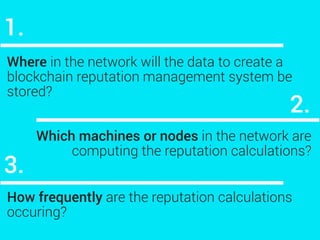
Where in the network will the data to create a
blockchain reputation management system be
stored?
How frequently are the reputation calculations
occuring?
Which machines or nodes in the network are
computing the reputation calculations?
1.
3.
2.
The numerous answers to these
questions constitute what’s called
blockchain reputation architecture.
WHERE TO STORE THE DATA?
One possible storage location is in the blockchain itself.
An advantages of this method is that it reduces
computation from a users’ software or machine and
instead the blockchain contains this data.
Another place that blockchain reputation management
data can potentially be stored is in a separate database,
this is called “persistent reputation off-chain”.
A third option is called “transient reputation”. This method
computes reputation calculations without separate
databases to integrate and with no data stored on the
original blockchain.
WHICH NODES CALCULATE
REPUTATION?
Travelchain, a decentralized data exchange for the travel
industry, plans to use the agencies off chain method to
process evaluations of travel services.
Another option is to have nodes running reputation
software within the network or blockchain (agencies
on-chain). This would require at least one node, but not all
nodes, to execute the same reputation code and would
require these nodes to be financially motivated to do so.
The last option is one where block-creating code contains
reputation calculations that all block-verifying nodes would
be required to compute (reputation mining on-chain). This
method touts the highest security and simplicity.
HOW FREQUENTLY IS
REPUTATION CALCULATED?
Reputation calculations are composed of complex
algorithmic code and it takes time, energy, and processing
power for computers to carry out this code. Any
redundancy or inefficiency that can be removed during the
design process improves blockchain system function.
One option is to recalculate someone’s reputation
whenever it’s been requested, this is called “complete
recalculation”.
A different solution would be to calculate reputation only
once for a set period of time, called “periodic
recalculation”.
Here at BitBay we store our reputation
data separate from our main blockchain,
the off-chain method of storage. This
design choice strengthens the network
as it prevents problems associated with
blockchain bloat like data-heavy
blockchain sizes and low transaction
speeds.
Storing reputation data independent of our
main blockchain benefits the network as a
whole because the reputation data doesn’t
slow down block verification thus
preserving the speed of BitBay
transactions.
A person’s reputation history is stored
on their machine locally and is visible
at the time they offer or enter a
contract
A reputation in BitBay’s system includes
the number of successful contracts, the
total number of contracts, and any
reviews users have left.
The beauty of our reputation system is that
it’s only part of how we discourage
cheating. Our Double Deposit Escrow
system (DDE) allows contract participants
to remove any profitability from cheating by
requiring both parties to submit a collateral
deposit which can be set to any amount.
Our Market Client’s steganography feature
opens the door to many different
possibilities. You can quickly and
discreetly send private information to
friends or colleagues, and this feature also
has the ability to extract and decrypt any
files that are sent to you.
DECENTRALIZED NETWORKS
TAKE DIFFERENT FORMS. SO
WILL REPUTATION
MANAGEMENT SYSTEMS.
Storing personal information within similar
decentralized network structures has benefits as
well. In developing areas where the cost of
getting credit is high, a person could be
financially liberated if their digital reputation was
used as substitute for a credit score or paystub.
Since decentralized networks are
increasingly recognized as a
powerful tool we are likely to witness
the development of both anonymous
reputation systems and centralized
digital ID systems containing
personal data.
The pro-decentralization community
might be averse to any comparison
with nations or other organizations,
but each day cryptocurrencies and
developing digital ID systems are
testing similar underlying network
technologies.
Click HERE to
get started
today.
Have any
questions?
Ask HERE
Blockchain Reputation Management

Blockchain Reputation Management

  • 1.
  • 2.
    JOIN THE CONVERSATION ONTWITTER @BITBAYOFFICIAL
  • 3.
    ABOUT BITBAY BitBay is asuite of free-to-use, multi-platform applications including the world’s first fully-functional Decentralized Marketplace.
  • 4.
    Want to see everythingour advanced client can do? VIEW ROADMAP
  • 5.
    Many people don’trealize there is enormous demand for legal forms of ID. This is especially true for people living in developing areas where access to identification is difficult or near impossible. By year 2030 the World Bank Group and its partners aim to provide everyone on Earth with a legal ID as part of its ID4D (Identification for Development) initiative
  • 6.
    This initiative isfueling the creation and implementation of digital ID systems primarily in areas where access to traditional ID is low, and blockchain technology is being examined as a network architecture for these systems.
  • 7.
    HOW SHOULD REPUTATIONSBE RECORDED AND MANAGED? To grasp the various possibilities of creating a blockchain reputation management system it can be helpful to think of three questions that are to be addressed in the design process:
  • 8.
    Where in thenetwork will the data to create a blockchain reputation management system be stored? How frequently are the reputation calculations occuring? Which machines or nodes in the network are computing the reputation calculations? 1. 3. 2.
  • 9.
    The numerous answersto these questions constitute what’s called blockchain reputation architecture.
  • 10.
    WHERE TO STORETHE DATA? One possible storage location is in the blockchain itself. An advantages of this method is that it reduces computation from a users’ software or machine and instead the blockchain contains this data. Another place that blockchain reputation management data can potentially be stored is in a separate database, this is called “persistent reputation off-chain”. A third option is called “transient reputation”. This method computes reputation calculations without separate databases to integrate and with no data stored on the original blockchain.
  • 11.
    WHICH NODES CALCULATE REPUTATION? Travelchain,a decentralized data exchange for the travel industry, plans to use the agencies off chain method to process evaluations of travel services. Another option is to have nodes running reputation software within the network or blockchain (agencies on-chain). This would require at least one node, but not all nodes, to execute the same reputation code and would require these nodes to be financially motivated to do so. The last option is one where block-creating code contains reputation calculations that all block-verifying nodes would be required to compute (reputation mining on-chain). This method touts the highest security and simplicity.
  • 12.
    HOW FREQUENTLY IS REPUTATIONCALCULATED? Reputation calculations are composed of complex algorithmic code and it takes time, energy, and processing power for computers to carry out this code. Any redundancy or inefficiency that can be removed during the design process improves blockchain system function. One option is to recalculate someone’s reputation whenever it’s been requested, this is called “complete recalculation”. A different solution would be to calculate reputation only once for a set period of time, called “periodic recalculation”.
  • 13.
    Here at BitBaywe store our reputation data separate from our main blockchain, the off-chain method of storage. This design choice strengthens the network as it prevents problems associated with blockchain bloat like data-heavy blockchain sizes and low transaction speeds.
  • 14.
    Storing reputation dataindependent of our main blockchain benefits the network as a whole because the reputation data doesn’t slow down block verification thus preserving the speed of BitBay transactions.
  • 15.
    A person’s reputationhistory is stored on their machine locally and is visible at the time they offer or enter a contract A reputation in BitBay’s system includes the number of successful contracts, the total number of contracts, and any reviews users have left.
  • 16.
    The beauty ofour reputation system is that it’s only part of how we discourage cheating. Our Double Deposit Escrow system (DDE) allows contract participants to remove any profitability from cheating by requiring both parties to submit a collateral deposit which can be set to any amount.
  • 17.
    Our Market Client’ssteganography feature opens the door to many different possibilities. You can quickly and discreetly send private information to friends or colleagues, and this feature also has the ability to extract and decrypt any files that are sent to you.
  • 18.
    DECENTRALIZED NETWORKS TAKE DIFFERENTFORMS. SO WILL REPUTATION MANAGEMENT SYSTEMS. Storing personal information within similar decentralized network structures has benefits as well. In developing areas where the cost of getting credit is high, a person could be financially liberated if their digital reputation was used as substitute for a credit score or paystub.
  • 19.
    Since decentralized networksare increasingly recognized as a powerful tool we are likely to witness the development of both anonymous reputation systems and centralized digital ID systems containing personal data.
  • 20.
    The pro-decentralization community mightbe averse to any comparison with nations or other organizations, but each day cryptocurrencies and developing digital ID systems are testing similar underlying network technologies.
  • 21.
    Click HERE to getstarted today. Have any questions? Ask HERE