Batten Animal Research NNeettwwoorrkk ((BBAARRNN)):: 
VVaarriiaanntt IInnffaannttiillee BBaatttteenn DDiisseeaassee 
 BARN is an international collaboration set up to coordinate studies of animal 
models of Batten disease. 
 We share resources, experiments and grants, exchange students, visit each 
other and plan together. 
WHAT THIS MEANS 
FOR THERAPY 
Increasing understanding of the 
normal function of NCL proteins will 
increase the likelihood of successful 
drug development. 
Gene therapy using AAV vectors for 
CLN5 and CLN6 sheep are in 
progress. Sheep were treated at 
2-3 months of age (Nov/Dec 2013). 
Analysis of disease progression using 
the biomarker tests we have 
developed is ongoing. 
BARN has shown the benefits of 
collaboration with increased 
research outputs, sharing of 
resources and funding, increased 
student opportunities and 
two-way information sharing with 
parent groups. 
People: Professor David Palmer, PhD students, 
Nadia Mitchell Janet Xu, Jarol Chen, Katharina 
Russell and our invaluable animal technicians. 
Focus: Disease mechanisms and developing 
therapies, gene injections, biomarkers, 
neuroinflammation, providing neural cell cultures 
Resources: CLN5 affected Borderdales and 
CLN6 affected South Hampshire sheep. 
david.palmer@lincoln.ac.nz 
People: Dr. Stephanie Hughes, PhD students 
Nicole Neverman and Hannah Best, Hollie Wicky, 
Dr. Lucia Schoderböck and Kristina McIntyre 
Focus: Gene therapy vectors for sheep gene 
therapy trials. Modelling pathology of Batten 
disease in neuronal cultures and the effectiveness 
of drug and gene therapies. Understanding how 
the disease-causing mutations affect the biology of 
neurons. 
Resources: Vector development and neural 
culture expertise 
stephanie.hughes@otago.ac.nz 
People: Associate Professor Imke Tammen, 
PhD student, Izmira Mohd Ismail, technical 
support, and Sydney U veterinary staff 
Focus: Molecular characterisation of animal 
models for NCLs, disease progression and 
behaviour studies of the affected Merino flock 
Resources: CLN6 affected Merino sheep 
and genetics laboratory 
imke.tammen@sydney.edu.au> 
Collaborators: Professor Sir John Walker, Mitochondrial Biology Unit, 
MRC, Cambridge, Professor Jenny Morton, Cambridge University and 
Professor Jon Cooper, Kings College, London; and their colleagues 
KEY RECENT RESEARCH 
Neuronal cultures from both CLN5 and CLN6 sheep 
models are showing us the very early stages of disease, 
and suggesting potential drug targets to halt these. 
These cells are being used to understand the normal 
function of CLN5 and CLN6 proteins and to rapidly 
screen drug and gene therapies. 
Measures of disease progression (biomarkers) such as 
behavioral and sight testing, CT and MRI scanning and 
inflammatory markers have been developed. 
These biomarkers are being used in our gene and drug 
therapy trials to access their effectiveness. 
The mutations in the two sheep CLN6 forms and the 
CLN5 form have been identified, and the effects of these 
mutations on protein function studied in neuronal culture 
and sheep tissues. 
Analysis of the neuroinflammatory cascade during 
disease development aim to identify new drug targets. 
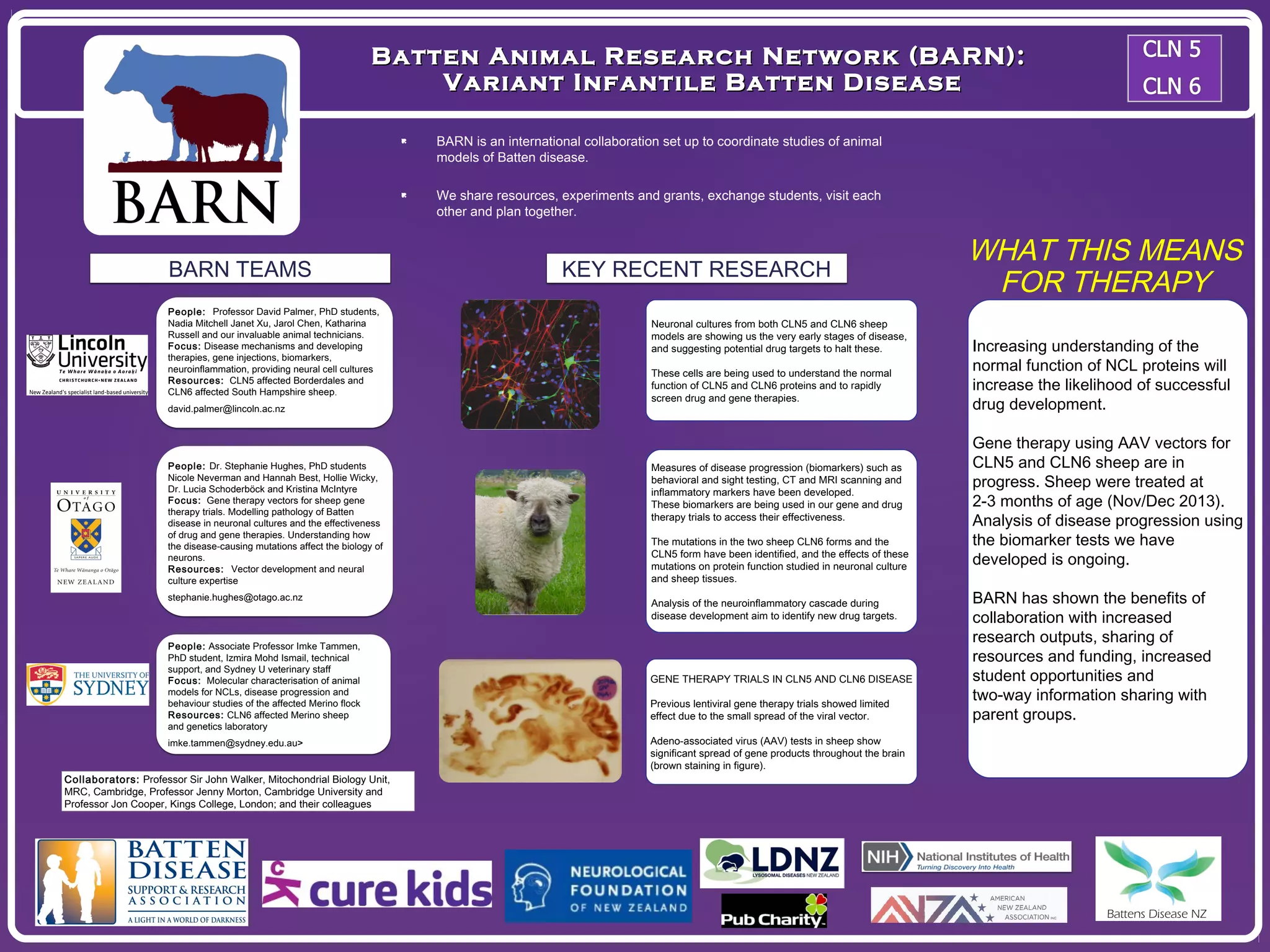
GENE THERAPY TRIALS IN CLN5 AND CLN6 DISEASE 
Previous lentiviral gene therapy trials showed limited 
effect due to the small spread of the viral vector. 
Adeno-associated virus (AAV) tests in sheep show 
significant spread of gene products throughout the brain 
(brown staining in figure). 
BARN TEAMS

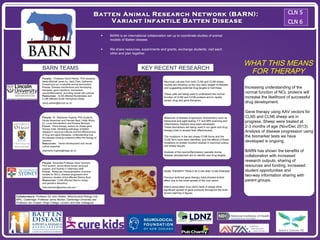
2014 BDSRA Palmer CLN 5 and CLN 6

  • 1.
    Batten Animal ResearchNNeettwwoorrkk ((BBAARRNN)):: VVaarriiaanntt IInnffaannttiillee BBaatttteenn DDiisseeaassee  BARN is an international collaboration set up to coordinate studies of animal models of Batten disease.  We share resources, experiments and grants, exchange students, visit each other and plan together. WHAT THIS MEANS FOR THERAPY Increasing understanding of the normal function of NCL proteins will increase the likelihood of successful drug development. Gene therapy using AAV vectors for CLN5 and CLN6 sheep are in progress. Sheep were treated at 2-3 months of age (Nov/Dec 2013). Analysis of disease progression using the biomarker tests we have developed is ongoing. BARN has shown the benefits of collaboration with increased research outputs, sharing of resources and funding, increased student opportunities and two-way information sharing with parent groups. People: Professor David Palmer, PhD students, Nadia Mitchell Janet Xu, Jarol Chen, Katharina Russell and our invaluable animal technicians. Focus: Disease mechanisms and developing therapies, gene injections, biomarkers, neuroinflammation, providing neural cell cultures Resources: CLN5 affected Borderdales and CLN6 affected South Hampshire sheep. david.palmer@lincoln.ac.nz People: Dr. Stephanie Hughes, PhD students Nicole Neverman and Hannah Best, Hollie Wicky, Dr. Lucia Schoderböck and Kristina McIntyre Focus: Gene therapy vectors for sheep gene therapy trials. Modelling pathology of Batten disease in neuronal cultures and the effectiveness of drug and gene therapies. Understanding how the disease-causing mutations affect the biology of neurons. Resources: Vector development and neural culture expertise stephanie.hughes@otago.ac.nz People: Associate Professor Imke Tammen, PhD student, Izmira Mohd Ismail, technical support, and Sydney U veterinary staff Focus: Molecular characterisation of animal models for NCLs, disease progression and behaviour studies of the affected Merino flock Resources: CLN6 affected Merino sheep and genetics laboratory imke.tammen@sydney.edu.au> Collaborators: Professor Sir John Walker, Mitochondrial Biology Unit, MRC, Cambridge, Professor Jenny Morton, Cambridge University and Professor Jon Cooper, Kings College, London; and their colleagues KEY RECENT RESEARCH Neuronal cultures from both CLN5 and CLN6 sheep models are showing us the very early stages of disease, and suggesting potential drug targets to halt these. These cells are being used to understand the normal function of CLN5 and CLN6 proteins and to rapidly screen drug and gene therapies. Measures of disease progression (biomarkers) such as behavioral and sight testing, CT and MRI scanning and inflammatory markers have been developed. These biomarkers are being used in our gene and drug therapy trials to access their effectiveness. The mutations in the two sheep CLN6 forms and the CLN5 form have been identified, and the effects of these mutations on protein function studied in neuronal culture and sheep tissues. Analysis of the neuroinflammatory cascade during disease development aim to identify new drug targets. GENE THERAPY TRIALS IN CLN5 AND CLN6 DISEASE Previous lentiviral gene therapy trials showed limited effect due to the small spread of the viral vector. Adeno-associated virus (AAV) tests in sheep show significant spread of gene products throughout the brain (brown staining in figure). BARN TEAMS