THE
SAINT VINCENT
  AND THE
 GRENADINES
CONSTITUTION
  ACT, 2009
 (Passed in the House of Assembly on the 3rd September, 2009)
Fourth Session of the Eighth Parliament of Saint Vincent and the
                          Grenadines
                        58 Elizabeth II

   BILL FOR AN ACT TO PROVIDE A NEW
   CONSTITUTION FOR SAINT VINCENT AND THE
                GRENADINES

 THE SAINT VINCENT AND THE GRENADINES
         CONSTITUTION ACT, 2009

                  ARRANGEMENT OF SECTIONS

   SECTION

   1.    Short title.
   2.    Interpretation.
   3.    Former Constitution repealed and the Constitution enacted.
         Schedule.
   4.    The appointed day. Schedule.
   5.    Exercise of powers of Parliament before the appointed day.
   6.    Existing laws.
   7.    Prerogative and privilege.
   8.    Continuation of legal proceedings.
   9.    Succession to property.
   10.   Rights, liabilities and obligations of Government.
   11.   Parliament.
   12.   Recalling Parliament.
   13.   Standing Orders.
   14.   The President.
   15.   The Prime Minister.
   16.   Ministers, Parliamentary Secretaries, Leader of the Opposition,
         etc.
   17.   The Cabinet.
   18.   Judges of the Supreme Court.

                                  1
19.   Public officers.
20.   Attorney-General.
21.   Oaths.
22.   Commissions.
23.   Validation of certain enactments.
24.   Prescribing matters.
25.   Constituencies and list of electors.
26.   The Supreme Court Order.
27.   The Appeals to Privy Council Order.
28.   Commonwealth citizen.
29.   The Constitution prevails.
30.   Alteration of Act.
31.   Act to be certified.


SCHEDULE:


 THE SAINT VINCENT AND THE GRENADINES
         CONSTITUTION, 2009.


                              2
BILL FOR AN ACT to enact a new Constitution for
            the Sovereign Democratic State of Saint Vincent and
            the Grenadines.

Preamble.   WHEREAS it is enacted in the 1979 Constitution of Saint Vincent and
            the Grenadines, Schedule 1 to The Saint Vincent Constitution Order
            1979(a), which may hereinafter be referred to as the former
            Constitution, by subsection (1) of section 38, that Parliament may alter
            any of the provisions of that Constitution or of the Supreme Court
            Order(b) ;

            AND WHEREAS it is enacted by subsection (2) of section 38 of the
            former Constitution that a bill for an Act of Parliament to alter any of
            the provisions of the former Constitution or of the Supreme Court
            Order shall not be regarded as being passed by the House of Assembly
            unless on its final reading the bill is supported by the votes of not less
            than two-thirds of all the Representatives;

            AND WHEREAS it is enacted by subsection (3) of section 38 of the
            former Constitution that a bill for an Act of Parliament to alter
            section 38 and certain other provisions of the former Constitution and
            certain provisions of the Supreme Court Order, all deeply entrenched
            provisions, shall not be submitted to the Governor-General for his
            assent unless-

                        (a)     there has been an interval of not less than ninety days
                                between the introduction of the bill in the House of
                                Assembly and the beginning of the proceedings in the
                                House on the second reading of the bill; and

                        (b)     after it has been passed by the House the bill has been
                                approved on a referendum by not less than two-thirds of
                                all the votes validly cast on that referendum;


            ________________________________________________________
            (a)                             (b)
                  S. I. 1979/ 916 [U.K.].         S. I. 1967/ 223 [U.K.].


                                                          3
AND WHEREAS it is intended by Parliament by this Act to alter the
               former Constitution, including the said deeply entrenched provisions
               thereof, and the Supreme Court Order in so far as it forms part of
               the law of Saint Vincent and the Grenadines:

Enactment.           NOW, THEREFORE, BE IT ENACTED by the Queen’s
                     Most Excellent Majesty, by and with the advice and consent of
                     the House of Assembly of Saint Vincent and the Grenadines,
                     and by the authority of the same, as follows:-

Short title.               1.   (1) This Act may be cited as the Saint Vincent
                     and the Grenadines Constitution Act, 2009.
                                 (2) This Act shall have effect for the
                     purpose of the alteration of the former Constitution, including
                     the deeply entrenched provisions thereof, and the Supreme
                     Court Order in so far as it forms part of the law of Saint
                     Vincent and the Grenadines.

Interpretation.            2.    In this Act, unless it is expressly otherwise stated
                     or the context otherwise requires -
                     “alter” has the same meaning as in section 38 of the former
                     Constitution;
                     “court” or “court of law” means any court of law established for
                     Saint Vincent and the Grenadines;
                     “existing law” means a law that has effect as part of the law of
                      Saint Vincent and the Grenadines immediately before the
                      appointed day;
                     “general election” means a general election of Representatives;
                     “law” has the same meaning as in section 4 of the Constitution;
                      “Parliament” means the Parliament established by section 66 of
                     the Constitution;
                     “public office” has the same meaning as in section 4 of the
                     Constitution;
                     “the appointed day” means the day appointed for the
                     commencement of the Constitution by Proclamation issued by

                                              4
the Governor-General, and published in the Official Gazette,
            in accordance with section 4 of this Act;
            “the Cabinet” means the Cabinet of Ministers of the
            Government established by section 112 of the Constitution;
             “the Commonwealth” has the same meaning as in section 4 of
            the Constitution;
Schedule.   “the Constitution” means the Saint Vincent and the Grenadines
            Constitution, 2009, set out in the Schedule to this Act, which
            provides, among other things, for a Republican form of
            government;
            “the former Assembly” means the House of Assembly
            constituted under the former Constitution;
            “the former Constitution” means the Constitution in force in
            Saint Vincent and the Grenadines immediately before the
            appointed day;
            “the former Parliament” means the Parliament which enacted
             this Act;
            “the Government” means the Government of Saint Vincent and
             the Grenadines;
            “the National Assembly” means the National Assembly
            established by section 67 of the Constitution;
            “the Order-in-Council of 1979” means the Saint Vincent
            Constitution Order 1979 (a);
            “the President” means the person holding or acting in the office
            of President established by section 49 of the Constitution as the
            Head of State of Saint Vincent and the Grenadines;
            “the Prime Minister” means the person holding or acting in the
            office of Prime Minister established by section 108 of the
            Constitution as the Head of Government of Saint Vincent and
            the Grenadines;
            __________________________________________________
            (a) S.I. 1979 / 916 [U.K.].


                                          5
“the State” means the State of Saint Vincent and the Grenadines
                         (which may also be referred to as the State of St. Vincent and
                         the Grenadines);

                         “the Supreme Court” means the Supreme Court established by
                         the Supreme Court Order;

                         “the Supreme Court Order” means the Order referred to in
                         section 26 of this Act.

Former Constitution              3.    Subject to this Act, on the appointed day all the
repealed and the
Constitution enacted.   provisions of the Order-in-Council of 1979 (in so far as they form
                        part of the law of Saint Vincent and the Grenadines) are revoked
                        and the former Constitution is repealed.           Thereupon, the
Schedule.               Constitution shall come into effect as the supreme law of Saint
                        Vincent and the Grenadines, subject to the transitional
                        provisions set out in sections 5 to 29 of this Act.

The appointed day.              4.   The Governor-General shall, by Proclamation
                        issued by him, and published in the Official Gazette, appoint a
Schedule.
                        day for the commencement of the Constitution, acting in
                        accordance with the advice of the Prime Minister; and that day
                        may be referred to as “the appointed day”.

Exercise of powers of            5.   At any time after the commencement of this Act
Parliament before the
appointed day.          the former Parliament may, for the purpose of enabling the
                        Constitution to function as from the appointed day, exercise any
                        of the powers conferred on the Parliament established by the
                        Constitution, until the first Parliament under the Constitution is
                        elected.

Existing laws.                  6.      (1) Subject to the provisions of this section, the
                        existing laws shall continue in force on and after the appointed
                        day as if they had been made pursuant to the Constitution, but
                        shall be construed with such modifications, adaptations,
                        qualifications, exceptions and other such alterations as may be
                        necessary to bring them into conformity with this Act, the
                        Supreme Court Order and the Constitution.


                                                  6
(2) The President may, by Order, published in
the Official Gazette, made at any time within the period of three
years next after the appointed day, make such modifications to
any existing law as may appear to him to be necessary or
expedient for bringing that law into conformity with the
provisions of this Act, the Supreme Court Order and the
Constitution, or otherwise for giving effect to or enabling effect
to be given to those provisions.

                (3) Anything done under any existing law
before its modification by or under this section which would, but
for this section, cease to have effect, shall continue to have effect
as if done under that law as so modified.

               (4) Subsection (2) of this section shall be
without prejudice to any powers conferred by this Act or any
other law upon any person or authority to make provision for any
matter, including the modification of any existing law.

               (5) For the purposes of this section, the
expression “existing law” means any Act, Ordinance, rule,
regulation, order or other instrument made pursuant to or
continued in force by or under the former Constitution, and
having effect as a law immediately before the appointed day.

               (6) In this section, “modification” includes
adaptation, qualification, exception and other such alteration
as is authorised by subsections (1) and (2) of this section.

              (7) Without prejudice to the generality of
subsections (1) to (6) of this section, and subject to any Order
made under subsection (2), in any public document or in any
existing law which continues in force after the appointed day, in
relation to any time or any period commencing on or after the
appointed day, unless the context otherwise requires-

                     (a)        any reference to Her Majesty the
                                Queen or to the Crown in respect of
                                Saint Vincent and the Grenadines,


                            7
shall be read and construed as if it
                                                   were a reference to the State;

                                         (b)    any reference to the Governor-
                                                General     shall    be    read    and
                                                construed as if it were a reference to
                                                the President;

                                         (c)    any reference to Crown land or other
                                                Crown property shall be read and
                                                construed as if it were a reference to
                                                land or other property of the State;

                                         (d)     any reference to Her Majesty’s
                                                dominions shall be read and
                                                construed as if it were a reference to
                                                the Commonwealth.

     Prerogative             7.    (1) Where under any existing law any
     and privilege.
                      prerogative or privilege is vested in Her Majesty the Queen or
                      in the Crown in respect of Saint Vincent and the Grenadines,
                      that prerogative or privilege shall, on the appointed day, vest in
                      the State and, subject to the Constitution and any other law, the
                      President shall from that day have power to do all things
                      necessary for the exercise thereof.

                                   (2) Where under any existing law any rights,
                      powers, privileges, duties or functions are vested in or imposed
                      on the Governor-General, those rights, powers, privileges,
                      duties and functions shall, on the appointed day, vest in, and
                      from that day be exercisable by, the President.

Continuation of
legal proceedings.          8.    (1) This section applies to actions, suits or
                      other legal proceedings which are pending immediately
                      before the appointed day before any court of law including
                      the Supreme Court established by the Supreme Court
                      Order, or before any tribunal or other body or authority, in
                      respect of which a corresponding court of law, including the
                      Supreme Court established by the Supreme Court Order,

                                               8
or tribunal or any other body or authority is established by
                          or under the Constitution. Such actions, suits and other
                          legal proceedings may, subject to subsections (2), (3) and (4)
                          of this section, on or after the appointed day, be continued
                          and completed by or before such corresponding court of
                          law, or tribunal or other body or authority as if they had
                          been commenced in or before such corresponding court of
                          law, or tribunal or other body or authority.

                                        (2) This subsection refers to proceedings
                          before any court of law or tribunal where the hearing was
                          partly completed immediately before the appointed day (in
                          this subsection referred to as “the original hearing”). No
                          person shall take part in the continued hearing, either as the sole
                          or other member, as the case may be, of the corresponding court
                          of law or tribunal, referred to in subsection (1) of this section,
                          unless he also likewise took part in the original hearing. Where
                          the original hearing cannot be so continued, the hearing shall be
                          recommenced.

                                       (3) Any criminal proceedings pending in any
                          court immediately before the appointed day, in which Her
                          Majesty the Queen is a party in respect of Saint Vincent and the
                          Grenadines, may be continued on or after that day with the
                          substitution of the State in place of Her Majesty as a party.

                                       (4) Any action, suit or other proceedings
                          pending in any court immediately before the appointed day, in
                          which the Governor-General is a party, may be continued on or
                          after that day with the substitution of the President in place of
                          the Governor-General as a party.


Succession to property.          9.   (1) All property which, immediately before the
                          appointed day, is vested in Her Majesty the Queen or the
                          Governor-General for the purposes of the Government of Saint
                          Vincent and the Grenadines shall, on the appointed day, vest in
                          the State.


                                                    9
(2) Any property which, immediately before the
                        appointed day, is liable to escheat or to be forfeited to Her
                        Majesty the Queen for the purposes of the Government of Saint
                        Vincent and the Grenadines shall, as from the appointed day, be
                        liable to escheat or to be forfeited to the State.

                                      (3) Where, immediately before the appointed
                        day, any person holds any property in trust for Her Majesty the
                        Queen or for the Governor-General for the purposes of the
                        Government of Saint Vincent and the Grenadines, that person
                        shall, as from the appointed day, hold such property on the like
                        trust for the State.

Rights, liabilities          10.      (1) All rights, liabilities and obligations of Her
and obligations of
Government.             Majesty the Queen in respect of the Government of Saint
                        Vincent and the Grenadines shall, as from the appointed day,
                        be rights, liabilities and obligations of the State.

                                      (2) All rights, liabilities and obligations of the
                        Governor-General or the holder of any other office under the
                        Crown in respect of the Government of Saint Vincent and the
                        Grenadines shall, as from the appointed day, be rights,
                        liabilities and obligations of the President or of the holder of
                        that other office, as the case may be, on behalf of the State.
                                     (3) In this section, rights, liabilities and
                        obligations include rights, liabilities and obligations arising
                        from contract or otherwise, other than rights mentioned in
                        sections 7 and 9 of this Act.

          Parliament.         11. (1)     With effect from the period beginning
                        with the appointed day and ending on the day on which the
                        National Assembly sits for the first time after the first
                        general election held pursuant to section 93 of the
                        Constitution, the former Assembly shall be deemed to be
                        the National Assembly (referred to in this section in respect
                        of that period as “the transitional National Assembly”).
                        This shall be so despite any difference between the
                        composition of the former Assembly and that of the

                                                10
National Assembly, but subject to subsection (8) of this
section.

            (2) Without prejudice to the generality of
 subsection (1) of this section, the persons who, immediately
 before the appointed day are elected members of the former
 Assembly, that is, the Representatives under the former
 Constitution, shall, as from the appointed day, be deemed to
 have been elected as Representatives pursuant to section 99 of
 the Constitution, until the first election referred to in
 subsection (1) of this section is held.

             (3) Without prejudice to the generality of
 subsection (1) of this section, the persons who immediately
 before the appointed day are appointed members of the former
 Assembly, that is, the Senators under the former Constitution,
 shall, as from the appointed day, be deemed to have been
 elected as Senators pursuant to section 100 of the Constitution,
 until the first election referred to in subsection (1) of this
 section is held.

            (4) In relation to any period before the
 appointed day, references in the Constitution to
 Representatives shall be construed as references to elected
 members of the former Assembly under the former
 Constitution, which elected members were also referred to as
 Representatives in the former Constitution.

            (5) Without prejudice to the generality of
 subsection (1) of this section, and subject to subsections (2)
 and (3) of this section, all questions concerning membership,
 formation of a quorum, voting, motions of no confidence
 in the government and the functioning of the transitional
 National Assembly shall be regulated as nearly as may be
 practicable by the existing law applicable in the like case to
 the former Assembly.

          (6) All matters pending before the former
 Assembly immediately before the appointed day may be


                        11
continued and completed or otherwise disposed of by the
              transitional National Assembly.

                         (7) Unless and until the transitional National
              Assembly otherwise resolves, any person who is a member
              thereof by virtue of subsections (2) and (3) of this section
              shall be deemed to have made and subscribed before the
              Assembly the oaths referred to in section 79 of the
              Constitution.

                         (8) Unless sooner dissolved by the President
              pursuant to section 92 of the Constitution, the Parliament
              constituted by the President and the transitional National
              Assembly shall stand dissolved five years from the first sitting
              of the former Assembly after the last dissolution of Parliament
              under the former Constitution.

                          (9) Subject to the other provisions of this
              section, the first general election pursuant to section 93 of
              the Constitution shall be held on such day as the President
              may by proclamation appoint, acting in accordance with the
              advice of the Prime Minister.

                         (10)    All monies granted, voted or appropriated
              by the former Parliament in respect of the services of Saint
              Vincent and the Grenadines for the current financial year shall
              be deemed to have been granted, voted or appropriated by the
              Parliament established by section 66 of the Constitution and
              in accordance with the Constitution.
Recalling
Parliament.        12. (1) Where it is necessary under subsection (2)
              of section 93 of the Constitution for Parliament, having been
              dissolved, to be summoned before the next ensuing general
              election is held after the appointed day, the former Assembly
              shall be deemed to be the National Assembly under the
              Constitution for all the purposes of that subsection. The
              former Assembly so summoned may thus proceed to deal with
              any business before the National Assembly notwithstanding
              any difference between the composition of the former


                                     12
Assembly under the former Constitution and that of the
                   National Assembly under the Constitution.

                               (2) Where, in the opinion of the Prime Minister,
                   it is necessary or expedient to recall Parliament in order to
                   make amendments to the Constitution between the appointed
                   day and the next ensuing general election, the President,
                   acting in accordance with the advice of the Prime Minister,
                   may recall the former Assembly for the purpose, and
                   subsection (1) of this section shall apply accordingly.

                              (3) A reference in the Constitution to a
                   dissolution of Parliament shall be deemed to include a
                   reference to the dissolution of the last Parliament under the
                   former Constitution.

Standing Orders.        13. Until it is otherwise provided by the National
                   Assembly under subsection (1) of section 86 of the
                   Constitution, the Standing Orders of the former Assembly
                   made under the former Constitution, as are in force
                   immediately before the appointed day, shall be the Standing
                   Orders of the National Assembly under the Constitution.
                   Such Standing Orders shall be construed with such
                   modifications, adaptations, qualifications, exceptions and
                   other such alterations as may be necessary to bring them into
                   conformity with the Constitution.


The President.           14. The person who immediately before the appointed
                   day holds the office of Governor-General under the former
                   Constitution shall, subject to subsection (1) of section 64 of
                   the Constitution (relating to the taking of the oaths by the
                   President), assume office as President of Saint Vincent and
                   the Grenadines as from the appointed day. He shall so assume
                   that office as if he had been elected thereto pursuant to section
                   54 of the Constitution and shall, subject to the Constitution,
                   continue in office, until the person elected President in the
                   first Presidential election held for the purposes of section 54
                   of the Constitution assumes office.


                                          13
The Prime Minister.        15. (1) The person who immediately before the
                      appointed day holds the office of Prime Minister under the
                      former Constitution shall, as from that day, hold the office of
                      Prime Minister as if he had been appointed thereto under
                      section 109 of the Constitution, until a person is appointed as
                      Prime Minister thereunder.

                                  (2) Where the person who is Prime Minister
                      under subsection (1) of this section is for any reason unable to
                      act, or where the office of Prime Minister is vacant, the
                      President, acting on the advice of the Prime Minister, if the
                      Prime Minister is able so to advise, shall appoint a person who
                      is a Minister under section 16 of this Act to perform the
                      functions of Prime Minister. That person shall so act until
                      such time as the substantive Prime Minister is again able to
                      perform his functions as Prime Minister, or until the next
                      general election after the appointed day is held, whichever
                      first occurs.


Ministers,                  16. (1) A person who, immediately before the
Parliamentary
Secretaries, Leader   appointed day, holds office as Minister (other than as Prime
of the Opposition,
etc.
                      Minister), Parliamentary Secretary, Leader of the Opposition,
                      Speaker or Deputy Speaker under the former Constitution
                      shall, as from that day, be deemed to have been elected or
                      appointed respectively to the corresponding office established
                      by the Constitution. He shall hold such corresponding office,
                      as if he had been appointed or elected thereto, as the case may
                      be, in accordance with the provisions of the Constitution,
                      until after the first general election is held pursuant to section
                      93 of the Constitution, unless sooner changed in accordance
                      with the provisions of the Constitution. The corresponding
                      office of Leader of the Opposition shall be that of Minority
                      Leader.

                                 (2) Any person holding the office of Prime
                      Minister or other Minister by virtue of section 15 of this Act
                      or of subsection (1) of this section respectively who,
                      immediately before the appointed day, was assigned
                      responsibility under the former Constitution for any business

                                              14
or matter of the Government, including the administration of
                    any department of Government, shall, as from that day, be
                    deemed to have been assigned responsibility therefor under
                    section 114 of the Constitution. This shall be so until after
                    the first general election is held under the Constitution unless
                    such responsibility is sooner re-assigned.

The Cabinet.             17. Subject to section 114 of the Constitution, every
                    person who does not otherwise become a member of the
                    Cabinet established by the Constitution but who immediately
                    before the appointed day is a member of the Cabinet under the
                    former Constitution shall, as from that day, be a member of
                    the Cabinet established by the Constitution as if he had been
                    appointed thereto under that subsection.

Judges of the            18. The salaries and allowances and other terms and
Supreme Court.
                    conditions of service of the Judges of the Supreme Court, in
                    so far as these form part of the law of Saint Vincent and the
                    Grenadines, shall continue to be the same after the appointed
                    day as they are immediately before the appointed day. The
                    provisions of the Supreme Court Order shall apply.

 Public officers.
                         19. (1) Subject to the provisions of this Act, every
                    person who, immediately before the appointed day, holds or is
                    acting in a public office under the former Constitution shall,
                    as from that day, continue to hold or act in that office or the
                    corresponding office established by the Constitution, as the
                    case may be, as if he had been appointed thereto in
                    accordance with the provisions of the Constitution.

                               (2) Without prejudice to its generality,
                    subsection (1) of this section shall apply in relation to the
                    offices of Attorney-General, Director of Public Prosecutions,
                    Director of Audit, Clerk and Deputy Clerk of the former
                    Assembly and any office to which section 83 of the former
                    Constitution applied. The corresponding office of Director of
                    Audit shall be the office of Auditor General.

                              (3) Without prejudice to its generality,
                    subsection (1) of this section shall apply in relation to the
                                           15
offices in the Police Service, Prison Service and Teaching
                    Service referred to in the Constitution.

                               (4)    Without prejudice to its generality,
                    subsection (1) of this section shall apply in relation to the
                    offices of Chairman, Deputy Chairman (if any) and other
                    members of the Public Service Commission, the Police
                    Service Commission, the Public Service Board of Appeal and
                    the Constituency Boundaries Commission as if those offices
                    were public offices. The corresponding offices of members of
                    the Constituency Boundaries Commission shall be the offices
                    of members of the Electoral and Boundaries Commission.
                    The corresponding offices of members of the Police Service
                    Commission shall be the offices of members of the Police and
                    Prison Services Commission.

                                (5) A person who under the former Constitution
                    or any other existing law would have been required to vacate
                    his office at the expiration of any period shall vacate his office
                    at the expiration of that period.


Attorney-General.        20. Until Parliament or, subject to the provisions of
                    any law enacted by Parliament, the President acting in
                    accordance with the advice of the Prime Minister, otherwise
                    provides, the office of Attorney-General shall be that of a
                    public office.


Oaths.                   21. (1) Subject to subsection (2) of this section, any
                    person who holds or acts in any office to which this section
                    applies, as from the appointed day, by virtue of holding or
                    acting in such office immediately before that day, shall be
                    deemed to have complied with the requirements of the
                    Constitution or any other law in force in Saint Vincent and the
                    Grenadines relating to the taking of oaths with respect to that
                    office.


                                            16
(2) The President may, at any time on or after
               the appointed day, require any person referred to in subsection
               (1) of this section to take any oath required as aforesaid.

                          (3) Until such time as the oath of allegiance, the
               oath of secrecy or, in relation to any office, the oath of office
               is prescribed by law, that oath may be taken in the form
               prescribed immediately before the appointed day but with
               such modifications, adaptations, qualifications, exceptions and
               other such alterations as may be necessary to bring it into
               conformity with this Act, the Supreme Court Order and the
               Constitution.

                          (4) This section applies to all offices to which
               sections 15, 16, 17, 18 and 19 of this Act apply.

Commissions.        22. (1) Any power of a Commission established by
               the former Constitution (in this section referred to as “an
               existing Commission”) which has been validly delegated to
               any person or authority shall, to the extent that such power
               could be delegated under the Constitution to such person or
               authority, be deemed as from the appointed day to have been
               delegated to that person or authority in accordance with the
               provisions of the Constitution.

                           (2) Subject to subsection (3) of this section, any
               matter which immediately before the appointed day is pending
               before an existing Commission or, as the case may be, before
               any person or authority to whom power to deal with such
               matters has been delegated under the former Constitution
               shall, as from the appointed day, be continued before the
               corresponding Commission established by the Constitution or,
               as the case may be, the said person or authority where such
               delegation has been continued under subsection (1) of this
               section.

                          (3) Where an existing Commission or, as the
               case may be, any person or authority acting as its delegates as
               aforesaid has, immediately before the appointed day, partly
               completed the hearing of a disciplinary proceeding (in this
                                      17
section referred to as “the original hearing”) no person shall
                 take part in the continued hearing to determine the hearing
                 unless he also likewise took part in the original hearing.
                 Where the original hearing cannot be so continued, the
                 hearing of the disciplinary proceeding shall be recommenced.

Validation of         23. All enactments passed by any Parliament, or
certain
enactments.      subordinate legislation made by any person or authority,
                 under or by virtue of the former Constitution and not before
                 the appointed day declared by a competent court to be void by
                 reason of any inconsistency with any provision of the former
                 Constitution, including in particular Chapter 1 thereof, and not
                 repealed, lapsed, spent or otherwise had their effect ended,
                 shall be deemed to have been validly passed or made and to
                 have had full force and effect as law immediately before the
                 appointed day. This shall be so even if any such enactment or
                 subordinate legislation might be thought to be inconsistent
                 with any provision of the former Constitution, including in
                 particular Chapter 1 thereof.

Prescribing           24. Where any matter that falls to be prescribed or
matters.
                 otherwise provided for under any provision of the
                 Constitution by Parliament or by any other person or authority
                 is prescribed or provided for by or under any existing law
                 made under a corresponding provision of the former
                 Constitution, including any modification to any existing law
                 made under section 6 of this Act, that prescription or
                 provision shall, as from the appointed day, have effect. Such
                 prescription or provision shall so have effect with such
                 modifications, adaptations, qualifications, exceptions or other
                 such alterations as may be necessary to bring it into
                 conformity with this Act, the Supreme Court Order and the
                 Constitution as if it had been made under the Constitution by
                 Parliament or, as the case may be, by the other person or
                 authority, until some other such prescription or provision may
                 be made.

Constituencies       25. (1) Until their number or boundaries are altered
and list of
electors.        pursuant to section 96 of the Constitution, the number and
                 boundaries of the constituencies shall, for the purposes of the

                                        18
election of Representatives and Senators, be the same as those
                         of the constituencies into which Saint Vincent and the
                         Grenadines is divided immediately before the appointed day
                         for the purpose of the election of elected Representatives of
                         the former Assembly under the former Constitution. The
                         number and boundaries of these Constituencies shall be
                         deemed to have been established under that section.

                                    (2) For the purposes of section 96 of the
                         Constitution, the list of electors last prepared before the
                         appointed day for the purpose of electing Representatives to
                         the former Assembly shall, subject to any further revision in
                         accordance with law, be deemed to be the list of electors
                         prepared by the Electoral and Boundaries Commission under
                         section 96 of this Constitution.

The Supreme                   26. The West Indies Associated States Supreme Court
Court Order.
                         Order 1967(a), in so far as it forms part of the law of Saint
                         Vincent and the Grenadines, may be cited as the Supreme
                         Court Order. For the purposes of that Order or any other law,
                         the Supreme Court established by that Order shall, unless
                         Parliament otherwise provides, be styled the Eastern
                         Caribbean Supreme Court.

The Appeals                   27. The West Indies Associated States (Appeals to
to Privy
Council                  Privy Council) Order 1967 (b) may, in so far as it forms part
Order.
                         of the law of Saint Vincent and the Grenadines, be cited as
                         the Saint Vincent and the Grenadines Appeals to Privy
                         Council Order.

Commonwealth
citizen.
                              28. The expression “Commonwealth citizen” means a
                         citizen of any of the countries designated as Commonwealth
                         countries by or under any Act of Parliament so
                         prescribing.


               _______________________________________________
               (a)                            (b)
                     S.I. 1967/ 223 [U.K.].         S.I. 1967/ 224 [U.K.].


                                                           19
The
    Constitution
    prevails.
                        29. Persons holding or acting in offices immediately
                   before the appointed day who by virtue of provisions of this
                   Act continue to hold or act in such offices after the appointed
                   day, whether until a specified date or otherwise, shall do so in
                   accordance with provisions of the Constitution unless this Act
                   specifically provides otherwise, as the Constitution prevails.

   Alteration
   of Act.
                        30. (1) Subject to subsections (2) and (3) of this
                   section, Parliament may alter section 3 of this Act and this
                   section in the same manner as it may alter any of the
                   provisions specified in subsection (3) of section 74 of the
                   Constitution.
   Schedule.                   (2) Parliament may alter the provisions of the
                   Schedule to this Act, being the Constitution, in the manner
                   stipulated by section 74 of the Constitution for the alteration
                   of any such particular provision.

                               (3) Parliament may alter any provision of this
                   Act other than those specified in subsections (1) and (2) of
                   this section in the same manner as it may alter any of the
                   provisions referred to in subsection (2) of section 74 of the
                   Constitution.

Act to be
certified.
                         31. (1) The Speaker of the former Assembly shall,
                   in writing under his hand, certify whether this Act is one the
                   bill for which has been passed by the former Assembly, and
                   on its final reading the bill has been supported by the votes
                   of not less than two-thirds of all the Representatives, after an
                   interval of not less than ninety days between the introduction
                   of the bill in the former Assembly and the beginning of the
                   proceedings in the former Assembly on the second reading
                   of the bill as provided for in subsection (2) and paragraph
                   (a) of subsection (3) of section 38 of the former Constitution.
                              (2) The certificate of the Speaker of the former
                   Assembly under subsection (1) of this section duly signed and
                   authenticated by him shall be conclusive of the matters so
                   certified by him, as provided for by paragraph (b) of
                   subsection (8) of section 38 of the former Constitution.

                                          20
(3) The Supervisor of Elections shall, under his
    hand, certify whether this Act is one the bill for which, after
    having been passed by the former Assembly, has been
    submitted to a referendum, and if so, whether on the said
    referendum the bill was approved by not less than two-thirds
    of all the votes validly cast on that referendum, as provided
    for by paragraph (b) of subsection (3) and paragraph (a) of
    subsection (8) of section 38 of the former Constitution.


                        SCHEDULE:


THE SAINT VINCENT AND THE GRENADINES
          CONSTITUTION, 2009


                           21
THE
   SAINT VINCENT
      AND THE
    GRENADINES
   CONSTITUTION,
        2009

(Schedule to the Saint Vincent and the Grenadines
Constitution Act, 2009, passed in the House of
Assembly of Saint Vincent and the Grenadines on 3 rd
September, 2009)
THE SAINT VINCENT AND THE GRENADINES

                               CONSTITUTION, 2009.
                            ARRANGEMENT OF SECTIONS


                                      CHAPTER 1

                     THE STATE AND THE CONSTITUTION

Section
1.    Sovereign Democratic State.
2.    Multi-Island State.
3.    The Constitution is the supreme law. First Schedule.
4.    Interpretation.


                                      CHAPTER II

                   GUIDING PRINCIPLES OF STATE POLICY

5.    The people are sovereign.
6.    Right to be active in political parties.
7.    Paramount constitutional doctrines.
8.    Economic development and social justice.
9.    Legal aid.
10.   Right to work.
11.   Right to health.
12.   More humane society.
13.   Equal treatment.
14.   The environment.
15.   National heritage.
16.   Freedom of culture.
17.   The family and marriage.
18.   The elderly and disabled.
19.   Young persons to be honoured.
20.   Youth rights.
21.   Equality for women and men.
22.   Protection of children; and equality for children born out of wedlock.
23.   Adherence to regionalism and international law.
24.   Guiding Principles.

                                             i
CHAPTER III

       PROTECTION OF FUNDAMENTAL RIGHTS AND FREEDOMS

25.   Fundamental rights and freedoms.
26.   Protection of right to life.
27.   Protection of right to personal liberty.
28.   Protection from slavery and forced labour.
29.   Protection from inhuman treatment.
30.   Protection from deprivation of property.
31.   Protection from arbitrary search or entry.
32.   Provisions to secure the protection of the law.
33.   Protection of freedom of conscience.
34.   Protection of freedom of expression.
35.   Protection of freedom of assembly and association.
36.   Protection of freedom of movement.
37.   Protection from discrimination on the grounds of race, etc.
38.   Age of civil legal responsibility.
39.   Derogations from s.27 or s.37 under emergency powers.
40.   Protection of persons detained under emergency laws.
41.   Enforcement of protective provisions.
42.   Declaration of emergency.
43.   Interpretation and savings.


                                      CHAPTER IV

                       THE HUMAN RIGHTS COMMISSION

44.   Establishment of Human Rights Commission.
45.   Composition.
46.   Functions.
47.   Recommendations and representations.
48.   Not subject to direction or control.

                                       CHAPTER V

                                    THE PRESIDENT

49.   Establishment of office of President as Head of State.
50.   President to be elected.
51.   Qualifications and disqualifications.
52.   Other conditions of office.
53.   Date for election.
                                               ii
54.   Election of President.
55.   Procedure at election.
56.   Nomination of candidates.
57.   Tied vote.
58.   Determining questions as to elections.
59.   Acting President.
60.   Terms of office.
61.   Vacating office.
62.   Grounds for removal from office.
63.   Procedure for removal from office.
64.   Oaths. Second Schedule.
65.   Immunities of President.


                                      CHAPTER VI

                                     PARLIAMENT
                                               Part 1
                                 Composition of Parliament

66.   Establishment and composition of Parliament.
67.   Establishment and composition of National Assembly.
68.   Qualifications.
69.   Disqualifications.
70.   Tenure.
71.   Establishment, etc., of office of Speaker.
72.   Establishment, etc., of office of Deputy Speaker.

                                               Part 2
                                    Powers of Parliament

73.   Power to make laws.
74.   Alteration of Constitution and Supreme Court Order. First Schedule.

                                               Part 3
                          Privileges and Immunities of Parliament

75.   Freedom of speech.
76.   Immunities for words spoken or written.
77.   Parliament may prescribe.
78.   Civil society invitees to National Assembly.


                                                 iii
Part 4
                                   Procedures in Parliament

79.   Oaths. Second Schedule.
80.   Presiding.
81.   Voting.
82.   Penalty for sitting if unqualified.
83.   Mode of making law.
84.   Restrictions as to financial measures.
85.   Public Accounts Committee.
86.   Procedure.


                                               Part 5
                       Representatives to report to National Assembly

87.   Representatives to report.
88.   Procedure for reporting.

                                           Part 6
                             Cooperation for better Governance

89.   Cooperation for better Governance.


                                               Part 7
                              Secretariat of National Assembly

90.   Establishment of Secretariat.


                                               Part 8
                  Summoning, Prorogation and Dissolution of Parliament

91.   Session.
92.   Prorogation and dissolution.
93.   Timing of general election.


                                               Part 9
                           Electoral and Boundaries Commission

94.   Establishment, etc., of Electoral and Boundaries Commission. Second Schedule.
                                                 iv
95.    Appointment of Chairman.
96.    Constituencies.


                                               Part 10
                           Election of Representatives and Senators


97.    Registration and entitlement to vote.
98.    Party List.
99.    Election of Representatives.
100.   Election of Senators.


                                               Part 11

                          Determination of Questions of Membership

101.   Determining questions of membership of Parliament.


                                       CHAPTER VII

                                     THE EXECUTIVE

                                               Part 1
                             The Formal Executive: The President

102.   The Executive Authority.
103.   Functions of President.
104.   Exercise of President’s functions.
105.   Constitution of offices, etc.
106.   Prerogative of Mercy.
107.   When court may not enquire.

                                               Part 2
                             The Effective Executive: The Cabinet

108.   Establishment of office of Prime Minister as Head of Government.
109.   Appointment of Prime Minister.
110.   Functions of Prime Minister.
111.   Establishment of offices of Minister other than Prime Minister, and their
       appointments.

                                                 v
112.   The Cabinet.
113.   Functions of the Cabinet.
114.   Allocation of portfolios.
115.   Performance of functions of Prime Minister and other Ministers during absence,
       illness or other unavailability.
116.   Appointments during dissolution.
117.   Functions of Attorney-General.
118.   Tenure.
119.   Secretary to the Cabinet.


                                             Part 3
                                  Parliamentary Secretaries


120.   Establishment, etc., of offices of Parliamentary Secretary.
                                             Part 4

                                            General
121.   Oaths. Second Schedule.
122.   Direction and supervision of departments.
123.   Interpretation.


                                      CHAPTER VIII
                               THE MINORITY LEADER

124.   Establishment of office of Minority Leader.
125.   Appointment.
126.   Functions.
127.   Tenure.
128.   Revocation of appointment.
129.   Provisions as to advice and consultation.


                                       CHAPTER IX
                      THE PARLIAMENTARY COMMISSION
130.   Establishment of Parliamentary Commission.
131.   Composition.
132.   Disqualifications.
133.   Functions.
                                               vi
134.   The Commission advising on the Prerogative of Mercy.
135.   Tenure.
136.   Procedure.
137.   Oaths. Second Schedule.
138.   Not subject to direction or control.

                                       CHAPTER X
                           THE INTEGRITY COMMISSION

139.   Establishment, etc., of Integrity Commission. Second Schedule.
140.   Not subject to direction or control.


                                       CHAPTER XI
                                   THE OMBUDSMAN
141.   Establishment of Ombudsman.
142.   Appointment.
143.   Functions.
144.   Oaths. Second Schedule.
145.   Acting appointment.
146.   Tribunal procedure for removal and suspension.
147.   Not subject to direction or control.


                                      CHAPTER XII
                                LOCAL GOVERNMENT

148.   Local government to be prescribed.
149.   General principles.
150.   Special provisions for the Grenadines.

                                      CHAPTER XIII
                                         FINANCE

151.   Consolidated Fund.
152.   Withdrawals from Consolidated Fund or other public funds.
153.   Authorisation of expenditure from Consolidated Fund by appropriation law.
154.   Authorisation of expenditure in advance of appropriation.
155.   Contingencies Fund.
156.   Remuneration of certain officers.
157.   Public debt.
                                                vii
158.   Functions of Public Accounts Committee.


                                       CHAPTER XIV
                                  THE PUBLIC SERVICE

                                              Part 1
                                The Public Service Commission

159.   Establishment of Public Service Commission.
160.   Composition.
161.   Disqualifications.
162.   Ineligibility.
163.   Tenure.
164.   Tribunal procedure for removal and suspension.
165.   Acting Chairman, acting member.
166.   Oaths. Second Schedule.
167.   Procedure.
168.   Not subject to direction or control.

                                              Part 2
                      Appointments, etc., to offices in the Public Service

169.   Appointments, etc., to public offices in general.
170.   Delegation.
171.   Exceptions.
172.   Concurrence and consultation.

                                              Part 3
                 Appointments, etc., to particular offices in the Public Service

173.   Appointments, etc., of permanent secretaries and certain other officers.
174.   Appointments, etc., of registrars and legal officers.


                                              Part 4
                          The Police and Prison Services Commission

175.   Establishment of Police and Prison Services Commission.
176.   Composition.

                                                viii
177.   Disqualifications.
178.   Tenure.
179.   Tribunal procedure for removal and suspension.
180.   Oaths. Second Schedule.
181.   Procedure.
182.   Not subject to direction or control.


                                            Part 5
          Appointments, etc., to offices in the Police Service and the Prison Service


183.   Appointments, etc., of police officers.
184.   Appointments, etc., of prison officers.


                                            Part 6
                             The Teaching Service Commission

185.   Establishment of Teaching Service Commission.
186.   Composition.
187.   Disqualifications.
188.   Tenure.
189.   Tribunal procedure for removal and suspension.
190.   Acting Chairman, acting member.
191.   Oaths. Second Schedule.
192.   Procedure.
193.   Not subject to direction or control.


                                            Part 7
                               Appointments, etc., of Teachers

194.   Appointments, etc., of Principals and Deputy Principals.
195.   Appointments, etc., of Teachers below Deputy Principal.
196.   Delegation of disciplinary powers.


                                            Part 8
                             The Public Service Board of Appeal

197.   Establishment of Public Service Board of Appeal.
198.   Composition.
199.   Disqualifications.
                                                 ix
200.   Ineligibility.
201.   Tenure.
202.   Tribunal procedure for removal and suspension.
203.   Acting Chairman, acting member.
204.   Oaths. Second Schedule.
205.   Procedure.
206.   Not subject to direction or control.


                                             Part 9
                                Decisions amenable to Appeals


207.   Who may appeal.
208.   Appeals in disciplinary cases.


                                            Part 10
                             Services Commissions Consultations


209.   Services Commissions Consultations.


                                            Part 11
                           Offices protected by Tribunal procedure

210.   Establishment of office of Attorney-General.
211.   Appointment.
212.   Functions.
213.   Acting.
214.   Oaths. Second Schedule.
215.   Not subject to direction or control.
216.   Vacating office.
217.   Tribunal procedure for removal and suspension.
218.   Establishment of office of Director of Public Prosecutions.
219.   Appointment.
220.   Functions.
221.   Acting.
222.   Oaths. Second Schedule.
223.   Not subject to direction or control.
224.   Vacating office.
225.   Tribunal procedure for removal and suspension.
226.   Establishment of office of Auditor General.
                                                x
227.   Appointment.
228.   Functions.
229.   Acting.
230.   Oaths. Second Schedule.
231.   Not subject to direction or control.
232.   Vacating office.
233.   Tribunal procedure for removal and suspension.


                                       CHAPTER XV
                                             PENSIONS

234.   Pensions laws and protection of pension rights.
235.   Power to withhold pensions.


                                       CHAPTER XVI
                                        CITIZENSHIP

236.   Continuation of citizenship.
237.   Continuation of entitlement to become citizen.
238.   Persons born in the State on or after the appointed day.
239.   Persons born outside the State on or after the appointed day.
240.   Commonwealth citizen.
241.   Entitlement to registration generally.
242.   Entitlement to registration through marriage.
243.   Dual citizenship.
244.   Parliament may provide.
245.   Interpretation.


                                      CHAPTER XVII
                                      THE JUDICIARY
                                               Part 1
                                 Judges of the Supreme Court

246.   Chief Justice and other Judges.
247.   Chief Registrar and other officers.

                                                 xi
Part 2
                                              Magistrates

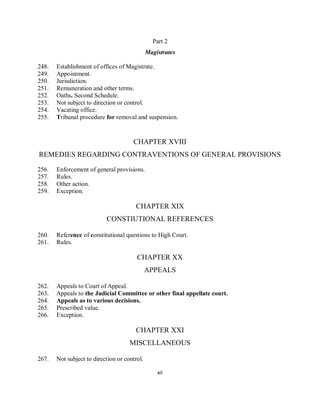
248.   Establishment of offices of Magistrate.
249.   Appointment.
250.   Jurisdiction.
251.   Remuneration and other terms.
252.   Oaths. Second Schedule.
253.   Not subject to direction or control.
254.   Vacating office.
255.   Tribunal procedure for removal and suspension.


                                      CHAPTER XVIII
REMEDIES REGARDING CONTRAVENTIONS OF GENERAL PROVISIONS

256.   Enforcement of general provisions.
257.   Rules.
258.   Other action.
259.   Exception.

                                        CHAPTER XIX
                           CONSTIUTIONAL REFERENCES

260.   Reference of constitutional questions to High Court.
261.   Rules.

                                        CHAPTER XX
                                              APPEALS

262.   Appeals to Court of Appeal.
263.   Appeals to the Judicial Committee or other final appellate court.
264.   Appeals as to various decisions.
265.   Prescribed value.
266.   Exception.

                                        CHAPTER XXI
                                     MISCELLANEOUS

267.   Not subject to direction or control.

                                                  xii
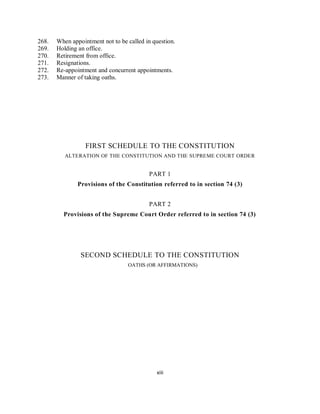
268.   When appointment not to be called in question.
269.   Holding an office.
270.   Retirement from office.
271.   Resignations.
272.   Re-appointment and concurrent appointments.
273.   Manner of taking oaths.


                  FIRST SCHEDULE TO THE CONSTITUTION
          ALTERATION OF THE CONSTITUTION AND THE SUPREME COURT ORDER


                                          PART 1
               Provisions of the Constitution referred to in section 74 (3)


                                          PART 2
         Provisions of the Supreme Court Order referred to in section 74 (3)


                SECOND SCHEDULE TO THE CONSTITUTION
                                  OATHS (OR AFFIRMATIONS)


                                             xiii
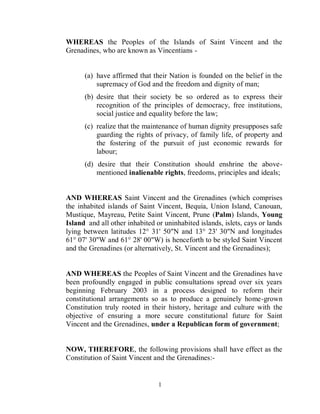
WHEREAS the Peoples of the Islands of Saint Vincent and the
Grenadines, who are known as Vincentians -


      (a) have affirmed that their Nation is founded on the belief in the
          supremacy of God and the freedom and dignity of man;
      (b) desire that their society be so ordered as to express their
          recognition of the principles of democracy, free institutions,
          social justice and equality before the law;
      (c) realize that the maintenance of human dignity presupposes safe
          guarding the rights of privacy, of family life, of property and
          the fostering of the pursuit of just economic rewards for
          labour;
      (d) desire that their Constitution should enshrine the above-
          mentioned inalienable rights, freedoms, principles and ideals;


AND WHEREAS Saint Vincent and the Grenadines (which comprises
the inhabited islands of Saint Vincent, Bequia, Union Island, Canouan,
Mustique, Mayreau, Petite Saint Vincent, Prune (Palm) Islands, Young
Island and all other inhabited or uninhabited islands, islets, cays or lands
lying between latitudes 12° 31' 50"N and 13° 23' 30"N and longitudes
61° 07' 30"W and 61° 28' 00"W) is henceforth to be styled Saint Vincent
and the Grenadines (or alternatively, St. Vincent and the Grenadines);


AND WHEREAS the Peoples of Saint Vincent and the Grenadines have
been profoundly engaged in public consultations spread over six years
beginning February 2003 in a process designed to reform their
constitutional arrangements so as to produce a genuinely home-grown
Constitution truly rooted in their history, heritage and culture with the
objective of ensuring a more secure constitutional future for Saint
Vincent and the Grenadines, under a Republican form of government;


NOW, THEREFORE, the following provisions shall have effect as the
Constitution of Saint Vincent and the Grenadines:-


                                1
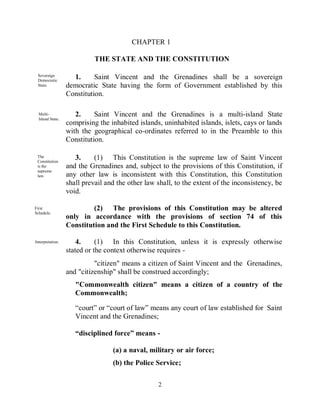
CHAPTER 1

                            THE STATE AND THE CONSTITUTION

 Sovereign
 Democratic
                    1.      Saint Vincent and the Grenadines shall be a sovereign
 State.           democratic State having the form of Government established by this
                  Constitution.

  Multi-             2.     Saint Vincent and the Grenadines is a multi-island State
  Island State.
                  comprising the inhabited islands, uninhabited islands, islets, cays or lands
                  with the geographical co-ordinates referred to in the Preamble to this
                  Constitution.

 The
 Constitution
                     3.     (1) This Constitution is the supreme law of Saint Vincent
 is the           and the Grenadines and, subject to the provisions of this Constitution, if
 supreme
 law.             any other law is inconsistent with this Constitution, this Constitution
                  shall prevail and the other law shall, to the extent of the inconsistency, be
                  void.

First                      (2) The provisions of this Constitution may be altered
Schedule.
                  only in accordance with the provisions of section 74 of this
                  Constitution and the First Schedule to this Constitution.

Interpretation.       4.     (1) In this Constitution, unless it is expressly otherwise
                  stated or the context otherwise requires -
                            "citizen" means a citizen of Saint Vincent and the Grenadines,
                  and "citizenship" shall be construed accordingly;
                     "Commonwealth citizen" means a citizen of a country of the
                     Commonwealth;

                     “court” or “court of law” means any court of law established for Saint
                     Vincent and the Grenadines;

                     “disciplined force” means -

                                  (a) a naval, military or air force;
                                  (b) the Police Service;

                                                  2
(c) the Prison Service;
            (d) the Auxiliary Police Service; or
            (e) the Cadet Corps;

"dollars" means dollars in the currency of Saint Vincent and the
Grenadines;

"financial year" means any period of twelve                months
beginning on 1st January in any year or such other date as may be
prescribed by law;
“foreign power or state” means a power or state other than a
CARICOM or an OECS member state of the Commonwealth;

“general election” means a general election of Representatives
and Senators, where contested, pursuant respectively to sections
99 and 100 of this Constitution;
"law" means any law or any part thereof in force in Saint Vincent
and the Grenadines, including any instrument having the force of
law, and any unwritten rule of law; and "lawful" and "lawfully" shall
be construed accordingly;

“meeting”, in relation to the National Assembly, means any
sitting or sittings of the Assembly commencing when the
Assembly first meets after being summoned at any time and
terminating when the Assembly is adjourned or at the conclusion
of a session;
“member”, in relation to a board, commission, tribunal or other
similar body established or provided for by this Constitution
includes the chairman and, if any, the deputy chairman and other
members of such body; by whatever name the office of chairman
or deputy chairman may be called;
“member”, in relation to the National Assembly, means a
Representative and a Senator ; as well as the Speaker and the
Attorney-General even when neither of these latter two is a
Representative or a Senator ;

"Minister" means a Minister of the Government;

                           3
“modifications” includes adaptations, qualifications, exceptions and
other such alterations;

"oath of allegiance" means such oath (or affirmation) of allegiance as
may be prescribed by law;

"oath of office" means, in relation to any office, such oath (or
affirmation) for the due execution of that office as may be prescribed
by law;

"Parliament" means the Parliament of Saint Vincent and the
Grenadines established by section 66 of this Constitution;

“Party List” means the list of candidates submitted by a political party
on nomination day for an ensuing general election pursuant to section
98 of this Constitution;

“police officer” means a person holding or acting in an office in
the Police Service referred to in section 183 of this Constitution;

“prison officer” means a person holding or acting in an office in
the Prison Service referred to in section 184 of this Constitution;

“public authority” means any functionary, whether an individual
or a body, empowered by law to exercise functions of a public
nature;

"public office" means any office of emolument in the Public Service;

"public officer" means a person holding or acting in any Public
Office;

“Representative” means a member of the National Assembly
elected in accordance with section 99 of this Constitution;


                            4
“Saint Vincent” means Saint Vincent and             the   Grenadines
(alternatively, St. Vincent and the Grenadines);

“Senator” means a member of the National Assembly elected in
accordance with section 100 of this Constitution;

"session" means, in relation to the National Assembly, the period
beginning when the National Assembly first meets after Parliament
has at any time been prorogued or dissolved and ending when
Parliament is prorogued or when Parliament is dissolved without
having been prorogued;

"sitting" means, in relation to the National Assembly, the period
during which the National Assembly is sitting continuously without
adjournment and includes any period during which it is in committee;

“Standing Orders” means the rules of procedure in force from time to
time made by the National Assembly governing proceedings in the
Assembly;
“teacher” means a person holding or acting in an office in the
Teaching Service referred to in sections 184 to 185 of this
Constitution;

“the Act” means the Saint Vincent and the Grenadines Constitution
Act, 2009;
“the appointed day” means the day appointed for the commencement
of this Constitution by Proclamation issued, and published in the
Official Gazette, in accordance with section 4 of the Act;

“the Assembly” means the National Assembly;

“the Cabinet” means the Cabinet of Ministers of the Government;

“the Cadet Corps” means the Saint Vincent and the Grenadines
Cadet Corps (hitherto called the Saint Vincent and the
Grenadines Cadet Force) or any other appropriate name by
which it may be called in the future;


                            5
“the Chief Justice” means the person holding or acting in the office of
Chief Justice established by the Supreme Court Order;
“the Commonwealth” means the states designated as
Commonwealth countries by or under any Act of Parliament so
prescribing;

“the former Constitution” means the Constitution in force in Saint
Vincent and the Grenadines immediately before the appointed day;

“the Government” means the Government of Saint Vincent and the
Grenadines;

“the Judicial Committee” means the Judicial Committee of the Privy
Council established by the Judicial Committee Act of the United
Kingdom (a);

“the Minority Leader” means the person holding or acting in the
office of Minority Leader established by section 124 of this
Constitution;
“the National Assembly” means the National Assembly of Saint
Vincent and the Grenadines established by section 67 of this
Constitution;

"the Police Service" means the Saint Vincent and the Grenadines
Police Service (hitherto called the Royal St. Vincent and the
Grenadines Police Force) or any other appropriate name by which it
may be called in the future and includes any other police service
established to succeed to the functions of the Saint Vincent and the
Grenadines Police Service;
“the President” means the person holding or acting in the Office of
President established by section 49 of this Constitution as the Head of
State of Saint Vincent and the Grenadines;
“the Prime Minister” means the person holding or acting in the office
of Prime Minister established by section 108 of this Constitution as
the Head of Government of Saint Vincent and the Grenadines;
_______________________________________________________________________________________
(a)
      1833 c.41.


                                   6
"the Prison Service" means the Saint Vincent and the Grenadines
    Prison Service;
    "the Public Service" means, subject to the provisions of this section,
    service in a civil capacity of the Government;

    "the Speaker" means the person holding or acting in the office of
    Speaker of the National Assembly established by section 71 of this
    Constitution;

    “the State” means the State of Saint Vincent and the Grenadines,
    which may be referred to as the State of St. Vincent and the
    Grenadines;

    “the Supreme Court” means the Supreme Court established by the
    Supreme Court Order;

    “the Supreme Court Order” has the meaning assigned to this
    expression by paragraph (b) of subsection (3) of this section;

    “the Teaching Service” means the Saint Vincent and the Grenadines
    Teaching Service.

     (2) In this Constitution, unless it is expressly stated otherwise,
references to an office in the public service shall not be construed as
including –
         (a) references to the office of President, Prime Minister or any
             other Minister, Parliamentary Secretary, Minority Leader or
             a member of the National Assembly;

         (b) references to the offices of Speaker and Deputy Speaker;

         (c) references to the office of a member of any
             Commission established by this Constitution or a
             member of the Public Service Board of Appeal;


                                7
(d) references to the office of Chief Justice or any other
          judge, or an officer, of the Supreme Court;

      (e) save in so far as may be provided by Parliament, references
          to the office of a member of any other council, board,
          panel,     committee or other similar body (whether
          incorporated or not) established by or under any law.

(3)    In this Constitution -

                  (a) “the Supreme Court” means the Supreme Court
                      established by the Supreme Court Order; and
                      this Court shall, unless Parliament otherwise
                      provides, be styled the Eastern Caribbean
                      Supreme Court;

                  (b) “the Supreme Court Order” is the citation which
                      may be given to the West Indies Associated States
                      Supreme Court Order, 1967 (a), in so far as it
                      forms part of the law of Saint Vincent and the
                      Grenadines;

                  (c) references to the Supreme Court Order include
                      references to any law altering that Order;

                  (d) references to the Supreme Court, the Court of
                      Appeal, the High Court and the Judicial and
                      Legal Services Commission are references to
                      the Supreme Court, the Court of Appeal, the High
                      Court and the Judicial      and Legal Services
                      Commission established by the Supreme Court
                      Order;

                  (e) references to the   Chief Justice have the same
                      meaning as in the Supreme Court Order;


      ____________________________________________________
       (a)
             SI 1967/223 [UK].


                                 8
(f) references to a judge of the Supreme Court are
                                 references to a judge of the High Court and of the
                                 Court of Appeal and, unless the context otherwise
                                 requires, include references to a judge of the former
                                 Supreme Court of the Windward Islands and
                                 Leeward Islands; and

                             (g) references to officers of the Supreme Court are
                                 references to the Chief Registrar, Masters and other
                                 officers of the Supreme Court appointed under the
                                 Supreme Court Order.

           (4)     In this Constitution "the specified qualifications" means the
        professional qualifications specified by or under any law, one of which
        must be held by any person before he may apply under that law to be
        admitted to practise as a Barrister-at-Law or an Attorney-at-Law or a
        Solicitor in Saint Vincent and the Grenadines.


           (5) Save as may be otherwise provided by Parliament, the
        provisions (except sections 2 and 17) of the Commissions of Enquiry Act
        of Saint Vincent and the Grenadines(a) shall apply, with necessary
        modifications, adaptations, qualifications, exceptions and other such
        alterations in relation to tribunals appointed under sections 63 (1) (d),
        146 (3), 164 (3), 179 (1), 189 (1), 202 (3), 217 (3), 225 (3) and 233 (3),
        of this Constitution or, as the context may require, to the members
        thereof as they apply in relation to Commissions or Commissioners
        appointed under that Act.


           (6) In this Constitution, references to altering this Constitution or
        any other law, or any provision thereof, include references –

                      (a) to revoking it, with or without re-enactment thereof or
                          the making of different provisions in lieu thereof;


___________________________________________________________________________________________
  (a)
        Cap. 14, Revised Laws of Saint Vincent and the Grenadines, 1990.


                                                  9
(b) to modifying it, whether by omitting or amending any of
               its provisions or inserting additional provisions in it or
               otherwise; and

           (c) to suspending its operation for any period or terminating
               any such suspension.


   (7)   In this Constitution-
                (a) the masculine includes the feminine, and vice
                    versa;
                (b)   the singular includes the plural, and vice versa.


   (8)    In this Constitution, “functions” includes powers and duties.


    (9) Where this Constitution provides for anything to be done by a
political party, that thing shall be deemed to have been validly done if it
is done by the person who for the time being is the leader of that party, or
by some other person duly authorised in writing in that behalf by the
leader of the party.


   (10) In this Constitution-

            (a) The Caribbean Community (“CARICOM”) means the
                regional grouping of countries which are signatory
                member states of the Treaty of Chaguaramas 1973
                Revised in 2001 and the countries which are associated
                member states thereunder;

            (b) The Organisation of Eastern Caribbean States
                (“OECS”) means the sub-regional grouping of
                countries which are signatory member states of the

                                 10
Treaty of Basseterre 1981 and the countries which are
                       associated member states thereunder;

                   (c) A CARICOM or an OECS member state of the
                       Commonwealth means a CARICOM or an OECS
                       member state or an associated member state of either
                       CARICOM or OECS that is also a member state of the
                       Commonwealth.


    (11) The Interpretation and General Provisions Act of Saint Vincent
and the Grenadines(a) shall apply, with necessary modifications,
adaptations, qualifications, exceptions and other such alterations for the
purpose of interpreting this Constitution and otherwise in relation thereto
as it applies for the purpose of interpreting and in relation to Acts of the
Parliament of Saint Vincent and the Grenadines.


____________________________________________________________________________________________
(a)
      Cap. 10, Revised Laws of Saint Vincent and the Grenadines, 1990.


                                            11
CHAPTER II
                            GUIDING PRINCIPLES OF STATE POLICY

The people               5.    (1) The people are the true political sovereign of the
are sovereign.
                  State; power belongs to the people. Therefore, the will of the people
                  shall be the basis of the authority of government. The people exercise
                  their sovereignty by the process of democracy through their
                  Representatives and Senators in the National Assembly, and through
                  such other democratic organs as may be established by or under this
                  Constitution.
                                (2) In formulating and implementing fundamental
                  policy measures, whether or not to be translated into law, Government
                  must constantly act primarily in furtherance of what is in the best
                  interests of the people.
  Right to               6.      Every person has the right to participate actively in party
  be active
  in political    politics, to join a political party of his choice and to hold and express
  parties.
                  political opinions according to his conscience, subject only to such
                  limitations as are properly imposed by or under this Constitution.
 Paramount
 constitutional
                        7.     This Constitution is founded on and is dedicated to
 doctrines.       enshrining the paramount constitutional doctrines of -
                               (i)     the freedom of the individual balanced by the civic
                                       responsibility of the individual;
                               (ii)    the rule of law;
                               (iii)   the separation of powers, particularly the personnel
                                       and powers of the Judiciary from those of the
                                       Legislature (Parliament) and the Executive
                                       (Government);
                               (iv)    parliamentary democracy; and
                               (v)     good governance.
  Economic              8.     The constitutional, administrative and political systems
  development
  and social      ought to strive for national sustainable economic development, based
  justice.
                  on a combination of privately owned and publicly owned economic
                  enterprises, and the pursuit of full employment. This development
                  must pay due regard to the existence of constituencies whenever
                  the annual estimates of revenues and expenditures are prepared.
                  A principal objective of this is to ensure the greatest possible
                                                      12
satisfaction of the growing material, spiritual, cultural and intellectual
                   needs of the people and to uplift the quality of their life, with social
                   justice for all.

    Legal aid.            9.     In order better to promote justice, Parliament shall enact
                   legislation to provide legal aid to indigent accused persons in cases
                   where such persons may be liable to be subjected to capital
                   punishment, as well as in other cases where such persons face serious
                   criminal charges if in such cases legal aid is recommended by the
                   presiding judicial officer.


    Right to              10. (1) Every member of the Vincentian work-force has
    work.
                   the right to work in his chosen field, whether his work be manual or
                   mental or otherwise, there being dignity in all honest labour; and he
                   has the right to be paid fair remuneration for his work.

                               (2) In turn, every member of the Vincentian
                   work-force has a responsibility to render a fair day’s work, and to
                   yield worthy production as well as proper productivity.


 Right to                 11. Every person has the right to the enjoyment of health.
 health.           The State shall protect and promote public health, and shall establish
                   and maintain appropriate sanitary measures to ensure to every
                   Vincentian the highest attainable standards of health, to the extent
                   feasible according to the resources available to the State.


More humane              12. State power is not to be abused; rather, its exercise is to
society.
                   be characterized by fair play in action in building a more caring and
                   humane society.


Equal treatment.         13. (1) Every person has a right to equality of treatment
                   by public authorities.

                               (2) Without prejudice to the generality of
                   subsection (1) of this section, it is hereby affirmed that, lawfully
                   depriving a person of his personal liberty does not, without more,
                                                      13
justify denying him his other rights and freedoms in the absence
                of appropriate regard for such relevant countervailing concerns
                as national security and public health, whether in relation to the
                condition of his hair or otherwise; and does not excuse disregard
                for his legitimate dietary practices.

The
environment.          14. This Constitution enjoins the organs of the State, other
                public authorities and the people to protect and enhance the
                environment.
 National
heritage.
                      15. Vincentians are entitled to have their historical, cultural
                and other heritage respected, protected and preserved.

Freedom of
culture.               16. The people have a right to the enjoyment of freedom of
                culture and to cultural expression.


The family             17. (1) The State acknowledges the family as the natural
and
marriage.       basic unit of society. Consequently, the State accords the family
                recognition, respect, protection and support; asserting that men and
                women of the age of civil, legal and societal responsibility have the
                right to establish a family.

                            (2) The State shall recognise and protect marriage,
                which shall be a legal union only between two persons each of the
                opposite sex.

                            (3) Parliament may make provision prescribing
                what status and protection may be accorded to common law
                unions in the context of this section.

The elderly           18. The elderly and the disabled are entitled to have their
and disabled.
                special needs met and to receive care befitting their circumstances
                according to the resources available to the State.


                                                 14
Young                  19. Due appreciation is to be accorded to young persons for
 persons to be
 honoured.       their contribution to nation-building.

 Youth rights.          20. Every young person has the right to educational, social,
                 cultural and vocational enhancement, including a right to fair
                 opportunity for responsible participation in national development.


   Equality             21. (1) Women and men have equal rights and the same
   for women
    and men.     legal status in all spheres of political, economic, cultural and social
                 life. All forms of discrimination against women and men on the basis
                 of their sex are prohibited.

                              (2) The rights of women are ensured by according to
                 women equal access with men to academic, vocational and
                 professional training, equal opportunities in employment,
                 remuneration and promotion; and in social, political and cultural
                 activity. Moral support is to be encouraged for mothers and children,
                 including paid leave and other benefits for mothers and expectant
                 mothers.

                             (3) Political parties are obliged to aspire to having
                 not less than thirty percent of the combined total number of
                 persons whose names are included on the Party List submitted by
                 a party in accordance with section 98 of this Constitution as
                 women; and not less than thirty percent of that combined total as
                 men.

 Protection of         22. (1) Children are entitled to the protection of the rights
 children; and
 equality for    of the child as expressed in relevant international treaties to which
 children born
 out of          Saint Vincent and the Grenadines is a State Party.
 wedlock.

                             (2)    Children born out of wedlock are entitled to the
                 same legal rights and legal status as are enjoyed by children born in
                 wedlock. All forms of discrimination against children on the basis of
                 their being born out of wedlock are prohibited.

Adherence to
regionalism
                       23. Organs of the State and other public authorities shall
and
international
                 adhere to and be guided by the obligations and commitments of
law.             Saint Vincent and the Grenadines to regional integration such as
                                                   15
in the Caribbean Community (“CARICOM”) and the
              Organisation of Eastern Caribbean States (“OECS”) and to
              applicable international law; while protecting the rights and
              benefits which Saint Vincent and the Grenadines derives from
              such regional integration and international law.


Guiding              24. The provisions of this Chapter constitute constitutional
principles.
              norms appropriate for the guidance of the actions of organs of the
              State and other public authorities, being of the nature of guiding
              principles of State policy.


                                              16
CHAPTER III

                         PROTECTION OF FUNDAMENTAL RIGHTS AND FREEDOMS


Fundam   Fundamental
         rights and
                                25. Whereas every person in Saint Vincent and the
         freedoms.       Grenadines is entitled to the fundamental rights and freedoms,
                         that is to say, the right, whatever his race, place of origin,
                         political opinions, colour, creed or sex, but subject to respect
                         for the rights and freedoms of others and for the public interest,
                         to each and all of the following, namely-

                                            (a) life, liberty, security of the person and
                                                the protection of the law;
                                            (b) freedom of conscience, of expression
                                                and of assembly and association; and

                                            (c) protection for the privacy of his home
                                                and other property and from
                                                deprivation of property without
                                                compensation,

                         the provisions of this Chapter shall have effect for the purpose
                         of affording protection to those rights and freedoms subject to
                         such limitations of that protection as are contained in those
                         provisions, being limitations designed to ensure that the
                         enjoyment of the said rights and freedoms by any person does
                         not prejudice the rights and freedoms of others or the public
                         interest.


Fundam     Protection           26. (1) No person shall be deprived of his life
           of right to
           life.         intentionally save in execution of the sentence of a court in
                         respect of a criminal offence under any law of which he has
                         been convicted.

                                     (2) A person shall not be regarded as having
                         been deprived of his life in contravention of this section if he
                         dies as the result of the use, to such extent and in such

                                                     17
circumstances as are permitted by law, of such force as is
              reasonably justifiable -

                                 (a) for the defence of any person from
                                     violence or for the defence of property;
                                 (b) in order to effect a lawful arrest or to
                                     prevent the escape of a person lawfully
                                     detained;

                                 (c) for the purpose of suppressing a riot,
                                     insurrection or mutiny; or

                                 (d) in order to prevent the commission by
                                     that person of a criminal offence, or if
                                     he dies as the result of a lawful act of
                                     war.

                           (3) A person shall not be regarded as having
              been deprived of his life in contravention of this section if he
              is subjected to capital punishment in accordance with
              section 29 of this Constitution.


Protection
of right to
                     27. (1) No person shall be deprived of his personal
personal      liberty save as may be authorised by law in any of the following
liberty.
              cases, that is to say:

                                 (a) in execution of the sentence or order of
                                     a court, whether established for Saint
                                     Vincent and the Grenadines or some
                                     other country, in respect of a criminal
                                     offence of which he has been
                                     convicted;

                                 (b) in execution of the order of the High
                                     Court or the Court of Appeal punishing
                                     him for contempt of that court or of
                                     another court or tribunal;
                                         18
(c) in execution of the order of a court
    made to secure the fulfillment of any
    obligation imposed on him by law;

(d) for the purpose of bringing him before
    a court in execution of the order of a
    court;

(e) upon reasonable    suspicion of his
    having committed, or being about to
    commit, a criminal offence under any
    law;

(f) under the order of a court or with the
    consent of his parent or guardian, for
    his education or welfare during any
    period ending not later than the date
    when he attains the age of eighteen
    years;

(g) for the purpose of preventing the spread
    of an infectious or contagious disease;

(h) in the case of a person who is, or is
    reasonably suspected to be, of unsound
    mind, addicted to drugs or alcohol, or a
    vagrant, for the purpose of his care or
    treatment or the protection of the
    community;

(i)   or the purpose of preventing the
      unlawful entry of that person into Saint
      Vincent and the Grenadines, or for the
      purpose of effecting the expulsion,
      extradition or other lawful removal of
      that person from the State, or for the
      purpose of restricting that person while
      he is being conveyed through the State

         19
in the course of his extradition or
                         removal as a convicted prisoner from
                         one country to another; or

                   (j)   to such extent as may be necessary in
                         the execution of a lawful order
                         requiring that person to remain within
                         a specified area within Saint Vincent
                         and the Grenadines or prohibiting him
                         from being within such an area, or to
                         such extent as may be reasonably
                         justifiable for the taking of proceedings
                         against that person with a view to the
                         making of any such order or relating to
                         such an order after it has been made, or
                         to such extent as may be reasonably
                         justifiable for restraining that person
                         during any visit that he is permitted to
                         make to any part of the State in which,
                         in consequence of any such order, his
                         presence        would      otherwise be
                         unlawful.


            (2) Any person who is arrested or detained shall
with reasonable promptitude and in any case no later than
twenty-four hours after such arrest or detention be informed in a
language that he understands of the reasons for his arrest or
detention and be afforded reasonable facilities for private
communication and consultation with a legal practitioner of his
own choice and, in the case of a minor, with his parents or
guardian.


             (3)   Any person who is arrested or detained -

                   (a)   for the purpose of bringing him before
                         a court in execution of the order of a
                         court; or


                            20
(b)   upon reasonable suspicion of his
                         having committed, or being about to
                         commit, a criminal offence under any
                         law,


and who is not released, shall be brought without undue delay
before a court.

             (4) Where any person is brought before a court
in execution of the order of a court in any proceedings or upon
suspicion of his having committed or being about to commit an
offence, he shall not be thereafter further held in custody in
connection with those proceedings or that offence save upon the
order of a court.

               (5) If any person arrested or detained as
mentioned in paragraph (b) of subsection (3) of this section is
not tried within a reasonable time, without prejudice to any
further proceedings that may be brought against him, he shall
be released either unconditionally or upon reasonable
conditions, including in particular such conditions as are
reasonably necessary to ensure that he appears at a later date for
trial or for proceedings preliminary to trial.


             (6) Any person who is unlawfully arrested or
detained by any other person shall be entitled to compensation
therefore from that other person or from any other person or
authority on whose behalf that other person was acting:


            Provided that a judge, a magistrate or a justice of
the peace or an officer of a court or a police officer acting in
pursuance of the order of a judge, a magistrate or a justice of
the peace shall not be under any personal liability to pay
compensation under this subsection in consequence of any act
performed by him in good faith in the discharge of the functions


                            21
of his office and any liability to pay any such compensation
                  in consequence of any such act shall be a liability of the State.


                                (7) For the purposes of paragraph (a) of
                  subsection (1) of this section, a person charged before a court
                  with a criminal offence of whom in respect of whom has been
                  returned the special verdict that he was guilty of the act or
                  omission charged but was insane when he did the act or made
                  the omission, or that he is not guilty by reason of insanity, shall
                  be regarded as a person who has been convicted of a criminal
                  offence. The detention of that person in consequence of such a
                  verdict shall be regarded as detention in execution of the order
                  of a court.


Protection
from slavery
                         28.   (1)    No person shall be held in slavery or
and               servitude.
forced labour .


                              (2)     No person shall be required to perform
                  forced labour.

                               (3) For the purposes of this section, the
                  expression "forced labour" does not include -

                                      (a)   any labour required in consequence of
                                            the sentence or order of a court;

                                      (b)   labour required of any person while
                                            he is lawfully detained that, though
                                            not required in consequence of the
                                            sentence or order of a court, is
                                            reasonably necessary in the interests
                                            of hygiene or for the maintenance of
                                            the place at which he is detained;

                                      (c)   any labour required of a member of a
                                            disciplined force in pursuance of his
                                            duties as such or, in the case of a
                                               22
person who has conscientious
                                         objections to service as a member of a
                                         naval, military or air force, any labour
                                         that that person is required by law to
                                         perform in place of such service;

                                  (d)    any labour required during any period
                                         of public emergency or in the event of
                                         any other emergency or calamity that
                                         threatens the life and well-being of
                                         the community, to the extent that the
                                         requiring of such labour is reasonably
                                         justifiable in the circumstances of any
                                         situation arising or existing during
                                         that period or as a result of that other
                                         emergency or calamity, for the
                                         purpose of dealing with that situation.

Protection
from inhuman        29. (1) No person shall be subjected to torture or to
treatment.
               inhuman or degrading punishment or other treatment.

                            (2) Nothing contained in or done under the
               authority of any law shall be held to be inconsistent with or in
               contravention of this section to the extent that the law in
               question authorizes the infliction of any description of
               punishment that was lawful in Saint Vincent and the
               Grenadines immediately before the coming into force of this
               Constitution:

                            Provided that Parliament may prescribe the
               infliction of other descriptions of punishment including the
               description of capital punishment other than by hanging.

                            (3) No objection shall be taken in or by any
               court to a sentence of capital punishment being carried out
               within one year after the exhaustion of all proceedings
               embarked upon and diligently pursued by the person thus
               sentenced, in any court or tribunal or other body the jurisdiction

                                           23
of which is recognised by or under the laws of Saint Vincent
and the Grenadines, whether such court or tribunal or other
body is located inside or outside Saint Vincent and the
Grenadines, at which the imposition or passing of such sentence
may lawfully be appealed, reviewed, challenged or questioned
by the person thus sentenced.


             (4) Parliament may prescribe relevant
criteria for determining whether murder is capital, on
conviction for which a person shall be subject to the death
penalty; or non-capital, on conviction for which a person
shall not be subject to the death penalty:

            Provided that non-capital murder shall be
confined to murder committed in sudden passion;

             Provided further that high treason shall always
be a capital offence.


             (5) On the trial of a person indicted for
murder, if the jury returns a verdict convicting that person
of murder, it shall be a matter for the judge presiding at the
trial to determine whether the murder is capital, as distinct
from non-capital.

            (6) If on the trial of a person indicted for
murder the jury returns a verdict convicting him of
murder, the judge shall hear evidence on the question
whether the murder is capital as distinct from non-capital.
If, having heard such evidence, and on any relevant criteria
referred to in sub section (4) of this section, the judge
determines that the murder is capital, the judge shall
impose the sentence of the death penalty, that is, capital
punishment, on the person so convicted.

           (7) If a person is convicted of murder,
whether capital or non-capital, then, after sentence has been

                           24
imposed on him, questions of mercy shall be for the
               exclusive determination of the President acting in
               accordance with the advice of the Parliamentary
               Commission pursuant to section 134 of this Constitution.

                           (8) The carrying out of capital punishment in
               accordance with this section shall not be held to be
               inconsistent with or in contravention of this section or
               section 26 of this Constitution protecting the right to life or
               any other provision of this Constitution.

Protection            30. (1) No property of any description shall be
from
deprivation    compulsorily taken possession of, and no interest in or right
of property.
               over property of any description shall be compulsorily
               acquired, except for a public purpose and except where
               provision is made by a law applicable to that taking of
               possession or acquisition for the payment, within a reasonable
               time, of adequate compensation, that is, compensation which
               in all the circumstances is fair and reasonable to the person
               entitled to compensation and also to the State, without
               limitation as to the date at which compensation should be
               assessed:

                           Provided that the compensation shall be paid
               within twelve months of the date of the compulsory taking of
               possession or acquisition.

                             (2) Every person having an interest in or right
               over property that is compulsorily taken possession of or whose
               interest in or right over any property is compulsorily acquired
               shall have a right of direct access to the High Court for -

                                 (a)   determining the nature and extent of
                                       that interest or right;

                                 (b)   determining whether that taking of
                                       possession or acquisition was duly
                                       carried out in accordance with a law
                                       authorising the taking of possession or
                                       acquisition;
                                          25
(c)   determining what compensation he is
                          entitled to under the law applicable to
                          that taking of possession or
                          acquisition;

                    (d)   obtaining that compensation:

             Provided that if Parliament so provides in relation
to any matter referred to in paragraph (a) or (c) of this
subsection the right of access shall be by way of appeal
(exercisable as of right at the instance of the person having the
interest in or right over the property) from a tribunal or
authority, other than the High Court, having jurisdiction under
any law to determine that matter.

              (3) The Chief Justice may make rules with
respect to the practice and procedure of the High Court or,
subject to such provision as may have been made in that behalf
by Parliament, with respect to the practice and procedure of any
other tribunal or authority in relation to the jurisdiction
conferred on the High Court by subsection (2) of this section or
exercisable by the other tribunal or authority for the purposes of
that subsection (including rules with respect to the time within
which applications or appeals to the High Court or applications
to the other tribunal or authority may be brought).

             (4) No person who is entitled to compensation
under this section shall be prevented from remitting, within a
reasonable time after he has received any amount of that
compensation in the form of a sum of money or, as the case
may be, has received any such amount in some other form and
has converted any of that amount into a sum of money, the
whole of that sum of money (free from any deduction, charge or
tax made or levied in respect of its remission) to any country of
his choice outside Saint Vincent and the Grenadines.

              (5) Nothing contained in or done under the
authority of any law shall be held to be inconsistent with or in
contravention of subsection (4) of this section to the extent that
the law in question authorises -

                             26
(a) the attachment, by order of a court, of
                       any amount of compensation to which a
                       person is entitled in satisfaction of the
                       judgment of a court or pending the
                       determination of civil proceedings to
                       which he is a party;

                   (b) the imposition of reasonable restrictions
                       on the manner in which any sum of
                       money is to be remitted; or

                   (c) the imposition of reasonable restrictions
                       upon the remission of any sum of
                       money in order to prevent or regulate
                       the transfer to a country outside Saint
                       Vincent and the Grenadines of capital
                       raised in the State, or in some other
                       country or derived from the natural
                       resources of the State.

             (6) Nothing contained in or done under the
authority of any law shall be held to be inconsistent with or in
contravention of subsection (1) of this section -

                   (a) to the extent that the law in question
                       makes provision for the taking of
                       possession or acquisition of any
                       property, interest or right -
                        (i) in satisfaction of any tax, rate or
                            due;

                      (ii) by way of penalty for breach of any
                           law or forfeiture in consequence of
                           breach of any law;

                      (iii) as an incident of a lease, tenancy,
                           mortgage, charge, bill of sale, pledge
                           or contract;
                           27
(iv) in the execution of judgments or
                           orders of a court in proceedings for
                           the determination of civil right or
                           obligations;

                      (v) in circumstances where it is
                          reasonably necessary so to do
                          because the property is in a
                          dangerous state or likely to be
                          injurious to the health of human
                          beings, animals or plants;

                      (vi) in consequence of any law with
                           respect to the limitation of
                           actions; or

                      (vii) for so long only as may be
                            necessary for the purposes of any
                            examination, investigation, trial or
                            inquiry or, in the case of land, for
                            the purposes of the carrying out
                            thereon of        work      of   soil
                            conservation or the conservation of
                            other natural resources or work
                            relating to agricultural development
                            or improvement (being work
                            relating to such development or
                            improvement that the owner or
                            occupier of the land has been
                            required,     and     has    without
                            reasonable excuse refused or failed,
                            to carry out),


and except so far as that provision or, as the case may be, the
thing done under the authority thereof is shown not to be
reasonably justifiable in a democratic society; or

                    (b) to the extent that the law in question
                        makes provision for the taking of

                           28
possession or acquisition of any of the
                         following property (including an
                         interest in or right over property), that
                         is to say -

                          (i) enemy property;

                          (ii) property of a deceased person, a
                               person of unsound mind or a
                               person who has not attained the
                               age of eighteen years, for the
                               purpose of its administration for
                               the benefit of the persons entitled
                               to the beneficial interest therein;

                         (iii) property of a person adjudged
                               bankrupt or a body corporate in
                               liquidation, for the purpose of its
                               administration for the benefit of
                               the creditors of the bankrupt or
                               body corporate and, subject
                               thereto, for the benefit of other
                               persons entitled to the beneficial
                               interest in the property; or

                          (iv) property subject to a trust, for the
                               purpose of vesting the property in
                               persons appointed as trustees
                               under the instrument creating the
                               trust or by a court or, by order of
                               a court, for the purpose of giving
                               effect to the trust.

             (7) Nothing contained in or done under the
authority of any law enacted by Parliament shall be held to be
inconsistent with or in contravention of this section to the
extent that the law in question makes provision for the
compulsory taking of possession of any property, or the
compulsory acquisition of any interest in or right over property,
                            29
where that property, interest or right is held by a body corporate
                 established by law for public purposes in which no monies have
                 been invested other than monies provided by Parliament.

                              (8) Nothing in this section shall affect the
                 operation of any law in force immediately before 27 th October
                 1969 or any law made on or after that date that alters a law in
                 force immediately before that date and that does not-

                                     (a)    add to the kinds of property that may
                                            be taken possession of or the rights
                                            over and interests in property that
                                            may be acquired; or

                                     (b)    make the conditions governing
                                            entitlement to compensation or the
                                            amount thereof less favourable to any
                                            person owning or having an interest in
                                            the property; or

                                     (c)    deprive any person of any such right
                                            as is mentioned in subsection (2) of
                                            this section.

                              (9)    In this section -

                 "acquisition", in relation to an interest in or right over property,
                 means transferring that interest or right to another person or
                 extinguishing or curtailing that interest or right;

                 "property" means any land or other thing capable of being
                 owned or held in possession and includes any right relating
                 thereto, whether under a contract, trust or law or otherwise and
                 whether present or future, absolute or conditional.

Protection              31. (1) Except with his own consent, a person shall
from arbitrary
search or        not be subjected to the search of his person or his property or
entry.
                 the entry by others on his premises.


                                              30
(2) Nothing contained in or done under the
authority of any law shall be held to be inconsistent with or in
contravention of this section to the extent that the law in
question makes provision -

                   (a)   that is reasonably required in the
                         interests of defence, public safety,
                         public order, public morality, public
                         health, town and country planning, the
                         development and utilization of
                         mineral resources or the development
                         or utilization of any property for a
                         purpose beneficial to the community;

                   (b)   that is reasonably required for the
                         purpose of protecting the rights or
                         freedoms of other persons;

                   (c)   that authorises an officer or agent of
                         the Government, a local government
                         authority or a body corporate
                         established by law for public purposes
                         to enter on the premises of any
                         person in order to inspect those
                         premises or anything thereon for
                         the purpose of any tax, rate or due or
                         in    order to carry out work
                         connected with any property that is
                         lawfully on those premises and that
                         belongs to the Government or to that
                         authority or body corporate, as the
                         case may be; or

                   (d)   that authorises, for the purpose of
                         enforcing the judgment or order of a
                         court in any civil proceedings, the
                         search of any person or property by
                         order of a court or entry upon any
                         premises by such order,


                           31
and except so far as that provision or, as the case may be,
              anything done under the authority thereof is shown not to be
              reasonably justifiable in a democratic society.

Provisions          32. (1) If any person is charged with a criminal
to secure
the           offence then, unless the charge is withdrawn, the case shall be
protection
of the law.
              afforded a fair hearing within a reasonable time by an
              independent and impartial court established by law.

                          (2)   Every person who is charged with a criminal
              offence -

                                (a)    shall be presumed to be innocent until
                                       he is proved or has pleaded guilty;
                                (b)    shall be informed as soon as
                                       reasonably practicable, in a language
                                       that he understands and in detail, of
                                       the nature of the offence charged;

                                (c)    shall be given adequate time and
                                       facilities for the preparation of his
                                       defence;

                                (d)    shall be permitted to defend himself
                                       before the court in person or, at his
                                       own expense, by a legal practitioner
                                       of his own choice;

                                (e)    shall be afforded facilities to examine
                                       in    person or by            his legal
                                       representative the witnesses called by
                                       the prosecution before the court, and
                                       to obtain the attendance and carry out
                                       the examination of witnesses to testify
                                       on his behalf before the court on the
                                       same conditions as those applying to
                                       witnesses called by the prosecution;
                                       and


                                         32
(f)   shall be permitted to have without
                          payment the assistance of an
                          interpreter if he cannot understand the
                          language used at the trial, and except
                          with his own consent the trial shall
                          not take place in his absence unless he
                          so conducts himself as to render the
                          continuance of the proceedings in his
                          presence impracticable and the court
                          has ordered him to be removed and
                          the trial to proceed in his absence:

             Provided that the trial may take place in his
absence in any case in which it is so provided by a law under
which he is entitled to adequate notice of the charge and the
date, time and place of the trial and to a reasonable opportunity
of appearing before the court.

             (3) When a person is tried for any criminal
offence, the accused person or any person authorised by him in
that behalf shall, if he so requires and subject to payment of
such reasonable fee as may be prescribed by law, be given
within a reasonable time after judgment a copy for the use of
the accused person of any record of the proceeding made by or
on behalf of the court.

             (4) A person shall not be held to be guilty of a
criminal offence on account of any act or omission that did not,
at the time it took place, constitute such an offence, and no
penalty shall be imposed for any criminal offence that is more
severe in degree or description than the maximum penalty that
might have been imposed for that offence at the time when it
was committed.

               (5) A person who shows that he has been tried
by a competent court for a criminal offence and either convicted
or acquitted shall not again be tried for that offence or for any
other criminal offence of which he could have been convicted at
the trial for that offence, save upon the order of a superior court


                             33
in the course of appeal or review proceedings relating to the
conviction or acquittal.

             (6) A person shall not be tried for a criminal
offence if he shows that he has been pardoned for that offence.

             (7) A person who is tried for a criminal offence
shall not be compelled to give evidence at the trial: Provided
that nothing in this subsection shall prevent the prosecution or
the court from commenting on his failure to give evidence on
his own behalf or prevent the court from drawing inferences
from any such failure.

             (8) Any court or other authority prescribed by
law for the determination of the existence or extent of any civil
right or obligation shall be established by law and shall be
independent and impartial; and where proceedings for such a
determination are instituted by any person before such a court
or other authority, the case shall be given a fair hearing within a
reasonable time.

             (9) Where the existence or extent of any civil
right or obligation has been determined in proceedings in any
court or before any other authority any party to those
proceedings shall, if he so requires and subject to payment of
such reasonable fee as may be prescribed by law, be entitled to
obtain within a reasonable time after the judgment or other
determination a copy of any record of the proceedings made by
or on behalf of the court or other authority.

              (10) Except with the agreement of all the parties
thereto, all proceedings of every court and proceedings for the
determination of the existence or extent of any civil right or
obligation before any other authority, including the
announcement of the decision of the court or other authority,
shall be held in public.

            (11) Nothing in subsection (10) of this section
shall prevent the court or other adjudicating authority from
excluding from the proceedings persons other than the parties

                             34
thereto and the legal practitioners representing them to such
extent as the court or other authority –

                   (a)   may by law be empowered to do
                         and may consider necessary or
                         expedient in circumstances where
                         publicity would prejudice the interests
                         of justice or      in    interlocutory
                         proceedings or in the interests of
                         public morality, the welfare of
                         persons under the age of eighteen
                         years or the protection of the
                         private lives of persons concerned
                         in the proceedings; or

                   (b)   may by law be empowered or
                         required to do in the interests of
                         defence, public safety or public order.

             (12) Nothing contained in or done under the
authority of any law shall be held to be inconsistent with or in
contravention of -

                   (a)   subsection (2)(a) of this section to the
                         extent that the law in question
                         imposes upon any person charged
                         with a criminal offence the burden
                         of proving particular facts;

                   (b)   subsection (2)(e) of this section to the
                         extent that the law in question
                         imposes reasonable conditions that
                         must be satisfied if witnesses called to
                         testify on behalf of an accused person
                         are to be paid their expenses out of
                         public funds; or

                   (c)   subsection (5) of this section to the
                         extent that the law in question
                         authorises a court to try a member of

                           35
a disciplined force for a criminal
                                        offence notwithstanding any trial and
                                        conviction or acquittal of that member
                                        under the disciplinary law of that
                                        force, so, however, that any court so
                                        trying such a member and convicting
                                        him shall in sentencing him to any
                                        punishment take into account any
                                        punishment awarded him under that
                                        disciplinary law.

                           (13) In the case of any person who is held in
              lawful detention the provisions of subsection (1), paragraphs (d)
              and (e) of subsection (2) and subsection (3) of this section shall
              not apply in relation to his trial for a criminal offence under the
              law regulating the discipline of persons held in such detention.

                           (14) In this section "criminal offence" means a
              criminal offence under a law.


Protection          33. (1) Except with his own consent, a person shall
of freedom
of            not be hindered in the enjoyment of his freedom of conscience,
conscience.
              including freedom of thought and of religion, freedom to
              change his religion or belief and freedom, either alone or in
              community with others, and both in public and in private, to
              manifest and propagate his religion or belief in worship,
              teaching, practice and observance.

                            (2) Except with his own consent (or, if he is a
              person under the age of eighteen years, the consent of his
              guardian) a person attending any place of education, detained in
              any prison or corrective institution or serving in a naval,
              military or air force shall not be required to receive religious
              instruction or to take part in or attend any religious ceremony or
              observance if that instruction, ceremony or observance relates
              to a religion that is not his own.

                         (3) Every religious community shall be entitled,
              at its own expense, to establish and maintain places of

                                           36
education and to manage any place of education which it
maintains; and no such community shall be prevented from
providing religious instruction for persons of that community in
the course of any education provided by that community,
whether or not it is in receipt of a government subsidy or other
form of financial assistance designed to meet in whole or in part
the cost of such course of education.

            (4) A person shall not be compelled to take any
oath which is contrary to his religion or belief or to take any
oath in a manner that is contrary to his religion or belief.

             (5) Nothing contained in or done under the
authority of any law shall be held to be inconsistent with or in
contravention of this section to the extent that the law in
question makes provision which is reasonably required -

                   (a)   in the interests of defence, public
                         safety, public order, public morality
                         or public health;

                   (b)   for the purpose of protecting the
                         rights and freedoms of other persons
                         including the right to observe and
                         practise any religion without the
                         unsolicited intervention of members
                         of any other religion; or

                   (c)   the purpose of regulating educational
                         institutions in the interests of the
                         persons who receive or may receive
                         instruction in them,

and except so far as that provision or, as the case may be, the
thing done under the authority thereof is shown not to be
reasonably justifiable in a democratic society.

            (6) References in this section to a religion shall
be   construed as including references to a religious


                            37
denomination, and cognate expressions shall be construed
              accordingly.


Protection           34. (1) Except with his own consent, a person shall
of freedom
of            not be hindered of in the enjoyment of his freedom of
expression.
              expression, including freedom to hold and express opinions
              without interference, freedom to receive ideas and information
              without interference, freedom to communicate ideas and
              information without interference (whether the communication
              be to the public generally or to any person or class of persons),
              freedom of the press and freedom from interference with his
              correspondence.

                           (2) Nothing contained in or done under the
              authority of any law shall be held to be inconsistent with or in
              contravention of this section to the extent that the law in
              question makes provision -

                                 (a)    that is reasonably required in the
                                        interests of defence, public safety,
                                        public order, public morality or public
                                        health;

                                 (b)    that is reasonably required for the
                                        purpose of protecting the reputations,
                                        rights and freedoms of other persons
                                        or the private lives of persons
                                        concerned in legal proceedings,
                                        preventing      the   disclosure     of
                                        information received in confidence,
                                        maintaining the authority and
                                        independence of the courts or
                                        regulating the technical administration
                                        or the technical operation of
                                        telephony, telegraphy, posts, wireless
                                        broadcasting or television, and
                                        telecommunications generally; or
                                 (c)    that imposes restrictions upon public
                                        officers that are reasonably required
                                          38
for the proper performance of their
                                         functions,
               and except so far as that provision or, as the case may be, the
               thing done under the authority thereof is shown not to be
               reasonably justifiable in a democratic society.

Protection
of
                      35. (1) Except with his own consent, a person shall
freedom of     not be hindered in the enjoyment of his freedom of assembly
assembly
and            and association, that is to say, his right to assemble freely and
association.
               associate with other persons and in particular, to form or belong
               to trade unions and to participate in collective bargaining
               activities and agreements, and to form or belong to political
               parties or other associations, organizations and institutions for
               the protection of his interests.

                            (2) Nothing contained in or done under the
               authority of any law shall be held to be inconsistent with or in
               contravention of this section to the extent that the law in
               question makes provision -

                                  (a)    that is reasonably required in the
                                         interests of defence, public safety,
                                         public order, public morality or public
                                         health;

                                  (b)    that is reasonably required for the
                                         purpose of protecting the rights or
                                         freedoms of other persons; or

                                  (c)    that imposes restrictions upon public
                                         officers that are reasonably required
                                         for the proper performance of their
                                         functions,

               and except so far as that provision or, as the case may be, the
               thing done under the authority thereof is shown not to be
               reasonably justifiable in a democratic society.


                                           39
Protection of          36. (1) A person shall not be deprived of his
freedom of
movement.       freedom of movement, that is to say, the right to move freely
                throughout Saint Vincent and the Grenadines, the right to
                reside in any part of the State, the right to enter the State, the
                right to leave the State and immunity from expulsion from the
                State.

                             (2) Any restriction on a person's freedom of
                movement that is involved in his lawful detention shall not be
                held to be inconsistent with or in contravention of this section.

                             (3) Nothing contained in or done under the
                authority of any law shall be held to be inconsistent with or in
                contravention of this section to the extent that the law in
                question makes provision -

                                   (a)    for the imposition of restrictions on
                                          the movement or residence within the
                                          State of any person or on any person's
                                          right to leave the State that are
                                          reasonably required in the interests of
                                          defence, public safety or public order;

                                   (b)    for the imposition of restrictions on
                                          the movement or residence within the
                                          State or on the right to leave the State
                                          of persons generally or any class of
                                          persons in the interests of defence,
                                          public safety, public order, public
                                          morality or public health or, in respect
                                          of the right to leave the State, of
                                          securing compliance with any
                                          international obligation of the
                                          Government, particulars of which
                                          have been laid before the National
                                          Assembly; and except so far as that
                                          provision or, as the case may be, the
                                          thing done under the authority thereof
                                          is shown not to be reasonably
                                          justifiable in a democratic society;

                                            40
(c)   for the imposition of restrictions, by
      order of a court, on the movement or
      residence within the State of any
      person or on any person's right to
      leave the State either in consequence
      of his having been found guilty of a
      criminal offence under a law or for
      the purpose of ensuring that he
      appears before a court at a later date
      for trial of such a criminal offence or
      for proceedings preliminary to trial or
      for proceedings relating to his
      extradition or lawful removal from the
      State;

(d)   for the imposition of restrictions on
      the freedom of movement of any
      person who is not a citizen;

(e)   for the imposition of restrictions on
      the acquisition or use by any person
      of land or other property in the State;

(f)   for the imposition of restrictions upon
      the movement or residence within the
      State or on the right to leave the State
      of any public officer that are
      reasonably required for the proper
      performance of his functions;

(g)   for the removal of a person from the
      State to be tried or punished in some
      other country for a criminal offence
      under the law of that other country or
      to undergo imprisonment in some
      other country in execution of the
      sentence of a court in respect of a
      criminal offence under a law of which
      he has been convicted; or

        41
(h)   for the imposition of restrictions on
                                           the right of any person to leave the
                                           State that are reasonably required in
                                           order to secure the fulfillment of any
                                           obligations imposed on that person by
                                           law; and except so far as that
                                           provision or, as the case may be, the
                                           thing done under the authority thereof
                                           is shown not to be reasonably
                                           justifiable in a democratic society.

                              (4) If any person whose freedom of movement
                 has been restricted by virtue of such a provision as is referred to
                 in subsection (3) (a) of this section so requests at any time
                 during the period of that restriction not earlier than three
                 months after the order was made or three months after he last
                 made such a request, as the case may be, his case shall be
                 reviewed by an independent and impartial tribunal presided
                 over by a person appointed by the Chief Justice from among
                 persons who are legal practitioners.

                              (5) On any review by a tribunal in pursuance of
                 subsection (4) of this section of the case of any person whose
                 freedom of movement has been restricted, the tribunal may
                 make recommendations concerning the necessity or expediency
                 of the continuation of that restriction to the authority by whom
                 it was ordered and, unless it is otherwise provided by law, that
                 authority shall be obliged to act in accordance with any such
                 recommendations.


Protection              37. (1) Subject to the provisions of subsections (4),
from
discrimination   (5) and (7) of this section, no law shall make any provision that
on the grounds
of race, etc.    is discriminatory either of itself or in its effect.

                             (2) Subject to the provisions of subsections (6),
                 (7) and (8) of this section, no person shall be treated in a
                 discriminatory manner by any person acting by virtue of any


                                              42
written law or in the performance of the functions of any
public office or any public authority.

             (3) In       this    section,      the     expression
"discriminatory" means affording different treatment to
different persons attributable wholly or mainly to their
respective descriptions by sex, race, place of origin, political
opinions, colour or creed, whereby persons of one such
description are subjected to disabilities or restrictions to which
persons of another such description are not made subject or are
accorded privileges or advantages which are not accorded to
persons of another such description.

             (4) Subsection (1) of this section shall not apply
to any law so far as that law makes provision-

                   (a)    for the appropriation of public
                          revenues or other public funds;
                   (b)    with respect to persons who are not
                          citizens;
                   (c)    for the application, in the case of
                          persons of any such description as is
                          mentioned in subsection (3) of this
                          section (or of persons connected with
                          such persons), of the law with respect
                          to adoption, marriage, divorce, burial,
                          devolution of property on death or
                          other like matters that is the personal
                          law of persons of that description;

                   (d)    whereby persons of any such
                          description as is mentioned in
                          subsection (3) of this section may be
                          subjected to any disability or
                          restriction or may be accorded any
                          privilege or advantage that, having
                          regard to its nature and to special
                          circumstances pertaining to those
                          persons or to persons of any other

                            43
such description, is reasonably
                                            justifiable in a democratic society.

                                (5)    Nothing contained in any law shall be held
                  to be inconsistent with or in contravention of subsection (1) of
                  this section to the extent that it makes provision with respect to
                  standards or qualifications (not being standards or qualifications
                  specifically relating to sex, race, place or origin, political
                  opinions, colour or creed) to be required of any person who is
                  appointed to or to act in any office or employment.

                                (6) Subsection (2) of this section shall not apply
                  to anything which is expressly or by necessary implication
                  authorised to be done by any such provision of law as is
                  referred to in subsection (4) or subsection (5) of this section.

                               (7) Nothing contained in or done under the
                  authority of any law shall be held to be inconsistent with or in
                  contravention of this section to the extent that the law in
                  question makes provision whereby persons of any such
                  description as is mentioned in subsection (3) of this section may
                  be subjected to any restriction on the rights and freedoms
                  guaranteed by sections 31, 33, 34, 35 and 36 of this
                  Constitution, being such a restriction as is authorised by
                  sections 31 (2), 33 (5), 34 (2), 35 (2) and paragraphs (a), (b), or
                  (h) of subsection (3) of section 36, as the case may be.

                                (8) Nothing in subsection (2) of this section
                  shall affect any discretion relating to the institution, conduct or
                  discontinuance of civil or criminal proceedings in any court that
                  is vested in any person or authority by or under this
                  Constitution or any other law.


Age of civil             38. (1) The age at which a person may decide for
legal
responsibility.   himself his own personal or societal destiny under his civil
                  legal responsibility shall be eighteen years.


                                               44
(2) Attaining the age for deciding his destiny
                 means that at this age he shall have the right to-

                                     (i)     marry without requiring the consent
                                             of his parent or guardian;

                                     (ii)    hold in his own name, as his own, any
                                             property including real property;

                                     (iii)   dispose of, whether by deed or by
                                             will or by any other written
                                             instrument, his property, including
                                             real property, without requiring the
                                             consent of any court, tribunal or other
                                             body or person so to do;

                                     (iv)    do, without requiring the consent of
                                             any court tribunal or other body or
                                             person, any of the things which
                                             previously could lawfully be done
                                             only by a person attaining a higher
                                             age.

 Derogations            39. Nothing contained in or done under the authority
 from s. 27 or
 s.37 under      of a law enacted by Parliament shall be held to be inconsistent
 emergency
 powers.
                 with or in contravention of section 27 or section 37 of this
                 Constitution to the extent that the law authorises the taking
                 during any period of public emergency of measures that are
                 reasonably justifiable for dealing with the situation that exists in
                 Saint Vincent and the Grenadines during that period.


Protection of
persons
                       40. (1) When a person is detained by virtue of any
detained         such law as is referred to in section 39 of this Constitution the
under
emergency        following provisions shall apply, that is to say:-
laws.


                                     (a)     he shall, with reasonable promptitude
                                             and in any case not more than seven
                                             days after the commencement of his
                                             detention, be       informed    in a

                                               45
language that he understands and in
      detail of the grounds upon which he is
      detained and furnished with a written
      statement in English specifying those
      grounds in detail;

(b)   not more than fourteen days
      after the commencement of his
      detention, a      notification shall be
      published in the Official Gazette
      stating that he has been detained and
      giving particulars of the provision of
      law under which his detention is
      authorised;

(c)   not more than one month after the
      commencement of his detention and
      thereafter during his detention at
      intervals of not more than six months,
      his case shall be reviewed by an
      independent and impartial tribunal
      established by law and presided over
      by a person appointed by the Chief
      Justice from among persons who are
      legal practitioners

(d)   he shall be afforded reasonable
      facilities for private communication
      and consultation with a legal
      practitioner of his own choice who
      shall      be permitted to make
      representations to      the    tribunal
      appointed for the review of the case of
      the detained person; and

(e)   at the hearing of his case by the
      tribunal appointed for the review of
      his case he shall be permitted to
      appear in person or to be


        46
represented by a legal practitioner of
                                              his own choice.

                              (2) On any review by a tribunal in pursuance of
                 this section of the case of a detained person, the tribunal may
                 make recommendations concerning the necessity or expediency
                 of continuing his detention to the authority by which it was
                 ordered but, unless it is otherwise provided by law, that
                 authority shall not be obliged to act in accordance with any
                 such recommendations.

                              (3) Nothing contained in paragraph (d) or (e) of
                 subsection (1) of this section shall be construed as entitling a
                 person to legal representation at public expense.


Enforcement of          41. (1) If any person alleges that any of the
protective
provisions.      provisions of sections 26 to 40 (inclusive) of this Constitution
                 has been, is being or is likely to be contravened in relation to
                 him (or, in the case of a person who is detained, if any other
                 person alleges such a contravention in relation to the detained
                 person), then, without prejudice to any other action with respect
                 to the same matter that is lawfully available, that person (or that
                 other person) may apply to the High Court for redress.

                                  (2)   The   High   Court   shall   have   original
                 jurisdiction -

                                        (a)   to hear and determine any application
                                              made by any person in pursuance
                                              of subsection (1) of this section; and
                                        (b)   to determine any question arising in
                                              the case of any person which is
                                              referred to it in pursuance of
                                              subsection (3) of this section,


                 and may make such declarations and orders, issue such writs
                 and give such directions as it may consider appropriate for the

                                                47
purpose of enforcing or securing the enforcement of any of the
provisions of sections 26 to 40 (inclusive) of this Constitution:


             Provided that the High Court may decline to
exercise its powers under this subsection if it is satisfied that
adequate means of redress for the contravention alleged are or
have been available to the person concerned under any other
law.


             (3) If in any proceedings in any court (other
than the Court of Appeal or the High Court or a court-martial)
any question arises as to the contravention of any of the
provisions of sections 26 to 40 (inclusive) of this Constitution,
the person presiding in that court may, and shall if any party to
the proceedings so requests, refer the question to the High
Court unless, in his opinion, the raising of the question is
merely frivolous or vexatious.


             (4) Where any question is referred to the High
Court in pursuance of subsection (3) of this section, the High
Court shall give its decision upon the question and the court in
which the question arose shall dispose of the case in accordance
with that decision or, if that decision is the subject of an appeal
to the Court of Appeal or to the Judicial Committee or to any
other court having final appellate jurisdiction in respect of
appeals from Saint Vincent and the Grenadines in substitution
for the Judicial Committee, in accordance with the decision of
the Court of Appeal or, as the case may be, of the Judicial
Committee or of such other final appellate court.


              (5) The High Court shall have such powers in
addition to those conferred by this section as may be conferred
upon it by Parliament for the purpose of enabling it more
effectively to exercise the jurisdiction conferred upon it by this
section.


                             48
(6) The Chief Justice may make rules with
                 respect to the practice and procedure of the High Court in
                 relation to the jurisdiction and powers conferred on it by or
                 under this section (including rules with respect to the time
                 within which applications may be brought and references shall
                 be made to the High Court).


Declaration of
emergency.
                        42. (1) The President may, by Proclamation which
                 shall be published in the Official Gazette, declare that a state
                 of emergency exists for the purposes of this Chapter.


                              (2) A proclamation under this section shall not
                 be effective unless it contains a declaration that the President is
                 satisfied -

                                     (a)   that a public emergency has arisen
                                           as a result of the imminence of a
                                           state of war between Saint Vincent
                                           and the Grenadines and a foreign
                                           state;

                                     (b)   that a public emergency has arisen as
                                           a result of the occurrence of any
                                           volcanic      eruption,    earthquake,
                                           hurricane, flood, fire, outbreak of
                                           pestilence or of infectious disease, or
                                           other calamity whether similar to the
                                           foregoing or not; or

                                     (c)   that action has been taken, or is
                                           immediately threatened by any
                                           person, of such a nature and on
                                           so extensive a scale, as to be likely to
                                           endanger the public safety or to
                                           deprive the community or any
                                           substantial portion of the community
                                           of supplies or services essential to
                                           life.

                                              49
(3)   Every declaration of emergency shall lapse –

                   (a)    in the case of a declaration made
                          when the National Assembly is sitting
                          at the expiration of a period of seven
                          days beginning with the date of
                          publication of the declaration; and

                   (b)    in any other case, at the expiration of
                          a period of twenty-one days
                          beginning with the           date of
                          publication of the declaration, unless
                          it has in the meantime been approved
                          by resolution of the Assembly.

             (4) A declaration of emergency may at any time
be revoked by the President by Proclamation which shall be
published in the Official Gazette.

             (5) A declaration of emergency that has been
approved by resolution of the Assembly in pursuance of
subsection (3) of this section shall, subject to the provisions of
subsection (4) of this section, remain in force so long as the
resolution remains in force and no longer.

             (6) A resolution of the Assembly passed for the
purposes of this section shall remain in force for twelve months
or such shorter period as may be specified therein:

             Provided that any such resolution may be extended
from time to time by a further such resolution, each extension
not exceeding twelve months from the date of the resolution
effecting the extension; and any such resolution may be
revoked at any time by a further resolution.

              (7) A resolution of the Assembly for the
purposes of subsection (3) of this section and a resolution of the
Assembly extending any such resolution shall not be passed in
the Assembly unless it is supported by the votes of at least two-
thirds of all the members of the Assembly; and a resolution
                            50
revoking any such resolution shall not be so passed unless it is
                 supported by the votes of at least a majority of all the members
                 of the Assembly.

                              (8) Any provision of this section that a
                 declaration of emergency shall lapse or cease to be in force at
                 any particular time is without prejudice to the making of a
                 further such declaration whether before or after that time.

Interpretation
and
                       43. (1) In         this        Chapter,   unless   the   context
savings.         otherwise requires -
                 "contravention", in relation to any requirement, includes a
                 failure to comply with that requirement, and cognate
                 expressions shall be construed accordingly;
                 "court" or “court of law” means any court of law having
                 jurisdiction in Saint Vincent and the Grenadines other than a
                 court established by a disciplinary law, and includes the
                 Judicial Committee or any other court having final appellate
                 jurisdiction in respect of appeals from Saint Vincent and the
                 Grenadines in substitution for the Judicial Committee, and in
                 sections 26 and 28 of this Constitution a court established by a
                 disciplinary law;

                 "disciplinary law" means a law regulating the discipline of any
                 disciplined force;

                 "legal practitioner" means a person entitled to be in or to enter
                 Saint Vincent and the Grenadines and entitled to practise law
                 as a barrister-at-law or an attorney-at-law in the State or, except
                 in relation to proceedings before a court in which a solicitor has
                 no right of audience, entitled to practise law as a solicitor in the
                 State;

                 "member", in relation to a disciplined force, includes any
                 person who, under the law regulating the discipline of that
                 force, is subject to that discipline.


                                                 51
(2) In this Chapter, "period                of   public
emergency" means any period during which -

                    (a)   Saint Vincent and the Grenadines is at
                          war; or
                    (b)   a declaration of emergency is in force
                          under section 42 of this Constitution.

             (3) In relation to any person who is a member of
a disciplined force of Saint Vincent and the Grenadines,
nothing contained in or done under the authority of the
disciplinary law of that force shall be held to be inconsistent
with or in contravention of any of the provisions of this Chapter
other than sections 26, 28 and 29 of this Constitution.


              (4) In relation to any person who is a member of
a disciplined force of a country other than Saint Vincent and the
Grenadines that is lawfully present in Saint Vincent and the
Grenadines, nothing contained in or done under the authority of
the disciplinary law of that force shall be held to be inconsistent
with or in contravention of any of the provisions of this
Chapter.


                             52
CHAPTER IV

                                    THE HUMAN RIGHTS COMMISSION

Establishment of             44. There shall be a Human Rights Commission for Saint
Human Rights
Commission.             Vincent and the Grenadines (hereinafter in this Chapter referred to as the
                        Commission).

 Composition.                45. The Commission shall comprise a Chairman and such other
                        number of Commissioners as may be provided for by Parliament.

   Functions.                  46. The Commission shall investigate complaints by persons
                        that they have suffered wrongs done by public authorities against the
                        basic human rights of complainants, whether or not amounting to
                        unconstitutional contraventions of the fundamental rights and freedoms
                        protected by Chapter III of this Constitution.
 Recommendations
 and representations.          47. (1) If the Commission finds that a complaint of the kind
                        referred to it under section 46 of this Constitution has been substantiated,
                        the Commission may make a recommendation to the Attorney-General as
                        to how the wrong complained about may be addressed.
                                     (2) The Commission may make written representations to
                        such persons, bodies or institutions, whether local or overseas, as may
                        appear to the Commission to have an interest therein, with a view to their
                        taking such action as may be appropriate.
     Not subject               48. (1) Parliament may make laws prescribing the method of
     to direction
     or control.        appointment and removal of Commissioners, their tenure, remuneration,
                        other terms and conditions; and other matters incidental to the
                        functioning of the Commission; in terms and with guarantees ensuring
                        the independence and effectiveness of the Commission.
                                      (2) The Commission shall, in the exercise of the functions
                        vested in it by this Constitution or any other law, not be subject to the
                        direction or control of any other person or authority.
                                                         53
CHAPTER V


                                            THE PRESIDENT

Establishment of
office of
                           49. There shall be an office of President of Saint Vincent and
President as Head    the Grenadines. The President shall be the Head of State of Saint
of State.
                     Vincent and the Grenadines.
President to be
elected.
                           50. The President shall be elected by the National Assembly in
                     accordance with the provisions of this Chapter.

Qualifications
and
                            51. (1) A person shall be qualified to be nominated for
disqualifications.   election as President if, and shall not be so qualified unless, at the date
                     of his nomination, he-

                                      (i) is a citizen of Saint Vincent and the Grenadines;

                                      (ii) is not, by virtue of his own act, under any
                                           acknowledgment of allegiance, obedience or
                                           adherence to a foreign power or state;

                                      (iii) is of the age of thirty-five years or upwards; and

                                      (iv) is domiciled and ordinarily resident in Saint
                                           Vincent and the Grenadines at the date of his
                                           nomination; or has been residing in Saint
                                           Vincent and the Grenadines for not less than five
                                           years immediately preceding his nomination.
                                  (2) For the purposes of subsection (1) of this section
                     a person shall be deemed to reside in Saint Vincent and the
                     Grenadines if he holds an office in the service of Saint Vincent and
                     the Grenadines, or in a regional or international institution or
                     other body of which Saint Vincent and the Grenadines is a
                     member, or in which Saint Vincent and the Grenadines
                     participates and functions, and lives outside Saint Vincent and the
                     Grenadines by reason of his being required to do so for the proper
                     discharge of his functions.


                                                     54
(3) A person shall be disqualified for nomination and
                          election as the President if he is disqualified for election as a member
                          of the National Assembly by virtue of section 69 of this Constitution
                          or any law made under that section of this Constitution.
                                       (4) A person shall not be qualified to be nominated for
                          election as President if he holds any office of emolument or profit in
                          the public service of, or any publicly elected office in, any country
                          other than Saint Vincent and the Grenadines.

Other
conditions
             Other
             conditions
                                 52. (1) If a member of the National Assembly is elected to
             of office.   the office of President, the seat of that member in the Assembly shall
                          thereupon become vacant.
                                        (2) Except in the case of a person acting as, or for the
                          time being performing the functions of, President under section 59 of
                          this Constitution, the President shall not hold any office of
                          emolument or profit in the public service or otherwise, other than that
                          of President.
                                      (3) The salary and allowances of the President and his
                          other terms and conditions of service shall not be altered to his
                          disadvantage during his tenure of office.
Other
conditions
             Date for
             election.
                                53. (1) The Speaker shall be responsible for arranging the
                          holding of elections for the office of President.
                                      (2) The date of every election under this section shall
                          be announced in the Official Gazette by the Speaker within such
                          number of days in advance as may be prescribed by Parliament.
                                         (3) An election for President shall be held not less
                          than ninety days nor more than one hundred and twenty days after the
                          first sitting of the transitional National Assembly referred to in section
                          11 of the Act, and the President who is so elected shall assume office
                          on the expiration of not more than thirty days next after his election.
                                        (4) Thereafter, an election for President shall be held
                          not less than thirty days nor more than sixty days before the expiration
                          of the term of that office.
                                       (5) Where the office of President becomes vacant
                          under section 61 of this Constitution before the expiration of the term
                                                          55
of that office prescribed by section 60 of this Constitution, an election
              shall be held to fill the vacancy within ninety days of the occurrence
              of the vacancy.
                          (6) When a person is elected President he shall
              immediately assume office.
                          (7) Where the date for the assumption of office of a
              President falls on a Sunday or public holiday the President shall
              assume office on the next following day that is not a Sunday or public
              holiday.
                          (8) Where the time limited for holding an election for
              President under subsections (3), (4) or (5) of this section has not been
              complied with, Parliament may make provision for an extension of the
              period during which elections may be held.
                           (9) The actual date for the election of a President
              under this section shall be fixed by the Prime Minister in consultation
              with the Minority Leader, and shall be communicated to the Speaker.

Election of
President.
                   54. (1) Whenever the office of President is vacant or the
              term of office of the President is due to expire within not more than
              ninety days, the Prime Minister and the Minority Leader shall
              consult with one another and with the Chairman of the
              Parliamentary Commission, jointly or separately on, among
              other things, the question whether the Prime Minister and the
              Minority Leader are able to agree on a joint nomination of a suitable
              candidate for election as President.
                           (2) If the Prime Minister and the Minority Leader,
              after both of them have consulted jointly or separately with the
              Chairman of the Parliamentary Commission, submit to the
              Speaker in writing a joint nomination of a candidate for election
              to the office of President, to which that candidate has consented,
              the Speaker shall inform the National Assembly of the joint
              nomination of that candidate. The Speaker shall thereupon fix a
              date for a meeting of the Assembly, not less than fourteen days
              thereafter, and he shall inform the Assembly that he intends, at
              that meeting, to declare that candidate to have been duly elected
              as President, without putting the question to a vote. If, however,
              another candidate has been nominated and seconded by not less
              than five members of the Assembly other than the
                                              56
Prime Minister and the Minority Leader, and has consented in
writing to the nomination, so that there are two or more
candidates, thus requiring a contested election, subsection (5) of
this section shall apply; provided that the nomination last
referred to in this subsection must be submitted to the Speaker
not less than seven days before the date fixed by the Speaker as
referred to in this subsection.
             (3) If the Prime Minister and the Minority Leader are
not able to agree on a joint nomination of a candidate for election as
President, the Prime Minister shall notify the Speaker to that effect
and the Speaker shall inform the Assembly accordingly.
              (4) The Prime Minister or the Minority Leader or
any other five members of the Assembly, during the period expiring
fourteen days after the day on which the Assembly has been informed
by the Speaker as provided for in subsection (3) of this section, may
submit by writing under their hands to the Speaker their respective
nominations of candidates for election as President. The Speaker shall
at the first meeting of the Assembly after the expiration of that period
and before the Assembly proceeds to any other business, inform the
Assembly of the nominations he has received and to which the
candidates concerned have consented.
             (5) At an election of the President the candidates
shall be those persons whose nominations have been brought to
the attention of the Assembly by the Speaker. The election shall be
held at the meeting of the Assembly next following the meeting
referred to in subsection (4) of this section or as soon as
practicable thereafter in accordance with the procedure
prescribed by section 55 of this Constitution. The candidate who
at that election receives the votes of not less than a majority of all
the members of the Assembly (“the requisite majority”) shall be
declared by the Speaker to have been duly elected:
                  Provided that if none of those candidates
receives the requisite majority, then, another vote or other votes
may be taken, in the same proceedings or at adjourned
proceedings, until a candidate receives the requisite majority; and
the candidate who receives the requisite majority shall be
declared by the Speaker to have been duly elected.


                               57
(6) If at an election of the President only one
                 candidate is nominated, so that such candidate is unopposed, the
                 Speaker shall declare that candidate to have been duly elected without
                 putting the question to the vote; the election being uncontested.

Procedure              55. (1) Subject to subsection (2) of section 54 of this
at election.
                 Constitution, the President shall be elected at a meeting of the
                 National Assembly by the members voting by secret ballot in such
                 manner as not to disclose how any particular member votes.
                              (2) The Speaker shall preside at a meeting of the
                 Assembly to elect a President. If the Speaker is not a Representative
                 or a Senator, he shall have neither an original nor a casting vote. If the
                 Speaker is performing the functions of the office of President under
                 subsection (1)(c) of section 59 of this Constitution, the Deputy
                 Speaker shall preside over the meeting, and shall have an original vote
                 but not a casting vote. If the Deputy Speaker is performing the
                 functions of the office of President under subsection (1)(d) of section
                 59 of this Constitution, the Clerk of the Assembly shall preside over
                 the meeting, but shall have neither an original nor a casting vote.

                              (3) Subject to this Chapter, the Assembly meeting to
                 elect a President may regulate its own procedure and may make
                 provision for the postponement or adjournment of its meetings and
                 such other provisions as may be necessary to meet any difficulties that
                 may arise in the carrying out of elections under this Chapter.
                             (4) Fourteen members of the Assembly shall
                 constitute a quorum of the Assembly for the purposes of this
                 section.
Nomination
of candidates.
                       56. A person shall not be a candidate for election as
                 President unless he is nominated for election by a nomination paper
                 which is-
                                     (a) in accordance with subsection (2) of section
                                         54 of this Constitution; and
                                     (b) delivered to the Speaker or Deputy Speaker or
                                         the Clerk, as the case may be, at least seven
                                         days before the election.

                                                 58
Tied vote.           57. If there are two or more candidates for election as
                President, and the votes for those candidates are equally divided, so
                that there is a tied vote, then, subject to section 53 of this
                Constitution, another vote or other votes may be taken, in the
                same proceedings or at adjourned proceedings, until a candidate
                receives the requisite majority referred to in subsection (5) of
                section 54 of this Constitution.

Determining           58. (1) Subject to subsection (2) of this section, an
questions as
to elections.   instrument which -

                                   (a) in the case of an uncontested election for the
                                       office of President, is signed and sealed by the
                                       Speaker, Deputy Speaker or Clerk, as the case
                                       may be, and states that a person named in the
                                       instrument was the only person nominated for
                                       the election and was in consequence declared
                                       elected; or

                                   (b) in the case of an election contested at a
                                       meeting of the National Assembly, is signed
                                       and sealed by the Speaker, Deputy Speaker or
                                       Clerk, as the case may be, and states that a
                                       person named in the instrument was declared
                                       elected at that meeting in consequence of the
                                       ballot,
                shall be conclusive evidence that the person so named was so elected,
                and subject to subsection (2) of this section, no question as to the
                validity of the election of the person so named shall be inquired into
                in any court.

                              (2) The Court of Appeal shall have exclusive
                jurisdiction to hear and determine any question as to the validity of an
                election of a President in so far as that question depends upon the
                qualification of any person for election or the interpretation of this
                Chapter, and the decision of that Court under this subsection shall be
                final.


                                               59
(3) Parliament may make provisions with respect to
             the persons by whom, the manner in which and the conditions upon
             which the proceedings under subsection (2) of this section may be
             instituted in the Court of Appeal and, subject to any provisions so
             made, provisions may be made with respect to these matters by rules
             of court. Until such provisions or rules are made the procedure for
             moving the Court of Appeal pursuant to subsection (2) of this section
             shall be by way of an election petition.


Acting
President.
                    59. (1) Whenever the holder of the office of President is
             unable to perform the functions of his office by reason of his absence
             from Saint Vincent and the Grenadines, or by reason of illness or,
             subject to the proviso to this subsection, for whatever other reason,
             those functions shall be performed -

                                (a) by such person as with his consent may have
                                    been designated in that behalf by the holder
                                    of the office of President, acting after
                                    consultation with the Prime Minister and the
                                    Minority Leader, by writing under the hand of
                                    the President;

                                (b) if there is no person so designated or if the
                                    person so designated is unable to act, by
                                    such person as may have been elected in that
                                    behalf by the National Assembly in
                                    accordance with the like procedure as is
                                    prescribed by sections 54 and 55 of this
                                    Constitution for the election of the President;

                                (c) if there is no person so designated or elected,
                                    by the Speaker;

                                (d) if there is no person so designated or elected
                                    and the Speaker is unable to act, by the
                                    Deputy Speaker; or


                                           60
(e) if there is no person within the categories
                                  prescribed by the preceding paragraphs, by
                                  the Chairman of the Public Service
                                  Commission:

                                    Provided that paragraph (a) shall not apply
           in any case where the inability of the President to perform the
           functions of his office has been caused by reason of his suspension
           from the exercise of those functions under section 63(2) of this
           Constitution.

                       (2) A person shall not be qualified to act as President
           unless he is qualified to be elected as, and to hold the office of,
           President:

                              Provided that the Speaker or the Deputy Speaker
           may act as President, and in that event the Speaker or Deputy Speaker,
           as the case may be, shall cease to perform the functions of his office
           as Speaker or Deputy Speaker during any period in which he acts as
           President.

                         (3) A person acting as President under this section
           shall cease to act when he is notified that -
                              (a) another person has been designated to act as
                                  President or elected to hold the office of
                                  President; or
                              (b) the holder of the office of President is about to
                                  resume the performance of the functions of
                                  his office.

Terms of
office.
                 60. (1) Subject to this section and to sections 61 and 62 of
           this Constitution, a President elected at an election under section 54 of
           this Constitution shall hold office for a term of five years; but he
           shall be eligible for re-election as President for one more term
           only.

                       (2) Parliament may make provision for the
           postponement of the date of expiration of the term of office of the
           President under subsection (1) of this section for a period not
                                           61
exceeding four months, in order to avoid the holding of an election for
           that office during a period of dissolution of Parliament or at a time too
           close to the beginning or to the end of such a period.

                         (3) Where for any reason at the date on which the term
           of office of the President is due to expire under subsection (1) or (2)
           of this section there is no person entitled by election under section 54
           of this Constitution to fill the office of President, the person holding
           or acting in the office of President shall continue to hold or act in that
           office until thirty days after a person is elected to that office;
           otherwise section 59 of this Constitution shall apply.

                        (4) Where a person is elected to fill a vacancy in the
           office of President occurring before the end of a term stipulated by
           subsection (1) of this section, he shall hold office only for the
           unexpired portion of the term of office of his predecessor:

                              Provided that he shall be eligible for election as
           President in his own right and for re-election in accordance with
           subsection (1) of this section.

Vacating         61. (1) The office of President shall become vacant before
office.
           the expiration of the term of his office as prescribed by section 60 of
           this Constitution where the person holding that office -
                               (a) dies;
                               (b) resigns from office by writing signed by him
                                   addressed to the National Assembly and
                                   delivered to the office of the Speaker; or
                               (c) is removed from office under section 63 of
                                   this Constitution on any of the grounds stated
                                   in section 62 of this Constitution.
                        (2) The resignation of the President under
           paragraph (b) of subsection (1) of this section shall take effect,
           and the office shall accordingly become vacant, when the writing
           is received by the office of the Speaker.


                                           62
Grounds for          62. The President may be removed from office under
removal
from office.   section 63 of this Constitution on any of the following grounds,
               namely, where -

                                 (a) he willfully violates any provision of this
                                     Constitution;
                                 (b) he behaves in such a way as to bring his office
                                     into hatred, contempt or ridicule;
                                 (c) he behaves in a way that endangers the
                                     security of the State; or
                                 (d) because of physical or mental incapacity, he is
                                     unable to perform the functions of his office.
Procedure
for removal
                     63. (1) The President shall be removed from office on any
from office.   of the grounds laid down in section 62 of this Constitution by the
               following procedure:-

                                 (a) a motion that the President be removed from
                                     office is proposed at a meeting of the National
                                     Assembly, following notice of such motion
                                     having been given to members of the
                                     Assembly thirty days in advance of that
                                     meeting;

                                 (b) the said motion states with full particulars the
                                     grounds on which the removal of the
                                     President from office is proposed, and is
                                     signed by not less than one-third of all the
                                     members of the Assembly;

                                 (c) the said motion is adopted at the said meeting
                                     by the votes of not less than one-half of all the
                                     members of the Assembly;

                                 (d) a tribunal consisting of a Chairman and not
                                     less than two other members, selected by the
                                     Chief Justice from among persons who hold
                                     or have held office as a judge of a court

                                             63
having unlimited jurisdiction in civil and
                                    criminal matters in any of the CARICOM or
                                    OECS member states of the Commonwealth,
                                    investigates the grounds on which the removal
                                    of the President from office is proposed and
                                    reports on the facts and circumstances to the
                                    Assembly;
                               (e) at a meeting of the Assembly called on the
                                   summons of the Speaker specifically and only
                                   for the purpose of considering the report
                                   referred to in paragraph (d) of this section,
                                   not less than two-thirds of all the members of
                                   the Assembly vote in favour of a resolution
                                   declaring that the President shall be removed
                                   from office:

                               Provided that subsection (2) of section 55 of this
            Constitution shall apply in relation to the removing of the
            President as it applies in relation to the electing of the President.
                          (2) Where a motion is adopted as is provided for in
            paragraphs (a), (b) and (c) of subsection (l) of this section, the
            President shall thereby be suspended from the office of President and
            shall cease to perform any of his functions as President, and the office
            of President shall be filled for the time being in accordance with the
            procedure set out in section 59 of this Constitution.
                        (3) The procedure of the tribunal referred to in
            paragraph (d) of subsection (1) of this section shall be such as is
            prescribed but, subject to such procedure, the tribunal may regulate its
            own procedure.
                         (4) Upon the adoption of the resolution in accordance
            with paragraph (e) of subsection (l) of this section the office of the
            President shall become vacant.

Oaths.
Second
                   64. (1) A President shall, before entering upon the duties
Schedule.   of his office, take and subscribe the oaths of allegiance and of office
            set out in the Second Schedule to this Constitution, such oath being


                                           64
administered by the Chief Justice or such other Judge as may be
             designated by the Chief Justice.

                          (2) Subsection (1) of this section shall apply to any
             person called upon to perform the functions of the office of President
             as Acting President under section 59 of this Constitution as it applies
             to a person elected to hold the office of President under section 54 of
             this Constitution.

Immunities
of
                   65. (1) Subject to subsections (2) to (5) of this section the
President.   President shall not be answerable to any court for the performance of
             the functions of his office or for any act done by him in the
             performance of those functions.

                          (2) Without the fiat of the Director of Public
             Prosecutions, no criminal proceedings shall be instituted or continued
             against the President in any court during his term of office and no
             process for the arrest of the President or his imprisonment shall be
             issued from any court or shall be executed during his term of office.

                          (3) No civil proceedings in which relief is claimed
             against the President shall be instituted during his term of office in
             any court in respect of any act done by him in his personal capacity
             whether before or after he entered the office of President, except on
             the condition specified in subsection (4) of this section.

                           (4) The condition referred to in subsection (3) of this
             section is that sixty days must elapse after a notice in writing has been
             served on him either by registered post or by being left at his office
             stating the nature of the proceedings, the cause of action, the name,
             description and address of the party instituting the proceedings and the
             relief claimed.

                          (5) A period of limitation prescribed by law shall not
             run in favour of the President in respect of a civil action during the
             period of sixty days after a notice in respect of that action has been
             served on him under subsection (4) of this section.


                                             65
CHAPTER VI

                                          PARLIAMENT

                                               Part 1

                                    Composition of Parliament

Establishment
and
                      66. There shall be a Parliament of Saint Vincent and the
composition      Grenadines which shall consist of the President and the National
of Parliament.
                 Assembly.

Establishment         67. (1)       There shall be a National Assembly of Saint
and
composition      Vincent and the    Grenadines.
of National
Assembly.
                            (2) Subject to subsections (3) and (4) of this section,
                 the Assembly shall consist of twenty-seven members, as follows -

                                    (a)   Seventeen Representatives or such other
                                          number of Representatives as corresponds
                                          with the number of constituencies for the time
                                          being established in accordance with the
                                          provisions of section 96 of this Constitution,
                                          who shall be elected in accordance with the
                                          provisions of section 99 of this Constitution;
                                          and

                                    (b)   Ten Senators or such other number of
                                          Senators for the time being provided for in
                                          accordance with the provisions of subsection
                                          (1) of section 100 of this Constitution, who
                                          shall be selected in accordance with the
                                          provisions of section 100 of this Constitution.

                              (3) If a person who is not a Representative or a
                 Senator is elected to be the Speaker he shall, by virtue of holding the
                 office of Speaker, be a member of the Assembly; though not being a
                 Representative or a Senator.

                              (4) At any time when the office of Attorney-General is
                 a public office, the Attorney-General shall, by virtue of holding or
                                                66
acting in that office, be a member of the Assembly; though not being a
                     Representative or a Senator.

                                 (5) Any reference in this Constitution to any person
                     having a seat in the Assembly shall be construed as a reference to
                     either a Representative or a Senator.

 Qualifications.
                            68. Subject to the provisions of section 69 of this
                     Constitution, a person shall be qualified to be elected as a
                     Representative or a Senator if, and shall not be so qualified to be so
                     elected unless, he –
                                        (a) is a citizen of a CARICOM or an OECS
                                            member state of the Commonwealth;
                                        (b) is of the age of eighteen years or upwards;
                                        (c) is domiciled and resident in Saint Vincent and
                                            the Grenadines at the date of his nomination
                                            for election as a Representative or as a
                                            Senator, or has resided in Saint Vincent and
                                            the Grenadines for a period of twelve months
                                            immediately before that date; and
                                        (d) is able to speak and, unless incapacitated by
                                            blindness or other physical cause, to read the
                                            English language with a degree of proficiency
                                            sufficient to enable him to take an active part
                                            in the proceedings of the National Assembly.
Disqualifications.        69. (1) No person shall be qualified to be elected as a
                     Representative or a Senator if he -
                                        (a) is, by virtue of his own act, under any
                                            acknowledgment of allegiance, obedience or
                                            adherence to a foreign power or state:
                                  Provided that a person shall not be deemed to be
                     disqualified under this paragraph if he, while being a citizen of a
                     CARICOM or an OECS member state of the Commonwealth, is
                     also a citizen of another country or countries or is entitled to the
                     citizenship of another country or countries, or holds a passport issued
                     by a foreign power or state; without being under any additional or
                     extraordinary acknowledgment, allegiance or adherence to that
                     foreign power or state;
                                                    67
Provided further that if a citizen of Saint Vincent and
the Grenadines or of another CARICOM or an OECS member
state of the Commonwealth renounces his respective citizenship,
he shall not be qualified to be elected as a Representative or a
Senator while such renunciation continues;

                  (b) holds or is acting in the office of President;
                      or last held that office within a period of
                      not less than five years immediately
                      preceding his nomination for election;
                  (c) holds or is acting in the office of judge of the
                      Supreme Court;
                  (d) subject to such exceptions and limitations as
                      may be prescribed by Parliament, holds or is
                      acting in any public office or is a paid
                      member of any disciplined force of Saint
                      Vincent and the Grenadines;
                  (e) is an undischarged bankrupt, having been
                      adjudged or otherwise declared bankrupt
                      under any law;
                  (f) is a person certified to be insane or otherwise
                      adjudged to be of unsound mind under any
                      law;
                  (g) is under sentence of death imposed on him by
                      a court of law in any part of the
                      Commonwealth or any other country
                      prescribed by Parliament or is serving a
                      sentence of imprisonment (by whatever name
                      called) exceeding twelve months imposed on
                      him by such a court or substituted by
                      competent authority for some other sentence
                      imposed on him by such a court, or is under
                      such a sentence of imprisonment the
                      execution of which has been suspended; or
                  (h) subject to such exceptions and limitations as
                      may be prescribed by Parliament, has any


                             68
such interest in any such government contract
                         as may be so prescribed.

             (2) If it is so provided by Parliament, a person shall
not be qualified to be elected as a Representative or a Senator if he
holds or is acting in any office that is specified by Parliament and the
functions of which involve responsibility for, or connection with, the
conduct of any election of Representatives or Senators or the
compilation of any register of votes for the purpose of electing
Representatives and Senators.

             (3) If it is so provided by Parliament, a person who is
convicted by any court of law of any offence that is prescribed by
Parliament and that is connected with the election of Representatives
and Senators or is reported guilty of such an offence by the court
trying an election petition shall not be qualified, for such period (not
exceeding five years) following his conviction or, as the case may be,
following the report of the court as may be so prescribed, to be elected
as a Representative or a Senator.

             (4)    In subsection (1) of this section -

      “government contract” means any contract made with the
      Government or with a department of the Government or with an
      officer of the Government contracting as such.


              (5)   For the purposes of paragraph (g) of subsection (1)
of this section -
                    (a) two or more sentences of imprisonment that
                        are required to be served consecutively shall
                        be regarded as separate sentences if none of
                        those sentences exceeds a term of twelve
                        months, but if any one of such sentences
                        exceeds that term they shall be regarded as
                        one sentence; and


                                69
(b) no account shall be taken of a sentence of
                                 imprisonment imposed as an alternative to or
                                 in default of the payment of a fine.

Tenure.          70. (1) A member of the National Assembly shall vacate
          his seat in the Assembly at the next dissolution of Parliament after his
          election.
                       (2) A member of the Assembly shall also vacate his
          seat in the Assembly where -
                             (a) he is absent from the meetings of the
                                 Assembly for such period and in such
                                 circumstances as may be prescribed in the
                                 Standing Orders of the Assembly;
                             (b) he ceases to be a citizen of a CARICOM or an
                                 OECS member state of the Commonwealth;
                             (c) subject to the provisions of subsection (4) of
                                 this section, if any other circumstances arise
                                 that, if he were not a member of the
                                 Assembly, would cause him to be disqualified
                                 to be elected as such by virtue of subsection
                                 (1) of section 69 of this Constitution or any
                                 law enacted in pursuance of subsections (2)
                                 and (3) of that section;

                             (d) in the case of a Representative, a political
                                 party advises the Electoral and Boundaries
                                 Commission that he, whose name is included
                                 on the current Party List of that party, should
                                 have his seat in the Assembly declared vacant
                                 because he has crossed the floor in the
                                 Assembly, in that he no longer supports that
                                 party in the Assembly, or he has resigned
                                 from that party; the Commission so notifying
                                 the Speaker; and the Speaker declaring the
                                 seat vacant;
                             (e ) in the case of a Senator, a political party
                                  advises the Electoral and Boundaries

                                         70
Commission that he, who was selected by
                         that party from its current Party List,
                         should have his seat in the Assembly
                         declared vacant, and that his seat in the
                         Assembly should be allotted to another
                         person selected by that party from the
                         undepleted portion of that List to fill that
                         vacancy:

                     Provided that if that List is already depleted, then,
that party may submit the name of an additional person to replenish
the List under subsection (4) of section 98 of this Constitution fill the
vacancy; the Commission so notifying the Speaker; and the Speaker
declaring the seat vacant and acting in accordance with subsection (7)
of section 93 of this Constitution.
             (3) In the exercise of his powers to declare vacant the
seat of a member of the Assembly under the provisions of paragraphs
(d) and (e) of subsection (2) of this section, the Speaker shall act in
accordance with the notification of the Electoral and Boundaries
Commission.

             (4)         (a) If any of the circumstances such as are
                         referred to in paragraph (c) of subsection (2)
                         of this section arises because a member of the
                         Assembly is under sentence of death or
                         imprisonment, adjudged to be of unsound
                         mind, declared bankrupt or convicted or
                         reported guilty of an offence relating to
                         elections, it shall be open to the member to
                         appeal against the decision (either with the
                         leave of a court of law or other authority or
                         without such leave), and notwithstanding that
                         he shall forthwith cease to perform his
                         functions as a member, subject to the
                         provisions of this section, he shall not vacate
                         his seat until the expiration of a period of
                         thirty days after the arising of such
                         circumstance:


                                71
Provided that the Speaker may, at the
                                         request of the member, extend from time to
                                         time that period for further periods of thirty
                                         days to enable the member to pursue an
                                         appeal against the decision so, however, that
                                         extensions of time exceeding in the aggregate
                                         one hundred and fifty days shall not be given
                                         without the approval of the Assembly
                                         signified by resolution.

                                     (b) If, on the determination of any appeal, such
                                         circumstances continue to exist and no further
                                         appeal is open to the member, or if, by reason
                                         of the expiration of any period for entering an
                                         appeal or notice thereof or the refusal of leave
                                         to appeal or for any other reason, it ceases to
                                         be open to the member to appeal, he shall
                                         forthwith vacate his seat.
                                     (c) If at any time before the member vacates his
                                         seat such circumstances aforesaid cease to
                                         exist, his seat shall not become vacant on the
                                         expiration of the period referred to in
                                         paragraph (a) of this subsection and he may
                                         resume the performance of his functions as a
                                         member.

Establishment,         71. (1) There shall be an office of Speaker of the National
etc., of office
of Speaker.       Assembly. The Speaker shall preside over the proceedings of the
                  Assembly.
                               (2) When the Assembly first meets after any general
                  election and before it proceeds to the dispatch of any other business,
                  the Assembly shall elect a person to be the Speaker; and if the office
                  of Speaker falls vacant at any time before the next dissolution of
                  Parliament, the Assembly shall as soon as practicable elect another
                  person to that office.
                              (3) The Speaker may be elected from among
                  Representatives or Senators who are not Ministers or Parliamentary


                                                72
Secretaries. He may also be elected from among persons who are not
Representatives or Senators:
             Provided that a person who is not a Representative or a
Senator shall not be elected as Speaker if he is -
                  (a) not a citizen of a CARICOM or an OECS
                      member state of the Commonwealth; or

                  (b)    a person disqualified from being elected as a
                        Representative or a Senator by virtue of
                        subsection (1) of section 69 of this
                        Constitution or of any law enacted in
                        pursuance of subsection (2) or (3) of that
                        section.

             (4) No business shall be transacted in the Assembly
(other than the election of a Speaker) at any time when the office of
Speaker is vacant.

            (5)   A person shall vacate the office of Speaker -
                  (a) in the case of a Speaker who was elected from
                      among the Representatives or Senators -
                         (i) if he is no longer either a Representative
                            or a Senator:
                               Provided that the Speaker shall not
                  vacate his office by reason only that he is no
                  longer either a Representative or a Senator on a
                  dissolution of Parliament, until the Assembly first
                  meets after the dissolution; or

                        (ii) if he becomes a Minister             or   a
                             Parliamentary Secretary;
                  (b) in the case of a Speaker who was elected from
                      among persons        who     were      neither
                      Representatives nor Senators -

                        (i) when the Assembly first meets after any
                            dissolution of Parliament;
                              73
(ii) if he ceases to be a citizen of a
                             CARICOM or an OECS member state of
                             the Commonwealth; or
                        (iii) if any circumstances arise that would
                              cause him to be disqualified to be elected
                              as a member of the Assembly by virtue
                              of subsection (1) of section 69 of this
                              Constitution or of any law enacted in
                              pursuance of subsection (2) or (3) of that
                              section; or
                   (c) if he is removed from office by resolution of
                       the National Assembly approved at a meeting
                       of the Assembly by the votes of not less than
                       a majority of all the members of the
                       Assembly excluding the Speaker.

             (6) If, by virtue of subsection (4) of section 70 of this
Constitution the Speaker, being a Representative or a Senator, is
required to cease to perform his functions as a Representative or a
Senator, he shall also cease to perform his functions as Speaker; and if
the Speaker resumes the performance of his functions as a
Representative or a Senator in accordance with the provisions of that
section, he shall also resume the performance of his functions as
Speaker.

             (7) At any time when, by virtue of subsection (4) of
section 70 this Constitution, the Speaker is unable to perform the
functions of his office, those functions shall, until he vacates his seat
in the Assembly or resumes the performance of the functions of his
office, be performed by the Deputy Speaker or, if the office of Deputy
Speaker is vacant or the Deputy Speaker is required to cease to
perform his functions as a member of the Assembly by virtue of
subsection (4) of section 70 of this Constitution, by such member of
the Assembly, not being a Minister or a Parliamentary Secretary, as
the Assembly may elect for that purpose.

          (8) If a motion for the removal of the Speaker,
signed by not less than seven members of the Assembly, is
                                74
delivered to the office of the Clerk of the Assembly, the provisions
                  of subsection (2) of section 91 of this Constitution shall apply to
                  such motion for the removal of the Speaker as they apply to a
                  motion of no confidence in the Government.

                               (9) If at any time the Speaker or the Deputy Speaker
                  acts as President, the proviso to subsection (2) of section 59 of this
                  Constitution shall apply.

Establishment,          72. (1) (a) There shall be an office of Deputy Speaker of
etc., of office
of Deputy         the National Assembly. The Deputy Speaker shall preside over the
Speaker.
                  proceedings of the Assembly in the absence of the Speaker.

                                     (b)    When the Assembly first meets after any
                                            general election and before it proceeds to the
                                            dispatch of any other business except the
                                            election of the Speaker, the Assembly shall
                                            elect a Representative or a Senator who is
                                            not a Minister or a Parliamentary Secretary,
                                            to be the Deputy Speaker; and if the office
                                            of Deputy Speaker falls vacant at any time
                                            before the next dissolution of Parliament the
                                            Assembly shall, as soon as convenient, elect
                                            another Representative or Senator to that
                                            office.
                              (2)    A     person shall vacate the office of Deputy
                  Speaker -
                                     (a)    if he is no longer a Representative or a
                                            Senator;
                                     (b)    if he becomes a Minister or a Parliamentary
                                            Secretary; or
                                     (c)    if he is elected to the office of Speaker.
                               (3) If, by virtue of subsection (4) of section 70 of this
                  Constitution, the Deputy Speaker is required to cease to perform his
                  functions as a Representative or Senator he shall also cease to
                  perform his functions as Deputy Speaker; and if he resumes the
                  performance of his functions as a Representative or Senator in

                                                 75
accordance with the provisions of that section, he shall also
                   resume the performance of his functions as Deputy Speaker.

                                (4) At any time when, by virtue of subsection (4) of
                   section 70 of this Constitution, the Deputy Speaker is unable to
                   perform the functions of his office, those functions shall, until he
                   vacates his seat in the Assembly or resumes the performance of the
                   functions of his office, be performed by such Representative or
                   Senator, not being a Minister or a Parliamentary Secretary, as the
                   Assembly may elect for that purpose.

                                                   Part 2
                                            Powers of Parliament

Power to make           73. Subject to the provisions of this Constitution, Parliament
laws.
                   may make laws for peace, order and good government of Saint
                   Vincent and the Grenadines.
Alteration of             74. (1) Subject to subsections (4), (5) and (6) of this
Constitution and
Supreme Court
                   section, Parliament may alter any of the provisions of this
Order.             Constitution or of the Supreme Court Order in the manner specified in
                   the following provisions of this section.
                                (2) A bill to alter any of the provisions of this
                   Constitution or of the Supreme Court Order shall not be regarded as
                   being passed by the National Assembly unless on its final reading the
                   bill is supported by the votes of not less than two-thirds of all the
                   members of the Assembly.
First Schedule.                 (3) A bill to alter this section, the First Schedule to
                   this Constitution or any of the provisions of this Constitution specified
                   in Part 1 of that Schedule or any of the provisions of the Supreme
                   Court Order specified in Part 2 of that Schedule, shall not be
                   submitted to the President for his assent unless -

                                      (a)      there has been an interval of not less than
                                               ninety days between the introduction of the
                                               bill in the Assembly and the beginning of
                                               the proceedings in the Assembly on the
                                               second reading of the bill; and


                                                    76
(b)    after it has been passed by the Assembly the
              bill has been approved on a referendum by
              not less than sixty percent of all the votes
              validly cast on that referendum.
(4)    (a)    A bill to which this paragraph and
              paragraph (b) of this subsection applies
              shall be validly passed if, on both its
              second reading and its final reading in the
              Assembly, the bill is supported by the
              votes of not less than a majority of all the
              members of the Assembly; and shall not
              need to be approved on a referendum.
       (b)    This subsection applies to a bill to alter
              any of the provisions of the Supreme
              Court Order or this Constitution in order
              to give effect to -
             (i) any agreement between St. Vincent
                 and the Grenadines and the United
                 Kingdom concerning final appeals; or
             (ii) any international agreement, to
                  which Saint Vincent and the
                  Grenadines is a party, relating to the
                  Supreme Court or any other court
                  (or any officer or authority having
                  functions in respect of any such
                  court) constituted in common for
                  Saint Vincent and the Grenadines and
                  for other countries also parties to the
                  agreement, whether such court has
                  been vested with an original
                  jurisdiction or with an appellate
                  jurisdiction or with both.
(5)   (a)     A bill to which this paragraph and
              paragraph (b) of this subsection applies
              shall be validly passed if, on both its
              second reading and its final reading in the
              Assembly, the bill is supported by the

                   77
votes of not less than a majority of all the
            members of the Assembly; and shall not
            need to be approved on a referendum.

      (b)   This subsection applies to a bill to abolish
            appeals to the Judicial Committee and to
            substitute therefor appeals to a final
            appellate court established collectively by
            CARICOM or OECS member states of
            the    Commonwealth        whether       for
            themselves or together with any other
            country or countries, by whatever name
            such court may be styled.
(6)   (a)   A bill to which this paragraph and
             paragraph (b) of this subsection applies
            shall be validly passed if, on both its
            second reading and its final reading in the
            Assembly, the bill is supported by the
            votes of not less than a majority of all the
            members of the Assembly; and shall not
            need to be approved on a referendum.

      (b)   This subsection applies to a bill to give
            effect in law in Saint Vincent and the
            Grenadines to any treaty, convention or
            other agreement to which Saint Vincent
            and the Grenadines is a party, the
            purpose or object of which is to deepen,
            widen or otherwise strengthen regional
            integration in the OECS or in CARICOM
            whether among themselves or together
            with any other country or countries; a
            statement in such a bill that it is for such
            purpose or object shall be final and
            conclusive in that regard. This subsection
            shall be without prejudice to the powers
            of the Executive, for and on behalf of
            Saint Vincent and the Grenadines, to
            negotiate and       enter into treaties,

                 78
conventions or other agreements whether
                          regionally or internationally.

              (7) Every person who, at the time when the
referendum is held, would be entitled to vote for the purpose of
electing members of the Assembly shall be entitled to vote on a
referendum held for the purposes of this section in accordance with
such procedures as may be prescribed by Parliament for the purposes
of the referendum, and no other person shall be entitled so to vote.
            (8) In any referendum for the purposes of this section
the votes shall be given by ballot in such manner as not to disclose
how any particular person has voted.
              (9) The conduct of any referendum for the purposes of
this section shall be the responsibility of the Electoral and Boundaries
Commission and the provisions of subsections (13), (14) and (15) of
section 94 of this Constitution shall apply in relation to the exercise by
that Commission of its functions with respect to a referendum as they
apply in relation to the exercise of its functions with respect to the
election of members of the Assembly.
              (10) A bill to alter any of the provisions of this
Constitution or of the Supreme Court Order shall not be submitted to
the President for his assent unless it is accompanied by a certificate
under the hand of the Speaker that the provisions of subsection (2) of
this section have been complied with and, where a referendum has
been held in pursuance of paragraph (b) of subsection (3) of this
section, by a certificate under the hand of the Chairman of the
Electoral and Boundaries Commission stating the results of the
referendum.
              (11) The certificate of the Speaker under subsection
(10) of this section shall be conclusive that the provisions of
subsections (2) and (3) of this section have been complied with and
shall not be enquired into in any court of law.
              (12) In this subsection, and in subsections (10) and (11)
of this section, references to the Speaker shall, if the person holding
the office of Speaker is for any reason unable to perform the functions
of the office, and no other person is performing them, include
references to the Deputy Speaker.

                                79
First                       (13) In this section and in the First Schedule to this
Schedule.
               Constitution, references to any of the provisions of this Constitution
               or the Supreme Court Order include references to any law that alters
               that provision.


                                            Part 3

                            Privileges and Immunities of Parliament

Freedom               75. Subject to the provisions of this Constitution and to the
of speech.
               Standing Orders regulating the procedures of the National Assembly,
               there shall be freedom of speech in the Assembly.

Immunities             76. No civil or criminal proceedings may be instituted
for words
spoken or      against any member of the National Assembly for words spoken
written.
               before, or written in a report to, the Assembly or a committee thereof;
               or by reason of any matter or thing brought by him therein by petition,
               bill, resolution, motion or otherwise; or for the publication by or
               under the authority of the Assembly of any report, paper, votes or
               proceedings.


Parliament            77. Subject to the provisions of sections 75 and 76 of this
may
prescribe.
               Constitution, the powers, privileges, and immunities of the National
               Assembly and its committees, or the privileges and immunities of the
               members and officers of the Assembly and of other persons concerned
               in the business of the Assembly or its committees, shall be such as
               may be prescribed by Parliament.

 Civil                78. (1) The Speaker, acting in accordance with the request
 society
 invitees to   of the Prime Minister or the Minority Leader, may from time to time
 National
 Assembly.
               invite persons from civil society who are not members of the National
               Assembly to address the Assembly on matters within the special
               expertise of such invited persons when such matters are being
               considered by the Assembly. Addresses to the Assembly by such
               invited persons shall be on such terms and conditions as the Speaker
               with the prior approval of the Assembly may signify, and shall
               otherwise be subject to the Standing Orders of the Assembly.


                                              80
(2) Invited persons referred to in subsection (1) of this
               section, or any other person called as a witness to give evidence
               before the Assembly or any committee thereof, shall not enjoy any
               voting rights in the Assembly but shall otherwise enjoy the same
               privileges and immunities as a member of the Assembly.

                                            Part 4
                                    Procedure in Parliament

  Oaths.
  Second              79. (1) Every member of the National Assembly shall,
  Schedule.    before taking his seat in the Assembly, take and subscribe before the
               Assembly the oaths of allegiance and of office as set out in the Second
               Schedule to this Constitution but a member may, before taking those
               oaths, take part in the election of the Speaker.
                            (2) Any person elected to the office of Speaker shall,
               if he has not already taken and subscribed the oaths of allegiance and
               of office under subsection (1) of this section, take and subscribe those
               oaths in the presence of the members of the Assembly before entering
               upon the duties of his office.
  Presiding.        80. There shall preside at any sitting of the National
  .            Assembly -
                                  (a) the Speaker;
                                  (b) in the absence of the Speaker, the Deputy
                                      Speaker; or
                                  (c) in the absence of the Speaker and the Deputy
                                      Speaker, such member of the Assembly, not
                                      being a Minister or Parliamentary Secretary,
                                      as the Assembly may elect for that purpose:

                          Provided that the Speaker shall not preside when a
               motion for his removal from office is being considered by the
               Assembly.

Voting.                     81. (1) Save as otherwise provided in sections 42
               (3) and (7), 71 (6), 74 and 93 (3) of this Constitution, any question
               proposed for decision in the National Assembly shall be determined


                                              81
by a majority of the votes of the members present and voting, that is, a
simple majority of members:
            Provided that questions of no confidence in the
Government shall be determined by a majority of the votes of all the
members of the Assembly, that is, an absolute majority of members.

            (2) A question shall not be regarded as having been
validly determined by a vote in the Assembly unless, when the
vote is taken, there is present a quorum of the Assembly, that is,
not less than fourteen members of the Assembly, or such greater
number of members as the Assembly may prescribe by Standing
Orders.

             (3) An Attorney-General who is a member of the
Assembly only by virtue of the provisions of subsection (4) of section
67 of this Constitution, so that he is neither a Representative nor a
Senator, shall have a right of audience in the Assembly, but he shall
not have a right to vote in the Assembly.

             (4) A Speaker who was elected from among the
Representatives or Senators, or any other Representative or Senator
presiding in the Assembly, shall not vote unless on any question the
votes of the members are equally divided, in which case he shall have
and exercise a casting vote:

                    Provided that in the case of the question of the
final reading of such a bill as is referred to in section 74 of this
Constitution he shall, if he is a Representative or Senator, have an
original vote but not a casting vote.

           (5) A Speaker who, when elected Speaker, was
neither a Representative nor a Senator shall not have a right to
vote in the Assembly; and, if upon any question before the
Assembly, when such a Speaker is presiding, the votes of the
members are equally divided, the motion shall be lost.

            (6) A member of the Assembly who shall not have a
right to vote in the Assembly shall not be able to propose or
second a motion or a resolution in the Assembly. Such a member

                               82
shall not be able to nominate or second a person for election in or
                 by the Assembly. Such a member shall not be counted in the
                 taking of a quorum in the Assembly.
Penalty for
sitting if
                        82. (1) Any person who sits or votes in the National
unqualified.     Assembly knowing or having reasonable grounds for knowing
                 that he is not entitled to do so shall be guilty of an offence, and shall
                 be liable to a fine not exceeding one thousand dollars or such other
                 sum as may be prescribed by Parliament, for each day on which he
                 so sits or votes in the Assembly.

                              (2) Any prosecution for an offence under this section
                 shall be instituted in the High Court and shall not be so instituted
                 except by the Director of Public Prosecutions.

  Mode of               83. (1) The power of Parliament to make laws shall be
  making law.
                 exercised by bills passed by the National Assembly and assented to by
                 the President.

                              (2) When a bill is submitted to the President for assent
                 in accordance with the provisions of this Constitution he shall signify
                 that he assents.

                              (3) When the President assents to a bill that has been
                 submitted to him in accordance with the provisions of this
                 Constitution, the bill shall become law and the President shall
                 thereupon cause it to be published in the Official Gazette as law.

                             (4) No law made by Parliament shall come into
                 operation until it has been published in the Official Gazette, but
                 Parliament may postpone the coming into operation of any such law
                 and may make laws with retrospective effect.
  Restrictions
  as to
                        84. (1) Except on the recommendation of the President
  financial      signified by a Minister, the National Assembly shall not -
  measures.


                                    (a)    proceed upon any bill, including any
                                           amendment to a bill, that, in the opinion of
                                           the person presiding, makes provision for
                                           any of the following purposes:-

                                                 83
(i)      the imposition of taxation or the
                                              alteration of taxation otherwise than
                                              by reduction;
                                     (ii)     the imposition of any charge upon the
                                              Consolidated Fund or any other public
                                              fund of Saint Vincent and the
                                              Grenadines or the alteration of any
                                              such charge otherwise than by
                                              reduction;

                                     (iii)    the payment, issue or withdrawal
                                              from the Consolidated Fund or any
                                              other public fund of Saint Vincent and
                                              the Grenadines of any monies not
                                              charged thereon or any increase in the
                                              amount of such payment, issue or
                                              withdrawal;

                                     (iv)     the composition or remission of any
                                              debt due to the Government; or

                               (b)   proceed upon any motion, including any
                                     amendment to a motion, the effect of which,
                                     in the opinion of the person presiding,
                                     would be to make provision for any of those
                                     purposes.

                          (2) The restrictions referred to in subsection (1) of
             this section shall not apply to motions proposed by the Minority
             Leader in accordance with the Standing Orders of the Assembly.
Public
Accounts            85. (1) The       National     Assembly shall,    at the
Committee.
             commencement of each session, appoint a Public Accounts
             Committee from among its members, to consist of a Chairman and six
             other members of the Assembly or such greater number of members
             as the Standing Orders may provide from time to time.


                                             84
(2) The Chairman of the Public Accounts Committee
                     shall be the Minority Leader as referred to in paragraph (c) of section
                     126 of this Constitution.
                                 (3) A majority of the members of the Public Accounts
                     Committee shall consist of Representatives and Senators who do
                     not support the Government.
                                   (4) The Standing Orders of the Assembly shall
                     provide for a procedure by which the Public Accounts Committee
                     may summon public officers before it and send for relevant public
                     financial documents in order to ensure the proper discharge of its
                     responsibilities under this Constitution and other laws.
                                 (5) The functions of this Committee shall be as
                     provided for in section 158 of this Constitution.

    Procedure.              86. (1) Subject to the provisions of this Constitution, the
                     National Assembly may regulate its own procedure and may in
                     particular make rules and Standing Orders for the orderly conduct of
                     its own proceedings.
                                  (2) The Assembly may act notwithstanding any
                     vacancy in its membership, including any vacancy not filled when the
                     Assembly first meets after any general election; and the presence or
                     participation of any person not entitled to be present at or to
                     participate in the proceedings of the Assembly shall not invalidate
                     those proceedings.


                                                   Part 5

                               Representatives to report to National Assembly

Representatives to
report.
                           87. Every Representative shall meet formally with his
                     constituents in relation to his representation of his constituency,
                     not less than once every six months, and within that same period,
                     in relation to such representation, he shall submit a report in
                     writing to the National Assembly on behalf of his constituents.

 Procedure for
 reporting.
                          88. Standing Orders shall make provisions for the
                     procedure to be adopted in the National Assembly for the efficient
                                                    85
discharge of the requirement in section 87 of this Constitution of
                  reporting by Representatives. Such Standing Orders shall include
                  a provision for the Speaker to inform the Assembly of any default
                  by any Representative in respect of his obligations under section
                  87; and a provision for each Representative to make an oral
                  statement to the Assembly on his report referred to in section 87.


                                               Part 6

                                 Cooperation for better Governance

  Cooperation
  for better
                        89. For the better governance of Saint Vincent and the
  Governance.     Grenadines, nothing in this Constitution shall be construed as
                  either prohibiting or inhibiting the reaching of consensus in the
                  National Assembly, and the fostering of cooperation between the
                  Government and those who do not support the Government.


                                               Part 7

                                  Secretariat of National Assembly

Establishment
of Secretariat.
                         90. (1) There shall be a Secretariat of the National
                  Assembly which shall comprise the offices of Clerk of the
                  Assembly, Deputy Clerk of the Assembly and such other officers
                  of the Assembly as may be established to constitute the Secretariat
                  of the Assembly.

                              (2) The Clerk of the Assembly shall be the head of
                  the Secretariat of the Assembly.

                              (3) The offices of the Secretariat of the Assembly
                  shall be public offices.


                                                86
Part 8

                    Summoning, Prorogation and Dissolution of Parliament


Session.         91. (1) Each session of Parliament shall be held at such
           place within Saint Vincent and the Grenadines and shall begin at such
           time, being not later than six months from the end of the preceding
           session if Parliament has been prorogued, or thirty days from the
           holding of a general election if Parliament has been dissolved, as the
           President shall appoint by Proclamation.

                       (2) (a) If notice in writing is given to the Speaker,
           signed by not less than seven members of the National Assembly, of a
           motion of no confidence in the Government, the Speaker shall -
                                     (i)  if the Assembly is then sitting or has
                                          been summoned to meet within five
                                          days, cause the motion to be
                                          considered by the Assembly within
                                          seven days of the notice; or

                                    (ii)    if the Assembly is not then sitting and
                                            has not been so summoned (and
                                            notwithstanding that Parliament may
                                            be prorogued) summon the Assembly
                                            to meet within fourteen days of the
                                            notice and cause the motion to be
                                            considered at that meeting:

                              Provided that if the Assembly does not, within
           twenty-one days of the notice, meet and dispose of the motion, the
           Clerk of the Assembly shall summon a special meeting of the
           Assembly at such time and place as he may specify for the purpose of
           debating and disposing of the motion.

                              (b)   The provisions of paragraph (a) of this
                                    subsection shall be without prejudice to the
                                    power of the Assembly to provide by its
                                    Standing Orders that notice of a motion of
                                    no confidence in the Government may be

                                           87
given by any member of the Assembly, or
                                         the power of the Assembly to debate and
                                         dispose of such a motion at any sitting of
                                         the Assembly.

                             (3) Subject to the foregoing provisions of this section,
               the sittings of the Assembly shall be held at such time and place as the
               Assembly may, by its Standing Orders or otherwise, determine.

Prorogation           92. (1) Subject to the provisions of this Constitution,
and
dissolution.   the President may at any time prorogue or dissolve Parliament.

                             (2) Subject to the provisions of subsections (3) and (5)
               of this section, Parliament shall continue for five years from the date
               of the first sitting of Parliament after any dissolution and shall then
               stand dissolved.

                            (3) At any time when Saint Vincent and the
               Grenadines is at war, Parliament may extend the period of five years
               specified in subsection (2) of this section for not more than twelve
               months at a time: Provided that the life of Parliament shall not be
               extended under this subsection for more than five years.

                            (4) Where a Parliament that has been dissolved is
               recalled under subsection (2) of section 93 of this Constitution, that
               Parliament shall, unless sooner dissolved, again stand dissolved at the
               date appointed for the nomination of candidates in the next succeeding
               general election, subject to subsection (3) of section 93 of this
               Constitution.

                            (5) In the exercise of his powers to dissolve
               Parliament, the President shall act in accordance with the advice of the
               Prime Minister:

                             Provided that -
                                  (a) the Prime Minister shall not advise a
                                      dissolution until a period of four years and
                                      nine months has elapsed after the first sitting
                                      of Parliament after the previous dissolution:
                                      unless -
                                              88
(i)     a motion of no confidence in the
                                             government is passed by the National
                                             Assembly; or

                                     (ii)    either by reason of the results of a
                                             general election or by subsequent
                                             events the Prime Minister is unable to
                                             command the support of a clear
                                             majority of the members of the
                                             Assembly;
                               (b) if a resolution of no confidence in the
                                   Government is passed and the Prime
                                   Minister does not within three days either
                                   resign or advise a dissolution, the
                                   President, acting in his own deliberate
                                   judgment, may       remove     the Prime
                                   Minister    from    office  or    dissolve
                                   Parliament; and

                                (c) if the office of Prime Minister is vacant and
                                    the President, acting in his own deliberate
                                    judgment, considers that there is no prospect
                                    of his being able within a reasonable time to
                                    appoint to that office a Representative who
                                    appears to the President, acting in his own
                                    deliberate judgment, likely to command the
                                    support of the majority of the members of
                                    the Assembly, the President shall dissolve
                                    Parliament.

Timing of
general
                   93. (1) Subject to the provisions of subsection (3) of this
election.   section, a general election shall be held at such time as the President
            may appoint, within ninety days after any dissolution of Parliament;
            or if Parliament has been dissolved by reason of a vote of no
            confidence in the Government, within sixty days after the dissolution.

                       (2) If, after a dissolution and before the date appointed
            for the nomination of candidates in the next succeeding general

                                            89
election, the Prime Minister advises the President that, owing to the
existence of a state of war involving the State or a state of emergency
in the State, it is necessary to recall Parliament, the President shall
summon the Parliament that has been dissolved to meet, but, subject
to the provisions of subsection (3) of this section, that general election
shall proceed.

             (3) The National Assembly of a Parliament that has
been recalled may, by a resolution supported by the votes of not less
than two-thirds of all its members, extend the period of ninety days
specified in subsection (1) of this section for not more than a further
period of ninety days in respect of the next succeeding general
election, and on the passing of such a resolution any appointment
previously made with respect to the date on which that general
election shall be held or on which candidates therein shall be
nominated, shall cease to have effect.

            (4) Where the seat of a member of the Assembly falls
vacant otherwise than by reason of a dissolution of Parliament -

                    (a) if the vacant seat is that of a Representative, a
                        by-election shall be held; or
                    (b) if the vacant seat is that of a Senator a
                        selection shall be made in accordance
                        with the provisions of subsection (7) of
                        this section.

             (5) Whenever it has been determined under section
101 of this Constitution that the election of any person as a
Representative is invalid, the President shall issue a writ for the
holding of a by-election for the election of a Representative to fill the
vacancy. This by-election shall be held at such time, as the
President may appoint, within ninety days of the final decision of
the High Court or, if the determination was by the Court of Appeal,
within ninety days of the decision of the Court of Appeal.

             (6) Whenever it has been determined under section
101 of this Constitution that the selection of any person as a Senator is
invalid, the affected political party shall advise the Electoral and
Boundaries Commission of the name of such new Senator to fill the
                                90
vacancy, in accordance with the provisions of subsection (7) of this
                     section, within ninety days of the final decision of the High Court or,
                     if the determination was by the Court of Appeal, within ninety days of
                     the decision of the Court of Appeal.

                                   (7) When the seat of a Senator in the Assembly
                     becomes vacant for any reason other than a dissolution of Parliament,
                     the political party which selected him may notify the Electoral and
                     Boundaries Commission as to which other person on its current Party
                     List, or which additional person under paragraph (e) of subsection
                     (2) of section 70 of this Constitution, should be allotted the seat. The
                     Commission shall, as soon as reasonably practicable after being so
                     notified, designate that person as the new Senator and shall so notify
                     the Speaker who shall act in accordance with such notification.

                                 (8) In appointing the time for the holding of a
                     general election under subsection (1) of this section or a by-
                     election under subsection (5) of this section, the President shall act
                     in accordance with the advice of the Prime Minister.


                                                      Part 9

                                       Electoral and Boundaries Commission


Establishment,              94. (1) There shall be an Electoral and Boundaries
etc., of Electoral
and Boundaries       Commission for Saint Vincent and the Grenadines (hereinafter in this
Commission.
                     Part referred to as the Commission).

                                (2) The members of the Commission shall be a
                     Chairman and four other members.

                                  (3) The Chairman of the Commission shall be
                     appointed by the President in accordance with section 95 of this
                     Constitution.

                                  (4) Two of the other four members of the Commission
                     shall be appointed by the President on the advice of the Prime
                     Minister, and two shall be appointed by the President on the advice of
                     the Minority Leader.
                                                    91
(5) A person shall not be qualified to hold office as a
member of the Commission who is a member of the Cabinet, a
member of the National Assembly, a judge of the Supreme Court or a
public officer.

           (6) Subject to the provisions of this section, a member
of the Commission shall vacate his office -

                  (a)   in the case of the Chairman, at the expiration
                        of five years from the date of his
                        appointment which shall commence on the
                        date of his appointment under section 95 of
                        this Constitution; but he shall be eligible for
                        re-appointment; and,

                  (b)   in the case of the other members, at the
                        expiration of five years from the date of
                        their appointment by the President; but they
                        shall be eligible for re-appointment; or

                  (c)   where any circumstances arise that, if the
                        Chairman and the other members were not
                        members of the Commission, would cause
                        them to be disqualified for appointment as
                        such.

             (7) The provisions of section 164 of this Constitution
shall apply to the Chairman and members of the Commission in
respect of removal or suspension from office as they apply to the
Commission referred to in that section.

            (8) The Chairman and two members of the
Commission shall constitute a quorum, provided that at least one of
the members forming the quorum shall have been appointed on the
advice of the Prime Minister and at least one of the other members
forming the quorum shall have been appointed on the advice of the
Minority Leader.

           (9) Where there is a quorum, the Commission shall
not be disabled from transacting any business by reason of any
                             92
vacancy among its members, and any proceeding of the Commission
shall be valid even though some person took part therein when he was
not entitled to do so.

             (10) The Chairman shall have both an original vote and
a casting vote at meetings of the Commission.

          (11) Subject to the other provisions of this section, the
Commission may regulate its own procedure.
            (12) (a)    There shall be a Chief Electoral Officer
                        who shall be the Chief Executive Officer
                        of the Commission in the carrying out of
                        the functions of the Commission
                        including, but not limited to, those
                        referred to in subsection (15) of this
                        section. He shall be subject to the general
                        supervision, direction and control of the
                        Commission. He shall be required to have
                        such qualifications, be subject to such
                        disqualifications and shall hold office
                        under such terms and conditions as may
                        be prescribed by Parliament.

                  (b)   The Chief Electoral Officer shall be
                        appointed by the President in accordance
                        with the advice of the Commission.

              (13) The Commission shall be provided with a staff and
facilities adequate for the efficient discharge of its functions.

            (14) The salaries and allowances of the staff, and the
operating expenses of the Commission, shall be a charge on the
Consolidated Fund.
             (15) The Commission shall exercise general
direction and supervision over the registration of voters for
elections of members of the Assembly; the conduct of such
elections; and the monitoring of Party Lists submitted by political
parties, regarding such elections. The Commission may give
directions in these respects to electoral officers.
                             93
(16) As to the exercise of its functions, the Commission
                    may submit reports to the Minister responsible for electoral matters,
                    and he shall lay any such report before the National Assembly not
                    later than fourteen days after the Assembly first meets following his
                    receipt thereof.
                                 (17) In the exercise of its functions under this section
                    the Commission shall not be subject to the direction or control of any
                    other person or authority.

Second
                                 (18) A member of the Commission shall not enter upon
Schedule.           the duties of his office until he has taken and subscribed the oaths of
                    allegiance and of office set out in the Second Schedule to this
                    Constitution.

Appointment                95. (1) When there is occasion to appoint a Chairman of
of Chairman.
                    the Commission, the Prime Minister shall consult with the Minority
                    Leader to ascertain whether they are able to agree a joint nomination
                    of a suitably qualified person for appointment as Chairman.
                                (2) If the Prime Minister and the Minority Leader
                    submit to the President in writing a joint nomination of a person for
                    appointment as Chairman of the Commission, the President shall
                    appoint as Chairman the person so nominated.

                                 (3) If, following the consultation referred to in
                    subsection (1) of this section, the Prime Minister informs the
                    President that the Prime Minister and the Minority Leader have not
                    agreed such a joint nomination the President shall, acting in his own
                    deliberate judgment, appoint a suitably qualified person as Chairman
                    of the Commission.

  Constituencies.          96. (1) For the purpose of the election of Representatives,
                    Saint Vincent and the Grenadines shall be divided into seventeen
                    constituencies or such other number of constituencies having such
                    boundaries as may be provided for in a report submitted by the
                    Commission to the Speaker and approved in an Order made by the
                    National Assembly in accordance with the provisions of this section.


                                                   94
(2) The Commission shall, in accordance with the
provisions of this section, review the number and boundaries of the
constituencies into which Saint Vincent and the Grenadines is
divided including consideration as to the alteration thereof, shall make
reports on such review, and shall submit such reports to the Speaker
for presentation to the Assembly in accordance with this section.

             (3) In conducting such review and preparing such
reports as are referred to in subsection (2) of this section, the
Commission shall pursue the objective that all constituencies shall
contain as nearly equal numbers of inhabitants as appears to the
Commission to be reasonably practicable, but the Commission may
depart from this principle to such extent as it considers expedient in
order to take account of the following factors, that is to say-
                   (a)    the density of population and in
                          particular the need to ensure adequate
                          representation of sparsely populated rural
                          areas;
                   (b)    the means of communication;
                   (c)    geographical features, particularly with
                          respect to the Grenadines; and
                   (d)    the boundaries of existing administrative
                          areas.

             (4)   Reports under subsection (2) of this section shall
either-
                   (a)    show the alteration of the number or
                          boundaries of constituencies into which the
                          Commission       recommends that Saint
                          Vincent and the Grenadines should be
                          divided to give effect to the provisions of
                          subsection (3) of this section; or

                   (b)    state that, in the opinion of the Commission,
                          no alteration is required to the existing
                          number or boundaries of constituencies.
            (5) Reports under subsection (2) of this section shall
be submitted by the Commission-


                               95
(a)    not less than five not more than seven years
                         from the date of the publication of the last
                         Order made pursuant to subsections (8) and
                         (9) of this section;

                  (b)    whenever an official census of the
                         population of Saint Vincent and the
                         Grenadines has been held in pursuance of
                         any law; or

                  (c)    within twelve months of the date of the
                         commencement of the review by the
                         Commission pursuant to subsection (2) of
                         this section.

             (6) As soon as may be after the Commission has
submitted a report under subsection (2) of this section, such report
shall be debated by the Assembly.

             (7) Where a motion for the adoption of the report by
the Assembly is approved by a majority of all the members of the
Assembly, the Commission shall submit to the Speaker a draft Order
made by it for presentation to the Assembly.

              (8) Where the motion for the approval of any draft
Order made under subsection (7) of this section is approved by a
majority of all the members of the Assembly under subsection (7) of
this section, that Order shall come into force on such day as may be
specified therein and shall be published in the Official Gazette and,
until revoked by a further Order made in accordance with the
provisions of this section, shall have the force of law.

             (9) Where the motion for the approval of any draft
Order made under subsection (7) of this section is rejected by the
Assembly or is withdrawn by leave of Assembly, the Commission
shall amend the draft Order and re-submit it to the Speaker for
presentation to the Assembly for its consideration. If the amended
draft Order is approved, that Order shall come into force on such day
as may be specified therein and shall be published in the Official


                              96
Gazette and, until revoked by a further Order made in accordance with
                the provisions of this section, shall have the force of law.

                              (10) The question of the validity of any Order by the
                Commission purporting to be made under this section, and reciting
                that a draft thereof has been approved by resolution of the Assembly,
                shall not be enquired into in any court.


                                                Part 10
                                Election of Representatives and Senators

 Registration
 and
                       97. (1) Every Commonwealth citizen of the age of
 entitlement
 to vote.
                eighteen years or upwards, and who possesses such qualifications
                relating to residence or domicile in Saint Vincent and the Grenadines
                as Parliament may prescribe, unless he is disqualified by Parliament
                from registration as a voter for the purpose of electing
                Representatives, shall be entitled to be registered as such a voter in
                accordance with the provisions of any law in that behalf, and no other
                person may be so registered:
                            Provided that shorter qualifications relating to residence
                or domicile in Saint Vincent and the Grenadines may be prescribed
                for citizens of CARICOM or OECS member states of the
                Commonwealth than those prescribed for other Commonwealth
                citizens.
                             (2) Every person who is registered in accordance with
                the provisions of subsection (1) of this section in any constituency
                shall, unless he is disqualified by Parliament from voting in that
                constituency in any election of Representatives, be entitled to vote in
                accordance with the provisions of any law in that behalf, and no other
                person may so vote.

Party                  98. (1) Every political party contesting a general
List.
                election may submit to the Electoral and Boundaries Commission
                a List with such number and names of persons as each party
                designates as candidates for election as Representatives and

                                               97
Senators, in accordance with the provisions of subsection (2)
of this section. Such a List may be referred to as a Party List.
A Party List shall be so submitted on nomination day for the
respective general election.

             (2) The Party List submitted by a political party to the
Electoral and Boundaries Commission shall include -
                   (a)    the names of the persons who shall
                          be     candidates     for   election     as
                          Representatives in accordance          with
                          section 99 of this Constitution ; and
                   (b)    ten or such other number of names of
                          the persons who shall be candidates
                          for election as Senators in accordance
                          with section 100 of this Constitution.
             (3) If a Party List submitted by a party to the
Commission is reduced or depleted by death, or by the unavailability
of persons previously included on its List or for any other reason, that
party may add names to the List to replenish the List. The party
concerned shall inform the Commission accordingly, and the
Commission shall then notify the Speaker of the addition to the List.
              (4) Until replaced, the Party List submitted by a party for
the most recent general election, as replenished pursuant to subsection
(3) of this section where appropriate, shall be the current Party List of
that party.
              (5) The Speaker shall cause current Party Lists of the
parties to be published in the Official Gazette.
              (6) In addition to the persons designated on a Party
List as candidates for election as Senators, all the persons
designated on that List as candidates for election as
Representatives shall be deemed to be and treated as persons
designated on that List as candidates for election as Senators. The
List shall be an open List. Persons who are elected as
Representatives shall not, while they are Representatives, be
eligible to be elected as Senators.


                                98
(7) The designating of a person on a Party List as a
                   candidate for election as a Senator shall be deemed and treated to
                   be as a nomination of that person for election as a Senator.

                               (8) Nothing in this section in particular, or in this
                   Constitution in general, shall be construed as precluding a person
                   from contesting    as an individual candidate for election as a
                   Representative, without being a member of a political party, as an
                   independent candidate.
Election of              99. (1) There shall be seventeen Representatives in the
Representatives.
                   National Assembly, or such other number of Representatives as
                   corresponds with the number of constituencies established in
                   accordance with the provisions of section 96 of this Constitution.
                   Each such constituency shall return one Representative to the
                   Assembly, each constituency directly electing its Representative in
                   such manner as may, subject to the provisions of this
                   Constitution, be prescribed by or under any law.
                                 (2) In any election of Representatives the votes shall
                   be given by ballot in such manner as not to disclose how any
                   particular person has voted, and in accordance with the first-past-the-
                   post system.

Election of              100. (1) There shall be ten seats reserved in the National
Senators.
                   Assembly for the Senators, or such other number of Senators as
                   may be prescribed by Parliament so as to maintain the
                   proportionate relationship between Representatives and Senators
                   provided for respectively by subsection (2) of section 67 of this
                   Constitution and by sections 96, 99 and 100 of this Constitution.
                   The seats of the Senators shall be allocated to the political parties
                   contesting a general election and drawn from Party Lists in the
                   manner set out in section 98 of this Constitution and submitted by
                   the respective political parties to the Electoral and Boundaries
                   Commission on the nomination day for general election as set out
                   in subsections (2) to (13) of this section, in accordance with the
                   system of proportional representation described therein.

                               (2) The number of the ten reserved proportional
                   representation seats allocated to a party as seats for its Senators
                   under this section shall be determined by the total number of
                                                  99
votes validly cast for all of the candidates contesting on behalf of
that party in the constituencies in a general election.

            (3) A party polling at least ten percent of the votes
validly cast, plus one vote, shall be allocated one seat.

             (4) A party polling at least twenty percent of the
votes validly cast, plus one vote, shall be allocated two seats.

              (5) A party polling at least thirty percent of the votes
validly cast, plus one vote, shall be allocated three seats.
              (6) A party polling at least forty percent of the
votes validly cast, plus one vote, shall be allocated four seats.
              (7)    A party polling at least fifty percent of the
votes validly cast, plus one vote, shall be allocated six seats.
             (8) A party polling at least sixty percent of the
votes validly cast, plus one vote, shall be allocated seven seats.
            (9) A party polling at least seventy percent of the
votes validly cast, plus one vote, shall be allocated eight seats.
           (10) A party polling at least eighty percent of the
votes validly cast, plus one vote, shall be allocated nine seats.
            (11) A party polling at least ninety percent of
the votes validly cast, plus one vote, shall be allocated all ten seats.
             (12) Where more than two parties and independent
candidates contest a general election, and any party or
independent candidate fails to qualify for a seat pursuant to
subsection (3) of this section, the votes validly cast for that party
or independent candidate shall be subtracted from the total
number of votes cast for all parties and independent candidates,
and the percentages which have been specified in subsections (3)
to (11) of this section shall be calculated on the basis of the total
number of votes remaining after the subtraction mentioned in this
subsection.
              (13) Where more than two parties and independent
candidates all qualify for an allocation of seats in the same election,
and any seat remains unallocated after the procedure and calculations
specified in subsections (3) to (12) of this section, that unallocated
seat shall be allocated to the party polling the highest total number of

                               100
votes validly cast in that election: Provided that if two or more parties
               have polled an identical number of votes, the unallocated seat shall be
               allocated to the party whose constituency candidates have won the
               highest number of constituencies.

                            (14) The allocation of proportional representation
               seats under this section shall be strictly in accordance with the
               Party Lists, and names of independent candidates, submitted to
               the Commission, on nomination day. No account shall be taken of
               arrangements communicated to the Commission after nomination
               day in this regard:

                          Provided that nothing in this subsection shall prevent
               there being arrangements between political parties and
               independent candidates which or who have won constituency seats
               or have been allocated proportional representation seats.

                                                Part 11
                        Determination of Questions of Membership of Parliament

Determining         101. (1) The High Court shall have jurisdiction to hear
questions of
membership     and determine any question whether -
of
Parliament.
                                  (a)    any person has been validly elected
                                         as a Representative;
                                  (b)    any person has been validly elected as
                                         a Senator;
                                  (c)    any person who has been           elected
                                         as Speaker from among persons who
                                         are neither Representatives nor Senators
                                         was qualified to be so elected or has
                                         vacated the office of Speaker; or
                                  (d)    any     member      of     the National
                                         Assembly has vacated his seat or
                                         is required, under the provisions of
                                         subsection (4) of section 70 of this
                                         Constitution,   to    cease to perform
                                         any of his functions as a member of the
                                         Assembly.


                                              101
(2) Any of the questions referred to in subsection
(1) of this section shall be determined by the High Court on
application made to the Court in that behalf.

             (3)    Proceedings for the determination of any
question referred to in subsection (1) of this section may be
instituted without the need to obtain prior leave of a Judge of the
High Court.
             (4) An application to the High Court for the
determination of any question under paragraphs (a) and (b) of
subsection (1) of this section may be made by any person entitled
to vote in the election to which the application relates or by any
person who was a candidate at that election or by the Attorney-
General.
             (5) An application to the High Court for the
determination of any question under paragraph (c) of subsection
(1) of this section may be made by any member of the Assembly
or by the Attorney-General.

              (6) An application to the High Court for the
determination of any question under paragraph (d) of subsection
(1) of this section may be made by any Representative or Senator
or by the Attorney-General; or in the case of the seat of a
Representative or a Senator, by any person registered in any
constituency as a voter for the purpose of electing Representatives
or Senators.

            (7) If any application is made by a person other
than the Attorney-General to the High Court for the
determination of any question under this section, the Attorney-
General may intervene and may then appear or be represented in
the proceedings.

             (8) Subject to the provisions of subsection (10) of
this section, an appeal shall lie to the Court of Appeal from the
determination by the High Court of any such question as may be
submitted to the High Court pursuant to subsection (1) of this
section.


                            102
(9)    No further appeal shall lie from any decision of
the Court of Appeal given in an appeal brought in accordance
with subsection (8) of this section.

             (10) Subject to the provisions of subsection (3) of
this section the circumstances, manner and conditions, including
conditions as to practice and procedure, governing applications
under this section shall be regulated by such provisions as may be
prescribed by Parliament from time to time.

             (11) In the exercise of his functions under this
section, the Attorney-General shall not be subject to the direction
or control of any other person or authority.


                            103
CHAPTER VII
                                     THE EXECUTIVE

                                         Part 1
                            The Formal Executive: The President

The                 102. (1) The executive authority of Saint Vincent and
Executive
Authority.    the Grenadines shall be vested in the President who, by section
              49 of this Constitution, shall be the Head of State of Saint
              Vincent and the Grenadines. The President shall be the Commander-
              in-Chief of the armed forces of Saint Vincent and the Grenadines.
                           (2) Subject to the provisions of this Constitution, the
              executive authority of Saint Vincent and the Grenadines may be
              exercised by the President either directly or through officers subordinate
              to him.
                           (3) Nothing in this section shall prevent Parliament from
              conferring functions on persons or authorities other than the President.
                           (4) In this section, the expression “armed forces” means -

                                 (a) such naval, military or air forces as may be
                                     established;
                                 (b) the Police Service and the Prison Service in time
                                     of war or emergency when acting in defence of
                                     the State; and
                                 (c) such other forces as may be prescribed by
                                     Parliament.
 Functions          103. Any reference in this Constitution to the functions of the
 of
 President.   President shall be construed as a reference to his powers and duties in
              the exercise of the executive authority of Saint Vincent and the
              Grenadines, and to any other powers and duties conferred or imposed
              on him as President by or under this Constitution or any other law.

Exercise             104. (1) The general principle applicable to the exercise by
of
President’s   the President of functions vested in him by this Constitution or any
Functions.
              other law is that, in the exercise of such functions, the President
              shall act in accordance with the advice of the Cabinet or a Minister
              acting under the general authority of the Cabinet.

                                              104
(2) The general principle stated in subsection (1) of this
section shall not apply where provision contrary thereto is made by
this Constitution or the Supreme Court Order or any Act of
Parliament passed in accordance with this Constitution. In
particular, the general principle stated in subsection (1) of this
section shall not apply where, by this Constitution or the Supreme
Court Order or such Act of Parliament, the President is required or
authorised to act –
                   (a) in his own deliberate judgment;
                   (b) in his discretion;
                   (c)  in consultation with any person or
                        authority; or
                   (d) in accordance with the advice of any person
                        or authority other than a Minister or the
                        Cabinet.
             (3) Without prejudice to any other case in which the
President is required or authorised to act in his own deliberate
judgment, the President shall act in his own deliberate judgment in
accordance with the following provisions of this Constitution-

                  (a)    sections 109 and 115 (1) and (3) (which
                         relate to the Prime Minister and other
                         Ministers);
                  (b)    sections 125 and 128 (1) (which relate to the
                         Minority Leader); and
                  (c)    section 198 (a) (which relates to the
                         Chairman of the Public Service Board of
                         Appeal).
              (4) Without prejudice to any other case in which the
President is required or authorised to act in his discretion, the
President shall act in his discretion in accordance with the following
provisions of this Constitution-
                   (a) section 131 (e) (which relates to certain
                       members      of    the     Parliamentary
                       Commission); and
                   (b) section 172 (1) (which relates to the
                       appointment of the President’s personal
                       staff).

                              105
(5) Nothing in subsection (1) of this section shall
               require the President to act in accordance with the advice of the
               Cabinet or a Minister in the exercise of the functions conferred upon
               him by the following provisions of this Constitution-

                                   (a) section 92 (5) (b) and (c) provisos (which
                                       relate to the President dissolving Parliament
                                       in certain circumstances);
                                   (b) section 118 (1) and (2) (which provides for
                                       the President removing the Prime Minister
                                       from office in certain circumstances);
                                   (c) section 110 (2) (which requires the Prime
                                       Minister to furnish the President with
                                       certain information);
                                   (d) sections 128, 164, 179, 189, 202, 217, 225,
                                       233 and 255 (which require the President to
                                       remove the holders of certain offices from
                                       office in certain circumstances); and
                                   (e) section 134 (6) (which requires the President
                                       to exercise the Prerogative of Mercy in
                                       accordance with certain advice).

                             (6) During any period in which there is a vacancy in the
               office of Minority Leader by reason of the fact that no person is both
               qualified for appointment to that office in accordance with this
               Constitution and willing to accept appointment, or if the President,
               acting in his own deliberate judgment, considers that it is not practicable
               for him to obtain advice from, or engage in consultation with, the
               Minority Leader within the time within which it may be necessary for
               him to act, the President may act without that advice or consultation and
               in his own deliberate judgment in the exercise of any power conferred
               upon him by this Constitution in respect of which it is provided that he
               shall act on the advice of, or after consultation with, the Minority
               Leader.
Constitution
of offices,           105. Subject to the provisions of this Constitution and of any
etc.
               other law, the President may constitute offices for Saint Vincent and the
               Grenadines, make appointments to any such office and terminate any
               such appointment.

                                               106
Prerogative        106. (1)      The President, in the exercise of the Prerogative of
  of Mercy.
                Mercy, may-
                                 (a)   grant a pardon, either free or subject to lawful
                                       conditions, to any person convicted of any
                                       offence;
                                (b)    grant to any person a respite, either indefinite or
                                       for a specified period, from the execution of any
                                       punishment imposed on that person for any
                                       offence;
                                (c)    substitute a less severe form of punishment for
                                       any punishment imposed on any person for any
                                       offence; or
                                (d)    remit the whole or any part of any punishment
                                       imposed on any person for any offence or of any
                                       penalty or forfeiture otherwise due to the State
                                       on account of such offence.
                             (2) The powers of the President under subsection (1) of this
                section shall be exercised by him in accordance with the advice of the
                Parliamentary Commission, which advice shall be given in accordance
                with section 134 of this Constitution.

   When Court
   may not
                      107. Where by this Constitution the President is required to
   enquire.     perform any function in accordance, or in consultation, with the advice
                of any person or authority, the question whether the President has so
                exercised that function shall not be enquired into in any court of law.


                                               Part 2
                                The Effective Executive: The Cabinet

Establishment
of office of
                     108. There shall be an office of Prime Minister of Saint Vincent
Prime           and the Grenadines. The Prime Minister shall be the Head of
Minister as
Head of         Government of Saint Vincent and the Grenadines.
Government.


Appointment
of Prime
                      109. Whenever the President has occasion to appoint a Prime
Minister.       Minister, the President shall appoint as Prime Minister the

                                                107
Representative who appears to the President, acting in his own deliberate
                  judgment, likely to command the support of the majority of the
                  Representatives and the Senators.


   Functions of
   Prime
                        110. (1) The Prime Minister shall serve as the Head of
   Minister.      Government of Saint Vincent and the Grenadines in accordance with
                  section 108 of this Constitution.

                               (2) The Prime Minister shall keep the President fully
                  informed concerning the general conduct of the Government and shall
                  furnish the President with such information as the President may request
                  with respect to any particular matter relating to the Government.

                                (3) Without prejudice to the provisions of subsections (1)
                  and (2) of this section, the Prime Minister shall -

                                     (a)    preside over the Cabinet of Ministers;
                                     (b)    provide advice to the President in cases
                                            where this Constitution so requires;
                                     (c)    afford consultation to the President in cases
                                            where the Constitution so requires; and
                                     (d)    perform such other functions as may be
                                            required by this Constitution or by any other
                                            law.
Establishment
of offices of            111. (1) In addition to the office of Prime Minister, there shall
Minister other
than Prime
                  be such other offices of Minister of the Government as may be
Minister, and     established by Parliament or, subject to the provision of any law enacted
their
appointments.     by Parliament, by the President, acting in accordance with the advice of
                  the Prime Minister:
                              Provided that there shall not be more than twelve such
                  offices of Minister of the Government other than the office of Prime
                  Minister.
                               (2) One of the twelve Ministers other than the Prime
                  Minister, referred to in the proviso to subsection (1) of this section, may


                                                  108
be designated Deputy Prime Minister, who shall be appointed by the
            President in accordance with the advice of the Prime Minister.

                         (3) Subject to the provisions of subsection (1) of this
            section and section 116 of this Constitution, appointments to the office
            of Minister other than the office of Prime Minister shall be made by the
            President, acting in accordance with the advice of the Prime Minister,
            from among the Representatives and Senators.


  The            112. (1) There shall be a Cabinet of Ministers of the
  Cabinet
            Government (“the Cabinet”) of Saint Vincent and the Grenadines.


                         (2) The Cabinet shall consist of the Prime Minister and
            not more than twelve other Ministers appointed in accordance with the
            provisions of section 111 of this Constitution, as the Prime Minister may
            consider appropriate.


                          (3) At any time when the office of Attorney-General is a
            public office, the Attorney-General shall, by virtue of holding or acting
            in that office, be a member of the Cabinet but shall not be deemed to be
            a Minister.


Functions          113. (1) The functions of the Cabinet shall be to conduct the
of the
Cabinet.    general direction and control of the Government of Saint Vincent and
            the Grenadines. The Cabinet shall in that regard advise the President,
            and the President shall act in accordance with such advice. The Cabinet
            shall be collectively responsible to the National Assembly for any advice
            given to the President by or under the general authority of the Cabinet,
            and for all things done by or under the authority of any Minister in the
            execution of his office.


                         (2) The provisions of subsection (1) of this section shall not
            apply where the Constitution requires the President to act in accordance
            with the advice of the Prime Minister, as in relation to –


                                            109
(a) the appointment and removal from office of
                                             Ministers and Parliamentary Secretaries, the
                                             allocation of portfolios or the assignment of
                                             responsibility to Ministers, the authorising of a
                                             Minister other than the Prime Minister to perform
                                             the functions of the Prime Minister during the
                                             Prime Minister’s absence or illness or other
                                             unavailability; or

                                         (b) the dissolution of Parliament;

                                    (3) The provisions of subsection (1) of this section
                      shall not apply to matters which are the subject of subsections (3),
                      (4), (5) and (6) of section 104 of this Constitution.


Allocation
of                          114. (1) The President, acting in accordance with the
portfolios.           advice of the Prime Minister may, by directions in writing, allocate
                      portfolios to the Prime Minister or any other Minister of the Cabinet
                      or assign to any of them responsibility for any business of the
                      Government of Saint Vincent and the Grenadines, including the
                      administration of any department of government.


                                  (2) Where the Prime Minister or any other Minister has
                      been allocated a portfolio or assigned responsibility for any department
                      of government, he shall exercise general direction and control over that
                      department.


   Performance               115. (1) Where the Prime Minister is absent from Saint
   of functions of
   Prime Minister     Vincent and the Grenadines, or is unable by reason of illness or of the
   and other
   Ministers
                      provisions of section 118 of this Constitution to perform the functions
   during             conferred on him by this Constitution, the President may authorise some
   absence,
   illness or other   other member of the Cabinet to perform those functions (other than the
   unavailability.
                      functions conferred by subsection (2) of this section) and that member
                      may perform those functions until his authority is revoked by the
                      President.


                                                     110
(2) Where a Minister other than the Prime Minister is
                absent from Saint Vincent and the Grenadines, or is unable by reason of
                illness or of the provisions of section 118 of this Constitution to perform
                the functions conferred on him by this Constitution, the President, acting
                in accordance with the advice of the Prime Minister, may authorise some
                other Minister to perform those functions or may appoint a
                Representative or a Senator to act in the office of such Minister during
                such absence or illness or other reason for his unavailability.

                             (3) The powers of the President under subsection (2) this
                section shall be exercised by him in accordance with the advice of the
                Prime Minister, save that, where the President considers that it is
                impracticable to obtain the advice of the Prime Minister owing to his
                absence or illness or other reason for his unavailability, the President
                may exercise those powers without the advice of the Prime Minister.


Appointments           116. (1) If occasion arises for making an appointment to the
during
dissolution.    office of Prime Minister or any other Minister while Parliament is
                dissolved, then, notwithstanding the provisions of sections 109 and 111
                (3) of this Constitution, a person who was a Representative immediately
                before the dissolution may be appointed Prime Minister, and a person
                who was a Representative or a Senator immediately before the
                dissolution may be appointed as any Minister other than Prime Minister.

                             (2) In the exercise of the powers conferred upon him by
                subsection (1) of this section the President shall act in accordance with
                the person who was Prime Minister immediately before the dissolution.
     .

    Functions          117. (1) The Attorney-General, as the principal legal advisor
    of
    Attorney-   to the Government of Saint Vincent and the Grenadines as laid down in
    General.
                section 213 of this Constitution, shall, subject to subsection (3) of
                section 112 of this Constitution, be responsible for the administration of
                the legal affairs of the Government of Saint Vincent and the Grenadines.
                             (2) In accordance with subsection (1) of this section,
                legal proceedings by and against the State shall be taken, in the case of
                civil proceedings, in the name of the Attorney-General and, in the case
                of criminal proceedings, in the name of the State.

                                                111
Tenure.          118. (1) The President may remove the Prime Minister from
          office if a resolution of no confidence in the Government is passed by
          the National Assembly and the Prime Minister does not within three
          days either resign from his office or advise the President to dissolve
          Parliament.
                       (2) If, at any time between the holding of a general
          election and the first meeting of Parliament thereafter, the President
          considers that in consequence of changes in the membership of the
          Assembly resulting from that election, the Prime Minister will not be
          able to command the support of the majority of the Representatives and
          the Senators, the President may remove the Prime Minister from office.
                      (3)    The office of any Minister shall become vacant –

                             (a) in the case of the Prime Minister if he ceases to
                                 be a Representative otherwise than by reason of a
                                 dissolution of Parliament;

                             (b) in the case of any Minister other than the Prime
                                 Minister, if the holder of such office of Minister
                                 ceases to be a member of the Assembly
                                 otherwise than by reason of a dissolution of
                                 Parliament;

                            (c) in the case of the Prime Minister if, when the
                                Assembly first meets after a dissolution of
                                Parliament, he is not then a Representative;

                            (d) in the case of any Minister other than the Prime
                                Minister if, when the Assembly first meets after a
                                dissolution of Parliament, he is not then a
                                member of the Assembly; or

                            (e)   if, by virtue of subsection (4) of section 70 of this
                                  Constitution, he is required to cease to perform
                                  his functions as a member of the Assembly.

                     (4) The office of a Minister other than the Prime Minister
          shall become vacant –

                                          112
(a)    if the President, acting in accordance with the
                                        advice of the Prime Minister, so directs;
                                 (b)    if the Prime Minister resigns from office
                                        within three days after a resolution of no
                                        confidence in the Government has been passed
                                        by the Assembly or he otherwise resigns
                                        from office under subsection (5) of this
                                        section or he is removed from office under
                                        subsection (1) or (2) of this section; or the
                                        office of Prime Minister becomes vacant
                                        under paragraph (a) (b) or (d) of subsection
                                        (3) of this section; or
                                 (c)    on the appointment of any person to the
                                        office of Prime Minister.


                            (5) The Prime Minister or any other Minister may at
               any time resign from office by writing under his hand in that behalf
               addressed to the President. The resignation shall take effect, and
               the office shall accordingly become vacant, when the writing is
               received by the President.


                           (6) In the exercise of the powers conferred upon him by
               subsections (1) and (2) of this section the President shall act in his
               own deliberate judgment.


Secretary to         119. (1) There shall be the office of Secretary to the Cabinet,
the Cabinet.
               which shall be a public office.
                             (2) The Secretary to the Cabinet, who shall have charge of
               the Cabinet Office shall be responsible, in accordance with such
               instructions as may be given to him by the Prime Minister, for arranging
               the business and keeping the minutes of the Cabinet; and for conveying
               the decisions of the Cabinet to the appropriate person or authority, and
               shall have such other functions as the Prime Minister may direct.


                                              113
Part 3

                                        Parliamentary Secretaries
Establishment,            120. (1) There shall be such offices of Parliamentary Secretary,
etc., of offices
of                 not more than five in number, as may be established by the President
Parliamentary
Secretary.         acting in accordance with the advice of the Prime Minister.
                                (2) Subject to subsection (1) of this section the President,
                   acting in accordance with the advice of the Prime Minister, may appoint
                   Parliamentary Secretaries from among the Representatives and Senators
                   to assist Ministers in the performance of their duties.
                                (3) Where occasion arises for making an appointment to
                   the office of Parliamentary Secretary while Parliament is dissolved, a
                   person who was a Representative or a Senator immediately before the
                   dissolution may be appointed as a Parliamentary Secretary.
                               (4)    The office of a Parliamentary Secretary shall become
                   vacant -
                                     (a) if the President, acting in accordance with the
                                         advice of the Prime Minister, so directs;

                                     (b) if the Prime Minister resigns from office, or is
                                         removed from office, or the office of Prime
                                         Minister becomes vacant; respectively under
                                         subsection (1) or (5), subsection (1) or (2), or
                                         subsection (3), of section 118 of this Constitution;

                                     (c) upon the appointment of any person to the office
                                         of Prime Minister;

                                     (d) if the holder of the office ceases to be a member
                                         of the Assembly otherwise than by reason of a
                                         dissolution of Parliament;

                                     (e) if, when the Assembly first meets after the
                                         dissolution of Parliament, he is not then a
                                         member of the Assembly; or


                                                  114
(f) if, by virtue of section 70(4) of this Constitution,
                                     he is required to cease to perform his functions as
                                     a member of the Assembly.

                           (5) A Parliamentary Secretary may at any time resign
              from office by writing under his hand in that behalf addressed to the
              President. The resignation shall take effect, and the office shall
              accordingly become vacant, when the writing is received by the
              President.


                                             Part 4

                                            General


Oaths.              121. (1) The Prime Minister, a Minister or a Parliamentary
Second
Schedule.     Secretary shall not enter upon the duties of his office unless he has taken
              and subscribed the oaths of allegiance and of office set out in the Second
              Schedule hereto.

                            (2) A member of the Cabinet shall not enter upon the
              duties of his office unless he has taken and subscribed the oath of a
              member of the Cabinet set out in the Second Schedule to this
              Constitution, in addition to the oaths which he is required to take by
              subsection (1) of this section.

Direction             122. (1) Subject to the direction and control which a Minister
and
supervision   exercises over the department or departments of              government
of
departments   constituting a Ministry for which he has been                   assigned
.
              responsibility, such a department or such departments shall be under the
              supervision of a Permanent Secretary whose office shall be a public
              office.

                           (2) For the purposes of this section:-
                                 (a) two or more government departments may be
                                      placed under the supervision of one Permanent
                                      Secretary; or

                                              115
(b) two or more Permanent Secretaries may
                                         supervise any department of government
                                         assigned to a Minister.

Interpretation.         123. In this Chapter, unless it is expressly stated otherwise or the
                  context requires otherwise, “Minister” shall include “Prime Minister”.


                                                  116
CHAPTER VIII

                              THE MINORITY LEADER

Establishment        124. There shall be an office of Minority Leader of Saint Vincent
of office of
Minority        and the Grenadines, and appointments thereto shall be made in
Leader.
                accordance with section 125 of this Constitution.

Appointment.          125 (1) Whenever there is occasion for the appointment of a
                Minority Leader the President shall appoint as Minority Leader the
                member of the National Assembly who appears to the President,
                acting in his own deliberate judgment, most likely to command the
                support of a majority of the Representatives and Senators who do not
                support the Government:
                           Provided that a Senator may be appointed as Minority
                Leader only if there is no Representative who is qualified under this
                subsection to be so appointed and is willing to accept such
                appointment.

                            (2) If occasion arises to appoint a Minority Leader
                during the period between a dissolution of Parliament and the day on
                which the ensuing general election is held, an appointment may be
                made as if Parliament had not been dissolved.

                           (3)   (a) If there are two or more members of the
                                     Assembly who do not support the Government
                                     but none of them commands the support of
                                     the other or others, the President may, acting
                                     in his own deliberate judgment, appoint any
                                     one of them as Minority Leader; and

                                 (b) in the exercise of his judgment the President
                                     shall be guided by the seniority of each based
                                     on his length of service as a member of
                                     Parliament whether under this Constitution or
                                     the former Constitution, by the number of
                                     votes cast in favour of each at the last general
                                     election, or by both such seniority and such
                                     number of votes.

                                           117
Functions.     126. The functions of the Minority Leader shall be to -

                              (a) offer advice to the President             when   the
                                  Constitution so requires;

                              (b) afford consultation to the President and the Prime
                                  Minister when the Constitution so requires;

                              (c) serve as Chairman of the Public Accounts
                                  Committee of the National Assembly or
                                  designate as his alternate one of the members of
                                  the Assembly who do           not support    the
                                  Government;

                              (d) as far as possible, co-ordinate the response to the
                                  Government       by members of the Assembly
                                  who do not support the Government;

                              (e) propose policies and ideas in and out of the
                                  Assembly as policies alternative to those of the
                                  Government; and

                              (f) undertake generally such other activities in
                                  and out of the Assembly as appear to him
                                  appropriate for his preparation to assume the
                                  office of Prime Minister if and when called upon
                                  to do so.

Tenure.            127. (1) The office of Minority Leader shall become vacant where
            the person holding or acting in that office -
                               (a) resigns his office;

                               (b) ceases to be a member of the National
                                   Assembly for any cause other than a dissolution
                                   of Parliament;

                                (c) is not a member of the Assembly when the
                                   Assembly first meets after a dissolution of
                                   Parliament;

                                        118
(d) is, by virtue of subsection (4) of section 70 of
                                         this Constitution, required to cease to exercise his
                                         functions as a member of the Assembly; or

                                     (e) is appointed to the office of Prime Minister.

                             (2) The Minority Leader at any time may resign from office by
                writing under his hand in that behalf addressed to the President. The
                resignation shall take effect, and the office shall accordingly become vacant,
                when the writing is received by the President.

                             (3) The office of Minority Leader shall also become vacant
                where the appointment of a person holding or acting in that office is
                revoked under the provisions of subsection (1) of section 128 of this
                Constitution.


Revocation             128. (1) Where the President, acting in his own deliberate
of
appointment.    judgment considers that the Minority Leader is no longer the member of
                the National Assembly best able to command the support of a majority
                of the members of the Assembly who do not support the Government,
                the President shall revoke the appointment of the Minority Leader.

                            (2) Nothing in subsection (1) of this section shall apply at
                any time while Parliament is dissolved.


Provisions as          129. Where, for whatever reason –
to advice and
consultation.
                                     (a)   the office of Minority Leader is vacant, or
                                     (b)   the Minority Leader fails without reasonable
                                           cause to offer advice or to afford consultation
                                           as required by this Constitution,

                      any provision in this Constitution requiring that the advice of the
                      Minority Leader be acted upon, or that he be consulted, shall not
                      apply in so far as that provision requires such advice or
                      consultation.


                                              119
CHAPTER IX

                         THE PARLIAMENTARY COMMISSION


Establishment           130. There shall be a Parliamentary Commission of Saint
of
Parliamentary    Vincent and the Grenadines which, in this Chapter, may be referred to
Commission       as the Commission.


  Composition.         131. (1) The Commission shall consist of ten (10) members, as
                 follows:

                                (a) the Speaker, who shall be the Chairman of the
                                    Commission;

                                (b) two members of the National Assembly who
                                    support the Government, only one of whom may
                                    be a member of the Cabinet, nominated to the
                                    Commission by the Prime Minister;

                                (c) one member of the Assembly who does not
                                    support the Government, nominated to the
                                    Commission by the Minority Leader;

                                (d) three distinguished nationals, drawn from civil
                                    society, nominated to the Commission by the
                                    Speaker after consultation with the Prime
                                    Minister and the Minority Leader;

                                (e) two distinguished nationals, one of whom shall
                                    be a Minister of Religion, and the other shall be
                                    a person entitled to practise as a medical
                                    practitioner in the State, both of whom shall be
                                    named to the Commission by the President,
                                    acting in his discretion; and

                                (f) the Attorney-General.


                                              120
(2) The Chairman and members of the Commission shall
                     be appointed to the Commission by the President in accordance with
                     subsection (1) of this section.

                                   (3) The Secretariat of the National Assembly referred to
                     in section 89 of this Constitution shall provide administrative and
                     clerical services for the Commission.


Disqualifications.       132. A person shall not be qualified to be appointed as a
                     member of the Commission if he –

                                        (a) is not a citizen of Saint Vincent and the
                                             Grenadines; or

                                        (b) is a judge of the Supreme Court.


      Functions.            133. (1) The functions of the Commission shall be as
                     stated in subsections (3) to (5) of this section.

                                   (2) Whenever a vacancy occurs or is about to occur in
                     the office of President, the Commission by its Chairman may
                     propose to the Prime Minister its nominees for the office of
                     President, on its Chairman being consulted by the Prime Minister
                     about the matter. The election of the President shall be decided by
                     the National Assembly in its own deliberate judgment, whether from
                     among such nominees or otherwise.

                                  (3) The Commission shall advise the President on the
                     exercise of the Prerogative of Mercy pursuant to the provisions of
                     section 134 of this Constitution.

                                  (4) The Commission may deliberate on such matters
                     pertaining to good governance as it sees fit.
                                  (5) Parliament may confer on the Commission functions
                     other than those set out in this section, provided that such other
                     functions are not inconsistent with this section.

                                                   121
The
Commission          134. (1) When the Commission is convened to consider
advising on
the           advising the President on the exercise of the Prerogative of Mercy, the
Prerogative
of Mercy.
              provisions of this section shall apply.

                           (2) The Commission may receive professional reports,
              including reports from medical practitioners.

                           (3) In a case in which a person has been sentenced to
              death by a Court (otherwise than by a court- martial) for an offence
              against the law, the Attorney-General shall cause to be obtained and
              be delivered to the Commission a written report of the case from the
              trial Judge (or the Chief Justice, if a report from the trial judge
              cannot be obtained), together with such other information derived
              from the record of the case or elsewhere as the Attorney-General may
              require.

                            (4) In cases other than those referred to in subsection
              (3) of this section, the Commission may require the Attorney General
              to submit to the Commission reports and information of the nature of
              that referred to in subsections (2) and (3) of this section.

                                  (5) After the Commission at a meeting has duly
              taken into consideration the reports and information referred to in
              subsections (2) (3) and (4) of this section, as the case may be, the
              Commission shall decide what advice it considers desirable to give the
              President on the exercise of the Prerogative of Mercy. Before giving
              such advice to the President, the Commission shall        consult the
              Prime Minister on its proposed advice.

                                 (6) When the Commission tenders its advice to the
              President pursuant to subsection (5) of this section, the President shall
              act in accordance with such advice.


 Tenure.                    135. (1) Subject to subsection (2) of this section, a
              member of the Commission appointed under paragraphs (b), (c), (d)
              and (e) of subsection (1) of section 131 of this Constitution shall hold
              his office therein for such period as may be specified in the instrument
              by which he was appointed.

                                             122
(2) The office of a member of the Commission referred
             to in paragraph (e) of subsection (1) of section 131of this Constitution
             shall become vacant-

                                (a) in the case of a person who at the date of his
                                    appointment was a Minister of Religion, if he
                                    ceases to be such a Minister; or

                                (b) in the case of a person who, at the date of his
                                    appointment was entitled to practise as a
                                    medical practitioner in the State, if he ceases
                                    to be so entitled;

                                (c)    if the President, by writing under his hand, so
                                      directs.

                          (3) The office of a member of the Commission who
             was nominated to the Commission by the Prime Minister, the
             Minority Leader or the Speaker, shall become vacant, if the Prime
             Minister, the Minority Leader or the Speaker, as the case may be,
             advises the President to remove that person, in which event the
             President shall remove that person.


                   136. (1) The Commission may regulate its own procedure
Procedure.
             all matters coming before it, including matters pertaining to its giving
             advice to the President on the exercise of the Prerogative of Mercy.

                          (2) The Commission may, subject to its roles of
             procedures, act notwithstanding any vacancy in its membership or the
             absence of any member. The proceedings of the Commission shall not
             be invalidated by the presence thereat or participation therein of any
             person not entitled to be present thereat or to participate therein.

                         (3) The Commission shall submit to the National
             Assembly annual reports in writing on the functioning of the
             Commission and shall do so not later than the end of April for the
             preceding calendar year.


                                            123
Oaths                 137. A member of the Commission shall not enter upon the
Second.
Schedule.      duties of his office unless he has taken and subscribed the oaths of
               allegiance and of office set out in the Second Schedule to this
               Constitution.

Not subject
to direction         138. The Commission shall, in the exercise of the functions
or control.
               vested in it by this Constitution or any other law, not be subject to
or control.    the direction or control of any other person or authority.


                                            124
CHAPTER X

                               THE INTEGRITY COMMISSION


Establishment,
etc., of                 139. (1)There shall be an Integrity Commission (in this
Integrity
Commission.
                 Chapter referred so as “the Commission”) for St. Vincent and the
                 Grenadines consisting of such number of members, qualified and
                 appointed in such manner and holding office upon such tenure as
                 may be prescribed by Parliament.

                              (2) The Commission shall perform the functions of –

                                  (a) receiving, from time to time, declarations in
                                       writing of the assets, liabilities and income of
                                       members of the National Assembly and the
                                       holders of such other offices as may be
                                       prescribed;

                                  (b) the supervision of all matters connected
                                      therewith as may be prescribed;

                                  (c) the supervision and monitoring of standards of
                                       ethical conduct prescribed by Parliament to be
                                       observed by the holders of offices referred to in
                                       paragraph (a) of this section;

                                  (d) the monitoring and investigating of conduct,
                                      practices and procedures which are dishonest
                                      or corrupt.


Second                         (3) A member of the Commission shall not enter upon
Schedule.
                  the duties of his office until he has taken and subscribed the oaths
                  of allegiance and of office set out in the Second Schedule to this
                  Constitution.

                               (4) Subject to this Constitution, Parliament may make
                  provisions for -
                                               125
(a)    regulating the procedure in accordance with
                                      which the Commission is to perform its
                                      functions;
                               (b)    conferring such powers on the Commission
                                      and imposing such duties on persons
                                      concerned as are necessary to enable the
                                      Commission to carry out effectively the
                                      purposes of section 1 of this Constitution;

                               (c)    the proper custody of declarations and other
                                      documents delivered to the Commission;

                               (d)    the maintenance of secrecy in respect of all
                                      information received by the Commission in
                                      the course of its duties with respect to the
                                      assets, liabilities and income of any member
                                      of the Assembly and any other person;

                               (e)    penalties for breaches of secrecy by
                                      members of the Commission and its staff;

                               (f)    the preparation by the Commission of a
                                      Register of Interests for public inspection;
                                      and

                               (g)    generally to give effect to the provisions of
                                      section 139 of this Constitution.

                           (5) Parliament shall make those provisions in such
               terms and with such guarantees to the Commission as to ensure
               the independence and effectiveness of the Commission.

Not subject           140. The Commission shall, in the exercise of the functions
to direction
or control.    vested in it by this Constitution or any other law, not be subject to
               the direction or control of any other person or authority.


                                             126
CHAPTER XI
                                       THE OMBUDSMAN


Establishment of          141. (1) There shall be an officer of Parliament who shall be
Ombudsman.
known              as the Ombudsman.

                                (2) The Ombudsman shall not hold any other office of
                   emolument either in the public service or otherwise nor engage in
                   any occupation for reward other than the duties of his office.
 Appointment.            142. The Ombudsman shall be appointed by a resolution of the
                   National Assembly for such term as may be prescribed therein.

 Functions.              143. (1) The Ombudsman may investigate and report
                   to the National Assembly on complaints that persons have
                   sustained injustice as a result of a fault in administration,
                   or maladministration, on account of any act done or omitted
                   by any public authority.

                              (2) Parliament may make provision for further functions,
                   powers and duties of the Ombudsman in such terms and with such
                   guarantees as to require public authorities to cooperate with the
                   Ombudsman and to ensure the independence and effectiveness of
                   the Ombudsman.

 Oaths.                   144. The Ombudsman shall not enter upon the duties of his
 Second
 Schedule.
                   office until he has taken and subscribed before the Speaker the oaths
                   of allegiance and of office set out in the Second Schedule to this
                   Constitution.


 Acting                  145. If at any time the Ombudsman is for any reason unable to
 appointment.
                   exercise the functions of his office, the National Assembly may by
                   resolution appoint a person to act as Ombudsman, and any person so
                   appointed shall, subject to subsections (3) and (4) of section 146 of
                   this Constitution, continue to act until the Ombudsman has resumed
                   his functions or until the appointment to act has been revoked by a
                   resolution of the Assembly.
                                                127
Tribunal
procedure for
                       146. (1) The Ombudsman may be removed from office only
removal and     for inability to exercise the functions of his office (whether arising
suspension.
                from infirmity of body or mind or any other cause) or for
                misbehaviour and shall not be so removed except in accordance with
                the provisions of this section.

                             (2) The Ombudsman shall be removed from office by a
                resolution of the National Assembly if the question of his removal
                from office has been referred to a tribunal appointed under subsection
                (3) of this section and the tribunal has recommended to the
                Assembly that he ought to be removed from office for inability as
                aforesaid or for misbehaviour.

                             (3) If by the Assembly it is resolved that the question of
                removing the Ombudsman from office under this section ought to be
                investigated, then—

                                 (a) the Speaker shall appoint a tribunal which
                                     shall consist of a chairman and not less than
                                     two other members selected by the Chief
                                     Justice from among persons who hold or have
                                     held office as a judge of a court having
                                     unlimited jurisdiction in civil and criminal
                                     matters in some part of the Commonwealth or
                                     a court having jurisdiction in appeals from
                                     such a court; and
                                 (b) the tribunal shall enquire into the matter and
                                     report on the facts thereof to the Speaker and
                                     recommend to the Assembly through the
                                     Speaker whether the Ombudsman ought to be
                                     removed from office under this section.


                             (4) If the question of removing the Ombudsman has
                been referred to a tribunal under this section, the Assembly may by
                resolution suspend the Ombudsman from the functions of his office
                and any such suspension may at any time be revoked by a resolution
                of the Assembly and shall in any case cease to have effect if the


                                              128
tribunal recommends to Parliament through the Speaker that the
                 Ombudsman should not be removed.


Not subject to
direction or           147. The Ombudsman shall, in the exercise of his functions
control.
                 under this Constitution, not be subject to the direction or control of
                 any other person or authority.


                                               129
CHAPTER XII

                                 LOCAL GOVERNMENT

Local               148. Not later than three years after the coming into force of
government
to be
              this Constitution, Parliament shall establish a system of Local
prescribed.   Government for Saint Vincent and the Grenadines, of such
              composition and with such powers, functions and duties as may be
              prescribed by Parliament.


General              149. The principles that shall inform the establishing,
principles.
              composition and functioning of local government bodies and their
              functioning shall aim at achieving primarily the following objectives:
                               (a) effective participation of the people in the
                                   affairs of local government institutions;

                               (b) effective opportunities for initiatives to be
                                   proposed and implemented by local government
                                   institutions;

                               (c) fiscal responsibility;

                               (d) proper procedures and structures for financial
                                   accountability;

                               (e) the promoting of democracy, towards which
                                   end the machinery for elections to local
                                   government bodies, in cases where such
                                   elections are prescribed by Parliament, shall be
                                   under the supervision of the Electoral and
                                   Boundaries Commission; and

                               (f) subject to the provisions of section 150 of this
                                   Constitution, as fair a degree of autonomy of
                                   local bodies as is consistent with the
                                   constitutional responsibility of Cabinet.


                                            130
Special             150. The Local Government systems and policies for the
provisions
for the       Grenadines shall reflect the special circumstances of the Grenadines,
Grenadines.
              and shall take into account the uniqueness of each of the communities
              in the Grenadines as well as the considerable contribution of the
              Grenadines to the national economy of Saint Vincent and the
              Grenadines. It will be appropriate for more autonomy to be
              afforded local government bodies in the Grenadines than those on
              the mainland.


                                           131
CHAPTER XIII


                                            FINANCE

Consolidated          151. All revenues or other monies raised or received by Saint Vincent
Fund.
                and the Grenadines (not being revenues or other monies that are payable,
                by or under any law for the time being in force in Saint Vincent and the
                Grenadines, into some other fund established for a specific purpose)
                shall be paid into and form a Consolidated Fund.


Withdrawals          152. (1) No monies shall be withdrawn from the Consolidated Fund
from
Consolidated    except:
Fund or other
public funds.

                                (a)   to meet expenditure that is charged upon the
                                      Consolidated Fund by this Constitution or by any
                                      law enacted by Parliament; or
                                (b)   where the issue of those monies has been
                                      authorised by an appropriation law or by a law
                                      made in pursuance of subsections (2), (3), (4), (5),
                                      and (6) of this section or section 154 of this
                                      Constitution.


                             (2) Where any monies are charged by this Constitution or
                any law enacted by Parliament upon the Consolidated Fund or any other
                public fund, they shall be paid out of that fund by the Government to the
                person or authority to whom payment is due.


                             (3) No monies shall be withdrawn from any public fund
                other than the Consolidated Fund unless the issue of those monies has
                been authorised by or under any law.

                            (4) There shall be such provision as may be made by
                Parliament prescribing the manner in which withdrawals may be made
                from the Consolidated Fund or any other public fund.

                                                132
(5) The investment of monies forming part of the
                Consolidated Fund shall be made in such manner as may be prescribed
                by or under a law enacted by Parliament.


                             (6) Notwithstanding the provisions of subsection (1) of
                this section, provision may be made by or under a law enacted by
                Parliament authorising withdrawals to be made from the Consolidated
                Fund in such circumstances and to such extent as may be prescribed by or
                under a law enacted by Parliament, for the purpose of making repayable
                advances.


Authorisation
of
                      153. (1) The Minister for the time being responsible for finance
expenditure
from
                shall cause to be prepared and laid before the National Assembly
Consolidated    before, or not later than thirty days after, the commencement of each
Fund by
appropriation   financial year, estimates of the revenues and expenditure of Saint
law.
                Vincent and the Grenadines for that financial year.


                            (2) When the estimates of expenditure (other than
                expenditure charged upon the Consolidated Fund by this Constitution or
                by any law enacted by Parliament) have been approved by the Assembly
                a bill, known as an appropriation bill, shall be introduced in the
                Assembly, providing for the issue from the Consolidated Fund of the
                sums necessary to meet that expenditure and the appropriation of those
                sums, under separate votes for the several services required, to the
                purposes specified therein.


                            (3) If in respect of any financial year it is found –

                                  (a) that the amount appropriated by the
                                      appropriation law to any purpose is insufficient,
                                      or that a need has arisen for expenditure for a
                                      purpose to which no amount has been
                                      appropriated by that law; or
                                  (b) that any monies have been expended for any
                                       purpose in excess of the amount appropriated to
                                       that purpose by the appropriation law, or for a
                                                133
purpose to which no amount has been
                                          appropriated by that law, a supplementary
                                          estimate showing the sums required or spent shall
                                          be laid before the Assembly and, when the
                                          supplementary estimate has been approved by
                                          the Assembly a supplementary appropriation
                                          bill shall be introduced in the Assembly
                                          providing for the issue of such sums from the
                                          Consolidated Fund and appropriating them to
                                          the purposes specified therein.


 Authorisation
 of expenditure
                         154. There shall be such provision as may be made by Parliament
 in advance       under which, if the appropriation law in respect of any financial year has
 of
 appropriation.   not     come into operation by the beginning of that financial year, the
                  Minister for the time being responsible for finance may authorise the
                  withdrawal of monies from the Consolidated Fund for the purpose of
                  meeting expenditure necessary to carry on the services of the
                  Government until the expiration of four months from the beginning of
                  that financial year, or the coming into operation of the law, whichever is
                  the earlier.


Contingencies
Fund.
                         155. (1) There shall be such provision as may be made by
                  Parliament for the establishment of a Contingencies Fund and for
                  authorising the Minister for the time being responsible for finance, if
                  satisfied that there has arisen an urgent and unforeseen need for
                  expenditure for which no other provision exists, to make advances
                  from that Fund to meet that need.

                               (2) Where any advance is made from the Contingencies
                  Fund, a supplementary estimate shall as soon as possible be laid before the
                  National Assembly and when the supplementary estimate has been
                  approved by the Assembly, a supplementary appropriation bill shall be
                  introduced as soon as possible in the Assembly for the purpose of
                  replacing the amount so advanced.


                                                  134
Remuneration          156. (1) There shall be paid to the holders of the offices to
of certain
officers.
               which this section applies such salaries and such allowances as may be
               prescribed by or under a law enacted by Parliament.


                             (2) The salaries and allowances prescribed in pursuance of
               this section in respect of the holders of the offices to which this section
               applies shall be a charge on the Consolidated Fund.

                            (3) The salary prescribed in pursuance of this section in
               respect of the holder of any office to which this section applies and his
               other terms of service (other than allowances that are not taken into
               account in computing, under any law in that behalf, any pension payable
               in respect of his service in that office) shall not be altered to his
               disadvantage after his appointment.


                            (4) When the salary of any person or any of the other
               terms of service of that person depends upon his option, the salary or
               terms for which he opts shall, for the purposes of subsection (3) of this
               section, be deemed to be more advantageous to him than any others for
               which he might have opted.


                          (5) This section applies to the offices of President,
               Attorney-General (when his office is a public office), Auditor
               General, Chief Electoral Officer, Director of Public Prosecutions,
               Magistrates and Ombudsman; and the members of the Electoral and
               Boundaries Commission, Human Rights Commission, Integrity
               Commission, Parliamentary Commission, Police and Prison Services
               Commission, Public Service Board of Appeal, Public Service
               Commission and Teaching Service Commission.


                            (6) Nothing in this section shall be construed as prejudicing
               the provisions of sections 234 and 235 of this Constitution (which protect
               pensions rights in respect of service as a public officer, police officer,
               prison officer or teacher).


                                               135
Public debt.        157. (1) All debt charges for which Saint Vincent and the
                  Grenadines is liable shall be a charge on the Consolidated Fund.


                                (2) For the purposes of this section, debt charges include
                  interest, sinking fund charges, the repayment or amortization of debt and
                  all expenditure in connection with the raising of loans on the security of
                  the Consolidated Fund and the services and redemption of the debt
                  created thereby.


Functions                158. (1) The Public Accounts Committee of the National Assembly
of Public
Accounts          established by section 85 of this Constitution shall consider the
Committee.
                  accounts referred to in section 228 of this Constitution in conjunction
                  with the report of the Auditor General and in particular shall report to the
                  Assembly –


                                    (a)    in the case of any excess or unauthorised
                                           expenditure of public funds, the reasons for such
                                           expenditure; and


                                    (b)    any measures it considers necessary in order to
                                           ensure that public funds are properly spent.


                             (2) The Public Accounts Committee shall perform such
                  other functions relating to public accounts as Parliament may from time
                  to time enact.


                                                   136
CHAPTER XIV

                                           THE PUBLIC SERVICE

                                                     Part 1

                                        The Public Service Commission
Establishment
of Public                    159. There shall be a Public Service Commission for Saint
Service
Commission.             Vincent and the Grenadines (which hereinafter in this Part and in Parts
                        2 and 3 of this Chapter may be referred to as the Commission).
Composition.
                             160. The Commission shall consist of -
                                          (a) a chairman appointed by the President, acting in
                                              consultation with the Prime Minister and the
                                              Minority Leader;
                                          (b) one member appointed by the President, acting in
                                              accordance with the advice of the Prime Minister;
                                          (c) one member appointed by the President, acting in
                                              accordance with the advice of the Prime Minister,
                                              provided that before tendering such advice the
                                              Prime Minister shall consult with the Minority
                                              Leader;
                                          (d) one member appointed by the President, acting in
                                              consultation with such civil society bodies as he
                                              may in his own deliberate judgment decide to
                                              consult;

                                          (e) one member appointed by the President, acting in
                                              consultation with the Prime Minister and the Saint
                                              Vincent and the Grenadines Public Service Union
                                              (or, if that union ceases to exist, such body or
                                              bodies representing the interests of public officers
                                              as the President may determine).

  Disqualifications .
                              161. A person shall not be qualified to be appointed as a member
                        of the Commission if -


                                                       137
(a) he is, or has at any time during the period of five
                                          years immediately preceding his appointment
                                          been, a Representative or a Senator, or nominated
                                          for election as a Representative or a Senator;

                                      (b) he is, or has at any time during that period been,
                                          the holder of an office in any political
                                          organisation that sponsors or otherwise supports,
                                          or that has at any time sponsored or otherwise
                                          supported, a candidate for election as a
                                          Representative or a Senator, or a member of any
                                          local government authority; or,
                                      (c) he is, or has at anytime during the three years
                                          preceding his appointment been, a judge of the
                                          Supreme Court or a public officer.

 Ineligibility.           162. A member of the Commission shall not, within the period of
                   three years commencing with the day on which he last held or acted in
                   the office of member of the Commission, be eligible for appointment to
                   hold or to act in any public office.

 Tenure.
                        163. Subject to the provisions of section 164, the office of a
                  member of the Commission shall become vacant -
                                (a) at the expiration of two years from the date of his
                                    appointment; or
                                (b) if any circumstances arise that, if he were not a
                                    member of the Commission, would cause him to be
                                    disqualified to be appointed as such under section 161
                                    of this Constitution.

Tribunal                 164. (1) A member of the Commission may be removed from
procedure for
removal and       office only for inability to exercise the functions of his office (whether
suspension.
                  arising from infirmity of body or mind or any other cause) or for
                  misbehaviour and shall not be so removed except in accordance with the
                  provisions of this section.

                                (2) A member of the Commission shall be removed from
                   office by the President if the question of his removal from office has been

                                                   138
referred to a tribunal appointed under subsection (3) of this section, and
            the tribunal has recommended to the President that he ought to be
            removed from office for inability as aforesaid, or for misbehaviour.

                          (3) If the Prime Minister represents to the President that the
            question of removing a member of the Commission from office under this
            section ought to be investigated, then –
                                (a) the President shall appoint a tribunal which shall
                                    consist of a chairman and not less than two other
                                    members, selected by the Chief Justice from
                                    among persons who hold or have held office as a
                                    judge of a court having unlimited jurisdiction in
                                    civil and criminal matters in any part of the
                                    Commonwealth, or a court having jurisdiction in
                                    appeals from such a court; and
                                (b) the tribunal shall enquire into the matter and
                                    report on the facts and circumstances thereof to
                                    the President, and recommend to him whether the
                                    member ought to be removed from office under
                                    this section.

                           (4) If the question of removing a member of the
            Commission has been referred to a tribunal under this section, the
            President, acting in accordance with the advice of the Prime Minister,
            may suspend that member from the exercise of the functions of his office.
            Any such suspension may at any time be revoked by the President, acting
            in accordance with such advice as aforesaid, and shall in any case cease to
            have effect if the tribunal recommends to the President that that member
             should not be removed.

Acting             165. (1) If the office of Chairman of the Commission is vacant
Chairman,
acting      or if the holder of that office is for any reason unable to exercise the
member.
            functions of this office, then, until a person has been appointed to hold
            that office, and has assumed the functions of that office, or until the
            person holding that office has resumed those functions, as the case may
            be, those functions shall be exercised by such other member of the
            Commission as may for the time being be designated by the President,
            acting in consultation with the Prime Minister and the Minority
            Leader.

                                             139
(2) If at any time there are less than two members of the
                   Commission other than the Chairman, or if any such member is acting as
                   Chairman or is for any reason unable to exercise the functions of his
                   office, the President, acting in accordance with the provisions of section
                   160 of this Constitution, may appoint a person who is qualified to be
                   appointed as a member of the Commission to act as a member, and any
                   person so appointed shall, subject to the provisions of section 163 of this
                   Constitution, continue to act until the office in which he is acting has
                   been filled or, as the case may be, until the holder thereof has resumed
                   his functions, or until his appointment to act has been revoked by the
                   President. In making such an acting appointment the President shall act
                   in accordance with section 160 (b) or (d) as the case may be.

Oaths.                     166. A member of the Commission shall not enter upon the duties
Second
Schedule.          of his office until he has taken and subscribed the oath of allegiance and
                   of office as set out in the Second Schedule to this Constitution.

 Procedure.               167. (1) The Commission may by regulation or otherwise regulate
                   its own procedure and, with the consent of the Prime Minister, may confer
                   powers or impose duties on any public officer or on any authority of the
                   Government for the purpose of the exercise of its functions.
                                   (2) The Commission may, subject to its rules of procedure
                   and subject    to subsection (3) of this section, act notwithstanding any
                   vacancy in     its membership or the absence of any member, and its
                   proceedings    shall not be invalidated by the presence or participation of
                   any person     not entitled to be present at or to participate in those
                   proceedings.
                           (3) Any decision of the Commission shall require the concurrence
                   of a majority of all its members.

     Not
     subject to
                          168. (1) The Commission shall, in the exercise of its functions
     direction
     or control.
                   under this Constitution, not be subject to the direction or control of any
                   other person or authority.


                                                     140
Part 2
                            Appointments, etc., to offices in the Public Service
Appointments,
etc., to public          169. The power to appoint persons to hold or act in offices in the
offices in        Public Service (including the power to make appointments on promotion
general.
                  and transfer and to confirm appointments), and, subject to the provisions of
                  section 208 of this Constitution, the power to exercise disciplinary control
                  over persons holding or acting in such offices and the power to remove
                  such persons from office shall vest in the Public Service Commission.

 Delegation.            170. The Public Service Commission may, by directions in
                  writing and subject to such conditions as it thinks fit, delegate any of
                  its powers under section 169 of this Constitution to any one or more
                  members of the Commission or, with the consent of the Prime Minister, to
                  any public officer.
 Exceptions.             171. The provisions of sections 169 and 170 shall not apply in
                  relation to the following offices, that is to say -
                                     (a) any office to which section 173 of this
                                         Constitution applies;
                                     (b) the office of Attorney-General;
                                     (c) the office of         Director    of    Public
                                         Prosecutions;
                                     (d) the office of Auditor General;
                                     (e) the office of Magistrate;
                                     (f) any office to which section 174 of this
                                         Constitution applies;
                                     (g) any office in the Police Service;

                                     (h) any office in the Prison Service; or
                                     (i)   any office in the Teaching Service.
  Concurrence
  and
                        172. (1) No person shall be appointed under this section to hold or
  consultation.   to act in any office on the President’s personal staff except with the
                  concurrence of the President, acting in his own deliberate judgment.
                            (2) Before any of the powers conferred by sections 169
                  and 170 of this Constitution is exercised by the Public Service

                                                   141
Commission or any other person or authority in relation to the members
                  of staff in the office of Auditor General, the Commission or that person or
                  authority shall consult with the Auditor General.

                               (3) Before any of the powers conferred by sections 169
                  and 170 of this Constitution is exercised by the Public Service
                  Commission or any other person or authority in relation to the Clerk of
                  the National Assembly or a member of his staff, the Commission or that
                  person or authority shall consult with the Speaker.


                                                  Part 3
                   Appointments, etc., to particular offices in the Public Services

Appointments,
etc.,of
                         173. (1) This section applies to certain particular offices in the
permanent         Public Service. These are the offices of Secretary to the Cabinet,
secretaries and
certain other     permanent secretary, head of a department of government, deputy head
officers.
                  of a department of government, any office for the time being designated
                  by the Public Service Commission as an office of a chief professional
                  adviser to a department of government and any office for the time being
                  designated by the Commission, after consultation with the Prime Minister,
                  as an office the holders of which are required to reside outside Saint Vincent
                  and the Grenadines for the proper discharge of their functions or as an
                  office in Saint Vincent and the Grenadines whose functions relate to
                  external affairs.

                               (2) Subject to subsections (3), (4) and (5) of this section,
                  the power to appoint persons to hold or to act in offices to which this
                  section applies (including the power to make appointments on promotion
                  and transfer and to confirm appointments) and, subject to the provisions
                  of sections 207 and 208 of this Constitution, the power to exercise
                  disciplinary control over persons holding or acting in such offices and the
                  power to remove such persons from office shall vest in the President,
                  acting in accordance with the advice of the Public Service Commission.

                              (3) The power to appoint a person to hold or act in an
                  office of permanent secretary on transfer from another such office
                  carrying the same salary shall vest in the President, acting in
                  accordance with the advice of the Prime Minister.

                                                   142
(4) Before the Public Service Commission tenders advice
                  to the President with respect to the appointment of any person to hold an
                  office to which this section applies (other than an appointment to an
                  office of permanent secretary on transfer from another such office
                  carrying the same salary) it shall consult with the Prime Minister. If the
                  Prime Minister signifies his objection to the appointment of any person
                  to the office, the Commission shall not advise the President to appoint
                  that person.
                               (5) In relation to any office of Ambassador, High
                  Commissioner or other principal representative of Saint Vincent
                  and the       Grenadines in any other country or accredited to any
                  international organization the President shall act in accordance with the
                  advice of the Prime Minister. Before tendering any such advice in respect
                  of any person who holds any public office to which appointments are
                  made by the President on the advice of, or after consultation with, some
                  other person or authority, the Prime Minister shall consult that person or
                  authority.

                               (6) References in this section to a department of
                  government shall not include the office of the President, the department
                  of the Attorney-General, the department of the Director of Public
                  Prosecutions, the department of a Magistrate, the department of the
                  Auditor General, the department of the Clerk of the National Assembly,
                  the Police Service, the Prison Service or the Teaching Service.
Appointments
etc., of                 174. (1) This section applies to the offices of registrar of the
registrars and
legal officers.   High Court and deputy registrar of the High Court and to any public
                  office in the department of the Attorney-General (other than the public
                  office of Attorney-General) or the department of the Director of Public
                  Prosecutions (other than the office of Director) for appointment to which
                  persons are required to hold one or other of the specified qualifications.
                               (2) The power to appoint persons to hold or act in offices
                  to which this section applies (including the power to make appointment
                  on promotion and transfer and to confirm appointments) and, subject to
                  the provisions of sections 207 and 208 of this Constitution, the power to
                  exercise disciplinary control over persons holding or acting in such
                  offices, and the power to remove such persons from office, shall vest in
                  the President, acting in accordance with the advice of the Judicial and
                  Legal Services Commission.

                                                  143
Part 4

                          The Police and Prison Services Commission

Establishment
of Police and
                        175. There shall be a Police and Prison Services Commission
Prison Services   for Saint Vincent and the Grenadines (which hereinafter in this Part
Commission.
                  and in Part 5 of this Chapter may be referred to as the Commission).


Composition.            176. (1)    The Police and Prison Services Commission shall consist
        of -
                                    (a)   the  Chairman of           the Public Service
                                          Commission;

                                    (b)   two members appointed by the President
                                          acting in consultation with the Prime
                                          Minister and-

                                           (i) the Saint Vincent and the Grenadines
                                          Police Welfare Association (or, if that
                                          Association ceases to exist, such body or
                                          bodies       representing the interests of
                                          police officers as the     President     may
                                          determine), in the case of    police officers;
                                          and
                                          (ii) the Saint Vincent and the Grenadines
                                          Public Service Union (or such body or
                                          bodies representing the interests of prison
                                          officers as the President may determine), in
                                          the case of prison officers; and
                                    (c)   the members of the Public Service
                                          Commission appointed under paragraphs (b),
                                          (c) and (d) of section 160 of this Constitution.

                              (2) The member of the Public Service Commission for the
                  time being performing the functions of the Chairman of that Commission
                  shall perform the functions of the Chairman of the Police and Prison
                  Services Commission.


                                                   144
(3) Any person for the time being authorised to act as a
                     member of the Public Service Commission under subsection (2) of
                     section 165 of this Constitution (other than a person so authorised on
                     account of the inability of the member of the Commission appointed
                     under section 160 (d) of this Constitution) shall act as a member of the
                     Police and Prison Services Commission.

                                  (4) If at any time either of the members of the
                     Commission appointed under paragraph (b) of subsection (1) of
                     section 176 of this Constitution is for any reason unable to exercise
                     the functions of his office, the President may appoint a person who is
                     qualified to be appointed as a member of the Commission to act as a
                     member, and any person so appointed shall, subject to the provisions
                     of sections 177 to 179 of this Constitution, continue to act until the
                     holder of the office has resumed his functions or until his appointment
                     to act has been revoked by the President. In making or revoking
                     such an acting appointment, the President shall act in accordance
                     with paragraph (b) of subsection (1) of section 176 of this
                     Constitution.

Disqualifications.          177. (1) Subject to subsections (2) and (3) of this section, the
                     provisions of sections 161 and 162 of this Constitution shall apply in
                     relation to the members of the Police and Prison Services Commission
                     referred to in paragraph (b) of subsection (1) of section 176 of this
                     Constitution, as they apply in relation to a member of the Public Service
                     Commission as regards disqualifications as to membership and
                     ineligibility for appointment respectively.
                                  (2) A person shall not be qualified to be appointed as a
                     member of the Commission if he is, or has at any time during the period
                     of three years immediately preceding his appointment, been a judge of
                     the Supreme Court or, as the case may be, a member of the Police
                     Service or the Prison Service.
                                  (3) A member of the Commission shall not, within the
                     period of three years commencing with the day on which he last held or
                     acted in the office of member of the Commission, be eligible for
                     appointment to or to act in any office in the Police Service or the Prison
                     Service as the case may be.


                                                     145
Tenure.            178. Subject to section 179 of this Constitution, the provisions of
                section 163 of this Constitution shall apply in relation to the members of
                the Police and Prison Services Commission referred to paragraph (b) of
                subsection (1) of section 176 of this Constitution as they apply in relation
                to a member of the Public Service Commission as regards tenure.
Tribunal               179. (1) The provisions of section 164 of this Constitution shall
procedure for
removal and     apply in relation to the members of the Police and Prison Services
suspension.
                Commission referred to in paragraph (b) of subsection (1) of section 176
                of this Constitution as they apply in relation to a member of the Public
                Service Commission as regards the protection afforded by the tribunal
                procedure respecting removal from office and suspension.

                             (2) The question that the removing from office of
                either of the members of the Police and Prison Services Commission
                referred to in subsection (1) of this section ought to be investigated
                may be represented to the President by the Prime Minister.

 Oaths.                180. A member of the Commission shall not enter upon the duties
 Second
 Schedule.      of his office until he has taken and subscribed the oaths of allegiance and
                of office set out in the Second Schedule to this Constitution.

 Procedure.            181. (1) The Commission may by regulation or otherwise
                regulate its own procedure and, with the consent of the Prime Minister,
                may confer powers or impose duties on any police officer or any prison
                officer as the case may be or on any authority of the Government for the
                purpose of the exercise of its functions.

                              (2) The Commission may, subject to its rules of
                procedure, and subject to subsection (3) of this section, act
                notwithstanding any vacancy in its membership or the absence of any
                member and its proceedings shall not be invalidated by the presence or
                participation of any person not entitled to be present at or to participate in
                those proceedings:

                                 Provided that when the Commission is hearing
                and determining matters regarding police officers the member appointed
                pursuant to section 176 (1) (b) (i) of this Constitution shall sit, but
                the member appointed pursuant to section 176 (1) (b) (ii) shall not sit;

                                                  146
Provided likewise that when the Commission is
                  hearing and determining matters regarding prison officers the member
                  appointed pursuant to section 176 (1) (b) (ii) shall sit, but the member
                  appointed pursuant to section 176 (1) (b) (i) shall not sit.

                              (3) Any decision of the Commission shall require the
                  concurrence of a majority of all its members.

    Not                 182. The Commission shall, in the exercise of its functions under
    subject to
    direction     this Constitution, not be subject to the direction or control of any other
    or control.
                  person or authority.


                                                  Part 5
                                 Appointments, etc., to offices in
                             the Police Service and the Prison Service

Appointments,            183. (1) The power to appoint a person to hold or act in the
etc., of police
officers.         office of Commissioner of Police or Deputy Commissioner of Police in
                  the Police Service (including the power to make appointments on
                  promotion and transfer and to confirm appointments) and, subject to the
                  provisions of sections 207 and 208 of this Constitution, the power to
                  remove the Commissioner or Deputy Commissioner from office shall
                  vest in the President, acting in accordance with the advice of the Police
                  and Prison Services Commission:

                                     Provided that, before the Commission tenders
                  advice to the President with respect to the appointment of any person to
                  hold the office of Commissioner of Police or Deputy Commissioner of
                  Police, the Commission shall consult with the Prime Minister and if the
                  Prime Minister signifies his objection to the appointment of any person to
                  any of those offices, the Commission shall not advise the President to
                  appoint that person.

                               (2) The power to appoint persons to hold or act in offices
                  in the Police Service below the rank of Deputy Commissioner of Police
                  but above the rank of sergeant (including the power to make
                  appointments on promotion and transfer and to confirm appointments)
                  and, subject to the provisions of sections 207 and 208 of this
                  Constitution, the power to exercise disciplinary control over persons
                                                  147
holding or acting in such offices and the power to remove such persons
                  from office, shall vest in the Police and Prison Services Commission.

                               (3) The power to appoint persons to hold or act in offices
                  in the Police Service of or below the rank of Sergeant (including the
                  power to make appointments on promotion and transfer and to
                  confirm appointments) and, subject to the provisions of sections 207
                  and 208 of this Constitution, the power to exercise disciplinary control
                  over persons holding or acting in such offices, and the power to remove
                  such persons from office, shall vest in the Commissioner of Police.

                               (4) The Commissioner of Police may, by directions
                  given in such manner as he thinks fit and subject to such conditions as
                  he thinks fit, delegate any of his powers under subsection (3) of this
                  section, other than the power to remove from office or reduce in rank,
                  to any other member of the Police Service not below the rank of
                  Inspector of Police.

                               (5) A police officer shall not be removed from office
                  or subjected to any other punishment under this section on the grounds of
                  any act done or omitted by him in the exercise of any judicial function
                  conferred on him unless the Judicial and Legal Services Commission
                  concurs therein.

                                (6) In this section references to the rank of Sergeant
                  shall, if the ranks within the Police Service are altered (whether in
                  consequence of the reorganization or replacement of an existing part of
                  the Service or the creation of an additional part), be construed as
                  references to such rank as may be specified by the Police and Prison
                  Services Commission by order published in the Official Gazette, being
                  a rank that in the opinion of the Commission most nearly corresponds to
                  the rank of Sergeant as it existed before the alteration.


Appointments,           184. (1) The power to appoint a person to hold or act in
etc., of prison
officers.         the office of Superintendent of Prisons or Assistant Superintendent
                  of Prisons in the Prison Service (including the power to make
                  appointments on promotion and transfer and to confirm

                                                 148
appointments) and, subject to the provisions of sections 207 and 208
of this Constitution, the power to remove the Superintendent or
Assistant Superintendent from office shall vest in the President,
acting in accordance with the advice of the Police and Prison
Services Commission:

                   Provided that, before the Commission tenders
advice to the President with respect to the appointment of any
person to hold the office of Superintendent of Prisons or Assistant
Superintendent of Prisons, the Commission shall consult with the
Prime Minister and if the Prime Minister signifies his objection to
the appointment of any person to any of those offices, the Commission
shall not advise the President to appoint that person.


            (2) The power to appoint persons to hold or act in
offices in the Prison Service below the rank of Assistant
Superintendent of Prisons but above the rank of Prison Officer
(including the power to make appointments on promotion and
transfer and to confirm appointments) and, subject to the provisions
of sections 207 and 208 of this Constitution, the power to exercise
disciplinary control over persons holding or acting in such offices
and the power to remove such persons from office, shall vest in the
Police and Prison Services Commission.

             (3) The power to appoint persons to hold or act in
offices in the Prison Service in the rank of Prison Officer
(including the power to make appointments on promotion and
transfer and to confirm appointments) and, subject to the
provisions of sections 207 and 208 of this Constitution, the power
to exercise disciplinary control over persons holding or acting in
such offices, and the power to remove such persons from office,
shall vest in the Superintendent of Prisons.

            (4) A prison officer shall not be removed from
office or subjected to any other punishment under this section on
the grounds of any act done or omitted by him in the exercise of any
judicial function conferred on him unless the Judicial and Legal
Services Commission concurs therein.

                              149
(5) In this Chapter, any reference to the office of
                     Assistant Superintendent of Prisons shall be deemed as including a
                     reference to any expression which signifies the office of the second
                     in command of the Prison Service.

                                                   Part 6

                                    The Teaching Service Commission
    Establishment
    of Teaching
                           185. There shall be a Teaching Service Commission for Saint
    Service          Vincent and the Grenadines (which hereafter in this Part and in Part 7 of
    Commission.
                     this Chapter may be referred to as the Commission).

   Composition.            186. The Teaching Service Commission shall consist of –

                                        (a) a Chairman appointed by the President acting
                                            in consultation with the Prime Minister and
                                            the Minority Leader:

                                                   Provided that a person who is
                                            Chairman of the Commission, while being
                                            such Chairman, shall not be the Chairman or
                                            any other member of either the Public Service
                                            Commission or the Police and Prison Services
                                            Commission;

                                        (b) one member appointed by the President
                                            acting in consultation     with    the Prime
                                            Minister and the Saint Vincent and the
                                            Grenadines Teachers’ Union (or, if that union
                                            ceases to exist, such body or bodies
                                            representing the interests of teachers as the
                                            President may determine); and

                                        (c) the members of the Public Service
                                            Commission appointed under paragraphs (b),
                                            (c) and (d) of section 160 of this Constitution.

Disqualifications.         187. (1) Subject to subsections (2) and (3) of this section, the
                     provisions of sections 161 and 162 of this Constitution shall apply in

                                                    150
relation to the members of the Teaching Service Commission referred to
                in paragraphs (a) and (b) of section 186 of this Constitution, as they
                apply in relation to a member of the Public Service Commission, as
                regards disqualifications as to membership and ineligibility for
                appointment respectively.
                              (2) A person shall not be qualified to be appointed as a
                member of the Commission if he is, or has at any time during the period
                of three years immediately preceding his appointment been, a judge of the
                Supreme Court or a member of the teaching service.
                             (3) A member of the Commission shall not, within the
                period of three years commencing with the day in which he last held or
                acted in the office of members of the Commission, be eligible for
                appointment to or to act in any office in the teaching service.

  Tenure.              188. Subject to section 189 of this Constitution the provisions of
                section 163 of this Constitution shall apply in relation to the members of
                the Teaching Service Commission referred to in paragraphs (a) and (b)
                of section 186 of this Constitution as they apply in relation to a member
                of the Public Service Commission as regards tenure.

Tribunal
procedure for
                       189. (1) The provisions of section 164 of this Constitution shall
removal and     apply in relation to the members of the Teaching Service Commission
suspension.
                referred to in paragraphs (a) and (b) of section 186 of this Constitution, as
                they apply in relation to a member of the Public Service Commission, as
                regards the protection afforded by the tribunal procedure respecting
                suspension and removal from office.

                             (2) The question that the removing from office of the
                members of the Teaching Service Commission referred to in sub
                section (1) of this section ought to be investigated may be represented
                to the President by the Prime Minister.


 Acting                190. (1) If the office of chairman of the Commission is vacant
 Chairman,
 acting         or if the holder of that office is for any reason unable to exercise the
 member.
                functions of this office then, until a person has been appointed to hold
                that office, and has assumed the functions of that office, or until the
                person holding that office has resumed those functions, as the case may

                                                 151
be, those functions shall be exercised by such other member of the
               Commission as may for the time being be designated by the President,
               acting in accordance with paragraph (a) of section 186 of this Constitution.


                            (2) If at any time the member of the Commission
               appointed under paragraph (b) of section 186 of this Constitution is for
               any reason unable to exercise the functions of his office, the President may
               appoint a person who is qualified to be appointed as a member of the
               Commission to act as a member, and any person so appointed shall, subject
               to the provisions of sections 187 to 189 of this Constitution, continue to
               act until the holder of the office has resumed his functions, or until his
               appointment to act has been revoked by the President. In making or
               revoking such an acting appointment, the President shall act in
               accordance with paragraph (b) of section 186 of this Constitution.

Oaths.
Second
                      191. A member of the Commission shall not enter upon the
Schedule.      duties of his office until he has taken and subscribed the oaths of
               allegiance and of office as set out in the Second Schedule to this
               Constitution.

Procedure.            192. (1) The Commission may by regulation or otherwise
               regulate its own procedure and, with the consent of the Prime Minister,
               may confer powers or impose duties on any teacher or on any authority
               of the Government for the purpose of the exercise of its functions.

                            (2) The Commission may, subject to its rules of procedure,
               and subject to subsection (3) of this section, act notwithstanding any
               vacancy in its membership or the absence of any member, and its
               proceedings shall not be invalidated by the presence or participation of
               any person not entitled to be present at or to participate in those
               proceedings.

                           (3) Any decision of the Commission shall require the
               concurrence of a majority of all its members.

Not subject          193. The Commission shall, in the exercise of its functions under
to direction
or control.    this Constitution, not be subject to the direction or control of any other
               person or authority.

                                                152
Part 7
                                      Appointments, etc., of Teachers
  Appointments,             194. The power to appoint persons to hold or act in the public
  etc., of
  Principals and     offices of Principal or Deputy Principal in the Teaching Service
  Deputy
  Principals.        (including the power to make appointments on promotion and transfer
                     and to confirm appointments), and, subject to the provisions of section
                     208 of this Constitution, the power to exercise disciplinary control over
                     persons holding or acting in such offices, and the power to remove such
                     persons from office, shall vest in the President acting in accordance with
                     the advice of the Teaching Service Commission.

Appointments,
etc., of teachers          195. The power to appoint persons to hold or act in offices in the
below Deputy
Principal.           Teaching Service below the office of Deputy Principal (including power
                     to make appointments or promotion and transfer and to confirm
                     appointments) and, subject to the provisions of section 208 of this
                     Constitution, the power to exercise disciplinary control over persons
                     holding or acting in such offices, and the power to remove such persons
                     from office, shall vest in the Teaching Service Commission.


      Delegation           196. (1) The Teaching Service Commission may, by direction
      of
      disciplinary   in writing and subject to such conditions not inconsistent with any
      powers.
                     provision of any law in force governing public educational institutions,
                     delegate any of its disciplinary powers under section 195 of this
                     Constitution to one or more members of the Commission or, with the
                     consent of the Prime Minister, to a senior public officer in the Ministry of
                     Education, or Headmaster, or Headmistress, or Principal or other similar
                     head of an educational institution.
                                   (2) The disciplinary powers referred to in subsection (1)
                     of this section shall not include the removal from office or the reduction
                     in grade of any teacher.

                                   (3) Any teacher aggrieved by any decision of any person to
                     whom disciplinary powers have been delegated and exercised in relation
                     to that teacher pursuant to subsection (1) of this section, shall have a right
                     of appeal to the Teaching Service Commission exercisable in accordance
                     with such rules of procedure as may be prescribed by Parliament.
                                                       153
(4) Any party aggrieved by any decision of the Teaching
                Service Commission made or given upon the hearing of an appeal made
                and heard pursuant to subsection (3) of this section, shall have a right of
                appeal to the Public Service Board of Appeal in accordance with the
                provisions of sections 207, 208 and 209 of this Constitution.


                                              Part 8
                                  The Public Service Board of Appeal
Establishment
of Public
                      197. There shall be a Public Service Board of Appeal for Saint
Service Board   Vincent and the Grenadines (which hereafter in this Part and in Part 9 of
of Appeal.
                this Chapter may be referred to as “the Board”).

Composition.          198. The Board shall consist of –
                                   (a) a chairman, appointed by the President, acting in his
                                       own deliberate judgment;
                                   (b) one member appointed by the President, acting
                                       in accordance with the advice of the Prime
                                       Minister, provided that before tendering such
                                       advice the Prime Minister shall consult with
                                       the Minority Leader;
                                   (c) one member appointed by the President,
                                       acting in accordance with the advice of the
                                       Saint Vincent and the Grenadines Public
                                       Service Union or such other body or bodies as
                                       may be determined under paragraph (e) of
                                       section 160 of this Constitution;
                                   (d) (i) one member appointed by the President,
                                       acting in accordance with the advice of the
                                       Saint Vincent and the Grenadines Police
                                       Welfare Association (or such other body or
                                       bodies as may         be    determined under
                                       subparagraph (i) of paragraph (b) of
                                       subsection (1) of section 176 of this
                                       Constitution), in the case of police officers; or


                                                154
(ii) one member appointed by the President,
                                               acting in accordance with the advice of the
                                               Saint Vincent and the Grenadines Public
                                               Service Union (or such other body or bodies
                                               as may be determined under subparagraph
                                               (ii) of paragraph (b) of subsection (1) of
                                               section 176 of this Constitution), in the
                                               case of prison officers; and
                                          (e) one member appointed by the President,
                                              acting in accordance with the advice of the
                                              Saint Vincent and the Grenadines Teachers’
                                              Union (or such other body or bodies as may be
                                              determined under paragraph (b) of section
                                              186 of this Constitution

Disqualifications.           199. A person shall not be qualified to be appointed as a member
                      of the Board if -
                                          (a) he is, or has at any time during the period of five
                                              years immediately preceding his appointment been,
                                              a member of the National Assembly;
                                          (b) he is, or has at any time during that period
                                              been, nominated as a candidate for election as a
                                              Representative or a Senator; or
                                         (c) he is, or has at any time during that period
                                             been, the holder of an office in any political
                                             organisation that sponsors or otherwise supports,
                                             or that has at any time sponsored or otherwise
                                             supported, a candidate for election as a
                                             Representative or a Senator, or a member of
                                             any local government authority.


     Ineligibility.          200. A member of the Board shall not, within the period of three
                      years commencing with the day on which he last held or acted in the office
                      of member of the Board, be eligible for appointment to hold or to act in
                      any offices in the public service, the police service, the prison service or
                      the teaching service.

                                                       155
Tenure.
                   201. Subject to the provisions of section 202 of this
              Constitution, the office of a member of the Board shall become vacant -
                                  (a) at the expiration of two years from the date of
                                      his appointment; or
                                  (b) if any circumstances arise that, if he were not a
                                      member of the Board, would cause him to be
                                      disqualified to be appointed as such under section
                                      199 of this Constitution.

Tribunal
procedure
                     202. (1) A member of the Board may be removed from office
for removal   only for inability to exercise the functions of his office (whether arising
and
suspension.   from infirmity of body or mind or any other cause), or for
              misbehaviour, and shall not be so removed except in accordance with
              the provisions of this section.

                             (2) A member of the Board shall be removed from office by
              the President if the question of his removal from office has been referred to
              a tribunal appointed under subsection (3) of this section and the tribunal
              has recommended to the President that he ought to be removed from office
              for inability as aforesaid, or for misbehaviour.

                            (3) If the President considers that the question of removing a
              member of        the Board from office under this section ought to be
              investigated, then –

                                  (a) the President shall appoint a tribunal which shall
                                      consist of a chairman and not less than two other
                                      members, selected by the Chief Justice from
                                      among persons who hold or have held office as a
                                      judge of a court having unlimited jurisdiction in
                                      civil and criminal matters in some part of the
                                      Commonwealth, or of a court having jurisdiction in
                                      appeals from such a court; and
                                  (b) the tribunal shall enquire into the matter and
                                      report on the facts and circumstances thereof to
                                      the President, and shall recommend to him
                                      whether the member ought to be removed from
                                      office under this section.
                                               156
(4) If the question of removing a member of the Board has
             been referred to a tribunal under this section, the President may suspend that
             member from the exercise of the functions of his office, and any such
             suspension may at any time be revoked by the President, and shall in any
             case cease to have effect if the tribunal recommends to the President that
             the member in question should not be removed.
                           (5) In the exercise of the powers conferred upon him by
             subsections (3) and (4) of this section the President shall, in the case of a
             member of the Board appointed under paragraphs (a) and (b) of section 198
             of this Constitution, act in accordance with the advice of the Prime Minister
             and shall, in any other case, act in accordance with paragraphs (c), (d) or (e)
             of section 198 of this Constitution, as the case may be.

 Acting             203. (1) If the office of chairman of the Board is vacant, or if the
 Chairman,
 acting      holder of that office is for any reason unable to exercise the functions of
 member.     this office, then, until a person has been appointed to hold that office, or
             until the person holding that office has resumed those functions, as the
             case may be, those functions shall be exercised by such other member of
             the Board as may for the time being be designated by the President, acting
             in his own deliberate judgment.

                            (2) If at any time any member of the Board other than the
             chairman is for any reason unable to exercise the functions of his office, the
             President may appoint a person who is qualified to be appointed as a
             member of the Board to act as a member, and any person so appointed shall,
             subject to the provisions of section 201 of this Constitution, continue to act
             until the holder thereof has resumed his functions or until his appointment
             to act has been revoked by the President. In making or revoking such an
             acting appointment, the President shall act in accordance with paragraphs
             (b), (c), (d) or (e) of section 198 of this Constitution, as the case may be.

Oaths.
Second
                    204. A member of the Commission shall not enter upon the duties of
Schedule     his office until he has taken and subscribed the oaths of allegiance and of
             office set out in the Second Schedule to this Constitution.
Procedure.         205. (1) Subject to subsection (4) of this section and to the
             provisions of section 209 of this Constitution, the Board may by
             regulation make provision for –

                                               157
(a) the procedure of the Board;
                                    (b) the procedure in appeals under this section; or
                                    (c) excepting from the provisions of sections 207
                                        and 208 of this Constitution, decisions in
                                        respect of public officers, police officers,
                                        prisons officers and teachers holding offices
                                        whose emoluments do not exceed such sum as
                                        may be prescribed by the regulations, or
                                        excepting such       decisions     to exercise
                                        disciplinary control, other than decisions to
                                        remove from office, as may be so prescribed.
                             (2) Regulations made under this section may, with the
               consent of the Prime Minister, confer powers or impose duties on any
               public officer, police officer, prison officer, teacher or any authority of the
               Government for the purpose of the exercise of the functions of the Board.
                             (3) The Board may, subject to the provisions of sections 205
               to 209 of this Constitution and to its regulations regarding procedure,
               act notwithstanding any vacancy in its membership or the absence of
               any member, and its proceedings shall not be invalidated by the
               presence or participation of any person not entitled to be present at, or
               to participate in, those proceedings.
                             (4)    Every decision of the Board shall require the
               concurrence of a majority of all the members of the Board entitled to
               participate for the purpose of making the decision.
Not subject
to direction         206. The Board shall, in the exercise of its functions under this
or control.    Constitution, not be subject to the direction or control of any other person or
               authority.


                                                 Part 9
                                   Decisions amenable to Appeals

  Who may            207. Subject to the provisions of this Part, an appeal shall lie
  appeal.
               to the Board from any decision to which section 208 applies at the
               instance of the public officer, police officer, prison officer, teacher or
               member of the naval, military or air force in respect of whom the
               decision is made:
                                                 158
Provided that in the case of any such decision as is
               referred to in paragraphs (e) and (g) of subsection (1) of section 208, an
               appeal shall lie in the first instance to the Police and Prison Services
               Commission if it is so provided by Parliament, in which case the
               Commission shall have the like powers as are conferred on the Board
               by subsection (2) of section 208 of this Constitution.


Appeals in
disciplinary
                     208. (1) The decisions regarding which the Board may hear
cases.         and determine appeals are -

                                  (a) any decision of the President, acting in
                                      accordance with the advice of the Public
                                      Service Commission, or any decision of the
                                      Public Service Commission to remove a public
                                      officer from office or to exercise disciplinary
                                      control over a public officer (including a
                                      decision made by          the Public Service
                                      Commission either on appeal from or
                                      confirming a decision by one of the persons to
                                      whom powers have been delegated under section
                                      170 of this Constitution;

                                  (b) any decision of any person to whom
                                      powers are delegated under section 170 of this
                                      Constitution to remove a public officer from
                                      office or to exercise disciplinary control over a
                                      public officer (not being a decision which is
                                      subject to appeal to, or confirmation by, the
                                      Public Service Commission);
                                  (c) any decision       of    the    Public   Service
                                      Commission to give such concurrence as is
                                      required by section 235 of this Constitution in
                                      relation to the refusal, withholding, reduction
                                      in amount or suspending, of any pension
                                      benefits in respect of an officer's service as a
                                        public officer;

                                  (d) any    decision    of   the   President, acting in
                                               159
accordance with the advice of the Police and
    Prison Services Commission, to remove the
    Commissioner of Police or the Deputy
    Commissioner of Police from office; or any
    decision of the Police and Prison Services
    Commission to remove a member of the Police
    Service from office or to exercise disciplinary
    control over such a member; respectively under
    subsections (1) and (2) of section 183 of this
    Constitution;

(e) if it is so provided by Parliament, any decision of
    the Commissioner of Police under subsection
    (3) of section 184 of this Constitution, or
    of a person to whom powers are delegated under
    subsection (4) of that section, to remove a
    police officer from office or to exercise
    disciplinary control over a police officer (not
    being a decision which is subject to appeal to or
    confirmation by the Police and Prison Services
    Commission);
(f) any decision of the Police and Prison Services
    Commission to give such concurrence as is
    required by section 235 of this Constitution in
    relation to the refusal, withholding, reducing in
    amount or suspending, of any pension benefit in
    respect of an officer’s service as a police
    officer;
(g) any decision of the President, acting in
    accordance with the advice of the Police and
    Prison Services Commission, to remove the
    Superintendent of Prisons or the Assistant
    Superintendent of Prisons from office; or any
    decision of the Police and Prison Services
    Commission to remove a member of the
    Prison Services from office or to exercise
    disciplinary control over such a member;
    respectively under subsections (1) and (2) of
    section 184 of this Constitution;

             160
(h) if it is so provided by Parliament, any
    decision of the Superintendent of Prisons
    under subsection (3) of section 184 of this
    Constitution to remove a prison officer from
    office or to exercise disciplinary control over
    a prison officer (not being a decision which is
    subject to appeal to or confirmation by the
    Police and Prison Services Commission);


(i)   any decision of the Police and Prison Services
      Commission to give such concurrence as is
      required by section 235 of this Constitution in
      relation to the refusal, withholding, reducing in
      amount or suspending, of any pension benefit in
      respect of an officer’s service as a prison
      officer;
(j)   any     decision of the President, acting in
      accordance with the advice of the Teaching
      Service Commission, to remove a Principal or
      Deputy Principal from office or to exercise
      disciplinary control over a Principal or Deputy
      Principal under section 194 of this Constitution,
      or any decision of the Teaching Service
      Commission to remove a teacher from office or
      to exercise disciplinary control over a teacher
      under section 195 of this Constitution;

(k) any decision of the           Teaching     Service
    Commission made on appeal by a teacher
    pursuant to subsection (3) of section 196;

(l)   any decision of the             Teaching Service
      Commission to give such concurrence as is
      required by section 235 of this Constitution in
      relation to the refusal, withholding, reducing in
      amount or suspending, of any pension benefit in
      respect of an officer’s service as a teacher; or

             161
(m) such decisions with respect to the discipline of
                          any military, naval or air force of Saint Vincent
                          and the Grenadines as may be prescribed by
                          Parliament.

              (2) On an appeal under this section the Board may affirm
or set aside the decision appealed against, or may make any other decision
which the authority or person from whom the appeal lies could have
made.

               (3) The member of the Board appointed under paragraph
(c) of section 198 of this Constitution shall not be entitled to participate as
a member in proceedings of the Board for the purpose of hearing and
determining appeals regarding decisions mentioned in paragraphs (d), (e),
(f), (g), (h), (i), (j), (k), (l) and (m) of subsection (1) of this section, or
of making regulations under paragraphs (a), (b) and (c) of subsection (1)
of section 205 of this Constitution with respect to the procedure in such
appeals or excepting any such decisions from the provisions of subsection
(1) of this section

              (4) The member of the Board appointed under paragraph
(d) (i) of section 198 of this Constitution shall not be entitled to
participate as a member in proceedings of the Board for the purpose of
hearing and determining appeals regarding decisions mentioned in
paragraphs (a), (b), (c), (g), (h), (i), (j), (k), (l) and (m) of subsection (1) of
this section, or of making regulations under paragraphs (a), (b) and (c) of
subsection (1) of section 205 of this Constitution with respect to the
procedure in such appeals or excepting any such decisions from the
provisions of subsection (1) of this section.

              (5) The member of the Board appointed under paragraph
(d) (ii) of section 198 of this Constitution shall not be entitled to
participate as a member in proceedings of the Board for the purpose
of hearing and determining appeals regarding decisions mentioned in
paragraphs (a), (b), (c), (d), (e), (f), (j), (k), (l) and (m) of subsection
(1) of this section, or of making regulations under paragraphs (a), (b)
and (c) of subsection (1) of section 205 of this Constitution with
respect to the procedures in such appeals or excepting such decisions
from the provisions of subsection (1) of this section.

                                    162
(6) The member of the Board appointed under paragraph (e)
                 of section 198 of this Constitution shall not be entitled to participate as a
                 member in proceedings of the Board for the purpose of hearing and
                 determining appeals regarding decisions mentioned in paragraphs (a), (b),
                 (c), (d), (e), (f), (g), (h), (i) and (m) of subsection (1) of this section or of
                 making regulations under paragraphs (a), (b) and (c) of subsection (1) of
                 section 205 of this Constitution with respect to the procedure in such
                 appeals or excepting any such decisions from the provisions of subsection
                 (1) of this section.


                                                     Part 10

                                Services Commissions Consultations

Services
Commissions
                        209. (1) This Part refers to the three Services Commissions,
Consultations.   namely, the Public Service Commission, the Police and Prison Services
                 Commission and the Teaching Service Commission (hereinafter in this
                 Part referred to as the Services Commissions).

                               (2) Before any of the Services Commissions to which this
                 Part refers, or any other person, exercises or advises on the exercise of
                 any power to appoint to hold, or to act in, any office, any person who
                 holds or is acting in any office within the purview of another of the
                 Services Commissions, the former Commission shall consult with the
                 latter Commission.

                              (3) A person who holds or acts in an office within the
                 purview of any of the Services Commissions shall not be removed from
                 office or subjected to any other disciplinary measure on the ground of
                 any act done or omitted by him in the exercise of a function conferred on
                 him by another of the Services Commissions, unless this latter
                 Commission concurs therein.

                              (4) Without prejudice to the generality of subsections (2)
                 and (3) of this section, section 172 of this Constitution shall apply to the
                 Police and Prison Services Commission and the Teaching Service
                 Commission as it applies to the Public Service Commission with
                 necessary modifications.

                                                    163
(5) Nothing in this section shall be construed as
                 prejudicing any provision of this Constitution or any other law requiring
                 any of the Services Commission to consult with the Judicial and Legal
                 Services Commission or any other person or authority.


                                               Part 11
                             Offices Protected by Tribunal Procedure

 Establishment
 of office of
                      210. (1) There shall be an office of Attorney-General for Saint
 Attorney-       Vincent and the Grenadines.
 General.

                               (2) The office of Attorney-General shall be either a public
                 office or the office of a Minister.


Appointment.
                        211. (1) The power to appoint a person to hold or act in the
                 office of Attorney-General at any time when it is a public office and,
                 subject to the provisions of section 217 of this Constitution, the power to
                 remove the Attorney-General from office at any such time, shall vest in the
                 President, acting in accordance with the advice of the Judicial and Legal
                 Services Commission.


                               (2) Before tendering advice with respect to the appointment
                 of any person to hold or act in the office of Attorney-General as a public
                 office, the Judicial and Legal Services Commission shall consult with the
                 Prime Minister.

                            (3) No person shall be qualified to hold the office of
                 Attorney-General unless he holds one of the specified qualifications.

                             (4) A person holding or acting in the office of Attorney-
                 General shall not at the same time hold or act in the office of Director of
                 Public Prosecutions.


                                                 164
Functions.          212. The Attorney-General shall be the principal legal advisor to
               the Government.

 Acting.             213. (1) Subject to section 211 of this Constitution, if the office
               of Attorney-General is vacant, or if the holder of that office is for any
               reason unable to exercise the functions of his office the President, acting
               in accordance with the advice of the Judicial and Legal Services
               Commission, may appoint a person to act as Attorney-General.
                            (2) A person appointed to act in the office of Attorney-
               General shall, subject to the provisions of sections 216 and 217 of this
               Constitution, cease so to act -
                                  (a)    when a person is appointed to hold that office
                                         and has assumed the functions thereof or, as
                                         the case may be, when the person in whose
                                         place he is acting resumes the functions of that
                                         office; or
                                  (b)    at such earlier time as may be prescribed by
                                         the terms of his appointment.


Oaths.                214. When the office of Attorney-General is a public office, the
Second
Schedule.      Attorney-General shall not enter upon the duties of his office unless he
               has taken and subscribed the oaths of allegiance and of office, as set out
               in the Second Schedule to this Constitution.


Not subject           215. In the exercise of the functions vested in him by section 213
to direction
or control.    of this Constitution, the Attorney-General shall not be subject to the
               direction or control of any other person or authority.

  Vacating           216. (1) Subject to the provisions of section 217 of this
  office.
               Constitution the Attorney-General, when his office is a public office, shall
               vacate his office when he attains the prescribed age.

                            (2) The prescribed age for the purposes of subsection (1)
               of this section is the age of sixty years or such other age as may be
               prescribed by Parliament:


                                                165
Provided that any law enacted by Parliament, to the extent
                to which it alters the prescribed age after a person has been appointed to
                hold or to act in the office of Attorney-General, shall not have effect in
                relation to that person unless he consents that it should have effect.

                             (3) Notwithstanding anything contained in this
                Constitution, when there is a change in Government or when a new
                Prime Minister is appointed, the Attorney-General shall put his
                appointment as Attorney-General at the disposal of the Prime
                Minister; and in any event without suffering any loss of his benefits
                as a public officer with security of tenure.

Tribunal               217. (1) When the office of Attorney-General is a public office,
procedure for
removal and     a person holding the office of Attorney-General may be removed from
suspension.
                office only for inability to exercise the functions of his office (whether
                arising from infirmity of body or mind or any other cause), or for
                misbehaviour, and shall not be so removed from office except in
                accordance with the provisions of this section.

                              (2) Subject to subsection (1) of this section, the Attorney-
                General shall be removed from office by the President if the question of
                his removal from office has been referred to a tribunal appointed under
                subsection (3) of this section, and the tribunal has recommended to the
                President that the Attorney-General ought to be removed from office for
                inability as aforesaid, or for misbehaviour.

                            (3) If the Prime Minister or the Chairman of the Judicial and
                Legal Services Commission represents to the President that the
                question of removing the Attorney-General from office under this
                section ought to be investigated, then –
                                   (a)   the President shall appoint a tribunal which
                                         shall consist of a chairman and not less than
                                         two other members selected by the Chief
                                         Justice from among persons who hold or have
                                         held office as a judge of a court having
                                         unlimited jurisdiction in civil and criminal
                                         matters in some part of the Commonwealth, or
                                         a court having jurisdiction in appeals from

                                                166
such a court; and
                                     (b)   the tribunal shall enquire into the matter and
                                           report on the facts and circumstances
                                           thereof to the President, and recommend to
                                           him whether the Attorney-General ought to be
                                           removed from office under this section.

                             (4) If the question of removing the Attorney-General has
                 been referred to a tribunal under this section the President, acting in
                 accordance with the advice of the Judicial and Legal Services
                 Commission, may suspend the Attorney-General from the exercise of
                 the functions of his office, and any such suspension may at any time
                 be revoked by the President acting in accordance with such advice as
                 aforesaid, and shall in any case cease to have effect if the tribunal
                 recommends to the President that the Attorney-General should not be
                 removed.

Establishment
of office of
                       218. (1) There shall be an office of Director of Public
Director of      Prosecutions for Saint Vincent and the Grenadines.
Public
Prosecutions.

                               (2)   The office of Director of Public Prosecutions shall be
                 a public office.

  Appointment.          219. (1) The Director of Public Prosecutions shall be
                 appointed by the President, acting in accordance with the advice of the
                 Judicial and Legal Services Commission.
                              (2) A person shall not be qualified to be appointed to
                 hold the office of Director of Public Prosecutions unless he holds one
                 of the specified qualifications and has held one or other of those
                 qualifications for a total period of not less than five years.

   Functions.
                        220. (1) The Director of Public Prosecutions shall have power
                 in any case in which he considers it desirable so to do -
                                     (a)   to institute and undertake criminal proceedings
                                           against any person before any court of law
                                           (other than a court-martial) in respect of any
                                           offence alleged to have been committed by that
                                           person;

                                                  167
(b)    to take over and continue any such criminal
                                     proceedings that have been instituted or
                                     undertaken by any other person or authority;
                                     and
                              (c)    to discontinue at any stage before judgment is
                                     delivered any such criminal proceedings
                                     instituted or undertaken by himself or any
                                     other person or authority.
                        (2) The powers of the Director of Public Prosecutions
          under subsection (1) of this section may be exercised by him in person or
          through other persons acting under and in accordance with his general or
          special instructions.

                        (3) The powers conferred on the Director of Public
          Prosecutions by paragraphs (b) and (c) of subsection (1) of this section
          shall be vested in him to the exclusion of any other person or authority:
          Provided that where any other person or authority has instituted criminal
          proceedings, nothing in this subsection shall prevent the withdrawal
          of those proceedings by or at the instance of that person or authority
          and with the leave of the court.
                       (4) For the purposes of this section, any appeal from a
          judgment in criminal proceedings before any court or any case stated or
          question of law reserved for the purpose of any such proceedings, to any
          other court (including the Judicial Committee or such other final
          appellate court as is referred to in subsection (2) of section 260 of this
          Constitution) shall be deemed to be part of those proceedings:

          Provided that the power conferred on the Director of Public Prosecution
          by paragraph (c) of subsection (1) of this section shall not be exercised in
          relation to any appeal by a person convicted in any criminal proceedings
          or to any case stated or question of law reserved at the instance of such a
          person.

Acting.          221. (1) If the office of Director of Public Prosecutions is
          vacant, or if the holder of that office is for any reason unable to exercise the
          functions of his office the President, acting in accordance with the advice
          of the Judicial and Legal Services Commission, may appoint a person to
          act as Director of Public Prosecutions if that person is qualified to hold the
          office of Director of Public Prosecutions.
                                            168
(2) A person appointed to act in the office of Director of
               Public Prosecutions shall, subject to the provisions of subsection (1) of
               section 224 and section 225 of this Constitution, cease so to act -
                                  (a)   when a person is appointed to hold that
                                        office and has assumed the functions thereof
                                        or, as the case may be, when the person in
                                        whose place he is acting resumes the functions
                                        of that office; or
                                  (b)   at such earlier time as may be prescribed by
                                        the terms of his appointment.


Oaths.
Second
                      222. The Director of Public Prosecution shall not enter upon the
Schedule       duties of his office unless he has taken and subscribed the oaths of
               allegiance and of office set out in the Second Schedule to this
               Constitution.

Not subject
to direction          223. In the exercise of the powers vested in him by subsection (1)
or control.
               of section 220 of this Constitution, the Director of Public Prosecutions
               shall not be subject to the direction or control of any other person or
               authority.


Vacating
office.
                     224. (1) Subject to the provisions of section 225 of this
               Constitution, the Director of Public Prosecutions shall vacate his office
               when he attains the prescribed age.
                            (2) The prescribed age for the purposes of subsection (1)
               of this section is the age of sixty years or such other age as may be
               prescribed by Parliament:
                                  Provided that any law enacted by Parliament, to the
                                  extent to which it alters the prescribed age after a
                                  person has been appointed to hold or to act in the office
                                  of Director of Public Prosecutions, shall not have effect
                                  in relation to that person unless he consents that it
                                  should have effect.


                                               169
Tribunal            225. (1) A person holding the office of Director of Public
procedure
for removal
              Prosecutions may be removed from office only for inability to exercise
and           the functions of his office (whether arising from infirmity of body or
suspension.
              mind or any other cause), or for misbehaviour, and shall not be so
              removed except in accordance with the provisions of this section.

                           (2) The Director of Public Prosecutions shall be removed
              from office by the President if the question of his removal from office has
              been referred to a tribunal appointed under subsection (3) of this section,
              and the tribunal has recommended to the President that he ought to be
              removed from office for inability as aforesaid, or for misbehaviour.
                            (3) If the Prime Minister or the Chairman of the Judicial
              and Legal Services Commission represents to the President that the
              question of removing the Director of Public Prosecutions from office under
              this section ought to be investigated, then -

                                 (a)    the President shall appoint a tribunal which
                                        shall consist of a chairman and not less than
                                        two other members selected by the Chief
                                        Justice from among persons who hold or have
                                        held office as a judge of a court having
                                        unlimited jurisdiction in civil and criminal
                                        matters in some part of the Commonwealth, or
                                        a court having jurisdiction in appeals from
                                        such a court; and
                                 (b)    the tribunal shall enquire into the matter and
                                        report on the facts and circumstances
                                        thereof to the President, and shall
                                        recommend to him whether the Director of
                                        Public Prosecutions ought to be removed from
                                        office under this section.
                           (4) If the question of removing the Director of Public
              Prosecutions has been referred to a tribunal under this section the
              President, acting in accordance with the advice of the Judicial and
              Legal Services Commission, may suspend the Director of Public
              Prosecutions from the exercise of the functions of his office, and any
              such suspension may at any time be revoked by the President acting
              in accordance with such advice as aforesaid, and shall in any case

                                              170
cease to have effect if the tribunal recommends to the President that the
                Director of Public Prosecutions should not be removed.

Establishment
of office of
                     226. (1) There shall be an office of Auditor General for Saint
Auditor         Vincent and the Grenadines.
General

                            (2)    The office of Auditor General shall be a public office.

Appointment.
                      227. (1) The Auditor General shall be appointed by the
                President, acting in accordance with the advice of the Public Service
                Commission.

                            (2) Before tendering advice for the purposes of
                subsection (1) of this section, the Public Service Commission shall
                consult with the Prime Minister.

   Functions.
                      228. (1)     The Auditor General shall -
                                   (a)   satisfy himself that all monies that have
                                         been appropriated by Parliament and
                                         disbursed have been applied to the purposes
                                         to which they were so appropriated, and that
                                         the expenditure conforms to the authority that
                                         governs it; and
                                   (b)   at least once in every year, audit and report on
                                         the public accounts of Saint Vincent and the
                                         Grenadines, the accounts of all officers and
                                         authorities of the Government, the accounts of
                                         all courts of law in Saint Vincent and the
                                         Grenadines (including any accounts of the
                                         Supreme Court maintained in Saint Vincent and
                                         the Grenadines), the accounts of every
                                         Commission established by this Constitution,
                                         and the accounts of the Clerk of the National
                                         Assembly.

                             (2) The Auditor General and any officer authorised by
                him shall have access to all books, records, returns, reports and other
                documents which in his opinion relate to any of the accounts referred
                to in subsection (1) of this section.

                                                171
(3) The Auditor General shall submit every report
          made by him in pursuance of subsection (1) of this section to the
          Minister for the time being responsible for finance who shall, not
          later than twenty-eight days after the Assembly first meets after he
          has received the report, lay it before the Assembly.

                       (4) If the Minister fails to lay a report before the
          Assembly in accordance with the provisions of subsection (3) of this
          section, the Auditor General shall transmit copies of that report to the
          Speaker who shall, as soon as practicable, present them to the
          Assembly.

                      (5) The Auditor General shall exercise such other
          functions in relation to the accounts of the Government, or the
          accounts of other authorities or bodies established by law for public
          purposes, as may be prescribed by or under any law enacted by
          Parliament.

Acting.          229. (1) If the office of Auditor General is vacant, or if the
          holder of that office is for any reason unable to exercise the functions of
          his office the President, acting in accordance with the advice of the Public
          Service Commission, may appoint a person to act as Auditor General.


                        (2) Before tendering advice for the purposes of subsection
          (1) of this section, the Public Service Commission shall consult with the
          Prime Minister.

                        (3) A person appointed to act in the office of Auditor
          General shall, subject to the provisions of section 232 and subsections
          (2) (3) and (4) of section 233 of this Constitution, cease to act –
                             (a)    when a person is appointed to hold that office
                                    and has assumed the functions thereof or, as
                                    the case may be, when the person in whose
                                    place he is acting resumes the functions of that
                                    office, or;
                             (b)    at such earlier time as may be prescribed by
                                    the terms of his appointment.

                                           172
Oaths.
                         230. An Auditor General shall not enter upon the duties of his
   Second         office unless he has taken and subscribed the oath of allegiance and of
   Schedule.
                  office as set out in the Second Schedule.

     Not
     subject to
                        231. In the exercise of his functions under subsections (1), (2),
     direction    (3) and (4) of section 228 of this Constitution, the Auditor General shall
     or
     control.     not be subject to the direction or control of any other person or authority.

     Vacating            232. (1) Subject to the provisions of section 233 of this
     office.
                  Constitution, the Auditor General shall vacate his office when he attains
                  the prescribed age.

                                (2) The prescribed age for the purposes of subsection (1)
                  of this section is the age of fifty-five years or such other age as may be
                  prescribed by Parliament:
                                Provided that any law enacted by Parliament, to the extent
                  to which it alters the prescribed age after a person has been appointed to
                  hold or to act in the office of Auditor General, shall not have effect in
                  relation to that person unless he consents that it should have effect.


Tribunal                 233. (1) A person holding the office of Auditor General may
procedure for
removal and       be removed from office only for inability to exercise the functions of his
suspension.
                  office (whether arising from infirmity of body or mind or any other
                  cause) or for misbehaviour and shall not be so removed except in
                  accordance with the provisions of this section.

                               (2) The Auditor General shall be removed from office by
                  the President if the question of his removal from office has been referred
                  to a tribunal appointed under subsection (3) of this section and the
                  tribunal has recommended to the President that he ought to be removed
                  from office for inability as aforesaid or for misbehaviour.

                               (3) If the Prime Minister or the Chairman of the Public
                  Service Commission represents to the President that the question of
                  removing the Auditor General from office under this section ought to be
                  investigated, then-
                                      (a) the President shall appoint a tribunal which

                                                  173
shall consist of a chairman and not less than
                         two other members selected by the Chief
                         Justice from among persons who hold or have
                         held office as a judge of a court having
                         unlimited jurisdiction in civil and criminal
                         matters in some part of the Commonwealth, or
                         a court having jurisdiction in appeals from
                         such a court; and
                   (b)   the tribunal shall enquire into the matter and
                         report on the facts and circumstances
                         thereof to the President and recommend to
                         him whether the Auditor General ought to be
                         removed from office under this section.

             (4) If the question of removing the Auditor General has
been referred to a tribunal under this section the President, acting in
accordance with the advice of the Public Service Commission, may
suspend the Auditor General from the exercise of the functions of his
office, and any such suspension may at any time be revoked by the
President acting in accordance with such advice as aforesaid, and shall in
any case cease to have effect if the tribunal recommends to the President
that the Auditor General should not be removed.


                                174
CHAPTER XV

                                         PENSIONS

Pensions
laws and
                    234. (1) The law to be applied with respect to any pension
protection   benefits that were granted to any person before the commencement of
of pension
rights.      this Constitution shall be the law that was in force at the date on which
             those benefits were granted, or any law in force at a later date that is not
             less favourable to that person.


                          (2) The law to be applied with respect to any pension
             benefits (not being benefits to which subsection (1) of this section applies)
             shall –
                                (a)    in so far as those benefits are wholly in respect
                                       of a period of service as a judge or officer of the
                                       Supreme Court, or a public officer or a police
                                       officer or a prison officer or a teacher, or a
                                       member of the National Assembly, that
                                       commenced before the commencement of this
                                       Constitution, be the law that was in force at such
                                       commencement; and

                                (b)    in so far as those benefits are wholly or partly in
                                       respect of a period of service as a judge or
                                       officer of the Supreme Court, or a member of
                                       the National Assembly, or a public officer, or a
                                       police officer, or a prison officer, or a teacher,
                                       that commenced after the commencement of
                                       this Constitution, be the law in force on the date
                                       on which that period of service commenced, or
                                       any law in force at a later date that is not less
                                       favourable to that person.

                          (3) Where a person is entitled to exercise an option as to
             which of two or more laws shall apply in his case, the law for which he
             opts shall, for the purposes of this section, be deemed to be more
             favourable to him than the other law or laws.

                                              175
(4) All pension benefits shall (except to the extent that
            they are by law charged upon and duly paid out of some other fund) be a
            charge on the Consolidated Fund.

                         (5) In this section "pension benefits" means any
            pension, compensation, gratuity or other like allowances for persons in
            respect of their service as judges or officers of the Supreme Court, or
            members of the National Assembly, or public officers, or police officers, or
            teachers, or for the widows, children, dependants or personal
            representatives of such persons in respect of such service.

                         (6) References in this section to the law with respect to
            pension benefits include (without prejudice to their generality)
            references to the law regulating the circumstances in which such benefits
            may be granted, or in which the grant of such benefits may be refused,
            the law regulating the circumstances in which any such benefits that
            have been granted may be withheld, reduced in amount or suspended, and
            the law regulating the amount of any such benefits.


Power to          235. (1)      Where under any law any person or authority has a
withhold
pensions.   discretion-

                                (a)   to decide whether or not any pension benefits
                                      shall be granted; or

                                (b)   to withhold, reduce in amount or suspend any
                                      such benefits that have been granted,

            those benefits shall be granted and may not be withheld, reduced in amount
            or suspended unless the Public Service Commission, the Police and Prison
            Services Commission, or the Teaching Service Commission, as the case
            may be, concurs in the refusal to grant the benefits or, as the case may be, in
            the decision to withhold them, reduce them in amount or suspend them.


                         (2) Where the amount of any pension benefits that may be
            granted to any person is not fixed by law, the amount of the benefits to be
            granted to him shall be the greatest amount for which he is eligible unless

                                              176
the Public Service Commission, the Police and Prison Services
Commission, or the Teaching Service Commission, as the case may be,
concurs in his being granted benefits of a smaller amount.

             (3) The Public Service Commission, the Police and Prison
Services Commission, or the Teaching Service Commission, as the case
may be, shall not concur under subsection (1) or subsection (2) of this
section in any action taken on the ground that any person who holds or
has held the office of judge of the Supreme Court, Attorney-General as a
public officer, Director of Public Prosecutions, Magistrate or Auditor
General has been guilty of misbehaviour in that office, unless he has been
removed from that office by reason of such misbehaviour.

             (4) Before the Public Service Commission, the Police and
Prison Services Commission, or the Teaching Service Commission, as the
case may be, concurs under subsection (1) or subsection (2) of this
section in any action taken on the ground that any person who holds or has
held any office to which, at the time of such action, section 234 of this
Constitution applies, has been guilty of misbehaviour in that office, the
Public Service Commission, Police and Prison Services Commission, or
Teaching Service Commission, as the case may be, shall consult the
Judicial and Legal Services Commission.

              (5) In this section "pension benefits" means any pension,
compensation, gratuity or other like allowances for persons in respect of
their services as judges or officers of the Supreme Court, or public officers,
or police officers, or teachers, or for the widows, children, dependants or
personal representatives of such persons in respect of such service.


                                  177
CHAPTER XVI

                                              CITIZENSHIP


Continuation             236. Any person who, immediately before the appointed day, was a
of citizenship.
                  citizen of Saint Vincent and the Grenadines, whether by birth or descent or
                  registration or otherwise, whether by virtue of the former Constitution or
                  pursuant to any other law, shall continue to be a citizen under this Constitution.


Continuation
of entitlement
                         237. Any person who, immediately before the appointed day, was
to become a       entitled to become a citizen of Saint Vincent and the Grenadines on
citizen.
                  registration or by other acquisition of citizenship shall continue to be entitled
                  to so become a citizen.

Persons born
in the State            238. (1) Subject to subsection (2) of this section, every person born
on or after
the appointed
                  in Saint Vincent and the Grenadines on or after the appointed day shall
day.              become a citizen at the date of his birth.

                                (2) A person shall not become a citizen by virtue of subsection
                  (1) of this section if at the time of his birth—

                                     (a) neither of his parents is a citizen of Saint Vincent and
                                         the Grenadines and either of them possesses such
                                         immunity from suit and legal process as is accorded
                                         to an envoy of a foreign sovereign power accredited
                                         to Saint Vincent and the Grenadines; or


                                     (b) either of his parents is an alien from an enemy country
                                         and the birth occurs in a place then under occupation
                                         by that country.


                                                     178
Persons born
                         239. (1) A person born outside Saint Vincent and the Grenadines
 outside the      on or after the appointed day shall become a citizen at the date of his birth if,
 State on or
 after the        at that date, his father or mother is or was, but for his parent’s death, a citizen
 appointed
 day.             otherwise than by descent.

                                (2) In the case of a person employed by the Government or an
                  authority of the Government that requires him to reside outside of the State for
                  the proper discharge of his functions, the words ―otherwise than by descent‖
                  in subsection (1) of this section shall not apply.


Commonwealth             240. (1) Every person who under this Constitution or any Act
citizen.
                  of Parliament is a citizen of Saint Vincent and the Grenadines or, under any
                  law for the time being in force in any country to which this section applies,
                  is a citizen of that country shall, by virtue of that citizenship, have the status
                  of a Commonwealth citizen.

                               (2) Every person who is a British subject without citizenship
                  under the British Nationality Act, 1948(a), or who continues to be a British
                  subject under section (2) of that Act, or who is a British subject under the
                  British Nationality Act, 1965(b), shall, by virtue of that status, have the status
                  of a Commonwealth citizen.

                               (3)    The countries to which this section applies are those
                  designated as Commonwealth countries by or under such Act as Parliament
                  may for the purpose prescribe.


 Entitlement to          241. (1) The following persons shall, upon making application, be
 registration
 generally.       entitled to be registered as citizens—

                                         (a)    any person who, being a Commonwealth citizen is
                                                ordinarily resident in Saint Vincent and the
                                                Grenadines on the appointed day, and has
                                                been so resident for the period of seven years
                                                immediately preceding that day; or who, being a


                        (a)                      (b)
                              1948 c. 56 [UK]          1965 c. 34 [UK].


                                                           179
Commonwealth citizen is, and at least for seven
      years previous to his application has been, ordinarily
      resident in Saint Vincent and the Grenadines;

(b)   any person who, having been a citizen, has
      renounced his citizenship in order to qualify for the
      acquisition or retention of the citizenship of another
      country;

(c)   any person who, but for having renounced his
      citizenship of the United Kingdom and Colonies
      in order to qualify for the acquisition or retention
      of the citizenship of another country, would have
      become a citizen on the appointed day.


(2)   (a)   This subsection applies to any person under
            the age of eighteen years who is the step-child
            or child adopted in a manner recognised by
            law of a citizen or is the child, stepchild or
            child so adopted of a person who is or would
            but for his death have been entitled to be
            registered as a citizen under subsection (1) of
            t h is section.

      (b)   Subject to paragraph (c) of this subsection,
            any person to whom this subsection applies
            shall be entitled, upon making application, to
            be registered as a citizen.


      (c)   Notwithstanding paragraphs (a) and (b) of this
            subsection, if it is so provided by Parliament
            an application for registration as a citizen
            under this subsection may, in such
            circumstances as may be prescribed by
            Parliament in the interests of defence, public
            safety or public order, be refused by the
            Minister in any case in which he is satisfied


              180
that there are reasonable grounds for refusing
                                                the application.

                             (3) An application under this section shall be made in such
               manner as may be prescribed, as respects that application, by or under a law
               enacted by Parliament and, in the case of a person to whom subsection (2) of
               this section applies, it shall be made on his behalf by his parent or guardian:

                                 Provided that, if any such person is or has been married, he
               may make the application himself.

                               (4) Every person who, being a British protected person, an
               alien or, if it is so prescribed by Parliament, a citizen of any country within the
               Commonwealth not forming part of Her Majesty's dominions and having
               reached the age of eighteen years, applies for registration under this section
               shall, before such registration, take the oath of allegiance.

Entitlement
 to                  242. (1) The following persons shall be entitled, upon making
registration
through
               application, to be registered as citizens -
marriage.

                                   (a)    any person who is married to a citizen, or who has
                                          been married to another person who, at any time
                                          during the period during which they were married to
                                          each other, was a citizen;

                                   (b)    any person who is married to any such other person
                                          as is mentioned in paragraph (a), (b) or ( c) of
                                          subsection (1) of section 241 of this Constitution or
                                          who was married to a person who, at any time
                                          during the period during which they were married
                                          to each other, was entitled to apply to be registered
                                          as a citizen under any such paragraph.

                           (2) Subsections (3) and (4) of section 241 of this Constitution
               shall apply to this section as they apply to the said section 241, with
               necessary modifications.


                                                   181
(3) If, after a person who was not a citizen (hereinafter
               referred to as ―previous non-citizen‖) is registered as a citizen on the basis of
               his marriage to a citizen (hereinafter referred to as ―spouse‖), the Minister is
               satisfied that the marriage was for the convenience of the previous non-citizen
               obtaining citizenship, the Minister may revoke the registration of citizenship
               granted to the previous non-citizen. A divorce or separation between the
               previous non-citizen and the spouse within four years of the grant of such
               registration of citizenship shall raise a presumption (and only a presumption
               rebuttable by evidence to the contrary) that the marriage was for such
               convenience.

                             (4) A revocation of citizenship pursuant to subsection (3) of
               this section shall not affect any rights or privileges enjoyed by the person
               whose citizenship is revoked where any such right or privilege was perfected
               prior to the revocation thereof.


Dual                 243. (1) A person who is a citizen of Saint Vincent and the
citizenship.
               Grenadines may also be a citizen of another country or other countries and
               thus hold dual or multiple citizenship; but such dual or multiple citizenship
               may be subject to such restrictions as may be stipulated by this Constitution as
               regards a person holding any specified office of State.

                            (2)    In this section, ―specified office of State‖ means the office
               of the President.

Parliament           244. Parliament may make provisions relating to citizenship, not
may provide.
               inconsistent with this Chapter, including provision for –

                                   (a)   the acquisition of citizenship by persons who are
                                         not, or do not become, citizens by virtue of the
                                         provisions of this Chapter;

                                   b)    depriving any person of his citizenship who is a
                                         citizen, but only on the acquisition of citizenship
                                         of another country involving allegiance to that
                                         country beyond holding a passport from that
                                         country, in the case of a person who is a citizen
                                         of Saint Vincent and the Grenadines by birth or

                                                  182
descent; and subject to section 243 of            this
                                                    Constitution;

                                             (c)    the renunciation by any person of his citizenship; or

                                             (d)    judicial review of any decision which has resulted in
                                                    any person become aggrieved thereby either on his
                                                    own behalf or on behalf of any person for whom he
                                                    bears legal responsibility.


  Interpreta tion.         245. (1)          In this Chapter—

                                      ―alien” means a person who is neither a citizen of Saint
                                     Vincent and the Grenadines, nor a citizen of another
                                     CARICOM or OECS country, nor a Commonwealth citizen,
                                     nor a British protected person nor a citizen of the Republic of
                                     Ireland;
                                     "British protected person" means a person who is a British
                                     protected person for the purposes of the British Nationality Act
                                     1948(a);
                                     "father" includes the father of a child born out of wedlock;

                                     ―Minister‖ means the Minister responsible for citizenship;

                                     "the British Nationality Act 1948" includes any Act of the
                                     Parliament of the United Kingdom altering that Act.

                                  (2) For the purposes of this Chapter, a person born outside
                     Saint Vincent and the Grenadines aboard a registered ship or aircraft, or
                     aboard an unregistered ship or aircraft of the Government of any country,
                     shall be deemed to have been born in the place in which the ship or aircraft
                     was registered or, as the case may be, in that country.


Parliamentary              (a)
may make
                                 1948 c. 56 [UK].
provision.
                                                             183
(3) Any reference in this Chapter to the national status of the
father of a person at the time of the birth that person shall, in relation to a
person born after the death of his father, be construed as a reference to the
national status of the father at the time of the death the father; and where that
death occurred before the appointed day, and the birth occurred after that day,
the national status that the father would have had if he had died immediately
after that day shall be deemed to be his national status a t the time of his death.


                                    184
CHAPTER XVII

                                                    THE JUDICIARY

                                                          Part 1

                                                Judges of the Supreme Court
 Chief Justice
 and other
                         246. (1) The Supreme Court Order(a), establishing the offices of
 Judges.
                  Chief Justice and other Judges of the Supreme Court created by it, provides
                  for their appointment, salaries and allowances, other terms and conditions of
                  office; their jurisdiction, security of tenure, and protection from removal
                  from office, confining such removal to certain restricted grounds to be
                  pursued on special tribunal procedures.

                               (2) The provisions of the Supreme Court Order referred to
                  in subsection (1) of this section are deeply entrenched in and by section 74
                  of this Constitution.
                               (3) This Constitution confers further jurisdiction on the
                  Court, in section 41, to enforce the fundamental rights and freedoms;
                  in section 58, to determine questions as to the election of the President;
                  in section 101, to determine questions as to membership of the National
                  Assembly; in section 256, to redress contraventions of the general
                  provisions of this Constitution; and in section 260, to decide questions
                  referred to it as to the interpretation of this Constitution.


Chief Registrar
and other
                         247. (1) The Supreme Court Order provides for the appointment,
officers.         salaries and allowances, and other terms and conditions of the offices of
                  Chief Registrar and such other officers of the Supreme Court as the Chief
                  Justice may prescribe. An office so far prescribed is the office of Master.

                               (2) The provisions of the Supreme Court Order referred to
                  in subsection (1) of this section are entrenched in and by section 74 of this
                  Constitution.

                  (a)
                        S.I. 1967/223 [U.K.].


                                                            185
Part 2
                                            Magistrates


Establishment         248. (1) There shall be offices of Magistrate for Saint Vincent and
of offices of
Magistrate .    the Grenadines, by whatever other name those offices may be designated.

                              (2) The number of offices of Magistrate and their respective
                districts shall be such as may be prescribed by Parliament.

                            (3) Where, by virtue of any agreement between Saint
                Vincent and the Grenadines and any CARICOM or OECS member state of
                the Commonwealth, Saint Vincent and the Grenadines becomes a party to
                arrangements for the establishment of a regional magistracy by whatever
                name called, Parliament may prescribe provisions to bring the magistracy in
                Saint Vincent and the Grenadines into conformity with such agreed regional
                arrangements.

                             (4) In this Constitution, the expression “Magistrate”
                includes the President and Vice President of the Family Court established
                by the Family Court Act of Saint Vincent and the Grenadines(a), as well as
                the judicial officers of any other specialist court of law which may be
                established by Act of Parliament and not falling within the ambit of the
                Supreme Court Order.


Appointment.           249. (1) The power to appoint persons to hold or act in the
                offices of Magistrate (including the power to transfer and to confirm
                appointments) and the power to exercise disciplinary control over persons
                holding or acting in such offices, but not the power to remove such persons
                from office, shall vest in the President acting in accordance with the
                advice of the Judicial and Legal Services Commission.


                (a) Act No. 53 of 1992.


                                                186
(2) A person shall not be qualified to be appointed to hold
                   or act in an office of Magistrate unless he holds one or other of the specified
                   qualifications and has held one or other of those qualifications for a total
                   period of not less than five years.

  Jurisdiction.
                         250. Magistrates shall have such jurisdiction and powers and shall
                   exercise such functions and duties as may be prescribed by Parliament.


Remuneration
and other
                        251. (1) Magistrates shall be paid such salaries and allowances as
terms.             may be prescribed by Parliament.

                               (2) Subject to sections 253 to 255 of this Constitution,
                   Magistrates shall have such terms and condition of office as may be
                   prescribed by Parliament.

                                (3) The salary and allowances (other than allowances which
                   are not taken into account in the computation of pensions) of a Magistrate
                   shall not be reduced, and the terms and conditions of office applicable to a
                   Magistrate upon his appointment shall not be made less favourable to him,
                   during the currency of that appointment.

    Oaths.                252. A Magistrate shall not enter upon the duties of his office until
    Second
    Schedule.      he has taken and subscribed the oaths of allegiance and the oath of office
                   set out in the Second Schedule to this Constitution.

    Not subject          253. In the exercise of his judicial functions, a Magistrate shall not
    to direction
    or control.    be subject to the direction or control of any other person or authority.

      Vacating
      office.
                         254. (1) Subject to the provisions of section 255 of this
                   Constitution, a Magistrate shall vacate his office when he attains the
                   prescribed age.

                                (2) The prescribed age for the purposes of subsection (1) of
                   this section is the age of sixty-six years or such other age as may be
                   prescribed by Parliament:


                                                     187
Provided that any law enacted by Parliament, to the
                extent to which it alters the prescribed age after a person has been appointed
                to hold or to act in the office of Magistrate, shall not have effect in relation
                to that person unless he consents to that law having such effect.

Tribunal               255. (1) A person holding the office of Magistrate may be
procedure for
removal and     removed from office only for inability to exercise the functions of his
suspension.
                office (whether arising from infirmity of body or mind or any other cause)
                or for misbehaviour, and shall not be so removed except in accordance with
                the provisions of this section.

                              (2) A Magistrate shall be removed from office by the
                President if the question of his removal from office has been referred to a
                tribunal appointed under subsection (3) of this section and the tribunal has
                recommended to the President that the Magistrate ought to be removed for
                inability to exercise the functions of his office as aforesaid, or for
                misbehaviour.

                             (3) If the Attorney General or the Chairman of the Judicial
                and Legal Services Commission represents to the President that the question
                of removing a Magistrate from office under this section ought to be
                investigated, then –

                                    (a)   the President shall appoint a tribunal which shall
                                          consist of a chairman and not less than two other
                                          members, selected by the Chief Justice from
                                          among persons who hold or have held office as a
                                          judge of a court having unlimited jurisdiction in
                                          civil and criminal matters in some part of the
                                          Commonwealth or a court having jurisdiction in
                                          appeals from such a court; and

                                    (b)   the tribunal shall enquire into the matter and
                                          report on the facts and circumstances thereof
                                          to the President and shall recommend to him


                                                   188
whether the Magistrate ought to be removed
                        from office under this section.

             (4) If the question of removing a Magistrate has been
referred to a tribunal under this section the President, acting in
accordance with the advice of the Judicial and Legal Services
Commission, may suspend the Magistrate from the exercise of the
functions of his office. Any such suspension may at any time be revoked
by the President acting in accordance with such advice as aforesaid, and
shall in any case cease to have effect if the tribunal recommends to the
President that the Magistrate should not be removed.


                               189
CHAPTER XVIII

                    REMEDIES REGARDING CONTRAVENTIONS OF
                          GENERAL PROVISIONS


  Enforcem ent         256. (1) Subject to sections 58(1), 65, 74(11), 96(10), 107,
  of gen era l
  provisions .   259 and 267 of this Constitution, any person who alleges that any
                 provision of this Constitution (other than a provision of Chapter III
                 thereof) or of the Supreme Court Order has been or is being
                 contravened may, if he has an arguable interest, apply to the High
                 Court for a declaration and for relief under this section.

                             (2) The High Court shall have jurisdiction on an
                 application made under this section to determine whether any
                 provision of this Constitution (other than a provision of Chapter III
                 thereof) or of the Supreme Court Order has been or is being
                 contravened and to make a declaration accordingly.

                               (3) Where the High Court makes a declaration under
                 this section that a provision of this Constitution (other than a provision
                 of Chapter III thereof) or of the Supreme Court Order has been or is
                 being contravened, and the person on whose application the
                 declaration is made has also applied for relief, the High Court may
                 grant to that person such remedy as it considers appropriate, being a
                 remedy available generally under any law in proceedings in the High
                 Court.

                              (4) A person shall be regarded as having an arguable
                 interest for the purpose of an application under this section if the
                 contravention of this Constitution or of the Supreme Court Order
                 alleged by him is such as to affect his interests, viewed against the
                 background of the Guiding Principles of State Policy laid down in
                 Chapter II of this Constitution.


      Rules.            257. The Chief Justice may make rules with respect to the
Parliamentar
                 practice and procedure of the High Court in relation to the
y may make       jurisdiction and powers conferred on the Court by or under section
provision.

                                                190
256 of this Constitution, including provision with respect to the time
             within which any application under this section may be made.


 Other
 actions.
                    258. The rights conferred on a person by subsection (1) of
             section 256 of this Constitution to apply for a declaration and relief in
             respect of an alleged contravention of this Constitution (other than a
             provision of Chapter III thereof), or of the Supreme Court Order,
             shall be in addition to any other action in respect of the same matter
             that may be available to that person under any law.


Exception.          259. Nothing in section 256 of this Constitution shall confer
             jurisdiction on the High Court to hear or determine any such question
             as is referred to in section 101 of this Constitution.


 Parlia
 menta
 ry
 may
 make
 provi
 sion.                                     191


Parliament
CHAPTER XIX

                                  CONSTITUTIONAL REFERENCES


Reference of
constitutional
                    260. (1) Where any question as to the interpretation of this
questions to     Constitution or of the Supreme Court Order arises in any court of law
High Court.
                 (other than the Court of Appeal, the High Court or a court-martial) and
                 the court is of the opinion that the question involves a substantial
                 question of law, the court shall refer the question to the High Court.

                           (2) Where any question is referred to the High Court in
                 pursuance of subsection (1) of this section, the High Court shall give its
                 decision upon the question and the court in which the question arose shall
                 dispose of the case in accordance with that decision or, if the decision is
                 the subject of an appeal to the Court of Appeal, or to the Judicial
                 Committee, or to any other court having final appellate jurisdiction in
                 respect of appeals from Saint Vincent and the Grenadines in substitution
                 for the jurisdiction of the Judicial Committee, in accordance with the
                 decision of the Court of Appeal or of the Judicial Committee or of such
                 other final appellate court, as the case may be.

 Rules.             261. The Chief Justice may make rules with respect to the
                 practice and procedure of the High Court in relation to the jurisdiction
                 and powers conferred on the Court by or under section 260 of this
                 Constitution, including provision with respect to the time within which
                 any application under this section may be made.


                                                   192
CHAPTER XX

                                           APPEALS

Appeals to
Court of
                      262. Subject to the provisions of sections 58(1), 65, 74(11),
Appeal.        96(10), 107, 259, 266 and 267 of this Constitution, an appeal shall lie
               from decisions of the High Court to the Court of Appeal as of right
               in the following cases -

                                  (a) final decisions in any civil or criminal
                                      proceedings on questions as to the
                                      interpretation of this Constitution or of the
                                      Supreme Court Order;
                                  (b) final decisions given in exercise of the
                                      jurisdiction conferred on the High Court by
                                      section 41 of this Constitution (which relates
                                      to the enforcement of the fundamental rights
                                      and freedoms); and
                                  (c) such other cases as may be prescribed by
                                      Parliament.
Appeals to           263. (1) Subject to the provisions of section 74 of this
the Judicial
Committee      Constitution generally and subsections (1) (4) and (5) of the said
or other
final          section 74 particularly, an Appeal shall lie from decisions of the Court
appellate
court.
               of Appeal to the Judicial Committee, or to any other court having final
               appellate jurisdiction in respect of appeals from Saint Vincent and the
               Grenadines in substitution for the jurisdiction of the Judicial
               Committee, as of right in the following cases –
                                  (a) final decisions in any civil proceedings where
                                      the matter in dispute on the appeal to the
                                      Judicial Committee, or to such other final
                                      appellate court as is referred to in this
                                      subsection, is of the prescribed value or
                                      upwards, or where the appeal involves
                                      directly or indirectly a claim to or question
                                      respecting property or a right of the prescribed
                                      value or upwards;


                                              193
(b) final decisions in proceedings for dissolution
                                       or nullity of marriage;
                                   (c) final decisions in any civil or criminal
                                       proceedings which involve a question as to
                                       the interpretation of this Constitution or of the
                                       Supreme Court Order; and
                                   (d) such other cases as may be prescribed by
                                       Parliament.
                              (2) An appeal shall lie from decisions of the Court of
                Appeal to the Judicial Committee, or to such other final appellate
                court as is referred to in subsection (1), with the leave of the Court of
                Appeal in the following cases –

                                     (a) decisions in any civil proceedings where in
                                         the opinion of the Court of Appeal the
                                         question involved in the appeal is one that,
                                         by reason of its great general or public
                                         importance or otherwise, ought to be
                                         submitted to the Judicial Committee, or to
                                         such other final appellate court; and
                                     (b) such other cases as may be prescribed by
                                         Parliament.

                              (3) An appeal shall lie to the Judicial Committee, or to
                such other final appellate court as is referred to in subsection (1) of
                this section, with the special leave of the Judicial Committee, or of
                such other final appellate court, from any decision of the Court of
                Appeal in any civil or criminal matter.


Appeals as to         264. References in this Chapter to decisions of the Court of
various
decisions.
                Appeal shall be construed as references to decisions of the Court of
                Appeal in exercise of the jurisdiction conferred by this Constitution,
                the Supreme Court Order or any other law.


                                               194
Prescribed              265. In this Chapter, the prescribed value means the value of
value.
                 fifteen hundred dollars or such other value as may be prescribed by
                 Parliament.


    Exception.         266. This Chapter shall be subject to the provisions of section
                 101 of this Constitution.


Parliame
ntary
may
make
provision                                       195
.
    Parliame                           Parliament
    ntary                              ary may
    may                                make
CHAPTER XXI

                                            MISCELLANEOUS

 Not subject
 to direction or
                          267. No provision of this Constitution that any person or authority
 control.          shall not be subject to the direction or control of any other person or
                   authority, in the exercise of any functions under this Constitution, shall be
                   construed as precluding a court of law from exercising jurisdiction in
                   relation to any question whether that person or authority has exercised
                   those functions in accordance with this Constitution or any other law .


When
                          268. Where this Constitution vests in any person or authority the
appointment not
to be called in
                   power to appoint any person to act in or to exercise the functions of any
question.
                   office if the holder thereof is himself unable to exercise those functions,
                   no such appointment shall be called in question on the ground that the
                   holder of the office was not unable to exercise those functions.

Holding an                269. (1) For the purposes of this Constitution, a person shall
office.
                   not be regarded as holding an office by reason only of the fact that he is
                   in receipt of a pension or other like allowance.

                                 (2) In this Constitution, unless the context otherwise
                   requires, a reference to the holder of an office by the term designating his
                   office shall be construed as including, to the extent of his authority, a
                   reference to any person for the time being authorised to exercise the
                   functions of that office.

                                (3) Except in the case where this Constitution provides
                   for the holder of any office thereunder to be such person holding or
                   acting in any other office as may for the time being be designated in that
                   behalf by some other specified person or authority, no person may,
 Parliamentary     without his consent, be nominated for election to any such office or be
 may make
 provision.        appointed to hold same or to act therein or otherwise be selected therefor.

Retirement
from office.
                          270. (1) References in this Constitution to the power to
                   remove a public officer from his office shall be construed as including
                   references to any power conferred by any law to require or permit that
                   officer to retire from the public service.
Parliamentary
may make                                            196
provision.
(2) Nothing in subsection (1) shall be construed as
                conferring on any person or authority the power to require the Director of
                Public Prosecutions or the Auditor General to retire from the public
                service.

                             (3) Any power conferred by law to permit a person to
                retire from the public service shall, in the case of any public officer who
                may be removed from office by some person or authority other than a
                Commission established by this Constitution, vest in the Public Service
                Commission.

                              (4) Any provision in this Constitution that vests in any
                person or authority the power to remove any public officer from his
                office shall be without prejudice to the power of any person or authority
                to abolish any office or to any law providing for the compulsory
                retirement of public officers generally or any class of public officer on
                attaining an age specified by or under that law.

Resignations.         271. (1) A Representative or a Senator may resign his seat in
                the National Assembly by writing under his hand addressed to the
                Speaker, and the resignation shall take effect, and the seat shall
                accordingly become vacant, when the writing is received, as the case may
                be, by –

                                  (a) the Speaker;
                                  (b) if the office of Speaker is vacant or the Speaker is
                                      for any reason unable to perform the functions of
                                      his office and no other person is performing them,
                                      the Deputy Speaker; or
                                  (c) if the office of Deputy Speaker is vacant or the
                                      Deputy Speaker is for any reason unable to
                                      perform the functions of his office and no other
                                      person is performing them, the Clerk of the
                                      Assembly.

                             (2) The Speaker or the Deputy Speaker may resign his
                office by writing under his hand addressed to the National Assembly, and
                the resignation shall take effect and the office shall accordingly become
                vacant, when the writing is received by the Clerk of the Assembly.
                                                197
(3) Unless otherwise provided in this Constitution, any
                   person who has been appointed to an office established by this
                   Constitution may resign that office by writing under his hand in that
                   behalf addressed to the person or authority by whom he was appointed,
                   and the resignation shall take effect and the office shall accordingly
                   become vacant –
                                               (a) at such time or on such date (if any) as may be
                                                   specified in the writing; or
                                               (b) when the writing is received by the person or
                                                   authority to whom it is addressed or by such other
                                                   person as may be authorised to receive it,
                   whichever is the later:
                                       Provided that the resignation may be withdrawn before
                   it takes effect if the person or authority to whom the resignation is
                   addressed consents to its withdrawal.

Re-appointment
and concurrent
                          272. (1) Where any person has vacated any office established
appointments.      by this Constitution, or any office of Minister or Parliamentary
                   Secretary established under this Constitution he may, if qualified, be
                   appointed or elected again to hold that office in accordance with the
                   provisions of this Constitution.

                                (2) Where this Constitution vests in any person or
                   authority the power to make any appointment to any office, a person may
                   be appointed to that office, notwithstanding that some other person may be
                   holding that office, when that other person is on leave of absence
                   pending the relinquishment of the office; and where two or more persons
                   are holding the same office by reason of an appointment made in
                   pursuance of this subsection then, for the purposes of any function
                   conferred upon the holder of that office, the person last appointed shall be
                   deemed to be the sole holder of the office.

   Manner of              273. Subject to this Constitution, the taking and the subscribing
   taking oaths.
                   of the oaths set out in the Second Schedule shall be done in the manner in
                   which oaths are required to be taken by the Oaths of Officials Act of
                   Saint Vincent and the Grenadines (a).
                         (a)
                               Cap.161, Revised Laws of Saint Vincent and the Grenadines, 1990.


                                                                  198
Section 74

             FIRST SCHEDULE TO THE CONSTITUTION
 ALTERATION OF THE CONSTITUTION AND THE SUPREME COURT ORDER

                                       PART 1
             Provisions of the Constitution referred to in section 74 (3)
                   (i)          Section 3;
                   (ii)         Section 4 in its application to any of the provisions
                                mentioned in this Schedule;
                   (iii)        Chapter III;
                   (iv)         Sections 49, 50, 52, 54 (1), 63;
                   (v)          Sections 66, 67 (except the number                of
                                Representatives and Senators), 71, 73, 74, 75,   76,
                                81, 83, 85, 91, 92, 93, 94, 95, 96 (except       the
                                number of constituencies), 97, 98, 99 (except    the
                                number of Representatives), 100 (except          the
                                number of Senators), 101;
                   (vi)         Sections 102, 104, 108, 109, 111(3), 112 (1) and
                                (3), 113 (1), 118;
                   (vii)        Sections 124, 125, 127;
                   (viii)       Chapter XIII;
                   (ix)         Chapter XIV;
                   (x)          Chapter XVIII;
                   (xi)         Chapter XIX;
                   (xii)        Sections 262 and 266;
                   (xiii)       Section 267.

                                       PART 2
     Provisions of the Supreme Court Order referred to in section 74 (3)
                           Sections 4, 5, 6, 8, 11, 18 and 19.

                                          199
SECOND SCHEDULE TO THE CONSTITUTION
                       OATHS (OR AFFIRMATIONS)

                                         FORMS OF OATHS

                                     OATH OF ALLEGIANCE

I……………………………………………………...do swear by Almighty God
[or do solemnly affirm] that I will faithfully bear true allegiance to the State and
the people of Saint Vincent and the Grenadines, according to law.
SO HELP ME GOD! [To be omitted in affirmation.]


                                        OATH OF OFFICE

I……………………………………………………...do swear by Almighty God
[or do solemnly affirm] that I will, to the best of my ability, conscientiously
and impartially discharge the functions of the office of …………………………
........................................................................without fear or favour, affection or
ill-will, and that, in the execution of the functions of that office, I will honour,
uphold and preserve the Constitution of Saint Vincent and the Grenadines.
SO HELP ME GOD! [To be omitted in affirmation.]


                   OATH OF OFFICE (MEMBERS OF CABINET)

I…………………………………………………………having been appointed
as a Member of the Cabinet of Ministers of the Government of Saint Vincent
and the Grenadines, do swear by Almighty God [or do solemnly affirm] that I
will, to the best of my judgment, at all times when required, freely contribute to
the deliberations of the Cabinet; that, except with the authority of the President
of Saint Vincent and the Grenadines, I will not directly or indirectly reveal the
business or proceedings of the Cabinet, or the nature or contents of any
document communicated to me as a Member thereof; that I will be a true and
faithful Member of the Cabinet; and that, in the execution of the functions of
the office of member of the Cabinet, I will honour, uphold and preserve the
Constitution of Saint Vincent and the Grenadines.
SO HELP ME GOD! [To be omitted in affirmation.]
                                                    200
OATH OF OFFICE FOR THE PRESIDENT
I……………………………………………………….. having been elected by the
National Assembly of Saint Vincent and the Grenadines as the President of Saint
Vincent and the Grenadines, do swear by Almighty God, (or do solemnly affirm), that
I will faithfully bear true allegiance to Saint Vincent and the Grenadines; that I will, to
the best of my ability, conscientiously and impartially discharge the functions of the
office of President, devoting myself to the well-being of our Nation, and that I will
preserve and defend the Constitution of Saint Vincent and the Grenadines.
SO HELP ME GOD! [To be omitted in affirmation.]

              OATH OF OFFICE (SECRETARY TO THE CABINET)
I………..…………………………………………………having been appointed to the
Office of Secretary to the Cabinet of Ministers of the Government of Saint Vincent
and the Grenadines, do swear by Almighty God, (or do solemnly affirm), that, except
with the authority of the President of Saint Vincent and the Grenadines, I will not
directly or indirectly reveal the business or proceedings of the Cabinet, or the nature
or contents of any document communicated to me as Secretary to the Cabinet, or any
matter coming to my knowledge in my capacity as Secretary to the Cabinet.
SO HELP ME GOD! [To be omitted in affirmation.]

                      ************************************


                                                         rd
        Passed in the House of Assembly this 3                day of September 2009.


                                                         NICOLE HERBERT,
                                                         Clerk of the House of Assembly.

                    (12 votes in favour; 2 votes against; 1 absentee)


________________________________________________________________
                 Printed by the Government Printer at the Government Printing Office,
                            Campden Park, St. Vincent and the Grenadines.
                                             __________
                                                 2009

                                                201

Stvincent.constitution.09

  • 1.
    THE SAINT VINCENT AND THE GRENADINES CONSTITUTION ACT, 2009 (Passed in the House of Assembly on the 3rd September, 2009)
  • 2.
    Fourth Session ofthe Eighth Parliament of Saint Vincent and the Grenadines 58 Elizabeth II BILL FOR AN ACT TO PROVIDE A NEW CONSTITUTION FOR SAINT VINCENT AND THE GRENADINES THE SAINT VINCENT AND THE GRENADINES CONSTITUTION ACT, 2009 ARRANGEMENT OF SECTIONS SECTION 1. Short title. 2. Interpretation. 3. Former Constitution repealed and the Constitution enacted. Schedule. 4. The appointed day. Schedule. 5. Exercise of powers of Parliament before the appointed day. 6. Existing laws. 7. Prerogative and privilege. 8. Continuation of legal proceedings. 9. Succession to property. 10. Rights, liabilities and obligations of Government. 11. Parliament. 12. Recalling Parliament. 13. Standing Orders. 14. The President. 15. The Prime Minister. 16. Ministers, Parliamentary Secretaries, Leader of the Opposition, etc. 17. The Cabinet. 18. Judges of the Supreme Court. 1
  • 3.
    19. Public officers. 20. Attorney-General. 21. Oaths. 22. Commissions. 23. Validation of certain enactments. 24. Prescribing matters. 25. Constituencies and list of electors. 26. The Supreme Court Order. 27. The Appeals to Privy Council Order. 28. Commonwealth citizen. 29. The Constitution prevails. 30. Alteration of Act. 31. Act to be certified. SCHEDULE: THE SAINT VINCENT AND THE GRENADINES CONSTITUTION, 2009. 2
  • 4.
    BILL FOR ANACT to enact a new Constitution for the Sovereign Democratic State of Saint Vincent and the Grenadines. Preamble. WHEREAS it is enacted in the 1979 Constitution of Saint Vincent and the Grenadines, Schedule 1 to The Saint Vincent Constitution Order 1979(a), which may hereinafter be referred to as the former Constitution, by subsection (1) of section 38, that Parliament may alter any of the provisions of that Constitution or of the Supreme Court Order(b) ; AND WHEREAS it is enacted by subsection (2) of section 38 of the former Constitution that a bill for an Act of Parliament to alter any of the provisions of the former Constitution or of the Supreme Court Order shall not be regarded as being passed by the House of Assembly unless on its final reading the bill is supported by the votes of not less than two-thirds of all the Representatives; AND WHEREAS it is enacted by subsection (3) of section 38 of the former Constitution that a bill for an Act of Parliament to alter section 38 and certain other provisions of the former Constitution and certain provisions of the Supreme Court Order, all deeply entrenched provisions, shall not be submitted to the Governor-General for his assent unless- (a) there has been an interval of not less than ninety days between the introduction of the bill in the House of Assembly and the beginning of the proceedings in the House on the second reading of the bill; and (b) after it has been passed by the House the bill has been approved on a referendum by not less than two-thirds of all the votes validly cast on that referendum; ________________________________________________________ (a) (b) S. I. 1979/ 916 [U.K.]. S. I. 1967/ 223 [U.K.]. 3
  • 5.
    AND WHEREAS itis intended by Parliament by this Act to alter the former Constitution, including the said deeply entrenched provisions thereof, and the Supreme Court Order in so far as it forms part of the law of Saint Vincent and the Grenadines: Enactment. NOW, THEREFORE, BE IT ENACTED by the Queen’s Most Excellent Majesty, by and with the advice and consent of the House of Assembly of Saint Vincent and the Grenadines, and by the authority of the same, as follows:- Short title. 1. (1) This Act may be cited as the Saint Vincent and the Grenadines Constitution Act, 2009. (2) This Act shall have effect for the purpose of the alteration of the former Constitution, including the deeply entrenched provisions thereof, and the Supreme Court Order in so far as it forms part of the law of Saint Vincent and the Grenadines. Interpretation. 2. In this Act, unless it is expressly otherwise stated or the context otherwise requires - “alter” has the same meaning as in section 38 of the former Constitution; “court” or “court of law” means any court of law established for Saint Vincent and the Grenadines; “existing law” means a law that has effect as part of the law of Saint Vincent and the Grenadines immediately before the appointed day; “general election” means a general election of Representatives; “law” has the same meaning as in section 4 of the Constitution; “Parliament” means the Parliament established by section 66 of the Constitution; “public office” has the same meaning as in section 4 of the Constitution; “the appointed day” means the day appointed for the commencement of the Constitution by Proclamation issued by 4
  • 6.
    the Governor-General, andpublished in the Official Gazette, in accordance with section 4 of this Act; “the Cabinet” means the Cabinet of Ministers of the Government established by section 112 of the Constitution; “the Commonwealth” has the same meaning as in section 4 of the Constitution; Schedule. “the Constitution” means the Saint Vincent and the Grenadines Constitution, 2009, set out in the Schedule to this Act, which provides, among other things, for a Republican form of government; “the former Assembly” means the House of Assembly constituted under the former Constitution; “the former Constitution” means the Constitution in force in Saint Vincent and the Grenadines immediately before the appointed day; “the former Parliament” means the Parliament which enacted this Act; “the Government” means the Government of Saint Vincent and the Grenadines; “the National Assembly” means the National Assembly established by section 67 of the Constitution; “the Order-in-Council of 1979” means the Saint Vincent Constitution Order 1979 (a); “the President” means the person holding or acting in the office of President established by section 49 of the Constitution as the Head of State of Saint Vincent and the Grenadines; “the Prime Minister” means the person holding or acting in the office of Prime Minister established by section 108 of the Constitution as the Head of Government of Saint Vincent and the Grenadines; __________________________________________________ (a) S.I. 1979 / 916 [U.K.]. 5
  • 7.
    “the State” meansthe State of Saint Vincent and the Grenadines (which may also be referred to as the State of St. Vincent and the Grenadines); “the Supreme Court” means the Supreme Court established by the Supreme Court Order; “the Supreme Court Order” means the Order referred to in section 26 of this Act. Former Constitution 3. Subject to this Act, on the appointed day all the repealed and the Constitution enacted. provisions of the Order-in-Council of 1979 (in so far as they form part of the law of Saint Vincent and the Grenadines) are revoked and the former Constitution is repealed. Thereupon, the Schedule. Constitution shall come into effect as the supreme law of Saint Vincent and the Grenadines, subject to the transitional provisions set out in sections 5 to 29 of this Act. The appointed day. 4. The Governor-General shall, by Proclamation issued by him, and published in the Official Gazette, appoint a Schedule. day for the commencement of the Constitution, acting in accordance with the advice of the Prime Minister; and that day may be referred to as “the appointed day”. Exercise of powers of 5. At any time after the commencement of this Act Parliament before the appointed day. the former Parliament may, for the purpose of enabling the Constitution to function as from the appointed day, exercise any of the powers conferred on the Parliament established by the Constitution, until the first Parliament under the Constitution is elected. Existing laws. 6. (1) Subject to the provisions of this section, the existing laws shall continue in force on and after the appointed day as if they had been made pursuant to the Constitution, but shall be construed with such modifications, adaptations, qualifications, exceptions and other such alterations as may be necessary to bring them into conformity with this Act, the Supreme Court Order and the Constitution. 6
  • 8.
    (2) The Presidentmay, by Order, published in the Official Gazette, made at any time within the period of three years next after the appointed day, make such modifications to any existing law as may appear to him to be necessary or expedient for bringing that law into conformity with the provisions of this Act, the Supreme Court Order and the Constitution, or otherwise for giving effect to or enabling effect to be given to those provisions. (3) Anything done under any existing law before its modification by or under this section which would, but for this section, cease to have effect, shall continue to have effect as if done under that law as so modified. (4) Subsection (2) of this section shall be without prejudice to any powers conferred by this Act or any other law upon any person or authority to make provision for any matter, including the modification of any existing law. (5) For the purposes of this section, the expression “existing law” means any Act, Ordinance, rule, regulation, order or other instrument made pursuant to or continued in force by or under the former Constitution, and having effect as a law immediately before the appointed day. (6) In this section, “modification” includes adaptation, qualification, exception and other such alteration as is authorised by subsections (1) and (2) of this section. (7) Without prejudice to the generality of subsections (1) to (6) of this section, and subject to any Order made under subsection (2), in any public document or in any existing law which continues in force after the appointed day, in relation to any time or any period commencing on or after the appointed day, unless the context otherwise requires- (a) any reference to Her Majesty the Queen or to the Crown in respect of Saint Vincent and the Grenadines, 7
  • 9.
    shall be readand construed as if it were a reference to the State; (b) any reference to the Governor- General shall be read and construed as if it were a reference to the President; (c) any reference to Crown land or other Crown property shall be read and construed as if it were a reference to land or other property of the State; (d) any reference to Her Majesty’s dominions shall be read and construed as if it were a reference to the Commonwealth. Prerogative 7. (1) Where under any existing law any and privilege. prerogative or privilege is vested in Her Majesty the Queen or in the Crown in respect of Saint Vincent and the Grenadines, that prerogative or privilege shall, on the appointed day, vest in the State and, subject to the Constitution and any other law, the President shall from that day have power to do all things necessary for the exercise thereof. (2) Where under any existing law any rights, powers, privileges, duties or functions are vested in or imposed on the Governor-General, those rights, powers, privileges, duties and functions shall, on the appointed day, vest in, and from that day be exercisable by, the President. Continuation of legal proceedings. 8. (1) This section applies to actions, suits or other legal proceedings which are pending immediately before the appointed day before any court of law including the Supreme Court established by the Supreme Court Order, or before any tribunal or other body or authority, in respect of which a corresponding court of law, including the Supreme Court established by the Supreme Court Order, 8
  • 10.
    or tribunal orany other body or authority is established by or under the Constitution. Such actions, suits and other legal proceedings may, subject to subsections (2), (3) and (4) of this section, on or after the appointed day, be continued and completed by or before such corresponding court of law, or tribunal or other body or authority as if they had been commenced in or before such corresponding court of law, or tribunal or other body or authority. (2) This subsection refers to proceedings before any court of law or tribunal where the hearing was partly completed immediately before the appointed day (in this subsection referred to as “the original hearing”). No person shall take part in the continued hearing, either as the sole or other member, as the case may be, of the corresponding court of law or tribunal, referred to in subsection (1) of this section, unless he also likewise took part in the original hearing. Where the original hearing cannot be so continued, the hearing shall be recommenced. (3) Any criminal proceedings pending in any court immediately before the appointed day, in which Her Majesty the Queen is a party in respect of Saint Vincent and the Grenadines, may be continued on or after that day with the substitution of the State in place of Her Majesty as a party. (4) Any action, suit or other proceedings pending in any court immediately before the appointed day, in which the Governor-General is a party, may be continued on or after that day with the substitution of the President in place of the Governor-General as a party. Succession to property. 9. (1) All property which, immediately before the appointed day, is vested in Her Majesty the Queen or the Governor-General for the purposes of the Government of Saint Vincent and the Grenadines shall, on the appointed day, vest in the State. 9
  • 11.
    (2) Any propertywhich, immediately before the appointed day, is liable to escheat or to be forfeited to Her Majesty the Queen for the purposes of the Government of Saint Vincent and the Grenadines shall, as from the appointed day, be liable to escheat or to be forfeited to the State. (3) Where, immediately before the appointed day, any person holds any property in trust for Her Majesty the Queen or for the Governor-General for the purposes of the Government of Saint Vincent and the Grenadines, that person shall, as from the appointed day, hold such property on the like trust for the State. Rights, liabilities 10. (1) All rights, liabilities and obligations of Her and obligations of Government. Majesty the Queen in respect of the Government of Saint Vincent and the Grenadines shall, as from the appointed day, be rights, liabilities and obligations of the State. (2) All rights, liabilities and obligations of the Governor-General or the holder of any other office under the Crown in respect of the Government of Saint Vincent and the Grenadines shall, as from the appointed day, be rights, liabilities and obligations of the President or of the holder of that other office, as the case may be, on behalf of the State. (3) In this section, rights, liabilities and obligations include rights, liabilities and obligations arising from contract or otherwise, other than rights mentioned in sections 7 and 9 of this Act. Parliament. 11. (1) With effect from the period beginning with the appointed day and ending on the day on which the National Assembly sits for the first time after the first general election held pursuant to section 93 of the Constitution, the former Assembly shall be deemed to be the National Assembly (referred to in this section in respect of that period as “the transitional National Assembly”). This shall be so despite any difference between the composition of the former Assembly and that of the 10
  • 12.
    National Assembly, butsubject to subsection (8) of this section. (2) Without prejudice to the generality of subsection (1) of this section, the persons who, immediately before the appointed day are elected members of the former Assembly, that is, the Representatives under the former Constitution, shall, as from the appointed day, be deemed to have been elected as Representatives pursuant to section 99 of the Constitution, until the first election referred to in subsection (1) of this section is held. (3) Without prejudice to the generality of subsection (1) of this section, the persons who immediately before the appointed day are appointed members of the former Assembly, that is, the Senators under the former Constitution, shall, as from the appointed day, be deemed to have been elected as Senators pursuant to section 100 of the Constitution, until the first election referred to in subsection (1) of this section is held. (4) In relation to any period before the appointed day, references in the Constitution to Representatives shall be construed as references to elected members of the former Assembly under the former Constitution, which elected members were also referred to as Representatives in the former Constitution. (5) Without prejudice to the generality of subsection (1) of this section, and subject to subsections (2) and (3) of this section, all questions concerning membership, formation of a quorum, voting, motions of no confidence in the government and the functioning of the transitional National Assembly shall be regulated as nearly as may be practicable by the existing law applicable in the like case to the former Assembly. (6) All matters pending before the former Assembly immediately before the appointed day may be 11
  • 13.
    continued and completedor otherwise disposed of by the transitional National Assembly. (7) Unless and until the transitional National Assembly otherwise resolves, any person who is a member thereof by virtue of subsections (2) and (3) of this section shall be deemed to have made and subscribed before the Assembly the oaths referred to in section 79 of the Constitution. (8) Unless sooner dissolved by the President pursuant to section 92 of the Constitution, the Parliament constituted by the President and the transitional National Assembly shall stand dissolved five years from the first sitting of the former Assembly after the last dissolution of Parliament under the former Constitution. (9) Subject to the other provisions of this section, the first general election pursuant to section 93 of the Constitution shall be held on such day as the President may by proclamation appoint, acting in accordance with the advice of the Prime Minister. (10) All monies granted, voted or appropriated by the former Parliament in respect of the services of Saint Vincent and the Grenadines for the current financial year shall be deemed to have been granted, voted or appropriated by the Parliament established by section 66 of the Constitution and in accordance with the Constitution. Recalling Parliament. 12. (1) Where it is necessary under subsection (2) of section 93 of the Constitution for Parliament, having been dissolved, to be summoned before the next ensuing general election is held after the appointed day, the former Assembly shall be deemed to be the National Assembly under the Constitution for all the purposes of that subsection. The former Assembly so summoned may thus proceed to deal with any business before the National Assembly notwithstanding any difference between the composition of the former 12
  • 14.
    Assembly under theformer Constitution and that of the National Assembly under the Constitution. (2) Where, in the opinion of the Prime Minister, it is necessary or expedient to recall Parliament in order to make amendments to the Constitution between the appointed day and the next ensuing general election, the President, acting in accordance with the advice of the Prime Minister, may recall the former Assembly for the purpose, and subsection (1) of this section shall apply accordingly. (3) A reference in the Constitution to a dissolution of Parliament shall be deemed to include a reference to the dissolution of the last Parliament under the former Constitution. Standing Orders. 13. Until it is otherwise provided by the National Assembly under subsection (1) of section 86 of the Constitution, the Standing Orders of the former Assembly made under the former Constitution, as are in force immediately before the appointed day, shall be the Standing Orders of the National Assembly under the Constitution. Such Standing Orders shall be construed with such modifications, adaptations, qualifications, exceptions and other such alterations as may be necessary to bring them into conformity with the Constitution. The President. 14. The person who immediately before the appointed day holds the office of Governor-General under the former Constitution shall, subject to subsection (1) of section 64 of the Constitution (relating to the taking of the oaths by the President), assume office as President of Saint Vincent and the Grenadines as from the appointed day. He shall so assume that office as if he had been elected thereto pursuant to section 54 of the Constitution and shall, subject to the Constitution, continue in office, until the person elected President in the first Presidential election held for the purposes of section 54 of the Constitution assumes office. 13
  • 15.
    The Prime Minister. 15. (1) The person who immediately before the appointed day holds the office of Prime Minister under the former Constitution shall, as from that day, hold the office of Prime Minister as if he had been appointed thereto under section 109 of the Constitution, until a person is appointed as Prime Minister thereunder. (2) Where the person who is Prime Minister under subsection (1) of this section is for any reason unable to act, or where the office of Prime Minister is vacant, the President, acting on the advice of the Prime Minister, if the Prime Minister is able so to advise, shall appoint a person who is a Minister under section 16 of this Act to perform the functions of Prime Minister. That person shall so act until such time as the substantive Prime Minister is again able to perform his functions as Prime Minister, or until the next general election after the appointed day is held, whichever first occurs. Ministers, 16. (1) A person who, immediately before the Parliamentary Secretaries, Leader appointed day, holds office as Minister (other than as Prime of the Opposition, etc. Minister), Parliamentary Secretary, Leader of the Opposition, Speaker or Deputy Speaker under the former Constitution shall, as from that day, be deemed to have been elected or appointed respectively to the corresponding office established by the Constitution. He shall hold such corresponding office, as if he had been appointed or elected thereto, as the case may be, in accordance with the provisions of the Constitution, until after the first general election is held pursuant to section 93 of the Constitution, unless sooner changed in accordance with the provisions of the Constitution. The corresponding office of Leader of the Opposition shall be that of Minority Leader. (2) Any person holding the office of Prime Minister or other Minister by virtue of section 15 of this Act or of subsection (1) of this section respectively who, immediately before the appointed day, was assigned responsibility under the former Constitution for any business 14
  • 16.
    or matter ofthe Government, including the administration of any department of Government, shall, as from that day, be deemed to have been assigned responsibility therefor under section 114 of the Constitution. This shall be so until after the first general election is held under the Constitution unless such responsibility is sooner re-assigned. The Cabinet. 17. Subject to section 114 of the Constitution, every person who does not otherwise become a member of the Cabinet established by the Constitution but who immediately before the appointed day is a member of the Cabinet under the former Constitution shall, as from that day, be a member of the Cabinet established by the Constitution as if he had been appointed thereto under that subsection. Judges of the 18. The salaries and allowances and other terms and Supreme Court. conditions of service of the Judges of the Supreme Court, in so far as these form part of the law of Saint Vincent and the Grenadines, shall continue to be the same after the appointed day as they are immediately before the appointed day. The provisions of the Supreme Court Order shall apply. Public officers. 19. (1) Subject to the provisions of this Act, every person who, immediately before the appointed day, holds or is acting in a public office under the former Constitution shall, as from that day, continue to hold or act in that office or the corresponding office established by the Constitution, as the case may be, as if he had been appointed thereto in accordance with the provisions of the Constitution. (2) Without prejudice to its generality, subsection (1) of this section shall apply in relation to the offices of Attorney-General, Director of Public Prosecutions, Director of Audit, Clerk and Deputy Clerk of the former Assembly and any office to which section 83 of the former Constitution applied. The corresponding office of Director of Audit shall be the office of Auditor General. (3) Without prejudice to its generality, subsection (1) of this section shall apply in relation to the 15
  • 17.
    offices in thePolice Service, Prison Service and Teaching Service referred to in the Constitution. (4) Without prejudice to its generality, subsection (1) of this section shall apply in relation to the offices of Chairman, Deputy Chairman (if any) and other members of the Public Service Commission, the Police Service Commission, the Public Service Board of Appeal and the Constituency Boundaries Commission as if those offices were public offices. The corresponding offices of members of the Constituency Boundaries Commission shall be the offices of members of the Electoral and Boundaries Commission. The corresponding offices of members of the Police Service Commission shall be the offices of members of the Police and Prison Services Commission. (5) A person who under the former Constitution or any other existing law would have been required to vacate his office at the expiration of any period shall vacate his office at the expiration of that period. Attorney-General. 20. Until Parliament or, subject to the provisions of any law enacted by Parliament, the President acting in accordance with the advice of the Prime Minister, otherwise provides, the office of Attorney-General shall be that of a public office. Oaths. 21. (1) Subject to subsection (2) of this section, any person who holds or acts in any office to which this section applies, as from the appointed day, by virtue of holding or acting in such office immediately before that day, shall be deemed to have complied with the requirements of the Constitution or any other law in force in Saint Vincent and the Grenadines relating to the taking of oaths with respect to that office. 16
  • 18.
    (2) The Presidentmay, at any time on or after the appointed day, require any person referred to in subsection (1) of this section to take any oath required as aforesaid. (3) Until such time as the oath of allegiance, the oath of secrecy or, in relation to any office, the oath of office is prescribed by law, that oath may be taken in the form prescribed immediately before the appointed day but with such modifications, adaptations, qualifications, exceptions and other such alterations as may be necessary to bring it into conformity with this Act, the Supreme Court Order and the Constitution. (4) This section applies to all offices to which sections 15, 16, 17, 18 and 19 of this Act apply. Commissions. 22. (1) Any power of a Commission established by the former Constitution (in this section referred to as “an existing Commission”) which has been validly delegated to any person or authority shall, to the extent that such power could be delegated under the Constitution to such person or authority, be deemed as from the appointed day to have been delegated to that person or authority in accordance with the provisions of the Constitution. (2) Subject to subsection (3) of this section, any matter which immediately before the appointed day is pending before an existing Commission or, as the case may be, before any person or authority to whom power to deal with such matters has been delegated under the former Constitution shall, as from the appointed day, be continued before the corresponding Commission established by the Constitution or, as the case may be, the said person or authority where such delegation has been continued under subsection (1) of this section. (3) Where an existing Commission or, as the case may be, any person or authority acting as its delegates as aforesaid has, immediately before the appointed day, partly completed the hearing of a disciplinary proceeding (in this 17
  • 19.
    section referred toas “the original hearing”) no person shall take part in the continued hearing to determine the hearing unless he also likewise took part in the original hearing. Where the original hearing cannot be so continued, the hearing of the disciplinary proceeding shall be recommenced. Validation of 23. All enactments passed by any Parliament, or certain enactments. subordinate legislation made by any person or authority, under or by virtue of the former Constitution and not before the appointed day declared by a competent court to be void by reason of any inconsistency with any provision of the former Constitution, including in particular Chapter 1 thereof, and not repealed, lapsed, spent or otherwise had their effect ended, shall be deemed to have been validly passed or made and to have had full force and effect as law immediately before the appointed day. This shall be so even if any such enactment or subordinate legislation might be thought to be inconsistent with any provision of the former Constitution, including in particular Chapter 1 thereof. Prescribing 24. Where any matter that falls to be prescribed or matters. otherwise provided for under any provision of the Constitution by Parliament or by any other person or authority is prescribed or provided for by or under any existing law made under a corresponding provision of the former Constitution, including any modification to any existing law made under section 6 of this Act, that prescription or provision shall, as from the appointed day, have effect. Such prescription or provision shall so have effect with such modifications, adaptations, qualifications, exceptions or other such alterations as may be necessary to bring it into conformity with this Act, the Supreme Court Order and the Constitution as if it had been made under the Constitution by Parliament or, as the case may be, by the other person or authority, until some other such prescription or provision may be made. Constituencies 25. (1) Until their number or boundaries are altered and list of electors. pursuant to section 96 of the Constitution, the number and boundaries of the constituencies shall, for the purposes of the 18
  • 20.
    election of Representativesand Senators, be the same as those of the constituencies into which Saint Vincent and the Grenadines is divided immediately before the appointed day for the purpose of the election of elected Representatives of the former Assembly under the former Constitution. The number and boundaries of these Constituencies shall be deemed to have been established under that section. (2) For the purposes of section 96 of the Constitution, the list of electors last prepared before the appointed day for the purpose of electing Representatives to the former Assembly shall, subject to any further revision in accordance with law, be deemed to be the list of electors prepared by the Electoral and Boundaries Commission under section 96 of this Constitution. The Supreme 26. The West Indies Associated States Supreme Court Court Order. Order 1967(a), in so far as it forms part of the law of Saint Vincent and the Grenadines, may be cited as the Supreme Court Order. For the purposes of that Order or any other law, the Supreme Court established by that Order shall, unless Parliament otherwise provides, be styled the Eastern Caribbean Supreme Court. The Appeals 27. The West Indies Associated States (Appeals to to Privy Council Privy Council) Order 1967 (b) may, in so far as it forms part Order. of the law of Saint Vincent and the Grenadines, be cited as the Saint Vincent and the Grenadines Appeals to Privy Council Order. Commonwealth citizen. 28. The expression “Commonwealth citizen” means a citizen of any of the countries designated as Commonwealth countries by or under any Act of Parliament so prescribing. _______________________________________________ (a) (b) S.I. 1967/ 223 [U.K.]. S.I. 1967/ 224 [U.K.]. 19
  • 21.
    The Constitution prevails. 29. Persons holding or acting in offices immediately before the appointed day who by virtue of provisions of this Act continue to hold or act in such offices after the appointed day, whether until a specified date or otherwise, shall do so in accordance with provisions of the Constitution unless this Act specifically provides otherwise, as the Constitution prevails. Alteration of Act. 30. (1) Subject to subsections (2) and (3) of this section, Parliament may alter section 3 of this Act and this section in the same manner as it may alter any of the provisions specified in subsection (3) of section 74 of the Constitution. Schedule. (2) Parliament may alter the provisions of the Schedule to this Act, being the Constitution, in the manner stipulated by section 74 of the Constitution for the alteration of any such particular provision. (3) Parliament may alter any provision of this Act other than those specified in subsections (1) and (2) of this section in the same manner as it may alter any of the provisions referred to in subsection (2) of section 74 of the Constitution. Act to be certified. 31. (1) The Speaker of the former Assembly shall, in writing under his hand, certify whether this Act is one the bill for which has been passed by the former Assembly, and on its final reading the bill has been supported by the votes of not less than two-thirds of all the Representatives, after an interval of not less than ninety days between the introduction of the bill in the former Assembly and the beginning of the proceedings in the former Assembly on the second reading of the bill as provided for in subsection (2) and paragraph (a) of subsection (3) of section 38 of the former Constitution. (2) The certificate of the Speaker of the former Assembly under subsection (1) of this section duly signed and authenticated by him shall be conclusive of the matters so certified by him, as provided for by paragraph (b) of subsection (8) of section 38 of the former Constitution. 20
  • 22.
    (3) The Supervisorof Elections shall, under his hand, certify whether this Act is one the bill for which, after having been passed by the former Assembly, has been submitted to a referendum, and if so, whether on the said referendum the bill was approved by not less than two-thirds of all the votes validly cast on that referendum, as provided for by paragraph (b) of subsection (3) and paragraph (a) of subsection (8) of section 38 of the former Constitution. SCHEDULE: THE SAINT VINCENT AND THE GRENADINES CONSTITUTION, 2009 21
  • 23.
    THE SAINT VINCENT AND THE GRENADINES CONSTITUTION, 2009 (Schedule to the Saint Vincent and the Grenadines Constitution Act, 2009, passed in the House of Assembly of Saint Vincent and the Grenadines on 3 rd September, 2009)
  • 24.
    THE SAINT VINCENTAND THE GRENADINES CONSTITUTION, 2009. ARRANGEMENT OF SECTIONS CHAPTER 1 THE STATE AND THE CONSTITUTION Section 1. Sovereign Democratic State. 2. Multi-Island State. 3. The Constitution is the supreme law. First Schedule. 4. Interpretation. CHAPTER II GUIDING PRINCIPLES OF STATE POLICY 5. The people are sovereign. 6. Right to be active in political parties. 7. Paramount constitutional doctrines. 8. Economic development and social justice. 9. Legal aid. 10. Right to work. 11. Right to health. 12. More humane society. 13. Equal treatment. 14. The environment. 15. National heritage. 16. Freedom of culture. 17. The family and marriage. 18. The elderly and disabled. 19. Young persons to be honoured. 20. Youth rights. 21. Equality for women and men. 22. Protection of children; and equality for children born out of wedlock. 23. Adherence to regionalism and international law. 24. Guiding Principles. i
  • 25.
    CHAPTER III PROTECTION OF FUNDAMENTAL RIGHTS AND FREEDOMS 25. Fundamental rights and freedoms. 26. Protection of right to life. 27. Protection of right to personal liberty. 28. Protection from slavery and forced labour. 29. Protection from inhuman treatment. 30. Protection from deprivation of property. 31. Protection from arbitrary search or entry. 32. Provisions to secure the protection of the law. 33. Protection of freedom of conscience. 34. Protection of freedom of expression. 35. Protection of freedom of assembly and association. 36. Protection of freedom of movement. 37. Protection from discrimination on the grounds of race, etc. 38. Age of civil legal responsibility. 39. Derogations from s.27 or s.37 under emergency powers. 40. Protection of persons detained under emergency laws. 41. Enforcement of protective provisions. 42. Declaration of emergency. 43. Interpretation and savings. CHAPTER IV THE HUMAN RIGHTS COMMISSION 44. Establishment of Human Rights Commission. 45. Composition. 46. Functions. 47. Recommendations and representations. 48. Not subject to direction or control. CHAPTER V THE PRESIDENT 49. Establishment of office of President as Head of State. 50. President to be elected. 51. Qualifications and disqualifications. 52. Other conditions of office. 53. Date for election. ii
  • 26.
    54. Election of President. 55. Procedure at election. 56. Nomination of candidates. 57. Tied vote. 58. Determining questions as to elections. 59. Acting President. 60. Terms of office. 61. Vacating office. 62. Grounds for removal from office. 63. Procedure for removal from office. 64. Oaths. Second Schedule. 65. Immunities of President. CHAPTER VI PARLIAMENT Part 1 Composition of Parliament 66. Establishment and composition of Parliament. 67. Establishment and composition of National Assembly. 68. Qualifications. 69. Disqualifications. 70. Tenure. 71. Establishment, etc., of office of Speaker. 72. Establishment, etc., of office of Deputy Speaker. Part 2 Powers of Parliament 73. Power to make laws. 74. Alteration of Constitution and Supreme Court Order. First Schedule. Part 3 Privileges and Immunities of Parliament 75. Freedom of speech. 76. Immunities for words spoken or written. 77. Parliament may prescribe. 78. Civil society invitees to National Assembly. iii
  • 27.
    Part 4 Procedures in Parliament 79. Oaths. Second Schedule. 80. Presiding. 81. Voting. 82. Penalty for sitting if unqualified. 83. Mode of making law. 84. Restrictions as to financial measures. 85. Public Accounts Committee. 86. Procedure. Part 5 Representatives to report to National Assembly 87. Representatives to report. 88. Procedure for reporting. Part 6 Cooperation for better Governance 89. Cooperation for better Governance. Part 7 Secretariat of National Assembly 90. Establishment of Secretariat. Part 8 Summoning, Prorogation and Dissolution of Parliament 91. Session. 92. Prorogation and dissolution. 93. Timing of general election. Part 9 Electoral and Boundaries Commission 94. Establishment, etc., of Electoral and Boundaries Commission. Second Schedule. iv
  • 28.
    95. Appointment of Chairman. 96. Constituencies. Part 10 Election of Representatives and Senators 97. Registration and entitlement to vote. 98. Party List. 99. Election of Representatives. 100. Election of Senators. Part 11 Determination of Questions of Membership 101. Determining questions of membership of Parliament. CHAPTER VII THE EXECUTIVE Part 1 The Formal Executive: The President 102. The Executive Authority. 103. Functions of President. 104. Exercise of President’s functions. 105. Constitution of offices, etc. 106. Prerogative of Mercy. 107. When court may not enquire. Part 2 The Effective Executive: The Cabinet 108. Establishment of office of Prime Minister as Head of Government. 109. Appointment of Prime Minister. 110. Functions of Prime Minister. 111. Establishment of offices of Minister other than Prime Minister, and their appointments. v
  • 29.
    112. The Cabinet. 113. Functions of the Cabinet. 114. Allocation of portfolios. 115. Performance of functions of Prime Minister and other Ministers during absence, illness or other unavailability. 116. Appointments during dissolution. 117. Functions of Attorney-General. 118. Tenure. 119. Secretary to the Cabinet. Part 3 Parliamentary Secretaries 120. Establishment, etc., of offices of Parliamentary Secretary. Part 4 General 121. Oaths. Second Schedule. 122. Direction and supervision of departments. 123. Interpretation. CHAPTER VIII THE MINORITY LEADER 124. Establishment of office of Minority Leader. 125. Appointment. 126. Functions. 127. Tenure. 128. Revocation of appointment. 129. Provisions as to advice and consultation. CHAPTER IX THE PARLIAMENTARY COMMISSION 130. Establishment of Parliamentary Commission. 131. Composition. 132. Disqualifications. 133. Functions. vi
  • 30.
    134. The Commission advising on the Prerogative of Mercy. 135. Tenure. 136. Procedure. 137. Oaths. Second Schedule. 138. Not subject to direction or control. CHAPTER X THE INTEGRITY COMMISSION 139. Establishment, etc., of Integrity Commission. Second Schedule. 140. Not subject to direction or control. CHAPTER XI THE OMBUDSMAN 141. Establishment of Ombudsman. 142. Appointment. 143. Functions. 144. Oaths. Second Schedule. 145. Acting appointment. 146. Tribunal procedure for removal and suspension. 147. Not subject to direction or control. CHAPTER XII LOCAL GOVERNMENT 148. Local government to be prescribed. 149. General principles. 150. Special provisions for the Grenadines. CHAPTER XIII FINANCE 151. Consolidated Fund. 152. Withdrawals from Consolidated Fund or other public funds. 153. Authorisation of expenditure from Consolidated Fund by appropriation law. 154. Authorisation of expenditure in advance of appropriation. 155. Contingencies Fund. 156. Remuneration of certain officers. 157. Public debt. vii
  • 31.
    158. Functions of Public Accounts Committee. CHAPTER XIV THE PUBLIC SERVICE Part 1 The Public Service Commission 159. Establishment of Public Service Commission. 160. Composition. 161. Disqualifications. 162. Ineligibility. 163. Tenure. 164. Tribunal procedure for removal and suspension. 165. Acting Chairman, acting member. 166. Oaths. Second Schedule. 167. Procedure. 168. Not subject to direction or control. Part 2 Appointments, etc., to offices in the Public Service 169. Appointments, etc., to public offices in general. 170. Delegation. 171. Exceptions. 172. Concurrence and consultation. Part 3 Appointments, etc., to particular offices in the Public Service 173. Appointments, etc., of permanent secretaries and certain other officers. 174. Appointments, etc., of registrars and legal officers. Part 4 The Police and Prison Services Commission 175. Establishment of Police and Prison Services Commission. 176. Composition. viii
  • 32.
    177. Disqualifications. 178. Tenure. 179. Tribunal procedure for removal and suspension. 180. Oaths. Second Schedule. 181. Procedure. 182. Not subject to direction or control. Part 5 Appointments, etc., to offices in the Police Service and the Prison Service 183. Appointments, etc., of police officers. 184. Appointments, etc., of prison officers. Part 6 The Teaching Service Commission 185. Establishment of Teaching Service Commission. 186. Composition. 187. Disqualifications. 188. Tenure. 189. Tribunal procedure for removal and suspension. 190. Acting Chairman, acting member. 191. Oaths. Second Schedule. 192. Procedure. 193. Not subject to direction or control. Part 7 Appointments, etc., of Teachers 194. Appointments, etc., of Principals and Deputy Principals. 195. Appointments, etc., of Teachers below Deputy Principal. 196. Delegation of disciplinary powers. Part 8 The Public Service Board of Appeal 197. Establishment of Public Service Board of Appeal. 198. Composition. 199. Disqualifications. ix
  • 33.
    200. Ineligibility. 201. Tenure. 202. Tribunal procedure for removal and suspension. 203. Acting Chairman, acting member. 204. Oaths. Second Schedule. 205. Procedure. 206. Not subject to direction or control. Part 9 Decisions amenable to Appeals 207. Who may appeal. 208. Appeals in disciplinary cases. Part 10 Services Commissions Consultations 209. Services Commissions Consultations. Part 11 Offices protected by Tribunal procedure 210. Establishment of office of Attorney-General. 211. Appointment. 212. Functions. 213. Acting. 214. Oaths. Second Schedule. 215. Not subject to direction or control. 216. Vacating office. 217. Tribunal procedure for removal and suspension. 218. Establishment of office of Director of Public Prosecutions. 219. Appointment. 220. Functions. 221. Acting. 222. Oaths. Second Schedule. 223. Not subject to direction or control. 224. Vacating office. 225. Tribunal procedure for removal and suspension. 226. Establishment of office of Auditor General. x
  • 34.
    227. Appointment. 228. Functions. 229. Acting. 230. Oaths. Second Schedule. 231. Not subject to direction or control. 232. Vacating office. 233. Tribunal procedure for removal and suspension. CHAPTER XV PENSIONS 234. Pensions laws and protection of pension rights. 235. Power to withhold pensions. CHAPTER XVI CITIZENSHIP 236. Continuation of citizenship. 237. Continuation of entitlement to become citizen. 238. Persons born in the State on or after the appointed day. 239. Persons born outside the State on or after the appointed day. 240. Commonwealth citizen. 241. Entitlement to registration generally. 242. Entitlement to registration through marriage. 243. Dual citizenship. 244. Parliament may provide. 245. Interpretation. CHAPTER XVII THE JUDICIARY Part 1 Judges of the Supreme Court 246. Chief Justice and other Judges. 247. Chief Registrar and other officers. xi
  • 35.
    Part 2 Magistrates 248. Establishment of offices of Magistrate. 249. Appointment. 250. Jurisdiction. 251. Remuneration and other terms. 252. Oaths. Second Schedule. 253. Not subject to direction or control. 254. Vacating office. 255. Tribunal procedure for removal and suspension. CHAPTER XVIII REMEDIES REGARDING CONTRAVENTIONS OF GENERAL PROVISIONS 256. Enforcement of general provisions. 257. Rules. 258. Other action. 259. Exception. CHAPTER XIX CONSTIUTIONAL REFERENCES 260. Reference of constitutional questions to High Court. 261. Rules. CHAPTER XX APPEALS 262. Appeals to Court of Appeal. 263. Appeals to the Judicial Committee or other final appellate court. 264. Appeals as to various decisions. 265. Prescribed value. 266. Exception. CHAPTER XXI MISCELLANEOUS 267. Not subject to direction or control. xii
  • 36.
    268. When appointment not to be called in question. 269. Holding an office. 270. Retirement from office. 271. Resignations. 272. Re-appointment and concurrent appointments. 273. Manner of taking oaths. FIRST SCHEDULE TO THE CONSTITUTION ALTERATION OF THE CONSTITUTION AND THE SUPREME COURT ORDER PART 1 Provisions of the Constitution referred to in section 74 (3) PART 2 Provisions of the Supreme Court Order referred to in section 74 (3) SECOND SCHEDULE TO THE CONSTITUTION OATHS (OR AFFIRMATIONS) xiii
  • 37.
    WHEREAS the Peoplesof the Islands of Saint Vincent and the Grenadines, who are known as Vincentians - (a) have affirmed that their Nation is founded on the belief in the supremacy of God and the freedom and dignity of man; (b) desire that their society be so ordered as to express their recognition of the principles of democracy, free institutions, social justice and equality before the law; (c) realize that the maintenance of human dignity presupposes safe guarding the rights of privacy, of family life, of property and the fostering of the pursuit of just economic rewards for labour; (d) desire that their Constitution should enshrine the above- mentioned inalienable rights, freedoms, principles and ideals; AND WHEREAS Saint Vincent and the Grenadines (which comprises the inhabited islands of Saint Vincent, Bequia, Union Island, Canouan, Mustique, Mayreau, Petite Saint Vincent, Prune (Palm) Islands, Young Island and all other inhabited or uninhabited islands, islets, cays or lands lying between latitudes 12° 31' 50"N and 13° 23' 30"N and longitudes 61° 07' 30"W and 61° 28' 00"W) is henceforth to be styled Saint Vincent and the Grenadines (or alternatively, St. Vincent and the Grenadines); AND WHEREAS the Peoples of Saint Vincent and the Grenadines have been profoundly engaged in public consultations spread over six years beginning February 2003 in a process designed to reform their constitutional arrangements so as to produce a genuinely home-grown Constitution truly rooted in their history, heritage and culture with the objective of ensuring a more secure constitutional future for Saint Vincent and the Grenadines, under a Republican form of government; NOW, THEREFORE, the following provisions shall have effect as the Constitution of Saint Vincent and the Grenadines:- 1
  • 38.
    CHAPTER 1 THE STATE AND THE CONSTITUTION Sovereign Democratic 1. Saint Vincent and the Grenadines shall be a sovereign State. democratic State having the form of Government established by this Constitution. Multi- 2. Saint Vincent and the Grenadines is a multi-island State Island State. comprising the inhabited islands, uninhabited islands, islets, cays or lands with the geographical co-ordinates referred to in the Preamble to this Constitution. The Constitution 3. (1) This Constitution is the supreme law of Saint Vincent is the and the Grenadines and, subject to the provisions of this Constitution, if supreme law. any other law is inconsistent with this Constitution, this Constitution shall prevail and the other law shall, to the extent of the inconsistency, be void. First (2) The provisions of this Constitution may be altered Schedule. only in accordance with the provisions of section 74 of this Constitution and the First Schedule to this Constitution. Interpretation. 4. (1) In this Constitution, unless it is expressly otherwise stated or the context otherwise requires - "citizen" means a citizen of Saint Vincent and the Grenadines, and "citizenship" shall be construed accordingly; "Commonwealth citizen" means a citizen of a country of the Commonwealth; “court” or “court of law” means any court of law established for Saint Vincent and the Grenadines; “disciplined force” means - (a) a naval, military or air force; (b) the Police Service; 2
  • 39.
    (c) the PrisonService; (d) the Auxiliary Police Service; or (e) the Cadet Corps; "dollars" means dollars in the currency of Saint Vincent and the Grenadines; "financial year" means any period of twelve months beginning on 1st January in any year or such other date as may be prescribed by law; “foreign power or state” means a power or state other than a CARICOM or an OECS member state of the Commonwealth; “general election” means a general election of Representatives and Senators, where contested, pursuant respectively to sections 99 and 100 of this Constitution; "law" means any law or any part thereof in force in Saint Vincent and the Grenadines, including any instrument having the force of law, and any unwritten rule of law; and "lawful" and "lawfully" shall be construed accordingly; “meeting”, in relation to the National Assembly, means any sitting or sittings of the Assembly commencing when the Assembly first meets after being summoned at any time and terminating when the Assembly is adjourned or at the conclusion of a session; “member”, in relation to a board, commission, tribunal or other similar body established or provided for by this Constitution includes the chairman and, if any, the deputy chairman and other members of such body; by whatever name the office of chairman or deputy chairman may be called; “member”, in relation to the National Assembly, means a Representative and a Senator ; as well as the Speaker and the Attorney-General even when neither of these latter two is a Representative or a Senator ; "Minister" means a Minister of the Government; 3
  • 40.
    “modifications” includes adaptations,qualifications, exceptions and other such alterations; "oath of allegiance" means such oath (or affirmation) of allegiance as may be prescribed by law; "oath of office" means, in relation to any office, such oath (or affirmation) for the due execution of that office as may be prescribed by law; "Parliament" means the Parliament of Saint Vincent and the Grenadines established by section 66 of this Constitution; “Party List” means the list of candidates submitted by a political party on nomination day for an ensuing general election pursuant to section 98 of this Constitution; “police officer” means a person holding or acting in an office in the Police Service referred to in section 183 of this Constitution; “prison officer” means a person holding or acting in an office in the Prison Service referred to in section 184 of this Constitution; “public authority” means any functionary, whether an individual or a body, empowered by law to exercise functions of a public nature; "public office" means any office of emolument in the Public Service; "public officer" means a person holding or acting in any Public Office; “Representative” means a member of the National Assembly elected in accordance with section 99 of this Constitution; 4
  • 41.
    “Saint Vincent” meansSaint Vincent and the Grenadines (alternatively, St. Vincent and the Grenadines); “Senator” means a member of the National Assembly elected in accordance with section 100 of this Constitution; "session" means, in relation to the National Assembly, the period beginning when the National Assembly first meets after Parliament has at any time been prorogued or dissolved and ending when Parliament is prorogued or when Parliament is dissolved without having been prorogued; "sitting" means, in relation to the National Assembly, the period during which the National Assembly is sitting continuously without adjournment and includes any period during which it is in committee; “Standing Orders” means the rules of procedure in force from time to time made by the National Assembly governing proceedings in the Assembly; “teacher” means a person holding or acting in an office in the Teaching Service referred to in sections 184 to 185 of this Constitution; “the Act” means the Saint Vincent and the Grenadines Constitution Act, 2009; “the appointed day” means the day appointed for the commencement of this Constitution by Proclamation issued, and published in the Official Gazette, in accordance with section 4 of the Act; “the Assembly” means the National Assembly; “the Cabinet” means the Cabinet of Ministers of the Government; “the Cadet Corps” means the Saint Vincent and the Grenadines Cadet Corps (hitherto called the Saint Vincent and the Grenadines Cadet Force) or any other appropriate name by which it may be called in the future; 5
  • 42.
    “the Chief Justice”means the person holding or acting in the office of Chief Justice established by the Supreme Court Order; “the Commonwealth” means the states designated as Commonwealth countries by or under any Act of Parliament so prescribing; “the former Constitution” means the Constitution in force in Saint Vincent and the Grenadines immediately before the appointed day; “the Government” means the Government of Saint Vincent and the Grenadines; “the Judicial Committee” means the Judicial Committee of the Privy Council established by the Judicial Committee Act of the United Kingdom (a); “the Minority Leader” means the person holding or acting in the office of Minority Leader established by section 124 of this Constitution; “the National Assembly” means the National Assembly of Saint Vincent and the Grenadines established by section 67 of this Constitution; "the Police Service" means the Saint Vincent and the Grenadines Police Service (hitherto called the Royal St. Vincent and the Grenadines Police Force) or any other appropriate name by which it may be called in the future and includes any other police service established to succeed to the functions of the Saint Vincent and the Grenadines Police Service; “the President” means the person holding or acting in the Office of President established by section 49 of this Constitution as the Head of State of Saint Vincent and the Grenadines; “the Prime Minister” means the person holding or acting in the office of Prime Minister established by section 108 of this Constitution as the Head of Government of Saint Vincent and the Grenadines; _______________________________________________________________________________________ (a) 1833 c.41. 6
  • 43.
    "the Prison Service"means the Saint Vincent and the Grenadines Prison Service; "the Public Service" means, subject to the provisions of this section, service in a civil capacity of the Government; "the Speaker" means the person holding or acting in the office of Speaker of the National Assembly established by section 71 of this Constitution; “the State” means the State of Saint Vincent and the Grenadines, which may be referred to as the State of St. Vincent and the Grenadines; “the Supreme Court” means the Supreme Court established by the Supreme Court Order; “the Supreme Court Order” has the meaning assigned to this expression by paragraph (b) of subsection (3) of this section; “the Teaching Service” means the Saint Vincent and the Grenadines Teaching Service. (2) In this Constitution, unless it is expressly stated otherwise, references to an office in the public service shall not be construed as including – (a) references to the office of President, Prime Minister or any other Minister, Parliamentary Secretary, Minority Leader or a member of the National Assembly; (b) references to the offices of Speaker and Deputy Speaker; (c) references to the office of a member of any Commission established by this Constitution or a member of the Public Service Board of Appeal; 7
  • 44.
    (d) references tothe office of Chief Justice or any other judge, or an officer, of the Supreme Court; (e) save in so far as may be provided by Parliament, references to the office of a member of any other council, board, panel, committee or other similar body (whether incorporated or not) established by or under any law. (3) In this Constitution - (a) “the Supreme Court” means the Supreme Court established by the Supreme Court Order; and this Court shall, unless Parliament otherwise provides, be styled the Eastern Caribbean Supreme Court; (b) “the Supreme Court Order” is the citation which may be given to the West Indies Associated States Supreme Court Order, 1967 (a), in so far as it forms part of the law of Saint Vincent and the Grenadines; (c) references to the Supreme Court Order include references to any law altering that Order; (d) references to the Supreme Court, the Court of Appeal, the High Court and the Judicial and Legal Services Commission are references to the Supreme Court, the Court of Appeal, the High Court and the Judicial and Legal Services Commission established by the Supreme Court Order; (e) references to the Chief Justice have the same meaning as in the Supreme Court Order; ____________________________________________________ (a) SI 1967/223 [UK]. 8
  • 45.
    (f) references toa judge of the Supreme Court are references to a judge of the High Court and of the Court of Appeal and, unless the context otherwise requires, include references to a judge of the former Supreme Court of the Windward Islands and Leeward Islands; and (g) references to officers of the Supreme Court are references to the Chief Registrar, Masters and other officers of the Supreme Court appointed under the Supreme Court Order. (4) In this Constitution "the specified qualifications" means the professional qualifications specified by or under any law, one of which must be held by any person before he may apply under that law to be admitted to practise as a Barrister-at-Law or an Attorney-at-Law or a Solicitor in Saint Vincent and the Grenadines. (5) Save as may be otherwise provided by Parliament, the provisions (except sections 2 and 17) of the Commissions of Enquiry Act of Saint Vincent and the Grenadines(a) shall apply, with necessary modifications, adaptations, qualifications, exceptions and other such alterations in relation to tribunals appointed under sections 63 (1) (d), 146 (3), 164 (3), 179 (1), 189 (1), 202 (3), 217 (3), 225 (3) and 233 (3), of this Constitution or, as the context may require, to the members thereof as they apply in relation to Commissions or Commissioners appointed under that Act. (6) In this Constitution, references to altering this Constitution or any other law, or any provision thereof, include references – (a) to revoking it, with or without re-enactment thereof or the making of different provisions in lieu thereof; ___________________________________________________________________________________________ (a) Cap. 14, Revised Laws of Saint Vincent and the Grenadines, 1990. 9
  • 46.
    (b) to modifyingit, whether by omitting or amending any of its provisions or inserting additional provisions in it or otherwise; and (c) to suspending its operation for any period or terminating any such suspension. (7) In this Constitution- (a) the masculine includes the feminine, and vice versa; (b) the singular includes the plural, and vice versa. (8) In this Constitution, “functions” includes powers and duties. (9) Where this Constitution provides for anything to be done by a political party, that thing shall be deemed to have been validly done if it is done by the person who for the time being is the leader of that party, or by some other person duly authorised in writing in that behalf by the leader of the party. (10) In this Constitution- (a) The Caribbean Community (“CARICOM”) means the regional grouping of countries which are signatory member states of the Treaty of Chaguaramas 1973 Revised in 2001 and the countries which are associated member states thereunder; (b) The Organisation of Eastern Caribbean States (“OECS”) means the sub-regional grouping of countries which are signatory member states of the 10
  • 47.
    Treaty of Basseterre1981 and the countries which are associated member states thereunder; (c) A CARICOM or an OECS member state of the Commonwealth means a CARICOM or an OECS member state or an associated member state of either CARICOM or OECS that is also a member state of the Commonwealth. (11) The Interpretation and General Provisions Act of Saint Vincent and the Grenadines(a) shall apply, with necessary modifications, adaptations, qualifications, exceptions and other such alterations for the purpose of interpreting this Constitution and otherwise in relation thereto as it applies for the purpose of interpreting and in relation to Acts of the Parliament of Saint Vincent and the Grenadines. ____________________________________________________________________________________________ (a) Cap. 10, Revised Laws of Saint Vincent and the Grenadines, 1990. 11
  • 48.
    CHAPTER II GUIDING PRINCIPLES OF STATE POLICY The people 5. (1) The people are the true political sovereign of the are sovereign. State; power belongs to the people. Therefore, the will of the people shall be the basis of the authority of government. The people exercise their sovereignty by the process of democracy through their Representatives and Senators in the National Assembly, and through such other democratic organs as may be established by or under this Constitution. (2) In formulating and implementing fundamental policy measures, whether or not to be translated into law, Government must constantly act primarily in furtherance of what is in the best interests of the people. Right to 6. Every person has the right to participate actively in party be active in political politics, to join a political party of his choice and to hold and express parties. political opinions according to his conscience, subject only to such limitations as are properly imposed by or under this Constitution. Paramount constitutional 7. This Constitution is founded on and is dedicated to doctrines. enshrining the paramount constitutional doctrines of - (i) the freedom of the individual balanced by the civic responsibility of the individual; (ii) the rule of law; (iii) the separation of powers, particularly the personnel and powers of the Judiciary from those of the Legislature (Parliament) and the Executive (Government); (iv) parliamentary democracy; and (v) good governance. Economic 8. The constitutional, administrative and political systems development and social ought to strive for national sustainable economic development, based justice. on a combination of privately owned and publicly owned economic enterprises, and the pursuit of full employment. This development must pay due regard to the existence of constituencies whenever the annual estimates of revenues and expenditures are prepared. A principal objective of this is to ensure the greatest possible 12
  • 49.
    satisfaction of thegrowing material, spiritual, cultural and intellectual needs of the people and to uplift the quality of their life, with social justice for all. Legal aid. 9. In order better to promote justice, Parliament shall enact legislation to provide legal aid to indigent accused persons in cases where such persons may be liable to be subjected to capital punishment, as well as in other cases where such persons face serious criminal charges if in such cases legal aid is recommended by the presiding judicial officer. Right to 10. (1) Every member of the Vincentian work-force has work. the right to work in his chosen field, whether his work be manual or mental or otherwise, there being dignity in all honest labour; and he has the right to be paid fair remuneration for his work. (2) In turn, every member of the Vincentian work-force has a responsibility to render a fair day’s work, and to yield worthy production as well as proper productivity. Right to 11. Every person has the right to the enjoyment of health. health. The State shall protect and promote public health, and shall establish and maintain appropriate sanitary measures to ensure to every Vincentian the highest attainable standards of health, to the extent feasible according to the resources available to the State. More humane 12. State power is not to be abused; rather, its exercise is to society. be characterized by fair play in action in building a more caring and humane society. Equal treatment. 13. (1) Every person has a right to equality of treatment by public authorities. (2) Without prejudice to the generality of subsection (1) of this section, it is hereby affirmed that, lawfully depriving a person of his personal liberty does not, without more, 13
  • 50.
    justify denying himhis other rights and freedoms in the absence of appropriate regard for such relevant countervailing concerns as national security and public health, whether in relation to the condition of his hair or otherwise; and does not excuse disregard for his legitimate dietary practices. The environment. 14. This Constitution enjoins the organs of the State, other public authorities and the people to protect and enhance the environment. National heritage. 15. Vincentians are entitled to have their historical, cultural and other heritage respected, protected and preserved. Freedom of culture. 16. The people have a right to the enjoyment of freedom of culture and to cultural expression. The family 17. (1) The State acknowledges the family as the natural and marriage. basic unit of society. Consequently, the State accords the family recognition, respect, protection and support; asserting that men and women of the age of civil, legal and societal responsibility have the right to establish a family. (2) The State shall recognise and protect marriage, which shall be a legal union only between two persons each of the opposite sex. (3) Parliament may make provision prescribing what status and protection may be accorded to common law unions in the context of this section. The elderly 18. The elderly and the disabled are entitled to have their and disabled. special needs met and to receive care befitting their circumstances according to the resources available to the State. 14
  • 51.
    Young 19. Due appreciation is to be accorded to young persons for persons to be honoured. their contribution to nation-building. Youth rights. 20. Every young person has the right to educational, social, cultural and vocational enhancement, including a right to fair opportunity for responsible participation in national development. Equality 21. (1) Women and men have equal rights and the same for women and men. legal status in all spheres of political, economic, cultural and social life. All forms of discrimination against women and men on the basis of their sex are prohibited. (2) The rights of women are ensured by according to women equal access with men to academic, vocational and professional training, equal opportunities in employment, remuneration and promotion; and in social, political and cultural activity. Moral support is to be encouraged for mothers and children, including paid leave and other benefits for mothers and expectant mothers. (3) Political parties are obliged to aspire to having not less than thirty percent of the combined total number of persons whose names are included on the Party List submitted by a party in accordance with section 98 of this Constitution as women; and not less than thirty percent of that combined total as men. Protection of 22. (1) Children are entitled to the protection of the rights children; and equality for of the child as expressed in relevant international treaties to which children born out of Saint Vincent and the Grenadines is a State Party. wedlock. (2) Children born out of wedlock are entitled to the same legal rights and legal status as are enjoyed by children born in wedlock. All forms of discrimination against children on the basis of their being born out of wedlock are prohibited. Adherence to regionalism 23. Organs of the State and other public authorities shall and international adhere to and be guided by the obligations and commitments of law. Saint Vincent and the Grenadines to regional integration such as 15
  • 52.
    in the CaribbeanCommunity (“CARICOM”) and the Organisation of Eastern Caribbean States (“OECS”) and to applicable international law; while protecting the rights and benefits which Saint Vincent and the Grenadines derives from such regional integration and international law. Guiding 24. The provisions of this Chapter constitute constitutional principles. norms appropriate for the guidance of the actions of organs of the State and other public authorities, being of the nature of guiding principles of State policy. 16
  • 53.
    CHAPTER III PROTECTION OF FUNDAMENTAL RIGHTS AND FREEDOMS Fundam Fundamental rights and 25. Whereas every person in Saint Vincent and the freedoms. Grenadines is entitled to the fundamental rights and freedoms, that is to say, the right, whatever his race, place of origin, political opinions, colour, creed or sex, but subject to respect for the rights and freedoms of others and for the public interest, to each and all of the following, namely- (a) life, liberty, security of the person and the protection of the law; (b) freedom of conscience, of expression and of assembly and association; and (c) protection for the privacy of his home and other property and from deprivation of property without compensation, the provisions of this Chapter shall have effect for the purpose of affording protection to those rights and freedoms subject to such limitations of that protection as are contained in those provisions, being limitations designed to ensure that the enjoyment of the said rights and freedoms by any person does not prejudice the rights and freedoms of others or the public interest. Fundam Protection 26. (1) No person shall be deprived of his life of right to life. intentionally save in execution of the sentence of a court in respect of a criminal offence under any law of which he has been convicted. (2) A person shall not be regarded as having been deprived of his life in contravention of this section if he dies as the result of the use, to such extent and in such 17
  • 54.
    circumstances as arepermitted by law, of such force as is reasonably justifiable - (a) for the defence of any person from violence or for the defence of property; (b) in order to effect a lawful arrest or to prevent the escape of a person lawfully detained; (c) for the purpose of suppressing a riot, insurrection or mutiny; or (d) in order to prevent the commission by that person of a criminal offence, or if he dies as the result of a lawful act of war. (3) A person shall not be regarded as having been deprived of his life in contravention of this section if he is subjected to capital punishment in accordance with section 29 of this Constitution. Protection of right to 27. (1) No person shall be deprived of his personal personal liberty save as may be authorised by law in any of the following liberty. cases, that is to say: (a) in execution of the sentence or order of a court, whether established for Saint Vincent and the Grenadines or some other country, in respect of a criminal offence of which he has been convicted; (b) in execution of the order of the High Court or the Court of Appeal punishing him for contempt of that court or of another court or tribunal; 18
  • 55.
    (c) in executionof the order of a court made to secure the fulfillment of any obligation imposed on him by law; (d) for the purpose of bringing him before a court in execution of the order of a court; (e) upon reasonable suspicion of his having committed, or being about to commit, a criminal offence under any law; (f) under the order of a court or with the consent of his parent or guardian, for his education or welfare during any period ending not later than the date when he attains the age of eighteen years; (g) for the purpose of preventing the spread of an infectious or contagious disease; (h) in the case of a person who is, or is reasonably suspected to be, of unsound mind, addicted to drugs or alcohol, or a vagrant, for the purpose of his care or treatment or the protection of the community; (i) or the purpose of preventing the unlawful entry of that person into Saint Vincent and the Grenadines, or for the purpose of effecting the expulsion, extradition or other lawful removal of that person from the State, or for the purpose of restricting that person while he is being conveyed through the State 19
  • 56.
    in the courseof his extradition or removal as a convicted prisoner from one country to another; or (j) to such extent as may be necessary in the execution of a lawful order requiring that person to remain within a specified area within Saint Vincent and the Grenadines or prohibiting him from being within such an area, or to such extent as may be reasonably justifiable for the taking of proceedings against that person with a view to the making of any such order or relating to such an order after it has been made, or to such extent as may be reasonably justifiable for restraining that person during any visit that he is permitted to make to any part of the State in which, in consequence of any such order, his presence would otherwise be unlawful. (2) Any person who is arrested or detained shall with reasonable promptitude and in any case no later than twenty-four hours after such arrest or detention be informed in a language that he understands of the reasons for his arrest or detention and be afforded reasonable facilities for private communication and consultation with a legal practitioner of his own choice and, in the case of a minor, with his parents or guardian. (3) Any person who is arrested or detained - (a) for the purpose of bringing him before a court in execution of the order of a court; or 20
  • 57.
    (b) upon reasonable suspicion of his having committed, or being about to commit, a criminal offence under any law, and who is not released, shall be brought without undue delay before a court. (4) Where any person is brought before a court in execution of the order of a court in any proceedings or upon suspicion of his having committed or being about to commit an offence, he shall not be thereafter further held in custody in connection with those proceedings or that offence save upon the order of a court. (5) If any person arrested or detained as mentioned in paragraph (b) of subsection (3) of this section is not tried within a reasonable time, without prejudice to any further proceedings that may be brought against him, he shall be released either unconditionally or upon reasonable conditions, including in particular such conditions as are reasonably necessary to ensure that he appears at a later date for trial or for proceedings preliminary to trial. (6) Any person who is unlawfully arrested or detained by any other person shall be entitled to compensation therefore from that other person or from any other person or authority on whose behalf that other person was acting: Provided that a judge, a magistrate or a justice of the peace or an officer of a court or a police officer acting in pursuance of the order of a judge, a magistrate or a justice of the peace shall not be under any personal liability to pay compensation under this subsection in consequence of any act performed by him in good faith in the discharge of the functions 21
  • 58.
    of his officeand any liability to pay any such compensation in consequence of any such act shall be a liability of the State. (7) For the purposes of paragraph (a) of subsection (1) of this section, a person charged before a court with a criminal offence of whom in respect of whom has been returned the special verdict that he was guilty of the act or omission charged but was insane when he did the act or made the omission, or that he is not guilty by reason of insanity, shall be regarded as a person who has been convicted of a criminal offence. The detention of that person in consequence of such a verdict shall be regarded as detention in execution of the order of a court. Protection from slavery 28. (1) No person shall be held in slavery or and servitude. forced labour . (2) No person shall be required to perform forced labour. (3) For the purposes of this section, the expression "forced labour" does not include - (a) any labour required in consequence of the sentence or order of a court; (b) labour required of any person while he is lawfully detained that, though not required in consequence of the sentence or order of a court, is reasonably necessary in the interests of hygiene or for the maintenance of the place at which he is detained; (c) any labour required of a member of a disciplined force in pursuance of his duties as such or, in the case of a 22
  • 59.
    person who hasconscientious objections to service as a member of a naval, military or air force, any labour that that person is required by law to perform in place of such service; (d) any labour required during any period of public emergency or in the event of any other emergency or calamity that threatens the life and well-being of the community, to the extent that the requiring of such labour is reasonably justifiable in the circumstances of any situation arising or existing during that period or as a result of that other emergency or calamity, for the purpose of dealing with that situation. Protection from inhuman 29. (1) No person shall be subjected to torture or to treatment. inhuman or degrading punishment or other treatment. (2) Nothing contained in or done under the authority of any law shall be held to be inconsistent with or in contravention of this section to the extent that the law in question authorizes the infliction of any description of punishment that was lawful in Saint Vincent and the Grenadines immediately before the coming into force of this Constitution: Provided that Parliament may prescribe the infliction of other descriptions of punishment including the description of capital punishment other than by hanging. (3) No objection shall be taken in or by any court to a sentence of capital punishment being carried out within one year after the exhaustion of all proceedings embarked upon and diligently pursued by the person thus sentenced, in any court or tribunal or other body the jurisdiction 23
  • 60.
    of which isrecognised by or under the laws of Saint Vincent and the Grenadines, whether such court or tribunal or other body is located inside or outside Saint Vincent and the Grenadines, at which the imposition or passing of such sentence may lawfully be appealed, reviewed, challenged or questioned by the person thus sentenced. (4) Parliament may prescribe relevant criteria for determining whether murder is capital, on conviction for which a person shall be subject to the death penalty; or non-capital, on conviction for which a person shall not be subject to the death penalty: Provided that non-capital murder shall be confined to murder committed in sudden passion; Provided further that high treason shall always be a capital offence. (5) On the trial of a person indicted for murder, if the jury returns a verdict convicting that person of murder, it shall be a matter for the judge presiding at the trial to determine whether the murder is capital, as distinct from non-capital. (6) If on the trial of a person indicted for murder the jury returns a verdict convicting him of murder, the judge shall hear evidence on the question whether the murder is capital as distinct from non-capital. If, having heard such evidence, and on any relevant criteria referred to in sub section (4) of this section, the judge determines that the murder is capital, the judge shall impose the sentence of the death penalty, that is, capital punishment, on the person so convicted. (7) If a person is convicted of murder, whether capital or non-capital, then, after sentence has been 24
  • 61.
    imposed on him,questions of mercy shall be for the exclusive determination of the President acting in accordance with the advice of the Parliamentary Commission pursuant to section 134 of this Constitution. (8) The carrying out of capital punishment in accordance with this section shall not be held to be inconsistent with or in contravention of this section or section 26 of this Constitution protecting the right to life or any other provision of this Constitution. Protection 30. (1) No property of any description shall be from deprivation compulsorily taken possession of, and no interest in or right of property. over property of any description shall be compulsorily acquired, except for a public purpose and except where provision is made by a law applicable to that taking of possession or acquisition for the payment, within a reasonable time, of adequate compensation, that is, compensation which in all the circumstances is fair and reasonable to the person entitled to compensation and also to the State, without limitation as to the date at which compensation should be assessed: Provided that the compensation shall be paid within twelve months of the date of the compulsory taking of possession or acquisition. (2) Every person having an interest in or right over property that is compulsorily taken possession of or whose interest in or right over any property is compulsorily acquired shall have a right of direct access to the High Court for - (a) determining the nature and extent of that interest or right; (b) determining whether that taking of possession or acquisition was duly carried out in accordance with a law authorising the taking of possession or acquisition; 25
  • 62.
    (c) determining what compensation he is entitled to under the law applicable to that taking of possession or acquisition; (d) obtaining that compensation: Provided that if Parliament so provides in relation to any matter referred to in paragraph (a) or (c) of this subsection the right of access shall be by way of appeal (exercisable as of right at the instance of the person having the interest in or right over the property) from a tribunal or authority, other than the High Court, having jurisdiction under any law to determine that matter. (3) The Chief Justice may make rules with respect to the practice and procedure of the High Court or, subject to such provision as may have been made in that behalf by Parliament, with respect to the practice and procedure of any other tribunal or authority in relation to the jurisdiction conferred on the High Court by subsection (2) of this section or exercisable by the other tribunal or authority for the purposes of that subsection (including rules with respect to the time within which applications or appeals to the High Court or applications to the other tribunal or authority may be brought). (4) No person who is entitled to compensation under this section shall be prevented from remitting, within a reasonable time after he has received any amount of that compensation in the form of a sum of money or, as the case may be, has received any such amount in some other form and has converted any of that amount into a sum of money, the whole of that sum of money (free from any deduction, charge or tax made or levied in respect of its remission) to any country of his choice outside Saint Vincent and the Grenadines. (5) Nothing contained in or done under the authority of any law shall be held to be inconsistent with or in contravention of subsection (4) of this section to the extent that the law in question authorises - 26
  • 63.
    (a) the attachment,by order of a court, of any amount of compensation to which a person is entitled in satisfaction of the judgment of a court or pending the determination of civil proceedings to which he is a party; (b) the imposition of reasonable restrictions on the manner in which any sum of money is to be remitted; or (c) the imposition of reasonable restrictions upon the remission of any sum of money in order to prevent or regulate the transfer to a country outside Saint Vincent and the Grenadines of capital raised in the State, or in some other country or derived from the natural resources of the State. (6) Nothing contained in or done under the authority of any law shall be held to be inconsistent with or in contravention of subsection (1) of this section - (a) to the extent that the law in question makes provision for the taking of possession or acquisition of any property, interest or right - (i) in satisfaction of any tax, rate or due; (ii) by way of penalty for breach of any law or forfeiture in consequence of breach of any law; (iii) as an incident of a lease, tenancy, mortgage, charge, bill of sale, pledge or contract; 27
  • 64.
    (iv) in theexecution of judgments or orders of a court in proceedings for the determination of civil right or obligations; (v) in circumstances where it is reasonably necessary so to do because the property is in a dangerous state or likely to be injurious to the health of human beings, animals or plants; (vi) in consequence of any law with respect to the limitation of actions; or (vii) for so long only as may be necessary for the purposes of any examination, investigation, trial or inquiry or, in the case of land, for the purposes of the carrying out thereon of work of soil conservation or the conservation of other natural resources or work relating to agricultural development or improvement (being work relating to such development or improvement that the owner or occupier of the land has been required, and has without reasonable excuse refused or failed, to carry out), and except so far as that provision or, as the case may be, the thing done under the authority thereof is shown not to be reasonably justifiable in a democratic society; or (b) to the extent that the law in question makes provision for the taking of 28
  • 65.
    possession or acquisitionof any of the following property (including an interest in or right over property), that is to say - (i) enemy property; (ii) property of a deceased person, a person of unsound mind or a person who has not attained the age of eighteen years, for the purpose of its administration for the benefit of the persons entitled to the beneficial interest therein; (iii) property of a person adjudged bankrupt or a body corporate in liquidation, for the purpose of its administration for the benefit of the creditors of the bankrupt or body corporate and, subject thereto, for the benefit of other persons entitled to the beneficial interest in the property; or (iv) property subject to a trust, for the purpose of vesting the property in persons appointed as trustees under the instrument creating the trust or by a court or, by order of a court, for the purpose of giving effect to the trust. (7) Nothing contained in or done under the authority of any law enacted by Parliament shall be held to be inconsistent with or in contravention of this section to the extent that the law in question makes provision for the compulsory taking of possession of any property, or the compulsory acquisition of any interest in or right over property, 29
  • 66.
    where that property,interest or right is held by a body corporate established by law for public purposes in which no monies have been invested other than monies provided by Parliament. (8) Nothing in this section shall affect the operation of any law in force immediately before 27 th October 1969 or any law made on or after that date that alters a law in force immediately before that date and that does not- (a) add to the kinds of property that may be taken possession of or the rights over and interests in property that may be acquired; or (b) make the conditions governing entitlement to compensation or the amount thereof less favourable to any person owning or having an interest in the property; or (c) deprive any person of any such right as is mentioned in subsection (2) of this section. (9) In this section - "acquisition", in relation to an interest in or right over property, means transferring that interest or right to another person or extinguishing or curtailing that interest or right; "property" means any land or other thing capable of being owned or held in possession and includes any right relating thereto, whether under a contract, trust or law or otherwise and whether present or future, absolute or conditional. Protection 31. (1) Except with his own consent, a person shall from arbitrary search or not be subjected to the search of his person or his property or entry. the entry by others on his premises. 30
  • 67.
    (2) Nothing containedin or done under the authority of any law shall be held to be inconsistent with or in contravention of this section to the extent that the law in question makes provision - (a) that is reasonably required in the interests of defence, public safety, public order, public morality, public health, town and country planning, the development and utilization of mineral resources or the development or utilization of any property for a purpose beneficial to the community; (b) that is reasonably required for the purpose of protecting the rights or freedoms of other persons; (c) that authorises an officer or agent of the Government, a local government authority or a body corporate established by law for public purposes to enter on the premises of any person in order to inspect those premises or anything thereon for the purpose of any tax, rate or due or in order to carry out work connected with any property that is lawfully on those premises and that belongs to the Government or to that authority or body corporate, as the case may be; or (d) that authorises, for the purpose of enforcing the judgment or order of a court in any civil proceedings, the search of any person or property by order of a court or entry upon any premises by such order, 31
  • 68.
    and except sofar as that provision or, as the case may be, anything done under the authority thereof is shown not to be reasonably justifiable in a democratic society. Provisions 32. (1) If any person is charged with a criminal to secure the offence then, unless the charge is withdrawn, the case shall be protection of the law. afforded a fair hearing within a reasonable time by an independent and impartial court established by law. (2) Every person who is charged with a criminal offence - (a) shall be presumed to be innocent until he is proved or has pleaded guilty; (b) shall be informed as soon as reasonably practicable, in a language that he understands and in detail, of the nature of the offence charged; (c) shall be given adequate time and facilities for the preparation of his defence; (d) shall be permitted to defend himself before the court in person or, at his own expense, by a legal practitioner of his own choice; (e) shall be afforded facilities to examine in person or by his legal representative the witnesses called by the prosecution before the court, and to obtain the attendance and carry out the examination of witnesses to testify on his behalf before the court on the same conditions as those applying to witnesses called by the prosecution; and 32
  • 69.
    (f) shall be permitted to have without payment the assistance of an interpreter if he cannot understand the language used at the trial, and except with his own consent the trial shall not take place in his absence unless he so conducts himself as to render the continuance of the proceedings in his presence impracticable and the court has ordered him to be removed and the trial to proceed in his absence: Provided that the trial may take place in his absence in any case in which it is so provided by a law under which he is entitled to adequate notice of the charge and the date, time and place of the trial and to a reasonable opportunity of appearing before the court. (3) When a person is tried for any criminal offence, the accused person or any person authorised by him in that behalf shall, if he so requires and subject to payment of such reasonable fee as may be prescribed by law, be given within a reasonable time after judgment a copy for the use of the accused person of any record of the proceeding made by or on behalf of the court. (4) A person shall not be held to be guilty of a criminal offence on account of any act or omission that did not, at the time it took place, constitute such an offence, and no penalty shall be imposed for any criminal offence that is more severe in degree or description than the maximum penalty that might have been imposed for that offence at the time when it was committed. (5) A person who shows that he has been tried by a competent court for a criminal offence and either convicted or acquitted shall not again be tried for that offence or for any other criminal offence of which he could have been convicted at the trial for that offence, save upon the order of a superior court 33
  • 70.
    in the courseof appeal or review proceedings relating to the conviction or acquittal. (6) A person shall not be tried for a criminal offence if he shows that he has been pardoned for that offence. (7) A person who is tried for a criminal offence shall not be compelled to give evidence at the trial: Provided that nothing in this subsection shall prevent the prosecution or the court from commenting on his failure to give evidence on his own behalf or prevent the court from drawing inferences from any such failure. (8) Any court or other authority prescribed by law for the determination of the existence or extent of any civil right or obligation shall be established by law and shall be independent and impartial; and where proceedings for such a determination are instituted by any person before such a court or other authority, the case shall be given a fair hearing within a reasonable time. (9) Where the existence or extent of any civil right or obligation has been determined in proceedings in any court or before any other authority any party to those proceedings shall, if he so requires and subject to payment of such reasonable fee as may be prescribed by law, be entitled to obtain within a reasonable time after the judgment or other determination a copy of any record of the proceedings made by or on behalf of the court or other authority. (10) Except with the agreement of all the parties thereto, all proceedings of every court and proceedings for the determination of the existence or extent of any civil right or obligation before any other authority, including the announcement of the decision of the court or other authority, shall be held in public. (11) Nothing in subsection (10) of this section shall prevent the court or other adjudicating authority from excluding from the proceedings persons other than the parties 34
  • 71.
    thereto and thelegal practitioners representing them to such extent as the court or other authority – (a) may by law be empowered to do and may consider necessary or expedient in circumstances where publicity would prejudice the interests of justice or in interlocutory proceedings or in the interests of public morality, the welfare of persons under the age of eighteen years or the protection of the private lives of persons concerned in the proceedings; or (b) may by law be empowered or required to do in the interests of defence, public safety or public order. (12) Nothing contained in or done under the authority of any law shall be held to be inconsistent with or in contravention of - (a) subsection (2)(a) of this section to the extent that the law in question imposes upon any person charged with a criminal offence the burden of proving particular facts; (b) subsection (2)(e) of this section to the extent that the law in question imposes reasonable conditions that must be satisfied if witnesses called to testify on behalf of an accused person are to be paid their expenses out of public funds; or (c) subsection (5) of this section to the extent that the law in question authorises a court to try a member of 35
  • 72.
    a disciplined forcefor a criminal offence notwithstanding any trial and conviction or acquittal of that member under the disciplinary law of that force, so, however, that any court so trying such a member and convicting him shall in sentencing him to any punishment take into account any punishment awarded him under that disciplinary law. (13) In the case of any person who is held in lawful detention the provisions of subsection (1), paragraphs (d) and (e) of subsection (2) and subsection (3) of this section shall not apply in relation to his trial for a criminal offence under the law regulating the discipline of persons held in such detention. (14) In this section "criminal offence" means a criminal offence under a law. Protection 33. (1) Except with his own consent, a person shall of freedom of not be hindered in the enjoyment of his freedom of conscience, conscience. including freedom of thought and of religion, freedom to change his religion or belief and freedom, either alone or in community with others, and both in public and in private, to manifest and propagate his religion or belief in worship, teaching, practice and observance. (2) Except with his own consent (or, if he is a person under the age of eighteen years, the consent of his guardian) a person attending any place of education, detained in any prison or corrective institution or serving in a naval, military or air force shall not be required to receive religious instruction or to take part in or attend any religious ceremony or observance if that instruction, ceremony or observance relates to a religion that is not his own. (3) Every religious community shall be entitled, at its own expense, to establish and maintain places of 36
  • 73.
    education and tomanage any place of education which it maintains; and no such community shall be prevented from providing religious instruction for persons of that community in the course of any education provided by that community, whether or not it is in receipt of a government subsidy or other form of financial assistance designed to meet in whole or in part the cost of such course of education. (4) A person shall not be compelled to take any oath which is contrary to his religion or belief or to take any oath in a manner that is contrary to his religion or belief. (5) Nothing contained in or done under the authority of any law shall be held to be inconsistent with or in contravention of this section to the extent that the law in question makes provision which is reasonably required - (a) in the interests of defence, public safety, public order, public morality or public health; (b) for the purpose of protecting the rights and freedoms of other persons including the right to observe and practise any religion without the unsolicited intervention of members of any other religion; or (c) the purpose of regulating educational institutions in the interests of the persons who receive or may receive instruction in them, and except so far as that provision or, as the case may be, the thing done under the authority thereof is shown not to be reasonably justifiable in a democratic society. (6) References in this section to a religion shall be construed as including references to a religious 37
  • 74.
    denomination, and cognateexpressions shall be construed accordingly. Protection 34. (1) Except with his own consent, a person shall of freedom of not be hindered of in the enjoyment of his freedom of expression. expression, including freedom to hold and express opinions without interference, freedom to receive ideas and information without interference, freedom to communicate ideas and information without interference (whether the communication be to the public generally or to any person or class of persons), freedom of the press and freedom from interference with his correspondence. (2) Nothing contained in or done under the authority of any law shall be held to be inconsistent with or in contravention of this section to the extent that the law in question makes provision - (a) that is reasonably required in the interests of defence, public safety, public order, public morality or public health; (b) that is reasonably required for the purpose of protecting the reputations, rights and freedoms of other persons or the private lives of persons concerned in legal proceedings, preventing the disclosure of information received in confidence, maintaining the authority and independence of the courts or regulating the technical administration or the technical operation of telephony, telegraphy, posts, wireless broadcasting or television, and telecommunications generally; or (c) that imposes restrictions upon public officers that are reasonably required 38
  • 75.
    for the properperformance of their functions, and except so far as that provision or, as the case may be, the thing done under the authority thereof is shown not to be reasonably justifiable in a democratic society. Protection of 35. (1) Except with his own consent, a person shall freedom of not be hindered in the enjoyment of his freedom of assembly assembly and and association, that is to say, his right to assemble freely and association. associate with other persons and in particular, to form or belong to trade unions and to participate in collective bargaining activities and agreements, and to form or belong to political parties or other associations, organizations and institutions for the protection of his interests. (2) Nothing contained in or done under the authority of any law shall be held to be inconsistent with or in contravention of this section to the extent that the law in question makes provision - (a) that is reasonably required in the interests of defence, public safety, public order, public morality or public health; (b) that is reasonably required for the purpose of protecting the rights or freedoms of other persons; or (c) that imposes restrictions upon public officers that are reasonably required for the proper performance of their functions, and except so far as that provision or, as the case may be, the thing done under the authority thereof is shown not to be reasonably justifiable in a democratic society. 39
  • 76.
    Protection of 36. (1) A person shall not be deprived of his freedom of movement. freedom of movement, that is to say, the right to move freely throughout Saint Vincent and the Grenadines, the right to reside in any part of the State, the right to enter the State, the right to leave the State and immunity from expulsion from the State. (2) Any restriction on a person's freedom of movement that is involved in his lawful detention shall not be held to be inconsistent with or in contravention of this section. (3) Nothing contained in or done under the authority of any law shall be held to be inconsistent with or in contravention of this section to the extent that the law in question makes provision - (a) for the imposition of restrictions on the movement or residence within the State of any person or on any person's right to leave the State that are reasonably required in the interests of defence, public safety or public order; (b) for the imposition of restrictions on the movement or residence within the State or on the right to leave the State of persons generally or any class of persons in the interests of defence, public safety, public order, public morality or public health or, in respect of the right to leave the State, of securing compliance with any international obligation of the Government, particulars of which have been laid before the National Assembly; and except so far as that provision or, as the case may be, the thing done under the authority thereof is shown not to be reasonably justifiable in a democratic society; 40
  • 77.
    (c) for the imposition of restrictions, by order of a court, on the movement or residence within the State of any person or on any person's right to leave the State either in consequence of his having been found guilty of a criminal offence under a law or for the purpose of ensuring that he appears before a court at a later date for trial of such a criminal offence or for proceedings preliminary to trial or for proceedings relating to his extradition or lawful removal from the State; (d) for the imposition of restrictions on the freedom of movement of any person who is not a citizen; (e) for the imposition of restrictions on the acquisition or use by any person of land or other property in the State; (f) for the imposition of restrictions upon the movement or residence within the State or on the right to leave the State of any public officer that are reasonably required for the proper performance of his functions; (g) for the removal of a person from the State to be tried or punished in some other country for a criminal offence under the law of that other country or to undergo imprisonment in some other country in execution of the sentence of a court in respect of a criminal offence under a law of which he has been convicted; or 41
  • 78.
    (h) for the imposition of restrictions on the right of any person to leave the State that are reasonably required in order to secure the fulfillment of any obligations imposed on that person by law; and except so far as that provision or, as the case may be, the thing done under the authority thereof is shown not to be reasonably justifiable in a democratic society. (4) If any person whose freedom of movement has been restricted by virtue of such a provision as is referred to in subsection (3) (a) of this section so requests at any time during the period of that restriction not earlier than three months after the order was made or three months after he last made such a request, as the case may be, his case shall be reviewed by an independent and impartial tribunal presided over by a person appointed by the Chief Justice from among persons who are legal practitioners. (5) On any review by a tribunal in pursuance of subsection (4) of this section of the case of any person whose freedom of movement has been restricted, the tribunal may make recommendations concerning the necessity or expediency of the continuation of that restriction to the authority by whom it was ordered and, unless it is otherwise provided by law, that authority shall be obliged to act in accordance with any such recommendations. Protection 37. (1) Subject to the provisions of subsections (4), from discrimination (5) and (7) of this section, no law shall make any provision that on the grounds of race, etc. is discriminatory either of itself or in its effect. (2) Subject to the provisions of subsections (6), (7) and (8) of this section, no person shall be treated in a discriminatory manner by any person acting by virtue of any 42
  • 79.
    written law orin the performance of the functions of any public office or any public authority. (3) In this section, the expression "discriminatory" means affording different treatment to different persons attributable wholly or mainly to their respective descriptions by sex, race, place of origin, political opinions, colour or creed, whereby persons of one such description are subjected to disabilities or restrictions to which persons of another such description are not made subject or are accorded privileges or advantages which are not accorded to persons of another such description. (4) Subsection (1) of this section shall not apply to any law so far as that law makes provision- (a) for the appropriation of public revenues or other public funds; (b) with respect to persons who are not citizens; (c) for the application, in the case of persons of any such description as is mentioned in subsection (3) of this section (or of persons connected with such persons), of the law with respect to adoption, marriage, divorce, burial, devolution of property on death or other like matters that is the personal law of persons of that description; (d) whereby persons of any such description as is mentioned in subsection (3) of this section may be subjected to any disability or restriction or may be accorded any privilege or advantage that, having regard to its nature and to special circumstances pertaining to those persons or to persons of any other 43
  • 80.
    such description, isreasonably justifiable in a democratic society. (5) Nothing contained in any law shall be held to be inconsistent with or in contravention of subsection (1) of this section to the extent that it makes provision with respect to standards or qualifications (not being standards or qualifications specifically relating to sex, race, place or origin, political opinions, colour or creed) to be required of any person who is appointed to or to act in any office or employment. (6) Subsection (2) of this section shall not apply to anything which is expressly or by necessary implication authorised to be done by any such provision of law as is referred to in subsection (4) or subsection (5) of this section. (7) Nothing contained in or done under the authority of any law shall be held to be inconsistent with or in contravention of this section to the extent that the law in question makes provision whereby persons of any such description as is mentioned in subsection (3) of this section may be subjected to any restriction on the rights and freedoms guaranteed by sections 31, 33, 34, 35 and 36 of this Constitution, being such a restriction as is authorised by sections 31 (2), 33 (5), 34 (2), 35 (2) and paragraphs (a), (b), or (h) of subsection (3) of section 36, as the case may be. (8) Nothing in subsection (2) of this section shall affect any discretion relating to the institution, conduct or discontinuance of civil or criminal proceedings in any court that is vested in any person or authority by or under this Constitution or any other law. Age of civil 38. (1) The age at which a person may decide for legal responsibility. himself his own personal or societal destiny under his civil legal responsibility shall be eighteen years. 44
  • 81.
    (2) Attaining theage for deciding his destiny means that at this age he shall have the right to- (i) marry without requiring the consent of his parent or guardian; (ii) hold in his own name, as his own, any property including real property; (iii) dispose of, whether by deed or by will or by any other written instrument, his property, including real property, without requiring the consent of any court, tribunal or other body or person so to do; (iv) do, without requiring the consent of any court tribunal or other body or person, any of the things which previously could lawfully be done only by a person attaining a higher age. Derogations 39. Nothing contained in or done under the authority from s. 27 or s.37 under of a law enacted by Parliament shall be held to be inconsistent emergency powers. with or in contravention of section 27 or section 37 of this Constitution to the extent that the law authorises the taking during any period of public emergency of measures that are reasonably justifiable for dealing with the situation that exists in Saint Vincent and the Grenadines during that period. Protection of persons 40. (1) When a person is detained by virtue of any detained such law as is referred to in section 39 of this Constitution the under emergency following provisions shall apply, that is to say:- laws. (a) he shall, with reasonable promptitude and in any case not more than seven days after the commencement of his detention, be informed in a 45
  • 82.
    language that heunderstands and in detail of the grounds upon which he is detained and furnished with a written statement in English specifying those grounds in detail; (b) not more than fourteen days after the commencement of his detention, a notification shall be published in the Official Gazette stating that he has been detained and giving particulars of the provision of law under which his detention is authorised; (c) not more than one month after the commencement of his detention and thereafter during his detention at intervals of not more than six months, his case shall be reviewed by an independent and impartial tribunal established by law and presided over by a person appointed by the Chief Justice from among persons who are legal practitioners (d) he shall be afforded reasonable facilities for private communication and consultation with a legal practitioner of his own choice who shall be permitted to make representations to the tribunal appointed for the review of the case of the detained person; and (e) at the hearing of his case by the tribunal appointed for the review of his case he shall be permitted to appear in person or to be 46
  • 83.
    represented by alegal practitioner of his own choice. (2) On any review by a tribunal in pursuance of this section of the case of a detained person, the tribunal may make recommendations concerning the necessity or expediency of continuing his detention to the authority by which it was ordered but, unless it is otherwise provided by law, that authority shall not be obliged to act in accordance with any such recommendations. (3) Nothing contained in paragraph (d) or (e) of subsection (1) of this section shall be construed as entitling a person to legal representation at public expense. Enforcement of 41. (1) If any person alleges that any of the protective provisions. provisions of sections 26 to 40 (inclusive) of this Constitution has been, is being or is likely to be contravened in relation to him (or, in the case of a person who is detained, if any other person alleges such a contravention in relation to the detained person), then, without prejudice to any other action with respect to the same matter that is lawfully available, that person (or that other person) may apply to the High Court for redress. (2) The High Court shall have original jurisdiction - (a) to hear and determine any application made by any person in pursuance of subsection (1) of this section; and (b) to determine any question arising in the case of any person which is referred to it in pursuance of subsection (3) of this section, and may make such declarations and orders, issue such writs and give such directions as it may consider appropriate for the 47
  • 84.
    purpose of enforcingor securing the enforcement of any of the provisions of sections 26 to 40 (inclusive) of this Constitution: Provided that the High Court may decline to exercise its powers under this subsection if it is satisfied that adequate means of redress for the contravention alleged are or have been available to the person concerned under any other law. (3) If in any proceedings in any court (other than the Court of Appeal or the High Court or a court-martial) any question arises as to the contravention of any of the provisions of sections 26 to 40 (inclusive) of this Constitution, the person presiding in that court may, and shall if any party to the proceedings so requests, refer the question to the High Court unless, in his opinion, the raising of the question is merely frivolous or vexatious. (4) Where any question is referred to the High Court in pursuance of subsection (3) of this section, the High Court shall give its decision upon the question and the court in which the question arose shall dispose of the case in accordance with that decision or, if that decision is the subject of an appeal to the Court of Appeal or to the Judicial Committee or to any other court having final appellate jurisdiction in respect of appeals from Saint Vincent and the Grenadines in substitution for the Judicial Committee, in accordance with the decision of the Court of Appeal or, as the case may be, of the Judicial Committee or of such other final appellate court. (5) The High Court shall have such powers in addition to those conferred by this section as may be conferred upon it by Parliament for the purpose of enabling it more effectively to exercise the jurisdiction conferred upon it by this section. 48
  • 85.
    (6) The ChiefJustice may make rules with respect to the practice and procedure of the High Court in relation to the jurisdiction and powers conferred on it by or under this section (including rules with respect to the time within which applications may be brought and references shall be made to the High Court). Declaration of emergency. 42. (1) The President may, by Proclamation which shall be published in the Official Gazette, declare that a state of emergency exists for the purposes of this Chapter. (2) A proclamation under this section shall not be effective unless it contains a declaration that the President is satisfied - (a) that a public emergency has arisen as a result of the imminence of a state of war between Saint Vincent and the Grenadines and a foreign state; (b) that a public emergency has arisen as a result of the occurrence of any volcanic eruption, earthquake, hurricane, flood, fire, outbreak of pestilence or of infectious disease, or other calamity whether similar to the foregoing or not; or (c) that action has been taken, or is immediately threatened by any person, of such a nature and on so extensive a scale, as to be likely to endanger the public safety or to deprive the community or any substantial portion of the community of supplies or services essential to life. 49
  • 86.
    (3) Every declaration of emergency shall lapse – (a) in the case of a declaration made when the National Assembly is sitting at the expiration of a period of seven days beginning with the date of publication of the declaration; and (b) in any other case, at the expiration of a period of twenty-one days beginning with the date of publication of the declaration, unless it has in the meantime been approved by resolution of the Assembly. (4) A declaration of emergency may at any time be revoked by the President by Proclamation which shall be published in the Official Gazette. (5) A declaration of emergency that has been approved by resolution of the Assembly in pursuance of subsection (3) of this section shall, subject to the provisions of subsection (4) of this section, remain in force so long as the resolution remains in force and no longer. (6) A resolution of the Assembly passed for the purposes of this section shall remain in force for twelve months or such shorter period as may be specified therein: Provided that any such resolution may be extended from time to time by a further such resolution, each extension not exceeding twelve months from the date of the resolution effecting the extension; and any such resolution may be revoked at any time by a further resolution. (7) A resolution of the Assembly for the purposes of subsection (3) of this section and a resolution of the Assembly extending any such resolution shall not be passed in the Assembly unless it is supported by the votes of at least two- thirds of all the members of the Assembly; and a resolution 50
  • 87.
    revoking any suchresolution shall not be so passed unless it is supported by the votes of at least a majority of all the members of the Assembly. (8) Any provision of this section that a declaration of emergency shall lapse or cease to be in force at any particular time is without prejudice to the making of a further such declaration whether before or after that time. Interpretation and 43. (1) In this Chapter, unless the context savings. otherwise requires - "contravention", in relation to any requirement, includes a failure to comply with that requirement, and cognate expressions shall be construed accordingly; "court" or “court of law” means any court of law having jurisdiction in Saint Vincent and the Grenadines other than a court established by a disciplinary law, and includes the Judicial Committee or any other court having final appellate jurisdiction in respect of appeals from Saint Vincent and the Grenadines in substitution for the Judicial Committee, and in sections 26 and 28 of this Constitution a court established by a disciplinary law; "disciplinary law" means a law regulating the discipline of any disciplined force; "legal practitioner" means a person entitled to be in or to enter Saint Vincent and the Grenadines and entitled to practise law as a barrister-at-law or an attorney-at-law in the State or, except in relation to proceedings before a court in which a solicitor has no right of audience, entitled to practise law as a solicitor in the State; "member", in relation to a disciplined force, includes any person who, under the law regulating the discipline of that force, is subject to that discipline. 51
  • 88.
    (2) In thisChapter, "period of public emergency" means any period during which - (a) Saint Vincent and the Grenadines is at war; or (b) a declaration of emergency is in force under section 42 of this Constitution. (3) In relation to any person who is a member of a disciplined force of Saint Vincent and the Grenadines, nothing contained in or done under the authority of the disciplinary law of that force shall be held to be inconsistent with or in contravention of any of the provisions of this Chapter other than sections 26, 28 and 29 of this Constitution. (4) In relation to any person who is a member of a disciplined force of a country other than Saint Vincent and the Grenadines that is lawfully present in Saint Vincent and the Grenadines, nothing contained in or done under the authority of the disciplinary law of that force shall be held to be inconsistent with or in contravention of any of the provisions of this Chapter. 52
  • 89.
    CHAPTER IV THE HUMAN RIGHTS COMMISSION Establishment of 44. There shall be a Human Rights Commission for Saint Human Rights Commission. Vincent and the Grenadines (hereinafter in this Chapter referred to as the Commission). Composition. 45. The Commission shall comprise a Chairman and such other number of Commissioners as may be provided for by Parliament. Functions. 46. The Commission shall investigate complaints by persons that they have suffered wrongs done by public authorities against the basic human rights of complainants, whether or not amounting to unconstitutional contraventions of the fundamental rights and freedoms protected by Chapter III of this Constitution. Recommendations and representations. 47. (1) If the Commission finds that a complaint of the kind referred to it under section 46 of this Constitution has been substantiated, the Commission may make a recommendation to the Attorney-General as to how the wrong complained about may be addressed. (2) The Commission may make written representations to such persons, bodies or institutions, whether local or overseas, as may appear to the Commission to have an interest therein, with a view to their taking such action as may be appropriate. Not subject 48. (1) Parliament may make laws prescribing the method of to direction or control. appointment and removal of Commissioners, their tenure, remuneration, other terms and conditions; and other matters incidental to the functioning of the Commission; in terms and with guarantees ensuring the independence and effectiveness of the Commission. (2) The Commission shall, in the exercise of the functions vested in it by this Constitution or any other law, not be subject to the direction or control of any other person or authority. 53
  • 90.
    CHAPTER V THE PRESIDENT Establishment of office of 49. There shall be an office of President of Saint Vincent and President as Head the Grenadines. The President shall be the Head of State of Saint of State. Vincent and the Grenadines. President to be elected. 50. The President shall be elected by the National Assembly in accordance with the provisions of this Chapter. Qualifications and 51. (1) A person shall be qualified to be nominated for disqualifications. election as President if, and shall not be so qualified unless, at the date of his nomination, he- (i) is a citizen of Saint Vincent and the Grenadines; (ii) is not, by virtue of his own act, under any acknowledgment of allegiance, obedience or adherence to a foreign power or state; (iii) is of the age of thirty-five years or upwards; and (iv) is domiciled and ordinarily resident in Saint Vincent and the Grenadines at the date of his nomination; or has been residing in Saint Vincent and the Grenadines for not less than five years immediately preceding his nomination. (2) For the purposes of subsection (1) of this section a person shall be deemed to reside in Saint Vincent and the Grenadines if he holds an office in the service of Saint Vincent and the Grenadines, or in a regional or international institution or other body of which Saint Vincent and the Grenadines is a member, or in which Saint Vincent and the Grenadines participates and functions, and lives outside Saint Vincent and the Grenadines by reason of his being required to do so for the proper discharge of his functions. 54
  • 91.
    (3) A personshall be disqualified for nomination and election as the President if he is disqualified for election as a member of the National Assembly by virtue of section 69 of this Constitution or any law made under that section of this Constitution. (4) A person shall not be qualified to be nominated for election as President if he holds any office of emolument or profit in the public service of, or any publicly elected office in, any country other than Saint Vincent and the Grenadines. Other conditions Other conditions 52. (1) If a member of the National Assembly is elected to of office. the office of President, the seat of that member in the Assembly shall thereupon become vacant. (2) Except in the case of a person acting as, or for the time being performing the functions of, President under section 59 of this Constitution, the President shall not hold any office of emolument or profit in the public service or otherwise, other than that of President. (3) The salary and allowances of the President and his other terms and conditions of service shall not be altered to his disadvantage during his tenure of office. Other conditions Date for election. 53. (1) The Speaker shall be responsible for arranging the holding of elections for the office of President. (2) The date of every election under this section shall be announced in the Official Gazette by the Speaker within such number of days in advance as may be prescribed by Parliament. (3) An election for President shall be held not less than ninety days nor more than one hundred and twenty days after the first sitting of the transitional National Assembly referred to in section 11 of the Act, and the President who is so elected shall assume office on the expiration of not more than thirty days next after his election. (4) Thereafter, an election for President shall be held not less than thirty days nor more than sixty days before the expiration of the term of that office. (5) Where the office of President becomes vacant under section 61 of this Constitution before the expiration of the term 55
  • 92.
    of that officeprescribed by section 60 of this Constitution, an election shall be held to fill the vacancy within ninety days of the occurrence of the vacancy. (6) When a person is elected President he shall immediately assume office. (7) Where the date for the assumption of office of a President falls on a Sunday or public holiday the President shall assume office on the next following day that is not a Sunday or public holiday. (8) Where the time limited for holding an election for President under subsections (3), (4) or (5) of this section has not been complied with, Parliament may make provision for an extension of the period during which elections may be held. (9) The actual date for the election of a President under this section shall be fixed by the Prime Minister in consultation with the Minority Leader, and shall be communicated to the Speaker. Election of President. 54. (1) Whenever the office of President is vacant or the term of office of the President is due to expire within not more than ninety days, the Prime Minister and the Minority Leader shall consult with one another and with the Chairman of the Parliamentary Commission, jointly or separately on, among other things, the question whether the Prime Minister and the Minority Leader are able to agree on a joint nomination of a suitable candidate for election as President. (2) If the Prime Minister and the Minority Leader, after both of them have consulted jointly or separately with the Chairman of the Parliamentary Commission, submit to the Speaker in writing a joint nomination of a candidate for election to the office of President, to which that candidate has consented, the Speaker shall inform the National Assembly of the joint nomination of that candidate. The Speaker shall thereupon fix a date for a meeting of the Assembly, not less than fourteen days thereafter, and he shall inform the Assembly that he intends, at that meeting, to declare that candidate to have been duly elected as President, without putting the question to a vote. If, however, another candidate has been nominated and seconded by not less than five members of the Assembly other than the 56
  • 93.
    Prime Minister andthe Minority Leader, and has consented in writing to the nomination, so that there are two or more candidates, thus requiring a contested election, subsection (5) of this section shall apply; provided that the nomination last referred to in this subsection must be submitted to the Speaker not less than seven days before the date fixed by the Speaker as referred to in this subsection. (3) If the Prime Minister and the Minority Leader are not able to agree on a joint nomination of a candidate for election as President, the Prime Minister shall notify the Speaker to that effect and the Speaker shall inform the Assembly accordingly. (4) The Prime Minister or the Minority Leader or any other five members of the Assembly, during the period expiring fourteen days after the day on which the Assembly has been informed by the Speaker as provided for in subsection (3) of this section, may submit by writing under their hands to the Speaker their respective nominations of candidates for election as President. The Speaker shall at the first meeting of the Assembly after the expiration of that period and before the Assembly proceeds to any other business, inform the Assembly of the nominations he has received and to which the candidates concerned have consented. (5) At an election of the President the candidates shall be those persons whose nominations have been brought to the attention of the Assembly by the Speaker. The election shall be held at the meeting of the Assembly next following the meeting referred to in subsection (4) of this section or as soon as practicable thereafter in accordance with the procedure prescribed by section 55 of this Constitution. The candidate who at that election receives the votes of not less than a majority of all the members of the Assembly (“the requisite majority”) shall be declared by the Speaker to have been duly elected: Provided that if none of those candidates receives the requisite majority, then, another vote or other votes may be taken, in the same proceedings or at adjourned proceedings, until a candidate receives the requisite majority; and the candidate who receives the requisite majority shall be declared by the Speaker to have been duly elected. 57
  • 94.
    (6) If atan election of the President only one candidate is nominated, so that such candidate is unopposed, the Speaker shall declare that candidate to have been duly elected without putting the question to the vote; the election being uncontested. Procedure 55. (1) Subject to subsection (2) of section 54 of this at election. Constitution, the President shall be elected at a meeting of the National Assembly by the members voting by secret ballot in such manner as not to disclose how any particular member votes. (2) The Speaker shall preside at a meeting of the Assembly to elect a President. If the Speaker is not a Representative or a Senator, he shall have neither an original nor a casting vote. If the Speaker is performing the functions of the office of President under subsection (1)(c) of section 59 of this Constitution, the Deputy Speaker shall preside over the meeting, and shall have an original vote but not a casting vote. If the Deputy Speaker is performing the functions of the office of President under subsection (1)(d) of section 59 of this Constitution, the Clerk of the Assembly shall preside over the meeting, but shall have neither an original nor a casting vote. (3) Subject to this Chapter, the Assembly meeting to elect a President may regulate its own procedure and may make provision for the postponement or adjournment of its meetings and such other provisions as may be necessary to meet any difficulties that may arise in the carrying out of elections under this Chapter. (4) Fourteen members of the Assembly shall constitute a quorum of the Assembly for the purposes of this section. Nomination of candidates. 56. A person shall not be a candidate for election as President unless he is nominated for election by a nomination paper which is- (a) in accordance with subsection (2) of section 54 of this Constitution; and (b) delivered to the Speaker or Deputy Speaker or the Clerk, as the case may be, at least seven days before the election. 58
  • 95.
    Tied vote. 57. If there are two or more candidates for election as President, and the votes for those candidates are equally divided, so that there is a tied vote, then, subject to section 53 of this Constitution, another vote or other votes may be taken, in the same proceedings or at adjourned proceedings, until a candidate receives the requisite majority referred to in subsection (5) of section 54 of this Constitution. Determining 58. (1) Subject to subsection (2) of this section, an questions as to elections. instrument which - (a) in the case of an uncontested election for the office of President, is signed and sealed by the Speaker, Deputy Speaker or Clerk, as the case may be, and states that a person named in the instrument was the only person nominated for the election and was in consequence declared elected; or (b) in the case of an election contested at a meeting of the National Assembly, is signed and sealed by the Speaker, Deputy Speaker or Clerk, as the case may be, and states that a person named in the instrument was declared elected at that meeting in consequence of the ballot, shall be conclusive evidence that the person so named was so elected, and subject to subsection (2) of this section, no question as to the validity of the election of the person so named shall be inquired into in any court. (2) The Court of Appeal shall have exclusive jurisdiction to hear and determine any question as to the validity of an election of a President in so far as that question depends upon the qualification of any person for election or the interpretation of this Chapter, and the decision of that Court under this subsection shall be final. 59
  • 96.
    (3) Parliament maymake provisions with respect to the persons by whom, the manner in which and the conditions upon which the proceedings under subsection (2) of this section may be instituted in the Court of Appeal and, subject to any provisions so made, provisions may be made with respect to these matters by rules of court. Until such provisions or rules are made the procedure for moving the Court of Appeal pursuant to subsection (2) of this section shall be by way of an election petition. Acting President. 59. (1) Whenever the holder of the office of President is unable to perform the functions of his office by reason of his absence from Saint Vincent and the Grenadines, or by reason of illness or, subject to the proviso to this subsection, for whatever other reason, those functions shall be performed - (a) by such person as with his consent may have been designated in that behalf by the holder of the office of President, acting after consultation with the Prime Minister and the Minority Leader, by writing under the hand of the President; (b) if there is no person so designated or if the person so designated is unable to act, by such person as may have been elected in that behalf by the National Assembly in accordance with the like procedure as is prescribed by sections 54 and 55 of this Constitution for the election of the President; (c) if there is no person so designated or elected, by the Speaker; (d) if there is no person so designated or elected and the Speaker is unable to act, by the Deputy Speaker; or 60
  • 97.
    (e) if thereis no person within the categories prescribed by the preceding paragraphs, by the Chairman of the Public Service Commission: Provided that paragraph (a) shall not apply in any case where the inability of the President to perform the functions of his office has been caused by reason of his suspension from the exercise of those functions under section 63(2) of this Constitution. (2) A person shall not be qualified to act as President unless he is qualified to be elected as, and to hold the office of, President: Provided that the Speaker or the Deputy Speaker may act as President, and in that event the Speaker or Deputy Speaker, as the case may be, shall cease to perform the functions of his office as Speaker or Deputy Speaker during any period in which he acts as President. (3) A person acting as President under this section shall cease to act when he is notified that - (a) another person has been designated to act as President or elected to hold the office of President; or (b) the holder of the office of President is about to resume the performance of the functions of his office. Terms of office. 60. (1) Subject to this section and to sections 61 and 62 of this Constitution, a President elected at an election under section 54 of this Constitution shall hold office for a term of five years; but he shall be eligible for re-election as President for one more term only. (2) Parliament may make provision for the postponement of the date of expiration of the term of office of the President under subsection (1) of this section for a period not 61
  • 98.
    exceeding four months,in order to avoid the holding of an election for that office during a period of dissolution of Parliament or at a time too close to the beginning or to the end of such a period. (3) Where for any reason at the date on which the term of office of the President is due to expire under subsection (1) or (2) of this section there is no person entitled by election under section 54 of this Constitution to fill the office of President, the person holding or acting in the office of President shall continue to hold or act in that office until thirty days after a person is elected to that office; otherwise section 59 of this Constitution shall apply. (4) Where a person is elected to fill a vacancy in the office of President occurring before the end of a term stipulated by subsection (1) of this section, he shall hold office only for the unexpired portion of the term of office of his predecessor: Provided that he shall be eligible for election as President in his own right and for re-election in accordance with subsection (1) of this section. Vacating 61. (1) The office of President shall become vacant before office. the expiration of the term of his office as prescribed by section 60 of this Constitution where the person holding that office - (a) dies; (b) resigns from office by writing signed by him addressed to the National Assembly and delivered to the office of the Speaker; or (c) is removed from office under section 63 of this Constitution on any of the grounds stated in section 62 of this Constitution. (2) The resignation of the President under paragraph (b) of subsection (1) of this section shall take effect, and the office shall accordingly become vacant, when the writing is received by the office of the Speaker. 62
  • 99.
    Grounds for 62. The President may be removed from office under removal from office. section 63 of this Constitution on any of the following grounds, namely, where - (a) he willfully violates any provision of this Constitution; (b) he behaves in such a way as to bring his office into hatred, contempt or ridicule; (c) he behaves in a way that endangers the security of the State; or (d) because of physical or mental incapacity, he is unable to perform the functions of his office. Procedure for removal 63. (1) The President shall be removed from office on any from office. of the grounds laid down in section 62 of this Constitution by the following procedure:- (a) a motion that the President be removed from office is proposed at a meeting of the National Assembly, following notice of such motion having been given to members of the Assembly thirty days in advance of that meeting; (b) the said motion states with full particulars the grounds on which the removal of the President from office is proposed, and is signed by not less than one-third of all the members of the Assembly; (c) the said motion is adopted at the said meeting by the votes of not less than one-half of all the members of the Assembly; (d) a tribunal consisting of a Chairman and not less than two other members, selected by the Chief Justice from among persons who hold or have held office as a judge of a court 63
  • 100.
    having unlimited jurisdictionin civil and criminal matters in any of the CARICOM or OECS member states of the Commonwealth, investigates the grounds on which the removal of the President from office is proposed and reports on the facts and circumstances to the Assembly; (e) at a meeting of the Assembly called on the summons of the Speaker specifically and only for the purpose of considering the report referred to in paragraph (d) of this section, not less than two-thirds of all the members of the Assembly vote in favour of a resolution declaring that the President shall be removed from office: Provided that subsection (2) of section 55 of this Constitution shall apply in relation to the removing of the President as it applies in relation to the electing of the President. (2) Where a motion is adopted as is provided for in paragraphs (a), (b) and (c) of subsection (l) of this section, the President shall thereby be suspended from the office of President and shall cease to perform any of his functions as President, and the office of President shall be filled for the time being in accordance with the procedure set out in section 59 of this Constitution. (3) The procedure of the tribunal referred to in paragraph (d) of subsection (1) of this section shall be such as is prescribed but, subject to such procedure, the tribunal may regulate its own procedure. (4) Upon the adoption of the resolution in accordance with paragraph (e) of subsection (l) of this section the office of the President shall become vacant. Oaths. Second 64. (1) A President shall, before entering upon the duties Schedule. of his office, take and subscribe the oaths of allegiance and of office set out in the Second Schedule to this Constitution, such oath being 64
  • 101.
    administered by theChief Justice or such other Judge as may be designated by the Chief Justice. (2) Subsection (1) of this section shall apply to any person called upon to perform the functions of the office of President as Acting President under section 59 of this Constitution as it applies to a person elected to hold the office of President under section 54 of this Constitution. Immunities of 65. (1) Subject to subsections (2) to (5) of this section the President. President shall not be answerable to any court for the performance of the functions of his office or for any act done by him in the performance of those functions. (2) Without the fiat of the Director of Public Prosecutions, no criminal proceedings shall be instituted or continued against the President in any court during his term of office and no process for the arrest of the President or his imprisonment shall be issued from any court or shall be executed during his term of office. (3) No civil proceedings in which relief is claimed against the President shall be instituted during his term of office in any court in respect of any act done by him in his personal capacity whether before or after he entered the office of President, except on the condition specified in subsection (4) of this section. (4) The condition referred to in subsection (3) of this section is that sixty days must elapse after a notice in writing has been served on him either by registered post or by being left at his office stating the nature of the proceedings, the cause of action, the name, description and address of the party instituting the proceedings and the relief claimed. (5) A period of limitation prescribed by law shall not run in favour of the President in respect of a civil action during the period of sixty days after a notice in respect of that action has been served on him under subsection (4) of this section. 65
  • 102.
    CHAPTER VI PARLIAMENT Part 1 Composition of Parliament Establishment and 66. There shall be a Parliament of Saint Vincent and the composition Grenadines which shall consist of the President and the National of Parliament. Assembly. Establishment 67. (1) There shall be a National Assembly of Saint and composition Vincent and the Grenadines. of National Assembly. (2) Subject to subsections (3) and (4) of this section, the Assembly shall consist of twenty-seven members, as follows - (a) Seventeen Representatives or such other number of Representatives as corresponds with the number of constituencies for the time being established in accordance with the provisions of section 96 of this Constitution, who shall be elected in accordance with the provisions of section 99 of this Constitution; and (b) Ten Senators or such other number of Senators for the time being provided for in accordance with the provisions of subsection (1) of section 100 of this Constitution, who shall be selected in accordance with the provisions of section 100 of this Constitution. (3) If a person who is not a Representative or a Senator is elected to be the Speaker he shall, by virtue of holding the office of Speaker, be a member of the Assembly; though not being a Representative or a Senator. (4) At any time when the office of Attorney-General is a public office, the Attorney-General shall, by virtue of holding or 66
  • 103.
    acting in thatoffice, be a member of the Assembly; though not being a Representative or a Senator. (5) Any reference in this Constitution to any person having a seat in the Assembly shall be construed as a reference to either a Representative or a Senator. Qualifications. 68. Subject to the provisions of section 69 of this Constitution, a person shall be qualified to be elected as a Representative or a Senator if, and shall not be so qualified to be so elected unless, he – (a) is a citizen of a CARICOM or an OECS member state of the Commonwealth; (b) is of the age of eighteen years or upwards; (c) is domiciled and resident in Saint Vincent and the Grenadines at the date of his nomination for election as a Representative or as a Senator, or has resided in Saint Vincent and the Grenadines for a period of twelve months immediately before that date; and (d) is able to speak and, unless incapacitated by blindness or other physical cause, to read the English language with a degree of proficiency sufficient to enable him to take an active part in the proceedings of the National Assembly. Disqualifications. 69. (1) No person shall be qualified to be elected as a Representative or a Senator if he - (a) is, by virtue of his own act, under any acknowledgment of allegiance, obedience or adherence to a foreign power or state: Provided that a person shall not be deemed to be disqualified under this paragraph if he, while being a citizen of a CARICOM or an OECS member state of the Commonwealth, is also a citizen of another country or countries or is entitled to the citizenship of another country or countries, or holds a passport issued by a foreign power or state; without being under any additional or extraordinary acknowledgment, allegiance or adherence to that foreign power or state; 67
  • 104.
    Provided further thatif a citizen of Saint Vincent and the Grenadines or of another CARICOM or an OECS member state of the Commonwealth renounces his respective citizenship, he shall not be qualified to be elected as a Representative or a Senator while such renunciation continues; (b) holds or is acting in the office of President; or last held that office within a period of not less than five years immediately preceding his nomination for election; (c) holds or is acting in the office of judge of the Supreme Court; (d) subject to such exceptions and limitations as may be prescribed by Parliament, holds or is acting in any public office or is a paid member of any disciplined force of Saint Vincent and the Grenadines; (e) is an undischarged bankrupt, having been adjudged or otherwise declared bankrupt under any law; (f) is a person certified to be insane or otherwise adjudged to be of unsound mind under any law; (g) is under sentence of death imposed on him by a court of law in any part of the Commonwealth or any other country prescribed by Parliament or is serving a sentence of imprisonment (by whatever name called) exceeding twelve months imposed on him by such a court or substituted by competent authority for some other sentence imposed on him by such a court, or is under such a sentence of imprisonment the execution of which has been suspended; or (h) subject to such exceptions and limitations as may be prescribed by Parliament, has any 68
  • 105.
    such interest inany such government contract as may be so prescribed. (2) If it is so provided by Parliament, a person shall not be qualified to be elected as a Representative or a Senator if he holds or is acting in any office that is specified by Parliament and the functions of which involve responsibility for, or connection with, the conduct of any election of Representatives or Senators or the compilation of any register of votes for the purpose of electing Representatives and Senators. (3) If it is so provided by Parliament, a person who is convicted by any court of law of any offence that is prescribed by Parliament and that is connected with the election of Representatives and Senators or is reported guilty of such an offence by the court trying an election petition shall not be qualified, for such period (not exceeding five years) following his conviction or, as the case may be, following the report of the court as may be so prescribed, to be elected as a Representative or a Senator. (4) In subsection (1) of this section - “government contract” means any contract made with the Government or with a department of the Government or with an officer of the Government contracting as such. (5) For the purposes of paragraph (g) of subsection (1) of this section - (a) two or more sentences of imprisonment that are required to be served consecutively shall be regarded as separate sentences if none of those sentences exceeds a term of twelve months, but if any one of such sentences exceeds that term they shall be regarded as one sentence; and 69
  • 106.
    (b) no accountshall be taken of a sentence of imprisonment imposed as an alternative to or in default of the payment of a fine. Tenure. 70. (1) A member of the National Assembly shall vacate his seat in the Assembly at the next dissolution of Parliament after his election. (2) A member of the Assembly shall also vacate his seat in the Assembly where - (a) he is absent from the meetings of the Assembly for such period and in such circumstances as may be prescribed in the Standing Orders of the Assembly; (b) he ceases to be a citizen of a CARICOM or an OECS member state of the Commonwealth; (c) subject to the provisions of subsection (4) of this section, if any other circumstances arise that, if he were not a member of the Assembly, would cause him to be disqualified to be elected as such by virtue of subsection (1) of section 69 of this Constitution or any law enacted in pursuance of subsections (2) and (3) of that section; (d) in the case of a Representative, a political party advises the Electoral and Boundaries Commission that he, whose name is included on the current Party List of that party, should have his seat in the Assembly declared vacant because he has crossed the floor in the Assembly, in that he no longer supports that party in the Assembly, or he has resigned from that party; the Commission so notifying the Speaker; and the Speaker declaring the seat vacant; (e ) in the case of a Senator, a political party advises the Electoral and Boundaries 70
  • 107.
    Commission that he,who was selected by that party from its current Party List, should have his seat in the Assembly declared vacant, and that his seat in the Assembly should be allotted to another person selected by that party from the undepleted portion of that List to fill that vacancy: Provided that if that List is already depleted, then, that party may submit the name of an additional person to replenish the List under subsection (4) of section 98 of this Constitution fill the vacancy; the Commission so notifying the Speaker; and the Speaker declaring the seat vacant and acting in accordance with subsection (7) of section 93 of this Constitution. (3) In the exercise of his powers to declare vacant the seat of a member of the Assembly under the provisions of paragraphs (d) and (e) of subsection (2) of this section, the Speaker shall act in accordance with the notification of the Electoral and Boundaries Commission. (4) (a) If any of the circumstances such as are referred to in paragraph (c) of subsection (2) of this section arises because a member of the Assembly is under sentence of death or imprisonment, adjudged to be of unsound mind, declared bankrupt or convicted or reported guilty of an offence relating to elections, it shall be open to the member to appeal against the decision (either with the leave of a court of law or other authority or without such leave), and notwithstanding that he shall forthwith cease to perform his functions as a member, subject to the provisions of this section, he shall not vacate his seat until the expiration of a period of thirty days after the arising of such circumstance: 71
  • 108.
    Provided that theSpeaker may, at the request of the member, extend from time to time that period for further periods of thirty days to enable the member to pursue an appeal against the decision so, however, that extensions of time exceeding in the aggregate one hundred and fifty days shall not be given without the approval of the Assembly signified by resolution. (b) If, on the determination of any appeal, such circumstances continue to exist and no further appeal is open to the member, or if, by reason of the expiration of any period for entering an appeal or notice thereof or the refusal of leave to appeal or for any other reason, it ceases to be open to the member to appeal, he shall forthwith vacate his seat. (c) If at any time before the member vacates his seat such circumstances aforesaid cease to exist, his seat shall not become vacant on the expiration of the period referred to in paragraph (a) of this subsection and he may resume the performance of his functions as a member. Establishment, 71. (1) There shall be an office of Speaker of the National etc., of office of Speaker. Assembly. The Speaker shall preside over the proceedings of the Assembly. (2) When the Assembly first meets after any general election and before it proceeds to the dispatch of any other business, the Assembly shall elect a person to be the Speaker; and if the office of Speaker falls vacant at any time before the next dissolution of Parliament, the Assembly shall as soon as practicable elect another person to that office. (3) The Speaker may be elected from among Representatives or Senators who are not Ministers or Parliamentary 72
  • 109.
    Secretaries. He mayalso be elected from among persons who are not Representatives or Senators: Provided that a person who is not a Representative or a Senator shall not be elected as Speaker if he is - (a) not a citizen of a CARICOM or an OECS member state of the Commonwealth; or (b) a person disqualified from being elected as a Representative or a Senator by virtue of subsection (1) of section 69 of this Constitution or of any law enacted in pursuance of subsection (2) or (3) of that section. (4) No business shall be transacted in the Assembly (other than the election of a Speaker) at any time when the office of Speaker is vacant. (5) A person shall vacate the office of Speaker - (a) in the case of a Speaker who was elected from among the Representatives or Senators - (i) if he is no longer either a Representative or a Senator: Provided that the Speaker shall not vacate his office by reason only that he is no longer either a Representative or a Senator on a dissolution of Parliament, until the Assembly first meets after the dissolution; or (ii) if he becomes a Minister or a Parliamentary Secretary; (b) in the case of a Speaker who was elected from among persons who were neither Representatives nor Senators - (i) when the Assembly first meets after any dissolution of Parliament; 73
  • 110.
    (ii) if heceases to be a citizen of a CARICOM or an OECS member state of the Commonwealth; or (iii) if any circumstances arise that would cause him to be disqualified to be elected as a member of the Assembly by virtue of subsection (1) of section 69 of this Constitution or of any law enacted in pursuance of subsection (2) or (3) of that section; or (c) if he is removed from office by resolution of the National Assembly approved at a meeting of the Assembly by the votes of not less than a majority of all the members of the Assembly excluding the Speaker. (6) If, by virtue of subsection (4) of section 70 of this Constitution the Speaker, being a Representative or a Senator, is required to cease to perform his functions as a Representative or a Senator, he shall also cease to perform his functions as Speaker; and if the Speaker resumes the performance of his functions as a Representative or a Senator in accordance with the provisions of that section, he shall also resume the performance of his functions as Speaker. (7) At any time when, by virtue of subsection (4) of section 70 this Constitution, the Speaker is unable to perform the functions of his office, those functions shall, until he vacates his seat in the Assembly or resumes the performance of the functions of his office, be performed by the Deputy Speaker or, if the office of Deputy Speaker is vacant or the Deputy Speaker is required to cease to perform his functions as a member of the Assembly by virtue of subsection (4) of section 70 of this Constitution, by such member of the Assembly, not being a Minister or a Parliamentary Secretary, as the Assembly may elect for that purpose. (8) If a motion for the removal of the Speaker, signed by not less than seven members of the Assembly, is 74
  • 111.
    delivered to theoffice of the Clerk of the Assembly, the provisions of subsection (2) of section 91 of this Constitution shall apply to such motion for the removal of the Speaker as they apply to a motion of no confidence in the Government. (9) If at any time the Speaker or the Deputy Speaker acts as President, the proviso to subsection (2) of section 59 of this Constitution shall apply. Establishment, 72. (1) (a) There shall be an office of Deputy Speaker of etc., of office of Deputy the National Assembly. The Deputy Speaker shall preside over the Speaker. proceedings of the Assembly in the absence of the Speaker. (b) When the Assembly first meets after any general election and before it proceeds to the dispatch of any other business except the election of the Speaker, the Assembly shall elect a Representative or a Senator who is not a Minister or a Parliamentary Secretary, to be the Deputy Speaker; and if the office of Deputy Speaker falls vacant at any time before the next dissolution of Parliament the Assembly shall, as soon as convenient, elect another Representative or Senator to that office. (2) A person shall vacate the office of Deputy Speaker - (a) if he is no longer a Representative or a Senator; (b) if he becomes a Minister or a Parliamentary Secretary; or (c) if he is elected to the office of Speaker. (3) If, by virtue of subsection (4) of section 70 of this Constitution, the Deputy Speaker is required to cease to perform his functions as a Representative or Senator he shall also cease to perform his functions as Deputy Speaker; and if he resumes the performance of his functions as a Representative or Senator in 75
  • 112.
    accordance with theprovisions of that section, he shall also resume the performance of his functions as Deputy Speaker. (4) At any time when, by virtue of subsection (4) of section 70 of this Constitution, the Deputy Speaker is unable to perform the functions of his office, those functions shall, until he vacates his seat in the Assembly or resumes the performance of the functions of his office, be performed by such Representative or Senator, not being a Minister or a Parliamentary Secretary, as the Assembly may elect for that purpose. Part 2 Powers of Parliament Power to make 73. Subject to the provisions of this Constitution, Parliament laws. may make laws for peace, order and good government of Saint Vincent and the Grenadines. Alteration of 74. (1) Subject to subsections (4), (5) and (6) of this Constitution and Supreme Court section, Parliament may alter any of the provisions of this Order. Constitution or of the Supreme Court Order in the manner specified in the following provisions of this section. (2) A bill to alter any of the provisions of this Constitution or of the Supreme Court Order shall not be regarded as being passed by the National Assembly unless on its final reading the bill is supported by the votes of not less than two-thirds of all the members of the Assembly. First Schedule. (3) A bill to alter this section, the First Schedule to this Constitution or any of the provisions of this Constitution specified in Part 1 of that Schedule or any of the provisions of the Supreme Court Order specified in Part 2 of that Schedule, shall not be submitted to the President for his assent unless - (a) there has been an interval of not less than ninety days between the introduction of the bill in the Assembly and the beginning of the proceedings in the Assembly on the second reading of the bill; and 76
  • 113.
    (b) after it has been passed by the Assembly the bill has been approved on a referendum by not less than sixty percent of all the votes validly cast on that referendum. (4) (a) A bill to which this paragraph and paragraph (b) of this subsection applies shall be validly passed if, on both its second reading and its final reading in the Assembly, the bill is supported by the votes of not less than a majority of all the members of the Assembly; and shall not need to be approved on a referendum. (b) This subsection applies to a bill to alter any of the provisions of the Supreme Court Order or this Constitution in order to give effect to - (i) any agreement between St. Vincent and the Grenadines and the United Kingdom concerning final appeals; or (ii) any international agreement, to which Saint Vincent and the Grenadines is a party, relating to the Supreme Court or any other court (or any officer or authority having functions in respect of any such court) constituted in common for Saint Vincent and the Grenadines and for other countries also parties to the agreement, whether such court has been vested with an original jurisdiction or with an appellate jurisdiction or with both. (5) (a) A bill to which this paragraph and paragraph (b) of this subsection applies shall be validly passed if, on both its second reading and its final reading in the Assembly, the bill is supported by the 77
  • 114.
    votes of notless than a majority of all the members of the Assembly; and shall not need to be approved on a referendum. (b) This subsection applies to a bill to abolish appeals to the Judicial Committee and to substitute therefor appeals to a final appellate court established collectively by CARICOM or OECS member states of the Commonwealth whether for themselves or together with any other country or countries, by whatever name such court may be styled. (6) (a) A bill to which this paragraph and paragraph (b) of this subsection applies shall be validly passed if, on both its second reading and its final reading in the Assembly, the bill is supported by the votes of not less than a majority of all the members of the Assembly; and shall not need to be approved on a referendum. (b) This subsection applies to a bill to give effect in law in Saint Vincent and the Grenadines to any treaty, convention or other agreement to which Saint Vincent and the Grenadines is a party, the purpose or object of which is to deepen, widen or otherwise strengthen regional integration in the OECS or in CARICOM whether among themselves or together with any other country or countries; a statement in such a bill that it is for such purpose or object shall be final and conclusive in that regard. This subsection shall be without prejudice to the powers of the Executive, for and on behalf of Saint Vincent and the Grenadines, to negotiate and enter into treaties, 78
  • 115.
    conventions or otheragreements whether regionally or internationally. (7) Every person who, at the time when the referendum is held, would be entitled to vote for the purpose of electing members of the Assembly shall be entitled to vote on a referendum held for the purposes of this section in accordance with such procedures as may be prescribed by Parliament for the purposes of the referendum, and no other person shall be entitled so to vote. (8) In any referendum for the purposes of this section the votes shall be given by ballot in such manner as not to disclose how any particular person has voted. (9) The conduct of any referendum for the purposes of this section shall be the responsibility of the Electoral and Boundaries Commission and the provisions of subsections (13), (14) and (15) of section 94 of this Constitution shall apply in relation to the exercise by that Commission of its functions with respect to a referendum as they apply in relation to the exercise of its functions with respect to the election of members of the Assembly. (10) A bill to alter any of the provisions of this Constitution or of the Supreme Court Order shall not be submitted to the President for his assent unless it is accompanied by a certificate under the hand of the Speaker that the provisions of subsection (2) of this section have been complied with and, where a referendum has been held in pursuance of paragraph (b) of subsection (3) of this section, by a certificate under the hand of the Chairman of the Electoral and Boundaries Commission stating the results of the referendum. (11) The certificate of the Speaker under subsection (10) of this section shall be conclusive that the provisions of subsections (2) and (3) of this section have been complied with and shall not be enquired into in any court of law. (12) In this subsection, and in subsections (10) and (11) of this section, references to the Speaker shall, if the person holding the office of Speaker is for any reason unable to perform the functions of the office, and no other person is performing them, include references to the Deputy Speaker. 79
  • 116.
    First (13) In this section and in the First Schedule to this Schedule. Constitution, references to any of the provisions of this Constitution or the Supreme Court Order include references to any law that alters that provision. Part 3 Privileges and Immunities of Parliament Freedom 75. Subject to the provisions of this Constitution and to the of speech. Standing Orders regulating the procedures of the National Assembly, there shall be freedom of speech in the Assembly. Immunities 76. No civil or criminal proceedings may be instituted for words spoken or against any member of the National Assembly for words spoken written. before, or written in a report to, the Assembly or a committee thereof; or by reason of any matter or thing brought by him therein by petition, bill, resolution, motion or otherwise; or for the publication by or under the authority of the Assembly of any report, paper, votes or proceedings. Parliament 77. Subject to the provisions of sections 75 and 76 of this may prescribe. Constitution, the powers, privileges, and immunities of the National Assembly and its committees, or the privileges and immunities of the members and officers of the Assembly and of other persons concerned in the business of the Assembly or its committees, shall be such as may be prescribed by Parliament. Civil 78. (1) The Speaker, acting in accordance with the request society invitees to of the Prime Minister or the Minority Leader, may from time to time National Assembly. invite persons from civil society who are not members of the National Assembly to address the Assembly on matters within the special expertise of such invited persons when such matters are being considered by the Assembly. Addresses to the Assembly by such invited persons shall be on such terms and conditions as the Speaker with the prior approval of the Assembly may signify, and shall otherwise be subject to the Standing Orders of the Assembly. 80
  • 117.
    (2) Invited personsreferred to in subsection (1) of this section, or any other person called as a witness to give evidence before the Assembly or any committee thereof, shall not enjoy any voting rights in the Assembly but shall otherwise enjoy the same privileges and immunities as a member of the Assembly. Part 4 Procedure in Parliament Oaths. Second 79. (1) Every member of the National Assembly shall, Schedule. before taking his seat in the Assembly, take and subscribe before the Assembly the oaths of allegiance and of office as set out in the Second Schedule to this Constitution but a member may, before taking those oaths, take part in the election of the Speaker. (2) Any person elected to the office of Speaker shall, if he has not already taken and subscribed the oaths of allegiance and of office under subsection (1) of this section, take and subscribe those oaths in the presence of the members of the Assembly before entering upon the duties of his office. Presiding. 80. There shall preside at any sitting of the National . Assembly - (a) the Speaker; (b) in the absence of the Speaker, the Deputy Speaker; or (c) in the absence of the Speaker and the Deputy Speaker, such member of the Assembly, not being a Minister or Parliamentary Secretary, as the Assembly may elect for that purpose: Provided that the Speaker shall not preside when a motion for his removal from office is being considered by the Assembly. Voting. 81. (1) Save as otherwise provided in sections 42 (3) and (7), 71 (6), 74 and 93 (3) of this Constitution, any question proposed for decision in the National Assembly shall be determined 81
  • 118.
    by a majorityof the votes of the members present and voting, that is, a simple majority of members: Provided that questions of no confidence in the Government shall be determined by a majority of the votes of all the members of the Assembly, that is, an absolute majority of members. (2) A question shall not be regarded as having been validly determined by a vote in the Assembly unless, when the vote is taken, there is present a quorum of the Assembly, that is, not less than fourteen members of the Assembly, or such greater number of members as the Assembly may prescribe by Standing Orders. (3) An Attorney-General who is a member of the Assembly only by virtue of the provisions of subsection (4) of section 67 of this Constitution, so that he is neither a Representative nor a Senator, shall have a right of audience in the Assembly, but he shall not have a right to vote in the Assembly. (4) A Speaker who was elected from among the Representatives or Senators, or any other Representative or Senator presiding in the Assembly, shall not vote unless on any question the votes of the members are equally divided, in which case he shall have and exercise a casting vote: Provided that in the case of the question of the final reading of such a bill as is referred to in section 74 of this Constitution he shall, if he is a Representative or Senator, have an original vote but not a casting vote. (5) A Speaker who, when elected Speaker, was neither a Representative nor a Senator shall not have a right to vote in the Assembly; and, if upon any question before the Assembly, when such a Speaker is presiding, the votes of the members are equally divided, the motion shall be lost. (6) A member of the Assembly who shall not have a right to vote in the Assembly shall not be able to propose or second a motion or a resolution in the Assembly. Such a member 82
  • 119.
    shall not beable to nominate or second a person for election in or by the Assembly. Such a member shall not be counted in the taking of a quorum in the Assembly. Penalty for sitting if 82. (1) Any person who sits or votes in the National unqualified. Assembly knowing or having reasonable grounds for knowing that he is not entitled to do so shall be guilty of an offence, and shall be liable to a fine not exceeding one thousand dollars or such other sum as may be prescribed by Parliament, for each day on which he so sits or votes in the Assembly. (2) Any prosecution for an offence under this section shall be instituted in the High Court and shall not be so instituted except by the Director of Public Prosecutions. Mode of 83. (1) The power of Parliament to make laws shall be making law. exercised by bills passed by the National Assembly and assented to by the President. (2) When a bill is submitted to the President for assent in accordance with the provisions of this Constitution he shall signify that he assents. (3) When the President assents to a bill that has been submitted to him in accordance with the provisions of this Constitution, the bill shall become law and the President shall thereupon cause it to be published in the Official Gazette as law. (4) No law made by Parliament shall come into operation until it has been published in the Official Gazette, but Parliament may postpone the coming into operation of any such law and may make laws with retrospective effect. Restrictions as to 84. (1) Except on the recommendation of the President financial signified by a Minister, the National Assembly shall not - measures. (a) proceed upon any bill, including any amendment to a bill, that, in the opinion of the person presiding, makes provision for any of the following purposes:- 83
  • 120.
    (i) the imposition of taxation or the alteration of taxation otherwise than by reduction; (ii) the imposition of any charge upon the Consolidated Fund or any other public fund of Saint Vincent and the Grenadines or the alteration of any such charge otherwise than by reduction; (iii) the payment, issue or withdrawal from the Consolidated Fund or any other public fund of Saint Vincent and the Grenadines of any monies not charged thereon or any increase in the amount of such payment, issue or withdrawal; (iv) the composition or remission of any debt due to the Government; or (b) proceed upon any motion, including any amendment to a motion, the effect of which, in the opinion of the person presiding, would be to make provision for any of those purposes. (2) The restrictions referred to in subsection (1) of this section shall not apply to motions proposed by the Minority Leader in accordance with the Standing Orders of the Assembly. Public Accounts 85. (1) The National Assembly shall, at the Committee. commencement of each session, appoint a Public Accounts Committee from among its members, to consist of a Chairman and six other members of the Assembly or such greater number of members as the Standing Orders may provide from time to time. 84
  • 121.
    (2) The Chairmanof the Public Accounts Committee shall be the Minority Leader as referred to in paragraph (c) of section 126 of this Constitution. (3) A majority of the members of the Public Accounts Committee shall consist of Representatives and Senators who do not support the Government. (4) The Standing Orders of the Assembly shall provide for a procedure by which the Public Accounts Committee may summon public officers before it and send for relevant public financial documents in order to ensure the proper discharge of its responsibilities under this Constitution and other laws. (5) The functions of this Committee shall be as provided for in section 158 of this Constitution. Procedure. 86. (1) Subject to the provisions of this Constitution, the National Assembly may regulate its own procedure and may in particular make rules and Standing Orders for the orderly conduct of its own proceedings. (2) The Assembly may act notwithstanding any vacancy in its membership, including any vacancy not filled when the Assembly first meets after any general election; and the presence or participation of any person not entitled to be present at or to participate in the proceedings of the Assembly shall not invalidate those proceedings. Part 5 Representatives to report to National Assembly Representatives to report. 87. Every Representative shall meet formally with his constituents in relation to his representation of his constituency, not less than once every six months, and within that same period, in relation to such representation, he shall submit a report in writing to the National Assembly on behalf of his constituents. Procedure for reporting. 88. Standing Orders shall make provisions for the procedure to be adopted in the National Assembly for the efficient 85
  • 122.
    discharge of therequirement in section 87 of this Constitution of reporting by Representatives. Such Standing Orders shall include a provision for the Speaker to inform the Assembly of any default by any Representative in respect of his obligations under section 87; and a provision for each Representative to make an oral statement to the Assembly on his report referred to in section 87. Part 6 Cooperation for better Governance Cooperation for better 89. For the better governance of Saint Vincent and the Governance. Grenadines, nothing in this Constitution shall be construed as either prohibiting or inhibiting the reaching of consensus in the National Assembly, and the fostering of cooperation between the Government and those who do not support the Government. Part 7 Secretariat of National Assembly Establishment of Secretariat. 90. (1) There shall be a Secretariat of the National Assembly which shall comprise the offices of Clerk of the Assembly, Deputy Clerk of the Assembly and such other officers of the Assembly as may be established to constitute the Secretariat of the Assembly. (2) The Clerk of the Assembly shall be the head of the Secretariat of the Assembly. (3) The offices of the Secretariat of the Assembly shall be public offices. 86
  • 123.
    Part 8 Summoning, Prorogation and Dissolution of Parliament Session. 91. (1) Each session of Parliament shall be held at such place within Saint Vincent and the Grenadines and shall begin at such time, being not later than six months from the end of the preceding session if Parliament has been prorogued, or thirty days from the holding of a general election if Parliament has been dissolved, as the President shall appoint by Proclamation. (2) (a) If notice in writing is given to the Speaker, signed by not less than seven members of the National Assembly, of a motion of no confidence in the Government, the Speaker shall - (i) if the Assembly is then sitting or has been summoned to meet within five days, cause the motion to be considered by the Assembly within seven days of the notice; or (ii) if the Assembly is not then sitting and has not been so summoned (and notwithstanding that Parliament may be prorogued) summon the Assembly to meet within fourteen days of the notice and cause the motion to be considered at that meeting: Provided that if the Assembly does not, within twenty-one days of the notice, meet and dispose of the motion, the Clerk of the Assembly shall summon a special meeting of the Assembly at such time and place as he may specify for the purpose of debating and disposing of the motion. (b) The provisions of paragraph (a) of this subsection shall be without prejudice to the power of the Assembly to provide by its Standing Orders that notice of a motion of no confidence in the Government may be 87
  • 124.
    given by anymember of the Assembly, or the power of the Assembly to debate and dispose of such a motion at any sitting of the Assembly. (3) Subject to the foregoing provisions of this section, the sittings of the Assembly shall be held at such time and place as the Assembly may, by its Standing Orders or otherwise, determine. Prorogation 92. (1) Subject to the provisions of this Constitution, and dissolution. the President may at any time prorogue or dissolve Parliament. (2) Subject to the provisions of subsections (3) and (5) of this section, Parliament shall continue for five years from the date of the first sitting of Parliament after any dissolution and shall then stand dissolved. (3) At any time when Saint Vincent and the Grenadines is at war, Parliament may extend the period of five years specified in subsection (2) of this section for not more than twelve months at a time: Provided that the life of Parliament shall not be extended under this subsection for more than five years. (4) Where a Parliament that has been dissolved is recalled under subsection (2) of section 93 of this Constitution, that Parliament shall, unless sooner dissolved, again stand dissolved at the date appointed for the nomination of candidates in the next succeeding general election, subject to subsection (3) of section 93 of this Constitution. (5) In the exercise of his powers to dissolve Parliament, the President shall act in accordance with the advice of the Prime Minister: Provided that - (a) the Prime Minister shall not advise a dissolution until a period of four years and nine months has elapsed after the first sitting of Parliament after the previous dissolution: unless - 88
  • 125.
    (i) a motion of no confidence in the government is passed by the National Assembly; or (ii) either by reason of the results of a general election or by subsequent events the Prime Minister is unable to command the support of a clear majority of the members of the Assembly; (b) if a resolution of no confidence in the Government is passed and the Prime Minister does not within three days either resign or advise a dissolution, the President, acting in his own deliberate judgment, may remove the Prime Minister from office or dissolve Parliament; and (c) if the office of Prime Minister is vacant and the President, acting in his own deliberate judgment, considers that there is no prospect of his being able within a reasonable time to appoint to that office a Representative who appears to the President, acting in his own deliberate judgment, likely to command the support of the majority of the members of the Assembly, the President shall dissolve Parliament. Timing of general 93. (1) Subject to the provisions of subsection (3) of this election. section, a general election shall be held at such time as the President may appoint, within ninety days after any dissolution of Parliament; or if Parliament has been dissolved by reason of a vote of no confidence in the Government, within sixty days after the dissolution. (2) If, after a dissolution and before the date appointed for the nomination of candidates in the next succeeding general 89
  • 126.
    election, the PrimeMinister advises the President that, owing to the existence of a state of war involving the State or a state of emergency in the State, it is necessary to recall Parliament, the President shall summon the Parliament that has been dissolved to meet, but, subject to the provisions of subsection (3) of this section, that general election shall proceed. (3) The National Assembly of a Parliament that has been recalled may, by a resolution supported by the votes of not less than two-thirds of all its members, extend the period of ninety days specified in subsection (1) of this section for not more than a further period of ninety days in respect of the next succeeding general election, and on the passing of such a resolution any appointment previously made with respect to the date on which that general election shall be held or on which candidates therein shall be nominated, shall cease to have effect. (4) Where the seat of a member of the Assembly falls vacant otherwise than by reason of a dissolution of Parliament - (a) if the vacant seat is that of a Representative, a by-election shall be held; or (b) if the vacant seat is that of a Senator a selection shall be made in accordance with the provisions of subsection (7) of this section. (5) Whenever it has been determined under section 101 of this Constitution that the election of any person as a Representative is invalid, the President shall issue a writ for the holding of a by-election for the election of a Representative to fill the vacancy. This by-election shall be held at such time, as the President may appoint, within ninety days of the final decision of the High Court or, if the determination was by the Court of Appeal, within ninety days of the decision of the Court of Appeal. (6) Whenever it has been determined under section 101 of this Constitution that the selection of any person as a Senator is invalid, the affected political party shall advise the Electoral and Boundaries Commission of the name of such new Senator to fill the 90
  • 127.
    vacancy, in accordancewith the provisions of subsection (7) of this section, within ninety days of the final decision of the High Court or, if the determination was by the Court of Appeal, within ninety days of the decision of the Court of Appeal. (7) When the seat of a Senator in the Assembly becomes vacant for any reason other than a dissolution of Parliament, the political party which selected him may notify the Electoral and Boundaries Commission as to which other person on its current Party List, or which additional person under paragraph (e) of subsection (2) of section 70 of this Constitution, should be allotted the seat. The Commission shall, as soon as reasonably practicable after being so notified, designate that person as the new Senator and shall so notify the Speaker who shall act in accordance with such notification. (8) In appointing the time for the holding of a general election under subsection (1) of this section or a by- election under subsection (5) of this section, the President shall act in accordance with the advice of the Prime Minister. Part 9 Electoral and Boundaries Commission Establishment, 94. (1) There shall be an Electoral and Boundaries etc., of Electoral and Boundaries Commission for Saint Vincent and the Grenadines (hereinafter in this Commission. Part referred to as the Commission). (2) The members of the Commission shall be a Chairman and four other members. (3) The Chairman of the Commission shall be appointed by the President in accordance with section 95 of this Constitution. (4) Two of the other four members of the Commission shall be appointed by the President on the advice of the Prime Minister, and two shall be appointed by the President on the advice of the Minority Leader. 91
  • 128.
    (5) A personshall not be qualified to hold office as a member of the Commission who is a member of the Cabinet, a member of the National Assembly, a judge of the Supreme Court or a public officer. (6) Subject to the provisions of this section, a member of the Commission shall vacate his office - (a) in the case of the Chairman, at the expiration of five years from the date of his appointment which shall commence on the date of his appointment under section 95 of this Constitution; but he shall be eligible for re-appointment; and, (b) in the case of the other members, at the expiration of five years from the date of their appointment by the President; but they shall be eligible for re-appointment; or (c) where any circumstances arise that, if the Chairman and the other members were not members of the Commission, would cause them to be disqualified for appointment as such. (7) The provisions of section 164 of this Constitution shall apply to the Chairman and members of the Commission in respect of removal or suspension from office as they apply to the Commission referred to in that section. (8) The Chairman and two members of the Commission shall constitute a quorum, provided that at least one of the members forming the quorum shall have been appointed on the advice of the Prime Minister and at least one of the other members forming the quorum shall have been appointed on the advice of the Minority Leader. (9) Where there is a quorum, the Commission shall not be disabled from transacting any business by reason of any 92
  • 129.
    vacancy among itsmembers, and any proceeding of the Commission shall be valid even though some person took part therein when he was not entitled to do so. (10) The Chairman shall have both an original vote and a casting vote at meetings of the Commission. (11) Subject to the other provisions of this section, the Commission may regulate its own procedure. (12) (a) There shall be a Chief Electoral Officer who shall be the Chief Executive Officer of the Commission in the carrying out of the functions of the Commission including, but not limited to, those referred to in subsection (15) of this section. He shall be subject to the general supervision, direction and control of the Commission. He shall be required to have such qualifications, be subject to such disqualifications and shall hold office under such terms and conditions as may be prescribed by Parliament. (b) The Chief Electoral Officer shall be appointed by the President in accordance with the advice of the Commission. (13) The Commission shall be provided with a staff and facilities adequate for the efficient discharge of its functions. (14) The salaries and allowances of the staff, and the operating expenses of the Commission, shall be a charge on the Consolidated Fund. (15) The Commission shall exercise general direction and supervision over the registration of voters for elections of members of the Assembly; the conduct of such elections; and the monitoring of Party Lists submitted by political parties, regarding such elections. The Commission may give directions in these respects to electoral officers. 93
  • 130.
    (16) As tothe exercise of its functions, the Commission may submit reports to the Minister responsible for electoral matters, and he shall lay any such report before the National Assembly not later than fourteen days after the Assembly first meets following his receipt thereof. (17) In the exercise of its functions under this section the Commission shall not be subject to the direction or control of any other person or authority. Second (18) A member of the Commission shall not enter upon Schedule. the duties of his office until he has taken and subscribed the oaths of allegiance and of office set out in the Second Schedule to this Constitution. Appointment 95. (1) When there is occasion to appoint a Chairman of of Chairman. the Commission, the Prime Minister shall consult with the Minority Leader to ascertain whether they are able to agree a joint nomination of a suitably qualified person for appointment as Chairman. (2) If the Prime Minister and the Minority Leader submit to the President in writing a joint nomination of a person for appointment as Chairman of the Commission, the President shall appoint as Chairman the person so nominated. (3) If, following the consultation referred to in subsection (1) of this section, the Prime Minister informs the President that the Prime Minister and the Minority Leader have not agreed such a joint nomination the President shall, acting in his own deliberate judgment, appoint a suitably qualified person as Chairman of the Commission. Constituencies. 96. (1) For the purpose of the election of Representatives, Saint Vincent and the Grenadines shall be divided into seventeen constituencies or such other number of constituencies having such boundaries as may be provided for in a report submitted by the Commission to the Speaker and approved in an Order made by the National Assembly in accordance with the provisions of this section. 94
  • 131.
    (2) The Commissionshall, in accordance with the provisions of this section, review the number and boundaries of the constituencies into which Saint Vincent and the Grenadines is divided including consideration as to the alteration thereof, shall make reports on such review, and shall submit such reports to the Speaker for presentation to the Assembly in accordance with this section. (3) In conducting such review and preparing such reports as are referred to in subsection (2) of this section, the Commission shall pursue the objective that all constituencies shall contain as nearly equal numbers of inhabitants as appears to the Commission to be reasonably practicable, but the Commission may depart from this principle to such extent as it considers expedient in order to take account of the following factors, that is to say- (a) the density of population and in particular the need to ensure adequate representation of sparsely populated rural areas; (b) the means of communication; (c) geographical features, particularly with respect to the Grenadines; and (d) the boundaries of existing administrative areas. (4) Reports under subsection (2) of this section shall either- (a) show the alteration of the number or boundaries of constituencies into which the Commission recommends that Saint Vincent and the Grenadines should be divided to give effect to the provisions of subsection (3) of this section; or (b) state that, in the opinion of the Commission, no alteration is required to the existing number or boundaries of constituencies. (5) Reports under subsection (2) of this section shall be submitted by the Commission- 95
  • 132.
    (a) not less than five not more than seven years from the date of the publication of the last Order made pursuant to subsections (8) and (9) of this section; (b) whenever an official census of the population of Saint Vincent and the Grenadines has been held in pursuance of any law; or (c) within twelve months of the date of the commencement of the review by the Commission pursuant to subsection (2) of this section. (6) As soon as may be after the Commission has submitted a report under subsection (2) of this section, such report shall be debated by the Assembly. (7) Where a motion for the adoption of the report by the Assembly is approved by a majority of all the members of the Assembly, the Commission shall submit to the Speaker a draft Order made by it for presentation to the Assembly. (8) Where the motion for the approval of any draft Order made under subsection (7) of this section is approved by a majority of all the members of the Assembly under subsection (7) of this section, that Order shall come into force on such day as may be specified therein and shall be published in the Official Gazette and, until revoked by a further Order made in accordance with the provisions of this section, shall have the force of law. (9) Where the motion for the approval of any draft Order made under subsection (7) of this section is rejected by the Assembly or is withdrawn by leave of Assembly, the Commission shall amend the draft Order and re-submit it to the Speaker for presentation to the Assembly for its consideration. If the amended draft Order is approved, that Order shall come into force on such day as may be specified therein and shall be published in the Official 96
  • 133.
    Gazette and, untilrevoked by a further Order made in accordance with the provisions of this section, shall have the force of law. (10) The question of the validity of any Order by the Commission purporting to be made under this section, and reciting that a draft thereof has been approved by resolution of the Assembly, shall not be enquired into in any court. Part 10 Election of Representatives and Senators Registration and 97. (1) Every Commonwealth citizen of the age of entitlement to vote. eighteen years or upwards, and who possesses such qualifications relating to residence or domicile in Saint Vincent and the Grenadines as Parliament may prescribe, unless he is disqualified by Parliament from registration as a voter for the purpose of electing Representatives, shall be entitled to be registered as such a voter in accordance with the provisions of any law in that behalf, and no other person may be so registered: Provided that shorter qualifications relating to residence or domicile in Saint Vincent and the Grenadines may be prescribed for citizens of CARICOM or OECS member states of the Commonwealth than those prescribed for other Commonwealth citizens. (2) Every person who is registered in accordance with the provisions of subsection (1) of this section in any constituency shall, unless he is disqualified by Parliament from voting in that constituency in any election of Representatives, be entitled to vote in accordance with the provisions of any law in that behalf, and no other person may so vote. Party 98. (1) Every political party contesting a general List. election may submit to the Electoral and Boundaries Commission a List with such number and names of persons as each party designates as candidates for election as Representatives and 97
  • 134.
    Senators, in accordancewith the provisions of subsection (2) of this section. Such a List may be referred to as a Party List. A Party List shall be so submitted on nomination day for the respective general election. (2) The Party List submitted by a political party to the Electoral and Boundaries Commission shall include - (a) the names of the persons who shall be candidates for election as Representatives in accordance with section 99 of this Constitution ; and (b) ten or such other number of names of the persons who shall be candidates for election as Senators in accordance with section 100 of this Constitution. (3) If a Party List submitted by a party to the Commission is reduced or depleted by death, or by the unavailability of persons previously included on its List or for any other reason, that party may add names to the List to replenish the List. The party concerned shall inform the Commission accordingly, and the Commission shall then notify the Speaker of the addition to the List. (4) Until replaced, the Party List submitted by a party for the most recent general election, as replenished pursuant to subsection (3) of this section where appropriate, shall be the current Party List of that party. (5) The Speaker shall cause current Party Lists of the parties to be published in the Official Gazette. (6) In addition to the persons designated on a Party List as candidates for election as Senators, all the persons designated on that List as candidates for election as Representatives shall be deemed to be and treated as persons designated on that List as candidates for election as Senators. The List shall be an open List. Persons who are elected as Representatives shall not, while they are Representatives, be eligible to be elected as Senators. 98
  • 135.
    (7) The designatingof a person on a Party List as a candidate for election as a Senator shall be deemed and treated to be as a nomination of that person for election as a Senator. (8) Nothing in this section in particular, or in this Constitution in general, shall be construed as precluding a person from contesting as an individual candidate for election as a Representative, without being a member of a political party, as an independent candidate. Election of 99. (1) There shall be seventeen Representatives in the Representatives. National Assembly, or such other number of Representatives as corresponds with the number of constituencies established in accordance with the provisions of section 96 of this Constitution. Each such constituency shall return one Representative to the Assembly, each constituency directly electing its Representative in such manner as may, subject to the provisions of this Constitution, be prescribed by or under any law. (2) In any election of Representatives the votes shall be given by ballot in such manner as not to disclose how any particular person has voted, and in accordance with the first-past-the- post system. Election of 100. (1) There shall be ten seats reserved in the National Senators. Assembly for the Senators, or such other number of Senators as may be prescribed by Parliament so as to maintain the proportionate relationship between Representatives and Senators provided for respectively by subsection (2) of section 67 of this Constitution and by sections 96, 99 and 100 of this Constitution. The seats of the Senators shall be allocated to the political parties contesting a general election and drawn from Party Lists in the manner set out in section 98 of this Constitution and submitted by the respective political parties to the Electoral and Boundaries Commission on the nomination day for general election as set out in subsections (2) to (13) of this section, in accordance with the system of proportional representation described therein. (2) The number of the ten reserved proportional representation seats allocated to a party as seats for its Senators under this section shall be determined by the total number of 99
  • 136.
    votes validly castfor all of the candidates contesting on behalf of that party in the constituencies in a general election. (3) A party polling at least ten percent of the votes validly cast, plus one vote, shall be allocated one seat. (4) A party polling at least twenty percent of the votes validly cast, plus one vote, shall be allocated two seats. (5) A party polling at least thirty percent of the votes validly cast, plus one vote, shall be allocated three seats. (6) A party polling at least forty percent of the votes validly cast, plus one vote, shall be allocated four seats. (7) A party polling at least fifty percent of the votes validly cast, plus one vote, shall be allocated six seats. (8) A party polling at least sixty percent of the votes validly cast, plus one vote, shall be allocated seven seats. (9) A party polling at least seventy percent of the votes validly cast, plus one vote, shall be allocated eight seats. (10) A party polling at least eighty percent of the votes validly cast, plus one vote, shall be allocated nine seats. (11) A party polling at least ninety percent of the votes validly cast, plus one vote, shall be allocated all ten seats. (12) Where more than two parties and independent candidates contest a general election, and any party or independent candidate fails to qualify for a seat pursuant to subsection (3) of this section, the votes validly cast for that party or independent candidate shall be subtracted from the total number of votes cast for all parties and independent candidates, and the percentages which have been specified in subsections (3) to (11) of this section shall be calculated on the basis of the total number of votes remaining after the subtraction mentioned in this subsection. (13) Where more than two parties and independent candidates all qualify for an allocation of seats in the same election, and any seat remains unallocated after the procedure and calculations specified in subsections (3) to (12) of this section, that unallocated seat shall be allocated to the party polling the highest total number of 100
  • 137.
    votes validly castin that election: Provided that if two or more parties have polled an identical number of votes, the unallocated seat shall be allocated to the party whose constituency candidates have won the highest number of constituencies. (14) The allocation of proportional representation seats under this section shall be strictly in accordance with the Party Lists, and names of independent candidates, submitted to the Commission, on nomination day. No account shall be taken of arrangements communicated to the Commission after nomination day in this regard: Provided that nothing in this subsection shall prevent there being arrangements between political parties and independent candidates which or who have won constituency seats or have been allocated proportional representation seats. Part 11 Determination of Questions of Membership of Parliament Determining 101. (1) The High Court shall have jurisdiction to hear questions of membership and determine any question whether - of Parliament. (a) any person has been validly elected as a Representative; (b) any person has been validly elected as a Senator; (c) any person who has been elected as Speaker from among persons who are neither Representatives nor Senators was qualified to be so elected or has vacated the office of Speaker; or (d) any member of the National Assembly has vacated his seat or is required, under the provisions of subsection (4) of section 70 of this Constitution, to cease to perform any of his functions as a member of the Assembly. 101
  • 138.
    (2) Any ofthe questions referred to in subsection (1) of this section shall be determined by the High Court on application made to the Court in that behalf. (3) Proceedings for the determination of any question referred to in subsection (1) of this section may be instituted without the need to obtain prior leave of a Judge of the High Court. (4) An application to the High Court for the determination of any question under paragraphs (a) and (b) of subsection (1) of this section may be made by any person entitled to vote in the election to which the application relates or by any person who was a candidate at that election or by the Attorney- General. (5) An application to the High Court for the determination of any question under paragraph (c) of subsection (1) of this section may be made by any member of the Assembly or by the Attorney-General. (6) An application to the High Court for the determination of any question under paragraph (d) of subsection (1) of this section may be made by any Representative or Senator or by the Attorney-General; or in the case of the seat of a Representative or a Senator, by any person registered in any constituency as a voter for the purpose of electing Representatives or Senators. (7) If any application is made by a person other than the Attorney-General to the High Court for the determination of any question under this section, the Attorney- General may intervene and may then appear or be represented in the proceedings. (8) Subject to the provisions of subsection (10) of this section, an appeal shall lie to the Court of Appeal from the determination by the High Court of any such question as may be submitted to the High Court pursuant to subsection (1) of this section. 102
  • 139.
    (9) No further appeal shall lie from any decision of the Court of Appeal given in an appeal brought in accordance with subsection (8) of this section. (10) Subject to the provisions of subsection (3) of this section the circumstances, manner and conditions, including conditions as to practice and procedure, governing applications under this section shall be regulated by such provisions as may be prescribed by Parliament from time to time. (11) In the exercise of his functions under this section, the Attorney-General shall not be subject to the direction or control of any other person or authority. 103
  • 140.
    CHAPTER VII THE EXECUTIVE Part 1 The Formal Executive: The President The 102. (1) The executive authority of Saint Vincent and Executive Authority. the Grenadines shall be vested in the President who, by section 49 of this Constitution, shall be the Head of State of Saint Vincent and the Grenadines. The President shall be the Commander- in-Chief of the armed forces of Saint Vincent and the Grenadines. (2) Subject to the provisions of this Constitution, the executive authority of Saint Vincent and the Grenadines may be exercised by the President either directly or through officers subordinate to him. (3) Nothing in this section shall prevent Parliament from conferring functions on persons or authorities other than the President. (4) In this section, the expression “armed forces” means - (a) such naval, military or air forces as may be established; (b) the Police Service and the Prison Service in time of war or emergency when acting in defence of the State; and (c) such other forces as may be prescribed by Parliament. Functions 103. Any reference in this Constitution to the functions of the of President. President shall be construed as a reference to his powers and duties in the exercise of the executive authority of Saint Vincent and the Grenadines, and to any other powers and duties conferred or imposed on him as President by or under this Constitution or any other law. Exercise 104. (1) The general principle applicable to the exercise by of President’s the President of functions vested in him by this Constitution or any Functions. other law is that, in the exercise of such functions, the President shall act in accordance with the advice of the Cabinet or a Minister acting under the general authority of the Cabinet. 104
  • 141.
    (2) The generalprinciple stated in subsection (1) of this section shall not apply where provision contrary thereto is made by this Constitution or the Supreme Court Order or any Act of Parliament passed in accordance with this Constitution. In particular, the general principle stated in subsection (1) of this section shall not apply where, by this Constitution or the Supreme Court Order or such Act of Parliament, the President is required or authorised to act – (a) in his own deliberate judgment; (b) in his discretion; (c) in consultation with any person or authority; or (d) in accordance with the advice of any person or authority other than a Minister or the Cabinet. (3) Without prejudice to any other case in which the President is required or authorised to act in his own deliberate judgment, the President shall act in his own deliberate judgment in accordance with the following provisions of this Constitution- (a) sections 109 and 115 (1) and (3) (which relate to the Prime Minister and other Ministers); (b) sections 125 and 128 (1) (which relate to the Minority Leader); and (c) section 198 (a) (which relates to the Chairman of the Public Service Board of Appeal). (4) Without prejudice to any other case in which the President is required or authorised to act in his discretion, the President shall act in his discretion in accordance with the following provisions of this Constitution- (a) section 131 (e) (which relates to certain members of the Parliamentary Commission); and (b) section 172 (1) (which relates to the appointment of the President’s personal staff). 105
  • 142.
    (5) Nothing insubsection (1) of this section shall require the President to act in accordance with the advice of the Cabinet or a Minister in the exercise of the functions conferred upon him by the following provisions of this Constitution- (a) section 92 (5) (b) and (c) provisos (which relate to the President dissolving Parliament in certain circumstances); (b) section 118 (1) and (2) (which provides for the President removing the Prime Minister from office in certain circumstances); (c) section 110 (2) (which requires the Prime Minister to furnish the President with certain information); (d) sections 128, 164, 179, 189, 202, 217, 225, 233 and 255 (which require the President to remove the holders of certain offices from office in certain circumstances); and (e) section 134 (6) (which requires the President to exercise the Prerogative of Mercy in accordance with certain advice). (6) During any period in which there is a vacancy in the office of Minority Leader by reason of the fact that no person is both qualified for appointment to that office in accordance with this Constitution and willing to accept appointment, or if the President, acting in his own deliberate judgment, considers that it is not practicable for him to obtain advice from, or engage in consultation with, the Minority Leader within the time within which it may be necessary for him to act, the President may act without that advice or consultation and in his own deliberate judgment in the exercise of any power conferred upon him by this Constitution in respect of which it is provided that he shall act on the advice of, or after consultation with, the Minority Leader. Constitution of offices, 105. Subject to the provisions of this Constitution and of any etc. other law, the President may constitute offices for Saint Vincent and the Grenadines, make appointments to any such office and terminate any such appointment. 106
  • 143.
    Prerogative 106. (1) The President, in the exercise of the Prerogative of of Mercy. Mercy, may- (a) grant a pardon, either free or subject to lawful conditions, to any person convicted of any offence; (b) grant to any person a respite, either indefinite or for a specified period, from the execution of any punishment imposed on that person for any offence; (c) substitute a less severe form of punishment for any punishment imposed on any person for any offence; or (d) remit the whole or any part of any punishment imposed on any person for any offence or of any penalty or forfeiture otherwise due to the State on account of such offence. (2) The powers of the President under subsection (1) of this section shall be exercised by him in accordance with the advice of the Parliamentary Commission, which advice shall be given in accordance with section 134 of this Constitution. When Court may not 107. Where by this Constitution the President is required to enquire. perform any function in accordance, or in consultation, with the advice of any person or authority, the question whether the President has so exercised that function shall not be enquired into in any court of law. Part 2 The Effective Executive: The Cabinet Establishment of office of 108. There shall be an office of Prime Minister of Saint Vincent Prime and the Grenadines. The Prime Minister shall be the Head of Minister as Head of Government of Saint Vincent and the Grenadines. Government. Appointment of Prime 109. Whenever the President has occasion to appoint a Prime Minister. Minister, the President shall appoint as Prime Minister the 107
  • 144.
    Representative who appearsto the President, acting in his own deliberate judgment, likely to command the support of the majority of the Representatives and the Senators. Functions of Prime 110. (1) The Prime Minister shall serve as the Head of Minister. Government of Saint Vincent and the Grenadines in accordance with section 108 of this Constitution. (2) The Prime Minister shall keep the President fully informed concerning the general conduct of the Government and shall furnish the President with such information as the President may request with respect to any particular matter relating to the Government. (3) Without prejudice to the provisions of subsections (1) and (2) of this section, the Prime Minister shall - (a) preside over the Cabinet of Ministers; (b) provide advice to the President in cases where this Constitution so requires; (c) afford consultation to the President in cases where the Constitution so requires; and (d) perform such other functions as may be required by this Constitution or by any other law. Establishment of offices of 111. (1) In addition to the office of Prime Minister, there shall Minister other than Prime be such other offices of Minister of the Government as may be Minister, and established by Parliament or, subject to the provision of any law enacted their appointments. by Parliament, by the President, acting in accordance with the advice of the Prime Minister: Provided that there shall not be more than twelve such offices of Minister of the Government other than the office of Prime Minister. (2) One of the twelve Ministers other than the Prime Minister, referred to in the proviso to subsection (1) of this section, may 108
  • 145.
    be designated DeputyPrime Minister, who shall be appointed by the President in accordance with the advice of the Prime Minister. (3) Subject to the provisions of subsection (1) of this section and section 116 of this Constitution, appointments to the office of Minister other than the office of Prime Minister shall be made by the President, acting in accordance with the advice of the Prime Minister, from among the Representatives and Senators. The 112. (1) There shall be a Cabinet of Ministers of the Cabinet Government (“the Cabinet”) of Saint Vincent and the Grenadines. (2) The Cabinet shall consist of the Prime Minister and not more than twelve other Ministers appointed in accordance with the provisions of section 111 of this Constitution, as the Prime Minister may consider appropriate. (3) At any time when the office of Attorney-General is a public office, the Attorney-General shall, by virtue of holding or acting in that office, be a member of the Cabinet but shall not be deemed to be a Minister. Functions 113. (1) The functions of the Cabinet shall be to conduct the of the Cabinet. general direction and control of the Government of Saint Vincent and the Grenadines. The Cabinet shall in that regard advise the President, and the President shall act in accordance with such advice. The Cabinet shall be collectively responsible to the National Assembly for any advice given to the President by or under the general authority of the Cabinet, and for all things done by or under the authority of any Minister in the execution of his office. (2) The provisions of subsection (1) of this section shall not apply where the Constitution requires the President to act in accordance with the advice of the Prime Minister, as in relation to – 109
  • 146.
    (a) the appointmentand removal from office of Ministers and Parliamentary Secretaries, the allocation of portfolios or the assignment of responsibility to Ministers, the authorising of a Minister other than the Prime Minister to perform the functions of the Prime Minister during the Prime Minister’s absence or illness or other unavailability; or (b) the dissolution of Parliament; (3) The provisions of subsection (1) of this section shall not apply to matters which are the subject of subsections (3), (4), (5) and (6) of section 104 of this Constitution. Allocation of 114. (1) The President, acting in accordance with the portfolios. advice of the Prime Minister may, by directions in writing, allocate portfolios to the Prime Minister or any other Minister of the Cabinet or assign to any of them responsibility for any business of the Government of Saint Vincent and the Grenadines, including the administration of any department of government. (2) Where the Prime Minister or any other Minister has been allocated a portfolio or assigned responsibility for any department of government, he shall exercise general direction and control over that department. Performance 115. (1) Where the Prime Minister is absent from Saint of functions of Prime Minister Vincent and the Grenadines, or is unable by reason of illness or of the and other Ministers provisions of section 118 of this Constitution to perform the functions during conferred on him by this Constitution, the President may authorise some absence, illness or other other member of the Cabinet to perform those functions (other than the unavailability. functions conferred by subsection (2) of this section) and that member may perform those functions until his authority is revoked by the President. 110
  • 147.
    (2) Where aMinister other than the Prime Minister is absent from Saint Vincent and the Grenadines, or is unable by reason of illness or of the provisions of section 118 of this Constitution to perform the functions conferred on him by this Constitution, the President, acting in accordance with the advice of the Prime Minister, may authorise some other Minister to perform those functions or may appoint a Representative or a Senator to act in the office of such Minister during such absence or illness or other reason for his unavailability. (3) The powers of the President under subsection (2) this section shall be exercised by him in accordance with the advice of the Prime Minister, save that, where the President considers that it is impracticable to obtain the advice of the Prime Minister owing to his absence or illness or other reason for his unavailability, the President may exercise those powers without the advice of the Prime Minister. Appointments 116. (1) If occasion arises for making an appointment to the during dissolution. office of Prime Minister or any other Minister while Parliament is dissolved, then, notwithstanding the provisions of sections 109 and 111 (3) of this Constitution, a person who was a Representative immediately before the dissolution may be appointed Prime Minister, and a person who was a Representative or a Senator immediately before the dissolution may be appointed as any Minister other than Prime Minister. (2) In the exercise of the powers conferred upon him by subsection (1) of this section the President shall act in accordance with the person who was Prime Minister immediately before the dissolution. . Functions 117. (1) The Attorney-General, as the principal legal advisor of Attorney- to the Government of Saint Vincent and the Grenadines as laid down in General. section 213 of this Constitution, shall, subject to subsection (3) of section 112 of this Constitution, be responsible for the administration of the legal affairs of the Government of Saint Vincent and the Grenadines. (2) In accordance with subsection (1) of this section, legal proceedings by and against the State shall be taken, in the case of civil proceedings, in the name of the Attorney-General and, in the case of criminal proceedings, in the name of the State. 111
  • 148.
    Tenure. 118. (1) The President may remove the Prime Minister from office if a resolution of no confidence in the Government is passed by the National Assembly and the Prime Minister does not within three days either resign from his office or advise the President to dissolve Parliament. (2) If, at any time between the holding of a general election and the first meeting of Parliament thereafter, the President considers that in consequence of changes in the membership of the Assembly resulting from that election, the Prime Minister will not be able to command the support of the majority of the Representatives and the Senators, the President may remove the Prime Minister from office. (3) The office of any Minister shall become vacant – (a) in the case of the Prime Minister if he ceases to be a Representative otherwise than by reason of a dissolution of Parliament; (b) in the case of any Minister other than the Prime Minister, if the holder of such office of Minister ceases to be a member of the Assembly otherwise than by reason of a dissolution of Parliament; (c) in the case of the Prime Minister if, when the Assembly first meets after a dissolution of Parliament, he is not then a Representative; (d) in the case of any Minister other than the Prime Minister if, when the Assembly first meets after a dissolution of Parliament, he is not then a member of the Assembly; or (e) if, by virtue of subsection (4) of section 70 of this Constitution, he is required to cease to perform his functions as a member of the Assembly. (4) The office of a Minister other than the Prime Minister shall become vacant – 112
  • 149.
    (a) if the President, acting in accordance with the advice of the Prime Minister, so directs; (b) if the Prime Minister resigns from office within three days after a resolution of no confidence in the Government has been passed by the Assembly or he otherwise resigns from office under subsection (5) of this section or he is removed from office under subsection (1) or (2) of this section; or the office of Prime Minister becomes vacant under paragraph (a) (b) or (d) of subsection (3) of this section; or (c) on the appointment of any person to the office of Prime Minister. (5) The Prime Minister or any other Minister may at any time resign from office by writing under his hand in that behalf addressed to the President. The resignation shall take effect, and the office shall accordingly become vacant, when the writing is received by the President. (6) In the exercise of the powers conferred upon him by subsections (1) and (2) of this section the President shall act in his own deliberate judgment. Secretary to 119. (1) There shall be the office of Secretary to the Cabinet, the Cabinet. which shall be a public office. (2) The Secretary to the Cabinet, who shall have charge of the Cabinet Office shall be responsible, in accordance with such instructions as may be given to him by the Prime Minister, for arranging the business and keeping the minutes of the Cabinet; and for conveying the decisions of the Cabinet to the appropriate person or authority, and shall have such other functions as the Prime Minister may direct. 113
  • 150.
    Part 3 Parliamentary Secretaries Establishment, 120. (1) There shall be such offices of Parliamentary Secretary, etc., of offices of not more than five in number, as may be established by the President Parliamentary Secretary. acting in accordance with the advice of the Prime Minister. (2) Subject to subsection (1) of this section the President, acting in accordance with the advice of the Prime Minister, may appoint Parliamentary Secretaries from among the Representatives and Senators to assist Ministers in the performance of their duties. (3) Where occasion arises for making an appointment to the office of Parliamentary Secretary while Parliament is dissolved, a person who was a Representative or a Senator immediately before the dissolution may be appointed as a Parliamentary Secretary. (4) The office of a Parliamentary Secretary shall become vacant - (a) if the President, acting in accordance with the advice of the Prime Minister, so directs; (b) if the Prime Minister resigns from office, or is removed from office, or the office of Prime Minister becomes vacant; respectively under subsection (1) or (5), subsection (1) or (2), or subsection (3), of section 118 of this Constitution; (c) upon the appointment of any person to the office of Prime Minister; (d) if the holder of the office ceases to be a member of the Assembly otherwise than by reason of a dissolution of Parliament; (e) if, when the Assembly first meets after the dissolution of Parliament, he is not then a member of the Assembly; or 114
  • 151.
    (f) if, byvirtue of section 70(4) of this Constitution, he is required to cease to perform his functions as a member of the Assembly. (5) A Parliamentary Secretary may at any time resign from office by writing under his hand in that behalf addressed to the President. The resignation shall take effect, and the office shall accordingly become vacant, when the writing is received by the President. Part 4 General Oaths. 121. (1) The Prime Minister, a Minister or a Parliamentary Second Schedule. Secretary shall not enter upon the duties of his office unless he has taken and subscribed the oaths of allegiance and of office set out in the Second Schedule hereto. (2) A member of the Cabinet shall not enter upon the duties of his office unless he has taken and subscribed the oath of a member of the Cabinet set out in the Second Schedule to this Constitution, in addition to the oaths which he is required to take by subsection (1) of this section. Direction 122. (1) Subject to the direction and control which a Minister and supervision exercises over the department or departments of government of departments constituting a Ministry for which he has been assigned . responsibility, such a department or such departments shall be under the supervision of a Permanent Secretary whose office shall be a public office. (2) For the purposes of this section:- (a) two or more government departments may be placed under the supervision of one Permanent Secretary; or 115
  • 152.
    (b) two ormore Permanent Secretaries may supervise any department of government assigned to a Minister. Interpretation. 123. In this Chapter, unless it is expressly stated otherwise or the context requires otherwise, “Minister” shall include “Prime Minister”. 116
  • 153.
    CHAPTER VIII THE MINORITY LEADER Establishment 124. There shall be an office of Minority Leader of Saint Vincent of office of Minority and the Grenadines, and appointments thereto shall be made in Leader. accordance with section 125 of this Constitution. Appointment. 125 (1) Whenever there is occasion for the appointment of a Minority Leader the President shall appoint as Minority Leader the member of the National Assembly who appears to the President, acting in his own deliberate judgment, most likely to command the support of a majority of the Representatives and Senators who do not support the Government: Provided that a Senator may be appointed as Minority Leader only if there is no Representative who is qualified under this subsection to be so appointed and is willing to accept such appointment. (2) If occasion arises to appoint a Minority Leader during the period between a dissolution of Parliament and the day on which the ensuing general election is held, an appointment may be made as if Parliament had not been dissolved. (3) (a) If there are two or more members of the Assembly who do not support the Government but none of them commands the support of the other or others, the President may, acting in his own deliberate judgment, appoint any one of them as Minority Leader; and (b) in the exercise of his judgment the President shall be guided by the seniority of each based on his length of service as a member of Parliament whether under this Constitution or the former Constitution, by the number of votes cast in favour of each at the last general election, or by both such seniority and such number of votes. 117
  • 154.
    Functions. 126. The functions of the Minority Leader shall be to - (a) offer advice to the President when the Constitution so requires; (b) afford consultation to the President and the Prime Minister when the Constitution so requires; (c) serve as Chairman of the Public Accounts Committee of the National Assembly or designate as his alternate one of the members of the Assembly who do not support the Government; (d) as far as possible, co-ordinate the response to the Government by members of the Assembly who do not support the Government; (e) propose policies and ideas in and out of the Assembly as policies alternative to those of the Government; and (f) undertake generally such other activities in and out of the Assembly as appear to him appropriate for his preparation to assume the office of Prime Minister if and when called upon to do so. Tenure. 127. (1) The office of Minority Leader shall become vacant where the person holding or acting in that office - (a) resigns his office; (b) ceases to be a member of the National Assembly for any cause other than a dissolution of Parliament; (c) is not a member of the Assembly when the Assembly first meets after a dissolution of Parliament; 118
  • 155.
    (d) is, byvirtue of subsection (4) of section 70 of this Constitution, required to cease to exercise his functions as a member of the Assembly; or (e) is appointed to the office of Prime Minister. (2) The Minority Leader at any time may resign from office by writing under his hand in that behalf addressed to the President. The resignation shall take effect, and the office shall accordingly become vacant, when the writing is received by the President. (3) The office of Minority Leader shall also become vacant where the appointment of a person holding or acting in that office is revoked under the provisions of subsection (1) of section 128 of this Constitution. Revocation 128. (1) Where the President, acting in his own deliberate of appointment. judgment considers that the Minority Leader is no longer the member of the National Assembly best able to command the support of a majority of the members of the Assembly who do not support the Government, the President shall revoke the appointment of the Minority Leader. (2) Nothing in subsection (1) of this section shall apply at any time while Parliament is dissolved. Provisions as 129. Where, for whatever reason – to advice and consultation. (a) the office of Minority Leader is vacant, or (b) the Minority Leader fails without reasonable cause to offer advice or to afford consultation as required by this Constitution, any provision in this Constitution requiring that the advice of the Minority Leader be acted upon, or that he be consulted, shall not apply in so far as that provision requires such advice or consultation. 119
  • 156.
    CHAPTER IX THE PARLIAMENTARY COMMISSION Establishment 130. There shall be a Parliamentary Commission of Saint of Parliamentary Vincent and the Grenadines which, in this Chapter, may be referred to Commission as the Commission. Composition. 131. (1) The Commission shall consist of ten (10) members, as follows: (a) the Speaker, who shall be the Chairman of the Commission; (b) two members of the National Assembly who support the Government, only one of whom may be a member of the Cabinet, nominated to the Commission by the Prime Minister; (c) one member of the Assembly who does not support the Government, nominated to the Commission by the Minority Leader; (d) three distinguished nationals, drawn from civil society, nominated to the Commission by the Speaker after consultation with the Prime Minister and the Minority Leader; (e) two distinguished nationals, one of whom shall be a Minister of Religion, and the other shall be a person entitled to practise as a medical practitioner in the State, both of whom shall be named to the Commission by the President, acting in his discretion; and (f) the Attorney-General. 120
  • 157.
    (2) The Chairmanand members of the Commission shall be appointed to the Commission by the President in accordance with subsection (1) of this section. (3) The Secretariat of the National Assembly referred to in section 89 of this Constitution shall provide administrative and clerical services for the Commission. Disqualifications. 132. A person shall not be qualified to be appointed as a member of the Commission if he – (a) is not a citizen of Saint Vincent and the Grenadines; or (b) is a judge of the Supreme Court. Functions. 133. (1) The functions of the Commission shall be as stated in subsections (3) to (5) of this section. (2) Whenever a vacancy occurs or is about to occur in the office of President, the Commission by its Chairman may propose to the Prime Minister its nominees for the office of President, on its Chairman being consulted by the Prime Minister about the matter. The election of the President shall be decided by the National Assembly in its own deliberate judgment, whether from among such nominees or otherwise. (3) The Commission shall advise the President on the exercise of the Prerogative of Mercy pursuant to the provisions of section 134 of this Constitution. (4) The Commission may deliberate on such matters pertaining to good governance as it sees fit. (5) Parliament may confer on the Commission functions other than those set out in this section, provided that such other functions are not inconsistent with this section. 121
  • 158.
    The Commission 134. (1) When the Commission is convened to consider advising on the advising the President on the exercise of the Prerogative of Mercy, the Prerogative of Mercy. provisions of this section shall apply. (2) The Commission may receive professional reports, including reports from medical practitioners. (3) In a case in which a person has been sentenced to death by a Court (otherwise than by a court- martial) for an offence against the law, the Attorney-General shall cause to be obtained and be delivered to the Commission a written report of the case from the trial Judge (or the Chief Justice, if a report from the trial judge cannot be obtained), together with such other information derived from the record of the case or elsewhere as the Attorney-General may require. (4) In cases other than those referred to in subsection (3) of this section, the Commission may require the Attorney General to submit to the Commission reports and information of the nature of that referred to in subsections (2) and (3) of this section. (5) After the Commission at a meeting has duly taken into consideration the reports and information referred to in subsections (2) (3) and (4) of this section, as the case may be, the Commission shall decide what advice it considers desirable to give the President on the exercise of the Prerogative of Mercy. Before giving such advice to the President, the Commission shall consult the Prime Minister on its proposed advice. (6) When the Commission tenders its advice to the President pursuant to subsection (5) of this section, the President shall act in accordance with such advice. Tenure. 135. (1) Subject to subsection (2) of this section, a member of the Commission appointed under paragraphs (b), (c), (d) and (e) of subsection (1) of section 131 of this Constitution shall hold his office therein for such period as may be specified in the instrument by which he was appointed. 122
  • 159.
    (2) The officeof a member of the Commission referred to in paragraph (e) of subsection (1) of section 131of this Constitution shall become vacant- (a) in the case of a person who at the date of his appointment was a Minister of Religion, if he ceases to be such a Minister; or (b) in the case of a person who, at the date of his appointment was entitled to practise as a medical practitioner in the State, if he ceases to be so entitled; (c) if the President, by writing under his hand, so directs. (3) The office of a member of the Commission who was nominated to the Commission by the Prime Minister, the Minority Leader or the Speaker, shall become vacant, if the Prime Minister, the Minority Leader or the Speaker, as the case may be, advises the President to remove that person, in which event the President shall remove that person. 136. (1) The Commission may regulate its own procedure Procedure. all matters coming before it, including matters pertaining to its giving advice to the President on the exercise of the Prerogative of Mercy. (2) The Commission may, subject to its roles of procedures, act notwithstanding any vacancy in its membership or the absence of any member. The proceedings of the Commission shall not be invalidated by the presence thereat or participation therein of any person not entitled to be present thereat or to participate therein. (3) The Commission shall submit to the National Assembly annual reports in writing on the functioning of the Commission and shall do so not later than the end of April for the preceding calendar year. 123
  • 160.
    Oaths 137. A member of the Commission shall not enter upon the Second. Schedule. duties of his office unless he has taken and subscribed the oaths of allegiance and of office set out in the Second Schedule to this Constitution. Not subject to direction 138. The Commission shall, in the exercise of the functions or control. vested in it by this Constitution or any other law, not be subject to or control. the direction or control of any other person or authority. 124
  • 161.
    CHAPTER X THE INTEGRITY COMMISSION Establishment, etc., of 139. (1)There shall be an Integrity Commission (in this Integrity Commission. Chapter referred so as “the Commission”) for St. Vincent and the Grenadines consisting of such number of members, qualified and appointed in such manner and holding office upon such tenure as may be prescribed by Parliament. (2) The Commission shall perform the functions of – (a) receiving, from time to time, declarations in writing of the assets, liabilities and income of members of the National Assembly and the holders of such other offices as may be prescribed; (b) the supervision of all matters connected therewith as may be prescribed; (c) the supervision and monitoring of standards of ethical conduct prescribed by Parliament to be observed by the holders of offices referred to in paragraph (a) of this section; (d) the monitoring and investigating of conduct, practices and procedures which are dishonest or corrupt. Second (3) A member of the Commission shall not enter upon Schedule. the duties of his office until he has taken and subscribed the oaths of allegiance and of office set out in the Second Schedule to this Constitution. (4) Subject to this Constitution, Parliament may make provisions for - 125
  • 162.
    (a) regulating the procedure in accordance with which the Commission is to perform its functions; (b) conferring such powers on the Commission and imposing such duties on persons concerned as are necessary to enable the Commission to carry out effectively the purposes of section 1 of this Constitution; (c) the proper custody of declarations and other documents delivered to the Commission; (d) the maintenance of secrecy in respect of all information received by the Commission in the course of its duties with respect to the assets, liabilities and income of any member of the Assembly and any other person; (e) penalties for breaches of secrecy by members of the Commission and its staff; (f) the preparation by the Commission of a Register of Interests for public inspection; and (g) generally to give effect to the provisions of section 139 of this Constitution. (5) Parliament shall make those provisions in such terms and with such guarantees to the Commission as to ensure the independence and effectiveness of the Commission. Not subject 140. The Commission shall, in the exercise of the functions to direction or control. vested in it by this Constitution or any other law, not be subject to the direction or control of any other person or authority. 126
  • 163.
    CHAPTER XI THE OMBUDSMAN Establishment of 141. (1) There shall be an officer of Parliament who shall be Ombudsman. known as the Ombudsman. (2) The Ombudsman shall not hold any other office of emolument either in the public service or otherwise nor engage in any occupation for reward other than the duties of his office. Appointment. 142. The Ombudsman shall be appointed by a resolution of the National Assembly for such term as may be prescribed therein. Functions. 143. (1) The Ombudsman may investigate and report to the National Assembly on complaints that persons have sustained injustice as a result of a fault in administration, or maladministration, on account of any act done or omitted by any public authority. (2) Parliament may make provision for further functions, powers and duties of the Ombudsman in such terms and with such guarantees as to require public authorities to cooperate with the Ombudsman and to ensure the independence and effectiveness of the Ombudsman. Oaths. 144. The Ombudsman shall not enter upon the duties of his Second Schedule. office until he has taken and subscribed before the Speaker the oaths of allegiance and of office set out in the Second Schedule to this Constitution. Acting 145. If at any time the Ombudsman is for any reason unable to appointment. exercise the functions of his office, the National Assembly may by resolution appoint a person to act as Ombudsman, and any person so appointed shall, subject to subsections (3) and (4) of section 146 of this Constitution, continue to act until the Ombudsman has resumed his functions or until the appointment to act has been revoked by a resolution of the Assembly. 127
  • 164.
    Tribunal procedure for 146. (1) The Ombudsman may be removed from office only removal and for inability to exercise the functions of his office (whether arising suspension. from infirmity of body or mind or any other cause) or for misbehaviour and shall not be so removed except in accordance with the provisions of this section. (2) The Ombudsman shall be removed from office by a resolution of the National Assembly if the question of his removal from office has been referred to a tribunal appointed under subsection (3) of this section and the tribunal has recommended to the Assembly that he ought to be removed from office for inability as aforesaid or for misbehaviour. (3) If by the Assembly it is resolved that the question of removing the Ombudsman from office under this section ought to be investigated, then— (a) the Speaker shall appoint a tribunal which shall consist of a chairman and not less than two other members selected by the Chief Justice from among persons who hold or have held office as a judge of a court having unlimited jurisdiction in civil and criminal matters in some part of the Commonwealth or a court having jurisdiction in appeals from such a court; and (b) the tribunal shall enquire into the matter and report on the facts thereof to the Speaker and recommend to the Assembly through the Speaker whether the Ombudsman ought to be removed from office under this section. (4) If the question of removing the Ombudsman has been referred to a tribunal under this section, the Assembly may by resolution suspend the Ombudsman from the functions of his office and any such suspension may at any time be revoked by a resolution of the Assembly and shall in any case cease to have effect if the 128
  • 165.
    tribunal recommends toParliament through the Speaker that the Ombudsman should not be removed. Not subject to direction or 147. The Ombudsman shall, in the exercise of his functions control. under this Constitution, not be subject to the direction or control of any other person or authority. 129
  • 166.
    CHAPTER XII LOCAL GOVERNMENT Local 148. Not later than three years after the coming into force of government to be this Constitution, Parliament shall establish a system of Local prescribed. Government for Saint Vincent and the Grenadines, of such composition and with such powers, functions and duties as may be prescribed by Parliament. General 149. The principles that shall inform the establishing, principles. composition and functioning of local government bodies and their functioning shall aim at achieving primarily the following objectives: (a) effective participation of the people in the affairs of local government institutions; (b) effective opportunities for initiatives to be proposed and implemented by local government institutions; (c) fiscal responsibility; (d) proper procedures and structures for financial accountability; (e) the promoting of democracy, towards which end the machinery for elections to local government bodies, in cases where such elections are prescribed by Parliament, shall be under the supervision of the Electoral and Boundaries Commission; and (f) subject to the provisions of section 150 of this Constitution, as fair a degree of autonomy of local bodies as is consistent with the constitutional responsibility of Cabinet. 130
  • 167.
    Special 150. The Local Government systems and policies for the provisions for the Grenadines shall reflect the special circumstances of the Grenadines, Grenadines. and shall take into account the uniqueness of each of the communities in the Grenadines as well as the considerable contribution of the Grenadines to the national economy of Saint Vincent and the Grenadines. It will be appropriate for more autonomy to be afforded local government bodies in the Grenadines than those on the mainland. 131
  • 168.
    CHAPTER XIII FINANCE Consolidated 151. All revenues or other monies raised or received by Saint Vincent Fund. and the Grenadines (not being revenues or other monies that are payable, by or under any law for the time being in force in Saint Vincent and the Grenadines, into some other fund established for a specific purpose) shall be paid into and form a Consolidated Fund. Withdrawals 152. (1) No monies shall be withdrawn from the Consolidated Fund from Consolidated except: Fund or other public funds. (a) to meet expenditure that is charged upon the Consolidated Fund by this Constitution or by any law enacted by Parliament; or (b) where the issue of those monies has been authorised by an appropriation law or by a law made in pursuance of subsections (2), (3), (4), (5), and (6) of this section or section 154 of this Constitution. (2) Where any monies are charged by this Constitution or any law enacted by Parliament upon the Consolidated Fund or any other public fund, they shall be paid out of that fund by the Government to the person or authority to whom payment is due. (3) No monies shall be withdrawn from any public fund other than the Consolidated Fund unless the issue of those monies has been authorised by or under any law. (4) There shall be such provision as may be made by Parliament prescribing the manner in which withdrawals may be made from the Consolidated Fund or any other public fund. 132
  • 169.
    (5) The investmentof monies forming part of the Consolidated Fund shall be made in such manner as may be prescribed by or under a law enacted by Parliament. (6) Notwithstanding the provisions of subsection (1) of this section, provision may be made by or under a law enacted by Parliament authorising withdrawals to be made from the Consolidated Fund in such circumstances and to such extent as may be prescribed by or under a law enacted by Parliament, for the purpose of making repayable advances. Authorisation of 153. (1) The Minister for the time being responsible for finance expenditure from shall cause to be prepared and laid before the National Assembly Consolidated before, or not later than thirty days after, the commencement of each Fund by appropriation financial year, estimates of the revenues and expenditure of Saint law. Vincent and the Grenadines for that financial year. (2) When the estimates of expenditure (other than expenditure charged upon the Consolidated Fund by this Constitution or by any law enacted by Parliament) have been approved by the Assembly a bill, known as an appropriation bill, shall be introduced in the Assembly, providing for the issue from the Consolidated Fund of the sums necessary to meet that expenditure and the appropriation of those sums, under separate votes for the several services required, to the purposes specified therein. (3) If in respect of any financial year it is found – (a) that the amount appropriated by the appropriation law to any purpose is insufficient, or that a need has arisen for expenditure for a purpose to which no amount has been appropriated by that law; or (b) that any monies have been expended for any purpose in excess of the amount appropriated to that purpose by the appropriation law, or for a 133
  • 170.
    purpose to whichno amount has been appropriated by that law, a supplementary estimate showing the sums required or spent shall be laid before the Assembly and, when the supplementary estimate has been approved by the Assembly a supplementary appropriation bill shall be introduced in the Assembly providing for the issue of such sums from the Consolidated Fund and appropriating them to the purposes specified therein. Authorisation of expenditure 154. There shall be such provision as may be made by Parliament in advance under which, if the appropriation law in respect of any financial year has of appropriation. not come into operation by the beginning of that financial year, the Minister for the time being responsible for finance may authorise the withdrawal of monies from the Consolidated Fund for the purpose of meeting expenditure necessary to carry on the services of the Government until the expiration of four months from the beginning of that financial year, or the coming into operation of the law, whichever is the earlier. Contingencies Fund. 155. (1) There shall be such provision as may be made by Parliament for the establishment of a Contingencies Fund and for authorising the Minister for the time being responsible for finance, if satisfied that there has arisen an urgent and unforeseen need for expenditure for which no other provision exists, to make advances from that Fund to meet that need. (2) Where any advance is made from the Contingencies Fund, a supplementary estimate shall as soon as possible be laid before the National Assembly and when the supplementary estimate has been approved by the Assembly, a supplementary appropriation bill shall be introduced as soon as possible in the Assembly for the purpose of replacing the amount so advanced. 134
  • 171.
    Remuneration 156. (1) There shall be paid to the holders of the offices to of certain officers. which this section applies such salaries and such allowances as may be prescribed by or under a law enacted by Parliament. (2) The salaries and allowances prescribed in pursuance of this section in respect of the holders of the offices to which this section applies shall be a charge on the Consolidated Fund. (3) The salary prescribed in pursuance of this section in respect of the holder of any office to which this section applies and his other terms of service (other than allowances that are not taken into account in computing, under any law in that behalf, any pension payable in respect of his service in that office) shall not be altered to his disadvantage after his appointment. (4) When the salary of any person or any of the other terms of service of that person depends upon his option, the salary or terms for which he opts shall, for the purposes of subsection (3) of this section, be deemed to be more advantageous to him than any others for which he might have opted. (5) This section applies to the offices of President, Attorney-General (when his office is a public office), Auditor General, Chief Electoral Officer, Director of Public Prosecutions, Magistrates and Ombudsman; and the members of the Electoral and Boundaries Commission, Human Rights Commission, Integrity Commission, Parliamentary Commission, Police and Prison Services Commission, Public Service Board of Appeal, Public Service Commission and Teaching Service Commission. (6) Nothing in this section shall be construed as prejudicing the provisions of sections 234 and 235 of this Constitution (which protect pensions rights in respect of service as a public officer, police officer, prison officer or teacher). 135
  • 172.
    Public debt. 157. (1) All debt charges for which Saint Vincent and the Grenadines is liable shall be a charge on the Consolidated Fund. (2) For the purposes of this section, debt charges include interest, sinking fund charges, the repayment or amortization of debt and all expenditure in connection with the raising of loans on the security of the Consolidated Fund and the services and redemption of the debt created thereby. Functions 158. (1) The Public Accounts Committee of the National Assembly of Public Accounts established by section 85 of this Constitution shall consider the Committee. accounts referred to in section 228 of this Constitution in conjunction with the report of the Auditor General and in particular shall report to the Assembly – (a) in the case of any excess or unauthorised expenditure of public funds, the reasons for such expenditure; and (b) any measures it considers necessary in order to ensure that public funds are properly spent. (2) The Public Accounts Committee shall perform such other functions relating to public accounts as Parliament may from time to time enact. 136
  • 173.
    CHAPTER XIV THE PUBLIC SERVICE Part 1 The Public Service Commission Establishment of Public 159. There shall be a Public Service Commission for Saint Service Commission. Vincent and the Grenadines (which hereinafter in this Part and in Parts 2 and 3 of this Chapter may be referred to as the Commission). Composition. 160. The Commission shall consist of - (a) a chairman appointed by the President, acting in consultation with the Prime Minister and the Minority Leader; (b) one member appointed by the President, acting in accordance with the advice of the Prime Minister; (c) one member appointed by the President, acting in accordance with the advice of the Prime Minister, provided that before tendering such advice the Prime Minister shall consult with the Minority Leader; (d) one member appointed by the President, acting in consultation with such civil society bodies as he may in his own deliberate judgment decide to consult; (e) one member appointed by the President, acting in consultation with the Prime Minister and the Saint Vincent and the Grenadines Public Service Union (or, if that union ceases to exist, such body or bodies representing the interests of public officers as the President may determine). Disqualifications . 161. A person shall not be qualified to be appointed as a member of the Commission if - 137
  • 174.
    (a) he is,or has at any time during the period of five years immediately preceding his appointment been, a Representative or a Senator, or nominated for election as a Representative or a Senator; (b) he is, or has at any time during that period been, the holder of an office in any political organisation that sponsors or otherwise supports, or that has at any time sponsored or otherwise supported, a candidate for election as a Representative or a Senator, or a member of any local government authority; or, (c) he is, or has at anytime during the three years preceding his appointment been, a judge of the Supreme Court or a public officer. Ineligibility. 162. A member of the Commission shall not, within the period of three years commencing with the day on which he last held or acted in the office of member of the Commission, be eligible for appointment to hold or to act in any public office. Tenure. 163. Subject to the provisions of section 164, the office of a member of the Commission shall become vacant - (a) at the expiration of two years from the date of his appointment; or (b) if any circumstances arise that, if he were not a member of the Commission, would cause him to be disqualified to be appointed as such under section 161 of this Constitution. Tribunal 164. (1) A member of the Commission may be removed from procedure for removal and office only for inability to exercise the functions of his office (whether suspension. arising from infirmity of body or mind or any other cause) or for misbehaviour and shall not be so removed except in accordance with the provisions of this section. (2) A member of the Commission shall be removed from office by the President if the question of his removal from office has been 138
  • 175.
    referred to atribunal appointed under subsection (3) of this section, and the tribunal has recommended to the President that he ought to be removed from office for inability as aforesaid, or for misbehaviour. (3) If the Prime Minister represents to the President that the question of removing a member of the Commission from office under this section ought to be investigated, then – (a) the President shall appoint a tribunal which shall consist of a chairman and not less than two other members, selected by the Chief Justice from among persons who hold or have held office as a judge of a court having unlimited jurisdiction in civil and criminal matters in any part of the Commonwealth, or a court having jurisdiction in appeals from such a court; and (b) the tribunal shall enquire into the matter and report on the facts and circumstances thereof to the President, and recommend to him whether the member ought to be removed from office under this section. (4) If the question of removing a member of the Commission has been referred to a tribunal under this section, the President, acting in accordance with the advice of the Prime Minister, may suspend that member from the exercise of the functions of his office. Any such suspension may at any time be revoked by the President, acting in accordance with such advice as aforesaid, and shall in any case cease to have effect if the tribunal recommends to the President that that member should not be removed. Acting 165. (1) If the office of Chairman of the Commission is vacant Chairman, acting or if the holder of that office is for any reason unable to exercise the member. functions of this office, then, until a person has been appointed to hold that office, and has assumed the functions of that office, or until the person holding that office has resumed those functions, as the case may be, those functions shall be exercised by such other member of the Commission as may for the time being be designated by the President, acting in consultation with the Prime Minister and the Minority Leader. 139
  • 176.
    (2) If atany time there are less than two members of the Commission other than the Chairman, or if any such member is acting as Chairman or is for any reason unable to exercise the functions of his office, the President, acting in accordance with the provisions of section 160 of this Constitution, may appoint a person who is qualified to be appointed as a member of the Commission to act as a member, and any person so appointed shall, subject to the provisions of section 163 of this Constitution, continue to act until the office in which he is acting has been filled or, as the case may be, until the holder thereof has resumed his functions, or until his appointment to act has been revoked by the President. In making such an acting appointment the President shall act in accordance with section 160 (b) or (d) as the case may be. Oaths. 166. A member of the Commission shall not enter upon the duties Second Schedule. of his office until he has taken and subscribed the oath of allegiance and of office as set out in the Second Schedule to this Constitution. Procedure. 167. (1) The Commission may by regulation or otherwise regulate its own procedure and, with the consent of the Prime Minister, may confer powers or impose duties on any public officer or on any authority of the Government for the purpose of the exercise of its functions. (2) The Commission may, subject to its rules of procedure and subject to subsection (3) of this section, act notwithstanding any vacancy in its membership or the absence of any member, and its proceedings shall not be invalidated by the presence or participation of any person not entitled to be present at or to participate in those proceedings. (3) Any decision of the Commission shall require the concurrence of a majority of all its members. Not subject to 168. (1) The Commission shall, in the exercise of its functions direction or control. under this Constitution, not be subject to the direction or control of any other person or authority. 140
  • 177.
    Part 2 Appointments, etc., to offices in the Public Service Appointments, etc., to public 169. The power to appoint persons to hold or act in offices in the offices in Public Service (including the power to make appointments on promotion general. and transfer and to confirm appointments), and, subject to the provisions of section 208 of this Constitution, the power to exercise disciplinary control over persons holding or acting in such offices and the power to remove such persons from office shall vest in the Public Service Commission. Delegation. 170. The Public Service Commission may, by directions in writing and subject to such conditions as it thinks fit, delegate any of its powers under section 169 of this Constitution to any one or more members of the Commission or, with the consent of the Prime Minister, to any public officer. Exceptions. 171. The provisions of sections 169 and 170 shall not apply in relation to the following offices, that is to say - (a) any office to which section 173 of this Constitution applies; (b) the office of Attorney-General; (c) the office of Director of Public Prosecutions; (d) the office of Auditor General; (e) the office of Magistrate; (f) any office to which section 174 of this Constitution applies; (g) any office in the Police Service; (h) any office in the Prison Service; or (i) any office in the Teaching Service. Concurrence and 172. (1) No person shall be appointed under this section to hold or consultation. to act in any office on the President’s personal staff except with the concurrence of the President, acting in his own deliberate judgment. (2) Before any of the powers conferred by sections 169 and 170 of this Constitution is exercised by the Public Service 141
  • 178.
    Commission or anyother person or authority in relation to the members of staff in the office of Auditor General, the Commission or that person or authority shall consult with the Auditor General. (3) Before any of the powers conferred by sections 169 and 170 of this Constitution is exercised by the Public Service Commission or any other person or authority in relation to the Clerk of the National Assembly or a member of his staff, the Commission or that person or authority shall consult with the Speaker. Part 3 Appointments, etc., to particular offices in the Public Services Appointments, etc.,of 173. (1) This section applies to certain particular offices in the permanent Public Service. These are the offices of Secretary to the Cabinet, secretaries and certain other permanent secretary, head of a department of government, deputy head officers. of a department of government, any office for the time being designated by the Public Service Commission as an office of a chief professional adviser to a department of government and any office for the time being designated by the Commission, after consultation with the Prime Minister, as an office the holders of which are required to reside outside Saint Vincent and the Grenadines for the proper discharge of their functions or as an office in Saint Vincent and the Grenadines whose functions relate to external affairs. (2) Subject to subsections (3), (4) and (5) of this section, the power to appoint persons to hold or to act in offices to which this section applies (including the power to make appointments on promotion and transfer and to confirm appointments) and, subject to the provisions of sections 207 and 208 of this Constitution, the power to exercise disciplinary control over persons holding or acting in such offices and the power to remove such persons from office shall vest in the President, acting in accordance with the advice of the Public Service Commission. (3) The power to appoint a person to hold or act in an office of permanent secretary on transfer from another such office carrying the same salary shall vest in the President, acting in accordance with the advice of the Prime Minister. 142
  • 179.
    (4) Before thePublic Service Commission tenders advice to the President with respect to the appointment of any person to hold an office to which this section applies (other than an appointment to an office of permanent secretary on transfer from another such office carrying the same salary) it shall consult with the Prime Minister. If the Prime Minister signifies his objection to the appointment of any person to the office, the Commission shall not advise the President to appoint that person. (5) In relation to any office of Ambassador, High Commissioner or other principal representative of Saint Vincent and the Grenadines in any other country or accredited to any international organization the President shall act in accordance with the advice of the Prime Minister. Before tendering any such advice in respect of any person who holds any public office to which appointments are made by the President on the advice of, or after consultation with, some other person or authority, the Prime Minister shall consult that person or authority. (6) References in this section to a department of government shall not include the office of the President, the department of the Attorney-General, the department of the Director of Public Prosecutions, the department of a Magistrate, the department of the Auditor General, the department of the Clerk of the National Assembly, the Police Service, the Prison Service or the Teaching Service. Appointments etc., of 174. (1) This section applies to the offices of registrar of the registrars and legal officers. High Court and deputy registrar of the High Court and to any public office in the department of the Attorney-General (other than the public office of Attorney-General) or the department of the Director of Public Prosecutions (other than the office of Director) for appointment to which persons are required to hold one or other of the specified qualifications. (2) The power to appoint persons to hold or act in offices to which this section applies (including the power to make appointment on promotion and transfer and to confirm appointments) and, subject to the provisions of sections 207 and 208 of this Constitution, the power to exercise disciplinary control over persons holding or acting in such offices, and the power to remove such persons from office, shall vest in the President, acting in accordance with the advice of the Judicial and Legal Services Commission. 143
  • 180.
    Part 4 The Police and Prison Services Commission Establishment of Police and 175. There shall be a Police and Prison Services Commission Prison Services for Saint Vincent and the Grenadines (which hereinafter in this Part Commission. and in Part 5 of this Chapter may be referred to as the Commission). Composition. 176. (1) The Police and Prison Services Commission shall consist of - (a) the Chairman of the Public Service Commission; (b) two members appointed by the President acting in consultation with the Prime Minister and- (i) the Saint Vincent and the Grenadines Police Welfare Association (or, if that Association ceases to exist, such body or bodies representing the interests of police officers as the President may determine), in the case of police officers; and (ii) the Saint Vincent and the Grenadines Public Service Union (or such body or bodies representing the interests of prison officers as the President may determine), in the case of prison officers; and (c) the members of the Public Service Commission appointed under paragraphs (b), (c) and (d) of section 160 of this Constitution. (2) The member of the Public Service Commission for the time being performing the functions of the Chairman of that Commission shall perform the functions of the Chairman of the Police and Prison Services Commission. 144
  • 181.
    (3) Any personfor the time being authorised to act as a member of the Public Service Commission under subsection (2) of section 165 of this Constitution (other than a person so authorised on account of the inability of the member of the Commission appointed under section 160 (d) of this Constitution) shall act as a member of the Police and Prison Services Commission. (4) If at any time either of the members of the Commission appointed under paragraph (b) of subsection (1) of section 176 of this Constitution is for any reason unable to exercise the functions of his office, the President may appoint a person who is qualified to be appointed as a member of the Commission to act as a member, and any person so appointed shall, subject to the provisions of sections 177 to 179 of this Constitution, continue to act until the holder of the office has resumed his functions or until his appointment to act has been revoked by the President. In making or revoking such an acting appointment, the President shall act in accordance with paragraph (b) of subsection (1) of section 176 of this Constitution. Disqualifications. 177. (1) Subject to subsections (2) and (3) of this section, the provisions of sections 161 and 162 of this Constitution shall apply in relation to the members of the Police and Prison Services Commission referred to in paragraph (b) of subsection (1) of section 176 of this Constitution, as they apply in relation to a member of the Public Service Commission as regards disqualifications as to membership and ineligibility for appointment respectively. (2) A person shall not be qualified to be appointed as a member of the Commission if he is, or has at any time during the period of three years immediately preceding his appointment, been a judge of the Supreme Court or, as the case may be, a member of the Police Service or the Prison Service. (3) A member of the Commission shall not, within the period of three years commencing with the day on which he last held or acted in the office of member of the Commission, be eligible for appointment to or to act in any office in the Police Service or the Prison Service as the case may be. 145
  • 182.
    Tenure. 178. Subject to section 179 of this Constitution, the provisions of section 163 of this Constitution shall apply in relation to the members of the Police and Prison Services Commission referred to paragraph (b) of subsection (1) of section 176 of this Constitution as they apply in relation to a member of the Public Service Commission as regards tenure. Tribunal 179. (1) The provisions of section 164 of this Constitution shall procedure for removal and apply in relation to the members of the Police and Prison Services suspension. Commission referred to in paragraph (b) of subsection (1) of section 176 of this Constitution as they apply in relation to a member of the Public Service Commission as regards the protection afforded by the tribunal procedure respecting removal from office and suspension. (2) The question that the removing from office of either of the members of the Police and Prison Services Commission referred to in subsection (1) of this section ought to be investigated may be represented to the President by the Prime Minister. Oaths. 180. A member of the Commission shall not enter upon the duties Second Schedule. of his office until he has taken and subscribed the oaths of allegiance and of office set out in the Second Schedule to this Constitution. Procedure. 181. (1) The Commission may by regulation or otherwise regulate its own procedure and, with the consent of the Prime Minister, may confer powers or impose duties on any police officer or any prison officer as the case may be or on any authority of the Government for the purpose of the exercise of its functions. (2) The Commission may, subject to its rules of procedure, and subject to subsection (3) of this section, act notwithstanding any vacancy in its membership or the absence of any member and its proceedings shall not be invalidated by the presence or participation of any person not entitled to be present at or to participate in those proceedings: Provided that when the Commission is hearing and determining matters regarding police officers the member appointed pursuant to section 176 (1) (b) (i) of this Constitution shall sit, but the member appointed pursuant to section 176 (1) (b) (ii) shall not sit; 146
  • 183.
    Provided likewise thatwhen the Commission is hearing and determining matters regarding prison officers the member appointed pursuant to section 176 (1) (b) (ii) shall sit, but the member appointed pursuant to section 176 (1) (b) (i) shall not sit. (3) Any decision of the Commission shall require the concurrence of a majority of all its members. Not 182. The Commission shall, in the exercise of its functions under subject to direction this Constitution, not be subject to the direction or control of any other or control. person or authority. Part 5 Appointments, etc., to offices in the Police Service and the Prison Service Appointments, 183. (1) The power to appoint a person to hold or act in the etc., of police officers. office of Commissioner of Police or Deputy Commissioner of Police in the Police Service (including the power to make appointments on promotion and transfer and to confirm appointments) and, subject to the provisions of sections 207 and 208 of this Constitution, the power to remove the Commissioner or Deputy Commissioner from office shall vest in the President, acting in accordance with the advice of the Police and Prison Services Commission: Provided that, before the Commission tenders advice to the President with respect to the appointment of any person to hold the office of Commissioner of Police or Deputy Commissioner of Police, the Commission shall consult with the Prime Minister and if the Prime Minister signifies his objection to the appointment of any person to any of those offices, the Commission shall not advise the President to appoint that person. (2) The power to appoint persons to hold or act in offices in the Police Service below the rank of Deputy Commissioner of Police but above the rank of sergeant (including the power to make appointments on promotion and transfer and to confirm appointments) and, subject to the provisions of sections 207 and 208 of this Constitution, the power to exercise disciplinary control over persons 147
  • 184.
    holding or actingin such offices and the power to remove such persons from office, shall vest in the Police and Prison Services Commission. (3) The power to appoint persons to hold or act in offices in the Police Service of or below the rank of Sergeant (including the power to make appointments on promotion and transfer and to confirm appointments) and, subject to the provisions of sections 207 and 208 of this Constitution, the power to exercise disciplinary control over persons holding or acting in such offices, and the power to remove such persons from office, shall vest in the Commissioner of Police. (4) The Commissioner of Police may, by directions given in such manner as he thinks fit and subject to such conditions as he thinks fit, delegate any of his powers under subsection (3) of this section, other than the power to remove from office or reduce in rank, to any other member of the Police Service not below the rank of Inspector of Police. (5) A police officer shall not be removed from office or subjected to any other punishment under this section on the grounds of any act done or omitted by him in the exercise of any judicial function conferred on him unless the Judicial and Legal Services Commission concurs therein. (6) In this section references to the rank of Sergeant shall, if the ranks within the Police Service are altered (whether in consequence of the reorganization or replacement of an existing part of the Service or the creation of an additional part), be construed as references to such rank as may be specified by the Police and Prison Services Commission by order published in the Official Gazette, being a rank that in the opinion of the Commission most nearly corresponds to the rank of Sergeant as it existed before the alteration. Appointments, 184. (1) The power to appoint a person to hold or act in etc., of prison officers. the office of Superintendent of Prisons or Assistant Superintendent of Prisons in the Prison Service (including the power to make appointments on promotion and transfer and to confirm 148
  • 185.
    appointments) and, subjectto the provisions of sections 207 and 208 of this Constitution, the power to remove the Superintendent or Assistant Superintendent from office shall vest in the President, acting in accordance with the advice of the Police and Prison Services Commission: Provided that, before the Commission tenders advice to the President with respect to the appointment of any person to hold the office of Superintendent of Prisons or Assistant Superintendent of Prisons, the Commission shall consult with the Prime Minister and if the Prime Minister signifies his objection to the appointment of any person to any of those offices, the Commission shall not advise the President to appoint that person. (2) The power to appoint persons to hold or act in offices in the Prison Service below the rank of Assistant Superintendent of Prisons but above the rank of Prison Officer (including the power to make appointments on promotion and transfer and to confirm appointments) and, subject to the provisions of sections 207 and 208 of this Constitution, the power to exercise disciplinary control over persons holding or acting in such offices and the power to remove such persons from office, shall vest in the Police and Prison Services Commission. (3) The power to appoint persons to hold or act in offices in the Prison Service in the rank of Prison Officer (including the power to make appointments on promotion and transfer and to confirm appointments) and, subject to the provisions of sections 207 and 208 of this Constitution, the power to exercise disciplinary control over persons holding or acting in such offices, and the power to remove such persons from office, shall vest in the Superintendent of Prisons. (4) A prison officer shall not be removed from office or subjected to any other punishment under this section on the grounds of any act done or omitted by him in the exercise of any judicial function conferred on him unless the Judicial and Legal Services Commission concurs therein. 149
  • 186.
    (5) In thisChapter, any reference to the office of Assistant Superintendent of Prisons shall be deemed as including a reference to any expression which signifies the office of the second in command of the Prison Service. Part 6 The Teaching Service Commission Establishment of Teaching 185. There shall be a Teaching Service Commission for Saint Service Vincent and the Grenadines (which hereafter in this Part and in Part 7 of Commission. this Chapter may be referred to as the Commission). Composition. 186. The Teaching Service Commission shall consist of – (a) a Chairman appointed by the President acting in consultation with the Prime Minister and the Minority Leader: Provided that a person who is Chairman of the Commission, while being such Chairman, shall not be the Chairman or any other member of either the Public Service Commission or the Police and Prison Services Commission; (b) one member appointed by the President acting in consultation with the Prime Minister and the Saint Vincent and the Grenadines Teachers’ Union (or, if that union ceases to exist, such body or bodies representing the interests of teachers as the President may determine); and (c) the members of the Public Service Commission appointed under paragraphs (b), (c) and (d) of section 160 of this Constitution. Disqualifications. 187. (1) Subject to subsections (2) and (3) of this section, the provisions of sections 161 and 162 of this Constitution shall apply in 150
  • 187.
    relation to themembers of the Teaching Service Commission referred to in paragraphs (a) and (b) of section 186 of this Constitution, as they apply in relation to a member of the Public Service Commission, as regards disqualifications as to membership and ineligibility for appointment respectively. (2) A person shall not be qualified to be appointed as a member of the Commission if he is, or has at any time during the period of three years immediately preceding his appointment been, a judge of the Supreme Court or a member of the teaching service. (3) A member of the Commission shall not, within the period of three years commencing with the day in which he last held or acted in the office of members of the Commission, be eligible for appointment to or to act in any office in the teaching service. Tenure. 188. Subject to section 189 of this Constitution the provisions of section 163 of this Constitution shall apply in relation to the members of the Teaching Service Commission referred to in paragraphs (a) and (b) of section 186 of this Constitution as they apply in relation to a member of the Public Service Commission as regards tenure. Tribunal procedure for 189. (1) The provisions of section 164 of this Constitution shall removal and apply in relation to the members of the Teaching Service Commission suspension. referred to in paragraphs (a) and (b) of section 186 of this Constitution, as they apply in relation to a member of the Public Service Commission, as regards the protection afforded by the tribunal procedure respecting suspension and removal from office. (2) The question that the removing from office of the members of the Teaching Service Commission referred to in sub section (1) of this section ought to be investigated may be represented to the President by the Prime Minister. Acting 190. (1) If the office of chairman of the Commission is vacant Chairman, acting or if the holder of that office is for any reason unable to exercise the member. functions of this office then, until a person has been appointed to hold that office, and has assumed the functions of that office, or until the person holding that office has resumed those functions, as the case may 151
  • 188.
    be, those functionsshall be exercised by such other member of the Commission as may for the time being be designated by the President, acting in accordance with paragraph (a) of section 186 of this Constitution. (2) If at any time the member of the Commission appointed under paragraph (b) of section 186 of this Constitution is for any reason unable to exercise the functions of his office, the President may appoint a person who is qualified to be appointed as a member of the Commission to act as a member, and any person so appointed shall, subject to the provisions of sections 187 to 189 of this Constitution, continue to act until the holder of the office has resumed his functions, or until his appointment to act has been revoked by the President. In making or revoking such an acting appointment, the President shall act in accordance with paragraph (b) of section 186 of this Constitution. Oaths. Second 191. A member of the Commission shall not enter upon the Schedule. duties of his office until he has taken and subscribed the oaths of allegiance and of office as set out in the Second Schedule to this Constitution. Procedure. 192. (1) The Commission may by regulation or otherwise regulate its own procedure and, with the consent of the Prime Minister, may confer powers or impose duties on any teacher or on any authority of the Government for the purpose of the exercise of its functions. (2) The Commission may, subject to its rules of procedure, and subject to subsection (3) of this section, act notwithstanding any vacancy in its membership or the absence of any member, and its proceedings shall not be invalidated by the presence or participation of any person not entitled to be present at or to participate in those proceedings. (3) Any decision of the Commission shall require the concurrence of a majority of all its members. Not subject 193. The Commission shall, in the exercise of its functions under to direction or control. this Constitution, not be subject to the direction or control of any other person or authority. 152
  • 189.
    Part 7 Appointments, etc., of Teachers Appointments, 194. The power to appoint persons to hold or act in the public etc., of Principals and offices of Principal or Deputy Principal in the Teaching Service Deputy Principals. (including the power to make appointments on promotion and transfer and to confirm appointments), and, subject to the provisions of section 208 of this Constitution, the power to exercise disciplinary control over persons holding or acting in such offices, and the power to remove such persons from office, shall vest in the President acting in accordance with the advice of the Teaching Service Commission. Appointments, etc., of teachers 195. The power to appoint persons to hold or act in offices in the below Deputy Principal. Teaching Service below the office of Deputy Principal (including power to make appointments or promotion and transfer and to confirm appointments) and, subject to the provisions of section 208 of this Constitution, the power to exercise disciplinary control over persons holding or acting in such offices, and the power to remove such persons from office, shall vest in the Teaching Service Commission. Delegation 196. (1) The Teaching Service Commission may, by direction of disciplinary in writing and subject to such conditions not inconsistent with any powers. provision of any law in force governing public educational institutions, delegate any of its disciplinary powers under section 195 of this Constitution to one or more members of the Commission or, with the consent of the Prime Minister, to a senior public officer in the Ministry of Education, or Headmaster, or Headmistress, or Principal or other similar head of an educational institution. (2) The disciplinary powers referred to in subsection (1) of this section shall not include the removal from office or the reduction in grade of any teacher. (3) Any teacher aggrieved by any decision of any person to whom disciplinary powers have been delegated and exercised in relation to that teacher pursuant to subsection (1) of this section, shall have a right of appeal to the Teaching Service Commission exercisable in accordance with such rules of procedure as may be prescribed by Parliament. 153
  • 190.
    (4) Any partyaggrieved by any decision of the Teaching Service Commission made or given upon the hearing of an appeal made and heard pursuant to subsection (3) of this section, shall have a right of appeal to the Public Service Board of Appeal in accordance with the provisions of sections 207, 208 and 209 of this Constitution. Part 8 The Public Service Board of Appeal Establishment of Public 197. There shall be a Public Service Board of Appeal for Saint Service Board Vincent and the Grenadines (which hereafter in this Part and in Part 9 of of Appeal. this Chapter may be referred to as “the Board”). Composition. 198. The Board shall consist of – (a) a chairman, appointed by the President, acting in his own deliberate judgment; (b) one member appointed by the President, acting in accordance with the advice of the Prime Minister, provided that before tendering such advice the Prime Minister shall consult with the Minority Leader; (c) one member appointed by the President, acting in accordance with the advice of the Saint Vincent and the Grenadines Public Service Union or such other body or bodies as may be determined under paragraph (e) of section 160 of this Constitution; (d) (i) one member appointed by the President, acting in accordance with the advice of the Saint Vincent and the Grenadines Police Welfare Association (or such other body or bodies as may be determined under subparagraph (i) of paragraph (b) of subsection (1) of section 176 of this Constitution), in the case of police officers; or 154
  • 191.
    (ii) one memberappointed by the President, acting in accordance with the advice of the Saint Vincent and the Grenadines Public Service Union (or such other body or bodies as may be determined under subparagraph (ii) of paragraph (b) of subsection (1) of section 176 of this Constitution), in the case of prison officers; and (e) one member appointed by the President, acting in accordance with the advice of the Saint Vincent and the Grenadines Teachers’ Union (or such other body or bodies as may be determined under paragraph (b) of section 186 of this Constitution Disqualifications. 199. A person shall not be qualified to be appointed as a member of the Board if - (a) he is, or has at any time during the period of five years immediately preceding his appointment been, a member of the National Assembly; (b) he is, or has at any time during that period been, nominated as a candidate for election as a Representative or a Senator; or (c) he is, or has at any time during that period been, the holder of an office in any political organisation that sponsors or otherwise supports, or that has at any time sponsored or otherwise supported, a candidate for election as a Representative or a Senator, or a member of any local government authority. Ineligibility. 200. A member of the Board shall not, within the period of three years commencing with the day on which he last held or acted in the office of member of the Board, be eligible for appointment to hold or to act in any offices in the public service, the police service, the prison service or the teaching service. 155
  • 192.
    Tenure. 201. Subject to the provisions of section 202 of this Constitution, the office of a member of the Board shall become vacant - (a) at the expiration of two years from the date of his appointment; or (b) if any circumstances arise that, if he were not a member of the Board, would cause him to be disqualified to be appointed as such under section 199 of this Constitution. Tribunal procedure 202. (1) A member of the Board may be removed from office for removal only for inability to exercise the functions of his office (whether arising and suspension. from infirmity of body or mind or any other cause), or for misbehaviour, and shall not be so removed except in accordance with the provisions of this section. (2) A member of the Board shall be removed from office by the President if the question of his removal from office has been referred to a tribunal appointed under subsection (3) of this section and the tribunal has recommended to the President that he ought to be removed from office for inability as aforesaid, or for misbehaviour. (3) If the President considers that the question of removing a member of the Board from office under this section ought to be investigated, then – (a) the President shall appoint a tribunal which shall consist of a chairman and not less than two other members, selected by the Chief Justice from among persons who hold or have held office as a judge of a court having unlimited jurisdiction in civil and criminal matters in some part of the Commonwealth, or of a court having jurisdiction in appeals from such a court; and (b) the tribunal shall enquire into the matter and report on the facts and circumstances thereof to the President, and shall recommend to him whether the member ought to be removed from office under this section. 156
  • 193.
    (4) If thequestion of removing a member of the Board has been referred to a tribunal under this section, the President may suspend that member from the exercise of the functions of his office, and any such suspension may at any time be revoked by the President, and shall in any case cease to have effect if the tribunal recommends to the President that the member in question should not be removed. (5) In the exercise of the powers conferred upon him by subsections (3) and (4) of this section the President shall, in the case of a member of the Board appointed under paragraphs (a) and (b) of section 198 of this Constitution, act in accordance with the advice of the Prime Minister and shall, in any other case, act in accordance with paragraphs (c), (d) or (e) of section 198 of this Constitution, as the case may be. Acting 203. (1) If the office of chairman of the Board is vacant, or if the Chairman, acting holder of that office is for any reason unable to exercise the functions of member. this office, then, until a person has been appointed to hold that office, or until the person holding that office has resumed those functions, as the case may be, those functions shall be exercised by such other member of the Board as may for the time being be designated by the President, acting in his own deliberate judgment. (2) If at any time any member of the Board other than the chairman is for any reason unable to exercise the functions of his office, the President may appoint a person who is qualified to be appointed as a member of the Board to act as a member, and any person so appointed shall, subject to the provisions of section 201 of this Constitution, continue to act until the holder thereof has resumed his functions or until his appointment to act has been revoked by the President. In making or revoking such an acting appointment, the President shall act in accordance with paragraphs (b), (c), (d) or (e) of section 198 of this Constitution, as the case may be. Oaths. Second 204. A member of the Commission shall not enter upon the duties of Schedule his office until he has taken and subscribed the oaths of allegiance and of office set out in the Second Schedule to this Constitution. Procedure. 205. (1) Subject to subsection (4) of this section and to the provisions of section 209 of this Constitution, the Board may by regulation make provision for – 157
  • 194.
    (a) the procedureof the Board; (b) the procedure in appeals under this section; or (c) excepting from the provisions of sections 207 and 208 of this Constitution, decisions in respect of public officers, police officers, prisons officers and teachers holding offices whose emoluments do not exceed such sum as may be prescribed by the regulations, or excepting such decisions to exercise disciplinary control, other than decisions to remove from office, as may be so prescribed. (2) Regulations made under this section may, with the consent of the Prime Minister, confer powers or impose duties on any public officer, police officer, prison officer, teacher or any authority of the Government for the purpose of the exercise of the functions of the Board. (3) The Board may, subject to the provisions of sections 205 to 209 of this Constitution and to its regulations regarding procedure, act notwithstanding any vacancy in its membership or the absence of any member, and its proceedings shall not be invalidated by the presence or participation of any person not entitled to be present at, or to participate in, those proceedings. (4) Every decision of the Board shall require the concurrence of a majority of all the members of the Board entitled to participate for the purpose of making the decision. Not subject to direction 206. The Board shall, in the exercise of its functions under this or control. Constitution, not be subject to the direction or control of any other person or authority. Part 9 Decisions amenable to Appeals Who may 207. Subject to the provisions of this Part, an appeal shall lie appeal. to the Board from any decision to which section 208 applies at the instance of the public officer, police officer, prison officer, teacher or member of the naval, military or air force in respect of whom the decision is made: 158
  • 195.
    Provided that inthe case of any such decision as is referred to in paragraphs (e) and (g) of subsection (1) of section 208, an appeal shall lie in the first instance to the Police and Prison Services Commission if it is so provided by Parliament, in which case the Commission shall have the like powers as are conferred on the Board by subsection (2) of section 208 of this Constitution. Appeals in disciplinary 208. (1) The decisions regarding which the Board may hear cases. and determine appeals are - (a) any decision of the President, acting in accordance with the advice of the Public Service Commission, or any decision of the Public Service Commission to remove a public officer from office or to exercise disciplinary control over a public officer (including a decision made by the Public Service Commission either on appeal from or confirming a decision by one of the persons to whom powers have been delegated under section 170 of this Constitution; (b) any decision of any person to whom powers are delegated under section 170 of this Constitution to remove a public officer from office or to exercise disciplinary control over a public officer (not being a decision which is subject to appeal to, or confirmation by, the Public Service Commission); (c) any decision of the Public Service Commission to give such concurrence as is required by section 235 of this Constitution in relation to the refusal, withholding, reduction in amount or suspending, of any pension benefits in respect of an officer's service as a public officer; (d) any decision of the President, acting in 159
  • 196.
    accordance with theadvice of the Police and Prison Services Commission, to remove the Commissioner of Police or the Deputy Commissioner of Police from office; or any decision of the Police and Prison Services Commission to remove a member of the Police Service from office or to exercise disciplinary control over such a member; respectively under subsections (1) and (2) of section 183 of this Constitution; (e) if it is so provided by Parliament, any decision of the Commissioner of Police under subsection (3) of section 184 of this Constitution, or of a person to whom powers are delegated under subsection (4) of that section, to remove a police officer from office or to exercise disciplinary control over a police officer (not being a decision which is subject to appeal to or confirmation by the Police and Prison Services Commission); (f) any decision of the Police and Prison Services Commission to give such concurrence as is required by section 235 of this Constitution in relation to the refusal, withholding, reducing in amount or suspending, of any pension benefit in respect of an officer’s service as a police officer; (g) any decision of the President, acting in accordance with the advice of the Police and Prison Services Commission, to remove the Superintendent of Prisons or the Assistant Superintendent of Prisons from office; or any decision of the Police and Prison Services Commission to remove a member of the Prison Services from office or to exercise disciplinary control over such a member; respectively under subsections (1) and (2) of section 184 of this Constitution; 160
  • 197.
    (h) if itis so provided by Parliament, any decision of the Superintendent of Prisons under subsection (3) of section 184 of this Constitution to remove a prison officer from office or to exercise disciplinary control over a prison officer (not being a decision which is subject to appeal to or confirmation by the Police and Prison Services Commission); (i) any decision of the Police and Prison Services Commission to give such concurrence as is required by section 235 of this Constitution in relation to the refusal, withholding, reducing in amount or suspending, of any pension benefit in respect of an officer’s service as a prison officer; (j) any decision of the President, acting in accordance with the advice of the Teaching Service Commission, to remove a Principal or Deputy Principal from office or to exercise disciplinary control over a Principal or Deputy Principal under section 194 of this Constitution, or any decision of the Teaching Service Commission to remove a teacher from office or to exercise disciplinary control over a teacher under section 195 of this Constitution; (k) any decision of the Teaching Service Commission made on appeal by a teacher pursuant to subsection (3) of section 196; (l) any decision of the Teaching Service Commission to give such concurrence as is required by section 235 of this Constitution in relation to the refusal, withholding, reducing in amount or suspending, of any pension benefit in respect of an officer’s service as a teacher; or 161
  • 198.
    (m) such decisionswith respect to the discipline of any military, naval or air force of Saint Vincent and the Grenadines as may be prescribed by Parliament. (2) On an appeal under this section the Board may affirm or set aside the decision appealed against, or may make any other decision which the authority or person from whom the appeal lies could have made. (3) The member of the Board appointed under paragraph (c) of section 198 of this Constitution shall not be entitled to participate as a member in proceedings of the Board for the purpose of hearing and determining appeals regarding decisions mentioned in paragraphs (d), (e), (f), (g), (h), (i), (j), (k), (l) and (m) of subsection (1) of this section, or of making regulations under paragraphs (a), (b) and (c) of subsection (1) of section 205 of this Constitution with respect to the procedure in such appeals or excepting any such decisions from the provisions of subsection (1) of this section (4) The member of the Board appointed under paragraph (d) (i) of section 198 of this Constitution shall not be entitled to participate as a member in proceedings of the Board for the purpose of hearing and determining appeals regarding decisions mentioned in paragraphs (a), (b), (c), (g), (h), (i), (j), (k), (l) and (m) of subsection (1) of this section, or of making regulations under paragraphs (a), (b) and (c) of subsection (1) of section 205 of this Constitution with respect to the procedure in such appeals or excepting any such decisions from the provisions of subsection (1) of this section. (5) The member of the Board appointed under paragraph (d) (ii) of section 198 of this Constitution shall not be entitled to participate as a member in proceedings of the Board for the purpose of hearing and determining appeals regarding decisions mentioned in paragraphs (a), (b), (c), (d), (e), (f), (j), (k), (l) and (m) of subsection (1) of this section, or of making regulations under paragraphs (a), (b) and (c) of subsection (1) of section 205 of this Constitution with respect to the procedures in such appeals or excepting such decisions from the provisions of subsection (1) of this section. 162
  • 199.
    (6) The memberof the Board appointed under paragraph (e) of section 198 of this Constitution shall not be entitled to participate as a member in proceedings of the Board for the purpose of hearing and determining appeals regarding decisions mentioned in paragraphs (a), (b), (c), (d), (e), (f), (g), (h), (i) and (m) of subsection (1) of this section or of making regulations under paragraphs (a), (b) and (c) of subsection (1) of section 205 of this Constitution with respect to the procedure in such appeals or excepting any such decisions from the provisions of subsection (1) of this section. Part 10 Services Commissions Consultations Services Commissions 209. (1) This Part refers to the three Services Commissions, Consultations. namely, the Public Service Commission, the Police and Prison Services Commission and the Teaching Service Commission (hereinafter in this Part referred to as the Services Commissions). (2) Before any of the Services Commissions to which this Part refers, or any other person, exercises or advises on the exercise of any power to appoint to hold, or to act in, any office, any person who holds or is acting in any office within the purview of another of the Services Commissions, the former Commission shall consult with the latter Commission. (3) A person who holds or acts in an office within the purview of any of the Services Commissions shall not be removed from office or subjected to any other disciplinary measure on the ground of any act done or omitted by him in the exercise of a function conferred on him by another of the Services Commissions, unless this latter Commission concurs therein. (4) Without prejudice to the generality of subsections (2) and (3) of this section, section 172 of this Constitution shall apply to the Police and Prison Services Commission and the Teaching Service Commission as it applies to the Public Service Commission with necessary modifications. 163
  • 200.
    (5) Nothing inthis section shall be construed as prejudicing any provision of this Constitution or any other law requiring any of the Services Commission to consult with the Judicial and Legal Services Commission or any other person or authority. Part 11 Offices Protected by Tribunal Procedure Establishment of office of 210. (1) There shall be an office of Attorney-General for Saint Attorney- Vincent and the Grenadines. General. (2) The office of Attorney-General shall be either a public office or the office of a Minister. Appointment. 211. (1) The power to appoint a person to hold or act in the office of Attorney-General at any time when it is a public office and, subject to the provisions of section 217 of this Constitution, the power to remove the Attorney-General from office at any such time, shall vest in the President, acting in accordance with the advice of the Judicial and Legal Services Commission. (2) Before tendering advice with respect to the appointment of any person to hold or act in the office of Attorney-General as a public office, the Judicial and Legal Services Commission shall consult with the Prime Minister. (3) No person shall be qualified to hold the office of Attorney-General unless he holds one of the specified qualifications. (4) A person holding or acting in the office of Attorney- General shall not at the same time hold or act in the office of Director of Public Prosecutions. 164
  • 201.
    Functions. 212. The Attorney-General shall be the principal legal advisor to the Government. Acting. 213. (1) Subject to section 211 of this Constitution, if the office of Attorney-General is vacant, or if the holder of that office is for any reason unable to exercise the functions of his office the President, acting in accordance with the advice of the Judicial and Legal Services Commission, may appoint a person to act as Attorney-General. (2) A person appointed to act in the office of Attorney- General shall, subject to the provisions of sections 216 and 217 of this Constitution, cease so to act - (a) when a person is appointed to hold that office and has assumed the functions thereof or, as the case may be, when the person in whose place he is acting resumes the functions of that office; or (b) at such earlier time as may be prescribed by the terms of his appointment. Oaths. 214. When the office of Attorney-General is a public office, the Second Schedule. Attorney-General shall not enter upon the duties of his office unless he has taken and subscribed the oaths of allegiance and of office, as set out in the Second Schedule to this Constitution. Not subject 215. In the exercise of the functions vested in him by section 213 to direction or control. of this Constitution, the Attorney-General shall not be subject to the direction or control of any other person or authority. Vacating 216. (1) Subject to the provisions of section 217 of this office. Constitution the Attorney-General, when his office is a public office, shall vacate his office when he attains the prescribed age. (2) The prescribed age for the purposes of subsection (1) of this section is the age of sixty years or such other age as may be prescribed by Parliament: 165
  • 202.
    Provided that anylaw enacted by Parliament, to the extent to which it alters the prescribed age after a person has been appointed to hold or to act in the office of Attorney-General, shall not have effect in relation to that person unless he consents that it should have effect. (3) Notwithstanding anything contained in this Constitution, when there is a change in Government or when a new Prime Minister is appointed, the Attorney-General shall put his appointment as Attorney-General at the disposal of the Prime Minister; and in any event without suffering any loss of his benefits as a public officer with security of tenure. Tribunal 217. (1) When the office of Attorney-General is a public office, procedure for removal and a person holding the office of Attorney-General may be removed from suspension. office only for inability to exercise the functions of his office (whether arising from infirmity of body or mind or any other cause), or for misbehaviour, and shall not be so removed from office except in accordance with the provisions of this section. (2) Subject to subsection (1) of this section, the Attorney- General shall be removed from office by the President if the question of his removal from office has been referred to a tribunal appointed under subsection (3) of this section, and the tribunal has recommended to the President that the Attorney-General ought to be removed from office for inability as aforesaid, or for misbehaviour. (3) If the Prime Minister or the Chairman of the Judicial and Legal Services Commission represents to the President that the question of removing the Attorney-General from office under this section ought to be investigated, then – (a) the President shall appoint a tribunal which shall consist of a chairman and not less than two other members selected by the Chief Justice from among persons who hold or have held office as a judge of a court having unlimited jurisdiction in civil and criminal matters in some part of the Commonwealth, or a court having jurisdiction in appeals from 166
  • 203.
    such a court;and (b) the tribunal shall enquire into the matter and report on the facts and circumstances thereof to the President, and recommend to him whether the Attorney-General ought to be removed from office under this section. (4) If the question of removing the Attorney-General has been referred to a tribunal under this section the President, acting in accordance with the advice of the Judicial and Legal Services Commission, may suspend the Attorney-General from the exercise of the functions of his office, and any such suspension may at any time be revoked by the President acting in accordance with such advice as aforesaid, and shall in any case cease to have effect if the tribunal recommends to the President that the Attorney-General should not be removed. Establishment of office of 218. (1) There shall be an office of Director of Public Director of Prosecutions for Saint Vincent and the Grenadines. Public Prosecutions. (2) The office of Director of Public Prosecutions shall be a public office. Appointment. 219. (1) The Director of Public Prosecutions shall be appointed by the President, acting in accordance with the advice of the Judicial and Legal Services Commission. (2) A person shall not be qualified to be appointed to hold the office of Director of Public Prosecutions unless he holds one of the specified qualifications and has held one or other of those qualifications for a total period of not less than five years. Functions. 220. (1) The Director of Public Prosecutions shall have power in any case in which he considers it desirable so to do - (a) to institute and undertake criminal proceedings against any person before any court of law (other than a court-martial) in respect of any offence alleged to have been committed by that person; 167
  • 204.
    (b) to take over and continue any such criminal proceedings that have been instituted or undertaken by any other person or authority; and (c) to discontinue at any stage before judgment is delivered any such criminal proceedings instituted or undertaken by himself or any other person or authority. (2) The powers of the Director of Public Prosecutions under subsection (1) of this section may be exercised by him in person or through other persons acting under and in accordance with his general or special instructions. (3) The powers conferred on the Director of Public Prosecutions by paragraphs (b) and (c) of subsection (1) of this section shall be vested in him to the exclusion of any other person or authority: Provided that where any other person or authority has instituted criminal proceedings, nothing in this subsection shall prevent the withdrawal of those proceedings by or at the instance of that person or authority and with the leave of the court. (4) For the purposes of this section, any appeal from a judgment in criminal proceedings before any court or any case stated or question of law reserved for the purpose of any such proceedings, to any other court (including the Judicial Committee or such other final appellate court as is referred to in subsection (2) of section 260 of this Constitution) shall be deemed to be part of those proceedings: Provided that the power conferred on the Director of Public Prosecution by paragraph (c) of subsection (1) of this section shall not be exercised in relation to any appeal by a person convicted in any criminal proceedings or to any case stated or question of law reserved at the instance of such a person. Acting. 221. (1) If the office of Director of Public Prosecutions is vacant, or if the holder of that office is for any reason unable to exercise the functions of his office the President, acting in accordance with the advice of the Judicial and Legal Services Commission, may appoint a person to act as Director of Public Prosecutions if that person is qualified to hold the office of Director of Public Prosecutions. 168
  • 205.
    (2) A personappointed to act in the office of Director of Public Prosecutions shall, subject to the provisions of subsection (1) of section 224 and section 225 of this Constitution, cease so to act - (a) when a person is appointed to hold that office and has assumed the functions thereof or, as the case may be, when the person in whose place he is acting resumes the functions of that office; or (b) at such earlier time as may be prescribed by the terms of his appointment. Oaths. Second 222. The Director of Public Prosecution shall not enter upon the Schedule duties of his office unless he has taken and subscribed the oaths of allegiance and of office set out in the Second Schedule to this Constitution. Not subject to direction 223. In the exercise of the powers vested in him by subsection (1) or control. of section 220 of this Constitution, the Director of Public Prosecutions shall not be subject to the direction or control of any other person or authority. Vacating office. 224. (1) Subject to the provisions of section 225 of this Constitution, the Director of Public Prosecutions shall vacate his office when he attains the prescribed age. (2) The prescribed age for the purposes of subsection (1) of this section is the age of sixty years or such other age as may be prescribed by Parliament: Provided that any law enacted by Parliament, to the extent to which it alters the prescribed age after a person has been appointed to hold or to act in the office of Director of Public Prosecutions, shall not have effect in relation to that person unless he consents that it should have effect. 169
  • 206.
    Tribunal 225. (1) A person holding the office of Director of Public procedure for removal Prosecutions may be removed from office only for inability to exercise and the functions of his office (whether arising from infirmity of body or suspension. mind or any other cause), or for misbehaviour, and shall not be so removed except in accordance with the provisions of this section. (2) The Director of Public Prosecutions shall be removed from office by the President if the question of his removal from office has been referred to a tribunal appointed under subsection (3) of this section, and the tribunal has recommended to the President that he ought to be removed from office for inability as aforesaid, or for misbehaviour. (3) If the Prime Minister or the Chairman of the Judicial and Legal Services Commission represents to the President that the question of removing the Director of Public Prosecutions from office under this section ought to be investigated, then - (a) the President shall appoint a tribunal which shall consist of a chairman and not less than two other members selected by the Chief Justice from among persons who hold or have held office as a judge of a court having unlimited jurisdiction in civil and criminal matters in some part of the Commonwealth, or a court having jurisdiction in appeals from such a court; and (b) the tribunal shall enquire into the matter and report on the facts and circumstances thereof to the President, and shall recommend to him whether the Director of Public Prosecutions ought to be removed from office under this section. (4) If the question of removing the Director of Public Prosecutions has been referred to a tribunal under this section the President, acting in accordance with the advice of the Judicial and Legal Services Commission, may suspend the Director of Public Prosecutions from the exercise of the functions of his office, and any such suspension may at any time be revoked by the President acting in accordance with such advice as aforesaid, and shall in any case 170
  • 207.
    cease to haveeffect if the tribunal recommends to the President that the Director of Public Prosecutions should not be removed. Establishment of office of 226. (1) There shall be an office of Auditor General for Saint Auditor Vincent and the Grenadines. General (2) The office of Auditor General shall be a public office. Appointment. 227. (1) The Auditor General shall be appointed by the President, acting in accordance with the advice of the Public Service Commission. (2) Before tendering advice for the purposes of subsection (1) of this section, the Public Service Commission shall consult with the Prime Minister. Functions. 228. (1) The Auditor General shall - (a) satisfy himself that all monies that have been appropriated by Parliament and disbursed have been applied to the purposes to which they were so appropriated, and that the expenditure conforms to the authority that governs it; and (b) at least once in every year, audit and report on the public accounts of Saint Vincent and the Grenadines, the accounts of all officers and authorities of the Government, the accounts of all courts of law in Saint Vincent and the Grenadines (including any accounts of the Supreme Court maintained in Saint Vincent and the Grenadines), the accounts of every Commission established by this Constitution, and the accounts of the Clerk of the National Assembly. (2) The Auditor General and any officer authorised by him shall have access to all books, records, returns, reports and other documents which in his opinion relate to any of the accounts referred to in subsection (1) of this section. 171
  • 208.
    (3) The AuditorGeneral shall submit every report made by him in pursuance of subsection (1) of this section to the Minister for the time being responsible for finance who shall, not later than twenty-eight days after the Assembly first meets after he has received the report, lay it before the Assembly. (4) If the Minister fails to lay a report before the Assembly in accordance with the provisions of subsection (3) of this section, the Auditor General shall transmit copies of that report to the Speaker who shall, as soon as practicable, present them to the Assembly. (5) The Auditor General shall exercise such other functions in relation to the accounts of the Government, or the accounts of other authorities or bodies established by law for public purposes, as may be prescribed by or under any law enacted by Parliament. Acting. 229. (1) If the office of Auditor General is vacant, or if the holder of that office is for any reason unable to exercise the functions of his office the President, acting in accordance with the advice of the Public Service Commission, may appoint a person to act as Auditor General. (2) Before tendering advice for the purposes of subsection (1) of this section, the Public Service Commission shall consult with the Prime Minister. (3) A person appointed to act in the office of Auditor General shall, subject to the provisions of section 232 and subsections (2) (3) and (4) of section 233 of this Constitution, cease to act – (a) when a person is appointed to hold that office and has assumed the functions thereof or, as the case may be, when the person in whose place he is acting resumes the functions of that office, or; (b) at such earlier time as may be prescribed by the terms of his appointment. 172
  • 209.
    Oaths. 230. An Auditor General shall not enter upon the duties of his Second office unless he has taken and subscribed the oath of allegiance and of Schedule. office as set out in the Second Schedule. Not subject to 231. In the exercise of his functions under subsections (1), (2), direction (3) and (4) of section 228 of this Constitution, the Auditor General shall or control. not be subject to the direction or control of any other person or authority. Vacating 232. (1) Subject to the provisions of section 233 of this office. Constitution, the Auditor General shall vacate his office when he attains the prescribed age. (2) The prescribed age for the purposes of subsection (1) of this section is the age of fifty-five years or such other age as may be prescribed by Parliament: Provided that any law enacted by Parliament, to the extent to which it alters the prescribed age after a person has been appointed to hold or to act in the office of Auditor General, shall not have effect in relation to that person unless he consents that it should have effect. Tribunal 233. (1) A person holding the office of Auditor General may procedure for removal and be removed from office only for inability to exercise the functions of his suspension. office (whether arising from infirmity of body or mind or any other cause) or for misbehaviour and shall not be so removed except in accordance with the provisions of this section. (2) The Auditor General shall be removed from office by the President if the question of his removal from office has been referred to a tribunal appointed under subsection (3) of this section and the tribunal has recommended to the President that he ought to be removed from office for inability as aforesaid or for misbehaviour. (3) If the Prime Minister or the Chairman of the Public Service Commission represents to the President that the question of removing the Auditor General from office under this section ought to be investigated, then- (a) the President shall appoint a tribunal which 173
  • 210.
    shall consist ofa chairman and not less than two other members selected by the Chief Justice from among persons who hold or have held office as a judge of a court having unlimited jurisdiction in civil and criminal matters in some part of the Commonwealth, or a court having jurisdiction in appeals from such a court; and (b) the tribunal shall enquire into the matter and report on the facts and circumstances thereof to the President and recommend to him whether the Auditor General ought to be removed from office under this section. (4) If the question of removing the Auditor General has been referred to a tribunal under this section the President, acting in accordance with the advice of the Public Service Commission, may suspend the Auditor General from the exercise of the functions of his office, and any such suspension may at any time be revoked by the President acting in accordance with such advice as aforesaid, and shall in any case cease to have effect if the tribunal recommends to the President that the Auditor General should not be removed. 174
  • 211.
    CHAPTER XV PENSIONS Pensions laws and 234. (1) The law to be applied with respect to any pension protection benefits that were granted to any person before the commencement of of pension rights. this Constitution shall be the law that was in force at the date on which those benefits were granted, or any law in force at a later date that is not less favourable to that person. (2) The law to be applied with respect to any pension benefits (not being benefits to which subsection (1) of this section applies) shall – (a) in so far as those benefits are wholly in respect of a period of service as a judge or officer of the Supreme Court, or a public officer or a police officer or a prison officer or a teacher, or a member of the National Assembly, that commenced before the commencement of this Constitution, be the law that was in force at such commencement; and (b) in so far as those benefits are wholly or partly in respect of a period of service as a judge or officer of the Supreme Court, or a member of the National Assembly, or a public officer, or a police officer, or a prison officer, or a teacher, that commenced after the commencement of this Constitution, be the law in force on the date on which that period of service commenced, or any law in force at a later date that is not less favourable to that person. (3) Where a person is entitled to exercise an option as to which of two or more laws shall apply in his case, the law for which he opts shall, for the purposes of this section, be deemed to be more favourable to him than the other law or laws. 175
  • 212.
    (4) All pensionbenefits shall (except to the extent that they are by law charged upon and duly paid out of some other fund) be a charge on the Consolidated Fund. (5) In this section "pension benefits" means any pension, compensation, gratuity or other like allowances for persons in respect of their service as judges or officers of the Supreme Court, or members of the National Assembly, or public officers, or police officers, or teachers, or for the widows, children, dependants or personal representatives of such persons in respect of such service. (6) References in this section to the law with respect to pension benefits include (without prejudice to their generality) references to the law regulating the circumstances in which such benefits may be granted, or in which the grant of such benefits may be refused, the law regulating the circumstances in which any such benefits that have been granted may be withheld, reduced in amount or suspended, and the law regulating the amount of any such benefits. Power to 235. (1) Where under any law any person or authority has a withhold pensions. discretion- (a) to decide whether or not any pension benefits shall be granted; or (b) to withhold, reduce in amount or suspend any such benefits that have been granted, those benefits shall be granted and may not be withheld, reduced in amount or suspended unless the Public Service Commission, the Police and Prison Services Commission, or the Teaching Service Commission, as the case may be, concurs in the refusal to grant the benefits or, as the case may be, in the decision to withhold them, reduce them in amount or suspend them. (2) Where the amount of any pension benefits that may be granted to any person is not fixed by law, the amount of the benefits to be granted to him shall be the greatest amount for which he is eligible unless 176
  • 213.
    the Public ServiceCommission, the Police and Prison Services Commission, or the Teaching Service Commission, as the case may be, concurs in his being granted benefits of a smaller amount. (3) The Public Service Commission, the Police and Prison Services Commission, or the Teaching Service Commission, as the case may be, shall not concur under subsection (1) or subsection (2) of this section in any action taken on the ground that any person who holds or has held the office of judge of the Supreme Court, Attorney-General as a public officer, Director of Public Prosecutions, Magistrate or Auditor General has been guilty of misbehaviour in that office, unless he has been removed from that office by reason of such misbehaviour. (4) Before the Public Service Commission, the Police and Prison Services Commission, or the Teaching Service Commission, as the case may be, concurs under subsection (1) or subsection (2) of this section in any action taken on the ground that any person who holds or has held any office to which, at the time of such action, section 234 of this Constitution applies, has been guilty of misbehaviour in that office, the Public Service Commission, Police and Prison Services Commission, or Teaching Service Commission, as the case may be, shall consult the Judicial and Legal Services Commission. (5) In this section "pension benefits" means any pension, compensation, gratuity or other like allowances for persons in respect of their services as judges or officers of the Supreme Court, or public officers, or police officers, or teachers, or for the widows, children, dependants or personal representatives of such persons in respect of such service. 177
  • 214.
    CHAPTER XVI CITIZENSHIP Continuation 236. Any person who, immediately before the appointed day, was a of citizenship. citizen of Saint Vincent and the Grenadines, whether by birth or descent or registration or otherwise, whether by virtue of the former Constitution or pursuant to any other law, shall continue to be a citizen under this Constitution. Continuation of entitlement 237. Any person who, immediately before the appointed day, was to become a entitled to become a citizen of Saint Vincent and the Grenadines on citizen. registration or by other acquisition of citizenship shall continue to be entitled to so become a citizen. Persons born in the State 238. (1) Subject to subsection (2) of this section, every person born on or after the appointed in Saint Vincent and the Grenadines on or after the appointed day shall day. become a citizen at the date of his birth. (2) A person shall not become a citizen by virtue of subsection (1) of this section if at the time of his birth— (a) neither of his parents is a citizen of Saint Vincent and the Grenadines and either of them possesses such immunity from suit and legal process as is accorded to an envoy of a foreign sovereign power accredited to Saint Vincent and the Grenadines; or (b) either of his parents is an alien from an enemy country and the birth occurs in a place then under occupation by that country. 178
  • 215.
    Persons born 239. (1) A person born outside Saint Vincent and the Grenadines outside the on or after the appointed day shall become a citizen at the date of his birth if, State on or after the at that date, his father or mother is or was, but for his parent’s death, a citizen appointed day. otherwise than by descent. (2) In the case of a person employed by the Government or an authority of the Government that requires him to reside outside of the State for the proper discharge of his functions, the words ―otherwise than by descent‖ in subsection (1) of this section shall not apply. Commonwealth 240. (1) Every person who under this Constitution or any Act citizen. of Parliament is a citizen of Saint Vincent and the Grenadines or, under any law for the time being in force in any country to which this section applies, is a citizen of that country shall, by virtue of that citizenship, have the status of a Commonwealth citizen. (2) Every person who is a British subject without citizenship under the British Nationality Act, 1948(a), or who continues to be a British subject under section (2) of that Act, or who is a British subject under the British Nationality Act, 1965(b), shall, by virtue of that status, have the status of a Commonwealth citizen. (3) The countries to which this section applies are those designated as Commonwealth countries by or under such Act as Parliament may for the purpose prescribe. Entitlement to 241. (1) The following persons shall, upon making application, be registration generally. entitled to be registered as citizens— (a) any person who, being a Commonwealth citizen is ordinarily resident in Saint Vincent and the Grenadines on the appointed day, and has been so resident for the period of seven years immediately preceding that day; or who, being a (a) (b) 1948 c. 56 [UK] 1965 c. 34 [UK]. 179
  • 216.
    Commonwealth citizen is,and at least for seven years previous to his application has been, ordinarily resident in Saint Vincent and the Grenadines; (b) any person who, having been a citizen, has renounced his citizenship in order to qualify for the acquisition or retention of the citizenship of another country; (c) any person who, but for having renounced his citizenship of the United Kingdom and Colonies in order to qualify for the acquisition or retention of the citizenship of another country, would have become a citizen on the appointed day. (2) (a) This subsection applies to any person under the age of eighteen years who is the step-child or child adopted in a manner recognised by law of a citizen or is the child, stepchild or child so adopted of a person who is or would but for his death have been entitled to be registered as a citizen under subsection (1) of t h is section. (b) Subject to paragraph (c) of this subsection, any person to whom this subsection applies shall be entitled, upon making application, to be registered as a citizen. (c) Notwithstanding paragraphs (a) and (b) of this subsection, if it is so provided by Parliament an application for registration as a citizen under this subsection may, in such circumstances as may be prescribed by Parliament in the interests of defence, public safety or public order, be refused by the Minister in any case in which he is satisfied 180
  • 217.
    that there arereasonable grounds for refusing the application. (3) An application under this section shall be made in such manner as may be prescribed, as respects that application, by or under a law enacted by Parliament and, in the case of a person to whom subsection (2) of this section applies, it shall be made on his behalf by his parent or guardian: Provided that, if any such person is or has been married, he may make the application himself. (4) Every person who, being a British protected person, an alien or, if it is so prescribed by Parliament, a citizen of any country within the Commonwealth not forming part of Her Majesty's dominions and having reached the age of eighteen years, applies for registration under this section shall, before such registration, take the oath of allegiance. Entitlement to 242. (1) The following persons shall be entitled, upon making registration through application, to be registered as citizens - marriage. (a) any person who is married to a citizen, or who has been married to another person who, at any time during the period during which they were married to each other, was a citizen; (b) any person who is married to any such other person as is mentioned in paragraph (a), (b) or ( c) of subsection (1) of section 241 of this Constitution or who was married to a person who, at any time during the period during which they were married to each other, was entitled to apply to be registered as a citizen under any such paragraph. (2) Subsections (3) and (4) of section 241 of this Constitution shall apply to this section as they apply to the said section 241, with necessary modifications. 181
  • 218.
    (3) If, aftera person who was not a citizen (hereinafter referred to as ―previous non-citizen‖) is registered as a citizen on the basis of his marriage to a citizen (hereinafter referred to as ―spouse‖), the Minister is satisfied that the marriage was for the convenience of the previous non-citizen obtaining citizenship, the Minister may revoke the registration of citizenship granted to the previous non-citizen. A divorce or separation between the previous non-citizen and the spouse within four years of the grant of such registration of citizenship shall raise a presumption (and only a presumption rebuttable by evidence to the contrary) that the marriage was for such convenience. (4) A revocation of citizenship pursuant to subsection (3) of this section shall not affect any rights or privileges enjoyed by the person whose citizenship is revoked where any such right or privilege was perfected prior to the revocation thereof. Dual 243. (1) A person who is a citizen of Saint Vincent and the citizenship. Grenadines may also be a citizen of another country or other countries and thus hold dual or multiple citizenship; but such dual or multiple citizenship may be subject to such restrictions as may be stipulated by this Constitution as regards a person holding any specified office of State. (2) In this section, ―specified office of State‖ means the office of the President. Parliament 244. Parliament may make provisions relating to citizenship, not may provide. inconsistent with this Chapter, including provision for – (a) the acquisition of citizenship by persons who are not, or do not become, citizens by virtue of the provisions of this Chapter; b) depriving any person of his citizenship who is a citizen, but only on the acquisition of citizenship of another country involving allegiance to that country beyond holding a passport from that country, in the case of a person who is a citizen of Saint Vincent and the Grenadines by birth or 182
  • 219.
    descent; and subjectto section 243 of this Constitution; (c) the renunciation by any person of his citizenship; or (d) judicial review of any decision which has resulted in any person become aggrieved thereby either on his own behalf or on behalf of any person for whom he bears legal responsibility. Interpreta tion. 245. (1) In this Chapter— ―alien” means a person who is neither a citizen of Saint Vincent and the Grenadines, nor a citizen of another CARICOM or OECS country, nor a Commonwealth citizen, nor a British protected person nor a citizen of the Republic of Ireland; "British protected person" means a person who is a British protected person for the purposes of the British Nationality Act 1948(a); "father" includes the father of a child born out of wedlock; ―Minister‖ means the Minister responsible for citizenship; "the British Nationality Act 1948" includes any Act of the Parliament of the United Kingdom altering that Act. (2) For the purposes of this Chapter, a person born outside Saint Vincent and the Grenadines aboard a registered ship or aircraft, or aboard an unregistered ship or aircraft of the Government of any country, shall be deemed to have been born in the place in which the ship or aircraft was registered or, as the case may be, in that country. Parliamentary (a) may make 1948 c. 56 [UK]. provision. 183
  • 220.
    (3) Any referencein this Chapter to the national status of the father of a person at the time of the birth that person shall, in relation to a person born after the death of his father, be construed as a reference to the national status of the father at the time of the death the father; and where that death occurred before the appointed day, and the birth occurred after that day, the national status that the father would have had if he had died immediately after that day shall be deemed to be his national status a t the time of his death. 184
  • 221.
    CHAPTER XVII THE JUDICIARY Part 1 Judges of the Supreme Court Chief Justice and other 246. (1) The Supreme Court Order(a), establishing the offices of Judges. Chief Justice and other Judges of the Supreme Court created by it, provides for their appointment, salaries and allowances, other terms and conditions of office; their jurisdiction, security of tenure, and protection from removal from office, confining such removal to certain restricted grounds to be pursued on special tribunal procedures. (2) The provisions of the Supreme Court Order referred to in subsection (1) of this section are deeply entrenched in and by section 74 of this Constitution. (3) This Constitution confers further jurisdiction on the Court, in section 41, to enforce the fundamental rights and freedoms; in section 58, to determine questions as to the election of the President; in section 101, to determine questions as to membership of the National Assembly; in section 256, to redress contraventions of the general provisions of this Constitution; and in section 260, to decide questions referred to it as to the interpretation of this Constitution. Chief Registrar and other 247. (1) The Supreme Court Order provides for the appointment, officers. salaries and allowances, and other terms and conditions of the offices of Chief Registrar and such other officers of the Supreme Court as the Chief Justice may prescribe. An office so far prescribed is the office of Master. (2) The provisions of the Supreme Court Order referred to in subsection (1) of this section are entrenched in and by section 74 of this Constitution. (a) S.I. 1967/223 [U.K.]. 185
  • 222.
    Part 2 Magistrates Establishment 248. (1) There shall be offices of Magistrate for Saint Vincent and of offices of Magistrate . the Grenadines, by whatever other name those offices may be designated. (2) The number of offices of Magistrate and their respective districts shall be such as may be prescribed by Parliament. (3) Where, by virtue of any agreement between Saint Vincent and the Grenadines and any CARICOM or OECS member state of the Commonwealth, Saint Vincent and the Grenadines becomes a party to arrangements for the establishment of a regional magistracy by whatever name called, Parliament may prescribe provisions to bring the magistracy in Saint Vincent and the Grenadines into conformity with such agreed regional arrangements. (4) In this Constitution, the expression “Magistrate” includes the President and Vice President of the Family Court established by the Family Court Act of Saint Vincent and the Grenadines(a), as well as the judicial officers of any other specialist court of law which may be established by Act of Parliament and not falling within the ambit of the Supreme Court Order. Appointment. 249. (1) The power to appoint persons to hold or act in the offices of Magistrate (including the power to transfer and to confirm appointments) and the power to exercise disciplinary control over persons holding or acting in such offices, but not the power to remove such persons from office, shall vest in the President acting in accordance with the advice of the Judicial and Legal Services Commission. (a) Act No. 53 of 1992. 186
  • 223.
    (2) A personshall not be qualified to be appointed to hold or act in an office of Magistrate unless he holds one or other of the specified qualifications and has held one or other of those qualifications for a total period of not less than five years. Jurisdiction. 250. Magistrates shall have such jurisdiction and powers and shall exercise such functions and duties as may be prescribed by Parliament. Remuneration and other 251. (1) Magistrates shall be paid such salaries and allowances as terms. may be prescribed by Parliament. (2) Subject to sections 253 to 255 of this Constitution, Magistrates shall have such terms and condition of office as may be prescribed by Parliament. (3) The salary and allowances (other than allowances which are not taken into account in the computation of pensions) of a Magistrate shall not be reduced, and the terms and conditions of office applicable to a Magistrate upon his appointment shall not be made less favourable to him, during the currency of that appointment. Oaths. 252. A Magistrate shall not enter upon the duties of his office until Second Schedule. he has taken and subscribed the oaths of allegiance and the oath of office set out in the Second Schedule to this Constitution. Not subject 253. In the exercise of his judicial functions, a Magistrate shall not to direction or control. be subject to the direction or control of any other person or authority. Vacating office. 254. (1) Subject to the provisions of section 255 of this Constitution, a Magistrate shall vacate his office when he attains the prescribed age. (2) The prescribed age for the purposes of subsection (1) of this section is the age of sixty-six years or such other age as may be prescribed by Parliament: 187
  • 224.
    Provided that anylaw enacted by Parliament, to the extent to which it alters the prescribed age after a person has been appointed to hold or to act in the office of Magistrate, shall not have effect in relation to that person unless he consents to that law having such effect. Tribunal 255. (1) A person holding the office of Magistrate may be procedure for removal and removed from office only for inability to exercise the functions of his suspension. office (whether arising from infirmity of body or mind or any other cause) or for misbehaviour, and shall not be so removed except in accordance with the provisions of this section. (2) A Magistrate shall be removed from office by the President if the question of his removal from office has been referred to a tribunal appointed under subsection (3) of this section and the tribunal has recommended to the President that the Magistrate ought to be removed for inability to exercise the functions of his office as aforesaid, or for misbehaviour. (3) If the Attorney General or the Chairman of the Judicial and Legal Services Commission represents to the President that the question of removing a Magistrate from office under this section ought to be investigated, then – (a) the President shall appoint a tribunal which shall consist of a chairman and not less than two other members, selected by the Chief Justice from among persons who hold or have held office as a judge of a court having unlimited jurisdiction in civil and criminal matters in some part of the Commonwealth or a court having jurisdiction in appeals from such a court; and (b) the tribunal shall enquire into the matter and report on the facts and circumstances thereof to the President and shall recommend to him 188
  • 225.
    whether the Magistrateought to be removed from office under this section. (4) If the question of removing a Magistrate has been referred to a tribunal under this section the President, acting in accordance with the advice of the Judicial and Legal Services Commission, may suspend the Magistrate from the exercise of the functions of his office. Any such suspension may at any time be revoked by the President acting in accordance with such advice as aforesaid, and shall in any case cease to have effect if the tribunal recommends to the President that the Magistrate should not be removed. 189
  • 226.
    CHAPTER XVIII REMEDIES REGARDING CONTRAVENTIONS OF GENERAL PROVISIONS Enforcem ent 256. (1) Subject to sections 58(1), 65, 74(11), 96(10), 107, of gen era l provisions . 259 and 267 of this Constitution, any person who alleges that any provision of this Constitution (other than a provision of Chapter III thereof) or of the Supreme Court Order has been or is being contravened may, if he has an arguable interest, apply to the High Court for a declaration and for relief under this section. (2) The High Court shall have jurisdiction on an application made under this section to determine whether any provision of this Constitution (other than a provision of Chapter III thereof) or of the Supreme Court Order has been or is being contravened and to make a declaration accordingly. (3) Where the High Court makes a declaration under this section that a provision of this Constitution (other than a provision of Chapter III thereof) or of the Supreme Court Order has been or is being contravened, and the person on whose application the declaration is made has also applied for relief, the High Court may grant to that person such remedy as it considers appropriate, being a remedy available generally under any law in proceedings in the High Court. (4) A person shall be regarded as having an arguable interest for the purpose of an application under this section if the contravention of this Constitution or of the Supreme Court Order alleged by him is such as to affect his interests, viewed against the background of the Guiding Principles of State Policy laid down in Chapter II of this Constitution. Rules. 257. The Chief Justice may make rules with respect to the Parliamentar practice and procedure of the High Court in relation to the y may make jurisdiction and powers conferred on the Court by or under section provision. 190
  • 227.
    256 of thisConstitution, including provision with respect to the time within which any application under this section may be made. Other actions. 258. The rights conferred on a person by subsection (1) of section 256 of this Constitution to apply for a declaration and relief in respect of an alleged contravention of this Constitution (other than a provision of Chapter III thereof), or of the Supreme Court Order, shall be in addition to any other action in respect of the same matter that may be available to that person under any law. Exception. 259. Nothing in section 256 of this Constitution shall confer jurisdiction on the High Court to hear or determine any such question as is referred to in section 101 of this Constitution. Parlia menta ry may make provi sion. 191 Parliament
  • 228.
    CHAPTER XIX CONSTITUTIONAL REFERENCES Reference of constitutional 260. (1) Where any question as to the interpretation of this questions to Constitution or of the Supreme Court Order arises in any court of law High Court. (other than the Court of Appeal, the High Court or a court-martial) and the court is of the opinion that the question involves a substantial question of law, the court shall refer the question to the High Court. (2) Where any question is referred to the High Court in pursuance of subsection (1) of this section, the High Court shall give its decision upon the question and the court in which the question arose shall dispose of the case in accordance with that decision or, if the decision is the subject of an appeal to the Court of Appeal, or to the Judicial Committee, or to any other court having final appellate jurisdiction in respect of appeals from Saint Vincent and the Grenadines in substitution for the jurisdiction of the Judicial Committee, in accordance with the decision of the Court of Appeal or of the Judicial Committee or of such other final appellate court, as the case may be. Rules. 261. The Chief Justice may make rules with respect to the practice and procedure of the High Court in relation to the jurisdiction and powers conferred on the Court by or under section 260 of this Constitution, including provision with respect to the time within which any application under this section may be made. 192
  • 229.
    CHAPTER XX APPEALS Appeals to Court of 262. Subject to the provisions of sections 58(1), 65, 74(11), Appeal. 96(10), 107, 259, 266 and 267 of this Constitution, an appeal shall lie from decisions of the High Court to the Court of Appeal as of right in the following cases - (a) final decisions in any civil or criminal proceedings on questions as to the interpretation of this Constitution or of the Supreme Court Order; (b) final decisions given in exercise of the jurisdiction conferred on the High Court by section 41 of this Constitution (which relates to the enforcement of the fundamental rights and freedoms); and (c) such other cases as may be prescribed by Parliament. Appeals to 263. (1) Subject to the provisions of section 74 of this the Judicial Committee Constitution generally and subsections (1) (4) and (5) of the said or other final section 74 particularly, an Appeal shall lie from decisions of the Court appellate court. of Appeal to the Judicial Committee, or to any other court having final appellate jurisdiction in respect of appeals from Saint Vincent and the Grenadines in substitution for the jurisdiction of the Judicial Committee, as of right in the following cases – (a) final decisions in any civil proceedings where the matter in dispute on the appeal to the Judicial Committee, or to such other final appellate court as is referred to in this subsection, is of the prescribed value or upwards, or where the appeal involves directly or indirectly a claim to or question respecting property or a right of the prescribed value or upwards; 193
  • 230.
    (b) final decisionsin proceedings for dissolution or nullity of marriage; (c) final decisions in any civil or criminal proceedings which involve a question as to the interpretation of this Constitution or of the Supreme Court Order; and (d) such other cases as may be prescribed by Parliament. (2) An appeal shall lie from decisions of the Court of Appeal to the Judicial Committee, or to such other final appellate court as is referred to in subsection (1), with the leave of the Court of Appeal in the following cases – (a) decisions in any civil proceedings where in the opinion of the Court of Appeal the question involved in the appeal is one that, by reason of its great general or public importance or otherwise, ought to be submitted to the Judicial Committee, or to such other final appellate court; and (b) such other cases as may be prescribed by Parliament. (3) An appeal shall lie to the Judicial Committee, or to such other final appellate court as is referred to in subsection (1) of this section, with the special leave of the Judicial Committee, or of such other final appellate court, from any decision of the Court of Appeal in any civil or criminal matter. Appeals as to 264. References in this Chapter to decisions of the Court of various decisions. Appeal shall be construed as references to decisions of the Court of Appeal in exercise of the jurisdiction conferred by this Constitution, the Supreme Court Order or any other law. 194
  • 231.
    Prescribed 265. In this Chapter, the prescribed value means the value of value. fifteen hundred dollars or such other value as may be prescribed by Parliament. Exception. 266. This Chapter shall be subject to the provisions of section 101 of this Constitution. Parliame ntary may make provision 195 . Parliame Parliament ntary ary may may make
  • 232.
    CHAPTER XXI MISCELLANEOUS Not subject to direction or 267. No provision of this Constitution that any person or authority control. shall not be subject to the direction or control of any other person or authority, in the exercise of any functions under this Constitution, shall be construed as precluding a court of law from exercising jurisdiction in relation to any question whether that person or authority has exercised those functions in accordance with this Constitution or any other law . When 268. Where this Constitution vests in any person or authority the appointment not to be called in power to appoint any person to act in or to exercise the functions of any question. office if the holder thereof is himself unable to exercise those functions, no such appointment shall be called in question on the ground that the holder of the office was not unable to exercise those functions. Holding an 269. (1) For the purposes of this Constitution, a person shall office. not be regarded as holding an office by reason only of the fact that he is in receipt of a pension or other like allowance. (2) In this Constitution, unless the context otherwise requires, a reference to the holder of an office by the term designating his office shall be construed as including, to the extent of his authority, a reference to any person for the time being authorised to exercise the functions of that office. (3) Except in the case where this Constitution provides for the holder of any office thereunder to be such person holding or acting in any other office as may for the time being be designated in that behalf by some other specified person or authority, no person may, Parliamentary without his consent, be nominated for election to any such office or be may make provision. appointed to hold same or to act therein or otherwise be selected therefor. Retirement from office. 270. (1) References in this Constitution to the power to remove a public officer from his office shall be construed as including references to any power conferred by any law to require or permit that officer to retire from the public service. Parliamentary may make 196 provision.
  • 233.
    (2) Nothing insubsection (1) shall be construed as conferring on any person or authority the power to require the Director of Public Prosecutions or the Auditor General to retire from the public service. (3) Any power conferred by law to permit a person to retire from the public service shall, in the case of any public officer who may be removed from office by some person or authority other than a Commission established by this Constitution, vest in the Public Service Commission. (4) Any provision in this Constitution that vests in any person or authority the power to remove any public officer from his office shall be without prejudice to the power of any person or authority to abolish any office or to any law providing for the compulsory retirement of public officers generally or any class of public officer on attaining an age specified by or under that law. Resignations. 271. (1) A Representative or a Senator may resign his seat in the National Assembly by writing under his hand addressed to the Speaker, and the resignation shall take effect, and the seat shall accordingly become vacant, when the writing is received, as the case may be, by – (a) the Speaker; (b) if the office of Speaker is vacant or the Speaker is for any reason unable to perform the functions of his office and no other person is performing them, the Deputy Speaker; or (c) if the office of Deputy Speaker is vacant or the Deputy Speaker is for any reason unable to perform the functions of his office and no other person is performing them, the Clerk of the Assembly. (2) The Speaker or the Deputy Speaker may resign his office by writing under his hand addressed to the National Assembly, and the resignation shall take effect and the office shall accordingly become vacant, when the writing is received by the Clerk of the Assembly. 197
  • 234.
    (3) Unless otherwiseprovided in this Constitution, any person who has been appointed to an office established by this Constitution may resign that office by writing under his hand in that behalf addressed to the person or authority by whom he was appointed, and the resignation shall take effect and the office shall accordingly become vacant – (a) at such time or on such date (if any) as may be specified in the writing; or (b) when the writing is received by the person or authority to whom it is addressed or by such other person as may be authorised to receive it, whichever is the later: Provided that the resignation may be withdrawn before it takes effect if the person or authority to whom the resignation is addressed consents to its withdrawal. Re-appointment and concurrent 272. (1) Where any person has vacated any office established appointments. by this Constitution, or any office of Minister or Parliamentary Secretary established under this Constitution he may, if qualified, be appointed or elected again to hold that office in accordance with the provisions of this Constitution. (2) Where this Constitution vests in any person or authority the power to make any appointment to any office, a person may be appointed to that office, notwithstanding that some other person may be holding that office, when that other person is on leave of absence pending the relinquishment of the office; and where two or more persons are holding the same office by reason of an appointment made in pursuance of this subsection then, for the purposes of any function conferred upon the holder of that office, the person last appointed shall be deemed to be the sole holder of the office. Manner of 273. Subject to this Constitution, the taking and the subscribing taking oaths. of the oaths set out in the Second Schedule shall be done in the manner in which oaths are required to be taken by the Oaths of Officials Act of Saint Vincent and the Grenadines (a). (a) Cap.161, Revised Laws of Saint Vincent and the Grenadines, 1990. 198
  • 235.
    Section 74 FIRST SCHEDULE TO THE CONSTITUTION ALTERATION OF THE CONSTITUTION AND THE SUPREME COURT ORDER PART 1 Provisions of the Constitution referred to in section 74 (3) (i) Section 3; (ii) Section 4 in its application to any of the provisions mentioned in this Schedule; (iii) Chapter III; (iv) Sections 49, 50, 52, 54 (1), 63; (v) Sections 66, 67 (except the number of Representatives and Senators), 71, 73, 74, 75, 76, 81, 83, 85, 91, 92, 93, 94, 95, 96 (except the number of constituencies), 97, 98, 99 (except the number of Representatives), 100 (except the number of Senators), 101; (vi) Sections 102, 104, 108, 109, 111(3), 112 (1) and (3), 113 (1), 118; (vii) Sections 124, 125, 127; (viii) Chapter XIII; (ix) Chapter XIV; (x) Chapter XVIII; (xi) Chapter XIX; (xii) Sections 262 and 266; (xiii) Section 267. PART 2 Provisions of the Supreme Court Order referred to in section 74 (3) Sections 4, 5, 6, 8, 11, 18 and 19. 199
  • 236.
    SECOND SCHEDULE TOTHE CONSTITUTION OATHS (OR AFFIRMATIONS) FORMS OF OATHS OATH OF ALLEGIANCE I……………………………………………………...do swear by Almighty God [or do solemnly affirm] that I will faithfully bear true allegiance to the State and the people of Saint Vincent and the Grenadines, according to law. SO HELP ME GOD! [To be omitted in affirmation.] OATH OF OFFICE I……………………………………………………...do swear by Almighty God [or do solemnly affirm] that I will, to the best of my ability, conscientiously and impartially discharge the functions of the office of ………………………… ........................................................................without fear or favour, affection or ill-will, and that, in the execution of the functions of that office, I will honour, uphold and preserve the Constitution of Saint Vincent and the Grenadines. SO HELP ME GOD! [To be omitted in affirmation.] OATH OF OFFICE (MEMBERS OF CABINET) I…………………………………………………………having been appointed as a Member of the Cabinet of Ministers of the Government of Saint Vincent and the Grenadines, do swear by Almighty God [or do solemnly affirm] that I will, to the best of my judgment, at all times when required, freely contribute to the deliberations of the Cabinet; that, except with the authority of the President of Saint Vincent and the Grenadines, I will not directly or indirectly reveal the business or proceedings of the Cabinet, or the nature or contents of any document communicated to me as a Member thereof; that I will be a true and faithful Member of the Cabinet; and that, in the execution of the functions of the office of member of the Cabinet, I will honour, uphold and preserve the Constitution of Saint Vincent and the Grenadines. SO HELP ME GOD! [To be omitted in affirmation.] 200
  • 237.
    OATH OF OFFICEFOR THE PRESIDENT I……………………………………………………….. having been elected by the National Assembly of Saint Vincent and the Grenadines as the President of Saint Vincent and the Grenadines, do swear by Almighty God, (or do solemnly affirm), that I will faithfully bear true allegiance to Saint Vincent and the Grenadines; that I will, to the best of my ability, conscientiously and impartially discharge the functions of the office of President, devoting myself to the well-being of our Nation, and that I will preserve and defend the Constitution of Saint Vincent and the Grenadines. SO HELP ME GOD! [To be omitted in affirmation.] OATH OF OFFICE (SECRETARY TO THE CABINET) I………..…………………………………………………having been appointed to the Office of Secretary to the Cabinet of Ministers of the Government of Saint Vincent and the Grenadines, do swear by Almighty God, (or do solemnly affirm), that, except with the authority of the President of Saint Vincent and the Grenadines, I will not directly or indirectly reveal the business or proceedings of the Cabinet, or the nature or contents of any document communicated to me as Secretary to the Cabinet, or any matter coming to my knowledge in my capacity as Secretary to the Cabinet. SO HELP ME GOD! [To be omitted in affirmation.] ************************************ rd Passed in the House of Assembly this 3 day of September 2009. NICOLE HERBERT, Clerk of the House of Assembly. (12 votes in favour; 2 votes against; 1 absentee) ________________________________________________________________ Printed by the Government Printer at the Government Printing Office, Campden Park, St. Vincent and the Grenadines. __________ 2009 201