Arpad Vass –pg. 1
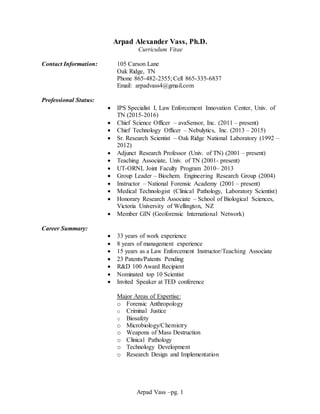
Arpad Alexander Vass, Ph.D.
Curriculum Vitae
Contact Information: 105 Carson Lane
Oak Ridge, TN
Phone 865-482-2355; Cell 865-335-6837
Email: arpadvass4@gmail.com
Professional Status:
 IPS Specialist I, Law Enforcement Innovation Center, Univ. of
TN (2015-2016)
 Chief Science Officer – avaSensor, Inc. (2011 – present)
 Chief Technology Officer – Nebulytics, Inc. (2013 – 2015)
 Sr. Research Scientist – Oak Ridge National Laboratory (1992 –
2012)
 Adjunct Research Professor (Univ. of TN) (2001 – present)
 Teaching Associate, Univ. of TN (2001- present)
 UT-ORNL Joint Faculty Program 2010– 2013
 Group Leader – Biochem. Engineering Research Group (2004)
 Instructor – National Forensic Academy (2001 – present)
 Medical Technologist (Clinical Pathology, Laboratory Scientist)
 Honorary Research Associate – School of Biological Sciences,
Victoria University of Wellington, NZ
 Member GIN (Geoforensic International Network)
Career Summary:
 33 years of work experience
 8 years of management experience
 15 years as a Law Enforcement Instructor/Teaching Associate
 23 Patents/Patents Pending
 R&D 100 Award Recipient
 Nominated top 10 Scientist
 Invited Speaker at TED conference
Major Areas of Expertise:
o Forensic Anthropology
o Criminal Justice
o Biosafety
o Microbiology/Chemistry
o Weapons of Mass Destruction
o Clinical Pathology
o Technology Development
o Research Design and Implementation
Arpad Vass –pg. 2
Major Contributions to Science:
Medicine, Biology and Environmental Science
 Discovery of one of the most powerful, novel, nontoxic, biodegradable
biosurfactants currently available.
 Discovery of novel biocidal agents to which microbes cannot develop resistance.
 Discovery of novel anti-tumor compounds specific to sarcomas.
 Discovery of a novel compound with anti-reverse transcriptase properties.
 Discovery of a unique mechanism (formation of derivars) by which free-living
amoeba can increase biodiversity in an ecosystem.
 Development of methods to isolate and recover microorganisms capable of
degrading virtually any toxic material in their environment.
Engineering
 Development of very high energy efficiency centrifugal and inertial motors and
generators.
 Impacted the development of next generation chemical/biological weapons
detection instrumentation currently deployed.
Forensics - Medicolegal/Law Enforcement
 Revolutionized methods to determine the post-mortem interval. Developed four
novel methods currently being used worldwide in criminal investigations.
 Developed databases comprising the volatile compounds emanating from human
decompositional events. These databases now influence canine training and the
development of ‘sniffer type’ instrumentation being developed for law
enforcement applications.
 Identified human specific decompositional markers and chemical ‘fingerprints’.
 Developed new standards, methods, procedures and instrumentation for locating
clandestine graves. To date, this has led to the personal discovery of 40+ such
graves worldwide.
Anthropology
 One of the first scientists to demonstrate the applicability of multi-disciplinary
approaches to solving anthropological questions. This has opened the door for
many scientists of diverse expertise to collaborate with anthropologists and
archaeologists.
Arpad Vass –pg. 3
Educational Background:
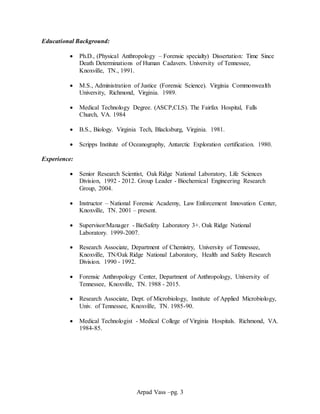
 Ph.D., (Physical Anthropology – Forensic specialty) Dissertation: Time Since
Death Determinations of Human Cadavers. University of Tennessee,
Knoxville, TN., 1991.
 M.S., Administration of Justice (Forensic Science). Virginia Commonwealth
University, Richmond, Virginia. 1989.
 Medical Technology Degree. (ASCP,CLS). The Fairfax Hospital, Falls
Church, VA. 1984
 B.S., Biology. Virginia Tech, Blacksburg, Virginia. 1981.
 Scripps Institute of Oceanography, Antarctic Exploration certification. 1980.
Experience:
 Senior Research Scientist, Oak Ridge National Laboratory, Life Sciences
Division, 1992 - 2012. Group Leader - Biochemical Engineering Research
Group, 2004.
 Instructor – National Forensic Academy, Law Enforcement Innovation Center,
Knoxville, TN. 2001 – present.
 Supervisor/Manager - BioSafety Laboratory 3+. Oak Ridge National
Laboratory. 1999-2007.
 Research Associate, Department of Chemistry, University of Tennessee,
Knoxville, TN/Oak Ridge National Laboratory, Health and Safety Research
Division. 1990 - 1992.
 Forensic Anthropology Center, Department of Anthropology, University of
Tennessee, Knoxville, TN. 1988 - 2015.
 Research Associate, Dept. of Microbiology, Institute of Applied Microbiology,
Univ. of Tennessee, Knoxville, TN. 1985-90.
 Medical Technologist - Medical College of Virginia Hospitals. Richmond, VA.
1984-85.
Arpad Vass –pg. 4
Legal Landmarks resulting from my published research:
 Frye Hearing – [first acceptance of organic and inorganic biomarkers for time
since death determinations], Feb 26-27th, 1996, Pensacola, FL [FDLE Case No.
PE-92-01-004]
Vass,A.A.,Bass,W.M.,Wolt, J.D.,Foss, J.E., Ammons, J.T.,"Time Since
Death Determinations of Human Cadavers Using Soil Solution" ,J. Forensic
Sci.,37(5):1236-1253, Sept. 1992.
 State of Tennessee vs. Howard Hawk Willis, Washington County Criminal Court,
Case No. 28343, June 14-22, 2010 [First time tissue biomarkers admitted as
evidence in US court system]
Vass,A.A.,Barshick, S.A., Sega, G., Caton, J.,Skeen, J.T., Love, J.C. and
Synstelien,J.A. Decomposition Chemistry of Human Remains: A New
Methodology for Determining the Postmortem Interval, J. Forensic Sci.,
2002;47(3):542-553.
 State of Florida vs. Casey Marie Anthony, 9thDistrict Criminal Court, Orlando,
Florida, May 15 – July 15, 2011. [First acceptance of odor mortis testimony in US
court system]
Vass,A.A.,Smith, R.R.,Thompson C.V.,Burnett, M.N., Dulgerian, N.,
Eckenrode, B.A. Odor Analysis of Decomposing Buried Human Remains. J.
Forensic Sci.,53 (2): 384-392, March 2008.
Specific Skills:
 Programming
 Research Design and Implementation
(Biology/Chemistry/Physics/Engineering/Biochemistry/Forensics/Environmental)
 Instrumentation development
 Technology development
 Grant writing
 Data analysis
 Proficiency in multiple software platforms
 Operation/maintenance of laboratory instrumentation and analysis techniques
Arpad Vass –pg. 5
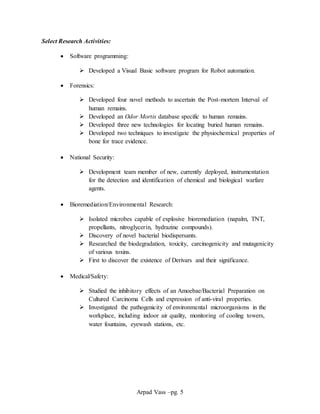
Select Research Activities:
 Software programming:
 Developed a Visual Basic software program for Robot automation.
 Forensics:
 Developed four novel methods to ascertain the Post-mortem Interval of
human remains.
 Developed an Odor Mortis database specific to human remains.
 Developed three new technologies for locating buried human remains.
 Developed two techniques to investigate the physiochemical properties of
bone for trace evidence.
 National Security:
 Development team member of new, currently deployed, instrumentation
for the detection and identification of chemical and biological warfare
agents.
 Bioremediation/Environmental Research:
 Isolated microbes capable of explosive bioremediation (napalm, TNT,
propellants, nitroglycerin, hydrazine compounds).
 Discovery of novel bacterial biodispersants.
 Researched the biodegradation, toxicity, carcinogenicity and mutagenicity
of various toxins.
 First to discover the existence of Derivars and their significance.
 Medical/Safety:
 Studied the inhibitory effects of an Amoebae/Bacterial Preparation on
Cultured Carcinoma Cells and expression of anti-viral properties.
 Investigated the pathogenicity of environmental microorganisms in the
workplace, including indoor air quality, monitoring of cooling towers,
water fountains, eyewash stations, etc.
Arpad Vass –pg. 6
Selected Publications:
 Bilheux, H.Z., Cekanova, M., Vass, A.A., Nichols, T.L., Bilheux, J.C., Donnell, R.L.,
Finochiarro, V. A novel approach to determine post mortem interval using neutron
radiography. Forensic Science International, 251: 11-21, 2015.
(doi:10.1016/j.forsciint.2015.02.017)
 Vass, A.A., Fleming, R.I., Harbinson, S., Curran, J.M. and Williams, E. Nucleic Acid
Degradation and the Postmortem Interval. Proceedings: American Academy of
Forensic Sciences, Atlanta, GA, Feb 20-25, 2012, (G36, p.295-6).
 Vass, A.A. Odor Mortis, Forensic Science Int. 222 (2012) 234-241.
 Larson, D.O., Vass, A.A. and Wise, M. Advanced Scientific Methods and Procedures
in the Forensic Investigation of Clandestine Graves. Journal for Contemporary
Criminal Justice, Volume 27 Issue 2 May 2011 pp. 149 - 182.
 Vass, A.A. The Elusive Universal Post-Mortem Interval Formula, Forensic Science
Int.204 (2011) 34–40.
 Vass, A. A. Dust to Dust - how a human body decomposes, Scientific American –
Special Issue “The End.”, pp 56-59, September, 2010.
 R.Schoske, R., Kennedy, P.W., Duty, C.E., Smith, R.R., Huxford, T.J., Bonavita,
A.M., Engleman, P.G., Vass, A.A., Griest, W.H., Jenkins, R.A., Ilgner, R.H, and
Brown, G.M. “Decontamination Strategy for Large Area and/or Equipment
Contaminated with Chemical and Biological Agents using a High Energy Arc Lamp
(HEAL)”. ORNL/TM-2009/08. April, 2009.
 Parkinson R.A., Dias K.R., Horswell J., Greenwood P., Banning N., Tibbett M. and
Vass A.A. Microbial community analysis of human decomposition in soil. In: Ritz,
K., Dawson, L.A., Miller, D. (Eds), Criminal and Environmental Soil Forensics,
Springer, New York, pp. 379–394, 2009.
 Bull, I.D, Berstan, R., Vass, A.A., Evershed, R.P. Identification of a disinterred grave
by molecular and stable isotope analysis. Science and Justice, 49:142-149, 2009.
 Vass, A.A.Review of: Soil Analysis in Forensic Taphonomy: Chemical and Biological
Effects of Buried Human Remains, .J. Forensic Sciences, 53 (6): 1484-1485,
November 2008.
 Vass, A.A., Smith, R.R., Thompson C.V., Burnett, M.N., Dulgerian N.,Eckenrode
B.A. Odor Analysis of Decomposing Buried Human Remains. J. Forensic Sciences,
53 (2): 384-392, March 2008.
Arpad Vass –pg. 7
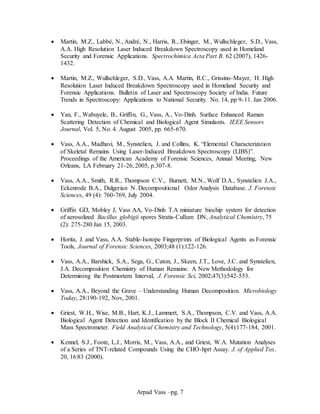
 Martin, M.Z., Labbé, N., André, N., Harris, R., Ebinger, M., Wullschleger, S.D., Vass,
A.A. High Resolution Laser Induced Breakdown Spectroscopy used in Homeland
Security and Forensic Applications. Spectrochimica Acta Part B. 62 (2007), 1426-
1432.
 Martin, M.Z., Wullschleger, S.D., Vass, A.A. Martin, R.C., Grissino-Mayer, H. High
Resolution Laser Induced Breakdown Spectroscopy used in Homeland Security and
Forensic Applications. Bulletin of Laser and Spectroscopy Society of India. Future
Trends in Spectroscopy: Applications to National Security. No. 14, pp 9-11. Jan 2006.
 Yan, F., Wabuyele, B., Griffin, G., Vass, A., Vo-Dinh. Surface Enhanced Raman
Scattering Detection of Chemical and Biological Agent Simulants. IEEE Sensors
Journal, Vol. 5, No. 4. August 2005, pp. 665-670.
 Vass, A.A., Madhavi, M., Synstelien, J. and Collins, K. “Elemental Characterization
of Skeletal Remains Using Laser-Induced Breakdown Spectroscopy (LIBS)”.
Proceedings of the American Academy of Forensic Sciences, Annual Meeting, New
Orleans, LA February 21-26, 2005, p.307-8.
 Vass, A.A., Smith, R.R., Thompson C.V., Burnett, M.N., Wolf D.A., Synstelien J.A.,
Eckenrode B.A., Dulgerian N. Decompositional Odor Analysis Database. J. Forensic
Sciences, 49 (4): 760-769, July 2004.
 Griffin GD, Mobley J, Vass AA, Vo-Dinh T.A miniature biochip system for detection
of aerosolized Bacillus globigii spores Stratis-Cullum DN, Analytical Chemistry, 75
(2): 275-280 Jan 15, 2003.
 Horita, J. and Vass, A.A. Stable-Isotope Fingerprints of Biological Agents as Forensic
Tools, Journal of Forensic Sciences, 2003;48 (1):122-126.
 Vass, A.A., Barshick, S.A., Sega, G., Caton, J., Skeen, J.T., Love, J.C. and Synstelien,
J.A. Decomposition Chemistry of Human Remains: A New Methodology for
Determining the Postmortem Interval, J. Forensic Sci, 2002;47(3):542-553.
 Vass, A.A., Beyond the Grave – Understanding Human Decomposition. Microbiology
Today, 28:190-192, Nov, 2001.
 Griest, W.H., Wise, M.B., Hart, K.J., Lammert, S.A., Thompson, C.V. and Vass, A.A.
Biological Agent Detection and Identification by the Block II Chemical Biological
Mass Spectrometer. Field Analytical Chemistry and Technology, 5(4):177-184, 2001.
 Kennel, S.J., Foote, L.J., Morris, M., Vass, A.A., and Griest, W.A. Mutation Analyses
of a Series of TNT-related Compounds Using the CHO-hprt Assay. J. of Applied Tox.
20, 16:83 (2000).
Arpad Vass –pg. 8
 Sega, Gary A., Vass, Arpad A., Caton, John, Barshick, Stacy A., Love, Jennifer C.,
and Marks, Murray. Measurement Technologies for Determining Time Since Death,
Proceedings of the 52nd Annual Meeting of the American Academy of Forensic
Sciences, Reno, NV, Feb. 21-26, 2000.
 Barshick, S.A., Wolf, D.A. and Vass, A.A. Differentiation of Microorganisms Based
on Pyrolysis-Ion Trap Mass Spectrometry using Chemical Ionization. Anal. Chem. 71:
633-641, 1999.
 Griest, W.H., Vass, A.A., Stewart, A.J. and Ho, C.-h. Chemical and Toxicological
Characterization of Slurry Reactor Biotreatment of Explosives-Contaminated Soils.
ORNL/TM-13384. March 1997.
 Vass, A.A., Mackowski, R., Anderson, T.A. and Ahmad N. Biocidal Efficacy of
Ozone in Cooling Towers. Paper Q99. Proceedings of the 96th meeting of the
American Society for Microbiology, May 19-23, New Orleans, LA, 1996.
 Hurst, G.B., Doktycz, M.J., Vass, A.A. and Buchanan, M.V. Detection of Bacterial
DNA Polymerase Chain Reaction Products by Matrix-Assisted Laser
Desorption/Ionization Mass Spectroscopy. Rapid Communications in Mass
Spectrometry, Vol. 10, 377-382, 1996.
 Barshick, S.A., Vass, A.A. and Griest, W.H. Electronic aroma technology for forensic
and law enforcement applications. SPIE, 2941:63-74, 1995.
 Barshick, S.A., Vass, A.A., Ma, C.Y., Skeen, J.T. and Griest, W.H. Investigating the
Decomposition Chemistry of Human Remains Using Advanced Analytical
Technologies. 36th Conference of Analytical Chemistry in Energy Technology. Conf-
9510143. pp. 5-6. Gatlinburg, Tennessee, October 10-12, 1995.
 Griest, W.H., Tyndall, R.L., Stewart, A.J., Caton, J.E., Vass, A.A., Ho, C.-h.,
Caldwell, W.M. Chemical Characterization and Toxicological Testing of Windrow
Composts from Explosives-Contaminated Sediments. Environ. Tox. Chem. Vol 14,
No. 1, pp. 51-59, 1995.
 Vass, A.A., et. al. The resistance of amoebae, amoebae associated bacteria and
derivars tovarious forms of radiation. Endocytobiology VI, Sept, 1995.
 Vass, A.A., et. al. Unique characteristics of amoebae associated bacteria and their
usefulness in bioremediation. Endocytobiology VI, Sept, 1995.
 Bowman, E.K., Vass, A.A., Mackowski, R., Owen, B.A., Tyndall, R.L. Quantitation
of Free-Living Amoebae and Bacterial Populations in Eyewash Stations. AIHA,
March 27, 1995.
Arpad Vass –pg. 9
 Vass, A.A., Tyndall R.L., Mackowski, R. Desorption and Removal of Elemental
Mercury from Soil. Paper Q272. Proceedings of the 95th meeting of the American
Society for Microbiology, May 21-25, Washington D.C., 1995.
 Vass, A.A., Tyndall R.L. Application of Amoebae Associated Bacteria in the
Degradation of Explosives. Paper Q108. Proceedings of the 95th meeting of the
American Society for Microbiology, May 21-25, Washington D.C., 1995.
 Tyndall, R.L., A.A. Vass. The impact of Protozoa on Human Health in the Indoor
Environment. Biological aerosols: A state of the art review. Ed. H.A. Burge and M.L.
Muilenberg. Chapter 6. CRC Press, Inc. pp 121-132, 1995.
 Griest, W.H., Tyndall, R.L., Stewart, A.J., Caton, J.E., Vass, A.A., Ho, C.-h.,
Caldwell, W.M. Characterization of Explosives Processing Waste Decomposition Due
to Composting. ORNL/TM-12812. September 1994.
 Vass, A.A., Tyndall, R.L. Radiation Induced Derivars and Their Genetic Similarity to
Irradiated Amoebae. 94th General Meeting of the American Society of Microbiology
Proceedings, p. 130, May 23-27, 1994. Las Vegas, NV.
 Dietz, A.J., Vass, A.A., Mackowski, R.P. Tyndall, R.L. Comparison of Intra- and
Extra-Amoebic Bacterial Isolates. 94th General Meeting of the American Society of
Microbiology Proceedings, p. 130, May 23-27, 1994. Las Vegas, NV.
 Vass, A.A., Tyndall, R.L. Radiation resistance of Free-Living Amoebae and Their
Associated Bacteria. Paper Q-23. 93rd General Meeting of the American Society of
Microbiology Proceedings, p. 164, May 16-20, 1993. Atlanta, GA.
 Vass, A.A., K.S. Ironside, R.L. Tyndall. Bioremediation of Petroleum Contaminated
Soils on Kwajelein Island: Microbial Characterization and Biotreatability Studies.
Chapter 3: Pathogenicity Profile. ORNL/TM-11925. 1992.
 Vass, A.A., R.L. Tyndall. The use of COSTAR Microtiter Plates to study amoebic-
bacterial interactions. Paper Q-378, p. 398. Proceedings of the 92nd General Meeting
of the American Society of Microbiology. May 25-31, 1992. New Orleans, LA.
 Tyndall, R.L., A.A. Vass. Increased bacterial diversity after passage of bacteria
through free-living amoebae. Proceedings of the 5th International Symposium of
Endocytobiology, pp. 515-522, Kyoto, Japan. June 15-19, 1992.
 Vass, A.A., R.L. Tyndall. Interactions of free-living Amoebae with bacteria resulting
in bacterial diversity. Proceedings of the 6th International Conference on the biology
and Pathogenicity of free-living amoebae, p. 87, August 2-7, 1992, Richmond, VA.
Arpad Vass –pg. 10
 Vass, A.A., Bass, W.M., Wolt, J.D., Foss, J.E., Ammons, J.T., "Time Since Death
Determinations of Human Cadavers Using Soil Solution", Journal of Forensic
Sciences, 37(5):1236-1253, Sept. 1992.
 Nivens, D., Jack, R., Vass, A.A., Guckert, J., Chambers, J. 1991. Multi-electrode
probe for statistical evaluation. J. of Microbial Methods. August 1992. 16(1):47-58.
 Tyndall, R.L., Vass, A.A., Fliermans, C.B. Mixed bacterial populations derived from
Legionella-infected free living amoeba. Proceedings of ASM 4th International
Symposium on Legionella, p 284, Orlando, FL., Jan. 26-29, 1992.
Selected Presentations:
 Vass, A.A. TEDxYYC – CommonScents - May 25, 2012, Calgary, Canada.
 Vass, A.A. Clandestine grave detection. Western Carolina University, Culhowee, NC.
Cadaver Dog Training Workshop: Invited Speaker, May 22, 2012.
 Ashton, J.L., Raum, B.A., Vass, A.A., Garavaglia, J.C. and Goldberger, B.A. Odor
Mortis: What is it anyway? American Academy of Forensic Sciences, Atlanta, GA,
Feb 20-25, 2012 (L2, p. 11).
 Fleming, R., Williams, E., Harbison, SA, Curran, J., Vass. A. Nails, Nucleic Acids
and the Post-Mortem Interval. Oral presentation at the Australia and New Zealand
Forensic Science Symposium, Hobart, Australia. September 2012.
 Vass, A., Williams, E., Harbison, SA, Curran, J., Fleming, R. Nucleic Acids in Nails
and the Post-Mortem Interval. Poster presentation at The American Academy of
Forensic Sciences Annual Meeting, Atlanta, GA, Feb 20-25, 2012, (G36, p.295-6).
 Vass, A., Williams, E., Harbison, SA, Curran, J., Fleming, R. Evaluating the Use of
DNA and RNA Degradation for Estimating the Post-Mortem Interval. Poster
presentation at the NIJ conference. Washington, D.C. June 2011.
 Fleming, R., Williams, E., Harbison, SA, Curran, J., Vass. A. Nails, Nucleic Acids
and the Post-Mortem Interval. Poster presentation at The 22nd International
Symposium on Human Identification. Maryland, US. October 2011.
 Vass, A.A. The 3rd International Conference on Criminal and Environmental Soil
Forensics. California Association of Criminalists. “Early Postmortem Decomposition
and mtDNA – Murder, Mystery and Microscope” Hyatt Regency Hotel, Long Beach,
California, USA. November 2-4, 2010.
Arpad Vass –pg. 11
 Vass, A.A. Technology for interrogating Crime Scenes. TVS-AIHA 2010 - Fall
conference. Industrial Hygiene Scene Investigation. October 20-22, 2010. Knoxville,
TN.
 Vass, A.A. Determining Death and Detecting Decomposition. 2010 TN IAI
Conference, TBI Headquarters, Nashville, TN. October 8th, 2010.
 Vass, A.A. Technology to locate clandestine graves. Presented at DOE's SERCh
event. Oak Ridge National Laboratory, Oak Ridge, TN., November 8, 2009.
 Martin, M., Vass, A.A., Labbe, N., Andre, N. Laser-Induced Breakdown
Spectroscopy for High Resolution Data Collection and Multivariate Analysis in
Forensic and Environmental Applications. Invited speaker NASLIBS 2009, New
Orleans, July 13-15.
 Madhavi Z. Martin, Stan D. Wullschleger, and Arpad Vass, “High Resolution
applications of Laser-induced breakdown spectroscopy for Homeland Security and
Forensic Applications”, First Indo-US Workshop on Spectroscopy, (Invited Talk), Jan
9-12, 2006, Varanasi, India.
 Vass, A.A. “The Dust of Death”. 6th Annual Vanderbilt-Meharry Alliance Genetics
Symposium/A look at genetics in the field of criminal investigations. Vanderbilt
University - Invited speaker. September 21, 2005.
 Vass, A.A., Martin, M. Elemental Characterization Using Laser-Induced Breakdown
Spectroscopy (LIBS) for Forensic Applications. Invited speaker Dept. of Homeland
Security Technology series, Gatlinburg, TN. September 15, 2004.
 Vass, A.A. Weapons of Mass Destruction. National Forensic Academy Alumni
Seminar, Knoxville Convention Center, Knoxville, TN August 23-25, 2004.
 Horswell, J., Parkinson, R., Cordiner, S., Sutherland, B., Speir, T., Chambers, G. and
Vass, A. 2003. Forensic DNA profiling of bacterial communities in soils.
International Society of Environmental Forensics, Environmental Forensics: Using
Science to Reconstruct Contamination Events. Taipei, Taiwan.
 Vass, A.A. Invited plenary speaker. Four presentations on Human decomposition,
Time since death and Forensic Anthropology presented at the 17th International
Symposium of the Forensic Sciences, Wellington, NZ. March 28-April 2, 2004
 Vass, A.A. “Odor Analysis of Decomposition”, presented at the 56th Annual Meeting
of the American Academy of Forensic Sciences, Dallas, TX. Feb 16-21, 2004.
 Collins, K.C., Vass, A.A. “What’s that Smell”, presented at the 56th Annual Meeting
of the American Academy of Forensic Sciences, Dallas, TX. Feb 16-21, 2004.
Arpad Vass –pg. 12
 Vass, A.A. Council for the Advancement of Science (CASW). Interpreting all that
Remains: New Insights. Radison Summitt Hotel, Knoxville, TN. October 29, 2003.
 Vass, A.A., “Human Decomposition and Biohazards”, presented at the American
Biorecovery Association (ABRA) conference, Las Vegas, NV, Sept 30 – Oct 4, 2002.
 Griest, W. H., M.B. Wise, K. J. Hart, S. A. Lammert, C. V. Thompson, D. A. Wolf,
M. N. Burnett, A. A. Vass, I. F. Robbins, and D. A. Clayton, “The Block II Chemical
Biological Mass Spectrometer (CBMS): Issues and Solutions in Integrated Chemical-
Biological Agent Detection,” presentation at Integrating Chemical and Biological
Detection Technology: Today’s Solutions and Tomorrow’s Issues,” Alexandria,
Virginia, May 1, 2002.
 Vass, A.A., “Chemical Issues in Human Decomposition – Implications for TSD
Determinations,” Presented at the U.S. Army Criminal Investigation Laboratory, Fort
Gillem, GA. August 23, 2002.
 Vass, A.A., "The University of Tennessee’s Forensic Research Facility and ORNL,"
presented to the East Tennessee Regional Leadership Association Class of 2002, Oak
Ridge National Laboratory, Oak Ridge, Tennessee, July 24, 2002 (Invited).
 Vass, A.A. “Weapons of Mass Destruction”, Seminar on Crime Scene Investigations.
National Center for Unresolved Homicides, Orlando, Fl., June 17-21, 2002.
 W. H. Griest, S. A. Lammert, M. B. Wise, K. J. Hart, A. A. Vass, D. A. Wolf, M. N.
Burnett, R. Merriweather, and R. R. Smith, “A Mass Spectrometer-Based System for
Integrated Chemical and Biological Agent Detection The Block II CBMS,” 50th
ASMS Conference, Orlando, FL, June 2-6, 2002.
 Griest, W. H., M. B. Wise, K. J. Hart, S. A. Lammert, C. V. Thompson, D. A. Wolf,
M. N. Burnett, A. A. Vass, I. B. Robbins, and D. A. Clayton, “The Block II Chemical
Biological Mass Spectrometer (CBMS): Issues and Solutions in Integrated Chemical-
Biological Agent Detection,” presentation at the Biodetection Conference,
Washington, DC, May 2-3, 2002.
 Lammert, S.A., W. H. Griest, M.B. Wise, K.J. Hart, A.A. Vass, D.A. Wolf, M.N.
Burnett, R. Merriweather, and R.R. Smith, “A Mass Spectrometer-Based System for
Integrated Chemical and Biological Agent Detection - The Block II CBMS,”
presentation at the 50th American Society for Mass Spectrometry (ASMS) Conference,
Orlando, FL, June 2, 2002.
 Vass, A.A., et. al. Human Decomposition Chemistry. Presented at the 54th Annual
Meeting of the American Academy of Forensic Sciences, Atlanta, GA, February 11-
15, 2002.
Arpad Vass –pg. 13
 Hart, K.H., S.H. Harmon, D.A. Wolf, A.A. Vass and M.B. Wise, "Detection of
Chemical/Biological Agents and Simulants Using Quadrupole Ion Trap Mass
Spectrometry". Presented at the 47th ASMS Conference on Mass Spectrometry and
Allied Topics, Dallas, TX, June 14-18, 1999.
 Vass, A.A."Forensic Anthropology and Time Since Death". Presented for the Center
of Unresolved Homicides in conjunction with the University of Central Florida,
Orlando, FL, June 14-18, 1999.
 “The resistance of amoebae, amoebae associated bacteria and derivars to various
forms of radiation", Vass, A.A., Tyndall, R.L., Presented at the International
Conference on the Biology and Pathogenicity of Free-Living Amoebae,
Murfreesboro, TN, May 27-June 2, 1998
 "The discovery of novel anti-microbial bacterial pigments" Vass, A.A., Tyndall, R.L.,
Presented at the International Conference on the Biology and Pathogenicity of Free-
Living Amoebae, Murfreesboro, TN, May 27-June 2, 1998.
 "The who, when, but not why, of forensic pathology" Vass, A.A. Presented at the
Virginia Military Institute. Lexington, VA. Feb. 6, 1997.
 "Bones, Decay and Time Since Death", Instructor Presentation for the Center for
Unresolved Homicides, Inc. East Coast police coalition agencies. Louisville, KY.
Sept. 23-27, 1996.
 “The Changing Role of Forensic Anthropologists", Presented at the Boulder Police
Training Center by The Center for Unresolved Homicides, Inc. Boulder, CO. April 22-
25, 1996.
 "Investigating the Decomposition Chemistry of Human Remains Using Advanced
Analytical Technologies", 36th Conference of Analytical Chemistry in Energy
Technology. Barshick, S.A., Vass, A.A., Ma, C.Y., Skeen, J.T. and Griest, W.H.
Conf- 9510143. pp. 5-6, Gatlinburg, Tennessee, October 10-12, 1995.
 "Trace Evidence at Crime Scenes/Homicides", Vass A.A., Presented at the 2nd
Annual Jacksonville Sheriff's Office Robbery/Homicide Conference, Jacksonville,
Fla. July 31- August 4, 1995.
 "The resistance of amoebae, amoebae associated bacteria and derivars to various
forms of radiation", Vass A.A., Tyndall, R.L., Presented at Endocytobiology VI,
Tubingen, Germany, Sept. 6-10, 1995.
 "Soil Analysis under Decomposing Remains", Vass A. A., Presented at Challenges in
Forensic Pathology and Investigations: District 12 Medical Examiners. 22nd Annual
Medical Examiners Program, Nov. 2-5, 1994, Sarasota, Fla.
Arpad Vass –pg. 14
 "The Importance of Protozoa in the Survival and Amplification of Legionella",
Tyndall, R.L., Vass A. A. Presented at the ASHRAE National Meeting, June 28, 1994,
Orlando, FL.
 "Bioremediation Capabilities of Amoebae Associated Bacteria", Vass, A.A., Tyndall,
R.L. Presented at the Biotechnology and Biomol. Science Colloquium, March 15-16,
1994.
 "Chemical/Toxicological Evaluation of Windrow Composting of Explosives-
Contaminated Sediments", Griest, W.H., Tyndall, R.L., Stewart, A.J., Vass, A.A., Ho,
C.-h., Caton, J.E., Caldwell, W.M. 35th Rocky Mountain Conference on Analytical
Chemistry, Denver, CO., July 25-29, 1993.
 "Bioremedial Capabilities and Diversity of Bacteria Sequestered by Amoebae", Expo
'93, Oak Ridge National Laboratory, April 1993.
 "Time Since Death: the most difficult forensic question to answer." 3rd Annual
Mountain, Swamp and Beach meeting for Forensic Anthropologists. University of
Tennessee, Knoxville. 1991.
 "Time since death determinations of Human Cadavers Utilizing Inorganic Parameters
in Soil Solution." 43rd Annual Meeting of the American Academy of Forensic
Sciences, Anaheim, CA. February 1991.
 "Time since death determinations of Human Cadavers Utilizing Volatile Fatty Acids
in Soil Solution." 42nd Annual Meeting of the American Academy of Forensic
Sciences, Cincinnati, OH, February 1990.
 "Time of Death", Seminar on Forensic Medicine: Homicide Investigation, East
Tennessee State University, Quillen-Dishner College of Medicine, Johnson City, TN.,
August 1989.
Arpad Vass –pg. 15
Honors/Awards:
 Antarctic Service Medal of the United States of America
 Certificate of Achievement, New Zealand Survival School
 National Dean's List
 Excellence in Crime Scene Investigation, FBI Southeastern Regional
Competition
 Certificates of Recognition, ORNL Patent Applications
 R&D 100 (2000)
 UT-Battelle Award Recipient (2000)
 UT-Battelle Award Recipient (2001)
 United States Army Criminal Investigation Command – Commanding
General’s Award for Excellence
 Nominated top 10 Scientist in TN, 2004 by Business Tennessee Magazine.
 UT-Battelle Service Award (2007, 2012)
 Certificate of Excellence, Forensic Science International (2013)
Patents:
 Patent Pending –Pub # US2015/0253452 A1 Matter detection, sensor and
locator device and methods of operation, Sept 10, 2015
 Docket 2709 DOE – S124268 Ethanol Production by a desert fungus:
submitted as ID Sept. 27, 2011
 DOE S-115, 344(#2305) – LABRADOR (filed July 31, 2010)
 DOE 2199 - External Split Field Generator (US Patent # 8,120,225B2).
Issued Feb. 21, 2012
 DOE 2200 – Internal Split Field Generator (US Patent 8,089,188B2)
Issued Jan 3, 2012
 DOE S-115, 238 – Terrestrial Electroacoustic Grave Detection (2009)
 DOE S-115, 347 – Inertia Pumped Parametric Motor (2009)
 DOE S-115, 350 – Centripetal Electric Generator (2009)
 Docket #: 1300001988Winnowed Impulse-flow Sample Entrainment and
Acoustic Spectroscopic Sensor (2007)
 Docket 1966 – UT/Battelle: Cooling Garment (2007)
 Docket 1911 – UT/Battelle: Universal Body Bag Tray (2007)
 DOE 1860 - US Patent # 8074490 – Clandestine grave detector
Issued Dec 13, 2011
 Docket 1203 – UT/Battelle: Biocidal material for treatment against pathogens
08/04/04. US Patent No. 11,748,649 issued 3-6-2008.
 ESID 1034-X Rescue or Creation of Bacterial Populations by Passage
Through Protozoa.
Arpad Vass –pg. 16
 ESID 1231-X Process for Degrading Explosives (Napalm/TNT)
o US Patent No. 5,449,618 issued 9-12-95
o US Patent No. 5,484,730 issued 1-16-96
o US Patent No. 5,578,488 issued 11-26-96
 ESID 1413-X Mercury Contaminated Soil Cleaning with Copper Pellets and
Microbial Agents; US Patent No. 5,597,729 issued 1-28-97
 ESID 1814-X Novel System for Removal of Infectious Agents Using Pulsed
Fields(6-2-97)
 ESID 1860-X Inhibitory Effects of an Amoebae/Bacterial Preparation Having
Anti-Tumor Properties (filed 9-15-97)
 ESID 1861-X Inhibitory Effects of an Amoebae/Bacterial Preparation Having
Anti-Reverse Transcriptase Activity (filed 9-15-97)
 ERID 0491 Antimicrobial Effect of an Amoebae/Bacterial Preparation
(Filed with the USPTO)
 UTRC Time Since Death Determinations of Human Cadavers
US Patent No. 5,162,232 issued Nov. 10, 1992.
Arpad Vass –pg. 17
References:
William M. Bass,Ph.D.
Professor Emeritus (Univ. of Tennessee – ret.)
1186 Treymour Way
Knoxville, TN 37922-5165
(865) 806-4545 (Cell)
Wayne Griest, Ph.D.
Program Director (Oak Ridge National Laboratory - ret.)
8257 Hempridge Rd.
Shelbyville, KY 40065-9313
(502) 738-0233
hempridge@yahoo.com
Marcus Wise. Ph.D.
Senior Scientist/Group Leader (Oak Ridge National Laboratory - ret.)
436 Foremast Rd.
Kingston, TN 37763
(423) 807-1554
mbwise@ix.netcom.com
Fred D. Tompkins, Ph.D.,P.E.
Professor Emeritus
University of Tennessee
110 BESS Office Building
2506 E.J. Chapman Drive
Knoxville, TN 37996-4531
(865) 974-7696
tompkins@tennessee.edu
Richard L. Tyndall, Ph.D.
Senior Scientist(Oak Ridge National Laboratory - ret.)
100 Donner Court
Oak Ridge, TN 37830-7721
(865) 220-8507
RichTyn@webtv.net
Don Green
Executive Director, Law Enforcement Innovation Center
1201 Oak Ridge Turnpike, Suite 101
Oak Ridge, TN 37830
(865) 946-3201
don.green@tennessee.edu

CV-vass 2016a

  • 1.
    Arpad Vass –pg.1 Arpad Alexander Vass, Ph.D. Curriculum Vitae Contact Information: 105 Carson Lane Oak Ridge, TN Phone 865-482-2355; Cell 865-335-6837 Email: arpadvass4@gmail.com Professional Status:  IPS Specialist I, Law Enforcement Innovation Center, Univ. of TN (2015-2016)  Chief Science Officer – avaSensor, Inc. (2011 – present)  Chief Technology Officer – Nebulytics, Inc. (2013 – 2015)  Sr. Research Scientist – Oak Ridge National Laboratory (1992 – 2012)  Adjunct Research Professor (Univ. of TN) (2001 – present)  Teaching Associate, Univ. of TN (2001- present)  UT-ORNL Joint Faculty Program 2010– 2013  Group Leader – Biochem. Engineering Research Group (2004)  Instructor – National Forensic Academy (2001 – present)  Medical Technologist (Clinical Pathology, Laboratory Scientist)  Honorary Research Associate – School of Biological Sciences, Victoria University of Wellington, NZ  Member GIN (Geoforensic International Network) Career Summary:  33 years of work experience  8 years of management experience  15 years as a Law Enforcement Instructor/Teaching Associate  23 Patents/Patents Pending  R&D 100 Award Recipient  Nominated top 10 Scientist  Invited Speaker at TED conference Major Areas of Expertise: o Forensic Anthropology o Criminal Justice o Biosafety o Microbiology/Chemistry o Weapons of Mass Destruction o Clinical Pathology o Technology Development o Research Design and Implementation
  • 2.
    Arpad Vass –pg.2 Major Contributions to Science: Medicine, Biology and Environmental Science  Discovery of one of the most powerful, novel, nontoxic, biodegradable biosurfactants currently available.  Discovery of novel biocidal agents to which microbes cannot develop resistance.  Discovery of novel anti-tumor compounds specific to sarcomas.  Discovery of a novel compound with anti-reverse transcriptase properties.  Discovery of a unique mechanism (formation of derivars) by which free-living amoeba can increase biodiversity in an ecosystem.  Development of methods to isolate and recover microorganisms capable of degrading virtually any toxic material in their environment. Engineering  Development of very high energy efficiency centrifugal and inertial motors and generators.  Impacted the development of next generation chemical/biological weapons detection instrumentation currently deployed. Forensics - Medicolegal/Law Enforcement  Revolutionized methods to determine the post-mortem interval. Developed four novel methods currently being used worldwide in criminal investigations.  Developed databases comprising the volatile compounds emanating from human decompositional events. These databases now influence canine training and the development of ‘sniffer type’ instrumentation being developed for law enforcement applications.  Identified human specific decompositional markers and chemical ‘fingerprints’.  Developed new standards, methods, procedures and instrumentation for locating clandestine graves. To date, this has led to the personal discovery of 40+ such graves worldwide. Anthropology  One of the first scientists to demonstrate the applicability of multi-disciplinary approaches to solving anthropological questions. This has opened the door for many scientists of diverse expertise to collaborate with anthropologists and archaeologists.
  • 3.
    Arpad Vass –pg.3 Educational Background:  Ph.D., (Physical Anthropology – Forensic specialty) Dissertation: Time Since Death Determinations of Human Cadavers. University of Tennessee, Knoxville, TN., 1991.  M.S., Administration of Justice (Forensic Science). Virginia Commonwealth University, Richmond, Virginia. 1989.  Medical Technology Degree. (ASCP,CLS). The Fairfax Hospital, Falls Church, VA. 1984  B.S., Biology. Virginia Tech, Blacksburg, Virginia. 1981.  Scripps Institute of Oceanography, Antarctic Exploration certification. 1980. Experience:  Senior Research Scientist, Oak Ridge National Laboratory, Life Sciences Division, 1992 - 2012. Group Leader - Biochemical Engineering Research Group, 2004.  Instructor – National Forensic Academy, Law Enforcement Innovation Center, Knoxville, TN. 2001 – present.  Supervisor/Manager - BioSafety Laboratory 3+. Oak Ridge National Laboratory. 1999-2007.  Research Associate, Department of Chemistry, University of Tennessee, Knoxville, TN/Oak Ridge National Laboratory, Health and Safety Research Division. 1990 - 1992.  Forensic Anthropology Center, Department of Anthropology, University of Tennessee, Knoxville, TN. 1988 - 2015.  Research Associate, Dept. of Microbiology, Institute of Applied Microbiology, Univ. of Tennessee, Knoxville, TN. 1985-90.  Medical Technologist - Medical College of Virginia Hospitals. Richmond, VA. 1984-85.
  • 4.
    Arpad Vass –pg.4 Legal Landmarks resulting from my published research:  Frye Hearing – [first acceptance of organic and inorganic biomarkers for time since death determinations], Feb 26-27th, 1996, Pensacola, FL [FDLE Case No. PE-92-01-004] Vass,A.A.,Bass,W.M.,Wolt, J.D.,Foss, J.E., Ammons, J.T.,"Time Since Death Determinations of Human Cadavers Using Soil Solution" ,J. Forensic Sci.,37(5):1236-1253, Sept. 1992.  State of Tennessee vs. Howard Hawk Willis, Washington County Criminal Court, Case No. 28343, June 14-22, 2010 [First time tissue biomarkers admitted as evidence in US court system] Vass,A.A.,Barshick, S.A., Sega, G., Caton, J.,Skeen, J.T., Love, J.C. and Synstelien,J.A. Decomposition Chemistry of Human Remains: A New Methodology for Determining the Postmortem Interval, J. Forensic Sci., 2002;47(3):542-553.  State of Florida vs. Casey Marie Anthony, 9thDistrict Criminal Court, Orlando, Florida, May 15 – July 15, 2011. [First acceptance of odor mortis testimony in US court system] Vass,A.A.,Smith, R.R.,Thompson C.V.,Burnett, M.N., Dulgerian, N., Eckenrode, B.A. Odor Analysis of Decomposing Buried Human Remains. J. Forensic Sci.,53 (2): 384-392, March 2008. Specific Skills:  Programming  Research Design and Implementation (Biology/Chemistry/Physics/Engineering/Biochemistry/Forensics/Environmental)  Instrumentation development  Technology development  Grant writing  Data analysis  Proficiency in multiple software platforms  Operation/maintenance of laboratory instrumentation and analysis techniques
  • 5.
    Arpad Vass –pg.5 Select Research Activities:  Software programming:  Developed a Visual Basic software program for Robot automation.  Forensics:  Developed four novel methods to ascertain the Post-mortem Interval of human remains.  Developed an Odor Mortis database specific to human remains.  Developed three new technologies for locating buried human remains.  Developed two techniques to investigate the physiochemical properties of bone for trace evidence.  National Security:  Development team member of new, currently deployed, instrumentation for the detection and identification of chemical and biological warfare agents.  Bioremediation/Environmental Research:  Isolated microbes capable of explosive bioremediation (napalm, TNT, propellants, nitroglycerin, hydrazine compounds).  Discovery of novel bacterial biodispersants.  Researched the biodegradation, toxicity, carcinogenicity and mutagenicity of various toxins.  First to discover the existence of Derivars and their significance.  Medical/Safety:  Studied the inhibitory effects of an Amoebae/Bacterial Preparation on Cultured Carcinoma Cells and expression of anti-viral properties.  Investigated the pathogenicity of environmental microorganisms in the workplace, including indoor air quality, monitoring of cooling towers, water fountains, eyewash stations, etc.
  • 6.
    Arpad Vass –pg.6 Selected Publications:  Bilheux, H.Z., Cekanova, M., Vass, A.A., Nichols, T.L., Bilheux, J.C., Donnell, R.L., Finochiarro, V. A novel approach to determine post mortem interval using neutron radiography. Forensic Science International, 251: 11-21, 2015. (doi:10.1016/j.forsciint.2015.02.017)  Vass, A.A., Fleming, R.I., Harbinson, S., Curran, J.M. and Williams, E. Nucleic Acid Degradation and the Postmortem Interval. Proceedings: American Academy of Forensic Sciences, Atlanta, GA, Feb 20-25, 2012, (G36, p.295-6).  Vass, A.A. Odor Mortis, Forensic Science Int. 222 (2012) 234-241.  Larson, D.O., Vass, A.A. and Wise, M. Advanced Scientific Methods and Procedures in the Forensic Investigation of Clandestine Graves. Journal for Contemporary Criminal Justice, Volume 27 Issue 2 May 2011 pp. 149 - 182.  Vass, A.A. The Elusive Universal Post-Mortem Interval Formula, Forensic Science Int.204 (2011) 34–40.  Vass, A. A. Dust to Dust - how a human body decomposes, Scientific American – Special Issue “The End.”, pp 56-59, September, 2010.  R.Schoske, R., Kennedy, P.W., Duty, C.E., Smith, R.R., Huxford, T.J., Bonavita, A.M., Engleman, P.G., Vass, A.A., Griest, W.H., Jenkins, R.A., Ilgner, R.H, and Brown, G.M. “Decontamination Strategy for Large Area and/or Equipment Contaminated with Chemical and Biological Agents using a High Energy Arc Lamp (HEAL)”. ORNL/TM-2009/08. April, 2009.  Parkinson R.A., Dias K.R., Horswell J., Greenwood P., Banning N., Tibbett M. and Vass A.A. Microbial community analysis of human decomposition in soil. In: Ritz, K., Dawson, L.A., Miller, D. (Eds), Criminal and Environmental Soil Forensics, Springer, New York, pp. 379–394, 2009.  Bull, I.D, Berstan, R., Vass, A.A., Evershed, R.P. Identification of a disinterred grave by molecular and stable isotope analysis. Science and Justice, 49:142-149, 2009.  Vass, A.A.Review of: Soil Analysis in Forensic Taphonomy: Chemical and Biological Effects of Buried Human Remains, .J. Forensic Sciences, 53 (6): 1484-1485, November 2008.  Vass, A.A., Smith, R.R., Thompson C.V., Burnett, M.N., Dulgerian N.,Eckenrode B.A. Odor Analysis of Decomposing Buried Human Remains. J. Forensic Sciences, 53 (2): 384-392, March 2008.
  • 7.
    Arpad Vass –pg.7  Martin, M.Z., Labbé, N., André, N., Harris, R., Ebinger, M., Wullschleger, S.D., Vass, A.A. High Resolution Laser Induced Breakdown Spectroscopy used in Homeland Security and Forensic Applications. Spectrochimica Acta Part B. 62 (2007), 1426- 1432.  Martin, M.Z., Wullschleger, S.D., Vass, A.A. Martin, R.C., Grissino-Mayer, H. High Resolution Laser Induced Breakdown Spectroscopy used in Homeland Security and Forensic Applications. Bulletin of Laser and Spectroscopy Society of India. Future Trends in Spectroscopy: Applications to National Security. No. 14, pp 9-11. Jan 2006.  Yan, F., Wabuyele, B., Griffin, G., Vass, A., Vo-Dinh. Surface Enhanced Raman Scattering Detection of Chemical and Biological Agent Simulants. IEEE Sensors Journal, Vol. 5, No. 4. August 2005, pp. 665-670.  Vass, A.A., Madhavi, M., Synstelien, J. and Collins, K. “Elemental Characterization of Skeletal Remains Using Laser-Induced Breakdown Spectroscopy (LIBS)”. Proceedings of the American Academy of Forensic Sciences, Annual Meeting, New Orleans, LA February 21-26, 2005, p.307-8.  Vass, A.A., Smith, R.R., Thompson C.V., Burnett, M.N., Wolf D.A., Synstelien J.A., Eckenrode B.A., Dulgerian N. Decompositional Odor Analysis Database. J. Forensic Sciences, 49 (4): 760-769, July 2004.  Griffin GD, Mobley J, Vass AA, Vo-Dinh T.A miniature biochip system for detection of aerosolized Bacillus globigii spores Stratis-Cullum DN, Analytical Chemistry, 75 (2): 275-280 Jan 15, 2003.  Horita, J. and Vass, A.A. Stable-Isotope Fingerprints of Biological Agents as Forensic Tools, Journal of Forensic Sciences, 2003;48 (1):122-126.  Vass, A.A., Barshick, S.A., Sega, G., Caton, J., Skeen, J.T., Love, J.C. and Synstelien, J.A. Decomposition Chemistry of Human Remains: A New Methodology for Determining the Postmortem Interval, J. Forensic Sci, 2002;47(3):542-553.  Vass, A.A., Beyond the Grave – Understanding Human Decomposition. Microbiology Today, 28:190-192, Nov, 2001.  Griest, W.H., Wise, M.B., Hart, K.J., Lammert, S.A., Thompson, C.V. and Vass, A.A. Biological Agent Detection and Identification by the Block II Chemical Biological Mass Spectrometer. Field Analytical Chemistry and Technology, 5(4):177-184, 2001.  Kennel, S.J., Foote, L.J., Morris, M., Vass, A.A., and Griest, W.A. Mutation Analyses of a Series of TNT-related Compounds Using the CHO-hprt Assay. J. of Applied Tox. 20, 16:83 (2000).
  • 8.
    Arpad Vass –pg.8  Sega, Gary A., Vass, Arpad A., Caton, John, Barshick, Stacy A., Love, Jennifer C., and Marks, Murray. Measurement Technologies for Determining Time Since Death, Proceedings of the 52nd Annual Meeting of the American Academy of Forensic Sciences, Reno, NV, Feb. 21-26, 2000.  Barshick, S.A., Wolf, D.A. and Vass, A.A. Differentiation of Microorganisms Based on Pyrolysis-Ion Trap Mass Spectrometry using Chemical Ionization. Anal. Chem. 71: 633-641, 1999.  Griest, W.H., Vass, A.A., Stewart, A.J. and Ho, C.-h. Chemical and Toxicological Characterization of Slurry Reactor Biotreatment of Explosives-Contaminated Soils. ORNL/TM-13384. March 1997.  Vass, A.A., Mackowski, R., Anderson, T.A. and Ahmad N. Biocidal Efficacy of Ozone in Cooling Towers. Paper Q99. Proceedings of the 96th meeting of the American Society for Microbiology, May 19-23, New Orleans, LA, 1996.  Hurst, G.B., Doktycz, M.J., Vass, A.A. and Buchanan, M.V. Detection of Bacterial DNA Polymerase Chain Reaction Products by Matrix-Assisted Laser Desorption/Ionization Mass Spectroscopy. Rapid Communications in Mass Spectrometry, Vol. 10, 377-382, 1996.  Barshick, S.A., Vass, A.A. and Griest, W.H. Electronic aroma technology for forensic and law enforcement applications. SPIE, 2941:63-74, 1995.  Barshick, S.A., Vass, A.A., Ma, C.Y., Skeen, J.T. and Griest, W.H. Investigating the Decomposition Chemistry of Human Remains Using Advanced Analytical Technologies. 36th Conference of Analytical Chemistry in Energy Technology. Conf- 9510143. pp. 5-6. Gatlinburg, Tennessee, October 10-12, 1995.  Griest, W.H., Tyndall, R.L., Stewart, A.J., Caton, J.E., Vass, A.A., Ho, C.-h., Caldwell, W.M. Chemical Characterization and Toxicological Testing of Windrow Composts from Explosives-Contaminated Sediments. Environ. Tox. Chem. Vol 14, No. 1, pp. 51-59, 1995.  Vass, A.A., et. al. The resistance of amoebae, amoebae associated bacteria and derivars tovarious forms of radiation. Endocytobiology VI, Sept, 1995.  Vass, A.A., et. al. Unique characteristics of amoebae associated bacteria and their usefulness in bioremediation. Endocytobiology VI, Sept, 1995.  Bowman, E.K., Vass, A.A., Mackowski, R., Owen, B.A., Tyndall, R.L. Quantitation of Free-Living Amoebae and Bacterial Populations in Eyewash Stations. AIHA, March 27, 1995.
  • 9.
    Arpad Vass –pg.9  Vass, A.A., Tyndall R.L., Mackowski, R. Desorption and Removal of Elemental Mercury from Soil. Paper Q272. Proceedings of the 95th meeting of the American Society for Microbiology, May 21-25, Washington D.C., 1995.  Vass, A.A., Tyndall R.L. Application of Amoebae Associated Bacteria in the Degradation of Explosives. Paper Q108. Proceedings of the 95th meeting of the American Society for Microbiology, May 21-25, Washington D.C., 1995.  Tyndall, R.L., A.A. Vass. The impact of Protozoa on Human Health in the Indoor Environment. Biological aerosols: A state of the art review. Ed. H.A. Burge and M.L. Muilenberg. Chapter 6. CRC Press, Inc. pp 121-132, 1995.  Griest, W.H., Tyndall, R.L., Stewart, A.J., Caton, J.E., Vass, A.A., Ho, C.-h., Caldwell, W.M. Characterization of Explosives Processing Waste Decomposition Due to Composting. ORNL/TM-12812. September 1994.  Vass, A.A., Tyndall, R.L. Radiation Induced Derivars and Their Genetic Similarity to Irradiated Amoebae. 94th General Meeting of the American Society of Microbiology Proceedings, p. 130, May 23-27, 1994. Las Vegas, NV.  Dietz, A.J., Vass, A.A., Mackowski, R.P. Tyndall, R.L. Comparison of Intra- and Extra-Amoebic Bacterial Isolates. 94th General Meeting of the American Society of Microbiology Proceedings, p. 130, May 23-27, 1994. Las Vegas, NV.  Vass, A.A., Tyndall, R.L. Radiation resistance of Free-Living Amoebae and Their Associated Bacteria. Paper Q-23. 93rd General Meeting of the American Society of Microbiology Proceedings, p. 164, May 16-20, 1993. Atlanta, GA.  Vass, A.A., K.S. Ironside, R.L. Tyndall. Bioremediation of Petroleum Contaminated Soils on Kwajelein Island: Microbial Characterization and Biotreatability Studies. Chapter 3: Pathogenicity Profile. ORNL/TM-11925. 1992.  Vass, A.A., R.L. Tyndall. The use of COSTAR Microtiter Plates to study amoebic- bacterial interactions. Paper Q-378, p. 398. Proceedings of the 92nd General Meeting of the American Society of Microbiology. May 25-31, 1992. New Orleans, LA.  Tyndall, R.L., A.A. Vass. Increased bacterial diversity after passage of bacteria through free-living amoebae. Proceedings of the 5th International Symposium of Endocytobiology, pp. 515-522, Kyoto, Japan. June 15-19, 1992.  Vass, A.A., R.L. Tyndall. Interactions of free-living Amoebae with bacteria resulting in bacterial diversity. Proceedings of the 6th International Conference on the biology and Pathogenicity of free-living amoebae, p. 87, August 2-7, 1992, Richmond, VA.
  • 10.
    Arpad Vass –pg.10  Vass, A.A., Bass, W.M., Wolt, J.D., Foss, J.E., Ammons, J.T., "Time Since Death Determinations of Human Cadavers Using Soil Solution", Journal of Forensic Sciences, 37(5):1236-1253, Sept. 1992.  Nivens, D., Jack, R., Vass, A.A., Guckert, J., Chambers, J. 1991. Multi-electrode probe for statistical evaluation. J. of Microbial Methods. August 1992. 16(1):47-58.  Tyndall, R.L., Vass, A.A., Fliermans, C.B. Mixed bacterial populations derived from Legionella-infected free living amoeba. Proceedings of ASM 4th International Symposium on Legionella, p 284, Orlando, FL., Jan. 26-29, 1992. Selected Presentations:  Vass, A.A. TEDxYYC – CommonScents - May 25, 2012, Calgary, Canada.  Vass, A.A. Clandestine grave detection. Western Carolina University, Culhowee, NC. Cadaver Dog Training Workshop: Invited Speaker, May 22, 2012.  Ashton, J.L., Raum, B.A., Vass, A.A., Garavaglia, J.C. and Goldberger, B.A. Odor Mortis: What is it anyway? American Academy of Forensic Sciences, Atlanta, GA, Feb 20-25, 2012 (L2, p. 11).  Fleming, R., Williams, E., Harbison, SA, Curran, J., Vass. A. Nails, Nucleic Acids and the Post-Mortem Interval. Oral presentation at the Australia and New Zealand Forensic Science Symposium, Hobart, Australia. September 2012.  Vass, A., Williams, E., Harbison, SA, Curran, J., Fleming, R. Nucleic Acids in Nails and the Post-Mortem Interval. Poster presentation at The American Academy of Forensic Sciences Annual Meeting, Atlanta, GA, Feb 20-25, 2012, (G36, p.295-6).  Vass, A., Williams, E., Harbison, SA, Curran, J., Fleming, R. Evaluating the Use of DNA and RNA Degradation for Estimating the Post-Mortem Interval. Poster presentation at the NIJ conference. Washington, D.C. June 2011.  Fleming, R., Williams, E., Harbison, SA, Curran, J., Vass. A. Nails, Nucleic Acids and the Post-Mortem Interval. Poster presentation at The 22nd International Symposium on Human Identification. Maryland, US. October 2011.  Vass, A.A. The 3rd International Conference on Criminal and Environmental Soil Forensics. California Association of Criminalists. “Early Postmortem Decomposition and mtDNA – Murder, Mystery and Microscope” Hyatt Regency Hotel, Long Beach, California, USA. November 2-4, 2010.
  • 11.
    Arpad Vass –pg.11  Vass, A.A. Technology for interrogating Crime Scenes. TVS-AIHA 2010 - Fall conference. Industrial Hygiene Scene Investigation. October 20-22, 2010. Knoxville, TN.  Vass, A.A. Determining Death and Detecting Decomposition. 2010 TN IAI Conference, TBI Headquarters, Nashville, TN. October 8th, 2010.  Vass, A.A. Technology to locate clandestine graves. Presented at DOE's SERCh event. Oak Ridge National Laboratory, Oak Ridge, TN., November 8, 2009.  Martin, M., Vass, A.A., Labbe, N., Andre, N. Laser-Induced Breakdown Spectroscopy for High Resolution Data Collection and Multivariate Analysis in Forensic and Environmental Applications. Invited speaker NASLIBS 2009, New Orleans, July 13-15.  Madhavi Z. Martin, Stan D. Wullschleger, and Arpad Vass, “High Resolution applications of Laser-induced breakdown spectroscopy for Homeland Security and Forensic Applications”, First Indo-US Workshop on Spectroscopy, (Invited Talk), Jan 9-12, 2006, Varanasi, India.  Vass, A.A. “The Dust of Death”. 6th Annual Vanderbilt-Meharry Alliance Genetics Symposium/A look at genetics in the field of criminal investigations. Vanderbilt University - Invited speaker. September 21, 2005.  Vass, A.A., Martin, M. Elemental Characterization Using Laser-Induced Breakdown Spectroscopy (LIBS) for Forensic Applications. Invited speaker Dept. of Homeland Security Technology series, Gatlinburg, TN. September 15, 2004.  Vass, A.A. Weapons of Mass Destruction. National Forensic Academy Alumni Seminar, Knoxville Convention Center, Knoxville, TN August 23-25, 2004.  Horswell, J., Parkinson, R., Cordiner, S., Sutherland, B., Speir, T., Chambers, G. and Vass, A. 2003. Forensic DNA profiling of bacterial communities in soils. International Society of Environmental Forensics, Environmental Forensics: Using Science to Reconstruct Contamination Events. Taipei, Taiwan.  Vass, A.A. Invited plenary speaker. Four presentations on Human decomposition, Time since death and Forensic Anthropology presented at the 17th International Symposium of the Forensic Sciences, Wellington, NZ. March 28-April 2, 2004  Vass, A.A. “Odor Analysis of Decomposition”, presented at the 56th Annual Meeting of the American Academy of Forensic Sciences, Dallas, TX. Feb 16-21, 2004.  Collins, K.C., Vass, A.A. “What’s that Smell”, presented at the 56th Annual Meeting of the American Academy of Forensic Sciences, Dallas, TX. Feb 16-21, 2004.
  • 12.
    Arpad Vass –pg.12  Vass, A.A. Council for the Advancement of Science (CASW). Interpreting all that Remains: New Insights. Radison Summitt Hotel, Knoxville, TN. October 29, 2003.  Vass, A.A., “Human Decomposition and Biohazards”, presented at the American Biorecovery Association (ABRA) conference, Las Vegas, NV, Sept 30 – Oct 4, 2002.  Griest, W. H., M.B. Wise, K. J. Hart, S. A. Lammert, C. V. Thompson, D. A. Wolf, M. N. Burnett, A. A. Vass, I. F. Robbins, and D. A. Clayton, “The Block II Chemical Biological Mass Spectrometer (CBMS): Issues and Solutions in Integrated Chemical- Biological Agent Detection,” presentation at Integrating Chemical and Biological Detection Technology: Today’s Solutions and Tomorrow’s Issues,” Alexandria, Virginia, May 1, 2002.  Vass, A.A., “Chemical Issues in Human Decomposition – Implications for TSD Determinations,” Presented at the U.S. Army Criminal Investigation Laboratory, Fort Gillem, GA. August 23, 2002.  Vass, A.A., "The University of Tennessee’s Forensic Research Facility and ORNL," presented to the East Tennessee Regional Leadership Association Class of 2002, Oak Ridge National Laboratory, Oak Ridge, Tennessee, July 24, 2002 (Invited).  Vass, A.A. “Weapons of Mass Destruction”, Seminar on Crime Scene Investigations. National Center for Unresolved Homicides, Orlando, Fl., June 17-21, 2002.  W. H. Griest, S. A. Lammert, M. B. Wise, K. J. Hart, A. A. Vass, D. A. Wolf, M. N. Burnett, R. Merriweather, and R. R. Smith, “A Mass Spectrometer-Based System for Integrated Chemical and Biological Agent Detection The Block II CBMS,” 50th ASMS Conference, Orlando, FL, June 2-6, 2002.  Griest, W. H., M. B. Wise, K. J. Hart, S. A. Lammert, C. V. Thompson, D. A. Wolf, M. N. Burnett, A. A. Vass, I. B. Robbins, and D. A. Clayton, “The Block II Chemical Biological Mass Spectrometer (CBMS): Issues and Solutions in Integrated Chemical- Biological Agent Detection,” presentation at the Biodetection Conference, Washington, DC, May 2-3, 2002.  Lammert, S.A., W. H. Griest, M.B. Wise, K.J. Hart, A.A. Vass, D.A. Wolf, M.N. Burnett, R. Merriweather, and R.R. Smith, “A Mass Spectrometer-Based System for Integrated Chemical and Biological Agent Detection - The Block II CBMS,” presentation at the 50th American Society for Mass Spectrometry (ASMS) Conference, Orlando, FL, June 2, 2002.  Vass, A.A., et. al. Human Decomposition Chemistry. Presented at the 54th Annual Meeting of the American Academy of Forensic Sciences, Atlanta, GA, February 11- 15, 2002.
  • 13.
    Arpad Vass –pg.13  Hart, K.H., S.H. Harmon, D.A. Wolf, A.A. Vass and M.B. Wise, "Detection of Chemical/Biological Agents and Simulants Using Quadrupole Ion Trap Mass Spectrometry". Presented at the 47th ASMS Conference on Mass Spectrometry and Allied Topics, Dallas, TX, June 14-18, 1999.  Vass, A.A."Forensic Anthropology and Time Since Death". Presented for the Center of Unresolved Homicides in conjunction with the University of Central Florida, Orlando, FL, June 14-18, 1999.  “The resistance of amoebae, amoebae associated bacteria and derivars to various forms of radiation", Vass, A.A., Tyndall, R.L., Presented at the International Conference on the Biology and Pathogenicity of Free-Living Amoebae, Murfreesboro, TN, May 27-June 2, 1998  "The discovery of novel anti-microbial bacterial pigments" Vass, A.A., Tyndall, R.L., Presented at the International Conference on the Biology and Pathogenicity of Free- Living Amoebae, Murfreesboro, TN, May 27-June 2, 1998.  "The who, when, but not why, of forensic pathology" Vass, A.A. Presented at the Virginia Military Institute. Lexington, VA. Feb. 6, 1997.  "Bones, Decay and Time Since Death", Instructor Presentation for the Center for Unresolved Homicides, Inc. East Coast police coalition agencies. Louisville, KY. Sept. 23-27, 1996.  “The Changing Role of Forensic Anthropologists", Presented at the Boulder Police Training Center by The Center for Unresolved Homicides, Inc. Boulder, CO. April 22- 25, 1996.  "Investigating the Decomposition Chemistry of Human Remains Using Advanced Analytical Technologies", 36th Conference of Analytical Chemistry in Energy Technology. Barshick, S.A., Vass, A.A., Ma, C.Y., Skeen, J.T. and Griest, W.H. Conf- 9510143. pp. 5-6, Gatlinburg, Tennessee, October 10-12, 1995.  "Trace Evidence at Crime Scenes/Homicides", Vass A.A., Presented at the 2nd Annual Jacksonville Sheriff's Office Robbery/Homicide Conference, Jacksonville, Fla. July 31- August 4, 1995.  "The resistance of amoebae, amoebae associated bacteria and derivars to various forms of radiation", Vass A.A., Tyndall, R.L., Presented at Endocytobiology VI, Tubingen, Germany, Sept. 6-10, 1995.  "Soil Analysis under Decomposing Remains", Vass A. A., Presented at Challenges in Forensic Pathology and Investigations: District 12 Medical Examiners. 22nd Annual Medical Examiners Program, Nov. 2-5, 1994, Sarasota, Fla.
  • 14.
    Arpad Vass –pg.14  "The Importance of Protozoa in the Survival and Amplification of Legionella", Tyndall, R.L., Vass A. A. Presented at the ASHRAE National Meeting, June 28, 1994, Orlando, FL.  "Bioremediation Capabilities of Amoebae Associated Bacteria", Vass, A.A., Tyndall, R.L. Presented at the Biotechnology and Biomol. Science Colloquium, March 15-16, 1994.  "Chemical/Toxicological Evaluation of Windrow Composting of Explosives- Contaminated Sediments", Griest, W.H., Tyndall, R.L., Stewart, A.J., Vass, A.A., Ho, C.-h., Caton, J.E., Caldwell, W.M. 35th Rocky Mountain Conference on Analytical Chemistry, Denver, CO., July 25-29, 1993.  "Bioremedial Capabilities and Diversity of Bacteria Sequestered by Amoebae", Expo '93, Oak Ridge National Laboratory, April 1993.  "Time Since Death: the most difficult forensic question to answer." 3rd Annual Mountain, Swamp and Beach meeting for Forensic Anthropologists. University of Tennessee, Knoxville. 1991.  "Time since death determinations of Human Cadavers Utilizing Inorganic Parameters in Soil Solution." 43rd Annual Meeting of the American Academy of Forensic Sciences, Anaheim, CA. February 1991.  "Time since death determinations of Human Cadavers Utilizing Volatile Fatty Acids in Soil Solution." 42nd Annual Meeting of the American Academy of Forensic Sciences, Cincinnati, OH, February 1990.  "Time of Death", Seminar on Forensic Medicine: Homicide Investigation, East Tennessee State University, Quillen-Dishner College of Medicine, Johnson City, TN., August 1989.
  • 15.
    Arpad Vass –pg.15 Honors/Awards:  Antarctic Service Medal of the United States of America  Certificate of Achievement, New Zealand Survival School  National Dean's List  Excellence in Crime Scene Investigation, FBI Southeastern Regional Competition  Certificates of Recognition, ORNL Patent Applications  R&D 100 (2000)  UT-Battelle Award Recipient (2000)  UT-Battelle Award Recipient (2001)  United States Army Criminal Investigation Command – Commanding General’s Award for Excellence  Nominated top 10 Scientist in TN, 2004 by Business Tennessee Magazine.  UT-Battelle Service Award (2007, 2012)  Certificate of Excellence, Forensic Science International (2013) Patents:  Patent Pending –Pub # US2015/0253452 A1 Matter detection, sensor and locator device and methods of operation, Sept 10, 2015  Docket 2709 DOE – S124268 Ethanol Production by a desert fungus: submitted as ID Sept. 27, 2011  DOE S-115, 344(#2305) – LABRADOR (filed July 31, 2010)  DOE 2199 - External Split Field Generator (US Patent # 8,120,225B2). Issued Feb. 21, 2012  DOE 2200 – Internal Split Field Generator (US Patent 8,089,188B2) Issued Jan 3, 2012  DOE S-115, 238 – Terrestrial Electroacoustic Grave Detection (2009)  DOE S-115, 347 – Inertia Pumped Parametric Motor (2009)  DOE S-115, 350 – Centripetal Electric Generator (2009)  Docket #: 1300001988Winnowed Impulse-flow Sample Entrainment and Acoustic Spectroscopic Sensor (2007)  Docket 1966 – UT/Battelle: Cooling Garment (2007)  Docket 1911 – UT/Battelle: Universal Body Bag Tray (2007)  DOE 1860 - US Patent # 8074490 – Clandestine grave detector Issued Dec 13, 2011  Docket 1203 – UT/Battelle: Biocidal material for treatment against pathogens 08/04/04. US Patent No. 11,748,649 issued 3-6-2008.  ESID 1034-X Rescue or Creation of Bacterial Populations by Passage Through Protozoa.
  • 16.
    Arpad Vass –pg.16  ESID 1231-X Process for Degrading Explosives (Napalm/TNT) o US Patent No. 5,449,618 issued 9-12-95 o US Patent No. 5,484,730 issued 1-16-96 o US Patent No. 5,578,488 issued 11-26-96  ESID 1413-X Mercury Contaminated Soil Cleaning with Copper Pellets and Microbial Agents; US Patent No. 5,597,729 issued 1-28-97  ESID 1814-X Novel System for Removal of Infectious Agents Using Pulsed Fields(6-2-97)  ESID 1860-X Inhibitory Effects of an Amoebae/Bacterial Preparation Having Anti-Tumor Properties (filed 9-15-97)  ESID 1861-X Inhibitory Effects of an Amoebae/Bacterial Preparation Having Anti-Reverse Transcriptase Activity (filed 9-15-97)  ERID 0491 Antimicrobial Effect of an Amoebae/Bacterial Preparation (Filed with the USPTO)  UTRC Time Since Death Determinations of Human Cadavers US Patent No. 5,162,232 issued Nov. 10, 1992.
  • 17.
    Arpad Vass –pg.17 References: William M. Bass,Ph.D. Professor Emeritus (Univ. of Tennessee – ret.) 1186 Treymour Way Knoxville, TN 37922-5165 (865) 806-4545 (Cell) Wayne Griest, Ph.D. Program Director (Oak Ridge National Laboratory - ret.) 8257 Hempridge Rd. Shelbyville, KY 40065-9313 (502) 738-0233 hempridge@yahoo.com Marcus Wise. Ph.D. Senior Scientist/Group Leader (Oak Ridge National Laboratory - ret.) 436 Foremast Rd. Kingston, TN 37763 (423) 807-1554 mbwise@ix.netcom.com Fred D. Tompkins, Ph.D.,P.E. Professor Emeritus University of Tennessee 110 BESS Office Building 2506 E.J. Chapman Drive Knoxville, TN 37996-4531 (865) 974-7696 tompkins@tennessee.edu Richard L. Tyndall, Ph.D. Senior Scientist(Oak Ridge National Laboratory - ret.) 100 Donner Court Oak Ridge, TN 37830-7721 (865) 220-8507 RichTyn@webtv.net Don Green Executive Director, Law Enforcement Innovation Center 1201 Oak Ridge Turnpike, Suite 101 Oak Ridge, TN 37830 (865) 946-3201 don.green@tennessee.edu