Annual Syllabus
Session: 2022-2023
Class-VIII (LEVEL-2)
Subject: SCIENCE
Chapter No.
and Name
Content and its mapping with
previous classes
Learning Outcomes Suggested Activities
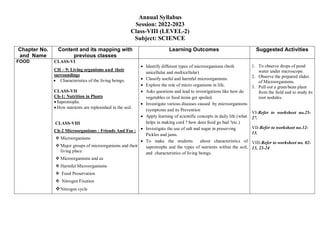
FOOD CLASS-VI
CH – 9: Living organisms and their
surroundings
• Characteristics of the living beings.
CLASS-VII
Ch-1: Nutrition in Plants
•Saprotrophs.
•How nutrients are replenished in the soil.
CLASS-VIII
Ch-2 Microorganisms : Friends And Foe :
Microorganisms
Major groups of microorganisms and their
living place
Microorganisms and us
Harmful Microorganisms
Food Preservation
Nitrogen Fixation
Nitrogen cycle
• Identify different types of microorganisms (both
unicellular and multicellular)
• Classify useful and harmful microorganisms.
• Explore the role of micro organisms in life.
• Asks questions and lead to investigations like how do
vegetables or food items get spoiled.
• Investigate various diseases caused by microorganisms
(symptoms and its Prevention
• Apply learning of scientific concepts in daily life (what
helps in making curd ? how does food go bad ?etc.)
• Investigate the use of salt and sugar in preserving
Pickles and jams.
• To make the students about characteristics of
saprotrophs and the types of nutrients within the soil,
and characteristics of living beings.
1. To observe drops of pond
water under microscope.
2. Observe the prepared slides
of Microorganisms.
3. Pull out a gram/bean plant
from the field and to study its
root nodules.
VI-Refer to worksheet no.25-
27.
VII-Refer to worksheet no.12-
13.
VIII-Refer to worksheet no. 02-
13, 23-24
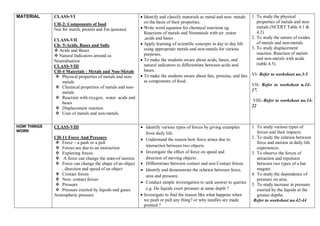
MATERIAL CLASS-VI
CH-2: Components of food
Test for starch, protein and Fat.(process)
CLASS-VII
Ch- 5:Acids, Bases and Salts
Acids and Bases
Natural Indicators around us
Neutralisation
CLASS-VIII
CH-4 Materials : Metals and Non-Metals
Physical properties of metals and non-
metals
Chemical properties of metals and non-
metals
Reaction with oxygen, water acids and
bases
Displacement reaction
Uses of metals and non-metals.
• Identify and classify materials as metal and non- metals
on the basis of their properties.
• Write word equation for chemical reactions eg.
Reactions of metals and Nonmetals with air ,water
,acids and bases .
• Apply learning of scientific concepts in day to day life
using appropriate metals and non-metals for various
purposes.
• To make the students aware about acids, bases, and
natural indicators to differentiate between acids and
bases.
• To make the students aware about fats, proteins, and fats
as components of food.
1. To study the physical
properties of metals and non-
metals (NCERT Table 4.1 &
4.2)
2. To study the nature of oxides
of metals and non-metals.
3. To study displacement
reaction. Reaction of metals
and non-metals with acids
(table 4.5).
VI- Refer to worksheet no.3-5
VII- Refer to worksheet n.14-
17.
VIII:-Refer to worksheet no.14-
22
HOW THINGS
WORK
CLASS-VIII
CH-11 Force And Pressure
Force – a push or a pull
Forces are due to an interaction
Exploring forces.
A force can change the state-of motion
Force can change the shape of an object
, direction and speed of an object
Contact forces
Non- contact forces
Pressure
Pressure exerted by liquids and gases.
Atmospheric pressure
• Identify various types of forces by giving examples
from daily life.
• Understand the reason how force arises due to
interaction between two objects.
• Investigate the effect of force on speed and
An direction of moving objects .
• Differentiate between contact and non Contact forces.
• Identify and demonstrate the relation between force,
area and pressure.
• Conduct simple investigation to seek answer to queries
e.g. Do liquids exert pressure at same depth ?
• Investigate to find the reason like what happens when
we push or pull any thing? or why needles are made
pointed ?
1. To study various types of
forces and their impacts.
2. To study the relation between
force and motion in daily life
experiences.
3. To observe the forces of
attraction and repulsion
between two types of a bar
magnet.
4. To study the dependence of
pressure on area.
5. To study increase in pressure
exerted by the liquids at the
greater depths.
Refer to worksheet no.42-44
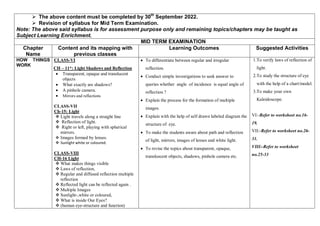
The above content must be completed by 30th
September 2022.
Revision of syllabus for Mid Term Examination.
Note: The above said syllabus is for assessment purpose only and remaining topics/chapters may be taught as
Subject Learning Enrichment.
MID TERM EXAMINATION
Chapter
Name
Content and its mapping with
previous classes
Learning Outcomes Suggested Activities
HOW THINGS
WORK
CLASS-VI
CH – 11*: Light Shadows and Reflection
• Transparent, opaque and translucent
objects
• What exactly are shadows?
• A pinhole camera.
• Mirrors and reflections
CLASS-VII
Ch-15: Light
Light travels along a straight line
Reflection of light.
Right or left, playing with spherical
mirrors.
Images formed by lenses.
Sunlight white or coloured.
CLASS-VIII
CH-16 Light
What makes things visible
Laws of reflection,
Regular and diffused reflection multiple
reflection
Reflected light can be reflected again .
Multiple Images
Sunlight-,white or coloured,
What is inside Our Eyes?
(human eye-structure and function)
• To differentiate between regular and irregular
reflection.
• Conduct simple investigations to seek answer to
queries whether angle of incidence is equal angle of
reflection ?
• Explain the process for the formation of multiple
images.
• Explain with the help of self drawn labeled diagram the
structure of eye.
• To make the students aware about path and reflection
of light, mirrors, images of lenses and white light.
• To revise the topics about transparent, opaque,
transluscent objects, shadows, pinhole camera etc.
1.To verify laws of reflection of
light.
2.To study the structure of eye
with the help of a chart/model.
3.To make your own
Kaleidoscope.
VI:-Refer to worksheet no.16-
19.
VII:-Refer to worksheet no.26-
31.
VIII:-Refer to worksheet
no.25-33
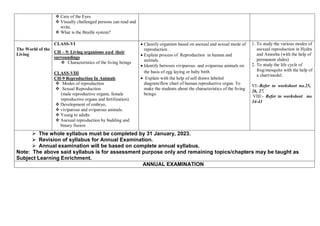
Care of the Eyes
Visually challenged persons can read and
write.
What is the Braille system?
The World of the
Living
CLASS-VI
CH – 9: Living organisms and their
surroundings
Characteristics of the living beings
CLASS-VIII
CH-9 Reproduction In Animals
Modes of reproduction
Sexual Reproduction
(male reproductive organs, female
reproductive organs and fertilization)
Development of embryo,
viviparous and oviparous animals.
Young to adults
Asexual reproduction by budding and
binary fission
• Classify organism based on asexual and sexual mode of
reproduction .
• Explain process of Reproduction in human and
animals.
• Identify between viviparous and oviparous animals on
the basis of egg laying or baby birth
• Explain with the help of self drawn labeled
diagram/flow chart of human reproductive organ. To
make the students about the characteristics of the living
beings.
1. To study the various modes of
asexual reproduction in Hydra
and Amoeba (with the help of
permanent slides)
2. To study the life cycle of
frog/mosquito with the help of
a chart/model.
VI:-Refer to worksheet no.25,
26, 27.
VIII:- Refer to worksheet no.
34-41
The whole syllabus must be completed by 31 January, 2023.
Revision of syllabus for Annual Examination.
Annual examination will be based on complete annual syllabus.
Note: The above said syllabus is for assessment purpose only and remaining topics/chapters may be taught as
Subject Learning Enrichment.
ANNUAL EXAMINATION

Science syllabus: class 8th

  • 1.
    Annual Syllabus Session: 2022-2023 Class-VIII(LEVEL-2) Subject: SCIENCE Chapter No. and Name Content and its mapping with previous classes Learning Outcomes Suggested Activities FOOD CLASS-VI CH – 9: Living organisms and their surroundings • Characteristics of the living beings. CLASS-VII Ch-1: Nutrition in Plants •Saprotrophs. •How nutrients are replenished in the soil. CLASS-VIII Ch-2 Microorganisms : Friends And Foe : Microorganisms Major groups of microorganisms and their living place Microorganisms and us Harmful Microorganisms Food Preservation Nitrogen Fixation Nitrogen cycle • Identify different types of microorganisms (both unicellular and multicellular) • Classify useful and harmful microorganisms. • Explore the role of micro organisms in life. • Asks questions and lead to investigations like how do vegetables or food items get spoiled. • Investigate various diseases caused by microorganisms (symptoms and its Prevention • Apply learning of scientific concepts in daily life (what helps in making curd ? how does food go bad ?etc.) • Investigate the use of salt and sugar in preserving Pickles and jams. • To make the students about characteristics of saprotrophs and the types of nutrients within the soil, and characteristics of living beings. 1. To observe drops of pond water under microscope. 2. Observe the prepared slides of Microorganisms. 3. Pull out a gram/bean plant from the field and to study its root nodules. VI-Refer to worksheet no.25- 27. VII-Refer to worksheet no.12- 13. VIII-Refer to worksheet no. 02- 13, 23-24
  • 2.
    MATERIAL CLASS-VI CH-2: Componentsof food Test for starch, protein and Fat.(process) CLASS-VII Ch- 5:Acids, Bases and Salts Acids and Bases Natural Indicators around us Neutralisation CLASS-VIII CH-4 Materials : Metals and Non-Metals Physical properties of metals and non- metals Chemical properties of metals and non- metals Reaction with oxygen, water acids and bases Displacement reaction Uses of metals and non-metals. • Identify and classify materials as metal and non- metals on the basis of their properties. • Write word equation for chemical reactions eg. Reactions of metals and Nonmetals with air ,water ,acids and bases . • Apply learning of scientific concepts in day to day life using appropriate metals and non-metals for various purposes. • To make the students aware about acids, bases, and natural indicators to differentiate between acids and bases. • To make the students aware about fats, proteins, and fats as components of food. 1. To study the physical properties of metals and non- metals (NCERT Table 4.1 & 4.2) 2. To study the nature of oxides of metals and non-metals. 3. To study displacement reaction. Reaction of metals and non-metals with acids (table 4.5). VI- Refer to worksheet no.3-5 VII- Refer to worksheet n.14- 17. VIII:-Refer to worksheet no.14- 22 HOW THINGS WORK CLASS-VIII CH-11 Force And Pressure Force – a push or a pull Forces are due to an interaction Exploring forces. A force can change the state-of motion Force can change the shape of an object , direction and speed of an object Contact forces Non- contact forces Pressure Pressure exerted by liquids and gases. Atmospheric pressure • Identify various types of forces by giving examples from daily life. • Understand the reason how force arises due to interaction between two objects. • Investigate the effect of force on speed and An direction of moving objects . • Differentiate between contact and non Contact forces. • Identify and demonstrate the relation between force, area and pressure. • Conduct simple investigation to seek answer to queries e.g. Do liquids exert pressure at same depth ? • Investigate to find the reason like what happens when we push or pull any thing? or why needles are made pointed ? 1. To study various types of forces and their impacts. 2. To study the relation between force and motion in daily life experiences. 3. To observe the forces of attraction and repulsion between two types of a bar magnet. 4. To study the dependence of pressure on area. 5. To study increase in pressure exerted by the liquids at the greater depths. Refer to worksheet no.42-44
  • 3.
    The above contentmust be completed by 30th September 2022. Revision of syllabus for Mid Term Examination. Note: The above said syllabus is for assessment purpose only and remaining topics/chapters may be taught as Subject Learning Enrichment. MID TERM EXAMINATION Chapter Name Content and its mapping with previous classes Learning Outcomes Suggested Activities HOW THINGS WORK CLASS-VI CH – 11*: Light Shadows and Reflection • Transparent, opaque and translucent objects • What exactly are shadows? • A pinhole camera. • Mirrors and reflections CLASS-VII Ch-15: Light Light travels along a straight line Reflection of light. Right or left, playing with spherical mirrors. Images formed by lenses. Sunlight white or coloured. CLASS-VIII CH-16 Light What makes things visible Laws of reflection, Regular and diffused reflection multiple reflection Reflected light can be reflected again . Multiple Images Sunlight-,white or coloured, What is inside Our Eyes? (human eye-structure and function) • To differentiate between regular and irregular reflection. • Conduct simple investigations to seek answer to queries whether angle of incidence is equal angle of reflection ? • Explain the process for the formation of multiple images. • Explain with the help of self drawn labeled diagram the structure of eye. • To make the students aware about path and reflection of light, mirrors, images of lenses and white light. • To revise the topics about transparent, opaque, transluscent objects, shadows, pinhole camera etc. 1.To verify laws of reflection of light. 2.To study the structure of eye with the help of a chart/model. 3.To make your own Kaleidoscope. VI:-Refer to worksheet no.16- 19. VII:-Refer to worksheet no.26- 31. VIII:-Refer to worksheet no.25-33
  • 4.
    Care of theEyes Visually challenged persons can read and write. What is the Braille system? The World of the Living CLASS-VI CH – 9: Living organisms and their surroundings Characteristics of the living beings CLASS-VIII CH-9 Reproduction In Animals Modes of reproduction Sexual Reproduction (male reproductive organs, female reproductive organs and fertilization) Development of embryo, viviparous and oviparous animals. Young to adults Asexual reproduction by budding and binary fission • Classify organism based on asexual and sexual mode of reproduction . • Explain process of Reproduction in human and animals. • Identify between viviparous and oviparous animals on the basis of egg laying or baby birth • Explain with the help of self drawn labeled diagram/flow chart of human reproductive organ. To make the students about the characteristics of the living beings. 1. To study the various modes of asexual reproduction in Hydra and Amoeba (with the help of permanent slides) 2. To study the life cycle of frog/mosquito with the help of a chart/model. VI:-Refer to worksheet no.25, 26, 27. VIII:- Refer to worksheet no. 34-41 The whole syllabus must be completed by 31 January, 2023. Revision of syllabus for Annual Examination. Annual examination will be based on complete annual syllabus. Note: The above said syllabus is for assessment purpose only and remaining topics/chapters may be taught as Subject Learning Enrichment. ANNUAL EXAMINATION