Angelica Spilis 
Research Methods in Dance 
Response week 9 
Starting with Walter Benjamin’s article The Work of Art in the Age of Mechanical Reproduction 
he attempts to mark something particular about the modern age and the effects on work of art. He 
discusses the change and the effects of modernity in the twentieth century with the existence of 
film, photography and the shifts within humanity with the way we perceive visual work of art. 
Benjamin discusses the loss of aura through the mechanical reproduction of art and the aura 
represents uniqueness and authenticity of a work of art that has not been reproduced. A painting 
would be considered an aura, an original work of art, and a photograph would only mimic 
something original; a mere duplication. 
What does it mean when the aura is lost? The spirit, luminosity and spontaneity; the true essence 
of the object and its function are lost within the work of art itself. Even though we don’t 
necessarily notice or perceive that this is happening, it becomes universal and the removal of 
authority within the original work of art intervenes with what we perceive. Through that we can 
say this is radical and also totalitarian because this guides humanity to a specific side of the story 
while leaving other parts out. Benjamin explains that “During long periods of history, the mode 
of human sense perception changes with humanity’s entire mode of existence” (Benjamin: 222). 
Simply put, the mode in which we view a work of art is influenced and restricted by our 
everyday lives and access to art. 
One example would be viewing movies or artwork in a gallery. We are limited to the perception 
of the creator and do not have access to experience the original work of art because we are 
viewing the art through a medium. The medium would be described as the artist’s point of view, 
where we have no freedom to explore outside of what is set before us. However, as stated by 
Benjamin “ If, while resting on a summer afternoon, you follow with your eyes a mountain range 
on the horizon or a branch which casts its shadow over you, you experience the aura of those 
mountains, of that branch” (Benjamin: 222-223). Here, the mountain range and shadows cast by 
the branch are completely in your control, giving the art its aura; unfiltered and original. 
Benjamin makes it apparent that the aura is dead and only exists within a mythological space and 
now everyone can just go to a gallery, theater, museum or cinema. This new age of mechanical 
reproduction changed in such a way that humanity can no longer reflect on the work of art 
because it is always changing. How can we reflect back after the work of art aura is lost and what 
does this mean for us? I strongly feel this means that humanity has to start perceiving a work of 
art through our own eyes instead of through someone else’s transparent material such as camera 
lenses.
In Ernst Bloch’s article Discussing Expressionism and Georg Lukcas’s Realism in the Balance 
we discover that there is a conflict between Bloch and Lukas on “Expressionism.” Lukas on one 
hand feels that expressionism is a movement with revolutionary power and radical political 
movement which therefore Bloch strongly disagrees. Lukas believes that expressionism is a part 
of fascism, which is a form of radical movement. In class we discussed how humanity is 
surrounded by fascism and we don’t even recognize it and aren’t aware when it is happening. For 
example, we disused that the Federal Government shutdown is a part of fascism even though the 
government doesn’t come out and says that it is humanity should be able to realize this and that 
we were in a capitalism crisis. 
In this case I can agree with Lukas because could the government feel that they can express 
themselves in any way they want because they are in control and cause the nation to suffer the 
outrageous and unfair consequences. Will the government ever realize when they are being pro 
fascist and being the main cause of fascism? Though we may live in a nation of democracy, it is 
evident that humanity and the government are not treated like equals. Perhaps “Expressionism” 
all comes down to power and how much power one has over everyone else. 
Bloch discusses a fascinating point that throughout Lukas’s article he doesn’t once mention that 
now where to be found is a single Expressionist painter. Bloch finds this tremendously surprising 
because he states that “Expressionism” is an enormous part of linking paintings and literature. 
Bloch states that “Reference to the painters, moreover, would have had the additional advantage 
of making it harder to dismiss Expressionism, so categorically, for some of their pictures have a 
lasting importance and greatness” (Bloch: 18). Therefore, Bloch doesn’t understand how Lukcas 
could have forgotten such an important part of “Expressionism” and that painters during this 
period made unforgettable works of art. 
I became incredibly interested in what Bloch was saying about how important painters are to 
“Expressionism” so I performed some research for myself. When I looked up “Expressionism” 
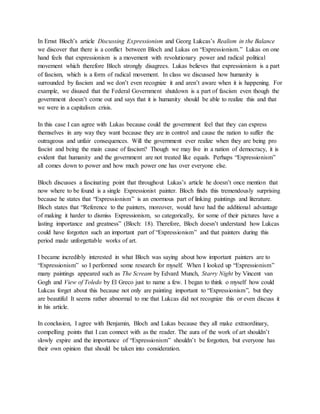
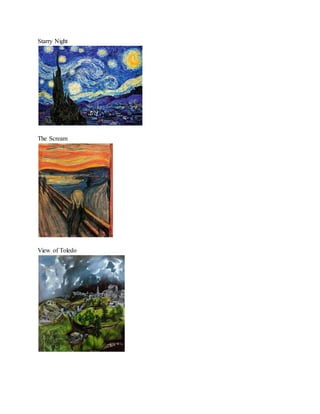
many paintings appeared such as The Scream by Edvard Munch, Starry Night by Vincent van 
Gogh and View of Toledo by El Greco just to name a few. I began to think o myself how could 
Lukcas forget about this because not only are painting important to “Expressionism”, but they 
are beautiful It seems rather abnormal to me that Lukcas did not recognize this or even discuss it 
in his article. 
In conclusion, I agree with Benjamin, Bloch and Lukas because they all make extraordinary, 
compelling points that I can connect with as the reader. The aura of the work of art shouldn’t 
slowly expire and the importance of “Expressionism” shouldn’t be forgotten, but everyone has 
their own opinion that should be taken into consideration.
Starry Night 
The Scream 
View of Toledo
Graduate Writing Sample

Graduate Writing Sample

  • 1.
    Angelica Spilis ResearchMethods in Dance Response week 9 Starting with Walter Benjamin’s article The Work of Art in the Age of Mechanical Reproduction he attempts to mark something particular about the modern age and the effects on work of art. He discusses the change and the effects of modernity in the twentieth century with the existence of film, photography and the shifts within humanity with the way we perceive visual work of art. Benjamin discusses the loss of aura through the mechanical reproduction of art and the aura represents uniqueness and authenticity of a work of art that has not been reproduced. A painting would be considered an aura, an original work of art, and a photograph would only mimic something original; a mere duplication. What does it mean when the aura is lost? The spirit, luminosity and spontaneity; the true essence of the object and its function are lost within the work of art itself. Even though we don’t necessarily notice or perceive that this is happening, it becomes universal and the removal of authority within the original work of art intervenes with what we perceive. Through that we can say this is radical and also totalitarian because this guides humanity to a specific side of the story while leaving other parts out. Benjamin explains that “During long periods of history, the mode of human sense perception changes with humanity’s entire mode of existence” (Benjamin: 222). Simply put, the mode in which we view a work of art is influenced and restricted by our everyday lives and access to art. One example would be viewing movies or artwork in a gallery. We are limited to the perception of the creator and do not have access to experience the original work of art because we are viewing the art through a medium. The medium would be described as the artist’s point of view, where we have no freedom to explore outside of what is set before us. However, as stated by Benjamin “ If, while resting on a summer afternoon, you follow with your eyes a mountain range on the horizon or a branch which casts its shadow over you, you experience the aura of those mountains, of that branch” (Benjamin: 222-223). Here, the mountain range and shadows cast by the branch are completely in your control, giving the art its aura; unfiltered and original. Benjamin makes it apparent that the aura is dead and only exists within a mythological space and now everyone can just go to a gallery, theater, museum or cinema. This new age of mechanical reproduction changed in such a way that humanity can no longer reflect on the work of art because it is always changing. How can we reflect back after the work of art aura is lost and what does this mean for us? I strongly feel this means that humanity has to start perceiving a work of art through our own eyes instead of through someone else’s transparent material such as camera lenses.
  • 2.
    In Ernst Bloch’sarticle Discussing Expressionism and Georg Lukcas’s Realism in the Balance we discover that there is a conflict between Bloch and Lukas on “Expressionism.” Lukas on one hand feels that expressionism is a movement with revolutionary power and radical political movement which therefore Bloch strongly disagrees. Lukas believes that expressionism is a part of fascism, which is a form of radical movement. In class we discussed how humanity is surrounded by fascism and we don’t even recognize it and aren’t aware when it is happening. For example, we disused that the Federal Government shutdown is a part of fascism even though the government doesn’t come out and says that it is humanity should be able to realize this and that we were in a capitalism crisis. In this case I can agree with Lukas because could the government feel that they can express themselves in any way they want because they are in control and cause the nation to suffer the outrageous and unfair consequences. Will the government ever realize when they are being pro fascist and being the main cause of fascism? Though we may live in a nation of democracy, it is evident that humanity and the government are not treated like equals. Perhaps “Expressionism” all comes down to power and how much power one has over everyone else. Bloch discusses a fascinating point that throughout Lukas’s article he doesn’t once mention that now where to be found is a single Expressionist painter. Bloch finds this tremendously surprising because he states that “Expressionism” is an enormous part of linking paintings and literature. Bloch states that “Reference to the painters, moreover, would have had the additional advantage of making it harder to dismiss Expressionism, so categorically, for some of their pictures have a lasting importance and greatness” (Bloch: 18). Therefore, Bloch doesn’t understand how Lukcas could have forgotten such an important part of “Expressionism” and that painters during this period made unforgettable works of art. I became incredibly interested in what Bloch was saying about how important painters are to “Expressionism” so I performed some research for myself. When I looked up “Expressionism” many paintings appeared such as The Scream by Edvard Munch, Starry Night by Vincent van Gogh and View of Toledo by El Greco just to name a few. I began to think o myself how could Lukcas forget about this because not only are painting important to “Expressionism”, but they are beautiful It seems rather abnormal to me that Lukcas did not recognize this or even discuss it in his article. In conclusion, I agree with Benjamin, Bloch and Lukas because they all make extraordinary, compelling points that I can connect with as the reader. The aura of the work of art shouldn’t slowly expire and the importance of “Expressionism” shouldn’t be forgotten, but everyone has their own opinion that should be taken into consideration.
  • 3.
    Starry Night TheScream View of Toledo