Aaron Vick
Cicayda Chief Strategy Officer
Ethics in Legal Tech
- 2018 CLE -
ABA 20/20 Commission
recommended updates to
ABA Model Rules defining the
need to understand
technology.
2012
Delaware Supreme Court amended
Lawyers’ Rule of Professional
Conduct and created the
Commission on Law & Tech
2013
US Supreme Court
approved FRCP
amendments in re
electronic discovery
2015
State Bar of California’s
Proposed Ethics Opinion
No. 11- 0004
2014
Industry Spotlight on
Technology
Florida Bar
implemented required
technology CLE credit
2017
ABA Model Rule 1.1
LawSites www.lawsitesblog.com/2015/03/11-states-have-
adopted-ethical-duty-of-technology-competence.html
ABA’s Amended Comment 8 to
Model Rule 1.1 reads as follows:
Maintaining Competence
To maintain the requisite knowledge and skill, a lawyer should keep abreast of
changes in the law and its practice, including the benefits and risks associated
with relevant technology, engage in continuing study and education and
comply with all continuing legal education requirements to which the lawyer
is subject.
State Adoption of
Technology Competence
LawSites www.lawsitesblog.com/2015/03/11-states-have-
adopted-ethical-duty-of-technology-competence.html
Acknowledge technology
competency
Formally Adopted Rule 1.1
Ethics &
Technology
Across All Areas
of Practice
Legal promotion via
technology such as social
media under ABA Model Rule
7 & Proposed Changes
Online Advertising
Ethical decisions regarding
the choices created by
emerging companies.
(i.e. car AI risk assessment)
General Counsel
Social Media
investigations, ESI
collections, competency of
client technology
Litigation
Emerging technology such
as Blockchain, regulatory
changes defining securities
Transactional
General Counsel
Machine-learning software trained on the
datasets didn’t just mirror those biases, it
amplified them.
Google, Microsoft, and others have all
acknowledged the need to monitor implicit
bias within development of ML & AI.
Wired - https://www.wired.com/story/machines-taught-by-
photos-learn-a-sexist-view-of-women/
Lawsuits regarding algorithms
“Tesla did not do what no manufacturer has
ever done—“develop and implement
computer algorithms that would eliminate
the danger of full throttle acceleration into
fixed objects” even if it is caused by human
error…Tesla disputes that there is a legal
duty to design a failsafe car.”
Forbes -
https://www.forbes.com/sites/patricklin/2017/04/05/heres-how-
tesla-solves-a-self-driving-crash-dilemma/#dc1201d68139
General Counsel
Transactional
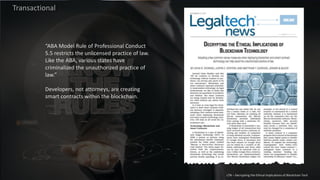
“ABA Model Rule of Professional Conduct
5.5 restricts the unlicensed practice of law.
Like the ABA, various states have
criminalized the unauthorized practice of
law.”
Developers, not attorneys, are creating
smart contracts within the blockchain.
LTN – Decrypting the Ethical Implications of Blockchain Tech
Transactional
Blockchain/ICO/Securities
KYC
Security Or Token?
International Regulations?
Securities Exchange Commission
LTN – Decrypting the Ethical Implications of Blockchain Tech
Marketing Legal Services
“Proposed revisions would consolidate
current Model Rules 7.1, 7.2, 7.3, 7.4,
and 7.5 into two directives covering attorney
advertising.
Proposed Model Rule 7.1 ("Communications
Concerning a Lawyer's Services") would
incorporate much of current Model Rule 7.2
regarding attorney advertising. Proposed
Model Rule 7.2 ("Solicitation") would revise
and consolidate the current Model Rules
governing solicitation of clients,
communications regarding fields of practice
and specialization, and firm names and
letterheads.
American Bar -
https://www.americanbar.org/publications/litigation-news/top-
stories/2017/proposed-aba-model-rule-changes-address-social-
media-advertising.html
ATTORNEY ADVERTISING Guideline No. 2.A:
Applicability of Advertising Rules
A lawyer’s social media profile that is used
only for personal purposes is not subject to
attorney advertising and solicitation rules.
However, a social media profile, posting or
blog a lawyer primarily uses for the purpose
of the retention of the lawyer or his law
firm is subject to such rules. Hybrid
accounts may need to comply with attorney
advertising and solicitation rules if used for
the primary purpose of the retention of the
lawyer or his law firm.
New York Bar - https://www.nysba.org/socialmediaguidelines17/
Marketing Legal Services
How Has Technology Changed Discovery?
 How We Communicate
 The Amount We Communicate
 How We Store Records
 Less Paper / More ESI
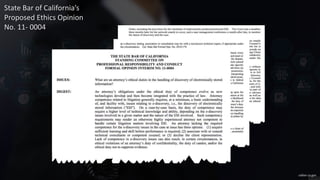
State Bar of California’s
Proposed Ethics Opinion
No. 11- 0004
calbar.ca.gov
FRCP Rule 37(e) states
ESI loss is sanctionable
when firms fail to take
“REASONABLE STEPS” to
identify and preserve data
Litigation - FRCP
Reasonable Steps
Identify
Facts &
Unknowns
Facts &
Unknowns
Who are the users?
Who are the IT staff?
Any third parties?
Proprietary systems?
On prem/cloud data?
Mobile/Social/IOT?
Deleted data?
Retention Policies?
Confirm
Key
Witnesses
Key Witnesses
What systems did
they use?
Did they maintain
online and offline
email?
Where did they store
data?
Do they have personal
backups?
Create
Notice and
Q&A
Notice and Q&A
Include obligation to
keep documents and
data
Issue Notice (improper
procedures are
sanctionable)
Create varied Q&A
Define
Collection
Scope
Collection Scope
The scope is defined by
compiling all the known
information collected
during the prior steps:
Who?
What?
Where?
When?
Litigation - FRCP
Duty to Preserve
Duty to Preserve
The Hold Notice
• Is a defensible process
• Reuse templates
• Informs many at once
• Sends auto-reminders
• Identifies custodians
• Maintains records
• Is “reasonable step” #1
Electronically stored information
(ESI), for the purpose of the
Federal Rules of Civil Procedure
(FRCP) is information created,
manipulated, communicated,
stored, and best utilized in digital
form, requiring the use of
computer hardware and
software.
Litigation - FRCP
Meet & Confer/Early Case Management
Electronic discovery requires cooperation between
opposing counsel and transparency in all aspects of
preservation and production of ESI. Moreover, where
counsel are using keyword searches for retrieval of ESI,
they at a minimum must carefully craft the appropriate
keywords, with input from the ESI’s custodians as to the
words and abbreviations they use, and the proposed
methodology must be quality control tested to assure
accuracy in retrieval and elimination of “false positives.”
It is time that the Bar—even those lawyers who did not
come of age in the computer era—understand this.
Litigation - FRCP
William A. Gross Constr. Assocs., Inc. v. Am.
Mfrs. Mut. Ins. Co., 256 F.R.D. 134 (S.D.N.Y.
2009) 256 F.R.D. at 136
Meet & Confer/Early Case Management
26(f)(3) Discovery Plan. A discovery plan must state the parties’ views and proposals on:
(A) what changes should be made in the timing, form, or requirement for disclosures under Rule 26(a), including a
statement of when initial disclosures were made or will be made;
(B) the subjects on which discovery may be needed, when discovery should be completed, and whether discovery
should be conducted in phases or be limited to or focused on particular issues;
(C) any issues about disclosure, discovery, or preservation of electronically stored information, including the form or
forms in which it should be produced;
(D) any issues about claims of privilege or of protection as trial-preparation materials, including—if the parties agree on
a procedure to assert these claims after production—whether to ask the court to include their agreement in an
order under Federal Rule of Evidence 502;
(E) what changes should be made in the limitations on discovery imposed under these rules or by local rule, and what
other limitations should be imposed; and
(F) any other orders that the court should issue under Rule 26(c) or under Rule 16(b) and (c)
Litigation - FRCP
Cornell - https://www.law.cornell.edu/rules/frcp/rule_26|
Litigation – Social Media
“As more and more attorneys find useful
background and investigative research
information in the social networking profiles
of opposing parties, potential witnesses,
experts, etc. more and more State Bar
associations are issuing Legal Ethics
Opinions discussing whether or not (or
under what circumstances they can) view
these profiles to collect information about
these types of people.”
Net for Lawyers - https://www.netforlawyers.com/content/legal-
ethics-opinions-lawyers-attorneys-social-media-investigative-
background-research-0045
Aaron Vick
Cicayda Chief Strategy Officer
Ethics in Legal Tech
- 2018 CLE -

Legal Tech Ethics

  • 1.
    Aaron Vick Cicayda ChiefStrategy Officer Ethics in Legal Tech - 2018 CLE -
  • 2.
    ABA 20/20 Commission recommendedupdates to ABA Model Rules defining the need to understand technology. 2012 Delaware Supreme Court amended Lawyers’ Rule of Professional Conduct and created the Commission on Law & Tech 2013 US Supreme Court approved FRCP amendments in re electronic discovery 2015 State Bar of California’s Proposed Ethics Opinion No. 11- 0004 2014 Industry Spotlight on Technology Florida Bar implemented required technology CLE credit 2017
  • 3.
    ABA Model Rule1.1 LawSites www.lawsitesblog.com/2015/03/11-states-have- adopted-ethical-duty-of-technology-competence.html ABA’s Amended Comment 8 to Model Rule 1.1 reads as follows: Maintaining Competence To maintain the requisite knowledge and skill, a lawyer should keep abreast of changes in the law and its practice, including the benefits and risks associated with relevant technology, engage in continuing study and education and comply with all continuing legal education requirements to which the lawyer is subject.
  • 4.
    State Adoption of TechnologyCompetence LawSites www.lawsitesblog.com/2015/03/11-states-have- adopted-ethical-duty-of-technology-competence.html Acknowledge technology competency Formally Adopted Rule 1.1
  • 5.
    Ethics & Technology Across AllAreas of Practice Legal promotion via technology such as social media under ABA Model Rule 7 & Proposed Changes Online Advertising Ethical decisions regarding the choices created by emerging companies. (i.e. car AI risk assessment) General Counsel Social Media investigations, ESI collections, competency of client technology Litigation Emerging technology such as Blockchain, regulatory changes defining securities Transactional
  • 6.
    General Counsel Machine-learning softwaretrained on the datasets didn’t just mirror those biases, it amplified them. Google, Microsoft, and others have all acknowledged the need to monitor implicit bias within development of ML & AI. Wired - https://www.wired.com/story/machines-taught-by- photos-learn-a-sexist-view-of-women/
  • 7.
    Lawsuits regarding algorithms “Tesladid not do what no manufacturer has ever done—“develop and implement computer algorithms that would eliminate the danger of full throttle acceleration into fixed objects” even if it is caused by human error…Tesla disputes that there is a legal duty to design a failsafe car.” Forbes - https://www.forbes.com/sites/patricklin/2017/04/05/heres-how- tesla-solves-a-self-driving-crash-dilemma/#dc1201d68139 General Counsel
  • 8.
    Transactional “ABA Model Ruleof Professional Conduct 5.5 restricts the unlicensed practice of law. Like the ABA, various states have criminalized the unauthorized practice of law.” Developers, not attorneys, are creating smart contracts within the blockchain. LTN – Decrypting the Ethical Implications of Blockchain Tech
  • 9.
    Transactional Blockchain/ICO/Securities KYC Security Or Token? InternationalRegulations? Securities Exchange Commission LTN – Decrypting the Ethical Implications of Blockchain Tech
  • 11.
    Marketing Legal Services “Proposedrevisions would consolidate current Model Rules 7.1, 7.2, 7.3, 7.4, and 7.5 into two directives covering attorney advertising. Proposed Model Rule 7.1 ("Communications Concerning a Lawyer's Services") would incorporate much of current Model Rule 7.2 regarding attorney advertising. Proposed Model Rule 7.2 ("Solicitation") would revise and consolidate the current Model Rules governing solicitation of clients, communications regarding fields of practice and specialization, and firm names and letterheads. American Bar - https://www.americanbar.org/publications/litigation-news/top- stories/2017/proposed-aba-model-rule-changes-address-social- media-advertising.html
  • 12.
    ATTORNEY ADVERTISING GuidelineNo. 2.A: Applicability of Advertising Rules A lawyer’s social media profile that is used only for personal purposes is not subject to attorney advertising and solicitation rules. However, a social media profile, posting or blog a lawyer primarily uses for the purpose of the retention of the lawyer or his law firm is subject to such rules. Hybrid accounts may need to comply with attorney advertising and solicitation rules if used for the primary purpose of the retention of the lawyer or his law firm. New York Bar - https://www.nysba.org/socialmediaguidelines17/ Marketing Legal Services
  • 13.
    How Has TechnologyChanged Discovery?  How We Communicate  The Amount We Communicate  How We Store Records  Less Paper / More ESI
  • 14.
    State Bar ofCalifornia’s Proposed Ethics Opinion No. 11- 0004 calbar.ca.gov
  • 15.
    FRCP Rule 37(e)states ESI loss is sanctionable when firms fail to take “REASONABLE STEPS” to identify and preserve data Litigation - FRCP
  • 16.
    Reasonable Steps Identify Facts & Unknowns Facts& Unknowns Who are the users? Who are the IT staff? Any third parties? Proprietary systems? On prem/cloud data? Mobile/Social/IOT? Deleted data? Retention Policies? Confirm Key Witnesses Key Witnesses What systems did they use? Did they maintain online and offline email? Where did they store data? Do they have personal backups? Create Notice and Q&A Notice and Q&A Include obligation to keep documents and data Issue Notice (improper procedures are sanctionable) Create varied Q&A Define Collection Scope Collection Scope The scope is defined by compiling all the known information collected during the prior steps: Who? What? Where? When?
  • 17.
    Litigation - FRCP Dutyto Preserve Duty to Preserve The Hold Notice • Is a defensible process • Reuse templates • Informs many at once • Sends auto-reminders • Identifies custodians • Maintains records • Is “reasonable step” #1
  • 18.
    Electronically stored information (ESI),for the purpose of the Federal Rules of Civil Procedure (FRCP) is information created, manipulated, communicated, stored, and best utilized in digital form, requiring the use of computer hardware and software. Litigation - FRCP
  • 19.
    Meet & Confer/EarlyCase Management Electronic discovery requires cooperation between opposing counsel and transparency in all aspects of preservation and production of ESI. Moreover, where counsel are using keyword searches for retrieval of ESI, they at a minimum must carefully craft the appropriate keywords, with input from the ESI’s custodians as to the words and abbreviations they use, and the proposed methodology must be quality control tested to assure accuracy in retrieval and elimination of “false positives.” It is time that the Bar—even those lawyers who did not come of age in the computer era—understand this. Litigation - FRCP William A. Gross Constr. Assocs., Inc. v. Am. Mfrs. Mut. Ins. Co., 256 F.R.D. 134 (S.D.N.Y. 2009) 256 F.R.D. at 136
  • 20.
    Meet & Confer/EarlyCase Management 26(f)(3) Discovery Plan. A discovery plan must state the parties’ views and proposals on: (A) what changes should be made in the timing, form, or requirement for disclosures under Rule 26(a), including a statement of when initial disclosures were made or will be made; (B) the subjects on which discovery may be needed, when discovery should be completed, and whether discovery should be conducted in phases or be limited to or focused on particular issues; (C) any issues about disclosure, discovery, or preservation of electronically stored information, including the form or forms in which it should be produced; (D) any issues about claims of privilege or of protection as trial-preparation materials, including—if the parties agree on a procedure to assert these claims after production—whether to ask the court to include their agreement in an order under Federal Rule of Evidence 502; (E) what changes should be made in the limitations on discovery imposed under these rules or by local rule, and what other limitations should be imposed; and (F) any other orders that the court should issue under Rule 26(c) or under Rule 16(b) and (c) Litigation - FRCP Cornell - https://www.law.cornell.edu/rules/frcp/rule_26|
  • 21.
    Litigation – SocialMedia “As more and more attorneys find useful background and investigative research information in the social networking profiles of opposing parties, potential witnesses, experts, etc. more and more State Bar associations are issuing Legal Ethics Opinions discussing whether or not (or under what circumstances they can) view these profiles to collect information about these types of people.” Net for Lawyers - https://www.netforlawyers.com/content/legal- ethics-opinions-lawyers-attorneys-social-media-investigative- background-research-0045
  • 22.
    Aaron Vick Cicayda ChiefStrategy Officer Ethics in Legal Tech - 2018 CLE -

Editor's Notes

  • #11 https://www.smithandcrown.com/wp-content/uploads/2017/09/SC_tokensale_selfregulation_graphs1.jpg
  • #14 “According to a University of California study, 93 percent of all information generated during 1999 was generated in digital form, on computers. Only 7 percent of information originated in other media, such as paper.”1 Not only is this change pervasive, but it occurred quite rapidly According to the Rand Study, Where the Money Goes “discovery is responsible for 70 percent of total litigation costs” – know what to do with discovery is an ethical obligation – Example: 400K processing estimate was reduced to $3500 in consulting time and a declaration
  • #15 CA options are: Learn the skills Find someone to help who has the skills Decline representation
  • #17 Who are the important people? What roles do they have within the organization? – Are there people who may be on the fringes? – Any third parties involved? -- What are the different types of applications being used? Are they, or could they be, different for each user? - Example is theft of client data – one matter failed to ask where the data was stored and, instead, began collection of email servers and computers. Costs could have been reduced by knowing that the original data was downloaded from a cloud based CRM and upon inspection it was determined that there was a complete log of what and who downloaded the data. Another example is server migration. We had a matter a server was partially migrated and the other server was taken offline. The other server had various files that were not migrated over as the project had closed but was relevant to the litigation. Through further discussion with an IT member we were able to find the offline server in the server room. --- Begin with drafting the Notice. Include the matter information, what they must retain, and ask if there is anyone else that should receive the notice. Attaching a questionnaire may also be helpful. Informing the witnesses/custodians why the survey being taken and how the questionnaire will be beneficial in the overall process. This may be self evident within the notice. Duty to preserve. You must identify, locate, and keep documents and data potentially relevant to the litigation. Zubulake explained: Once a party reasonably anticipates litigation, it must suspend its routine document retention/destruction policy and put in place a “litigation hold” to ensure the preservation of relevant documents.  Define Scope: Who – What – Where – When In re A&M Florida Properties II, 2010 WL 1418861 (Bankr. S.D.N.Y. April 7, 2010) –The “company-wide” search was a very broad request and the failure to communicate with the key employees led to discovery failures that were only resolved after months of delay & forensic examinations.
  • #18 Duty to preserve. You must identify, locate, and keep documents and data potentially relevant to the litigation. The Hold Process -- Identifies custodians. -- Informs custodians of the obligation to preserve documents and data. Normally sent via a notice. -- Determine sources from the custodians -- Inform custodians what and how this may be handled -- Asks if others should be notified -- Monitor and tack compliance by the custodians -- Release custodian(s) when they no longer meet the criteria or litigation has ended Sanctions for improper preservation and lack of legal holds 2015 – In re Pegasus Aviation I, Inc. v. Varig Logistica S.A., 26 N.Y.3d 543 (Court of Appeals) – Def failed to issue legal hold 2013 - In re Pradaxa (Dabigatran Etexilate) Prods. Liab. Litig., MDL No. 2385, 2013 WL 6486921 (S.D. Ill. Dec. 9, 2013) – 1) failed to issue legal hold in various departments and 2) failed to identify a major custodian 2010 - Pension Committee of the University of Montreal Pension Plan v. Banc of America Securities, LLC, 685 F. Supp. 2d 456 (S.D.N.Y. 2010) – Plts failed to implement timely written litigation holds & performed careless collection efforts. – Court found pltfs conducted negligent and grossly negligent discovery practices. Court imposed monetary & adverse inference sanctions Zubulake explained: Once a party reasonably anticipates litigation, it must suspend its routine document retention/destruction policy and put in place a “litigation hold” to ensure the preservation of relevant documents. 
  • #19 Proper Collection is important – ESI In re Fannie Mae Securities Litigation, 552 F.3d 814 (D.C. Cir. 2009) –Federal Housing Enterprise Oversight spent more than 9% of its annual budget (> $6 million) to respond to 3rd party subpoena. – Counsel did not understand the various systems or location of data. – Motion for civil contempt was granted as Office of Federal Housing Enterprise Oversight’s efforts were “too little, too late.”
  • #20 Conference Content; Parties' Responsibilities. In conferring, the parties must 1 consider the nature and basis of their claims and defenses and the possibilities for promptly settling or resolving the case; 2 make or arrange for the disclosures required by Rule 26(a)(1); 3 discuss any issues about preserving discoverable information; and develop a proposed discovery plan. - See more at: http://technology.findlaw.com/ediscovery-wizard/rules-16-b-and-26-f.html#sthash.JdIybgIl.dpuf
  • #21 FRCP 26(f)(3) “requires the parties' discovery plan to state the parties' views and proposals on issues about preservation of ESI and include court orders under Rule of Evidence 502.[16]” Jones http://www.jonesday.com/significant-changes-to-the-federal-rules-of-civil-procedure-expected-to-take-effect-december-1-12015-practical-implications-and-what-litigators-need-to-know-09-25-2015