Global Business Communication
Bar Graph Interpretation
On
Money Spent On Transportation
Presented By:
Astha Laghate
Mayank Garg
Introduction
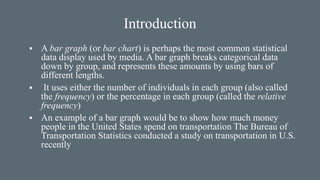
 A bar graph (or bar chart) is perhaps the most common statistical
data display used by media. A bar graph breaks categorical data
down by group, and represents these amounts by using bars of
different lengths.
 It uses either the number of individuals in each group (also called
the frequency) or the percentage in each group (called the relative
frequency)
 An example of a bar graph would be to show how much money
people in the United States spend on transportation The Bureau of
Transportation Statistics conducted a study on transportation in U.S.
recently
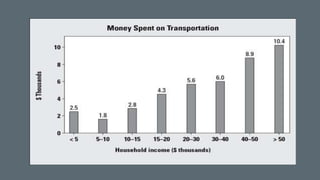
 The particular bar graph shows how much money is spent on
transportation for people in different household-income groups.
 It appears that as household income increases, the total expenditures
on transportation also increase.
 This makes sense, because the more money people have, the more
they have available to spend.
 The households in the first group make less than $5,000 a year and
have to spend $2,500 of it on transportation.
 This $2,500 represents 50% of the annual income of those who make
$5,000 per year; the percentage of the total income is even higher for
those who make less than $5,000 per year.
 The households earning $30,000–$40,000 per year pay $6,000 per
year on transportation, which is between 15% and 20% of their
household income.
 So, although the people making more money spend more dollars on
transportation, they don't spend more as a percentage of their total
income.
 Another point to check out is the groupings on the graph. The
categories for household income as shown aren't equivalent.
 For example, each of the first four bars represents household
incomes in intervals of $5,000, but the next three groups increase
by $10,000 each, and the last group contains every household
making more than $50,000 per year.
 Bar graphs using different-sized intervals to represent numerical
values make true comparisons between groups more difficult.
Thank You

Global business communication

  • 1.
    Global Business Communication BarGraph Interpretation On Money Spent On Transportation Presented By: Astha Laghate Mayank Garg
  • 2.
    Introduction  A bargraph (or bar chart) is perhaps the most common statistical data display used by media. A bar graph breaks categorical data down by group, and represents these amounts by using bars of different lengths.  It uses either the number of individuals in each group (also called the frequency) or the percentage in each group (called the relative frequency)  An example of a bar graph would be to show how much money people in the United States spend on transportation The Bureau of Transportation Statistics conducted a study on transportation in U.S. recently
  • 4.
     The particularbar graph shows how much money is spent on transportation for people in different household-income groups.  It appears that as household income increases, the total expenditures on transportation also increase.  This makes sense, because the more money people have, the more they have available to spend.
  • 5.
     The householdsin the first group make less than $5,000 a year and have to spend $2,500 of it on transportation.  This $2,500 represents 50% of the annual income of those who make $5,000 per year; the percentage of the total income is even higher for those who make less than $5,000 per year.  The households earning $30,000–$40,000 per year pay $6,000 per year on transportation, which is between 15% and 20% of their household income.  So, although the people making more money spend more dollars on transportation, they don't spend more as a percentage of their total income.
  • 6.
     Another pointto check out is the groupings on the graph. The categories for household income as shown aren't equivalent.  For example, each of the first four bars represents household incomes in intervals of $5,000, but the next three groups increase by $10,000 each, and the last group contains every household making more than $50,000 per year.  Bar graphs using different-sized intervals to represent numerical values make true comparisons between groups more difficult.
  • 7.