Artificial Neural
Network
Business Analytics
PGDM(X) 2021-2022
Ashutosh Mishra
Roll No: 21XPGDM07
About ANN
• The first artificial neuron was produced in 1943 by
Warren McCulloch and Walter Pits.
• Artificial neural network (ANN) is a machine
learning approach that models human brain and
consists of a number of artificial neurons.
• Neuron in ANNs tend to have fewer connections
than biological neurons.
• Each neuron in ANN receives a number of inputs.
An activation function is applied to these inputs
which results in activation level of neuron (output
value of the neuron).
An Artificial Neural Network is specified
by:
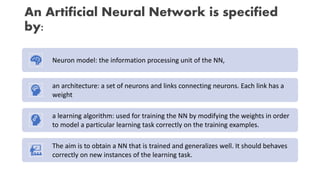
Neuron model: the information processing unit of the NN,
an architecture: a set of neurons and links connecting neurons. Each link has a
weight
a learning algorithm: used for training the NN by modifying the weights in order
to model a particular learning task correctly on the training examples.
The aim is to obtain a NN that is trained and generalizes well. It should behaves
correctly on new instances of the learning task.
Advantages
of ANN
• Storing information on the entire network : Information
such as in traditional programming is stored on the entire
network, not on a database.
• Ability to work with incomplete knowledge : After ANN
training, the data may produce output even with
incomplete information. The loss of performance here
depends on the importance of the missing information.
• Having fault tolerance: Corruption of one or more cells of
ANN does not prevent it from generating output. This
feature makes the networks fault tolerant.
• Ability to make machine learning: Artificial neural
networks learn events and make decisions by commenting
on similar events.
• Parallel processing capability: Artificial neural networks
have numerical strength that can perform more than one
job at the same time.
Disadvantages
• Hardware dependence: Artificial neural networks require
processors with parallel processing power, in accordance
with their structure. For this reason, the realization of the
equipment is dependent.
• Unexplained behavior of the network: This is the most
important problem of ANN. When ANN produces a probing
solution, it does not give a clue as to why and how. This
reduces trust in the network.
• Determination of proper network structure: There is no
specific rule for determining the structure of artificial
neural networks. Appropriate network structure is
achieved through experience and trial and error.
• The duration of the network is unknown: The network is
reduced to a certain value of the error on the sample
means that the training has been completed. This value
does not give us optimum results.
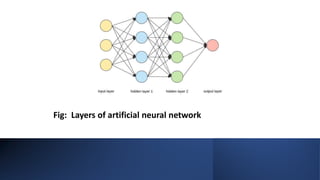
Fig: Layers of artificial neural network

Artificial Neural Network.pptx

  • 1.
    Artificial Neural Network Business Analytics PGDM(X)2021-2022 Ashutosh Mishra Roll No: 21XPGDM07
  • 2.
    About ANN • Thefirst artificial neuron was produced in 1943 by Warren McCulloch and Walter Pits. • Artificial neural network (ANN) is a machine learning approach that models human brain and consists of a number of artificial neurons. • Neuron in ANNs tend to have fewer connections than biological neurons. • Each neuron in ANN receives a number of inputs. An activation function is applied to these inputs which results in activation level of neuron (output value of the neuron).
  • 3.
    An Artificial NeuralNetwork is specified by: Neuron model: the information processing unit of the NN, an architecture: a set of neurons and links connecting neurons. Each link has a weight a learning algorithm: used for training the NN by modifying the weights in order to model a particular learning task correctly on the training examples. The aim is to obtain a NN that is trained and generalizes well. It should behaves correctly on new instances of the learning task.
  • 4.
    Advantages of ANN • Storinginformation on the entire network : Information such as in traditional programming is stored on the entire network, not on a database. • Ability to work with incomplete knowledge : After ANN training, the data may produce output even with incomplete information. The loss of performance here depends on the importance of the missing information. • Having fault tolerance: Corruption of one or more cells of ANN does not prevent it from generating output. This feature makes the networks fault tolerant. • Ability to make machine learning: Artificial neural networks learn events and make decisions by commenting on similar events. • Parallel processing capability: Artificial neural networks have numerical strength that can perform more than one job at the same time.
  • 5.
    Disadvantages • Hardware dependence:Artificial neural networks require processors with parallel processing power, in accordance with their structure. For this reason, the realization of the equipment is dependent. • Unexplained behavior of the network: This is the most important problem of ANN. When ANN produces a probing solution, it does not give a clue as to why and how. This reduces trust in the network. • Determination of proper network structure: There is no specific rule for determining the structure of artificial neural networks. Appropriate network structure is achieved through experience and trial and error. • The duration of the network is unknown: The network is reduced to a certain value of the error on the sample means that the training has been completed. This value does not give us optimum results.
  • 6.
    Fig: Layers ofartificial neural network