From: Siebert, Gopaldas, Lindridge, and Simões (2020)
Customer Experience Journeys:
“Smooth” versus “Sticky”
Key Insights
• Customers want predictable, easy, and “smooth” journeys in instrumental service categories
(e.g., banking, insurance, transport), but unpredictable, exciting, and “sticky” journeys in
recreational service categories (e.g., dating, fitness, gaming).
• Firms can facilitate smooth journeys by “streamlining” the customer journey, or they can
facilitate sticky journeys by providing “endless variation” along the customer journey.
From: Siebert, Gopaldas, Lindridge, and Simões (2020)
The Smooth Journey Model
This is the dominant model in Customer Experience
Management (CXM) theory and practice.
Firms enroll customers in a Loyalty Loop by offering
them Decision Support during the initial service
cycle and Streamlining across subsequent service
cycles.
The resulting customer journey is predictable, easy,
and “smooth.”
Customers make deliberate purchase decisions at first,
then routinized or automated purchases later.
Smooth journeys end with brand switching, triggered
by loyalty-weakening incidents.
From: Siebert, Gopaldas, Lindridge, and Simões (2020)
The Sticky Journey Model
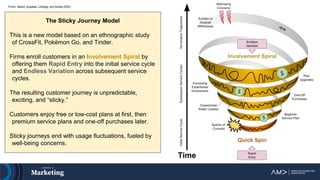
This is a new model based on an ethnographic study
of CrossFit, Pokémon Go, and Tinder.
Firms enroll customers in an Involvement Spiral by
offering them Rapid Entry into the initial service cycle
and Endless Variation across subsequent service
cycles.
The resulting customer journey is unpredictable,
exciting, and “sticky.”
Customers enjoy free or low-cost plans at first, then
premium service plans and one-off purchases later.
Sticky journeys end with usage fluctuations, fueled by
well-being concerns.
From: Siebert, Gopaldas, Lindridge, and Simões (2020)
Sample Evidence from Tinder Interviews
Charles, Tinder user: When Tinder came out, I saw my mates play it, and I
thought the idea of it was amazing in the sense that you just swipe, “Yeah, I
think she’s hot!” or “No, not for me!” I was like, “All right, let’s see what the
hype’s about.” This is definitely a game changer! (abbreviated)
Anna, Tinder user: Tall men, small men, fat men, thin men, poor [men],
rich [men], doctors, gardeners, and everything! You really see a big cross-
section of society. And that was super exciting! (abbreviated)
Enrico, Tinder user: The first match you say “Hi, how are you?” and the
conversation goes on. But then you feel greedy and you’re non-stop until
you reach the second match, or third, or fourth. And then you start having
five conversations at the same time. And then you try to select a few that
you really think are the good catches. So over time, I became more
mature in the use of the app. (abbreviated)
Sophia, Tinder user: It’s very addictive. I would spend a lot of time. It was
like an addictive game, so in order to stop using it, at some point, I just
deleted it. (abbreviated)
From: Siebert, Gopaldas, Lindridge, and Simões (2020)
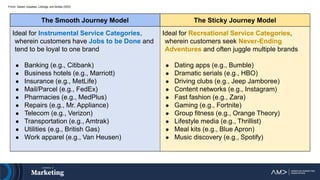
The Smooth Journey Model The Sticky Journey Model
Ideal for Instrumental Service Categories,
wherein customers have Jobs to be Done and
tend to be loyal to one brand
● Banking (e.g., Citibank)
● Business hotels (e.g., Marriott)
● Insurance (e.g., MetLife)
● Mail/Parcel (e.g., FedEx)
● Pharmacies (e.g., MedPlus)
● Repairs (e.g., Mr. Appliance)
● Telecom (e.g., Verizon)
● Transportation (e.g., Amtrak)
● Utilities (e.g., British Gas)
● Work apparel (e.g., Van Heusen)
Ideal for Recreational Service Categories,
wherein customers seek Never-Ending
Adventures and often juggle multiple brands
● Dating apps (e.g., Bumble)
● Dramatic serials (e.g., HBO)
● Driving clubs (e.g., Jeep Jamboree)
● Content networks (e.g., Instagram)
● Fast fashion (e.g., Zara)
● Gaming (e.g., Fortnite)
● Group fitness (e.g., Orange Theory)
● Lifestyle media (e.g., Thrillist)
● Meal kits (e.g., Blue Apron)
● Music discovery (e.g., Spotify)

Customer Experience Journeys: Loyalty Loops versus Involvement Spirals

  • 1.
    From: Siebert, Gopaldas,Lindridge, and Simões (2020) Customer Experience Journeys: “Smooth” versus “Sticky” Key Insights • Customers want predictable, easy, and “smooth” journeys in instrumental service categories (e.g., banking, insurance, transport), but unpredictable, exciting, and “sticky” journeys in recreational service categories (e.g., dating, fitness, gaming). • Firms can facilitate smooth journeys by “streamlining” the customer journey, or they can facilitate sticky journeys by providing “endless variation” along the customer journey.
  • 2.
    From: Siebert, Gopaldas,Lindridge, and Simões (2020) The Smooth Journey Model This is the dominant model in Customer Experience Management (CXM) theory and practice. Firms enroll customers in a Loyalty Loop by offering them Decision Support during the initial service cycle and Streamlining across subsequent service cycles. The resulting customer journey is predictable, easy, and “smooth.” Customers make deliberate purchase decisions at first, then routinized or automated purchases later. Smooth journeys end with brand switching, triggered by loyalty-weakening incidents.
  • 3.
    From: Siebert, Gopaldas,Lindridge, and Simões (2020) The Sticky Journey Model This is a new model based on an ethnographic study of CrossFit, Pokémon Go, and Tinder. Firms enroll customers in an Involvement Spiral by offering them Rapid Entry into the initial service cycle and Endless Variation across subsequent service cycles. The resulting customer journey is unpredictable, exciting, and “sticky.” Customers enjoy free or low-cost plans at first, then premium service plans and one-off purchases later. Sticky journeys end with usage fluctuations, fueled by well-being concerns.
  • 4.
    From: Siebert, Gopaldas,Lindridge, and Simões (2020) Sample Evidence from Tinder Interviews Charles, Tinder user: When Tinder came out, I saw my mates play it, and I thought the idea of it was amazing in the sense that you just swipe, “Yeah, I think she’s hot!” or “No, not for me!” I was like, “All right, let’s see what the hype’s about.” This is definitely a game changer! (abbreviated) Anna, Tinder user: Tall men, small men, fat men, thin men, poor [men], rich [men], doctors, gardeners, and everything! You really see a big cross- section of society. And that was super exciting! (abbreviated) Enrico, Tinder user: The first match you say “Hi, how are you?” and the conversation goes on. But then you feel greedy and you’re non-stop until you reach the second match, or third, or fourth. And then you start having five conversations at the same time. And then you try to select a few that you really think are the good catches. So over time, I became more mature in the use of the app. (abbreviated) Sophia, Tinder user: It’s very addictive. I would spend a lot of time. It was like an addictive game, so in order to stop using it, at some point, I just deleted it. (abbreviated)
  • 5.
    From: Siebert, Gopaldas,Lindridge, and Simões (2020) The Smooth Journey Model The Sticky Journey Model Ideal for Instrumental Service Categories, wherein customers have Jobs to be Done and tend to be loyal to one brand ● Banking (e.g., Citibank) ● Business hotels (e.g., Marriott) ● Insurance (e.g., MetLife) ● Mail/Parcel (e.g., FedEx) ● Pharmacies (e.g., MedPlus) ● Repairs (e.g., Mr. Appliance) ● Telecom (e.g., Verizon) ● Transportation (e.g., Amtrak) ● Utilities (e.g., British Gas) ● Work apparel (e.g., Van Heusen) Ideal for Recreational Service Categories, wherein customers seek Never-Ending Adventures and often juggle multiple brands ● Dating apps (e.g., Bumble) ● Dramatic serials (e.g., HBO) ● Driving clubs (e.g., Jeep Jamboree) ● Content networks (e.g., Instagram) ● Fast fashion (e.g., Zara) ● Gaming (e.g., Fortnite) ● Group fitness (e.g., Orange Theory) ● Lifestyle media (e.g., Thrillist) ● Meal kits (e.g., Blue Apron) ● Music discovery (e.g., Spotify)