Presented by: Adrija Ganguly Roll no.:04
CSE 1A
The word probability derives from the Latin probabilitas, which can
also mean "probity", a measure of the authority of a witness in a legal
case in Europe, and often correlated with the witness's nobility.
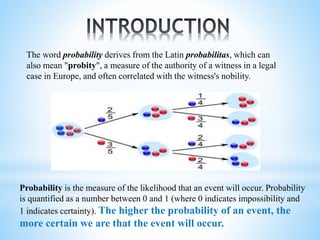
Probability is the measure of the likelihood that an event will occur. Probability
is quantified as a number between 0 and 1 (where 0 indicates impossibility and
1 indicates certainty). The higher the probability of an event, the
more certain we are that the event will occur.
EVENT: In probability theory, an event is a
set of outcomes of an experiment (a subset of
the sample space) to which a probability is
assigned.
RANDOM EXPERIMENT: An
experiment whose outcome
cannot be predicted with
certainty, before the experiment
is run.
NON-RANDOM
EXPERIMENT: An experiment
whose outcome may or may not
be predicted before the
experiment is run.
TERMS IN PROBABILITY WHICH HAS THEIR
APPLICATION IN REAL LIFE
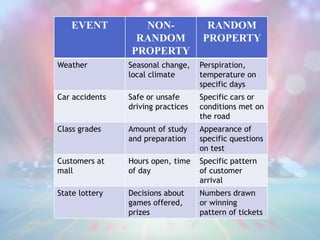
EVENT NON-
RANDOM
PROPERTY
RANDOM
PROPERTY
Weather Seasonal change,
local climate
Perspiration,
temperature on
specific days
Car accidents Safe or unsafe
driving practices
Specific cars or
conditions met on
the road
Class grades Amount of study
and preparation
Appearance of
specific questions
on test
Customers at
mall
Hours open, time
of day
Specific pattern
of customer
arrival
State lottery Decisions about
games offered,
prizes
Numbers drawn
or winning
pattern of tickets
Well, there are many practical applications of Probability.
Some of them are:
1. Communication ( In order to estimate the noise in the channel
for calculating the S/N ratio)
2. Weather forecasting.
3. Calculating statistics ( eg. Life expectancy and population
index)
4. Games (eg.Gambling etc).
Planning Around the Weather
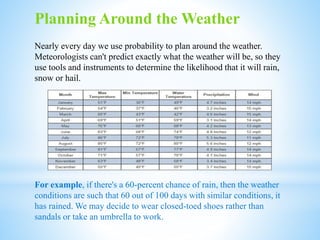
Nearly every day we use probability to plan around the weather.
Meteorologists can't predict exactly what the weather will be, so they
use tools and instruments to determine the likelihood that it will rain,
snow or hail.
For example, if there's a 60-percent chance of rain, then the weather
conditions are such that 60 out of 100 days with similar conditions, it
has rained. We may decide to wear closed-toed shoes rather than
sandals or take an umbrella to work.
Calculating Statistics
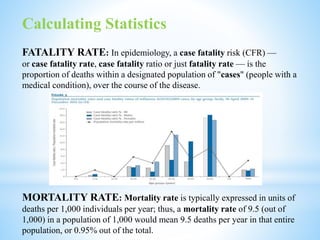
FATALITY RATE: In epidemiology, a case fatality risk (CFR) —
or case fatality rate, case fatality ratio or just fatality rate — is the
proportion of deaths within a designated population of "cases" (people with a
medical condition), over the course of the disease.
MORTALITY RATE: Mortality rate is typically expressed in units of
deaths per 1,000 individuals per year; thus, a mortality rate of 9.5 (out of
1,000) in a population of 1,000 would mean 9.5 deaths per year in that entire
population, or 0.95% out of the total.
Games and Recreational Activities
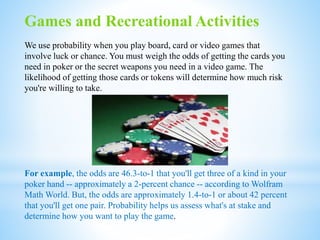
We use probability when you play board, card or video games that
involve luck or chance. You must weigh the odds of getting the cards you
need in poker or the secret weapons you need in a video game. The
likelihood of getting those cards or tokens will determine how much risk
you're willing to take.
For example, the odds are 46.3-to-1 that you'll get three of a kind in your
poker hand -- approximately a 2-percent chance -- according to Wolfram
Math World. But, the odds are approximately 1.4-to-1 or about 42 percent
that you'll get one pair. Probability helps us assess what's at stake and
determine how you want to play the game.
Luck is generally used to describe success or failure
apparently brought by chance rather than through one’s
own actions. The definition of
luck(or chance) varies by the
philosophical, religious,
mystical, and emotional
context of the one interpreting
it. So as we say it,
LUCK IS PROBABILITY TAKEN PERSONALLY!
A DIFFERENT ASPECT OF PRACTICAL APPLICATION OF
PROBABILITY : BEING LUCKY
In conclusion, we think although probability has a lot of
practical applications, it’s very important to remember that
we’ll never have probabilities in the clear-cut way a casino
has them.
There will always be some
degree of subjective belief
we’ll need to incorporate, at
least for the near future. So it
has to be kept in mind that
while our projection systems
and statistical analysis continue to improve and become
more accurate, there will always be an element we
can’t model.
PROBABILITY

PROBABILITY

  • 1.
    Presented by: AdrijaGanguly Roll no.:04 CSE 1A
  • 2.
    The word probabilityderives from the Latin probabilitas, which can also mean "probity", a measure of the authority of a witness in a legal case in Europe, and often correlated with the witness's nobility. Probability is the measure of the likelihood that an event will occur. Probability is quantified as a number between 0 and 1 (where 0 indicates impossibility and 1 indicates certainty). The higher the probability of an event, the more certain we are that the event will occur.
  • 3.
    EVENT: In probabilitytheory, an event is a set of outcomes of an experiment (a subset of the sample space) to which a probability is assigned. RANDOM EXPERIMENT: An experiment whose outcome cannot be predicted with certainty, before the experiment is run. NON-RANDOM EXPERIMENT: An experiment whose outcome may or may not be predicted before the experiment is run. TERMS IN PROBABILITY WHICH HAS THEIR APPLICATION IN REAL LIFE
  • 4.
    EVENT NON- RANDOM PROPERTY RANDOM PROPERTY Weather Seasonalchange, local climate Perspiration, temperature on specific days Car accidents Safe or unsafe driving practices Specific cars or conditions met on the road Class grades Amount of study and preparation Appearance of specific questions on test Customers at mall Hours open, time of day Specific pattern of customer arrival State lottery Decisions about games offered, prizes Numbers drawn or winning pattern of tickets
  • 5.
    Well, there aremany practical applications of Probability. Some of them are: 1. Communication ( In order to estimate the noise in the channel for calculating the S/N ratio) 2. Weather forecasting. 3. Calculating statistics ( eg. Life expectancy and population index) 4. Games (eg.Gambling etc).
  • 6.
    Planning Around theWeather Nearly every day we use probability to plan around the weather. Meteorologists can't predict exactly what the weather will be, so they use tools and instruments to determine the likelihood that it will rain, snow or hail. For example, if there's a 60-percent chance of rain, then the weather conditions are such that 60 out of 100 days with similar conditions, it has rained. We may decide to wear closed-toed shoes rather than sandals or take an umbrella to work.
  • 7.
    Calculating Statistics FATALITY RATE:In epidemiology, a case fatality risk (CFR) — or case fatality rate, case fatality ratio or just fatality rate — is the proportion of deaths within a designated population of "cases" (people with a medical condition), over the course of the disease. MORTALITY RATE: Mortality rate is typically expressed in units of deaths per 1,000 individuals per year; thus, a mortality rate of 9.5 (out of 1,000) in a population of 1,000 would mean 9.5 deaths per year in that entire population, or 0.95% out of the total.
  • 8.
    Games and RecreationalActivities We use probability when you play board, card or video games that involve luck or chance. You must weigh the odds of getting the cards you need in poker or the secret weapons you need in a video game. The likelihood of getting those cards or tokens will determine how much risk you're willing to take. For example, the odds are 46.3-to-1 that you'll get three of a kind in your poker hand -- approximately a 2-percent chance -- according to Wolfram Math World. But, the odds are approximately 1.4-to-1 or about 42 percent that you'll get one pair. Probability helps us assess what's at stake and determine how you want to play the game.
  • 9.
    Luck is generallyused to describe success or failure apparently brought by chance rather than through one’s own actions. The definition of luck(or chance) varies by the philosophical, religious, mystical, and emotional context of the one interpreting it. So as we say it, LUCK IS PROBABILITY TAKEN PERSONALLY! A DIFFERENT ASPECT OF PRACTICAL APPLICATION OF PROBABILITY : BEING LUCKY
  • 10.
    In conclusion, wethink although probability has a lot of practical applications, it’s very important to remember that we’ll never have probabilities in the clear-cut way a casino has them. There will always be some degree of subjective belief we’ll need to incorporate, at least for the near future. So it has to be kept in mind that while our projection systems and statistical analysis continue to improve and become more accurate, there will always be an element we can’t model.