The IBM AS/400
  A technical introduction


      Tom Van Looy
      tom@ctors.net
       August 2009
Overview
•   Who am I?

•   AS/400 history
•   What is IBM i?
•   Other environments
•   Programming
•   Work management
•   Exploring the system
Who am I
●   AS/400 system programmer (+4 years)
●   Currently Linux sysadmin (@priorweb.be)
●   Linux and *BSD user
●   Belgian village
Why this talk
●   AS/400, 20 year anniversary (2008)
●   You have nothing else to do ;-)
    –   I brought a system here to play with
         ●   Type-model 9402-200 (feat 2031)
         ●   11.6 CPW
         ●   56 MB main memory (8+16+32)
         ●   3093 MB ASP (3x1031)
         ●   OS/400 V3R2M0 (EOL 31/may/2000)
         ●   Dutch :-(

●   I do not represent IBM
    these are my views and opinions!
AS/400 history
AS/400 history
●   IBM Rochester, Minnesota
●   Midrange system
●   Different and extremely closed-source
●   Project Silverlake
●   Designed by Dr. Frank Soltis [1]
Rochester systems
●   System/3 (1969)
●   System/32 (1975)
●   System/34 (1977)
●   System/38 (1978)
●   System/36 (1983)
●   Fort Knox
●   AS/400 (1988)
S/3 (1969)   [2]
S/32 (1975)   [2]
S/34 (1977)   [2]
S/38 (1978)             [2]
Control Program Facility (CPF)
S/36 (1983)         [2]

System Support Program (SSP)
Fort Knox
●   S/36
●   S/38
●   Series/1
●   RS/6000 (AIX)
●   Some small IBM mainframes
AS/400 (1988)   [2]
     OS/400
Renaming
●   AS/400
●   AS/400e
●   eServer iSeries
●   eServer i5 (i5/OS)
●   System i5
●   System i

●   POWER systems (i + p)
    –   Power 6
    –   Rename i5/OS to IBM i
IBM Power systems   [3] [4] [5]


●   AIX, IBM i, Linux
What is IBM i?
Design principles
●   Technology independence
●   Object-based design
●   Hardware integration
●   Software integration
●   Single-level store
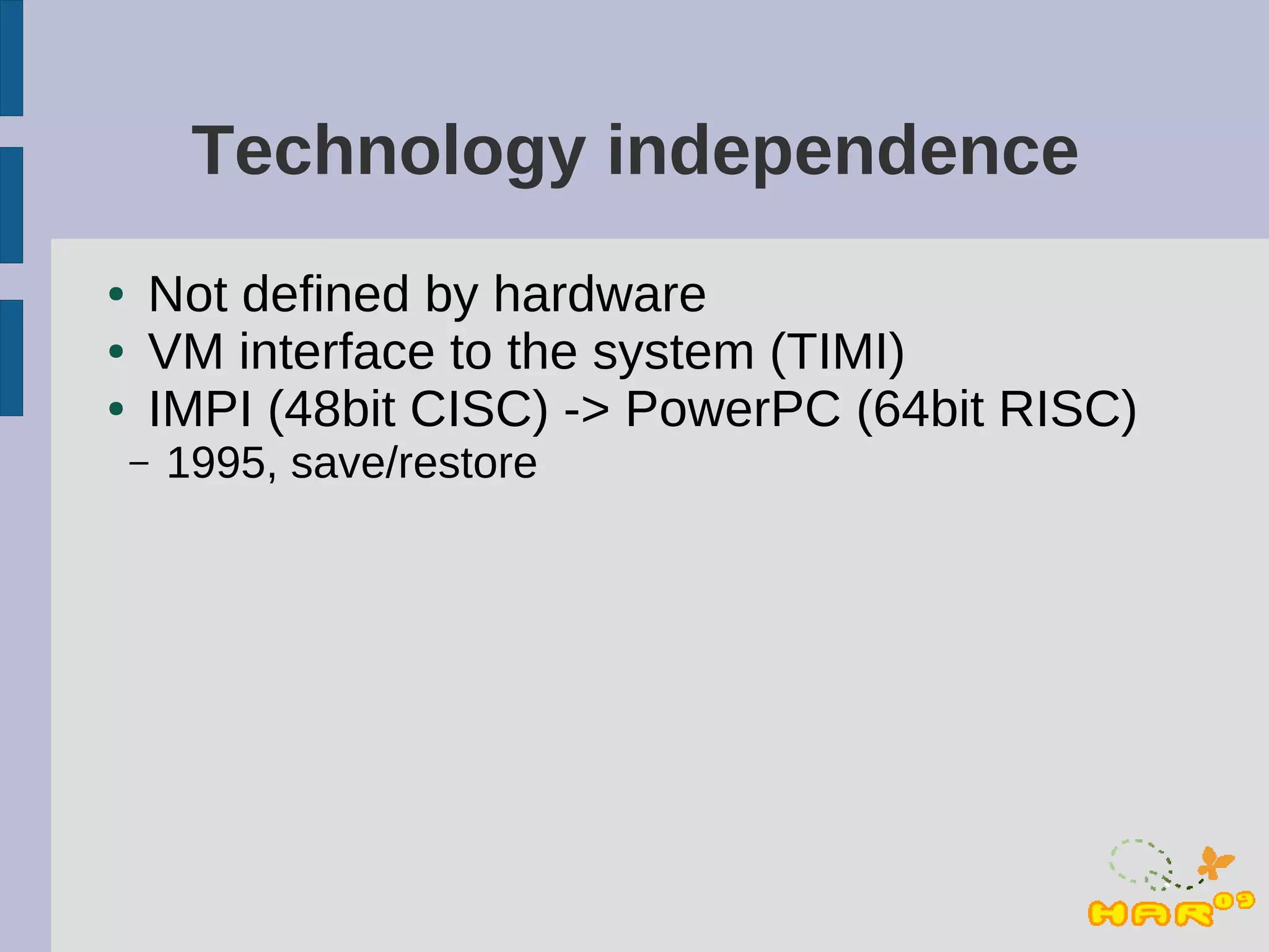
Technology independence
●   Not defined by hardware
●   VM interface to the system (TIMI)
●   IMPI (48bit CISC) -> PowerPC (64bit RISC)
    –   1995, save/restore
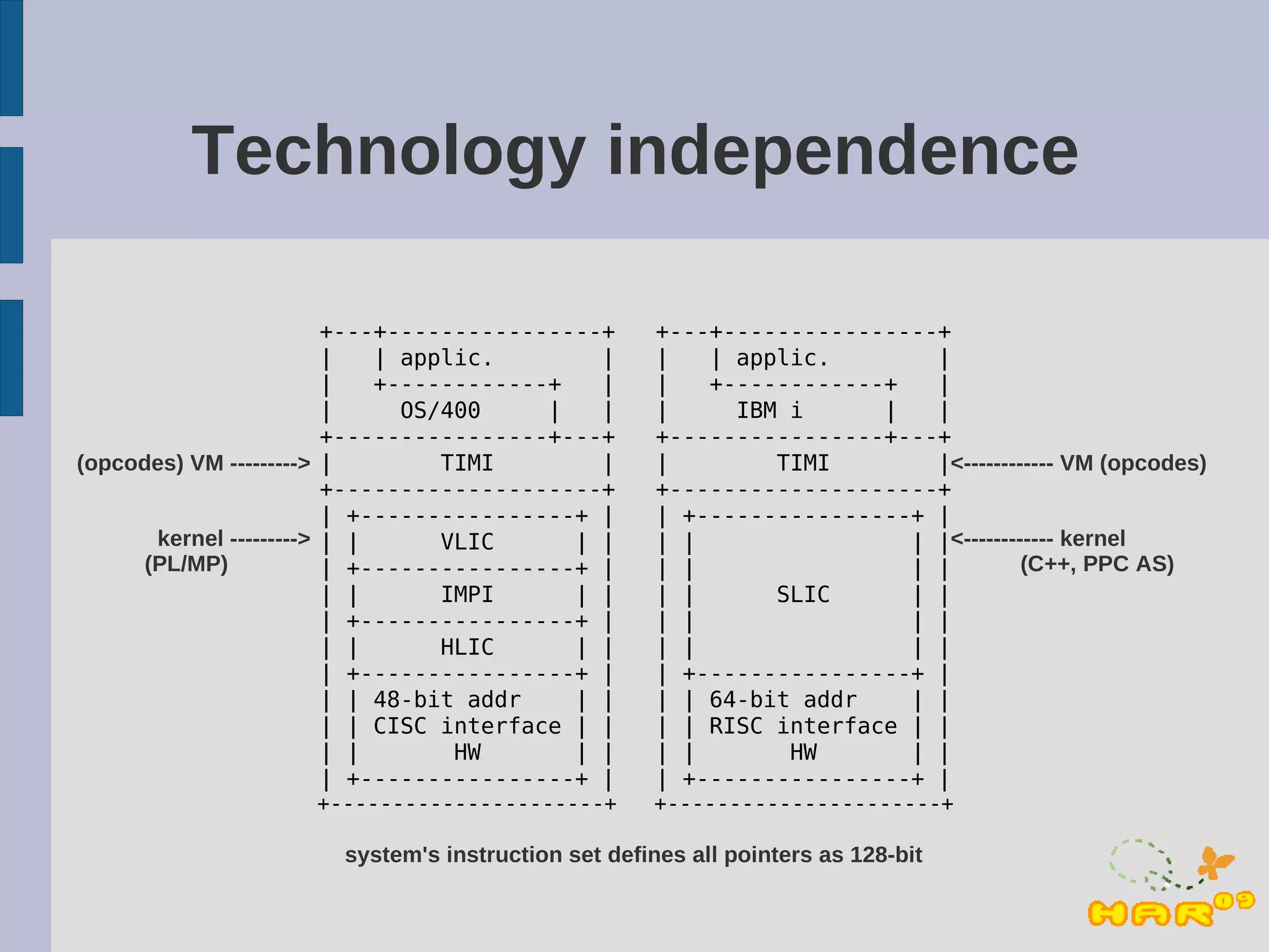
Technology independence

                         +---+----------------+      +---+----------------+
                         |   | applic.        |      |   | applic.        |
                         |   +------------+   |      |   +------------+   |
                         |     OS/400     |   |      |     IBM i      |   |
                         +----------------+---+      +----------------+---+
(opcodes) VM ---------> |         TIMI        |      |        TIMI        |<------------ VM (opcodes)
                         +--------------------+      +--------------------+
                         | +----------------+ |      | +----------------+ |
       kernel ---------> | |      VLIC      | |      | |                | |<------------ kernel
      (PL/MP)            | +----------------+ |      | |                | |         (C++, PPC AS)
                         | |      IMPI      | |      | |      SLIC      | |
                         | +----------------+ |      | |                | |
                         | |      HLIC      | |      | |                | |
                         | +----------------+ |      | +----------------+ |
                         | | 48-bit addr    | |      | | 64-bit addr    | |
                         | | CISC interface | |      | | RISC interface | |
                         | |       HW       | |      | |       HW       | |
                         | +----------------+ |      | +----------------+ |
                    +----------------------+        +----------------------+

                       system's instruction set defines all pointers as 128-bit
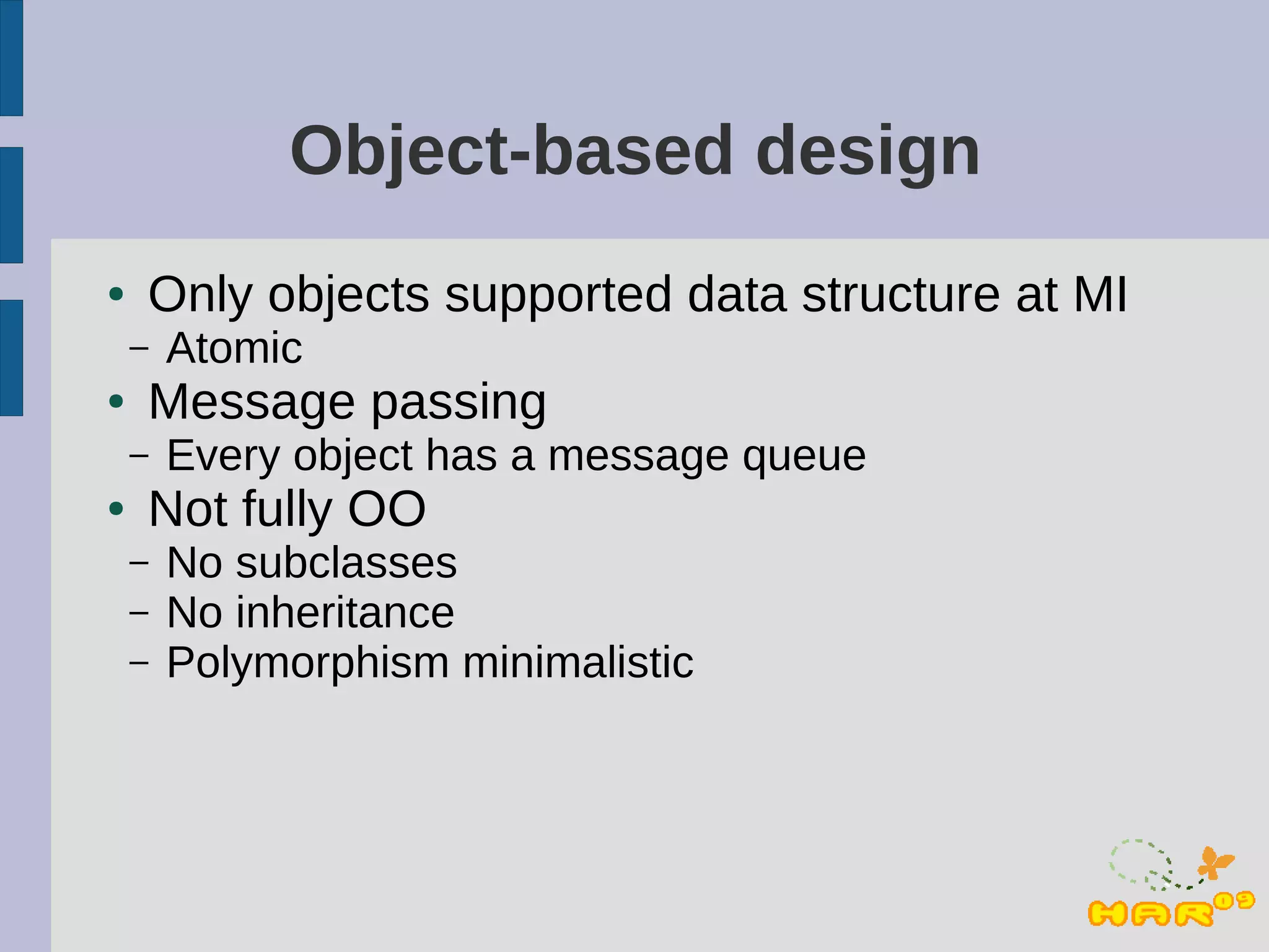
Object-based design
●   Only objects supported data structure at MI
    –   Atomic
●   Message passing
    –   Every object has a message queue
●   Not fully OO
    –   No subclasses
    –   No inheritance
    –   Polymorphism minimalistic
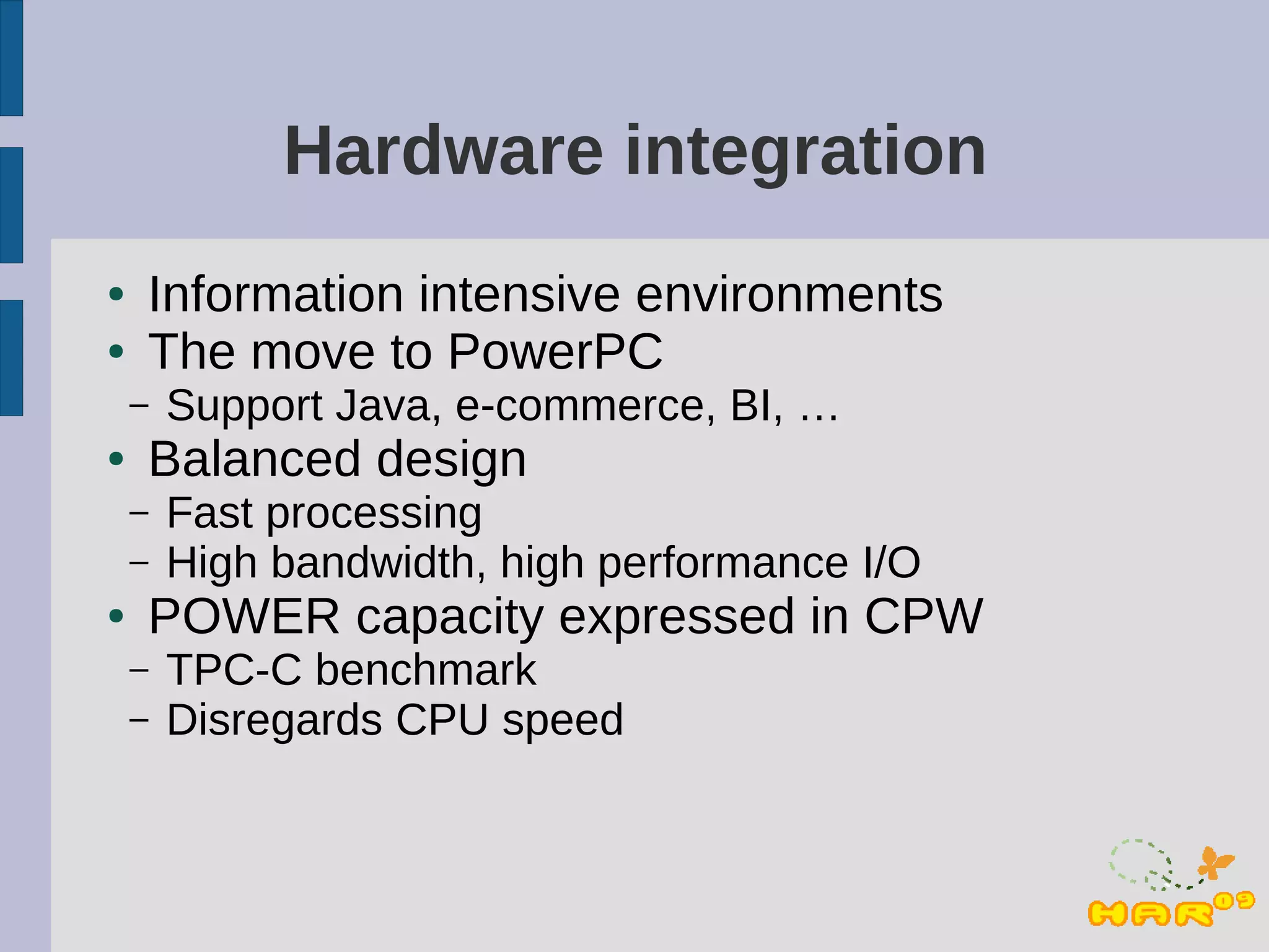
Hardware integration
●   Information intensive environments
●   The move to PowerPC
    –   Support Java, e-commerce, BI, …
●   Balanced design
    –   Fast processing
    –   High bandwidth, high performance I/O
●   POWER capacity expressed in CPW
    –   TPC-C benchmark
    –   Disregards CPU speed
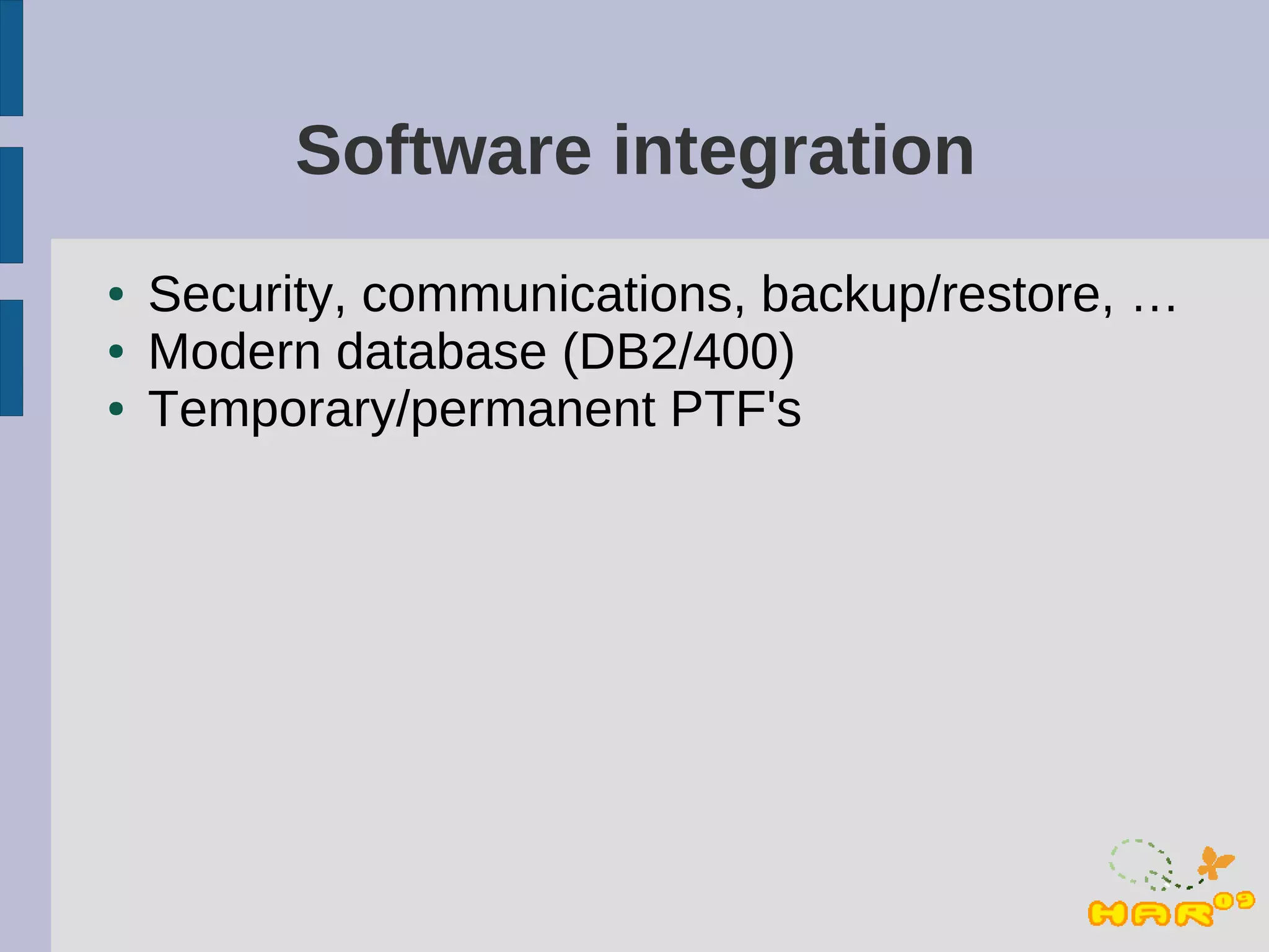
Software integration
●   Security, communications, backup/restore, …
●   Modern database (DB2/400)
●   Temporary/permanent PTF's
Single-level store
●   64-bit address space
    –   One large shared storage
    –   Contains all programs and data
    –   Addressable from single permanent address
         ●   Reference by name or pointer
         ●   Don't worry where it resides
    –   No address reuse
●   No process local storage
    –   Task creation
    –   Context switching
●   Virtual addressing moves object into real
    memory (not accessible by programmer)
Other environments
PASE
●   Portable Application Solution Environment
    –   Incorporated 64-bit AIX runtime env.
●   Private Address Space Environment
●   Not technology independent
    –   does not talk to TIMI
    –   syscall interface to the SLIC
PASE
●   Call PASE from i
    –   QSH CMD('ls /home/tvl')
●   Call i from PASE
    –   system ”WRKOBJLCK OBJ(MYFILE)
          OBJTYPE(*FILE)”
●   Query DB2 from PASE, …
●   Run Apache, X, ...
Hypervisor
●   Hardware support in PowerPC
●   Logical Partitioning (LPAR)
    –   AIX, Linux, IBM i
    –   Created and managed from the HMC
●   Dynamic resource allocation at runtime
Management
●   Twinax (obsolete)
●   Hardware Management Console (HMC)
    –   IPL the system
    –   Service tools
    –   LPAR
                              +-------+
                              |       ||
         +-------+           | IBM i ||
         |        ||          |       ||   +----+ +----+ +----+
         | HMC    ||------------[FSP] ||   | WS | | WS | | WS |
         |        ||----+ +---|       ||   +----+ +----+ +----+
         +-------+/     | |   |       || /____/| /____/| /____/|
        /_______/       | |   | [CP ] ||        |       |       |
                        | |   +-------+/        |       |       |
                      ~~~~~~~                   |       |       |
                    (         )-----------------+       |       |
                   (    LAN    )------------------------+       |
                    (         )---------------------------------+
                      ~~~~~~~
Programming
Languages
●   CL
●   RPG
●   COBOL
●   SQL
●   C
●   Pascal
●   Java
OPM, EPM
●   Original Program Model
●   Extended Program Model
    –   C, Pascal, ...
●   Translate into MI programs (*PGM)
    –   Morphed into PPC pgm's by optimizing translator
●   Only call external
    –   Late binding
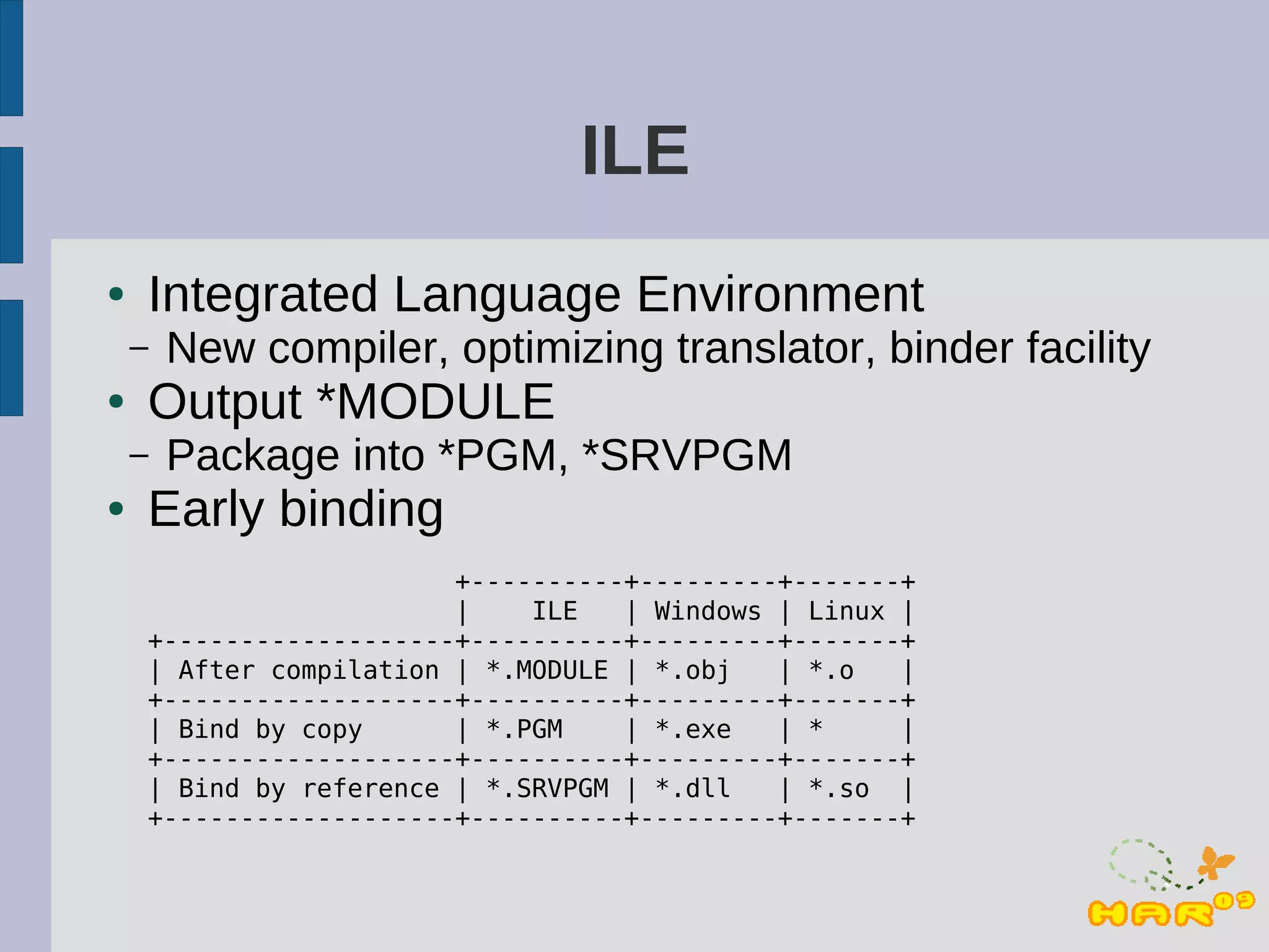
ILE
●   Integrated Language Environment
    –   New compiler, optimizing translator, binder facility
●   Output *MODULE
    –   Package into *PGM, *SRVPGM
●   Early binding
                        +----------+---------+-------+
                        |    ILE   | Windows | Linux |
    +-------------------+----------+---------+-------+
    | After compilation | *.MODULE | *.obj   | *.o   |
    +-------------------+----------+---------+-------+
    | Bind by copy      | *.PGM    | *.exe   | *     |
    +-------------------+----------+---------+-------+
    | Bind by reference | *.SRVPGM | *.dll   | *.so |
    +-------------------+----------+---------+-------+
Java
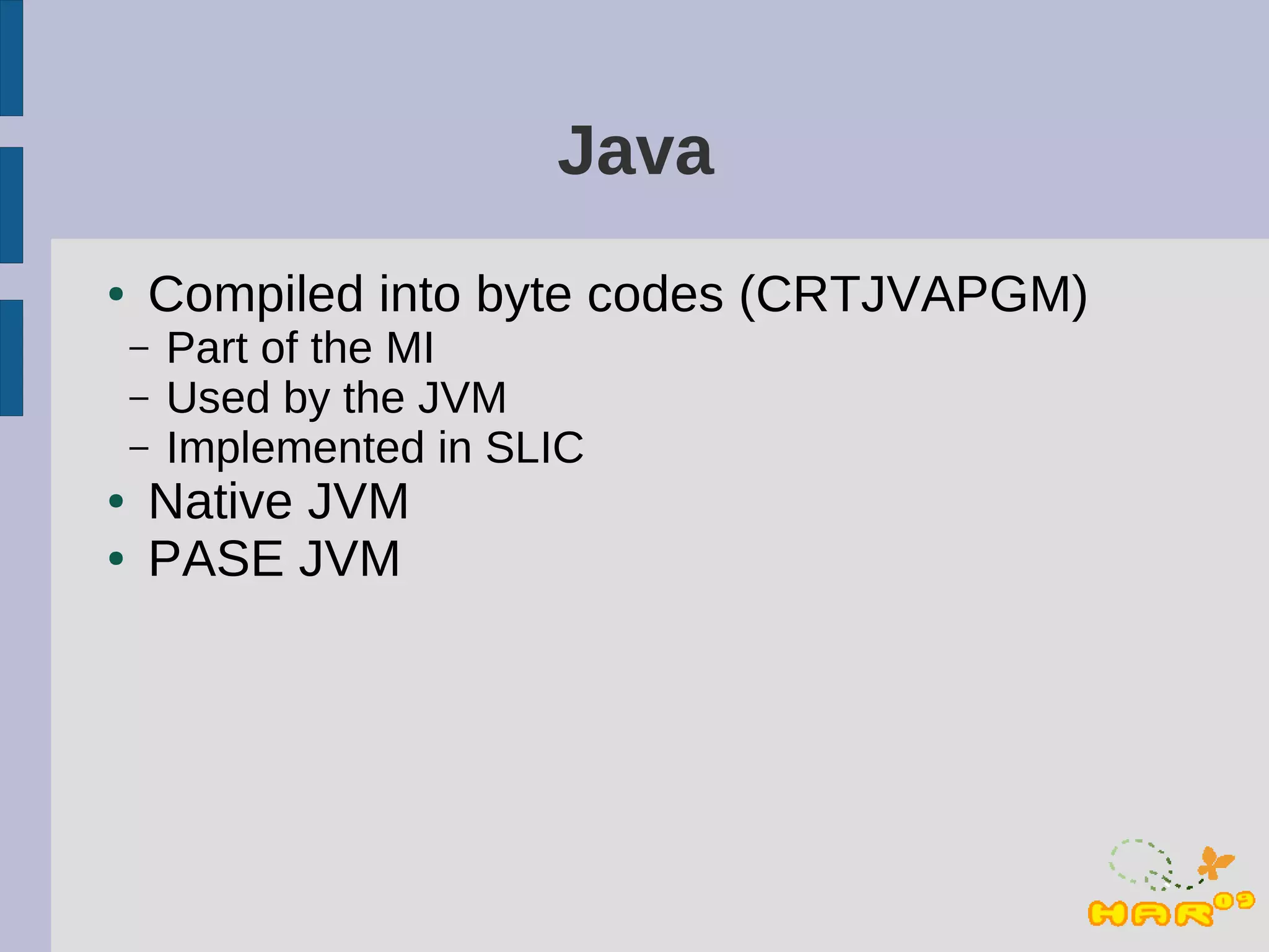
●   Compiled into byte codes (CRTJVAPGM)
    –   Part of the MI
    –   Used by the JVM
    –   Implemented in SLIC
●   Native JVM
●   PASE JVM
Work management
LUW
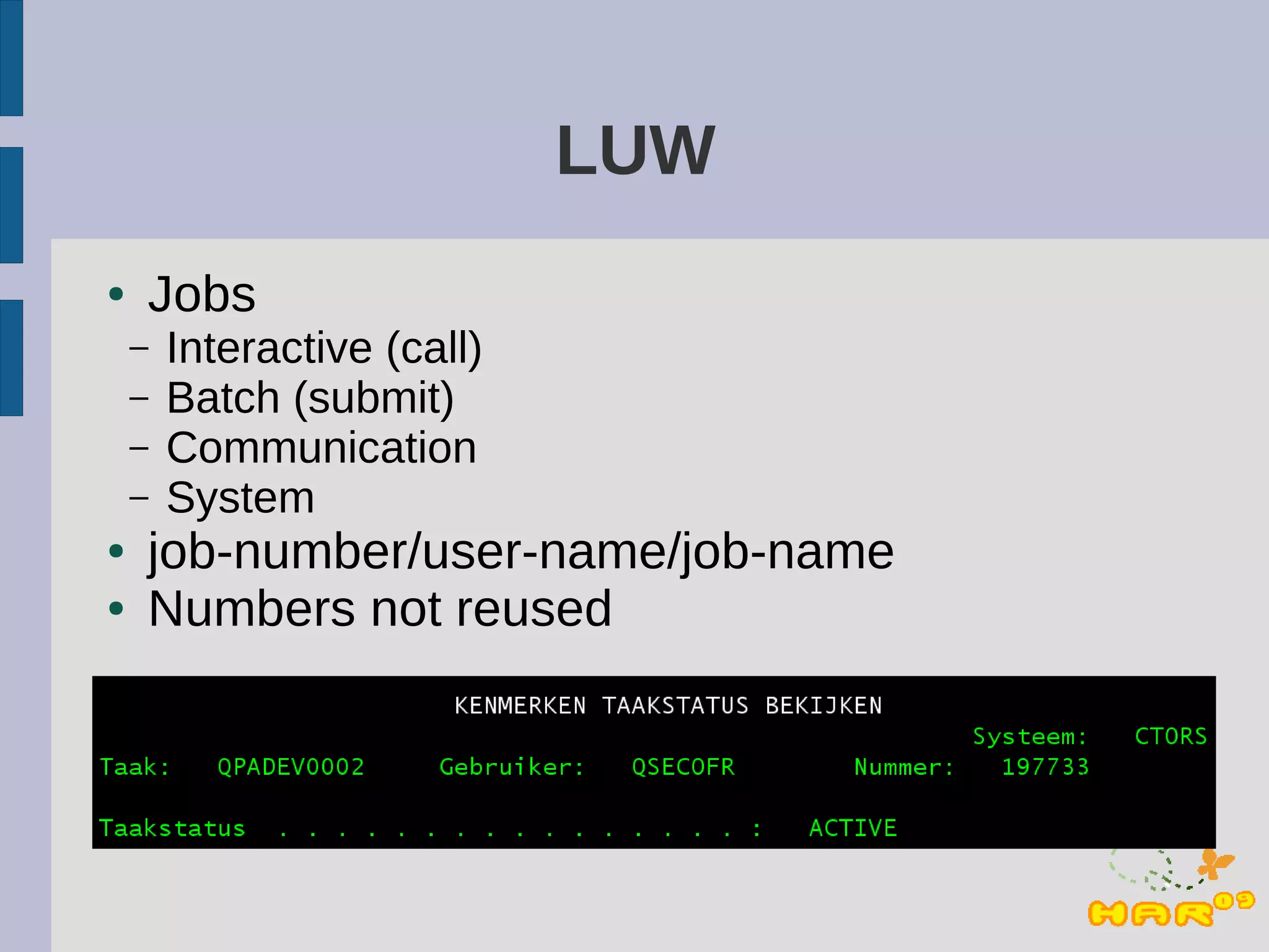
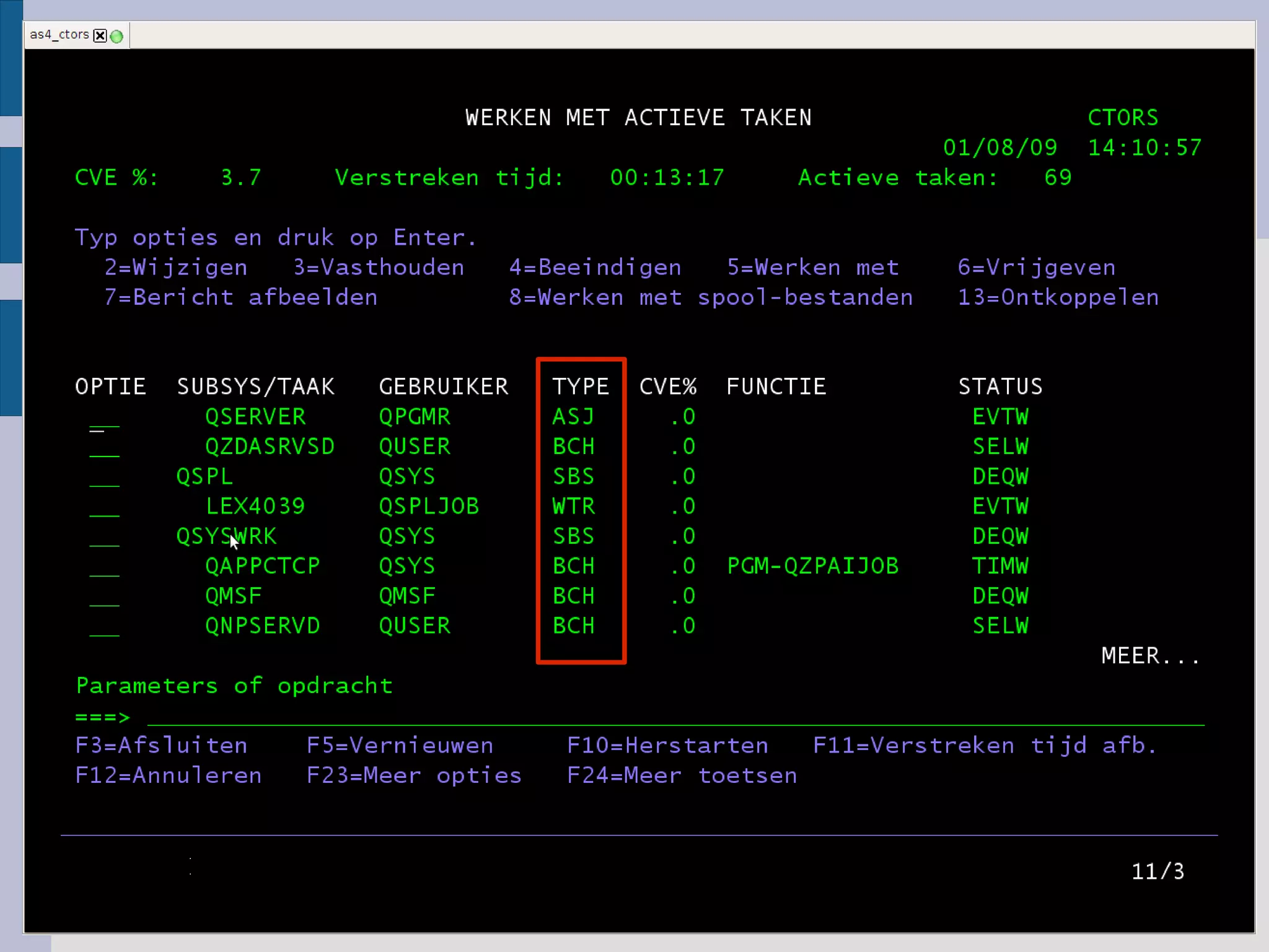
●   Jobs
    –   Interactive (call)
    –   Batch (submit)
    –   Communication
    –   System
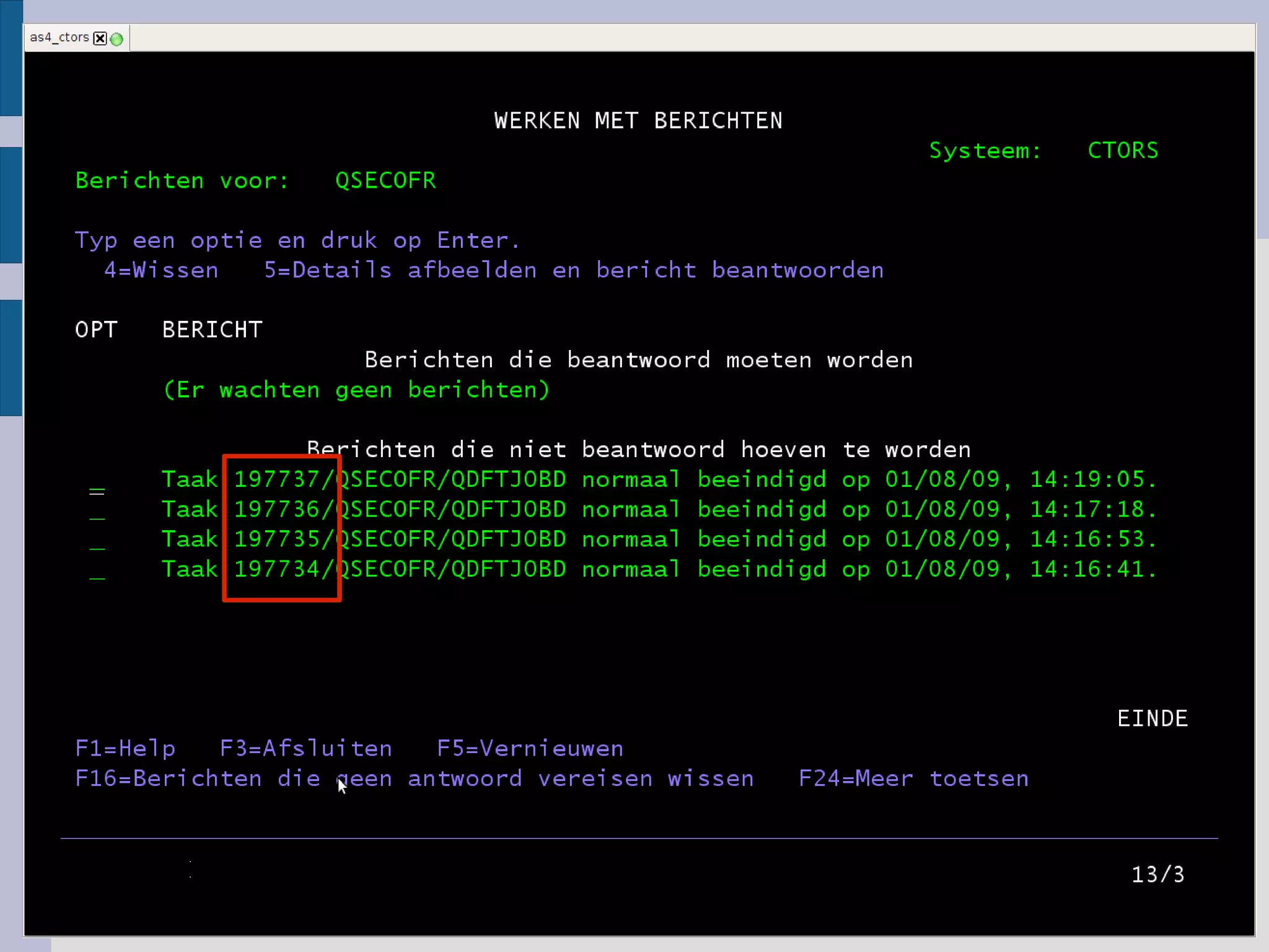
●   job-number/user-name/job-name
●   Numbers not reused
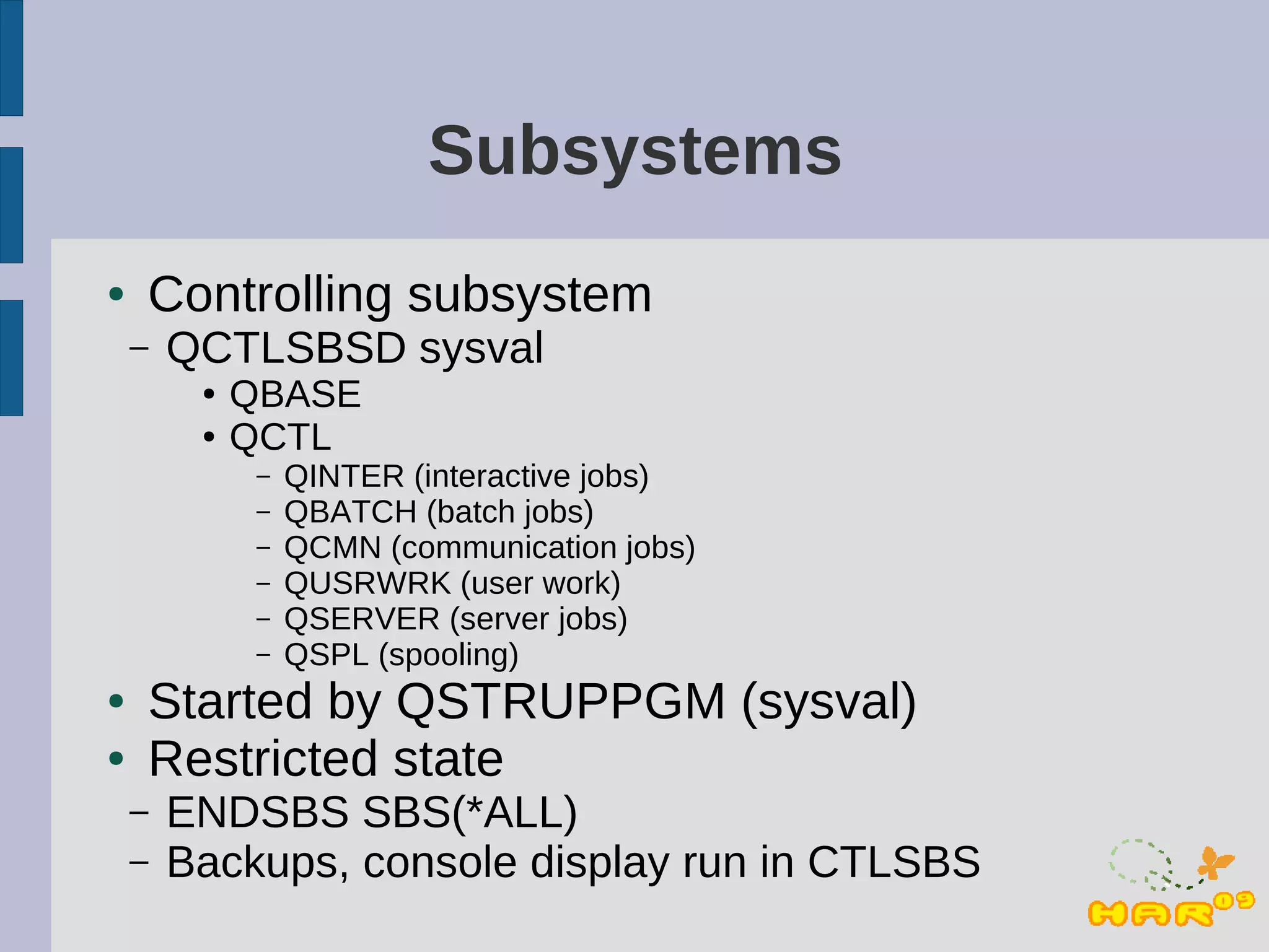
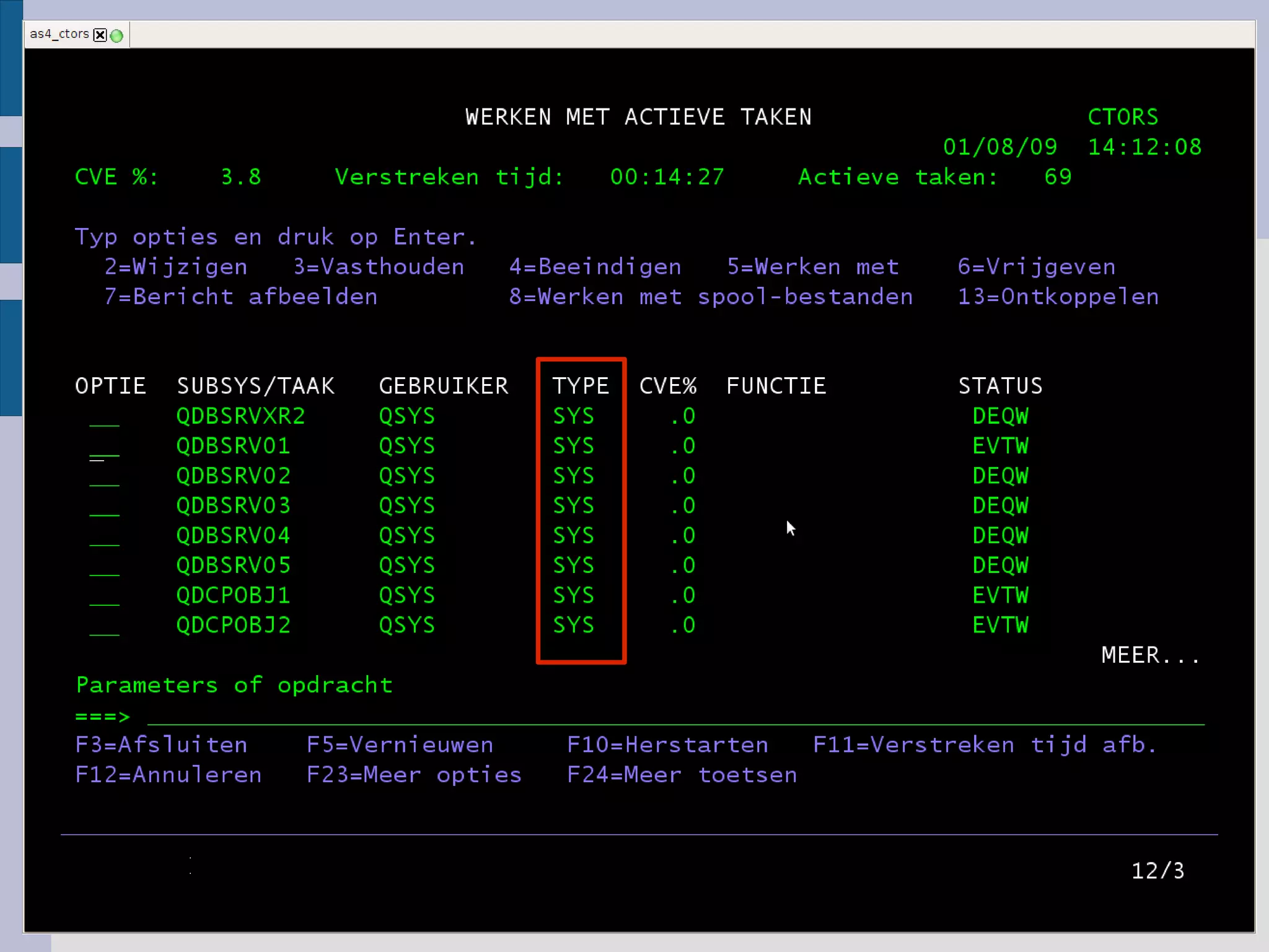
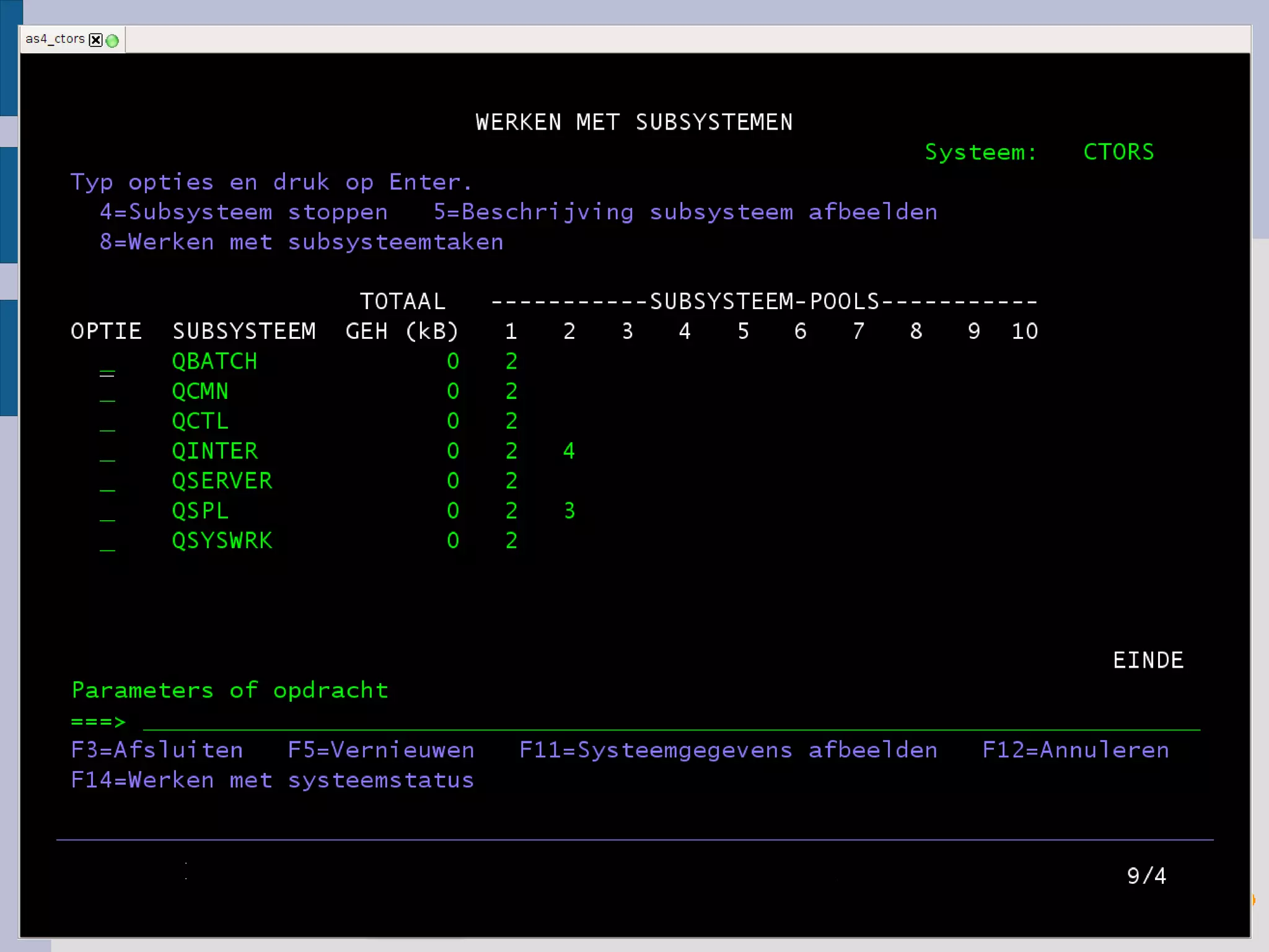
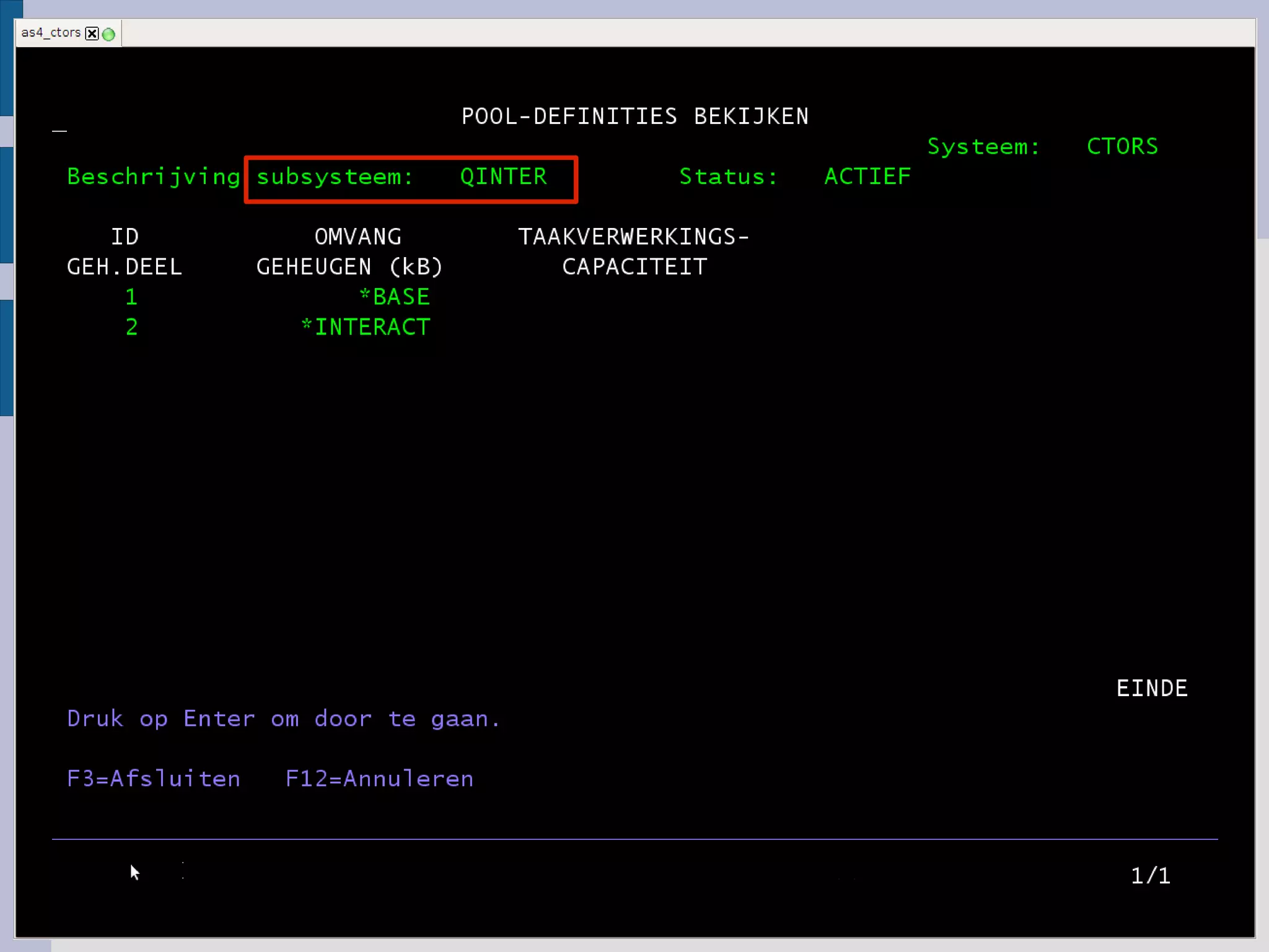
Subsystems
●   Controlling subsystem
    –   QCTLSBSD sysval
         ●   QBASE
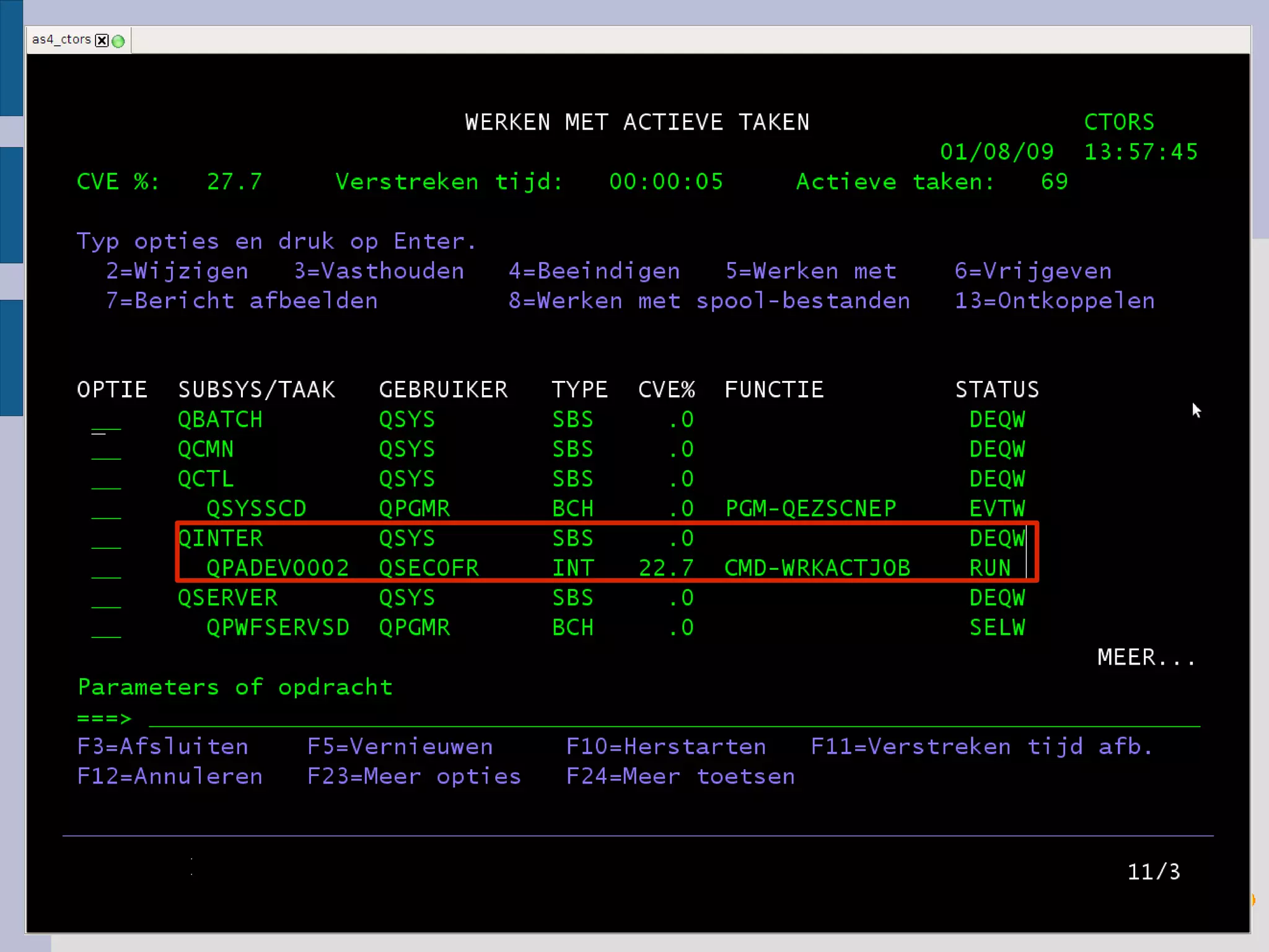
         ●   QCTL
              –   QINTER (interactive jobs)
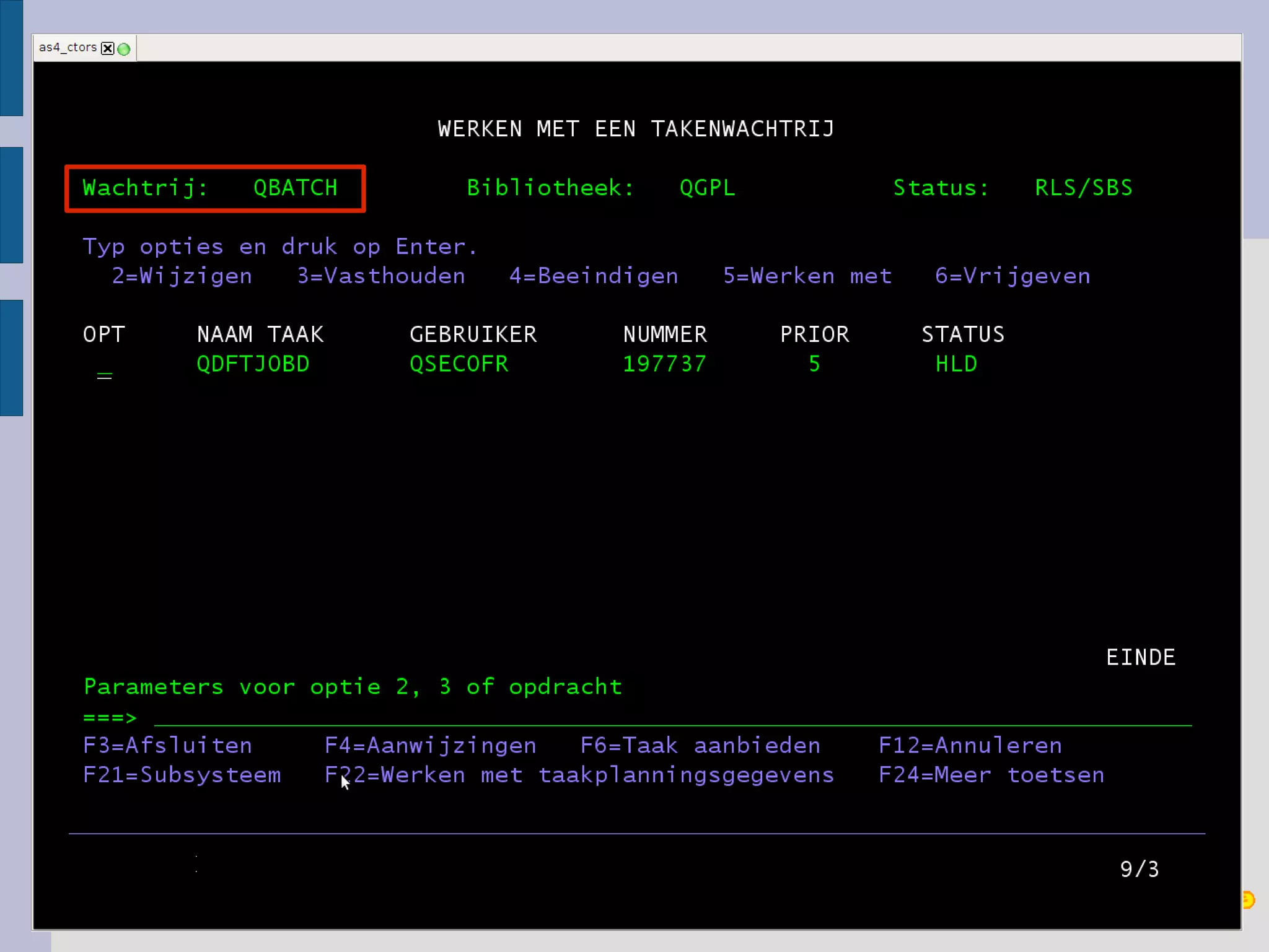
              –   QBATCH (batch jobs)
              –   QCMN (communication jobs)
              –   QUSRWRK (user work)
              –   QSERVER (server jobs)
              –   QSPL (spooling)
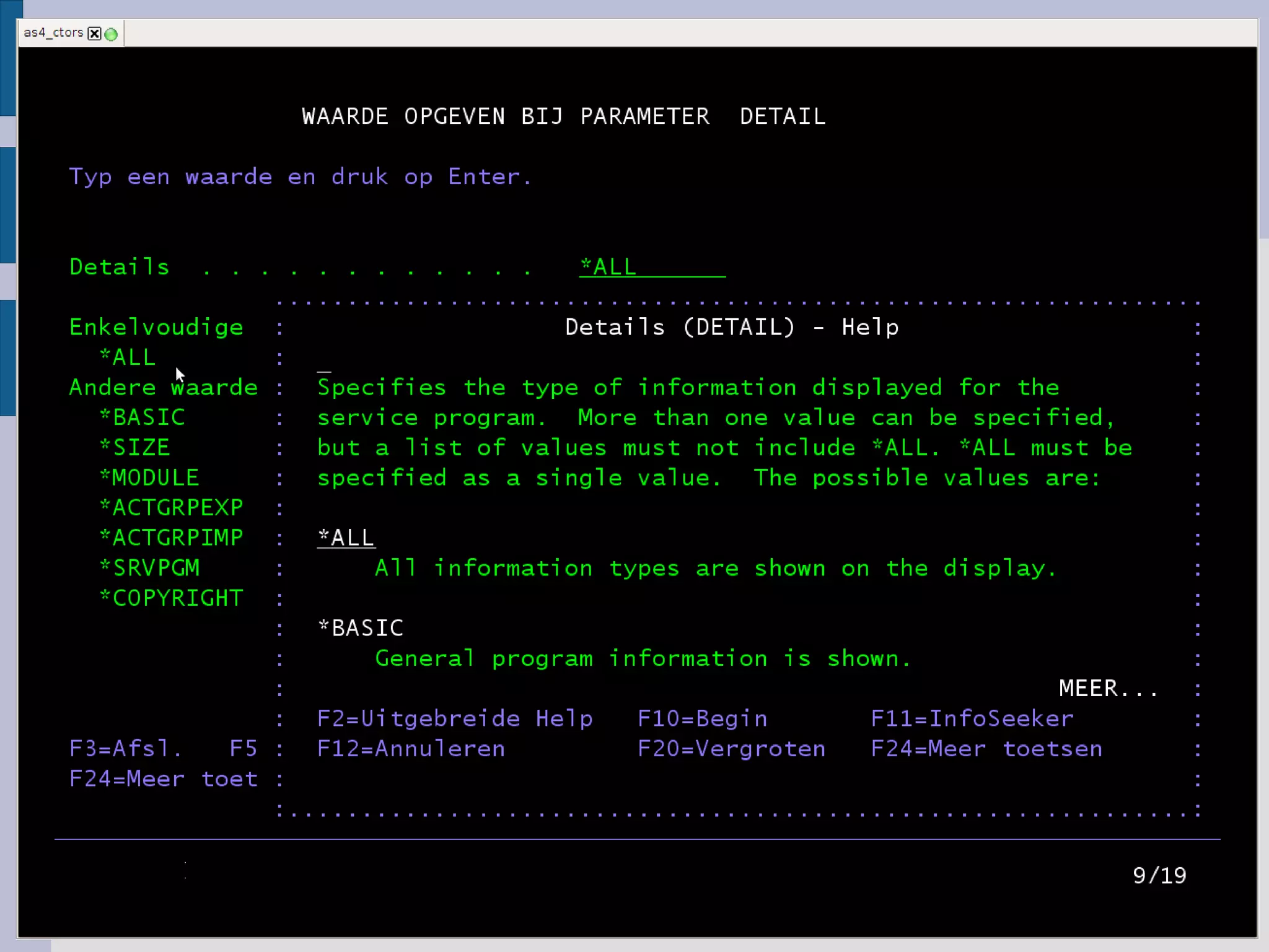
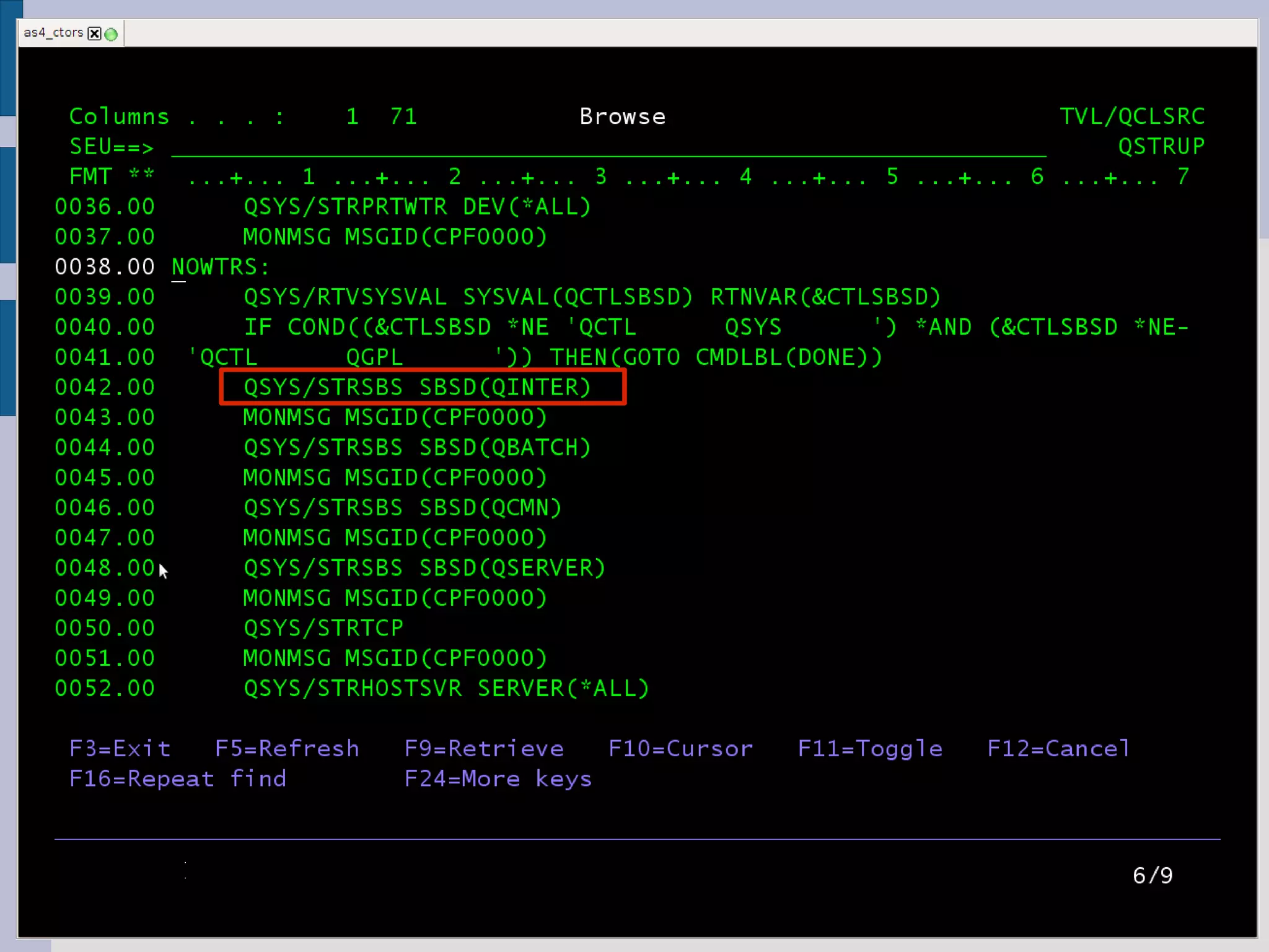
●   Started by QSTRUPPGM (sysval)
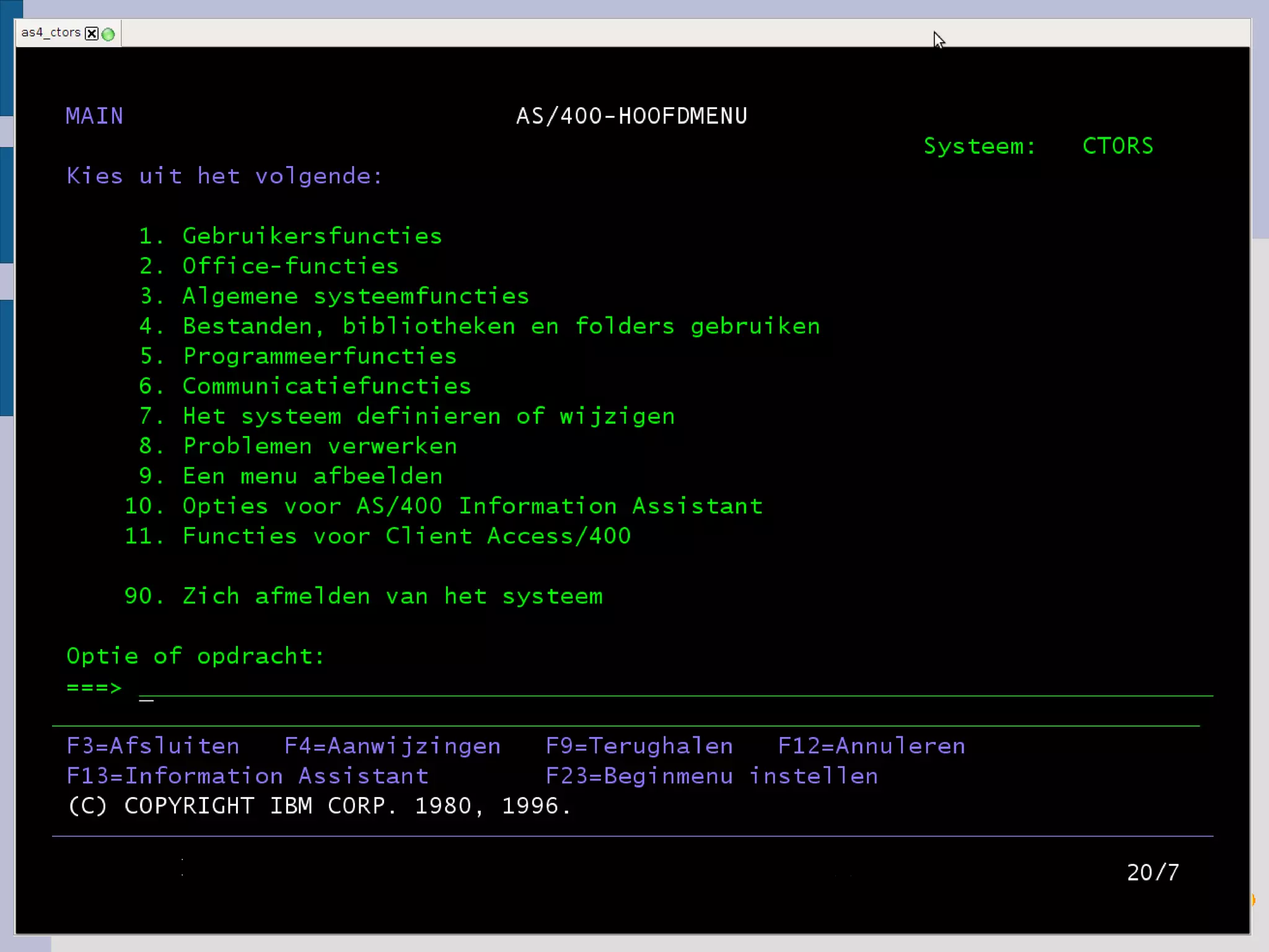
●   Restricted state
    –   ENDSBS SBS(*ALL)
    –   Backups, console display run in CTLSBS
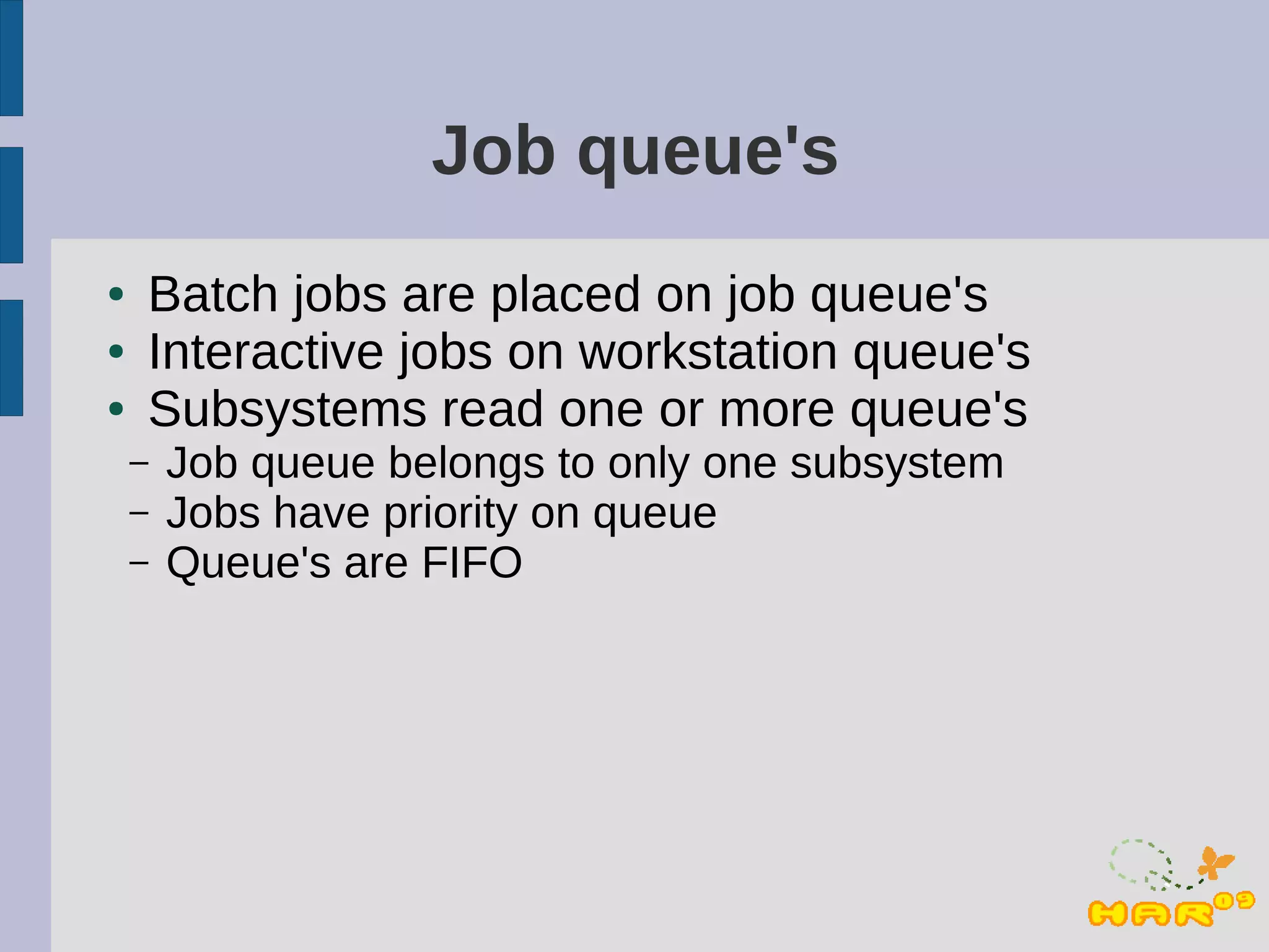
Job queue's
●   Batch jobs are placed on job queue's
●   Interactive jobs on workstation queue's
●   Subsystems read one or more queue's
    –   Job queue belongs to only one subsystem
    –   Jobs have priority on queue
    –   Queue's are FIFO
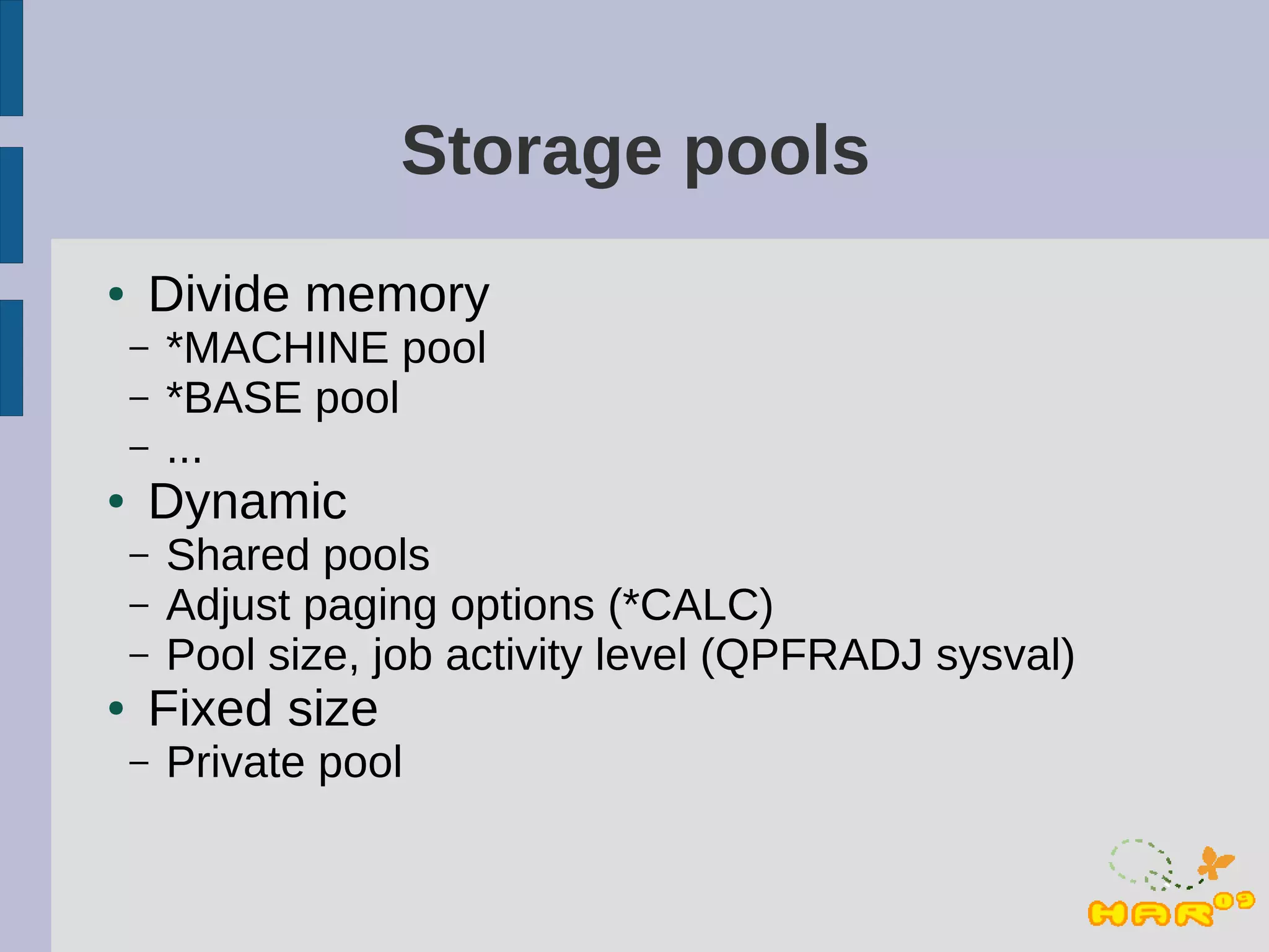
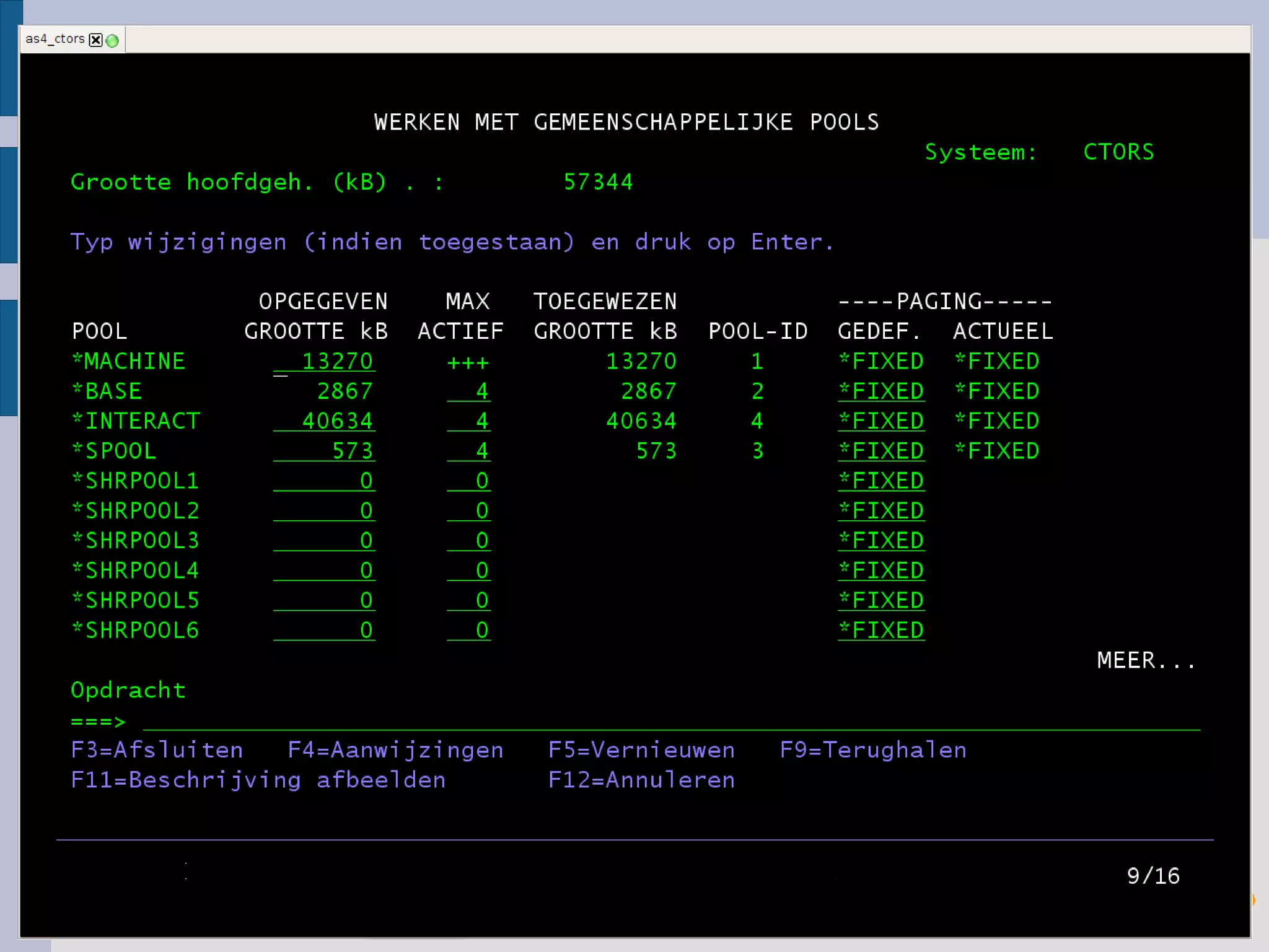
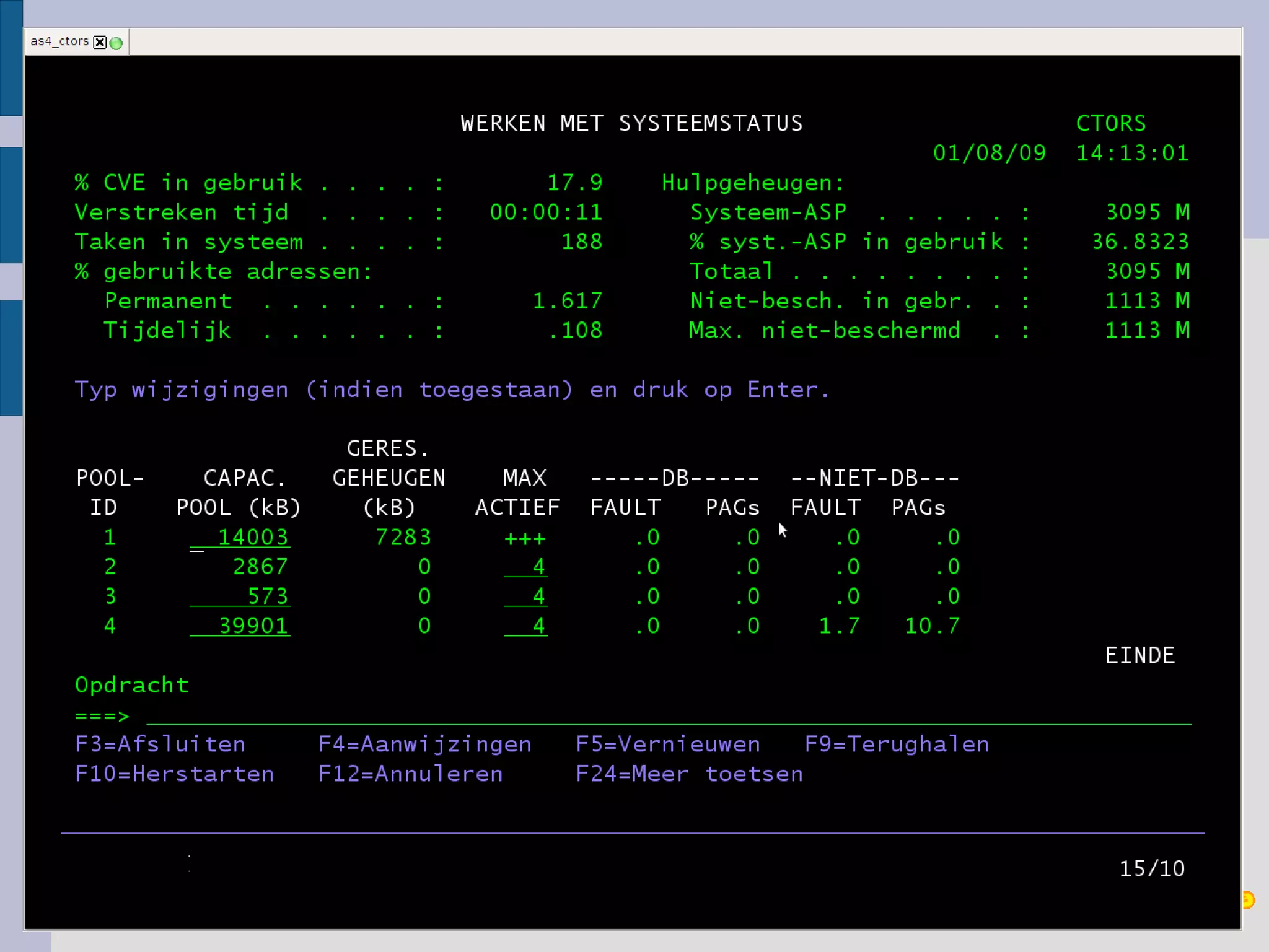
Storage pools
●   Divide memory
    –   *MACHINE pool
    –   *BASE pool
    –   ...
●   Dynamic
    –   Shared pools
    –   Adjust paging options (*CALC)
    –   Pool size, job activity level (QPFRADJ sysval)
●   Fixed size
    –   Private pool
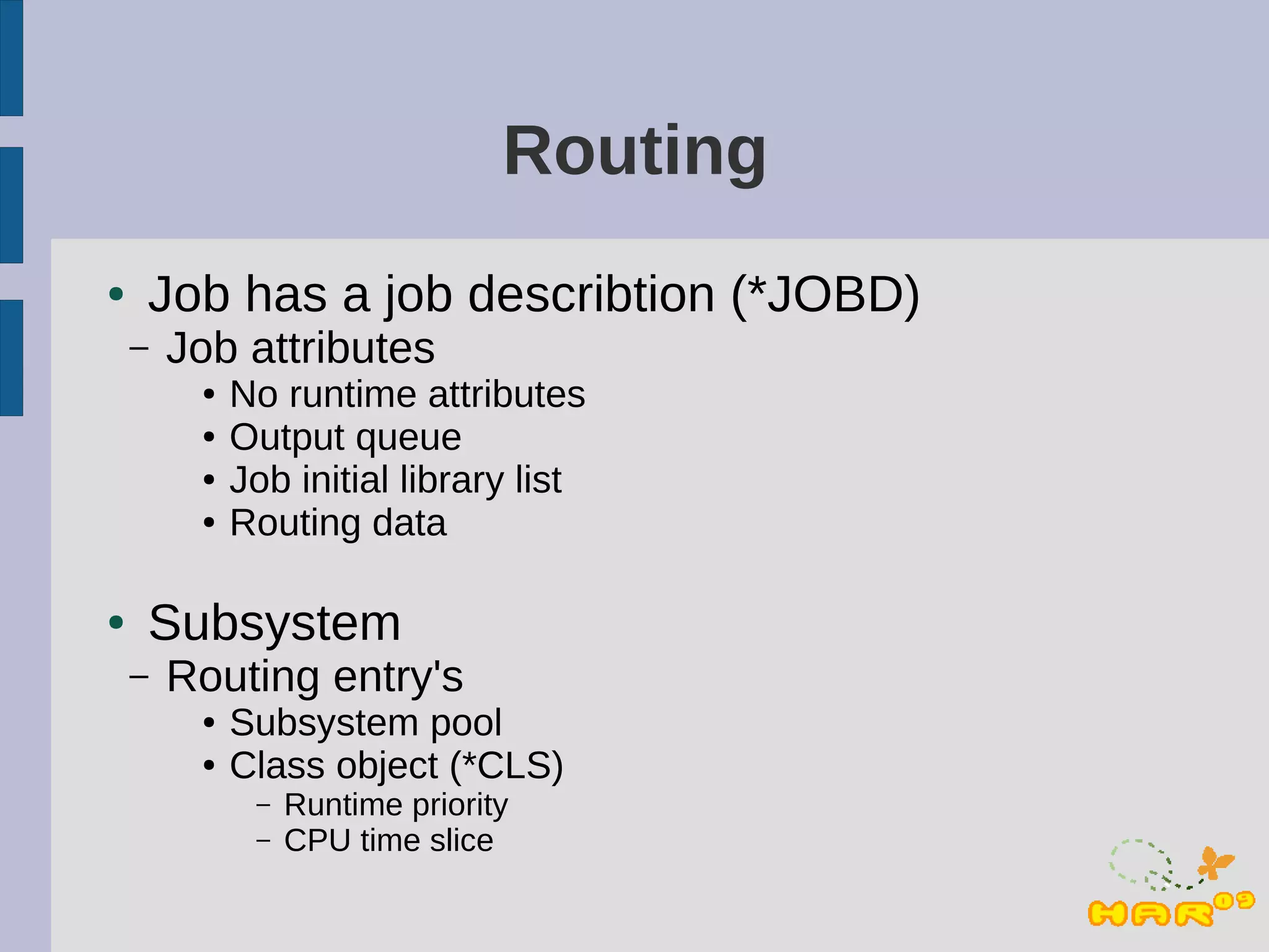
Routing
●   Job has a job describtion (*JOBD)
    –   Job attributes
         ●   No runtime attributes
         ●   Output queue
         ●   Job initial library list
         ●   Routing data

●   Subsystem
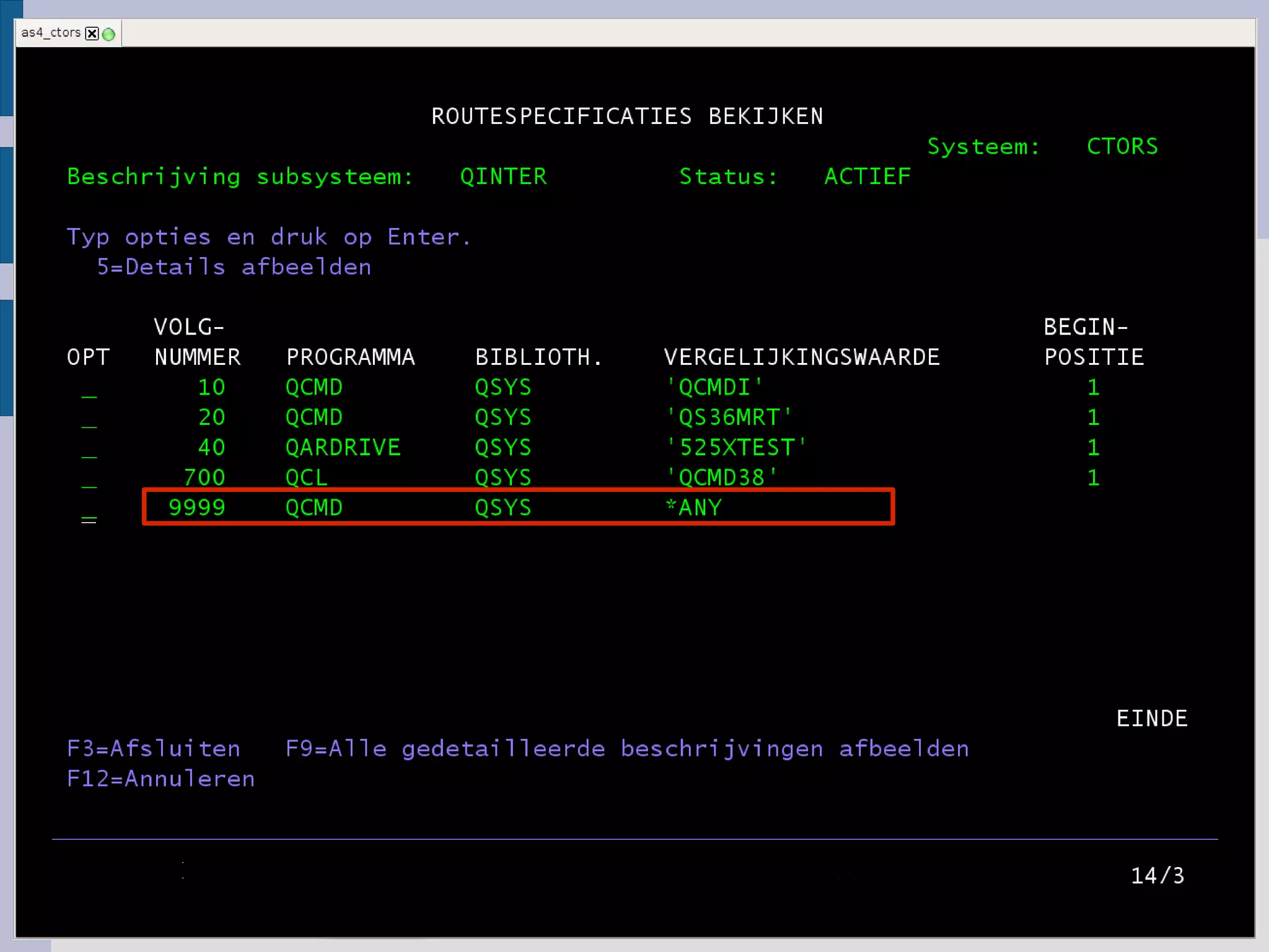
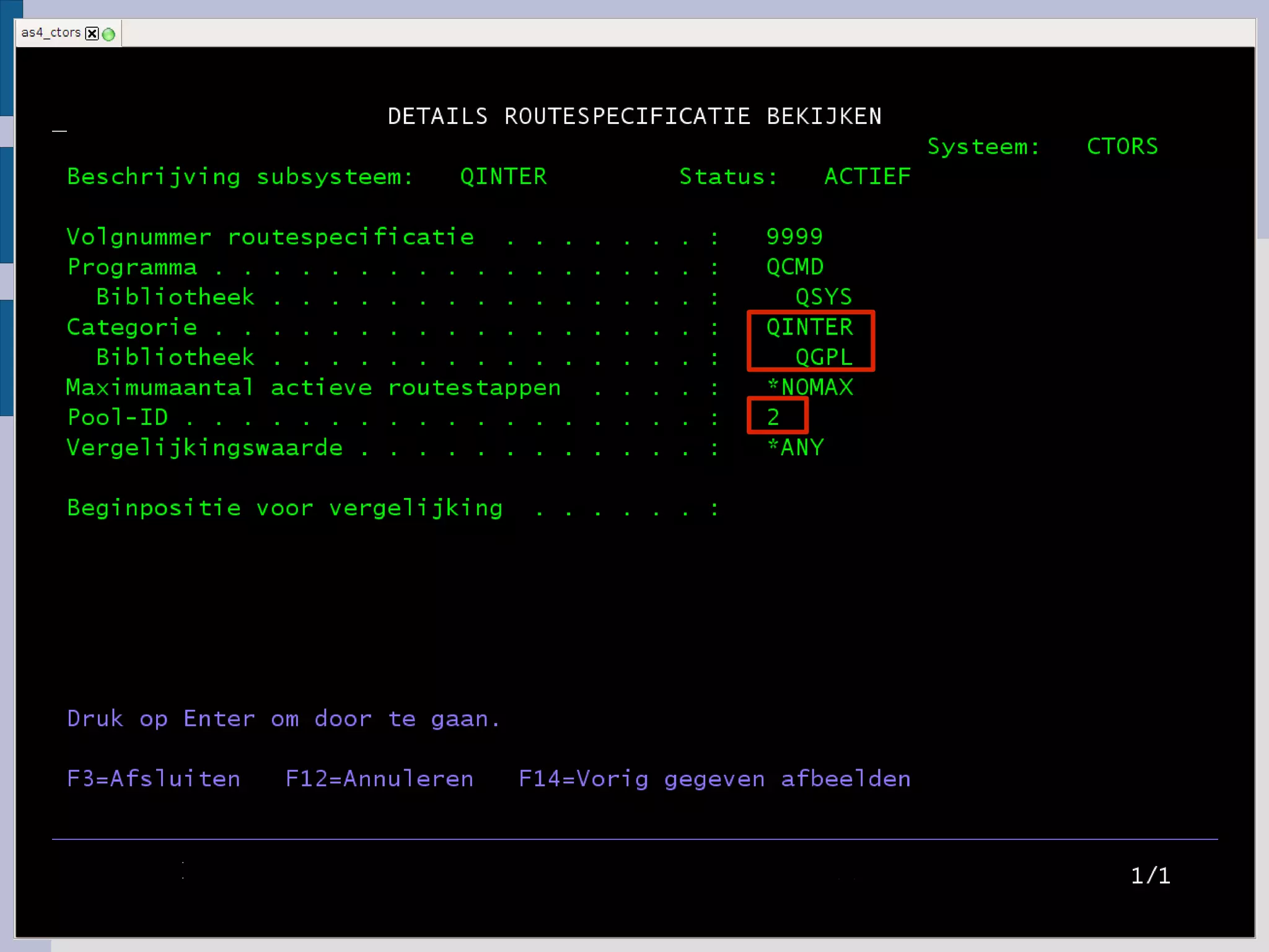
    –   Routing entry's
         ●   Subsystem pool
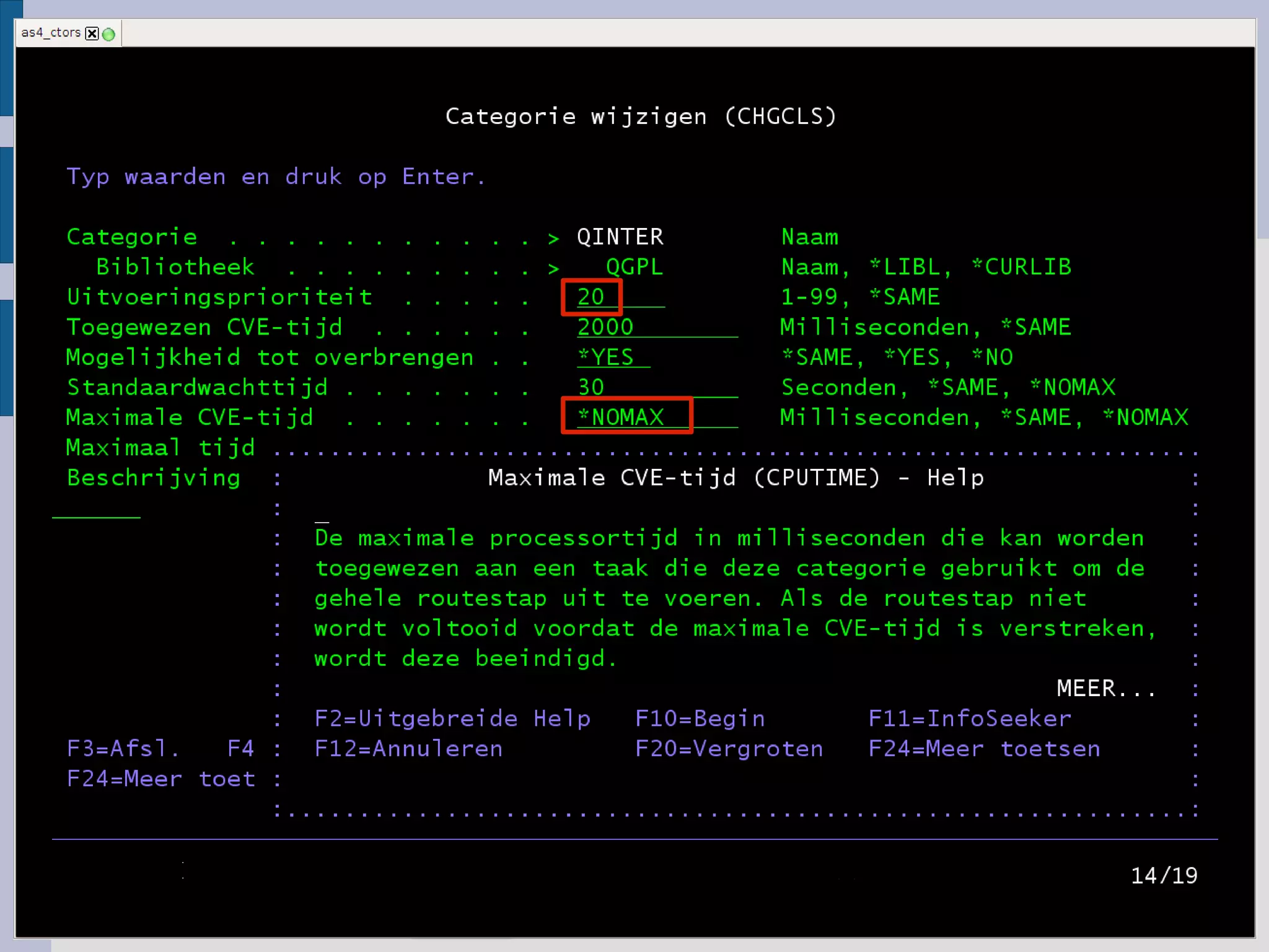
         ●   Class object (*CLS)
              –   Runtime priority
              –   CPU time slice
Exploring the system
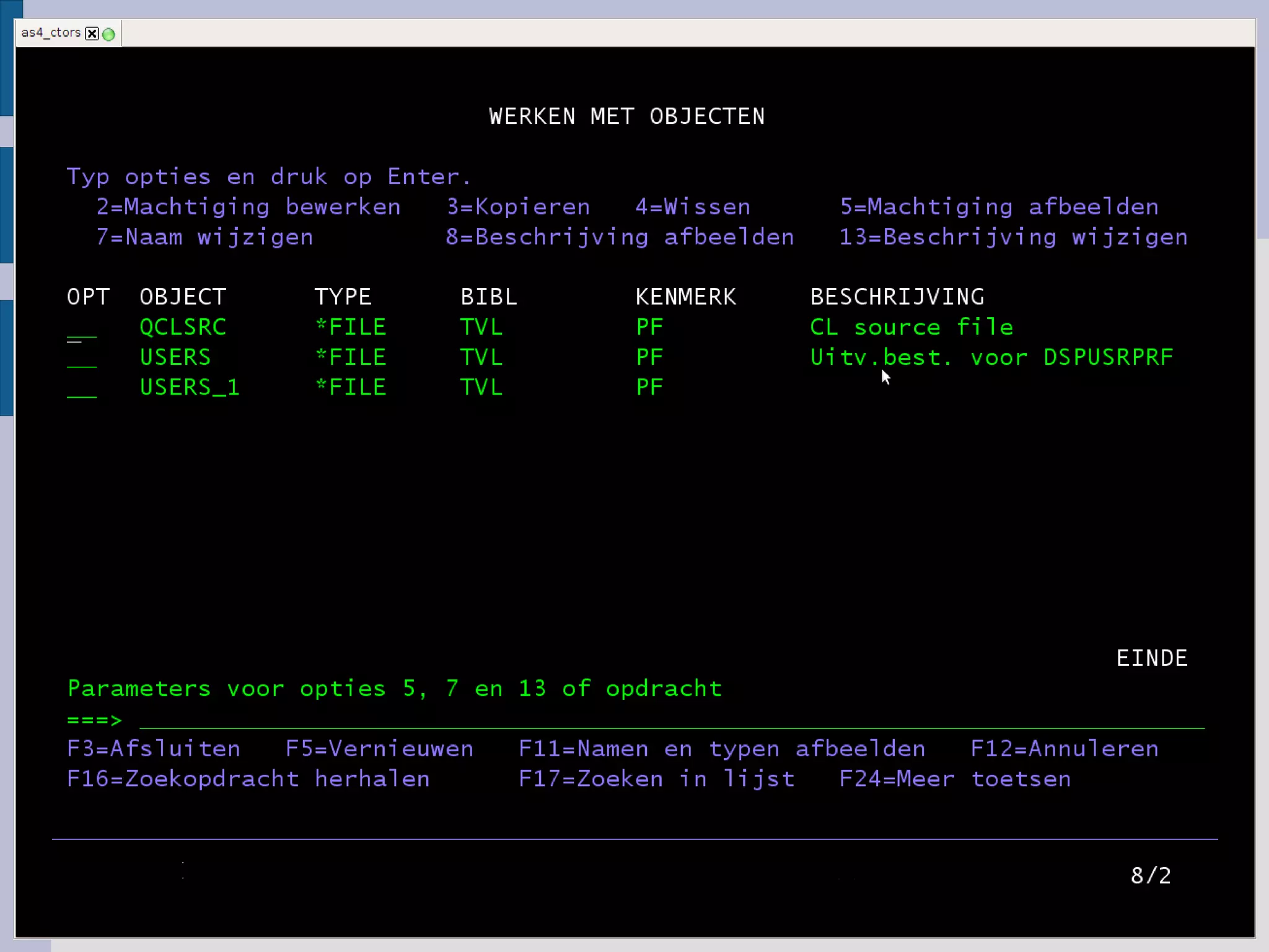
Objects
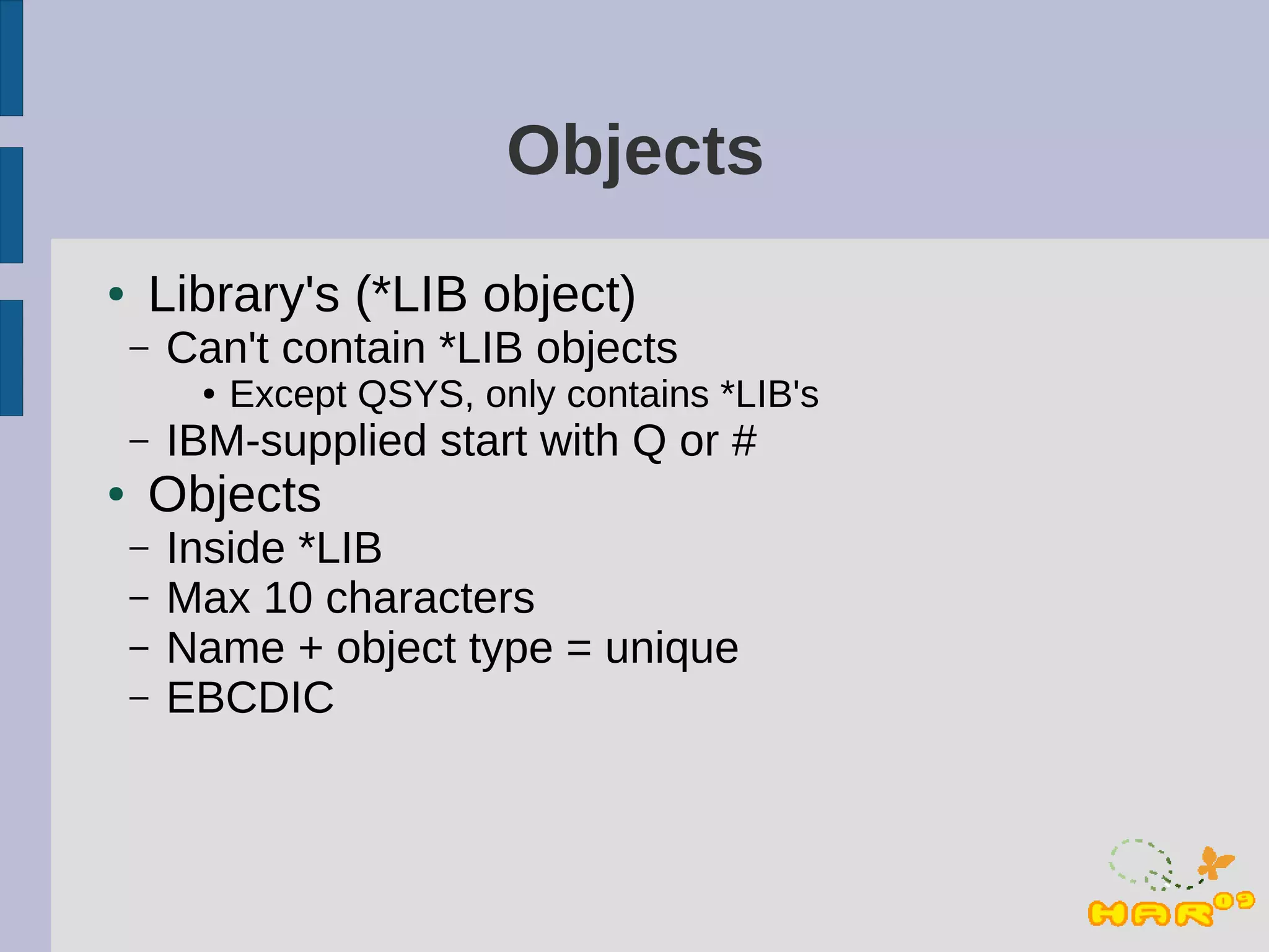
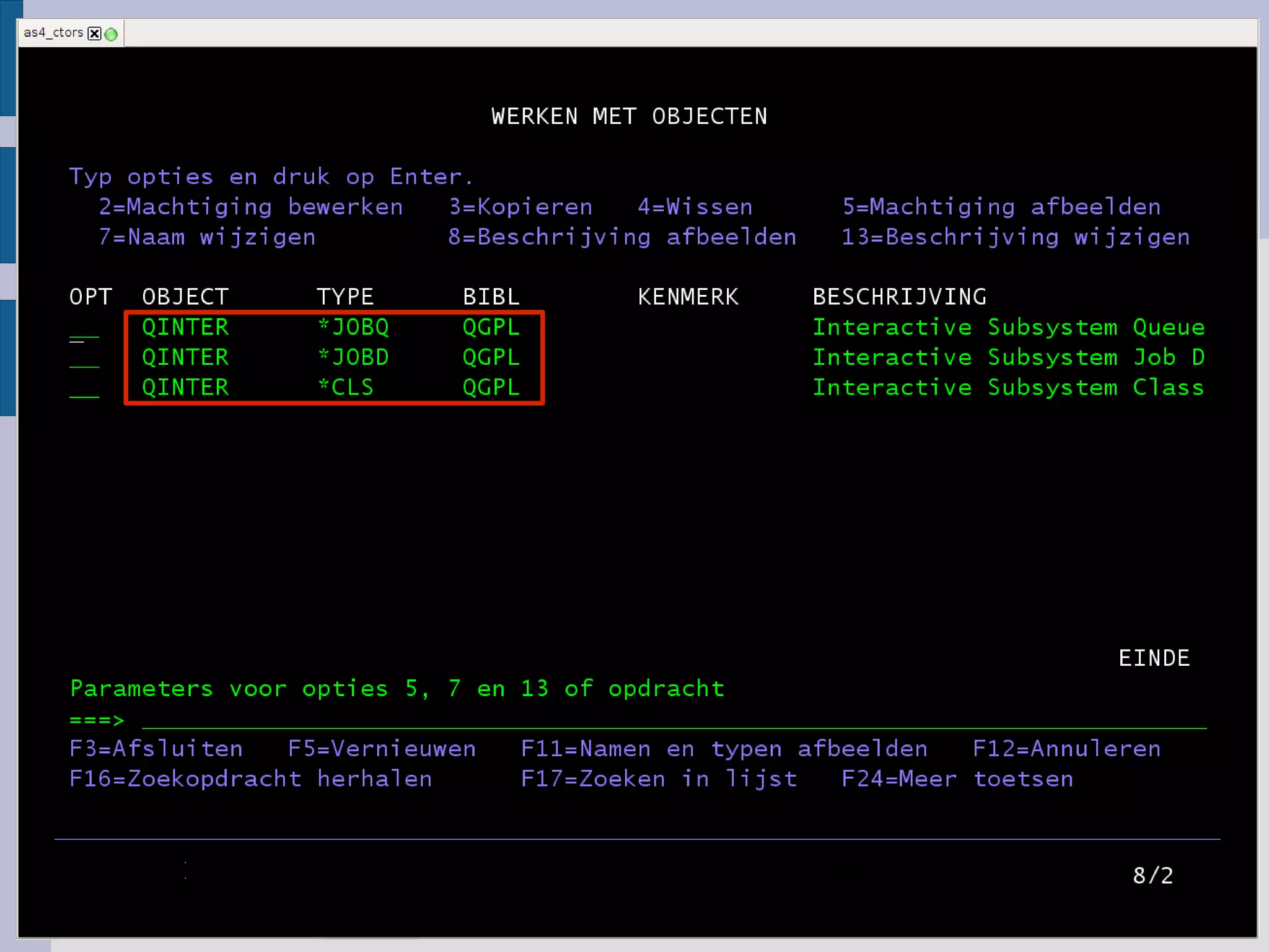
●   Library's (*LIB object)
    –   Can't contain *LIB objects
         ●   Except QSYS, only contains *LIB's
    –   IBM-supplied start with Q or #
●   Objects
    –   Inside *LIB
    –   Max 10 characters
    –   Name + object type = unique
    –   EBCDIC
File system
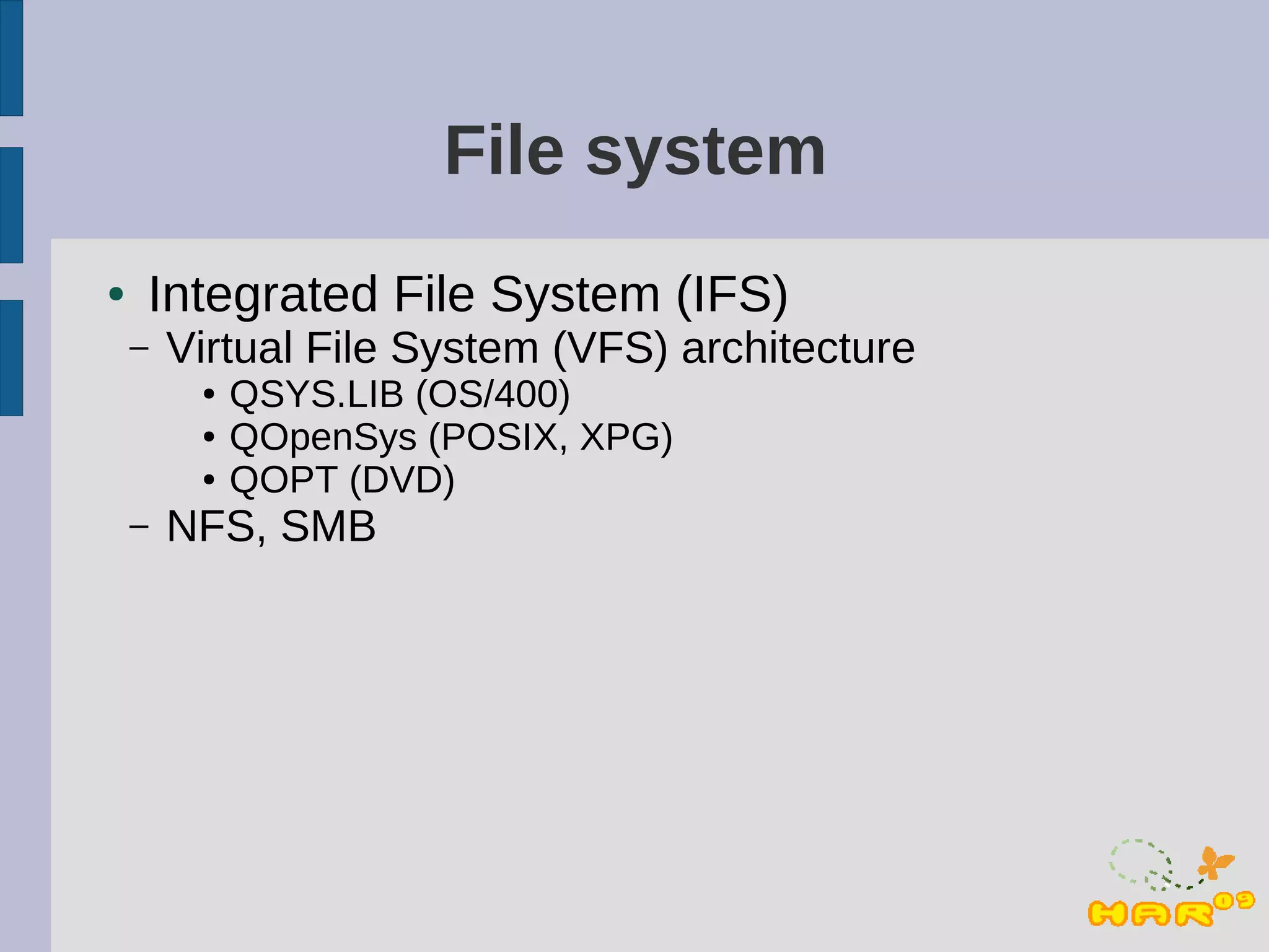
●   Integrated File System (IFS)
    –   Virtual File System (VFS) architecture
         ●   QSYS.LIB (OS/400)
         ●   QOpenSys (POSIX, XPG)
         ●   QOPT (DVD)
    –   NFS, SMB
Users
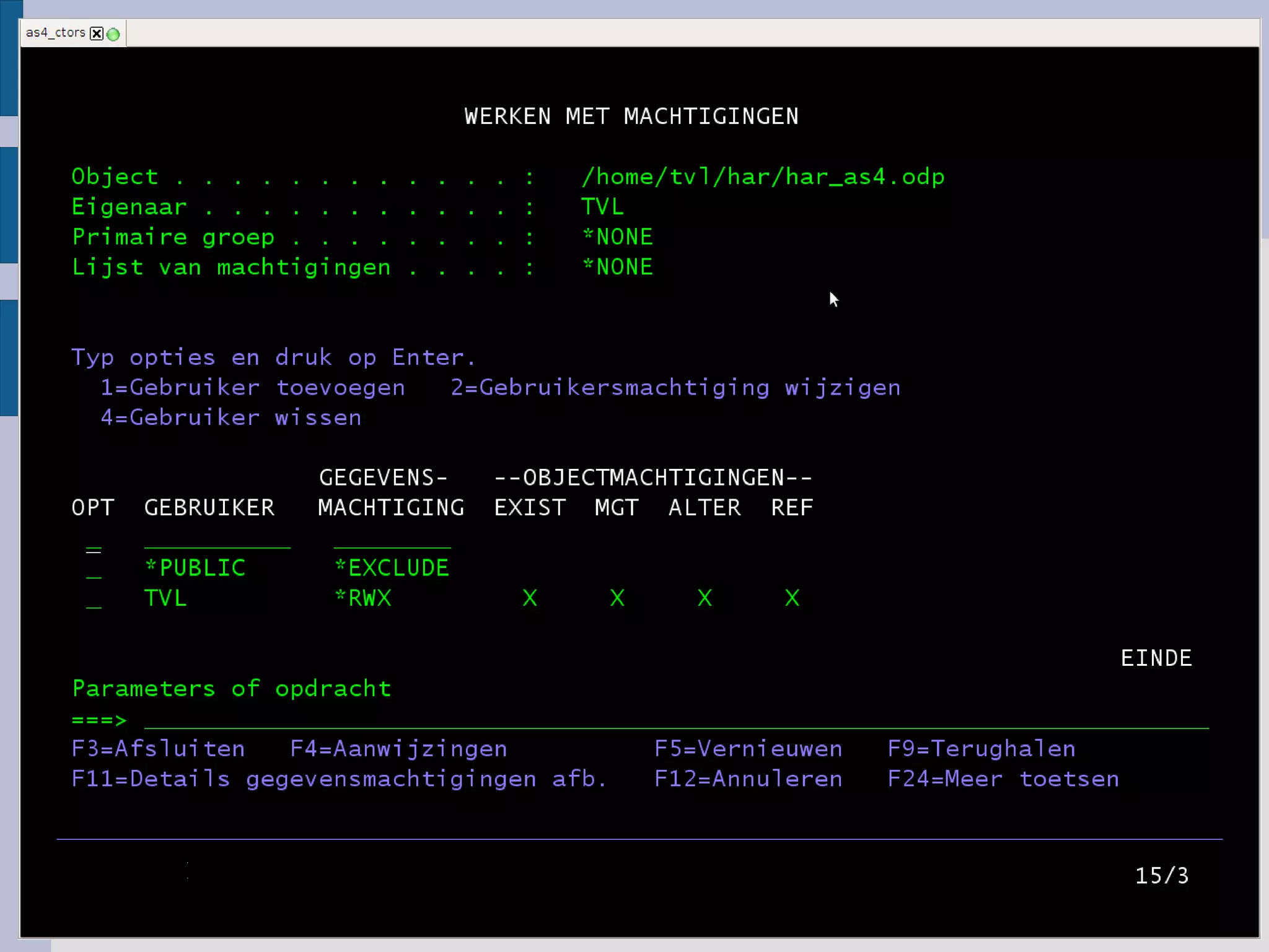
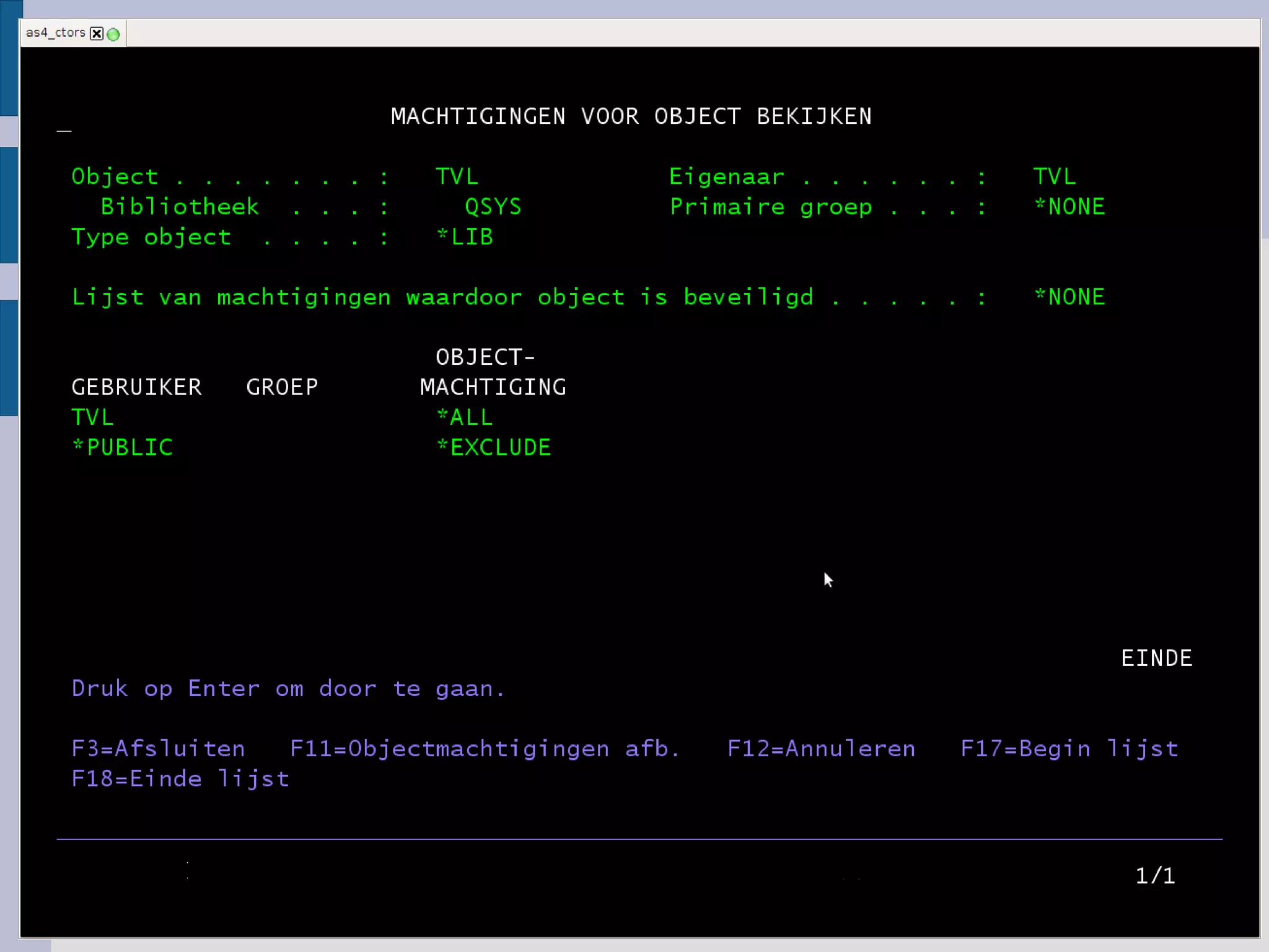
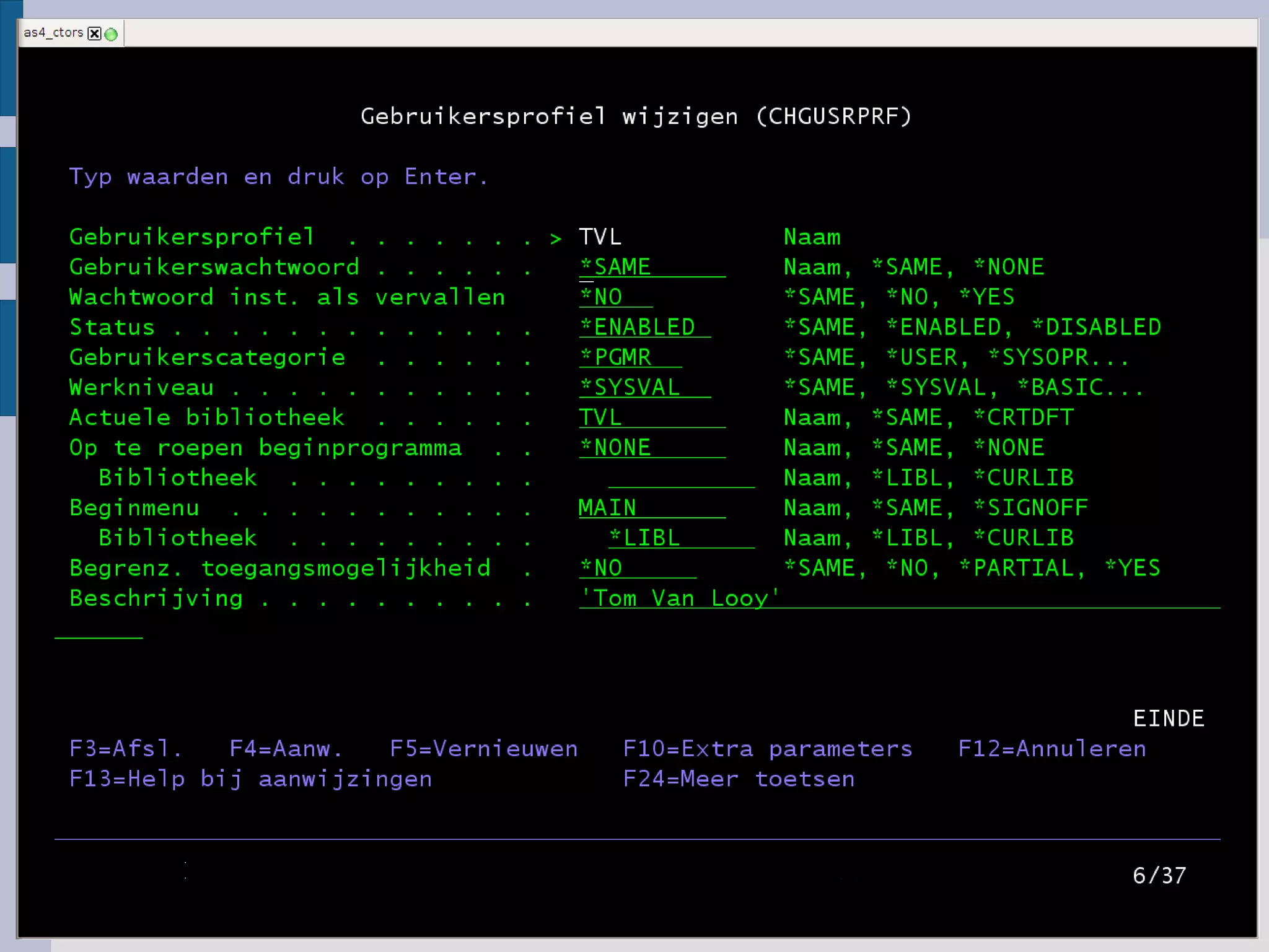
●   QSECOFR – security officer
●   Authority levels
    –   All object authority (*ALLOBJ)
    –   Auditing (*AUDIT)
    –   I/O system configuration (*IOSYSCFG)
    –   Save system (*SAVSYS)
    –   Security administration (*SECADM)
    –   Service functions (*SERVICE)
    –   Spool control (*SPLCTL)
●   Group profiles
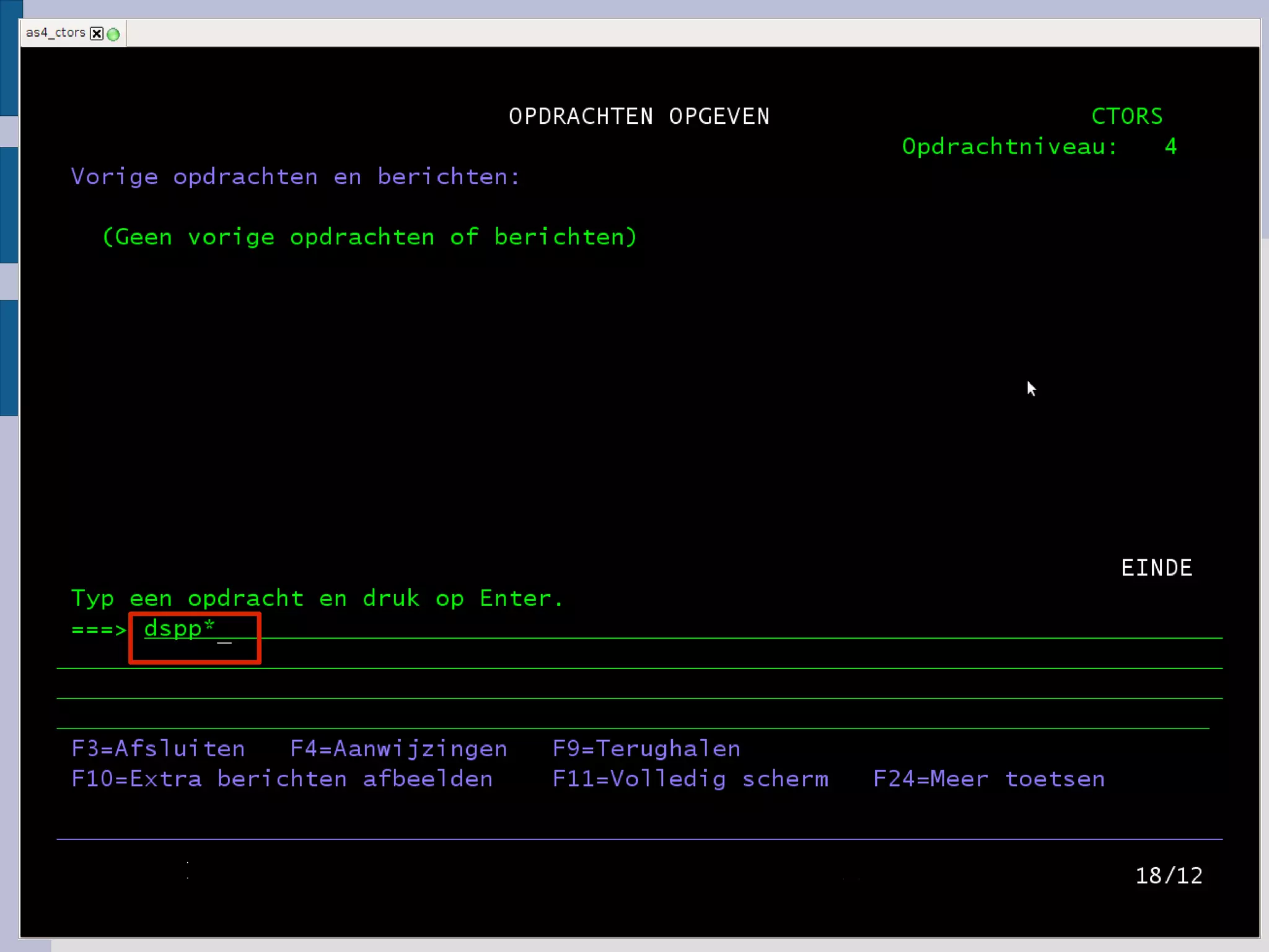
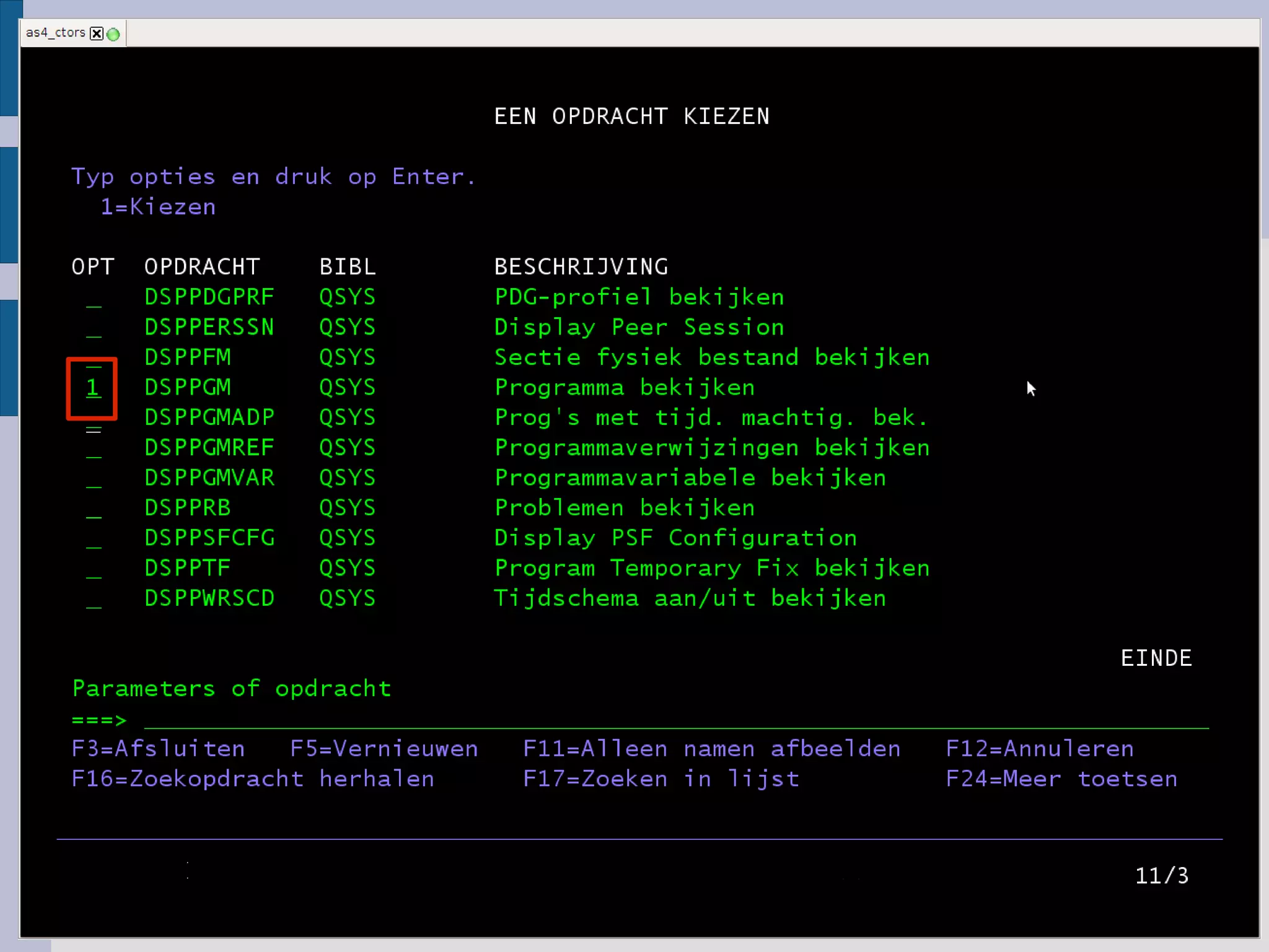
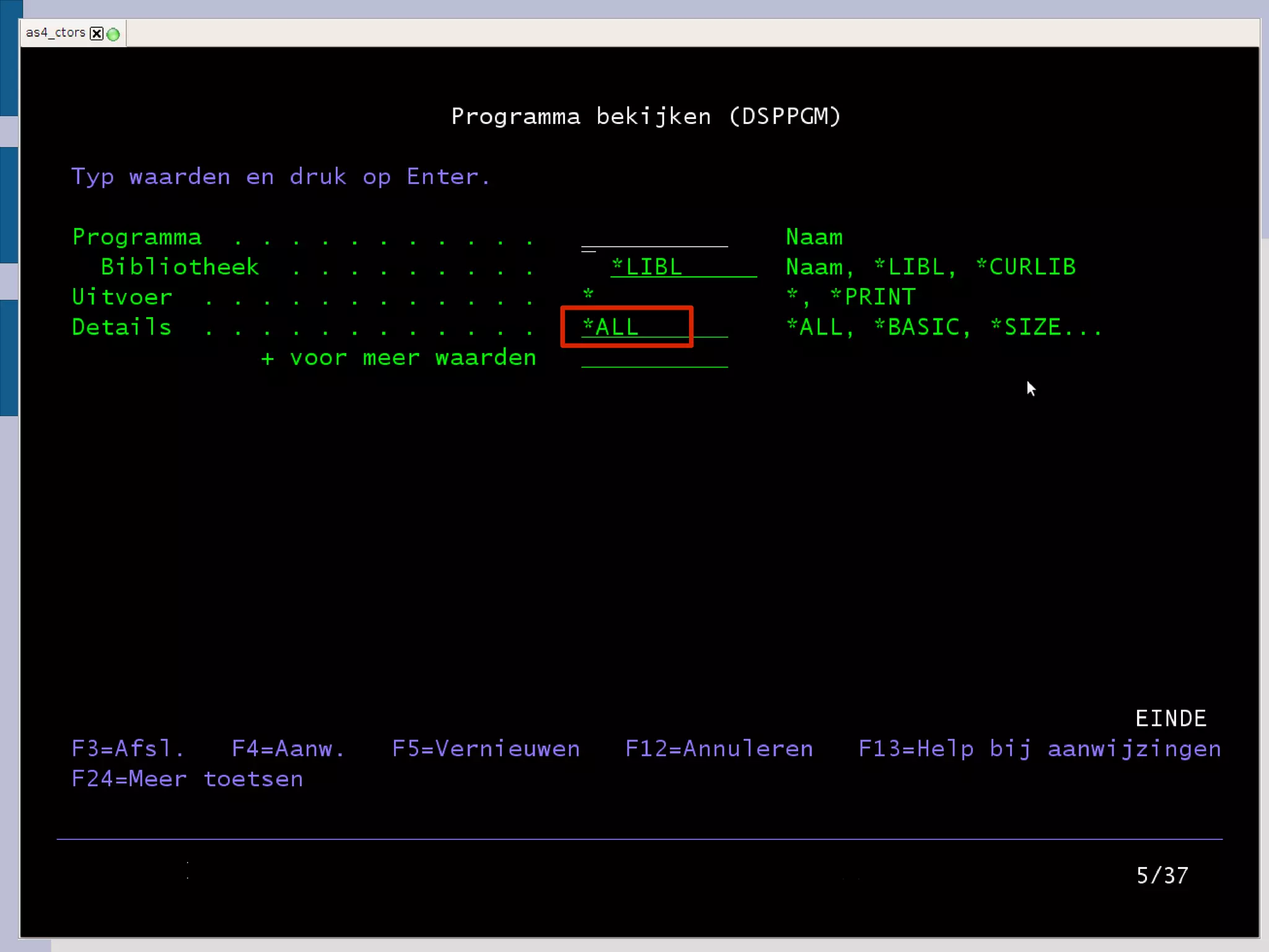
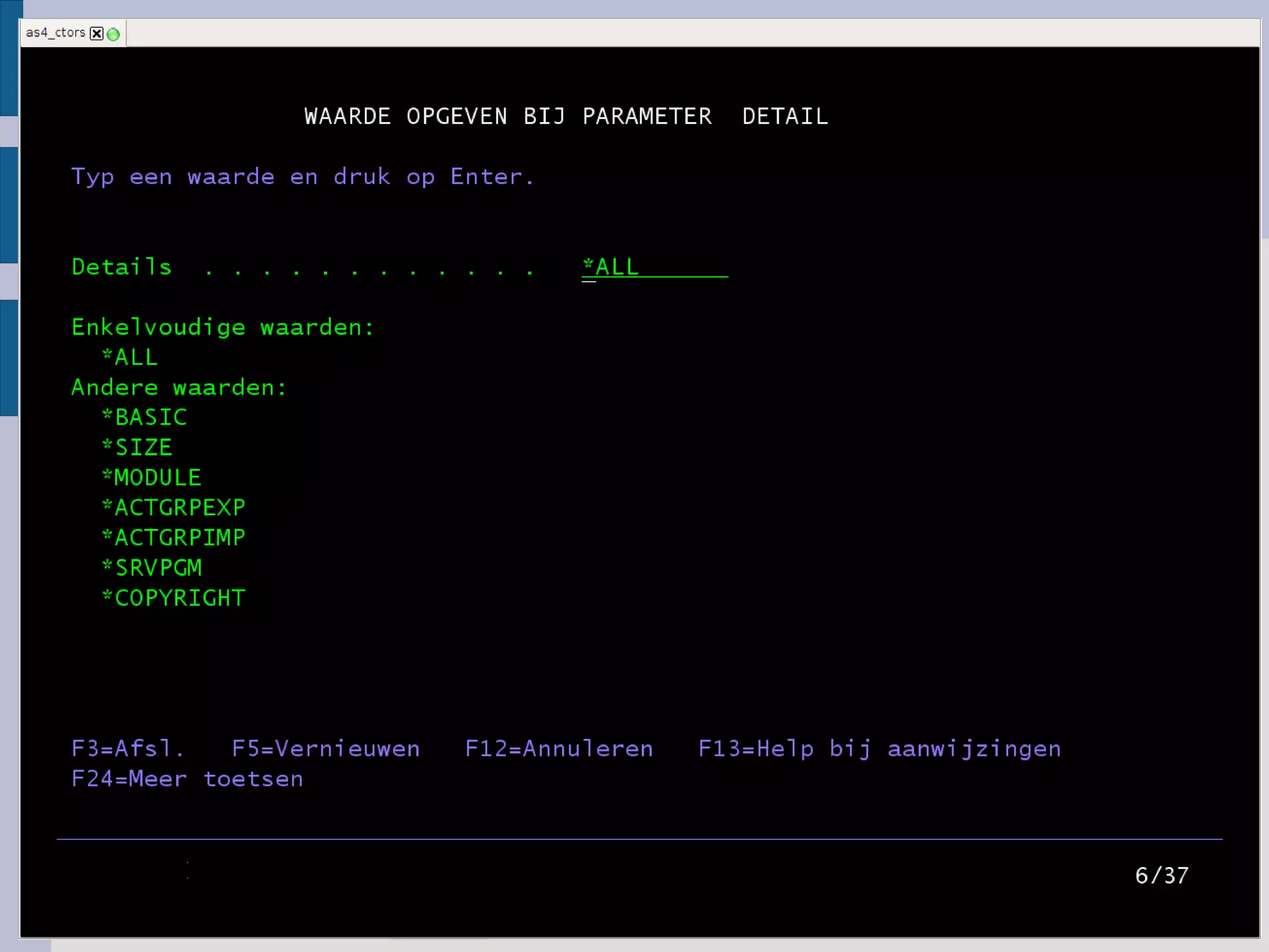
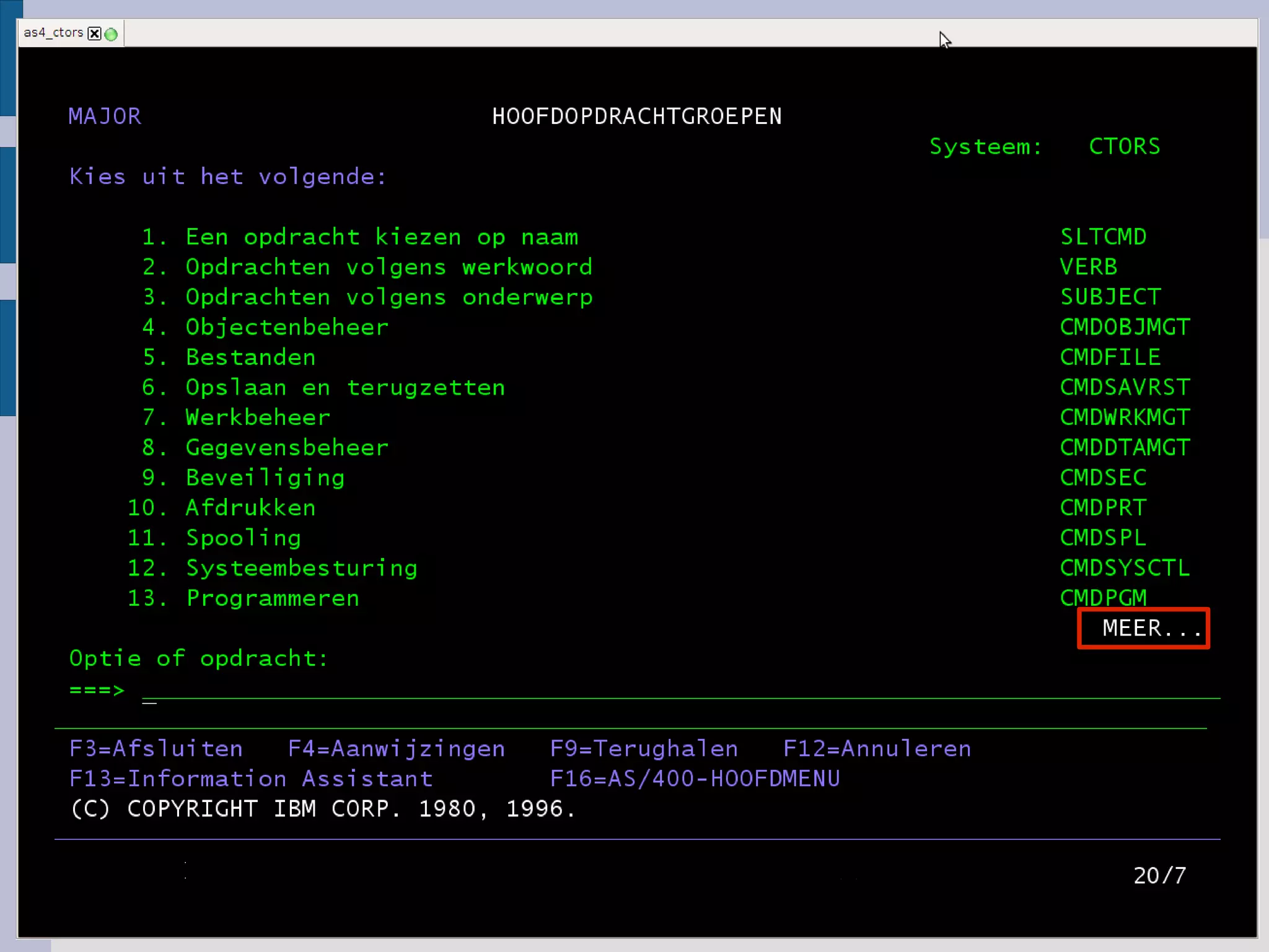
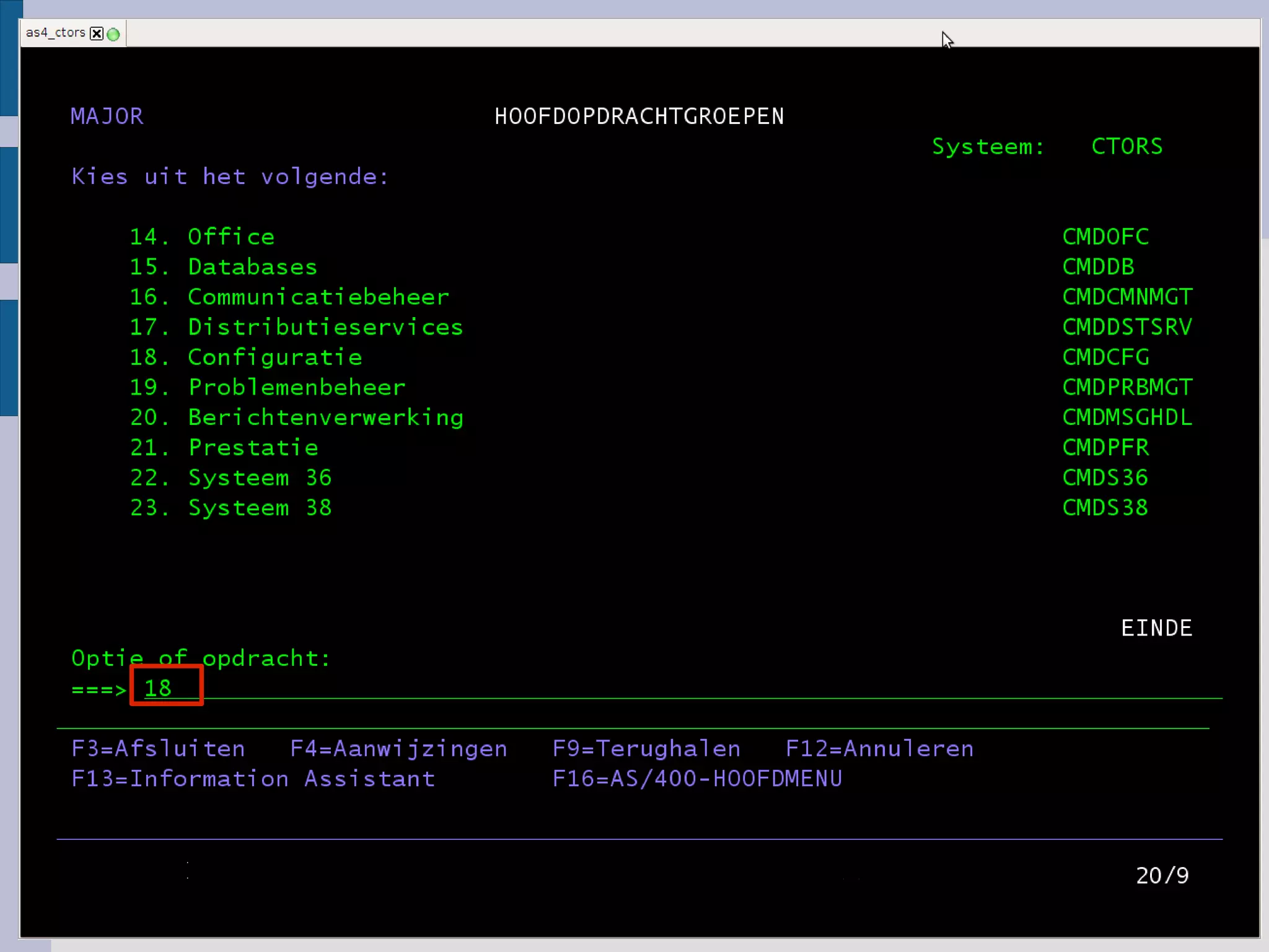
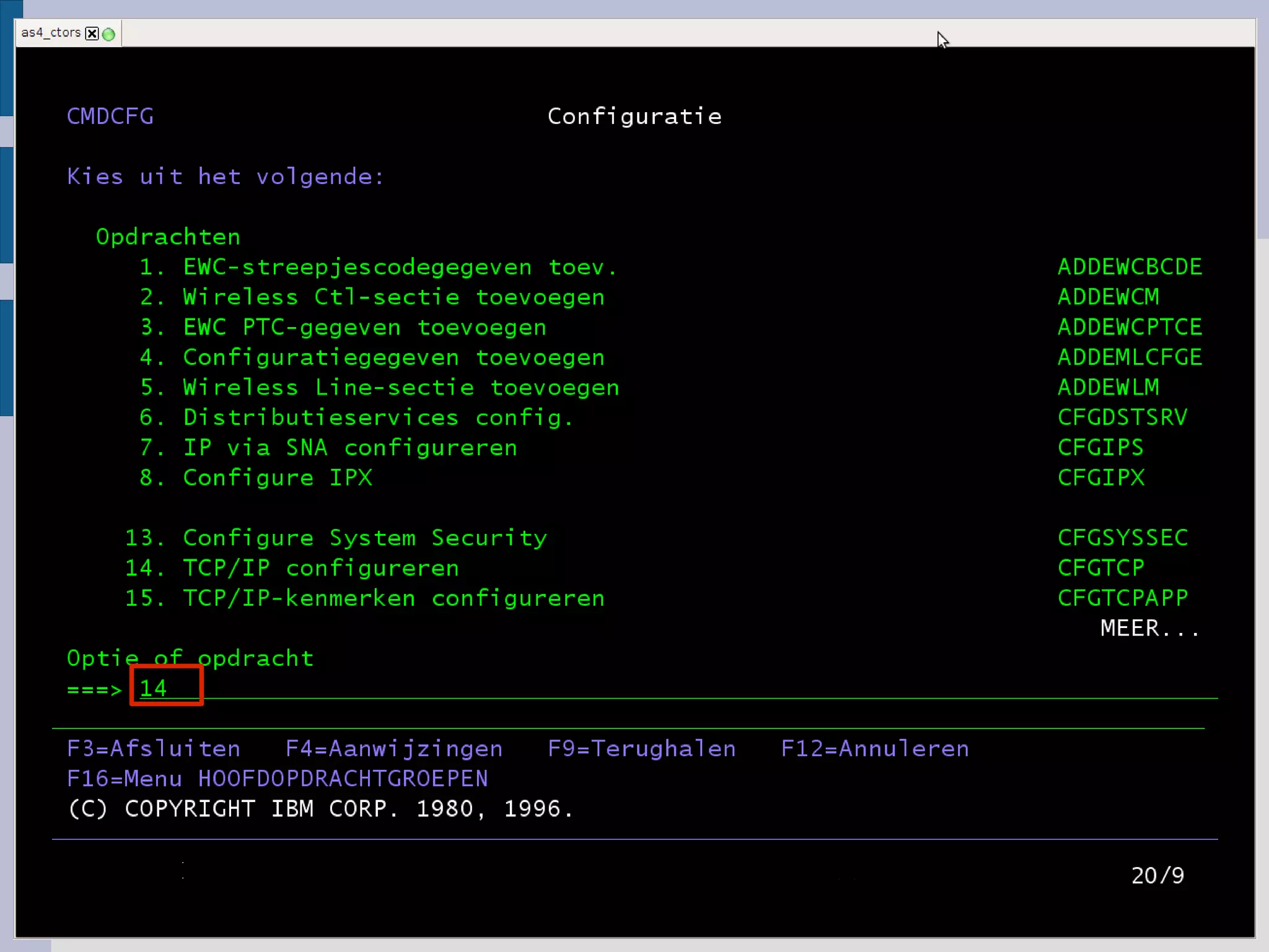
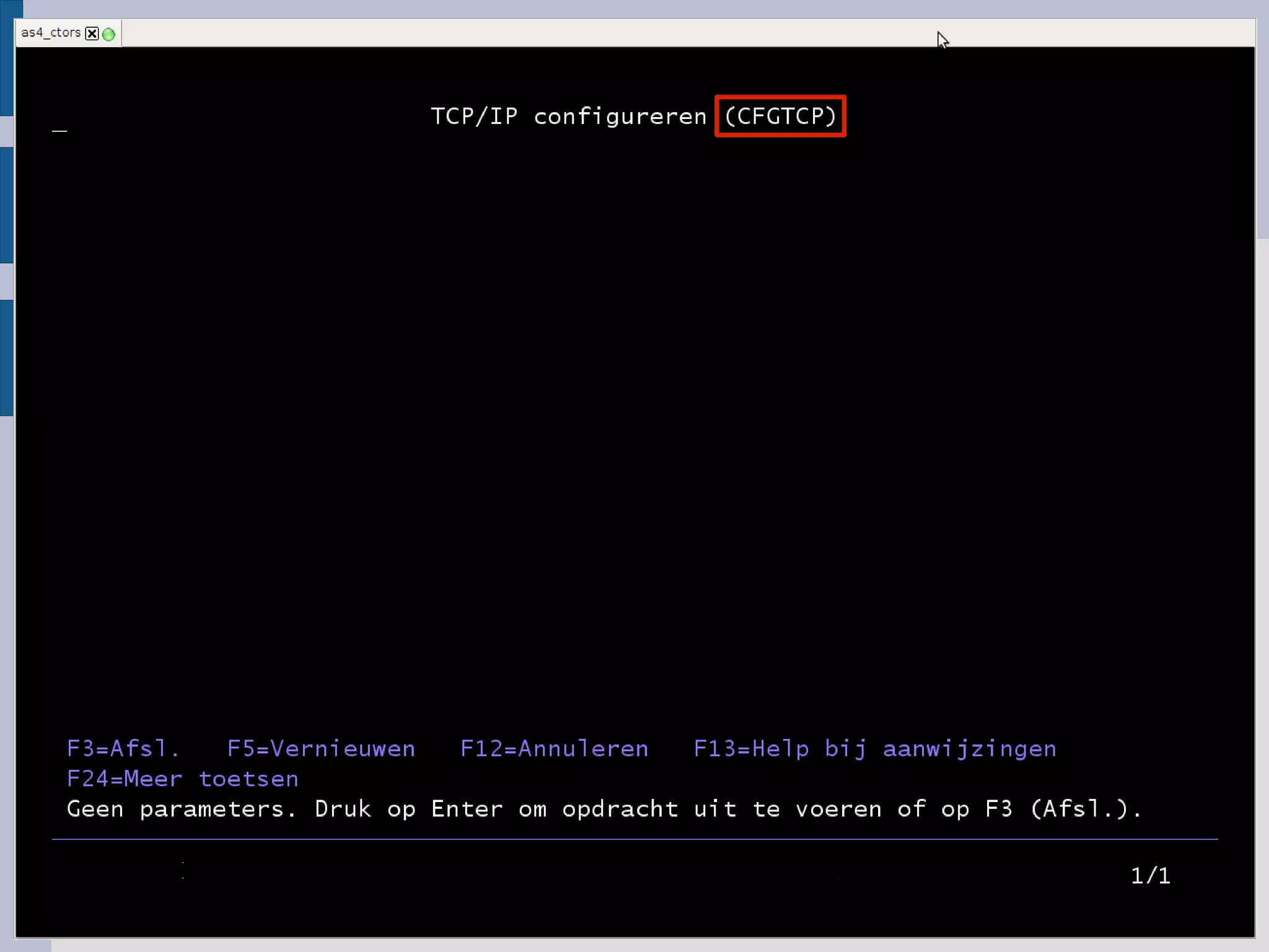
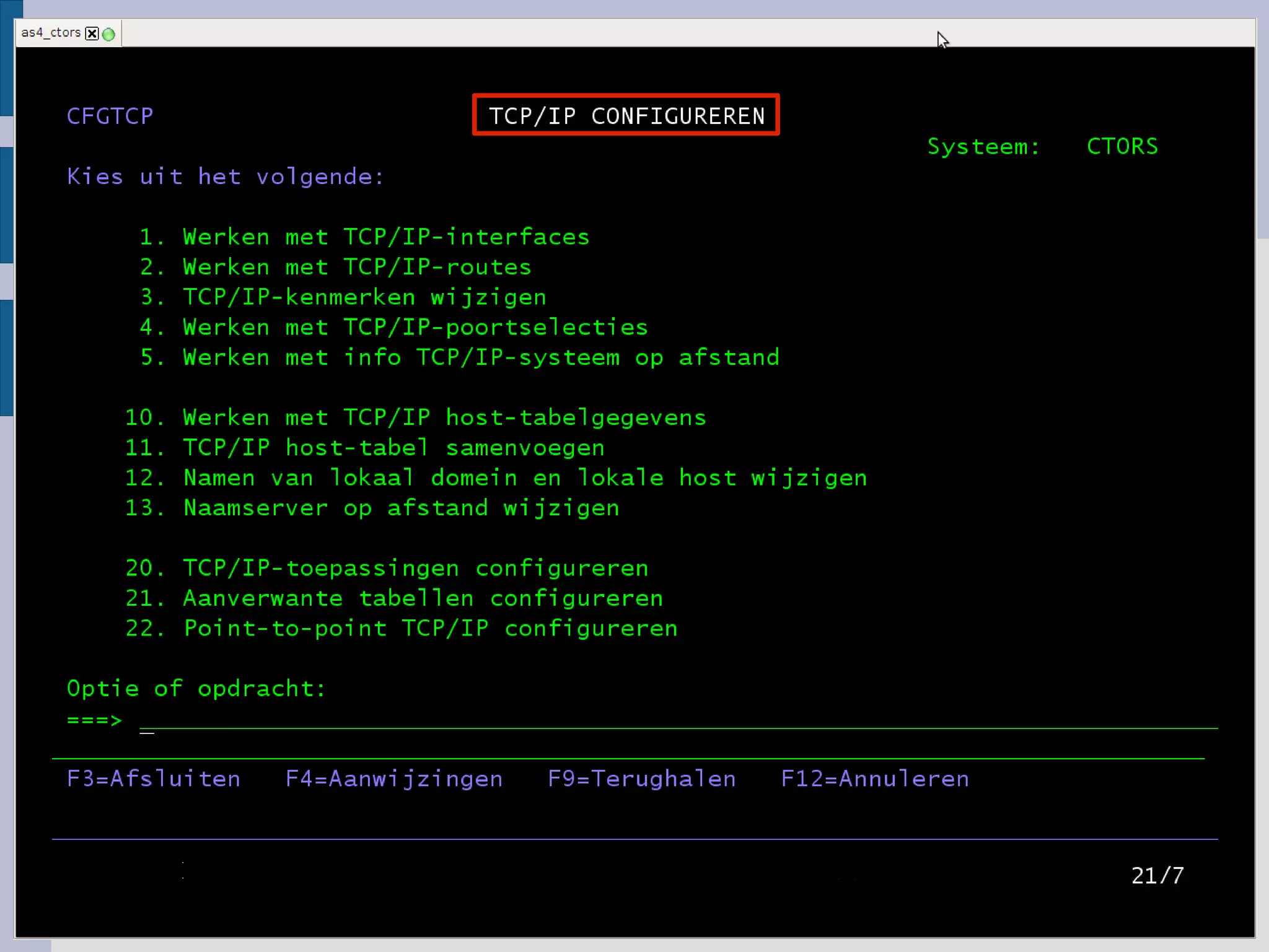
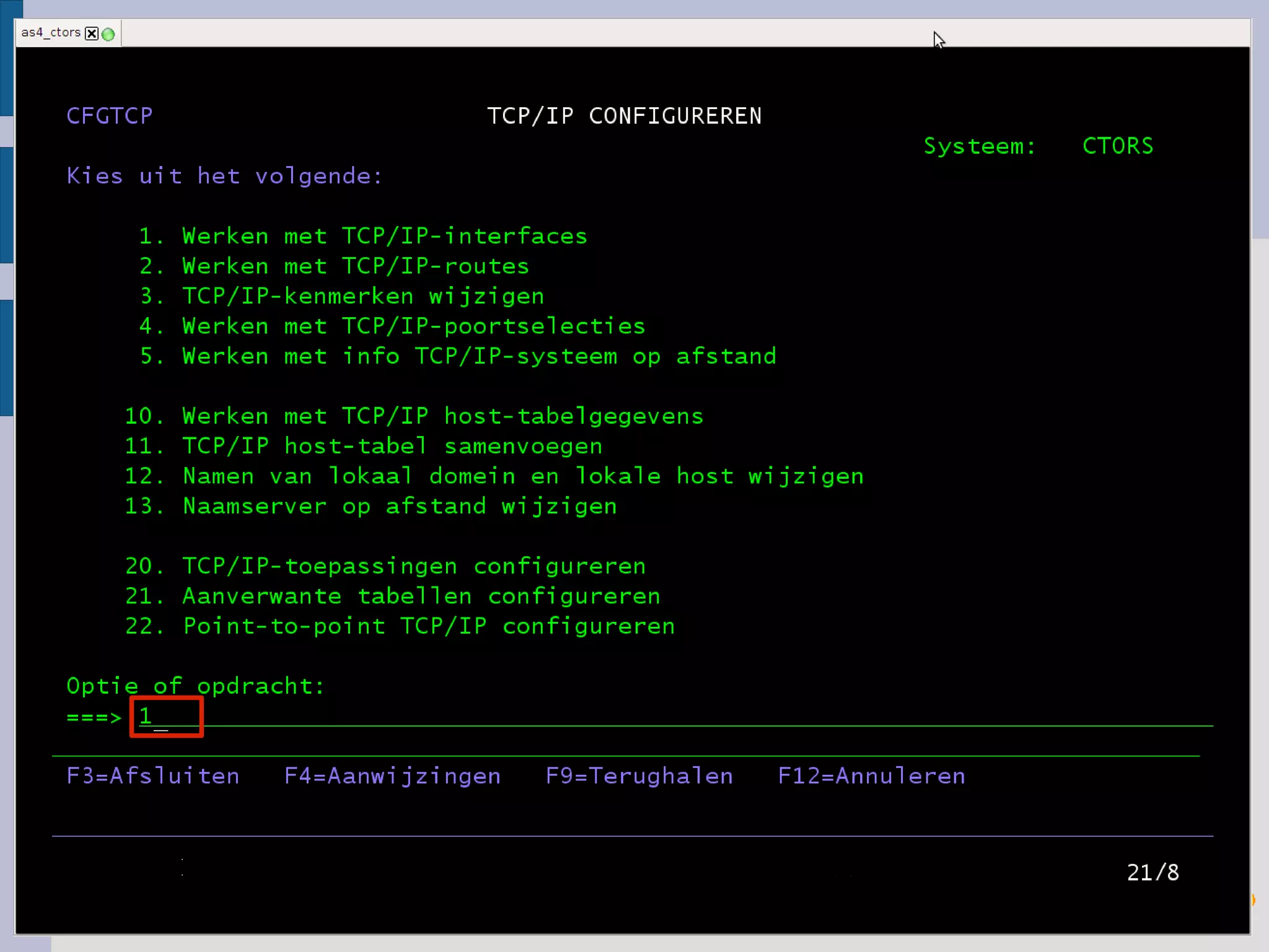
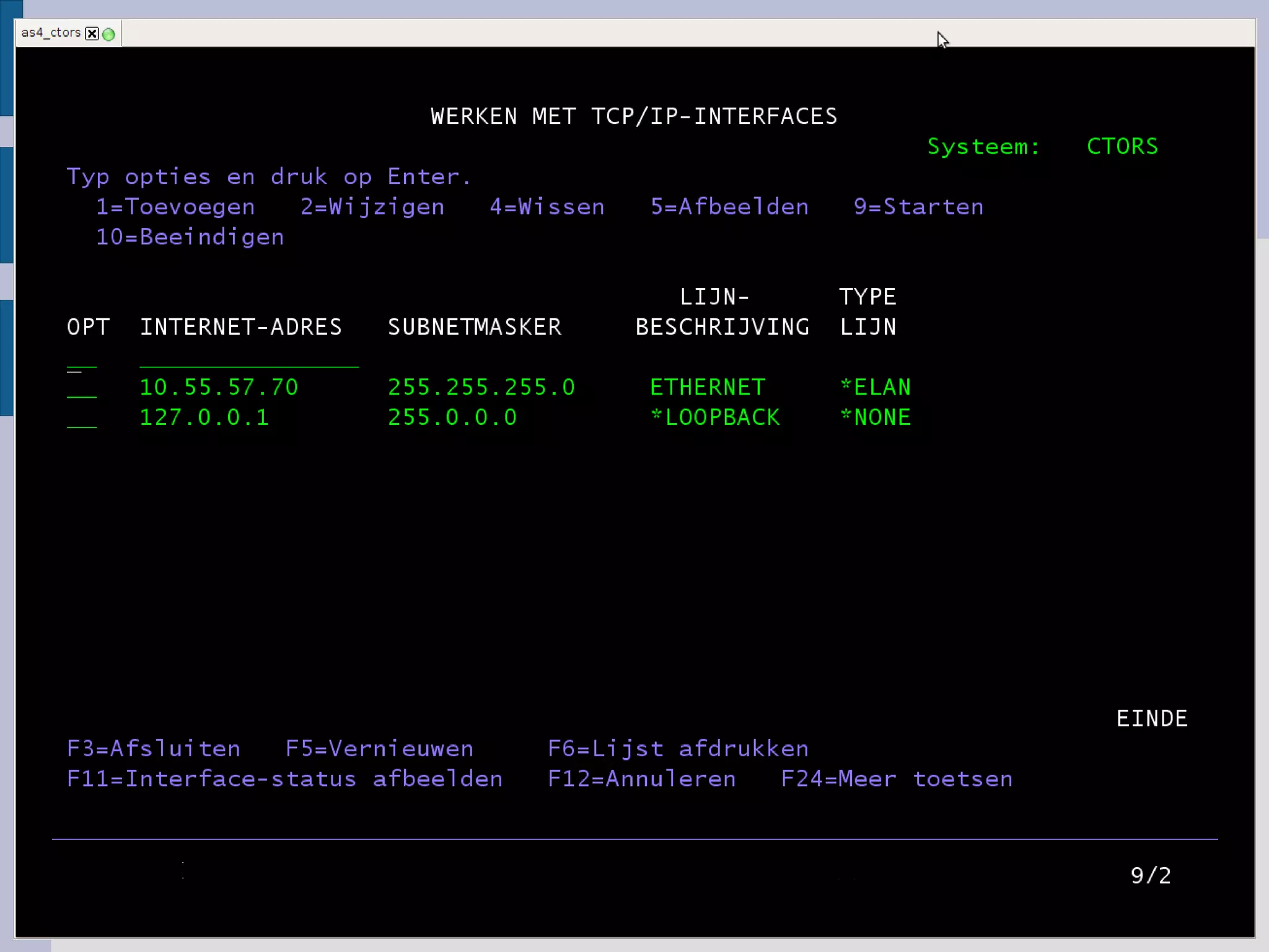
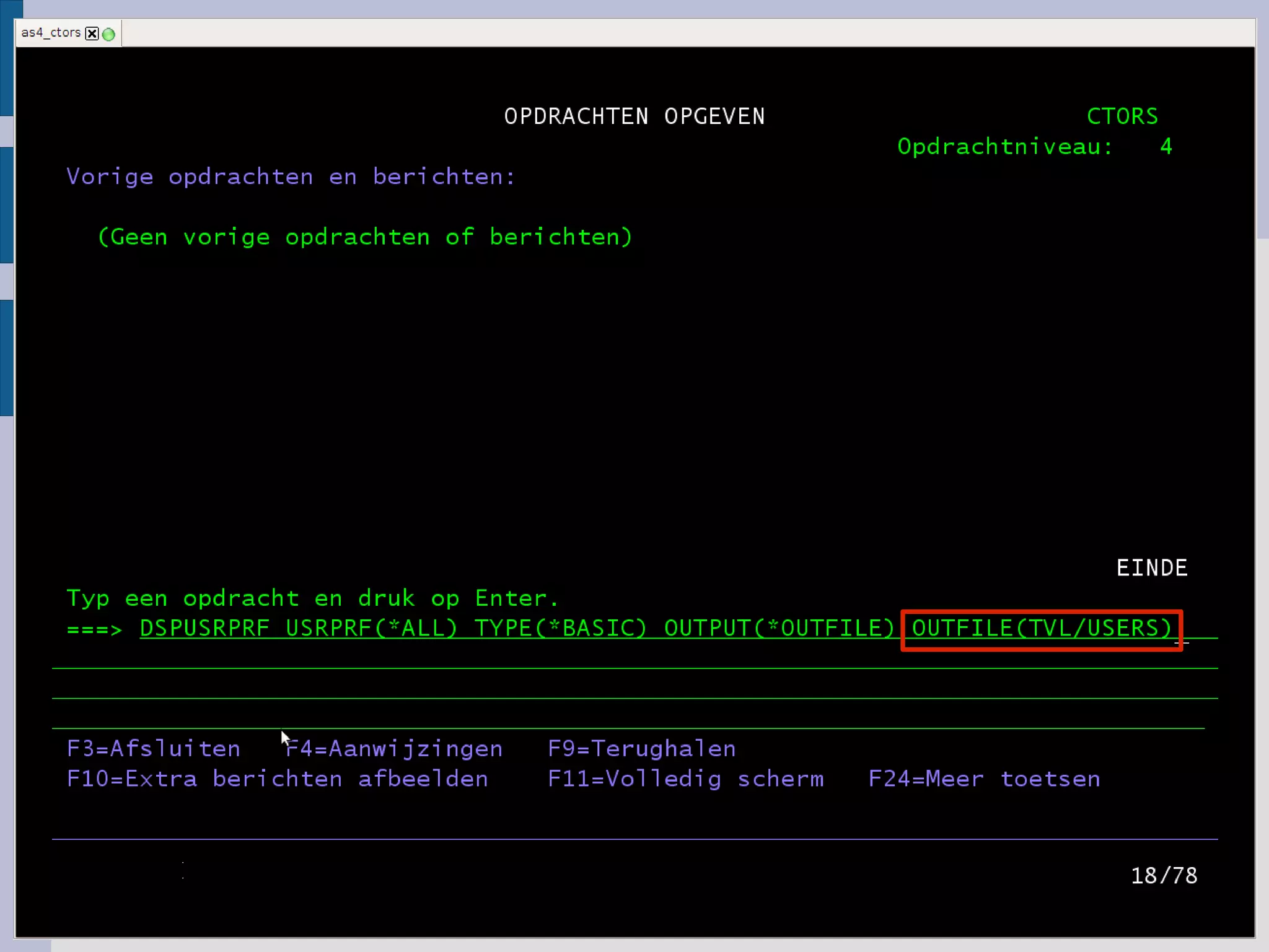
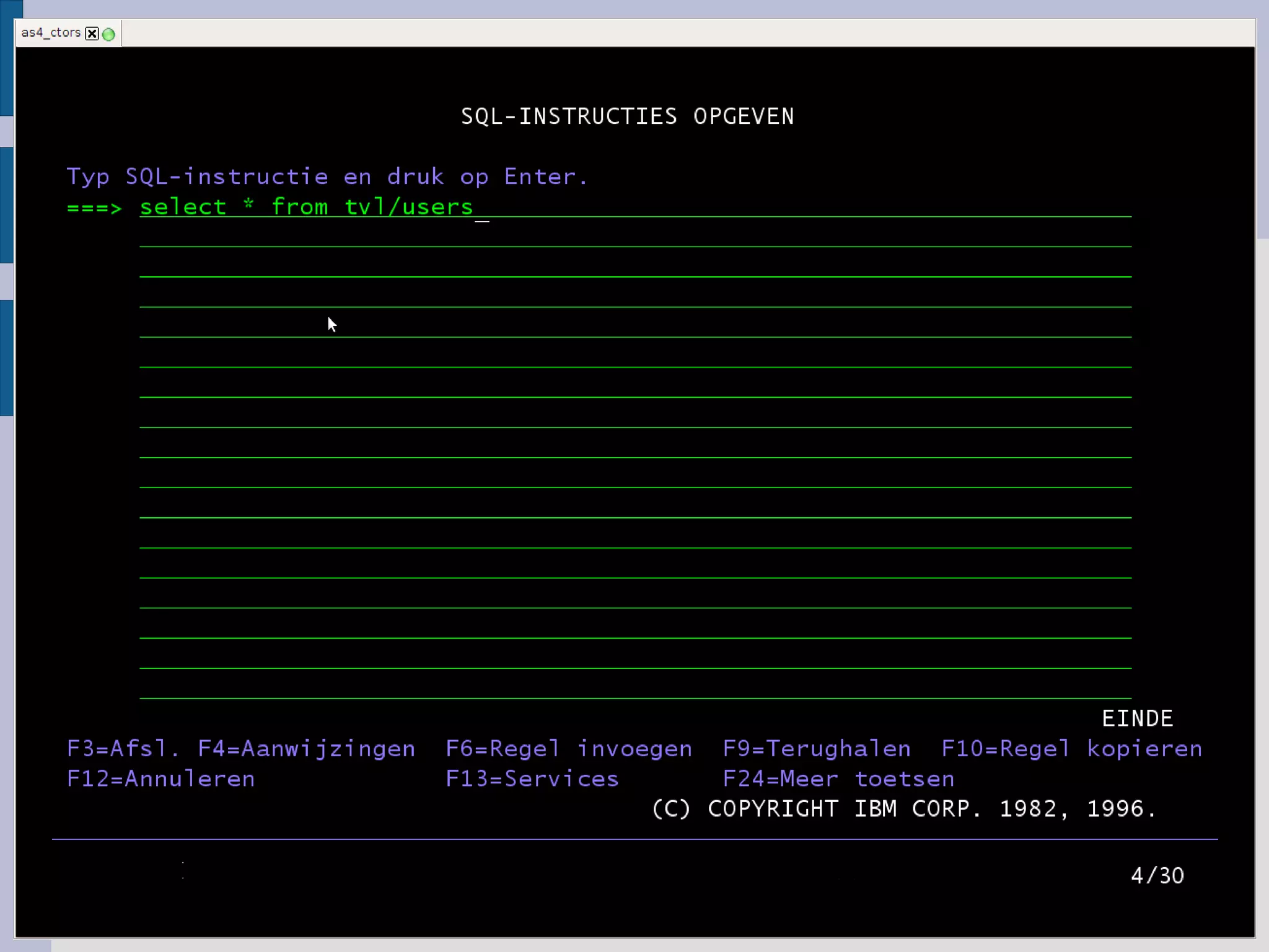
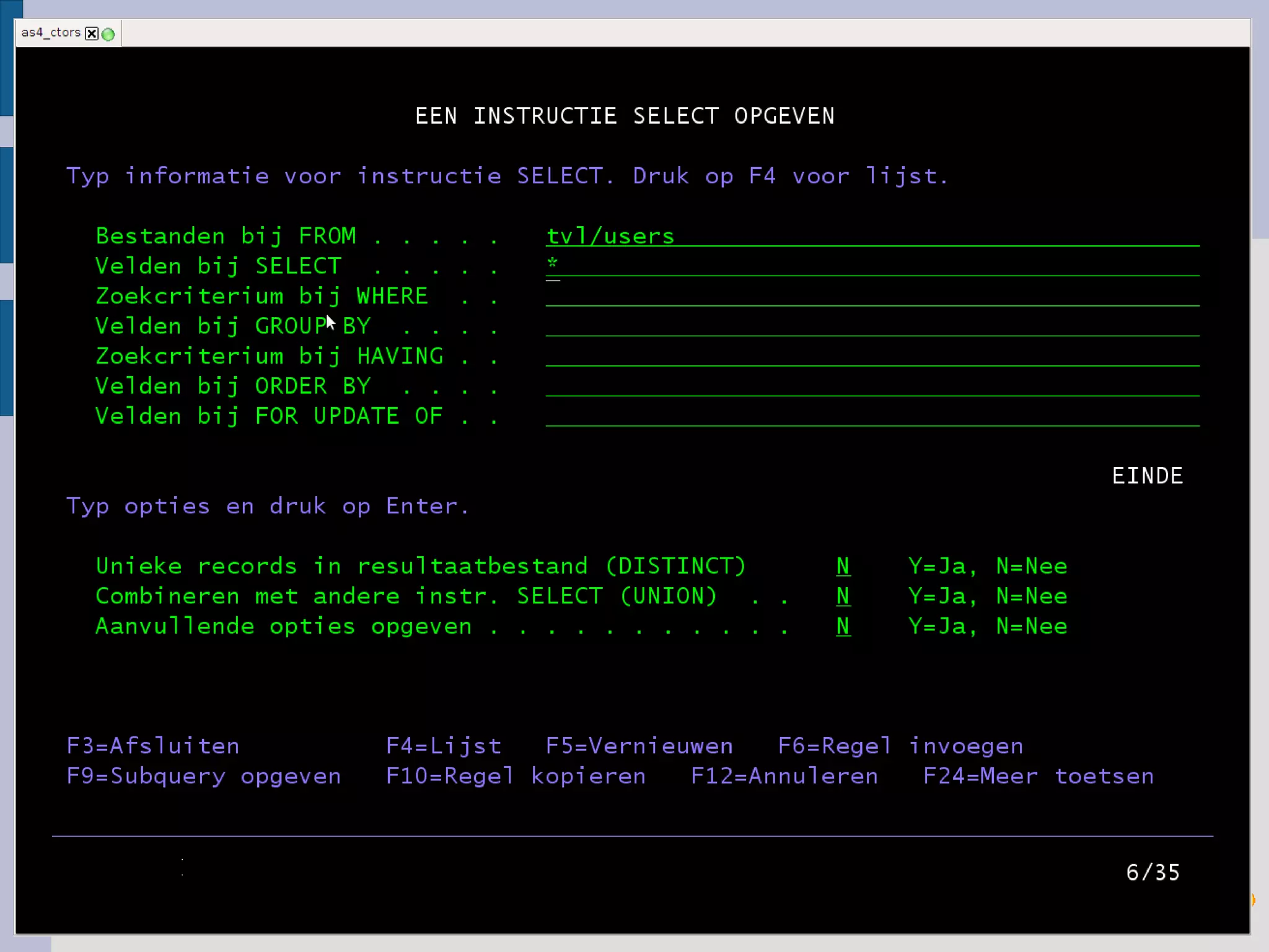
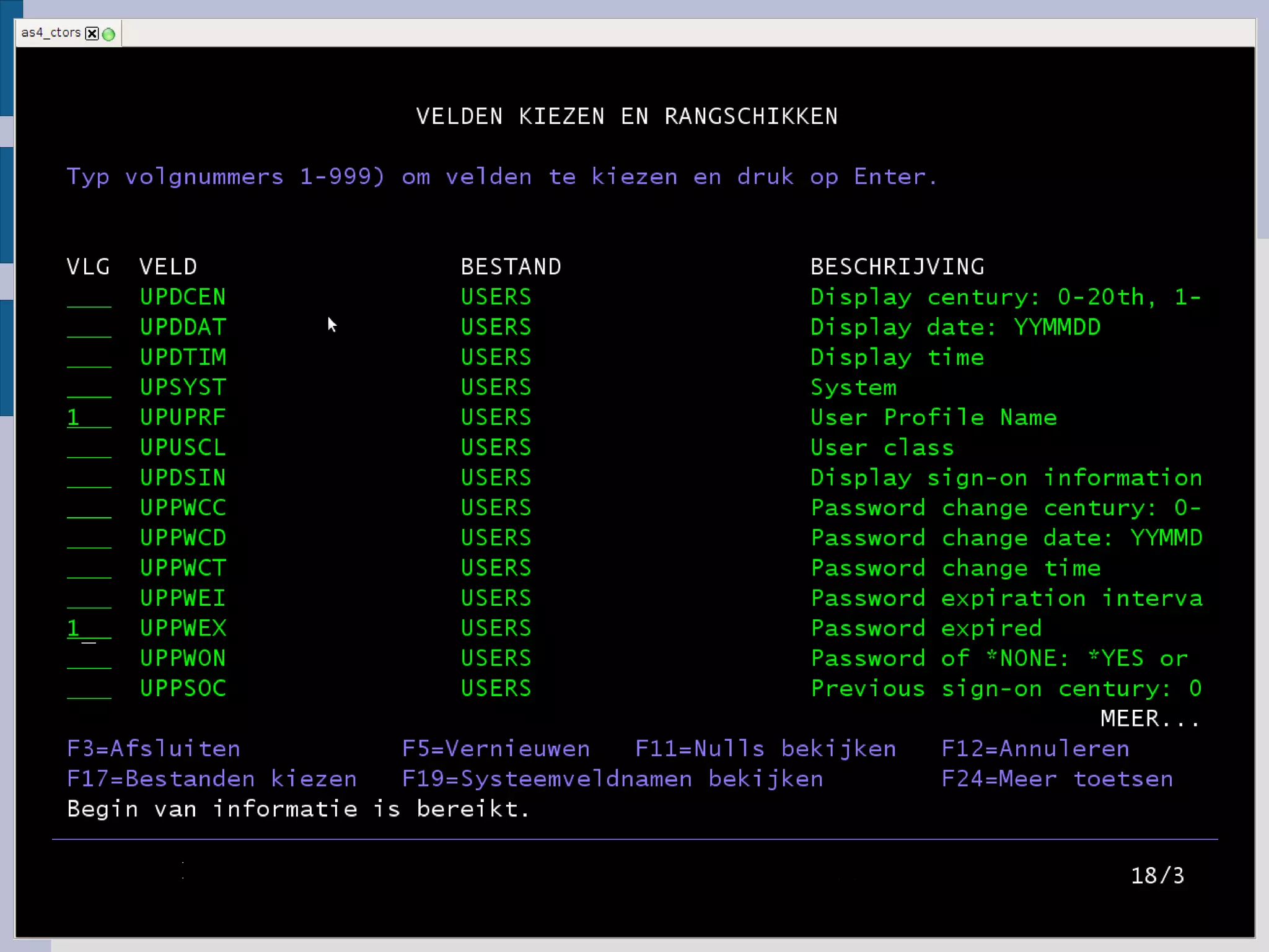
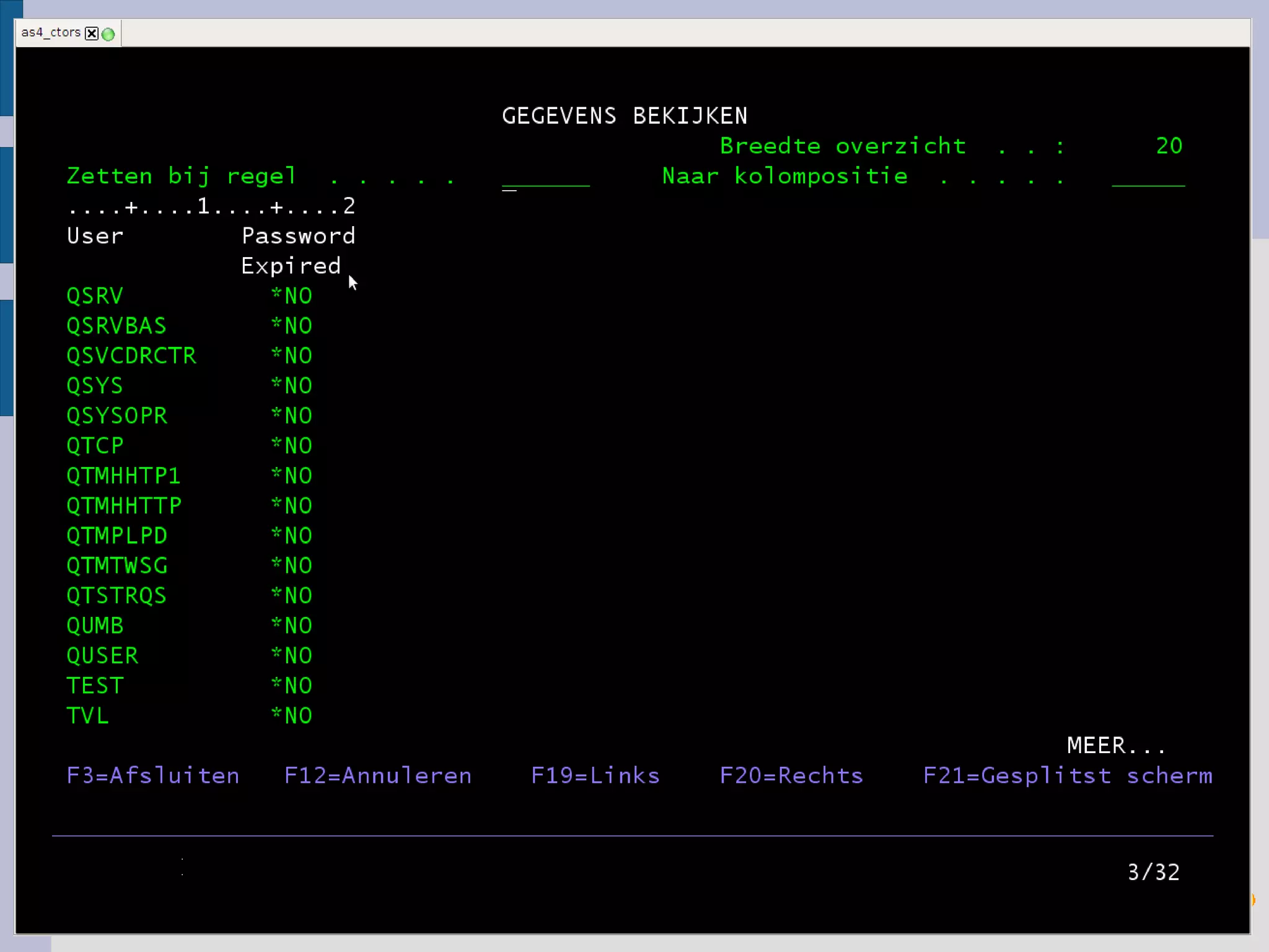
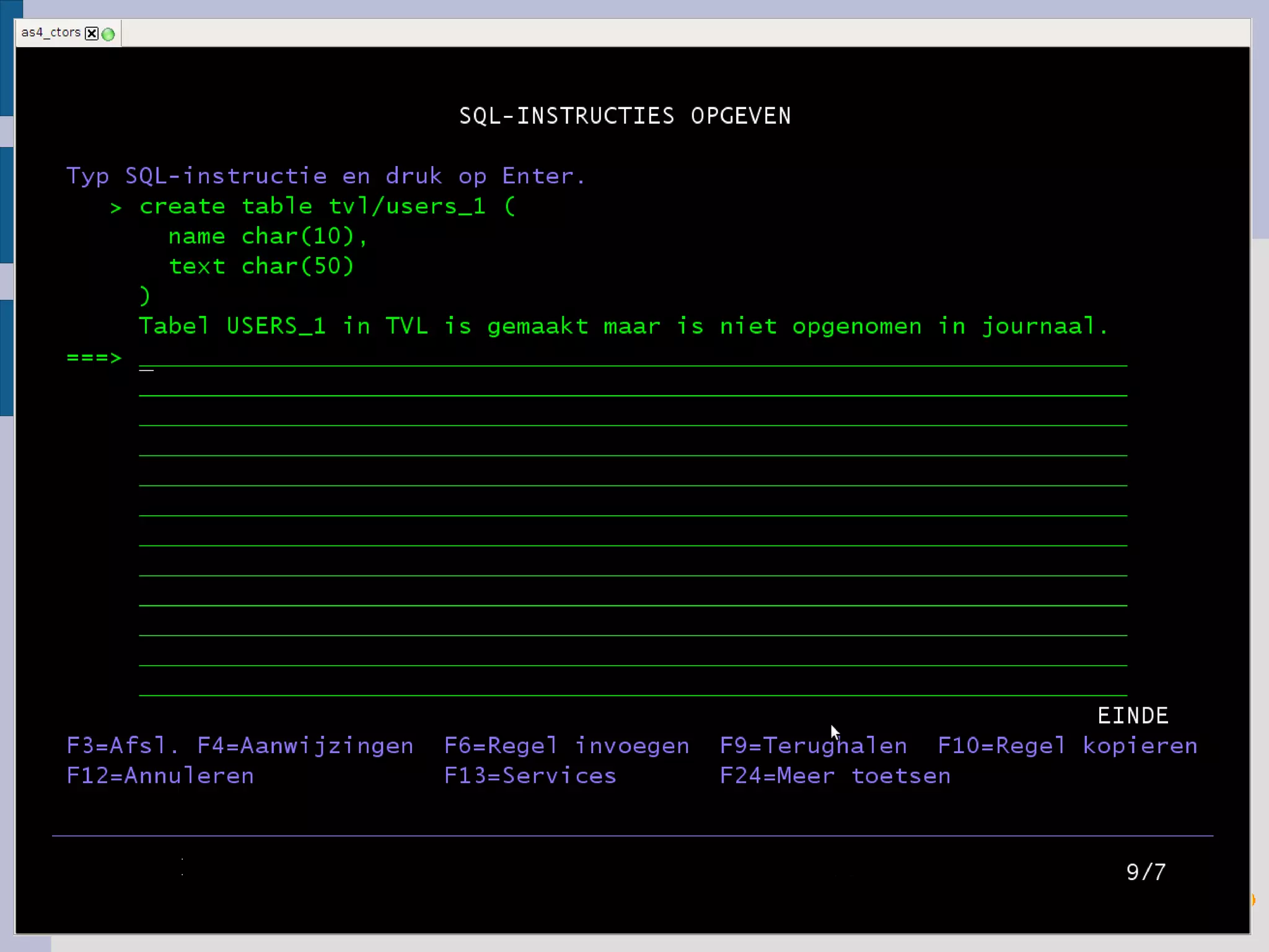
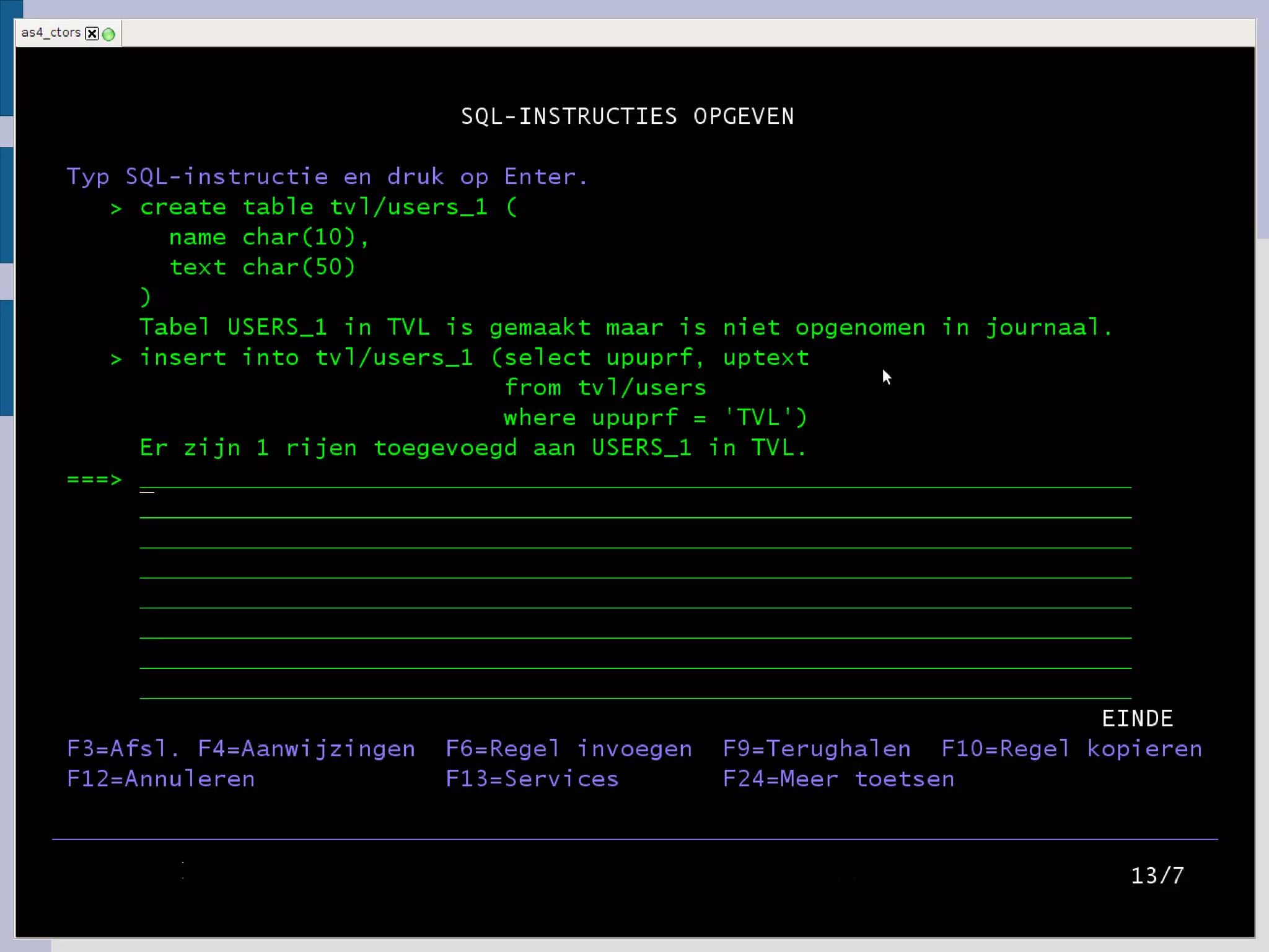
Navigating
●   Commands
●   Menu's (*MENU)
The end
●       Thank you for listening!
●       Images (google)
    –     [1] http://www.ibmsystemsmag.com/ibmi/endpgm/2008/atriumphofhardwork/assetuploadfile60620807.jpg
    –     [2] http://www-03.ibm.com/ibm/history/exhibits/rochester/rochester_album.html
    –     [3] http://www.nasi.com/images/ibm_power-family.jpg
    –     [4] http://www.tug.ca/eblast/library/logo_IBM_POWER6_BoP.gif
    –     [5] http://www.pclaunches.com/entry_images/0408/09/ibm_power595-2.jpg
    –     [6] http://andrewscg.files.wordpress.com/2008/02/i5os-v6r1-logo.jpg
    –     [7] http://www.gobmug.com/images/ibm_i.gif
Introduction to the IBM AS/400

Introduction to the IBM AS/400

  • 1.
    The IBM AS/400 A technical introduction Tom Van Looy tom@ctors.net August 2009
  • 2.
    Overview • Who am I? • AS/400 history • What is IBM i? • Other environments • Programming • Work management • Exploring the system
  • 3.
    Who am I ● AS/400 system programmer (+4 years) ● Currently Linux sysadmin (@priorweb.be) ● Linux and *BSD user ● Belgian village
  • 4.
    Why this talk ● AS/400, 20 year anniversary (2008) ● You have nothing else to do ;-) – I brought a system here to play with ● Type-model 9402-200 (feat 2031) ● 11.6 CPW ● 56 MB main memory (8+16+32) ● 3093 MB ASP (3x1031) ● OS/400 V3R2M0 (EOL 31/may/2000) ● Dutch :-( ● I do not represent IBM these are my views and opinions!
  • 5.
  • 6.
    AS/400 history ● IBM Rochester, Minnesota ● Midrange system ● Different and extremely closed-source ● Project Silverlake ● Designed by Dr. Frank Soltis [1]
  • 7.
    Rochester systems ● System/3 (1969) ● System/32 (1975) ● System/34 (1977) ● System/38 (1978) ● System/36 (1983) ● Fort Knox ● AS/400 (1988)
  • 8.
  • 9.
  • 10.
  • 11.
    S/38 (1978) [2] Control Program Facility (CPF)
  • 12.
    S/36 (1983) [2] System Support Program (SSP)
  • 13.
    Fort Knox ● S/36 ● S/38 ● Series/1 ● RS/6000 (AIX) ● Some small IBM mainframes
  • 14.
    AS/400 (1988) [2] OS/400
  • 15.
    Renaming ● AS/400 ● AS/400e ● eServer iSeries ● eServer i5 (i5/OS) ● System i5 ● System i ● POWER systems (i + p) – Power 6 – Rename i5/OS to IBM i
  • 16.
    IBM Power systems [3] [4] [5] ● AIX, IBM i, Linux
  • 17.
  • 18.
    Design principles ● Technology independence ● Object-based design ● Hardware integration ● Software integration ● Single-level store
  • 19.
    Technology independence ● Not defined by hardware ● VM interface to the system (TIMI) ● IMPI (48bit CISC) -> PowerPC (64bit RISC) – 1995, save/restore
  • 20.
    Technology independence +---+----------------+ +---+----------------+ | | applic. | | | applic. | | +------------+ | | +------------+ | | OS/400 | | | IBM i | | +----------------+---+ +----------------+---+ (opcodes) VM ---------> | TIMI | | TIMI |<------------ VM (opcodes) +--------------------+ +--------------------+ | +----------------+ | | +----------------+ | kernel ---------> | | VLIC | | | | | |<------------ kernel (PL/MP) | +----------------+ | | | | | (C++, PPC AS) | | IMPI | | | | SLIC | | | +----------------+ | | | | | | | HLIC | | | | | | | +----------------+ | | +----------------+ | | | 48-bit addr | | | | 64-bit addr | | | | CISC interface | | | | RISC interface | | | | HW | | | | HW | | | +----------------+ | | +----------------+ | +----------------------+ +----------------------+ system's instruction set defines all pointers as 128-bit
  • 21.
    Object-based design ● Only objects supported data structure at MI – Atomic ● Message passing – Every object has a message queue ● Not fully OO – No subclasses – No inheritance – Polymorphism minimalistic
  • 22.
    Hardware integration ● Information intensive environments ● The move to PowerPC – Support Java, e-commerce, BI, … ● Balanced design – Fast processing – High bandwidth, high performance I/O ● POWER capacity expressed in CPW – TPC-C benchmark – Disregards CPU speed
  • 23.
    Software integration ● Security, communications, backup/restore, … ● Modern database (DB2/400) ● Temporary/permanent PTF's
  • 25.
    Single-level store ● 64-bit address space – One large shared storage – Contains all programs and data – Addressable from single permanent address ● Reference by name or pointer ● Don't worry where it resides – No address reuse ● No process local storage – Task creation – Context switching ● Virtual addressing moves object into real memory (not accessible by programmer)
  • 26.
  • 27.
    PASE ● Portable Application Solution Environment – Incorporated 64-bit AIX runtime env. ● Private Address Space Environment ● Not technology independent – does not talk to TIMI – syscall interface to the SLIC
  • 28.
    PASE ● Call PASE from i – QSH CMD('ls /home/tvl') ● Call i from PASE – system ”WRKOBJLCK OBJ(MYFILE) OBJTYPE(*FILE)” ● Query DB2 from PASE, … ● Run Apache, X, ...
  • 29.
    Hypervisor ● Hardware support in PowerPC ● Logical Partitioning (LPAR) – AIX, Linux, IBM i – Created and managed from the HMC ● Dynamic resource allocation at runtime
  • 30.
    Management ● Twinax (obsolete) ● Hardware Management Console (HMC) – IPL the system – Service tools – LPAR +-------+ | || +-------+ | IBM i || | || | || +----+ +----+ +----+ | HMC ||------------[FSP] || | WS | | WS | | WS | | ||----+ +---| || +----+ +----+ +----+ +-------+/ | | | || /____/| /____/| /____/| /_______/ | | | [CP ] || | | | | | +-------+/ | | | ~~~~~~~ | | | ( )-----------------+ | | ( LAN )------------------------+ | ( )---------------------------------+ ~~~~~~~
  • 31.
  • 32.
    Languages ● CL ● RPG ● COBOL ● SQL ● C ● Pascal ● Java
  • 33.
    OPM, EPM ● Original Program Model ● Extended Program Model – C, Pascal, ... ● Translate into MI programs (*PGM) – Morphed into PPC pgm's by optimizing translator ● Only call external – Late binding
  • 34.
    ILE ● Integrated Language Environment – New compiler, optimizing translator, binder facility ● Output *MODULE – Package into *PGM, *SRVPGM ● Early binding +----------+---------+-------+ | ILE | Windows | Linux | +-------------------+----------+---------+-------+ | After compilation | *.MODULE | *.obj | *.o | +-------------------+----------+---------+-------+ | Bind by copy | *.PGM | *.exe | * | +-------------------+----------+---------+-------+ | Bind by reference | *.SRVPGM | *.dll | *.so | +-------------------+----------+---------+-------+
  • 35.
    Java ● Compiled into byte codes (CRTJVAPGM) – Part of the MI – Used by the JVM – Implemented in SLIC ● Native JVM ● PASE JVM
  • 36.
  • 37.
    LUW ● Jobs – Interactive (call) – Batch (submit) – Communication – System ● job-number/user-name/job-name ● Numbers not reused
  • 39.
    Subsystems ● Controlling subsystem – QCTLSBSD sysval ● QBASE ● QCTL – QINTER (interactive jobs) – QBATCH (batch jobs) – QCMN (communication jobs) – QUSRWRK (user work) – QSERVER (server jobs) – QSPL (spooling) ● Started by QSTRUPPGM (sysval) ● Restricted state – ENDSBS SBS(*ALL) – Backups, console display run in CTLSBS
  • 44.
    Job queue's ● Batch jobs are placed on job queue's ● Interactive jobs on workstation queue's ● Subsystems read one or more queue's – Job queue belongs to only one subsystem – Jobs have priority on queue – Queue's are FIFO
  • 46.
    Storage pools ● Divide memory – *MACHINE pool – *BASE pool – ... ● Dynamic – Shared pools – Adjust paging options (*CALC) – Pool size, job activity level (QPFRADJ sysval) ● Fixed size – Private pool
  • 51.
    Routing ● Job has a job describtion (*JOBD) – Job attributes ● No runtime attributes ● Output queue ● Job initial library list ● Routing data ● Subsystem – Routing entry's ● Subsystem pool ● Class object (*CLS) – Runtime priority – CPU time slice
  • 55.
  • 56.
    Objects ● Library's (*LIB object) – Can't contain *LIB objects ● Except QSYS, only contains *LIB's – IBM-supplied start with Q or # ● Objects – Inside *LIB – Max 10 characters – Name + object type = unique – EBCDIC
  • 58.
    File system ● Integrated File System (IFS) – Virtual File System (VFS) architecture ● QSYS.LIB (OS/400) ● QOpenSys (POSIX, XPG) ● QOPT (DVD) – NFS, SMB
  • 60.
    Users ● QSECOFR – security officer ● Authority levels – All object authority (*ALLOBJ) – Auditing (*AUDIT) – I/O system configuration (*IOSYSCFG) – Save system (*SAVSYS) – Security administration (*SECADM) – Service functions (*SERVICE) – Spool control (*SPLCTL) ● Group profiles
  • 63.
    Navigating ● Commands ● Menu's (*MENU)
  • 85.
    The end ● Thank you for listening! ● Images (google) – [1] http://www.ibmsystemsmag.com/ibmi/endpgm/2008/atriumphofhardwork/assetuploadfile60620807.jpg – [2] http://www-03.ibm.com/ibm/history/exhibits/rochester/rochester_album.html – [3] http://www.nasi.com/images/ibm_power-family.jpg – [4] http://www.tug.ca/eblast/library/logo_IBM_POWER6_BoP.gif – [5] http://www.pclaunches.com/entry_images/0408/09/ibm_power595-2.jpg – [6] http://andrewscg.files.wordpress.com/2008/02/i5os-v6r1-logo.jpg – [7] http://www.gobmug.com/images/ibm_i.gif