Architecture Enforcement Aspects Itarc2009

Loading...

Flash Player 9 (or above) is needed to view presentations.
We have detected that you do not have it on your computer. To install it, go here.

0 comments

Post a comment

    Post a comment
    Embed Video
    Edit your comment Cancel

    Favorites, Groups & Events

    Architecture Enforcement Aspects Itarc2009 - Presentation Transcript

    1. IT Architect Regional Conference 2009 Taking your strategy to new heights! Architecture Enforcement and Governance Using Aspects Srini Penchikala Enterprise Architect
    2. About the Speaker • Enterprise Architect • Editor: InfoQ, Java & Architecture communities • Writer: InfoQ, TSS, ONJava, DevX Java, java.net • Speaker • Detroit Java User Group Leader • Using Java since 1996 & JEE since 2000 • SOA/Web Services since 2006 • PowerPoint since September 2008 Sponsor Logo
    3. Goals for this Presentation • Overview of Reference Architecture (RA) and its significance in EA • How Aspects and AOP can help to enforce RA and manage Architecture Governance Sponsor Logo
    4. Format Interactive  Demos  Duration: ~60 minutes  Q&A  Sponsor Logo
    5. Before we start… • How many currently have some kind of Reference Architecture in place? • How many actually use RA to enforce architecture? Sponsor Logo
    6. Agenda • Reference Architecture & Enforcement • Architecture Rules Categories • Aspect-oriented Programming • Rules Demo(s) • CI Process Changes • Case Study • Architecture Rules Aspects - Open Source Project Sponsor Logo
    7. Agenda • Reference Architecture & Enforcement • Architecture Rules Categories • Aspect-oriented Programming • Rules Demo(s) • CI Process Changes • Case Study • Architecture Rules Aspects - Open Source Project Sponsor Logo
    8. Reference Architecture • A high-level system design which consists of: – description of system components – definitions of relationships between components – definitions of relationships between system components & elements external to the system
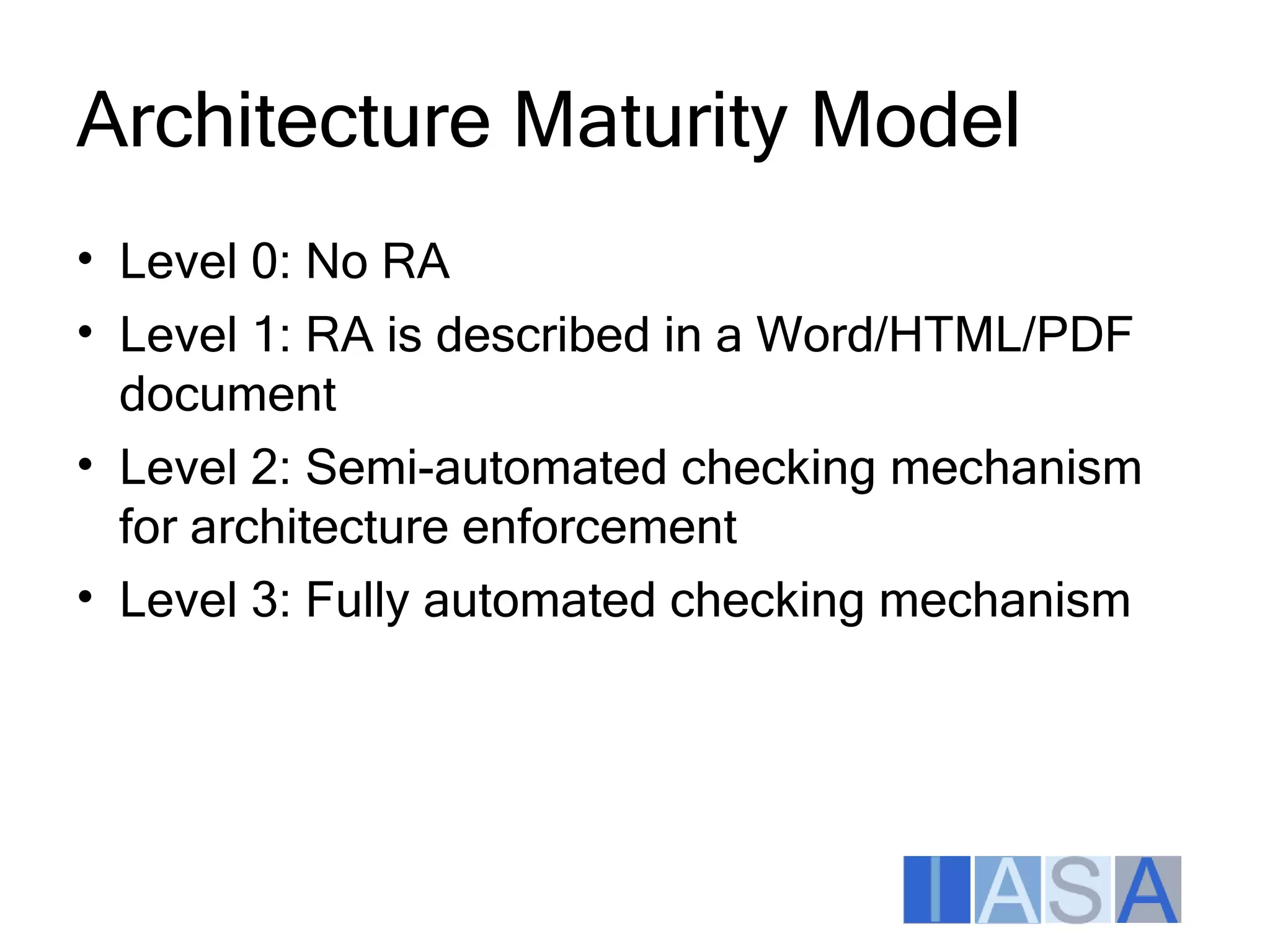
    9. Architecture Maturity Model • Level 0: No RA • Level 1: RA is described in a Word/HTML/PDF document • Level 2: Semi-automated checking mechanism for architecture enforcement • Level 3: Fully automated checking mechanism
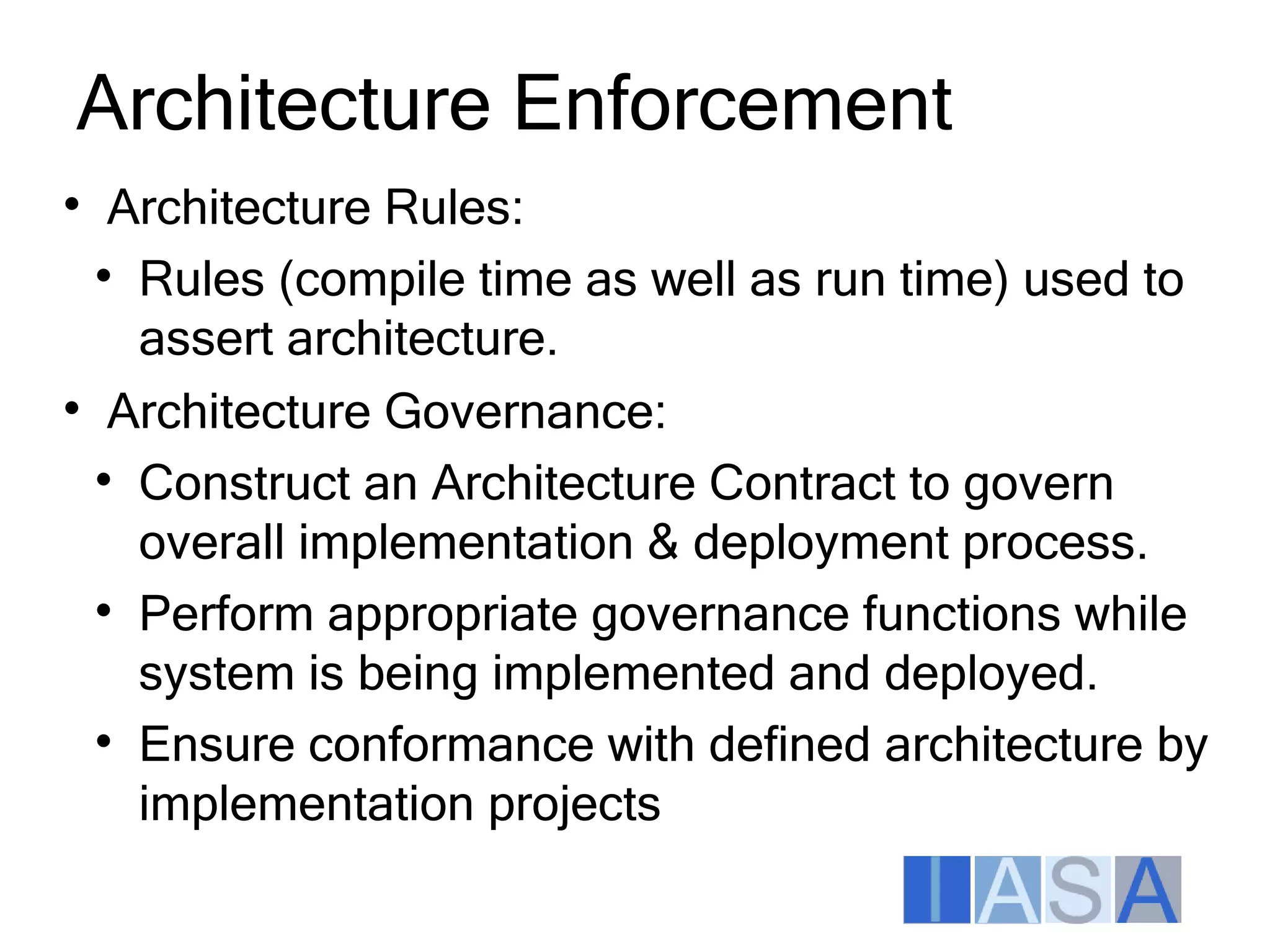
    10. Architecture Enforcement Architecture Rules:  Rules (compile time as well as run time) used to  assert architecture. Architecture Governance:  Construct an Architecture Contract to govern  overall implementation & deployment process. Perform appropriate governance functions while  system is being implemented and deployed. Ensure conformance with defined architecture by  implementation projects
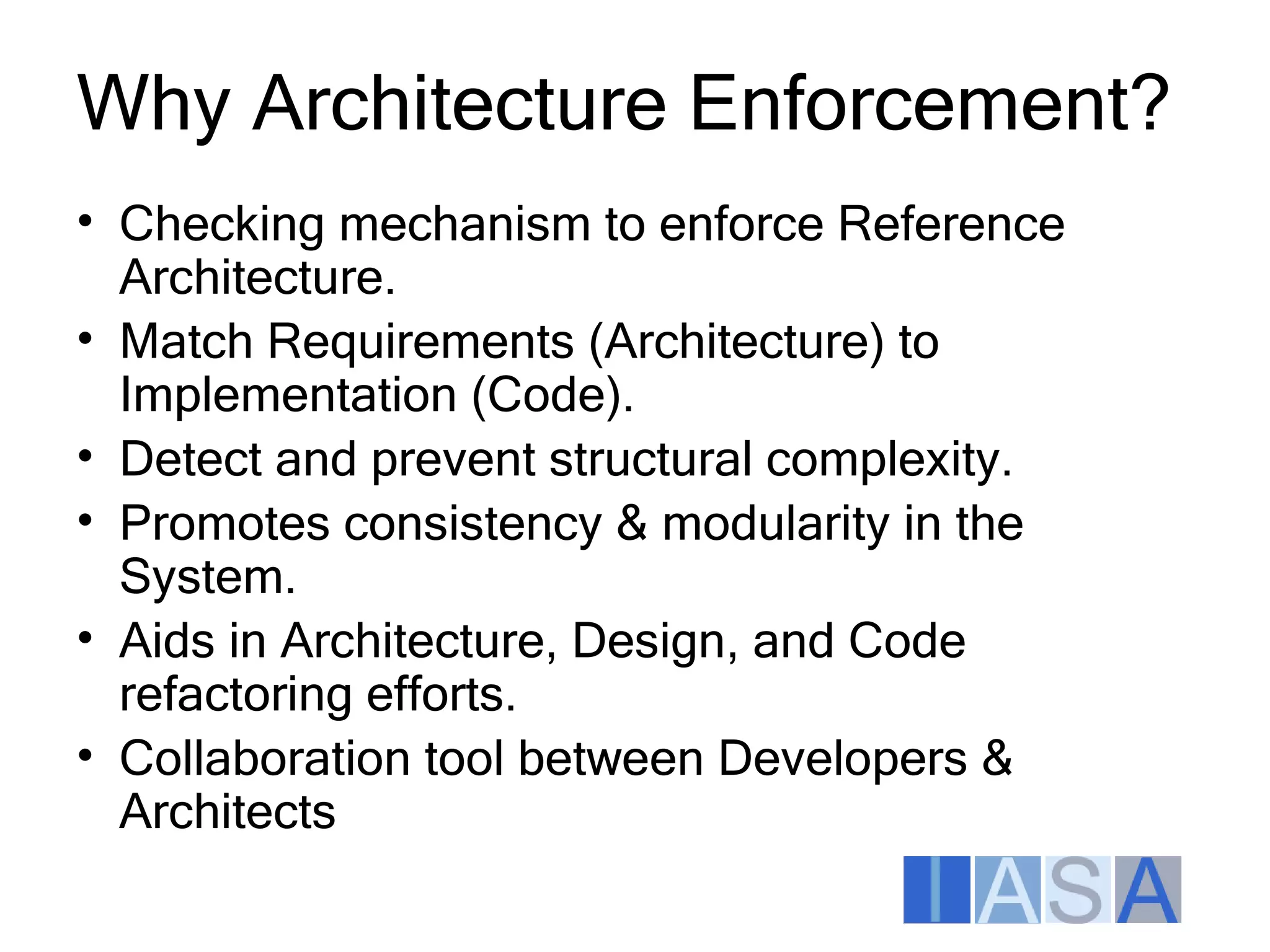
    11. Why Architecture Enforcement? • Checking mechanism to enforce Reference Architecture. • Match Requirements (Architecture) to Implementation (Code). • Detect and prevent structural complexity. • Promotes consistency & modularity in the System. • Aids in Architecture, Design, and Code refactoring efforts. • Collaboration tool between Developers & Architects
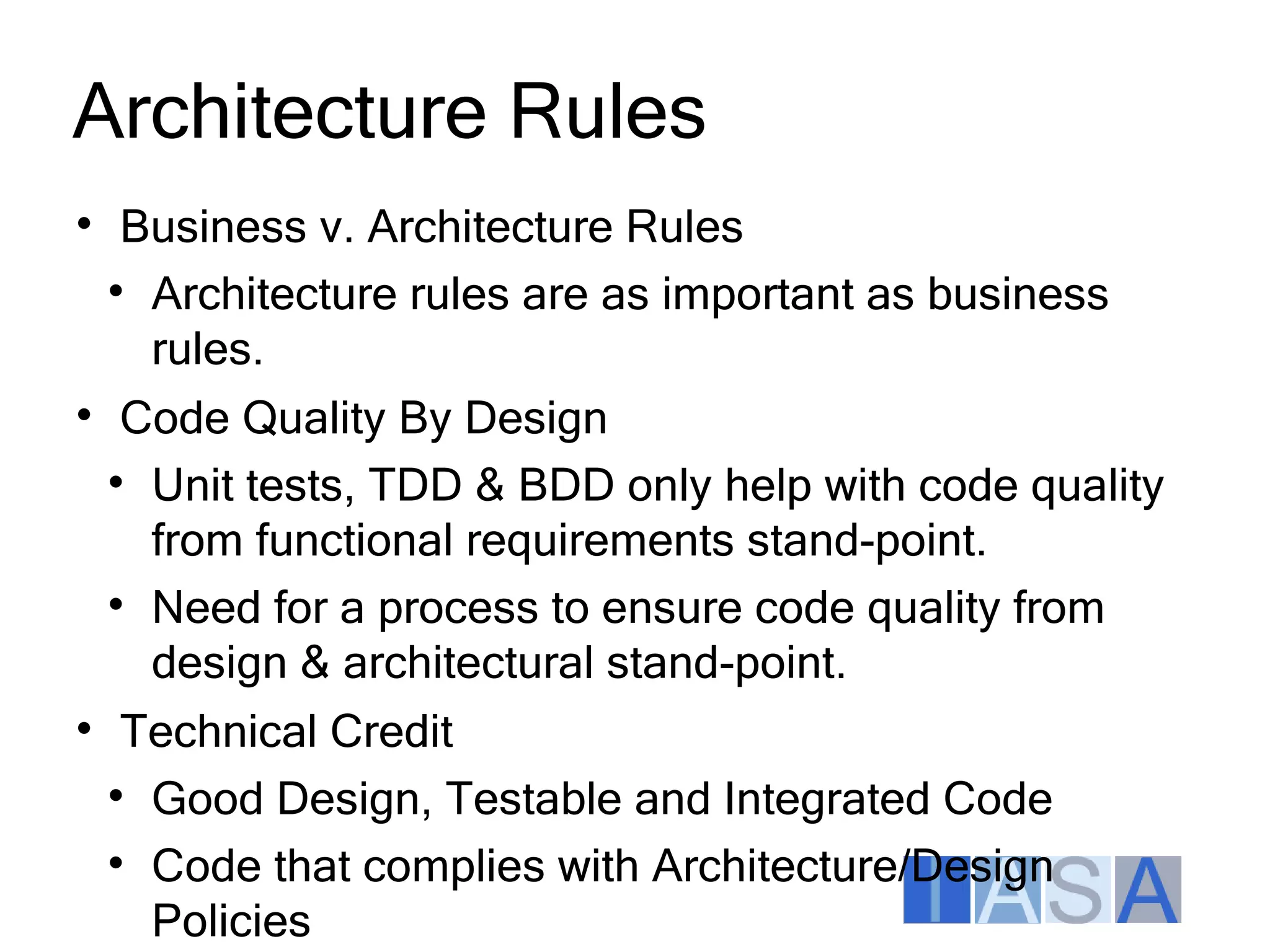
    12. Architecture Rules Business v. Architecture Rules  Architecture rules are as important as business  rules. Code Quality By Design  Unit tests, TDD & BDD only help with code quality  from functional requirements stand-point. Need for a process to ensure code quality from  design & architectural stand-point. Technical Credit  Good Design, Testable and Integrated Code  Code that complies with Architecture/Design  Policies
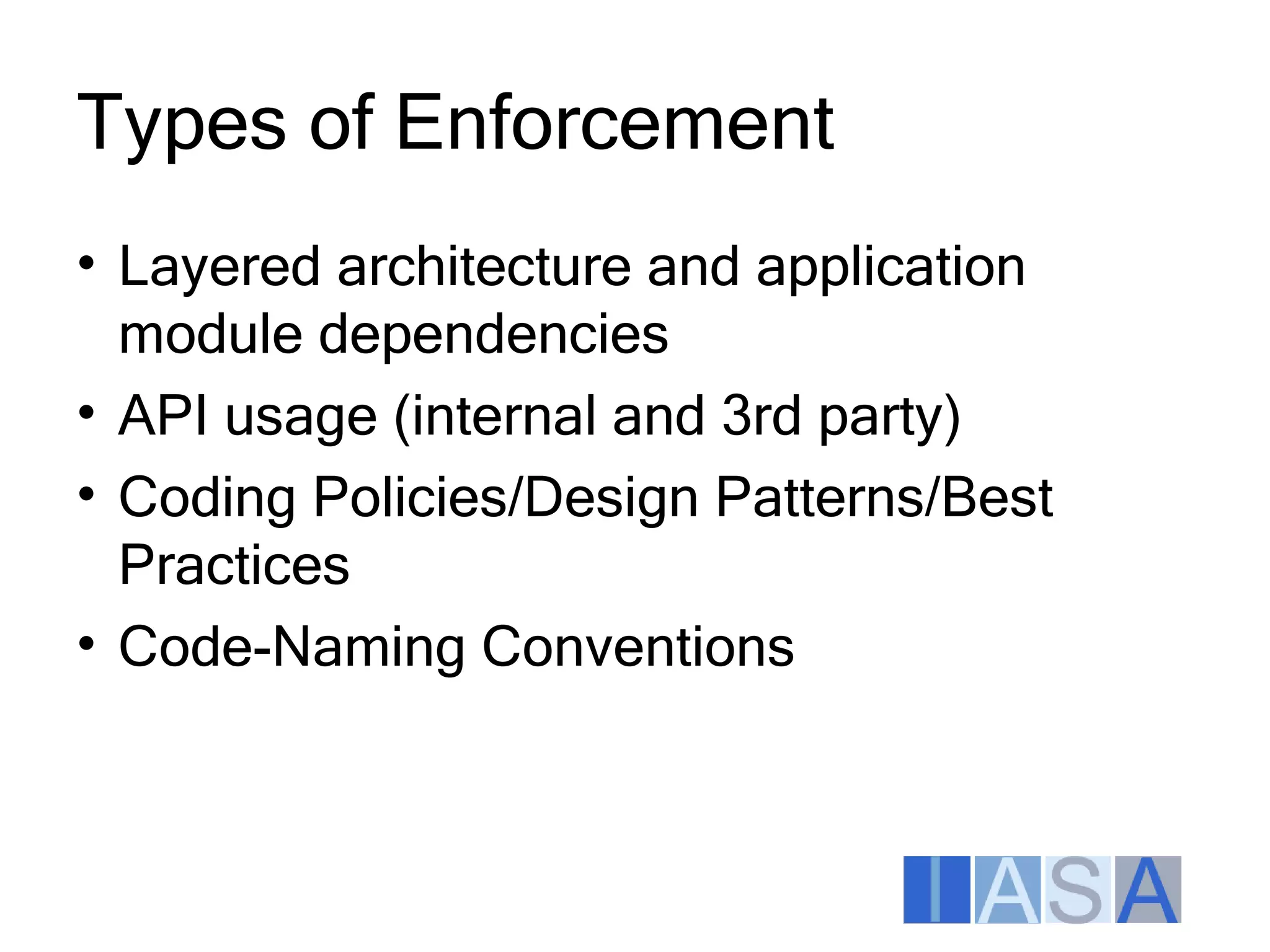
    13. Types of Enforcement • Layered architecture and application module dependencies • API usage (internal and 3rd party) • Coding Policies/Design Patterns/Best Practices • Code-Naming Conventions
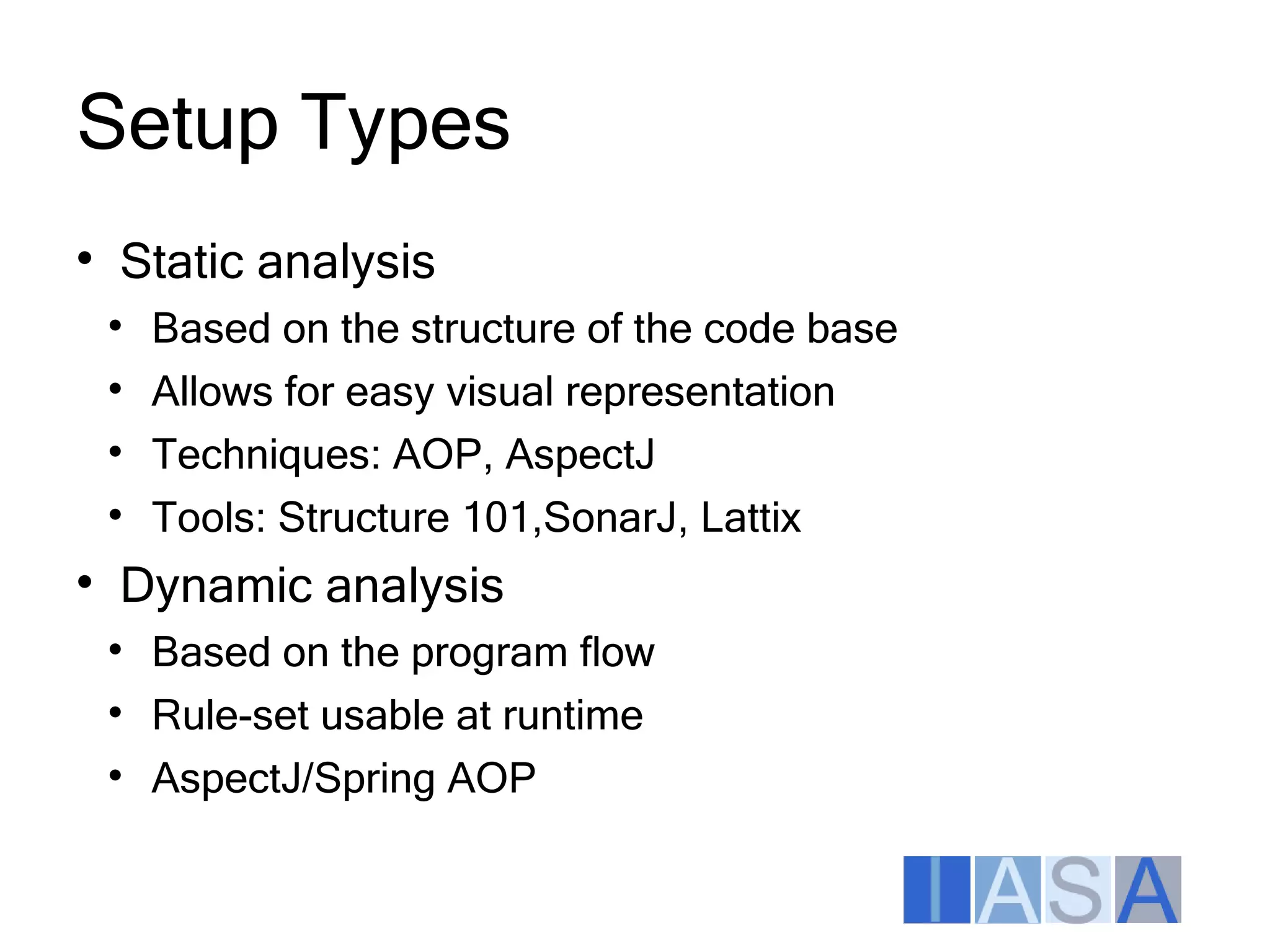
    14. Setup Types Static analysis  Based on the structure of the code base  Allows for easy visual representation  Techniques: AOP, AspectJ  Tools: Structure 101,SonarJ, Lattix  Dynamic analysis  Based on the program flow  Rule-set usable at runtime  AspectJ/Spring AOP 
    15. Agenda • Reference Architecture & Enforcement • Architecture Rules Categories • Aspect-oriented Programming • Rules Demo(s) • CI Process Changes • Case Study • Architecture Rules Aspects - Open Source Project Sponsor Logo
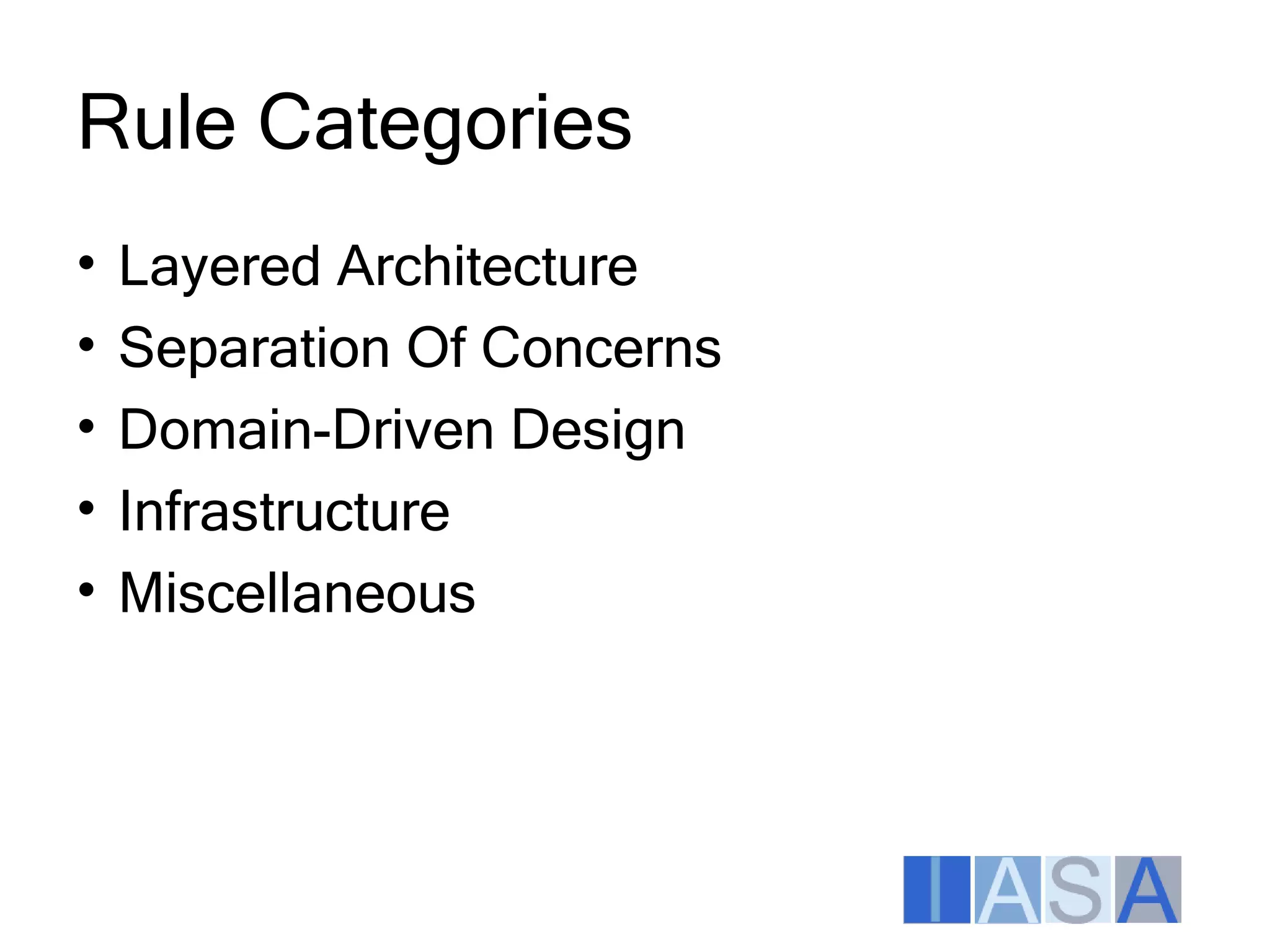
    16. Rule Categories • Layered Architecture • Separation Of Concerns • Domain-Driven Design • Infrastructure • Miscellaneous
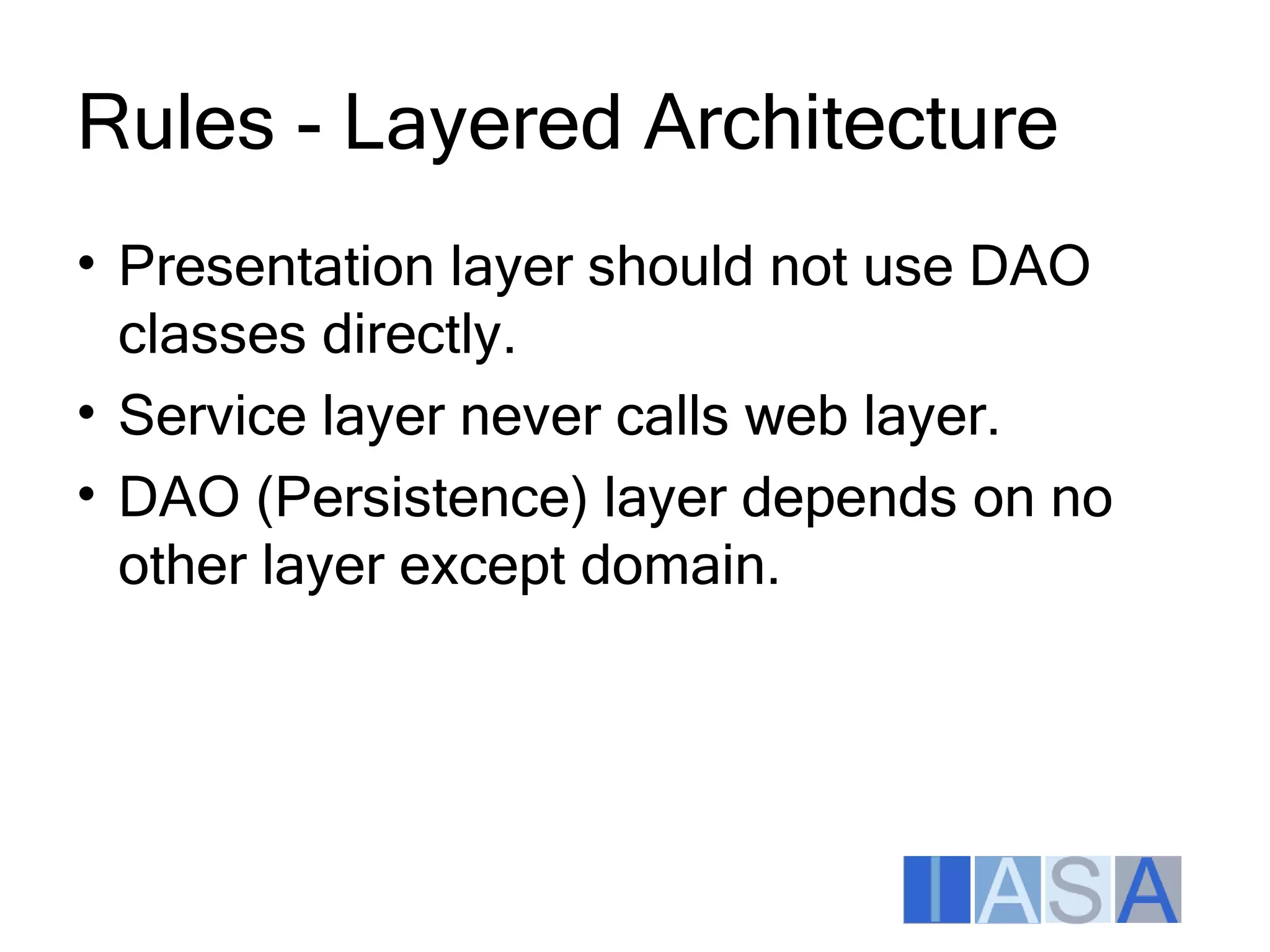
    17. Rules - Layered Architecture • Presentation layer should not use DAO classes directly. • Service layer never calls web layer. • DAO (Persistence) layer depends on no other layer except domain.
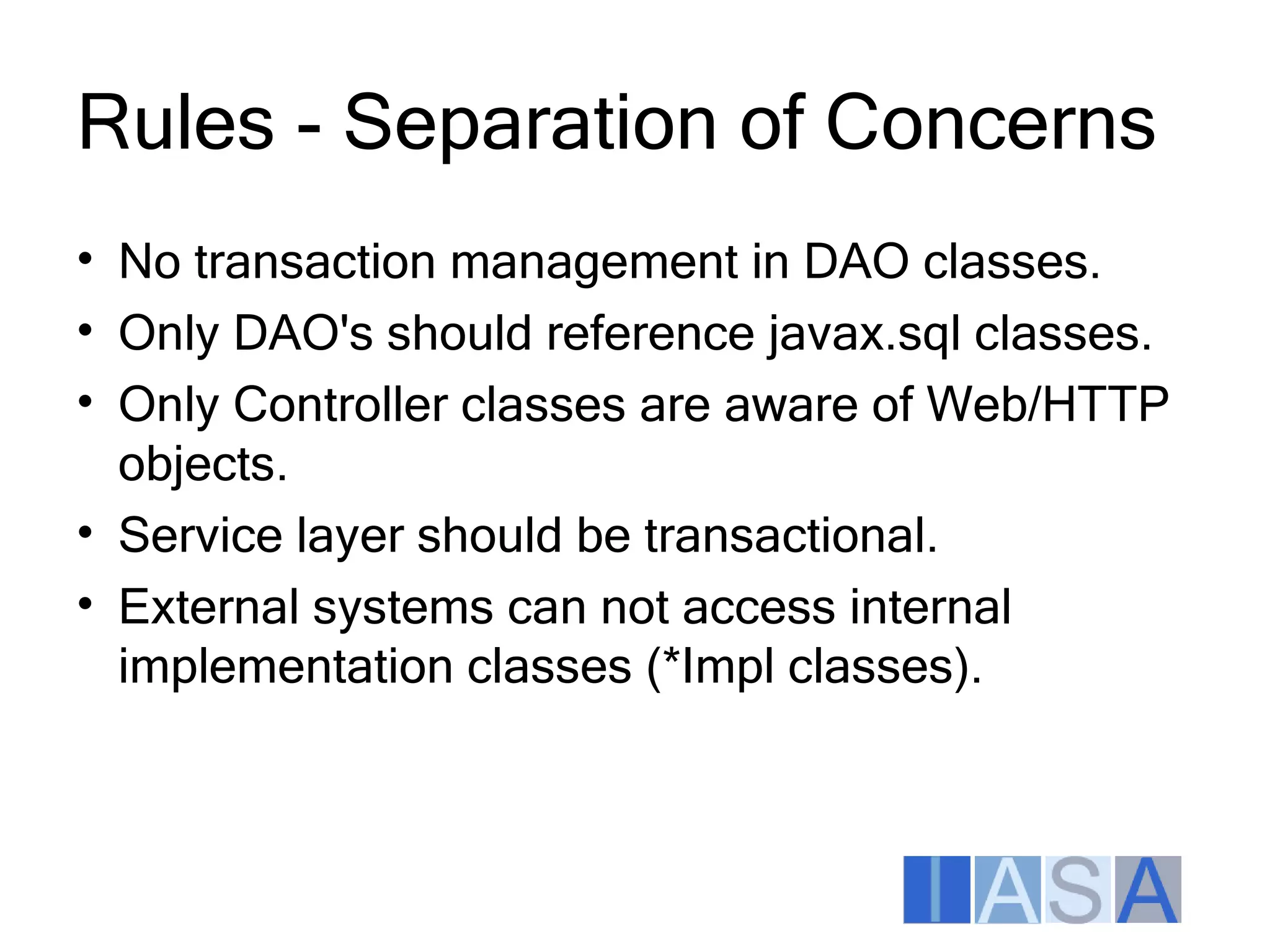
    18. Rules - Separation of Concerns • No transaction management in DAO classes. • Only DAO's should reference javax.sql classes. • Only Controller classes are aware of Web/HTTP objects. • Service layer should be transactional. • External systems can not access internal implementation classes (*Impl classes).
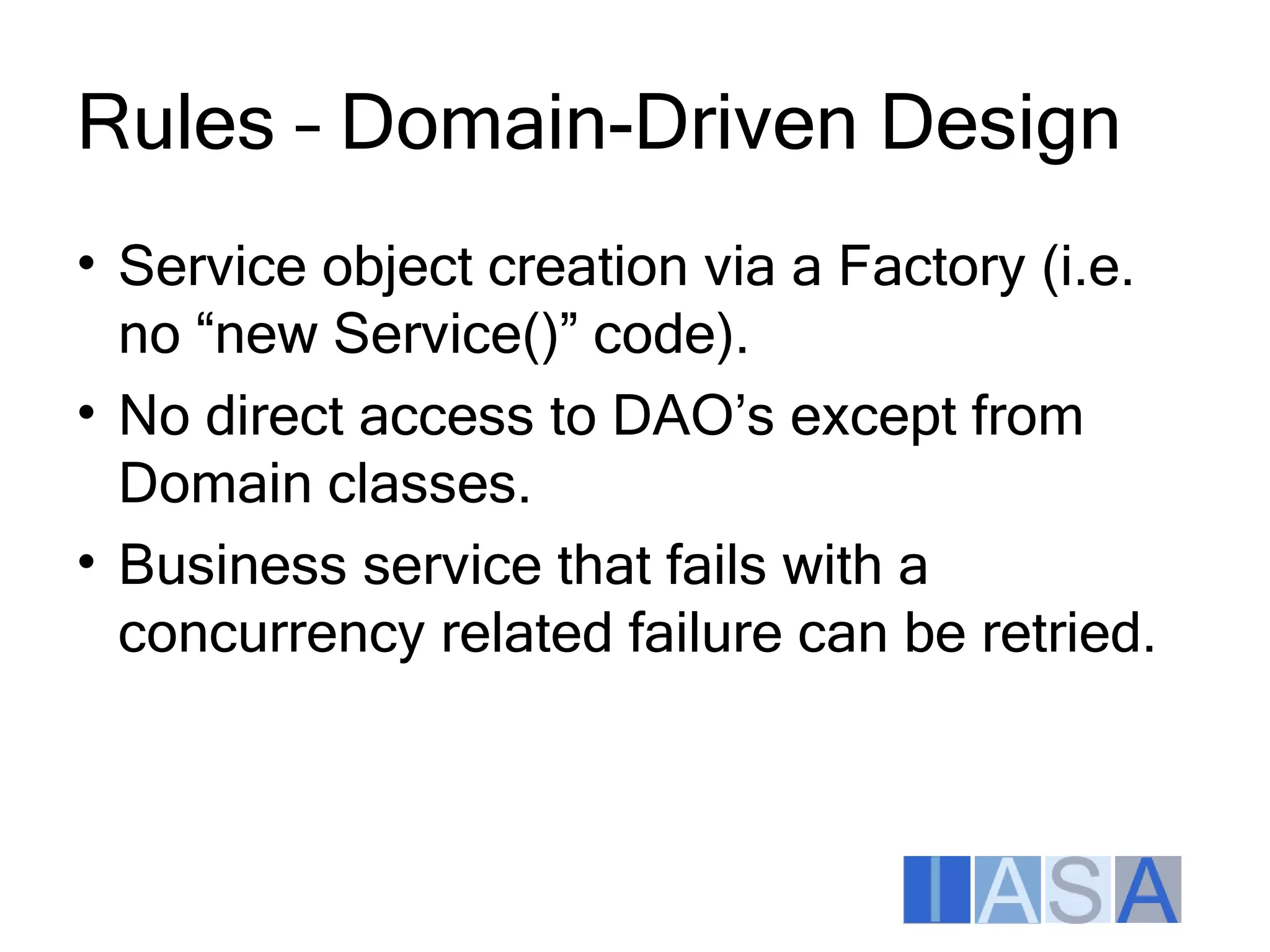
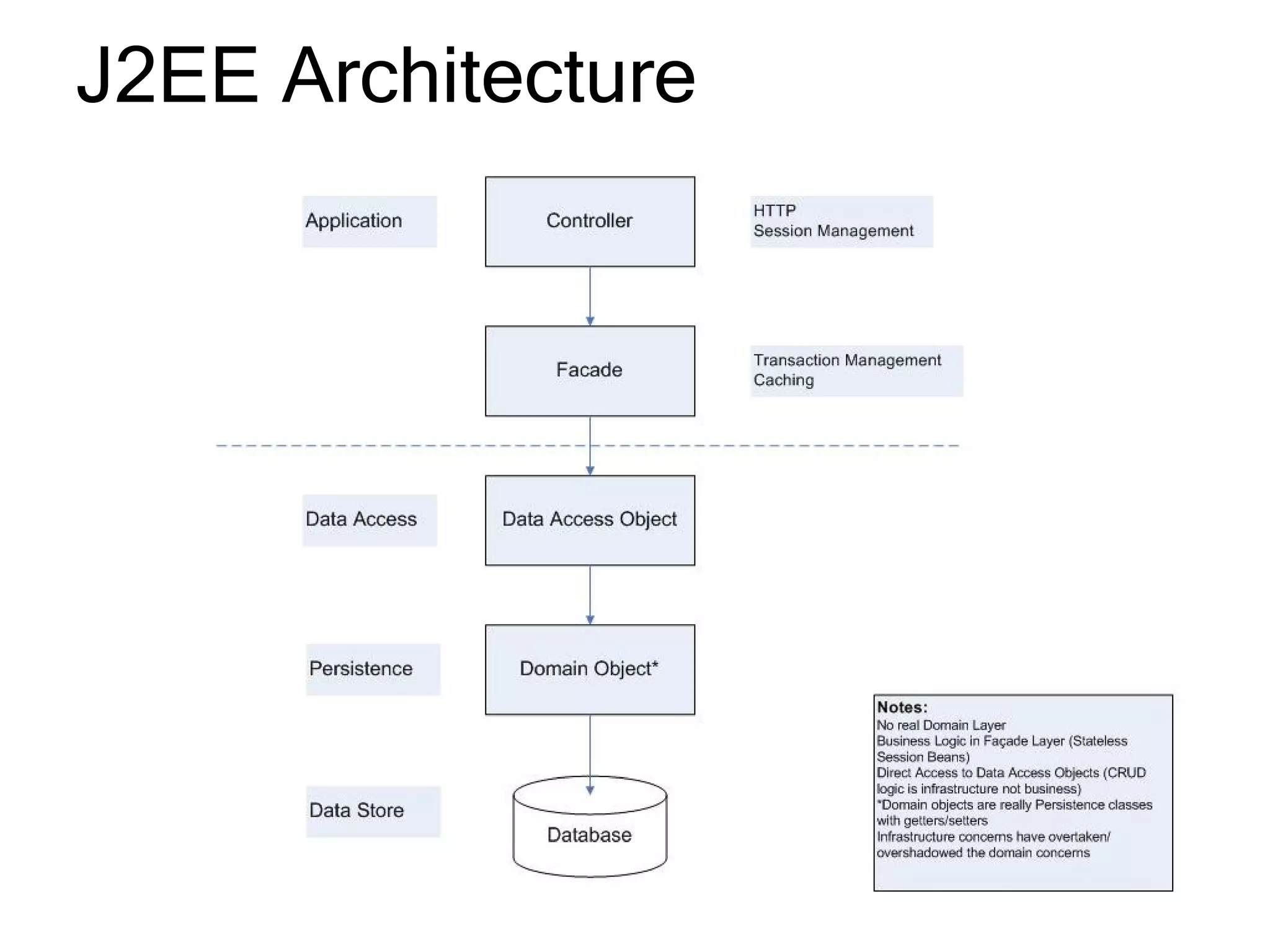
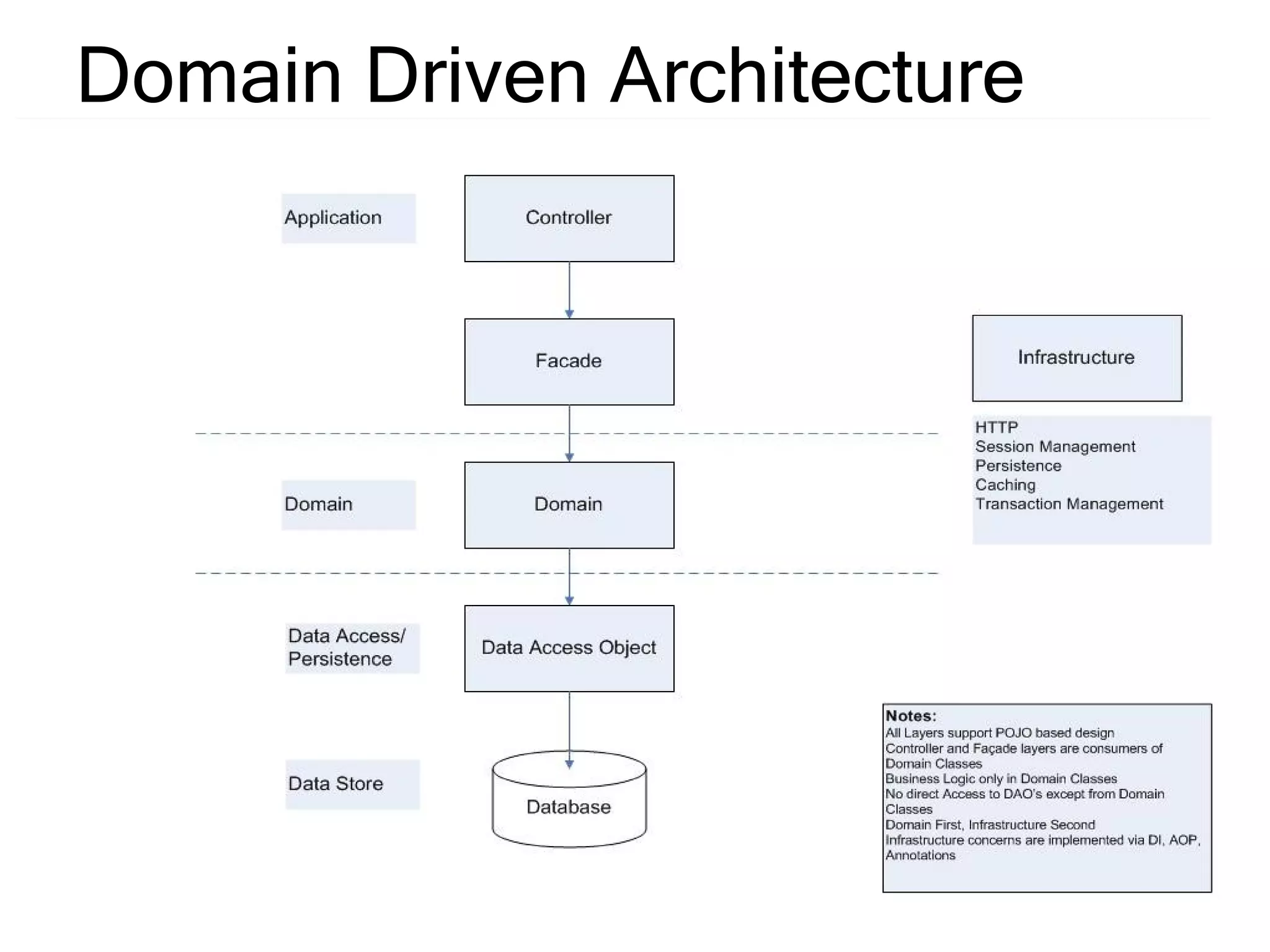
    19. Rules – Domain-Driven Design • Service object creation via a Factory (i.e. no “new Service()” code). • No direct access to DAO’s except from Domain classes. • Business service that fails with a concurrency related failure can be retried.
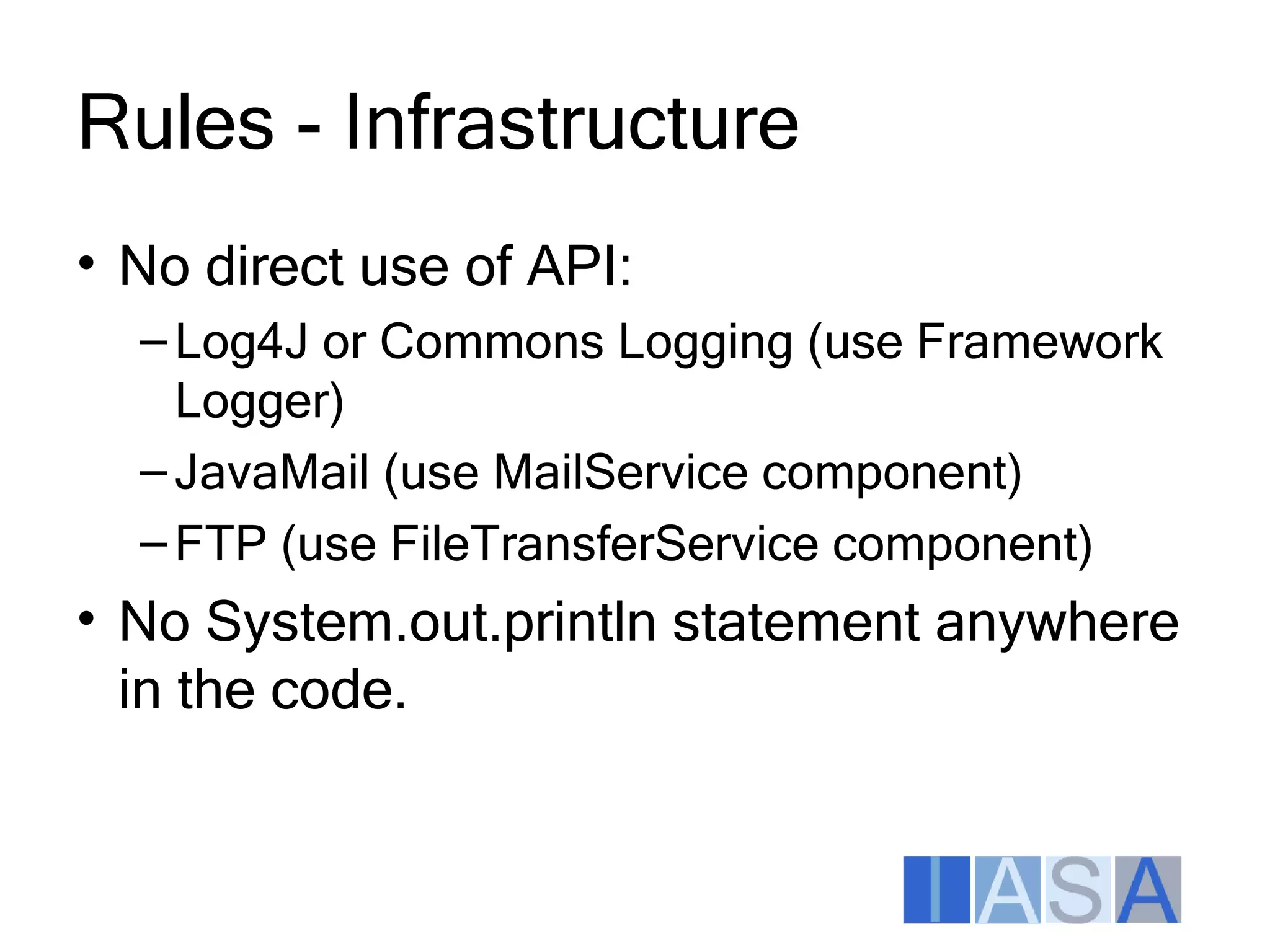
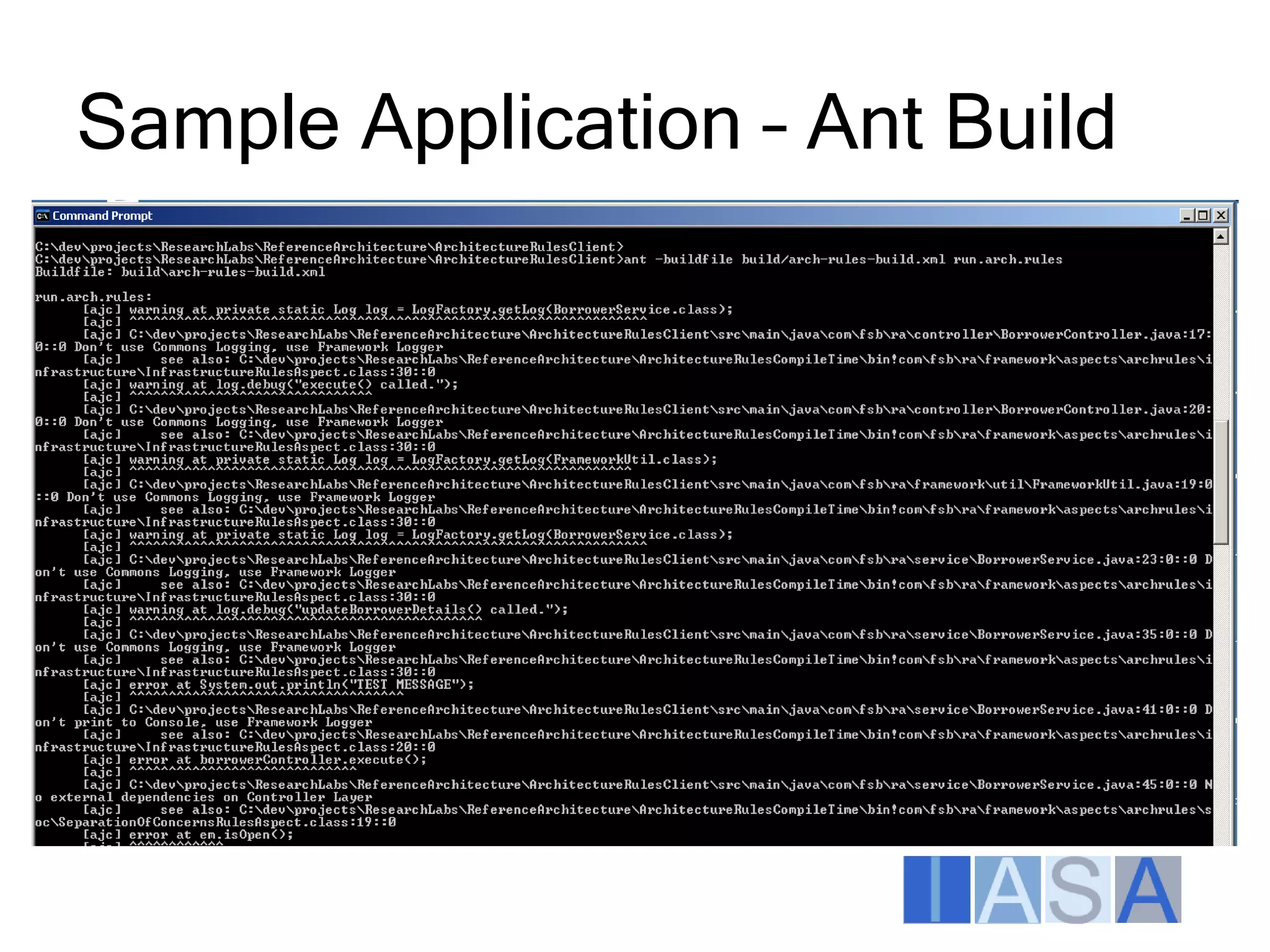
    20. Rules - Infrastructure • No direct use of API: – Log4J or Commons Logging (use Framework Logger) – JavaMail (use MailService component) – FTP (use FileTransferService component) • No System.out.println statement anywhere in the code.
    21. Rules - Miscellaneous • All primary key classes (*PK.java) should implement Serializable interface. • All test classes should be named with the suffix “Test”.
    22. Persistence • Hibernate session close only allowed in EJB's and Servlet Filters. • DAO's accessing DB Views use JDBC (no Hibernate). • Use SpringJdbcTemplate for JDBC data access requirements.
    23. Other Concerns Auditing  Domain state change tracking  Monitoring  Aspects to implement MonitorMBean interface  Expose Results as an MBean  Publish results using RSS feeds 
    24. Approaches • Code Inspections • Architecture Reconstruction • Model Driven Architecture (MDA) • Code Generation • Byte Code Instrumentation • Enforcement Tools • Aspect-oriented Programming (AOP)
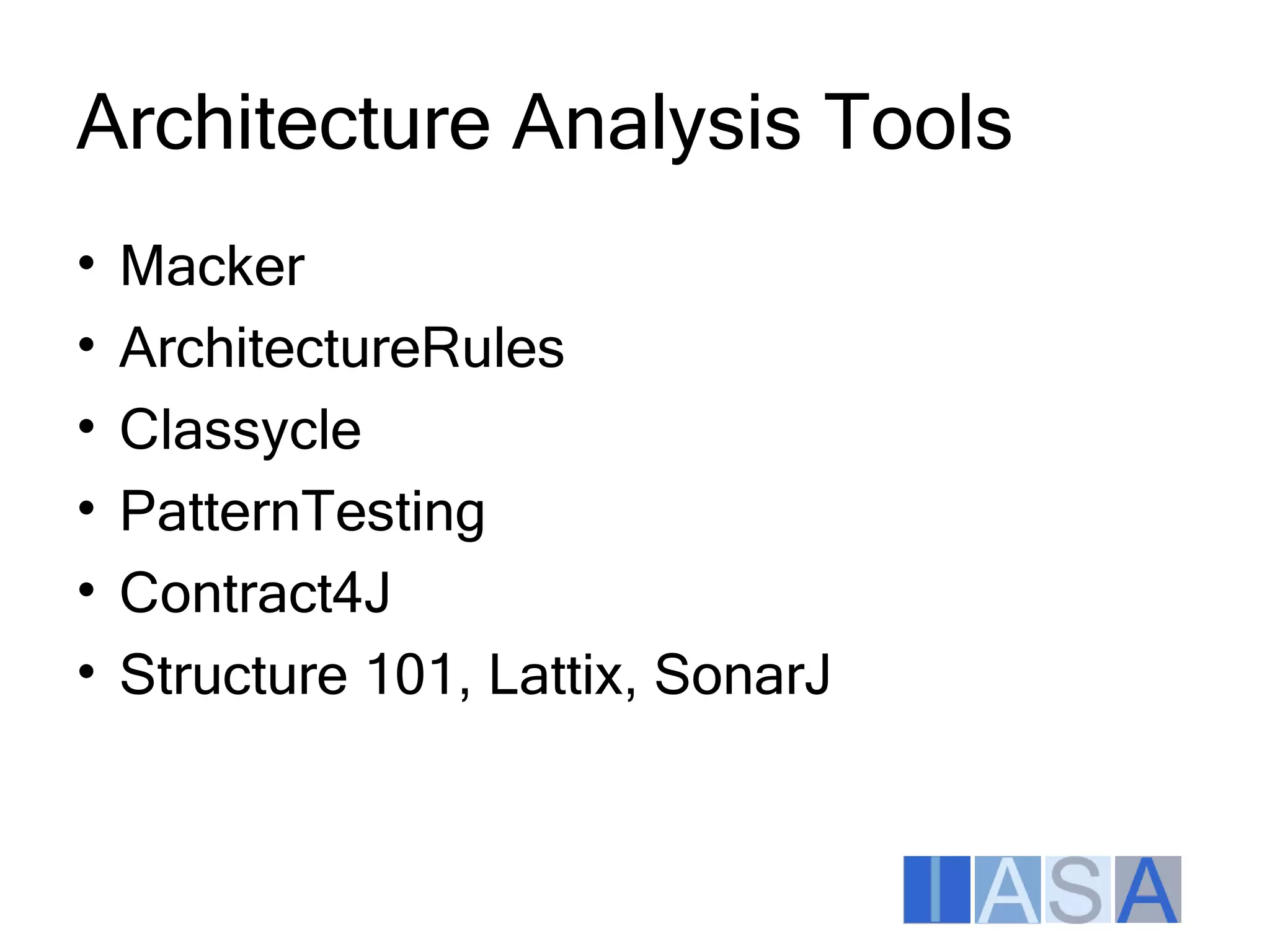
    25. Architecture Analysis Tools • Macker • ArchitectureRules • Classycle • PatternTesting • Contract4J • Structure 101, Lattix, SonarJ
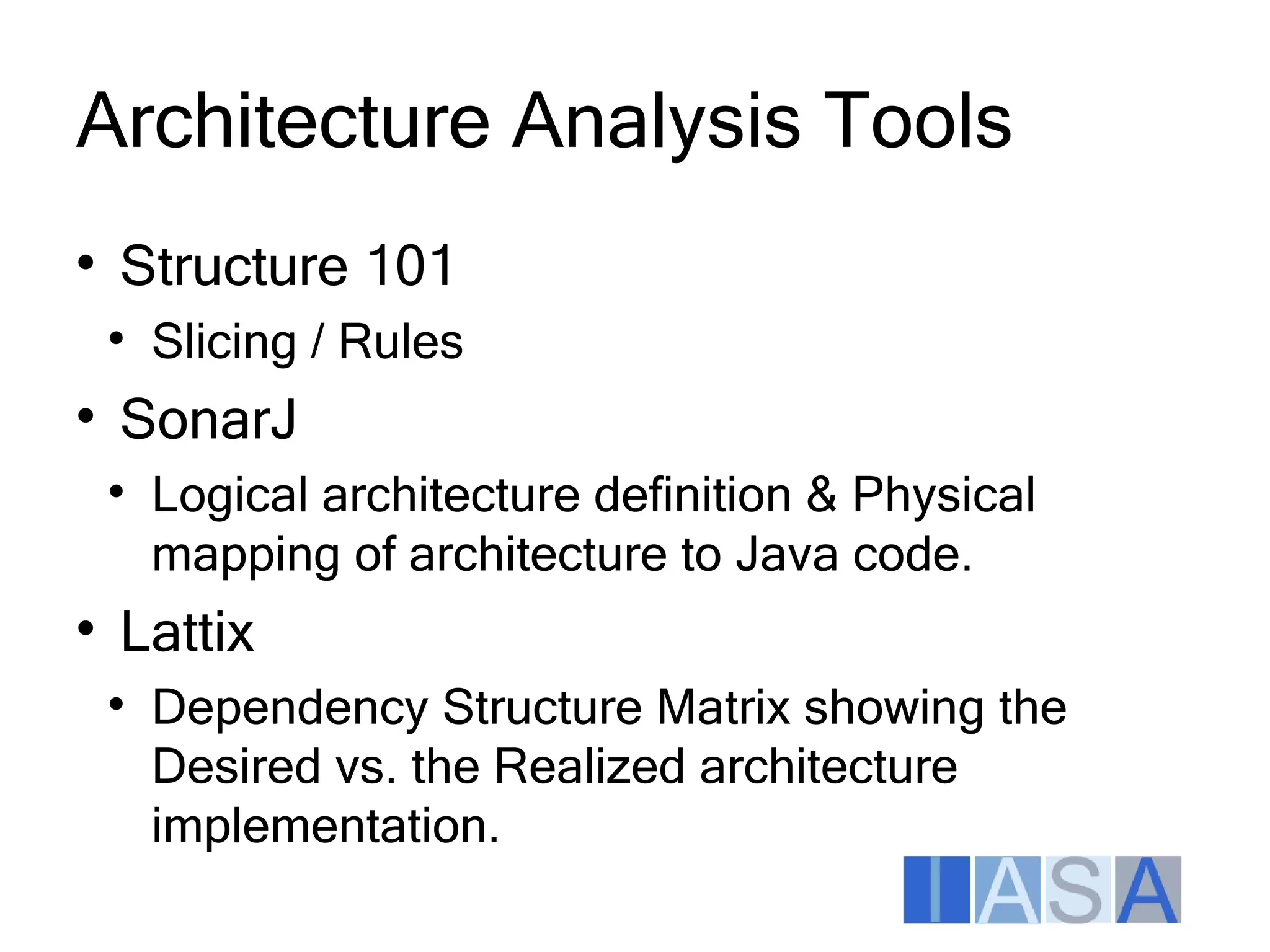
    26. Architecture Analysis Tools Structure 101  Slicing / Rules  SonarJ  Logical architecture definition & Physical  mapping of architecture to Java code. Lattix  Dependency Structure Matrix showing the  Desired vs. the Realized architecture implementation.
    27. Agenda • Reference Architecture & Enforcement • Architecture Rules Categories • Aspect-oriented Programming • Rules Demo(s) • CI Process Changes • Case Study • Architecture Rules Aspects - Open Source Project Sponsor Logo
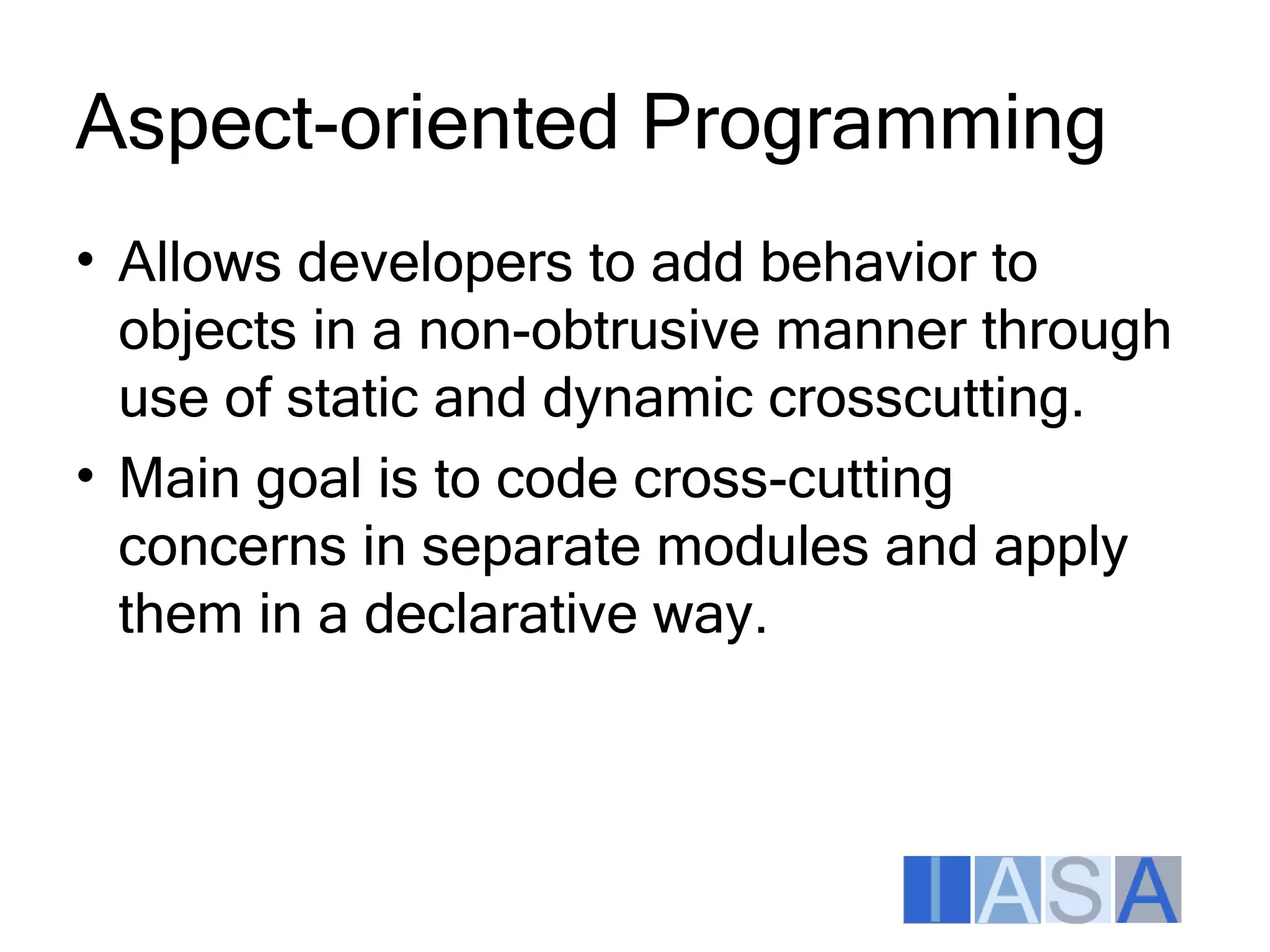
    28. Aspect-oriented Programming • Allows developers to add behavior to objects in a non-obtrusive manner through use of static and dynamic crosscutting. • Main goal is to code cross-cutting concerns in separate modules and apply them in a declarative way. Sponsor Logo
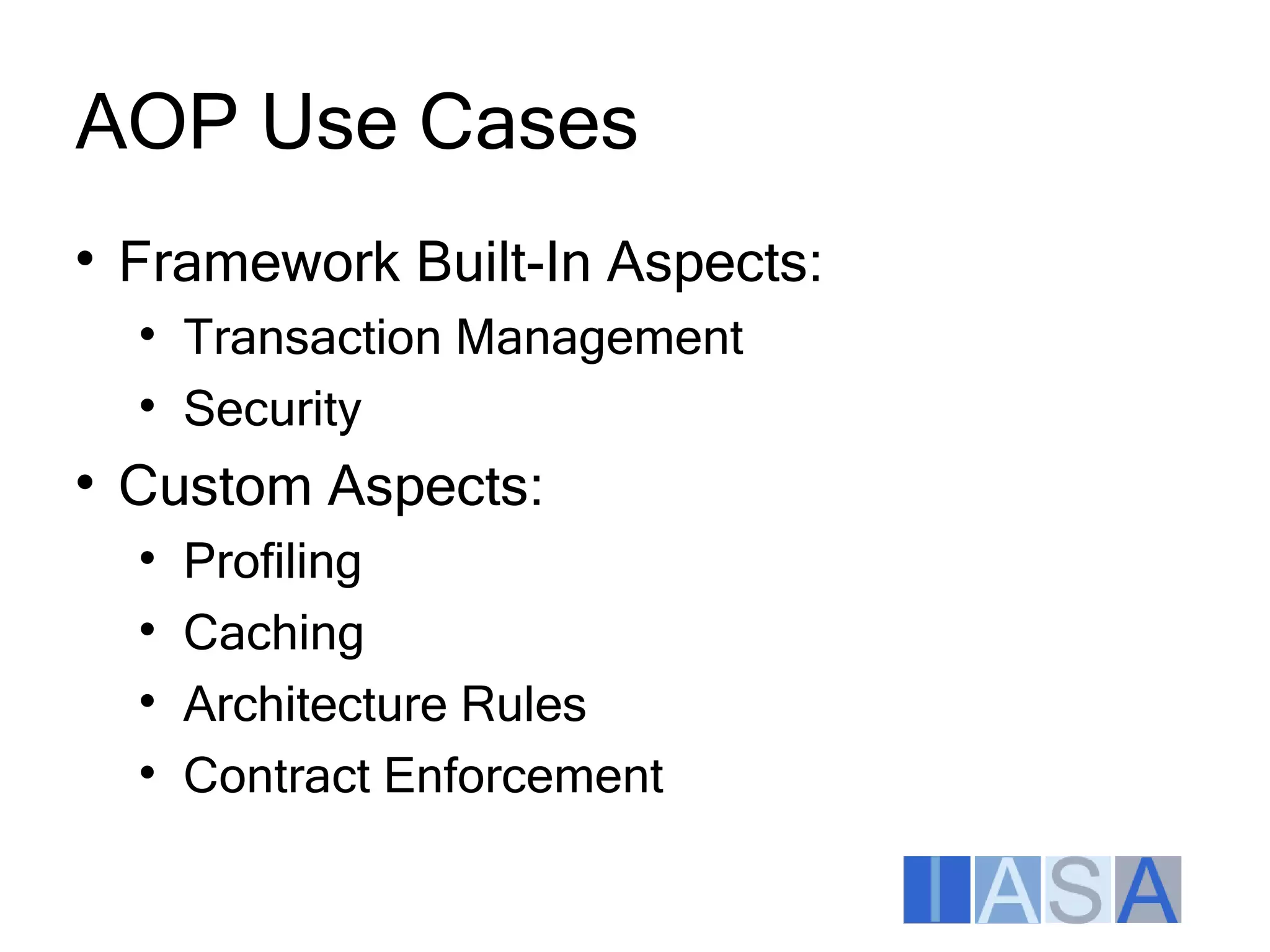
    29. AOP Use Cases Framework Built-In Aspects:  Transaction Management  Security  Custom Aspects:  Profiling  Caching  Architecture Rules  Contract Enforcement  Sponsor Logo
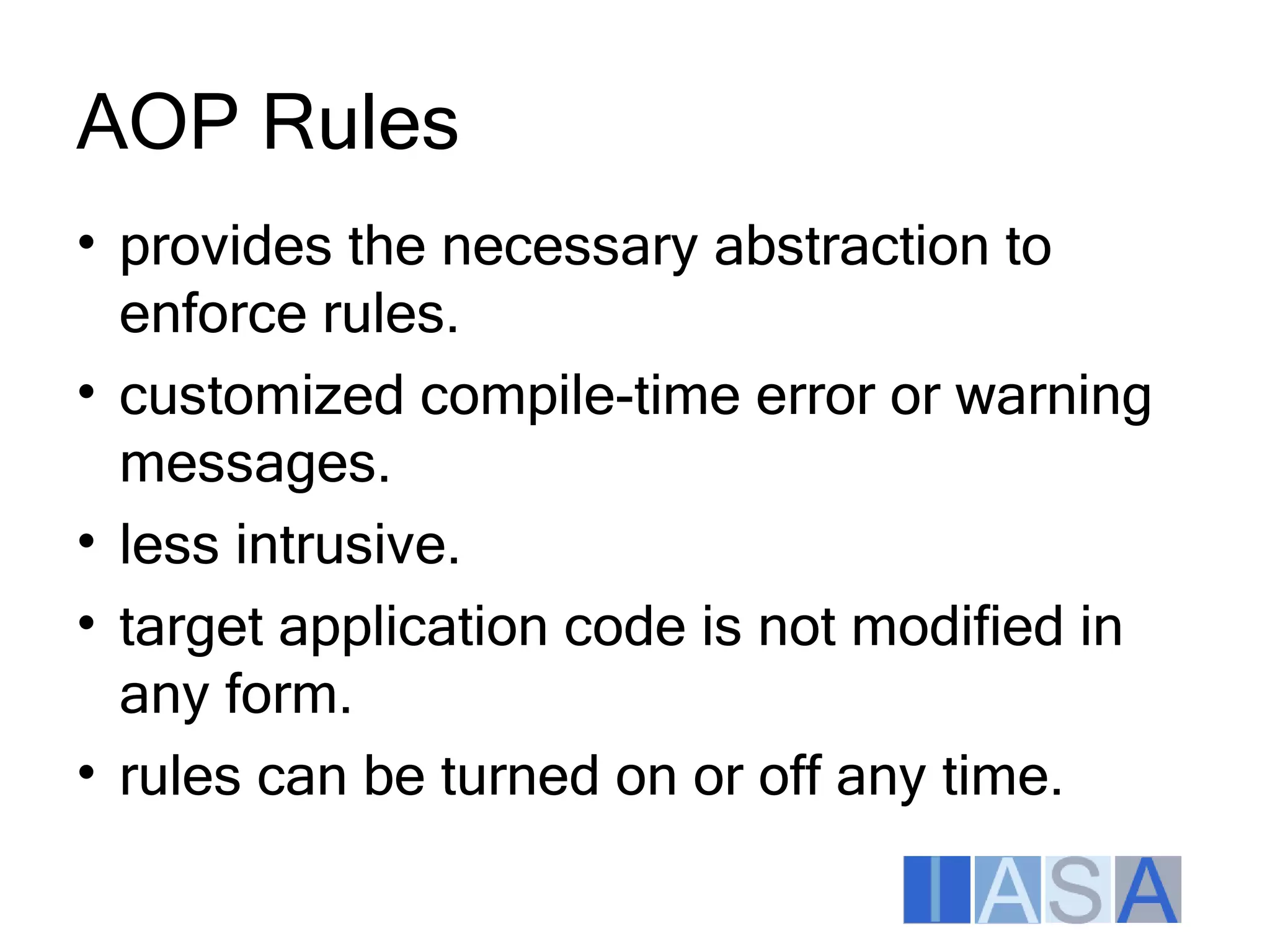
    30. AOP Rules • provides the necessary abstraction to enforce rules. • customized compile-time error or warning messages. • less intrusive. • target application code is not modified in any form. • rules can be turned on or off any time.
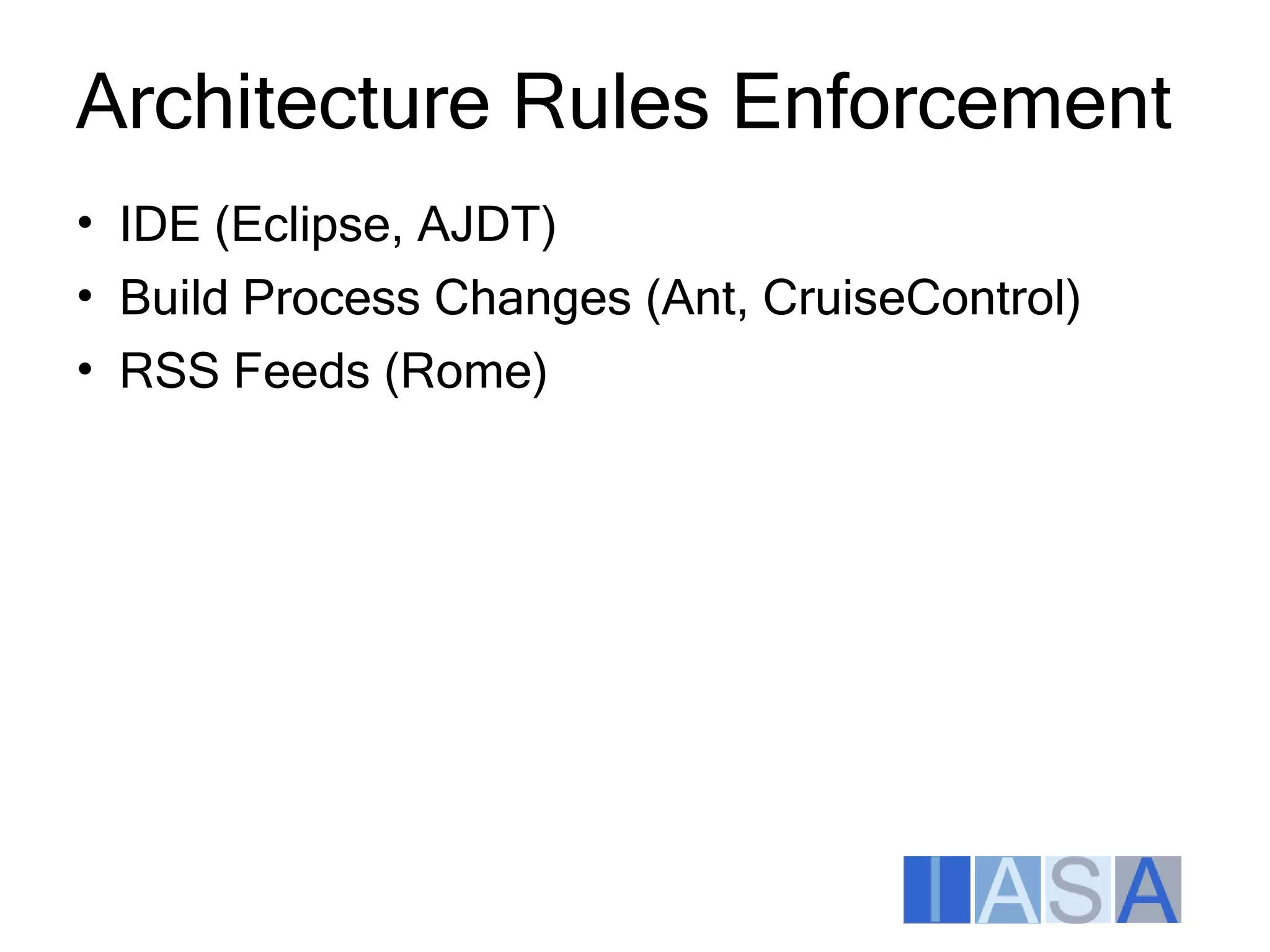
    31. Architecture Rules Enforcement • IDE (Eclipse, AJDT) • Build Process Changes (Ant, CruiseControl) • RSS Feeds (Rome) Sponsor Logo
    32. Agenda • Reference Architecture & Enforcement • Architecture Rules Categories • Aspect-oriented Programming • Rules Demo(s) • CI Process Changes • Case Study • Architecture Rules Aspects - Open Source Project Sponsor Logo
    33. Sample Application Tools:  Eclipse  AspectJ  AJDT  Spring AOP  Ant 
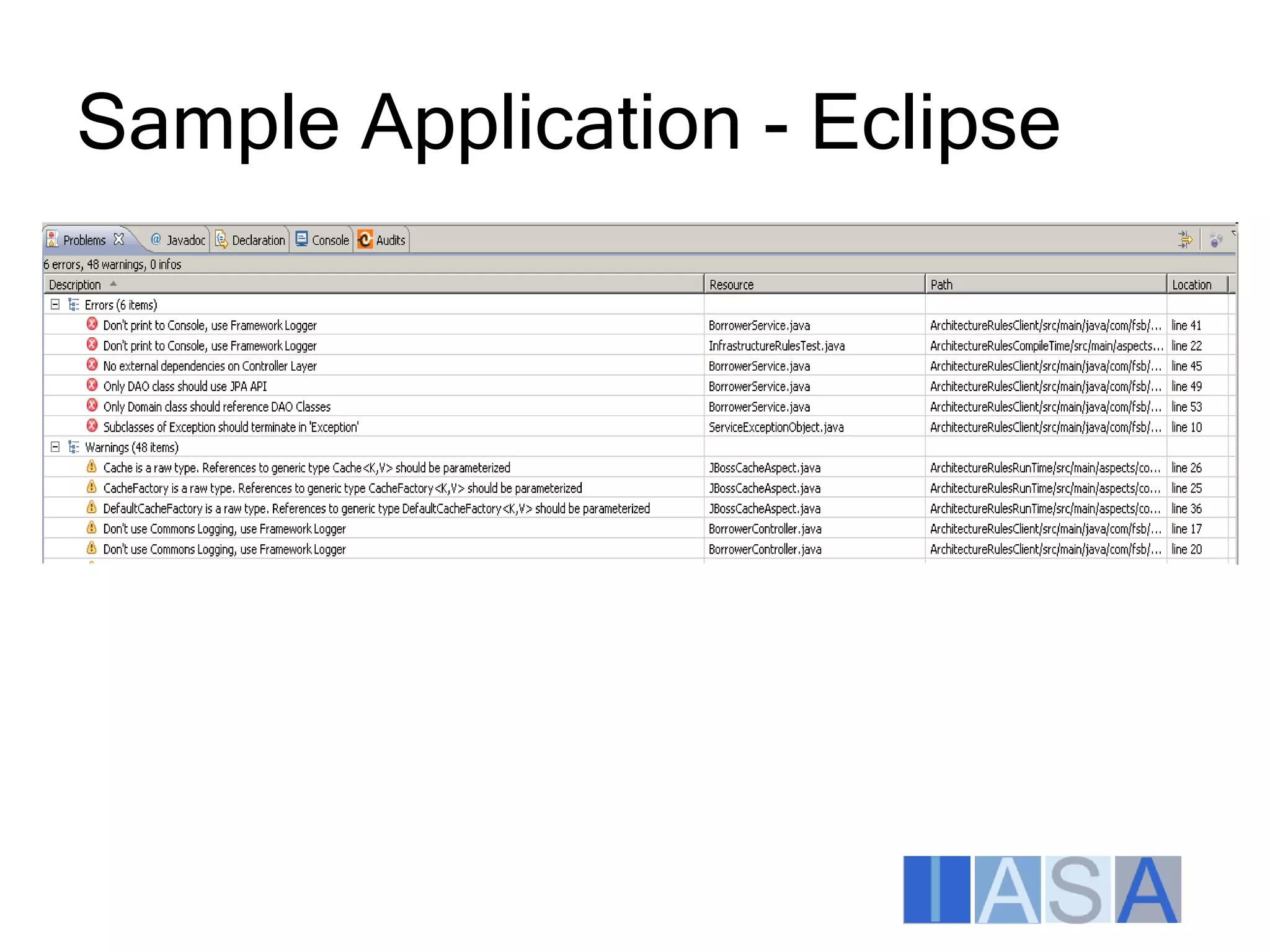
    34. Sample Application - Eclipse
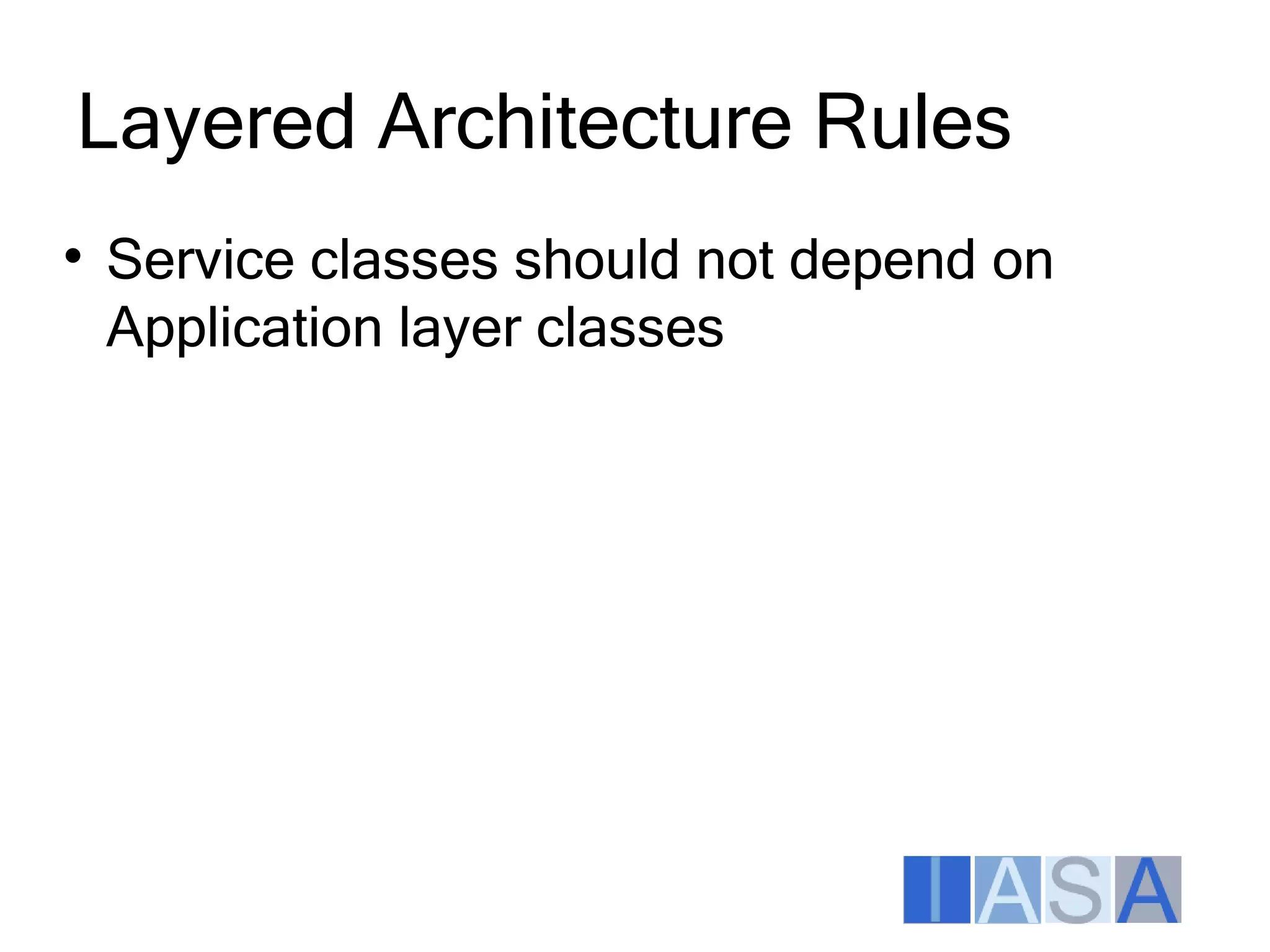
    35. Layered Architecture Rules Service classes should not depend on  Application layer classes
    36. DEMO
    37. Domain-Driven Design Rules • No direct access to DAO's except from the Domain classes (go through Domain or Repository objects).
    38. J2EE Architecture Sponsor Logo
    39. Domain Driven Architecture Sponsor Logo
    40. DEMO
    41. DDD Rules Demo 2 Business service that fails with a  concurrency related failure can be retried. Caching example  Spring AOP and EHCache  Requirement: To cache specific data (objects)  using a custom Annotation Annotation: @CacheEntity  Sponsor Logo
    42. DEMO
    43. Infrastructure Rules No direct use of API:  Log4J or Commons Logging (use Framework  Logger)
    44. DEMO
    45. Agenda • Reference Architecture & Enforcement • Architecture Rules Categories • Aspect-oriented Programming • Rules Demo(s) • CI Process Changes • Case Study • Architecture Rules Aspects - Open Source Project Sponsor Logo
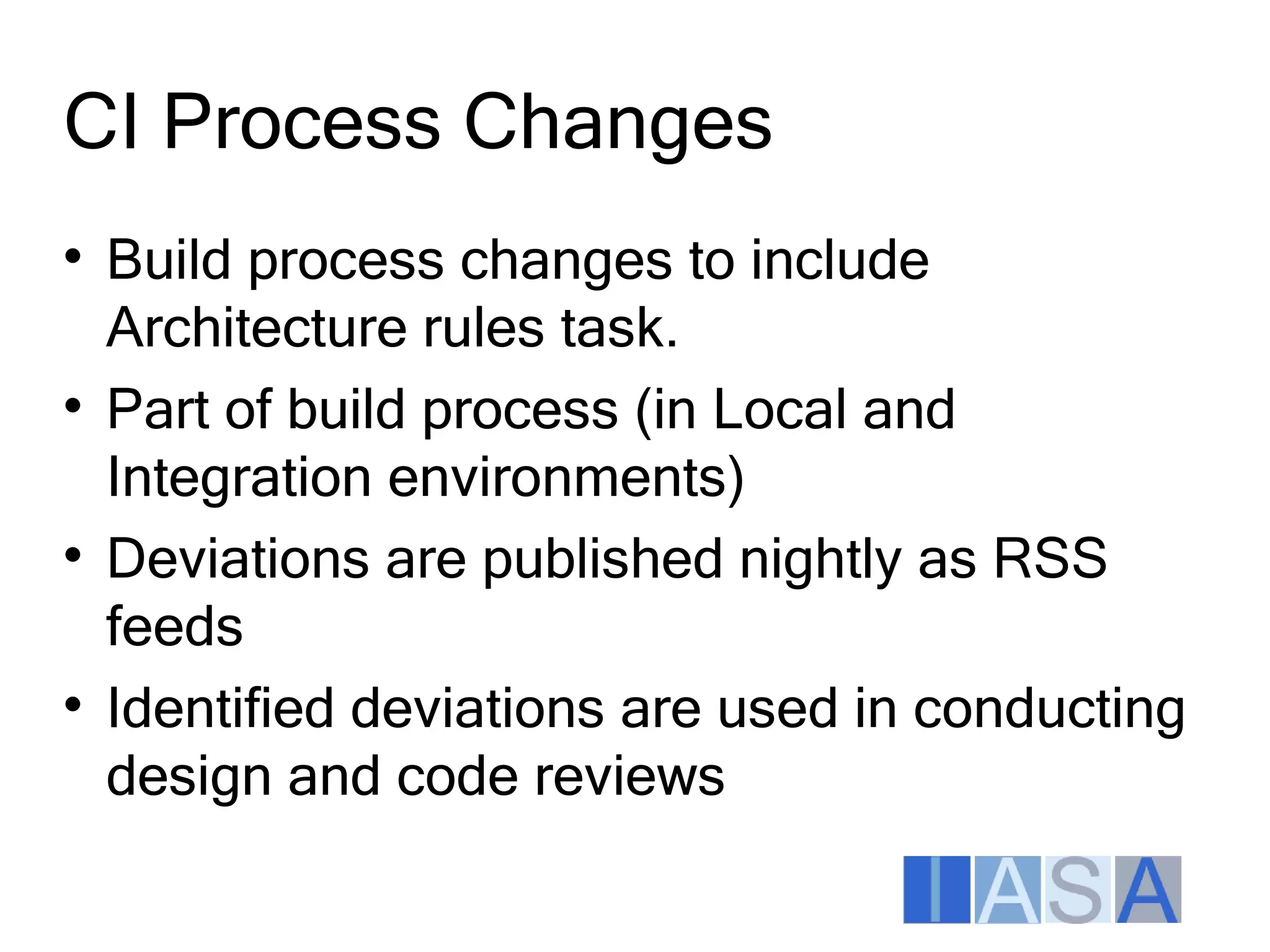
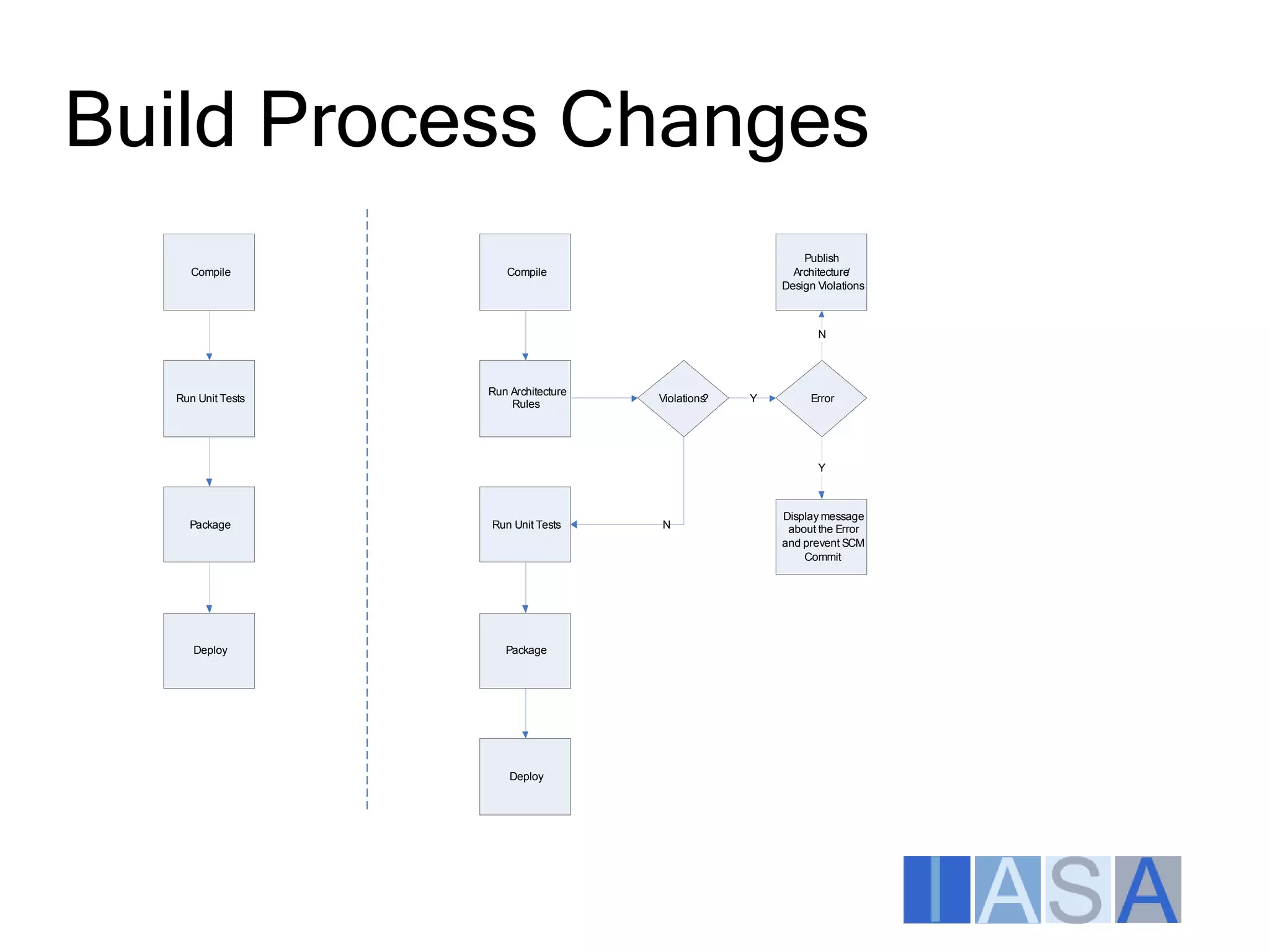
    46. CI Process Changes Build process changes to include  Architecture rules task. Part of build process (in Local and  Integration environments) Deviations are published nightly as RSS  feeds Identified deviations are used in conducting  design and code reviews
    47. Build Process Changes Publish Compile Compile Architecture/ Design Violations N Run Architecture Run Unit Tests Violations ? Y Error Rules Y Display message Package Run Unit Tests N about the Error and prevent SCM Commit Deploy Package Deploy
    48. Sample Application – Ant Build
    49. Enforcement: Aspects or Tools? Tools  Better enforcement options  Licensing costs  Aspects  More flexibility for customization  Relatively intrusive  Not backed by an architecture meta  model.
    50. Agenda • Reference Architecture & Enforcement • Architecture Rules Categories • Aspect-oriented Programming • Rules Demo(s) • CI Process Changes • Case Study • Architecture Rules Aspects - Open Source Project Sponsor Logo
    51. Implementation Road Map • Publish rules along with Reference Architecture (RA) and Standard Technology/Framework Stack. • Pick a pilot application to enforce architecture rules as part of the build process (and Eclipse IDE). • Incorporate architecture enforcement into other applications. • Training/Mentoring as part of an on-going Architecture Governance effort.
    52. Case Study Implementation Plan:  Phase 1 (Day 1): Enable rules but not enforce  them (yet). Phase 2 (Day 16): Enable rules and enforce only  critical Errors (No Warnings). Phase 3: Enable rules and enforce all deviations  (Errors & Warnings). Phase 4: Enable rules and enforce all Errors and  Warnings in all applications in the enterprise.
    53. Agenda • Reference Architecture & Enforcement • Architecture Rules Categories • Aspect-oriented Programming • Rules Demo(s) • CI Process Changes • Case Study • Architecture Rules Aspects - Open Source Project Sponsor Logo
    54. Architecture Rules Aspects Open source Google project  architecture-rules-aspects ● (http://code.google.com/p/architecture-rules- aspects/ Future road-map:  DSL to define architecture rules (e.g. Groovy)  Define the rules in a Rules Engine.  Feedback 
    55. Conclusions • Make architecture rules part of build process to detect deviations earlier in SDLC. • Use enforcement check results to improve architecture/design/code (via refactoring efforts) • Capture design patterns and best practices as policy enforcement Aspects. • Refine & refactor enforcement rules.
    56. Resources (1/2) • Architecture Rules Aspects Google Project (http://code.google.com/p/architecture-rules- aspects/) • AspectJ In Action (2nd Edition) • Building Software As Solid As The Pyramids (Ramnivas Laddad & Alef Arendsen) • Using Aspect-Oriented Programming to Enforce Architecture (Paulo Merson) • AOP In the Enterprise (Adrian Colyer) • Aspects & policy injection - clean up your code • Policy Injection Application Block
    57. Resources (2/2) • Structure 101 • SonarJ (http://www.hello2morrow.com) • Lattix • Contract4J (http://www.contract4j.org/contract4j) • Macker (http://innig.net/macker/)
    58. AOP Tools • AJDT • Spring AOP • MaintainJ: Sequence Diagram Using AspectJ • PointcutDoctor • Jexin
    59. Contact Information • Domain-Driven Design and Enterprise Architecture articles on InfoQ. • InfoQ website (http://www.infoq.com) • E-Mail: srinipenchikala@gmail.com • Blog: http://srinip2007.blogspot.com Sponsor Logo
    60. Q&A Sponsor Logo
    61. Thank You • Thank you for your attention • SATURN 2009 Conference Presentation • Feedback survey Sponsor Logo

    + Srini PenchikalaSrini Penchikala, 8 months ago

    custom

    658 views, 0 favs, 0 embeds more stats

    ITARC Atlanta 2009 conference presentation on using more

    More info about this document

    © All Rights Reserved

    Go to text version

    • Total Views 658
      • 658 on SlideShare
      • 0 from embeds
    • Comments 0
    • Favorites 0
    • Downloads 0
    Most viewed embeds

    more

    All embeds

    less

    Flagged as inappropriate Flag as inappropriate
    Flag as inappropriate

    Select your reason for flagging this presentation as inappropriate. If needed, use the feedback form to let us know more details.

    Cancel
    File a copyright complaint
    Having problems? Go to our helpdesk?

    Categories