
2009 September Kinesin Talk at UNM Chemistry
•Download as PPT, PDF•
2 likes•828 views

Talk given by Steve at the Unviversity of New Mexico Chemistry Department on September 11, 2009. It is mostly still an introduction to our kinesin project, but now I'm able to include the latest results from gliding motility assay, tracking software, and stochastic kinetics simulation.
![[object Object],[object Object],[object Object],[object Object],[object Object],KochLab Overview / Acknowledgments Susan Atlas —Lead of the DTRA project UNM Physics / Cancer Center / Director of CARC Haiqing Liu —Microdevice applications of kinesin LANL & Center for Integrated Nanotechnology (CINT) Evan Evans Lab —Single-molecule thermodynamics and kinetics U. New Mexico / U. British Columbia / Boston U. Collaborations Funding DTRA —Basic Science; CHTM —Startup; ACS —Jan Oliver IRG](data:image/gif;base64,R0lGODlhAQABAIAAAAAAAP///yH5BAEAAAAALAAAAAABAAEAAAIBRAA7)
Recommended
Recommended
More Related Content
What's hot
What's hot (20)
Similar to 2009 September Kinesin Talk at UNM Chemistry
Similar to 2009 September Kinesin Talk at UNM Chemistry (20)
More from Steve Koch
More from Steve Koch (20)
Recently uploaded
Recently uploaded (20)
2009 September Kinesin Talk at UNM Chemistry
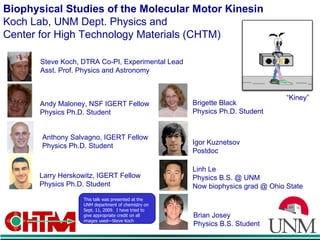
- 1. Biophysical Studies of the Molecular Motor Kinesin Koch Lab, UNM Dept. Physics and Center for High Technology Materials (CHTM) Steve Koch, DTRA Co-PI, Experimental Lead Asst. Prof. Physics and Astronomy Larry Herskowitz, IGERT Fellow Physics Ph.D. Student Anthony Salvagno, IGERT Fellow Physics Ph.D. Student Brigette Black Physics Ph.D. Student Andy Maloney, NSF IGERT Fellow Physics Ph.D. Student Igor Kuznetsov Postdoc Linh Le Physics B.S. @ UNM Now biophysics grad @ Ohio State “ Kiney” Brian Josey Physics B.S. Student This talk was presented at the UNM department of chemistry on Sept. 11, 2009. I have tried to give appropriate credit on all images used—Steve Koch
- 4. Kinesin is a eukaryotic molecular motor protein with a number of intracellular functions Mitosis Intracellular transport
- 5. Kinesin binds to microtubules and uses ATP hydolysis to walk along tubulin protofilaments An overview of the two basic components of this system: Microtubules Kinesin Microtubules are a key component of the system: kinesin does not move or catalyze ATP hydrolysis in absence of MTs Goldstein Lab
- 6. Microtubules are polymers of tubulin heterodimers 25 nm 4 nm 8 nm
- 7. Microtubules can be reliably polymerized in vitro In living cells, predominant form of MTs have 13 protofilaments (PFs) In vitro “reassembly” of microtubules was possible by the early 1970s (Borisy, Brinkley, …) Typically performed with purified bovine or porcine brain tubulin Produces an assortment of MTs with varying numbers of PFs (usually not 13) Recombinant tubulin is not readily available MTs are stabilized by taxol … chemical cross-linking is another strategy Easily visualized by fluorescence microscopy - + tubulin dimer Protofilament 25 nm
- 8. Kinesin binds to microtubules and uses ATP hydrolysis to walk along tubulin protofilaments An overview of the two basic components of this system: Microtubules Kinesin Goldstein Lab
- 9. Kinesin is a eukaryotic molecular motor protein with a number of intracellular functions Mitosis Intracellular transport Vale, Reese, Sheetz, 1985, Cell 42 39-50. “Identification of a Novel Force-Generating Protein, Kinesin, Involved in Microtubule-Based Motility.” At least 14 families of kinesin across all eukaryotes Dimeric “conventional” kinesin-1 : vesicle transport Kinesin-1, -2, -3, etc… E.g., Kinesin-5 is tetrameric kinesin: spindle formation HHMI Winter Bulletin 2005 Kinesin-5 tetramers
- 10. Conventional kinesin-1 “walks” along protofiliments in hand-over-hand mechanism Sablin and Fletterick, 2004 JBC
- 11. Processivity Thorn, Ubersax, Vale JCB 2000
- 13. Truncated, tagged conventional kinesin constructs Coy, Hancock, Wagenbock, Howard (1999) Full length conventional kinesin self-inhibits by tail binding to motor domain Asbury, Fehr, Block (2003) Recombinant kinesin expressed in E. coli, purified by his-tag methods Limited commercial availability
- 14. Striving for atomistic insights into catalytic mechanism Sablin and Fletterick, 2004 JBC Much has been learned about kinesin at the stochastic (mechanical) level But atomistic understanding of mechanochemistry is lacking Our goal is to gain atomistic insight via a variety of experiments and simulations
- 15. Our DTRA Project: “Coupled Atomistic Modeling and Experimental Studies of Energy Transduction and Catalysis in the Molecular Motor Protein Kinesin” Susan Atlas and Steve Valone (LANL) “ Charge transfer embedded atom model” (CT-EAM) Atomistic modeling of kinesin catalytic core Kochlab: Biophysical studies of kinesin
- 16. An initial connection between theory & experiment: Water! CT-EAM can correctly model water; can make predictions about how osmotic pressure and heavy water will affect kinetics Kochlab: Can vary water osmotic pressure; heavy / light water
- 17. Biophysicists have often ignored water Me too, before I saw work from Parsegian, Rand, Rau 1995
- 18. The osmotic stress method relies on changing water activity by adding high concentration of solutes Parsegian, Rand, Rau, Methods in Enzymology 259 (1995) “ Osmolyte” (sucrose, betaine, PEG, …) Reduces the chemical potential of water Molecule of interest has a shell of hydrating water molecules
- 19. No osmotic stress studies of kinesin untapped Utility proven in protein-DNA studies Protein DNA Non-specific, K nonsp Specific complex, K sp Sidorova and Rau, PNAS 1996
- 20. Osmotic stress dramatically increases lifetime of bound molecular complexes Osmotic pressure helpful For increasing lifetime too ln(Fraction bound) Sidorova and Rau Kinesin binding / unbinding
- 21. Why is water so important? Each time the kinesin head binds to tubulin, dozens of “hydrating” water molecules must be excluded. Each time the kinesin unbinds, water must “rehydrate” Thus, “water activity” strongly impacts binding kinetics (and whole kinetic cycle) Okada, Higuchi, Hirokawa Water excluded Water hydrating
- 22. Osmotic stress increases myosin-actin affinity (only one study I’m aware of) Highsmith et al. Biophys. J. 1996 No data exist for kinesin-MT Potentially many high-impact results
- 23. So, our first line of experiments will utilize osmotic stress (and heavy water) Properties of water will provide initial strong ties between theory and experiment Provide a very interesting line of high-impact experiments Also provide a connection to technological applications of kinesin / MT system Long-term stability of kinesin and microtubules Up-modulation of kinesin processivity? velocity? strength?
- 24. We will utilize two independent experimental platforms “ Easy” Robust Many experimental “knobs” Limited readout More difficult Many experimental “knobs” Many readout variables
- 25. Gliding motility assay Andy, Brigette, Linh have gliding assay working very well in our lab! Passivated glass surface (casein) Buffer includes ATP, antifade cocktail The assay is a bit finicky…light-induced microtubule disintegration is one problem.
- 26. Microtubule velocity in gliding assay is measured via LabVIEW image tracking software written by Larry
- 27. Gliding motility assay will be our initial main assay Operate in the high motor density regime Main experimental result is transport velocity Osmotic stress Light / heavy water Temperature, metal ions, ATP concentration Site-directed mutagenesis Experimental “knobs” to obtain data that can be compared with theory in the iterative loop Passivated glass surface (casein) Buffer includes ATP, antifade cocktail
- 28. Bead motility assay Adrian Fehr, Chip Asbury Science 2003 Steve Block Lab, Stanford Single-molecule kinesin transport Steve Block Lab, Stanford
- 29. Optical tweezers are formed by shining laser light into a high numerical aperture objective Optical Trap “ Laser tweezers” Microsphere Biomolecular “Tether” Coverglass Kochlab Optical Tweezers
- 32. Bead motility assay provides wealth of information High kinesin concentration Measure velocity of collective molecular motors (similar to gliding assay) Low kinesin concentration Single-molecule studies of kinesin: processivity force-velocity pull-off force Block et al. (2003) PNAS
- 33. Bead motility assay High kinesin concentration Measure velocity of collective molecular motors (similar to gliding assay) Low kinesin concentration Single-molecule studies of kinesin: processivity force-velocity pull-off force Experimental knobs for iterative theory/experiment loop: Osmotic stress Light / heavy water Temperature, metal ions, ATP concentration Site-directed mutagenesis We’ve not yet implemented this assay
- 34. Modeling: Kinesin kinetic cycle is complicated Gilbert et al., Nature 1995 R. D. Vale and R. A. Milligan, Science 288 , 88 (2000). We can not measure all of these rate constants directly…We measure: velocity; processivity; stall force; pull-off force
- 35. We have written a stochastic simulation for interpreting / predicting results of assays DT Gillespie , “ Exact Stochastic Simulation of Coupled Chemical Reactions” The Journal of Physical Chemistry, V. 8 p. 2340 1977 State machine, written in LabVIEW by Larry
- 36. Results of simulation can be viewed with LabVIEW animation – gives insight into kinetic pathway
- 37. Simulation of a single kinesin run
- 38. Repeating many times, we can measure the “processivity” -> average run length Guydosh @ Block Nature 2009 optical tweezers measurements
- 39. Changing ATP concentration in the simulation produces Michaelis-Menten kinetics 200 simulations at each concentration
- 40. Application of opposing and assisting force also reproduces results seen with OT data! Block et al. (2003) PNAS
- 41. Acknowledgments Susan Atlas —Lead of the DTRA project UNM Physics / Cancer Center / Director of CARC Steve Valone —Co-PI (LANL) Haiqing Liu —Microdevice applications of kinesin LANL & Center for Integrated Nanotechnology (CINT) Evan Evans Lab —Single-molecule thermodynamics and kinetics U. New Mexico / U. British Columbia / Boston U. Collaborations Funding DTRA —Basic Science; CHTM —Startup; ACS —Jan Oliver IRG Our Lab —Larry Herskowitz, Andy Maloney, Brigette Black, Anthony Salvagno, Linh Le, Brian Josey, Igor Kuznetzov
- 42. End
- 43. Our preliminary data showed that osmotic stress effects protein-DNA unbinding forces X-intercept of these curves reveals off-rate Evans & Ritchie 1997 theory Protein-DNA interactions probed by DNA unzipping is another Koch Lab project We anticipate similar effects of osmotic stress on kinesin-MT forced disruption Specific Non-specific
- 44. Kinesin-microtubule unbinding forces Kawaguchi, Uemura, Ishiwata 2003 “ Dynamic Strength of Molecular Adhesion Bonds” Evan Evans and Ken Ritchie, 1997 Biophys. J. Brower-Toland et al., 2002