The document outlines the history of Scouting Troop 109 in Phoenix, AZ, detailing the origins and development of the Boy Scouts initiated by Robert Baden-Powell in the early 1900s. It describes Baden-Powell's military background, his founding of the Boy Scouts, and important milestones such as the first Scout camp and the creation of merit badges. The text also highlights the growth of the Scouting movement in the U.S., the establishment of the Boy Scouts of America, and notable figures within the organization.
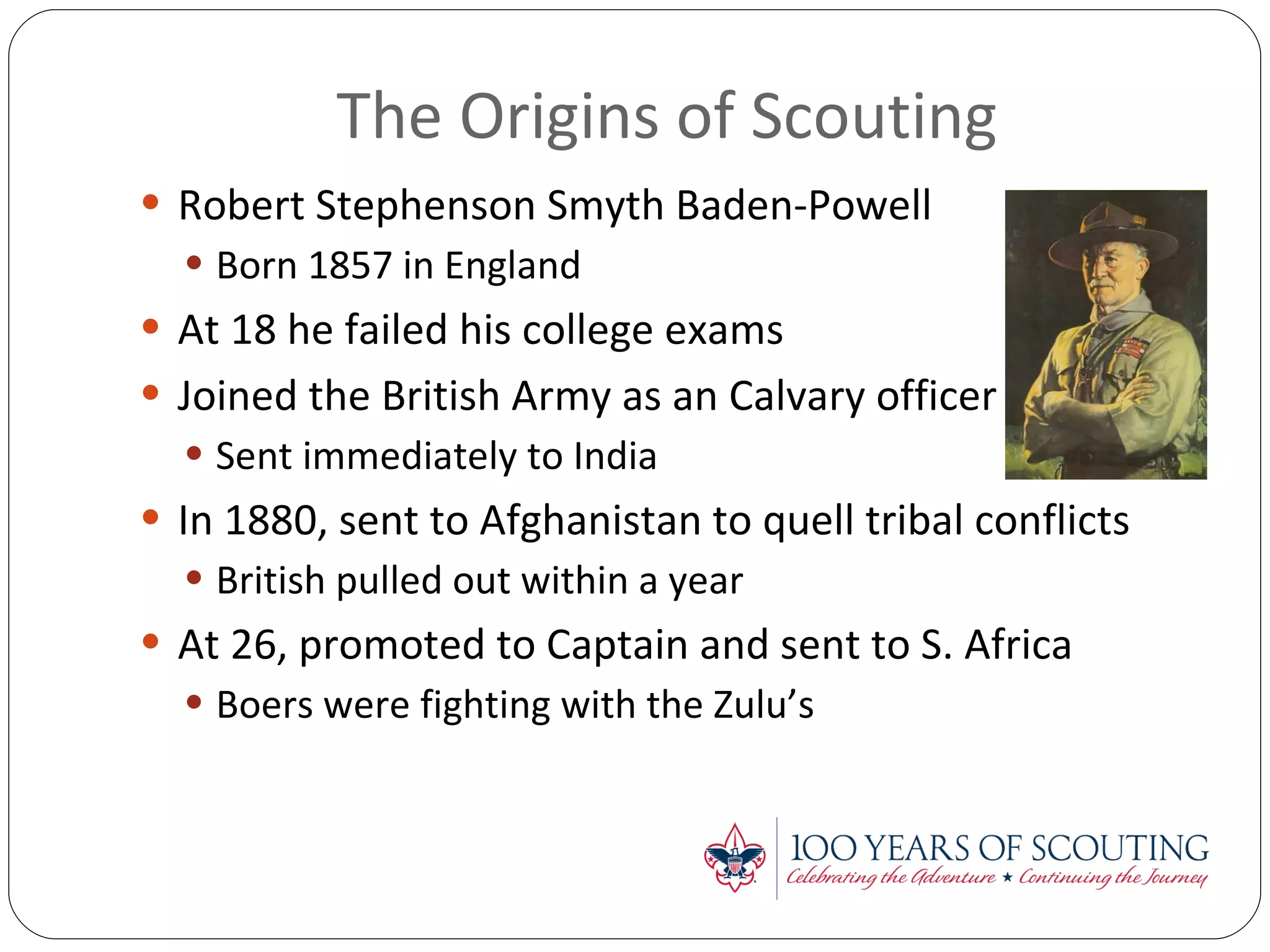
The Origins ofScouting Robert Stephenson Smyth Baden-Powell Born 1857 in England At 18 he failed his college exams Joined the British Army as an Calvary officer Sent immediately to India In 1880, sent to Afghanistan to quell tribal conflicts British pulled out within a year At 26, promoted to Captain and sent to S. Africa Boers were fighting with the Zulu’s
3.
Learning the TradeIn 1890, stationed in Malta promoted to Major Sent on intelligence missions posing as a Butterfly Collector Participated in the Ashanti Expedition in 1895 Gold Coast of Africa (Ghana) where tribes were fighting over control of the slave trade Promoted to Lt. Colonel 1897 promoted to full Colonel commanding the 5 th Dragoon Guards in India Known as B-P
4.
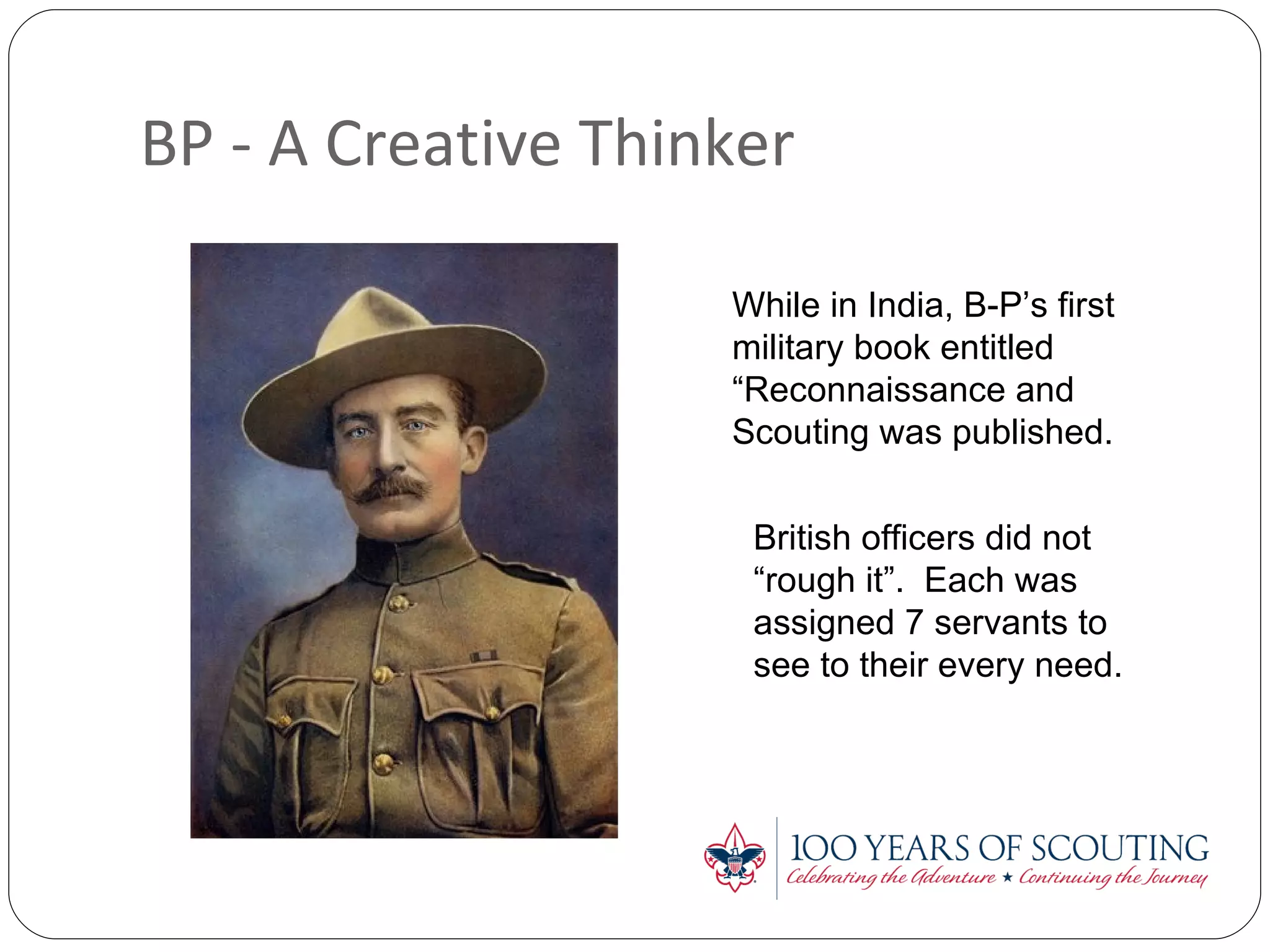
BP - ACreative Thinker While in India, B-P’s first military book entitled “Reconnaissance and Scouting was published. British officers did not “rough it”. Each was assigned 7 servants to see to their every need.
5.
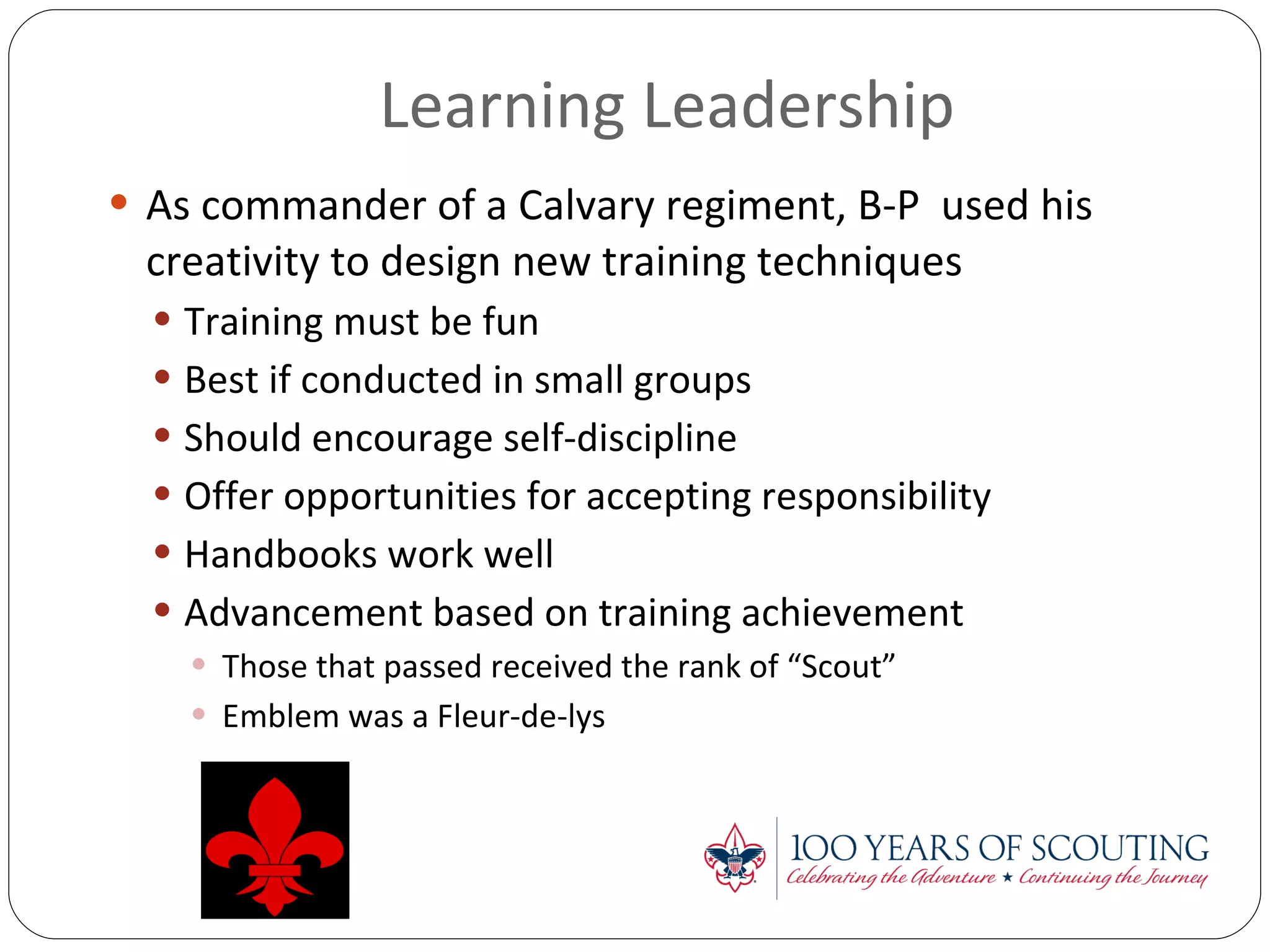
Learning Leadership Ascommander of a Calvary regiment, B-P used his creativity to design new training techniques Training must be fun Best if conducted in small groups Should encourage self-discipline Offer opportunities for accepting responsibility Handbooks work well Advancement based on training achievement Those that passed received the rank of “Scout” Emblem was a Fleur-de-lys
6.
Baden-Powell, the Hero In 1899 B-P sent to S. African Boer War B-P Commander-in-Chief of the Rhodesian Frontier Force Dutch, British and native tribes fighting over land and sovereignty B-P defends the city of Mafeking from the Boers (Dutch) Siege lasts 217 days His book “Aids to Scouting” is published Covers outdoor skills needed for military personnel B-P becomes a national hero Promoted to Major-General
7.
Putting His Ideasinto Practice B-P sets up a new S. African army Designs uniforms himself Khaki shirt with soft collar Round brimmed campaign hats Implements his training techniques Morale and enthusiasm so high, the soldiers adopted the slogan “Be Prepared” Each division divided into 4 “Districts” Districts divided into “Troops” Troops divided into “Patrols” of 6 men Each has a “patrol leader”
8.
Recognizing the PotentialIn 1904 B-P becomes Inspector General of Great Britain and Ireland Tours England and finds many schools, YMCAs, and other youth military groups are using his book Aids to Scouting as a handbook Over 50,000 boys participating throughout England B-P believes participation could be much bigger if boys performed more fun, non-military type activities He envisions a movement that could help the impoverished youth of England Begins to modify his Aids to Scouting book to include outdoor camping skills and citizenship
9.
Boy Scouts TakesForm In 1906 B-P receives a book entitled The Birch-bark Roll of the Woodcraft Indians Authored by Ernest Thomson Seton An American boys group focused on Indian lore and frontier skills The two men meet in London and agree to merge their ideas to form a boy’s organization The Boy Scouts was born Each area would be set up as a “Council” Achievement awards were changed from feathers to merit badges
10.
B-Ps Outlines HisScouting Ideas In 1907 B-P published his outline for the Boy Scouts Received wide acceptance Object: To make the rising generation, of whatever class or creed, into good citizens Subjects: activities such as tracking, woodcraft, lifesaving, health, thrift, self-sacrifice, discipline, responsibility, chivalry, and patriotism Organization: patrols, led by a Scoutmaster
11.
Testing His IdeasOn July 29, 1907 B-P held the first Boy Scout summer camp Brownsea Island, off southern coast of England Invited 21 boys to attend Issued S. African army uniforms Created patrol names (Wolves, Bulls, Ravens) The first Boy Scout campfire was held on July 31, 1907 B-P told stories about his military career The last day of camp, the scouts played games Scout planned, and led
12.
13.
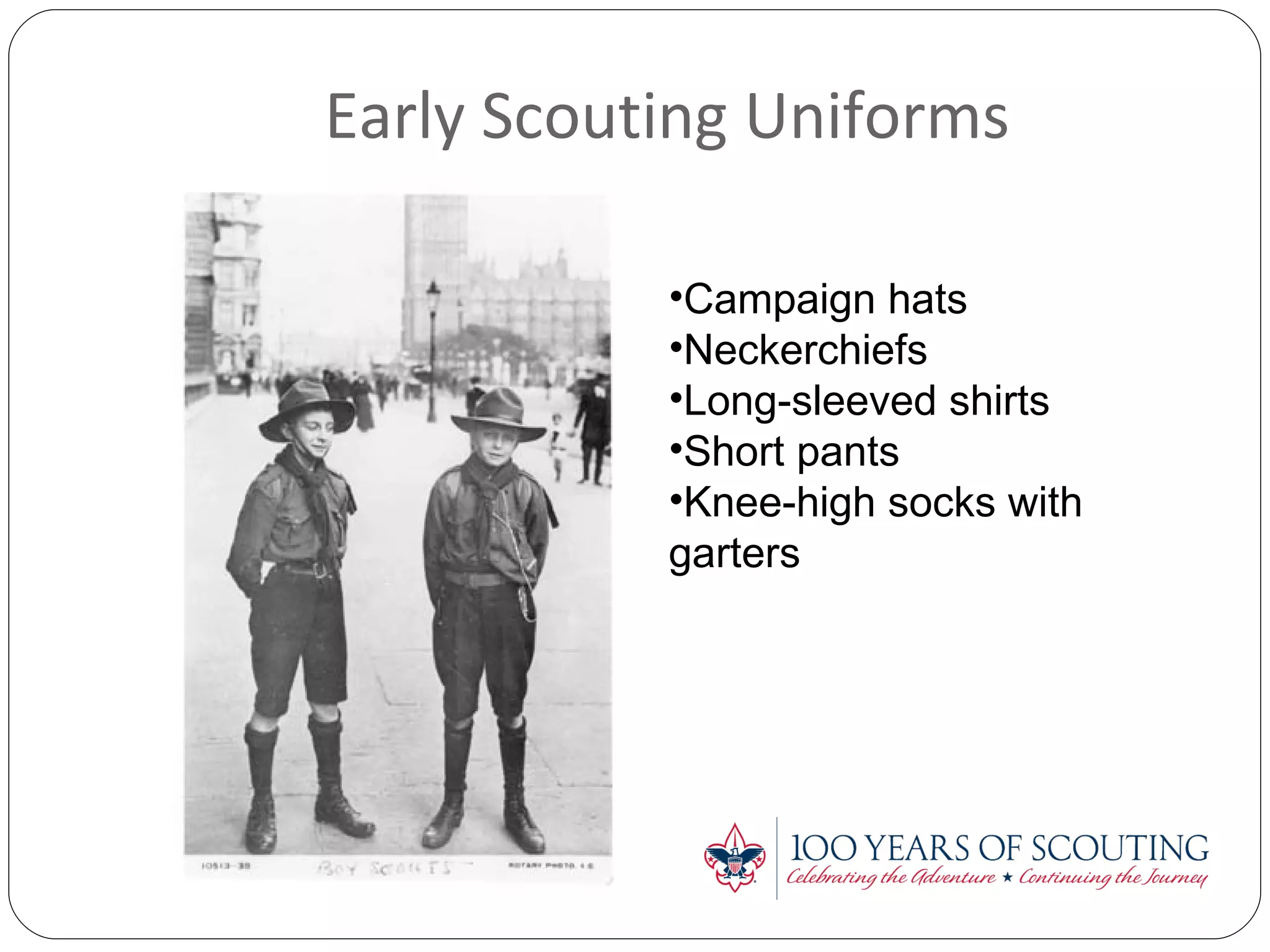
Early Scouting UniformsCampaign hats Neckerchiefs Long-sleeved shirts Short pants Knee-high socks with garters
14.
The Scouting MovementSkyrockets In 1908, a re-written handbook “Scouting for Boys” was published Outlined the Scout Oath, Law, rank advancement to First Class and merit badges. Created the official scout salute and uniform Tens of thousands of boys joined within a few years B-P always planned on Scouting to be a part of other organizations Boys wanted to be Scouts, and only Scouts Led to a stand-alone Boy Scout organization By 1909, scouting had spread to India and Canada
15.
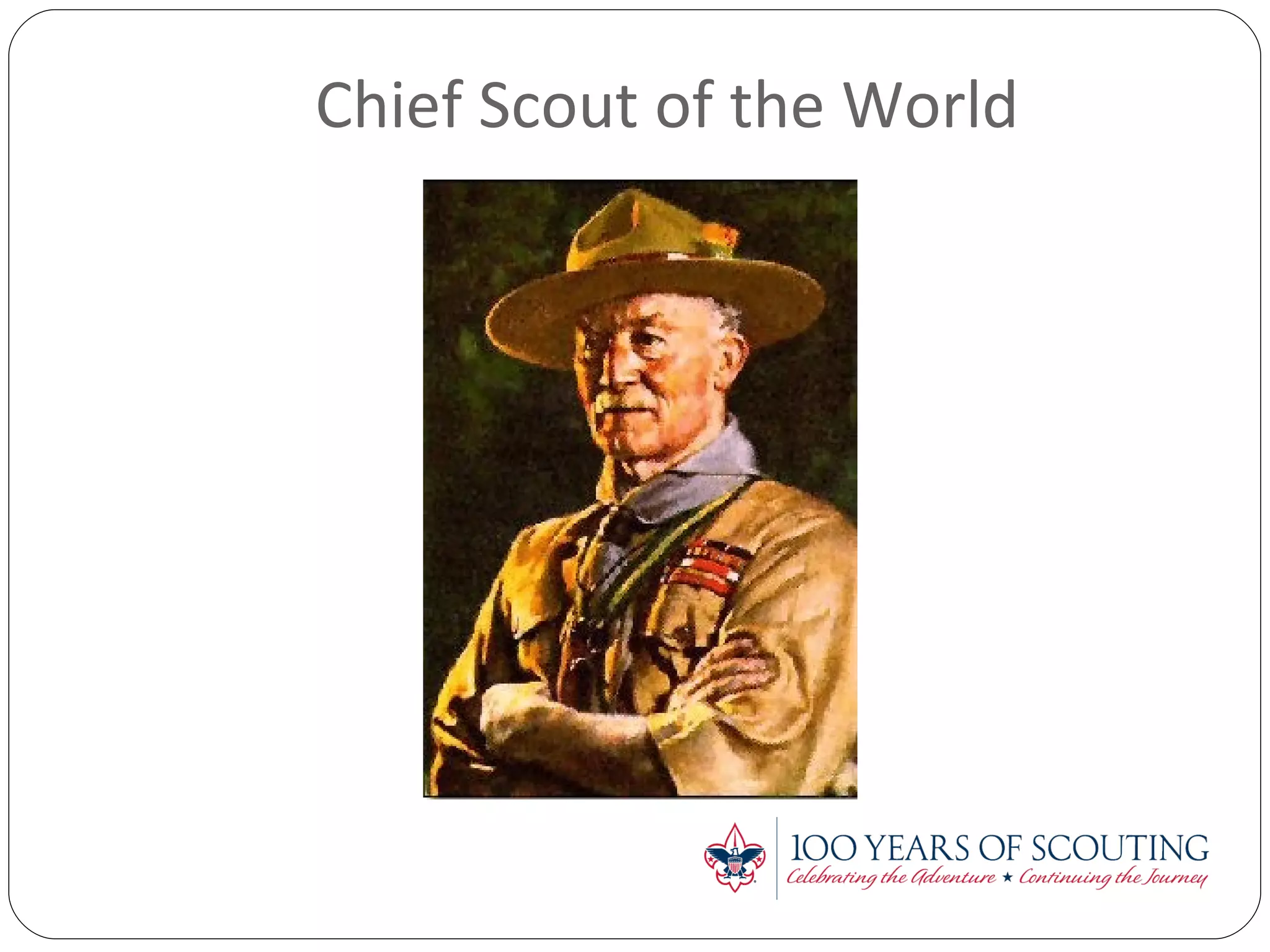
Gilwell Park In1909, the King of England knighted B-P In 1910 B-P initiated the Cub Scout program to prepare both boys and adults for scouting In 1919, the King gave land at Gilwell Park to serve as the official Boy Scout training center Site of the first Boy Scout Jamboree and Wood Badge leadership training course In 1920, site of the first Boy Scout World Jamboree B-P named Chief Scout of the World B-P died in 1937
16.
Creation of theBoy Scout of America In 1909, William Boyce visited London and became lost A Boy Scout helped him find his way and would not accept a tip, for Scouts were expected to do a good turn daily Boyce was so impressed, he wrote to B-P about bringing scouting the America The BSA was established in 1910 President Theodore Roosevelt was named Chief Scout Citizen Merged with the Sons of Daniel Boone, a backwoods boys group founded by Daniel Carter Beard In 1912, the Boys Life magazine was created Arthur Eldred becomes the first Eagle Scout Scout dues were 25 cents
17.
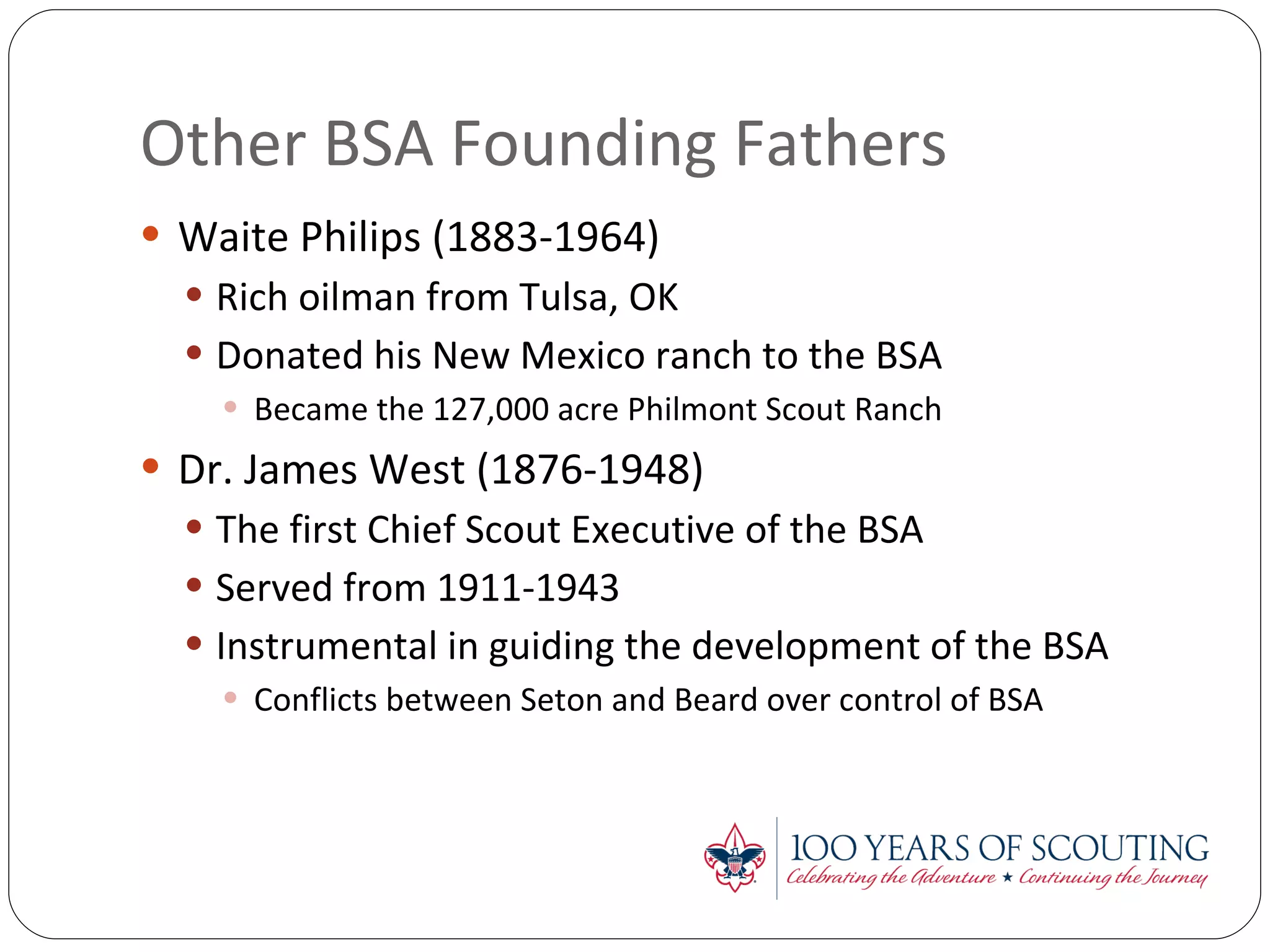
Other BSA FoundingFathers Waite Philips (1883-1964) Rich oilman from Tulsa, OK Donated his New Mexico ranch to the BSA Became the 127,000 acre Philmont Scout Ranch Dr. James West (1876-1948) The first Chief Scout Executive of the BSA Served from 1911-1943 Instrumental in guiding the development of the BSA Conflicts between Seton and Beard over control of BSA
18.
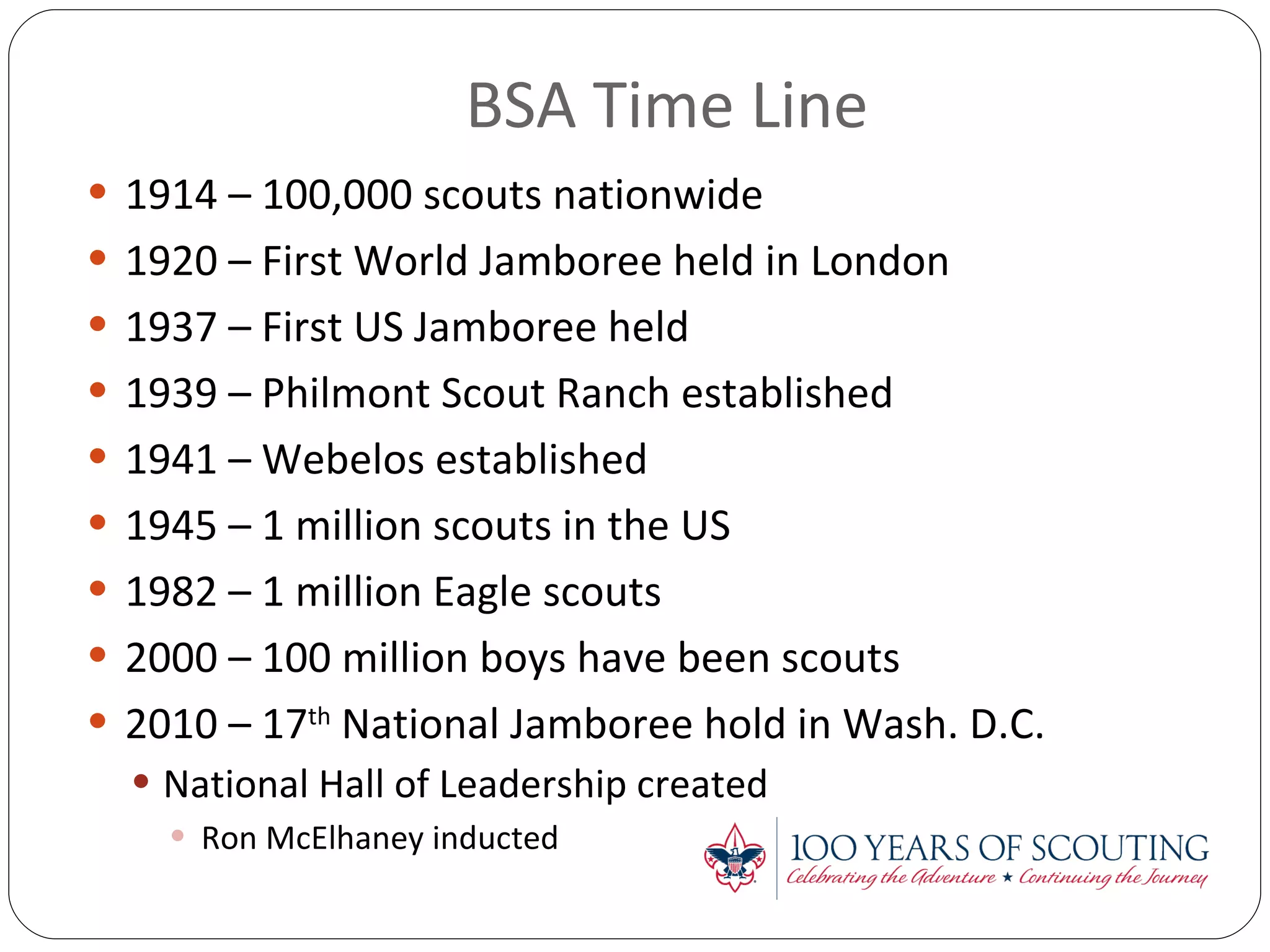
BSA Time Line1914 – 100,000 scouts nationwide 1920 – First World Jamboree held in London 1937 – First US Jamboree held 1939 – Philmont Scout Ranch established 1941 – Webelos established 1945 – 1 million scouts in the US 1982 – 1 million Eagle scouts 2000 – 100 million boys have been scouts 2010 – 17 th National Jamboree hold in Wash. D.C. National Hall of Leadership created Ron McElhaney inducted
19.
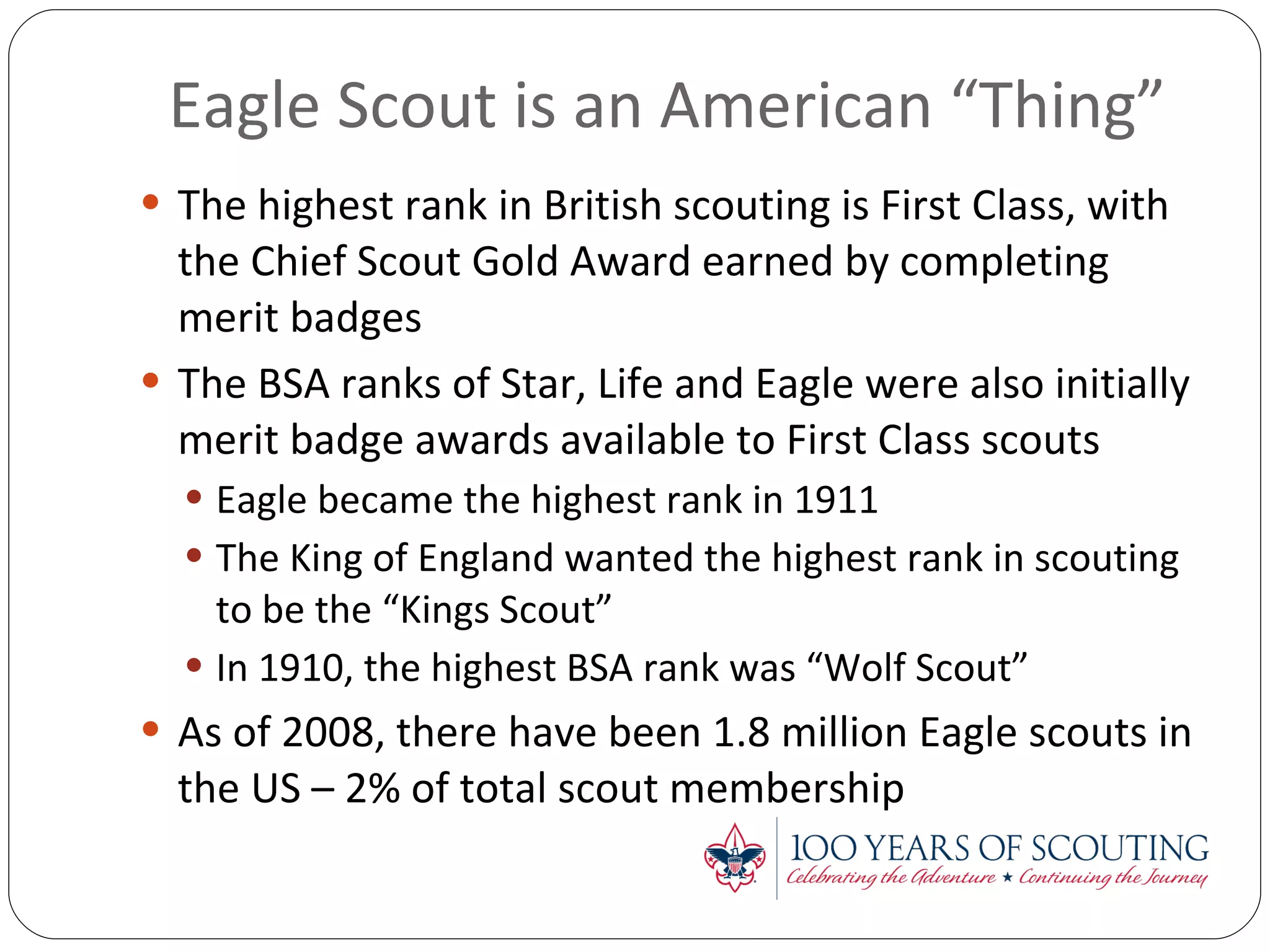
Eagle Scout isan American “Thing” The highest rank in British scouting is First Class, with the Chief Scout Gold Award earned by completing merit badges The BSA ranks of Star, Life and Eagle were also initially merit badge awards available to First Class scouts Eagle became the highest rank in 1911 The King of England wanted the highest rank in scouting to be the “Kings Scout” In 1910, the highest BSA rank was “Wolf Scout” As of 2008, there have been 1.8 million Eagle scouts in the US – 2% of total scout membership
20.
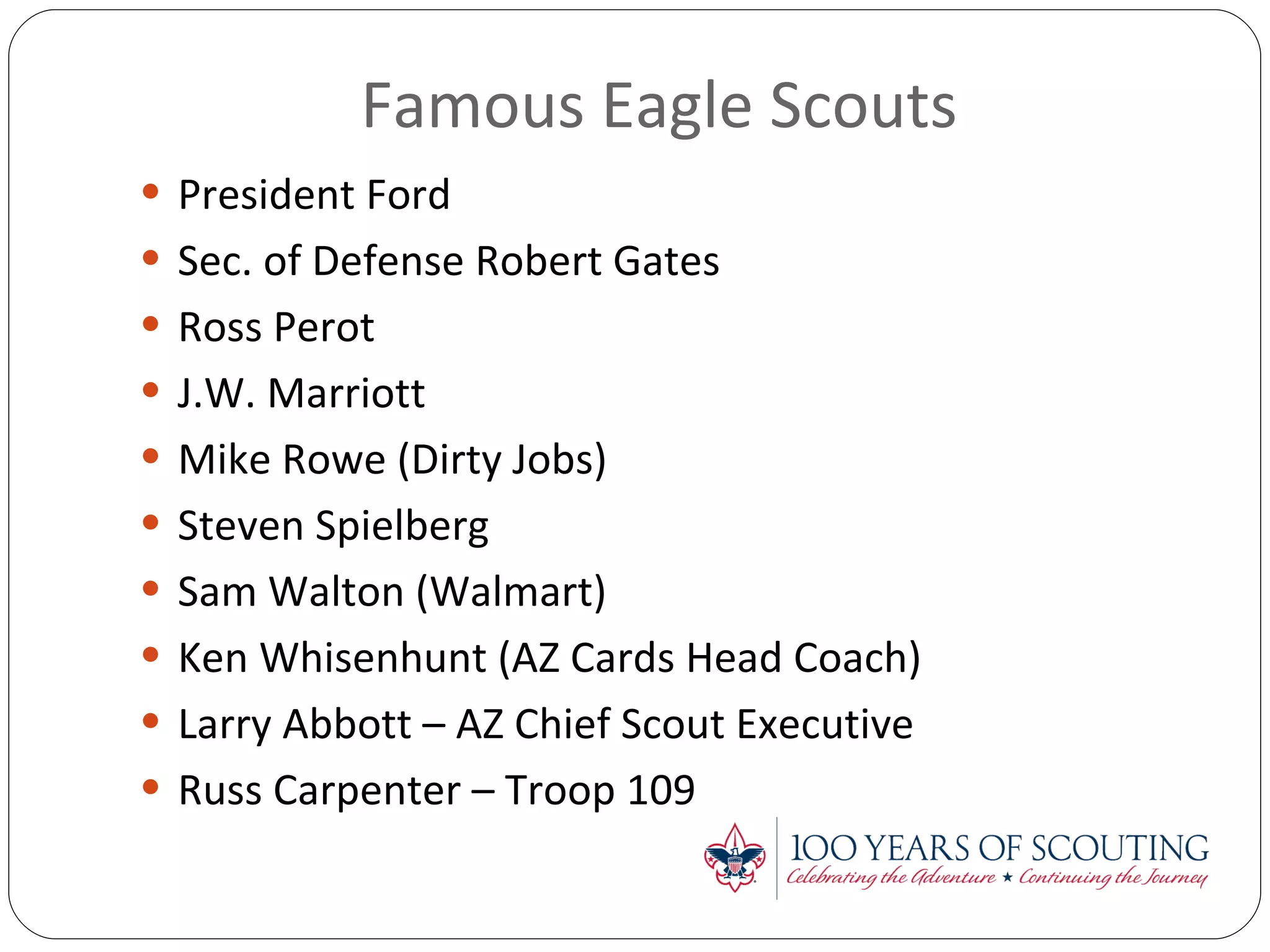
Famous Eagle Scouts President Ford Sec. of Defense Robert Gates Ross Perot J.W. Marriott Mike Rowe (Dirty Jobs) Steven Spielberg Sam Walton (Walmart) Ken Whisenhunt (AZ Cards Head Coach) Larry Abbott – AZ Chief Scout Executive Russ Carpenter – Troop 109
21.
Other Famous ScoutsHenry Aaron – Home run king Walter Cronkite – TV newsman Henry Fonda – actor Pres. Kennedy Bill Gates – Microsoft Jimmy Stewart – actor Tom Potter – Troop 109 Scoutmaster