Architecting of modern
 information systems
           Module 4
    Information architecture
          A. Samarin
Enterprise Content Management (ECM)

• Capture (OCR, email, video, etc.)
• Manage
      – Document management (check in/out, versioning, metadata)
      – Collaboration (forums, news, events, calendars, blogs, etc.)
      – Web content management
      – Records management (indexing, archive and filing management)
      – Automation (capture, reviews, approvals, publishing, expiration)
      – Search
• Store (repositories, libraries, media)
• Deliver (transform, secure, distribute)
• Preserve (backup, recovery)
© A. Samarin 2012         Architecting of modern information systems - Module 4   2
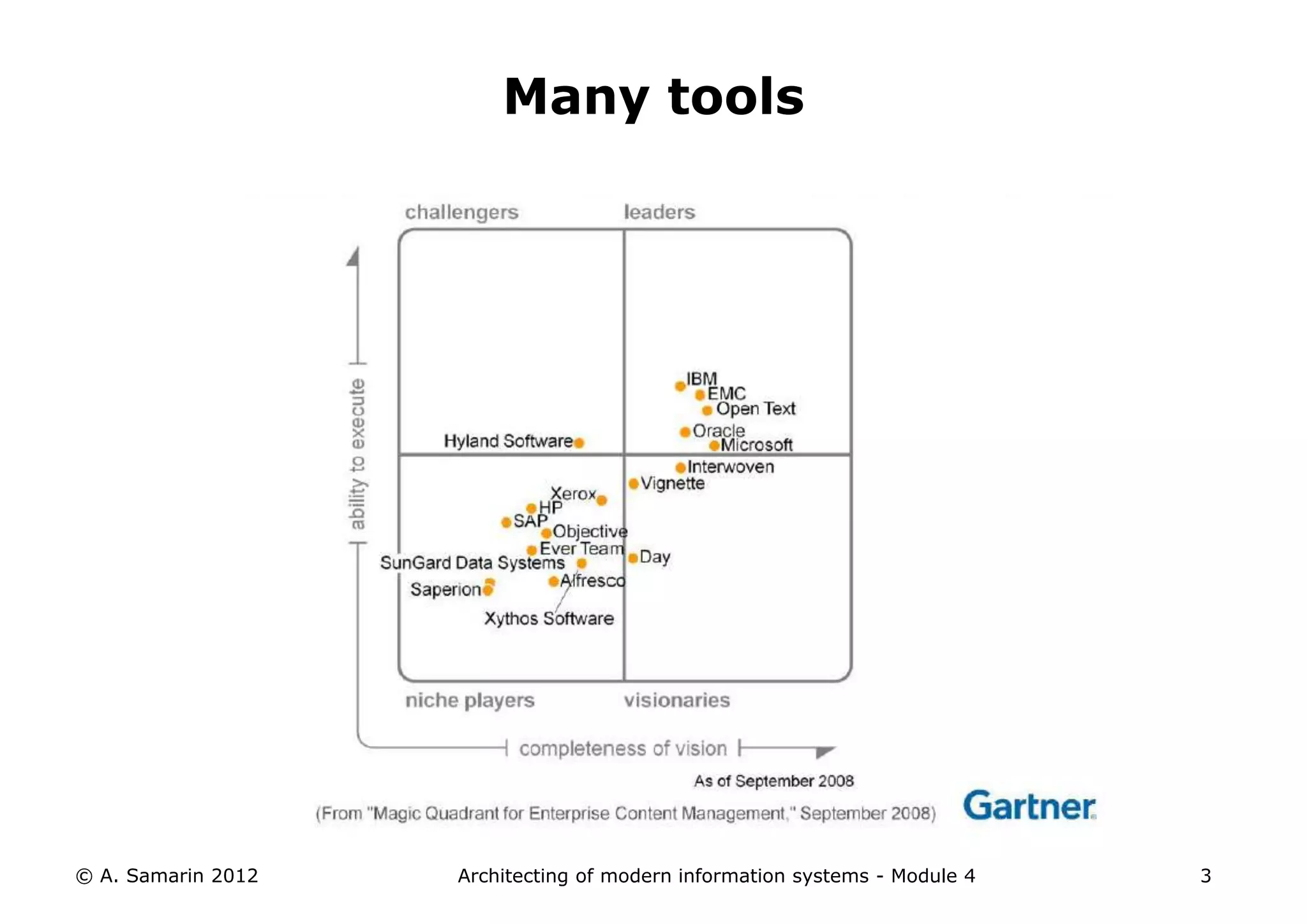
Many tools


© A. Samarin 2012   Architecting of modern information systems - Module 4   3
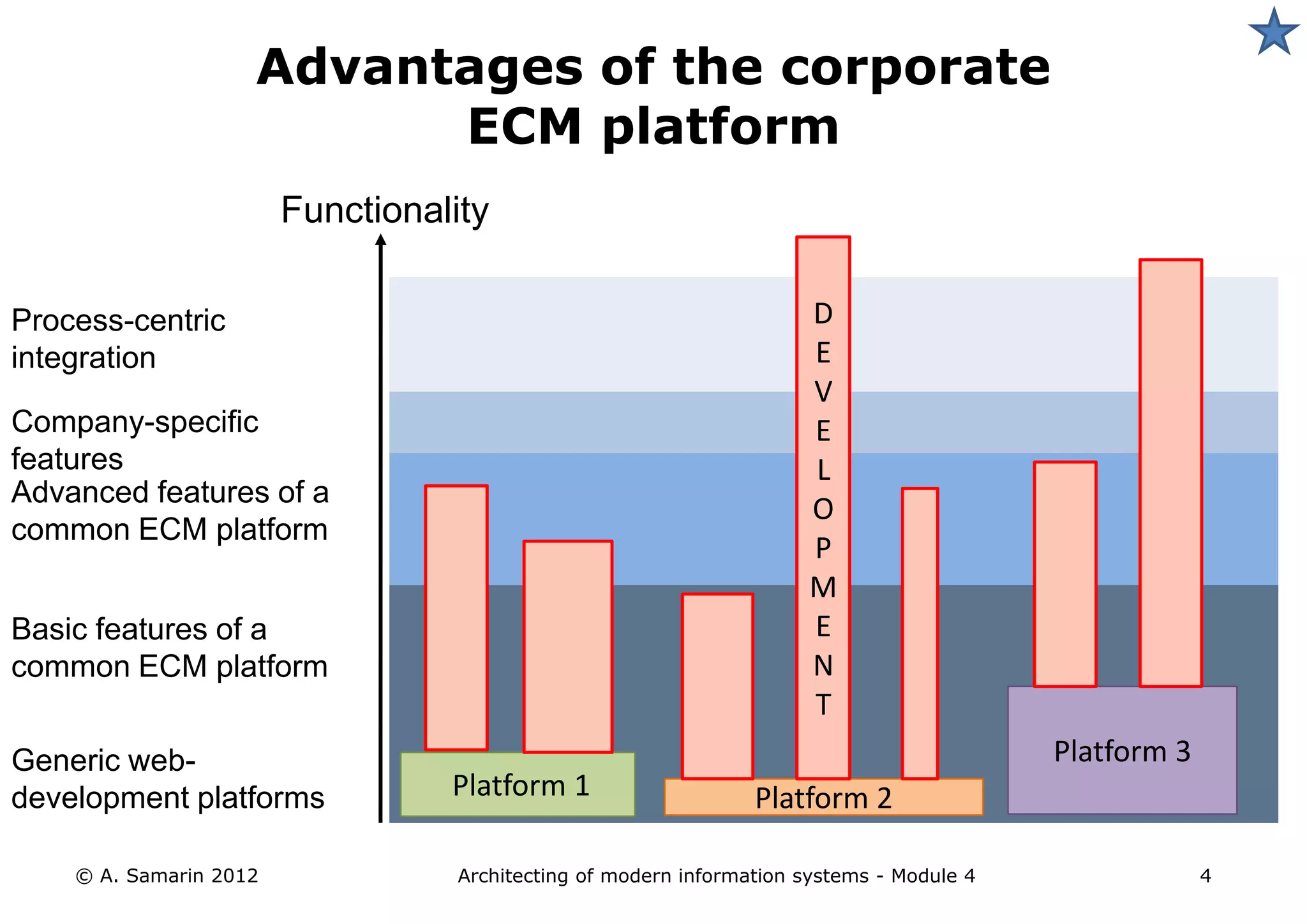
Advantages of the corporate
                          ECM platform
                        Functionality

Process-centric                                                       D
integration                                                           E
                                                                      V
Company-specific                                                      E
features                                                              L
Advanced features of a
                                                                      O
common ECM platform
                                                                      P
                                                                      M
Basic features of a                                                   E
common ECM platform                                                   N
                                                                      T
Generic web-                                                                               Platform 3
development platforms             Platform 1                     Platform 2

    © A. Samarin 2012              Architecting of modern information systems - Module 4                4
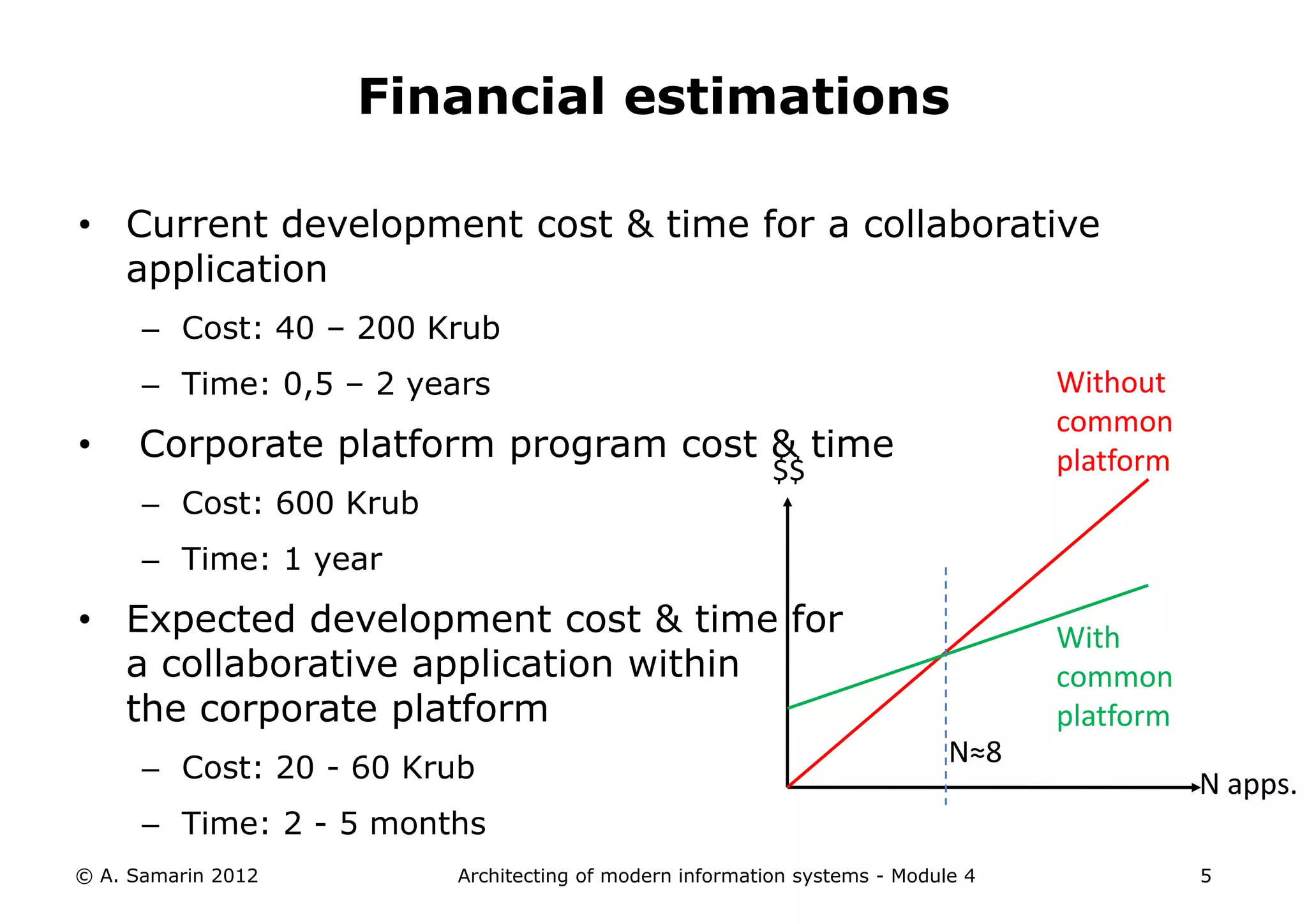
Financial estimations

• Current development cost & time for a collaborative
  application
      – Cost: 40 – 200 Krub
      – Time: 0,5 – 2 years                                                      Without
                                                                                 common
•    Corporate platform program cost & time                                      platform
                                                         $$
      – Cost: 600 Krub
      – Time: 1 year

• Expected development cost & time for                                           With
  a collaborative application within                                             common
  the corporate platform                                                         platform
                                                                           N≈8
      – Cost: 20 - 60 Krub                                                                  N apps.
      – Time: 2 - 5 months
© A. Samarin 2012        Architecting of modern information systems - Module 4              5
Typical departmental Group Productivity
           Environment (GPE)
• Information related to department’s internal functioning
      – correspondences, meetings, contracts, suppliers, consultants, inter
        nal archive, etc.

• Information related to department’s core business
  processes
• Information for all Company’s employers
      – Organization structure, policies, related Presidential
        instructions, rules and procedures, operations
        manuals, announcements, contacts, etc.


© A. Samarin 2012         Architecting of modern information systems - Module 4   6
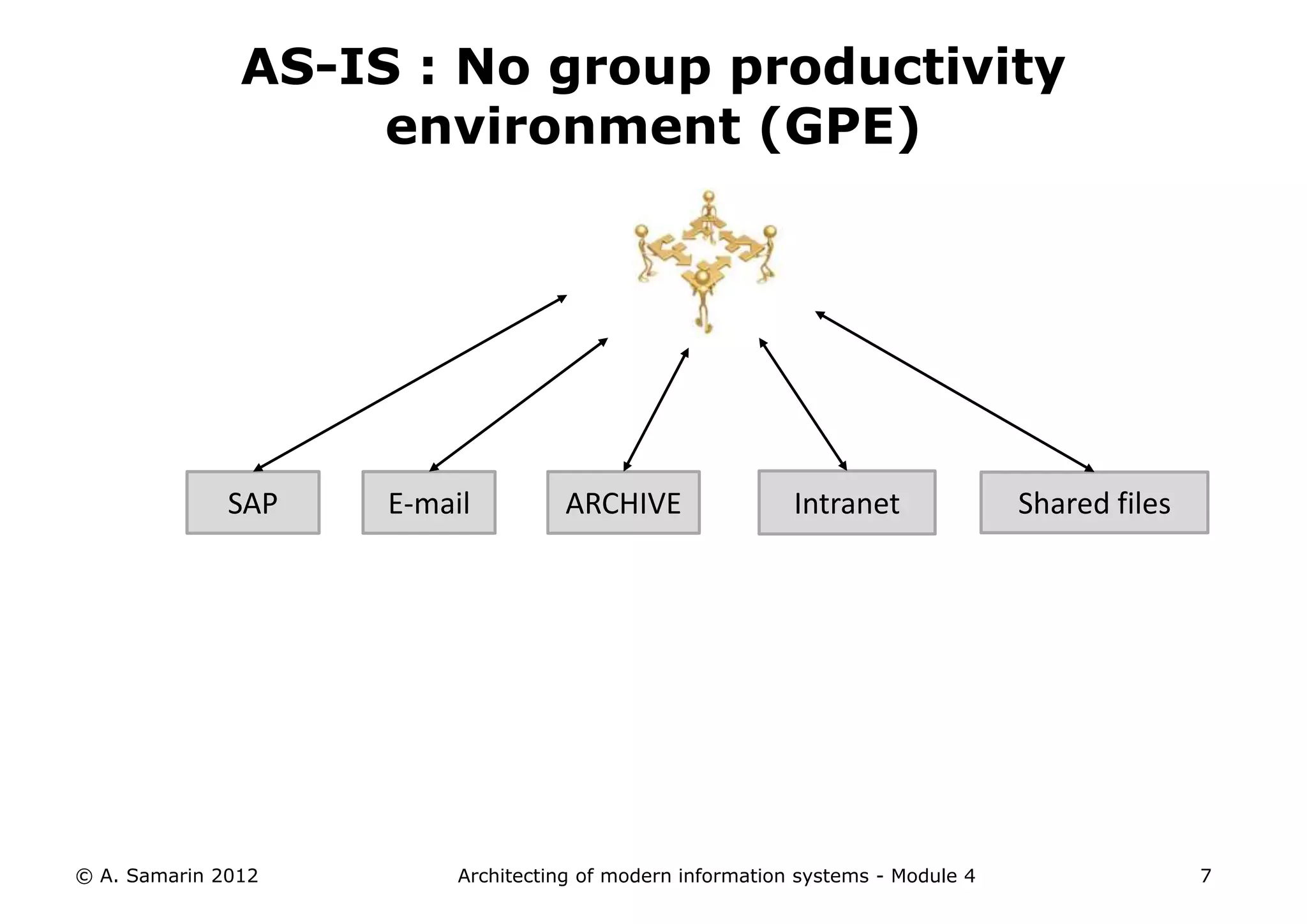
AS-IS : No group productivity
                    environment (GPE)


              SAP   E-mail          ARCHIVE                Intranet              Shared files


© A. Samarin 2012        Architecting of modern information systems - Module 4                  7
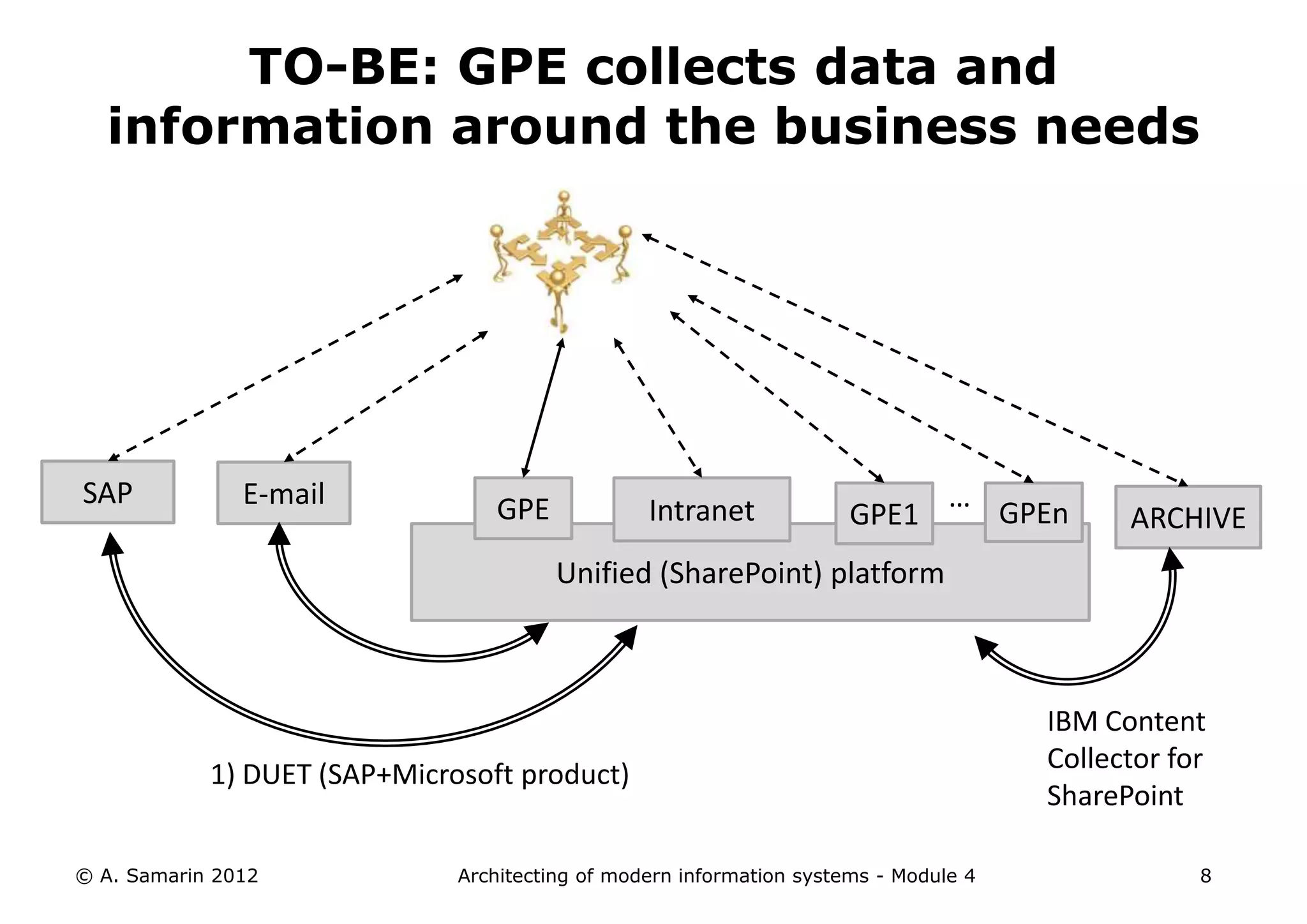
TO-BE: GPE collects data and
  information around the business needs


SAP            E-mail            GPE                                            …
                                                 Intranet             GPE1            GPEn    ARCHIVE
                                        Unified (SharePoint) platform


                                                                                        IBM Content
                                                                                        Collector for
            1) DUET (SAP+Microsoft product)
                                                                                        SharePoint

© A. Samarin 2012             Architecting of modern information systems - Module 4                 8
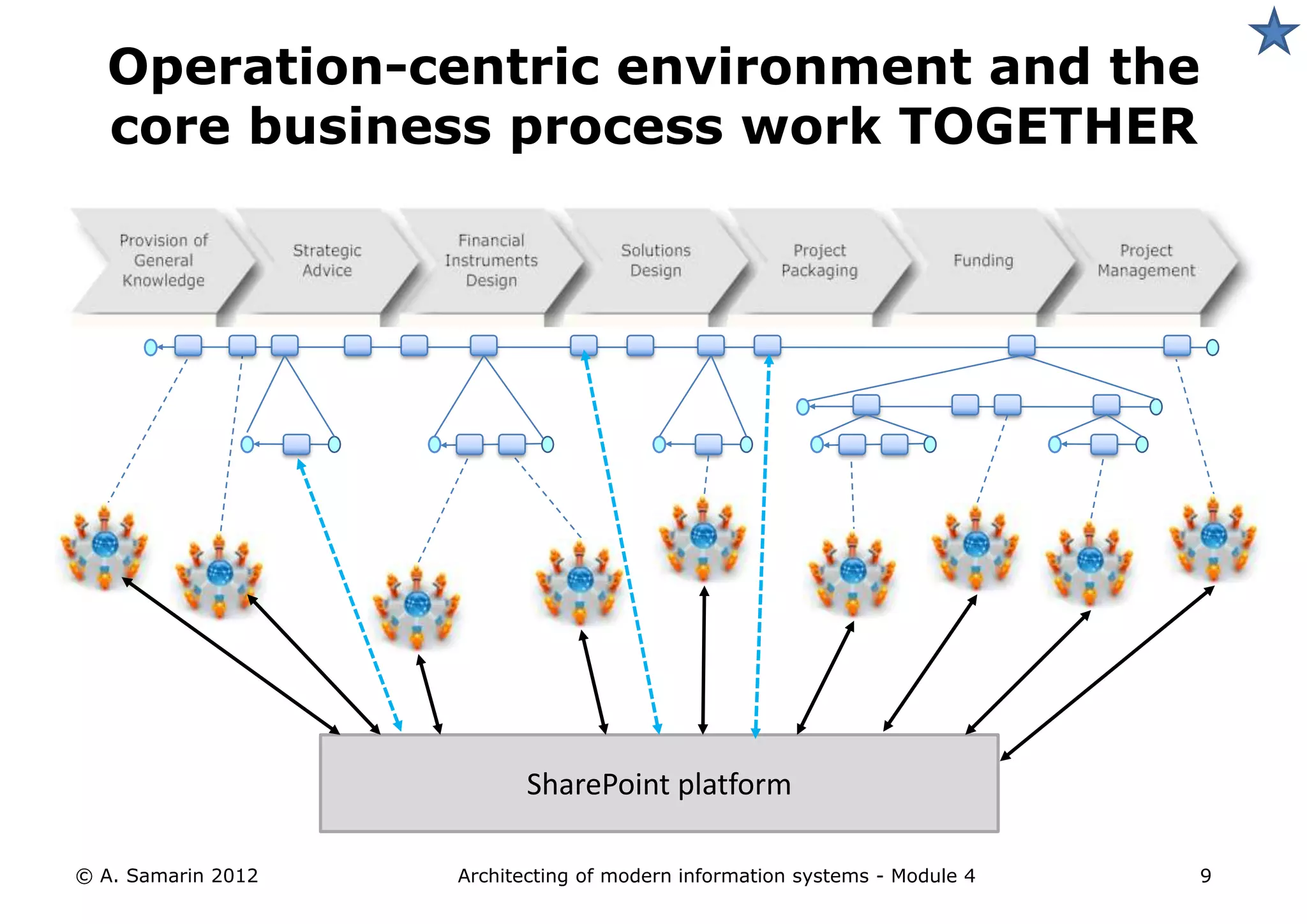
Operation-centric environment and the
  core business process work TOGETHER


                           SharePoint platform

© A. Samarin 2012   Architecting of modern information systems - Module 4   9
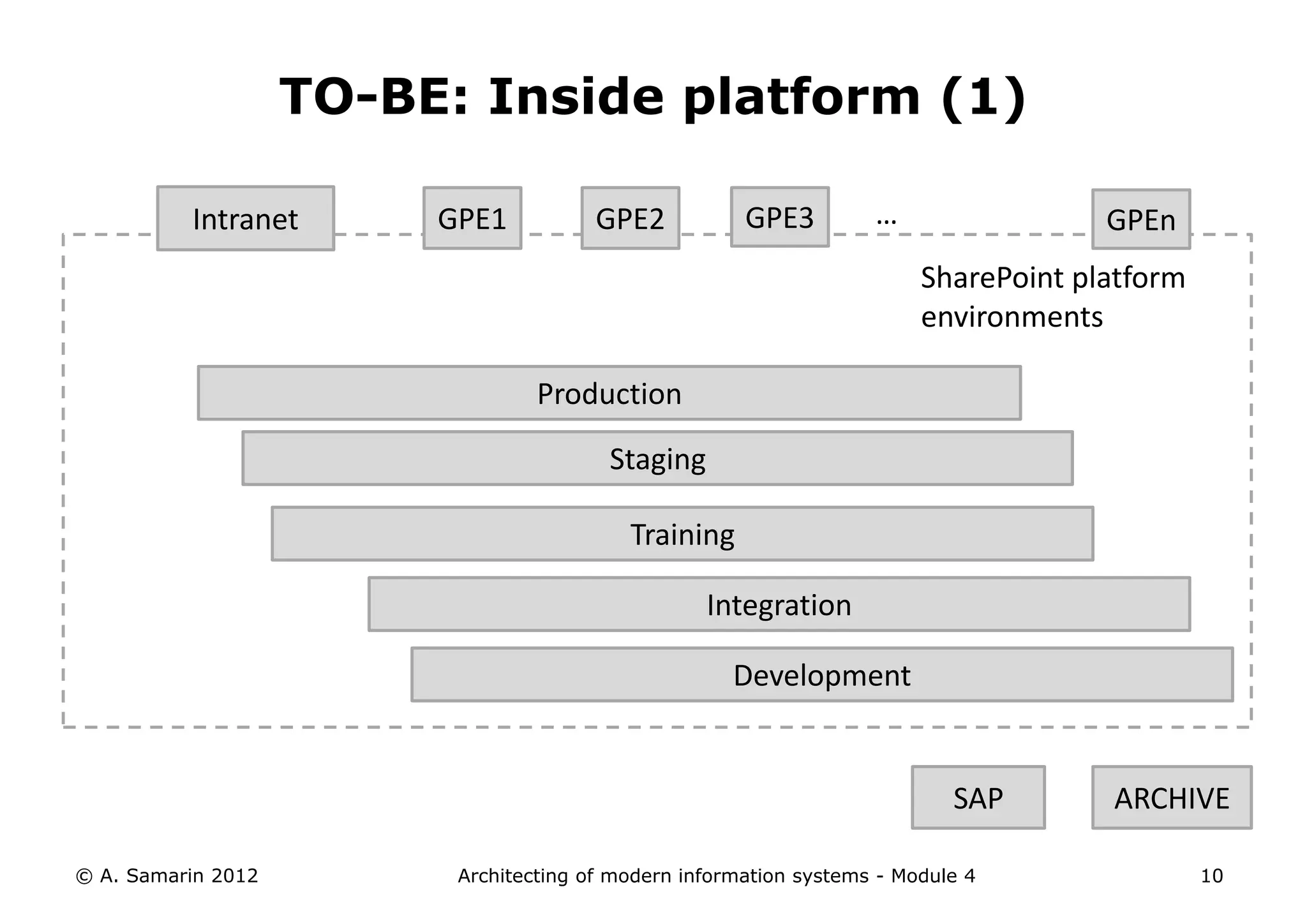
TO-BE: Inside platform (1)

          Intranet       GPE1           GPE2           GPE3         …                 GPEn
                                                                         SharePoint platform
                                                                         environments

                                  Production

                                         Staging

                                           Training

                                                   Integration

                                                      Development


                                                                            SAP       ARCHIVE

© A. Samarin 2012         Architecting of modern information systems - Module 4                10
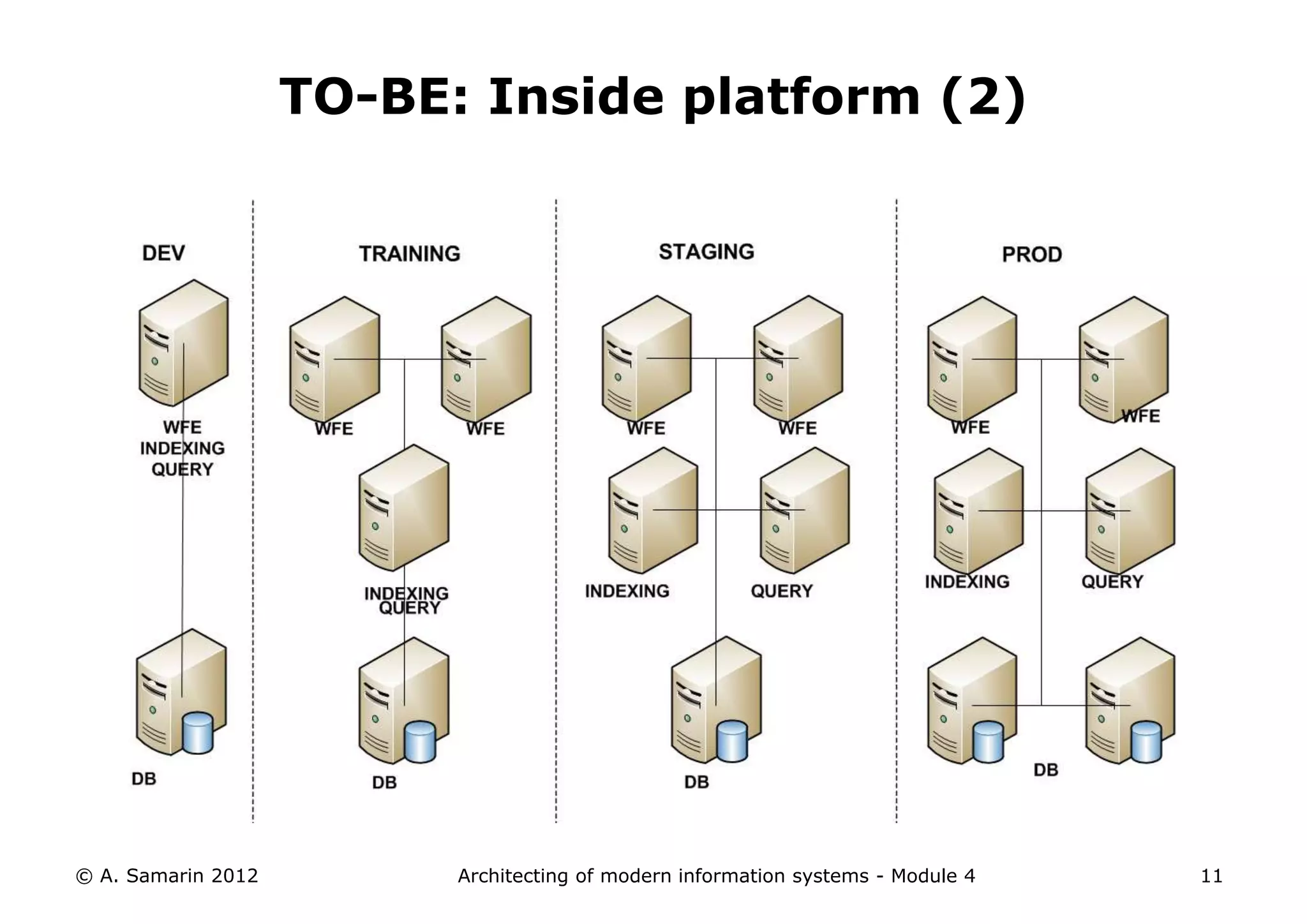
TO-BE: Inside platform (2)


© A. Samarin 2012         Architecting of modern information systems - Module 4   11
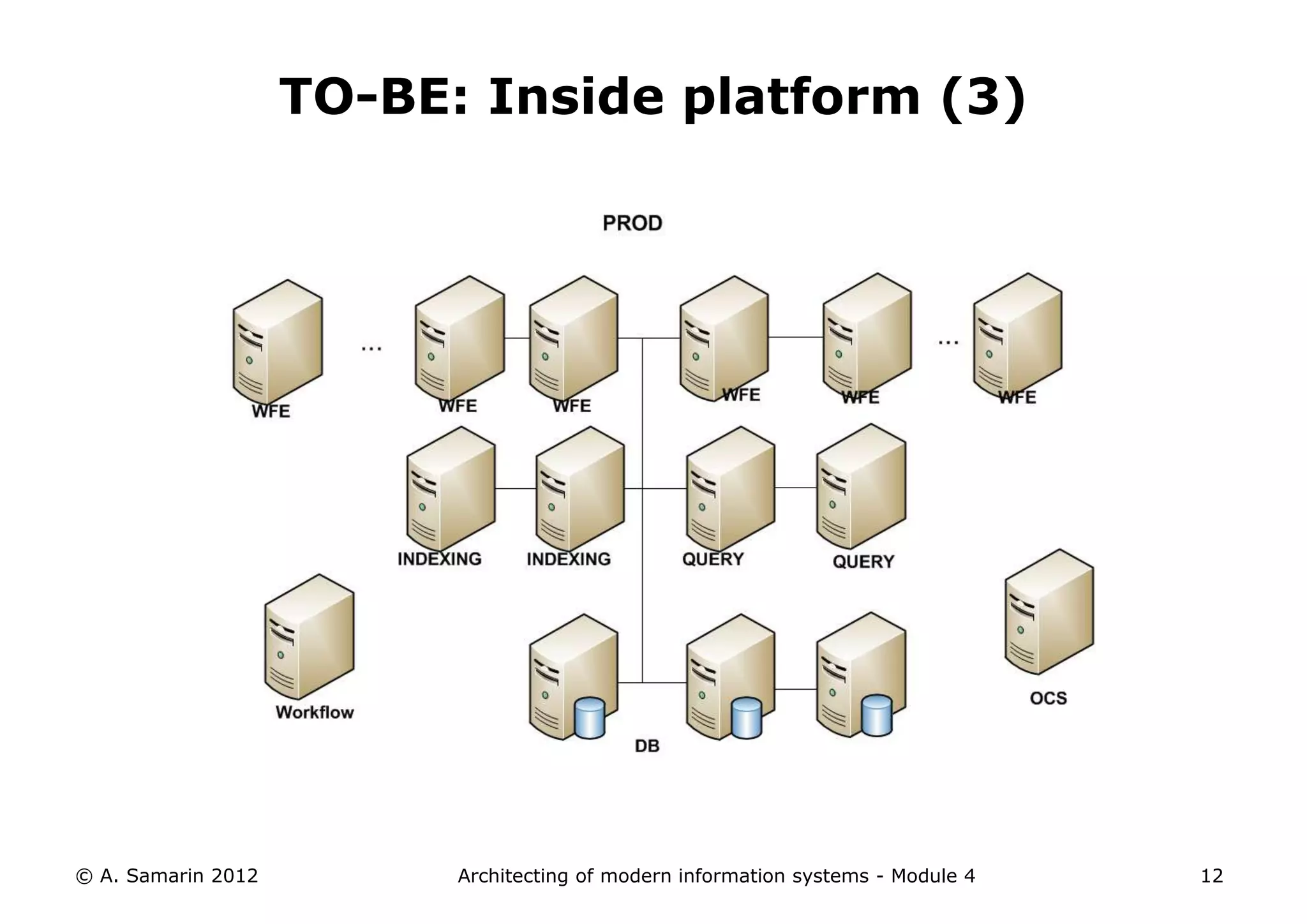
TO-BE: Inside platform (3)


© A. Samarin 2012         Architecting of modern information systems - Module 4   12
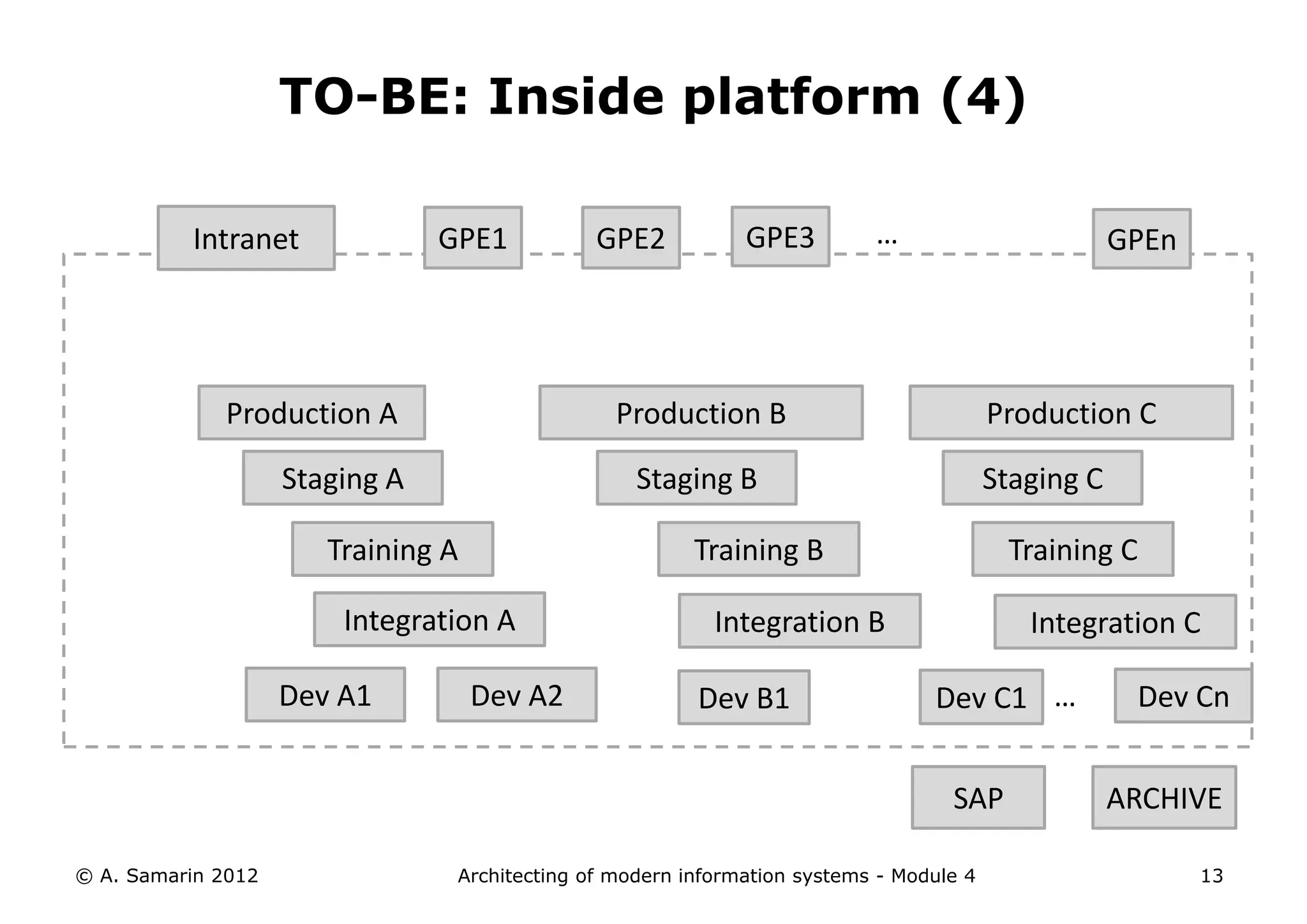
TO-BE: Inside platform (4)

          Intranet              GPE1           GPE2           GPE3         …                         GPEn


             Production A                        Production B                            Production C

                    Staging A                      Staging B                             Staging C

                       Training A                        Training B                       Training C

                        Integration A                      Integration B                    Integration C

                    Dev A1          Dev A2               Dev B1                  Dev C1 …             Dev Cn


                                                                                   SAP               ARCHIVE

© A. Samarin 2012                Architecting of modern information systems - Module 4                      13
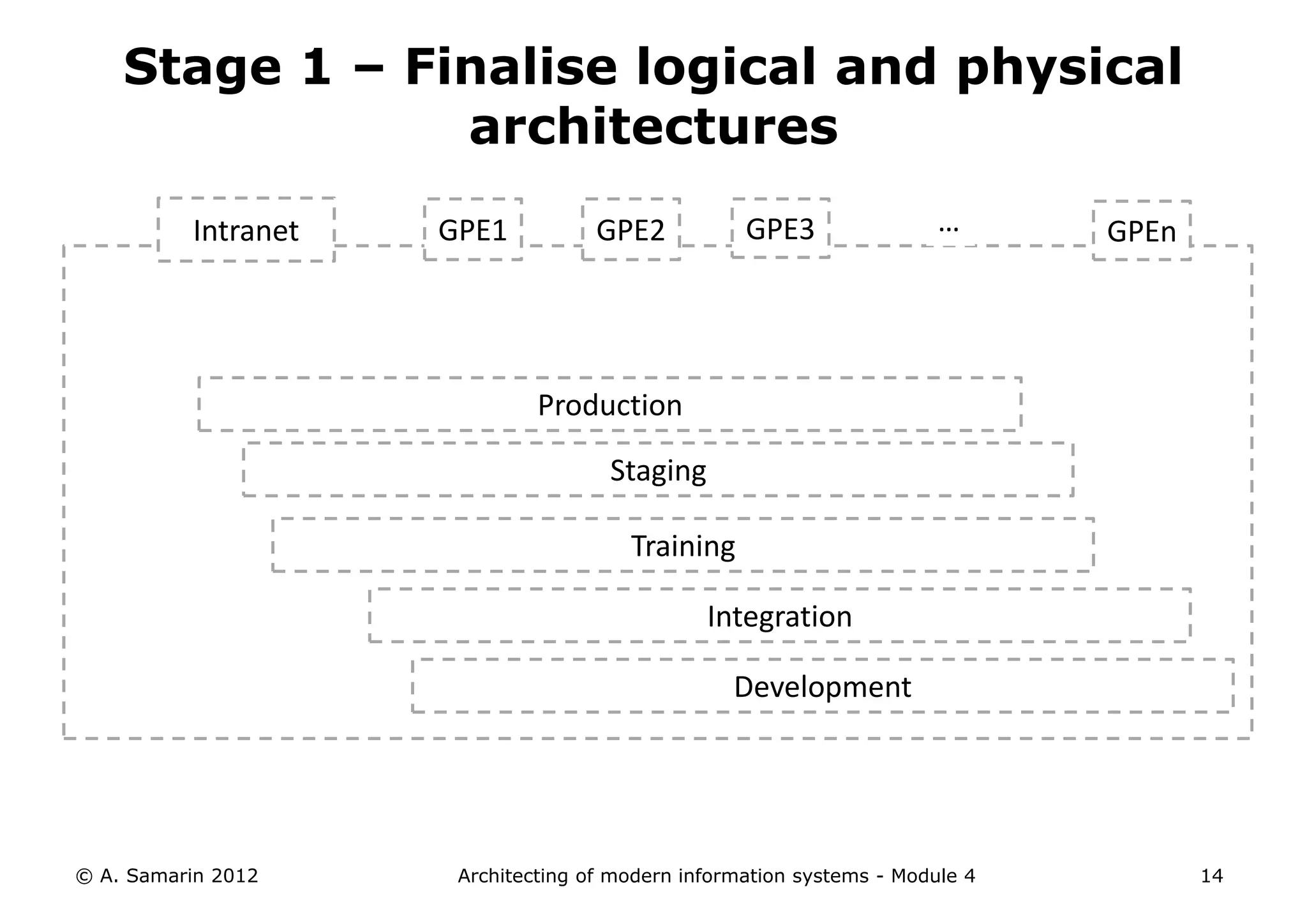
Stage 1 – Finalise logical and physical
                architectures
          Intranet   GPE1           GPE2           GPE3                …      GPEn


                              Production

                                     Staging

                                       Training

                                               Integration

                                                  Development


© A. Samarin 2012     Architecting of modern information systems - Module 4          14
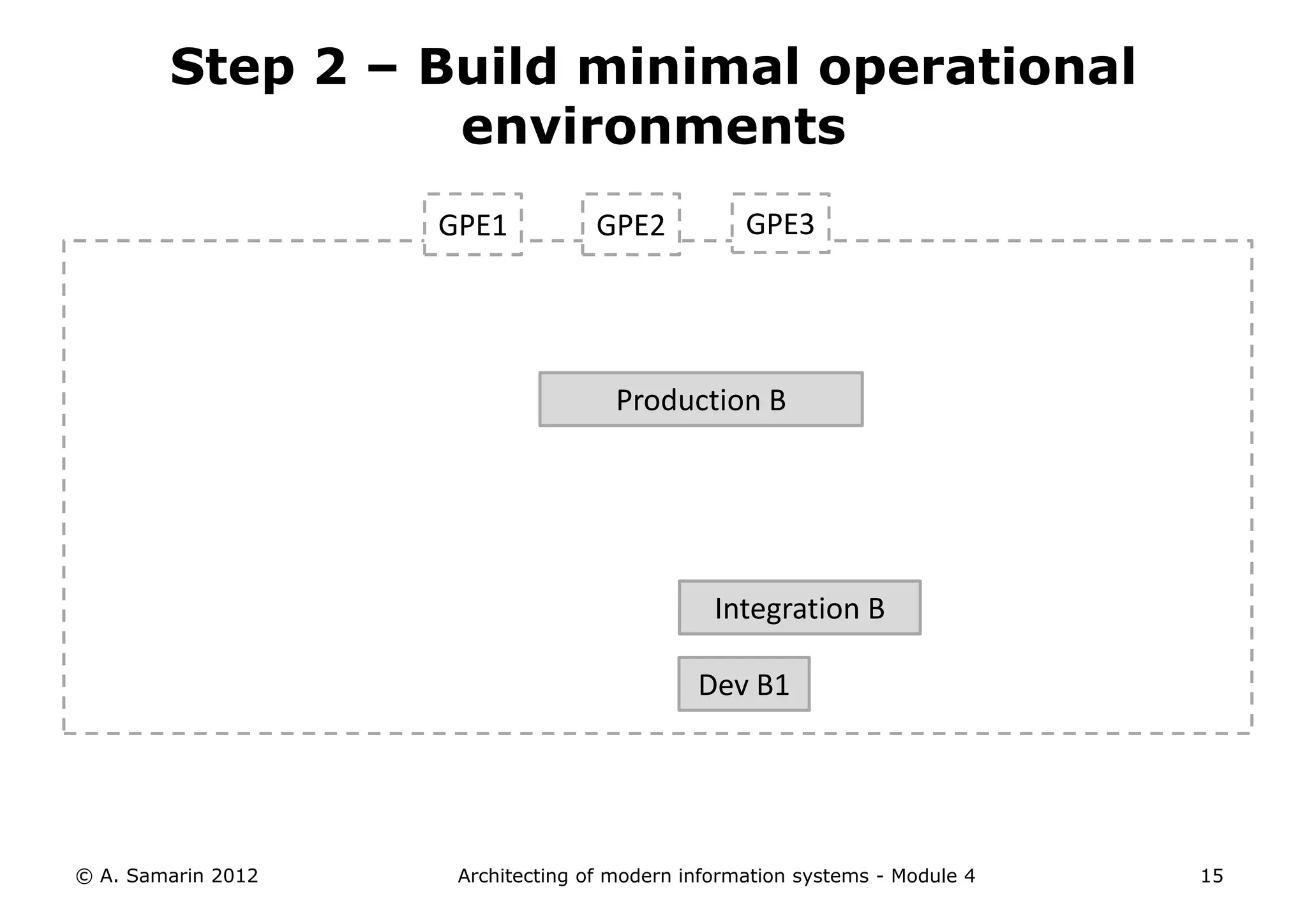
Step 2 – Build minimal operational
                  environments
                    GPE1           GPE2           GPE3


                                     Production B


                                               Integration B

                                             Dev B1


© A. Samarin 2012    Architecting of modern information systems - Module 4   15
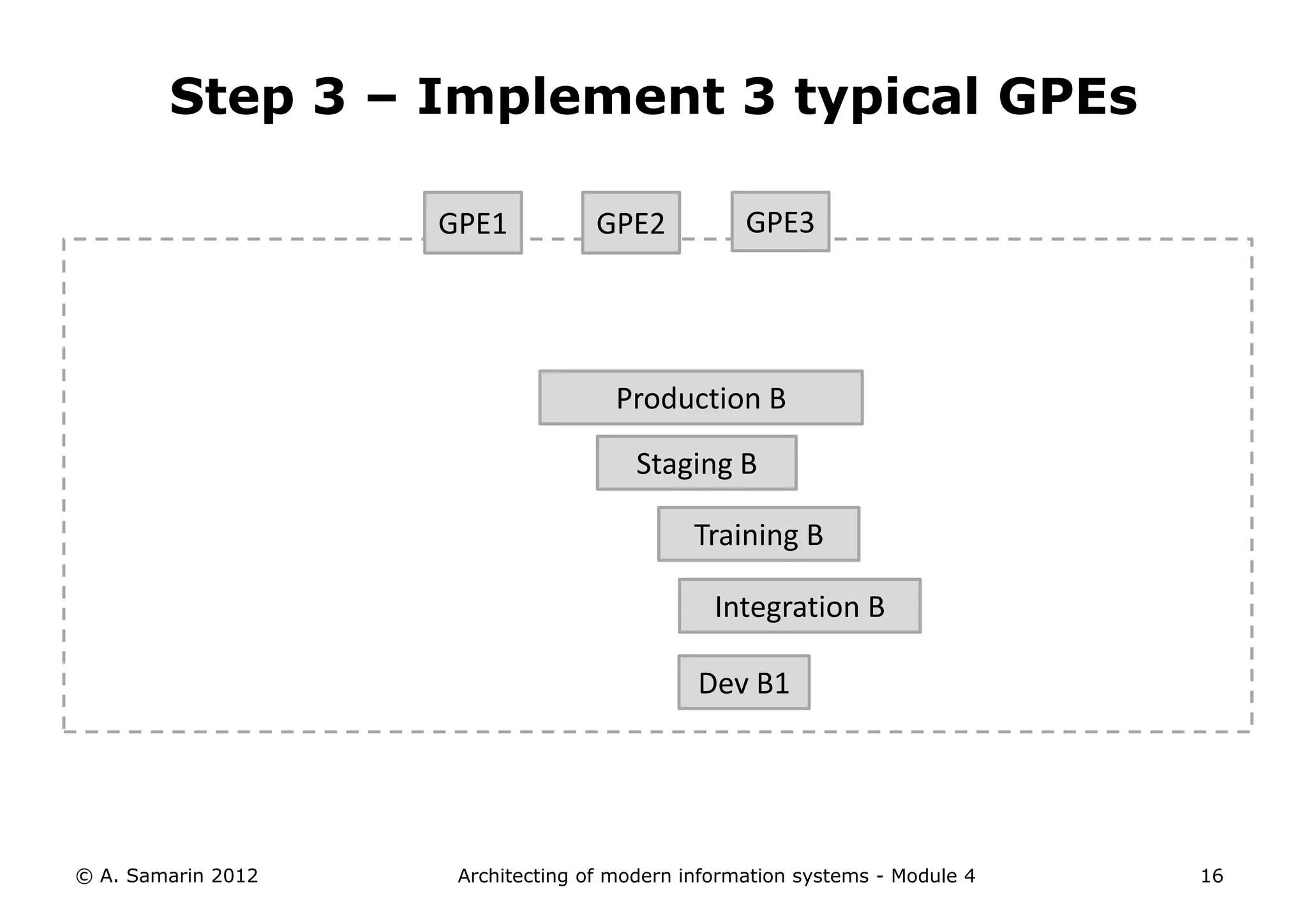
Step 3 – Implement 3 typical GPEs

                    GPE1           GPE2           GPE3


                                     Production B

                                       Staging B

                                             Training B

                                               Integration B

                                             Dev B1


© A. Samarin 2012    Architecting of modern information systems - Module 4   16
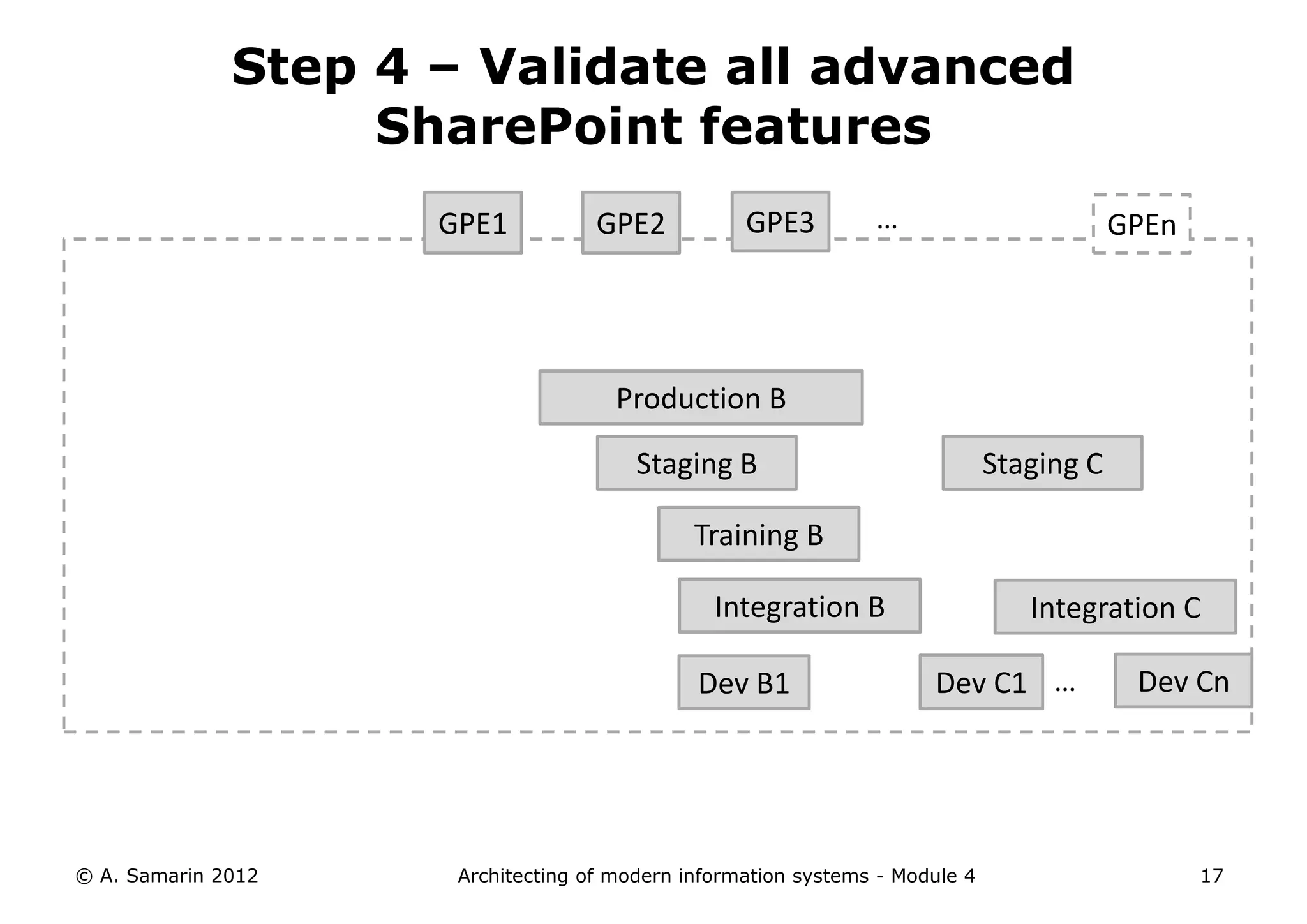
Step 4 – Validate all advanced
                   SharePoint features
                     GPE1           GPE2           GPE3         …                         GPEn


                                      Production B

                                        Staging B                             Staging C

                                              Training B

                                                Integration B                    Integration C

                                              Dev B1                  Dev C1 …             Dev Cn


© A. Samarin 2012     Architecting of modern information systems - Module 4                      17
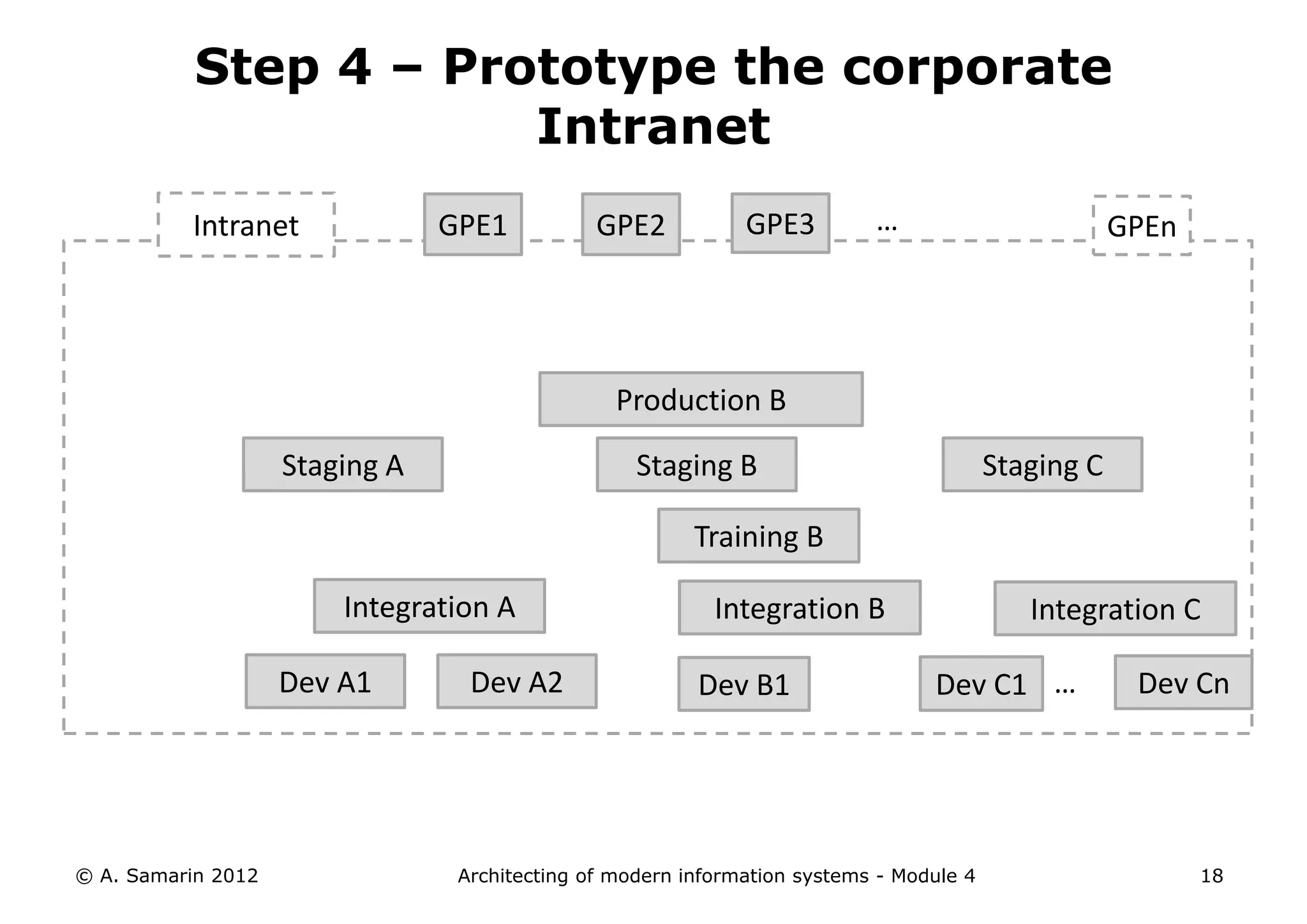
Step 4 – Prototype the corporate
                       Intranet
          Intranet              GPE1           GPE2           GPE3         …                         GPEn


                                                 Production B

                    Staging A                      Staging B                             Staging C

                                                         Training B

                        Integration A                      Integration B                    Integration C

                    Dev A1        Dev A2                 Dev B1                  Dev C1 …             Dev Cn


© A. Samarin 2012                Architecting of modern information systems - Module 4                      18
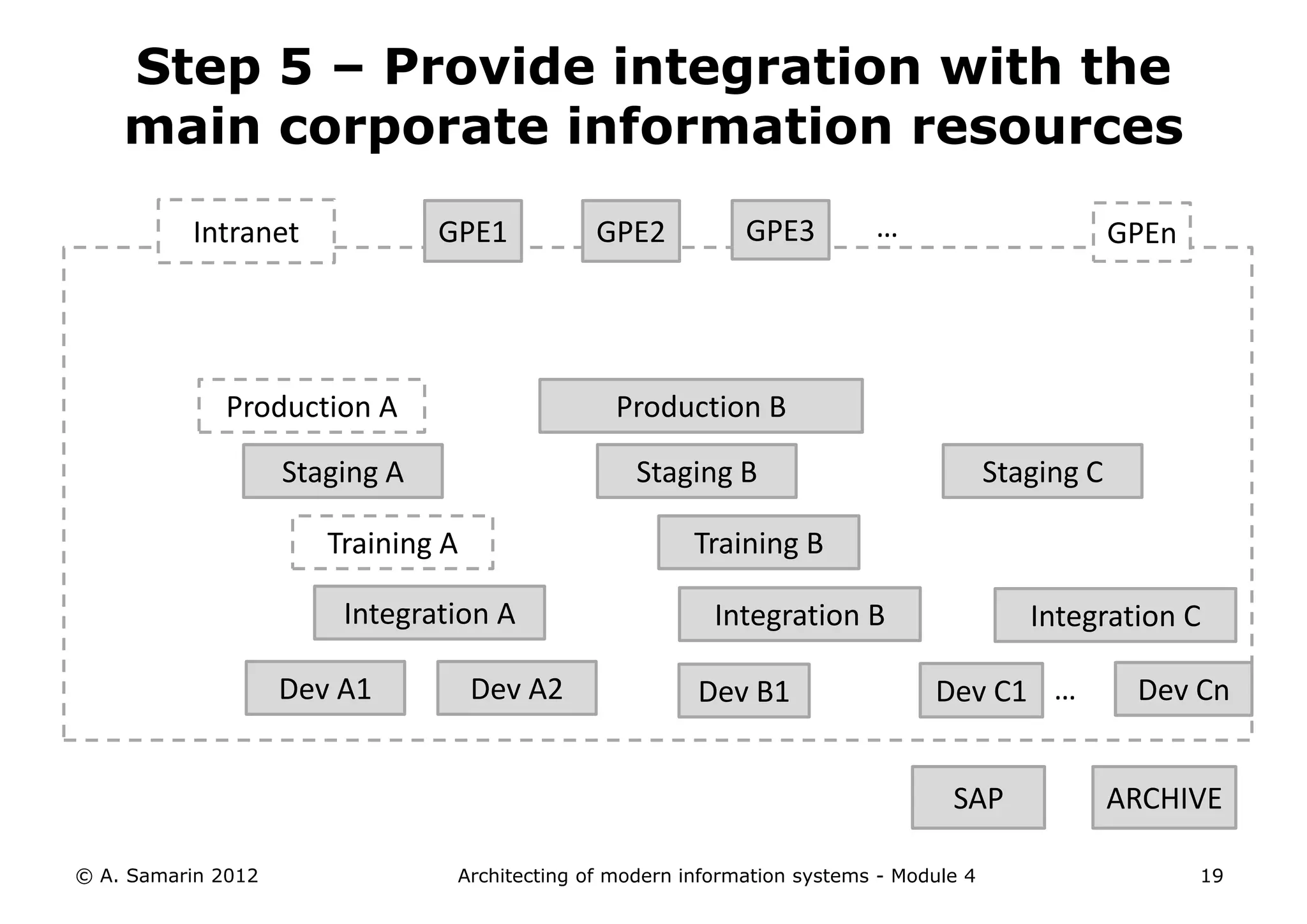
Step 5 – Provide integration with the
    main corporate information resources
          Intranet              GPE1           GPE2           GPE3         …                         GPEn


             Production A                        Production B

                    Staging A                      Staging B                             Staging C

                       Training A                        Training B

                        Integration A                      Integration B                    Integration C

                    Dev A1          Dev A2               Dev B1                  Dev C1 …             Dev Cn


                                                                                   SAP               ARCHIVE

© A. Samarin 2012                Architecting of modern information systems - Module 4                      19
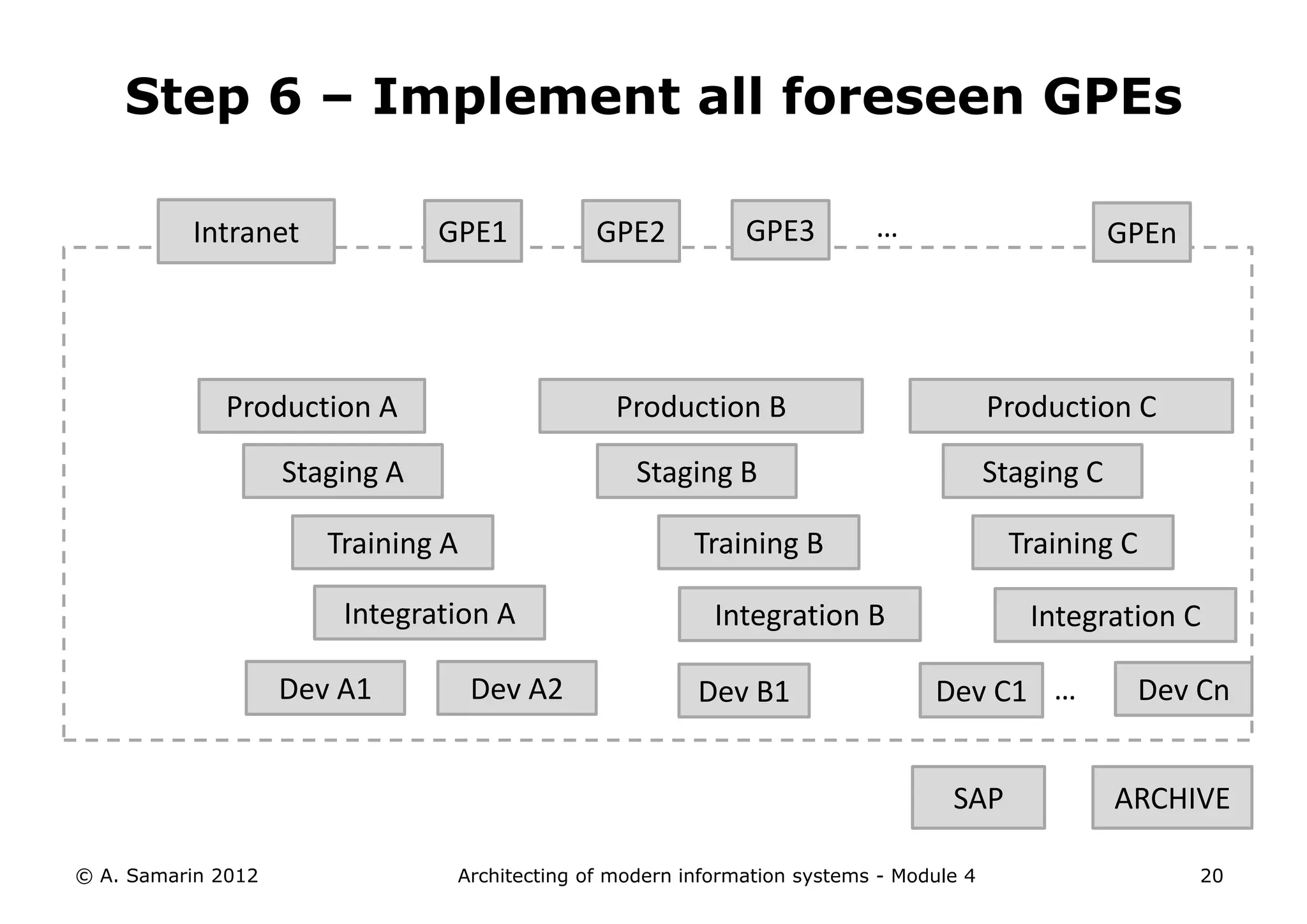
Step 6 – Implement all foreseen GPEs

          Intranet              GPE1           GPE2           GPE3         …                         GPEn


             Production A                        Production B                            Production C

                    Staging A                      Staging B                             Staging C

                       Training A                        Training B                       Training C

                        Integration A                      Integration B                    Integration C

                    Dev A1          Dev A2               Dev B1                  Dev C1 …             Dev Cn


                                                                                   SAP               ARCHIVE

© A. Samarin 2012                Architecting of modern information systems - Module 4                      20
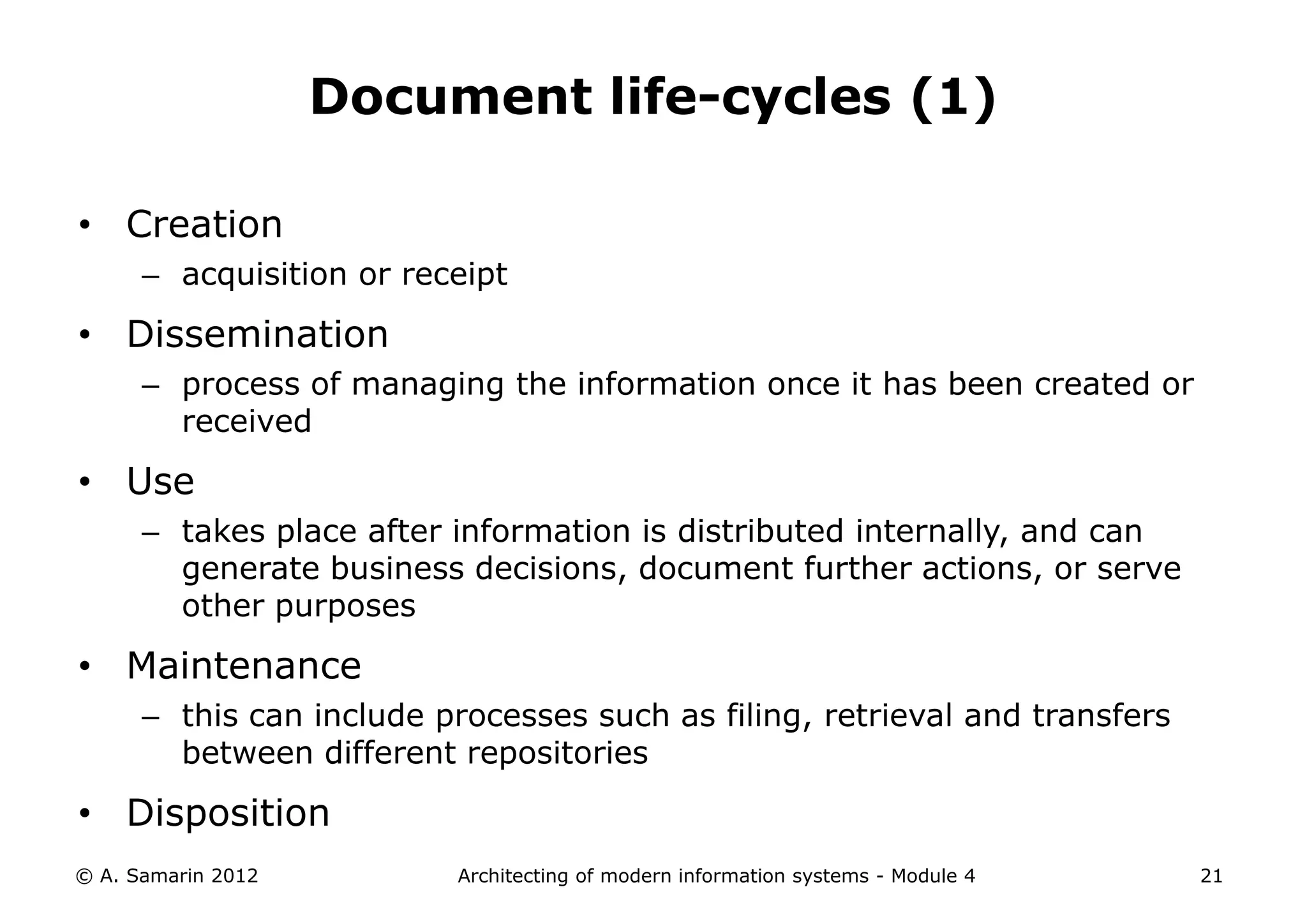
Document life-cycles (1)

• Creation
      – acquisition or receipt

• Dissemination
      – process of managing the information once it has been created or
        received

• Use
      – takes place after information is distributed internally, and can
        generate business decisions, document further actions, or serve
        other purposes

• Maintenance
      – this can include processes such as filing, retrieval and transfers
        between different repositories
• Disposition
© A. Samarin 2012         Architecting of modern information systems - Module 4   21
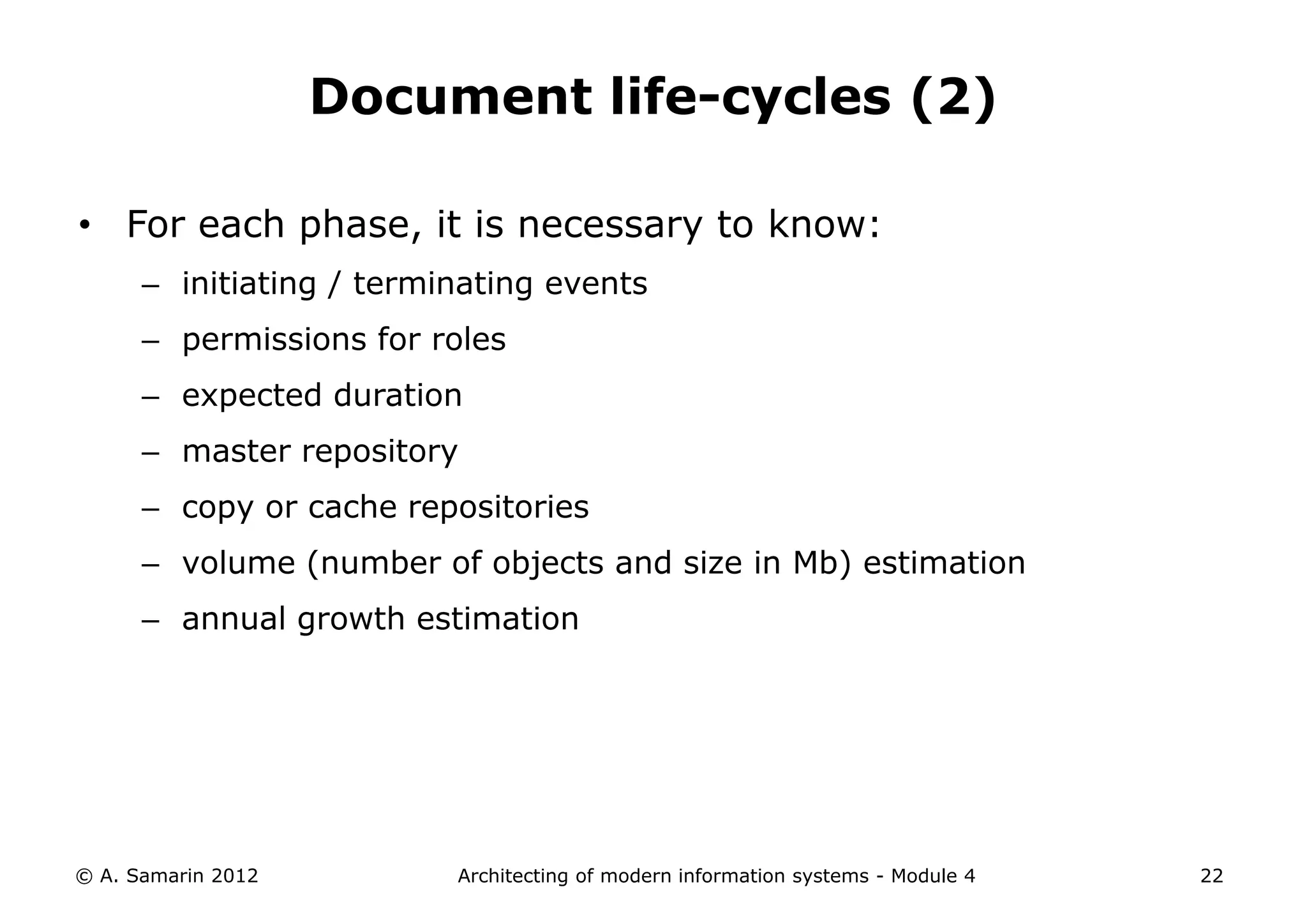
Document life-cycles (2)

• For each phase, it is necessary to know:
      – initiating / terminating events
      – permissions for roles
      – expected duration
      – master repository
      – copy or cache repositories
      – volume (number of objects and size in Mb) estimation
      – annual growth estimation


© A. Samarin 2012         Architecting of modern information systems - Module 4   22
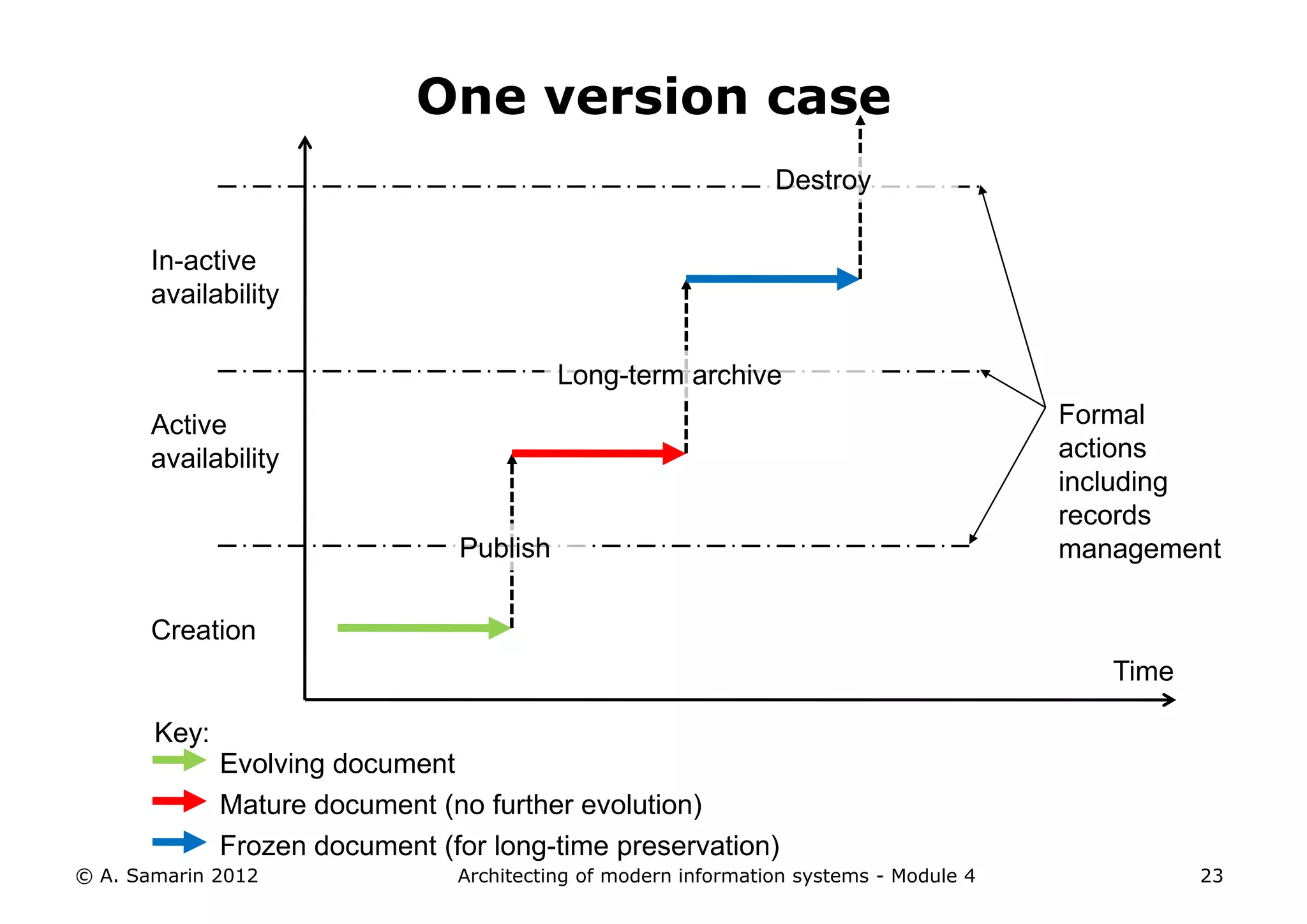
One version case
                                                                Destroy

       In-active
       availability

                                          Long-term archive
       Active                                                                           Formal
       availability                                                                     actions
                                                                                        including
                                                                                        records
                                Publish                                                 management

       Creation
                                                                                           Time

       Key:
              Evolving document
              Mature document (no further evolution)
              Frozen document (for long-time preservation)
© A. Samarin 2012               Architecting of modern information systems - Module 4             23
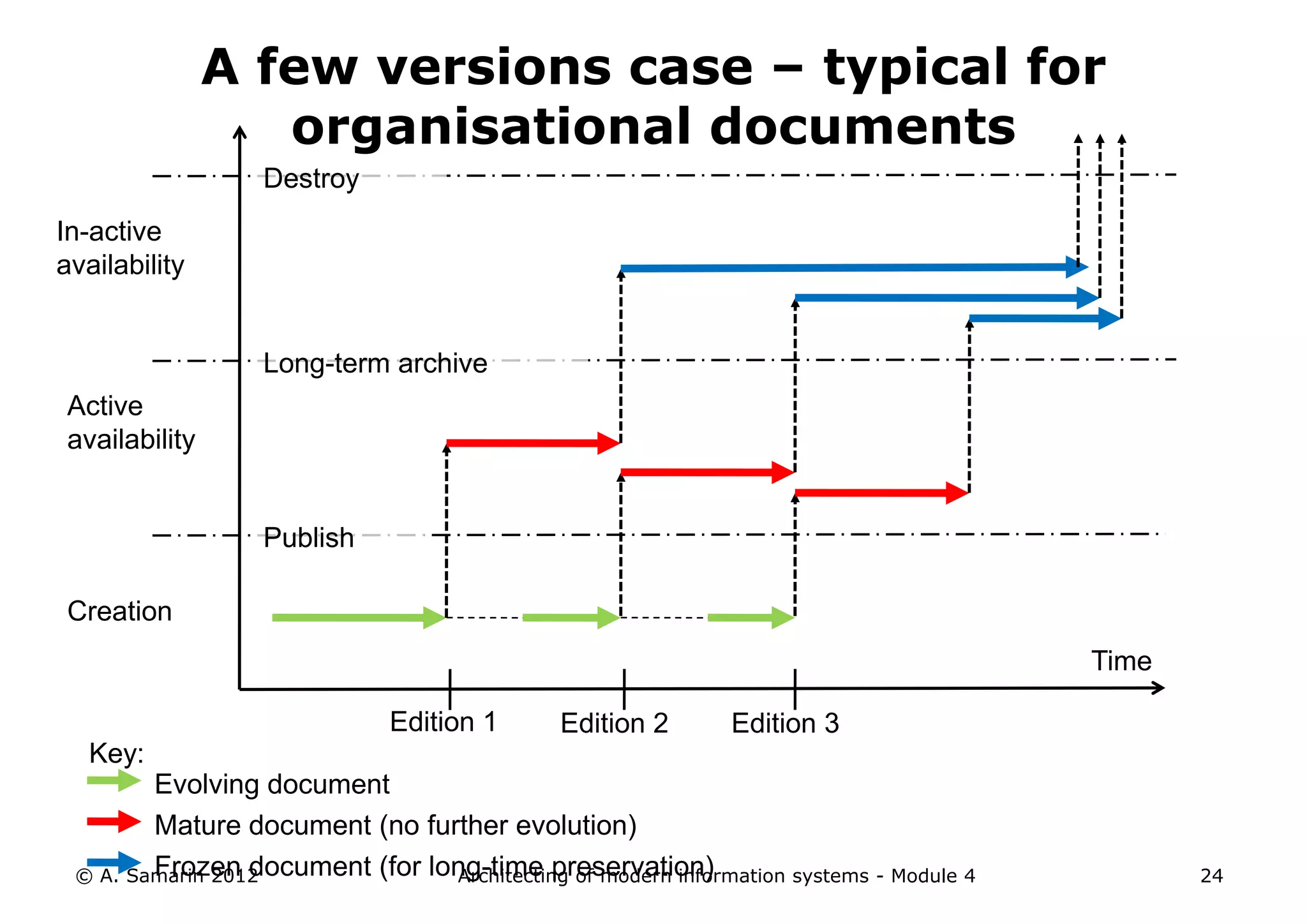
A few versions case – typical for
                   organisational documents
                  Destroy
In-active
availability


                  Long-term archive
 Active
 availability


                  Publish

 Creation
                                                                                       Time

                             Edition 1       Edition 2       Edition 3
   Key:
        Evolving document
        Mature document (no further evolution)
        Frozen document (for long-time preservation)
 © A. Samarin 2012             Architecting of modern information systems - Module 4          24
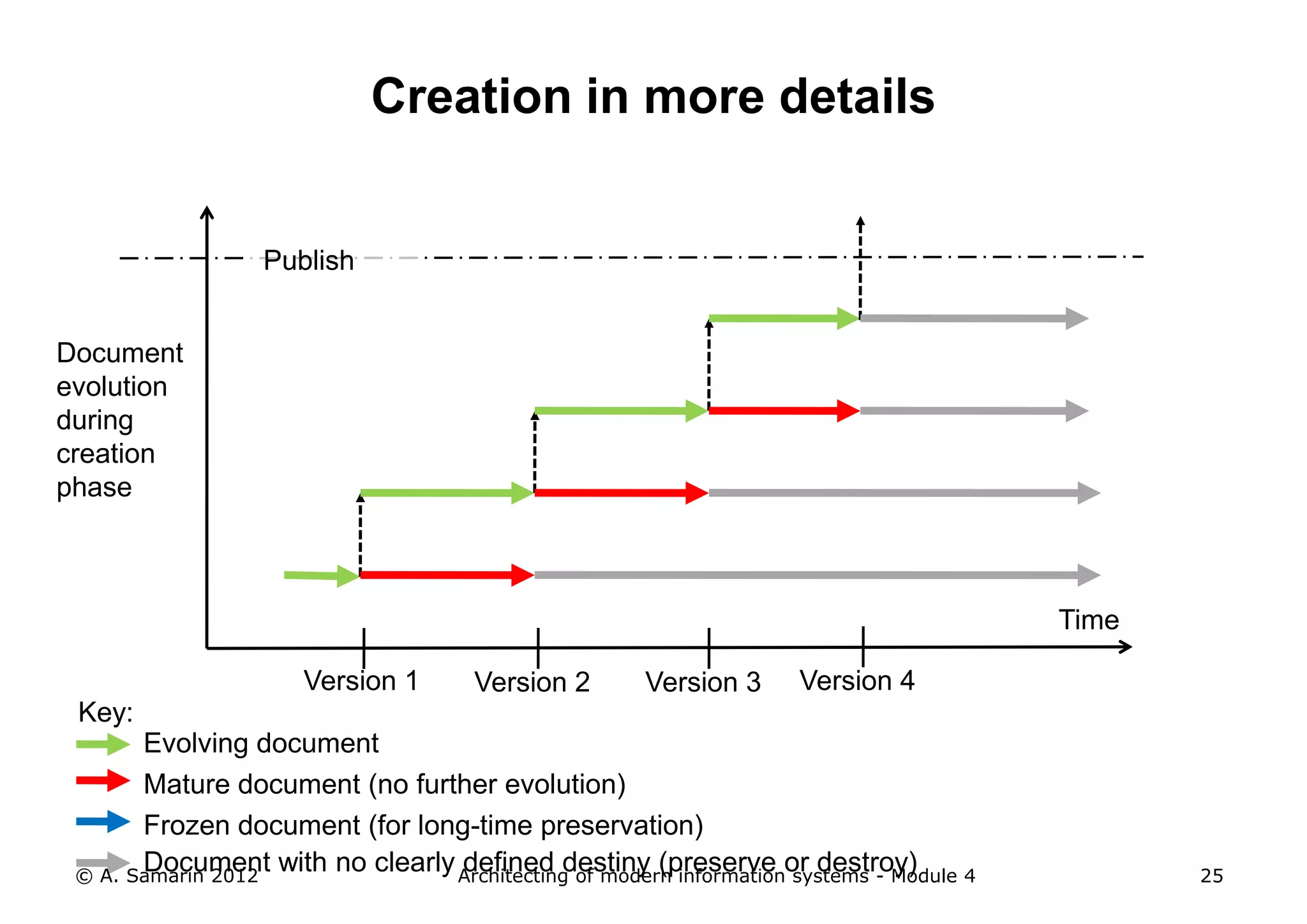
Creation in more details


                Publish


Document
evolution
during
creation
phase


                                                                                Time

                    Version 1     Version 2      Version 3    Version 4
 Key:
       Evolving document
       Mature document (no further evolution)
       Frozen document (for long-time preservation)
       Document with no clearly Architecting of modern informationor destroy)
 © A. Samarin 2012
                                defined destiny (preserve systems - Module 4           25
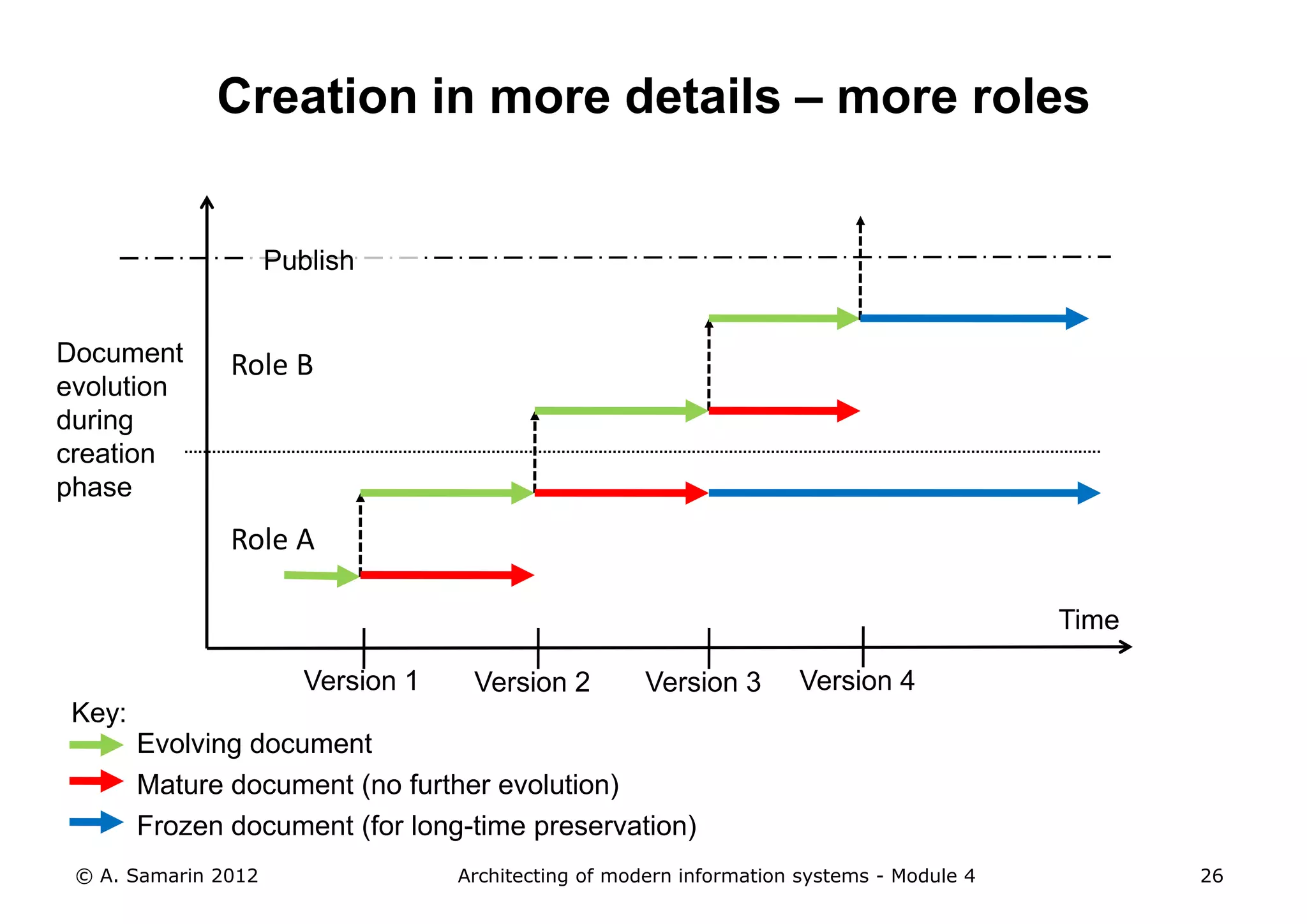
Creation in more details – more roles


                     Publish


Document       Role B
evolution
during
creation
phase
               Role A

                                                                                            Time

                        Version 1    Version 2         Version 3      Version 4
 Key:
        Evolving document
        Mature document (no further evolution)
        Frozen document (for long-time preservation)
 © A. Samarin 2012                  Architecting of modern information systems - Module 4          26
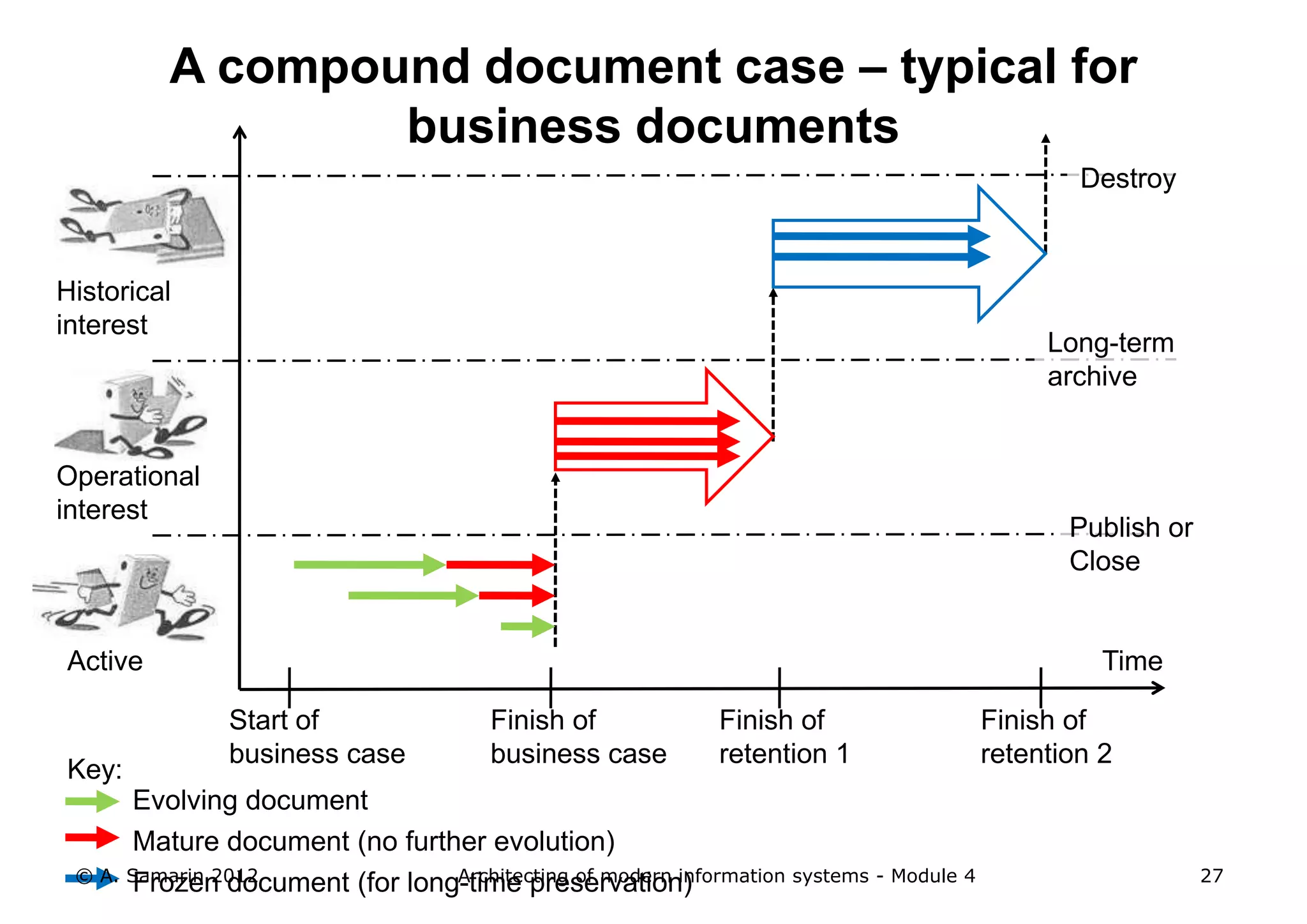
A compound document case – typical for
                 business documents
                                                                                                Destroy


Historical
interest
                                                                                             Long-term
                                                                                             archive


Operational
interest
                                                                                               Publish or
                                                                                               Close


Active                                                                                            Time

               Start of                Finish of             Finish of                  Finish of
               business case           business case         retention 1                retention 2
Key:
       Evolving document
       Mature document (no further evolution)
 © A. Samarin 2012              Architecting of modern information systems - Module 4                       27
       Frozen document (for long-time preservation)
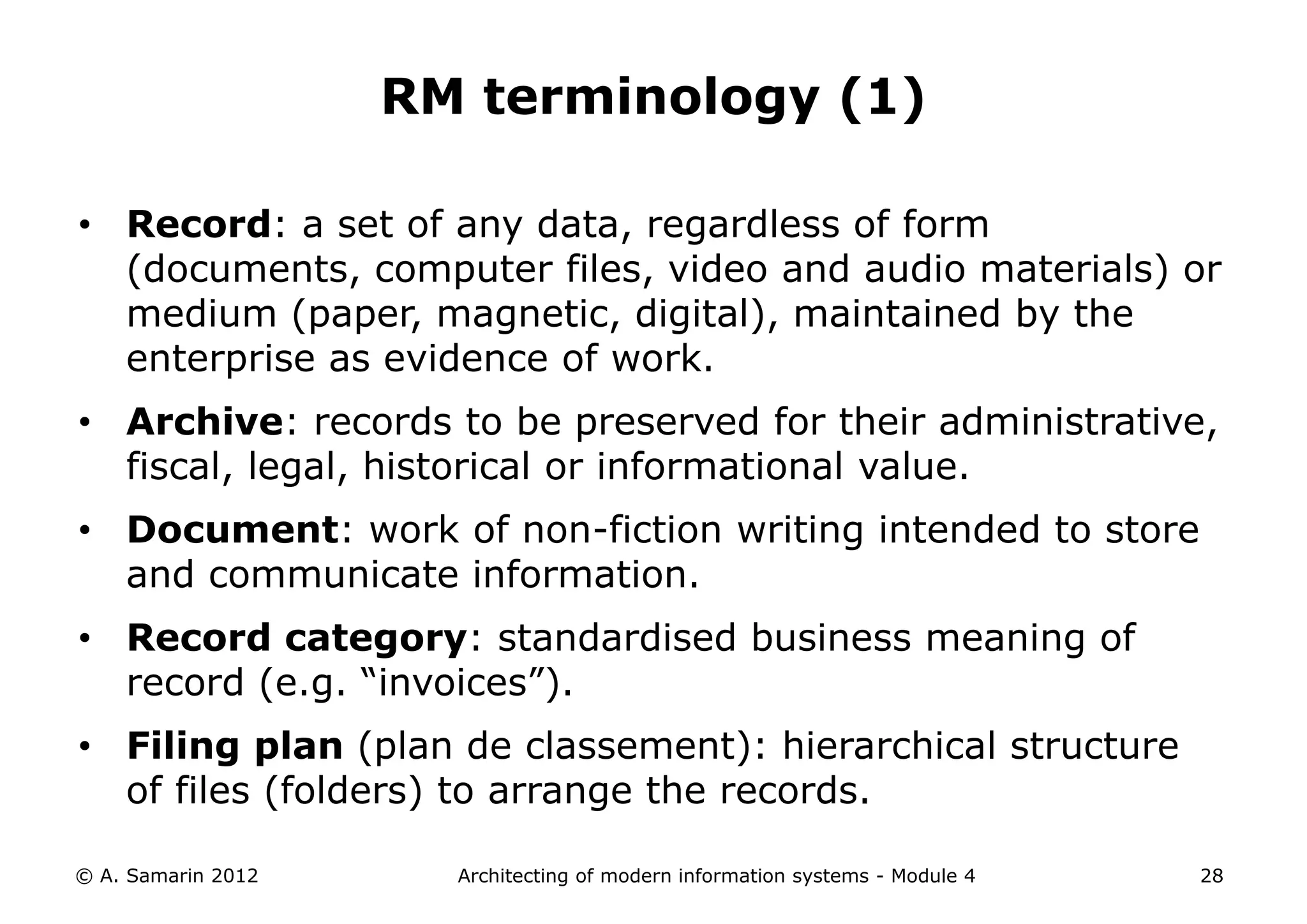
RM terminology (1)

• Record: a set of any data, regardless of form
  (documents, computer files, video and audio materials) or
  medium (paper, magnetic, digital), maintained by the
  enterprise as evidence of work.
• Archive: records to be preserved for their administrative,
  fiscal, legal, historical or informational value.
• Document: work of non-fiction writing intended to store
  and communicate information.
• Record category: standardised business meaning of
  record (e.g. “invoices”).
• Filing plan (plan de classement): hierarchical structure
  of files (folders) to arrange the records.

© A. Samarin 2012     Architecting of modern information systems - Module 4   28
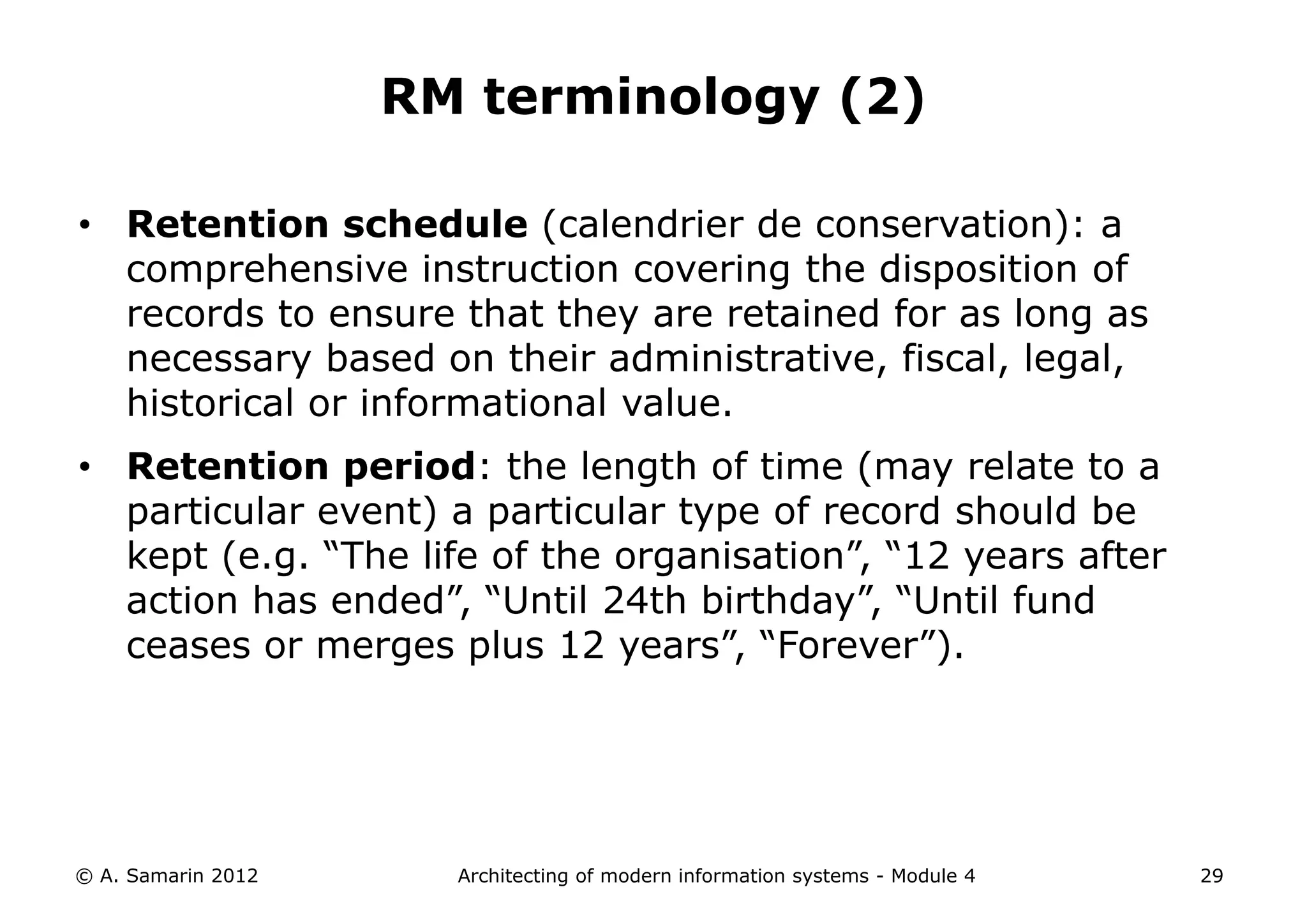
RM terminology (2)

• Retention schedule (calendrier de conservation): a
  comprehensive instruction covering the disposition of
  records to ensure that they are retained for as long as
  necessary based on their administrative, fiscal, legal,
  historical or informational value.
• Retention period: the length of time (may relate to a
  particular event) a particular type of record should be
  kept (e.g. “The life of the organisation”, “12 years after
  action has ended”, “Until 24th birthday”, “Until fund
  ceases or merges plus 12 years”, “Forever”).


© A. Samarin 2012     Architecting of modern information systems - Module 4   29
Types of archives

• operational (close to the working place, e.g. in the
  corridor)
• intermediate (in the attic or basement)
• historical (in a specialised external place)


© A. Samarin 2012    Architecting of modern information systems - Module 4   30
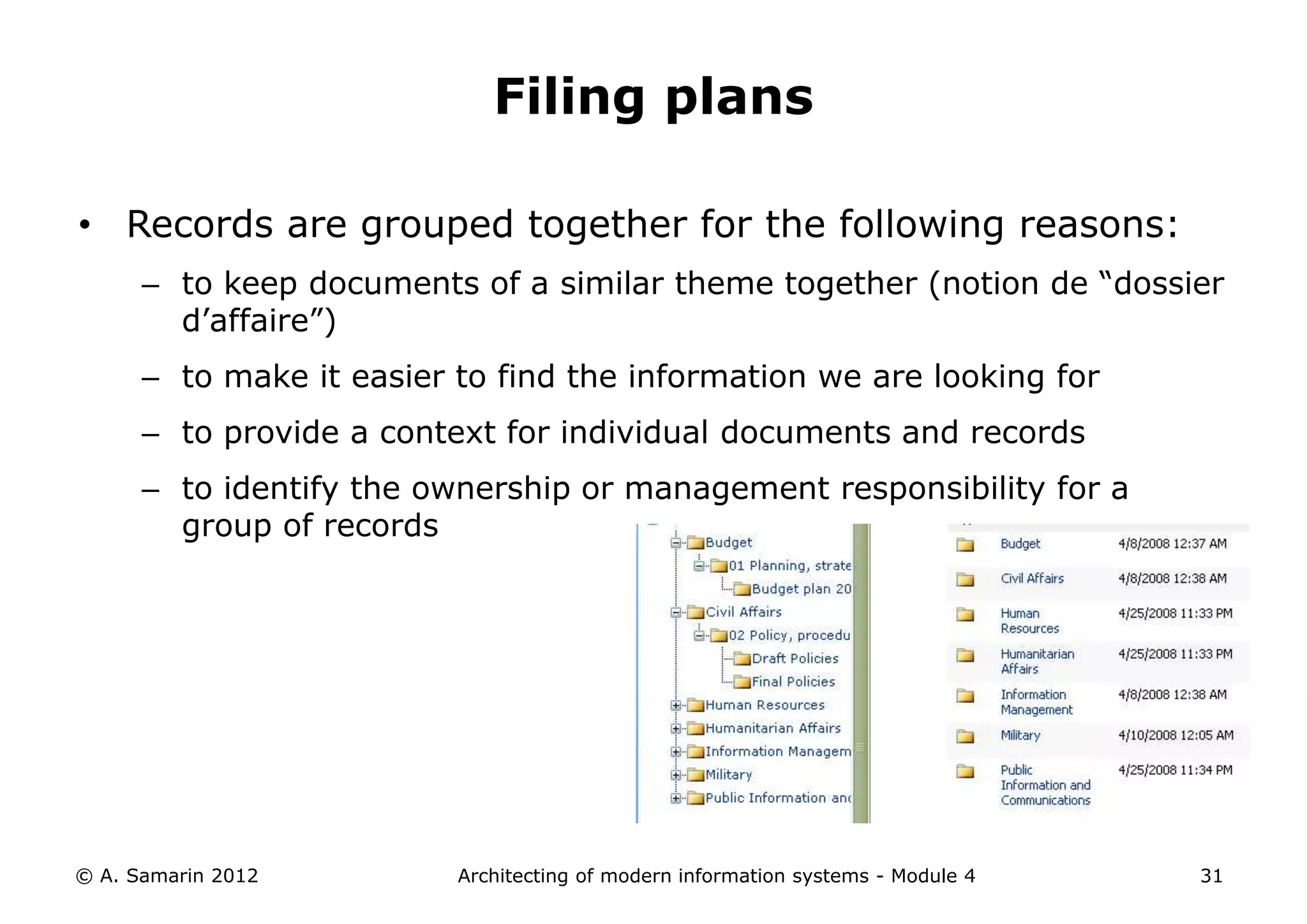
Filing plans

• Records are grouped together for the following reasons:
      – to keep documents of a similar theme together (notion de “dossier
        d’affaire”)
      – to make it easier to find the information we are looking for
      – to provide a context for individual documents and records
      – to identify the ownership or management responsibility for a
        group of records


© A. Samarin 2012         Architecting of modern information systems - Module 4   31
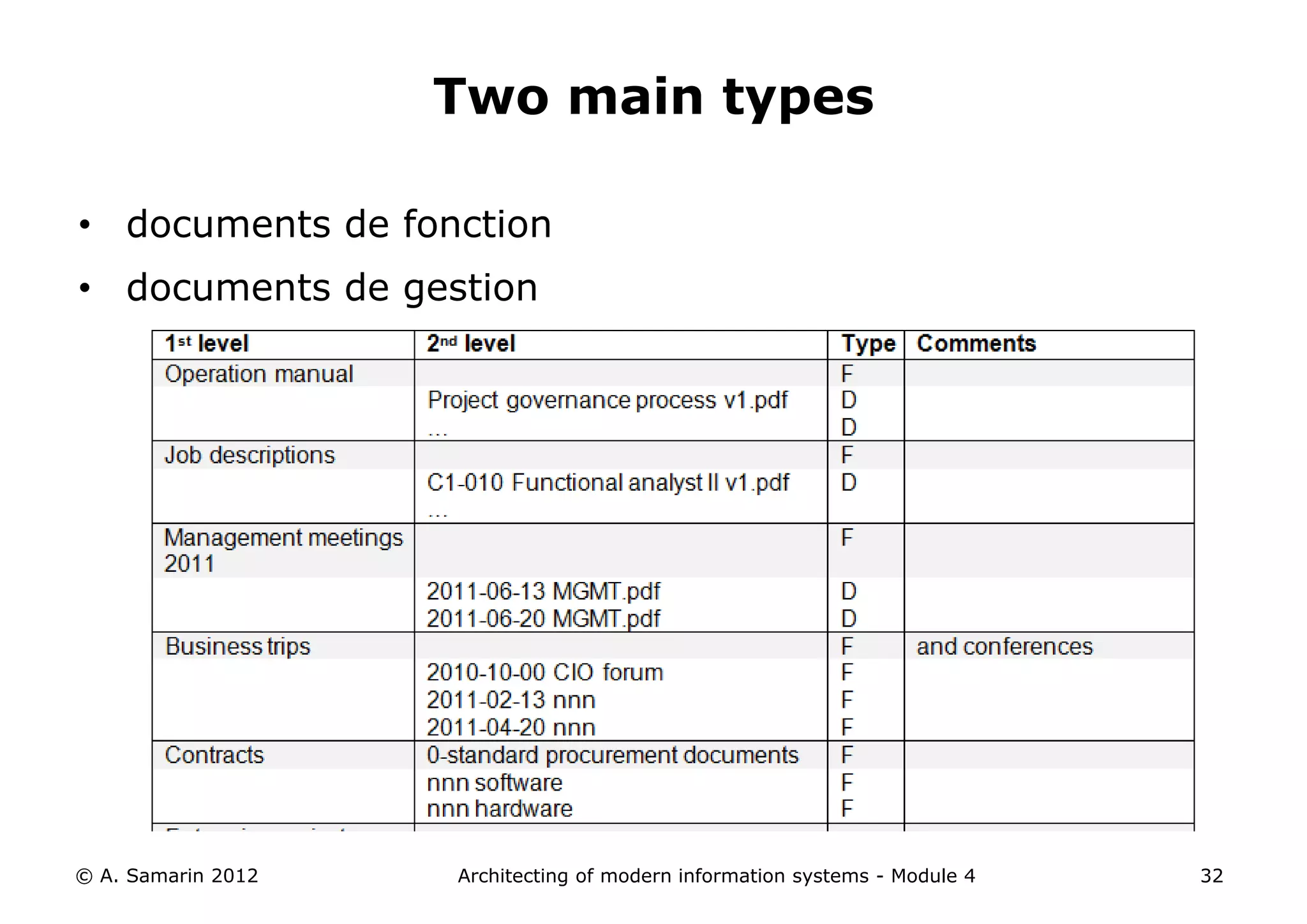
Two main types

• documents de fonction
• documents de gestion


© A. Samarin 2012   Architecting of modern information systems - Module 4   32
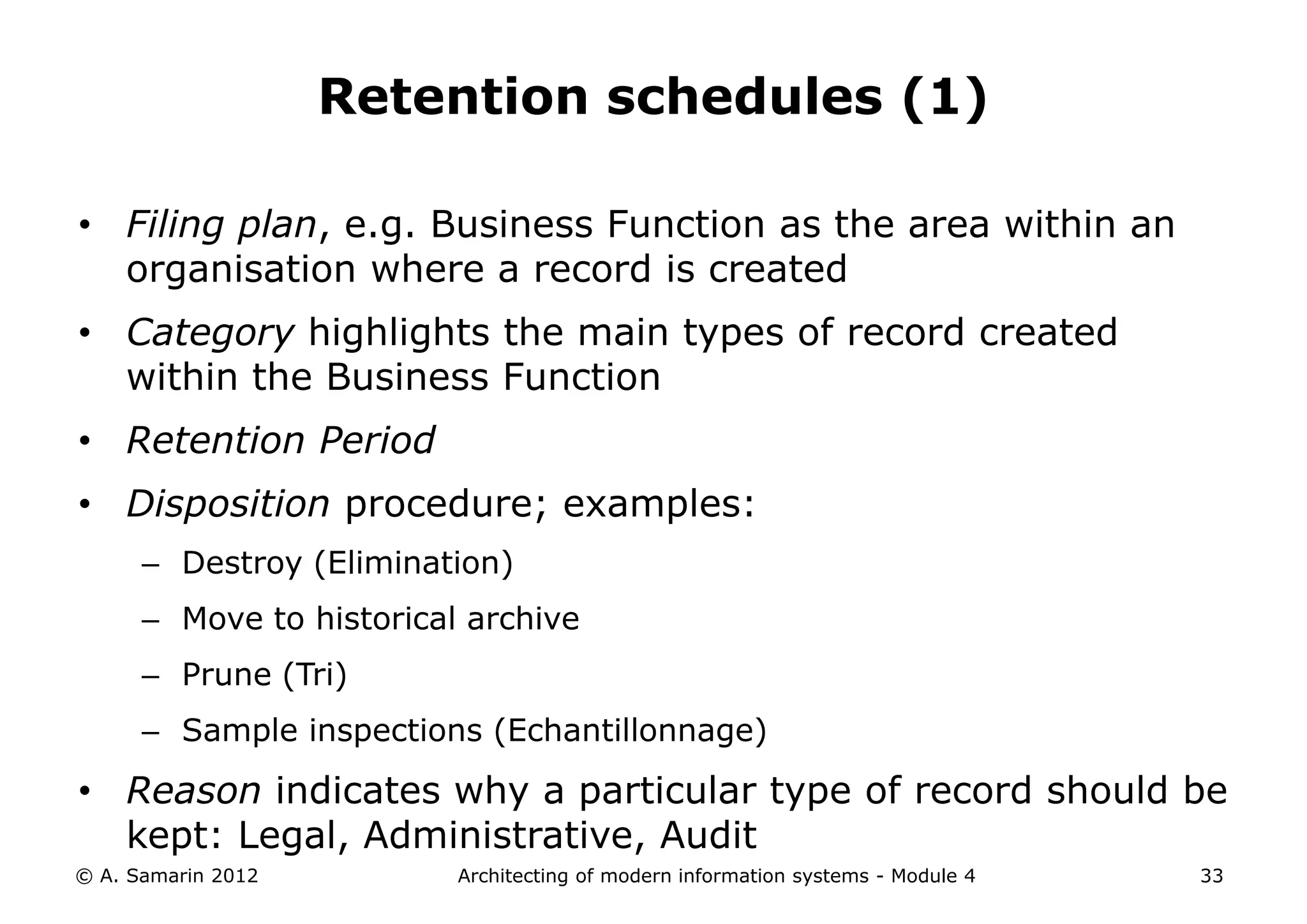
Retention schedules (1)

• Filing plan, e.g. Business Function as the area within an
  organisation where a record is created
• Category highlights the main types of record created
  within the Business Function
• Retention Period
• Disposition procedure; examples:
      – Destroy (Elimination)
      – Move to historical archive
      – Prune (Tri)
      – Sample inspections (Echantillonnage)

• Reason indicates why a particular type of record should be
  kept: Legal, Administrative, Audit
© A. Samarin 2012         Architecting of modern information systems - Module 4   33
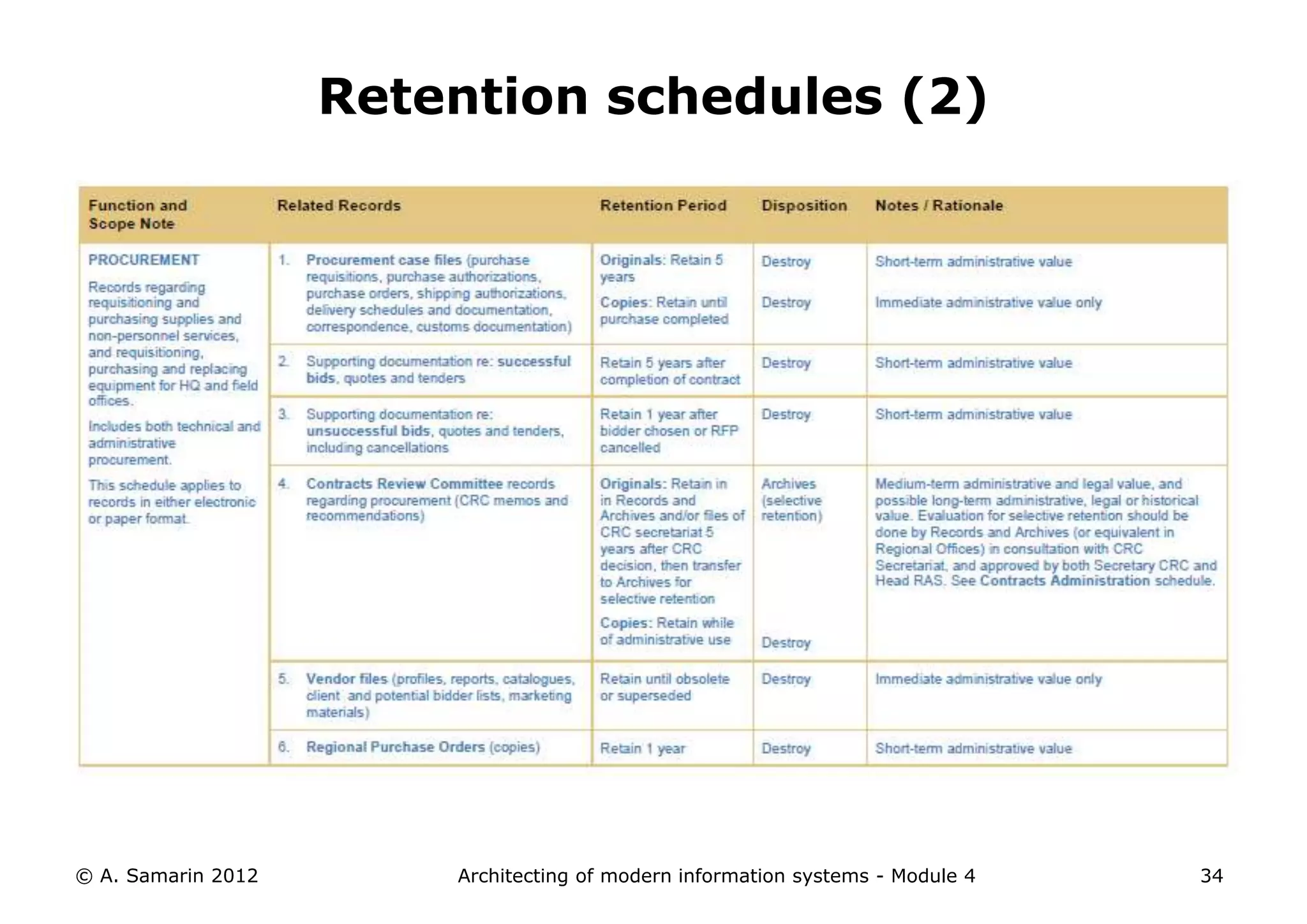
Retention schedules (2)


© A. Samarin 2012       Architecting of modern information systems - Module 4   34
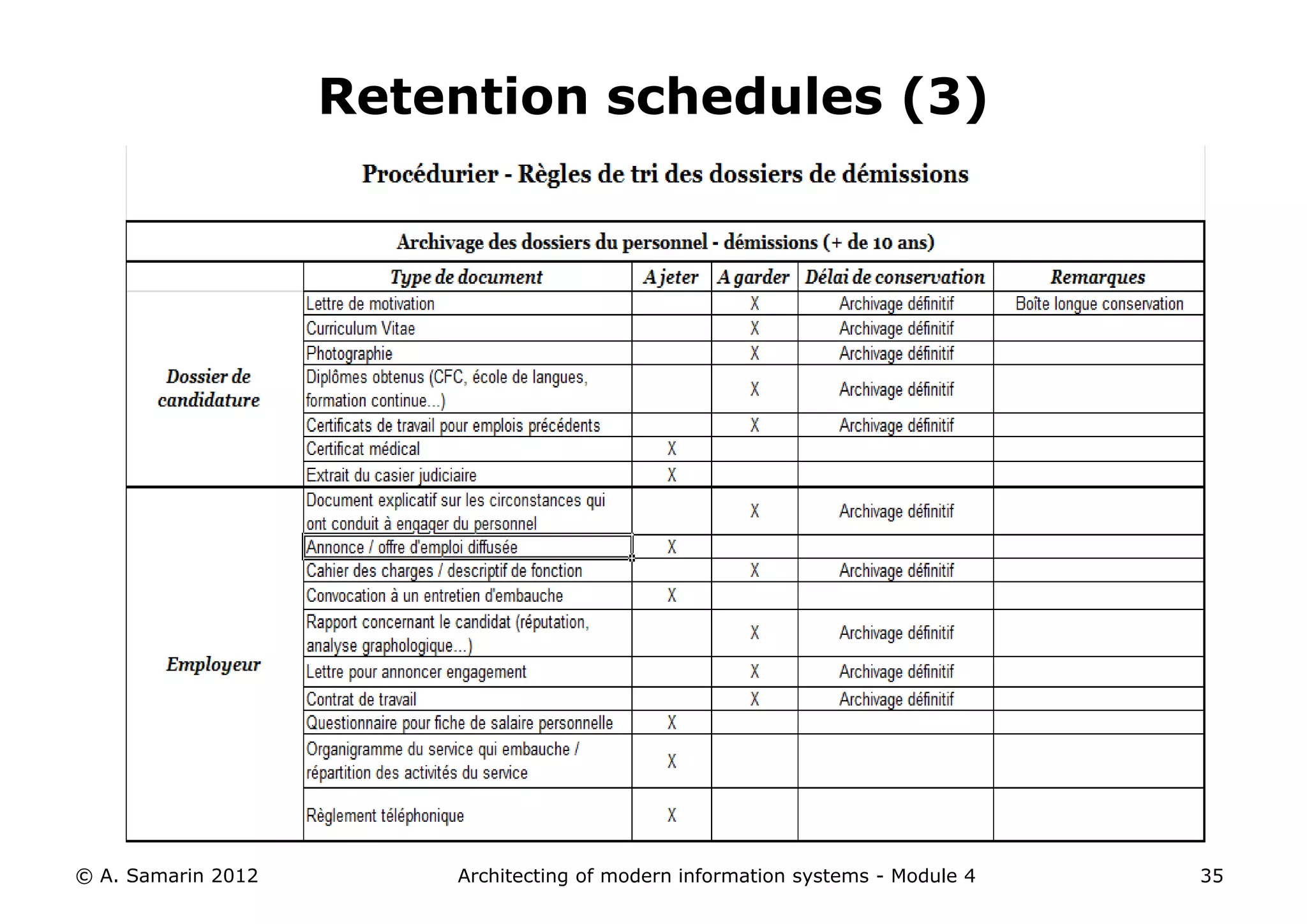
Retention schedules (3)


© A. Samarin 2012       Architecting of modern information systems - Module 4   35
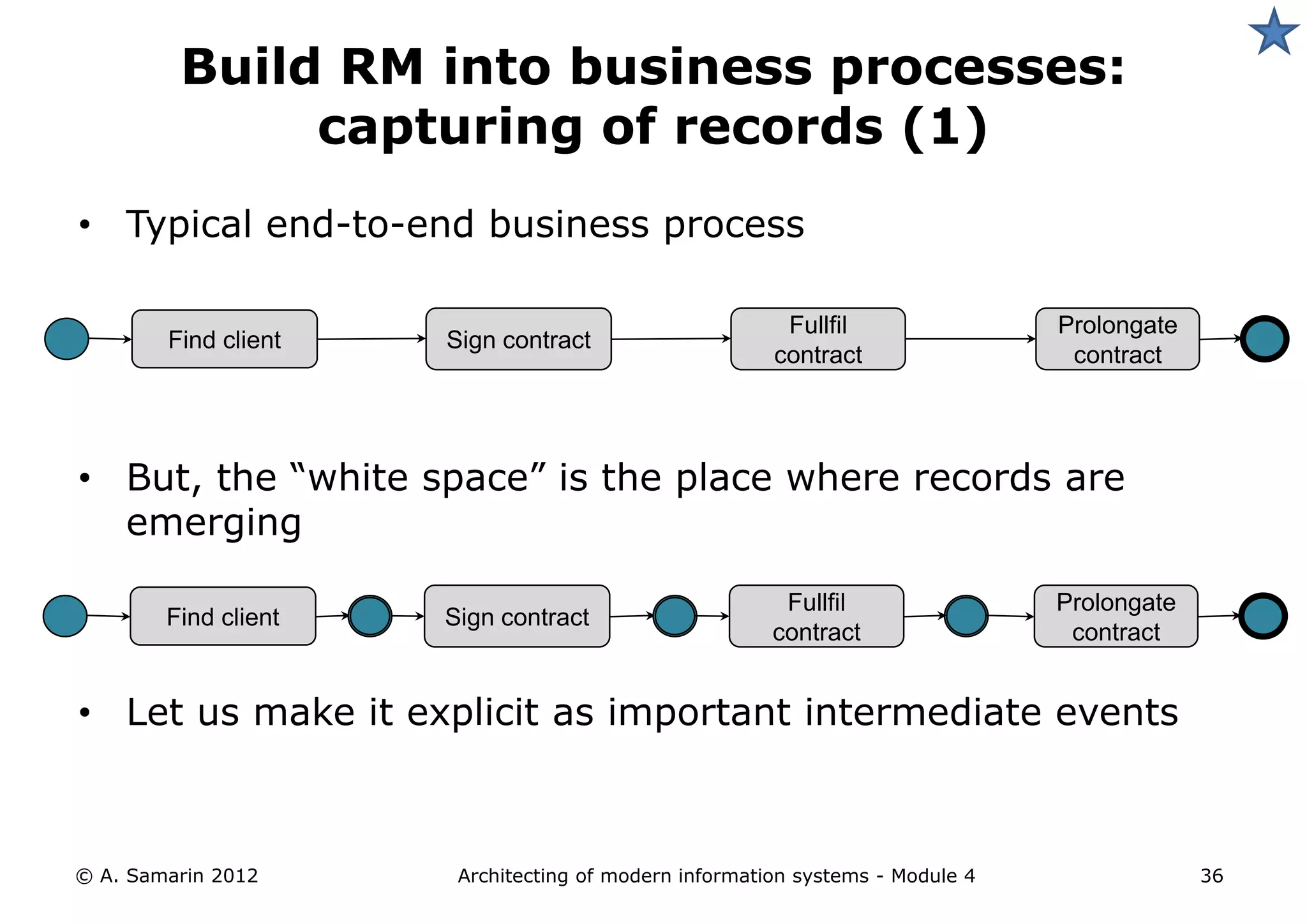
Build RM into business processes:
              capturing of records (1)
• Typical end-to-end business process

                                                        Fullfil                Prolongate
        Find client   Sign contract
                                                       contract                 contract


• But, the “white space” is the place where records are
  emerging

                                                        Fullfil                Prolongate
        Find client   Sign contract
                                                       contract                 contract


• Let us make it explicit as important intermediate events


© A. Samarin 2012      Architecting of modern information systems - Module 4                36
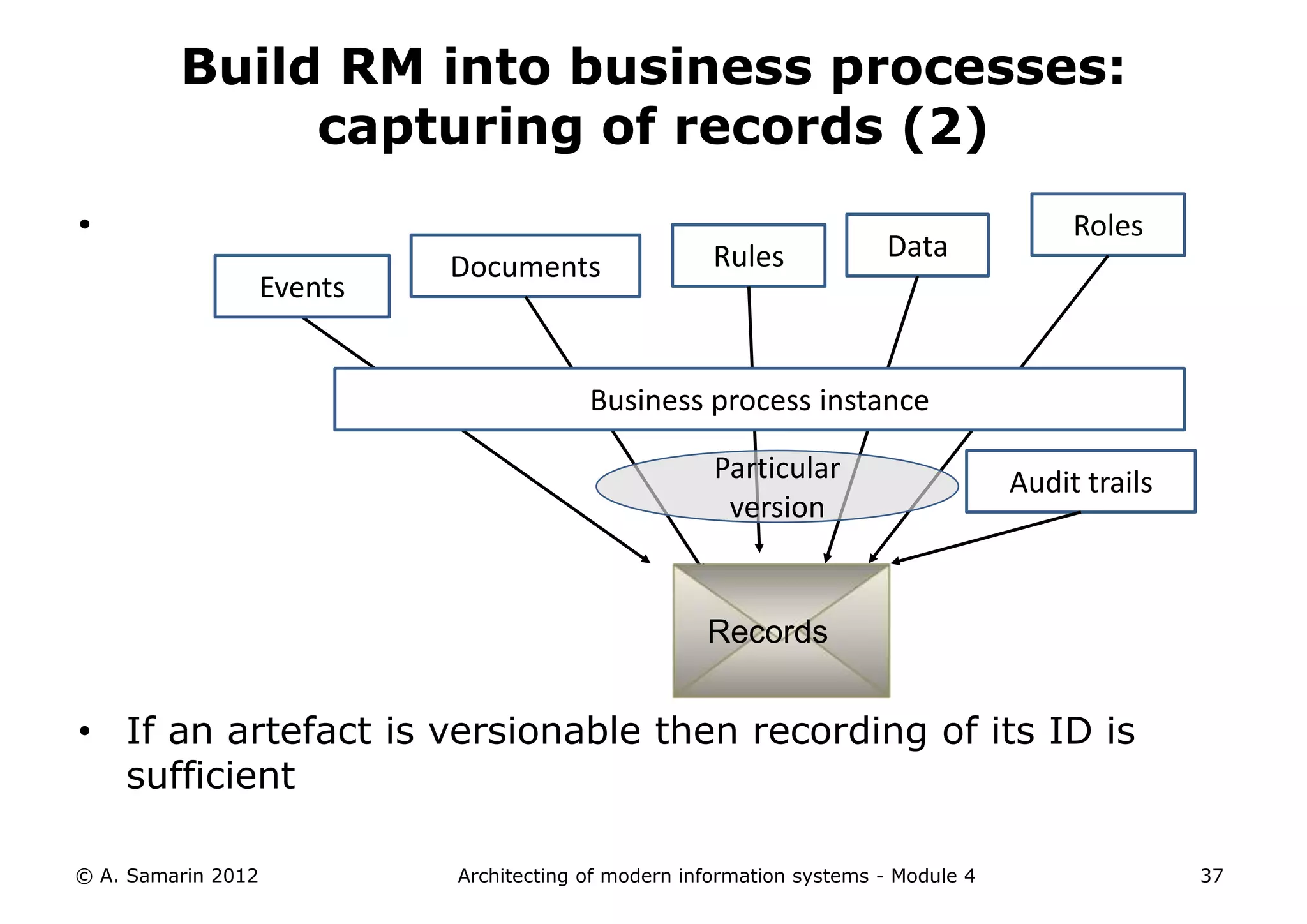
Build RM into business processes:
              capturing of records (2)
•                                                                                         Roles
                                                       Rules            Data
                             Documents
                    Events


                                          Business process instance

                                                       Particular                    Audit trails
                                                        version


                                                      Records


• If an artefact is versionable then recording of its ID is
  sufficient

© A. Samarin 2012            Architecting of modern information systems - Module 4                  37
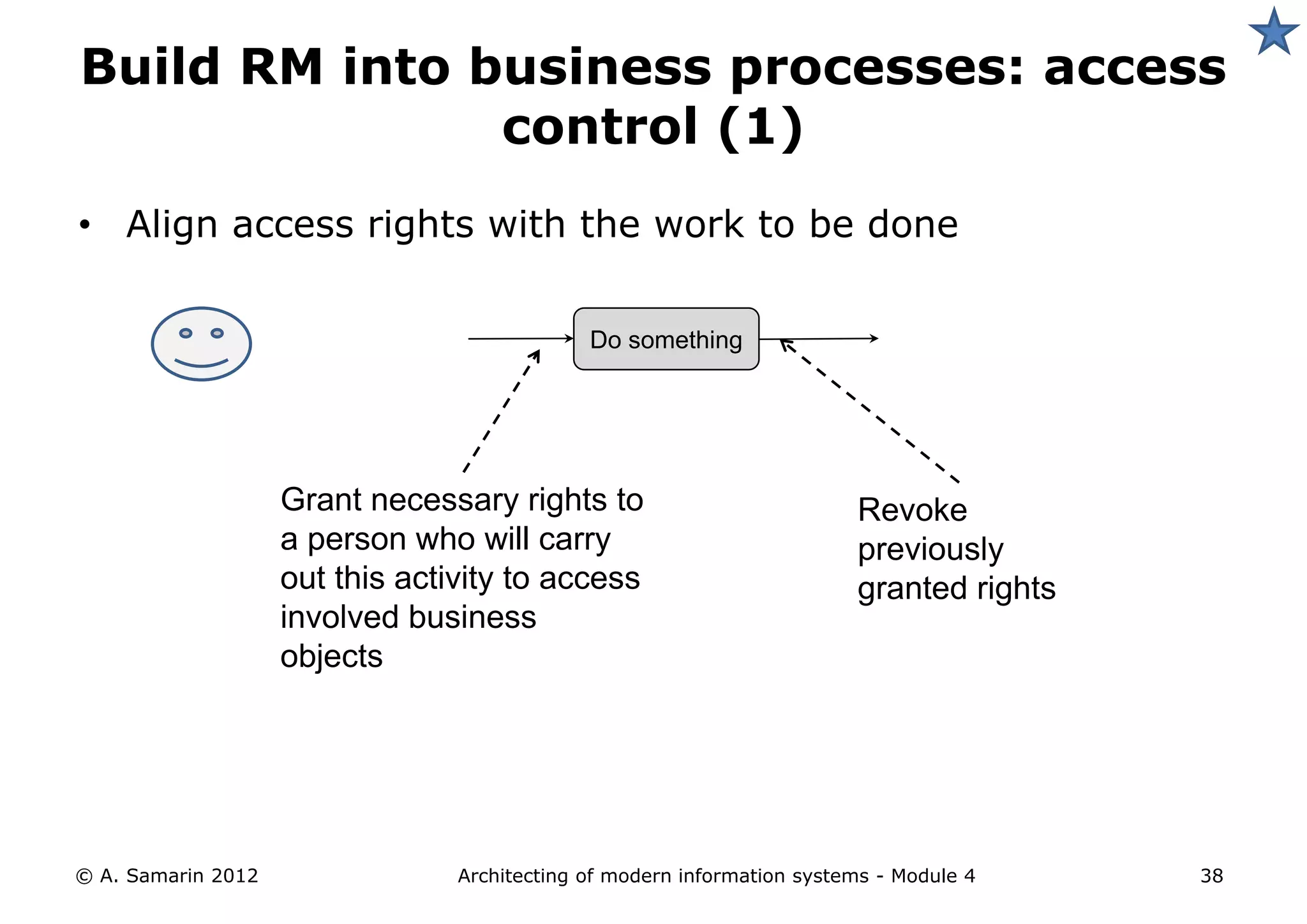
Build RM into business processes: access
               control (1)
• Align access rights with the work to be done

                                              Do something


                    Grant necessary rights to                            Revoke
                    a person who will carry                              previously
                    out this activity to access                          granted rights
                    involved business
                    objects


© A. Samarin 2012                Architecting of modern information systems - Module 4    38
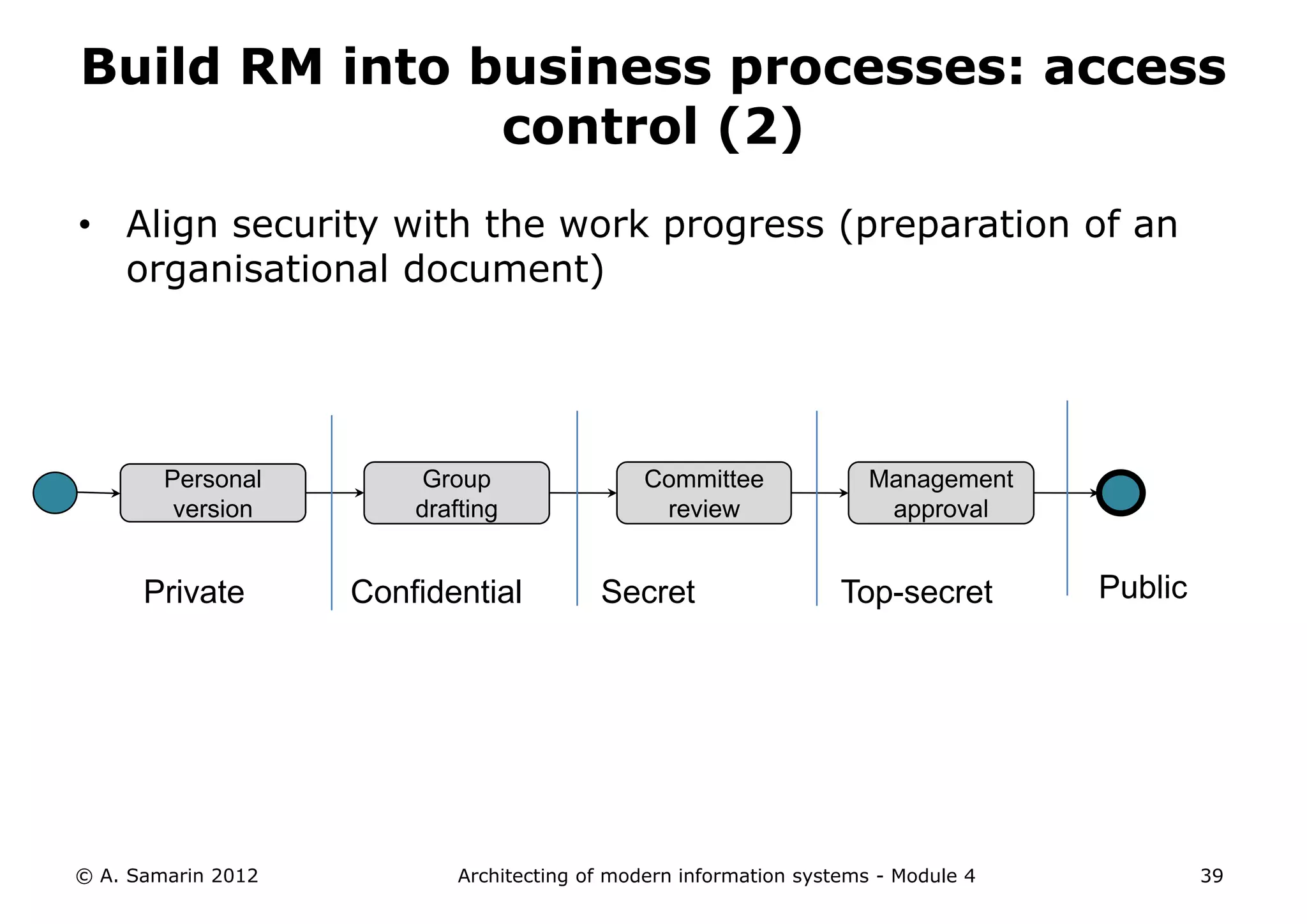
Build RM into business processes: access
               control (2)
• Align security with the work progress (preparation of an
  organisational document)


        Personal        Group                  Committee              Management
         version        drafting                review                 approval


      Private       Confidential          Secret                   Top-secret       Public


© A. Samarin 2012           Architecting of modern information systems - Module 4            39
Regulatory compliance and BPM

• Well-known regulations: Sarbane-Oxley, Basel II, etc.


• Again, business processes can be instrumented to provide
  the documentation critical to compliance


© A. Samarin 2012   Architecting of modern information systems - Module 4   40
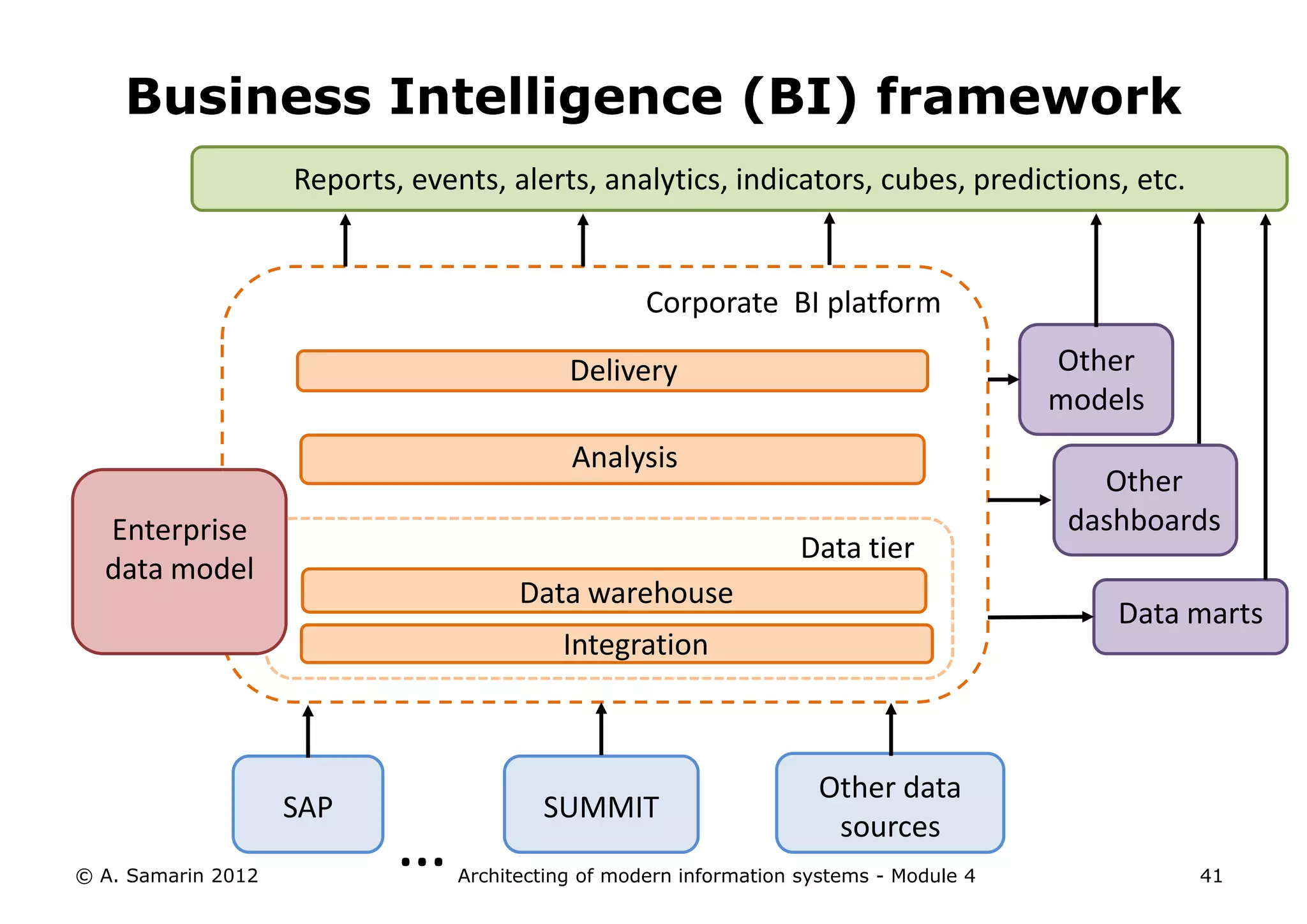
Business Intelligence (BI) framework
                    Reports, events, alerts, analytics, indicators, cubes, predictions, etc.


                                                    Corporate BI platform

                                            Delivery                                     Other
                                                                                         models
                                            Analysis
                                                                                            Other
  Enterprise                                                                              dashboards
                                                                    Data tier
  data model
                                       Data warehouse
                                                                                             Data marts
                                           Integration


                                                                     Other data
                    SAP                  SUMMIT
© A. Samarin 2012
                            …                                         sources
                                 Architecting of modern information systems - Module 4            41
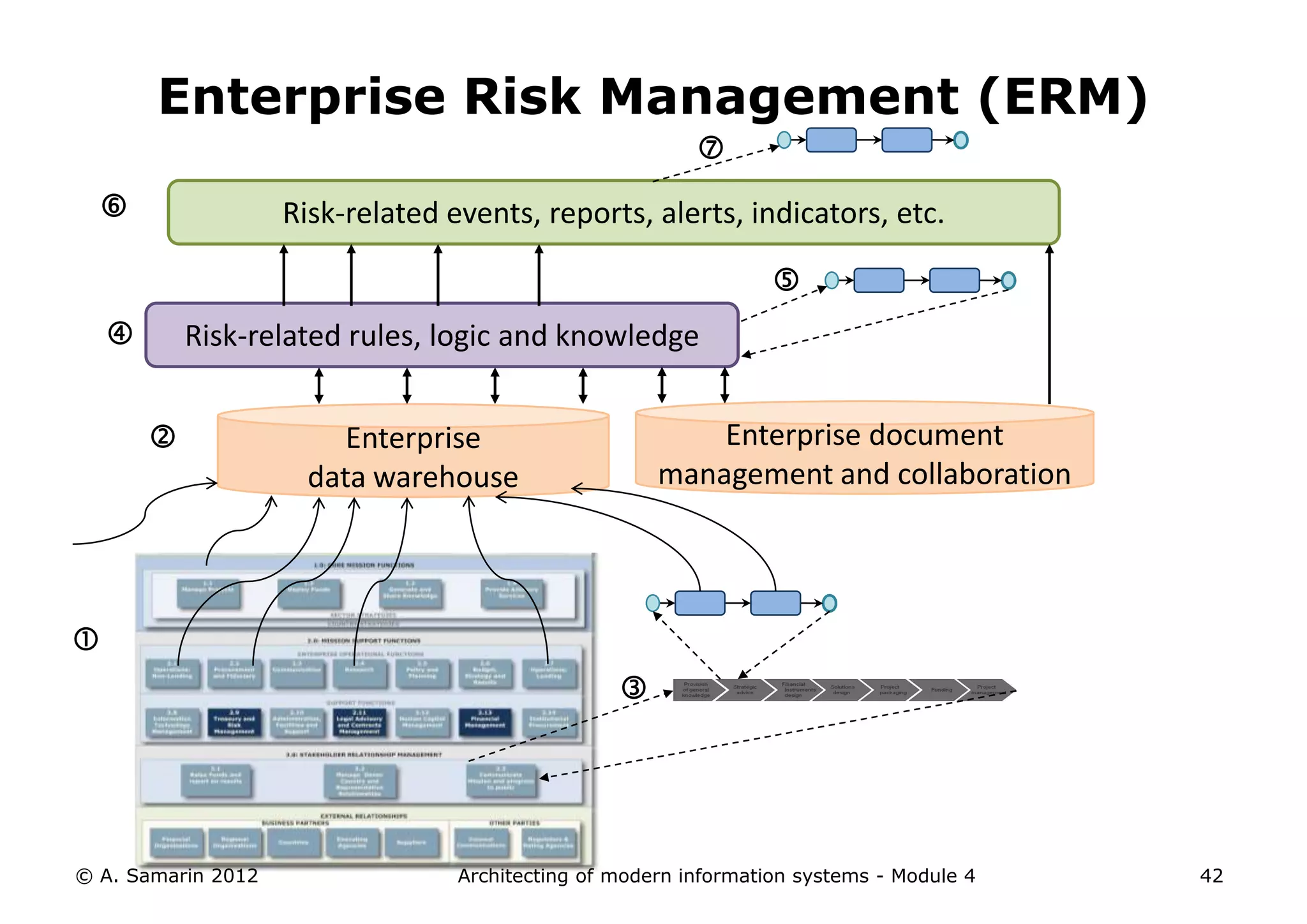
Enterprise Risk Management (ERM)
                                                          
                   Risk-related events, reports, alerts, indicators, etc.

                                                                  
           Risk-related rules, logic and knowledge


                        Enterprise                       Enterprise document
                      data warehouse                  management and collaboration



                                                  


© A. Samarin 2012                 Architecting of modern information systems - Module 4   42
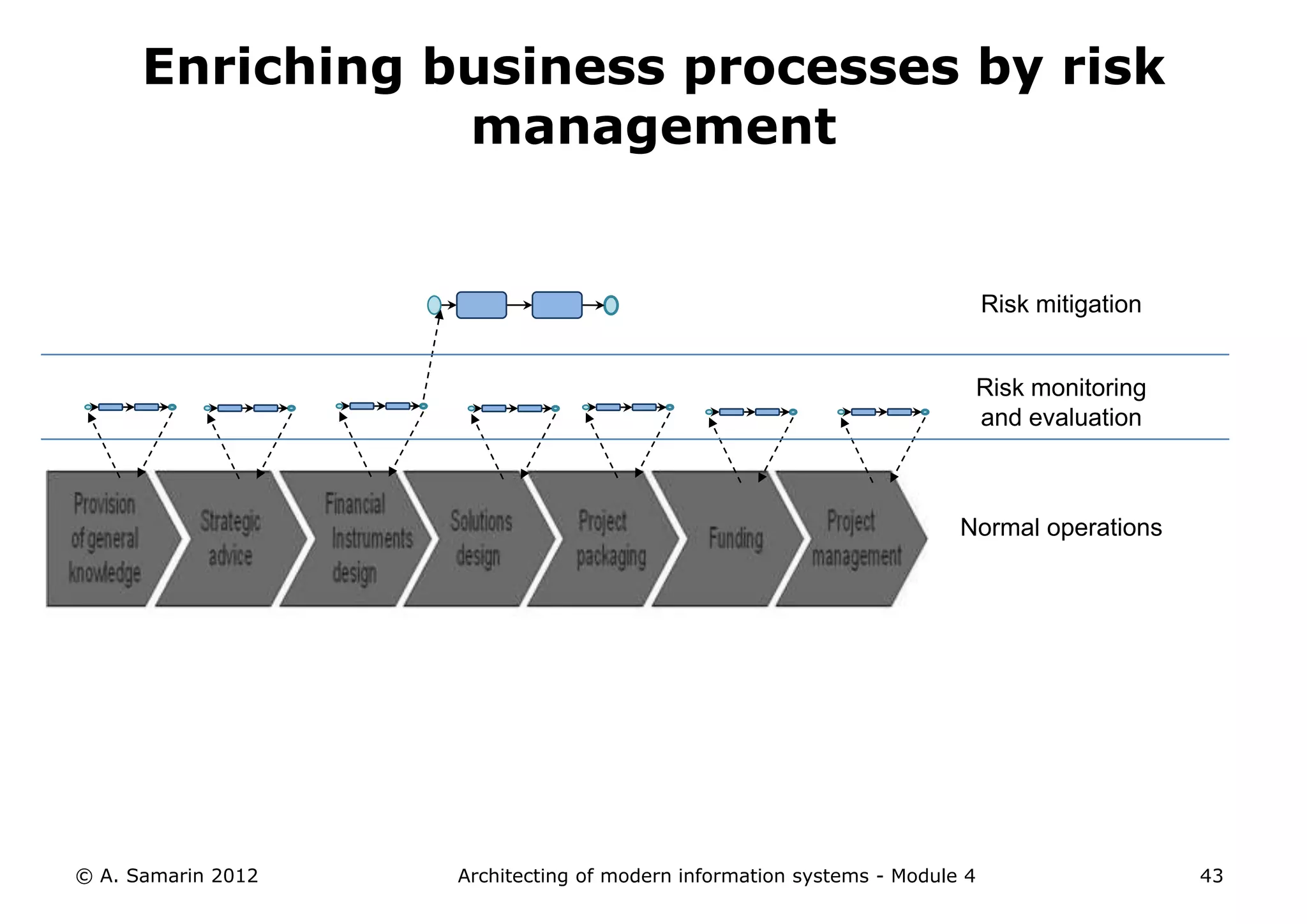
Enriching business processes by risk
                 management


                                                                            Risk mitigation


                                                                            Risk monitoring
                                                                            and evaluation


                                                                       Normal operations


© A. Samarin 2012   Architecting of modern information systems - Module 4                     43
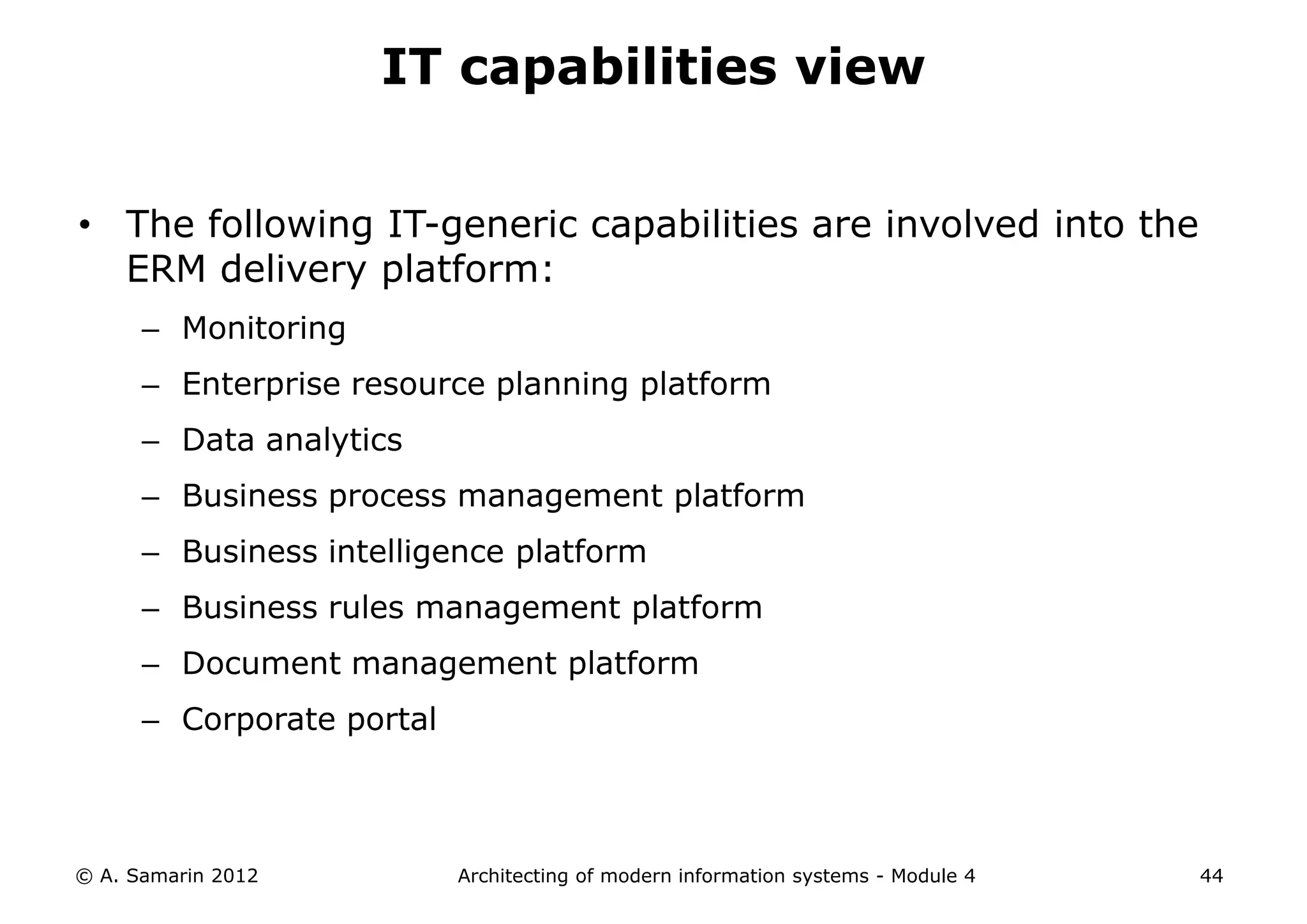
IT capabilities view


• The following IT-generic capabilities are involved into the
  ERM delivery platform:
      – Monitoring
      – Enterprise resource planning platform
      – Data analytics
      – Business process management platform
      – Business intelligence platform
      – Business rules management platform
      – Document management platform
      – Corporate portal


© A. Samarin 2012          Architecting of modern information systems - Module 4   44
Homework 4-1

• Add to your “chocolate cake” process some risk-
  management controls


© A. Samarin 2012   Architecting of modern information systems - Module 4   45

Architecting modern informaiton systems M4 information architecture

  • 1.
    Architecting of modern information systems Module 4 Information architecture A. Samarin
  • 2.
    Enterprise Content Management(ECM) • Capture (OCR, email, video, etc.) • Manage – Document management (check in/out, versioning, metadata) – Collaboration (forums, news, events, calendars, blogs, etc.) – Web content management – Records management (indexing, archive and filing management) – Automation (capture, reviews, approvals, publishing, expiration) – Search • Store (repositories, libraries, media) • Deliver (transform, secure, distribute) • Preserve (backup, recovery) © A. Samarin 2012 Architecting of modern information systems - Module 4 2
  • 3.
    Many tools © A.Samarin 2012 Architecting of modern information systems - Module 4 3
  • 4.
    Advantages of thecorporate ECM platform Functionality Process-centric D integration E V Company-specific E features L Advanced features of a O common ECM platform P M Basic features of a E common ECM platform N T Generic web- Platform 3 development platforms Platform 1 Platform 2 © A. Samarin 2012 Architecting of modern information systems - Module 4 4
  • 5.
    Financial estimations • Currentdevelopment cost & time for a collaborative application – Cost: 40 – 200 Krub – Time: 0,5 – 2 years Without common • Corporate platform program cost & time platform $$ – Cost: 600 Krub – Time: 1 year • Expected development cost & time for With a collaborative application within common the corporate platform platform N≈8 – Cost: 20 - 60 Krub N apps. – Time: 2 - 5 months © A. Samarin 2012 Architecting of modern information systems - Module 4 5
  • 6.
    Typical departmental GroupProductivity Environment (GPE) • Information related to department’s internal functioning – correspondences, meetings, contracts, suppliers, consultants, inter nal archive, etc. • Information related to department’s core business processes • Information for all Company’s employers – Organization structure, policies, related Presidential instructions, rules and procedures, operations manuals, announcements, contacts, etc. © A. Samarin 2012 Architecting of modern information systems - Module 4 6
  • 7.
    AS-IS : Nogroup productivity environment (GPE) SAP E-mail ARCHIVE Intranet Shared files © A. Samarin 2012 Architecting of modern information systems - Module 4 7
  • 8.
    TO-BE: GPE collectsdata and information around the business needs SAP E-mail GPE … Intranet GPE1 GPEn ARCHIVE Unified (SharePoint) platform IBM Content Collector for 1) DUET (SAP+Microsoft product) SharePoint © A. Samarin 2012 Architecting of modern information systems - Module 4 8
  • 9.
    Operation-centric environment andthe core business process work TOGETHER SharePoint platform © A. Samarin 2012 Architecting of modern information systems - Module 4 9
  • 10.
    TO-BE: Inside platform(1) Intranet GPE1 GPE2 GPE3 … GPEn SharePoint platform environments Production Staging Training Integration Development SAP ARCHIVE © A. Samarin 2012 Architecting of modern information systems - Module 4 10
  • 11.
    TO-BE: Inside platform(2) © A. Samarin 2012 Architecting of modern information systems - Module 4 11
  • 12.
    TO-BE: Inside platform(3) © A. Samarin 2012 Architecting of modern information systems - Module 4 12
  • 13.
    TO-BE: Inside platform(4) Intranet GPE1 GPE2 GPE3 … GPEn Production A Production B Production C Staging A Staging B Staging C Training A Training B Training C Integration A Integration B Integration C Dev A1 Dev A2 Dev B1 Dev C1 … Dev Cn SAP ARCHIVE © A. Samarin 2012 Architecting of modern information systems - Module 4 13
  • 14.
    Stage 1 –Finalise logical and physical architectures Intranet GPE1 GPE2 GPE3 … GPEn Production Staging Training Integration Development © A. Samarin 2012 Architecting of modern information systems - Module 4 14
  • 15.
    Step 2 –Build minimal operational environments GPE1 GPE2 GPE3 Production B Integration B Dev B1 © A. Samarin 2012 Architecting of modern information systems - Module 4 15
  • 16.
    Step 3 –Implement 3 typical GPEs GPE1 GPE2 GPE3 Production B Staging B Training B Integration B Dev B1 © A. Samarin 2012 Architecting of modern information systems - Module 4 16
  • 17.
    Step 4 –Validate all advanced SharePoint features GPE1 GPE2 GPE3 … GPEn Production B Staging B Staging C Training B Integration B Integration C Dev B1 Dev C1 … Dev Cn © A. Samarin 2012 Architecting of modern information systems - Module 4 17
  • 18.
    Step 4 –Prototype the corporate Intranet Intranet GPE1 GPE2 GPE3 … GPEn Production B Staging A Staging B Staging C Training B Integration A Integration B Integration C Dev A1 Dev A2 Dev B1 Dev C1 … Dev Cn © A. Samarin 2012 Architecting of modern information systems - Module 4 18
  • 19.
    Step 5 –Provide integration with the main corporate information resources Intranet GPE1 GPE2 GPE3 … GPEn Production A Production B Staging A Staging B Staging C Training A Training B Integration A Integration B Integration C Dev A1 Dev A2 Dev B1 Dev C1 … Dev Cn SAP ARCHIVE © A. Samarin 2012 Architecting of modern information systems - Module 4 19
  • 20.
    Step 6 –Implement all foreseen GPEs Intranet GPE1 GPE2 GPE3 … GPEn Production A Production B Production C Staging A Staging B Staging C Training A Training B Training C Integration A Integration B Integration C Dev A1 Dev A2 Dev B1 Dev C1 … Dev Cn SAP ARCHIVE © A. Samarin 2012 Architecting of modern information systems - Module 4 20
  • 21.
    Document life-cycles (1) •Creation – acquisition or receipt • Dissemination – process of managing the information once it has been created or received • Use – takes place after information is distributed internally, and can generate business decisions, document further actions, or serve other purposes • Maintenance – this can include processes such as filing, retrieval and transfers between different repositories • Disposition © A. Samarin 2012 Architecting of modern information systems - Module 4 21
  • 22.
    Document life-cycles (2) •For each phase, it is necessary to know: – initiating / terminating events – permissions for roles – expected duration – master repository – copy or cache repositories – volume (number of objects and size in Mb) estimation – annual growth estimation © A. Samarin 2012 Architecting of modern information systems - Module 4 22
  • 23.
    One version case Destroy In-active availability Long-term archive Active Formal availability actions including records Publish management Creation Time Key: Evolving document Mature document (no further evolution) Frozen document (for long-time preservation) © A. Samarin 2012 Architecting of modern information systems - Module 4 23
  • 24.
    A few versionscase – typical for organisational documents Destroy In-active availability Long-term archive Active availability Publish Creation Time Edition 1 Edition 2 Edition 3 Key: Evolving document Mature document (no further evolution) Frozen document (for long-time preservation) © A. Samarin 2012 Architecting of modern information systems - Module 4 24
  • 25.
    Creation in moredetails Publish Document evolution during creation phase Time Version 1 Version 2 Version 3 Version 4 Key: Evolving document Mature document (no further evolution) Frozen document (for long-time preservation) Document with no clearly Architecting of modern informationor destroy) © A. Samarin 2012 defined destiny (preserve systems - Module 4 25
  • 26.
    Creation in moredetails – more roles Publish Document Role B evolution during creation phase Role A Time Version 1 Version 2 Version 3 Version 4 Key: Evolving document Mature document (no further evolution) Frozen document (for long-time preservation) © A. Samarin 2012 Architecting of modern information systems - Module 4 26
  • 27.
    A compound documentcase – typical for business documents Destroy Historical interest Long-term archive Operational interest Publish or Close Active Time Start of Finish of Finish of Finish of business case business case retention 1 retention 2 Key: Evolving document Mature document (no further evolution) © A. Samarin 2012 Architecting of modern information systems - Module 4 27 Frozen document (for long-time preservation)
  • 28.
    RM terminology (1) •Record: a set of any data, regardless of form (documents, computer files, video and audio materials) or medium (paper, magnetic, digital), maintained by the enterprise as evidence of work. • Archive: records to be preserved for their administrative, fiscal, legal, historical or informational value. • Document: work of non-fiction writing intended to store and communicate information. • Record category: standardised business meaning of record (e.g. “invoices”). • Filing plan (plan de classement): hierarchical structure of files (folders) to arrange the records. © A. Samarin 2012 Architecting of modern information systems - Module 4 28
  • 29.
    RM terminology (2) •Retention schedule (calendrier de conservation): a comprehensive instruction covering the disposition of records to ensure that they are retained for as long as necessary based on their administrative, fiscal, legal, historical or informational value. • Retention period: the length of time (may relate to a particular event) a particular type of record should be kept (e.g. “The life of the organisation”, “12 years after action has ended”, “Until 24th birthday”, “Until fund ceases or merges plus 12 years”, “Forever”). © A. Samarin 2012 Architecting of modern information systems - Module 4 29
  • 30.
    Types of archives •operational (close to the working place, e.g. in the corridor) • intermediate (in the attic or basement) • historical (in a specialised external place) © A. Samarin 2012 Architecting of modern information systems - Module 4 30
  • 31.
    Filing plans • Recordsare grouped together for the following reasons: – to keep documents of a similar theme together (notion de “dossier d’affaire”) – to make it easier to find the information we are looking for – to provide a context for individual documents and records – to identify the ownership or management responsibility for a group of records © A. Samarin 2012 Architecting of modern information systems - Module 4 31
  • 32.
    Two main types •documents de fonction • documents de gestion © A. Samarin 2012 Architecting of modern information systems - Module 4 32
  • 33.
    Retention schedules (1) •Filing plan, e.g. Business Function as the area within an organisation where a record is created • Category highlights the main types of record created within the Business Function • Retention Period • Disposition procedure; examples: – Destroy (Elimination) – Move to historical archive – Prune (Tri) – Sample inspections (Echantillonnage) • Reason indicates why a particular type of record should be kept: Legal, Administrative, Audit © A. Samarin 2012 Architecting of modern information systems - Module 4 33
  • 34.
    Retention schedules (2) ©A. Samarin 2012 Architecting of modern information systems - Module 4 34
  • 35.
    Retention schedules (3) ©A. Samarin 2012 Architecting of modern information systems - Module 4 35
  • 36.
    Build RM intobusiness processes: capturing of records (1) • Typical end-to-end business process Fullfil Prolongate Find client Sign contract contract contract • But, the “white space” is the place where records are emerging Fullfil Prolongate Find client Sign contract contract contract • Let us make it explicit as important intermediate events © A. Samarin 2012 Architecting of modern information systems - Module 4 36
  • 37.
    Build RM intobusiness processes: capturing of records (2) • Roles Rules Data Documents Events Business process instance Particular Audit trails version Records • If an artefact is versionable then recording of its ID is sufficient © A. Samarin 2012 Architecting of modern information systems - Module 4 37
  • 38.
    Build RM intobusiness processes: access control (1) • Align access rights with the work to be done Do something Grant necessary rights to Revoke a person who will carry previously out this activity to access granted rights involved business objects © A. Samarin 2012 Architecting of modern information systems - Module 4 38
  • 39.
    Build RM intobusiness processes: access control (2) • Align security with the work progress (preparation of an organisational document) Personal Group Committee Management version drafting review approval Private Confidential Secret Top-secret Public © A. Samarin 2012 Architecting of modern information systems - Module 4 39
  • 40.
    Regulatory compliance andBPM • Well-known regulations: Sarbane-Oxley, Basel II, etc. • Again, business processes can be instrumented to provide the documentation critical to compliance © A. Samarin 2012 Architecting of modern information systems - Module 4 40
  • 41.
    Business Intelligence (BI)framework Reports, events, alerts, analytics, indicators, cubes, predictions, etc. Corporate BI platform Delivery Other models Analysis Other Enterprise dashboards Data tier data model Data warehouse Data marts Integration Other data SAP SUMMIT © A. Samarin 2012 … sources Architecting of modern information systems - Module 4 41
  • 42.
    Enterprise Risk Management(ERM)   Risk-related events, reports, alerts, indicators, etc.   Risk-related rules, logic and knowledge  Enterprise Enterprise document data warehouse management and collaboration   © A. Samarin 2012 Architecting of modern information systems - Module 4 42
  • 43.
    Enriching business processesby risk management Risk mitigation Risk monitoring and evaluation Normal operations © A. Samarin 2012 Architecting of modern information systems - Module 4 43
  • 44.
    IT capabilities view •The following IT-generic capabilities are involved into the ERM delivery platform: – Monitoring – Enterprise resource planning platform – Data analytics – Business process management platform – Business intelligence platform – Business rules management platform – Document management platform – Corporate portal © A. Samarin 2012 Architecting of modern information systems - Module 4 44
  • 45.
    Homework 4-1 • Addto your “chocolate cake” process some risk- management controls © A. Samarin 2012 Architecting of modern information systems - Module 4 45