
“My Rule of Life” in 1st
draft
SSPP Seminar session #7
© JCD 2013
The word “rule” derives from the Latin word,
regula, which implies not so much a system of
rules and laws, but rather a way of regulating or
regularizing our lives so that we can stay on the
path that we have set for ourselves.
– A rule is like a trellis which offers support and
guidance for a plant, helping it grow in a certain
direction.
Macchia, Stephen A. Crafting a Rule of Life: An Invitation to the Well-Ordered Way. Downers Grove, Ill.:
Formatio/IVP Books, 2012, p.14.
Getting started . . .
Okay – so now you're ready to try creating your own Rule of Life. Get pencil
and paper, and then pay attention to these brief thoughts . . .
– You are not creating the Rule of Life, for all people or for all
time . . .
• Jesus has already taken care of that
– You are not creating a Rule for Your Entire Life . . .
• It's not meant to account for every minute, eliminate
spontaneity, or remain unchanged until death
– You are creating a rule that will spur you toward a deeper
relationship with God . . .
– You are committing to begin a practice that, with God's help, will
remove obstacles that hinder your spiritual journey . . .
Practices in your Rule should be . . .
• Natural,
• Intentional, and
• should be able to lived out in a rhythm
that fits one’s ordinary life . . .
There are many time-tested practices (disciplines) that might be
incorporated into the patterns of one’s Rule of Life . . .
Some of those behaviours are . . .
– Reading and meditating on Scripture;
– Praying regularly (and in differing forms)
– Worship, fellowship and public communion
– Regular confession of sin and forgiveness of others
– Exercising sacrificial self-giving
– Observing periods of silence or solitude
– Fasting and retreat
– Practicing hospitality
In addition attitudes can be brought under a Rule of Life . . .
– Response to authority,
– acceptance of the "other",
– rejection of grumbling or cynicism,
– forgiveness,
– Respect for others.
So let’s get started . . .
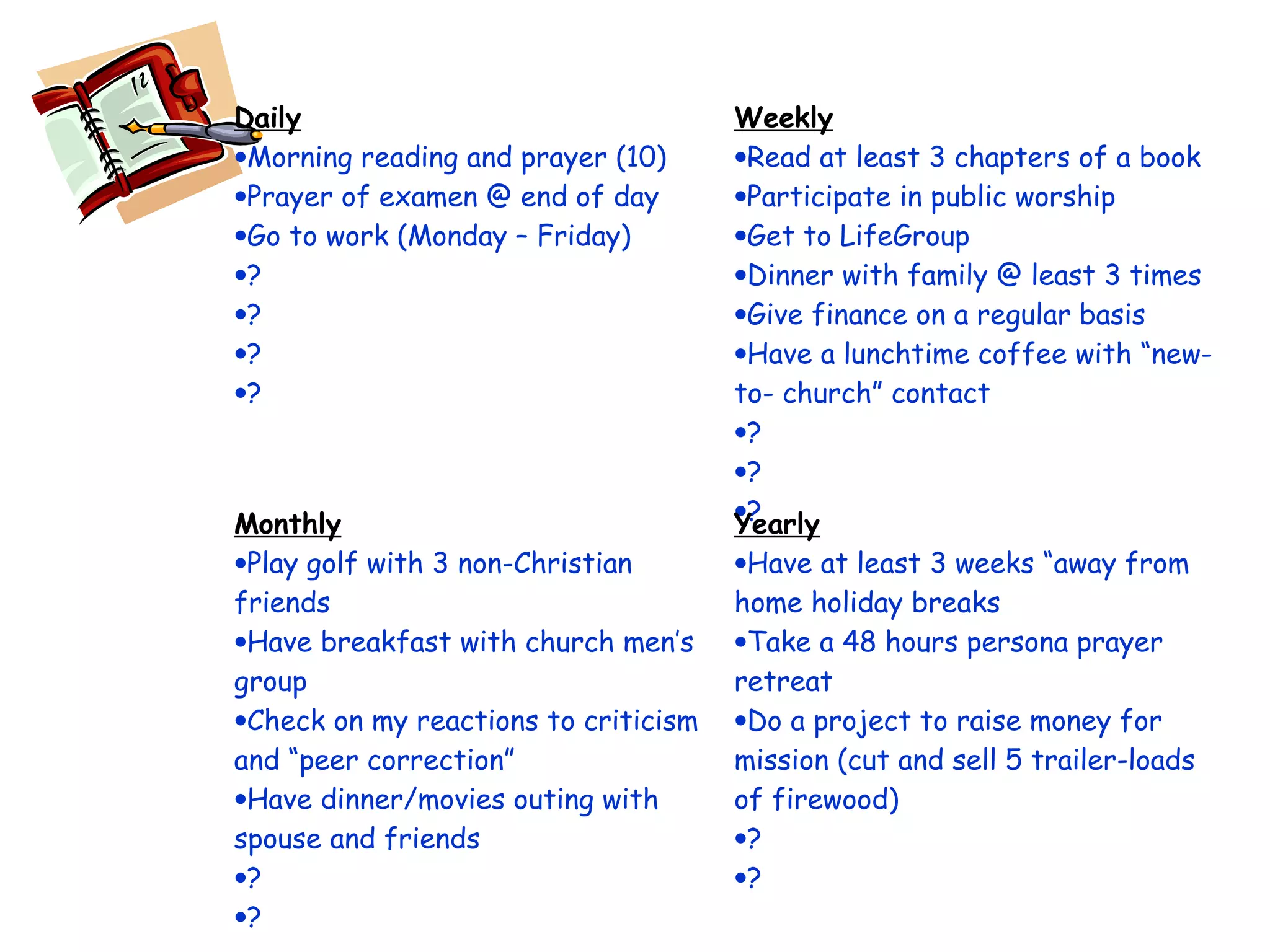
1. Take a piece of A4 or A3 paper and
2. Draw a vertical line that divides the paper in
half, then
3. about two-thirds of the way down the page,
draw a horizontal line, now
4. Label the top two sections - "daily" and
"weekly"
5. Label the bottom (smaller) sections -
"monthly" and "yearly"
In each of these sections, write down whatever you
already do on purpose that helps you become more
mindful of God at work in your life – whether daily,
weekly, monthly, or yearly.
– Daily quiet time or reading,
– weekly church attendance or Bible study,
– a monthly meeting,
– or an annual retreat might be examples of what you
might write down.
. . . you might also include serving with “a community helping
programme”, or playing in a music group, or managing an on-line
prayer list, or promoting the need of affordable housing, or saying
"Lord have mercy" instead of losing your temper.
Be honest . . .
– This is not a test of your devoutness (no
one's looking over your shoulder) and it is
not a wish list of what you hope to do
someday . . .
• If there's only one thing (or no thing!), that's a
fine place to start.
• If you already have lots of things crowding the
spaces, one of your challenges may be to prune
some of your activities.
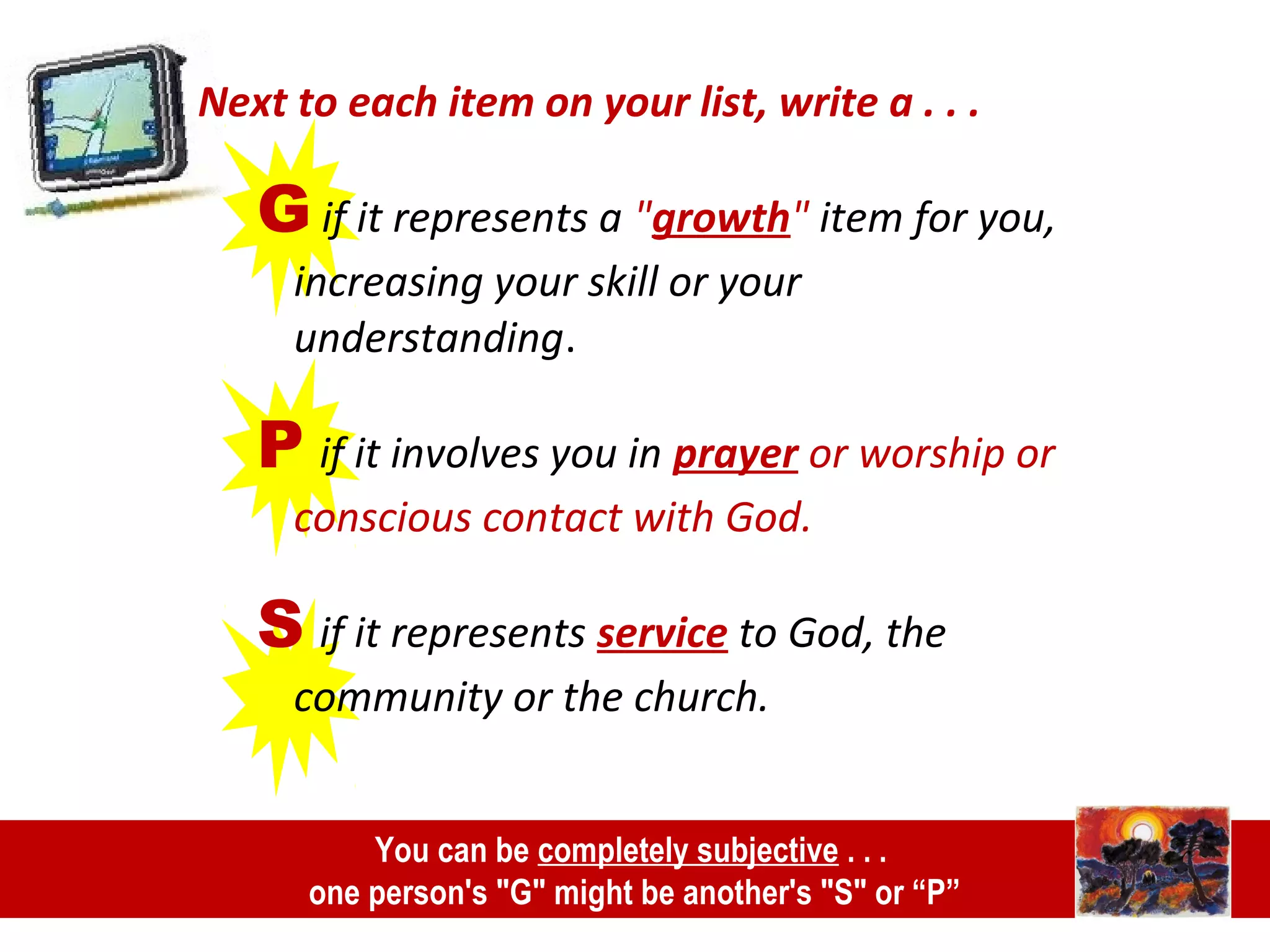
Now it’s time to give
your “emerging rule” a
GPS evaluation/rating
Next to each item on your list, write a . . .
G if it represents a "growth" item for you,
increasing your skill or your
understanding.
P if it involves you in prayer or worship or
conscious contact with God.
S if it represents service to God, the
community or the church.
You can be completely subjective . . .
one person's "G" might be another's "S" or “P”
Remember because your Rule of life is a
means to serve in your Christian Spiritual
Formation as “the process of being
conformed to the Image of Christ for the
sake of others”1
. . .
It requires ongoing review . . .
1
M. Robert. Mulholland, Invitation to a Journey: A Road Map for Spiritual Formation. Downers Grove, Ill.: InterVarsity, 1993.
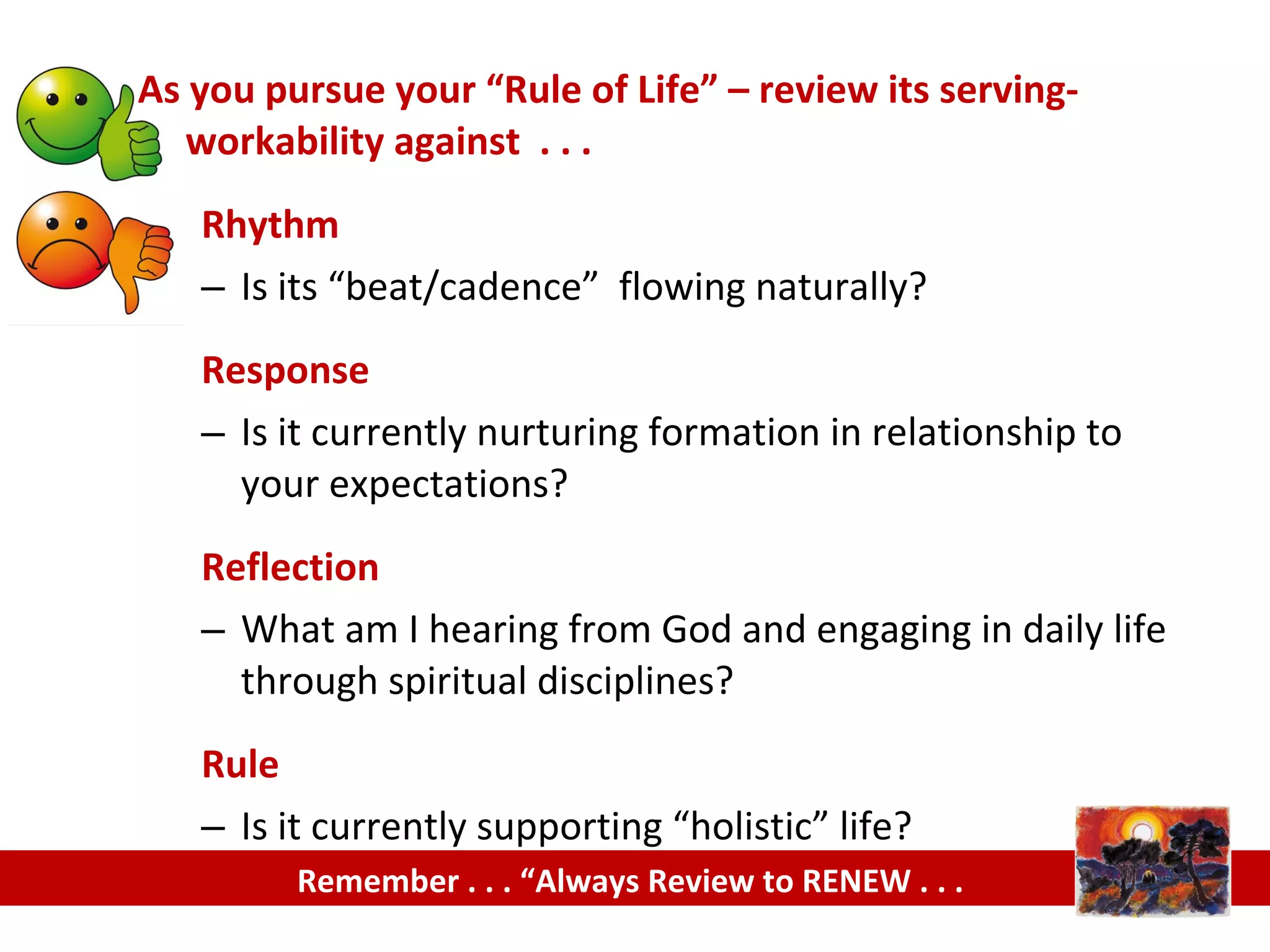
As you pursue your “Rule of Life” – review its serving-
workability against . . .
Rhythm
– Is its “beat/cadence” flowing naturally?
Response
– Is it currently nurturing formation in relationship to
your expectations?
Reflection
– What am I hearing from God and engaging in daily life
through spiritual disciplines?
Rule
– Is it currently supporting “holistic” life?
Remember . . . “Always Review to RENEW . . .

“My Rule of Life” in 1st draft

  • 1.
    “My Rule ofLife” in 1st draft SSPP Seminar session #7 © JCD 2013
  • 2.
    The word “rule”derives from the Latin word, regula, which implies not so much a system of rules and laws, but rather a way of regulating or regularizing our lives so that we can stay on the path that we have set for ourselves. – A rule is like a trellis which offers support and guidance for a plant, helping it grow in a certain direction. Macchia, Stephen A. Crafting a Rule of Life: An Invitation to the Well-Ordered Way. Downers Grove, Ill.: Formatio/IVP Books, 2012, p.14.
  • 3.
    Getting started .. . Okay – so now you're ready to try creating your own Rule of Life. Get pencil and paper, and then pay attention to these brief thoughts . . . – You are not creating the Rule of Life, for all people or for all time . . . • Jesus has already taken care of that – You are not creating a Rule for Your Entire Life . . . • It's not meant to account for every minute, eliminate spontaneity, or remain unchanged until death – You are creating a rule that will spur you toward a deeper relationship with God . . . – You are committing to begin a practice that, with God's help, will remove obstacles that hinder your spiritual journey . . .
  • 4.
    Practices in yourRule should be . . . • Natural, • Intentional, and • should be able to lived out in a rhythm that fits one’s ordinary life . . .
  • 5.
    There are manytime-tested practices (disciplines) that might be incorporated into the patterns of one’s Rule of Life . . . Some of those behaviours are . . . – Reading and meditating on Scripture; – Praying regularly (and in differing forms) – Worship, fellowship and public communion – Regular confession of sin and forgiveness of others – Exercising sacrificial self-giving – Observing periods of silence or solitude – Fasting and retreat – Practicing hospitality In addition attitudes can be brought under a Rule of Life . . . – Response to authority, – acceptance of the "other", – rejection of grumbling or cynicism, – forgiveness, – Respect for others.
  • 6.
    So let’s getstarted . . . 1. Take a piece of A4 or A3 paper and 2. Draw a vertical line that divides the paper in half, then 3. about two-thirds of the way down the page, draw a horizontal line, now 4. Label the top two sections - "daily" and "weekly" 5. Label the bottom (smaller) sections - "monthly" and "yearly"
  • 7.
    In each ofthese sections, write down whatever you already do on purpose that helps you become more mindful of God at work in your life – whether daily, weekly, monthly, or yearly. – Daily quiet time or reading, – weekly church attendance or Bible study, – a monthly meeting, – or an annual retreat might be examples of what you might write down. . . . you might also include serving with “a community helping programme”, or playing in a music group, or managing an on-line prayer list, or promoting the need of affordable housing, or saying "Lord have mercy" instead of losing your temper.
  • 8.
    Be honest .. . – This is not a test of your devoutness (no one's looking over your shoulder) and it is not a wish list of what you hope to do someday . . . • If there's only one thing (or no thing!), that's a fine place to start. • If you already have lots of things crowding the spaces, one of your challenges may be to prune some of your activities.
  • 10.
    Now it’s timeto give your “emerging rule” a GPS evaluation/rating
  • 11.
    Next to eachitem on your list, write a . . . G if it represents a "growth" item for you, increasing your skill or your understanding. P if it involves you in prayer or worship or conscious contact with God. S if it represents service to God, the community or the church. You can be completely subjective . . . one person's "G" might be another's "S" or “P”
  • 12.
    Remember because yourRule of life is a means to serve in your Christian Spiritual Formation as “the process of being conformed to the Image of Christ for the sake of others”1 . . . It requires ongoing review . . . 1 M. Robert. Mulholland, Invitation to a Journey: A Road Map for Spiritual Formation. Downers Grove, Ill.: InterVarsity, 1993.
  • 13.
    As you pursueyour “Rule of Life” – review its serving- workability against . . . Rhythm – Is its “beat/cadence” flowing naturally? Response – Is it currently nurturing formation in relationship to your expectations? Reflection – What am I hearing from God and engaging in daily life through spiritual disciplines? Rule – Is it currently supporting “holistic” life? Remember . . . “Always Review to RENEW . . .