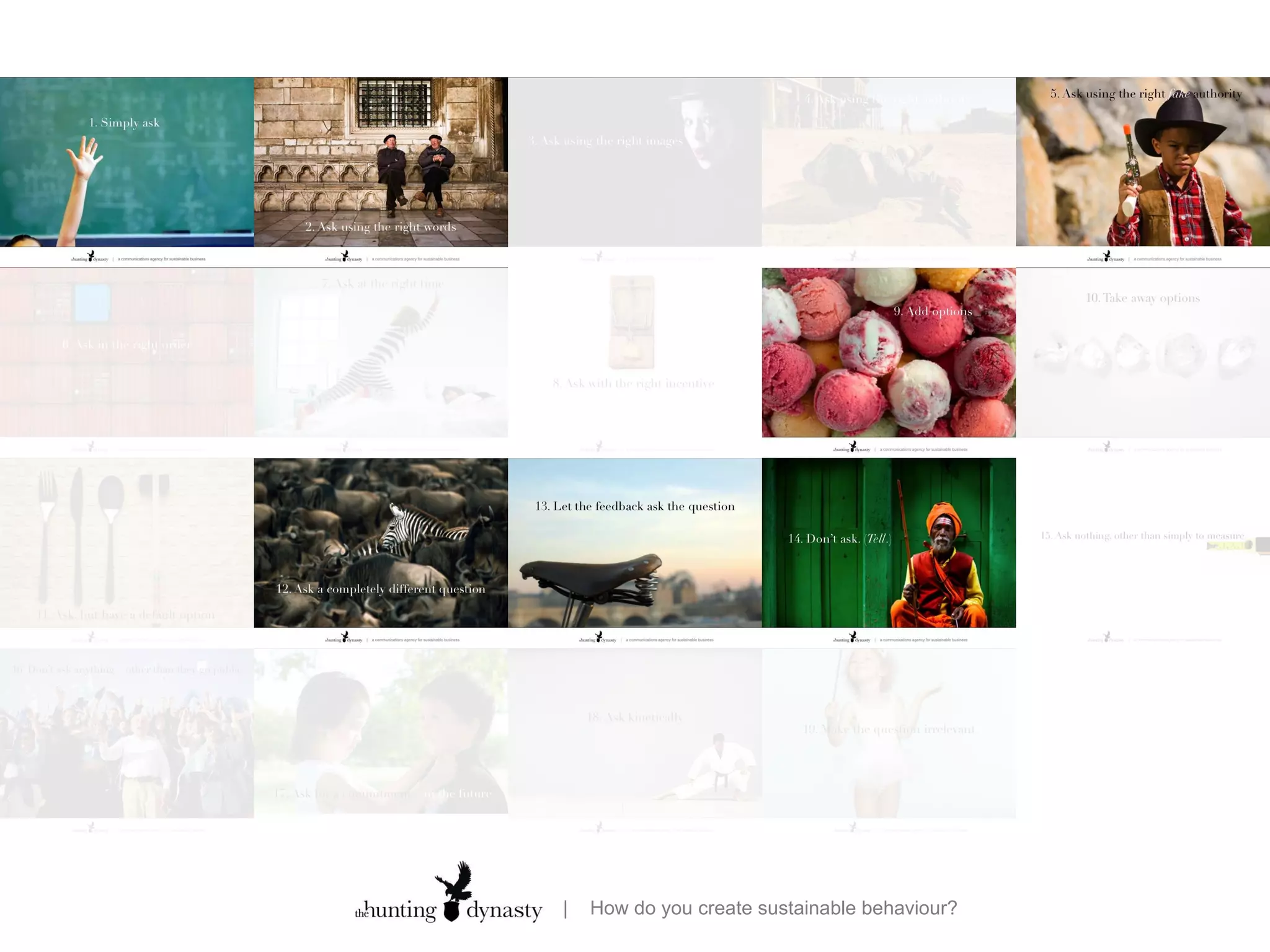
Creating sustainable behaviour 19 th  February 2010 Oliver Payne, Founder, CEO, The Hunting Dynasty ,  (Undisclosed recipient)
 
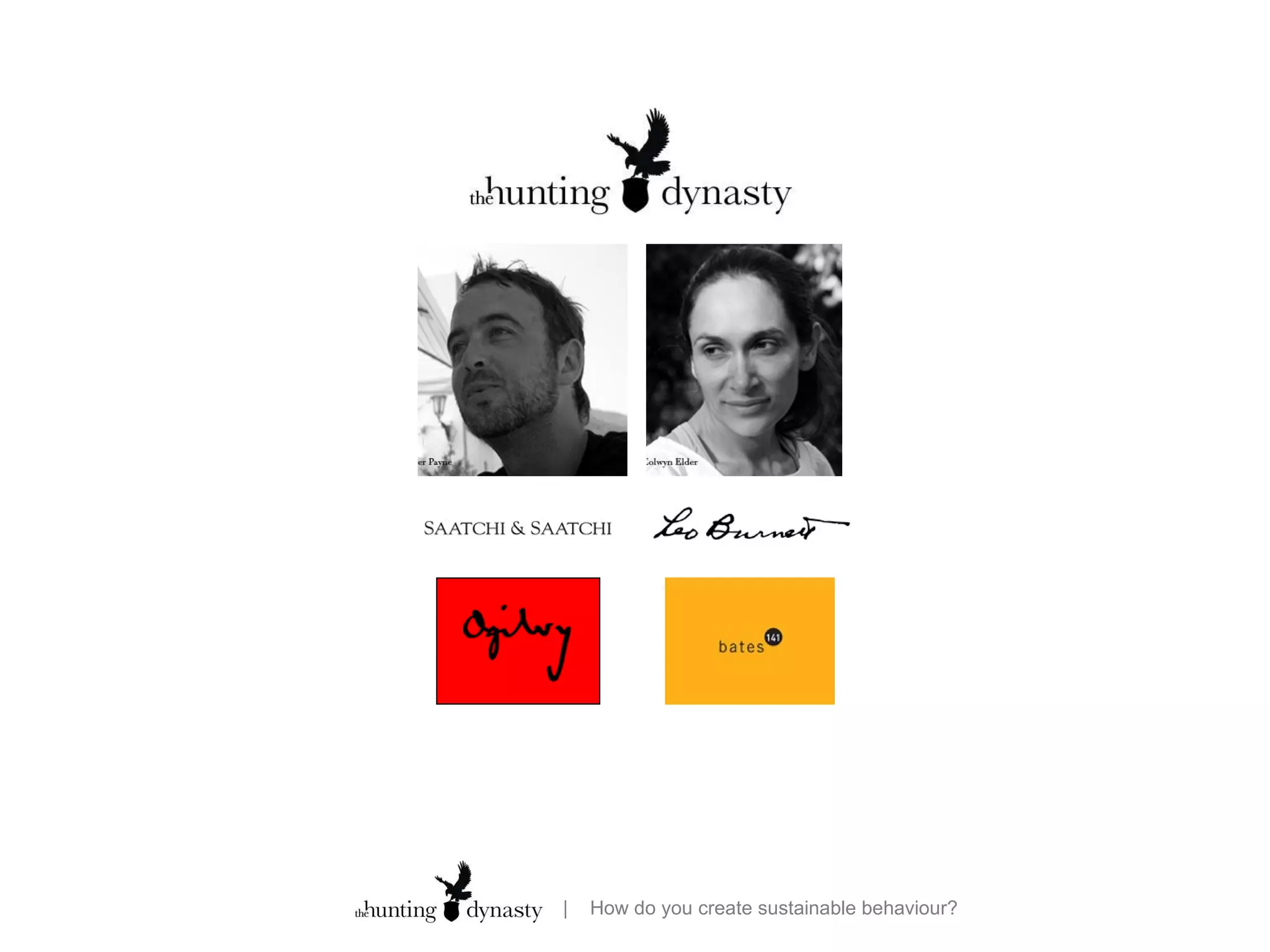
Creative Director - Global, Regional - London - Awarded, Judge Planning Director - Global, Regional - London, Hong Kong, Amsterdam - Awarded
“ …  very impressive work. ”  Justin Hall, Discovery Channel Environmental Explorer Founder, CEO Partner, Planning Director
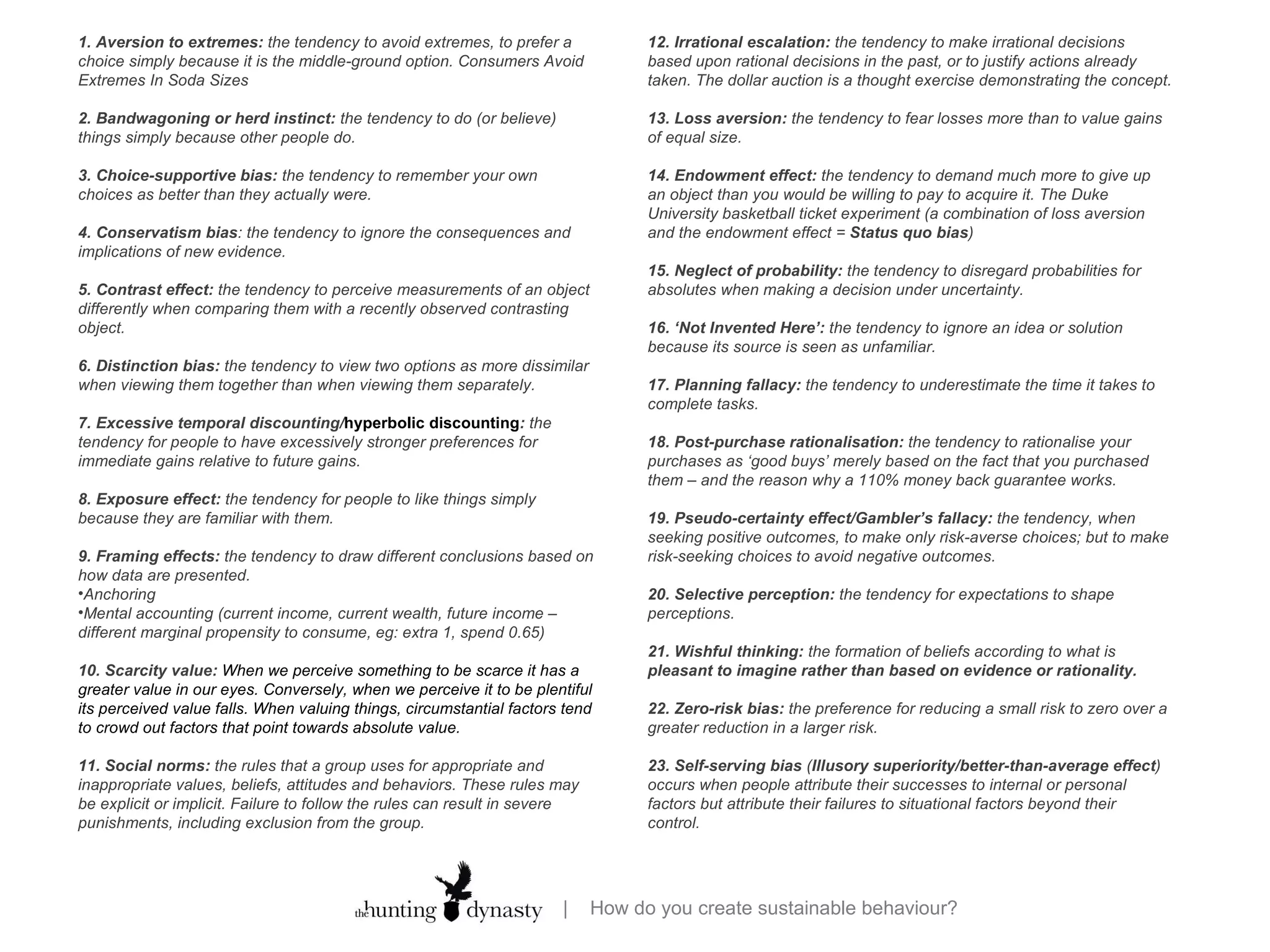
12. Irrational escalation:  the tendency to make irrational decisions based upon rational decisions in the past, or to justify actions already taken. The dollar auction is a thought exercise demonstrating the concept. 13. Loss aversion:  the tendency to fear losses more than to value gains of equal size.  14. Endowment effect:  the tendency to demand much more to give up an object than you would be willing to pay to acquire it. The Duke University basketball ticket experiment (a combination of loss aversion and the endowment effect =  Status quo bias ) 15. Neglect of probability:  the tendency to disregard probabilities for absolutes when making a decision under uncertainty. 16. ‘Not Invented Here’:  the tendency to ignore an idea or solution because its source is seen as unfamiliar. 17. Planning fallacy:  the tendency to underestimate the time it takes to complete tasks. 18. Post-purchase rationalisation:  the tendency to rationalise your purchases as ‘good buys’ merely based on the fact that you purchased them – and the reason why a 110% money back guarantee works. 19. Pseudo-certainty effect/Gambler’s fallacy:  the tendency, when seeking positive outcomes, to make only risk-averse choices; but to make risk-seeking choices to avoid negative outcomes. 20. Selective perception:  the tendency for expectations to shape perceptions. 21. Wishful thinking:  the formation of beliefs according to what is  pleasant to imagine rather than based on evidence or rationality. 22. Zero-risk bias:  the preference for reducing a small risk to zero over a greater reduction in a larger risk.  23. Self-serving bias  ( Illusory superiority/better-than-average effect ) occurs when people attribute their successes to internal or personal factors but attribute their failures to situational factors beyond their control. 1. Aversion to extremes:  the tendency to avoid extremes, to prefer a choice simply because it is the middle-ground option. Consumers Avoid Extremes In Soda Sizes 2. Bandwagoning or herd instinct:  the tendency to do (or believe) things simply because other people do. 3. Choice-supportive bias:  the tendency to remember your own choices as better than they actually were. 4. Conservatism bias : the tendency to ignore the consequences and implications of new evidence. 5. Contrast effect:  the tendency to perceive measurements of an object differently when comparing them with a recently observed contrasting object. 6. Distinction bias:  the tendency to view two options as more dissimilar when viewing them together than when viewing them separately. 7. Excessive temporal discounting/ hyperbolic discounting :  the tendency for people to have excessively stronger preferences for immediate gains relative to future gains. 8. Exposure effect:  the tendency for people to like things simply because they are familiar with them. 9. Framing effects:  the tendency to draw different conclusions based on how data are presented.  Anchoring Mental accounting (current income, current wealth, future income – different marginal propensity to consume, eg: extra 1, spend 0.65) 10. Scarcity value:  When we perceive something to be scarce it has a greater value in our eyes. Conversely, when we perceive it to be plentiful its perceived value falls. When valuing things, circumstantial factors tend to crowd out factors that point towards absolute value.  11. Social norms:  the rules that a group uses for appropriate and inappropriate values, beliefs, attitudes and behaviors. These rules may be explicit or implicit. Failure to follow the rules can result in severe punishments, including exclusion from the group.
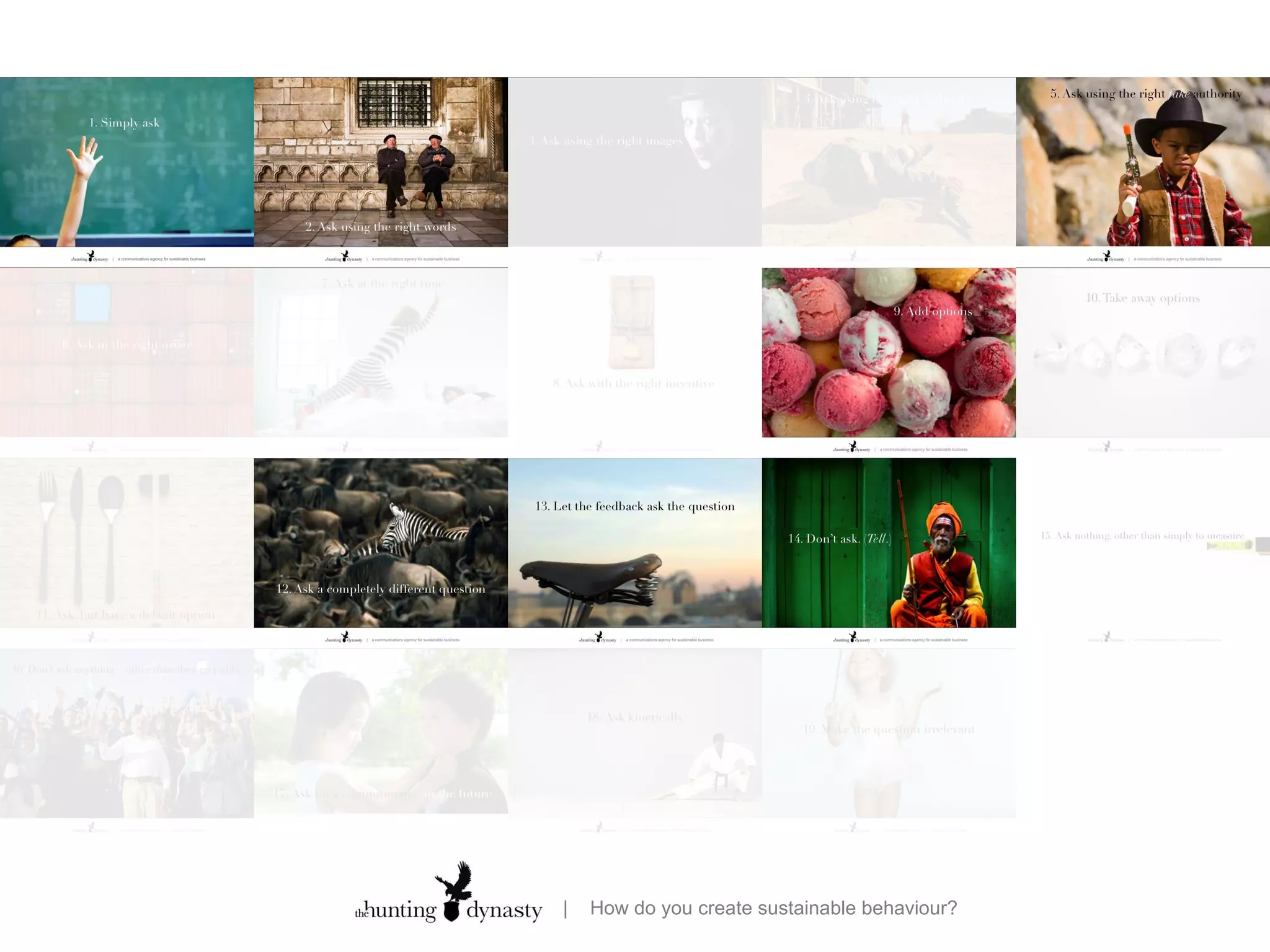
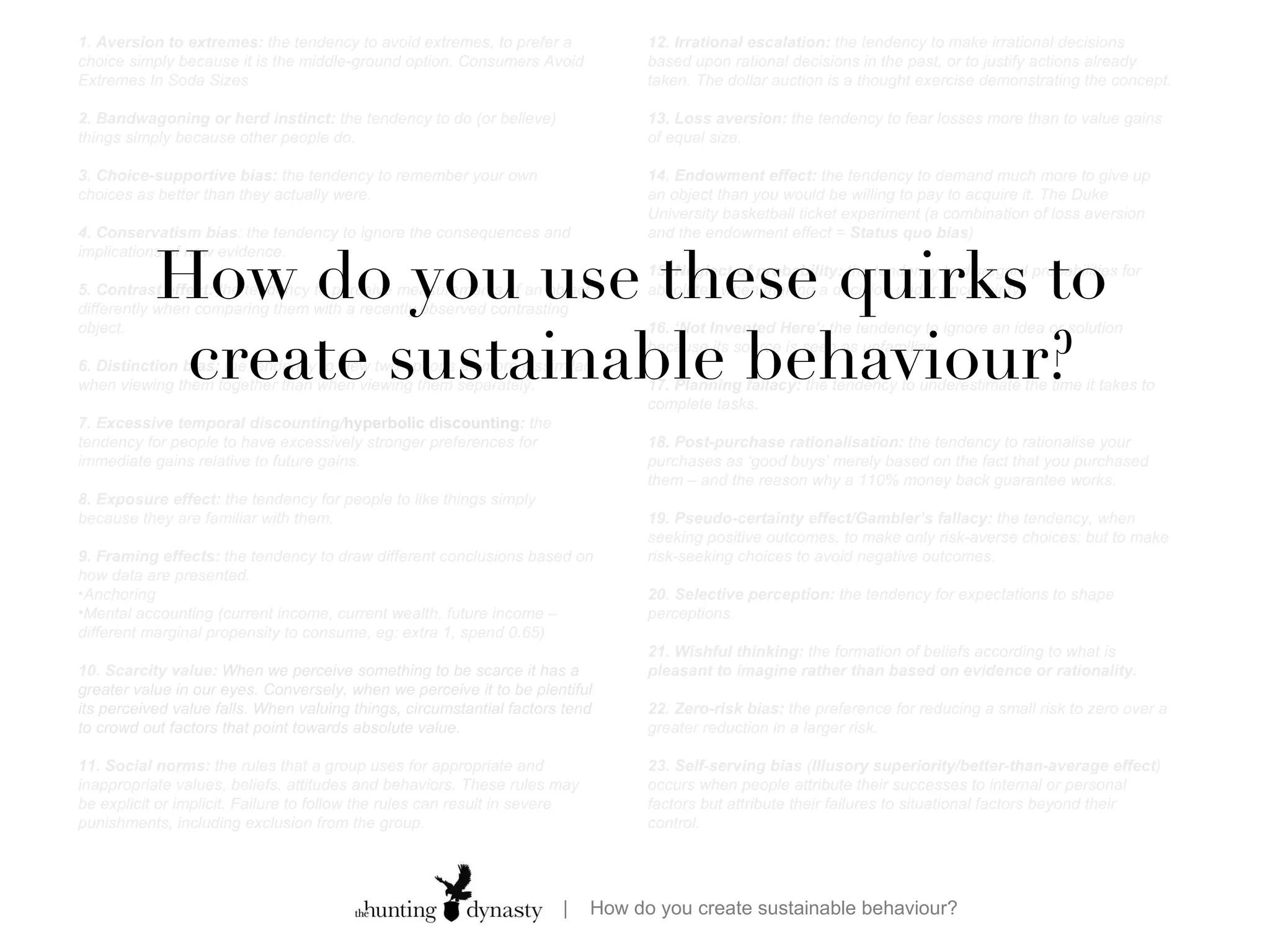
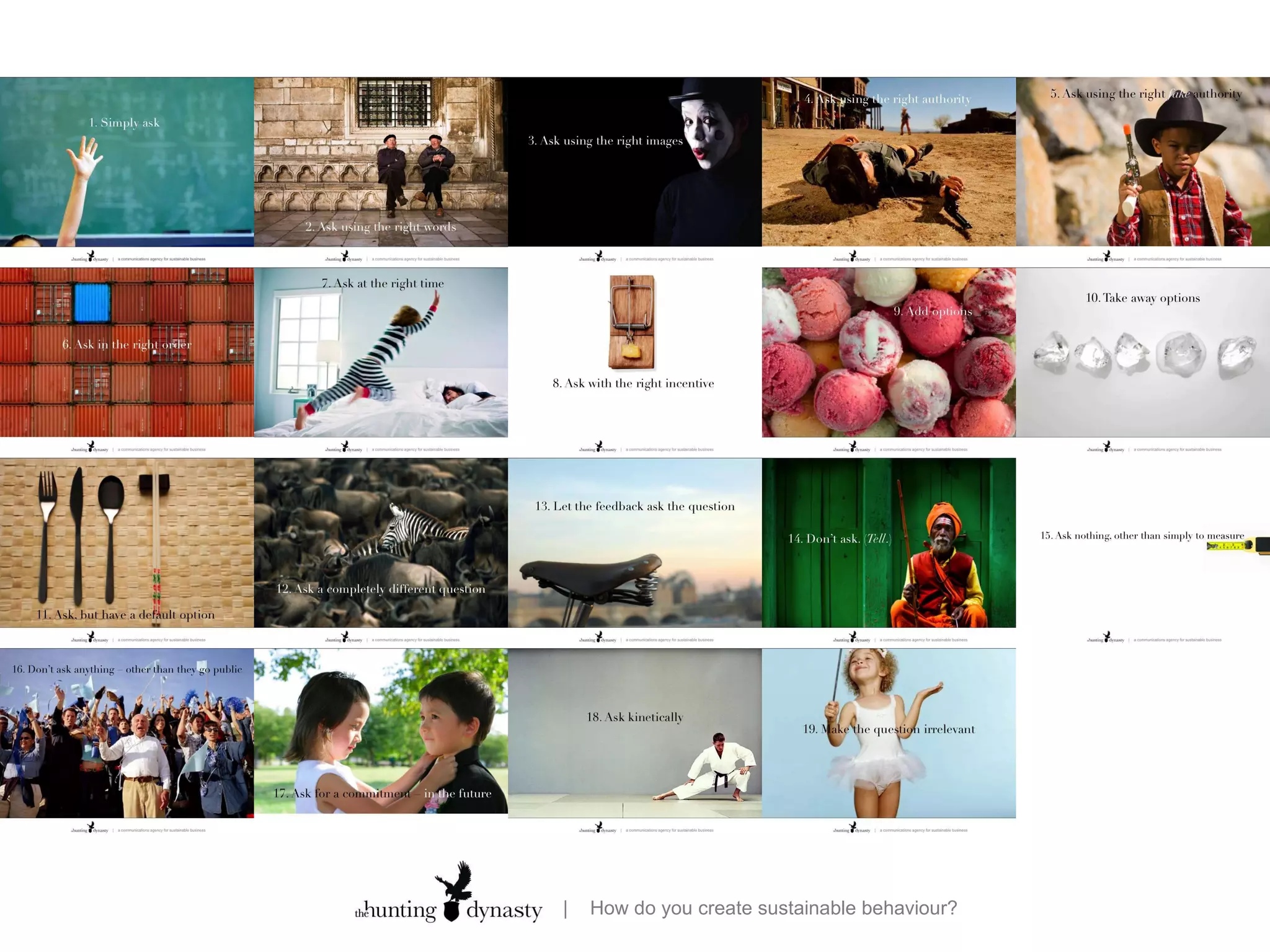
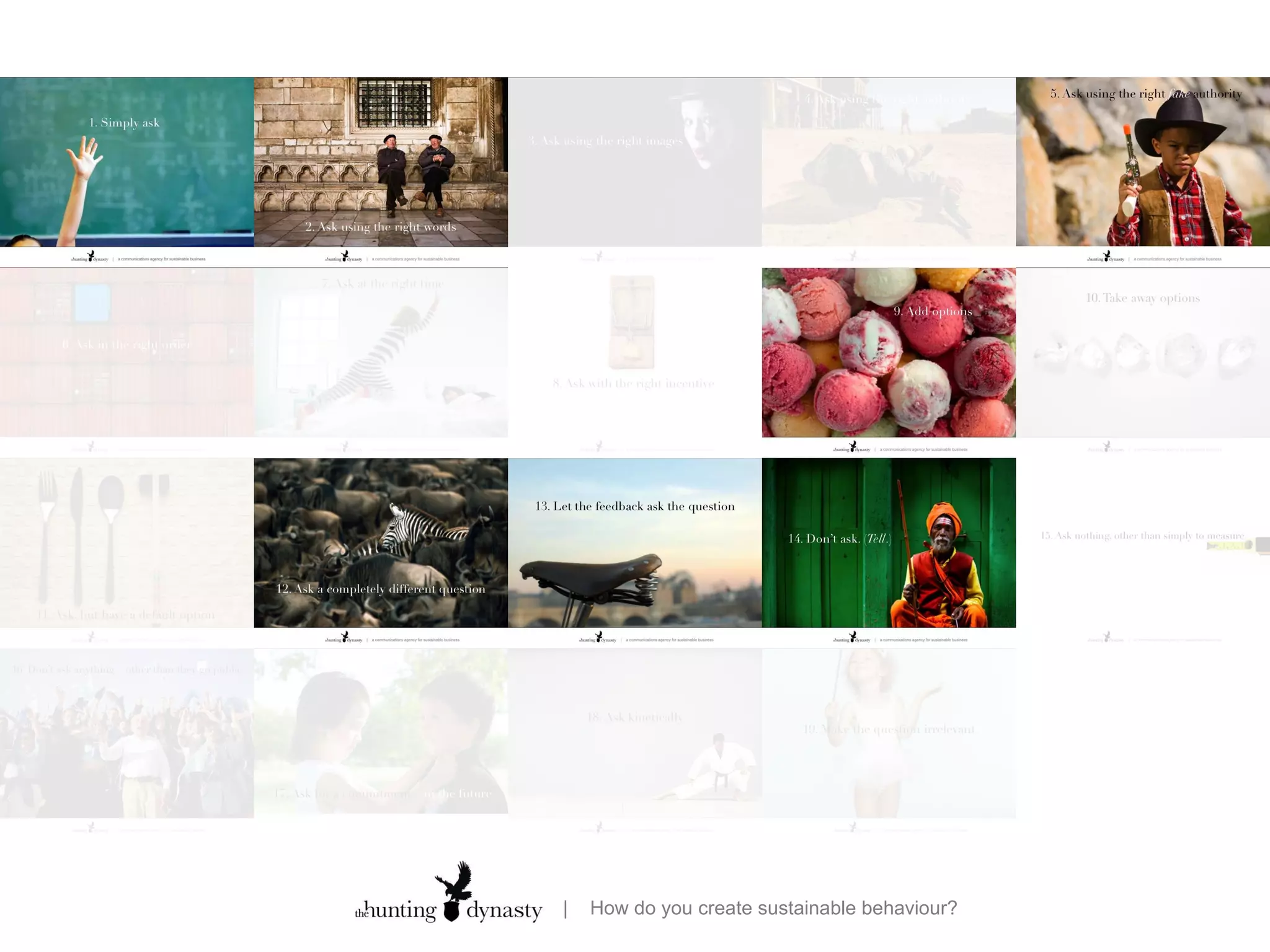
12. Irrational escalation:  the tendency to make irrational decisions based upon rational decisions in the past, or to justify actions already taken. The dollar auction is a thought exercise demonstrating the concept. 13. Loss aversion:  the tendency to fear losses more than to value gains of equal size.  14. Endowment effect:  the tendency to demand much more to give up an object than you would be willing to pay to acquire it. The Duke University basketball ticket experiment (a combination of loss aversion and the endowment effect =  Status quo bias ) 15. Neglect of probability:  the tendency to disregard probabilities for absolutes when making a decision under uncertainty. 16. ‘Not Invented Here’:  the tendency to ignore an idea or solution because its source is seen as unfamiliar. 17. Planning fallacy:  the tendency to underestimate the time it takes to complete tasks. 18. Post-purchase rationalisation:  the tendency to rationalise your purchases as ‘good buys’ merely based on the fact that you purchased them – and the reason why a 110% money back guarantee works. 19. Pseudo-certainty effect/Gambler’s fallacy:  the tendency, when seeking positive outcomes, to make only risk-averse choices; but to make risk-seeking choices to avoid negative outcomes. 20. Selective perception:  the tendency for expectations to shape perceptions. 21. Wishful thinking:  the formation of beliefs according to what is  pleasant to imagine rather than based on evidence or rationality. 22. Zero-risk bias:  the preference for reducing a small risk to zero over a greater reduction in a larger risk.  23. Self-serving bias  ( Illusory superiority/better-than-average effect ) occurs when people attribute their successes to internal or personal factors but attribute their failures to situational factors beyond their control. 1. Aversion to extremes:  the tendency to avoid extremes, to prefer a choice simply because it is the middle-ground option. Consumers Avoid Extremes In Soda Sizes 2. Bandwagoning or herd instinct:  the tendency to do (or believe) things simply because other people do. 3. Choice-supportive bias:  the tendency to remember your own choices as better than they actually were. 4. Conservatism bias : the tendency to ignore the consequences and implications of new evidence. 5. Contrast effect:  the tendency to perceive measurements of an object differently when comparing them with a recently observed contrasting object. 6. Distinction bias:  the tendency to view two options as more dissimilar when viewing them together than when viewing them separately. 7. Excessive temporal discounting/ hyperbolic discounting :  the tendency for people to have excessively stronger preferences for immediate gains relative to future gains. 8. Exposure effect:  the tendency for people to like things simply because they are familiar with them. 9. Framing effects:  the tendency to draw different conclusions based on how data are presented.  Anchoring Mental accounting (current income, current wealth, future income – different marginal propensity to consume, eg: extra 1, spend 0.65) 10. Scarcity value:  When we perceive something to be scarce it has a greater value in our eyes. Conversely, when we perceive it to be plentiful its perceived value falls. When valuing things, circumstantial factors tend to crowd out factors that point towards absolute value.  11. Social norms:  the rules that a group uses for appropriate and inappropriate values, beliefs, attitudes and behaviors. These rules may be explicit or implicit. Failure to follow the rules can result in severe punishments, including exclusion from the group. How do you use these quirks to create sustainable behaviour?
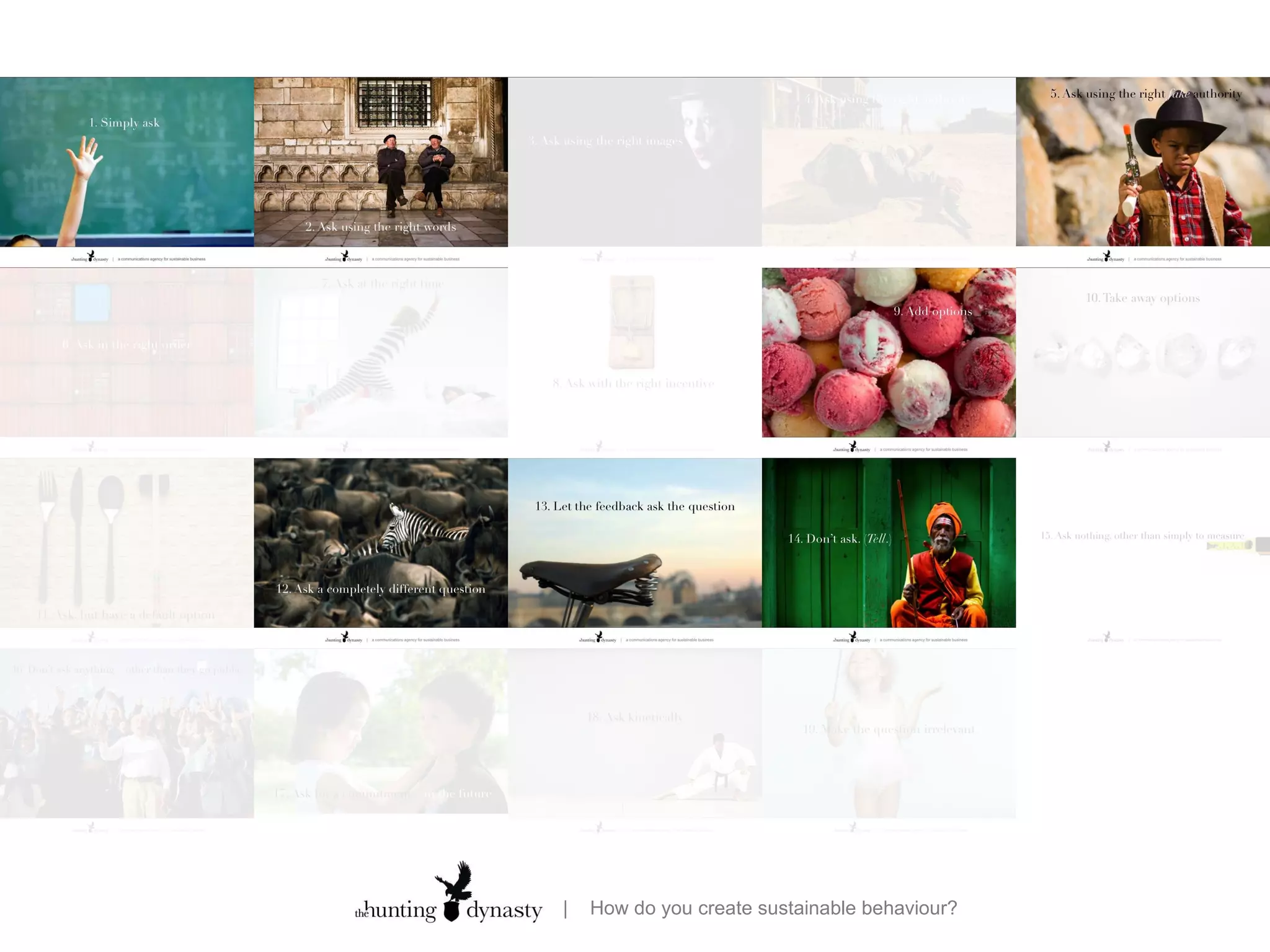
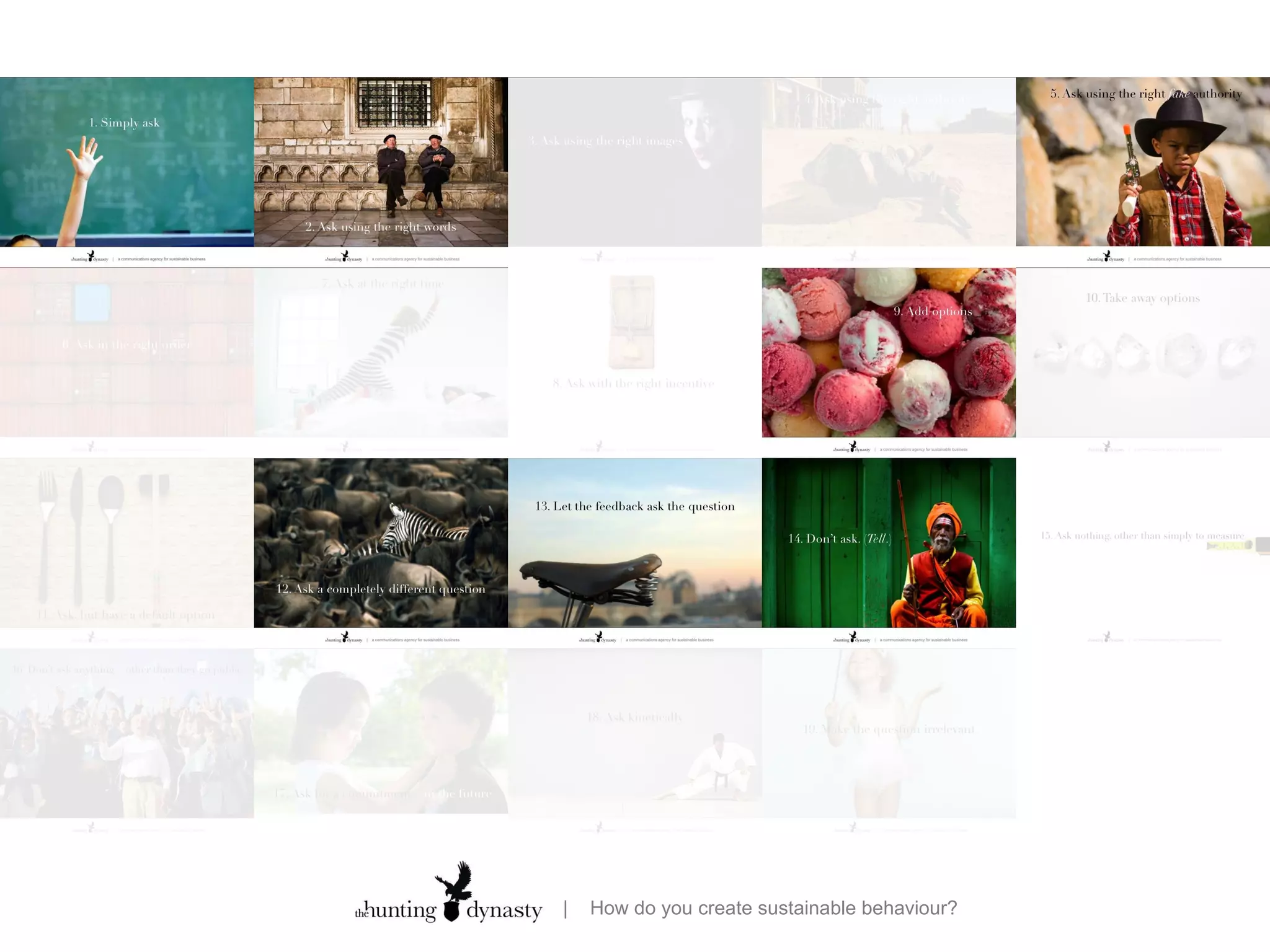
1. Simply ask
 
 
1. Simply ask
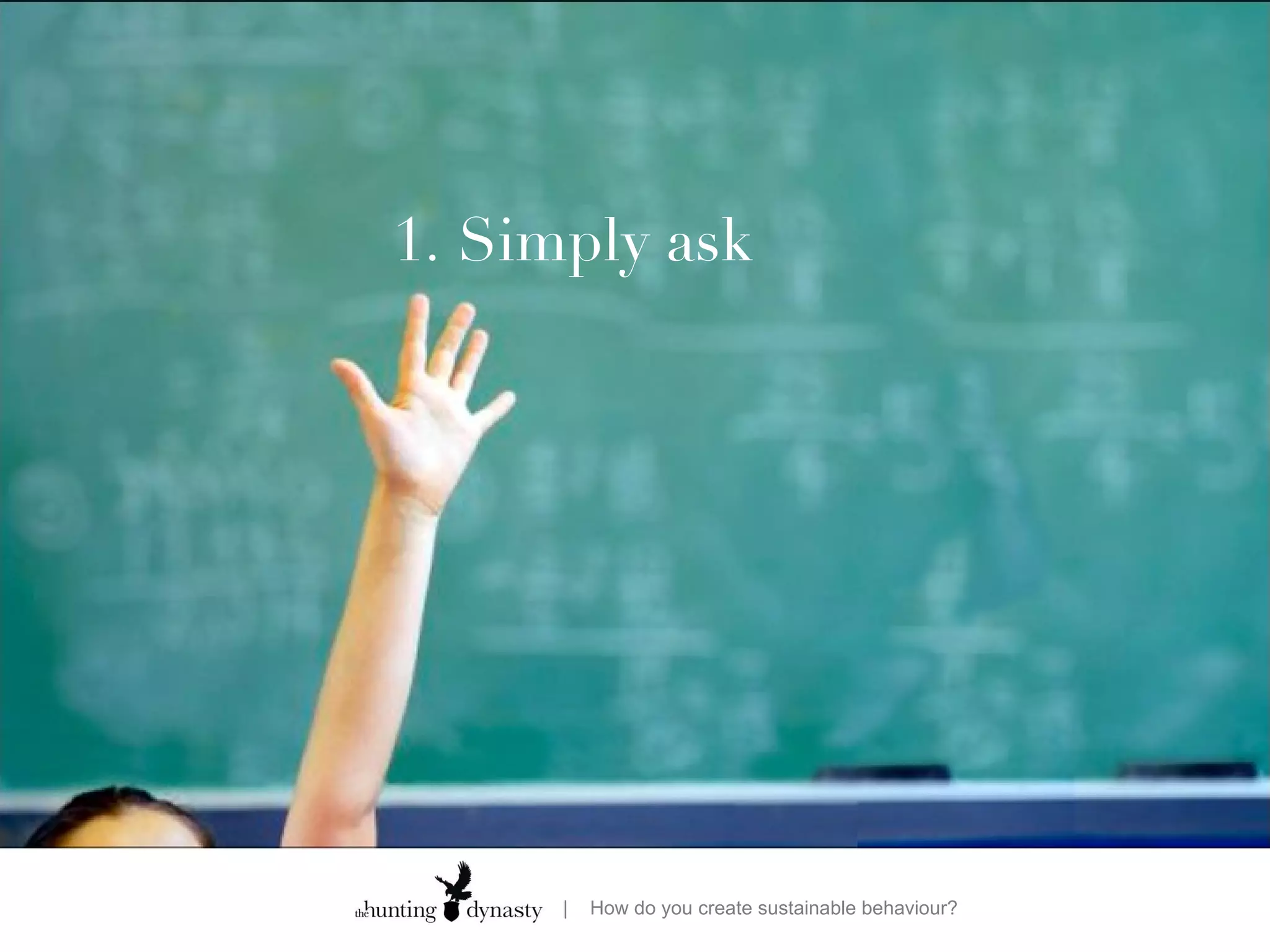
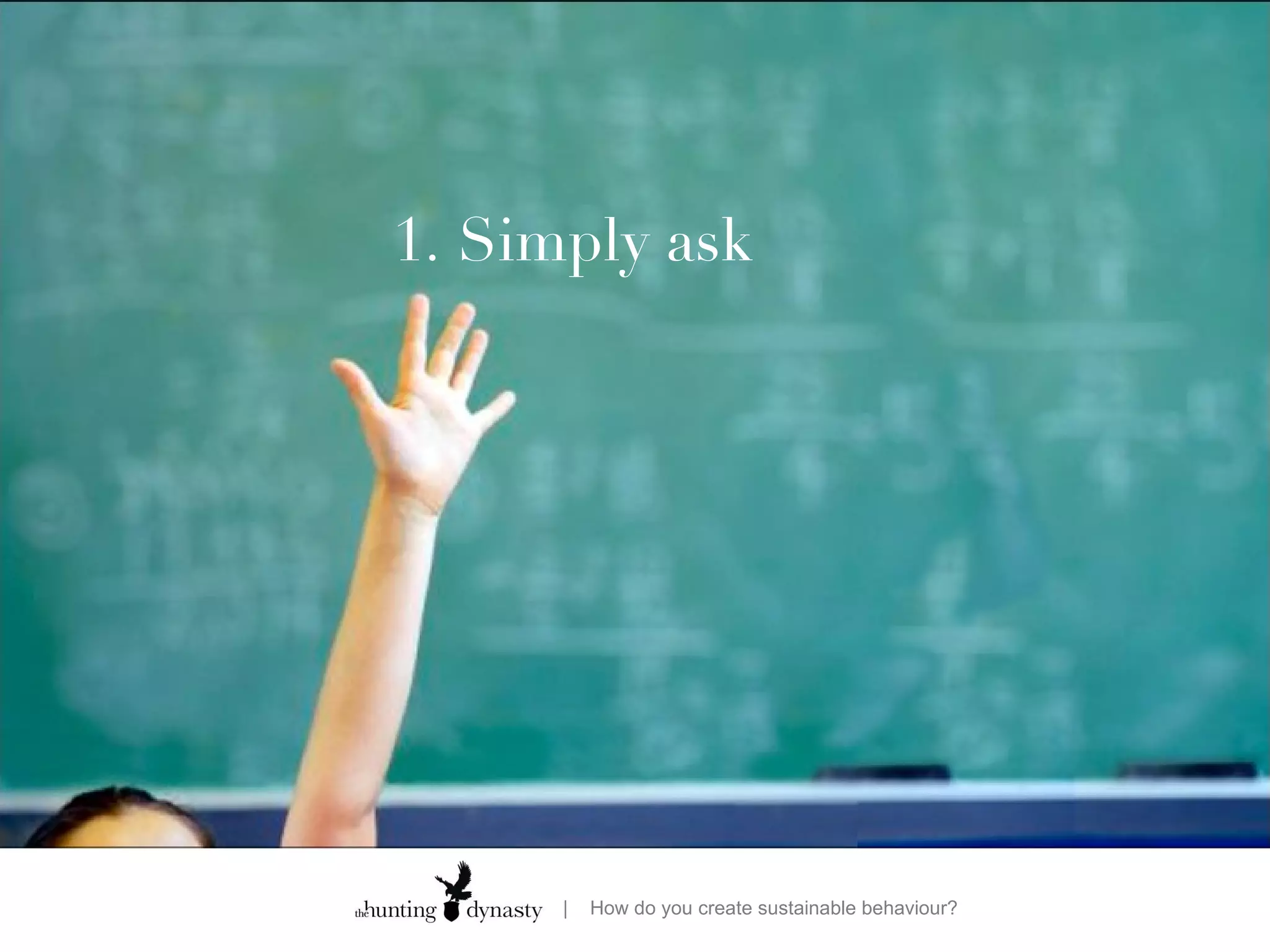
1. Simply ask  a. What can I get you sir? When asked nothing while in a queue for food 40% of students took a serving of fruit Yale University researcher Marlene Schwartz in a 2007 study
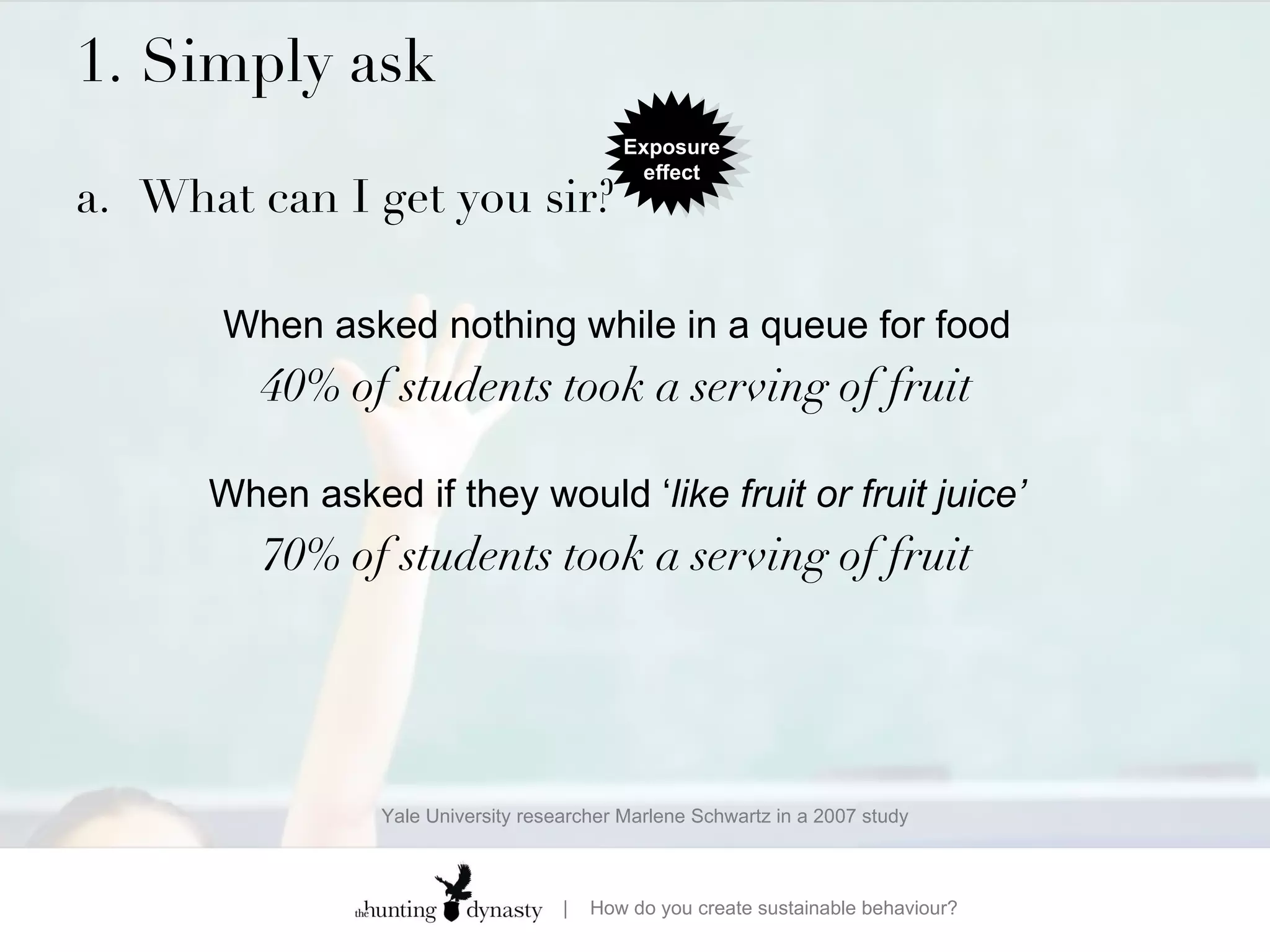
1. Simply ask  a. What can I get you sir? When asked nothing while in a queue for food 40% of students took a serving of fruit When asked if they would ‘ like fruit or fruit juice’ 70% of students took a serving of fruit Yale University researcher Marlene Schwartz in a 2007 study
1. Simply ask  a. What can I get you sir? When asked nothing while in a queue for food 40% of students took a serving of fruit When asked if they would ‘ like fruit or fruit juice’ 70% of students took a serving of fruit Yale University researcher Marlene Schwartz in a 2007 study Exposure effect
 
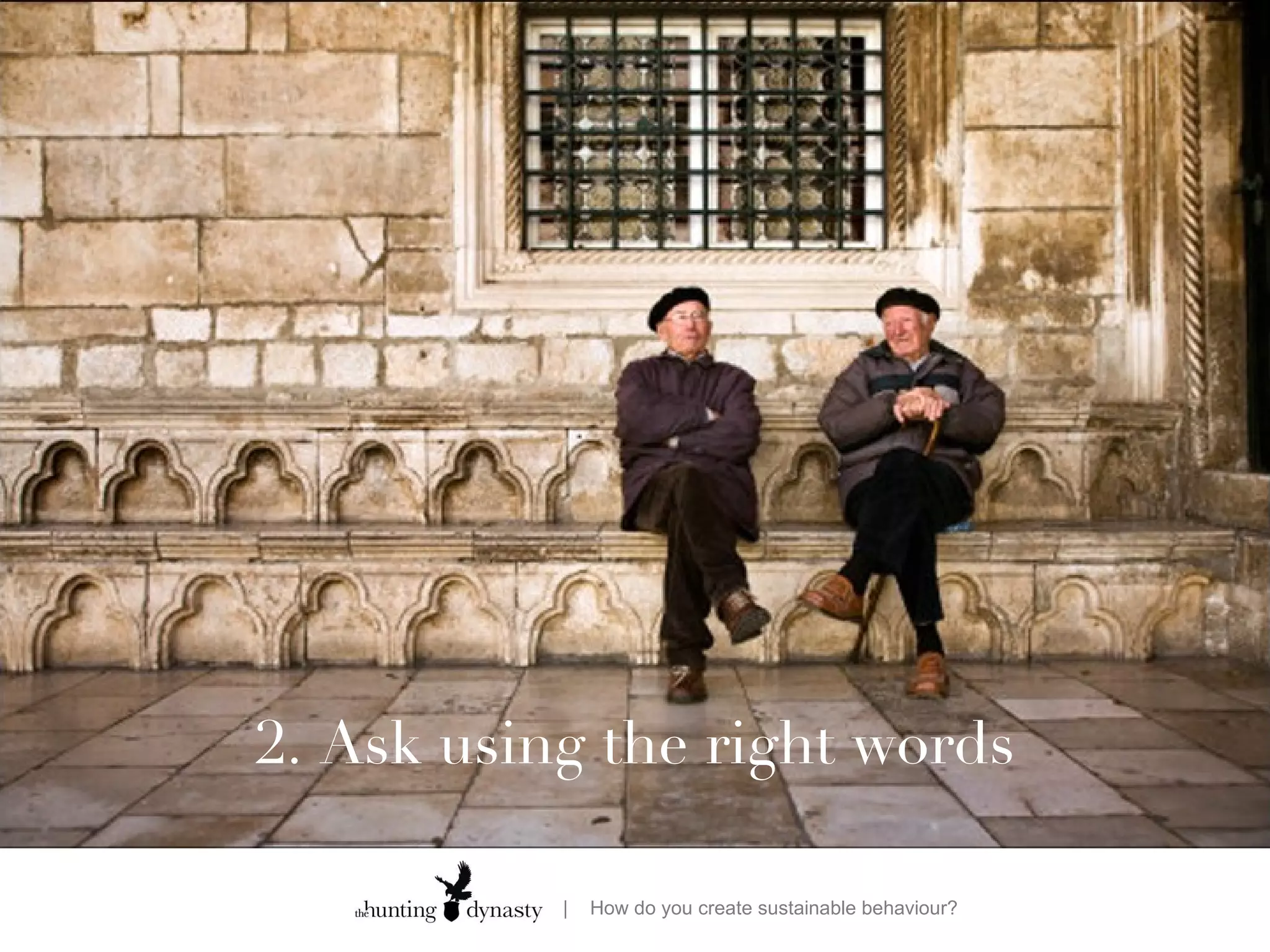
2.  Ask using the right words
2.  Ask using the right words b. Petrified Thieves People steal bits of wood from Arizona’s Petrified Forest National Park.    Many past  visitors  have removed  petrified wood from the Park,  changing  the natural state  of the Petrified Forest Please don’t remove  the  petrified wood from the Park ,  in order to preserve  the natural state   of the Petrified Forest  [nothing] The signs above were tested to stop the theft:  Some were more successful than others… Yes! 50 secrets from the science of persuasion | Goldstein, Martin, Cialdini | 2007 | pp20
2.  Ask using the right words b. Petrified Thieves People steal bits of wood from Arizona’s Petrified Forest National Park.    Many past  visitors  have removed  petrified wood from the Park,  changing  the natural state  of the Petrified Forest Please don’t remove  the  petrified wood from the Park ,  in order to preserve  the natural state   of the Petrified Forest  8%  theft [nothing] Yes! 50 secrets from the science of persuasion | Goldstein, Martin, Cialdini | 2007 | pp20
2.  Ask using the right words b. Petrified Thieves People steal bits of wood from Arizona’s Petrified Forest National Park.    Many past  visitors  have removed  petrified wood from the Park,  changing  the natural state  of the Petrified Forest Please don’t remove  the  petrified wood from the Park ,  in order to preserve  the natural state   of the Petrified Forest  8%  theft [nothing] 3%  theft Yes! 50 secrets from the science of persuasion | Goldstein, Martin, Cialdini | 2007 | pp20
2.  Ask using the right words b. Petrified Thieves People steal bits of wood from Arizona’s Petrified Forest National Park.    Many past  visitors  have removed  petrified wood from the Park,  changing  the natural state  of the Petrified Forest Please don’t remove  the  petrified wood from the Park ,  in order to preserve  the natural state   of the Petrified Forest  8%  theft 1.7%  theft [nothing] 3%  theft Yes! 50 secrets from the science of persuasion | Goldstein, Martin, Cialdini | 2007 | pp20
2.  Ask using the right words b. Petrified Thieves People steal bits of wood from Arizona’s Petrified Forest National Park.    Many past  visitors  have removed  petrified wood from the Park,  changing  the natural state  of the Petrified Forest Please don’t remove  the  petrified wood from the Park ,  in order to preserve  the natural state   of the Petrified Forest  8%  theft 1.7%  theft [nothing] 3%  theft “… a message that focuses recipients on the  injunctive norm  will be superior to messages that focus recipients on the  descriptive norm .”  (Cialdini et al., 2003) Yes! 50 secrets from the science of persuasion | Goldstein, Martin, Cialdini | 2007 | pp20
2.  Ask using the right words b. Petrified Thieves People steal bits of wood from Arizona’s Petrified Forest National Park.    Many past  visitors  have removed  petrified wood from the Park,  changing  the natural state  of the Petrified Forest Please don’t remove  the  petrified wood from the Park ,  in order to preserve  the natural state   of the Petrified Forest  8%  theft 1.7%  theft [nothing] 3%  theft “… a message that focuses recipients on the  injunctive norm  will be superior to messages that focus recipients on the  descriptive norm .”  (Cialdini et al., 2003) Yes! 50 secrets from the science of persuasion | Goldstein, Martin, Cialdini | 2007 | pp20 Social norms
 
5. Ask using the right  fake   authority
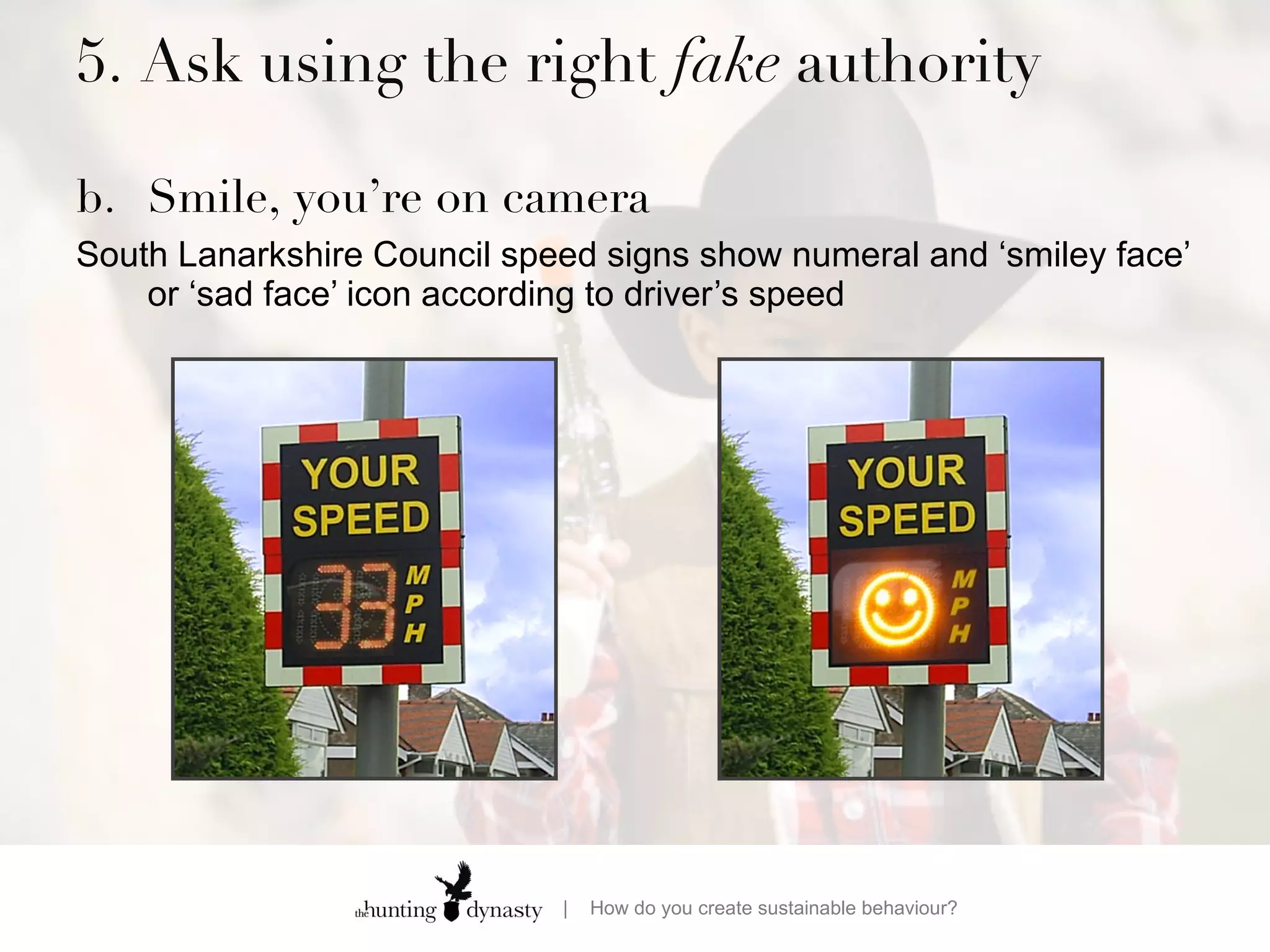
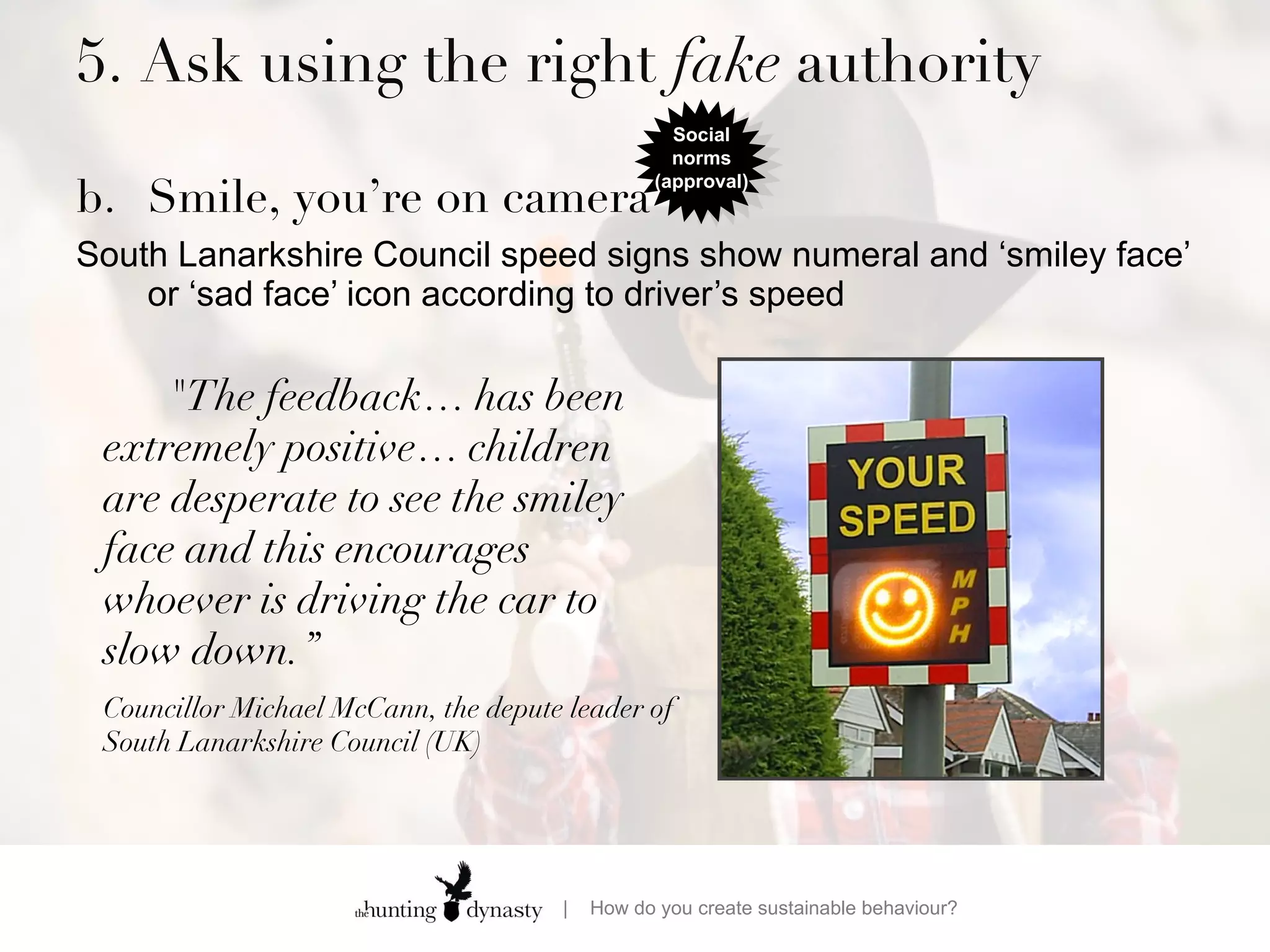
5. Ask using the right  fake  authority  b. Smile, you’re on camera South Lanarkshire Council speed signs show numeral and ‘smiley face’ or ‘sad face’ icon according to driver’s speed
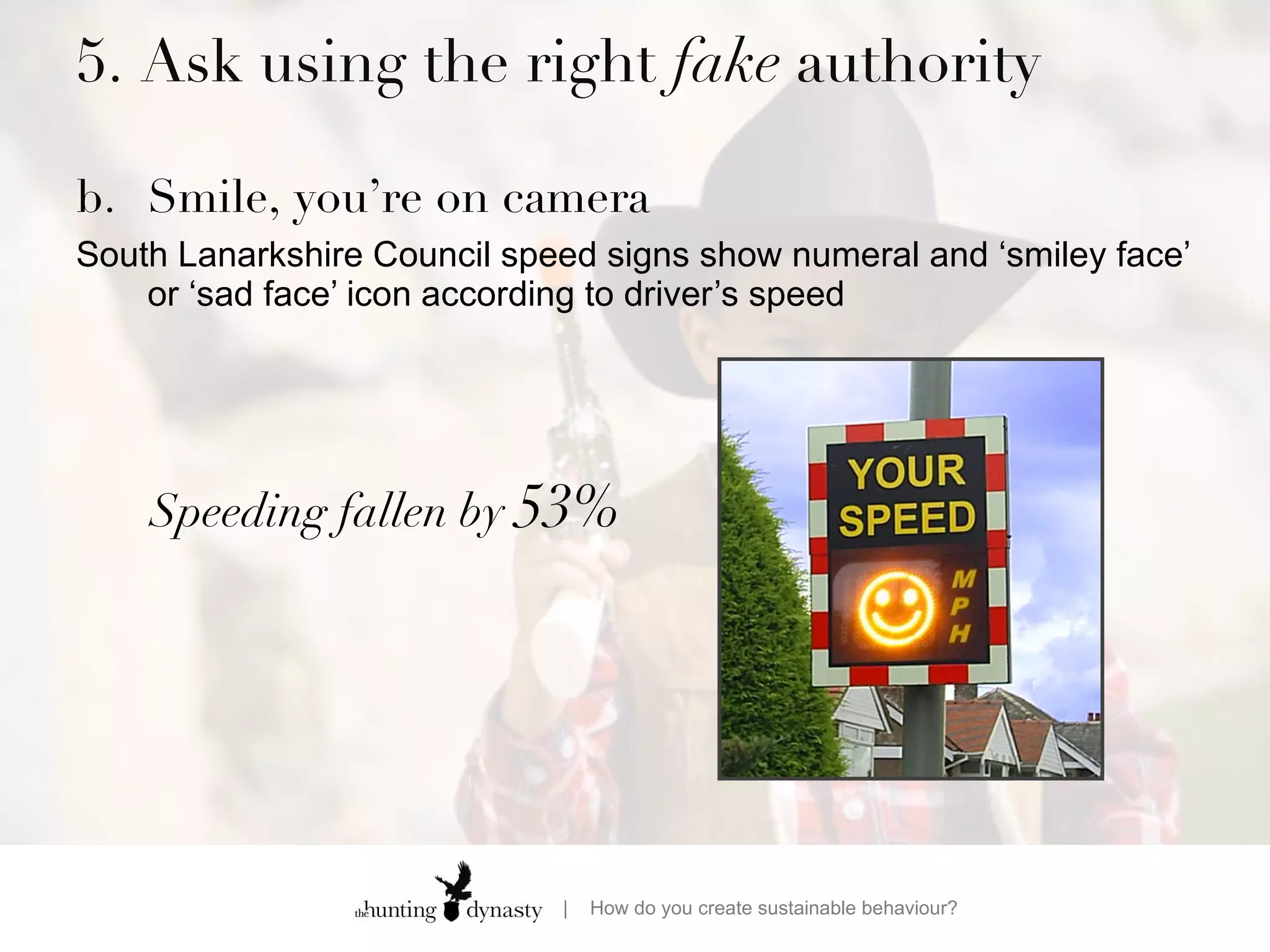
5. Ask using the right  fake  authority  b. Smile, you’re on camera South Lanarkshire Council speed signs show numeral and ‘smiley face’ or ‘sad face’ icon according to driver’s speed Speeding fallen by  53%
5. Ask using the right  fake  authority  b. Smile, you’re on camera South Lanarkshire Council speed signs show numeral and ‘smiley face’ or ‘sad face’ icon according to driver’s speed "The feedback… has been extremely positive… children are desperate to see the smiley face and this encourages whoever is driving the car to slow down.” Councillor Michael McCann, the depute leader of South Lanarkshire Council (UK) Social norms (approval)
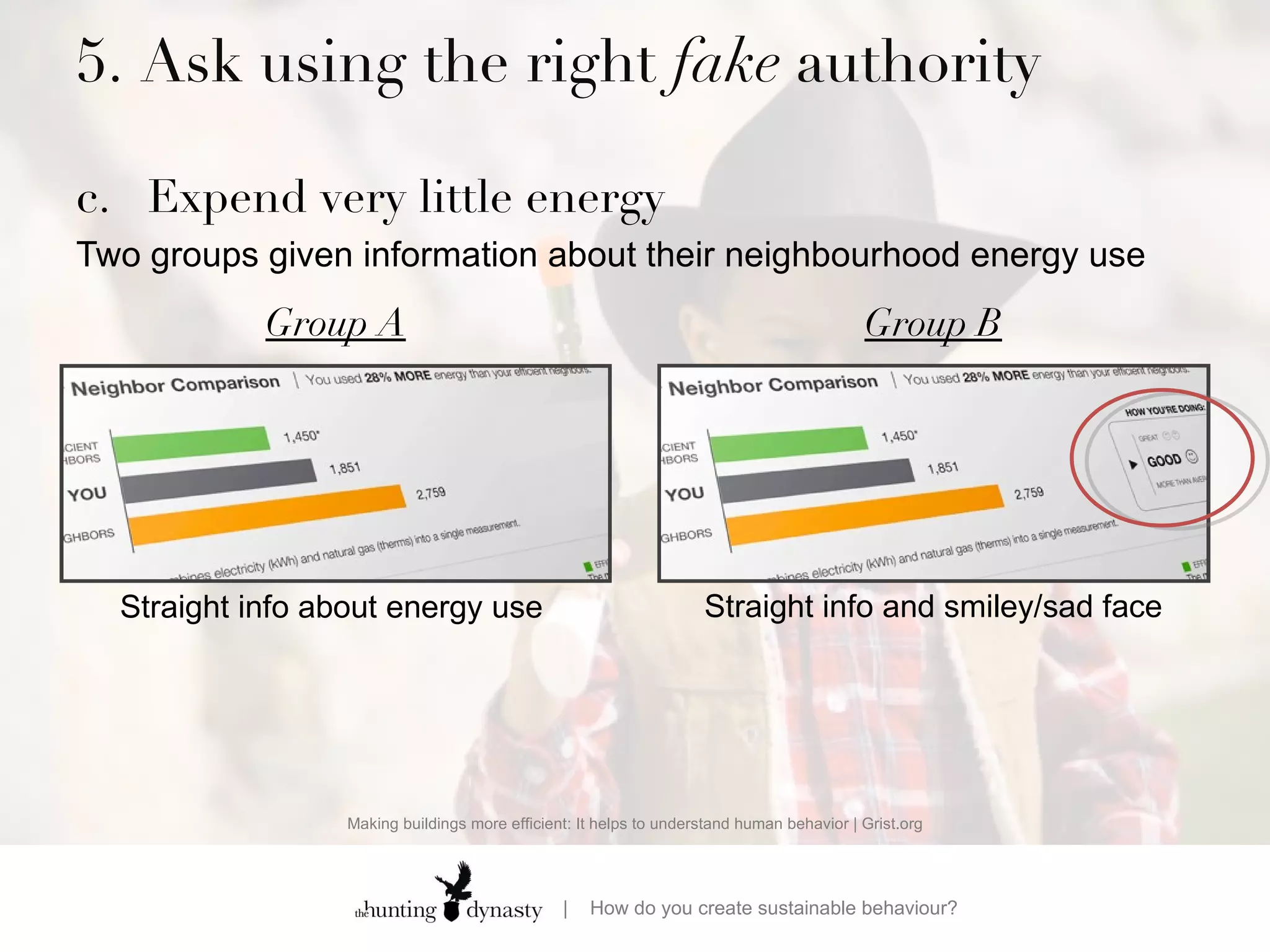
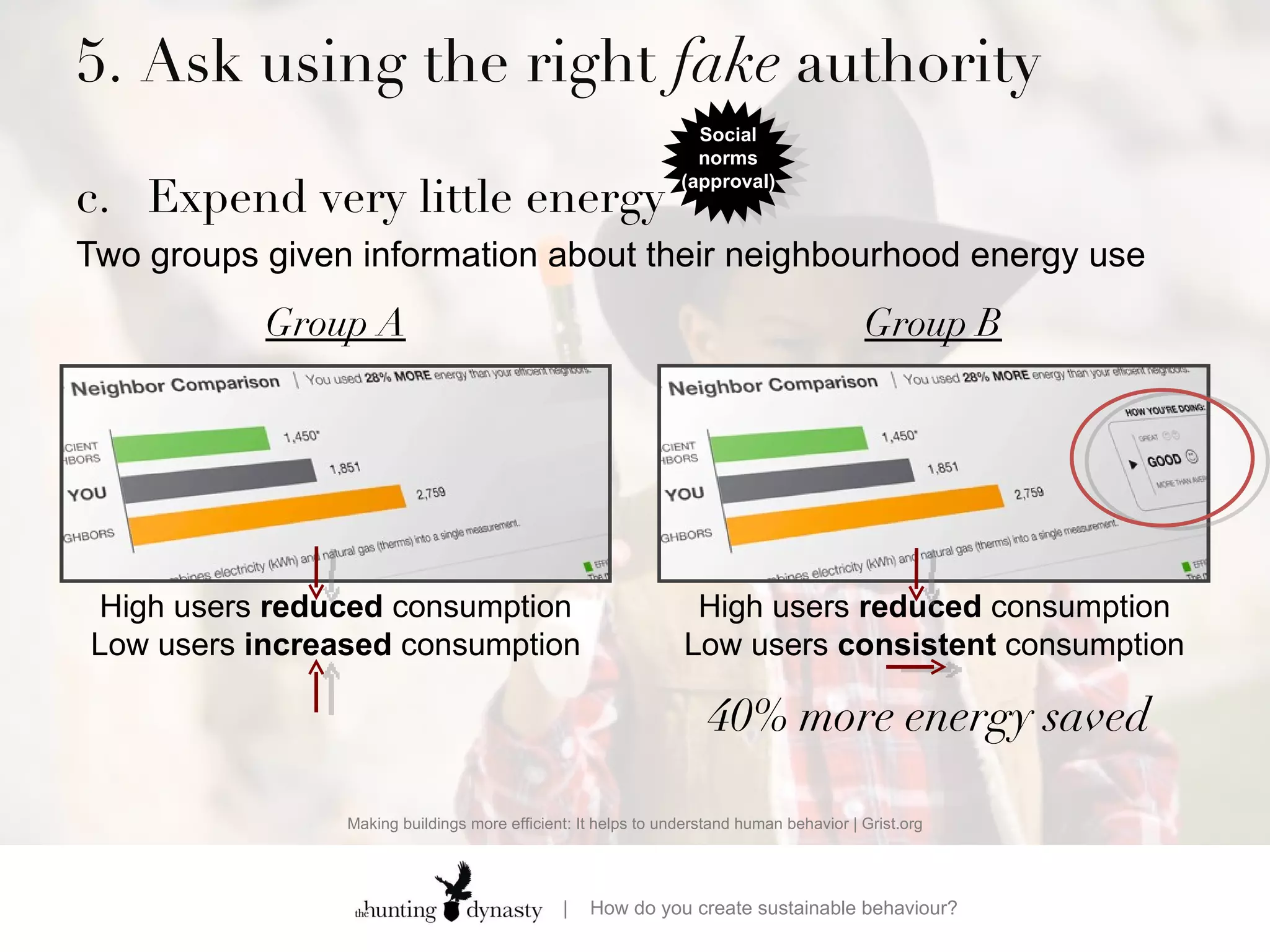
5. Ask using the right  fake  authority  c. Expend very little energy Two groups given information about their neighbourhood energy use Making buildings more efficient: It helps to understand human behavior | Grist.org Group A 10 mpg Group B 25 mpg Straight info about energy use   Straight info and  smiley/sad face
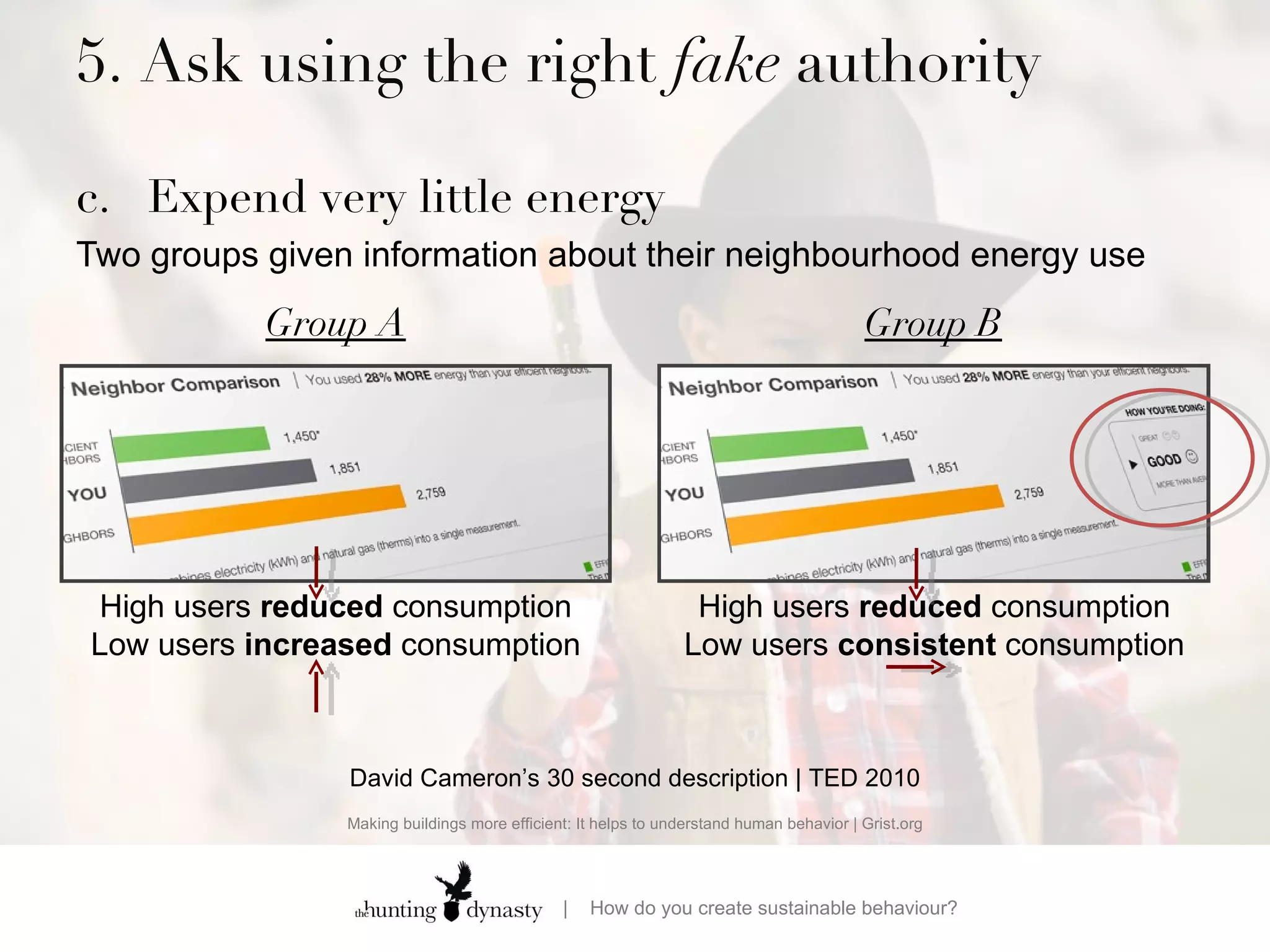
5. Ask using the right  fake  authority  c. Expend very little energy Two groups given information about their neighbourhood energy use Making buildings more efficient: It helps to understand human behavior | Grist.org Group A 10 mpg Group B 25 mpg High users  reduced  consumption Low users  increased  consumption High users  reduced  consumption Low users  consistent  consumption David Cameron’s 30 second description | TED 2010
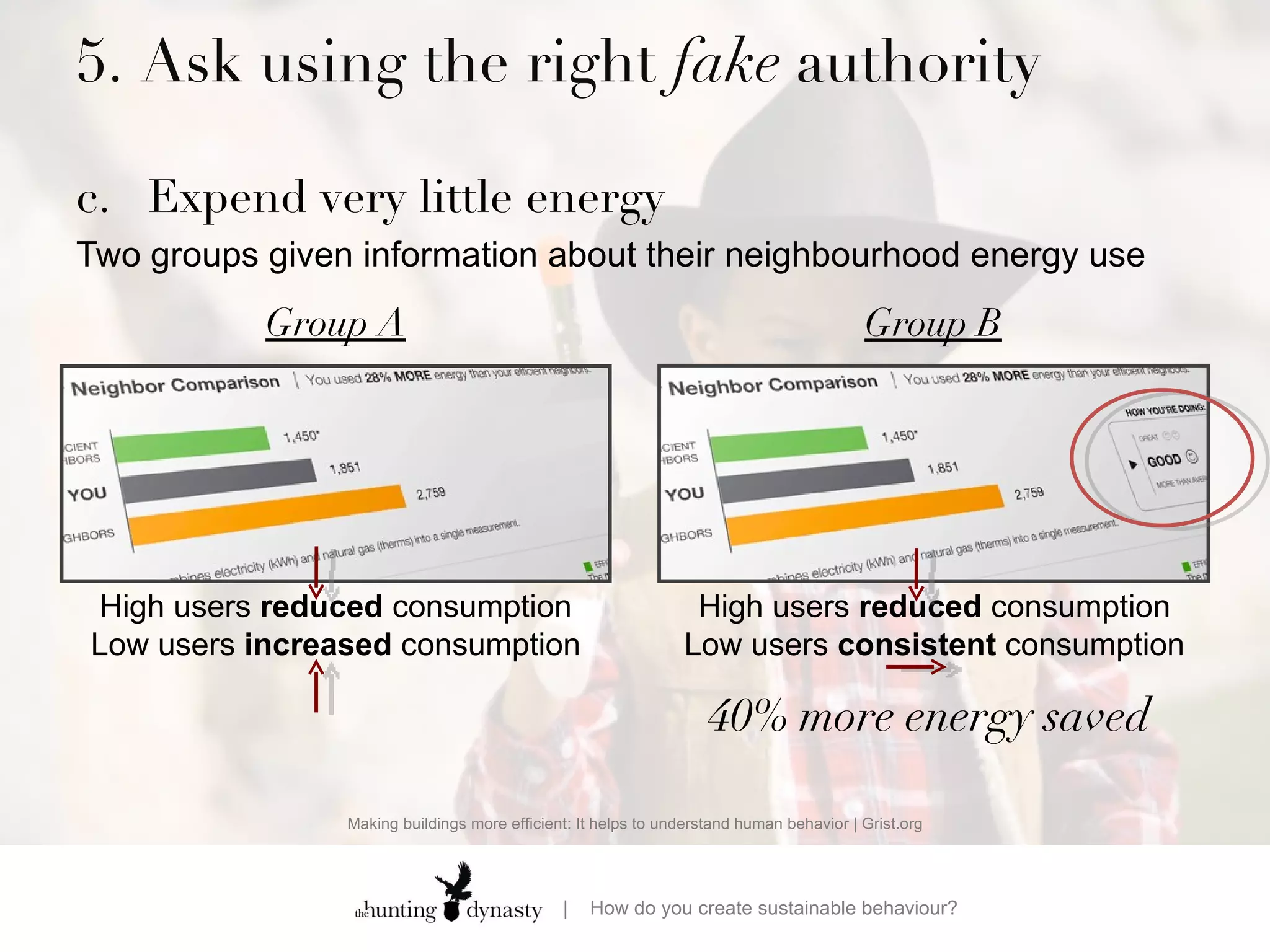
5. Ask using the right  fake  authority  c. Expend very little energy Two groups given information about their neighbourhood energy use Making buildings more efficient: It helps to understand human behavior | Grist.org Group A 10 mpg Group B 25 mpg 40% more energy saved   High users  reduced  consumption Low users  increased  consumption High users  reduced  consumption Low users  consistent  consumption
5. Ask using the right  fake  authority  c. Expend very little energy Two groups given information about their neighbourhood energy use Making buildings more efficient: It helps to understand human behavior | Grist.org Group A 10 mpg Group B 25 mpg 40% more energy saved   High users  reduced  consumption Low users  increased  consumption High users  reduced  consumption Low users  consistent  consumption Social norms (approval)
 
9. Add options
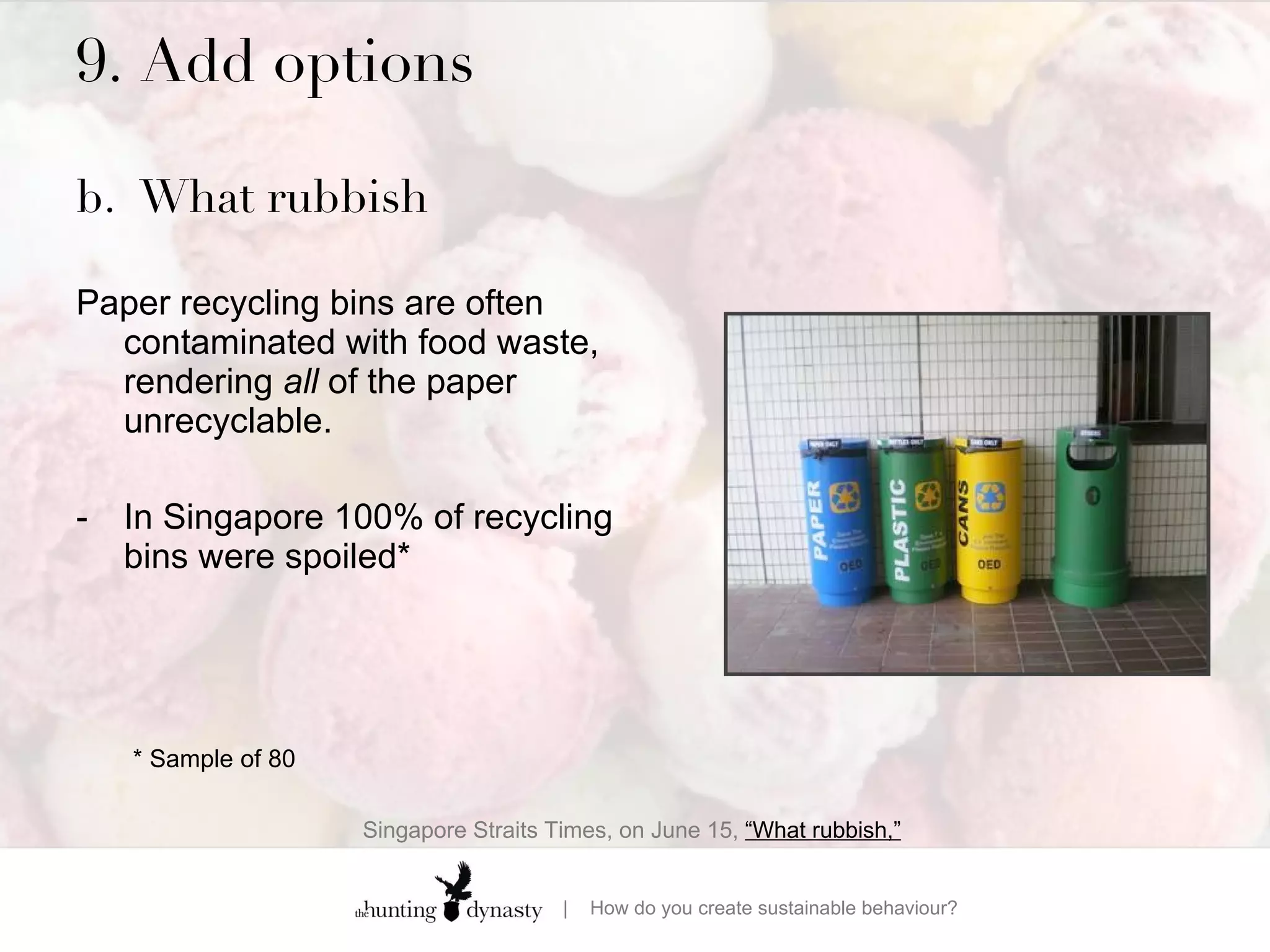
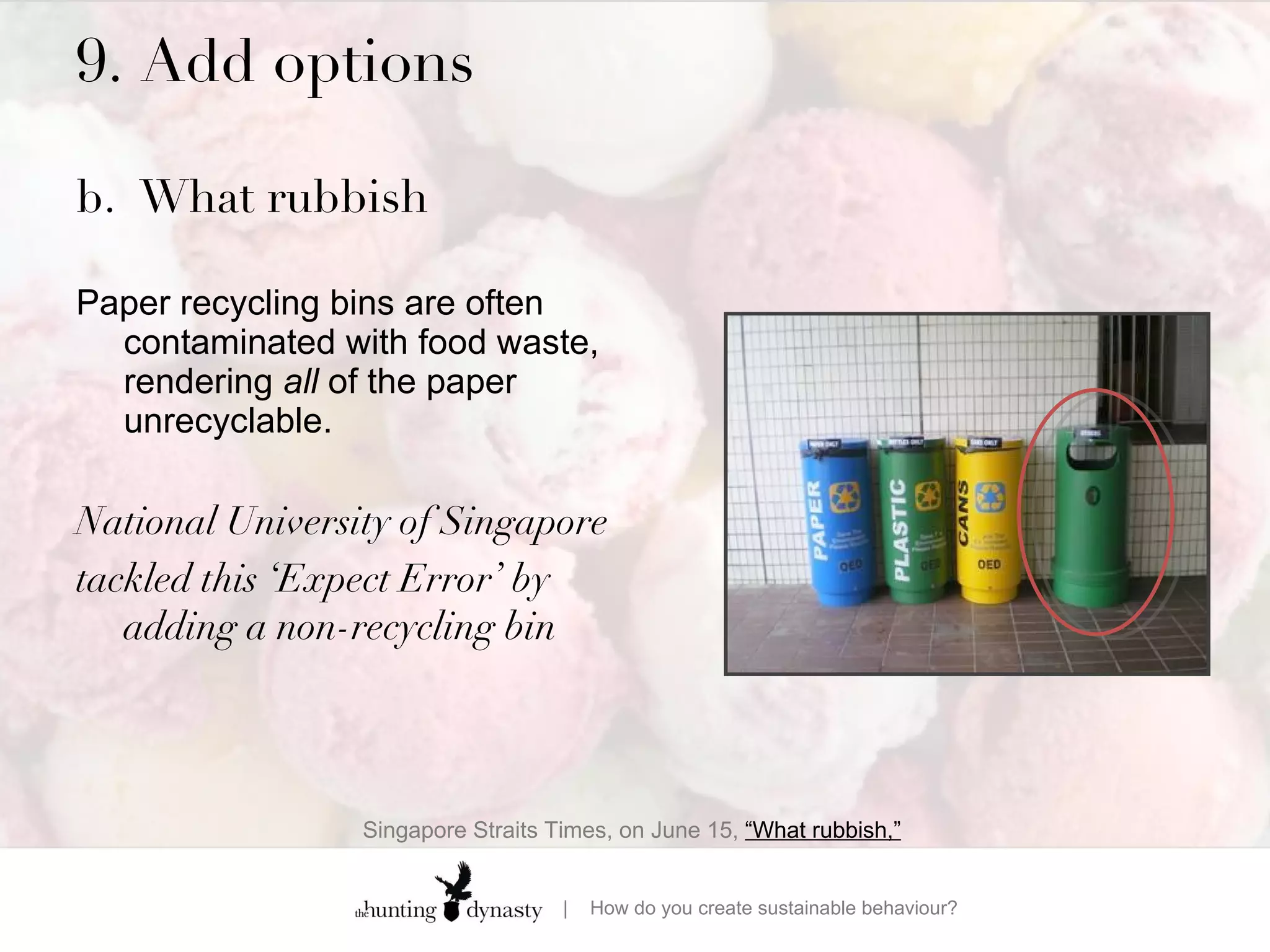
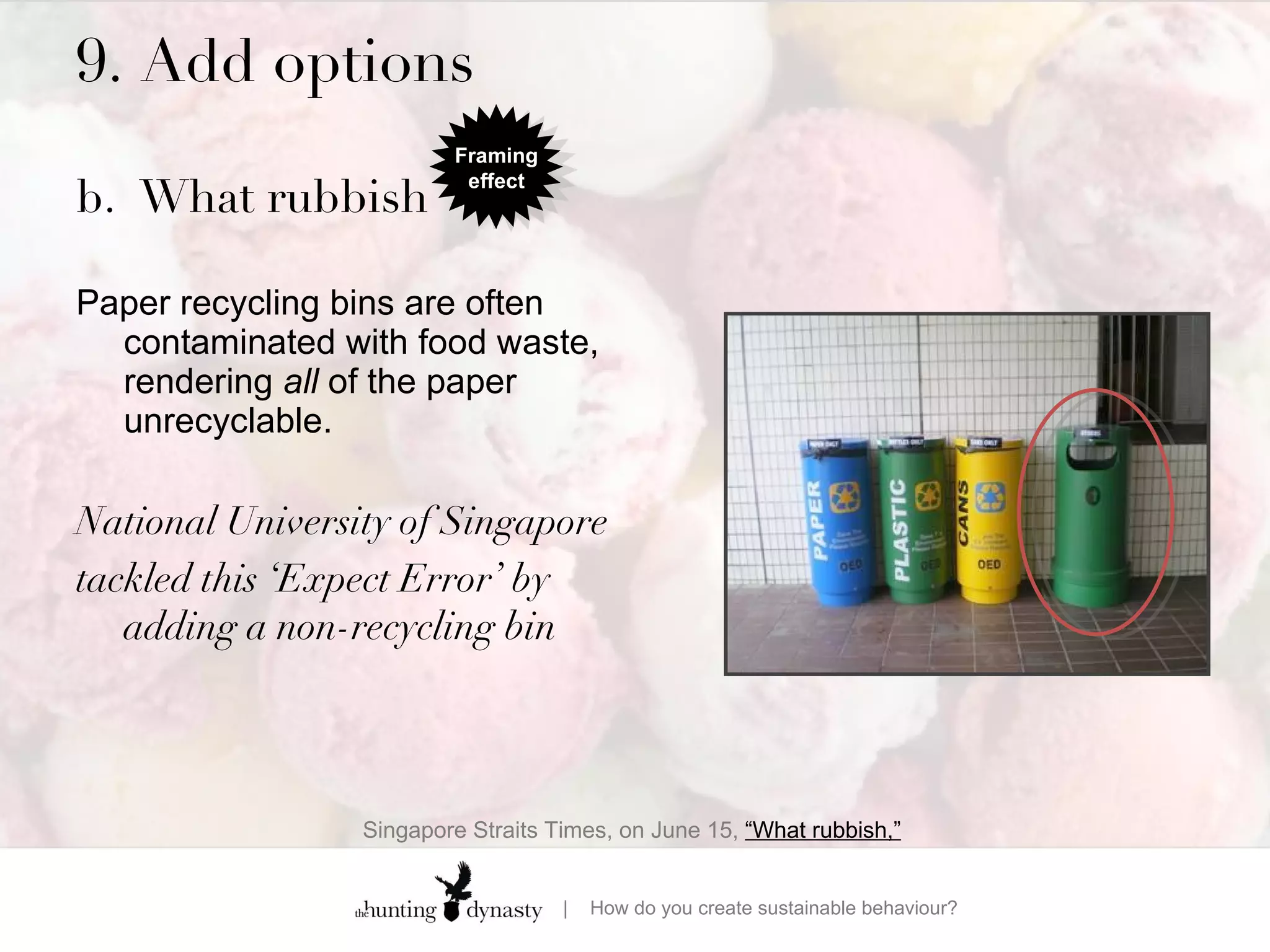
9. Add options  b. What rubbish Paper recycling bins are often contaminated with food waste, rendering  all  of the paper unrecyclable.  In Singapore 100% of recycling bins were spoiled* * Sample of 80 Singapore Straits Times, on June 15,  “What rubbish,”
9. Add options  b. What rubbish Paper recycling bins are often contaminated with food waste, rendering  all  of the paper unrecyclable.  National University of Singapore tackled this ‘Expect Error’ by adding a non-recycling bin  Singapore Straits Times, on June 15,  “What rubbish,”
9. Add options  b. What rubbish Paper recycling bins are often contaminated with food waste, rendering  all  of the paper unrecyclable.  National University of Singapore tackled this ‘Expect Error’ by adding a non-recycling bin  Singapore Straits Times, on June 15,  “What rubbish,”   Framing effect
 
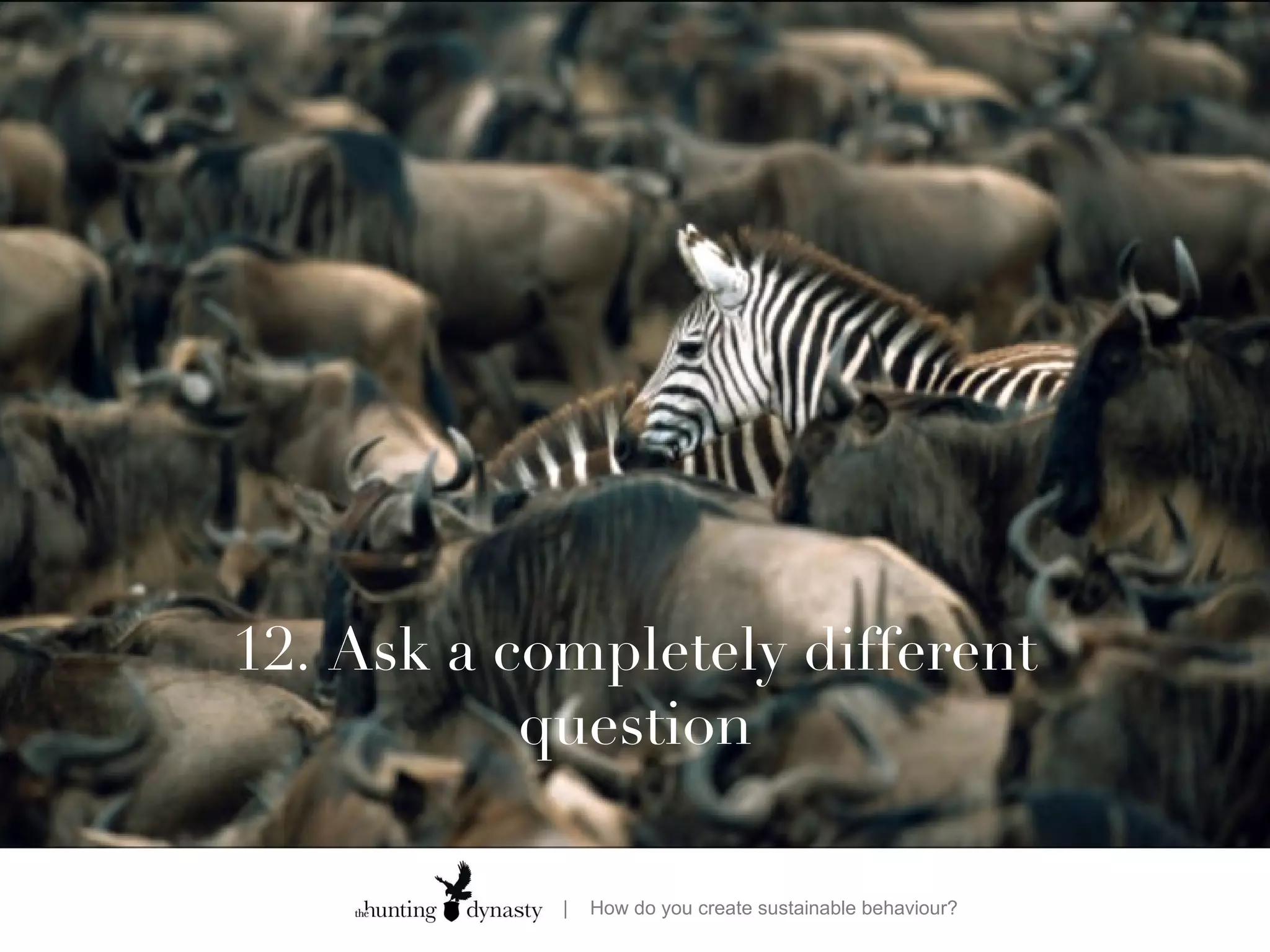
12. Ask a completely different question
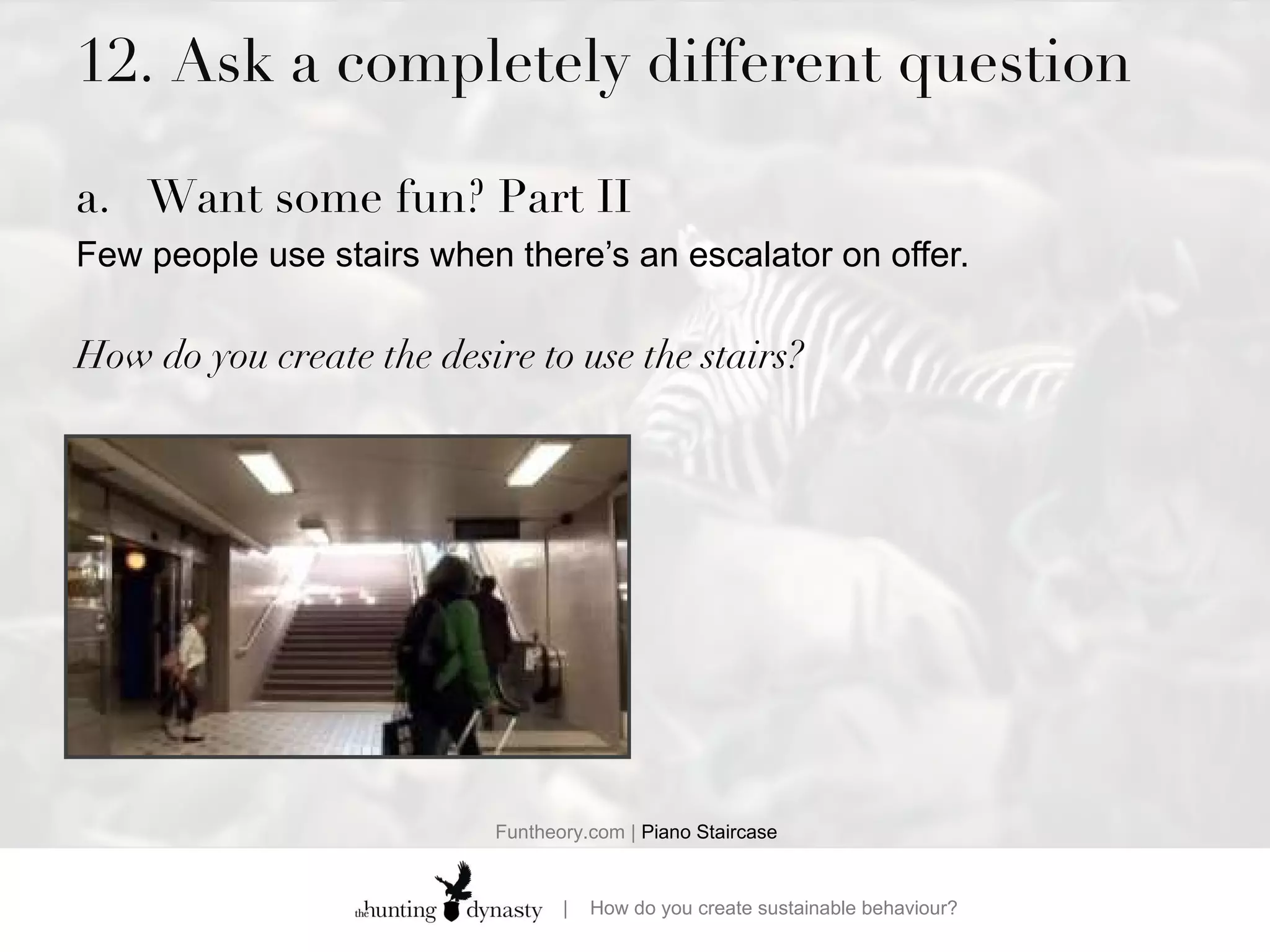
12. Ask a completely different question Want some fun? Part II Few people use stairs when there’s an escalator on offer.  How do you create the desire to use the stairs? Funtheory.com |  Piano Staircase
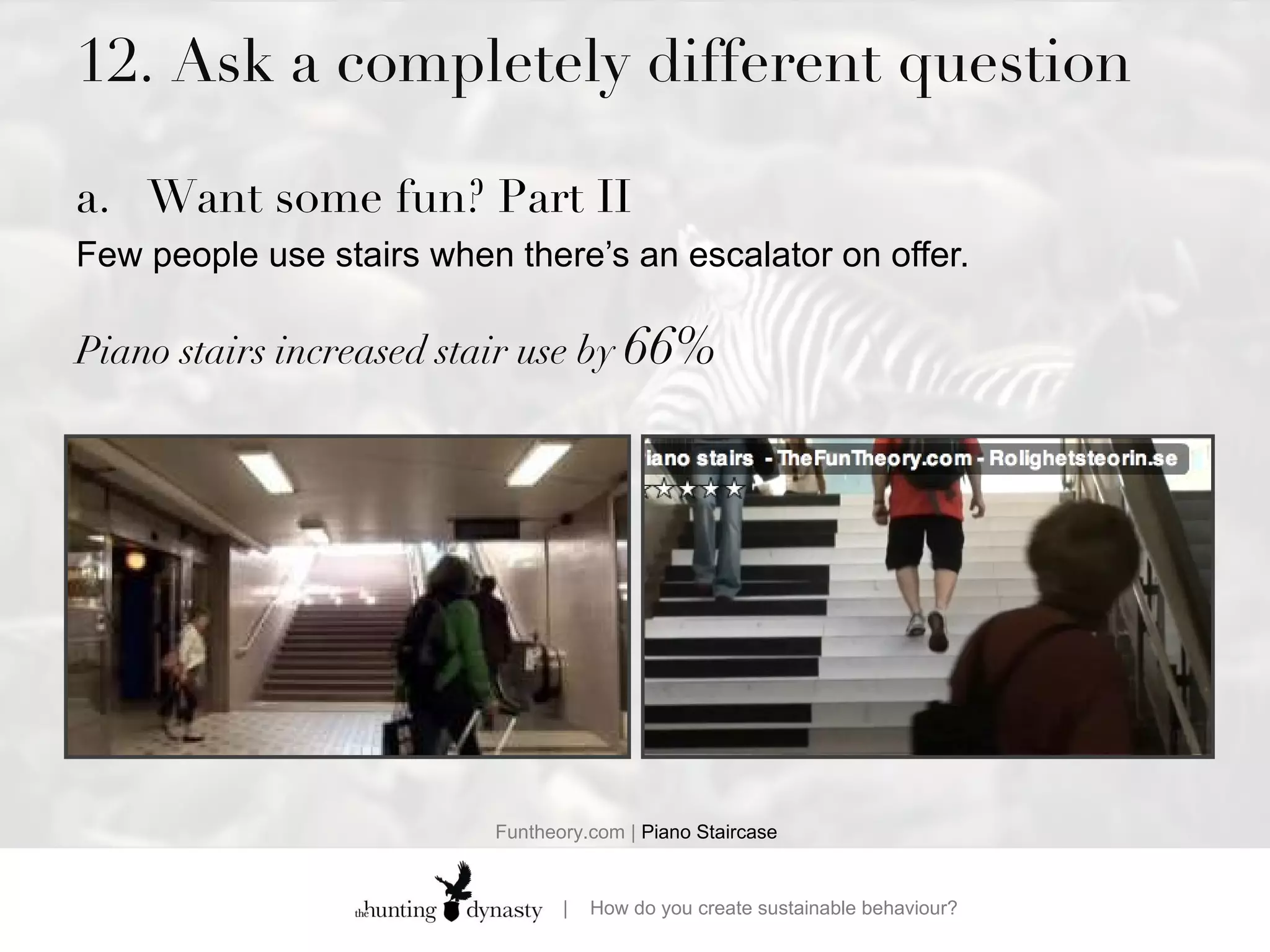
12. Ask a completely different question Want some fun? Part II Few people use stairs when there’s an escalator on offer.  Piano stairs increased stair use by  66% Funtheory.com |  Piano Staircase
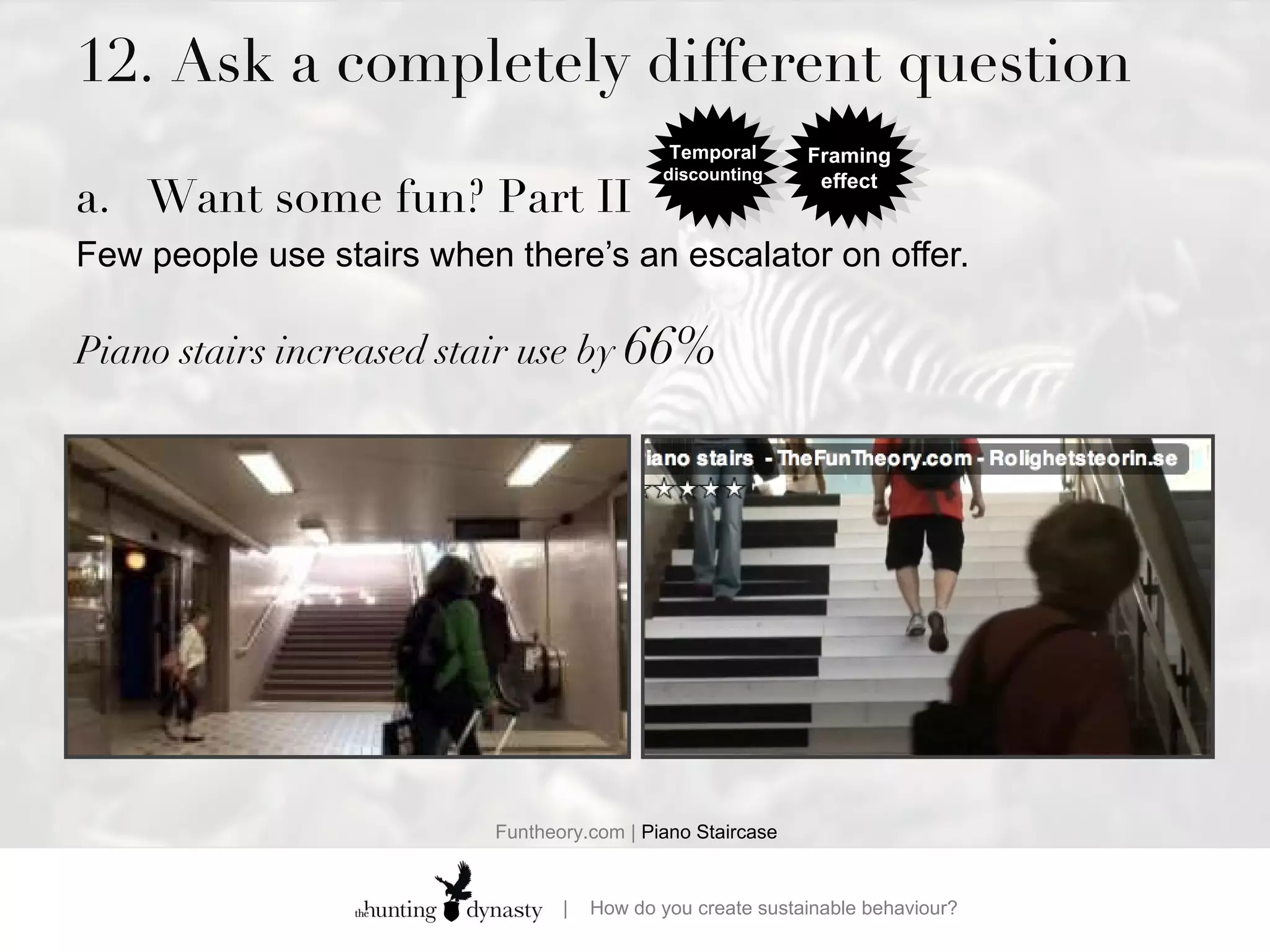
12. Ask a completely different question Want some fun? Part II Few people use stairs when there’s an escalator on offer.  Piano stairs increased stair use by  66% Funtheory.com |  Piano Staircase Temporal  discounting Framing effect
 
13. Let the feedback ask the question
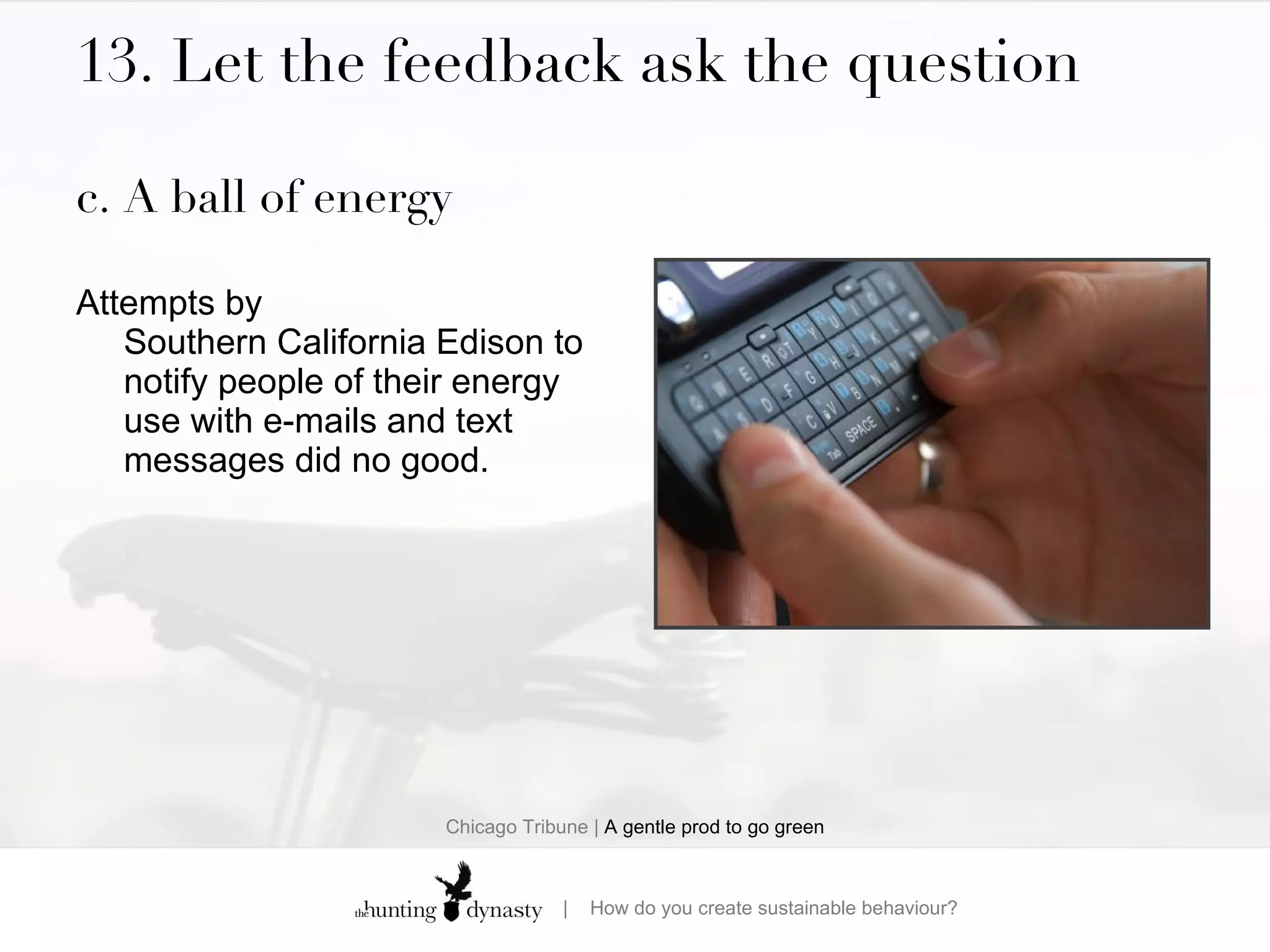
13. Let the feedback ask the question c. A ball of energy Attempts by  Southern California Edison  to notify people of their energy use with e-mails and text messages did no good.    Chicago Tribune |  A gentle prod to go green
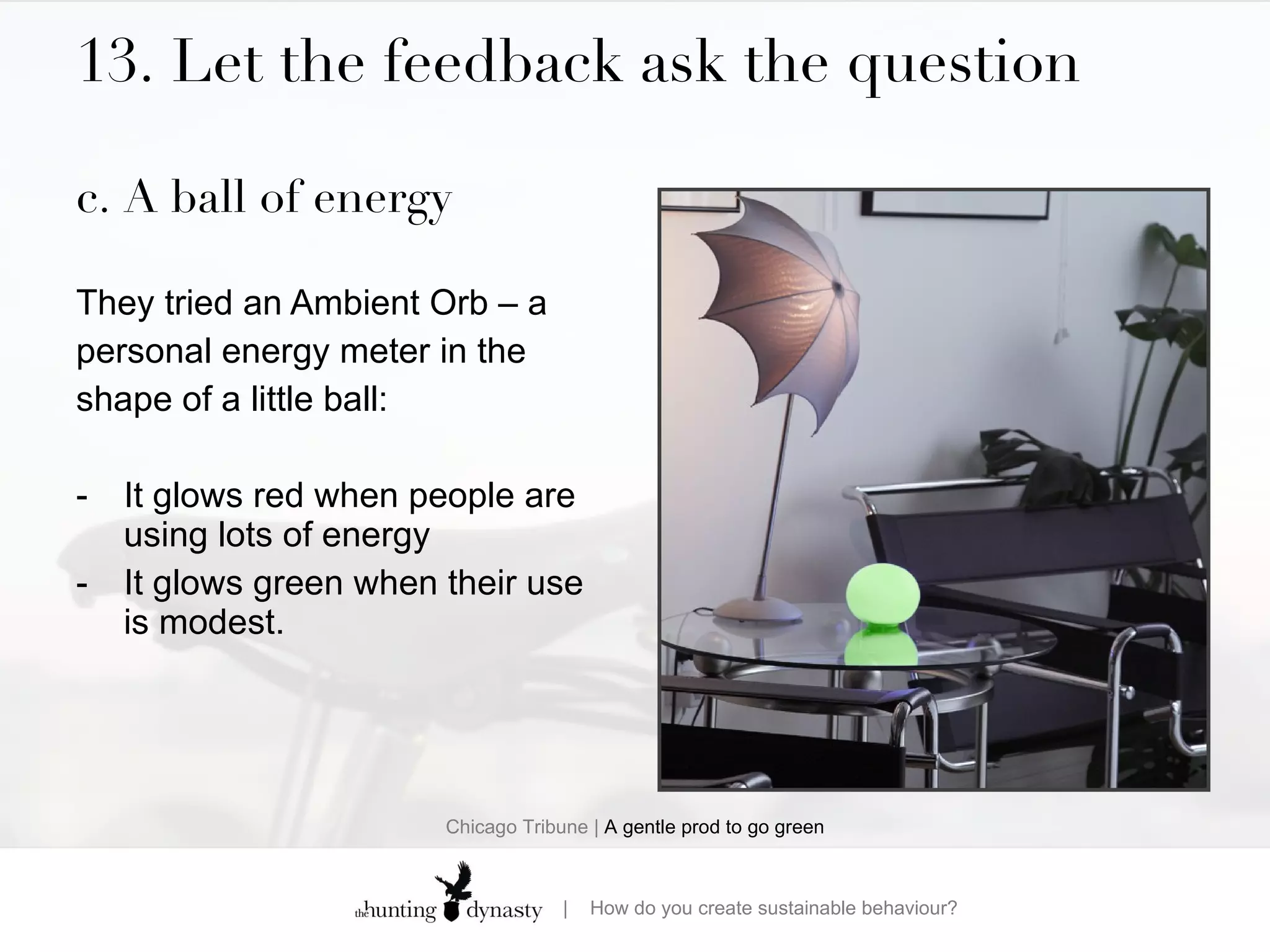
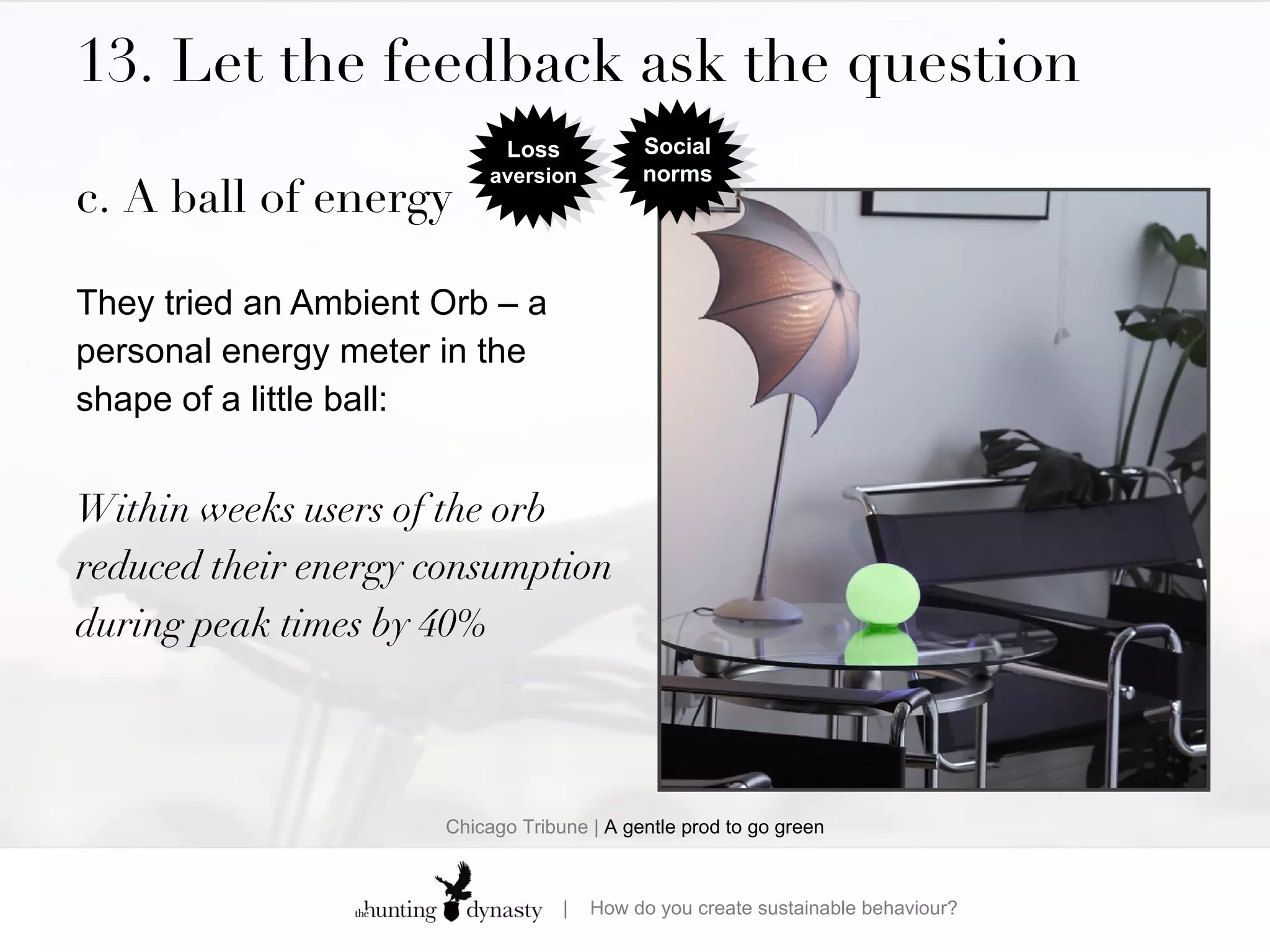
13. Let the feedback ask the question c. A ball of energy They tried an Ambient Orb – a personal energy meter in the shape of a little ball: It glows red when people are using lots of energy It glows green when their use is modest. Chicago Tribune |  A gentle prod to go green
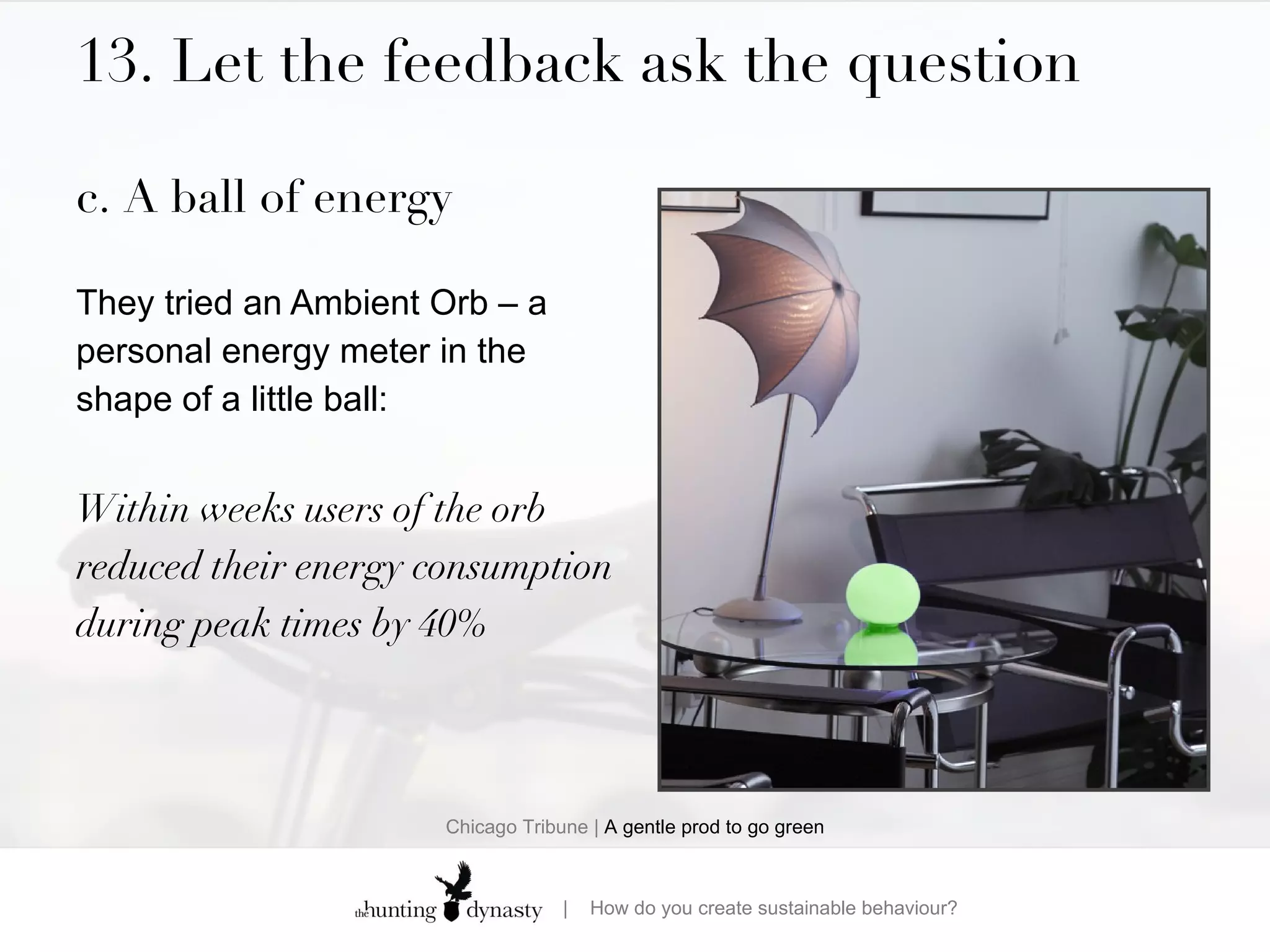
13. Let the feedback ask the question c. A ball of energy They tried an Ambient Orb – a personal energy meter in the shape of a little ball: Within weeks users of the orb reduced their energy consumption during peak times by 40% Chicago Tribune |  A gentle prod to go green
13. Let the feedback ask the question c. A ball of energy They tried an Ambient Orb – a personal energy meter in the shape of a little ball: Within weeks users of the orb reduced their energy consumption during peak times by 40% Chicago Tribune |  A gentle prod to go green Loss  aversion Social norms
 
14. Don’t ask. ( Tell .)
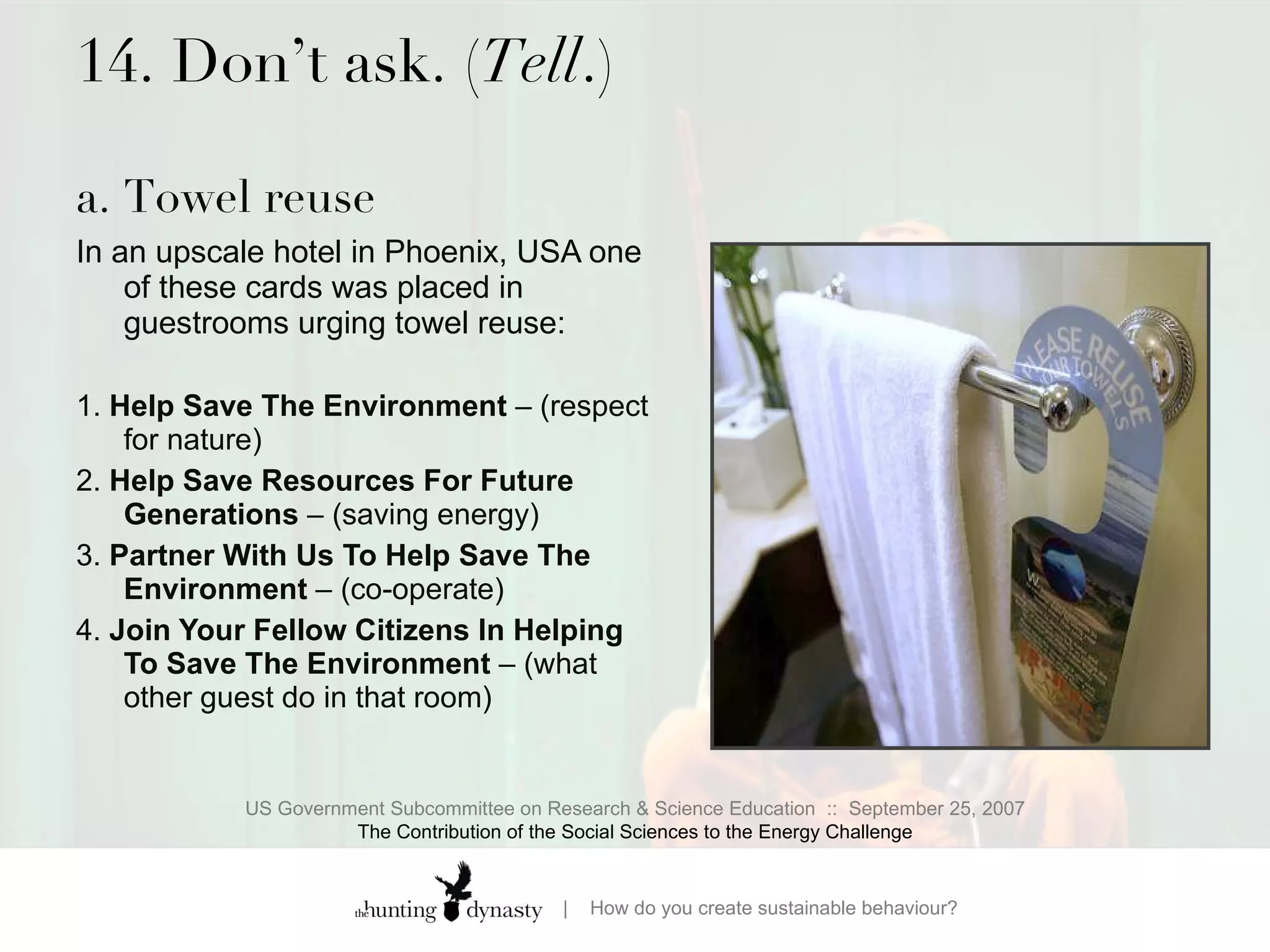
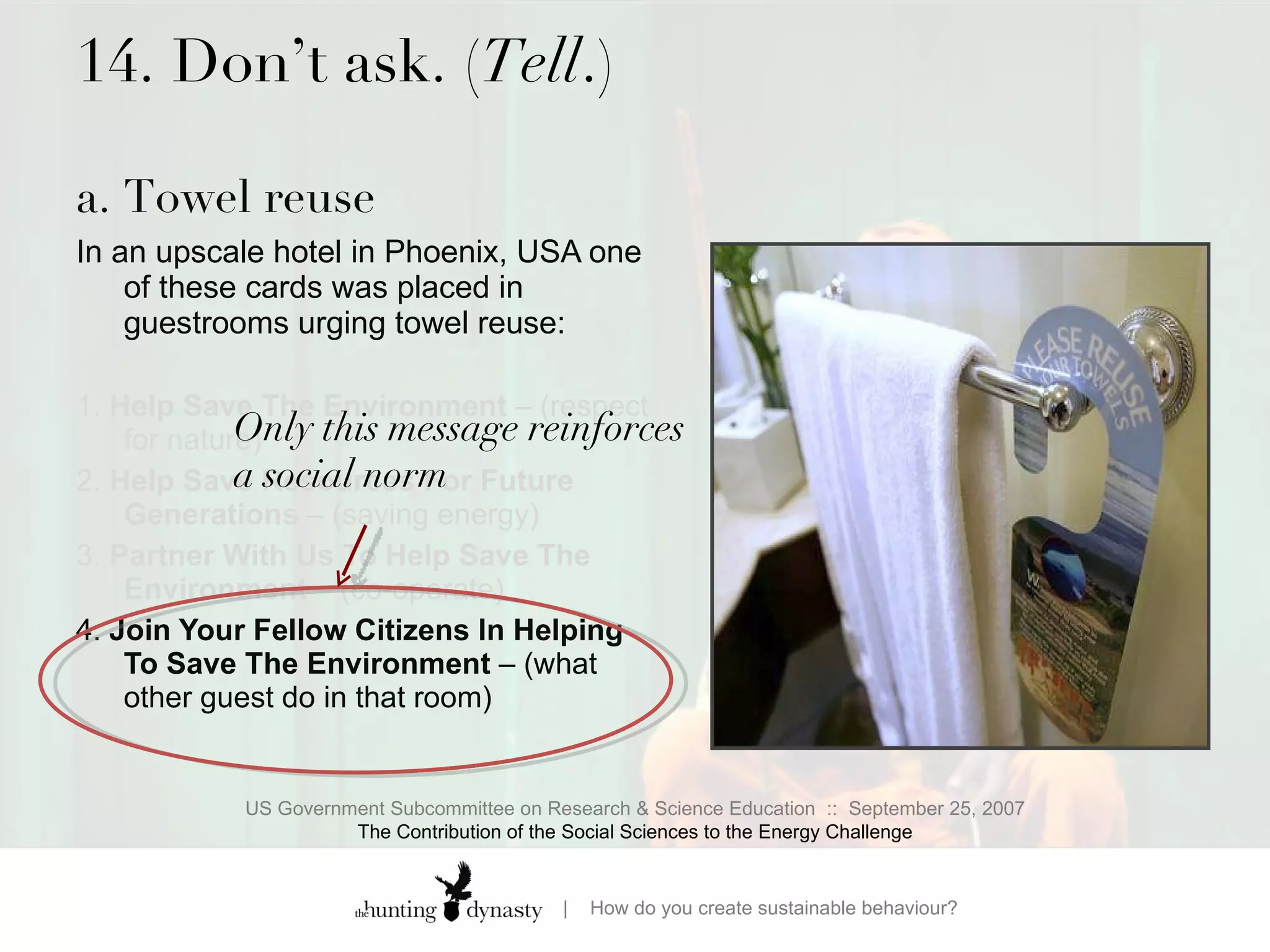
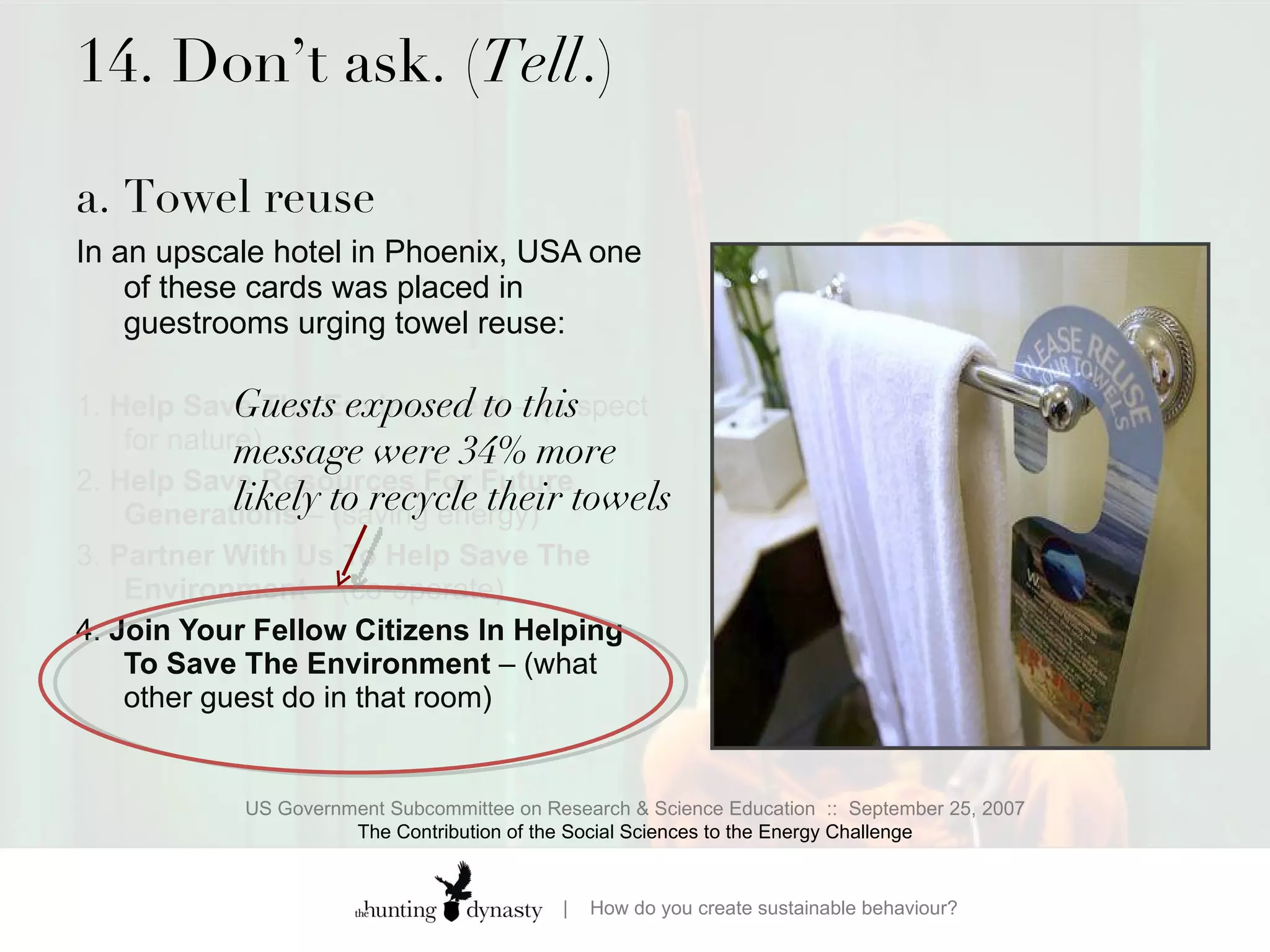
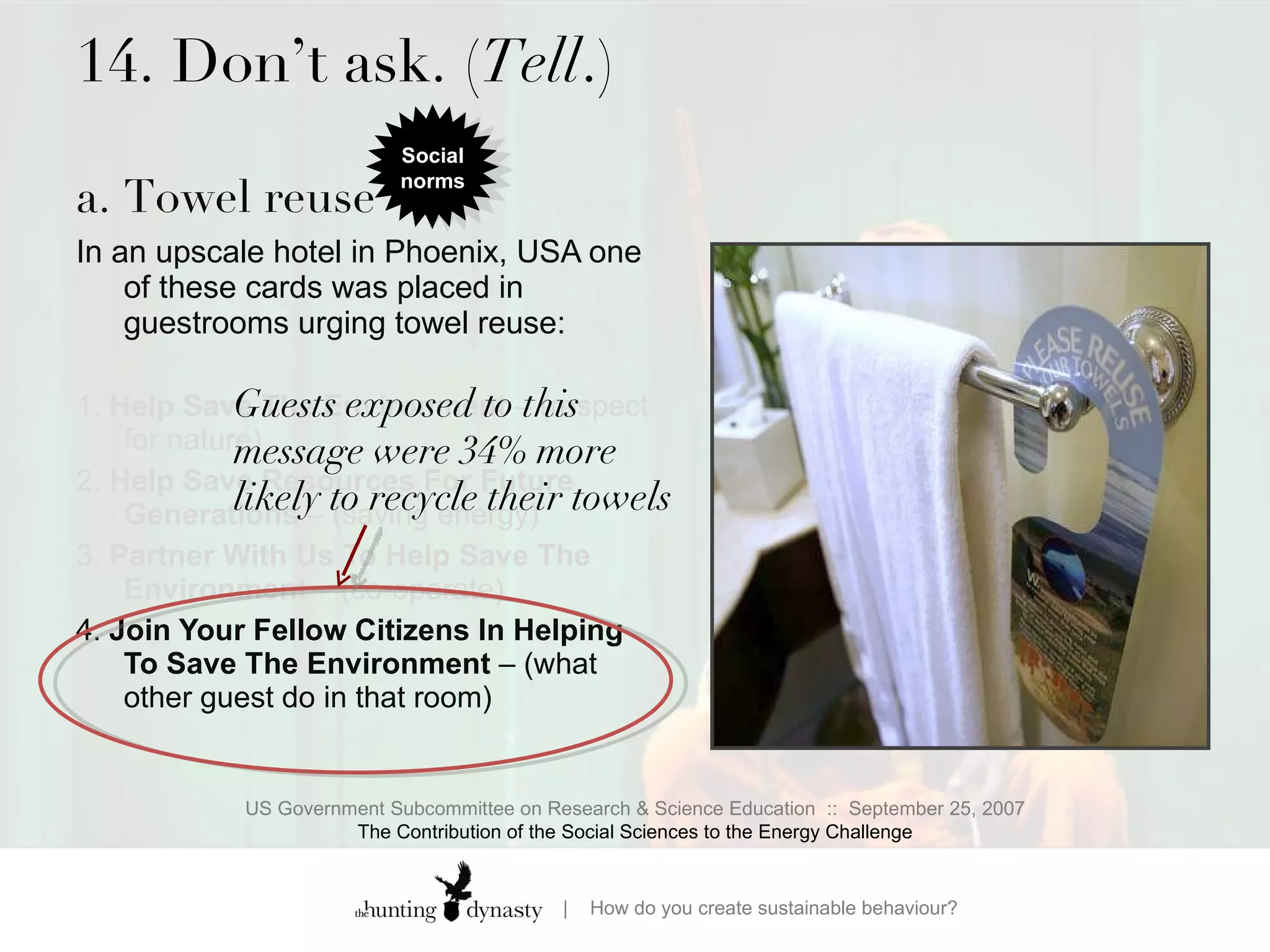
14. Don’t ask. ( Tell .) a. Towel reuse  In an upscale hotel in Phoenix, USA one of these cards was placed in guestrooms urging towel reuse:  1.  Help Save The Environment  – (respect for nature)  2.  Help Save Resources For Future Generations  – (saving energy) 3.  Partner With Us To Help Save The Environment  – (co-operate) 4.  Join Your Fellow Citizens In Helping To Save The Environment  – (what other guest do in that room) US Government Subcommittee on Research & Science Education  ::  September 25, 2007 The Contribution of the Social Sciences to the Energy Challenge
14. Don’t ask. ( Tell .) a. Towel reuse  In an upscale hotel in Phoenix, USA one of these cards was placed in guestrooms urging towel reuse:  1.  Help Save The Environment  – (respect for nature)  2.  Help Save Resources For Future Generations  – (saving energy) 3.  Partner With Us To Help Save The Environment  – (co-operate) 4.  Join Your Fellow Citizens In Helping To Save The Environment  – (what other guest do in that room) US Government Subcommittee on Research & Science Education  ::  September 25, 2007 The Contribution of the Social Sciences to the Energy Challenge Only this message reinforces a social norm
14. Don’t ask. ( Tell .) a. Towel reuse  In an upscale hotel in Phoenix, USA one of these cards was placed in guestrooms urging towel reuse:  1.  Help Save The Environment  – (respect for nature)  2.  Help Save Resources For Future Generations  – (saving energy) 3.  Partner With Us To Help Save The Environment  – (co-operate) 4.  Join Your Fellow Citizens In Helping To Save The Environment  – (what other guest do in that room) US Government Subcommittee on Research & Science Education  ::  September 25, 2007 The Contribution of the Social Sciences to the Energy Challenge Guests exposed to this message were 34% more likely to recycle their towels
14. Don’t ask. ( Tell .) a. Towel reuse  In an upscale hotel in Phoenix, USA one of these cards was placed in guestrooms urging towel reuse:  1.  Help Save The Environment  – (respect for nature)  2.  Help Save Resources For Future Generations  – (saving energy) 3.  Partner With Us To Help Save The Environment  – (co-operate) 4.  Join Your Fellow Citizens In Helping To Save The Environment  – (what other guest do in that room) US Government Subcommittee on Research & Science Education  ::  September 25, 2007 The Contribution of the Social Sciences to the Energy Challenge Guests exposed to this message were 34% more likely to recycle their towels Social norms
 
Who’s doing it?
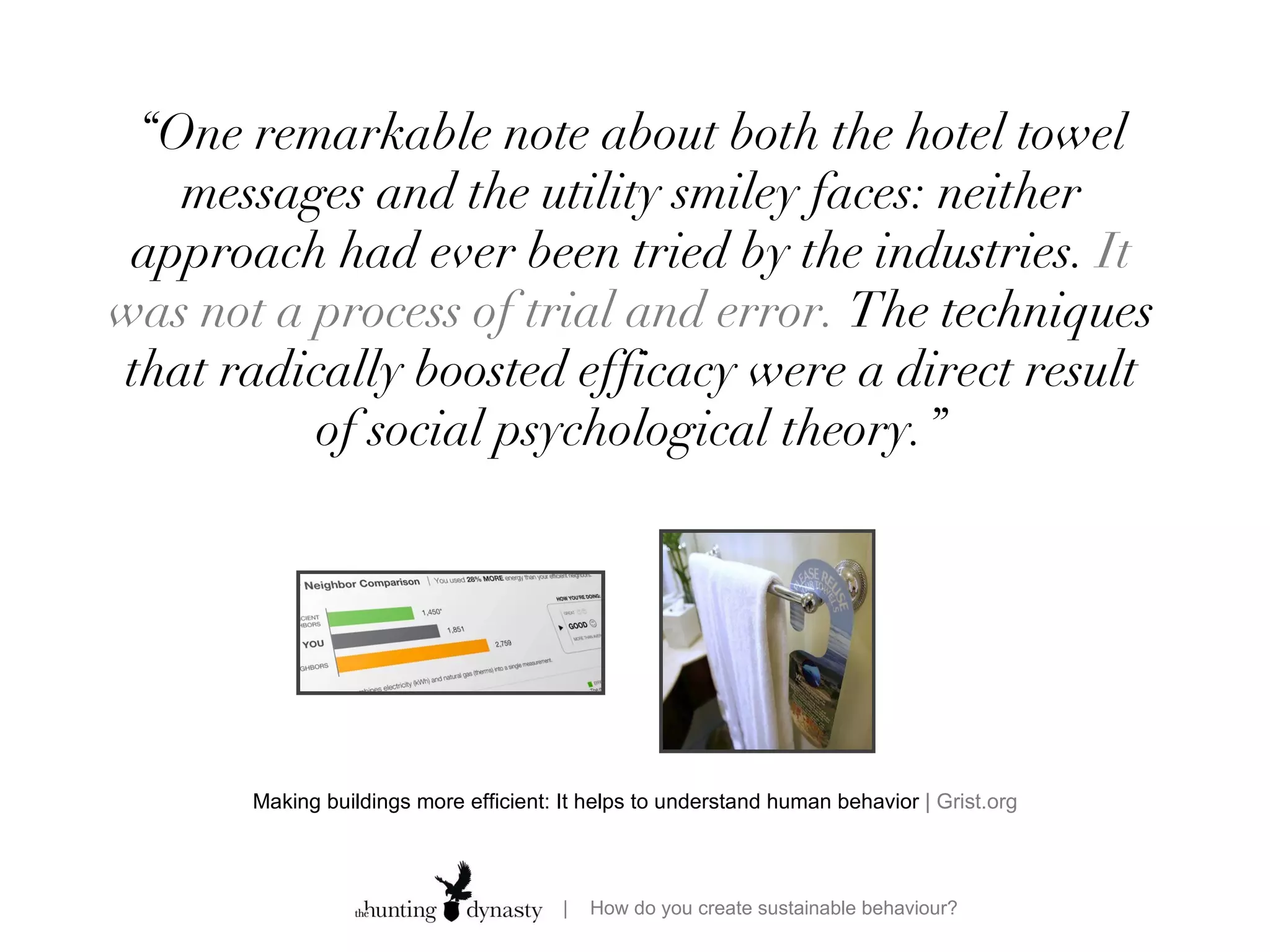
“ One remarkable note about both the hotel towel messages and the utility smiley faces: neither approach had ever been tried by the industries.  It was not a process of trial and error.  The techniques that radically boosted efficacy were a direct result of social psychological theory.” Making buildings more efficient: It helps to understand human behavior  | Grist.org
Until now…
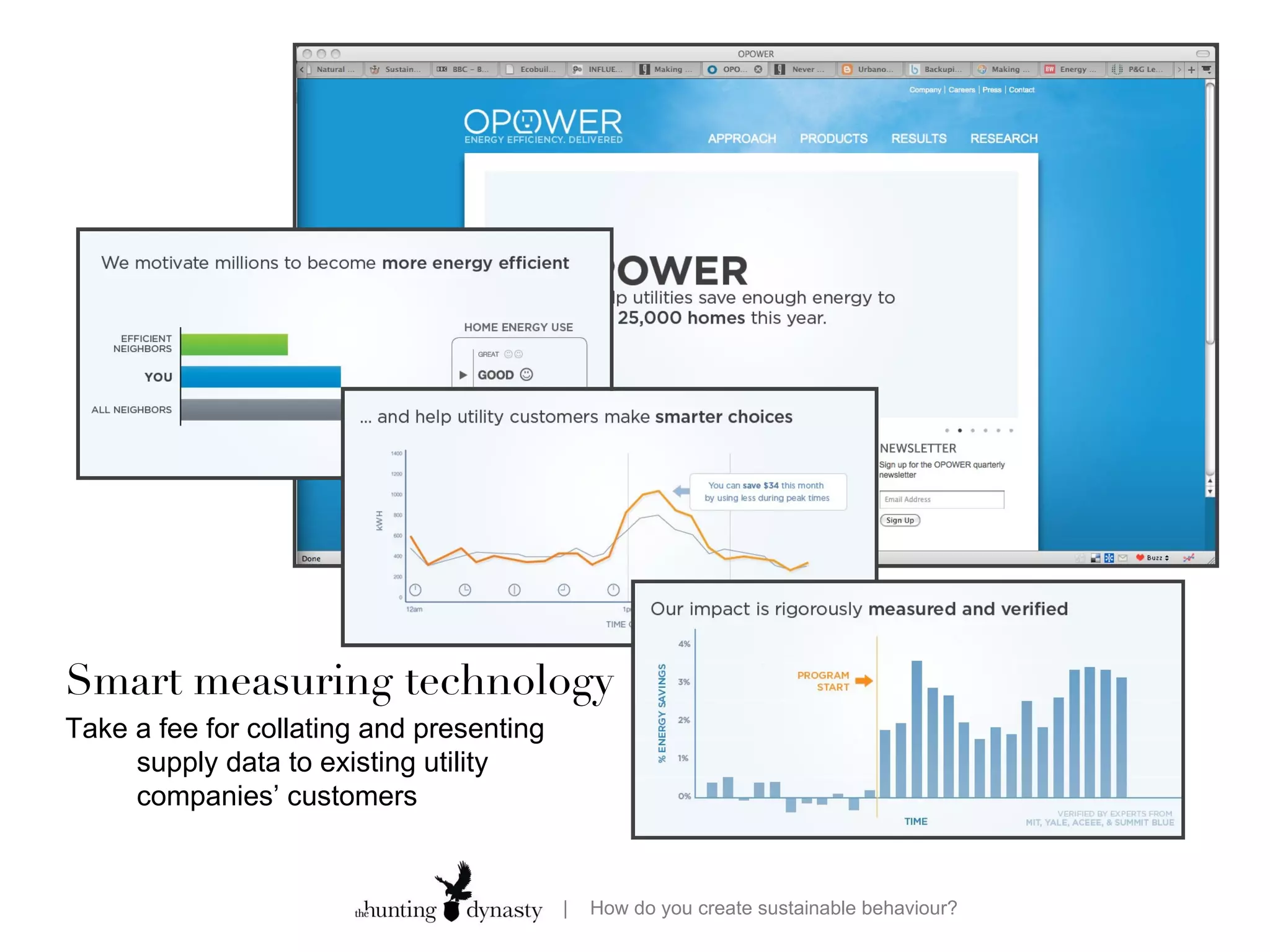
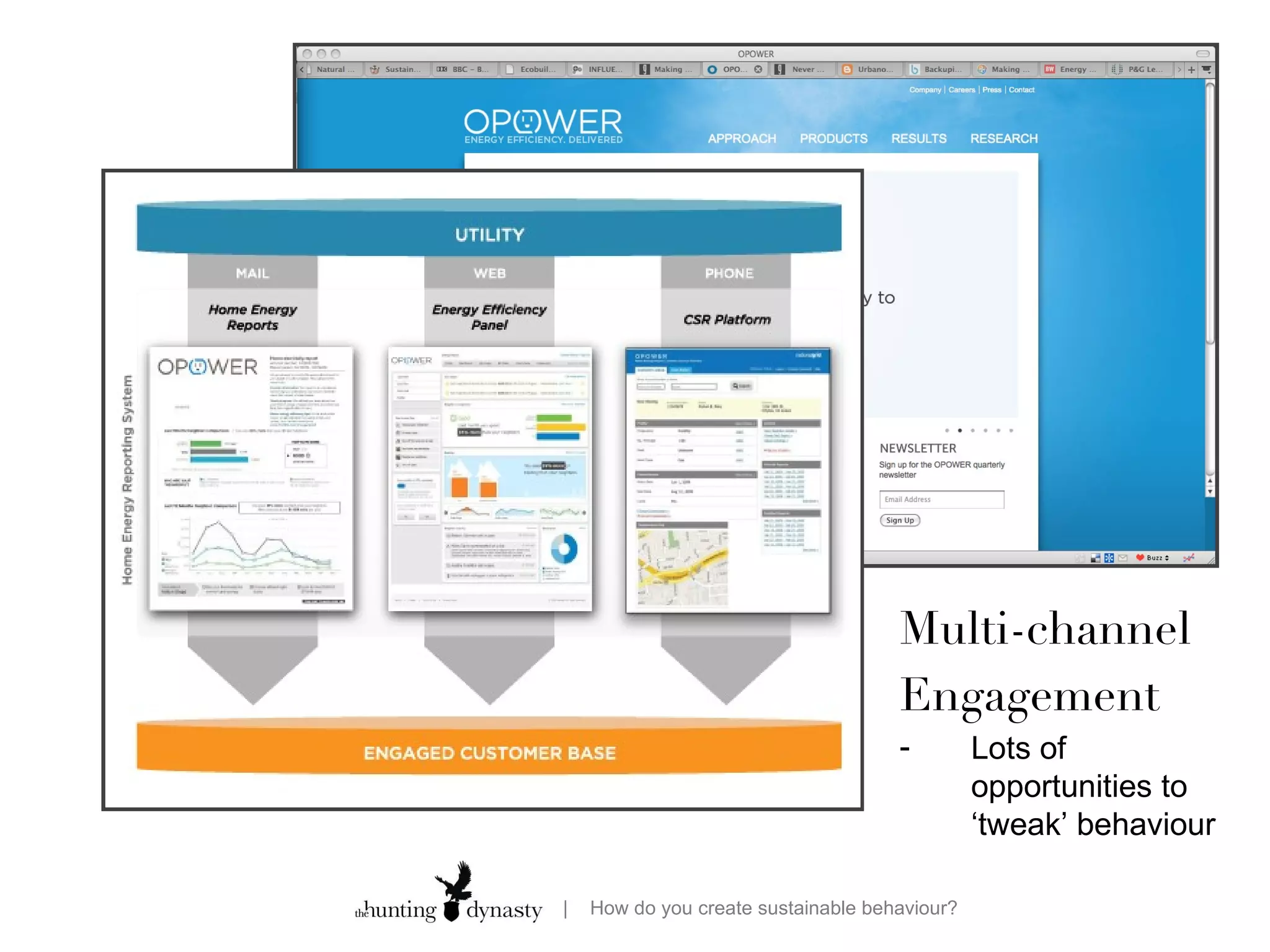
Smart measuring technology Take a fee for collating and presenting supply data to existing utility companies’ customers
Multi-channel  Engagement Lots of opportunities to ‘tweak’ behaviour
Are the results any good?
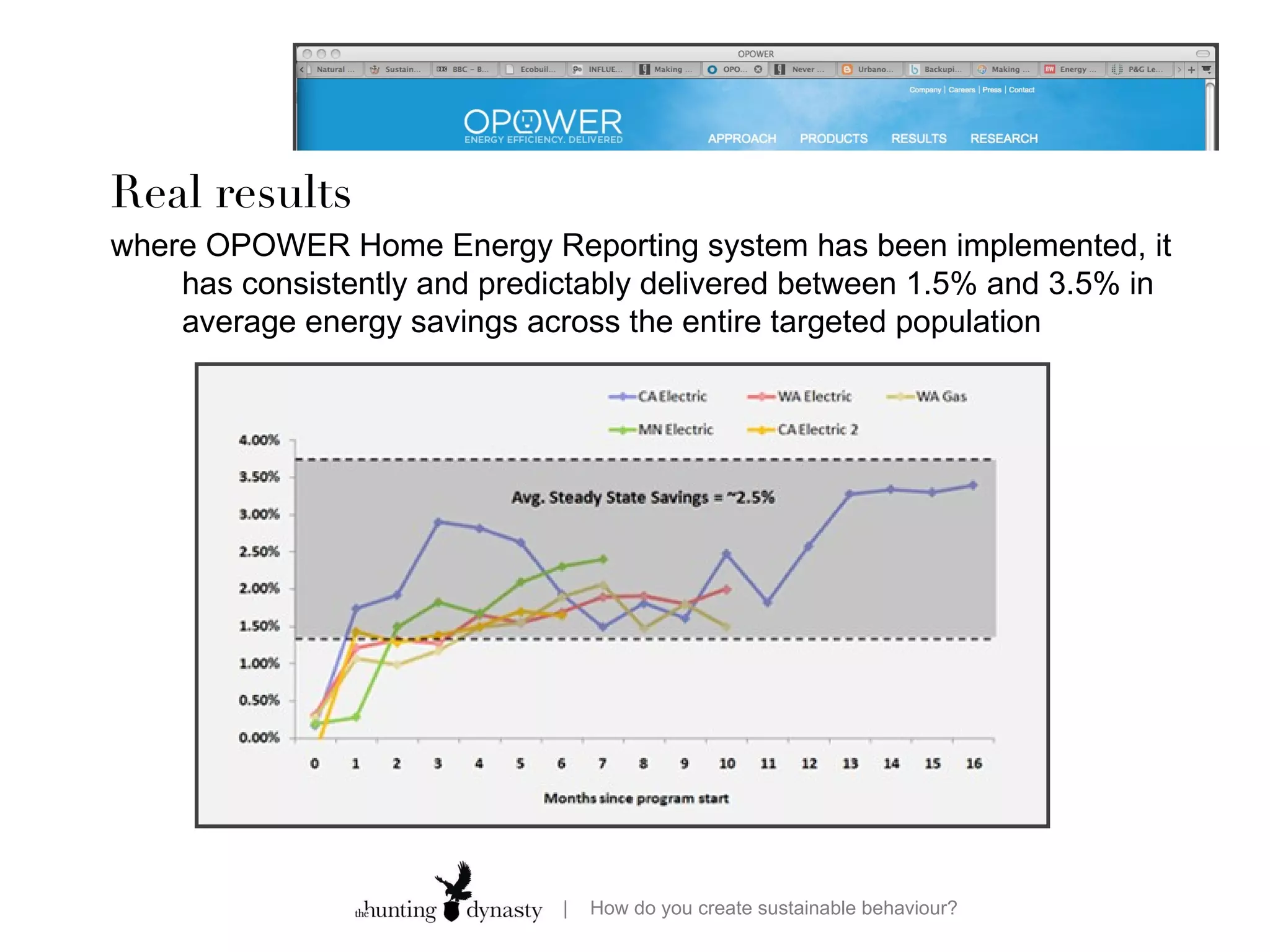
Real results where OPOWER Home Energy Reporting system has been implemented, it has consistently and predictably delivered between 1.5% and 3.5% in average energy savings across the entire targeted population
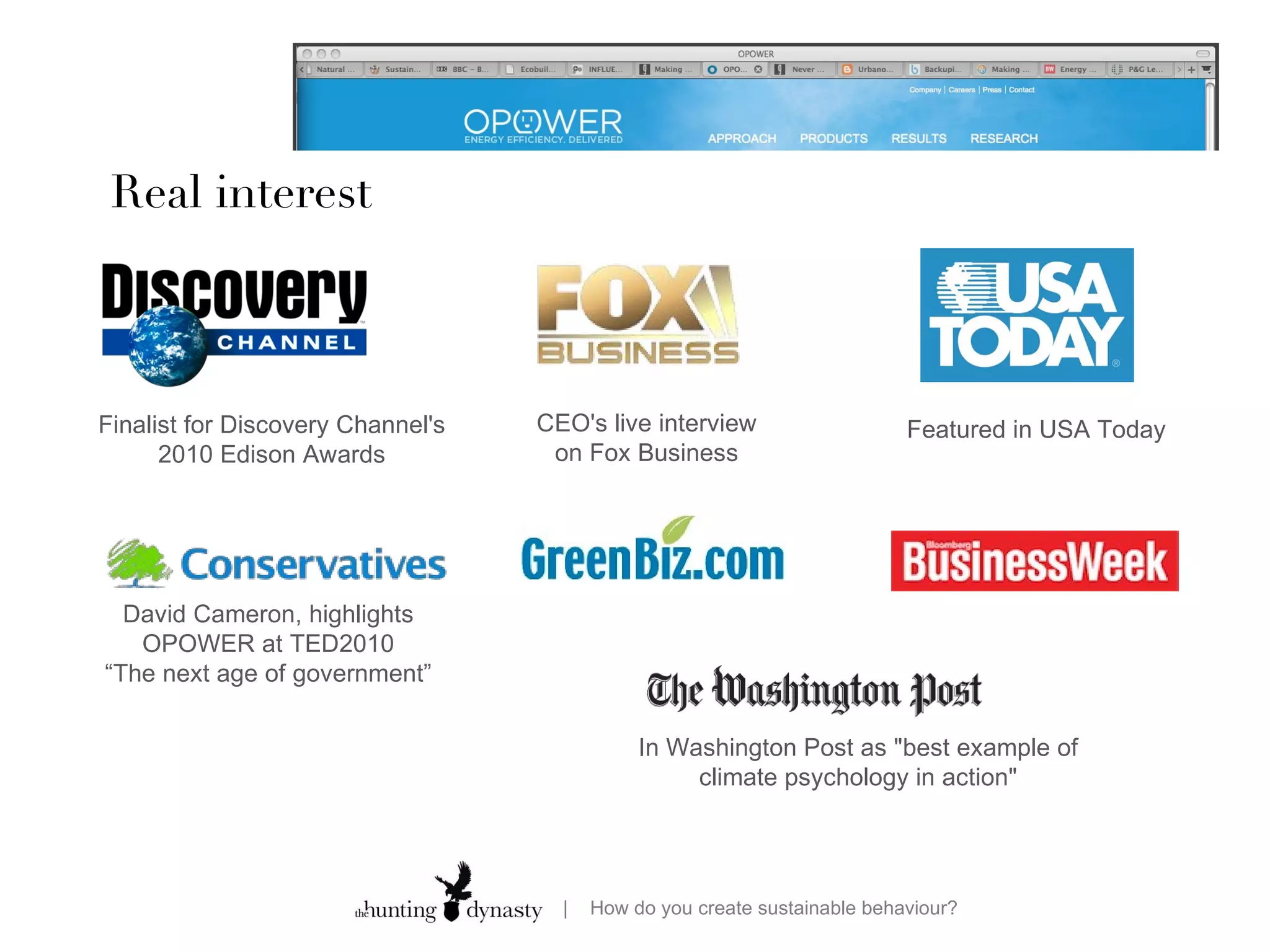
Real interest Finalist for Discovery Channel's 2010 Edison Awards CEO's live interview on Fox Business Featured in USA Today In Washington Post as "best example of climate psychology in action" David Cameron, highlights OPOWER at TED2010 “ The next age of government”
Are behavioural communications expensive to implement?
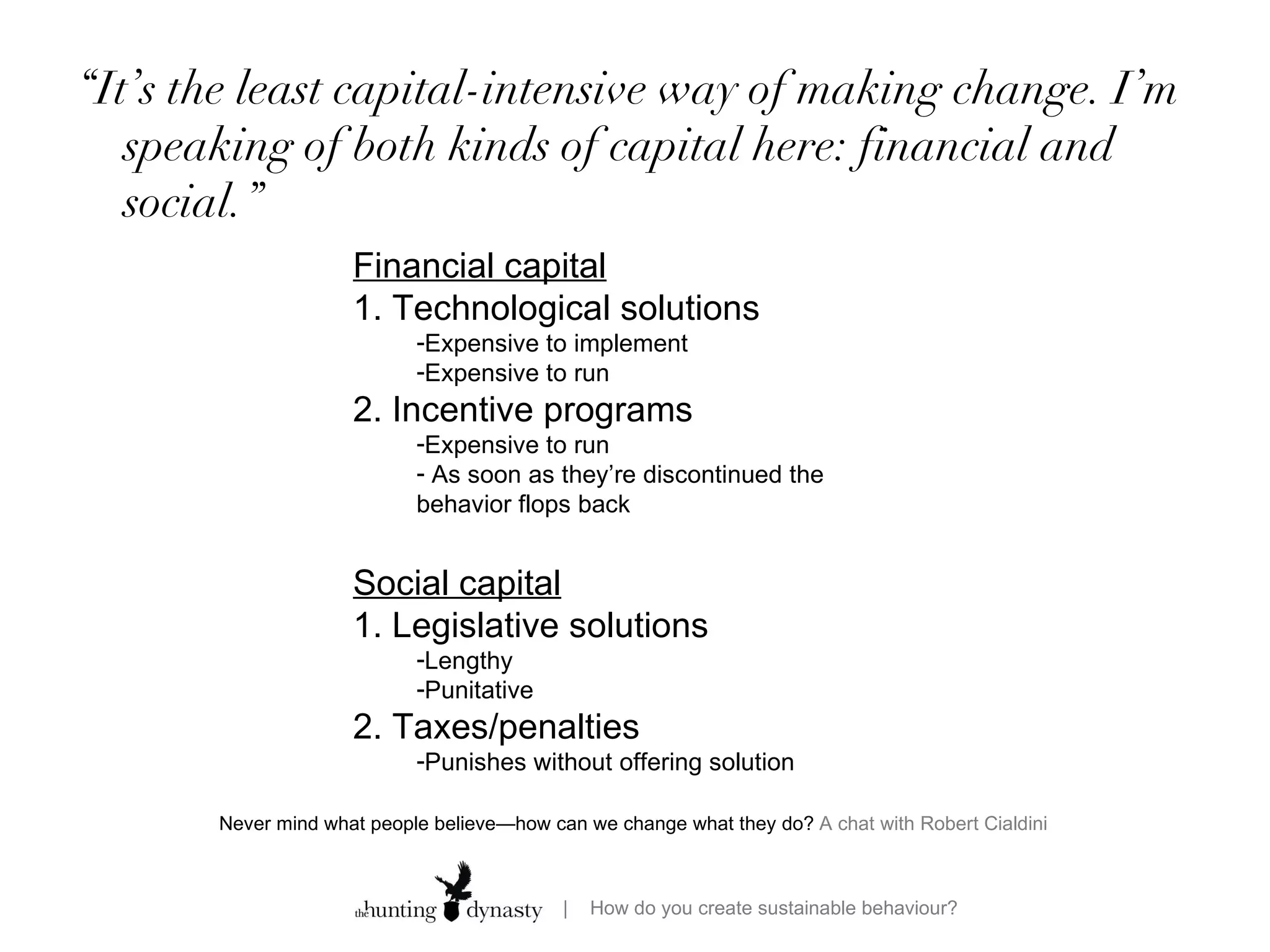
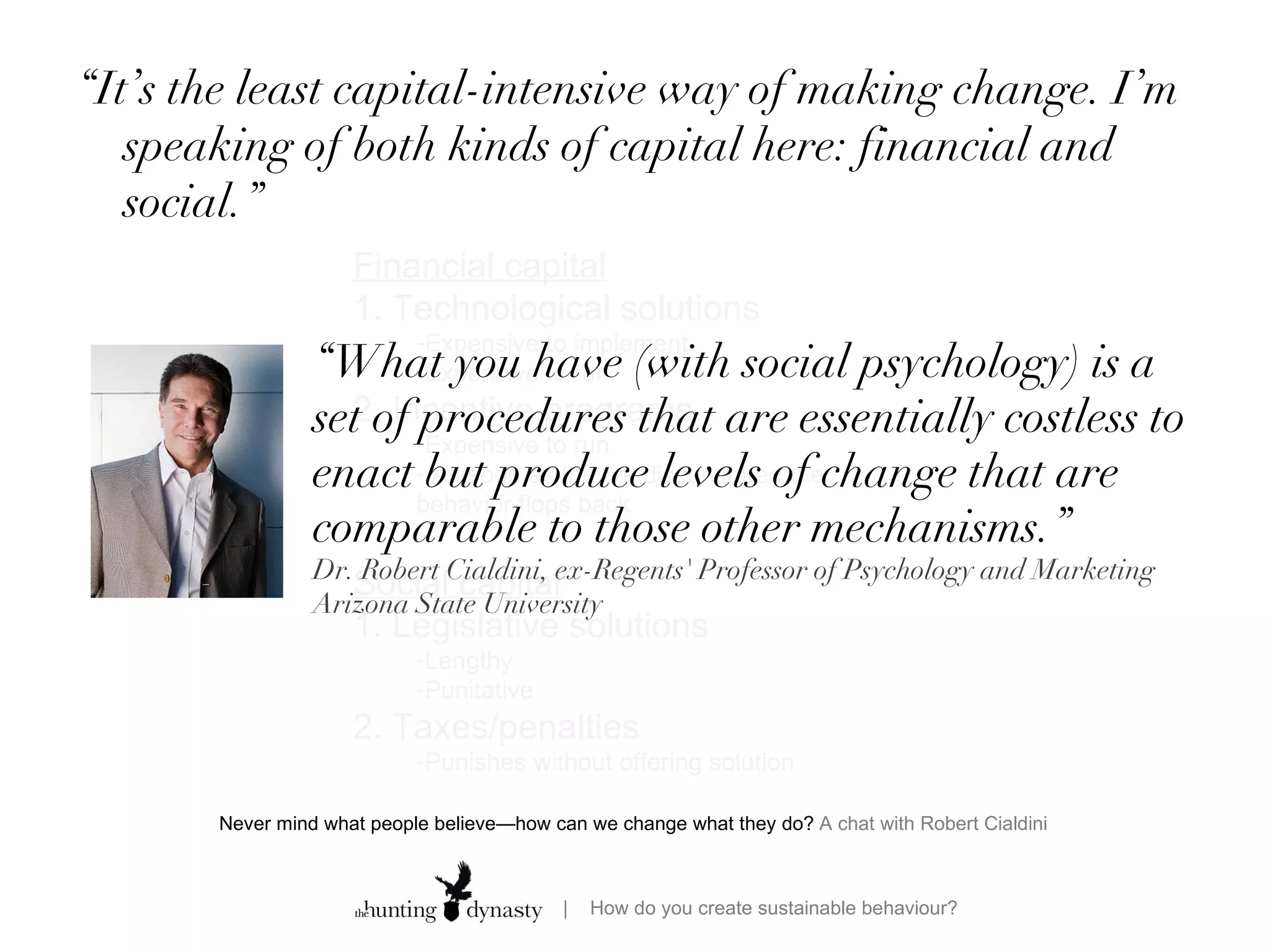
“ It’s the least capital-intensive way of making change. I’m speaking of both kinds of capital here: financial and social.” Never mind what people believe—how can we change what they do?  A chat with Robert Cialdini  Financial capital 1. Technological solutions Expensive to implement Expensive to run  2. Incentive programs  Expensive to run As soon as they’re discontinued the behavior flops back Social capital 1. Legislative solutions Lengthy  Punitative 2. Taxes/penalties Punishes without offering solution
“ It’s the least capital-intensive way of making change. I’m speaking of both kinds of capital here: financial and social.” Never mind what people believe—how can we change what they do?  A chat with Robert Cialdini  Financial capital 1. Technological solutions Expensive to implement Expensive to run  2. Incentive programs  Expensive to run As soon as they’re discontinued the behavior flops back Social capital 1. Legislative solutions Lengthy  Punitative 2. Taxes/penalties Punishes without offering solution “ What you have (with social psychology) is a set of procedures that are essentially costless to enact but produce levels of change that are comparable to those other mechanisms.” Dr. Robert Cialdini, ex-Regents' Professor of Psychology and Marketing Arizona State University
Is there a market for it?
Making buildings more efficient: It helps to understand human behavior  | Grist.org “ Tim Stout, vice-president of energy efficiency at [Massachusetts utility] National Grid, admits that  most of the company’s efforts toward conservation have been tied to infrastructure and hardware…  ‘When we look at the remaining potential for efficiency,’  Stout says,  ‘changing consumer behavior is the next wave of savings that needs to be tapped.’”
How to do it – in 5 points
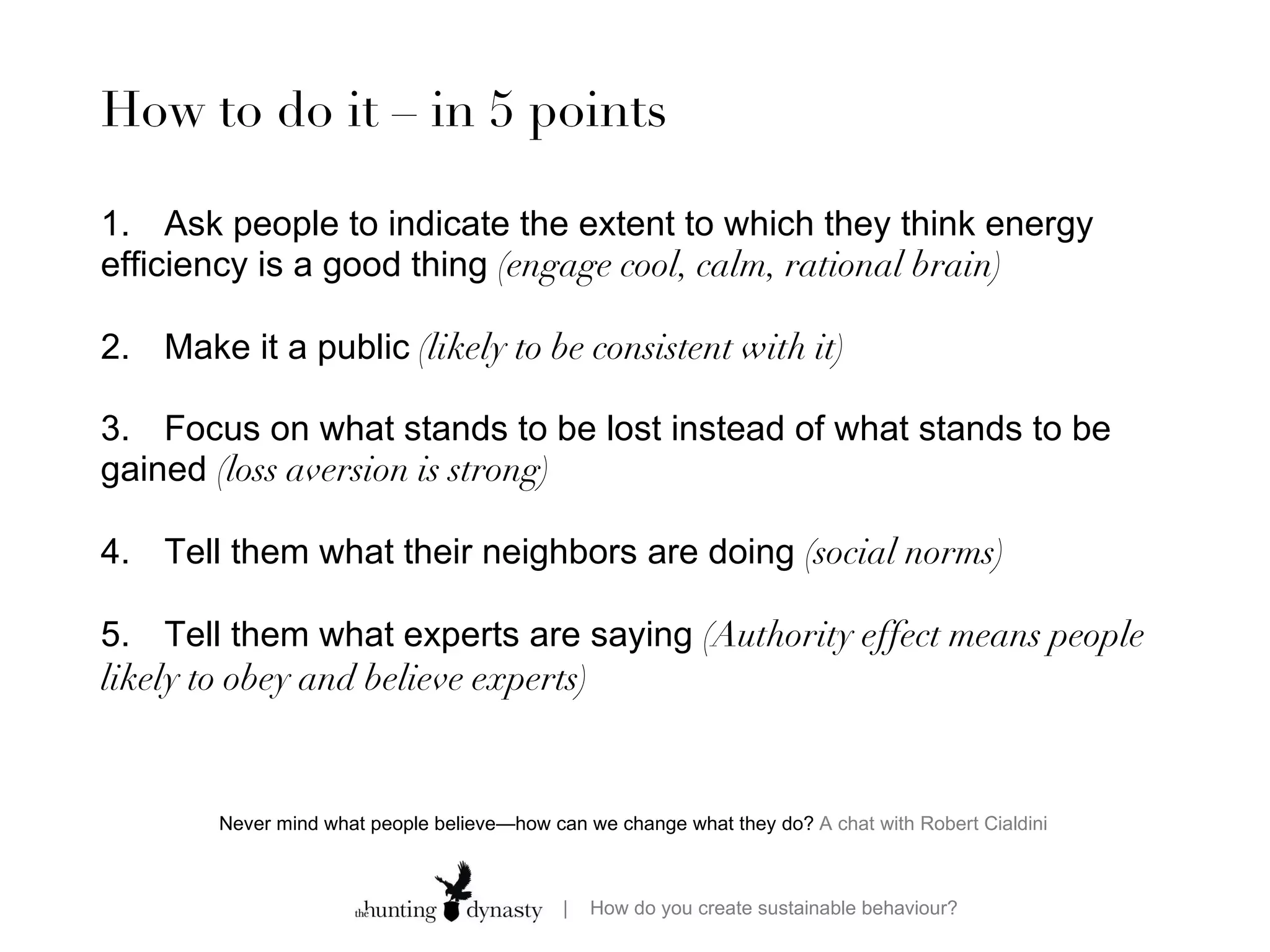
How to do it – in 5 points 1.  Ask people to indicate the extent to which they think energy efficiency is a good thing  (engage cool, calm, rational brain) 2. Make it a public  (likely to be consistent with it) 3. Focus on what stands to be lost instead of what stands to be gained  (loss aversion is strong)  4. Tell them what their neighbors are doing  (social norms)  5. Tell them what experts are saying  (Authority effect means people likely to obey and believe experts)  Never mind what people believe—how can we change what they do?  A chat with Robert Cialdini
How to do it – in 1 sentence
How to do it – in 1 sentence “… marginalise undesirable behaviour.” Dr. Robert Cialdini, ex-Regents' Professor of Psychology and Marketing Arizona State University Never mind what people believe—how can we change what they do?  A chat with Robert Cialdini
Creating sustainable behaviour Thank you [Soon to be released - The 19 Ways To Create Sustainable Behaviour – click for more]

Creating Sustainable Behaviour

  • 1.
    Creating sustainable behaviour19 th February 2010 Oliver Payne, Founder, CEO, The Hunting Dynasty , (Undisclosed recipient)
  • 2.
  • 3.
    Creative Director -Global, Regional - London - Awarded, Judge Planning Director - Global, Regional - London, Hong Kong, Amsterdam - Awarded
  • 4.
    “ … very impressive work. ” Justin Hall, Discovery Channel Environmental Explorer Founder, CEO Partner, Planning Director
  • 5.
    12. Irrational escalation: the tendency to make irrational decisions based upon rational decisions in the past, or to justify actions already taken. The dollar auction is a thought exercise demonstrating the concept. 13. Loss aversion: the tendency to fear losses more than to value gains of equal size. 14. Endowment effect: the tendency to demand much more to give up an object than you would be willing to pay to acquire it. The Duke University basketball ticket experiment (a combination of loss aversion and the endowment effect = Status quo bias ) 15. Neglect of probability: the tendency to disregard probabilities for absolutes when making a decision under uncertainty. 16. ‘Not Invented Here’: the tendency to ignore an idea or solution because its source is seen as unfamiliar. 17. Planning fallacy: the tendency to underestimate the time it takes to complete tasks. 18. Post-purchase rationalisation: the tendency to rationalise your purchases as ‘good buys’ merely based on the fact that you purchased them – and the reason why a 110% money back guarantee works. 19. Pseudo-certainty effect/Gambler’s fallacy: the tendency, when seeking positive outcomes, to make only risk-averse choices; but to make risk-seeking choices to avoid negative outcomes. 20. Selective perception: the tendency for expectations to shape perceptions. 21. Wishful thinking: the formation of beliefs according to what is pleasant to imagine rather than based on evidence or rationality. 22. Zero-risk bias: the preference for reducing a small risk to zero over a greater reduction in a larger risk. 23. Self-serving bias ( Illusory superiority/better-than-average effect ) occurs when people attribute their successes to internal or personal factors but attribute their failures to situational factors beyond their control. 1. Aversion to extremes: the tendency to avoid extremes, to prefer a choice simply because it is the middle-ground option. Consumers Avoid Extremes In Soda Sizes 2. Bandwagoning or herd instinct: the tendency to do (or believe) things simply because other people do. 3. Choice-supportive bias: the tendency to remember your own choices as better than they actually were. 4. Conservatism bias : the tendency to ignore the consequences and implications of new evidence. 5. Contrast effect: the tendency to perceive measurements of an object differently when comparing them with a recently observed contrasting object. 6. Distinction bias: the tendency to view two options as more dissimilar when viewing them together than when viewing them separately. 7. Excessive temporal discounting/ hyperbolic discounting : the tendency for people to have excessively stronger preferences for immediate gains relative to future gains. 8. Exposure effect: the tendency for people to like things simply because they are familiar with them. 9. Framing effects: the tendency to draw different conclusions based on how data are presented. Anchoring Mental accounting (current income, current wealth, future income – different marginal propensity to consume, eg: extra 1, spend 0.65) 10. Scarcity value: When we perceive something to be scarce it has a greater value in our eyes. Conversely, when we perceive it to be plentiful its perceived value falls. When valuing things, circumstantial factors tend to crowd out factors that point towards absolute value. 11. Social norms: the rules that a group uses for appropriate and inappropriate values, beliefs, attitudes and behaviors. These rules may be explicit or implicit. Failure to follow the rules can result in severe punishments, including exclusion from the group.
  • 6.
    12. Irrational escalation: the tendency to make irrational decisions based upon rational decisions in the past, or to justify actions already taken. The dollar auction is a thought exercise demonstrating the concept. 13. Loss aversion: the tendency to fear losses more than to value gains of equal size. 14. Endowment effect: the tendency to demand much more to give up an object than you would be willing to pay to acquire it. The Duke University basketball ticket experiment (a combination of loss aversion and the endowment effect = Status quo bias ) 15. Neglect of probability: the tendency to disregard probabilities for absolutes when making a decision under uncertainty. 16. ‘Not Invented Here’: the tendency to ignore an idea or solution because its source is seen as unfamiliar. 17. Planning fallacy: the tendency to underestimate the time it takes to complete tasks. 18. Post-purchase rationalisation: the tendency to rationalise your purchases as ‘good buys’ merely based on the fact that you purchased them – and the reason why a 110% money back guarantee works. 19. Pseudo-certainty effect/Gambler’s fallacy: the tendency, when seeking positive outcomes, to make only risk-averse choices; but to make risk-seeking choices to avoid negative outcomes. 20. Selective perception: the tendency for expectations to shape perceptions. 21. Wishful thinking: the formation of beliefs according to what is pleasant to imagine rather than based on evidence or rationality. 22. Zero-risk bias: the preference for reducing a small risk to zero over a greater reduction in a larger risk. 23. Self-serving bias ( Illusory superiority/better-than-average effect ) occurs when people attribute their successes to internal or personal factors but attribute their failures to situational factors beyond their control. 1. Aversion to extremes: the tendency to avoid extremes, to prefer a choice simply because it is the middle-ground option. Consumers Avoid Extremes In Soda Sizes 2. Bandwagoning or herd instinct: the tendency to do (or believe) things simply because other people do. 3. Choice-supportive bias: the tendency to remember your own choices as better than they actually were. 4. Conservatism bias : the tendency to ignore the consequences and implications of new evidence. 5. Contrast effect: the tendency to perceive measurements of an object differently when comparing them with a recently observed contrasting object. 6. Distinction bias: the tendency to view two options as more dissimilar when viewing them together than when viewing them separately. 7. Excessive temporal discounting/ hyperbolic discounting : the tendency for people to have excessively stronger preferences for immediate gains relative to future gains. 8. Exposure effect: the tendency for people to like things simply because they are familiar with them. 9. Framing effects: the tendency to draw different conclusions based on how data are presented. Anchoring Mental accounting (current income, current wealth, future income – different marginal propensity to consume, eg: extra 1, spend 0.65) 10. Scarcity value: When we perceive something to be scarce it has a greater value in our eyes. Conversely, when we perceive it to be plentiful its perceived value falls. When valuing things, circumstantial factors tend to crowd out factors that point towards absolute value. 11. Social norms: the rules that a group uses for appropriate and inappropriate values, beliefs, attitudes and behaviors. These rules may be explicit or implicit. Failure to follow the rules can result in severe punishments, including exclusion from the group. How do you use these quirks to create sustainable behaviour?
  • 7.
  • 8.
  • 9.
  • 10.
  • 11.
    1. Simply ask a. What can I get you sir? When asked nothing while in a queue for food 40% of students took a serving of fruit Yale University researcher Marlene Schwartz in a 2007 study
  • 12.
    1. Simply ask a. What can I get you sir? When asked nothing while in a queue for food 40% of students took a serving of fruit When asked if they would ‘ like fruit or fruit juice’ 70% of students took a serving of fruit Yale University researcher Marlene Schwartz in a 2007 study
  • 13.
    1. Simply ask a. What can I get you sir? When asked nothing while in a queue for food 40% of students took a serving of fruit When asked if they would ‘ like fruit or fruit juice’ 70% of students took a serving of fruit Yale University researcher Marlene Schwartz in a 2007 study Exposure effect
  • 14.
  • 15.
    2. Askusing the right words
  • 16.
    2. Askusing the right words b. Petrified Thieves People steal bits of wood from Arizona’s Petrified Forest National Park.   Many past visitors have removed petrified wood from the Park, changing the natural state of the Petrified Forest Please don’t remove the petrified wood from the Park , in order to preserve the natural state of the Petrified Forest [nothing] The signs above were tested to stop the theft:  Some were more successful than others… Yes! 50 secrets from the science of persuasion | Goldstein, Martin, Cialdini | 2007 | pp20
  • 17.
    2. Askusing the right words b. Petrified Thieves People steal bits of wood from Arizona’s Petrified Forest National Park.   Many past visitors have removed petrified wood from the Park, changing the natural state of the Petrified Forest Please don’t remove the petrified wood from the Park , in order to preserve the natural state of the Petrified Forest 8% theft [nothing] Yes! 50 secrets from the science of persuasion | Goldstein, Martin, Cialdini | 2007 | pp20
  • 18.
    2. Askusing the right words b. Petrified Thieves People steal bits of wood from Arizona’s Petrified Forest National Park.   Many past visitors have removed petrified wood from the Park, changing the natural state of the Petrified Forest Please don’t remove the petrified wood from the Park , in order to preserve the natural state of the Petrified Forest 8% theft [nothing] 3% theft Yes! 50 secrets from the science of persuasion | Goldstein, Martin, Cialdini | 2007 | pp20
  • 19.
    2. Askusing the right words b. Petrified Thieves People steal bits of wood from Arizona’s Petrified Forest National Park.   Many past visitors have removed petrified wood from the Park, changing the natural state of the Petrified Forest Please don’t remove the petrified wood from the Park , in order to preserve the natural state of the Petrified Forest 8% theft 1.7% theft [nothing] 3% theft Yes! 50 secrets from the science of persuasion | Goldstein, Martin, Cialdini | 2007 | pp20
  • 20.
    2. Askusing the right words b. Petrified Thieves People steal bits of wood from Arizona’s Petrified Forest National Park.   Many past visitors have removed petrified wood from the Park, changing the natural state of the Petrified Forest Please don’t remove the petrified wood from the Park , in order to preserve the natural state of the Petrified Forest 8% theft 1.7% theft [nothing] 3% theft “… a message that focuses recipients on the injunctive norm will be superior to messages that focus recipients on the descriptive norm .” (Cialdini et al., 2003) Yes! 50 secrets from the science of persuasion | Goldstein, Martin, Cialdini | 2007 | pp20
  • 21.
    2. Askusing the right words b. Petrified Thieves People steal bits of wood from Arizona’s Petrified Forest National Park.   Many past visitors have removed petrified wood from the Park, changing the natural state of the Petrified Forest Please don’t remove the petrified wood from the Park , in order to preserve the natural state of the Petrified Forest 8% theft 1.7% theft [nothing] 3% theft “… a message that focuses recipients on the injunctive norm will be superior to messages that focus recipients on the descriptive norm .” (Cialdini et al., 2003) Yes! 50 secrets from the science of persuasion | Goldstein, Martin, Cialdini | 2007 | pp20 Social norms
  • 22.
  • 23.
    5. Ask usingthe right fake authority
  • 24.
    5. Ask usingthe right fake authority b. Smile, you’re on camera South Lanarkshire Council speed signs show numeral and ‘smiley face’ or ‘sad face’ icon according to driver’s speed
  • 25.
    5. Ask usingthe right fake authority b. Smile, you’re on camera South Lanarkshire Council speed signs show numeral and ‘smiley face’ or ‘sad face’ icon according to driver’s speed Speeding fallen by 53%
  • 26.
    5. Ask usingthe right fake authority b. Smile, you’re on camera South Lanarkshire Council speed signs show numeral and ‘smiley face’ or ‘sad face’ icon according to driver’s speed "The feedback… has been extremely positive… children are desperate to see the smiley face and this encourages whoever is driving the car to slow down.” Councillor Michael McCann, the depute leader of South Lanarkshire Council (UK) Social norms (approval)
  • 27.
    5. Ask usingthe right fake authority c. Expend very little energy Two groups given information about their neighbourhood energy use Making buildings more efficient: It helps to understand human behavior | Grist.org Group A 10 mpg Group B 25 mpg Straight info about energy use Straight info and smiley/sad face
  • 28.
    5. Ask usingthe right fake authority c. Expend very little energy Two groups given information about their neighbourhood energy use Making buildings more efficient: It helps to understand human behavior | Grist.org Group A 10 mpg Group B 25 mpg High users reduced consumption Low users increased consumption High users reduced consumption Low users consistent consumption David Cameron’s 30 second description | TED 2010
  • 29.
    5. Ask usingthe right fake authority c. Expend very little energy Two groups given information about their neighbourhood energy use Making buildings more efficient: It helps to understand human behavior | Grist.org Group A 10 mpg Group B 25 mpg 40% more energy saved High users reduced consumption Low users increased consumption High users reduced consumption Low users consistent consumption
  • 30.
    5. Ask usingthe right fake authority c. Expend very little energy Two groups given information about their neighbourhood energy use Making buildings more efficient: It helps to understand human behavior | Grist.org Group A 10 mpg Group B 25 mpg 40% more energy saved High users reduced consumption Low users increased consumption High users reduced consumption Low users consistent consumption Social norms (approval)
  • 31.
  • 32.
  • 33.
    9. Add options b. What rubbish Paper recycling bins are often contaminated with food waste, rendering all of the paper unrecyclable. In Singapore 100% of recycling bins were spoiled* * Sample of 80 Singapore Straits Times, on June 15, “What rubbish,”
  • 34.
    9. Add options b. What rubbish Paper recycling bins are often contaminated with food waste, rendering all of the paper unrecyclable. National University of Singapore tackled this ‘Expect Error’ by adding a non-recycling bin Singapore Straits Times, on June 15, “What rubbish,”
  • 35.
    9. Add options b. What rubbish Paper recycling bins are often contaminated with food waste, rendering all of the paper unrecyclable. National University of Singapore tackled this ‘Expect Error’ by adding a non-recycling bin Singapore Straits Times, on June 15, “What rubbish,” Framing effect
  • 36.
  • 37.
    12. Ask acompletely different question
  • 38.
    12. Ask acompletely different question Want some fun? Part II Few people use stairs when there’s an escalator on offer. How do you create the desire to use the stairs? Funtheory.com | Piano Staircase
  • 39.
    12. Ask acompletely different question Want some fun? Part II Few people use stairs when there’s an escalator on offer. Piano stairs increased stair use by 66% Funtheory.com | Piano Staircase
  • 40.
    12. Ask acompletely different question Want some fun? Part II Few people use stairs when there’s an escalator on offer. Piano stairs increased stair use by 66% Funtheory.com | Piano Staircase Temporal discounting Framing effect
  • 41.
  • 42.
    13. Let thefeedback ask the question
  • 43.
    13. Let thefeedback ask the question c. A ball of energy Attempts by Southern California Edison to notify people of their energy use with e-mails and text messages did no good.   Chicago Tribune | A gentle prod to go green
  • 44.
    13. Let thefeedback ask the question c. A ball of energy They tried an Ambient Orb – a personal energy meter in the shape of a little ball: It glows red when people are using lots of energy It glows green when their use is modest. Chicago Tribune | A gentle prod to go green
  • 45.
    13. Let thefeedback ask the question c. A ball of energy They tried an Ambient Orb – a personal energy meter in the shape of a little ball: Within weeks users of the orb reduced their energy consumption during peak times by 40% Chicago Tribune | A gentle prod to go green
  • 46.
    13. Let thefeedback ask the question c. A ball of energy They tried an Ambient Orb – a personal energy meter in the shape of a little ball: Within weeks users of the orb reduced their energy consumption during peak times by 40% Chicago Tribune | A gentle prod to go green Loss aversion Social norms
  • 47.
  • 48.
  • 49.
    14. Don’t ask.( Tell .) a. Towel reuse In an upscale hotel in Phoenix, USA one of these cards was placed in guestrooms urging towel reuse: 1. Help Save The Environment – (respect for nature) 2. Help Save Resources For Future Generations – (saving energy) 3. Partner With Us To Help Save The Environment – (co-operate) 4. Join Your Fellow Citizens In Helping To Save The Environment – (what other guest do in that room) US Government Subcommittee on Research & Science Education :: September 25, 2007 The Contribution of the Social Sciences to the Energy Challenge
  • 50.
    14. Don’t ask.( Tell .) a. Towel reuse In an upscale hotel in Phoenix, USA one of these cards was placed in guestrooms urging towel reuse: 1. Help Save The Environment – (respect for nature) 2. Help Save Resources For Future Generations – (saving energy) 3. Partner With Us To Help Save The Environment – (co-operate) 4. Join Your Fellow Citizens In Helping To Save The Environment – (what other guest do in that room) US Government Subcommittee on Research & Science Education :: September 25, 2007 The Contribution of the Social Sciences to the Energy Challenge Only this message reinforces a social norm
  • 51.
    14. Don’t ask.( Tell .) a. Towel reuse In an upscale hotel in Phoenix, USA one of these cards was placed in guestrooms urging towel reuse: 1. Help Save The Environment – (respect for nature) 2. Help Save Resources For Future Generations – (saving energy) 3. Partner With Us To Help Save The Environment – (co-operate) 4. Join Your Fellow Citizens In Helping To Save The Environment – (what other guest do in that room) US Government Subcommittee on Research & Science Education :: September 25, 2007 The Contribution of the Social Sciences to the Energy Challenge Guests exposed to this message were 34% more likely to recycle their towels
  • 52.
    14. Don’t ask.( Tell .) a. Towel reuse In an upscale hotel in Phoenix, USA one of these cards was placed in guestrooms urging towel reuse: 1. Help Save The Environment – (respect for nature) 2. Help Save Resources For Future Generations – (saving energy) 3. Partner With Us To Help Save The Environment – (co-operate) 4. Join Your Fellow Citizens In Helping To Save The Environment – (what other guest do in that room) US Government Subcommittee on Research & Science Education :: September 25, 2007 The Contribution of the Social Sciences to the Energy Challenge Guests exposed to this message were 34% more likely to recycle their towels Social norms
  • 53.
  • 54.
  • 55.
    “ One remarkablenote about both the hotel towel messages and the utility smiley faces: neither approach had ever been tried by the industries. It was not a process of trial and error. The techniques that radically boosted efficacy were a direct result of social psychological theory.” Making buildings more efficient: It helps to understand human behavior | Grist.org
  • 56.
  • 57.
    Smart measuring technologyTake a fee for collating and presenting supply data to existing utility companies’ customers
  • 58.
    Multi-channel EngagementLots of opportunities to ‘tweak’ behaviour
  • 59.
    Are the resultsany good?
  • 60.
    Real results whereOPOWER Home Energy Reporting system has been implemented, it has consistently and predictably delivered between 1.5% and 3.5% in average energy savings across the entire targeted population
  • 61.
    Real interest Finalistfor Discovery Channel's 2010 Edison Awards CEO's live interview on Fox Business Featured in USA Today In Washington Post as "best example of climate psychology in action" David Cameron, highlights OPOWER at TED2010 “ The next age of government”
  • 62.
    Are behavioural communicationsexpensive to implement?
  • 63.
    “ It’s theleast capital-intensive way of making change. I’m speaking of both kinds of capital here: financial and social.” Never mind what people believe—how can we change what they do? A chat with Robert Cialdini Financial capital 1. Technological solutions Expensive to implement Expensive to run 2. Incentive programs Expensive to run As soon as they’re discontinued the behavior flops back Social capital 1. Legislative solutions Lengthy Punitative 2. Taxes/penalties Punishes without offering solution
  • 64.
    “ It’s theleast capital-intensive way of making change. I’m speaking of both kinds of capital here: financial and social.” Never mind what people believe—how can we change what they do? A chat with Robert Cialdini Financial capital 1. Technological solutions Expensive to implement Expensive to run 2. Incentive programs Expensive to run As soon as they’re discontinued the behavior flops back Social capital 1. Legislative solutions Lengthy Punitative 2. Taxes/penalties Punishes without offering solution “ What you have (with social psychology) is a set of procedures that are essentially costless to enact but produce levels of change that are comparable to those other mechanisms.” Dr. Robert Cialdini, ex-Regents' Professor of Psychology and Marketing Arizona State University
  • 65.
    Is there amarket for it?
  • 66.
    Making buildings moreefficient: It helps to understand human behavior | Grist.org “ Tim Stout, vice-president of energy efficiency at [Massachusetts utility] National Grid, admits that most of the company’s efforts toward conservation have been tied to infrastructure and hardware… ‘When we look at the remaining potential for efficiency,’ Stout says, ‘changing consumer behavior is the next wave of savings that needs to be tapped.’”
  • 67.
    How to doit – in 5 points
  • 68.
    How to doit – in 5 points 1. Ask people to indicate the extent to which they think energy efficiency is a good thing (engage cool, calm, rational brain) 2. Make it a public (likely to be consistent with it) 3. Focus on what stands to be lost instead of what stands to be gained (loss aversion is strong) 4. Tell them what their neighbors are doing (social norms) 5. Tell them what experts are saying (Authority effect means people likely to obey and believe experts) Never mind what people believe—how can we change what they do? A chat with Robert Cialdini
  • 69.
    How to doit – in 1 sentence
  • 70.
    How to doit – in 1 sentence “… marginalise undesirable behaviour.” Dr. Robert Cialdini, ex-Regents' Professor of Psychology and Marketing Arizona State University Never mind what people believe—how can we change what they do? A chat with Robert Cialdini
  • 71.
    Creating sustainable behaviourThank you [Soon to be released - The 19 Ways To Create Sustainable Behaviour – click for more]