from Night
(page 593)

By Eli Wiesel
from Night (page 593)
70 – 79 Due: 2/4
Reference Aids—Foreign Terms (page 584) Building Vocabulary
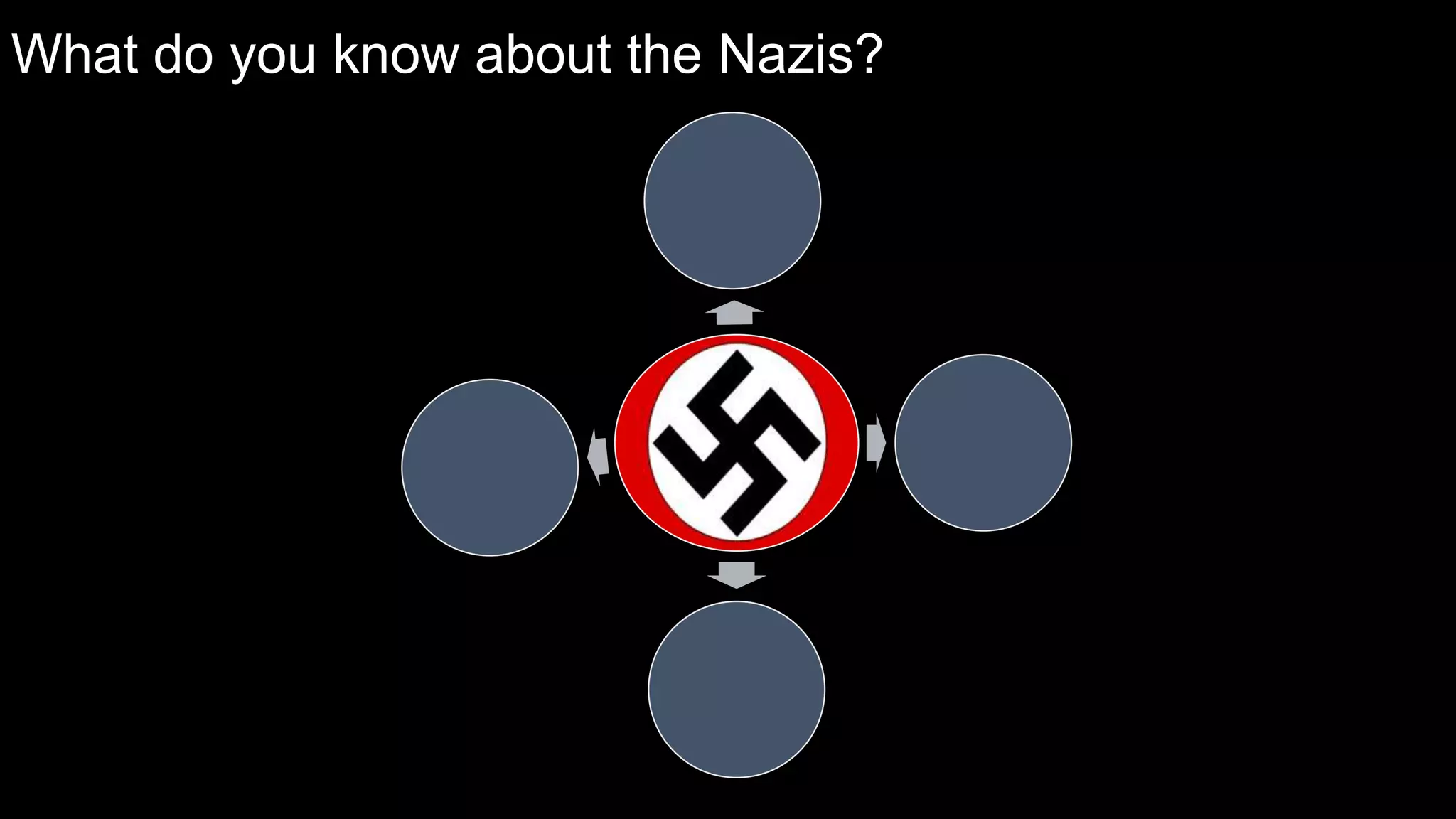
What do you know about the Nazis? Bubble Graph
Nazi Webquest
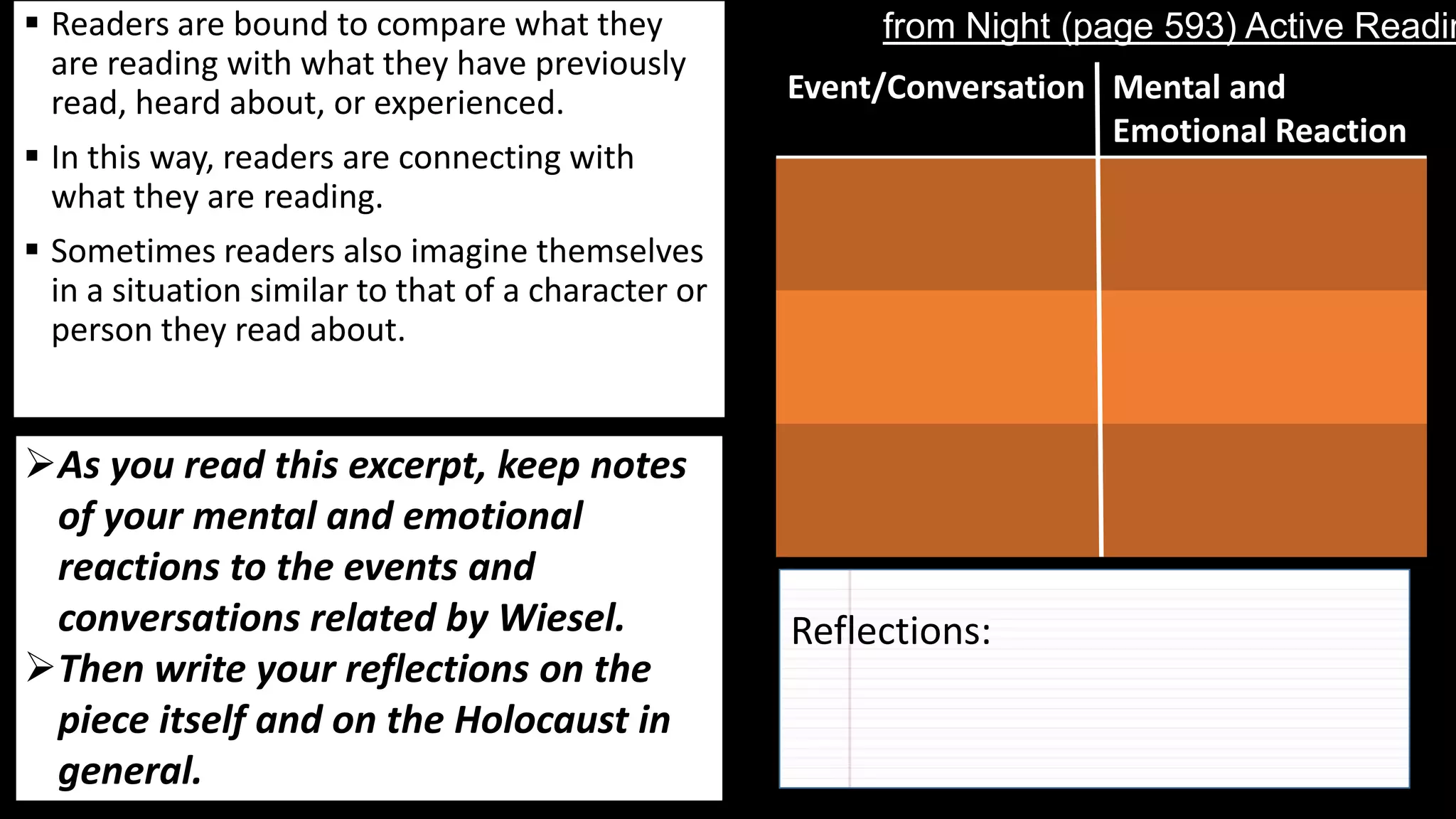
Active Reading Chart & Reflections
from Night (page 593) Literary Analysis – Style
Questions 1, comprehension check, 2 - 5
80 – 89 due: 2/7
Poem or song about Night &/or Holocaust
90 – 100 Due 2/7
Digital presentation of Holocaust
= 10 Extra – Credit to present for class.
Words to Know Pretest
listen to each word to know used in a sentence then
select the best answer. 100% = 5 points extracredit!!!!!!!
Words to Know

Definitions

1. Din
2. Emaciated
3. Interminable
4. Notorious
5. Stature

A.
B.
C.
D.
E.

Bad reputation
Endless
Extremely thin
Height
Jumble of loud
noises
Reference Aids—Foreign Terms (page 584) Building Vocabulary
 Foreign words are frequently used in literature, and you will likely encounter some that are
unfamiliar to you. Learning the meaning of these terms will improve your comprehension of
the literature. Foreign words can be found in such reference tools as an English dictionary, a
foreign-language dictionary, or the Internet. Use a reference tool to translate the following
commonly used foreign words and phrases.

1.
2.
3.
4.
5.
6.
7.
8.

c’est la vie:
oi vey:
à la carte:
carpe diem:
coup d’état:
détente:
summa cum laude:
barrio:

9. narthex:
10. esprit de corps:
11. ricksha:
12. persona non grata:
13. baccalaureate:
14. incognito:
15. je ne sais quoi:
What do you know about the Nazis?
Nazi Webquest
1. How were schools used to spread Nazi ideas and antiSemitism?
2. Explain Hitler’s attitude towards the “handicapped.”
3. Why do you think that many people didn’t notice the
harassment of German Jews before the war?
4. What were the Nuremberg Laws?
5. What is meant by “ARBEIT MACHT FREI,” and where might one
have seen it?
6. What was the difference between the “concentration camps”
and the “extermination camps?
Standard & Objective
Reading Standard - Literature

Learning Objective

• 1. Cite strong and thorough
textual evidence to support
analysis of what the text says
explicitly as well as inferences
drawn from the text.

• Today we will practice
articulating our mental and
emotional reactions to a text.
 Readers are bound to compare what they
are reading with what they have previously
read, heard about, or experienced.
 In this way, readers are connecting with
what they are reading.
 Sometimes readers also imagine themselves
in a situation similar to that of a character or
person they read about.

As you read this excerpt, keep notes
of your mental and emotional
reactions to the events and
conversations related by Wiesel.
Then write your reflections on the
piece itself and on the Holocaust in
general.

from Night (page 593) Active Readin
Event/Conversation Mental and
Emotional Reaction

Reflections:
Standard & Objective
Reading Standard – infotext

Learning Objective

• 6. Determine an author’s point
of view or purpose in a text and
analyze how an author uses
rhetoric to advance that point of
view or purpose.

• Today we will learn how to apply
our analysis of author style to
author purpose.
from Night (page 593) Literary Analysis Style

 Style is the way in which a
literary work is written.
Dialogue
 Style refers not to what is
Sentence
said, but to how it is said.
Imagery
length
 Elements that contribute to a
writer’s personal style include
Passage
beginning
word choice, or diction;
sentence length, structure, and
Word
Tone
variety; tone, imagery, and
choice
dialogue.
structure
Choose a passage of five or six
and
variety
paragraphs from this excerpt
and analyze its style.
Use the chart to record your  How does Wiesel’s style affect your
understanding of the purpose of his descriptions?
analysis.
Quiz - Comprehension
1. According to the veterans, present camp conditions at Buna are
a. better than before. b. worse than before. c. about the same as before. d.
completely different from before.
2. Before the selection, the prisoners try to make themselves look
a. clean. b. honest. c. healthy. d. harmless.
3. The prisoners regard the Kapo’s advice not to be afraid during selection as
a. wise. c. pointless. b. harmful. d. encouraging.
4. Wiesel tries to refuse his father’s knife and spoon mainly because he
a. doesn’t need them. b. feels guilty about taking them. c. is afraid of being
caught with them. d. doesn’t want to believe his father will not need them.
5. Wiesel’s writing style could best be described as
a. flashy. c. simple. b. formal. d. scholarly.
Words to Know
1. A person becomes emaciated when he or she is
a. frightened. b. lonely. c. starving.
2. An animal that is notorious in many fairy tales is the
a. owl. b. wolf. c. swan.
3. A likely response to a din is to cover one’s
a. ears. b. eyes. c. nose.
4. To determine a person’s stature, you would use
a. a scale. b. a yardstick. c. an IQ test.
5. You are most likely to describe an event as interminable if it is very
a. exciting. b. funny. c. boring.
1. Write arguments to support claims in
an analysis of substantive texts, using
valid reasoning and relevant and
sufficient evidence.
a. Introduce precise claim(s), and create
an organization that establishes clear
relationships among claim(s), reasons,
and evidence.
b. Develop claim(s) by supplying
evidence for each.
c. Use words, phrases, and clauses to link
the major sections of the text, create
cohesion, and clarify the relationships
between claim(s) and reasons, between
reasons and evidence.
d. Establish and maintain a formal style
and objective tone while attending to the
norms and conventions of the discipline
in which they are writing.
e. Provide a concluding statement or
section that follows from and supports
the argument presented.

Essay Prompt
• What is Wiesel’s tone
when he refers to his
father’s knife and
spoon as “the
inheritance”? What is
summed up by this
statement? Support
your answer.

Night

  • 1.
  • 2.
    from Night (page593) 70 – 79 Due: 2/4 Reference Aids—Foreign Terms (page 584) Building Vocabulary What do you know about the Nazis? Bubble Graph Nazi Webquest Active Reading Chart & Reflections from Night (page 593) Literary Analysis – Style Questions 1, comprehension check, 2 - 5 80 – 89 due: 2/7 Poem or song about Night &/or Holocaust 90 – 100 Due 2/7 Digital presentation of Holocaust = 10 Extra – Credit to present for class.
  • 3.
    Words to KnowPretest listen to each word to know used in a sentence then select the best answer. 100% = 5 points extracredit!!!!!!! Words to Know Definitions 1. Din 2. Emaciated 3. Interminable 4. Notorious 5. Stature A. B. C. D. E. Bad reputation Endless Extremely thin Height Jumble of loud noises
  • 4.
    Reference Aids—Foreign Terms(page 584) Building Vocabulary  Foreign words are frequently used in literature, and you will likely encounter some that are unfamiliar to you. Learning the meaning of these terms will improve your comprehension of the literature. Foreign words can be found in such reference tools as an English dictionary, a foreign-language dictionary, or the Internet. Use a reference tool to translate the following commonly used foreign words and phrases. 1. 2. 3. 4. 5. 6. 7. 8. c’est la vie: oi vey: à la carte: carpe diem: coup d’état: détente: summa cum laude: barrio: 9. narthex: 10. esprit de corps: 11. ricksha: 12. persona non grata: 13. baccalaureate: 14. incognito: 15. je ne sais quoi:
  • 5.
    What do youknow about the Nazis?
  • 6.
    Nazi Webquest 1. Howwere schools used to spread Nazi ideas and antiSemitism? 2. Explain Hitler’s attitude towards the “handicapped.” 3. Why do you think that many people didn’t notice the harassment of German Jews before the war? 4. What were the Nuremberg Laws? 5. What is meant by “ARBEIT MACHT FREI,” and where might one have seen it? 6. What was the difference between the “concentration camps” and the “extermination camps?
  • 7.
    Standard & Objective ReadingStandard - Literature Learning Objective • 1. Cite strong and thorough textual evidence to support analysis of what the text says explicitly as well as inferences drawn from the text. • Today we will practice articulating our mental and emotional reactions to a text.
  • 8.
     Readers arebound to compare what they are reading with what they have previously read, heard about, or experienced.  In this way, readers are connecting with what they are reading.  Sometimes readers also imagine themselves in a situation similar to that of a character or person they read about. As you read this excerpt, keep notes of your mental and emotional reactions to the events and conversations related by Wiesel. Then write your reflections on the piece itself and on the Holocaust in general. from Night (page 593) Active Readin Event/Conversation Mental and Emotional Reaction Reflections:
  • 9.
    Standard & Objective ReadingStandard – infotext Learning Objective • 6. Determine an author’s point of view or purpose in a text and analyze how an author uses rhetoric to advance that point of view or purpose. • Today we will learn how to apply our analysis of author style to author purpose.
  • 10.
    from Night (page593) Literary Analysis Style  Style is the way in which a literary work is written. Dialogue  Style refers not to what is Sentence said, but to how it is said. Imagery length  Elements that contribute to a writer’s personal style include Passage beginning word choice, or diction; sentence length, structure, and Word Tone variety; tone, imagery, and choice dialogue. structure Choose a passage of five or six and variety paragraphs from this excerpt and analyze its style. Use the chart to record your  How does Wiesel’s style affect your understanding of the purpose of his descriptions? analysis.
  • 11.
    Quiz - Comprehension 1.According to the veterans, present camp conditions at Buna are a. better than before. b. worse than before. c. about the same as before. d. completely different from before. 2. Before the selection, the prisoners try to make themselves look a. clean. b. honest. c. healthy. d. harmless. 3. The prisoners regard the Kapo’s advice not to be afraid during selection as a. wise. c. pointless. b. harmful. d. encouraging. 4. Wiesel tries to refuse his father’s knife and spoon mainly because he a. doesn’t need them. b. feels guilty about taking them. c. is afraid of being caught with them. d. doesn’t want to believe his father will not need them. 5. Wiesel’s writing style could best be described as a. flashy. c. simple. b. formal. d. scholarly.
  • 12.
    Words to Know 1.A person becomes emaciated when he or she is a. frightened. b. lonely. c. starving. 2. An animal that is notorious in many fairy tales is the a. owl. b. wolf. c. swan. 3. A likely response to a din is to cover one’s a. ears. b. eyes. c. nose. 4. To determine a person’s stature, you would use a. a scale. b. a yardstick. c. an IQ test. 5. You are most likely to describe an event as interminable if it is very a. exciting. b. funny. c. boring.
  • 13.
    1. Write argumentsto support claims in an analysis of substantive texts, using valid reasoning and relevant and sufficient evidence. a. Introduce precise claim(s), and create an organization that establishes clear relationships among claim(s), reasons, and evidence. b. Develop claim(s) by supplying evidence for each. c. Use words, phrases, and clauses to link the major sections of the text, create cohesion, and clarify the relationships between claim(s) and reasons, between reasons and evidence. d. Establish and maintain a formal style and objective tone while attending to the norms and conventions of the discipline in which they are writing. e. Provide a concluding statement or section that follows from and supports the argument presented. Essay Prompt • What is Wiesel’s tone when he refers to his father’s knife and spoon as “the inheritance”? What is summed up by this statement? Support your answer.