
floopsSystems Diagrams for Feedback loops
FloopsFloops emerge when actor’s actions affect their future actions creating a feedback loopActor’s acts are based on limits, inputs and/or beliefsOutcomes are the results of mutiple actors being linked into feedback loops.Actors influence other actors by changing inputs, beliefs or limits.Floops arise spontaneously, grow and or disappearin different environments.
Parts of a FloopdiagramFloop diagrams show a single outcome for a given period of cycle time within the growth & decay constraints of all the actorsOutcome StatesComponentsActor or componentGrowth OutcomeDecay OutcomeLink between actors (no arrow head)  =  stable  impactStabile Outcomearrow head indicates growth or decayClockwise actors indicate growth actionOutcome of FloopCounter Clockwise actors indicate decay action
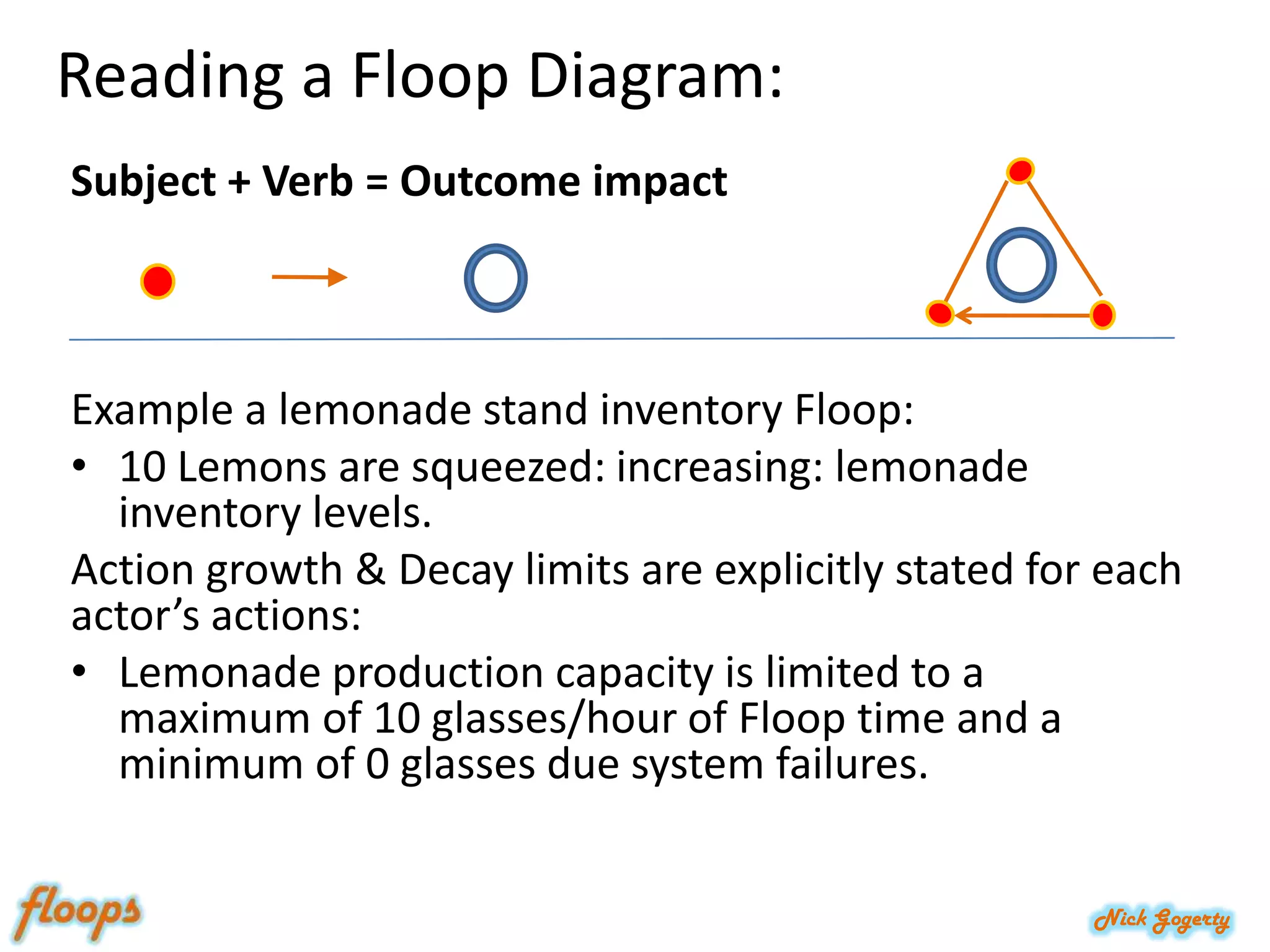
Reading a FloopDiagram: Subject + Verb = Outcome impactExample a lemonade stand inventory Floop: 10 Lemons are squeezed: increasing: lemonade inventory levels. Action growth & Decay limits are explicitly stated for each actor’s actions:Lemonade production capacity is limited to a maximum of 10 glasses/hour of Floop time and a minimum of 0 glasses due system failures.
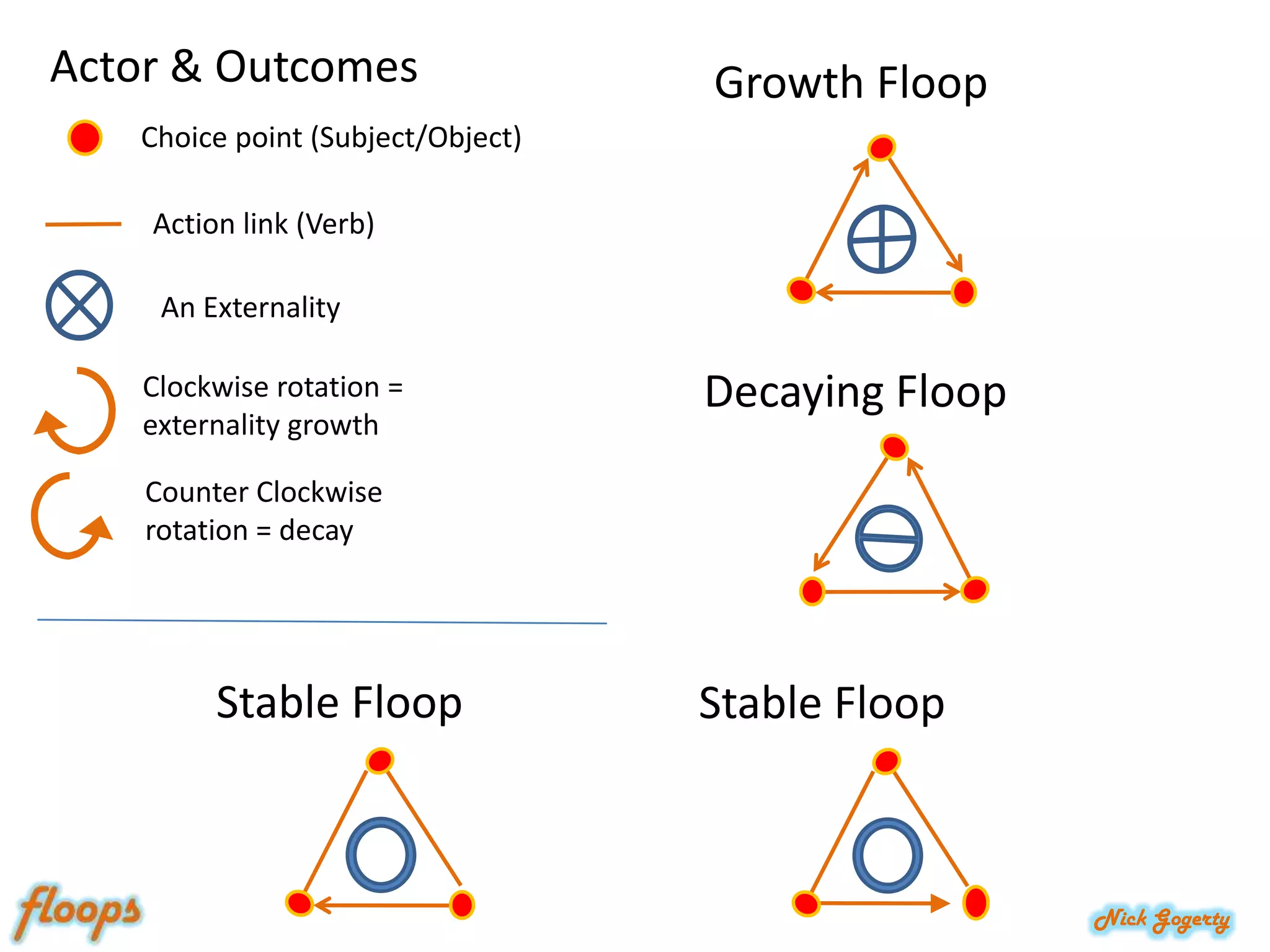
Actor & OutcomesGrowth FloopChoice point (Subject/Object)Action link (Verb)An ExternalityDecaying FloopClockwise rotation = externality growthCounter Clockwise rotation = decayStable FloopStable Floop
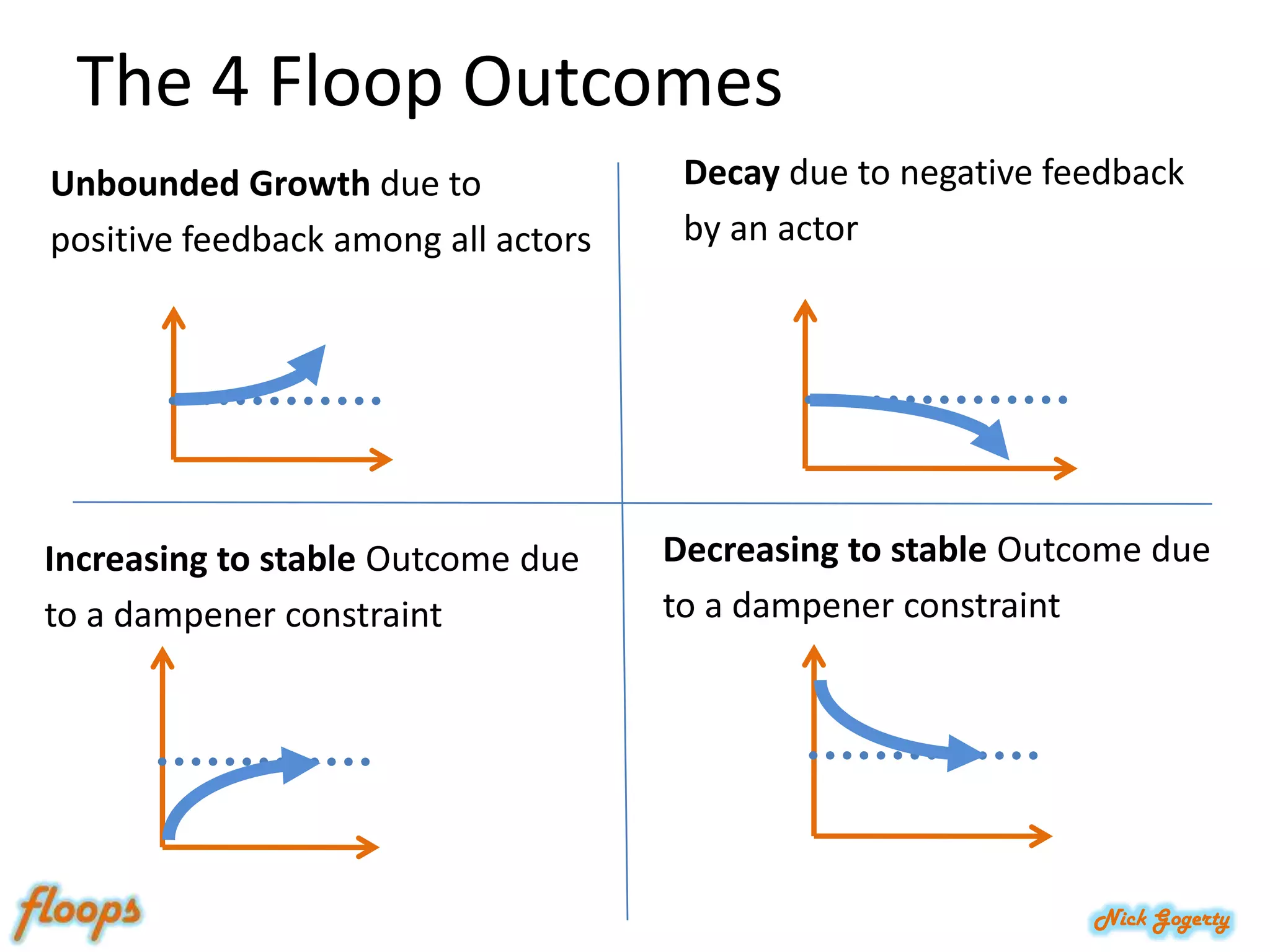
The 4 Floop OutcomesDecay due to negative feedback by an actorUnbounded Growth due to positive feedback among all actorsDecreasing to stable Outcome due to a dampener constraintIncreasing to stable Outcome due to a dampener constraint
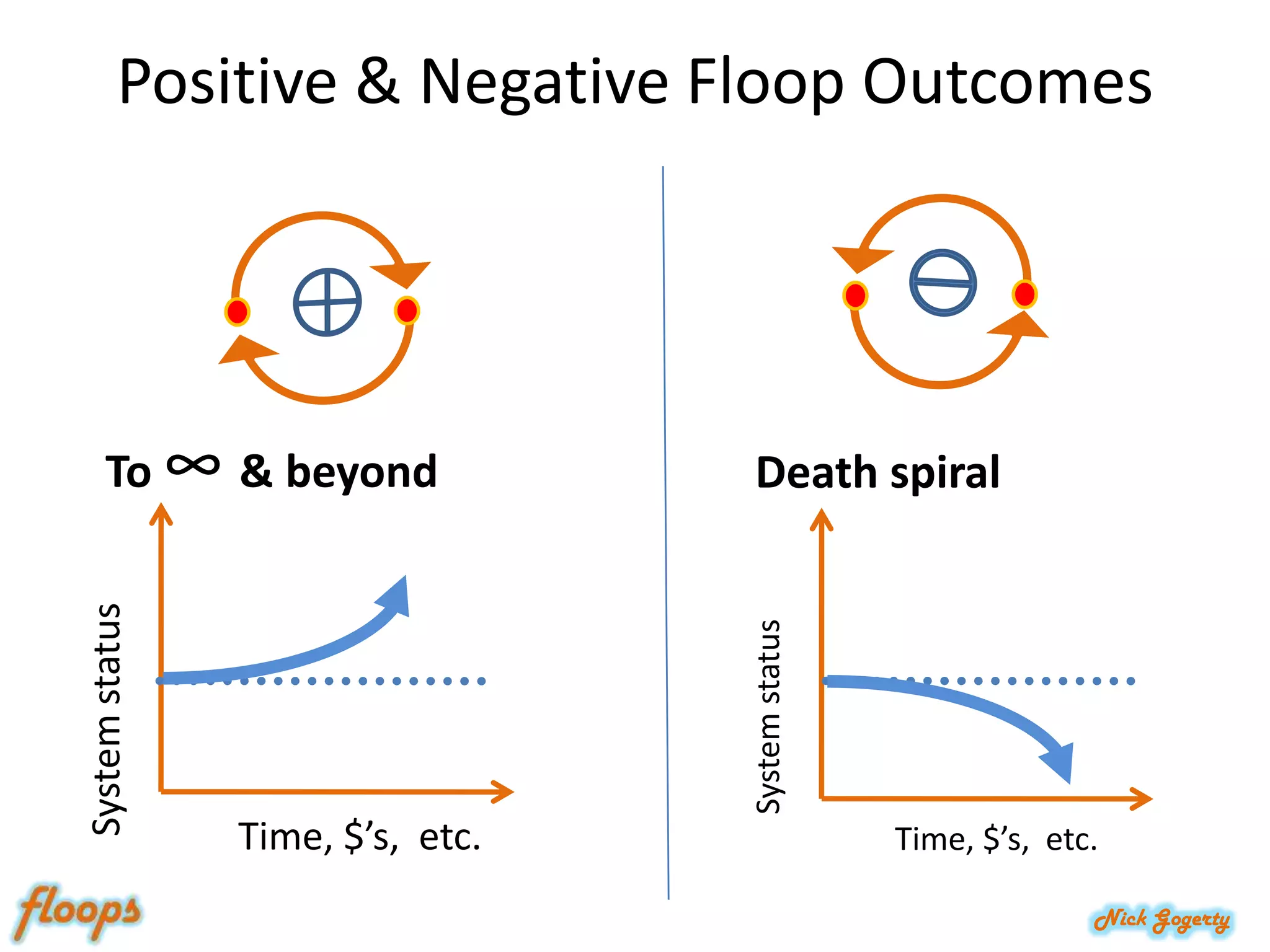
Positive & Negative Floop OutcomesTo ∞ & beyondDeath spiralSystem statusSystem statusTime, $’s,  etc.Time, $’s,  etc.
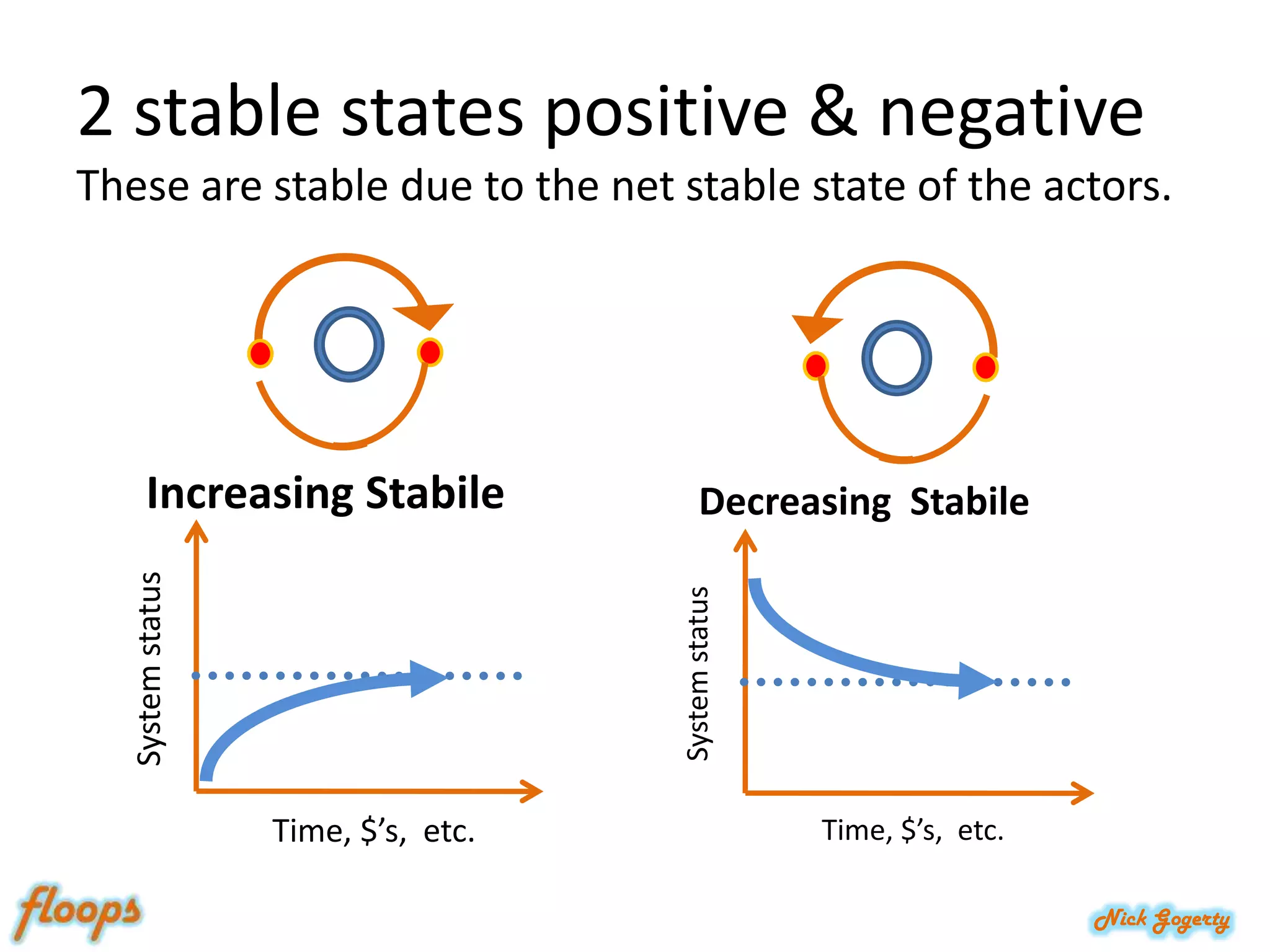
2 stable states positive & negativeThese are stable due to the net stable state of the actors.Increasing StabileDecreasing  StabileSystem statusSystem statusTime, $’s,  etc.Time, $’s,  etc.
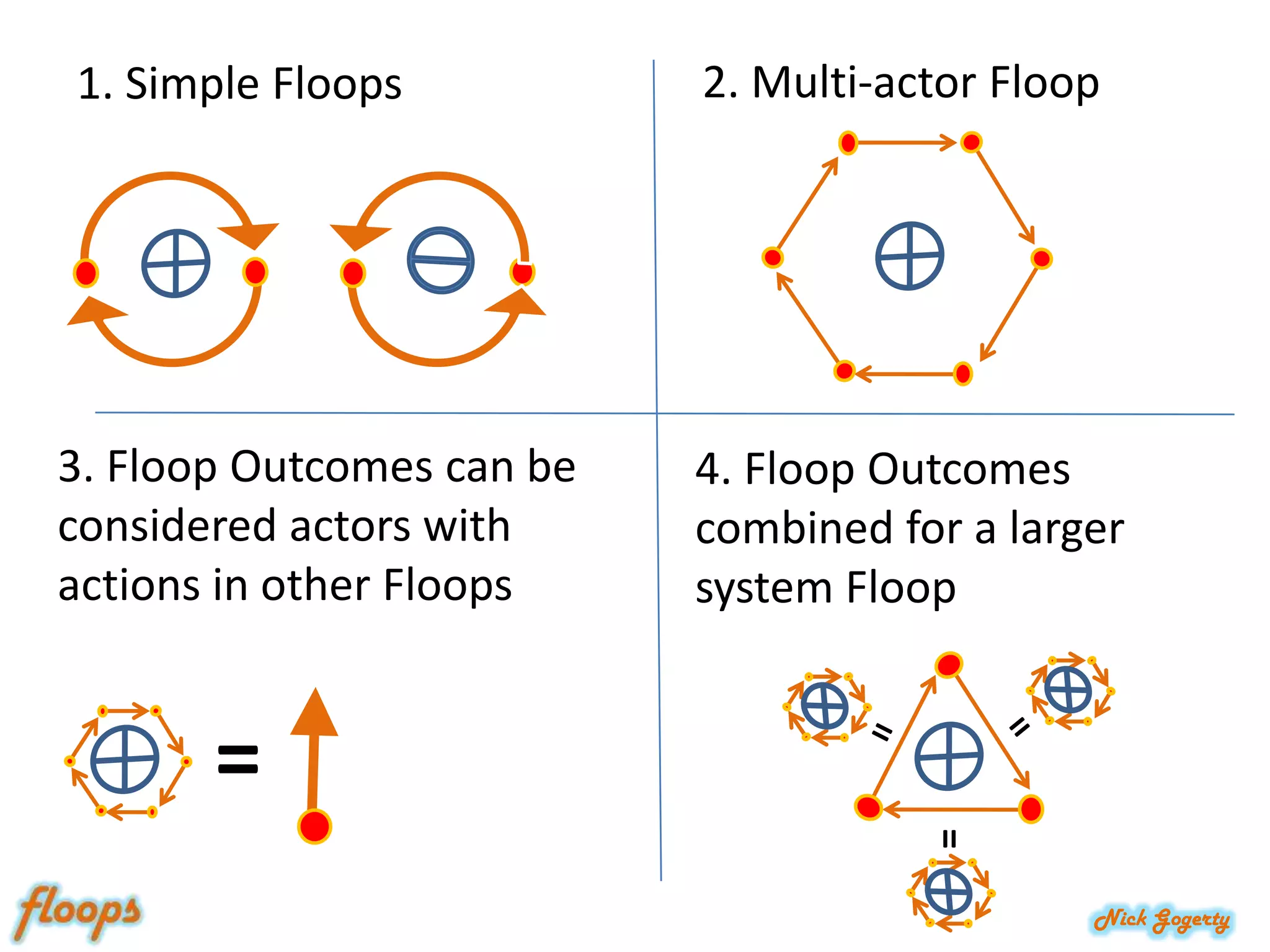
2. Multi-actor Floop1. Simple Floops3. Floop Outcomes can be considered actors with actions in other Floops4. Floop Outcomes combined for a larger system Floop====
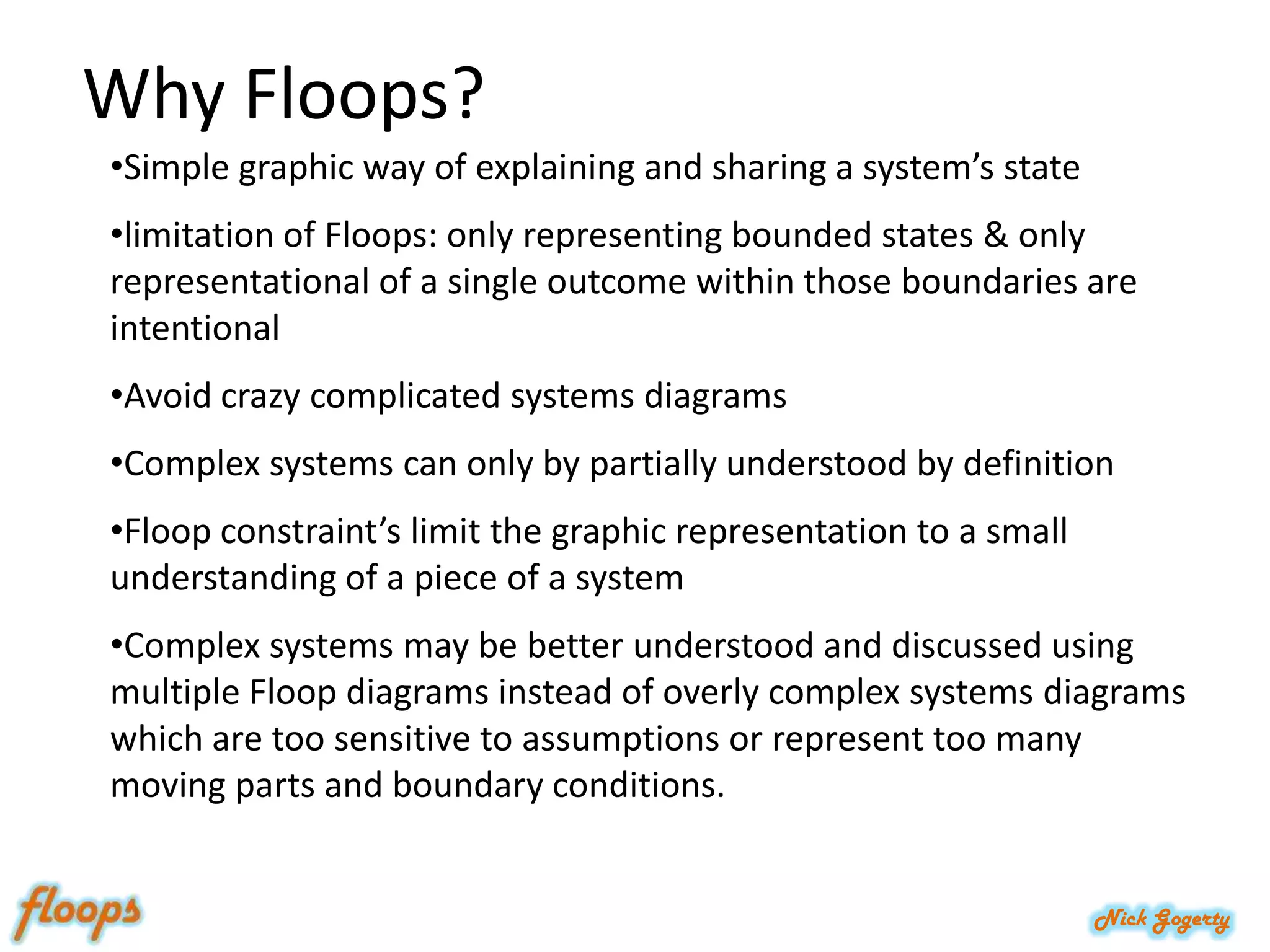
Why Floops? Simple graphic way of explaining and sharing a system’s state

Floops

  • 1.
  • 2.
    FloopsFloops emerge whenactor’s actions affect their future actions creating a feedback loopActor’s acts are based on limits, inputs and/or beliefsOutcomes are the results of mutiple actors being linked into feedback loops.Actors influence other actors by changing inputs, beliefs or limits.Floops arise spontaneously, grow and or disappearin different environments.
  • 3.
    Parts of aFloopdiagramFloop diagrams show a single outcome for a given period of cycle time within the growth & decay constraints of all the actorsOutcome StatesComponentsActor or componentGrowth OutcomeDecay OutcomeLink between actors (no arrow head) = stable impactStabile Outcomearrow head indicates growth or decayClockwise actors indicate growth actionOutcome of FloopCounter Clockwise actors indicate decay action
  • 4.
    Reading a FloopDiagram:Subject + Verb = Outcome impactExample a lemonade stand inventory Floop: 10 Lemons are squeezed: increasing: lemonade inventory levels. Action growth & Decay limits are explicitly stated for each actor’s actions:Lemonade production capacity is limited to a maximum of 10 glasses/hour of Floop time and a minimum of 0 glasses due system failures.
  • 5.
    Actor & OutcomesGrowthFloopChoice point (Subject/Object)Action link (Verb)An ExternalityDecaying FloopClockwise rotation = externality growthCounter Clockwise rotation = decayStable FloopStable Floop
  • 6.
    The 4 FloopOutcomesDecay due to negative feedback by an actorUnbounded Growth due to positive feedback among all actorsDecreasing to stable Outcome due to a dampener constraintIncreasing to stable Outcome due to a dampener constraint
  • 7.
    Positive & NegativeFloop OutcomesTo ∞ & beyondDeath spiralSystem statusSystem statusTime, $’s, etc.Time, $’s, etc.
  • 8.
    2 stable statespositive & negativeThese are stable due to the net stable state of the actors.Increasing StabileDecreasing StabileSystem statusSystem statusTime, $’s, etc.Time, $’s, etc.
  • 9.
    2. Multi-actor Floop1.Simple Floops3. Floop Outcomes can be considered actors with actions in other Floops4. Floop Outcomes combined for a larger system Floop====
  • 10.
    Why Floops? Simplegraphic way of explaining and sharing a system’s state
  • 11.
    limitation of Floops:only representing bounded states & only representational of a single outcome within those boundaries are intentional
  • 12.
    Avoid crazy complicatedsystems diagrams
  • 13.
    Complex systems canonly by partially understood by definition
  • 14.
    Floop constraint’s limitthe graphic representation to a small understanding of a piece of a system
  • 15.
    Complex systems maybe better understood and discussed using multiple Floop diagrams instead of overly complex systems diagrams which are too sensitive to assumptions or represent too many moving parts and boundary conditions.