


Assessing intensity in FUNCTIONAL
TRAINING
Max Icardi
BSc.Hon Sports Medicine
Founder of the Functional Training Network
www.maxicardi.com
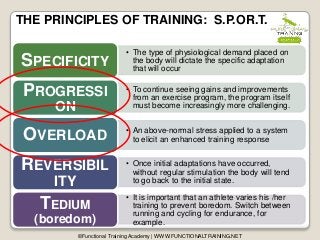
• The type of physiological demand placed on
the body will dictate the specific adaptation
that will occur
SPECIFICITY
• To continue seeing gains and improvements
from an exercise program, the program itself
must become increasingly more challenging.
PROGRESSI
ON
• An above-normal stress applied to a system
to elicit an enhanced training responseOVERLOAD
• Once initial adaptations have occurred,
without regular stimulation the body will tend
to go back to the initial state.
REVERSIBIL
ITY
• It is important that an athlete varies his /her
training to prevent boredom. Switch between
running and cycling for endurance, for
example.
TEDIUM
(boredom)
THE PRINCIPLES OF TRAINING: S.P.OR.T.
©Functional Training Academy | WWW.FUNCTIONALTRAINING.NET
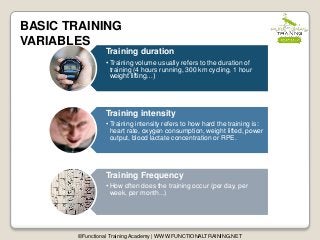
Training duration
• Training volume usually refers to the duration of
training (4 hours running, 300 km cycling, 1 hour
weight lifting…)
Training intensity
• Training intensity refers to how hard the training is:
heart rate, oxygen consumption, weight lifted, power
output, blood lactate concentration or RPE.
Training Frequency
• How often does the training occur (per day, per
week, per month...)
BASIC TRAINING
VARIABLES
©Functional Training Academy | WWW.FUNCTIONALTRAINING.NET
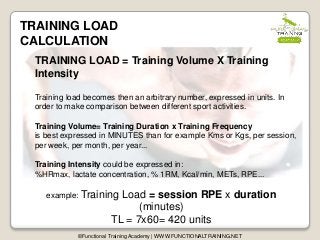
TRAINING LOAD
CALCULATION
TRAINING LOAD = Training Volume X Training
Intensity
Training load becomes then an arbitrary number, expressed in units. In
order to make comparison between different sport activities.
Training Volume= Training Duration x Training Frequency
is best expressed in MINUTES than for example Kms or Kgs, per session,
per week, per month, per year...
Training Intensity could be expressed in:
%HRmax, lactate concentration, % 1RM, Kcal/min, METs, RPE...
©Functional Training Academy | WWW.FUNCTIONALTRAINING.NET
example: Training Load = session RPE x duration
(minutes)
TL = 7x60= 420 units
©Functional Training Academy | WWW.FUNCTIONALTRAINING.NET
PRACTICAL APPLICATIONS
©Functional Training Academy | WWW.FUNCTIONALTRAINING.NET
Research and anecdotal evidence have shown that each athlete has a
different tolerance to training load 1. For example, if two athletes complete the
same training program, one may be able to tolerate the training load, resulting
in an improved performance, while the other may not tolerate the training load,
leading to an impaired performance.
1. Foster, C., Daines, E, Hector, L, Snyder, AC and
Welsh, R, (1996). Athletic performance in relation to
training load, Wis. Med. J. 95:370–4.
“Experienced triathletes are
able to tolerate training
loads up to 7200 units per
week whereas other trained
triathletes show signs of
over-training when their
training load is increased
to approximately 6000
units per week”
©Functional Training Academy | WWW.FUNCTIONALTRAINING.NET
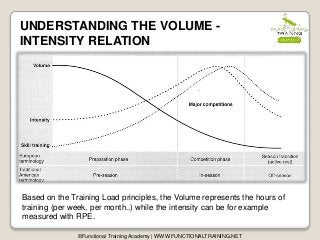
UNDERSTANDING THE VOLUME -
INTENSITY RELATION
Based on the Training Load principles, the Volume represents the hours of
training (per week, per month..) while the intensity can be for example
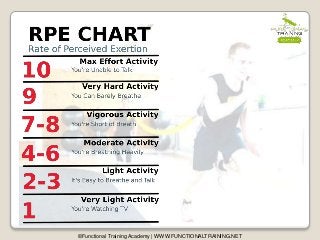
measured with RPE.
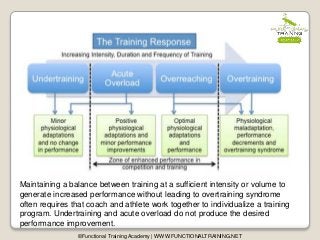
Maintaining a balance between training at a sufficient intensity or volume to
generate increased performance without leading to overtraining syndrome
often requires that coach and athlete work together to individualize a training
program. Undertraining and acute overload do not produce the desired
performance improvement.
©Functional Training Academy | WWW.FUNCTIONALTRAINING.NET
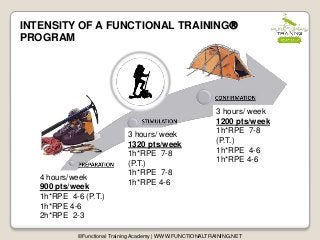
4 hours/week
900 pts/week
1h*RPE 4-6 (P.T.)
1h*RPE 4-6
2h*RPE 2-3
3 hours/ week
1320 pts/week
1h*RPE 7-8
(P.T.)
1h*RPE 7-8
1h*RPE 4-6
3 hours/ week
1200 pts/week
1h*RPE 7-8
(P.T.)
1h*RPE 4-6
1h*RPE 4-6
©Functional Training Academy | WWW.FUNCTIONALTRAINING.NET
INTENSITY OF A FUNCTIONAL TRAINING
PROGRAM
Assessing the right intensity of a training is a MUST for every coach. This,
in combination with the understanding of the concept ‘Training Load’ allows
the coach to stimolate progression of the performance without incurring in
overtraining.
Here are some considerations to keep in mind:
The INTENSITY of a training has to vary according to different
training periods (cfr. ‘Periodization in Functional Training’)
INTENSITY and VOLUME are inversely correlated in an
efficient training program
It is one of the functional trainer’s most important responsibility
to make sure the client is training at the right intensity
CONCLUSIONS:
© Functional Training Network
Postgraduaat ‘FUNCTIONAL
TRAINER’
Interested to become a certified Functional Trainer or you are already a
personal trainer and to affiliate to the Functional Training Network?
info@functionaltraining.net

Assessing training intensity in Functional Training

  • 1.
    Assessing intensity inFUNCTIONAL TRAINING Max Icardi BSc.Hon Sports Medicine Founder of the Functional Training Network www.maxicardi.com
  • 2.
    • The typeof physiological demand placed on the body will dictate the specific adaptation that will occur SPECIFICITY • To continue seeing gains and improvements from an exercise program, the program itself must become increasingly more challenging. PROGRESSI ON • An above-normal stress applied to a system to elicit an enhanced training responseOVERLOAD • Once initial adaptations have occurred, without regular stimulation the body will tend to go back to the initial state. REVERSIBIL ITY • It is important that an athlete varies his /her training to prevent boredom. Switch between running and cycling for endurance, for example. TEDIUM (boredom) THE PRINCIPLES OF TRAINING: S.P.OR.T. ©Functional Training Academy | WWW.FUNCTIONALTRAINING.NET
  • 3.
    Training duration • Trainingvolume usually refers to the duration of training (4 hours running, 300 km cycling, 1 hour weight lifting…) Training intensity • Training intensity refers to how hard the training is: heart rate, oxygen consumption, weight lifted, power output, blood lactate concentration or RPE. Training Frequency • How often does the training occur (per day, per week, per month...) BASIC TRAINING VARIABLES ©Functional Training Academy | WWW.FUNCTIONALTRAINING.NET
  • 4.
    TRAINING LOAD CALCULATION TRAINING LOAD= Training Volume X Training Intensity Training load becomes then an arbitrary number, expressed in units. In order to make comparison between different sport activities. Training Volume= Training Duration x Training Frequency is best expressed in MINUTES than for example Kms or Kgs, per session, per week, per month, per year... Training Intensity could be expressed in: %HRmax, lactate concentration, % 1RM, Kcal/min, METs, RPE... ©Functional Training Academy | WWW.FUNCTIONALTRAINING.NET example: Training Load = session RPE x duration (minutes) TL = 7x60= 420 units
  • 5.
    ©Functional Training Academy| WWW.FUNCTIONALTRAINING.NET
  • 6.
    PRACTICAL APPLICATIONS ©Functional TrainingAcademy | WWW.FUNCTIONALTRAINING.NET Research and anecdotal evidence have shown that each athlete has a different tolerance to training load 1. For example, if two athletes complete the same training program, one may be able to tolerate the training load, resulting in an improved performance, while the other may not tolerate the training load, leading to an impaired performance. 1. Foster, C., Daines, E, Hector, L, Snyder, AC and Welsh, R, (1996). Athletic performance in relation to training load, Wis. Med. J. 95:370–4. “Experienced triathletes are able to tolerate training loads up to 7200 units per week whereas other trained triathletes show signs of over-training when their training load is increased to approximately 6000 units per week”
  • 7.
    ©Functional Training Academy| WWW.FUNCTIONALTRAINING.NET UNDERSTANDING THE VOLUME - INTENSITY RELATION Based on the Training Load principles, the Volume represents the hours of training (per week, per month..) while the intensity can be for example measured with RPE.
  • 8.
    Maintaining a balancebetween training at a sufficient intensity or volume to generate increased performance without leading to overtraining syndrome often requires that coach and athlete work together to individualize a training program. Undertraining and acute overload do not produce the desired performance improvement. ©Functional Training Academy | WWW.FUNCTIONALTRAINING.NET
  • 9.
    4 hours/week 900 pts/week 1h*RPE4-6 (P.T.) 1h*RPE 4-6 2h*RPE 2-3 3 hours/ week 1320 pts/week 1h*RPE 7-8 (P.T.) 1h*RPE 7-8 1h*RPE 4-6 3 hours/ week 1200 pts/week 1h*RPE 7-8 (P.T.) 1h*RPE 4-6 1h*RPE 4-6 ©Functional Training Academy | WWW.FUNCTIONALTRAINING.NET INTENSITY OF A FUNCTIONAL TRAINING PROGRAM
  • 10.
    Assessing the rightintensity of a training is a MUST for every coach. This, in combination with the understanding of the concept ‘Training Load’ allows the coach to stimolate progression of the performance without incurring in overtraining. Here are some considerations to keep in mind: The INTENSITY of a training has to vary according to different training periods (cfr. ‘Periodization in Functional Training’) INTENSITY and VOLUME are inversely correlated in an efficient training program It is one of the functional trainer’s most important responsibility to make sure the client is training at the right intensity CONCLUSIONS: © Functional Training Network
  • 11.
    Postgraduaat ‘FUNCTIONAL TRAINER’ Interested tobecome a certified Functional Trainer or you are already a personal trainer and to affiliate to the Functional Training Network? info@functionaltraining.net

Editor's Notes

  • #8 http://sportsci.org/2009/ss.htm#_Toc245522384