Oracle Critical Patch Updates
Unwrapped
                Stephen Kost
          Chief Technology Officer
           Integrigy Corporation

                 Session #330
Agenda
 Background of Critical Patch Updates
 Vulnerabilities
 Patches
 Patching Strategy
 Questions
Integrigy Overview
Integrigy Corporation is a leader in application security for enterprise 
mission‐critical applications.  AppSentry, our application and database 
security assessment tool, assists companies in securing their largest and 
most important applications through detailed security audits and 
actionable recommendations.  Integrigy Consulting offers comprehensive 
security assessment services for leading databases and ERP applications, 
enabling companies to leverage our in‐depth knowledge of this 
significant threat to business operations.

Corporate Details
  – Founded December 2001
  – Privately Held
  – Based in Chicago, Illinois
Integrigy Background
 A database/ERP company and a security company
 Integrigy bridges the gap between applications, 
 databases, and security
 Extensive experience with Oracle
 Integrigy has found more security bugs in Oracle ERP than 
 anyone else inside or outside of Oracle

 AppSentry – Oracle E‐Business Security Assessment Tool
 Integrigy Consulting – Security Assessment Services
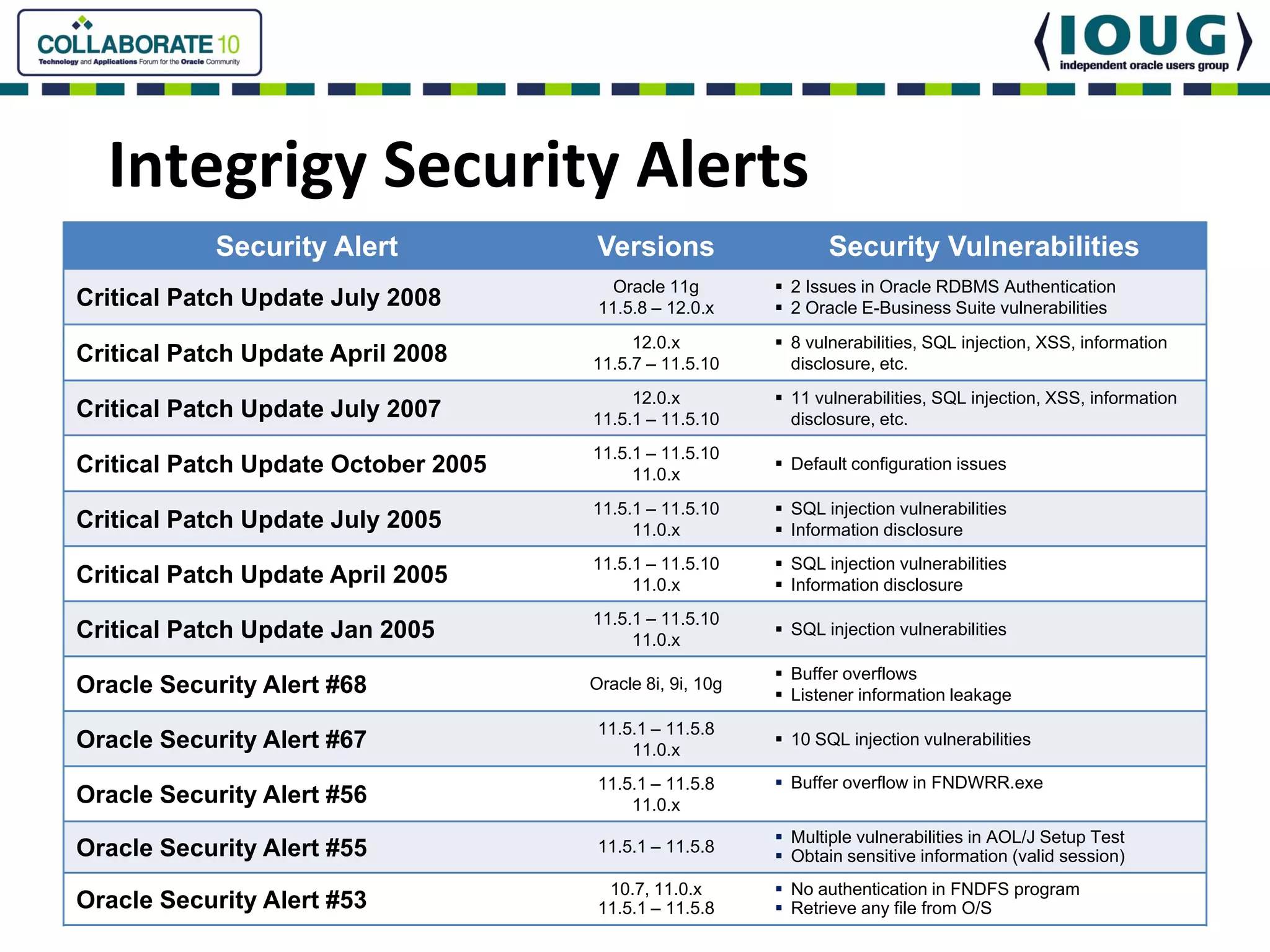
Integrigy Security Alerts
            Security Alert            Versions                 Security Vulnerabilities
                                        Oracle 11g        2 Issues in Oracle RDBMS Authentication
Critical Patch Update July 2008       11.5.8 – 12.0.x     2 Oracle E-Business Suite vulnerabilities
                                          12.0.x          8 vulnerabilities, SQL injection, XSS, information
Critical Patch Update April 2008     11.5.7 – 11.5.10     disclosure, etc.
                                          12.0.x          11 vulnerabilities, SQL injection, XSS, information
Critical Patch Update July 2007      11.5.1 – 11.5.10     disclosure, etc.
                                     11.5.1 – 11.5.10
Critical Patch Update October 2005        11.0.x
                                                          Default configuration issues

                                     11.5.1 – 11.5.10     SQL injection vulnerabilities
Critical Patch Update July 2005           11.0.x          Information disclosure
                                     11.5.1 – 11.5.10     SQL injection vulnerabilities
Critical Patch Update April 2005          11.0.x          Information disclosure
                                     11.5.1 – 11.5.10
Critical Patch Update Jan 2005            11.0.x
                                                          SQL injection vulnerabilities

                                                          Buffer overflows
Oracle Security Alert #68            Oracle 8i, 9i, 10g
                                                          Listener information leakage
                                      11.5.1 – 11.5.8
Oracle Security Alert #67                 11.0.x
                                                          10 SQL injection vulnerabilities

                                      11.5.1 – 11.5.8     Buffer overflow in FNDWRR.exe
Oracle Security Alert #56                 11.0.x
                                                          Multiple vulnerabilities in AOL/J Setup Test
Oracle Security Alert #55             11.5.1 – 11.5.8
                                                          Obtain sensitive information (valid session)
                                       10.7, 11.0.x       No authentication in FNDFS program
Oracle Security Alert #53             11.5.1 – 11.5.8     Retrieve any file from O/S
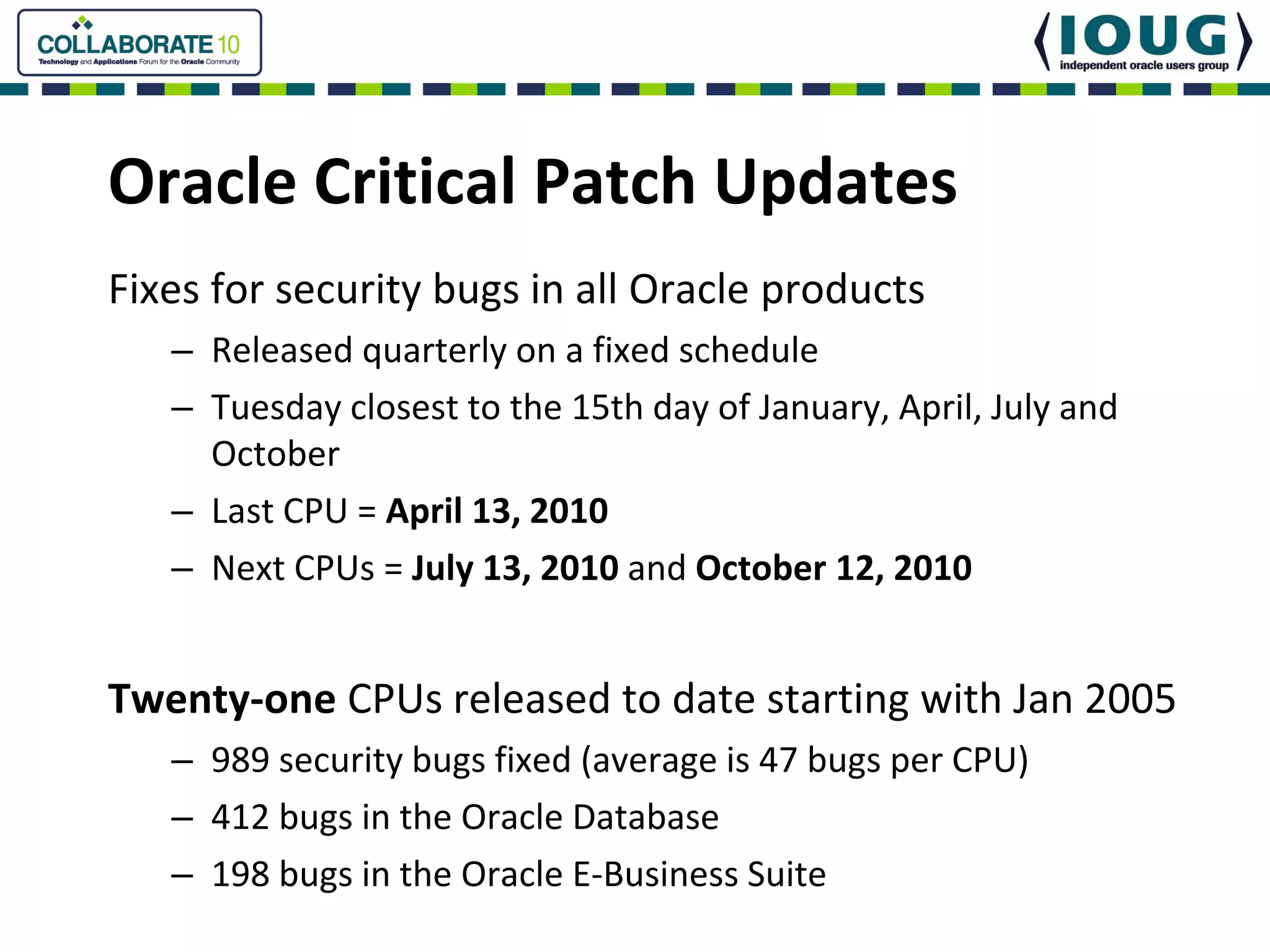
Oracle Critical Patch Updates
Fixes for security bugs in all Oracle products
   – Released quarterly on a fixed schedule
   – Tuesday closest to the 15th day of January, April, July and 
     October
   – Last CPU = April 13, 2010
   – Next CPUs = July 13, 2010 and October 12, 2010


Twenty‐one CPUs released to date starting with Jan 2005
   – 989 security bugs fixed (average is 47 bugs per CPU)
   – 412 bugs in the Oracle Database
   – 198 bugs in the Oracle E‐Business Suite
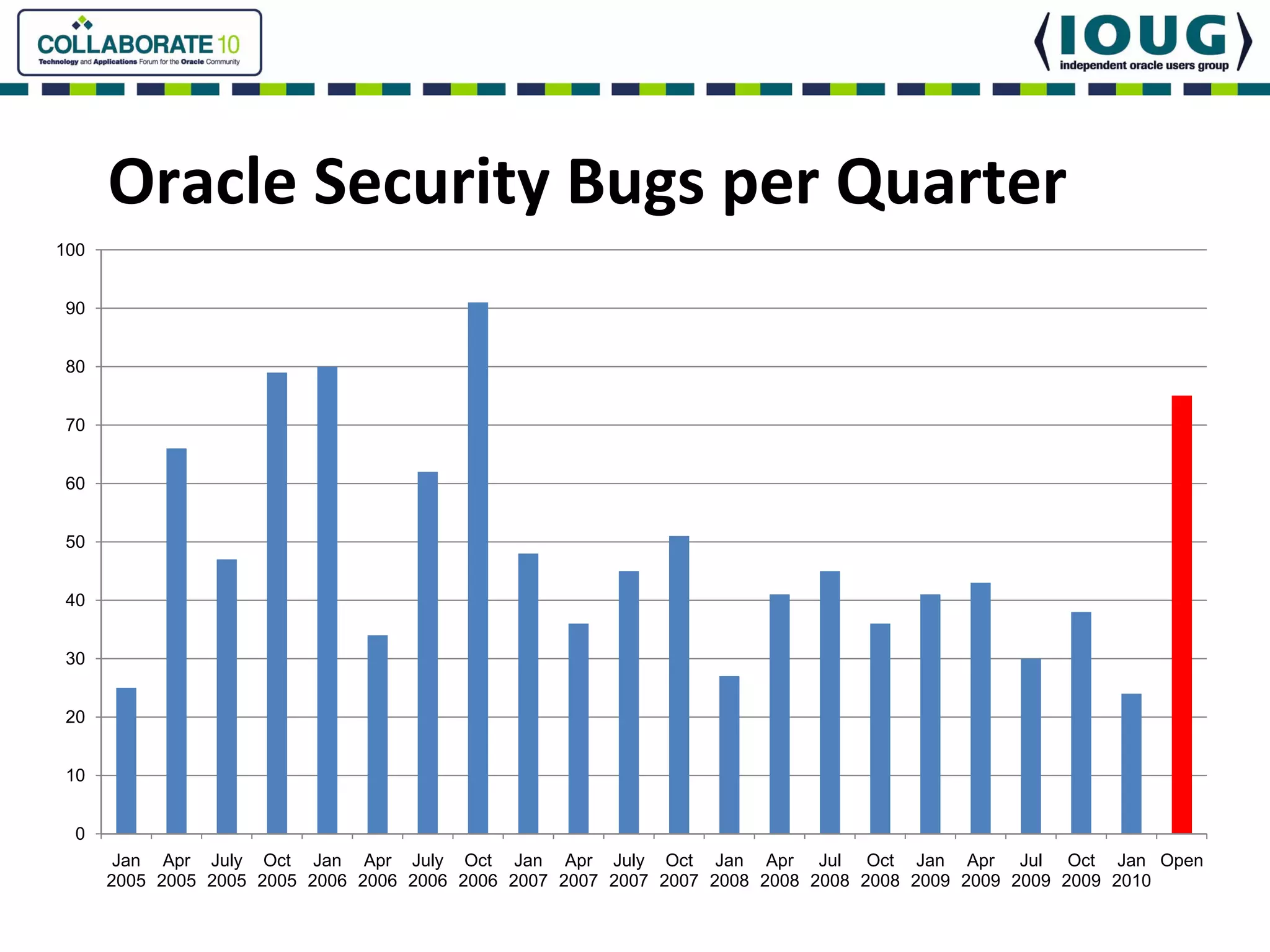
Oracle Security Bugs per Quarter
100


 90


 80


 70


 60


 50


 40


 30


 20


 10


  0
       Jan Apr July Oct Jan Apr July Oct Jan Apr July Oct Jan Apr Jul Oct Jan Apr Jul Oct Jan Open
      2005 2005 2005 2005 2006 2006 2006 2006 2007 2007 2007 2007 2008 2008 2008 2008 2009 2009 2009 2009 2010
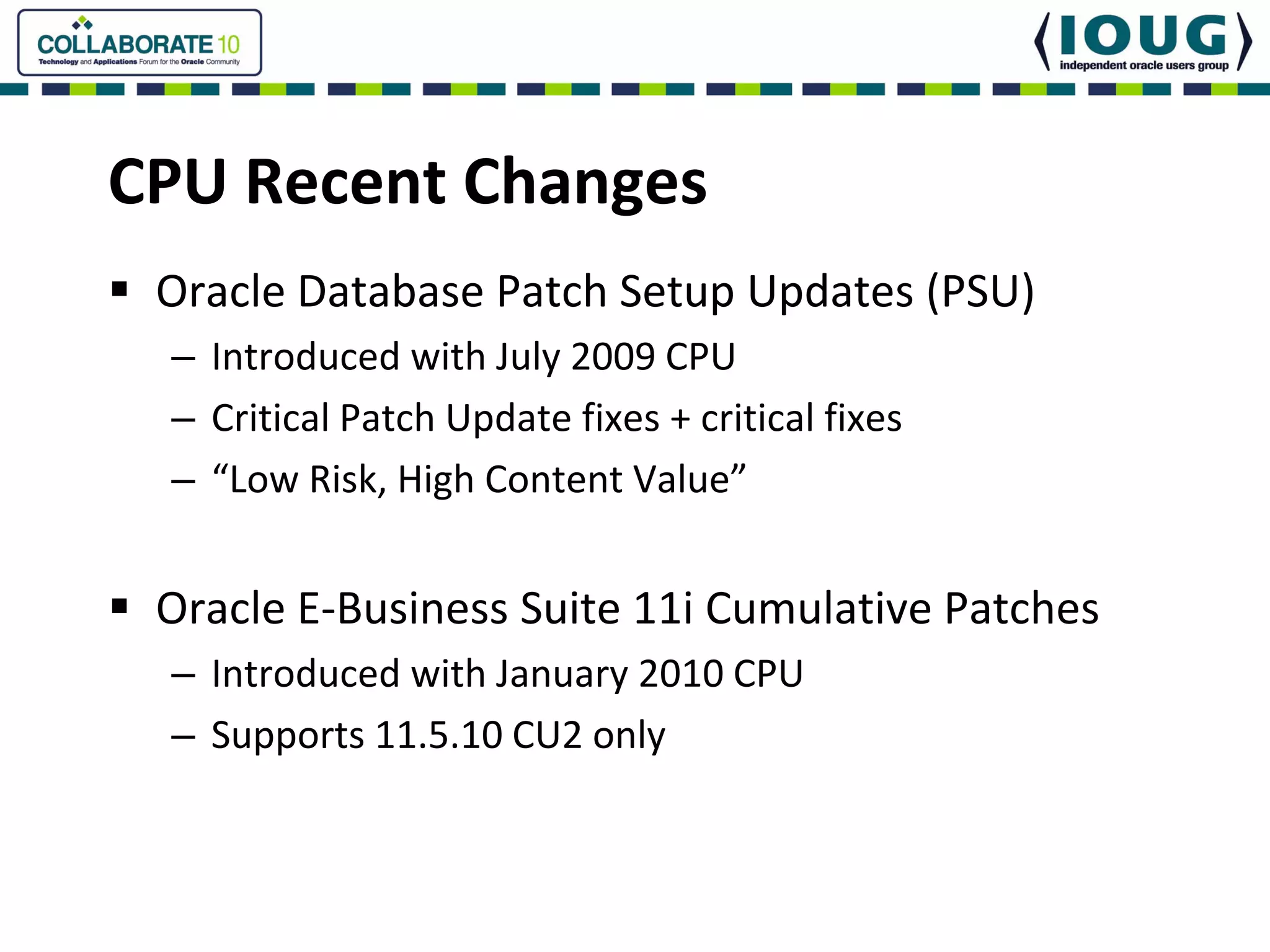
CPU Recent Changes
 Oracle Database Patch Setup Updates (PSU)
 – Introduced with July 2009 CPU
 – Critical Patch Update fixes + critical fixes
 – “Low Risk, High Content Value”


 Oracle E‐Business Suite 11i Cumulative Patches
 – Introduced with January 2010 CPU
 – Supports 11.5.10 CU2 only
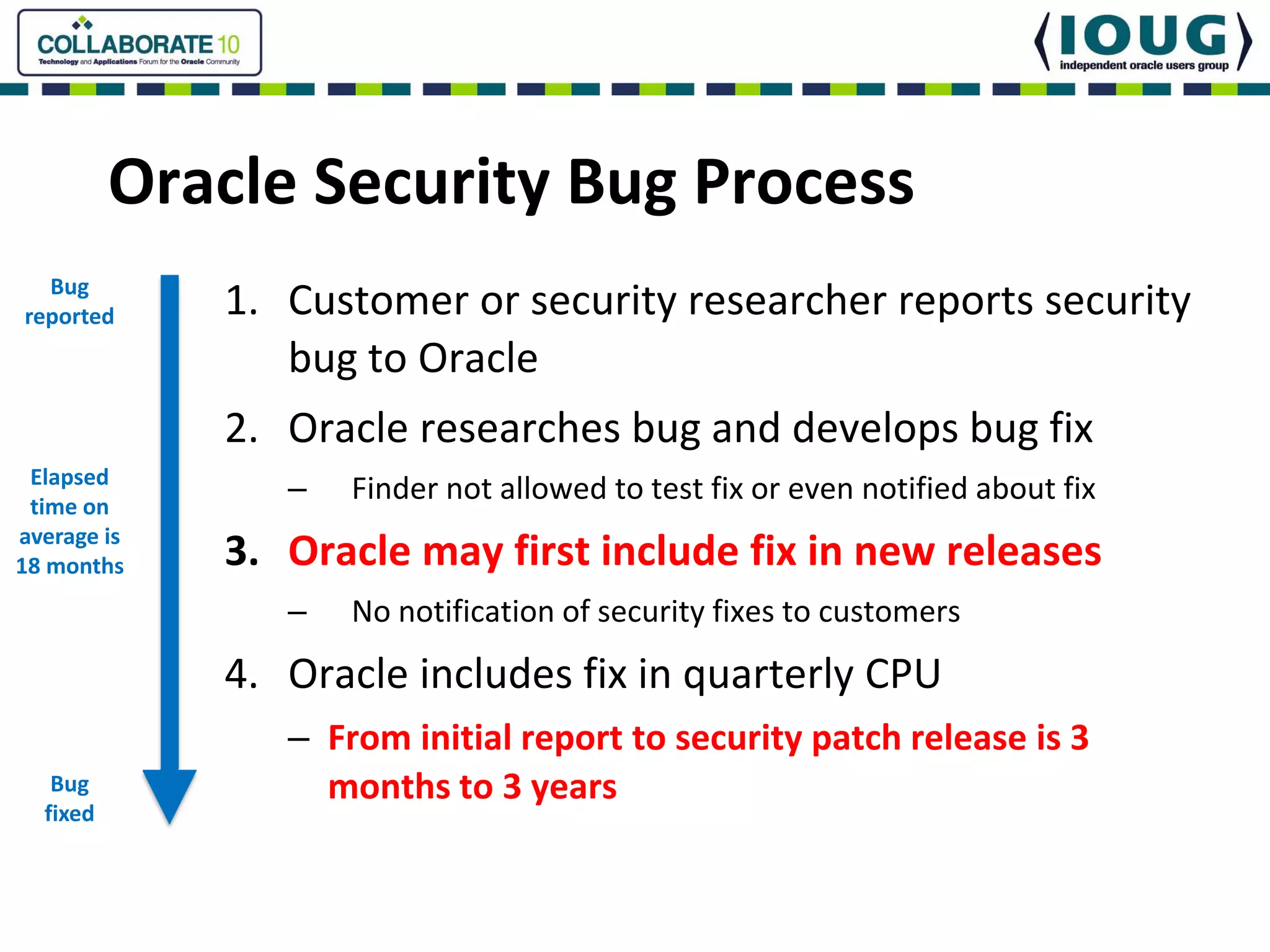
Oracle Security Bug Process
  Bug
reported     1. Customer or security researcher reports security 
                bug to Oracle
             2. Oracle researches bug and develops bug fix
 Elapsed
 time on
                –   Finder not allowed to test fix or even notified about fix
average is
18 months    3. Oracle may first include fix in new releases
                –   No notification of security fixes to customers
             4. Oracle includes fix in quarterly CPU
                – From initial report to security patch release is 3 
   Bug            months to 3 years
  fixed
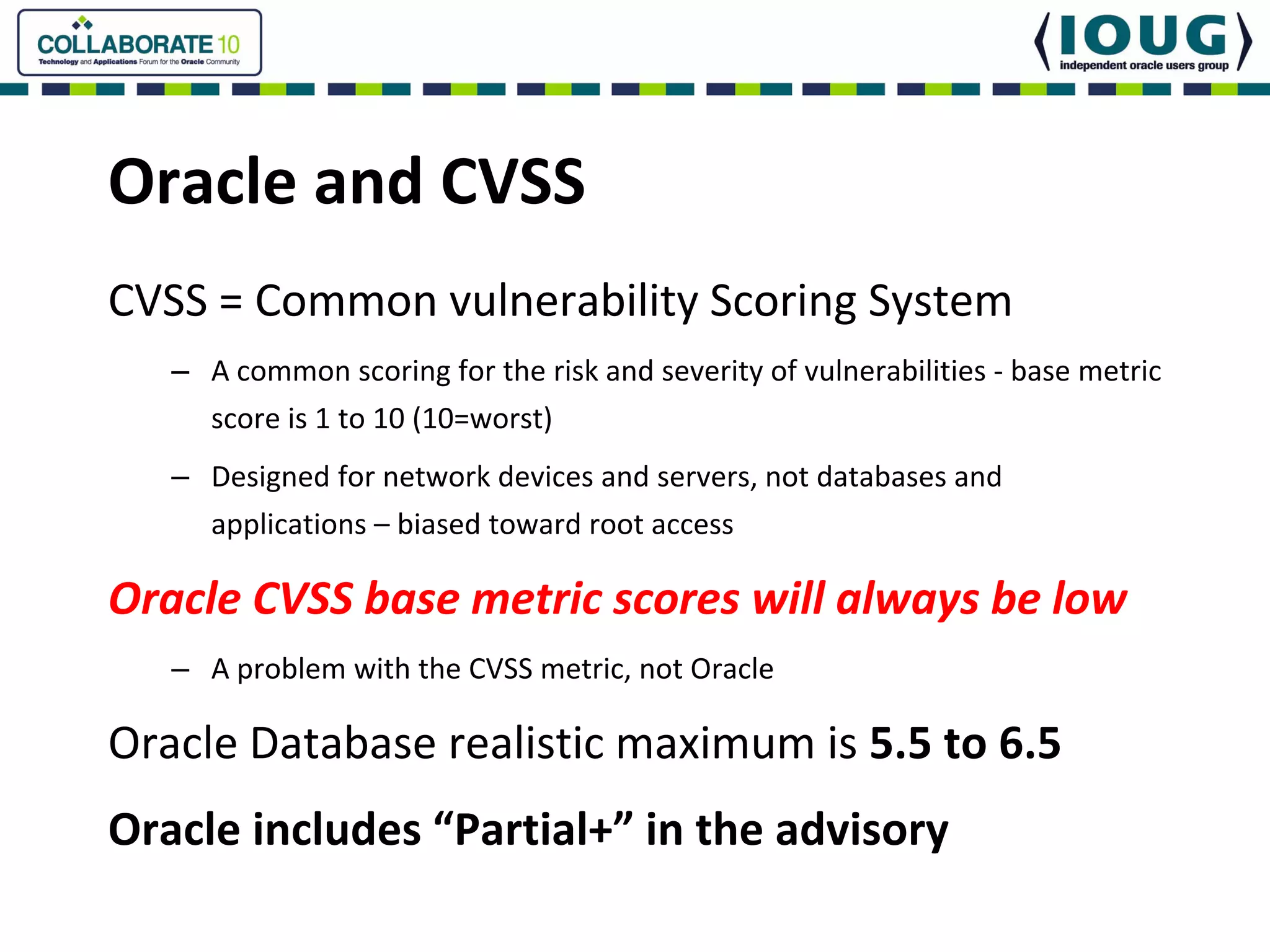
Oracle and CVSS
CVSS = Common vulnerability Scoring System
   – A common scoring for the risk and severity of vulnerabilities ‐ base metric 
     score is 1 to 10 (10=worst)
   – Designed for network devices and servers, not databases and 
     applications – biased toward root access

Oracle CVSS base metric scores will always be low
   – A problem with the CVSS metric, not Oracle

Oracle Database realistic maximum is 5.5 to 6.5
Oracle includes “Partial+” in the advisory
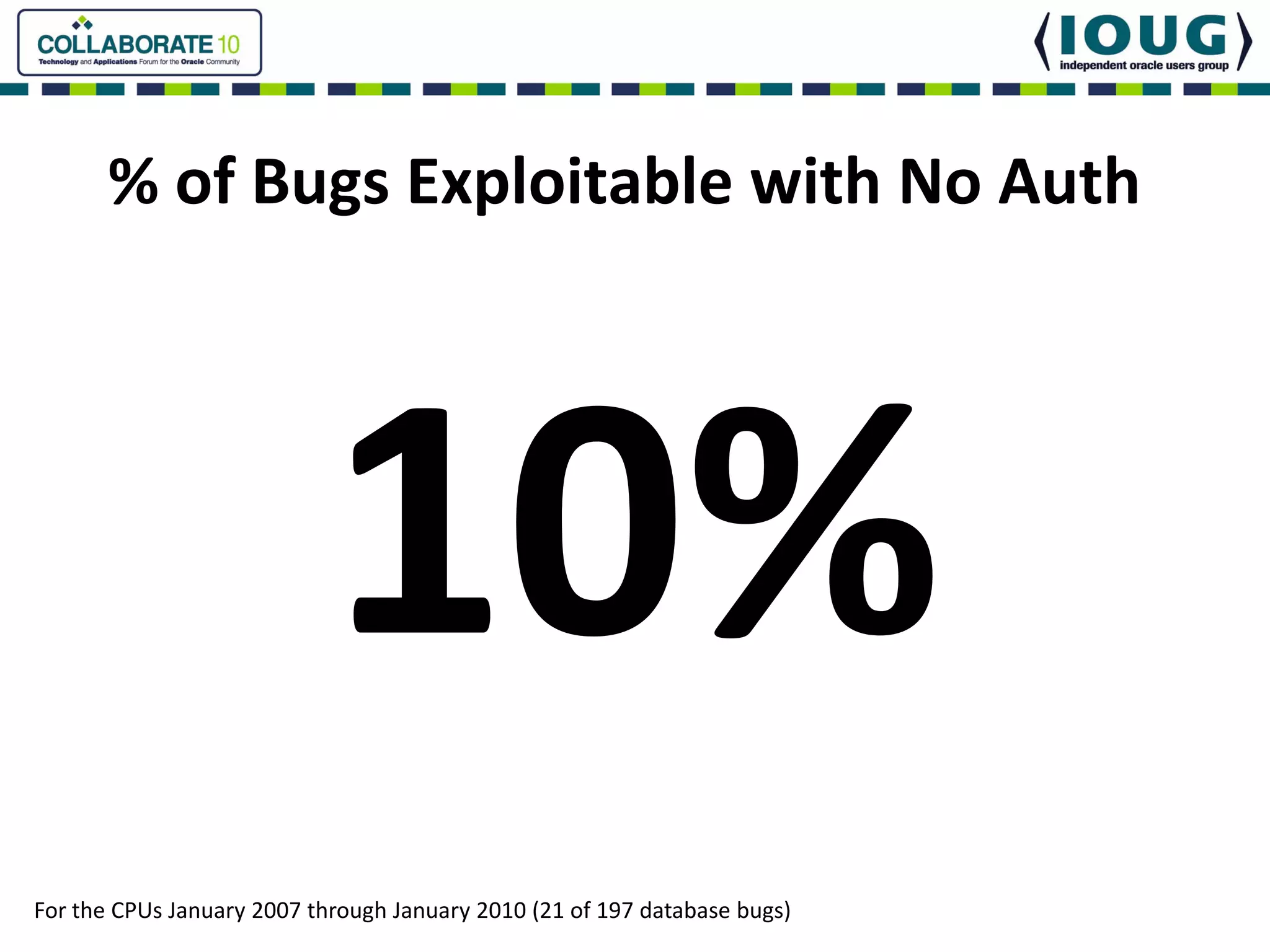
% of Bugs Exploitable with No Auth


For the CPUs January 2007 through January 2010 (21 of 197 database bugs)
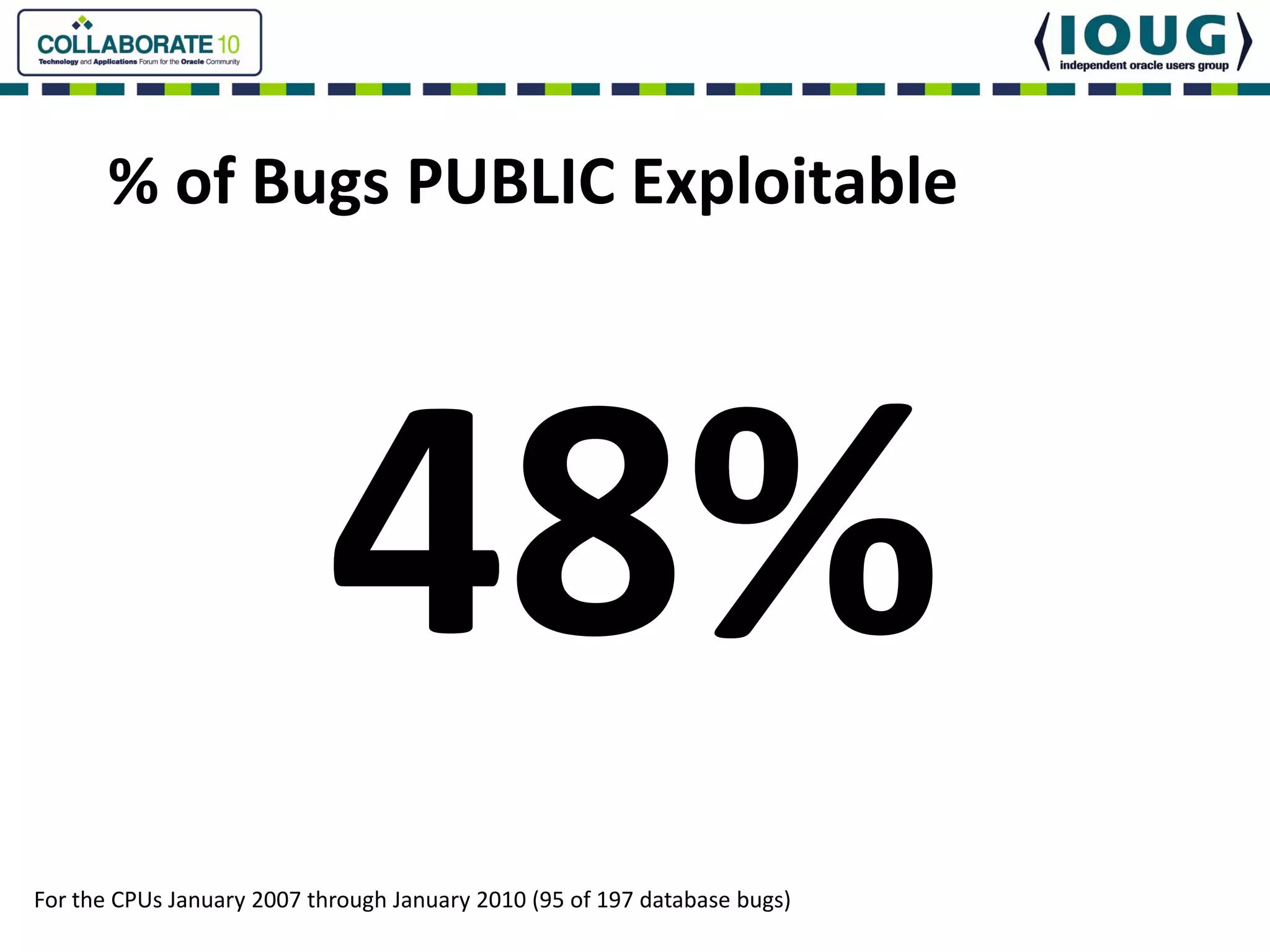
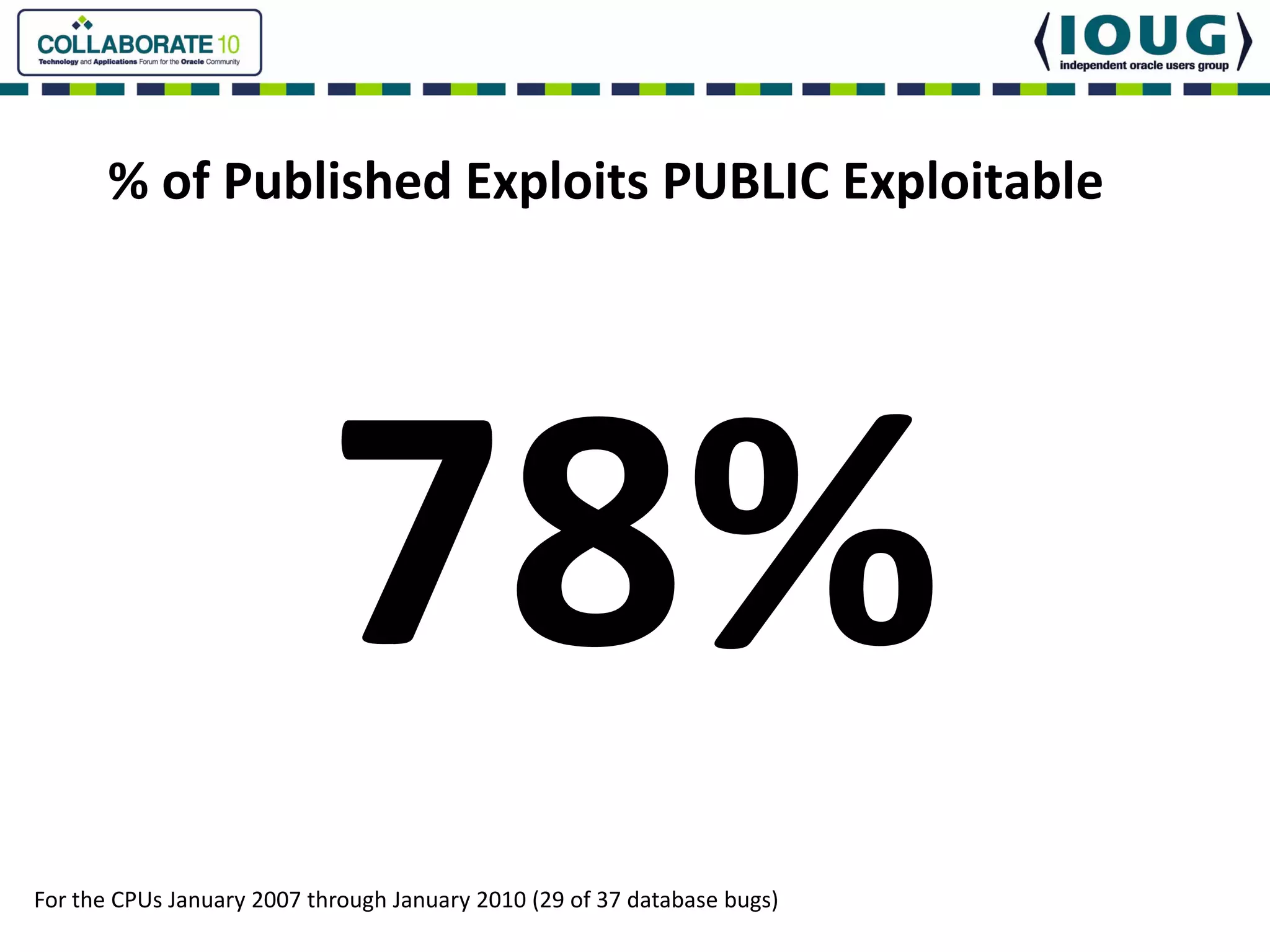
% of Bugs PUBLIC Exploitable


For the CPUs January 2007 through January 2010 (95 of 197 database bugs)
% of Published Exploits PUBLIC Exploitable


For the CPUs January 2007 through January 2010 (29 of 37 database bugs)
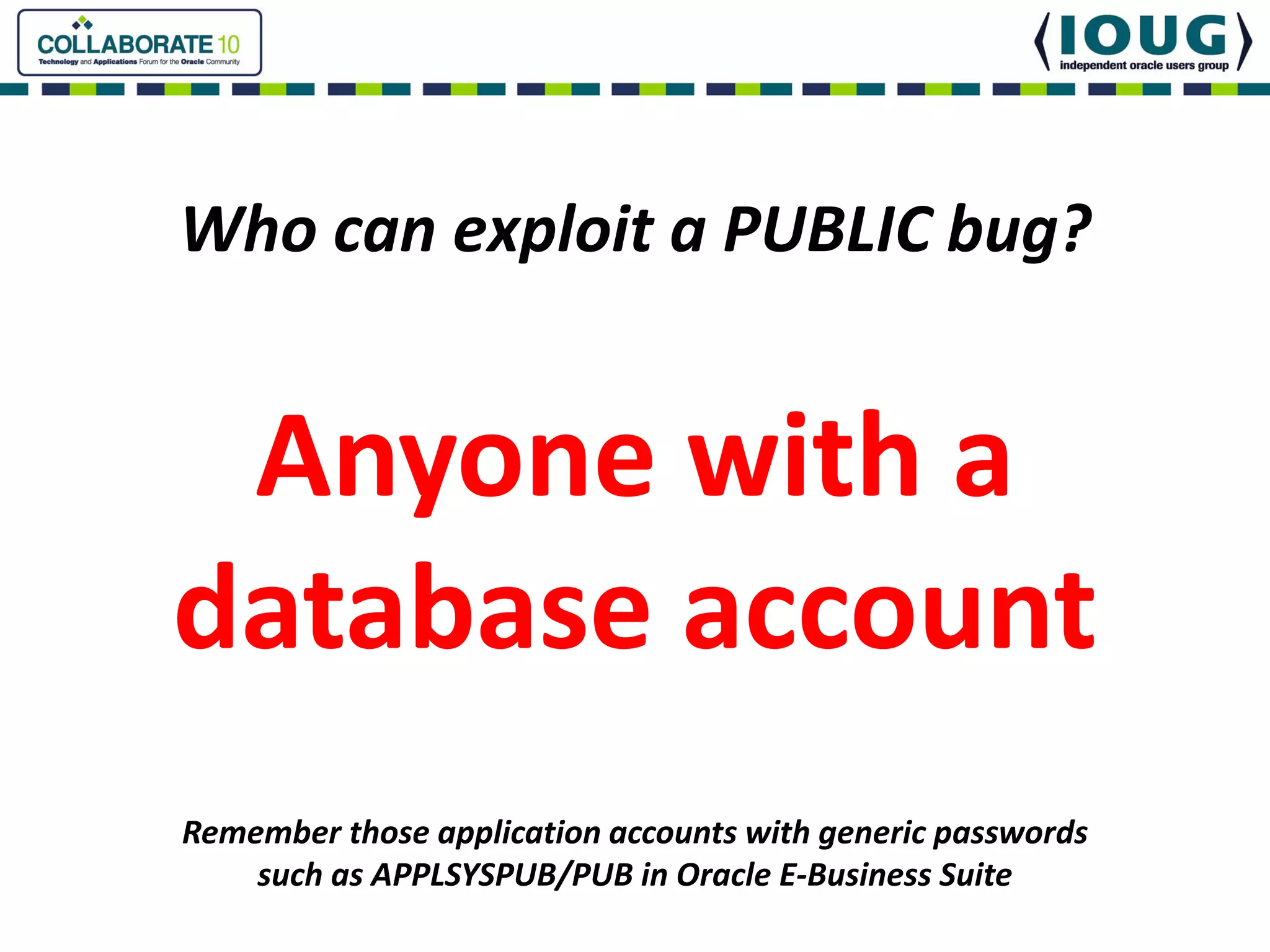
Who can exploit a PUBLIC bug?


 Anyone with a
database account
Remember those application accounts with generic passwords
    such as APPLSYSPUB/PUB in Oracle E‐Business Suite
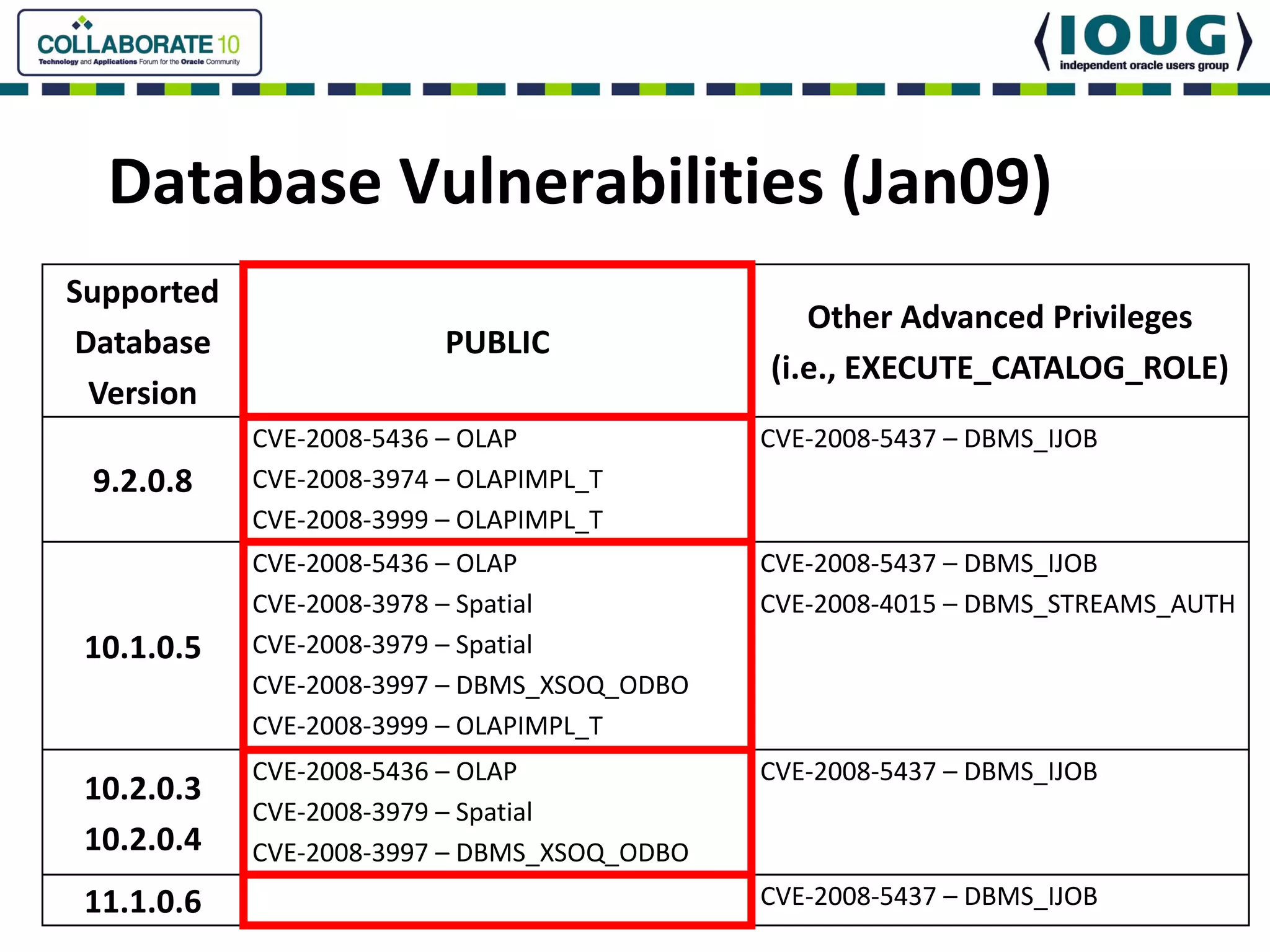
Database Vulnerabilities (Jan09)
Supported 
                                                 Other Advanced Privileges
 Database                  PUBLIC
                                              (i.e., EXECUTE_CATALOG_ROLE)
  Version
             CVE‐2008‐5436 – OLAP             CVE‐2008‐5437 – DBMS_IJOB
 9.2.0.8     CVE‐2008‐3974 – OLAPIMPL_T
             CVE‐2008‐3999 – OLAPIMPL_T
             CVE‐2008‐5436 – OLAP             CVE‐2008‐5437 – DBMS_IJOB
             CVE‐2008‐3978 – Spatial          CVE‐2008‐4015 – DBMS_STREAMS_AUTH
 10.1.0.5    CVE‐2008‐3979 – Spatial
             CVE‐2008‐3997 – DBMS_XSOQ_ODBO
             CVE‐2008‐3999 – OLAPIMPL_T
             CVE‐2008‐5436 – OLAP             CVE‐2008‐5437 – DBMS_IJOB
 10.2.0.3
             CVE‐2008‐3979 – Spatial
 10.2.0.4    CVE‐2008‐3997 – DBMS_XSOQ_ODBO
 11.1.0.6                                     CVE‐2008‐5437 – DBMS_IJOB
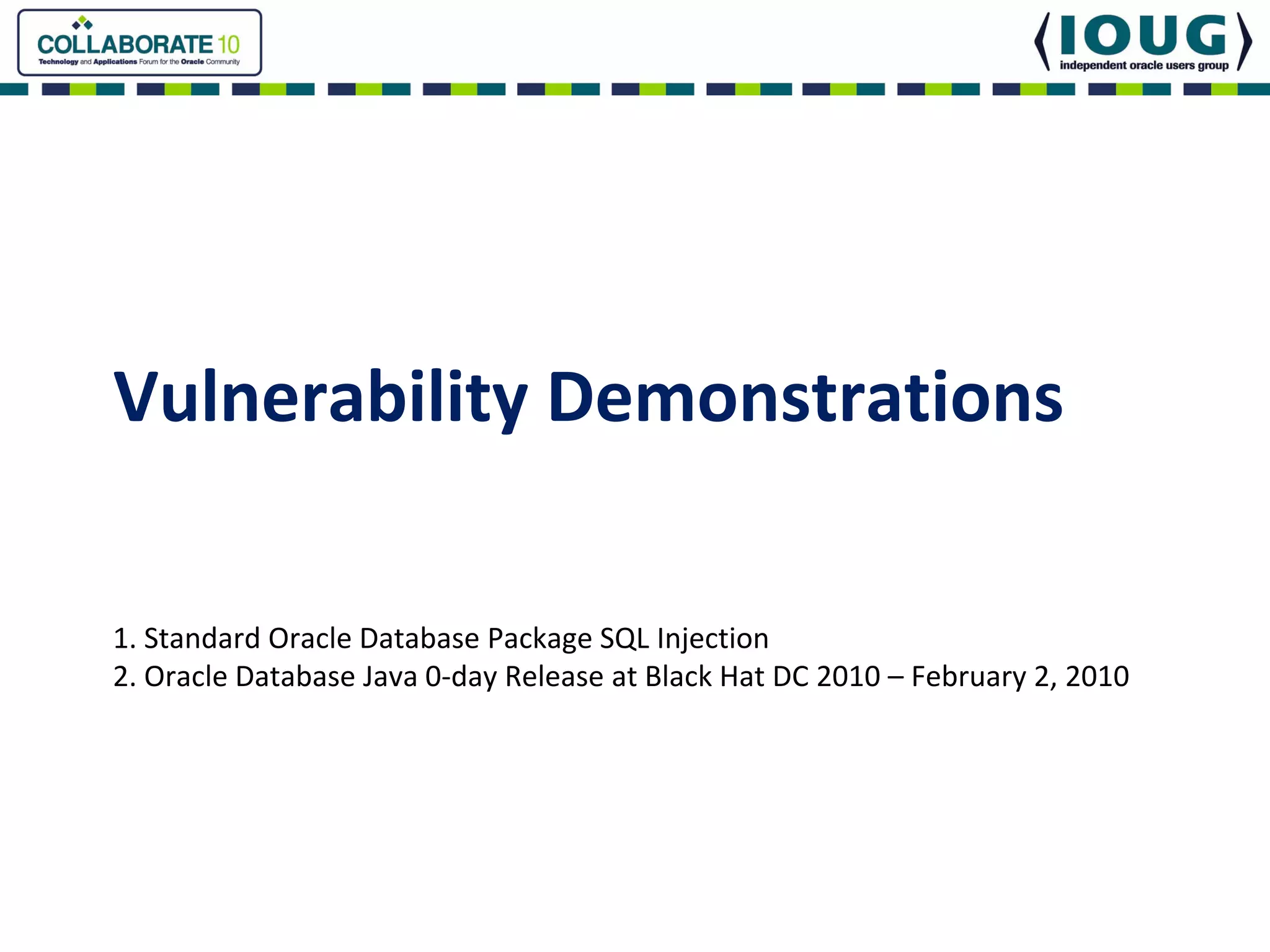
Vulnerability Demonstrations

1. Standard Oracle Database Package SQL Injection
2. Oracle Database Java 0‐day Release at Black Hat DC 2010 – February 2, 2010 
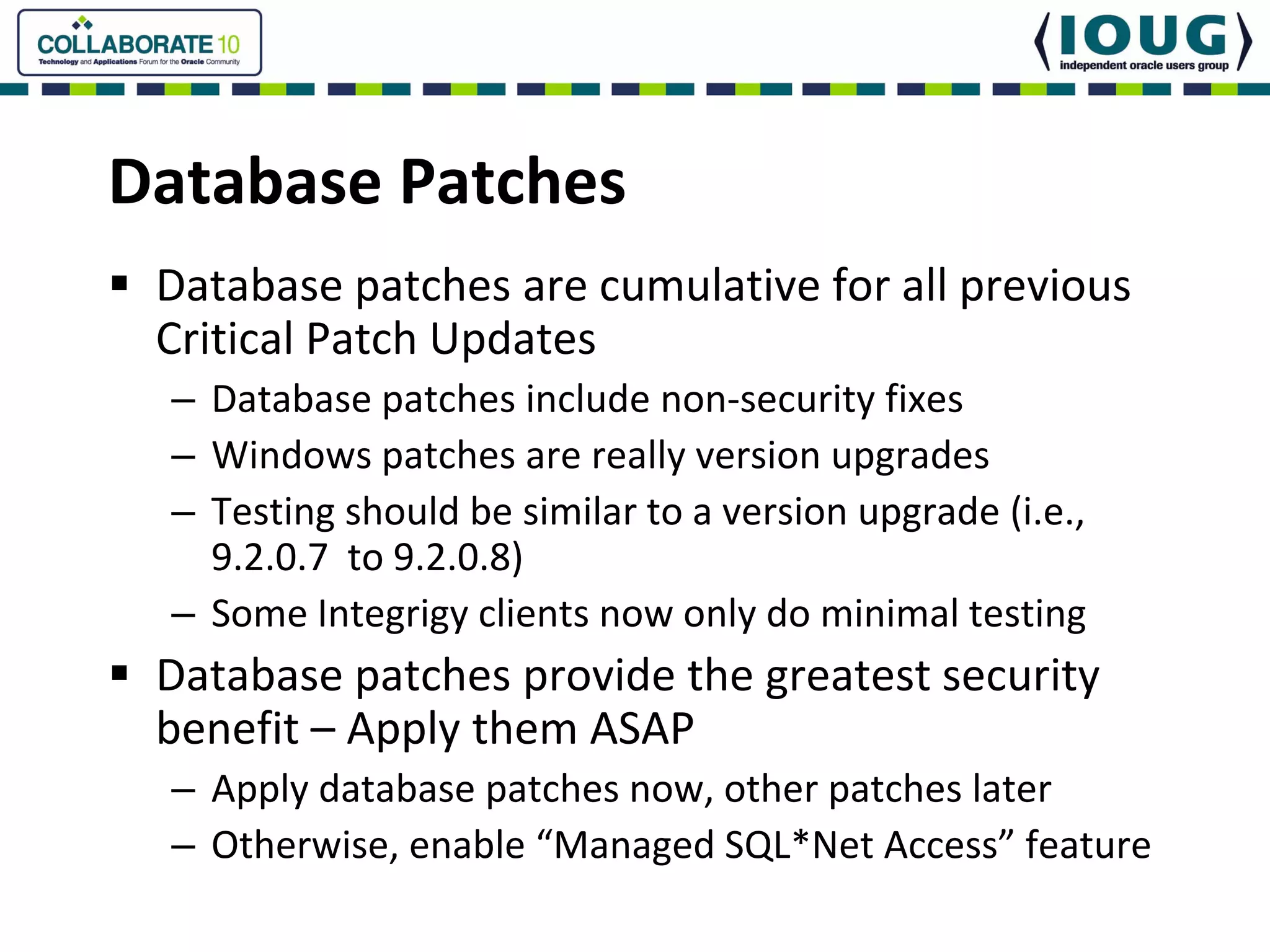
Database Patches
 Database patches are cumulative for all previous 
 Critical Patch Updates
 – Database patches include non‐security fixes
 – Windows patches are really version upgrades
 – Testing should be similar to a version upgrade (i.e., 
   9.2.0.7  to 9.2.0.8)
 – Some Integrigy clients now only do minimal testing
 Database patches provide the greatest security 
 benefit – Apply them ASAP
 – Apply database patches now, other patches later
 – Otherwise, enable “Managed SQL*Net Access” feature
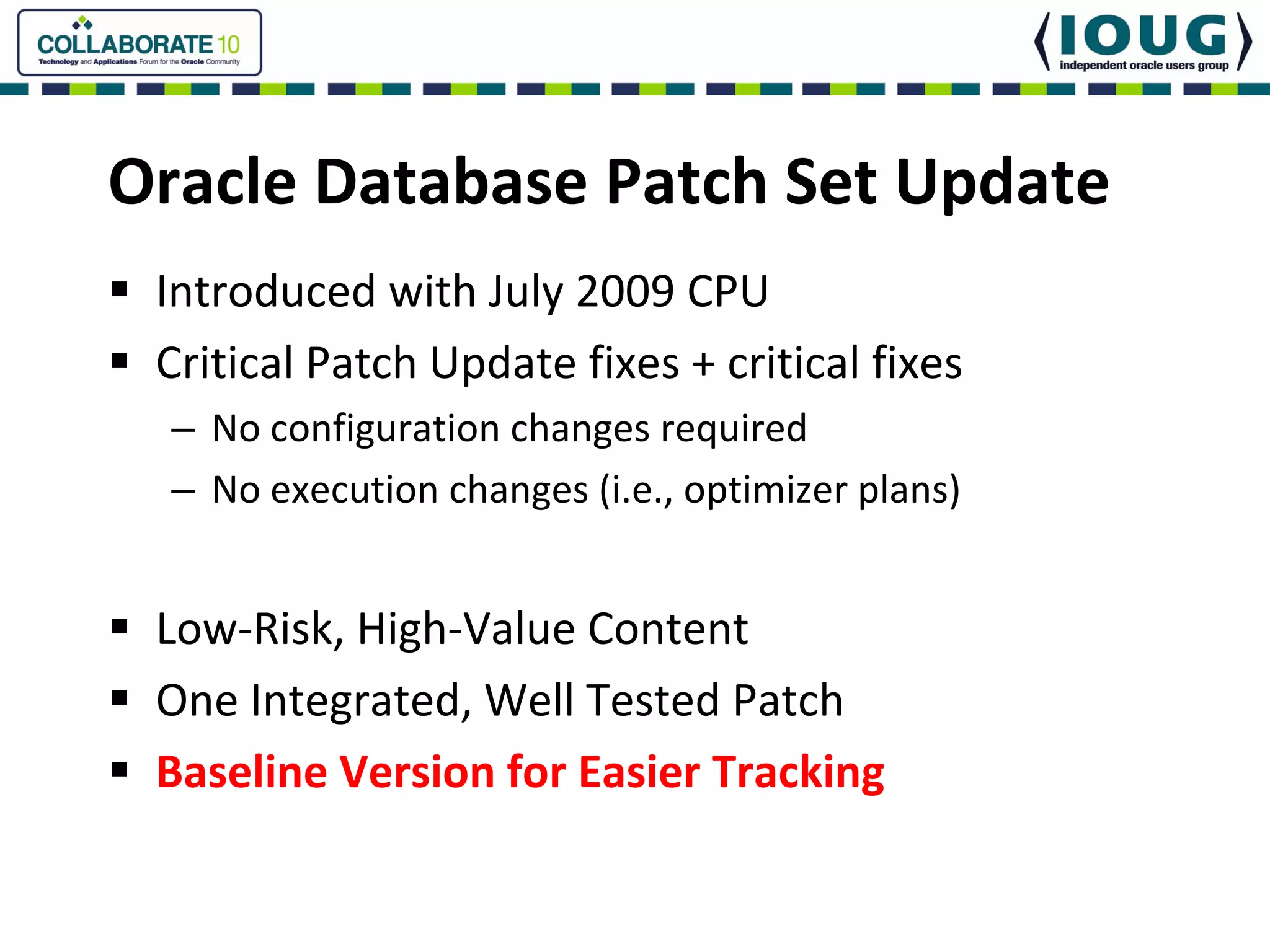
Oracle Database Patch Set Update
 Introduced with July 2009 CPU
 Critical Patch Update fixes + critical fixes
  – No configuration changes required
  – No execution changes (i.e., optimizer plans)


 Low‐Risk, High‐Value Content
 One Integrated, Well Tested Patch
 Baseline Version for Easier Tracking
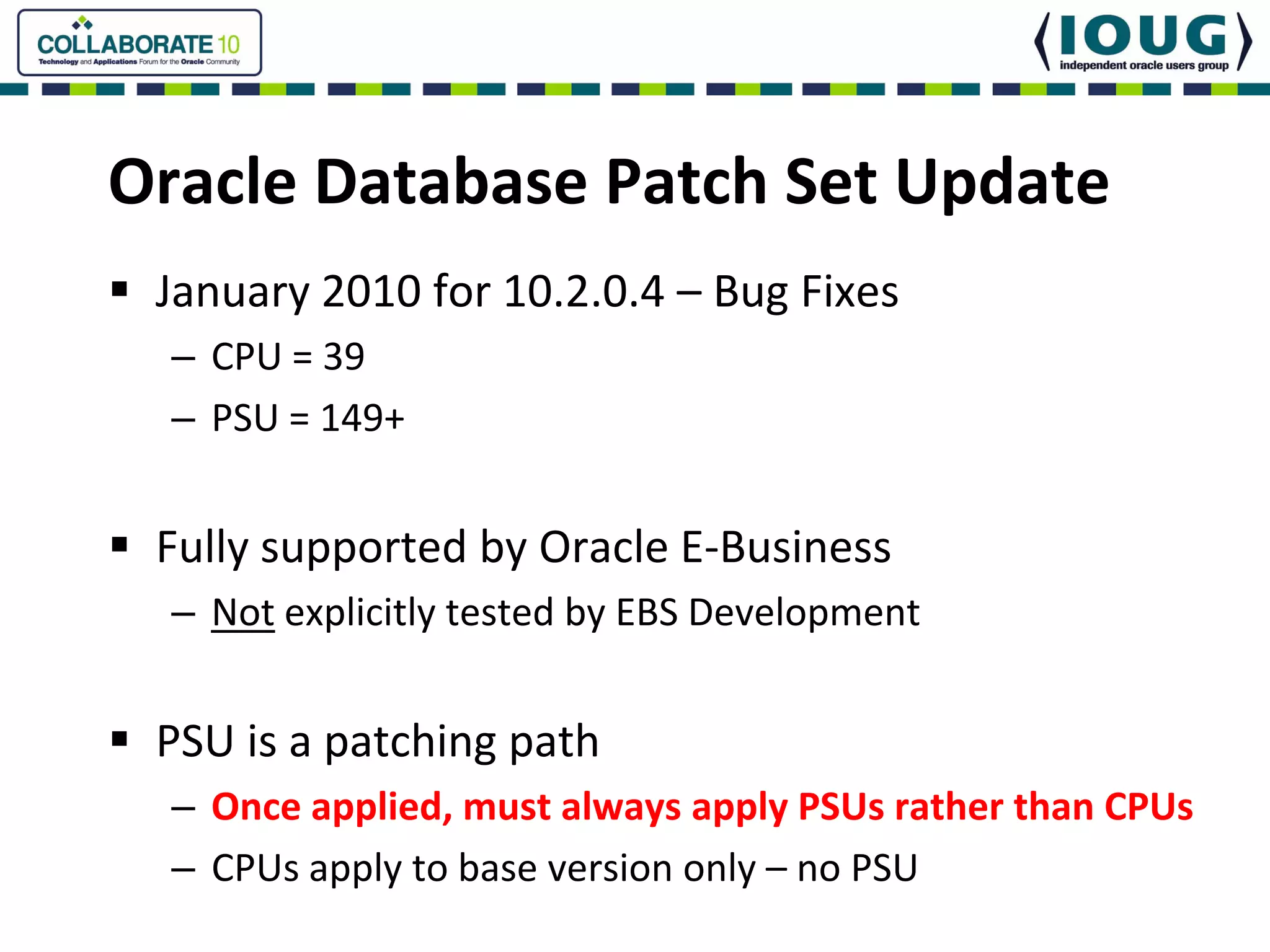
Oracle Database Patch Set Update
 January 2010 for 10.2.0.4 – Bug Fixes
  – CPU = 39   
  – PSU = 149+


 Fully supported by Oracle E‐Business
  – Not explicitly tested by EBS Development


 PSU is a patching path
  – Once applied, must always apply PSUs rather than CPUs
  – CPUs apply to base version only – no PSU
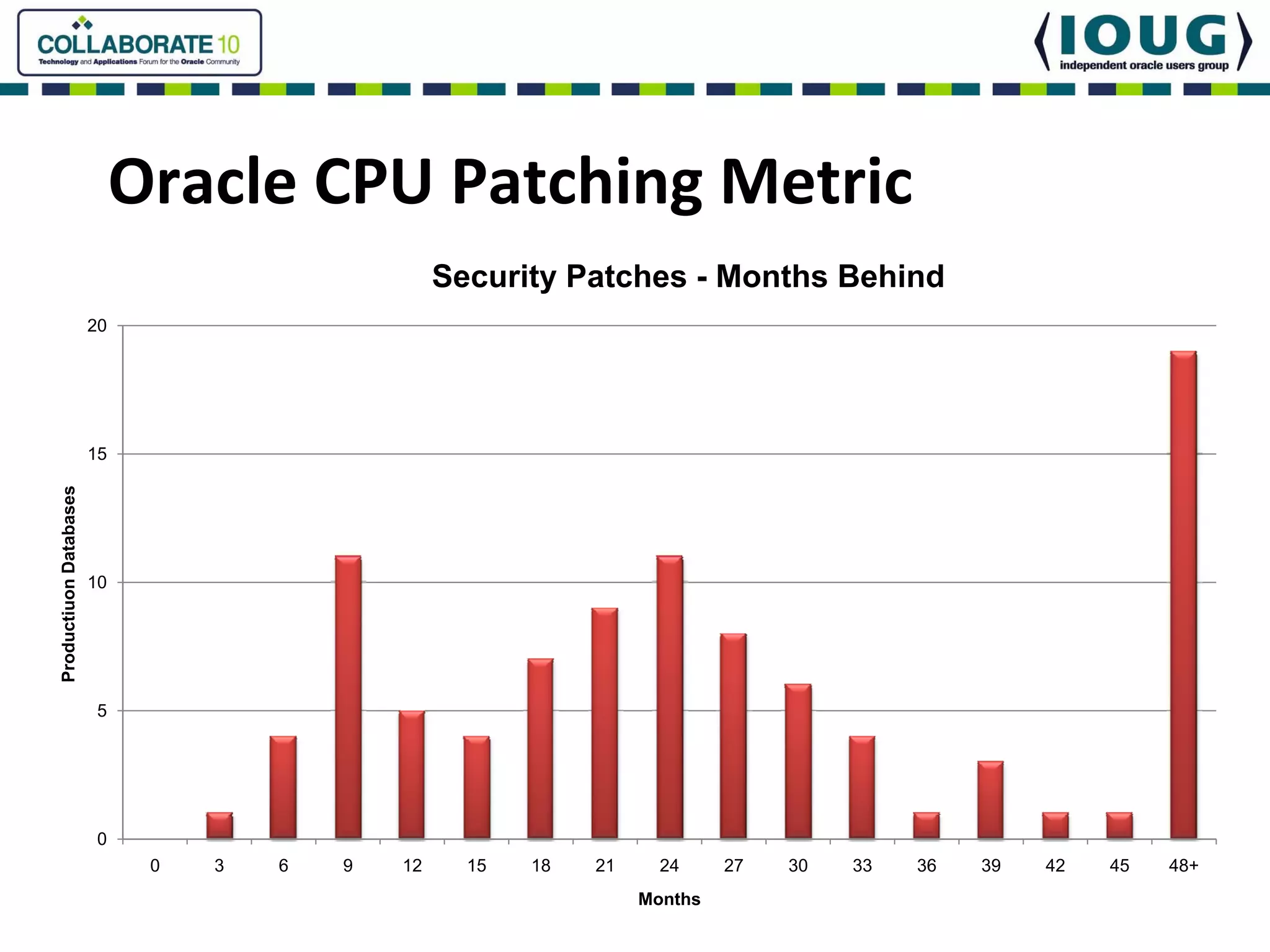
Oracle CPU Patching Metric
                                                   Security Patches - Months Behind
                        20


                        15
Productiuon Databases


                        10


                         5


                         0
                              0   3   6   9   12     15   18   21     24     27   30   33   36   39   42   45   48+
                                                                    Months
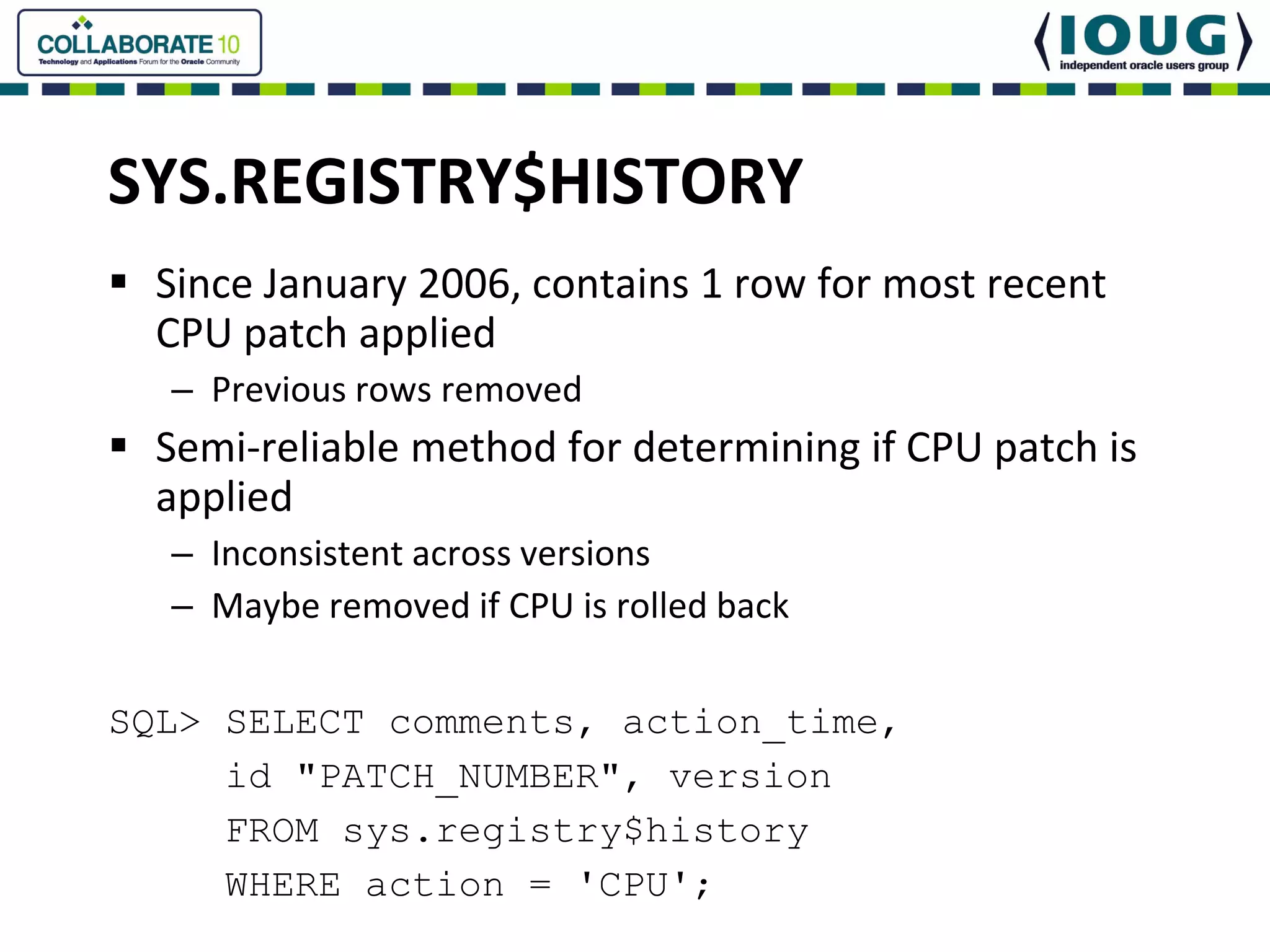
SYS.REGISTRY$HISTORY
  Since January 2006, contains 1 row for most recent 
  CPU patch applied
  – Previous rows removed
  Semi‐reliable method for determining if CPU patch is 
  applied
  – Inconsistent across versions
  – Maybe removed if CPU is rolled back 

SQL> SELECT comments, action_time,
     id "PATCH_NUMBER", version
     FROM sys.registry$history
     WHERE action = 'CPU';
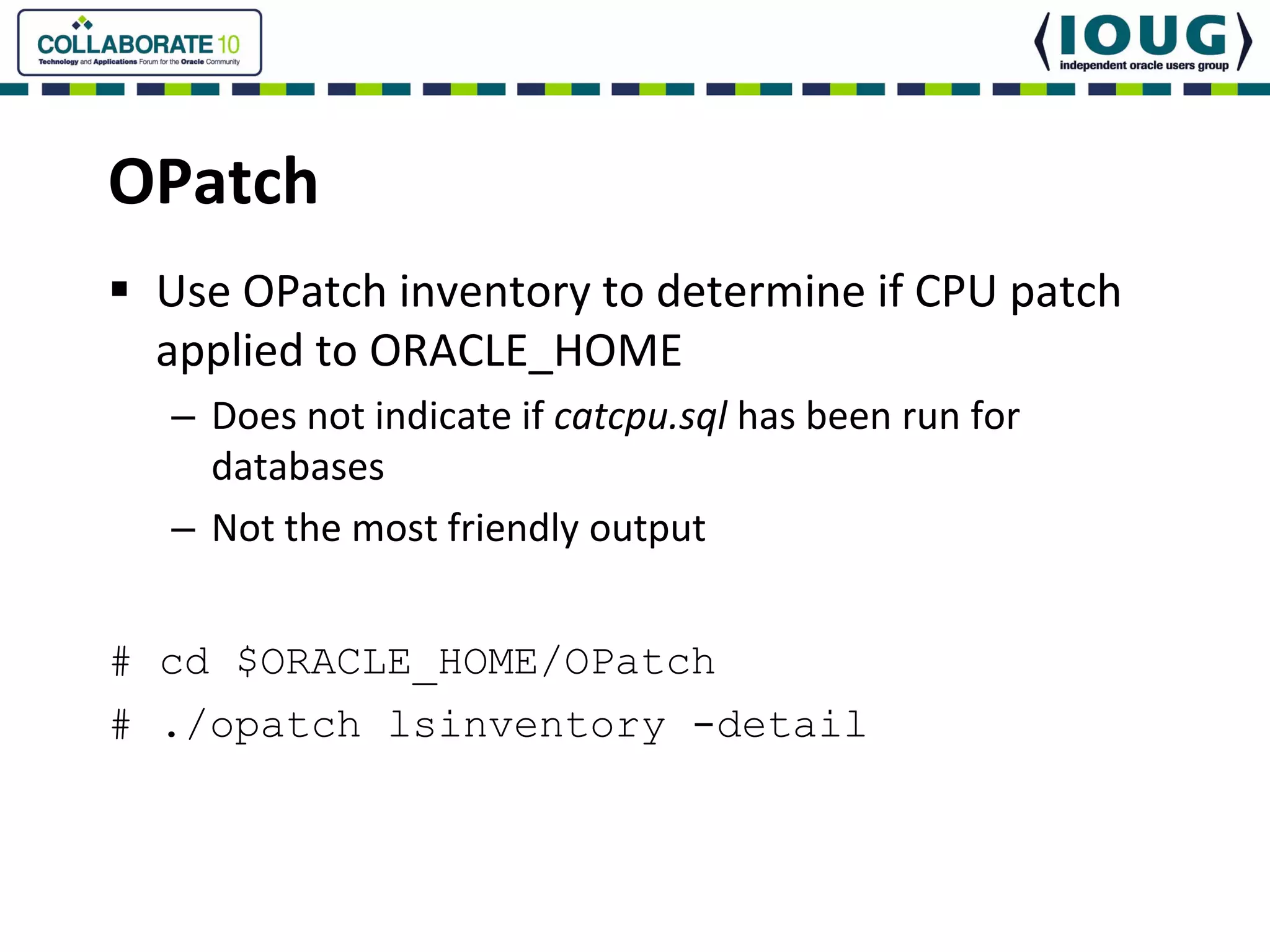
OPatch
 Use OPatch inventory to determine if CPU patch 
 applied to ORACLE_HOME
  – Does not indicate if catcpu.sql has been run for 
    databases
  – Not the most friendly output


# cd $ORACLE_HOME/OPatch
# ./opatch lsinventory -detail
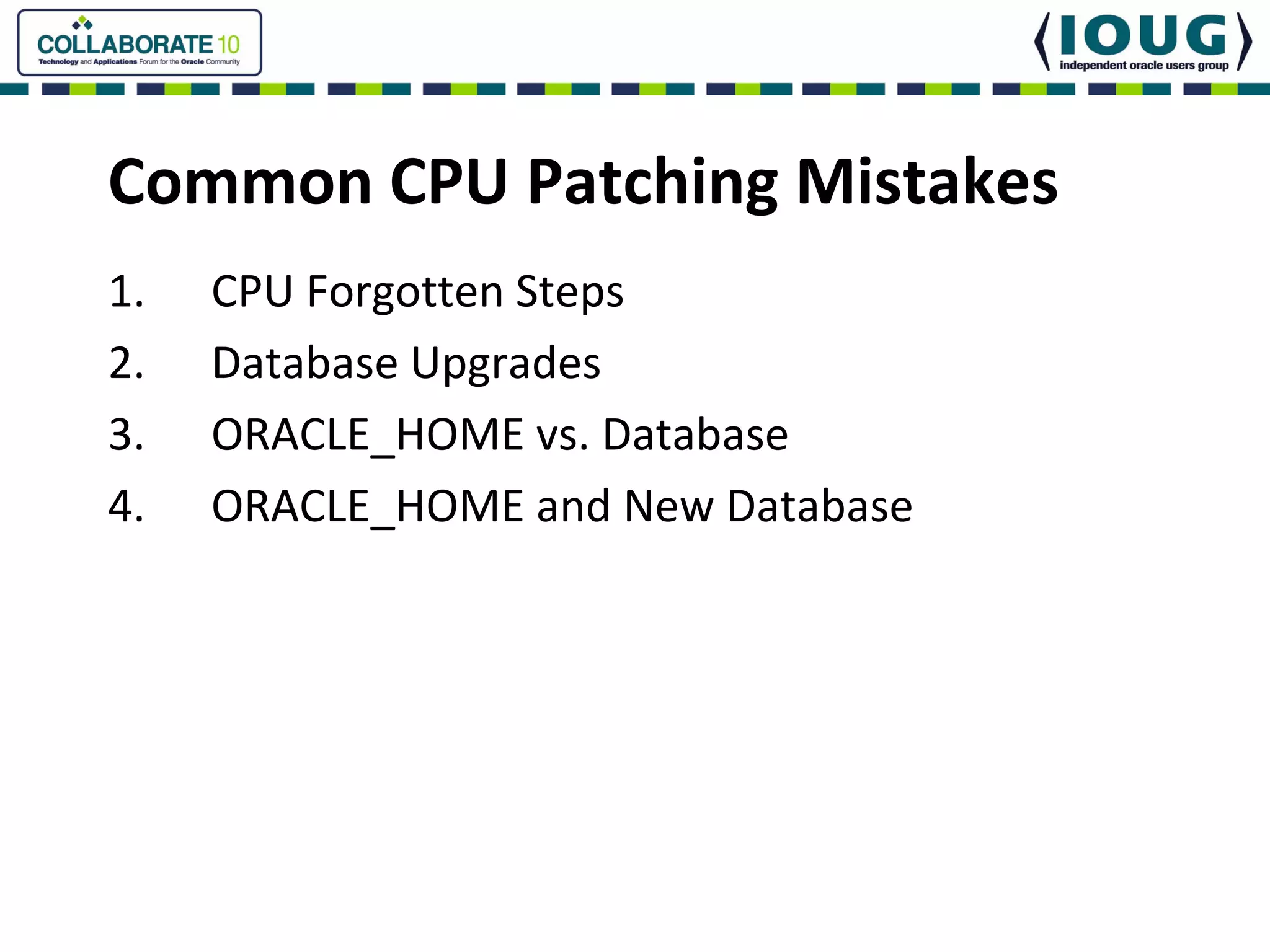
Common CPU Patching Mistakes
1.   CPU Forgotten Steps
2.   Database Upgrades
3.   ORACLE_HOME vs. Database
4.   ORACLE_HOME and New Database
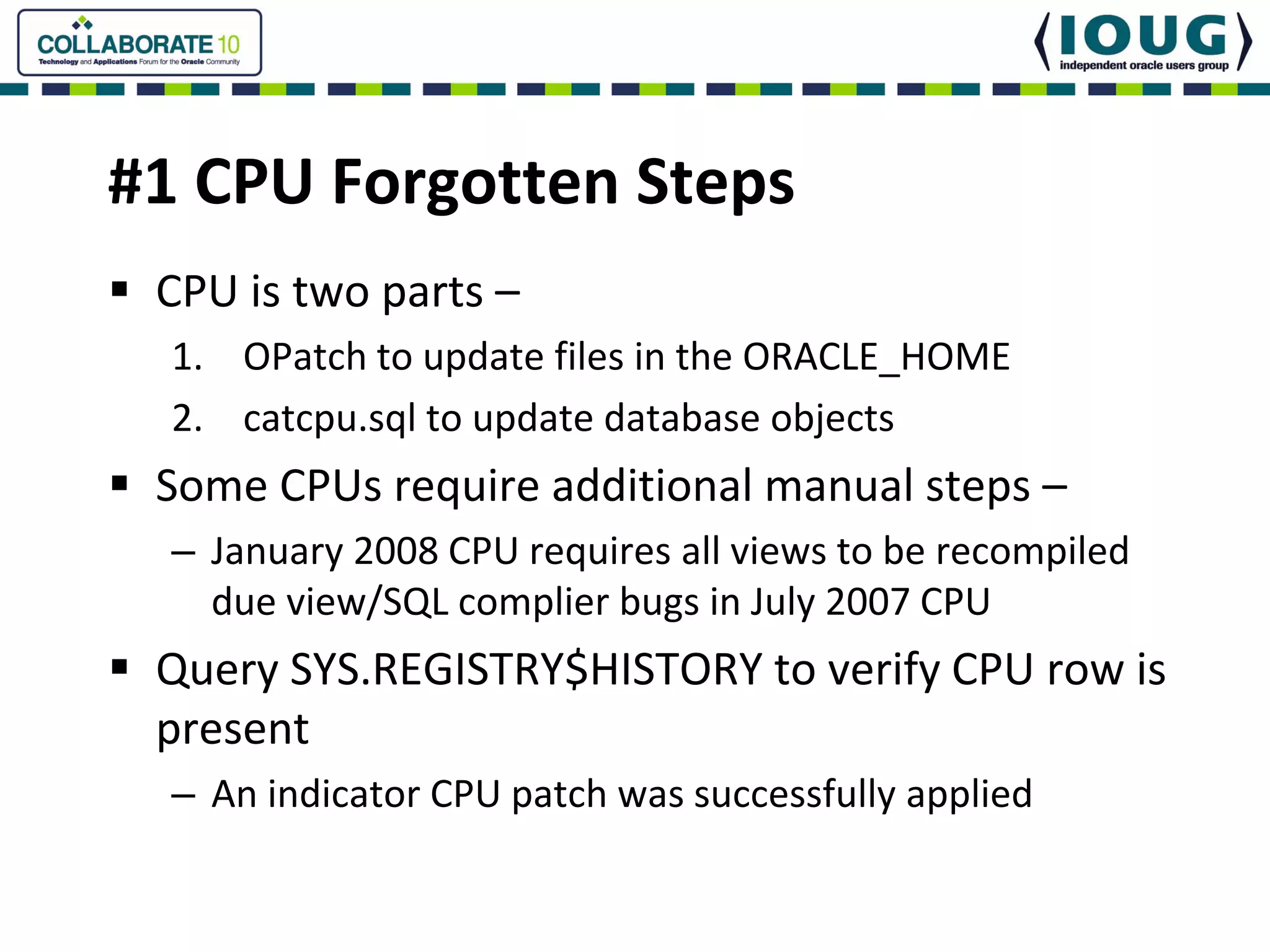
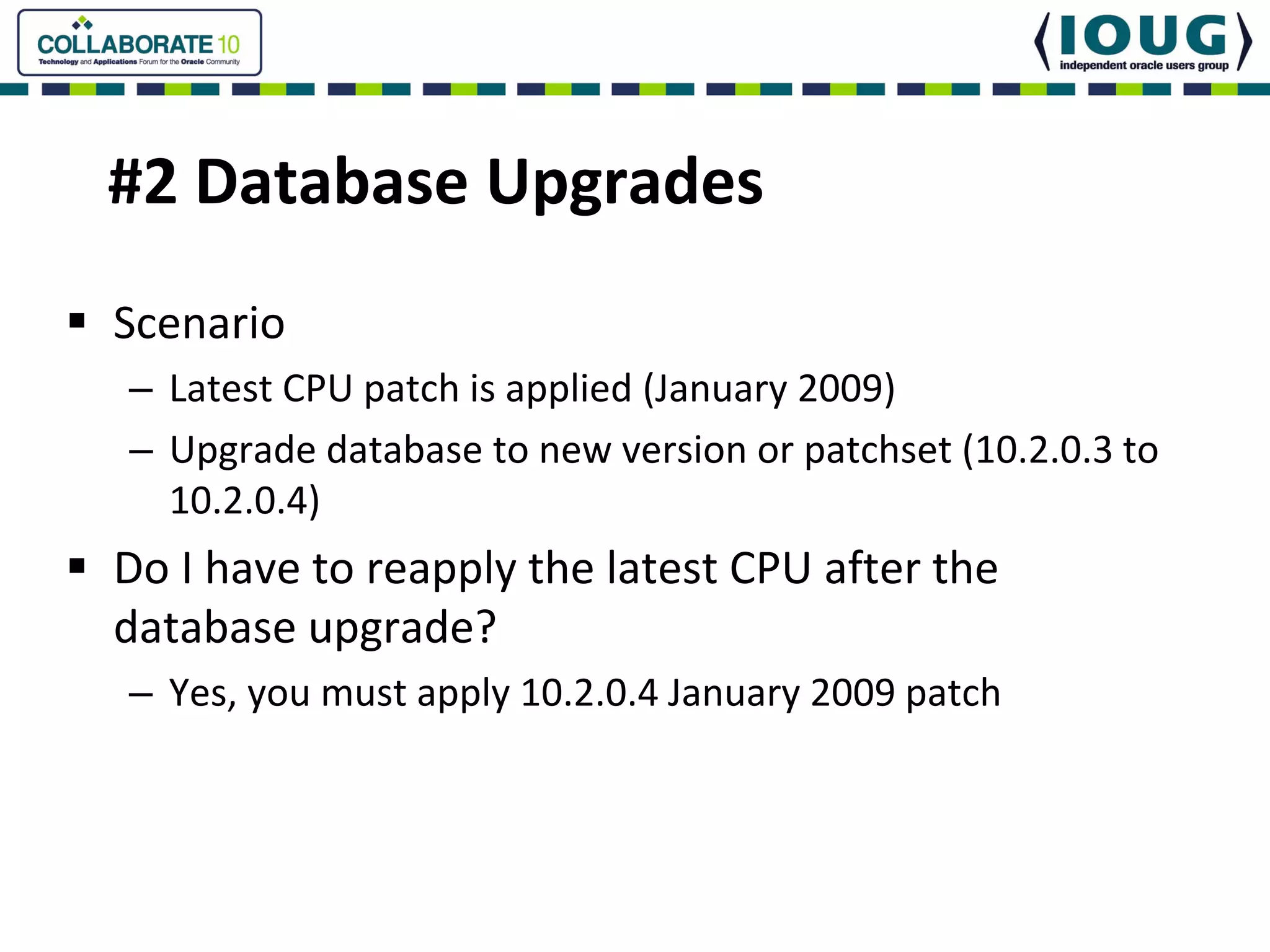
#1 CPU Forgotten Steps
 CPU is two parts –
  1. OPatch to update files in the ORACLE_HOME
  2. catcpu.sql to update database objects
 Some CPUs require additional manual steps –
  – January 2008 CPU requires all views to be recompiled 
    due view/SQL complier bugs in July 2007 CPU
 Query SYS.REGISTRY$HISTORY to verify CPU row is 
 present
  – An indicator CPU patch was successfully applied
#2 Database Upgrades
Scenario
– Latest CPU patch is applied (January 2009)
– Upgrade database to new version or patchset (10.2.0.3 to 
  10.2.0.4)
Do I have to reapply the latest CPU after the 
database upgrade?
– Yes, you must apply 10.2.0.4 January 2009 patch
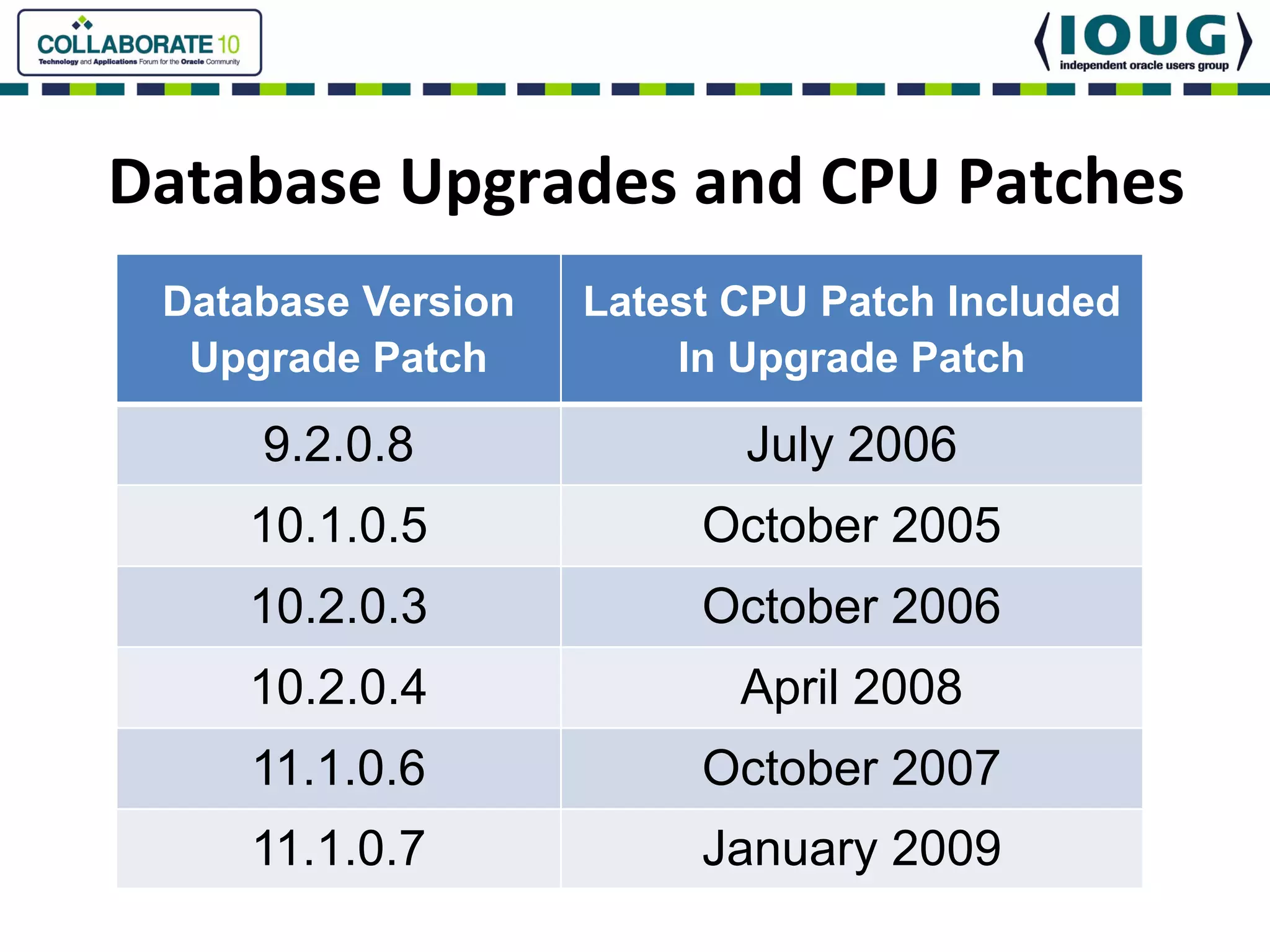
Database Upgrades and CPU Patches
 Database Version   Latest CPU Patch Included
  Upgrade Patch         In Upgrade Patch

     9.2.0.8               July 2006
    10.1.0.5             October 2005
    10.2.0.3             October 2006
    10.2.0.4               April 2008
     11.1.0.6            October 2007
     11.1.0.7            January 2009
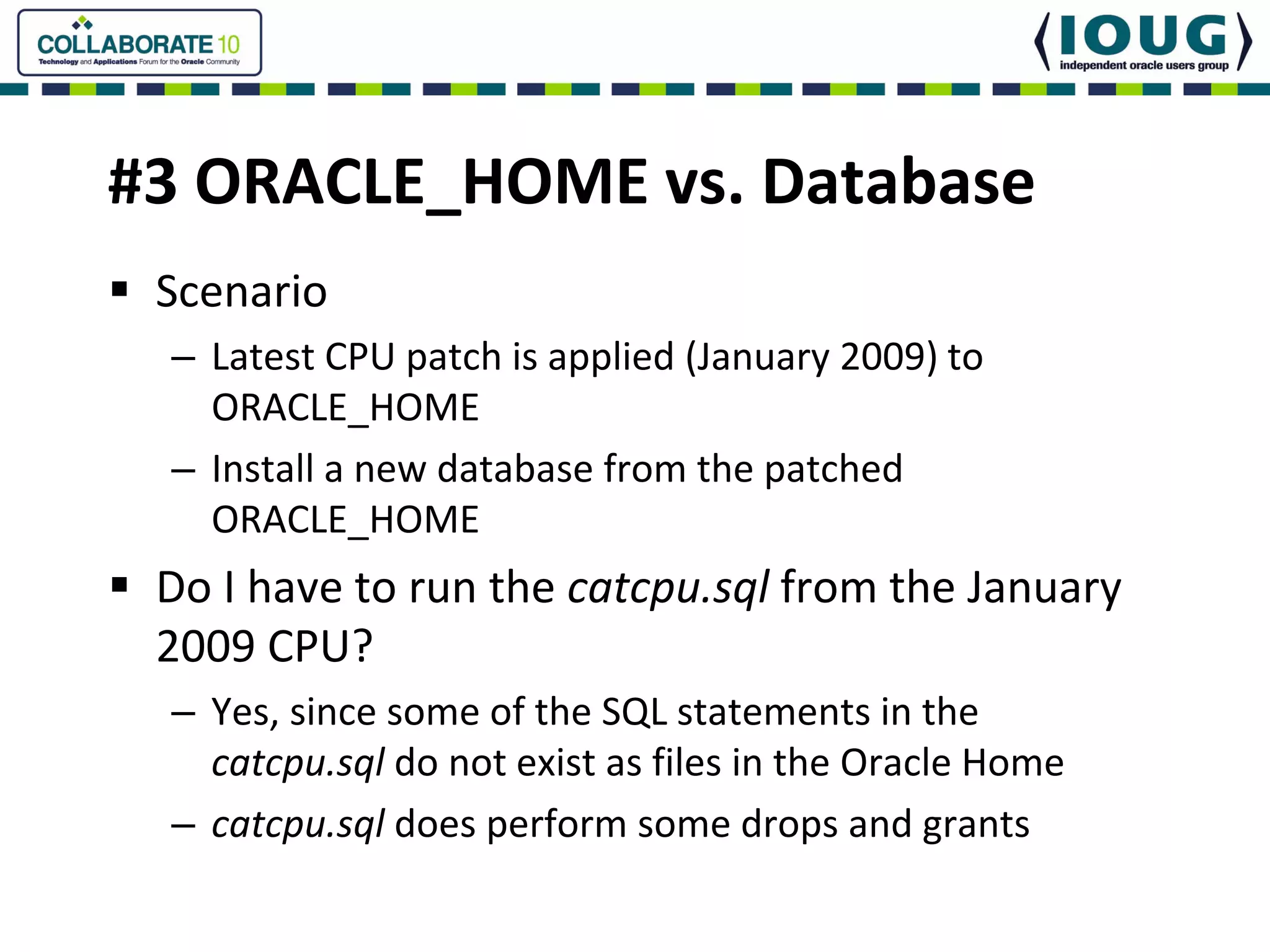
#3 ORACLE_HOME vs. Database
 Scenario
 – Latest CPU patch is applied (January 2009) to 
   ORACLE_HOME
 – Install a new database from the patched 
   ORACLE_HOME
 Do I have to run the catcpu.sql from the January 
 2009 CPU?
 – Yes, since some of the SQL statements in the 
   catcpu.sql do not exist as files in the Oracle Home
 – catcpu.sql does perform some drops and grants
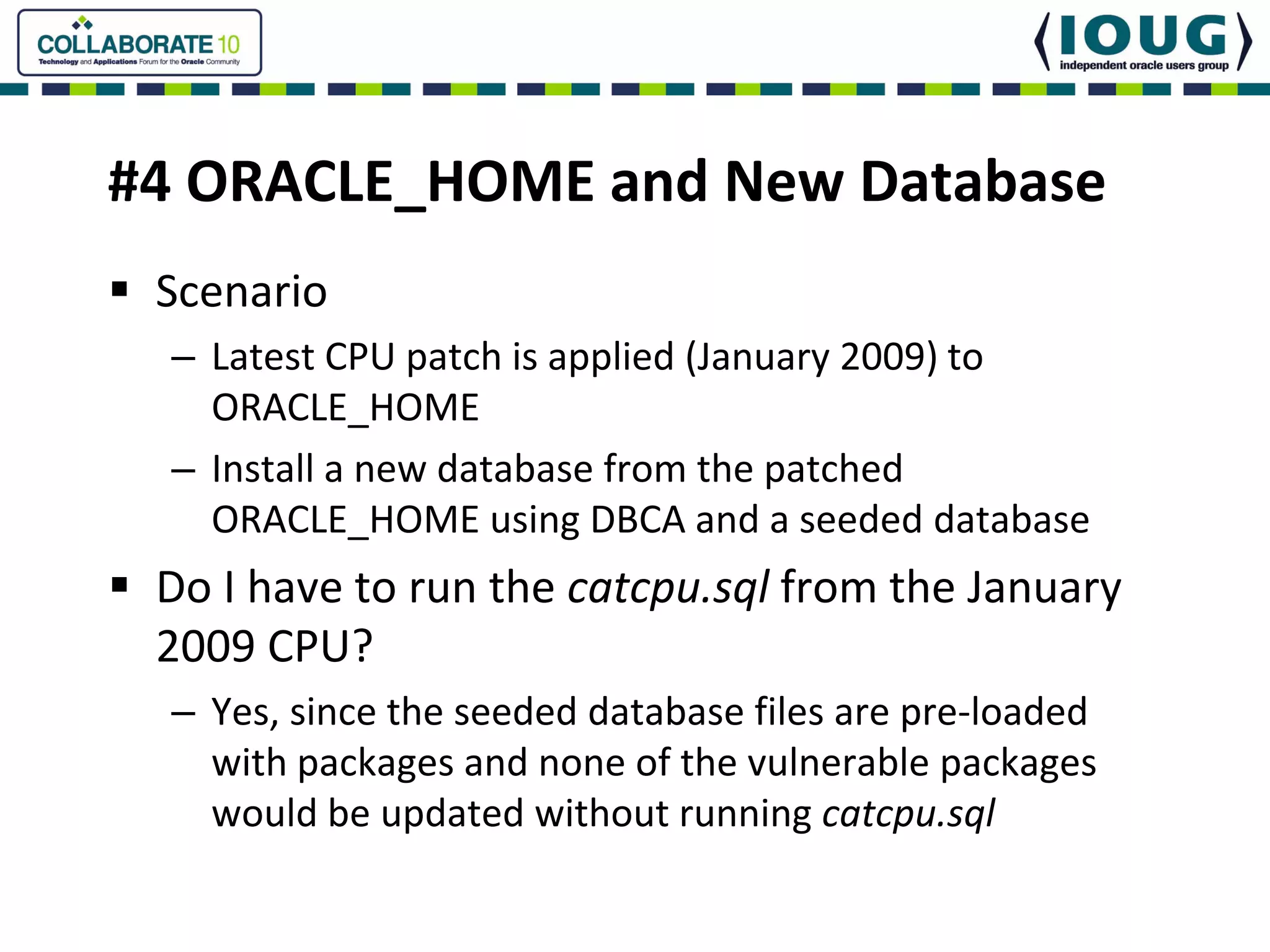
#4 ORACLE_HOME and New Database
 Scenario
 – Latest CPU patch is applied (January 2009) to 
   ORACLE_HOME
 – Install a new database from the patched 
   ORACLE_HOME using DBCA and a seeded database
 Do I have to run the catcpu.sql from the January 
 2009 CPU?
 – Yes, since the seeded database files are pre‐loaded 
   with packages and none of the vulnerable packages 
   would be updated without running catcpu.sql
References
  Oracle Critical Patch Update January 2010 Advisory, 12 January 2010, 
  http://www.oracle.com/technology/deploy/security/critical‐patch‐
  updates/cpujan2010.html
  Security Alerts and Critical Patch Updates ‐ Frequently Asked Questions", 
  30 July 2007, Oracle Metalink Note ID 360470.1
  Oracle Database Server and Networking Patches for Microsoft Platforms, 
  11 April 2010, Oracle Metalink Note ID 161549.1
  How can I see if a Critical Patch Update is installed on the database, 18 May 
  2009, Oracle Metalink Note ID 352783.1
  Critical Patch Update January 2010 Availability Information for Oracle 
  Database and Fusion Middleware Products, 12 January 2010, Oracle 
  Metalink Note ID 967472.1
  Integrigy Corporation, "An Introduction to SQL Injection Attacks for Oracle 
  Developers", http://www.integrigy.com/security‐
  resources/whitepapers/Integrigy_Oracle_SQL_Injection_Attacks.pdf, March 
  2007
Questions?
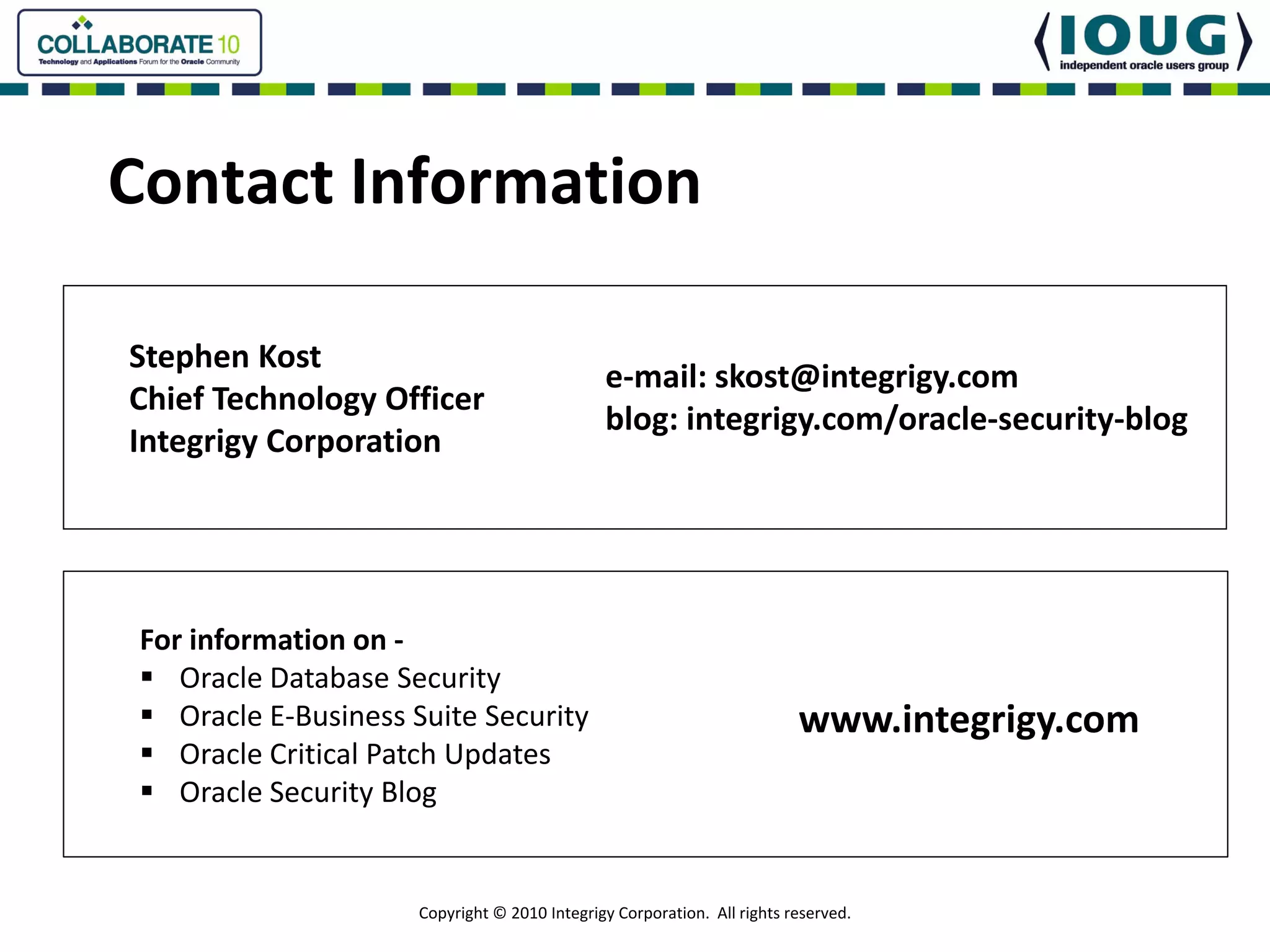
Contact Information

Stephen Kost
                                                e‐mail: skost@integrigy.com
Chief Technology Officer
                                                blog: integrigy.com/oracle‐security‐blog
Integrigy Corporation


 For information on ‐
    Oracle Database Security
    Oracle E‐Business Suite Security                                       www.integrigy.com
    Oracle Critical Patch Updates
    Oracle Security Blog


                      Copyright © 2010 Integrigy Corporation.  All rights reserved.

Ioug 2010 oracle critical patch updates unwrapped presentation