Basic Mechanism of
       Object-Oriented
Programming Language

                              2009-09-11 : Released
                              2009-09-14 : Fixed


       makoto kuwata <kwa@kuwata-lab.com>
               http://www.kuwata-lab.com/


       copyright© 2009 kuwata-lab.com all right reserved.
Purpose

✤   Describes basic mechanism of Object-Oriented
    Programming Language (OOPL)
    ✤   Not only Perl but also Python, Ruby, Java, ...

✤   You must be familiar with terms of Object-Oriented
    ✤   Class, Instance, Method, Override, Overload, ...


                                      copyright© 2009 kuwata-lab.com all right reserved.
Agenda

✤   Part 1. Basics about OOPL Mechanism
✤   Part 2. More about OOPL Mechanism
✤   Part 3. Case Study


                             copyright© 2009 kuwata-lab.com all right reserved.
Part 1.
Basics about OOPL Mechanism


                copyright© 2009 kuwata-lab.com all right reserved.
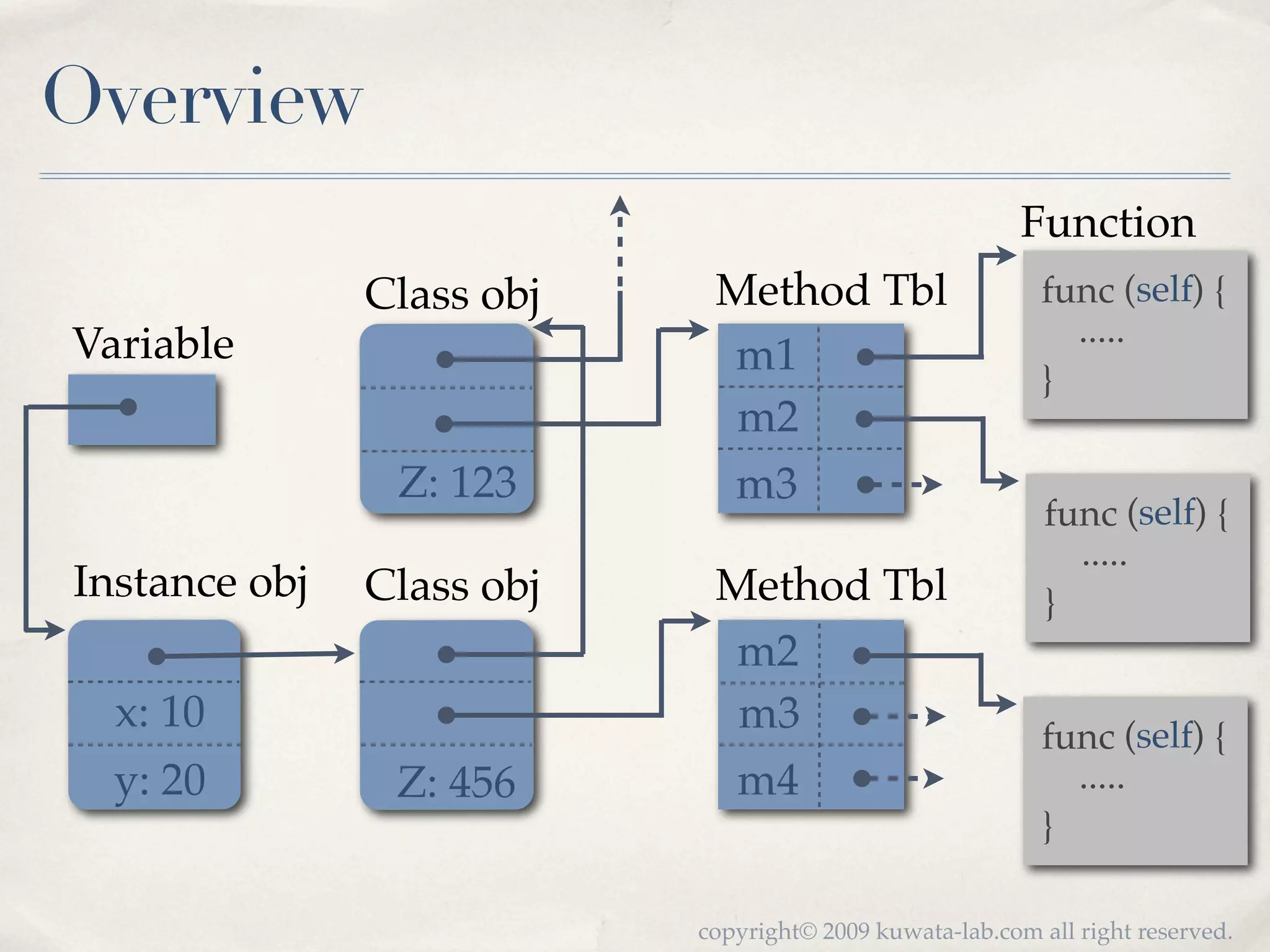
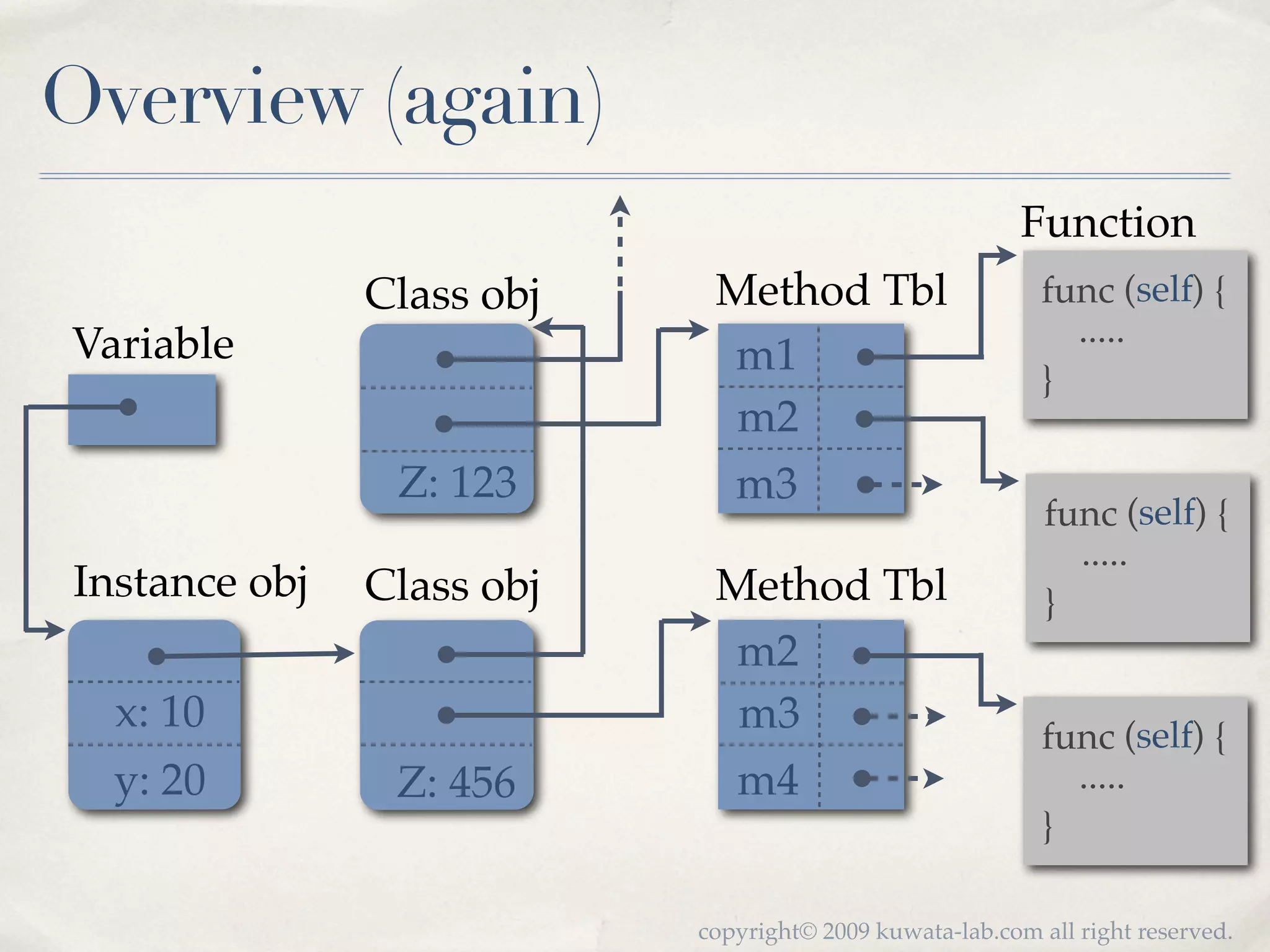
Overview
                                                         Function
               Class obj    Method Tbl                     func (self) {
Variable                                                     .....
                            m1                             }
                             m2
                Z: 123      m3
                                                           func (self) {
                                                             .....
Instance obj   Class obj    Method Tbl                     }
                             m2
  x: 10                      m3                            func (self) {
  y: 20         Z: 456       m4                              .....
                                                           }

                           copyright© 2009 kuwata-lab.com all right reserved.
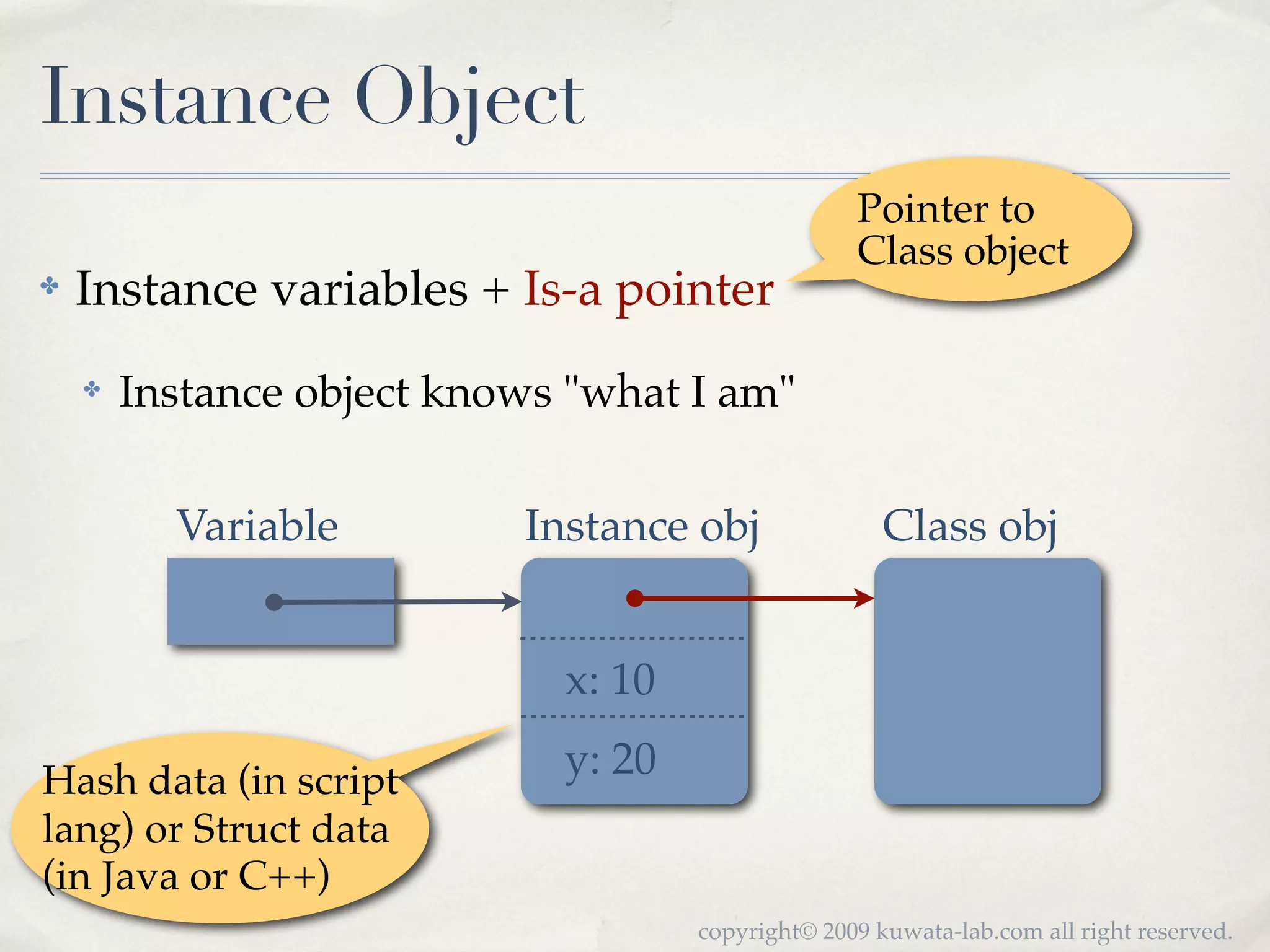
Instance Object
                                                   Pointer to
                                                   Class object
✤   Instance variables + Is-a pointer
    ✤   Instance object knows "what I am"


          Variable         Instance obj               Class obj


                             x: 10

Hash data (in script         y: 20
lang) or Struct data
(in Java or C++)
                                     copyright© 2009 kuwata-lab.com all right reserved.
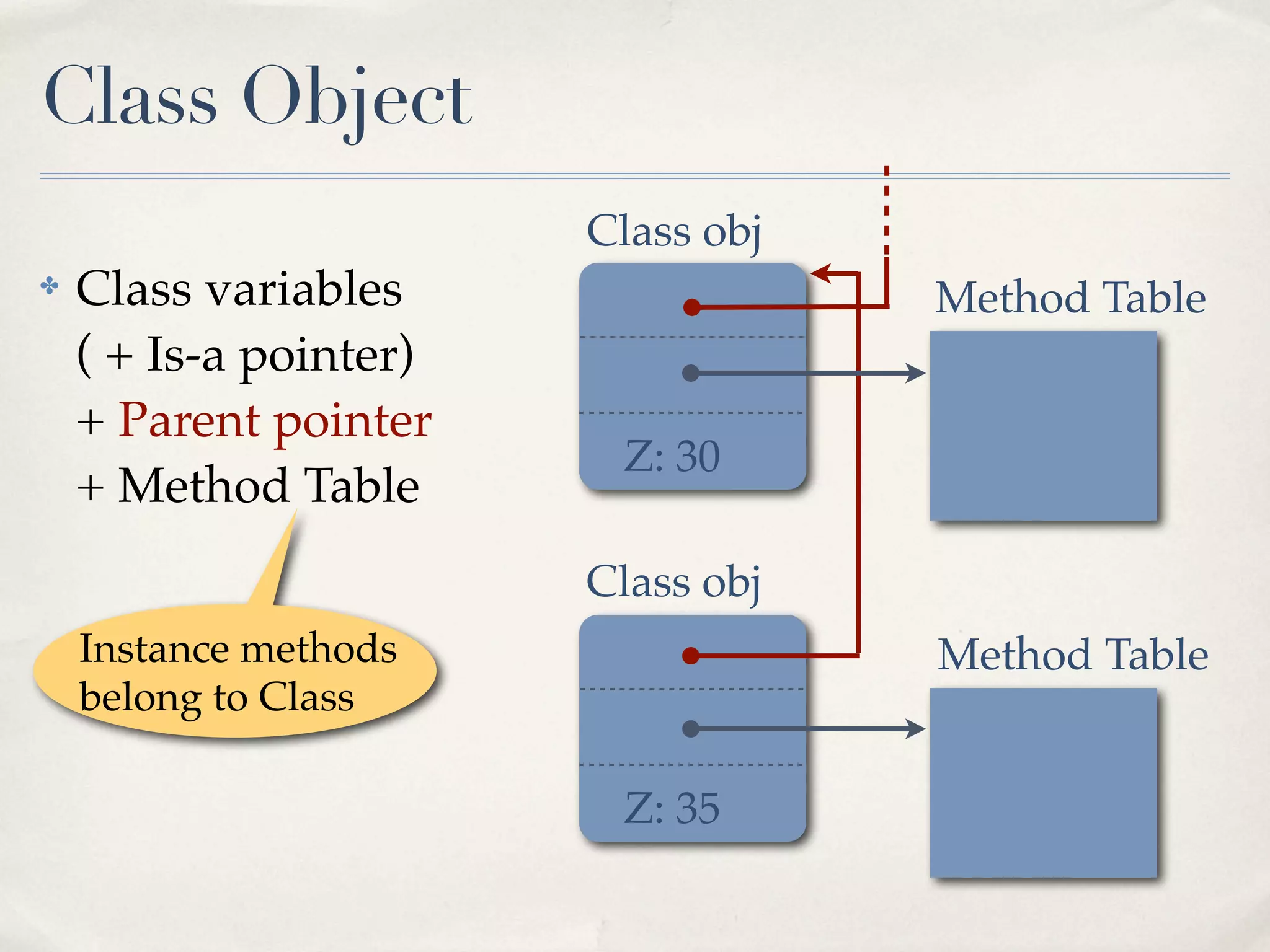
Class Object
                        Class obj
✤   Class variables                 Method Table
    ( + Is-a pointer)
    + Parent pointer
                         Z: 30
    + Method Table
                        Class obj
    Instance methods                Method Table
    belong to Class

                         Z: 35
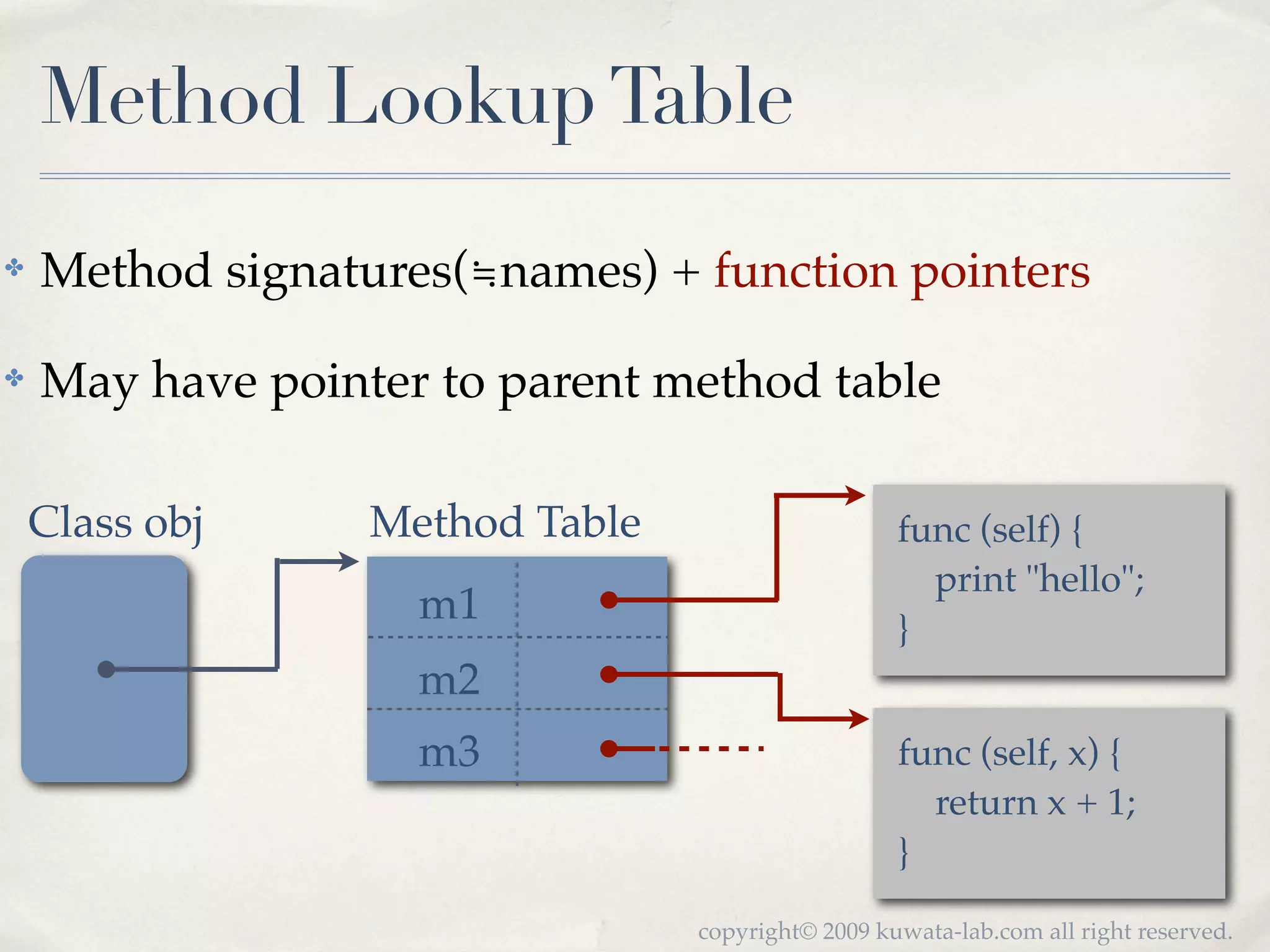
Method Lookup Table
✤   Method signatures(≒names) + function pointers

✤   May have pointer to parent method table

    Class obj     Method Table                     func (self) {
                                                     print "hello";
                    m1                             }
                    m2
                    m3                             func (self, x) {
                                                     return x + 1;
                                                   }

                                 copyright© 2009 kuwata-lab.com all right reserved.
Method Function

✤   Instance object is passed as hidden argument
                    OOPL                                          non-OOPL
    class Point {                    def move(self, x, y) {
      var x=0, y=0;                    self['x'] = x;
      def move(x, y) {                 self['y'] = y;
        this.x = x;                  }
        this.y = y;
                           almost
      }                    equiv. p = {isa: Point, x: 0, y: 0};
    }                                func = lookup(p, 'move');
    p = new Point();                 func(p, 10, 20);
    p.move(10, 20);
                                    copyright© 2009 kuwata-lab.com all right reserved.
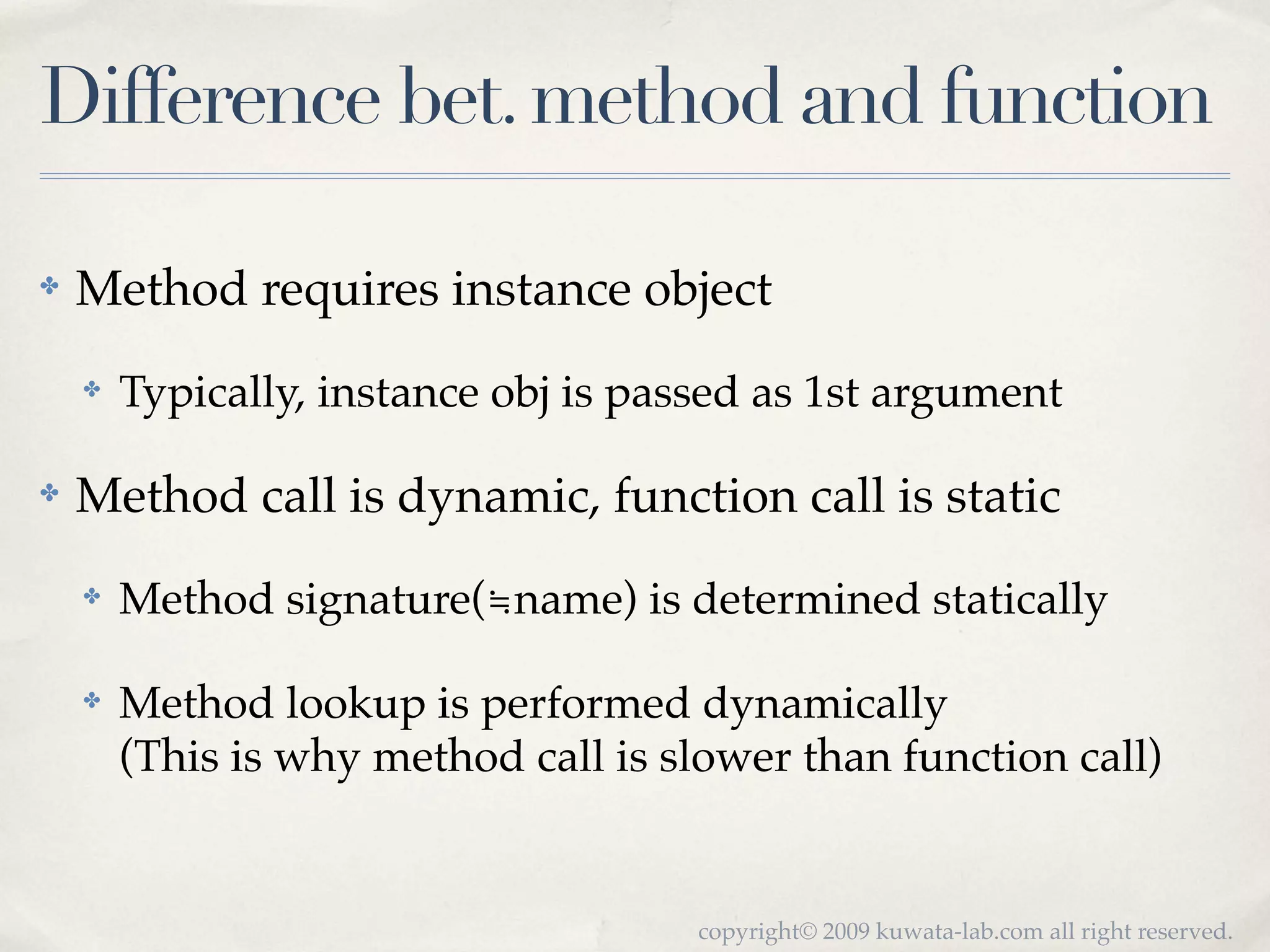
Difference bet. method and function

✤   Method requires instance object
    ✤   Typically, instance obj is passed as 1st argument

✤   Method call is dynamic, function call is static
    ✤   Method signature(≒name) is determined statically

    ✤   Method lookup is performed dynamically
        (This is why method call is slower than function call)


                                      copyright© 2009 kuwata-lab.com all right reserved.
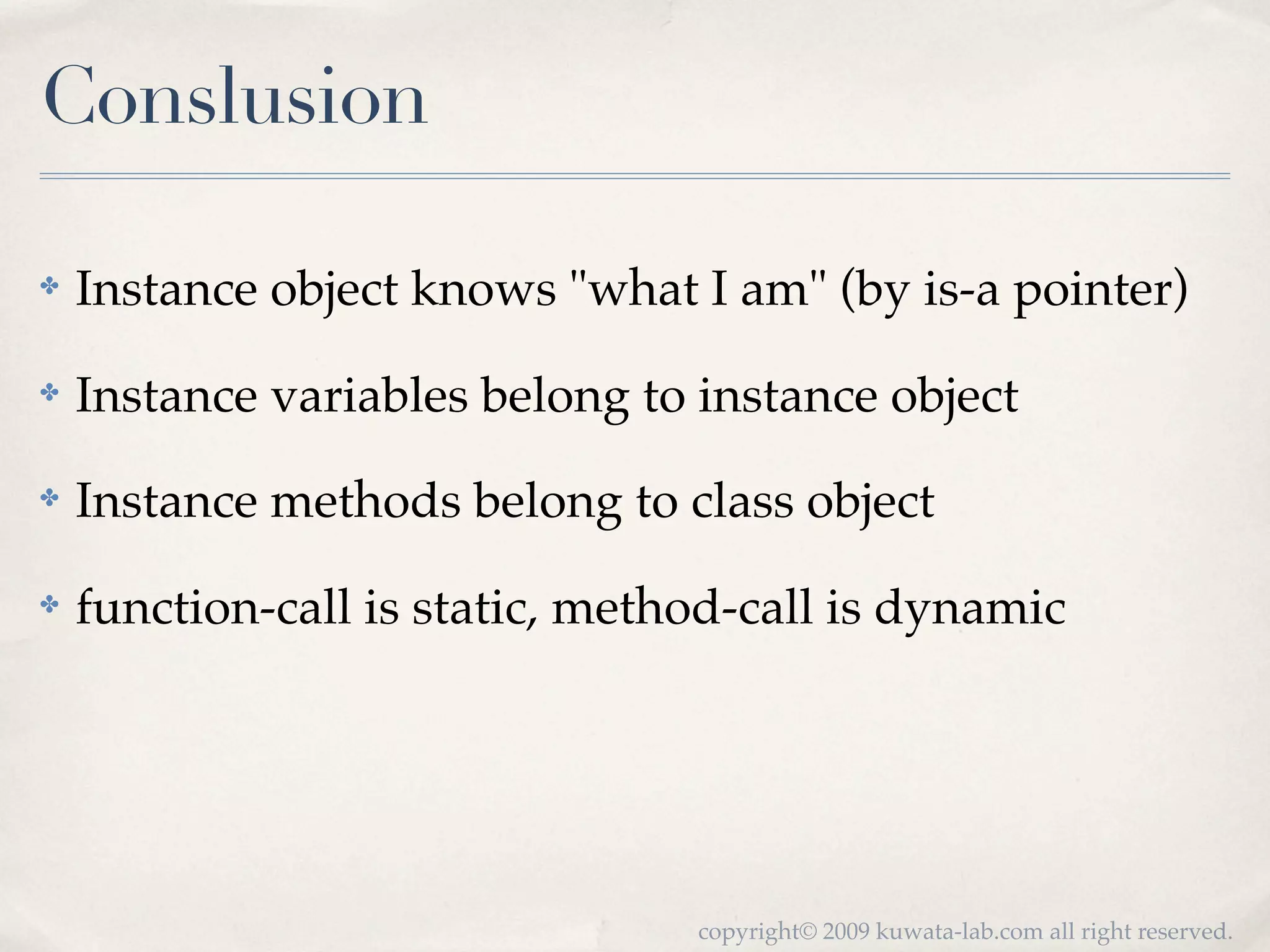
Overview (again)
                                                         Function
               Class obj    Method Tbl                     func (self) {
Variable                                                     .....
                            m1                             }
                             m2
                Z: 123      m3
                                                           func (self) {
                                                             .....
Instance obj   Class obj    Method Tbl                     }
                             m2
  x: 10                      m3                            func (self) {
  y: 20         Z: 456       m4                              .....
                                                           }

                           copyright© 2009 kuwata-lab.com all right reserved.
Conslusion

✤   Instance object knows "what I am" (by is-a pointer)
✤   Instance variables belong to instance object
✤   Instance methods belong to class object
✤   function-call is static, method-call is dynamic


                                 copyright© 2009 kuwata-lab.com all right reserved.
Part 2.
More about OOPL Mechanism


               copyright© 2009 kuwata-lab.com all right reserved.
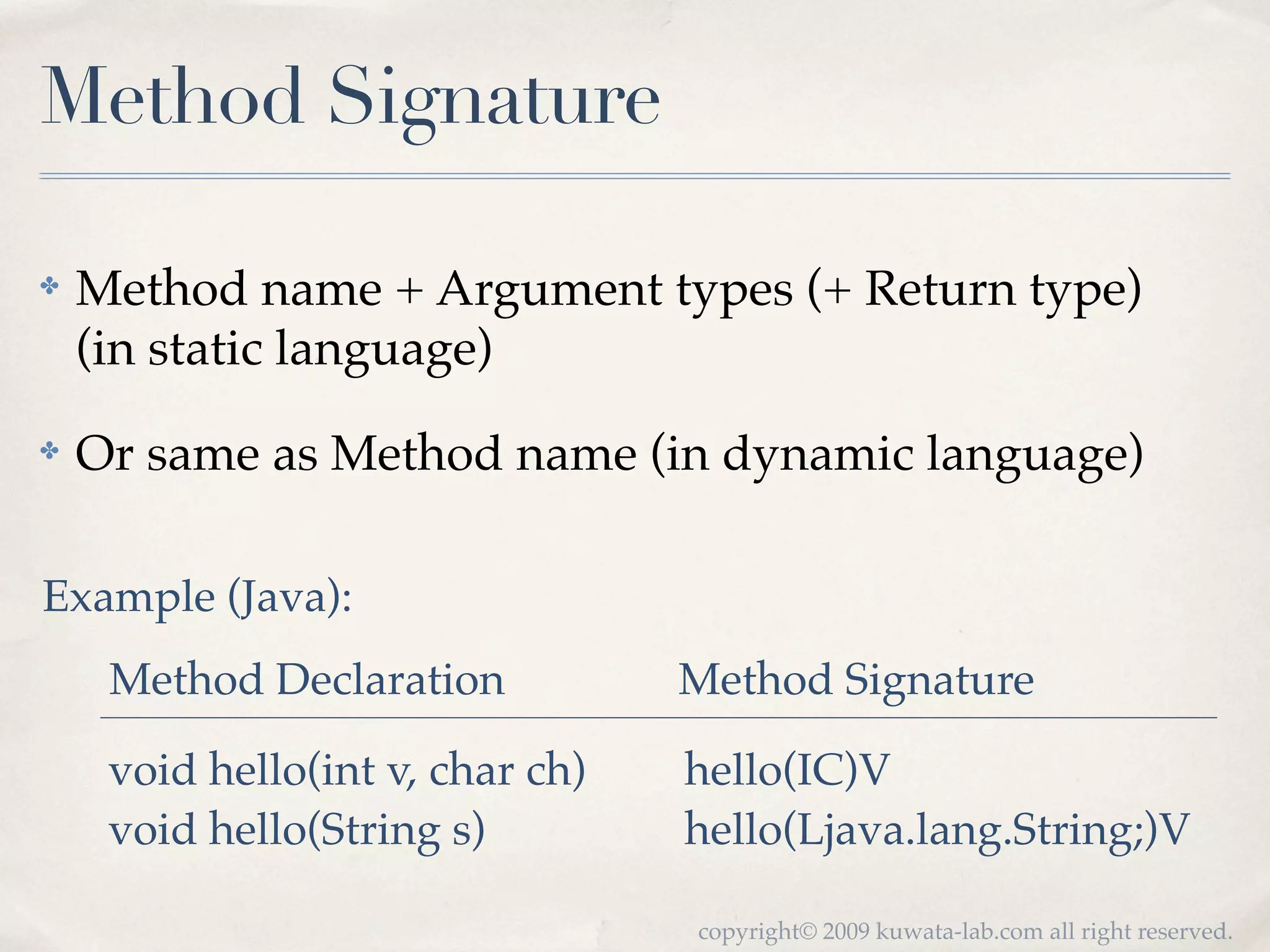
Method Signature

✤   Method name + Argument types (+ Return type)
    (in static language)
✤   Or same as Method name (in dynamic language)

Example (Java):
     Method Declaration           Method Signature

     void hello(int v, char ch)   hello(IC)V
     void hello(String s)         hello(Ljava.lang.String;)V

                                  copyright© 2009 kuwata-lab.com all right reserved.
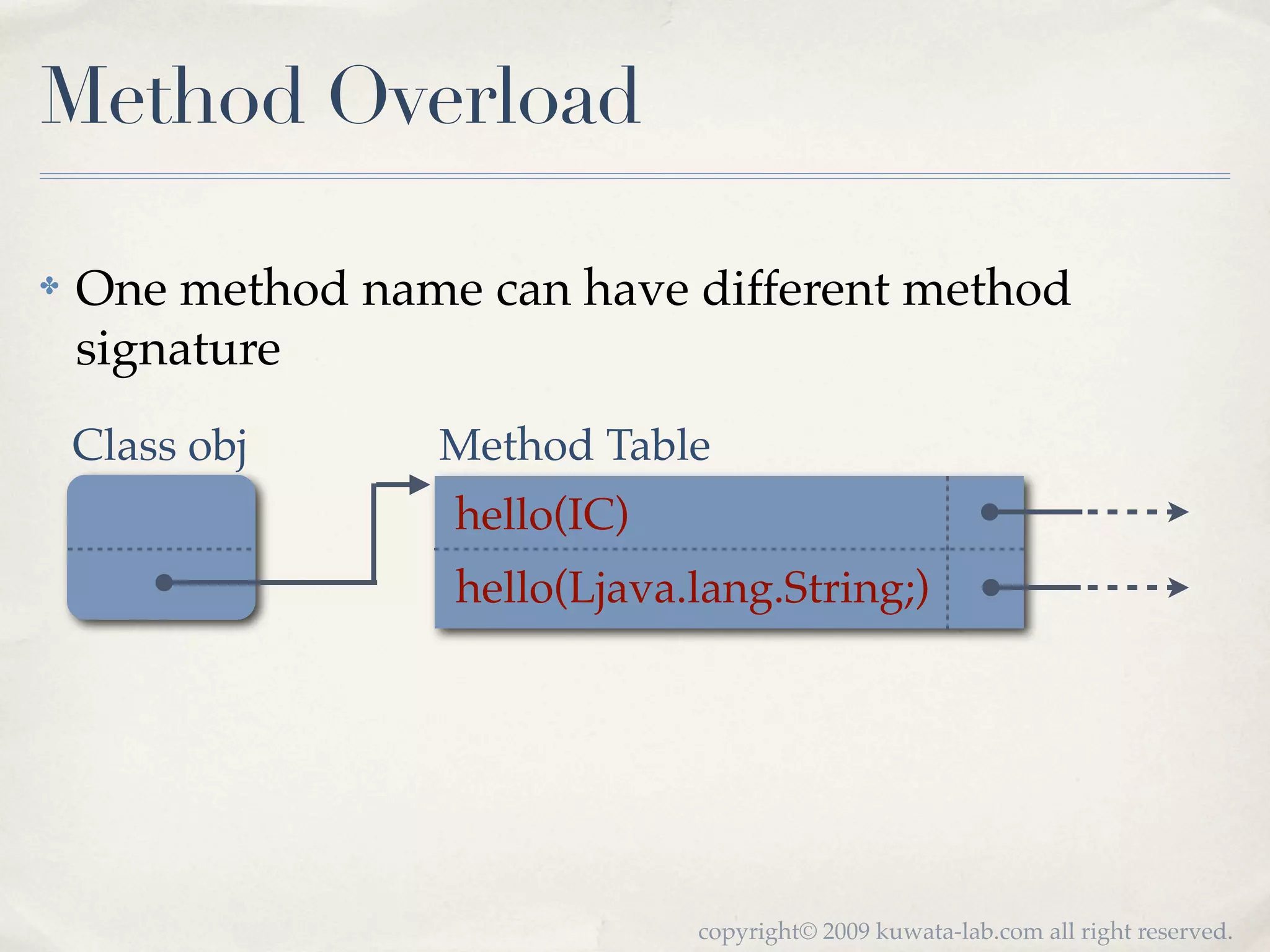
Method Overload

✤   One method name can have different method
    signature
    Class obj     Method Table
                   hello(IC)
                   hello(Ljava.lang.String;)


                               copyright© 2009 kuwata-lab.com all right reserved.
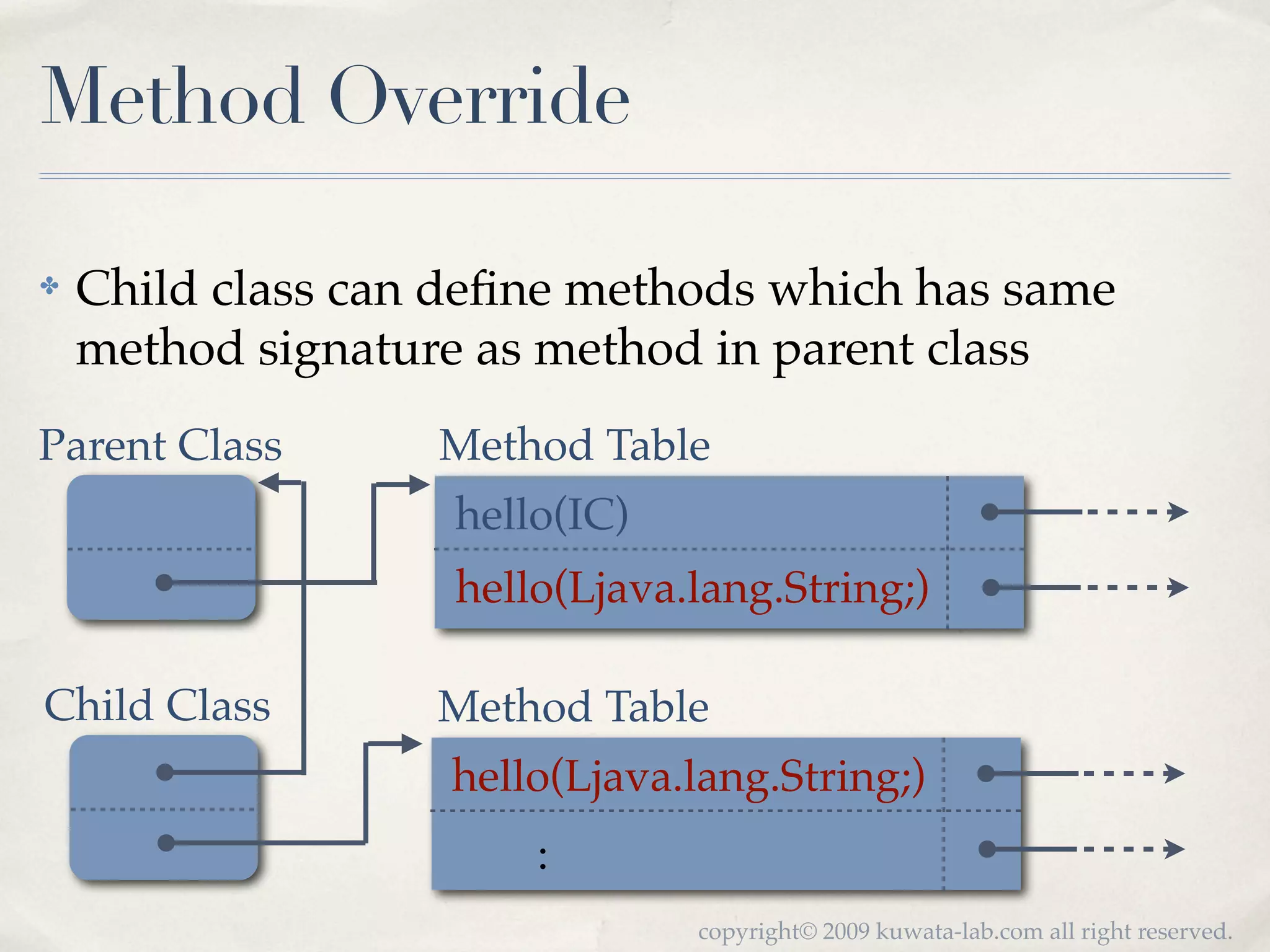
Method Override

✤   Child class can define methods which has same
    method signature as method in parent class
Parent Class       Method Table
                    hello(IC)
                    hello(Ljava.lang.String;)

Child Class        Method Table
                   hello(Ljava.lang.String;)
                        :
                                copyright© 2009 kuwata-lab.com all right reserved.
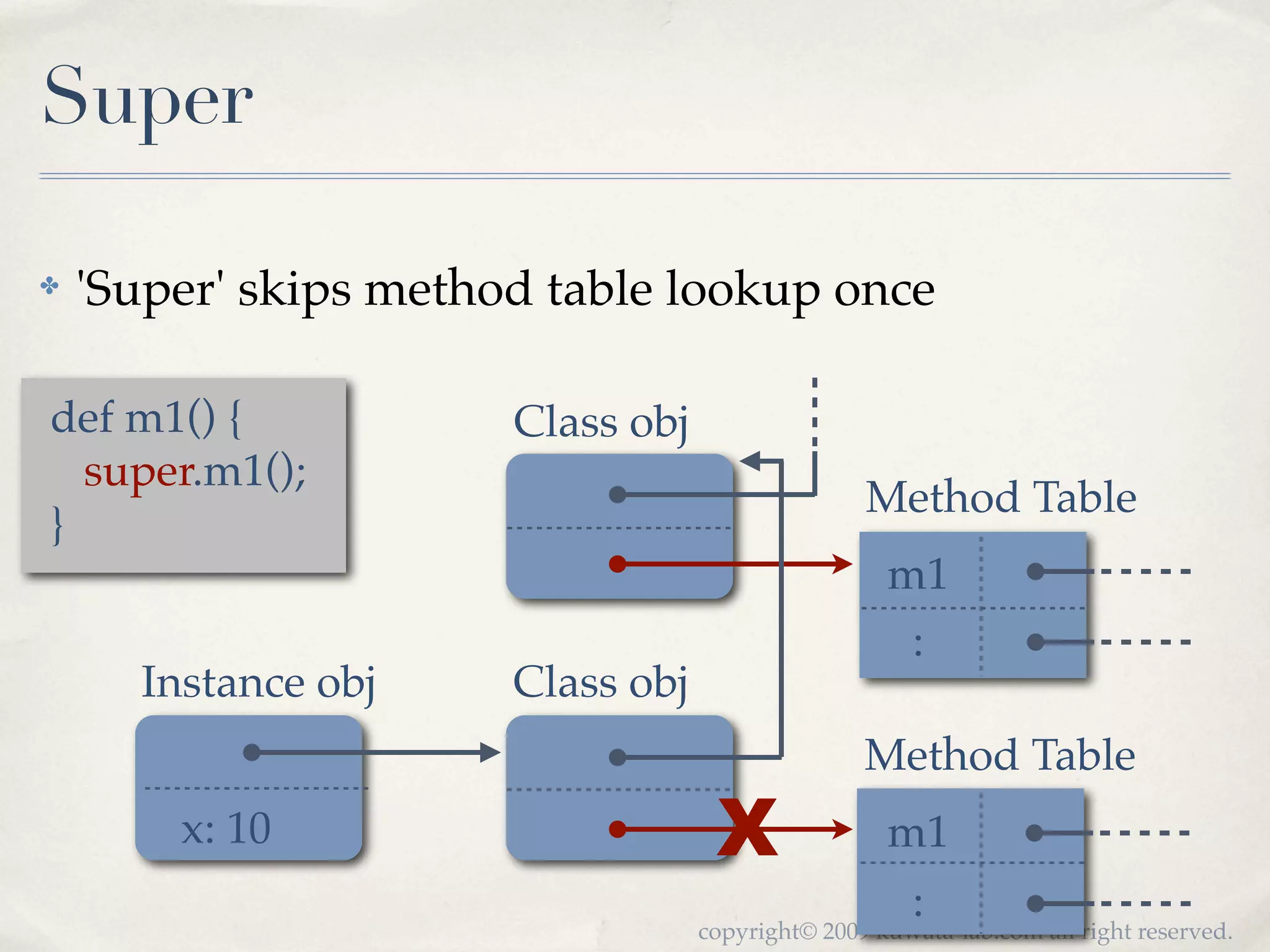
Super

✤   'Super' skips method table lookup once

def m1() {             Class obj
  super.m1();
                                                  Method Table
}
                                                    m1
                                                     :
      Instance obj     Class obj
                                                  Method Table
        x: 10                       X               m1
                                                       :
                                   copyright© 2009 kuwata-lab.com all right reserved.
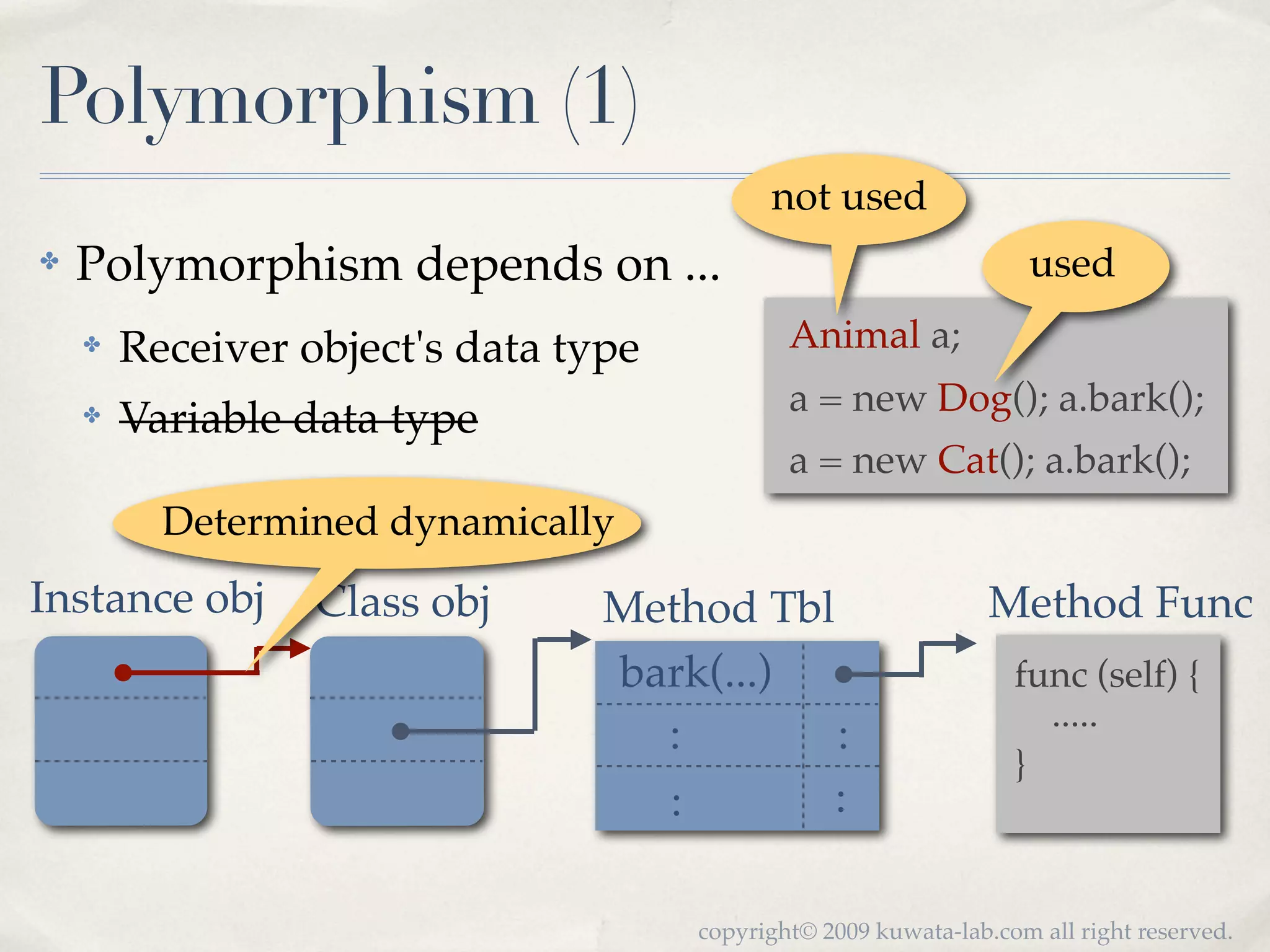
Polymorphism (1)
                                            not used
✤   Polymorphism depends on ...                                     used
    ✤   Receiver object's data type           Animal a;
                                              a = new Dog(); a.bark();
    ✤   Variable data type
                                              a = new Cat(); a.bark();
          Determined dynamically
Instance obj      Class obj      Method Tbl                      Method Func
                                 bark(...)                         func (self) {
                                                                     .....
                                   :        :
                                                                   }
                                   :        :

                                      copyright© 2009 kuwata-lab.com all right reserved.
Polymorphism (2)
✤   Polymorphism depends on ...
                                                 void bark(Object o) { ... }
    ✤   Data type of formal args
                                                 a.bark("Wee!");
    ✤   Data type of actual args

                                              Determined statically

Instance obj      Class obj        Method Tbl                     Method Func
                                   bark(...)                        func (self) {
                                                                      .....
                                     :        :
                                                                    }
                                     :        :

                                       copyright© 2009 kuwata-lab.com all right reserved.
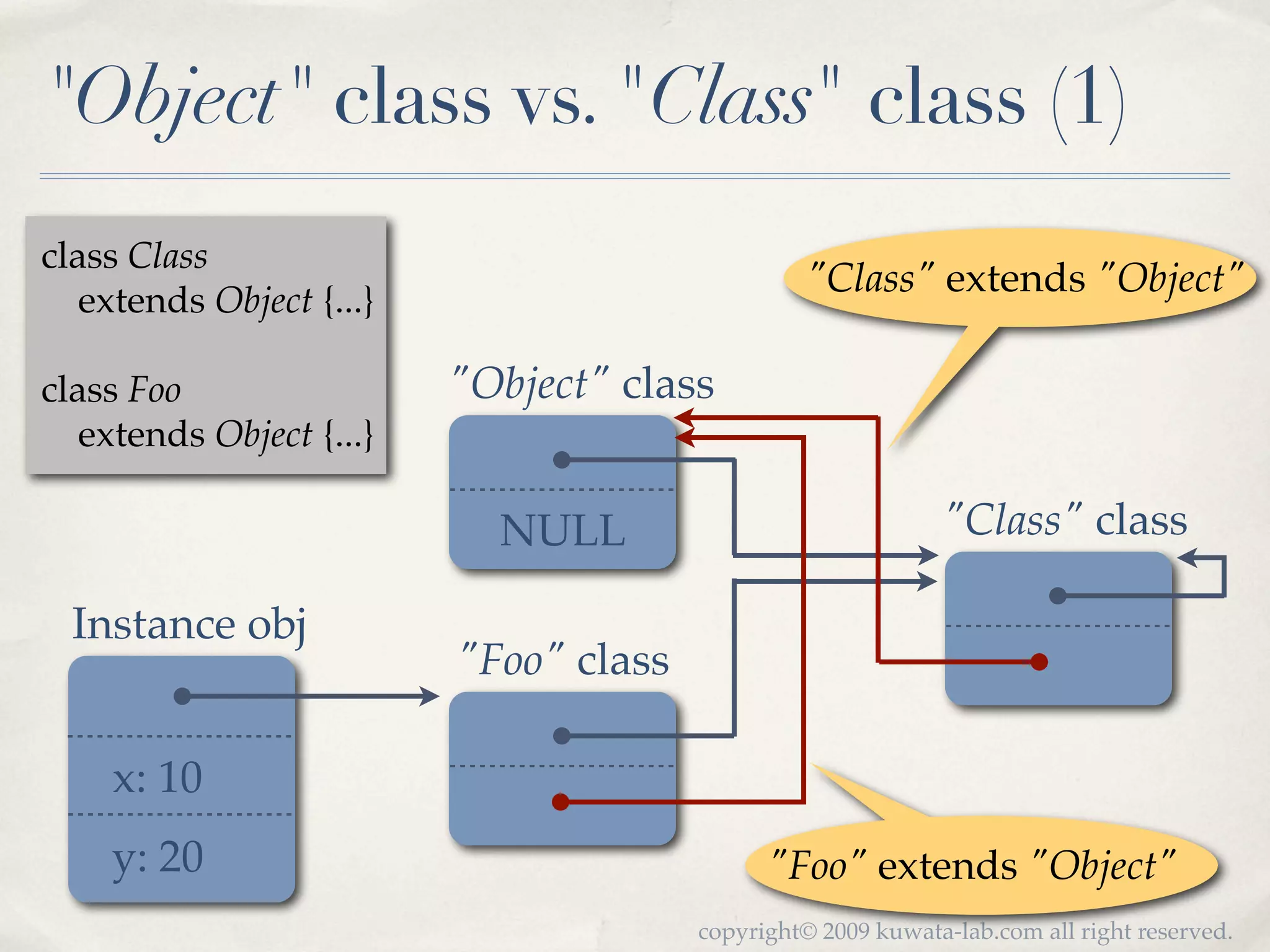
"Object" class vs. "Class" class (1)
class Class
                                                  "Class" extends "Object"
   extends Object {...}

class Foo                 "Object" class
   extends Object {...}

                            NULL                              "Class" class

  Instance obj
                          "Foo" class

    x: 10
    y: 20                                     "Foo" extends "Object"
                                        copyright© 2009 kuwata-lab.com all right reserved.
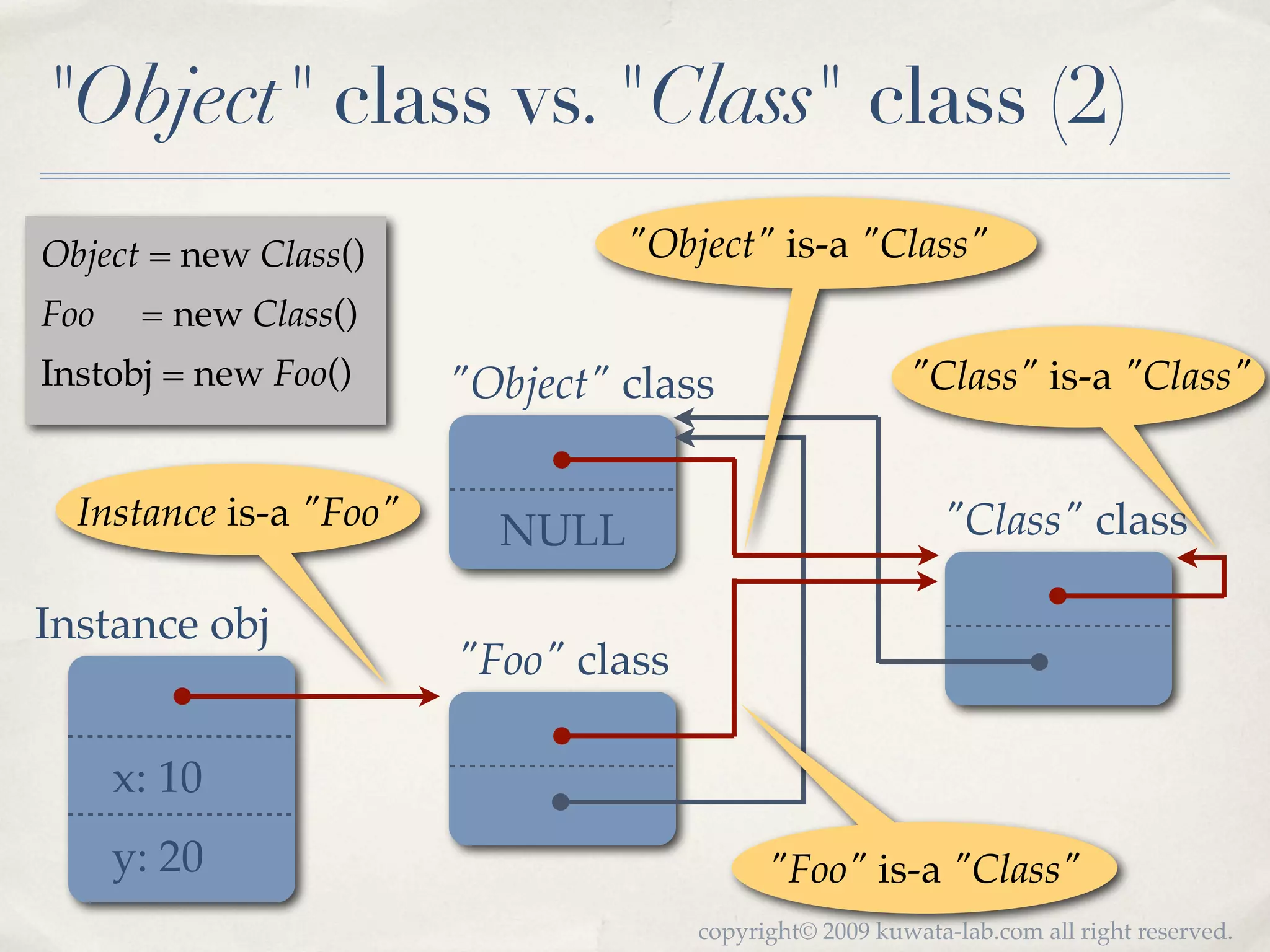
"Object" class vs. "Class" class (2)
Object = new Class()             "Object" is-a "Class"
Foo    = new Class()
Instobj = new Foo()     "Object" class                   "Class" is-a "Class"


  Instance is-a "Foo"     NULL                              "Class" class

Instance obj
                        "Foo" class

      x: 10
      y: 20                                 "Foo" is-a "Class"
                                      copyright© 2009 kuwata-lab.com all right reserved.
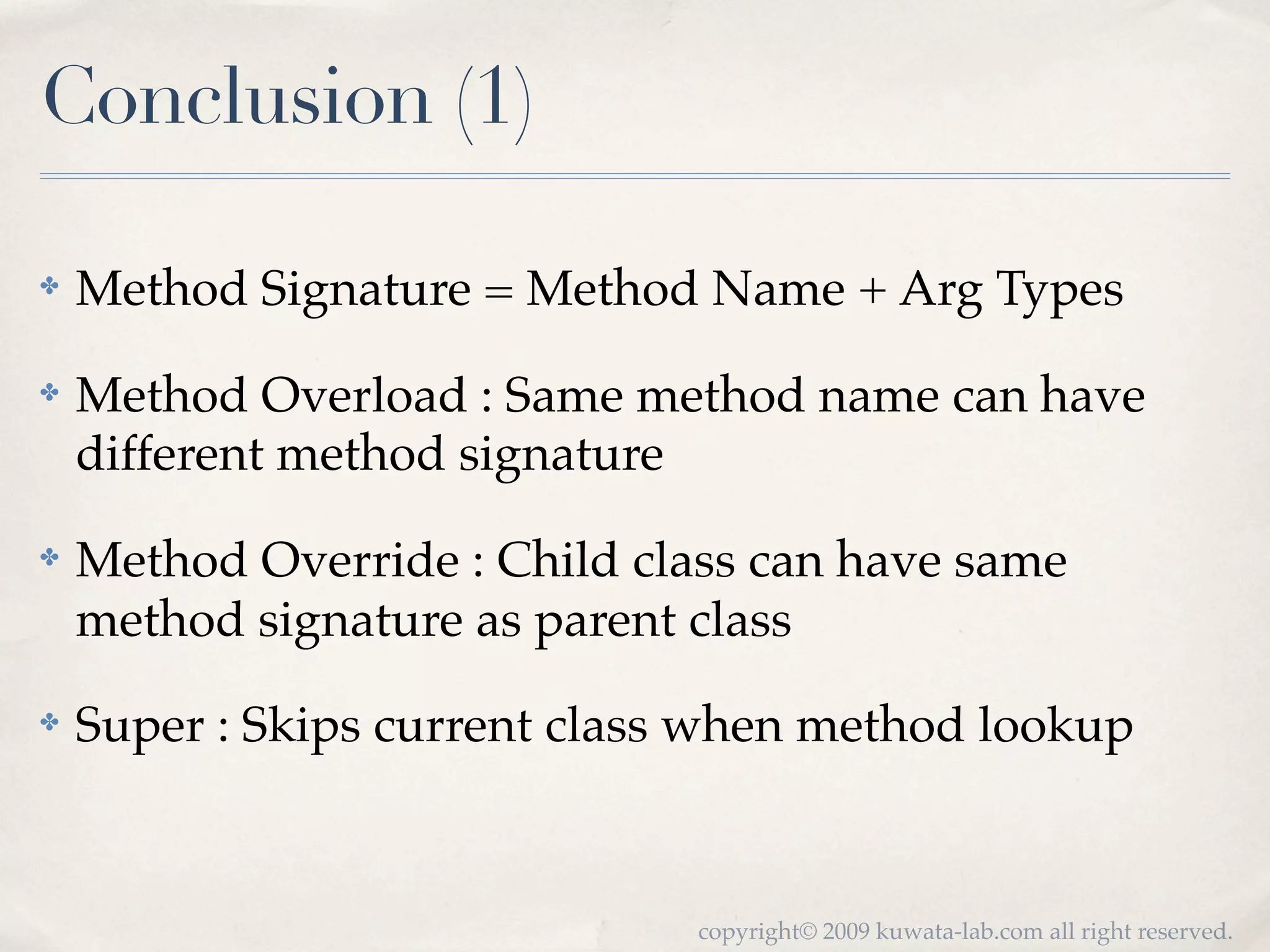
Conclusion (1)

✤   Method Signature = Method Name + Arg Types
✤   Method Overload : Same method name can have
    different method signature
✤   Method Override : Child class can have same
    method signature as parent class
✤   Super : Skips current class when method lookup


                               copyright© 2009 kuwata-lab.com all right reserved.
Conclusion (2)

✤   Polymorphism
    ✤   Depends on Receiver's data type, Method Name, and
        Temporary Args' data type

    ✤   Not depends on Variable data type and Actual Args'
        data type

✤   Relation between "Object" class and "Class" class is
    complicated


                                    copyright© 2009 kuwata-lab.com all right reserved.
Part 3.
Case Study


             copyright© 2009 kuwata-lab.com all right reserved.
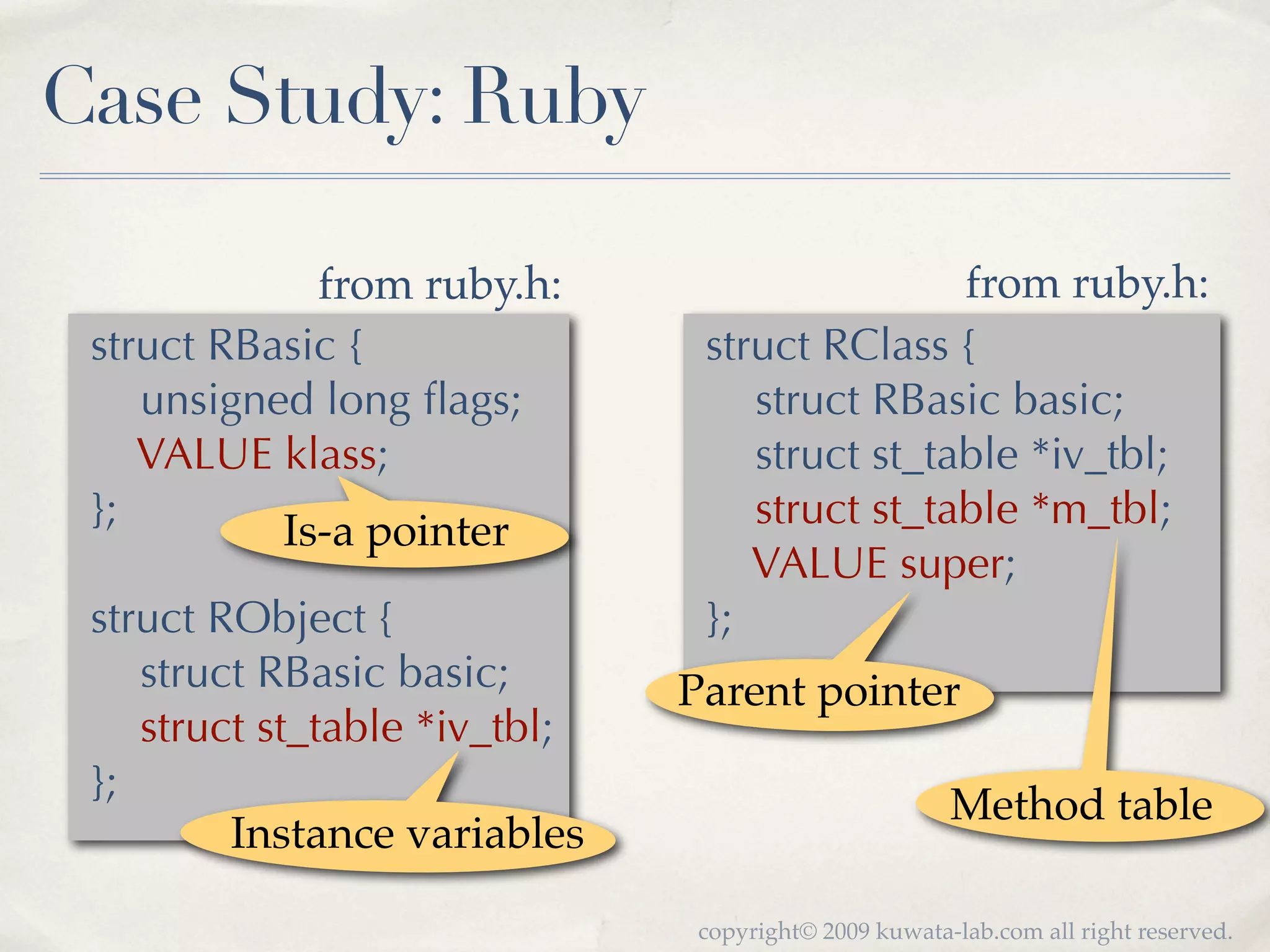
Case Study: Ruby

             from ruby.h:                      from ruby.h:
 struct RBasic {                struct RClass {
    unsigned long flags;            struct RBasic basic;
    VALUE klass;                   struct st_table *iv_tbl;
 };                                struct st_table *m_tbl;
           Is-a pointer
                                   VALUE super;
 struct RObject {               };
    struct RBasic basic;       Parent pointer
    struct st_table *iv_tbl;
 };
                                                       Method table
         Instance variables

                                copyright© 2009 kuwata-lab.com all right reserved.
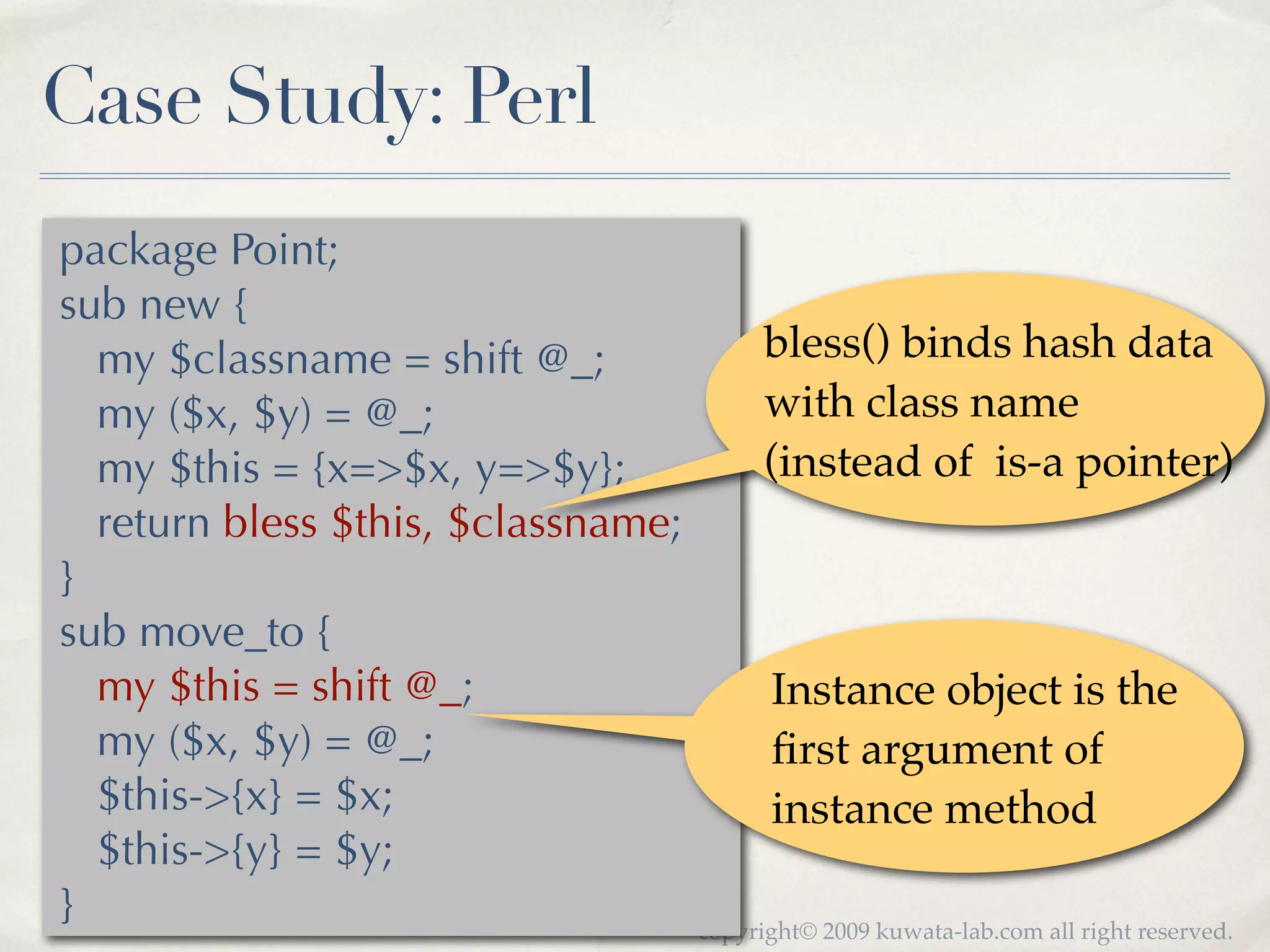
Case Study: Perl
package Point;
sub new {
  my $classname = shift @_;               bless() binds hash data
  my ($x, $y) = @_;                       with class name
  my $this = {x=>$x, y=>$y};              (instead of is-a pointer)
  return bless $this, $classname;
}
sub move_to {
  my $this = shift @_;                    Instance object is the
  my ($x, $y) = @_;                       first argument of
  $this->{x} = $x;                        instance method
  $this->{y} = $y;
}                                   copyright© 2009 kuwata-lab.com all right reserved.
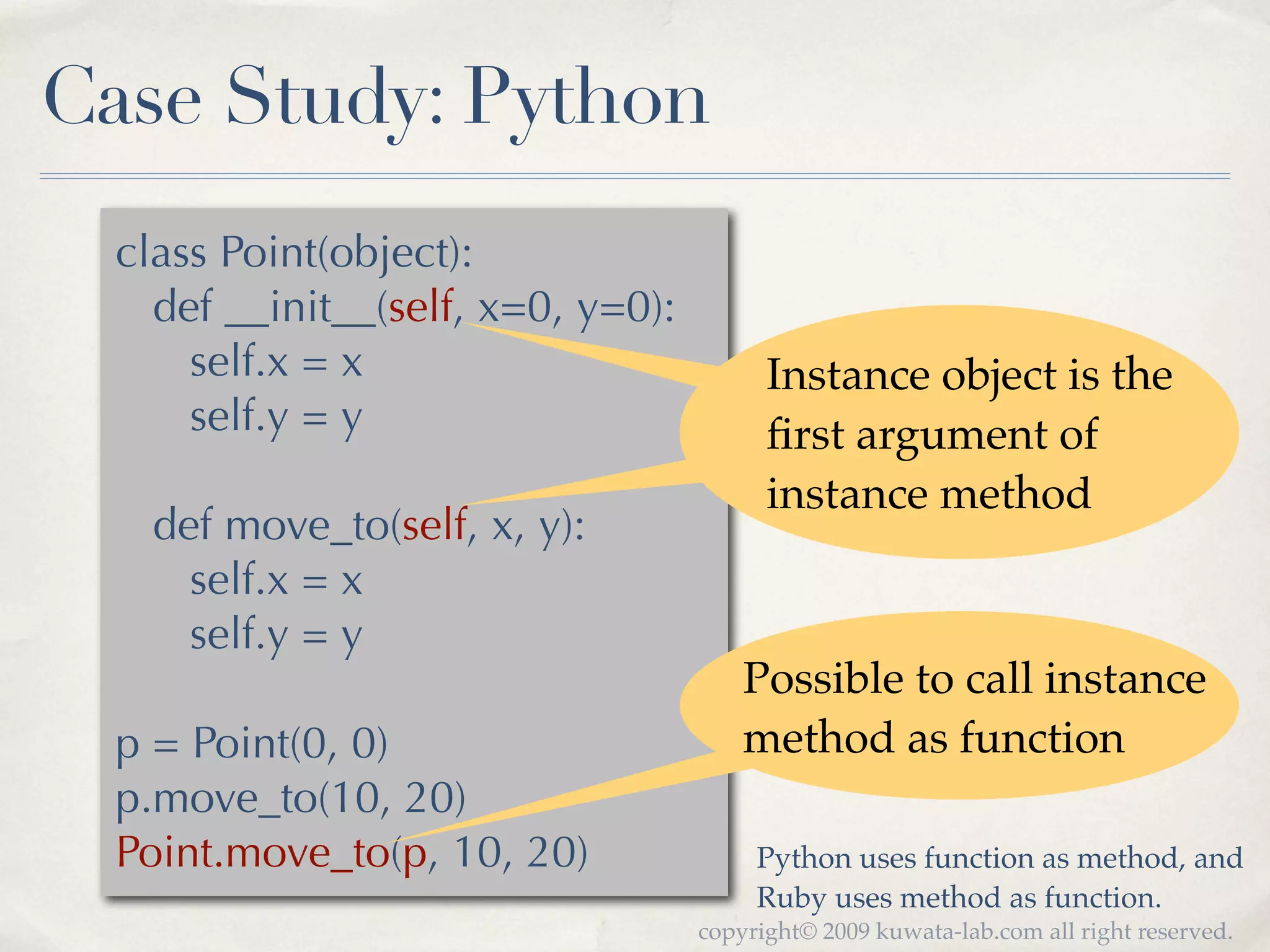
Case Study: Python
  class Point(object):
    def __init__(self, x=0, y=0):
      self.x = x                          Instance object is the
      self.y = y                          first argument of
                                          instance method
    def move_to(self, x, y):
      self.x = x
      self.y = y
                                        Possible to call instance
  p = Point(0, 0)                       method as function
  p.move_to(10, 20)
  Point.move_to(p, 10, 20)               Python uses function as method, and
                                         Ruby uses method as function.
                                    copyright© 2009 kuwata-lab.com all right reserved.
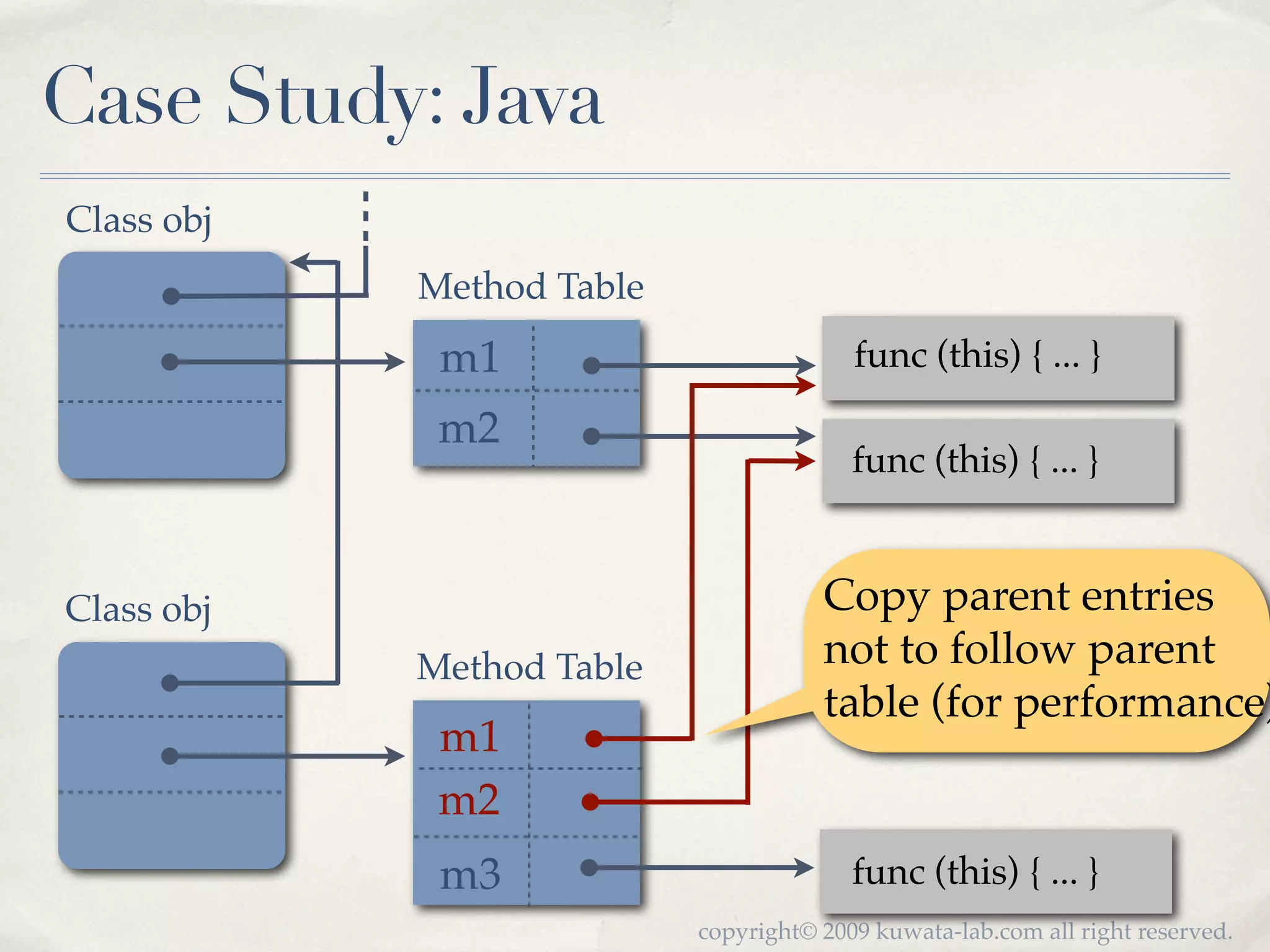
Case Study: Java
Class obj
            Method Table
             m1                          func (this) { ... }

             m2
                                         func (this) { ... }


Class obj                             Copy parent entries
            Method Table              not to follow parent
                                      table (for performance)
             m1
             m2
             m3                          func (this) { ... }
                           copyright© 2009 kuwata-lab.com all right reserved.
Case Study: JavaScript (1)
                                                               /// (1)
✤   instance.__proto__ points prototype                        function Animal(name) {
    object (= Constructor.prototype)                              this.name = name;
                                                               }
✤   Trace __proto__ recursively
                                                               /// (2)
    (called as 'prototype chain')                              Animal.prototype.bark =
                                                                   function() {
    ('__proto__' property is         anim                              alert(this.name); }
     available on Firefox)
                                       name                    /// (3)
                                                               var anim =
                                     __proto__
                                                                   new Animal("Doara");
                                                     (3)
     Animal                          prototype
                               (1)                          (2)
      prototype                         bark                           prototype
      this.name = name;               __proto__                          alert(this.name);

                                                 copyright© 2009 kuwata-lab.com all right reserved.
Case Study: JavaScript (2)
/// (4)                                                 /// (5)
function Dog(name) {                                    Dog.prototype.bark2 =
   Animal.call(this, name);    dog                          function() {
}                                name                           alert("BowWow"); };
Dog.prototype = anim;                                   /// (6)
                               __proto__
delete Dog.prototype.name;                              var dog = new Dog("so16");
                                                (6)
   Dog                         anim
                         (4)                            (5)
   prototype                     bark2                            prototype
    Animal.call(this);         __proto__                           alert("BowWow");


   Animal                      prototype
    prototype                        bark                         prototype
    this.name = name;           __proto__                           alert(this.name);

                                            copyright© 2009 kuwata-lab.com all right reserved.
thank you

     copyright© 2009 kuwata-lab.com all right reserved.

Basic Mechanism of OOPL

  • 1.
    Basic Mechanism of Object-Oriented Programming Language 2009-09-11 : Released 2009-09-14 : Fixed makoto kuwata <kwa@kuwata-lab.com> http://www.kuwata-lab.com/ copyright© 2009 kuwata-lab.com all right reserved.
  • 2.
    Purpose ✤ Describes basic mechanism of Object-Oriented Programming Language (OOPL) ✤ Not only Perl but also Python, Ruby, Java, ... ✤ You must be familiar with terms of Object-Oriented ✤ Class, Instance, Method, Override, Overload, ... copyright© 2009 kuwata-lab.com all right reserved.
  • 3.
    Agenda ✤ Part 1. Basics about OOPL Mechanism ✤ Part 2. More about OOPL Mechanism ✤ Part 3. Case Study copyright© 2009 kuwata-lab.com all right reserved.
  • 4.
    Part 1. Basics aboutOOPL Mechanism copyright© 2009 kuwata-lab.com all right reserved.
  • 5.
    Overview Function Class obj Method Tbl func (self) { Variable ..... m1 } m2 Z: 123 m3 func (self) { ..... Instance obj Class obj Method Tbl } m2 x: 10 m3 func (self) { y: 20 Z: 456 m4 ..... } copyright© 2009 kuwata-lab.com all right reserved.
  • 6.
    Instance Object Pointer to Class object ✤ Instance variables + Is-a pointer ✤ Instance object knows "what I am" Variable Instance obj Class obj x: 10 Hash data (in script y: 20 lang) or Struct data (in Java or C++) copyright© 2009 kuwata-lab.com all right reserved.
  • 7.
    Class Object Class obj ✤ Class variables Method Table ( + Is-a pointer) + Parent pointer Z: 30 + Method Table Class obj Instance methods Method Table belong to Class Z: 35
  • 8.
    Method Lookup Table ✤ Method signatures(≒names) + function pointers ✤ May have pointer to parent method table Class obj Method Table func (self) { print "hello"; m1 } m2 m3 func (self, x) { return x + 1; } copyright© 2009 kuwata-lab.com all right reserved.
  • 9.
    Method Function ✤ Instance object is passed as hidden argument OOPL non-OOPL class Point { def move(self, x, y) { var x=0, y=0; self['x'] = x; def move(x, y) { self['y'] = y; this.x = x; } this.y = y; almost } equiv. p = {isa: Point, x: 0, y: 0}; } func = lookup(p, 'move'); p = new Point(); func(p, 10, 20); p.move(10, 20); copyright© 2009 kuwata-lab.com all right reserved.
  • 10.
    Difference bet. methodand function ✤ Method requires instance object ✤ Typically, instance obj is passed as 1st argument ✤ Method call is dynamic, function call is static ✤ Method signature(≒name) is determined statically ✤ Method lookup is performed dynamically (This is why method call is slower than function call) copyright© 2009 kuwata-lab.com all right reserved.
  • 11.
    Overview (again) Function Class obj Method Tbl func (self) { Variable ..... m1 } m2 Z: 123 m3 func (self) { ..... Instance obj Class obj Method Tbl } m2 x: 10 m3 func (self) { y: 20 Z: 456 m4 ..... } copyright© 2009 kuwata-lab.com all right reserved.
  • 12.
    Conslusion ✤ Instance object knows "what I am" (by is-a pointer) ✤ Instance variables belong to instance object ✤ Instance methods belong to class object ✤ function-call is static, method-call is dynamic copyright© 2009 kuwata-lab.com all right reserved.
  • 13.
    Part 2. More aboutOOPL Mechanism copyright© 2009 kuwata-lab.com all right reserved.
  • 14.
    Method Signature ✤ Method name + Argument types (+ Return type) (in static language) ✤ Or same as Method name (in dynamic language) Example (Java): Method Declaration Method Signature void hello(int v, char ch) hello(IC)V void hello(String s) hello(Ljava.lang.String;)V copyright© 2009 kuwata-lab.com all right reserved.
  • 15.
    Method Overload ✤ One method name can have different method signature Class obj Method Table hello(IC) hello(Ljava.lang.String;) copyright© 2009 kuwata-lab.com all right reserved.
  • 16.
    Method Override ✤ Child class can define methods which has same method signature as method in parent class Parent Class Method Table hello(IC) hello(Ljava.lang.String;) Child Class Method Table hello(Ljava.lang.String;) : copyright© 2009 kuwata-lab.com all right reserved.
  • 17.
    Super ✤ 'Super' skips method table lookup once def m1() { Class obj super.m1(); Method Table } m1 : Instance obj Class obj Method Table x: 10 X m1 : copyright© 2009 kuwata-lab.com all right reserved.
  • 18.
    Polymorphism (1) not used ✤ Polymorphism depends on ... used ✤ Receiver object's data type Animal a; a = new Dog(); a.bark(); ✤ Variable data type a = new Cat(); a.bark(); Determined dynamically Instance obj Class obj Method Tbl Method Func bark(...) func (self) { ..... : : } : : copyright© 2009 kuwata-lab.com all right reserved.
  • 19.
    Polymorphism (2) ✤ Polymorphism depends on ... void bark(Object o) { ... } ✤ Data type of formal args a.bark("Wee!"); ✤ Data type of actual args Determined statically Instance obj Class obj Method Tbl Method Func bark(...) func (self) { ..... : : } : : copyright© 2009 kuwata-lab.com all right reserved.
  • 20.
    "Object" class vs."Class" class (1) class Class "Class" extends "Object" extends Object {...} class Foo "Object" class extends Object {...} NULL "Class" class Instance obj "Foo" class x: 10 y: 20 "Foo" extends "Object" copyright© 2009 kuwata-lab.com all right reserved.
  • 21.
    "Object" class vs."Class" class (2) Object = new Class() "Object" is-a "Class" Foo = new Class() Instobj = new Foo() "Object" class "Class" is-a "Class" Instance is-a "Foo" NULL "Class" class Instance obj "Foo" class x: 10 y: 20 "Foo" is-a "Class" copyright© 2009 kuwata-lab.com all right reserved.
  • 22.
    Conclusion (1) ✤ Method Signature = Method Name + Arg Types ✤ Method Overload : Same method name can have different method signature ✤ Method Override : Child class can have same method signature as parent class ✤ Super : Skips current class when method lookup copyright© 2009 kuwata-lab.com all right reserved.
  • 23.
    Conclusion (2) ✤ Polymorphism ✤ Depends on Receiver's data type, Method Name, and Temporary Args' data type ✤ Not depends on Variable data type and Actual Args' data type ✤ Relation between "Object" class and "Class" class is complicated copyright© 2009 kuwata-lab.com all right reserved.
  • 24.
    Part 3. Case Study copyright© 2009 kuwata-lab.com all right reserved.
  • 25.
    Case Study: Ruby from ruby.h: from ruby.h: struct RBasic { struct RClass { unsigned long flags; struct RBasic basic; VALUE klass; struct st_table *iv_tbl; }; struct st_table *m_tbl; Is-a pointer VALUE super; struct RObject { }; struct RBasic basic; Parent pointer struct st_table *iv_tbl; }; Method table Instance variables copyright© 2009 kuwata-lab.com all right reserved.
  • 26.
    Case Study: Perl packagePoint; sub new { my $classname = shift @_; bless() binds hash data my ($x, $y) = @_; with class name my $this = {x=>$x, y=>$y}; (instead of is-a pointer) return bless $this, $classname; } sub move_to { my $this = shift @_; Instance object is the my ($x, $y) = @_; first argument of $this->{x} = $x; instance method $this->{y} = $y; } copyright© 2009 kuwata-lab.com all right reserved.
  • 27.
    Case Study: Python class Point(object): def __init__(self, x=0, y=0): self.x = x Instance object is the self.y = y first argument of instance method def move_to(self, x, y): self.x = x self.y = y Possible to call instance p = Point(0, 0) method as function p.move_to(10, 20) Point.move_to(p, 10, 20) Python uses function as method, and Ruby uses method as function. copyright© 2009 kuwata-lab.com all right reserved.
  • 28.
    Case Study: Java Classobj Method Table m1 func (this) { ... } m2 func (this) { ... } Class obj Copy parent entries Method Table not to follow parent table (for performance) m1 m2 m3 func (this) { ... } copyright© 2009 kuwata-lab.com all right reserved.
  • 29.
    Case Study: JavaScript(1) /// (1) ✤ instance.__proto__ points prototype function Animal(name) { object (= Constructor.prototype) this.name = name; } ✤ Trace __proto__ recursively /// (2) (called as 'prototype chain') Animal.prototype.bark = function() { ('__proto__' property is anim alert(this.name); } available on Firefox) name /// (3) var anim = __proto__ new Animal("Doara"); (3) Animal prototype (1) (2) prototype bark prototype this.name = name; __proto__ alert(this.name); copyright© 2009 kuwata-lab.com all right reserved.
  • 30.
    Case Study: JavaScript(2) /// (4) /// (5) function Dog(name) { Dog.prototype.bark2 = Animal.call(this, name); dog function() { } name alert("BowWow"); }; Dog.prototype = anim; /// (6) __proto__ delete Dog.prototype.name; var dog = new Dog("so16"); (6) Dog anim (4) (5) prototype bark2 prototype Animal.call(this); __proto__ alert("BowWow"); Animal prototype prototype bark prototype this.name = name; __proto__ alert(this.name); copyright© 2009 kuwata-lab.com all right reserved.
  • 31.
    thank you copyright© 2009 kuwata-lab.com all right reserved.