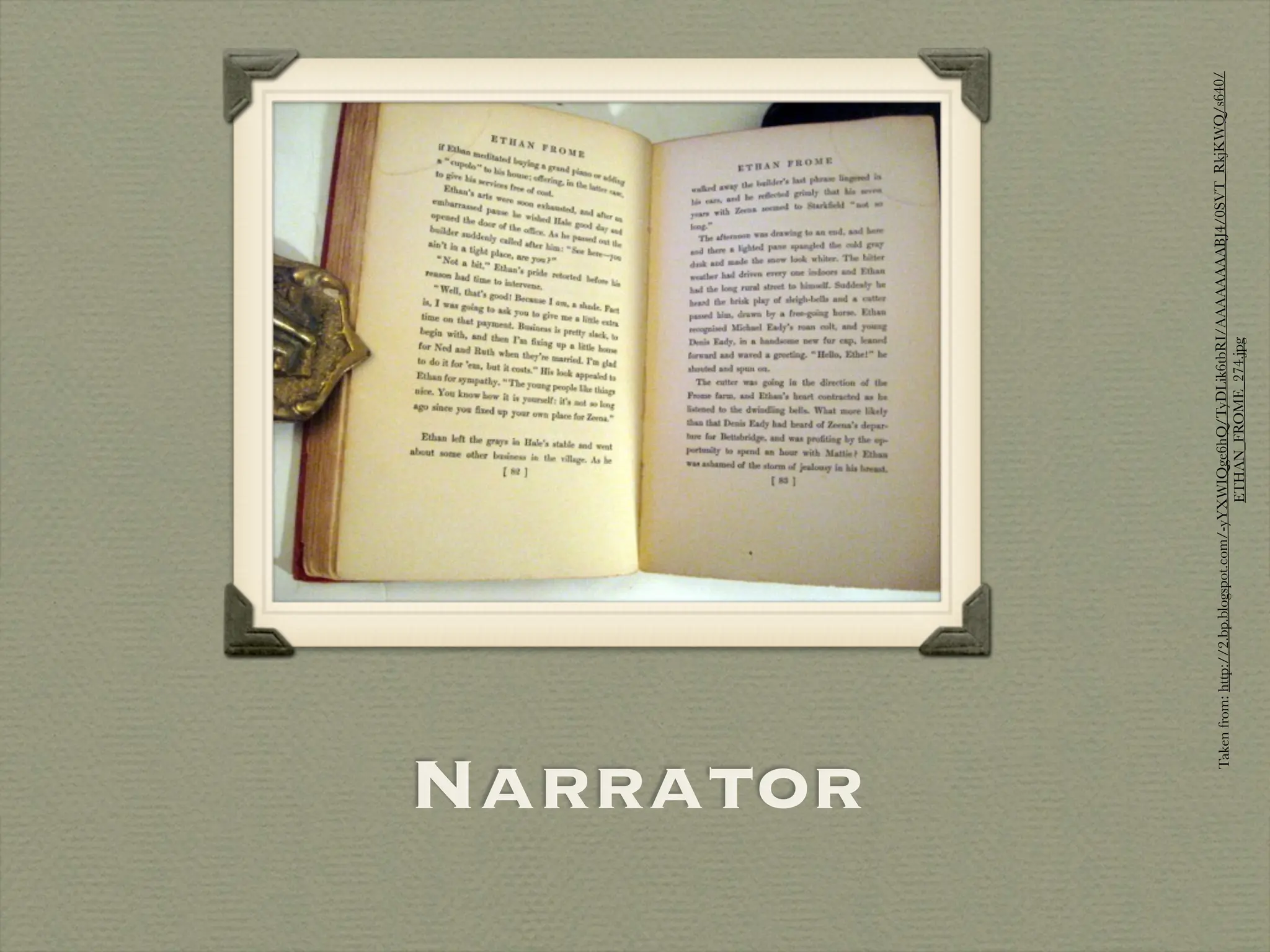
Narrator


     Taken from: http://2.bp.blogspot.com/-yYXWIQge6hQ/TyDLik6tbRI/AAAAAAAABJ4/0SVT_RkjKWQ/s640/
                                              ETHAN_FROME_274.jpg
Who tells the story?


Taken from: http://www.waynejune.com/images/waynejune1.jpg
Who tells the story?

• The author is the person


                                    Taken from: http://www.waynejune.com/images/waynejune1.jpg
  who has written the story. In
  our case that is Edith Wharton.
Who tells the story?

• The author is the person


                                        Taken from: http://www.waynejune.com/images/waynejune1.jpg
  who has written the story. In
  our case that is Edith Wharton.

• The narrator, however, is
  the often fictive person who
  tells the story in the story. It is
  so to speak the novella‘s
  voice.
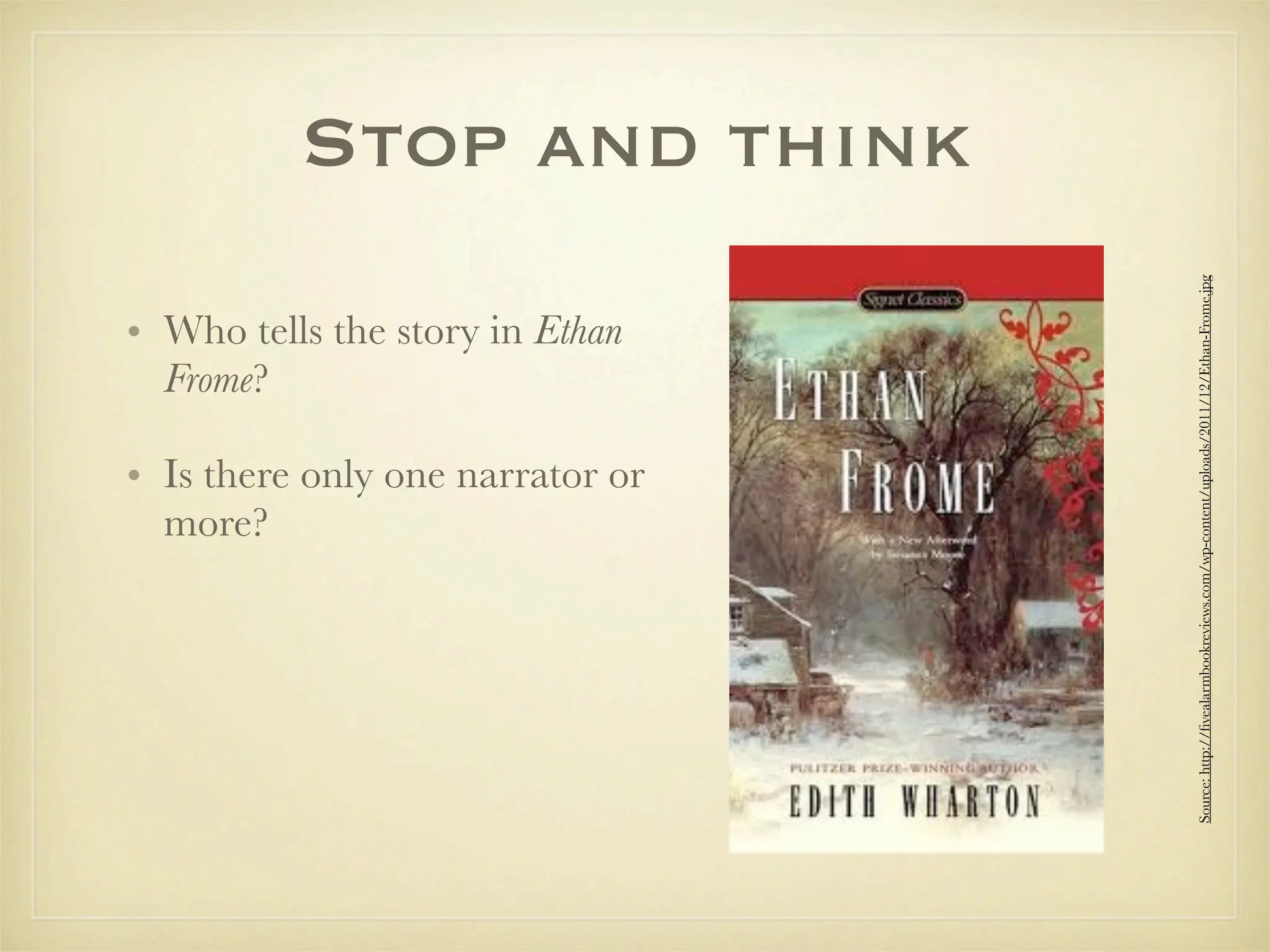
Stop and think


Source: http://fivealarmbookreviews.com/wp-content/uploads/2011/12/Ethan-Frome.jpg
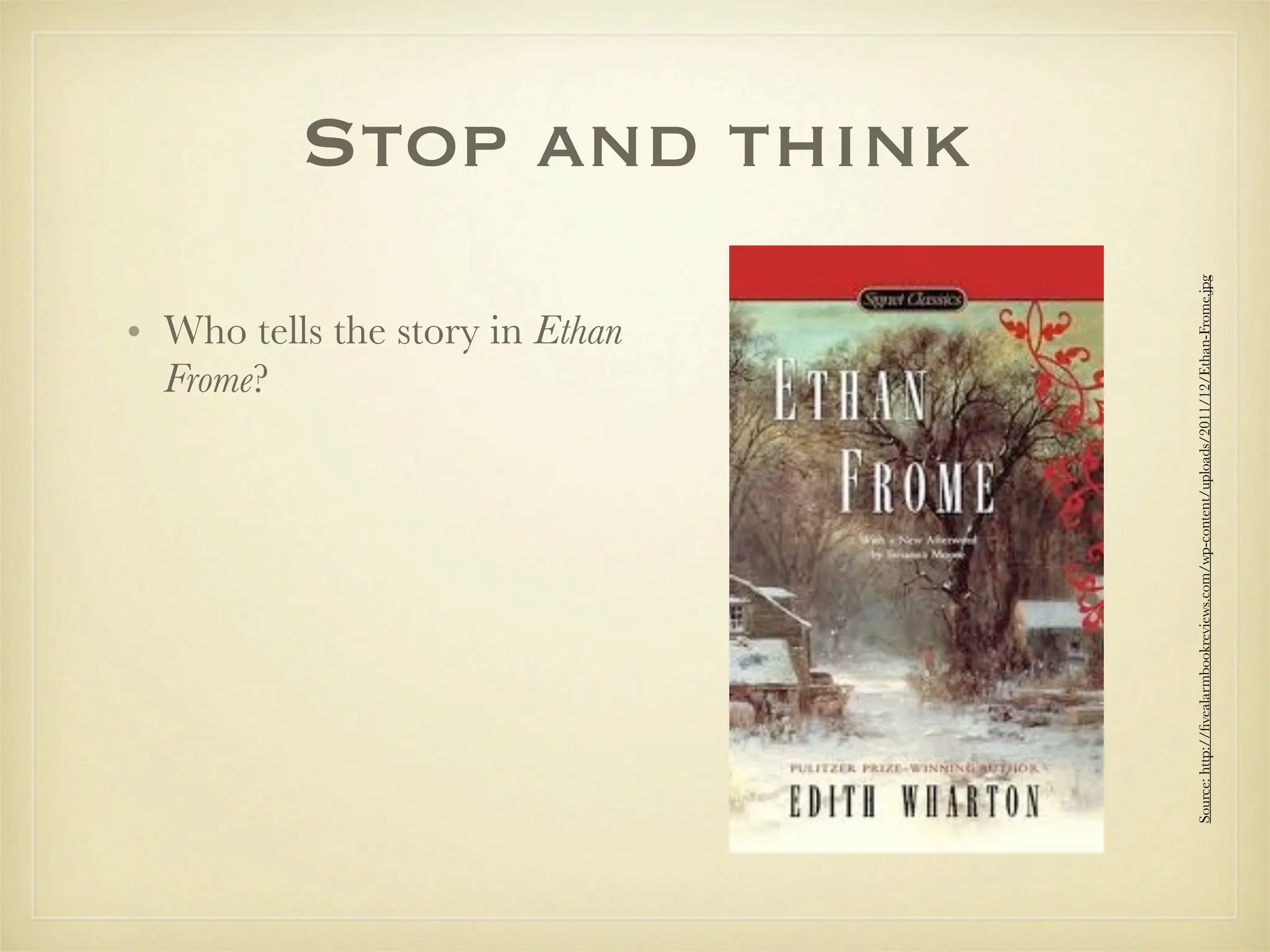
Frome?
                                                              • Who tells the story in Ethan
                                                                                               Stop and think


Source: http://fivealarmbookreviews.com/wp-content/uploads/2011/12/Ethan-Frome.jpg
Stop and think


                                  Source: http://fivealarmbookreviews.com/wp-content/uploads/2011/12/Ethan-Frome.jpg
• Who tells the story in Ethan
  Frome?

• Is there only one narrator or
  more?
Stop and think


                                  Source: http://fivealarmbookreviews.com/wp-content/uploads/2011/12/Ethan-Frome.jpg
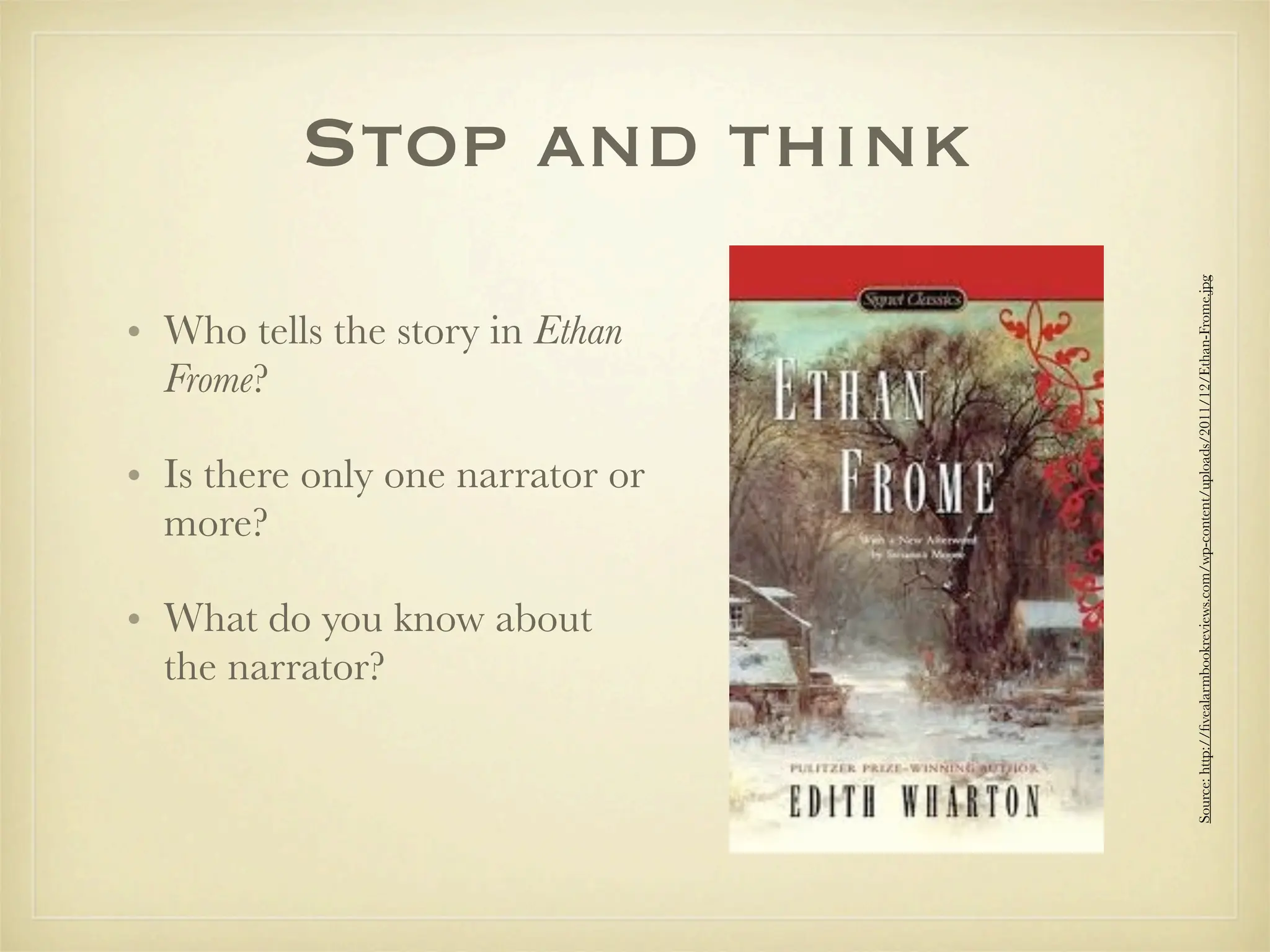
• Who tells the story in Ethan
  Frome?

• Is there only one narrator or
  more?

• What do you know about
  the narrator?
There are different types
        of narrators
• First-person narrator : Either the protagonist (=
  the main character in the story) or one of the minor
  characters tells the story. The narrator uses pronouns
  like I, we, me etc. First-person narrators can only
  present things which they see, hear, feel, know and think.
  Therefore the narrative is often subjective. And because
  one character cannot know everything, the point of view
  will be limited.
• Third-person narrator: If the narrator is not a character
  in the story, we talk about a third-person narrator. The
  narrator will then use pronouns like he, she or they. The
  point of view may be more objective than for a first-person
  narrator, but it still presents the reader with a selective
  perspective, and often also with the narrator‘s comments and
  judgements.
• Third-person narrator: If the narrator is not a character
  in the story, we talk about a third-person narrator. The
  narrator will then use pronouns like he, she or they. The
  point of view may be more objective than for a first-person
  narrator, but it still presents the reader with a selective
  perspective, and often also with the narrator‘s comments and
  judgements.

• A third-person narrator who knows everything that is
  happening in different places, at the same time and even
  inside the characters‘ minds is called omniscient. His or
  her knowledge of the story is unlimited. It is also possible
  that a third person narrator has a limited point of view,
  so that they cannot see into the minds of some of the
  characters in the story.
Point of view


                                 Source: http://lazytechguys.zippykidcdn.com/wp-content/uploads/2011/07/writing-with-quill1.jpg
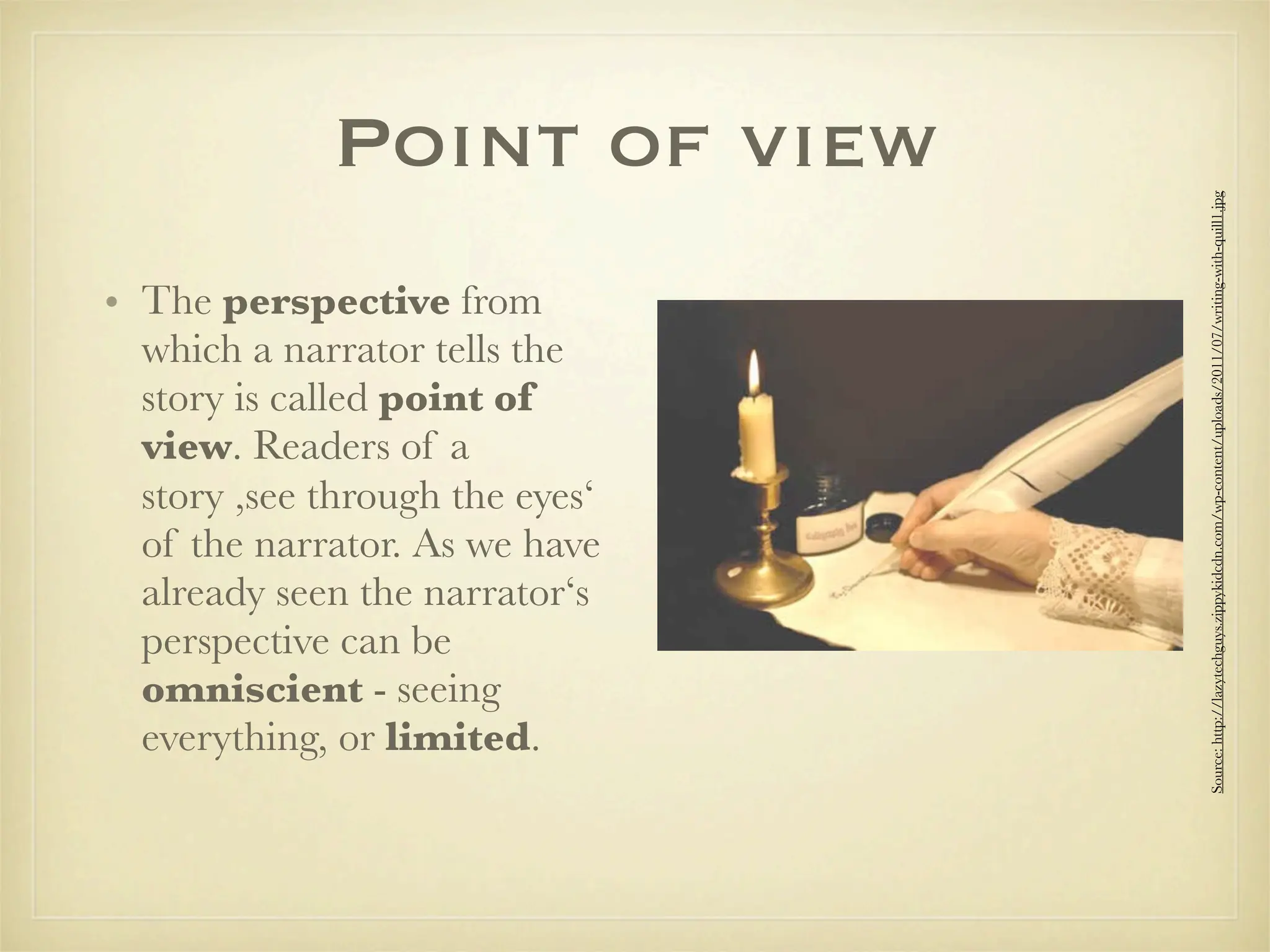
• The perspective from
  which a narrator tells the
  story is called point of
  view. Readers of a
  story ,see through the eyes‘
  of the narrator. As we have
  already seen the narrator‘s
  perspective can be
  omniscient - seeing
  everything, or limited.
different story
                                                                                                                       Stop and Think
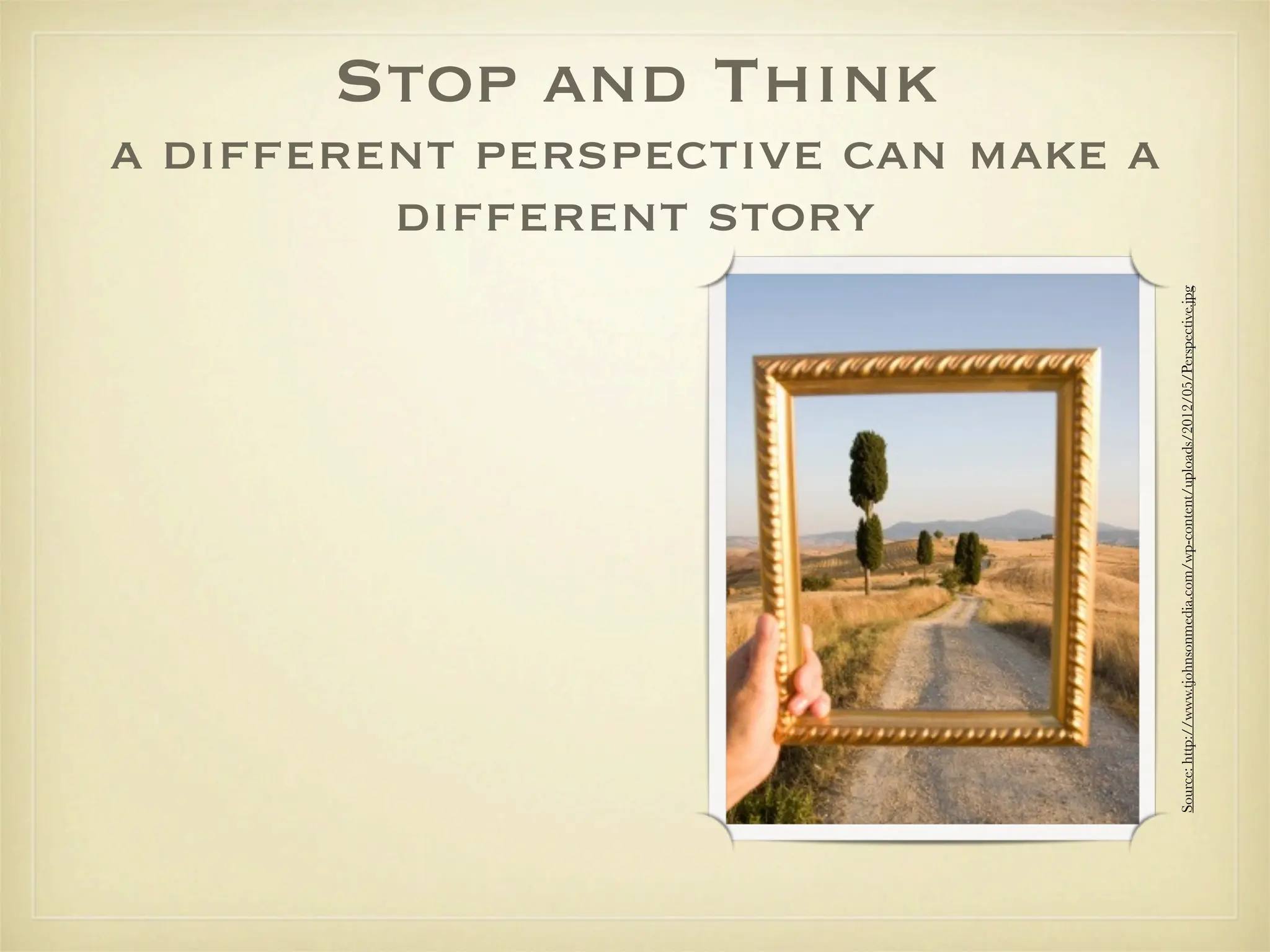
                                                                                  a different perspective can make a


Source: http://www.tjohnsonmedia.com/wp-content/uploads/2012/05/Perspective.jpg
Stop and Think
a different perspective can make a
         different story
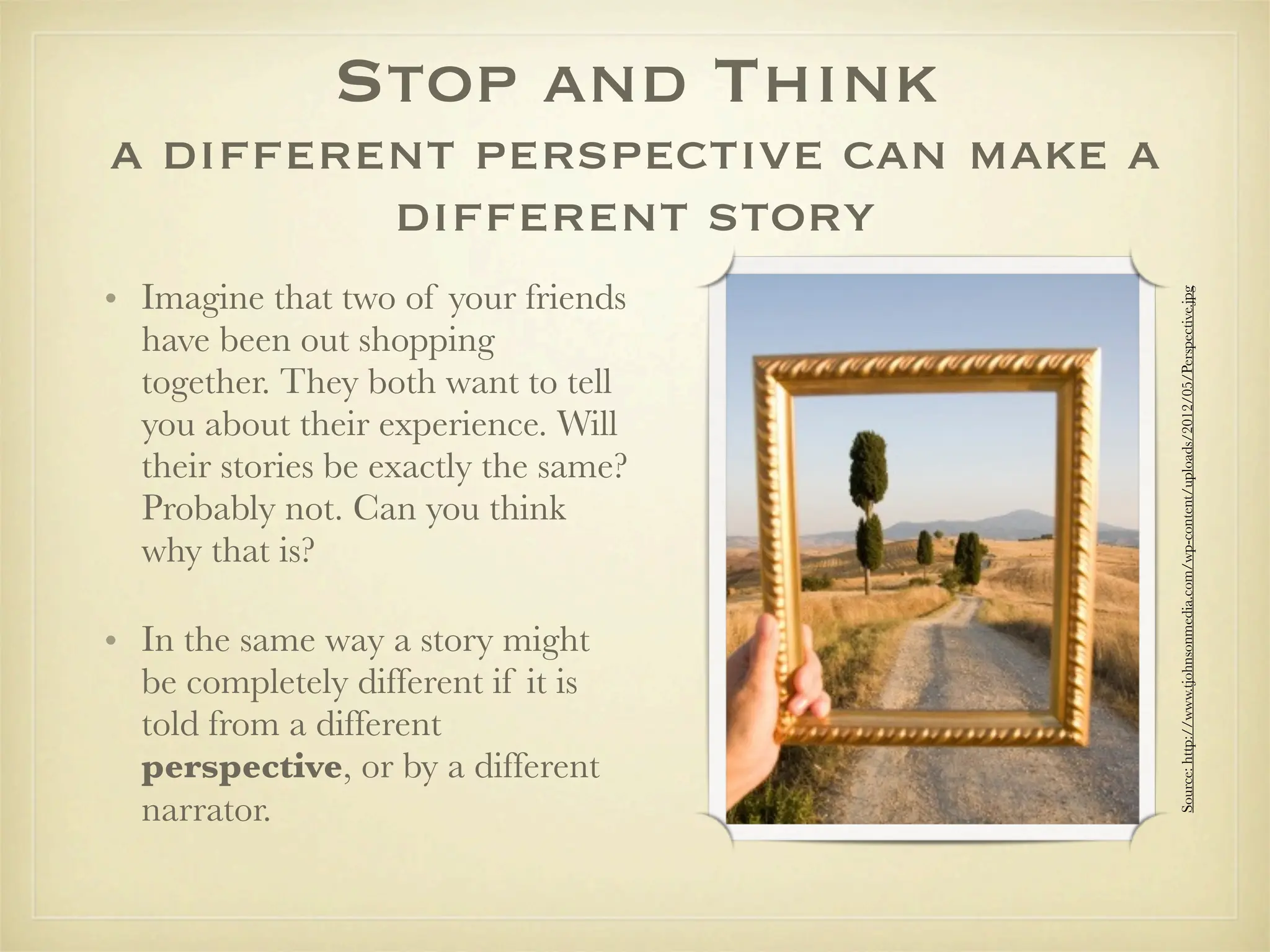
• Imagine that two of your friends


                                       Source: http://www.tjohnsonmedia.com/wp-content/uploads/2012/05/Perspective.jpg
  have been out shopping
  together. They both want to tell
  you about their experience. Will
  their stories be exactly the same?
  Probably not. Can you think
  why that is?
Stop and Think
a different perspective can make a
         different story
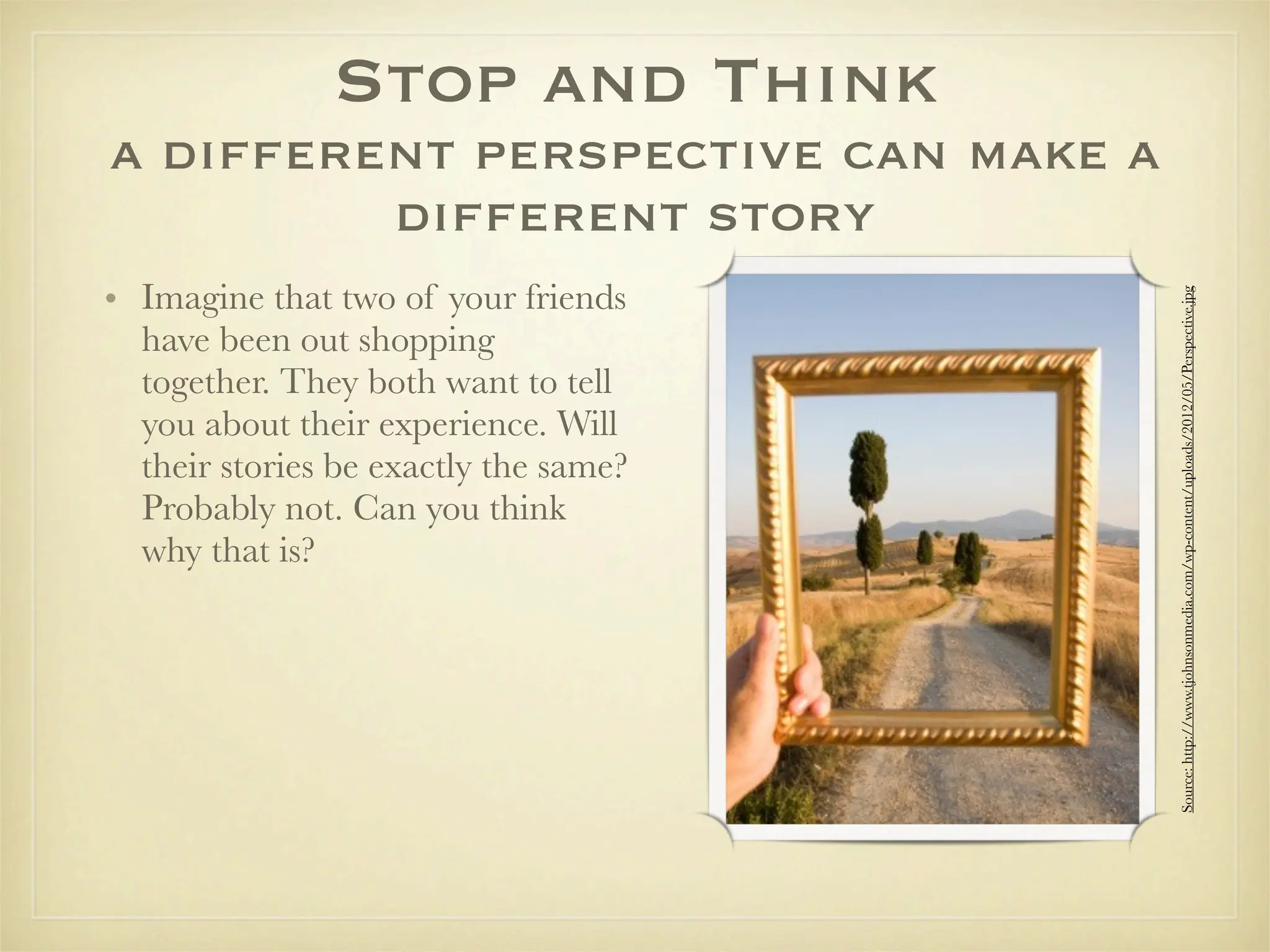
• Imagine that two of your friends


                                       Source: http://www.tjohnsonmedia.com/wp-content/uploads/2012/05/Perspective.jpg
  have been out shopping
  together. They both want to tell
  you about their experience. Will
  their stories be exactly the same?
  Probably not. Can you think
  why that is?

• In the same way a story might
  be completely different if it is
  told from a different
  perspective, or by a different
  narrator.
Reliable or unreliable
      narrator?

             RELIABLE

             NARRATOR

             UNRELIABLE

             NARRATOR
Reliable or unreliable
         narrator?
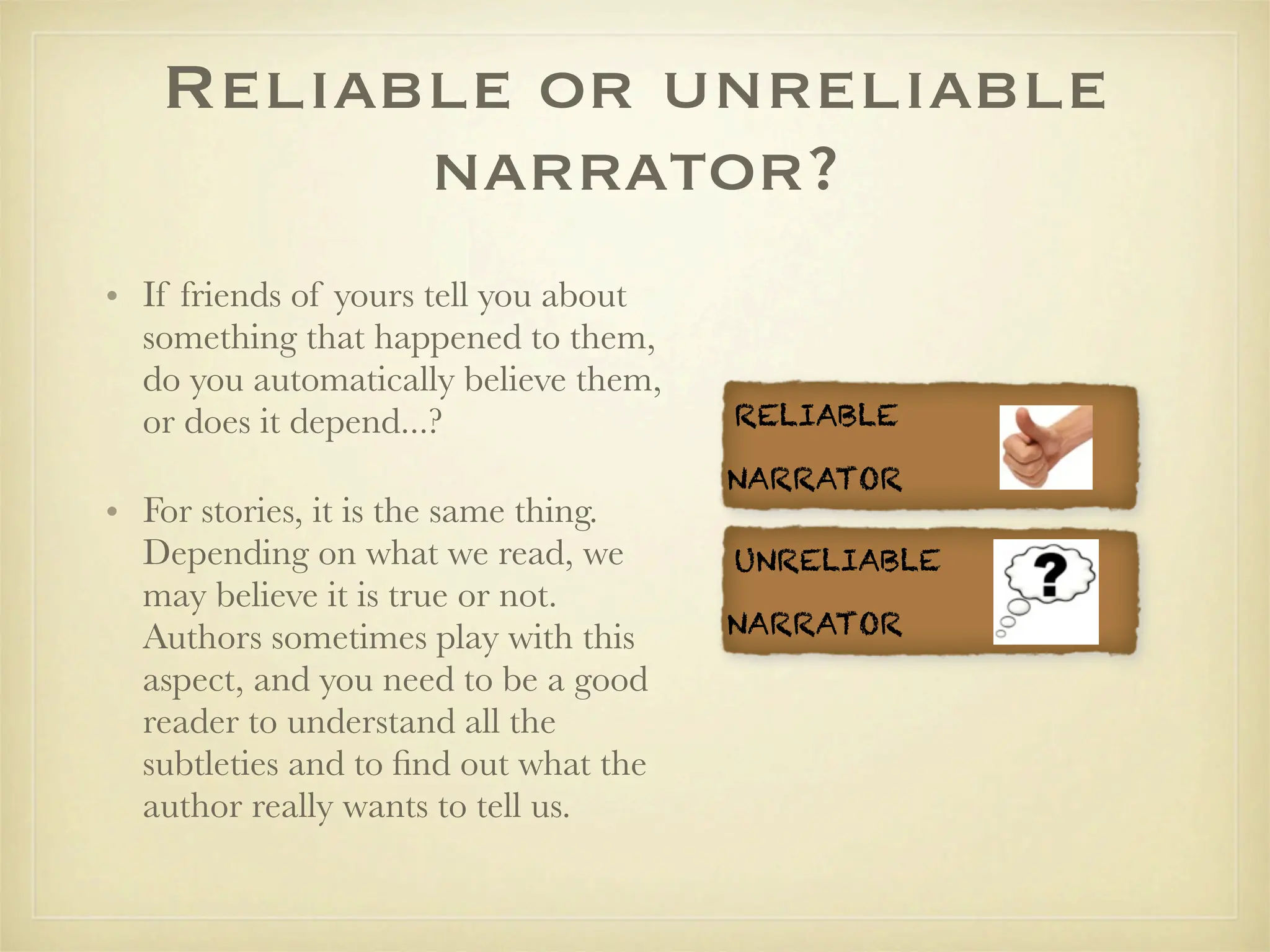
• If friends of yours tell you about
  something that happened to them,
  do you automatically believe them,
  or does it depend...?                RELIABLE

                                       NARRATOR

                                       UNRELIABLE

                                       NARRATOR
Reliable or unreliable
         narrator?
• If friends of yours tell you about
  something that happened to them,
  do you automatically believe them,
  or does it depend...?                RELIABLE

                                       NARRATOR
• For stories, it is the same thing.
  Depending on what we read, we        UNRELIABLE
  may believe it is true or not.
                                       NARRATOR
  Authors sometimes play with this
  aspect, and you need to be a good
  reader to understand all the
  subtleties and to find out what the
  author really wants to tell us.
RELIABLE OR
UNRELIABLE NARRATOR
RELIABLE OR
  UNRELIABLE NARRATOR
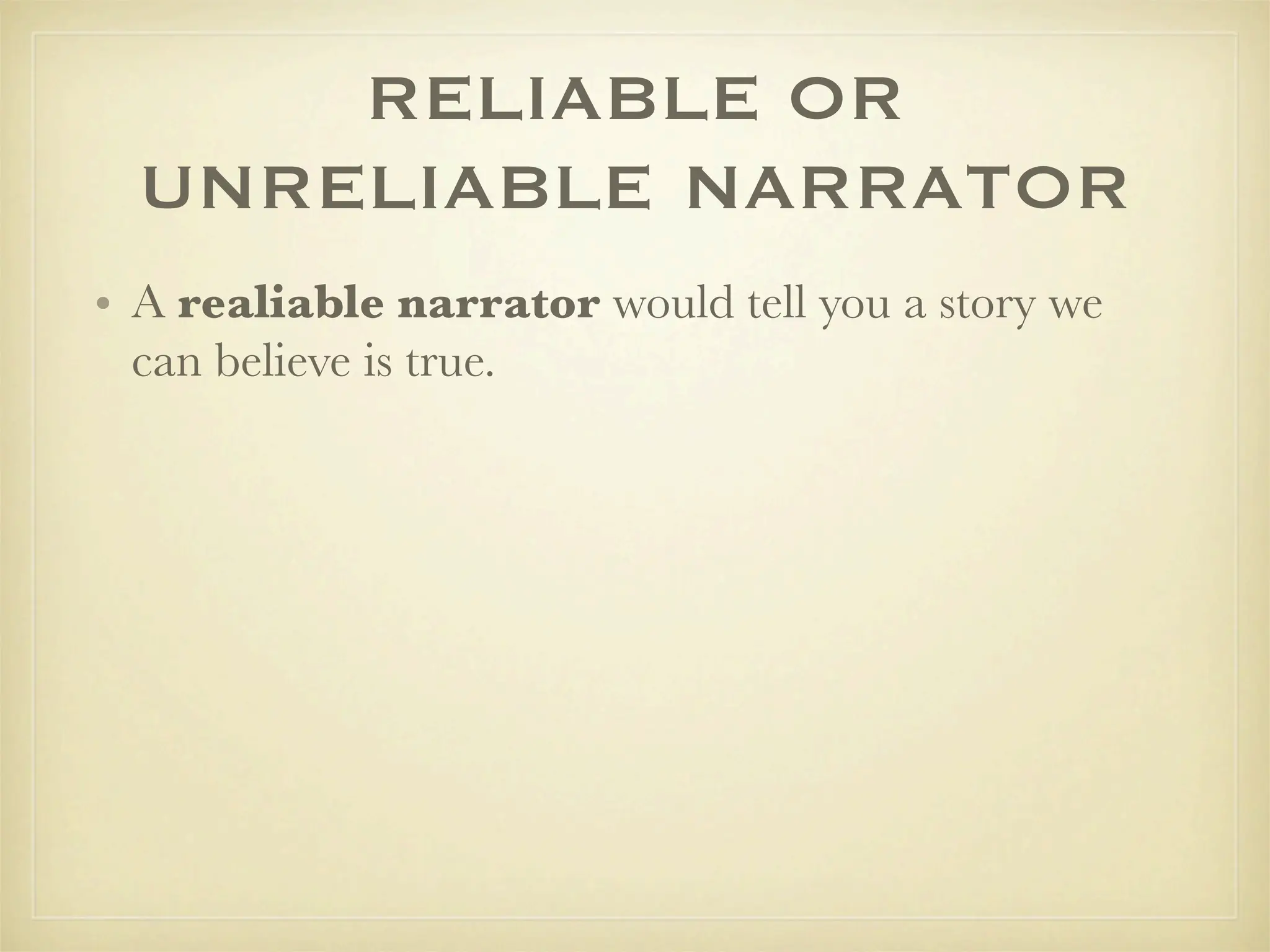
• A realiable narrator would tell you a story we
  can believe is true.
RELIABLE OR
  UNRELIABLE NARRATOR
• A realiable narrator would tell you a story we
  can believe is true.
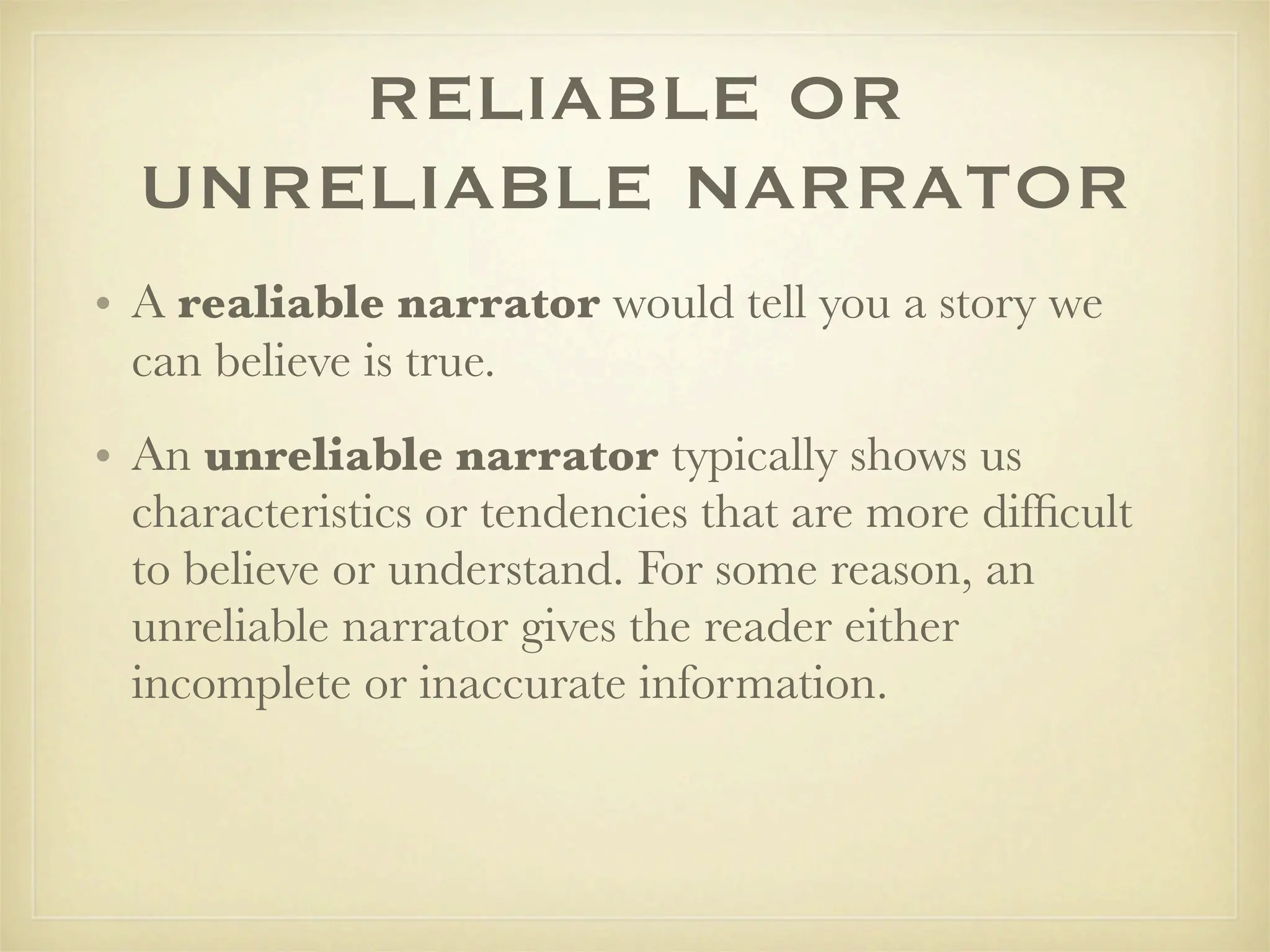
• An unreliable narrator typically shows us
  characteristics or tendencies that are more difficult
  to believe or understand. For some reason, an
  unreliable narrator gives the reader either
  incomplete or inaccurate information.
Obtrusive and
unobtrusive narrator
Obtrusive and
 unobtrusive narrator
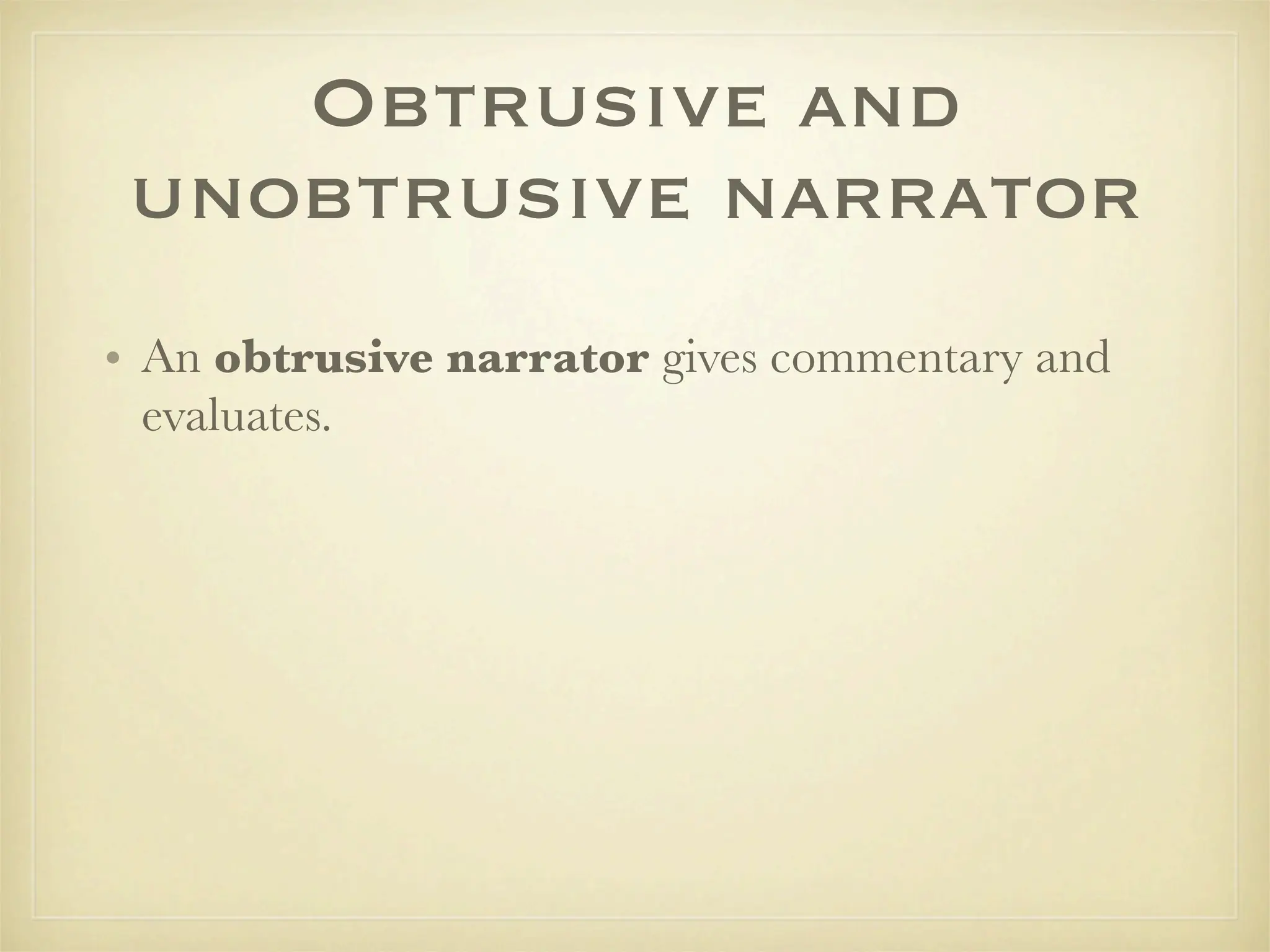
• An obtrusive narrator gives commentary and
  evaluates.
Obtrusive and
 unobtrusive narrator
• An obtrusive narrator gives commentary and
  evaluates.
• An unobtrusive narrator would describe the
  events or the characters without much
  commentary.
Narrator - a review
Narrator - a review
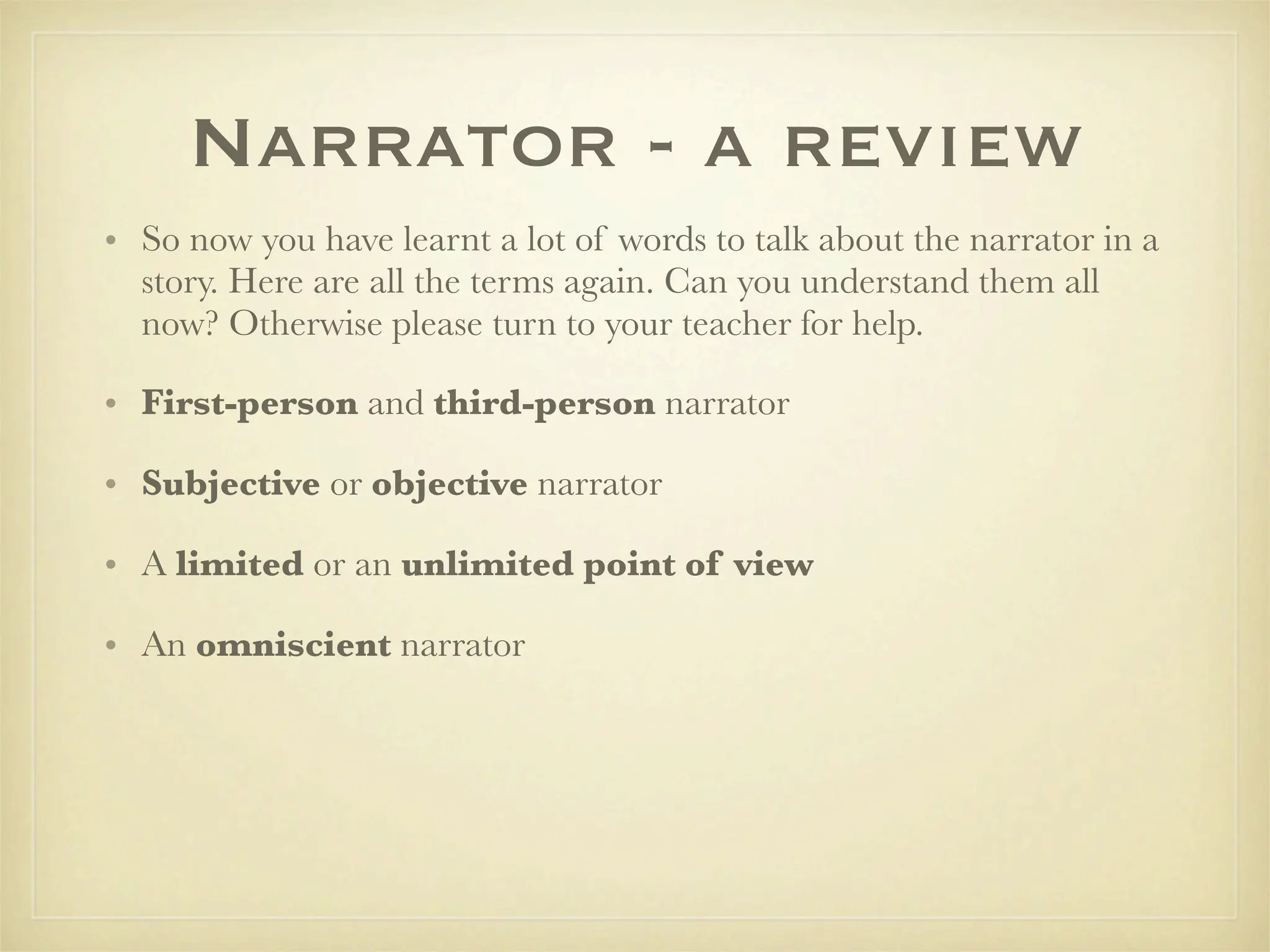
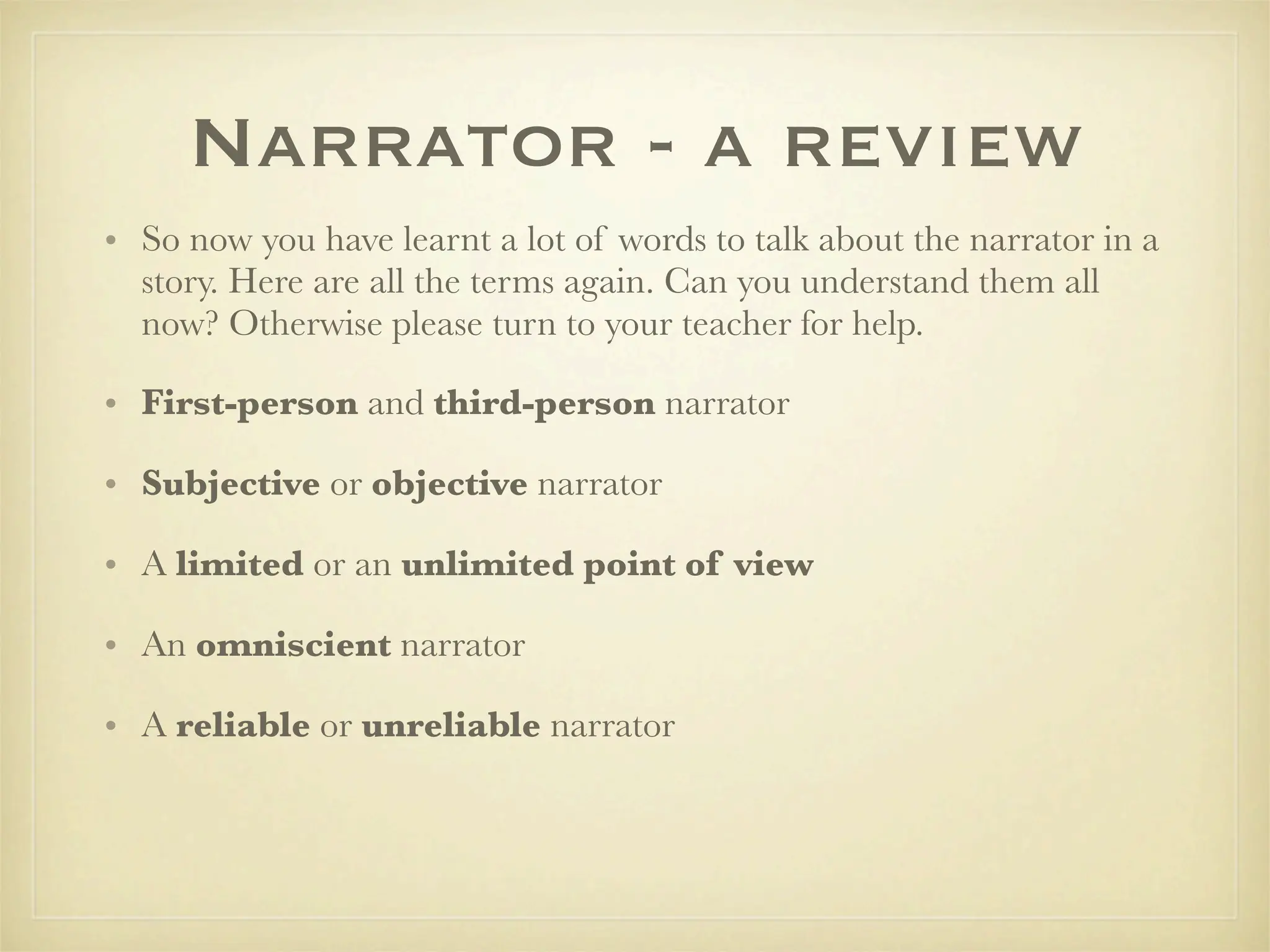
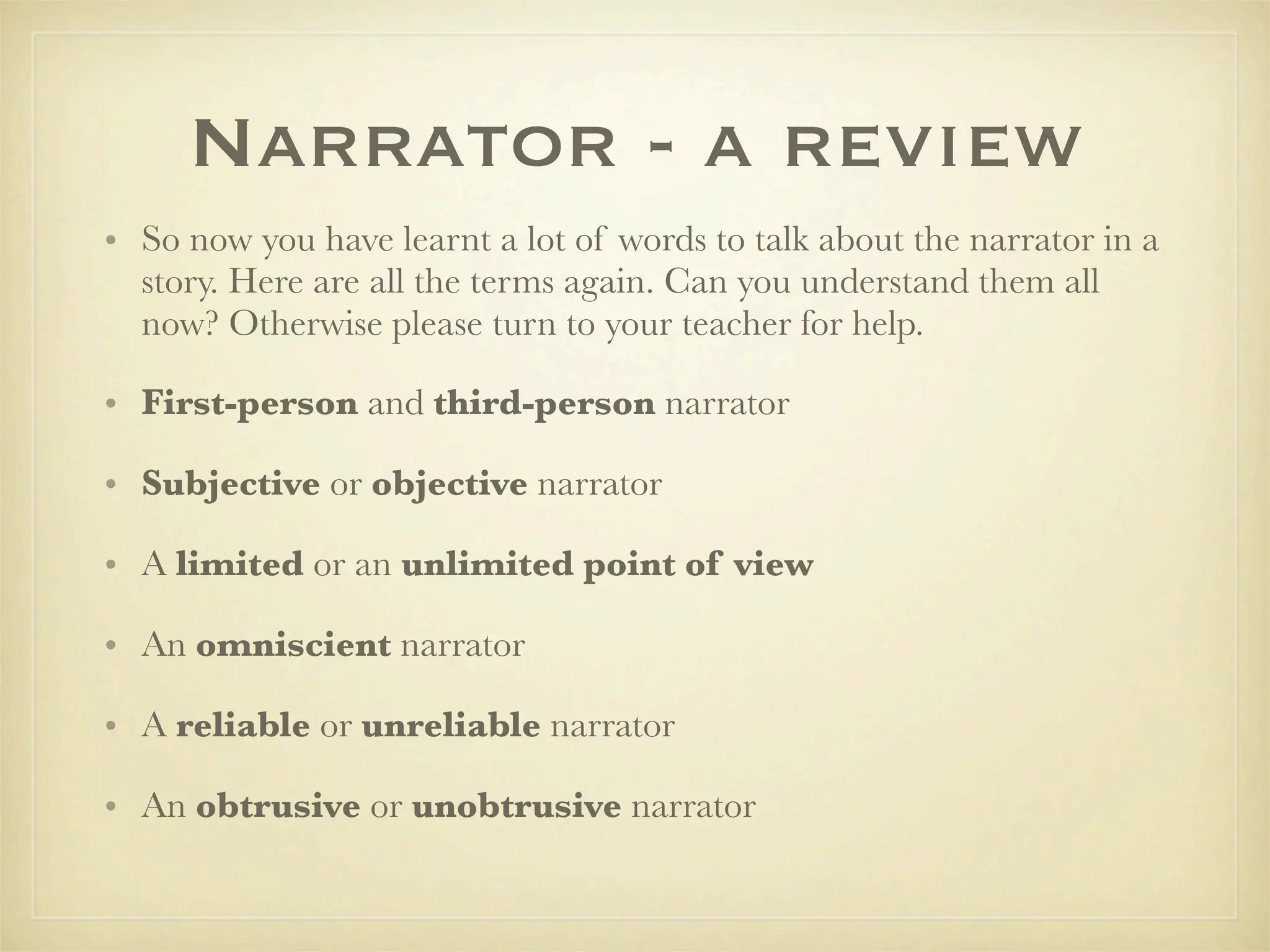
• So now you have learnt a lot of words to talk about the narrator in a
  story. Here are all the terms again. Can you understand them all
  now? Otherwise please turn to your teacher for help.
Narrator - a review
• So now you have learnt a lot of words to talk about the narrator in a
  story. Here are all the terms again. Can you understand them all
  now? Otherwise please turn to your teacher for help.

• First-person and third-person narrator
Narrator - a review
• So now you have learnt a lot of words to talk about the narrator in a
  story. Here are all the terms again. Can you understand them all
  now? Otherwise please turn to your teacher for help.

• First-person and third-person narrator

• Subjective or objective narrator
Narrator - a review
• So now you have learnt a lot of words to talk about the narrator in a
  story. Here are all the terms again. Can you understand them all
  now? Otherwise please turn to your teacher for help.

• First-person and third-person narrator

• Subjective or objective narrator

• A limited or an unlimited point of view
Narrator - a review
• So now you have learnt a lot of words to talk about the narrator in a
  story. Here are all the terms again. Can you understand them all
  now? Otherwise please turn to your teacher for help.

• First-person and third-person narrator

• Subjective or objective narrator

• A limited or an unlimited point of view

• An omniscient narrator
Narrator - a review
• So now you have learnt a lot of words to talk about the narrator in a
  story. Here are all the terms again. Can you understand them all
  now? Otherwise please turn to your teacher for help.

• First-person and third-person narrator

• Subjective or objective narrator

• A limited or an unlimited point of view

• An omniscient narrator

• A reliable or unreliable narrator
Narrator - a review
• So now you have learnt a lot of words to talk about the narrator in a
  story. Here are all the terms again. Can you understand them all
  now? Otherwise please turn to your teacher for help.

• First-person and third-person narrator

• Subjective or objective narrator

• A limited or an unlimited point of view

• An omniscient narrator

• A reliable or unreliable narrator

• An obtrusive or unobtrusive narrator
Input narrator

  • 1.
    Narrator Taken from: http://2.bp.blogspot.com/-yYXWIQge6hQ/TyDLik6tbRI/AAAAAAAABJ4/0SVT_RkjKWQ/s640/ ETHAN_FROME_274.jpg
  • 2.
    Who tells thestory? Taken from: http://www.waynejune.com/images/waynejune1.jpg
  • 3.
    Who tells thestory? • The author is the person Taken from: http://www.waynejune.com/images/waynejune1.jpg who has written the story. In our case that is Edith Wharton.
  • 4.
    Who tells thestory? • The author is the person Taken from: http://www.waynejune.com/images/waynejune1.jpg who has written the story. In our case that is Edith Wharton. • The narrator, however, is the often fictive person who tells the story in the story. It is so to speak the novella‘s voice.
  • 5.
    Stop and think Source:http://fivealarmbookreviews.com/wp-content/uploads/2011/12/Ethan-Frome.jpg
  • 6.
    Frome? • Who tells the story in Ethan Stop and think Source: http://fivealarmbookreviews.com/wp-content/uploads/2011/12/Ethan-Frome.jpg
  • 7.
    Stop and think Source: http://fivealarmbookreviews.com/wp-content/uploads/2011/12/Ethan-Frome.jpg • Who tells the story in Ethan Frome? • Is there only one narrator or more?
  • 8.
    Stop and think Source: http://fivealarmbookreviews.com/wp-content/uploads/2011/12/Ethan-Frome.jpg • Who tells the story in Ethan Frome? • Is there only one narrator or more? • What do you know about the narrator?
  • 9.
    There are differenttypes of narrators • First-person narrator : Either the protagonist (= the main character in the story) or one of the minor characters tells the story. The narrator uses pronouns like I, we, me etc. First-person narrators can only present things which they see, hear, feel, know and think. Therefore the narrative is often subjective. And because one character cannot know everything, the point of view will be limited.
  • 11.
    • Third-person narrator:If the narrator is not a character in the story, we talk about a third-person narrator. The narrator will then use pronouns like he, she or they. The point of view may be more objective than for a first-person narrator, but it still presents the reader with a selective perspective, and often also with the narrator‘s comments and judgements.
  • 12.
    • Third-person narrator:If the narrator is not a character in the story, we talk about a third-person narrator. The narrator will then use pronouns like he, she or they. The point of view may be more objective than for a first-person narrator, but it still presents the reader with a selective perspective, and often also with the narrator‘s comments and judgements. • A third-person narrator who knows everything that is happening in different places, at the same time and even inside the characters‘ minds is called omniscient. His or her knowledge of the story is unlimited. It is also possible that a third person narrator has a limited point of view, so that they cannot see into the minds of some of the characters in the story.
  • 13.
    Point of view Source: http://lazytechguys.zippykidcdn.com/wp-content/uploads/2011/07/writing-with-quill1.jpg • The perspective from which a narrator tells the story is called point of view. Readers of a story ,see through the eyes‘ of the narrator. As we have already seen the narrator‘s perspective can be omniscient - seeing everything, or limited.
  • 14.
    different story Stop and Think a different perspective can make a Source: http://www.tjohnsonmedia.com/wp-content/uploads/2012/05/Perspective.jpg
  • 15.
    Stop and Think adifferent perspective can make a different story • Imagine that two of your friends Source: http://www.tjohnsonmedia.com/wp-content/uploads/2012/05/Perspective.jpg have been out shopping together. They both want to tell you about their experience. Will their stories be exactly the same? Probably not. Can you think why that is?
  • 16.
    Stop and Think adifferent perspective can make a different story • Imagine that two of your friends Source: http://www.tjohnsonmedia.com/wp-content/uploads/2012/05/Perspective.jpg have been out shopping together. They both want to tell you about their experience. Will their stories be exactly the same? Probably not. Can you think why that is? • In the same way a story might be completely different if it is told from a different perspective, or by a different narrator.
  • 17.
    Reliable or unreliable narrator? RELIABLE NARRATOR UNRELIABLE NARRATOR
  • 18.
    Reliable or unreliable narrator? • If friends of yours tell you about something that happened to them, do you automatically believe them, or does it depend...? RELIABLE NARRATOR UNRELIABLE NARRATOR
  • 19.
    Reliable or unreliable narrator? • If friends of yours tell you about something that happened to them, do you automatically believe them, or does it depend...? RELIABLE NARRATOR • For stories, it is the same thing. Depending on what we read, we UNRELIABLE may believe it is true or not. NARRATOR Authors sometimes play with this aspect, and you need to be a good reader to understand all the subtleties and to find out what the author really wants to tell us.
  • 20.
  • 21.
    RELIABLE OR UNRELIABLE NARRATOR • A realiable narrator would tell you a story we can believe is true.
  • 22.
    RELIABLE OR UNRELIABLE NARRATOR • A realiable narrator would tell you a story we can believe is true. • An unreliable narrator typically shows us characteristics or tendencies that are more difficult to believe or understand. For some reason, an unreliable narrator gives the reader either incomplete or inaccurate information.
  • 23.
  • 24.
    Obtrusive and unobtrusivenarrator • An obtrusive narrator gives commentary and evaluates.
  • 25.
    Obtrusive and unobtrusivenarrator • An obtrusive narrator gives commentary and evaluates. • An unobtrusive narrator would describe the events or the characters without much commentary.
  • 26.
  • 27.
    Narrator - areview • So now you have learnt a lot of words to talk about the narrator in a story. Here are all the terms again. Can you understand them all now? Otherwise please turn to your teacher for help.
  • 28.
    Narrator - areview • So now you have learnt a lot of words to talk about the narrator in a story. Here are all the terms again. Can you understand them all now? Otherwise please turn to your teacher for help. • First-person and third-person narrator
  • 29.
    Narrator - areview • So now you have learnt a lot of words to talk about the narrator in a story. Here are all the terms again. Can you understand them all now? Otherwise please turn to your teacher for help. • First-person and third-person narrator • Subjective or objective narrator
  • 30.
    Narrator - areview • So now you have learnt a lot of words to talk about the narrator in a story. Here are all the terms again. Can you understand them all now? Otherwise please turn to your teacher for help. • First-person and third-person narrator • Subjective or objective narrator • A limited or an unlimited point of view
  • 31.
    Narrator - areview • So now you have learnt a lot of words to talk about the narrator in a story. Here are all the terms again. Can you understand them all now? Otherwise please turn to your teacher for help. • First-person and third-person narrator • Subjective or objective narrator • A limited or an unlimited point of view • An omniscient narrator
  • 32.
    Narrator - areview • So now you have learnt a lot of words to talk about the narrator in a story. Here are all the terms again. Can you understand them all now? Otherwise please turn to your teacher for help. • First-person and third-person narrator • Subjective or objective narrator • A limited or an unlimited point of view • An omniscient narrator • A reliable or unreliable narrator
  • 33.
    Narrator - areview • So now you have learnt a lot of words to talk about the narrator in a story. Here are all the terms again. Can you understand them all now? Otherwise please turn to your teacher for help. • First-person and third-person narrator • Subjective or objective narrator • A limited or an unlimited point of view • An omniscient narrator • A reliable or unreliable narrator • An obtrusive or unobtrusive narrator