Routing in Drupal 8 
November 13, 2014
Nice to Meet You! 
Kalpana Goel 
Developer 
Drupal.org - kgoel 
Twitter - @kalpanagoel 
William Hurley 
Manager, Technical 
Development
What is a route? 
Routes are the mappings between URL paths and 
their corresponding page and access callbacks.
What’s Changed
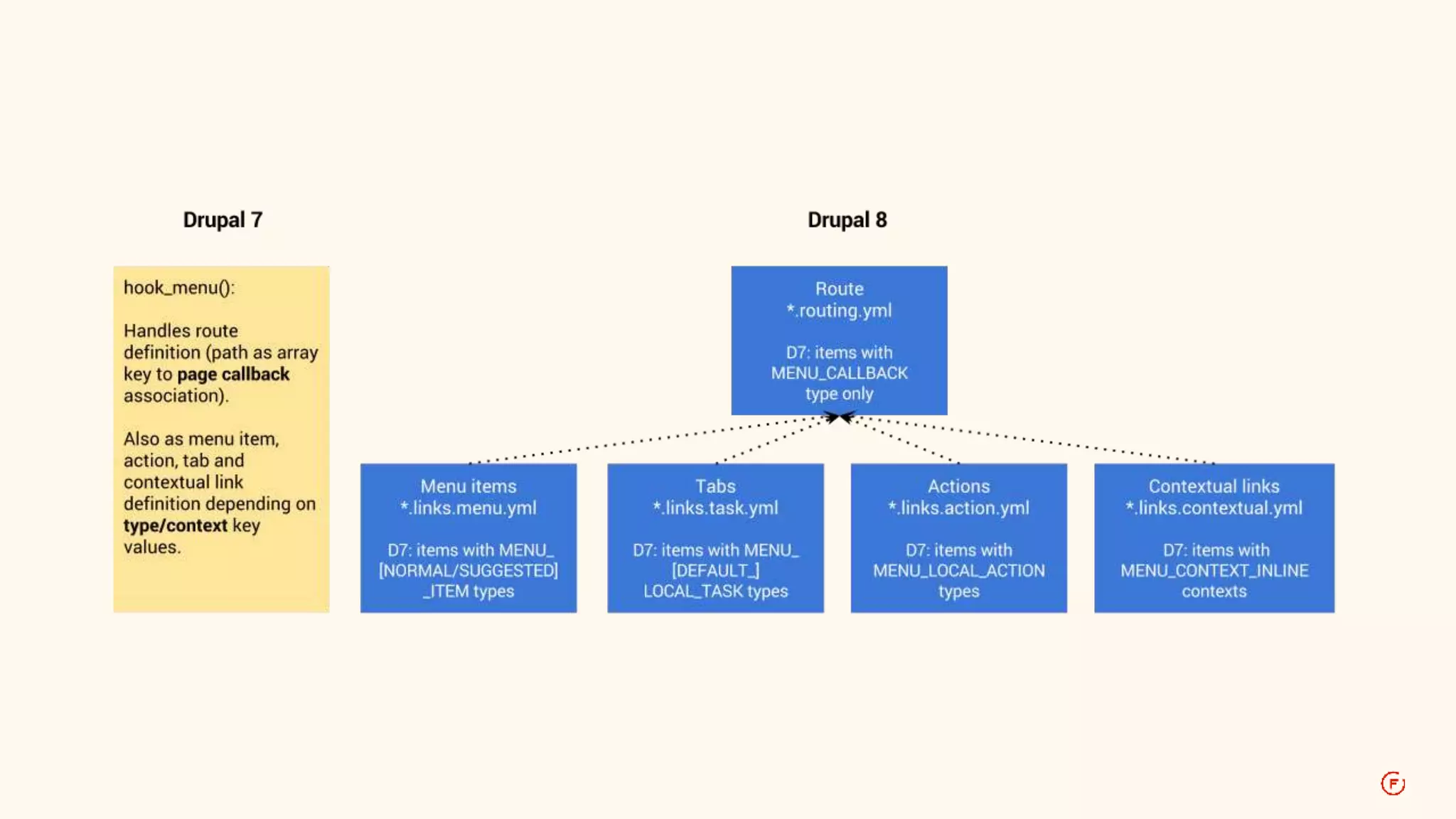
hook_menu defines the 
routing in Drupal 7 
1:1 mapping of path to route
hook_menu is dead in 8.0.x 
There is no hook_menu in Drupal 8! 
MODULENAME.routing.yml 
One path may map to multiple routes
Why the Change?
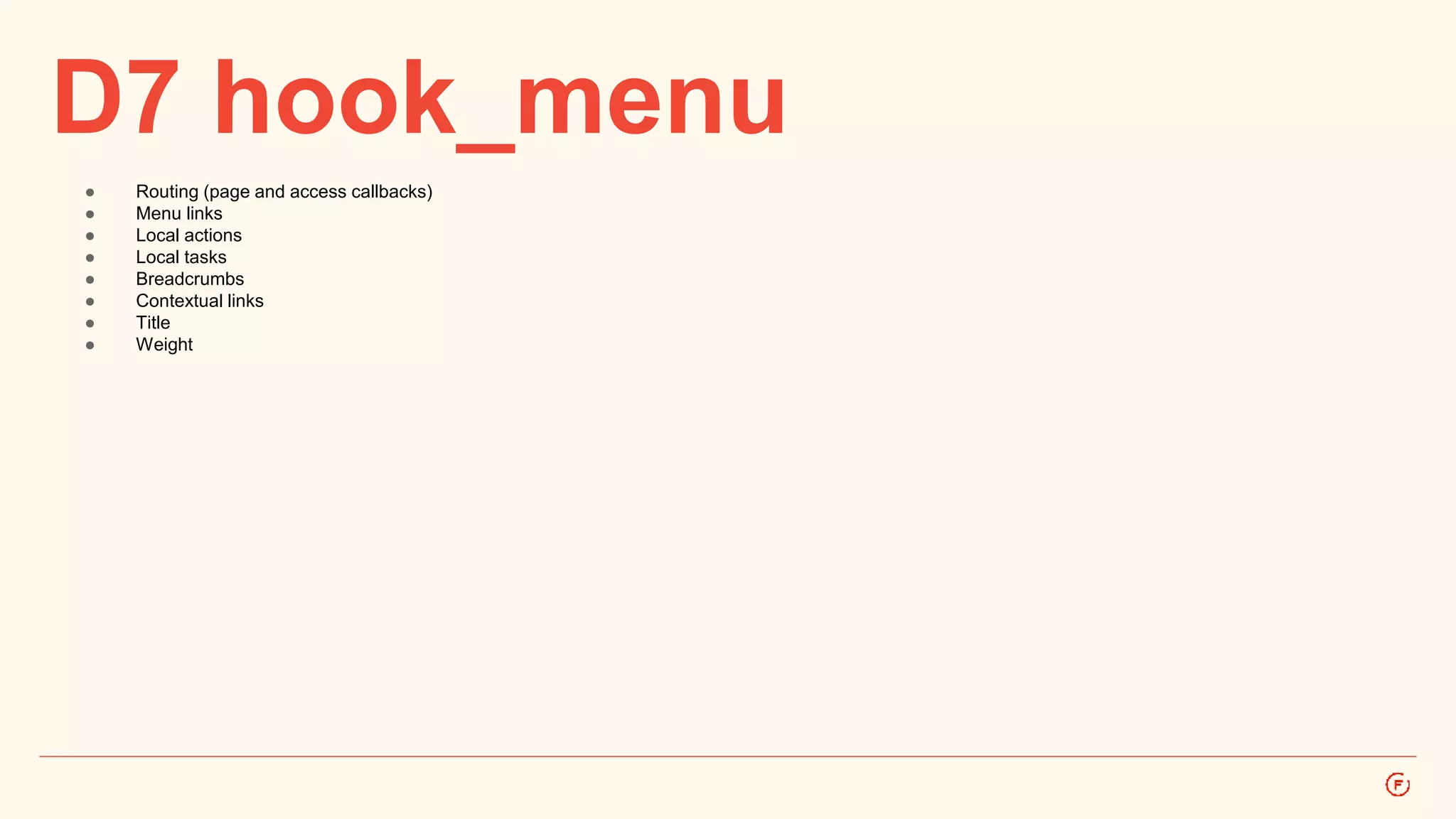
D7 hook_menu 
● Routing (page and access callbacks) 
● Menu links 
● Local actions 
● Local tasks 
● Breadcrumbs 
● Contextual links 
● Title 
● Weight
*.links.actin.ml *.links.contexual.yml
Basic Example
D7: hook_menu() 
function user_menu() { 
$items['user/logout'] = array( 
'title' => 'Log out', 
'access callback' => 'user_is_logged_in', 
'page callback' => 'user_logout', 
'weight' => 10, 
'menu_name' => 'user-menu', 
'file' => 'user.pages.inc', 
); 
return $items; 
}
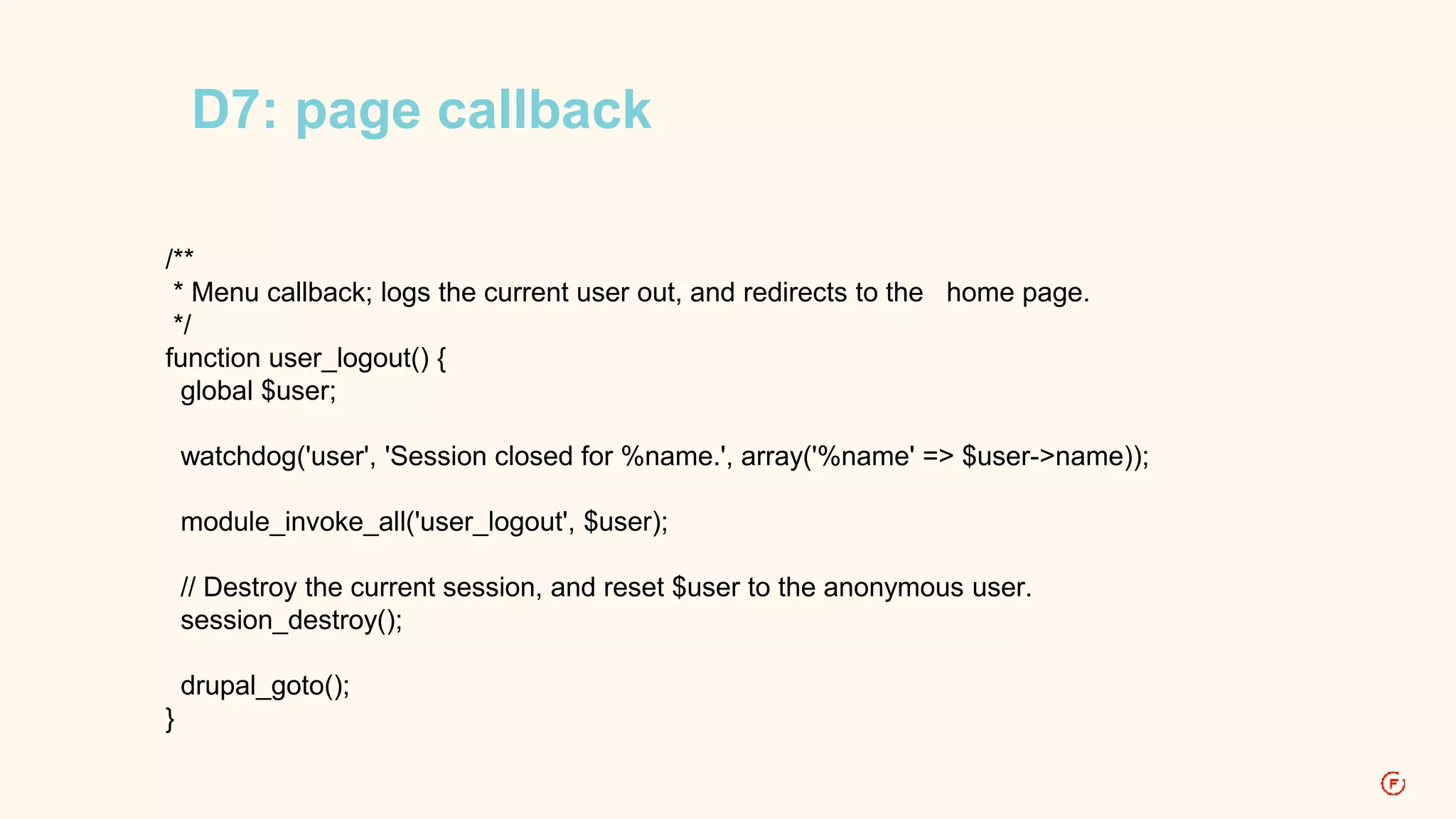
D7: page callback 
/** 
* Menu callback; logs the current user out, and redirects to the home page. 
*/ 
function user_logout() { 
global $user; 
watchdog('user', 'Session closed for %name.', array('%name' => $user->name)); 
module_invoke_all('user_logout', $user); 
// Destroy the current session, and reset $user to the anonymous user. 
session_destroy(); 
drupal_goto(); 
}
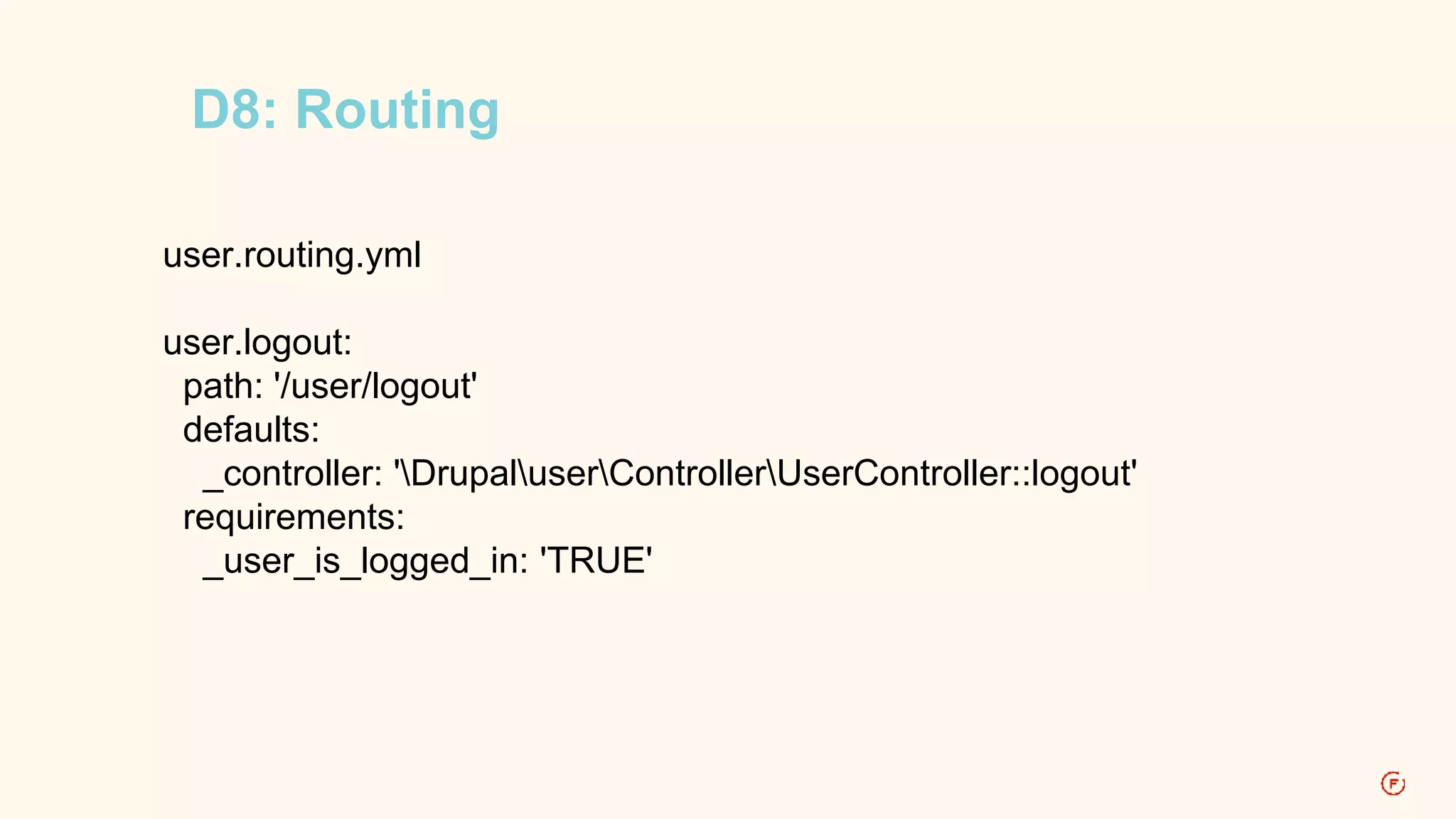
D8: Routing 
user.routing.yml 
user.logout: 
path: '/user/logout' 
defaults: 
_controller: 'DrupaluserControllerUserController::logout' 
requirements: 
_user_is_logged_in: 'TRUE'
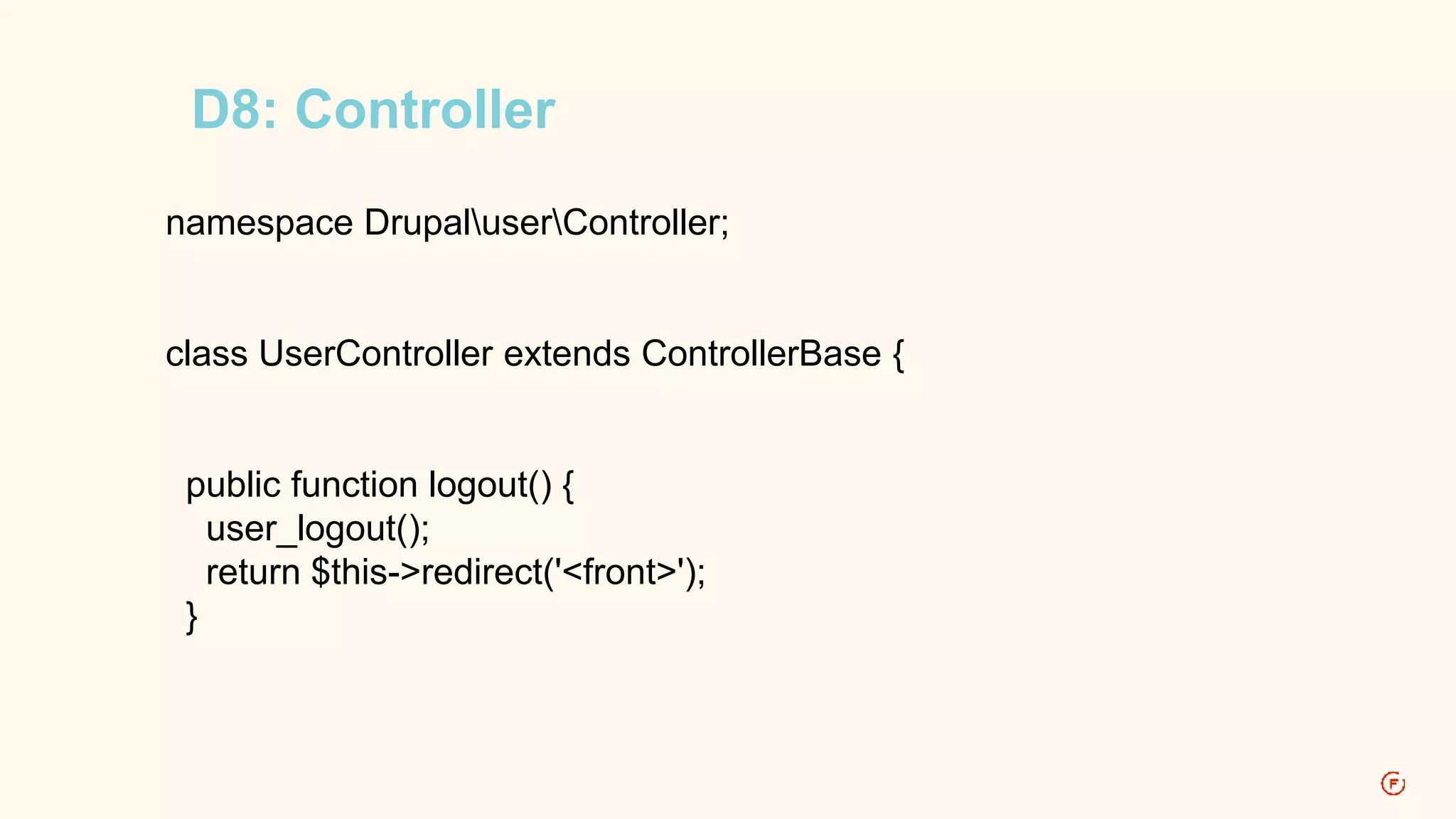
D8: Controller 
namespace DrupaluserController; 
class UserController extends ControllerBase { 
public function logout() { 
user_logout(); 
return $this->redirect('<front>'); 
}
Path Variables
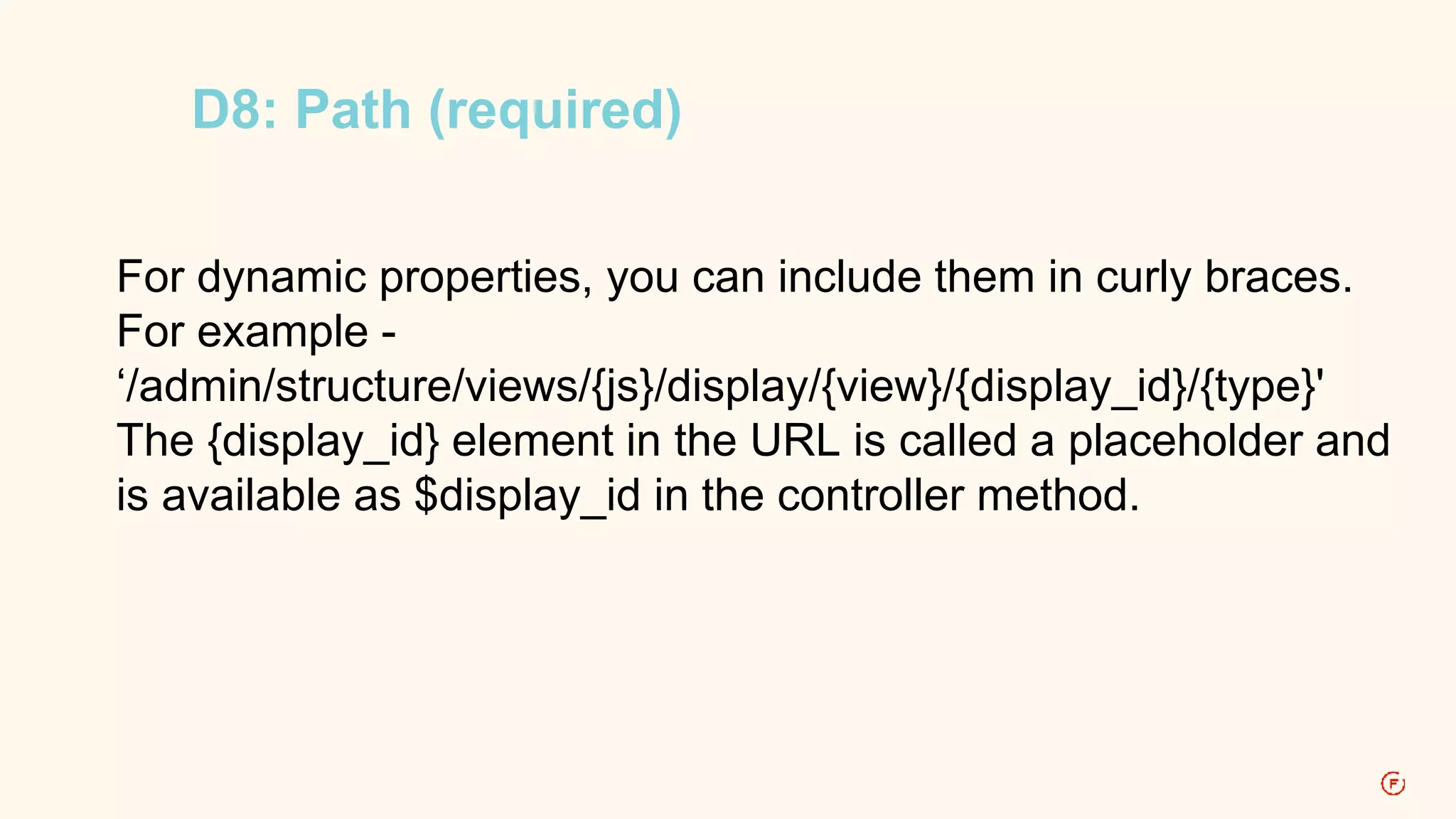
D8: Path (required) 
For dynamic properties, you can include them in curly braces. 
For example - 
‘/admin/structure/views/{js}/display/{view}/{display_id}/{type}' 
The {display_id} element in the URL is called a placeholder and 
is available as $display_id in the controller method.
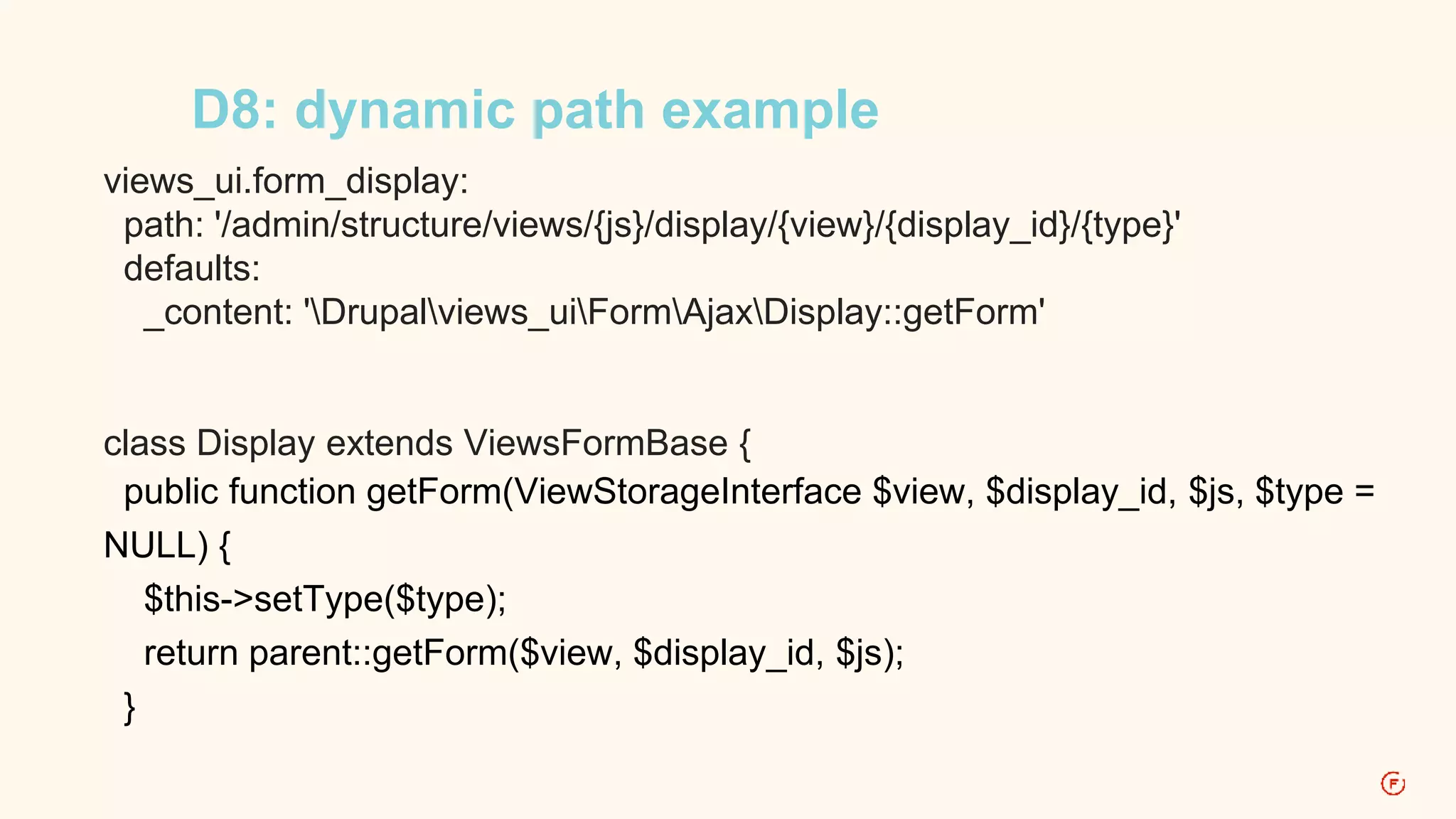
D8: dynamic path example 
views_ui.form_display: 
path: '/admin/structure/views/{js}/display/{view}/{display_id}/{type}' 
defaults: 
_content: 'Drupalviews_uiFormAjaxDisplay::getForm' 
class Display extends ViewsFormBase { 
public function getForm(ViewStorageInterface $view, $display_id, $js, $type = 
NULL) { 
$this->setType($type); 
return parent::getForm($view, $display_id, $js); 
}
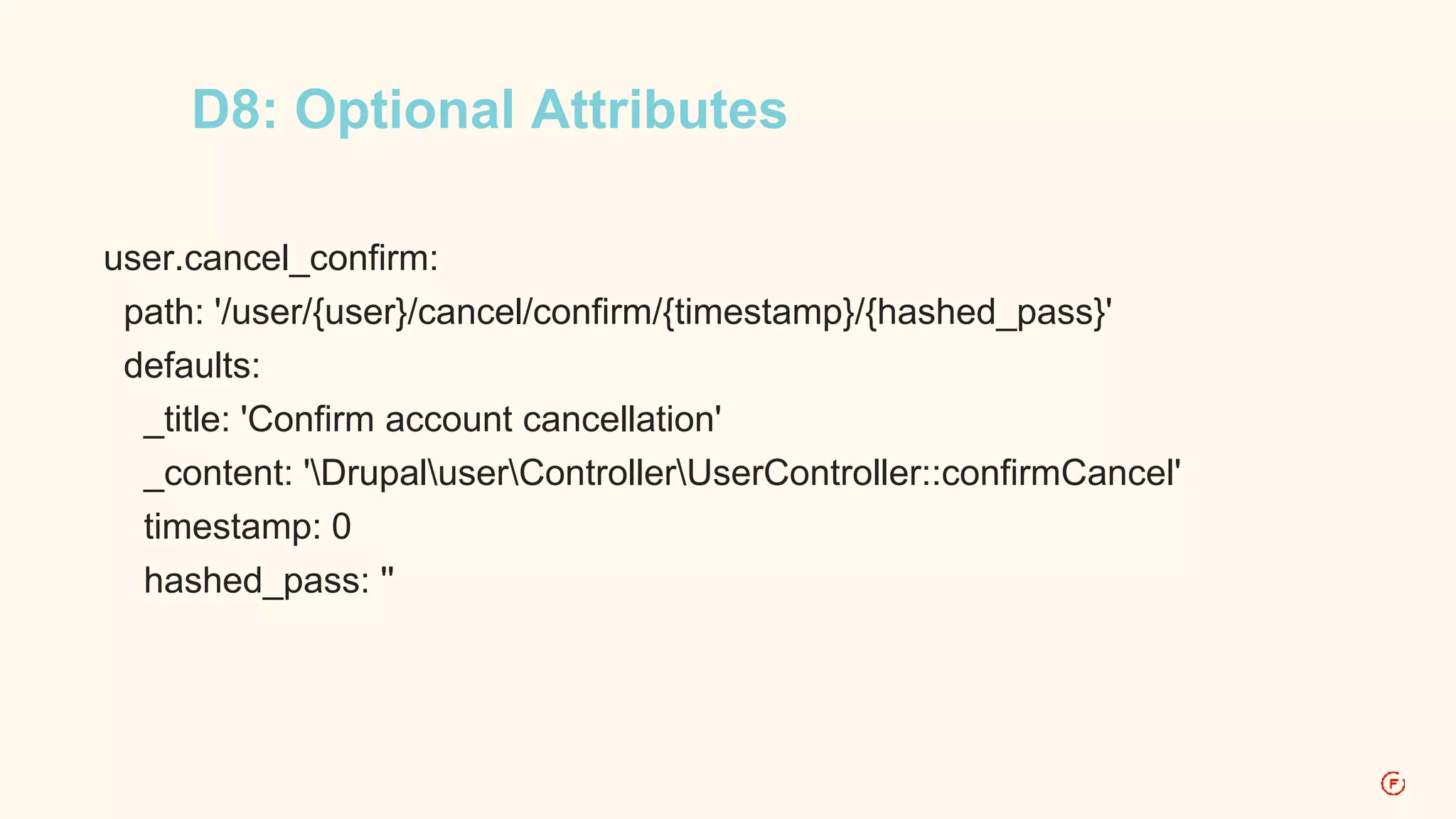
D8: Optional Attributes 
user.cancel_confirm: 
path: '/user/{user}/cancel/confirm/{timestamp}/{hashed_pass}' 
defaults: 
_title: 'Confirm account cancellation' 
_content: 'DrupaluserControllerUserController::confirmCancel' 
timestamp: 0 
hashed_pass: ''
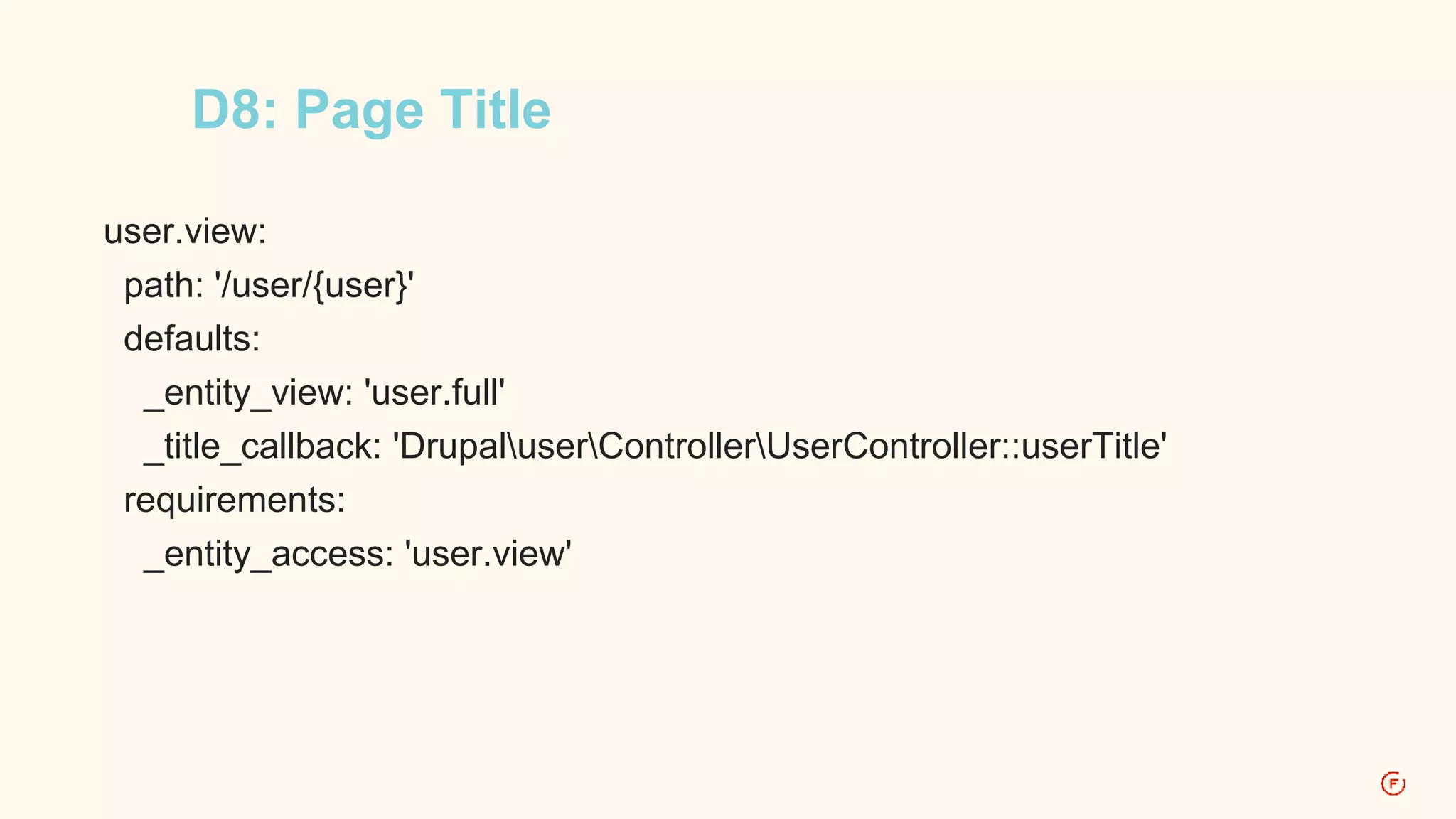
D8: Page Title 
user.view: 
path: '/user/{user}' 
defaults: 
_entity_view: 'user.full' 
_title_callback: 'DrupaluserControllerUserController::userTitle' 
requirements: 
_entity_access: 'user.view'
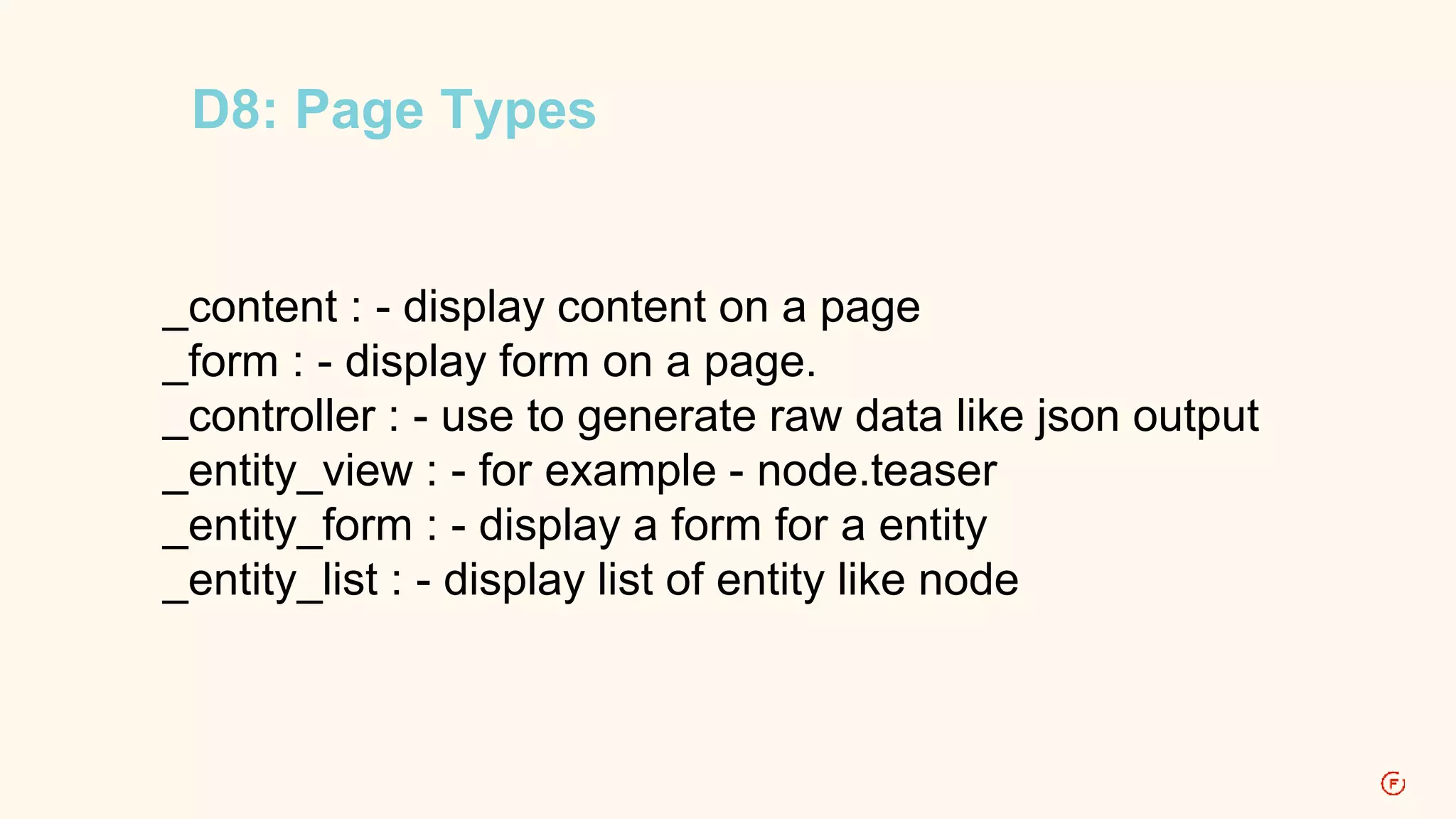
D8: Page Types 
_content : - display content on a page 
_form : - display form on a page. 
_controller : - use to generate raw data like json output 
_entity_view : - for example - node.teaser 
_entity_form : - display a form for a entity 
_entity_list : - display list of entity like node
Access Restrictions
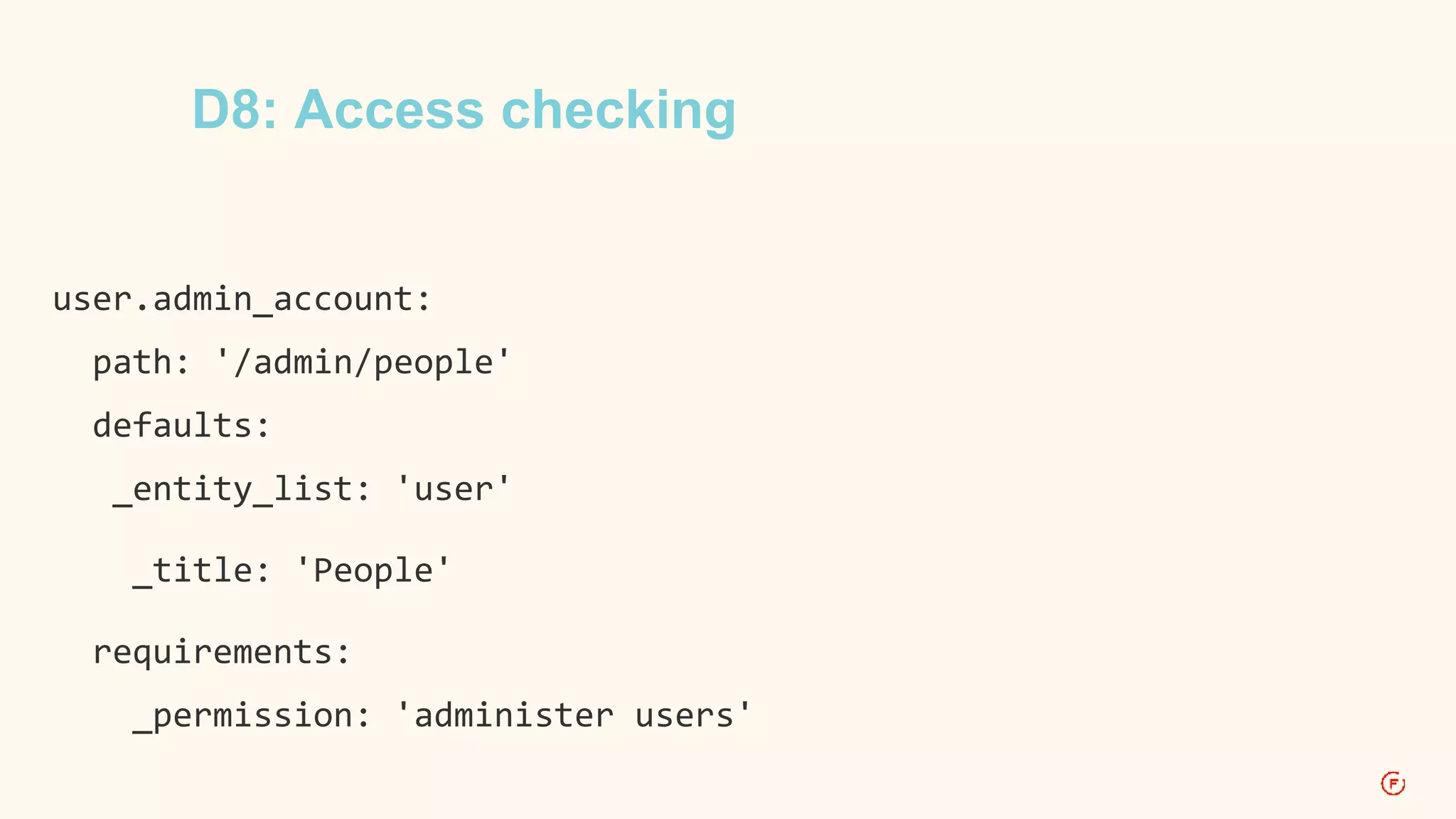
D8: Access checking 
user.admin_account: 
path: '/admin/people' 
defaults: 
_entity_list: 'user' 
_title: 'People' 
requirements: 
_permission: 'administer users'
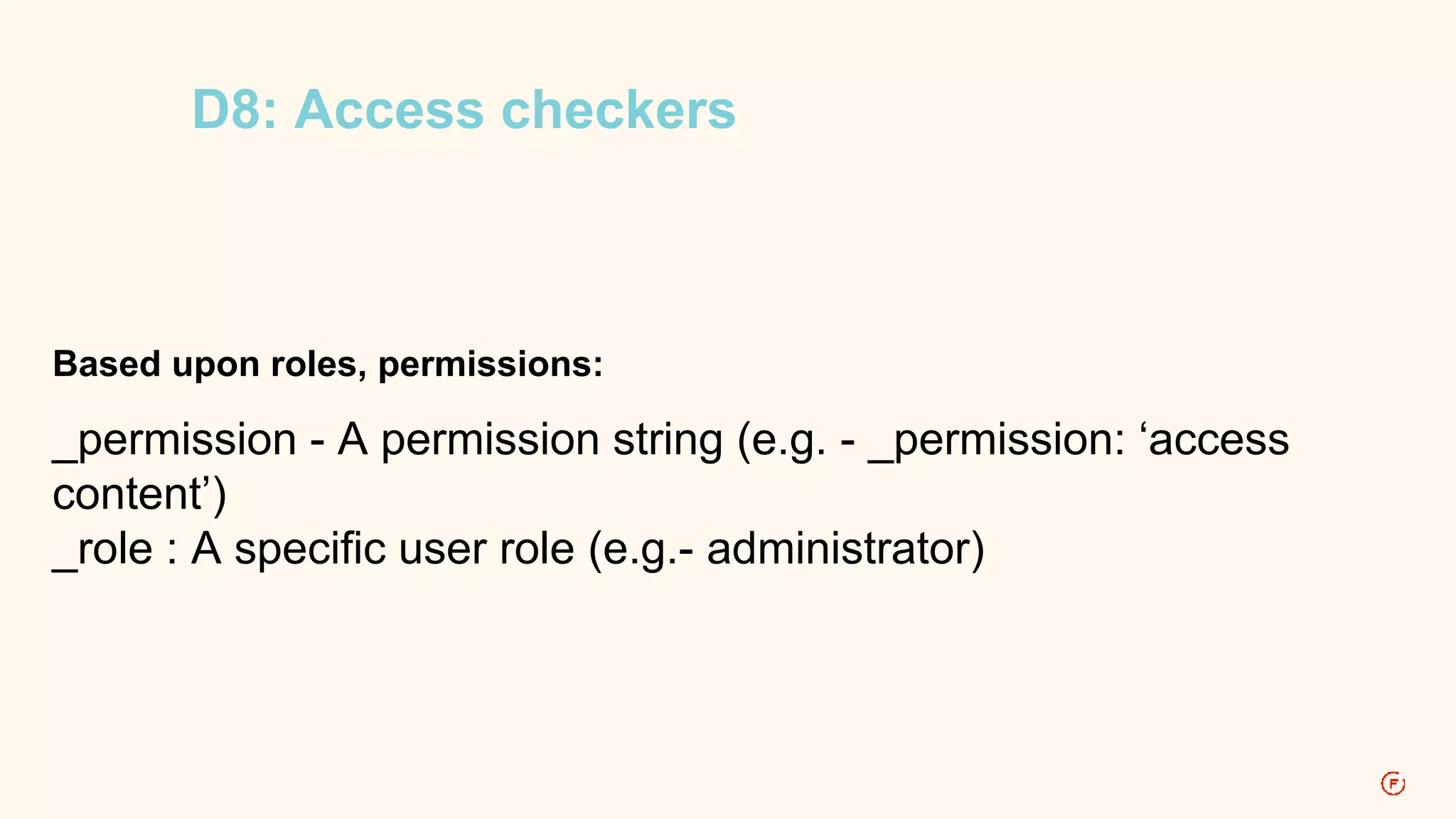
D8: Access checkers 
Based upon roles, permissions: 
_permission - A permission string (e.g. - _permission: ‘access 
content’) 
_role : A specific user role (e.g.- administrator)
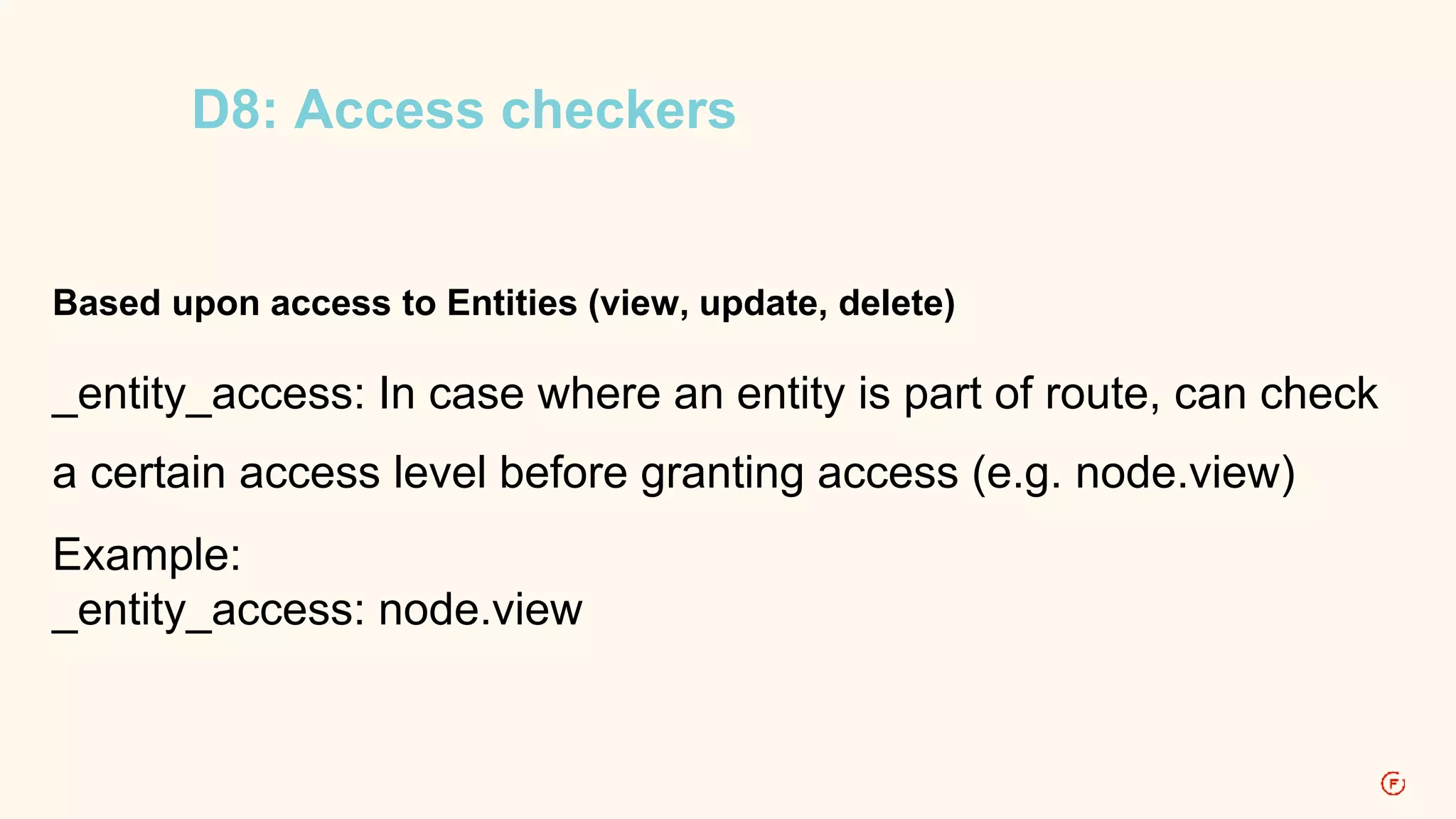
D8: Access checkers 
Based upon access to Entities (view, update, delete) 
_entity_access: In case where an entity is part of route, can check 
a certain access level before granting access (e.g. node.view) 
Example: 
_entity_access: node.view
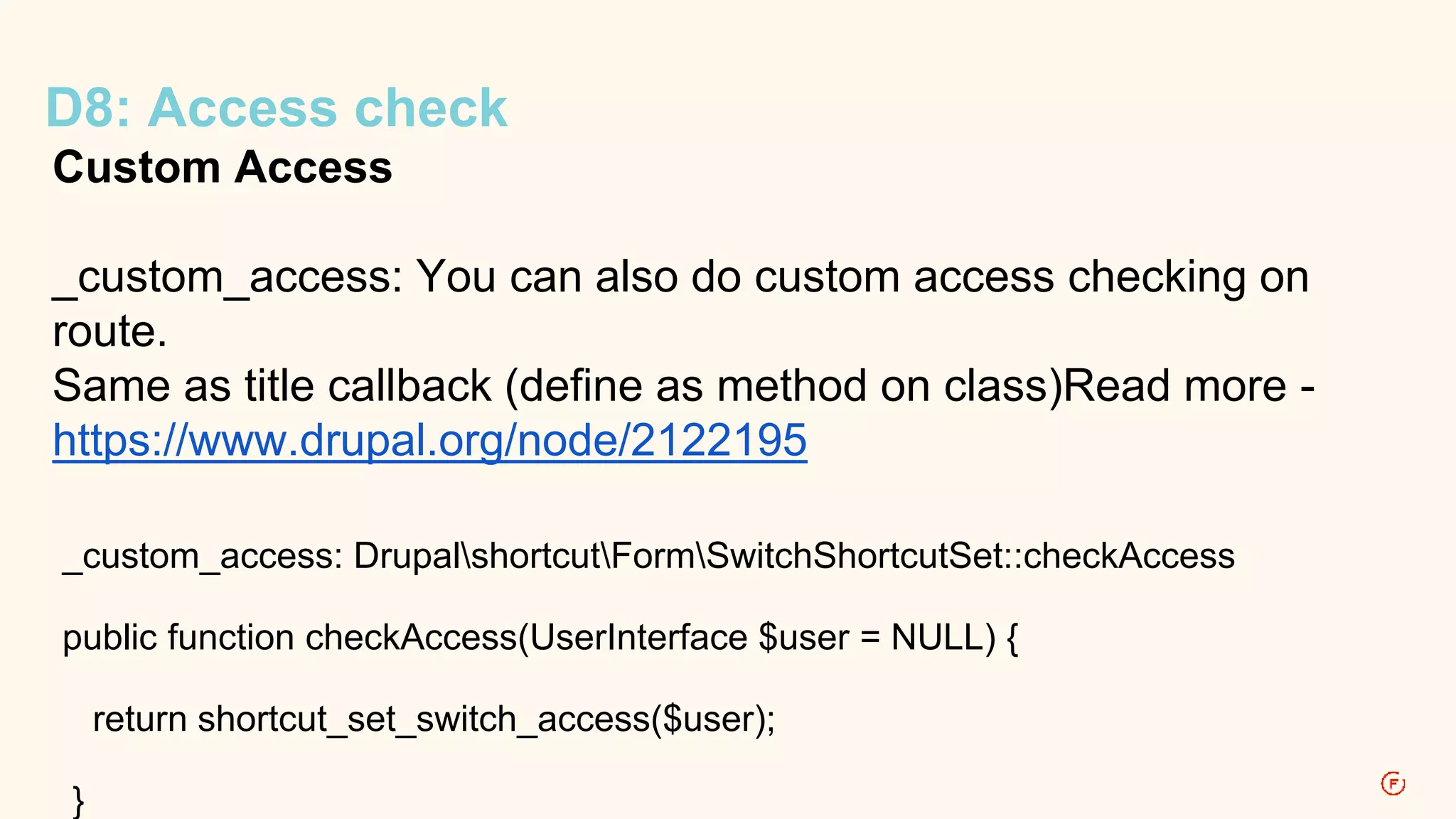
D8: Access check 
Custom Access 
_custom_access: You can also do custom access checking on 
route. 
Same as title callback (define as method on class)Read more - 
https://www.drupal.org/node/2122195 
_custom_access: DrupalshortcutFormSwitchShortcutSet::checkAccess 
public function checkAccess(UserInterface $user = NULL) { 
return shortcut_set_switch_access($user); 
}
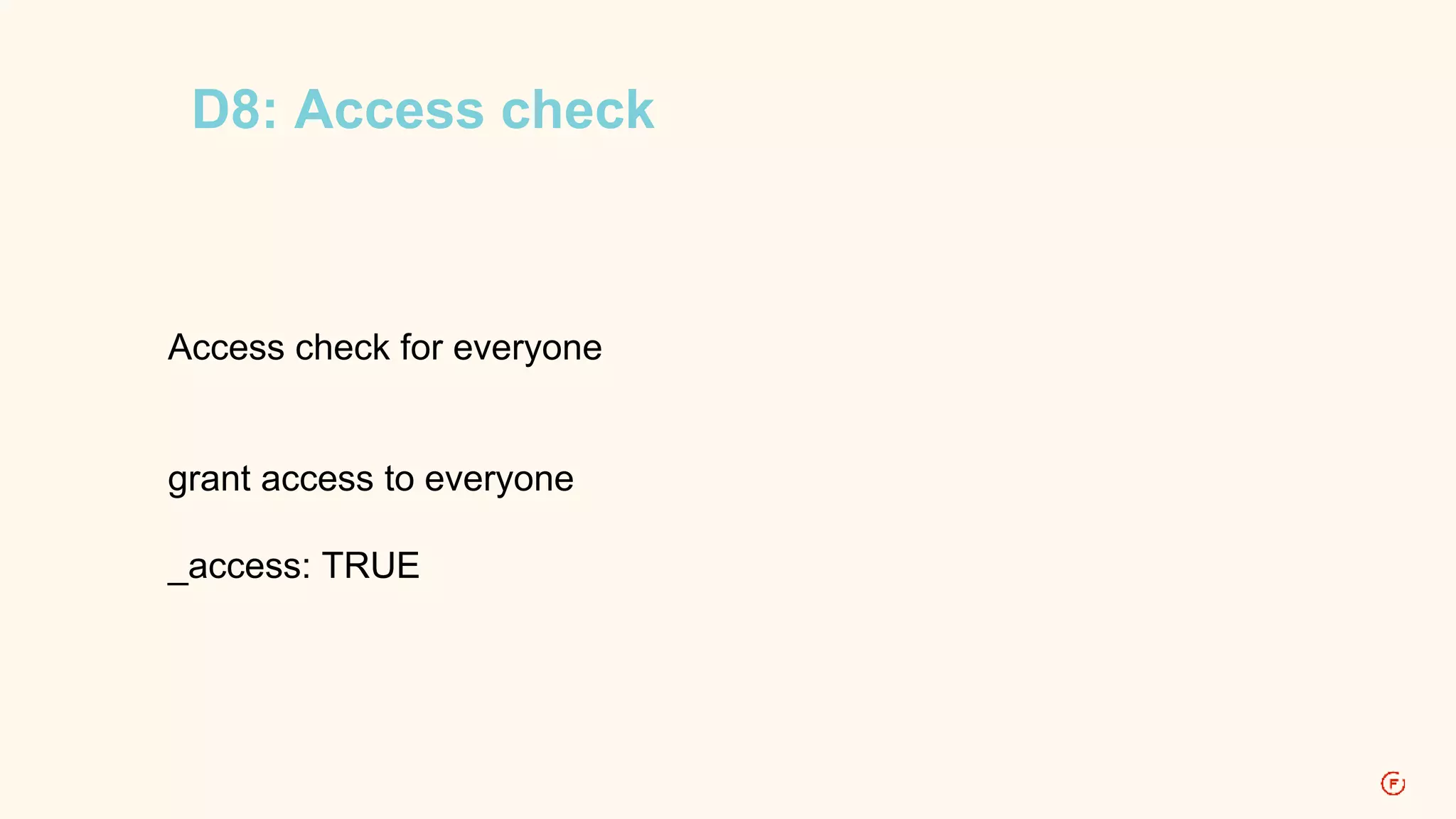
D8: Access check 
Access check for everyone 
grant access to everyone 
_access: TRUE
D8: Access check 
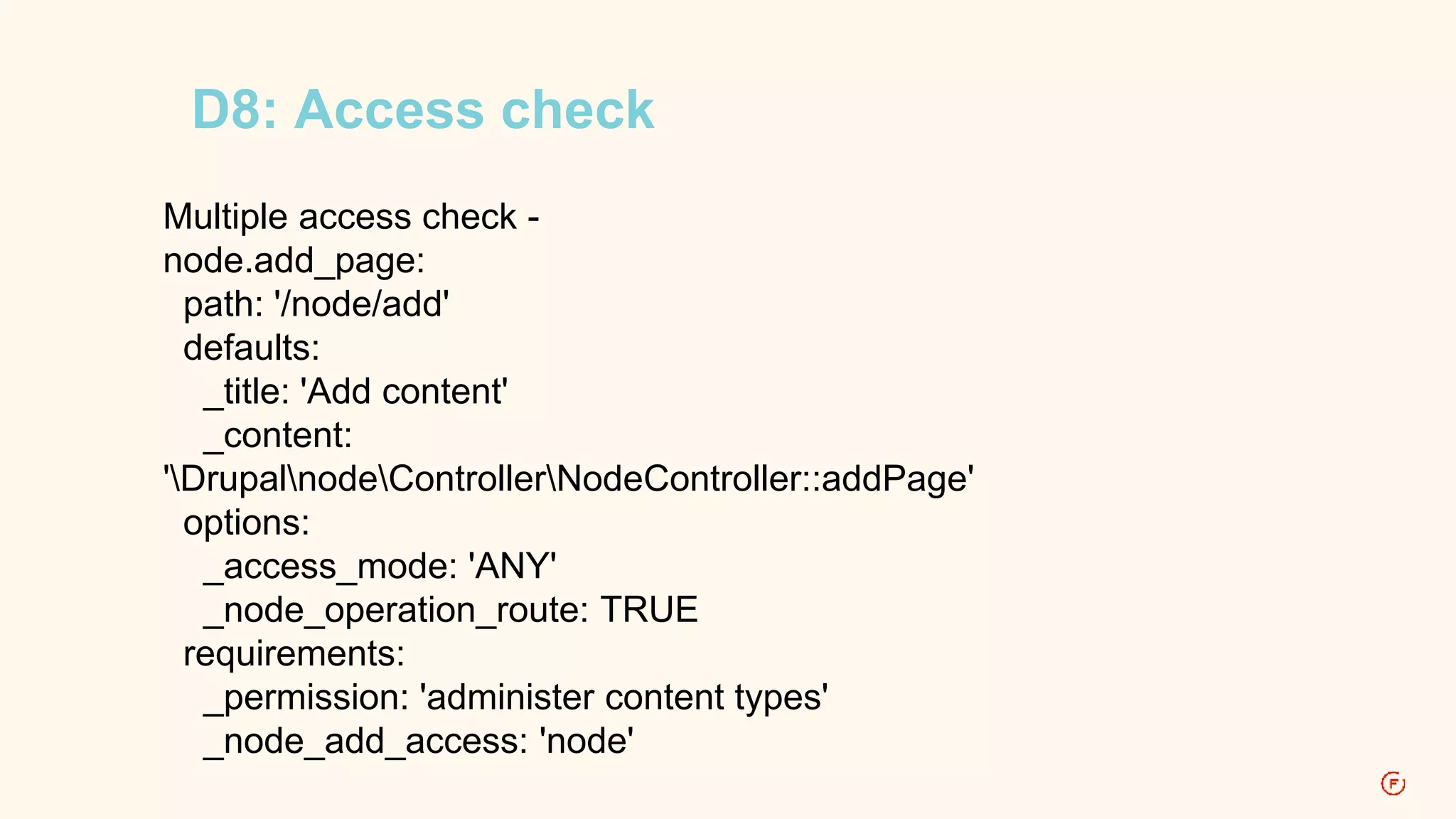
Multiple access check - 
node.add_page: 
path: '/node/add' 
defaults: 
_title: 'Add content' 
_content: 
'DrupalnodeControllerNodeController::addPage' 
options: 
_access_mode: 'ANY' 
_node_operation_route: TRUE 
requirements: 
_permission: 'administer content types' 
_node_add_access: 'node'
Forms
D7: Form Router 
$items['user/password'] = array( 
'title' => 'Request new password', 
'page callback' => 'drupal_get_form', 
'page arguments' => array('user_pass'), 
'access callback' => TRUE, 
'type' => MENU_LOCAL_TASK, 
'file' => 'user.pages.inc', 
);
D7: User Password Form 
function user_pass() { 
$form['name'] = array( 
'#type' => 'textfield', 
'#title' => t('Username or e-mail address'), 
'#size' => 60, 
'#maxlength' => max(USERNAME_MAX_LENGTH, 
EMAIL_MAX_LENGTH), 
'#required' => TRUE, 
'#default_value' => isset($_GET['name']) ? $_GET['name'] : '', 
); 
[...] 
} 
function user_pass_validate($form, &$form_state) 
function user_pass_submit($form, &$form_state)
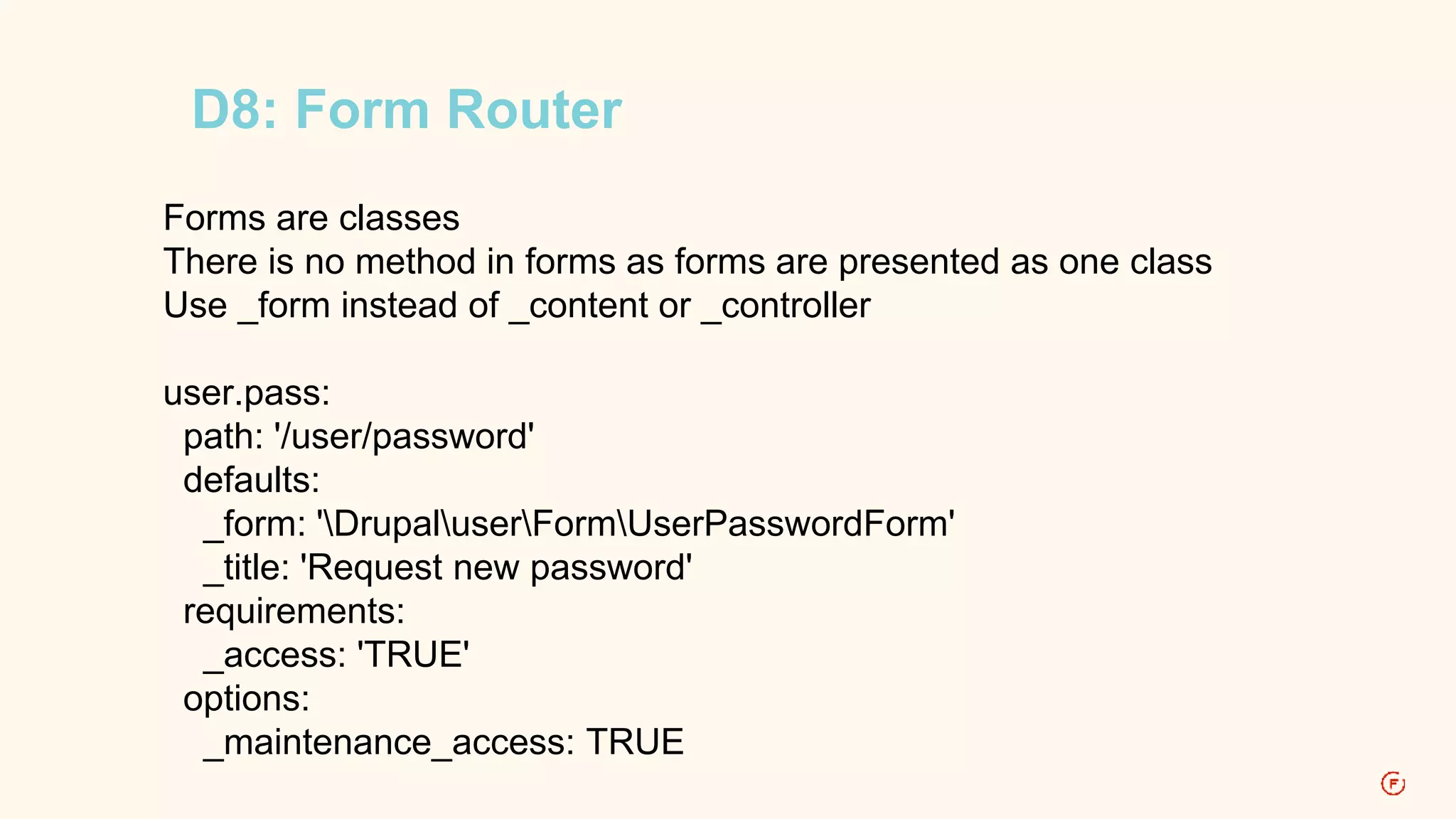
D8: Form Router 
Forms are classes 
There is no method in forms as forms are presented as one class 
Use _form instead of _content or _controller 
user.pass: 
path: '/user/password' 
defaults: 
_form: 'DrupaluserFormUserPasswordForm' 
_title: 'Request new password' 
requirements: 
_access: 'TRUE' 
options: 
_maintenance_access: TRUE
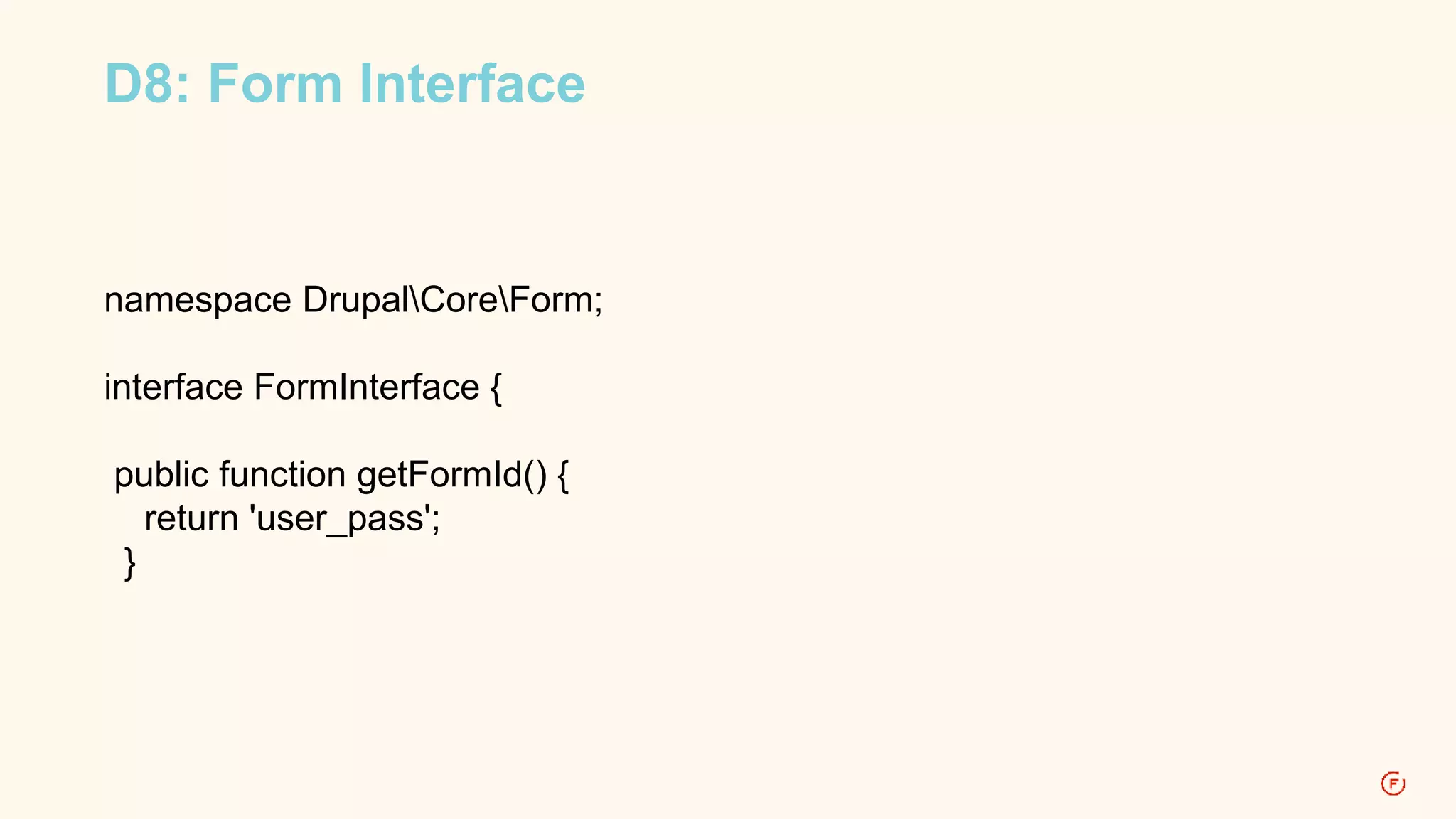
D8: Form Interface 
namespace DrupalCoreForm; 
interface FormInterface { 
public function getFormId() { 
return 'user_pass'; 
}
D8: Form Interface 
public function buildForm(array $form, FormStateInterface $form_state) { 
$form['name'] = array( 
'#type' => 'textfield', 
'#title' => $this->t('Username or email address'), 
'#size' => 60, 
'#maxlength' => max(USERNAME_MAX_LENGTH, 
Email::EMAIL_MAX_LENGTH), 
'#required' => TRUE, 
'#attributes' => array( 
'autocorrect' => 'off', 
'autocapitalize' => 'off', 
'spellcheck' => 'false', 
'autofocus' => 'autofocus', 
), 
);
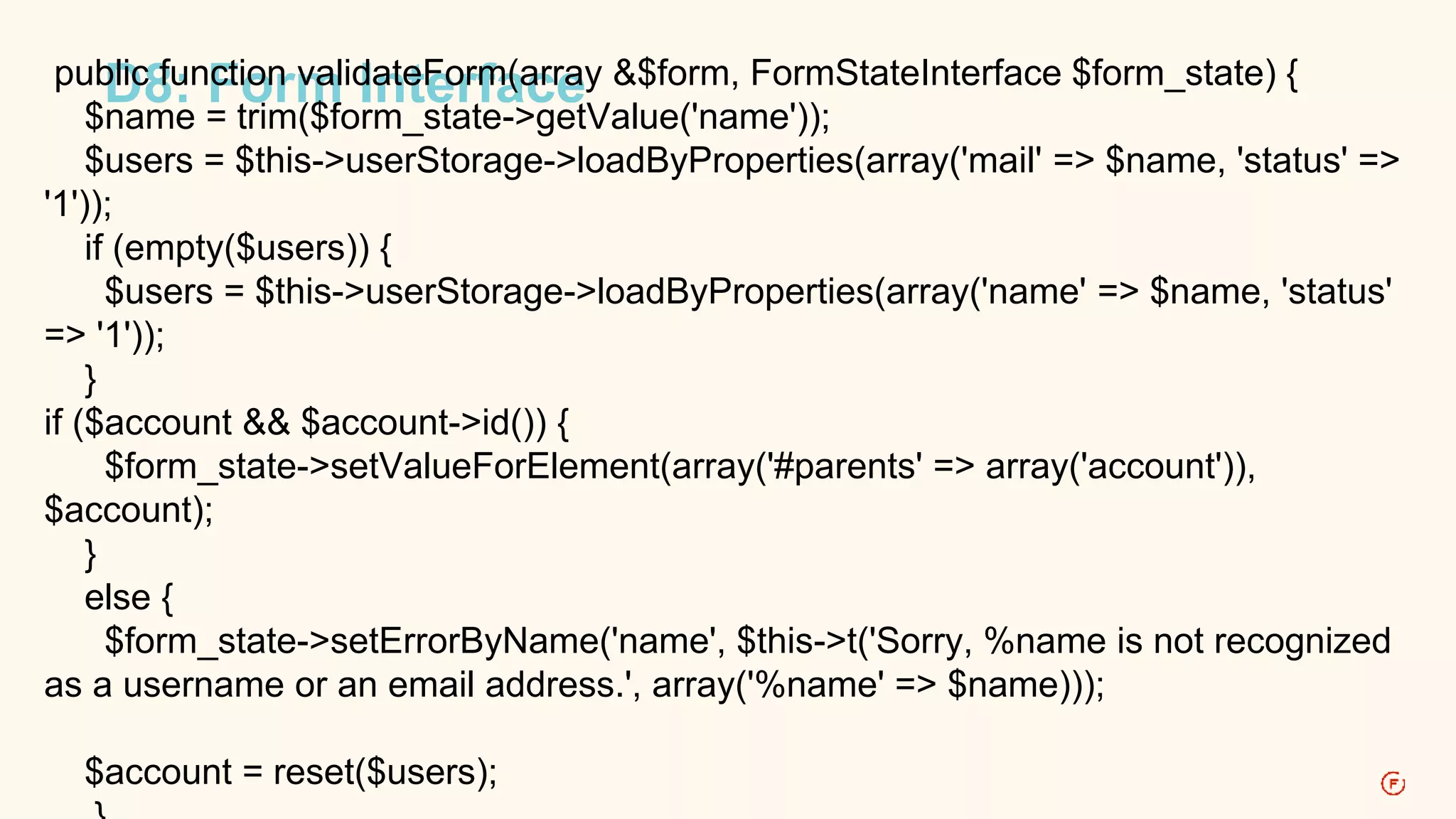
pubDlic8 fu:n Fctioonr mvali dIantetFeorrmfa(acrreay &$form, FormStateInterface $form_state) { 
$name = trim($form_state->getValue('name')); 
$users = $this->userStorage->loadByProperties(array('mail' => $name, 'status' => 
'1')); 
if (empty($users)) { 
$users = $this->userStorage->loadByProperties(array('name' => $name, 'status' 
=> '1')); 
} 
if ($account && $account->id()) { 
$form_state->setValueForElement(array('#parents' => array('account')), 
$account); 
} 
else { 
$form_state->setErrorByName('name', $this->t('Sorry, %name is not recognized 
as a username or an email address.', array('%name' => $name))); 
$account = reset($users); 
}
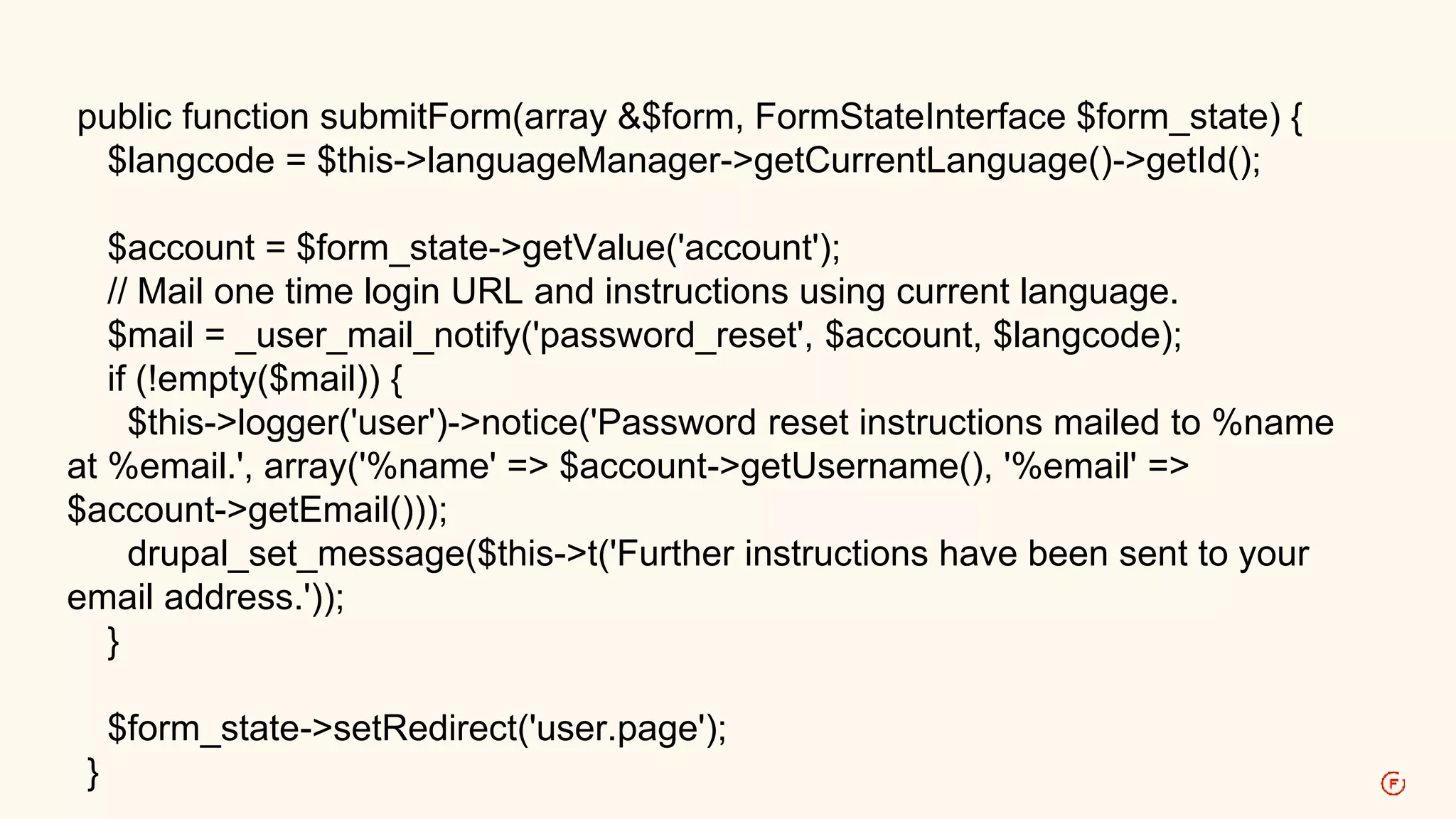
public function submitForm(array &$form, FormStateInterface $form_state) { 
$langcode = $this->languageManager->getCurrentLanguage()->getId(); 
$account = $form_state->getValue('account'); 
// Mail one time login URL and instructions using current language. 
$mail = _user_mail_notify('password_reset', $account, $langcode); 
if (!empty($mail)) { 
$this->logger('user')->notice('Password reset instructions mailed to %name 
at %email.', array('%name' => $account->getUsername(), '%email' => 
$account->getEmail())); 
drupal_set_message($this->t('Further instructions have been sent to your 
email address.')); 
} 
$form_state->setRedirect('user.page'); 
}
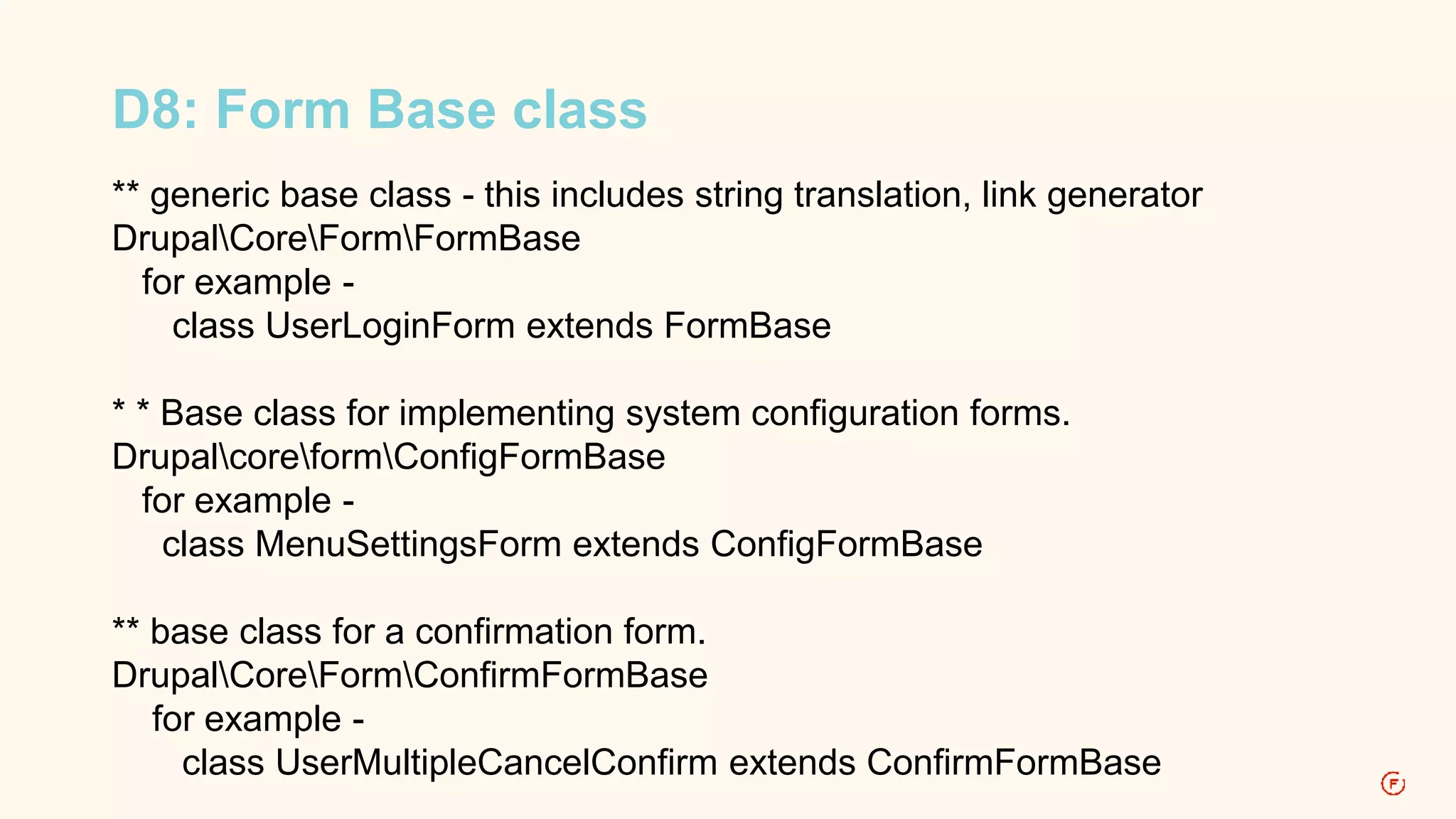
D8: Form Base class 
** generic base class - this includes string translation, link generator 
DrupalCoreFormFormBase 
for example - 
class UserLoginForm extends FormBase 
* * Base class for implementing system configuration forms. 
DrupalcoreformConfigFormBase 
for example - 
class MenuSettingsForm extends ConfigFormBase 
** base class for a confirmation form. 
DrupalCoreFormConfirmFormBase 
for example - 
class UserMultipleCancelConfirm extends ConfirmFormBase
Other functionality 
from hook_menu
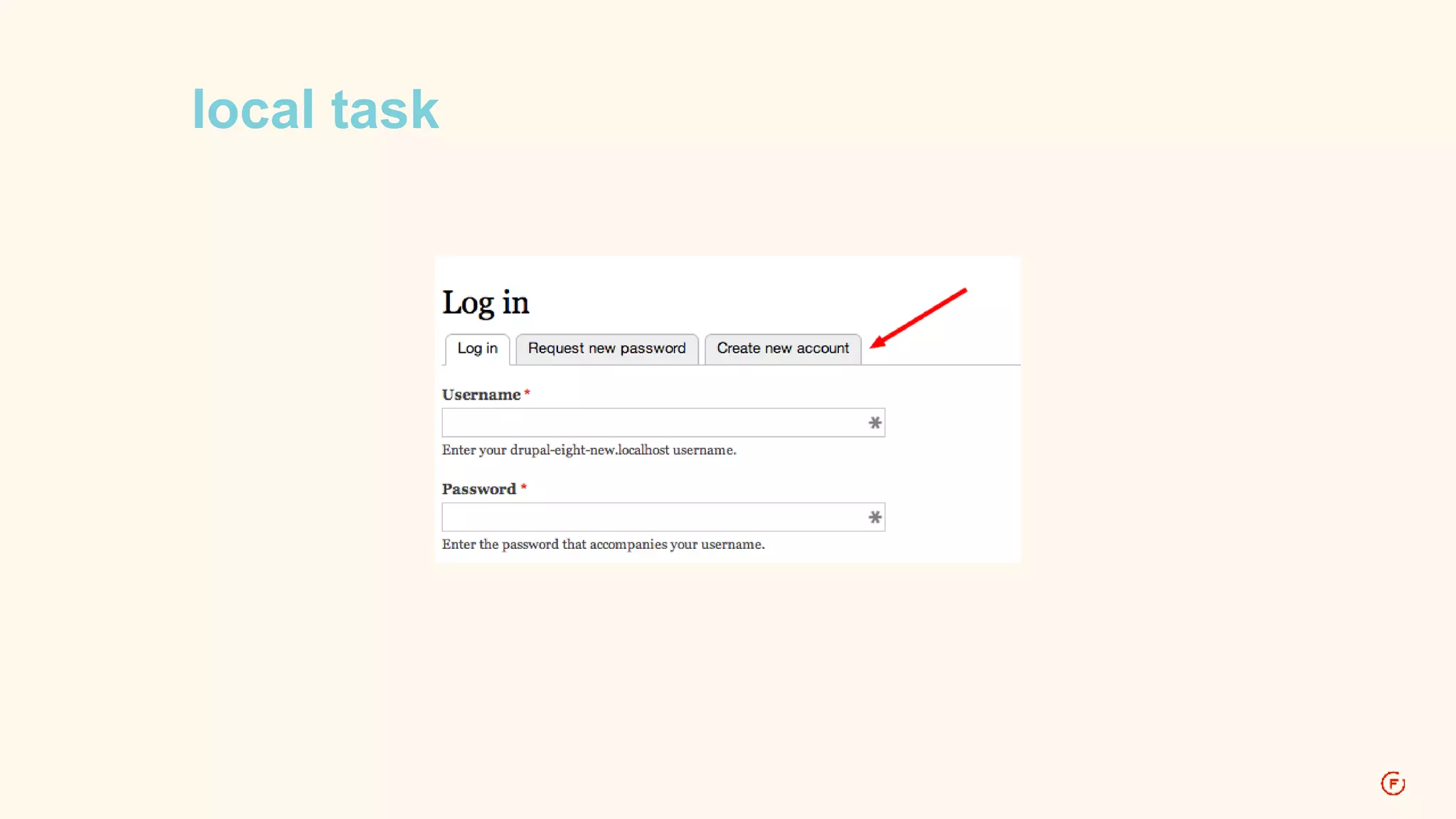
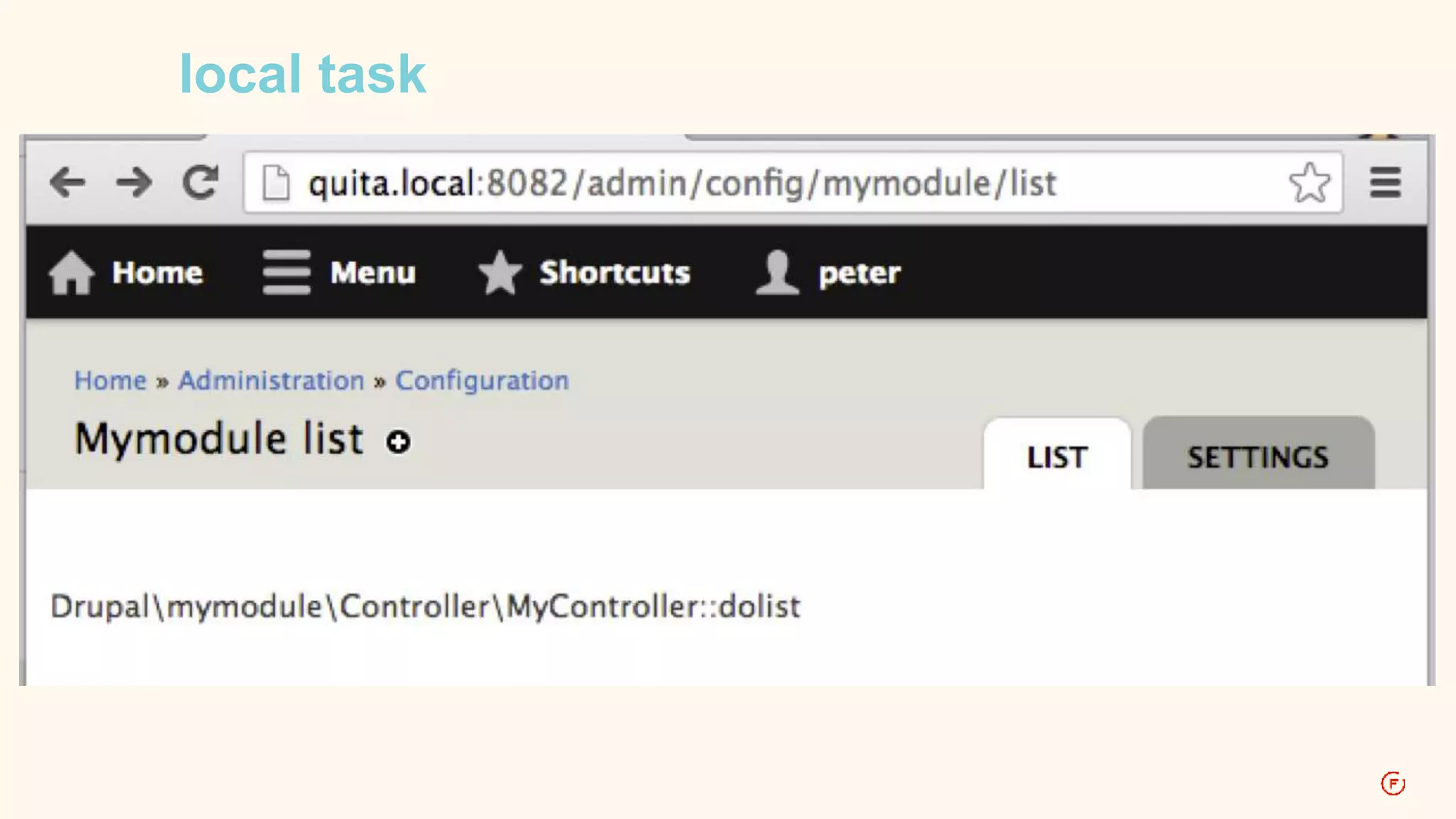
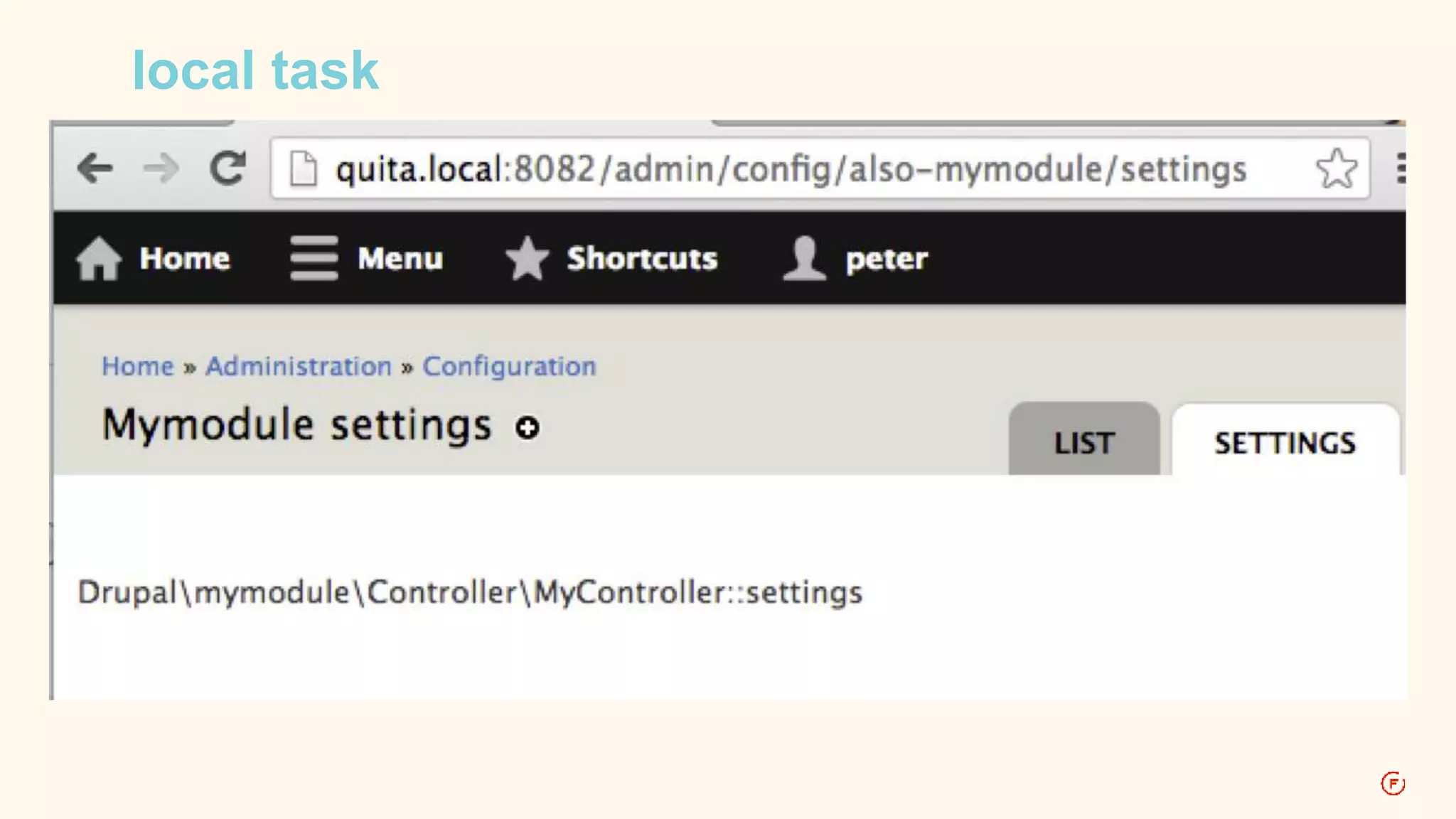
local task
local task
local task
D7: menu local tasks 
$items['user/password'] = array( 
'title' => 'Request new password', 
'page callback' => 'drupal_get_form', 
'page arguments' => array('user_pass'), 
'access callback' => TRUE, 
'type' => MENU_LOCAL_TASK, 
'file' => 'user.pages.inc', 
);
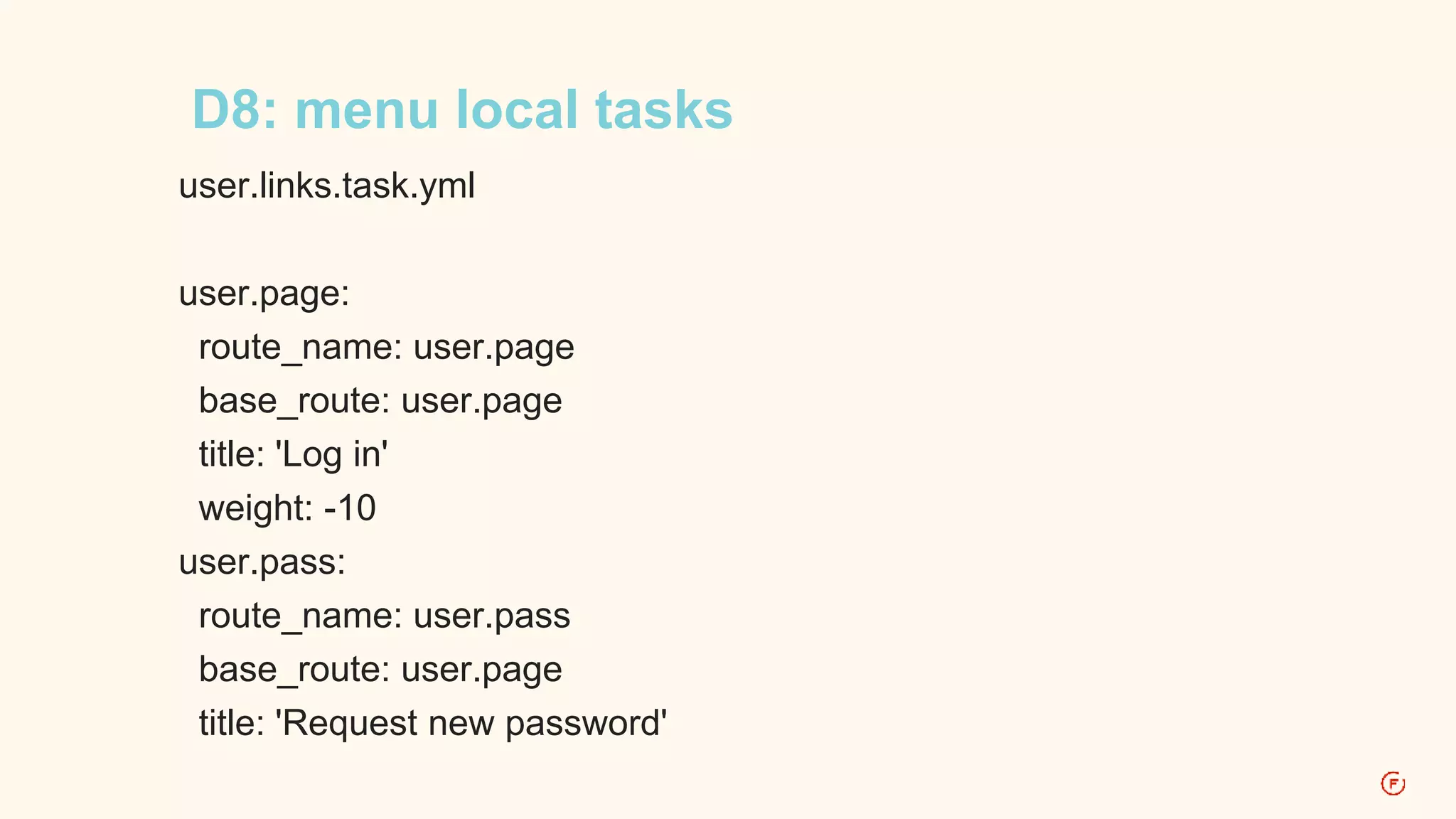
D8: menu local tasks 
user.links.task.yml 
user.page: 
route_name: user.page 
base_route: user.page 
title: 'Log in' 
weight: -10 
user.pass: 
route_name: user.pass 
base_route: user.page 
title: 'Request new password'
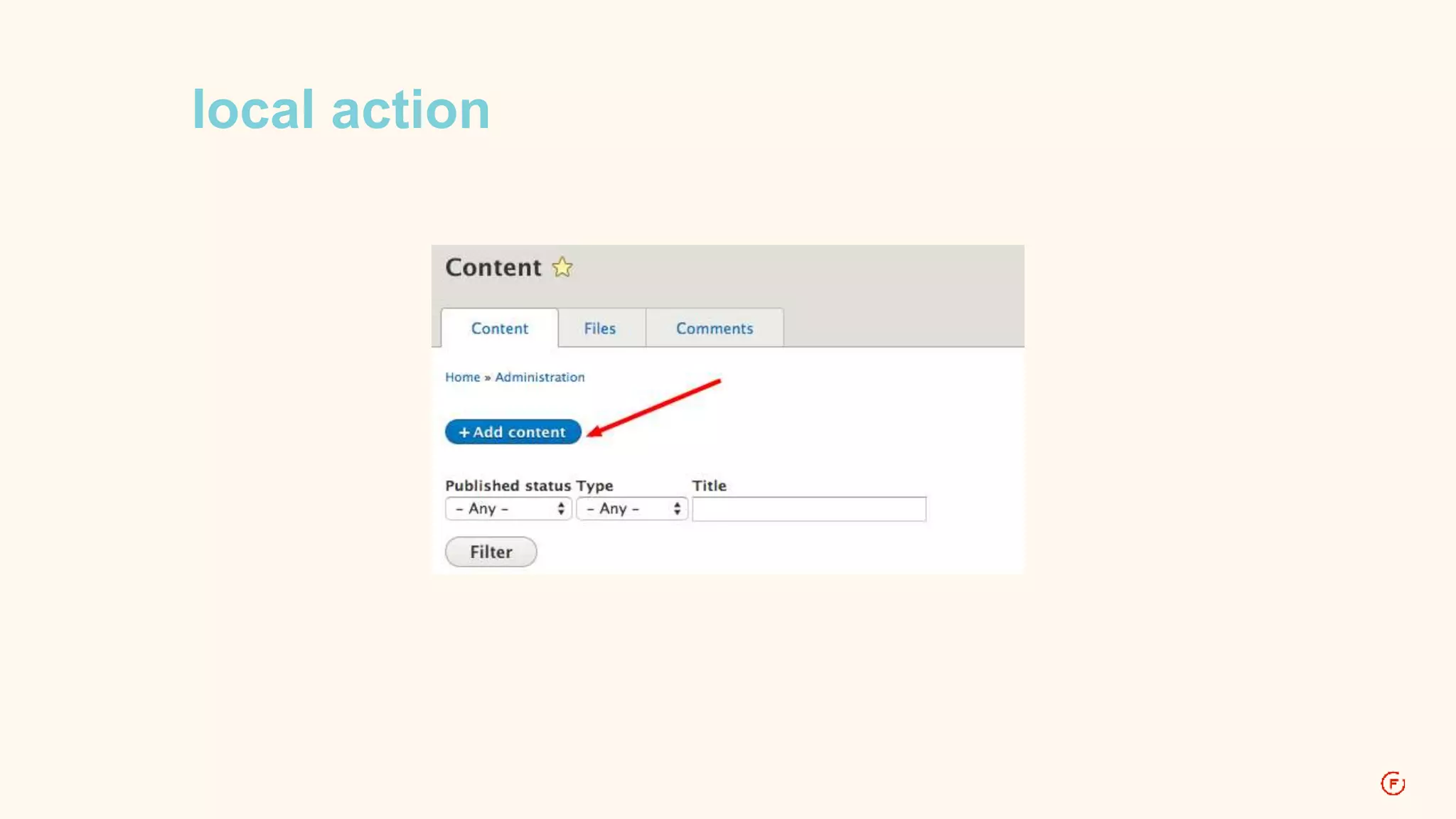
local action
D7: Local action 
$items['admin/structure/types/add'] = array( 
'title' => 'Add content type', 
'page callback' => 'drupal_get_form', 
'page arguments' => array('node_type_form'), 
'access arguments' => array('administer content types'), 
'type' => MENU_LOCAL_ACTION, 
'file' => 'content_types.inc', 
);
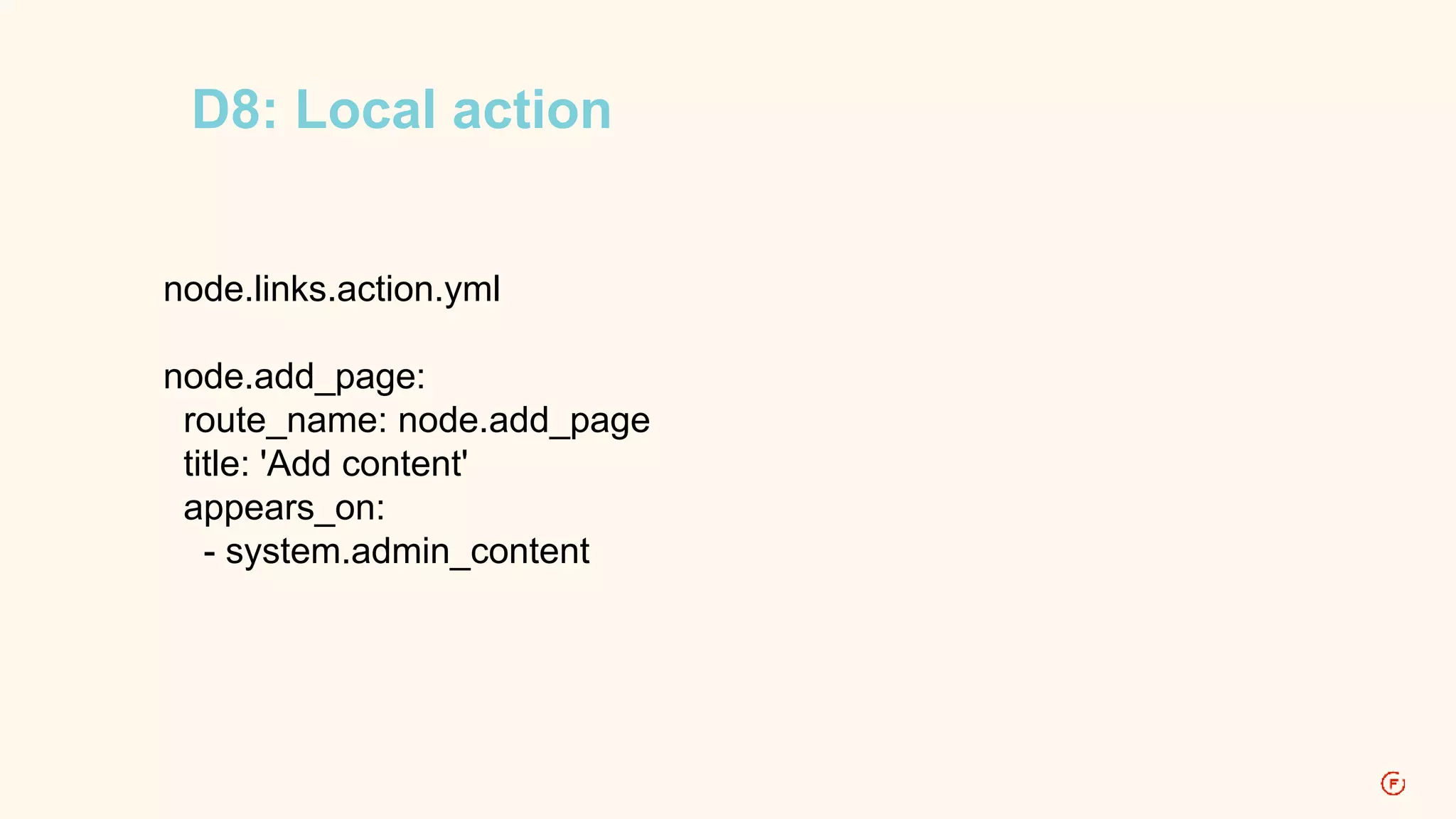
D8: Local action 
node.links.action.yml 
node.add_page: 
route_name: node.add_page 
title: 'Add content' 
appears_on: 
- system.admin_content
D8: Local action on multiple pages 
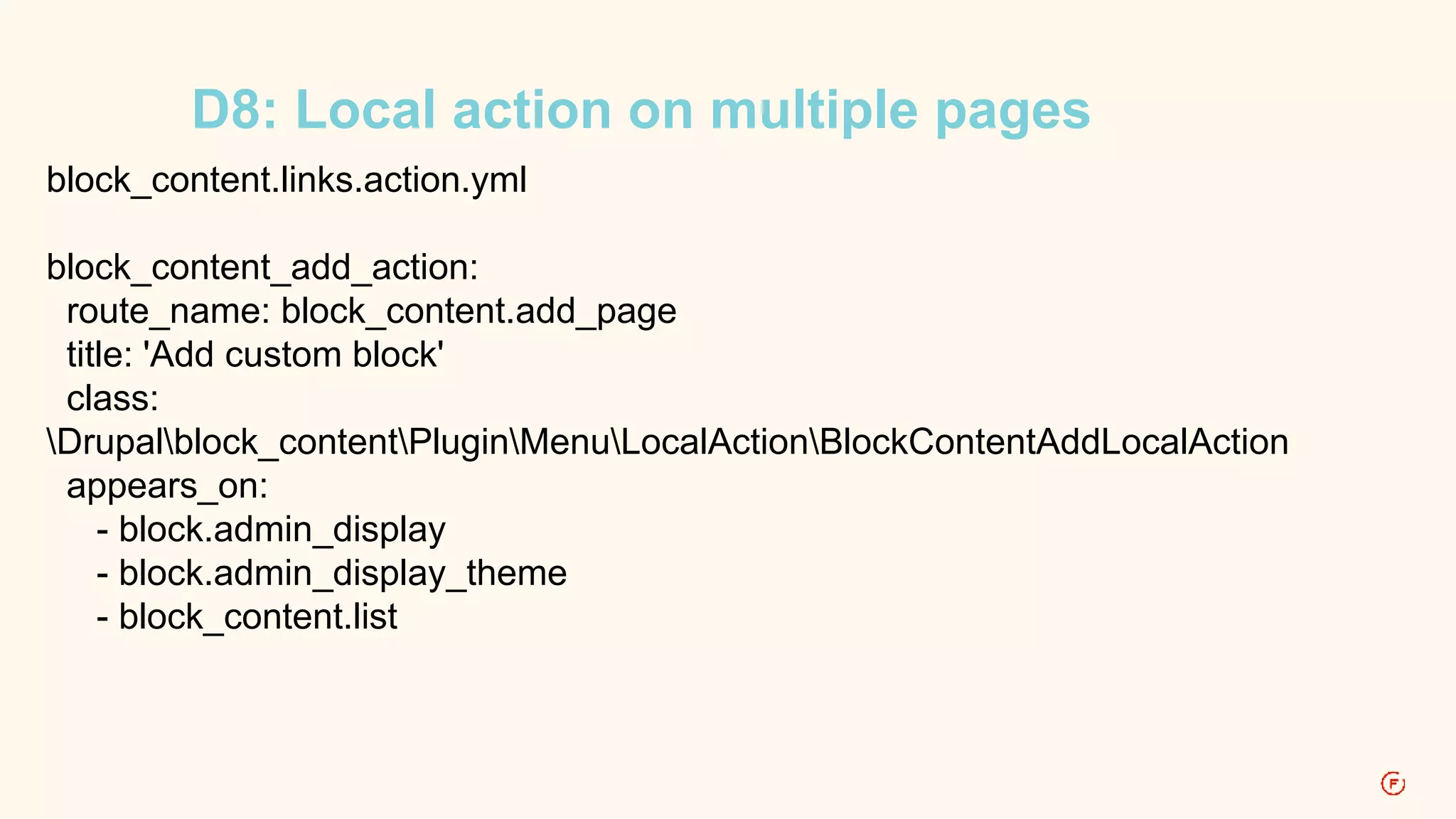
block_content.links.action.yml 
block_content_add_action: 
route_name: block_content.add_page 
title: 'Add custom block' 
class: 
Drupalblock_contentPluginMenuLocalActionBlockContentAddLocalAction 
appears_on: 
- block.admin_display 
- block.admin_display_theme 
- block_content.list
D8: Contextual 
links
D7: Contextual 
links $items['admin/structure/block/manage/%/%/configure'] = array( 
'title' => 'Configure block', 
'type' => MENU_DEFAULT_LOCAL_TASK, 
'context' => MENU_CONTEXT_INLINE, 
);
D8: Contextual 
links 
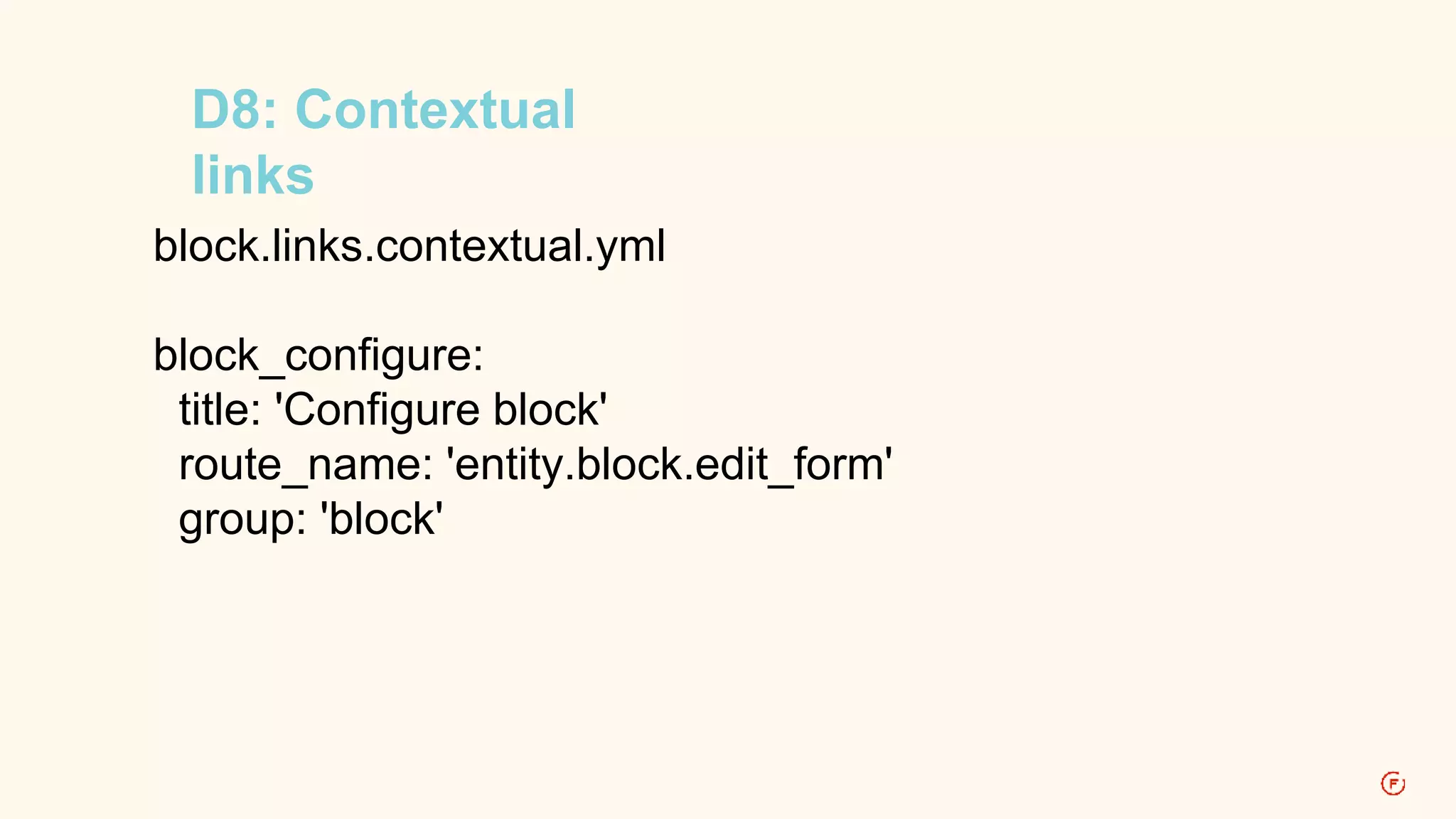
block.links.contextual.yml 
block_configure: 
title: 'Configure block' 
route_name: 'entity.block.edit_form' 
group: 'block'
D8: Path based breadcrumb 
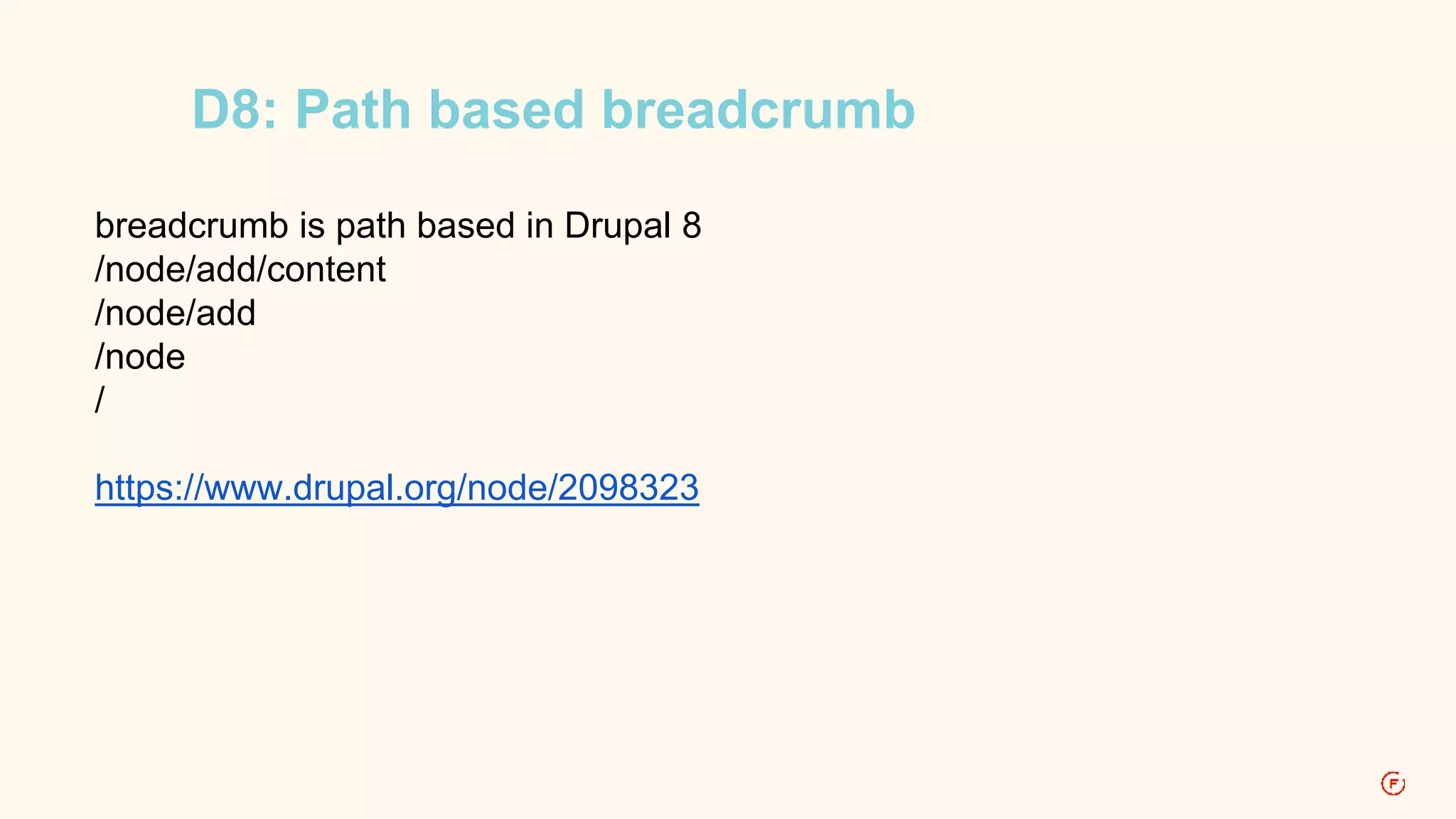
breadcrumb is path based in Drupal 8 
/node/add/content 
/node/add 
/node 
/ 
https://www.drupal.org/node/2098323
Useful Tips
Options 
_admin_route -- whether to use the admin theme for this route 
_maintenance_access -- whether route is publicly available when the site 
is in maintenance mode 
_access_mode -- whether requirements are ANY or ALL 
Useful Tips
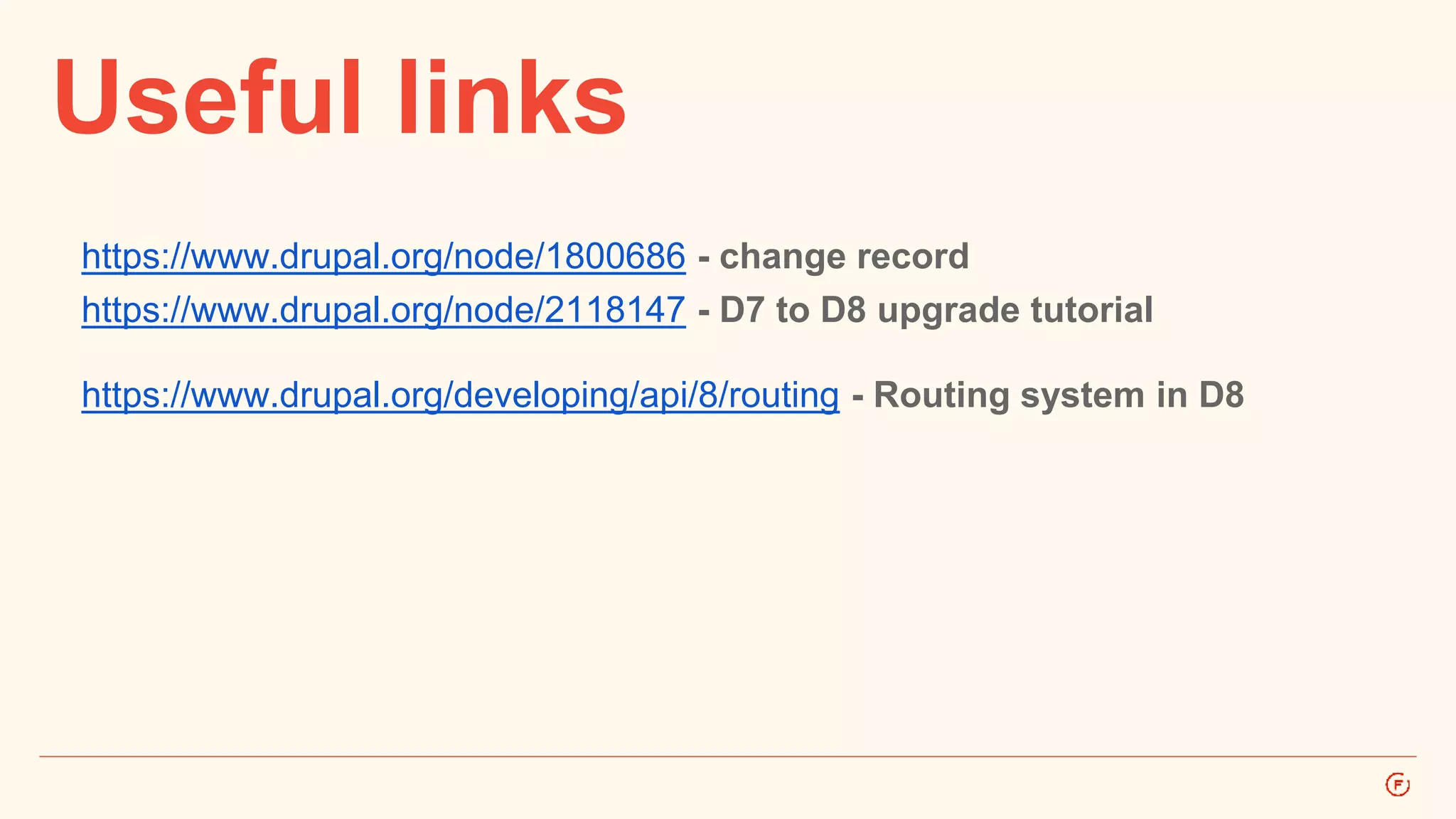
Useful links 
https://www.drupal.org/node/1800686 - change record 
https://www.drupal.org/node/2118147 - D7 to D8 upgrade tutorial 
https://www.drupal.org/developing/api/8/routing - Routing system in D8
THANK YOU! 
Kalpana Goel 
William Hurley

Routing in Drupal 8

  • 1.
    Routing in Drupal8 November 13, 2014
  • 2.
    Nice to MeetYou! Kalpana Goel Developer Drupal.org - kgoel Twitter - @kalpanagoel William Hurley Manager, Technical Development
  • 3.
    What is aroute? Routes are the mappings between URL paths and their corresponding page and access callbacks.
  • 4.
  • 5.
    hook_menu defines the routing in Drupal 7 1:1 mapping of path to route
  • 6.
    hook_menu is deadin 8.0.x There is no hook_menu in Drupal 8! MODULENAME.routing.yml One path may map to multiple routes
  • 8.
  • 9.
    D7 hook_menu ●Routing (page and access callbacks) ● Menu links ● Local actions ● Local tasks ● Breadcrumbs ● Contextual links ● Title ● Weight
  • 10.
  • 11.
  • 12.
    D7: hook_menu() functionuser_menu() { $items['user/logout'] = array( 'title' => 'Log out', 'access callback' => 'user_is_logged_in', 'page callback' => 'user_logout', 'weight' => 10, 'menu_name' => 'user-menu', 'file' => 'user.pages.inc', ); return $items; }
  • 13.
    D7: page callback /** * Menu callback; logs the current user out, and redirects to the home page. */ function user_logout() { global $user; watchdog('user', 'Session closed for %name.', array('%name' => $user->name)); module_invoke_all('user_logout', $user); // Destroy the current session, and reset $user to the anonymous user. session_destroy(); drupal_goto(); }
  • 14.
    D8: Routing user.routing.yml user.logout: path: '/user/logout' defaults: _controller: 'DrupaluserControllerUserController::logout' requirements: _user_is_logged_in: 'TRUE'
  • 15.
    D8: Controller namespaceDrupaluserController; class UserController extends ControllerBase { public function logout() { user_logout(); return $this->redirect('<front>'); }
  • 16.
  • 17.
    D8: Path (required) For dynamic properties, you can include them in curly braces. For example - ‘/admin/structure/views/{js}/display/{view}/{display_id}/{type}' The {display_id} element in the URL is called a placeholder and is available as $display_id in the controller method.
  • 18.
    D8: dynamic pathexample views_ui.form_display: path: '/admin/structure/views/{js}/display/{view}/{display_id}/{type}' defaults: _content: 'Drupalviews_uiFormAjaxDisplay::getForm' class Display extends ViewsFormBase { public function getForm(ViewStorageInterface $view, $display_id, $js, $type = NULL) { $this->setType($type); return parent::getForm($view, $display_id, $js); }
  • 19.
    D8: Optional Attributes user.cancel_confirm: path: '/user/{user}/cancel/confirm/{timestamp}/{hashed_pass}' defaults: _title: 'Confirm account cancellation' _content: 'DrupaluserControllerUserController::confirmCancel' timestamp: 0 hashed_pass: ''
  • 20.
    D8: Page Title user.view: path: '/user/{user}' defaults: _entity_view: 'user.full' _title_callback: 'DrupaluserControllerUserController::userTitle' requirements: _entity_access: 'user.view'
  • 21.
    D8: Page Types _content : - display content on a page _form : - display form on a page. _controller : - use to generate raw data like json output _entity_view : - for example - node.teaser _entity_form : - display a form for a entity _entity_list : - display list of entity like node
  • 22.
  • 23.
    D8: Access checking user.admin_account: path: '/admin/people' defaults: _entity_list: 'user' _title: 'People' requirements: _permission: 'administer users'
  • 24.
    D8: Access checkers Based upon roles, permissions: _permission - A permission string (e.g. - _permission: ‘access content’) _role : A specific user role (e.g.- administrator)
  • 25.
    D8: Access checkers Based upon access to Entities (view, update, delete) _entity_access: In case where an entity is part of route, can check a certain access level before granting access (e.g. node.view) Example: _entity_access: node.view
  • 26.
    D8: Access check Custom Access _custom_access: You can also do custom access checking on route. Same as title callback (define as method on class)Read more - https://www.drupal.org/node/2122195 _custom_access: DrupalshortcutFormSwitchShortcutSet::checkAccess public function checkAccess(UserInterface $user = NULL) { return shortcut_set_switch_access($user); }
  • 27.
    D8: Access check Access check for everyone grant access to everyone _access: TRUE
  • 28.
    D8: Access check Multiple access check - node.add_page: path: '/node/add' defaults: _title: 'Add content' _content: 'DrupalnodeControllerNodeController::addPage' options: _access_mode: 'ANY' _node_operation_route: TRUE requirements: _permission: 'administer content types' _node_add_access: 'node'
  • 29.
  • 30.
    D7: Form Router $items['user/password'] = array( 'title' => 'Request new password', 'page callback' => 'drupal_get_form', 'page arguments' => array('user_pass'), 'access callback' => TRUE, 'type' => MENU_LOCAL_TASK, 'file' => 'user.pages.inc', );
  • 31.
    D7: User PasswordForm function user_pass() { $form['name'] = array( '#type' => 'textfield', '#title' => t('Username or e-mail address'), '#size' => 60, '#maxlength' => max(USERNAME_MAX_LENGTH, EMAIL_MAX_LENGTH), '#required' => TRUE, '#default_value' => isset($_GET['name']) ? $_GET['name'] : '', ); [...] } function user_pass_validate($form, &$form_state) function user_pass_submit($form, &$form_state)
  • 32.
    D8: Form Router Forms are classes There is no method in forms as forms are presented as one class Use _form instead of _content or _controller user.pass: path: '/user/password' defaults: _form: 'DrupaluserFormUserPasswordForm' _title: 'Request new password' requirements: _access: 'TRUE' options: _maintenance_access: TRUE
  • 33.
    D8: Form Interface namespace DrupalCoreForm; interface FormInterface { public function getFormId() { return 'user_pass'; }
  • 34.
    D8: Form Interface public function buildForm(array $form, FormStateInterface $form_state) { $form['name'] = array( '#type' => 'textfield', '#title' => $this->t('Username or email address'), '#size' => 60, '#maxlength' => max(USERNAME_MAX_LENGTH, Email::EMAIL_MAX_LENGTH), '#required' => TRUE, '#attributes' => array( 'autocorrect' => 'off', 'autocapitalize' => 'off', 'spellcheck' => 'false', 'autofocus' => 'autofocus', ), );
  • 35.
    pubDlic8 fu:n Fctioonrmvali dIantetFeorrmfa(acrreay &$form, FormStateInterface $form_state) { $name = trim($form_state->getValue('name')); $users = $this->userStorage->loadByProperties(array('mail' => $name, 'status' => '1')); if (empty($users)) { $users = $this->userStorage->loadByProperties(array('name' => $name, 'status' => '1')); } if ($account && $account->id()) { $form_state->setValueForElement(array('#parents' => array('account')), $account); } else { $form_state->setErrorByName('name', $this->t('Sorry, %name is not recognized as a username or an email address.', array('%name' => $name))); $account = reset($users); }
  • 36.
    public function submitForm(array&$form, FormStateInterface $form_state) { $langcode = $this->languageManager->getCurrentLanguage()->getId(); $account = $form_state->getValue('account'); // Mail one time login URL and instructions using current language. $mail = _user_mail_notify('password_reset', $account, $langcode); if (!empty($mail)) { $this->logger('user')->notice('Password reset instructions mailed to %name at %email.', array('%name' => $account->getUsername(), '%email' => $account->getEmail())); drupal_set_message($this->t('Further instructions have been sent to your email address.')); } $form_state->setRedirect('user.page'); }
  • 37.
    D8: Form Baseclass ** generic base class - this includes string translation, link generator DrupalCoreFormFormBase for example - class UserLoginForm extends FormBase * * Base class for implementing system configuration forms. DrupalcoreformConfigFormBase for example - class MenuSettingsForm extends ConfigFormBase ** base class for a confirmation form. DrupalCoreFormConfirmFormBase for example - class UserMultipleCancelConfirm extends ConfirmFormBase
  • 38.
  • 39.
  • 40.
  • 41.
  • 42.
    D7: menu localtasks $items['user/password'] = array( 'title' => 'Request new password', 'page callback' => 'drupal_get_form', 'page arguments' => array('user_pass'), 'access callback' => TRUE, 'type' => MENU_LOCAL_TASK, 'file' => 'user.pages.inc', );
  • 43.
    D8: menu localtasks user.links.task.yml user.page: route_name: user.page base_route: user.page title: 'Log in' weight: -10 user.pass: route_name: user.pass base_route: user.page title: 'Request new password'
  • 44.
  • 45.
    D7: Local action $items['admin/structure/types/add'] = array( 'title' => 'Add content type', 'page callback' => 'drupal_get_form', 'page arguments' => array('node_type_form'), 'access arguments' => array('administer content types'), 'type' => MENU_LOCAL_ACTION, 'file' => 'content_types.inc', );
  • 46.
    D8: Local action node.links.action.yml node.add_page: route_name: node.add_page title: 'Add content' appears_on: - system.admin_content
  • 47.
    D8: Local actionon multiple pages block_content.links.action.yml block_content_add_action: route_name: block_content.add_page title: 'Add custom block' class: Drupalblock_contentPluginMenuLocalActionBlockContentAddLocalAction appears_on: - block.admin_display - block.admin_display_theme - block_content.list
  • 48.
  • 49.
    D7: Contextual links$items['admin/structure/block/manage/%/%/configure'] = array( 'title' => 'Configure block', 'type' => MENU_DEFAULT_LOCAL_TASK, 'context' => MENU_CONTEXT_INLINE, );
  • 50.
    D8: Contextual links block.links.contextual.yml block_configure: title: 'Configure block' route_name: 'entity.block.edit_form' group: 'block'
  • 51.
    D8: Path basedbreadcrumb breadcrumb is path based in Drupal 8 /node/add/content /node/add /node / https://www.drupal.org/node/2098323
  • 52.
  • 53.
    Options _admin_route --whether to use the admin theme for this route _maintenance_access -- whether route is publicly available when the site is in maintenance mode _access_mode -- whether requirements are ANY or ALL Useful Tips
  • 54.
    Useful links https://www.drupal.org/node/1800686- change record https://www.drupal.org/node/2118147 - D7 to D8 upgrade tutorial https://www.drupal.org/developing/api/8/routing - Routing system in D8
  • 55.
    THANK YOU! KalpanaGoel William Hurley

Editor's Notes

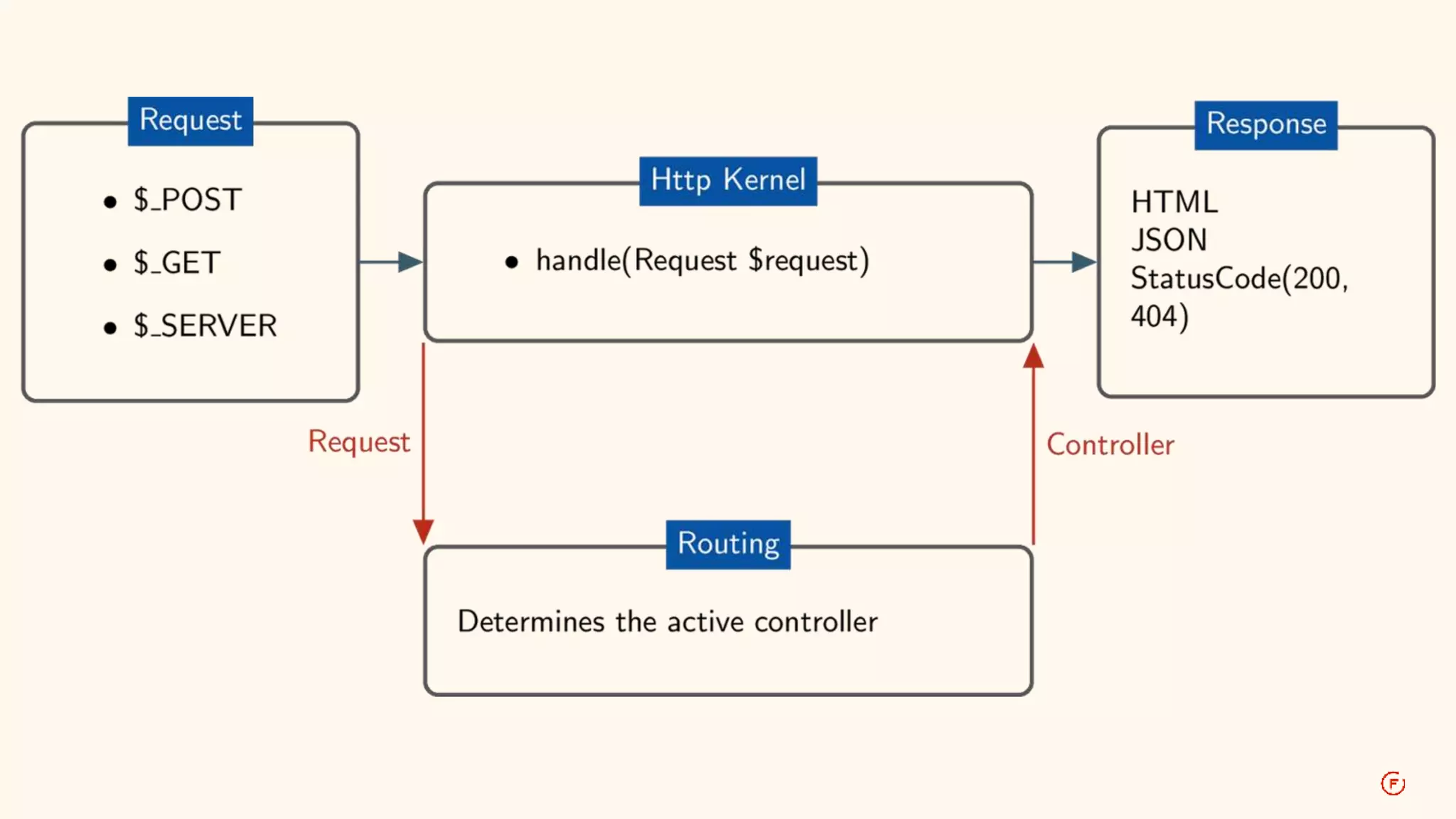
  • #8 This is a general overview of how routing works. So request comes in via your mobile devices or browser and you get a response in the format of JSON or HTML, an image, a redirect or a 404 return. Drupal routing works with Symfony HTTP Kernel, but you don’t need to know the details how it works. In Symfony there is an object which converts request into response which is called HTTP kernel. router matches the incoming URl to a specific route and returns information about the route including controller that should be executed. Symfony kernel executes the controller, which returns a response object.
  • #10 hook_menu did too much in Drupal 7 and it was very complicated to understand what it was doing or it was very difficult to do any advanced task with it.
  • #13 This example is from user module from Drupal 7. As you can see it has path - user/logout, title as change log out, access callback, page callback, weight, menu-name, and this callback happens to be in separate file - user.pages.inc
  • #14 This is a page callback in Drupal 7. All it does is logs out the user, closes the session and takes user to the homepage.
  • #15 So this part takes over the routing aspect from drupal 7. This is routing yml for Drupal 8. modulename.routing.yml There is a machine name - user.logout of the route(modulname.something), path is - user/logout, it is same as what used to be in the key array items. There is two other section - defaults and requirements. The new thing is the controller part here which is following PSR-4 standard here but I am not covering here but this is the controller we are using here = Drupal\user\Controller\UserController instead of old page callback. Controller has a class name - \Drupal\user\Controller\UserController and logout is method name. For the requirement, it is same as access callback in hook_menu in Drupal 7, here we have if user is logged in as requirement instead of access argument.
  • #16 This is Drupal 8 version, In d8 everything is in objects and classes. so here we have a namespace. In Drupal 8, we are using psr -4 (to know where files are). we have a method here which is for logout. All it does is logs out the current user and redirect user to homepage. So the general concept is that instead of having a function in a one file you have it in in method in a class.
  • #18 Path is required in Drupal 8.
  • #19 If you are using node IDs in the URL, the ID can be automatically be converted to a node object by ParamConverter system so it loads an entity from an existing entity ID. In this example above, its using id as one of the parameter, you can see order doesn’t matter here. so we have a entity type view here and in the method, it loads the complete views object.
  • #20 In some cases, you can provide default value under defaults. By default drupal passes some parameter. if you go to user/somenumber/cancel/confirm page then something will be displayed and if you don’t provide default value for timestamp and hashed_pass then it will return 404 page.
  • #21 So we do have title_callback here, if you go to user/specific user page then you want to display user name as the title so we are using title_callback here. same syntax as controller.
  • #22 5 available defaults in Drupal 8. it is required in drupal 8 Controller is for non-HTML, JSON or only for partial HTML but no theming or block will be output. entity_view - value is entity_type.view_mode. for example node.teaser will return render array of the node in teaser mode. entity_form - for example _entity_form: node.default will display the default node form. entity_list : - for example view_mode returns the list of view modes. (Value is the entity type/view mode to show)
  • #24 requirements - determines what conditions must be met in order to grant access to the route. role - since this can be different for sites so its recommended to use permission based on access restriction. _format:json - so it only matches requests when the accept header is json _module -
  • #25 requirements - determines what conditions must be met in order to grant access to the route. role - since this can be different for sites so its recommended to use permission based on access restriction. _format:json - so it only matches requests when the accept header is json _module
  • #26 requirements - determines what conditions must be met in order to grant access to the route. role - since this can be different for sites so its recommended to use permission based on access restriction. _format:json - so it only matches requests when the accept header is json _module
  • #27 requirements - determines what conditions must be met in order to grant access to the route. role - since this can be different for sites so its recommended to use permission based on access restriction. _format:json - so it only matches requests when the accept header is json _module
  • #28 In Drupal 8, routing is very powerful. So now you need to check access on the page like does the user has certain role or permission so symfony provides requirements. So here is _permission and also there is role so you can specify if user has permission to access the content based on role and permission. There is also _entity_access permission. So if user go to node.edit so if user has permission to edit the node
  • #29 In Drupal 8, you can also have multiple access checks. In the above route, there are two access check. options “any” means if either of the requirements is true then user will be able to access the page. If there is _access_mode: All then both requirements need to meet in order to access the page. This is more powerful than Drupal 7. Default is “ALL” A very interesting thing here - _node_operation_route:TRUE - You can configure in node module that all node related routes show the admin theme so this is a flag which flags the route here.
  • #31 In Drupal 8, we are using form api such as user login page. In the previous example we saw _controller, _content and so on. in Drupal 8 forms are classes. use _form . there is no method so one form is presented as one class. here in this example, we have a user login form
  • #32 In Drupal 8, here is user login form, it has a getFormId function, buildform function, and submit function, validateAuthentication, validateName and validateFiinal function. build form lets you build the form structure. submit method is executed when form is submitted. validateName function is for -- Sets an error if supplied username has been blocked. validateAuthentication function is for checking supplied username/password against local users table. validateFinal function is for checking if user was not authenticated, or if too many logins were attempted, Code was too long to paste here so just wanted to show you an example of form in Drupal 8.
  • #33 In Drupal 8, we are using form api such as user login page. In the previous example we saw _controller, _content and so on. in Drupal 8 forms are classes. use _form . there is no method so one form is presented as one class. here in this example, we have a user login form
  • #34 In Drupal 8, here is user login form, it has a getFormId function, buildform function, validateForm, and submit function. build form lets you build the form structure. validateForm is for flagging errors in submitted data. submit method is executed when form is submitted and has passed validation. Code was too long to paste here so just wanted to show you an example of form in Drupal 8.
  • #35 In Drupal 8, here is user login form, it has a getFormId function, buildform function, validateForm, and submit function. build form lets you build the form structure. validateForm is for flagging errors in submitted data. submit method is executed when form is submitted and has passed validation. Code was too long to paste here so just wanted to show you an example of form in Drupal 8.
  • #36 In Drupal 8, here is user login form, it has a getFormId function, buildform function, validateForm, and submit function. build form lets you build the form structure. validateForm is for flagging errors in submitted data. submit method is executed when form is submitted and has passed validation. Code was too long to paste here so just wanted to show you an example of form in Drupal 8.
  • #37 In Drupal 8, here is user login form, it has a getFormId function, buildform function, and submit function, validateFinal function is for checking if user was not authenticated, or if too many logins were attempted,
  • #38  There are some helper classes for form . ConfigFormBase - Provides an generic base class for a confirmation form. FormBase - generic base class - includes string translation, link generator, ConfirmFormBase -
  • #40  in Drupal 8 you have menu local tasks in its own file so here we have user.links.task.yml file.
  • #41  in Drupal 8 you have menu local tasks in its own file so here we have user.links.task.yml file.
  • #42  in Drupal 8 you have menu local tasks in its own file so here we have user.links.task.yml file.
  • #43  in Drupal 8 you have menu local tasks in its own file so here we have user.links.task.yml file. here we don’t path anymore but we have route_name, base_route, title, and weight. base_route so tabs appear on same page.
  • #44  in Drupal 8 you have menu local tasks in its own file so here we have user.links.task.yml file. here we don’t path anymore but we have route_name, base_route, title, and weight. base_route so tabs appear on same page.
  • #45  in Drupal 8 we have local action which is add content here in this image. so you can easily create some content.
  • #46 in Drupal 8, you can define local action in node.links.action.yml. you have machine name, route name, title. important thing to notice is “appears on” where this local action should appear.
  • #47 in Drupal 8, you can define local action in node.links.action.yml. you have machine name, route name, title. important thing to notice is “appears on” where this local action should appear.
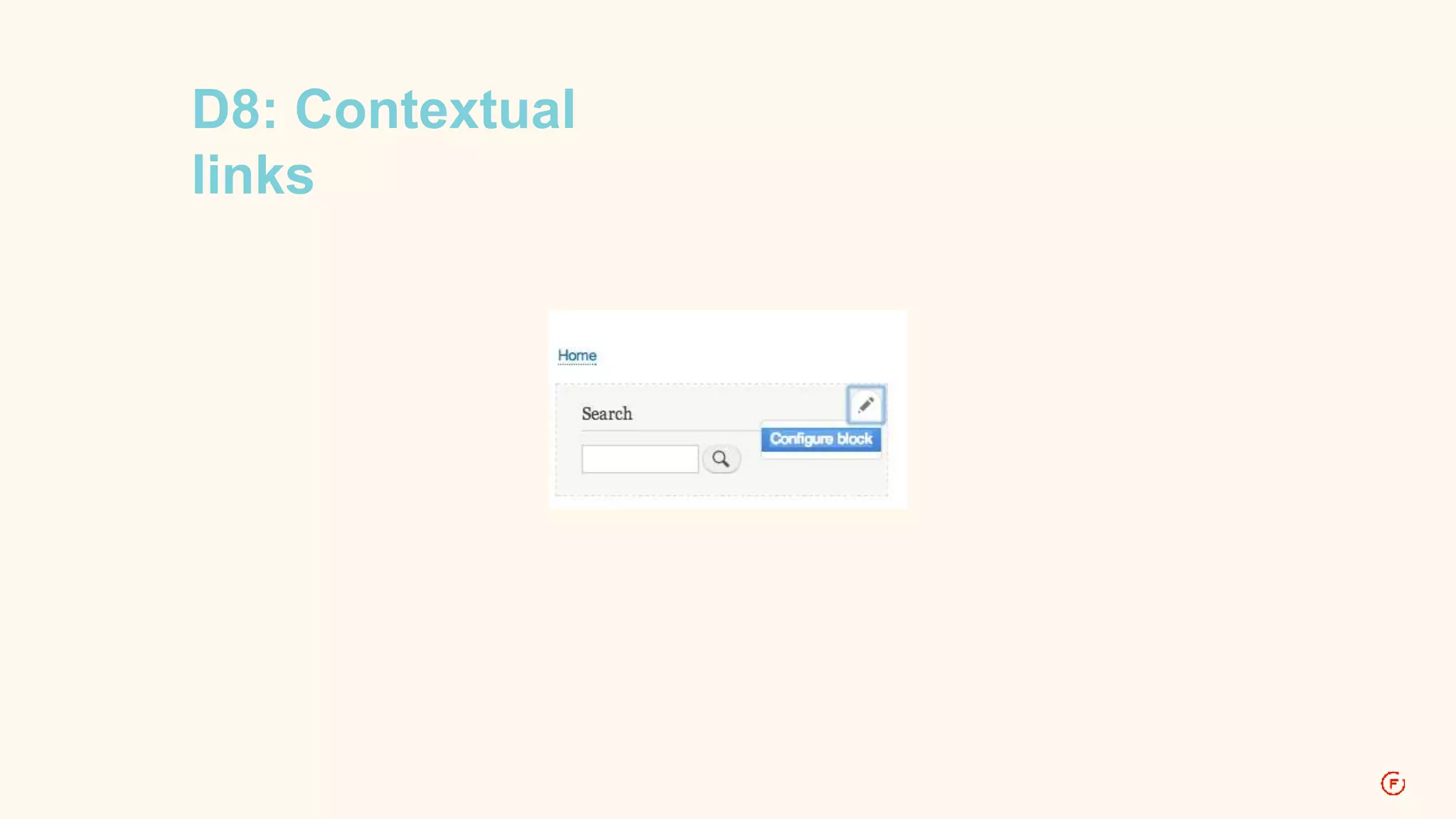
  • #49 in Drupal 8, if you hover over any block then you get this “configure block” icon so in drupal 8 you can configure block where should it appear and you can do that in contextual yml file.
  • #50 in Drupal 8, you can configure block where should it appear and you can do that in contextual yml file for example - block.links.contextual.yml. again machine name, title, group, and route name. everything which is related to block contextual link should appear under block group
  • #51 in Drupal 8, you can configure block where should it appear and you can do that in contextual yml file for example - block.links.contextual.yml. again machine name, title, group, and route name. everything which is related to block contextual link should appear under block group Check BlockViewBuilder - group block is defined there in the render array
  • #52 in Drupal 8, you can configure block where should it appear and you can do that in contextual yml file for example - user.links.contextual.yml. again machine name, title, group, weight, and route name so its like i want to display delete role on user.role_delete route.
  • #54 hook_menu did too much in Drupal 7 and it was very complicated to understand what it was doing or to do anything very advanced tasks.
  • #55 hook_menu did too much in Drupal 7 and it was very complicated to understand what it was doing or to do anything very advanced tasks.