

Recommended
More Related Content
What's hot
What's hot (20)
Similar to Lightning Talk: An Introduction To Scrum
Similar to Lightning Talk: An Introduction To Scrum (20)
More from joshua.mcadams
More from joshua.mcadams (9)
Recently uploaded
Recently uploaded (20)
Lightning Talk: An Introduction To Scrum
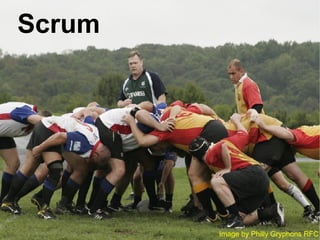
- 1. Image by Philly Gryphons RFC Scrum
- 2. What is it?
- 3. An agile development methodology
- 4. Details?
- 5. Scrum has three primary areas of focus
- 6. 1) Definition of roles
- 7. 2) Existence of backlogs
- 10. Two classes of people
- 11. Image by KB35
- 13. A chicken and pig start a breakfast shop called “Bacon & Eggs”
- 14. The chicken has an interest in the project
- 15. But the pig has skin in the game
- 16. Core roles
- 17. Scrum Master
- 20. Closest role to a project manager
- 21. Product owner
- 22. Maintains the product backlog
- 24. Sets preferred order of completion
- 25. Business owner for the project
- 26. The team
- 27. Designers, Developers, QA, etc.
- 28. Own workload for a given cycle
- 29. Set expectations
- 32. Product backlog
- 33. Prioritized list of user stories
- 34. Created and ranked by product owner
- 35. Sprint backlog
- 36. List of user stories selected from the product backlog
- 37. Selected by the team, not the product owner
- 38. All tasks in the sprint backlog should fit into one sprint cycle
- 39. What is this sprint thing?
- 40. A sprint is a 30 day work cycle
- 41. At the beginning of a sprint user stories are selected
- 42. Selected by the team, not the product owner
- 43. This is the most difficult transition for an organization to make
- 44. At the end of the sprint these same user stories are demonstrated
- 45. Demonstrated as fully-functional, shippable, unit-tested deliverables
- 46. Shippable
- 47. in 30 days
- 48. The team controls the workload
- 49. And must be honest and accurate in estimates
- 50. Constant feature delivery builds trust
- 51. And makes it easier for the business to buy-in to scrum
- 54. 8 hours
- 55. First four hours for the product owner presenting the product backlog
- 56. Final four hours for the team deciding on workload and doing initial design and estimation
- 58. 15 minutes
- 59. What did you do?
- 60. What are you going to do?
- 61. Do you have any roadblocks?
- 62. Sprint Expo
- 63. 4 hours
- 64. End of sprint show-and-tell
- 66. 4 hours
- 67. What went wrong this sprint?
- 68. What went right this sprint?
- 69. That seems like a lot of meetings
- 70. 8 + (.25*20) + 4 + 4 = 21 hours of meetings
- 71. 21 hours of 176 hours = 17% overhead
- 72. 21 hours of 176 hours = 17% overhead
- 74. That's Scrum