Molecular Clinical Safety Intelligence: Tools to detect risk (or at least illuminate blind spots) earlier in drug discovery.
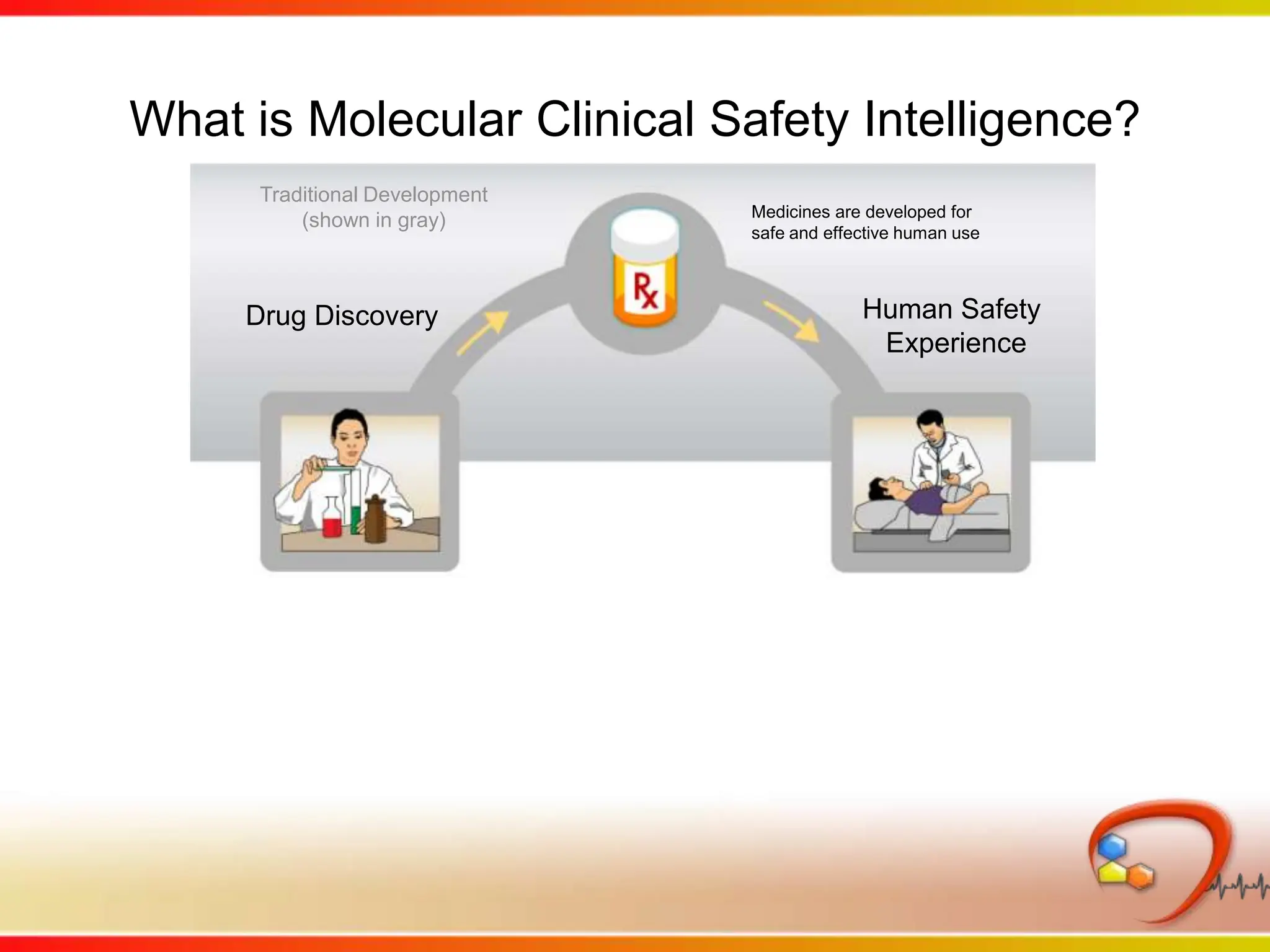
Traditional Development(shown in gray)Medicines are developed for safe and effective human useHuman Safety   ExperienceDrug DiscoveryWhat is Molecular Clinical Safety Intelligence?
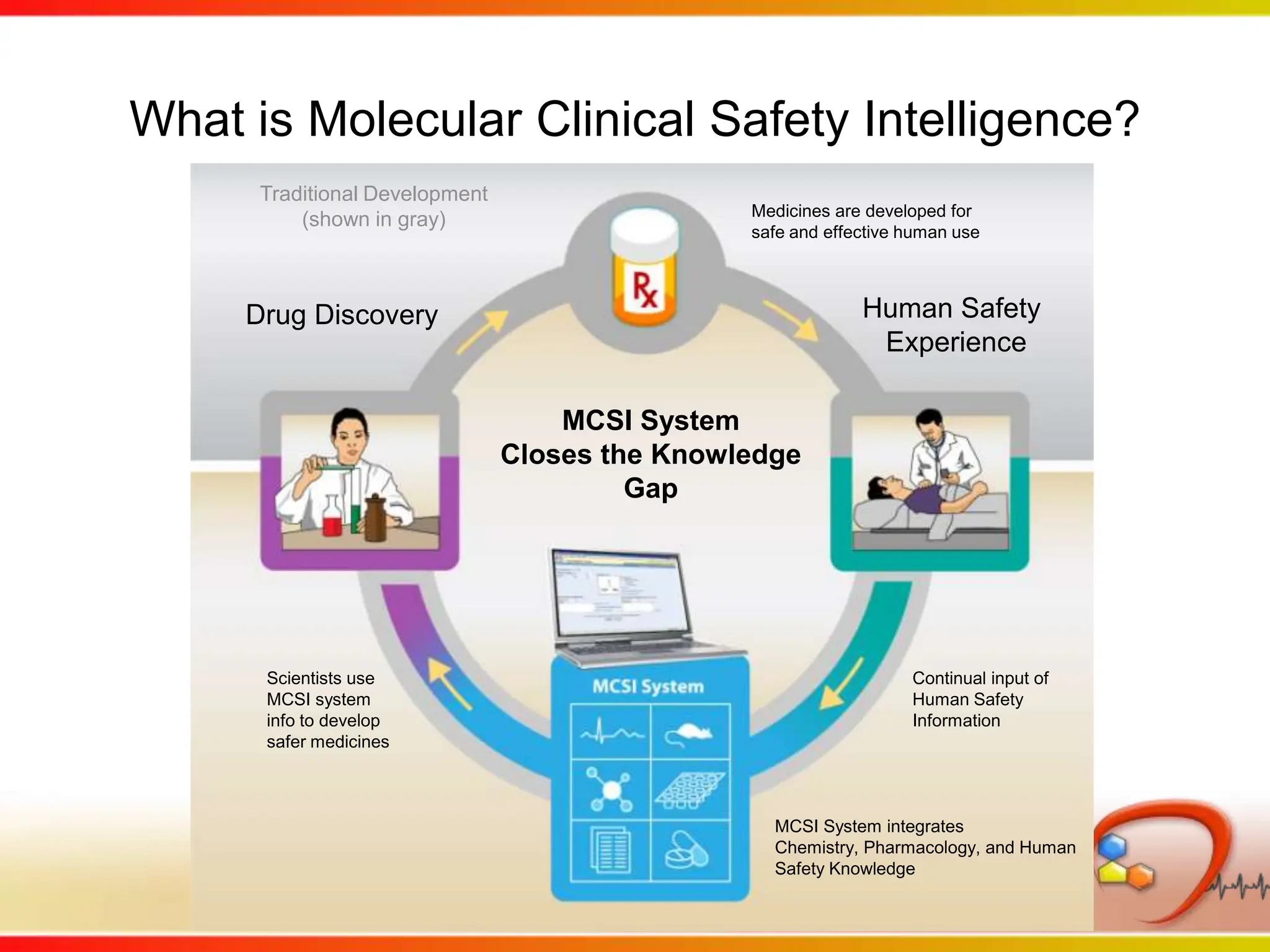
Traditional Development(shown in gray)Medicines are developed for safe and effective human useHuman Safety   ExperienceDrug DiscoveryMCSI SystemCloses the Knowledge GapContinual input of Human Safety InformationScientists use MCSI system info to develop safer medicinesMCSI System integrates Chemistry, Pharmacology, and Human Safety KnowledgeWhat is Molecular Clinical Safety Intelligence?
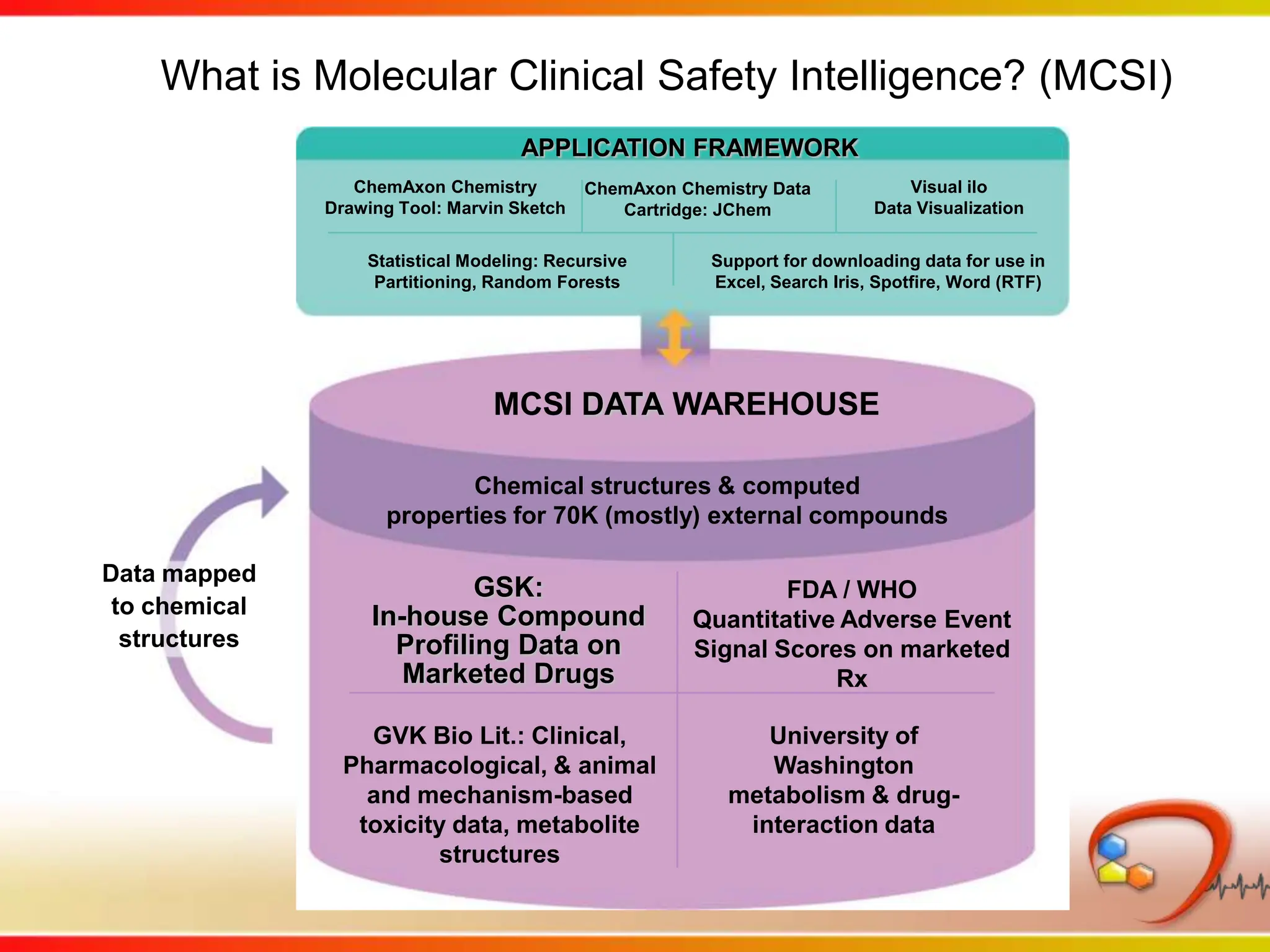
What is Molecular Clinical Safety Intelligence? (MCSI)APPLICATION FRAMEWORKChemAxon Chemistry Drawing Tool: Marvin SketchVisual iloData VisualizationChemAxon Chemistry Data Cartridge: JChemStatistical Modeling: Recursive Partitioning, Random ForestsSupport for downloading data for use in Excel, Search Iris, Spotfire, Word (RTF)MCSI DATA WAREHOUSEChemical structures & computedproperties for 70K (mostly) external compoundsData mappedto chemicalstructuresFDA / WHOQuantitative Adverse Event Signal Scores on marketed RxGSK: In-house Compound Profiling Data on Marketed DrugsUniversity of Washingtonmetabolism & drug-interaction dataGVK Bio Lit.: Clinical, Pharmacological, & animaland mechanism-basedtoxicity data, metabolite structures
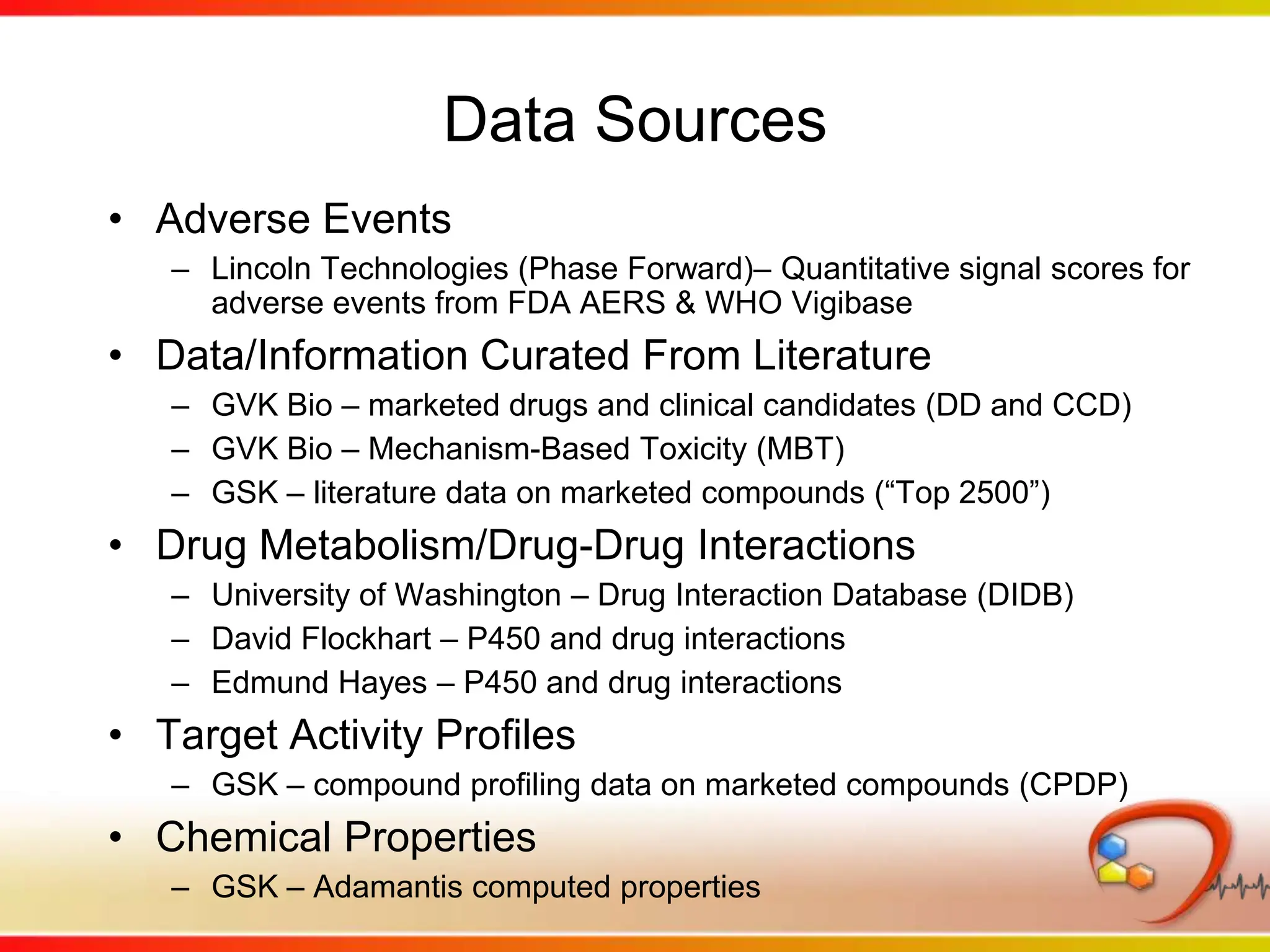
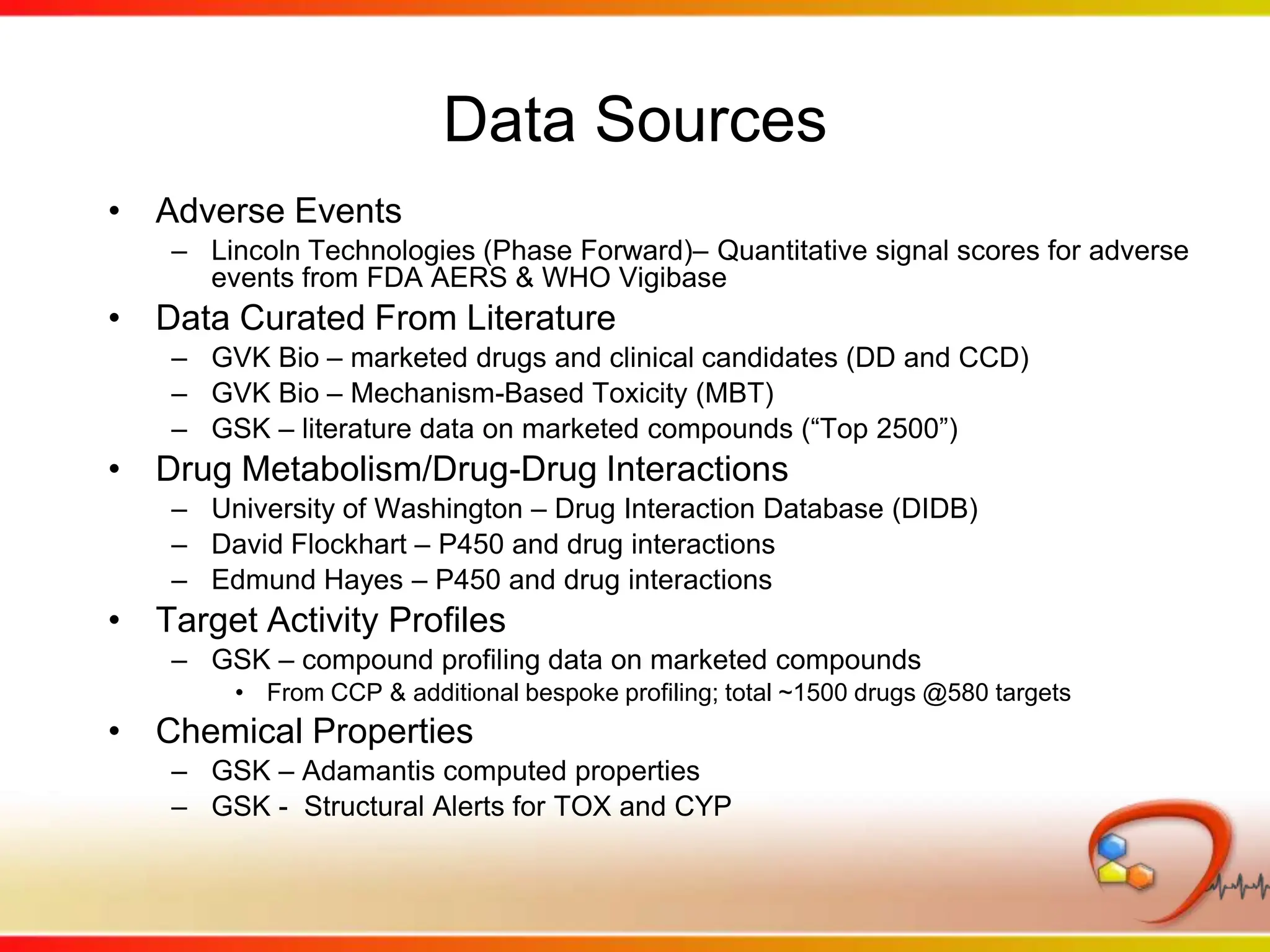
Data SourcesAdverse EventsLincoln Technologies (Phase Forward)– Quantitative signal scores for adverse events from FDA AERS & WHO VigibaseData/Information Curated From Literature GVK Bio – marketed drugs and clinical candidates (DD and CCD)GVK Bio – Mechanism-Based Toxicity (MBT)GSK – literature data on marketed compounds (“Top 2500”)Drug Metabolism/Drug-Drug InteractionsUniversity of Washington – Drug Interaction Database (DIDB)David Flockhart – P450 and drug interactionsEdmund Hayes – P450 and drug interactions Target Activity ProfilesGSK – compound profiling data on marketed compounds (CPDP)Chemical PropertiesGSK – Adamantis computed properties
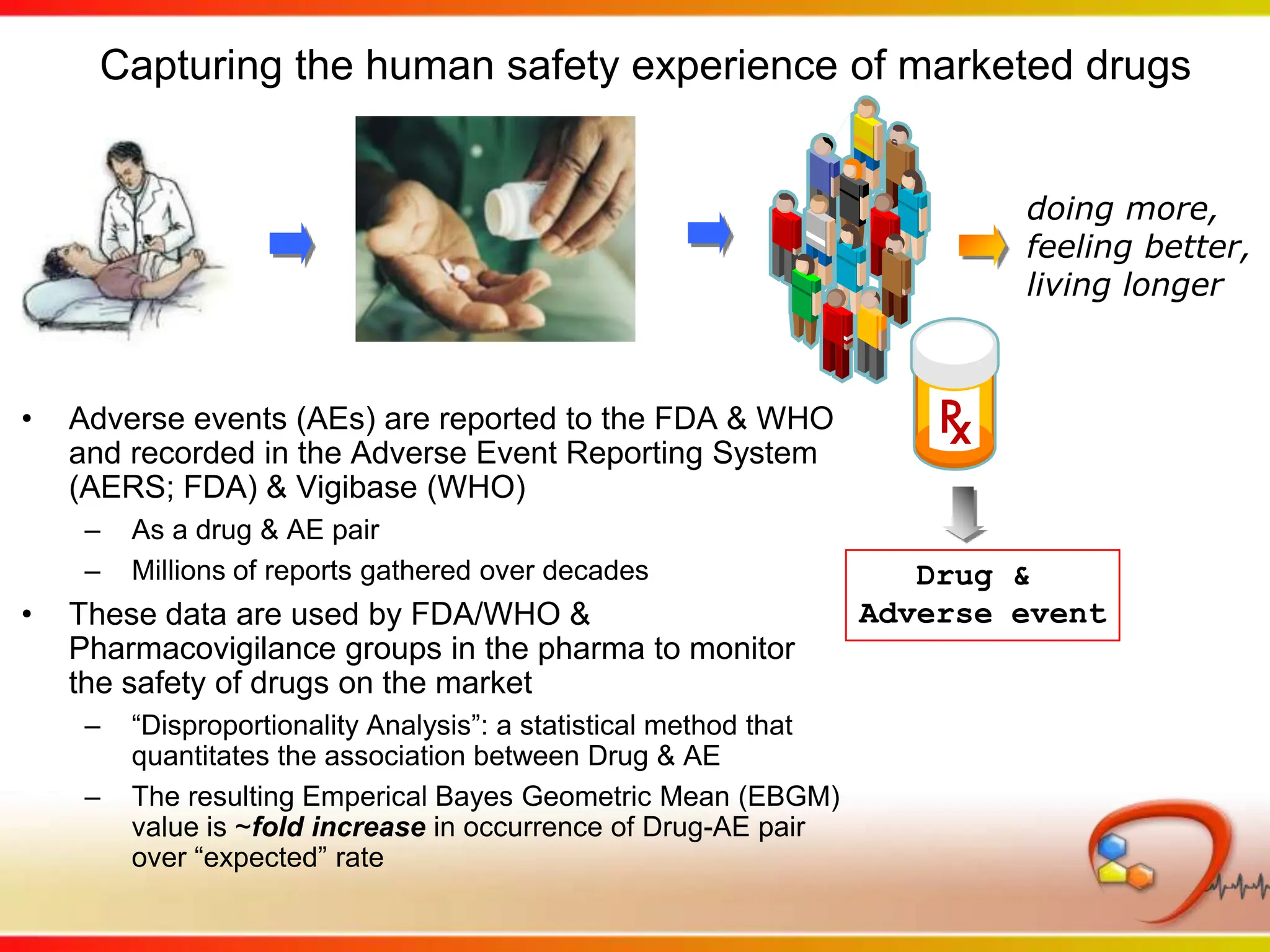
Capturing the human safety experience of marketed drugsdoing more,feeling better,living longerAdverse events (AEs) are reported to the FDA & WHO and recorded in the Adverse Event Reporting System (AERS; FDA) & Vigibase (WHO)As a drug & AE pairMillions of reports gathered over decadesThese data are used by FDA/WHO & Pharmacovigilance groups in the pharma to monitor the safety of drugs on the market“Disproportionality Analysis”: a statistical method that quantitates the association between Drug & AEThe resulting Emperical Bayes Geometric Mean (EBGM) value is ~fold increase in occurrence of Drug-AE pair over “expected” rateDrug & Adverse event
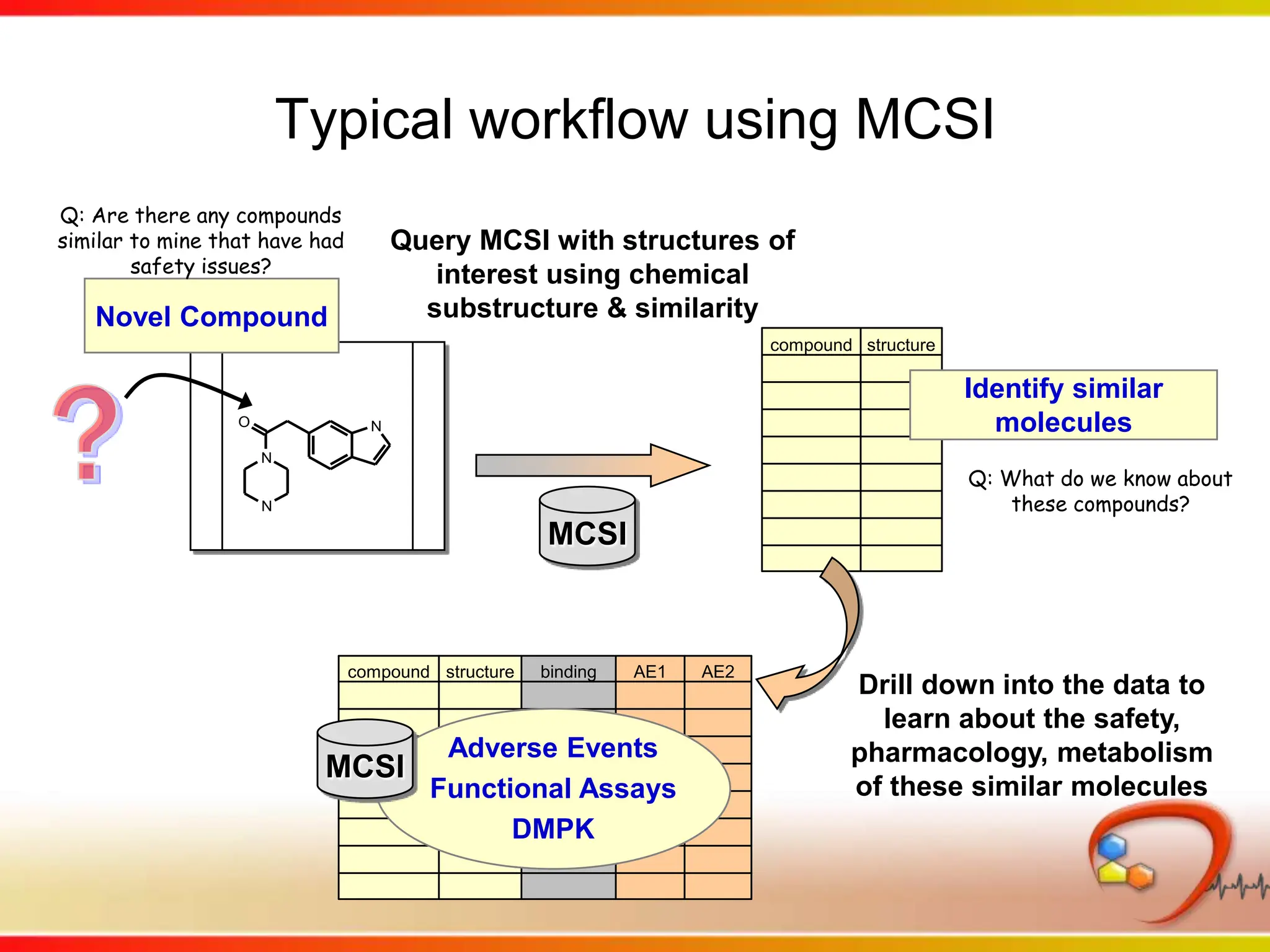
Typical workflow using MCSINovel Compound?structurecompoundAE2AE1bindingstructurecompound                                                        Q: Are there any compounds similar to mine that have had safety issues?Query MCSI with structures of interest using chemical substructure & similarity Identify similar moleculesQ: What do we know about these compounds?MCSIDrill down into the data to learn about the safety, pharmacology, metabolism of these similar moleculesAdverse EventsFunctional AssaysDMPKMCSI
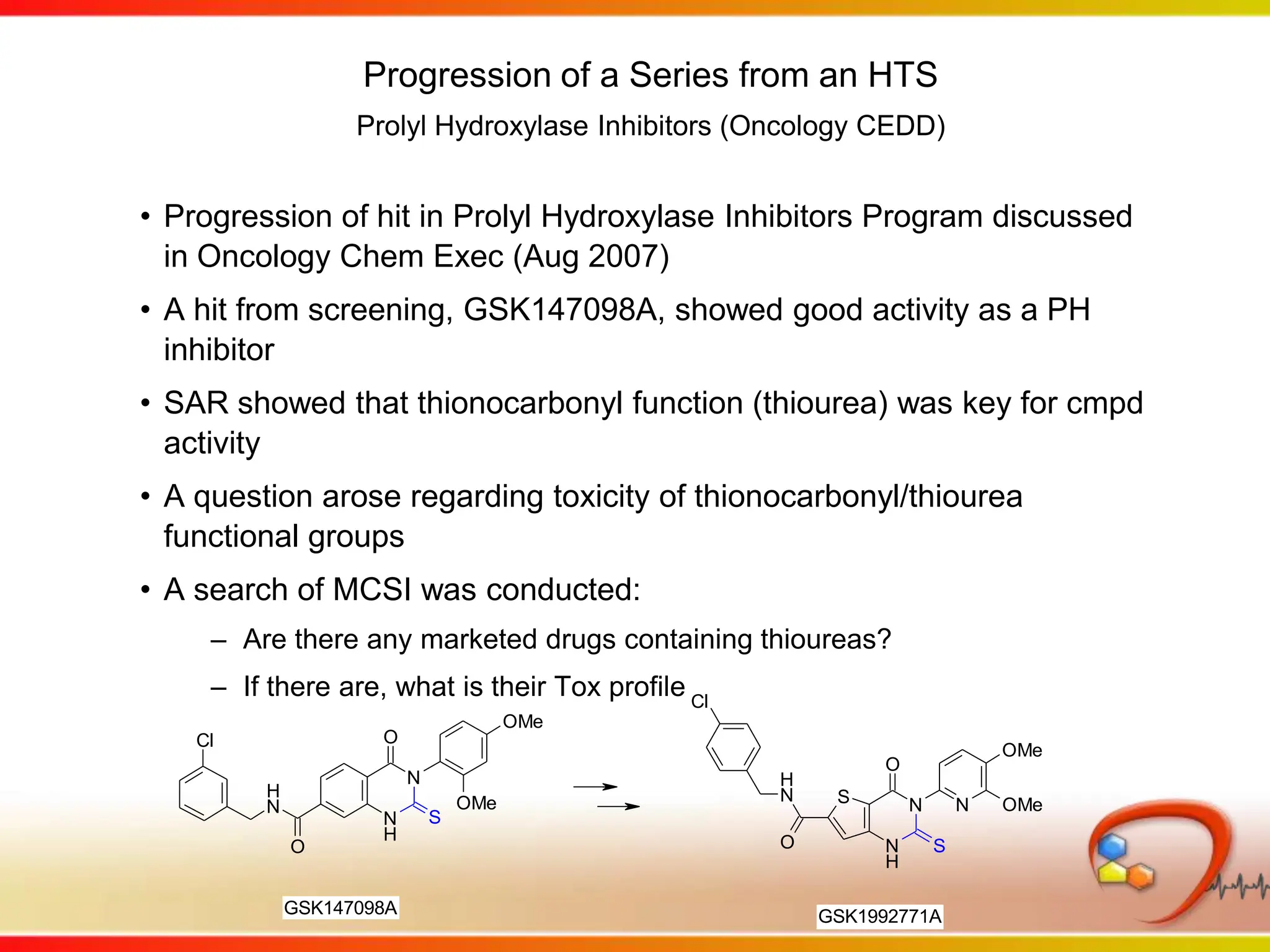
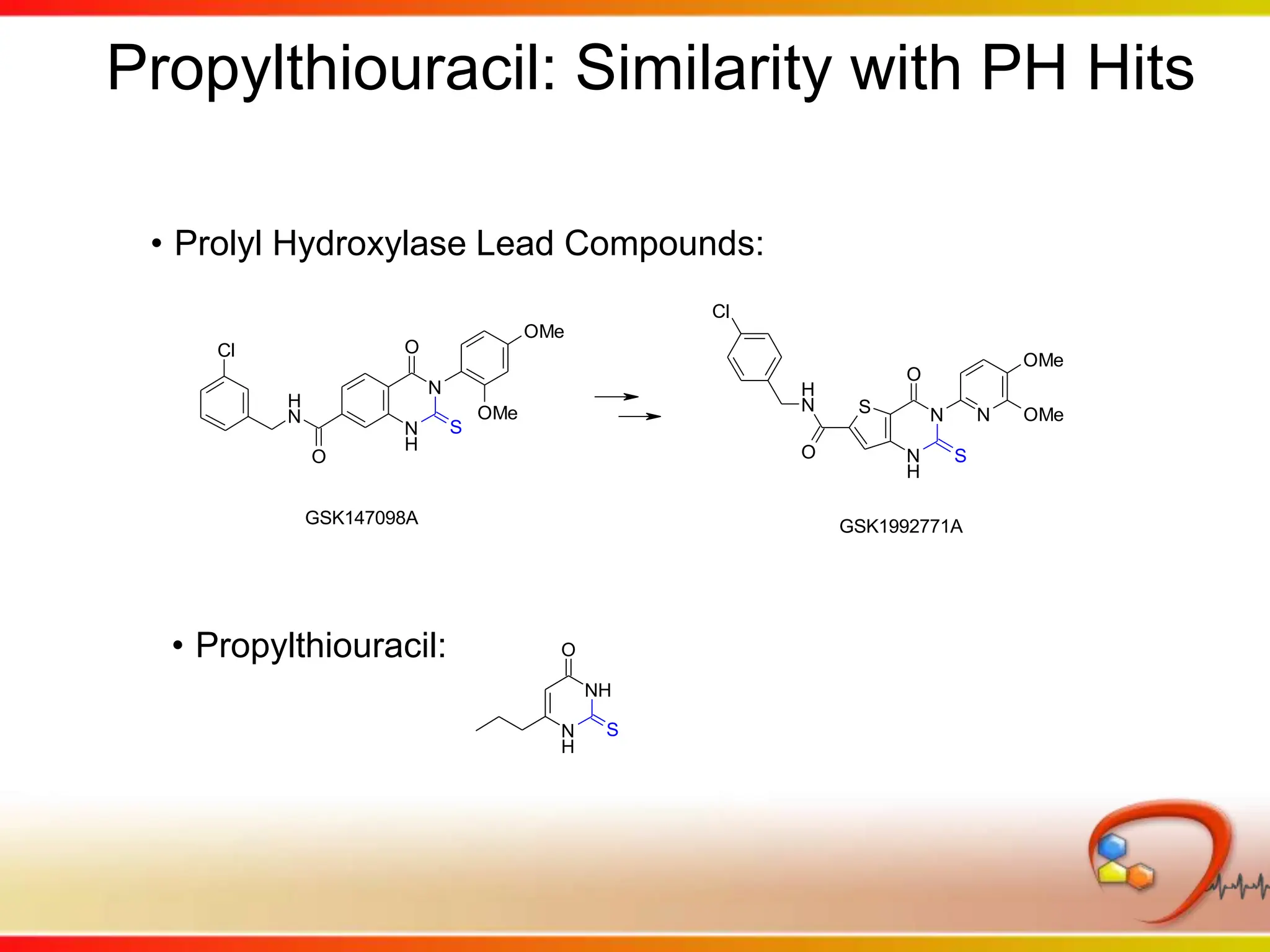
Progression of a Series from an HTSProlyl Hydroxylase Inhibitors (Oncology CEDD)Progression of hit in Prolyl Hydroxylase Inhibitors Program discussed in Oncology Chem Exec (Aug 2007)A hit from screening, GSK147098A, showed good activity as a PH inhibitorSAR showed that thionocarbonyl function (thiourea) was key for cmpd activityA question arose regarding toxicity of thionocarbonyl/thiourea functional groupsA search of MCSI was conducted:Are there any marketed drugs containing thioureas?If there are, what is their Tox profile
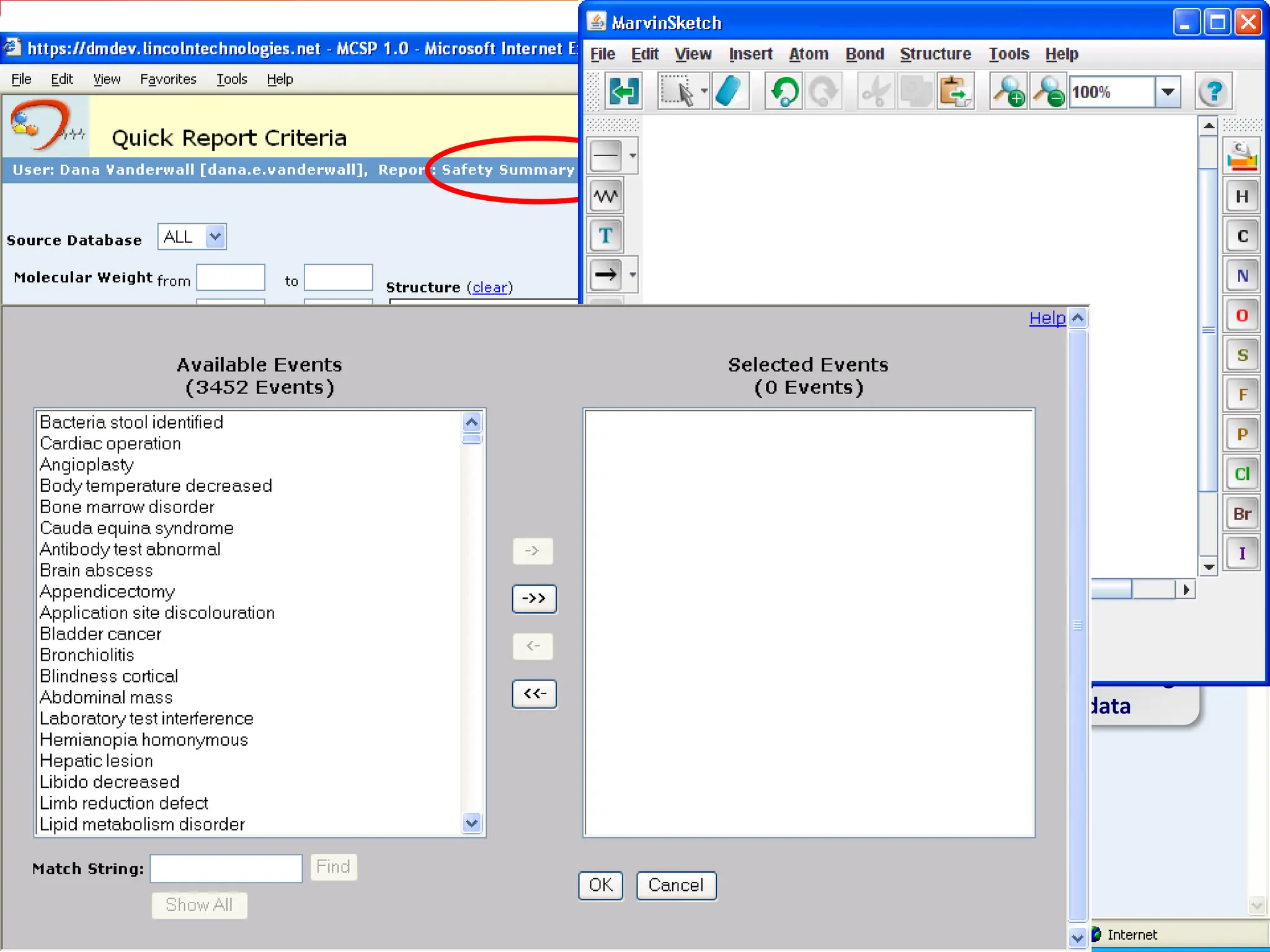
Currently 4 std quick reportsQuery by chemical similarity or substructureQuery target in GSK profiling dataQuery by  adverse event in FDA AERS
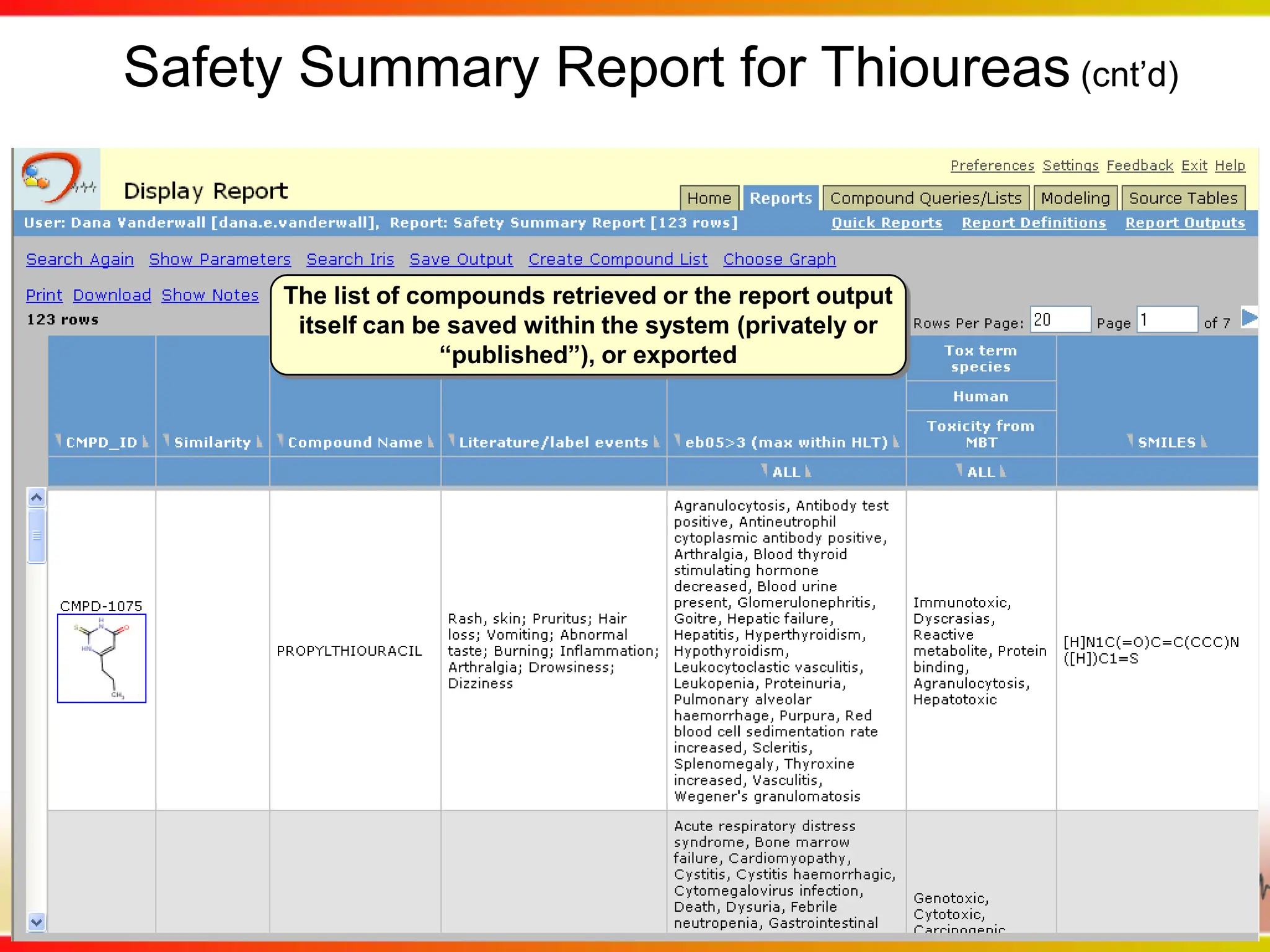
Safety Summary Report for Thioureas (cnt’d)The list of compounds retrieved or the report output itself can be saved within the system (privately or “published”), or exported
Propylthiouracil: Similarity with PH HitsProlyl Hydroxylase Lead Compounds:
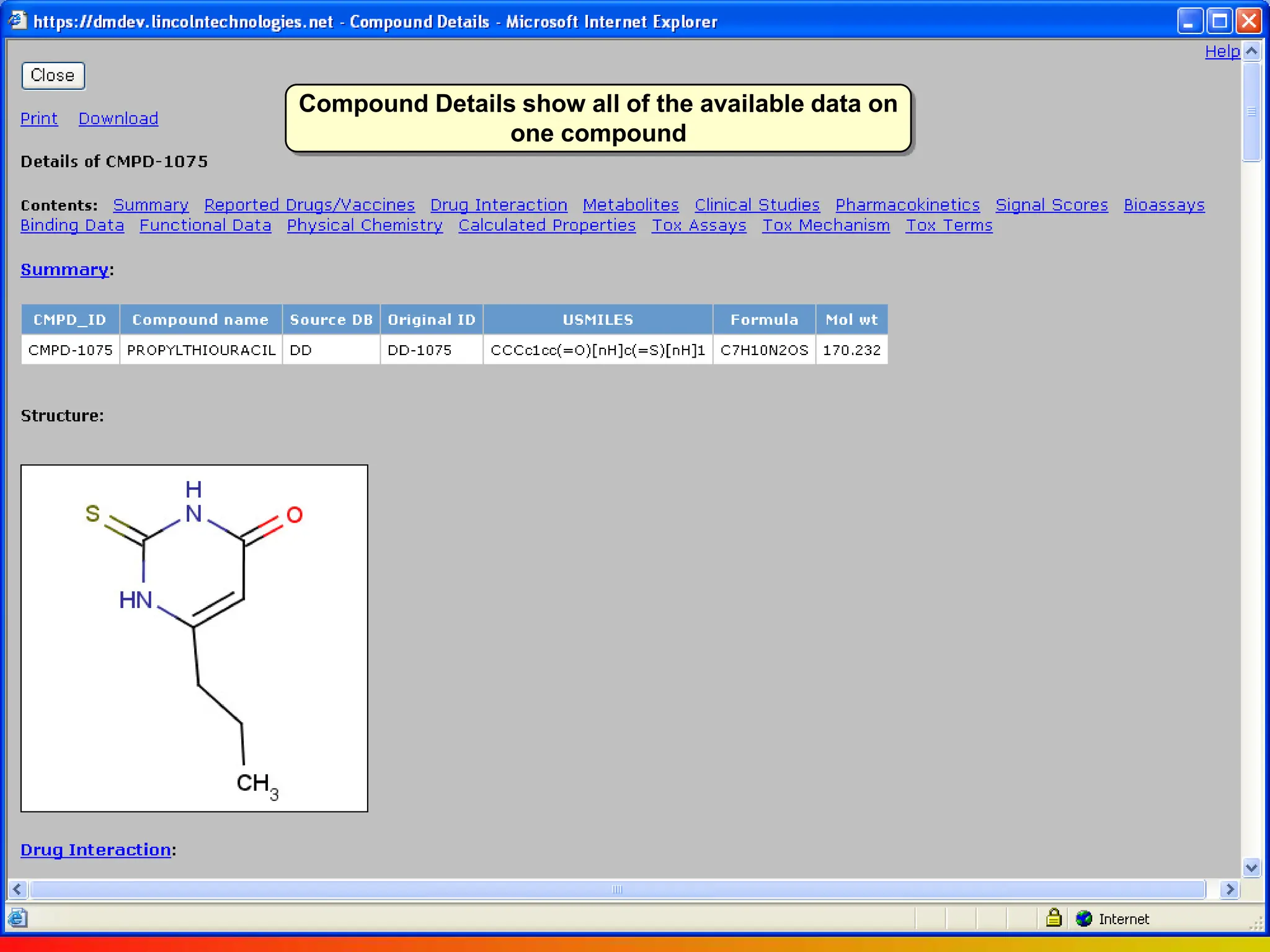
Propylthiouracil:Compound Details show all of the available data on one compound
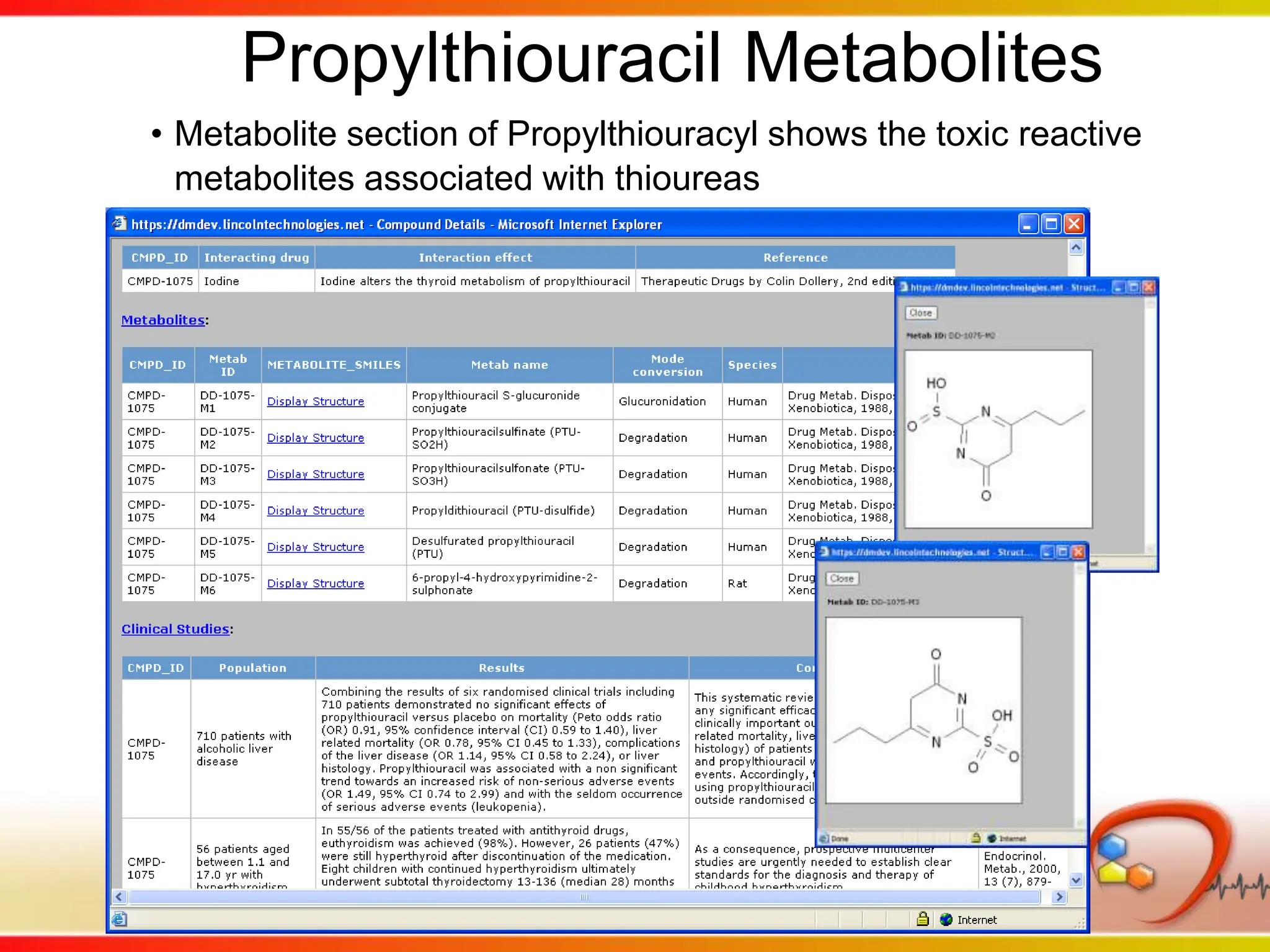
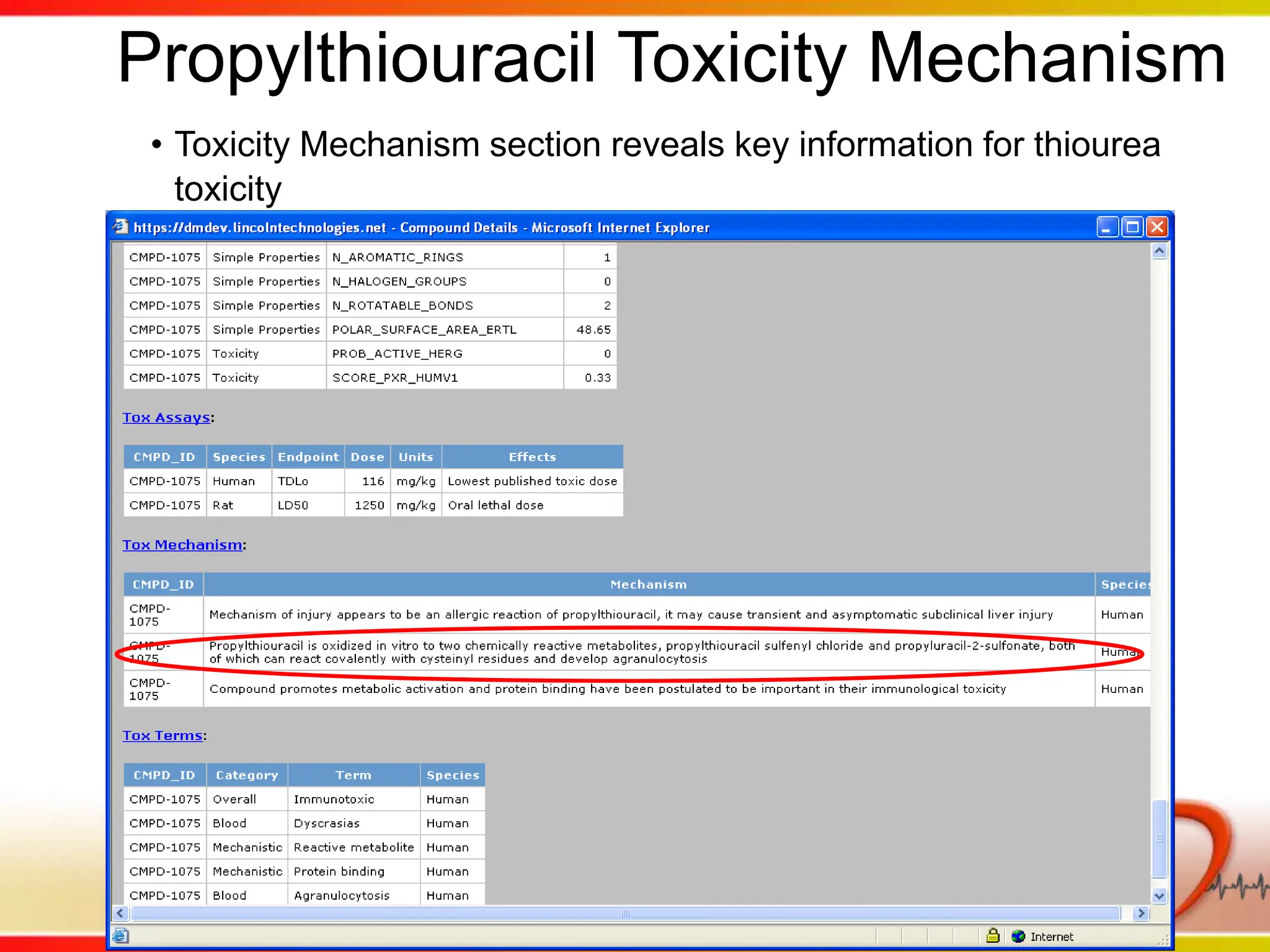
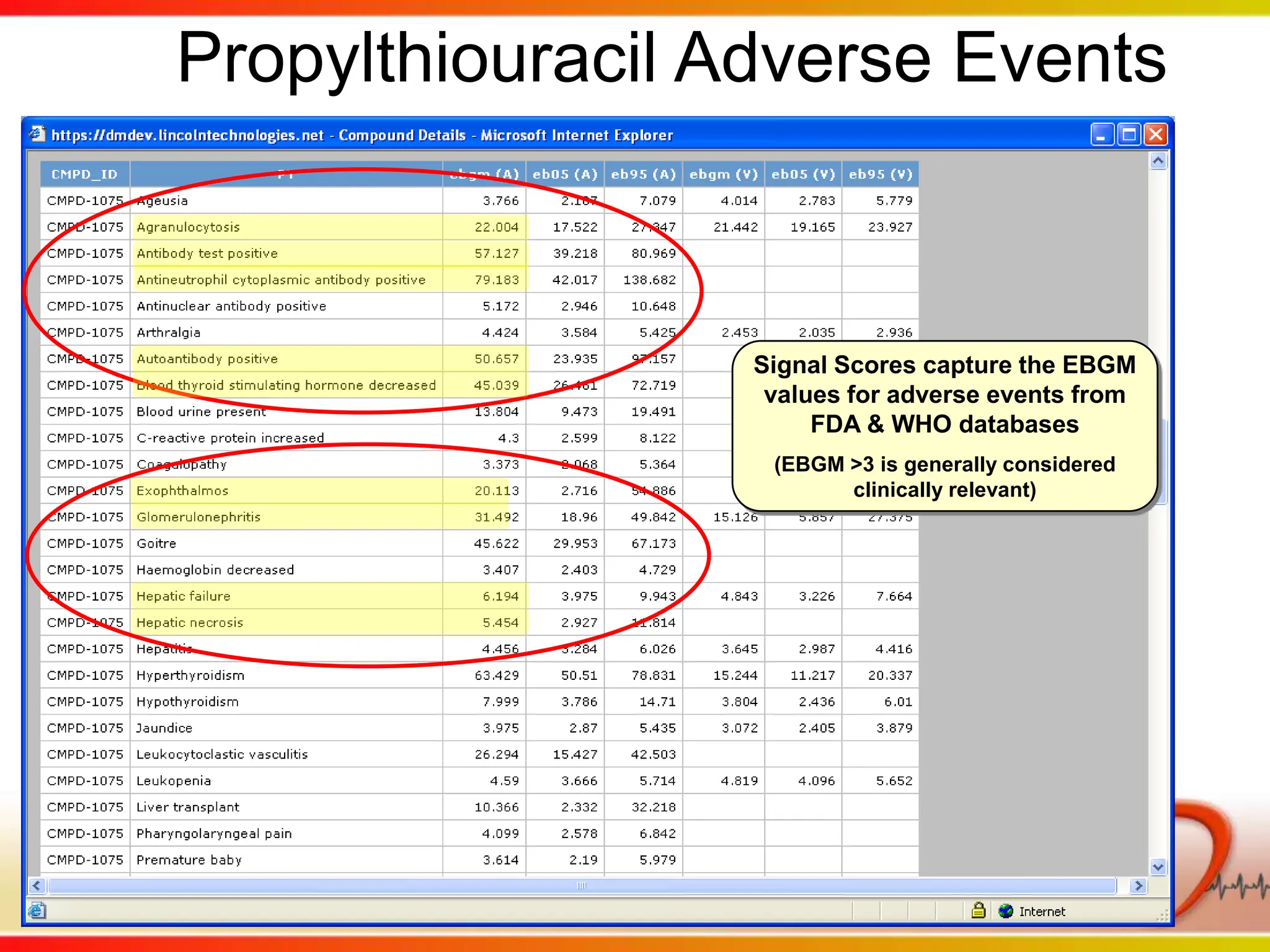
Propylthiouracil MetabolitesMetabolite section of Propylthiouracyl shows the toxic reactive metabolites associated with thioureasPropylthiouracil Toxicity MechanismToxicity Mechanism section reveals key information for thiourea toxicityPropylthiouracil Adverse EventsSignal Scores capture the EBGM values for adverse events from FDA & WHO databases(EBGM >3 is generally considered clinically relevant)
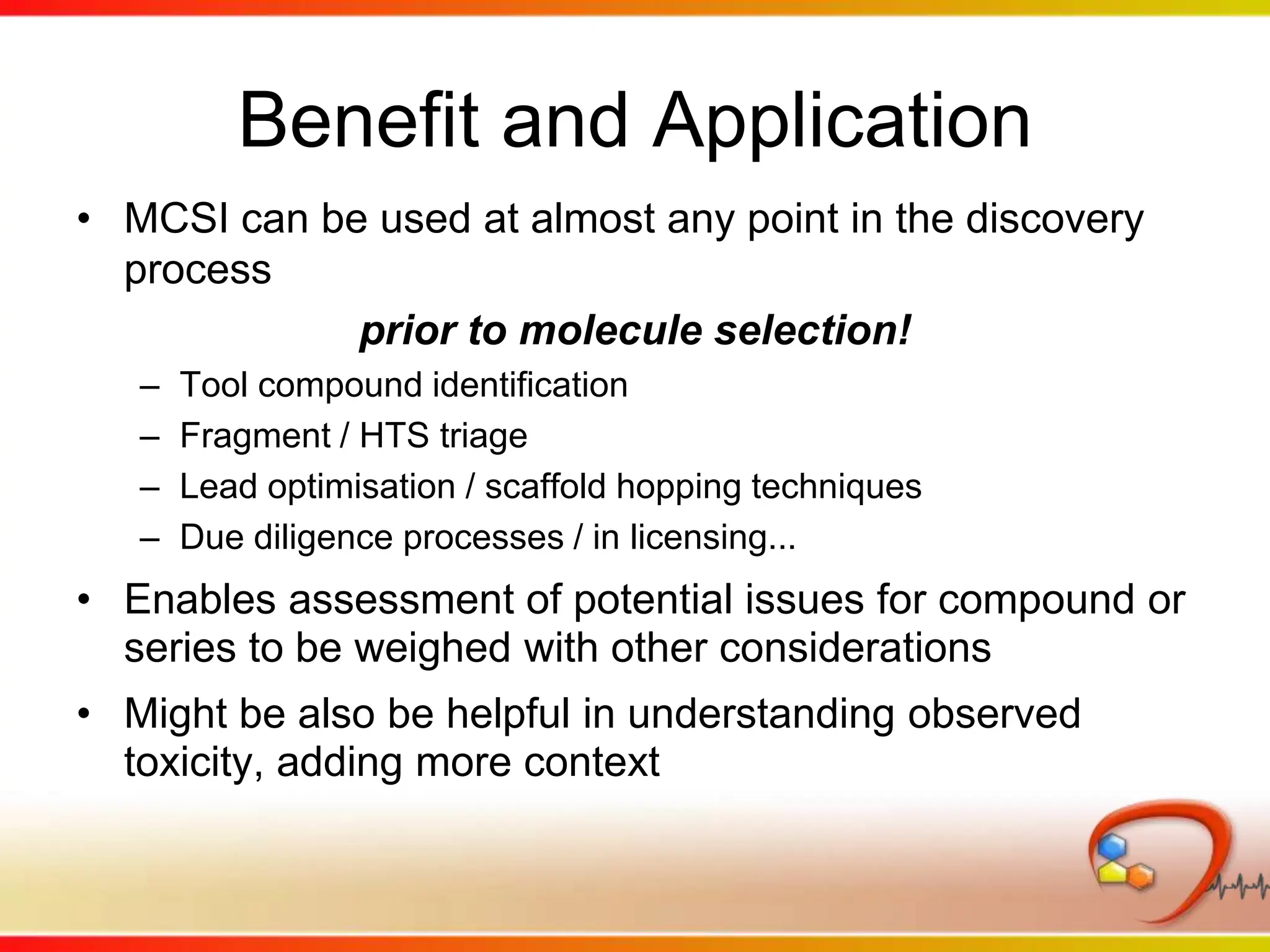
Benefit and ApplicationMCSI can be used at almost any point in the discovery processprior to molecule selection!Tool compound identificationFragment / HTS triageLead optimisation / scaffold hopping techniquesDue diligence processes / in licensing...Enables assessment of potential issues for compound or series to be weighed with other considerationsMight be also be helpful in understanding observed toxicity, adding more context
The MCSI CommunityLed by James Bailey, Dana Vanderwall, Nancy Yuen~75 User-Members within R&DDPU Chemistry, Biology, DMPKComputational Chemistry, MDRGlobal Clinical Safety & Pharmacovigilance Scinovo (preclinical externalization group)Members serve as a resource to drug discovery/development programsAlways open to new members: email: nancy.a.yuen@gsk.com
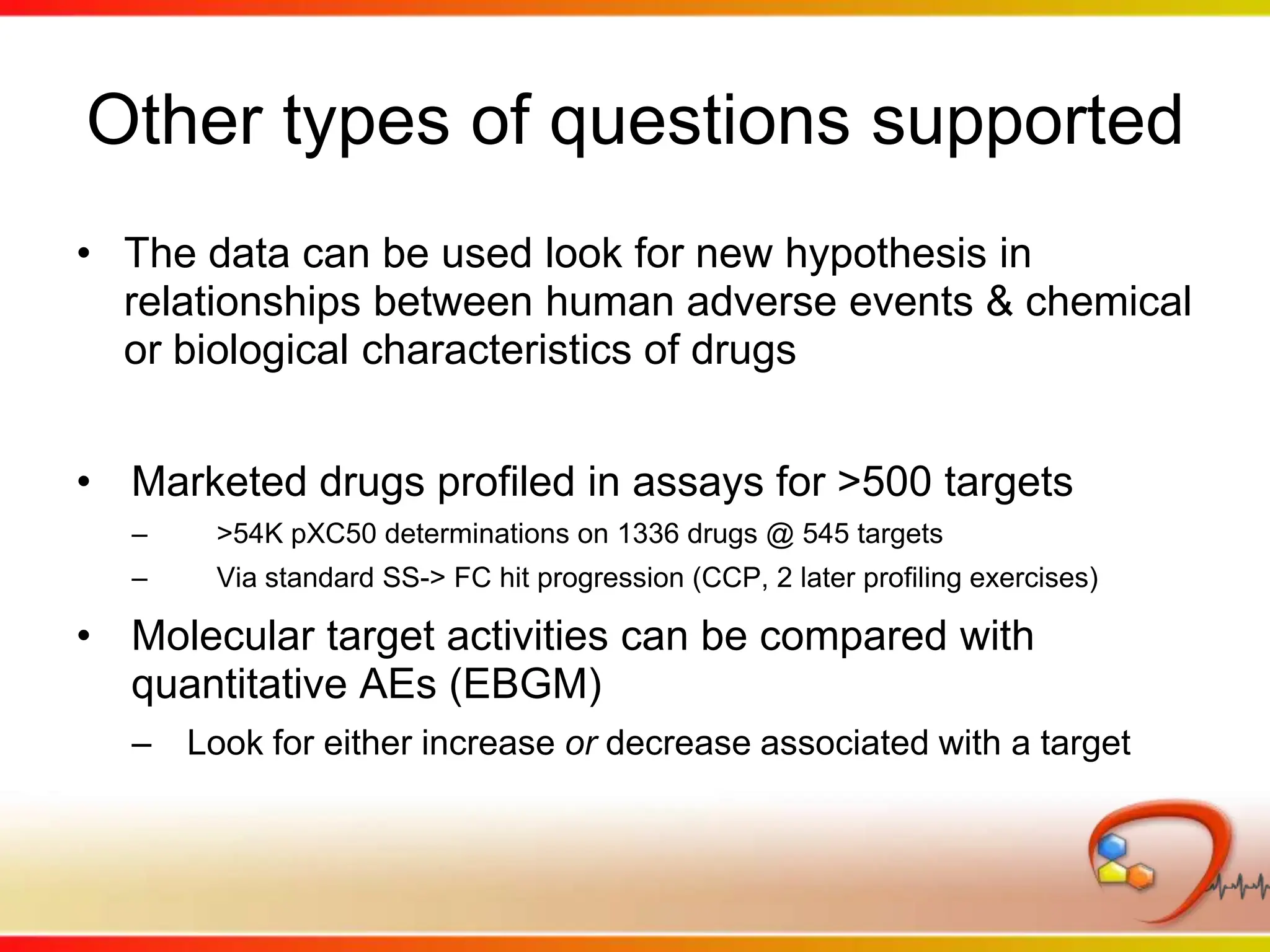
Other types of questions supportedThe data can be used look for new hypothesis in relationships between human adverse events & chemical or biological characteristics of drugsMarketed drugs profiled in assays for >500 targets>54K pXC50 determinations on 1336 drugs @ 545 targetsVia standard SS-> FC hit progression (CCP, 2 later profiling exercises)Molecular target activities can be compared with quantitative AEs (EBGM)Look for either increase or decrease associated with a target
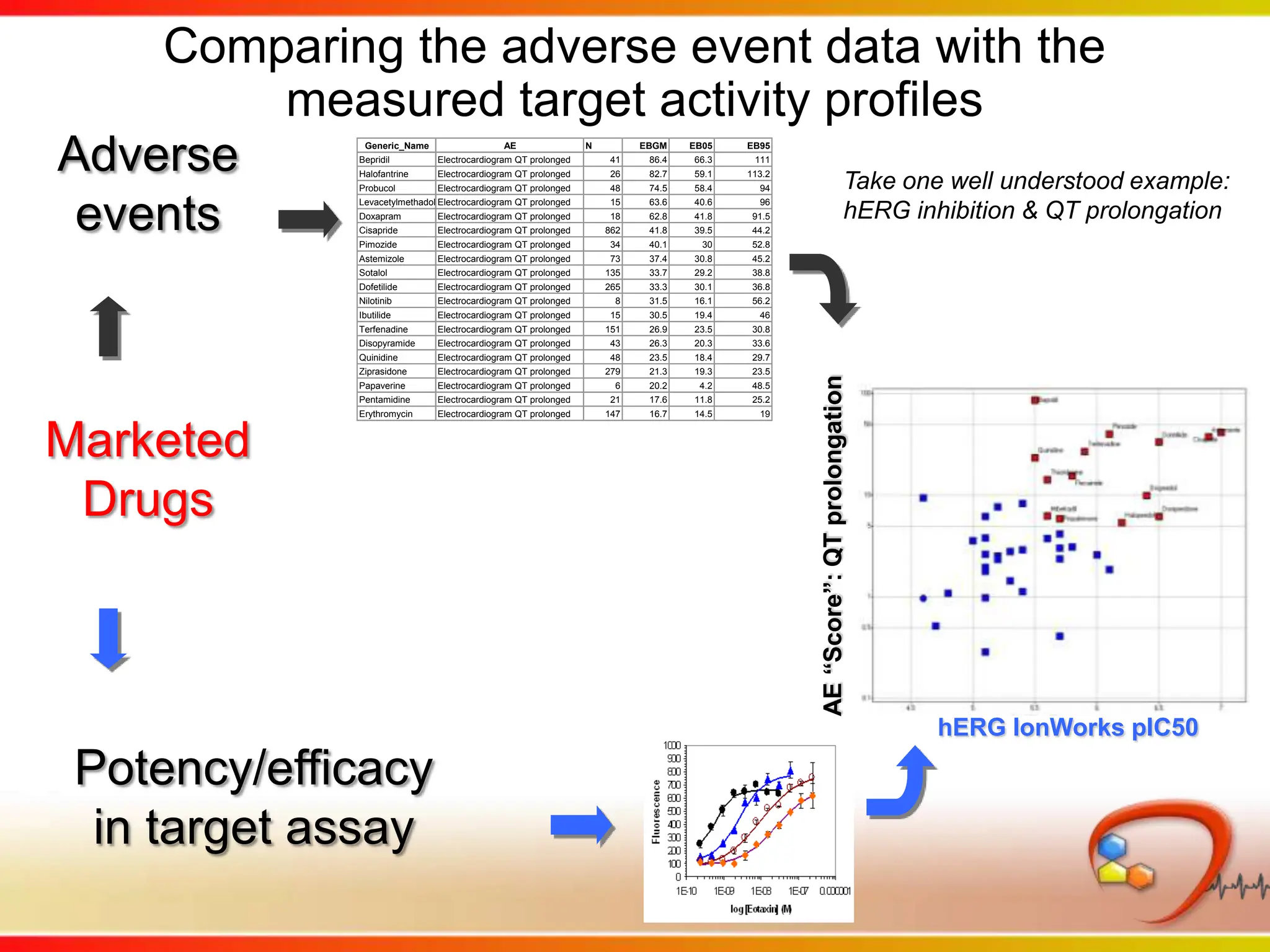
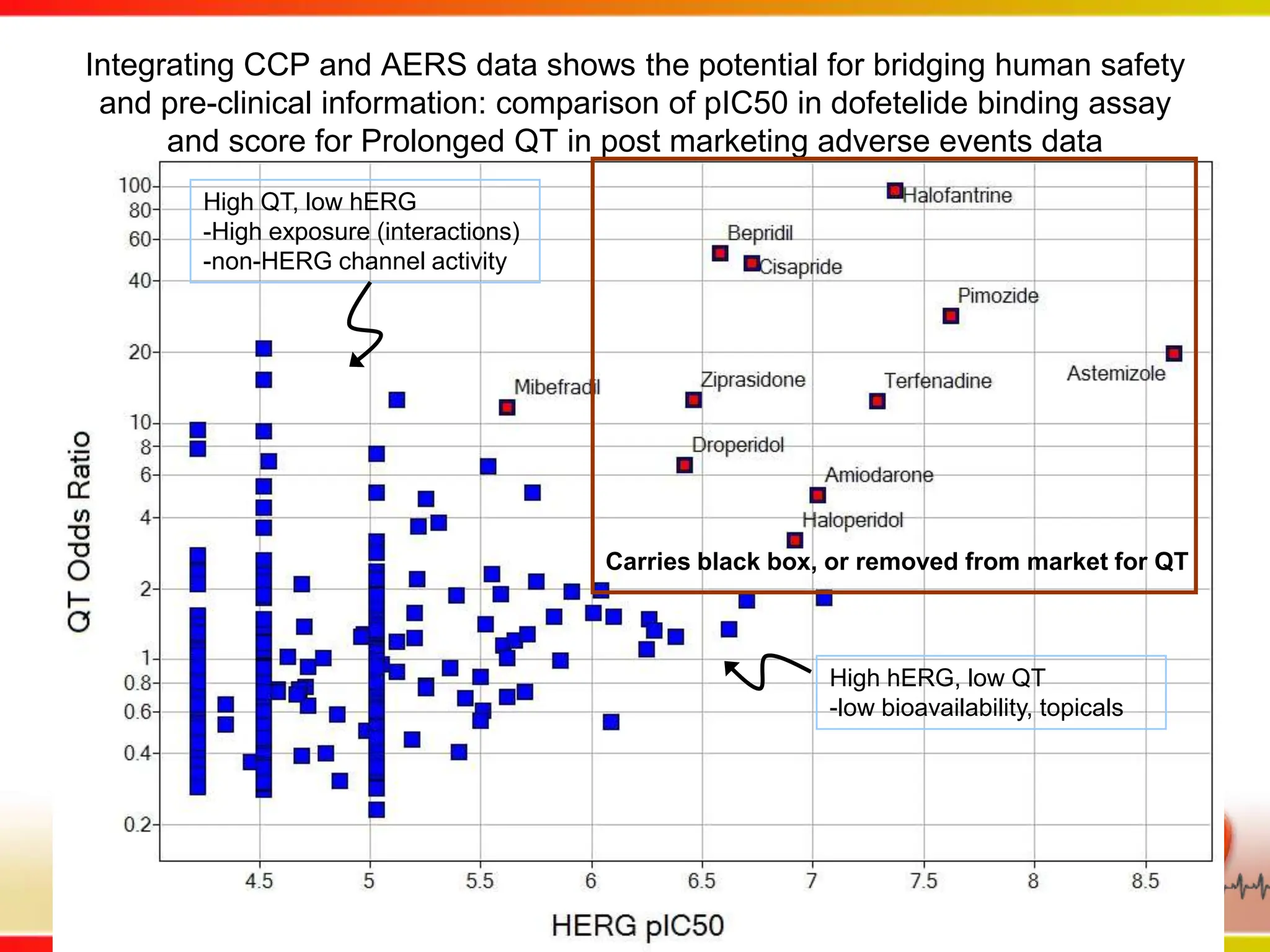
Comparing the adverse event data with the measured target activity profilesAdverse eventsTake one well understood example:hERG inhibition & QT prolongationMarketed Drugs AE “Score”: QT prolongation hERG IonWorks pIC50Potency/efficacy in target assay
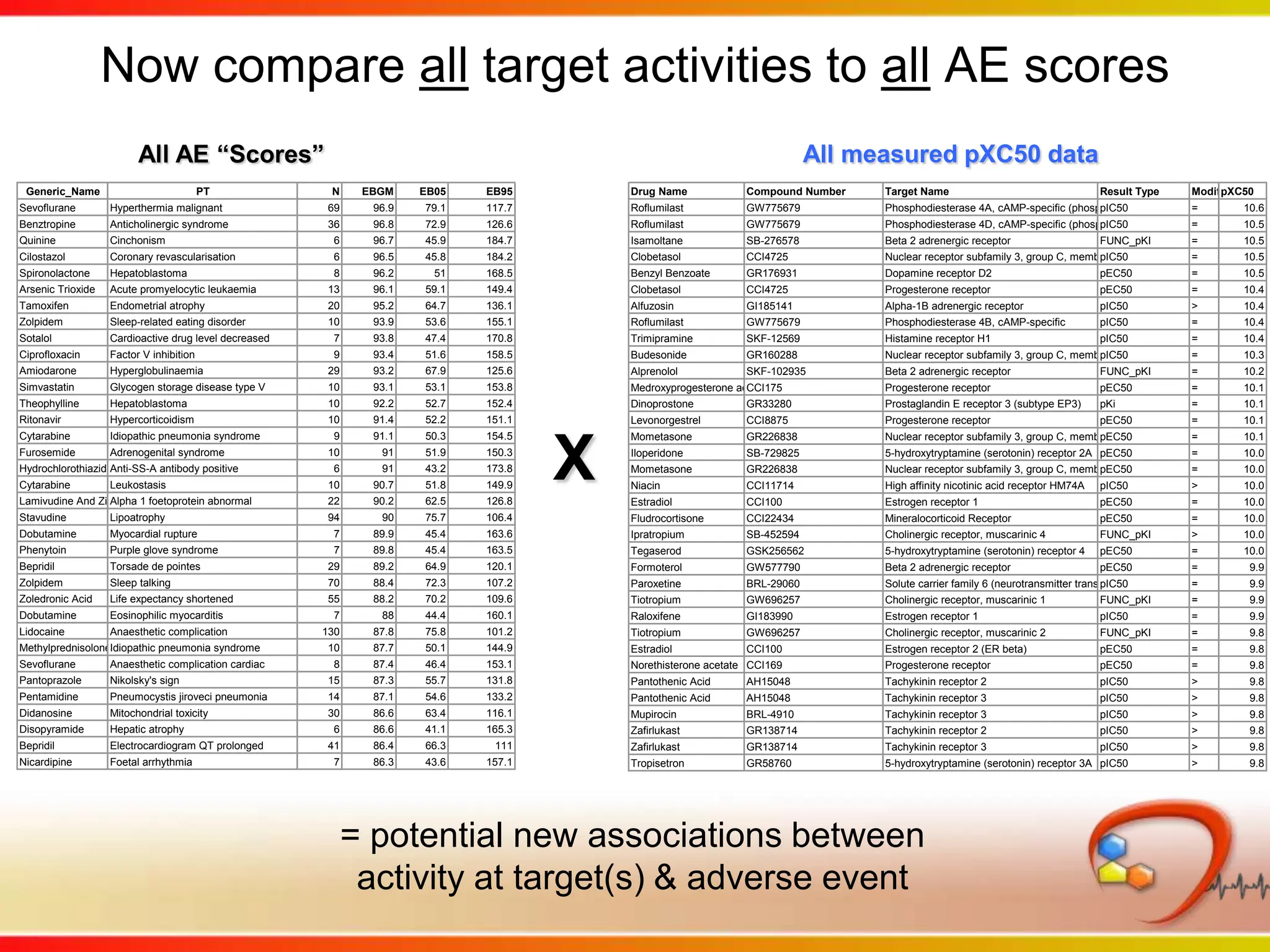
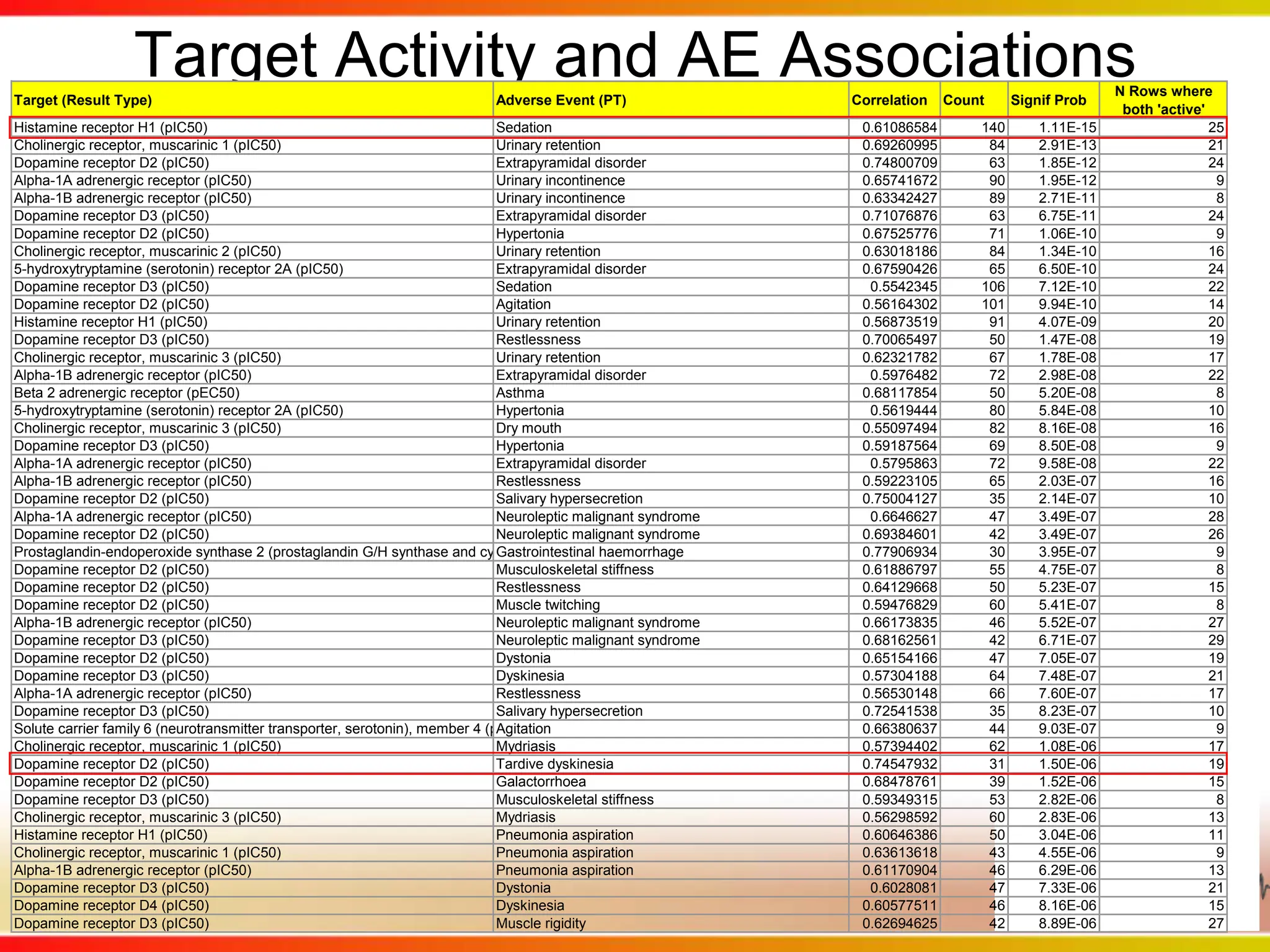
Now compare all target activities to all AE scoresAll measured pXC50 data All AE “Scores”X= potential new associations between activity at target(s) & adverse event
Target Activity and AE Associations
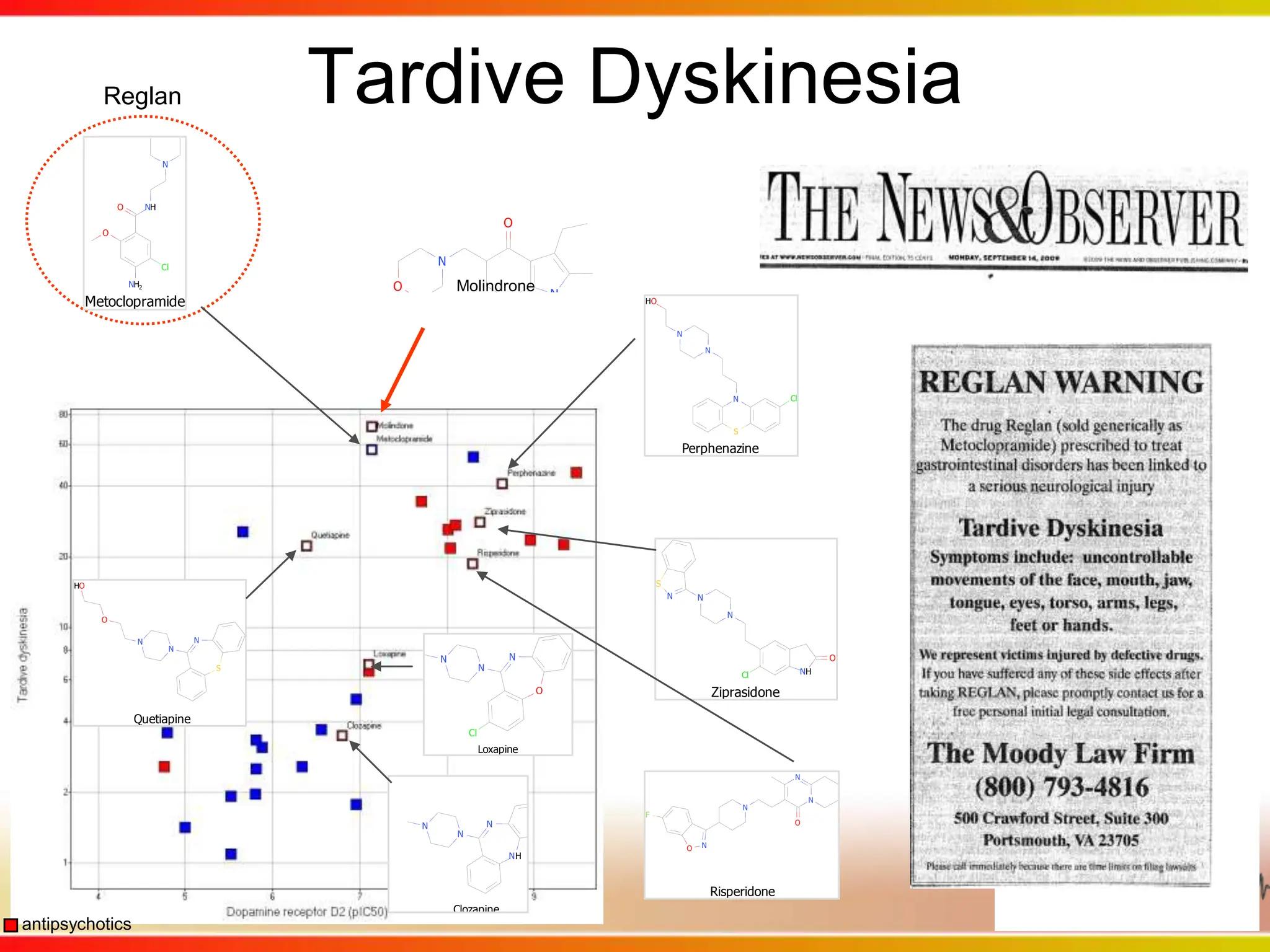
antipsychoticsTardive DyskinesiaReglanMolindrone
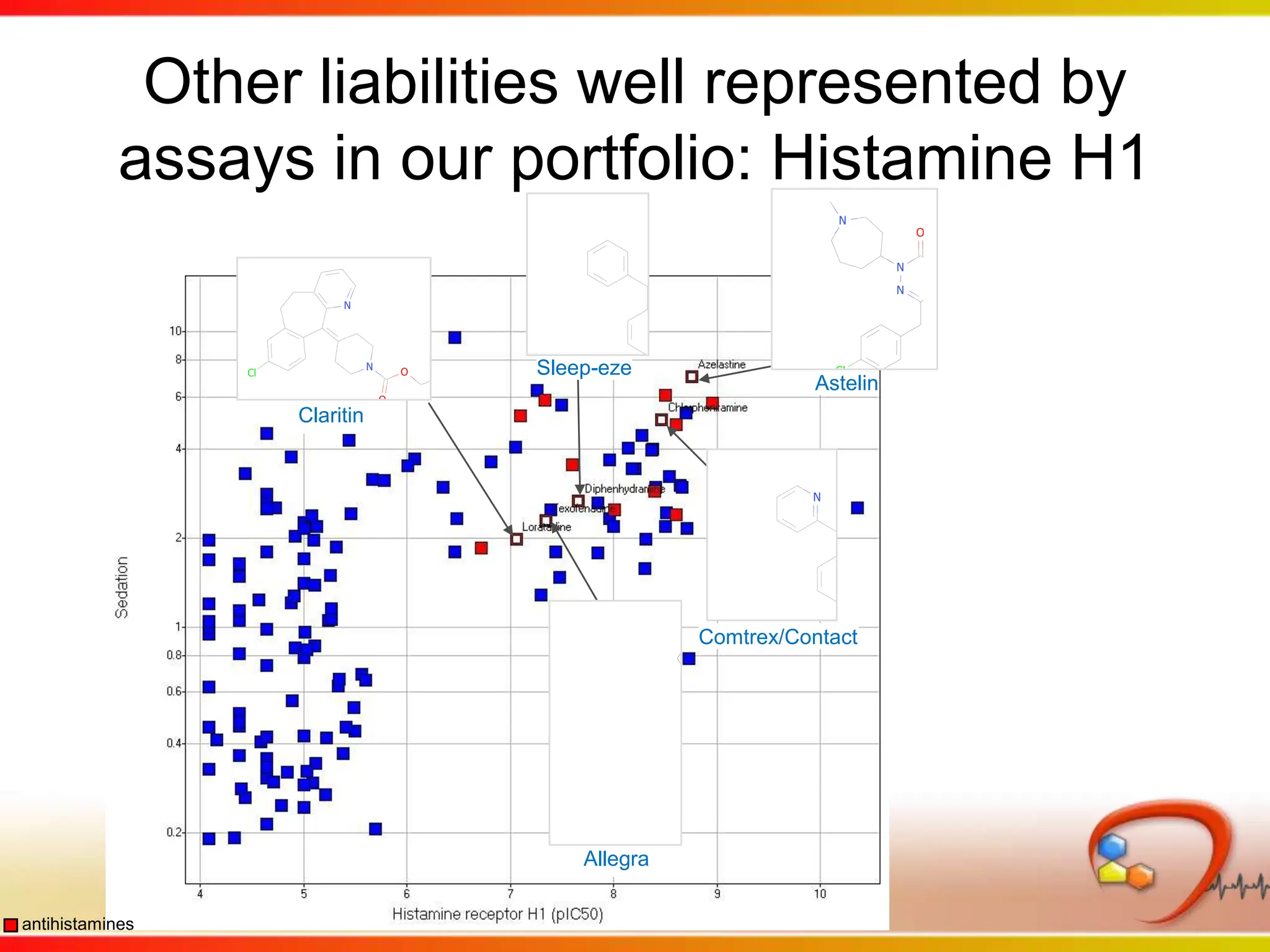
Other liabilities well represented by assays in our portfolio: Histamine H1antihistaminesSleep-ezeAstelinClaritinComtrex/ContactAllegra
AcknowledgementsNancy Yuen, James Bailey (co-leads) Juan Luengo		Giovanni Vitulli 		James Bailey Subhas Chakravorty	Sunny Hung		Francoise GellibertJohn Walsh		Dennis Lee 		David LivermoreSimon Semus		Stephen Pickett		Ricardo MacarronMui Cheung		Rick Cousins		Gordon Dear	Jakob Busch-Petersen	Robin Cregan		Graham SimpsonIan Churcher		Laurie Bayon		Katherine WiddowsonDeanna Frey		Ceara Rea		Chris N. JohnsonDarren Green					Dave Morris   Phase Forward-/Lincoln Technologies: Mohammad Al-Ansari, David Fram
Supplementary information
Data SourcesAdverse EventsLincoln Technologies (Phase Forward)– Quantitative signal scores for adverse events from FDA AERS & WHO VigibaseData Curated From Literature GVK Bio – marketed drugs and clinical candidates (DD and CCD)GVK Bio – Mechanism-Based Toxicity (MBT)GSK – literature data on marketed compounds (“Top 2500”)Drug Metabolism/Drug-Drug InteractionsUniversity of Washington – Drug Interaction Database (DIDB)David Flockhart – P450 and drug interactionsEdmund Hayes – P450 and drug interactions Target Activity ProfilesGSK – compound profiling data on marketed compoundsFrom CCP & additional bespoke profiling; total ~1500 drugs @580 targetsChemical PropertiesGSK – Adamantis computed propertiesGSK -  Structural Alerts for TOX and CYP
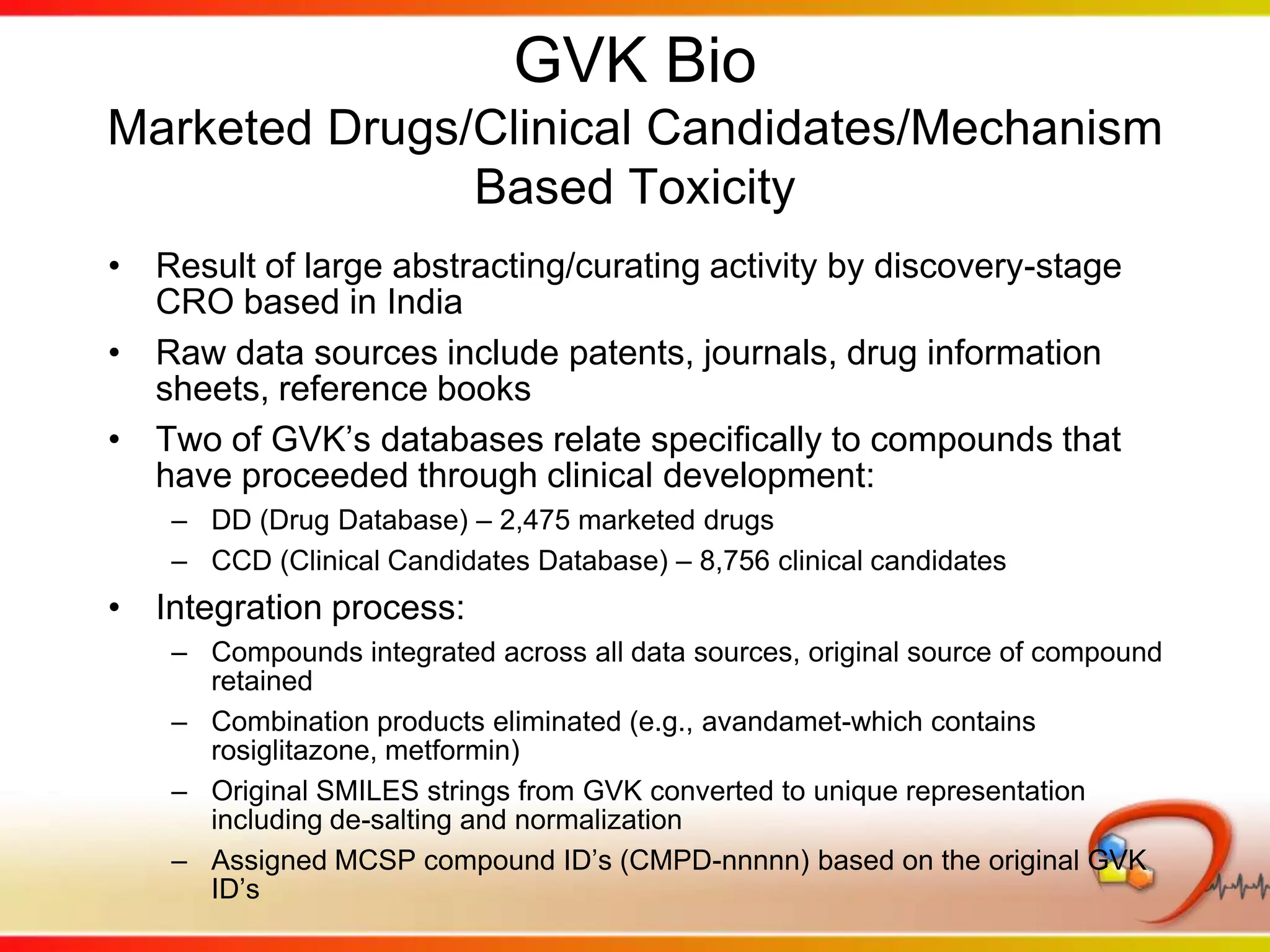
GVK BioMarketed Drugs/Clinical Candidates/Mechanism Based Toxicity Result of large abstracting/curating activity by discovery-stage CRO based in IndiaRaw data sources include patents, journals, drug information sheets, reference books Two of GVK’s databases relate specifically to compounds that have proceeded through clinical development:DD (Drug Database) – 2,475 marketed drugsCCD (Clinical Candidates Database) – 8,756 clinical candidatesIntegration process:Compounds integrated across all data sources, original source of compound retained Combination products eliminated (e.g., avandamet-which contains rosiglitazone, metformin)Original SMILES strings from GVK converted to unique representation including de-salting and normalizationAssigned MCSP compound ID’s (CMPD-nnnnn) based on the original GVK ID’s
GVK Data Content  Marketed Drugs / Clinical Candidates2D chemical structures and related propertiesPharmacokineticsBinding data Functional dataMetabolites Cytochrome P450 interactions Drug interactionsClinical studiesPhysical properties, mostly solubilityReferences
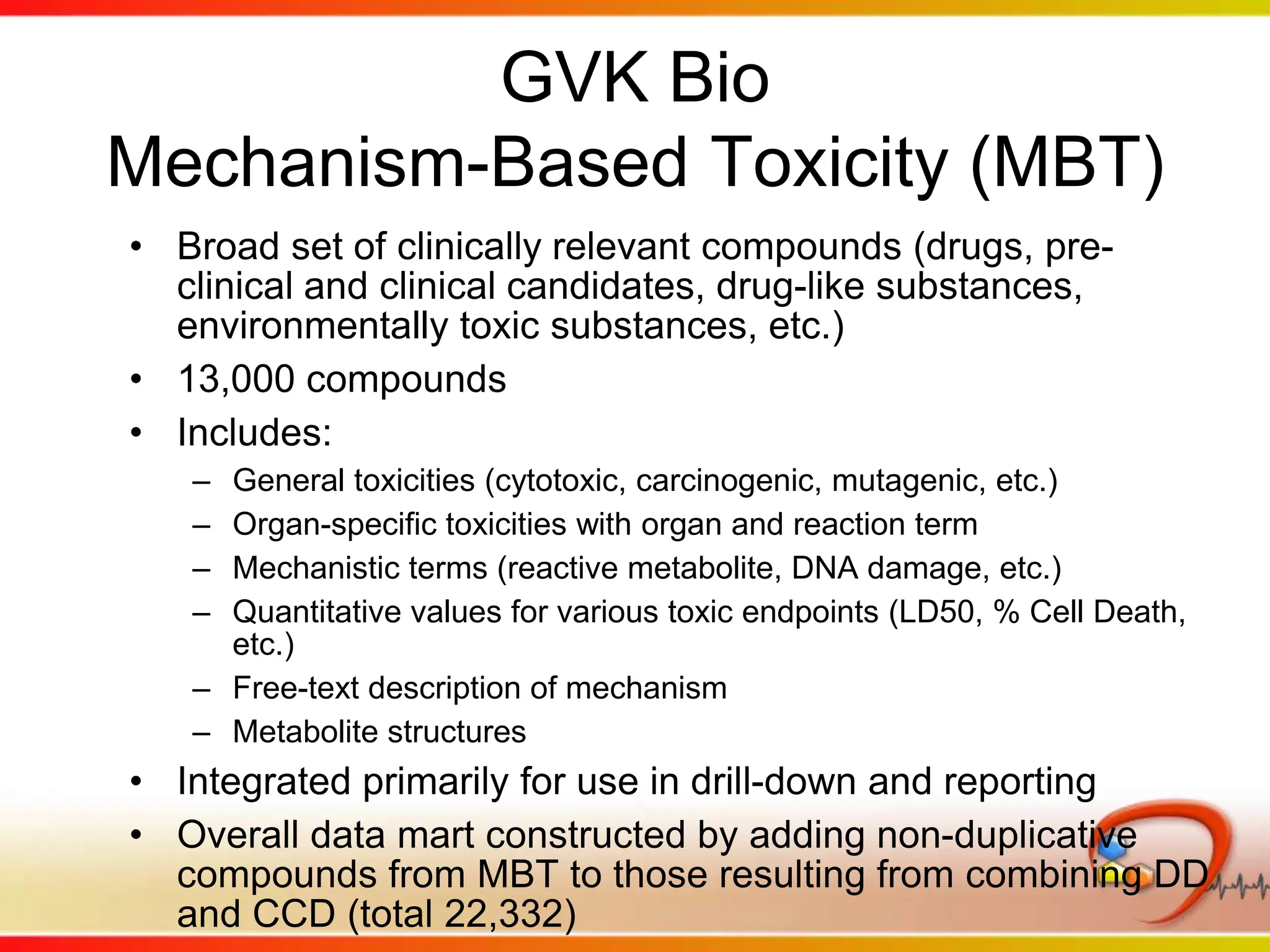
GVK Bio Mechanism-Based Toxicity (MBT)Broad set of clinically relevant compounds (drugs, pre-clinical and clinical candidates, drug-like substances, environmentally toxic substances, etc.)13,000 compoundsIncludes:General toxicities (cytotoxic, carcinogenic, mutagenic, etc.)Organ-specific toxicities with organ and reaction termMechanistic terms (reactive metabolite, DNA damage, etc.)Quantitative values for various toxic endpoints (LD50, % Cell Death, etc.)Free-text description of mechanismMetabolite structuresIntegrated primarily for use in drill-down and reportingOverall data mart constructed by adding non-duplicative compounds from MBT to those resulting from combining DD and CCD (total 22,332)
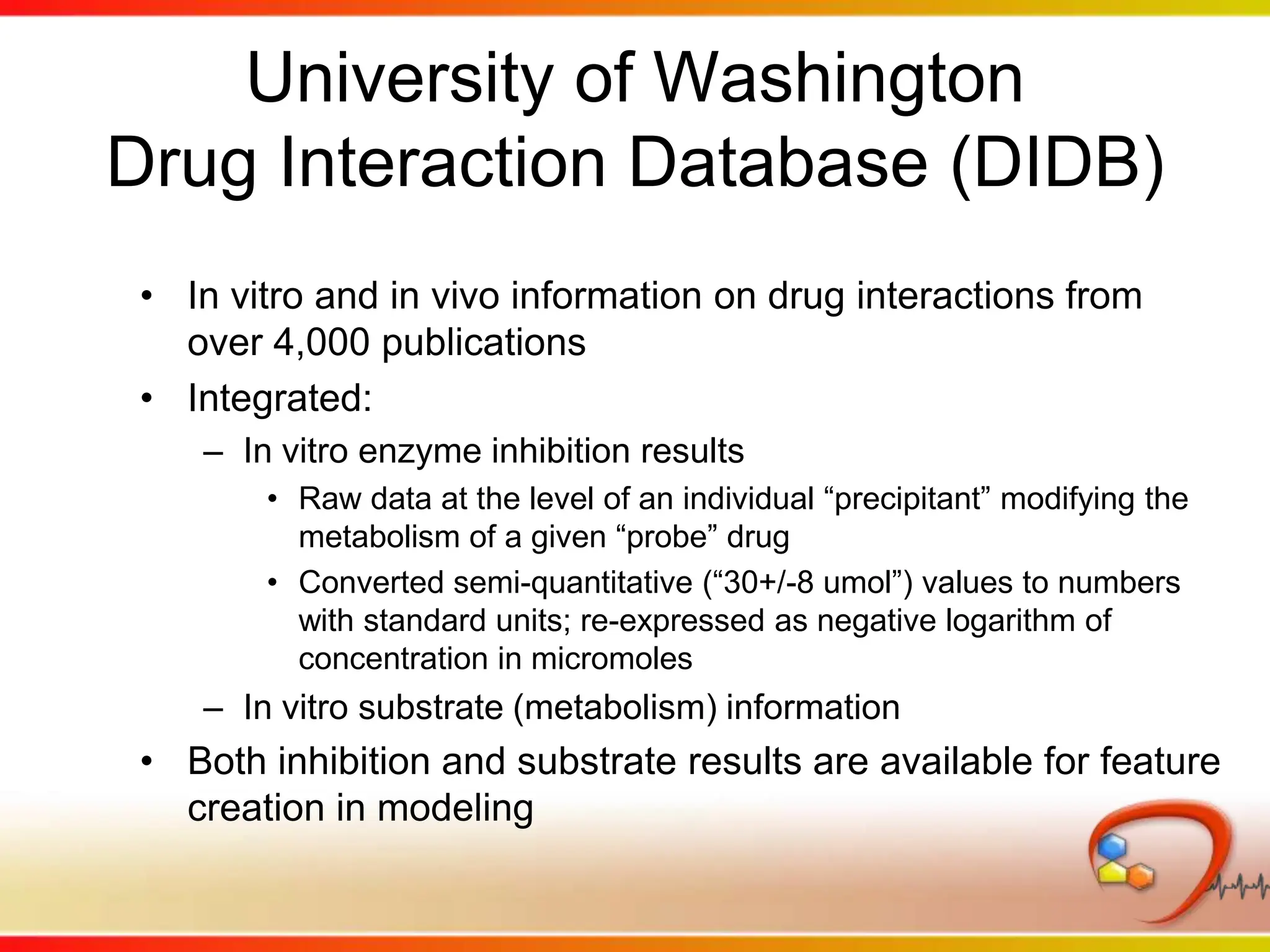
University of WashingtonDrug Interaction Database (DIDB)In vitro and in vivo information on drug interactions from over 4,000 publicationsIntegrated:In vitro enzyme inhibition resultsRaw data at the level of an individual “precipitant” modifying the metabolism of a given “probe” drugConverted semi-quantitative (“30+/-8 umol”) values to numbers with standard units; re-expressed as negative logarithm of concentration in micromolesIn vitro substrate (metabolism) informationBoth inhibition and substrate results are available for feature creation in modeling
P450 and Drug InteractionsMerged and combined substrate information from 4 sourcesUniversity of Washington (preceding slide)Flockhart (medicine.iupui.edu/flockhart/)Hayes (www.edhayes.com/CYP450-1.html)“Top 2500”Combined results available for feature creation in modeling
Functional CapabilitiesQuerySearch data mart creating saved compound listCriteria based on structure matching (substructure similarity) or characteristics (chemical, biological, pre-clinical and clinical safety)ReportingPresent in tabular form a variety of information retrieved for a compound listCan be combined with query in one step via “Quick Report”ModelingBuild models based on recursive partitioning and random forest techniques to capture relationships between predictors and safety outcomesVisualizationVisualize data and models using Visual i | o, Spotfire, Reaper
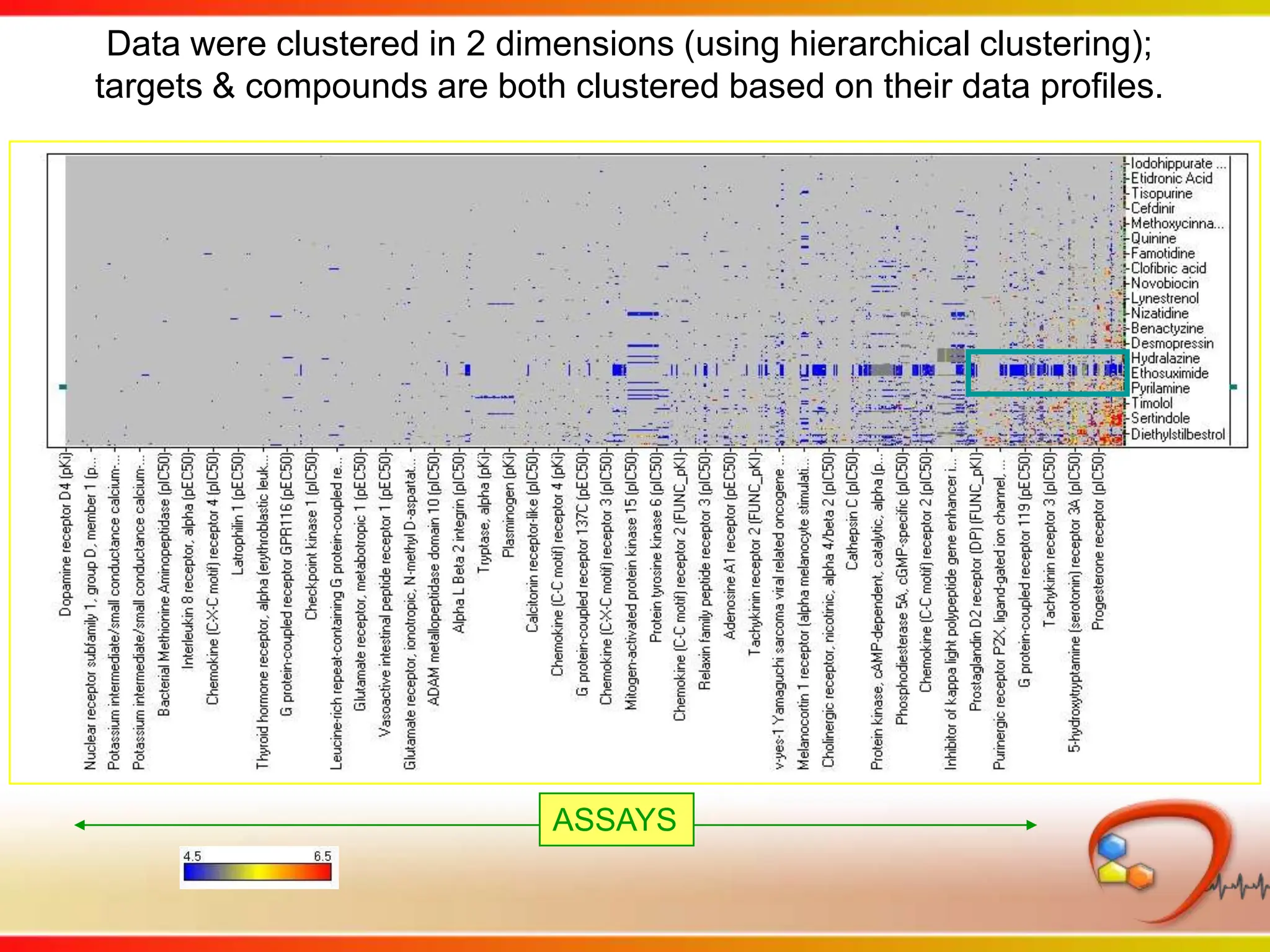
Data were clustered in 2 dimensions (using hierarchical clustering); targets & compounds are both clustered based on their data profiles.ASSAYS
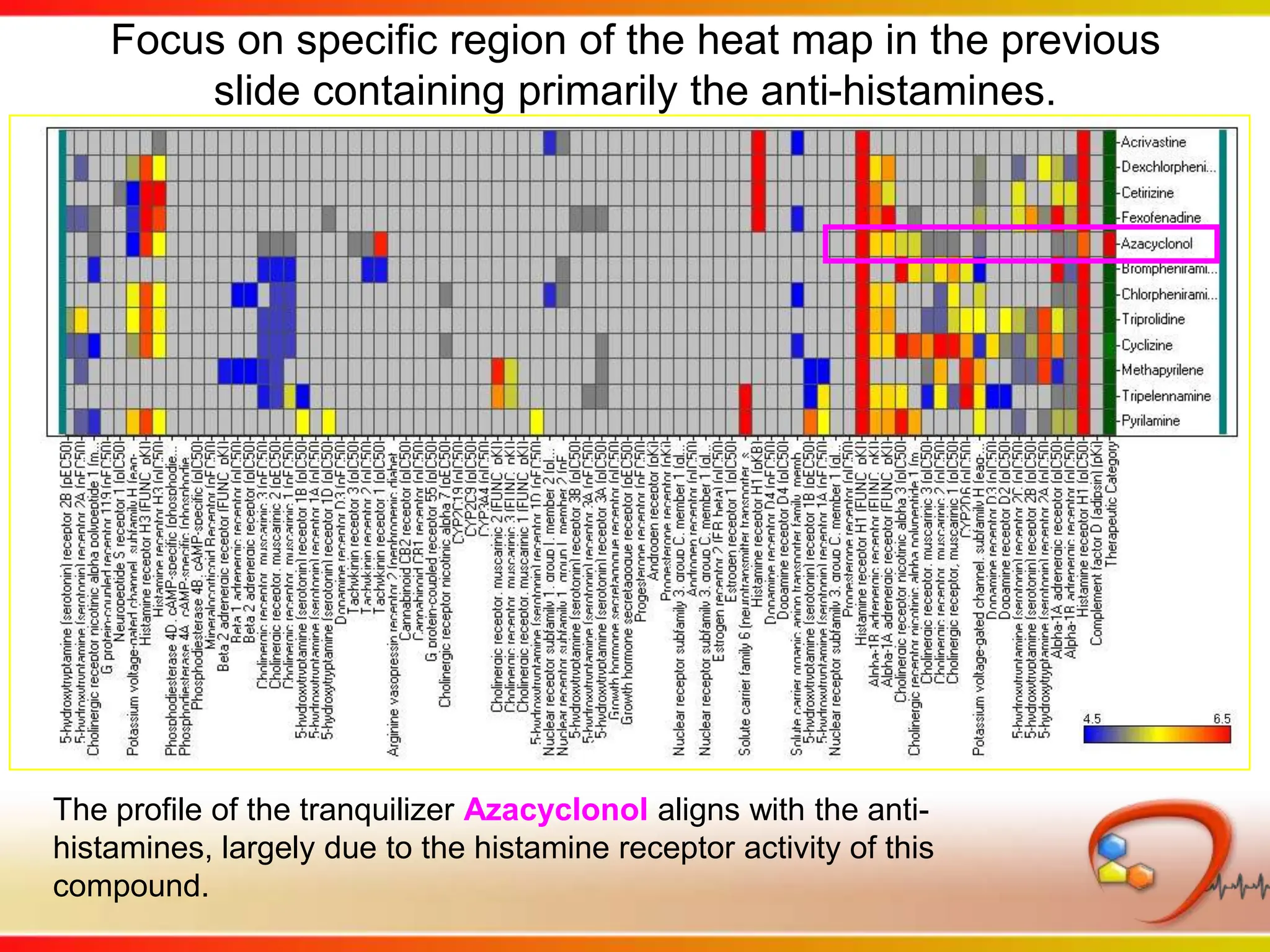
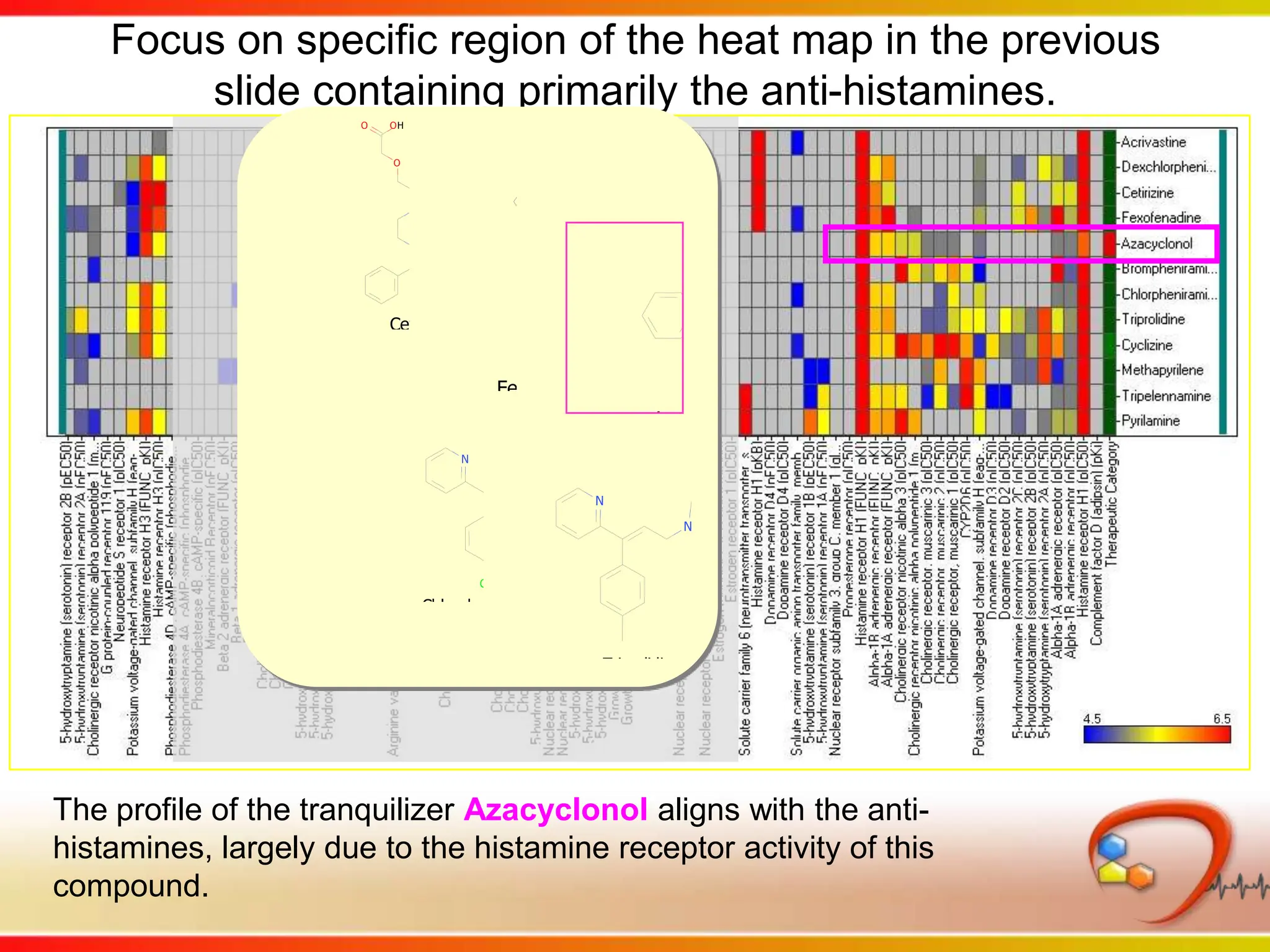
Focus on specific region of the heat map in the previous slide containing primarily the anti-histamines.The profile of the tranquilizer Azacyclonol aligns with the anti-histamines, largely due to the histamine receptor activity of this compound.
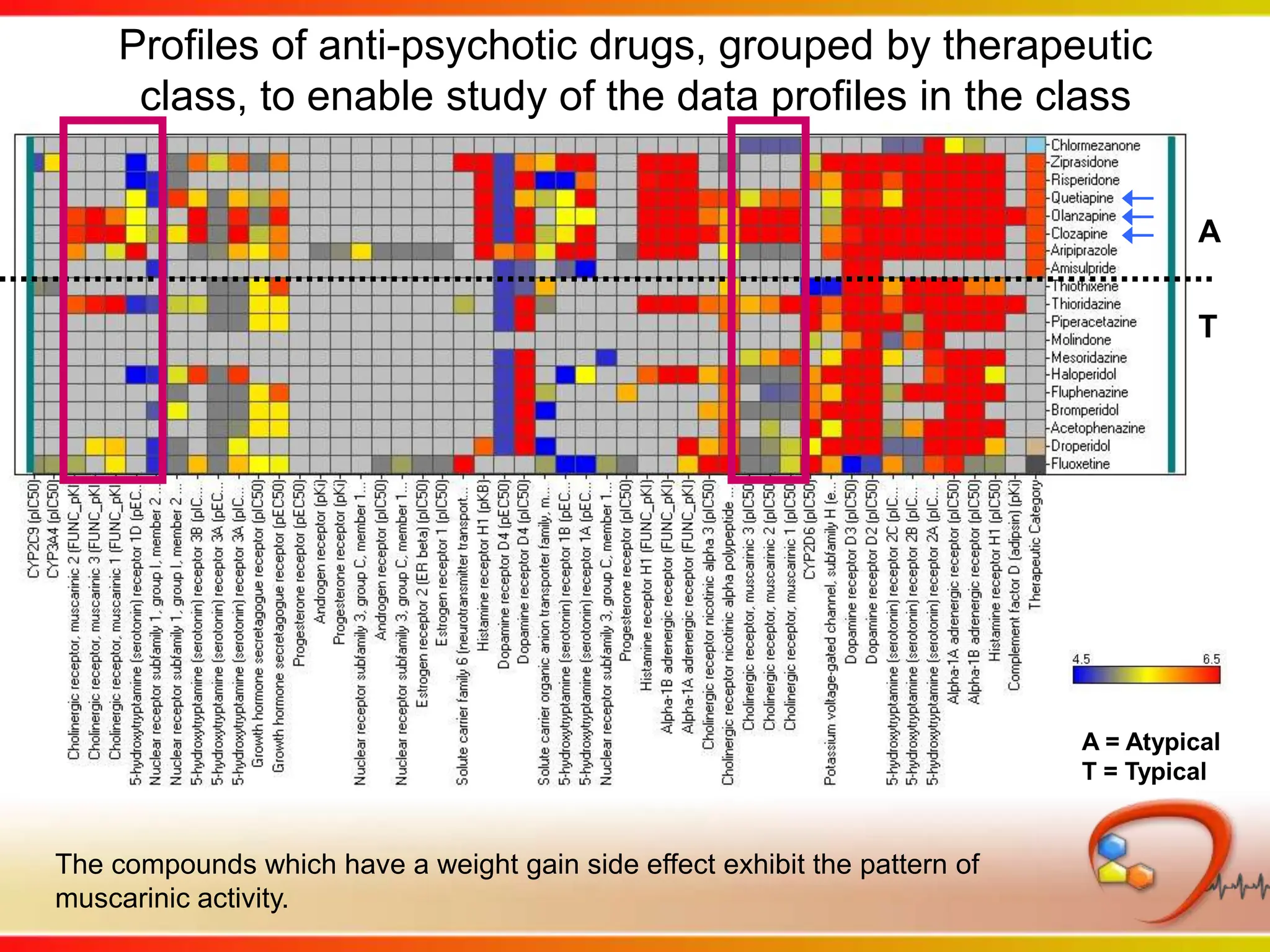
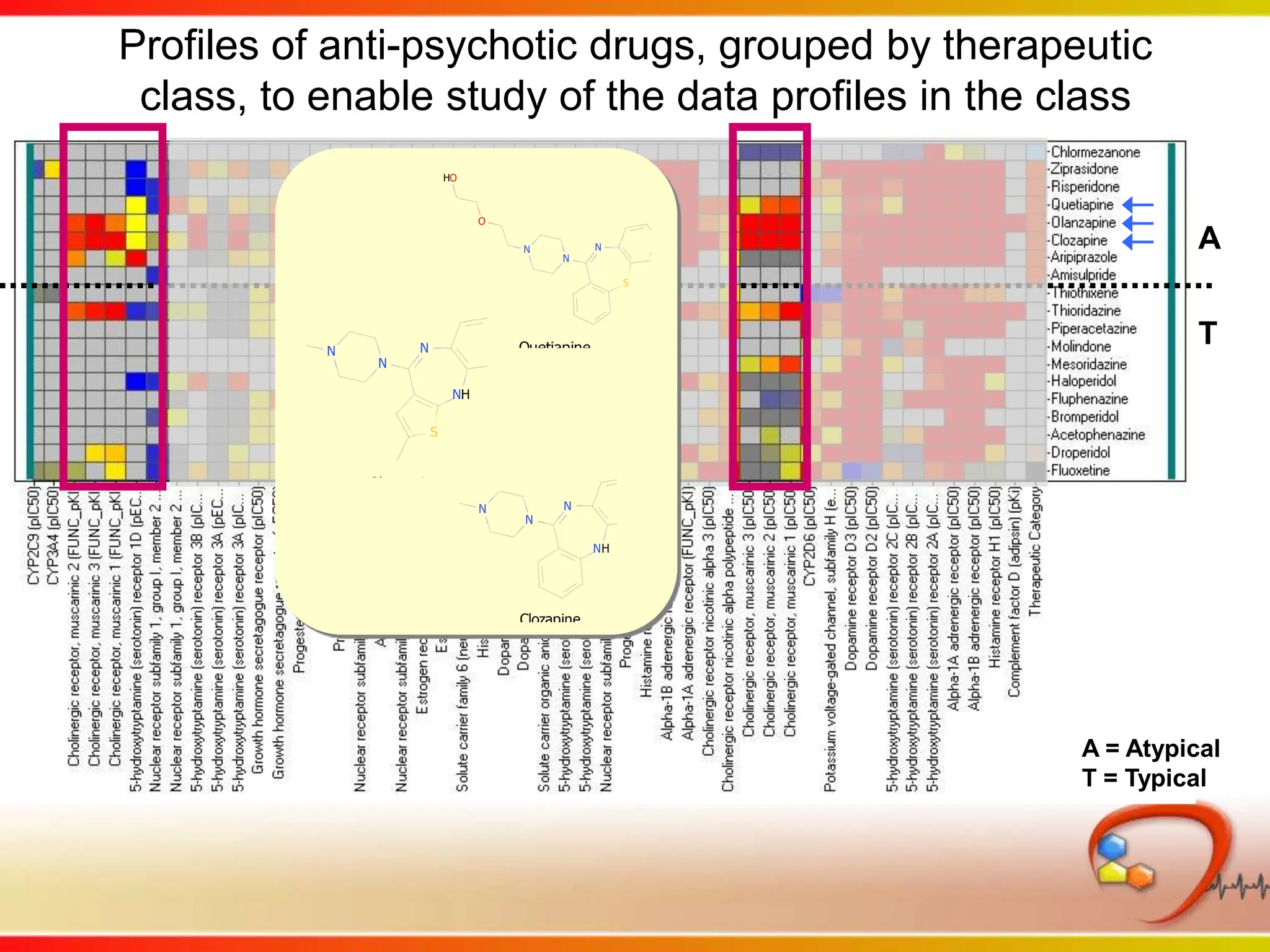
Profiles of anti-psychotic drugs, grouped by therapeutic class, to enable study of the data profiles in the classATA = AtypicalT = TypicalThe compounds which have a weight gain side effect exhibit the pattern of muscarinic activity.
Profiles of anti-psychotic drugs, grouped by therapeutic class, to enable study of the data profiles in the classATA = AtypicalT = Typical
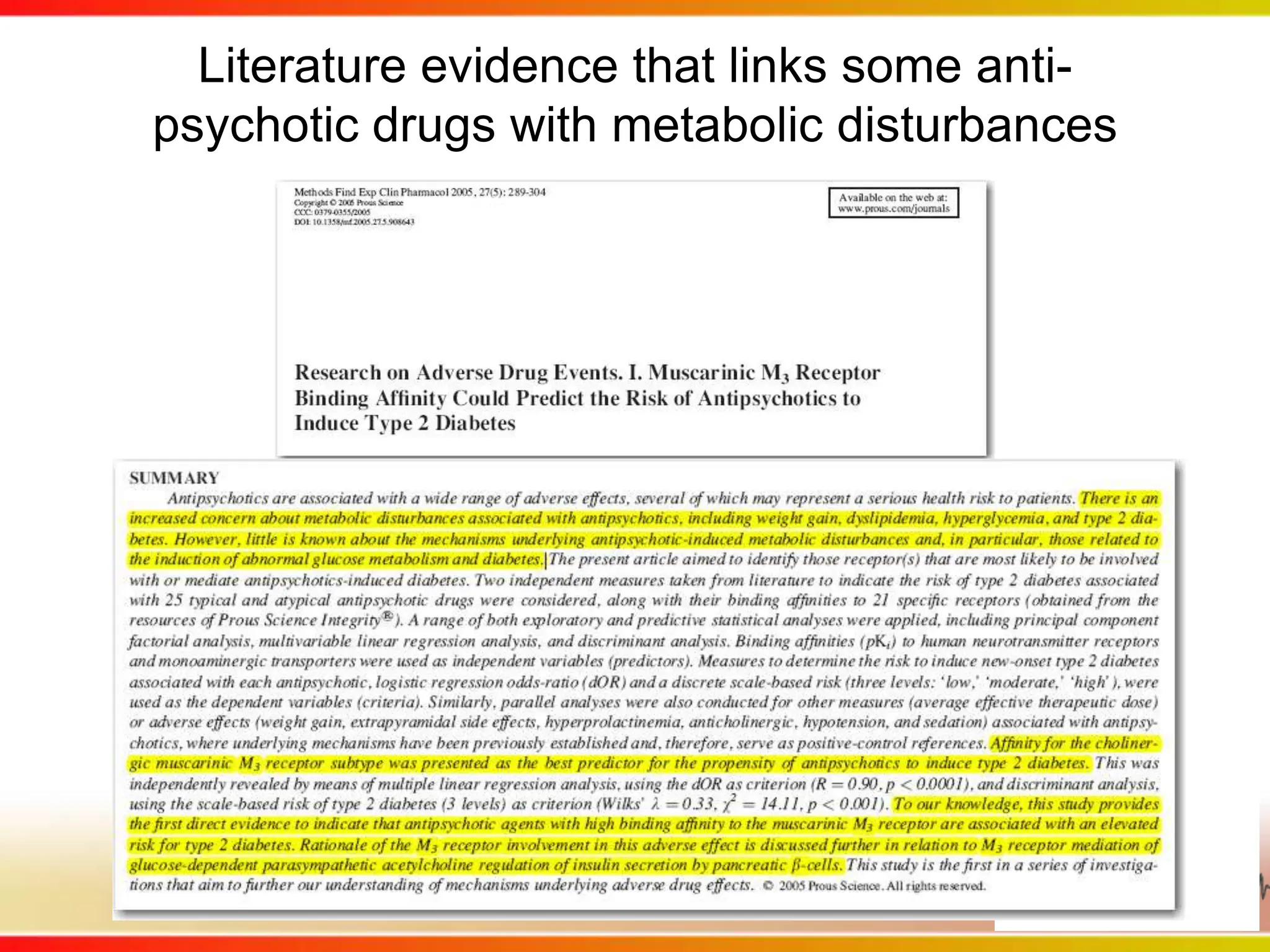
Literature evidence that links some anti-psychotic drugs with metabolic disturbances
Interpretation of MGPS Parameters
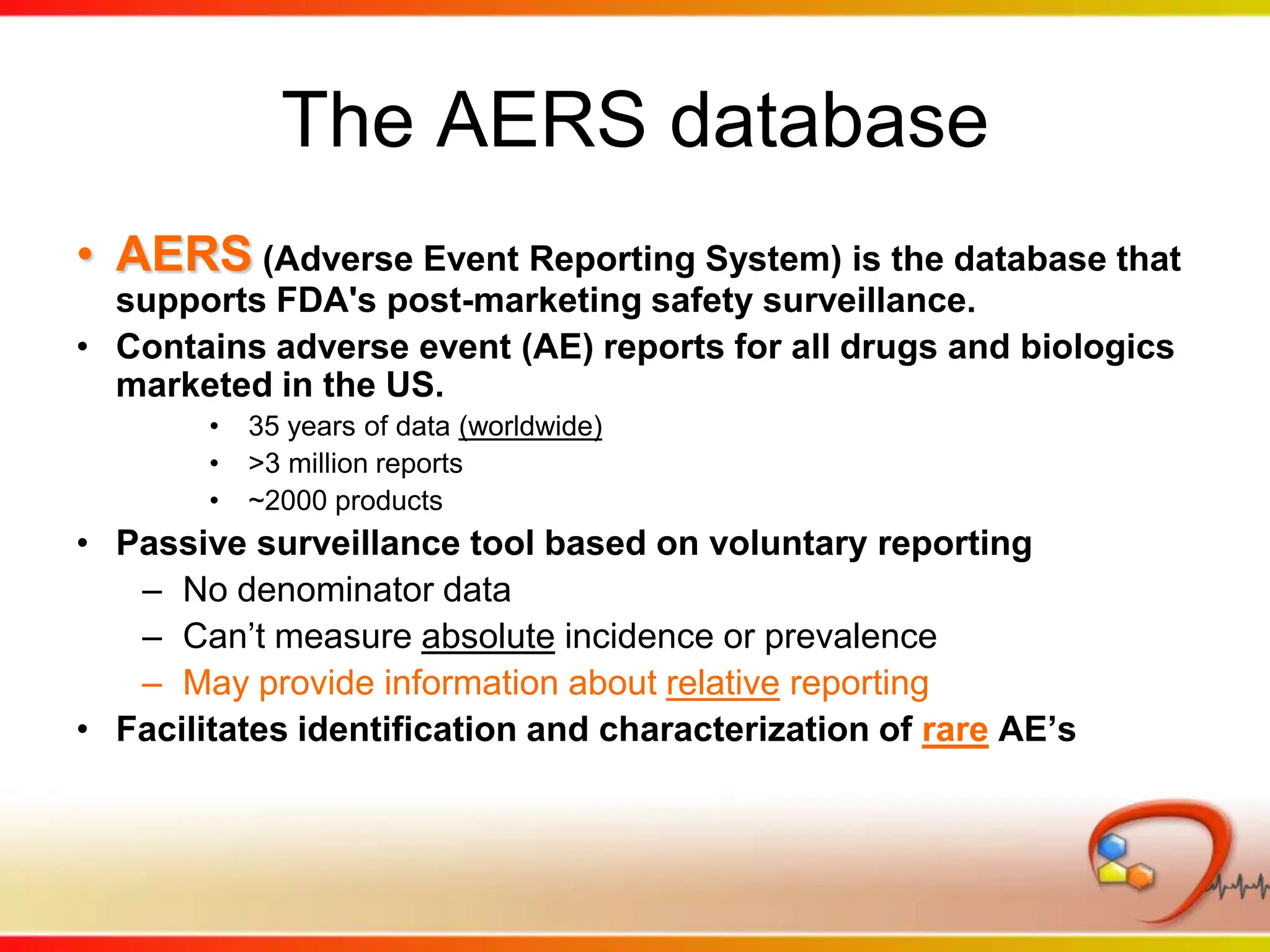
The AERS databaseAERS (Adverse Event Reporting System) is the database that supports FDA's post-marketing safety surveillance.  Contains adverse event (AE) reports for all drugs and biologics marketed in the US.  35 years of data (worldwide) >3 million reports~2000 productsPassive surveillance tool based on voluntary reportingNo denominator dataCan’t measure absolute incidence or prevalenceMay provide information about relative reportingFacilitates identification and characterization of rareAE’s
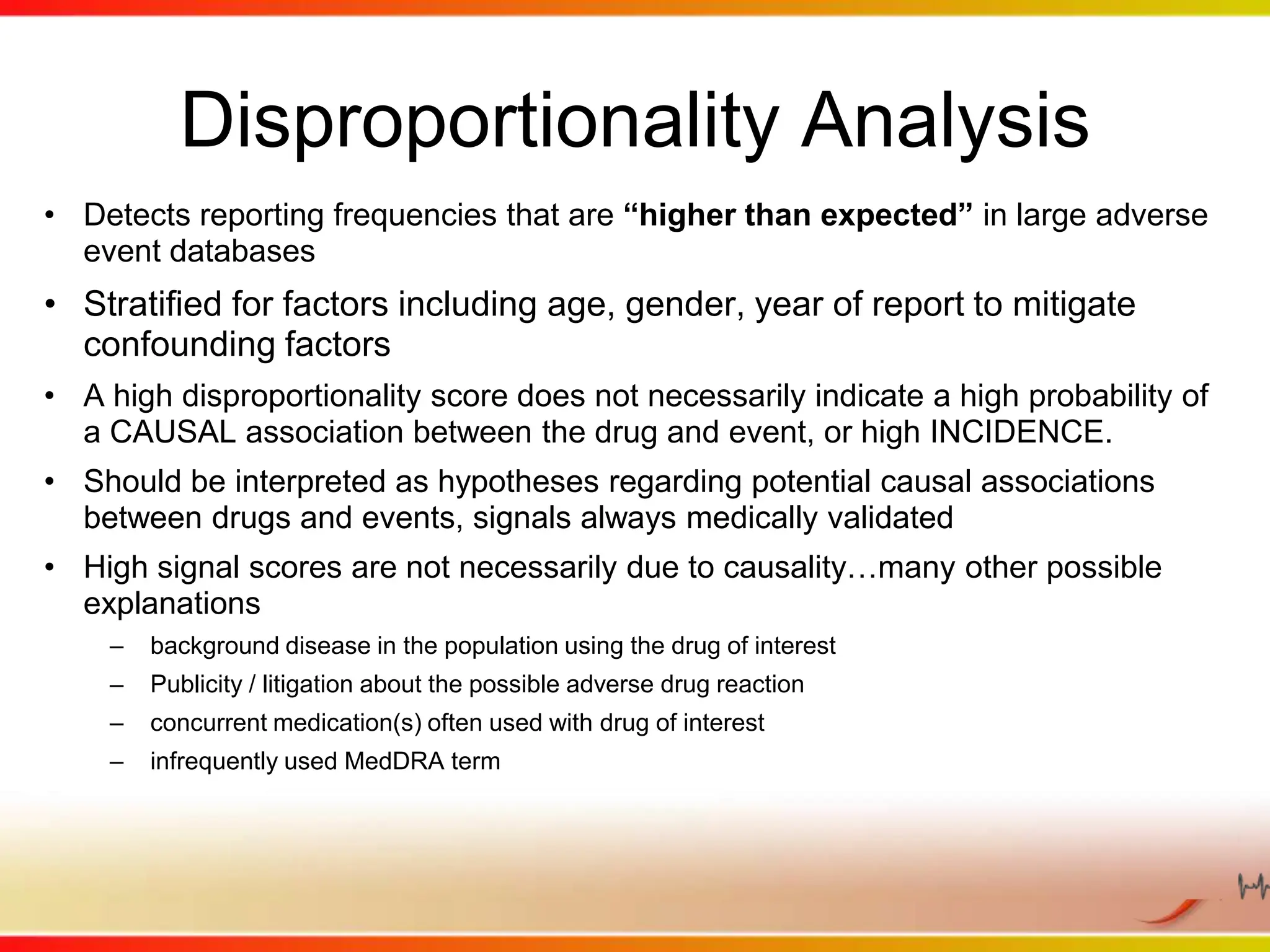
Detects reporting frequencies that are “higher than expected” in large adverse event databasesStratified for factors including age, gender, year of report to mitigate confounding factorsA high disproportionality score does not necessarily indicate a high probability of a CAUSAL association between the drug and event, or high INCIDENCE.Should be interpreted as hypotheses regarding potential causal associations between drugs and events, signals always medically validatedHigh signal scores are not necessarily due to causality…many other possible explanationsbackground disease in the population using the drug of interestPublicity / litigation about the possible adverse drug reaction concurrent medication(s) often used with drug of interestinfrequently used MedDRA termDisproportionality Analysis
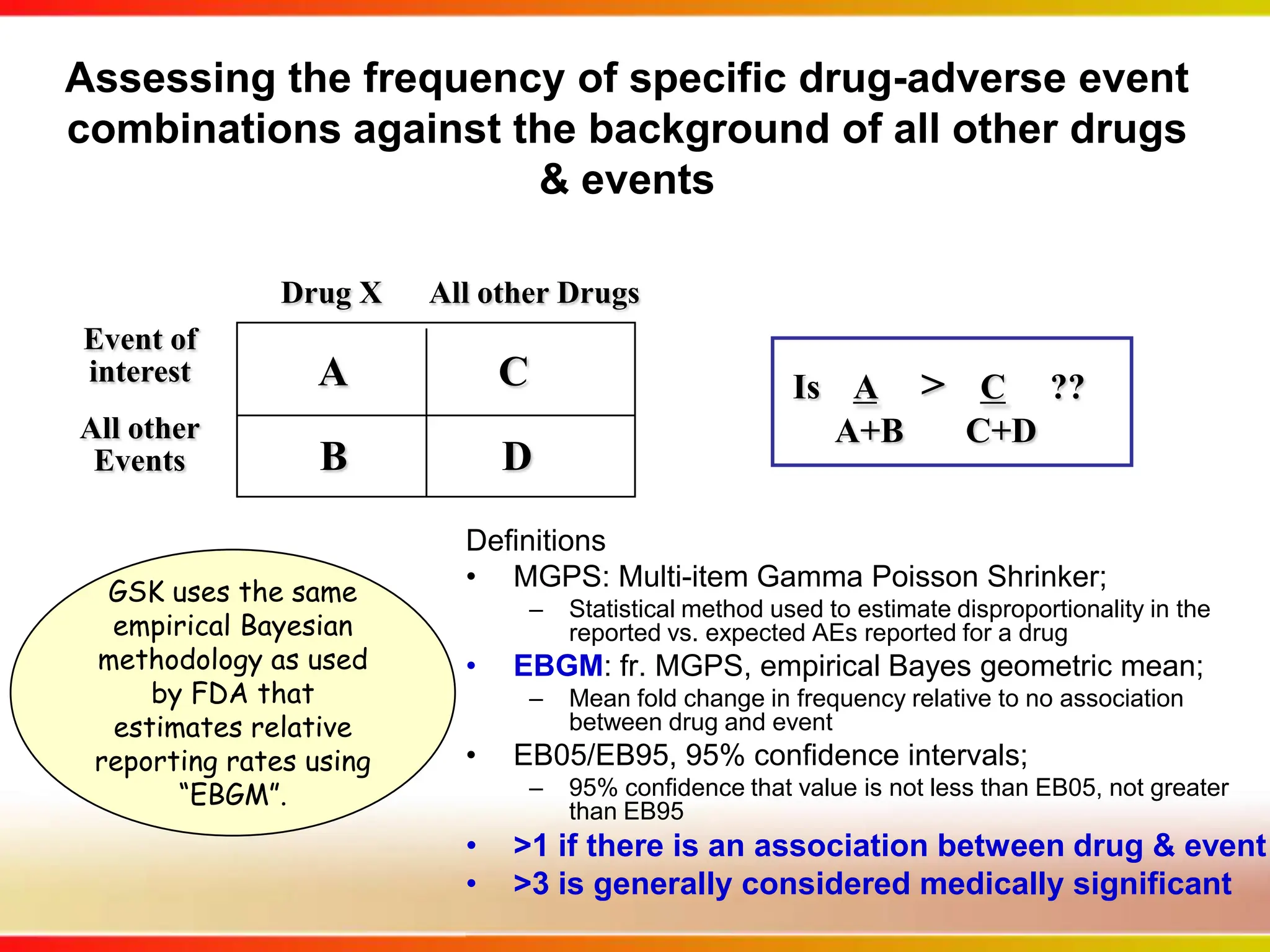
Is    A>C     ??     A+B       C+DAssessing the frequency of specific drug-adverse event combinations against the background of all other drugs & eventsDrug XAll other DrugsEvent of interest A CAll other EventsBDDefinitionsMGPS: Multi-item Gamma Poisson Shrinker; Statistical method used to estimate disproportionality in the reported vs. expected AEs reported for a drugEBGM: fr. MGPS, empirical Bayes geometric mean; Mean fold change in frequency relative to no association between drug and eventEB05/EB95, 95% confidence intervals;95% confidence that value is not less than EB05, not greater than EB95>1 if there is an association between drug & event>3 is generally considered medically significantGSK uses the same  empirical Bayesian methodology as used by FDA that estimates relative reporting rates using “EBGM”.
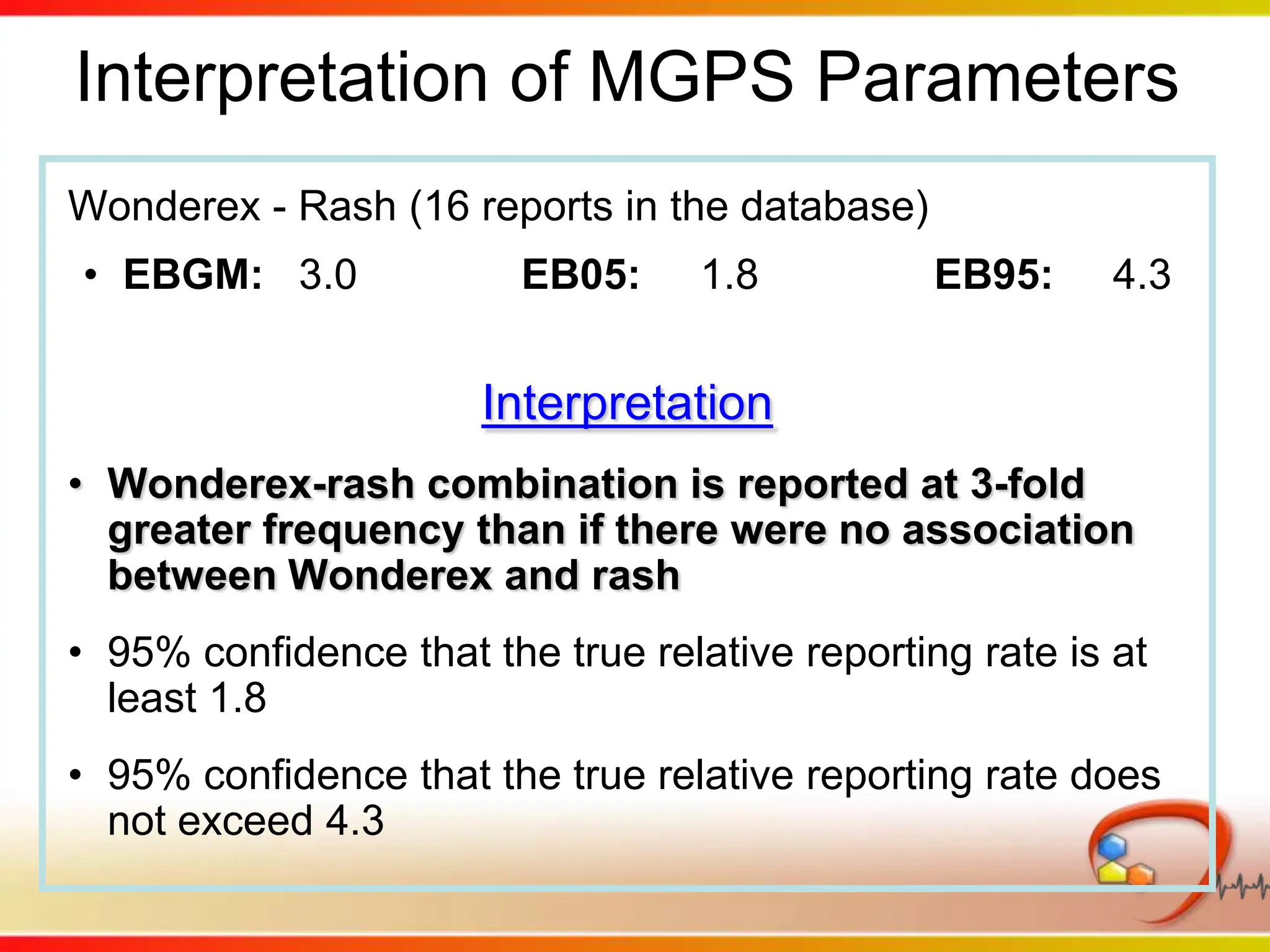
Interpretation of MGPS ParametersWonderex - Rash (16 reports in the database)EBGM:   3.0              EB05:     1.8               EB95:     4.3InterpretationWonderex-rash combination is reported at 3-fold greater frequency than if there were no association between Wonderex and rash95% confidence that the true relative reporting rate is at least 1.895% confidence that the true relative reporting rate does not exceed 4.3
Are there examples of an adverse event with a known target association?..and does the EBGM compare reasonably to the target activity?
Integrating CCP and AERS data shows the potential for bridging human safety and pre-clinical information: comparison of pIC50 in dofetelide binding assay and score for Prolonged QT in post marketing adverse events dataCarries black box, or removed from market for QTHigh QT, low hERG-High exposure (interactions)-non-HERG channel activityHigh hERG, low QT-low bioavailability, topicals
Vanderwall cheminformatics Drexel Part 2

Vanderwall cheminformatics Drexel Part 2

  • 1.
    Molecular Clinical SafetyIntelligence: Tools to detect risk (or at least illuminate blind spots) earlier in drug discovery.
  • 2.
    Traditional Development(shown ingray)Medicines are developed for safe and effective human useHuman Safety ExperienceDrug DiscoveryWhat is Molecular Clinical Safety Intelligence?
  • 3.
    Traditional Development(shown ingray)Medicines are developed for safe and effective human useHuman Safety ExperienceDrug DiscoveryMCSI SystemCloses the Knowledge GapContinual input of Human Safety InformationScientists use MCSI system info to develop safer medicinesMCSI System integrates Chemistry, Pharmacology, and Human Safety KnowledgeWhat is Molecular Clinical Safety Intelligence?
  • 4.
    What is MolecularClinical Safety Intelligence? (MCSI)APPLICATION FRAMEWORKChemAxon Chemistry Drawing Tool: Marvin SketchVisual iloData VisualizationChemAxon Chemistry Data Cartridge: JChemStatistical Modeling: Recursive Partitioning, Random ForestsSupport for downloading data for use in Excel, Search Iris, Spotfire, Word (RTF)MCSI DATA WAREHOUSEChemical structures & computedproperties for 70K (mostly) external compoundsData mappedto chemicalstructuresFDA / WHOQuantitative Adverse Event Signal Scores on marketed RxGSK: In-house Compound Profiling Data on Marketed DrugsUniversity of Washingtonmetabolism & drug-interaction dataGVK Bio Lit.: Clinical, Pharmacological, & animaland mechanism-basedtoxicity data, metabolite structures
  • 5.
    Data SourcesAdverse EventsLincolnTechnologies (Phase Forward)– Quantitative signal scores for adverse events from FDA AERS & WHO VigibaseData/Information Curated From Literature GVK Bio – marketed drugs and clinical candidates (DD and CCD)GVK Bio – Mechanism-Based Toxicity (MBT)GSK – literature data on marketed compounds (“Top 2500”)Drug Metabolism/Drug-Drug InteractionsUniversity of Washington – Drug Interaction Database (DIDB)David Flockhart – P450 and drug interactionsEdmund Hayes – P450 and drug interactions Target Activity ProfilesGSK – compound profiling data on marketed compounds (CPDP)Chemical PropertiesGSK – Adamantis computed properties
  • 6.
    Capturing the humansafety experience of marketed drugsdoing more,feeling better,living longerAdverse events (AEs) are reported to the FDA & WHO and recorded in the Adverse Event Reporting System (AERS; FDA) & Vigibase (WHO)As a drug & AE pairMillions of reports gathered over decadesThese data are used by FDA/WHO & Pharmacovigilance groups in the pharma to monitor the safety of drugs on the market“Disproportionality Analysis”: a statistical method that quantitates the association between Drug & AEThe resulting Emperical Bayes Geometric Mean (EBGM) value is ~fold increase in occurrence of Drug-AE pair over “expected” rateDrug & Adverse event
  • 7.
    Typical workflow usingMCSINovel Compound?structurecompoundAE2AE1bindingstructurecompound                                                        Q: Are there any compounds similar to mine that have had safety issues?Query MCSI with structures of interest using chemical substructure & similarity Identify similar moleculesQ: What do we know about these compounds?MCSIDrill down into the data to learn about the safety, pharmacology, metabolism of these similar moleculesAdverse EventsFunctional AssaysDMPKMCSI
  • 8.
    Progression of aSeries from an HTSProlyl Hydroxylase Inhibitors (Oncology CEDD)Progression of hit in Prolyl Hydroxylase Inhibitors Program discussed in Oncology Chem Exec (Aug 2007)A hit from screening, GSK147098A, showed good activity as a PH inhibitorSAR showed that thionocarbonyl function (thiourea) was key for cmpd activityA question arose regarding toxicity of thionocarbonyl/thiourea functional groupsA search of MCSI was conducted:Are there any marketed drugs containing thioureas?If there are, what is their Tox profile
  • 9.
    Currently 4 stdquick reportsQuery by chemical similarity or substructureQuery target in GSK profiling dataQuery by adverse event in FDA AERS
  • 10.
    Safety Summary Reportfor Thioureas (cnt’d)The list of compounds retrieved or the report output itself can be saved within the system (privately or “published”), or exported
  • 11.
    Propylthiouracil: Similarity withPH HitsProlyl Hydroxylase Lead Compounds:
  • 12.
    Propylthiouracil:Compound Details showall of the available data on one compound
  • 13.
    Propylthiouracil MetabolitesMetabolite sectionof Propylthiouracyl shows the toxic reactive metabolites associated with thioureasPropylthiouracil Toxicity MechanismToxicity Mechanism section reveals key information for thiourea toxicityPropylthiouracil Adverse EventsSignal Scores capture the EBGM values for adverse events from FDA & WHO databases(EBGM >3 is generally considered clinically relevant)
  • 14.
    Benefit and ApplicationMCSIcan be used at almost any point in the discovery processprior to molecule selection!Tool compound identificationFragment / HTS triageLead optimisation / scaffold hopping techniquesDue diligence processes / in licensing...Enables assessment of potential issues for compound or series to be weighed with other considerationsMight be also be helpful in understanding observed toxicity, adding more context
  • 15.
    The MCSI CommunityLedby James Bailey, Dana Vanderwall, Nancy Yuen~75 User-Members within R&DDPU Chemistry, Biology, DMPKComputational Chemistry, MDRGlobal Clinical Safety & Pharmacovigilance Scinovo (preclinical externalization group)Members serve as a resource to drug discovery/development programsAlways open to new members: email: nancy.a.yuen@gsk.com
  • 16.
    Other types ofquestions supportedThe data can be used look for new hypothesis in relationships between human adverse events & chemical or biological characteristics of drugsMarketed drugs profiled in assays for >500 targets>54K pXC50 determinations on 1336 drugs @ 545 targetsVia standard SS-> FC hit progression (CCP, 2 later profiling exercises)Molecular target activities can be compared with quantitative AEs (EBGM)Look for either increase or decrease associated with a target
  • 17.
    Comparing the adverseevent data with the measured target activity profilesAdverse eventsTake one well understood example:hERG inhibition & QT prolongationMarketed Drugs AE “Score”: QT prolongation hERG IonWorks pIC50Potency/efficacy in target assay
  • 18.
    Now compare alltarget activities to all AE scoresAll measured pXC50 data All AE “Scores”X= potential new associations between activity at target(s) & adverse event
  • 19.
    Target Activity andAE Associations
  • 20.
  • 21.
    Other liabilities wellrepresented by assays in our portfolio: Histamine H1antihistaminesSleep-ezeAstelinClaritinComtrex/ContactAllegra
  • 22.
    AcknowledgementsNancy Yuen, JamesBailey (co-leads) Juan Luengo Giovanni Vitulli James Bailey Subhas Chakravorty Sunny Hung Francoise GellibertJohn Walsh Dennis Lee David LivermoreSimon Semus Stephen Pickett Ricardo MacarronMui Cheung Rick Cousins Gordon Dear Jakob Busch-Petersen Robin Cregan Graham SimpsonIan Churcher Laurie Bayon Katherine WiddowsonDeanna Frey Ceara Rea Chris N. JohnsonDarren Green Dave Morris Phase Forward-/Lincoln Technologies: Mohammad Al-Ansari, David Fram
  • 23.
  • 24.
    Data SourcesAdverse EventsLincolnTechnologies (Phase Forward)– Quantitative signal scores for adverse events from FDA AERS & WHO VigibaseData Curated From Literature GVK Bio – marketed drugs and clinical candidates (DD and CCD)GVK Bio – Mechanism-Based Toxicity (MBT)GSK – literature data on marketed compounds (“Top 2500”)Drug Metabolism/Drug-Drug InteractionsUniversity of Washington – Drug Interaction Database (DIDB)David Flockhart – P450 and drug interactionsEdmund Hayes – P450 and drug interactions Target Activity ProfilesGSK – compound profiling data on marketed compoundsFrom CCP & additional bespoke profiling; total ~1500 drugs @580 targetsChemical PropertiesGSK – Adamantis computed propertiesGSK - Structural Alerts for TOX and CYP
  • 25.
    GVK BioMarketed Drugs/ClinicalCandidates/Mechanism Based Toxicity Result of large abstracting/curating activity by discovery-stage CRO based in IndiaRaw data sources include patents, journals, drug information sheets, reference books Two of GVK’s databases relate specifically to compounds that have proceeded through clinical development:DD (Drug Database) – 2,475 marketed drugsCCD (Clinical Candidates Database) – 8,756 clinical candidatesIntegration process:Compounds integrated across all data sources, original source of compound retained Combination products eliminated (e.g., avandamet-which contains rosiglitazone, metformin)Original SMILES strings from GVK converted to unique representation including de-salting and normalizationAssigned MCSP compound ID’s (CMPD-nnnnn) based on the original GVK ID’s
  • 26.
    GVK Data Content Marketed Drugs / Clinical Candidates2D chemical structures and related propertiesPharmacokineticsBinding data Functional dataMetabolites Cytochrome P450 interactions Drug interactionsClinical studiesPhysical properties, mostly solubilityReferences
  • 27.
    GVK Bio Mechanism-BasedToxicity (MBT)Broad set of clinically relevant compounds (drugs, pre-clinical and clinical candidates, drug-like substances, environmentally toxic substances, etc.)13,000 compoundsIncludes:General toxicities (cytotoxic, carcinogenic, mutagenic, etc.)Organ-specific toxicities with organ and reaction termMechanistic terms (reactive metabolite, DNA damage, etc.)Quantitative values for various toxic endpoints (LD50, % Cell Death, etc.)Free-text description of mechanismMetabolite structuresIntegrated primarily for use in drill-down and reportingOverall data mart constructed by adding non-duplicative compounds from MBT to those resulting from combining DD and CCD (total 22,332)
  • 28.
    University of WashingtonDrugInteraction Database (DIDB)In vitro and in vivo information on drug interactions from over 4,000 publicationsIntegrated:In vitro enzyme inhibition resultsRaw data at the level of an individual “precipitant” modifying the metabolism of a given “probe” drugConverted semi-quantitative (“30+/-8 umol”) values to numbers with standard units; re-expressed as negative logarithm of concentration in micromolesIn vitro substrate (metabolism) informationBoth inhibition and substrate results are available for feature creation in modeling
  • 29.
    P450 and DrugInteractionsMerged and combined substrate information from 4 sourcesUniversity of Washington (preceding slide)Flockhart (medicine.iupui.edu/flockhart/)Hayes (www.edhayes.com/CYP450-1.html)“Top 2500”Combined results available for feature creation in modeling
  • 30.
    Functional CapabilitiesQuerySearch datamart creating saved compound listCriteria based on structure matching (substructure similarity) or characteristics (chemical, biological, pre-clinical and clinical safety)ReportingPresent in tabular form a variety of information retrieved for a compound listCan be combined with query in one step via “Quick Report”ModelingBuild models based on recursive partitioning and random forest techniques to capture relationships between predictors and safety outcomesVisualizationVisualize data and models using Visual i | o, Spotfire, Reaper
  • 31.
    Data were clusteredin 2 dimensions (using hierarchical clustering); targets & compounds are both clustered based on their data profiles.ASSAYS
  • 32.
    Focus on specificregion of the heat map in the previous slide containing primarily the anti-histamines.The profile of the tranquilizer Azacyclonol aligns with the anti-histamines, largely due to the histamine receptor activity of this compound.
  • 33.
    Focus on specificregion of the heat map in the previous slide containing primarily the anti-histamines.The profile of the tranquilizer Azacyclonol aligns with the anti-histamines, largely due to the histamine receptor activity of this compound.
  • 34.
    Profiles of anti-psychoticdrugs, grouped by therapeutic class, to enable study of the data profiles in the classATA = AtypicalT = TypicalThe compounds which have a weight gain side effect exhibit the pattern of muscarinic activity.
  • 35.
    Profiles of anti-psychoticdrugs, grouped by therapeutic class, to enable study of the data profiles in the classATA = AtypicalT = Typical
  • 36.
    Literature evidence thatlinks some anti-psychotic drugs with metabolic disturbances
  • 37.
  • 38.
    The AERS databaseAERS(Adverse Event Reporting System) is the database that supports FDA's post-marketing safety surveillance. Contains adverse event (AE) reports for all drugs and biologics marketed in the US. 35 years of data (worldwide) >3 million reports~2000 productsPassive surveillance tool based on voluntary reportingNo denominator dataCan’t measure absolute incidence or prevalenceMay provide information about relative reportingFacilitates identification and characterization of rareAE’s
  • 39.
    Detects reporting frequenciesthat are “higher than expected” in large adverse event databasesStratified for factors including age, gender, year of report to mitigate confounding factorsA high disproportionality score does not necessarily indicate a high probability of a CAUSAL association between the drug and event, or high INCIDENCE.Should be interpreted as hypotheses regarding potential causal associations between drugs and events, signals always medically validatedHigh signal scores are not necessarily due to causality…many other possible explanationsbackground disease in the population using the drug of interestPublicity / litigation about the possible adverse drug reaction concurrent medication(s) often used with drug of interestinfrequently used MedDRA termDisproportionality Analysis
  • 40.
    Is A>C ?? A+B C+DAssessing the frequency of specific drug-adverse event combinations against the background of all other drugs & eventsDrug XAll other DrugsEvent of interest A CAll other EventsBDDefinitionsMGPS: Multi-item Gamma Poisson Shrinker; Statistical method used to estimate disproportionality in the reported vs. expected AEs reported for a drugEBGM: fr. MGPS, empirical Bayes geometric mean; Mean fold change in frequency relative to no association between drug and eventEB05/EB95, 95% confidence intervals;95% confidence that value is not less than EB05, not greater than EB95>1 if there is an association between drug & event>3 is generally considered medically significantGSK uses the same empirical Bayesian methodology as used by FDA that estimates relative reporting rates using “EBGM”.
  • 41.
    Interpretation of MGPSParametersWonderex - Rash (16 reports in the database)EBGM: 3.0 EB05: 1.8 EB95: 4.3InterpretationWonderex-rash combination is reported at 3-fold greater frequency than if there were no association between Wonderex and rash95% confidence that the true relative reporting rate is at least 1.895% confidence that the true relative reporting rate does not exceed 4.3
  • 42.
    Are there examplesof an adverse event with a known target association?..and does the EBGM compare reasonably to the target activity?
  • 43.
    Integrating CCP andAERS data shows the potential for bridging human safety and pre-clinical information: comparison of pIC50 in dofetelide binding assay and score for Prolonged QT in post marketing adverse events dataCarries black box, or removed from market for QTHigh QT, low hERG-High exposure (interactions)-non-HERG channel activityHigh hERG, low QT-low bioavailability, topicals