What Every Data Programmer Needs to Know about DisksOSCON Data – July, 2011 - PortlandTed Dziuba@dozbatjdziuba@gmail.comNot proprietary or confidential. In fact, you’re risking a career by listening to me.
Who are you and why are you talking?First job: Like college but they pay you to go.A few years ago: Technical troll for The Register.Recently: Co-founder of Milo.com, local shopping engine.Present: Senior Technical Staff for eBay Local
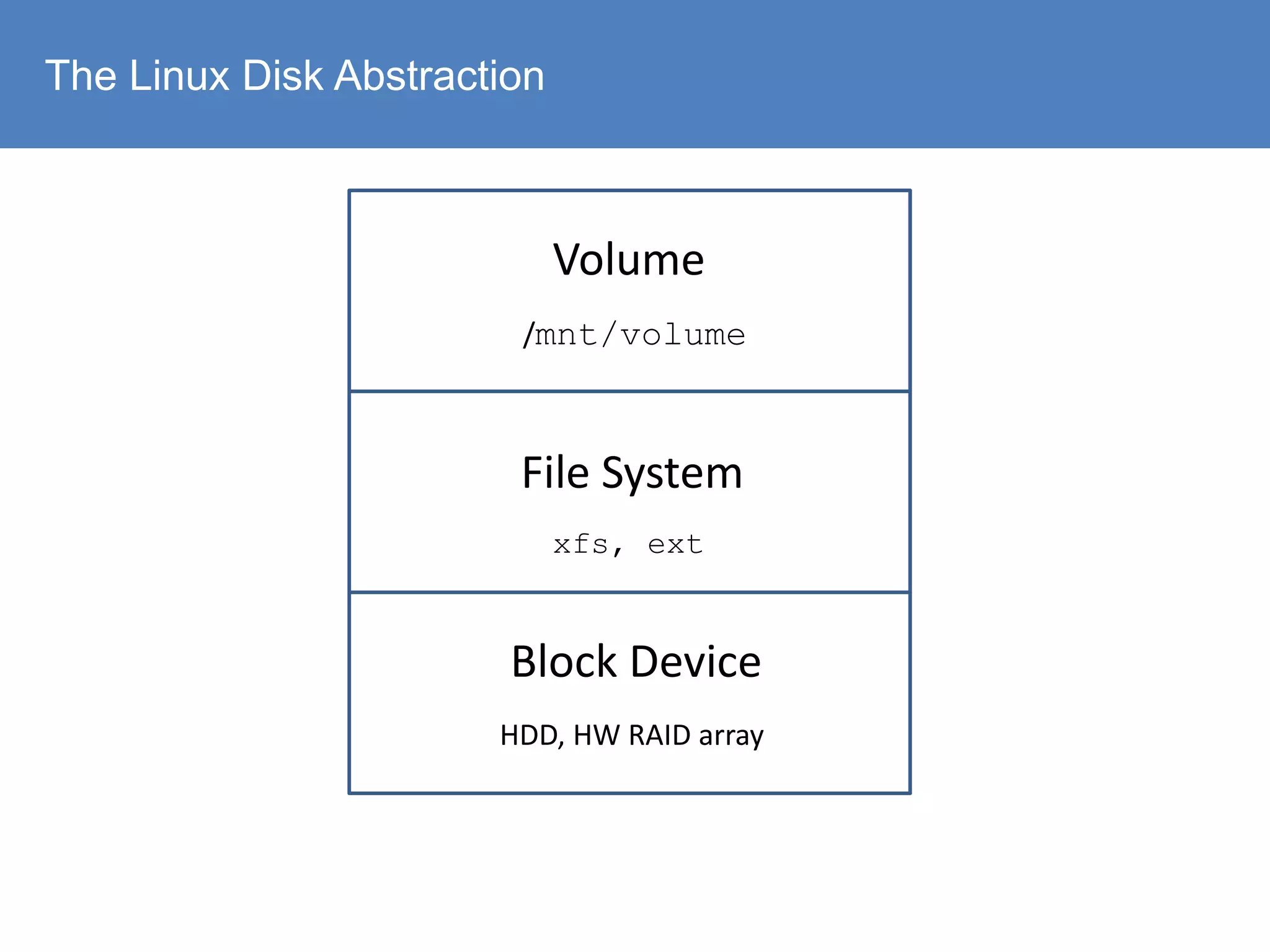
The Linux Disk AbstractionVolume/mnt/volumeFile Systemxfs, extBlock DeviceHDD, HW RAID array
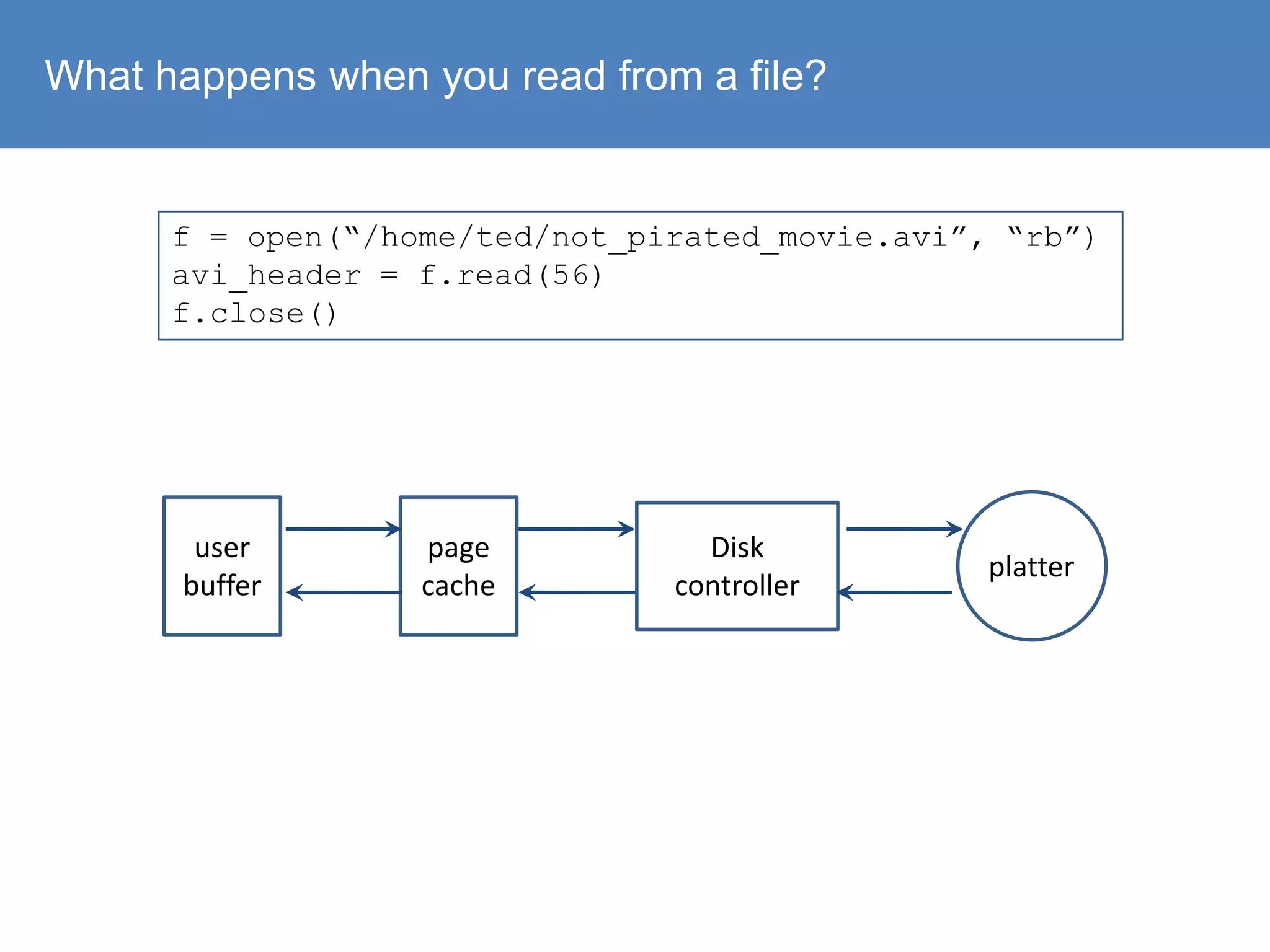
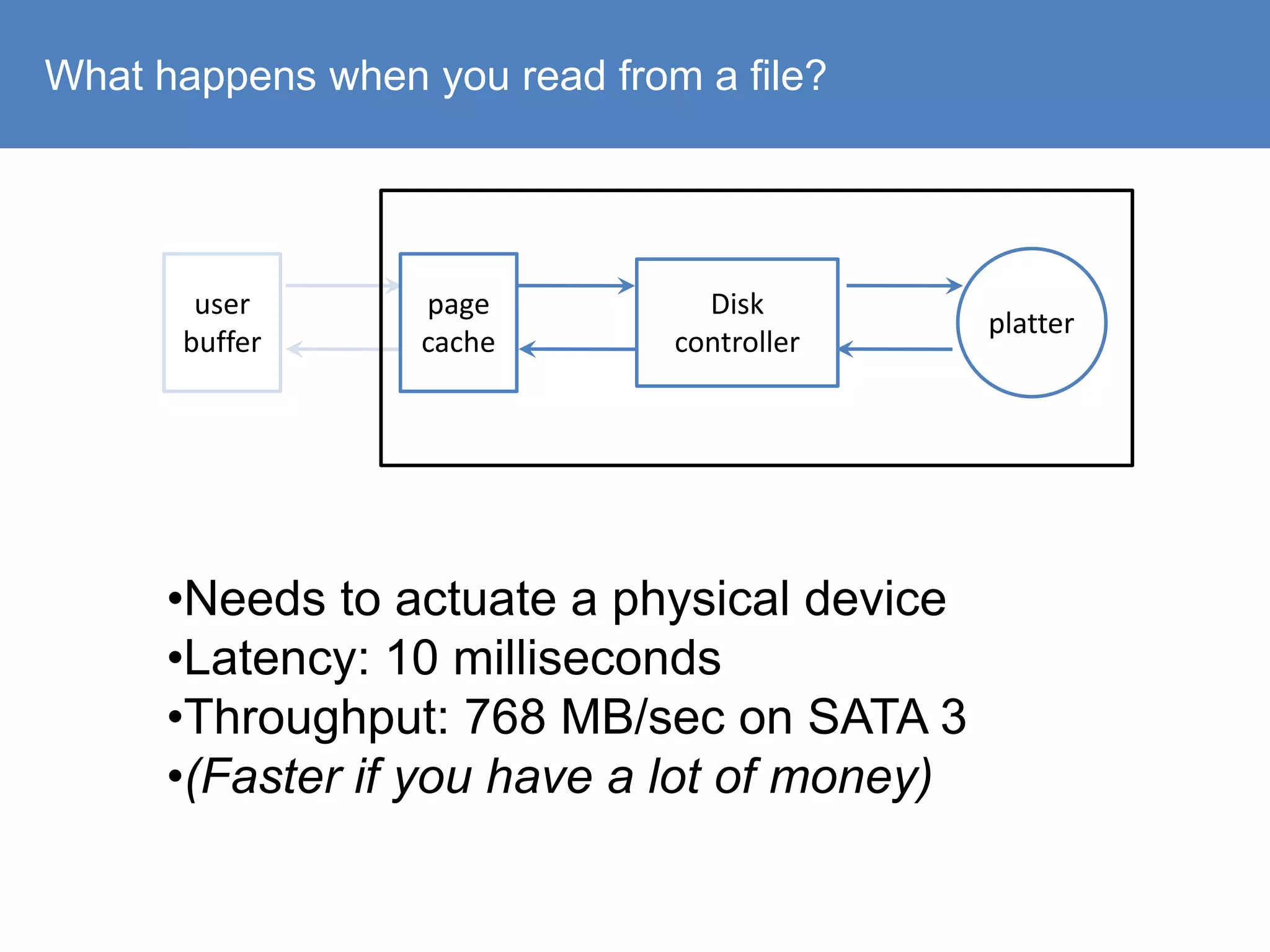
What happens when you read from a file?f = open(“/home/ted/not_pirated_movie.avi”, “rb”)avi_header = f.read(56)f.close()Diskcontrolleruserbufferpagecacheplatter
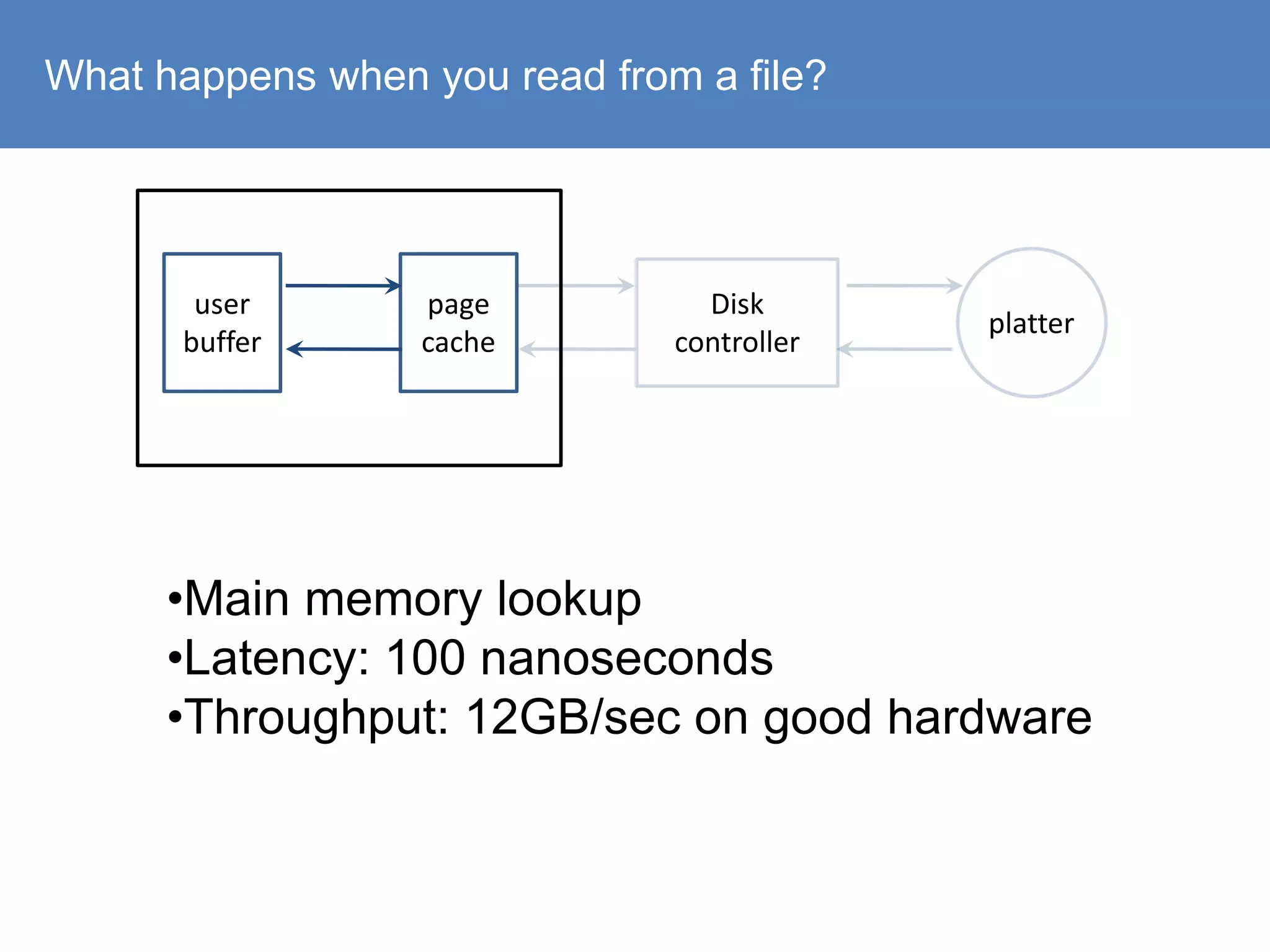
What happens when you read from a file?DiskcontrolleruserbufferpagecacheMain memory lookup
Latency: 100 nanoseconds
Throughput: 12GB/sec on good hardwareplatter
What happens when you read from a file?DiskcontrolleruserbufferpagecacheNeeds to actuate a physical device
Latency: 10 milliseconds
Throughput: 768 MB/sec on SATA 3
(Faster if you have a lot of money)platter
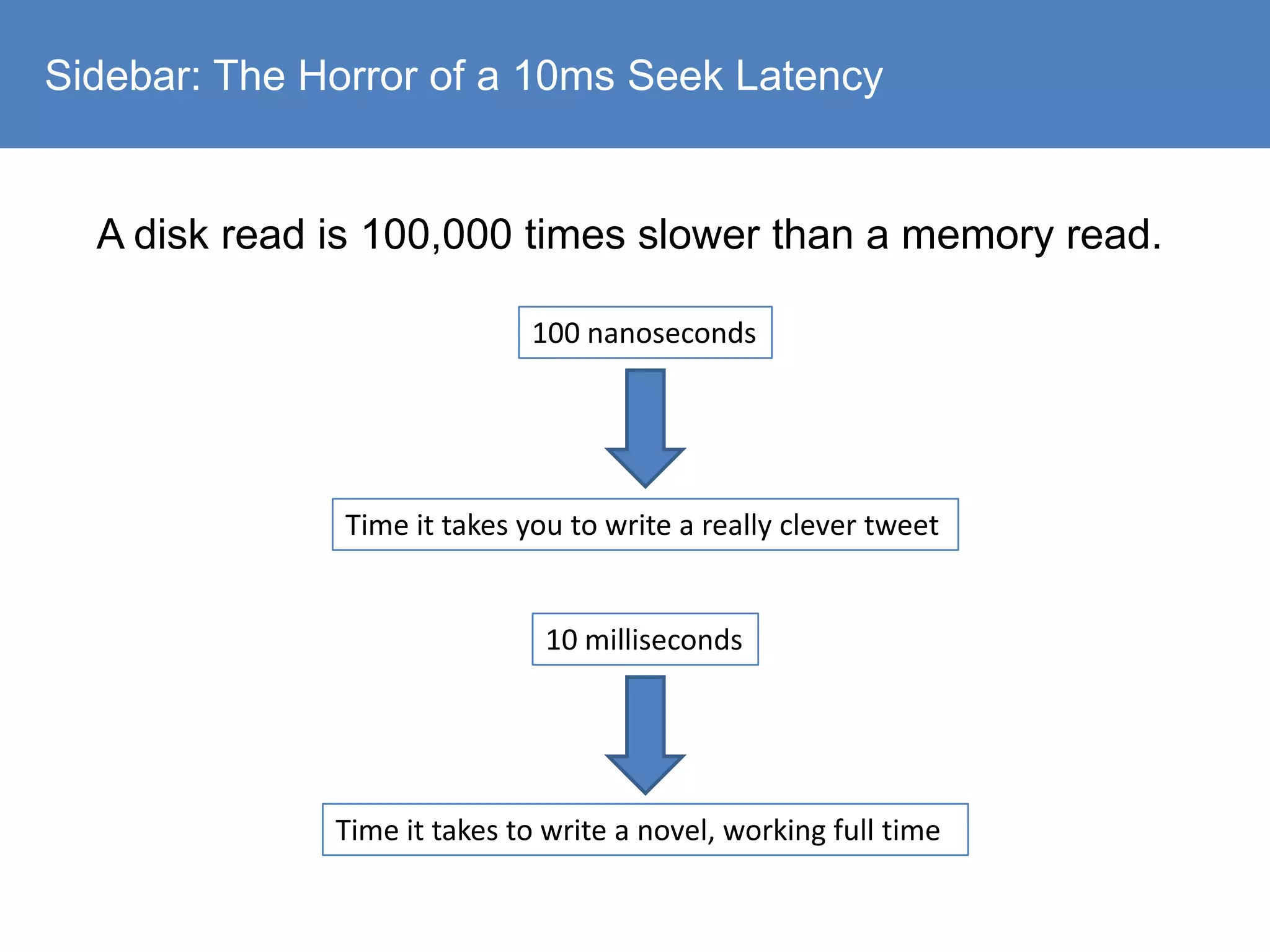
Sidebar: The Horror of a 10ms Seek LatencyA disk read is 100,000 times slower than a memory read.100 nanosecondsTime it takes you to write a really clever tweet10 millisecondsTime it takes to write a novel, working full time
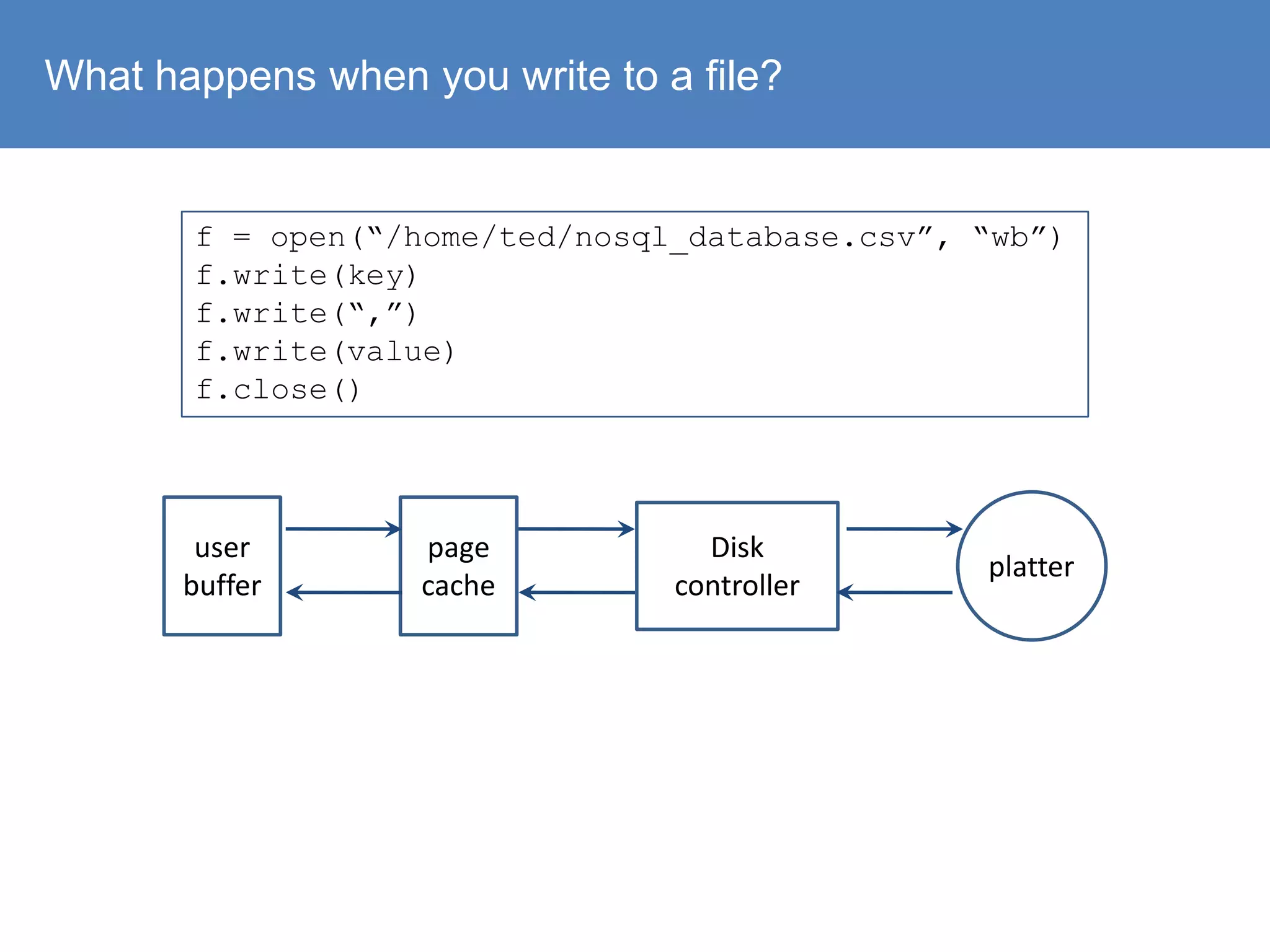
What happens when you write to a file?f = open(“/home/ted/nosql_database.csv”, “wb”)f.write(key)f.write(“,”)f.write(value)f.close()Diskcontrolleruserbufferpagecacheplatter
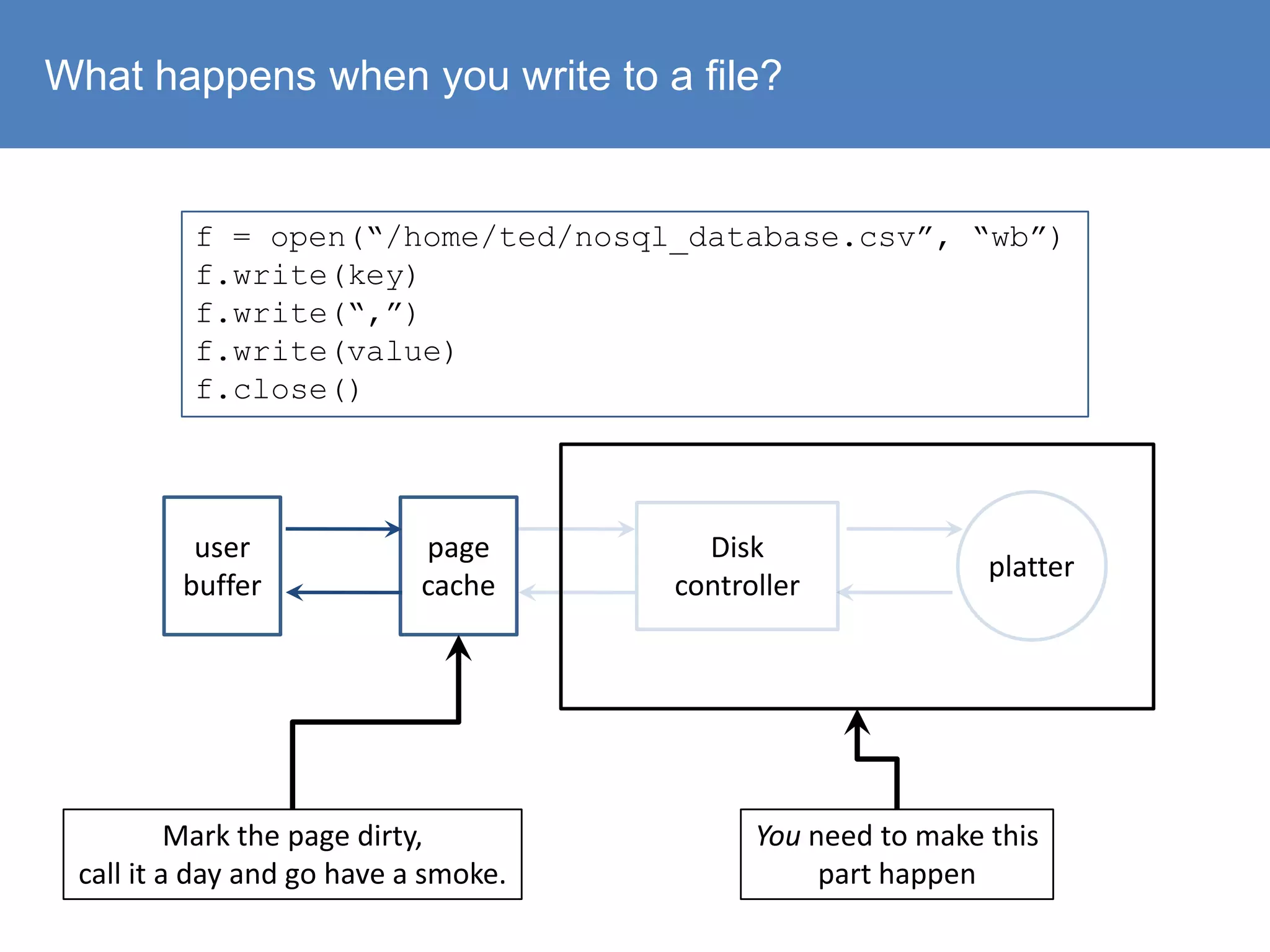
What happens when you write to a file?f = open(“/home/ted/nosql_database.csv”, “wb”)f.write(key)f.write(“,”)f.write(value)f.close()DiskcontrolleruserbufferpagecacheplatterYou need to make thispart happenMark the page dirty,call it a day and go have a smoke.
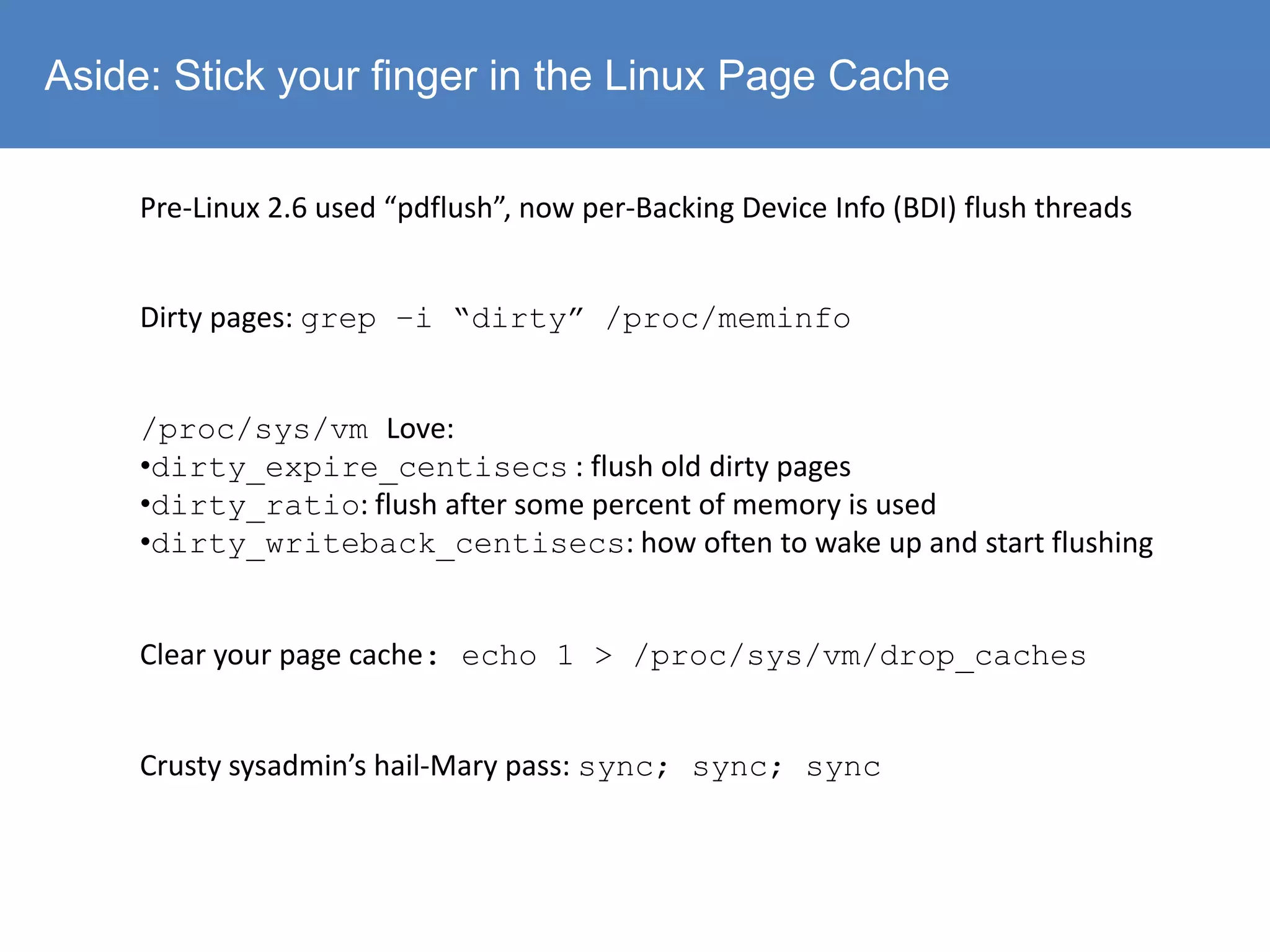
Aside: Stick your finger in the Linux Page CachePre-Linux 2.6 used “pdflush”, now per-Backing Device Info (BDI) flush threadsDirty pages: grep –i “dirty” /proc/meminfo/proc/sys/vmLove:dirty_expire_centisecs : flush old dirty pages
dirty_ratio: flush after some percent of memory is used
dirty_writeback_centisecs: how often to wake up and start flushingClear your page cache: echo 1 > /proc/sys/vm/drop_cachesCrusty sysadmin’s hail-Mary pass: sync; sync; sync
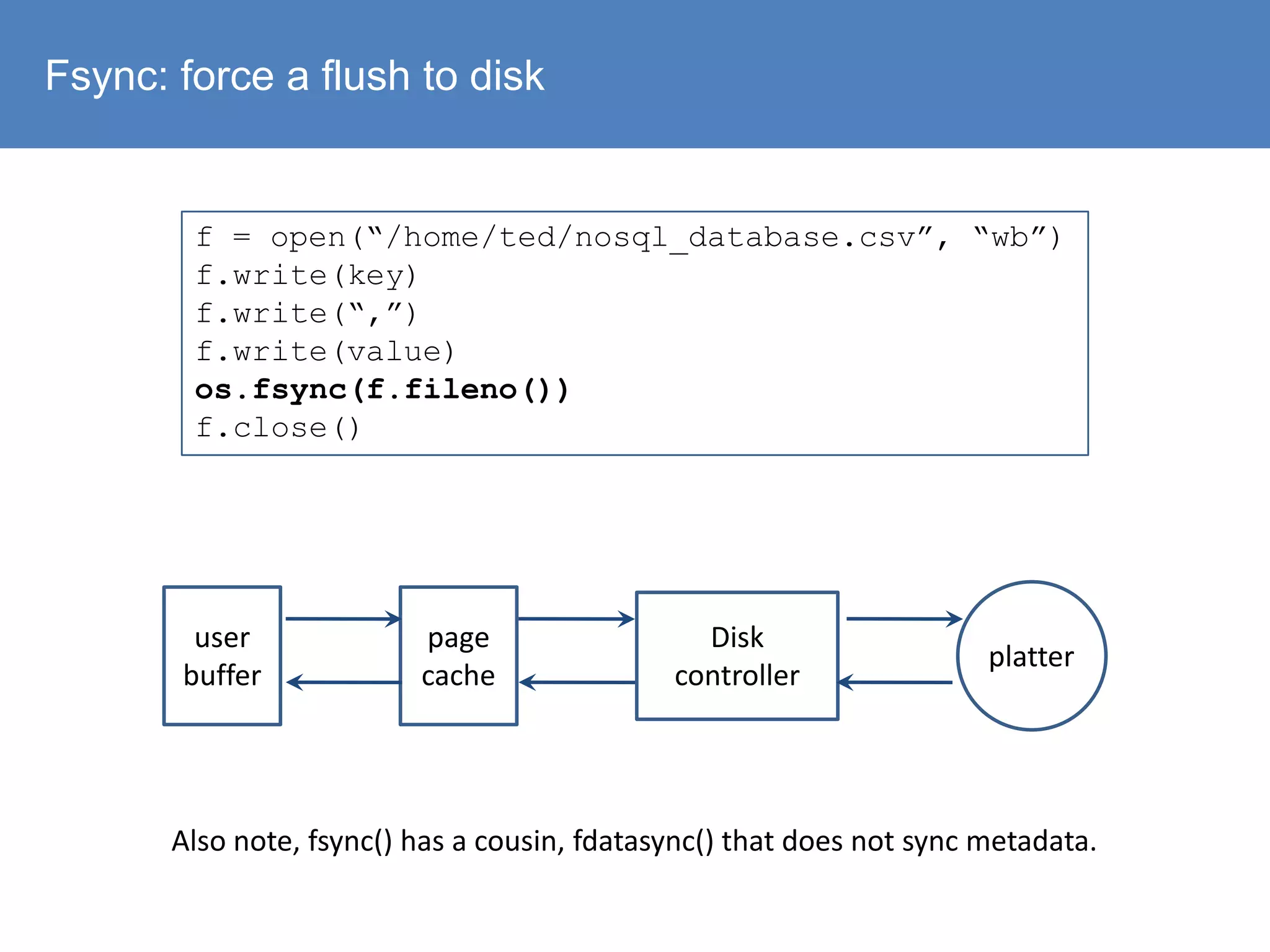
Fsync: force a flush to diskf = open(“/home/ted/nosql_database.csv”, “wb”)f.write(key)f.write(“,”)f.write(value)os.fsync(f.fileno())f.close()DiskcontrolleruserbufferpagecacheplatterAlso note, fsync() has a cousin, fdatasync() that does not sync metadata.
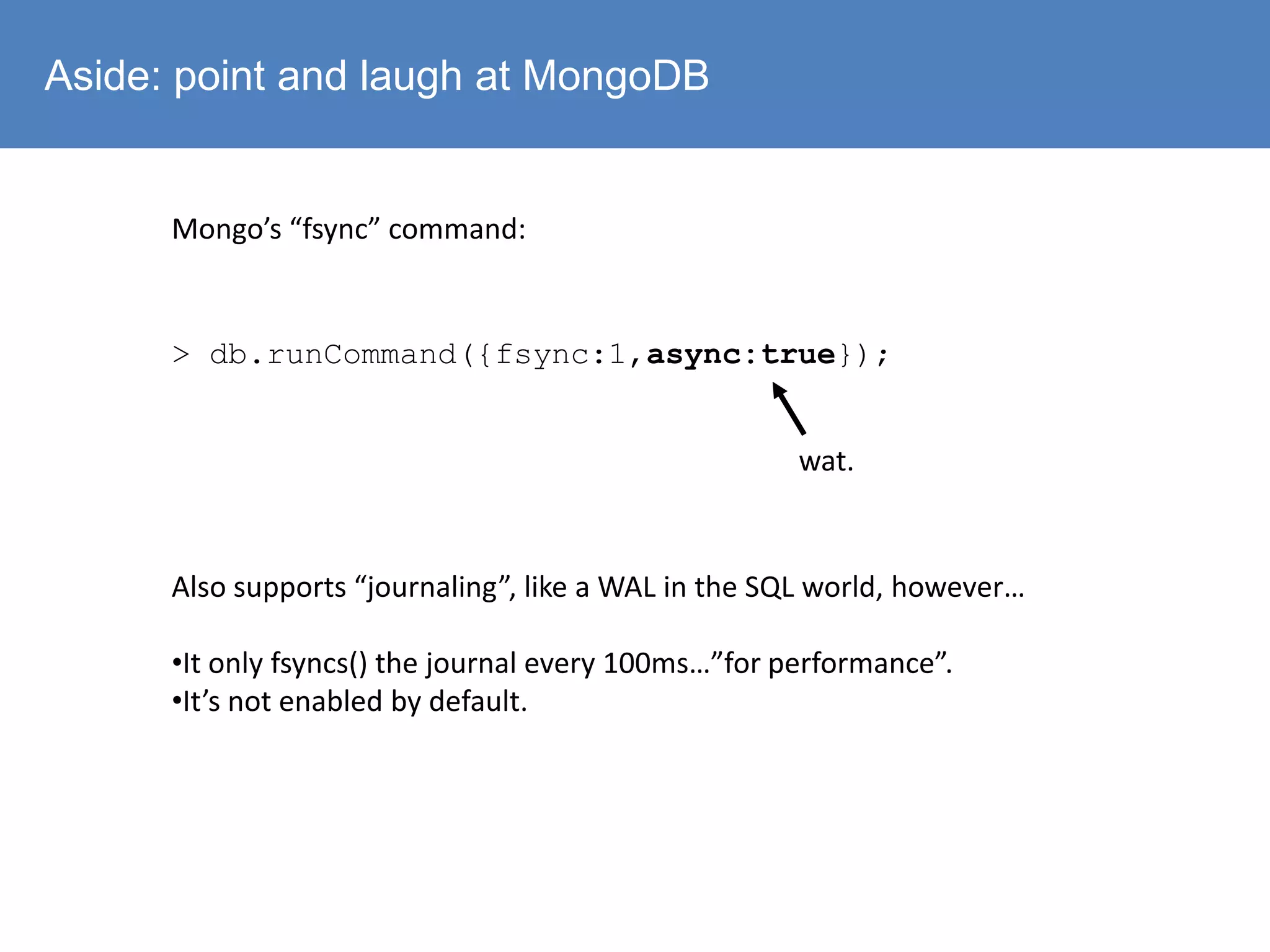
Aside: point and laugh at MongoDBMongo’s “fsync” command:> db.runCommand({fsync:1,async:true}); wat.Also supports “journaling”, like a WAL in the SQL world, however…It only fsyncs() the journal every 100ms…”for performance”.
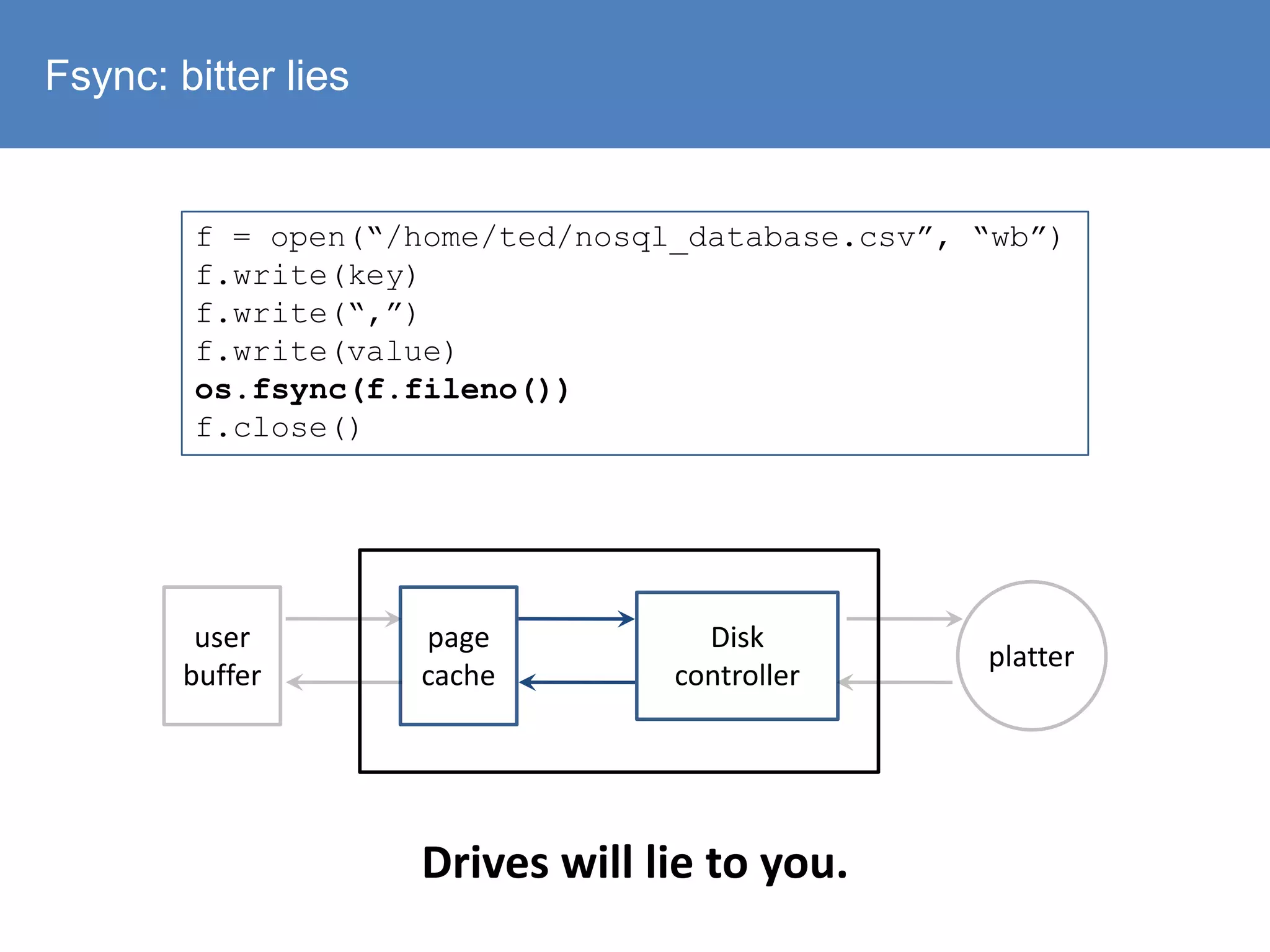
It’s not enabled by default.Fsync: bitter liesf = open(“/home/ted/nosql_database.csv”, “wb”)f.write(key)f.write(“,”)f.write(value)os.fsync(f.fileno())f.close()DiskcontrolleruserbufferpagecacheplatterDrives will lie to you.
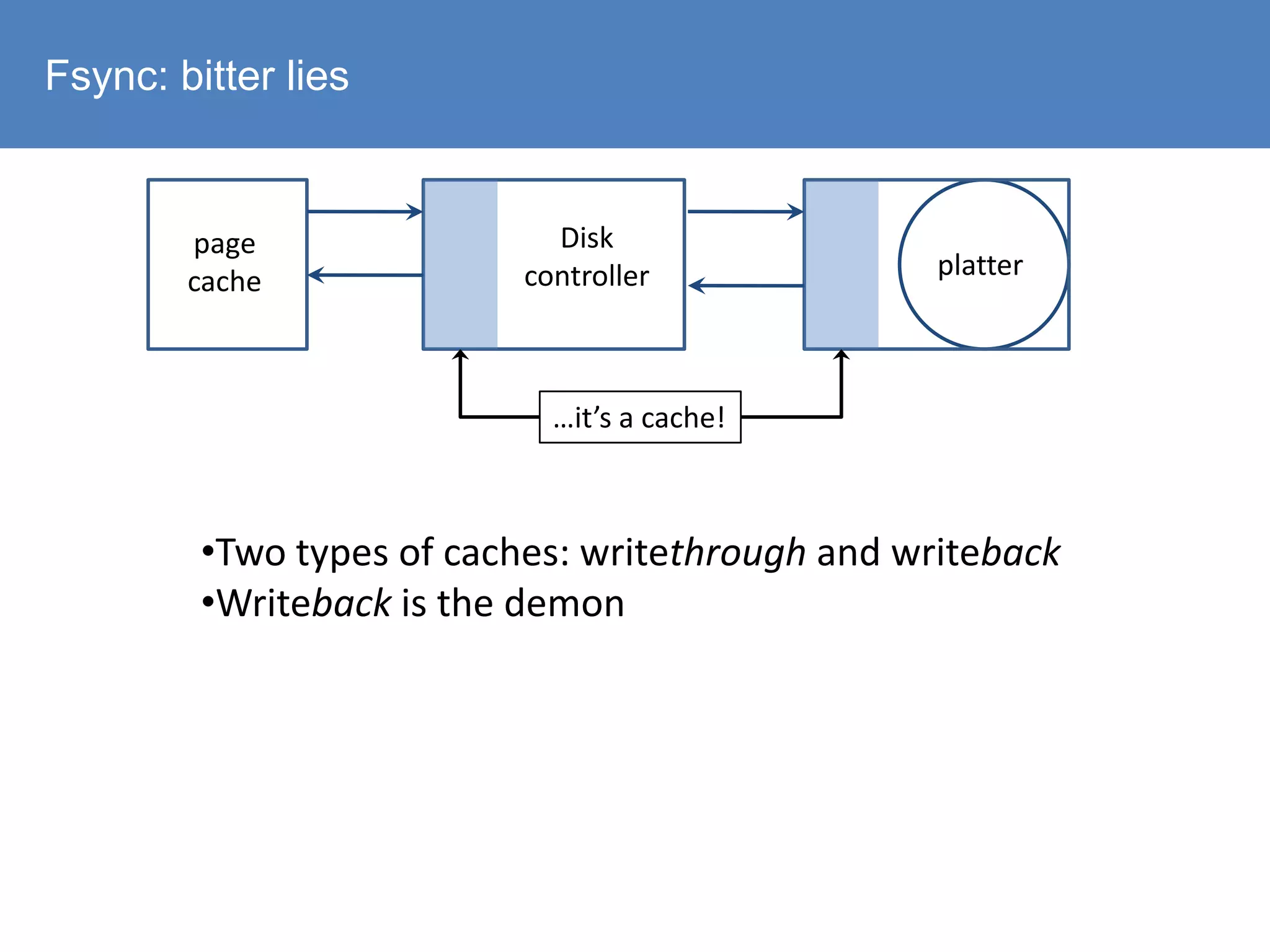
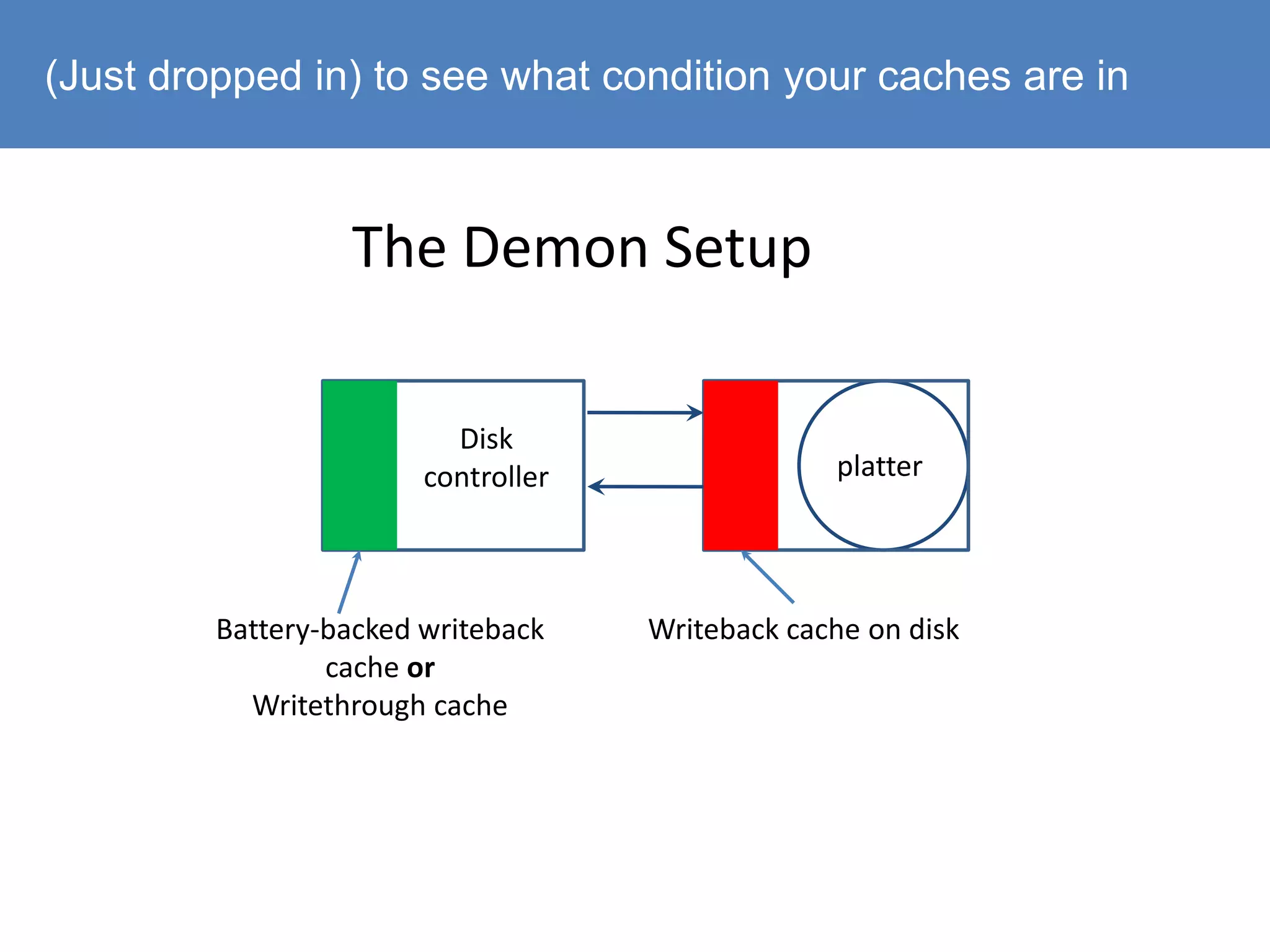
Fsync: bitter liesplatter…it’s a cache!DiskcontrollerpagecacheTwo types of caches: writethrough and writeback
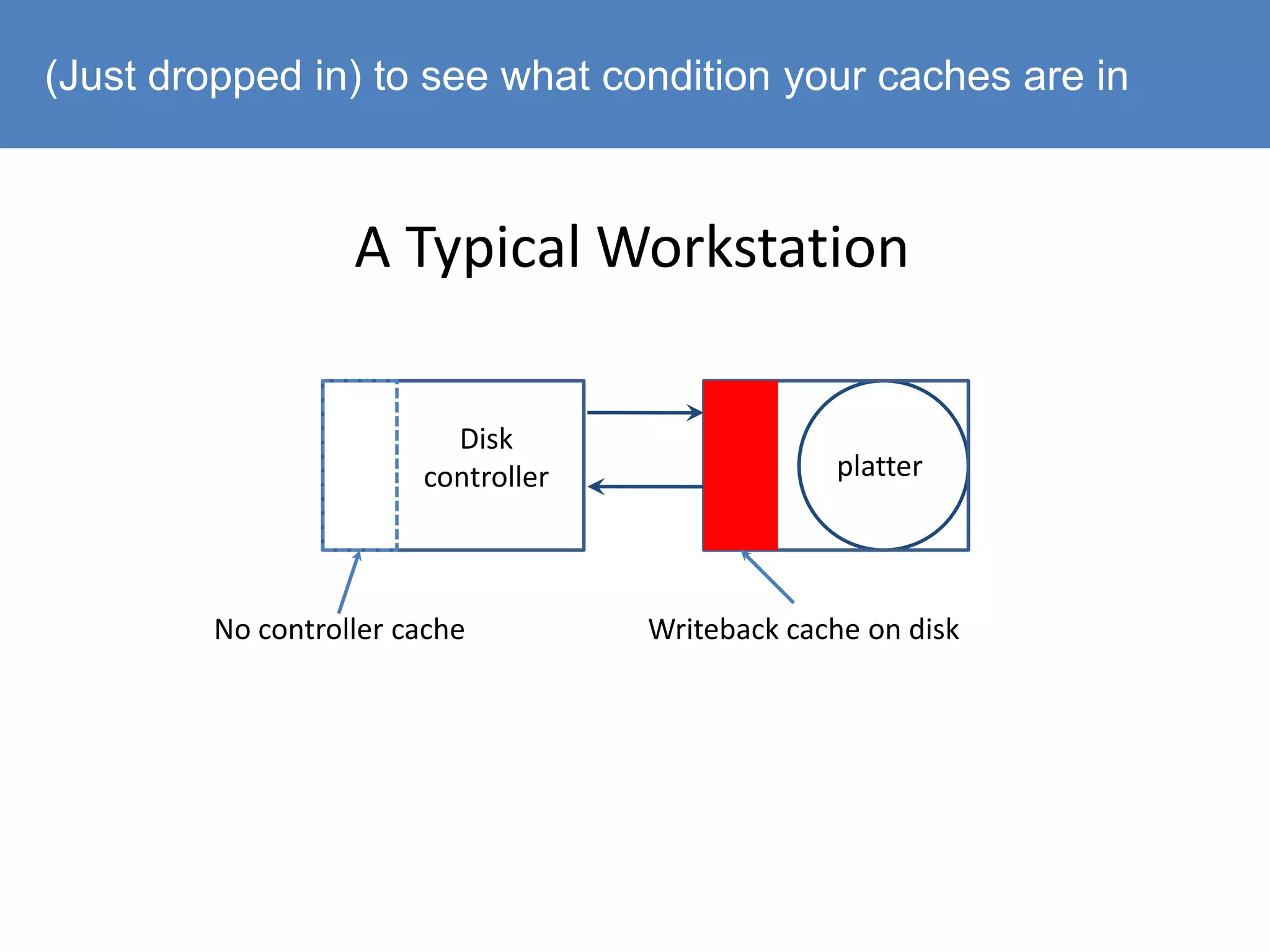
Writeback is the demon(Just dropped in) to see what condition your caches are inA Typical WorkstationplatterNo controller cacheWriteback cache on diskDiskcontroller
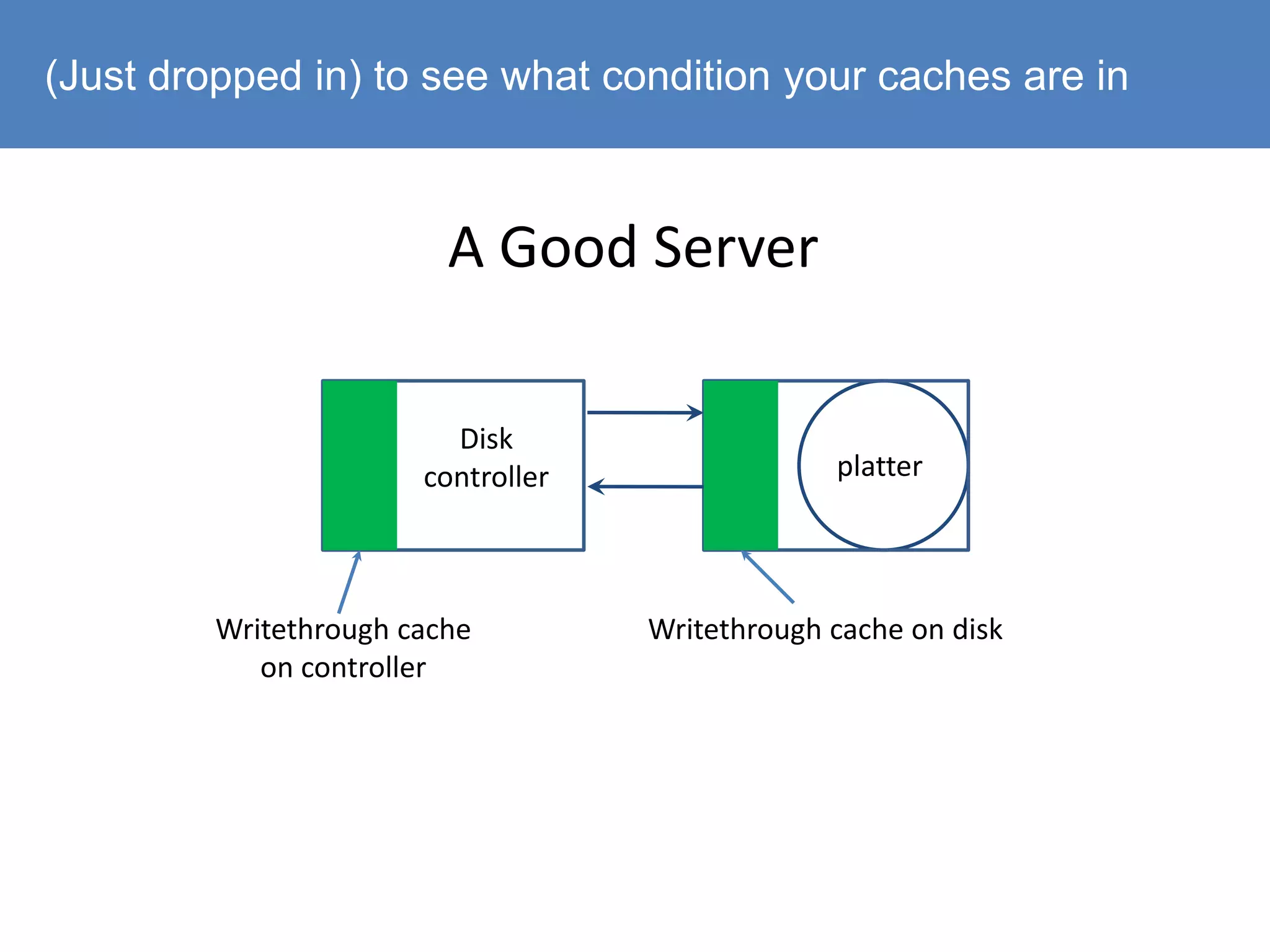
(Just dropped in) to see what condition your caches are inA Good ServerplatterWritethrough cacheon controllerWritethrough cache on diskDiskcontroller
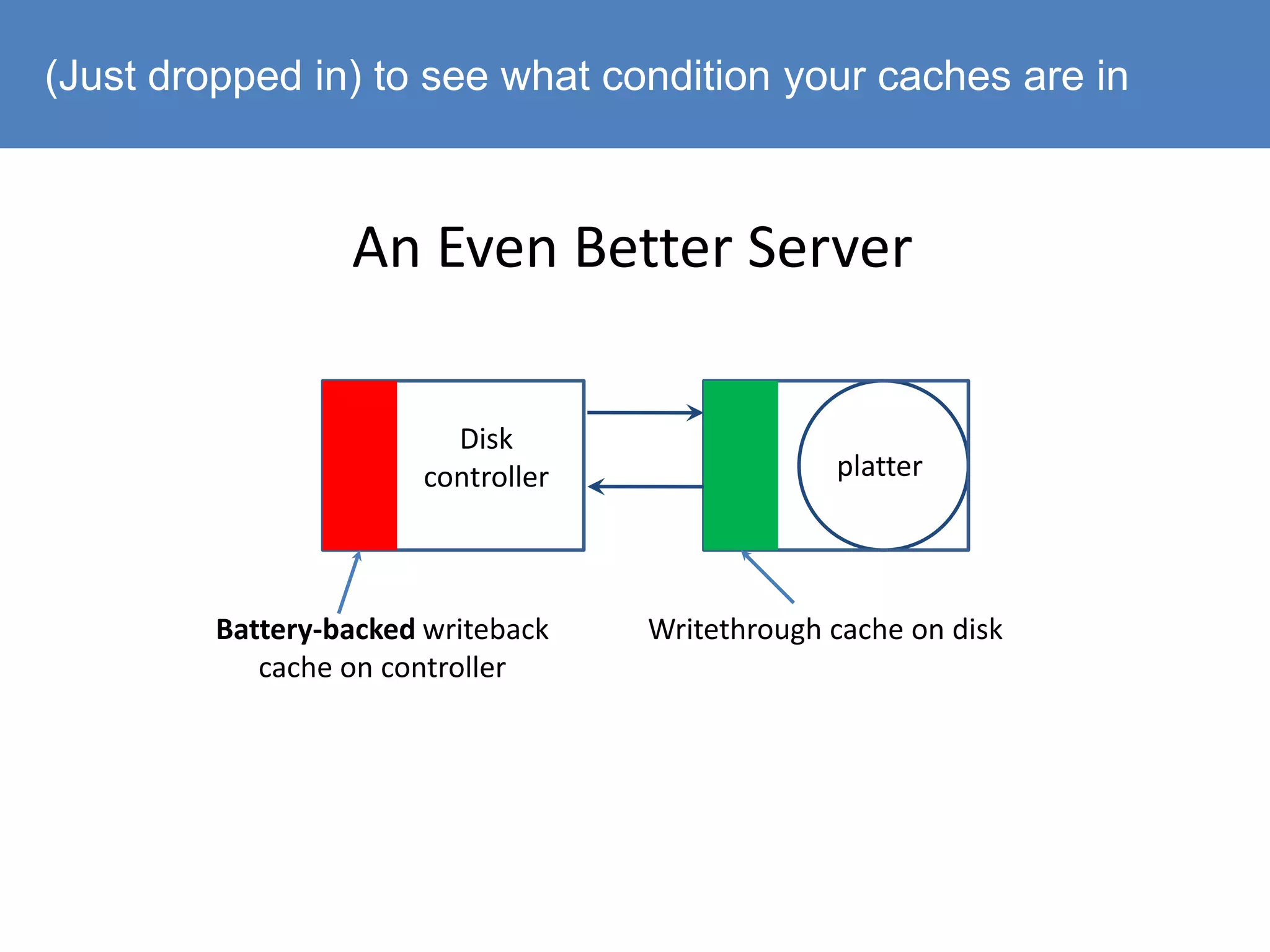
(Just dropped in) to see what condition your caches are inAn Even Better ServerplatterBattery-backedwritebackcache on controllerWritethrough cache on diskDiskcontroller
(Just dropped in) to see what condition your caches are inThe Demon SetupplatterBattery-backed writebackcache orWritethrough cacheWriteback cache on diskDiskcontroller
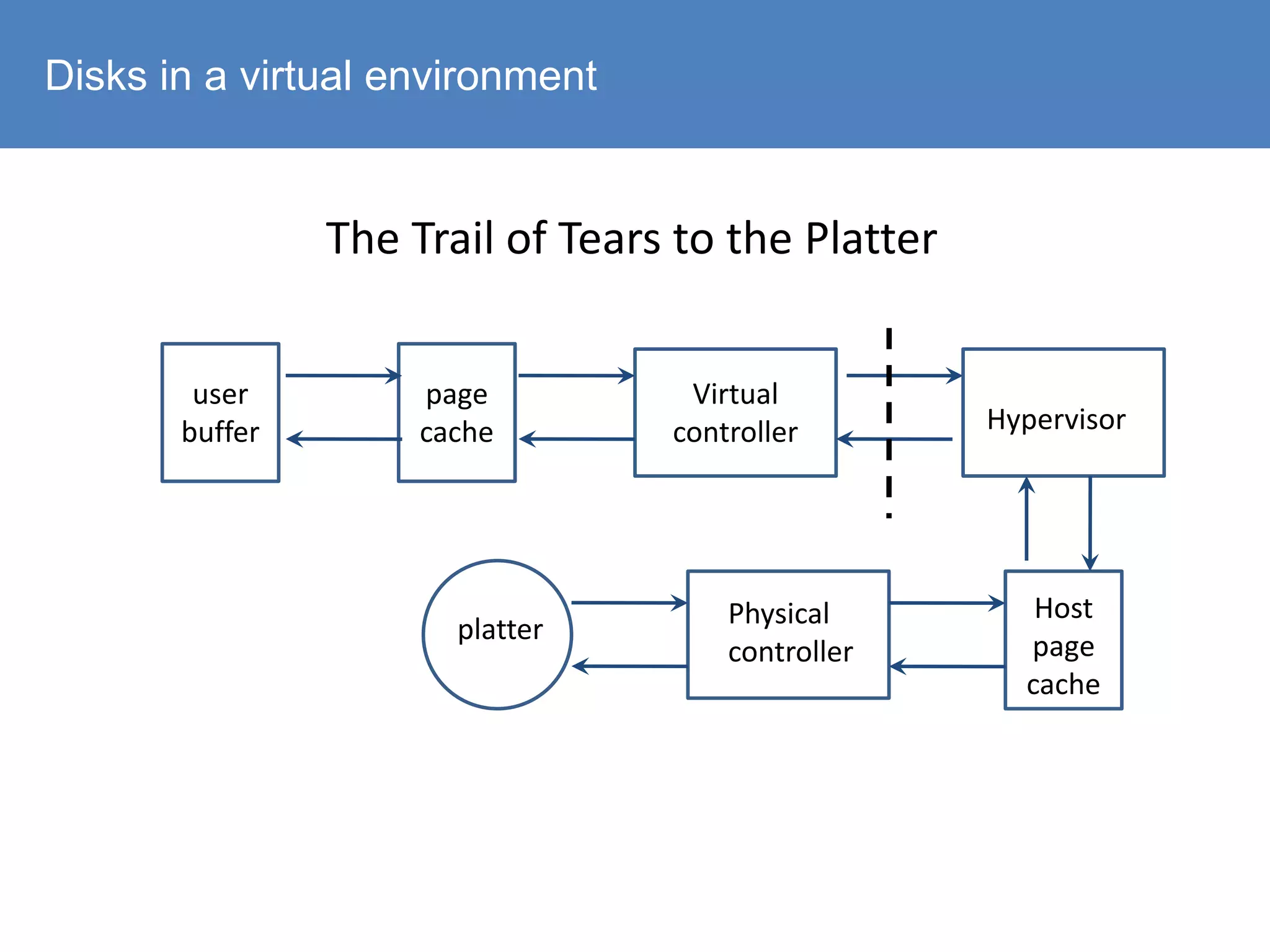
Disks in a virtual environmentThe Trail of Tears to the PlatterHostpagecacheVirtualcontrolleruserbufferpagecachePhysicalcontrollerHypervisorplatter

What every data programmer needs to know about disks

  • 1.
    What Every DataProgrammer Needs to Know about DisksOSCON Data – July, 2011 - PortlandTed Dziuba@dozbatjdziuba@gmail.comNot proprietary or confidential. In fact, you’re risking a career by listening to me.
  • 2.
    Who are youand why are you talking?First job: Like college but they pay you to go.A few years ago: Technical troll for The Register.Recently: Co-founder of Milo.com, local shopping engine.Present: Senior Technical Staff for eBay Local
  • 3.
    The Linux DiskAbstractionVolume/mnt/volumeFile Systemxfs, extBlock DeviceHDD, HW RAID array
  • 4.
    What happens whenyou read from a file?f = open(“/home/ted/not_pirated_movie.avi”, “rb”)avi_header = f.read(56)f.close()Diskcontrolleruserbufferpagecacheplatter
  • 5.
    What happens whenyou read from a file?DiskcontrolleruserbufferpagecacheMain memory lookup
  • 6.
  • 7.
    Throughput: 12GB/sec ongood hardwareplatter
  • 8.
    What happens whenyou read from a file?DiskcontrolleruserbufferpagecacheNeeds to actuate a physical device
  • 9.
  • 10.
  • 11.
    (Faster if youhave a lot of money)platter
  • 12.
    Sidebar: The Horrorof a 10ms Seek LatencyA disk read is 100,000 times slower than a memory read.100 nanosecondsTime it takes you to write a really clever tweet10 millisecondsTime it takes to write a novel, working full time
  • 13.
    What happens whenyou write to a file?f = open(“/home/ted/nosql_database.csv”, “wb”)f.write(key)f.write(“,”)f.write(value)f.close()Diskcontrolleruserbufferpagecacheplatter
  • 14.
    What happens whenyou write to a file?f = open(“/home/ted/nosql_database.csv”, “wb”)f.write(key)f.write(“,”)f.write(value)f.close()DiskcontrolleruserbufferpagecacheplatterYou need to make thispart happenMark the page dirty,call it a day and go have a smoke.
  • 15.
    Aside: Stick yourfinger in the Linux Page CachePre-Linux 2.6 used “pdflush”, now per-Backing Device Info (BDI) flush threadsDirty pages: grep –i “dirty” /proc/meminfo/proc/sys/vmLove:dirty_expire_centisecs : flush old dirty pages
  • 16.
    dirty_ratio: flush aftersome percent of memory is used
  • 17.
    dirty_writeback_centisecs: how oftento wake up and start flushingClear your page cache: echo 1 > /proc/sys/vm/drop_cachesCrusty sysadmin’s hail-Mary pass: sync; sync; sync
  • 18.
    Fsync: force aflush to diskf = open(“/home/ted/nosql_database.csv”, “wb”)f.write(key)f.write(“,”)f.write(value)os.fsync(f.fileno())f.close()DiskcontrolleruserbufferpagecacheplatterAlso note, fsync() has a cousin, fdatasync() that does not sync metadata.
  • 19.
    Aside: point andlaugh at MongoDBMongo’s “fsync” command:> db.runCommand({fsync:1,async:true}); wat.Also supports “journaling”, like a WAL in the SQL world, however…It only fsyncs() the journal every 100ms…”for performance”.
  • 20.
    It’s not enabledby default.Fsync: bitter liesf = open(“/home/ted/nosql_database.csv”, “wb”)f.write(key)f.write(“,”)f.write(value)os.fsync(f.fileno())f.close()DiskcontrolleruserbufferpagecacheplatterDrives will lie to you.
  • 21.
    Fsync: bitter liesplatter…it’sa cache!DiskcontrollerpagecacheTwo types of caches: writethrough and writeback
  • 22.
    Writeback is thedemon(Just dropped in) to see what condition your caches are inA Typical WorkstationplatterNo controller cacheWriteback cache on diskDiskcontroller
  • 23.
    (Just dropped in)to see what condition your caches are inA Good ServerplatterWritethrough cacheon controllerWritethrough cache on diskDiskcontroller
  • 24.
    (Just dropped in)to see what condition your caches are inAn Even Better ServerplatterBattery-backedwritebackcache on controllerWritethrough cache on diskDiskcontroller
  • 25.
    (Just dropped in)to see what condition your caches are inThe Demon SetupplatterBattery-backed writebackcache orWritethrough cacheWriteback cache on diskDiskcontroller
  • 26.
    Disks in avirtual environmentThe Trail of Tears to the PlatterHostpagecacheVirtualcontrolleruserbufferpagecachePhysicalcontrollerHypervisorplatter
  • 27.
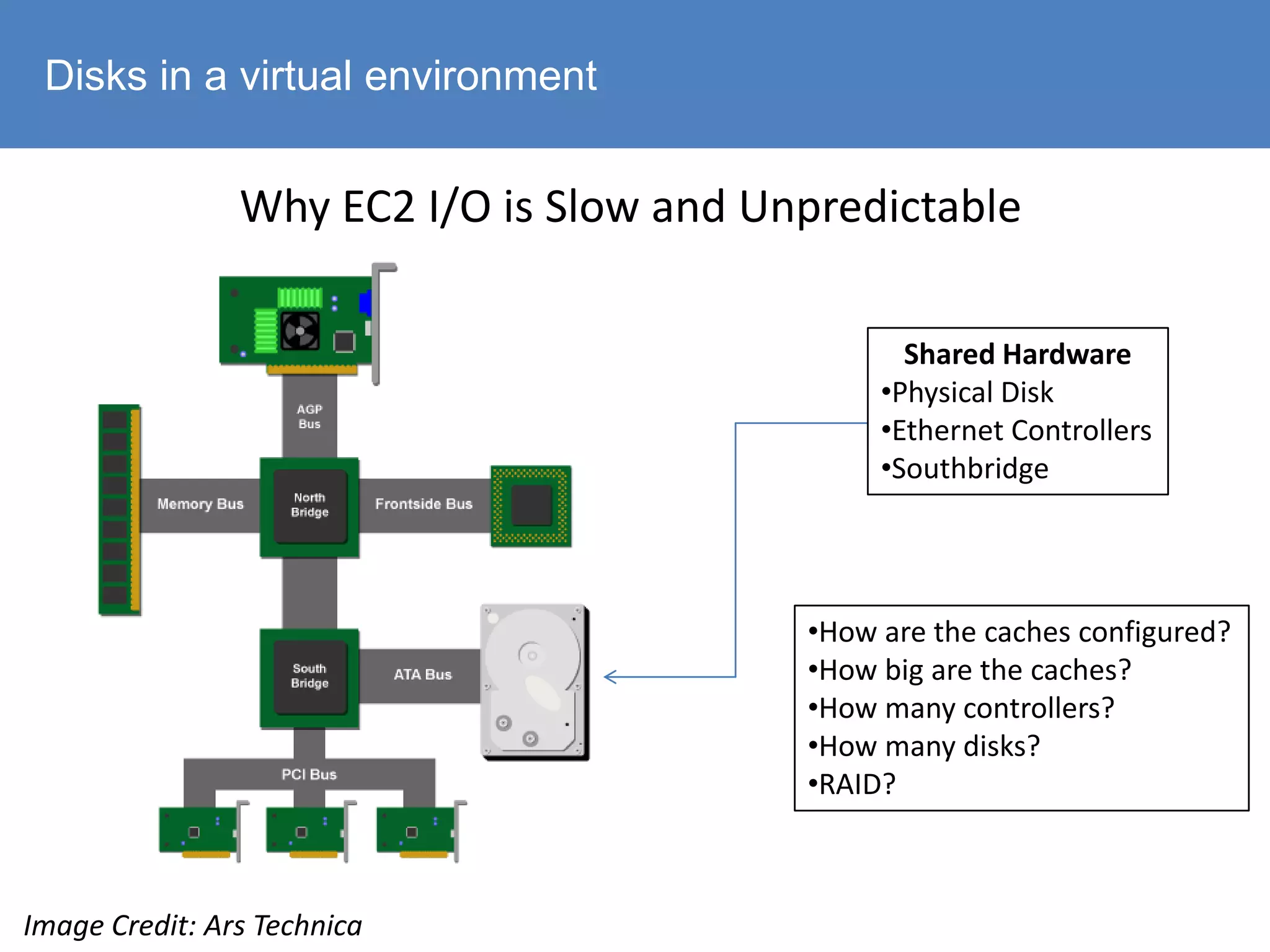
    Disks in avirtual environmentWhy EC2 I/O is Slow and UnpredictableShared HardwarePhysical Disk
  • 28.
  • 29.
  • 30.
    How are thecaches configured?
  • 31.
    How big arethe caches?
  • 32.
  • 33.
  • 34.
  • 35.
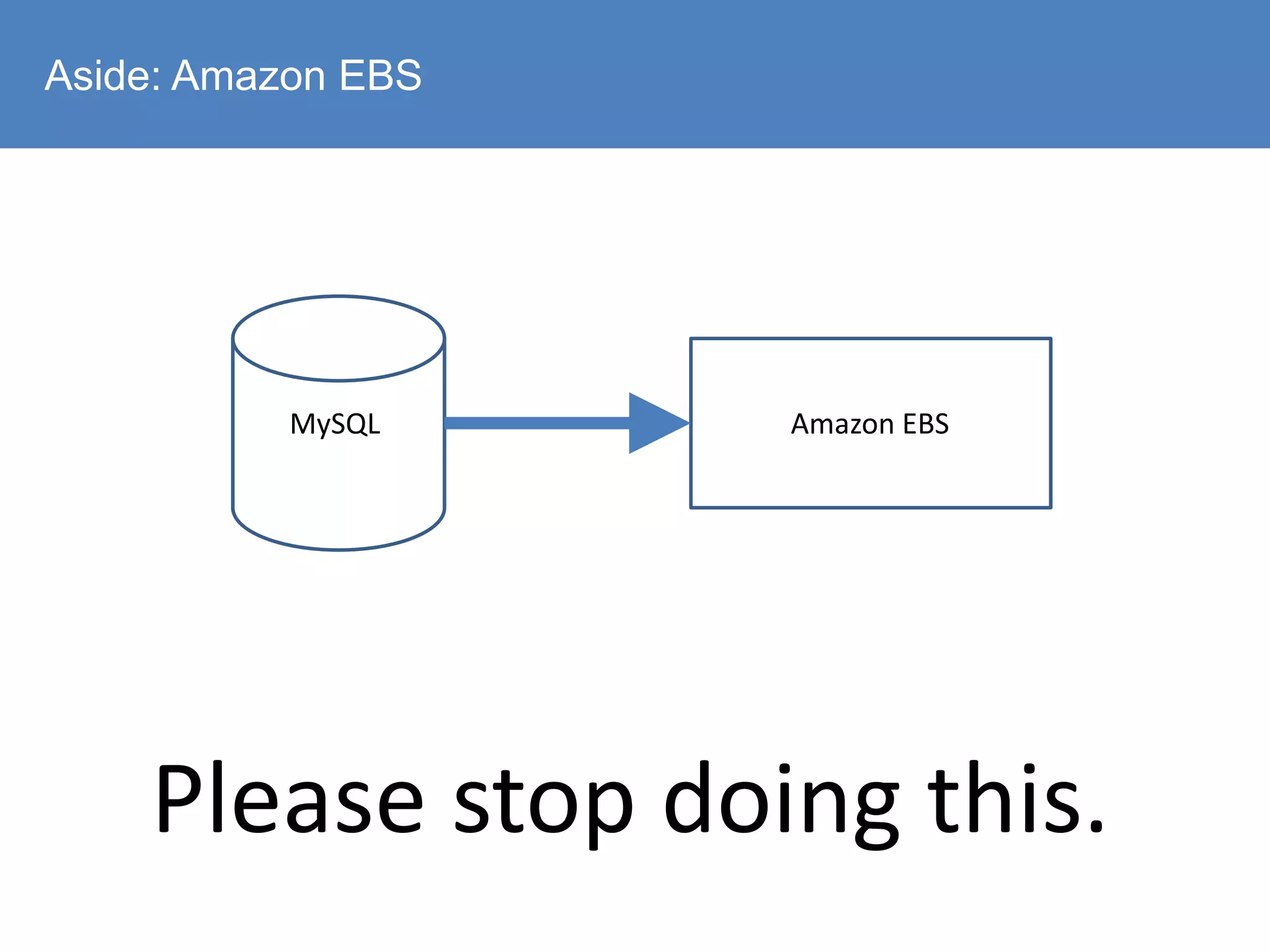
    Aside: Amazon EBSMySQLAmazonEBSPlease stop doing this.
  • 36.
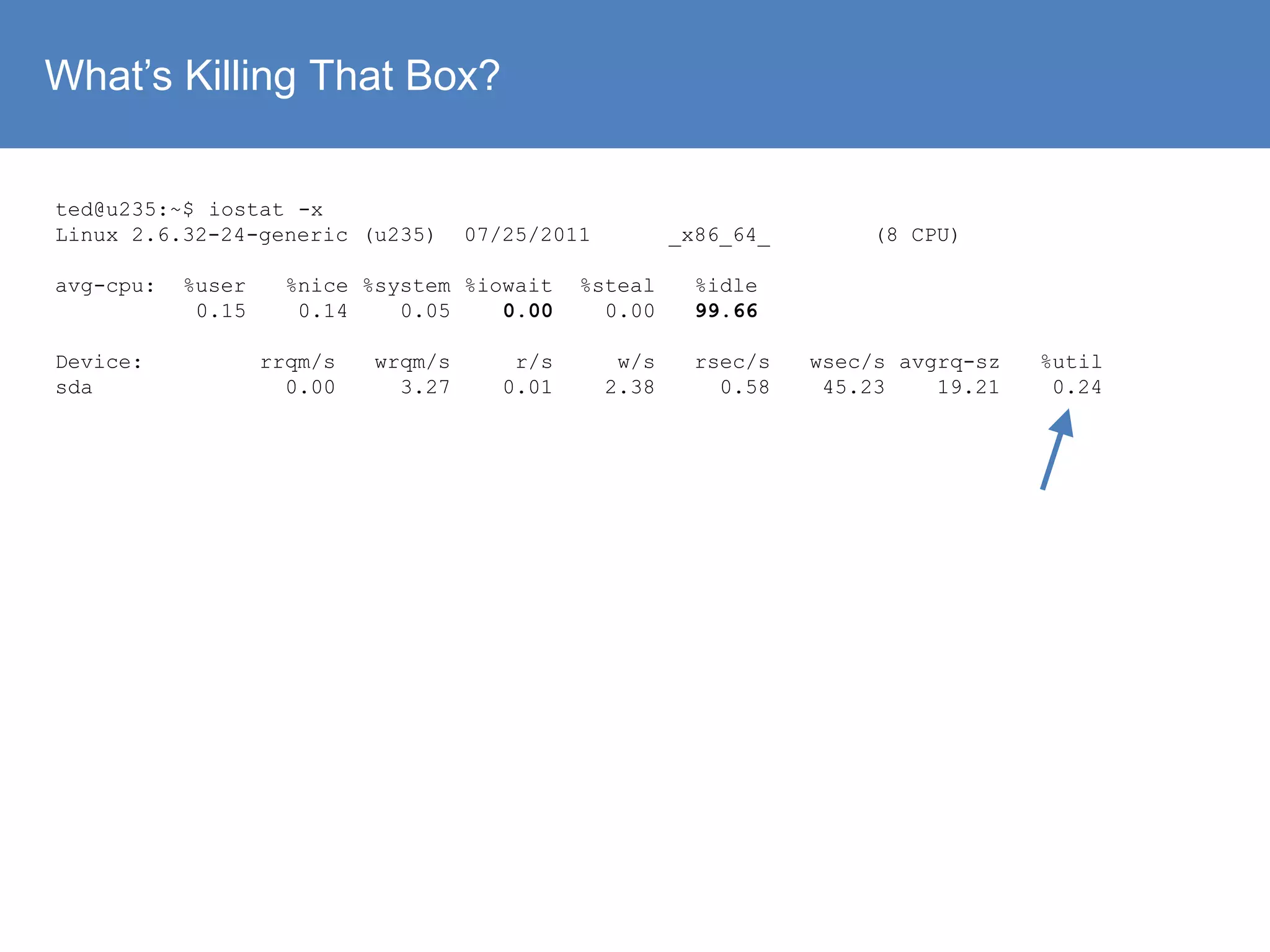
    What’s Killing ThatBox?ted@u235:~$ iostat -xLinux 2.6.32-24-generic (u235) 07/25/2011 _x86_64_ (8 CPU)avg-cpu: %user %nice %system %iowait %steal %idle 0.15 0.14 0.05 0.00 0.00 99.66Device: rrqm/s wrqm/s r/s w/s rsec/s wsec/s avgrq-sz%utilsda 0.00 3.27 0.01 2.38 0.58 45.23 19.21 0.24
  • 37.
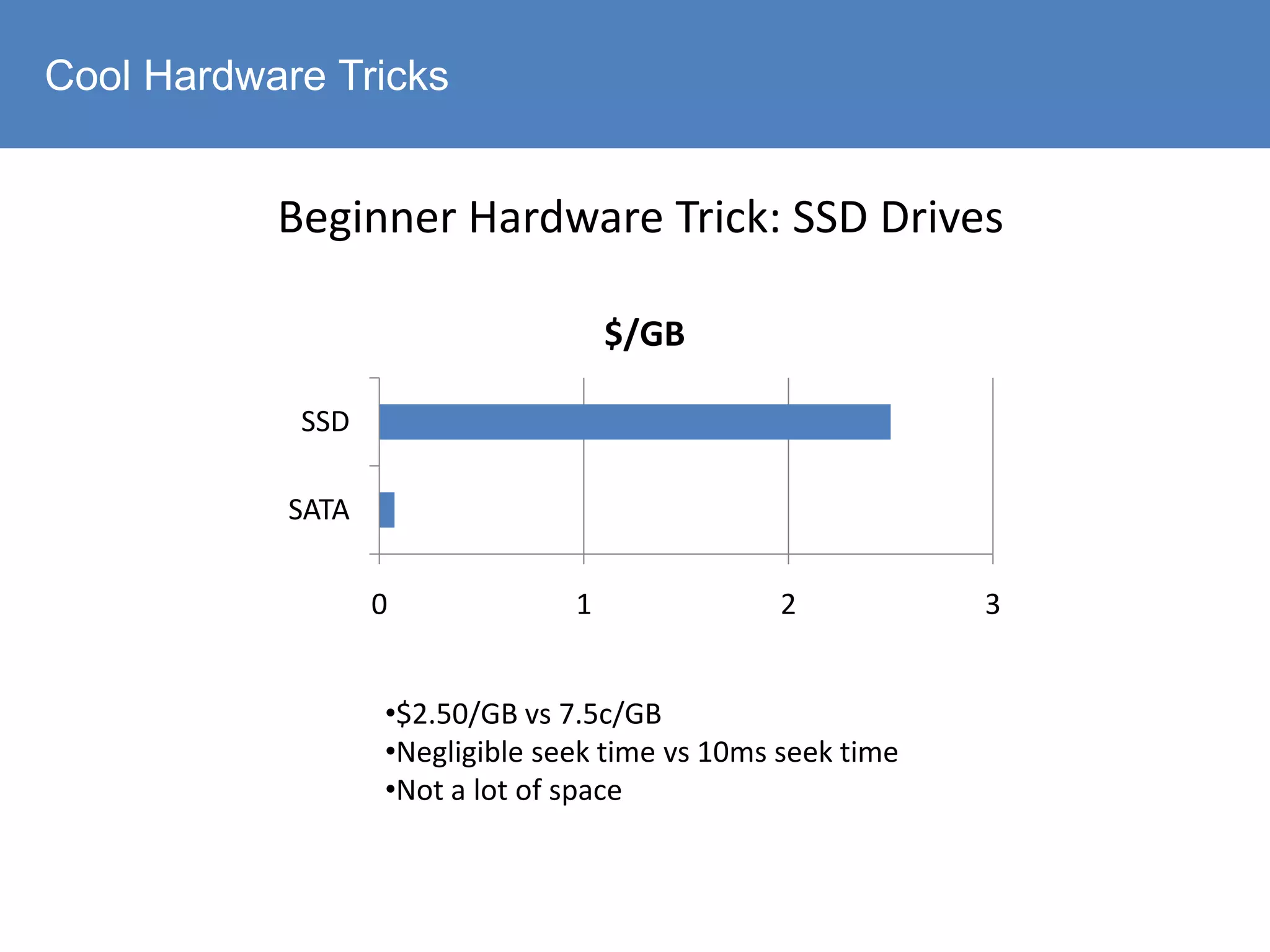
    Cool Hardware TricksBeginnerHardware Trick: SSD Drives$2.50/GB vs 7.5c/GB
  • 38.
    Negligible seek timevs 10ms seek time
  • 39.
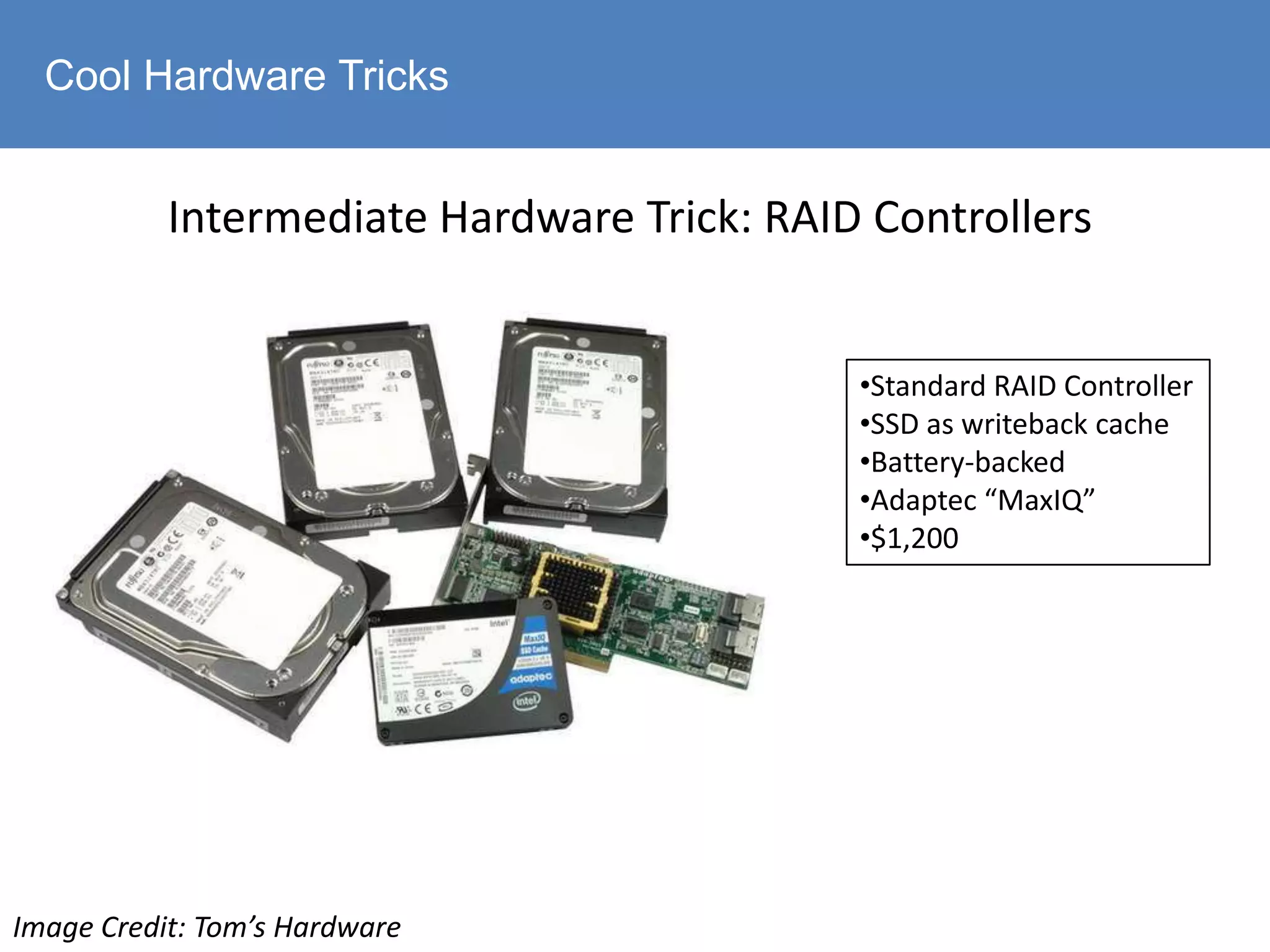
    Not a lotof spaceCool Hardware TricksIntermediate Hardware Trick: RAID ControllersStandard RAID Controller
  • 40.
  • 41.
  • 42.
  • 43.
  • 44.
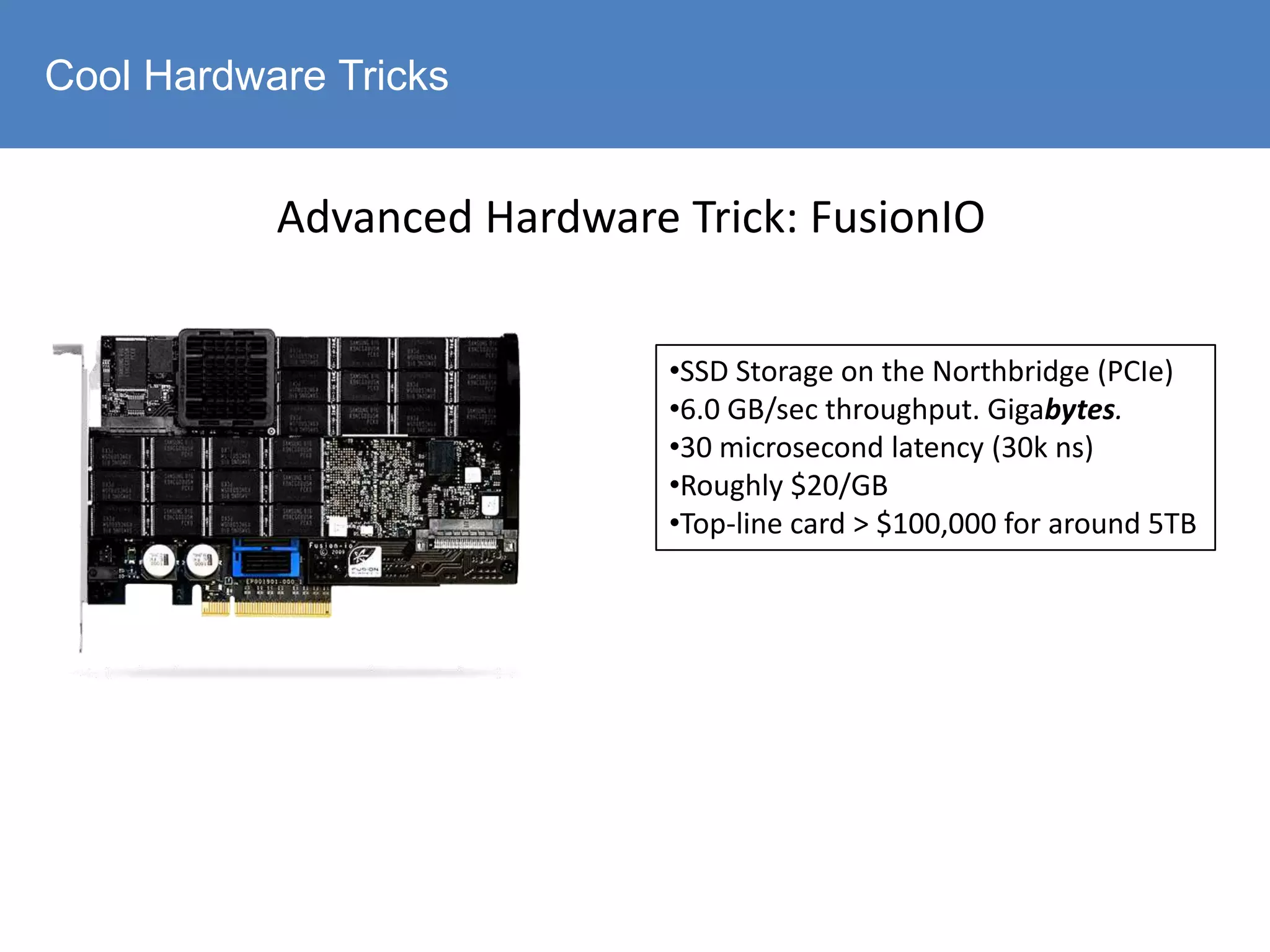
    Cool Hardware TricksAdvancedHardware Trick: FusionIOSSD Storage on the Northbridge (PCIe)
  • 45.
  • 46.
  • 47.
  • 48.
    Top-line card >$100,000 for around 5TBQuestionsQuestions & HecklingThank Youhttp://teddziuba.com/@dozba

Editor's Notes

  • #6 Note that the page is actually in memory twice. Mmaped files fix this, but it’s beyond the scope of this discussion.Also this is why read performance on a lot of memory only NoSQL databases beats disk-backed SQL. Duh.
  • #8 Equate 100 nanoseconds to about 100 seconds. Then 10 milliseconds is about 3 months.
  • #10 This is where a lot of NoSQL databases get their performance, but more on that in a few minutes.
  • #11 There are threads that wake up every now and then to flush pages to disk.
  • #12 Fsync blocks until the data has been written to disk.
  • #18 With a battery-backed RAID controller, fsync can return very quickly with little risk of data loss.
  • #19 You need to dive into your vendor’s control tool to find this out.
  • #20 VMWare server is faithful to fsync, VMWare workstation is not. Xen usually queues I/O requests after they have been issued. The point is that you have no way of knowing. Your visibility of what happens to your data after you write or fsync ends at the hypervisor.
  • #21 Newer intel chips have the northbridge controller on-die. Southbridge bandwidth is usually <= 10GB/sec, and you are sharing this with other customers’ network and disk I/O. That, and you may be sharing drive spindles.
  • #22 EBS lies about the result of fsync. This is why Reddit is down all the time. You have been warned.
  • #23 EBS lies about the result of fsync. This is why Reddit is down all the time. You have been warned.