Gamification
What, Why and How
Andrzej Marczewski
marczewski.me.uk
@daverage
Me with short hair
© Andrzej Marczewski 2013
The First of Three Presentation Slides
Go to this link (please)!
http://bit.ly/g-bingo
© Andrzej Marczewski 2013
Gamification What, How and Why
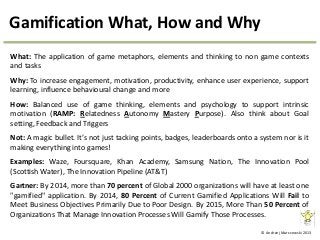
What: The application of game metaphors, elements and thinking to non game contexts
and tasks
Why: To increase engagement, motivation, productivity, enhance user experience, support
learning, influence behavioural change and more
How: Balanced use of game thinking, elements and psychology to support intrinsic
motivation (RAMP: Relatedness Autonomy Mastery Purpose). Also think about Goal
setting, Feedback and Triggers
Not: A magic bullet. It’s not just tacking points, badges, leaderboards onto a system nor is it
making everything into games!
Examples: Waze, Foursquare, Khan Academy, Samsung Nation, The Innovation Pool
(Scottish Water), The Innovation Pipeline (AT&T)
Gartner: By 2014, more than 70 percent of Global 2000 organizations will have at least one
"gamified" application. By 2014, 80 Percent of Current Gamified Applications Will Fail to
Meet Business Objectives Primarily Due to Poor Design. By 2015, More Than 50 Percent of
Organizations That Manage Innovation Processes Will Gamify Those Processes.
© Andrzej Marczewski 2013
It’s not a Magic Bullet
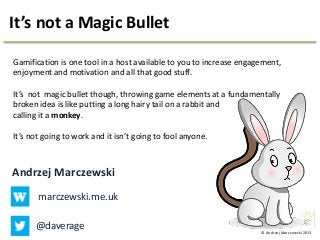
Gamification is one tool in a host available to you to increase engagement,
enjoyment and motivation and all that good stuff.
It’s not magic bullet though, throwing game elements at a fundamentally
broken idea is like putting a long hairy tail on a rabbit and
calling it a monkey.
It’s not going to work and it isn’t going to fool anyone.
Andrzej Marczewski
marczewski.me.uk
@daverage
Gamification
What, Why and How –
Extended Cut
Andrzej Marczewski
marczewski.me.uk
@daverage
Me with short hair
© Andrzej Marczewski 2013
What?
The application of game metaphors, elements and thinking to non game contexts
and tasks
My description
Gamification is the strategy which takes behaviour-motivating mechanics from
traditional and social games, and applies these mechanics to non-game
experiences.
Scott Schnaars, the GM of EMEA at Badgeville
The use of game attributes to drive game-like player behaviour in a non-game
context with predictability.
Michael Wu Ph.D., Chief Scientist at Lithium Technologies Inc.
Gamification n. A stupid term invented by ninnies to describe half-assed
attempts to make boring things more interesting.
Jesse Schell, Games Designer and Author of The Art of Game Design
© Andrzej Marczewski 2013
Why?
Because lots of other people are doing it or at least looking at it!
Gartner predicts that by 2014, more than 70 percent of Global 2000
organizations will have at least one "gamified" application
They also predict that by 2015, 40 percent of Global 1000 organizations will use
gamification as the primary mechanism to transform business operations.
Companies like SAP, Accenture, Capgemini, Nike and Deloitte are already
making huge use of it
A recent free course in gamification had over 80,000 people register
Of them, over 8280 received certificates (70% or higher on assessments)
Gamification can lead to useful metrics
© Andrzej Marczewski 2013
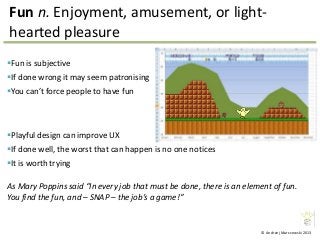
Fun n. Enjoyment, amusement, or light-
hearted pleasure
Fun is subjective
If done wrong it may seem patronising
You can’t force people to have fun
As Mary Poppins said “In every job that must be done, there is an element of fun.
You find the fun, and – SNAP – the job’s a game!”
Playful design can improve UX
If done well, the worst that can happen is no one notices
It is worth trying
© Andrzej Marczewski 2013
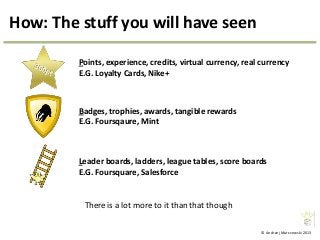
How: The stuff you will have seen
Badges, trophies, awards, tangible rewards
E.G. Foursqaure, Mint
Points, experience, credits, virtual currency, real currency
E.G. Loyalty Cards, Nike+
Leader boards, ladders, league tables, score boards
E.G. Foursquare, Salesforce
There is a lot more to it than that though
© Andrzej Marczewski 2013
How: The other stuff
At its core, gamification is about the application of behavioral psychology, using
ideas and elements found in game design. Things like Goal setting, Feedback and
Triggers are all vital. Remember, people dislike the feeling that they are being used.
© Andrzej Marczewski 2013
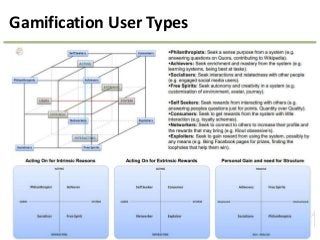
Gamification User Types
Thank You
Andrzej Marczewski
marczewski.me.uk
@daverage

Gamification Presentation for SocialNow.org - The Extended Cut

  • 1.
    Gamification What, Why andHow Andrzej Marczewski marczewski.me.uk @daverage Me with short hair
  • 2.
    © Andrzej Marczewski2013 The First of Three Presentation Slides Go to this link (please)! http://bit.ly/g-bingo
  • 3.
    © Andrzej Marczewski2013 Gamification What, How and Why What: The application of game metaphors, elements and thinking to non game contexts and tasks Why: To increase engagement, motivation, productivity, enhance user experience, support learning, influence behavioural change and more How: Balanced use of game thinking, elements and psychology to support intrinsic motivation (RAMP: Relatedness Autonomy Mastery Purpose). Also think about Goal setting, Feedback and Triggers Not: A magic bullet. It’s not just tacking points, badges, leaderboards onto a system nor is it making everything into games! Examples: Waze, Foursquare, Khan Academy, Samsung Nation, The Innovation Pool (Scottish Water), The Innovation Pipeline (AT&T) Gartner: By 2014, more than 70 percent of Global 2000 organizations will have at least one "gamified" application. By 2014, 80 Percent of Current Gamified Applications Will Fail to Meet Business Objectives Primarily Due to Poor Design. By 2015, More Than 50 Percent of Organizations That Manage Innovation Processes Will Gamify Those Processes.
  • 4.
    © Andrzej Marczewski2013 It’s not a Magic Bullet Gamification is one tool in a host available to you to increase engagement, enjoyment and motivation and all that good stuff. It’s not magic bullet though, throwing game elements at a fundamentally broken idea is like putting a long hairy tail on a rabbit and calling it a monkey. It’s not going to work and it isn’t going to fool anyone. Andrzej Marczewski marczewski.me.uk @daverage
  • 5.
    Gamification What, Why andHow – Extended Cut Andrzej Marczewski marczewski.me.uk @daverage Me with short hair
  • 6.
    © Andrzej Marczewski2013 What? The application of game metaphors, elements and thinking to non game contexts and tasks My description Gamification is the strategy which takes behaviour-motivating mechanics from traditional and social games, and applies these mechanics to non-game experiences. Scott Schnaars, the GM of EMEA at Badgeville The use of game attributes to drive game-like player behaviour in a non-game context with predictability. Michael Wu Ph.D., Chief Scientist at Lithium Technologies Inc. Gamification n. A stupid term invented by ninnies to describe half-assed attempts to make boring things more interesting. Jesse Schell, Games Designer and Author of The Art of Game Design
  • 7.
    © Andrzej Marczewski2013 Why? Because lots of other people are doing it or at least looking at it! Gartner predicts that by 2014, more than 70 percent of Global 2000 organizations will have at least one "gamified" application They also predict that by 2015, 40 percent of Global 1000 organizations will use gamification as the primary mechanism to transform business operations. Companies like SAP, Accenture, Capgemini, Nike and Deloitte are already making huge use of it A recent free course in gamification had over 80,000 people register Of them, over 8280 received certificates (70% or higher on assessments) Gamification can lead to useful metrics
  • 8.
    © Andrzej Marczewski2013 Fun n. Enjoyment, amusement, or light- hearted pleasure Fun is subjective If done wrong it may seem patronising You can’t force people to have fun As Mary Poppins said “In every job that must be done, there is an element of fun. You find the fun, and – SNAP – the job’s a game!” Playful design can improve UX If done well, the worst that can happen is no one notices It is worth trying
  • 9.
    © Andrzej Marczewski2013 How: The stuff you will have seen Badges, trophies, awards, tangible rewards E.G. Foursqaure, Mint Points, experience, credits, virtual currency, real currency E.G. Loyalty Cards, Nike+ Leader boards, ladders, league tables, score boards E.G. Foursquare, Salesforce There is a lot more to it than that though
  • 10.
    © Andrzej Marczewski2013 How: The other stuff At its core, gamification is about the application of behavioral psychology, using ideas and elements found in game design. Things like Goal setting, Feedback and Triggers are all vital. Remember, people dislike the feeling that they are being used.
  • 11.
    © Andrzej Marczewski2013 Gamification User Types
  • 12.

Editor's Notes

  • #7 So, let’s get started with the core question. What is Gamification?Next a few taken from a survey I ran with a few industry leaders – just to see what they would say on the matter.As you can see they all revolve around the same idea, well, except Jesse Schell. However, as comical as his description is – it is actually pretty accurate when you think about what many attempts at gamification have been like so far.For me it is the use of behavioural psychology and game mechanics to influence desired behaviours or to enhance user experiences. Adding unusual things to usual things to create some kind of benefit.Unless there are any questions about the first two slides, let’s look at some the standard tools that you will see used in Gamification today.