
Our Planet:Renewable Energy - Generating power, jobs and development
•
2 likes•1,542 views


Recommended
Recommended
More Related Content
What's hot
Similar to Our Planet:Renewable Energy - Generating power, jobs and development
Similar to Our Planet:Renewable Energy - Generating power, jobs and development (20)
More from Andy Dabydeen
More from Andy Dabydeen (20)
Recently uploaded
Recently uploaded (13)
Our Planet:Renewable Energy - Generating power, jobs and development
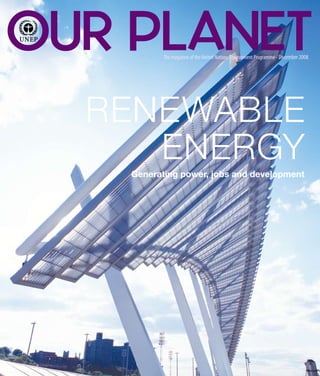
- 1. OUR PLANET The magazine of the United Nations Environment Programme - december 2008 RENEWABLE ENERGY Generating power, jobs and development OUR PLANET GENERATiNG POwER, jObs ANd dEvELOPmENT 1
- 2. OUR ... explains how his country's Matthias Machnig, Deputy Environment policies have lend to a dynamic Minister of Germany... expansion of electricity generation from renewable energy, strengthening its climate strategy. PLANET generating growth - page 4 Shyam Saran, a former Foreign ... describes his country's commitment to Secretary of India, who is now exploiting solar energy's potential and calls for the Prime Minister’s Special a global programme to realise it worldwide. Envoy for Climate Change... mission possible - page 8 Our Planet, the magazine of the United Nations Environment Programme (UNEP) Yingling Liu, China Program Manager at the ... describes the extraordinarily PO box 30552 Worldwatch Institute... rapid growth of renewable energy Nairobi, Kenya in China and shows how it is an Tel: (254 20)7621 234 Fax: (254 20)7623 927 intensifying force behind the e-mail: uneppub@unep.org country's economic growth. China's new path - page 10 To view current and past issues of this publication online, please visit Michael Liebreich, CEO of New ... describes and explains the extraordinary www.unep.org/ourplanet Energy Finance... surge in investment in clean energy worldwide. issN 101 - 7394 Director of Publication: satinder bindra cleaning up - page 14 Editor: Geoffrey Lean Coordinators: Naomi Poulton & david simpson Assistant Coordinator: Anne-France white Senator Liz Thompson, a former Minister of ... describes the urgent need for Special Contributor: Nick Nuttall Energy and Environment of Barbados... renewable energy in Small Island Distribution Manager: manyahleshal Kebede Developing States and calls on the Design: Amina darani international community to help Produced by: UNEP division of provide it. Communications and Public information regaining paradise - page 16 Printed by: Phoenix design Aid Distributed by: smi books Prof Ed Gallagher, Chairman ... describes how early enthusiasm for biofuels The contents of this magazine do not necessarily waned, and charts a way forward. of the UK Renewable Fuels reflect the views or policies of UNEP or the Agency... editors, nor are they an official record. The making biofuels sustainable designations employed and the presentation do not imply the expressions of any opinion - page 18 whatsoever on the part of UNEP concerning the legal status of any country, territory or city or its Lalita Ramdas, Board Chair , ... calls for a carbon-free, authority or concerning the delimitation of its frontiers or boundaries. Greenpeace International ... nuclear-free revolution. * All dollar ($) amounts refer to Us dollars. enough is enough - page 22 Martin Roscheisen, CEO of ... describes a green business boom in Silicon Nanosolar, Inc... Valley and outlines what government must do to encourage and support such innovation. also green valley - page 24 Daniel M. Kammen, the Class of 1935 ... calls on the incoming U.S. president page 3 reflections Distinguished Professor of Energy in the to launch a clean energy century. page 7 products Energy and Resources Group, the Goldman School of Public Policy, and the Department innovation agenda page 12 people of Nuclear Engineering at the University of - page 26 California, Berkeley... page 13 awards and events Australian actor Cate Blanchett ... page 20 verbatim and numbers ... is pioneering quot;greenovationquot; at page 21 books home and work. page 29 www sunshine and light showers - page 30 2 OUR PLANET GENERATiNG POwER, jObs ANd dEvELOPmENT
- 3. reflections by Achim Steiner, U.N. Under-Secretary-General and Executive Director, UNEP A chill wind has blown through international stock markets, and renewable energy companies have not been immune. A global index of solar stocks, the Claymore/MAC index, fell by over 50 per cent between April — when it started trading — and early November, while the New Energy Global Innovation Index fell by a huge 45 per cent in October alone. Some have drawn parallels with the dot.com bubble when Internet start-up companies, based on marketing rather than real markets, came and went like mayflies. But this ignores hard and fast fundamentals that should make renewable energy companies far more robust and lasting. a Dutch multinational, the German Wind Energy Institute and local investors The main driving force, climate change — unlike the stock markets — are planning a 300 megawatts wind farm in Turkana, northern Kenya. has steadily grown, not waxed and waned. Scientists studying ice cores Renewable energy companies are no longer small start-ups. Suntech Power, in Antarctica estimate that greenhouse gases are now at their highest headquartered in Wuxi, China — the world’s biggest solar manufacturer — concentration for 800,000 years. has a market capitalization of $3.5 billion; First Solar in the United States has one of $11.3 billion. Serious long-term government commitments are emerging, partly as a result of the Kyoto Protocol and in anticipation of deeper and more comprehensive The economic models of the 20th century are now hitting the limits of what deal in Copenhagen in 2009. The European Union wants to generate 20 is possible — both in terms of our ecological footprint and in delivering per cent of its energy from renewable sources by 2020, up from just over better livelihoods for the 2.6 billion people still living on less than $2 a day. 6 per cent in 2005. British Prime Minister Gordon Brown has announced a Investments will soon be pouring back into the global economy. Will they big expansion of wind power — 7,000 turbines on- and off-shore. The U.S. go into yesterday’s old, extractive, short-term economy or into a new Green government recently passed the Production Tax Credit and Investment Tax Economy that will deal with today’s challenges and generate countless Credit, extending support for wind power by a year and for geothermal and economic opportunities for poor and well-off alike? Renewable energy solar power by two and eight respectively. And in the run-up to the elections, generates three to five times more jobs than fossil fuel generation and its President-elect Obama pledged to invest $150 billion in clean energy over ecological footprint is infinitely smaller. the next 10 years, generating five million jobs. This edition of Our Planet marks the climate convention meeting in Poznan, Meanwhile Clean Development Mechanism projects, now numbering over which must be central to the transition to a low carbon, green energy three thousand, appear unaffected by the financial crisis: new resources are economy. Strategies for long-term cooperative action on climate change being found and exploited daily, it seems. Countries like Mali and Madagascar, must be fleshed out alongside the financial architecture needed to boost once outside the mechanism, are now accessing it, partly as a result of UN- investments in renewables and other sectors. Directing the multi-billion linked capacity building. And renewables remain the fastest, most cost- stimulus packages being lined up by governments, allied to a reshaping and effective and most environmentally friendly solution for many of the two refocusing of global markets, can assist success. billion people still without access to modern energy. However the biggest stimulus package of all — which could set the stage for sustainable growth in the 21st century — must come in Copenhagen next A recent survey in Ghana — part of UNEP and the Global Environment year. If the international community can make this a big deal in every sense of Facility’s Solar and Wind Energy Resource Assessment — has found 100 the word, we will be a long way to a Global Green New Deal that will meet the square kilometres of good windy land able to generate 500 megawatts of genuine development needs of 6.7 — rising to 9 — billion people. electricity or 10 per cent of the country’s needs. And a consortium including UNEP promotes Cover photo © AdRiAN wiLsON / beateworks / Corbis. 'New Green deal' is the phrase on the lips of world leaders on the environmentally sound practices eve of the december 2008 climate change negotiations in Poznan, Poland. with economies in turmoil around the world, and globally and in its own activities. global warming firmly installed at the top of the international political agenda, the development of renewable and clean This magazine is printed on 100% recycled energy options looks like a classic 'win-win-win' situation: curbing greenhouse gas emissions, addressing growing concern paper, using vegetable -based inks and other over energy security, and providing new employment opportunities for millions. This issue of Our Planet explains how. eco-friendly practices. Our distribution policy OUR PLANET GENERATiNG POwER, jObs ANd dEvELOPmENT 3 aims to reduce UNEP’s carbon footprint.
- 4. 4 OUR PLANET GENERATiNG POwER, jObs ANd dEvELOPmENTs
- 5. © Manuela Hoefer / Getty Images generating growth by Matthias Machnig When senior German executives were asked by a major economics newspaper to name the business with the greatest future potential, three quarters cited renewable energy. In the past two years, for example, 15 new solar module factories have gone into operation or been under construction in Germany — representing an investment of around 1 billion Euros. Meanwhile, at the new Alpha Ventus test site in the North Sea, German manufacturers are developing technologies to advance offshore wind energy use and are demonstrating the suitability of large-scale 5 megawatt wind turbines, which can also make important future contributions onshore. All these are signs of the flourishing, innovation-friendly and dynamically growing renewable energy technology sector. It owes its current standing to a far-sighted energy policy which, in view of globally rising demand, is the best insurance against limited resources, climate threats and supply shortages. Good renewable energy policy is characterised by reliability, consistency, flexibility, credibility and transparency — criteria the German Government is committed to meeting. As early as 1991 — 17 years ago — the Electricity Feed Act was established as one of the first systematic support instruments for renewable electricity. In 2000, the Renewable Energy Sources Act (EEG) followed; it distinguishes between the different sources and was recently evaluated and improved. OUR PLANET GENERATiNG POwER, jObs ANd dEvELOPmENTs 5
- 6. The EEG started a rapid development of renewable electricity generation, Innovation also means thinking about how we can best integrate renewable particularly from wind, solar and biomass energy sources. Within just 10 years sources' rapidly growing share into the electricity system. We have fine its share of gross electricity consumption has almost tripled from around 5 to tuned the feed-in management system that comes into play when there are over 14 per cent. We have thus already far exceeded the 12.5 per cent target bottlenecks in the grid. We are also developing different incentives to ensure set by the European Commission for Germany for 2010. that renewable energies not only provide electrical energy but can also take on other functions, such as voltage and frequency control and reactive power Renewable energies have long ceased to be a niche product and are now a compensation or involvement in the balancing energy market. Storage, load mainstay of the electricity industry. They also play a substantial role in other management and the precise optimisation of the electricity grid infrastructure sectors, satisfying 6.6 per cent of our demand for heat and 7.6 per cent of our are also important. Progress in information and communication technologies demand for fuel. We must continue on this successful course, for our goal is now allows us to interconnect many decentralised generators and loads in a extremely ambitious. We aim to generate at least 30 per cent of our electricity ’virtual combination power plant’ whose technical properties are equal to a from renewable sources in 2020, and to continue this growth: after 2030, they conventional large-scale power plant. We will intensify our support for this should account for more than half Germany's electricity supply. development to ensure that, in the long-term, modern renewable energy sources become the majority share of electricity supply. This growth has a positive effect in combating climate change. In 2007, renewables in Germany saved over 115 million tonnes of CO2 emissions from Currently, the higher costs for renewable energies are paid by electricity electricity generation, heat supply and transport. The EEG itself contributed consumers. In 2007 the additional purchase costs amounted to 4.3 billion savings of 57 million tonnes. This equals more than 7 per cent of Germany's euro — which, for an average German household, means additional costs of emissions and amounts to 13 million tonnes more than in the previous year. around 3 Euros per month. Even though these costs are set to rise moderately We will increase this figure. In 2020 the EEG alone will save over 100 million over the next couple of years during the continued expansion, renewable tonnes of CO2 emissions. The feed-in system for electricity from renewable energies will be more cost-effective than conventional energy sources in energies is the only German policy instrument that can bring about such around 10 years time. Then Germany will reap the rewards of its groundwork huge reductions in climate-damaging emissions. It is irreplaceable if we are and benefit from annually increasing savings. to achieve a 40 per cent reduction in our total greenhouse gas emissions by 2020 over 1990 levels. Our domestic economy is already profiting. The Euros invested reduce import dependency; renewable electricity gives us protection from fossil fuel prices The EEG's recipe for success has four ingredients: guaranteed connection of which will continue to rise; and eco-power plants curb electricity prices on the all renewable energy installations to the electricity grid; priority purchase stock exchange. We are, moreover, creating a favourable climate for a sector and distribution of the electricity they generate; fixed feed-in tariffs for the which had a total turnover of nearly 25 billion Euros in 2007, securing around different types of renewables, generally laid down for 20 years; and, not 250,000 jobs — particularly in regions of eastern Germany most affected by least, the long-term, clear and reliable target for renewable energies' share structural change. of electricity consumption — which we have just raised from at least 20 to at least 30 per cent by 2020. Installers and manufacturers of renewable energy In a nutshell: climate protection is the most intelligent form of economic technologies confirm that the planning and investment security created by policy. It initially costs money, but ultimately leads to a genuine ‘vorsprung the EEG plays a major part in its success. Fixed feed-in tariffs carry a low risk, durch technik’ (head start through technology). The export market is gaining giving them an advantage over quota provisions combined with tradable in importance, as many countries adopt ambitious expansion targets for certificates. This creates the conditions which enable investors to build new renewable energies; the German wind sector's export quota now stands at factories and power plants, for installation manufacturers to conduct intensive 70 per cent. Although investments in new wind turbines in Germany have research and development and for banks to offer low-interest credits. fallen, the companies which operate internationally have seen an increase in turnover thanks to the quot;first mover advantagequot;. The European Commission confirmed this again in January 2008 when, comparing support instruments for renewable energies, it concluded that The EEG can only be one component of our policy for the future. The Integrated well-adapted feed-in regimes — like the EEG — are generally the most efficient Energy and Climate Programme, which we have developed in recent months and effective of them. So it is no wonder that Germany exports the EEG as and which, to a large extent, has already been legally implemented, comprises well as wind turbines and solar modules: around 50 countries worldwide now 29 measures: the new EEG; support programmes for heat from renewable have a similar system of feed-in tariffs. energies; underground cabling to accelerate grid expansion and more stringent insulation stringent standards in buildings being just a few. We will Importantly, the Act was not intended to be a static set of provisions, but strengthen electricity generation from climate-friendly combined heat and was aimed at encouraging innovations through sophisticated mechanisms to power plants and double our energy productivity by 2020, clearly showing drive renewables rapidly up the economic learning curve. Degression rates, that we are focusing on energy efficiency alongside renewables. With these bonuses for especially innovative technologies and a regular review of the two closely interlinked strategic elements we will continue along our chosen Act ensure its present and future effectiveness. path to protect the climate. 6 OUR PLANET GENERATiNG POwER, jObs ANd dEvELOPmENT
- 7. products Water wise Ethical fashion Electric scooter against deforestation, in these days of droughts and global and using ecological warming, it is ever more crucial to stop leather instead of needlessly wasting water. One solution is chrome tanned leather. the venus, a septic system that takes your household water — including sewage — Pachacuti, won both and cleans it up so that it can be used for yard the business Award irrigation. This makes the venus – designed and the People Award. by danish company biokube — much more A Fairtrade fashion efficient than ordinary tanks, which settle company, it produces a range of goods from alpaca The Re: Fashion Awards are the world’s first ethical solids out via sheer gravity. The venus puts knitwear to Panama hats that aims to improve the lives fashion awards. Presented in London on 13 November, the water through several membranes of Andean producers. the twelve awards “celebrate social and environmental housing bacteria, making it clean enough to improvements in retail, manufacture and consumer go straight into your soil. And the Cotton Awards went to Pants to Poverty, an engagement.” Categories include Retailer of the Year, the organization that sells organic underwear through Cotton Award and the Africa Award. www.biokube.co.uk No fumes, no noise, no emissions and in a sign that sustainable fashion is no longer the domain no visits to the gas station — the of hemp-wearing radicals, the glitzy event brought Chinese-built Ego street scoota is a together scenesters like Pixie Geldof and Ozwald boateng 100 per cent electric scooter that can and featured fashion by leading designers, including be charged using the mains electricity vivienne westwood. supply. The bike has a 30-to 40-mile range and a top speed of 30 mph — The Environment Award went not bad considering it only costs around to veja — a French company eight pence for an eight-hour charge. that produces sneakers through Could this be the answer to high fuel small producers in brazil — for prices, congestion and, ultimately, ethical and independent shops to raise money for the its pioneering work replacing global warming? make Poverty History campaign. traditional cotton by organic cotton, supporting wild latex http://www.firebox.com/product/2166/ www.refashionawards.org production in Amazonia to fight Ego-Electric-street-scoota Helping refugees Solar concentrator Solar-powered radio The Gaia Association won an Ashden Award earlier this year for its work The world’s first solar-powered digital providing ethanol-fuelled stoves to around 1,800 families in eastern radio, launched by british company Roberts, Ethiopia’s Kebribeyah refugee camp. some 17,000 people live in the camp, capitalizes on solar energy while avoiding having fled conflict in neighbouring somalia — and they rely on fuelwood the environmental scourge of batteries — no for cooking. The Gaia Association’s project is helping to prevent the mean feat given that the U.K., for example, indiscriminate wood use which has contributed to extensive deforestation consumes around 30,000 tonnes of portable in the area, as well as greatly improving the refugees’ living conditions. The batteries every year. The radio provides up to ethanol is produced from locally-available molasses, a sugar by-product 27 hours of listening away from sunlight. which previously caused pollution. http://www.biggreensmile.com/products/ www.gvepinternational.org roberts-solar-powered-dab-radio/rbsoldab. aspx?productid=rbsoldab we could soon collect solar energy through our windows. Researchers at the massachusetts institute of Technology have developed a light-absorbing dye that, when painted on a window, transfers energy via the glass into solar cells at the window’s edges. The scientists found a 30 per cent higher performance with the combined system of light-absorbing dye and solar panels compared to a stand-alone solar cell. Ultimately, they think this approach will allow us to nearly double the performance of existing solar cells for minimal added cost. The ‘solar concentrator’ could be marketed within three years. http://www.guardian.co.uk/environment/2008/jul/10/solarpower. renewableenergy OUR PLANET GENERATiNG POwER, jObs ANd dEvELOPmENT 7
- 8. mission possible by Shyam Saran 8 OUR PLANET GENERATiNG POwER, jObs ANd dEvELOPmENTs
- 9. © Bill Ross / Corbis and the constraints we face. Different currently available technologies, such as The Sun has long solar photovoltaic and solar thermal, are being evaluated for their suitability been recognized as in different applications. A regulatory and incentive framework is being the primal source of evolved to provide a predictable and efficient policy framework that could, all energy on Earth. with a modest investment, trigger large-scale development of solar energy. In an ancient civilization like The objective is to use any government support — whether in the form of India's, it has been worshipped capital subsidy or feed-in-tariff — as a temporary and declining charge on as a god who bestows life- government, so that the industry becomes viable as quickly as possible. We sustaining heat and light to all living are studying the experience of other countries which have initiated similar beings. Sunlight is locked up as usable plans to promote solar energy and are exploring opportunities for mutually energy in fossil fuels and carbon, but these beneficial collaboration with several partner countries. are finite and are being rapidly depleted. Yet the Sun’s direct energy is inexhaustible and India wishes to become the leading solar nation of the world, in terms both constantly renewable. The energy in sunlight that of the scale of its application and of focussed research and development reaches our earth in just 40 minutes is equivalent to current (R&D) work. Our objective is to promote technological innovations and global energy consumption for a year — and what is more, solar improvements in existing technologies. This would bring costs down and energy in itself is totally free. increase efficiency. At the same time, we are trying to create a well-funded R&D network that could explore cutting–edge technologies with a view to making India has significant advantages it can leverage in promoting solar energy as solar applications as user-friendly and convenient as possible. The focus will an alternative and renewable energy source. Firstly, the intensity and duration be on cost-effective, environmentally friendly storage technologies, which of sunlight available on its landmass is relatively greater than in many other would enable solar power to be stored and used as and when required. heavily populated regions of the world. Just 1 per cent of India’s land area can meet its entire electricity requirements up to 2030. Secondly, the country's India has a very comprehensive science and technology network and a very size permits a rapid build-up of capacity to levels that can allow significant significant number of world class research institutions that could be mobilized economies of scale. for this. Nevertheless, the ambitious nature of the programme we envisage would also require a plan for building human capacity. This, too, is being Another factor adds to the attractiveness of solar power, even at current prepared as part of the National Solar Mission. technological levels. India’s peaking power requirements during the daytime hours provide a virtually precise fit to the availability of solar power India believes that the promotion of renewable energy — particularly solar through photovoltaics. energy — could play a significant, and perhaps even decisive, role in meeting the challenge of climate change. Its merit lies in the accompanying benefit The Prime Minister of India launched the country's first National Action Plan that it also advances energy security. We need a truly collaborative effort, on Climate Change on 30 June this year. Among the eight National Missions publicly funded, on a global scale, to accelerate the diffusion of existing solar which form the substantive content of the Plan, the National Solar Mission technologies. We also need to explore technological innovations aimed at has been given pride of place. This fits in very well with the Plan's basic thrust, achieving more radical solutions, especially in solar energy storage. which is to bring about a strategic shift from India’s reliance on fossil fuels and conventional sources of energy to a progressively greater use of renewable The current economic and financial crisis has demonstrated the willingness of sources of energy. This would serve the country's quest for energy security as countries to inject billions of dollars of public funds to rescue their economies. well as help meet the challenge of climate change. A modest part of these public funds could also be mobilized to fund a global campaign to promote solar energy. This would create new industries, new jobs India is now in the process of elaborating its National Solar Mission into an and encourage technological innovation. It could become part of the solution ambitious but actionable project. We are looking at what could be realistic to the economic crisis, and not, as it currently appears, its casualty. targets for the year 2020, and for 2050, given both the advantages we possess OUR PLANET GENERATiNG POwER, jObs ANd dEvELOPmENTs 9
- 10. © Christian Michaels / Getty Images China's new path by Yingling Liu China is at an energy crossroads. The dominance of coal in its energy structure industries such as wind, solar photovoltaic (PV) and biomass, and reinforced — and the country’s avid search for new energy sources around the globe the expansion of others, including hydropower and solar hot water. — have heightened concerns over energy security and environmental and economic sustainability, not to speak of China’s contribution to the global Wind power has recently been the fastest growing renewable energy source. climate challenge. As its energy consumption rises, never has it been so The law gave the long-dormant industry a jumpstart, and the unexpectedly urgent for China to find clean energy alternatives and expand their share in enthusiastic response from the market caused policy makers to hasten to the total energy mix raise its short- and mid-term targets. Additional installed capacity grew by over 60 per cent in 2005, and more than doubled in both 2006 and 2007. Indeed, this is happening on the ground. A combination of government By the end of 2007, cumulative capacity had reached roughly 6 GW — up policies and the market has recently driven a renewable energy boom in China. from just 0.8 GW in 2004 — ranking China fifth among all the world's nations It shows how state policies can encourage and sustain the development and for wind installations. Cumulative installations in 2007 exceeded the target expansion of industries for a new market niche, and how market forces can set for 2010 just one year ago, and the 2020 target of 30 GW is expected to be inject vitality into the private sector and thus greatly hasten the achievement reached by 2012, eight years ahead of schedule. of policy goals. This mutual reinforcement between policies and the market is likely to prove the most lasting and profound force in pushing China towards China’s solar PV industry has also seen phenomenal development. a new energy path. Surging worldwide demand — particularly from Europe and the U.S. — has encouraged the development of a world-class solar PV manufacture base China’s landmark renewable energy law — passed in 2005 and coming in China, literally from scratch. The country's total solar cell production into effect at the start of 2006 — has been the most decisive policy tool. jumped from less than 100 MW in 2005 to 1,088 MW in 2007, making it the It requires the government to formulate development targets, strategic world's top producer. Chinese experts and business leaders believe that plans, and financial guarantee measures for renewable energy, and provides production will exceed 5 GW by 2010, accounting for a third of the world total, preferential guidance on cost sharing frameworks, grid accessibility and and reaching 10 GW by 2015. Though the lion’s share of China’s production pricing mechanisms. The law, together with a series of implementation is for overseas markets, the country is unquestionably turning into a major regulations, has caused the immediate take-off of several renewable energy global solar PV base. 10 OUR PLANET GENERATiNG POwER, jObs ANd dEvELOPmENTs
- 11. Biomass energy is starting to shift from traditional burning in rural homes prediction envisages 800 million square metres installed capacity by 2030, to commercialized industrial-scale power generation. China has prioritized which would mean that more than half of all Chinese households would be this since the energy law took effect. Mainly using waste from the agriculture using solar energy for water heating. and forestry sectors, installed capacity is projected to increase from 2 GW in 2005 to 30 GW by 2020, providing a growing share of the country’s Renewable energy has become a strategic industry in China. The country green electricity. has more than 50 domestic wind turbine manufacturers, over 15 major solar cell manufacturers and roughly 50 companies constructing, expanding The recent policy tools have also consolidated and advanced traditional or planning for polysilicon production lines, the key components for solar renewable energy industries, including hydropower and solar thermal PV systems. Those two industries together employ some 80,000 people. panels, where China has already been a world leader. The technologies are The country also has thousands of hydropower manufacturers and comparatively simple and low-cost, and the country has developed fairly engineering and design firms. More than a thousand solar water heater strong construction, manufacturing and installation industries for both manufacturers throughout the country — and associated design, installation sources. They are still dominant in China’s renewable energy use, and are and service providers — provide some 600,000 jobs. As renewable industries expected to see continuous strong growth. are scaled up, costs will come down, enabling faster and wider utilization, and private industry will have an increased stake in lobbying for a bigger Hydropower accounts for about two-thirds of China’s current renewable share of the domestic market. energy use. It has grown by over 8 per cent annually from 2002 to 2006, and installed capacity will reach 190 GW by 2010 and 300 GW by 2020. China China currently gets 7.5 per cent of its primary energy from renewable also has nearly two-thirds of the world's solar hot water capacity: more than energy sources. The government aims to expand that to 15 per cent by 2020. one in every ten households bathe in water heated by the sun. Such solar Yet development in the marketplace shows that this target could well be thermal has witnessed 20-25 per cent annual growth in recent years, with exceeded, and that its share will keep rising beyond 2020. The takeoff and installed capacity rising from 35 million square metres in 2000 to 100 million strong advancement of renewable energy in China is significant not just in square metres by the end of 2006. The government aims for 150 million green powering of China’s future economic growth, but in providing hope for square metres by 2010 and double that figure by 2020. A more optimistic environmental well-being worldwide. OUR PLANET GENERATiNG POwER, jObs ANd dEvELOPmENTs 11
- 12. people Following the historic U.s. election on 4 worth 150 billion dollars – including a target of more than 2,000 he plans for the world’s © Ahmad Masood / Reuters November, all eyes are on President-elect of 10 per cent of electricity from renewable biggest wind farm in Texas. when complete, BArACk OBAMA to see what change sources by 2012, and 25 percent by 2025 the $10 billion project should produce he will bring when he takes office in – which is envisaged to create 5 million 4,000 megawatts of power — about the january. News of senator Obama’s victory new jobs. same as a coal-fired power station that would provides 7 per cent of the electricity Another landmark election on the other side demand of a country such as the U.K. during of the globe saw MOHAMED NASHEED the U.s. election campaign, Pickens tabled attain the presidency of the maldives. a plan which calls for America to produce Among his first pronouncements was the 20 per cent of its electricity from renewables, intention to establish a “sovereign wealth switch its auto fleet to natural gas and fund” from tourist income to buy land so the expand offshore drilling. quot;i've been an oil 300,000 inhabitants of the 1,200 islands man all my life, but this is one emergency of the country’s first national park, band-e and coral atolls that form the maldives we can't drill our way out of,quot; says the Amir, which encompasses five spectacular can find new homes in the face of rising ever-quotable Oklahoman. lakes in the Hindu Kush. Leading the sea levels. “we do not want to leave the initiative to protect the country’s fragile American activist ANNiE LEONArD is maldives, but we also do not want to be natural resources and create environmental climate refugees living in tents for decades,” a passionate campaigner against the awareness is Afghanistan’s first female absurdity of waste. in 2007, more than governor, HABiBA SArABi, appointed brought congratulations from a variety of 3 million people around the world watched by President Hamid Karzai in 2005. © Anuruddha Lokuhapuarachchi / Reuters environmentalists and leaders around the her viral documentary 'The story of stuff', Having previously served as minister of world. Yvo de boer, Executive secretary of which documents the life-cycle of our women's Affairs and minister of Culture the UNFCCC, which is tasked with working and Education, sarabi hopes that tourism towards an inclusive, comprehensive and can help boost the development of one of ratifiable deal at the crucial climate talks Afghanistan’s poorest provinces. scheduled for december 2009, said he was quot;very encouragedquot; by barack Obama's To call T. BOONE PiCkENS bold would stance on global warming. German Foreign be an understatement. The billionaire oil minister Frank-walter steinmeier said the tycoon-turned-environmentalist has made world has to work more closely together waves in the U.s. by announcing that he on the environment to create a quot;New Green will invest his substantial oil fortune in wind dealquot; after Obama’s election victory, while power. quot;don't get the idea that i've turned Canada’s Prime minister stephen Harper he said. “we can do nothing to stop climate green. my business is making money and i said he hoped to work with the President- change on our own and so we have to buy elect on a North American deal for curbing land elsewhere. it’s an insurance policy for greenhouse gas emissions linked to global the worst possible outcome.” with most © Yuri Gripas / Reuters warming. According to his campaign of the maldives no more than 1.5 metres products. with humour and clarity, the film statements, the incoming President will above sea level, that outcome is a distinct explains where all our stuff comes from, radically depart from current U.s. climate possibility. Potential sites under discussion what resources are used to create it, whose and energy policies to create a green energy for relocation include india and sri Lanka, lives are affected during its production, economy and “make the U.s. a leader on which have similar cultures, cuisines and and what happens to it when we discard climate change”. Proposals include setting climates, or Australia. it. Leonard has spent the last 20 years a goal of reducing U.s. emissions to 1990 raising awareness of environmental levels by 2020 and by 80 per cent by 2050, The Afghan province of bamiyan achieved health and justice issues — she is the using a cap-and-trade system. Nor would he global name recognition in 2001 when two coordinator of the Global Alliance for wait for emerging industrial giants such as world Heritage-listed buddhist sculptures incinerator Alternatives, serves on the China and india to act, though he may insist hewn from a sandstone cliff face were boards of the international Forum for they must not be far behind in making their destroyed by the Taliban government. Globalization and the Environmental think this is going to make a lot of money,quot; own binding commitments. Other proposals seven years on, the province is set to mark a Health Fund, and has previously worked for he declared. Pickens recently ordered 667 include a 10-year clean energy programme more positive note with the establishment Greenpeace international. turbines from General Electric, the first batch 12 OUR PLANET GENERATiNG POwER, jObs ANd dEvELOPmENTs
- 13. awards and events in july 2007, Live Earth made history with a seven-continent, 24-hour music extravaganza stretching from New York to sydney and johannesburg that brought Champions of the Earth together acts like The Police, Genesis, madonna and Kanye west. Organizer Al and B4E Gore’s 2008 follow-up is Live Earth india on 7 december in mumbai. The concert will feature jon bon jovi and bollywood legend Amitabh bachchan to raise climate change awareness. The organizers – who include Rajendra Pachauri, the chairman of the intergovernmental Panel on Climate Change – say the event will ”provide a platform so india can continue its global climate leadership”. The event will benefit For 2009, UNEP’s Champions of the Earth awards are being recast to encompass projects, including the Light A billion Lives campaign and Climate Project india, four new categories: environmental policy, business, civil society and science and dedicated to promoting awareness and finding solutions to climate change while technology. The new categories – which replace the award’s previous regional alleviating poverty. emphasis – highlight the urgency of cooperation between all players and all sectors of society to achieve a global Green Economy. The awards will go to http://liveearth.org/ transformational leaders around the globe: they may be politicians, civic figures or youth leaders, and can range from musicians to economists. The award ceremony will once again take place in parallel with the annual Global business summit for the Environment (b4E), co-hosted by UNEP and the U.N. Global Compact, in Paris, France, in April 2009. Live Earth india http://www.unep.org/champions/ The Convention on the Conservation of migratory species has declared 2009 the Year of the Gorilla. Three of the UNEP Earth Overshoot Day four gorilla subspecies are listed as ‘critically endangered’ Governing Council in the Red List published by the international Union for the Conservation of Nature (iUCN). Partners in the Year of the Gorilla campaign include the Great Apes survival Partnership – under UNEP and UNEsCO – and the world 22 september was the last day in 2008 on which Association of Zoos and Aquariums. The objective of the The UNEP Governing Council and Global ministerial the world’s 6.7 billion people were living in Year is to support scientific research and conservation Environment Forum, 16–20 February 2009, Nairobi, balance with the planet’s biocapacity. This is action for gorillas, including funding training of trainers, Kenya, will discuss UNEP’s work and the latest according to the Global Footprint Network, a develop alternative sources of income such as ecotourism, environmental issues. The two main themes of the group that aims to draw attention to estimates and boost education and awareness. meeting will be ‘Globalization and the Environment that people are consuming 40 per cent more – Global Crises: National Chaos?’ and ‘international resources than the planet can currently www.yog2009.org Environmental Governance and United Nations replenish. The last full year when humanity was Reform’. ministers will discuss formally and deemed to be living in resource equilibrium was informally the interventions necessary to create a 1985, when the global population was around ‘green economy’. The meeting will also be attended 4.8 billion. since then, Earth Overshoot day has by U.N. heads, and trade union, civil society and come steadily earlier each year – in 2007, it was 2009 Year of the Gorilla business leaders. set at October 6. www.unep.org www.footprintnetwork.org The Prix Pictet is a major new global photography prize that focuses on sustainability, rewarding photographers “and the images they use to tell stories of urgent global significance”. The inaugural prize was given to Canadian photographer benoit Aquin for his series on desertification in China entitled ‘The Chinese dust bowl’. mr Aquin received his prize on 30 Prix Pictet October from former U.N. secretary-General Kofi Annan, who said he hopes the prize “will help to deepen understanding of the changes taking place in our world and raise public awareness about the urgency of taking preventative action.” www.prixpictet.com OUR PLANET GENERATiNG POwER, jObs ANd dEvELOPmENTs 13
- 14. cleaning up by Michael Liebreich 14 OUR PLANET GENERATiNG POwER, jObs ANd dEvELOPmENTs
- 15. © Aliaksandr Niavolin/ iStockphoto Sustainable energy and energy efficiency have soared up the world's political indeed, have really shown their intent to become clean energy powerhouses. agenda. And the money has followed: in 2007, new investment reached A few years ago, sustainable energy investment in China flowed mainly into $148.4 billion worldwide, up nearly five-fold from $33.4 billion in 2004. The manufacturing expansion, but the publicity surrounding the Beijing Olympic credit crisis, which has rocked the world’s capital markets to their core, has Games sharpened the country’s political resolve and boosted programmes slowed this meteoric rise, but money is still flowing into clean energy in to promote cleaner power. By 2007, investment in sustainable generation recognition of two fundamental truths: climate change is not going to go capacity — excluding large hydro projects such as the Three Gorges dam — away any time soon; and exposure to high and volatile fossil fuel costs is not soared to $10.8 billion. And India is home to one of the world’s most successful going to become any more palatable. wind turbine producers, Suzlon. Clean energy technologies span all stages of maturity, allowing different types True, renewable energy would not be competitive on a stand-alone basis with of investors to get in on the act. The bulk of investment is going into asset coal-fired power. But three things are working to level the playing field. First, finance — building new renewable energy projects and biofuels processing carbon prices are increasing the cost of dirty power — as can be seen by the capacity — which rose 68 per cent to reach $84.5 billion in 2007. Billions of number of coal-fired plants being struck off the drawing boards in the U.S. dollars are also flowing into renewable energy equipment companies via the and Europe. Second, renewable energy is becoming cheaper as technologies world’s public markets, with $23.4 billion raised in 2007. Sustainable energy increase in scale and operating experience (although this trend has been companies now account for 19 per cent of all new capital raised on the public obscured recently by surging commodity prices and supply chain bottlenecks, markets by the energy sector. there is no doubt it is still powerfully at work). Third, an increasingly robust web of policy is being woven into place to support clean energy around the Wind is the most mature clean energy technology. It accounted for more than world — whether in the form of research grants, accelerated depreciation a third of investment in renewable generation capacity in 2007 — attracting allowances, feed-in tariffs, renewable portfolio standards or green certificates. more investment than nuclear or hydroelectric power. Twenty-one gigawatts The fossil fuel industry may complain about this support for clean energy, (GW) of new wind capacity was added worldwide in 2007, and in March but it has had a free pass to dump its effluent in the air for too long. We 2008 the industry passed the milestone of 100GW installed capacity. Wind pay to treat our sewage, even though it would be cheaper to discard it in investment in 2007 was focused on the U.S., China and Spain, which together our streets and rivers; we now have to take the same approach to protect accounted for nearly 60 per cent of new wind farms built around the world. our atmosphere. Furthermore, the development of wind technology is far from over. Funding is directed towards increasing the size and efficiency of turbines, as well as to The sustainable energy sector has not been immune to the turmoil on the developing massive turbines for deployment far offshore where wind quality world’s financial markets. The impact of the credit crisis started to make is good and there are no neighbours to complain about the view. itself felt in early 2008, with stock prices falling nearly 20 per cent. Since then, however, investors seem to have regained their nerve. During the Solar energy is the fastest-growing sector. A multitude of exciting new first half of 2008, total investment was only slightly lower than the year technologies and applications propelled it into the limelight in 2007, when before. Asset finance also slowed as credit became more expensive. The it attracted $17.7 billion in project financing, nearly a quarter of all new public markets saw a very quiet first quarter this year. But other investment investment — up a massive 250 per cent on the previous year. Solar is also the categories have taken up the slack: venture capital and private-equity leading sector for venture capital investment, as investors back such emerging investment logged a record quarter in the subsequent three months as technologies as thin film, which uses less silicon, or the exciting area of Solar companies completed private rounds rather than brave the turbulent Thermal Electricity Generation, which concentrates the heat of the sun with public markets. mirrors to produce steam and drive a conventional turbine. Indeed the industry’s resilience in the face of the current capital market It is now generally accepted that there is no silver bullet for the world’s energy conditions bodes extremely well for the future. Investment in sustainable problems. We have to generate more clean energy, but we also have to use energy must continue to grow strongly if we are to meet the ambitious what we generate far more cleverly. Companies working on energy efficiency targets for greenhouse gas reductions outlined by the 2007 G8 summit are also attracting record investment, especially from early-stage investors. at Heiligendamm. At New Energy Finance, we expect investment in This reflects a broader trend. A few years ago, when energy prices started to clean energy to reach $450 billion annually by 2012, rising to more than surge, investors made money by backing companies whose technologies had $600 billion from 2020. The level of activity during 2007 set it on track to been struggling to break even, but which faced attractive prospects. More achieve these levels — with the current credit crunch testing the market’s recently they have had to go back to basics and look for winners among the resolve, but not causing patient investors to question the industry’s next generation of technologies, from cellulosic and algae-based biofuels — strong fundamentals. which bypass the conflict between food and fuel for land — through to next- generation solar and digital energy management. Clean energy is clearly no longer a marginal investment class, of interest only to specialists and those prepared to accept lower returns for altruistic Investment in sustainable energy has not only grown in the past few years, reasons. The pioneering family funds which opened up the sector have but has also diversified geographically. As little as five years ago, clean energy been joined by mainstream utility companies, asset managers and meant wind, and that meant investing in Denmark, Germany and Spain. Since pension funds in providing funding, whether to build generation capacity, then we have seen renewable capacity rollout shifting away from Europe and support promising new technologies or invest in one of the growing towards China and the U.S. Developing countries attracted 23 per cent ($26 number of publicly quoted sustainable energy companies. Put simply — billion) of asset financing in 2007, compared to just 13 per cent ($1.8 billion) they have realized that it has become riskier to bet against clean energy in 2004, although most of this went to China, India and Brazil. India and China, than to bet on it. OUR PLANET GENERATiNG POwER, jObs ANd dEvELOPmENTs 15
- 16. Liz Thompson, the former Energy and Environment minister of barbados, was named a UNEP Champion of the Earth in 2008. The award is given annually © David Stuart / Getty Images to outstanding environmental leaders who have significantly influenced the protection and sustainable management of the planet’s environment. Each issue of Our Planet features the views of one of UNEP’s Champions. For more information on the UNEP Champions of the Earth award see http://www.unep.org/champions/ regaining paradise by Liz Thompson 16 OUR PLANET GENERATiNG POwER, jObs ANd dEvELOPmENTs
- 17. In his epic poems Paradise Lost and Paradise Regained, John Milton explores feed power from renewable sources into the national grid. Barbados the existence of paradise — and of losing and then regaining it. His theme, already uses solar water heaters from its mature indigenous industry. of course, is spiritual, but the concept of losing paradise could equally apply It is the largest supplier of these units to other Caribbean islands, and one to the possible impact of climate change on the ecology and economy of Barbadian manufacturer has even set up a factory in Nigeria. Guyana, the globe. Nowhere is this more likely than in the Small Island Developing with vast land and water resources, is developing biofuels and bagasse, States (SIDS). Their size, population and resource base severely constrain their and is working towards hydroelectricity. Finally, there has been much production capacity, making them peculiarly vulnerable to environmental discussion about exploiting the temperature differential between surface problems and economic shocks. They are on the front line of damage from and bottom temperatures in the Caribbean Sea through Ocean Thermal climate change. Energy Conversion. Many see the Caribbean as presenting a snapshot of the landscape of paradise. The commendable efforts of Caribbean SIDS require greater collaboration But they do not see how climate change threatens to distort or destroy the from the international community. The developed countries, which are islands’ idyllic image by damaging their physical environment, undermining the largest emitters of greenhouse gases, have never quite fulfilled their economic gains and permanently compromising their peoples' quality of life. commitment to make available adequate financial and technical resources Fortunately, severe as the threat is, the prescription for regaining paradise to support the goal of poor developing countries, especially SIDS, of is available. It is to reduce greenhouse gas emissions (and by so doing achieving sustainable social and economic development. The Caribbean shrink our carbon and ecological footprints), and to pursue a paradigm of thrust toward renewable energy technologies has the potential of creating industrialization and social and economic development which is sustainable competitive advantage, developing the kind of technology typical of the because it is predicated on renewable and infinite resources instead of finite, global knowledge economy which precipitates improvements in quality expensive and increasingly inaccessible fossil fuels. of life. The use of renewables earns revenue, reduces carbon footprints, diminishes dependency on fossil fuels, saves foreign exchange on petroleum UNDP's Human Development Report reminds us that climate change is “the products and ultimately enables sustainable development. These features defining human development issue of our generation” and cautions that “it is characterize Brazil’s highly successful experiment with ethanol. still a preventable crisis, but only just.” This strikes an almost dire note when measured against the degree of uncertainty as to the outcome and final Regional organizations calculate that in 2004 the cost of importing 100 commitments expected from the 2009 Copenhagen conference to replace million barrels of oil into the Caribbean was $6.5 billion, an exorbitant sum the present arrangements under the Kyoto Protocol. for the area's SIDS, already attempting to cope with food price increases and a shrinking share of global trade. The PetroCaribe agreement was the prescribed Amazingly, the debate among policy makers and their negotiators continues to cure. Its terms include deferring payment for 60 per cent of supplied fuel focus on nuances of language and the placement of brackets and punctuation for 25 years at a maximum interest rate of 2 per cent per annum. However, — all in the name of protecting their national interest. To many people, such without identified funding or a clear strategy and implementation schedule interests appear obscure, abstract and likely to be rendered irrelevant unless for introducing renewable energy technologies, Caribbean signatories to the global community can agree on strict fixed targets with specific time PetroCaribe are digging a deep hole of debt from which they will find it frames for reducing greenhouse gas emissions. This is imperative for SIDS: the very difficult to emerge. The twin state of Antigua and Barbuda graphically environmental and economic danger they face will not be alleviated, to say illustrates the point. In 2007 the country's population was estimated at 70,000 the least, by the two degree increase in global temperature around which with a GDP of $1 billion. From the middle of 2006 to mid 2007, it accrued consensus seems to be coalescing. At current levels of 0.7 degrees, SIDS are a debt under PetroCaribe of US $44.1 million. By December 2007, the total on the edge of survival. A further 1.3 degree temperature increase will push indebtedness of the twelve Caribbean and four Central American countries them into crisis. to Venezuela for fuel under the agreement had already reached $1.17 billion. How will they repay that colossal sum? Caribbean SIDS — working assiduously to achieve the best development outcome, even though they bear only marginal responsibility for global Venezuela has some marine boundary disputes across the region — and greenhouse gas levels — have set targets for incorporating renewable some of the islands of the Eastern Caribbean that are in its debt are about energy technologies. They recognize that their rapid diffusion is critical for to offer marine territory for oil exploration. Will those offshore resources be both cutting emissions and achieving sustainable development. Settled claimed or offered against the debt owed? The situation could potentially targets for renewables differ among the islands but generally range from 15 allow Venezuela inextricably to entrench itself and assert sovereignty or per cent to 30 per cent of total energy by 2020. Renewable energy projects influence over several islands' hydrocarbon resources. It may therefore be have been and are being developed, many with the support of the Caribbean argued that apart from the universal urgency of the economic and ecological Renewable Energy Development Programme — an initiative of the Energy drivers of the introduction of renewable energy, geopolitical considerations Ministers of the Caribbean Community to “reduce barriers to the increased also make it imperative that developed countries help Caribbean SIDS to use of renewable energy thus reducing the dependency on fossil fuels while establish a Renewable Energy Fund to finance the research, development contributing to the reduction of greenhouse gas emissions.” and implementation of renewable energy technologies with the potential to transform and protect Caribbean society. The upcoming negotiations must Caribbean development can be anchored on renewable energy. Several recognize that reducing carbon emissions and establishing a renewable initiatives are in progress: Jamaica has a CDM-certified wind farm and the energy framework is required now. These measures are necessary globally — utility companies in Barbados, Guyana, Grenada and Dominica are also but are urgent for SIDS. preparing to use wind power. Jamaica is experimenting with hydroelectricity, cogeneration from bagasse and biomass and is already adding ethanol Paradise can be entirely lost, or the climate crisis can be halted and paradise to petrol. Some islands have landfill gas recovery; others are taking steps regained. Whether we hold on to paradise is entirely up to us. We must make toward it. St Kitts Nevis is working on geothermal energy. The Barbados the required decisions and take the actions necessary to combat climate National Energy Policy 2007 allows householders and corporations to change as we journey toward Copenhagen. OUR PLANET GENERATiNG POwER, jObs ANd dEvELOPmENTs 17
- 18. making biofuels 18 OUR PLANET GENERATiNG POwER, jObs ANd dEvELOPmENT dEvELOPmENTs
- 19. © George Clerk/ iStockphoto sustainable by Ed Gallagher As the twentieth century drew to a close, there was considerable support for work is now under way to measure the indirect effects and incorporate them the use of biofuels as a source of renewable energy. To many people, they in reporting and analysis. It concluded that we need to be more cautious and offered significant savings in greenhouse gas emissions compared to fossil discriminating in our use of biofuels and called for a slowing of targets until, fuels, an opportunity for reduced dependency on oil for transport, and in particular, the indirect efforts could be monitored and evaluated properly. potential as a counter weight to increasing oil prices. They also promised But it also saw a way forward for a sustainable biofuels industry. an opportunity for rural economies to benefit from a new market for their products and a chance of narrowing the gap between rich and poor nations. If this is to happen, biofuels should use the right feedstocks, be grown on the right land and use the least energy intensive production processes. Biofuel development was encouraged by government subsidies, and rapid Thus, ethanol derived from sugar cane, grown on land not needed for food growth occurred in many parts of the world. Forty per cent of Brazilian sugar production, farmed with an efficient use of fertilisers and produced using cane is used for biofuel production, for example, as is almost a quarter of bagasse (sugar cane waste) as a source of energy, would be a sustainable maize grown in the United States. biofuel. However, ethanol derived from maize using highly intensive farming processes, grown on land needed for food, and using energy from coal-fired Although only around 1 per cent of arable land is cultivated to grow feedstock power stations, would be an unsustainable one. for biofuels, there has been increasing concern over the way a largely unchecked market has developed, and about its social and environmental The Review recommended that biofuel production should be concentrated consequences. Recent research has confirmed that food prices have been on idle agricultural land – areas that have been previously farmed but driven significantly higher by competition for prime agricultural land and which would remain uncultivated if not used in this way – and on marginal that savings in greenhouse gas emissions are much smaller – and in some areas which are unproductive when used for food crops or livestock. It also cases entirely eliminated – when environmentally important land, such as recommended increasing the use of wastes and residues for feedstocks and rainforest, is destroyed to grow biofuels. As a result, many now believe that creating incentives for second generation biofuels using new technologies, the economic benefits of biofuels have been obtained at too high a social such as cellulosic ethanol from woody plants or biodiesel from algae. and environmental price, and they question whether they can be a truly sustainable source of energy. The Review also concluded that, left to itself, the market was unlikely to develop in a sustainable way, and so recommended more research into both The United Kingdom has always had sustainability at the heart of its biofuel indirect and direct effects and introducing internationally agreed mandatory policies and set up the Renewable Fuels Agency to ensure that this goal sustainability standards. These should be accompanied by full public was met. The direct effects of biofuel production are already being assessed information to allow consumers to make their views known by purchasing through five measures of environmental performance and two measures fuels of which they approve. of social performance, as well as measures of the energy efficiency of the production processes used and of the greenhouse gas savings achieved. While the contribution from biofuels may be more constrained and smaller Previous land use is also recorded. than envisaged in the optimism of some years ago, they cannot be abandoned as part of a low carbon future, particularly for transport. They, along with other The indirect effects of biofuel production – such as land displacement – have measures, will be needed to cope with the developed world's increasing recently been examined by a review commissioned by the U.K. Government appetite for travel and the millions of new motorists expected in India, China, and carried out by the Renewable Fuels Agency. It confirmed the concerns, and Russia and elsewhere. OUR PLANET GENERATiNG POwER, jObs ANd dEvELOPmENTs OUR PLANET GENERATiNG POwER, jObs ANd dEvELOPmENT 19