

The China Analyst
中国分析家
中国分析家                                   战略            采购             投资
                                       Strategy • Sourcing • Investment

A knowledge tool by THE BEIJING AXIS for executives with a China agenda                    May 2010


                China Technology Edition


                                                                         Features
                           Upstart: China’s Emergence in Technology and Innovation 6
                     Building by Design: How China Develops the Developing World 9
                    Transition to the Future: Mining and Mineral Processing in China 12
                                                                         Regulars
                                                          Macroeconomic Monitor       14
                                                           China Sourcing Strategy    25
                   China Capital: Inbound and Outbound Foreign Direct Investment      30
            Strategy: Mapping China in the Gold Mining Industry/Zijin Mining Group    34
                                                      Regional Focus: China-Africa    39
                                                    Regional Focus: China-Australia   44
                                               Regional Focus: China-Latin America    48
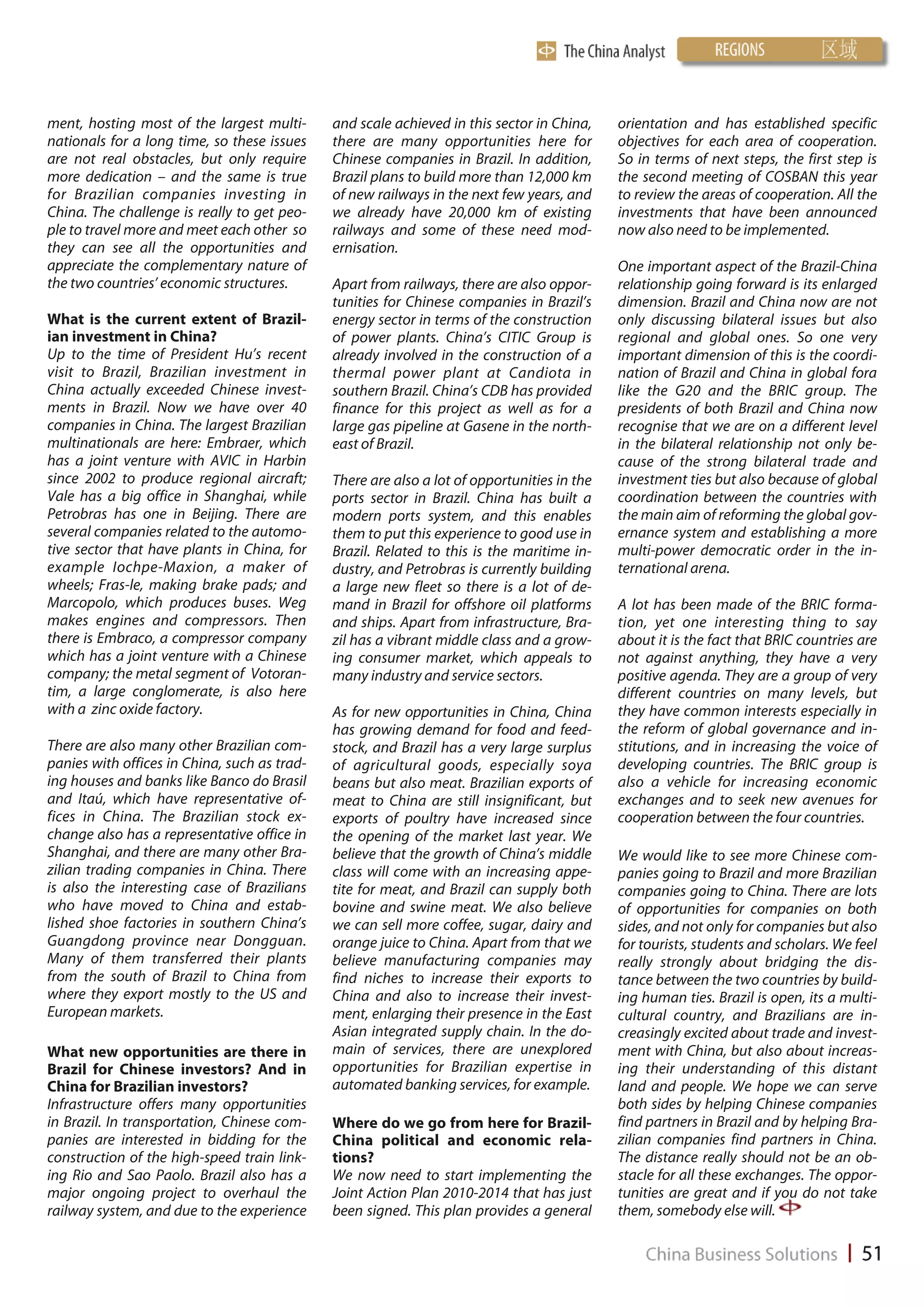
                                                      Regional Focus: China-Russia    52
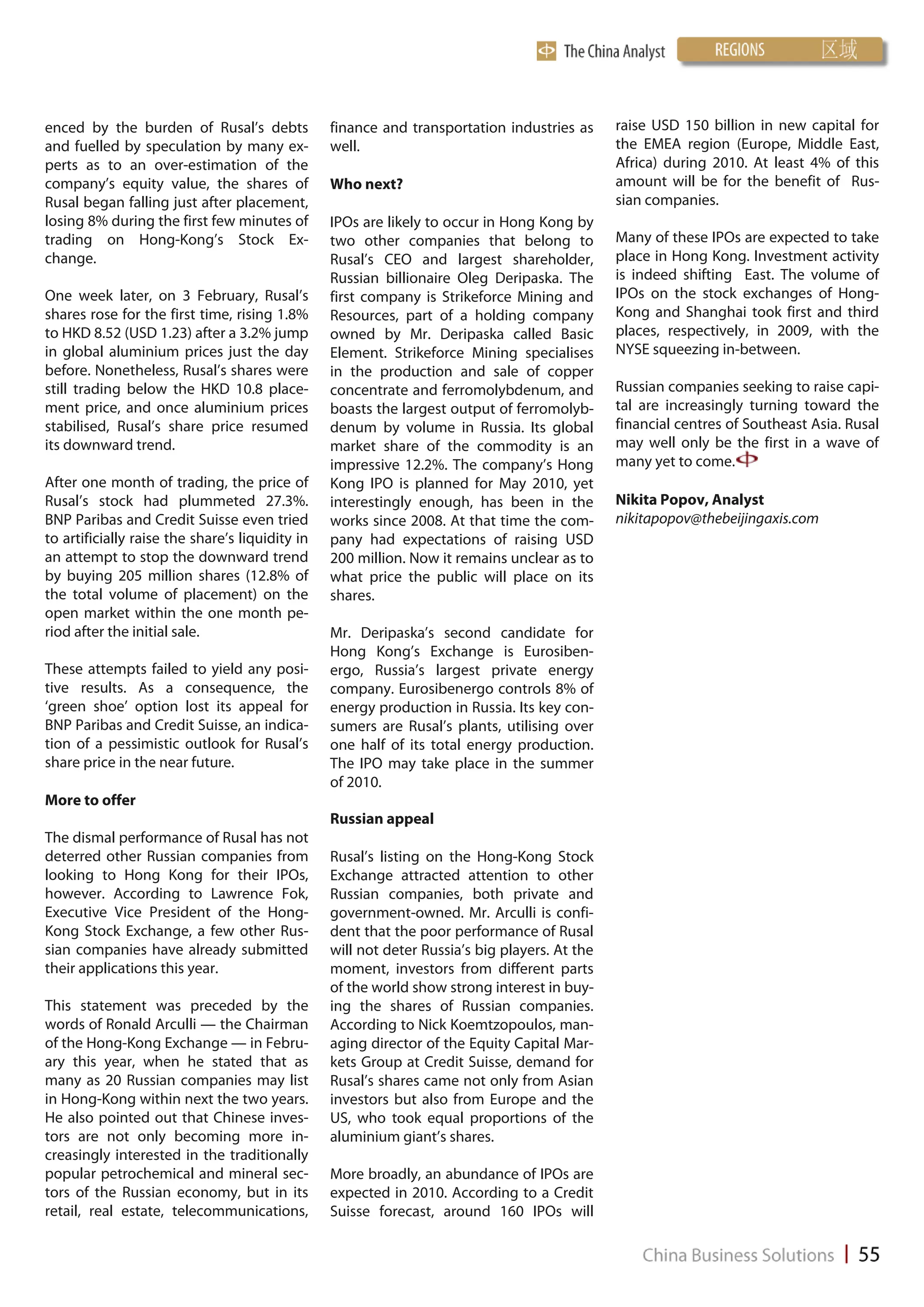
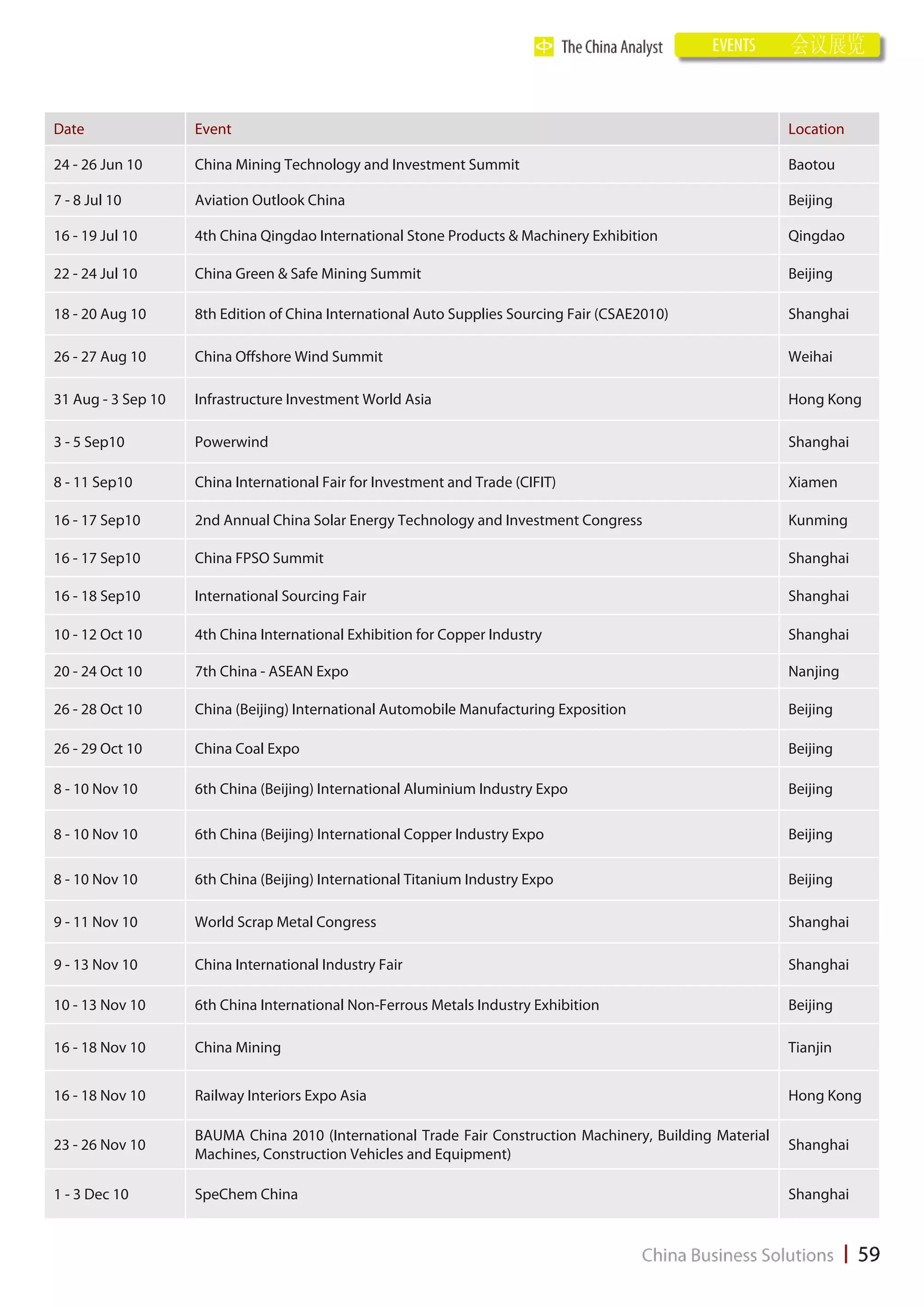
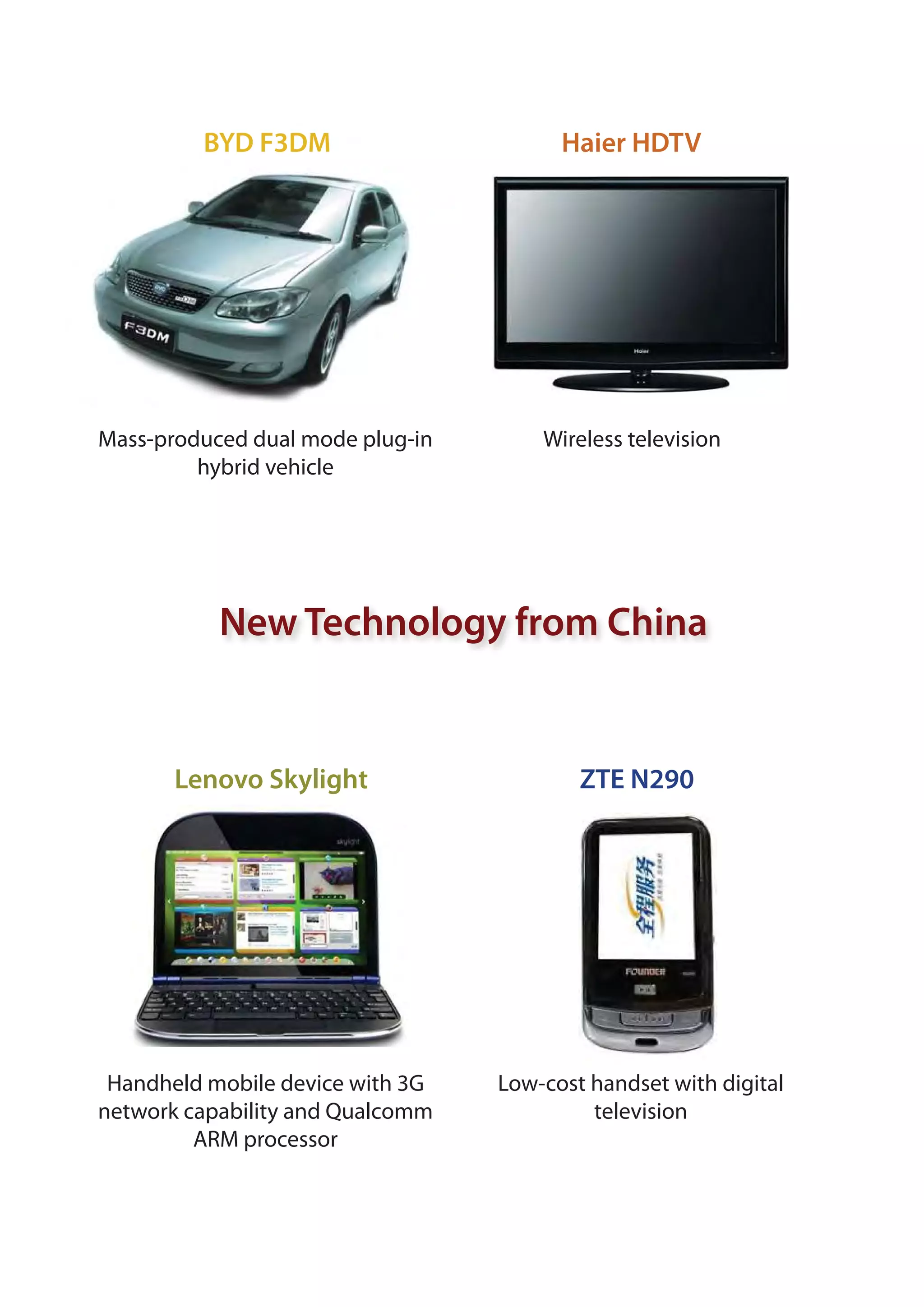
BYD F3DM                       Haier HDTV


Mass-produced dual mode plug-in       Wireless television
         hybrid vehicle


           New Technology from China


       Lenovo Skylight                    ZTE N290


 Handheld mobile device with 3G   Low-cost handset with digital
network capability and Qualcomm            television
         ARM processor
At the Highest Level
As the world economy gradually emerges from the worst financial crisis since the 1930s, it cannot but look
towards China again, which long since emerged from the crisis and showed the way forward. In this edition
of The China Analyst we examine China’s next frontier of development: technology, where China has ample
ability to surprise the world yet again.
                        he financial crisis is behind us. We         neering and design firms in executing contracts the world
                     T  have lived through a period of im-
                   mense historical significance and, finally,
                                                                     over; and the ability of its industries to produce sophisticated
                                                                     machinery ranging from small cost-cutting telecommunica-
                   we are able to look forward to a perhaps          tions products to large airplanes and aircraft carriers.
                   more normal year for the global economy
                   in 2010. Yet looking back now, the global         As we finally leave the financial crisis behind us, it seems in ret-
                   financial crisis seemed like little more than     rospect that this global calamity clearly illustrated China’s abil-
                   a blip for China’s resilient economy, and if      ity to lead. Experience has taught us never to underestimate
                   the crisis can now pass into history, the         China’s ability to surprise, however, and it is with this perspec-
                   ongoing story of China’s rise is leading the      tive that we consider China’s emergence in technology and
                   world further into the future with seem-          innovation.
ingly boundless potential.
                                                                     It has been a remarkable journey documenting China’s pro-
In the years since 2003 that THE BEIJING AXIS has published          gress in the last few years, and we will do so still, with only in-
The China Analyst, it has been a remarkable experience to track      creasing fascination. I trust that our readers will be able to gain
the journey of China’s economic development. It has been a           new insights from this China Technology Edition of The China
multifaceted picture not only of how China itself has been able      Analyst – and as always we look forward receiving to your
to shed an image of backwardness, but also of how the rest of        feedback.
the world has been able to profit from China’s rise. China’s role
in the global recovery from the financial crisis was a case in       Kobus van der Wath
point.                                                               Founder & Group Managing Director, THE BEIJING AXIS
                                                                     & CEO, Bateman Beijing Axis
In previous editions of The China Analyst we have paid particu-      kobus@thebeijingaxis.com
lar attention to China’s manufacturing capability and the com-
plex processes of procurement that have enabled the world to
profit from China’s cheap industrial outputs; we have illus-
trated the macroeconomic and financial fundamentals of                      THE CHINA ANALYST - May 2010
China’s economy and given forecasts of underlying trends; we
have analysed China’s outbound investments in various parts              Published by             THE BEIJING AXIS Ltd.
of the world and looked at China’s relations with strategic              Address                  3806 Central Plaza
countries and regions; we have studied the impact of the                                          18 Harbour Road
global financial crisis on China and monitored its response;                                      Wanchai
and we have—more recently—investigated the business                                               Hong Kong, PRC
strategies of China’s leading enterprises.                                                        Tel: +86 (0)10 6440 2106
                                                                                                  Fax: +86 (0)10 6440 2672
For this edition, however, we have chosen to look at China                                        www.thebeijingaxis.com
from a new perspective: technology. On the surface, China is             Executive Editor         Kobus van der Wath
often perceived to be still inordinately afflicted by intellectual                                kobus@thebeijingaxis.com
property enforcement problems. Yet in this China Technology              Editor                   Barry van Wyk
Edition we illustrate how effective China has been in harness-                                    barry.vanwyk@batemanbeijingaxis.com
ing foreign technology and fusing it with China’s own corpo-             Assistant Editor         Charles Avery
rate ingenuity. After 30 years of technology absorption, politi-                                  charlesavery@thebeijingaxis.com
cal reform and industrial innovation, Chinese manufacturers              Editorial Board          Lilian Luca
are increasingly able to compete successfully in global markets                                   luca@batemanbeijingaxis.com
by utilising China’s low-cost advantages to produce quality                                       Michele Cosani
products.                                                                                         michele.cosani@batemanbeijingaxis.com
                                                                                                  Cheryl Tang
As we make clear in the features to follow, we are only at the                                    cheryl.tang@batemanbeijingaxis.com
beginning of China’s global emergence in technology and in-                                       Javier Cuñat
novation. Yet the outlines of China’s technological capabilities                                  javier.cunat@batemanbeijingaxis.com
are already impressive, from the numbers of patents taken out            Advertising              Haiwei Huang
by its leading firms and inventors; the vast increases in its out-                                haiwei.huang@batemanbeijingaxis.com
put of scientific research; the expanding activities of its engi-        To subscribe to The China Analyst, please visit www.thebeijingaxis.com.
Table of Contents
May 2010
6    FEATURES Upstart: China’s Emergence in Technology and Innovation
     After coming of age in China’s domestic markets, Chinese firms are now replicating their domestic success in
     global markets by competing on price and quality as part of an emerging trend of Chinese innovation.
9    FEATURES Building by Design: How China Develops the Developing World
     Chinese contractors and design firms have gone international and are shaping landscapes and raising the
     world’s skylines where improvement is needed most: the developing world.
12   FEATURES Transition to the Future: Mining and Mineral Processing in China
     China’s mining and mineral processing sector has been a significant market for the world’s technology leaders,
     yet now China is increasingly turning the tables and exporting more of its mining and processing technology.
14   MACROECONOMY Macroeconomic Monitor: China’s Quiet Confidence
     Premier Wen Jiabao promised a very difficult year for China’s economy in 2010, but despite signs of a bubble
     forming in the property sector, China’s economy performed well in Q1 2010. Yet the calm may not last long.
18   NEWS China Business News Highlights
     Headline business stories in China during Q1 2010, leading with Geely’s acquisition of Volvo.
20   STATISTICS China Facts & Figures
     A cross-section of data illustrating growth, transformations and trends in select Chinese economic indicators.
22   STATISTICS China Trade Roundup
     Recent trends in China’s trade performance and the outlook going forward, with the latest trade data.
25   SOURCING China Sourcing Strategy
     In this edition CSS looks at China’s industrial clusters to see how concentrated local manufacturing has become.
29   SOURCING China Sourcing Blog Highlights
     A summary of recent postings on the China Sourcing Blog, THE BEIJING AXIS’ online sourcing portal.
30   INVESTMENT China Capital: Inbound and Outbound Foreign Direct Investment
     China’s investment activity contracted slightly in 2009 yet by Q1 2010 the outlook had turned positive again.
34   STRATEGY Mapping China in the Gold Mining Industry
     In this edition Mapping China illustrates China’s role as producer and consumer in the gold mining industry.
36   STRATEGY Zijin Mining Group: Leading China’s Next Golden Age
     A closer look at China’s largest gold producer and the drivers behind its rapid increase in competitiveness.
38   REGIONS Quarterly Overview: BRIICS
     A review of the world’s leading developing economies: Brazil, Russia, India, Indonesia, China and South Africa.
39   REGIONS Regional Focus CHINA-AFRICA
     China-Africa trade and investment analysis, with a China-Africa trade and investment country profile of Ghana.
44   REGIONS Regional Focus CHINA-AUSTRALIA
     China-Australia trade and investment analysis, and a look at the role of liquefied natural gas in bilateral ties.
48   REGIONS Regional Focus CHINA-LATIN AMERICA
     China-Latin America trade and investment analysis, and an interview with Brazil’s Econ. & Trade Counsellor in Beijing.
52   REGIONS Regional Focus CHINA-RUSSIA
     China-Russia trade and investment analysis, with an investigation of Rusal’s problematic recent IPO in Hong Kong.
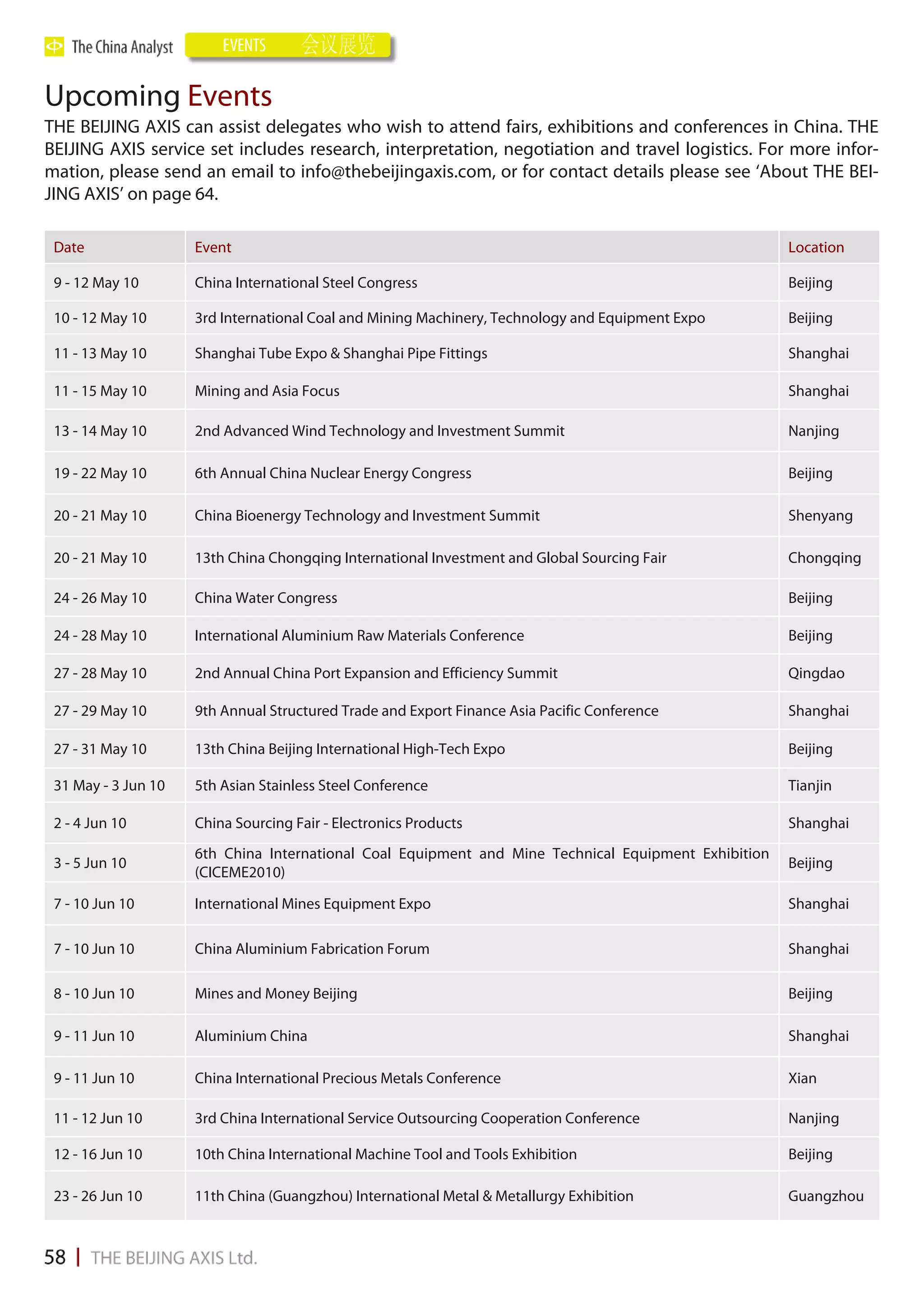
58   EVENTS Upcoming Events
     A selection of upcoming China events focusing on the mining and engineering sectors.
60   THE BEIJING AXIS THE BEIJING AXIS and Bateman Beijing Axis Careers
     New employment opportunities at THE BEIJING AXIS and Bateman Beijing Axis.
62   THE BEIJING AXIS THE BEIJING AXIS News - Q1 2010
     Company news for the first quarter of 2010.
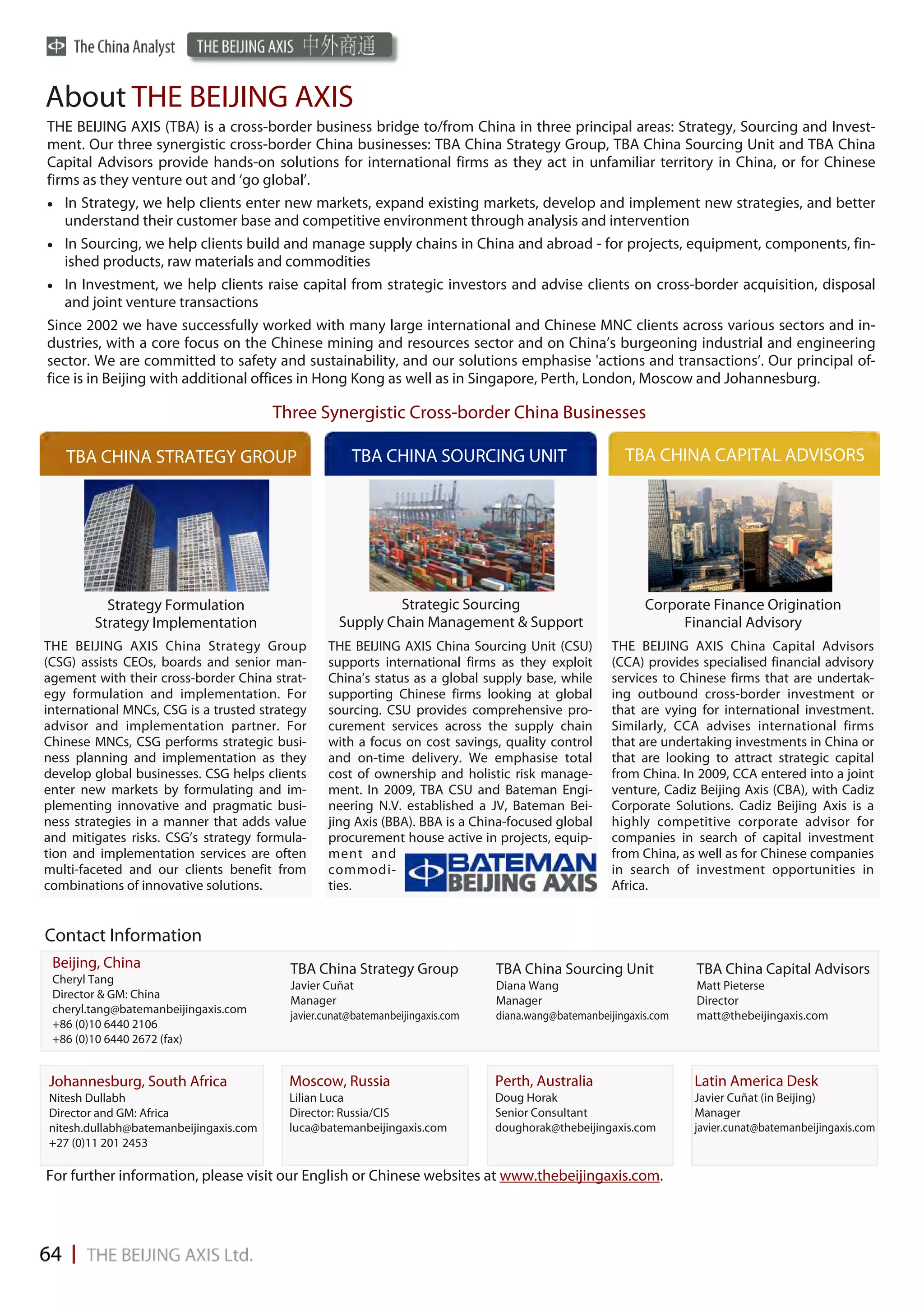
64   THE BEIJING AXIS About THE BEIJING AXIS
     Company profile and contact information.
Upstart: China’s Emergence in Technology and Innovation
After coming of age in China’s domestic markets, Chinese firms are now replicating their domestic success
in global markets by competing on price and quality. The success of the likes of Huawei and Lenovo are in-
dicative of an emerging trend of Chinese technology and innovation, yet China’s emergence is only just be-
ginning. By Barry van Wyk.

      n 13 October 1981, Deng Xiaoping, the architect and vi-
O     sionary of the reform policies that opened China’s econ-
omy to the world in the late 1970s, made what must then have
                                                                   ics. Hence by the time China began to import technology and
                                                                   to attract foreign direct investment (FDI) in the 1980s, it could
                                                                   utilise a diversified industrial system and a pool of manufactur-
seemed like a startling comment in a speech to the Central Po-     ing and production skills. As a result, the export processing
litical Bureau of the Chinese Communist Party. China, he de-       trade rapidly became a catalyst for China’s economy, with its
clared, should be making all of its own domestic planes. He        share of total exports increasing from 30% in 1988 to 55% in
may well have been thinking of the Yun-10 when he said this,       2005, while China’s exports as a whole grew at an annualised
because at the time, the Chinese government’s Department of        rate of 18.4% from 1992 to 2005, more than twice the growth
Industry on Aviation and Spaceflight was engaged in the con-       rate of world exports.
struction of China’s first large passenger plane. Just the year
before, the Yun-10 had successfully completed a test flight, yet   Following in the footsteps of other Asian catch-up economies
ultimately only two prototypes were ever constructed. The          like Japan and—more recently—Hong Kong and Singapore,
plane would ultimately be retired in 1984.                         China’s exports gradually moved up the value chain. Initially
                                                                   specialising in low-tech products such as apparel, toys and
The main reason the Yun-10 project never got off the ground        footwear, in the last decade Chinese manufacturers have pro-
was that those involved in its construction could not agree on     gressed to electronics and machinery. Between 1992 and 2005,
what basis the plane should be constructed: imitation or inno-     China’s medium- to high-technology exports grew 22% annu-
vation. Should it simply be an exact replica of an existing        ally, while high-technology exports grew by 32%. By 2008,
plane, or a new one designed from scratch? Those favouring         43% of China’s exports were directly related to machinery, me-
innovation initially prevailed, and the plane was painstakingly    chanical appliances and electrical equipment, with China now
constructed over a period of ten years. The China Civil Aviation   dominating global markets for these and other types of ma-
Authority (CCAA) decided not to buy the Yun-10, however, and       chinery. Furthermore, a full 27 years after Deng Xiaoping’s
even before Deng’s speech in 1981, it had opted to import for-     speech in 1981, China showcased the ARJ21—or Advanced
eign planes instead.                                               Regional Jet for the 21st Century—a new Chinese regional air-
                                                                   craft currently in final assembly stage that is set to propel
Despite the failure of the Yun-10, Deng’s confidence in China’s    China to become a competitor in the global commercial air-
fledgling manufacturing capabilities was indicative of what        craft industry. Within ten years China is poised to challenge
was to come. China, Deng insinuated, can make anything. In         not only the regional jet market but even the Airbus/Boeing
the 30 years that followed, the world has learned how right he     duopoly of large commercial aircraft, to expand upon its cur-
was, China does indeed seem to make everything. It makes           rent manufacture of fighter aircraft, helicopters and space ve-
everything not only at low cost, but now also of high quality,     hicles.
constituting a particularly Chinese brand of innovation that
enables China to increasingly shake up global markets.             China’s emergence as a serious challenger in the commercial
                                                                   aircraft industry was sealed in 2008 when Airbus signed an
The road much travelled                                            agreement with Tianjin Zhongtian Aviation Industry to open a
                                                                   final assembly plant for the A320 aircraft in Tianjin. After 20
As export processing zones were established in China’s coastal     years of absorbing technology and expertise from Western air-
regions from the early 1980s, and firms from North America,        craft manufacturers, this facility is considered the final step for
Europe, Japan and newly industrialised Asian economies             Chinese manufacturers to master the skills of producing com-
moved their labour-intensive assembly plants to China, China’s     mercial aircraft to international standards. With the latest avail-
manufacturing sector expanded in leaps and bounds, drawing         able machine tools, advanced engineering procedures and de-
on an elastic supply of labour from the interior and completely    sign software; with China’s low labour costs and a supportive
transforming China’s coastal provinces, turning fishing villages   investment environment; and with a China-based supply
into new megacities within a few years, as exemplified by          chains of Western aircraft components to draw on, China
Shenzhen.                                                          seems finally ready to start making its own domestic planes.

Rapid economic growth ensued from China’s ability to absorb        A tale of two firms
and harness codified technology. The groundwork for this was
laid in the 1950s when an industrial policy was initiated to       In the 1980s the southern Chinese province of Guangdong be-
achieve a degree of self-sufficiency across a range of capital     came a national experiment for combining foreign investment
and consumer goods. A heavy industrial base was established,       and technology with the cost advantages of Chinese labour.
followed in the 1970s by investment in the manufacturing ca-       Three of the initial five special economic zones for foreign as-
pacity for light consumer items, farm equipment and electron-      sembly operations were situated in the province, allowing it to
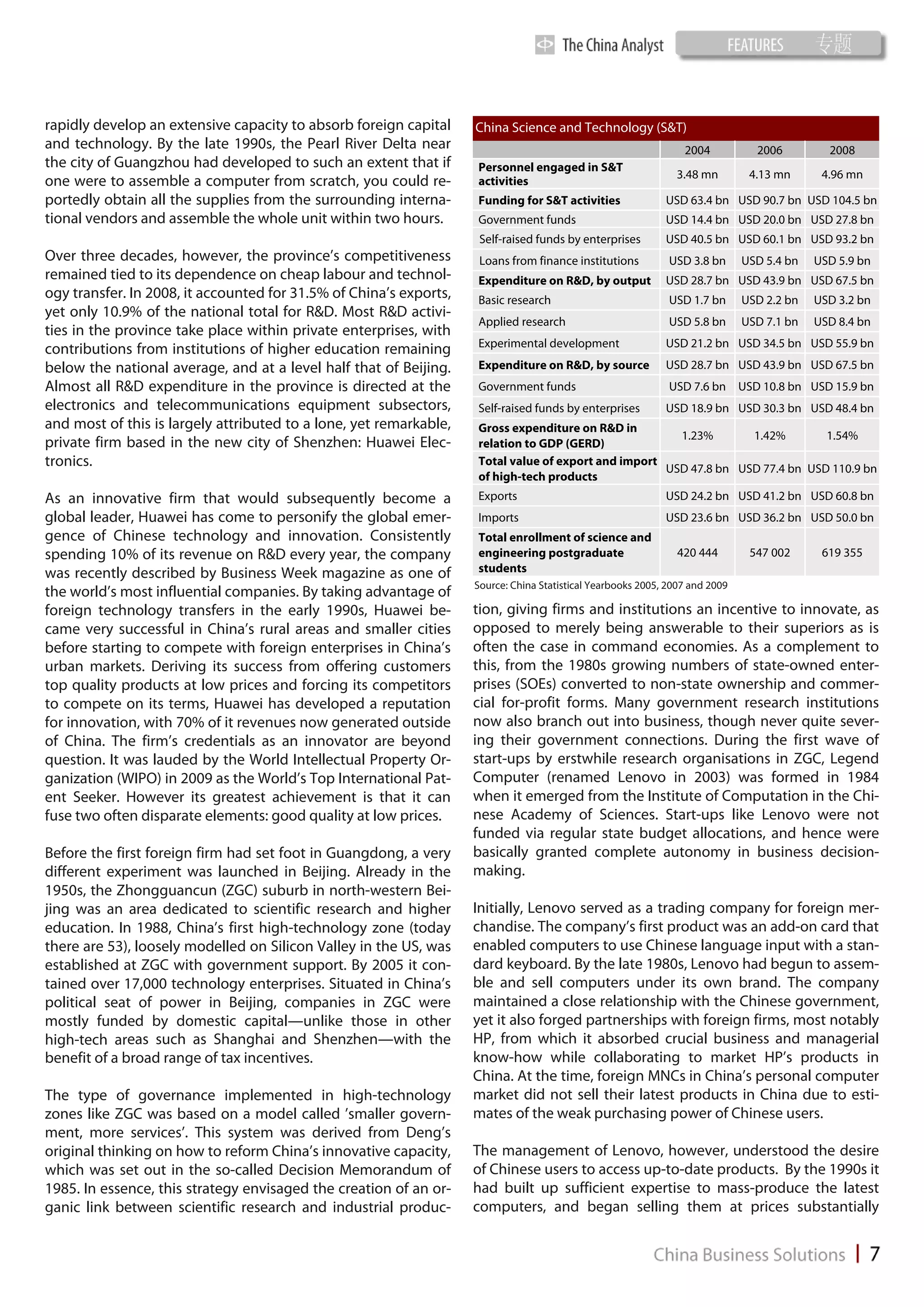
rapidly develop an extensive capacity to absorb foreign capital     China Science and Technology (S&T)
and technology. By the late 1990s, the Pearl River Delta near                                                    2004           2006         2008
the city of Guangzhou had developed to such an extent that if       Personnel engaged in S&T
                                                                                                               3.48 mn         4.13 mn      4.96 mn
one were to assemble a computer from scratch, you could re-         activities
portedly obtain all the supplies from the surrounding interna-      Funding for S&T activities               USD 63.4 bn USD 90.7 bn USD 104.5 bn
tional vendors and assemble the whole unit within two hours.        Government funds                         USD 14.4 bn USD 20.0 bn USD 27.8 bn
                                                                     Self-raised funds by enterprises        USD 40.5 bn USD 60.1 bn USD 93.2 bn
Over three decades, however, the province’s competitiveness          Loans from finance institutions          USD 3.8 bn      USD 5.4 bn   USD 5.9 bn
remained tied to its dependence on cheap labour and technol-        Expenditure on R&D, by output            USD 28.7 bn USD 43.9 bn USD 67.5 bn
ogy transfer. In 2008, it accounted for 31.5% of China’s exports,   Basic research                            USD 1.7 bn      USD 2.2 bn   USD 3.2 bn
yet only 10.9% of the national total for R&D. Most R&D activi-
                                                                    Applied research                          USD 5.8 bn      USD 7.1 bn   USD 8.4 bn
ties in the province take place within private enterprises, with
                                                                    Experimental development                 USD 21.2 bn USD 34.5 bn USD 55.9 bn
contributions from institutions of higher education remaining
below the national average, and at a level half that of Beijing.    Expenditure on R&D, by source            USD 28.7 bn USD 43.9 bn USD 67.5 bn
Almost all R&D expenditure in the province is directed at the       Government funds                          USD 7.6 bn USD 10.8 bn USD 15.9 bn
electronics and telecommunications equipment subsectors,            Self-raised funds by enterprises         USD 18.9 bn USD 30.3 bn USD 48.4 bn
and most of this is largely attributed to a lone, yet remarkable,   Gross expenditure on R&D in
                                                                                                       1.23%       1.42%        1.54%
private firm based in the new city of Shenzhen: Huawei Elec-        relation to GDP (GERD)
tronics.                                                            Total value of export and import
                                                                                                     USD 47.8 bn USD 77.4 bn USD 110.9 bn
                                                                    of high-tech products
As an innovative firm that would subsequently become a              Exports                                  USD 24.2 bn USD 41.2 bn USD 60.8 bn
global leader, Huawei has come to personify the global emer-        Imports                                  USD 23.6 bn USD 36.2 bn USD 50.0 bn
gence of Chinese technology and innovation. Consistently            Total enrollment of science and
spending 10% of its revenue on R&D every year, the company          engineering postgraduate                    420 444        547 002      619 355
was recently described by Business Week magazine as one of          students
                                                                    Source: China Statistical Yearbooks 2005, 2007 and 2009
the world’s most influential companies. By taking advantage of
foreign technology transfers in the early 1990s, Huawei be-         tion, giving firms and institutions an incentive to innovate, as
came very successful in China’s rural areas and smaller cities      opposed to merely being answerable to their superiors as is
before starting to compete with foreign enterprises in China’s      often the case in command economies. As a complement to
urban markets. Deriving its success from offering customers         this, from the 1980s growing numbers of state-owned enter-
top quality products at low prices and forcing its competitors      prises (SOEs) converted to non-state ownership and commer-
to compete on its terms, Huawei has developed a reputation          cial for-profit forms. Many government research institutions
for innovation, with 70% of it revenues now generated outside       now also branch out into business, though never quite sever-
of China. The firm’s credentials as an innovator are beyond         ing their government connections. During the first wave of
question. It was lauded by the World Intellectual Property Or-      start-ups by erstwhile research organisations in ZGC, Legend
ganization (WIPO) in 2009 as the World’s Top International Pat-     Computer (renamed Lenovo in 2003) was formed in 1984
ent Seeker. However its greatest achievement is that it can         when it emerged from the Institute of Computation in the Chi-
fuse two often disparate elements: good quality at low prices.      nese Academy of Sciences. Start-ups like Lenovo were not
                                                                    funded via regular state budget allocations, and hence were
Before the first foreign firm had set foot in Guangdong, a very     basically granted complete autonomy in business decision-
different experiment was launched in Beijing. Already in the        making.
1950s, the Zhongguancun (ZGC) suburb in north-western Bei-
jing was an area dedicated to scientific research and higher        Initially, Lenovo served as a trading company for foreign mer-
education. In 1988, China’s first high-technology zone (today       chandise. The company’s first product was an add-on card that
there are 53), loosely modelled on Silicon Valley in the US, was    enabled computers to use Chinese language input with a stan-
established at ZGC with government support. By 2005 it con-         dard keyboard. By the late 1980s, Lenovo had begun to assem-
tained over 17,000 technology enterprises. Situated in China’s      ble and sell computers under its own brand. The company
political seat of power in Beijing, companies in ZGC were           maintained a close relationship with the Chinese government,
mostly funded by domestic capital—unlike those in other             yet it also forged partnerships with foreign firms, most notably
high-tech areas such as Shanghai and Shenzhen—with the              HP, from which it absorbed crucial business and managerial
benefit of a broad range of tax incentives.                         know-how while collaborating to market HP’s products in
                                                                    China. At the time, foreign MNCs in China’s personal computer
The type of governance implemented in high-technology               market did not sell their latest products in China due to esti-
zones like ZGC was based on a model called ’smaller govern-         mates of the weak purchasing power of Chinese users.
ment, more services’. This system was derived from Deng’s
original thinking on how to reform China’s innovative capacity,     The management of Lenovo, however, understood the desire
which was set out in the so-called Decision Memorandum of           of Chinese users to access up-to-date products. By the 1990s it
1985. In essence, this strategy envisaged the creation of an or-    had built up sufficient expertise to mass-produce the latest
ganic link between scientific research and industrial produc-       computers, and began selling them at prices substantially
lower than those of any foreign competitor. Lenovo quickly          (gross domestic expenditure on R&D as a percentage of GDP)
became the leading computer brand in China, enjoying a 30%          to 2% by 2010 and to 2.5% by 2020; to have S&T and innova-
share of the domestic market in the 2000s. Like Huawei,             tion contribute 60% to GDP growth, and for China to be
Lenovo excelled by absorbing foreign technology and busi-           among the top five worldwide contributors to domestic pat-
ness expertise and adapting them to a Chinese context before        ents and international citations in scientific papers.
extending the same strategy into global markets.
                                                                    Significant progress has already been achieved with the MLP,
Upstarts                                                            and it is not hard to identify signs of China’s rapidly improving
                                                                    innovative abilities. GERD has increased from 0.57% in 1995 to
Foreign firms currently still retain a strong presence in China’s   1.54% in 2008 (see table on previous page). Occurring at a
high-tech exports and patents. In 2004, for example, exports        time when its GDP was growing exceptionally fast, China’s
by foreign-invested enterprises in China accounted for 55% of       GERD now ranks behind only the US and Japan. The number of
China’s total exports, as much as 90% of computers, compo-          triadic patents (granted in all three of the major patent offices:
nents and peripheral exports, and 71% of electronics and tele-      US Patent & Trademark Office, Japan Patent Office and Euro-
communications equipment exports. While domestic patent             pean Patent Office) granted to China remains relatively small,
applications to the Chinese State Intellectual Property Office      reaching 433 in 2005 (compared to 652 for Sweden and 3158
expanded nearly six-fold between 1995 and 2006, patents             for Korea), yet Chinese patent applications are increasing rap-
granted to Chinese nationals have been mainly non-invention         idly. Chinese patent applications to the World Intellectual
patents (in the form of utility models or appearance-based de-      Property Office (WIPO), for example, increased by 44% in 2005
signs).                                                             and by a further 57% in 2006.

Nevertheless, it is easy to identify innovative techniques in the   From a total of about 20,000 in 1998, China’s output of scien-
way trailblazing firms like Huawei and Lenovo originally over-      tific papers has increased four-fold to about 112,000 as of
came the established influence of foreign firms in China. One       2008, moving China to second place in the global rankings, be-
might expect that the Chinese market’s preference—or im-            hind only the US. In the period 2004 to 2008, China produced
perative—for low prices not to be particularly fertile ground       about 400,000 papers, with the major focus areas being mate-
for providing incentives for Chinese firms to engage in techno-     rial science, chemistry, physics, mathematics and engineering.
logical advancement. Yet because foreign technology is read-        While these focus areas reflect China’s traditional emphasis on
ily available in China, Chinese firms are able to concentrate       heavy industry and primary manufacturing, substantial re-
their in-house R&D on China’s comparative labour-using and          search outputs in these subjects provide China with a major
cost-cutting advantages. Hence the vast majority of such firms’     platform for innovation in such core industries. Chinese re-
R&D expenditure is devoted to experimental development (as          searchers have also branched into new fields and achieved
opposed to basic or applied research, see table on previous         prominence in areas like biological and medical sciences. Fur-
page), which constitutes the adaptation and process develop-        thermore, China has greatly expanded regional collaborations
ment of existing techniques. The industrious way in which Chi-      with north American, Asian and European counterparts. In
nese firms have applied themselves to absorb, adapt and to          short, the progress of Chinese scientific output, while some-
improve technology for China’s vast market is the foundation        times associated with an environment in China grappling with
of their success on a global scale. Because as Huawei and           intellectual property right enforcement, has undoubtedly
Lenovo have shown, good quality at a low price is well-nigh         emerged on a global platform, enabling China to support in-
impossible to beat.                                                 dependent research and technological activity.

Huawei and Lenovo are merely the vanguard of innovative             China’s emergence since 1978 remains an exceedingly indus-
new Chinese companies with global ambitions. By the late            trious and innovative Chinese economic phenomenon which
1990s, as China was progressively becoming the world’s larg-        has impacted the world to an extent that seems almost impos-
est mobile phone market, a new wave of ZGC start-ups had            sible to grasp in its entirety. Yet Chinese companies are now
emerged, boasting more extensive global connections and             becoming very successful at replicating their low cost manu-
better technical expertise. One of these which has followed in      facturing prowess on a global scale, but at good quality and
the footsteps of Lenovo is the multimedia chip design firm          with constantly improving technology. There is no way of tell-
Vimicro. It already has an established multimedia product (a        ing how far China will go as a global leader in technology and
chip used in desktop computer cameras) for which it has             innovation. China’s MLP in 2006 called for the construction of
around 60% global market share. Because most of the world’s         large passenger airplanes through 16 major new projects over
leading computer accessory makers have a strong presence in         the next 15 years. Deng Xiaoping had already believed China
China, Vimicro needs only to market its chip to these firms for     to be capable of this back in 1981, yet even now, almost 30
it to quickly become a mainstream product.                          years later, China’s global emergence in technology is just be-
                                                                    ginning.
China’s vision to become a global technology leader is set out
in the Medium to Long-Term S&T Strategic Plan 2006-2020             Barry van Wyk, Consultant
(MLP). In essence, the MLP aims to reduce China’s reliance on       barry.vanwyk@batemanbeijingaxis.com
foreign technology to less than 30% by 2020; to increase GERD
Building by Design: How China Develops the Developing World
Chinese contractors and design firms have gone international. With one-sixth of global construction indus-
try market share, China is shaping landscapes and raising the world’s skylines. Most of China’s projects have
been implemented where improvement is needed most: in the developing world. China’s resilient growth
may yet spread through infrastructure construction and design projects abroad. By Charles Avery.


D      uring the last three decades, China has developed at a
       rate unprecedented in its long history. The changes
have occurred incrementally, almost unnoticed to those who
                                                                    were notorious for exceeding deadlines and budgets. At the
                                                                    time, one could hardly foresee a successful future for Chinese
                                                                    contractors internationally.
have become accustomed to the sight of cranes on the hori-
zon and to the sound of jackhammers. But then there are             In the 1980s, reform was applied to the construction industry
those who leave their homes to return years later who barely        with the allowance of tendering in construction projects. At
recognise their own city. Roads of dirt and gravel have given       that point the industry became imbued with a sense of vitality.
way to paved, multiple-lane highways; cars, busses and sub-         Although as little as 25% of rural square footage—and up to
ways have displaced bicycles for transportation; high-rise          60% of that in urban areas—was opened to tender offers prior
buildings of glass, steel and cement now tower above the            to commencement, the advantages of having market-based
structures of yesteryear; on China’s shores, trade bustles in       competition quickly became apparent. Chinese contractors
some of the world’s busiest, most state-of-the-art harbours.        excelled, as did China’s economy. It is around this time that
These changes are visible symbols of China’s rapid progress.        Chinese builders also began going abroad in earnest, although
Every pipe laid and every power plant constructed marks a           still on a relatively limited scale. International revenues re-
subtle contribution toward economic development. Behind             mained under USD 3 billion in 1989, but then quickly rose to
every brick laid on this road toward modernity are Chinese          USD 5 billion three years later.
contractors and designers. (Designers, although inclusive of
both engineers and architects, will be used more or less syn-       Then in 2001 China entered the World Trade Organisation
onymously with engineers.)                                          (WTO), putting China’s ‘go abroad’ policy into full swing. By
                                                                    2005, this USD 5 billion annual turnover figure would increase
China is now spreading its progress abroad, its contractors be-     ten-fold. Chinese contractors and designers now operate in
coming the primary fountainheads of development. In con-            179 countries. The handful of construction enterprises certified
struction—one of the world’s most important industries, com-        to work overseas in the early 1980s has increased to over 2,000
prising over 10% of global GDP—China has become a domi-             today, and the world is increasingly being shaped by China.
nant player. At USD 77 billion in 2009, this lone nation ac-
counts for around one-sixth of all internationally contracted       Chinese contractors in emerging Asia and Africa
projects by value, most of this earned shaping the landscapes
of emerging Asia and Africa. Way off the mark only a quarter-       Itself a developing nation, China has shown great prowess in
century ago, China’s contractors and designers are quickly ris-     changing the skylines and infrastructure of likewise emerging
ing to become the world’s most competitive.                         economies, particularly those in Asia and Africa. In Asia, Chi-
                                                                    nese firms have overwhelmingly been the contractors of
Humble origins                                                      choice for Hong Kong and Singapore, due as much to cultural
                                                                    affinity as to their proximity with the mainland. However, the
Despite numerous accomplishments at home, Chinese con-              most promising Asian markets at present for China’s construc-
tractors are relative newcomers on the global scene. The gov-       tion talent lie in the developing ASEAN countries—the Asso-
ernment has historically been the prime mover of the market,        ciation of Southeast Asian Nations (its ten members being In-
with international projects subordinate to domestic programs.       donesia, Malaysia, the Philippines, Singapore, Thailand, Brunei,
In the early days of the Peoples’ Republic the state directly       Myanmar, Cambodia, Laos and Vietnam).
contracted projects to local firms, limiting the possibility for
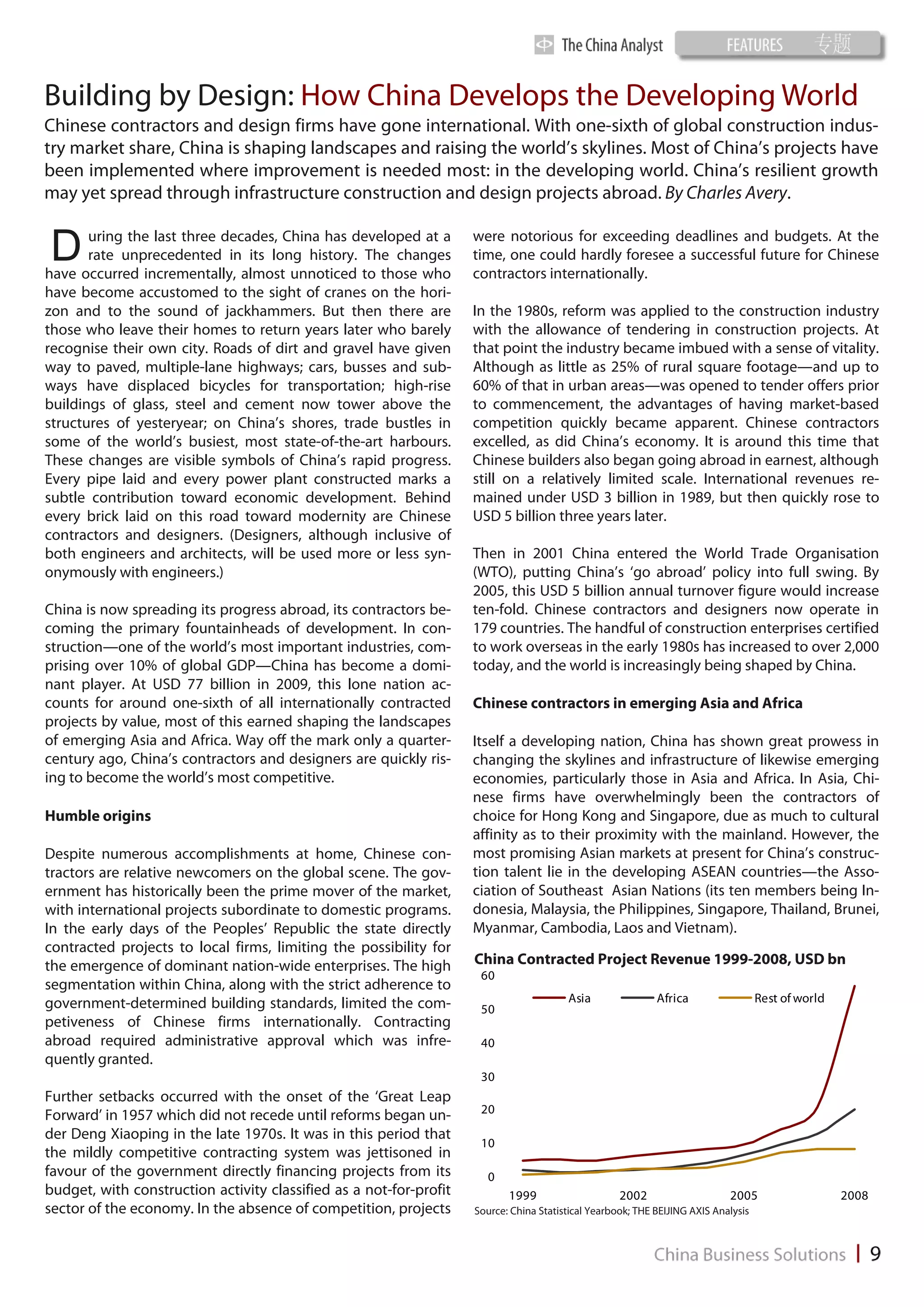
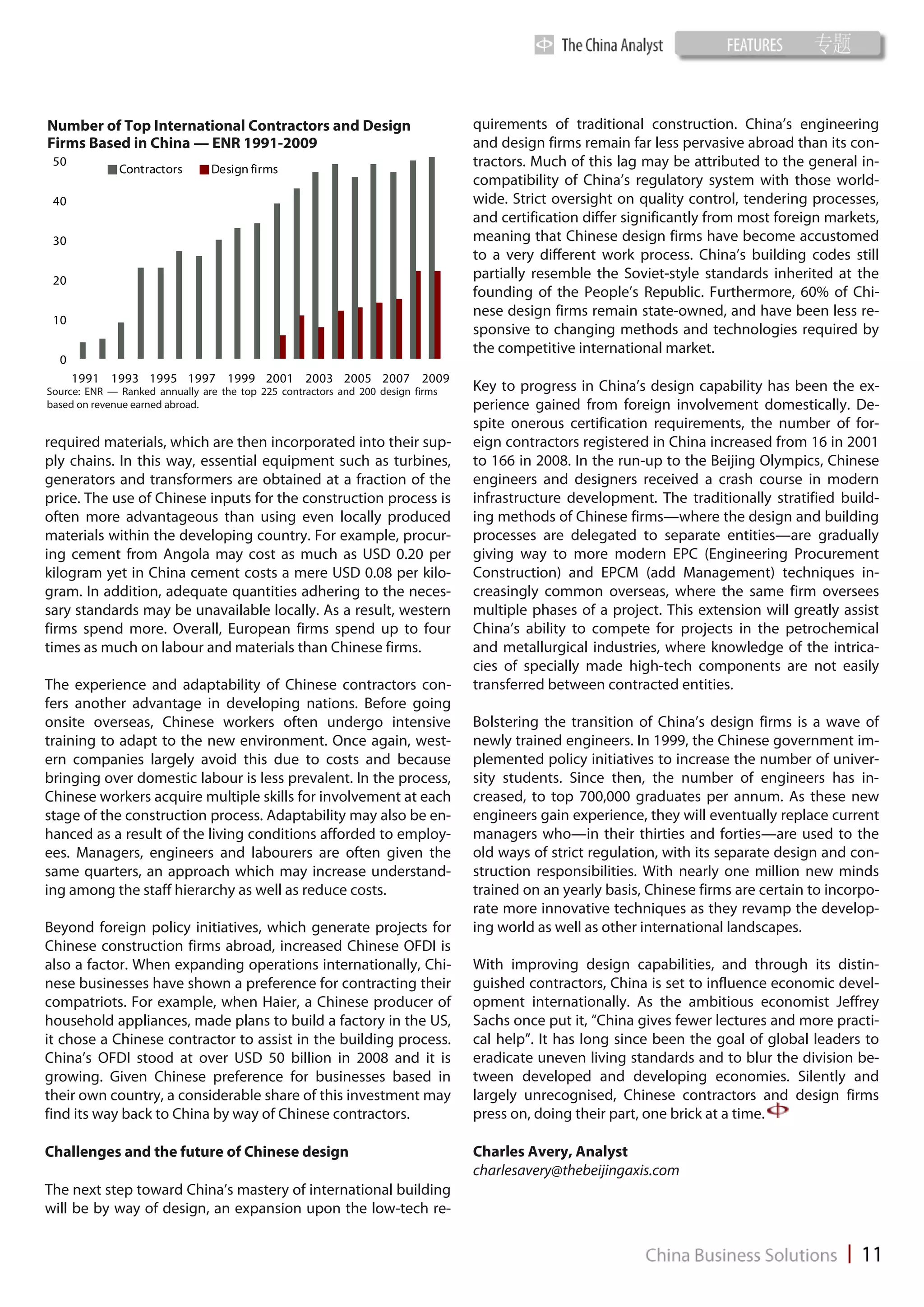
the emergence of dominant nation-wide enterprises. The high         China Contracted Project Revenue 1999-2008, USD bn
                                                                     60
segmentation within China, along with the strict adherence to
government-determined building standards, limited the com-                              Asia                Africa                  Rest of world
                                                                     50
petiveness of Chinese firms internationally. Contracting
abroad required administrative approval which was infre-             40
quently granted.
                                                                     30
Further setbacks occurred with the onset of the ‘Great Leap
                                                                     20
Forward’ in 1957 which did not recede until reforms began un-
der Deng Xiaoping in the late 1970s. It was in this period that
                                                                     10
the mildly competitive contracting system was jettisoned in
favour of the government directly financing projects from its         0
budget, with construction activity classified as a not-for-profit          1999                     2002                    2005                    2008
sector of the economy. In the absence of competition, projects      Source: China Statistical Yearbook; THE BEIJING AXIS Analysis
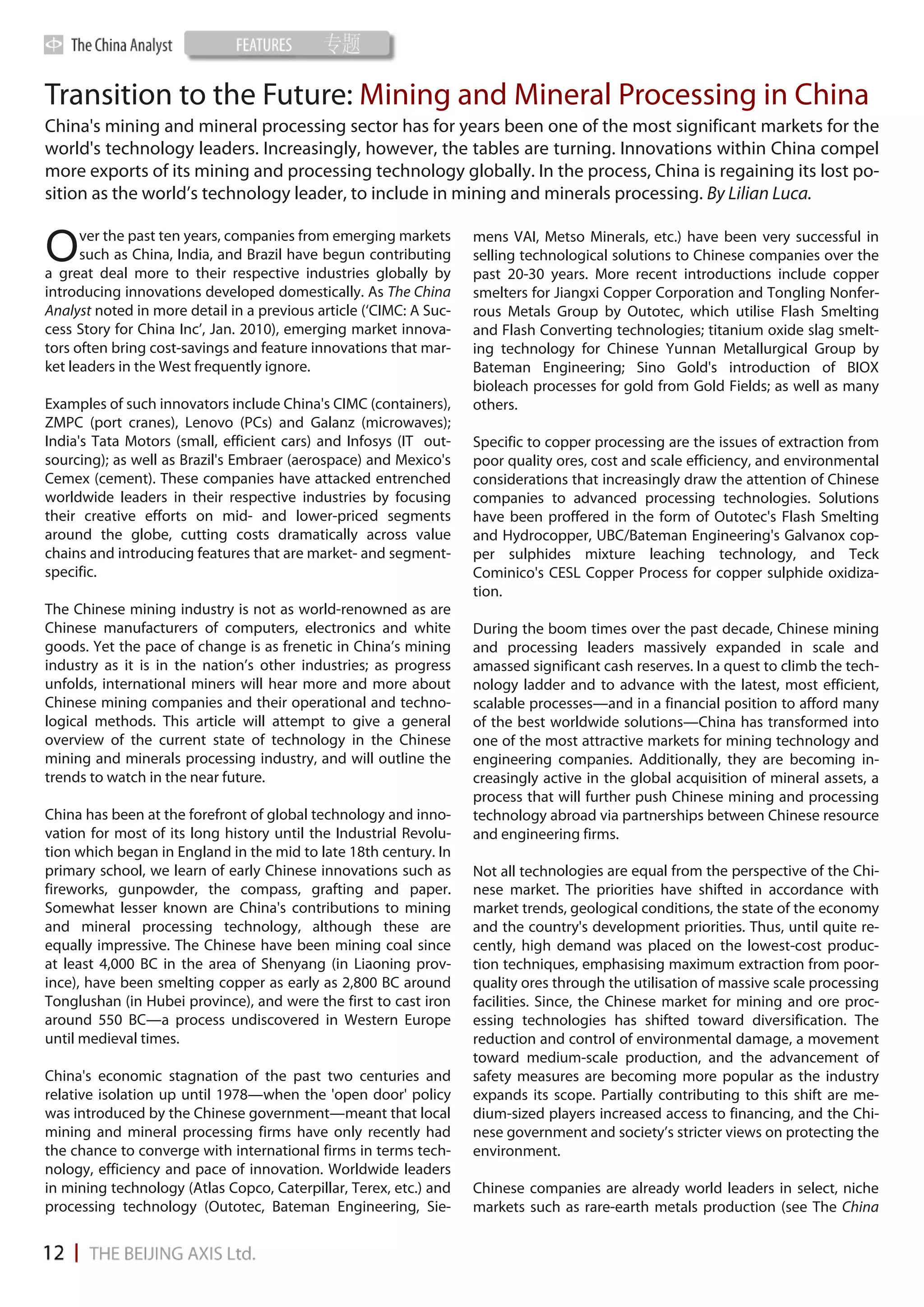
With USD 57 billion of China’s contracted revenue originating      Top Asian and African Countries for Chinese Contracting, Labour and
in Asia, China’s home continent is by far the most prevalent       Design Activity 2008
location of its international projects. Two ASEAN countries in     ASEAN                                    Value (USD mn)         Regional %
particular – Vietnam and Indonesia – have infrastructure indus-    Indonesia                                      2,278               25%
try values that rank in the top ten for non-BRIC countries. Con-
                                                                   Vietnam                                        1,982               22%
sequently, Chinese contractors have ventured south to these
highly active regions, bringing their expertise in economic de-    Singapore                                      1,862               20%
velopment along with them.                                         Malaysia                                        789                9%
                                                                   Africa                                   Value (USD mn)         Regional %
As much as one-third of the Vietnamese construction indus-         Algeria                                        2,405               19%
try’s value, estimated at just under USD 6 billion in 2008, is     Sudan                                          2,222               18%
contributed by Chinese firms. Due to a shared border, materi-
                                                                   Nigeria                                        1,423               11%
als and personnel amply flow into China’s southern neighbour,
giving Chinese firms an edge in freight costs. Current projects    Angola                                         1,190               9%
underway involve improvements to Vietnam’s railway, ports          Source: China Statistical Yearbook; THE BEIJING AXIS Analysis

and energy-based infrastructure.
                                                                   ranking. Of Africa’s 57 countries, China has registered con-
For rail, China Railway No. 6 Engineering Group has been as-       struction activity in 53. The basics of modern infrastructure are
signed by the Vietnamese government to a USD 553 million           still needed in Africa, and such is exactly China’s area of exper-
railway project from the capital, Hanoi. In southern Vietnam,      tise. General building comprises 36% of all projects, water sup-
China Harbour Engineering Company is upgrading a port in           ply 21%, transportation 13% and power just shy of 10%. Many
Ho Chi Minh City to handle increased loads of containers and       of the contracts received have been those initiated by govern-
general cargo at a multi-million USD price tag. For power, Viet-   ment agencies, and have been financed by grants. The Chi-
nam will have its first nuclear-based generator come online        nese government actively fosters diplomatic relations in Africa
with the assistance of China Guangdong Nuclear Power Group.        by giving financial aid for infrastructure development, with
Construction of thermo-electric and coal fired plants have also    preference given for Chinese contractors. Even where diplo-
been tasked to Chinese companies in its southern neighbour.        macy has not been a factor, China’s builders are nonetheless
                                                                   frequent winners of open tenders, beating out even local firms
Indonesia’s construction industry, at USD 38 billion as of 2008,   on the basis of low cost.
is by far the largest of all ASEAN countries. Here too, Chinese
firms have shown increasing levels of activity. The greatest on-   Although China’s infrastructure projects in Africa are often ac-
going contributions from China have been towards Indone-           companied by strategic resource deals, it is not China’s largest
sia’s energy infrastructure in the form of power plants. No less   oil trading partners Angola or Sudan who top the list for Chi-
than nine power plants are currently under construction in In-     nese construction activity, rather it is Algeria. Over USD 2.4 bil-
donesia through the guidance and labour of Chinese contrac-        lion was contracted to Chinese firms in 2008, out of a total in-
tors. Companies such as Chengda Engineering, Sinhydro, Si-         dustry value USD 12 billion. This is in large part due to the
nomach and Shandong Electric Power Construction are presid-        reputation of Chinese construction firms, notably China State
ing over 2,000 MW in new electrical capacity valued at around      Construction Engineering Company (CSCEC). After the devas-
USD 3.5 billion, set to come online in the near future. Showing    tating earthquake Algeria experienced in 2003, many buildings
the adaptability of Chinese contractors, Shenhua Goa Power         collapsed, yet those built by CSCEC remained standing. The
will not only construct a power plant, but an adjacent coal        result: more large projects awarded to China. Ongoing Chinese
mine as well to supply it with over 1.5 million metric tonnes of   projects in Algeria include several railways, nuclear power fa-
coal per annum.                                                    cilities, and a 12,000 kilometre highway under construction in
                                                                   conjunction with a team of international firms.
There is yet more good news for Chinese contractors operat-
ing in ASEAN. As of 1 January this year, the ASEAN-China Free      The China advantage
Trade Agreement became fully operational. To further cement
its commitment to expand economic activity between south-          There are several key features that give Chinese contractors an
east Asian countries, China signed an agreement to initiate a      edge over their predominantly Western competitors in devel-
USD 10 billion China-ASEAN Investment Cooperation Fund,            oping countries. First and foremost is cost. Chinese labour is
with an accompanying USD 15 billion line of commercial credit      cheap, reflected in the comparatively lower price Chinese firms
specifically targeted at infrastructure development. As the        are able to offer cash strapped developing countries. It is esti-
members of ASEAN countries develop and prosper, so too will        mated that the salaries of workers, designers and consultants
Chinese contractors who have been rapidly increasing their         from China are only 5% that of those from the US and Japan.
presence in the region.
                                                                   Input costs are also significantly less. This is because Chinese
Chinese contractors are playing a leading role in the African      contractors procure their equipment and materials inexpen-
market. Chinese firms have advanced from holding only 7% of        sively from China. Many leading state-owned Chinese contrac-
the market in 2000 to 27% as of 2007, giving it the number one     tors operate their own manufacturing bases to produce the
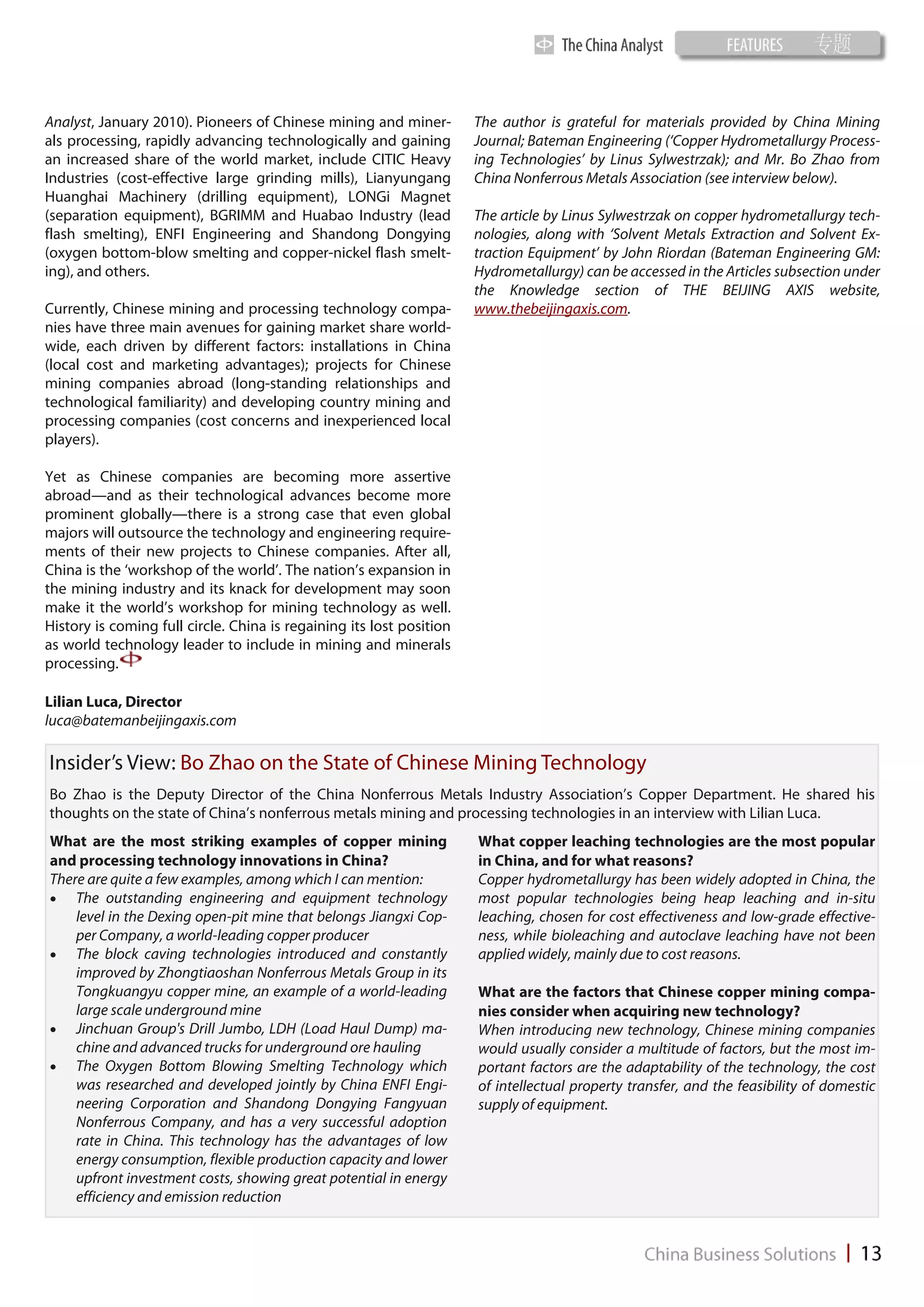
Number of Top International Contractors and Design                               quirements of traditional construction. China’s engineering
Firms Based in China — ENR 1991-2009                                             and design firms remain far less pervasive abroad than its con-
 50
              Contractors       Design firms
                                                                                 tractors. Much of this lag may be attributed to the general in-
                                                                                 compatibility of China’s regulatory system with those world-
 40                                                                              wide. Strict oversight on quality control, tendering processes,
                                                                                 and certification differ significantly from most foreign markets,
 30                                                                              meaning that Chinese design firms have become accustomed
                                                                                 to a very different work process. China’s building codes still
 20                                                                              partially resemble the Soviet-style standards inherited at the
                                                                                 founding of the People’s Republic. Furthermore, 60% of Chi-
                                                                                 nese design firms remain state-owned, and have been less re-
 10
                                                                                 sponsive to changing methods and technologies required by
                                                                                 the competitive international market.
  0
      1991 1993 1995 1997 1999 2001 2003 2005 2007 2009
Source: ENR — Ranked annually are the top 225 contractors and 200 design firms   Key to progress in China’s design capability has been the ex-
based on revenue earned abroad.                                                  perience gained from foreign involvement domestically. De-
                                                                                 spite onerous certification requirements, the number of for-
required materials, which are then incorporated into their sup-                  eign contractors registered in China increased from 16 in 2001
ply chains. In this way, essential equipment such as turbines,                   to 166 in 2008. In the run-up to the Beijing Olympics, Chinese
generators and transformers are obtained at a fraction of the                    engineers and designers received a crash course in modern
price. The use of Chinese inputs for the construction process is                 infrastructure development. The traditionally stratified build-
often more advantageous than using even locally produced                         ing methods of Chinese firms—where the design and building
materials within the developing country. For example, procur-                    processes are delegated to separate entities—are gradually
ing cement from Angola may cost as much as USD 0.20 per                          giving way to more modern EPC (Engineering Procurement
kilogram yet in China cement costs a mere USD 0.08 per kilo-                     Construction) and EPCM (add Management) techniques in-
gram. In addition, adequate quantities adhering to the neces-                    creasingly common overseas, where the same firm oversees
sary standards may be unavailable locally. As a result, western                  multiple phases of a project. This extension will greatly assist
firms spend more. Overall, European firms spend up to four                       China’s ability to compete for projects in the petrochemical
times as much on labour and materials than Chinese firms.                        and metallurgical industries, where knowledge of the intrica-
                                                                                 cies of specially made high-tech components are not easily
The experience and adaptability of Chinese contractors con-                      transferred between contracted entities.
fers another advantage in developing nations. Before going
onsite overseas, Chinese workers often undergo intensive                         Bolstering the transition of China’s design firms is a wave of
training to adapt to the new environment. Once again, west-                      newly trained engineers. In 1999, the Chinese government im-
ern companies largely avoid this due to costs and because                        plemented policy initiatives to increase the number of univer-
bringing over domestic labour is less prevalent. In the process,                 sity students. Since then, the number of engineers has in-
Chinese workers acquire multiple skills for involvement at each                  creased, to top 700,000 graduates per annum. As these new
stage of the construction process. Adaptability may also be en-                  engineers gain experience, they will eventually replace current
hanced as a result of the living conditions afforded to employ-                  managers who—in their thirties and forties—are used to the
ees. Managers, engineers and labourers are often given the                       old ways of strict regulation, with its separate design and con-
same quarters, an approach which may increase understand-                        struction responsibilities. With nearly one million new minds
ing among the staff hierarchy as well as reduce costs.                           trained on an yearly basis, Chinese firms are certain to incorpo-
                                                                                 rate more innovative techniques as they revamp the develop-
Beyond foreign policy initiatives, which generate projects for                   ing world as well as other international landscapes.
Chinese construction firms abroad, increased Chinese OFDI is
also a factor. When expanding operations internationally, Chi-                   With improving design capabilities, and through its distin-
nese businesses have shown a preference for contracting their                    guished contractors, China is set to influence economic devel-
compatriots. For example, when Haier, a Chinese producer of                      opment internationally. As the ambitious economist Jeffrey
household appliances, made plans to build a factory in the US,                   Sachs once put it, “China gives fewer lectures and more practi-
it chose a Chinese contractor to assist in the building process.                 cal help”. It has long since been the goal of global leaders to
China’s OFDI stood at over USD 50 billion in 2008 and it is                      eradicate uneven living standards and to blur the division be-
growing. Given Chinese preference for businesses based in                        tween developed and developing economies. Silently and
their own country, a considerable share of this investment may                   largely unrecognised, Chinese contractors and design firms
find its way back to China by way of Chinese contractors.                        press on, doing their part, one brick at a time.

Challenges and the future of Chinese design                                      Charles Avery, Analyst
                                                                                 charlesavery@thebeijingaxis.com
The next step toward China’s mastery of international building
will be by way of design, an expansion upon the low-tech re-
Transition to the Future: Mining and Mineral Processing in China
China's mining and mineral processing sector has for years been one of the most significant markets for the
world's technology leaders. Increasingly, however, the tables are turning. Innovations within China compel
more exports of its mining and processing technology globally. In the process, China is regaining its lost po-
sition as the world’s technology leader, to include in mining and minerals processing. By Lilian Luca.

      ver the past ten years, companies from emerging markets
O     such as China, India, and Brazil have begun contributing
a great deal more to their respective industries globally by
                                                                    mens VAI, Metso Minerals, etc.) have been very successful in
                                                                    selling technological solutions to Chinese companies over the
                                                                    past 20-30 years. More recent introductions include copper
introducing innovations developed domestically. As The China        smelters for Jiangxi Copper Corporation and Tongling Nonfer-
Analyst noted in more detail in a previous article (‘CIMC: A Suc-   rous Metals Group by Outotec, which utilise Flash Smelting
cess Story for China Inc’, Jan. 2010), emerging market innova-      and Flash Converting technologies; titanium oxide slag smelt-
tors often bring cost-savings and feature innovations that mar-     ing technology for Chinese Yunnan Metallurgical Group by
ket leaders in the West frequently ignore.                          Bateman Engineering; Sino Gold's introduction of BIOX
                                                                    bioleach processes for gold from Gold Fields; as well as many
Examples of such innovators include China's CIMC (containers),      others.
ZMPC (port cranes), Lenovo (PCs) and Galanz (microwaves);
India's Tata Motors (small, efficient cars) and Infosys (IT out-    Specific to copper processing are the issues of extraction from
sourcing); as well as Brazil's Embraer (aerospace) and Mexico's     poor quality ores, cost and scale efficiency, and environmental
Cemex (cement). These companies have attacked entrenched            considerations that increasingly draw the attention of Chinese
worldwide leaders in their respective industries by focusing        companies to advanced processing technologies. Solutions
their creative efforts on mid- and lower-priced segments            have been proffered in the form of Outotec's Flash Smelting
around the globe, cutting costs dramatically across value           and Hydrocopper, UBC/Bateman Engineering's Galvanox cop-
chains and introducing features that are market- and segment-       per sulphides mixture leaching technology, and Teck
specific.                                                           Cominico's CESL Copper Process for copper sulphide oxidiza-
                                                                    tion.
The Chinese mining industry is not as world-renowned as are
Chinese manufacturers of computers, electronics and white           During the boom times over the past decade, Chinese mining
goods. Yet the pace of change is as frenetic in China’s mining      and processing leaders massively expanded in scale and
industry as it is in the nation’s other industries; as progress     amassed significant cash reserves. In a quest to climb the tech-
unfolds, international miners will hear more and more about         nology ladder and to advance with the latest, most efficient,
Chinese mining companies and their operational and techno-          scalable processes—and in a financial position to afford many
logical methods. This article will attempt to give a general        of the best worldwide solutions—China has transformed into
overview of the current state of technology in the Chinese          one of the most attractive markets for mining technology and
mining and minerals processing industry, and will outline the       engineering companies. Additionally, they are becoming in-
trends to watch in the near future.                                 creasingly active in the global acquisition of mineral assets, a
                                                                    process that will further push Chinese mining and processing
China has been at the forefront of global technology and inno-      technology abroad via partnerships between Chinese resource
vation for most of its long history until the Industrial Revolu-    and engineering firms.
tion which began in England in the mid to late 18th century. In
primary school, we learn of early Chinese innovations such as       Not all technologies are equal from the perspective of the Chi-
fireworks, gunpowder, the compass, grafting and paper.              nese market. The priorities have shifted in accordance with
Somewhat lesser known are China's contributions to mining           market trends, geological conditions, the state of the economy
and mineral processing technology, although these are               and the country's development priorities. Thus, until quite re-
equally impressive. The Chinese have been mining coal since         cently, high demand was placed on the lowest-cost produc-
at least 4,000 BC in the area of Shenyang (in Liaoning prov-        tion techniques, emphasising maximum extraction from poor-
ince), have been smelting copper as early as 2,800 BC around        quality ores through the utilisation of massive scale processing
Tonglushan (in Hubei province), and were the first to cast iron     facilities. Since, the Chinese market for mining and ore proc-
around 550 BC—a process undiscovered in Western Europe              essing technologies has shifted toward diversification. The
until medieval times.                                               reduction and control of environmental damage, a movement
                                                                    toward medium-scale production, and the advancement of
China's economic stagnation of the past two centuries and           safety measures are becoming more popular as the industry
relative isolation up until 1978—when the 'open door' policy        expands its scope. Partially contributing to this shift are me-
was introduced by the Chinese government—meant that local           dium-sized players increased access to financing, and the Chi-
mining and mineral processing firms have only recently had          nese government and society’s stricter views on protecting the
the chance to converge with international firms in terms tech-      environment.
nology, efficiency and pace of innovation. Worldwide leaders
in mining technology (Atlas Copco, Caterpillar, Terex, etc.) and    Chinese companies are already world leaders in select, niche
processing technology (Outotec, Bateman Engineering, Sie-           markets such as rare-earth metals production (see The China
Analyst, January 2010). Pioneers of Chinese mining and miner-         The author is grateful for materials provided by China Mining
als processing, rapidly advancing technologically and gaining         Journal; Bateman Engineering (‘Copper Hydrometallurgy Process-
an increased share of the world market, include CITIC Heavy           ing Technologies’ by Linus Sylwestrzak); and Mr. Bo Zhao from
Industries (cost-effective large grinding mills), Lianyungang         China Nonferrous Metals Association (see interview below).
Huanghai Machinery (drilling equipment), LONGi Magnet
(separation equipment), BGRIMM and Huabao Industry (lead              The article by Linus Sylwestrzak on copper hydrometallurgy tech-
flash smelting), ENFI Engineering and Shandong Dongying               nologies, along with ‘Solvent Metals Extraction and Solvent Ex-
(oxygen bottom-blow smelting and copper-nickel flash smelt-           traction Equipment’ by John Riordan (Bateman Engineering GM:
ing), and others.                                                     Hydrometallurgy) can be accessed in the Articles subsection under
                                                                      the Knowledge section of THE BEIJING AXIS website,
Currently, Chinese mining and processing technology compa-            www.thebeijingaxis.com.
nies have three main avenues for gaining market share world-
wide, each driven by different factors: installations in China
(local cost and marketing advantages); projects for Chinese
mining companies abroad (long-standing relationships and
technological familiarity) and developing country mining and
processing companies (cost concerns and inexperienced local
players).

Yet as Chinese companies are becoming more assertive
abroad—and as their technological advances become more
prominent globally—there is a strong case that even global
majors will outsource the technology and engineering require-
ments of their new projects to Chinese companies. After all,
China is the ‘workshop of the world’. The nation’s expansion in
the mining industry and its knack for development may soon
make it the world’s workshop for mining technology as well.
History is coming full circle. China is regaining its lost position
as world technology leader to include in mining and minerals
processing.

Lilian Luca, Director
luca@batemanbeijingaxis.com

Insider’s View: Bo Zhao on the State of Chinese Mining Technology
Bo Zhao is the Deputy Director of the China Nonferrous Metals Industry Association’s Copper Department. He shared his
thoughts on the state of China’s nonferrous metals mining and processing technologies in an interview with Lilian Luca.
What are the most striking examples of copper mining                  What copper leaching technologies are the most popular
and processing technology innovations in China?                       in China, and for what reasons?
There are quite a few examples, among which I can mention:            Copper hydrometallurgy has been widely adopted in China, the
 The outstanding engineering and equipment technology               most popular technologies being heap leaching and in-situ
    level in the Dexing open-pit mine that belongs Jiangxi Cop-       leaching, chosen for cost effectiveness and low-grade effective-
    per Company, a world-leading copper producer                      ness, while bioleaching and autoclave leaching have not been
 The block caving technologies introduced and constantly            applied widely, mainly due to cost reasons.
    improved by Zhongtiaoshan Nonferrous Metals Group in its
    Tongkuangyu copper mine, an example of a world-leading            What are the factors that Chinese copper mining compa-
    large scale underground mine                                      nies consider when acquiring new technology?
 Jinchuan Group's Drill Jumbo, LDH (Load Haul Dump) ma-             When introducing new technology, Chinese mining companies
    chine and advanced trucks for underground ore hauling             would usually consider a multitude of factors, but the most im-
 The Oxygen Bottom Blowing Smelting Technology which                portant factors are the adaptability of the technology, the cost
    was researched and developed jointly by China ENFI Engi-          of intellectual property transfer, and the feasibility of domestic
    neering Corporation and Shandong Dongying Fangyuan                supply of equipment.
    Nonferrous Company, and has a very successful adoption
    rate in China. This technology has the advantages of low
    energy consumption, flexible production capacity and lower
    upfront investment costs, showing great potential in energy
    efficiency and emission reduction
Macroeconomic Monitor: China’s Quiet Confidence
Premier Wen Jiabao has said that 2010 will be a very difficult year for China’s economy, yet in Q1 its per-
formance was remarkable, with GDP growth again well into double digits. Although consumption and trade
grew in March despite the occurrence of a trade deficit, concerns linger in regard to the possibility of a bub-
ble in the housing market and to the health of Chinese banks. With tighter monetary policy seemingly im-
minent, the calm of Q1 2010 may not last long. By Barry van Wyk.

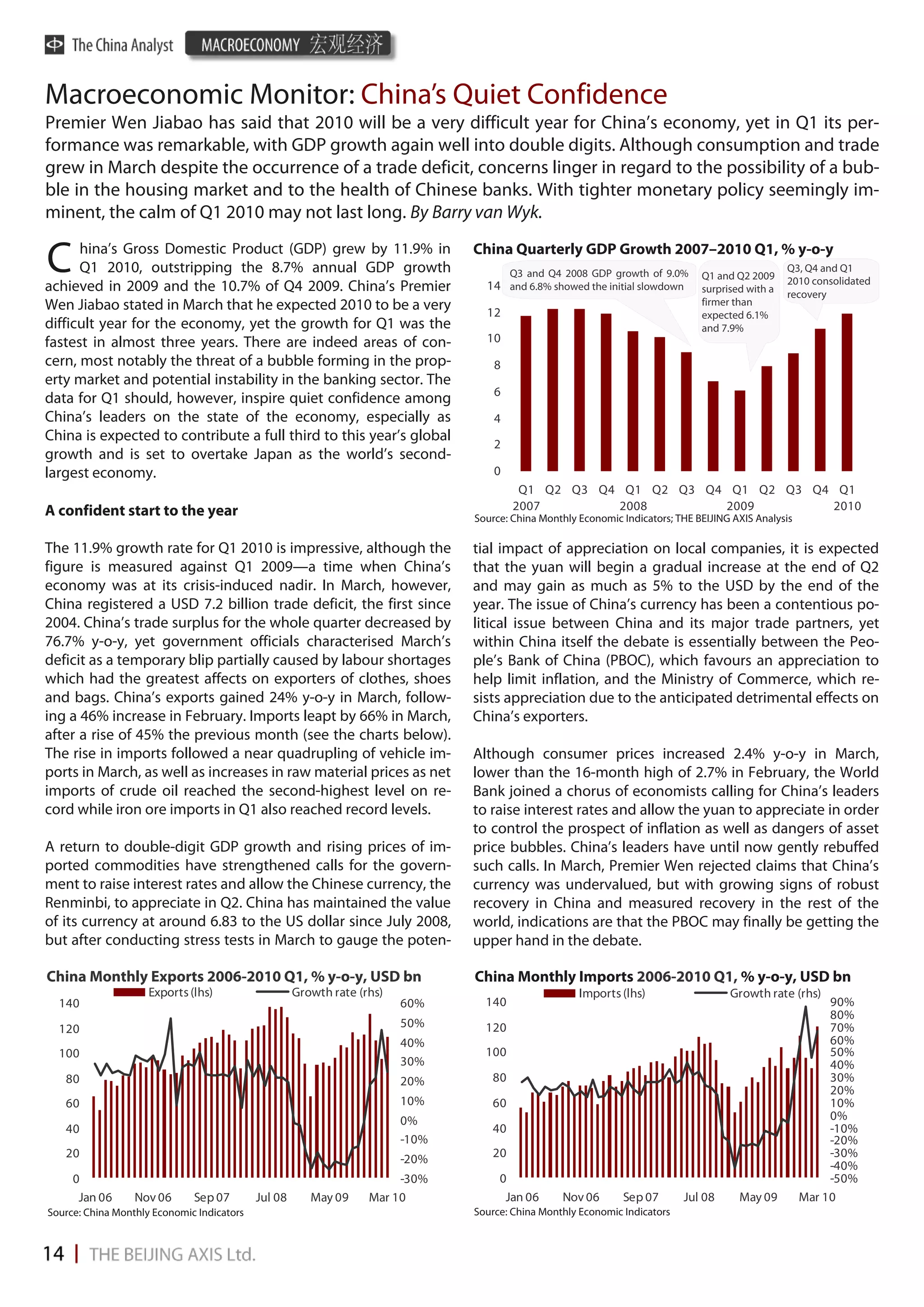
C     hina’s Gross Domestic Product (GDP) grew by 11.9% in
      Q1 2010, outstripping the 8.7% annual GDP growth
achieved in 2009 and the 10.7% of Q4 2009. China’s Premier
                                                                                China Quarterly GDP Growth 2007–2010 Q1, % y-o-y
                                                                                        Q3 and Q4 2008 GDP growth of 9.0%
                                                                                  14 and 6.8% showed the initial slowdown
                                                                                                                                Q1 and Q2 2009
                                                                                                                                surprised with a
                                                                                                                                                   Q3, Q4 and Q1
                                                                                                                                                   2010 consolidated
                                                                                                                                                   recovery
Wen Jiabao stated in March that he expected 2010 to be a very                                                                   firmer than
                                                                                  12                                            expected 6.1%
difficult year for the economy, yet the growth for Q1 was the                                                                   and 7.9%
fastest in almost three years. There are indeed areas of con-                     10
cern, most notably the threat of a bubble forming in the prop-                      8
erty market and potential instability in the banking sector. The
                                                                                    6
data for Q1 should, however, inspire quiet confidence among
China’s leaders on the state of the economy, especially as                          4
China is expected to contribute a full third to this year’s global
                                                                                    2
growth and is set to overtake Japan as the world’s second-
largest economy.                                                                    0
                                                                                         Q1 Q2 Q3 Q4 Q1 Q2 Q3 Q4 Q1 Q2 Q3 Q4 Q1
A confident start to the year                                                           2007        2008        2009        2010
                                                                                Source: China Monthly Economic Indicators; THE BEIJING AXIS Analysis

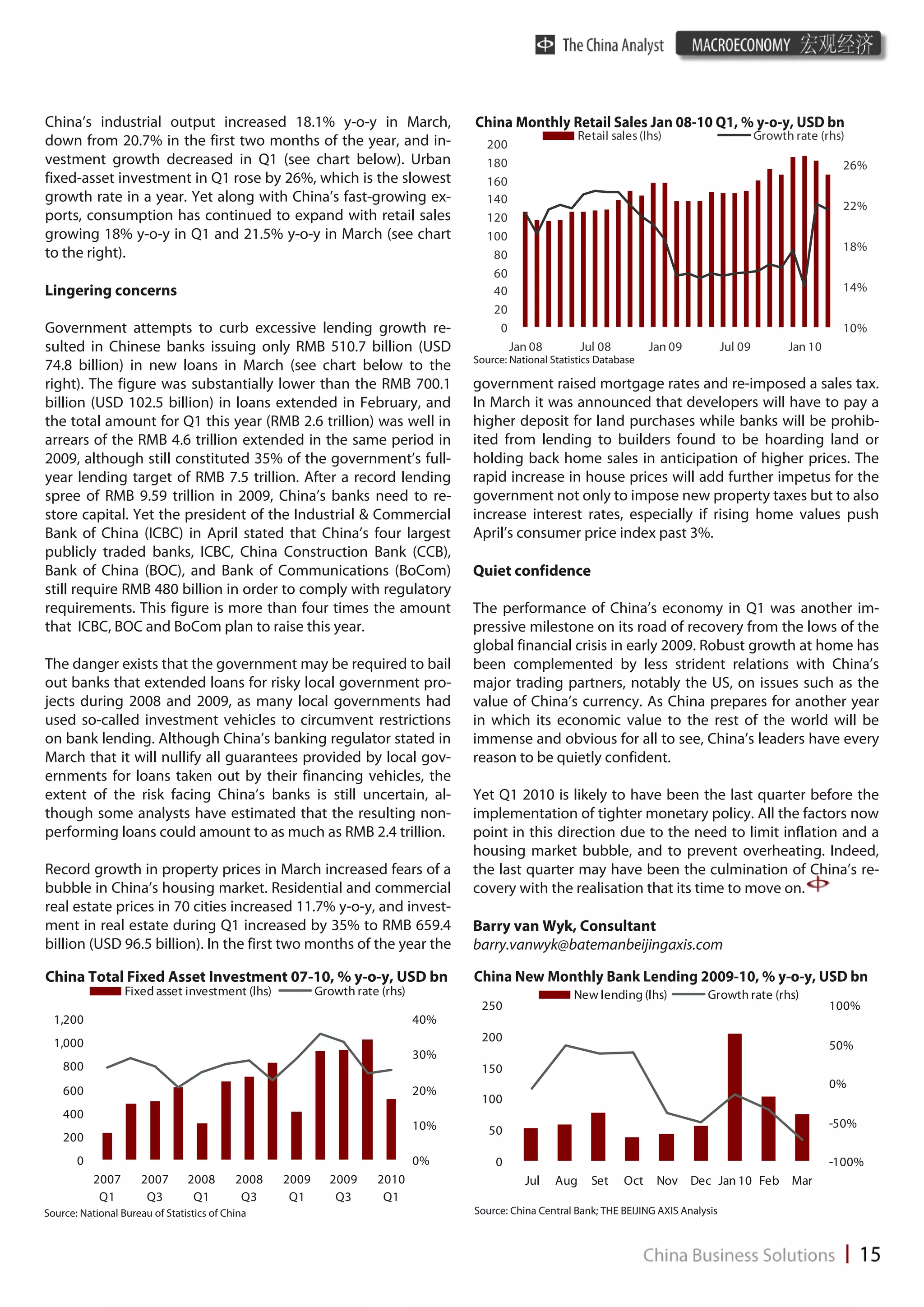
The 11.9% growth rate for Q1 2010 is impressive, although the                   tial impact of appreciation on local companies, it is expected
figure is measured against Q1 2009—a time when China’s                          that the yuan will begin a gradual increase at the end of Q2
economy was at its crisis-induced nadir. In March, however,                     and may gain as much as 5% to the USD by the end of the
China registered a USD 7.2 billion trade deficit, the first since               year. The issue of China’s currency has been a contentious po-
2004. China’s trade surplus for the whole quarter decreased by                  litical issue between China and its major trade partners, yet
76.7% y-o-y, yet government officials characterised March’s                     within China itself the debate is essentially between the Peo-
deficit as a temporary blip partially caused by labour shortages                ple’s Bank of China (PBOC), which favours an appreciation to
which had the greatest affects on exporters of clothes, shoes                   help limit inflation, and the Ministry of Commerce, which re-
and bags. China’s exports gained 24% y-o-y in March, follow-                    sists appreciation due to the anticipated detrimental effects on
ing a 46% increase in February. Imports leapt by 66% in March,                  China’s exporters.
after a rise of 45% the previous month (see the charts below).
The rise in imports followed a near quadrupling of vehicle im-                  Although consumer prices increased 2.4% y-o-y in March,
ports in March, as well as increases in raw material prices as net              lower than the 16-month high of 2.7% in February, the World
imports of crude oil reached the second-highest level on re-                    Bank joined a chorus of economists calling for China’s leaders
cord while iron ore imports in Q1 also reached record levels.                   to raise interest rates and allow the yuan to appreciate in order
                                                                                to control the prospect of inflation as well as dangers of asset
A return to double-digit GDP growth and rising prices of im-                    price bubbles. China’s leaders have until now gently rebuffed
ported commodities have strengthened calls for the govern-                      such calls. In March, Premier Wen rejected claims that China’s
ment to raise interest rates and allow the Chinese currency, the                currency was undervalued, but with growing signs of robust
Renminbi, to appreciate in Q2. China has maintained the value                   recovery in China and measured recovery in the rest of the
of its currency at around 6.83 to the US dollar since July 2008,                world, indications are that the PBOC may finally be getting the
but after conducting stress tests in March to gauge the poten-                  upper hand in the debate.

China Monthly Exports 2006-2010 Q1, % y-o-y, USD bn                             China Monthly Imports 2006-2010 Q1, % y-o-y, USD bn
                     Exports (lhs)                   Growth rate (rhs)                                Imports (lhs)                   Growth rate (rhs)
  140                                                                    60%      140                                                                       90%
                                                                                                                                                            80%
  120                                                                    50%      120                                                                       70%
                                                                         40%                                                                                60%
  100                                                                             100                                                                       50%
                                                                         30%                                                                                40%
   80                                                                    20%       80                                                                       30%
                                                                                                                                                            20%
   60                                                                    10%       60                                                                       10%
                                                                         0%                                                                                 0%
   40                                                                              40                                                                       -10%
                                                                         -10%                                                                               -20%
   20                                                                    -20%      20                                                                       -30%
                                                                                                                                                            -40%
     0                                                                  -30%         0                                                                      -50%
      Jan 06      Nov 06      Sep 07        Jul 08      May 09     Mar 10             Jan 06      Nov 06       Sep 07       Jul 08      May 09         Mar 10
Source: China Monthly Economic Indicators                                       Source: China Monthly Economic Indicators
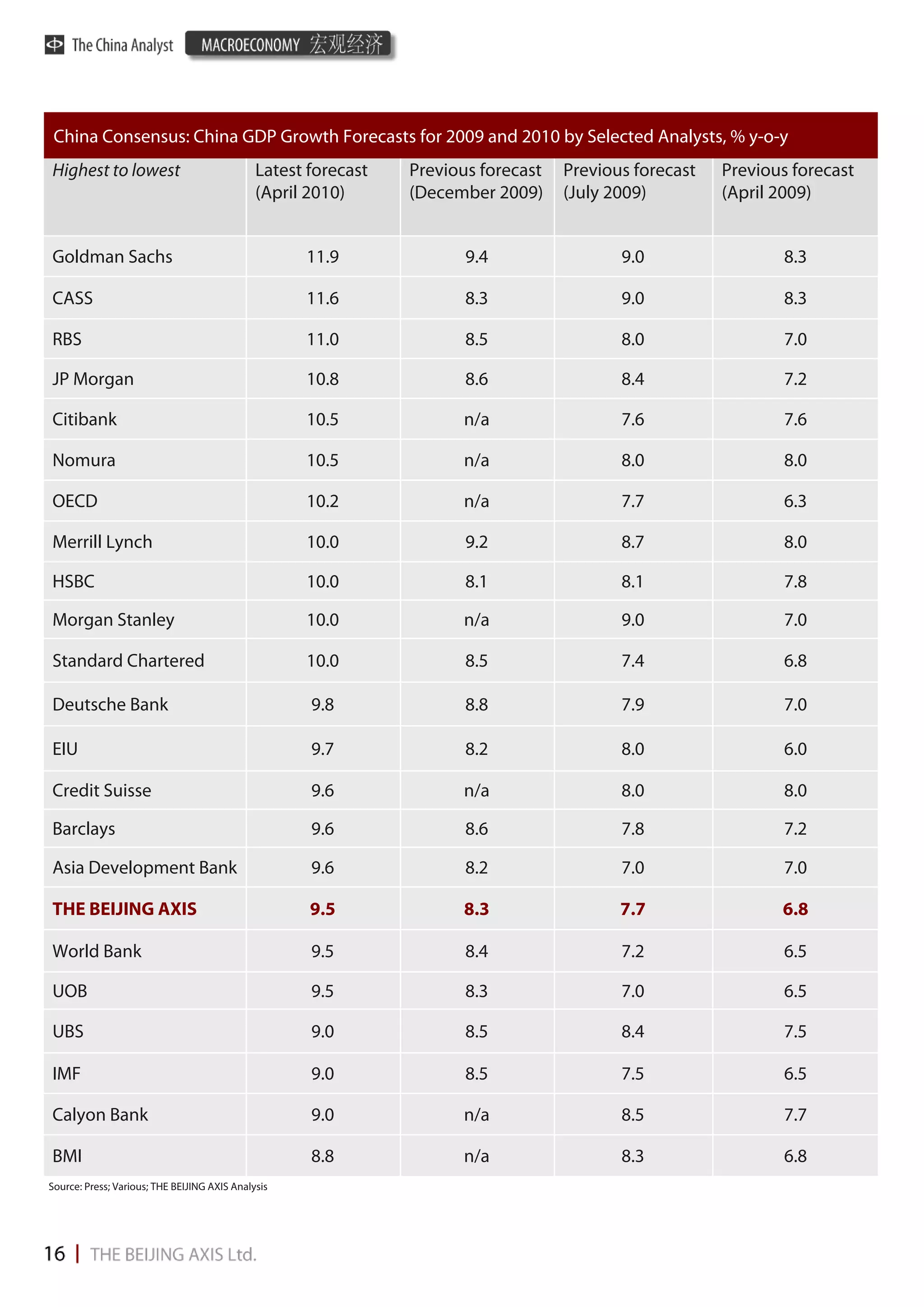
China’s industrial output increased 18.1% y-o-y in March,                          China Monthly Retail Sales Jan 08-10 Q1, % y-o-y, USD bn
down from 20.7% in the first two months of the year, and in-                                               Retail sales (lhs)                       Growth rate (rhs)
                                                                                     200
vestment growth decreased in Q1 (see chart below). Urban                             180                                                                             26%
fixed-asset investment in Q1 rose by 26%, which is the slowest                       160
growth rate in a year. Yet along with China’s fast-growing ex-                       140
                                                                                                                                                                     22%
ports, consumption has continued to expand with retail sales                         120
growing 18% y-o-y in Q1 and 21.5% y-o-y in March (see chart                          100
                                                                                                                                                                     18%
to the right).                                                                        80
                                                                                      60
Lingering concerns                                                                    40                                                                             14%
                                                                                      20
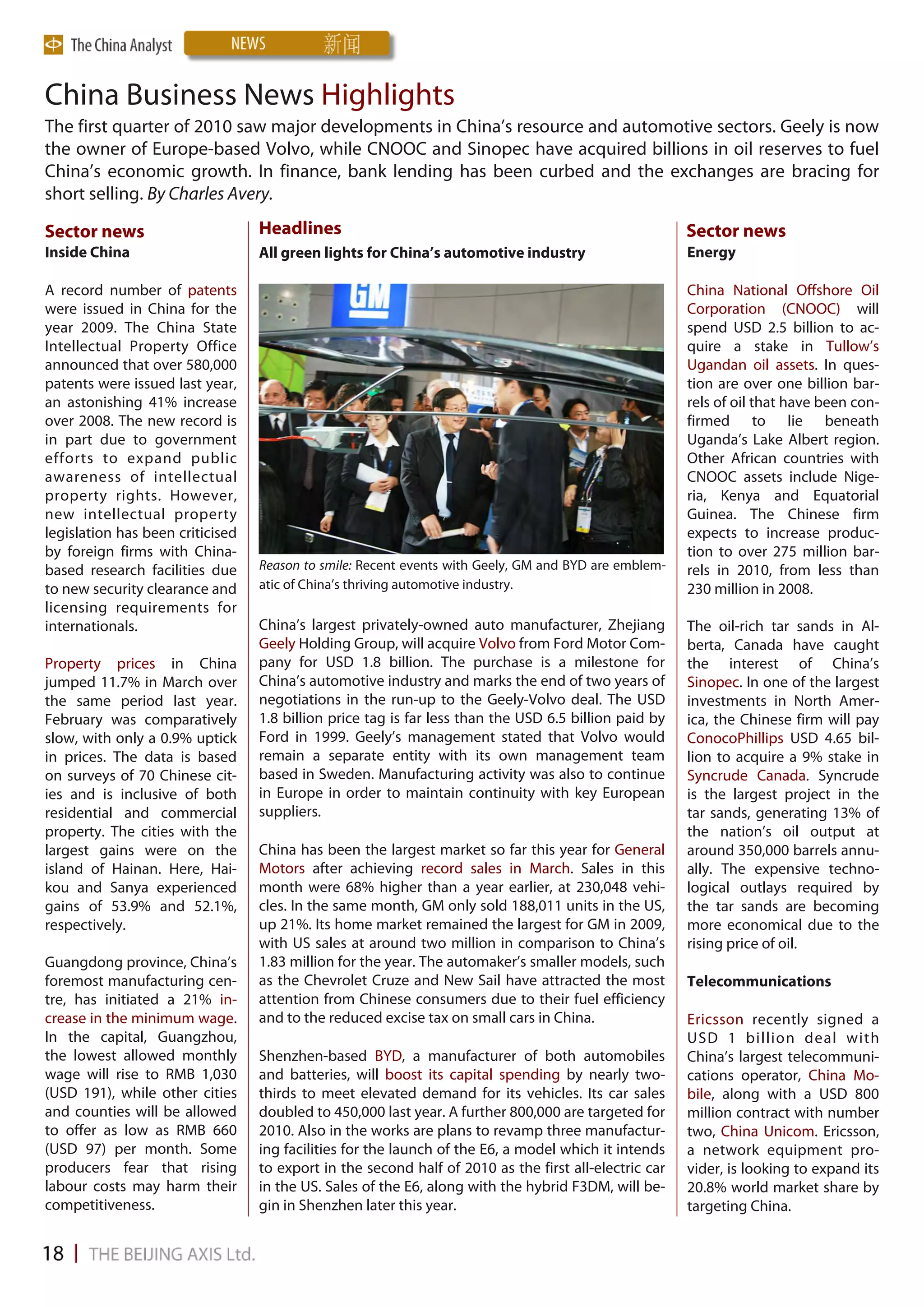
Government attempts to curb excessive lending growth re-                               0                                                                             10%
sulted in Chinese banks issuing only RMB 510.7 billion (USD                                Jan 08          Jul 08         Jan 09           Jul 09         Jan 10
                                                                                   Source: National Statistics Database
74.8 billion) in new loans in March (see chart below to the
right). The figure was substantially lower than the RMB 700.1                      government raised mortgage rates and re-imposed a sales tax.
billion (USD 102.5 billion) in loans extended in February, and                     In March it was announced that developers will have to pay a
the total amount for Q1 this year (RMB 2.6 trillion) was well in                   higher deposit for land purchases while banks will be prohib-
arrears of the RMB 4.6 trillion extended in the same period in                     ited from lending to builders found to be hoarding land or
2009, although still constituted 35% of the government’s full-                     holding back home sales in anticipation of higher prices. The
year lending target of RMB 7.5 trillion. After a record lending                    rapid increase in house prices will add further impetus for the
spree of RMB 9.59 trillion in 2009, China’s banks need to re-                      government not only to impose new property taxes but to also
store capital. Yet the president of the Industrial & Commercial                    increase interest rates, especially if rising home values push
Bank of China (ICBC) in April stated that China’s four largest                     April’s consumer price index past 3%.
publicly traded banks, ICBC, China Construction Bank (CCB),
Bank of China (BOC), and Bank of Communications (BoCom)                            Quiet confidence
still require RMB 480 billion in order to comply with regulatory
requirements. This figure is more than four times the amount                       The performance of China’s economy in Q1 was another im-
that ICBC, BOC and BoCom plan to raise this year.                                  pressive milestone on its road of recovery from the lows of the
                                                                                   global financial crisis in early 2009. Robust growth at home has
The danger exists that the government may be required to bail                      been complemented by less strident relations with China’s
out banks that extended loans for risky local government pro-                      major trading partners, notably the US, on issues such as the
jects during 2008 and 2009, as many local governments had                          value of China’s currency. As China prepares for another year
used so-called investment vehicles to circumvent restrictions                      in which its economic value to the rest of the world will be
on bank lending. Although China’s banking regulator stated in                      immense and obvious for all to see, China’s leaders have every
March that it will nullify all guarantees provided by local gov-                   reason to be quietly confident.
ernments for loans taken out by their financing vehicles, the
extent of the risk facing China’s banks is still uncertain, al-                    Yet Q1 2010 is likely to have been the last quarter before the
though some analysts have estimated that the resulting non-                        implementation of tighter monetary policy. All the factors now
performing loans could amount to as much as RMB 2.4 trillion.                      point in this direction due to the need to limit inflation and a
                                                                                   housing market bubble, and to prevent overheating. Indeed,
Record growth in property prices in March increased fears of a                     the last quarter may have been the culmination of China’s re-
bubble in China’s housing market. Residential and commercial                       covery with the realisation that its time to move on.
real estate prices in 70 cities increased 11.7% y-o-y, and invest-
ment in real estate during Q1 increased by 35% to RMB 659.4                        Barry van Wyk, Consultant
billion (USD 96.5 billion). In the first two months of the year the                barry.vanwyk@batemanbeijingaxis.com

China Total Fixed Asset Investment 07-10, % y-o-y, USD bn                          China New Monthly Bank Lending 2009-10, % y-o-y, USD bn
                  Fixed asset investment (lhs)           Growth rate (rhs)                               New lending (lhs)           Growth rate (rhs)
                                                                                    250                                                                            100%
  1,200                                                                      40%
  1,000                                                                             200
                                                                                                                                                                   50%
                                                                             30%
    800                                                                             150
                                                                                                                                                                   0%
    600                                                                      20%
                                                                                    100
    400
                                                                             10%                                                                                   -50%
                                                                                      50
    200
       0                                                                     0%        0                                                                           -100%
           2007       2007      2008       2008   2009     2009     2010                      Jul    Aug     Set    Oct    Nov Dec Jan 10 Feb Mar
            Q1         Q3        Q1         Q3     Q1       Q3       Q1
Source: National Bureau of Statistics of China                                     Source: China Central Bank; THE BEIJING AXIS Analysis
China Consensus: China GDP Growth Forecasts for 2009 and 2010 by Selected Analysts, % y-o-y
Highest to lowest                             Latest forecast   Previous forecast   Previous forecast   Previous forecast
                                              (April 2010)      (December 2009)     (July 2009)         (April 2009)


Goldman Sachs                                       11.9               9.4                 9.0                 8.3

CASS                                                11.6               8.3                 9.0                 8.3

RBS                                                 11.0               8.5                 8.0                 7.0

JP Morgan                                           10.8               8.6                 8.4                 7.2

Citibank                                            10.5              n/a                  7.6                 7.6

Nomura                                              10.5              n/a                  8.0                 8.0

OECD                                                10.2              n/a                  7.7                 6.3

Merrill Lynch                                       10.0               9.2                 8.7                 8.0

HSBC                                                10.0               8.1                 8.1                 7.8

Morgan Stanley                                      10.0              n/a                  9.0                 7.0

Standard Chartered                                  10.0               8.5                 7.4                 6.8

Deutsche Bank                                        9.8               8.8                 7.9                 7.0

EIU                                                  9.7               8.2                 8.0                 6.0

Credit Suisse                                        9.6              n/a                  8.0                 8.0

Barclays                                             9.6               8.6                 7.8                 7.2

Asia Development Bank                                9.6               8.2                 7.0                 7.0

THE BEIJING AXIS                                     9.5              8.3                  7.7                 6.8

World Bank                                           9.5               8.4                 7.2                 6.5

UOB                                                  9.5               8.3                 7.0                 6.5

UBS                                                  9.0               8.5                 8.4                 7.5

IMF                                                  9.0               8.5                 7.5                 6.5

Calyon Bank                                          9.0              n/a                  8.5                 7.7

BMI                                                  8.8              n/a                  8.3                 6.8
Source: Press; Various; THE BEIJING AXIS Analysis
China Business News Highlights
The first quarter of 2010 saw major developments in China’s resource and automotive sectors. Geely is now
the owner of Europe-based Volvo, while CNOOC and Sinopec have acquired billions in oil reserves to fuel
China’s economic growth. In finance, bank lending has been curbed and the exchanges are bracing for
short selling. By Charles Avery.

Sector news                       Headlines                                                            Sector news
Inside China                      All green lights for China’s automotive industry                     Energy

A record number of patents                                                                             China National Offshore Oil
were issued in China for the                                                                           Corporation (CNOOC) will
year 2009. The China State                                                                             spend USD 2.5 billion to ac-
Intellectual Property Office                                                                           quire a stake in Tullow’s
announced that over 580,000                                                                            Ugandan oil assets. In ques-
patents were issued last year,                                                                         tion are over one billion bar-
an astonishing 41% increase                                                                            rels of oil that have been con-
over 2008. The new record is                                                                           firmed to lie beneath
in part due to government                                                                              Uganda’s Lake Albert region.
efforts to expand public                                                                               Other African countries with
awareness of intellectual                                                                              CNOOC assets include Nige-
property rights. However,                                                                              ria, Kenya and Equatorial
new intellectual property                                                                              Guinea. The Chinese firm
legislation has been criticised                                                                        expects to increase produc-
by foreign firms with China-                                                                           tion to over 275 million bar-
based research facilities due     Reason to smile: Recent events with Geely, GM and BYD are emblem-    rels in 2010, from less than
to new security clearance and     atic of China’s thriving automotive industry.                        230 million in 2008.
licensing requirements for
internationals.                   China’s largest privately-owned auto manufacturer, Zhejiang          The oil-rich tar sands in Al-
                                  Geely Holding Group, will acquire Volvo from Ford Motor Com-         berta, Canada have caught
Property prices in China          pany for USD 1.8 billion. The purchase is a milestone for            the interest of China’s
jumped 11.7% in March over        China’s automotive industry and marks the end of two years of        Sinopec. In one of the largest
the same period last year.        negotiations in the run-up to the Geely-Volvo deal. The USD          investments in North Amer-
February was comparatively        1.8 billion price tag is far less than the USD 6.5 billion paid by   ica, the Chinese firm will pay
slow, with only a 0.9% uptick     Ford in 1999. Geely’s management stated that Volvo would             ConocoPhillips USD 4.65 bil-
in prices. The data is based      remain a separate entity with its own management team                lion to acquire a 9% stake in
on surveys of 70 Chinese cit-     based in Sweden. Manufacturing activity was also to continue         Syncrude Canada. Syncrude
ies and is inclusive of both      in Europe in order to maintain continuity with key European          is the largest project in the
residential and commercial        suppliers.                                                           tar sands, generating 13% of
property. The cities with the                                                                          the nation’s oil output at
largest gains were on the         China has been the largest market so far this year for General       around 350,000 barrels annu-
island of Hainan. Here, Hai-      Motors after achieving record sales in March. Sales in this          ally. The expensive techno-
kou and Sanya experienced         month were 68% higher than a year earlier, at 230,048 vehi-          logical outlays required by
gains of 53.9% and 52.1%,         cles. In the same month, GM only sold 188,011 units in the US,       the tar sands are becoming
respectively.                     up 21%. Its home market remained the largest for GM in 2009,         more economical due to the
                                  with US sales at around two million in comparison to China’s         rising price of oil.
Guangdong province, China’s       1.83 million for the year. The automaker’s smaller models, such
foremost manufacturing cen-       as the Chevrolet Cruze and New Sail have attracted the most          Telecommunications
tre, has initiated a 21% in-      attention from Chinese consumers due to their fuel efficiency
crease in the minimum wage.       and to the reduced excise tax on small cars in China.                Ericsson recently signed a
In the capital, Guangzhou,                                                                             USD 1 billion deal with
the lowest allowed monthly        Shenzhen-based BYD, a manufacturer of both automobiles               China’s largest telecommuni-
wage will rise to RMB 1,030       and batteries, will boost its capital spending by nearly two-        cations operator, China Mo-
(USD 191), while other cities     thirds to meet elevated demand for its vehicles. Its car sales       bile, along with a USD 800
and counties will be allowed      doubled to 450,000 last year. A further 800,000 are targeted for     million contract with number
to offer as low as RMB 660        2010. Also in the works are plans to revamp three manufactur-        two, China Unicom. Ericsson,
(USD 97) per month. Some          ing facilities for the launch of the E6, a model which it intends    a network equipment pro-
producers fear that rising        to export in the second half of 2010 as the first all-electric car   vider, is looking to expand its
labour costs may harm their       in the US. Sales of the E6, along with the hybrid F3DM, will be-     20.8% world market share by
competitiveness.                  gin in Shenzhen later this year.                                     targeting China.
Mining                             An eventful quarter for Rio Tinto in China                              Finance

The East China Mineral Explo-                                                                              A trial period commenced in
ration and Development Bu-                                                                                 late March of this year to al-
reau (ECE) signed a prelimi-                                                                               low short selling and margin
nary agreement in March to                                                                                 trades on the exchanges of
acquire Itaminas of Brazil. For                                                                            Shanghai and Shenzhen. This
around USD 1.2 billion, ECE                                                                                move has been considered a
will gain access to the 1.3                                                                                prelude to the announce-
billion tons of iron ore held as                                                                           ment of the initiation of trad-
reserves at the Brazilian firm’s                                                                           ing in stock-index futures, set
Sarzedo mine. Three million                                                                                to begin in mid-April. These
metric tons of iron ore con-                                                                               risky, alternative investments
centrate are produced annu-                                                                                are being introduced to add
ally by the mine, although                                                                                 a level of depth to China’s
after investment, it is ex-                                                                                relatively young stock mar-
                                   En route to Guinea: Chinalco’s new stake with Rio Tinto in the Siman-
pected that this output can                                                                                kets.
                                   dou mines will help meet China’s insatiable demand for iron ore.
be increased to around ten
million. Due diligence is to be    Anglo-Australian miner Rio Tinto and Chinalco, a Chinese met-           In an attempt to stem infla-
performed before finalisation      als conglomerate, signed a deal in March worth USD 1.35 bil-            tion, China’s regulators are
of the deal can be com-            lion. As compensation for its funding, Chinalco will receive a          tightening monetary policy.
pleted.                            47% stake in the Simandou mines located in the west African             Commercial banks’ reserve
                                   state of Guinea, known as one of the world’s largest sources of         requirements were increased
China’s 40-year-old pricing        high-grade iron ore. Given its annual production capacity of            by 0.5% to 16% in January.
system for iron ore—typified       200 million tonnes, the mineral site has the opportunity to rival       Authorities are expected to
by annual prices and ex-           the world class mines of Western Australia and Brazil. To bring         target an 18% increase in
tended negotiations—has            Simandou up to speed, the Chinese firm will direct investment           loans for this year, down from
been scrapped in favour of         toward the mine as well as the processing plant, railway and            a surge of over 30% in 2009.
contracts linked to the spot       port facilities. China accounted for about a quarter of Rio             In response, China Construc-
market. Coinciding with this       Tinto’s 2009 revenues, and Chinalco owns 9% of the Rio Tinto            tion Bank, China’s second
is the decision of China’s gov-    equity.                                                                 largest, has decreased its
ernment to prohibit the im-                                                                                loan quota by 20% y-o-y, to
port of low grade iron ore. As     Less than two weeks after the announcement of the Chinalco              RMB 750 billion (USD 110
of April this year, all incoming   deal, however, four Rio Tinto employees were sentenced to               billion) for 2010.
ore must have iron content         prison for accepting bribes after originally being charged with
above 60%. Although this will      espionage. The primary defendant, an Australian national                CITIC, a Chinese industrial
have worldwide implications        named Stern Hu who managed Rio Tinto’s China sales, will be             and financial conglomerate,
for the industry, as China’s       imprisoned for ten years after being found guilty of accepting          has accumulated a RMB 9
imports account for 70% of         nearly USD 1 million in bribes. The three other accused Rio             billion (USD 1.32 billion) in-
all maritime iron ore trade, it    Tinto employees received between seven to 14 year sentences.            vestment fund, of which an
will effect India’s low-grade      Rio Tinto, who originally insisted on their employees’ inno-            anticipated two-thirds will be
producers most.                    cence after an investigation, eventually dismissed the four just        directed toward the rejuve-
                                   before the verdict was rendered stating clear evidence of their         nation of state-owned enter-
A new Indonesian coal rail-        guilt.                                                                  prises. Already targeted as
way valued at USD 4.8 billion                                                                              recipients of investment are
has been assigned to China         Greater voting power at the World Bank for China                        Kuaijishan, a Chinese brand
Railway Group. The contract                                                                                of liquor, and the data service
with Indonesia’s Bukit Asam        China has been given greater authority in international affairs         provider Wind Info.
Transpacific Railway Corpora-      after the World Bank increased its voting share to 4.42%, be-
tion includes design, con-         hind only the US and Japan. Previously, China held 2.77% of the         The world’s largest bank by
struction and management           voting rights. Japan’s influence at the World Bank is now just          market capitalisation, Indus-
responsibilities over a time       beyond that of China, at 6.84%, while the US retains the most           trial and Commercial Bank of
period of 24 years. The 307        power at 15.85%. Coinciding with this decision was the upward           China (ICBC), will issue USD
kilometre transport line will      movement in the aggregate voting power of developing coun-              3.7 billion in convertible
stretch across South Sumatra.      tries to just over 47% of total World Bank votes. Decisions is-         bonds, as well as issue new
Indonesia is the world’s larg-     sued by the bank require an 85% approval rate for passage. The          stock on the exchanges of
est exporter of thermal coal,      shift in the international organisation’s power structure is sym-       Hong Kong and Shanghai.
with 15% of its 2009 exports       bolic of the movement in economic might away from the tradi-            2009 lending activity strained
shipped to China.                  tionally developed world.                                               the bank’s balance sheet.
China Facts & Figures
China Facts & Figures is a cross-section of medium- to long-term data illustrating growth, transformations
and trends in select Chinese economic indicators. In this edition we also analyse China’s growth composi-
tion for 2009 and investigate the geographic and sectoral distribution of urban employment in China dur-
ing the first three quarters of 2009. By William Dey-Chao.

China Selected Economic Indicators
General statistics                                                             2005       2006      2007       2008       2009      Trend
Population (mn)                                                                1,308     1,314      1,321      1,330      1,334
Nominal GDP (USD bn)                                                           2,244     2,645      3,242      4,522      4,917
GDP per capita (USD)                                                           1,716     2,012      2,454      3,400      3,566
Real GDP growth (%)                                                            10.4       11.1        13        9.6        8.7
Prices and exchange rates
CPI inflation (%, December over December)                                       1.6        2.8       6.5        1.2        1.9
PPI inflation (%, December over December)                                       3.2        3.1       2.0        -1.1       1.7
Exchange rate (RMB per USD, average)                                           8.19       7.97       7.61       6.9       6.82
Fiscal data
General government fiscal balance (% of GDP)                                   -1.2       -0.8       -0.6       -0.4       -2.8
General government expenditure (% of GDP)                                      18.5       19.2       19.9      20.8       23.4
General government revenue (% of GDP)                                          17.3       18.3       19.9      20.4       20.6
Money supply and credit
Broad money supply (M2, % of GDP)                                              160.7     163.9      163.6       158       180.7
Broad money supply (M2, % year-on-year change)                                 17.6       16.9       16.7      17.8       27.7
Balance of payments
Exports (total value, % of GDP)                                                37.3       40.1        41       32.1       24.44
Imports (total value, % of GDP)                                                31.7       32.2       32.2      25.5       20.45
Exports (goods and non-factor services, % increase in USD value)               27.6       26.9       25.2      17.3       -16.0
Imports (goods and non-factor services, % increase in USD value)               17.4       19.8       22.2      19.4       -11.2
Current account balance (USD bn)                                               160.8     249.9       372        440        372
Current account (% of GDP)                                                      7.2        9.4        11       10.1        7.8
FDI (USD bn)                                                                   72.4       72.7       83.5      92.3       90.03
External debt outstanding (USD bn)                                             283.8      325       373.6       420       386.8
Central bank gross FX reserves (USD bn)                                        819        1066      1528       1980       2399
Source: China Monthly Indicators; IMF; World Bank; THE BEIJING AXIS Analysis


World GDP Growth, % y-o-y, 2000-2010F
           China                                                               Composition of China’s Q1 2010 GDP growth
 15        Emerging and developing economies
 14        World                                                               In Q1 2010, China’s GDP grew at a rate of 11.9%, the fastest
 13        Advanced economies                                                  since 2007. Investment remained the major driver of the
 12
 11                                                                            economy, contributing 57.9%, while final consumption also
 10
  9                                                                            still played an important role, contributing 52%. The contri-
  8
  7                                                                            bution of net exports still remained negative at -9.9%. Yet a
  6                                                                            shift in the composition of growth can be observed due to a
  5
  4                                                                            gradual recovery in exports, favourable labour market condi-
  3
  2                                                                            tions, continued fiscal support for households supporting
  1
  0                                                                            final consumption, and a gradual deceleration in gross capi-
 -1
 -2                                                                            tal formation. This deceleration is occurring as government-
 -3                                                                            led investments are wound down while fiscal and monetary
 -4
 -5                                                                            policy is tightened in order to avoid overheating, inflation
       2000 2001 2002 2003 2004 2005 2006 2007 2008 2009 2010F                 and asset price bubbles.
Source: IMF; National Bureau of Statistics; THE BEIJING AXIS Analysis
Employed Persons in Urban Units* by Province Q3 2009

                                                                                                                        Employed Persons in Urban Areas (1,000 Persons)
                                                                                                                                                                          Growth
                                                                                                                            Region          Q3 2008         Q3 2009
                                                                                                                                                                          rate (%)
                                                                                                     Heilongjiang      China total         120,777          121,989         1.00
                                                                                                                       Eastern area         59,416           60,392         1.64
                                                                                  Beijing               Jilin          Central area         33,953           33,907         -0.14
                   Xinjiang
                                                                                               Liaoning                Western area         27,407           27,689         1.03
                                           Gansu          Inner Mongolia
                                                                                                                        Employed Persons in Urban Areas by Sector
                                                                                  Hebei   Tianjin                       Q3 2009
                                                  Ningxia
                                   Qinghai                                          Shandong
                                                                         Shanxi
                                                                                                                                               Urban collectively-owned 5%
                                                              Shaanxi      Henan
                     Tibet                                                              Jiangsu
                                                  Sichuan
                                                                         Hubei       Anhui            Shanghai
                                                Chongqing
                                                                                  Jiangxi            Zhejiang                                                 Others 42%
                                                                      Hunan
                                                          Guizhou                     Fujian
                                              Yunnan
                                              Guang-                                                 Taiwan
                                                             Guangxi                                                     State-owned 53%
                                                                               Guangdong
       Top 5 provinces: employed persons
       Top 5 provinces: employed persons growth                         Hainan
                        Employed Persons in           Employed Persons in                                  What is the current employment situation in
                                                                                      y-o-y Growth
 Region                  Urban Units (1,000            Urban Units (1,000                                  China?
                                                                                        Rate (%)
                         persons) Q3 2008              persons) Q3 2009
 Anhui                            3,427                         3,435                        0.23          China’s economy expanded at an impressive rate in
 Beijing                          5,642                         5,704                        1.11          2009 largely due to the massive economic stimulus
 Chongqing                        2,318                         2,414                        4.13          package implemented by the government. Yet as is
 Fujian                           4,589                         4,581                        -0.17         the case with the US, Japan and Europe, rising unem-
 Gansu                            1,925                         1,931                        0.30          ployment is a major concern in China. In 2009 China’s
 Guangdong                       10,073                         10,070                       -0.04         unemployment rate increased by 0.1% to 4.3%. This
 Guangxi                          2,856                         2,932                        2.65          increase can mostly be attributed to large job shed-
 Guizhou                          2,154                         2,106                        -2.23         ding that occurred in export-oriented manufacturing
 Hainan                            753                           754                         0.08          firms at the beginning of the year.
 Hebei                            4,959                         4,988                        0.60
 Heilongjiang                     5,073                         4,766                        -6.04         At the end of 2009, the total number of employed
 Henan                            7,090                         7,171                        1.14          people in China reached 779.95 million, 5.15 million
 Hubei                            4,727                         4,732                        0.12          more than in 2008. Urban employment accounted for
 Hunan                            4,354                         4,548                        4.45          40% of total employment with a total of 311.20 mil-
 Inner Mongolia                   2,477                         2,476                        -0.05         lion people, a net increase of 9.10 million from 2008.
 Jiangsu                          7,087                         7,075                        -0.17         By the end of Q3, the coastal regions had the highest
 Jiangxi                          2,879                         2,899                        0.70          number of urban employment. Yet provinces in west-
 Jilin                            2,624                         2,621                        -0.11         ern China were growing the fastest in terms of urban
 Liaoning                         4,978                         5,086                        2.16          employment during this period.
 Ningxia                           625                           623                         -0.24
 Qinghai                           455                           482                         5.93          China aims to keep the urban unemployment rate
 Shaanxi                          3,408                         3,448                        1.17          below 4.6% in 2010 and create over 9 million new
 Shandong                         9,140                         9,095                        -0.49         jobs in urban areas. During the first three months of
 Shanghai                         3,654                         3,703                        1.34          2010, the labour market has shown some improve-
 Shanxi                           3,776                         3,731                        -1.21         ment as demand for migrant labourers in coastal re-
 Sichuan                          5,291                         5,477                        3.51          gions started to increase.
 Tianjin                          2,003                         1,998                        -0.25
 Tibet                             195                            201                         3.10
 Xinjiang                         2,758                          2,578                       -6.50         * Note: Employed persons in urban units refers to all persons working in
                                                                                                           government agencies at various levels, political and party organisations,
 Yunnan                           2,938                          3,014                        2.58         social organisations, enterprises and institutions, and who are receiving
 Zhejiang                         6,531                          7,332                       12.26         wages or other forms of payment.
Source: China Monthly Indicators; National Bureau of Statistics; THE BEIJING AXIS Analysis
China Trade Roundup
China Trade Roundup illustrates recent trends in China’s trade performance and the outlook going forward
with a summary of the latest trade data. In this edition, we also examine China’s recent rebound in trade
and analyse the contribution of different countries and regions of the world to China’s total trade. By Wil-
liam Dey-Chao.
China Total Trade Jan 2009-Mar 2010, USD bn                                                   China’s trade performance and outlook
                     Exports                       Imports China’s first monthly              China’s exports rebounded strongly towards the end of 2009,
                                                           trade deficit in six years
                                                                                              and in Q1 2010 monthly y-o-y growth rates exceeded pre‐crisis
 120                                                                                          levels as the gradual recovery of the global economy helped
 100                                                                                          sustain the rebound in Chinese exports. During Q1 2010,
                                                                                              China’s imports and exports collectively amounted to USD 617
   80
                                                                                              billion, an increase of 44% compared to the same period last
   60                                                                                         year. During Q1 2010, China’s trade surplus decreased to USD
                                                                                              14.5 billion, which represents a 77% reduction from the same
   40
                                                                                              period in 2009. Total exports for the period increased by 26%
   20                                                                                         compared to the same period last year, amounting to USD
      0                                                                                       316.1 billion, while imports increased by 64% y-o-y, amounting
          Jan Feb Mar Apr May Jun Jul Aug Sep Oct NovDec Jan FebMar                           to USD 183.4 billion.
           09                                            10
Source: National Bureau of Statistics; China Customs; THE BEIJING AXIS Analysis
                                                                                              In March 2010, China’s total trade increased by 30% from Feb-
                                                                                              ruary to reach USD 231.4 billion, while the figure for March
China Trade Monthly y-o-y Growth Rates 2008-Q1 2010, %                                        increased by 43% over the same month last year. In March
90                           Exports                  Imports                                 China also registered a monthly trade deficit of USD 7.2 billion,
80                                                                                            the first since April 2004. Chinese exports reached USD 112.1
70        2008                            2009                                    2010        billion in March, a 24.3% y-o-y increase, while imports in-
60                                                                                            creased by 66% y-o-y to USD 119.3 billion.
50
                                                                                              March’s trade deficit has been attributed mainly to fewer ex-
40
                                                                                              ports of labour-intensive products, surging import volumes
30                                                                                            and rising commodity prices. In addition, the March deficit
20                                                                                            illustrates that demand in China remains strong, driven in part
10                                                                                            by a flood of bank lending in 2009 and other government
  0
                    Nov Dec Jan Feb Mar Apr MayJun Jul AugSep Oct                             stimuli. As a result, prices for crude oil, iron ore and other raw
      Jul Aug Sep Oct                                           Nov Dec Jan Feb Mar           materials China imports have been rising. Western economies
-10
                                                                                              that are the leading export markets for Chinese goods, more-
-20                                                                                           over, are only expected to begin a substantial recovery later in
-30                                                                                           2010.
Source: National Bureau of Statistics; China Customs; THE BEIJING AXIS Analysis


Contribution to China’s Total Trade by Country/Region 2009, %
China total trade in 2009:                15%-10.01%           10%-5.01%          5%-2.51%           2.5%-0.51%    0.5%-0%
USD 2.207 trillion

                                                                        Europe
                                                                        (19.3%)
                                                                        Germany 4.7%
                                                                        Netherlands 1.8%
  North America*                                                        UK 1.7%
                                                                        Russia 1.7%
  (14.9%)
                                                                        France 1.5%
  US 13.5%                                                                                                                                    Asia
                                                                        Others 7.9%
  Canada 1.3%                                                                                                                                 (53.1%)
  Others 0.1%                                                                                                                                 Japan 10.7%
                                                                     Africa                                                                   Hong Kong 7.9%
                      Latin America                                  (4.1%)                                                                   South Korea 7.0%
                      (5.5%)                                         Angola 0.7%                                                              Taiwan 4.8%
                      Brazil 1.9%                                    South Africa 0.7%                                                        Malaysia 2.3%
                      Chile 0.8%                                     Nigeria 0.2%                                 Oceania*
                                                                                                                                              Others 20.4%
                      Mexico 0.7%                                    Western Sahara 0.2%                          (3.1%)
                      Argentina 0.3%                                 Egypt 0.2%                                   Australia 2.7%
                      Venezuela 0.3%                                 Others 2.1%                                  New Zealand 0.2%
                      Others 1.5%                                                                                 Others 0.2%
Source: All China Marketing Research; THE BEIJING AXIS Analysis. *Limited regional data available.
China Total Exports & Imports by Country/Region Q1 2009 vs. Q2 2010, USD bn
                                                                    Exports 2010                        Exports 2009                                                                                                                             Imports 2010               Imports 2009

EU
US                                                                                                                                                                                                                                                                             The only area with contraction in
Hong Kong                                                                                                                                                                                                                                                                      trade was imports from the US
ASEAN
Japan
S. Korea
India
Taiwan
Australia
Russia
Brazil
 70        65                       60                    55                     50          45         40              35      30       25           20                    15    10              5                     0                  5          10         15         20      25            30                  35           40
Source: China Customs; THE BEIJING AXIS Analysis


Recent export / import levels
During the end of 2009 and the beginning of 2010, global eco-                                                                                                                    from its major trading partners increased by an average of
nomic recovery boosted China’s exports to its leading trade                                                                                                                      60% y-o-y. Total imports from leading countries/regions in Q1
partners by an average of 40% y-o-y. Total exports to leading                                                                                                                    2010 amounted to USD 208.6 billion, which accounted for 69%
countries/regions in Q1 2010 amounted to USD 259.8 billion,                                                                                                                      of China’s total imports for the period. During Q1 2010, Japan
accounting for 82% of China’s total exports. The EU (USD 65.3                                                                                                                    (USD 37.9 bn) and the EU (USD 36.0 bn) were the top exporters
bn) and US (USD 54.4 bn) were still the largest importers of                                                                                                                     to China, respectively accounting for 13% and 12% of China’s
Chinese products, respectively accounting for 21% and 17% of                                                                                                                     total imports for the period. Russia (USD 6.7 bn) and Taiwan
China’s total exports. However, Brazil (USD 4.3 bn) and Taiwan                                                                                                                   (USD 25.4 bn) experienced the highest growth rates, at 94%
(USD 6.0 bn) displayed the highest growth rates during this                                                                                                                      and 77%, respectively, over the same period. The US (USD 11.8
period, respectively growing at 90% and 62%.                                                                                                                                     bn) was the only country among China’s major trading part-
                                                                                                                                                                                 ners which experienced a reduction in exports to China com-
During Q1 2010, the major Chinese exported commodities                                                                                                                           pared to the previous year.
grew by an average of 27% y-o-y. Electronic circuits (USD 6.6
bn) and computers (USD 34.0 bn) were the two commodities                                                                                                                         During Q1 2010, the growth rate of major Chinese imported
that displayed the highest growth rate for the period, growing                                                                                                                   commodities averaged 74% y-o-y. Motor vehicles (USD 6.8 bn)
54% and 43%, respectively. Mechanical and electrical products                                                                                                                    and crude oil (USD 31.3 bn) displayed the highest growth rate
(USD 189.1 bn) were China’s top exported products, account-                                                                                                                      for the period, respectively growing by 159% and 150%. Me-
ing for 45% of total exports for the period.                                                                                                                                     chanical and electrical products (USD 137.7 bn) were China’s
                                                                                                                                                                                 top imports, accounting for 30% of total imports for the pe-
Boosted by strong domestic demand, Chinese total imports                                                                                                                         riod.

Leading Chinese Exports Jan-Mar 2009-2010, USD bn                                                                                                                                Leading Chinese Imports Jan-Mar 2009-2010, USD bn
 200                                                                                                                                                                                        50%
              32%                                                                                                                                                                140
                                                                                                                          2009           2010                                                                                                                                        2009                           2010
 180
                                                                                                                          % change y-o-y                                         120                                                                                                 % change y-o-y
 160
 140                                                                                                                                                                             100                                51%
 120                                  39%                                                                                                                                         80
 100
  80                                                                                                                                                                              60
  60                                                                                                                                                                              40                                                      150%
                                                                                 43%
  40                                                      9%
                                                                                             27%                                                                                  20                                                                  42%        69%        10%     25%           118% 62%                         159%
  20                                                                                                    16%             14%      14%      21%         54%
   0                                                                                                                                                                               0
                                                                                                        Mobile phones
                                                                                 Computers

                                                                                             Textiles


                                                                                                                        Shoes


                                                                                                                                                      Electronic circuits
                                                          Apparel and clothing
        Mechanical and electrical


                                                                                                                                 Steel

                                                                                                                                          Furniture


                                                                                                                                                                                                                                                                 Plastics


                                                                                                                                                                                                                                                                                                                                   Motor vehicles
                                                                                                                                                                                                                                                                                     Soya beans

                                                                                                                                                                                                                                                                                                  Copper products

                                                                                                                                                                                                                                                                                                                       Petroleum
                                                                                                                                                                                                                                                                            Steel
                                                                                                                                                                                        Mechanical and electrical


                                                                                                                                                                                                                    High tech products*

                                                                                                                                                                                                                                          Crude oil

                                                                                                                                                                                                                                                      Iron ore
                                    High tech products*
              products*


                                                                                                                                                                                             products*


*Might include duplicate data.                                                                                                                                                   *Might include duplicate data.
Source: China Customs; THE BEIJING AXIS Analysis                                                                                                                                 Source: China Customs; THE BEIJING AXIS Analysis
A China-focused
Global Procurement House

                                                                                                    Projects
                                                                                                      项目


                                                                               Equipment
                                                                                  设备


                                                                                                Commodities
                                                                                                  大宗商品


Is China in your supply chain?
Bateman Engineering N.V. and THE BEIJING AXIS China Sourcing Unit are pleased to announce the formalisa-
tion of an equity joint venture - Bateman Beijing Axis.
Bateman Beijing Axis (BBA) does intelligent procurement in a way that balances total cost, delivery time and
quality. For international clients we do China procurement for projects and equipment; for Chinese clients
we procure commodities and raw materials.
BBA has significant experience in sourcing components, finished goods, raw materials, specially
designed/engineered equipment and services from mainland China. BBA offers comprehensive procure-
ment solutions, with an emphasis on solid project management, holistic risk management and strategic
relationship management. By leveraging the knowledge and networks of Bateman Engineering and THE BEI-
JING AXIS, BBA also provides bulk commodity trading solutions.

For more information, please go to www.batemanbeijingaxis.com, or contact:
Cheryl Tang in Beijing at cheryl.tang@batemanbeijingaxis.com or +86 10 6440 2106; or
Nitesh Dullabh in Johannesburg at nitesh.dullabh@batemanbeijingaxis.com or +27 11 201 2453


A Joint Venture between Bateman Engineering N.V. and THE BEIJING AXIS Ltd.
China Sourcing Strategy
Although China is geographically very large, overseas procurement managers usually do not have to travel
far and wide to visit different suppliers. This is partly due to industrial clustering in China. In this edition we
look at China’s industrial clusters to see how local manufacturing capacity of various goods has been con-
centrated in order to enhance competitiveness. By the Bateman Beijing Axis Sourcing team.

Recent Developments
 In Q1 2010, China's total trade amounted to USD 617.85           Purchasing Managers Index January 2007–March 2010
  billion, an increase of 44.1% y-o-y. Exports grew by 26%
                                                                                               PMI of manufacturing industry
  y-o-y; imports by 64.6% y-o-y. China’s trade surplus              60
  amounted to USD 14.49 billion, a decrease of 76.7% y-o-y
 China’s total trade in Q1 for the first time exceeded the
  value at the onset of the financial crisis (Q1 2008). Com-        50
  pared with Q1 2008, China’s total trade value grew by
  8.2%; exports increased by 3.4% and imports by 13.8%
 According to the World Trade Organisation (WTO), China            40
  has overtaken Germany as the world’s leading exporting
  country. China’s export volume in 2009 accounted for 10%
  of the global total. China is the world’s second-largest im-      30
  porting country with 8% of the global total, after the US              Jan Apr Jul Oct Jan Apr Jul Oct Jan Apr Jul Oct Jan Mar
 In March 2010, China exported 3.33 million tons of steel, a             07 07 07 07 08 08 08 08 09 09 09 09 10 10
                                                                   Source: China Federation of Logistics & Purchasing
  growth rate of 99.4% y-o-y
 A new round of talks on the value of the RMB commenced
                                                                   China Truckload Freight October 2008–January 2010
  in March 2010. The central parity of RMB against the USD
                                                                                                   Full truck load (USD/t · km)
  rose from USD 1 = RMB 6.8268 on 2 March 2010 to reach a                                          Less truck load (Heavy) (USD/t · km)
                                                                    0.06
  peak of USD 1 = RMB 6.8259 on 7 April, a 10-month high.                                          Less truck load (Light) (USD/m3 · km)
  Since this time the RMB weakened slightly, reaching
                                                                    0.05
  RMB 6.8264 on 21 April
 The CFLP manufacturing Purchasing Managers Index (PMI)
                                                                    0.04
  in March 2010 increased to 55.1%, 3.1% higher compared
  to February 2010. All 11 sub-indices rose in March. The
                                                                    0.03
  indices for output, new orders, new export orders, order
  backlog index, procurement volume index, import index,
                                                                    0.02
  and purchase price index all grew by over 4%. The indices
  for production, new orders, procurement volume, and pur-
                                                                    0.01
  chase price all exceeded 55%. Among the 20 industries
                                                                           Oct 08         Jan 09        Apr 09          Jul 09      Oct 09          Jan 10
  surveyed in March, only Beverage Manufacturing, Non-
                                                                   Note: Freight costs have been converted from RMB to USD at a rate of USD 1 = RMB 6.8
  Ferrous Metallurgical Smelting and Rolling Processing,           Source: China Federation of Logistics & Purchasing
  Timber Processing and Furniture Manufacturing PMI did
  not exceed 50%. The PMI for the Manufacture of Commu-
  nication and Transportation, Electrical Machinery and            China Containerized Freight Index May 2009–April 2010
  Equipment, General Equipment and Metalware all ex-                                          South Africa/South America Service
                                                                                              Australia/New Zealand Service
  ceeded 60%                                                         2,250
                                                                                              Mediterranean Service
 China’s truck load (road transportation) freight rates             2,050                    Southeast Asia Service
  have generally followed rising global trends which have                                     W/C America Service
                                                                     1,850                    Europe Service
  increased due to the traditional annual transport boom
                                                                     1,650
  season in December and January
 The containerised freight index for Europe and the Medi-           1,450
  terranean consistently increased during the first quarter,         1,250
  with demand growing much faster in comparison to other             1,050
  regions. A small fluctuation occurred around China’s
                                                                         850
  Spring Festival (first 20 days of February), yet by late March
  to early April demand returned to the levels of January.               650
  Compared to the levels observed in 2009, the indices for                     22 12 3 24 14 4 25 23 13 4 25 22 12 12 2
                                                                               May Jun Jul Jul Aug Sep Sep Oct Nov Dec Dec Jan Feb Mar Apr
  services to other regions have not fluctuated much up                        09 09 09 09 09 09 09 09 09 09 09 09 10 10 10
  to the end of the first quarter, indicating that exports to
                                                                   Note: Base date is 1 January 1998, base value is 1000
  these regions are still in the process of recovering             Source: China Federation of Logistics & Purchasing; Shanghai Shipping Exchange
WHY and WHAT to Source - China’s Leading Industrial Clusters*
In development since the 1980s, China’s industrial clusters have gradually enhanced the competitiveness of Made-in-China products by geographically concentrating R&D, manufacturing, procurement and sales of certain prod-
ucts. China now has relatively mature industrial clusters in terms of quantity and scale, industry coverage, supportive systems (such as industry associations), advanced supply chains linking with upstream and downstream in-
dustries, and local government support. Currently, China’s industrial clusters are concentrated in the Yangtze River Delta, Pearl River Delta and Bohai Bay area. The map below illustrates China’s leading industrial clusters and the
provinces where they are located. These provinces are also China’s foremost exporting provinces as the industrial clusters are normally geared for export.
 Hebei 河北                                                                                                                                                                                                      Jilin 吉林
 2009 exports: USD 15.69 billion, Rank: 10                                                                                                                                                                     2009 exports: USD 3.13 billion, Rank: 23
1.   Hejian Heat Insulating Material Industrial Cluster                                                                                                                                          Jilin        1. Tonghua Medicine Industrial Cluster
2.   Xianghe Furnishings Industrial Cluster                                                                                                        Hebei                                                      2. Tonghua Iron and Steel Industrial Cluster
3.   Qinghe Cashmere Industrial Cluster
4.   Botou Casting Industrial Cluster                                                                                                                                                                          Liaoning 辽宁
5.   Yongnian Fasteners Industrial Cluster                                                                               Shanxi
6.   Taocheng Engineering Rubber Industrial Cluster                                                                                                                                                            2009 exports: USD 33.44 billion, Rank: 8
                                                                                                                                                                                                              1. Faku Architectural Ceramics Industrial Cluster
                                                                                                                                                                                                              2. Dashiqiao Magnesium Products Industrial Cluster
 Shanxi 山西                                                                                                                                                                                                    3. Dandong Instrument and Meter Industrial Cluster
 2009 exports: USD 2.84 billion, Rank: 24                                                                                                                                      Liaoning
1.   Taiyuan Stainless Steel Industrial Cluster                                                                                                                                                                Shandong 山东
2.   Qingxu Radiator Industrial Cluster                                                                                                                                                                        2009 exports: USD 79.50, Rank: 5
3.   Dingxiang Forging Industrial Cluster
                                                                                                            Henan                                                                                             1. Rizhao Aquatic Products Industrial Cluster
4.   Taigu Coking Industrial Cluster
                                                                                                                                                                   Shandong                                   2. Wendeng Home Textile Industrial Clusters
                                                                                                                                                                                                              3. Haiyang Sweater Industrial Cluster
 Henan 河南                                                                                                                                                                                                     4. Linqing Bearings Industrial Cluster
                                                                                                                                                                                                              5. Jiaonan Textile Machinery Industrial Cluster
 2009 exports: USD 7.35 billion, Rank: 18                                                                                                                      Jiangsu                                        6. Fuyang White Board industrial Cluster
1. Gongyi Aluminium Products Industrial Cluster                                                Hubei                                                                                                          7. Penglai Wine Industrial Cluster
2. Gongyi Refractory Material Industrial Cluster                                                                                                                                                              8. Zhangqiu Transportation Equipment Industrial Cluster
3. Changyuan Crane Industrial Cluster                                                                                                                                                                         9. Dezhou Solar Energy Water Heater Industrial Cluster
                                                                                                                                                                 Shanghai                                     10. Linyi Plant Protection Mechanical Equipment Industrial
                                                                                                                                                                                                                  Cluster
 Jiangsu 江苏                                                                                 Hunan                                                                                                             11. Qingcheng Steel Pipe Industrial Cluster
 2009 exports: USD 199.24 billion, Rank: 2
                                                                                                                                                                Zhejiang
1. Shengze Silk and Textile Industrial Cluster
2. Changshu Clothing Industrial Cluster
                                                                                                                                                                                                               Zhejiang 浙江
3. Kunshan IT Industrial Cluster                                                                                                                                                                               2009 exports: USD 133.02 billion, Rank: 4
4. Danyang Optical Industrial Cluster                                                                                                                                                                         1. Yiwu Small Commodities Industrial Cluster
5. Jiangdu Leather Shoes Industrial Cluster                                                                                                                                                                   2. Shengzhou Tie Industrial Cluster
6. Pizhou Wood Processing Industrial Cluster                                            Guangdong
                                                                                                                                              Fujian                                                          3. Shaoxing Light Textile Cluster
7. Wuxi New Area Microelectronics Industrial Cluster                                                                                                                                                          4. Shaoxing Printing and Dyeing Industrial Cluster
8. Wuxi New Area PV Solar Energy Industrial Cluster                                                                                                                                                           5. Herning Leather Industrial Cluster
9. Xishan Electric Vehicle Industrial Cluster                                                                                                                                                                 6. Herning Warp Knitting Industrial Cluster
10. Yixing Wire and Cable Industrial Cluster                                                                                                                                                                  7. Chongfu Fur and Leather Industrial Cluster
11. Yixing Environmental Protection Equipment Industrial Cluster                                                                                                                                              8. Xiaoshan Chemical Industrial Cluster
12. Yixing Purple Sands Tea Sets Industrial Cluster                                                                                                                                                           9. Ouhai Lockset Industrial Cluster
                                                                     Guangdong 广东                                                         Hubei 湖北
13. Jingjiang Shipbuilding Industrial Cluster                                                                                                                                                                 10. Zhuji Hosiery Industrial Cluster
14. Donghai Silicon Material Industrial Cluster                      2009 exports: USD 358.96 billion, Rank: 1                            2009 exports: USD 9.98 billion, Rank: 14                            11. Yongkan Hardware Industrial Cluster
15. Jiangyan Energy Equipment Industrial Cluster                    1. Huadu Automobile Industrial Cluster                               1. Yichang Phosphor Chemical Industrial Cluster                      12. Yongkan Electrictools Industrial Cluster
                                                                    2. Shenzhen Infocomm Products Industrial Cluster                     2. Xiantao Non-Woven Fabrics Industrial Cluster                      13. Yutao Molds Industrial Cluster
                                                                    3. Dongguan Electronic Products Industrial Cluster                                                                                        14. Pinghu optical-mechanical-electrical Industrial Cluster
 Fujian 福建                                                          4. Zhongshan Electromechanical Industrial Cluster                     Hunan 湖南                                                            15. Longwan Valve Gate Industrial Cluster
                                                                    5. Zhongshan Packing Industrial Cluster                               2009 exports: USD 5.49 billion, Rank: 19                            16. Leqing Mesolow Electrical Appliances Industrial Cluster
 2009 exports: USD 58.33 billion, Rank: 6                           6. Ancient Town Decorative Lighting Cluster                                                                                               17. Cixi Small Home Appliances Industrial Cluster
                                                                    7. Shaxi Casual Cloths Industrial Cluster                            1. Liuyang Fireworks and Crackers Industrial Cluster
1.   Huian Snack Food Industrial Cluster                                                                                                                                                                      18. Zhuji Pearl Industrial Cluster
                                                                    8. Shantou Underwear Industrial Cluster                              2. Liling Arts and Crafts Ceramics Industrial Cluster
2.   Jinjiang Athlete Leisure Shoes Industrial Cluster                                                                                                                                                        19. Ninghai Stationery Industrial Cluster
3.   Xianyou Classic Furnishings Industrial Cluster                 9. Xintang Jeans Industrial Cluster                                                                                                       20. Wenling Plastic Shoes Industrial Cluster
                                                                    10. Chenghai Toy Industrial Cluster
                                                                                                                                          Shanghai 上海
4.   Fengli Children's Wear Industrial Cluster                                                                                                                                                                21. Anji Bamboo Products Industrial Cluster
5.   Jinjiang Zipper Industrial Cluster                             11. Xinxing Kitchen Ware Industrial Cluster                           2009 exports: USD 141.88 billion, Rank: 3                           22. Luqiao Solid Waste Utilization Industrial Cluster
6.   Nanan Hardware Plumbing Industrial Cluster                     12 Yuncheng Stone Industrial Cluster                                 1. Jinshan Chemical Engineering Industrial Cluster                   23. Lucheng Lighter Industrial Cluster
7.   Putian Jadeware Processing Industrial Cluster                  13. Huidong Women's Shoes Industrial Cluster                         2. Kunshan Circuit Board Industrial Cluster                          24. Pingyang Plastic Woven Packing Industrial Cluster
* This map is based on a list compiled by the China United Research Centre for Social Science (中国社会科学联合研究中心). The clusters and the provinces in which they are located correspond to the 100 leading industrials clusters of China. Chongqing, Anhui, Guizhou,
Shaanxi, Heilongjiang and Xinjiang each have only one industrial cluster listed in the top 100, whereas Inner Mongolia, Gansu, Qinghai, Tibet, Yunnan, Guangxi, Jiangxi, Sichuan, Beijing, Tianjin, Ningxia and Hainan all have no industrial clusters listed in the Top 100.
HOW to Source in China
Process Flow of the Bateman Beijing Axis China Sourcing Unit (CSU)—Supplier Engagement, RFQ & Tendering (SOI, RFP)
                                                                           Strategic sourcing                                      This section discusses the process flow
                                                                                                                                   of Bateman Beijing Axis (BBA) from the
  Analysis                          China sourcing        Systematic         Supplier           Supplier                           point of receiving enquiries to the ser-
  Initial scoping, supplier         competitive           industry           evaluation,        prequalifica-
                                    analysis &            search &           application        tion, due                          vices included in the solution process
  evaluation, due diligence         supply needs          supplier           of high-level      diligence &
  and final selection               analysis              identification     filters            final selection                    and the benefits provided to clients. In
                                                                                                                                   this edition we discuss Supplier En-
                                                                                                                                   gagement, focusing on interaction with
   Engagement                         Commercial      Negotiation,           Site inspec-    Supplier                              the suppliers. With a competent and
   Supplier engagement,               process,
                                      contracting &
                                                      tender
                                                      evaluation
                                                                             tions, sample
                                                                             testing &
                                                                                             engagement,
                                                                                             RFQ & tender-
                                                                                                                                   culturally-astute on-the-ground pres-
   client visits, testing, appli-
   cation of detailed filters
                                      contract
                                      mgmt
                                                                             standards       ing (SOI, RFP)                        ence, BBA not only ensures supplier
                                                                                                                                   accuracy, timely delivery and efficiency,
                                                                                                                                   but also engages with clients to assist
                                                                                                                                   them with making sound judgement


                                                                                                                    Supply chain
   Process
                                      Transaction      Quality mgmt        Logistics         Coordination                          based on our experience. As a rule, BBA


                                                                                                                      support
                                                                                                                      mgmt &
   Transaction monitoring,            monitoring       (QA/QC),                              & assistance
   quality assurance, expedit-                         expediting &
                                                       third party
                                                                                             on site (mate-
                                                                                             rial mgmt,
                                                                                                                                   operates by establishing a relationship
   ing, third party manage-                            mgmt                                  etc.)                                 of trust and confidence between the
   ment and logistics
                                                                                                                                   two parties.


                                           Enquires to                        Collecting                           Submitting                     6   In the next edition:
            Supplier                        suppliers                          answers                               results
            engagement,                  Prepare and                       Instruct                               Analyse                          Site inspections,
    5       RFQ & tendering              localise                          suppliers to                           answers;                         sample testing &
            (SOI, RFP)                   enquiries                         provide quali-                         Judge; Advise                    standards
                                                                           fied answers


Bateman Beijing Axis Guidelines on Engagement with Chinese Suppliers
 A good introduction and initial engagement
 Because of a degree of physical and cultural divide persisting between business people in China and elsewhere in the world,
 many Chinese suppliers are still concerned about potential risks inherent in the export business and hence sometimes do not
 respond actively when receiving foreign enquiries. BBA normally prepares a comprehensive introduction of the client and the
 background of the enquiry in order to illustrate to suppliers the rigidity of the enquiry so that they can be more cooperative
 and supportive.
 Flexible workflow
 BBA will select a methodology based on the complexity of the required result. Thus BBA can obtain quick quotations with a
 simplified RFI/RFQ as well as implement competitive bidding processes with strictly controlled procedures. BBA has set up a
 database for standard enquiry templates which require varying levels of information.
  Clear operational procedures
 Once the optimal methodology has been identified, BBA will methodically instruct the supplier and probe them to verify that
 they completely comprehend what is required. Should any of the suppliers be unable to answer all relevant questions, BBA will
 determine the root of the problem, explore alternative solutions and present these to the client.
  Expediting the outcome
 From confirming the receipt of the enquiry to engaging with the suppliers and up to the point when we receive the answer/
 offer/proposal/bidding documents, BBA takes full advantage of on-the-ground operations. We will listen to and get an under-
 standing of Chinese suppliers’ difficulties if they failed to submit the information required and provide an explanation to the
 client.
  Verification of the results
 BBA will check, double check and triple check the answers, both the commercial parts and technical parts, to ensure everything
 is in order.
  Document management and maintenance
 BBA has a system in place to control the information flow and quality of deliverables by recording and archiving all the key
 processes and correspondence between Chinese suppliers and BBA and the client, including letters of interest, RFQ, technical
 communications, proposals, formal and informal letters dealing with any disagreements, etc.
  Building an ongoing relationship
 Through the interaction with the services of BBA, most of the suppliers find it easier and less risky to supply to clients. BBA will
 actively build up relationships and connections / ‘guanxi’ with the suppliers, which will be very helpful for facilitating enhanced
 cooperation in the future.
China Sourcing Blog Highlights
In Q1 2010, the China Sourcing Blog (CSB) considered the prospects offered by the new ASEAN-China free
trade agreement, compared China and India’s sourcing potential by dissecting the two countries’ logistical
and industrial capabilities, and examined some of China’s internal challenges with an investigation on re-
cent movements and job prospects of the country’s millions of migrant workers. By Charles Avery.
The China Sourcing Blog (CSB) is THE
BEIJING AXIS’ online platform to track
the latest trends on sourcing and on the
Chinese economy. Taking on a multi-
faceted, dynamic subject and carefully
scanning everything from the main-
stream media to the distant corners of
the Internet, CSB strives to get to the
bottom of China sourcing and the
broader Chinese environment in which
it operates. The following is a selection
of CSB postings over the last four
months.

Posted: 2 April
The US Trade Representative’s office
released a report in April outlining the     flickr / monkeyking
legal obstacles faced by foreign firms for   On the road to where exactly? Millions of migrant workers have left the industrial centres of
entry into the Chinese market. The most      Guangdong province and are able to consider other options.
onerous, according to the report, are
controls on media and telecommunica-         Posted: 1 March                                 Posted: 26 January
tions.                                       The promise of a better life often lures        In a posting comparing the sourcing
                                             China’s citizens away from the country-         potential of China and India, CSB evalu-
Posted: 22 March                             side toward factories in the urban cen-         ated factory performance as well as
In one of the more recent protectionist      tres of the east. However, these indus-         China and India’s levels of infrastructure
quarrels that has occurred, China was        trial zones have recently experienced           development. China and India can com-
accused of unfair bias in favour of local    labour shortfalls as rising rural incomes       pete well on factory performance, yet
companies in its government procure-         have altered people’s incentives to             when it comes to infrastructure and lo-
ment practices. Is the complaint justi-      move. In this posting CSB investigated          gistics, China still holds the advantage.
fied? The procurement practices of gov-      the reasons why millions of China’s mi-
ernments from Japan to Liechtenstein         grant workers are choosing to stay - or         Posted: 20 January
were examined to find out, and based         go.                                             The world’s largest free trade agreement
on additional WTO data, we reached                                                           came into effect at the onset of 2010.
some interesting conclusions.                Posted: 22 February                             The deal between China and the mem-
                                             Despite China’s considerable impact on          bers of ASEAN involves 1.9 billion indi-
Posted: 9 March                              the world economy, international use of         viduals who are now economically
Not everyone is convinced by China’s         the Renminbi still occurs infrequently.         linked in an arrangement which may yet
high GDP growth figures, and Jim             Data from several sources, however,             rival NAFTA and the EU. CSB looked at
Chanos is perhaps the most outspoken         suggests that this may be changing. CSB         the potential of the ASEAN-China free
critic. In this posting CSB provided a       explored prevailing trends in the world’s       trade agreement.
refutation of the China bears by pointing    currency markets as the Chinese govern-
out that rising asset prices regarded as     ment gradually moves to expand the              Posted: 29 December
bubbles may actually be attributable to      use of the Renminbi worldwide.                  For Chinese companies the Russian busi-
changes in China’s demographics.                                                             ness environment can sometimes seem
                                             Posted: 27 January                              like a maze of cultural and regulatory
Posted: 9 March                              China’s steel industry experienced a dif-       barriers. In this posting, the second of a
Before accession to the WTO and the          ficult period in the financial crisis, and      three-part series, CSB shed some light
implementation of its ‘go abroad’ policy,    anti-China legislation in the West, as well     on Russia’s GOST R certification and how
China’s brands remained largely un-          as in nearby India and Russia has forced        it provides the basis for the successful
known internationally. Yet this is chang-    Chinese steel producers to shift their          navigation of a challenging market.
ing. Recent surveys have included nu-        strategies. CSB looked at how the indus-
merous Chinese companies in their lists      try has adapted by targeting new mar-           CSB@chinasourcingblog.org
of international brand rankings.             kets.                                           www.chinasourcingblog.org
China Capital: Inbound and Outbound Foreign Direct Investment
China’s investment climate experienced a minor contraction in foreign inflows in 2009, yet the outlook has
turned positive again as of Q1 2010. In this edition we examine the latest deals and trends in FDI and OFDI,
and take a closer look at the mineral resource sector as an indicator of the expansion of China’s OFDI. By
William Dey-Chao.

China Foreign Direct Investment Highlights                           China Actually Utilised FDI 2009-March 2010, USD bn
• In 2009, China’s actually utilised FDI amounted to USD 90                          2009                      2010                      Growth rate (y-o-y)
  billion, down 14.8% from the previous year due in large             15
  part to the impact of the global financial crisis
                                                                      13            Total Q1 2010 FDI: USD 23 bn                                12.1
• In 2009, 23,435 overseas-funded ventures were established                         Total 2009 FDI: USD 90 bn
  in the non-financial sector in China                                                                                                                                   110%
                                                                      11
• A total of 5,459 overseas-funded ventures were established                                                  9.0
                                                                                                                                                                   9.4
  in Q1 2010, up 19.9% from the corresponding period in                 9                    8.4                                                       8.1
                                                                              7.5                                               7.9
  2009                                                                                                                    7.5         7.1 7.0
                                                                                                                                                                         60%
                                                                        7                          5.9 6.4
• China's  FDI, although down on a y-o-y basis, was still                           5.8
                                                                                                                    5.4
                                                                                                                                                             5.9
  higher when compared to investment flows in other
                                                                        5
  areas of the world. Total FDI decreased by 35% in develop-
  ing countries, for example, and declined still further in the         3                                                                                                10%
  developed world
• During    Q1 2010, China’s FDI increased by 7.7% y-o-y to             1
  USD 23.4 billion. China's FDI in March alone stood at USD
  9.4 billion, up 12.0% y-o-y                                          -1 Jan                Mar      May           Jul         Sep      Nov           Jan         Mar -40%
                                                                     Source: National Bureau of Statistics; MOFCOM; THE BEIJING AXIS Analysis
• In 2009, FDI was mostly spent in China’s manufacturing
  sector. Although overall investment decreased by 6.26% y-          China FDI Top 10 Sectors 2009, USD bn
  o-y, this sector still attracted USD 46.7 billion last year, ac-
  counting for 51% of total FDI. The service sector attracted                            1.67        1.59                                 Manufacturing
  USD 37.87 billion, down 0.67% from 2008, accounting for                   2.11                                      1.43                Real estate
  42% of total FDI                                                       2.25
                                                                                                                                          Leasing and business services
                                                                     2.53
• China’s FDI in 2009 originated primarily from other Asian            5.39
                                                                                                                                          Wholesales and retail trade
  countries, with USD 41.6 billion, or 69% of the total, coming                                                                           Transport, storage, post and
  from Hong Kong alone, reflecting Hong Kong’s position as                                                                                telecommunications services

  a springboard for investment into mainland China. During              6.8                                                               Information transmission,
                                                                                                                                          computer services and software
  the first quarter of 2010, Hong Kong (USD 13.9 billion), Tai-
                                                                                                                                          Production and supply of
  wan (USD 1.7 billion), and Singapore (USD 1.2 billion)                                                                                  electricity, gas and water
  were the three largest sources of FDI into mainland China                                                                               Scientific research, technical
                                                                                                                                          services
• The rise in China’s FDI during Q1 continued   despite recent                16.8                                              46.77     Services to households
  concerns raised in some quarters of the western media
                                                                                                                                         Farming, forestry, animal
  over the regulatory environment for investment in China.                                                                               husbandry and fishery
  The case of Google was perhaps the most prominent
                                                                     Source: National Bureau of Statistics; THE BEIJING AXIS Analysis
  example of this, although it is unlikely that Google’s depar-
  ture will have more widespread consequences. In order to
  encourage more FDI inflows, China’s government made                Top 10 Sources of FDI to China Q1 2010, USD bn
  further commitments to improve business conditions                  Hong Kong                                                                                            59%
  while restricting funding to environmentally unsound pro-                 Taiwan                        7%
  jects. Under the new rules, foreign investments in high-             Singapore                     5%                                                USD 13.95 bn
  tech industries, the service sector and in energy-efficient                       US               5%
  and environmentally-friendly projects are encouraged, es-
                                                                              Japan                 4%                    The top 10 regions accounted
  pecially within China's central and western provinces. Addi-
                                                                            S. Korea            2%                        for 89% of total investment
  tionally, the new regulations offer reduced tax rates on im-                                                            into China during Q1 2010
                                                                            Holland            2%
  ported items for scientific and technological development
  to qualified foreign-funded R&D centres. The legislation                          UK        1%
  also provides a range of financing options to foreign invest-      Saudi Arabia             1%
  tors by allowing qualified companies to go public, and to             Germany               1%
  issue corporate bonds or medium-term bills in China
                                                                                         0                2               4              6                   8           10
                                                                     Source: MOFCOM; THE BEIJING AXIS Analysis
China Outbound Foreign Direct Investment Highlights                                      China Outbound FDI Flow 2004-2009, USD bn
 • According to Thomson Reuters data, Chinese outbound                                                     Non-financial OFDI flow                Growth rate
   foreign direct investment in 2009 amounted to USD 43.3
   billion, an increase of 6.5% from the previous year, with a                            50                                                                     100%
   record-breaking 298 M&A deals (see chart to the right)                                                                                                 43.3
                                                                                                                                               41.9
 •    Chinese companies are currently ranked third among for-                             40
      eign M&A investing countries, up from 12th earlier in the
      2000s, now trailing only France and the US
 •    China was the top investor in the Asia Pacific region in                            30
                                                                                                                                     24.8
      2009, accounting for 52% of the region’s total M&A                                                                                                         50%
 •    China was the largest M&A investor abroad in the energy                             20                              17.6
      and power sector in 2009 and was the second-largest in-
      vestor in the raw materials sector                                                                        12.3
                                                                                          10
 •    During the first two months of 2010, Chinese OFDI                                              5.5
      amounted to USD 4.6 billion, a figure greater than that for
      the entire first quarter of 2009                                                       0                                                                   0%
 •    China’s approach to expansion in OFDI can be categorized                                      2004        2005      2006       2007      2008       2009
      by four specific strategies: market seeking— expansion in                          Source: National Bureau of Statistics; MOFCOM; Thomson Reuters

      search of new and bigger consumer markets; efficiency
      seeking— expansion in search of cheaper, more efficient                            Chinese Investment in Mineral Resources
      operations and labour; resource seeking— expansion in                               • In 2009, Chinese mineral resources investment amounted
      search of natural resources to meet domestic demand; and                              to USD 16.1 billion. This value constituted slightly more
      strategic asset-seeking— expansion in search of know-                                 than a quarter of all global investment in this sector
      ledge, technology, and foreign brands                                              •       Though there was a decrease in total transaction value,
                                                                                                 China managed to overtake Canada (which dropped to the
Top Acquiring Countries in Mining Sector 2009, USD bn                                            number four spot) as the number one acquiring nation of
           China                                                             16.1                mineral resources in 2009 (see chart to the left)
              US                               7.0                                       •       Over the last decade a total of 369 deals with a combined
              UK                               6.7                                               value of over USD 50 billion were completed by Chinese
          Canada                               6.7                                               firms in the mining and mineral resources sector
          Russia                     4.3
          Brazil
                                                                                         •       The high volume of transactions in the mining sector can
                                  3.5
                                                                                                 be attributed to a recent expansion in Chinese activity,
     Mexico                 2.4
                                                                                                 with a full 80% of all China’s transactions executed in 2008
  Venezuela                1.9
                                                                                                 and 2009 attributed to this sector (see chart to the bot-
 Switzerland               1.9
                                                                                                 tom left)
     Indonesia           1.8
                                                                                         •       The global financial crisis in 2009 contributed to the min-
                   0   2          4        6     8   10     12     14      16       18           ing sector’s increased dependence on mid-sized deals.
Source: Ernst & Young’s Global Mining & Metals Center; THE BEIJING AXIS Analysis
                                                                                                 2008 figures were supplemented by the large USD 14.5
                                                                                                 billion acquisition of a 12% stake in Rio Tinto by Chinalco
China Mining Sector Transactions 2000-2009, USD mn
 100                                                                            26,000   •       The rapid expansion of Chinese overseas M&A can be at-
                       Number of transactions* (lhs)                            24,000           tributed in large part to the Chinese government’s ‘go
     90
                       Value of transactions* (rhs)                             22,000           abroad’ strategy which aims to utilise China’s massive for-
     80                                                                                          eign exchange reserves to acquire resources needed to
                                                                                20,000
     70                                                                         18,000           fuel the nation’s rapid expansion
     60                                                                         16,000   •       The economic downturn of 2009 opened new invest-
                                                                                14,000           ment opportunities for Chinese firms as quality, low cost
     50
                                                                                12,000           assets previously inaccessible became available. Hence
     40                                                                         10,000           China was able to make numerous acquisitions in Australia
     30                                                                         8,000            and Canada. In total, 92% of all China’s acquisition activity
                                                                                6,000            in 2009 occurred in these two countries
     20
                                                                                4,000    •       China is poised to continue its expansion into the mineral
     10                                                                         2,000            resources market in 2010. The unwavering objective of
      0                                                                         0                striking deals—fueled by the need for resources and the
          2000 2001 2002 2003 2004 2005 2006 2007 2008 2009                                      desire to diversify abroad to hedge against domestic
Source: Ernst & Young’s Global Mining & Metals Center; THE BEIJING AXIS Analysis                 risks—are key drivers of this development
*Data may include domestic deals
China Mining Acquisitions by Country 2009                                              China Mining Acquisitions by Commodity 2009
          International acquisitions                      Australia   Zambia
          Domestic acquisitions                                       Other                              8%
                                                          Canada
                                                                                                   3%                                     Coal
                                                        4% 4%                                 5%                                          Diversified
  29%
                                                                                                                                          Iron ore
                                                                                           6%
                                                                                                                                          Base metals
                                             23%
                                                                                                                                          Steel
                                                                                         11%                                              Copper
                                                                                                                                          Gold
                                                                                                                               40%
                                                                          69%                                                             Other
                                                                                                11%
                                   71%
                                                                                                                16%
Source: Ernst & Young’s Global Mining & Metals Center                                  Source: Ernst & Young’s Global Mining & Metals Center
                                                                                       *Includes domestic deals within sector


China OFDI: Top Deals in 2010                                                          China FDI: Top Deals in 2010
                                       Acquiring Company:                                                                     Acquiring Company:
                                       Wuhan Iron & Steel Co. (WISCO)                                                         Au Optronics Corp.
                                       Target Company:                                                                        Target Company:
                                       Brazilian Steel Mill Project                                                           Flat Panel Plant Project
                                       Commodity/Industry:                                                                    Commodity/Industry:
                                       Steel                                                                                  Electronics
                                       Target Country:                                                                        Target Country:
                                       Brazil                                                                                 China
                                       Transaction Value:                                                                     Transaction Value:
                                       USD 5 bn                                                                               USD 3 bn

Partially attributable to President Hu Jintao’s state visit to Brazil in April 2010,   Taiwanese electronics manufacturer Au Optronics Corp. is expected to take
WISCO signed a major investment agreement to undertake the construction                over a flat panel plant currently under construction in the city of Kunshan,
of a steel mill outside Rio De Janeiro. The project will be conducted jointly          which will produce 7.5 generation panels. The company is thought to be
with the Brazilian logistics company LLX Logistica which will hold a 30%               acquiring the project from its co-owners, a Kunshan city development body
stake in the venture. The plant is expected to yield five million tonnes of steel      and the Taiwanese firm Pou Chen. AU Optronics previously sought govern-
annually. (Also see interview in Regional Focus Latin America section)                 mental approval to establish its own plant in China.

                                       Acquiring Company:                                                                     Acquiring Company:
                                       Sinopec                                                                                Kohlberg, Kravis ,Roberts & Co. and
                                       Target Company:                                                                        TPG Capital
                                       Syncrude                                                                               Target Company:
                                       Commodity/Industry:                                                                    China International Capital Corp.
                                       Oil                                                                                    Commodity/Industry:
                                       Target Country:                                                                        Financial
                                       Canada                                                                                 Target Country:
                                       Transaction Value:                                                                     China
                                       USD 4.65 bn                                                                            Transaction Value:
                                                                                                                              USD 1-1.5 bn

Sinopec reached final agreement with Canada-based ConocoPhillips for the               Private equity firms Kohlberg, Kravis, Roberts & Co. and TPG Capital will take
purchase of a 9.03% stake in Syncrude. Syncrude holds the world’s largest oil          a 34.4% stake in China International Capital Corp., one of China’s leading
sands project, located in Canada’s Athabasca region, producing a daily vol-            investment banks. The stake was previously owned by Morgan Stanley. The
ume of 350,000 barrels of synthetic crude oil. This is one of China’s largest          purchase would combine two giants of the private-equity world together
investments to date in North America.                                                  with a player in China's fast-growing capital markets.

                                       Acquiring Company:                                                                     Acquiring Company:
                                       CNPC and Shell                                                                         Blackstone Group and Capital Group
                                       Target Company:                                                                        Target Company:
                                       Arrow Energy Ltd.                                                                      China Shouguang Agricultural
                                       Commodity/Industry:                                                                    Product Logistics Park
                                       Natural gas                                                                            Commodity/Industry:
                                       Target Country:                                                                        Real estate
                                       Australia                                                                              Target Country:
                                       Transaction Value:                                                                     China
                                       USD 3.2 bn                                                                             Transaction Value:
                                                                                                                              USD 600 mn

A joint USD 3.2 billion offer by Shell and CNCP for the Australian coal-bed            A consortium headed by the Blackstone Group and Capital Group pooled
methane producer Arrow Energy Ltd. plans to export 8 million tonnes of                 funds to purchase the China Shouguang Agricultural Product Logistics Park,
liquefied natural gas (LNG) from the Curtis project in Australia. The deal is          a major agricultural trade center. The acquisition marks the second major
pending shareholder and government approval.                                           investment in China for the Blackstone Group, which purchased a 20% stake
                                                                                       in chemical maker China National BlueStar in 2007.
China Cross–border Investment Dealsheet: Major Deals January-April 2010
Date        Acquirer / Investor                       Target / New company                     Country      Value (USD)     Stake       Status
                                                                                                                             15% and
                                                      Kimberley Metals Ltd. and Sorby Hills                 USD 12.48 mn and
Apr 10      Henan Yuguang Lead and Gold Co. Ltd.                                               Australia                     25% respec- Ongoing
                                                      Project                                               USD 5 mn
                                                                                                                             tively
Apr 10      Wuhan Iron and Steel Company              Steel Mill in Rio de Janeiro             Brazil       USD 5 bn         70%         Ongoing
Apr 10      hiSoft Technology International Limited   Echolane                                 US           n/a             100%         Agreement signed

Apr 10      Zijin Mining                              Inter-Citic Minerals                     Canada       USD 18.73 mn    19.9%        Ongoing
Apr 10      Tencent Technology                        Digital Sky Technology                   Russia       USD 300 mn      10.26%       Ongoing
Apr 10      China National Coal Import & Export Co.   Metro Coal Ltd.                          Australia    USD 28 mn       51%          Agreement signed
Apr 10      MCC                                       Anglo American                           South Africa USD 1 bn        n/a          Ongoing
Apr 10      Sinopec                                   Syncrude                                 Canada       USD 4.65 bn     9.03%        Offer accepted
Apr 10      Jinchuan Group                            Crowflight Minerals                      Canada       USD 151 mn      n/a          Ongoing
Apr 10      Bright Food Group Corp.                   Sucrogen                                 Australia    USD 1.6 bn      100%         Ongoing
            Beijing Perfect World Network
Mar 10                                                C&C Media                                Japan        USD 21 mn       100%         Agreement signed
            Technology Co. Ltd.
            East China Mineral Exploration &
Mar 10                                                Jupiter iron ore project                 Brazil       USD 1.2 bn      100%         Agreement signed
            Development Bureau
Mar 10      Insigma                                   SOLXYZ                                   Japan        USD 2.9 mn      5%           Agreement signed
Mar 10      Linktone Ltd.                             InnoForm Group                           Singapore    USD 70 mn       75%          Concluded
Mar 10      PetroChina & Shell                        Arrow Energy Ltd.                        Australia    USD 3.3 bn      50%          Approved by gov.

Mar 10      Chinalco                                  Joint Venture with Rio Tinto in Guinea   Guinea       USD 1.35 bn     44.65%       Agreement signed
                                                                                                                            To 51% from
Mar 10      Geely Automobile                          Manganese Bronze                         Britain      USD 21.5 mn                 Ongoing
                                                                                                                            31%
Mar 10      CNOOC                                     Bridas Corp.                             Argentina    USD 3.1 bn      50%         Ongoing
                                                                                                                                        Subject to gov.
Mar 10      CNOOC                                     Tullow Oil Plc's three blocks in Uganda Uganda        USD 2.5 bn      33%
                                                                                                                                        approval
Mar 10      China Sci-Tech                            Lady Annie Copper Project                Australia    USD 119.4mn     100%         Approved by gov.
Mar 10      Xiangguang Copper Ltd.                    Rocklands Mine                           Australia    n/a             15%          Ongoing
Mar 10      Sichuan Hanlong Group                     General Moly Inc.                        US           USD 74.6 mn     25%          Agreement signed
Feb 10      CNOOC & Sinopec                           Azerbaijan oil field of Devon Energy     Azerbaijan   USD 3 bn        5.6%         Ongoing
                                                      Companhia de Telecomunicacoes de
Feb 10      CITIC 1616 Group                                                                   Hong Kong USD 180.23 mn      20%          Agreement signed
                                                      Macau, S.A.R.L
                                                      2 Oil Sands of Athabasca Oil Sands
Feb 10      Sinopec                                                                            Canada       USD 1.7 bn      60%          Concluded
                                                      Group
Feb 10      Yifang Digital Technology Co. Ltd.        Pegasus Technologies Ltd.                Israel    USD 60 mn          100%         Concluded
Feb 10      Ctrip.com International Ltd.              Travel service unit of Wing On Travel    Hong Kong USD 88 mn          90%          Ongoing
            China International Marine Containers
Feb 10                                                Friede Goldman United (F&G)              Russia       USD 75 mn       75%          Ongoing
            (CIMC)
            China National Nuclear Corporation
Feb 10                                                Khan Resources                           Canada       USD 52.9 mn     100%         Ongoing
            (CNNC)
Feb 10      China Metallurgical Group Corp. (MCC)     Resourcehouse Mining Group               Australia    USD 200 mn      5.%          Agreement signed
            Jinchuan Mining, Beijing Songshanheli
Jan 10                                                Tanzanian Royalty Exploration            Tanzania     n/a             n/a          Ongoing
            Mining Investment
            China National Nuclear Corporation        Azelik uranium mine of Ideal Mining
Jan 10                                                                                         Niger        USD 53.3 mn     37%          Ongoing
            (CNNC)                                    Limited
                                                      Leasing business of Allco Finance
Jan 10      Hainan Airlines                                                                    Australia    USD 150 mn      100%         Agreement signed
                                                      Group
Jan 10      Zijin Mining                              Indophil Resources NL                    Australia    USD 498 mn      100%         Approved by FIRB
Jan 10      Shanda Interactive Entertainment Ltd.     Mochi Media                              US           USD 80 mn       100%         Ongoing
Jan 10      Yunnan Copper Co.                         JV with ActivEX Limited                  Australia    USD 3 mn        70%          Agreement signed
            China Railway Materials Commercial Corp
Jan 10                                              African Minerals (AML)                     Africa       USD 256 mn      12.5%        Agreement signed
            (CRM)
Jan 10      Sichuan Taifeng Group                     IMX Resources                            Australia    USD 21.7 mn     19.9%        Agreement signed

Source: Various; THE BEIJING AXIS Analysis
Mapping China in the Gold Mining Industry
In the last decade China has become one of the gold mining industry’s most important players. Although lacking sufficient funding and access to advanced technology in years past, today China boasts some of the world’s larg-
est gold mining companies, is the world’s largest gold producer and is set to surpass India as the world’s largest consumer. In this edition of Mapping China we take a closer look at the relevant production, consumption and re-
serves data for China as well as the industry’s other most influential countries, and summarise the key facts and trends that have transformed China into the main driver of the global consumption and production of gold. By the
Bateman Beijing Axis KM & Research Unit.
                                                                                                            World Gold Reserves 1997, tons                             Key facts and trends                   Key facts and trends                    World Gold Consumption by Usage 1997, tons
 World Gold Production - 1997                                                                                                                                                                                                                                                                                                                                                          World Gold Consumption - 1997
                                                                                                                                                 South Africa           •   Total world gold mine pro-         •   Jewellery consumption was                 Jewellery
                                                                                                                                                 US                         duction increased to a record          a major driver of world                   consumption
                                                                                                                   9,500                                                    level in 1997, reaching 2,450          demand for gold in interna-                                  70 459
                                                                                                                                                 Australia                                                                                                   Industrial
                                                                                                                                                                            tons                                   tional markets as well as in                                 349
                                                                                                                800            19,000                                                                                                                        consumption
                                                                                                               1,500                             Russia                 •   South Africa, although its             China
                                                                                                                                                                                                                                                             Dentistry
                                                                                                                3,000                            Uzbekistan                 gold output has been de-           •   India was the world’s largest
                                                                                                                 3,100                                                      clining, remained the largest          consumer of gold before
                                                                                                                                                 Canada                     producer of more than 80               China and the US                          Net retail                           3,311
                                                                                                                     3,400 5,600
                                                                                                                                                 Brazil
                                                                                                                                                                            gold-producing nations,            •   Although China’s statistical              investment
                                                                                                                                                                            followed by the US, Australia,         data on gold imports were                 ETFs & similar
                                                                                                                                                 Other countries            Canada, and China                      not released by the govern-               products
                                                                                                                                                                        •   China’s economy appeared               ment, analysts stated that
                                                                                                                                                                                                                   production fell short of the
Gold Production by Country, tons, % of world                                                                China Gold Production 1997, tons                                relatively unaffected during                                              China Gold Consumer Consumption in 1997, tons                     Gold Consumer Consumption by Country, tons, % of world
                                                                                                                                                                            the Asian financial crisis             demand for gold
                                                                                                                                               Shandong
 South Africa                      492                       20%
                                                                                                                                               Henan                    •   China’s annual gold output         •   In 1997 gold prices in the                                                                           India                             688                    18%
          US                  362                  15%                                                                                                                                                             international market were                                                                           China              374                   10%
                                                                                                                                35             Hebei                        had been continuously                                                            Jewellery                   34.9
    Australia               315                 13%                                                                                                                         increasing but China was               lower than domestic gold                                                                                US             371                   10%
       China          175                                                                                           60                         Shaanxi                                                             selling prices that were set
                                 7%
                                                                                                                                               Heilongjiang
                                                                                                                                                                            also a big gold consumer                                                                                                            Saudi Arabia           250          5%
                                                                                                                                     16                                                                            by the Chinese govern-
     Canada           171       7%
                                                                                                                                               Liaoning                 •   China’s gold market was                ment.                                                                                              Turkey        170      4%
       Russia       115      5%                                                                                                                                             controlled by the govern-                                                                                                                              138     3%
   Indonesia       87     4%                                                                                        6
                                                                                                                                 11
                                                                                                                                    13         Inner Mongolia
                                                                                                                                                                            ment. All gold mined in            •   Many traders smuggled                     Net retail
                                                                                                                                                                                                                                                                                                                       Egypt
                                                                                                                                                                                                                                                                                                                                  113
                                                                                                                      6                        Hunan                                                               gold bullion into China from                                                   339                    Italy            3%
                                                                                                                        6 6 7 10                                            China was purchased by the                                                       investment
  Uzbekistan       82    3%                                                                                                                                                                                        Hong Kong to capitalise on                                                                          Japan      109    3%
                                                                                                                                               Xinjiang                     People’s Bank of China at a
        Peru      76    3%                                World Total Gold Production in 1997: 2,450 tons                                                                                                          the differentials between                                                                       Indonesia     103     3%
                                                                                                                                               Gansu                        fixed price                                                                                                                                                                      World total gold consumer consumption in 1997: 3,770 tons
       Brazil     58 2%                                                                                                                        Others
                                                                                                                                                                                                                   these prices                                                                                       Taiwan     93     2%
Source: USGS; THE BEIJING AXIS Analysis                                                                     Source: USGS; China Gold Council; THE BEIJING AXIS Analysis                                       Source: World Gold Council; THE BEIJING AXIS Analysis                                                                                                                  Source: World Gold Council; THE BEIJING AXIS Analysis


                                                                                                            World Gold Reserves 2003, tons                             Key facts and trends                   Key facts and trends                    World Gold Consumption by Usage 2003, tons
 World Gold Production - 2003                                                                                                                                                                                                                                                                                                                                                          World Gold Consumption - 2003
                                                                                                                                                 South Africa           •   Gold production continued          •   Jewellery kept driving                    Jewellery
                                                                                                                                                 US                         to expand. Increased produc-           global demand but Ex-                     consumption
                                                                                                                               8,000                                        tion from mines in Asia offset         change Traded Funds (ETFs)                Industrial
                                                                                                                                                                                                                                                                                          208
                                                                                                                                                 Australia                                                         started playing a more                                           388
                                                                                                                                                                            closures, lower ore grades                                                                        62
                                                                                                                16,600                                                      and operational difficulties in        important role in gold                    consumption
                                                                                                                                                 Russia
                                                                                                                                     5,600                                  north America and South                consumption                               Dentistry        367
                                                                                                                                                 Indonesia
                                                                                                                                                                            Africa                             •   China ranked as the fourth-
                                                                                                                    200
                                                                                                                             5,000               Canada                 •   China produced an esti-                largest gold consuming                    Net retail                             2,704
                                                                                                                   1,200 3,000                   China                      mated 202 tons of gold in              country in the world behind               investment
                                                                                                                    1,300                                                   2003, becoming the world’s             India, the US and Turkey
                                                                                                                       1,800                     Peru                                                                                                        ETFs & similar
                                                                                                                                                 Other countries
                                                                                                                                                                            fourth-largest gold producer       •   Bank of China opened gold                 products
                                                                                                                                                                        •   China’s gold sector was                trading to individuals in
Gold Production by Country, tons, % of world                                                                China Gold Production 2003, tons                                conditionally open to foreign          2003 in Shanghai, encour-          China Gold Consumer Consumption in 2003, tons                     Gold Consumer Consumption by Country, tons, % of world
                                                                                                                                                                            investors since advanced               aging individuals to partici-
 South Africa                       376                         15%                                                                            Shandong                                                                                                                                                                                                      565
                                                                                                                                                                            technology and modern                  pate in the trading of gold,                                                                         India                                            20%
    Australia                282                    11%                                                                                        Henan                        management were required               illustrating the huge poten-                                             6.4                                                   375                  13%
                                                                                                                                                                                                                                                                                                                           US
           US                277                    11%                                                              45         49             Shaanxi                      to improve its productivity            tial for growth in China                 Jewellery
                                                                                                                                                                                                                                                                                                                      Turkey             212            8%
       China              202              8%                                                                                                  Hebei                    •   Sino Gold Mining Ltd. was          •   Gold consumption started                                                                            China            207             7%
        Peru            172           7%                                                                         5                             Fujian                       the only foreign gold pro-             experiencing a sharp in-
                                                                                                                 6                                                                                                                                                                                              Saudi Arabia         133      5%
       Russia           170           7%                                                                         6
                                                                                                                                               Liaoning                     ducer, operating the Ji-               crease when the govern-
                                                                                                                                    28                                                                             ment removed trade restric-                                                                         Japan       93      3%
     Canada            141      5%                                                                                 7                           Hunan                        anchaling Mine in Shaanxi                                                       Net retail
                                                                                                                    13                                                      province                               tions                                                                                                 UAE       88      3%
   Indonesia           140                                                                                                                     Xinjiang                                                                                                     investment                          201
                                5%                                                                                     14 14 16
  Uzbekistan        90     3%                                                                                                                  Gansu                    •   The government established         •   The Shanghai Gold Ex-                                                                           Indonesia       84     3%
                                                          World total gold production in 2003: 2,590 tons                                      Inner Mongolia               a gold exchange in Shanghai            change ended about 50                                                                                 Italy    82      3%                 World total gold consumer consumption in 2003: 2,823 tons
      Ghana        70     3%                                                                                                                                                                                       years of government control                                                                                   73
                                                                                                                                               Others                                                                                                                                                                      UK            3%
Source: USGS; THE BEIJING AXIS Analysis                                                                     Source: USGS; China Gold Council; THE BEIJING AXIS Analysis                                       Source: World Gold Council; THE BEIJING AXIS Analysis                                                                                                                  Source: World Gold Council; THE BEIJING AXIS Analysis

                                                                                                            World Gold Reserves 2009, tons                             Key facts and trends                   Key facts and trends                    World Gold Consumption by Usage 2009, tons
 World Gold Production - 2009                                                                                                                                           •   China increased its gold-          •   Investment demand rising
                                                                                                                                                                                                                                                                                                                                                                                       World Gold Consumption - 2009
                                                                                                                                                 South Africa                                                                                                Jewellery
                                                                                                                             6,000               Australia                  mining output by 84% over              steadily while jewellery                  consumption
                                                                                                                                                                            the past decade to become              consumption loses share                   Industrial              595
                                                                                                                                     5,800       Russia
                                                                                                                                                 US
                                                                                                                                                                            the world's largest producer
                                                                                                                                                                            in 2007
                                                                                                                                                                                                               •   Demand for gold in China                  consumption
                                                                                                               28,700                  5,000
                                                                                                                                                                                                                   reached 428 metric tons but
                                                                                                                                                 Indonesia              •   However, it only has 4% of             domestic mines contributed                Dentistry
                                                                                                                                                                                                                                                                               676                      1,747
                                                                                                                                    3,000        Brazil                     known global reserves                  only 314 metric tons. This
                                                                                                                                  3,000                                 •   China's 2009 mine output               shortfall makes China's gold              Net retail
                                                                                                                                                 Chile                                                                                                                              52
                                                                                                                                2,000                                       did not match jewelry and              industry reliant on imports               investment                  315
                                                                                                                              2,000
                                                                                                                           1,900                 China                      investment demand                  •   The Chinese government is                 ETFs & similar
                                                                                                                                                 Other countries        •   China removed gold explora-            set to further encourage
                                                                                                                                                                                                                   and facilitate gold buying
                                                                                                                                                                                                                                                             products
                                                                                                                                                                            tion from the catalogue of
Gold Production by Country*, tons, % of world                                                               China Gold Production 2009 H1, tons                             foreign investment sectors in          by the Chinese public as
                                                                                                                                                                                                                   gold is considered a good          China Gold Consumer Consumption in 2009, tons                     Gold Consumer Consumption by Country*, tons, % of world
         China                           314                     13%                                                                                                        2007 in a move to tighten its                                                                                                               India                       480                        20%
                                                                                                                                                 Shandong                   provisions for foreign explo-          investment
                                                    9%
      Australia               220                                                                                                                Henan                      ration and mining rights           •   The likelihood of growing                                                                           China                      428                  18%
                                                    9%                                                                                           Fujian                                                            demand and the country's                                                                                              263              11%
             US              210
                                                    9%                                                             93
                                                                                                                                64
                                                                                                                                                 Guizhou
                                                                                                                                                                        •   Chinese miners are now                 reliance on imports should               Jewellery                80.5
                                                                                                                                                                                                                                                                                                                          US
                                                                                                                                                                                                                                                                                                                                    134
   South Africa              210                                                                                                                                            more competitive since                                                                                                                 Germany                   6%
                                               8%                                                                                                Hunan                                                             support the gold price over                                                                                     107                                    Consumer demand figures suggest
         Russia            185                                                                                                                                              acquiring sufficient funding,          the long term                                                                                      Turkey               4%
                                               8%                                                                                      36        Inner Mongolia             access to advanced technol-
          Peru             180                                                                                                                                                                                 •   China's gold jewelry and                                                                      Switzerland       97     4%                              that China will overtake India as the
                              4%                                                                                  9                              Shaanxi                    ogy and good equipment
       Canada          100                                                                                        10             25                                                                                investment demand is                                                                         Saudi Arabia       93     4%                              world’s largest gold consumer in 2010
     Indonesia         100    4%                                                                                    11
                                                                                                                      1214 14 14
                                                                                                                                                 Yunnan
                                                                                                                                                 Jilin
                                                                                                                                                                        •   The trend of Chinese gold              expected to double in the
                                                                                                                                                                                                                                                            Net retail
                                                                                                                                                                                                                                                            investment
                                                                                                                                                                                                                                                                                                  347.1                  UAE      74    3%
        Ghana         85    4%                                                                                                                                              mining companies going                 next decade                                                                                      Vietnam      73     3%
                           4%
                                                          World total gold production in 2009: 2,350 tons                                        Xinjiang                   global is gradually intensify-                                                                                                                                                   World total gold consumer consumption in 2009: 2,424 tons
    Uzbekistan        85                                                                                                                         Others                     ing                                                                                                                                        Russia    59 2%

Source: USGS; THE BEIJING AXIS Analysis           Note: *China figure is real. The rest are estimated.                                  Source: USGS; China Gold Council; THE BEIJING AXIS Analysis           Source: World Gold Council; THE BEIJING AXIS Analysis                                                                               Note: *Provisional figures         Source: World Gold Council; THE BEIJING AXIS Analysis
Zijin Mining Group: Leading China’s Next Golden Age
Lower production costs, a sharp increase in mineral production and ample access to financing are some of
the key drivers behind the rapid increase in overall competitiveness for Chinese gold mining companies
within the global mining industry. We take a closer look at Zijin Mining Group, China’s largest gold producer
and a forerunner of a trend that is set to lead China’s next golden age. By Javier Cuñat.


P    rior to 2002, the gold market in China was tightly regu-
     lated, from production of the precious metal to its retail
distribution. It was not until full membership of the World
                                                                                      Going (not only) for gold

                                                                                      There are many factors, both internal and external, that have
Trade Organisation (WTO) in December 2001 that the Chinese                            played a role in Zijin’s outstanding operational and financial
government began encouraging investment in the industry,                              performance of the last decade. While the substantial increase
resulting in the modernisation of equipment and technology                            in the price of gold, the under-exploration of the metal within
and in improvements of local mining expertise. Despite this                           China and domestic government support are all relevant,
late start, today China is the world’s largest gold producer and                      other success factors deserve greater attention.
second-largest consumer. In fact, in order to cope with the
past decade’s growing domestic demand, China’s total gold                             Zijin is characterised by its large, rapidly growing production
mine output has risen 84% to reach a new record of 313.98                             capacity along with its steady increase in diversified resources.
tons in 2009. The champions of China’s gold industry have                             Resources are obtained, both through acquiring reserves
risen to the challenge of increased demand, have adapted, and                         within China and through the expansion of asset holdings
as a result, have expanded rapidly.                                                   overseas.

In 1992, Zijin Mining Group, formerly known as Fujian Province                        As a result of its well-grounded investment plan in explora-
Shanghang County Mining Company, had 76 employees. Pro-                               tion—revisited annually by management—the company has
duction was a mere 8.05 kg of gold, from a total asset base of                        been transformed into one of China’s largest owners of metal-
USD 683,000. Realised sales equaled USD 307,000, which gen-                           mineral resources, with new reserves acquired every year for
erated profits of only USD 8,800. In 2009, twenty years later, its                    the past decade. Zijin emphasises strategic gold and copper
output had risen to 75.37 tons of gold, equivalent to 12% of                          assets, although it maintains an assortment of mineral hold-
China's total goldmine output. Total assets expanded to USD                           ings as its geological exploration continues to produce new
4.34 billion, as did sales revenues which increased to USD                            findings. Successful discoveries have converted Zijin into a
3.068 billion (or 36% of all China’s corporate gold revenue).                         truly diversified precious metals and nonferrous metals player
Net profits achieved astounding gains—rising to USD 593 mil-                          (see table below).
lion—causing the firm’s net equity to reach 3.16 billion.
                                                                                      The Group has also made a strong push to constantly increase
Zijin is now China’s largest gold producer as well as its largest                     its production capabilities and scale, both through organic
owner of metal-mineral resources and its third-largest pro-                           expansion and via mergers and acquisitions. In 2003, Zijin
ducer of copper. Zijin Mining’s other accolades include ranking                       moved ahead of its competitors, acquiring a number of gold/
243d among the Financial Times’ Global Top 500 Companies,                             copper mines in China before the commodities boom and the
listing in the top 10 for gold producers worldwide and becom-                         resulting increase in metal prices. This enabled the company
ing the world’s fourth-largest gold mining company by market                          to consistently increase its output since 2004 amid the upward
capitalisation, behind only Barrick, Goldcorp and Newmont.                            movement in metal values. Although the commodity boom
Zijin Mining Key Earnings Contributors with Forecasts                                 Zijin Mining Resource Holdings
                                2007      2008    2009f     2010f     2011f   2012f   Resources                2003      2004      2005      2006    2007    2008     2009
Sales volume                                                                          Gold (t)                  235       315       375       455     638     701       715
Gold (tons)                 53.2          54.8    72.1      61.9      61.7    64.9                                                                                    10,62
 Mine-produced gold         24.8          28.5    29.6      31.1      32.2    32.2    Copper (kt)                                            6,700   9,370   9,640
                                                                                                                                                                          9
 Refined gold                                                                         Zinc & lead (kt)                                       2,780   3,710   5,280    5,230
                            27.5          28.8    42.5      32.7      32.7    32.7
 (smelting)
                                                                                      Nickel (kt)            Started diversifying into        593     670     670      607
Copper (tons)             49,285        60,200 75,562 90,358 107,715 126,659                                 copper, zinc , lead, nickel,
                                                                                      Molybdenum (kt)                                         323     310     390      393
Zinc (tons)              122,211       107,294 113,774 152,117 180,519 191,659                               and molybdenum
Unit cost                                                                             Platinum and
                                                                                                                                                      151     151
Gold (RMB/g)                  55            66     62     63     65     65            palladium (t)
                                                                                      Tin (kt)                Further diversification into            100     100      100
Copper concentr. (RMB/t) 10,523         10,942 10,942 11,489 11,696 11,907                                    other resources
Zinc bullion (RMB/t)      22,239        12,555 9,667 9,841 10,019 10,199              Iron ore (mn t)                                                 168     168      186
Financial summary (RMB mn)                                                            Silver (t)                                                      678    1,700    1,855
Revenue                   14,871        16,322 20,956 24,181 25,391 26,993            Coal (mn t)                                                     300     300      459
Gross profit               5,576         5,993 6,800 10,565 11,413 12,251                                                                             62.5    100      173
                                                                                      Tungsten (t)
EBIT                       4,653         4,594 5,523 8,167 8,893 9,570
                                                                                      Bauxite (mn t)                                                   44        44
NI                         2,520         3,066 3,541 5,459 5,706 6,030
EPS (RMB)                   0.19          0.22   0.24   0.38   0.39   0.41            Gallium (kt)                                                      7        7
Growth                      53%           14%    12%    54%     5%     6%             Iron pyrites (mn t)                                                              186
Source: Company data; Morgan Stanley Research; THE BEIJING AXIS Analysis              Source: Company data; Morgan Stanley Research; THE BEIJING AXIS Analysis
Current Market Capitalisation of Top 10 Gold Mining Companies
                                         Mkt cap.          Turnover     Net income    Gross margin    Net margin     Total debt    ROE       ROA
        Company               Ticker
                                    USD mn (2010.4.19)       USD           USD            (%)             (%)           USD        (%)       (%)
Barrick Gold                  ABX              38,503        8.136 bn     -4.274 bn           53.21        -52.58       6.335 bn    -28.81     -16.7
Goldcorp                       GG              28,578       778.3 mn        66.7 mn           56.41           8.75     735.7 mn       1.58      1.19
Newmont Mining                NEM              25,605        7.705 bn      1.297 bn           60.43         27.58       4.809 bn     14.54     11.18
Zijin Mining Group           601899            18,437       3.068 bn         518 mn          32.45          19.33        598 mn     20.65       14.5
Newcrest Mining               NCM              16,743         2.28 bn        223 mn           38.33         12.59        406 mn       6.85      5.53
Kinross Gold                  KGC              12,326        2.412 bn     312.6 mn            55.79         17.45      692.2 mn       6.00      5.46
AngloGold Ashanti              ANG                14,122     3.768 bn      -320 mn           25.32          -7.11       1.931 bn    -11.97     -3.00
Lihir Gold                     LGL                10,070     1.087 bn      -234 mn            37.9          16.43       50.9 mn       5.86      5.16
Agnico-Eagle Mines             AEM                 9,326    629.9 mn       86.5 mn           50.09          13.74      727.0 mn       3.28      2.27
Gold Fields                    GFI                 8,867     3.228 bn     170.4 mn           26.44          12.98       1.113 bn      8.76      6.34
Average                                           18,258                                     43.64           6.92                     2.67      3.19
Source: Company data; THE BEIJING AXIS Analysis

subsequently subsided, Zijin has nonetheless been able to                     ing in China, Zijin’s cost differential in China remains substan-
realise profit margins much higher than the industry average.                 tial. Additionally, gold mines within China are usually open pit
Through growing sales volumes, the company has been able                      (for example, at Zijinshan Gold and Copper mine—Zijin’s core
to raise its earnings despite the difficult environment for com-              mining operation and the largest gold mine in China). In con-
modity producers.                                                             trast, mines in South Africa and Australia have become increas-
                                                                              ingly deep, greatly adding to production costs for the firms
Zijin has also progressively accelerated its international expan-             operating in these locations.
sion and is constantly improving its ability to make interna-
tional deals. The company spent USD 300 million over the past                 Access to finance has also been a key success factor for Zijin.
five years in eight overseas projects. Examples include the stra-             As part of its expansion strategy domestically and internation-
tegic acquisition of a 75% stake in ZGC, the largest gold pro-                ally, Zijin listed on the Hong Kong Stock Exchange (2899) in
ducer in Tajikistan, as well as the purchase of Peru’s Rio Blanco             2003. It was the first mainland gold mining firm to list over-
copper and molybdenum mine and a zinc and lead mine from                      seas. The company then decided to issue more shares, and in
Russia’s Tuva. More recently, Zijin agreed to pay USD 501 mil-                April 2008 had its IPO on the Shanghai Stock Exchange
lion for Indophil Resources NL to gain a stake in Southeast                   (601899). In Shanghai Zijin sold 1.4 billion A shares to raise a
Asia’s largest untapped copper and gold deposit.                              near equivalent amount of around USD 1.4 billion. These sales
                                                                              of equity, along with low debt holdings and a remarkable fi-
Despite the size of the Indophil deal, Zijin still pursues smaller            nancial performance over the years have enabled the com-
projects to bolster its reserve base. In April 2010 the firm an-              pany to self-finance further investment in exploration, and to
nounced a USD 18.24 million investment in Inter-Citic Miner-                  expand both abroad and at home.
als, a junior Toronto miner. This north American acquisition
demonstrates the company’s increasing internationalism.                       Looking ahead
Given the firm’s exceptional cash flow position, further acquisi-
tions for Zijin are anticipated in Southeast Asia, Africa, Latin              The rising price of gold has greatly benefited firms which mine
America and in the Democratic Republic of Congo.                              the precious metal, both within China and internationally. In
                                                                              the long term, China’s continued impressive economic growth
Digging deeper for lower costs and finances                                   and the consequent rise in individual income levels will result
                                                                              in the further expansion of China’s gold consumption. As
Double-digit sales volume growth, coupled with efficient cost                 gold’s appeal increases within China, companies such as Zi-
control methods to produce favourable unit costs have al-                     jin—through its numerous competitive advantages—is set to
lowed Zijin to outperform the competition in terms of profit-                 progressively outperform its international peers in the indus-
ability. In 2009, Zijin’s gold bullion production costs were a                try. We are on the verge of China’s next golden age, and Zijin
mere USD 271 per troy ounce, while its production costs of                    will feature prominently in it.
gold concentrate stood at USD 202 per troy ounce—both very
competitive when compared to its global peers, especially                     Javier Cuñat, Manager: Sourcing Strategy & KM/Research
since Zijin’s cut-off point for low grade ores is at less than 1              javier.cunat@batemanbeijingaxis.com
gram per ton. According to analyst reports, Zijin’s mineral pro-
duction costs are 30% lower than those of its international
gold producing peers.

The low production costs enjoyed by Zijin can be partially at-
tributed to less expensive operational requirements for mining
firms within China. Although the overall costs associated with
the development of new mines—such as those imposed by
input expenses and tougher safety regulations—are increas-
Quarterly Overview: BRIICS
• In Q1 2010, China achieved impressive annualised growth of 11.9%, with India following behind at 7.2%.
                  Statistics for the rest of the BRIICS countries were not yet released at the time of publication
• The BRIICS economies again diverged in the speed of recovery from the global financial crisis. While
  China, India, Brazil and Indonesia achieved impressive GDP growth in Q4 2009 with even greater growth
  expectations for Q1 2010, the economies of Russia and South Africa have lagged behind
• All major BRIICS raw materials exporters have benefited from China's rebound, but the domestic indus-
  trial sectors of Russia and South Africa are still underperforming due to structural deficiencies in their
  economies, with low consumer confidence and unemployment symptomatic of a weak recovery
• Inflation is not (yet) a big concern in any of the BRIICS countries, with worldwide capacities still under-
  utilised. The Chinese government is keeping a close watch on perceived bubbles in the housing and
  stock markets
                                                                                                                                                                                                                 Russia
                                                                                                                                                                                                                   141
                                                                                                                                                                                                                  1,255
                                                                                                                                                                                                                  8,874


                                                                                                                                                                                                 China
                                                                                                Brazil                                                                                           1,334
                                                                                                   191                                                                                           4,917
                                                                                                  1,575                                                                                          3,566
                                                                                                  7,737
                          Legend                                                                                                                                                                    Indonesia
 Population, mn                                                                                                                                          India                                          232
 GDP, USD bn                                                                                                                                                                                            515
                                                                                                                                                         1,203
                                                                                                          South Africa                                                                                 2,224
 GDP per capita, USD, data                                                                                                                               1,243
                                                                                                                   49
 for 2009                                                                                                                                                1,032
                                                                                                                  277
                                                                                                                 5,635
Source: IMF

Real GDP Growth for BRIICS Countries 2008-2009, %                                                                                   Current Account Balance as % of GDP 2005-2009
                                                                                                                                       12%
                                    2008                                                       2009
       9.0                                                             8.5                                                              9%
                                                                                                                                                                                                                China
                     6.1         6.0                                              6.5                                                   6%
                                         5.6      5.1
                                                                                                                                        3%                                                                      Russia
                                                            3.1                           1.4
                                                                                                                                        0%                                                                      Indonesia
                                                                                                                 -0.3
                                                                                                                                                                                                                Brazil
                                                                                                                                        -3%                                                                     India
                                                                                                         1.0              -7.9                                                                                  South Africa
                                                                                                                                        -6%
                                                                                                                                        -9%
                                                                       China

                                                                                  India

                                                                                          Indonesia


                                                                                                        Africa
                                                                                                                 Russia
                                                                                                        South


                                                                                                                           Brazil
            China


                                         Russia
                                 India


                                                           Africa
                     Indonesia


                                                           South
                                                  Brazil


                                                                                                                                      -12%
                                                                                                                                          2005             2006            2007           2008            2009

Source: IMF; Trading Economics                                                                                                      Source: IMF

Unemployment and Inflation in BRIICS Countries 2009, %                                                                              PMI of BRIICS* Countries 2008-Mar 2010
                     China                India            Indonesia           Russia                 Brazil     South Africa
                                                                                                                                      60


                   -5%                                                                                                                50
                          -0.68%
                                                                                                               Inflation
                    0%
                                                            4.87%                                     4.90%
 Inverted Scale


                    5%                   6.80%                                                                      7.14%                         China
                                                                               8.38%                                                  40          Russia
                            4.28%                                                                                                                 Brazil
                  10%                                       7.99%                           8.08%                                                 India
                                         10.83%                           11.72%                                                                  South Africa
                  15%
                                                                                                                                      30
                  20%                                                   Unemployment rate                        23.90%                    Jan Mar May Jul Sep Nov Jan Mar May Jul Sep Nov Jan Mar
                                                                                                                                         2008                               2009                                2010
                  25%                                                                                                               *No data for Indonesia
Source: IMF; Various; THE BEIJING AXIS Analysis                                                                                     Source: HSBC; VTB Capital; SA Kagiso PMI; NBSC; THE BEIJING AXIS Analysis
Regional Focus CHINA–AFRICA
Encouraged by China’s ‘go abroad’ policy, government financial support, growth in both consumption and
in resource demand, and by the need for external assistance to foster African economic development, the
China-Africa relationship has entered a new phase in 2010. In the first quarter of the year, trade and invest-
ment activity has increased further. A series of high level official visits—to include three senior Chinese offi-
cials visiting 11 African countries, and trips by Zimbabwean and South African leaders to Beijing—has in-
creased mutual political affinity and strengthened bilateral relations. By Jackie Li.

China-Africa Highlights                                                                      Imports of Products Allowed Zero-Tariffs from
•   In 2009, bilateral trade between China and Africa                                        African LDCs to China by Category
    amounted to USD 91 billion, a 15% decrease y-o-y. How-                                                                     5%
    ever, the first two months of 2010 showed a considerable                                                   14%                                   22%
    recovery, with 93.9% growth y-o-y to USD 17.67 billion
•   For January and February 2010, China exported USD 8.7
                                                                                                        3%
    billion to Africa, a 42% increase y-o-y. African exports to
    China equalled USD 9 billion, three times more than the                                            2%
    same period in 2008                                                                                                                                            6%

•   In March, the China Economic and Social Council (CESC)
                                                                                                         13%
                                                                                                                                                                1%
    established the China-Africa Economic and Technology
    Cooperation Committee (CAETCC), a working platform to
    deepen bilateral relations and to promote China-Africa                                                      3%
                                                                                                                                                       31%
    economic and technological cooperation
•   China and South Africa signed a series of trade agreements                                              Agricultural products & animal by-products
    worth around RMB 2.3 billion (USD 400 million), covering                                                Chemical products - natural & processed
                                                                                                            Wood & bamboo products
    exports of various edibles, fabrics, copper, manganese and                                              Textiles & fabrics
    chrome from South Africa to China                                                                       Plastic products
•   A consortium of China National Electric Equipment Corpo-                                                Mineral & metal products
                                                                                                            Steel & iron products
    ration (CNEEC) and Shenyang Blower Works Electro-                                                       Vehicles & machinery
    Mechanics Import and Export Co., Ltd signed an Engineer-                                                Industrial tools, parts & spare parts
    ing Procurement Construction (EPC) turnkey contract with                                                Others
    Botswana Power Corporation (BPC) to construct the Moru-
                                                                                            Source: China customs; Standard Bank; THE BEIJING AXIS Analysis.
    pule B power station in Palapye                                                         Full details on all zero tariff commodities can be found in “Economics, BRIC and Af-
                                                                                            rica”, 7 April 2010, by Simon Freemantle and Jeremy Stevens

African Least-developed Countries (LDCs)                                                    Zero-Tariffs on African Commodities
Granted Zero-Tariff Exports to China 2010
                                                                                             •   Zero-tariffs were first agreed upon during the second FO-
                                                                                                 CAC meeting in 2003. In 2005, China first implemented
                                                                                                 zero-tariffs on 190 commodities imported from the Least
                                                                                                 Developed Countries (LDCs) in Africa. During the third FO-
                                                                                                 CAC meeting in 2006, zero-tariff commodities were ex-
                                 Niger
                                                                                                 panded from 190 items to 440 items. Today, there are 454
          Mauritania                                              Eritrea
 Cape
                       Mali                          Sudan                                       commodities under zero-tariff treatment imported from 30
                                          Chad                         Djibouti
 Verde     Senegal                                                                               LDCs in Africa
Guinea
Bissau
              Guinea                     Central African
                                            Republic
                                                            Ethiopia                         •   Zero tariff commodities are largely manufactured and
         Sierra
         Leone                                                              Somalia              processed products such as plastics, chemicals, industrial
                 Liberia Togo       Republic of          Uganda
                           Benin    the Congo          Rwanda                                    tools, vehicles, machinery, and spare parts
                            Equatorial
                            Guinea
                                                DRC Burundi                                  •   The policy aims to strengthen the competitiveness of Afri-
                                                         Tanzania
                                                                                                 can imports into the Chinese market, increase African com-
                                         Angola                                                  modity exports to China and encourage the establishment
                                                                     Mozambique
                                                   Zambia
                                                                                                 of beneficiations in Africa. At the end of June 2009, the
                                                                                                 cumulative value of preferential commodities imported by
                                                                                                 China from LDCs reached USD 890 million
         LDCs that enjoy zero-                                      Madagascar
         tariff exports to China                   Lesotho                                   •   The policy poses new exporting opportunities for LDCs in
                                                                                                 Africa, both over the short and over the long term. In addi-
                                                                                                 tion, it contributes to job creation and industrial develop-
                                                                                                 ment in Africa
Source: All China Marketing Research; Xinhua Net; China Customs; People.com; ETCN; Reuters; The Business Diary; THE BEIJING AXIS Analysis
China-Africa Investment Highlights
 Amid the global financial crisis, foreign direct investment                                     China National Offshore Oil Corp. (CNOOC) is set to pur-
  (FDI) from China to Africa accelerated. In the first three                                       chase USD 2.5 billion of Ugandan assets owned by Heri-
  quarters of 2009, FDI from China to Africa achieved a stag-                                      tage Oil Plc. In addition, Shaanxi Yanchang Petroleum
  gering 77.5% increase y-o-y to USD 875 million. It is esti-                                      Group has already bought 15% of Sino Union Energy In-
  mated that total FDI from China to Africa reached USD 1                                          vestment Corp. which operates oil blocks in Madagascar
  billion in 2009                                                                                 Jia Qinglin, a senior Chinese Communist Party leader, vis-
• The Export-Import Bank of China (Eximbank) expressed its                                         ited three African countries in March. During his visit to
  commitment to continuous investment in Africa despite                                            Cameroon, an agreement was signed to build a USD 500
  the perceived risks and the reduced returns to industrial                                        million bus manufacturing plant to serve western and cen-
  investments. Eximbank’s president Li Ruogu is confident                                          tral Africa. Other agreements signed in Cameroon included
  that although financial risks do exist, Eximbank will still                                      a USD 65 million interest free loan and the donation of
  invest in the continent as part of its China-Africa long-term                                    technical equipment to Cameroon’s post office
  strategy                                                                                        Discussions on the establishment of a Suez Economic and
 African banks are actively seeking cooperation with those                                        Trade Cooperation Zone (SETC) between the Egyptian
  from China. After an MOU was signed with China Construc-                                         government and Tianjin Economic-Technological Devel-
  tion Bank (CCB) last year, South Africa-based First Rand                                         opment Area (TEDA) may soon be finalised. TEDA has se-
  signed an MOU with the China Africa Development Fund                                             cured major investments from multinational companies
  (CAD Fund) in March; EcoBank, a Pan African Bank, also                                           such as IBM and Toyota and is expected to set up its first
  signed a cooperative agreement with Bank of China in                                             marketing office in the zone in June 2010
  February, coinciding with the African Development Bank’s                                        China National Nuclear Corp. (CNNC) said it will acquire a
  February visit to China. Furthermore, the World Bank may                                         37.2% stake in Azelik uranium mine in Niger through an
  seek to co-invest with China in African manufacturing pro-                                       acquisition of Ideal Mining Ltd. for upwards of USD 53.3
  jects                                                                                            million. It is CNNC’s first acquisition in Africa
 Wuhan Iron and Steel Co. (WISCO) invested USD 68 million                                        China has agreed to provide a USD 2.9 million grant to
  to acquire a 60% stake in China-Union Investment (CUI)                                           finance development projects in Zimbabwe after the two
  from the CAD Fund. CUI owns the Bong Iron Ore mine in                                            countries signed an economic and technical cooperation
  Liberia with proven iron ore reserves of over 1.3 billion                                        agreement in March

Major Chinese Investments and Loans to Africa January to March 2010
        Western Africa                         Northern Africa                       Central Africa                 Eastern Africa                  Southern Africa


MARCH: Rio Tinto and China's
Chinalco signed a USD 1.35 bil-
lion deal to develop an iron ore                                                                                     MARCH: ZTE received an allocation of approxi-
field in Guinea.                                                                                                     mately 10,000 hectares of land from the Ministry
                                                                                                                     of Agriculture of Sudan with the aim to boost
                                                                                                 Sudan               production of wheat and maize.
MARCH: Huawei Technologies
opened its new Technology
Support Centre and expanded                   Guinea
its Training Centre for Western                                    Nigeria
                                                                                                                      JANUARY: The Democratic Republic of the
Africa in Abuja, the capital city                                      Cameroon                                       Congo (DRC) will receive a USD 3 billion copper-
of Nigeria, constituting a USD                                                                                        backed loan from the Chinese government,
10 million investment.                                                                                                which will help finance railways, roads, hospitals,
                                                                                        DRC
                                                                                                                      and universities.
MARCH: Cameroon signed a series of agree-
ments with China's National Committee of the                                   Angola
People's Political Consultative Conference,                                               Zambia
including a USD 65 million grant, a USD 65                                                                           MARCH: Zambia has secured a concessional loan
million no-interest loan and donation of tech-                                                Zimbabwe               of USD 1 billion from the government of China for
nical equipment to Cameroon's post office.                                                                           investment in hydro-electric power, housing, road
                                                                                                                     infrastructure and other sectors.
                                                                                     South Africa
MARCH: China Petroleum & Chemical Corp.,
(Sinopec) agreed to acquire a deep-water oil
asset in Angola by buying a 55% stake in So-                                                                          MARCH: Zimbabwe's economic recovery is ex-
nangol Sinopec International Ltd. for USD 2.46                                                                        pected to improve after China‘s President Hu
billion. China Sonangol International Holding               MARCH: China FAW Group, is preparing to localise          Jintao promised to issue a USD 950 million loan
Ltd. owns the remaining 45% stake in Sonangol               truck manufacturing capacity in South Africa. The         to support internal development.
Sinopec International.                                      project will involve USD 100 million.

Source: Xinhua; Reuters; Bloomberg; China View; Herald Reporters; People.com; All Africa News.
China-Africa Trade and Investment Country Profile: Ghana
Ghana is richly endowed with natural resources and has twice the per capita output of the poorest coun-
tries in West Africa. After periods of economic and political instability after independence in 1957, Ghana
now tops African human development rankings and aims to reach middle-income status by 2015. The pace
of this rise toward modernity may yet hinge on Ghana’s trade with China. By Nitesh Dullabh & Mitch Cosani.


G     hana was formed via the merger of
      Gold Coast—a former British col-
ony—and the Togoland trust territory,
and in 1957 was celebrated as the first
independent country in sub-Saharan
Africa. It then experienced periods of
turbulence before obtaining political
stability under the leadership of Jerry
Rawlings in the early 1980s. Now a
multi-party democracy, Ghana shows
great potential for development. Al-
though still structured around a dec-
ades-old Economic Recovery Pro-
gramme—with its persistent low-
productivity farming practices, poor in-
frastructure and unresolved land tenure      In the pipeline: Natural resources are a major factor in Ghana-China relations. The
issues—the African nation’s economy is       new focus will be on recently discovered offshore oil.
set to expand. The world’s businesses
have taken note, no less those hailing       Although the mining industry has been          Ghana’s relations with China
from China. Ghana’s future develop-          successful in attracting foreign capital, it
ment will be largely influenced by           has been accused of exploiting loop-           China has agreed to cooperate with
China’s foreign direct investment and        holes in legislation, of damaging the          Ghana in the areas of agriculture, invest-
trade in the natural resources sector.       environment and of human rights                ment, trade and infrastructure. In the
                                             abuses. Criticism has come not only            area of agriculture, exchanges have
China prospecting: Ghana’s mining            from environmentalists and human               been facilitated in irrigation, agro-
industry                                     rights activists, but also from the Ghana-     processing, agricultural technology and
                                             ian government.                                agricultural infrastructure development.
Mining plays a significant role in Ghana’s                                                  In the area of trade, agreements have
economy. The nation contains the sec-        The basic law governing the mining in-         been made to promote more balanced
ond-largest area of gold deposits in Af-     dustry is the Minerals and Mining Act of       commerce between China and Ghana.
rica behind only South Africa, with gold     2006 (Act 703). Under the law, the presi-
accounting for around 90% of Ghana’s         dent holds the power to grant mining           Infrastructure is arguably the area of
total mineral exports. Apart from gold,      rights. However, pressure to amend the         greatest cooperation between Ghana
bauxite and diamonds are produced in         law has come from farmers who want a           and China, with several agreements
significant quantities. The country also     say in the authorisation of their lands for    drawn up over the years for Chinese
counts among the world’s top five na-        mining activity. Change in this direction      firms to undertake construction projects
tions for manganese ore production. A        is gaining increasing favour in the coun-      in Ghana. These have included the con-
number of international mining houses        try as a way to crack down on the ram-         struction of roads, buildings, and most
have operations in Ghana, including          pant exploitation of the environment by        recently, a hydroelectric dam. Further
Gold Fields, Newmont Ghana and An-           miners.                                        examples of this cooperation extend to
gloGold Ashanti. According to figures                                                       the construction of a national theatre,
released by the Ghanaian Chamber of          Ghana’s mining sector nonetheless              the Afefi Irrigation Project, a vocational
Mines in June 2009, overall revenue in       holds significant potential. The country       training centre, the Dangme East District
2008 from the country’s mining sector        is regarded as relatively stable, with         Hospital, and to the provision of cotton-
reached a total of USD 2.3 billion, an       clear regulatory standards governing           textile machinery, methane gas equip-
increase of 28% y-o-y. Gold revenue          the industry. Ghana already boasts             ment and technical expertise for the
stood at USD 2.2 billion, with output up     world-class gold mines and manganese           Nobewam Farmland Irrigation Project.
4% y-o-y to 2.6 million ounces. Revenue      ore facilities. Given gold’s high price and
from manganese ore increased 69% to          its role as Ghana’s principal mining as-       In the first nine months of 2009, Chinese
USD 62.34 million, while revenue from        set, forecasts for Ghana’s mining sector       companies launched 14 projects in
bauxite remained flat at USD 19.81 mil-      show greater potential than those of its       Ghana and topped the list of foreign
lion.                                        African neighbours.                            firms registered in terms of Foreign Di-
rect Investment (FDI). This trend is in line     total incoming trade. However, the gap                         flows of cheap Chinese goods that could
with China’s growing footprint in Africa.        between the import of Chinese goods                            yet dominate local markets.
According to the Ministry of Commerce            and Ghana’s exports is widening. In
of the People’s Republic of China, Chi-          2004, Ghana’s exports to China totalled                        China invests with energy
nese investment in Africa rose 77.5%, to         only USD 80.38 million with imports of
USD 875 million from January to Octo-            USD 510.40 million—a USD 430.02 mil-                           Rapidly rising FDI flows from China have
ber 2009. While Beijing and Accra have           lion difference. More recent figures see a                     added a new dynamic to Ghana-China
enjoyed relatively strong and stable bi-         continuation in imbalanced trade, with                         relations. This is for the most part due to
lateral relations since the 1960s, the           Ghana exporting USD 93.40 million to                           the Chinese Government’s ‘go abroad’
backdrop of a recent surge in Chinese            China in exchange for USD 1,747.9 mil-                         policy as well as to the favourable do-
activities in Ghana warrants a closer ex-        lion as of 2008; this despite numerous                         mestic environment in Ghana. In 2006,
amination of China’s presence in the             Chinese foreign direct investments into                        the National Development and Reform
African nation, and on its implications          its African counterpart. Some Ghanaians                        Commission (NDRC)—the macroeco-
for China’s overall West Africa and pan-         argue that while China benefits from                           nomic planning agency under the Chi-
African strategies.                              free trade on the African continent, it                        nese State Council—published a report
                                                 imposes tariffs and stringent import                           with the heading ‘Africa is the ideal mar-
In October 2009, the state-owned China           standards on African goods.                                    ket for Zhongguo Zhizao [goods made in
National Offshore Oil Company (CNOOC)                                                                           China]’. In 2008, the NDRC released the
made a bid for a share of U.S.-based Kos-        A closer examination of the imbalanced                         official ‘Catalogue of Industrial Guidance
mos Energy’s assets in Ghana’s Jubilee           volume in Ghana-China bilateral trade                          for Foreign Investment’ and ‘China’s
oil field. Ghana is clearly rising in terms      reveals that it is largely because of the                      Energy Conditions and Policies’ in order
of its strategic and economic impor-             uneven position of the two sides on the                        to emphasise the significance of the
tance to China, as these recent moves            demand and supply chain. According to                          African continent and to encourage Chi-
further consolidate China’s stake in             an official report from the Economic and                       nese companies to explore market op-
Ghana’s future development. Oil, cocoa           Commercial Counsellor's Office of the                          portunities in Africa.
and manganese, to name but a few,                Chinese Embassy in Ghana, the principle
form part of China’s shopping list that          items that China exports to Ghana are                          In 2007, according to the Chinese De-
runs the gamut of commodities that               electronics, telecommunications equip-                         partment of Commerce, China topped
Ghana and the rest of Africa can supply.         ment, power-supply equipment and                               Ghana’s FDI list with a cumulative total
                                                 textiles. On the other hand, major ex-                         of 316 registered projects. It also ranked
On 30 December 2009, the Agreement               ports from Ghana to China include crude                        fourth with an investment value of USD
on Economic and Technical Cooperation            oil products, cocoa, cotton, gold, timber,                     219 million. In H1 2009, the Ghana In-
between China and Ghana was signed at            and industrial diamonds. China manu-                           vestment Promotion Centre (GIPC) had
the Ghanaian Ministry of Finance and             factures and processes goods with a                            China topping the list of countries for
Economic Planning in Accra. According            high-end value, whereas Ghana contin-                          registered projects, at 21, and second for
to the agreement, China will provide             ues to trade low-end value goods such                          project value at USD 8.2 million. Low-
two concessional financial facilities in-        as agricultural products and raw materi-                       interest loans which accompany Chinese
cluding a grant and an interest-free loan        als. If these inequalities persist in the                      infrastructure projects contribute to
to the government of Ghana in 2010.              future, local manufacturing industries in                      Ghana’s employment level and stabilise
                                                 Ghana may suffer from continuous in-                           the nation’s economy.
Growing trade and investment
                                                 Ghana Imports 2004-2008
Trade and investment flows between
Africa and China have increased dra-             Unit: USD (mn)                       2004            2005            2006         2007          2008
matically in the past decade. Coinciding
                                                 Total                                   4,074           5,754           6,498        7,978        10,351
with its growing manufacturing prow-
ess, Chinese equipment and products              From China                                510             672             803        1,228         1,747
have become Ghana’s major imports.
                                                 China’s share of total                 12.5%           11.7%           12.4%        15.4%         16.8%
China’s official statistics reveal that, as of
the end of October 2009, trade between           Ghana Exports 2004-2008
Ghana and China totalled USD 189.4               Unit: USD (mn)                      2004            2005             2006         2007          2008
million. UN Comtrade figures indicate
that the value of Ghanaian imports from          Total                                  2,622           2,802           3,735         4,322         5,625
China increased just over three-fold in
four years—from USD 510.4 million in             To China                                   80              96               80           53            93
2004 to USD 1,747.9 million in 2008.             China’s share of total                  3.1%            3.4%            2.1%          1.2%          1.7%
China now ranks first among Ghanaian
import countries with a 16.8% share of           Source: UN Comtrade; Ghanaian Ministry of Trade and Industry
China OFDI to Ghana 2004-2008                                                                Ghana’s Participation in the 2010
                                                                                             World Expo in Shanghai
Unit: USD (’000s)           2004        2005         2006         2007          2008
                                                                                             The Ghanaian Ministry of Trade and
Flow                            340       2,570          500         1,850        10,990
                                                                                             Industry (MOTI) on 6 April 2010 an-
Stock                         6,310       7,330         8,090       41,870        58,020     nounced that it will begin accepting
Source: MOFCOM
                                                                                             Expressions of Interest for companies to
                                                                                             participate in the Ghana-China Business
In addition to its abundance of gold,          can governments, China could yet out-         Partnership for the 2010 Shanghai
diamonds, timber and cocoa, the recent         compete others for a substantial share        Expo.
discovery of offshore oil has resulted in      of West Africa’s natural resources.
new and greater opportunities for                                                            The programme is being facilitated by
Ghana to accelerate its economic devel-        Conclusion                                    MOTI, the Ghanaian Office of the Com-
opment. In 2007, oil was found off                                                           missioner General, Togbe Afede IV and
Ghana’s coast with the potential to gen-       China’s emergence as Africa’s largest         the China-Africa Business Council.
erate USD 1.2 billion in revenue annually      trading partner has attracted the world’s
for a period of twenty years. This discov-     attention. China’s recent activities in       Under the Ghana-China Business Part-
ery was also good news for China.              West Africa, especially in Ghana, are par-    nership programme, the Government
China’s consumption of oil has doubled         ticularly significant. Clearly, China bene-   of Ghana, through the facilitation of
since 1996 and is now second only to           fits through imports of natural resources     Togbe Afede, MOTI and the Embassy of
the US, with roughly one-third of China’s      and raw materials, as well as through         the People's Republic of China in
imported oil coming from Africa.               exports of Chinese goods. Yet it is still     Ghana, will prepare and send a delega-
                                               unclear whether this model will or will       tion of around fifty Ghanaian compa-
Since sub-Saharan Africa is considered         not work for all African countries. While     nies and businesses from various sec-
under-explored when it comes to re-            Chinese investment may yield signifi-         tors to China every month for a period
source extraction, it is an ideal place to     cant opportunities and returns for            of six months.
extend China’s energy supply chains to         Ghana, it could also prove to be the
satisfy its rapid economic development         country’s undoing. The determining            The programme schedule is as follows
and its surging appetite for natural re-       factor will be if China’s investments con-    for the various sectors:
sources. Chinese firms have therefore          tribute to the development of Ghana’s           May 8 - May 15: Agro-processing
been proactively bidding for Ghana’s oil       own industrial capabilities or if they            and plantation agriculture
exploration activities, in competition         leave only a void where resources were          May 22 - May 30: Agricultural ma-
with ExxonMobil and other large inter-         once present.                                     chinery
national oil players. By fostering diplo-                                                      June 5 - June 13: Construction and
matic relations with Ghana, China is set       As a result of China’s significant involve-       transport sector
to share Ghana’s oil wealth. However,          ment in Ghana’s mining industry and its         June 19 - June 27 and July 3 - July
some negative sentiment toward Chi-            domestic market, China weighs heavily             11: Textiles and publishing/printing
nese oil companies still persists as stake-    in the African nation’s future develop-         July 17 - July 25 and July 31 - August
holders and external media maintain            ment. China’s investments in Ghanaian             8: Electronics/plastics
that Chinese companies are not as ex-          oil fields may provide yet more opportu-        August 14 - August 22 and Septem-
perienced at deep-sea oil projects, and        nities to accelerate Ghana’s economic             ber 4 - September 12: Pharmaceuti-
that their labour and environmental            growth, and to internally develop its             cals and health tourism
records are substandard.                       industrial might. However, an overflow          September 18 - September 26 and
                                               of Chinese goods or improperly planned            October 2 - October 10: Tourism,
As a new player in the West African oil        natural resource extraction could ruin            hospitality and real estate
fields, China will continue to compete         Ghana’s prospects for modernisation. It
with giants from India, the US, the EU,        remains to be seen whether Ghana can
and the UK. In fact, a recent news article     translate these investment opportuni-
in the Chinese media revealed that in          ties into sustainable development for its
response to China’s growing influence in       economy.
Africa, the Indian state-owned Oil and
Natural Gas Corp. Ltd. (ONGC) and GAIL         Nitesh Dullabh, GM: Africa
(India) Ltd. began talks with Ghana Na-        nitesh.dullabh@batemanbeijingaxis.com
tional Petroleum Corp. (GNPC) to ac-
quire stakes in hydrocarbon blocks in          Michele (Mitch) Cosani, Manager
the country. China may still be a late-        michele.cosani@batemanbeijingaxis.com
comer to the African offshore oil busi-
ness, but through its economic strength
and relatively sound relations with Afri-
Regional Focus CHINA–AUSTRALIA
Total China-Australia trade grew by 9% y-o-y in 2009, and the first quarter of 2010 was characterised by the
signing of multi-billion trade contracts, iron ore negotiations and investment deals. With the resumption of
free trade discussions, Beijing and Canberra have reaffirmed their commitment to the development of a
strategic framework that will be supportive of both economies. By Barbie Co.

China-Australia Highlights
  Iron ore negotiations between China and the three major producers—BHP Billiton, Rio Tinto and Vale—are still deadlocked,
   with BHP Billiton and Vale eager to raise prices by 90% from 2009 levels. Moreover, the companies are seeking to
   shorten the price commitment from one year to three months
  In March, Stern Hu and three other Rio Tinto employees pleaded guilty to accepting bribes from private steel mills. The
   Shanghai No. 1 Intermediate People’s Court subsequently sentenced Hu to ten years in prison and USD 147,000 in fines. The
   rest of the accused received sentences ranging from 7 to 14 years
  China and Australia resumed free trade talks after a 14-month hiatus which was characterised by political and economic ten-
   sions. The 14th round of negotiations took place in Canberra from 24 to 26 February, with the next round planned for Beijing
   at a yet undetermined date. The Australian Department of Foreign Affairs and Trade reported that “many difficult and sensi-
   tive issues…remain to be resolved”, however, the engagement was largely perceived as constructive
  The Australian firm Resourcehouse has signed the country’s largest export contract to date (USD 60 bn) to supply 30 mn
   tons of coal annually to China Power International Development Ltd. (of China Power Investment Corp.) over 20 years

China-Australia Annual and Monthly Trade 2001-2010, USD bn                                                             China-Australia Trade Highlights
                          Exports to Australia                                       Exports to Australia
                                                                                                                        With the newly altered Australia-China annual
                          Imports from Australia                                     Imports from Australia              trade chart*, Australia continued to have a
 40                       Trade balance (rhs)    0                                   Trade balance (rhs)         0
                                                                    4
                                                                                                                         trade surplus with China in 2009; however, it
 35
 30                                                         -5                                                           was at a sharper difference of USD 4,926.4 mn
 25                                                                 3                                            -1      rather than USD 1,688.0 mn in fiscal year
 20                                                         -10                                                          08-09 as prepared by the ABS. According to
 15                                                                 2
 10                                                         -15                                                  -2      China Customs (CC), China’s trade deficit with
                                                                    1
  5                                                                                                                      Australia was significantly larger in the past
  0                                                         -20     0                                            -3      two years, with the gap widening more by
          2001
                 2002
                        2003
                        2004
                               2005
                                      2006
                                      2007
                                             2008
                                                    2009


                                                                         Sep Nov Jan Sep Nov Jan                         USD 3,396.1 mn from 2008 to 2009
                                                                                 2009        2010
                                                                                                                        CC monthly figures show continuously dimin-
Source: China Customs; All China Marketing Research; THE BEIJING AXIS Analysis
                                                                                                                         ishing Australian imports (from USD 4,437.4
Australia-China Annual and Monthly Trade 2001-2010, USD bn                                                               mn to USD 3,536.1 mn) and total trade (from
                                                                                                                         USD 6,480.6 mn to USD 5,122.5 mn) from Dec
                          Exports to China                                        Exports to China
                          Imports from China                                      Imports from China                     2009 to Feb 2010. ABS statistics illustrate that
 40                       Trade balance (rhs)              10                     Trade balance (rhs)
 35
                                                                     4                                            1      the trade balance’s uncharacteristic dip below
                                                           5
 30                                                                                                                      0 in Oct and Nov 2009 has now moved back to
 25                                                        0         3
                                                                                                                         a surplus with China, reaching USD 944.3 mn
 20                                                        -5
                                                                     2                                            0      in Dec 2009 and USD 303.7 mn and USD 355.4
 15                                                        -10
 10                                                                                                                      mn in Jan and Feb 2010, respectively
  5                                                        -15       1                                                 *Starting with this edition, the Australia-China Annual Trade chart will
  0                                                        -20                                                         be aligned with the calendar year (which is used by CC) instead of the
                                                                     0                                            -1
          2001
          2002
          2003
          2004
                               2005
                               2006
                               2007
                               2008
                               2009


                                                                                                                       Australian fiscal year in order to facilitate more appropriate compari-
                                                                         Sep Nov Jan Sep Nov Jan                       sons
                                                                                 2009        2010                      Source: Australian Bureau of Statistics; China Customs; Various Press;
Source: Australian Bureau of Statistics; THE BEIJING AXIS Analysis                                                     THE BEIJING AXIS Analysis


State Watch: Queensland-China Trade 2008-2010, USD mn                                                                  State Watch: Queensland (QLD)
                         Expo rts to China
                         Exports to China                  Impo rts fro m China
                                                            Imports from China           Trade balance (rhs)
                                                                                        Trade balance (lhs)
                                                                                                                       With a real gross state product (GSP) of USD
 600                                                                                                           400     167.2 bn in 08-09, QLD is Australia’s third-largest
 500                                                                                                           300     economy. Key contributors to its GSP are the
                                                                                                               200     business services (20%), government services
 400                                                                                                           100
 300                                                                                                           0
                                                                                                                       (17%) and wholesale and retail trade (14%) sec-
                                                                                                               -100    tors. Mining makes a surprisingly small contribu-
 200
                                                                                                               -200    tion of 6%. QLD is a net exporter with exports
 100                                                                                                           -300    reaching USD 32.3 bn and imports USD 21.9 bn.
      0                                                                                                        -400    Key exports are coal (USD 22.5 bn), beef (USD 2.3
            3 4 5 6 7 8 9 10 11 12 1 2 3 4 5 6 7 8 9 10 11 12 1 2                                                      bn) and copper (USD 1.4 bn). In 08-09, China was
            2008                   2009                       2010
Source: Australian Bureau of Statistics; Dept of Foreign Affairs and Trade; THE BEIJING AXIS Analysis                  its second-largest trading partner, after Japan.
China-Australia Investment Highlights
  The Chinese firm Minmetals is presently conducting a review that could potentially revive its Avebury nickel mine operations
   in Tasmania. Prior to its shutdown in 2008, Avebury yielded an estimated 8,500 tons of nickel a year, which were then dis-
   patched to China for the use of Jinchuan Group, a Chinese refiner. The recovery of nickel prices from the trough of USD 8,850
   in October 2008 to the current LME price of USD 25,900 per ton is expected to prompt an increasing number of mine owners
   to initiate reviews to reactivate nickel mine operations
  Anglo-Australian mining giant Rio Tinto signed a USD 1.35 billion deal with Chinese state-owned enterprise Chinalco to
   jointly develop an iron ore project in Guinea. Chinalco would obtain a 44.65% stake in the Simandou project, which is touted
   to be the world’s largest undeveloped iron ore deposit with an estimated 2.3 billion tons of high quality iron ore. Industry ob-
   servers see this as a significant step forward in repairing this specific Sino-Australian relationship, which has been strained
   since the collapse of a USD 19.5 billion deal and the recent criminal prosecution of former Rio employees in China
  Two Chinese firms—Hebei Iron and Steel Group and Tianjin-based RockCheck Steel Group—are among the prospective fi-
   nanciers of Aurox Resources Ltd.’s Balla Balla magnetite iron ore mine. Aurox plans to sell a 50% stake in the project, which is
   valued at USD 1.2 billion. The mine is expected to produce 6 million metric tons of iron ore concentrate a year by 2012, with
   a planned second-stage expansion worth USD 671.6 million
Source: Australian Bureau of Statistics; FIRB; Various Press; THE BEIJING AXIS Analysis

Foreign Investments in Australia by Country 2008, USD bn                                          China’s Total Foreign Direct Investments 2008, USD bn
          UK                                                                              364.0   Hong Kong                                                                                  41.0
          US                                                                              356.6   Br. Virgin Is                                                                              16.0
       Japan                                                             76.3                      Singapore                                                                      4.44
Hong Kong                                             48                                                 Japan                                                         3.65
 Singapore                                     36.7                                                Cayman Is                                                    3.14
                                            32.5                                                      S. Korea                                                  3.14
 Switz'land
                                        30.9                                                                US                                               2.94
  Germany
                                       28                                                              Samoa                                          2.55
Neth'lands                                                                                                                                      1.9
                                     24.6                                                              Taiwan
     France                                                                                         Mauritius                            1.49
New Z'land                          23.1
Br. Virgin Is                16.4           China ranked 15th in the ABS list of                                      //                    Chinese government statistics placed
                                                                                                      Macao                   0.58
                                                                                                                                            Australia as the 20th-largest recipient
     Canada                15.5             foreign investors to Australia in 2008.                  Canada                  0.54
                        10.1                The USD 6.7 bn from China was 0.5%                                                              of China’s FDI in 2008. The USD 407.1
   Belgium                                                                                              Italy               0.49
                       8.6                  of the world’s and 1.2% of APEC’s                                                               mn was 0.4% of China’s total FDI out-
   Malaysia                                                                                         Bermuda                 0.47
                      6.7                   total investments in Australia                                                                  flow and 12.8% of its FDI to Oceania
       China                                                                                        Australia              0.41

                0               25                    50            75                100                         0              1              2         3              4               5
Source: Australian Bureau of Statistics THE BEIJING AXIS Analysis                                 Source: Nat’l Bureau of Statistics; All China Marketing Research; THE BEIJING AXIS Analysis


Developments in China-Australia Foreign Investment, December 2009-April 2010
Month           Acquirer / Investor                 Target / New company                                                             Amount USD Stake                         Status
Apr 10 China Nat. Coal Import & Export Co. Columboola JV: Metro Coal Ltd.                                                             28.0 mn          51%                    Signed
Apr 10 Chongqing Steel                                              AU iron ore mine: Asia Steel Holdings                             258.0 mn        100%               Approved
Apr 10 Bright Food Group Corp.                                      Sucrogen                                                           1.6 bn         100%                Ongoing
Apr 10 Henan Yuguang Lead and Gold Co. Kimberley Metals Ltd. & Sorby Hills                                                           USD 12.48 & 15% and                  Ongoing
       Ltd.                            Project                                                                                        USD 5 mn     25%
Mar 10 China Sci-Tech                                               Lady Annie Cu proj.: Cape Lambert Grp.                            119.4 mn        100%                Ongoing
Mar 10 PetroChina Company Ltd (JV: Shell) Arrow Energy Limited                                                                         3.2 bn         100%         Pending Approval
Mar 10 Xiangguang Copper Co. Ltd.                                   Rocklands Mine: CuDeco Limited                                      n/a            15%                Ongoing
Mar 10 HD Mining & Investment                                       Yalgoo: Venus Resources                                            7.5 mn          50%               Approved
Mar 10 Sichuan Taifeng                                              IMX Resources Ltd.                                                13.6 mn          13%                Ongoing
Mar 10 Yunnan Tin Group                                             Tasmanian tin operations: Metals X Ltd.                           46.7 mn          50%                Ongoing
Feb 10 China Metallurgical Group. (MCC)                             Resourcehouse Mining Group                                        200.0 mn          5%         Pending Approval
Feb 10 Meijin Energy Group                                          Rocklands Richfield Ltd.                                          180.6 mn          n/a               Ongoing
Jan 10 Hainan Airlines Group                                        Leasing Business: Allco Finance Group                             150.0 mn        100%              Completed
Jan 10 Zijin Mining Group                                           Indophil Resources NL                                             498.0 mn          n/a            Approved - AU
Jan 10 China Yunnan Copper Australia Ltd. Pentland Project: ActivEX Limited                                                             3 mn            n/a                   Signed
Dec 09 China Uranium Development Co.                                Energy Metals Limited                                             71.4 mn          66%              Completed
Source: Various press; THE BEIJING AXIS Analysis
Liquefied Natural Gas: An Emerging Pillar in the China-Australia Resource Agenda
China’s increasing appetite for Australia’s liquefied natural gas (LNG) underscores its commitment to wean
itself from coal and oil and diversify its energy supply mix. This has helped to cultivate a less volatile yet vi-
able energy resource alternative that is expected to satisfy both China’s economic imperatives and its envi-
ronmental obligations. By Barbie Co.


C     hina’s seemingly insatiable appetite
      for resources is bolstered by its
growing trade and investment activities
around the world. Its reliance on Austra-
lia’s wealth of minerals and fuels is par-
ticularly noteworthy as multi-million
dollar contracts dominate industry fora
on a regular basis.

The latest deal to emerge was the LNG
contract between the China National
Offshore Oil Corporation (CNOOC) and
BG Group Plc. Billed as Australia’s largest
ever LNG supply contract by volume, the
estimated USD 40-60 billion deal will
                                              Precious cargo: China’s growing interest and demand for LNG from Australia has im-
enable CNOOC to purchase 3.6 million
                                              portant implications for their bilateral relationship
tonnes of LNG per annum (mtpa) for 20
years from BG’s Queensland Curtis LNG         dustry to take charge of the exploration,     293.07 bcf in 2008 to 299.01 bcf in 2009.
project.                                      production, transportation, and market-       Sinopec’s gas fields are largely located in
                                              ing of crude oil and natural gas as well      the northeast region of the Chinese
Just months before, PetroChina and            as refined and chemical products. Even-       province of Sichuan.
ExxonMobil signed a USD 45 billion            tually, the natural gas sector came to be
trade contract for LNG from the US com-       dominated by three major state-owned          CNOOC is the China’s largest producer
pany’s North West Shelf Gorgon devel-         companies: China National Petroleum           of offshore crude oil and natural gas. Its
opment in Western Australia. Then             Company (CNPC, established at the dis-        major production areas are in Bohai Bay,
touted as the single largest resource         solution of the Ministry of Petroleum         East China Sea, Southeastern China Sea
deal between China and Australia, the         Industry, also the parent company of          and Southwestern China Sea. The com-
supply and purchase agreement in-             PetroChina), China Petrochemical Cor-         pany also has overseas assets in South-
cludes the terms of a 2.25 mtpa supply        poration (Sinopec Group) and CNOOC.           east Asia, Australia, Africa, the Middle
of LNG to PetroChina from the Gorgon                                                        East and the Americas. Without provid-
gas fields, which have an estimated gas       With natural gas production of 2,180.7        ing a breakdown to oil and gas produc-
deposit of 40,000 billion cubic feet (bcf)    bcf in 2008, CNPC is China’s largest natu-    tion, CNOOC reported a net production
and a potential lifespan of 60 years.         ral gas company in both the upstream          of 3.43 bcf in 2009.
                                              and downstream sectors. The company
With two other supply agreements un-          boasts four major gas zones: Changqing,       A glance at these companies’ annual
der its belt (CNOOC–North West Shelf          Qinghai, Southwest and Tarim. Together        reports would show that oil remains the
Australia LNG and Royal Dutch Shell–          these four produce 65% of China’s total       dominant component of their portfolios,
PetroChina), China aims to improve the        natural gas output. CNPC’s subsidiary,        as natural gas has not been a traditional
share of natural gas in its energy mix to     PetroChina, is the largest oil and gas        energy source in China. China’s produc-
10% by 2020. As it currently stands,          storage and transportation service pro-       tion and demand of the resource, how-
China’s energy consumption composi-           vider in the country. It has been strategi-   ever, has been steadily increasing so
tion is dominated by coal (68.7%), with       cally developing China’s oil and gas          that in 1995, CNOOC was appointed by
the remainder divided between crude           pipeline network, and at the end of 2009      the State Planning Commission to un-
oil (18.7%); hydro, nuclear and wind          their pipelines had reached a total           dertake a study of the national LNG pro-
power (8.9%); and, natural gas (3.8%).        length of 50,627 km, of which 28,595 km       gramme and import strategy. This led to
                                              are natural gas pipelines.                    the identification of potential locations
China’s LNG programme                                                                       for future LNG receiving terminals –
                                              Sinopec Group is a Fortune Global 500         Zhujiang Delta, Fujian Province and
The Chinese government began the              petroleum and petrochemical company.          Changjiang Delta.
systematic development of its oil and         It has an increasing interest in develop-
gas industry in the 1950s when it             ing the country’s natural gas sector, and     In 2006, the milestone Guangdong
founded the Ministry of Petroleum In-         its gas production grew by 2% from            Dapeng Project (located in the Zhujiang
Delta) began its operations, receiving its                   China and Australia’s LNG Supply Agreements, as of April 2010
first shipment of LNG from the North
                                                                                                                   Destination   Volume
West Shelf project. This heralded the                         Buyer              Seller          Project
                                                                                                                   terminal      (mtpa)
                                                                                                                                                  Term (years)   First shipment
beginning of what would be a rapidly
increasing trade of the energy resource                                          North West                        Dapeng,
                                                              CNOOC                              Browse                          3.3              25             26 May 2006
                                                                                 Shelf LNG                         Guangdong
between China and Australia.
                                                                                 Shell Eastern                     Rudong,
                                                              PetroChina                         Gorgon                          2.0              20             2015
                                                                                 LNG                               Jiangsu
Meeting demand
                                                                                                 Queensland Yangshan,
                                                              CNOOC              BG Group                                        3.6              20             2014
                                                                                                 Curtis LNG Shanghai
Production and demand for natural gas
                                                                                                                   Shenzhen,
grew steadily until it came to a head in                      PetroChina         ExxonMobil      Gorgon                          2.5              20             2015
                                                                                                                   Guangdong
2007 when China’s consumption of
                                                             Source: Department of Parliamentary Services, Australia; THE BEIJING AXIS Analysis
natural gas exceeded production by 10.6
bcf and the country became a net im-                         countries’ energy mix, making them less                         coastlines of Australia as well as along
porter of natural gas. This can be ex-                       dependent on coal and oil. This also en-                        the southern and eastern coastlines of
plained by the commencement of LNG                           ables them to fulfill environmental obli-                       China.
imports in 2006, which paved the way                         gations of lowering greenhouse gas
for a slightly higher than usual con-                        emissions and using cleaner energy.                             China’s shipbuilding sector also stands
sumption growth rate of 23.9% in 2007,                                                                                       to benefit as more LNG vessels are
as opposed to the average of 16%. 2008                       China’s foray into the LNG sector will                          manufactured to meet increasing ship-
consumption continued to grow by                             also enable it to increase its knowledge                        ping demands. Higher value-added ves-
16.1%.                                                       base and technological capability in or-                        sels are specially manufactured to store
                                                             der to potentially compete in the LNG                           the gas, which can only be turned to
Presently, China draws its LNG from a                        market in the future. As a relative new-                        liquid if it is cooled to -162° Celsius.
variety of sources. Yet Australia remains                    comer to the industry, China is still in a                      China is one of the few countries that
its largest source of LNG, with its volume                   process of learning and technology                              boasts LNG vessel manufacturing tech-
and value larger than those of the next                      transfer. It has not yet reached the levels                     nology. In fact, China State Shipbuilding
three supplying countries combined.                          of Japan, South Korea, the US or Western                        Co. has just launched three self-
Since 2006, Australian LNG exports to                        Europe in terms of infrastructure and                           developed models of LNG ships earlier
China have grown at an astounding                            technical knowledge. Yet burgeoning                             this year, bringing the total number of
CAGR of 72.1%. Based on the four active                      natural gas demand is an important sub-                         LNG vessels manufactured since their
agreements that have been signed,                            ject in the government’s agenda that                            inception in 1997-1998. The current
China is expected to receive around                          will be developed over time.                                    agreements and the promise of future
11.15 mtpa of LNG by 2015 from pro-                                                                                          deals are also contributing to the stimu-
jects in Western Australia and Queen-                        Given the nature and complexity of the                          lation of jobs in both countries.
sland.                                                       LNG market, it will serve to stimulate
                                                             related sectors such as terminals and                           Conclusion
Implications for China and Australia                         shipbuilding. The dearth of proper ports
                                                             as well as liquefaction and regasification                      China’s growing interest and demand
The LNG industry is rife with opportuni-                     terminals that can process and store                            for LNG from Australia has wider implica-
ties and advantages for both China and                       LNG has driven a construction frenzy                            tions for their bilateral relationship.
Australia. The use of LNG diversifies both                   along the north-western and eastern                             Given China’s mounting concern over
                                                                                                                             the use of coal on the environment and
China’s LNG Imports by Country 2009 & Imports from Australia 2006-2010                                                       its increasing demand for energy, there
             Indonesia      Qatar       Russia
                                                                                                                             is a strong argument to support an even
             0.54, 10%     0.40, 7%    0.19, 3%                            Imports from Australia, mn tonnes                 greater reliance on imported LNG. Prox-
                                                              4                                                      600     imity, supply and an already established
Malaysia                                                                   Value, USD mn (rhs)
0.66, 12%                                   Rest of world                                                                    tradition in resource deals puts Australia
                                              0.24, 4%                                                                       on a stronger footing with China. Pro-
                                                              3                                                      450
                                                                                                                             vided that prices continue to be com-
                                                                                                                             petitive or become more so, LNG is and
                                                              2                                                      300     will become an ever more important
                                                                                                                             pillar in the China-Australia agenda.
                                                              1                                                      150
 Australia                                                                                                                   Barbie Co, Consultant
 3.50, 64%                                                                                                                   barbie.co@batemanbeijingaxis.com
                                                              0                                                      0
          Total imports: 5.53 mn tonnes                             2006     2007         2008   2009      2010
                                                                                                           (J,F)
Source: China Customs; All China Marketing Research; THE BEIJING AXIS Analysis
Regional Focus CHINA–LATIN AMERICA
Trade and investment between Latin America and China decreased in 2009, yet the prospects for 2010 are
once more very promising. In this edition we take a look at China’s bilateral trade and investment relation-
ship with Brazil, its largest trade partner in the region, including an interview with Tatiana Rosito, Director-
General for Economic and Trade Affairs at the Embassy of Brazil in Beijing. By William Dey-Chao.

China-LatAm Highlights in Q1 2010
 In April 2010, Chinese President Hu Jintao attended the second BRIC summit held in Brazil. His trip was to also include visits
  to Venezuela and Chile, two of China’s other major trade partners in the region, yet the Chinese president had to return home
  shortly after his visit to Brazil due to the earthquake which took place in western China
 Argentinean President Cristina Fernandez de Kirchner was expected to visit China in January 2010 for talks to deepen the
  strategic relationship between the two countries. Yet the trip was postponed to the end of 2010. At present Argentina and
  China are involved in a trade dispute involving a Chinese ban on the import of Argentinean soybean oil, a measure which was
  passed on 1 April. Dialogue between the two countries since then seems to have progressed somewhat as a Chinese govern-
  ment official subsequently revealed that China has agreed to allow all incoming cargo ships from Argentina to unload soy-
  bean oil at Chinese ports. Then ban was announced shortly after Argentina issued an antidumping case on several Chinese
  products
Bilateral Trade China-LatAm* 2003- 2009, USD bn                                  China-LatAm Trade Highlights
 70                                                                              •   In 2009, China’s total bilateral trade with LatAm decreased
                                                                                     by 16% y-o-y to USD 106.69 billion
 60
              China exports to LatAm                                             •   In 2009, Mexico and Colombia remained the LatAm coun-
              China imports from LatAm
                                                                                     tries with the largest trade deficits with China, at USD 8.4
                                                                                     billion and USD 1.4 billion, respectively. Conversely, Brazil
 50
                                                                                     (USD 14.1 billion) and Chile (USD 7.8 billion) held the larg-
                                                                                     est trade surpluses with China in the region
 40
                                                                                 •   China’s exports to LatAm decreased by 21% in 2009
                                                                                     y-o-y to reach USD 45.5 billion, an amount equivalent to 4%
 30                                                                                  of China’s total world exports
                                                                                 •   China’s imports from LatAm also decreased, although at a
 20                                                                                  more moderate rate of 12%, to reach USD 61.12 billion for
                                                                                     2009. Imports from Latin America comprised 6% of China’s
 10                                                                                  total intake from other nations
                                                                                 •   Bilateral trade is expected to expand in 2010 as domestic
   0                                                                                 demand increases in China with a greater need for raw ma-
         2003      2004        2005      2006       2007        2008      2009       terials, while demand for Chinese manufactured products
*Note: Latin America here refers to the Latin American Integration Associa-          accelerates in LatAm. According to the UN Economic Com-
tion (LAIA). LAIA’s members are Argentina, Bolivia, Brazil, Chile, Colombia,         mission for Latin America and the Caribbean (CEPAL), China
Cuba, Ecuador, México, Paraguay, Perú, Uruguay and Venezuela.                        is forecast to receive 19.3% of LatAm’s total exports in 2010
Source: All China Marketing Research; THE BEIJING AXIS Analysis                      to become the region’s foremost trading partner

China-LatAm Trade by Country 2008 vs. 2009, USD bn
                                         Imports 2008             Imports 2009                        Exports 2009    Exports 2008

Brazil
Chile
Mexico
Argentina
Venezuela
Peru
Colombia
Ecuador
Uruguay
Cuba
Paraguay
Bolivia

         30               25              20               15              10    5           0            5          10              15     20
Source: All China Marketing Research; THE BEIJING AXIS Analysis
China-LatAm Investment Highlights
•   China’s primary interest in the Latin American region is to gain further access to natural resources and new markets through
    increased trade and investment. This is evident from the range of deals signed in Q1 2010 between China and various Latin
    American countries
•   In March, the Nanjing-based East China Mineral Exploration & Development Bureau (ECE) signed a USD 1.2 billion agreement
    with owner Bernardo de Mello to buy the Itaminas iron ore mine in Brazil for USD 1.22 billion. The mine produces around 3
    million tons of high-grade iron ore per year
•   Also in March, China National Offshore Oil Corporation (CNOOC) announced it was taking a 50% stake in the Argentinean
    oil and gas group Bridas Corporation for USD 3.1 billion. CNOOC, China’s largest offshore oil exporter, hopes to complete the
    deal by mid-2010. Bridas has oil exploration and production operations in Argentina, Bolivia, and Chile
•   In December 2009, China Minmetals, China’s largest diversified metals-trading company, joined forces with Shunde Rixin De-
    velopment Company and announced the development of an iron ore mine in Chile valued at USD 1.9 billion. According to
    the agreement, Rixin will acquire 70% of the iron ore mine, while Minmetals will help sell the ore

China-LatAm Country Watch: Brazil                                     China Total Trade with Brazil 2000-2009, USD bn
•   China’s relations with Brazil continue to strengthen, with
                                                                       30
    China overtaking the US to become Brazil’s largest trading                               Exports to Brazil
    partner in 2009. The relationship is fueled by China’s inter-      25                    Imports from Brazil
    est in natural resources and by Brazil’s need for consumer
                                                                       20
    goods and investment
•   In April 2010 China’s President Hu Jintao visited his Brazil-      15                                    CAGR 31%
    ian counterpart Luiz Inacio Lula da Silva in Brazil for further    10
    talks on the promotion of the China-Brazil strategic part-
    nership. President Hu Jintao put forward a three-point pro-         5
    posal for the rapid advancement of bilateral ties, which            0
    encompassed the enhancement of political trust, the pro-                 2000 2001 2002 2003 2004 2005 2006 2007 2008 2009
    motion of cooperative facilities and the upgrading of stra-        Source: UN Comtrade, All China Marketing Research
    tegic cooperation in international affairs. The two sides
    also signed the 2010-2014 Joint Action Plan as well as a          China Top Imports from Brazil 2008, USD bn
    number of cooperative documents                                   100%
                                                                              Total                                  Ores, slag and ash
                                                                                                                     Oil seed, fruits, grain, seed, etc.
•   China’s total trade with Brazil reached USD 42.4 billion in                29.9 15.5
                                                                                                                     Mineral fuels, oils, distillation products
    2009. This is a decrease of 12% compared to the same pe-          80%                                            Animals, vegetable fats and oils, etc.
                                                                                                                     Wood pulp, fibrous cellulosic material
    riod in 2008, yet bilateral trade between the two countries
                                                                      60%                                            Iron and steel
    has been growing at a compound annual growth rate of                                                             Raw hides and skins (other than fur)
    31% since 2000                                                    40%
                                                                                              7.28                   Tobacco an tobacco substitutes
                                                                                                                     Aircraft, spacecraft, and parts thereof
•   In 2009, China’s imports from Brazil decreased by 5% y-                                          1.89            Others
    o-y to USD 28.31 billion, which represented 46% of                20%
    China’s total imports from Latin America. In 2008, 52% of                                               0.93   0.89    0.65 0.52
                                                                        0%                                                                0.40    0.36
    Chinas’ total imports from Brazil were mineral ores, 24%                                                                                             1.38
    were seed, grain, and fruits, and 6% were mineral fuels, oils
                                                                      -20%
    and distillation products                                         Source: UN Comtrade; THE BEIJING AXIS Analysis
•   Brazil imported USD 14.1 billion from China in 2009,
    representing a 25% decrease y-o-y. Brazil accounted for           China Top Exports to Brazil 2008, USD bn
                                                                                                                       Electronic equipment
    about 31% of China’s total exports to LatAm. In 2008, Bra-                                                         Nuclear reactors, boilers, machinery, etc.
                                                                              Total
    zil’s imports from China mainly consisted of electronic           100%                                             Optical, photo, technical, medical, etc.
                                                                              18.8    4.70                             Iron and steel
    equipment (which represented 25% of total imports), nu-
                                                                                                                       Mineral fuels, oils, distillation products, etc.
    clear equipment (16% of total imports) and optical, photo-        80%                                              Organic chemicals
                                                                                              3.10
    graphic, technical, and medical apparatuses (7% of total                                                           Vehicles other than railway, tramway
    imports)                                                                                                           Manmade filaments
                                                                      60%                            1.40              Rubber and articles thereof
•   In 2008, China’s FDI flow to Brazil reached USD 22.38 mil-                                              1.26       Others
    lion. Since the beginning of 2009, however, Chinese invest-                                                    1.21
                                                                      40%                                                 1.05
    ment in Brazil has greatly expanded. During Q1 2010,                                                                         0.82
                                                                                                                                         0.37 0.29
    China invested more than USD 2 billion in Brazil’s mining                                                                                             2.90
    industry. China has also signed a number of infrastructure        20%
    and energy-related deals to greatly enhance Chinese in-
    vestment in Latin America’s largest economy (Statistical            0%
    Bulletin for China‘s OFDI, 2008)                                  Source: UN Comtrade; THE BEIJING AXIS Analysis
Tatiana Rosito on the State of the China-Brazil Economic Relationship
Tatiana Rosito, Economic and Trade Counsellor at the Embassy of Brazil in Beijing, aims to bridge the dis-
tance between Brazil and China by fostering more exchange of visits and human ties. She discusses the
broadening bilateral relationship and outlines a range of new business opportunities and next steps in rela-
tions between two of the world’s leading developing economies. By William Dey-Chao and Barry van Wyk.

                                               signing of an agreement between                 ZTE, and a few agreements were signed in
                                               Sinopec, Petrobras, and the China Devel-        the space area between the Brazilian na-
                                               opment Bank (CDB) for long term supply          tional space research institute and several
                                               of crude oil to China. This deal involves       institutes in China. Lastly, an agreement
                                               the supply of 200 000 barrels per day of oil    was announced in which Sinopec took a
                                               to China for ten years while CDB will pro-      20% stake in two oil blocks in northern
                                               vide financing of USD 10 billion to Petro-      regions of Brazil. Other agreements were
                                               bras. Further landmark deals signed in          also concluded in the area of intellectual
B     razil and China actually have a
      long history of cooperation, how
did relations develop up to the pre-
                                               2009 facilitated the re-opening of the
                                               Chinese market for Brazilian poultry and
                                                                                               property and in the sanitary and phyto-
                                                                                               sanitary areas.
sent stage?                                    agricultural exports. Agreements were
There was increasing cooperation be-           also signed between CDB and BNDES, the          Energy and mining have lately been the
tween Brazil and China in the 1980s, no-       Brazilian Development Bank, and the             strongest areas of economic bilateral co-
tably in science and technology and espe-      Chinese automaker Chery has announced           operation and over the next few years we
cially in space technology, and in 1988        that it would be investing in Brazil, which     expect to see more Chinese companies
they launched a partnership for jointly        has indeed occurred since then.                 participate in the Brazilian market both in
manufacturing satellites, which is recog-                                                      services and in exploration and produc-
nised as one of the most successful exam-      More frequent exchanges have also been          tion. Chinese companies are also very
ples of South-South cooperation in the         established between Brazilian states and        interested to invest in the Brazilian oil
domain of high technology. Three satel-        Chinese provinces, and an increasing            sector. There is a mutual interest for Chi-
lites have already been launched under         number of Brazilian governors have vis-         nese companies to secure more oil from
this partnership, with more to follow.         ited China. As a future host city of the        Brazil and for Brazilian companies to ob-
                                               Olympic Games, trade and investment             tain financing from Chinese companies.
A major milestone in 1993 was the estab-       relations between Rio and Beijing are set
lishment of a Strategic Partnership which      to increase. There is strong interest           What are some of the challenges for
was China’s first with a developing coun-      among Chinese companies to help build           Chinese companies doing business or
try. During the following decade, there        infrastructure related to the Football          investing in Brazil? Or for Brazilian
was a significant increase in bilateral eco-   World Cup and the Games in Brazil, and          companies in China?
nomic relations: trade grew by over 50%        there is strong interest from Brazil as well    I think the greatest challenge is the dis-
per year between 2000 and 2009. Some           to learn from the Chinese experience.           tance, both physical and cultural, be-
growth in bilateral investments has also                                                       tween the countries. It is difficult to estab-
occurred, but the bulk of it is starting to    What new developments arose from                lish human ties and trust when you are so
happen now.                                    President Hu Jintao’s trip to Brazil in         far from each other. But Brazil is a multi-
                                               April this year?                                cultural and multi-ethnic country. The
                                               President Hu’s visit had two main focus         main challenge is to make a start in a
In 2004 both Presidents Lula and Hu ex-        areas: the second BRIC summit in Brasilia       country that is so far, to find the right
changed state visits with large delega-
                                               and a state visit to Brazil. The highlight of   partners, to understand the legal struc-
tions. Many fields of cooperation that         the state visit was the signing of the Bra-     tures and judicial system and so forth.
have been consolidated since then were
                                               zil-China Joint Action Plan 2010-2014
in fact initiated in 2004. The Brazil-China    which outlines objectives and targets for       Foreign companies in Brazil also need to
High-level Committee (known as COS-                                                            take into account the different levels of
                                               cooperation in 11 different areas ranging
BAN) was also formed in 2004 to provide        from politics, the economy, trade, culture,     governance in Brazil, namely the federal
a framework for bilateral relations, and                                                       government, the state governments, and
                                               energy and mining to science and tech-
this committee now has 11 sub-                 nology, innovation and finance.                 the local governments. Each of these have
committees. So both in the economic and                                                        their own jurisdictions and issues, and
diplomatic arenas, we have seen a              A considerable number of commercial             sometimes they also have overlapping
strengthening of the bilateral relationship    deals were announced during the trip, for       attributions, for example when it comes
in the last few years. In 2009 China be-       example the investment of USD 5 billion         to tax policies. Hence foreign companies
came Brazil’s largest trade partner, and       for the construction of a steel mill in Porto   in Brazil need to be sure they understand
the financial crisis has actually reinforced   do Acu by Wuhan Iron and Steel Corpora-         the particular requirements of the tax law
the relationship.                              tion and EBX Group, with partial funding        and the labour law.
                                               from CDB. More details were announced
One of the highlights of President Lula’s      of deals in the telecommunications sector       Nevertheless, Brazil is one of the world’s
state visit to China in May 2009 was the       involving the Chinese firms Huawei and          largest recipients of foreign direct invest-
ment, hosting most of the largest multi-      and scale achieved in this sector in China,    orientation and has established specific
nationals for a long time, so these issues    there are many opportunities here for          objectives for each area of cooperation.
are not real obstacles, but only require      Chinese companies in Brazil. In addition,      So in terms of next steps, the first step is
more dedication – and the same is true        Brazil plans to build more than 12,000 km      the second meeting of COSBAN this year
for Brazilian companies investing in          of new railways in the next few years, and     to review the areas of cooperation. All the
China. The challenge is really to get peo-    we already have 20,000 km of existing          investments that have been announced
ple to travel more and meet each other so     railways and some of these need mod-           now also need to be implemented.
they can see all the opportunities and        ernisation.
appreciate the complementary nature of                                                       One important aspect of the Brazil-China
the two countries’ economic structures.       Apart from railways, there are also oppor-     relationship going forward is its enlarged
                                              tunities for Chinese companies in Brazil’s     dimension. Brazil and China now are not
What is the current extent of Brazil-         energy sector in terms of the construction     only discussing bilateral issues but also
ian investment in China?                      of power plants. China’s CITIC Group is        regional and global ones. So one very
Up to the time of President Hu’s recent       already involved in the construction of a      important dimension of this is the coordi-
visit to Brazil, Brazilian investment in      thermal power plant at Candiota in             nation of Brazil and China in global fora
China actually exceeded Chinese invest-       southern Brazil. China’s CDB has provided      like the G20 and the BRIC group. The
ments in Brazil. Now we have over 40          finance for this project as well as for a      presidents of both Brazil and China now
companies in China. The largest Brazilian     large gas pipeline at Gasene in the north-     recognise that we are on a different level
multinationals are here: Embraer, which       east of Brazil.                                in the bilateral relationship not only be-
has a joint venture with AVIC in Harbin                                                      cause of the strong bilateral trade and
since 2002 to produce regional aircraft;      There are also a lot of opportunities in the   investment ties but also because of global
Vale has a big office in Shanghai, while      ports sector in Brazil. China has built a      coordination between the countries with
Petrobras has one in Beijing. There are       modern ports system, and this enables          the main aim of reforming the global gov-
several companies related to the automo-      them to put this experience to good use in     ernance system and establishing a more
tive sector that have plants in China, for    Brazil. Related to this is the maritime in-    multi-power democratic order in the in-
example Iochpe-Maxion, a maker of             dustry, and Petrobras is currently building    ternational arena.
wheels; Fras-le, making brake pads; and       a large new fleet so there is a lot of de-
Marcopolo, which produces buses. Weg          mand in Brazil for offshore oil platforms      A lot has been made of the BRIC forma-
makes engines and compressors. Then           and ships. Apart from infrastructure, Bra-     tion, yet one interesting thing to say
there is Embraco, a compressor company        zil has a vibrant middle class and a grow-     about it is the fact that BRIC countries are
which has a joint venture with a Chinese      ing consumer market, which appeals to          not against anything, they have a very
company; the metal segment of Votoran-        many industry and service sectors.             positive agenda. They are a group of very
tim, a large conglomerate, is also here                                                      different countries on many levels, but
with a zinc oxide factory.                    As for new opportunities in China, China       they have common interests especially in
                                              has growing demand for food and feed-          the reform of global governance and in-
There are also many other Brazilian com-      stock, and Brazil has a very large surplus     stitutions, and in increasing the voice of
panies with offices in China, such as trad-   of agricultural goods, especially soya         developing countries. The BRIC group is
ing houses and banks like Banco do Brasil     beans but also meat. Brazilian exports of      also a vehicle for increasing economic
and Itaú, which have representative of-       meat to China are still insignificant, but     exchanges and to seek new avenues for
fices in China. The Brazilian stock ex-       exports of poultry have increased since        cooperation between the four countries.
change also has a representative office in    the opening of the market last year. We
Shanghai, and there are many other Bra-       believe that the growth of China’s middle      We would like to see more Chinese com-
zilian trading companies in China. There      class will come with an increasing appe-       panies going to Brazil and more Brazilian
is also the interesting case of Brazilians    tite for meat, and Brazil can supply both      companies going to China. There are lots
who have moved to China and estab-            bovine and swine meat. We also believe         of opportunities for companies on both
lished shoe factories in southern China’s     we can sell more coffee, sugar, dairy and      sides, and not only for companies but also
Guangdong province near Dongguan.             orange juice to China. Apart from that we      for tourists, students and scholars. We feel
Many of them transferred their plants         believe manufacturing companies may            really strongly about bridging the dis-
from the south of Brazil to China from        find niches to increase their exports to       tance between the two countries by build-
where they export mostly to the US and        China and also to increase their invest-       ing human ties. Brazil is open, its a multi-
European markets.                             ment, enlarging their presence in the East     cultural country, and Brazilians are in-
                                              Asian integrated supply chain. In the do-      creasingly excited about trade and invest-
What new opportunities are there in           main of services, there are unexplored         ment with China, but also about increas-
Brazil for Chinese investors? And in          opportunities for Brazilian expertise in       ing their understanding of this distant
China for Brazilian investors?                automated banking services, for example.       land and people. We hope we can serve
Infrastructure offers many opportunities                                                     both sides by helping Chinese companies
in Brazil. In transportation, Chinese com-    Where do we go from here for Brazil-           find partners in Brazil and by helping Bra-
panies are interested in bidding for the      China political and economic rela-             zilian companies find partners in China.
construction of the high-speed train link-    tions?                                         The distance really should not be an ob-
ing Rio and Sao Paolo. Brazil also has a      We now need to start implementing the          stacle for all these exchanges. The oppor-
major ongoing project to overhaul the         Joint Action Plan 2010-2014 that has just      tunities are great and if you do not take
railway system, and due to the experience     been signed. This plan provides a general      them, somebody else will.
Regional Focus CHINA–RUSSIA
Following the resource-seeking or ‘going global’ trend of Chinese companies, Russia—a country with a vast
array of natural resources—is set to become the next target market after Australia, Canada and Africa.
Hence the China-Russia relationship will become a more important component of each country’s foreign
outlook, especially in terms of trade and investment. By Julia Wang.

China-Russia Highlights
•   At the invitation of Russian Prime Minister Vladimir Putin, Chinese Vice President Xi Jinping visited Russia from 20-24 March
    2010 to facilitate further China-Russia bilateral economic cooperation
•   During Xi Jinping’s visit, 15 cooperative agreements involving USD 1.6 billion were signed with the local government in Vladi-
    vostok on March 20. The agreements advanced economic, technological, energy and infrastructure cooperation between
    Russia and China
•   During a meeting between Xi Jinping and Valentina Matviyenko, the mayor of St. Petersburg, both sides expressed their
    intention to promote cultural exchanges and advance further economic cooperation. As sister cities, St. Petersburg and
    Shanghai have established enhanced inter-city ties in the areas of economic relations, finance and technology. The World
    Expo in Shanghai is expected to create more opportunities for cooperation between these cities. Based on the agreements
    signed during Xi Jinping’s trip, additional cooperation can be expected regarding tourism and infrastructure development in
    upcoming years
•   Russia and China are planning to use more of the Renminbi and Ruble in bilateral trade. The People's Bank of China has ex-
    pressed its willingness to expand the use of the Renminbi and the Ruble in bilateral trade, thereby reducing the risk from ex
    -change rate fluctuations. The amount of bilateral trade currently settled with the Renminbi is less than 1% of the total trade
    volume, and presently there are only a dozen Russian banks that have business relationships with Chinese credit agencies.
    Yet it seems that the global financial crisis has accelerated the trend of using local currencies as payment between China
    and Russia. At the beginning of February, the Russian company Sportmaster, a retailer of sporting goods, said that they were
    preparing to use the Renminbi and Ruble to settle payments with their Chinese suppliers
Source: Xinhua; THE BEIJING AXIS Analysis

Bilateral Trade Between China and                                  Russia-China Trade vs. Russia-World                China-Russia Trade Highlights
Russia 2005-2009 USD bn                                            Trade 2005-2009, USD bn                            •   Throughout 2009 and the first two
                 Russian imports from China                              Trade between Russia and China
                 Russian exports to China                                Trade between Russia and the world               months of 2010 China maintained
    30           Trade balance                          15         600                                                    its position as Russia’s largest source
                                                                                                                          of imports. In this same period it also
                                                        10                                                                became Russia’s third-largest export
    20                                                             400                                                    market
                                                        5
                                                                                                                      •   In the first two months of 2010, the
                                                                                                                          volume of trade between China and
    10                                                             200                                                    Russia was USD 6.69 billion, an in-
                                                        0                                                                 crease of 37.4% compared to the
                                                                                  7.5%    8.4%    8.8%     9.8%           same period in 2009
                                                                         6.6%
     0                                                  -5           0                                                •   In 2008, China surpassed Germany to
          2005 2006 2007 2008 2009                                         2005    2006    2007    2008        2009       became Russia’s largest source of
Source: MOFCOM; THE BEIJING AXIS Analysis                                                                                 imports. That same year, Russia’s
                                                                                                                          trade deficit with China reached USD
Russia Monthly Trade with China Jan 2009-Feb 2010, USD bn                                                                 14.27 billion
    2.5                                     Russian imports from China
                                            Russian exports to China                                                  •   Impacted by the global financial cri-
                                                                                                                          sis, in 2009 bilateral trade between
      2                                                                                                                   Russia and China declined for the
                                                                                                                          first time since 2005 to USD 38.14
    1.5                                                                                                                   billion, a decrease of 30.7% com-
                                                                                                                          pared to the previous year
      1
                                                                                                                      •   The proportion of the two countries’
                                                                                                                          trade compared with Russia’s world
                                                                                                                          trade has shown stable growth
    0.5                                                                                                                   since 2005, an indication that China-
                                                                                                                          Russia trade is becoming more im-
      0                                                                                                                   portant for both countries (see chart
           Jan     Feb    Mar     Apr       May   Jun        Jul    Aug     Sep    Oct    Nov    Dec     Jan    Feb       to the left)
Source: MOFCOM; THE BEIJING AXIS Analysis                                                                             Source: MOFCOM; THE BEIJING AXIS Analysis
Russia Investment Highlights
•   In 2009 Russia received USD 81.93 billion in capital inflows, 21.0% less than in 2008. FDI into Russia amounted to USD 15.91
    billion, a decrease of USD 11.12 billion, or 69.9%, compared with 2008. By the end of 2009, FDI stock in Russia was valued at
    USD 109.0 billion. As for outward FDI, Russia’s cumulative investments abroad amounted to USD 65.08 billion by the end of
    2009, of which OFDI stock totalled USD 44.63 billion, 39.0% less than in 2008
•   The top five recipients of Russian FDI were Cyprus, the Netherlands, Germany, the British Virgin Islands and the UK, while Rus-
    sia’s OFDI stock resides primarily in Cyprus, the Netherlands, the US, the UK, Switzerland and various CIS countries
•   Due to increased Chinese investment in Russia’s energy sector in 2009, China became the eighth-largest holder of FDI stock in
    Russia with a total of USD 0.94 billion. The upwards movement in China’s FDI ranking is considered a significant milestone in
    the development of the China-Russia investment relationship
Source: ROSSTAT; THE BEIJING AXIS Analysis


China-Russia Resources Highlights                                                    Russia Industrial Production Index Jan 2008-Dec 2009
• On March 22 2010, FinTronics Holding Company Limited,                               140
                                                                                                                  Relevant period of previous year=100
  the leading ATM service provider in mainland China, of-                                                         Relevant previous month=100
  fered to acquire an 80% controlling interest in CSJC Gold
  Mining Company Omchak at an aggregate price of USD 300                              120
  million. Omchak and its subsidiaries are engaged in geo-
  logical exploration and in commercial gold mining, and has                          100
  eight gold projects located in eastern Russia. Upon the
  transaction’s completion, the natural resources sector
                                                                                        80
  will become one of FinTronics core business segments
• On March 23 2010, two Chinese companies—CNEEC and
                                                                                        60
  ICBC—signed an agreement to finance an EPC contract
                                                                                         Jan 08       May 08          Sep 08         Jan 09       May 09    Sep 09
  with ARICOM, a London-based iron ore mining company
                                                                                     Source: ROSSTAT; THE BEIJING AXIS Analysis
  with operations in Russia. The investment will allow ARI-
  COM to explore KSG (Kimkan, Sutara and Garinskoye)
                                                                                     Russia FDI Inflow by Sectors Jan-Dec 2009, USD bn
  iron ore resources located in remote areas of eastern Rus-
                                                                                                 Manufacturing
  sia. The total investment of the KSG iron ore project will
                                                                                         100% 15.91
  amount to around USD 2 billion. CNEEC will be responsible
  for engineering, procurement and construction, while ICBC                                                           Wholesale/Retail trade
  will provide financing for the first phase of the three-phase                              80%                               Mining
  iron ore project                                                                                         4.10
                                                                                                                                      Real estate
• Mechel opened a representative office in China on 5 March                                  60%
                                                                                                                                              Construction
  2010. The office will support and promote the company's
                                                                                                                      3.52                             Finance
  expanding business in China. Since 2007, Mechel has suc-                                   40%                                                             Others
  cessfully supplied iron ore concentrate, coking coal and                                                                                                       Transport
  ferroalloys to China in exchange for coal equipment. Addi                                                                    3.18
                                                                                                                                                                 and com-
  tionally, Mechel has signed a contract with Minmetals for                                  20%                                                                 munications
  the construction of a mill to produce rail and structural                                                                                2.74                0.51 0.48
                                                                                                                                                 0.74
  steel at the Chelyabinsk Metallurgical Plant                                               0%                                                         0.63
Source: Various; THE BEIJING AXIS Analysis                                           Source: ROSSTAT; THE BEIJING AXIS Analysis

Russia FDI Stock by Country as of Dec 2009, USD bn                                   Russia OFDI Stock by Country as of Dec 2009, USD bn
                  Ireland        0.42                                                                  Austria         0.41
                   Japan           0.88                                                            Luxembourg           0.48
                   China           0.94                                                                Ukraine          0.58
            Luxembourg              1.19                                                British Virgin Islands                1.38
                  France                    2.18                                                       Belarus                     1.98
                      UK                           3.63                                            Switzerland                     2.06
    British Virgin Islands                                4.73                                              UK                      2.22
                Germany                                          7.83                                       US                                      5.46
            Netherlands                                                      29.07                 Netherlands                                                        12.40
                  Cyprus                                                     33.56                     Cyprus                                                             13.12

                             0          2          4         6   8      10                                        0            2           4        6       8        10
Source: ROSSTAT; THE BEIJING AXIS Analysis                                           Source: ROSSTAT; THE BEIJING AXIS Analysis
Rusal’s IPO in Hong-Kong: First Sign of a Coming Wave?
The Initial Public Offering (IPO) of Russia’s Rusal on the Hong-Kong Stock Exchange was the world’s second-
largest so far in 2010, and as it was the first for a Russian company in Hong Kong it was also an historical
landmark. 2010 will shed more light on a topic actively discussed by financial observers: was it just a one-
time event, or is it indicative of a looming Russian interest in raising capital in Asia? By Nikita Popov.

O     n January 27, 2010, United Com-
      pany Rusal (Rusal), the largest alu-
minium and alumina producer in the
world, commanding 12% of the global
aluminium market in 2008, made its
initial public offering on the Hong-Kong
Stock Exchange. This action was in-
tended to reduce the company’s exces-
sive debt holdings, which at the time of
the IPO amounted to a staggering USD
15 billion. In its Asian debut, Rusal’s
shares traded for HKD 10.8 (USD 1.4)
apiece, allowing the company to raise
HKD 17.4 billion (USD 2.24 billion).
10.8% of Rusal’s equity went to the auc-
tion block that day, the first time an
Asian stock exchange hosted the IPO of       Line of fire: Though burdened by debt, Rusal remains the most powerful company for alumin-
a Russian company.                           ium and alumina production globally. The Krasnoyarsk Aluminium Smelter is the second-
                                             largest smelter in the world, in 2008 it produced one million tonnes of primary aluminium.
Debt weight
                                             gain approval from the authorities in           Russia’s leading investment banking
At the time of the IPO, Rusal’s debt were    Hong Kong at all. Of concern was Rusal’s        firm Renaissance Capital, and the Rus-
at critical levels. Bankruptcy threatened    most pressing debt obligation with a            sian banks Sberbank and VTB. Rusal’s
the company, prompting drastic meas-         formidable creditor: Vnesheconombank,           financial consultant for the IPO was the
ures. The Hong-Kong IPO presented an         a 100% government-owned Russian                 investment banking firm Rothschild.
opportunity to alleviate the pressure        bank. Rusal’s obligation to repay USD 4.5
from creditors, hence the majority of the    billion had a rapidly approaching due           As coordinators, BNP Paribas and Credit
USD 2.1 billion raised was used to re-       date—November 2010. The Hong-Kong               Suisse received the so-called ‘green
duce this overwhelming burden. Distri-       Stock Exchange Listing Committee                shoe’ option: the right to sell an addi-
butions of the funds included a USD 1.5      viewed this liability with concern, and it      tional number of shares within a fixed
billion sum paid to various international    delayed Rusal’s ability to list until a solu-   period of time from the onset of trading,
creditors, a USD 278 million payment to      tion could be found.                            a standard practice used to reward the
a Russian private investment group                                                           coordinators of an IPO. In the case of
called ONEXIM, and a USD 253 million         It was not until Rusal established an           Rusal, the organisers had the option to
remuneration to a handful of domestic        agreement with Sberbank, the largest            auction off an additional 225 million of
Russian creditors.                           bank in Russia and Eastern Europe, to           the company’s shares by the February
                                             extend the repayment of the multi-              26 deadline (within one month after
Additionally, USD 152 million was used       billion USD loan until 2013 that the com-       listing) for the option. However, BNP
to settle commission payments for inter-     mittee gave Rusal the go-ahead. The             Paribas and Credit Suisse did not exer-
national banks. Thus, Rusal’s debt posi-     firm was then set to earn its historical        cise their right to sell additional stakes in
tion was decreased to USD 12.9 billion,      place as the first Russian company to list      Rusal due to the lackluster performance
which still looks indecently high but is     on an Asian stock exchange.                     of the stock during the IPO.
within the bounds set by Rusal’s debt
restructuring plan announced in July         Unused green shoes                              The plan goes wrong
2009. The IPO, moreover, was only one
piece of Rusal’s larger strategy to limit    The global coordinators of Rusal’s IPO          In January, Rusal’s total capitalisation
its dependence on debt.                      included the French bank BNP Paribas            was evaluated at USD 21 billion, making
                                             and Switzerland’s Credit Suisse. The larg-      it the world’s highest valued aluminium
Hesitant Hong Kong                           est underwriters of the newly-issued            company. For the purposes of compari-
                                             Rusal stocks were Bank of America-              son, the market capitalisation of Alcoa
In the run-up to the IPO, it was uncertain   Merrill Lynch, the Japanese financial           (US), one of Rusal’s major competitors is
whether Rusal would even be able to          holding company Nomura Holdings,                around USD 16 billion. However, influ-
enced by the burden of Rusal’s debts             finance and transportation industries as      raise USD 150 billion in new capital for
and fuelled by speculation by many ex-           well.                                         the EMEA region (Europe, Middle East,
perts as to an over-estimation of the                                                          Africa) during 2010. At least 4% of this
company’s equity value, the shares of            Who next?                                     amount will be for the benefit of Rus-
Rusal began falling just after placement,                                                      sian companies.
losing 8% during the first few minutes of        IPOs are likely to occur in Hong Kong by
trading on Hong-Kong’s Stock Ex-                 two other companies that belong to            Many of these IPOs are expected to take
change.                                          Rusal’s CEO and largest shareholder,          place in Hong Kong. Investment activity
                                                 Russian billionaire Oleg Deripaska. The       is indeed shifting East. The volume of
One week later, on 3 February, Rusal’s           first company is Strikeforce Mining and       IPOs on the stock exchanges of Hong-
shares rose for the first time, rising 1.8%      Resources, part of a holding company          Kong and Shanghai took first and third
to HKD 8.52 (USD 1.23) after a 3.2% jump         owned by Mr. Deripaska called Basic           places, respectively, in 2009, with the
in global aluminium prices just the day          Element. Strikeforce Mining specialises       NYSE squeezing in-between.
before. Nonetheless, Rusal’s shares were         in the production and sale of copper
still trading below the HKD 10.8 place-          concentrate and ferromolybdenum, and          Russian companies seeking to raise capi-
ment price, and once aluminium prices            boasts the largest output of ferromolyb-      tal are increasingly turning toward the
stabilised, Rusal’s share price resumed          denum by volume in Russia. Its global         financial centres of Southeast Asia. Rusal
its downward trend.                              market share of the commodity is an           may well only be the first in a wave of
                                                 impressive 12.2%. The company’s Hong          many yet to come.
After one month of trading, the price of         Kong IPO is planned for May 2010, yet
Rusal’s stock had plummeted 27.3%.               interestingly enough, has been in the         Nikita Popov, Analyst
BNP Paribas and Credit Suisse even tried         works since 2008. At that time the com-       nikitapopov@thebeijingaxis.com
to artificially raise the share’s liquidity in   pany had expectations of raising USD
an attempt to stop the downward trend            200 million. Now it remains unclear as to
by buying 205 million shares (12.8% of           what price the public will place on its
the total volume of placement) on the            shares.
open market within the one month pe-
riod after the initial sale.                     Mr. Deripaska’s second candidate for
                                                 Hong Kong’s Exchange is Eurosiben-
These attempts failed to yield any posi-         ergo, Russia’s largest private energy
tive results. As a consequence, the              company. Eurosibenergo controls 8% of
‘green shoe’ option lost its appeal for          energy production in Russia. Its key con-
BNP Paribas and Credit Suisse, an indica-        sumers are Rusal’s plants, utilising over
tion of a pessimistic outlook for Rusal’s        one half of its total energy production.
share price in the near future.                  The IPO may take place in the summer
                                                 of 2010.
More to offer
                                                 Russian appeal
The dismal performance of Rusal has not
deterred other Russian companies from            Rusal’s listing on the Hong-Kong Stock
looking to Hong Kong for their IPOs,             Exchange attracted attention to other
however. According to Lawrence Fok,              Russian companies, both private and
Executive Vice President of the Hong-            government-owned. Mr. Arculli is confi-
Kong Stock Exchange, a few other Rus-            dent that the poor performance of Rusal
sian companies have already submitted            will not deter Russia’s big players. At the
their applications this year.                    moment, investors from different parts
                                                 of the world show strong interest in buy-
This statement was preceded by the               ing the shares of Russian companies.
words of Ronald Arculli — the Chairman           According to Nick Koemtzopoulos, man-
of the Hong-Kong Exchange — in Febru-            aging director of the Equity Capital Mar-
ary this year, when he stated that as            kets Group at Credit Suisse, demand for
many as 20 Russian companies may list            Rusal’s shares came not only from Asian
in Hong-Kong within next the two years.          investors but also from Europe and the
He also pointed out that Chinese inves-          US, who took equal proportions of the
tors are not only becoming more in-              aluminium giant’s shares.
creasingly interested in the traditionally
popular petrochemical and mineral sec-           More broadly, an abundance of IPOs are
tors of the Russian economy, but in its          expected in 2010. According to a Credit
retail, real estate, telecommunications,         Suisse forecast, around 160 IPOs will
Unlocking Mineral Wealth

                                                                   Flotation cells, Lumwana Copper Project, Zambia.


Sishen Expansion Project, South Africa.                            Sulphuric acid facilities, Ambatovy Nickel, Madagascar.

        Let Bateman Engineering assist you to convert your natural resources
        into marketable products by using its comprehensive range of services –
        process-orientated engineering, specialist niche technologies, financial
        and commercial facilitation and contracting and project management.
■ Project services                                                 Bateman Engineering’s approach has a core environmental
      Studies and planning, engineering, procurement,              component to ensure that processing facilities provided are
      project and construction management, commissioning,          aligned to the concept of sustainable development.
      operation and maintenance.
                                                                   We have an 85-year history and a track record of over
■ Finance and commercial facilitation                              1,000 successful projects in more than 50 countries since
     Sourcing funds for projects and arranging off-take            1980, often in difficult and remote terrains.
     agreements for products.

■ Application of state-of-the-art process technology
    Design of commercially viable process plants.
                                                                   Bateman Engineering N.V.
                                                                     Offices in Africa, the Americas, Asia, Australia and Europe
■ In-house know-how
     Feed preparation, minerals processing, electrowinning, etc.
                                                                   Contact us:
     Smelting, molten-metal and slag handling.                       enquiries@Bateman.com
     Bulk-materials handling, conveying.
     Environmental control, water and effluent treatment.
                                                                     www.Bateman.com
Bateman Engineering handles contracts from the
largest turnkey projects to expansion projects, retrofits,
modifications, audits and staff training.
                                                                         – process plants that work
OUR CORE VALUES: ACCOUNTABILITY, CUSTOMER FOCUS, COACHING & MENTORING, CONTINUOUS IMPROVEMENT AND TEAMWORK
Upcoming Events
THE BEIJING AXIS can assist delegates who wish to attend fairs, exhibitions and conferences in China. THE
BEIJING AXIS service set includes research, interpretation, negotiation and travel logistics. For more infor-
mation, please send an email to info@thebeijingaxis.com, or for contact details please see ‘About THE BEI-
JING AXIS’ on page 64.

 Date                Event                                                                            Location

 9 - 12 May 10       China International Steel Congress                                               Beijing

 10 - 12 May 10      3rd International Coal and Mining Machinery, Technology and Equipment Expo       Beijing

 11 - 13 May 10      Shanghai Tube Expo & Shanghai Pipe Fittings                                      Shanghai

 11 - 15 May 10      Mining and Asia Focus                                                            Shanghai

 13 - 14 May 10      2nd Advanced Wind Technology and Investment Summit                               Nanjing

 19 - 22 May 10      6th Annual China Nuclear Energy Congress                                         Beijing

 20 - 21 May 10      China Bioenergy Technology and Investment Summit                                 Shenyang

 20 - 21 May 10      13th China Chongqing International Investment and Global Sourcing Fair           Chongqing

 24 - 26 May 10      China Water Congress                                                             Beijing

 24 - 28 May 10      International Aluminium Raw Materials Conference                                 Beijing

 27 - 28 May 10      2nd Annual China Port Expansion and Efficiency Summit                            Qingdao

 27 - 29 May 10      9th Annual Structured Trade and Export Finance Asia Pacific Conference           Shanghai

 27 - 31 May 10      13th China Beijing International High-Tech Expo                                  Beijing

 31 May - 3 Jun 10   5th Asian Stainless Steel Conference                                             Tianjin

 2 - 4 Jun 10        China Sourcing Fair - Electronics Products                                       Shanghai
                     6th China International Coal Equipment and Mine Technical Equipment Exhibition
 3 - 5 Jun 10                                                                                         Beijing
                     (CICEME2010)

 7 - 10 Jun 10       International Mines Equipment Expo                                               Shanghai

 7 - 10 Jun 10       China Aluminium Fabrication Forum                                                Shanghai

 8 - 10 Jun 10       Mines and Money Beijing                                                          Beijing

 9 - 11 Jun 10       Aluminium China                                                                  Shanghai

 9 - 11 Jun 10       China International Precious Metals Conference                                   Xian

 11 - 12 Jun 10      3rd China International Service Outsourcing Cooperation Conference               Nanjing

 12 - 16 Jun 10      10th China International Machine Tool and Tools Exhibition                       Beijing

 23 - 26 Jun 10      11th China (Guangzhou) International Metal & Metallurgy Exhibition               Guangzhou
Date                Event                                                                                  Location

24 - 26 Jun 10      China Mining Technology and Investment Summit                                          Baotou

7 - 8 Jul 10        Aviation Outlook China                                                                 Beijing

16 - 19 Jul 10      4th China Qingdao International Stone Products & Machinery Exhibition                  Qingdao

22 - 24 Jul 10      China Green & Safe Mining Summit                                                       Beijing

18 - 20 Aug 10      8th Edition of China International Auto Supplies Sourcing Fair (CSAE2010)              Shanghai

26 - 27 Aug 10      China Offshore Wind Summit                                                             Weihai

31 Aug - 3 Sep 10   Infrastructure Investment World Asia                                                   Hong Kong

3 - 5 Sep10         Powerwind                                                                              Shanghai

8 - 11 Sep10        China International Fair for Investment and Trade (CIFIT)                              Xiamen

16 - 17 Sep10       2nd Annual China Solar Energy Technology and Investment Congress                       Kunming

16 - 17 Sep10       China FPSO Summit                                                                      Shanghai

16 - 18 Sep10       International Sourcing Fair                                                            Shanghai

10 - 12 Oct 10      4th China International Exhibition for Copper Industry                                 Shanghai

20 - 24 Oct 10      7th China - ASEAN Expo                                                                 Nanjing

26 - 28 Oct 10      China (Beijing) International Automobile Manufacturing Exposition                      Beijing

26 - 29 Oct 10      China Coal Expo                                                                        Beijing

8 - 10 Nov 10       6th China (Beijing) International Aluminium Industry Expo                              Beijing

8 - 10 Nov 10       6th China (Beijing) International Copper Industry Expo                                 Beijing

8 - 10 Nov 10       6th China (Beijing) International Titanium Industry Expo                               Beijing

9 - 11 Nov 10       World Scrap Metal Congress                                                             Shanghai

9 - 13 Nov 10       China International Industry Fair                                                      Shanghai

10 - 13 Nov 10      6th China International Non-Ferrous Metals Industry Exhibition                         Beijing

16 - 18 Nov 10      China Mining                                                                           Tianjin


16 - 18 Nov 10      Railway Interiors Expo Asia                                                            Hong Kong

                    BAUMA China 2010 (International Trade Fair Construction Machinery, Building Material
23 - 26 Nov 10                                                                                             Shanghai
                    Machines, Construction Vehicles and Equipment)

1 - 3 Dec 10        SpeChem China                                                                          Shanghai
THE BEIJING AXIS and Bateman Beijing Axis Careers
THE BEIJING AXIS and its group companies are looking for dynamic, performance-driven individuals to as-
sist us in meeting our business challenges. Applications will be treated confidentially. If you believe you can
make a contribution, send your detailed CV with a letter of motivation and references to the Group MD,
Kobus van der Wath: kobus@thebeijingaxis.com (Note: international relocation is possible).

 Senior Consultants                       Manager: Corporate Finance                BCT (Bulk Commodity
                                                                                    Trading) Senior Analyst
 TBA China Strategy Group                 TBA China Capital Advisors
 Johannesburg Office (2 positions)        Beijing Office                            Bateman Beijing Axis
 Beijing Office (1 position - CSG                                                   Beijing Office
 Manager)                                  Role
                                           Lead multiple assignments in the         Role
 Role                                       investment advisory division of THE      Coordinate and execute BCT opera-
 Lead multiple assignments in the          BEIJING AXIS                               tions in China
  strategy division of THE BEIJING AXIS    Manage assignments and projects          Expand and implement BCT process
 Manage assignments and projects           to ensure quality and time object-         and methodology
  to ensure quality and time object-        tives are met; ensure the mainte-        Participate in business development,
  tives are met; ensure the mainte-         nance of professional ‘best practice’      commodity marketing efforts, and
  nance of professional ‘best practice’     standards across all projects              business negotiations
  standards across all projects            Valuation, modelling, participation      Manage and execute commodity
 Manage teams of consultants and           in overall investment processes            trading deals
  analysts                                 Manage two to four deal-team             Coordinate the various parties of

 Be a thought leader and promote           consultants and analysts                   trading transactions across the sup-
  the development of learning              Be a thought leader and promote            ply chain
  processes and platforms                                                            Analyse the needs of Chinese com-
                                            the development of learning
 Client relationship management            processes and platforms                    panies for industrial commodities,
 Ensure alignment of division’s           Improve process efficiencies               recommend priority areas for devel-
                                                                                       opment and international sourcing
  objectives with the group’s              Client relationship management
                                                                                       by our South African, Australian,
 Multi-sector assignments with            Ensure alignment of division’s
                                                                                       Latin American and Russian/CIS
  emphasis on resources, mining and         objectives with those of the group
                                                                                       teams
  industry                                 Multi-sector assignments with
 Significant (international) travel        emphasis on resources, mining and
                                                                                    Requirements
                                            industry
                                                                                     Excellent academic background;
Requirements                               Significant (international) travel
                                                                                       specialised trading / commodity
 Strong experience in the formulation
                                                                                       qualifications preferred
  and execution of research               Requirements
                                                                                     3-5 years work experience with
  methodologies and analysis               Superior analytical and problem-           well-known commodity trading
 Ability to work with diverse              solving abilities: Valuation,              companies
  cultures and backgrounds                  modelling and deal structuring           Thorough, detail-oriented and
 Interest in and knowledge of             Ability to work with diverse               responsible
  China’s cross-border business             cultures and backgrounds                 High energy and drive; ability to
  engagement                               Interest in and knowledge of               coordinate deliverables and teams
 Sound judgement, maturity and a           China’s cross-border business              across different locations
  systematic mind                           engagement                               Ability to multitask and lead
 Conceptual thinking and attention        Sound judgement, maturity and a            simultaneously multiple responsibili-
  to detail                                 systematic mind                            ties and projects
 MBA preferred with more than five        Conceptual thinking and attention        Sound knowledge of trading
  years experience in consulting and/       to detail                                  transaction management processes
  or management                            MBA/CFA/CA or legal back-                Excellent English and Chinese com-
 Native English written and verbal         ground preferred with 3-5 years            munication skills, including written
  communication skills essential            experience in finance/consulting           and verbal communication as well as
 Willingness to travel                    Native English written and verbal          presentation skills
                                            communication skills essential
                                           Mandarin ability essential
                                           Willingness to travel
Business Development
Consultant

Bateman Beijing Axis
Johannesburg Office

Role
 Identify new prospects using
  multiple leads
 Build an effective consultative
  relationship with clients
 Attend job-related training and
   events to increase knowledge and
   expand network
 Support and provide consulting
   services for China-Africa projects
 Undertake research and analysis of      THE BEIJING AXIS and Bateman Beijing Axis staff in Beijing, April 2010.
   different project areas in order to     THE BEIJING AXIS is an entrepreneurial firm and welcomes applications from individuals with
                                           a well-grounded knowledge of their professional fields within a Chinese context. We offer
   support project work
                                           rewarding experience, international exposure and competitive remuneration.
 Provide assistance in the preparation
   of proposals and submission of           Consultant: China-LatAm Market                  Sourcing Engineer
   tender documentation
                                            TBA China Strategy Group                        Bateman Beijing Axis
Requirements                                Beijing Office                                  Beijing Office
 Minimum bachelor degree or
   equivalent qualification                Role                                             Requirements
 Proposal writing experience required     Support and provide consulting ser-            Sourcing (or manufacturing) project
 5 years experience with business          vices for LatAm-China projects by               management skills essential
   development                               the application of solutions, analysis,        Project manage sourcing schedules
 Excellent English writing, communi-       and implementation methods                      (i.e. ensure that specialised capital
   cation, and analytical skills            Actively develop and secure new                 equipment is manufactured to
 Ability to work with tight deadlines      LatAm-China projects and clients                required standards and delivered on
 Ability to work independently,
                                            Actively develop and secure new                 time); technical QA/QC knowledge;
   prioritise tasks and meet deadlines       LatAm-China projects with current               expediting experience and strong
 Strong negotiation and presentation       clients                                         supplier management skills
   skills                                   Undertake research and analysis of             Provide support and technical
 Ability to work well under pressure
                                             different project areas in order to             advice/expertise to China Sourcing
 Excellent knowledge of Microsoft
                                             support project work                            Unit department colleagues
   Office suite                             Assist in the preparation and submis-          A degree in engineering, preferably
 Knowledgeable on local media
                                             sion of tender documentation                    mechanical/mining-related with a
 Knowledgeable and/or experience in
                                            Project manage client trips and over-           minimum of ten years work experi-
   business marketing                                                                        ence in an appropriate field
                                             see overall facilitation
 Willingness to travel
                                                                                            Excellent English and Mandarin writ-
 Mandarin not essential but regarded
                                            Requirements                                     ten and spoken abilities
   as advantage                             Minimum 5 years experience in a                Willingness to travel
                                             relevant or related field
                                            Bachelor degree in appropriate or
                                             related field preferred
                                            Proven ability to execute projects
                                            Ability to lead project teams and
                                             client representatives
                                            Strong interpersonal skills, flexible
                                             thinker, strong problem-solving skills
                                             and team player
                                            Portuguese, Spanish and English
                                             communication skills essential
                                            Willingness to travel
THE BEIJING AXIS News - Q1 2010
Community

THE BEIJING AXIS (TBA) sponsored the
Annual Fundraising Dinner of the South
African Development Community Dip-
lomatic Women’s Association, hosted at
the Westin Beijing Chaoyang Hotel on
24 April 2010. This year’s event raised
funds for China-based charities focused
on the well-being of disabled children.

TBA sponsored the Chartered Institute
of Purchasing and Supply (CIPS) Pan-
African Conference and Awards Dinner,
which took place at the Emperor’s Pal-
ace Convention Centre in Johannes-
burg, South Africa, on 20-21 April 2010.   Delegates at the inaugural Leading Women of Africa-China Dinner at The Capital Club in
The occasion also marked the launch of     Beijing, co-hosted by the Young African Professionals and Students (YAPS) Association and
CIPS Southern Africa, and Kobus van        THE BEIJING AXIS.
der Wath, Founder and Group Manag-
ing Director of TBA and Chief Executive    On 16–18 March Lilian Luca, BBA Chief         Africa
of Bateman Beijing Axis (BBA), deliv-      Operating Officer, attended the Minex
ered a presentation at the event enti-     Central Asia Forum which was held in          On 25 March Nitesh Dullabh, BBA Gen-
tled ’Low Cost Country Procurement:        Astana, Kazakstan.                            eral Manager: Africa, delivered a pres-
Examining the Strategic and Opera-                                                       entation on China sourcing at the
tional Imperatives of Incorporating        On 25–26 March Matt Pieterse attended         South Africa Capital Equipment Export
China and Asia into the Supply Chain.’     the Annual Asian Ferroalloys Conference       Council in Johannesburg.
                                           which was held in Hong Kong. Matt also
                                           delivered a presentation at the event.        On 4 February Kobus van der Wath de-
On 20 March TBA co-hosted the inau-
gural Leading Women of Africa-China                                                      livered a presentation at the University
Dinner with the Young African Profes-      On 21–22 January Javier Cuñat, Man-           of Cape Town’s Distinguished Speakers
                                           ager: Sourcing Strategy and Research/         event entitled ‘China’s Relentless Rise:
sionals and Students (YAPS) Association
                                           KM & International Strategic Develop-         Implications for Board Room Discus-
at The Capital Club in Beijing. Cheryl
Tang, BBA General Manager: China and       ment, served as chairperson at the Asia       sions in Africa in the Year of the Tiger’.
                                           Gold Mining conference which was held
Barbie Co, Consultant: Group Corporate
                                           in Beijing.                                   On 4 February Kobus van der Wath at-
Office, attended.
                                                                                         tended a Macquarie Breakfast held in
Learning and Getting Around                During May and June THE BEIJING AXIS          Cape Town, South Africa.
                                           and Bateman Beijing Axis will be repre-
Greater China and Asia                     sented at these forthcoming events in         On 3 February Lilian Luca, Nitesh Dul-
                                           Greater China and Asia:                       labh and Jackie Li, BBA Business Devel-
On 16 April Cheryl Tang attended Sup-       6th Annual China Nuclear Energy Con-       opment Manager: South Africa, at-
ply Link 2010 in Manila, Philippines.         gress 2010, Beijing (19-22 May)            tended the Ernst & Young Cruise and
                                            International Aluminium Raw Materi-        Dinner in Cape Town.
On 29–31 March Matt Pieterse, CEO:            als Conference, Beijing (24-29 May)
TBA China Capital Advisors, presented       9th Annual Structured Trade and Ex-        On 3 February TBA and Cadiz Corporate
at Mines and Money in Hong Kong.              port Finance Asia Pacific Conference,      Solutions, the corporate finance divi-
                                              Shanghai (27-28 May)                       sion of Cadiz FSG (a leading South Afri-
On 29–31 March Haiwei Huang, Man-           International Mines Equipment Expo         can financial services group) jointly
ager: China Business Development &            2010, Shanghai (7-10 June)                 held an event in Cape Town to launch a
International Marketing Coordination        2010 China Aluminum Fabrication            new joint venture called Cadiz Beijing
and William Dey-Chao, Lead Consult-           Forum, Shanghai (7-10 June)                Axis.
ant, attended China Iron Ore 2010 in        Central Asia Mining Congress, Almaty,
Beijing.                                      Kazakhstan (7-11 June)                     On 1 February Kobus van der Wath
                                            Mines and Money Beijing 2010, Beijing      served on a panel at the SA Canada
On 27 March Cheryl Tang attended the          (8-10 June)                                Chamber event entitled ‘Beyond Min-
6th Annual Asia Mining Congress in          Aluminium China 2010, Shanghai (9-         ing: Is Africa choosing its investors
Singapore.                                    12 June)                                   wisely?’ The event was held in Cape
Town, and Matt Pieterse and Nitesh          On 22 March Kobus van der Wath and          Team Developments
Dullabh also attended.                      Doug Horak attended an SBB Iron–Steel
                                            Cocktail in Perth.                          In February 2010 Nitesh Dullabh joined
On 1–4 February Kobus van der Wath,                                                     Bateman Beijing Axis as General Man-
Matt Pieterse, Lilian Luca, Nitesh Dul-     On 18 February BBA sponsored the            ager: Africa. He will be based in Johan-
labh, Michele Cosani, Manager: South        Western Australia Mining Club luncheon      nesburg. Nitesh has several years of
Africa Office, and Jackie Li attended       held in Perth.                              China experience in negotiation, mar-
Mining Indaba 2010, held in Cape                                                        keting, research and in managing trade
                                                                                        and investment relationships in the
Town. Kobus also delivered a keynote        During May and June THE BEIJING AXIS
                                                                                        public and private sectors. Prior to join-
presentation at the event entitled          and Bateman Beijing Axis will be repre-     ing Bateman Beijing Axis, Nitesh man-
‘China and Africa: A Natural Resource       sented at these forthcoming events in       aged the Specialty Risk practice of
Alliance?’                                  Australasia:                                March Risk Consultancy. Previously
                                             Carbon Capture and Storage World         Nitesh also served as South Africa’s
On 29 January Kobus van der Wath and           Australia Conference, Melbourne (22-     Trade and Investment Attaché in Bei-
Lilian Luca attended Macquarie China           24 May)                                  jing and Shanghai. He holds an MBA
Day 2010 which was held in Cape              AMEC Convention2010, Perth (1-3          from Henley Management College in
Town.                                          June)                                    the UK and an MA in International Rela-
                                                                                        tions from Rhodes University, South
                                                                                        Africa.
During May and June THE BEIJING AXIS        Latin America, Europe and North
and Bateman Beijing Axis will be repre-     America                                     In February 2010 Sandy Zhang joined
sented at these forthcoming events in                                                   Bateman Beijing Axis as Financial Man-
Africa:                                     On 19 April Javier Cuñat delivered a lec-   ager. She will be based in Beijing.
 Energy Leadership Summit, Pilans-        ture in Lima, Peru, to a group of compa-    In April 2010 Lynn Liu and Jane Huang
   berg, South Africa (4-5 May)             nies with a China agenda at the Estudio     joined the Bateman Beijing Axis Beijing
 SA-Zambia Business Breakfast, Johan-     Muniz law firm.                             office as admin assistant and personal
   nesburg (28 May)                                                                     assistant.
 3rd North African Steel Conference,      On 16 April Kobus van der Wath and
                                                                                        In March 2010 Frank Wu joined THE
   Cairo (8-11 June)                        Javier Cuñat attended EXPOMIN 2010 in       BEIJING AXIS as Director. Frank will be
                                            Santiago, Chile.                            based in Shanghai. He is a founding
Australasia                                                                             partner of a Shanghai-based boutique
                                            On 8–10 March Matt Pieterse attended        investment bank, and holds an MBA
On 29–30 March Kobus van der Wath           the PDAC Conference in Toronto.             from the University of Central England
attended the Rare Earths and Future                                                     in the UK.
Metals conference in Perth.                 During May and June THE BEIJING AXIS        Doug Horak joined THE BEIJING AXIS in
                                            and Bateman Beijing Axis will be repre-     March 2010 as Business Development
On 25 March Kobus van der Wath and          sented at these forthcoming events in       Manager, and will be based in Perth.
Doug Horak, Business Development            Europe:
                                             World Mining Investment Congress         THE BEIJING AXIS Beijing office wel-
Manager: Australia, attended the West-
                                               2010, London (17-20 May)                 comed Fred Xiao and Jeff Dong in
ern Australia Mining Club luncheon in                                                   March 2010 as Senior Analyst and Ana-
Perth.                                       7th Annual Global Commodities Fi-
                                                                                        lyst.
                                               nance Forum, Geneva (9-11 June)
On 23–25 March Kobus van der Wath                                                       In March 2010 Lena Hinterlang joined
and Doug Horak attended the Austral-                                                    Bateman Beijing Axis as Analyst: Ad-
asian Oil and Gas Conference in Perth.                                                  ministration. She will be based in Jo-
                                                                                        hannesburg.
Kobus also delivered a presentation at
the event, which was entitled ‘China’s                                                  During April, THE BEIJING AXIS wel-
Role in the Global Iron and Steel Sector:                                               comed Leonard Schramm and Kelly
A Short, Medium and Long Term Per-                                                      Durban as interns at the Beijing office.
spective’.
                                                                                        Tarryn de Beer, Analyst at the Johan-
                                                                                        nesburg office, left Bateman Beijing
On 23 March Doug Horak attended a
                                                                                        Axis at the end of March 2010. Hattie
Citi-AJM Global Iron/Steel Dinner in
                                                                                        Peng, long-serving analyst in the Bei-
Perth.
                                                                                        jing office, left Bateman Beijing Axis in
                                                                                        early May 2010. THE BEIJING AXIS and
On 22–23 March Kobus van der Wath
                                                                                        Bateman Beijing Axis wishes them both
attended the Global Iron and Steel Con-
                                                                                        all of the best for the future and the
ference in Perth. Kobus also presented
                                                                                        next stage of their careers.
at the event.
About THE BEIJING AXIS
THE BEIJING AXIS (TBA) is a cross-border business bridge to/from China in three principal areas: Strategy, Sourcing and Invest-
ment. Our three synergistic cross-border China businesses: TBA China Strategy Group, TBA China Sourcing Unit and TBA China
Capital Advisors provide hands-on solutions for international firms as they act in unfamiliar territory in China, or for Chinese
firms as they venture out and ‘go global’.
 In Strategy, we help clients enter new markets, expand existing markets, develop and implement new strategies, and better
   understand their customer base and competitive environment through analysis and intervention
 In Sourcing, we help clients build and manage supply chains in China and abroad - for projects, equipment, components, fin-
   ished products, raw materials and commodities
 In Investment, we help clients raise capital from strategic investors and advise clients on cross-border acquisition, disposal
   and joint venture transactions
Since 2002 we have successfully worked with many large international and Chinese MNC clients across various sectors and in-
dustries, with a core focus on the Chinese mining and resources sector and on China’s burgeoning industrial and engineering
sector. We are committed to safety and sustainability, and our solutions emphasise 'actions and transactions’. Our principal of-
fice is in Beijing with additional offices in Hong Kong as well as in Singapore, Perth, London, Moscow and Johannesburg.

                                        Three Synergistic Cross-border China Businesses

   TBA CHINA STRATEGY GROUP                           TBA CHINA SOURCING UNIT                           TBA CHINA CAPITAL ADVISORS


          Strategy Formulation                               Strategic Sourcing                             Corporate Finance Origination
        Strategy Implementation                     Supply Chain Management & Support                            Financial Advisory
THE BEIJING AXIS China Strategy Group            THE BEIJING AXIS China Sourcing Unit (CSU)           THE BEIJING AXIS China Capital Advisors
(CSG) assists CEOs, boards and senior man-       supports international firms as they exploit         (CCA) provides specialised financial advisory
agement with their cross-border China strat-     China’s status as a global supply base, while        services to Chinese firms that are undertak-
egy formulation and implementation. For          supporting Chinese firms looking at global           ing outbound cross-border investment or
international MNCs, CSG is a trusted strategy    sourcing. CSU provides comprehensive pro-            that are vying for international investment.
advisor and implementation partner. For          curement services across the supply chain            Similarly, CCA advises international firms
Chinese MNCs, CSG performs strategic busi-       with a focus on cost savings, quality control        that are undertaking investments in China or
ness planning and implementation as they         and on-time delivery. We emphasise total             that are looking to attract strategic capital
develop global businesses. CSG helps clients     cost of ownership and holistic risk manage-          from China. In 2009, CCA entered into a joint
enter new markets by formulating and im-         ment. In 2009, TBA CSU and Bateman Engi-             venture, Cadiz Beijing Axis (CBA), with Cadiz
plementing innovative and pragmatic busi-        neering N.V. established a JV, Bateman Bei-          Corporate Solutions. Cadiz Beijing Axis is a
ness strategies in a manner that adds value      jing Axis (BBA). BBA is a China-focused global       highly competitive corporate advisor for
and mitigates risks. CSG’s strategy formula-     procurement house active in projects, equip-         companies in search of capital investment
tion and implementation services are often       ment and                                             from China, as well as for Chinese companies
multi-faceted and our clients benefit from       commodi-                                             in search of investment opportunities in
combinations of innovative solutions.            ties.                                                Africa.


Contact Information
 Beijing, China                           TBA China Strategy Group              TBA China Sourcing Unit             TBA China Capital Advisors
 Cheryl Tang                              Javier Cuñat                          Diana Wang                          Matt Pieterse
 Director & GM: China
                                          Manager                               Manager                             Director
 cheryl.tang@batemanbeijingaxis.com
                                          javier.cunat@batemanbeijingaxis.com   diana.wang@batemanbeijingaxis.com   matt@thebeijingaxis.com
 +86 (0)10 6440 2106
 +86 (0)10 6440 2672 (fax)


Johannesburg, South Africa                Moscow, Russia                        Perth, Australia                    Latin America Desk
Nitesh Dullabh                            Lilian Luca                           Doug Horak                          Javier Cuñat (in Beijing)
Director and GM: Africa                   Director: Russia/CIS                  Senior Consultant                   Manager
nitesh.dullabh@batemanbeijingaxis.com     luca@batemanbeijingaxis.com           doughorak@thebeijingaxis.com        javier.cunat@batemanbeijingaxis.com
+27 (0)11 201 2453

For further information, please visit our English or Chinese websites at www.thebeijingaxis.com.
Previous Editions of The China Analyst
 January 2010                                                                                                September 2009
                                     Regulars                                                                                                    Regulars
                                     Macroeconomic Monitor                                                                                       Macroeconomic Monitor
                                     China Facts & Figures                                                                                       China Facts & Figures
                                     China Sourcing Strategy                                                                                     China Sourcing Strategy
                                     China Sourcing Blog Highlights                                                                              China Sourcing Blog Highlights
                                     China Trade Roundup                                                                                         China Trade Roundup
                                     China Capital and Investment                                                                                China Capital and Investment
                                     Regional Focus: China-Africa, China-Australia,                                                              Regional Focus: China-Africa, China-Australia,
                                     China-Latin America and China-Russia                                                                        China-Latin America and China-Russia
                                     China Strategy: Mapping China                                                                               China Business News Highlights

 Features                                                              Features
 Fighting for Trade: China and the Threat of Protectionism             Why, Who and Why Now? Chinese OFDI on the World Stage
 China’s leaders are worried about protectionism, yet what is the real Chinese OFDI has become fundamental to China’s global integration,
 extent of the threat to China?                                        yet who is at the forefront of this drive and where is it heading?
 Rare Earths: China’s Contribution to Modern Technology                 Mining in a Downturn: What’s in it for China?
 A closer look at the history of the rare earths industry in China, the The crisis hit the mining industry hard, yet Chinese companies have
 controversies surrounding it, and some upcoming trends to watch.       remained active with mining acquisitions and strategic stockpiling.

 May 2009                                                                                                    February 2009
                                     Regulars                                                                                                     Regulars
                                     Macroeconomic Monitor                                                                                        Macroeconomic Monitor
                                     China Facts & Figures                                                                                        China Facts, Figures & Forecasts
                                     China Sourcing Strategy                                                                                      China Sourcing Strategy
                                     China Sourcing Blog Highlights                                                                               China Sourcing Blog Highlights
                                     China Trade Roundup                                                                                          China Trade Roundup
                                     China OFDI and M&A                                                                                           China OFDI and M&A
                                     Regional Focus: China-Africa, China-Australia,                                                               Regional Focus: China-Africa, China-Australia,
                                     China-Latin America and China-Russia                                                                         China-Latin America and China-Russia
                                     China Business News Highlights                                                                               China Business News Highlights
 Features                                                                                                    Features
 Re-engineering Growth: China’s Crisis Exit Strategy                                                         Financial Crisis: China Impact and Response
 The slowdown has severely impacted China, yet can it be the first na-                                       The slowdown has impacted China’s exports, yet with a massive
 tion to recover by reconfiguring its economy?                                                               stimulus package, there’s much room for hope.
 China’s Stimulus Package: How Green?                                  Financial Crisis: Beginning of the BRIC Era
 Environmental damage is one of China’s greatest concerns, yet will it While not unaffected by the crisis, BRIC countries will emerge from it
 continue its efforts with the environmental regulation?               with a greater role in the global economy.

                                                         Other Recent Publications by THE BEIJING AXIS
 The China Compass                                                      An Examination of                                                       Low Cost Country Pro-
 A Country in Figures                                                   China’s Strategy for Out-                                               curement: Examining
                                                                        bound Investment in                                                     the Imperatives of Incor-
                                                                        Mining                                                                  porating China and Asia

 A TBA publication                                                      A TBA presentation                                                      A BBA presentation
 March 2010                                                             March 2010                                                              April 2010
 To view or download current or previous editions of The China Analyst or other TBA publications, visit our website at www.thebeijingaxis.com.

DISCLAIMER
This document is issued by THE BEIJING AXIS Ltd. While all reasonable care has been taken in preparing this document, no responsibility or liability is accepted for errors or omissions of fact or for any opinions ex-
pressed herein. Opinions, projections and estimates are subject to change without notice. This document is for information purposes only, and solely for private circulation. The information presented here has been
compiled from sources believed to be reliable. While every effort has been made ensure that the information is correct and that the views are accurate, THE BEIJING AXIS cannot be held responsible for any loss,
irrespective of how it may arise. In addition, this document does not constitute any offer, recommendation or solicitation to any person to enter into any transaction or to adopt any investment strategy, nor does it
constitute any prediction of likely future movements or events in any form. Some investments discussed here may not be suitable for all investors. Past performance is not necessarily indicative of future performance;
the value, price or income from investments may fall as well as rise. THE BEIJING AXIS, and/or a connected company may have a position in any of the investments mentioned in this document. All readers are advised
to make their own independent judgement with respect to any matter contained in this document.

Copyright notice: Copyright of all materials, text, articles and information contained herein resides in and may only be reproduced with permission of an authorised signatory of THE BEIJING AXIS. Copyright in
materials created by third parties and the rights under copyright of such parties is hereby acknowledged. Copyright in all other materials not belonging to third parties and copyright in these materials as a compila-
tion vests in and shall remain copyright of THE BEIJING AXIS and should not be reproduced or used except for business purposes on behalf of THE BEIJING AXIS or save with the express prior written consent of an
authorised signatory of THE BEIJING AXIS. All rights reserved. © THE BEIJING AXIS 2010.

Picture credits: Page 18: flickr/gmchina; Page 19: flickr/numnuts; Page 29: flickr/monkeyking; Page 41: Radio Netherlands Worldwide; Page 54: Rusal website.
The China Analyst - May 2010

The China Analyst - May 2010

  • 1.
    The China Analyst 中国分析家 中国分析家 战略 采购 投资 Strategy • Sourcing • Investment A knowledge tool by THE BEIJING AXIS for executives with a China agenda May 2010 China Technology Edition Features Upstart: China’s Emergence in Technology and Innovation 6 Building by Design: How China Develops the Developing World 9 Transition to the Future: Mining and Mineral Processing in China 12 Regulars Macroeconomic Monitor 14 China Sourcing Strategy 25 China Capital: Inbound and Outbound Foreign Direct Investment 30 Strategy: Mapping China in the Gold Mining Industry/Zijin Mining Group 34 Regional Focus: China-Africa 39 Regional Focus: China-Australia 44 Regional Focus: China-Latin America 48 Regional Focus: China-Russia 52
  • 3.
    BYD F3DM Haier HDTV Mass-produced dual mode plug-in Wireless television hybrid vehicle New Technology from China Lenovo Skylight ZTE N290 Handheld mobile device with 3G Low-cost handset with digital network capability and Qualcomm television ARM processor
  • 4.
    At the HighestLevel As the world economy gradually emerges from the worst financial crisis since the 1930s, it cannot but look towards China again, which long since emerged from the crisis and showed the way forward. In this edition of The China Analyst we examine China’s next frontier of development: technology, where China has ample ability to surprise the world yet again. he financial crisis is behind us. We neering and design firms in executing contracts the world T have lived through a period of im- mense historical significance and, finally, over; and the ability of its industries to produce sophisticated machinery ranging from small cost-cutting telecommunica- we are able to look forward to a perhaps tions products to large airplanes and aircraft carriers. more normal year for the global economy in 2010. Yet looking back now, the global As we finally leave the financial crisis behind us, it seems in ret- financial crisis seemed like little more than rospect that this global calamity clearly illustrated China’s abil- a blip for China’s resilient economy, and if ity to lead. Experience has taught us never to underestimate the crisis can now pass into history, the China’s ability to surprise, however, and it is with this perspec- ongoing story of China’s rise is leading the tive that we consider China’s emergence in technology and world further into the future with seem- innovation. ingly boundless potential. It has been a remarkable journey documenting China’s pro- In the years since 2003 that THE BEIJING AXIS has published gress in the last few years, and we will do so still, with only in- The China Analyst, it has been a remarkable experience to track creasing fascination. I trust that our readers will be able to gain the journey of China’s economic development. It has been a new insights from this China Technology Edition of The China multifaceted picture not only of how China itself has been able Analyst – and as always we look forward receiving to your to shed an image of backwardness, but also of how the rest of feedback. the world has been able to profit from China’s rise. China’s role in the global recovery from the financial crisis was a case in Kobus van der Wath point. Founder & Group Managing Director, THE BEIJING AXIS & CEO, Bateman Beijing Axis In previous editions of The China Analyst we have paid particu- kobus@thebeijingaxis.com lar attention to China’s manufacturing capability and the com- plex processes of procurement that have enabled the world to profit from China’s cheap industrial outputs; we have illus- trated the macroeconomic and financial fundamentals of THE CHINA ANALYST - May 2010 China’s economy and given forecasts of underlying trends; we have analysed China’s outbound investments in various parts Published by THE BEIJING AXIS Ltd. of the world and looked at China’s relations with strategic Address 3806 Central Plaza countries and regions; we have studied the impact of the 18 Harbour Road global financial crisis on China and monitored its response; Wanchai and we have—more recently—investigated the business Hong Kong, PRC strategies of China’s leading enterprises. Tel: +86 (0)10 6440 2106 Fax: +86 (0)10 6440 2672 For this edition, however, we have chosen to look at China www.thebeijingaxis.com from a new perspective: technology. On the surface, China is Executive Editor Kobus van der Wath often perceived to be still inordinately afflicted by intellectual kobus@thebeijingaxis.com property enforcement problems. Yet in this China Technology Editor Barry van Wyk Edition we illustrate how effective China has been in harness- barry.vanwyk@batemanbeijingaxis.com ing foreign technology and fusing it with China’s own corpo- Assistant Editor Charles Avery rate ingenuity. After 30 years of technology absorption, politi- charlesavery@thebeijingaxis.com cal reform and industrial innovation, Chinese manufacturers Editorial Board Lilian Luca are increasingly able to compete successfully in global markets luca@batemanbeijingaxis.com by utilising China’s low-cost advantages to produce quality Michele Cosani products. michele.cosani@batemanbeijingaxis.com Cheryl Tang As we make clear in the features to follow, we are only at the cheryl.tang@batemanbeijingaxis.com beginning of China’s global emergence in technology and in- Javier Cuñat novation. Yet the outlines of China’s technological capabilities javier.cunat@batemanbeijingaxis.com are already impressive, from the numbers of patents taken out Advertising Haiwei Huang by its leading firms and inventors; the vast increases in its out- haiwei.huang@batemanbeijingaxis.com put of scientific research; the expanding activities of its engi- To subscribe to The China Analyst, please visit www.thebeijingaxis.com.
  • 5.
    Table of Contents May2010 6 FEATURES Upstart: China’s Emergence in Technology and Innovation After coming of age in China’s domestic markets, Chinese firms are now replicating their domestic success in global markets by competing on price and quality as part of an emerging trend of Chinese innovation. 9 FEATURES Building by Design: How China Develops the Developing World Chinese contractors and design firms have gone international and are shaping landscapes and raising the world’s skylines where improvement is needed most: the developing world. 12 FEATURES Transition to the Future: Mining and Mineral Processing in China China’s mining and mineral processing sector has been a significant market for the world’s technology leaders, yet now China is increasingly turning the tables and exporting more of its mining and processing technology. 14 MACROECONOMY Macroeconomic Monitor: China’s Quiet Confidence Premier Wen Jiabao promised a very difficult year for China’s economy in 2010, but despite signs of a bubble forming in the property sector, China’s economy performed well in Q1 2010. Yet the calm may not last long. 18 NEWS China Business News Highlights Headline business stories in China during Q1 2010, leading with Geely’s acquisition of Volvo. 20 STATISTICS China Facts & Figures A cross-section of data illustrating growth, transformations and trends in select Chinese economic indicators. 22 STATISTICS China Trade Roundup Recent trends in China’s trade performance and the outlook going forward, with the latest trade data. 25 SOURCING China Sourcing Strategy In this edition CSS looks at China’s industrial clusters to see how concentrated local manufacturing has become. 29 SOURCING China Sourcing Blog Highlights A summary of recent postings on the China Sourcing Blog, THE BEIJING AXIS’ online sourcing portal. 30 INVESTMENT China Capital: Inbound and Outbound Foreign Direct Investment China’s investment activity contracted slightly in 2009 yet by Q1 2010 the outlook had turned positive again. 34 STRATEGY Mapping China in the Gold Mining Industry In this edition Mapping China illustrates China’s role as producer and consumer in the gold mining industry. 36 STRATEGY Zijin Mining Group: Leading China’s Next Golden Age A closer look at China’s largest gold producer and the drivers behind its rapid increase in competitiveness. 38 REGIONS Quarterly Overview: BRIICS A review of the world’s leading developing economies: Brazil, Russia, India, Indonesia, China and South Africa. 39 REGIONS Regional Focus CHINA-AFRICA China-Africa trade and investment analysis, with a China-Africa trade and investment country profile of Ghana. 44 REGIONS Regional Focus CHINA-AUSTRALIA China-Australia trade and investment analysis, and a look at the role of liquefied natural gas in bilateral ties. 48 REGIONS Regional Focus CHINA-LATIN AMERICA China-Latin America trade and investment analysis, and an interview with Brazil’s Econ. & Trade Counsellor in Beijing. 52 REGIONS Regional Focus CHINA-RUSSIA China-Russia trade and investment analysis, with an investigation of Rusal’s problematic recent IPO in Hong Kong. 58 EVENTS Upcoming Events A selection of upcoming China events focusing on the mining and engineering sectors. 60 THE BEIJING AXIS THE BEIJING AXIS and Bateman Beijing Axis Careers New employment opportunities at THE BEIJING AXIS and Bateman Beijing Axis. 62 THE BEIJING AXIS THE BEIJING AXIS News - Q1 2010 Company news for the first quarter of 2010. 64 THE BEIJING AXIS About THE BEIJING AXIS Company profile and contact information.
  • 6.
    Upstart: China’s Emergencein Technology and Innovation After coming of age in China’s domestic markets, Chinese firms are now replicating their domestic success in global markets by competing on price and quality. The success of the likes of Huawei and Lenovo are in- dicative of an emerging trend of Chinese technology and innovation, yet China’s emergence is only just be- ginning. By Barry van Wyk. n 13 October 1981, Deng Xiaoping, the architect and vi- O sionary of the reform policies that opened China’s econ- omy to the world in the late 1970s, made what must then have ics. Hence by the time China began to import technology and to attract foreign direct investment (FDI) in the 1980s, it could utilise a diversified industrial system and a pool of manufactur- seemed like a startling comment in a speech to the Central Po- ing and production skills. As a result, the export processing litical Bureau of the Chinese Communist Party. China, he de- trade rapidly became a catalyst for China’s economy, with its clared, should be making all of its own domestic planes. He share of total exports increasing from 30% in 1988 to 55% in may well have been thinking of the Yun-10 when he said this, 2005, while China’s exports as a whole grew at an annualised because at the time, the Chinese government’s Department of rate of 18.4% from 1992 to 2005, more than twice the growth Industry on Aviation and Spaceflight was engaged in the con- rate of world exports. struction of China’s first large passenger plane. Just the year before, the Yun-10 had successfully completed a test flight, yet Following in the footsteps of other Asian catch-up economies ultimately only two prototypes were ever constructed. The like Japan and—more recently—Hong Kong and Singapore, plane would ultimately be retired in 1984. China’s exports gradually moved up the value chain. Initially specialising in low-tech products such as apparel, toys and The main reason the Yun-10 project never got off the ground footwear, in the last decade Chinese manufacturers have pro- was that those involved in its construction could not agree on gressed to electronics and machinery. Between 1992 and 2005, what basis the plane should be constructed: imitation or inno- China’s medium- to high-technology exports grew 22% annu- vation. Should it simply be an exact replica of an existing ally, while high-technology exports grew by 32%. By 2008, plane, or a new one designed from scratch? Those favouring 43% of China’s exports were directly related to machinery, me- innovation initially prevailed, and the plane was painstakingly chanical appliances and electrical equipment, with China now constructed over a period of ten years. The China Civil Aviation dominating global markets for these and other types of ma- Authority (CCAA) decided not to buy the Yun-10, however, and chinery. Furthermore, a full 27 years after Deng Xiaoping’s even before Deng’s speech in 1981, it had opted to import for- speech in 1981, China showcased the ARJ21—or Advanced eign planes instead. Regional Jet for the 21st Century—a new Chinese regional air- craft currently in final assembly stage that is set to propel Despite the failure of the Yun-10, Deng’s confidence in China’s China to become a competitor in the global commercial air- fledgling manufacturing capabilities was indicative of what craft industry. Within ten years China is poised to challenge was to come. China, Deng insinuated, can make anything. In not only the regional jet market but even the Airbus/Boeing the 30 years that followed, the world has learned how right he duopoly of large commercial aircraft, to expand upon its cur- was, China does indeed seem to make everything. It makes rent manufacture of fighter aircraft, helicopters and space ve- everything not only at low cost, but now also of high quality, hicles. constituting a particularly Chinese brand of innovation that enables China to increasingly shake up global markets. China’s emergence as a serious challenger in the commercial aircraft industry was sealed in 2008 when Airbus signed an The road much travelled agreement with Tianjin Zhongtian Aviation Industry to open a final assembly plant for the A320 aircraft in Tianjin. After 20 As export processing zones were established in China’s coastal years of absorbing technology and expertise from Western air- regions from the early 1980s, and firms from North America, craft manufacturers, this facility is considered the final step for Europe, Japan and newly industrialised Asian economies Chinese manufacturers to master the skills of producing com- moved their labour-intensive assembly plants to China, China’s mercial aircraft to international standards. With the latest avail- manufacturing sector expanded in leaps and bounds, drawing able machine tools, advanced engineering procedures and de- on an elastic supply of labour from the interior and completely sign software; with China’s low labour costs and a supportive transforming China’s coastal provinces, turning fishing villages investment environment; and with a China-based supply into new megacities within a few years, as exemplified by chains of Western aircraft components to draw on, China Shenzhen. seems finally ready to start making its own domestic planes. Rapid economic growth ensued from China’s ability to absorb A tale of two firms and harness codified technology. The groundwork for this was laid in the 1950s when an industrial policy was initiated to In the 1980s the southern Chinese province of Guangdong be- achieve a degree of self-sufficiency across a range of capital came a national experiment for combining foreign investment and consumer goods. A heavy industrial base was established, and technology with the cost advantages of Chinese labour. followed in the 1970s by investment in the manufacturing ca- Three of the initial five special economic zones for foreign as- pacity for light consumer items, farm equipment and electron- sembly operations were situated in the province, allowing it to
  • 7.
    rapidly develop anextensive capacity to absorb foreign capital China Science and Technology (S&T) and technology. By the late 1990s, the Pearl River Delta near 2004 2006 2008 the city of Guangzhou had developed to such an extent that if Personnel engaged in S&T 3.48 mn 4.13 mn 4.96 mn one were to assemble a computer from scratch, you could re- activities portedly obtain all the supplies from the surrounding interna- Funding for S&T activities USD 63.4 bn USD 90.7 bn USD 104.5 bn tional vendors and assemble the whole unit within two hours. Government funds USD 14.4 bn USD 20.0 bn USD 27.8 bn Self-raised funds by enterprises USD 40.5 bn USD 60.1 bn USD 93.2 bn Over three decades, however, the province’s competitiveness Loans from finance institutions USD 3.8 bn USD 5.4 bn USD 5.9 bn remained tied to its dependence on cheap labour and technol- Expenditure on R&D, by output USD 28.7 bn USD 43.9 bn USD 67.5 bn ogy transfer. In 2008, it accounted for 31.5% of China’s exports, Basic research USD 1.7 bn USD 2.2 bn USD 3.2 bn yet only 10.9% of the national total for R&D. Most R&D activi- Applied research USD 5.8 bn USD 7.1 bn USD 8.4 bn ties in the province take place within private enterprises, with Experimental development USD 21.2 bn USD 34.5 bn USD 55.9 bn contributions from institutions of higher education remaining below the national average, and at a level half that of Beijing. Expenditure on R&D, by source USD 28.7 bn USD 43.9 bn USD 67.5 bn Almost all R&D expenditure in the province is directed at the Government funds USD 7.6 bn USD 10.8 bn USD 15.9 bn electronics and telecommunications equipment subsectors, Self-raised funds by enterprises USD 18.9 bn USD 30.3 bn USD 48.4 bn and most of this is largely attributed to a lone, yet remarkable, Gross expenditure on R&D in 1.23% 1.42% 1.54% private firm based in the new city of Shenzhen: Huawei Elec- relation to GDP (GERD) tronics. Total value of export and import USD 47.8 bn USD 77.4 bn USD 110.9 bn of high-tech products As an innovative firm that would subsequently become a Exports USD 24.2 bn USD 41.2 bn USD 60.8 bn global leader, Huawei has come to personify the global emer- Imports USD 23.6 bn USD 36.2 bn USD 50.0 bn gence of Chinese technology and innovation. Consistently Total enrollment of science and spending 10% of its revenue on R&D every year, the company engineering postgraduate 420 444 547 002 619 355 was recently described by Business Week magazine as one of students Source: China Statistical Yearbooks 2005, 2007 and 2009 the world’s most influential companies. By taking advantage of foreign technology transfers in the early 1990s, Huawei be- tion, giving firms and institutions an incentive to innovate, as came very successful in China’s rural areas and smaller cities opposed to merely being answerable to their superiors as is before starting to compete with foreign enterprises in China’s often the case in command economies. As a complement to urban markets. Deriving its success from offering customers this, from the 1980s growing numbers of state-owned enter- top quality products at low prices and forcing its competitors prises (SOEs) converted to non-state ownership and commer- to compete on its terms, Huawei has developed a reputation cial for-profit forms. Many government research institutions for innovation, with 70% of it revenues now generated outside now also branch out into business, though never quite sever- of China. The firm’s credentials as an innovator are beyond ing their government connections. During the first wave of question. It was lauded by the World Intellectual Property Or- start-ups by erstwhile research organisations in ZGC, Legend ganization (WIPO) in 2009 as the World’s Top International Pat- Computer (renamed Lenovo in 2003) was formed in 1984 ent Seeker. However its greatest achievement is that it can when it emerged from the Institute of Computation in the Chi- fuse two often disparate elements: good quality at low prices. nese Academy of Sciences. Start-ups like Lenovo were not funded via regular state budget allocations, and hence were Before the first foreign firm had set foot in Guangdong, a very basically granted complete autonomy in business decision- different experiment was launched in Beijing. Already in the making. 1950s, the Zhongguancun (ZGC) suburb in north-western Bei- jing was an area dedicated to scientific research and higher Initially, Lenovo served as a trading company for foreign mer- education. In 1988, China’s first high-technology zone (today chandise. The company’s first product was an add-on card that there are 53), loosely modelled on Silicon Valley in the US, was enabled computers to use Chinese language input with a stan- established at ZGC with government support. By 2005 it con- dard keyboard. By the late 1980s, Lenovo had begun to assem- tained over 17,000 technology enterprises. Situated in China’s ble and sell computers under its own brand. The company political seat of power in Beijing, companies in ZGC were maintained a close relationship with the Chinese government, mostly funded by domestic capital—unlike those in other yet it also forged partnerships with foreign firms, most notably high-tech areas such as Shanghai and Shenzhen—with the HP, from which it absorbed crucial business and managerial benefit of a broad range of tax incentives. know-how while collaborating to market HP’s products in China. At the time, foreign MNCs in China’s personal computer The type of governance implemented in high-technology market did not sell their latest products in China due to esti- zones like ZGC was based on a model called ’smaller govern- mates of the weak purchasing power of Chinese users. ment, more services’. This system was derived from Deng’s original thinking on how to reform China’s innovative capacity, The management of Lenovo, however, understood the desire which was set out in the so-called Decision Memorandum of of Chinese users to access up-to-date products. By the 1990s it 1985. In essence, this strategy envisaged the creation of an or- had built up sufficient expertise to mass-produce the latest ganic link between scientific research and industrial produc- computers, and began selling them at prices substantially
  • 8.
    lower than thoseof any foreign competitor. Lenovo quickly (gross domestic expenditure on R&D as a percentage of GDP) became the leading computer brand in China, enjoying a 30% to 2% by 2010 and to 2.5% by 2020; to have S&T and innova- share of the domestic market in the 2000s. Like Huawei, tion contribute 60% to GDP growth, and for China to be Lenovo excelled by absorbing foreign technology and busi- among the top five worldwide contributors to domestic pat- ness expertise and adapting them to a Chinese context before ents and international citations in scientific papers. extending the same strategy into global markets. Significant progress has already been achieved with the MLP, Upstarts and it is not hard to identify signs of China’s rapidly improving innovative abilities. GERD has increased from 0.57% in 1995 to Foreign firms currently still retain a strong presence in China’s 1.54% in 2008 (see table on previous page). Occurring at a high-tech exports and patents. In 2004, for example, exports time when its GDP was growing exceptionally fast, China’s by foreign-invested enterprises in China accounted for 55% of GERD now ranks behind only the US and Japan. The number of China’s total exports, as much as 90% of computers, compo- triadic patents (granted in all three of the major patent offices: nents and peripheral exports, and 71% of electronics and tele- US Patent & Trademark Office, Japan Patent Office and Euro- communications equipment exports. While domestic patent pean Patent Office) granted to China remains relatively small, applications to the Chinese State Intellectual Property Office reaching 433 in 2005 (compared to 652 for Sweden and 3158 expanded nearly six-fold between 1995 and 2006, patents for Korea), yet Chinese patent applications are increasing rap- granted to Chinese nationals have been mainly non-invention idly. Chinese patent applications to the World Intellectual patents (in the form of utility models or appearance-based de- Property Office (WIPO), for example, increased by 44% in 2005 signs). and by a further 57% in 2006. Nevertheless, it is easy to identify innovative techniques in the From a total of about 20,000 in 1998, China’s output of scien- way trailblazing firms like Huawei and Lenovo originally over- tific papers has increased four-fold to about 112,000 as of came the established influence of foreign firms in China. One 2008, moving China to second place in the global rankings, be- might expect that the Chinese market’s preference—or im- hind only the US. In the period 2004 to 2008, China produced perative—for low prices not to be particularly fertile ground about 400,000 papers, with the major focus areas being mate- for providing incentives for Chinese firms to engage in techno- rial science, chemistry, physics, mathematics and engineering. logical advancement. Yet because foreign technology is read- While these focus areas reflect China’s traditional emphasis on ily available in China, Chinese firms are able to concentrate heavy industry and primary manufacturing, substantial re- their in-house R&D on China’s comparative labour-using and search outputs in these subjects provide China with a major cost-cutting advantages. Hence the vast majority of such firms’ platform for innovation in such core industries. Chinese re- R&D expenditure is devoted to experimental development (as searchers have also branched into new fields and achieved opposed to basic or applied research, see table on previous prominence in areas like biological and medical sciences. Fur- page), which constitutes the adaptation and process develop- thermore, China has greatly expanded regional collaborations ment of existing techniques. The industrious way in which Chi- with north American, Asian and European counterparts. In nese firms have applied themselves to absorb, adapt and to short, the progress of Chinese scientific output, while some- improve technology for China’s vast market is the foundation times associated with an environment in China grappling with of their success on a global scale. Because as Huawei and intellectual property right enforcement, has undoubtedly Lenovo have shown, good quality at a low price is well-nigh emerged on a global platform, enabling China to support in- impossible to beat. dependent research and technological activity. Huawei and Lenovo are merely the vanguard of innovative China’s emergence since 1978 remains an exceedingly indus- new Chinese companies with global ambitions. By the late trious and innovative Chinese economic phenomenon which 1990s, as China was progressively becoming the world’s larg- has impacted the world to an extent that seems almost impos- est mobile phone market, a new wave of ZGC start-ups had sible to grasp in its entirety. Yet Chinese companies are now emerged, boasting more extensive global connections and becoming very successful at replicating their low cost manu- better technical expertise. One of these which has followed in facturing prowess on a global scale, but at good quality and the footsteps of Lenovo is the multimedia chip design firm with constantly improving technology. There is no way of tell- Vimicro. It already has an established multimedia product (a ing how far China will go as a global leader in technology and chip used in desktop computer cameras) for which it has innovation. China’s MLP in 2006 called for the construction of around 60% global market share. Because most of the world’s large passenger airplanes through 16 major new projects over leading computer accessory makers have a strong presence in the next 15 years. Deng Xiaoping had already believed China China, Vimicro needs only to market its chip to these firms for to be capable of this back in 1981, yet even now, almost 30 it to quickly become a mainstream product. years later, China’s global emergence in technology is just be- ginning. China’s vision to become a global technology leader is set out in the Medium to Long-Term S&T Strategic Plan 2006-2020 Barry van Wyk, Consultant (MLP). In essence, the MLP aims to reduce China’s reliance on barry.vanwyk@batemanbeijingaxis.com foreign technology to less than 30% by 2020; to increase GERD
  • 9.
    Building by Design:How China Develops the Developing World Chinese contractors and design firms have gone international. With one-sixth of global construction indus- try market share, China is shaping landscapes and raising the world’s skylines. Most of China’s projects have been implemented where improvement is needed most: in the developing world. China’s resilient growth may yet spread through infrastructure construction and design projects abroad. By Charles Avery. D uring the last three decades, China has developed at a rate unprecedented in its long history. The changes have occurred incrementally, almost unnoticed to those who were notorious for exceeding deadlines and budgets. At the time, one could hardly foresee a successful future for Chinese contractors internationally. have become accustomed to the sight of cranes on the hori- zon and to the sound of jackhammers. But then there are In the 1980s, reform was applied to the construction industry those who leave their homes to return years later who barely with the allowance of tendering in construction projects. At recognise their own city. Roads of dirt and gravel have given that point the industry became imbued with a sense of vitality. way to paved, multiple-lane highways; cars, busses and sub- Although as little as 25% of rural square footage—and up to ways have displaced bicycles for transportation; high-rise 60% of that in urban areas—was opened to tender offers prior buildings of glass, steel and cement now tower above the to commencement, the advantages of having market-based structures of yesteryear; on China’s shores, trade bustles in competition quickly became apparent. Chinese contractors some of the world’s busiest, most state-of-the-art harbours. excelled, as did China’s economy. It is around this time that These changes are visible symbols of China’s rapid progress. Chinese builders also began going abroad in earnest, although Every pipe laid and every power plant constructed marks a still on a relatively limited scale. International revenues re- subtle contribution toward economic development. Behind mained under USD 3 billion in 1989, but then quickly rose to every brick laid on this road toward modernity are Chinese USD 5 billion three years later. contractors and designers. (Designers, although inclusive of both engineers and architects, will be used more or less syn- Then in 2001 China entered the World Trade Organisation onymously with engineers.) (WTO), putting China’s ‘go abroad’ policy into full swing. By 2005, this USD 5 billion annual turnover figure would increase China is now spreading its progress abroad, its contractors be- ten-fold. Chinese contractors and designers now operate in coming the primary fountainheads of development. In con- 179 countries. The handful of construction enterprises certified struction—one of the world’s most important industries, com- to work overseas in the early 1980s has increased to over 2,000 prising over 10% of global GDP—China has become a domi- today, and the world is increasingly being shaped by China. nant player. At USD 77 billion in 2009, this lone nation ac- counts for around one-sixth of all internationally contracted Chinese contractors in emerging Asia and Africa projects by value, most of this earned shaping the landscapes of emerging Asia and Africa. Way off the mark only a quarter- Itself a developing nation, China has shown great prowess in century ago, China’s contractors and designers are quickly ris- changing the skylines and infrastructure of likewise emerging ing to become the world’s most competitive. economies, particularly those in Asia and Africa. In Asia, Chi- nese firms have overwhelmingly been the contractors of Humble origins choice for Hong Kong and Singapore, due as much to cultural affinity as to their proximity with the mainland. However, the Despite numerous accomplishments at home, Chinese con- most promising Asian markets at present for China’s construc- tractors are relative newcomers on the global scene. The gov- tion talent lie in the developing ASEAN countries—the Asso- ernment has historically been the prime mover of the market, ciation of Southeast Asian Nations (its ten members being In- with international projects subordinate to domestic programs. donesia, Malaysia, the Philippines, Singapore, Thailand, Brunei, In the early days of the Peoples’ Republic the state directly Myanmar, Cambodia, Laos and Vietnam). contracted projects to local firms, limiting the possibility for the emergence of dominant nation-wide enterprises. The high China Contracted Project Revenue 1999-2008, USD bn 60 segmentation within China, along with the strict adherence to government-determined building standards, limited the com- Asia Africa Rest of world 50 petiveness of Chinese firms internationally. Contracting abroad required administrative approval which was infre- 40 quently granted. 30 Further setbacks occurred with the onset of the ‘Great Leap 20 Forward’ in 1957 which did not recede until reforms began un- der Deng Xiaoping in the late 1970s. It was in this period that 10 the mildly competitive contracting system was jettisoned in favour of the government directly financing projects from its 0 budget, with construction activity classified as a not-for-profit 1999 2002 2005 2008 sector of the economy. In the absence of competition, projects Source: China Statistical Yearbook; THE BEIJING AXIS Analysis
  • 10.
    With USD 57billion of China’s contracted revenue originating Top Asian and African Countries for Chinese Contracting, Labour and in Asia, China’s home continent is by far the most prevalent Design Activity 2008 location of its international projects. Two ASEAN countries in ASEAN Value (USD mn) Regional % particular – Vietnam and Indonesia – have infrastructure indus- Indonesia 2,278 25% try values that rank in the top ten for non-BRIC countries. Con- Vietnam 1,982 22% sequently, Chinese contractors have ventured south to these highly active regions, bringing their expertise in economic de- Singapore 1,862 20% velopment along with them. Malaysia 789 9% Africa Value (USD mn) Regional % As much as one-third of the Vietnamese construction indus- Algeria 2,405 19% try’s value, estimated at just under USD 6 billion in 2008, is Sudan 2,222 18% contributed by Chinese firms. Due to a shared border, materi- Nigeria 1,423 11% als and personnel amply flow into China’s southern neighbour, giving Chinese firms an edge in freight costs. Current projects Angola 1,190 9% underway involve improvements to Vietnam’s railway, ports Source: China Statistical Yearbook; THE BEIJING AXIS Analysis and energy-based infrastructure. ranking. Of Africa’s 57 countries, China has registered con- For rail, China Railway No. 6 Engineering Group has been as- struction activity in 53. The basics of modern infrastructure are signed by the Vietnamese government to a USD 553 million still needed in Africa, and such is exactly China’s area of exper- railway project from the capital, Hanoi. In southern Vietnam, tise. General building comprises 36% of all projects, water sup- China Harbour Engineering Company is upgrading a port in ply 21%, transportation 13% and power just shy of 10%. Many Ho Chi Minh City to handle increased loads of containers and of the contracts received have been those initiated by govern- general cargo at a multi-million USD price tag. For power, Viet- ment agencies, and have been financed by grants. The Chi- nam will have its first nuclear-based generator come online nese government actively fosters diplomatic relations in Africa with the assistance of China Guangdong Nuclear Power Group. by giving financial aid for infrastructure development, with Construction of thermo-electric and coal fired plants have also preference given for Chinese contractors. Even where diplo- been tasked to Chinese companies in its southern neighbour. macy has not been a factor, China’s builders are nonetheless frequent winners of open tenders, beating out even local firms Indonesia’s construction industry, at USD 38 billion as of 2008, on the basis of low cost. is by far the largest of all ASEAN countries. Here too, Chinese firms have shown increasing levels of activity. The greatest on- Although China’s infrastructure projects in Africa are often ac- going contributions from China have been towards Indone- companied by strategic resource deals, it is not China’s largest sia’s energy infrastructure in the form of power plants. No less oil trading partners Angola or Sudan who top the list for Chi- than nine power plants are currently under construction in In- nese construction activity, rather it is Algeria. Over USD 2.4 bil- donesia through the guidance and labour of Chinese contrac- lion was contracted to Chinese firms in 2008, out of a total in- tors. Companies such as Chengda Engineering, Sinhydro, Si- dustry value USD 12 billion. This is in large part due to the nomach and Shandong Electric Power Construction are presid- reputation of Chinese construction firms, notably China State ing over 2,000 MW in new electrical capacity valued at around Construction Engineering Company (CSCEC). After the devas- USD 3.5 billion, set to come online in the near future. Showing tating earthquake Algeria experienced in 2003, many buildings the adaptability of Chinese contractors, Shenhua Goa Power collapsed, yet those built by CSCEC remained standing. The will not only construct a power plant, but an adjacent coal result: more large projects awarded to China. Ongoing Chinese mine as well to supply it with over 1.5 million metric tonnes of projects in Algeria include several railways, nuclear power fa- coal per annum. cilities, and a 12,000 kilometre highway under construction in conjunction with a team of international firms. There is yet more good news for Chinese contractors operat- ing in ASEAN. As of 1 January this year, the ASEAN-China Free The China advantage Trade Agreement became fully operational. To further cement its commitment to expand economic activity between south- There are several key features that give Chinese contractors an east Asian countries, China signed an agreement to initiate a edge over their predominantly Western competitors in devel- USD 10 billion China-ASEAN Investment Cooperation Fund, oping countries. First and foremost is cost. Chinese labour is with an accompanying USD 15 billion line of commercial credit cheap, reflected in the comparatively lower price Chinese firms specifically targeted at infrastructure development. As the are able to offer cash strapped developing countries. It is esti- members of ASEAN countries develop and prosper, so too will mated that the salaries of workers, designers and consultants Chinese contractors who have been rapidly increasing their from China are only 5% that of those from the US and Japan. presence in the region. Input costs are also significantly less. This is because Chinese Chinese contractors are playing a leading role in the African contractors procure their equipment and materials inexpen- market. Chinese firms have advanced from holding only 7% of sively from China. Many leading state-owned Chinese contrac- the market in 2000 to 27% as of 2007, giving it the number one tors operate their own manufacturing bases to produce the
  • 11.
    Number of TopInternational Contractors and Design quirements of traditional construction. China’s engineering Firms Based in China — ENR 1991-2009 and design firms remain far less pervasive abroad than its con- 50 Contractors Design firms tractors. Much of this lag may be attributed to the general in- compatibility of China’s regulatory system with those world- 40 wide. Strict oversight on quality control, tendering processes, and certification differ significantly from most foreign markets, 30 meaning that Chinese design firms have become accustomed to a very different work process. China’s building codes still 20 partially resemble the Soviet-style standards inherited at the founding of the People’s Republic. Furthermore, 60% of Chi- nese design firms remain state-owned, and have been less re- 10 sponsive to changing methods and technologies required by the competitive international market. 0 1991 1993 1995 1997 1999 2001 2003 2005 2007 2009 Source: ENR — Ranked annually are the top 225 contractors and 200 design firms Key to progress in China’s design capability has been the ex- based on revenue earned abroad. perience gained from foreign involvement domestically. De- spite onerous certification requirements, the number of for- required materials, which are then incorporated into their sup- eign contractors registered in China increased from 16 in 2001 ply chains. In this way, essential equipment such as turbines, to 166 in 2008. In the run-up to the Beijing Olympics, Chinese generators and transformers are obtained at a fraction of the engineers and designers received a crash course in modern price. The use of Chinese inputs for the construction process is infrastructure development. The traditionally stratified build- often more advantageous than using even locally produced ing methods of Chinese firms—where the design and building materials within the developing country. For example, procur- processes are delegated to separate entities—are gradually ing cement from Angola may cost as much as USD 0.20 per giving way to more modern EPC (Engineering Procurement kilogram yet in China cement costs a mere USD 0.08 per kilo- Construction) and EPCM (add Management) techniques in- gram. In addition, adequate quantities adhering to the neces- creasingly common overseas, where the same firm oversees sary standards may be unavailable locally. As a result, western multiple phases of a project. This extension will greatly assist firms spend more. Overall, European firms spend up to four China’s ability to compete for projects in the petrochemical times as much on labour and materials than Chinese firms. and metallurgical industries, where knowledge of the intrica- cies of specially made high-tech components are not easily The experience and adaptability of Chinese contractors con- transferred between contracted entities. fers another advantage in developing nations. Before going onsite overseas, Chinese workers often undergo intensive Bolstering the transition of China’s design firms is a wave of training to adapt to the new environment. Once again, west- newly trained engineers. In 1999, the Chinese government im- ern companies largely avoid this due to costs and because plemented policy initiatives to increase the number of univer- bringing over domestic labour is less prevalent. In the process, sity students. Since then, the number of engineers has in- Chinese workers acquire multiple skills for involvement at each creased, to top 700,000 graduates per annum. As these new stage of the construction process. Adaptability may also be en- engineers gain experience, they will eventually replace current hanced as a result of the living conditions afforded to employ- managers who—in their thirties and forties—are used to the ees. Managers, engineers and labourers are often given the old ways of strict regulation, with its separate design and con- same quarters, an approach which may increase understand- struction responsibilities. With nearly one million new minds ing among the staff hierarchy as well as reduce costs. trained on an yearly basis, Chinese firms are certain to incorpo- rate more innovative techniques as they revamp the develop- Beyond foreign policy initiatives, which generate projects for ing world as well as other international landscapes. Chinese construction firms abroad, increased Chinese OFDI is also a factor. When expanding operations internationally, Chi- With improving design capabilities, and through its distin- nese businesses have shown a preference for contracting their guished contractors, China is set to influence economic devel- compatriots. For example, when Haier, a Chinese producer of opment internationally. As the ambitious economist Jeffrey household appliances, made plans to build a factory in the US, Sachs once put it, “China gives fewer lectures and more practi- it chose a Chinese contractor to assist in the building process. cal help”. It has long since been the goal of global leaders to China’s OFDI stood at over USD 50 billion in 2008 and it is eradicate uneven living standards and to blur the division be- growing. Given Chinese preference for businesses based in tween developed and developing economies. Silently and their own country, a considerable share of this investment may largely unrecognised, Chinese contractors and design firms find its way back to China by way of Chinese contractors. press on, doing their part, one brick at a time. Challenges and the future of Chinese design Charles Avery, Analyst charlesavery@thebeijingaxis.com The next step toward China’s mastery of international building will be by way of design, an expansion upon the low-tech re-
  • 12.
    Transition to theFuture: Mining and Mineral Processing in China China's mining and mineral processing sector has for years been one of the most significant markets for the world's technology leaders. Increasingly, however, the tables are turning. Innovations within China compel more exports of its mining and processing technology globally. In the process, China is regaining its lost po- sition as the world’s technology leader, to include in mining and minerals processing. By Lilian Luca. ver the past ten years, companies from emerging markets O such as China, India, and Brazil have begun contributing a great deal more to their respective industries globally by mens VAI, Metso Minerals, etc.) have been very successful in selling technological solutions to Chinese companies over the past 20-30 years. More recent introductions include copper introducing innovations developed domestically. As The China smelters for Jiangxi Copper Corporation and Tongling Nonfer- Analyst noted in more detail in a previous article (‘CIMC: A Suc- rous Metals Group by Outotec, which utilise Flash Smelting cess Story for China Inc’, Jan. 2010), emerging market innova- and Flash Converting technologies; titanium oxide slag smelt- tors often bring cost-savings and feature innovations that mar- ing technology for Chinese Yunnan Metallurgical Group by ket leaders in the West frequently ignore. Bateman Engineering; Sino Gold's introduction of BIOX bioleach processes for gold from Gold Fields; as well as many Examples of such innovators include China's CIMC (containers), others. ZMPC (port cranes), Lenovo (PCs) and Galanz (microwaves); India's Tata Motors (small, efficient cars) and Infosys (IT out- Specific to copper processing are the issues of extraction from sourcing); as well as Brazil's Embraer (aerospace) and Mexico's poor quality ores, cost and scale efficiency, and environmental Cemex (cement). These companies have attacked entrenched considerations that increasingly draw the attention of Chinese worldwide leaders in their respective industries by focusing companies to advanced processing technologies. Solutions their creative efforts on mid- and lower-priced segments have been proffered in the form of Outotec's Flash Smelting around the globe, cutting costs dramatically across value and Hydrocopper, UBC/Bateman Engineering's Galvanox cop- chains and introducing features that are market- and segment- per sulphides mixture leaching technology, and Teck specific. Cominico's CESL Copper Process for copper sulphide oxidiza- tion. The Chinese mining industry is not as world-renowned as are Chinese manufacturers of computers, electronics and white During the boom times over the past decade, Chinese mining goods. Yet the pace of change is as frenetic in China’s mining and processing leaders massively expanded in scale and industry as it is in the nation’s other industries; as progress amassed significant cash reserves. In a quest to climb the tech- unfolds, international miners will hear more and more about nology ladder and to advance with the latest, most efficient, Chinese mining companies and their operational and techno- scalable processes—and in a financial position to afford many logical methods. This article will attempt to give a general of the best worldwide solutions—China has transformed into overview of the current state of technology in the Chinese one of the most attractive markets for mining technology and mining and minerals processing industry, and will outline the engineering companies. Additionally, they are becoming in- trends to watch in the near future. creasingly active in the global acquisition of mineral assets, a process that will further push Chinese mining and processing China has been at the forefront of global technology and inno- technology abroad via partnerships between Chinese resource vation for most of its long history until the Industrial Revolu- and engineering firms. tion which began in England in the mid to late 18th century. In primary school, we learn of early Chinese innovations such as Not all technologies are equal from the perspective of the Chi- fireworks, gunpowder, the compass, grafting and paper. nese market. The priorities have shifted in accordance with Somewhat lesser known are China's contributions to mining market trends, geological conditions, the state of the economy and mineral processing technology, although these are and the country's development priorities. Thus, until quite re- equally impressive. The Chinese have been mining coal since cently, high demand was placed on the lowest-cost produc- at least 4,000 BC in the area of Shenyang (in Liaoning prov- tion techniques, emphasising maximum extraction from poor- ince), have been smelting copper as early as 2,800 BC around quality ores through the utilisation of massive scale processing Tonglushan (in Hubei province), and were the first to cast iron facilities. Since, the Chinese market for mining and ore proc- around 550 BC—a process undiscovered in Western Europe essing technologies has shifted toward diversification. The until medieval times. reduction and control of environmental damage, a movement toward medium-scale production, and the advancement of China's economic stagnation of the past two centuries and safety measures are becoming more popular as the industry relative isolation up until 1978—when the 'open door' policy expands its scope. Partially contributing to this shift are me- was introduced by the Chinese government—meant that local dium-sized players increased access to financing, and the Chi- mining and mineral processing firms have only recently had nese government and society’s stricter views on protecting the the chance to converge with international firms in terms tech- environment. nology, efficiency and pace of innovation. Worldwide leaders in mining technology (Atlas Copco, Caterpillar, Terex, etc.) and Chinese companies are already world leaders in select, niche processing technology (Outotec, Bateman Engineering, Sie- markets such as rare-earth metals production (see The China
  • 13.
    Analyst, January 2010).Pioneers of Chinese mining and miner- The author is grateful for materials provided by China Mining als processing, rapidly advancing technologically and gaining Journal; Bateman Engineering (‘Copper Hydrometallurgy Process- an increased share of the world market, include CITIC Heavy ing Technologies’ by Linus Sylwestrzak); and Mr. Bo Zhao from Industries (cost-effective large grinding mills), Lianyungang China Nonferrous Metals Association (see interview below). Huanghai Machinery (drilling equipment), LONGi Magnet (separation equipment), BGRIMM and Huabao Industry (lead The article by Linus Sylwestrzak on copper hydrometallurgy tech- flash smelting), ENFI Engineering and Shandong Dongying nologies, along with ‘Solvent Metals Extraction and Solvent Ex- (oxygen bottom-blow smelting and copper-nickel flash smelt- traction Equipment’ by John Riordan (Bateman Engineering GM: ing), and others. Hydrometallurgy) can be accessed in the Articles subsection under the Knowledge section of THE BEIJING AXIS website, Currently, Chinese mining and processing technology compa- www.thebeijingaxis.com. nies have three main avenues for gaining market share world- wide, each driven by different factors: installations in China (local cost and marketing advantages); projects for Chinese mining companies abroad (long-standing relationships and technological familiarity) and developing country mining and processing companies (cost concerns and inexperienced local players). Yet as Chinese companies are becoming more assertive abroad—and as their technological advances become more prominent globally—there is a strong case that even global majors will outsource the technology and engineering require- ments of their new projects to Chinese companies. After all, China is the ‘workshop of the world’. The nation’s expansion in the mining industry and its knack for development may soon make it the world’s workshop for mining technology as well. History is coming full circle. China is regaining its lost position as world technology leader to include in mining and minerals processing. Lilian Luca, Director luca@batemanbeijingaxis.com Insider’s View: Bo Zhao on the State of Chinese Mining Technology Bo Zhao is the Deputy Director of the China Nonferrous Metals Industry Association’s Copper Department. He shared his thoughts on the state of China’s nonferrous metals mining and processing technologies in an interview with Lilian Luca. What are the most striking examples of copper mining What copper leaching technologies are the most popular and processing technology innovations in China? in China, and for what reasons? There are quite a few examples, among which I can mention: Copper hydrometallurgy has been widely adopted in China, the  The outstanding engineering and equipment technology most popular technologies being heap leaching and in-situ level in the Dexing open-pit mine that belongs Jiangxi Cop- leaching, chosen for cost effectiveness and low-grade effective- per Company, a world-leading copper producer ness, while bioleaching and autoclave leaching have not been  The block caving technologies introduced and constantly applied widely, mainly due to cost reasons. improved by Zhongtiaoshan Nonferrous Metals Group in its Tongkuangyu copper mine, an example of a world-leading What are the factors that Chinese copper mining compa- large scale underground mine nies consider when acquiring new technology?  Jinchuan Group's Drill Jumbo, LDH (Load Haul Dump) ma- When introducing new technology, Chinese mining companies chine and advanced trucks for underground ore hauling would usually consider a multitude of factors, but the most im-  The Oxygen Bottom Blowing Smelting Technology which portant factors are the adaptability of the technology, the cost was researched and developed jointly by China ENFI Engi- of intellectual property transfer, and the feasibility of domestic neering Corporation and Shandong Dongying Fangyuan supply of equipment. Nonferrous Company, and has a very successful adoption rate in China. This technology has the advantages of low energy consumption, flexible production capacity and lower upfront investment costs, showing great potential in energy efficiency and emission reduction
  • 14.
    Macroeconomic Monitor: China’sQuiet Confidence Premier Wen Jiabao has said that 2010 will be a very difficult year for China’s economy, yet in Q1 its per- formance was remarkable, with GDP growth again well into double digits. Although consumption and trade grew in March despite the occurrence of a trade deficit, concerns linger in regard to the possibility of a bub- ble in the housing market and to the health of Chinese banks. With tighter monetary policy seemingly im- minent, the calm of Q1 2010 may not last long. By Barry van Wyk. C hina’s Gross Domestic Product (GDP) grew by 11.9% in Q1 2010, outstripping the 8.7% annual GDP growth achieved in 2009 and the 10.7% of Q4 2009. China’s Premier China Quarterly GDP Growth 2007–2010 Q1, % y-o-y Q3 and Q4 2008 GDP growth of 9.0% 14 and 6.8% showed the initial slowdown Q1 and Q2 2009 surprised with a Q3, Q4 and Q1 2010 consolidated recovery Wen Jiabao stated in March that he expected 2010 to be a very firmer than 12 expected 6.1% difficult year for the economy, yet the growth for Q1 was the and 7.9% fastest in almost three years. There are indeed areas of con- 10 cern, most notably the threat of a bubble forming in the prop- 8 erty market and potential instability in the banking sector. The 6 data for Q1 should, however, inspire quiet confidence among China’s leaders on the state of the economy, especially as 4 China is expected to contribute a full third to this year’s global 2 growth and is set to overtake Japan as the world’s second- largest economy. 0 Q1 Q2 Q3 Q4 Q1 Q2 Q3 Q4 Q1 Q2 Q3 Q4 Q1 A confident start to the year 2007 2008 2009 2010 Source: China Monthly Economic Indicators; THE BEIJING AXIS Analysis The 11.9% growth rate for Q1 2010 is impressive, although the tial impact of appreciation on local companies, it is expected figure is measured against Q1 2009—a time when China’s that the yuan will begin a gradual increase at the end of Q2 economy was at its crisis-induced nadir. In March, however, and may gain as much as 5% to the USD by the end of the China registered a USD 7.2 billion trade deficit, the first since year. The issue of China’s currency has been a contentious po- 2004. China’s trade surplus for the whole quarter decreased by litical issue between China and its major trade partners, yet 76.7% y-o-y, yet government officials characterised March’s within China itself the debate is essentially between the Peo- deficit as a temporary blip partially caused by labour shortages ple’s Bank of China (PBOC), which favours an appreciation to which had the greatest affects on exporters of clothes, shoes help limit inflation, and the Ministry of Commerce, which re- and bags. China’s exports gained 24% y-o-y in March, follow- sists appreciation due to the anticipated detrimental effects on ing a 46% increase in February. Imports leapt by 66% in March, China’s exporters. after a rise of 45% the previous month (see the charts below). The rise in imports followed a near quadrupling of vehicle im- Although consumer prices increased 2.4% y-o-y in March, ports in March, as well as increases in raw material prices as net lower than the 16-month high of 2.7% in February, the World imports of crude oil reached the second-highest level on re- Bank joined a chorus of economists calling for China’s leaders cord while iron ore imports in Q1 also reached record levels. to raise interest rates and allow the yuan to appreciate in order to control the prospect of inflation as well as dangers of asset A return to double-digit GDP growth and rising prices of im- price bubbles. China’s leaders have until now gently rebuffed ported commodities have strengthened calls for the govern- such calls. In March, Premier Wen rejected claims that China’s ment to raise interest rates and allow the Chinese currency, the currency was undervalued, but with growing signs of robust Renminbi, to appreciate in Q2. China has maintained the value recovery in China and measured recovery in the rest of the of its currency at around 6.83 to the US dollar since July 2008, world, indications are that the PBOC may finally be getting the but after conducting stress tests in March to gauge the poten- upper hand in the debate. China Monthly Exports 2006-2010 Q1, % y-o-y, USD bn China Monthly Imports 2006-2010 Q1, % y-o-y, USD bn Exports (lhs) Growth rate (rhs) Imports (lhs) Growth rate (rhs) 140 60% 140 90% 80% 120 50% 120 70% 40% 60% 100 100 50% 30% 40% 80 20% 80 30% 20% 60 10% 60 10% 0% 0% 40 40 -10% -10% -20% 20 -20% 20 -30% -40% 0 -30% 0 -50% Jan 06 Nov 06 Sep 07 Jul 08 May 09 Mar 10 Jan 06 Nov 06 Sep 07 Jul 08 May 09 Mar 10 Source: China Monthly Economic Indicators Source: China Monthly Economic Indicators
  • 15.
    China’s industrial outputincreased 18.1% y-o-y in March, China Monthly Retail Sales Jan 08-10 Q1, % y-o-y, USD bn down from 20.7% in the first two months of the year, and in- Retail sales (lhs) Growth rate (rhs) 200 vestment growth decreased in Q1 (see chart below). Urban 180 26% fixed-asset investment in Q1 rose by 26%, which is the slowest 160 growth rate in a year. Yet along with China’s fast-growing ex- 140 22% ports, consumption has continued to expand with retail sales 120 growing 18% y-o-y in Q1 and 21.5% y-o-y in March (see chart 100 18% to the right). 80 60 Lingering concerns 40 14% 20 Government attempts to curb excessive lending growth re- 0 10% sulted in Chinese banks issuing only RMB 510.7 billion (USD Jan 08 Jul 08 Jan 09 Jul 09 Jan 10 Source: National Statistics Database 74.8 billion) in new loans in March (see chart below to the right). The figure was substantially lower than the RMB 700.1 government raised mortgage rates and re-imposed a sales tax. billion (USD 102.5 billion) in loans extended in February, and In March it was announced that developers will have to pay a the total amount for Q1 this year (RMB 2.6 trillion) was well in higher deposit for land purchases while banks will be prohib- arrears of the RMB 4.6 trillion extended in the same period in ited from lending to builders found to be hoarding land or 2009, although still constituted 35% of the government’s full- holding back home sales in anticipation of higher prices. The year lending target of RMB 7.5 trillion. After a record lending rapid increase in house prices will add further impetus for the spree of RMB 9.59 trillion in 2009, China’s banks need to re- government not only to impose new property taxes but to also store capital. Yet the president of the Industrial & Commercial increase interest rates, especially if rising home values push Bank of China (ICBC) in April stated that China’s four largest April’s consumer price index past 3%. publicly traded banks, ICBC, China Construction Bank (CCB), Bank of China (BOC), and Bank of Communications (BoCom) Quiet confidence still require RMB 480 billion in order to comply with regulatory requirements. This figure is more than four times the amount The performance of China’s economy in Q1 was another im- that ICBC, BOC and BoCom plan to raise this year. pressive milestone on its road of recovery from the lows of the global financial crisis in early 2009. Robust growth at home has The danger exists that the government may be required to bail been complemented by less strident relations with China’s out banks that extended loans for risky local government pro- major trading partners, notably the US, on issues such as the jects during 2008 and 2009, as many local governments had value of China’s currency. As China prepares for another year used so-called investment vehicles to circumvent restrictions in which its economic value to the rest of the world will be on bank lending. Although China’s banking regulator stated in immense and obvious for all to see, China’s leaders have every March that it will nullify all guarantees provided by local gov- reason to be quietly confident. ernments for loans taken out by their financing vehicles, the extent of the risk facing China’s banks is still uncertain, al- Yet Q1 2010 is likely to have been the last quarter before the though some analysts have estimated that the resulting non- implementation of tighter monetary policy. All the factors now performing loans could amount to as much as RMB 2.4 trillion. point in this direction due to the need to limit inflation and a housing market bubble, and to prevent overheating. Indeed, Record growth in property prices in March increased fears of a the last quarter may have been the culmination of China’s re- bubble in China’s housing market. Residential and commercial covery with the realisation that its time to move on. real estate prices in 70 cities increased 11.7% y-o-y, and invest- ment in real estate during Q1 increased by 35% to RMB 659.4 Barry van Wyk, Consultant billion (USD 96.5 billion). In the first two months of the year the barry.vanwyk@batemanbeijingaxis.com China Total Fixed Asset Investment 07-10, % y-o-y, USD bn China New Monthly Bank Lending 2009-10, % y-o-y, USD bn Fixed asset investment (lhs) Growth rate (rhs) New lending (lhs) Growth rate (rhs) 250 100% 1,200 40% 1,000 200 50% 30% 800 150 0% 600 20% 100 400 10% -50% 50 200 0 0% 0 -100% 2007 2007 2008 2008 2009 2009 2010 Jul Aug Set Oct Nov Dec Jan 10 Feb Mar Q1 Q3 Q1 Q3 Q1 Q3 Q1 Source: National Bureau of Statistics of China Source: China Central Bank; THE BEIJING AXIS Analysis
  • 16.
    China Consensus: ChinaGDP Growth Forecasts for 2009 and 2010 by Selected Analysts, % y-o-y Highest to lowest Latest forecast Previous forecast Previous forecast Previous forecast (April 2010) (December 2009) (July 2009) (April 2009) Goldman Sachs 11.9 9.4 9.0 8.3 CASS 11.6 8.3 9.0 8.3 RBS 11.0 8.5 8.0 7.0 JP Morgan 10.8 8.6 8.4 7.2 Citibank 10.5 n/a 7.6 7.6 Nomura 10.5 n/a 8.0 8.0 OECD 10.2 n/a 7.7 6.3 Merrill Lynch 10.0 9.2 8.7 8.0 HSBC 10.0 8.1 8.1 7.8 Morgan Stanley 10.0 n/a 9.0 7.0 Standard Chartered 10.0 8.5 7.4 6.8 Deutsche Bank 9.8 8.8 7.9 7.0 EIU 9.7 8.2 8.0 6.0 Credit Suisse 9.6 n/a 8.0 8.0 Barclays 9.6 8.6 7.8 7.2 Asia Development Bank 9.6 8.2 7.0 7.0 THE BEIJING AXIS 9.5 8.3 7.7 6.8 World Bank 9.5 8.4 7.2 6.5 UOB 9.5 8.3 7.0 6.5 UBS 9.0 8.5 8.4 7.5 IMF 9.0 8.5 7.5 6.5 Calyon Bank 9.0 n/a 8.5 7.7 BMI 8.8 n/a 8.3 6.8 Source: Press; Various; THE BEIJING AXIS Analysis
  • 18.
    China Business NewsHighlights The first quarter of 2010 saw major developments in China’s resource and automotive sectors. Geely is now the owner of Europe-based Volvo, while CNOOC and Sinopec have acquired billions in oil reserves to fuel China’s economic growth. In finance, bank lending has been curbed and the exchanges are bracing for short selling. By Charles Avery. Sector news Headlines Sector news Inside China All green lights for China’s automotive industry Energy A record number of patents China National Offshore Oil were issued in China for the Corporation (CNOOC) will year 2009. The China State spend USD 2.5 billion to ac- Intellectual Property Office quire a stake in Tullow’s announced that over 580,000 Ugandan oil assets. In ques- patents were issued last year, tion are over one billion bar- an astonishing 41% increase rels of oil that have been con- over 2008. The new record is firmed to lie beneath in part due to government Uganda’s Lake Albert region. efforts to expand public Other African countries with awareness of intellectual CNOOC assets include Nige- property rights. However, ria, Kenya and Equatorial new intellectual property Guinea. The Chinese firm legislation has been criticised expects to increase produc- by foreign firms with China- tion to over 275 million bar- based research facilities due Reason to smile: Recent events with Geely, GM and BYD are emblem- rels in 2010, from less than to new security clearance and atic of China’s thriving automotive industry. 230 million in 2008. licensing requirements for internationals. China’s largest privately-owned auto manufacturer, Zhejiang The oil-rich tar sands in Al- Geely Holding Group, will acquire Volvo from Ford Motor Com- berta, Canada have caught Property prices in China pany for USD 1.8 billion. The purchase is a milestone for the interest of China’s jumped 11.7% in March over China’s automotive industry and marks the end of two years of Sinopec. In one of the largest the same period last year. negotiations in the run-up to the Geely-Volvo deal. The USD investments in North Amer- February was comparatively 1.8 billion price tag is far less than the USD 6.5 billion paid by ica, the Chinese firm will pay slow, with only a 0.9% uptick Ford in 1999. Geely’s management stated that Volvo would ConocoPhillips USD 4.65 bil- in prices. The data is based remain a separate entity with its own management team lion to acquire a 9% stake in on surveys of 70 Chinese cit- based in Sweden. Manufacturing activity was also to continue Syncrude Canada. Syncrude ies and is inclusive of both in Europe in order to maintain continuity with key European is the largest project in the residential and commercial suppliers. tar sands, generating 13% of property. The cities with the the nation’s oil output at largest gains were on the China has been the largest market so far this year for General around 350,000 barrels annu- island of Hainan. Here, Hai- Motors after achieving record sales in March. Sales in this ally. The expensive techno- kou and Sanya experienced month were 68% higher than a year earlier, at 230,048 vehi- logical outlays required by gains of 53.9% and 52.1%, cles. In the same month, GM only sold 188,011 units in the US, the tar sands are becoming respectively. up 21%. Its home market remained the largest for GM in 2009, more economical due to the with US sales at around two million in comparison to China’s rising price of oil. Guangdong province, China’s 1.83 million for the year. The automaker’s smaller models, such foremost manufacturing cen- as the Chevrolet Cruze and New Sail have attracted the most Telecommunications tre, has initiated a 21% in- attention from Chinese consumers due to their fuel efficiency crease in the minimum wage. and to the reduced excise tax on small cars in China. Ericsson recently signed a In the capital, Guangzhou, USD 1 billion deal with the lowest allowed monthly Shenzhen-based BYD, a manufacturer of both automobiles China’s largest telecommuni- wage will rise to RMB 1,030 and batteries, will boost its capital spending by nearly two- cations operator, China Mo- (USD 191), while other cities thirds to meet elevated demand for its vehicles. Its car sales bile, along with a USD 800 and counties will be allowed doubled to 450,000 last year. A further 800,000 are targeted for million contract with number to offer as low as RMB 660 2010. Also in the works are plans to revamp three manufactur- two, China Unicom. Ericsson, (USD 97) per month. Some ing facilities for the launch of the E6, a model which it intends a network equipment pro- producers fear that rising to export in the second half of 2010 as the first all-electric car vider, is looking to expand its labour costs may harm their in the US. Sales of the E6, along with the hybrid F3DM, will be- 20.8% world market share by competitiveness. gin in Shenzhen later this year. targeting China.
  • 19.
    Mining An eventful quarter for Rio Tinto in China Finance The East China Mineral Explo- A trial period commenced in ration and Development Bu- late March of this year to al- reau (ECE) signed a prelimi- low short selling and margin nary agreement in March to trades on the exchanges of acquire Itaminas of Brazil. For Shanghai and Shenzhen. This around USD 1.2 billion, ECE move has been considered a will gain access to the 1.3 prelude to the announce- billion tons of iron ore held as ment of the initiation of trad- reserves at the Brazilian firm’s ing in stock-index futures, set Sarzedo mine. Three million to begin in mid-April. These metric tons of iron ore con- risky, alternative investments centrate are produced annu- are being introduced to add ally by the mine, although a level of depth to China’s after investment, it is ex- relatively young stock mar- En route to Guinea: Chinalco’s new stake with Rio Tinto in the Siman- pected that this output can kets. dou mines will help meet China’s insatiable demand for iron ore. be increased to around ten million. Due diligence is to be Anglo-Australian miner Rio Tinto and Chinalco, a Chinese met- In an attempt to stem infla- performed before finalisation als conglomerate, signed a deal in March worth USD 1.35 bil- tion, China’s regulators are of the deal can be com- lion. As compensation for its funding, Chinalco will receive a tightening monetary policy. pleted. 47% stake in the Simandou mines located in the west African Commercial banks’ reserve state of Guinea, known as one of the world’s largest sources of requirements were increased China’s 40-year-old pricing high-grade iron ore. Given its annual production capacity of by 0.5% to 16% in January. system for iron ore—typified 200 million tonnes, the mineral site has the opportunity to rival Authorities are expected to by annual prices and ex- the world class mines of Western Australia and Brazil. To bring target an 18% increase in tended negotiations—has Simandou up to speed, the Chinese firm will direct investment loans for this year, down from been scrapped in favour of toward the mine as well as the processing plant, railway and a surge of over 30% in 2009. contracts linked to the spot port facilities. China accounted for about a quarter of Rio In response, China Construc- market. Coinciding with this Tinto’s 2009 revenues, and Chinalco owns 9% of the Rio Tinto tion Bank, China’s second is the decision of China’s gov- equity. largest, has decreased its ernment to prohibit the im- loan quota by 20% y-o-y, to port of low grade iron ore. As Less than two weeks after the announcement of the Chinalco RMB 750 billion (USD 110 of April this year, all incoming deal, however, four Rio Tinto employees were sentenced to billion) for 2010. ore must have iron content prison for accepting bribes after originally being charged with above 60%. Although this will espionage. The primary defendant, an Australian national CITIC, a Chinese industrial have worldwide implications named Stern Hu who managed Rio Tinto’s China sales, will be and financial conglomerate, for the industry, as China’s imprisoned for ten years after being found guilty of accepting has accumulated a RMB 9 imports account for 70% of nearly USD 1 million in bribes. The three other accused Rio billion (USD 1.32 billion) in- all maritime iron ore trade, it Tinto employees received between seven to 14 year sentences. vestment fund, of which an will effect India’s low-grade Rio Tinto, who originally insisted on their employees’ inno- anticipated two-thirds will be producers most. cence after an investigation, eventually dismissed the four just directed toward the rejuve- before the verdict was rendered stating clear evidence of their nation of state-owned enter- A new Indonesian coal rail- guilt. prises. Already targeted as way valued at USD 4.8 billion recipients of investment are has been assigned to China Greater voting power at the World Bank for China Kuaijishan, a Chinese brand Railway Group. The contract of liquor, and the data service with Indonesia’s Bukit Asam China has been given greater authority in international affairs provider Wind Info. Transpacific Railway Corpora- after the World Bank increased its voting share to 4.42%, be- tion includes design, con- hind only the US and Japan. Previously, China held 2.77% of the The world’s largest bank by struction and management voting rights. Japan’s influence at the World Bank is now just market capitalisation, Indus- responsibilities over a time beyond that of China, at 6.84%, while the US retains the most trial and Commercial Bank of period of 24 years. The 307 power at 15.85%. Coinciding with this decision was the upward China (ICBC), will issue USD kilometre transport line will movement in the aggregate voting power of developing coun- 3.7 billion in convertible stretch across South Sumatra. tries to just over 47% of total World Bank votes. Decisions is- bonds, as well as issue new Indonesia is the world’s larg- sued by the bank require an 85% approval rate for passage. The stock on the exchanges of est exporter of thermal coal, shift in the international organisation’s power structure is sym- Hong Kong and Shanghai. with 15% of its 2009 exports bolic of the movement in economic might away from the tradi- 2009 lending activity strained shipped to China. tionally developed world. the bank’s balance sheet.
  • 20.
    China Facts &Figures China Facts & Figures is a cross-section of medium- to long-term data illustrating growth, transformations and trends in select Chinese economic indicators. In this edition we also analyse China’s growth composi- tion for 2009 and investigate the geographic and sectoral distribution of urban employment in China dur- ing the first three quarters of 2009. By William Dey-Chao. China Selected Economic Indicators General statistics 2005 2006 2007 2008 2009 Trend Population (mn) 1,308 1,314 1,321 1,330 1,334 Nominal GDP (USD bn) 2,244 2,645 3,242 4,522 4,917 GDP per capita (USD) 1,716 2,012 2,454 3,400 3,566 Real GDP growth (%) 10.4 11.1 13 9.6 8.7 Prices and exchange rates CPI inflation (%, December over December) 1.6 2.8 6.5 1.2 1.9 PPI inflation (%, December over December) 3.2 3.1 2.0 -1.1 1.7 Exchange rate (RMB per USD, average) 8.19 7.97 7.61 6.9 6.82 Fiscal data General government fiscal balance (% of GDP) -1.2 -0.8 -0.6 -0.4 -2.8 General government expenditure (% of GDP) 18.5 19.2 19.9 20.8 23.4 General government revenue (% of GDP) 17.3 18.3 19.9 20.4 20.6 Money supply and credit Broad money supply (M2, % of GDP) 160.7 163.9 163.6 158 180.7 Broad money supply (M2, % year-on-year change) 17.6 16.9 16.7 17.8 27.7 Balance of payments Exports (total value, % of GDP) 37.3 40.1 41 32.1 24.44 Imports (total value, % of GDP) 31.7 32.2 32.2 25.5 20.45 Exports (goods and non-factor services, % increase in USD value) 27.6 26.9 25.2 17.3 -16.0 Imports (goods and non-factor services, % increase in USD value) 17.4 19.8 22.2 19.4 -11.2 Current account balance (USD bn) 160.8 249.9 372 440 372 Current account (% of GDP) 7.2 9.4 11 10.1 7.8 FDI (USD bn) 72.4 72.7 83.5 92.3 90.03 External debt outstanding (USD bn) 283.8 325 373.6 420 386.8 Central bank gross FX reserves (USD bn) 819 1066 1528 1980 2399 Source: China Monthly Indicators; IMF; World Bank; THE BEIJING AXIS Analysis World GDP Growth, % y-o-y, 2000-2010F China Composition of China’s Q1 2010 GDP growth 15 Emerging and developing economies 14 World In Q1 2010, China’s GDP grew at a rate of 11.9%, the fastest 13 Advanced economies since 2007. Investment remained the major driver of the 12 11 economy, contributing 57.9%, while final consumption also 10 9 still played an important role, contributing 52%. The contri- 8 7 bution of net exports still remained negative at -9.9%. Yet a 6 shift in the composition of growth can be observed due to a 5 4 gradual recovery in exports, favourable labour market condi- 3 2 tions, continued fiscal support for households supporting 1 0 final consumption, and a gradual deceleration in gross capi- -1 -2 tal formation. This deceleration is occurring as government- -3 led investments are wound down while fiscal and monetary -4 -5 policy is tightened in order to avoid overheating, inflation 2000 2001 2002 2003 2004 2005 2006 2007 2008 2009 2010F and asset price bubbles. Source: IMF; National Bureau of Statistics; THE BEIJING AXIS Analysis
  • 21.
    Employed Persons inUrban Units* by Province Q3 2009 Employed Persons in Urban Areas (1,000 Persons) Growth Region Q3 2008 Q3 2009 rate (%) Heilongjiang China total 120,777 121,989 1.00 Eastern area 59,416 60,392 1.64 Beijing Jilin Central area 33,953 33,907 -0.14 Xinjiang Liaoning Western area 27,407 27,689 1.03 Gansu Inner Mongolia Employed Persons in Urban Areas by Sector Hebei Tianjin Q3 2009 Ningxia Qinghai Shandong Shanxi Urban collectively-owned 5% Shaanxi Henan Tibet Jiangsu Sichuan Hubei Anhui Shanghai Chongqing Jiangxi Zhejiang Others 42% Hunan Guizhou Fujian Yunnan Guang- Taiwan Guangxi State-owned 53% Guangdong Top 5 provinces: employed persons Top 5 provinces: employed persons growth Hainan Employed Persons in Employed Persons in What is the current employment situation in y-o-y Growth Region Urban Units (1,000 Urban Units (1,000 China? Rate (%) persons) Q3 2008 persons) Q3 2009 Anhui 3,427 3,435 0.23 China’s economy expanded at an impressive rate in Beijing 5,642 5,704 1.11 2009 largely due to the massive economic stimulus Chongqing 2,318 2,414 4.13 package implemented by the government. Yet as is Fujian 4,589 4,581 -0.17 the case with the US, Japan and Europe, rising unem- Gansu 1,925 1,931 0.30 ployment is a major concern in China. In 2009 China’s Guangdong 10,073 10,070 -0.04 unemployment rate increased by 0.1% to 4.3%. This Guangxi 2,856 2,932 2.65 increase can mostly be attributed to large job shed- Guizhou 2,154 2,106 -2.23 ding that occurred in export-oriented manufacturing Hainan 753 754 0.08 firms at the beginning of the year. Hebei 4,959 4,988 0.60 Heilongjiang 5,073 4,766 -6.04 At the end of 2009, the total number of employed Henan 7,090 7,171 1.14 people in China reached 779.95 million, 5.15 million Hubei 4,727 4,732 0.12 more than in 2008. Urban employment accounted for Hunan 4,354 4,548 4.45 40% of total employment with a total of 311.20 mil- Inner Mongolia 2,477 2,476 -0.05 lion people, a net increase of 9.10 million from 2008. Jiangsu 7,087 7,075 -0.17 By the end of Q3, the coastal regions had the highest Jiangxi 2,879 2,899 0.70 number of urban employment. Yet provinces in west- Jilin 2,624 2,621 -0.11 ern China were growing the fastest in terms of urban Liaoning 4,978 5,086 2.16 employment during this period. Ningxia 625 623 -0.24 Qinghai 455 482 5.93 China aims to keep the urban unemployment rate Shaanxi 3,408 3,448 1.17 below 4.6% in 2010 and create over 9 million new Shandong 9,140 9,095 -0.49 jobs in urban areas. During the first three months of Shanghai 3,654 3,703 1.34 2010, the labour market has shown some improve- Shanxi 3,776 3,731 -1.21 ment as demand for migrant labourers in coastal re- Sichuan 5,291 5,477 3.51 gions started to increase. Tianjin 2,003 1,998 -0.25 Tibet 195 201 3.10 Xinjiang 2,758 2,578 -6.50 * Note: Employed persons in urban units refers to all persons working in government agencies at various levels, political and party organisations, Yunnan 2,938 3,014 2.58 social organisations, enterprises and institutions, and who are receiving Zhejiang 6,531 7,332 12.26 wages or other forms of payment. Source: China Monthly Indicators; National Bureau of Statistics; THE BEIJING AXIS Analysis
  • 22.
    China Trade Roundup ChinaTrade Roundup illustrates recent trends in China’s trade performance and the outlook going forward with a summary of the latest trade data. In this edition, we also examine China’s recent rebound in trade and analyse the contribution of different countries and regions of the world to China’s total trade. By Wil- liam Dey-Chao. China Total Trade Jan 2009-Mar 2010, USD bn China’s trade performance and outlook Exports Imports China’s first monthly China’s exports rebounded strongly towards the end of 2009, trade deficit in six years and in Q1 2010 monthly y-o-y growth rates exceeded pre‐crisis 120 levels as the gradual recovery of the global economy helped 100 sustain the rebound in Chinese exports. During Q1 2010, China’s imports and exports collectively amounted to USD 617 80 billion, an increase of 44% compared to the same period last 60 year. During Q1 2010, China’s trade surplus decreased to USD 14.5 billion, which represents a 77% reduction from the same 40 period in 2009. Total exports for the period increased by 26% 20 compared to the same period last year, amounting to USD 0 316.1 billion, while imports increased by 64% y-o-y, amounting Jan Feb Mar Apr May Jun Jul Aug Sep Oct NovDec Jan FebMar to USD 183.4 billion. 09 10 Source: National Bureau of Statistics; China Customs; THE BEIJING AXIS Analysis In March 2010, China’s total trade increased by 30% from Feb- ruary to reach USD 231.4 billion, while the figure for March China Trade Monthly y-o-y Growth Rates 2008-Q1 2010, % increased by 43% over the same month last year. In March 90 Exports Imports China also registered a monthly trade deficit of USD 7.2 billion, 80 the first since April 2004. Chinese exports reached USD 112.1 70 2008 2009 2010 billion in March, a 24.3% y-o-y increase, while imports in- 60 creased by 66% y-o-y to USD 119.3 billion. 50 March’s trade deficit has been attributed mainly to fewer ex- 40 ports of labour-intensive products, surging import volumes 30 and rising commodity prices. In addition, the March deficit 20 illustrates that demand in China remains strong, driven in part 10 by a flood of bank lending in 2009 and other government 0 Nov Dec Jan Feb Mar Apr MayJun Jul AugSep Oct stimuli. As a result, prices for crude oil, iron ore and other raw Jul Aug Sep Oct Nov Dec Jan Feb Mar materials China imports have been rising. Western economies -10 that are the leading export markets for Chinese goods, more- -20 over, are only expected to begin a substantial recovery later in -30 2010. Source: National Bureau of Statistics; China Customs; THE BEIJING AXIS Analysis Contribution to China’s Total Trade by Country/Region 2009, % China total trade in 2009: 15%-10.01% 10%-5.01% 5%-2.51% 2.5%-0.51% 0.5%-0% USD 2.207 trillion Europe (19.3%) Germany 4.7% Netherlands 1.8% North America* UK 1.7% Russia 1.7% (14.9%) France 1.5% US 13.5% Asia Others 7.9% Canada 1.3% (53.1%) Others 0.1% Japan 10.7% Africa Hong Kong 7.9% Latin America (4.1%) South Korea 7.0% (5.5%) Angola 0.7% Taiwan 4.8% Brazil 1.9% South Africa 0.7% Malaysia 2.3% Chile 0.8% Nigeria 0.2% Oceania* Others 20.4% Mexico 0.7% Western Sahara 0.2% (3.1%) Argentina 0.3% Egypt 0.2% Australia 2.7% Venezuela 0.3% Others 2.1% New Zealand 0.2% Others 1.5% Others 0.2% Source: All China Marketing Research; THE BEIJING AXIS Analysis. *Limited regional data available.
  • 23.
    China Total Exports& Imports by Country/Region Q1 2009 vs. Q2 2010, USD bn Exports 2010 Exports 2009 Imports 2010 Imports 2009 EU US The only area with contraction in Hong Kong trade was imports from the US ASEAN Japan S. Korea India Taiwan Australia Russia Brazil 70 65 60 55 50 45 40 35 30 25 20 15 10 5 0 5 10 15 20 25 30 35 40 Source: China Customs; THE BEIJING AXIS Analysis Recent export / import levels During the end of 2009 and the beginning of 2010, global eco- from its major trading partners increased by an average of nomic recovery boosted China’s exports to its leading trade 60% y-o-y. Total imports from leading countries/regions in Q1 partners by an average of 40% y-o-y. Total exports to leading 2010 amounted to USD 208.6 billion, which accounted for 69% countries/regions in Q1 2010 amounted to USD 259.8 billion, of China’s total imports for the period. During Q1 2010, Japan accounting for 82% of China’s total exports. The EU (USD 65.3 (USD 37.9 bn) and the EU (USD 36.0 bn) were the top exporters bn) and US (USD 54.4 bn) were still the largest importers of to China, respectively accounting for 13% and 12% of China’s Chinese products, respectively accounting for 21% and 17% of total imports for the period. Russia (USD 6.7 bn) and Taiwan China’s total exports. However, Brazil (USD 4.3 bn) and Taiwan (USD 25.4 bn) experienced the highest growth rates, at 94% (USD 6.0 bn) displayed the highest growth rates during this and 77%, respectively, over the same period. The US (USD 11.8 period, respectively growing at 90% and 62%. bn) was the only country among China’s major trading part- ners which experienced a reduction in exports to China com- During Q1 2010, the major Chinese exported commodities pared to the previous year. grew by an average of 27% y-o-y. Electronic circuits (USD 6.6 bn) and computers (USD 34.0 bn) were the two commodities During Q1 2010, the growth rate of major Chinese imported that displayed the highest growth rate for the period, growing commodities averaged 74% y-o-y. Motor vehicles (USD 6.8 bn) 54% and 43%, respectively. Mechanical and electrical products and crude oil (USD 31.3 bn) displayed the highest growth rate (USD 189.1 bn) were China’s top exported products, account- for the period, respectively growing by 159% and 150%. Me- ing for 45% of total exports for the period. chanical and electrical products (USD 137.7 bn) were China’s top imports, accounting for 30% of total imports for the pe- Boosted by strong domestic demand, Chinese total imports riod. Leading Chinese Exports Jan-Mar 2009-2010, USD bn Leading Chinese Imports Jan-Mar 2009-2010, USD bn 200 50% 32% 140 2009 2010 2009 2010 180 % change y-o-y 120 % change y-o-y 160 140 100 51% 120 39% 80 100 80 60 60 40 150% 43% 40 9% 27% 20 42% 69% 10% 25% 118% 62% 159% 20 16% 14% 14% 21% 54% 0 0 Mobile phones Computers Textiles Shoes Electronic circuits Apparel and clothing Mechanical and electrical Steel Furniture Plastics Motor vehicles Soya beans Copper products Petroleum Steel Mechanical and electrical High tech products* Crude oil Iron ore High tech products* products* products* *Might include duplicate data. *Might include duplicate data. Source: China Customs; THE BEIJING AXIS Analysis Source: China Customs; THE BEIJING AXIS Analysis
  • 24.
    A China-focused Global ProcurementHouse Projects 项目 Equipment 设备 Commodities 大宗商品 Is China in your supply chain? Bateman Engineering N.V. and THE BEIJING AXIS China Sourcing Unit are pleased to announce the formalisa- tion of an equity joint venture - Bateman Beijing Axis. Bateman Beijing Axis (BBA) does intelligent procurement in a way that balances total cost, delivery time and quality. For international clients we do China procurement for projects and equipment; for Chinese clients we procure commodities and raw materials. BBA has significant experience in sourcing components, finished goods, raw materials, specially designed/engineered equipment and services from mainland China. BBA offers comprehensive procure- ment solutions, with an emphasis on solid project management, holistic risk management and strategic relationship management. By leveraging the knowledge and networks of Bateman Engineering and THE BEI- JING AXIS, BBA also provides bulk commodity trading solutions. For more information, please go to www.batemanbeijingaxis.com, or contact: Cheryl Tang in Beijing at cheryl.tang@batemanbeijingaxis.com or +86 10 6440 2106; or Nitesh Dullabh in Johannesburg at nitesh.dullabh@batemanbeijingaxis.com or +27 11 201 2453 A Joint Venture between Bateman Engineering N.V. and THE BEIJING AXIS Ltd.
  • 25.
    China Sourcing Strategy AlthoughChina is geographically very large, overseas procurement managers usually do not have to travel far and wide to visit different suppliers. This is partly due to industrial clustering in China. In this edition we look at China’s industrial clusters to see how local manufacturing capacity of various goods has been con- centrated in order to enhance competitiveness. By the Bateman Beijing Axis Sourcing team. Recent Developments  In Q1 2010, China's total trade amounted to USD 617.85 Purchasing Managers Index January 2007–March 2010 billion, an increase of 44.1% y-o-y. Exports grew by 26% PMI of manufacturing industry y-o-y; imports by 64.6% y-o-y. China’s trade surplus 60 amounted to USD 14.49 billion, a decrease of 76.7% y-o-y  China’s total trade in Q1 for the first time exceeded the value at the onset of the financial crisis (Q1 2008). Com- 50 pared with Q1 2008, China’s total trade value grew by 8.2%; exports increased by 3.4% and imports by 13.8%  According to the World Trade Organisation (WTO), China 40 has overtaken Germany as the world’s leading exporting country. China’s export volume in 2009 accounted for 10% of the global total. China is the world’s second-largest im- 30 porting country with 8% of the global total, after the US Jan Apr Jul Oct Jan Apr Jul Oct Jan Apr Jul Oct Jan Mar  In March 2010, China exported 3.33 million tons of steel, a 07 07 07 07 08 08 08 08 09 09 09 09 10 10 Source: China Federation of Logistics & Purchasing growth rate of 99.4% y-o-y  A new round of talks on the value of the RMB commenced China Truckload Freight October 2008–January 2010 in March 2010. The central parity of RMB against the USD Full truck load (USD/t · km) rose from USD 1 = RMB 6.8268 on 2 March 2010 to reach a Less truck load (Heavy) (USD/t · km) 0.06 peak of USD 1 = RMB 6.8259 on 7 April, a 10-month high. Less truck load (Light) (USD/m3 · km) Since this time the RMB weakened slightly, reaching 0.05 RMB 6.8264 on 21 April  The CFLP manufacturing Purchasing Managers Index (PMI) 0.04 in March 2010 increased to 55.1%, 3.1% higher compared to February 2010. All 11 sub-indices rose in March. The 0.03 indices for output, new orders, new export orders, order backlog index, procurement volume index, import index, 0.02 and purchase price index all grew by over 4%. The indices for production, new orders, procurement volume, and pur- 0.01 chase price all exceeded 55%. Among the 20 industries Oct 08 Jan 09 Apr 09 Jul 09 Oct 09 Jan 10 surveyed in March, only Beverage Manufacturing, Non- Note: Freight costs have been converted from RMB to USD at a rate of USD 1 = RMB 6.8 Ferrous Metallurgical Smelting and Rolling Processing, Source: China Federation of Logistics & Purchasing Timber Processing and Furniture Manufacturing PMI did not exceed 50%. The PMI for the Manufacture of Commu- nication and Transportation, Electrical Machinery and China Containerized Freight Index May 2009–April 2010 Equipment, General Equipment and Metalware all ex- South Africa/South America Service Australia/New Zealand Service ceeded 60% 2,250 Mediterranean Service  China’s truck load (road transportation) freight rates 2,050 Southeast Asia Service have generally followed rising global trends which have W/C America Service 1,850 Europe Service increased due to the traditional annual transport boom 1,650 season in December and January  The containerised freight index for Europe and the Medi- 1,450 terranean consistently increased during the first quarter, 1,250 with demand growing much faster in comparison to other 1,050 regions. A small fluctuation occurred around China’s 850 Spring Festival (first 20 days of February), yet by late March to early April demand returned to the levels of January. 650 Compared to the levels observed in 2009, the indices for 22 12 3 24 14 4 25 23 13 4 25 22 12 12 2 May Jun Jul Jul Aug Sep Sep Oct Nov Dec Dec Jan Feb Mar Apr services to other regions have not fluctuated much up 09 09 09 09 09 09 09 09 09 09 09 09 10 10 10 to the end of the first quarter, indicating that exports to Note: Base date is 1 January 1998, base value is 1000 these regions are still in the process of recovering Source: China Federation of Logistics & Purchasing; Shanghai Shipping Exchange
  • 26.
    WHY and WHATto Source - China’s Leading Industrial Clusters* In development since the 1980s, China’s industrial clusters have gradually enhanced the competitiveness of Made-in-China products by geographically concentrating R&D, manufacturing, procurement and sales of certain prod- ucts. China now has relatively mature industrial clusters in terms of quantity and scale, industry coverage, supportive systems (such as industry associations), advanced supply chains linking with upstream and downstream in- dustries, and local government support. Currently, China’s industrial clusters are concentrated in the Yangtze River Delta, Pearl River Delta and Bohai Bay area. The map below illustrates China’s leading industrial clusters and the provinces where they are located. These provinces are also China’s foremost exporting provinces as the industrial clusters are normally geared for export. Hebei 河北 Jilin 吉林 2009 exports: USD 15.69 billion, Rank: 10 2009 exports: USD 3.13 billion, Rank: 23 1. Hejian Heat Insulating Material Industrial Cluster Jilin 1. Tonghua Medicine Industrial Cluster 2. Xianghe Furnishings Industrial Cluster Hebei 2. Tonghua Iron and Steel Industrial Cluster 3. Qinghe Cashmere Industrial Cluster 4. Botou Casting Industrial Cluster Liaoning 辽宁 5. Yongnian Fasteners Industrial Cluster Shanxi 6. Taocheng Engineering Rubber Industrial Cluster 2009 exports: USD 33.44 billion, Rank: 8 1. Faku Architectural Ceramics Industrial Cluster 2. Dashiqiao Magnesium Products Industrial Cluster Shanxi 山西 3. Dandong Instrument and Meter Industrial Cluster 2009 exports: USD 2.84 billion, Rank: 24 Liaoning 1. Taiyuan Stainless Steel Industrial Cluster Shandong 山东 2. Qingxu Radiator Industrial Cluster 2009 exports: USD 79.50, Rank: 5 3. Dingxiang Forging Industrial Cluster Henan 1. Rizhao Aquatic Products Industrial Cluster 4. Taigu Coking Industrial Cluster Shandong 2. Wendeng Home Textile Industrial Clusters 3. Haiyang Sweater Industrial Cluster Henan 河南 4. Linqing Bearings Industrial Cluster 5. Jiaonan Textile Machinery Industrial Cluster 2009 exports: USD 7.35 billion, Rank: 18 Jiangsu 6. Fuyang White Board industrial Cluster 1. Gongyi Aluminium Products Industrial Cluster Hubei 7. Penglai Wine Industrial Cluster 2. Gongyi Refractory Material Industrial Cluster 8. Zhangqiu Transportation Equipment Industrial Cluster 3. Changyuan Crane Industrial Cluster 9. Dezhou Solar Energy Water Heater Industrial Cluster Shanghai 10. Linyi Plant Protection Mechanical Equipment Industrial Cluster Jiangsu 江苏 Hunan 11. Qingcheng Steel Pipe Industrial Cluster 2009 exports: USD 199.24 billion, Rank: 2 Zhejiang 1. Shengze Silk and Textile Industrial Cluster 2. Changshu Clothing Industrial Cluster Zhejiang 浙江 3. Kunshan IT Industrial Cluster 2009 exports: USD 133.02 billion, Rank: 4 4. Danyang Optical Industrial Cluster 1. Yiwu Small Commodities Industrial Cluster 5. Jiangdu Leather Shoes Industrial Cluster 2. Shengzhou Tie Industrial Cluster 6. Pizhou Wood Processing Industrial Cluster Guangdong Fujian 3. Shaoxing Light Textile Cluster 7. Wuxi New Area Microelectronics Industrial Cluster 4. Shaoxing Printing and Dyeing Industrial Cluster 8. Wuxi New Area PV Solar Energy Industrial Cluster 5. Herning Leather Industrial Cluster 9. Xishan Electric Vehicle Industrial Cluster 6. Herning Warp Knitting Industrial Cluster 10. Yixing Wire and Cable Industrial Cluster 7. Chongfu Fur and Leather Industrial Cluster 11. Yixing Environmental Protection Equipment Industrial Cluster 8. Xiaoshan Chemical Industrial Cluster 12. Yixing Purple Sands Tea Sets Industrial Cluster 9. Ouhai Lockset Industrial Cluster Guangdong 广东 Hubei 湖北 13. Jingjiang Shipbuilding Industrial Cluster 10. Zhuji Hosiery Industrial Cluster 14. Donghai Silicon Material Industrial Cluster 2009 exports: USD 358.96 billion, Rank: 1 2009 exports: USD 9.98 billion, Rank: 14 11. Yongkan Hardware Industrial Cluster 15. Jiangyan Energy Equipment Industrial Cluster 1. Huadu Automobile Industrial Cluster 1. Yichang Phosphor Chemical Industrial Cluster 12. Yongkan Electrictools Industrial Cluster 2. Shenzhen Infocomm Products Industrial Cluster 2. Xiantao Non-Woven Fabrics Industrial Cluster 13. Yutao Molds Industrial Cluster 3. Dongguan Electronic Products Industrial Cluster 14. Pinghu optical-mechanical-electrical Industrial Cluster Fujian 福建 4. Zhongshan Electromechanical Industrial Cluster Hunan 湖南 15. Longwan Valve Gate Industrial Cluster 5. Zhongshan Packing Industrial Cluster 2009 exports: USD 5.49 billion, Rank: 19 16. Leqing Mesolow Electrical Appliances Industrial Cluster 2009 exports: USD 58.33 billion, Rank: 6 6. Ancient Town Decorative Lighting Cluster 17. Cixi Small Home Appliances Industrial Cluster 7. Shaxi Casual Cloths Industrial Cluster 1. Liuyang Fireworks and Crackers Industrial Cluster 1. Huian Snack Food Industrial Cluster 18. Zhuji Pearl Industrial Cluster 8. Shantou Underwear Industrial Cluster 2. Liling Arts and Crafts Ceramics Industrial Cluster 2. Jinjiang Athlete Leisure Shoes Industrial Cluster 19. Ninghai Stationery Industrial Cluster 3. Xianyou Classic Furnishings Industrial Cluster 9. Xintang Jeans Industrial Cluster 20. Wenling Plastic Shoes Industrial Cluster 10. Chenghai Toy Industrial Cluster Shanghai 上海 4. Fengli Children's Wear Industrial Cluster 21. Anji Bamboo Products Industrial Cluster 5. Jinjiang Zipper Industrial Cluster 11. Xinxing Kitchen Ware Industrial Cluster 2009 exports: USD 141.88 billion, Rank: 3 22. Luqiao Solid Waste Utilization Industrial Cluster 6. Nanan Hardware Plumbing Industrial Cluster 12 Yuncheng Stone Industrial Cluster 1. Jinshan Chemical Engineering Industrial Cluster 23. Lucheng Lighter Industrial Cluster 7. Putian Jadeware Processing Industrial Cluster 13. Huidong Women's Shoes Industrial Cluster 2. Kunshan Circuit Board Industrial Cluster 24. Pingyang Plastic Woven Packing Industrial Cluster * This map is based on a list compiled by the China United Research Centre for Social Science (中国社会科学联合研究中心). The clusters and the provinces in which they are located correspond to the 100 leading industrials clusters of China. Chongqing, Anhui, Guizhou, Shaanxi, Heilongjiang and Xinjiang each have only one industrial cluster listed in the top 100, whereas Inner Mongolia, Gansu, Qinghai, Tibet, Yunnan, Guangxi, Jiangxi, Sichuan, Beijing, Tianjin, Ningxia and Hainan all have no industrial clusters listed in the Top 100.
  • 27.
    HOW to Sourcein China Process Flow of the Bateman Beijing Axis China Sourcing Unit (CSU)—Supplier Engagement, RFQ & Tendering (SOI, RFP) Strategic sourcing This section discusses the process flow of Bateman Beijing Axis (BBA) from the Analysis China sourcing Systematic Supplier Supplier point of receiving enquiries to the ser- Initial scoping, supplier competitive industry evaluation, prequalifica- analysis & search & application tion, due vices included in the solution process evaluation, due diligence supply needs supplier of high-level diligence & and final selection analysis identification filters final selection and the benefits provided to clients. In this edition we discuss Supplier En- gagement, focusing on interaction with Engagement Commercial Negotiation, Site inspec- Supplier the suppliers. With a competent and Supplier engagement, process, contracting & tender evaluation tions, sample testing & engagement, RFQ & tender- culturally-astute on-the-ground pres- client visits, testing, appli- cation of detailed filters contract mgmt standards ing (SOI, RFP) ence, BBA not only ensures supplier accuracy, timely delivery and efficiency, but also engages with clients to assist them with making sound judgement Supply chain Process Transaction Quality mgmt Logistics Coordination based on our experience. As a rule, BBA support mgmt & Transaction monitoring, monitoring (QA/QC), & assistance quality assurance, expedit- expediting & third party on site (mate- rial mgmt, operates by establishing a relationship ing, third party manage- mgmt etc.) of trust and confidence between the ment and logistics two parties. Enquires to Collecting Submitting 6 In the next edition: Supplier suppliers answers results engagement, Prepare and Instruct Analyse Site inspections, 5 RFQ & tendering localise suppliers to answers; sample testing & (SOI, RFP) enquiries provide quali- Judge; Advise standards fied answers Bateman Beijing Axis Guidelines on Engagement with Chinese Suppliers  A good introduction and initial engagement Because of a degree of physical and cultural divide persisting between business people in China and elsewhere in the world, many Chinese suppliers are still concerned about potential risks inherent in the export business and hence sometimes do not respond actively when receiving foreign enquiries. BBA normally prepares a comprehensive introduction of the client and the background of the enquiry in order to illustrate to suppliers the rigidity of the enquiry so that they can be more cooperative and supportive.  Flexible workflow BBA will select a methodology based on the complexity of the required result. Thus BBA can obtain quick quotations with a simplified RFI/RFQ as well as implement competitive bidding processes with strictly controlled procedures. BBA has set up a database for standard enquiry templates which require varying levels of information.  Clear operational procedures Once the optimal methodology has been identified, BBA will methodically instruct the supplier and probe them to verify that they completely comprehend what is required. Should any of the suppliers be unable to answer all relevant questions, BBA will determine the root of the problem, explore alternative solutions and present these to the client.  Expediting the outcome From confirming the receipt of the enquiry to engaging with the suppliers and up to the point when we receive the answer/ offer/proposal/bidding documents, BBA takes full advantage of on-the-ground operations. We will listen to and get an under- standing of Chinese suppliers’ difficulties if they failed to submit the information required and provide an explanation to the client.  Verification of the results BBA will check, double check and triple check the answers, both the commercial parts and technical parts, to ensure everything is in order.  Document management and maintenance BBA has a system in place to control the information flow and quality of deliverables by recording and archiving all the key processes and correspondence between Chinese suppliers and BBA and the client, including letters of interest, RFQ, technical communications, proposals, formal and informal letters dealing with any disagreements, etc.  Building an ongoing relationship Through the interaction with the services of BBA, most of the suppliers find it easier and less risky to supply to clients. BBA will actively build up relationships and connections / ‘guanxi’ with the suppliers, which will be very helpful for facilitating enhanced cooperation in the future.
  • 28.
    China Sourcing BlogHighlights In Q1 2010, the China Sourcing Blog (CSB) considered the prospects offered by the new ASEAN-China free trade agreement, compared China and India’s sourcing potential by dissecting the two countries’ logistical and industrial capabilities, and examined some of China’s internal challenges with an investigation on re- cent movements and job prospects of the country’s millions of migrant workers. By Charles Avery. The China Sourcing Blog (CSB) is THE BEIJING AXIS’ online platform to track the latest trends on sourcing and on the Chinese economy. Taking on a multi- faceted, dynamic subject and carefully scanning everything from the main- stream media to the distant corners of the Internet, CSB strives to get to the bottom of China sourcing and the broader Chinese environment in which it operates. The following is a selection of CSB postings over the last four months. Posted: 2 April The US Trade Representative’s office released a report in April outlining the flickr / monkeyking legal obstacles faced by foreign firms for On the road to where exactly? Millions of migrant workers have left the industrial centres of entry into the Chinese market. The most Guangdong province and are able to consider other options. onerous, according to the report, are controls on media and telecommunica- Posted: 1 March Posted: 26 January tions. The promise of a better life often lures In a posting comparing the sourcing China’s citizens away from the country- potential of China and India, CSB evalu- Posted: 22 March side toward factories in the urban cen- ated factory performance as well as In one of the more recent protectionist tres of the east. However, these indus- China and India’s levels of infrastructure quarrels that has occurred, China was trial zones have recently experienced development. China and India can com- accused of unfair bias in favour of local labour shortfalls as rising rural incomes pete well on factory performance, yet companies in its government procure- have altered people’s incentives to when it comes to infrastructure and lo- ment practices. Is the complaint justi- move. In this posting CSB investigated gistics, China still holds the advantage. fied? The procurement practices of gov- the reasons why millions of China’s mi- ernments from Japan to Liechtenstein grant workers are choosing to stay - or Posted: 20 January were examined to find out, and based go. The world’s largest free trade agreement on additional WTO data, we reached came into effect at the onset of 2010. some interesting conclusions. Posted: 22 February The deal between China and the mem- Despite China’s considerable impact on bers of ASEAN involves 1.9 billion indi- Posted: 9 March the world economy, international use of viduals who are now economically Not everyone is convinced by China’s the Renminbi still occurs infrequently. linked in an arrangement which may yet high GDP growth figures, and Jim Data from several sources, however, rival NAFTA and the EU. CSB looked at Chanos is perhaps the most outspoken suggests that this may be changing. CSB the potential of the ASEAN-China free critic. In this posting CSB provided a explored prevailing trends in the world’s trade agreement. refutation of the China bears by pointing currency markets as the Chinese govern- out that rising asset prices regarded as ment gradually moves to expand the Posted: 29 December bubbles may actually be attributable to use of the Renminbi worldwide. For Chinese companies the Russian busi- changes in China’s demographics. ness environment can sometimes seem Posted: 27 January like a maze of cultural and regulatory Posted: 9 March China’s steel industry experienced a dif- barriers. In this posting, the second of a Before accession to the WTO and the ficult period in the financial crisis, and three-part series, CSB shed some light implementation of its ‘go abroad’ policy, anti-China legislation in the West, as well on Russia’s GOST R certification and how China’s brands remained largely un- as in nearby India and Russia has forced it provides the basis for the successful known internationally. Yet this is chang- Chinese steel producers to shift their navigation of a challenging market. ing. Recent surveys have included nu- strategies. CSB looked at how the indus- merous Chinese companies in their lists try has adapted by targeting new mar- CSB@chinasourcingblog.org of international brand rankings. kets. www.chinasourcingblog.org
  • 29.
    China Capital: Inboundand Outbound Foreign Direct Investment China’s investment climate experienced a minor contraction in foreign inflows in 2009, yet the outlook has turned positive again as of Q1 2010. In this edition we examine the latest deals and trends in FDI and OFDI, and take a closer look at the mineral resource sector as an indicator of the expansion of China’s OFDI. By William Dey-Chao. China Foreign Direct Investment Highlights China Actually Utilised FDI 2009-March 2010, USD bn • In 2009, China’s actually utilised FDI amounted to USD 90 2009 2010 Growth rate (y-o-y) billion, down 14.8% from the previous year due in large 15 part to the impact of the global financial crisis 13 Total Q1 2010 FDI: USD 23 bn 12.1 • In 2009, 23,435 overseas-funded ventures were established Total 2009 FDI: USD 90 bn in the non-financial sector in China 110% 11 • A total of 5,459 overseas-funded ventures were established 9.0 9.4 in Q1 2010, up 19.9% from the corresponding period in 9 8.4 8.1 7.5 7.9 2009 7.5 7.1 7.0 60% 7 5.9 6.4 • China's FDI, although down on a y-o-y basis, was still 5.8 5.4 5.9 higher when compared to investment flows in other 5 areas of the world. Total FDI decreased by 35% in develop- ing countries, for example, and declined still further in the 3 10% developed world • During Q1 2010, China’s FDI increased by 7.7% y-o-y to 1 USD 23.4 billion. China's FDI in March alone stood at USD 9.4 billion, up 12.0% y-o-y -1 Jan Mar May Jul Sep Nov Jan Mar -40% Source: National Bureau of Statistics; MOFCOM; THE BEIJING AXIS Analysis • In 2009, FDI was mostly spent in China’s manufacturing sector. Although overall investment decreased by 6.26% y- China FDI Top 10 Sectors 2009, USD bn o-y, this sector still attracted USD 46.7 billion last year, ac- counting for 51% of total FDI. The service sector attracted 1.67 1.59 Manufacturing USD 37.87 billion, down 0.67% from 2008, accounting for 2.11 1.43 Real estate 42% of total FDI 2.25 Leasing and business services 2.53 • China’s FDI in 2009 originated primarily from other Asian 5.39 Wholesales and retail trade countries, with USD 41.6 billion, or 69% of the total, coming Transport, storage, post and from Hong Kong alone, reflecting Hong Kong’s position as telecommunications services a springboard for investment into mainland China. During 6.8 Information transmission, computer services and software the first quarter of 2010, Hong Kong (USD 13.9 billion), Tai- Production and supply of wan (USD 1.7 billion), and Singapore (USD 1.2 billion) electricity, gas and water were the three largest sources of FDI into mainland China Scientific research, technical services • The rise in China’s FDI during Q1 continued despite recent 16.8 46.77 Services to households concerns raised in some quarters of the western media Farming, forestry, animal over the regulatory environment for investment in China. husbandry and fishery The case of Google was perhaps the most prominent Source: National Bureau of Statistics; THE BEIJING AXIS Analysis example of this, although it is unlikely that Google’s depar- ture will have more widespread consequences. In order to encourage more FDI inflows, China’s government made Top 10 Sources of FDI to China Q1 2010, USD bn further commitments to improve business conditions Hong Kong 59% while restricting funding to environmentally unsound pro- Taiwan 7% jects. Under the new rules, foreign investments in high- Singapore 5% USD 13.95 bn tech industries, the service sector and in energy-efficient US 5% and environmentally-friendly projects are encouraged, es- Japan 4% The top 10 regions accounted pecially within China's central and western provinces. Addi- S. Korea 2% for 89% of total investment tionally, the new regulations offer reduced tax rates on im- into China during Q1 2010 Holland 2% ported items for scientific and technological development to qualified foreign-funded R&D centres. The legislation UK 1% also provides a range of financing options to foreign invest- Saudi Arabia 1% tors by allowing qualified companies to go public, and to Germany 1% issue corporate bonds or medium-term bills in China 0 2 4 6 8 10 Source: MOFCOM; THE BEIJING AXIS Analysis
  • 30.
    China Outbound ForeignDirect Investment Highlights China Outbound FDI Flow 2004-2009, USD bn • According to Thomson Reuters data, Chinese outbound Non-financial OFDI flow Growth rate foreign direct investment in 2009 amounted to USD 43.3 billion, an increase of 6.5% from the previous year, with a 50 100% record-breaking 298 M&A deals (see chart to the right) 43.3 41.9 • Chinese companies are currently ranked third among for- 40 eign M&A investing countries, up from 12th earlier in the 2000s, now trailing only France and the US • China was the top investor in the Asia Pacific region in 30 24.8 2009, accounting for 52% of the region’s total M&A 50% • China was the largest M&A investor abroad in the energy 20 17.6 and power sector in 2009 and was the second-largest in- vestor in the raw materials sector 12.3 10 • During the first two months of 2010, Chinese OFDI 5.5 amounted to USD 4.6 billion, a figure greater than that for the entire first quarter of 2009 0 0% • China’s approach to expansion in OFDI can be categorized 2004 2005 2006 2007 2008 2009 by four specific strategies: market seeking— expansion in Source: National Bureau of Statistics; MOFCOM; Thomson Reuters search of new and bigger consumer markets; efficiency seeking— expansion in search of cheaper, more efficient Chinese Investment in Mineral Resources operations and labour; resource seeking— expansion in • In 2009, Chinese mineral resources investment amounted search of natural resources to meet domestic demand; and to USD 16.1 billion. This value constituted slightly more strategic asset-seeking— expansion in search of know- than a quarter of all global investment in this sector ledge, technology, and foreign brands • Though there was a decrease in total transaction value, China managed to overtake Canada (which dropped to the Top Acquiring Countries in Mining Sector 2009, USD bn number four spot) as the number one acquiring nation of China 16.1 mineral resources in 2009 (see chart to the left) US 7.0 • Over the last decade a total of 369 deals with a combined UK 6.7 value of over USD 50 billion were completed by Chinese Canada 6.7 firms in the mining and mineral resources sector Russia 4.3 Brazil • The high volume of transactions in the mining sector can 3.5 be attributed to a recent expansion in Chinese activity, Mexico 2.4 with a full 80% of all China’s transactions executed in 2008 Venezuela 1.9 and 2009 attributed to this sector (see chart to the bot- Switzerland 1.9 tom left) Indonesia 1.8 • The global financial crisis in 2009 contributed to the min- 0 2 4 6 8 10 12 14 16 18 ing sector’s increased dependence on mid-sized deals. Source: Ernst & Young’s Global Mining & Metals Center; THE BEIJING AXIS Analysis 2008 figures were supplemented by the large USD 14.5 billion acquisition of a 12% stake in Rio Tinto by Chinalco China Mining Sector Transactions 2000-2009, USD mn 100 26,000 • The rapid expansion of Chinese overseas M&A can be at- Number of transactions* (lhs) 24,000 tributed in large part to the Chinese government’s ‘go 90 Value of transactions* (rhs) 22,000 abroad’ strategy which aims to utilise China’s massive for- 80 eign exchange reserves to acquire resources needed to 20,000 70 18,000 fuel the nation’s rapid expansion 60 16,000 • The economic downturn of 2009 opened new invest- 14,000 ment opportunities for Chinese firms as quality, low cost 50 12,000 assets previously inaccessible became available. Hence 40 10,000 China was able to make numerous acquisitions in Australia 30 8,000 and Canada. In total, 92% of all China’s acquisition activity 6,000 in 2009 occurred in these two countries 20 4,000 • China is poised to continue its expansion into the mineral 10 2,000 resources market in 2010. The unwavering objective of 0 0 striking deals—fueled by the need for resources and the 2000 2001 2002 2003 2004 2005 2006 2007 2008 2009 desire to diversify abroad to hedge against domestic Source: Ernst & Young’s Global Mining & Metals Center; THE BEIJING AXIS Analysis risks—are key drivers of this development *Data may include domestic deals
  • 31.
    China Mining Acquisitionsby Country 2009 China Mining Acquisitions by Commodity 2009 International acquisitions Australia Zambia Domestic acquisitions Other 8% Canada 3% Coal 4% 4% 5% Diversified 29% Iron ore 6% Base metals 23% Steel 11% Copper Gold 40% 69% Other 11% 71% 16% Source: Ernst & Young’s Global Mining & Metals Center Source: Ernst & Young’s Global Mining & Metals Center *Includes domestic deals within sector China OFDI: Top Deals in 2010 China FDI: Top Deals in 2010 Acquiring Company: Acquiring Company: Wuhan Iron & Steel Co. (WISCO) Au Optronics Corp. Target Company: Target Company: Brazilian Steel Mill Project Flat Panel Plant Project Commodity/Industry: Commodity/Industry: Steel Electronics Target Country: Target Country: Brazil China Transaction Value: Transaction Value: USD 5 bn USD 3 bn Partially attributable to President Hu Jintao’s state visit to Brazil in April 2010, Taiwanese electronics manufacturer Au Optronics Corp. is expected to take WISCO signed a major investment agreement to undertake the construction over a flat panel plant currently under construction in the city of Kunshan, of a steel mill outside Rio De Janeiro. The project will be conducted jointly which will produce 7.5 generation panels. The company is thought to be with the Brazilian logistics company LLX Logistica which will hold a 30% acquiring the project from its co-owners, a Kunshan city development body stake in the venture. The plant is expected to yield five million tonnes of steel and the Taiwanese firm Pou Chen. AU Optronics previously sought govern- annually. (Also see interview in Regional Focus Latin America section) mental approval to establish its own plant in China. Acquiring Company: Acquiring Company: Sinopec Kohlberg, Kravis ,Roberts & Co. and Target Company: TPG Capital Syncrude Target Company: Commodity/Industry: China International Capital Corp. Oil Commodity/Industry: Target Country: Financial Canada Target Country: Transaction Value: China USD 4.65 bn Transaction Value: USD 1-1.5 bn Sinopec reached final agreement with Canada-based ConocoPhillips for the Private equity firms Kohlberg, Kravis, Roberts & Co. and TPG Capital will take purchase of a 9.03% stake in Syncrude. Syncrude holds the world’s largest oil a 34.4% stake in China International Capital Corp., one of China’s leading sands project, located in Canada’s Athabasca region, producing a daily vol- investment banks. The stake was previously owned by Morgan Stanley. The ume of 350,000 barrels of synthetic crude oil. This is one of China’s largest purchase would combine two giants of the private-equity world together investments to date in North America. with a player in China's fast-growing capital markets. Acquiring Company: Acquiring Company: CNPC and Shell Blackstone Group and Capital Group Target Company: Target Company: Arrow Energy Ltd. China Shouguang Agricultural Commodity/Industry: Product Logistics Park Natural gas Commodity/Industry: Target Country: Real estate Australia Target Country: Transaction Value: China USD 3.2 bn Transaction Value: USD 600 mn A joint USD 3.2 billion offer by Shell and CNCP for the Australian coal-bed A consortium headed by the Blackstone Group and Capital Group pooled methane producer Arrow Energy Ltd. plans to export 8 million tonnes of funds to purchase the China Shouguang Agricultural Product Logistics Park, liquefied natural gas (LNG) from the Curtis project in Australia. The deal is a major agricultural trade center. The acquisition marks the second major pending shareholder and government approval. investment in China for the Blackstone Group, which purchased a 20% stake in chemical maker China National BlueStar in 2007.
  • 32.
    China Cross–border InvestmentDealsheet: Major Deals January-April 2010 Date Acquirer / Investor Target / New company Country Value (USD) Stake Status 15% and Kimberley Metals Ltd. and Sorby Hills USD 12.48 mn and Apr 10 Henan Yuguang Lead and Gold Co. Ltd. Australia 25% respec- Ongoing Project USD 5 mn tively Apr 10 Wuhan Iron and Steel Company Steel Mill in Rio de Janeiro Brazil USD 5 bn 70% Ongoing Apr 10 hiSoft Technology International Limited Echolane US n/a 100% Agreement signed Apr 10 Zijin Mining Inter-Citic Minerals Canada USD 18.73 mn 19.9% Ongoing Apr 10 Tencent Technology Digital Sky Technology Russia USD 300 mn 10.26% Ongoing Apr 10 China National Coal Import & Export Co. Metro Coal Ltd. Australia USD 28 mn 51% Agreement signed Apr 10 MCC Anglo American South Africa USD 1 bn n/a Ongoing Apr 10 Sinopec Syncrude Canada USD 4.65 bn 9.03% Offer accepted Apr 10 Jinchuan Group Crowflight Minerals Canada USD 151 mn n/a Ongoing Apr 10 Bright Food Group Corp. Sucrogen Australia USD 1.6 bn 100% Ongoing Beijing Perfect World Network Mar 10 C&C Media Japan USD 21 mn 100% Agreement signed Technology Co. Ltd. East China Mineral Exploration & Mar 10 Jupiter iron ore project Brazil USD 1.2 bn 100% Agreement signed Development Bureau Mar 10 Insigma SOLXYZ Japan USD 2.9 mn 5% Agreement signed Mar 10 Linktone Ltd. InnoForm Group Singapore USD 70 mn 75% Concluded Mar 10 PetroChina & Shell Arrow Energy Ltd. Australia USD 3.3 bn 50% Approved by gov. Mar 10 Chinalco Joint Venture with Rio Tinto in Guinea Guinea USD 1.35 bn 44.65% Agreement signed To 51% from Mar 10 Geely Automobile Manganese Bronze Britain USD 21.5 mn Ongoing 31% Mar 10 CNOOC Bridas Corp. Argentina USD 3.1 bn 50% Ongoing Subject to gov. Mar 10 CNOOC Tullow Oil Plc's three blocks in Uganda Uganda USD 2.5 bn 33% approval Mar 10 China Sci-Tech Lady Annie Copper Project Australia USD 119.4mn 100% Approved by gov. Mar 10 Xiangguang Copper Ltd. Rocklands Mine Australia n/a 15% Ongoing Mar 10 Sichuan Hanlong Group General Moly Inc. US USD 74.6 mn 25% Agreement signed Feb 10 CNOOC & Sinopec Azerbaijan oil field of Devon Energy Azerbaijan USD 3 bn 5.6% Ongoing Companhia de Telecomunicacoes de Feb 10 CITIC 1616 Group Hong Kong USD 180.23 mn 20% Agreement signed Macau, S.A.R.L 2 Oil Sands of Athabasca Oil Sands Feb 10 Sinopec Canada USD 1.7 bn 60% Concluded Group Feb 10 Yifang Digital Technology Co. Ltd. Pegasus Technologies Ltd. Israel USD 60 mn 100% Concluded Feb 10 Ctrip.com International Ltd. Travel service unit of Wing On Travel Hong Kong USD 88 mn 90% Ongoing China International Marine Containers Feb 10 Friede Goldman United (F&G) Russia USD 75 mn 75% Ongoing (CIMC) China National Nuclear Corporation Feb 10 Khan Resources Canada USD 52.9 mn 100% Ongoing (CNNC) Feb 10 China Metallurgical Group Corp. (MCC) Resourcehouse Mining Group Australia USD 200 mn 5.% Agreement signed Jinchuan Mining, Beijing Songshanheli Jan 10 Tanzanian Royalty Exploration Tanzania n/a n/a Ongoing Mining Investment China National Nuclear Corporation Azelik uranium mine of Ideal Mining Jan 10 Niger USD 53.3 mn 37% Ongoing (CNNC) Limited Leasing business of Allco Finance Jan 10 Hainan Airlines Australia USD 150 mn 100% Agreement signed Group Jan 10 Zijin Mining Indophil Resources NL Australia USD 498 mn 100% Approved by FIRB Jan 10 Shanda Interactive Entertainment Ltd. Mochi Media US USD 80 mn 100% Ongoing Jan 10 Yunnan Copper Co. JV with ActivEX Limited Australia USD 3 mn 70% Agreement signed China Railway Materials Commercial Corp Jan 10 African Minerals (AML) Africa USD 256 mn 12.5% Agreement signed (CRM) Jan 10 Sichuan Taifeng Group IMX Resources Australia USD 21.7 mn 19.9% Agreement signed Source: Various; THE BEIJING AXIS Analysis
  • 33.
    Mapping China inthe Gold Mining Industry In the last decade China has become one of the gold mining industry’s most important players. Although lacking sufficient funding and access to advanced technology in years past, today China boasts some of the world’s larg- est gold mining companies, is the world’s largest gold producer and is set to surpass India as the world’s largest consumer. In this edition of Mapping China we take a closer look at the relevant production, consumption and re- serves data for China as well as the industry’s other most influential countries, and summarise the key facts and trends that have transformed China into the main driver of the global consumption and production of gold. By the Bateman Beijing Axis KM & Research Unit. World Gold Reserves 1997, tons Key facts and trends Key facts and trends World Gold Consumption by Usage 1997, tons World Gold Production - 1997 World Gold Consumption - 1997 South Africa • Total world gold mine pro- • Jewellery consumption was Jewellery US duction increased to a record a major driver of world consumption 9,500 level in 1997, reaching 2,450 demand for gold in interna- 70 459 Australia Industrial tons tional markets as well as in 349 800 19,000 consumption 1,500 Russia • South Africa, although its China Dentistry 3,000 Uzbekistan gold output has been de- • India was the world’s largest 3,100 clining, remained the largest consumer of gold before Canada producer of more than 80 China and the US Net retail 3,311 3,400 5,600 Brazil gold-producing nations, • Although China’s statistical investment followed by the US, Australia, data on gold imports were ETFs & similar Other countries Canada, and China not released by the govern- products • China’s economy appeared ment, analysts stated that production fell short of the Gold Production by Country, tons, % of world China Gold Production 1997, tons relatively unaffected during China Gold Consumer Consumption in 1997, tons Gold Consumer Consumption by Country, tons, % of world the Asian financial crisis demand for gold Shandong South Africa 492 20% Henan • China’s annual gold output • In 1997 gold prices in the India 688 18% US 362 15% international market were China 374 10% 35 Hebei had been continuously Jewellery 34.9 Australia 315 13% increasing but China was lower than domestic gold US 371 10% China 175 60 Shaanxi selling prices that were set 7% Heilongjiang also a big gold consumer Saudi Arabia 250 5% 16 by the Chinese govern- Canada 171 7% Liaoning • China’s gold market was ment. Turkey 170 4% Russia 115 5% controlled by the govern- 138 3% Indonesia 87 4% 6 11 13 Inner Mongolia ment. All gold mined in • Many traders smuggled Net retail Egypt 113 6 Hunan gold bullion into China from 339 Italy 3% 6 6 7 10 China was purchased by the investment Uzbekistan 82 3% Hong Kong to capitalise on Japan 109 3% Xinjiang People’s Bank of China at a Peru 76 3% World Total Gold Production in 1997: 2,450 tons the differentials between Indonesia 103 3% Gansu fixed price World total gold consumer consumption in 1997: 3,770 tons Brazil 58 2% Others these prices Taiwan 93 2% Source: USGS; THE BEIJING AXIS Analysis Source: USGS; China Gold Council; THE BEIJING AXIS Analysis Source: World Gold Council; THE BEIJING AXIS Analysis Source: World Gold Council; THE BEIJING AXIS Analysis World Gold Reserves 2003, tons Key facts and trends Key facts and trends World Gold Consumption by Usage 2003, tons World Gold Production - 2003 World Gold Consumption - 2003 South Africa • Gold production continued • Jewellery kept driving Jewellery US to expand. Increased produc- global demand but Ex- consumption 8,000 tion from mines in Asia offset change Traded Funds (ETFs) Industrial 208 Australia started playing a more 388 closures, lower ore grades 62 16,600 and operational difficulties in important role in gold consumption Russia 5,600 north America and South consumption Dentistry 367 Indonesia Africa • China ranked as the fourth- 200 5,000 Canada • China produced an esti- largest gold consuming Net retail 2,704 1,200 3,000 China mated 202 tons of gold in country in the world behind investment 1,300 2003, becoming the world’s India, the US and Turkey 1,800 Peru ETFs & similar Other countries fourth-largest gold producer • Bank of China opened gold products • China’s gold sector was trading to individuals in Gold Production by Country, tons, % of world China Gold Production 2003, tons conditionally open to foreign 2003 in Shanghai, encour- China Gold Consumer Consumption in 2003, tons Gold Consumer Consumption by Country, tons, % of world investors since advanced aging individuals to partici- South Africa 376 15% Shandong 565 technology and modern pate in the trading of gold, India 20% Australia 282 11% Henan management were required illustrating the huge poten- 6.4 375 13% US US 277 11% 45 49 Shaanxi to improve its productivity tial for growth in China Jewellery Turkey 212 8% China 202 8% Hebei • Sino Gold Mining Ltd. was • Gold consumption started China 207 7% Peru 172 7% 5 Fujian the only foreign gold pro- experiencing a sharp in- 6 Saudi Arabia 133 5% Russia 170 7% 6 Liaoning ducer, operating the Ji- crease when the govern- 28 ment removed trade restric- Japan 93 3% Canada 141 5% 7 Hunan anchaling Mine in Shaanxi Net retail 13 province tions UAE 88 3% Indonesia 140 Xinjiang investment 201 5% 14 14 16 Uzbekistan 90 3% Gansu • The government established • The Shanghai Gold Ex- Indonesia 84 3% World total gold production in 2003: 2,590 tons Inner Mongolia a gold exchange in Shanghai change ended about 50 Italy 82 3% World total gold consumer consumption in 2003: 2,823 tons Ghana 70 3% years of government control 73 Others UK 3% Source: USGS; THE BEIJING AXIS Analysis Source: USGS; China Gold Council; THE BEIJING AXIS Analysis Source: World Gold Council; THE BEIJING AXIS Analysis Source: World Gold Council; THE BEIJING AXIS Analysis World Gold Reserves 2009, tons Key facts and trends Key facts and trends World Gold Consumption by Usage 2009, tons World Gold Production - 2009 • China increased its gold- • Investment demand rising World Gold Consumption - 2009 South Africa Jewellery 6,000 Australia mining output by 84% over steadily while jewellery consumption the past decade to become consumption loses share Industrial 595 5,800 Russia US the world's largest producer in 2007 • Demand for gold in China consumption 28,700 5,000 reached 428 metric tons but Indonesia • However, it only has 4% of domestic mines contributed Dentistry 676 1,747 3,000 Brazil known global reserves only 314 metric tons. This 3,000 • China's 2009 mine output shortfall makes China's gold Net retail Chile 52 2,000 did not match jewelry and industry reliant on imports investment 315 2,000 1,900 China investment demand • The Chinese government is ETFs & similar Other countries • China removed gold explora- set to further encourage and facilitate gold buying products tion from the catalogue of Gold Production by Country*, tons, % of world China Gold Production 2009 H1, tons foreign investment sectors in by the Chinese public as gold is considered a good China Gold Consumer Consumption in 2009, tons Gold Consumer Consumption by Country*, tons, % of world China 314 13% 2007 in a move to tighten its India 480 20% Shandong provisions for foreign explo- investment 9% Australia 220 Henan ration and mining rights • The likelihood of growing China 428 18% 9% Fujian demand and the country's 263 11% US 210 9% 93 64 Guizhou • Chinese miners are now reliance on imports should Jewellery 80.5 US 134 South Africa 210 more competitive since Germany 6% 8% Hunan support the gold price over 107 Consumer demand figures suggest Russia 185 acquiring sufficient funding, the long term Turkey 4% 8% 36 Inner Mongolia access to advanced technol- Peru 180 • China's gold jewelry and Switzerland 97 4% that China will overtake India as the 4% 9 Shaanxi ogy and good equipment Canada 100 10 25 investment demand is Saudi Arabia 93 4% world’s largest gold consumer in 2010 Indonesia 100 4% 11 1214 14 14 Yunnan Jilin • The trend of Chinese gold expected to double in the Net retail investment 347.1 UAE 74 3% Ghana 85 4% mining companies going next decade Vietnam 73 3% 4% World total gold production in 2009: 2,350 tons Xinjiang global is gradually intensify- World total gold consumer consumption in 2009: 2,424 tons Uzbekistan 85 Others ing Russia 59 2% Source: USGS; THE BEIJING AXIS Analysis Note: *China figure is real. The rest are estimated. Source: USGS; China Gold Council; THE BEIJING AXIS Analysis Source: World Gold Council; THE BEIJING AXIS Analysis Note: *Provisional figures Source: World Gold Council; THE BEIJING AXIS Analysis
  • 34.
    Zijin Mining Group:Leading China’s Next Golden Age Lower production costs, a sharp increase in mineral production and ample access to financing are some of the key drivers behind the rapid increase in overall competitiveness for Chinese gold mining companies within the global mining industry. We take a closer look at Zijin Mining Group, China’s largest gold producer and a forerunner of a trend that is set to lead China’s next golden age. By Javier Cuñat. P rior to 2002, the gold market in China was tightly regu- lated, from production of the precious metal to its retail distribution. It was not until full membership of the World Going (not only) for gold There are many factors, both internal and external, that have Trade Organisation (WTO) in December 2001 that the Chinese played a role in Zijin’s outstanding operational and financial government began encouraging investment in the industry, performance of the last decade. While the substantial increase resulting in the modernisation of equipment and technology in the price of gold, the under-exploration of the metal within and in improvements of local mining expertise. Despite this China and domestic government support are all relevant, late start, today China is the world’s largest gold producer and other success factors deserve greater attention. second-largest consumer. In fact, in order to cope with the past decade’s growing domestic demand, China’s total gold Zijin is characterised by its large, rapidly growing production mine output has risen 84% to reach a new record of 313.98 capacity along with its steady increase in diversified resources. tons in 2009. The champions of China’s gold industry have Resources are obtained, both through acquiring reserves risen to the challenge of increased demand, have adapted, and within China and through the expansion of asset holdings as a result, have expanded rapidly. overseas. In 1992, Zijin Mining Group, formerly known as Fujian Province As a result of its well-grounded investment plan in explora- Shanghang County Mining Company, had 76 employees. Pro- tion—revisited annually by management—the company has duction was a mere 8.05 kg of gold, from a total asset base of been transformed into one of China’s largest owners of metal- USD 683,000. Realised sales equaled USD 307,000, which gen- mineral resources, with new reserves acquired every year for erated profits of only USD 8,800. In 2009, twenty years later, its the past decade. Zijin emphasises strategic gold and copper output had risen to 75.37 tons of gold, equivalent to 12% of assets, although it maintains an assortment of mineral hold- China's total goldmine output. Total assets expanded to USD ings as its geological exploration continues to produce new 4.34 billion, as did sales revenues which increased to USD findings. Successful discoveries have converted Zijin into a 3.068 billion (or 36% of all China’s corporate gold revenue). truly diversified precious metals and nonferrous metals player Net profits achieved astounding gains—rising to USD 593 mil- (see table below). lion—causing the firm’s net equity to reach 3.16 billion. The Group has also made a strong push to constantly increase Zijin is now China’s largest gold producer as well as its largest its production capabilities and scale, both through organic owner of metal-mineral resources and its third-largest pro- expansion and via mergers and acquisitions. In 2003, Zijin ducer of copper. Zijin Mining’s other accolades include ranking moved ahead of its competitors, acquiring a number of gold/ 243d among the Financial Times’ Global Top 500 Companies, copper mines in China before the commodities boom and the listing in the top 10 for gold producers worldwide and becom- resulting increase in metal prices. This enabled the company ing the world’s fourth-largest gold mining company by market to consistently increase its output since 2004 amid the upward capitalisation, behind only Barrick, Goldcorp and Newmont. movement in metal values. Although the commodity boom Zijin Mining Key Earnings Contributors with Forecasts Zijin Mining Resource Holdings 2007 2008 2009f 2010f 2011f 2012f Resources 2003 2004 2005 2006 2007 2008 2009 Sales volume Gold (t) 235 315 375 455 638 701 715 Gold (tons) 53.2 54.8 72.1 61.9 61.7 64.9 10,62 Mine-produced gold 24.8 28.5 29.6 31.1 32.2 32.2 Copper (kt) 6,700 9,370 9,640 9 Refined gold Zinc & lead (kt) 2,780 3,710 5,280 5,230 27.5 28.8 42.5 32.7 32.7 32.7 (smelting) Nickel (kt) Started diversifying into 593 670 670 607 Copper (tons) 49,285 60,200 75,562 90,358 107,715 126,659 copper, zinc , lead, nickel, Molybdenum (kt) 323 310 390 393 Zinc (tons) 122,211 107,294 113,774 152,117 180,519 191,659 and molybdenum Unit cost Platinum and 151 151 Gold (RMB/g) 55 66 62 63 65 65 palladium (t) Tin (kt) Further diversification into 100 100 100 Copper concentr. (RMB/t) 10,523 10,942 10,942 11,489 11,696 11,907 other resources Zinc bullion (RMB/t) 22,239 12,555 9,667 9,841 10,019 10,199 Iron ore (mn t) 168 168 186 Financial summary (RMB mn) Silver (t) 678 1,700 1,855 Revenue 14,871 16,322 20,956 24,181 25,391 26,993 Coal (mn t) 300 300 459 Gross profit 5,576 5,993 6,800 10,565 11,413 12,251 62.5 100 173 Tungsten (t) EBIT 4,653 4,594 5,523 8,167 8,893 9,570 Bauxite (mn t) 44 44 NI 2,520 3,066 3,541 5,459 5,706 6,030 EPS (RMB) 0.19 0.22 0.24 0.38 0.39 0.41 Gallium (kt) 7 7 Growth 53% 14% 12% 54% 5% 6% Iron pyrites (mn t) 186 Source: Company data; Morgan Stanley Research; THE BEIJING AXIS Analysis Source: Company data; Morgan Stanley Research; THE BEIJING AXIS Analysis
  • 35.
    Current Market Capitalisationof Top 10 Gold Mining Companies Mkt cap. Turnover Net income Gross margin Net margin Total debt ROE ROA Company Ticker USD mn (2010.4.19) USD USD (%) (%) USD (%) (%) Barrick Gold ABX 38,503 8.136 bn -4.274 bn 53.21 -52.58 6.335 bn -28.81 -16.7 Goldcorp GG 28,578 778.3 mn 66.7 mn 56.41 8.75 735.7 mn 1.58 1.19 Newmont Mining NEM 25,605 7.705 bn 1.297 bn 60.43 27.58 4.809 bn 14.54 11.18 Zijin Mining Group 601899 18,437 3.068 bn 518 mn 32.45 19.33 598 mn 20.65 14.5 Newcrest Mining NCM 16,743 2.28 bn 223 mn 38.33 12.59 406 mn 6.85 5.53 Kinross Gold KGC 12,326 2.412 bn 312.6 mn 55.79 17.45 692.2 mn 6.00 5.46 AngloGold Ashanti ANG 14,122 3.768 bn -320 mn 25.32 -7.11 1.931 bn -11.97 -3.00 Lihir Gold LGL 10,070 1.087 bn -234 mn 37.9 16.43 50.9 mn 5.86 5.16 Agnico-Eagle Mines AEM 9,326 629.9 mn 86.5 mn 50.09 13.74 727.0 mn 3.28 2.27 Gold Fields GFI 8,867 3.228 bn 170.4 mn 26.44 12.98 1.113 bn 8.76 6.34 Average 18,258 43.64 6.92 2.67 3.19 Source: Company data; THE BEIJING AXIS Analysis subsequently subsided, Zijin has nonetheless been able to ing in China, Zijin’s cost differential in China remains substan- realise profit margins much higher than the industry average. tial. Additionally, gold mines within China are usually open pit Through growing sales volumes, the company has been able (for example, at Zijinshan Gold and Copper mine—Zijin’s core to raise its earnings despite the difficult environment for com- mining operation and the largest gold mine in China). In con- modity producers. trast, mines in South Africa and Australia have become increas- ingly deep, greatly adding to production costs for the firms Zijin has also progressively accelerated its international expan- operating in these locations. sion and is constantly improving its ability to make interna- tional deals. The company spent USD 300 million over the past Access to finance has also been a key success factor for Zijin. five years in eight overseas projects. Examples include the stra- As part of its expansion strategy domestically and internation- tegic acquisition of a 75% stake in ZGC, the largest gold pro- ally, Zijin listed on the Hong Kong Stock Exchange (2899) in ducer in Tajikistan, as well as the purchase of Peru’s Rio Blanco 2003. It was the first mainland gold mining firm to list over- copper and molybdenum mine and a zinc and lead mine from seas. The company then decided to issue more shares, and in Russia’s Tuva. More recently, Zijin agreed to pay USD 501 mil- April 2008 had its IPO on the Shanghai Stock Exchange lion for Indophil Resources NL to gain a stake in Southeast (601899). In Shanghai Zijin sold 1.4 billion A shares to raise a Asia’s largest untapped copper and gold deposit. near equivalent amount of around USD 1.4 billion. These sales of equity, along with low debt holdings and a remarkable fi- Despite the size of the Indophil deal, Zijin still pursues smaller nancial performance over the years have enabled the com- projects to bolster its reserve base. In April 2010 the firm an- pany to self-finance further investment in exploration, and to nounced a USD 18.24 million investment in Inter-Citic Miner- expand both abroad and at home. als, a junior Toronto miner. This north American acquisition demonstrates the company’s increasing internationalism. Looking ahead Given the firm’s exceptional cash flow position, further acquisi- tions for Zijin are anticipated in Southeast Asia, Africa, Latin The rising price of gold has greatly benefited firms which mine America and in the Democratic Republic of Congo. the precious metal, both within China and internationally. In the long term, China’s continued impressive economic growth Digging deeper for lower costs and finances and the consequent rise in individual income levels will result in the further expansion of China’s gold consumption. As Double-digit sales volume growth, coupled with efficient cost gold’s appeal increases within China, companies such as Zi- control methods to produce favourable unit costs have al- jin—through its numerous competitive advantages—is set to lowed Zijin to outperform the competition in terms of profit- progressively outperform its international peers in the indus- ability. In 2009, Zijin’s gold bullion production costs were a try. We are on the verge of China’s next golden age, and Zijin mere USD 271 per troy ounce, while its production costs of will feature prominently in it. gold concentrate stood at USD 202 per troy ounce—both very competitive when compared to its global peers, especially Javier Cuñat, Manager: Sourcing Strategy & KM/Research since Zijin’s cut-off point for low grade ores is at less than 1 javier.cunat@batemanbeijingaxis.com gram per ton. According to analyst reports, Zijin’s mineral pro- duction costs are 30% lower than those of its international gold producing peers. The low production costs enjoyed by Zijin can be partially at- tributed to less expensive operational requirements for mining firms within China. Although the overall costs associated with the development of new mines—such as those imposed by input expenses and tougher safety regulations—are increas-
  • 36.
    Quarterly Overview: BRIICS •In Q1 2010, China achieved impressive annualised growth of 11.9%, with India following behind at 7.2%. Statistics for the rest of the BRIICS countries were not yet released at the time of publication • The BRIICS economies again diverged in the speed of recovery from the global financial crisis. While China, India, Brazil and Indonesia achieved impressive GDP growth in Q4 2009 with even greater growth expectations for Q1 2010, the economies of Russia and South Africa have lagged behind • All major BRIICS raw materials exporters have benefited from China's rebound, but the domestic indus- trial sectors of Russia and South Africa are still underperforming due to structural deficiencies in their economies, with low consumer confidence and unemployment symptomatic of a weak recovery • Inflation is not (yet) a big concern in any of the BRIICS countries, with worldwide capacities still under- utilised. The Chinese government is keeping a close watch on perceived bubbles in the housing and stock markets Russia 141 1,255 8,874 China Brazil 1,334 191 4,917 1,575 3,566 7,737 Legend Indonesia Population, mn India 232 GDP, USD bn 515 1,203 South Africa 2,224 GDP per capita, USD, data 1,243 49 for 2009 1,032 277 5,635 Source: IMF Real GDP Growth for BRIICS Countries 2008-2009, % Current Account Balance as % of GDP 2005-2009 12% 2008 2009 9.0 8.5 9% China 6.1 6.0 6.5 6% 5.6 5.1 3% Russia 3.1 1.4 0% Indonesia -0.3 Brazil -3% India 1.0 -7.9 South Africa -6% -9% China India Indonesia Africa Russia South Brazil China Russia India Africa Indonesia South Brazil -12% 2005 2006 2007 2008 2009 Source: IMF; Trading Economics Source: IMF Unemployment and Inflation in BRIICS Countries 2009, % PMI of BRIICS* Countries 2008-Mar 2010 China India Indonesia Russia Brazil South Africa 60 -5% 50 -0.68% Inflation 0% 4.87% 4.90% Inverted Scale 5% 6.80% 7.14% China 8.38% 40 Russia 4.28% Brazil 10% 7.99% 8.08% India 10.83% 11.72% South Africa 15% 30 20% Unemployment rate 23.90% Jan Mar May Jul Sep Nov Jan Mar May Jul Sep Nov Jan Mar 2008 2009 2010 25% *No data for Indonesia Source: IMF; Various; THE BEIJING AXIS Analysis Source: HSBC; VTB Capital; SA Kagiso PMI; NBSC; THE BEIJING AXIS Analysis
  • 37.
    Regional Focus CHINA–AFRICA Encouragedby China’s ‘go abroad’ policy, government financial support, growth in both consumption and in resource demand, and by the need for external assistance to foster African economic development, the China-Africa relationship has entered a new phase in 2010. In the first quarter of the year, trade and invest- ment activity has increased further. A series of high level official visits—to include three senior Chinese offi- cials visiting 11 African countries, and trips by Zimbabwean and South African leaders to Beijing—has in- creased mutual political affinity and strengthened bilateral relations. By Jackie Li. China-Africa Highlights Imports of Products Allowed Zero-Tariffs from • In 2009, bilateral trade between China and Africa African LDCs to China by Category amounted to USD 91 billion, a 15% decrease y-o-y. How- 5% ever, the first two months of 2010 showed a considerable 14% 22% recovery, with 93.9% growth y-o-y to USD 17.67 billion • For January and February 2010, China exported USD 8.7 3% billion to Africa, a 42% increase y-o-y. African exports to China equalled USD 9 billion, three times more than the 2% same period in 2008 6% • In March, the China Economic and Social Council (CESC) 13% 1% established the China-Africa Economic and Technology Cooperation Committee (CAETCC), a working platform to deepen bilateral relations and to promote China-Africa 3% 31% economic and technological cooperation • China and South Africa signed a series of trade agreements Agricultural products & animal by-products worth around RMB 2.3 billion (USD 400 million), covering Chemical products - natural & processed Wood & bamboo products exports of various edibles, fabrics, copper, manganese and Textiles & fabrics chrome from South Africa to China Plastic products • A consortium of China National Electric Equipment Corpo- Mineral & metal products Steel & iron products ration (CNEEC) and Shenyang Blower Works Electro- Vehicles & machinery Mechanics Import and Export Co., Ltd signed an Engineer- Industrial tools, parts & spare parts ing Procurement Construction (EPC) turnkey contract with Others Botswana Power Corporation (BPC) to construct the Moru- Source: China customs; Standard Bank; THE BEIJING AXIS Analysis. pule B power station in Palapye Full details on all zero tariff commodities can be found in “Economics, BRIC and Af- rica”, 7 April 2010, by Simon Freemantle and Jeremy Stevens African Least-developed Countries (LDCs) Zero-Tariffs on African Commodities Granted Zero-Tariff Exports to China 2010 • Zero-tariffs were first agreed upon during the second FO- CAC meeting in 2003. In 2005, China first implemented zero-tariffs on 190 commodities imported from the Least Developed Countries (LDCs) in Africa. During the third FO- CAC meeting in 2006, zero-tariff commodities were ex- Niger panded from 190 items to 440 items. Today, there are 454 Mauritania Eritrea Cape Mali Sudan commodities under zero-tariff treatment imported from 30 Chad Djibouti Verde Senegal LDCs in Africa Guinea Bissau Guinea Central African Republic Ethiopia • Zero tariff commodities are largely manufactured and Sierra Leone Somalia processed products such as plastics, chemicals, industrial Liberia Togo Republic of Uganda Benin the Congo Rwanda tools, vehicles, machinery, and spare parts Equatorial Guinea DRC Burundi • The policy aims to strengthen the competitiveness of Afri- Tanzania can imports into the Chinese market, increase African com- Angola modity exports to China and encourage the establishment Mozambique Zambia of beneficiations in Africa. At the end of June 2009, the cumulative value of preferential commodities imported by China from LDCs reached USD 890 million LDCs that enjoy zero- Madagascar tariff exports to China Lesotho • The policy poses new exporting opportunities for LDCs in Africa, both over the short and over the long term. In addi- tion, it contributes to job creation and industrial develop- ment in Africa Source: All China Marketing Research; Xinhua Net; China Customs; People.com; ETCN; Reuters; The Business Diary; THE BEIJING AXIS Analysis
  • 38.
    China-Africa Investment Highlights Amid the global financial crisis, foreign direct investment  China National Offshore Oil Corp. (CNOOC) is set to pur- (FDI) from China to Africa accelerated. In the first three chase USD 2.5 billion of Ugandan assets owned by Heri- quarters of 2009, FDI from China to Africa achieved a stag- tage Oil Plc. In addition, Shaanxi Yanchang Petroleum gering 77.5% increase y-o-y to USD 875 million. It is esti- Group has already bought 15% of Sino Union Energy In- mated that total FDI from China to Africa reached USD 1 vestment Corp. which operates oil blocks in Madagascar billion in 2009  Jia Qinglin, a senior Chinese Communist Party leader, vis- • The Export-Import Bank of China (Eximbank) expressed its ited three African countries in March. During his visit to commitment to continuous investment in Africa despite Cameroon, an agreement was signed to build a USD 500 the perceived risks and the reduced returns to industrial million bus manufacturing plant to serve western and cen- investments. Eximbank’s president Li Ruogu is confident tral Africa. Other agreements signed in Cameroon included that although financial risks do exist, Eximbank will still a USD 65 million interest free loan and the donation of invest in the continent as part of its China-Africa long-term technical equipment to Cameroon’s post office strategy  Discussions on the establishment of a Suez Economic and  African banks are actively seeking cooperation with those Trade Cooperation Zone (SETC) between the Egyptian from China. After an MOU was signed with China Construc- government and Tianjin Economic-Technological Devel- tion Bank (CCB) last year, South Africa-based First Rand opment Area (TEDA) may soon be finalised. TEDA has se- signed an MOU with the China Africa Development Fund cured major investments from multinational companies (CAD Fund) in March; EcoBank, a Pan African Bank, also such as IBM and Toyota and is expected to set up its first signed a cooperative agreement with Bank of China in marketing office in the zone in June 2010 February, coinciding with the African Development Bank’s  China National Nuclear Corp. (CNNC) said it will acquire a February visit to China. Furthermore, the World Bank may 37.2% stake in Azelik uranium mine in Niger through an seek to co-invest with China in African manufacturing pro- acquisition of Ideal Mining Ltd. for upwards of USD 53.3 jects million. It is CNNC’s first acquisition in Africa  Wuhan Iron and Steel Co. (WISCO) invested USD 68 million  China has agreed to provide a USD 2.9 million grant to to acquire a 60% stake in China-Union Investment (CUI) finance development projects in Zimbabwe after the two from the CAD Fund. CUI owns the Bong Iron Ore mine in countries signed an economic and technical cooperation Liberia with proven iron ore reserves of over 1.3 billion agreement in March Major Chinese Investments and Loans to Africa January to March 2010 Western Africa Northern Africa Central Africa Eastern Africa Southern Africa MARCH: Rio Tinto and China's Chinalco signed a USD 1.35 bil- lion deal to develop an iron ore MARCH: ZTE received an allocation of approxi- field in Guinea. mately 10,000 hectares of land from the Ministry of Agriculture of Sudan with the aim to boost Sudan production of wheat and maize. MARCH: Huawei Technologies opened its new Technology Support Centre and expanded Guinea its Training Centre for Western Nigeria JANUARY: The Democratic Republic of the Africa in Abuja, the capital city Cameroon Congo (DRC) will receive a USD 3 billion copper- of Nigeria, constituting a USD backed loan from the Chinese government, 10 million investment. which will help finance railways, roads, hospitals, DRC and universities. MARCH: Cameroon signed a series of agree- ments with China's National Committee of the Angola People's Political Consultative Conference, Zambia including a USD 65 million grant, a USD 65 MARCH: Zambia has secured a concessional loan million no-interest loan and donation of tech- Zimbabwe of USD 1 billion from the government of China for nical equipment to Cameroon's post office. investment in hydro-electric power, housing, road infrastructure and other sectors. South Africa MARCH: China Petroleum & Chemical Corp., (Sinopec) agreed to acquire a deep-water oil asset in Angola by buying a 55% stake in So- MARCH: Zimbabwe's economic recovery is ex- nangol Sinopec International Ltd. for USD 2.46 pected to improve after China‘s President Hu billion. China Sonangol International Holding MARCH: China FAW Group, is preparing to localise Jintao promised to issue a USD 950 million loan Ltd. owns the remaining 45% stake in Sonangol truck manufacturing capacity in South Africa. The to support internal development. Sinopec International. project will involve USD 100 million. Source: Xinhua; Reuters; Bloomberg; China View; Herald Reporters; People.com; All Africa News.
  • 39.
    China-Africa Trade andInvestment Country Profile: Ghana Ghana is richly endowed with natural resources and has twice the per capita output of the poorest coun- tries in West Africa. After periods of economic and political instability after independence in 1957, Ghana now tops African human development rankings and aims to reach middle-income status by 2015. The pace of this rise toward modernity may yet hinge on Ghana’s trade with China. By Nitesh Dullabh & Mitch Cosani. G hana was formed via the merger of Gold Coast—a former British col- ony—and the Togoland trust territory, and in 1957 was celebrated as the first independent country in sub-Saharan Africa. It then experienced periods of turbulence before obtaining political stability under the leadership of Jerry Rawlings in the early 1980s. Now a multi-party democracy, Ghana shows great potential for development. Al- though still structured around a dec- ades-old Economic Recovery Pro- gramme—with its persistent low- productivity farming practices, poor in- frastructure and unresolved land tenure In the pipeline: Natural resources are a major factor in Ghana-China relations. The issues—the African nation’s economy is new focus will be on recently discovered offshore oil. set to expand. The world’s businesses have taken note, no less those hailing Although the mining industry has been Ghana’s relations with China from China. Ghana’s future develop- successful in attracting foreign capital, it ment will be largely influenced by has been accused of exploiting loop- China has agreed to cooperate with China’s foreign direct investment and holes in legislation, of damaging the Ghana in the areas of agriculture, invest- trade in the natural resources sector. environment and of human rights ment, trade and infrastructure. In the abuses. Criticism has come not only area of agriculture, exchanges have China prospecting: Ghana’s mining from environmentalists and human been facilitated in irrigation, agro- industry rights activists, but also from the Ghana- processing, agricultural technology and ian government. agricultural infrastructure development. Mining plays a significant role in Ghana’s In the area of trade, agreements have economy. The nation contains the sec- The basic law governing the mining in- been made to promote more balanced ond-largest area of gold deposits in Af- dustry is the Minerals and Mining Act of commerce between China and Ghana. rica behind only South Africa, with gold 2006 (Act 703). Under the law, the presi- accounting for around 90% of Ghana’s dent holds the power to grant mining Infrastructure is arguably the area of total mineral exports. Apart from gold, rights. However, pressure to amend the greatest cooperation between Ghana bauxite and diamonds are produced in law has come from farmers who want a and China, with several agreements significant quantities. The country also say in the authorisation of their lands for drawn up over the years for Chinese counts among the world’s top five na- mining activity. Change in this direction firms to undertake construction projects tions for manganese ore production. A is gaining increasing favour in the coun- in Ghana. These have included the con- number of international mining houses try as a way to crack down on the ram- struction of roads, buildings, and most have operations in Ghana, including pant exploitation of the environment by recently, a hydroelectric dam. Further Gold Fields, Newmont Ghana and An- miners. examples of this cooperation extend to gloGold Ashanti. According to figures the construction of a national theatre, released by the Ghanaian Chamber of Ghana’s mining sector nonetheless the Afefi Irrigation Project, a vocational Mines in June 2009, overall revenue in holds significant potential. The country training centre, the Dangme East District 2008 from the country’s mining sector is regarded as relatively stable, with Hospital, and to the provision of cotton- reached a total of USD 2.3 billion, an clear regulatory standards governing textile machinery, methane gas equip- increase of 28% y-o-y. Gold revenue the industry. Ghana already boasts ment and technical expertise for the stood at USD 2.2 billion, with output up world-class gold mines and manganese Nobewam Farmland Irrigation Project. 4% y-o-y to 2.6 million ounces. Revenue ore facilities. Given gold’s high price and from manganese ore increased 69% to its role as Ghana’s principal mining as- In the first nine months of 2009, Chinese USD 62.34 million, while revenue from set, forecasts for Ghana’s mining sector companies launched 14 projects in bauxite remained flat at USD 19.81 mil- show greater potential than those of its Ghana and topped the list of foreign lion. African neighbours. firms registered in terms of Foreign Di-
  • 40.
    rect Investment (FDI).This trend is in line total incoming trade. However, the gap flows of cheap Chinese goods that could with China’s growing footprint in Africa. between the import of Chinese goods yet dominate local markets. According to the Ministry of Commerce and Ghana’s exports is widening. In of the People’s Republic of China, Chi- 2004, Ghana’s exports to China totalled China invests with energy nese investment in Africa rose 77.5%, to only USD 80.38 million with imports of USD 875 million from January to Octo- USD 510.40 million—a USD 430.02 mil- Rapidly rising FDI flows from China have ber 2009. While Beijing and Accra have lion difference. More recent figures see a added a new dynamic to Ghana-China enjoyed relatively strong and stable bi- continuation in imbalanced trade, with relations. This is for the most part due to lateral relations since the 1960s, the Ghana exporting USD 93.40 million to the Chinese Government’s ‘go abroad’ backdrop of a recent surge in Chinese China in exchange for USD 1,747.9 mil- policy as well as to the favourable do- activities in Ghana warrants a closer ex- lion as of 2008; this despite numerous mestic environment in Ghana. In 2006, amination of China’s presence in the Chinese foreign direct investments into the National Development and Reform African nation, and on its implications its African counterpart. Some Ghanaians Commission (NDRC)—the macroeco- for China’s overall West Africa and pan- argue that while China benefits from nomic planning agency under the Chi- African strategies. free trade on the African continent, it nese State Council—published a report imposes tariffs and stringent import with the heading ‘Africa is the ideal mar- In October 2009, the state-owned China standards on African goods. ket for Zhongguo Zhizao [goods made in National Offshore Oil Company (CNOOC) China]’. In 2008, the NDRC released the made a bid for a share of U.S.-based Kos- A closer examination of the imbalanced official ‘Catalogue of Industrial Guidance mos Energy’s assets in Ghana’s Jubilee volume in Ghana-China bilateral trade for Foreign Investment’ and ‘China’s oil field. Ghana is clearly rising in terms reveals that it is largely because of the Energy Conditions and Policies’ in order of its strategic and economic impor- uneven position of the two sides on the to emphasise the significance of the tance to China, as these recent moves demand and supply chain. According to African continent and to encourage Chi- further consolidate China’s stake in an official report from the Economic and nese companies to explore market op- Ghana’s future development. Oil, cocoa Commercial Counsellor's Office of the portunities in Africa. and manganese, to name but a few, Chinese Embassy in Ghana, the principle form part of China’s shopping list that items that China exports to Ghana are In 2007, according to the Chinese De- runs the gamut of commodities that electronics, telecommunications equip- partment of Commerce, China topped Ghana and the rest of Africa can supply. ment, power-supply equipment and Ghana’s FDI list with a cumulative total textiles. On the other hand, major ex- of 316 registered projects. It also ranked On 30 December 2009, the Agreement ports from Ghana to China include crude fourth with an investment value of USD on Economic and Technical Cooperation oil products, cocoa, cotton, gold, timber, 219 million. In H1 2009, the Ghana In- between China and Ghana was signed at and industrial diamonds. China manu- vestment Promotion Centre (GIPC) had the Ghanaian Ministry of Finance and factures and processes goods with a China topping the list of countries for Economic Planning in Accra. According high-end value, whereas Ghana contin- registered projects, at 21, and second for to the agreement, China will provide ues to trade low-end value goods such project value at USD 8.2 million. Low- two concessional financial facilities in- as agricultural products and raw materi- interest loans which accompany Chinese cluding a grant and an interest-free loan als. If these inequalities persist in the infrastructure projects contribute to to the government of Ghana in 2010. future, local manufacturing industries in Ghana’s employment level and stabilise Ghana may suffer from continuous in- the nation’s economy. Growing trade and investment Ghana Imports 2004-2008 Trade and investment flows between Africa and China have increased dra- Unit: USD (mn) 2004 2005 2006 2007 2008 matically in the past decade. Coinciding Total 4,074 5,754 6,498 7,978 10,351 with its growing manufacturing prow- ess, Chinese equipment and products From China 510 672 803 1,228 1,747 have become Ghana’s major imports. China’s share of total 12.5% 11.7% 12.4% 15.4% 16.8% China’s official statistics reveal that, as of the end of October 2009, trade between Ghana Exports 2004-2008 Ghana and China totalled USD 189.4 Unit: USD (mn) 2004 2005 2006 2007 2008 million. UN Comtrade figures indicate that the value of Ghanaian imports from Total 2,622 2,802 3,735 4,322 5,625 China increased just over three-fold in four years—from USD 510.4 million in To China 80 96 80 53 93 2004 to USD 1,747.9 million in 2008. China’s share of total 3.1% 3.4% 2.1% 1.2% 1.7% China now ranks first among Ghanaian import countries with a 16.8% share of Source: UN Comtrade; Ghanaian Ministry of Trade and Industry
  • 41.
    China OFDI toGhana 2004-2008 Ghana’s Participation in the 2010 World Expo in Shanghai Unit: USD (’000s) 2004 2005 2006 2007 2008 The Ghanaian Ministry of Trade and Flow 340 2,570 500 1,850 10,990 Industry (MOTI) on 6 April 2010 an- Stock 6,310 7,330 8,090 41,870 58,020 nounced that it will begin accepting Source: MOFCOM Expressions of Interest for companies to participate in the Ghana-China Business In addition to its abundance of gold, can governments, China could yet out- Partnership for the 2010 Shanghai diamonds, timber and cocoa, the recent compete others for a substantial share Expo. discovery of offshore oil has resulted in of West Africa’s natural resources. new and greater opportunities for The programme is being facilitated by Ghana to accelerate its economic devel- Conclusion MOTI, the Ghanaian Office of the Com- opment. In 2007, oil was found off missioner General, Togbe Afede IV and Ghana’s coast with the potential to gen- China’s emergence as Africa’s largest the China-Africa Business Council. erate USD 1.2 billion in revenue annually trading partner has attracted the world’s for a period of twenty years. This discov- attention. China’s recent activities in Under the Ghana-China Business Part- ery was also good news for China. West Africa, especially in Ghana, are par- nership programme, the Government China’s consumption of oil has doubled ticularly significant. Clearly, China bene- of Ghana, through the facilitation of since 1996 and is now second only to fits through imports of natural resources Togbe Afede, MOTI and the Embassy of the US, with roughly one-third of China’s and raw materials, as well as through the People's Republic of China in imported oil coming from Africa. exports of Chinese goods. Yet it is still Ghana, will prepare and send a delega- unclear whether this model will or will tion of around fifty Ghanaian compa- Since sub-Saharan Africa is considered not work for all African countries. While nies and businesses from various sec- under-explored when it comes to re- Chinese investment may yield signifi- tors to China every month for a period source extraction, it is an ideal place to cant opportunities and returns for of six months. extend China’s energy supply chains to Ghana, it could also prove to be the satisfy its rapid economic development country’s undoing. The determining The programme schedule is as follows and its surging appetite for natural re- factor will be if China’s investments con- for the various sectors: sources. Chinese firms have therefore tribute to the development of Ghana’s  May 8 - May 15: Agro-processing been proactively bidding for Ghana’s oil own industrial capabilities or if they and plantation agriculture exploration activities, in competition leave only a void where resources were  May 22 - May 30: Agricultural ma- with ExxonMobil and other large inter- once present. chinery national oil players. By fostering diplo-  June 5 - June 13: Construction and matic relations with Ghana, China is set As a result of China’s significant involve- transport sector to share Ghana’s oil wealth. However, ment in Ghana’s mining industry and its  June 19 - June 27 and July 3 - July some negative sentiment toward Chi- domestic market, China weighs heavily 11: Textiles and publishing/printing nese oil companies still persists as stake- in the African nation’s future develop-  July 17 - July 25 and July 31 - August holders and external media maintain ment. China’s investments in Ghanaian 8: Electronics/plastics that Chinese companies are not as ex- oil fields may provide yet more opportu-  August 14 - August 22 and Septem- perienced at deep-sea oil projects, and nities to accelerate Ghana’s economic ber 4 - September 12: Pharmaceuti- that their labour and environmental growth, and to internally develop its cals and health tourism records are substandard. industrial might. However, an overflow  September 18 - September 26 and of Chinese goods or improperly planned October 2 - October 10: Tourism, As a new player in the West African oil natural resource extraction could ruin hospitality and real estate fields, China will continue to compete Ghana’s prospects for modernisation. It with giants from India, the US, the EU, remains to be seen whether Ghana can and the UK. In fact, a recent news article translate these investment opportuni- in the Chinese media revealed that in ties into sustainable development for its response to China’s growing influence in economy. Africa, the Indian state-owned Oil and Natural Gas Corp. Ltd. (ONGC) and GAIL Nitesh Dullabh, GM: Africa (India) Ltd. began talks with Ghana Na- nitesh.dullabh@batemanbeijingaxis.com tional Petroleum Corp. (GNPC) to ac- quire stakes in hydrocarbon blocks in Michele (Mitch) Cosani, Manager the country. China may still be a late- michele.cosani@batemanbeijingaxis.com comer to the African offshore oil busi- ness, but through its economic strength and relatively sound relations with Afri-
  • 42.
    Regional Focus CHINA–AUSTRALIA TotalChina-Australia trade grew by 9% y-o-y in 2009, and the first quarter of 2010 was characterised by the signing of multi-billion trade contracts, iron ore negotiations and investment deals. With the resumption of free trade discussions, Beijing and Canberra have reaffirmed their commitment to the development of a strategic framework that will be supportive of both economies. By Barbie Co. China-Australia Highlights  Iron ore negotiations between China and the three major producers—BHP Billiton, Rio Tinto and Vale—are still deadlocked, with BHP Billiton and Vale eager to raise prices by 90% from 2009 levels. Moreover, the companies are seeking to shorten the price commitment from one year to three months  In March, Stern Hu and three other Rio Tinto employees pleaded guilty to accepting bribes from private steel mills. The Shanghai No. 1 Intermediate People’s Court subsequently sentenced Hu to ten years in prison and USD 147,000 in fines. The rest of the accused received sentences ranging from 7 to 14 years  China and Australia resumed free trade talks after a 14-month hiatus which was characterised by political and economic ten- sions. The 14th round of negotiations took place in Canberra from 24 to 26 February, with the next round planned for Beijing at a yet undetermined date. The Australian Department of Foreign Affairs and Trade reported that “many difficult and sensi- tive issues…remain to be resolved”, however, the engagement was largely perceived as constructive  The Australian firm Resourcehouse has signed the country’s largest export contract to date (USD 60 bn) to supply 30 mn tons of coal annually to China Power International Development Ltd. (of China Power Investment Corp.) over 20 years China-Australia Annual and Monthly Trade 2001-2010, USD bn China-Australia Trade Highlights Exports to Australia Exports to Australia  With the newly altered Australia-China annual Imports from Australia Imports from Australia trade chart*, Australia continued to have a 40 Trade balance (rhs) 0 Trade balance (rhs) 0 4 trade surplus with China in 2009; however, it 35 30 -5 was at a sharper difference of USD 4,926.4 mn 25 3 -1 rather than USD 1,688.0 mn in fiscal year 20 -10 08-09 as prepared by the ABS. According to 15 2 10 -15 -2 China Customs (CC), China’s trade deficit with 1 5 Australia was significantly larger in the past 0 -20 0 -3 two years, with the gap widening more by 2001 2002 2003 2004 2005 2006 2007 2008 2009 Sep Nov Jan Sep Nov Jan USD 3,396.1 mn from 2008 to 2009 2009 2010  CC monthly figures show continuously dimin- Source: China Customs; All China Marketing Research; THE BEIJING AXIS Analysis ishing Australian imports (from USD 4,437.4 Australia-China Annual and Monthly Trade 2001-2010, USD bn mn to USD 3,536.1 mn) and total trade (from USD 6,480.6 mn to USD 5,122.5 mn) from Dec Exports to China Exports to China Imports from China Imports from China 2009 to Feb 2010. ABS statistics illustrate that 40 Trade balance (rhs) 10 Trade balance (rhs) 35 4 1 the trade balance’s uncharacteristic dip below 5 30 0 in Oct and Nov 2009 has now moved back to 25 0 3 a surplus with China, reaching USD 944.3 mn 20 -5 2 0 in Dec 2009 and USD 303.7 mn and USD 355.4 15 -10 10 mn in Jan and Feb 2010, respectively 5 -15 1 *Starting with this edition, the Australia-China Annual Trade chart will 0 -20 be aligned with the calendar year (which is used by CC) instead of the 0 -1 2001 2002 2003 2004 2005 2006 2007 2008 2009 Australian fiscal year in order to facilitate more appropriate compari- Sep Nov Jan Sep Nov Jan sons 2009 2010 Source: Australian Bureau of Statistics; China Customs; Various Press; Source: Australian Bureau of Statistics; THE BEIJING AXIS Analysis THE BEIJING AXIS Analysis State Watch: Queensland-China Trade 2008-2010, USD mn State Watch: Queensland (QLD) Expo rts to China Exports to China Impo rts fro m China Imports from China Trade balance (rhs) Trade balance (lhs) With a real gross state product (GSP) of USD 600 400 167.2 bn in 08-09, QLD is Australia’s third-largest 500 300 economy. Key contributors to its GSP are the 200 business services (20%), government services 400 100 300 0 (17%) and wholesale and retail trade (14%) sec- -100 tors. Mining makes a surprisingly small contribu- 200 -200 tion of 6%. QLD is a net exporter with exports 100 -300 reaching USD 32.3 bn and imports USD 21.9 bn. 0 -400 Key exports are coal (USD 22.5 bn), beef (USD 2.3 3 4 5 6 7 8 9 10 11 12 1 2 3 4 5 6 7 8 9 10 11 12 1 2 bn) and copper (USD 1.4 bn). In 08-09, China was 2008 2009 2010 Source: Australian Bureau of Statistics; Dept of Foreign Affairs and Trade; THE BEIJING AXIS Analysis its second-largest trading partner, after Japan.
  • 43.
    China-Australia Investment Highlights  The Chinese firm Minmetals is presently conducting a review that could potentially revive its Avebury nickel mine operations in Tasmania. Prior to its shutdown in 2008, Avebury yielded an estimated 8,500 tons of nickel a year, which were then dis- patched to China for the use of Jinchuan Group, a Chinese refiner. The recovery of nickel prices from the trough of USD 8,850 in October 2008 to the current LME price of USD 25,900 per ton is expected to prompt an increasing number of mine owners to initiate reviews to reactivate nickel mine operations  Anglo-Australian mining giant Rio Tinto signed a USD 1.35 billion deal with Chinese state-owned enterprise Chinalco to jointly develop an iron ore project in Guinea. Chinalco would obtain a 44.65% stake in the Simandou project, which is touted to be the world’s largest undeveloped iron ore deposit with an estimated 2.3 billion tons of high quality iron ore. Industry ob- servers see this as a significant step forward in repairing this specific Sino-Australian relationship, which has been strained since the collapse of a USD 19.5 billion deal and the recent criminal prosecution of former Rio employees in China  Two Chinese firms—Hebei Iron and Steel Group and Tianjin-based RockCheck Steel Group—are among the prospective fi- nanciers of Aurox Resources Ltd.’s Balla Balla magnetite iron ore mine. Aurox plans to sell a 50% stake in the project, which is valued at USD 1.2 billion. The mine is expected to produce 6 million metric tons of iron ore concentrate a year by 2012, with a planned second-stage expansion worth USD 671.6 million Source: Australian Bureau of Statistics; FIRB; Various Press; THE BEIJING AXIS Analysis Foreign Investments in Australia by Country 2008, USD bn China’s Total Foreign Direct Investments 2008, USD bn UK 364.0 Hong Kong 41.0 US 356.6 Br. Virgin Is 16.0 Japan 76.3 Singapore 4.44 Hong Kong 48 Japan 3.65 Singapore 36.7 Cayman Is 3.14 32.5 S. Korea 3.14 Switz'land 30.9 US 2.94 Germany 28 Samoa 2.55 Neth'lands 1.9 24.6 Taiwan France Mauritius 1.49 New Z'land 23.1 Br. Virgin Is 16.4 China ranked 15th in the ABS list of // Chinese government statistics placed Macao 0.58 Australia as the 20th-largest recipient Canada 15.5 foreign investors to Australia in 2008. Canada 0.54 10.1 The USD 6.7 bn from China was 0.5% of China’s FDI in 2008. The USD 407.1 Belgium Italy 0.49 8.6 of the world’s and 1.2% of APEC’s mn was 0.4% of China’s total FDI out- Malaysia Bermuda 0.47 6.7 total investments in Australia flow and 12.8% of its FDI to Oceania China Australia 0.41 0 25 50 75 100 0 1 2 3 4 5 Source: Australian Bureau of Statistics THE BEIJING AXIS Analysis Source: Nat’l Bureau of Statistics; All China Marketing Research; THE BEIJING AXIS Analysis Developments in China-Australia Foreign Investment, December 2009-April 2010 Month Acquirer / Investor Target / New company Amount USD Stake Status Apr 10 China Nat. Coal Import & Export Co. Columboola JV: Metro Coal Ltd. 28.0 mn 51% Signed Apr 10 Chongqing Steel AU iron ore mine: Asia Steel Holdings 258.0 mn 100% Approved Apr 10 Bright Food Group Corp. Sucrogen 1.6 bn 100% Ongoing Apr 10 Henan Yuguang Lead and Gold Co. Kimberley Metals Ltd. & Sorby Hills USD 12.48 & 15% and Ongoing Ltd. Project USD 5 mn 25% Mar 10 China Sci-Tech Lady Annie Cu proj.: Cape Lambert Grp. 119.4 mn 100% Ongoing Mar 10 PetroChina Company Ltd (JV: Shell) Arrow Energy Limited 3.2 bn 100% Pending Approval Mar 10 Xiangguang Copper Co. Ltd. Rocklands Mine: CuDeco Limited n/a 15% Ongoing Mar 10 HD Mining & Investment Yalgoo: Venus Resources 7.5 mn 50% Approved Mar 10 Sichuan Taifeng IMX Resources Ltd. 13.6 mn 13% Ongoing Mar 10 Yunnan Tin Group Tasmanian tin operations: Metals X Ltd. 46.7 mn 50% Ongoing Feb 10 China Metallurgical Group. (MCC) Resourcehouse Mining Group 200.0 mn 5% Pending Approval Feb 10 Meijin Energy Group Rocklands Richfield Ltd. 180.6 mn n/a Ongoing Jan 10 Hainan Airlines Group Leasing Business: Allco Finance Group 150.0 mn 100% Completed Jan 10 Zijin Mining Group Indophil Resources NL 498.0 mn n/a Approved - AU Jan 10 China Yunnan Copper Australia Ltd. Pentland Project: ActivEX Limited 3 mn n/a Signed Dec 09 China Uranium Development Co. Energy Metals Limited 71.4 mn 66% Completed Source: Various press; THE BEIJING AXIS Analysis
  • 44.
    Liquefied Natural Gas:An Emerging Pillar in the China-Australia Resource Agenda China’s increasing appetite for Australia’s liquefied natural gas (LNG) underscores its commitment to wean itself from coal and oil and diversify its energy supply mix. This has helped to cultivate a less volatile yet vi- able energy resource alternative that is expected to satisfy both China’s economic imperatives and its envi- ronmental obligations. By Barbie Co. C hina’s seemingly insatiable appetite for resources is bolstered by its growing trade and investment activities around the world. Its reliance on Austra- lia’s wealth of minerals and fuels is par- ticularly noteworthy as multi-million dollar contracts dominate industry fora on a regular basis. The latest deal to emerge was the LNG contract between the China National Offshore Oil Corporation (CNOOC) and BG Group Plc. Billed as Australia’s largest ever LNG supply contract by volume, the estimated USD 40-60 billion deal will Precious cargo: China’s growing interest and demand for LNG from Australia has im- enable CNOOC to purchase 3.6 million portant implications for their bilateral relationship tonnes of LNG per annum (mtpa) for 20 years from BG’s Queensland Curtis LNG dustry to take charge of the exploration, 293.07 bcf in 2008 to 299.01 bcf in 2009. project. production, transportation, and market- Sinopec’s gas fields are largely located in ing of crude oil and natural gas as well the northeast region of the Chinese Just months before, PetroChina and as refined and chemical products. Even- province of Sichuan. ExxonMobil signed a USD 45 billion tually, the natural gas sector came to be trade contract for LNG from the US com- dominated by three major state-owned CNOOC is the China’s largest producer pany’s North West Shelf Gorgon devel- companies: China National Petroleum of offshore crude oil and natural gas. Its opment in Western Australia. Then Company (CNPC, established at the dis- major production areas are in Bohai Bay, touted as the single largest resource solution of the Ministry of Petroleum East China Sea, Southeastern China Sea deal between China and Australia, the Industry, also the parent company of and Southwestern China Sea. The com- supply and purchase agreement in- PetroChina), China Petrochemical Cor- pany also has overseas assets in South- cludes the terms of a 2.25 mtpa supply poration (Sinopec Group) and CNOOC. east Asia, Australia, Africa, the Middle of LNG to PetroChina from the Gorgon East and the Americas. Without provid- gas fields, which have an estimated gas With natural gas production of 2,180.7 ing a breakdown to oil and gas produc- deposit of 40,000 billion cubic feet (bcf) bcf in 2008, CNPC is China’s largest natu- tion, CNOOC reported a net production and a potential lifespan of 60 years. ral gas company in both the upstream of 3.43 bcf in 2009. and downstream sectors. The company With two other supply agreements un- boasts four major gas zones: Changqing, A glance at these companies’ annual der its belt (CNOOC–North West Shelf Qinghai, Southwest and Tarim. Together reports would show that oil remains the Australia LNG and Royal Dutch Shell– these four produce 65% of China’s total dominant component of their portfolios, PetroChina), China aims to improve the natural gas output. CNPC’s subsidiary, as natural gas has not been a traditional share of natural gas in its energy mix to PetroChina, is the largest oil and gas energy source in China. China’s produc- 10% by 2020. As it currently stands, storage and transportation service pro- tion and demand of the resource, how- China’s energy consumption composi- vider in the country. It has been strategi- ever, has been steadily increasing so tion is dominated by coal (68.7%), with cally developing China’s oil and gas that in 1995, CNOOC was appointed by the remainder divided between crude pipeline network, and at the end of 2009 the State Planning Commission to un- oil (18.7%); hydro, nuclear and wind their pipelines had reached a total dertake a study of the national LNG pro- power (8.9%); and, natural gas (3.8%). length of 50,627 km, of which 28,595 km gramme and import strategy. This led to are natural gas pipelines. the identification of potential locations China’s LNG programme for future LNG receiving terminals – Sinopec Group is a Fortune Global 500 Zhujiang Delta, Fujian Province and The Chinese government began the petroleum and petrochemical company. Changjiang Delta. systematic development of its oil and It has an increasing interest in develop- gas industry in the 1950s when it ing the country’s natural gas sector, and In 2006, the milestone Guangdong founded the Ministry of Petroleum In- its gas production grew by 2% from Dapeng Project (located in the Zhujiang
  • 45.
    Delta) began itsoperations, receiving its China and Australia’s LNG Supply Agreements, as of April 2010 first shipment of LNG from the North Destination Volume West Shelf project. This heralded the Buyer Seller Project terminal (mtpa) Term (years) First shipment beginning of what would be a rapidly increasing trade of the energy resource North West Dapeng, CNOOC Browse 3.3 25 26 May 2006 Shelf LNG Guangdong between China and Australia. Shell Eastern Rudong, PetroChina Gorgon 2.0 20 2015 LNG Jiangsu Meeting demand Queensland Yangshan, CNOOC BG Group 3.6 20 2014 Curtis LNG Shanghai Production and demand for natural gas Shenzhen, grew steadily until it came to a head in PetroChina ExxonMobil Gorgon 2.5 20 2015 Guangdong 2007 when China’s consumption of Source: Department of Parliamentary Services, Australia; THE BEIJING AXIS Analysis natural gas exceeded production by 10.6 bcf and the country became a net im- countries’ energy mix, making them less coastlines of Australia as well as along porter of natural gas. This can be ex- dependent on coal and oil. This also en- the southern and eastern coastlines of plained by the commencement of LNG ables them to fulfill environmental obli- China. imports in 2006, which paved the way gations of lowering greenhouse gas for a slightly higher than usual con- emissions and using cleaner energy. China’s shipbuilding sector also stands sumption growth rate of 23.9% in 2007, to benefit as more LNG vessels are as opposed to the average of 16%. 2008 China’s foray into the LNG sector will manufactured to meet increasing ship- consumption continued to grow by also enable it to increase its knowledge ping demands. Higher value-added ves- 16.1%. base and technological capability in or- sels are specially manufactured to store der to potentially compete in the LNG the gas, which can only be turned to Presently, China draws its LNG from a market in the future. As a relative new- liquid if it is cooled to -162° Celsius. variety of sources. Yet Australia remains comer to the industry, China is still in a China is one of the few countries that its largest source of LNG, with its volume process of learning and technology boasts LNG vessel manufacturing tech- and value larger than those of the next transfer. It has not yet reached the levels nology. In fact, China State Shipbuilding three supplying countries combined. of Japan, South Korea, the US or Western Co. has just launched three self- Since 2006, Australian LNG exports to Europe in terms of infrastructure and developed models of LNG ships earlier China have grown at an astounding technical knowledge. Yet burgeoning this year, bringing the total number of CAGR of 72.1%. Based on the four active natural gas demand is an important sub- LNG vessels manufactured since their agreements that have been signed, ject in the government’s agenda that inception in 1997-1998. The current China is expected to receive around will be developed over time. agreements and the promise of future 11.15 mtpa of LNG by 2015 from pro- deals are also contributing to the stimu- jects in Western Australia and Queen- Given the nature and complexity of the lation of jobs in both countries. sland. LNG market, it will serve to stimulate related sectors such as terminals and Conclusion Implications for China and Australia shipbuilding. The dearth of proper ports as well as liquefaction and regasification China’s growing interest and demand The LNG industry is rife with opportuni- terminals that can process and store for LNG from Australia has wider implica- ties and advantages for both China and LNG has driven a construction frenzy tions for their bilateral relationship. Australia. The use of LNG diversifies both along the north-western and eastern Given China’s mounting concern over the use of coal on the environment and China’s LNG Imports by Country 2009 & Imports from Australia 2006-2010 its increasing demand for energy, there Indonesia Qatar Russia is a strong argument to support an even 0.54, 10% 0.40, 7% 0.19, 3% Imports from Australia, mn tonnes greater reliance on imported LNG. Prox- 4 600 imity, supply and an already established Malaysia Value, USD mn (rhs) 0.66, 12% Rest of world tradition in resource deals puts Australia 0.24, 4% on a stronger footing with China. Pro- 3 450 vided that prices continue to be com- petitive or become more so, LNG is and 2 300 will become an ever more important pillar in the China-Australia agenda. 1 150 Australia Barbie Co, Consultant 3.50, 64% barbie.co@batemanbeijingaxis.com 0 0 Total imports: 5.53 mn tonnes 2006 2007 2008 2009 2010 (J,F) Source: China Customs; All China Marketing Research; THE BEIJING AXIS Analysis
  • 46.
    Regional Focus CHINA–LATINAMERICA Trade and investment between Latin America and China decreased in 2009, yet the prospects for 2010 are once more very promising. In this edition we take a look at China’s bilateral trade and investment relation- ship with Brazil, its largest trade partner in the region, including an interview with Tatiana Rosito, Director- General for Economic and Trade Affairs at the Embassy of Brazil in Beijing. By William Dey-Chao. China-LatAm Highlights in Q1 2010  In April 2010, Chinese President Hu Jintao attended the second BRIC summit held in Brazil. His trip was to also include visits to Venezuela and Chile, two of China’s other major trade partners in the region, yet the Chinese president had to return home shortly after his visit to Brazil due to the earthquake which took place in western China  Argentinean President Cristina Fernandez de Kirchner was expected to visit China in January 2010 for talks to deepen the strategic relationship between the two countries. Yet the trip was postponed to the end of 2010. At present Argentina and China are involved in a trade dispute involving a Chinese ban on the import of Argentinean soybean oil, a measure which was passed on 1 April. Dialogue between the two countries since then seems to have progressed somewhat as a Chinese govern- ment official subsequently revealed that China has agreed to allow all incoming cargo ships from Argentina to unload soy- bean oil at Chinese ports. Then ban was announced shortly after Argentina issued an antidumping case on several Chinese products Bilateral Trade China-LatAm* 2003- 2009, USD bn China-LatAm Trade Highlights 70 • In 2009, China’s total bilateral trade with LatAm decreased by 16% y-o-y to USD 106.69 billion 60 China exports to LatAm • In 2009, Mexico and Colombia remained the LatAm coun- China imports from LatAm tries with the largest trade deficits with China, at USD 8.4 billion and USD 1.4 billion, respectively. Conversely, Brazil 50 (USD 14.1 billion) and Chile (USD 7.8 billion) held the larg- est trade surpluses with China in the region 40 • China’s exports to LatAm decreased by 21% in 2009 y-o-y to reach USD 45.5 billion, an amount equivalent to 4% 30 of China’s total world exports • China’s imports from LatAm also decreased, although at a 20 more moderate rate of 12%, to reach USD 61.12 billion for 2009. Imports from Latin America comprised 6% of China’s 10 total intake from other nations • Bilateral trade is expected to expand in 2010 as domestic 0 demand increases in China with a greater need for raw ma- 2003 2004 2005 2006 2007 2008 2009 terials, while demand for Chinese manufactured products *Note: Latin America here refers to the Latin American Integration Associa- accelerates in LatAm. According to the UN Economic Com- tion (LAIA). LAIA’s members are Argentina, Bolivia, Brazil, Chile, Colombia, mission for Latin America and the Caribbean (CEPAL), China Cuba, Ecuador, México, Paraguay, Perú, Uruguay and Venezuela. is forecast to receive 19.3% of LatAm’s total exports in 2010 Source: All China Marketing Research; THE BEIJING AXIS Analysis to become the region’s foremost trading partner China-LatAm Trade by Country 2008 vs. 2009, USD bn Imports 2008 Imports 2009 Exports 2009 Exports 2008 Brazil Chile Mexico Argentina Venezuela Peru Colombia Ecuador Uruguay Cuba Paraguay Bolivia 30 25 20 15 10 5 0 5 10 15 20 Source: All China Marketing Research; THE BEIJING AXIS Analysis
  • 47.
    China-LatAm Investment Highlights • China’s primary interest in the Latin American region is to gain further access to natural resources and new markets through increased trade and investment. This is evident from the range of deals signed in Q1 2010 between China and various Latin American countries • In March, the Nanjing-based East China Mineral Exploration & Development Bureau (ECE) signed a USD 1.2 billion agreement with owner Bernardo de Mello to buy the Itaminas iron ore mine in Brazil for USD 1.22 billion. The mine produces around 3 million tons of high-grade iron ore per year • Also in March, China National Offshore Oil Corporation (CNOOC) announced it was taking a 50% stake in the Argentinean oil and gas group Bridas Corporation for USD 3.1 billion. CNOOC, China’s largest offshore oil exporter, hopes to complete the deal by mid-2010. Bridas has oil exploration and production operations in Argentina, Bolivia, and Chile • In December 2009, China Minmetals, China’s largest diversified metals-trading company, joined forces with Shunde Rixin De- velopment Company and announced the development of an iron ore mine in Chile valued at USD 1.9 billion. According to the agreement, Rixin will acquire 70% of the iron ore mine, while Minmetals will help sell the ore China-LatAm Country Watch: Brazil China Total Trade with Brazil 2000-2009, USD bn • China’s relations with Brazil continue to strengthen, with 30 China overtaking the US to become Brazil’s largest trading Exports to Brazil partner in 2009. The relationship is fueled by China’s inter- 25 Imports from Brazil est in natural resources and by Brazil’s need for consumer 20 goods and investment • In April 2010 China’s President Hu Jintao visited his Brazil- 15 CAGR 31% ian counterpart Luiz Inacio Lula da Silva in Brazil for further 10 talks on the promotion of the China-Brazil strategic part- nership. President Hu Jintao put forward a three-point pro- 5 posal for the rapid advancement of bilateral ties, which 0 encompassed the enhancement of political trust, the pro- 2000 2001 2002 2003 2004 2005 2006 2007 2008 2009 motion of cooperative facilities and the upgrading of stra- Source: UN Comtrade, All China Marketing Research tegic cooperation in international affairs. The two sides also signed the 2010-2014 Joint Action Plan as well as a China Top Imports from Brazil 2008, USD bn number of cooperative documents 100% Total Ores, slag and ash Oil seed, fruits, grain, seed, etc. • China’s total trade with Brazil reached USD 42.4 billion in 29.9 15.5 Mineral fuels, oils, distillation products 2009. This is a decrease of 12% compared to the same pe- 80% Animals, vegetable fats and oils, etc. Wood pulp, fibrous cellulosic material riod in 2008, yet bilateral trade between the two countries 60% Iron and steel has been growing at a compound annual growth rate of Raw hides and skins (other than fur) 31% since 2000 40% 7.28 Tobacco an tobacco substitutes Aircraft, spacecraft, and parts thereof • In 2009, China’s imports from Brazil decreased by 5% y- 1.89 Others o-y to USD 28.31 billion, which represented 46% of 20% China’s total imports from Latin America. In 2008, 52% of 0.93 0.89 0.65 0.52 0% 0.40 0.36 Chinas’ total imports from Brazil were mineral ores, 24% 1.38 were seed, grain, and fruits, and 6% were mineral fuels, oils -20% and distillation products Source: UN Comtrade; THE BEIJING AXIS Analysis • Brazil imported USD 14.1 billion from China in 2009, representing a 25% decrease y-o-y. Brazil accounted for China Top Exports to Brazil 2008, USD bn Electronic equipment about 31% of China’s total exports to LatAm. In 2008, Bra- Nuclear reactors, boilers, machinery, etc. Total zil’s imports from China mainly consisted of electronic 100% Optical, photo, technical, medical, etc. 18.8 4.70 Iron and steel equipment (which represented 25% of total imports), nu- Mineral fuels, oils, distillation products, etc. clear equipment (16% of total imports) and optical, photo- 80% Organic chemicals 3.10 graphic, technical, and medical apparatuses (7% of total Vehicles other than railway, tramway imports) Manmade filaments 60% 1.40 Rubber and articles thereof • In 2008, China’s FDI flow to Brazil reached USD 22.38 mil- 1.26 Others lion. Since the beginning of 2009, however, Chinese invest- 1.21 40% 1.05 ment in Brazil has greatly expanded. During Q1 2010, 0.82 0.37 0.29 China invested more than USD 2 billion in Brazil’s mining 2.90 industry. China has also signed a number of infrastructure 20% and energy-related deals to greatly enhance Chinese in- vestment in Latin America’s largest economy (Statistical 0% Bulletin for China‘s OFDI, 2008) Source: UN Comtrade; THE BEIJING AXIS Analysis
  • 48.
    Tatiana Rosito onthe State of the China-Brazil Economic Relationship Tatiana Rosito, Economic and Trade Counsellor at the Embassy of Brazil in Beijing, aims to bridge the dis- tance between Brazil and China by fostering more exchange of visits and human ties. She discusses the broadening bilateral relationship and outlines a range of new business opportunities and next steps in rela- tions between two of the world’s leading developing economies. By William Dey-Chao and Barry van Wyk. signing of an agreement between ZTE, and a few agreements were signed in Sinopec, Petrobras, and the China Devel- the space area between the Brazilian na- opment Bank (CDB) for long term supply tional space research institute and several of crude oil to China. This deal involves institutes in China. Lastly, an agreement the supply of 200 000 barrels per day of oil was announced in which Sinopec took a to China for ten years while CDB will pro- 20% stake in two oil blocks in northern vide financing of USD 10 billion to Petro- regions of Brazil. Other agreements were bras. Further landmark deals signed in also concluded in the area of intellectual B razil and China actually have a long history of cooperation, how did relations develop up to the pre- 2009 facilitated the re-opening of the Chinese market for Brazilian poultry and property and in the sanitary and phyto- sanitary areas. sent stage? agricultural exports. Agreements were There was increasing cooperation be- also signed between CDB and BNDES, the Energy and mining have lately been the tween Brazil and China in the 1980s, no- Brazilian Development Bank, and the strongest areas of economic bilateral co- tably in science and technology and espe- Chinese automaker Chery has announced operation and over the next few years we cially in space technology, and in 1988 that it would be investing in Brazil, which expect to see more Chinese companies they launched a partnership for jointly has indeed occurred since then. participate in the Brazilian market both in manufacturing satellites, which is recog- services and in exploration and produc- nised as one of the most successful exam- More frequent exchanges have also been tion. Chinese companies are also very ples of South-South cooperation in the established between Brazilian states and interested to invest in the Brazilian oil domain of high technology. Three satel- Chinese provinces, and an increasing sector. There is a mutual interest for Chi- lites have already been launched under number of Brazilian governors have vis- nese companies to secure more oil from this partnership, with more to follow. ited China. As a future host city of the Brazil and for Brazilian companies to ob- Olympic Games, trade and investment tain financing from Chinese companies. A major milestone in 1993 was the estab- relations between Rio and Beijing are set lishment of a Strategic Partnership which to increase. There is strong interest What are some of the challenges for was China’s first with a developing coun- among Chinese companies to help build Chinese companies doing business or try. During the following decade, there infrastructure related to the Football investing in Brazil? Or for Brazilian was a significant increase in bilateral eco- World Cup and the Games in Brazil, and companies in China? nomic relations: trade grew by over 50% there is strong interest from Brazil as well I think the greatest challenge is the dis- per year between 2000 and 2009. Some to learn from the Chinese experience. tance, both physical and cultural, be- growth in bilateral investments has also tween the countries. It is difficult to estab- occurred, but the bulk of it is starting to What new developments arose from lish human ties and trust when you are so happen now. President Hu Jintao’s trip to Brazil in far from each other. But Brazil is a multi- April this year? cultural and multi-ethnic country. The President Hu’s visit had two main focus main challenge is to make a start in a In 2004 both Presidents Lula and Hu ex- areas: the second BRIC summit in Brasilia country that is so far, to find the right changed state visits with large delega- and a state visit to Brazil. The highlight of partners, to understand the legal struc- tions. Many fields of cooperation that the state visit was the signing of the Bra- tures and judicial system and so forth. have been consolidated since then were zil-China Joint Action Plan 2010-2014 in fact initiated in 2004. The Brazil-China which outlines objectives and targets for Foreign companies in Brazil also need to High-level Committee (known as COS- take into account the different levels of cooperation in 11 different areas ranging BAN) was also formed in 2004 to provide from politics, the economy, trade, culture, governance in Brazil, namely the federal a framework for bilateral relations, and government, the state governments, and energy and mining to science and tech- this committee now has 11 sub- nology, innovation and finance. the local governments. Each of these have committees. So both in the economic and their own jurisdictions and issues, and diplomatic arenas, we have seen a A considerable number of commercial sometimes they also have overlapping strengthening of the bilateral relationship deals were announced during the trip, for attributions, for example when it comes in the last few years. In 2009 China be- example the investment of USD 5 billion to tax policies. Hence foreign companies came Brazil’s largest trade partner, and for the construction of a steel mill in Porto in Brazil need to be sure they understand the financial crisis has actually reinforced do Acu by Wuhan Iron and Steel Corpora- the particular requirements of the tax law the relationship. tion and EBX Group, with partial funding and the labour law. from CDB. More details were announced One of the highlights of President Lula’s of deals in the telecommunications sector Nevertheless, Brazil is one of the world’s state visit to China in May 2009 was the involving the Chinese firms Huawei and largest recipients of foreign direct invest-
  • 49.
    ment, hosting mostof the largest multi- and scale achieved in this sector in China, orientation and has established specific nationals for a long time, so these issues there are many opportunities here for objectives for each area of cooperation. are not real obstacles, but only require Chinese companies in Brazil. In addition, So in terms of next steps, the first step is more dedication – and the same is true Brazil plans to build more than 12,000 km the second meeting of COSBAN this year for Brazilian companies investing in of new railways in the next few years, and to review the areas of cooperation. All the China. The challenge is really to get peo- we already have 20,000 km of existing investments that have been announced ple to travel more and meet each other so railways and some of these need mod- now also need to be implemented. they can see all the opportunities and ernisation. appreciate the complementary nature of One important aspect of the Brazil-China the two countries’ economic structures. Apart from railways, there are also oppor- relationship going forward is its enlarged tunities for Chinese companies in Brazil’s dimension. Brazil and China now are not What is the current extent of Brazil- energy sector in terms of the construction only discussing bilateral issues but also ian investment in China? of power plants. China’s CITIC Group is regional and global ones. So one very Up to the time of President Hu’s recent already involved in the construction of a important dimension of this is the coordi- visit to Brazil, Brazilian investment in thermal power plant at Candiota in nation of Brazil and China in global fora China actually exceeded Chinese invest- southern Brazil. China’s CDB has provided like the G20 and the BRIC group. The ments in Brazil. Now we have over 40 finance for this project as well as for a presidents of both Brazil and China now companies in China. The largest Brazilian large gas pipeline at Gasene in the north- recognise that we are on a different level multinationals are here: Embraer, which east of Brazil. in the bilateral relationship not only be- has a joint venture with AVIC in Harbin cause of the strong bilateral trade and since 2002 to produce regional aircraft; There are also a lot of opportunities in the investment ties but also because of global Vale has a big office in Shanghai, while ports sector in Brazil. China has built a coordination between the countries with Petrobras has one in Beijing. There are modern ports system, and this enables the main aim of reforming the global gov- several companies related to the automo- them to put this experience to good use in ernance system and establishing a more tive sector that have plants in China, for Brazil. Related to this is the maritime in- multi-power democratic order in the in- example Iochpe-Maxion, a maker of dustry, and Petrobras is currently building ternational arena. wheels; Fras-le, making brake pads; and a large new fleet so there is a lot of de- Marcopolo, which produces buses. Weg mand in Brazil for offshore oil platforms A lot has been made of the BRIC forma- makes engines and compressors. Then and ships. Apart from infrastructure, Bra- tion, yet one interesting thing to say there is Embraco, a compressor company zil has a vibrant middle class and a grow- about it is the fact that BRIC countries are which has a joint venture with a Chinese ing consumer market, which appeals to not against anything, they have a very company; the metal segment of Votoran- many industry and service sectors. positive agenda. They are a group of very tim, a large conglomerate, is also here different countries on many levels, but with a zinc oxide factory. As for new opportunities in China, China they have common interests especially in has growing demand for food and feed- the reform of global governance and in- There are also many other Brazilian com- stock, and Brazil has a very large surplus stitutions, and in increasing the voice of panies with offices in China, such as trad- of agricultural goods, especially soya developing countries. The BRIC group is ing houses and banks like Banco do Brasil beans but also meat. Brazilian exports of also a vehicle for increasing economic and Itaú, which have representative of- meat to China are still insignificant, but exchanges and to seek new avenues for fices in China. The Brazilian stock ex- exports of poultry have increased since cooperation between the four countries. change also has a representative office in the opening of the market last year. We Shanghai, and there are many other Bra- believe that the growth of China’s middle We would like to see more Chinese com- zilian trading companies in China. There class will come with an increasing appe- panies going to Brazil and more Brazilian is also the interesting case of Brazilians tite for meat, and Brazil can supply both companies going to China. There are lots who have moved to China and estab- bovine and swine meat. We also believe of opportunities for companies on both lished shoe factories in southern China’s we can sell more coffee, sugar, dairy and sides, and not only for companies but also Guangdong province near Dongguan. orange juice to China. Apart from that we for tourists, students and scholars. We feel Many of them transferred their plants believe manufacturing companies may really strongly about bridging the dis- from the south of Brazil to China from find niches to increase their exports to tance between the two countries by build- where they export mostly to the US and China and also to increase their invest- ing human ties. Brazil is open, its a multi- European markets. ment, enlarging their presence in the East cultural country, and Brazilians are in- Asian integrated supply chain. In the do- creasingly excited about trade and invest- What new opportunities are there in main of services, there are unexplored ment with China, but also about increas- Brazil for Chinese investors? And in opportunities for Brazilian expertise in ing their understanding of this distant China for Brazilian investors? automated banking services, for example. land and people. We hope we can serve Infrastructure offers many opportunities both sides by helping Chinese companies in Brazil. In transportation, Chinese com- Where do we go from here for Brazil- find partners in Brazil and by helping Bra- panies are interested in bidding for the China political and economic rela- zilian companies find partners in China. construction of the high-speed train link- tions? The distance really should not be an ob- ing Rio and Sao Paolo. Brazil also has a We now need to start implementing the stacle for all these exchanges. The oppor- major ongoing project to overhaul the Joint Action Plan 2010-2014 that has just tunities are great and if you do not take railway system, and due to the experience been signed. This plan provides a general them, somebody else will.
  • 50.
    Regional Focus CHINA–RUSSIA Followingthe resource-seeking or ‘going global’ trend of Chinese companies, Russia—a country with a vast array of natural resources—is set to become the next target market after Australia, Canada and Africa. Hence the China-Russia relationship will become a more important component of each country’s foreign outlook, especially in terms of trade and investment. By Julia Wang. China-Russia Highlights • At the invitation of Russian Prime Minister Vladimir Putin, Chinese Vice President Xi Jinping visited Russia from 20-24 March 2010 to facilitate further China-Russia bilateral economic cooperation • During Xi Jinping’s visit, 15 cooperative agreements involving USD 1.6 billion were signed with the local government in Vladi- vostok on March 20. The agreements advanced economic, technological, energy and infrastructure cooperation between Russia and China • During a meeting between Xi Jinping and Valentina Matviyenko, the mayor of St. Petersburg, both sides expressed their intention to promote cultural exchanges and advance further economic cooperation. As sister cities, St. Petersburg and Shanghai have established enhanced inter-city ties in the areas of economic relations, finance and technology. The World Expo in Shanghai is expected to create more opportunities for cooperation between these cities. Based on the agreements signed during Xi Jinping’s trip, additional cooperation can be expected regarding tourism and infrastructure development in upcoming years • Russia and China are planning to use more of the Renminbi and Ruble in bilateral trade. The People's Bank of China has ex- pressed its willingness to expand the use of the Renminbi and the Ruble in bilateral trade, thereby reducing the risk from ex -change rate fluctuations. The amount of bilateral trade currently settled with the Renminbi is less than 1% of the total trade volume, and presently there are only a dozen Russian banks that have business relationships with Chinese credit agencies. Yet it seems that the global financial crisis has accelerated the trend of using local currencies as payment between China and Russia. At the beginning of February, the Russian company Sportmaster, a retailer of sporting goods, said that they were preparing to use the Renminbi and Ruble to settle payments with their Chinese suppliers Source: Xinhua; THE BEIJING AXIS Analysis Bilateral Trade Between China and Russia-China Trade vs. Russia-World China-Russia Trade Highlights Russia 2005-2009 USD bn Trade 2005-2009, USD bn • Throughout 2009 and the first two Russian imports from China Trade between Russia and China Russian exports to China Trade between Russia and the world months of 2010 China maintained 30 Trade balance 15 600 its position as Russia’s largest source of imports. In this same period it also 10 became Russia’s third-largest export 20 400 market 5 • In the first two months of 2010, the volume of trade between China and 10 200 Russia was USD 6.69 billion, an in- 0 crease of 37.4% compared to the 7.5% 8.4% 8.8% 9.8% same period in 2009 6.6% 0 -5 0 • In 2008, China surpassed Germany to 2005 2006 2007 2008 2009 2005 2006 2007 2008 2009 became Russia’s largest source of Source: MOFCOM; THE BEIJING AXIS Analysis imports. That same year, Russia’s trade deficit with China reached USD Russia Monthly Trade with China Jan 2009-Feb 2010, USD bn 14.27 billion 2.5 Russian imports from China Russian exports to China • Impacted by the global financial cri- sis, in 2009 bilateral trade between 2 Russia and China declined for the first time since 2005 to USD 38.14 1.5 billion, a decrease of 30.7% com- pared to the previous year 1 • The proportion of the two countries’ trade compared with Russia’s world trade has shown stable growth 0.5 since 2005, an indication that China- Russia trade is becoming more im- 0 portant for both countries (see chart Jan Feb Mar Apr May Jun Jul Aug Sep Oct Nov Dec Jan Feb to the left) Source: MOFCOM; THE BEIJING AXIS Analysis Source: MOFCOM; THE BEIJING AXIS Analysis
  • 51.
    Russia Investment Highlights • In 2009 Russia received USD 81.93 billion in capital inflows, 21.0% less than in 2008. FDI into Russia amounted to USD 15.91 billion, a decrease of USD 11.12 billion, or 69.9%, compared with 2008. By the end of 2009, FDI stock in Russia was valued at USD 109.0 billion. As for outward FDI, Russia’s cumulative investments abroad amounted to USD 65.08 billion by the end of 2009, of which OFDI stock totalled USD 44.63 billion, 39.0% less than in 2008 • The top five recipients of Russian FDI were Cyprus, the Netherlands, Germany, the British Virgin Islands and the UK, while Rus- sia’s OFDI stock resides primarily in Cyprus, the Netherlands, the US, the UK, Switzerland and various CIS countries • Due to increased Chinese investment in Russia’s energy sector in 2009, China became the eighth-largest holder of FDI stock in Russia with a total of USD 0.94 billion. The upwards movement in China’s FDI ranking is considered a significant milestone in the development of the China-Russia investment relationship Source: ROSSTAT; THE BEIJING AXIS Analysis China-Russia Resources Highlights Russia Industrial Production Index Jan 2008-Dec 2009 • On March 22 2010, FinTronics Holding Company Limited, 140 Relevant period of previous year=100 the leading ATM service provider in mainland China, of- Relevant previous month=100 fered to acquire an 80% controlling interest in CSJC Gold Mining Company Omchak at an aggregate price of USD 300 120 million. Omchak and its subsidiaries are engaged in geo- logical exploration and in commercial gold mining, and has 100 eight gold projects located in eastern Russia. Upon the transaction’s completion, the natural resources sector 80 will become one of FinTronics core business segments • On March 23 2010, two Chinese companies—CNEEC and 60 ICBC—signed an agreement to finance an EPC contract Jan 08 May 08 Sep 08 Jan 09 May 09 Sep 09 with ARICOM, a London-based iron ore mining company Source: ROSSTAT; THE BEIJING AXIS Analysis with operations in Russia. The investment will allow ARI- COM to explore KSG (Kimkan, Sutara and Garinskoye) Russia FDI Inflow by Sectors Jan-Dec 2009, USD bn iron ore resources located in remote areas of eastern Rus- Manufacturing sia. The total investment of the KSG iron ore project will 100% 15.91 amount to around USD 2 billion. CNEEC will be responsible for engineering, procurement and construction, while ICBC Wholesale/Retail trade will provide financing for the first phase of the three-phase 80% Mining iron ore project 4.10 Real estate • Mechel opened a representative office in China on 5 March 60% Construction 2010. The office will support and promote the company's 3.52 Finance expanding business in China. Since 2007, Mechel has suc- 40% Others cessfully supplied iron ore concentrate, coking coal and Transport ferroalloys to China in exchange for coal equipment. Addi 3.18 and com- tionally, Mechel has signed a contract with Minmetals for 20% munications the construction of a mill to produce rail and structural 2.74 0.51 0.48 0.74 steel at the Chelyabinsk Metallurgical Plant 0% 0.63 Source: Various; THE BEIJING AXIS Analysis Source: ROSSTAT; THE BEIJING AXIS Analysis Russia FDI Stock by Country as of Dec 2009, USD bn Russia OFDI Stock by Country as of Dec 2009, USD bn Ireland 0.42 Austria 0.41 Japan 0.88 Luxembourg 0.48 China 0.94 Ukraine 0.58 Luxembourg 1.19 British Virgin Islands 1.38 France 2.18 Belarus 1.98 UK 3.63 Switzerland 2.06 British Virgin Islands 4.73 UK 2.22 Germany 7.83 US 5.46 Netherlands 29.07 Netherlands 12.40 Cyprus 33.56 Cyprus 13.12 0 2 4 6 8 10 0 2 4 6 8 10 Source: ROSSTAT; THE BEIJING AXIS Analysis Source: ROSSTAT; THE BEIJING AXIS Analysis
  • 52.
    Rusal’s IPO inHong-Kong: First Sign of a Coming Wave? The Initial Public Offering (IPO) of Russia’s Rusal on the Hong-Kong Stock Exchange was the world’s second- largest so far in 2010, and as it was the first for a Russian company in Hong Kong it was also an historical landmark. 2010 will shed more light on a topic actively discussed by financial observers: was it just a one- time event, or is it indicative of a looming Russian interest in raising capital in Asia? By Nikita Popov. O n January 27, 2010, United Com- pany Rusal (Rusal), the largest alu- minium and alumina producer in the world, commanding 12% of the global aluminium market in 2008, made its initial public offering on the Hong-Kong Stock Exchange. This action was in- tended to reduce the company’s exces- sive debt holdings, which at the time of the IPO amounted to a staggering USD 15 billion. In its Asian debut, Rusal’s shares traded for HKD 10.8 (USD 1.4) apiece, allowing the company to raise HKD 17.4 billion (USD 2.24 billion). 10.8% of Rusal’s equity went to the auc- tion block that day, the first time an Asian stock exchange hosted the IPO of Line of fire: Though burdened by debt, Rusal remains the most powerful company for alumin- a Russian company. ium and alumina production globally. The Krasnoyarsk Aluminium Smelter is the second- largest smelter in the world, in 2008 it produced one million tonnes of primary aluminium. Debt weight gain approval from the authorities in Russia’s leading investment banking At the time of the IPO, Rusal’s debt were Hong Kong at all. Of concern was Rusal’s firm Renaissance Capital, and the Rus- at critical levels. Bankruptcy threatened most pressing debt obligation with a sian banks Sberbank and VTB. Rusal’s the company, prompting drastic meas- formidable creditor: Vnesheconombank, financial consultant for the IPO was the ures. The Hong-Kong IPO presented an a 100% government-owned Russian investment banking firm Rothschild. opportunity to alleviate the pressure bank. Rusal’s obligation to repay USD 4.5 from creditors, hence the majority of the billion had a rapidly approaching due As coordinators, BNP Paribas and Credit USD 2.1 billion raised was used to re- date—November 2010. The Hong-Kong Suisse received the so-called ‘green duce this overwhelming burden. Distri- Stock Exchange Listing Committee shoe’ option: the right to sell an addi- butions of the funds included a USD 1.5 viewed this liability with concern, and it tional number of shares within a fixed billion sum paid to various international delayed Rusal’s ability to list until a solu- period of time from the onset of trading, creditors, a USD 278 million payment to tion could be found. a standard practice used to reward the a Russian private investment group coordinators of an IPO. In the case of called ONEXIM, and a USD 253 million It was not until Rusal established an Rusal, the organisers had the option to remuneration to a handful of domestic agreement with Sberbank, the largest auction off an additional 225 million of Russian creditors. bank in Russia and Eastern Europe, to the company’s shares by the February extend the repayment of the multi- 26 deadline (within one month after Additionally, USD 152 million was used billion USD loan until 2013 that the com- listing) for the option. However, BNP to settle commission payments for inter- mittee gave Rusal the go-ahead. The Paribas and Credit Suisse did not exer- national banks. Thus, Rusal’s debt posi- firm was then set to earn its historical cise their right to sell additional stakes in tion was decreased to USD 12.9 billion, place as the first Russian company to list Rusal due to the lackluster performance which still looks indecently high but is on an Asian stock exchange. of the stock during the IPO. within the bounds set by Rusal’s debt restructuring plan announced in July Unused green shoes The plan goes wrong 2009. The IPO, moreover, was only one piece of Rusal’s larger strategy to limit The global coordinators of Rusal’s IPO In January, Rusal’s total capitalisation its dependence on debt. included the French bank BNP Paribas was evaluated at USD 21 billion, making and Switzerland’s Credit Suisse. The larg- it the world’s highest valued aluminium Hesitant Hong Kong est underwriters of the newly-issued company. For the purposes of compari- Rusal stocks were Bank of America- son, the market capitalisation of Alcoa In the run-up to the IPO, it was uncertain Merrill Lynch, the Japanese financial (US), one of Rusal’s major competitors is whether Rusal would even be able to holding company Nomura Holdings, around USD 16 billion. However, influ-
  • 53.
    enced by theburden of Rusal’s debts finance and transportation industries as raise USD 150 billion in new capital for and fuelled by speculation by many ex- well. the EMEA region (Europe, Middle East, perts as to an over-estimation of the Africa) during 2010. At least 4% of this company’s equity value, the shares of Who next? amount will be for the benefit of Rus- Rusal began falling just after placement, sian companies. losing 8% during the first few minutes of IPOs are likely to occur in Hong Kong by trading on Hong-Kong’s Stock Ex- two other companies that belong to Many of these IPOs are expected to take change. Rusal’s CEO and largest shareholder, place in Hong Kong. Investment activity Russian billionaire Oleg Deripaska. The is indeed shifting East. The volume of One week later, on 3 February, Rusal’s first company is Strikeforce Mining and IPOs on the stock exchanges of Hong- shares rose for the first time, rising 1.8% Resources, part of a holding company Kong and Shanghai took first and third to HKD 8.52 (USD 1.23) after a 3.2% jump owned by Mr. Deripaska called Basic places, respectively, in 2009, with the in global aluminium prices just the day Element. Strikeforce Mining specialises NYSE squeezing in-between. before. Nonetheless, Rusal’s shares were in the production and sale of copper still trading below the HKD 10.8 place- concentrate and ferromolybdenum, and Russian companies seeking to raise capi- ment price, and once aluminium prices boasts the largest output of ferromolyb- tal are increasingly turning toward the stabilised, Rusal’s share price resumed denum by volume in Russia. Its global financial centres of Southeast Asia. Rusal its downward trend. market share of the commodity is an may well only be the first in a wave of impressive 12.2%. The company’s Hong many yet to come. After one month of trading, the price of Kong IPO is planned for May 2010, yet Rusal’s stock had plummeted 27.3%. interestingly enough, has been in the Nikita Popov, Analyst BNP Paribas and Credit Suisse even tried works since 2008. At that time the com- nikitapopov@thebeijingaxis.com to artificially raise the share’s liquidity in pany had expectations of raising USD an attempt to stop the downward trend 200 million. Now it remains unclear as to by buying 205 million shares (12.8% of what price the public will place on its the total volume of placement) on the shares. open market within the one month pe- riod after the initial sale. Mr. Deripaska’s second candidate for Hong Kong’s Exchange is Eurosiben- These attempts failed to yield any posi- ergo, Russia’s largest private energy tive results. As a consequence, the company. Eurosibenergo controls 8% of ‘green shoe’ option lost its appeal for energy production in Russia. Its key con- BNP Paribas and Credit Suisse, an indica- sumers are Rusal’s plants, utilising over tion of a pessimistic outlook for Rusal’s one half of its total energy production. share price in the near future. The IPO may take place in the summer of 2010. More to offer Russian appeal The dismal performance of Rusal has not deterred other Russian companies from Rusal’s listing on the Hong-Kong Stock looking to Hong Kong for their IPOs, Exchange attracted attention to other however. According to Lawrence Fok, Russian companies, both private and Executive Vice President of the Hong- government-owned. Mr. Arculli is confi- Kong Stock Exchange, a few other Rus- dent that the poor performance of Rusal sian companies have already submitted will not deter Russia’s big players. At the their applications this year. moment, investors from different parts of the world show strong interest in buy- This statement was preceded by the ing the shares of Russian companies. words of Ronald Arculli — the Chairman According to Nick Koemtzopoulos, man- of the Hong-Kong Exchange — in Febru- aging director of the Equity Capital Mar- ary this year, when he stated that as kets Group at Credit Suisse, demand for many as 20 Russian companies may list Rusal’s shares came not only from Asian in Hong-Kong within next the two years. investors but also from Europe and the He also pointed out that Chinese inves- US, who took equal proportions of the tors are not only becoming more in- aluminium giant’s shares. creasingly interested in the traditionally popular petrochemical and mineral sec- More broadly, an abundance of IPOs are tors of the Russian economy, but in its expected in 2010. According to a Credit retail, real estate, telecommunications, Suisse forecast, around 160 IPOs will
  • 54.
    Unlocking Mineral Wealth Flotation cells, Lumwana Copper Project, Zambia. Sishen Expansion Project, South Africa. Sulphuric acid facilities, Ambatovy Nickel, Madagascar. Let Bateman Engineering assist you to convert your natural resources into marketable products by using its comprehensive range of services – process-orientated engineering, specialist niche technologies, financial and commercial facilitation and contracting and project management. ■ Project services Bateman Engineering’s approach has a core environmental Studies and planning, engineering, procurement, component to ensure that processing facilities provided are project and construction management, commissioning, aligned to the concept of sustainable development. operation and maintenance. We have an 85-year history and a track record of over ■ Finance and commercial facilitation 1,000 successful projects in more than 50 countries since Sourcing funds for projects and arranging off-take 1980, often in difficult and remote terrains. agreements for products. ■ Application of state-of-the-art process technology Design of commercially viable process plants. Bateman Engineering N.V. Offices in Africa, the Americas, Asia, Australia and Europe ■ In-house know-how Feed preparation, minerals processing, electrowinning, etc. Contact us: Smelting, molten-metal and slag handling. enquiries@Bateman.com Bulk-materials handling, conveying. Environmental control, water and effluent treatment. www.Bateman.com Bateman Engineering handles contracts from the largest turnkey projects to expansion projects, retrofits, modifications, audits and staff training. – process plants that work OUR CORE VALUES: ACCOUNTABILITY, CUSTOMER FOCUS, COACHING & MENTORING, CONTINUOUS IMPROVEMENT AND TEAMWORK
  • 56.
    Upcoming Events THE BEIJINGAXIS can assist delegates who wish to attend fairs, exhibitions and conferences in China. THE BEIJING AXIS service set includes research, interpretation, negotiation and travel logistics. For more infor- mation, please send an email to info@thebeijingaxis.com, or for contact details please see ‘About THE BEI- JING AXIS’ on page 64. Date Event Location 9 - 12 May 10 China International Steel Congress Beijing 10 - 12 May 10 3rd International Coal and Mining Machinery, Technology and Equipment Expo Beijing 11 - 13 May 10 Shanghai Tube Expo & Shanghai Pipe Fittings Shanghai 11 - 15 May 10 Mining and Asia Focus Shanghai 13 - 14 May 10 2nd Advanced Wind Technology and Investment Summit Nanjing 19 - 22 May 10 6th Annual China Nuclear Energy Congress Beijing 20 - 21 May 10 China Bioenergy Technology and Investment Summit Shenyang 20 - 21 May 10 13th China Chongqing International Investment and Global Sourcing Fair Chongqing 24 - 26 May 10 China Water Congress Beijing 24 - 28 May 10 International Aluminium Raw Materials Conference Beijing 27 - 28 May 10 2nd Annual China Port Expansion and Efficiency Summit Qingdao 27 - 29 May 10 9th Annual Structured Trade and Export Finance Asia Pacific Conference Shanghai 27 - 31 May 10 13th China Beijing International High-Tech Expo Beijing 31 May - 3 Jun 10 5th Asian Stainless Steel Conference Tianjin 2 - 4 Jun 10 China Sourcing Fair - Electronics Products Shanghai 6th China International Coal Equipment and Mine Technical Equipment Exhibition 3 - 5 Jun 10 Beijing (CICEME2010) 7 - 10 Jun 10 International Mines Equipment Expo Shanghai 7 - 10 Jun 10 China Aluminium Fabrication Forum Shanghai 8 - 10 Jun 10 Mines and Money Beijing Beijing 9 - 11 Jun 10 Aluminium China Shanghai 9 - 11 Jun 10 China International Precious Metals Conference Xian 11 - 12 Jun 10 3rd China International Service Outsourcing Cooperation Conference Nanjing 12 - 16 Jun 10 10th China International Machine Tool and Tools Exhibition Beijing 23 - 26 Jun 10 11th China (Guangzhou) International Metal & Metallurgy Exhibition Guangzhou
  • 57.
    Date Event Location 24 - 26 Jun 10 China Mining Technology and Investment Summit Baotou 7 - 8 Jul 10 Aviation Outlook China Beijing 16 - 19 Jul 10 4th China Qingdao International Stone Products & Machinery Exhibition Qingdao 22 - 24 Jul 10 China Green & Safe Mining Summit Beijing 18 - 20 Aug 10 8th Edition of China International Auto Supplies Sourcing Fair (CSAE2010) Shanghai 26 - 27 Aug 10 China Offshore Wind Summit Weihai 31 Aug - 3 Sep 10 Infrastructure Investment World Asia Hong Kong 3 - 5 Sep10 Powerwind Shanghai 8 - 11 Sep10 China International Fair for Investment and Trade (CIFIT) Xiamen 16 - 17 Sep10 2nd Annual China Solar Energy Technology and Investment Congress Kunming 16 - 17 Sep10 China FPSO Summit Shanghai 16 - 18 Sep10 International Sourcing Fair Shanghai 10 - 12 Oct 10 4th China International Exhibition for Copper Industry Shanghai 20 - 24 Oct 10 7th China - ASEAN Expo Nanjing 26 - 28 Oct 10 China (Beijing) International Automobile Manufacturing Exposition Beijing 26 - 29 Oct 10 China Coal Expo Beijing 8 - 10 Nov 10 6th China (Beijing) International Aluminium Industry Expo Beijing 8 - 10 Nov 10 6th China (Beijing) International Copper Industry Expo Beijing 8 - 10 Nov 10 6th China (Beijing) International Titanium Industry Expo Beijing 9 - 11 Nov 10 World Scrap Metal Congress Shanghai 9 - 13 Nov 10 China International Industry Fair Shanghai 10 - 13 Nov 10 6th China International Non-Ferrous Metals Industry Exhibition Beijing 16 - 18 Nov 10 China Mining Tianjin 16 - 18 Nov 10 Railway Interiors Expo Asia Hong Kong BAUMA China 2010 (International Trade Fair Construction Machinery, Building Material 23 - 26 Nov 10 Shanghai Machines, Construction Vehicles and Equipment) 1 - 3 Dec 10 SpeChem China Shanghai
  • 58.
    THE BEIJING AXISand Bateman Beijing Axis Careers THE BEIJING AXIS and its group companies are looking for dynamic, performance-driven individuals to as- sist us in meeting our business challenges. Applications will be treated confidentially. If you believe you can make a contribution, send your detailed CV with a letter of motivation and references to the Group MD, Kobus van der Wath: kobus@thebeijingaxis.com (Note: international relocation is possible). Senior Consultants Manager: Corporate Finance BCT (Bulk Commodity Trading) Senior Analyst TBA China Strategy Group TBA China Capital Advisors Johannesburg Office (2 positions) Beijing Office Bateman Beijing Axis Beijing Office (1 position - CSG Beijing Office Manager) Role  Lead multiple assignments in the Role Role investment advisory division of THE  Coordinate and execute BCT opera-  Lead multiple assignments in the BEIJING AXIS tions in China strategy division of THE BEIJING AXIS  Manage assignments and projects  Expand and implement BCT process  Manage assignments and projects to ensure quality and time object- and methodology to ensure quality and time object- tives are met; ensure the mainte-  Participate in business development, tives are met; ensure the mainte- nance of professional ‘best practice’ commodity marketing efforts, and nance of professional ‘best practice’ standards across all projects business negotiations standards across all projects  Valuation, modelling, participation  Manage and execute commodity  Manage teams of consultants and in overall investment processes trading deals analysts  Manage two to four deal-team  Coordinate the various parties of  Be a thought leader and promote consultants and analysts trading transactions across the sup- the development of learning  Be a thought leader and promote ply chain processes and platforms  Analyse the needs of Chinese com- the development of learning  Client relationship management processes and platforms panies for industrial commodities,  Ensure alignment of division’s  Improve process efficiencies recommend priority areas for devel- opment and international sourcing objectives with the group’s  Client relationship management by our South African, Australian,  Multi-sector assignments with  Ensure alignment of division’s Latin American and Russian/CIS emphasis on resources, mining and objectives with those of the group teams industry  Multi-sector assignments with  Significant (international) travel emphasis on resources, mining and Requirements industry  Excellent academic background; Requirements  Significant (international) travel specialised trading / commodity  Strong experience in the formulation qualifications preferred and execution of research Requirements  3-5 years work experience with methodologies and analysis  Superior analytical and problem- well-known commodity trading  Ability to work with diverse solving abilities: Valuation, companies cultures and backgrounds modelling and deal structuring  Thorough, detail-oriented and  Interest in and knowledge of  Ability to work with diverse responsible China’s cross-border business cultures and backgrounds  High energy and drive; ability to engagement  Interest in and knowledge of coordinate deliverables and teams  Sound judgement, maturity and a China’s cross-border business across different locations systematic mind engagement  Ability to multitask and lead  Conceptual thinking and attention  Sound judgement, maturity and a simultaneously multiple responsibili- to detail systematic mind ties and projects  MBA preferred with more than five  Conceptual thinking and attention  Sound knowledge of trading years experience in consulting and/ to detail transaction management processes or management  MBA/CFA/CA or legal back-  Excellent English and Chinese com-  Native English written and verbal ground preferred with 3-5 years munication skills, including written communication skills essential experience in finance/consulting and verbal communication as well as  Willingness to travel  Native English written and verbal presentation skills communication skills essential  Mandarin ability essential  Willingness to travel
  • 59.
    Business Development Consultant Bateman BeijingAxis Johannesburg Office Role  Identify new prospects using multiple leads  Build an effective consultative relationship with clients  Attend job-related training and events to increase knowledge and expand network  Support and provide consulting services for China-Africa projects  Undertake research and analysis of THE BEIJING AXIS and Bateman Beijing Axis staff in Beijing, April 2010. different project areas in order to THE BEIJING AXIS is an entrepreneurial firm and welcomes applications from individuals with a well-grounded knowledge of their professional fields within a Chinese context. We offer support project work rewarding experience, international exposure and competitive remuneration.  Provide assistance in the preparation of proposals and submission of Consultant: China-LatAm Market Sourcing Engineer tender documentation TBA China Strategy Group Bateman Beijing Axis Requirements Beijing Office Beijing Office  Minimum bachelor degree or equivalent qualification Role Requirements  Proposal writing experience required  Support and provide consulting ser-  Sourcing (or manufacturing) project  5 years experience with business vices for LatAm-China projects by management skills essential development the application of solutions, analysis,  Project manage sourcing schedules  Excellent English writing, communi- and implementation methods (i.e. ensure that specialised capital cation, and analytical skills  Actively develop and secure new equipment is manufactured to  Ability to work with tight deadlines LatAm-China projects and clients required standards and delivered on  Ability to work independently,  Actively develop and secure new time); technical QA/QC knowledge; prioritise tasks and meet deadlines LatAm-China projects with current expediting experience and strong  Strong negotiation and presentation clients supplier management skills skills  Undertake research and analysis of  Provide support and technical  Ability to work well under pressure different project areas in order to advice/expertise to China Sourcing  Excellent knowledge of Microsoft support project work Unit department colleagues Office suite  Assist in the preparation and submis-  A degree in engineering, preferably  Knowledgeable on local media sion of tender documentation mechanical/mining-related with a  Knowledgeable and/or experience in  Project manage client trips and over- minimum of ten years work experi- business marketing ence in an appropriate field see overall facilitation  Willingness to travel  Excellent English and Mandarin writ-  Mandarin not essential but regarded Requirements ten and spoken abilities as advantage  Minimum 5 years experience in a  Willingness to travel relevant or related field  Bachelor degree in appropriate or related field preferred  Proven ability to execute projects  Ability to lead project teams and client representatives  Strong interpersonal skills, flexible thinker, strong problem-solving skills and team player  Portuguese, Spanish and English communication skills essential  Willingness to travel
  • 60.
    THE BEIJING AXISNews - Q1 2010 Community THE BEIJING AXIS (TBA) sponsored the Annual Fundraising Dinner of the South African Development Community Dip- lomatic Women’s Association, hosted at the Westin Beijing Chaoyang Hotel on 24 April 2010. This year’s event raised funds for China-based charities focused on the well-being of disabled children. TBA sponsored the Chartered Institute of Purchasing and Supply (CIPS) Pan- African Conference and Awards Dinner, which took place at the Emperor’s Pal- ace Convention Centre in Johannes- burg, South Africa, on 20-21 April 2010. Delegates at the inaugural Leading Women of Africa-China Dinner at The Capital Club in The occasion also marked the launch of Beijing, co-hosted by the Young African Professionals and Students (YAPS) Association and CIPS Southern Africa, and Kobus van THE BEIJING AXIS. der Wath, Founder and Group Manag- ing Director of TBA and Chief Executive On 16–18 March Lilian Luca, BBA Chief Africa of Bateman Beijing Axis (BBA), deliv- Operating Officer, attended the Minex ered a presentation at the event enti- Central Asia Forum which was held in On 25 March Nitesh Dullabh, BBA Gen- tled ’Low Cost Country Procurement: Astana, Kazakstan. eral Manager: Africa, delivered a pres- Examining the Strategic and Opera- entation on China sourcing at the tional Imperatives of Incorporating On 25–26 March Matt Pieterse attended South Africa Capital Equipment Export China and Asia into the Supply Chain.’ the Annual Asian Ferroalloys Conference Council in Johannesburg. which was held in Hong Kong. Matt also delivered a presentation at the event. On 4 February Kobus van der Wath de- On 20 March TBA co-hosted the inau- gural Leading Women of Africa-China livered a presentation at the University Dinner with the Young African Profes- On 21–22 January Javier Cuñat, Man- of Cape Town’s Distinguished Speakers ager: Sourcing Strategy and Research/ event entitled ‘China’s Relentless Rise: sionals and Students (YAPS) Association KM & International Strategic Develop- Implications for Board Room Discus- at The Capital Club in Beijing. Cheryl Tang, BBA General Manager: China and ment, served as chairperson at the Asia sions in Africa in the Year of the Tiger’. Gold Mining conference which was held Barbie Co, Consultant: Group Corporate in Beijing. On 4 February Kobus van der Wath at- Office, attended. tended a Macquarie Breakfast held in Learning and Getting Around During May and June THE BEIJING AXIS Cape Town, South Africa. and Bateman Beijing Axis will be repre- Greater China and Asia sented at these forthcoming events in On 3 February Lilian Luca, Nitesh Dul- Greater China and Asia: labh and Jackie Li, BBA Business Devel- On 16 April Cheryl Tang attended Sup-  6th Annual China Nuclear Energy Con- opment Manager: South Africa, at- ply Link 2010 in Manila, Philippines. gress 2010, Beijing (19-22 May) tended the Ernst & Young Cruise and  International Aluminium Raw Materi- Dinner in Cape Town. On 29–31 March Matt Pieterse, CEO: als Conference, Beijing (24-29 May) TBA China Capital Advisors, presented  9th Annual Structured Trade and Ex- On 3 February TBA and Cadiz Corporate at Mines and Money in Hong Kong. port Finance Asia Pacific Conference, Solutions, the corporate finance divi- Shanghai (27-28 May) sion of Cadiz FSG (a leading South Afri- On 29–31 March Haiwei Huang, Man-  International Mines Equipment Expo can financial services group) jointly ager: China Business Development & 2010, Shanghai (7-10 June) held an event in Cape Town to launch a International Marketing Coordination  2010 China Aluminum Fabrication new joint venture called Cadiz Beijing and William Dey-Chao, Lead Consult- Forum, Shanghai (7-10 June) Axis. ant, attended China Iron Ore 2010 in  Central Asia Mining Congress, Almaty, Beijing. Kazakhstan (7-11 June) On 1 February Kobus van der Wath  Mines and Money Beijing 2010, Beijing served on a panel at the SA Canada On 27 March Cheryl Tang attended the (8-10 June) Chamber event entitled ‘Beyond Min- 6th Annual Asia Mining Congress in  Aluminium China 2010, Shanghai (9- ing: Is Africa choosing its investors Singapore. 12 June) wisely?’ The event was held in Cape
  • 61.
    Town, and MattPieterse and Nitesh On 22 March Kobus van der Wath and Team Developments Dullabh also attended. Doug Horak attended an SBB Iron–Steel Cocktail in Perth. In February 2010 Nitesh Dullabh joined On 1–4 February Kobus van der Wath, Bateman Beijing Axis as General Man- Matt Pieterse, Lilian Luca, Nitesh Dul- On 18 February BBA sponsored the ager: Africa. He will be based in Johan- labh, Michele Cosani, Manager: South Western Australia Mining Club luncheon nesburg. Nitesh has several years of Africa Office, and Jackie Li attended held in Perth. China experience in negotiation, mar- Mining Indaba 2010, held in Cape keting, research and in managing trade and investment relationships in the Town. Kobus also delivered a keynote During May and June THE BEIJING AXIS public and private sectors. Prior to join- presentation at the event entitled and Bateman Beijing Axis will be repre- ing Bateman Beijing Axis, Nitesh man- ‘China and Africa: A Natural Resource sented at these forthcoming events in aged the Specialty Risk practice of Alliance?’ Australasia: March Risk Consultancy. Previously  Carbon Capture and Storage World Nitesh also served as South Africa’s On 29 January Kobus van der Wath and Australia Conference, Melbourne (22- Trade and Investment Attaché in Bei- Lilian Luca attended Macquarie China 24 May) jing and Shanghai. He holds an MBA Day 2010 which was held in Cape  AMEC Convention2010, Perth (1-3 from Henley Management College in Town. June) the UK and an MA in International Rela- tions from Rhodes University, South Africa. During May and June THE BEIJING AXIS Latin America, Europe and North and Bateman Beijing Axis will be repre- America In February 2010 Sandy Zhang joined sented at these forthcoming events in Bateman Beijing Axis as Financial Man- Africa: On 19 April Javier Cuñat delivered a lec- ager. She will be based in Beijing.  Energy Leadership Summit, Pilans- ture in Lima, Peru, to a group of compa- In April 2010 Lynn Liu and Jane Huang berg, South Africa (4-5 May) nies with a China agenda at the Estudio joined the Bateman Beijing Axis Beijing  SA-Zambia Business Breakfast, Johan- Muniz law firm. office as admin assistant and personal nesburg (28 May) assistant.  3rd North African Steel Conference, On 16 April Kobus van der Wath and In March 2010 Frank Wu joined THE Cairo (8-11 June) Javier Cuñat attended EXPOMIN 2010 in BEIJING AXIS as Director. Frank will be Santiago, Chile. based in Shanghai. He is a founding Australasia partner of a Shanghai-based boutique On 8–10 March Matt Pieterse attended investment bank, and holds an MBA On 29–30 March Kobus van der Wath the PDAC Conference in Toronto. from the University of Central England attended the Rare Earths and Future in the UK. Metals conference in Perth. During May and June THE BEIJING AXIS Doug Horak joined THE BEIJING AXIS in and Bateman Beijing Axis will be repre- March 2010 as Business Development On 25 March Kobus van der Wath and sented at these forthcoming events in Manager, and will be based in Perth. Doug Horak, Business Development Europe:  World Mining Investment Congress THE BEIJING AXIS Beijing office wel- Manager: Australia, attended the West- 2010, London (17-20 May) comed Fred Xiao and Jeff Dong in ern Australia Mining Club luncheon in March 2010 as Senior Analyst and Ana- Perth.  7th Annual Global Commodities Fi- lyst. nance Forum, Geneva (9-11 June) On 23–25 March Kobus van der Wath In March 2010 Lena Hinterlang joined and Doug Horak attended the Austral- Bateman Beijing Axis as Analyst: Ad- asian Oil and Gas Conference in Perth. ministration. She will be based in Jo- hannesburg. Kobus also delivered a presentation at the event, which was entitled ‘China’s During April, THE BEIJING AXIS wel- Role in the Global Iron and Steel Sector: comed Leonard Schramm and Kelly A Short, Medium and Long Term Per- Durban as interns at the Beijing office. spective’. Tarryn de Beer, Analyst at the Johan- nesburg office, left Bateman Beijing On 23 March Doug Horak attended a Axis at the end of March 2010. Hattie Citi-AJM Global Iron/Steel Dinner in Peng, long-serving analyst in the Bei- Perth. jing office, left Bateman Beijing Axis in early May 2010. THE BEIJING AXIS and On 22–23 March Kobus van der Wath Bateman Beijing Axis wishes them both attended the Global Iron and Steel Con- all of the best for the future and the ference in Perth. Kobus also presented next stage of their careers. at the event.
  • 62.
    About THE BEIJINGAXIS THE BEIJING AXIS (TBA) is a cross-border business bridge to/from China in three principal areas: Strategy, Sourcing and Invest- ment. Our three synergistic cross-border China businesses: TBA China Strategy Group, TBA China Sourcing Unit and TBA China Capital Advisors provide hands-on solutions for international firms as they act in unfamiliar territory in China, or for Chinese firms as they venture out and ‘go global’.  In Strategy, we help clients enter new markets, expand existing markets, develop and implement new strategies, and better understand their customer base and competitive environment through analysis and intervention  In Sourcing, we help clients build and manage supply chains in China and abroad - for projects, equipment, components, fin- ished products, raw materials and commodities  In Investment, we help clients raise capital from strategic investors and advise clients on cross-border acquisition, disposal and joint venture transactions Since 2002 we have successfully worked with many large international and Chinese MNC clients across various sectors and in- dustries, with a core focus on the Chinese mining and resources sector and on China’s burgeoning industrial and engineering sector. We are committed to safety and sustainability, and our solutions emphasise 'actions and transactions’. Our principal of- fice is in Beijing with additional offices in Hong Kong as well as in Singapore, Perth, London, Moscow and Johannesburg. Three Synergistic Cross-border China Businesses TBA CHINA STRATEGY GROUP TBA CHINA SOURCING UNIT TBA CHINA CAPITAL ADVISORS Strategy Formulation Strategic Sourcing Corporate Finance Origination Strategy Implementation Supply Chain Management & Support Financial Advisory THE BEIJING AXIS China Strategy Group THE BEIJING AXIS China Sourcing Unit (CSU) THE BEIJING AXIS China Capital Advisors (CSG) assists CEOs, boards and senior man- supports international firms as they exploit (CCA) provides specialised financial advisory agement with their cross-border China strat- China’s status as a global supply base, while services to Chinese firms that are undertak- egy formulation and implementation. For supporting Chinese firms looking at global ing outbound cross-border investment or international MNCs, CSG is a trusted strategy sourcing. CSU provides comprehensive pro- that are vying for international investment. advisor and implementation partner. For curement services across the supply chain Similarly, CCA advises international firms Chinese MNCs, CSG performs strategic busi- with a focus on cost savings, quality control that are undertaking investments in China or ness planning and implementation as they and on-time delivery. We emphasise total that are looking to attract strategic capital develop global businesses. CSG helps clients cost of ownership and holistic risk manage- from China. In 2009, CCA entered into a joint enter new markets by formulating and im- ment. In 2009, TBA CSU and Bateman Engi- venture, Cadiz Beijing Axis (CBA), with Cadiz plementing innovative and pragmatic busi- neering N.V. established a JV, Bateman Bei- Corporate Solutions. Cadiz Beijing Axis is a ness strategies in a manner that adds value jing Axis (BBA). BBA is a China-focused global highly competitive corporate advisor for and mitigates risks. CSG’s strategy formula- procurement house active in projects, equip- companies in search of capital investment tion and implementation services are often ment and from China, as well as for Chinese companies multi-faceted and our clients benefit from commodi- in search of investment opportunities in combinations of innovative solutions. ties. Africa. Contact Information Beijing, China TBA China Strategy Group TBA China Sourcing Unit TBA China Capital Advisors Cheryl Tang Javier Cuñat Diana Wang Matt Pieterse Director & GM: China Manager Manager Director cheryl.tang@batemanbeijingaxis.com javier.cunat@batemanbeijingaxis.com diana.wang@batemanbeijingaxis.com matt@thebeijingaxis.com +86 (0)10 6440 2106 +86 (0)10 6440 2672 (fax) Johannesburg, South Africa Moscow, Russia Perth, Australia Latin America Desk Nitesh Dullabh Lilian Luca Doug Horak Javier Cuñat (in Beijing) Director and GM: Africa Director: Russia/CIS Senior Consultant Manager nitesh.dullabh@batemanbeijingaxis.com luca@batemanbeijingaxis.com doughorak@thebeijingaxis.com javier.cunat@batemanbeijingaxis.com +27 (0)11 201 2453 For further information, please visit our English or Chinese websites at www.thebeijingaxis.com.
  • 63.
    Previous Editions ofThe China Analyst January 2010 September 2009 Regulars Regulars Macroeconomic Monitor Macroeconomic Monitor China Facts & Figures China Facts & Figures China Sourcing Strategy China Sourcing Strategy China Sourcing Blog Highlights China Sourcing Blog Highlights China Trade Roundup China Trade Roundup China Capital and Investment China Capital and Investment Regional Focus: China-Africa, China-Australia, Regional Focus: China-Africa, China-Australia, China-Latin America and China-Russia China-Latin America and China-Russia China Strategy: Mapping China China Business News Highlights Features Features Fighting for Trade: China and the Threat of Protectionism Why, Who and Why Now? Chinese OFDI on the World Stage China’s leaders are worried about protectionism, yet what is the real Chinese OFDI has become fundamental to China’s global integration, extent of the threat to China? yet who is at the forefront of this drive and where is it heading? Rare Earths: China’s Contribution to Modern Technology Mining in a Downturn: What’s in it for China? A closer look at the history of the rare earths industry in China, the The crisis hit the mining industry hard, yet Chinese companies have controversies surrounding it, and some upcoming trends to watch. remained active with mining acquisitions and strategic stockpiling. May 2009 February 2009 Regulars Regulars Macroeconomic Monitor Macroeconomic Monitor China Facts & Figures China Facts, Figures & Forecasts China Sourcing Strategy China Sourcing Strategy China Sourcing Blog Highlights China Sourcing Blog Highlights China Trade Roundup China Trade Roundup China OFDI and M&A China OFDI and M&A Regional Focus: China-Africa, China-Australia, Regional Focus: China-Africa, China-Australia, China-Latin America and China-Russia China-Latin America and China-Russia China Business News Highlights China Business News Highlights Features Features Re-engineering Growth: China’s Crisis Exit Strategy Financial Crisis: China Impact and Response The slowdown has severely impacted China, yet can it be the first na- The slowdown has impacted China’s exports, yet with a massive tion to recover by reconfiguring its economy? stimulus package, there’s much room for hope. China’s Stimulus Package: How Green? Financial Crisis: Beginning of the BRIC Era Environmental damage is one of China’s greatest concerns, yet will it While not unaffected by the crisis, BRIC countries will emerge from it continue its efforts with the environmental regulation? with a greater role in the global economy. Other Recent Publications by THE BEIJING AXIS The China Compass An Examination of Low Cost Country Pro- A Country in Figures China’s Strategy for Out- curement: Examining bound Investment in the Imperatives of Incor- Mining porating China and Asia A TBA publication A TBA presentation A BBA presentation March 2010 March 2010 April 2010 To view or download current or previous editions of The China Analyst or other TBA publications, visit our website at www.thebeijingaxis.com. DISCLAIMER This document is issued by THE BEIJING AXIS Ltd. While all reasonable care has been taken in preparing this document, no responsibility or liability is accepted for errors or omissions of fact or for any opinions ex- pressed herein. Opinions, projections and estimates are subject to change without notice. This document is for information purposes only, and solely for private circulation. The information presented here has been compiled from sources believed to be reliable. While every effort has been made ensure that the information is correct and that the views are accurate, THE BEIJING AXIS cannot be held responsible for any loss, irrespective of how it may arise. In addition, this document does not constitute any offer, recommendation or solicitation to any person to enter into any transaction or to adopt any investment strategy, nor does it constitute any prediction of likely future movements or events in any form. Some investments discussed here may not be suitable for all investors. Past performance is not necessarily indicative of future performance; the value, price or income from investments may fall as well as rise. THE BEIJING AXIS, and/or a connected company may have a position in any of the investments mentioned in this document. All readers are advised to make their own independent judgement with respect to any matter contained in this document. Copyright notice: Copyright of all materials, text, articles and information contained herein resides in and may only be reproduced with permission of an authorised signatory of THE BEIJING AXIS. Copyright in materials created by third parties and the rights under copyright of such parties is hereby acknowledged. Copyright in all other materials not belonging to third parties and copyright in these materials as a compila- tion vests in and shall remain copyright of THE BEIJING AXIS and should not be reproduced or used except for business purposes on behalf of THE BEIJING AXIS or save with the express prior written consent of an authorised signatory of THE BEIJING AXIS. All rights reserved. © THE BEIJING AXIS 2010. Picture credits: Page 18: flickr/gmchina; Page 19: flickr/numnuts; Page 29: flickr/monkeyking; Page 41: Radio Netherlands Worldwide; Page 54: Rusal website.