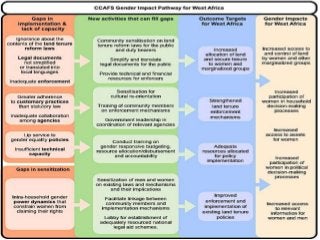
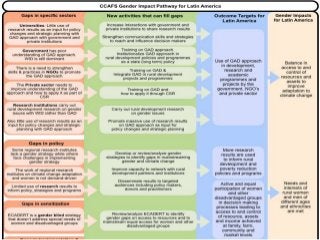
CCAFS Regional Gender Impact Pathways
Participants at a CCAFS-organized Gender Training and Strategizing Workshop held in
October 2013 were assigned in their five regional groups to identify the kind of gender
impacts that are needed in order to reach the target CGIAR global gender impact
considering norms, beliefs, rules and values that regulate gender and what kinds of
transformations need to occur. These were identified as:
- Latin America: Balance in power among members of different social units.
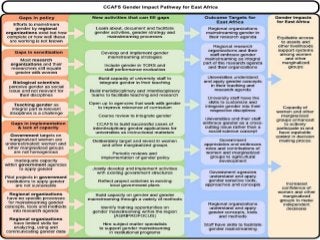
- East Africa: Balance in power and access to resources.
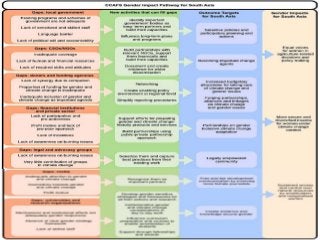
- South Asia: Men’s voices are not dominant. Women and other marginalised groups
have equal voice in decision making.
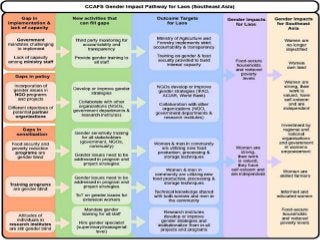
- Southeast Asia: Confident women that are free to make decisions.
- West Africa: Increased and equal control by women and youth to land, markets,
information, extension services etc. Women and youth have equality in control of
livelihood support systems.
The participants worked in regional groups and generated the following regional gender
impact pathways for achieving these impacts. The detailed information behind these
regional gender impact pathways can be found in Annex 1 in the Workshop report:
http://ow.ly/u1g4K
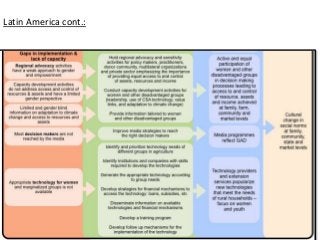
Latin America cont.:

Regional Impact Pathways: Gender

  • 1.
    CCAFS Regional GenderImpact Pathways Participants at a CCAFS-organized Gender Training and Strategizing Workshop held in October 2013 were assigned in their five regional groups to identify the kind of gender impacts that are needed in order to reach the target CGIAR global gender impact considering norms, beliefs, rules and values that regulate gender and what kinds of transformations need to occur. These were identified as: - Latin America: Balance in power among members of different social units. - East Africa: Balance in power and access to resources. - South Asia: Men’s voices are not dominant. Women and other marginalised groups have equal voice in decision making. - Southeast Asia: Confident women that are free to make decisions. - West Africa: Increased and equal control by women and youth to land, markets, information, extension services etc. Women and youth have equality in control of livelihood support systems. The participants worked in regional groups and generated the following regional gender impact pathways for achieving these impacts. The detailed information behind these regional gender impact pathways can be found in Annex 1 in the Workshop report: http://ow.ly/u1g4K
  • 7.