
Right to Food
•
1 like•353 views

Handout used by Molly Anderson in the workshop titled "Is the US Ready for the Right to Food?" during the 2009 Community Food Security Conference held in Des Moines, Iowa.

Recommended
More Related Content
What's hot
What's hot (15)
Viewers also liked
Viewers also liked (19)
Similar to Right to Food
Similar to Right to Food (20)
More from Community Food Security Coalition
More from Community Food Security Coalition (20)
Recently uploaded
Recently uploaded (20)
Right to Food
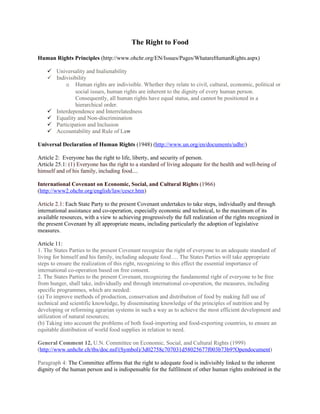
- 1. The Right to Food Human Rights Principles (http://www.ohchr.org/EN/Issues/Pages/WhatareHumanRights.aspx) Universality and Inalienability Indivisibility o Human rights are indivisible. Whether they relate to civil, cultural, economic, political or social issues, human rights are inherent to the dignity of every human person. Consequently, all human rights have equal status, and cannot be positioned in a hierarchical order. Interdependence and Interrelatedness Equality and Non-discrimination Participation and Inclusion Accountability and Rule of Law Universal Declaration of Human Rights (1948) (http://www.un.org/en/documents/udhr/) Article 2: Everyone has the right to life, liberty, and security of person. Article 25.1: (1) Everyone has the right to a standard of living adequate for the health and well-being of himself and of his family, including food.... International Covenant on Economic, Social, and Cultural Rights (1966) (http://www2.ohchr.org/english/law/cescr.htm) Article 2.1: Each State Party to the present Covenant undertakes to take steps, individually and through international assistance and co-operation, especially economic and technical, to the maximum of its available resources, with a view to achieving progressively the full realization of the rights recognized in the present Covenant by all appropriate means, including particularly the adoption of legislative measures. Article 11: 1. The States Parties to the present Covenant recognize the right of everyone to an adequate standard of living for himself and his family, including adequate food…. The States Parties will take appropriate steps to ensure the realization of this right, recognizing to this effect the essential importance of international co-operation based on free consent. 2. The States Parties to the present Covenant, recognizing the fundamental right of everyone to be free from hunger, shall take, individually and through international co-operation, the measures, including specific programmes, which are needed: (a) To improve methods of production, conservation and distribution of food by making full use of technical and scientific knowledge, by disseminating knowledge of the principles of nutrition and by developing or reforming agrarian systems in such a way as to achieve the most efficient development and utilization of natural resources; (b) Taking into account the problems of both food-importing and food-exporting countries, to ensure an equitable distribution of world food supplies in relation to need. General Comment 12, U.N. Committee on Economic, Social, and Cultural Rights (1999) (http://www.unhchr.ch/tbs/doc.nsf/(Symbol)/3d02758c707031d58025677f003b73b9?Opendocument) Paragraph 4: The Committee affirms that the right to adequate food is indivisibly linked to the inherent dignity of the human person and is indispensable for the fulfilment of other human rights enshrined in the
- 2. 2 International Bill of Human Rights. It is also inseparable from social justice, requiring the adoption of appropriate economic, environmental and social policies, at both the national and international levels, oriented to the eradication of poverty and the fulfilment of all human rights for all. Para. 6: The right to adequate food is realized when every man, woman and child, alone or in community with others, has physical and economic access at all times to adequate food or means for its procurement. The right to adequate food shall therefore not be interpreted in a narrow or restrictive sense which equates it with a minimum package of calories, proteins and other specific nutrients. The right to adequate food will have to be realized progressively. However, States have a core obligation to take the necessary action to mitigate and alleviate hunger as provided for in paragraph 2 of article 11, even in times of natural or other disasters. Para. 15: The right to adequate food, like any other human right, imposes three types or levels of obligations on States parties: the obligations to respect, to protect and to fulfil. In turn, the obligation to fulfil incorporates both an obligation to facilitate and an obligation to provide. The obligation to respect existing access to adequate food requires States parties not to take any measures that result in preventing such access. The obligation to protect requires measures by the State to ensure that enterprises or individuals do not deprive individuals of their access to adequate food. The obligation to fulfil (facilitate) means the State must pro-actively engage in activities intended to strengthen people's access to and utilization of resources and means to ensure their livelihood, including food security. Finally, whenever an individual or group is unable, for reasons beyond their control, to enjoy the right to adequate food by the means at their disposal, States have the obligation to fulfil (provide) that right directly. This obligation also applies for persons who are victims of natural or other disasters. Right to Food Guidelines (2004) (http://www.fao.org/righttofood/publi_01_en.htm) Detailed guidance to governments on implementation of the right to adequate food, unanimously approved by the governing body of the Food and Agriculture Organization of the United Nations (FAO). For further reading FAO Right to Food website: http://www.fao.org/righttofood/index_en.htm FIAN (right to food organization, operates similarly to Amnesty International) website: http://www.fian.org/ George Kent, Freedom from Want: The Human Right to Adequate Food (Washington, DC: Georgetown University Press, 2005); can be downloaded at http://press.georgetown.edu/pdfs/9781589010550.pdf George Kent, editor, Global Obligations for the Right to Food (Lanham, MD: Rowman and Littlefield, 2008); see http://www2.hawaii.edu/~kent/GORFflyer.doc for flyer. Ellen Messer and Marc J. Cohen, “The Human Right to Food as a U.S. Nutrition Concern, 1976-2006,” IFPRI Discussion Paper No. 731 (Washington, DC: International Food Policy Research Institute, 2007). http://www.ifpri.org/publication/human-right-food-us-nutrition-concern-1976-2006