Smart Demand:
Lessons from Water

Dr Ben Anderson
b.anderson@soton.ac.uk
Sustainable Energy Research Group
Faculty of Engineering and the Environment
The Menu
 The problem(s) with water

 Water ‘practices’

 The problem with ‘demographics’

 Lessons from water

 Implications for smart energy


                                    2
The Menu
 The problem(s) with water

 Water ‘practices’

 The problem with ‘demographics’

 Lessons from water

 Implications for smart energy

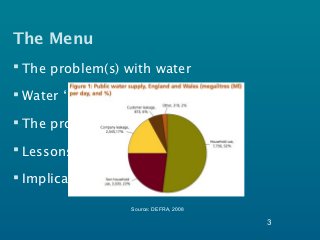
                      Source: DEFRA, 2008

                                            3
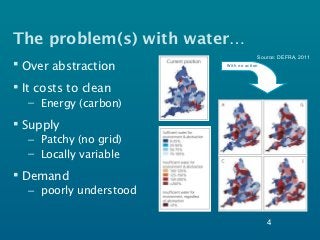
The problem(s) with water…
                                      Source: DEFRA, 2011
 Over abstraction       With no action


 It costs to clean
   – Energy (carbon)

 Supply
   – Patchy (no grid)
   – Locally variable

 Demand
   – poorly understood

                                          4
What do we know?
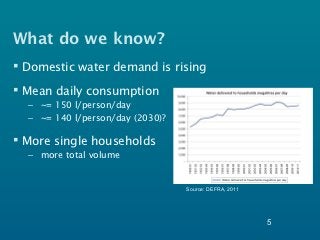
 Domestic water demand is rising

 Mean daily consumption
  – ~= 150 l/person/day
  – ~= 140 l/person/day (2030)?

 More single households
  – more total volume


                                  Source: DEFRA, 2011


                                                        5
What do we know?
 Domestic water demand is rising

 Mean daily consumption
   –   ~= 150 l/person/day
   –   ~= 140 l/person/day (2030)?

 More single households
   –   more total volume

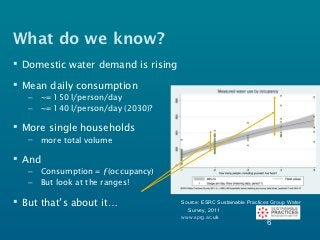
 And
   –   Consumption = ƒ(occupancy)
   –   But look at the ranges!
                                       Source: DEFRA, 2011

 But that’s about it…               Source: ESRC Sustainable Practices Group Water
                                       Survey, 2011
                                     www.sprg.ac.uk
                                                                     6
Well… almost
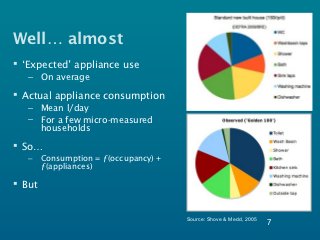
 ‘Expected’ appliance use
   – On average

 Actual appliance consumption
   – Mean l/day
   – For a few micro-measured
     households

 So…
   –    Consumption = ƒ(occupancy) +
        ƒ(appliances)

 But


                                       Source: Shove & Medd, 2005
                                                                    7
The trouble with averages…
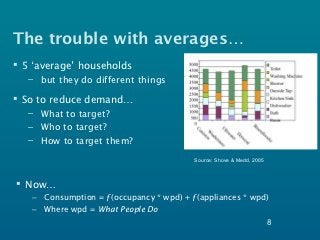
 5 ‘average’ households
   – but they do different things

 So to reduce demand…
   – What to target?
   – Who to target?
   – How to target them?
                                            Source: Shove & Medd, 2005


 Now…
    –   Consumption = ƒ(occupancy * wpd) + ƒ(appliances * wpd)
    –   Where wpd = What People Do
                                                                         8
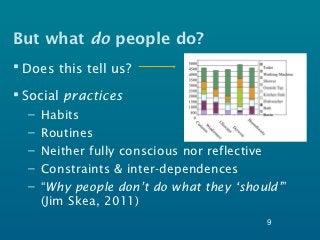
But what do people do?
 Does this tell us?

 Social practices
  –   Habits
  –   Routines
  –   Neither fully conscious nor reflective
  –   Constraints & inter-dependences
  –   “Why people don’t do what they ‘should’”
      (Jim Skea, 2011)
                                          9
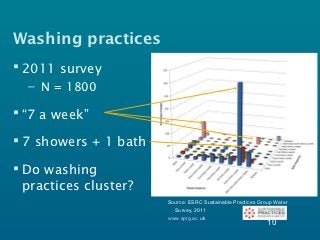
Washing practices
 2011 survey
  – N = 1800

 “7 a week”

 7 showers + 1 bath

 Do washing
  practices cluster?
                       Source: ESRC Sustainable Practices Group Water
                         Survey, 2011
                       www.sprg.ac.uk
                                                             10
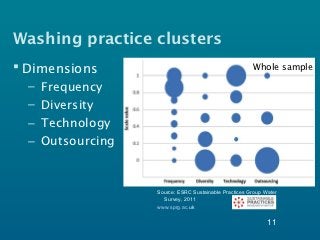
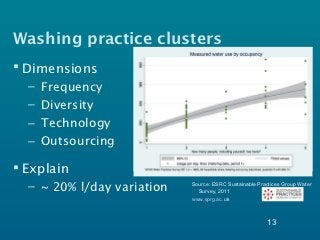
Washing practice clusters
 Dimensions                                            Whole sample

  –   Frequency
  –   Diversity
  –   Technology
  –   Outsourcing


                    Source: ESRC Sustainable Practices Group Water
                      Survey, 2011
                    www.sprg.ac.uk


                                                              11
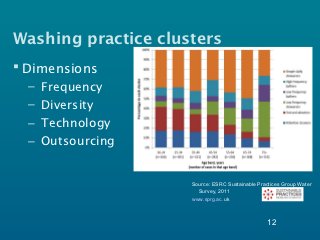
Washing practice clusters
 Dimensions
  –   Frequency
  –   Diversity
  –   Technology
  –   Outsourcing


                     Source: ESRC Sustainable Practices Group Water
                       Survey, 2011
                     www.sprg.ac.uk


                                                 12
Washing practice clusters
 Dimensions
  –   Frequency
  –   Diversity
  –   Technology
  –   Outsourcing

 Explain
  – ~ 20% l/day variation   Source: ESRC Sustainable Practices Group Water
                              Survey, 2011
                            www.sprg.ac.uk


                                                        13
But…
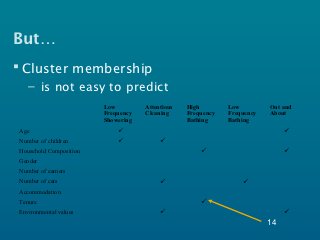
 Cluster membership
   – is not easy to predict
                        Low         Attentious   High        Low         Out and
                        Frequency   Cleaning     Frequency   Frequency   About
                        Showering                Bathing     Bathing
Age                                                                          
Number of children                      
Household Composition                                                        
Gender
Number of earners
Number of cars                                                  
Accommodation
Tenure                                               
Environmental values                                                         
                                                                         14
Lessons from water:
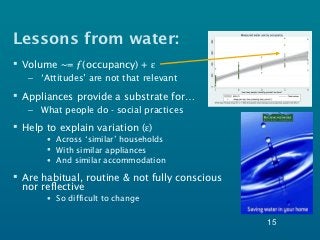
 Volume ~= ƒ(occupancy) + ε
   – ‘Attitudes’ are not that relevant

 Appliances provide a substrate for…
   – What people do - social practices
 Help to explain variation (ε)
       • Across ‘similar’ households
       • With similar appliances
       • And similar accommodation

 Are habitual, routine & not fully conscious
  nor reflective
       • So difficult to change


                                                15
Implications for Energy
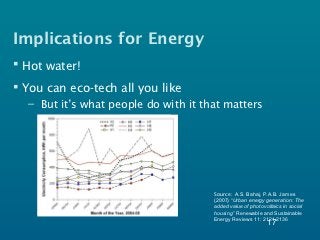
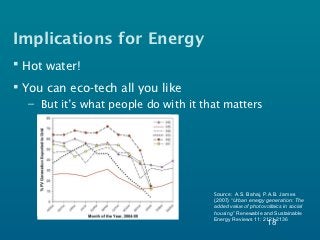
 Hot water!
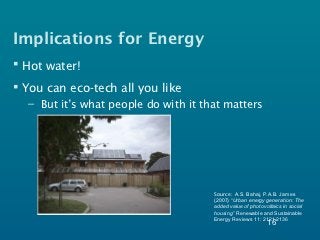
 You can eco-tech all you like
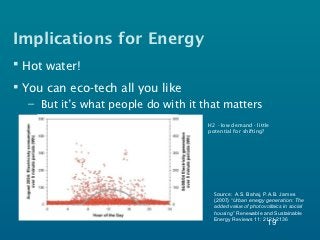
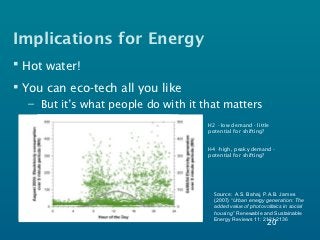
  – But it’s what people do with it that matters


                                      Source: A.S. Bahaj, P.A.B. James
                                      (2007) “Urban energy generation: The
                                      added value of photovoltaics in social
                                      housing” Renewable and Sustainable
                                      Energy Reviews 11: 2121-2136
                                                            16
Implications for Energy
 Hot water!
 You can eco-tech all you like
  – But it’s what people do with it that matters


                                      Source: A.S. Bahaj, P.A.B. James
                                      (2007) “Urban energy generation: The
                                      added value of photovoltaics in social
                                      housing” Renewable and Sustainable
                                      Energy Reviews 11: 2121-2136
                                                            17
Implications for Energy
 Hot water!
 You can eco-tech all you like
  – But it’s what people do with it that matters


                                      Source: A.S. Bahaj, P.A.B. James
                                      (2007) “Urban energy generation: The
                                      added value of photovoltaics in social
                                      housing” Renewable and Sustainable
                                      Energy Reviews 11: 2121-2136
                                                            18
Implications for Energy
 Hot water!
 You can eco-tech all you like
  – But it’s what people do with it that matters
                                     H2 - low demand - little
                                     potential for shifting?


                                       Source: A.S. Bahaj, P.A.B. James
                                       (2007) “Urban energy generation: The
                                       added value of photovoltaics in social
                                       housing” Renewable and Sustainable
                                       Energy Reviews 11: 2121-2136
                                                             19
Implications for Energy
 Hot water!
 You can eco-tech all you like
  – But it’s what people do with it that matters
                                     H2 - low demand - little
                                     potential for shifting?


                                     H4 -high, peaky demand -
                                     potential for shifting?


                                       Source: A.S. Bahaj, P.A.B. James
                                       (2007) “Urban energy generation: The
                                       added value of photovoltaics in social
                                       housing” Renewable and Sustainable
                                       Energy Reviews 11: 2121-2136
                                                             20
Implications for Energy
 Hot water!
 You can eco-tech all you like
   – But it’s what people do with it that matters

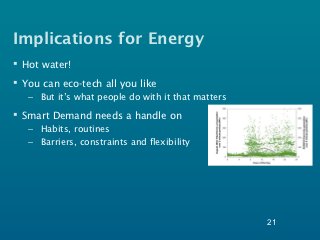
 Smart Demand needs a handle on
   – Habits, routines
   – Barriers, constraints and flexibility


                                                    21
Implications for Energy
 Hot water!
 You can eco-tech all you like
   – But it’s what people do with it that matters

 Smart Demand needs a handle on
   – Habits, routines
   – Barriers, constraints and flexibility
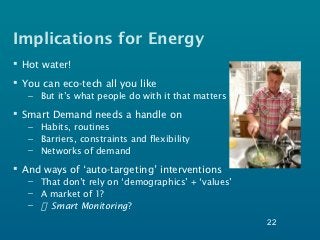
   – Networks of demand

 And ways of ‘auto-targeting’ interventions
   – That don’t rely on ‘demographics’ + ‘values’
   – A market of 1?
   –   Smart Monitoring?
                                                    22
Thank you
 Dr Ben Anderson (b.anderson@soton.ac.uk)

 www.energy.soton.ac.uk
  – SPRG
     • Sustainable Practices Research Group
     • www.sprg.ac.uk
  – DANCER
     • Digital Agent Networking for Customer Energy
       Reduction (EPSRC)
     • dancerproject.wordpress.com
                                              23

Smart Demand: Lessons From Water

  • 1.
    Smart Demand: Lessons fromWater Dr Ben Anderson b.anderson@soton.ac.uk Sustainable Energy Research Group Faculty of Engineering and the Environment
  • 2.
    The Menu  Theproblem(s) with water  Water ‘practices’  The problem with ‘demographics’  Lessons from water  Implications for smart energy 2
  • 3.
    The Menu  Theproblem(s) with water  Water ‘practices’  The problem with ‘demographics’  Lessons from water  Implications for smart energy Source: DEFRA, 2008 3
  • 4.
    The problem(s) withwater… Source: DEFRA, 2011  Over abstraction With no action  It costs to clean – Energy (carbon)  Supply – Patchy (no grid) – Locally variable  Demand – poorly understood 4
  • 5.
    What do weknow?  Domestic water demand is rising  Mean daily consumption – ~= 150 l/person/day – ~= 140 l/person/day (2030)?  More single households – more total volume Source: DEFRA, 2011 5
  • 6.
    What do weknow?  Domestic water demand is rising  Mean daily consumption – ~= 150 l/person/day – ~= 140 l/person/day (2030)?  More single households – more total volume  And – Consumption = ƒ(occupancy) – But look at the ranges! Source: DEFRA, 2011  But that’s about it… Source: ESRC Sustainable Practices Group Water Survey, 2011 www.sprg.ac.uk 6
  • 7.
    Well… almost  ‘Expected’appliance use – On average  Actual appliance consumption – Mean l/day – For a few micro-measured households  So… – Consumption = ƒ(occupancy) + ƒ(appliances)  But Source: Shove & Medd, 2005 7
  • 8.
    The trouble withaverages…  5 ‘average’ households – but they do different things  So to reduce demand… – What to target? – Who to target? – How to target them? Source: Shove & Medd, 2005  Now… – Consumption = ƒ(occupancy * wpd) + ƒ(appliances * wpd) – Where wpd = What People Do 8
  • 9.
    But what dopeople do?  Does this tell us?  Social practices – Habits – Routines – Neither fully conscious nor reflective – Constraints & inter-dependences – “Why people don’t do what they ‘should’” (Jim Skea, 2011) 9
  • 10.
    Washing practices  2011survey – N = 1800  “7 a week”  7 showers + 1 bath  Do washing practices cluster? Source: ESRC Sustainable Practices Group Water Survey, 2011 www.sprg.ac.uk 10
  • 11.
    Washing practice clusters Dimensions Whole sample – Frequency – Diversity – Technology – Outsourcing Source: ESRC Sustainable Practices Group Water Survey, 2011 www.sprg.ac.uk 11
  • 12.
    Washing practice clusters Dimensions – Frequency – Diversity – Technology – Outsourcing Source: ESRC Sustainable Practices Group Water Survey, 2011 www.sprg.ac.uk 12
  • 13.
    Washing practice clusters Dimensions – Frequency – Diversity – Technology – Outsourcing  Explain – ~ 20% l/day variation Source: ESRC Sustainable Practices Group Water Survey, 2011 www.sprg.ac.uk 13
  • 14.
    But…  Cluster membership – is not easy to predict Low Attentious High Low Out and Frequency Cleaning Frequency Frequency About Showering Bathing Bathing Age   Number of children   Household Composition   Gender Number of earners Number of cars   Accommodation Tenure  Environmental values   14
  • 15.
    Lessons from water: Volume ~= ƒ(occupancy) + ε – ‘Attitudes’ are not that relevant  Appliances provide a substrate for… – What people do - social practices  Help to explain variation (ε) • Across ‘similar’ households • With similar appliances • And similar accommodation  Are habitual, routine & not fully conscious nor reflective • So difficult to change 15
  • 16.
    Implications for Energy Hot water!  You can eco-tech all you like – But it’s what people do with it that matters Source: A.S. Bahaj, P.A.B. James (2007) “Urban energy generation: The added value of photovoltaics in social housing” Renewable and Sustainable Energy Reviews 11: 2121-2136 16
  • 17.
    Implications for Energy Hot water!  You can eco-tech all you like – But it’s what people do with it that matters Source: A.S. Bahaj, P.A.B. James (2007) “Urban energy generation: The added value of photovoltaics in social housing” Renewable and Sustainable Energy Reviews 11: 2121-2136 17
  • 18.
    Implications for Energy Hot water!  You can eco-tech all you like – But it’s what people do with it that matters Source: A.S. Bahaj, P.A.B. James (2007) “Urban energy generation: The added value of photovoltaics in social housing” Renewable and Sustainable Energy Reviews 11: 2121-2136 18
  • 19.
    Implications for Energy Hot water!  You can eco-tech all you like – But it’s what people do with it that matters H2 - low demand - little potential for shifting? Source: A.S. Bahaj, P.A.B. James (2007) “Urban energy generation: The added value of photovoltaics in social housing” Renewable and Sustainable Energy Reviews 11: 2121-2136 19
  • 20.
    Implications for Energy Hot water!  You can eco-tech all you like – But it’s what people do with it that matters H2 - low demand - little potential for shifting? H4 -high, peaky demand - potential for shifting? Source: A.S. Bahaj, P.A.B. James (2007) “Urban energy generation: The added value of photovoltaics in social housing” Renewable and Sustainable Energy Reviews 11: 2121-2136 20
  • 21.
    Implications for Energy Hot water!  You can eco-tech all you like – But it’s what people do with it that matters  Smart Demand needs a handle on – Habits, routines – Barriers, constraints and flexibility 21
  • 22.
    Implications for Energy Hot water!  You can eco-tech all you like – But it’s what people do with it that matters  Smart Demand needs a handle on – Habits, routines – Barriers, constraints and flexibility – Networks of demand  And ways of ‘auto-targeting’ interventions – That don’t rely on ‘demographics’ + ‘values’ – A market of 1? – Smart Monitoring? 22
  • 23.
    Thank you  DrBen Anderson (b.anderson@soton.ac.uk)  www.energy.soton.ac.uk – SPRG • Sustainable Practices Research Group • www.sprg.ac.uk – DANCER • Digital Agent Networking for Customer Energy Reduction (EPSRC) • dancerproject.wordpress.com 23

Editor's Notes

  • #4 Just so we’re clear on the numbers…
  • #9 No use trying to reduce water the same way for these households - can the heavy showerers be reduced? The heavy WC users? -> What are people actually doing with these appliances…?
  • #10 No… we need a way to get at what we term… (Warde, 2005) etc Constraints - the way we wash our bodies & our clothes may be closely linked via occupations, commuting modes, children’s activities etc Power showers enable new washing experiences but uses more water… They are why people appear irrational in terms of water use - don’t respond (for example) to price signals.
  • #12 Frequency - how often shower/bathe/flannel wash etc Diversity - range of different kinds of performances/reasons (always shower, mixture etc) Technology - power shower, bath, shower, flannel Outsourcing - washing outside the home Chart = distribution of whole sample on these dimensions
  • #13 Generates these 6 washing clusters - differentiated along the dimensions NB: project has done same exercise for laundry & gardening too
  • #14 Interestingly simple regression model suggests membership of these clusters explains about 20% of the variation on litres/day consumed by the 69 households for whom we have linked data. So by thinking about clusters of practices we’re starting to get a handle on some of that variation
  • #15 Simple daily showers = reference group for logitistic models Basically few demographics are good predictors of being in a given cluster Environmental values (attitudes to water/energy etc) are poor predictors overall NB: much historical social housing does not have a shower so expect more ‘baths’ for this tenure group (arrow)
  • #17 Some examples from ongoing work by Southampton group 9 eco-houses in Havant - same build standards, same equipment incl PV, varying people
  • #18 Massively varying overall consumption patterns
  • #19 And also massively varying rates of PV export, not always (or even mostly) related to overall levels of consumption. Timing is key! -> habits and routines
  • #20 e.g. HH 2
  • #21 e.g. HH 4
  • #23 Jamie? Systematics - school/work routines constrain WHEN cooking can happen. C.f. comparisons with S. Europe siesta/mid-day cooking etc But also distributed networks of demand -> a greater part of the way we use energy in the kitchen is ‘constructed’ through wider network of influences incl. media chefs, what is considered ‘good cooking’ (and by whom?), taste & fashion etc
  • #24 SPRG = social practices work on water (& energy by others, esp cooling) DANCER = applying some of these ideas to energy interventions