Acknowledgements UGA Biologists/Biochemists Will York ,  Complex Carbohydrate Research Center Jonathan Arnold ,  Fungal Genomics Philip Bowen ,  CCQC Project members of LSDIS lab projects  Bioinformatics for  Glycan  Expression  and  METEOR-S   (incl. Miller, Kochut, Arpinar) Special thanks in background research & preparation: Karthik Gomadam, Christopher Thomas, Kunal Verma
Excellent starting point for complementary material (a partial list) “ Building a Bioinformatics Nation ,“  Lincoln Stein’s   Keynote at O'Reilly's Bioinformatics Technology Conference 2002 “ Bio-Ontologies: Their creation and design ” Peter Karp, Robert Stevens and Carole Goble “ Query Processing with Description Logic Ontologies over Object-Wrapped Databases ”  Martin Peim, Enrico Franconi, Norman Paton and   Carole Goble “ Ontologies for molecular biology and bioinformatics ”  Steffen Schulze-Kremer (paper) “ Can we do better than Google? Using semantics to   explore large heterogeneous knowledge sources,”   Anatole Gershman, SWDB Workshop, 2003.
Some current  BioInformatics Systems Tambis BioMediator Biodas BioSem Data integration, in some cases using an ontology. Single access point for multiple biological information sources; querying multiple sources.
Outline of this talk… A Short History of Science Challenges in biology What can BioInformatics do for Biology? What can Semantics do for BioInformatics? Some examples of Semantics-powered Bioinformatics
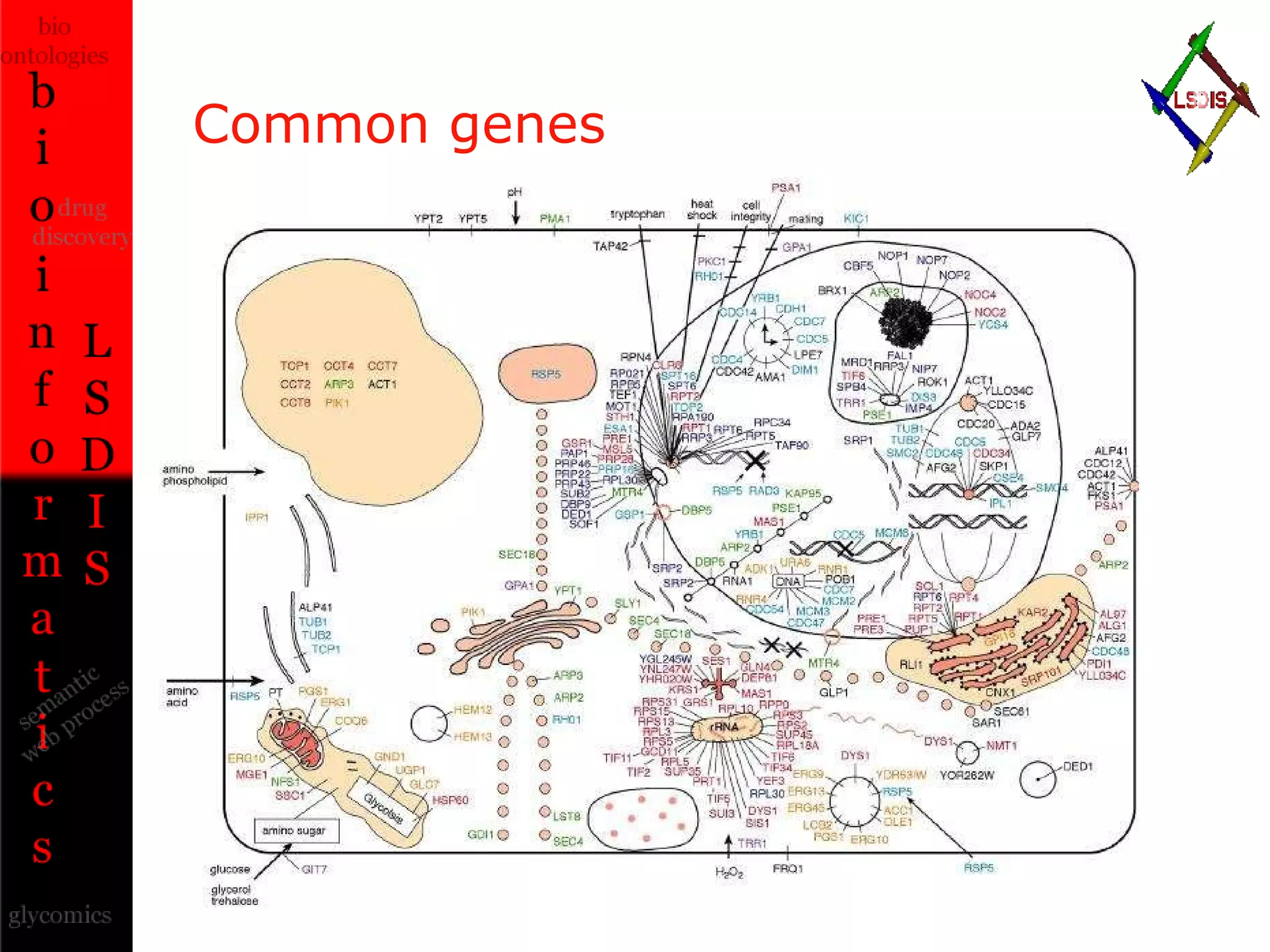
What is difficult, tedious and    time consuming now … What genes do we all have in common?*  Research to answer this question took scientists two years** * G. Strobel and J Arnold.  Essential Eukaryotic Core,    Evolution (to appear, 2003) **but we now believe with semantic techniques and    technology, we can answer similar questions much    faster
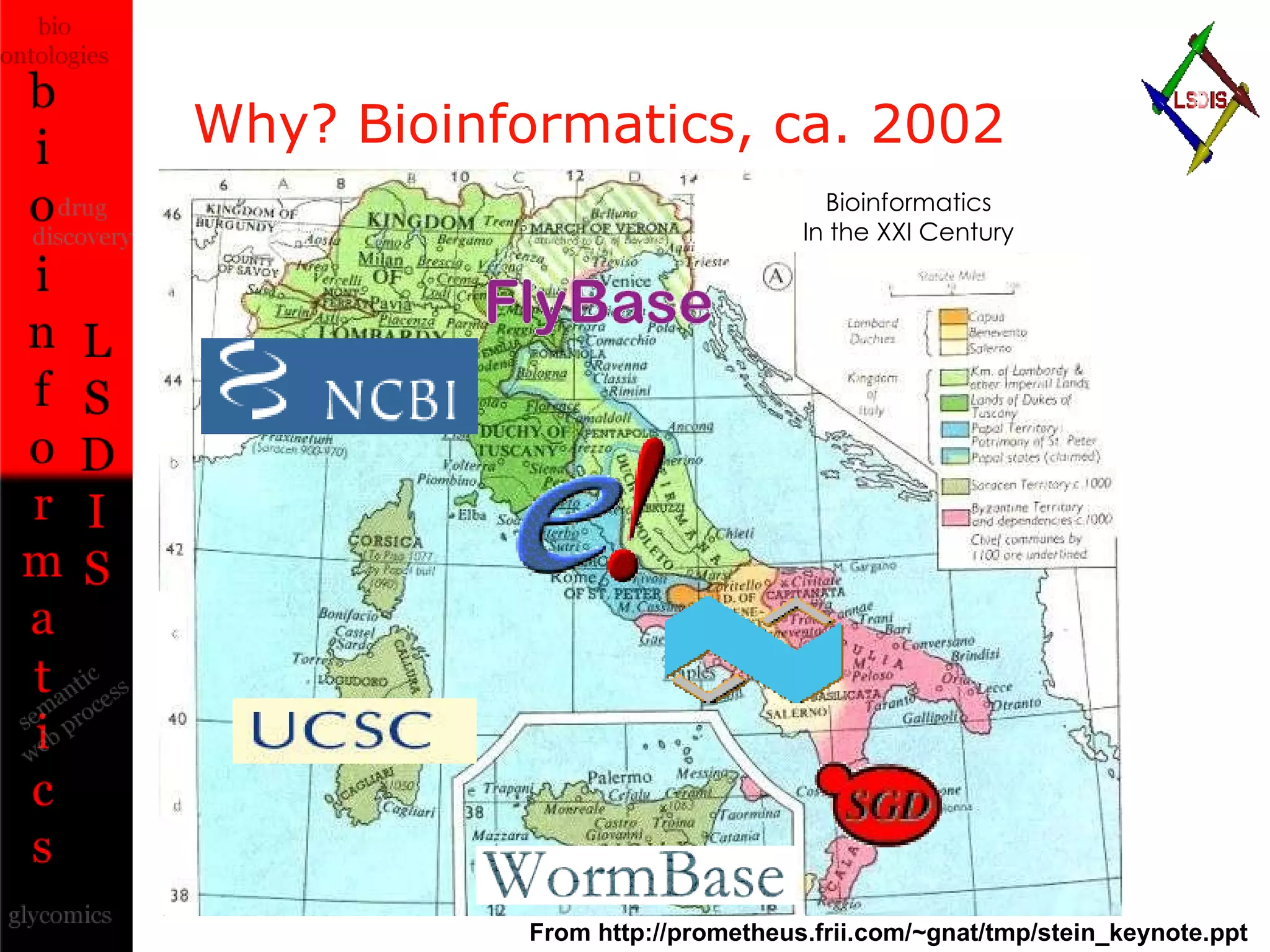
Why? Bioinformatics, ca. 2002 Bioinformatics In the XXI Century From http://prometheus.frii.com/~gnat/tmp/stein_keynote.ppt
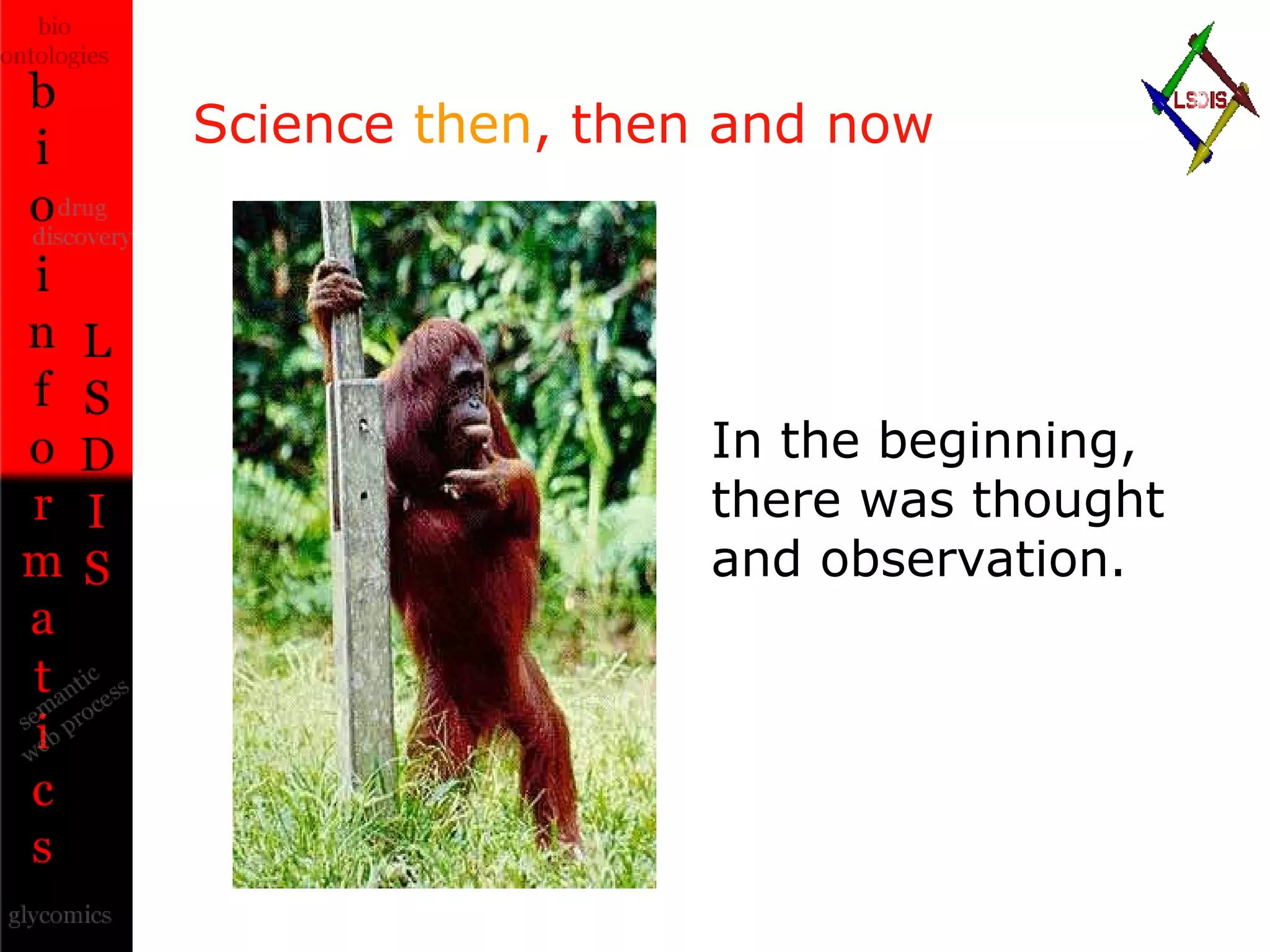
Science  then , then and now In the beginning, there was thought and observation.
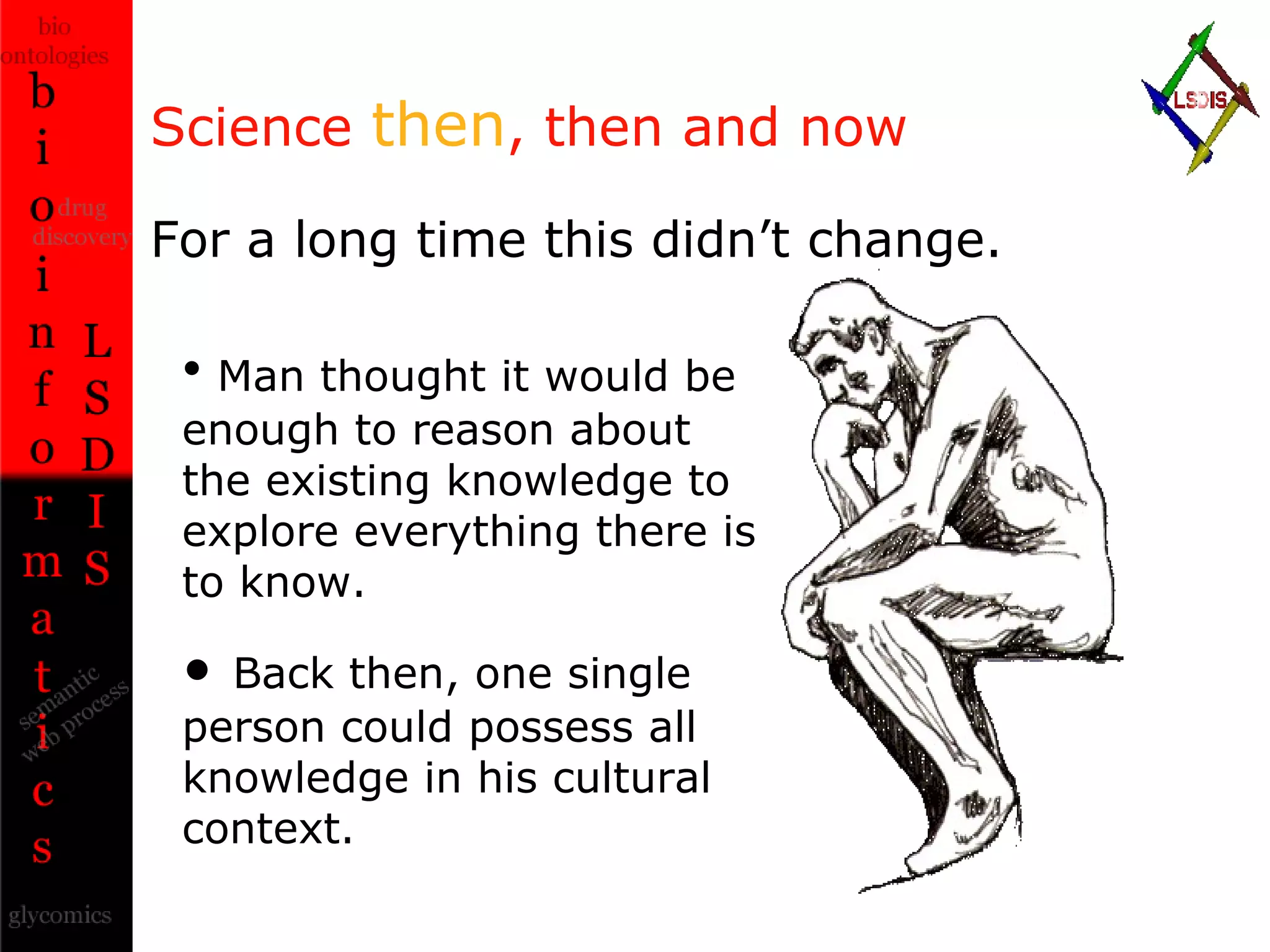
Science  then , then and now For a long time this didn’t change. Man thought it would be enough to reason about the existing knowledge to explore everything there is to know. Back then, one single person could possess all knowledge in his cultural context.
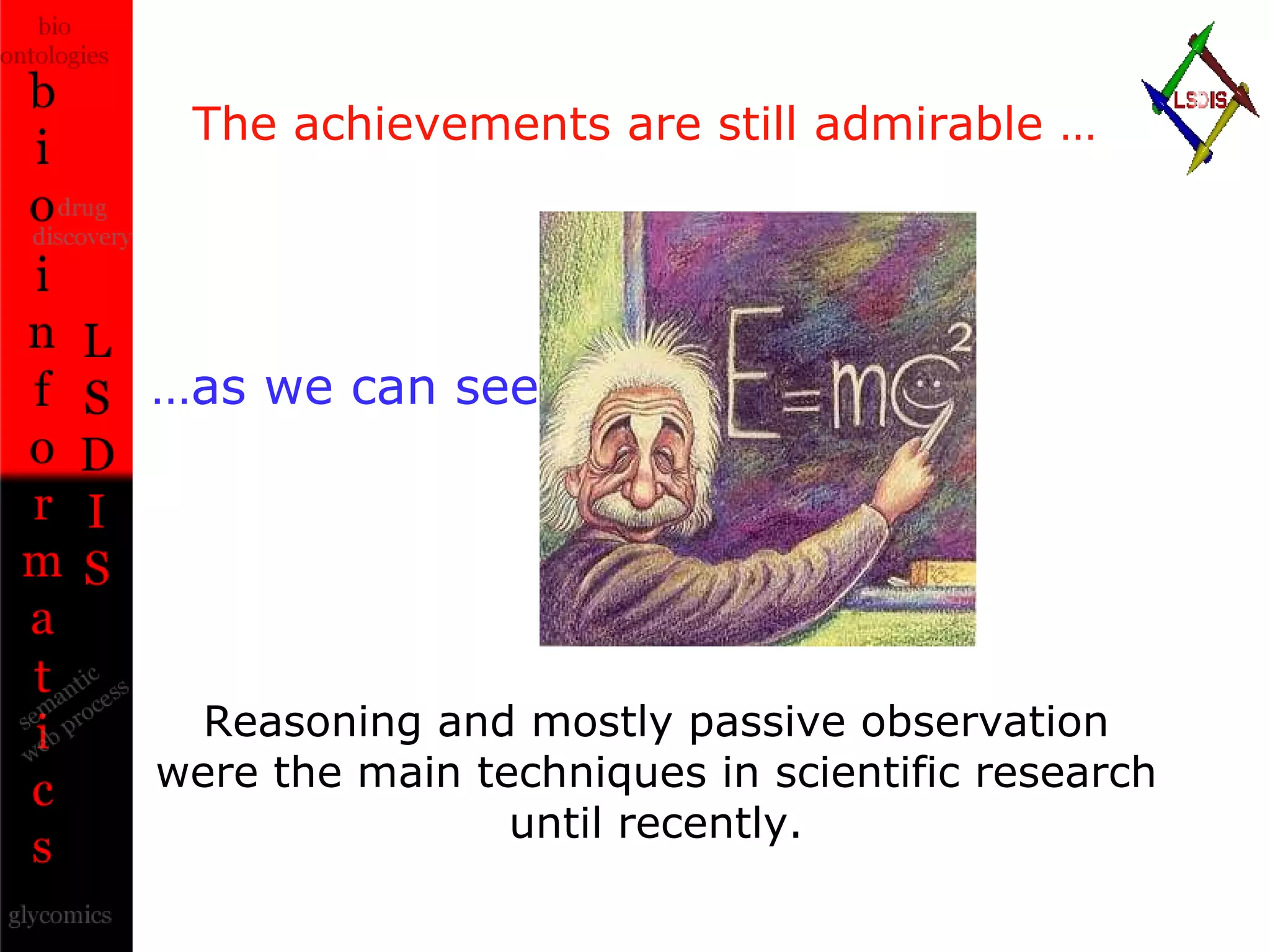
The achievements are still admirable … Reasoning and mostly passive observation were the main techniques in scientific research until recently. … as we can see
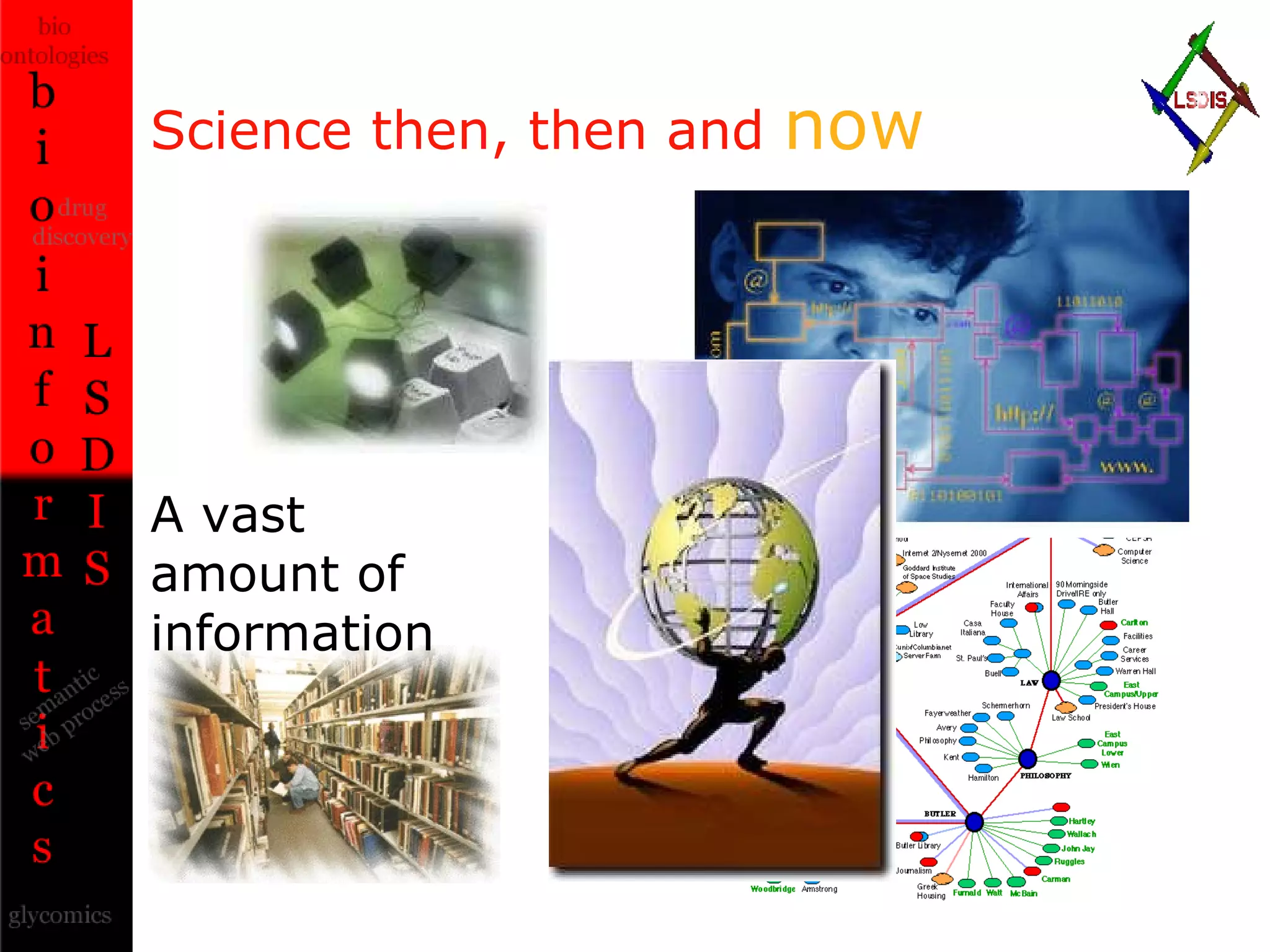
Science then, then and  now A vast amount of information
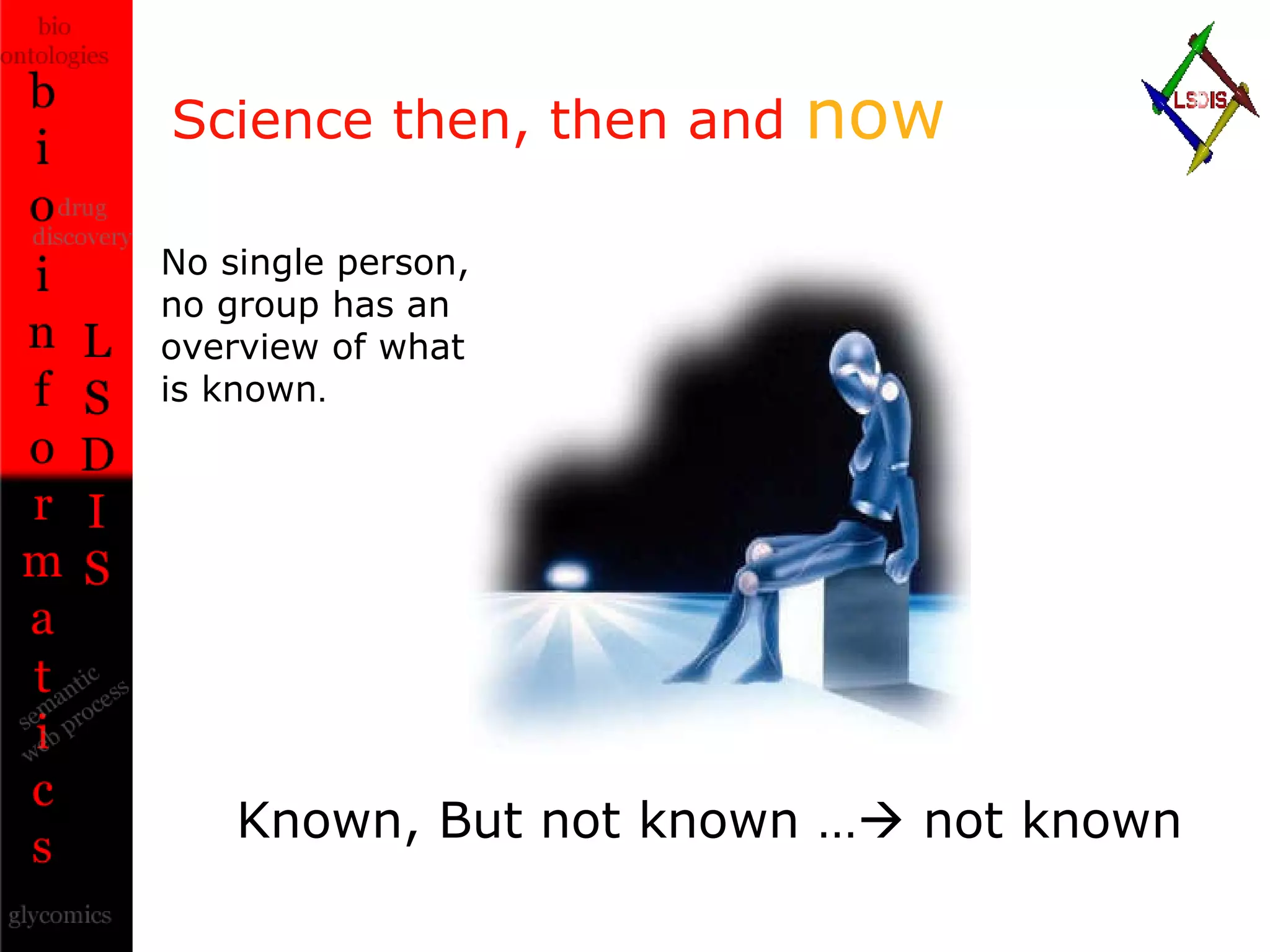
Science then, then and  now No single person,  no group has an overview of what  is known . Known, But not known …   not known
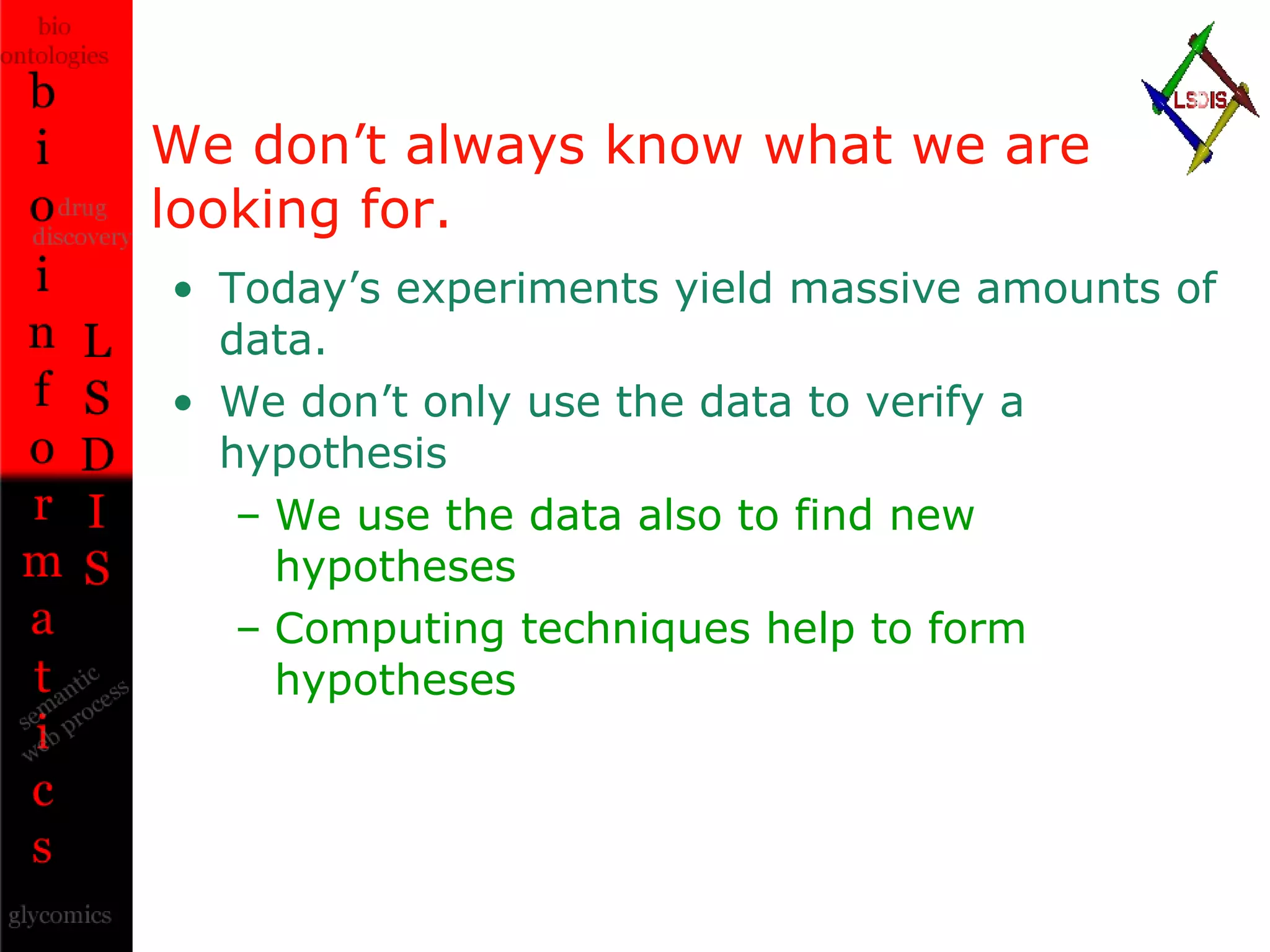
We don’t always know what we are looking for. Today’s experiments yield massive amounts of data. We don’t only use the data to verify a hypothesis We use the data also to find new hypotheses Computing techniques help to form hypotheses
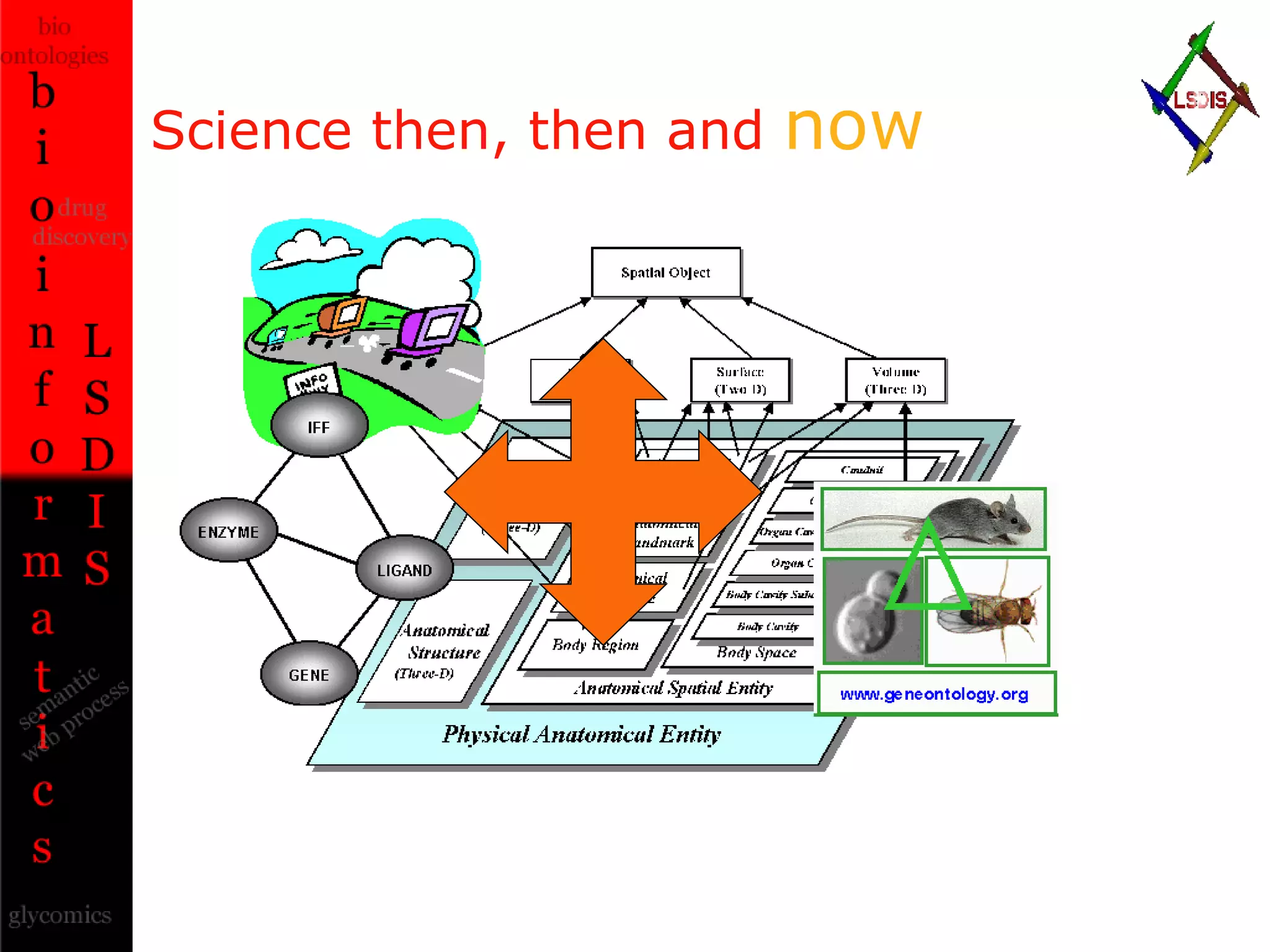
Science then, then and  now
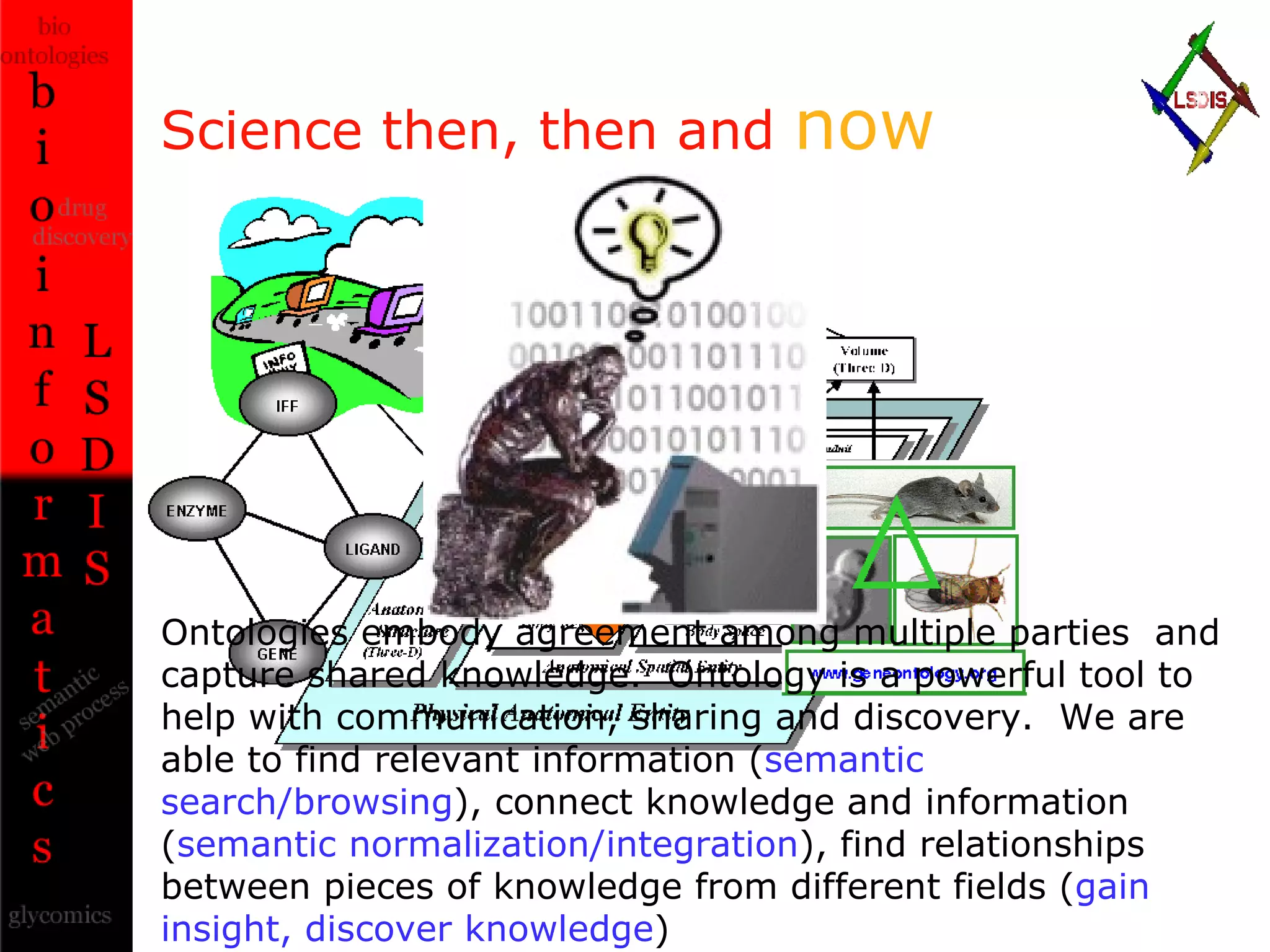
Science then, then and  now Ontologies embody agreement among multiple parties  and capture shared knowledge.  Ontology is a powerful tool to help with communication, sharing and discovery.  We are able to find relevant information ( semantic search/browsing ), connect knowledge and information ( semantic normalization/integration ), find relationships between pieces of knowledge from different fields ( gain insight, discover knowledge )
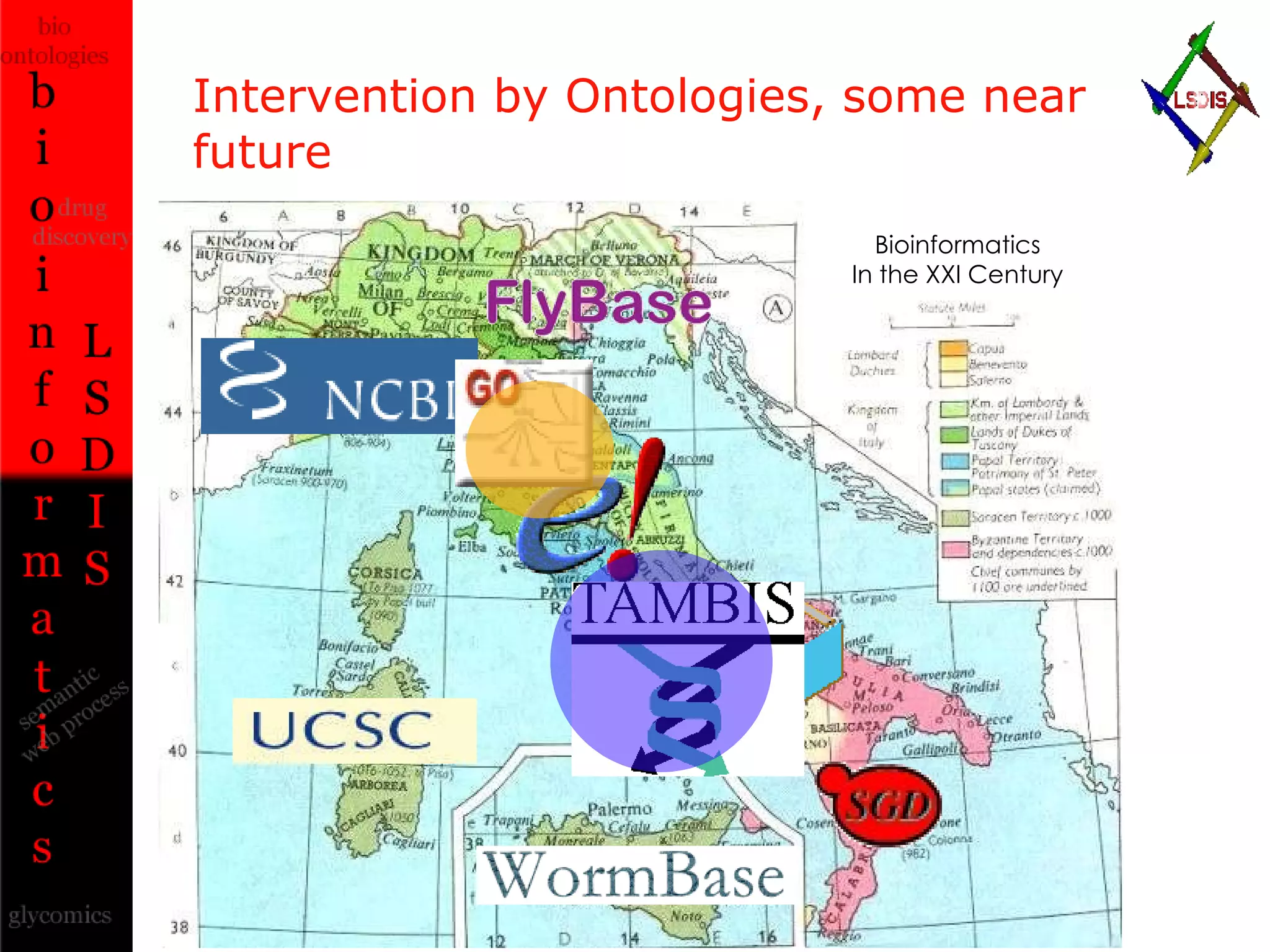
Intervention by Ontologies, some near future Bioinformatics In the XXI Century
Outline of the talk… A Short History of Science Challenges in biology What can BioInformatics do for Biology? What can Semantics do for BioInformatics: Some examples of Semantics-powered Bioinformatics
Challenges in biology What makes us ill or unwell? Disease identification, disease inducing agents What keeps us healthy and makes us live longer? Drug discovery Where do we all come from and what are we made of? Genetics and beyond
… and their implications Understand biological structures of increasing complexity: Genes ( Genomics ): 1980s Proteins ( Proteomics ): 1990s Complex Carbohydrates ( Glycomics ): 2000s Understand biological processes and the roles structures play in them (biosynthesis and biological processes)
Outline Evolution of Science Challenges in biology What can bioInformatics do for Biology? What can Semantics do for bioInformatics? Some examples of Semantics-powered Bioinformatics
What can BioInformatics do? Analyze genetic and molecular sequences Look for patterns, similarities, matches Identify structures Store derived information Large databases of genetic information
Outline Evolution of Science Challenges in biology What can bioInformatics do for Biology? What can Semantics do for bioInformatics? Some examples of Semantics-powered Bioinformatics
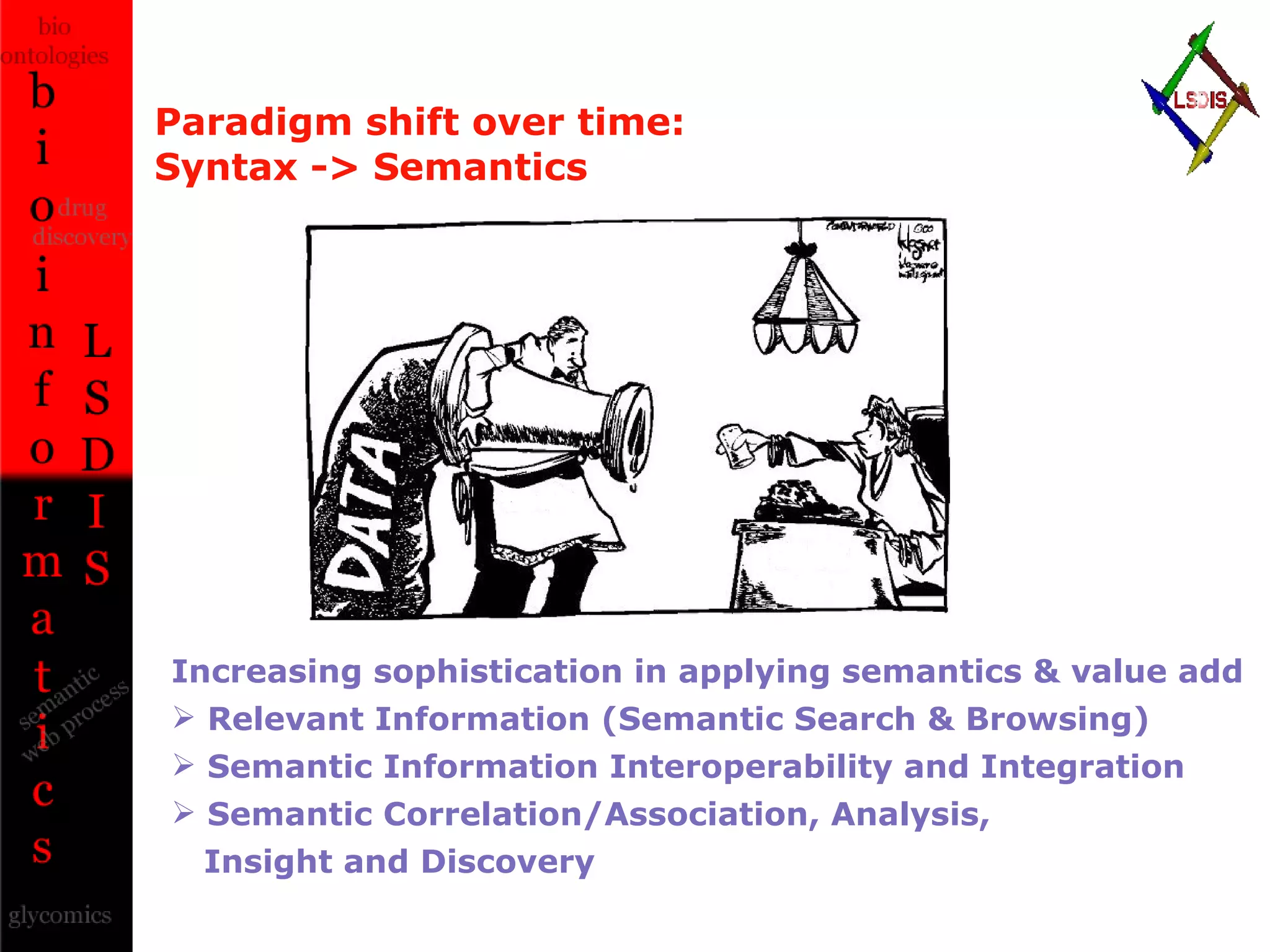
Paradigm shift over time:    Syntax -> Semantics Increasing sophistication in applying semantics & value add Relevant Information (Semantic Search & Browsing) Semantic Information Interoperability and Integration Semantic Correlation/Association, Analysis,    Insight and Discovery
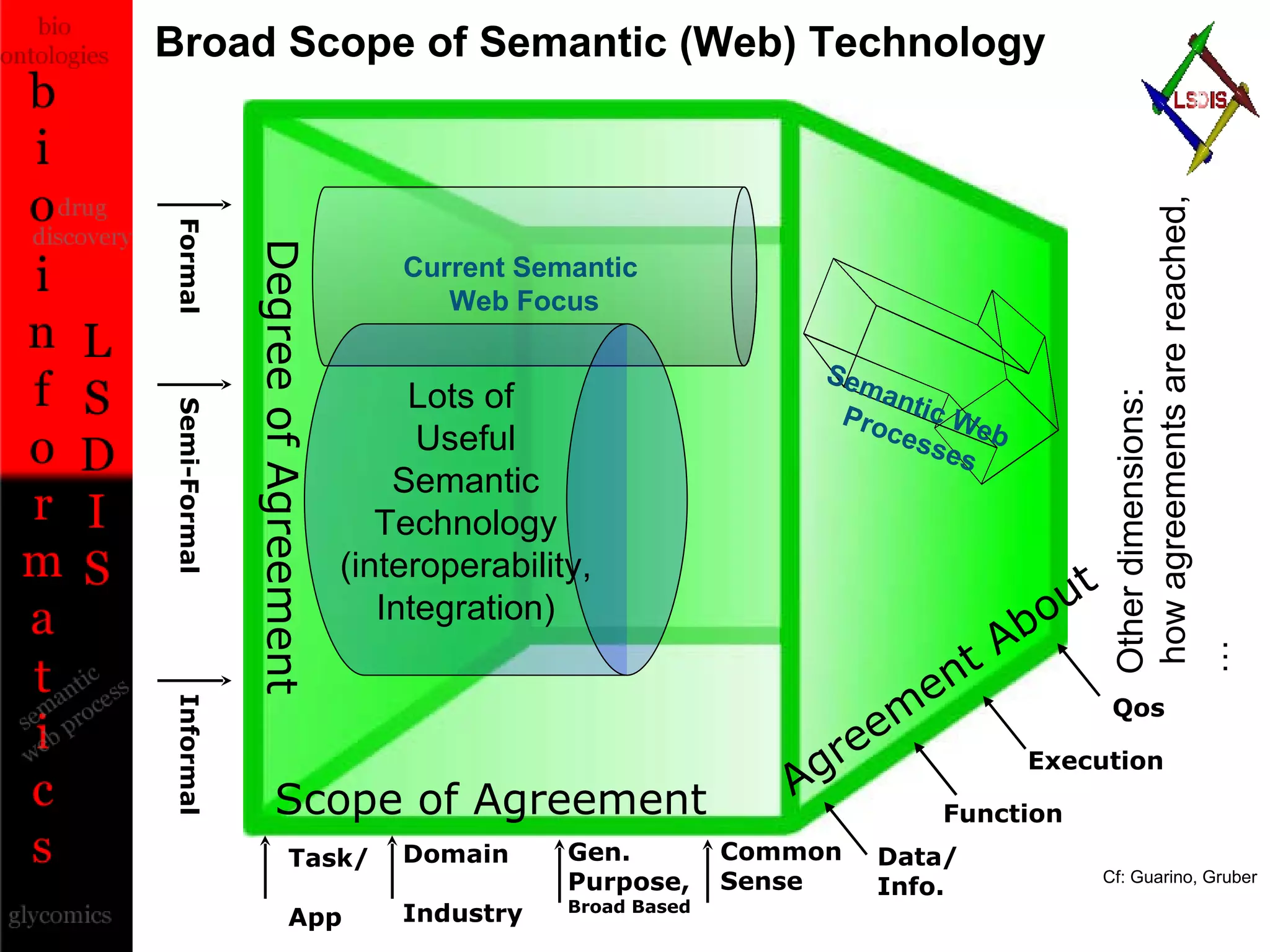
Broad Scope of Semantic (Web) Technology Other dimensions: how agreements are reached, … Lots of  Useful Semantic Technology (interoperability, Integration) Cf: Guarino, Gruber Gen. Purpose, Broad Based Scope of Agreement Task/  App Domain  Industry Common Sense Degree of Agreement Informal Semi-Formal Formal Agreement About Data/ Info. Function Execution Qos Current Semantic  Web Focus Semantic Web  Processes
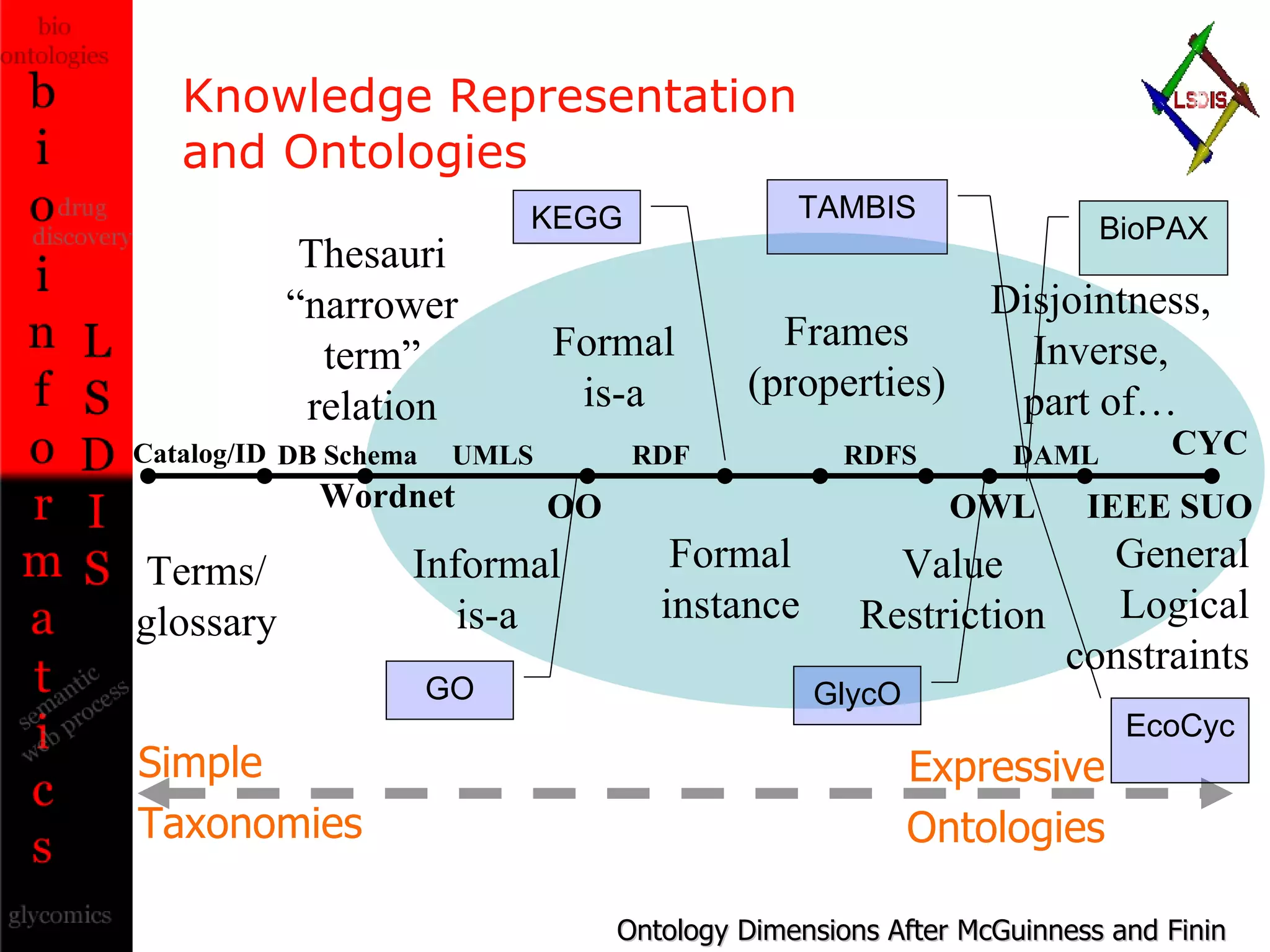
Knowledge Representation and Ontologies  Catalog/ID General Logical constraints Terms/ glossary Thesauri “ narrower term” relation Formal is-a Frames (properties) Informal is-a Formal instance Value Restriction Disjointness, Inverse, part of… Ontology Dimensions After McGuinness and Finin Simple Taxonomies Expressive Ontologies Wordnet CYC RDF DAML OO DB Schema RDFS IEEE SUO OWL UMLS GO KEGG GlycO TAMBIS EcoCyc BioPAX
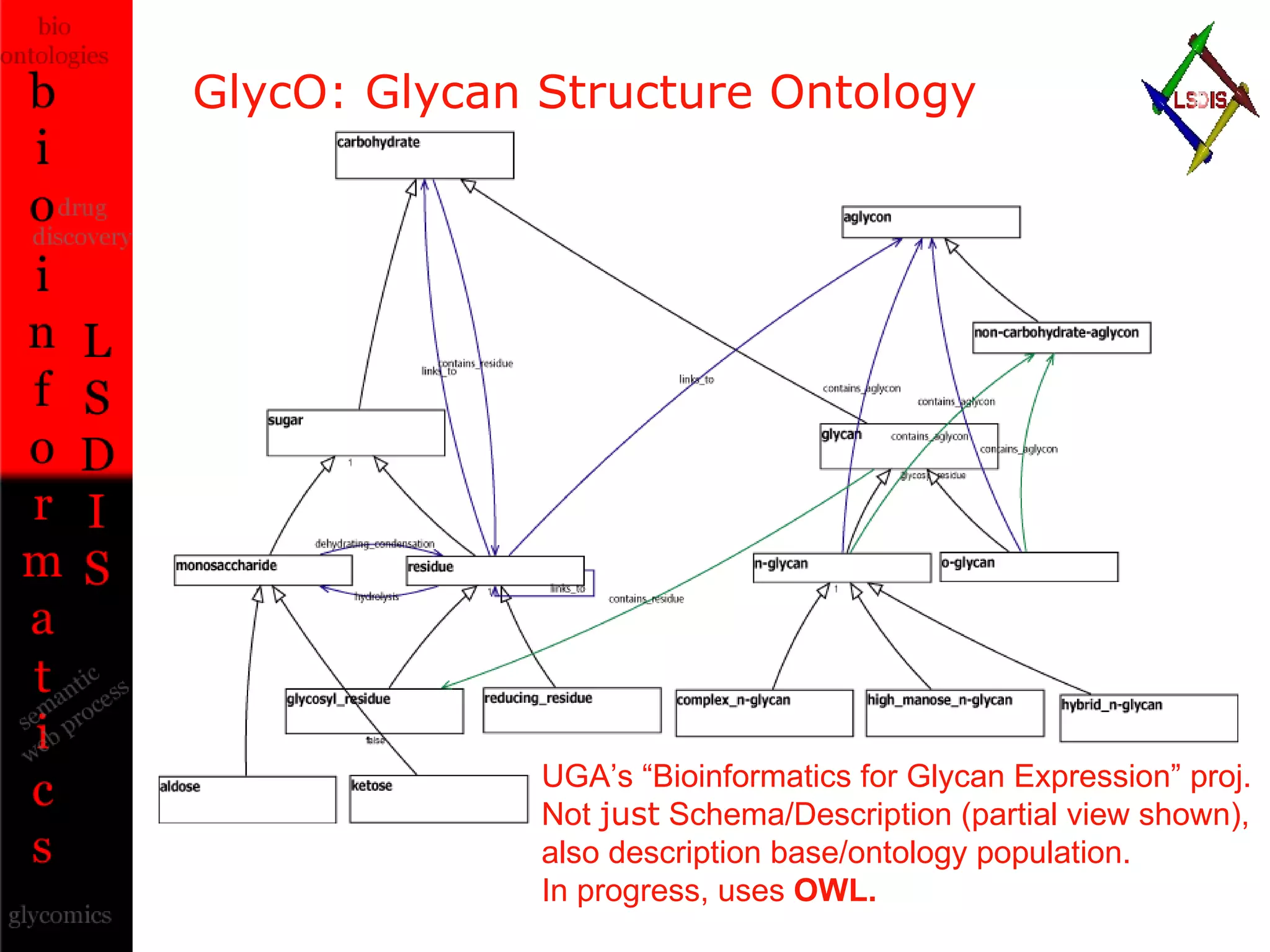
GlycO: Glycan Structure Ontology UGA’s “Bioinformatics for Glycan Expression” proj. Not  just  Schema/Description (partial view shown), also description base/ontology population. In progress, uses  OWL.
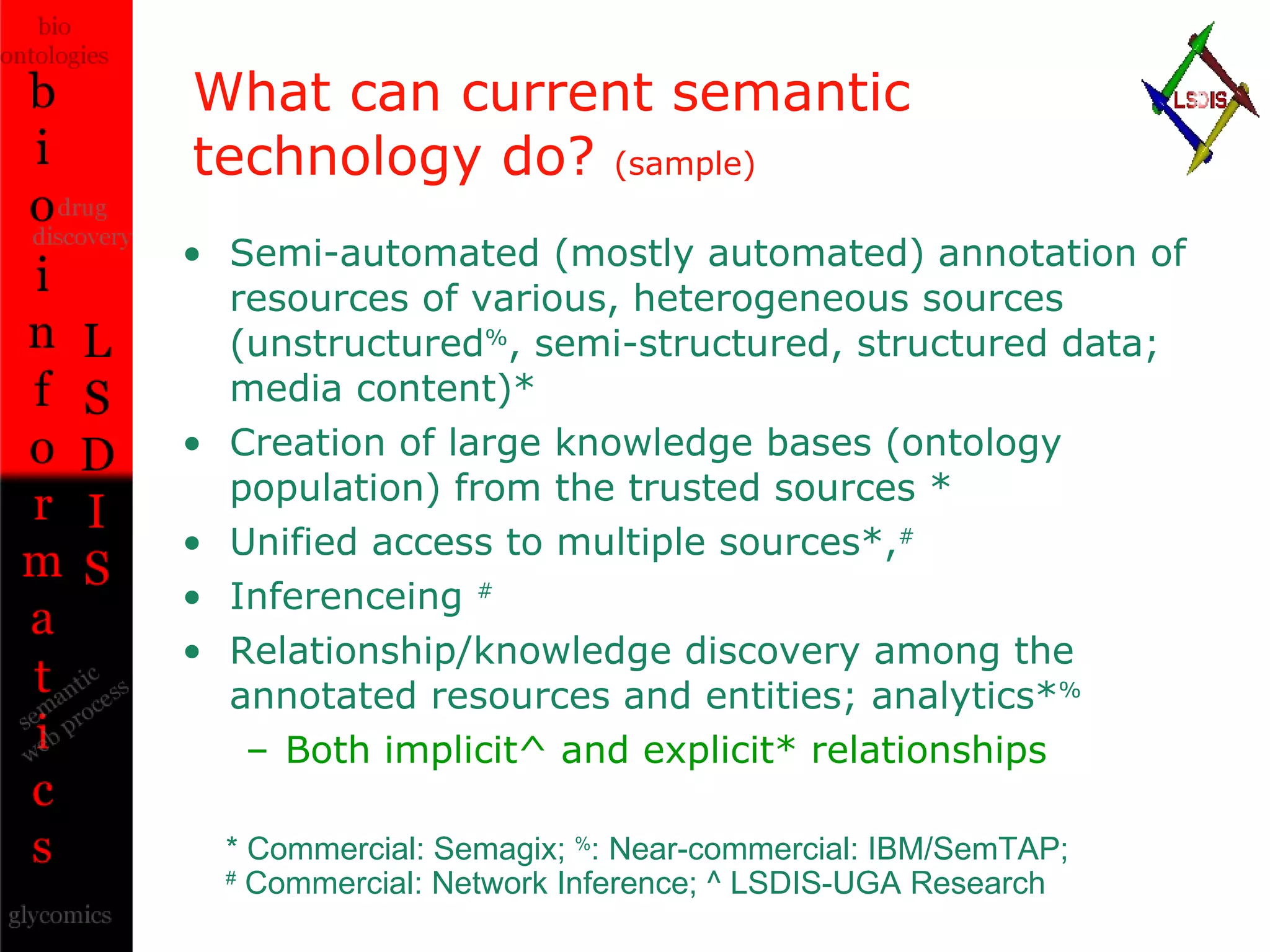
What can current semantic technology do?  (sample) Semi-automated (mostly automated) annotation of resources of various, heterogeneous sources (unstructured % , semi-structured, structured data; media content)* Creation of large knowledge bases (ontology population) from the trusted sources * Unified access to multiple sources*, # Inferenceing  # Relationship/knowledge discovery among the annotated resources and entities; analytics* %   Both implicit^ and explicit* relationships * Commercial: Semagix;  % : Near-commercial: IBM/SemTAP;  #  Commercial: Network Inference; ^ LSDIS-UGA Research
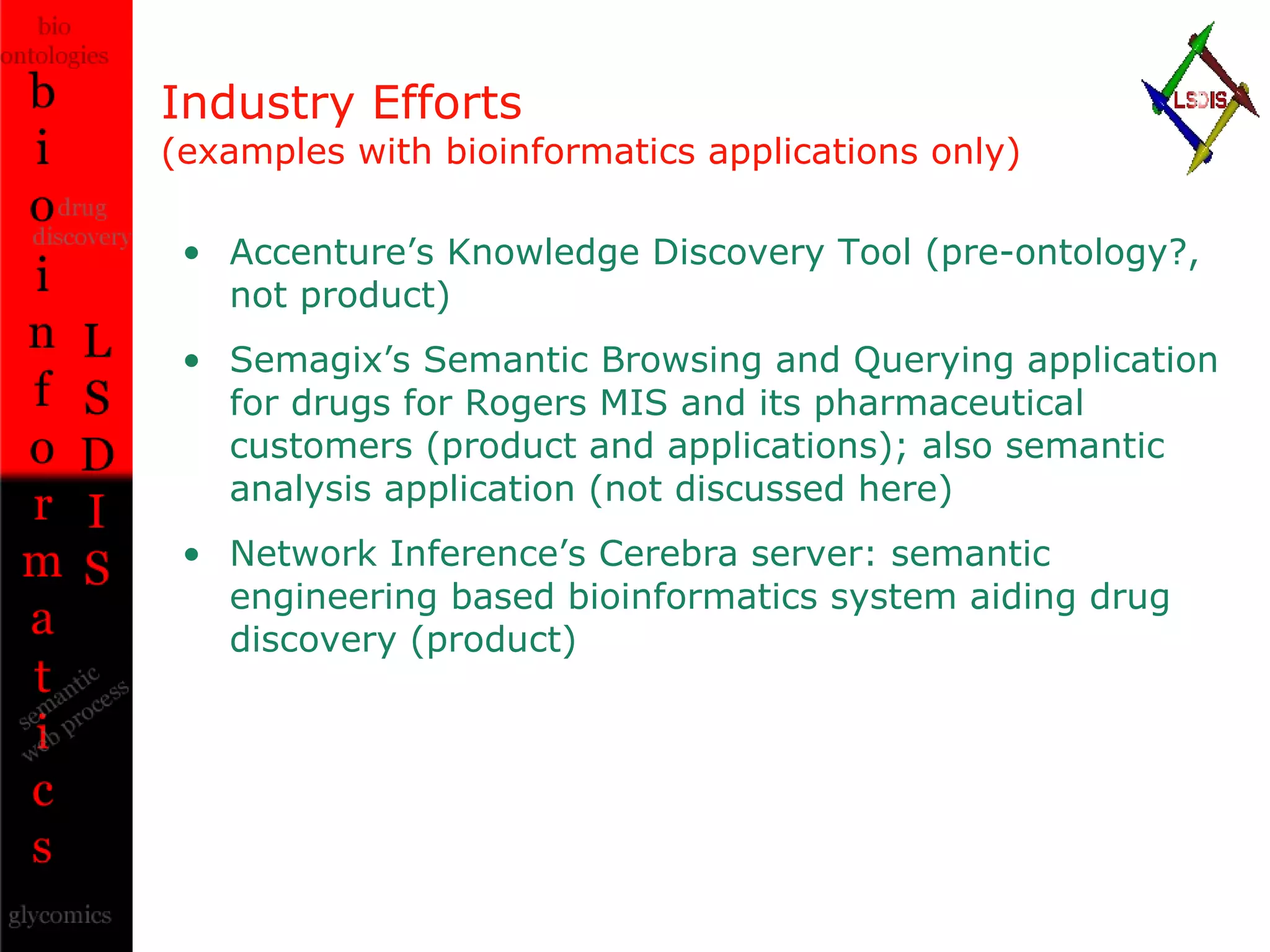
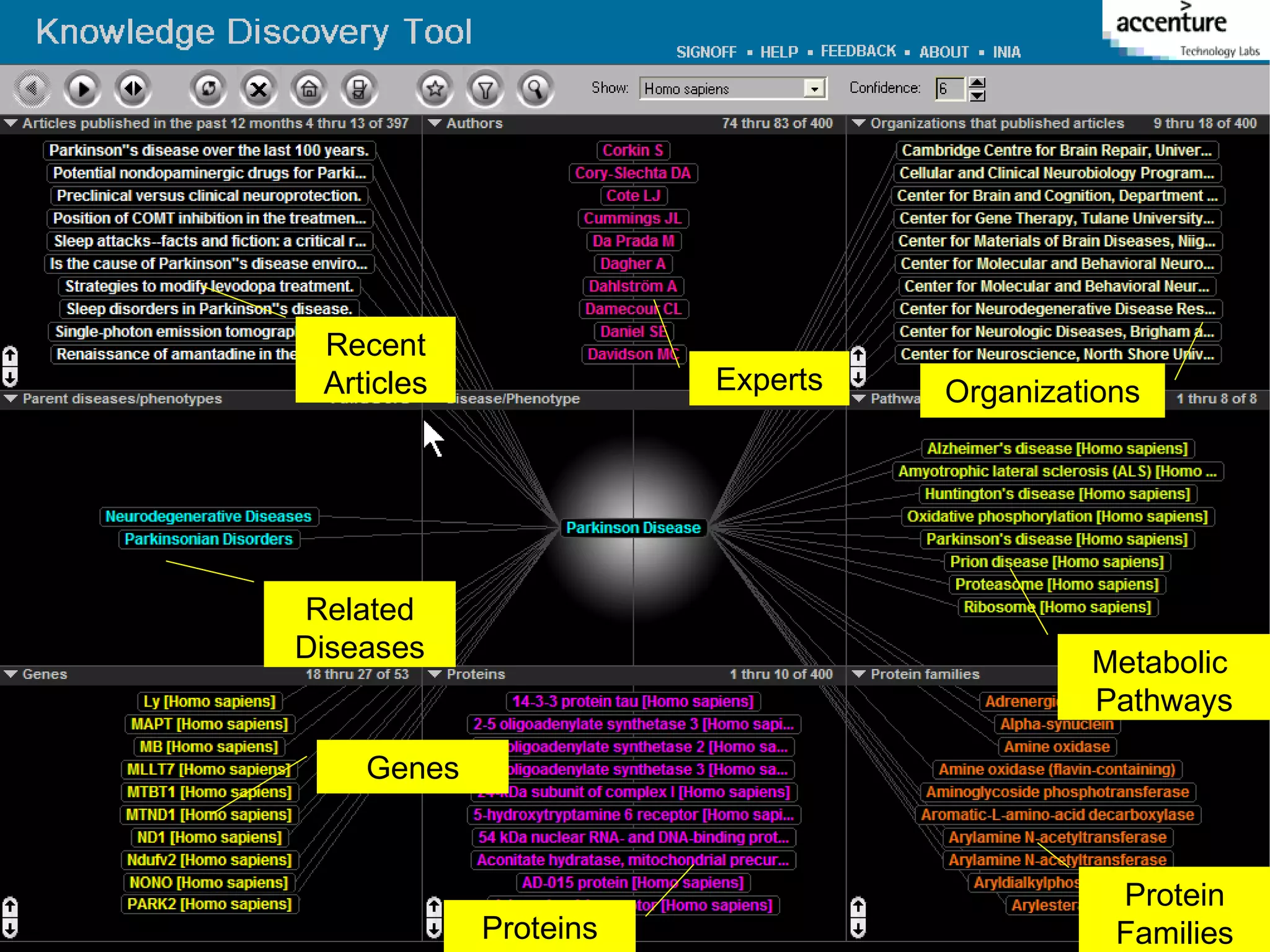
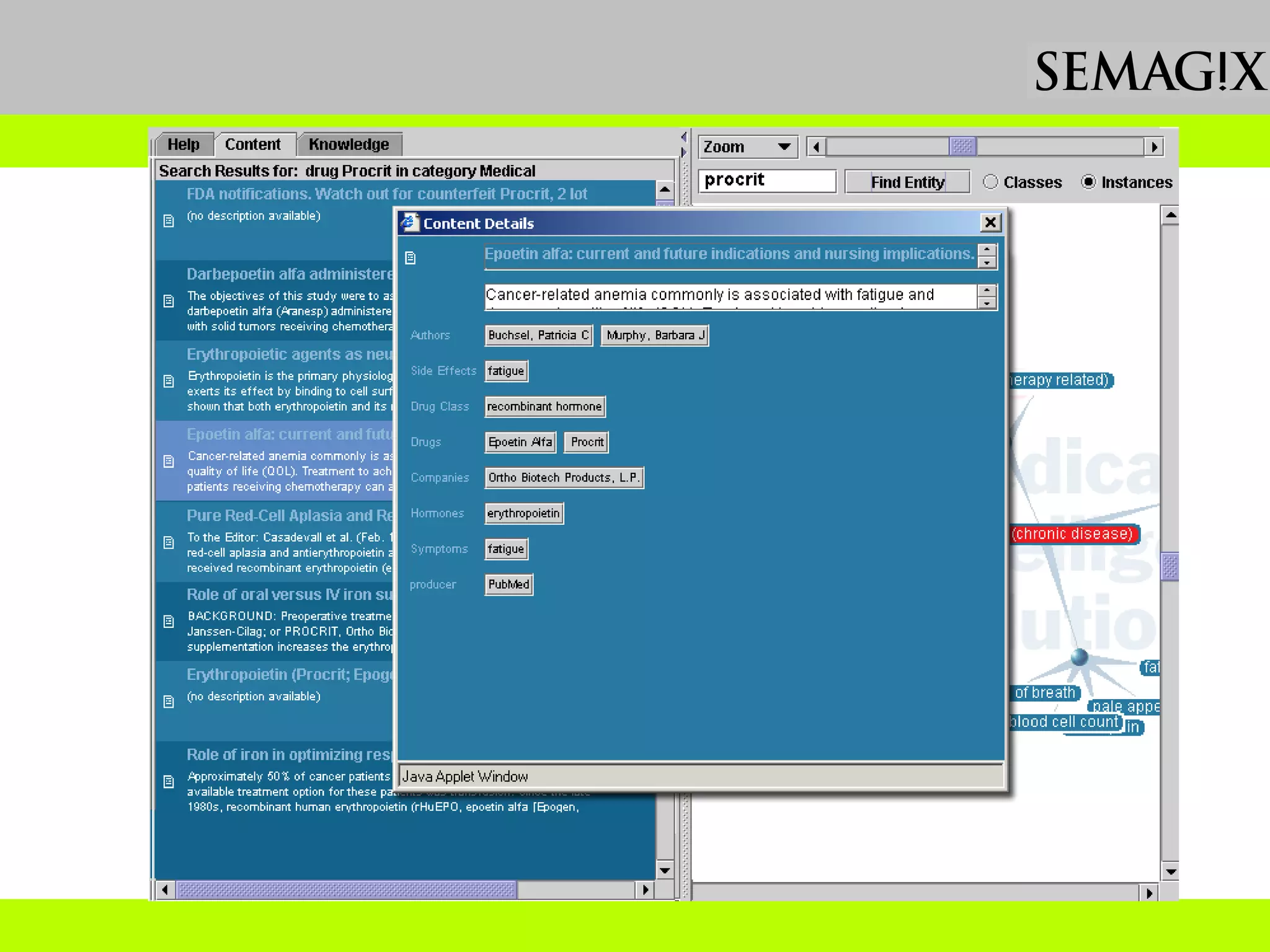
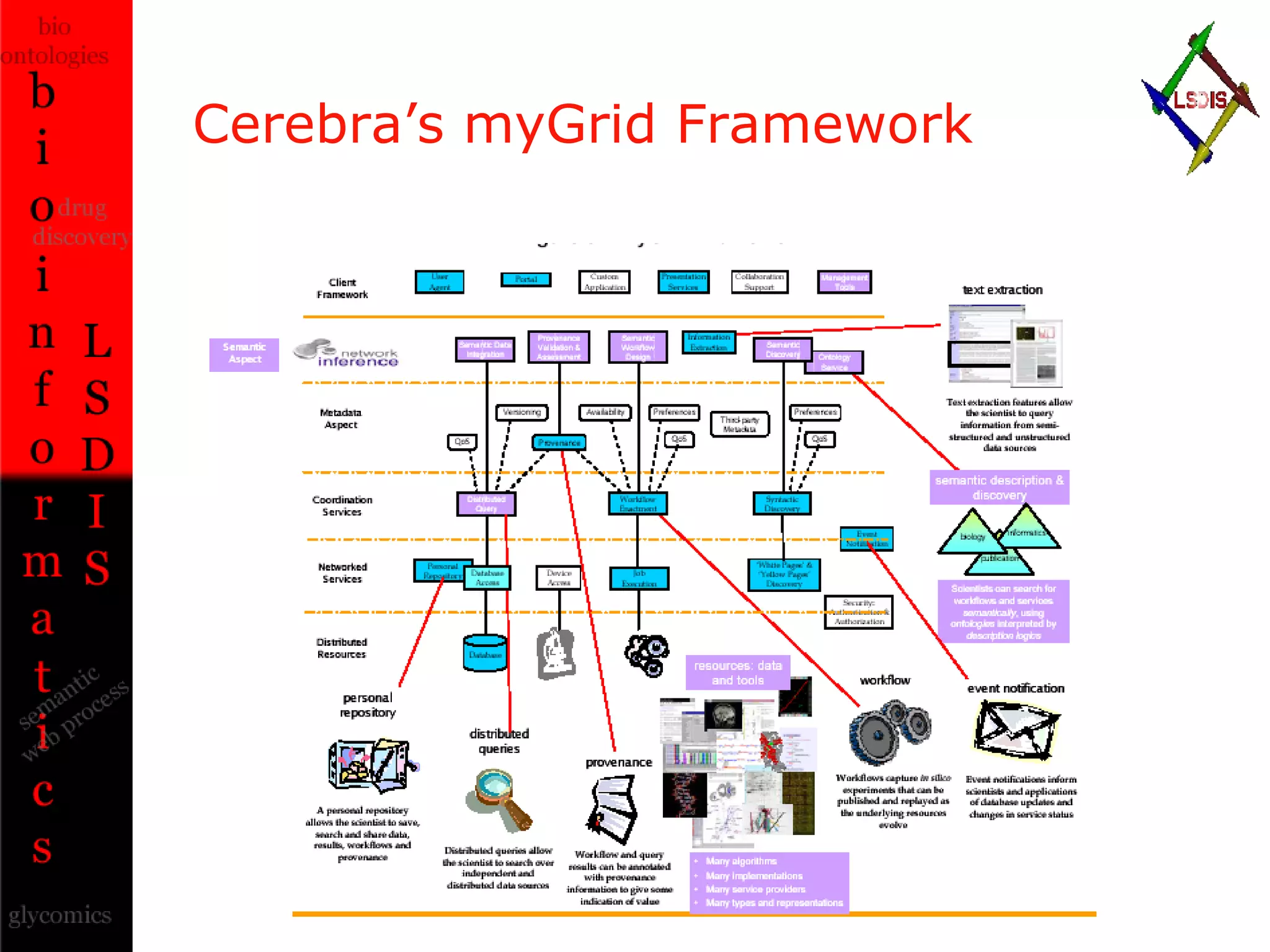
Industry Efforts (examples with bioinformatics applications only) Accenture’s Knowledge Discovery Tool (pre-ontology?, not product) Semagix’s Semantic Browsing and Querying application for drugs for Rogers MIS and its pharmaceutical customers (product and applications); also semantic analysis application (not discussed here)  Network Inference’s Cerebra server: semantic engineering based bioinformatics system aiding drug discovery (product)
Existing Systems using Semantics for Bioinformatics FOCUS: SEMANTIC SEARCH AND BROWSING (with nascent work in discovery)
Recent Articles Experts Organizations Metabolic  Pathways Protein Families Proteins Genes Related Diseases
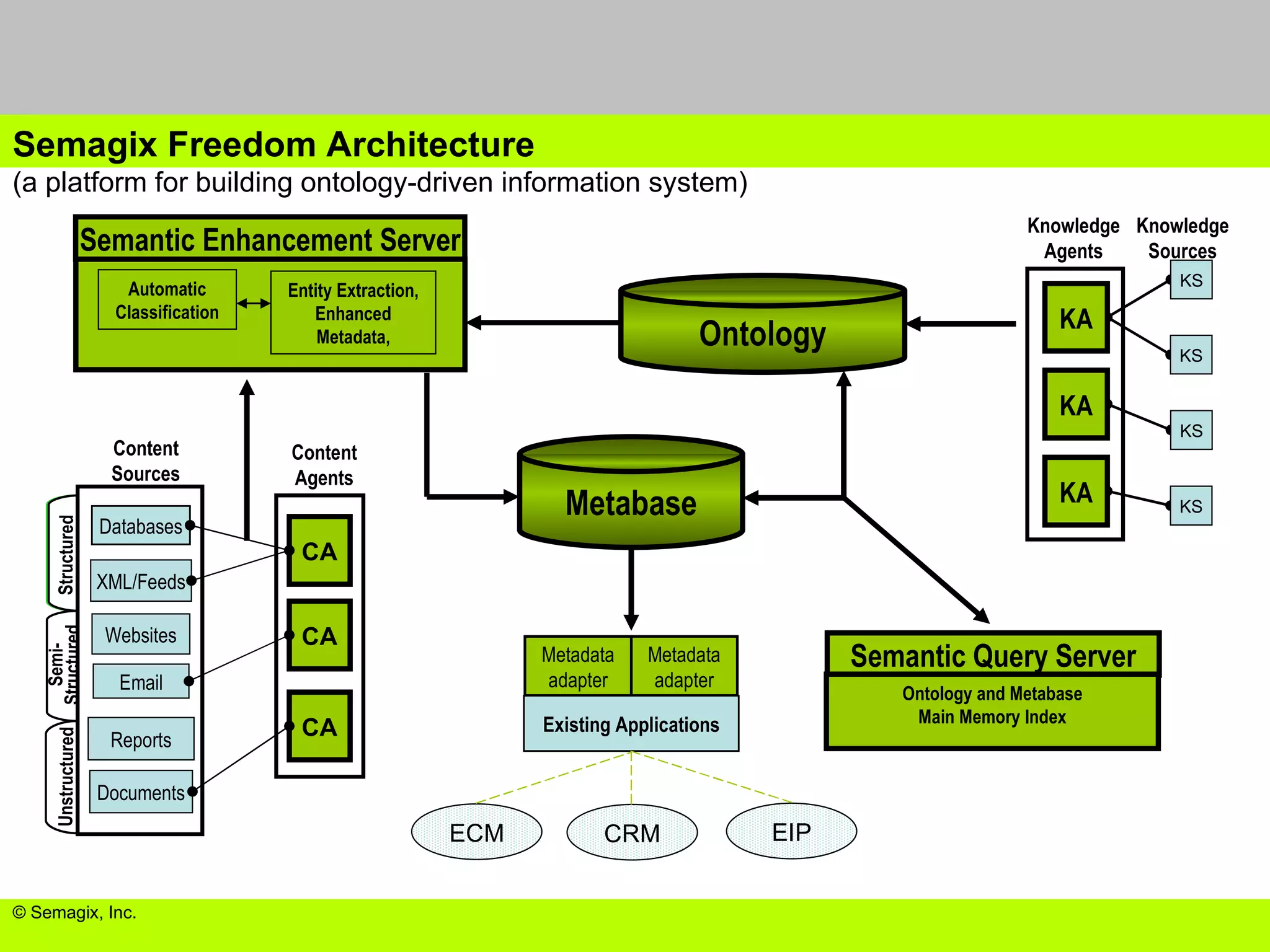
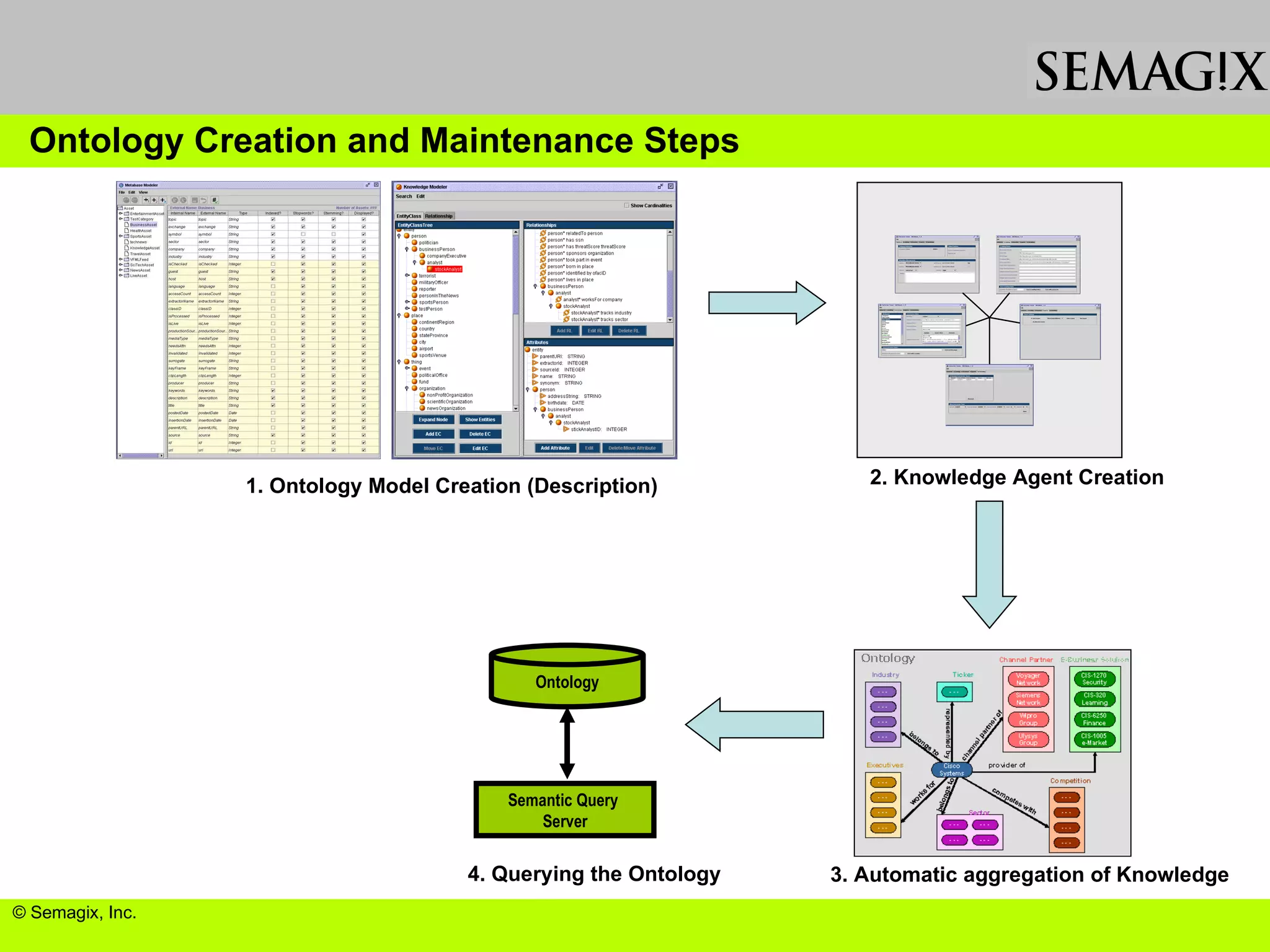
Semagix Freedom Architecture  (a platform for building ontology-driven information system) Ontology © Semagix, Inc. Content Sources Semi- Structured CA Content Agents Structured Unstructured Documents Reports XML/Feeds Websites Email Databases CA CA Knowledge Sources KA KS KS KA KA KS Knowledge Agents KS Metabase Semantic Enhancement Server Entity Extraction, Enhanced Metadata, Automatic Classification Semantic   Query Server Ontology and Metabase Main Memory Index Metadata adapter Metadata adapter Existing Applications ECM EIP CRM
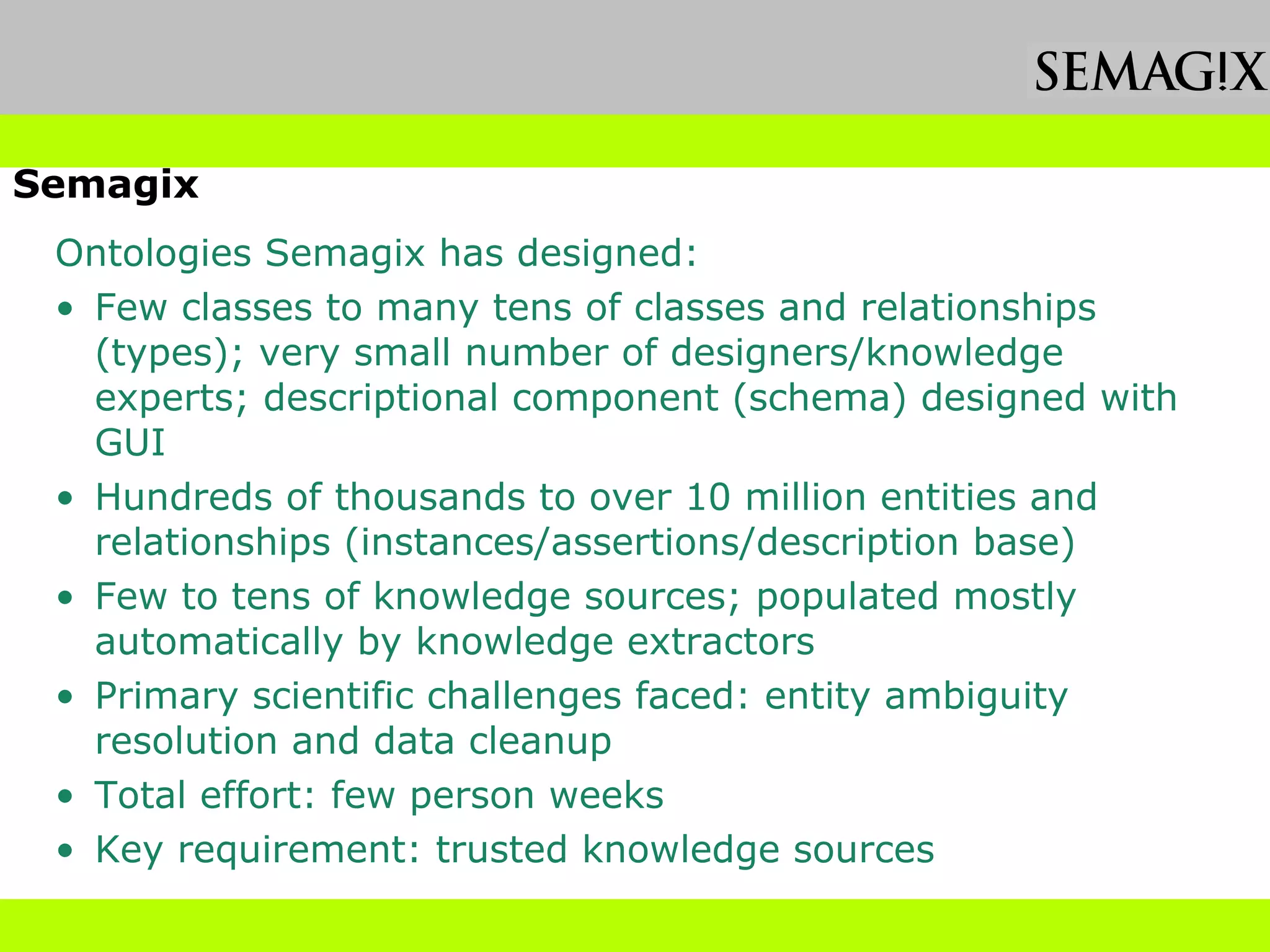
Practical Ontology Development Observation by Semagix Ontologies Semagix has designed: Few classes to many tens of classes and relationships (types); very small number of designers/knowledge experts; descriptional component (schema) designed with GUI Hundreds of thousands to over 10 million entities and relationships (instances/assertions/description base) Few to tens of knowledge sources; populated mostly automatically by knowledge extractors Primary scientific challenges faced: entity ambiguity resolution and data cleanup  Total effort: few person weeks Key requirement: trusted knowledge sources
1. Ontology Model Creation (Description) 2. Knowledge Agent Creation 3. Automatic aggregation of Knowledge 4. Querying the Ontology Ontology Creation and Maintenance Steps © Semagix, Inc. Ontology Semantic Query  Server
 
Cerebra’s myGrid Framework
Outline Evolution of Science Challenges in biology What can bioInformatics do for Biology? What can Semantics do for BioInformatics? Some examples of Semantics-powered Bioinformatics
Applying Semantics to  BioInformatics : Example 1 Semantic Browsing, Querying and Integration
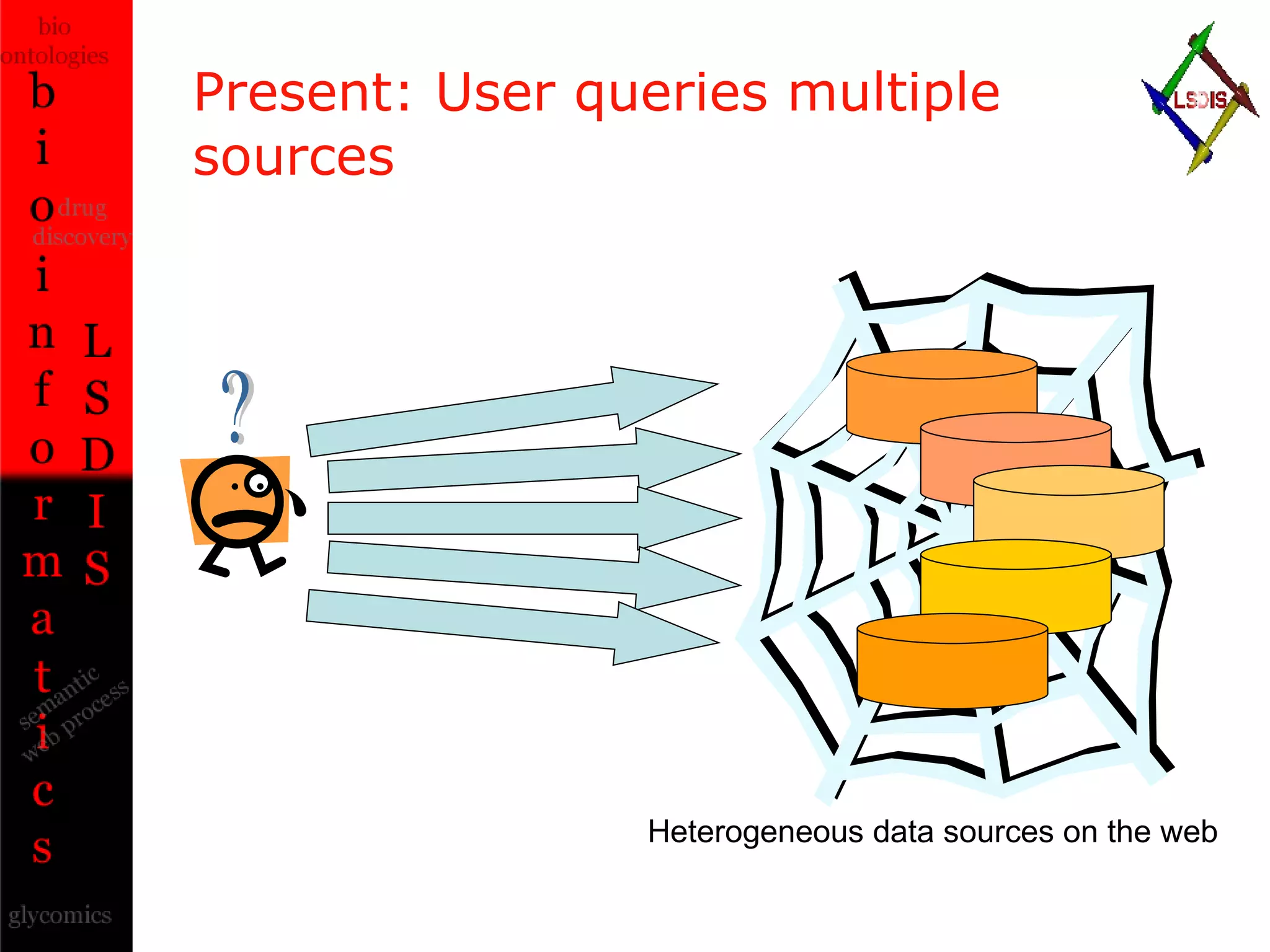
Present: User queries multiple sources Heterogeneous data sources on the web ?
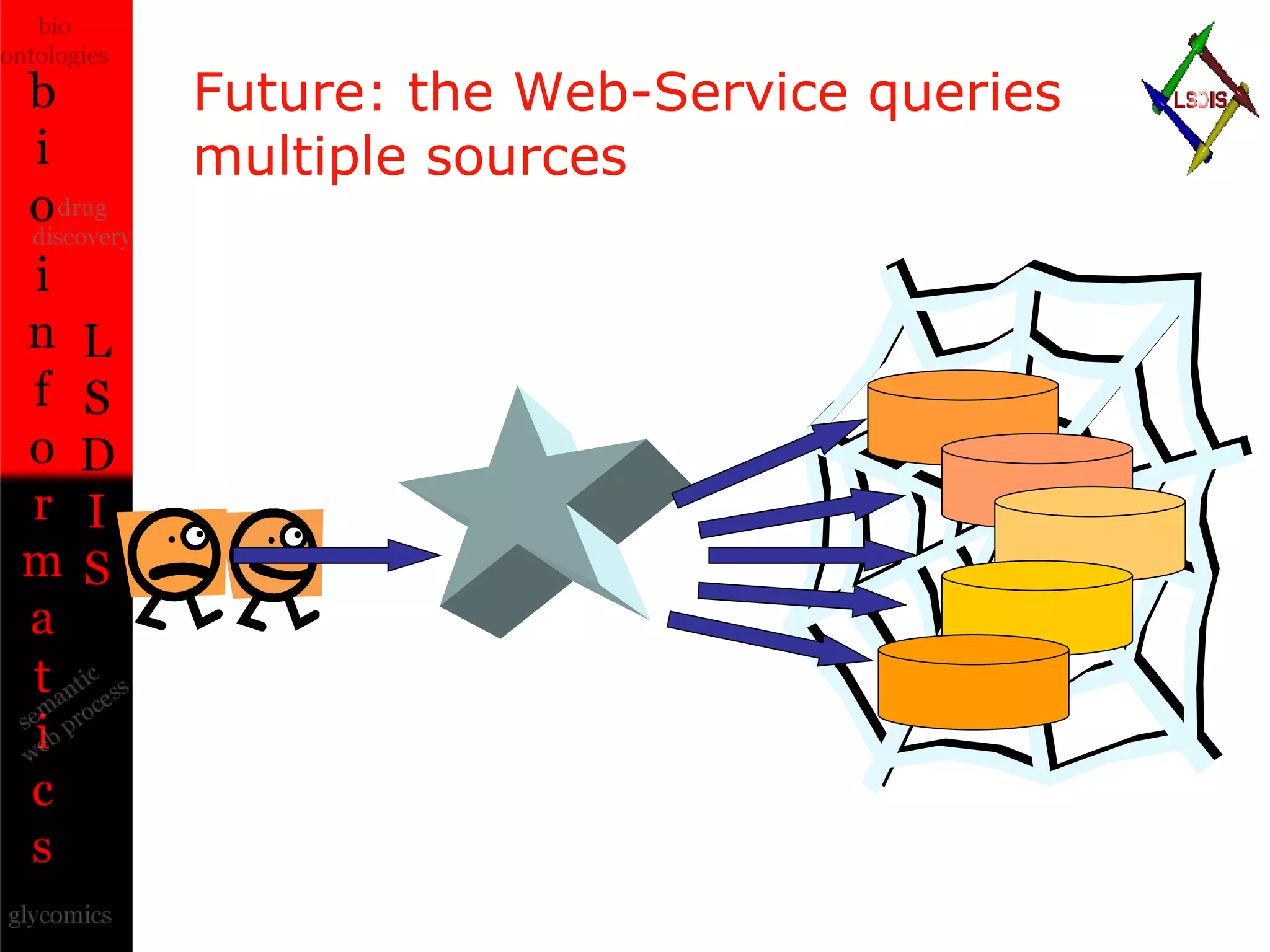
Future: the Web-Service queries multiple sources
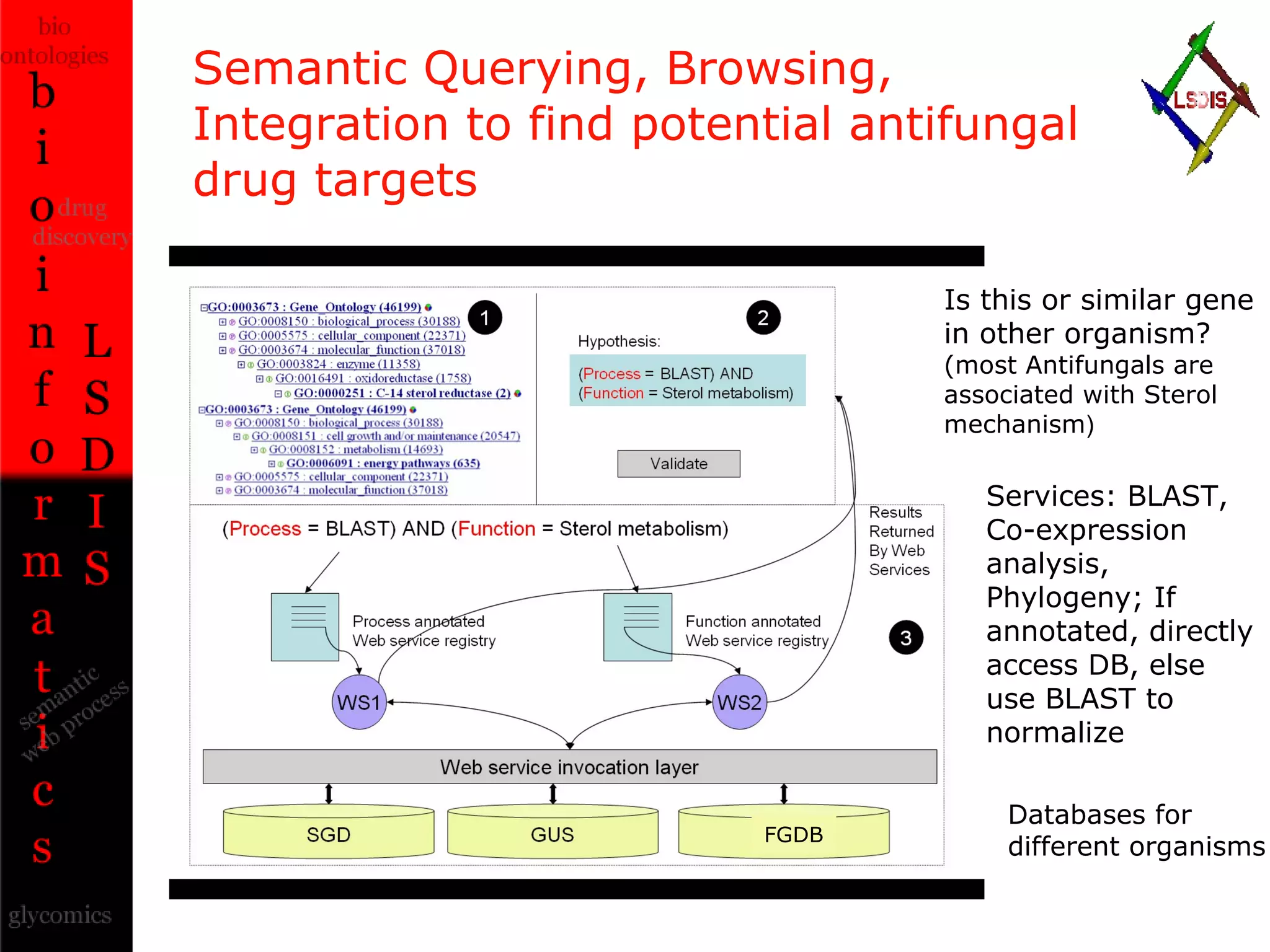
Semantic Querying, Browsing, Integration to find potential antifungal drug targets  Databases for different organisms Is this or similar gene in other organism?  (most Antifungals are associated with Sterol mechanism ) Services: BLAST, Co-expression analysis, Phylogeny; If annotated, directly access DB, else use BLAST to normalize FGDB
Applying Semantics to  BioInformatics : Example 2 Analytics in Drug Discovery
Analytics, Using Explicit and Implicit Relationships in  Drug Discovery Some molecules contain functional groups that   inhibit them from acting as drugs Elimination of these groups can make the   molecule, a DRUG.
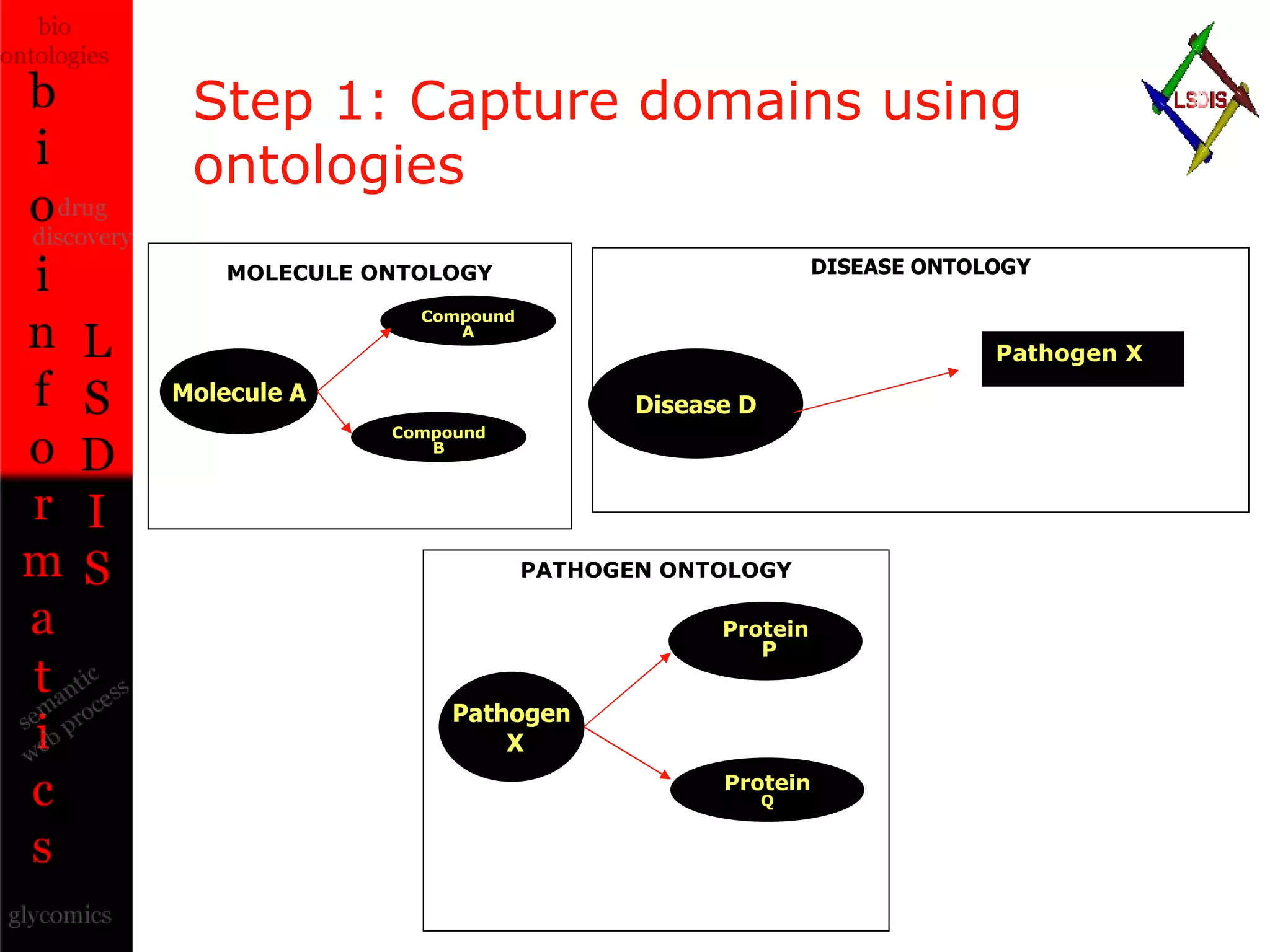
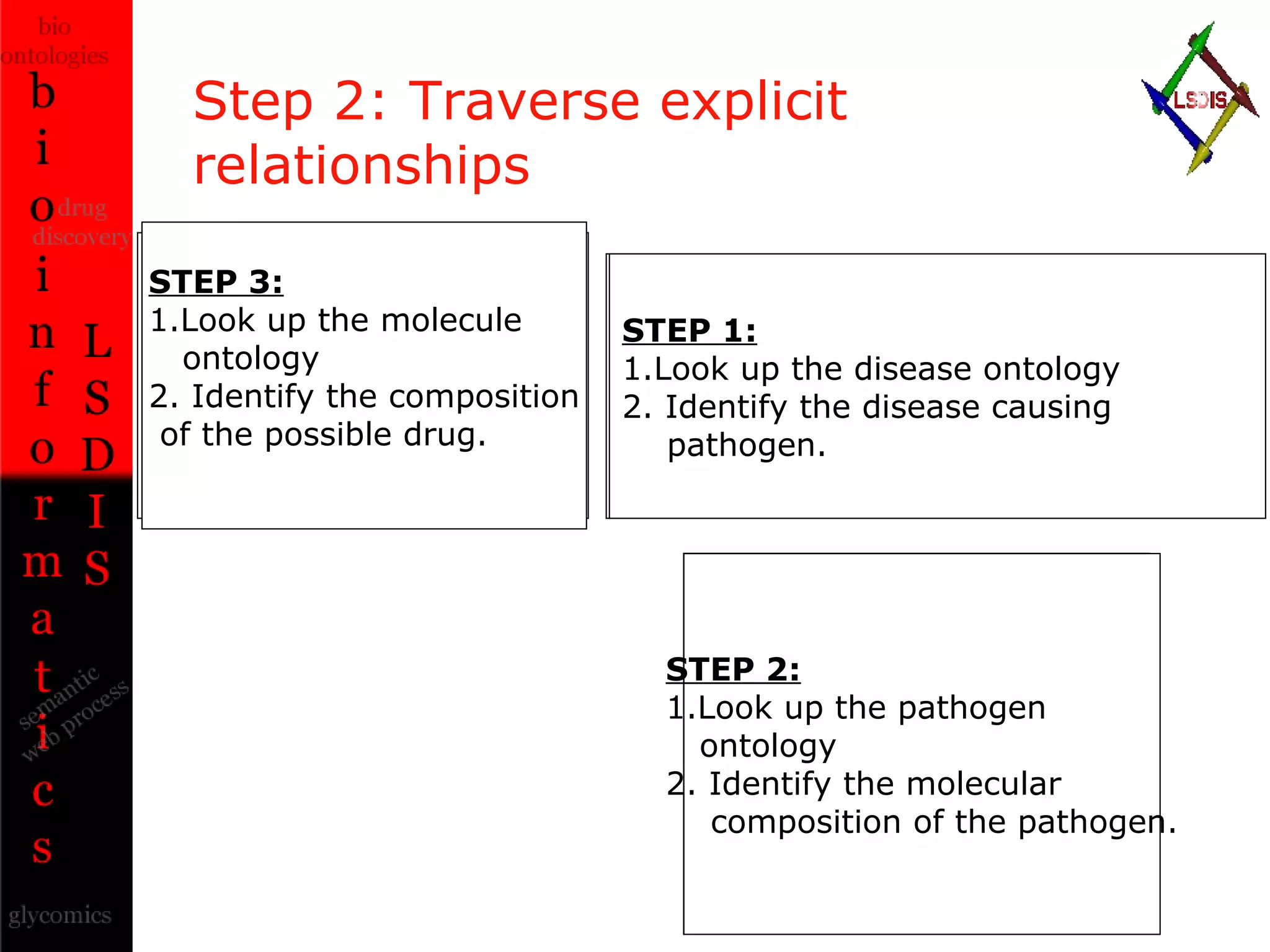
Step 1: Capture domains using ontologies Pathogen X MOLECULE ONTOLOGY Molecule A Compound  A Compound B DISEASE ONTOLOGY Disease D PATHOGEN ONTOLOGY Pathogen X Protein P Protein Q
Pathogen X Protein P Step 2: Traverse explicit relationships Compound A DISEASE ONTOLOGY Disease D PATHOGEN ONTOLOGY Pathogen X Protein Q STEP 1: 1.Look up the disease ontology 2. Identify the disease causing  pathogen. STEP 2: 1.Look up the pathogen ontology 2. Identify the molecular  composition of the pathogen. MOLECULE ONTOLOGY Molecule A Compound  B Compound C STEP 3: 1.Look up the molecule  ontology 2. Identify the composition of the possible drug.
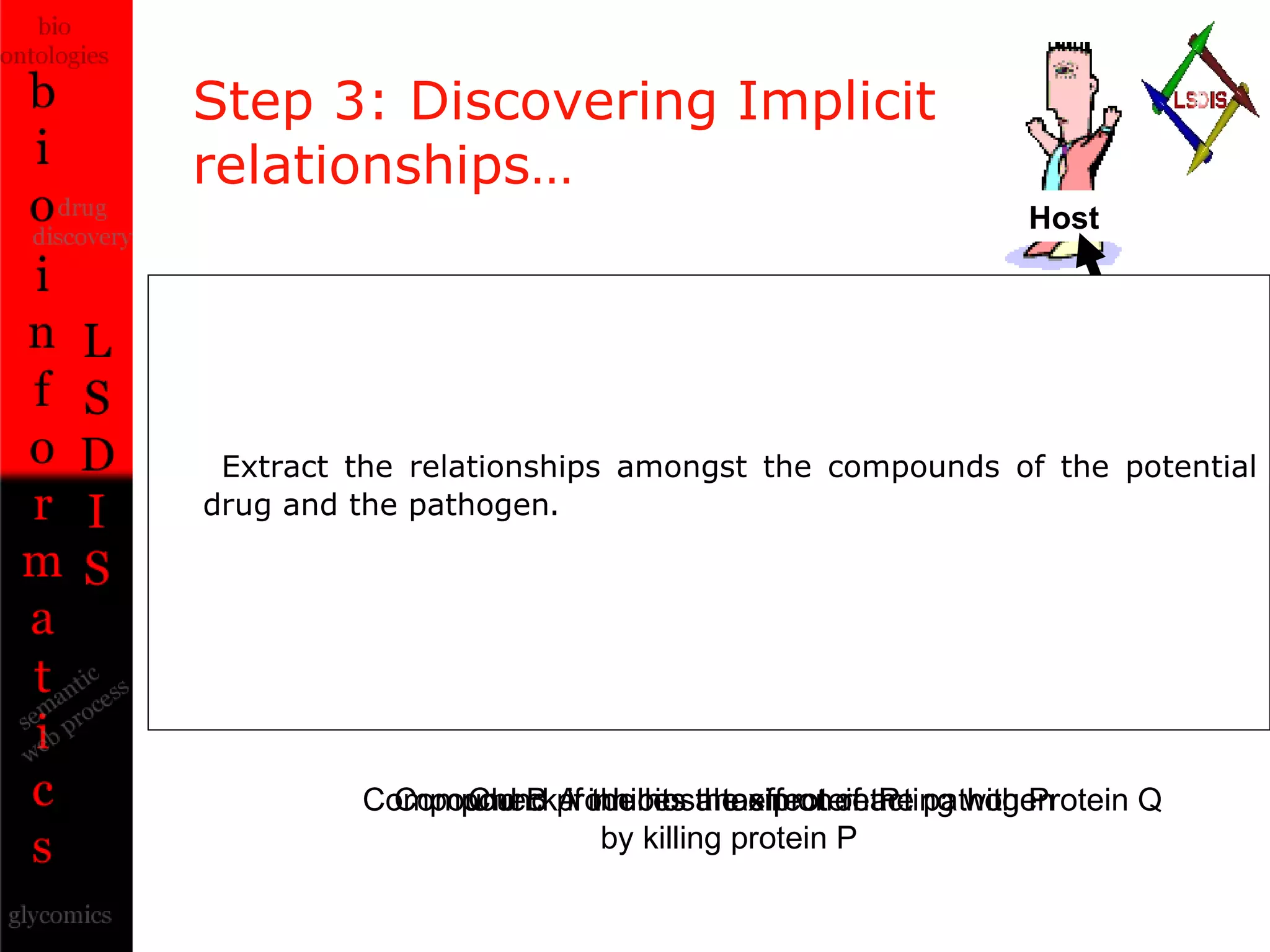
Step 3: Discovering Implicit relationships…  Protein P MOLECULE ONTOLOGY Molecule A Compound A Compound B PATHOGEN ONTOLOGY Pathogen X Protein Q Compound A inhibits the effect of the pathogen  by killing protein P Compound B produces a toxin on reacting with Protein Q Host Check if the host has protein P Extract the relationships amongst the compounds of the potential   drug and the pathogen .
Inferences Based on  Relationships Compound B doesn’t contribute to the curing aspect of the drug, but rather generates a toxin. Eliminate compound B and molecule A can be a potential drug. However if the host has protein P, then we cannot use protein to bind the drug. So look for another drug that can bind at protein Q without producing a toxin Eliminate and Discover!!!!
Applying Semantics to  BioInformatics : Example 3 Using Ontologies in cancer research
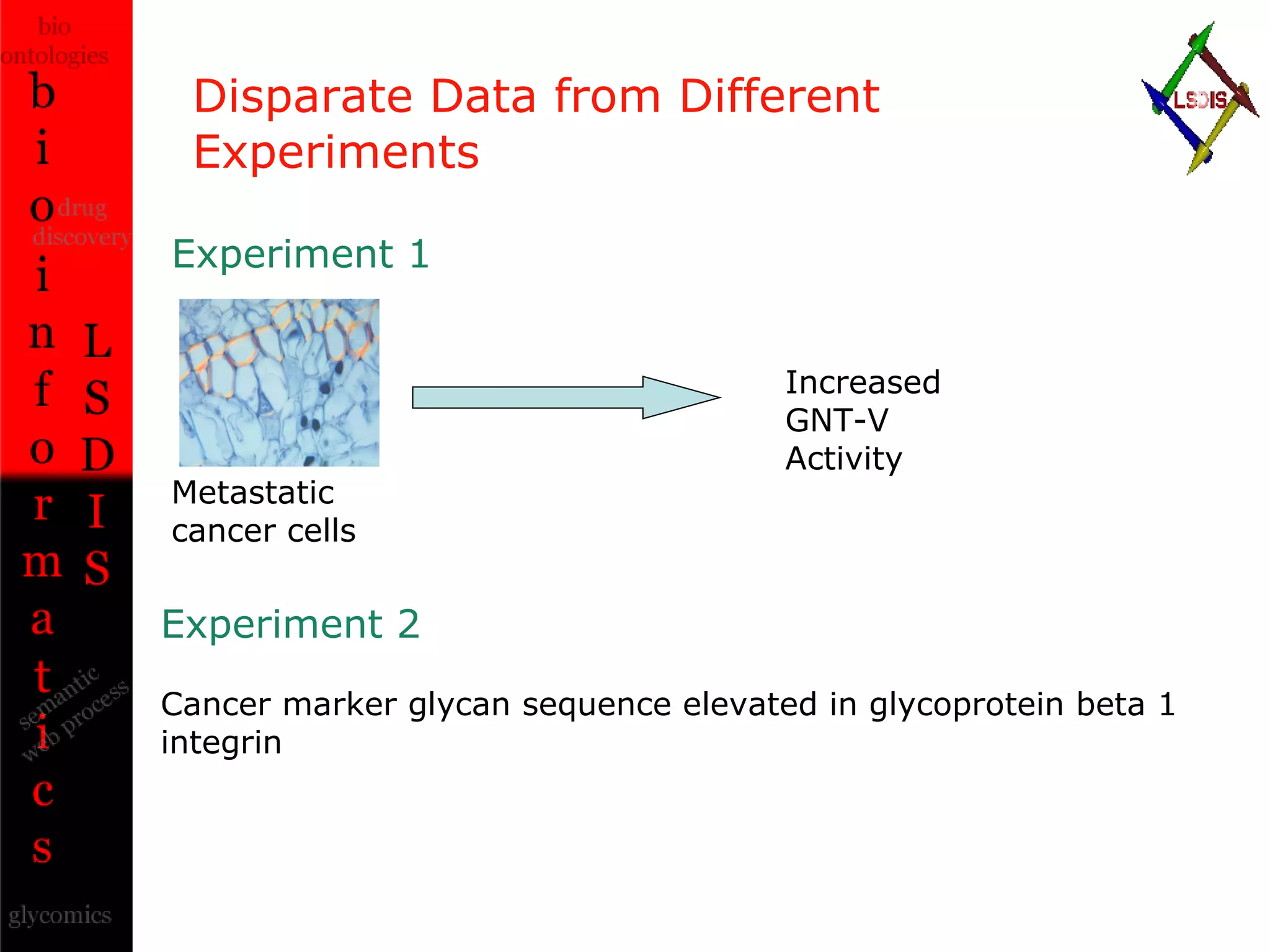
Disparate Data from Different Experiments Metastatic cancer cells Increased GNT-V Activity Experiment 1 Experiment 2 Cancer marker glycan sequence elevated in glycoprotein beta 1 integrin
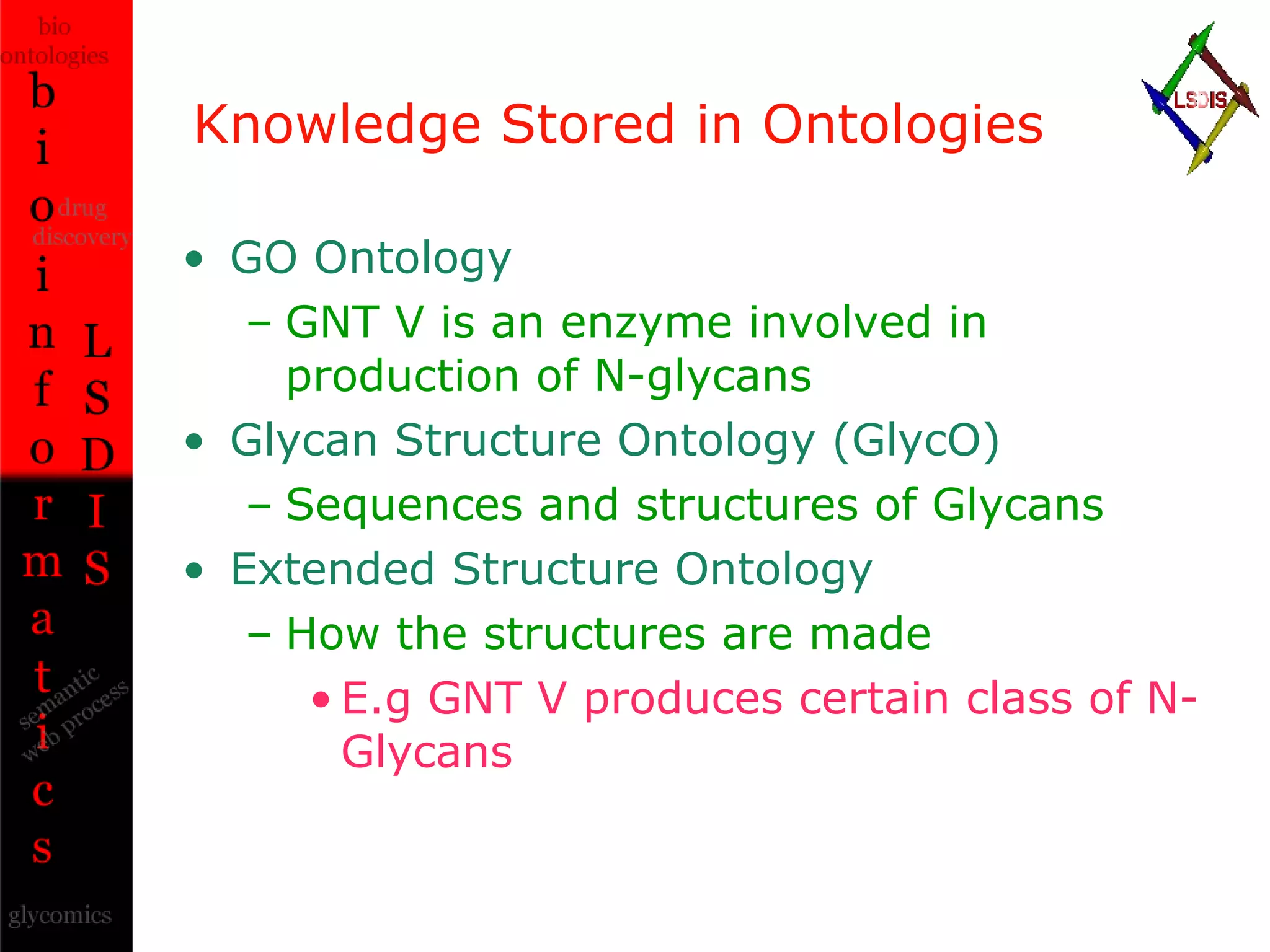
Knowledge Stored in Ontologies GO Ontology GNT V is an enzyme involved in production of N-glycans Glycan Structure Ontology (GlycO) Sequences and structures of Glycans Extended Structure Ontology How the structures are made E.g GNT V produces certain class of N-Glycans
Finding New Information Combine data from experiments and  knowledge stored in ontologies Known assertion from Experiments Beta Integrin is involved in cancer New assertion to be tested Are any other glycoproteins involved in cancer ?
Applying Semantics to  BioInformatics : Example 4 Applying Semantics to BioInformatics Processes
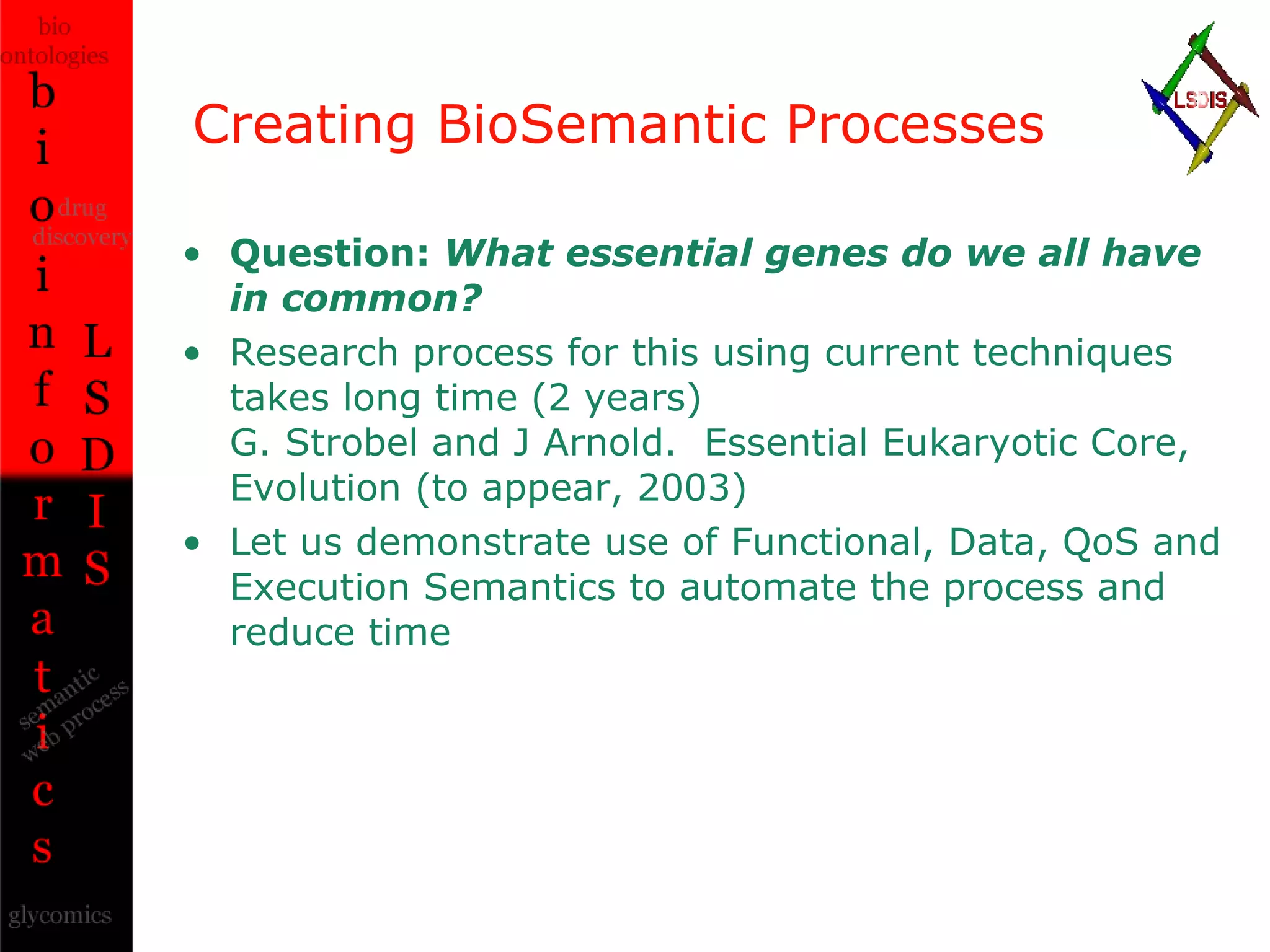
Creating BioSemantic Processes  Question:  What essential genes do we all have in common? Research process for this using current techniques takes long time (2 years)  G. Strobel and J Arnold.  Essential Eukaryotic Core, Evolution (to appear, 2003) Let us demonstrate use of Functional, Data, QoS and Execution Semantics to automate the process and reduce time
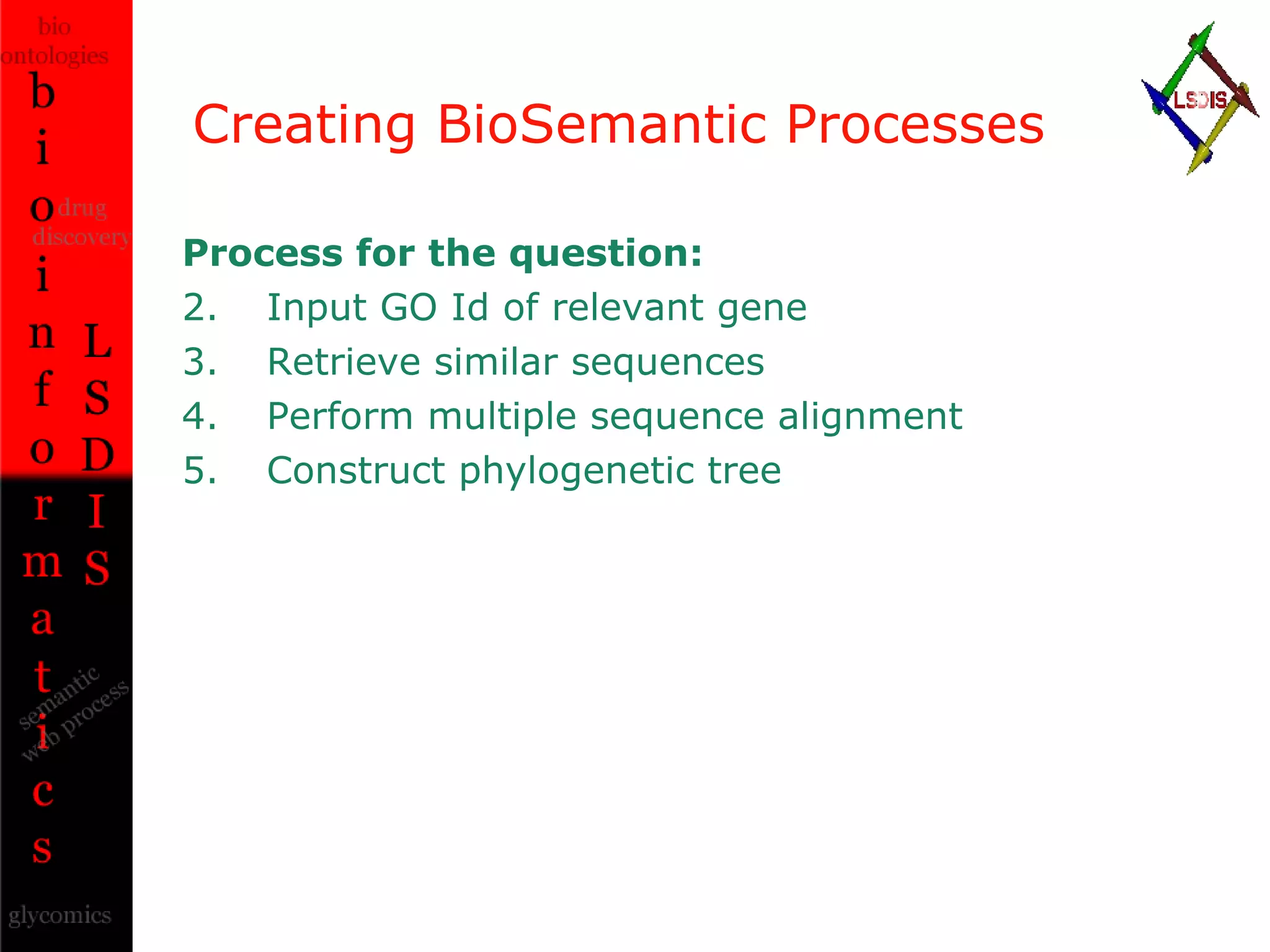
Creating BioSemantic Processes  Process for the question:   Input GO Id of relevant gene Retrieve similar sequences Perform multiple sequence alignment Construct phylogenetic tree
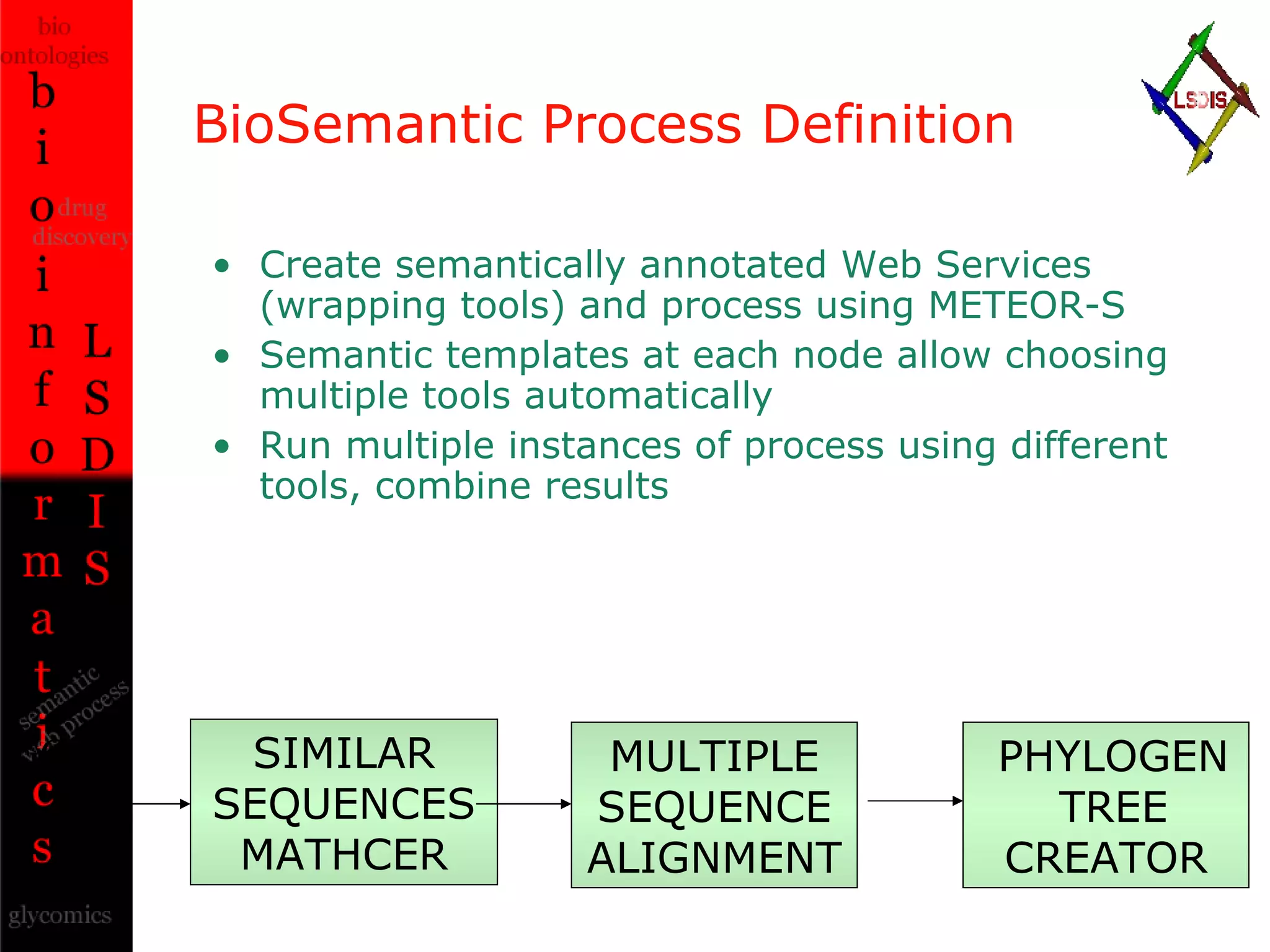
BioSemantic Process Definition Create semantically annotated Web Services (wrapping tools) and process using METEOR-S Semantic templates at each node allow choosing multiple tools automatically  Run multiple instances of process using different tools, combine results GO id SIMILAR SEQUENCES MATHCER MULTIPLE SEQUENCE ALIGNMENT PHYLOGEN  TREE CREATOR
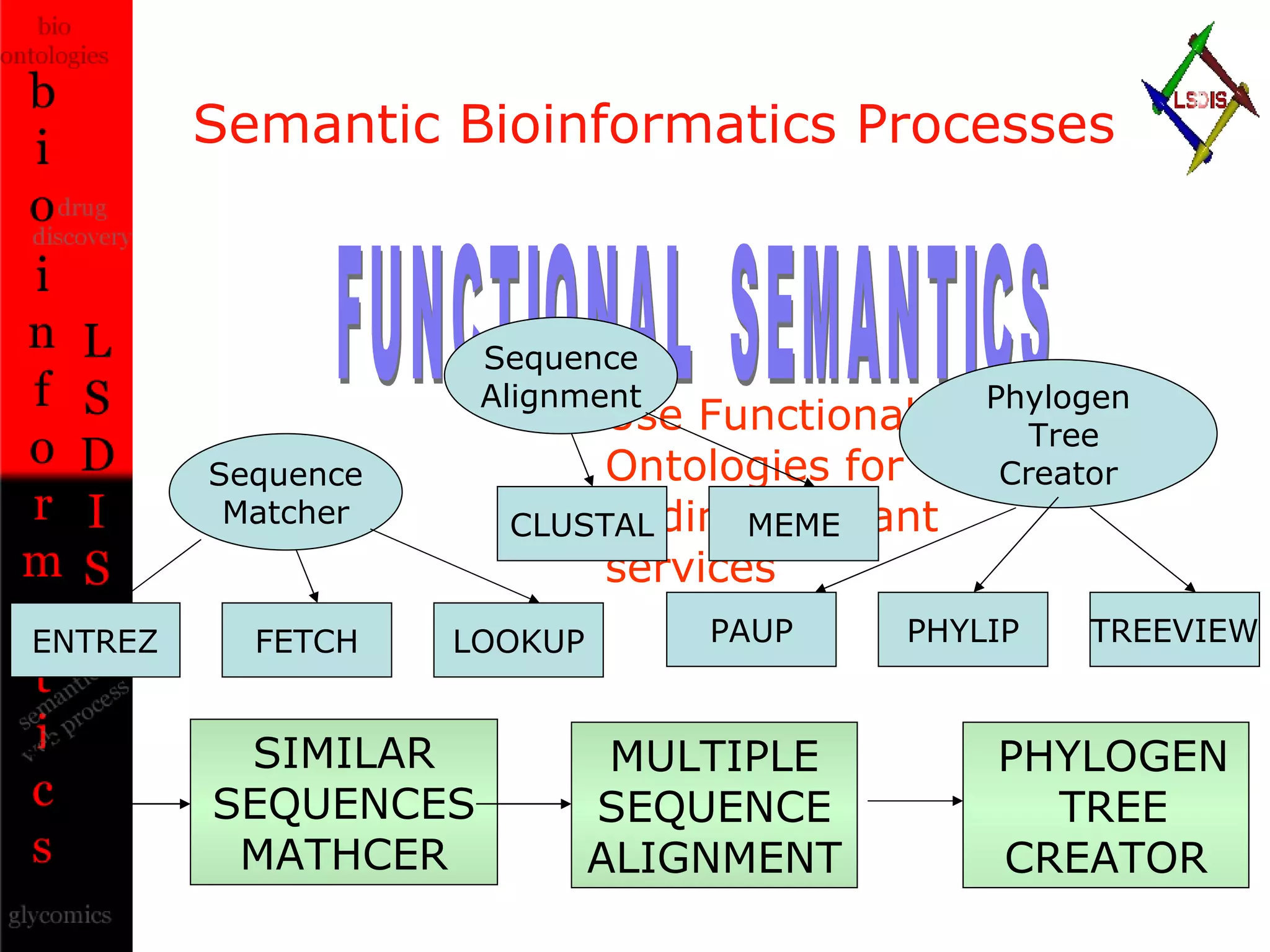
Semantic Bioinformatics Processes SIMILAR SEQUENCES MATHCER GO id MULTIPLE SEQUENCE ALIGNMENT PHYLOGEN  TREE CREATOR FUNCTIONAL  SEMANTICS Use Functional Ontologies for finding relevant services Sequence Matcher ENTREZ FETCH LOOKUP Sequence Alignment CLUSTAL MEME Phylogen  Tree Creator PAUP PHYLIP TREEVIEW
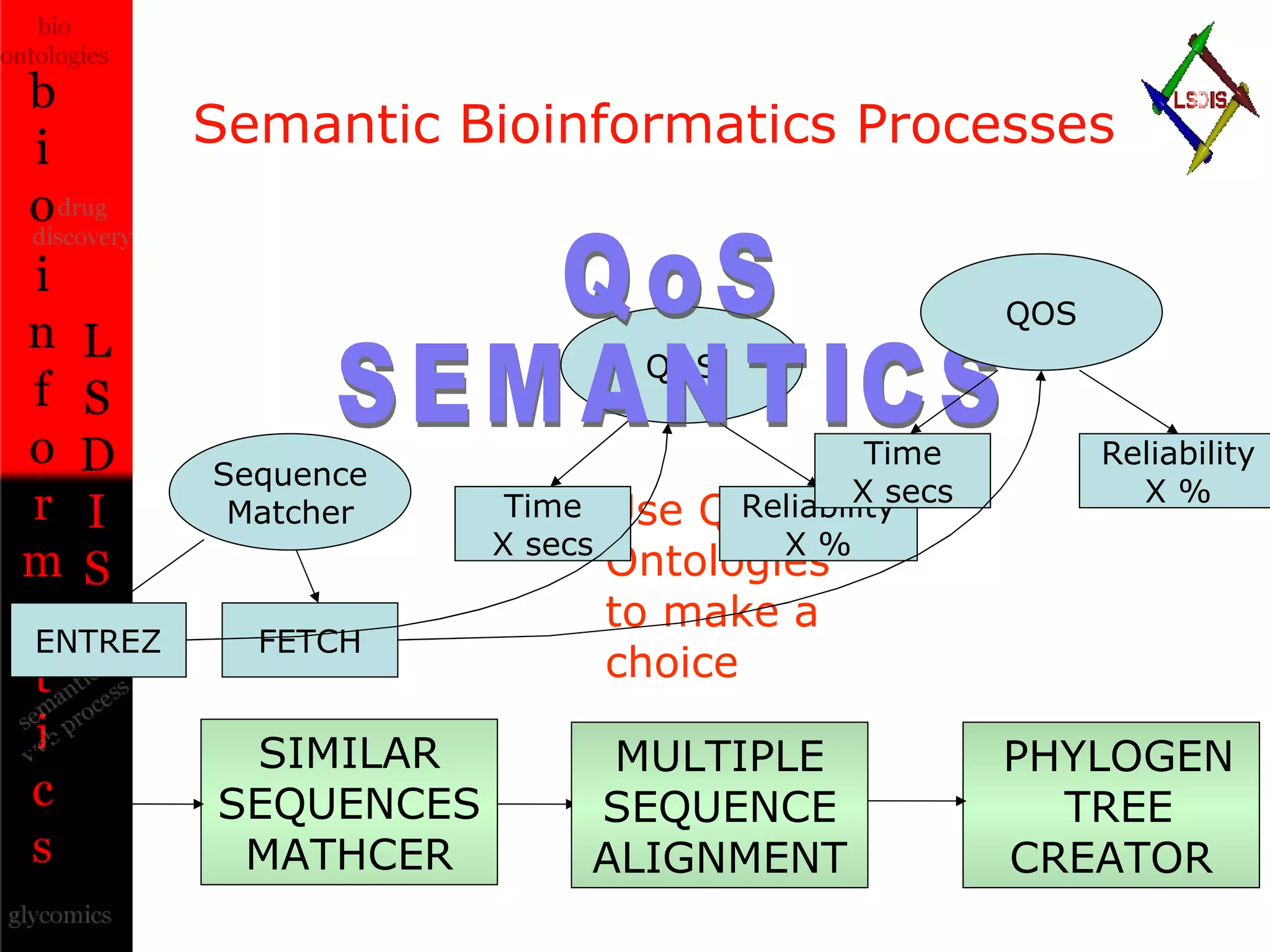
Semantic Bioinformatics Processes SIMILAR SEQUENCES MATHCER GO id MULTIPLE SEQUENCE ALIGNMENT PHYLOGEN  TREE CREATOR Use QoS Ontologies to make a  choice Sequence Matcher ENTREZ FETCH QOS Time X secs Reliability X % QoS  SEMANTICS QOS Time X secs Reliability X %
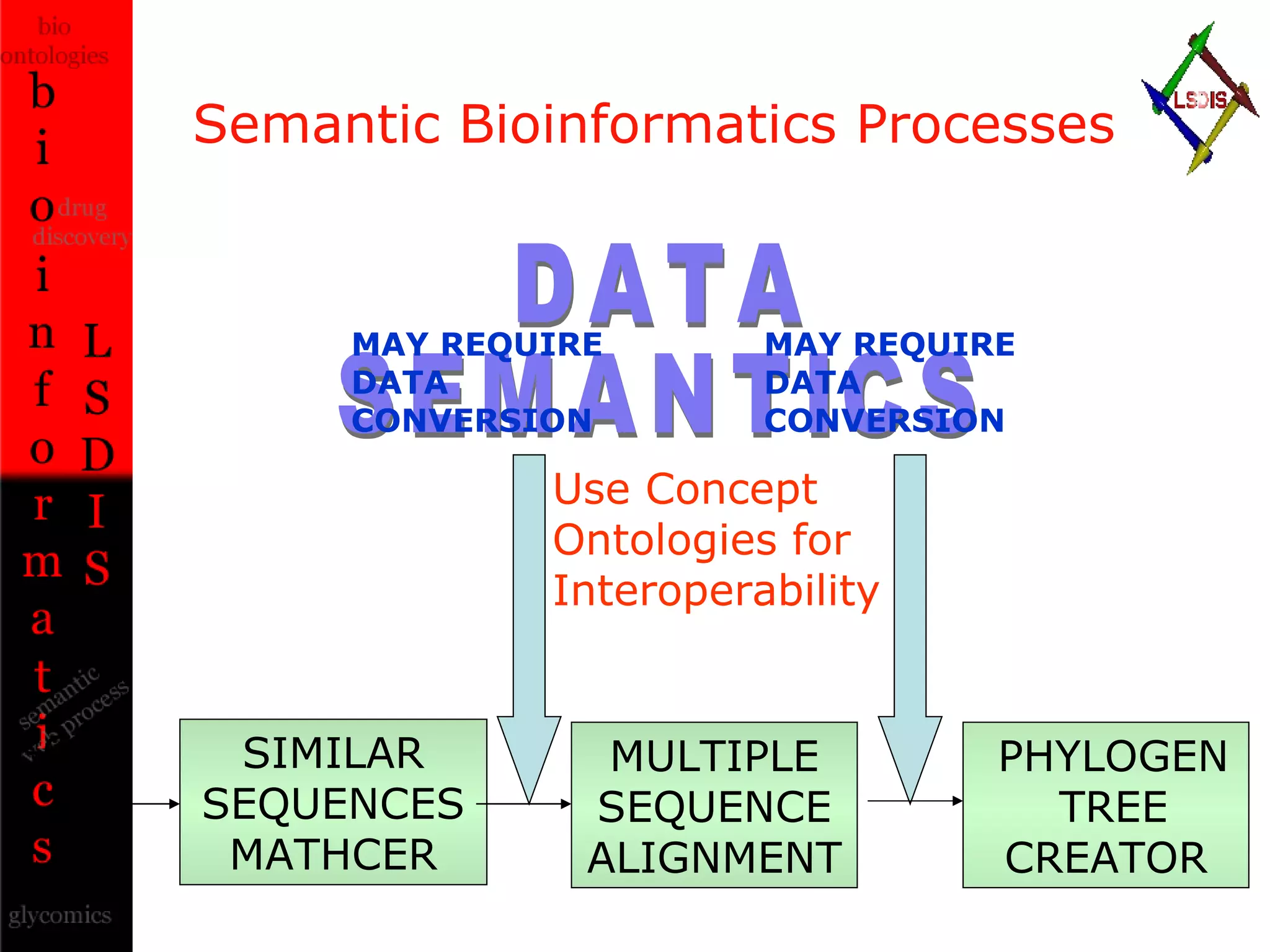
Semantic Bioinformatics Processes GO id DATA  SEMANTICS Use Concept Ontologies for Interoperability MAY REQUIRE  DATA CONVERSION MAY REQUIRE  DATA CONVERSION SIMILAR SEQUENCES MATHCER MULTIPLE SEQUENCE ALIGNMENT PHYLOGEN  TREE CREATOR
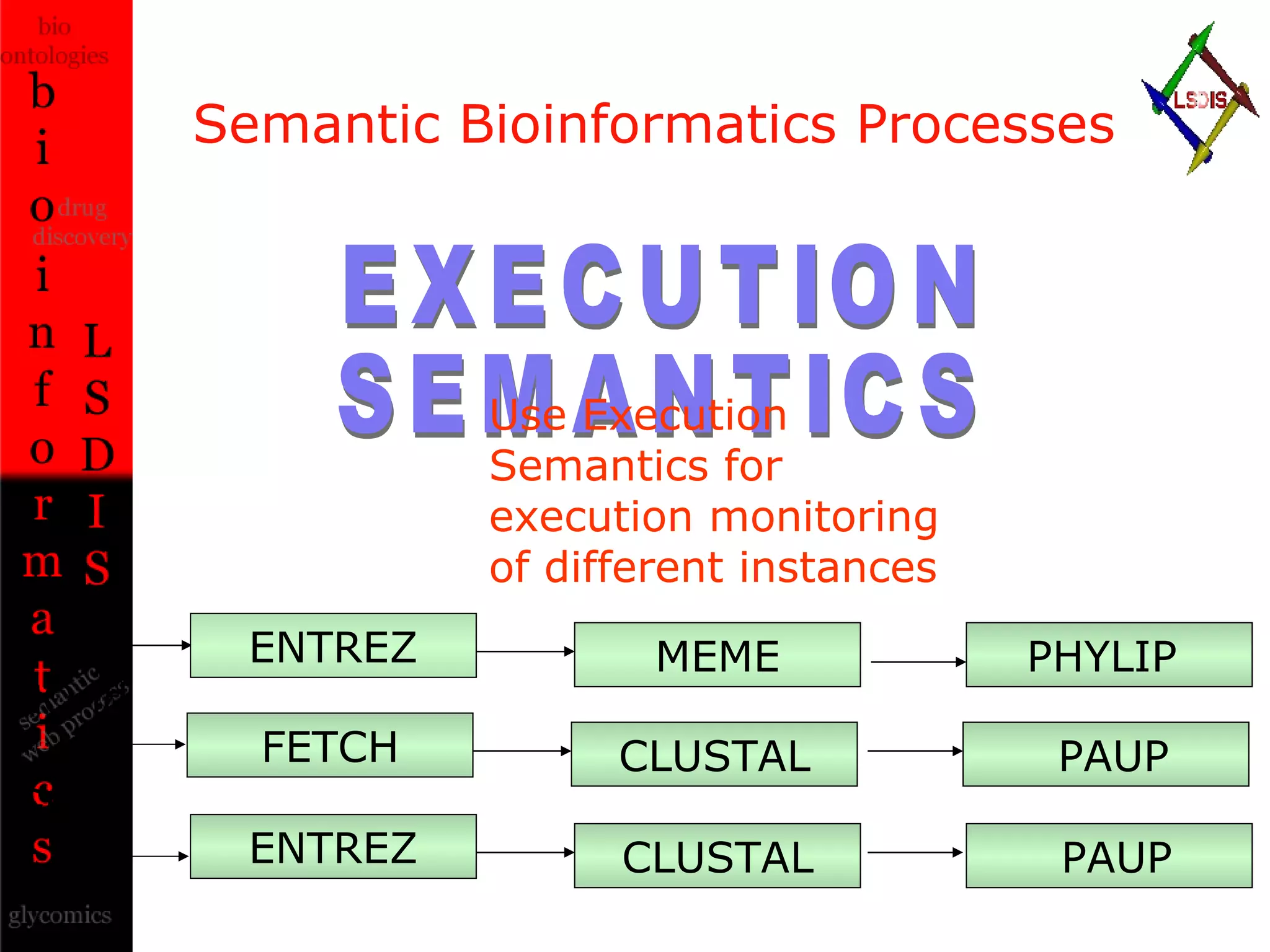
Semantic Bioinformatics Processes GO id CLUSTAL PAUP EXECUTION SEMANTICS Use Execution Semantics for execution monitoring of different instances GO id MEME PHYLIP  GO id CLUSTAL PAUP FETCH ENTREZ ENTREZ
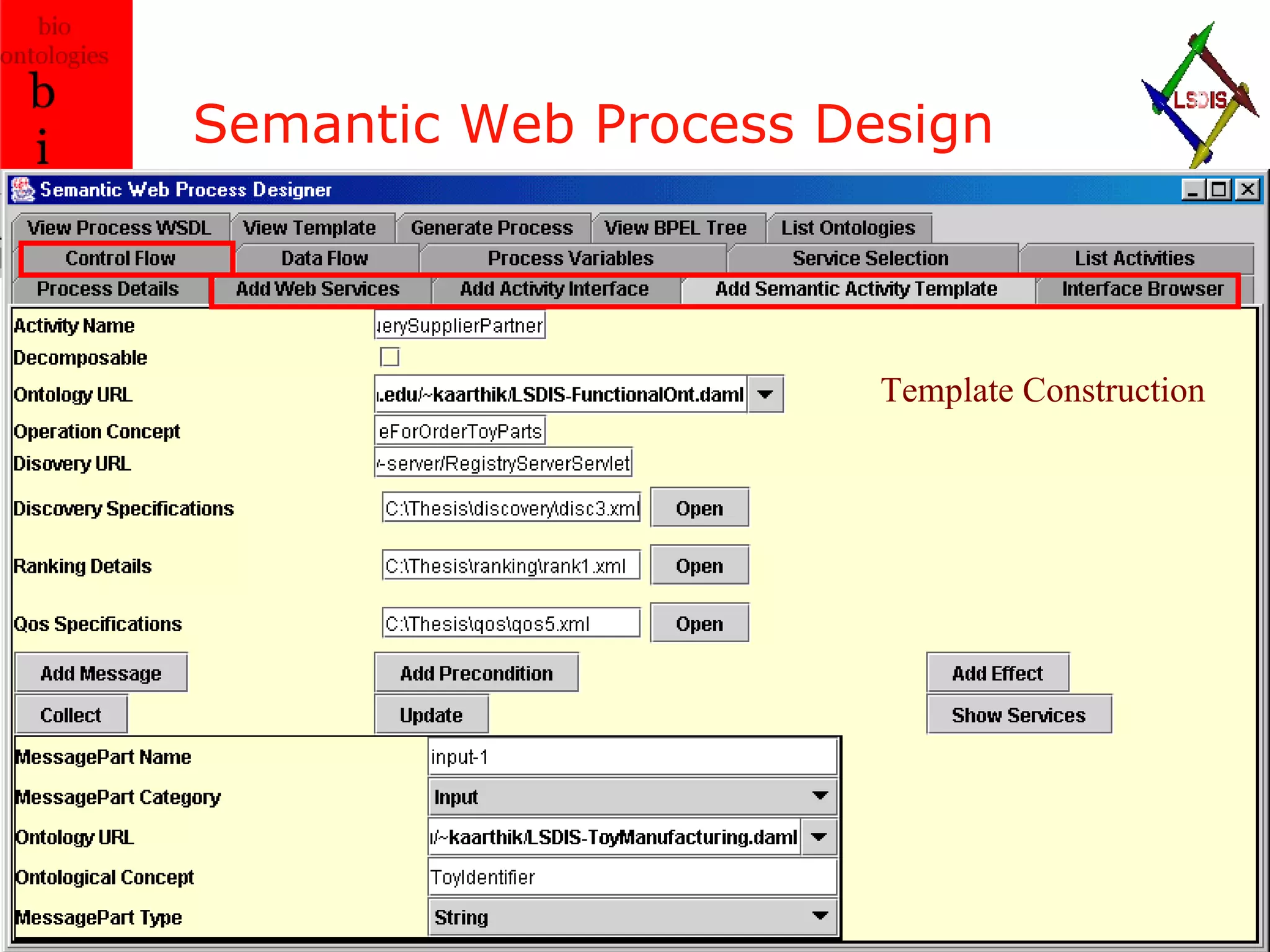
Semantic Web Process Design Template Construction
Common genes
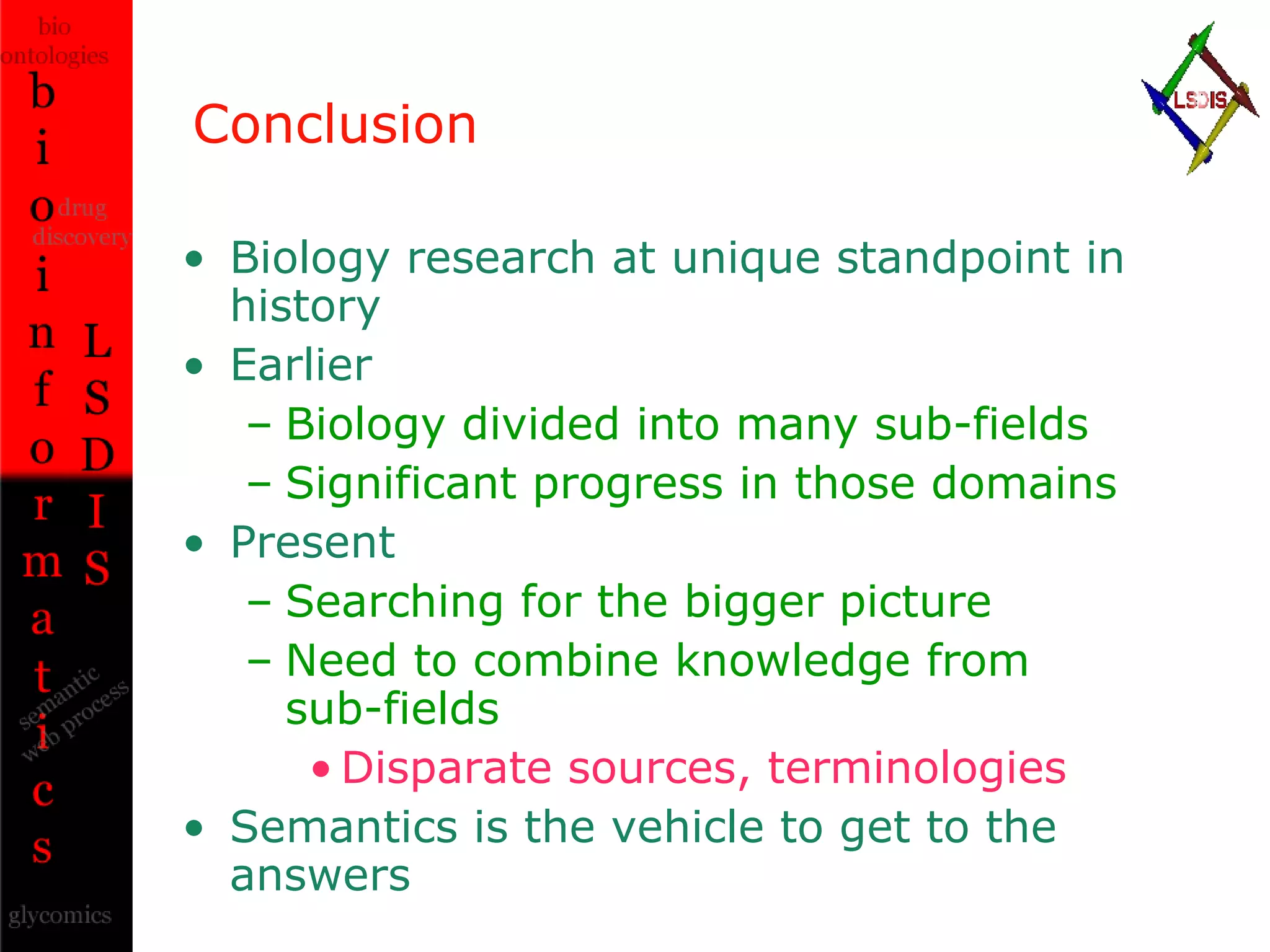
Conclusion Biology research at unique standpoint in history Earlier Biology divided into many sub-fields Significant progress in those domains Present Searching for the bigger picture Need to combine knowledge from  sub-fields Disparate sources, terminologies Semantics is the vehicle to get to the answers
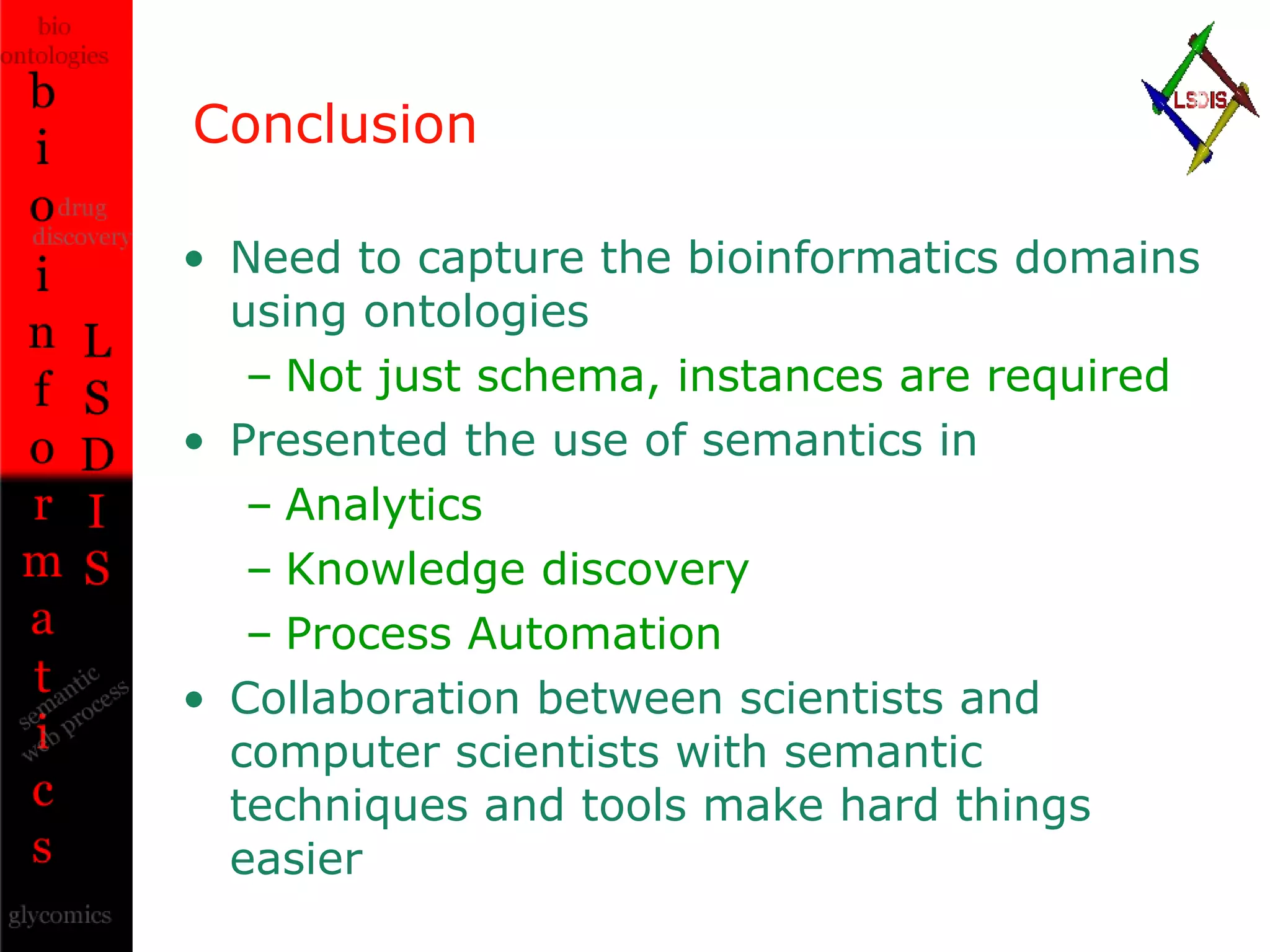
Conclusion Need to capture the bioinformatics domains using ontologies Not just schema, instances are required Presented the use of semantics in Analytics Knowledge discovery Process Automation Collaboration between scientists and computer scientists with semantic techniques and tools make hard things easier
Sources Picture on each sub-section title :  http://www.3rdMill.com Pictures on the title collage were taken from http://web.mit.edu/beh.480j/www/covermed.gif  - Glycomics http://bcf.bcm.tmc.edu/proteomics_3.jpg  - Proteomics http://www.microsoft.com/spain/msdn/eventos/presentaciones/images/  - Webservices http://panda.cs.inf.shizuoka.ac.jp/~cs8060/images/ontology.png   - ontology http://www.chem.agilent.com/cag/other/workflow-330.gif - RNA analysis workflow   http://www.exploratorium.edu/ti/human_body/dna.html  - Genomics Molecular Modelling – Principles and Applications by Andrew R Leach  - Drug Discovery

Semantics for Bioinformatics: What, Why and How of Search, Integration and Analysis

  • 1.
  • 2.
    Acknowledgements UGA Biologists/BiochemistsWill York , Complex Carbohydrate Research Center Jonathan Arnold , Fungal Genomics Philip Bowen , CCQC Project members of LSDIS lab projects Bioinformatics for Glycan Expression and METEOR-S (incl. Miller, Kochut, Arpinar) Special thanks in background research & preparation: Karthik Gomadam, Christopher Thomas, Kunal Verma
  • 3.
    Excellent starting pointfor complementary material (a partial list) “ Building a Bioinformatics Nation ,“ Lincoln Stein’s Keynote at O'Reilly's Bioinformatics Technology Conference 2002 “ Bio-Ontologies: Their creation and design ” Peter Karp, Robert Stevens and Carole Goble “ Query Processing with Description Logic Ontologies over Object-Wrapped Databases ” Martin Peim, Enrico Franconi, Norman Paton and Carole Goble “ Ontologies for molecular biology and bioinformatics ” Steffen Schulze-Kremer (paper) “ Can we do better than Google? Using semantics to explore large heterogeneous knowledge sources,” Anatole Gershman, SWDB Workshop, 2003.
  • 4.
    Some current BioInformatics Systems Tambis BioMediator Biodas BioSem Data integration, in some cases using an ontology. Single access point for multiple biological information sources; querying multiple sources.
  • 5.
    Outline of thistalk… A Short History of Science Challenges in biology What can BioInformatics do for Biology? What can Semantics do for BioInformatics? Some examples of Semantics-powered Bioinformatics
  • 6.
    What is difficult,tedious and time consuming now … What genes do we all have in common?* Research to answer this question took scientists two years** * G. Strobel and J Arnold.  Essential Eukaryotic Core, Evolution (to appear, 2003) **but we now believe with semantic techniques and technology, we can answer similar questions much faster
  • 7.
    Why? Bioinformatics, ca.2002 Bioinformatics In the XXI Century From http://prometheus.frii.com/~gnat/tmp/stein_keynote.ppt
  • 8.
    Science then, then and now In the beginning, there was thought and observation.
  • 9.
    Science then, then and now For a long time this didn’t change. Man thought it would be enough to reason about the existing knowledge to explore everything there is to know. Back then, one single person could possess all knowledge in his cultural context.
  • 10.
    The achievements arestill admirable … Reasoning and mostly passive observation were the main techniques in scientific research until recently. … as we can see
  • 11.
    Science then, thenand now A vast amount of information
  • 12.
    Science then, thenand now No single person, no group has an overview of what is known . Known, But not known …  not known
  • 13.
    We don’t alwaysknow what we are looking for. Today’s experiments yield massive amounts of data. We don’t only use the data to verify a hypothesis We use the data also to find new hypotheses Computing techniques help to form hypotheses
  • 14.
  • 15.
    Science then, thenand now Ontologies embody agreement among multiple parties and capture shared knowledge. Ontology is a powerful tool to help with communication, sharing and discovery. We are able to find relevant information ( semantic search/browsing ), connect knowledge and information ( semantic normalization/integration ), find relationships between pieces of knowledge from different fields ( gain insight, discover knowledge )
  • 16.
    Intervention by Ontologies,some near future Bioinformatics In the XXI Century
  • 17.
    Outline of thetalk… A Short History of Science Challenges in biology What can BioInformatics do for Biology? What can Semantics do for BioInformatics: Some examples of Semantics-powered Bioinformatics
  • 18.
    Challenges in biologyWhat makes us ill or unwell? Disease identification, disease inducing agents What keeps us healthy and makes us live longer? Drug discovery Where do we all come from and what are we made of? Genetics and beyond
  • 19.
    … and theirimplications Understand biological structures of increasing complexity: Genes ( Genomics ): 1980s Proteins ( Proteomics ): 1990s Complex Carbohydrates ( Glycomics ): 2000s Understand biological processes and the roles structures play in them (biosynthesis and biological processes)
  • 20.
    Outline Evolution ofScience Challenges in biology What can bioInformatics do for Biology? What can Semantics do for bioInformatics? Some examples of Semantics-powered Bioinformatics
  • 21.
    What can BioInformaticsdo? Analyze genetic and molecular sequences Look for patterns, similarities, matches Identify structures Store derived information Large databases of genetic information
  • 22.
    Outline Evolution ofScience Challenges in biology What can bioInformatics do for Biology? What can Semantics do for bioInformatics? Some examples of Semantics-powered Bioinformatics
  • 23.
    Paradigm shift overtime: Syntax -> Semantics Increasing sophistication in applying semantics & value add Relevant Information (Semantic Search & Browsing) Semantic Information Interoperability and Integration Semantic Correlation/Association, Analysis, Insight and Discovery
  • 24.
    Broad Scope ofSemantic (Web) Technology Other dimensions: how agreements are reached, … Lots of Useful Semantic Technology (interoperability, Integration) Cf: Guarino, Gruber Gen. Purpose, Broad Based Scope of Agreement Task/ App Domain Industry Common Sense Degree of Agreement Informal Semi-Formal Formal Agreement About Data/ Info. Function Execution Qos Current Semantic Web Focus Semantic Web Processes
  • 25.
    Knowledge Representation andOntologies Catalog/ID General Logical constraints Terms/ glossary Thesauri “ narrower term” relation Formal is-a Frames (properties) Informal is-a Formal instance Value Restriction Disjointness, Inverse, part of… Ontology Dimensions After McGuinness and Finin Simple Taxonomies Expressive Ontologies Wordnet CYC RDF DAML OO DB Schema RDFS IEEE SUO OWL UMLS GO KEGG GlycO TAMBIS EcoCyc BioPAX
  • 26.
    GlycO: Glycan StructureOntology UGA’s “Bioinformatics for Glycan Expression” proj. Not just Schema/Description (partial view shown), also description base/ontology population. In progress, uses OWL.
  • 27.
    What can currentsemantic technology do? (sample) Semi-automated (mostly automated) annotation of resources of various, heterogeneous sources (unstructured % , semi-structured, structured data; media content)* Creation of large knowledge bases (ontology population) from the trusted sources * Unified access to multiple sources*, # Inferenceing # Relationship/knowledge discovery among the annotated resources and entities; analytics* % Both implicit^ and explicit* relationships * Commercial: Semagix; % : Near-commercial: IBM/SemTAP; # Commercial: Network Inference; ^ LSDIS-UGA Research
  • 28.
    Industry Efforts (exampleswith bioinformatics applications only) Accenture’s Knowledge Discovery Tool (pre-ontology?, not product) Semagix’s Semantic Browsing and Querying application for drugs for Rogers MIS and its pharmaceutical customers (product and applications); also semantic analysis application (not discussed here) Network Inference’s Cerebra server: semantic engineering based bioinformatics system aiding drug discovery (product)
  • 29.
    Existing Systems usingSemantics for Bioinformatics FOCUS: SEMANTIC SEARCH AND BROWSING (with nascent work in discovery)
  • 30.
    Recent Articles ExpertsOrganizations Metabolic Pathways Protein Families Proteins Genes Related Diseases
  • 31.
    Semagix Freedom Architecture (a platform for building ontology-driven information system) Ontology © Semagix, Inc. Content Sources Semi- Structured CA Content Agents Structured Unstructured Documents Reports XML/Feeds Websites Email Databases CA CA Knowledge Sources KA KS KS KA KA KS Knowledge Agents KS Metabase Semantic Enhancement Server Entity Extraction, Enhanced Metadata, Automatic Classification Semantic Query Server Ontology and Metabase Main Memory Index Metadata adapter Metadata adapter Existing Applications ECM EIP CRM
  • 32.
    Practical Ontology DevelopmentObservation by Semagix Ontologies Semagix has designed: Few classes to many tens of classes and relationships (types); very small number of designers/knowledge experts; descriptional component (schema) designed with GUI Hundreds of thousands to over 10 million entities and relationships (instances/assertions/description base) Few to tens of knowledge sources; populated mostly automatically by knowledge extractors Primary scientific challenges faced: entity ambiguity resolution and data cleanup Total effort: few person weeks Key requirement: trusted knowledge sources
  • 33.
    1. Ontology ModelCreation (Description) 2. Knowledge Agent Creation 3. Automatic aggregation of Knowledge 4. Querying the Ontology Ontology Creation and Maintenance Steps © Semagix, Inc. Ontology Semantic Query Server
  • 34.
  • 35.
  • 36.
    Outline Evolution ofScience Challenges in biology What can bioInformatics do for Biology? What can Semantics do for BioInformatics? Some examples of Semantics-powered Bioinformatics
  • 37.
    Applying Semantics to BioInformatics : Example 1 Semantic Browsing, Querying and Integration
  • 38.
    Present: User queriesmultiple sources Heterogeneous data sources on the web ?
  • 39.
    Future: the Web-Servicequeries multiple sources
  • 40.
    Semantic Querying, Browsing,Integration to find potential antifungal drug targets Databases for different organisms Is this or similar gene in other organism? (most Antifungals are associated with Sterol mechanism ) Services: BLAST, Co-expression analysis, Phylogeny; If annotated, directly access DB, else use BLAST to normalize FGDB
  • 41.
    Applying Semantics to BioInformatics : Example 2 Analytics in Drug Discovery
  • 42.
    Analytics, Using Explicitand Implicit Relationships in Drug Discovery Some molecules contain functional groups that inhibit them from acting as drugs Elimination of these groups can make the molecule, a DRUG.
  • 43.
    Step 1: Capturedomains using ontologies Pathogen X MOLECULE ONTOLOGY Molecule A Compound A Compound B DISEASE ONTOLOGY Disease D PATHOGEN ONTOLOGY Pathogen X Protein P Protein Q
  • 44.
    Pathogen X ProteinP Step 2: Traverse explicit relationships Compound A DISEASE ONTOLOGY Disease D PATHOGEN ONTOLOGY Pathogen X Protein Q STEP 1: 1.Look up the disease ontology 2. Identify the disease causing pathogen. STEP 2: 1.Look up the pathogen ontology 2. Identify the molecular composition of the pathogen. MOLECULE ONTOLOGY Molecule A Compound B Compound C STEP 3: 1.Look up the molecule ontology 2. Identify the composition of the possible drug.
  • 45.
    Step 3: DiscoveringImplicit relationships… Protein P MOLECULE ONTOLOGY Molecule A Compound A Compound B PATHOGEN ONTOLOGY Pathogen X Protein Q Compound A inhibits the effect of the pathogen by killing protein P Compound B produces a toxin on reacting with Protein Q Host Check if the host has protein P Extract the relationships amongst the compounds of the potential drug and the pathogen .
  • 46.
    Inferences Based on Relationships Compound B doesn’t contribute to the curing aspect of the drug, but rather generates a toxin. Eliminate compound B and molecule A can be a potential drug. However if the host has protein P, then we cannot use protein to bind the drug. So look for another drug that can bind at protein Q without producing a toxin Eliminate and Discover!!!!
  • 47.
    Applying Semantics to BioInformatics : Example 3 Using Ontologies in cancer research
  • 48.
    Disparate Data fromDifferent Experiments Metastatic cancer cells Increased GNT-V Activity Experiment 1 Experiment 2 Cancer marker glycan sequence elevated in glycoprotein beta 1 integrin
  • 49.
    Knowledge Stored inOntologies GO Ontology GNT V is an enzyme involved in production of N-glycans Glycan Structure Ontology (GlycO) Sequences and structures of Glycans Extended Structure Ontology How the structures are made E.g GNT V produces certain class of N-Glycans
  • 50.
    Finding New InformationCombine data from experiments and knowledge stored in ontologies Known assertion from Experiments Beta Integrin is involved in cancer New assertion to be tested Are any other glycoproteins involved in cancer ?
  • 51.
    Applying Semantics to BioInformatics : Example 4 Applying Semantics to BioInformatics Processes
  • 52.
    Creating BioSemantic Processes Question: What essential genes do we all have in common? Research process for this using current techniques takes long time (2 years) G. Strobel and J Arnold.  Essential Eukaryotic Core, Evolution (to appear, 2003) Let us demonstrate use of Functional, Data, QoS and Execution Semantics to automate the process and reduce time
  • 53.
    Creating BioSemantic Processes Process for the question: Input GO Id of relevant gene Retrieve similar sequences Perform multiple sequence alignment Construct phylogenetic tree
  • 54.
    BioSemantic Process DefinitionCreate semantically annotated Web Services (wrapping tools) and process using METEOR-S Semantic templates at each node allow choosing multiple tools automatically Run multiple instances of process using different tools, combine results GO id SIMILAR SEQUENCES MATHCER MULTIPLE SEQUENCE ALIGNMENT PHYLOGEN TREE CREATOR
  • 55.
    Semantic Bioinformatics ProcessesSIMILAR SEQUENCES MATHCER GO id MULTIPLE SEQUENCE ALIGNMENT PHYLOGEN TREE CREATOR FUNCTIONAL SEMANTICS Use Functional Ontologies for finding relevant services Sequence Matcher ENTREZ FETCH LOOKUP Sequence Alignment CLUSTAL MEME Phylogen Tree Creator PAUP PHYLIP TREEVIEW
  • 56.
    Semantic Bioinformatics ProcessesSIMILAR SEQUENCES MATHCER GO id MULTIPLE SEQUENCE ALIGNMENT PHYLOGEN TREE CREATOR Use QoS Ontologies to make a choice Sequence Matcher ENTREZ FETCH QOS Time X secs Reliability X % QoS SEMANTICS QOS Time X secs Reliability X %
  • 57.
    Semantic Bioinformatics ProcessesGO id DATA SEMANTICS Use Concept Ontologies for Interoperability MAY REQUIRE DATA CONVERSION MAY REQUIRE DATA CONVERSION SIMILAR SEQUENCES MATHCER MULTIPLE SEQUENCE ALIGNMENT PHYLOGEN TREE CREATOR
  • 58.
    Semantic Bioinformatics ProcessesGO id CLUSTAL PAUP EXECUTION SEMANTICS Use Execution Semantics for execution monitoring of different instances GO id MEME PHYLIP GO id CLUSTAL PAUP FETCH ENTREZ ENTREZ
  • 59.
    Semantic Web ProcessDesign Template Construction
  • 60.
  • 61.
    Conclusion Biology researchat unique standpoint in history Earlier Biology divided into many sub-fields Significant progress in those domains Present Searching for the bigger picture Need to combine knowledge from sub-fields Disparate sources, terminologies Semantics is the vehicle to get to the answers
  • 62.
    Conclusion Need tocapture the bioinformatics domains using ontologies Not just schema, instances are required Presented the use of semantics in Analytics Knowledge discovery Process Automation Collaboration between scientists and computer scientists with semantic techniques and tools make hard things easier
  • 63.
    Sources Picture oneach sub-section title : http://www.3rdMill.com Pictures on the title collage were taken from http://web.mit.edu/beh.480j/www/covermed.gif - Glycomics http://bcf.bcm.tmc.edu/proteomics_3.jpg - Proteomics http://www.microsoft.com/spain/msdn/eventos/presentaciones/images/ - Webservices http://panda.cs.inf.shizuoka.ac.jp/~cs8060/images/ontology.png - ontology http://www.chem.agilent.com/cag/other/workflow-330.gif - RNA analysis workflow http://www.exploratorium.edu/ti/human_body/dna.html - Genomics Molecular Modelling – Principles and Applications by Andrew R Leach - Drug Discovery

Editor's Notes

  • #25 Semantics (of information, communication) is a very old area, and extensive work on Semantic Technology has been going on for well over a decade (many projects on semantic interoperability, semantic information brokering) Semantic Web and related visions are being achieved in various depth and scope – mostly starting with targeted applications where requirements are much better understood and scope is manageable
  • #26 GO (Gene ontology). KEGG (Kyoto Encyclopedia of Genes and Genomes) is a bioinformatics resource for understanding higher order functional meanings and utilities of the cell or the organism from its genome information. TAMBIS (Transparent Access to Multiple Bioinformatics Information Source). TAMBIS aims to aid researchers in biological science by providing a single access point for biological information sources round the world. EcoCyc , a part of the BioCyc library, is a scientific database for the bacterium Escherichia coli. The EcoCyc project performs literature-based curation of the entire E. coli genome, and of E. coli transcriptional regulation, transporters, and metabolic pathways. BioPAX (Biological Pathways Exchange).
  • #28 Go ontology (schema) – corresponding KB for gene interaction can come from: Protein-protein interaction, GenBank phylogenetic relatedness, micro array data coexpression
  • #41 Is gene the biologist researching in other organism? Is a similar gene in other organism? [if annotated, directly access DB, if not, use BLAST to normalize] Finding potential antifungal drug targets (most known antifungals are associated with Sterol metabolism), using BLAST to normalize the results (genetic sequences) from different databases associated with different organisms SGD: baker’s yeast; GUS: human, plasmodium, trypanosomes, ..; FGDB: pneumocystis Services: BLAST, co expression analysis, phylogeny
  • #45 Change all these things.. Make them more concept killing
  • #53 Big Question: What essential genes we all have in common?
  • #54 Big Question: What essential genes we all have in common?
  • #61 Essential eukaryotic core. All 202 genes of P. carinii listed are shared between P. carinii , S. pombe , and S. cerevisiae . All genes included are either lethal as knockouts in S. pombe or S. cerevisiae . Most genes on the diagram use the S. cerevisiae name, but a few follow the naming convention of S. pombe ( i.e ., ypt2 ), when there was more annotation in S. pombe . Genes in DNA- (light blue), RNA- (dark blue), protein- (red), signaling- (purple), metabolism- (orange), transport- (green), or other- (black) related processes are color-coded.