Health Canada’s Proposalto Enable the Use of Peroxidase from Aspergillus niger MOX-54 in Liquid Whey
Destined for the Manufacture of Dried Whey Products
Bureau of Chemical Safety, Food Directorate, Health Products and Food Branch 1
Health Canada’s Proposal to Enable the Use of Peroxidase
from Aspergillus niger MOX-54 in Liquid Whey Destined
for the Manufacture of Dried Whey Products
Notice of Proposal – Lists of Permitted Food Additives
Reference Number: [NOP/AVP-0014]
March 31, 2016
2.
Health Canada’s Proposalto Enable the Use of Peroxidase from Aspergillus niger MOX-54 in Liquid Whey
Destined for the Manufacture of Dried Whey Products
Bureau of Chemical Safety, Food Directorate, Health Products and Food Branch 2
Summary
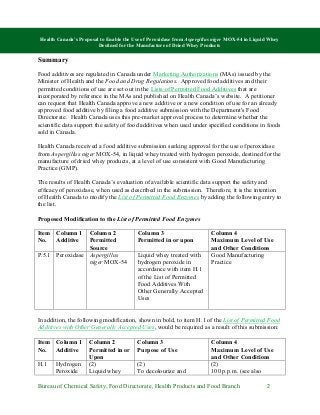
Food additives are regulated in Canada under Marketing Authorizations (MAs) issued by the
Minister of Health and the Food and Drug Regulations. Approved food additives and their
permitted conditions of use are set out in the Lists of Permitted Food Additives that are
incorporated by reference in the MAs and published on Health Canada’s website. A petitioner
can request that Health Canada approve a new additive or a new condition of use for an already
approved food additive by filing a food additive submission with the Department's Food
Directorate. Health Canada uses this pre-market approval process to determine whether the
scientific data support the safety of food additives when used under specified conditions in foods
sold in Canada.
Health Canada received a food additive submission seeking approval for the use of peroxidase
from Aspergillus niger MOX-54, in liquid whey treated with hydrogen peroxide, destined for the
manufacture of dried whey products, at a level of use consistent with Good Manufacturing
Practice (GMP).
The results of Health Canada’s evaluation of available scientific data support the safety and
efficacy of peroxidase, when used as described in the submission. Therefore, it is the intention
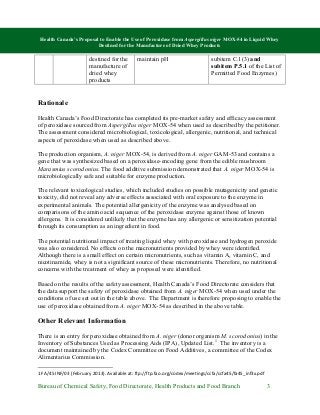
of Health Canada to modify the List of Permitted Food Enzymes by adding the following entry to
the list.
Proposed Modification to the List of Permitted Food Enzymes
Item
No.
Column 1
Additive
Column 2
Permitted
Source
Column 3
Permitted in or upon
Column 4
Maximum Level of Use
and Other Conditions
P.5.1 Peroxidase Aspergillus
niger MOX-54
Liquid whey treated with
hydrogen peroxide in
accordance with item H.1
of the List of Permitted
Food Additives With
Other Generally Accepted
Uses
Good Manufacturing
Practice
In addition, the following modification, shown in bold, to item H.1 of the List of Permitted Food
Additives with Other Generally Accepted Uses, would be required as a result of this submission:
Item
No.
Column 1
Additive
Column 2
Permitted in or
Upon
Column 3
Purpose of Use
Column 4
Maximum Level of Use
and Other Conditions
H.1 Hydrogen
Peroxide
(2)
Liquid whey
(2)
To decolourize and
(2)
100 p.p.m. (see also
3.
Health Canada’s Proposalto Enable the Use of Peroxidase from Aspergillus niger MOX-54 in Liquid Whey
Destined for the Manufacture of Dried Whey Products
Bureau of Chemical Safety, Food Directorate, Health Products and Food Branch 3
destined for the
manufacture of
dried whey
products
maintain pH subitem C.1(3) and
subitem P.5.1 of the List of
Permitted Food Enzymes)
Rationale
Health Canada’s Food Directorate has completed its pre-market safety and efficacy assessment
of peroxidase sourced from Aspergillus niger MOX-54 when used as described by the petitioner.
The assessment considered microbiological, toxicological, allergenic, nutritional, and technical
aspects of peroxidase when used as described above.
The production organism, A. niger MOX-54, is derived from A. niger GAM-53 and contains a
gene that was synthesized based on a peroxidase-encoding gene from the edible mushroom
Marasmius scorodonius. The food additive submission demonstrated that A. niger MOX-54 is
microbiologically safe and suitable for enzyme production.
The relevant toxicological studies, which included studies on possible mutagenicity and genetic
toxicity, did not reveal any adverse effects associated with oral exposure to the enzyme in
experimental animals. The potential allergenicity of the enzyme was analysed based on
comparisons of the amino acid sequence of the peroxidase enzyme against those of known
allergens. It is considered unlikely that the enzyme has any allergenic or sensitization potential
through its consumption as an ingredient in food.
The potential nutritional impact of treating liquid whey with peroxidase and hydrogen peroxide
was also considered. No effects on the macronutrients provided by whey were identified.
Although there is a small effect on certain micronutrients, such as vitamin A, vitamin C, and
nicotinamide, whey is not a significant source of these micronutrients. Therefore, no nutritional
concerns with the treatment of whey as proposed were identified.
Based on the results of the safety assessment, Health Canada’s Food Directorate considers that
the data support the safety of peroxidase obtained from A. niger MOX-54 when used under the
conditions of use set out in the table above. The Department is therefore proposing to enable the
use of peroxidase obtained from A. niger MOX-54 as described in the above table.
Other Relevant Information
There is an entry for peroxidase obtained from A. niger (donor organism M. scorodonius) in the
Inventory of Substances Used as Processing Aids (IPA), Updated List.1
The inventory is a
document maintained by the Codex Committee on Food Additives, a committee of the Codex
Alimentarius Commission.
1 FA/45 INF/03 (February 2013). Available at: ftp://ftp.fao.org/codex/meetings/ccfa/ccfa45/fa45_inf3x.pdf
4.
Health Canada’s Proposalto Enable the Use of Peroxidase from Aspergillus niger MOX-54 in Liquid Whey
Destined for the Manufacture of Dried Whey Products
Bureau of Chemical Safety, Food Directorate, Health Products and Food Branch 4
The same use of peroxidase from A. niger MOX-54 is the subject of a Generally Recognized As
Safe (GRAS) notification (No. GRN 000402) that was submitted by a third-party to the Unites
States Food and Drug Administration. The U.S. FDA had no further questions in response to the
notification.
A similar food additive submission was reviewed by France’s Agence nationale de sécurité
sanitair de l’alimentation, de l’environnement et du travail (ANSES), which issued an
unfavourable decision. The issues that formed the basis for the refusal in France were considered
by Food Directorate scientists during its safety evaluation. One issue was not relevant to the
submission under evaluation as it related to uses in foods other than whey. The other issue
identified by ANSES was the partial degradation of very minor micronutrient components in
whey. The Food Directorate does not consider the effect of peroxidase on micronutrients in whey
to be of nutritional significance in a Canadian context.
The Food and Drug Regulations require that all food enzymes used as food additives meet the
specifications for enzyme preparations set out in the most recent edition of the Food Chemicals
Codex (FCC). The FCC is a compendium of standards for purity and identity of food ingredients,
including food additives, which is published by the United States Pharmacopeial Convention.
Implementation and Enforcement
The proposed changes will be effective the day on which they are published in the List of
Permitted Food Enzymes and the List of Permitted Food Additives with Other Generally
Accepted Uses. This will be announced via a Notice of Modification which will be published on
Health Canada’s Website.
The Canadian Food Inspection Agency is responsible for the enforcement of the Food and Drugs
Act and its associated regulations with respect to foods.
Contact Information
For additional information or to submit comments related to this proposal, please contact:
Bureau of Chemical Safety, Food Directorate
251 Sir Frederick Banting Driveway
Tunney’s Pasture, PL: 2202C
Ottawa, Ontario K1A 0L2
E-mail: bcs-bipc@hc-sc.gc.ca
If communicating by e-mail, please use the words “Peroxidase from Aspergillus niger
MOX-54” in the subject line of your e-mail. Health Canada is able to consider information
received by June 13, 2016, 75 days from the date of this posting.
![Health Canada’s Proposal to Enable the Use of Peroxidase from Aspergillus niger MOX-54 in Liquid Whey
Destined for the Manufacture of Dried Whey Products
Bureau of Chemical Safety, Food Directorate, Health Products and Food Branch 1
Health Canada’s Proposal to Enable the Use of Peroxidase
from Aspergillus niger MOX-54 in Liquid Whey Destined
for the Manufacture of Dried Whey Products
Notice of Proposal – Lists of Permitted Food Additives
Reference Number: [NOP/AVP-0014]
March 31, 2016](https://image.slidesharecdn.com/document-consultation-eng-whey-160423005551/85/Document-consultation-eng-whey-1-320.jpg?cb=1461372966)