Tok introduction to approaches and evidence truth tests
The document discusses four approaches to knowledge: common sense, certainty, radical doubt, and relativism. It also examines three tests of truth: correspondence, coherence, and pragmatic.
Common sense holds that knowledge is organized based on a coherent picture of the world, but this view has limitations as common sense can be vague, untested, and based on hearsay. Certainty considers knowledge as what is known with absolute certainty, but our ways of knowing have limits and introduce degrees of certainty. Radical doubt argues we can never be 100% certain, while relativism claims there is no absolute truth independent of beliefs as all views are equally valid, though this poses issues like how to determine what is wrong.
Correspondence
1. Common SenseKnowledgeis organized common sense providing us with a coherent picture of the world. Limitations -vague and untested- often based on hearsay, prejudice, blind adherence to authority.- what seems like common sense becomes less and less so as you look closer at it.- a common sense mental map is ok, but occasionally should be subject to scrutiny.For Inquiry:Who is the greatest writer of all time?
3.
2. CertaintyBasing ourknowledge claims to what is certain. It is thought that certainty distinguishes knowledge from mere belief.Ie. If you know something, you are certain and have no doubt; if you believe something you think it is true but are not certain.Limitations - the WOK are not always reliable (perception, language, emotion and reason).- certainty is influenced by the limits of our WOK is sometimes referred to as degrees of certaintyFor Inquiry:If you were asked to wage your life on a question of certainty, would you? Ie. Neil Armstrong landed on the moon in 1969…are you %100 certain?
4.
3. Radical DoubtTheidea that we can never be %100 certain about any knowledgeLimitations - the WOK are not always reliable (perception, language, emotion and reason).- certainty is influenced by the limits of our WOK is sometimes referred to as degrees of certaintyFor Inquiry:If you were asked to wage your life on a question of certainty, would you? Ie. Neil Armstrong landed on the moon in 1969…are you %100 certain?
5.
4. RelativismThere isno such thing as an absolute truth that exist in an objective way independent of what everyone happens to believe is true. Truth is relative to individual we conclude that all points of view are of equal valueLimitations - allows a broad sweep of equal opinions.- if everything is relative, then so is relativism.- difficult grounds to argue that someone is wrong.- believing something is true does not make it true.For Inquiry:How can we believe that the earth is both round and flat, surely there is a truth independent of opinions
1. CorrespondenceA statementis true only if it corresponds to a fact.Limitations - Requires the existence of all kinds of ghostly facts to which true statements are supposed to correspond. - There is a gap between language used to describe facts and the world. - Truth cannot be determined in isolationFor Inquiry:Most people agree that there are degree of truth that we can achieve as there is never truly a perfect correspondence. We need further tests.
9.
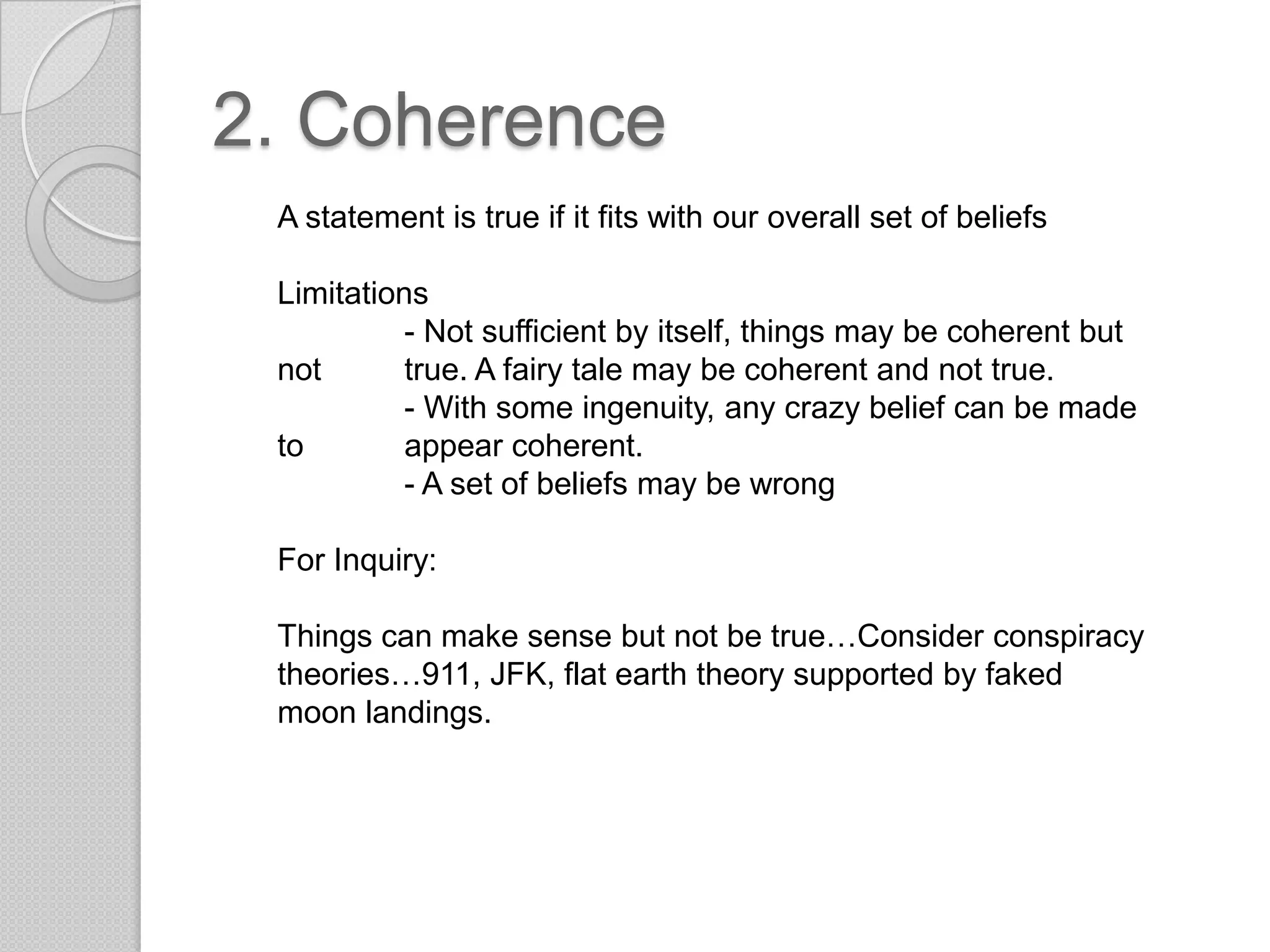
2. CoherenceA statementis true if it fits with our overall set of beliefsLimitations - Not sufficient by itself, things may be coherent but not true. A fairy tale may be coherent and not true. - With some ingenuity, any crazy belief can be made to appear coherent. - A set of beliefs may be wrongFor Inquiry:Things can make sense but not be true…Consider conspiracy theories…911, JFK, flat earth theory supported by faked moon landings.
10.
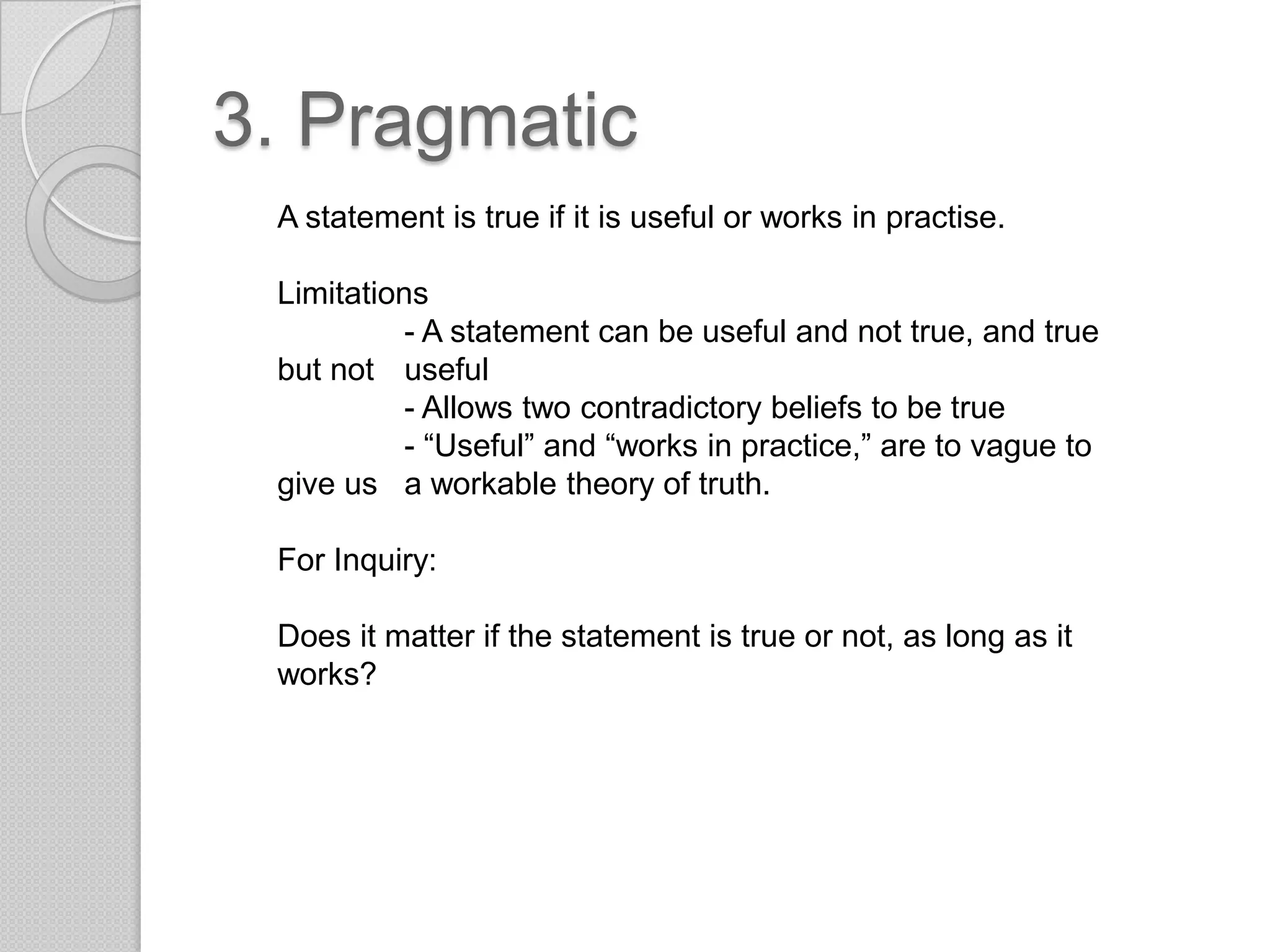
3. PragmaticA statementis true if it is useful or works in practise.Limitations - A statement can be useful and not true, and true but not useful - Allows two contradictory beliefs to be true - “Useful” and “works in practice,” are to vague to give us a workable theory of truth.For Inquiry:Does it matter if the statement is true or not, as long as it works?
11.
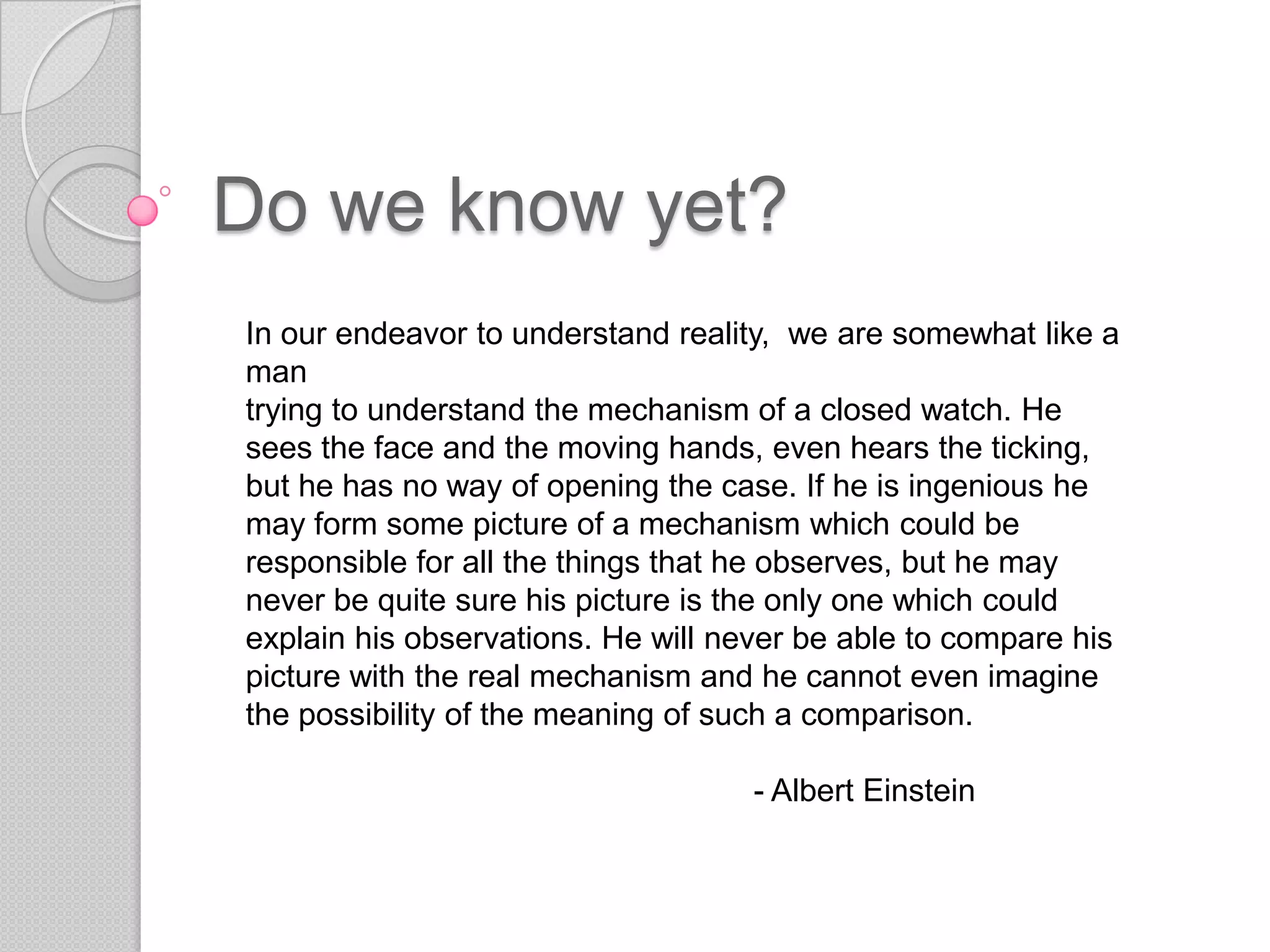
Do we knowyet?In our endeavor to understand reality, we are somewhat like a man trying to understand the mechanism of a closed watch. He sees the face and the moving hands, even hears the ticking, but he has no way of opening the case. If he is ingenious he may form some picture of a mechanism which could be responsible for all the things that he observes, but he may never be quite sure his picture is the only one which could explain his observations. He will never be able to compare his picture with the real mechanism and he cannot even imagine the possibility of the meaning of such a comparison. - Albert Einstein