Finding Reliable Health
Information on the Internet


Christine Caufield-Noll, MLIS, AHIP
Community Health Library
Johns Hopkins Bayview Medical Center
Summer 2012
Objective and Goals
• Objective
  – to help you be an informed partner in your
    health care
• Goals
  – you will understand how to evaluate a
    health website
  – you will learn how to use MedlinePlus.gov for
    disease, drug, and directory information
  – you will be aware of other reliable drug
    websites on the Internet
Did you know?
    • A Pew Internet survey reported that 57% of
      American adults use the Internet to find
      healthcare information
    • The most commonly-researched topics are
      specific diseases or conditions; treatments or
      procedures; and doctors or other health
      professionals.
    • A typical search for health information is on
      behalf of someone else – information access by
      proxy
Source: http://www.pewinternet.org/Commentary/2011/November/
Pew-Internet-Health.aspx
About the Internet
   • No one is in charge
   • There are few rules and regulations
   • Anyone can build a website
   • No educational or professional
     qualifications are necessary
   • Therefore, you cannot automatically trust
     information found on the Web

From: Internet Power Searching: The advanced manual,
Phil Bradley, Neal-Schuman Publishers
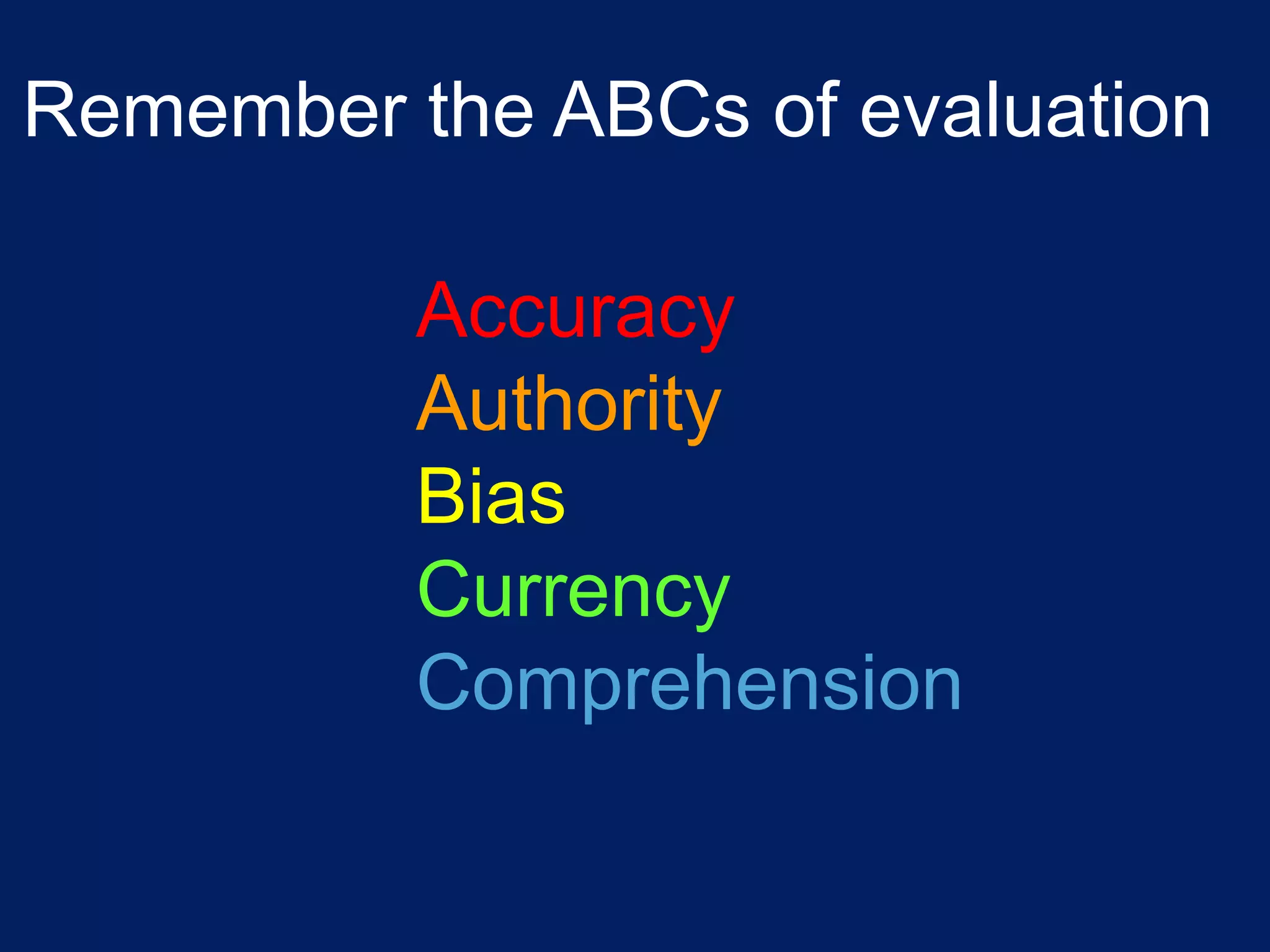
Remember the ABCs of evaluation

          Accuracy
          Authority
          Bias
          Currency
          Comprehension
Remember the ABCs of evaluation
 Accuracy
 • Does the site provide references to scientific
 literature? (popular media doesn’t count)
 Authority
 • Is the information from a credible source?
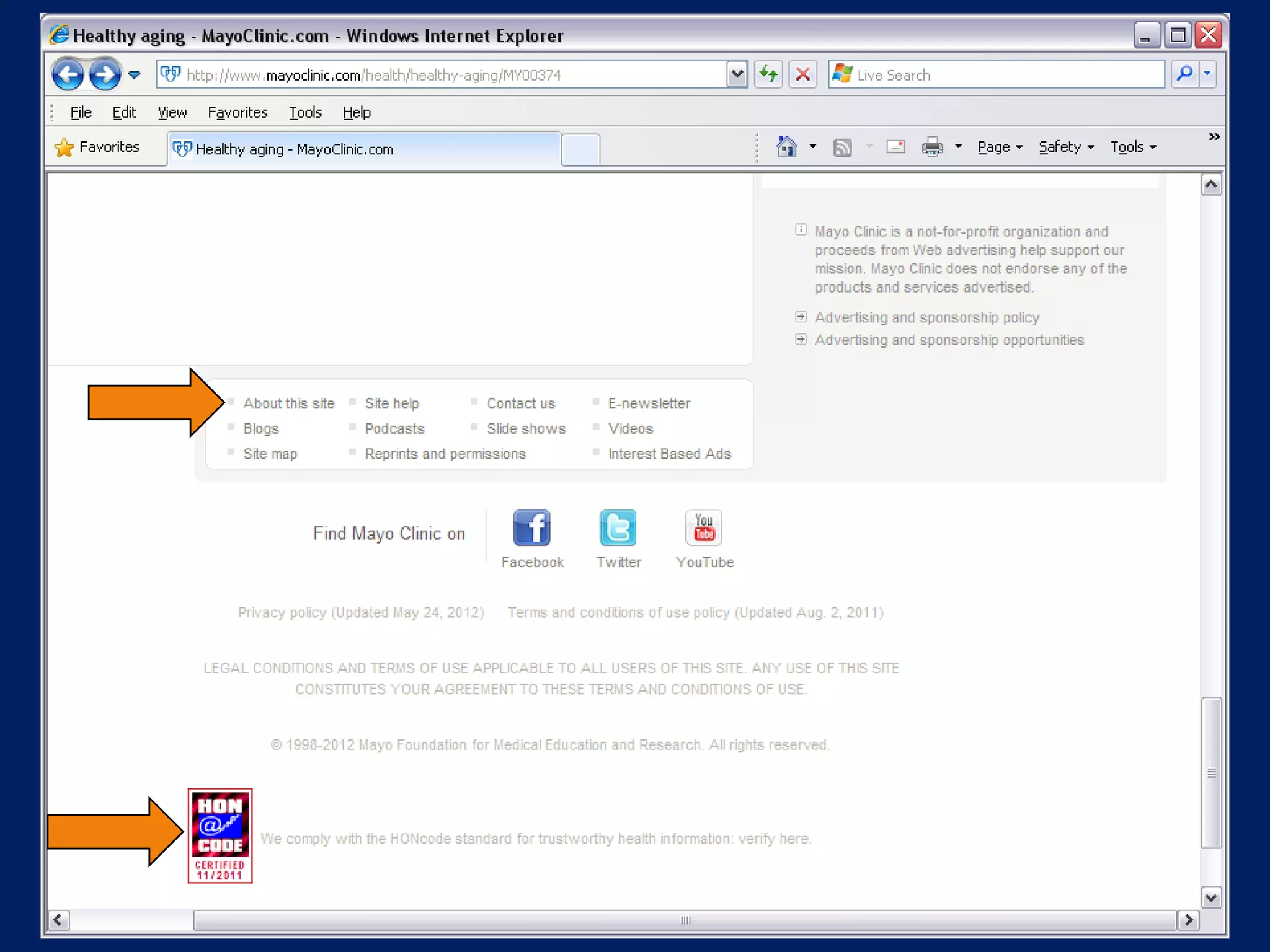
 (check the About Us section and the site’s domain)
 Bias
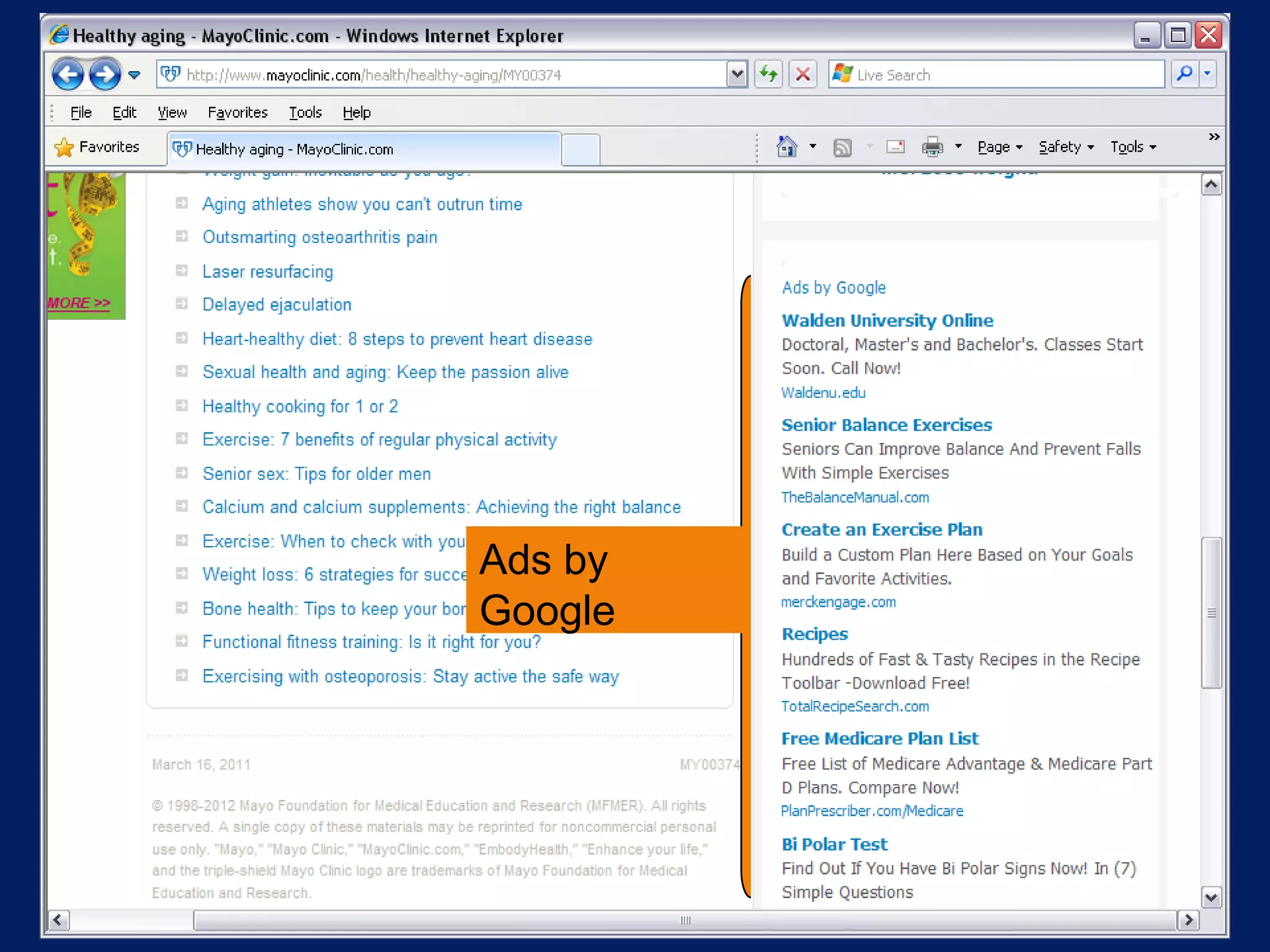
 • Who pays for the site? Are ads/sponsored
 content clearly labeled?
Remember the ABCs of evaluation

 Currency
 • Are there dates on the material? (under 5 yrs)
 Comprehension
 • Is the information understandable and the site
 easy to navigate?
Warning
• Watch out for sites like
  – WebMD.com
  – Gerd.com
  – DrKoop.com
• These sites and other like them may have
  some reliable information, but their main
  goal is not to educate the user but to
  generate money
But how can I tell if a health
 website is reliable or not?
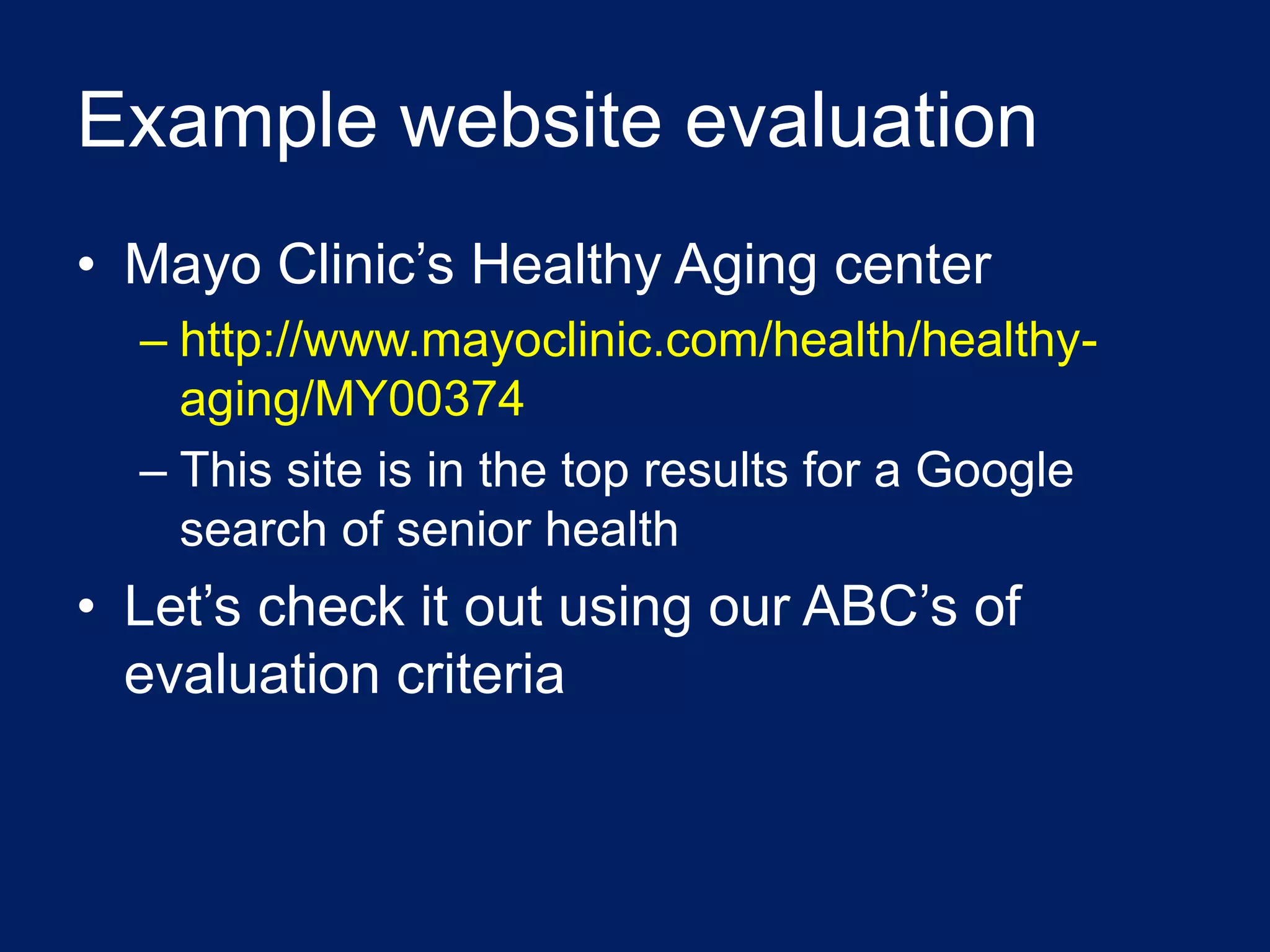
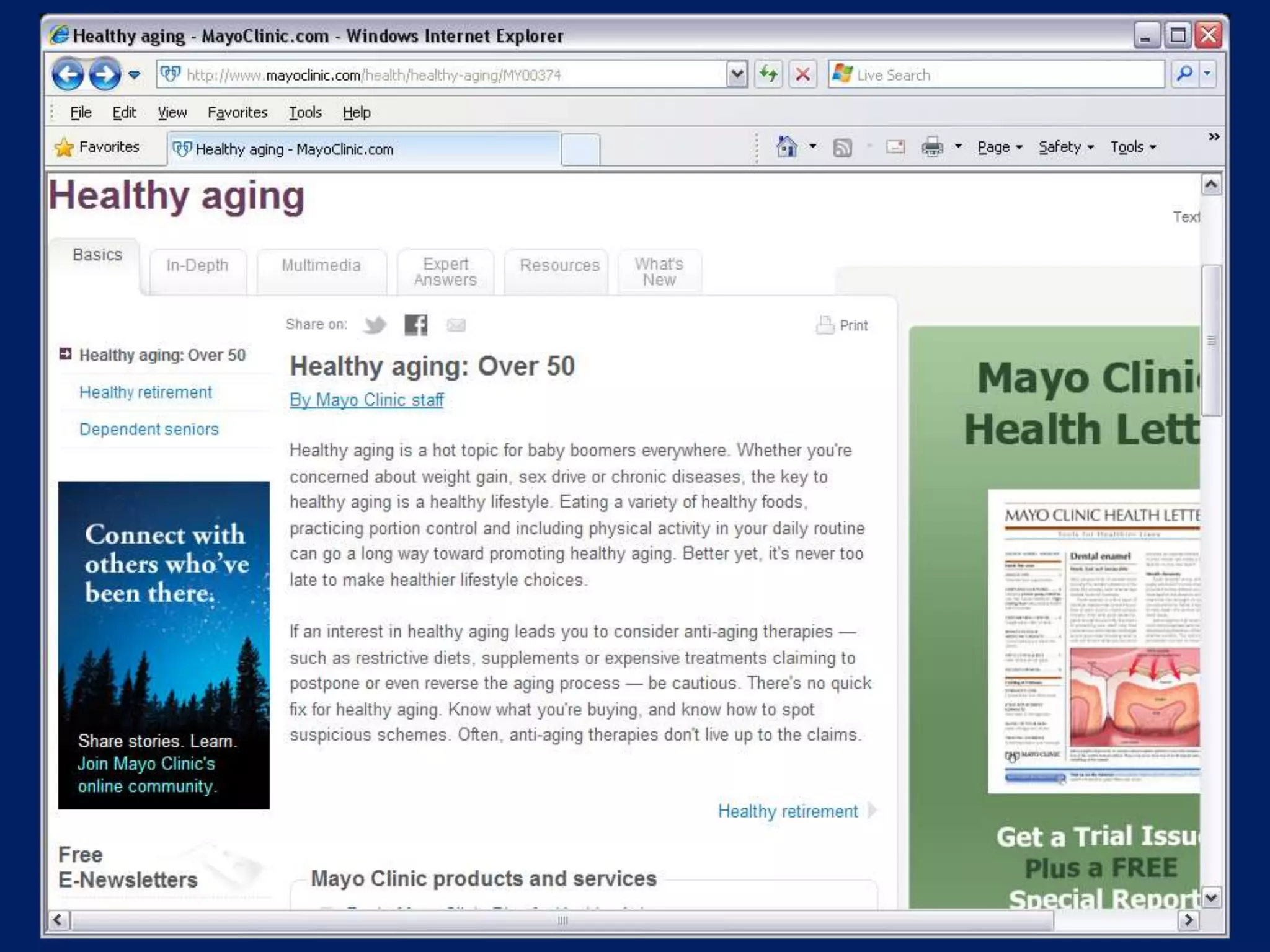
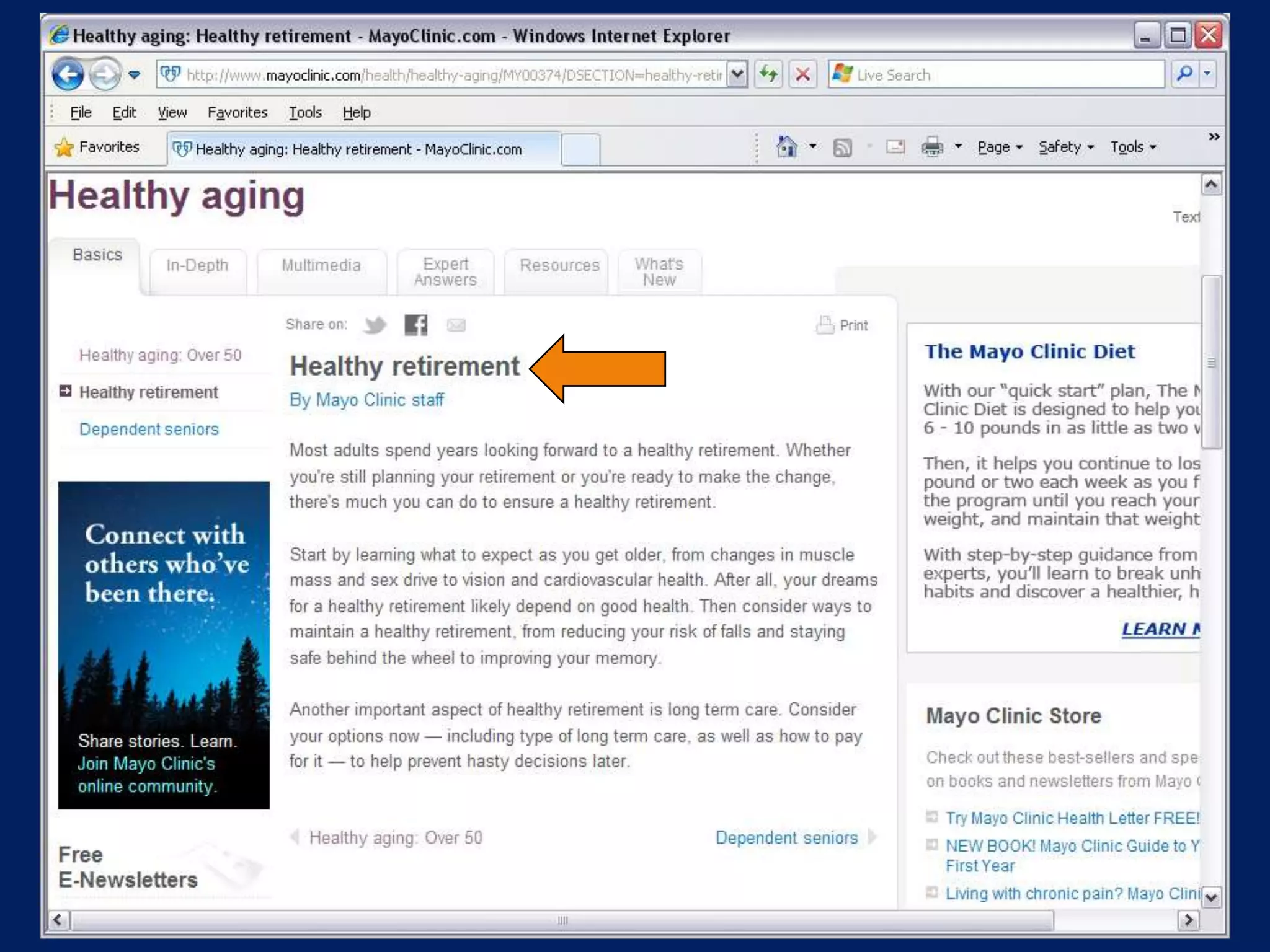
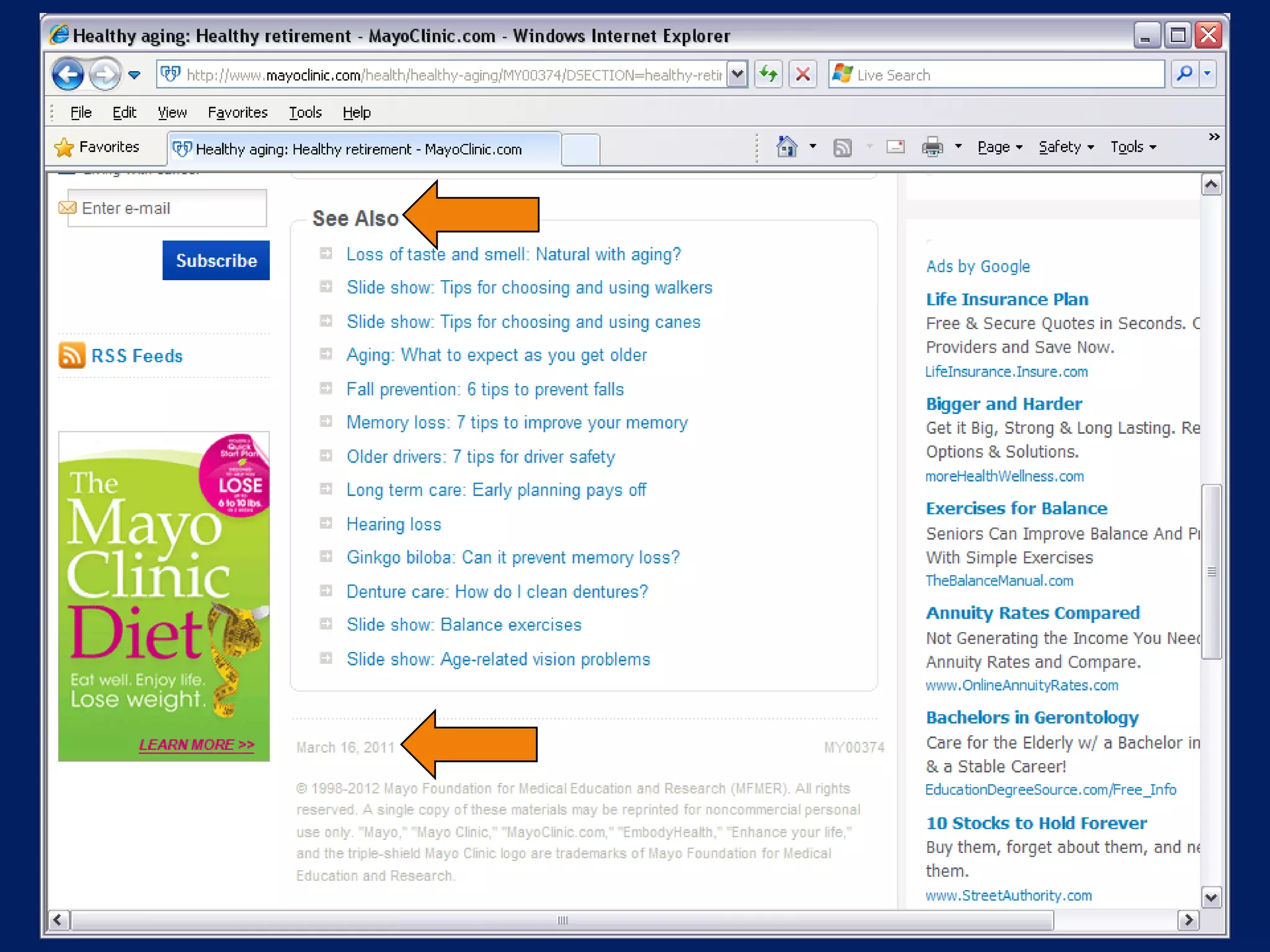
Example website evaluation
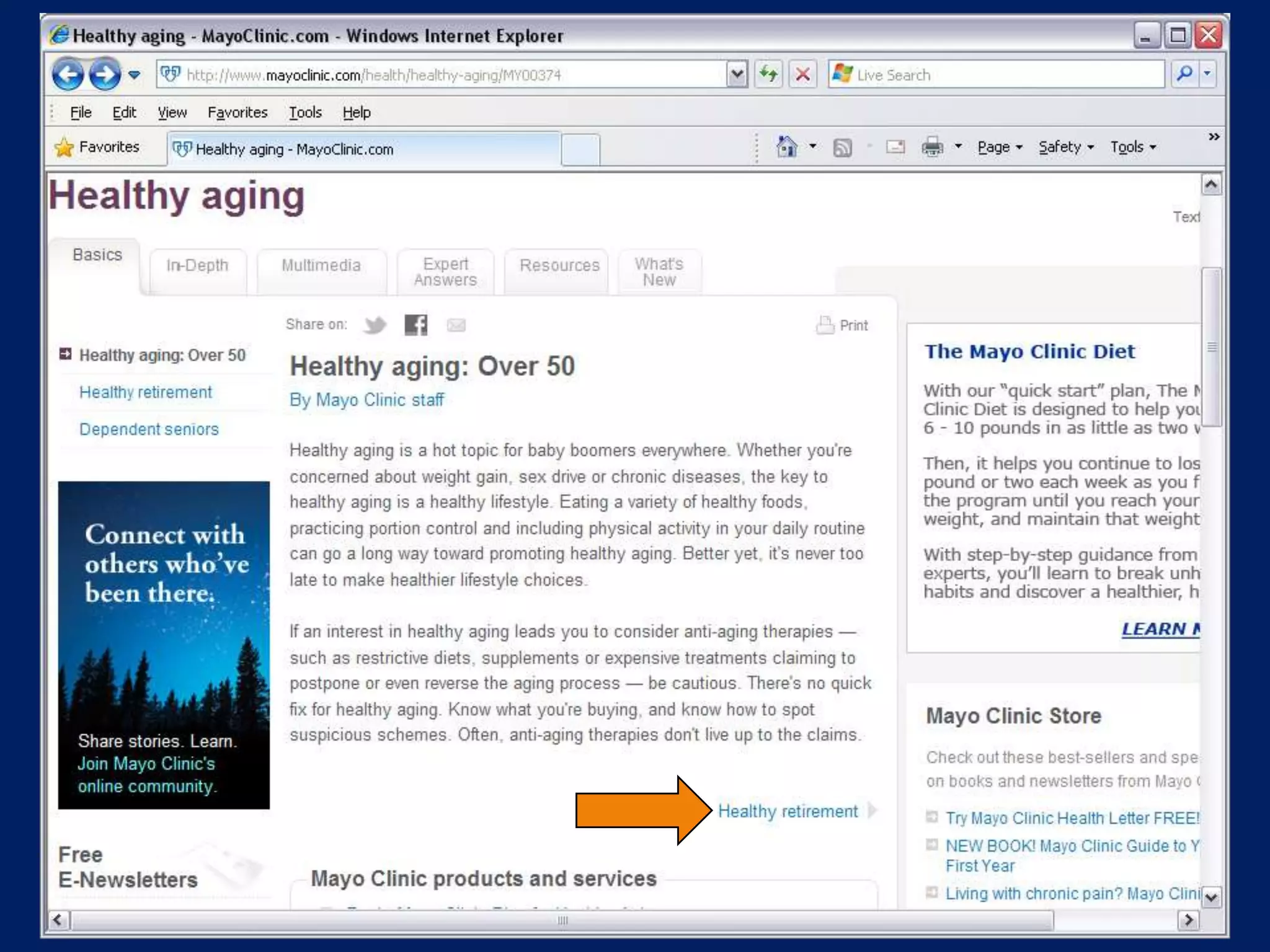
• Mayo Clinic’s Healthy Aging center
  – http://www.mayoclinic.com/health/healthy-
    aging/MY00374
  – This site is in the top results for a Google
    search of senior health
• Let’s check it out using our ABC’s of
  evaluation criteria
Ads by
Google
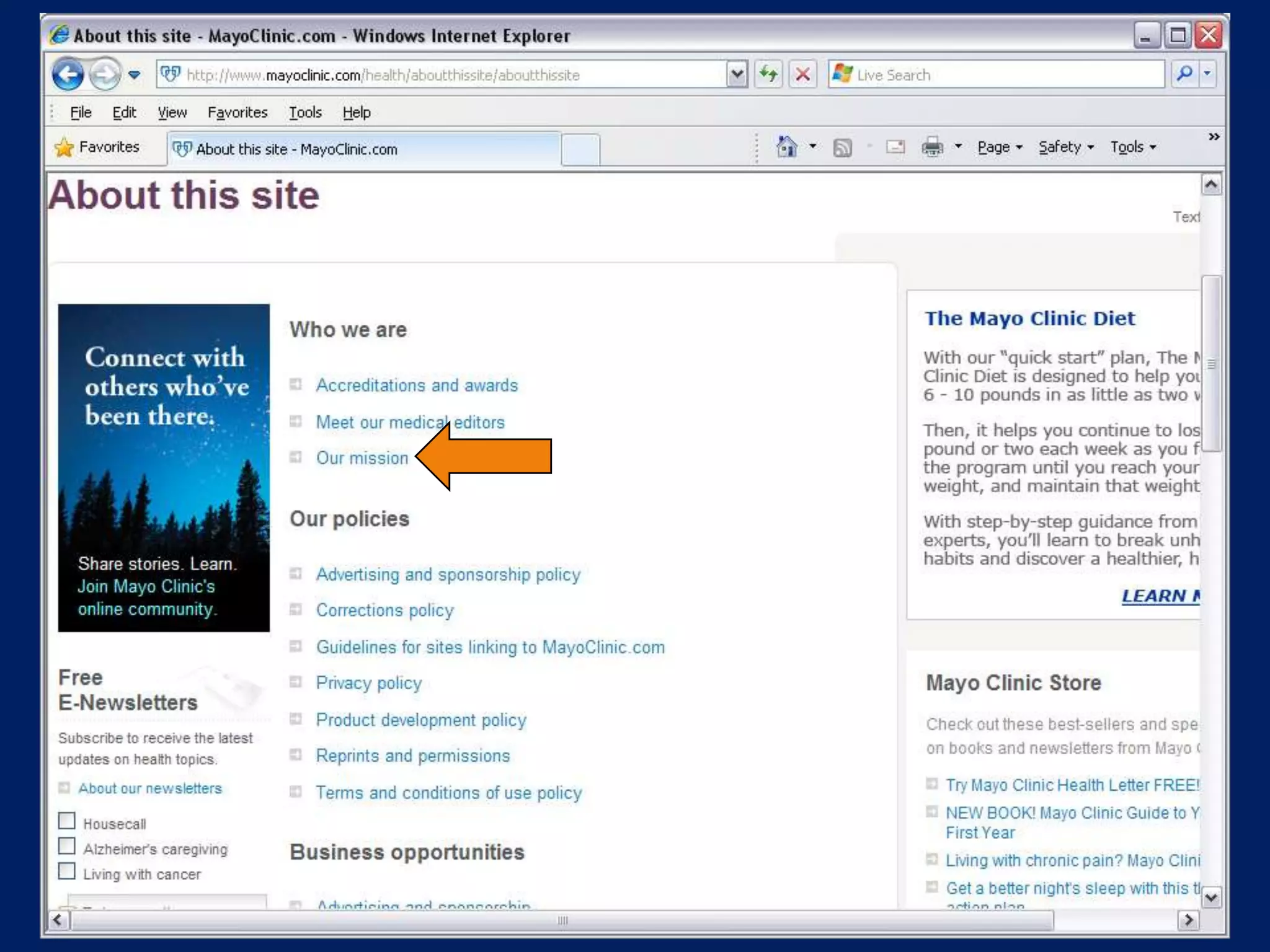
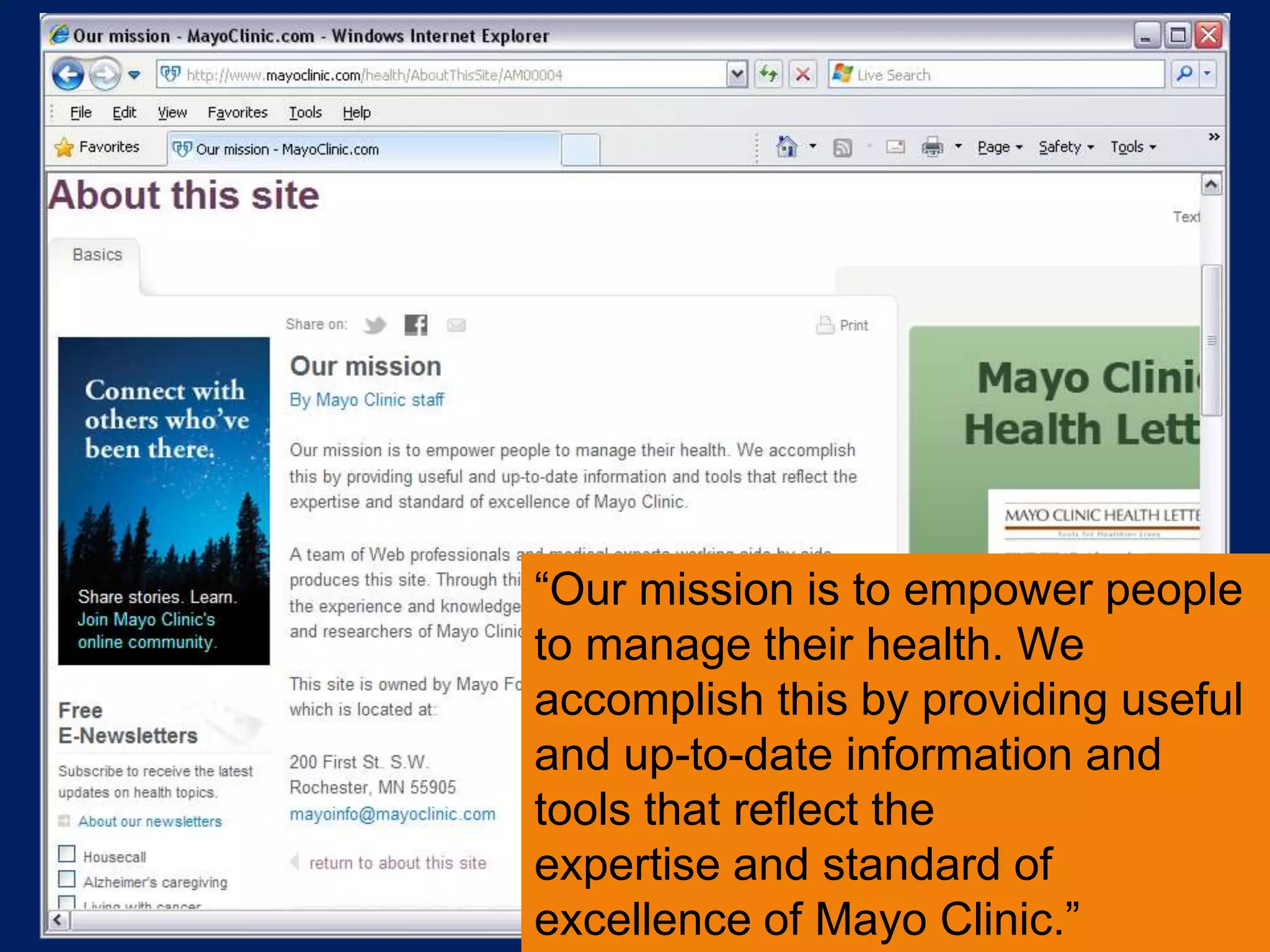
“Our mission is to empower people
to manage their health. We
accomplish this by providing useful
and up-to-date information and
tools that reflect the
expertise and standard of
excellence of Mayo Clinic.”
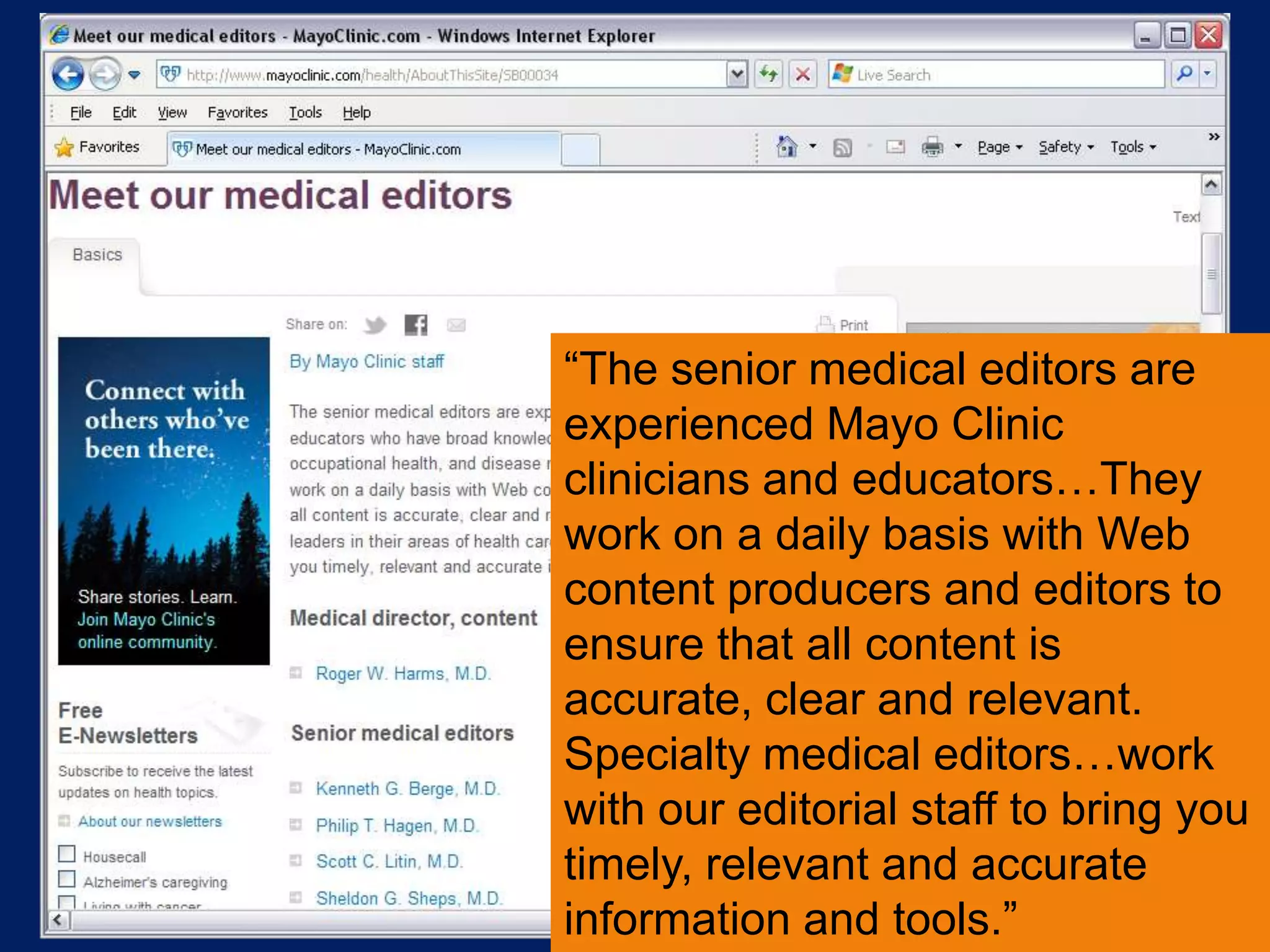
“The senior medical editors are
experienced Mayo Clinic
clinicians and educators…They
work on a daily basis with Web
content producers and editors to
ensure that all content is
accurate, clear and relevant.
Specialty medical editors…work
with our editorial staff to bring you
timely, relevant and accurate
information and tools.”
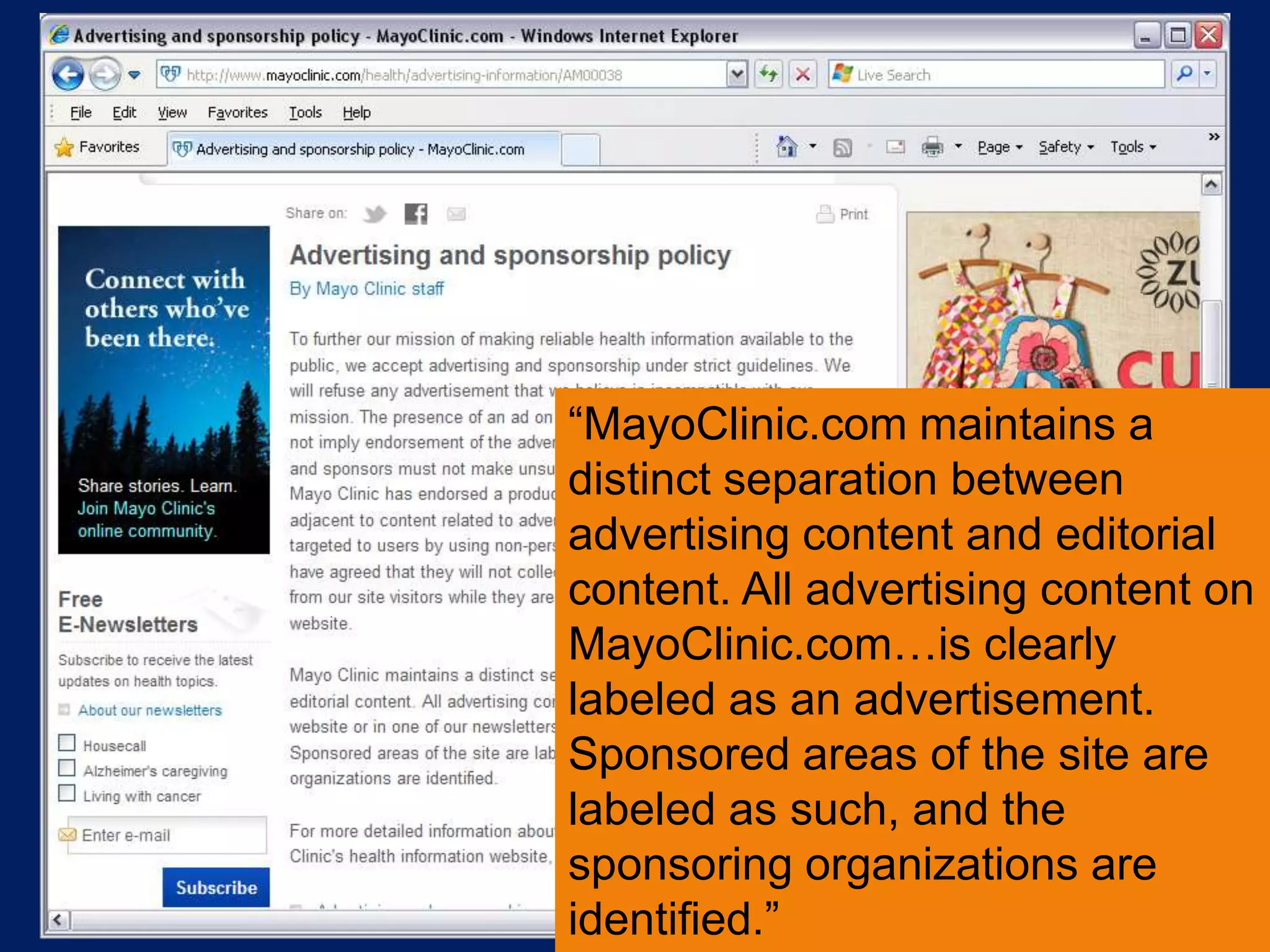
“MayoClinic.com maintains a
distinct separation between
advertising content and editorial
content. All advertising content on
MayoClinic.com…is clearly
labeled as an advertisement.
Sponsored areas of the site are
labeled as such, and the
sponsoring organizations are
identified.”
Thank you!


      Please call Christine at
    410-550-0681 or email her
      at ccaufie1@jhmi.edu
    if you have any questions

Evaluating Consumer Health Websites

  • 1.
    Finding Reliable Health Informationon the Internet Christine Caufield-Noll, MLIS, AHIP Community Health Library Johns Hopkins Bayview Medical Center Summer 2012
  • 2.
    Objective and Goals •Objective – to help you be an informed partner in your health care • Goals – you will understand how to evaluate a health website – you will learn how to use MedlinePlus.gov for disease, drug, and directory information – you will be aware of other reliable drug websites on the Internet
  • 3.
    Did you know? • A Pew Internet survey reported that 57% of American adults use the Internet to find healthcare information • The most commonly-researched topics are specific diseases or conditions; treatments or procedures; and doctors or other health professionals. • A typical search for health information is on behalf of someone else – information access by proxy Source: http://www.pewinternet.org/Commentary/2011/November/ Pew-Internet-Health.aspx
  • 4.
    About the Internet • No one is in charge • There are few rules and regulations • Anyone can build a website • No educational or professional qualifications are necessary • Therefore, you cannot automatically trust information found on the Web From: Internet Power Searching: The advanced manual, Phil Bradley, Neal-Schuman Publishers
  • 5.
    Remember the ABCsof evaluation Accuracy Authority Bias Currency Comprehension
  • 6.
    Remember the ABCsof evaluation Accuracy • Does the site provide references to scientific literature? (popular media doesn’t count) Authority • Is the information from a credible source? (check the About Us section and the site’s domain) Bias • Who pays for the site? Are ads/sponsored content clearly labeled?
  • 7.
    Remember the ABCsof evaluation Currency • Are there dates on the material? (under 5 yrs) Comprehension • Is the information understandable and the site easy to navigate?
  • 8.
    Warning • Watch outfor sites like – WebMD.com – Gerd.com – DrKoop.com • These sites and other like them may have some reliable information, but their main goal is not to educate the user but to generate money
  • 9.
    But how canI tell if a health website is reliable or not?
  • 10.
    Example website evaluation •Mayo Clinic’s Healthy Aging center – http://www.mayoclinic.com/health/healthy- aging/MY00374 – This site is in the top results for a Google search of senior health • Let’s check it out using our ABC’s of evaluation criteria
  • 12.
  • 15.
    “Our mission isto empower people to manage their health. We accomplish this by providing useful and up-to-date information and tools that reflect the expertise and standard of excellence of Mayo Clinic.”
  • 16.
    “The senior medicaleditors are experienced Mayo Clinic clinicians and educators…They work on a daily basis with Web content producers and editors to ensure that all content is accurate, clear and relevant. Specialty medical editors…work with our editorial staff to bring you timely, relevant and accurate information and tools.”
  • 17.
    “MayoClinic.com maintains a distinctseparation between advertising content and editorial content. All advertising content on MayoClinic.com…is clearly labeled as an advertisement. Sponsored areas of the site are labeled as such, and the sponsoring organizations are identified.”
  • 21.
    Thank you! Please call Christine at 410-550-0681 or email her at ccaufie1@jhmi.edu if you have any questions

Editor's Notes

  • #11 Site last accessed: 5/31/12
  • #14 The About this Site link is at the bottom of the pageThis site also has the HON CODE seal, which means that it subscribes to the Heath on the Net criteria for health web sites. It’s a good indication that the site will be reliable, but is definitely not the only thing to look for.Clic k on the About this site link