
Artic Sea Ice Melt
•Download as DOCX, PDF•
0 likes•721 views

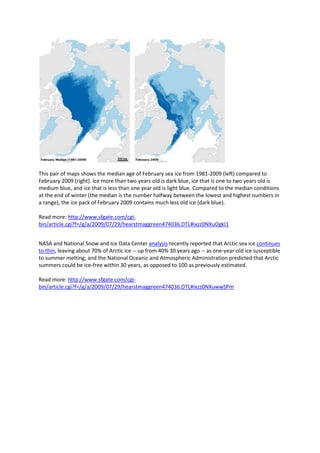
This pair of maps shows the median age of February sea ice from 1981-2009 (left) compared to February 2009 (right). Ice more than two years old is dark blue, ice that is one to two years old is medium blue, and ice that is less than one year old is light blue. Compared to the median conditions at the end of winter (the median is the number halfway between the lowest and highest numbers in a range), the ice pack of February 2009 contains much less old ice (dark blue).
Recommended

Recommended
More Related Content
Recently uploaded
Recently uploaded (20)
Featured
Featured (20)
Artic Sea Ice Melt
- 1. This pair of maps shows the median age of February sea ice from 1981-2009 (left) compared to February 2009 (right). Ice more than two years old is dark blue, ice that is one to two years old is medium blue, and ice that is less than one year old is light blue. Compared to the median conditions at the end of winter (the median is the number halfway between the lowest and highest numbers in a range), the ice pack of February 2009 contains much less old ice (dark blue). Read more: http://www.sfgate.com/cgi-bin/article.cgi?f=/g/a/2009/07/29/hearstmaggreen474036.DTL#ixzz0NXuOgkI1 NASA and National Snow and Ice Data Center analysis recently reported that Arctic sea ice continues to thin, leaving about 70% of Arctic ice -- up from 40% 30 years ago -- as one-year-old ice susceptible to summer melting; and the National Oceanic and Atmospheric Administration predicted that Arctic summers could be ice-free within 30 years, as opposed to 100 as previously estimated. Read more: http://www.sfgate.com/cgi-bin/article.cgi?f=/g/a/2009/07/29/hearstmaggreen474036.DTL#ixzz0NXuwwSPm