1
Steve McCarty
APACALL Webinar , 6 May 2022
Asia-Pacific Association for
Computer-Assisted Language Learning
2
Abstract & Presenter Bio
Podcasting originated as a new form of audio broadcasting,
but by 2006, issues of ease of use, proprietary technology,
and finances slowed its momentum. Now podcasting is more
popular than ever. This presentation therefore traces the
author’s initial and current CALL podcasting projects,
reconsidering the foundations and pedagogy of podcasting.
Steve McCarty lectures for Osaka Jogakuin University and the
government foreign aid agency JICA. He is the World Association
for Online Education President. At Kansai University from 2015
to 2020 he held a unique Global Faculty Development position.
He has been an APACALL officer, and a Japan Association for
Language Teaching chapter founder, Bilingualism SIG president,
and appointed national officer. His highly cited publications on
e-learning, bilingualism, language teaching, Japan, Asia, and the
academic life are available from https://japanned.hcommons.org
3
Explanatory Concepts
 Curtain CALL – student-generated content (Sener, 2007),
turning student FL/SL/L2 presentations into podcasts or video.
Online performances address a global audience, encouraging
integrative motivation and active participation in the L2-using
and content-creating community (McCarty, 2009).
 “Podcasting” – a portmanteau of “iPod” & “broadcasting.”
 “[P]ushing sound files to subscribers with portable MP3 players … for
listening on the go. This opens up new educational potential in terms of
using hitherto unproductive time for learning” (McCarty, 2005, p. 68).
 “Coursecasting” – recording lectures for student support
(McCarty, 2007), partly a forerunner of asynchronous hybrid instruction.
 Proprietary technology, e.g., Apple’s iPod vs. generic audio.
 Ease of use, vital for technology uptake & sustained success.
 Business models – paid or free Web services, subscription
or one-off podcast Web page visits, sustainable or unreliable.
4
Japancasting site from 2005
[Original blog]
5
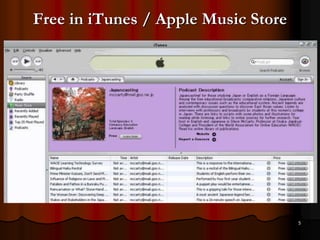
Free in iTunes / Apple Music Store
6
[Coursecasting]
7
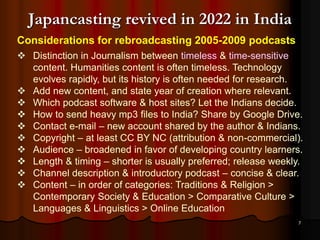
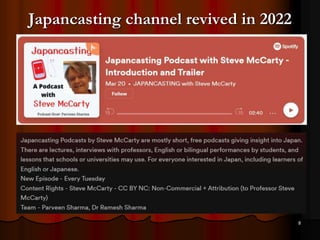
Japancasting revived in 2022 in India
Considerations for rebroadcasting 2005-2009 podcasts
 Distinction in Journalism between timeless & time-sensitive
content. Humanities content is often timeless. Technology
evolves rapidly, but its history is often needed for research.
 Add new content, and state year of creation where relevant.
 Which podcast software & host sites? Let the Indians decide.
 How to send heavy mp3 files to India? Share by Google Drive.
 Contact e-mail – new account shared by the author & Indians.
 Copyright – at least CC BY NC (attribution & non-commercial).
 Audience – broadened in favor of developing country learners.
 Length & timing – shorter is usually preferred; release weekly.
 Channel description & introductory podcast – concise & clear.
 Content – in order of categories: Traditions & Religion >
Contemporary Society & Education > Comparative Culture >
Languages & Linguistics > Online Education
8
Japancasting channel revived in 2022
9
Conclusions
Podcasting Reconsidered
 Digital broadcasting should not have been tied to the proprietary
technologies of one company: Apple iPods, iTunes, & iTunesU.
“Casting” makes interesting metaphors, but generic terms like
sound files, digital audio or radio are more understandable.
 By the criterion of ease of use, podcasting was complex
at first, but now subscribing is easier, and free podcasts
can be accessed unconditionally at a permanent Web URL.
 Business models are still unsatisfactory for sellers and buyers,
while free sites are ethically compromising and more unreliable.
 There will always be situations where just listening is beneficial.
 Along with the increasing global population of Internet users,
podcasting will continue to grow more popular than ever.
 A collaborative project such as Japancasting contributes to
the Open Educational Resources (Sharma, 2022) movement.
10
References
McCarty, S. (2009). Curtain CALL: Online performances for integrative motivation.
In M. Thomas (Ed.), New frontiers in CALL: Negotiating diversity (pp. 71-76).
https://www.researchgate.net/publication/323513118
McCarty, S. (2005). Spoken Internet to go: Popularization through podcasting.
JALT CALL Journal, 1(2). 67-74. https://www.academia.edu/11156449 or
https://www.researchgate.net/publication/237544289
McCarty, S. (2007). Window into the classroom: Podcasting an English for
professional purposes course. Osaka Jogakuin College Journal, 36, 1-21.
https://www.researchgate.net/publication/265424072
Sener, J. (2009). Podcasting student performances to develop EFL skills.
Effective Practice. Online Learning Consortium.
https://web.archive.org/web/20090208152933/http://www.sloanconsortium.org/node/846
Sharma, P. (2022, March 20). Japancasting podcast with Steve McCarty – Launch.
[Blog message]. https://eklavyaparv.com/edusomedia/japancasting-podcast/544-
japancasting-podcast-with-steve-mccarty-launch

Podcasting Reconsidered

  • 1.
    1 Steve McCarty APACALL Webinar, 6 May 2022 Asia-Pacific Association for Computer-Assisted Language Learning
  • 2.
    2 Abstract & PresenterBio Podcasting originated as a new form of audio broadcasting, but by 2006, issues of ease of use, proprietary technology, and finances slowed its momentum. Now podcasting is more popular than ever. This presentation therefore traces the author’s initial and current CALL podcasting projects, reconsidering the foundations and pedagogy of podcasting. Steve McCarty lectures for Osaka Jogakuin University and the government foreign aid agency JICA. He is the World Association for Online Education President. At Kansai University from 2015 to 2020 he held a unique Global Faculty Development position. He has been an APACALL officer, and a Japan Association for Language Teaching chapter founder, Bilingualism SIG president, and appointed national officer. His highly cited publications on e-learning, bilingualism, language teaching, Japan, Asia, and the academic life are available from https://japanned.hcommons.org
  • 3.
    3 Explanatory Concepts  CurtainCALL – student-generated content (Sener, 2007), turning student FL/SL/L2 presentations into podcasts or video. Online performances address a global audience, encouraging integrative motivation and active participation in the L2-using and content-creating community (McCarty, 2009).  “Podcasting” – a portmanteau of “iPod” & “broadcasting.”  “[P]ushing sound files to subscribers with portable MP3 players … for listening on the go. This opens up new educational potential in terms of using hitherto unproductive time for learning” (McCarty, 2005, p. 68).  “Coursecasting” – recording lectures for student support (McCarty, 2007), partly a forerunner of asynchronous hybrid instruction.  Proprietary technology, e.g., Apple’s iPod vs. generic audio.  Ease of use, vital for technology uptake & sustained success.  Business models – paid or free Web services, subscription or one-off podcast Web page visits, sustainable or unreliable.
  • 4.
    4 Japancasting site from2005 [Original blog]
  • 5.
    5 Free in iTunes/ Apple Music Store
  • 6.
  • 7.
    7 Japancasting revived in2022 in India Considerations for rebroadcasting 2005-2009 podcasts  Distinction in Journalism between timeless & time-sensitive content. Humanities content is often timeless. Technology evolves rapidly, but its history is often needed for research.  Add new content, and state year of creation where relevant.  Which podcast software & host sites? Let the Indians decide.  How to send heavy mp3 files to India? Share by Google Drive.  Contact e-mail – new account shared by the author & Indians.  Copyright – at least CC BY NC (attribution & non-commercial).  Audience – broadened in favor of developing country learners.  Length & timing – shorter is usually preferred; release weekly.  Channel description & introductory podcast – concise & clear.  Content – in order of categories: Traditions & Religion > Contemporary Society & Education > Comparative Culture > Languages & Linguistics > Online Education
  • 8.
  • 9.
    9 Conclusions Podcasting Reconsidered  Digitalbroadcasting should not have been tied to the proprietary technologies of one company: Apple iPods, iTunes, & iTunesU. “Casting” makes interesting metaphors, but generic terms like sound files, digital audio or radio are more understandable.  By the criterion of ease of use, podcasting was complex at first, but now subscribing is easier, and free podcasts can be accessed unconditionally at a permanent Web URL.  Business models are still unsatisfactory for sellers and buyers, while free sites are ethically compromising and more unreliable.  There will always be situations where just listening is beneficial.  Along with the increasing global population of Internet users, podcasting will continue to grow more popular than ever.  A collaborative project such as Japancasting contributes to the Open Educational Resources (Sharma, 2022) movement.
  • 10.
    10 References McCarty, S. (2009).Curtain CALL: Online performances for integrative motivation. In M. Thomas (Ed.), New frontiers in CALL: Negotiating diversity (pp. 71-76). https://www.researchgate.net/publication/323513118 McCarty, S. (2005). Spoken Internet to go: Popularization through podcasting. JALT CALL Journal, 1(2). 67-74. https://www.academia.edu/11156449 or https://www.researchgate.net/publication/237544289 McCarty, S. (2007). Window into the classroom: Podcasting an English for professional purposes course. Osaka Jogakuin College Journal, 36, 1-21. https://www.researchgate.net/publication/265424072 Sener, J. (2009). Podcasting student performances to develop EFL skills. Effective Practice. Online Learning Consortium. https://web.archive.org/web/20090208152933/http://www.sloanconsortium.org/node/846 Sharma, P. (2022, March 20). Japancasting podcast with Steve McCarty – Launch. [Blog message]. https://eklavyaparv.com/edusomedia/japancasting-podcast/544- japancasting-podcast-with-steve-mccarty-launch