
Compensation
&
Tax Implications
Compensation
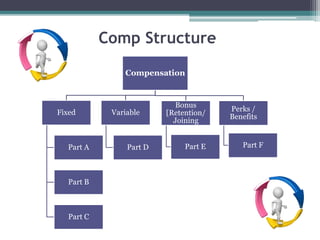
Fixed
Part A
Part B
Part C
Variable
Part D
Perks /
Benefits
Part F
Bonus
[Retention/
Joining
Part E
Comp Structure
Compensation
Fixed
Part A
Part B
Part C
Understanding Structure
[Basic Wages]
Basic & DA
[Retirals]
PF & Gratuity
[Choice Pay]
Reimbursements
Compensation
Variable
Part D
Understanding Structure
[Performance
Linked Payments]
Incentives
Compensation
Perks / Benefits
Part F
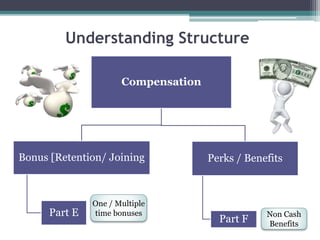
Bonus [Retention/ Joining
Part E
Understanding Structure
One / Multiple
time bonuses Non Cash
Benefits
Smart Analogy
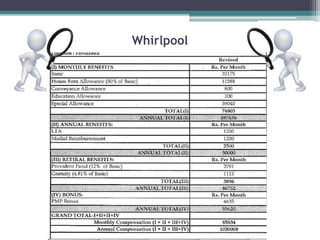
Whirlpool
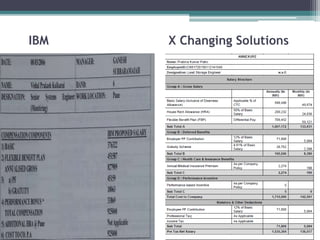
IBM X Changing Solutions
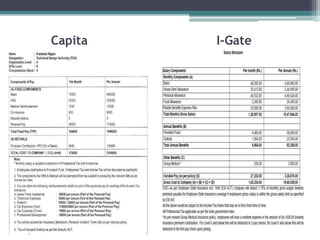
Capita I-Gate
“Tax Implications”
Way to invest wisely
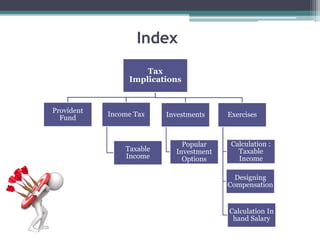
Tax
Implications
Provident
Fund
Income Tax
Taxable
Income
Exercises
Calculation :
Taxable
Income
Designing
Compensation
Calculation In
hand Salary
Investments
Popular
Investment
Options
Index
All you want to know about PF
• Employees’ Provident Fund Scheme, (EPF)1952
• Employees’ Deposit Linked Insurance
Scheme,(EDLIS) 1976
• Employees’ Pension Scheme, 1995 [EPS]
(replacing the Employees’ Family Pension
Scheme, 1971)
Smart Facts about PF
• Not compulsory for all
• Your EPF account does not earn compounded interest each year
on the total monthly contribution.
• Withdrawing EPF during job change illegal
• Can be withdrawn on special occasions
• Allows voluntary contribution
• Every employee had a PF account number which was
associated with the employer. [Till Oct 2014 ]
Smart Facts about PF
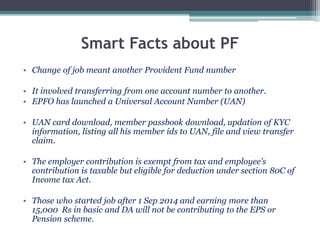
• Change of job meant another Provident Fund number
• It involved transferring from one account number to another.
• EPFO has launched a Universal Account Number (UAN)
• UAN card download, member passbook download, updation of KYC
information, listing all his member ids to UAN, file and view transfer
claim.
• The employer contribution is exempt from tax and employee’s
contribution is taxable but eligible for deduction under section 80C of
Income tax Act.
• Those who started job after 1 Sep 2014 and earning more than
15,000 Rs in basic and DA will not be contributing to the EPS or
Pension scheme.
Options available with Organizations
PF Calculation [Basic Salary >RS.15,000/-]
Option - 1
Contribution Towards Calculation Amount
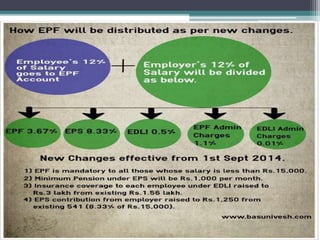
EPF Employees share 20000 x 12% 2400
EPS Employer share 15000 x 8.33% 1250
EPF employer share 20000 x 12% (-) 1250 1150
EDLI charges 20000 x 0.5% 220
EPF Admin charges 20000 x 1.1% 220
EDLI Admin charges 20000 x 0.01% 2
PF Calculation [Basic Salary >RS.15,000/-]
Option - 2
Contribution Towards Calculation Amount
EPF Employees share 20000 x 12% 2400
EPS Employer share 15000 x 8.33% 1250
EPF employer share 15000 x 3.67% 550.5
EDLI charges 15000 x 0.5% 75
EPF Admin charges 15000 x 1.1% 165
EDLI Admin charges 15000 x 0.01% 1.5
PF Calculation [Basic Salary >RS.15,000/-]
Option – 3
Contribution Towards Calculation Amount
EPF Employees share 15000 x 12% 1800
EPS Employer share 15000 x 8.33%
1249.5(round
ed to 1250)
EPF employer share 15000 x 3.67%
555.5
(rounded to
555)
EDLI charges 15000 x 0.5% 75
EPF Admin charges 15000 x 1.1% 165
EDLI Admin charges 15000 x 0.01% 1.5
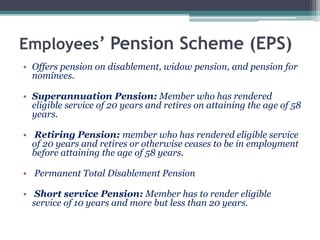
Employees’ Pension Scheme (EPS)
• Offers pension on disablement, widow pension, and pension for
nominees.
• Superannuation Pension: Member who has rendered
eligible service of 20 years and retires on attaining the age of 58
years.
• Retiring Pension: member who has rendered eligible service
of 20 years and retires or otherwise ceases to be in employment
before attaining the age of 58 years.
• Permanent Total Disablement Pension
• Short service Pension: Member has to render eligible
service of 10 years and more but less than 20 years.
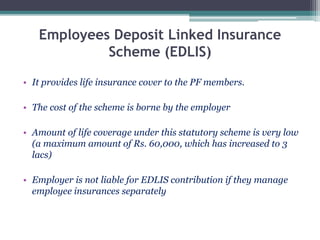
Employees Deposit Linked Insurance
Scheme (EDLIS)
• It provides life insurance cover to the PF members.
• The cost of the scheme is borne by the employer
• Amount of life coverage under this statutory scheme is very low
(a maximum amount of Rs. 60,000, which has increased to 3
lacs)
• Employer is not liable for EDLIS contribution if they manage
employee insurances separately
Basic Tax Jargons
1. Financial Year (FY) [2014-15] – Income Earned
2. Assessment Year (AY) [2015-16] – Income Assessed
3. Previous Year (PY) [2014-15]
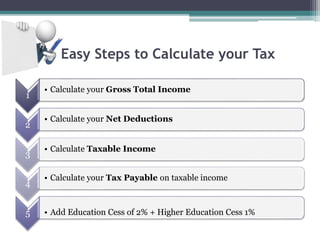
Easy Steps to Calculate your Tax
1
• Calculate your Gross Total Income
2
• Calculate your Net Deductions
3
• Calculate Taxable Income
4
• Calculate your Tax Payable on taxable income
5 • Add Education Cess of 2% + Higher Education Cess 1%
Income Tax Slab For Financial Year 2014-15
General (M/F) Senior Citizen [60 to 80] Income Tax
0-250000 0-300000 No Tax
250000-500000 300000-500000 10%
500000-1000000 500000-1000000 20%
Above-1000000 Above-1000000 30%
Investments
▫ Smarter way to save Taxes
▫ Ensures and Knit the “Security Net”
Popular Investment Options
For Tax exemption
▫ Section – 80 C
 Section – 80 CCC [LIC Annuity Plan / Pension Fund]
 Section – 80 CCD(1) [National Pension Scheme- Employee]
 Section – 80 CCD(1B) [National Pension Scheme- Employee]
 Section – 80 CCD(2) [National Pension Scheme - Employer]
 Section – 80 D [Medical Insurance]
 Section – 80 E [Loan for Higher Education]
 Section – 80 GG [HRA]
▫ Section – 24 [Home Loan]
▫ Section – 10 (13A) [HRA]
How much do we understand
Section 80
Deduction for the interest that you pay on your home
loan
[Limit: Rs.2,00,000/- for Self occupied property]
[No Cap on property that is not self-occupied]
Deductions – Home Loan Benefit u/s 24
1. Actual HRA
OR
2. Actual rent paid by you minus 10% of your basic salary
and other allowances (excluding HRA)
OR
3. 50% of your basic salary [Metro] / 40% [Non Metro]
Deductions – HRA [Section 10(13A)]
Exercise – 1
Calculation of Taxable Income
&
Payable Income Tax
Exercise – 2 & 3
Designing Compensation Structure
&
Calculation of Taxable Income
Do You Know..??
▫ Gratuity – 4.81% [Why]
▫ Difference b/w last year & this Year
investment plans
▫ LTA [Twice in 4 Years]
▫ Slab for Super Senior Citizens
▫ Can HRA & Home loan benefit could be
availed simultaneously
▫ Whether PAN of the Landlord is mandatory
for HRA claim – What’s the limit
▫ Is producing Rent Receipts necessary for
claiming HRA
Calculation – Taxable Income

Calculation – Taxable Income

  • 1.
  • 3.
    Compensation Fixed Part A Part B PartC Variable Part D Perks / Benefits Part F Bonus [Retention/ Joining Part E Comp Structure
  • 4.
    Compensation Fixed Part A Part B PartC Understanding Structure [Basic Wages] Basic & DA [Retirals] PF & Gratuity [Choice Pay] Reimbursements
  • 5.
  • 6.
    Compensation Perks / Benefits PartF Bonus [Retention/ Joining Part E Understanding Structure One / Multiple time bonuses Non Cash Benefits
  • 7.
  • 8.
  • 9.
    IBM X ChangingSolutions
  • 10.
  • 11.
  • 12.
  • 13.
    All you wantto know about PF • Employees’ Provident Fund Scheme, (EPF)1952 • Employees’ Deposit Linked Insurance Scheme,(EDLIS) 1976 • Employees’ Pension Scheme, 1995 [EPS] (replacing the Employees’ Family Pension Scheme, 1971)
  • 15.
    Smart Facts aboutPF • Not compulsory for all • Your EPF account does not earn compounded interest each year on the total monthly contribution. • Withdrawing EPF during job change illegal • Can be withdrawn on special occasions • Allows voluntary contribution • Every employee had a PF account number which was associated with the employer. [Till Oct 2014 ]
  • 16.
    Smart Facts aboutPF • Change of job meant another Provident Fund number • It involved transferring from one account number to another. • EPFO has launched a Universal Account Number (UAN) • UAN card download, member passbook download, updation of KYC information, listing all his member ids to UAN, file and view transfer claim. • The employer contribution is exempt from tax and employee’s contribution is taxable but eligible for deduction under section 80C of Income tax Act. • Those who started job after 1 Sep 2014 and earning more than 15,000 Rs in basic and DA will not be contributing to the EPS or Pension scheme.
  • 17.
  • 18.
    PF Calculation [BasicSalary >RS.15,000/-] Option - 1 Contribution Towards Calculation Amount EPF Employees share 20000 x 12% 2400 EPS Employer share 15000 x 8.33% 1250 EPF employer share 20000 x 12% (-) 1250 1150 EDLI charges 20000 x 0.5% 220 EPF Admin charges 20000 x 1.1% 220 EDLI Admin charges 20000 x 0.01% 2
  • 19.
    PF Calculation [BasicSalary >RS.15,000/-] Option - 2 Contribution Towards Calculation Amount EPF Employees share 20000 x 12% 2400 EPS Employer share 15000 x 8.33% 1250 EPF employer share 15000 x 3.67% 550.5 EDLI charges 15000 x 0.5% 75 EPF Admin charges 15000 x 1.1% 165 EDLI Admin charges 15000 x 0.01% 1.5
  • 20.
    PF Calculation [BasicSalary >RS.15,000/-] Option – 3 Contribution Towards Calculation Amount EPF Employees share 15000 x 12% 1800 EPS Employer share 15000 x 8.33% 1249.5(round ed to 1250) EPF employer share 15000 x 3.67% 555.5 (rounded to 555) EDLI charges 15000 x 0.5% 75 EPF Admin charges 15000 x 1.1% 165 EDLI Admin charges 15000 x 0.01% 1.5
  • 21.
    Employees’ Pension Scheme(EPS) • Offers pension on disablement, widow pension, and pension for nominees. • Superannuation Pension: Member who has rendered eligible service of 20 years and retires on attaining the age of 58 years. • Retiring Pension: member who has rendered eligible service of 20 years and retires or otherwise ceases to be in employment before attaining the age of 58 years. • Permanent Total Disablement Pension • Short service Pension: Member has to render eligible service of 10 years and more but less than 20 years.
  • 22.
    Employees Deposit LinkedInsurance Scheme (EDLIS) • It provides life insurance cover to the PF members. • The cost of the scheme is borne by the employer • Amount of life coverage under this statutory scheme is very low (a maximum amount of Rs. 60,000, which has increased to 3 lacs) • Employer is not liable for EDLIS contribution if they manage employee insurances separately
  • 23.
    Basic Tax Jargons 1.Financial Year (FY) [2014-15] – Income Earned 2. Assessment Year (AY) [2015-16] – Income Assessed 3. Previous Year (PY) [2014-15]
  • 24.
    Easy Steps toCalculate your Tax 1 • Calculate your Gross Total Income 2 • Calculate your Net Deductions 3 • Calculate Taxable Income 4 • Calculate your Tax Payable on taxable income 5 • Add Education Cess of 2% + Higher Education Cess 1%
  • 25.
    Income Tax SlabFor Financial Year 2014-15 General (M/F) Senior Citizen [60 to 80] Income Tax 0-250000 0-300000 No Tax 250000-500000 300000-500000 10% 500000-1000000 500000-1000000 20% Above-1000000 Above-1000000 30%
  • 26.
    Investments ▫ Smarter wayto save Taxes ▫ Ensures and Knit the “Security Net”
  • 27.
    Popular Investment Options ForTax exemption ▫ Section – 80 C  Section – 80 CCC [LIC Annuity Plan / Pension Fund]  Section – 80 CCD(1) [National Pension Scheme- Employee]  Section – 80 CCD(1B) [National Pension Scheme- Employee]  Section – 80 CCD(2) [National Pension Scheme - Employer]  Section – 80 D [Medical Insurance]  Section – 80 E [Loan for Higher Education]  Section – 80 GG [HRA] ▫ Section – 24 [Home Loan] ▫ Section – 10 (13A) [HRA]
  • 28.
    How much dowe understand Section 80
  • 29.
    Deduction for theinterest that you pay on your home loan [Limit: Rs.2,00,000/- for Self occupied property] [No Cap on property that is not self-occupied] Deductions – Home Loan Benefit u/s 24
  • 30.
    1. Actual HRA OR 2.Actual rent paid by you minus 10% of your basic salary and other allowances (excluding HRA) OR 3. 50% of your basic salary [Metro] / 40% [Non Metro] Deductions – HRA [Section 10(13A)]
  • 31.
    Exercise – 1 Calculationof Taxable Income & Payable Income Tax
  • 32.
    Exercise – 2& 3 Designing Compensation Structure & Calculation of Taxable Income
  • 33.
    Do You Know..?? ▫Gratuity – 4.81% [Why] ▫ Difference b/w last year & this Year investment plans ▫ LTA [Twice in 4 Years] ▫ Slab for Super Senior Citizens ▫ Can HRA & Home loan benefit could be availed simultaneously ▫ Whether PAN of the Landlord is mandatory for HRA claim – What’s the limit ▫ Is producing Rent Receipts necessary for claiming HRA

Editor's Notes

  • #16 Change of Job meant another PF Number
  • #17 Change of Job meant another PF Number
  • #18 Change of Job meant another PF Number