Approach of the MTR
And how recent changes make you closer to eternal reward
What are we going to talk about?
• Brief rundown on general changes to the policy.
• The new shortcuts.
• The new fix for players leaving a draft mid-way.
Updates for
Magic: The Gathering Tournament Rules
Actual important stuff:
• "Free Information" rules updated.
• Shortcuts have been changed:
• Combat Shortcut.
• End-of-turn shortcut.
• Planeswalker redirection shortcut.
• "Counterspell target" rule.
•Why? Split damage.
•New targeting restrictions.
•Nothing really changed.
Section 4.2 (Tournament Shortcuts): “A player who chooses an opponent’s planeswalker as the target
of a spell or ability that cannot normally target a planeswalker is assumed to be targeting that
opponent and redirecting the damage on resolution. The player must adhere to that choice unless an
opponent responds”
The updated planeswalker redirection shortcut
•Why? Disallow.
•Targets the last spell on the stack.
•Works as intended.
Section 4.2 (Tournament Shortcuts):“A player who casts a spell or activates an ability that targets an
object on the stack is assumed to target the legal spell closest to the top of the stack unless the player
specifies otherwise. “
The updated “Counterspell Target” rule
•Why? Triggers.
•Works like the old shortcut.
•Plays as intended.
Section 4.2 (Tournament Shortcuts): “If the active player passes priority during their first main phase, the non-
active player is assumed to be acting in beginning of combat unless they are affecting how or whether a
beginning of combat ability triggers. However, if the non-active player takes no action, the active player has
priority at the beginning of combat. Beginning of combat triggered abilities (even ones that target) may be
announced after any non-active player action has resolved.”
The updated combat shortcut
Two ways to think of this:
1. AP Still in the main phase, but can’t play
sorceries.
2. Move to beginning of combat (unless NAP
interrupts triggers), triggers happen when
AP has priority and empty stack.
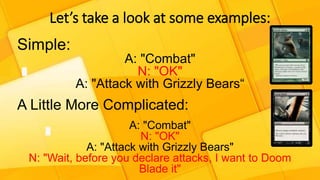
Let’s take a look at some examples:
Simple:
A: "Combat"
N: "OK"
A: "Attack with Grizzly Bears“
A Little More Complicated:
A: "Combat"
N: "OK"
A: "Attack with Grizzly Bears"
N: "Wait, before you declare attacks, I want to Doom
Blade it"
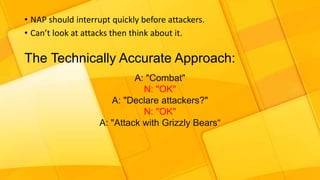
• NAP should interrupt quickly before attackers.
• Can’t look at attacks then think about it.
The Technically Accurate Approach:
A: "Combat"
N: "OK"
A: "Declare attackers?"
N: "OK"
A: "Attack with Grizzly Bears“
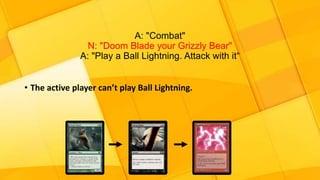
A: "Combat"
N: "Doom Blade your Grizzly Bear"
A: "Play a Ball Lightning. Attack with it“
• The active player can’t play Ball Lightning.
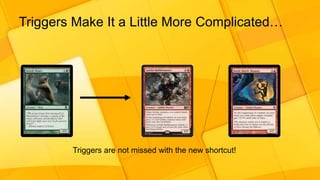
Triggers Make It a Little More Complicated…
Triggers are not missed with the new shortcut!
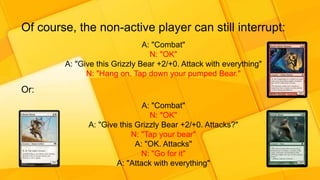
Of course, the non-active player can still interrupt:
A: "Combat"
N: "OK"
A: "Give this Grizzly Bear +2/+0. Attack with everything"
N: "Hang on. Tap down your pumped Bear."
Or:
A: "Combat"
N: "OK"
A: "Give this Grizzly Bear +2/+0. Attacks?"
N: "Tap your bear"
A: "OK. Attacks"
N: "Go for it"
A: "Attack with everything"
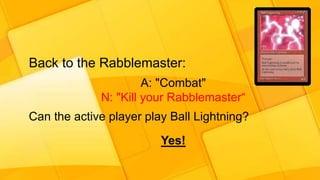
Back to the Rabblemaster:
A: "Combat"
N: "Kill your Rabblemaster“
Can the active player play Ball Lightning?
Yes!
• If you’re worried about that Ball Lightning, this is still possible:
A: "Combat"
N: "In Beginning of Combat, kill your Rabblemaster"
A: OK, Rabblemaster trigger resolves. I have a token.
• or, more likely:
A: "Combat"
N: "OK"
A: "Make a token"
N: "Kill your Rabblemaster“
• Declare attackers -> Missed trigger.
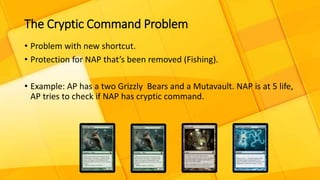
The Cryptic Command Problem
• Problem with new shortcut.
• Protection for NAP that’s been removed (Fishing).
• Example: AP has a two Grizzly Bears and a Mutavault. NAP is at 5 life,
AP tries to check if NAP has cryptic command.
•Why? Similar to combat shortcut.
•Works the same way.
•Still need to call out targeted triggers.
Section 4.2 (Tournament Shortcuts): “If the active player passes priority during their second main phase, or uses a
phrase such as “Go” or “Your Turn” at any time, the non-active player is assumed to be acting in the end of turn
step unless they are affecting how or whether an end of turn ability triggers. End of turn triggered abilities that do
not target resolve after the non-active player passes priority”.
The updated end of turn shortcut
Questions?
How to handle a player leaving in the middle
of the draft?
• Picks are skipped (no longer random).
• Not applicable if dropping from the draft.
Section 7.7 (Booster Draft Procedure):“If a player is unable or unwilling to continue drafting, but wishes to
remain in the tournament, he or she is suspended from drafting and must construct a deck from whatever cards
he or she has drafted thus far. For the remainder of the draft, their picks are skipped and the draft continues
with one fewer player.”
Q&A:
• Q: For subsequent packs, what happens to the unopened boosters that
would have been opened by the player that left?
• A: They remain unopened.
• Q: Can a player still register a deck with the cards he already drafted?
• A: Yes. Add basic lands until minimum deck size requirement is made.
• Q: Can a player keep any unopened boosters?
• A: Up to the TO.
• Can a player later return and use any remaining boosters to build his deck?
• A: No.
Brief rundown on general changes to the MTR:
• Different place, same meaning.
• Outside Assistance in the MTR.
• Nationals.
• Obvious things are permitted.
• Card identification rules updated.
• Number of rounds for 4-7 teams added.
• B&R list + DCI process updated.
Questions?
New IPG Perspectives
Updates for
Magic: The Gathering Infraction procedure guide
• Two penalties: Decklist Problems (warning) and Deck Problems (Game
Loss).
• Very similar to previous policy.
• Discovering sideboard cards in your opening hand is an automatic
mulligan.
Deck & Decklist problems:
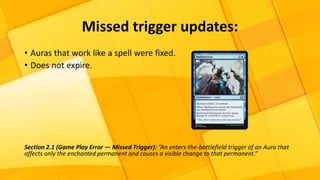
• Auras that work like a spell were fixed.
• Does not expire.
Section 2.1 (Game Play Error — Missed Trigger): “An enters-the-battlefield trigger of an Aura that
affects only the enchanted permanent and causes a visible change to that permanent.”
Missed trigger updates:
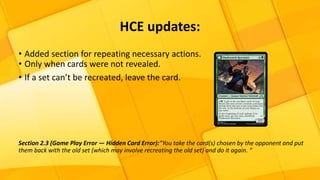
HCE updates:
• Added section for repeating necessary actions.
• Only when cards were not revealed.
• If a set can’t be recreated, leave the card.
Section 2.3 (Game Play Error — Hidden Card Error):“You take the card(s) chosen by the opponent and put
them back with the old set (which may involve recreating the old set) and do it again. “
Questions?
You win the game!

Recent changes IPG/MTR

  • 1.
    Approach of theMTR And how recent changes make you closer to eternal reward
  • 2.
    What are wegoing to talk about? • Brief rundown on general changes to the policy. • The new shortcuts. • The new fix for players leaving a draft mid-way.
  • 3.
    Updates for Magic: TheGathering Tournament Rules
  • 4.
    Actual important stuff: •"Free Information" rules updated. • Shortcuts have been changed: • Combat Shortcut. • End-of-turn shortcut. • Planeswalker redirection shortcut. • "Counterspell target" rule.
  • 5.
    •Why? Split damage. •Newtargeting restrictions. •Nothing really changed. Section 4.2 (Tournament Shortcuts): “A player who chooses an opponent’s planeswalker as the target of a spell or ability that cannot normally target a planeswalker is assumed to be targeting that opponent and redirecting the damage on resolution. The player must adhere to that choice unless an opponent responds” The updated planeswalker redirection shortcut
  • 6.
    •Why? Disallow. •Targets thelast spell on the stack. •Works as intended. Section 4.2 (Tournament Shortcuts):“A player who casts a spell or activates an ability that targets an object on the stack is assumed to target the legal spell closest to the top of the stack unless the player specifies otherwise. “ The updated “Counterspell Target” rule
  • 7.
    •Why? Triggers. •Works likethe old shortcut. •Plays as intended. Section 4.2 (Tournament Shortcuts): “If the active player passes priority during their first main phase, the non- active player is assumed to be acting in beginning of combat unless they are affecting how or whether a beginning of combat ability triggers. However, if the non-active player takes no action, the active player has priority at the beginning of combat. Beginning of combat triggered abilities (even ones that target) may be announced after any non-active player action has resolved.” The updated combat shortcut
  • 8.
    Two ways tothink of this: 1. AP Still in the main phase, but can’t play sorceries. 2. Move to beginning of combat (unless NAP interrupts triggers), triggers happen when AP has priority and empty stack.
  • 9.
    Let’s take alook at some examples: Simple: A: "Combat" N: "OK" A: "Attack with Grizzly Bears“ A Little More Complicated: A: "Combat" N: "OK" A: "Attack with Grizzly Bears" N: "Wait, before you declare attacks, I want to Doom Blade it"
  • 10.
    • NAP shouldinterrupt quickly before attackers. • Can’t look at attacks then think about it. The Technically Accurate Approach: A: "Combat" N: "OK" A: "Declare attackers?" N: "OK" A: "Attack with Grizzly Bears“
  • 11.
    A: "Combat" N: "DoomBlade your Grizzly Bear" A: "Play a Ball Lightning. Attack with it“ • The active player can’t play Ball Lightning.
  • 12.
    Triggers Make Ita Little More Complicated… Triggers are not missed with the new shortcut!
  • 13.
    Of course, thenon-active player can still interrupt: A: "Combat" N: "OK" A: "Give this Grizzly Bear +2/+0. Attack with everything" N: "Hang on. Tap down your pumped Bear." Or: A: "Combat" N: "OK" A: "Give this Grizzly Bear +2/+0. Attacks?" N: "Tap your bear" A: "OK. Attacks" N: "Go for it" A: "Attack with everything"
  • 14.
    Back to theRabblemaster: A: "Combat" N: "Kill your Rabblemaster“ Can the active player play Ball Lightning? Yes!
  • 15.
    • If you’reworried about that Ball Lightning, this is still possible: A: "Combat" N: "In Beginning of Combat, kill your Rabblemaster" A: OK, Rabblemaster trigger resolves. I have a token. • or, more likely: A: "Combat" N: "OK" A: "Make a token" N: "Kill your Rabblemaster“ • Declare attackers -> Missed trigger.
  • 16.
    The Cryptic CommandProblem • Problem with new shortcut. • Protection for NAP that’s been removed (Fishing). • Example: AP has a two Grizzly Bears and a Mutavault. NAP is at 5 life, AP tries to check if NAP has cryptic command.
  • 17.
    •Why? Similar tocombat shortcut. •Works the same way. •Still need to call out targeted triggers. Section 4.2 (Tournament Shortcuts): “If the active player passes priority during their second main phase, or uses a phrase such as “Go” or “Your Turn” at any time, the non-active player is assumed to be acting in the end of turn step unless they are affecting how or whether an end of turn ability triggers. End of turn triggered abilities that do not target resolve after the non-active player passes priority”. The updated end of turn shortcut
  • 18.
  • 19.
    How to handlea player leaving in the middle of the draft? • Picks are skipped (no longer random). • Not applicable if dropping from the draft. Section 7.7 (Booster Draft Procedure):“If a player is unable or unwilling to continue drafting, but wishes to remain in the tournament, he or she is suspended from drafting and must construct a deck from whatever cards he or she has drafted thus far. For the remainder of the draft, their picks are skipped and the draft continues with one fewer player.”
  • 20.
    Q&A: • Q: Forsubsequent packs, what happens to the unopened boosters that would have been opened by the player that left? • A: They remain unopened. • Q: Can a player still register a deck with the cards he already drafted? • A: Yes. Add basic lands until minimum deck size requirement is made. • Q: Can a player keep any unopened boosters? • A: Up to the TO. • Can a player later return and use any remaining boosters to build his deck? • A: No.
  • 21.
    Brief rundown ongeneral changes to the MTR: • Different place, same meaning. • Outside Assistance in the MTR. • Nationals. • Obvious things are permitted.
  • 22.
    • Card identificationrules updated. • Number of rounds for 4-7 teams added. • B&R list + DCI process updated.
  • 23.
  • 24.
  • 25.
    Updates for Magic: TheGathering Infraction procedure guide
  • 26.
    • Two penalties:Decklist Problems (warning) and Deck Problems (Game Loss). • Very similar to previous policy. • Discovering sideboard cards in your opening hand is an automatic mulligan. Deck & Decklist problems:
  • 27.
    • Auras thatwork like a spell were fixed. • Does not expire. Section 2.1 (Game Play Error — Missed Trigger): “An enters-the-battlefield trigger of an Aura that affects only the enchanted permanent and causes a visible change to that permanent.” Missed trigger updates:
  • 28.
    HCE updates: • Addedsection for repeating necessary actions. • Only when cards were not revealed. • If a set can’t be recreated, leave the card. Section 2.3 (Game Play Error — Hidden Card Error):“You take the card(s) chosen by the opponent and put them back with the old set (which may involve recreating the old set) and do it again. “
  • 29.
  • 30.

Editor's Notes

  • #5 The "Free Information" rules have been changed so that both the type and number of a counter are free information. We’ve all encountered the situations – this nickel is three +1/+1 counters, and the penny is a charge counter. That’s my pile of energy counters. I’m tracking experience in my head. There’s a lot of counters in the game, and their representation may not be intuitive, so we’re putting a higher communication burden there – you have to be forthright about the information. It also means we no longer need to call out poison counters as special in various places.
  • #6 The planeswalker redirection rule got tweaked to account for cards that might split damage, but is otherwise unchanged The Counterspell target rule got tweaked slightly because of Disallow: If a spell had triggered something, you might suddenly find yourself targeting the trigger, which seemed less likely to be the desired target, so now unless you call it out, you’re targeting the top spell.
  • #7 The planeswalker redirection rule got tweaked to account for cards that might split damage, but is otherwise unchanged The Counterspell target rule got tweaked slightly because of Disallow: If a spell had triggered something, you might suddenly find yourself targeting the trigger, which seemed less likely to be the desired target, so now unless you call it out, you’re targeting the top spell.
  • #8  The combat shortcut works horribly with beginning of combat triggers and abilities like crew. New design space being explored. Then Goblin Rabblemaster came along and we had to handwave a lot. At least that one didn’t target. Then Surrak came along. At least that one was only fringe-tournament-playable. More handwaving, since saying “Move to Combat” meaning you missed your trigger was a bit awful! And then the dam broke and there were a whole bunch of them.
  • #9 Having to parse the difference between “I pass priority in Combat” and “I pass priority into Combat” is not something we want in a global game.
  • #10 The active player passing in their main phase doesn’t leave the main phase, but they lose the ability to play anything at sorcery speed. Play proceeds from there. The active player passing means the next person to take an action will be doing so in the beginning of combat, and beginning-of-combat triggers happen when the active player next gets priority with an empty stack. “• If the active player passes priority during their second main phase, or uses a phrase such as “Go” or “Your Turn” at any time, the non-active player is assumed to be acting in the end of turn step unless they are affecting how or whether an end of turn ability triggers. End of turn triggered abilities that do not target resolve after the non-active player passes priority.”
  • #12 We expect the non-active player to interrupt relatively quickly once the active player makes it clear that they’re going into combat. No waiting to see what’s declared as attackers, pausing to think for a bit, then attempting to interrupt the shortcut. If the active player is worried about this, they can protect themselves with…
  • #13 Yes, this is annoying. Unfortunately, there’s no way to preserve the active player’s ability to take actions such as Crewing or activating creature-lands after they’ve passed into combat while also streamlining this interaction. The structure of the rules is not our friend here.
  • #14 This is a change from the previous shortcut. The previous shortcut moved to the active player passing priority in Beginning of Combat, which was past the point by which you were expected to declare a target.
  • #16 Yes! This is the exception to the non-active player acting in Beginning of Combat because we assume that, by default, they’re trying to stop the trigger.
  • #17 Triggers can still be missed, of course, but it will often take until the active player actually tries to declare attackers to determine that. Basically, if they’re interrupting a trigger, it’s in main, if not, BoC (but AP gets a followup chance to use their triggers) Please note that this implies that judges need to understand the cards and how they work. Make sure you’re updated!
  • #18 There’s a problem with the new shortcut that’s important to address. It’s not a problem with the shortcut, per se, but it’s a protection for the non-active player that’s been removed. Here’s an example: The active player has a two Grizzly Bears and a Mutavault. The non-active player is at 5 life, but active player is worried about a Cryptic Command. How can he check if the coast is clear? The active player wants to try to get a read on if the coast is clear. So, they say “Combat” in an attempt to imply that they’re ready to declare attackers. If the non-active plays the Cryptic, you activate the Mutavault and get in for 2. If they don’t, unless they’re a very precise player, it’s a strong sign that they may not have it and you should activate the Mutavault and go for it. The old shortcut precluded that baiting. Of course, the correct time to play the Command if you have it is after the second priority pass (or interrupting the declaration). But now you need to be more careful if you’re the non-active player to not accidentally tip your hand.
  • #19  The combat shortcut works horribly with beginning of combat triggers and abilities like crew. New design space being explored. Then Goblin Rabblemaster came along and we had to handwave a lot. At least that one didn’t target. Then Surrak came along. At least that one was only fringe-tournament-playable. More handwaving, since saying “Move to Combat” meaning you missed your trigger was a bit awful! And then the dam broke and there were a whole bunch of them.
  • #21 If a player has to stop drafting (whether or not they plan to eventually play), but wants to remain in the tournament they are skipped instead of having a judge pick randomly for them. This is not applicable if they are dropping from the draft. This is for when they want to play in the swiss, or continue in a multiple format tournament (such as a PT) but are called away for an emergency.
  • #23 Some rules moved places, but haven’t changed their meaning. The MTR has a new section on Outside Assistance. While we had penalties for it in the IPG, none of the player-targeted documents talked about it. So now we tell them not to and nothing really changes. We now have nationals, and no WMCQs. A clarification that judges now have the latitude to allow obvious things (such as Amonkhet Invocations being legal during a Prerelease), even if an official update hasn't happened yet has been added.
  • #24 Card identification now requires everyone to agree on the card (name not required). what happens if it is not clarified, and the discrepancy is only noticed when it becomes relevant? The relevant player declares what he named, and we declare that he did. An illegal card does not need to be considered. When it’s realized, clarify it. Players are allowed to play poorly, just not illegally. We would have the player identify the card unambiguously now, and remind both players that they need to seek clarification when identifying a card. information has been added about how many rounds to run when four to seven teams are in a two-headed giant and team events. The banned and restricted lists, and how to get a DCI number have been updated!
  • #28 We now have two separate penalties: Decklist Problems and Deck Problems, and they’re much more straightforward. the former defaults to a Game Loss and the latter to a Warning. If you understood the policy before, you’re on solid footing now. Only one piece of policy changed: discovering sideboard cards in your opening hand is an automatic mulligan rather than removal of the cards In recent updates, the combined infraction has become too complicated, needing multiple downgrade paths with their own subclauses, and a whole lot of exceptions. So it’s now split.
  • #29 Under additional remedy for missed triggers that do not expire, we have a new bullet: “An enters-the-battlefield trigger of an Aura that affects only the enchanted permanent and causes a visible change to that permanent.” This has been added for auras like Malfunction that function more like a spell resolving (if you miss the trigger the rest of the card is irrelevant). Since we were talking to R&D about the Combat shortcut, they also raised one particular pain point for them: they were unhappy about how cards like Malfunction were interacting with the trigger rules and asked us if there was something we could do about that. The concern is understandable. There’s a certain immediacy to that part of the Aura that makes it feel more like a spell resolving. There are some taboos around touching other player’s cards, which means that people are more comfortable with the opponent taking the action, and it can be hard to register that it didn’t happen, even if you were assuming that it did. It renders the rest of the card irrelevant if you were hoping to remove a blocker. We’ve kept the change narrow; it only affects the Auras that tap on resolution, and three other (not-played) cards whose identity will be left for the reader to discover. For those cards, when the missed trigger is discovered, we’ll tap the creature then
  • #30 In the last update, The remedy for HCE removed the part regarding not repeating the action. There was nothing that said what you should do, though. Now, the only action that needs repeating is when someone fails to reveal a card. So now that section has an explanation of what to do when it happens: “You take the card(s) chosen by the opponent and put them back with the old set (which may involve recreating the old set) and do it again. “ Example: if I activate Duskwatch Recruiter and put a card into my hand, I reveal my hand. You choose a card to be the selected card, we grab the other two from the bottom of the deck and I do it again, revealing a card this time. Sometimes a set can’t be recreated. Sure, the library is always available as a set, but maybe someone cracked a fetch after their Duskwatch Recruiter activation. At that point, we just leave things as is. The opponent had plenty of time to point out that the card hadn’t been revealed, so they’ve acquiesced to you grabbing a legal card. There’s a common-sense update to how to think about sets. When you move cards face-down away from a set, they are still part of the old set until you’ve seen them. The opponent is not restricted in what card they choose. They simply say “that was the card” and you proceed logically from there. If a set can’t be recreated, You still reveal, but you leave the card they select in hand.
  • #36 Point #3: Yes, this makes Amonkhet Invocations legal for tournaments. No, this does not make gold-bordered cards legal due to other conditions in the list (namely "a standard Magic back"). We have also removed the Un-set basic land exemption due to its redundancy.
  • #37 How do you name a card? That seems like an straightforward question, but there’s nothing in the documents talking about it. Traditionally, we’ve used the standard described in how to get access to Oracle text, and that worked well enough to not really worry about it. I wasn’t planning on changing this as nobody was being forced to name Humpus Wumpus. But, part of consolidating information about sideboards meant a chunk of the section went away. Since we’re here, why not fix card naming to be more widely defined? Since we’re fixing that, why not just put the Shackles/Vedalken Shackles debate to bed for good? So now, any time a player names a card during a game, for whatever reason, they need to describe a card unambiguously, and if anyone knows that they haven’t done so, they need to seek greater clarification. A name isn’t necessary, as long as there’s a single card that everyone is on the same page about.
  • #42 A player who receives an offer and does not immediately contact a tournament official is considered complicit in the offer and will receive the same penalty If an object is in an incorrect zone either due to a required zone change being missed or due to being put into the wrong zone during a zone change, the identity of the object was known to all players, and it can be moved with only minor disruption to the current state of the game, put the object in the correct zone