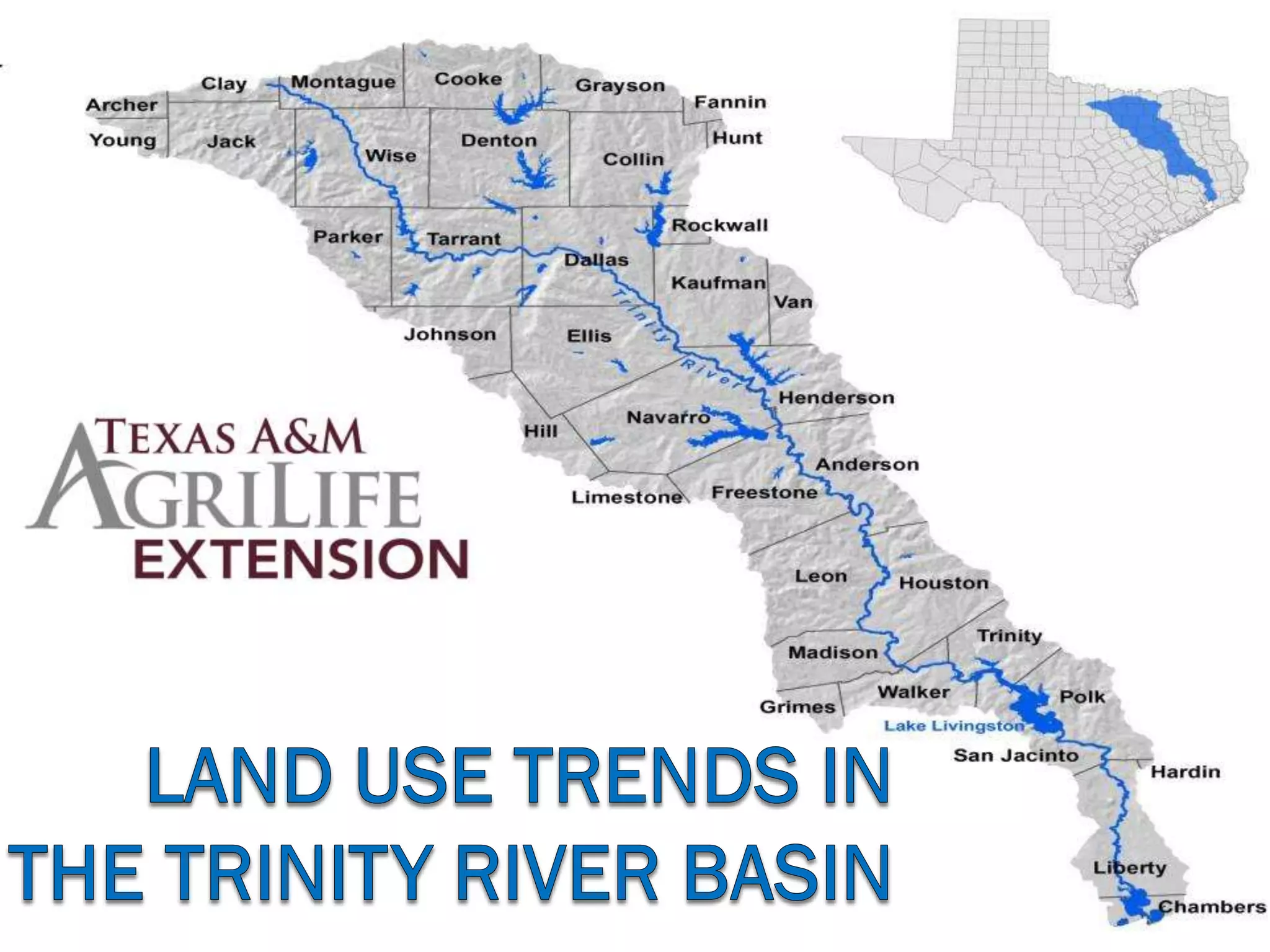
What is land use?
 How the land is managed, whether it is for
agriculture, wildlife, industry, timber, or
urbanization
What is land cover?
 Land cover refers to the biological or
physical features on the land
 Crop fields, native rangeland, improved
pasture, lakes, forests, pavement
2006 NLCD Land Use/Land Cover
Cropland (< 1%)
Forest (20%)
Developed: High (<1%)
Developed: Low (5%)
Grassland (8%)
Wetlands (21%)
Open Water (2%)
Pasture/Hay (42%)
Factors That Affect Land Use
 Population growth
 For every 1,000
new residents,
Texas loses 149
acres
 In top 50 growth
counties, 270
acres are lost for
every 1,000 new
residents
Texas’ top 25 growth counties from 1997-
2007
Factors That Affect Land Use
 Agricultural economic
uncertainty
 Drought
 Supply and Demand
 Estate Taxes
October 11,
2011
Factors That Affect Land Use
 Increasing land
values leads to
greater
fragmentation
 Dividing up of
land into smaller
patches
 More landowners
= Different
management
perspectives
No Fragmentation
Fragmentation
Fragmentation
 5,000 new properties in the 1-100 size class
 Resulting problems
 Loss of sustainable wildlife habitat
 Reduced agricultural productivity
Fragmentation
 Reduced economic sustainability for landowners
Fragmentation in the Trinity?
 71,600 acres
added to 1-100
size class
 140,500 acres
added to 2000+
size class
 More evidence of
consolidation than
fragmentation in
the middle Trinity
Fragmentation in the Trinity?
 Fragmentation more
severe north of
Houston and
moderate north of
D/FW
 Significant
consolidation in the
middle basin
 How about your
area?
Trinity Basin Land Use Trends
 Loss of 257,000
acres of native
rangeland
 Gain of 334,000
acres of non-native
pasture
 Loss of 231,000
acres of cropland
 Gain of 82,000
acres in wildlife
Land Use Effects on Water
 Surface runoff = 24%
 Infiltration = 75%
 Wildlife habitat!
Bunchgrasses Sodgrasses
 Surface runoff = 45%
 Infiltration = 54%
 Fertilizers?
Land Use Effects on Water
 Maintain vegetation in riparian areas
 Reduces erosion, benefits water and wildlife
Land Use Effects on Water
 Riparian soils can hold more water and greater forage
production can be periodically grazed
Land Use Effects on Water
 Roots anchor soil and reduce flood damage
Land Use Effects on Water
 Less erosion = Less sediment filling lakes
Land Management Tool - TRIMS
 TRIMS
Conservation Easement
Wildlife Management Associations
 Landowners working
together under
guidance of a biologist
 Large area under
same general
management
 Lessens the effect of
fragmentation
 10 in middle basin for
95,000 acres
Texas Land Trends
 IRNR

Land use trends in the Trinity River basin

  • 2.
    What is landuse?  How the land is managed, whether it is for agriculture, wildlife, industry, timber, or urbanization
  • 3.
    What is landcover?  Land cover refers to the biological or physical features on the land  Crop fields, native rangeland, improved pasture, lakes, forests, pavement
  • 6.
    2006 NLCD LandUse/Land Cover Cropland (< 1%) Forest (20%) Developed: High (<1%) Developed: Low (5%) Grassland (8%) Wetlands (21%) Open Water (2%) Pasture/Hay (42%)
  • 8.
    Factors That AffectLand Use  Population growth  For every 1,000 new residents, Texas loses 149 acres  In top 50 growth counties, 270 acres are lost for every 1,000 new residents Texas’ top 25 growth counties from 1997- 2007
  • 9.
    Factors That AffectLand Use  Agricultural economic uncertainty  Drought  Supply and Demand  Estate Taxes October 11, 2011
  • 10.
    Factors That AffectLand Use  Increasing land values leads to greater fragmentation  Dividing up of land into smaller patches  More landowners = Different management perspectives
  • 11.
  • 12.
  • 13.
    Fragmentation  5,000 newproperties in the 1-100 size class  Resulting problems  Loss of sustainable wildlife habitat  Reduced agricultural productivity
  • 14.
    Fragmentation  Reduced economicsustainability for landowners
  • 15.
    Fragmentation in theTrinity?  71,600 acres added to 1-100 size class  140,500 acres added to 2000+ size class  More evidence of consolidation than fragmentation in the middle Trinity
  • 16.
    Fragmentation in theTrinity?  Fragmentation more severe north of Houston and moderate north of D/FW  Significant consolidation in the middle basin  How about your area?
  • 17.
    Trinity Basin LandUse Trends  Loss of 257,000 acres of native rangeland  Gain of 334,000 acres of non-native pasture  Loss of 231,000 acres of cropland  Gain of 82,000 acres in wildlife
  • 23.
    Land Use Effectson Water  Surface runoff = 24%  Infiltration = 75%  Wildlife habitat! Bunchgrasses Sodgrasses  Surface runoff = 45%  Infiltration = 54%  Fertilizers?
  • 24.
    Land Use Effectson Water  Maintain vegetation in riparian areas  Reduces erosion, benefits water and wildlife
  • 25.
    Land Use Effectson Water  Riparian soils can hold more water and greater forage production can be periodically grazed
  • 26.
    Land Use Effectson Water  Roots anchor soil and reduce flood damage
  • 27.
    Land Use Effectson Water  Less erosion = Less sediment filling lakes
  • 28.
    Land Management Tool- TRIMS  TRIMS
  • 29.
  • 30.
    Wildlife Management Associations Landowners working together under guidance of a biologist  Large area under same general management  Lessens the effect of fragmentation  10 in middle basin for 95,000 acres
  • 31.