Fatty
Alcohols
Presentation by
Primary Information Services
www.primaryinfo.com
mailto:primaryinfo@gmail.com
Feedstock ?
The source of FA could be either palm kernel oil or petrochemicals.
Both the petrochemical and PKO
feedstocks are part of large and
complex supply chains
Fatty alcohol production
Choice of feedstock
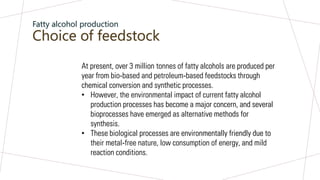
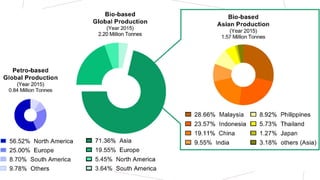
At present, over 3 million tonnes of fatty alcohols are produced per
year from bio‐based and petroleum‐based feedstocks through
chemical conversion and synthetic processes.
• However, the environmental impact of current fatty alcohol
production processes has become a major concern, and several
bioprocesses have emerged as alternative methods for
synthesis.
• These biological processes are environmentally friendly due to
their metal‐free nature, low consumption of energy, and mild
reaction conditions.
Fatty Alcohols From petrochemical
sources
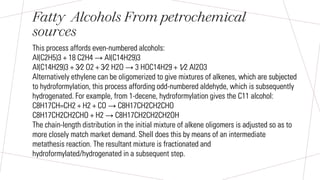
This process affords even-numbered alcohols:
Al(C2H5)3 + 18 C2H4 → Al(C14H29)3
Al(C14H29)3 + 3⁄2 O2 + 3⁄2 H2O → 3 HOC14H29 + 1⁄2 Al2O3
Alternatively ethylene can be oligomerized to give mixtures of alkenes, which are subjected
to hydroformylation, this process affording odd-numbered aldehyde, which is subsequently
hydrogenated. For example, from 1-decene, hydroformylation gives the C11 alcohol:
C8H17CH=CH2 + H2 + CO → C8H17CH2CH2CHO
C8H17CH2CH2CHO + H2 → C8H17CH2CH2CH2OH
The chain-length distribution in the initial mixture of alkene oligomers is adjusted so as to
more closely match market demand. Shell does this by means of an intermediate
metathesis reaction. The resultant mixture is fractionated and
hydroformylated/hydrogenated in a subsequent step.
Primary Information Services
We Find the
Primary Information
that is Reliable Categorize it, index it Adsense and make it Knowledgeable
to every one Who is willing to Pay for it

Fatty alcohols

  • 1.
    Fatty Alcohols Presentation by Primary InformationServices www.primaryinfo.com mailto:primaryinfo@gmail.com
  • 2.
    Feedstock ? The sourceof FA could be either palm kernel oil or petrochemicals. Both the petrochemical and PKO feedstocks are part of large and complex supply chains
  • 4.
    Fatty alcohol production Choiceof feedstock At present, over 3 million tonnes of fatty alcohols are produced per year from bio‐based and petroleum‐based feedstocks through chemical conversion and synthetic processes. • However, the environmental impact of current fatty alcohol production processes has become a major concern, and several bioprocesses have emerged as alternative methods for synthesis. • These biological processes are environmentally friendly due to their metal‐free nature, low consumption of energy, and mild reaction conditions.
  • 6.
    Fatty Alcohols Frompetrochemical sources This process affords even-numbered alcohols: Al(C2H5)3 + 18 C2H4 → Al(C14H29)3 Al(C14H29)3 + 3⁄2 O2 + 3⁄2 H2O → 3 HOC14H29 + 1⁄2 Al2O3 Alternatively ethylene can be oligomerized to give mixtures of alkenes, which are subjected to hydroformylation, this process affording odd-numbered aldehyde, which is subsequently hydrogenated. For example, from 1-decene, hydroformylation gives the C11 alcohol: C8H17CH=CH2 + H2 + CO → C8H17CH2CH2CHO C8H17CH2CH2CHO + H2 → C8H17CH2CH2CH2OH The chain-length distribution in the initial mixture of alkene oligomers is adjusted so as to more closely match market demand. Shell does this by means of an intermediate metathesis reaction. The resultant mixture is fractionated and hydroformylated/hydrogenated in a subsequent step.
  • 12.
    Primary Information Services WeFind the Primary Information that is Reliable Categorize it, index it Adsense and make it Knowledgeable to every one Who is willing to Pay for it