By
Ms.A.Thamizhiniyal, M.C.A., M.Phil.,
Assistant Professor,
Bon Secours College for Women, Thanjavur.
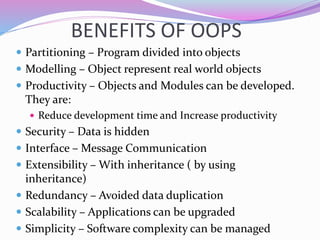
BENEFITS OF OOPS
 Partitioning – Program divided into objects
 Modelling – Object represent real world objects
 Productivity – Objects and Modules can be developed.
They are:
 Reduce development time and Increase productivity
 Security – Data is hidden
 Interface – Message Communication
 Extensibility – With inheritance ( by using
inheritance)
 Redundancy – Avoided data duplication
 Scalability – Applications can be upgraded
 Simplicity – Software complexity can be managed
Applications of OOPS
 Real-time Systems
 Eg: A system Parameters change every time, Output
changes, Dynamic systems eg: Weather, Temperature
etc.,
 Simulation and Modelling
 Limitation of real world product (eg : automobiles
changes)
 Hypertext, Hypermedia and Expertext
 Suitable for various media approaches
 AI ( Artificial Intelligence)
 Eg : Combination of both hypermedia and real time
systems
 Neural networks and parallel programming
 Eg: Refer to a N/W of biological neurons
 Consists of AI neurons 0r nodes
 Large problem divided into smaller ones and solved
concurrently (in parallel)
 Office Automation System
 Type of real System
 CAM/CAD systems
 Computer Aided Manufacturing
 Computer Aided Design
What is C++ ?
 C++ is an object oriented programming language.
 It was developed by Bjarne Stroustrup at AT & T Bell
Laboratories in Murray, New Jersey, USA, in the early
1980’s.
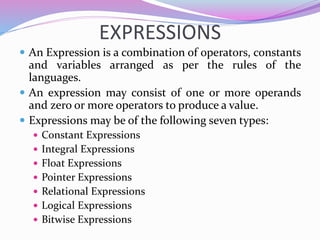
EXPRESSIONS
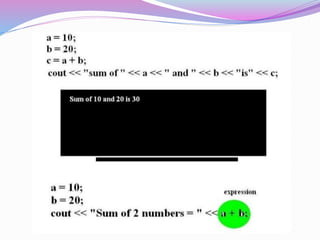
 An Expression is a combination of operators, constants
and variables arranged as per the rules of the
languages.
 An expression may consist of one or more operands
and zero or more operators to produce a value.
 Expressions may be of the following seven types:
 Constant Expressions
 Integral Expressions
 Float Expressions
 Pointer Expressions
 Relational Expressions
 Logical Expressions
 Bitwise Expressions
Thank You

C++

  • 1.
    By Ms.A.Thamizhiniyal, M.C.A., M.Phil., AssistantProfessor, Bon Secours College for Women, Thanjavur.
  • 20.
    BENEFITS OF OOPS Partitioning – Program divided into objects  Modelling – Object represent real world objects  Productivity – Objects and Modules can be developed. They are:  Reduce development time and Increase productivity  Security – Data is hidden  Interface – Message Communication  Extensibility – With inheritance ( by using inheritance)  Redundancy – Avoided data duplication  Scalability – Applications can be upgraded  Simplicity – Software complexity can be managed
  • 22.
    Applications of OOPS Real-time Systems  Eg: A system Parameters change every time, Output changes, Dynamic systems eg: Weather, Temperature etc.,  Simulation and Modelling  Limitation of real world product (eg : automobiles changes)  Hypertext, Hypermedia and Expertext  Suitable for various media approaches  AI ( Artificial Intelligence)  Eg : Combination of both hypermedia and real time systems
  • 23.
     Neural networksand parallel programming  Eg: Refer to a N/W of biological neurons  Consists of AI neurons 0r nodes  Large problem divided into smaller ones and solved concurrently (in parallel)  Office Automation System  Type of real System  CAM/CAD systems  Computer Aided Manufacturing  Computer Aided Design
  • 24.
    What is C++?  C++ is an object oriented programming language.  It was developed by Bjarne Stroustrup at AT & T Bell Laboratories in Murray, New Jersey, USA, in the early 1980’s.
  • 40.
    EXPRESSIONS  An Expressionis a combination of operators, constants and variables arranged as per the rules of the languages.  An expression may consist of one or more operands and zero or more operators to produce a value.  Expressions may be of the following seven types:  Constant Expressions  Integral Expressions  Float Expressions  Pointer Expressions  Relational Expressions  Logical Expressions  Bitwise Expressions
  • 41.