Acute Respiratory Infection
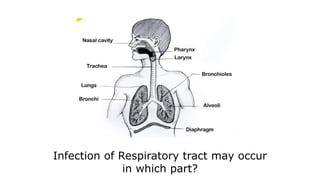
Infection of Respiratory tract may occur
in which part?
So ARI may start in any part
Nose  Alveoli
and ARI may spread to any part
Nose  Alveoli
Clinical Symptom depends on
Site of Infection Site of Infection
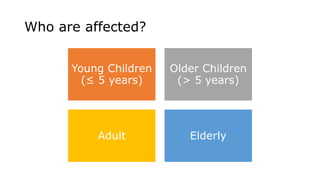
Who are affected?
Young Children
(≤ 5 years)
Older Children
(> 5 years)
Adult Elderly
1980: World Health Organization
(WHO) develop a pneumonia control
strategy.
What’s Unique in this Strategy
Simple signs are used to classify severities
of pneumonia followed by appropriate case
management.
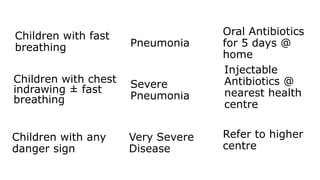
Children with fast
breathing Pneumonia
Oral Antibiotics
for 5 days @
home
Children with chest
indrawing ± fast
breathing
Severe
Pneumonia
Injectable
Antibiotics @
nearest health
centre
Children with any
danger sign
Very Severe
Disease
Refer to higher
centre
Integrated Management of Childhood Illness
(IMCI) by WHO.
Integrated Management of Neonatal and Childhood
Illness (IMNCI) by India.
(after modifying WHO version)
After 30 years: Revision of the
pneumonia guidelines
The revisions include
1. Changing the recommendation for the first-line
antibiotic
2. Re-defining the classification of pneumonia severity
New classification
1. Pneumonia with fast breathing and/or chest
indrawing, which requires home therapy with oral
amoxicillin.
2. Severe pneumonia, pneumonia with any general
danger sign, which requires referral and
injectable therapy.
Recommendation_1
• Children with fast breathing pneumonia with no chest
indrawing or general danger sign should be treated
with oral amoxicillin for 3 days.
Recommendation_2
• Children aged 2–59 months with chest indrawing
pneumonia should be treated with oral amoxicillin
Recommendation_2
• Children aged 2–59 months with severe pneumonia
should be treated with parenteral ampicillin (or
penicillin) and gentamicin as a first-line treatment.
Recommendation_3
• Children aged 2–59 months with severe pneumonia
should be treated with parenteral ampicillin (or
penicillin) and gentamicin as a first-line treatment.
Ceftriaxone should be used as a second-line
treatment in children with severe pneumonia
having failed on the first-line treatment.
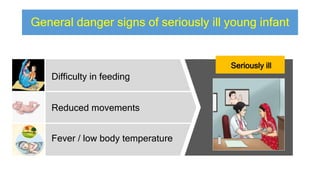
General danger signs of seriously ill young infant
Seriously ill
Difficulty in feeding
Reduced movements
Fever / low body temperature
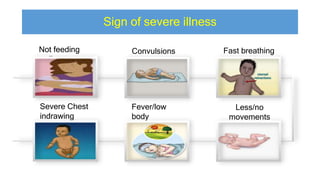
Sign of severe illness
Not feeding
well
Severe Chest
indrawing
Convulsions Fast breathing
Fever/low
body
temperature
Less/no
movements
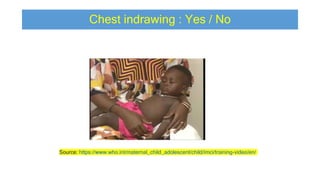
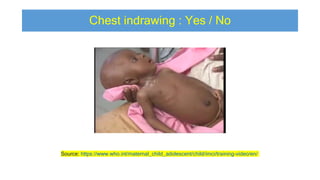
Chest indrawing : Yes / No
Source: https://www.who.int/maternal_child_adolescent/child/imci/training-video/en/
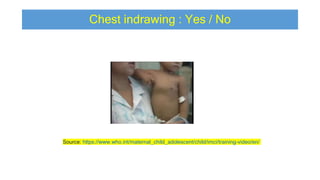
Chest indrawing : Yes / No
Source: https://www.who.int/maternal_child_adolescent/child/imci/training-video/en/
Chest indrawing : Yes / No
Source: https://www.who.int/maternal_child_adolescent/child/imci/training-video/en/

Acute Respiratory Infections.pptx

  • 1.
  • 2.
    Infection of Respiratorytract may occur in which part?
  • 3.
    So ARI maystart in any part Nose  Alveoli and ARI may spread to any part Nose  Alveoli
  • 4.
    Clinical Symptom dependson Site of Infection Site of Infection
  • 5.
    Who are affected? YoungChildren (≤ 5 years) Older Children (> 5 years) Adult Elderly
  • 6.
    1980: World HealthOrganization (WHO) develop a pneumonia control strategy.
  • 7.
    What’s Unique inthis Strategy Simple signs are used to classify severities of pneumonia followed by appropriate case management.
  • 8.
    Children with fast breathingPneumonia Oral Antibiotics for 5 days @ home Children with chest indrawing ± fast breathing Severe Pneumonia Injectable Antibiotics @ nearest health centre Children with any danger sign Very Severe Disease Refer to higher centre
  • 9.
    Integrated Management ofChildhood Illness (IMCI) by WHO. Integrated Management of Neonatal and Childhood Illness (IMNCI) by India. (after modifying WHO version)
  • 10.
    After 30 years:Revision of the pneumonia guidelines
  • 11.
    The revisions include 1.Changing the recommendation for the first-line antibiotic 2. Re-defining the classification of pneumonia severity
  • 12.
    New classification 1. Pneumoniawith fast breathing and/or chest indrawing, which requires home therapy with oral amoxicillin. 2. Severe pneumonia, pneumonia with any general danger sign, which requires referral and injectable therapy.
  • 13.
    Recommendation_1 • Children withfast breathing pneumonia with no chest indrawing or general danger sign should be treated with oral amoxicillin for 3 days.
  • 14.
    Recommendation_2 • Children aged2–59 months with chest indrawing pneumonia should be treated with oral amoxicillin
  • 15.
    Recommendation_2 • Children aged2–59 months with severe pneumonia should be treated with parenteral ampicillin (or penicillin) and gentamicin as a first-line treatment.
  • 16.
    Recommendation_3 • Children aged2–59 months with severe pneumonia should be treated with parenteral ampicillin (or penicillin) and gentamicin as a first-line treatment. Ceftriaxone should be used as a second-line treatment in children with severe pneumonia having failed on the first-line treatment.
  • 17.
    General danger signsof seriously ill young infant Seriously ill Difficulty in feeding Reduced movements Fever / low body temperature
  • 18.
    Sign of severeillness Not feeding well Severe Chest indrawing Convulsions Fast breathing Fever/low body temperature Less/no movements
  • 19.
    Chest indrawing :Yes / No Source: https://www.who.int/maternal_child_adolescent/child/imci/training-video/en/
  • 20.
    Chest indrawing :Yes / No Source: https://www.who.int/maternal_child_adolescent/child/imci/training-video/en/
  • 21.
    Chest indrawing :Yes / No Source: https://www.who.int/maternal_child_adolescent/child/imci/training-video/en/

Editor's Notes

  • #7 suitable for countries with limited resources and constrained health systems
  • #10 These pneumonia classification and management guidelines had been developed based on evidence generated in the 1970s and early 1980s, and were incorporated into the original version of Integrated Management of Childhood Illness (IMCI). In the intervening time, new evidence has emerged which prompted the development of revised guidelines
  • #12 Programmes should recognize the importance of these revisions, which will result in a substantially lower need for referral, and in better treatment outcomes. Local adaptations may be required, particularly the arrangements to include amoxicillin as the first-line therapy; facility-level
  • #13 The revisions include changing the recommendation for the first-line antibiotic and re-defining the classification of pneumonia severity. The data show that oral amoxicillin is preferable to oral cotrimoxazole for the treatment of “fast breathing pneumonia” and is equivalent to injectable penicillin/ampicillin in cases of “chest indrawing pneumonia”. Hence, in a programmatic context, the distinction between previously defined “pneumonia” (fast breathing) and “severe pneumonia”
  • #17 Ceftriaxone should be used as a second-line treatment in children with severe pneumonia having failed on the first-line treatment.