Title: What areATXMotherboardDimensionsin ATX Specification?
Keywords: atx motherboard dimensions, dimensions of atx motherboard, e atx motherboard
dimensions
Description: This essay mainly introduces the ATX motherboard dimensions of the standard form
(12 × 9.6 in) as well as the variants.
URL: https://www.partitionwizard.com/partitionmagic/atx-motherboard-dimensions.html
Summary: The following content is going to talk about the ATXmotherboard dimensions of the
standard type as well as the variants. If you are interested in more details about the ATXmotherboard
or similar knowledge, you can just visit MiniTool disk partition software website.
About ATX (Advanced Technology eXtended)
According to Wikipedia, ATX is a configuration specification of the motherboard and power supply
invented by Intel in 1995. It was the first major change in the motherboard, power supply and desktop
computer enclosure design for many years. ATX improves the standardization and interchangeability
of computer components. It defines the dimensions, the I/O panel, the mounting points, and the power
& connector interfaces within a computer host case,a motherboard as well as a power supply.
ATX Motherboard Dimensions
Just as mentioned in the above, ATX is the most common (popular) motherboard design. As for other
standards for smaller boards, like microATX, mini-ITX, nano-ITX and FlexATX, they usually only
keep the basic rear layout and reduce the number of the slots as well as decrease the size of the board.
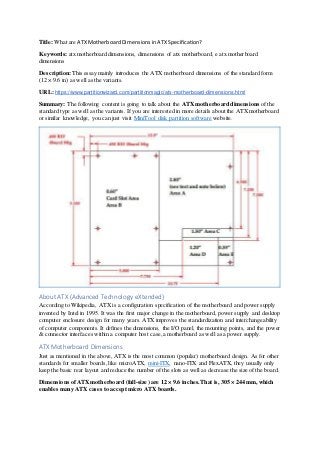
Dimensions ofATXmotherboard (full-size) are 12 × 9.6 inches. That is, 305 × 244 mm, which
enables many ATX cases to accept micro ATXboards.
2.
Alt= ATX MotherboardHole Dimensions
Dimensions of ATX Motherboard Variants
Just as described in the above, some smaller boards that derived from the normal ATX set different
standards for the board size and smaller number of expansion slots. Yet,they make use of the same
mountings, basic back panel arrangement as well as the same power supply.
The standard ATX motherboard offers 7 slots at 0.8 inches (20 mm) spacing, while the microATX
reduces 3 slots of 2.4 inches (61mm). Here,the width refers to the distance along the external
connector edge, while the depth refers to distance from front to rear.
Note: There once was a Mini ATX with a design of 5.9 × 5.9 in (15 × 15 cm). It was removed fromthe
ATX specificationsdue to microATX was adopted.Also, the removing of MiniATX specification is to
avoid contradiction to the modern Mini-ITX standard,which is of 6.7 × 6.7 in (17 × 17 cm)
dimension.
You may also like: [2020 Guide] Howto Choosea Motherboard forYourPC?
Many manufacturers have added 1, 2 or 3 additional expansion slots (with the standard 0.8-inch
spacing) to the standard 12-inch ATX width. Also, there were some strange form factors in 1999
including full-size AT, Baby-AT and the semi-proprietary LPXfor low-profile host cases.
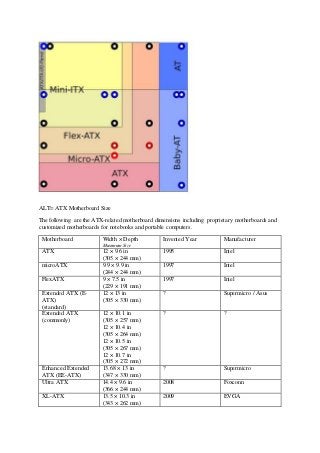
Below is a picture comparing the different variants of ATX motherboard dimensions.Each larger
size includes all previous smaller color areas.
3.
ALT= ATX MotherboardSize
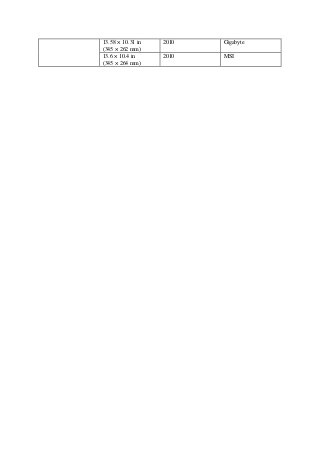
The following are the ATX-related motherboard dimensions including proprietary motherboards and
customized motherboards for notebooks and portable computers.
Motherboard Width × Depth
Maximum Size
Invented Year Manufacturer
ATX 12 × 9.6 in
(305 × 244 mm)
1995 Intel
microATX 9.9 × 9.9 in
(244 × 244 mm)
1997 Intel
FlexATX 9 × 7.5 in
(229 × 191 mm)
1997 Intel
Extended ATX (E-
ATX)
(standard)
12 × 13 in
(305 × 330 mm)
? Supermicro / Asus
Extended ATX
(commonly)
12 × 10.1 in
(305 × 257 mm)
12 × 10.4 in
(305 × 264 mm)
12 × 10.5 in
(305 × 267 mm)
12 × 10.7 in
(305 × 272 mm)
? ?
Enhanced Extended
ATX (EE-ATX)
13.68 × 13 in
(347 × 330 mm)
? Supermicro
Ultra ATX 14.4 × 9.6 in
(366 × 244 mm)
2008 Foxconn
XL-ATX 13.5 × 10.3 in
(343 × 262 mm)
2009 EVGA
![Alt= ATX Motherboard Hole Dimensions
Dimensions of ATX Motherboard Variants
Just as described in the above, some smaller boards that derived from the normal ATX set different
standards for the board size and smaller number of expansion slots. Yet,they make use of the same
mountings, basic back panel arrangement as well as the same power supply.
The standard ATX motherboard offers 7 slots at 0.8 inches (20 mm) spacing, while the microATX
reduces 3 slots of 2.4 inches (61mm). Here,the width refers to the distance along the external
connector edge, while the depth refers to distance from front to rear.
Note: There once was a Mini ATX with a design of 5.9 × 5.9 in (15 × 15 cm). It was removed fromthe
ATX specificationsdue to microATX was adopted.Also, the removing of MiniATX specification is to
avoid contradiction to the modern Mini-ITX standard,which is of 6.7 × 6.7 in (17 × 17 cm)
dimension.
You may also like: [2020 Guide] Howto Choosea Motherboard forYourPC?
Many manufacturers have added 1, 2 or 3 additional expansion slots (with the standard 0.8-inch
spacing) to the standard 12-inch ATX width. Also, there were some strange form factors in 1999
including full-size AT, Baby-AT and the semi-proprietary LPXfor low-profile host cases.
Below is a picture comparing the different variants of ATX motherboard dimensions.Each larger
size includes all previous smaller color areas.](https://image.slidesharecdn.com/atx-motherboard-dimensions-200727094420/85/Atx-motherboard-dimensions-2-320.jpg?cb=1595843083)