Crafts and SMEs profiting from EU / EMU
First ideas
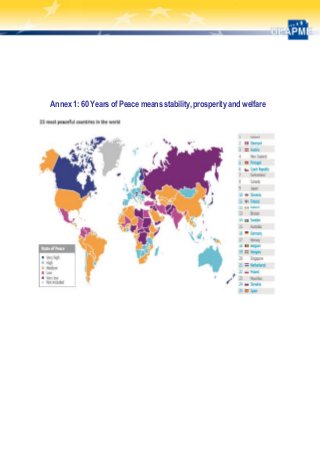
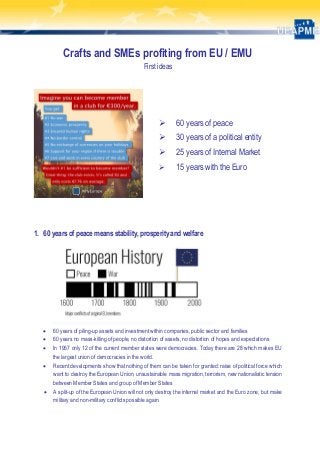
 60 years of peace
 30 years of a political entity
 25 years of Internal Market
 15 years with the Euro
1. 60 years of peace means stability, prosperity and welfare
 60 years of piling-up assets and investment within companies, public sector and families
 60 years no mass-killing of people, no distortion of assets, no distortion of hopes and expectations
 In 1957 only 12 of the current member states were democracies. Today there are 28 which makes EU
the largest union of democracies in the world.
 Recent developments show that nothing of them can be taken for granted: raise of political force which
want to destroy the European Union, unsustainable mass migration, terrorism, new nationalistic tension
between Member States and group of Member States
 A split-up of the European Union will not only destroy the internal market and the Euro zone, but make
military and non-military conflicts possible again.
2. Europe is a main player at global level – single European countries will be irrelevant
 European countries have to join forces to be a
relevant play at global level – WTO, G7, G20
 This is especially true for trade policy, financial
market regulations, global standards and targets
in climate policy, IPR protection and technical
standards
 Only together European can achieve the
political, monetary and military relevance to deal
with others on equal footing
 The EU is the largest trade block in the world
and a top trading partner for 80 countries.
3. The internal market the main driver for growth, jobs and welfare in the EU
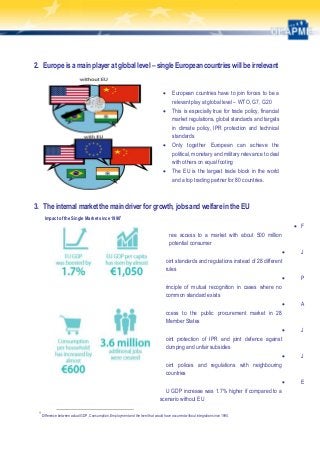
Impact of the Single Market since 19901
 F
ree access to a market with about 500 million
potential consumer
 J
oint standards and regulations instead of 28 different
rules
 P
rinciple of mutual recognition in cases where no
common standard exists
 A
ccess to the public procurement market in 28
Member States
 J
oint protection of IPR and joint defence against
dumping and unfair subsidies
 J
oint polices and regulations with neighbouring
countries
 E
U GDP increase was 1.7% higher if compared to a
scenario without EU
1
Difference between actual GDP, Consumption,Employmentand the level that would have occurred without integration since 1990.
 Integration increased GDP per capita by almost 1050
Euro
 Consumption per Household increased by almost €600
 Integration led to the creation of 3.6 million jobs
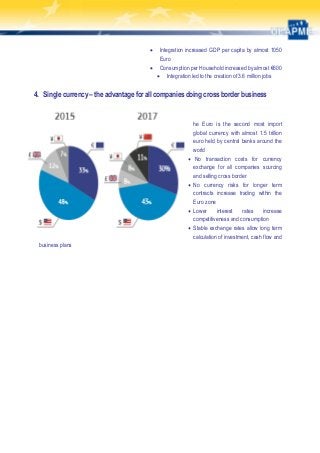
4. Single currency – the advantage for all companies doing cross border business
he Euro is the second most import
global currency with almost 1.5 trillion
euro held by central banks around the
world
 No transaction costs for currency
exchange for all companies sourcing
and selling cross border
 No currency risks for longer term
contracts increase trading within the
Euro zone
 Lower interest rates increase
competitiveness and consumption
 Stable exchange rates allow long term
calculation of investment, cash flow and
business plans
Annex 1: 60 Years of Peace means stability, prosperity and welfare
Annex 2: 25 years of Internal Market
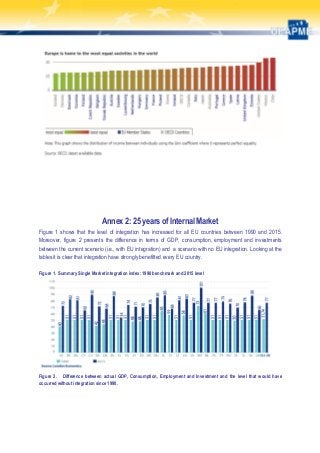
Figure 1 shows that the level of integration has increased for all EU countries between 1990 and 2015.
Moreover, figure 2 presents the difference in terms of GDP, consumption, employment and investments
between the current scenario (i.e., with EU integration) and a scenario with no EU integration. Looking at the
tables it is clear that integration have strongly benefitted every EU country.
Figure 1. Summary Single Market integration index: 1990 benchmark and 2015 level
Figure 2. Difference between actual GDP, Consumption, Employment and Investment and the level that would have
occurred without integration since 1990.
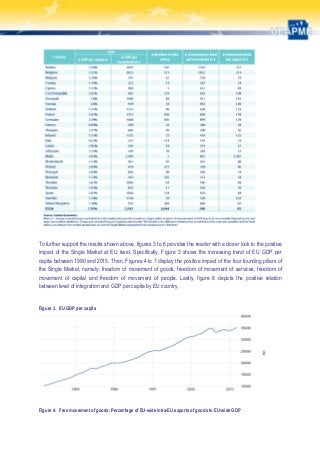
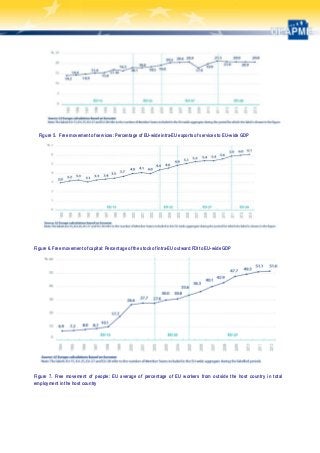
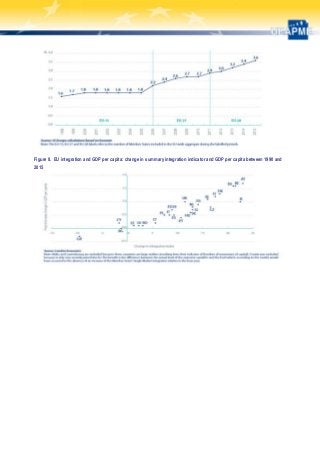
To further support the results shown above, figures 3 to 8 provides the reader with a closer look to the positive
impact of the Single Market at EU level. Specifically, Figure 3 shows the increasing trend of EU GDP per
capita between 1990 and 2015. Then, Figures 4 to 7 display the positive impact of the four founding pillars of
the Single Market, namely: freedom of movement of goods, freedom of movement of services, freedom of
movement of capital and freedom of movement of people. Lastly, figure 8 depicts the positive relation
between level of integration and GDP per capita by EU country.
Figure 3. EU GDP per capita
Figure 4. Free movement of goods: Percentage of EU-wide intra-EU exports of goods to EU-wide GDP
Figure 5. Free movement of services: Percentage of EU-wide intra-EU exports of services to EU-wide GDP
Figure 6. Free movement of capital: Percentage of the stock of intra-EU outward FDI to EU-wide GDP
Figure 7. Free movement of people: EU average of percentage of EU workers from outside the host country in total
employment in the host country
Figure 8. EU integration and GDP per capita: change in summary integration indicator and GDP per capita between 1990 and
2015
Crafts and SMEs profiting from EU / EMU

  • 1.
    Crafts and SMEsprofiting from EU / EMU First ideas  60 years of peace  30 years of a political entity  25 years of Internal Market  15 years with the Euro 1. 60 years of peace means stability, prosperity and welfare  60 years of piling-up assets and investment within companies, public sector and families  60 years no mass-killing of people, no distortion of assets, no distortion of hopes and expectations  In 1957 only 12 of the current member states were democracies. Today there are 28 which makes EU the largest union of democracies in the world.  Recent developments show that nothing of them can be taken for granted: raise of political force which want to destroy the European Union, unsustainable mass migration, terrorism, new nationalistic tension between Member States and group of Member States  A split-up of the European Union will not only destroy the internal market and the Euro zone, but make military and non-military conflicts possible again.
  • 2.
    2. Europe isa main player at global level – single European countries will be irrelevant  European countries have to join forces to be a relevant play at global level – WTO, G7, G20  This is especially true for trade policy, financial market regulations, global standards and targets in climate policy, IPR protection and technical standards  Only together European can achieve the political, monetary and military relevance to deal with others on equal footing  The EU is the largest trade block in the world and a top trading partner for 80 countries. 3. The internal market the main driver for growth, jobs and welfare in the EU Impact of the Single Market since 19901  F ree access to a market with about 500 million potential consumer  J oint standards and regulations instead of 28 different rules  P rinciple of mutual recognition in cases where no common standard exists  A ccess to the public procurement market in 28 Member States  J oint protection of IPR and joint defence against dumping and unfair subsidies  J oint polices and regulations with neighbouring countries  E U GDP increase was 1.7% higher if compared to a scenario without EU 1 Difference between actual GDP, Consumption,Employmentand the level that would have occurred without integration since 1990.
  • 3.
     Integration increasedGDP per capita by almost 1050 Euro  Consumption per Household increased by almost €600  Integration led to the creation of 3.6 million jobs 4. Single currency – the advantage for all companies doing cross border business he Euro is the second most import global currency with almost 1.5 trillion euro held by central banks around the world  No transaction costs for currency exchange for all companies sourcing and selling cross border  No currency risks for longer term contracts increase trading within the Euro zone  Lower interest rates increase competitiveness and consumption  Stable exchange rates allow long term calculation of investment, cash flow and business plans
  • 4.
    Annex 1: 60Years of Peace means stability, prosperity and welfare
  • 5.
    Annex 2: 25years of Internal Market Figure 1 shows that the level of integration has increased for all EU countries between 1990 and 2015. Moreover, figure 2 presents the difference in terms of GDP, consumption, employment and investments between the current scenario (i.e., with EU integration) and a scenario with no EU integration. Looking at the tables it is clear that integration have strongly benefitted every EU country. Figure 1. Summary Single Market integration index: 1990 benchmark and 2015 level Figure 2. Difference between actual GDP, Consumption, Employment and Investment and the level that would have occurred without integration since 1990.
  • 6.
    To further supportthe results shown above, figures 3 to 8 provides the reader with a closer look to the positive impact of the Single Market at EU level. Specifically, Figure 3 shows the increasing trend of EU GDP per capita between 1990 and 2015. Then, Figures 4 to 7 display the positive impact of the four founding pillars of the Single Market, namely: freedom of movement of goods, freedom of movement of services, freedom of movement of capital and freedom of movement of people. Lastly, figure 8 depicts the positive relation between level of integration and GDP per capita by EU country. Figure 3. EU GDP per capita Figure 4. Free movement of goods: Percentage of EU-wide intra-EU exports of goods to EU-wide GDP
  • 7.
    Figure 5. Freemovement of services: Percentage of EU-wide intra-EU exports of services to EU-wide GDP Figure 6. Free movement of capital: Percentage of the stock of intra-EU outward FDI to EU-wide GDP Figure 7. Free movement of people: EU average of percentage of EU workers from outside the host country in total employment in the host country
  • 8.
    Figure 8. EUintegration and GDP per capita: change in summary integration indicator and GDP per capita between 1990 and 2015