1
 DEFINITION
 EVOLUTION
1.CLASSIC ANTIQUITY
2.MIDDLE AGES
3.RENAISSANCE
4.MODERN
5.MUSEUM ARCHITECTURE
6.GENERAL CLASSIFICATION IN MUSEUM ARCHITECTURE
7.MUSEUMS BASED ON CURIOSITIES OF GENERATIONS
8.PARTICIPATORY ACTIVITES
9.EASE OF INTERNET
 TYPOLOGY IN MUSEUMS
A museum is a non-profit , permanent institution in the
service of society and its development , open to the
public , which acquires , conserves , researches ,
communicates and exhibits the tangible and intangible
heritage of humanity and its environment for the
purpose of education , study and enjoyment.
15TH CENTURY – Started with idea of preserving
culture leading to COLLECTION OF IDEAS AND
MEMORIES.
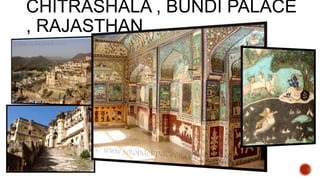
Eg: CHITRASHALAS IN ANCIENT INDIA
- Source of entertainment as well as means of education.
- Old palace( Bundi palace), now museum @ New Delhi.
CHITRASHALA , BUNDI PALACE
, RAJASTHAN
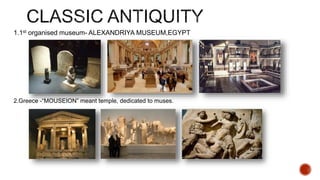
1.1st organised museum- ALEXANDRIYA MUSEUM,EGYPT
2.Greece -“MOUSEION” meant temple, dedicated to muses.
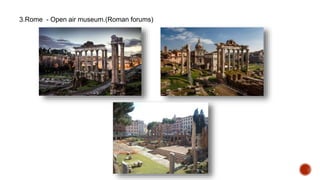
3.Rome - Open air museum.(Roman forums)
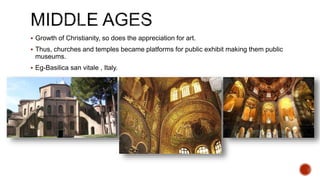
 Growth of Christianity, so does the appreciation for art.
 Thus, churches and temples became platforms for public exhibit making them public
museums.
 Eg-Basilica san vitale , Italy.
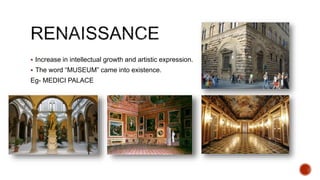
 Increase in intellectual growth and artistic expression.
 The word “MUSEUM” came into existence.
Eg- MEDICI PALACE
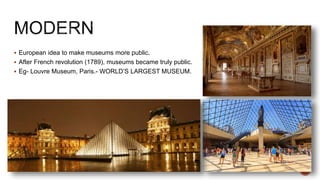
 European idea to make museums more public.
 After French revolution (1789), museums became truly public.
 Eg- Louvre Museum, Paris.- WORLD’S LARGEST MUSEUM.
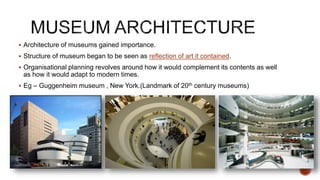
 Architecture of museums gained importance.
 Structure of museum began to be seen as reflection of art it contained.
 Organisational planning revolves around how it would complement its contents as well
as how it would adapt to modern times.
 Eg – Guggenheim museum , New York.(Landmark of 20th century museums)
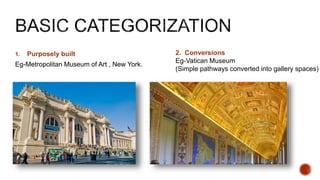
1. Purposely built
Eg-Metropolitan Museum of Art , New York.
2. Conversions
Eg-Vatican Museum
(Simple pathways converted into gallery spaces)
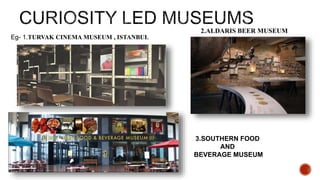
Eg- 1.TURVAK CINEMA MUSEUM , ISTANBUL
2.ALDARIS BEER MUSEUM
3.SOUTHERN FOOD
AND
BEVERAGE MUSEUM
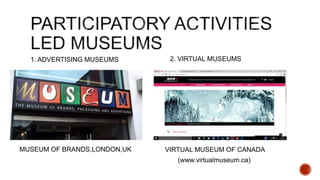
1. ADVERTISING MUSEUMS 2. VIRTUAL MUSEUMS
MUSEUM OF BRANDS,LONDON,UK VIRTUAL MUSEUM OF CANADA
(www.virtualmuseum.ca)
TYPOLOGY PURELY DEPENDS ON THE
SUBJECT MATTER, THUS CAN BE “N” NUMBER
OF CATAGORISATION.
GENERAL/COMMON TYPES :
1.GENERAL MUSEUM
2.NATURAL HISTORY AND NATURAL SCIENCE MUSEUM
3.SCIENCE AND TECHNOLOGY MUSEUM
4.HISTORIC MUSEUM
5.ART MUSEUM
Evolution of museums

Evolution of museums

  • 1.
  • 2.
     DEFINITION  EVOLUTION 1.CLASSICANTIQUITY 2.MIDDLE AGES 3.RENAISSANCE 4.MODERN 5.MUSEUM ARCHITECTURE 6.GENERAL CLASSIFICATION IN MUSEUM ARCHITECTURE 7.MUSEUMS BASED ON CURIOSITIES OF GENERATIONS 8.PARTICIPATORY ACTIVITES 9.EASE OF INTERNET  TYPOLOGY IN MUSEUMS
  • 3.
    A museum isa non-profit , permanent institution in the service of society and its development , open to the public , which acquires , conserves , researches , communicates and exhibits the tangible and intangible heritage of humanity and its environment for the purpose of education , study and enjoyment.
  • 4.
    15TH CENTURY –Started with idea of preserving culture leading to COLLECTION OF IDEAS AND MEMORIES. Eg: CHITRASHALAS IN ANCIENT INDIA - Source of entertainment as well as means of education. - Old palace( Bundi palace), now museum @ New Delhi.
  • 5.
    CHITRASHALA , BUNDIPALACE , RAJASTHAN
  • 6.
    1.1st organised museum-ALEXANDRIYA MUSEUM,EGYPT 2.Greece -“MOUSEION” meant temple, dedicated to muses.
  • 7.
    3.Rome - Openair museum.(Roman forums)
  • 8.
     Growth ofChristianity, so does the appreciation for art.  Thus, churches and temples became platforms for public exhibit making them public museums.  Eg-Basilica san vitale , Italy.
  • 9.
     Increase inintellectual growth and artistic expression.  The word “MUSEUM” came into existence. Eg- MEDICI PALACE
  • 10.
     European ideato make museums more public.  After French revolution (1789), museums became truly public.  Eg- Louvre Museum, Paris.- WORLD’S LARGEST MUSEUM.
  • 11.
     Architecture ofmuseums gained importance.  Structure of museum began to be seen as reflection of art it contained.  Organisational planning revolves around how it would complement its contents as well as how it would adapt to modern times.  Eg – Guggenheim museum , New York.(Landmark of 20th century museums)
  • 12.
    1. Purposely built Eg-MetropolitanMuseum of Art , New York. 2. Conversions Eg-Vatican Museum (Simple pathways converted into gallery spaces)
  • 13.
    Eg- 1.TURVAK CINEMAMUSEUM , ISTANBUL 2.ALDARIS BEER MUSEUM 3.SOUTHERN FOOD AND BEVERAGE MUSEUM
  • 14.
    1. ADVERTISING MUSEUMS2. VIRTUAL MUSEUMS MUSEUM OF BRANDS,LONDON,UK VIRTUAL MUSEUM OF CANADA (www.virtualmuseum.ca)
  • 15.
    TYPOLOGY PURELY DEPENDSON THE SUBJECT MATTER, THUS CAN BE “N” NUMBER OF CATAGORISATION. GENERAL/COMMON TYPES : 1.GENERAL MUSEUM 2.NATURAL HISTORY AND NATURAL SCIENCE MUSEUM 3.SCIENCE AND TECHNOLOGY MUSEUM 4.HISTORIC MUSEUM 5.ART MUSEUM