BREEDING 
ORGANIC 
VEGETABLES 
A STEP-BY-STEP 
GUIDE FOR GROWERS 
BY ROWEN WHITE 
& BRYAN CONNOLLY 
EDITED BY ELIZABETH DYCK
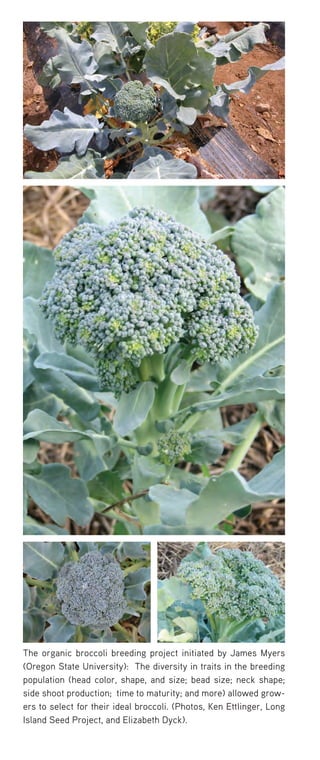
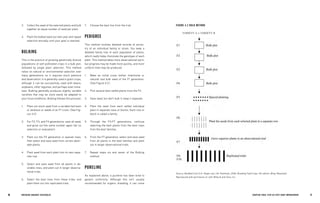
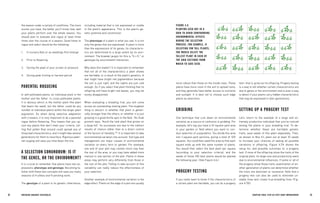
The organic broccoli breeding project initiated by James Myers (Oregon State University): The diversity in traits in the breeding population (head color, shape, and size; bead size; neck shape; side shoot production; time to maturity; and more) allowed growers to select for their ideal broccoli. (Photos, Ken Ettlinger, Long Island Seed Project, and Elizabeth Dyck).
BREEDING 
ORGANIC 
VEGETABLES 
A STEP-BY-STEP GUIDE FOR GROWERS 
BY ROWEN WHITE AND BRYAN CONNOLLY 
EDITED BY ELIZABETH DYCK
Copyright © 2011 Northeast Organic Farming Association of 
New York, Inc. (NOFA-NY) 
All rights reserved. No part of this book may be reproduced in 
any form without the written consent of NOFA-NY, Inc. 
Northeast Organic Farming Association of New York, Inc. (NOFA-NY) 
249 Highland Ave 
Rochester, NY 14620 
(585) 271–1979 
info@nofany.org 
www.nofany.org 
NOFA NY, Inc is an organization of consumers, gardeners, and farmers working together to create a sustainable regional food system which is ecologically sound and economically viable. Through demonstration and educational opportunities, we promote land stewardship, organic food production, and local marketing. NOFA NY brings consumers and farmers closer together to make high quality food available to all people. 
This book is a product of the Public Seed Initiative, which was funded by the USDA Initiative for Future Agricultural and Food Systems. 
Cover & book design by Stacy Wakefield, Evil Twin Publications 
Printed in Canada. 
First printing, October 2011 
Printed on recycled paper. 
Library of Congress Control Number: 2011935904 
ISBN 978-0-9820850-2-8 
96 pages 
ACKNOWLEDGMENTS 
This project was supported in part from funds from the USDA Organic Research and Education Initiative Award No. 2004-51300-02229 and USDA-SARE grant LNE04-204. We are very grateful to Dr. Michael Mazourek and Michael Glos of Cornell University’s Department of Plant Breeding and Genetics for reviewing an early draft of this guide. Special thanks to Ken Ettlinger, John Gorzynski, Brett Grohsgal, and Bryan O’Hara for sharing freely their wealth of experience in breeding vegetable varieties. Our work has also been informed by colleagues and participants from the Organic Seed Partnership Project, including George Moriarty, Jim Myers, Alison Frost, Beth Corymb, and Nathan Corymb.
CONTENTS 
7 PREFACE 
9 CHAPTER ONE: WHY SAVE AND SELECT SEED? 
11 CHAPTER TWO: HOW IT ALL BEGAN 
13 CHAPTER THREE: SEED-SAVING BASICS 
21 CHAPTER FOUR: STEP-BY-STEP CROP IMPROVEMENT 
22 Step 1: Decide on Your Scale 
23 Step 2: Decide on a Crop 
30 Step 3: Decide on a Goal 
34 Step 4: Decide on a Breeding Method 
45 Step 5: Choose or Create Initial Stock Seed 
49 Step 6: Plant your Chosen Cultivars under Appropriate Screens 
50 Step 7: Rogue and Select 
57 Step 8: Do Final Evaluations; Harvest and Process Seed of Selected Plants 
57 Step 9: Repeat Steps Six through Eight Annually until You Achieve Your Goal! 
59 CHAPTER FIVE: GROWER-BREEDER RECIPES FOR BETTER VEGETABLES 
59 Breeding for Independence and Profit: John Gorzynski, Gorzynski Ornery Farm 
61 Breeding Tough and Beautiful Mixtures of Greens: Anita, Bryan, and Clara O’Hara, 
Tobacco Road Farm 
64 Breeding Winter-Hardy and Disease-Resistant Varieties: Brett Grohsgal, Even’ Star Farm 
66 Breeding with Imagination in the Garden: Ken Ettlinger, Long Island Seed Project 
68 The Patient Backcrosser: Bryan Connolly 
70 APPENDICES 
70 Appendix A: Participatory Plant Breeding Projects 
71 Appendix B: Resources for Further Information 
73 Appendix C: Life Cycle, Pollination Biology, Minimum Plant Numbers, and Isolation Distances 
and Techniques for Specific Crops 
76 Appendix D: Screen Sizes for Seed Cleaning from Clipper Office Tester 
78 Appendix E: Sources of Germplasm 
80 Appendix F: Getting Started with Varietal Crosses: Gene Pools of Vegetable and Specialty Crops 
92 NOTES 
94 GLOSSARY 
PHOTOGRAPH BY ELIZABETH DYCK
7 
PREFACE 
The purpose of this manual is to give farmers and gardeners access to the tools of plant breeding. We hope to explain basic plant breeding theory and techniques in a clear, concise, and tangible fashion, allowing growers to create varieties that suit their needs and situations. The authors not only want to show how plant breeding can be done, but also hope to inspire many to begin the journey of plant breeding. With some luck and grower persistence, we’ll see a blossoming of varieties coming from “regular people” with new color combinations and flavors and improved disease resistance. The more people who become involved in crop breeding, the more collective imagination and inspiration we have to work to develop “garden beauties” that can sustain us physically, spiritually, and economically. 
PREFACE 
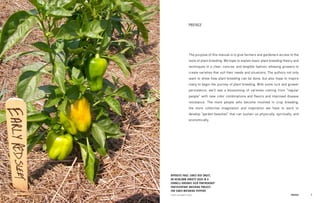
OPPOSITE PAGE: EARLY RED SWEET, AN HEIRLOOM VARIETY USED IN A CORNELL/ORGANIC SEED PARTNERSHIP PARTICIPATORY BREEDING PROJECT FOR EARLY-MATURING PEPPERS 
PHOTO, ELIZABETH DYCK
9 
CHAPTER ONE: WHY SAVE AND SELECT SEED? 
FARMERS WERE THE FIRST plant breeders. Through millennia of plant domestication, they created our food and fiber crops and developed thousands of crop varieties.1 Yet, in the current era, plant breeding has been professionalized. Most contemporary farmers and gardeners rely on seed catalogs and exchanges with other growers for their annual seed needs. 
If we have access to seed improved and produced by companies, universities, and other specialized means, why should any farmer or gardener take the time to save and select seed? Aren’t we all busy enough?! As you will glean from this manual, seed saving and breeding can not only be an empowering and creative venture in your plots or fields, but it can result in varieties that improve the quality, reliability, and profitability of your farm or garden produce. 
Generally speaking, farmers and gardeners take for granted the seed that they order via catalogs and 
seed companies. Have you considered where your seed comes from, who produces it, and just how it is produced? Even though organic growers strive to produce crops that yield well without pesticides, herbicides, and chemical fertilizers, many organic growers rely on seeds that were bred to thrive in conventional, high-input production systems. The organic seed industry has yet to catch up with the growth of organic farming practices. Even those companies that offer “organic seed” are still working with varieties that have been bred and grown under large-scale chemical agriculture. 
Even our cherished heirlooms have room to improve. These varieties need to continue to be selected and improved to meet the demands and conditions of our ever-changing field and garden environments and market pressures. Breeding vegetables and grains for organic production systems is predicted to be a burgeoning field as the demand for high-quality organic seed rises. 
Thankfully, there is a new organic seed movement on the rise. Many regional seed companies, university breeding programs, and organic farmers and gardeners are beginning to see the need to breed for organic farming systems. This manual is a part of these efforts; the goal is to demystify the practices of crop improvement on a practical farm/ garden scale. You don’t need a university degree to develop new and improved lines of vegetables that suit your growing conditions. It basically requires skills and practices you already use on your farm or garden, such as observation, recordkeeping, crop rotation, intuition, and creativity. 
Let’s face it: Evolution and natural selection are happening all around us, in our fields and in our 
CHAPTER ONE 
WHY SAVE AND SELECT SEED? 
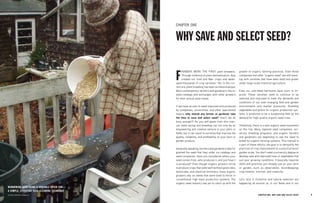
WINNOWING SEED USING A VARIABLE SPEED FAN— 
A SIMPLE, EFFECTIVE SEED-CLEANING TECHNIQUE 
PHOTO, BRYAN CONNOLLY
10 
BREEDING ORGANIC VEGETABLES 11 
CHAPTER TWO: HOW IT ALL BEGAN 
THE IDEA OF PLANT BREEDING is shrouded in myth these days. The general public assumes that plant breeding is something done in a lab, by those with specialized degrees and specialized equipment. The truth is that many of the crop plants that we rely upon today were domesticated, selected, and bred by farmers and consumers just like you. 
Farmers selected and saved seed stock from plants with desirable characteristics long before scientists discovered the genetic basis for selection. 3 The roots of agriculture began with the simple act of saving seeds. Some speculate that the first plant breeder was a woman who, because her mate was a poor hunter, began selecting and growing plants to ensure a stable food supply for her family.4 
With the commoditization of seeds and the development of the hybrid seed industry, there was a turning point in farmer involvement in plant breeding. As Cary Fowler notes, “Farmers simply ‘traded in’ their old seeds to get better varieties in an act which simply and politely ended thousands of years of farmer seed saving.”5 Thus begins the modern era of plant breeding, “characterized by a strict division between breeders as the ‘creators’ of new varieties and the farmers as ‘users’.”6 
Professional plant breeders have focused on developing modern varieties that have wide geographic adaptation and high yield potential under optimal 
growing conditions.7 More recently, varieties are also bred for systems that are dependent upon chemical inputs. 
This is in contrast to varieties developed by farmers: 
heirlooms, landraces, and local varieties that have more narrow geographical adaptation with ability to yield consistently under marginal and variable growing conditions.8 
In summing up the state of the current seed industry, 
Colley and Dylan note that “pressure is placed on university breeders to develop proprietary breeds that are profitable to industrial sponsors.”9 The emphasis in most private breeding programs is to develop hybrid varieties, which is a natural proprietary mechanism. In the private sector, the larger seed companies have yet to invest in organic breeding programs because of relatively small organic acreage and no set timeline from the National Organic Program for transition to use of only organic seed. 
Does this all sound bleak? Don’t let it shake you! Remember, it was only a generation ago that 
farmers, seed companies, and state extension services worked together to develop and evaluate varieties.10 With the rise of alternative and organic 
gardens. So we might just as well have a say in what direction it takes us. Breeding projects serve to enhance agricultural production. You can breed for color, taste, productivity, disease resistance, cold-soil tolerance, and vigor. All of this and more is possible. An increasing number of growers in the Northeast and beyond are reaping the benefits of seed production and crop improvement in their fields and gardens. 
As pioneering farmer-breeder Frank Morton says, “Seed saving and adaptive selection have been part of the farmer’s rights and responsibilities since the emergence of agriculture. As practitioners 
of this old art, organic farmers can reclaim the power to forge crops that better fit their land, their systems, and their imaginations.”2 
CHAPTER TWO 
HOW IT ALL BEGAN 
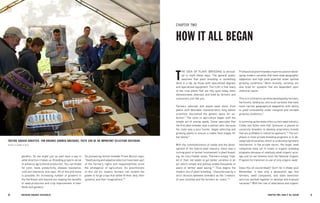
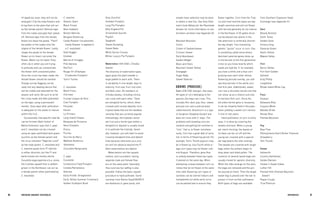
TASTING SQUASH VARIETIES. FOR ORGANIC GROWER-BREEDERS, TASTE CAN BE AN IMPORTANT SELECTION CRITERION. 
PHOTO, ELIZABETH DYCK
12 BRE EDING ORGANIC V EGE TABL E S 13 
CHAPTER THREE: SEED-SAVING BASICS 
TO BE A PLANT BREEDER, you have to know how to save seed. Breeders must be able to grow plants to flowering, control pollination, and ripen, clean, and store seeds. Therefore, if you have seed-saving experience, you have a leg up on learning the breeding process. You may even have crossed over into breeding if you have ever tried to improve a variety by selecting superior plants from which to save seeds. If you have limited or no experience in saving seed, the basics of how to produce viable seed follow. (For in-depth coverage of the topic, see Appendix B for a list of books and pamphlets on seed saving.) 
Chapter 4 covers the important breeding topics of choosing what crop and starting material to work with and how to select plants from which to save seeds. Here the focus is on the seed-saving cycle itself (see Figure 3.1). Let’s assume that you are at a point in your breeding project where you have selected plants that you want to be able to reproduce from seed. 
KNOW YOUR CROP’S METHOD OF REPRODUCTION 
You have finally created the plant you have been searching for. Now how do you grow it so that it will produce seeds that “breed true”? You need to start with your crop’s biology, specifically its reproductive biology. (For a brief review of flower and pollination biology, see Figure 3.2.) 
There are two main types of crops as far as sexual reproduction is concerned: self-pollinated crops and outcrossing crops. Self-pollinated crops, or “selfers,” are plants that reproduce by using their own pollen. Selfers sometimes have mechanisms that prevent pollen from other plants from reaching their flowers. 
Beans, peas, tomatoes, and lettuce are classic examples of self-pollinating crops. But selfers do cross under certain conditions. For example, planting two varieties immediately next to each other may yield some hybrid individuals in the following generation. So even if your plant is a selfer, for seed production it is best to grow it at a distance from plants of another variety. How great an isolation distance do you need? Appendix C lists 
agricultural production, we are at another turning point in the history of crop improvement. 
A participatory breeding model holds the promise for serving the organic- and small-scale-grower sectors. Cleveland et al. define participatory plant breeding as “an attempt to bring farmers and plant breeders together to develop new crop varieties to meet farmers’ needs.”11 The ultimate goal of participatory plant breeding is to develop local varieties adapted to local conditions. 
In the Northeast region alone, there have been several innovative participatory plant breeding projects. These and other resources on participatory plant breeding are described in Appendix A. 
* Sections of this chapter have been adapted from Organic Seed Production and Saving: The Wisdom of Plant Heritage, authored by Bryan Connolly and published by the NOFA Interstate Council (2004) and republished by Chelsea Green Publishing (2011). 
CHAPTER THREE 
SEED-SAVING BASICS* 
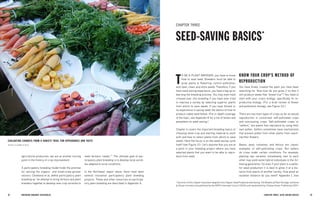
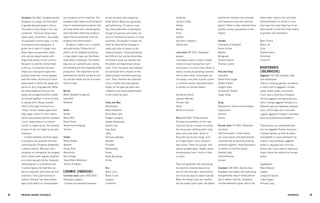
EVALUATING CARROTS FROM A VARIETY TRIAL FOR APPEARANCE AND TASTE 
PHOTO, ELIZABETH DYCK
14 BRE EDING ORGANIC V EGE TABL E S 15 
CHAPTER THREE: SEED-SAVING BASICS 
suggested distances for each crop, but as a rule of thumb, make sure the plants of a selfer crop you are raising for seed are at least 20 feet from plants of another variety of that crop. 
In outcrossing crops (also called “crossers”), a plant tends to use pollen of another plant to produce its seeds. Thus, crossers can pick up pollen from other varieties readily! Corn, brassicas, and cucurbits are classic examples of outcrossing crops. In general, a variety of an outcrossing crop needs to be isolated ¼ mile or more from other varieties of that crop. (See Appendix C for recommendations for isolation distances for individual outcrossing crops.) 
For growers with a small garden or who have close neighbors with gardens or fields in vegetable production, an isolation distance of a ¼ mile may be tough to achieve. One simple approach you can use to decrease isolation distance is to allow only one variety of a crop to flower and produce seed in a given season. This can work quite well for crops whose edible portions are not ripe fruit, such as onion and the brassica crops. For example, you could produce seed of a broccoli variety you have created if you allow only that variety to flower and go to seed—and prevent flowering of any other crops of the same species (Brassica oleracea), which include kale, Brussels sprouts, cabbage, cauliflower, collard, and kohlrabi. For crops like squash and corn, however, whose seed is developed in mature fruit, this is not an option unless you can restrict yourself (and close neighbors) to growing one variety a season. 
FIGURE 3.1 THE SEED-SAVING CYCLEPHOTO, BRYAN CONNOLLY. 
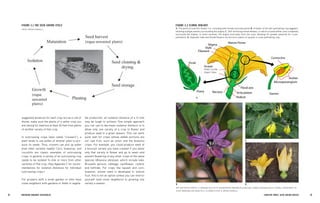
FIGURE 3.2 FLORAL BIOLOGY 
A. The parts of a perfect flower (i.e., including both female and male parts) B. A flower of the self-pollinating crop eggplant, showing multiple anthers surrounding the stigma. C. Self-fertilizing tomato flowers, in which a fused anther cone completely surrounds the stigma. In some varieties, the stigma protrudes from the cone, allowing for greater potential for cross- pollination. D. Separate male and female flowers are borne on plants of squash, a cross-pollinating crop. 
B. 
D. 
C. 
A. 
ART AND PHOTO CREDITS: A. MARIANA RUIZ (HTTP://EN.WIKIPEDIA.ORG/WIKI/FILE:MATURE_FLOWER_DIAGRAM.SVG) B. CORNELL DEPARTMENT OF PLANT BREEDING AND GENETICS C. ELIZABETH DYCK D. BRYAN CONNOLLY 
Perianth 
Petal: Corolla 
Sepal: Calyx
16 BRE EDING ORGANIC V EGE TABL E S 17 
CHAPTER THREE: SEED-SAVING BASICS 
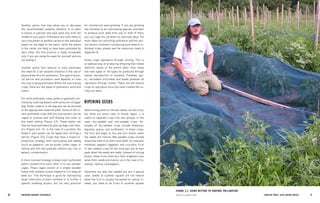
FIGURE 3.3 USING NETTING TO CONTROL POLLINATIONPHOTO, ELIZABETH DYCK 
Another option that may allow you to decrease the recommended isolation distance is to plant in blocks or patches and save seed only from the middle of your patch. Pollinators are more likely to carry the pollen of another variety to the individual plants on the edge of the patch, while the plants in the center are likely to have been pollinated by each other. But this practice is really acceptable only if you are using the seed for yourself and are not selling it. 
Another option that reduces or even eliminates the need for a set isolation distance is the use of physical barriers for pollination. The type of physical barrier and procedure used depends on how the crop is being pollinated. Within the outcrossing crops, there are two types of pollination, wind and insect. 
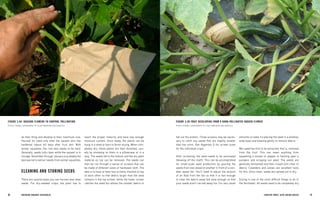
For wind-pollinated crops, pollen is generally controlled by covering flowers with some sort of paper bag. Pollen collects in the bag and can be directed to the appropriate maternal plant. Some of the insect- pollinated crops that are outcrossers can be caged or covered well with floating row cover or fine mesh netting (Figure 3.3). These plants can then be hand pollinated by placing bags over flowers (Figure 3.4). Or, in the case of cucurbits, the flower’s own petals can be taped shut forming a barrier (Figure 3.5). Crops that have a mixed reproductive strategy, both outcrossing and selfing (such as peppers), can be grown under cages or netting and will self-pollinate without any risk of genetic contamination. 
A more involved strategy to keep insect-pollinated plants isolated from each other is to use wooden cages. These cages consist of a simple wooden frame with window screen stapled to it to keep all bees out. This technique is good for maintaining large collections of plant varieties or to further a specific breeding project, but not very practical for commercial seed growing. If you are growing two varieties of an outcrossing species, and want to produce pure seed from one or both of them, you can cage the varieties on alternate days. For more ideas on controlling pollination and the various factors involved in producing pure seed of individual crops, please see the resources listed in Appendix B. 
Some crops reproduce through cloning. This is an asexual way of producing offspring that makes identical copies of the parent plant. Only rarely will new types or off-types be produced through sexual reproduction or mutation. Potatoes, garlic, Jerusalem artichokes and sweet potatoes all reproduce through clones. These are the easiest crops to reproduce once you have created the variety you want. 
RIPENING SEEDS 
Determining when to harvest seeds can be tricky, but there are some rules of thumb. Again, it is useful to separate crops into two groups: in this case, dry-seeded and wet-seeded crops. Examples of dry-seeded crops include brassicas, legumes, grains, and sunflowers. In these crops, the fruit will begin to dry and turn brown when the seeds are mature. Wet-seeded crops include those that have fruit with moist flesh, for example, tomatoes, peppers, eggplant, and cucurbits. Fruit of wet-seeded crops for the most part are at their peak when the seeds are ready. Instead of turning brown, these fruits often turn their brightest color when their seeds are mature, as in the case of tomatoes, melons, and peppers. 
Squashes are also wet seeded but are a special case. Seeds of summer squash are not mature when the fruit is usually harvested for eating. Instead, you need to let fruits of summer squash
18 
BRE EDING ORGANIC V EGE TABL E S 19 
CHAPTER THREE: SEED-SAVING BASICS 
fall out the bottom. Three screens may be necessary to catch any seeds that are slightly smaller than the norm. See Appendix D for screen sizes for the individual crops. 
After screening, the seed needs to be winnowed (blowing off the chaff). This can be accomplished for small-scale seed production by pouring the seeds from one vessel to another in front of a variable speed fan. You’ll need to adjust the amount of air flow from the fan so that it is fast enough to clear the debris away but slow enough so that your seeds aren’t carried away too. For very small amounts of seed, try placing the seed in a shallow, wide bowl and blowing gently to remove debris. 
Wet seed has first to be extracted, that is, removed from the fruit. This can mean anything from squashing a tomato or pepper to hacking open a pumpkin and scraping out seed. The seeds are generally fermented and then rinsed until clear of debris. Colanders and sieves are excellent tools for this. Once clean, seeds are spread out to dry. 
Drying is one of the most difficult things to do in the Northeast. All seeds need to be completely dry 
FIGURE 3.4A BAGGING FLOWERS TO CONTROL POLLINATION 
PHOTO, CORNELL DEPARTMENT OF PLANT BREEDING AND GENETICS 
FIGURE 3.4B FRUIT DEVELOPING FROM A HAND-POLLINATED SQUASH FLOWER 
PHOTO, CORNELL DEPARTMENT OF PLANT BREEDING AND GENETICS 
do their thing and develop to their maximum size. Harvest for seed only after the squash skin has hardened (about 60 days after fruit set). With winter squashes, the rind also needs to be hard. Generally, seeds fully ripen while the squash is in 
storage. November through January is probably the 
best period to extract seeds from winter squashes. 
CLEANING AND STORING SEEDS 
There are several ways you can harvest and clean seeds. For dry-seeded crops, the plant has to reach the proper maturity and have low enough moisture content. Once ready, the plants can be hung in a shed or barn to finish drying. When completely dry, these plants are then threshed, usually by stomping on them in a pillowcase or in a tarp. The seeds fall to the bottom and the dry plant material on top can be removed. The seeds can then be run through a series of screens that can be made of different sizes of hardware cloth. The idea is to have at least two screens stacked on top of each other so that debris larger than the seed remains in the top screen, while the lower screen catches the seed but allows the smaller debris to
20 BRE EDING ORGANIC V EGE TABL E S 21 
CHAPTER FOUR: STEP-BY-STEP CROP IMPROVEMENT 
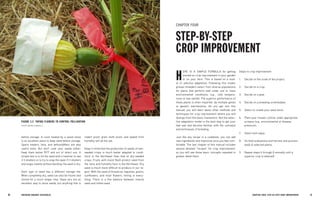
HERE IS A SIMPLE FORMULA for getting started on crop improvement in your garden or on your farm. This is based on a model of selective adaptation. Following this model, grower-breeders select from diverse populations for plants that perform well under one or more environmental conditions, e.g., cold temperatures or low rainfall. The superior performance of these plants is often imparted by multiple genes or genetic mechanisms. As you get into this manual, you will learn about other methods and techniques for crop improvement where you will diverge from this basic framework. But the selective adaptation model is the best way to get your feet wet and become familiar with the concepts and techniques of breeding. 
Just like any recipe in a cookbook, you can add new ingredients and improvise once you feel comfortable. The last chapter of this manual includes several detailed “recipes” for crop improvement, so you will see these basic concepts repeated in greater detail there. 
Steps to crop improvement: 
1. Decide on the scale of the project. 
2. Decide on a crop. 
3. Decide on a goal. 
4. Decide on a breeding scheme/plan. 
5. Select or create your seed stock. 
6. Plant your chosen cultivar under appropriate screens (e.g., environmental or disease 
pressure). 
7. Select and rogue. 
8. Do final evaluations and harvest and process seed of selected plants. 
9. Repeat steps 6 through 8 annually until a 
superior crop is attained! 
CHAPTER FOUR 
STEP-BY-STEP 
CROP IMPROVEMENT 
before storage. A room heated by a wood stove is an excellent place to keep seed before storage. Space heaters, fans, and dehumidifiers are also useful tools. But don’t cook your seeds either: Keep them below 95°F and out of direct sun. A simple test is to hit the seed with a hammer to see if it shatters or to try to snap the seed. If it shatters and snaps cleanly without bending, the seed is dry. 
Each type of seed has a different storage life. When completely dry, seed can also be frozen and stored for a much longer time. Glass jars are an excellent way to store seeds, but anything that is rodent proof, grain moth proof, and sealed from humidity will do the job. 
Keep in mind that the production of seeds of wet- seeded crops is much better adapted to conditions in the Northeast than that of dry-seeded crops. Fruits with moist flesh protect seed from the rains and humidity here in the Northeast. Dry seed is much more difficult to produce in our region. With the seed of brassicas, legumes, grains, sunflowers, and most flowers, timing is everything. There is a fine balance between mature seed and rotted seed. 
FIGURE 3.5 TAPING FLOWERS TO CONTROL POLLINATION 
PHOTO, BRYAN CONNOLLY
22 BRE EDING ORGANIC V EGE TABL E S 23 
CHAPTER FOUR: STEP-BY-STEP CROP IMPROVEMENT 
SUCCESSFUL BREEDING PROJECTS have arisen from backyard gardens, small market farms, and large-scale operations of both vegetables and grains. You don’t have to have a whole field of any crop to begin to breed it. As Carol Deppe reminds us, “You don’t have to make dozens of crosses. You can make just one. You don’t have to grow fifty plants from each cross; you can grow five or ten— or one.”12 However, keep in mind that the larger the population or plot of plants that you grow, the larger the pool of diversity that you have to select from and the more likely a desired combination will occur. So whatever scale you choose, try to grow the maximum number of plants that you can. 
Setting a realistic scale for your own situation will greatly improve your own chances of success. Knowing your scale will help you to make wise decisions later on, such as which crops are best suited to your situation, which breeding schemes will work for you, and which goals will be best met in your garden or farm. 
The on-farm breeding projects of several regional growers (see Chapter 5) illustrate the point that successful crop improvement can be conducted at a variety of scales, from the thousands of plants screened by Brett Grohsgal on his large CSA farm to the many small-scale breeding projects in multiple crops carried out in Ken Ettlinger’s garden. Their stories highlight projects that are well suited to their size and scale and also detail their challenges and hurdles in implementing their projects. 
Ultimately, start small and work your way up to larger and more ambitious goals and projects. 
STEP ONE: 
DECIDE ON YOUR SCALE 
AS WITH ANYTHING, work with crops you know and love. For example, if you want to breed for good flavor in a tomato, you better love eating them! Because in the evaluation stage, you might have to develop discerning taste buds to distinguish the difference between one tomato and the next. An important skill in the art of crop improvement is keen observation, so it helps if you are already familiar with the growth habits and traits in a certain crop as you begin a project with it. 
Another good approach is to pick crops that historically have been grown in your region and have the potential to produce well in your climate. Adapting a mango or banana to yield well in the North Country isn’t a wise first project! In the Northeast, we have a broad range of annual and perennial crops to choose from that have the potential to thrive in our cool seasons. You might be able to breed a melon to ripen earlier, for example, but you should start with seed that already lends itself to a shorter season. 
But don’t be afraid to choose a crop that historically has not done well in your farm or garden. The point here is to use selective adaptation and plant breeding to make your crops better! If you have heavy disease or pest pressures in your growing fields, it might be an ideal location to breed varieties that have resistance to these problems. In the field of breeding, these plots are called “disease nurseries,” and they are coveted by those who really want to put their plants to the test. If you’ve got lemons, make lemonade! Use the disease pressure to create vigorous tomatoes that are adapted to your specific conditions. 
A summary of practical considerations that you should think about when deciding on your crop(s) of choice is provided below. 
REPRODUCTIVE HABITS 
Nearly all vegetable, herb, and grain crops have a reproductive cycle of one or two seasons. Annuals produce seed in one season. Biennial plants require two seasons for seed production. Using the chart in Appendix C, determine the life cycle of the crops that you wish to work with. 
Why does this matter? Generally, biennials are trickier to work with in the Northeast region. Most biennial crops need to be dug up, stored indoors over the winter, and planted out again in the spring. Thus, the time frame of your project increases twofold. If you are a beginner, it is advisable to start with an annual crop. You will see results more quickly, and your learning curve will be higher over a shorter amount of time. 
STEP TWO: 
DECIDE ON A CROP
24 BRE EDING ORGANIC V EGE TABL E S 25 
CHAPTER FOUR: STEP-BY-STEP CROP IMPROVEMENT 
special efforts to inbreed these species into a stable variety. In contrast to selfers, crossers have a different mother plant from the father plant. Traits can be elusive in crossers. One generation you have it, the next you don’t. This is a result of transgressive segregation. Every time an individual plant cross-pollinates, its genes recombine, often resulting in unpredictable combinations for the next couple of generations.16 
Breeder John Navazio claims that the hardest thing in all plant breeding is to breed a new open-pollinated (OP) variety of a cross-pollinating crop, and then to maintain it well over many generations.17 To do effective breeding and selection you must not only choose which pollen is desirable and which is not; you must also ensure that the right pollen is getting to the source. 
Many organic farmers and gardeners have a diverse array of plants in their fields. If your intention is saving seed from a cross-pollinated plant, you need to ensure that it is sufficiently isolated from other varieties of the same crop species. See Appendix C for guidance on isolation distances and methods. 
POLLINATION HABITS 
As discussed in the seed-saving chapter, it is crucial to understand the pollination habits of the crops that you work with. Knowing this will help you pick the right crops for your growing situation and determine the best breeding scheme for your chosen crop type. Making selections of superior plants and saving seed requires two entirely different perspectives and approaches depending on whether you are working with self-pollinated plants (selfers) or cross-pollinated plants (crossers). As veteran breeder John Navazio laments, “We have so many lousy open-pollinated varieties in crossers because people have treated crossers like selfers.”13 So, save yourself generations of misguided selection and frustration by getting to know your plant sex! 
SELF-POLLINATED PLANTS 
As explained in Chapter 3, a selfer is a plant that pollinates itself to make fertile seeds. These plants have functional male and female parts in the same flower. Often, selfers will pollinate themselves even before the flower has opened. Many vegetables and small grains are selfers, which means that these species will “automatically” pollinate themselves into thousands of pure breeding lines (genetically uniform lines) after the initial cross or mutation has occurred. As Frank Morton explains it, selfers are conservative: When they hit on a good combination of traits, they maintain them.14 
Self-pollinated seed stock can either be a pure line or a multi-line. A pure-line variety is totally uniform, the progeny of one initial plant, which is then multiplied out to thousands of seeds. These populations are almost completely uniform and are often offered by large commercial seed sources. Selection in this type of line is ineffective, because there is not enough genetic diversity from which to select. These types of populations change slowly 
over time, and after dozens of generations might show slight variations due to mutations or chance crosses. 
A multi-line population is a collection of pure-line plants. When working with these types of populations (often seen in heirloom varieties), you can effectively select between different lines and make progress. Within these populations, with the low occurrence of outcrossing, there is still enough genetic variation with which to work. 
REMEMBER: SELFERS CAN CROSS! 
Especially on organic farms, where there is a diversity of blooms and habitat for native and domesticated pollinators, cross-pollination within supposed selfers occurs at a much higher rate than expected. Certain varieties of peppers and tomatoes can be particularly “promiscuous” and outcross at high rates—potato-leaved tomato varieties, for example. So take care to isolate these plants, for just one unwanted cross can throw a wrench in the gears of your breeding project. 
CROSS-POLLINATED PLANTS 
Cross-pollinated plants, also known as crossers, are plants that have flowers designed to promote outcrossing with other plants. This is an evolutionary mechanism to prevent inbreeding. Inbreeding can cause all sorts of problems, such as loss of vigor, loss in yield, etc. The evolutionary strategy of a crosser is to experiment, mingling and mixing with other genotypes to cover up deleterious traits and increase fitness to its environment.15 
Because these plants thrive on variation, it takes 
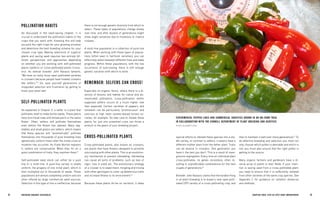
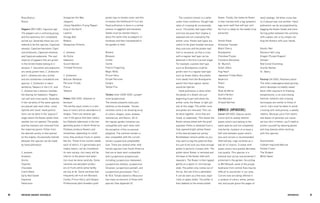
EXPERIMENTAL PEPPER LINES AND COMMERCIAL VARIETIES GROWN IN AN ON-FARM TRIAL 
IN COLLABORATION WITH THE CORNELL DEPARTMENT OF PLANT BREEDING AND GENETICS 
PHOTO, ELIZABETH DYCK
27 
CHAPTER FOUR: STEP-BY-STEP CROP IMPROVEMENT 
POPULATION REQUIREMENTS 
FOR ROBUST SEED 
Ideally, you want to start a project with a number of plants that will maintain good genetic diversity. The more plants you include, the greater chance that you will find the traits and characteristics you are looking for, and you will produce higher-quality seed in the long run. The minimal rule of thumb is 
• 60 to 80 plants for cross-pollinated varieties 
• 20 to 30 plants for self-pollinated varieties 
Remember, this is only a rule of thumb! Some crops, such as corn, require far more than 60 to 80 plants for robust seed. If your garden plot cannot accommodate the ideal number of plants, at least aim for the minimum number that will deliver usable results. The chart in Appendix C includes a recommendation for the minimum number of plants for each crop. 
Taking population size into consideration, the size of your farm or garden may determine your choice of crops for a breeding project. For example, winter squash plants generally require a lot of space per plant. If you wanted to grow out an ideal population of 60 to 80 plants, you would need several hundred row feet of growing space, whereas you can fit hundreds of bean plants into a relatively small area. 
GOOD CROPS FOR BEGINNERS 
If you are just getting started with crop improvement, it’s best to start with a self-pollinated crop. Overall, the genetics of these crops are simpler, and you can make good progress with smaller populations. With selfers you can select from relatively small populations and produce high- quality seed. With cross-pollinated plants, you can’t get away with that in the long run. Often, the best strategy for plant breeding and crop improvement is to control pollination. With selfers, they do their own pollination for us. As Carol Deppe says, “…if we choose a good mother plant, she is also the father plant. Selection is very easy with inbreeding plants; we just save seed from the best plants.”18 The following selfers work well for beginners 
• Tomatoes 
• Beans 
• Lettuce 
• Peas 
If you feel compelled to do some work with cross-pollinated crops, there are a handful that lend themselves well to beginners’ breeding projects. Generally these crops don’t have a tendency toward severe inbreeding depression (a loss of vigor caused by pollination between related individuals). Therefore, the population numbers don’t have to be enormous. Some of these crops take up little growing space, so a large population doesn’t require a large area. The best crossers to start with are 
• Summer squashes 
• Cucumbers 
• Radishes 
• Asian greens 
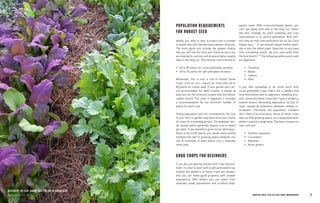
DIVERSITY IN LEAF SHAPE AND COLOR IN BRASSICAS 
PHOTO, ELIZABETH DYCK
28 
29 
Genes are sections of DNA that code for traits in a plant. Some traits, such as yield and flavor, are controlled by several or even many independent genes. Other traits are controlled by a single gene. 
Alleles are alternative forms of a gene and code for different versions of a trait. For 
example, there may be one version of a gene that codes for a tall plant (let’s call it T). 
Another version of that gene codes for a short plant (t). When a plant has two copies of the same allele, e.g., two copies of the T allele or two copies of the t allele, it is called homozygous. If it has two different alleles, e.g., a T allele and a t allele, it is called heterozygous. 
In some cases, one allele may be dominant to another. For example, if the T allele is dominant to the t allele, heterozygous plants with both versions of the gene will be tall—the t allele will be masked. The masked allele is called recessive. In this hypothetical example, three combinations of alleles are possible: a homozygous tall plant (TT), a homozygous short plant (tt), and a heterozygous tall plant (Tt). Note that if these three genotypes were planted under the same conditions, the TT and Tt plants would look the same, that is, tall. Only the tt plant would look different. (See Figure B.1). 
Alleles are not always either dominant or recessive. In some cases, the heterozygous individual expresses an intermediate characteristic. For example, some plant species exhibit incomplete dominance in genes for flower color. In this case, when a plant that is homozygous for red flowers is crossed with a plant homozygous for white flowers, the resulting offspring have pink flowers. If alleles are codominant, both traits appear in the heterozygous offspring. Using the example of flower color again, a plant homozygous for red flowers crossing with a plant homozygous for white flowers would produce offspring with red-and-white-spotted flowers. 
There can be more than two alleles or versions of a gene. For example, there may be alleles for red, green, white, and yellow for the gene controlling fruit color. However, only two of these alleles can be carried by an individual plant. 
Segregation is the genetic reshuffling that occurs during sexual reproduction (seed production in this case). The two alleles that a parent carries for each gene are separated. Thus, each grain of pollen or each egg carries only one allele for each gene. When the pollen and egg of the two parents are united, various combinations of the alleles can occur. By using the Punnett Square (which you’ll remember from biology class) and working through a couple of examples, you’ll see how this genetic recombination works. 
Figure B.2 shows what happens when a homozygous plant self-pollinates. Only homozygous 
offspring—true copies of the parent—result. Figure B.3 shows the results of self-pollination of a heterozygous plant when one trait is being considered. Notice that three types of plants are being produced: TT, Tt, and tt. The same principles and process apply if you are working with two or more traits that have dominant and recessive alleles (Figure B.4). 
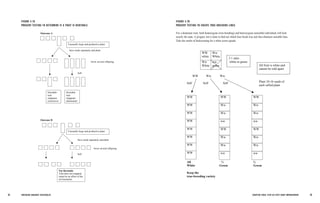
Notice also that the Punnett Square shows the odds of each type of offspring being produced. On average, 25% of the offspring will be TT (homozygous dominant), 50% will be Tt (heterozygous), and 25% will be tt (homozygous recessive). It is important to remember that these percentages are probabilities, not guaranteed outcomes. (To understand the difference, think of flipping a coin. On average, 50% of the time it will land heads up, 50% of the time it will land tails up. But in reality you can flip a coin three or four times in a row and get all heads. The more times you flip the coin, though, the closer your final tally approaches 50% heads and 50% tails.) These probabilities of offspring have practical consequences: To increase your chances of seeing all possible variation in offspring, plant enough seeds. A rule of thumb is to plant at least 10 seeds, but the more traits you are working with, the higher the number of seeds you should plant. 
BOX 4.1 
A Brief Review of Genes, Alleles, and Segregation 
FIGURE B.2 
SELF-POLLINATION IN 
A HOMOZYGOUS PLANT 
FIGURE B.1 
MASKING OF A 
RECESSIVE GENE 
FIGURE B.3 
SELF-POLLINATION IN A HETEROZYGOUS PLANT 
FIGURE B.4 
SELF-POLLINATION IN A HETEROZYGOUS PLANT SHOWING TWO TRAITS 
TT Tt tt 
TR 
Tr 
tR 
tr 
TR 
TTRR 
tall and red 
TTRr 
tall and red 
TtRR 
tall and red 
TtRr 
tall and red 
Tr 
TTRr 
tall and red 
TTrr 
tall and yellow 
TtRr 
tall and red 
Ttrr 
tall and yellow 
tR 
TtRR 
tall and red 
TtRr 
tall and red 
ttRR 
short and red 
ttRr 
short and red 
tr 
TtRr 
tall and red 
Ttrr 
tall and yellow 
ttRr 
short and red 
ttrr 
short and yellow 
Parental alleles 
T 
t 
T 
TT 
tall 
Tt 
tall 
t 
tT 
tall 
tt 
short 
Parental alleles 
T 
T 
T 
TT 
tall 
TT 
tall 
T 
TT 
tall 
TT 
tall 
BREEDING ORGANIC VEGETABLES 
CHAPTER FOUR: STEP-BY-STEP CROP IMPROVEMENT
30 BRE EDING ORGANIC V EGE TABL E S 31 
CHAPTER FOUR: STEP-BY-STEP CROP IMPROVEMENT 
BREEDING FOR DURABLE 
DISEASE AND PEST RESISTANCE 
A first step to breeding for disease resistance is to become familiar with the diseases of the crops you grow. A second step is understanding the types of resistance plants show to disease. You don’t have to settle for diseased plants or rely on outside inputs to keep diseases at bay. All wild plants, and most cultivated ones, have levels of resistance to disease pressures. There are two kinds of disease resistance: monogenic/vertical and polygenic/horizontal. 
VERTICAL OR MONOGENIC RESISTANCE 
Vertical resistance is sometimes termed monogenic because one or a few genes confer the resistance. It is “race-specific,” meaning it is dramatically effective against one or more races of a pathogen and not effective at all with other races. It’s all or nothing; plants will show no sign of infection or be heavily infected. A few varieties that have been bred with monogenic resistance have been in commercial use for years without their resistance breaking down. But generally this type of disease resistance is matched over time by the pathogen, which through mutation can produce new races to which the variety is susceptible. For this reason and because breeding for vertical resistance requires assembling and screening large collections of germplasm, it is not typically a breeding goal for farmers or gardeners. 
HORIZONTAL OR POLYGENIC RESISTANCE 
Horizontal resistance is a type of resistance in which a plant has multiple genes interacting to defend it against disease. There is a wide range in the levels of horizontal resistance expressed in individuals of any one variety. The most resistant individuals will usually show only minor signs of the disease, while more-susceptible plants may be moderately to severely affected. Horizontal resistance is sometimes termed durable resistance, because unlike vertical resistance, it is difficult for a pathogen to completely break down. For this reason, it is preferred in organic and sustainably managed fields and gardens. 
Horizontal resistance can be attained in five to eight generations when large numbers of plants are used. Raoul Robinson recommends crossing multiple varieties and selecting from 10,000 individuals. 24 Ten thousand is a lot fewer than you think when dealing with small grains, Asian greens, or many field-grown legumes such as lentils or peas. Dr. Robinson starts with seedlings sown in flats. (A dozen to several dozen standard 10 × 20 seed flats can hold 10,000 seedlings of most crops.) He then inoculates the seedlings with fungal spores. Only the individuals that show the greatest degree of resistance are planted in the field. This saves a great deal of space. The resistant individuals then are allowed to cross, and the inoculation cycle is continued until an acceptable level of resistance is reached. Horizontal resistance to several diseases can be selected for at the same time. 
DISEASE NURSERIES 
Another approach to developing disease resistance is the disease nursery. These nurseries truly put even great plants to the test. Disease nurseries can make a full-grown organic farmer cry. In these plots you violate every rule that you have learned to avoid disease. For example, crops are not rotated so that populations of insects, fungi, bacteBACKYARD 
AND ON-FARM crop improvement involves both science and art. It is good to know your genetics when you embark on a breeding or improvement project, but it is just as important to have good observation skills, a creative mind, and a vision of what you want. 
As farmer-breeder Brett Grohsgal says, “Farmers do not need a lot of time or a team of breeders to improve our competitive edge.”19 It’s true—in a short amount of time, you can achieve measurable benefits. 
THE KEY TO SUCCESS: 
BE REALISTIC! 
Realistic goals include disease resistance, many aspects of regional adaptation, increased yields, and breeding for aesthetics such as color, shape, size, and flavor. As Brett Grohsgal reasons, “When we farmers genetically improve our crops, we are usually enhancing potentials already present in at least some of the individuals of that crop.… it is not realistic to strive for absurd goals, such as hard-freeze tolerance in tomatoes or watermelons; these crops came from a genetic lineage that includes little such history.”20 Open your eyes to the potentials that the plants hold, and work with their strengths. 
It is not essential to carry out elaborate procedures to develop a new and improved crop variety. Many of the following crop improvement goals can be met by rigorous rogueing and selection, also known as “getting rid of the uglies.”21 Nevertheless, as noted above, grounding in some basic genetic principles helps to set a realistic breeding goal and understand the process required to achieve it. See Box 4.1 (p. 28) for a brief review of some basic genetics principles. 
BREEDING FOR ORGANIC 
FARMING SYSTEMS 
Coffman and Smith note that, in breeding for sustainability, the emphasis is on adapting a cultivar to an environment rather than relying on irrigation and fertilizer and pesticides inputs to alter the environment to suit the plant.22 We want plants that will work hard for a living! Breeding objectives generally pertain to strengthening a plant’s stress tolerances, such as tolerance to diseases, insect pests, weeds, drought, heat, cold, and variable soils, all of which can be challenges on organic farms and gardens.23 These tolerances generally involve a complex number of traits and genes. Achieving these objectives often takes many years, but in just a year or two a grower can often see measurable improvements in seed stock and plants. 
STEP THREE: 
DECIDE ON A GOAL
32 BRE EDING ORGANIC V EGE TABL E S 33 
CHAPTER FOUR: STEP-BY-STEP CROP IMPROVEMENT 
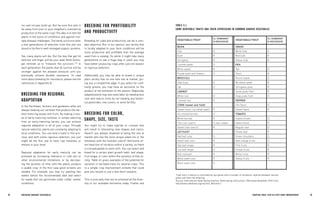
TABLE 4.1 
SOME HERITABLE TRAITS AND THEIR EXPRESSION IN COMMON GARDEN VEGETABLES 
*Leaf color in lettuce is controlled by two genes with a number of variations. Hybrids between red and green will have red offspring. 
Source: International Seed Saving Institute, Seed-saving instructions. (Retrieved November 2010 from http://www.seedsave.org/issi/issi_904.html.) 
VEGETABLE/TRAIT 
D= DOMINANT R=RECESSIVE 
VEGETABLE/TRAIT 
D= DOMINANT R=RECESSIVE 
BEAN 
ONION 
Pole 
D 
White bulb 
D 
Bush 
R 
Red bulb 
R 
Stringless 
R 
Yellow bulb 
R 
Colored seeds 
D 
PEA 
White seeds 
R 
Tall 
D 
Purple pods and flowers 
D 
Short 
R 
BROCCOLI 
Round seeds 
D 
Side buds 
D 
Wrinkled seeds 
R 
Tall 
D 
Stringless pods 
R 
CARROT 
Snow pods (flat) 
R 
White root 
D 
Snap pods (full) 
D 
Colored root 
R 
PEPPER 
CORN (sweet and field) 
Hot flavor 
D 
Sweet flavor (wrinkled seed) 
R 
Sweet flavor 
R 
All colored kernels 
D 
TOMATO 
White kernels 
R 
Indeterminant 
D 
Flint corn starch 
D over sweet 
Determinant 
R 
Sweet (low starch) 
R 
Regular leaf 
D 
LETTUCE* 
Potato leaf 
R 
Red leaf color 
D 
Green shoulders 
D 
Green leaf color 
R 
Red-orange fruits 
D 
Oak leaf shape 
R 
Pink fruits 
R 
Cos leaf shape 
D 
Purple fruits 
R 
Bolt resistant 
R 
White fruits 
R 
White seed color 
R 
Yellow fruits 
R 
Black seed color 
D 
ria, and viruses build up. But be sure this plot is far away from your or your neighbor’s commercial production of the same crop! The idea is to test the plants in the worst of conditions and against multiple disease challenges. The hardy survivors after a few generations of selection from this plot are bound to do fine in well-managed organic systems. 
Yes, many plants will die. But the few that get hit hard but still linger will be your lead. Brett Grohsgal reminds us to “treasure the survivors.”25 In each generation, the plants that do survive will be stronger against the disease pressure until you eventually achieve durable resistance. To read more about breeding for resistance, please see the references in Appendix B. 
BREEDING FOR REGIONAL ADAPTATION 
In the Northeast, farmers and gardeners alike are always seeking out varieties that produce the earliest- maturing leaves and fruits. By making crosses of early-maturing varieties, or simply selecting from an early-maturing variety, you can achieve regional adaptation in all of your crops. Through natural selection, plants are constantly adapting to local conditions. You can lend a hand in this process, and with some rigorous selection, you just might be the first one to have ripe tomatoes or melons in your area! 
Regional adaptation for early maturity can be achieved by increasing tolerance to cold soil or other environmental limitations, or by decreasing the duration of time until the plants produce a usable crop. In the first case good screens are needed. For example, you may try planting two weeks before the recommended date and select for seeds that can germinate under colder, wetter conditions. 
BREEDING FOR PROFITABILITY 
AND PRODUCTIVITY 
Breeding for yield and productivity can be a complex objective. But, in our opinion, any variety that is locally adapted to your farm conditions will be more productive and profitable than the average seed from a catalog. So while it might take many generations to see a huge leap in yield, you may have better-producing crops after just one season of rigorous selection. 
Additionally you may be able to breed a unique plant variety that no one else has at market, giving you a competitive edge. If you select for cold- hardy greens, you may have an exclusive on the product at the extremes of the season. Regionally adapted plants may also save labor by needing less care and reduce costs by not needing any botanical pesticides, row covers, or extra fertility. 
BREEDING FOR COLOR, 
SHAPE, SIZE, TASTE 
You might try to make hybrids or crosses that will result in interesting new shapes and colors. Haven’t you always dreamed of being the one at market who has the most unique salad mix or the tomatoes with the funkiest colors? Heirlooms often have lots of variation within a variety, so there is a broad palette to work with. You can select and breed for a certain plant growth habit, leaf shape, fruit shape, or color within the variation of that variety. Table 4.1 gives examples of the potential for variation in heritable traits for several crops. This is a simple crop improvement scheme that could give you results in just a few short seasons. 
This is precisely how we’ve achieved all the diversity of our available heirlooms today. Fowler and
34 BRE EDING ORGANIC V EGE TABL E S 35 
CHAPTER FOUR: STEP-BY-STEP CROP IMPROVEMENT 
THERE ARE MANY WAYS to approach crop improvement and plant breeding in your fields. The scheme that you decide to utilize will depend on your chosen crop, your intended goals, and the reproductive habits of the crop you are working with. You must also consider your own limiting factors, including time, maintenance, and space, when choosing which method will work best for you. Perhaps you are a meticulous recordkeeper. If so, the pedigree method might be the way to go for you. The mass selection breeding method might suit those who have the time and patience to wait and see what happens. 
Whichever of the following breeding methods you decide to use, all of them require growing out multiple generations of plants. It’s useful to review the breeding terminology for these generations: Sexual reproduction between parents produces the “first filial” or F1 generation. F1 plants are also referred to as hybrids and have nearly identical genotypes. When F1 plants are either self-pollinated (selfed) 
STEP FOUR: 
DECIDE ON A BREEDING METHOD 
Mooney note, “The 12,000 year process of plant domestication produced an explosion of color and proliferation in the uses to which plants were put.”26 The seeds of these unusual, vigorous, and tasty plants were selected and shared with the next generation of family and community. 
Frank Morton of Wild Garden Seeds has been using selection to come up with outrageous colors and combinations of lettuce and salad greens. In addition to taking advantage of serendipitous crosses, he has selected variable heirloom populations that exhibit brighter and better pigmentations. He spent several seasons selecting Forellenschluss lettuce for brighter red speckles and other characteristics, such as resistance to disease and tip burn. He now has a marketable variety called Flashy Trout Back. 
Envisioning a new variety can be key. This ideal variety is called an ideotype. Think of a trait you’ve seen in crops and imagine new combinations you could make from different genetically compatible varieties. For example, you could possibly breed a lacy-leaved bok choy by crossing mizuna, which has a dissected leaf, to bok choy. (This cross is quite doable since both vegetables belong to the same species, Brassica rapa.) Due to such gene interactions as gene linkage (genes being close to each other on a chromosome and therefore inseparable), some combinations are not possible, but you can always try, and a happy accident may result. 
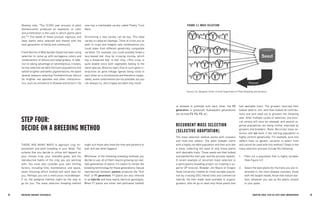
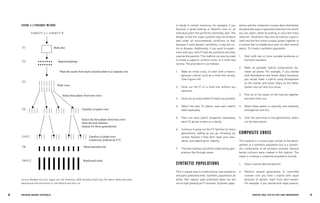
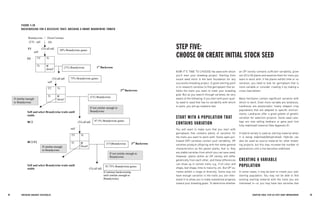
FIGURE 4.1 MASS SELECTION 
Source: Dr. Margaret Smith, Cornell Department of Plant Breeding and Genetics 
or allowed to pollinate with each other, the F2 generation is produced. Subsequent generations are termed F3, F4, F5, etc. 
RECURRENT MASS SELECTION (SELECTIVE ADAPTATION) 
The mass selection method works with crossers and multi-line selfers. The plant breeder starts with a highly variable population and then acts like a sieve, collecting the seed of only those plants with desirable traits. These seeds are then bulked and planted the next year and the process repeats. A recent example of recurrent mass selection is a participatory breeding project on creating a superior OP broccoli. Breeder Jim Myers of Oregon State University created an initial variable population by crossing OSU inbred lines and commercial hybrids. He then made seed available to organic growers, who let go to seed only those plants that had desirable traits. The growers returned their bulked seed to Jim, who then bulked all contributions and sent seed out to growers the following year. After multiple cycles of selection, one broccoli variety will soon be released, and several regional populations are being further improved by growers and breeders. (Note: Recurrent mass selection will not work if the starting population is highly uniform genetically. For example, pure-line selfers have no genetic variation to select from and cannot be used with this method.) Steps in the mass selection process include the following: 
1. Plant out a population that is highly variable. (See Figure 4.1) 
2. Select the best plants for the traits you are interested in: the most disease resistant, those with the largest heads, those that mature earliest, whatever you see as the plants closest to your goals.
36 
BRE EDING ORGANIC V EGE TABL E S 37 
CHAPTER FOUR: STEP-BY-STEP CROP IMPROVEMENT 
3. Collect the seed of the selected plants and bulk together an equal number of seed per plant. 
4. Plant the bulked seed out next year and repeat selection annually until your goal is reached. 
BULKING 
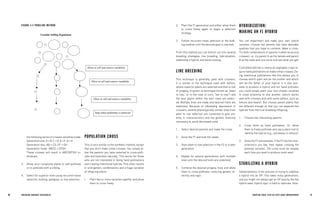
This is the practice of growing genetically diverse populations of self-pollinated crops in a bulk plot, followed by single plant selection. This method relies on natural or environmental selection over many generations, so it requires much patience and observation. It is generally used in grain crops, although it can be successfully used with beans, soybeans, other legumes, and perhaps even tomatoes. Bulking generally produces slightly variable varieties that may be more easily be adapted to your local conditions. Bulking follows this process: 
1. Plant out stock seed from a variable heirloom or landrace or seeds of an F1 cross. (See Figure 4.2) 
2. For F2, F3, and F4 generations, save all seed, and grow out the same number again (do no selection or evaluation). 
3. Plant out the F5 generation in spaced rows, then select and save seed from certain desirable plants. 
4. Plant seed from each plant into its own separate row. 
5. Select and save seed from all plants in desirable rows, and plant out in larger observational trials. 
6. Select the best lines from these trials, and plant them out into replicated trials. 
7. Choose the best line from the trial. 
PEDIGREE 
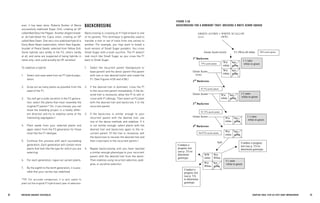
This method involves detailed records of ancestry of an individual family or strain. You keep a detailed family tree of each population of plants, which really helps illuminate the genotype of each plant. This method takes more observational work, but progress may be made more quickly, and more uniform lines may be produced. 
1. Make an initial cross (either intentional or natural) and bulk seed of the F1 generation. (See Figure 4.3.) 
2. Pick several best selfed plants from the F2. 
3. Save seed, but don’t bulk it; keep it separate. 
4. Plant the seed from each selfed individual plant in separate rows or blocks. Each row or block is called a family. 
5. Through the F3-F7 generations, continue selecting the best plants from the best rows from the best families. 
6. From the F7 generation, select and save seed from all plants in the best families and plant out in larger observational trials. 
7. Repeat steps six and seven of the Bulking method. 
PURELINE 
As explained above, a pureline has been bred to genetic uniformity. Although this isn’t usually recommended for organic breeding, it can come 
FIGURE 4.2 BULK METHOD 
Source: Modified from D.A. Sleper and J.M. Poehlman, 2006, Breeding Field Crops, 5th edition, Wiley-Blackwell. Reproduced with permission of John Wiley & and Sons, Inc. 
VARIETY A × VARIETY B
38 
BRE EDING ORGANIC V EGE TABL E S 39 
CHAPTER FOUR: STEP-BY-STEP CROP IMPROVEMENT 
in handy in certain instances, for example, if you discover a great-looking or flavorful line—or an individual plant that performs extremely well. The danger is that this super pureline may not produce well under all environmental conditions or that, because it lacks genetic variability, it may fall victim to disease. Additionally, if you want to experiment with your own F1 hybrids, purelines are often used as the parents. This method can also be used to breed a superior uniform strain of a multi-line variety. The procedure is as follows: 
1. Make an initial cross, or start with a heterogeneous cultivar such as a multi-line variety. (See Figure 4.4) 
2. Grow out the F1 or a multi-line without any selection. 
3. Grow out as many selfed F2 plants as possible. 
4. Select the best F2 plants; save each plant’s seed separately. 
5. Plant out each plant’s progenies separately; each F2 group is seen as a family. 
6. Continue to grow out the F2 families for many generations, selfing as you go, throwing out certain families if they don’t meet your standards, and selecting for stability. 
7. The best families should be stabilized by generations five through seven. 
SYNTHETIC POPULATIONS 
This is a great way to create diverse new landraces and open-pollinated lines. Synthetic populations do better than regular open-pollinated types but are not as high yielding as F1 varieties. Synthetic populations and the composite crosses described below are generally ways to generate diversity from which you can select, either by bulking or recurrent mass selection. Synthetics may also be bred as a goal in itself and the first initial crosses grown together in a mixture that is remade each year (or after several years). To create a synthetic population: 
1. Start with two or more variable landraces or heirloom varieties. 
2. Make all possible hybrid combinations between all plants. For example, if you started with Brandywine and Green Zebra tomatoes, you would make a hybrid using Brandywine as the mother and Green Zebra as the father (pollen source) and vice versa. 
3. Pool all of the seeds of the hybrids together and plant them out. 
4. Allow these plants to naturally and randomly homogenize and mix. 
5. Over the next three to five generations, select out the best plants. 
COMPOSITE CROSS 
This method is in some ways similar to the development of a synthetic population but is a systematic combination of all varieties involved. Several barley cultivars were created in this fashion. The steps in creating a composite population include 
1. Select several desired parents. 
2. Perform several generations of controlled crosses until you have a hybrid with equal amounts of genetic input from each parent. For example, if you started with eight parents, 
Pedigree method (Modified from Poehlman, 1959) Variety A X Variety B F1 Bulk plot F2 • • • • • • • Spaced planting • • • • • • • Plant the seeds from each selected plant in a separate row F3 Plant rows Select best plants from best rows F4 Families of plant rows Select the best plants from best rows from the best families (repeat for three generations) F5-F7 Families of plant rows (relatively uniform by F7) F8 Observational trial F9-F12 Replicated trials Source: Poehlman, J. M., 1959, Breeding Field Crops, Holt, Rinehart, and Winston, New York, NY, p. 59. 
FIGURE 4.3 PEDIGREE METHOD 
Source: Modified from D.A. Sleper and J.M. Poehlman, 2006, Breeding Field Crops, 5th edition, Wiley-Blackwell. Reproduced with permission of John Wiley & and Sons, Inc. 
VARIETY A × VARIETY B
40 BRE EDING ORGANIC V EGE TABL E S 41 
CHAPTER FOUR: STEP-BY-STEP CROP IMPROVEMENT 
the following series of crosses would be made: Generation one: A × B, C × D, E × F, G × Hxxxxxx Generation two: AB × CD, EF × GHxxxxxxxxxx Generation three: ABCD × EFGHxxxxxxxxxxx These crosses will result in ABCDEFGH individuals. 
3. Allow your composite plants to self-pollinate or to pollinate with a sibling. 
4. Select for superior lines using recurrent mass selection, bulking, pedigree, or line selection. 
POPULATION CROSS 
This is very similar to the synthetic method, except that you don’t make initial crosses. You simply allow the parents you have selected to cross-pollinate and hybridize naturally. This works for those who are not interested in doing hand pollinations and creating intentional hybrids. This often results in wild genetic combinations and a huge variation of offspring plants. 
1. Plant two or more varieties together and allow them to cross freely. 
2. Plant the F1 generation and either allow them to cross freely again or begin a selection strategy. 
3. Follow recurrent mass selection or the bulking method until the desired goal is reached. 
From this method you can branch out into several breeding strategies: line breeding, hybridization, stabilizing a hybrid, and backcrossing. 
LINE BREEDING 
This technique is generally used with crossers. It is similar to the technique used with selfers, where superior plants are selected and then a row of progeny is grown (a technique known as “plant to row,” or in the case of corn, “ear to row”) and the best plants within the best rows are selected. Multiple lines are made and desired traits are stabilized. Because of inbreeding depression in crossers, several phenotypically similar lines from plant to row selection are combined to give stability in characteristics and the genetic diversity necessary to avoid decreased yield. 
1. Select desired parents and make the cross. 
2. Grow the F1 and bulk the seeds. 
3. Start plant to row selection in the F2 or a later generation. 
4. Repeat for several generations with multiple lines until the desired traits are stabilized. 
5. Combine the desired progeny lines and allow them to cross-pollinate, restoring genetic diversity and vigor. 
HYBRIDIZATION: 
MAKING AN F1 HYBRID 
You can experiment and make your own hybrid varieties. Choose two parents that have desirable qualities that you hope to combine. Make a cross. Try both combinations of parents (called reciprocal crosses); i.e., try parent A as the female and parent B as the male and vice versa and see what you get! 
Controlled hybrids in nearly all vegetable crops require hand pollinations to make initial crosses. Doing intentional pollinations like this allows you to choose which plant will be the mother and which will be the father of your hybrid. It is also possible to produce a hybrid and not hand pollinate; you could simply plant your two chosen varieties in close proximity to one another (which works well with crossers and with some selfers, such as lettuce and beans). But choose parent plants that are different enough so that you can separate the hybrids from the true-breeding offspring. 
1. Choose two interesting parents. 
2. Cross them by hand pollination. Or, allow them to freely pollinate and use a plant trait to identify the hybrid (e.g., red leaves in lettuce). 
3. Grow the F1 and evaluate. If the F1 has the characteristics you like, then repeat crossing the parental varieties. The cross must be remade each time you want to produce more seed. 
STABILIZING A HYBRID 
Dehybridization is the process of trying to stabilize 
a hybrid into an OP. This takes many generations, and you might not always get an OP exactly like the hybrid seed. Hybrid vigor is hard to replicate. HowPureline 
Method Variable Selfing Population Allow to self and remove variability Allow to self and remove variability Allow to self and remove variability Stop when uniformity is achieved 
FIGURE 4.4 PURELINE METHOD 
Pureline Method Variable Selfing Population Allow to self and remove variability Allow to self and remove variability Allow to self and remove variability Stop when uniformity is achieved
42 BRE EDING ORGANIC V EGE TABL E S 43 
CHAPTER FOUR: STEP-BY-STEP CROP IMPROVEMENT 
ever, it has been done. Roberta Bunker of Maine successfully stabilized Super Chili, creating an OP called Matchbox Hot Pepper. Another diligent breeder de-hybridized the Copra onion, creating an OP called New Dawn. One very nice stabilized hybrid is Early Moon Beam watermelon, which Alan Kapuler, founder of Peace Seeds, selected from Yellow Doll. Some hybrids vary wildly in the F2, others hardly at all, and some are suspected of being hybrids in name only—and could actually be OP varieties! 
To stabilize a hybrid: 
1. Select and save seed from an F1 hybrid population. 
2. Grow out as many plants as possible from the seed of the F1. 
3. You will get a wide variation in the F2 generation; select the plants that most resemble the original F1 parent.* (Or, if you choose, you can move the breeding project in a totally different direction and try to stabilize some of the interesting segregates.) 
4. Plant seeds from your selected plants and again select from the F3 generation for those most like the F1 ideotype. 
5. Continue this process with each succeeding generation. Each generation will contain more plants that look like the type for which you are selecting. 
6. For each generation, rogue out variant plants. 
7. By the eighth to the tenth generation, it is possible that your variety has stabilized. 
*TIP: For accurate comparison, it is very useful to plant out the original F1 hybrid each year of selection. 
BACKCROSSING 
Backcrossing is crossing an F1 hybrid back to one of its parents. This technique is generally used to transfer a trait or set of traits from one variety to another. For example, you may want to breed a bush version of Small Sugar pumpkin. You cross Small Sugar with a bush zucchini. The F1 doesn’t look much like Small Sugar so you cross the F1 back to Small Sugar. 
1. Select the recurrent parent (background or base parent) and the donor parent (the parent with one or two desired traits) and create the F1. (See Figures 4.5A and 4.5B.) 
2. If the desired trait is dominant, cross the F1 to the recurrent parent immediately. If the desired trait is recessive, allow the F1 to self or cross with F1 siblings. Then select an F2 plant with the desired trait and backcross it to the recurrent parent. 
3. If the backcross is similar enough to your recurrent parent with the desired trait, use one of the above methods and stabilize. If it is not similar enough, select plants with the desired trait and backcross again to the recurrent parent. (If the trait is recessive, self the backcross to recover the desired trait and then cross back to the recurrent parent.) 
4. Repeat backcrossing until you have reached a similar-enough phenotype to your recurrent parent with the desired trait from the donor. Then stabilize using recurrent selection, pedigree, or pureline selection. 
Backcrossing for a dominant trait: Breeding a white acorn squash Green Acorn Squash x White Scallop (ww) (WW) Green Acorn (ww) F1 (Ww) all white 1st Backcross Green Acorn (ww) 2nd Backcross Green Acorn 3rd Backcross Green Acorn 4th Backcross Self Ww white ww green Ww white ww green Ww white ww green Ww white ww green Ww white ww green WW white Ww White Ww White ww green 1:1 ratio white to green 1:1 ratio white to green 3:1 ratio white to green Conduct a progeny test (see p. 53) to determine genotype. Conduct a progeny test (see p. 53) to determine genotype. Conduct a progeny test (see p. 53) to determine genotype. 50% acorn genes 75% acorn genes 87.5% acorn genes 93.75% acorn genes 96.875% acorn genes 1:1 ratio white to green 
FIGURE 4.5A 
BACKCROSSING FOR A DOMINANT TRAIT: BREEDING A WHITE ACORN SQUASH 
GREEN ACORN × WHITE SCALLOP 
(ww) (WW) 
×
44 BRE EDING ORGANIC V EGE TABL E S 45 
CHAPTER FOUR: STEP-BY-STEP CROP IMPROVEMENT 
NOW IT’S TIME TO CHOOSE the seed with which you’ll start your breeding project. Starting from sound seed stock is the best foundation for any successful breeding project. A good starting point is to research varieties to find germplasm that exhibits the traits you want to meet your breeding goal. But as you search through varieties, be very aware of the following: If you start with poor-quality seed or seed that has no variability with which to work, you will go nowhere fast. 
START WITH A POPULATION THAT CONTAINS VARIATION 
You will want to make sure that you start with germplasm that contains plenty of variation for the traits you want to work with. Some open-pollinated (OP) varieties contain such variability. OP varieties produce offspring with the same general characteristics as the parent plants, that is, they are stable varieties from which you can save seed. However, plants within an OP variety will differ genetically from each other, and these differences can show up in certain traits, e.g., fruit color and shape, leaf shape, time to maturity, etc. But OP varieties exhibit a range of diversity. Some may not have enough variation in the traits you are interested in to allow you to make substantial progress toward your breeding goals. To determine whether an OP variety contains sufficient variability, grow out 25 to 50 plants and examine them for traits you want to work with. If the plants exhibit little or no variation, you need to look for germplasm that is more variable or consider creating it by making a cross (see below). 
Many heirlooms contain significant variation with which to work. Even more variable are landraces. Landraces are polymorphic (many shapes) crop populations that are adapted to specific environments. Landraces offer a great palette of genetic variation for selection projects. Some seed catalogs are now selling landrace or gene pool (not fully stabilized) material (See Appendix E). 
A hybrid variety is used as starting material when it is being stabilized/dehybridized. Hybrids can also be used as source material for other breeding projects, but this may increase the number of generations until a line becomes stabilized. 
CREATING A VARIABLE POPULATION 
In some cases, it may be best to create your own starting population. You may not be able to find existing starting material with the traits you are interested in—or you may have two varieties that 
STEP FIVE: 
CHOOSE OR CREATE INITIAL STOCK SEED 
Backcrossing for a recessive trait: Breeding a dwarf Brandywine tomato Brandywine x a dwarf tomato (TT) tall (tt) F1 (Tt) all tall self F2 (Tt) all tall self Self and select Brandywine traits until stable BC2 (Tt) all tall self BC2 F2 Self and select Brandywine traits until stable (Tt) all tall (Continue backcrossing until similar enough to Brandywine) TT Tt Tt tt dwarf TT Tt Tt tt dwarf TT Tt Tt tt dwarf (TT) Brandywine If similar enough to Brandywine If not similar enough to Brandywine If similar enough to Brandywine (TT)Brandywine If not similar enough to Brandywine 50% Brandywine genes 75% Brandywine genes 87.5% Brandywine genes 93.75% Brandywine genes 1st Backcross (TT) Brandywine 2nd Backcross 3rd Backcross 
FIGURE 4.5B 
BACKCROSSING FOR A RECESSIVE TRAIT: BREEDING A DWARF BRANDYWINE TOMATO 
Brandywine × Dwarf tomato
46 BRE EDING ORGANIC V EGE TABL E S 47 
CHAPTER FOUR: STEP-BY-STEP CROP IMPROVEMENT 
or plots of each variety. Replicated trials take more land and effort but can give you more reliable information on variety performance. See Appendix B for resources on setting up variety trials. 
In order to effectively use a trial, be sure to do evaluations over the life cycle of the plants. Keep good records here; it will pay off down the line. There are detailed tips and techniques for good recordkeeping and evaluation of these trials in Step Seven (see pp. 50–56). 
Make sure to include the same varieties in a trial over two growing seasons. You may not be able to accurately judge how a variety performs in varied conditions in just one season. 
PROVENANCE: NOT ALL SEED IS CREATED EQUAL 
The term “provenance” means the source of origin of seed, e.g., a seed company, a particular seed saver, or a breeding program. Once you have found the variety (or varieties) you want to work with, you need to find the best source of seed for that particular variety. 
At High Mowing Seeds in Vermont, Tom Stearns decided to test the quality and purity of Red Deer Tongue lettuce from several provenances. He planted seed stock from four regional seed companies, including seed stock from High Mowing Farm. The results were quite striking! There was an enormous range of variation between provenances, and even between plants within certain provenances. In one group there had obviously been some outcrossing; there were plants that in no way resembled the typical Red Deer Tongue. 
Even though you buy the same variety from two different sources, they may not exhibit all of the same qualities depending on where they were collected and grown, and how they were maintained. Plants are dynamic entities, so seed grown in a different bioregion for even a few years may begin to exhibit new characteristics. Try to obtain stock seed that has been grown in the Northeast or in northern regions with a climate akin to ours. 
It certainly is worthwhile to trial several sources of a variety to find the provenance that does best on your farm and that exhibits the qualities you desire. This gives you a comparison from which you can accurately judge the performance of each strain. 
It is important to do your own research, but Appendix F can help you get started in finding good material to work with. This appendix provides lists of sample varieties (along with breeding tips) for many crop species. Before beginning your breeding project, you also need to become familiar with the various types of plant patents that exist and the restrictions that are imposed on use of patented varieties (see Box 4.2). 
you think might make an even better variety if only you could combine them somehow. 
A good example of creating a starting population is the Costata Romanesca breeding project spearheaded by George Moriarty and others at Cornell’s Department of Plant Breeding and Genetics. In response to grower requests, these breeders wanted to improve Costata by adding powdery mildew resistance (PMR) and a more bush-type growth habit—while retaining the squash’s great flavor and general appearance. They made crosses between Costata and a cocozelle-type squash with PMR, producing an F1 generation of nearly identical individuals. They then self-pollinated the F1 plants to produce an F2 generation filled with variation. This F2 generation has become their starting population for the Costata improvement project. Pollination techniques for creating starting populations for individual crops are given in Appendix F. 
HOW TO FIND GOOD STARTING MATERIAL 
It is crucial to learn your varieties! Do your homework over those long winter months. Talk with others who grow the crop that you are looking to improve. Get their advice on good varieties to start with. Read seed catalogs, yearbooks from the Seed Savers Exchange, and other books about heirloom seeds. There is also information on the USDA National Plant Germplasm System website regarding trial statistics and general performance research for many varieties. Many university plant breeding programs have a great wealth of knowledge about germplasm and varieties, and they might even have seed to share with prospective breeders (See also Appendix A). 
As you flip through the pages of seed catalogs, you see a brilliant range of seeds and plants: orange peppers, yellow watermelons, black tomatoes, red pumpkins, and much more! Nearly all vegetable crops have dozens, if not hundreds or thousands, of distinct varieties. All of these varieties hold potential, but you must determine which ones represent the characteristics you are looking to enhance. Not all varieties perform the same in all growing conditions. Based on your goal, you may want to build a collection of varieties of some of your favorite crops to get to know the characteristics available to you. 
Ultimately, conducting variety trials is the most effective way to find the varieties best suited for your project. What hasn’t worked for someone else might be just what you are looking for. One person’s trash is another person’s treasure! 
CONDUCTING VARIETY TRIALS 
Conducting trials is the best way to get intimate and useful information on different varieties. Using comparison, you will see which varieties do best in your situation and exhibit desirable traits. The first year, you won’t do selection or seed saving in your trial observation plots, but you most certainly can sell or eat this produce. Most seed savers and breeders are constantly conducting trials with new varieties. 
In your trial, make sure to use at least one “check” planting. Use an OP variety of the same crop with which you are familiar or successfully grow year after year. This will give you a good reference point from which to judge the new varieties you will be trialing. 
You can conduct a simple observational trial, in which single rows or patches/plots of each variety are planted side by side, or you can conduct a replicated trial, in which you plant multiple rows
48 
49 
CHAPTER FOUR: STEP-BY-STEP CROP IMPROVEMENT 
A “SCREEN” IS A SELECTION PRESSURE. It helps to make evident the weaker or less desirable plants in your population and helps emphasize those that thrive under stressful conditions. 
If you are selecting or breeding for disease resistance, your screen would be a disease-ridden field. If you were selecting for cold hardiness in lettuce, you would plant lettuce so that it was exposed to hard frosts at the peak of its life 
span. If you are selecting for drought resistance, you would plant your crops without irrigation in your driest field or bed (and pray for a dry year). Once you get into plant breeding, you will gain a new appreciation for challenges in your fields, although the neighbors might think you have lost your mind when you are watering your disease- ridden fields just after a rain to spread inoculum for disease pressure! 
To really put your plants to the test, the more rigorous you make the screen, the better the result you will get. Brett Grohsgal states that “screens need to be rigorous enough to eliminate good numbers (e.g., 30%) of an unimproved starting population, but not so harsh that you don’t have enough surviving parents.”30 
In some crop improvement schemes, the screen, quite simply, could be your own fields and production system. If your breeding objectives have to do with aesthetics or flavor, you would plant out your chosen crops in your current growing conditions, and your screening and selection would happen primarily at harvest or post-harvest. 
The key is to not baby your plants: Put them to work out in your fields and select for the ones that do the best under typical growing conditions. 
Heirlooms, landraces, and some modern varieties are in the public domain and can be propagated and used in breeding projects without restrictions. However, many modern varieties are patented.27 
Under the Plant Variety Protection Act of 1970, breeders can obtain a certificate of Plant Variety Protection (PVP) through the USDA on new varieties they have developed. This PVP restricts others from propagating and selling seed of the variety without permission for a period of 20 years. The PVP Act does allow you to save seed (for your own use) and breed with PVP varieties. However, you are not allowed to resell saved seed or use the PVP variety as a parent in a hybrid for resale. PVP varieties are usually identified as such in catalogs—but not always. 
There are also other types of patents. Perennial fruits and ornamentals propagated by cuttings or tubers can be protected by a plant patent through the United States Patent and Trademark Office. Utility patents have now been expanded through U.S. court decisions to include living organisms, including plants. Large seed companies are obtaining utility patents for plant traits.28 Utility patents are far more restrictive than PVP protection: You cannot use this material for breeding or even save the seed for your own use. 
Before using a variety in a breeding project, you need to determine conclusively whether it is protected with a patent. Before using PVP varieties in a breeding project, you should also research the actual statute. See Appendix B for further information. 
Public and private plant breeders will usually require that you sign a material transfer agreement (MTA) before giving you access to experimental germplasm.29 MTAs differ in their requirements, but often restrict you from giving or selling the seed to a third party and sometimes from saving the seed or using it in breeding projects. Before signing an MTA, be sure that you understand the restrictions it imposes and that you can abide by its terms. 
STEP SIX: 
PLANT YOUR CHOSEN CULTIVARS UNDER APPROPRIATE SCREENS 
BOX 4.2 
A Note on Plant Patents and Material 
Transfer Agreements (MTAs) 
BREEDING ORGANIC VEGETABLES
50 BRE EDING ORGANIC V EGE TABL E S 51 
CHAPTER FOUR: STEP-BY-STEP CROP IMPROVEMENT 
“One of the most powerful tools in the hands of the breeder... is selection.” L.H. Snyder31 
SELECTION AND EVALUATION go hand in hand. You want to evaluate your patch of plants and select the ones that rate the best. The best way to maintain good plant populations is to consistently throw out the weak individuals. As John Navazio says, “It’s not what you keep, it’s what you throw away.”32 Informal selection and evaluation is usually sufficient for nearly all on-farm crop improvement projects. Periodically walking through your fields noting and tagging the good plants and “rogueing” (uprooting) the bad plants is a good place to start. 
In evaluating your trials, you must take a number of factors into account. As noted before, you should make it a point to know your crop. Keeping your breeding goals and crop variety in mind, determine which four or five traits are most important. It might take a season or two to feel comfortable judging these objectively. 
Evaluating and selecting for several traits can seem daunting and time-consuming. However, armed with a few tips and techniques on field evaluations, you will be able to pinpoint the ideal plants in your field and make very real progress in a short amount of time. 
There are several methods you can use to select for multiple characteristics: tandem selection, index selection, independent culling, and rank summation index. Many breeders use a simple scoring approach that helps them assess relative performance of the plants in the field. A popular scoring technique uses a scale of 1 to 9. In terms of each trait being evaluated, the poorest-performing plant receives a score of 1 while the best plant is rated 9.33 Feel free to come up with your own scoring scale. But be sure to use all the numerals of your scale, including the extremes. It doesn’t help you much if all the plants are average. Challenge yourself to really look closely and notice subtle differences between plants. It is at this stage where keen observation really pays off. 
Walk through your plot. Using tags, tape, flags, or a field map, rate a broad spectrum of plants. If you have a large number of plants, you don’t have to rate every single plant, but be sure to rate a fair sampling from the entire field or patch. Bright fluorescent forestry tape works well. Use an indelible marker to write plant information on the tape. 
TANDEM SELECTION 
Using this method of selection, you evaluate and select for one trait at a time. Select for easily identifiable traits, such as plant stature, color, fruit type, etc., early in the breeding process. Save complicated traits that are controlled by multiple genes, such as disease resistance and yield, for later seasons. 
INDEX SELECTION 
This method of selection uses the 1 through 9 scoring system described above. Each trait is evaluated and given a separate number. For example, Plant A receives a 7 for flavor and a 6 for disease resistance. All of the evaluation scores for each plant are added together so Plant A would receive a 13. Plant B receives an 8 on flavor and 3 for disease resistance for a combined score of 11. Plant A, which has the higher combined score, would be selected over Plant B. 
INDEPENDENT CULLING 
This selection technique culls any plant that falls beneath a cutoff value (determined by the breeder). 
Brett Grohsgal has a practical example of this. He uses flower stalk thickness to measure for general plant vigor. So, when it comes time to select his collard plants for seed, he tells his workers: “Please cut and gather all the collard stems that are thicker than a pencil at 2” above soil surface. And only harvest stems that have ceased flowering and have seed bulges in most pods.”34 
You can set your cutoff values for whatever traits you are looking for. You might select tomato or pepper plants that set a certain amount of fruit. You might select eggplants for those who have flowered before a certain cutoff date. 
RANK SUMMATION INDEX 
This method uses a ranking system to judge between plants. Out of a number of plants, each individual is ranked first, second, third, etc., for each trait. All of the ranks for each trait are summed together for each plant. The plants with the lowest total scores are selected for the next generation. 
In the beginning, the odds are that you won’t have a large number of excellent individuals for all traits. So select the ones that seem most promising, knowing that they will only improve over the course of the project. 
If you’ve put enough pressure on your plants, when it comes time for selection, it isn’t always a pretty sight. You may find your standards are lowered. But Frank Morton gives priceless advice when he says, “You need to look for good potential in a bad situation.”35 
TIMELINE FOR SELECTION 
If you are selecting for only one trait, one round of rogueing may be enough. For example, if a variety performs well in your climate, but you want a different-colored fruit, you may need to rogue only when the fruits are mature. If you are breeding for resistance or tolerance to a disease or stress, the best time to take evaluations is when the stress or disease pressure is at its greatest. This gives you a chance to see which plants or which varieties exhibit the best tolerance to your screens. 
If you are selecting for several traits, such as color, flavor, disease resistance, and general hardiness, rigorous and effective selection requires that you evaluate and select during several different times of your plants’ life cycles. This allows you to pinpoint weak and strong plants at different times of 
STEP SEVEN: 
ROGUE AND SELECT
52 BRE EDING ORGANIC V EGE TABL E S 53 
CHAPTER FOUR: STEP-BY-STEP CROP IMPROVEMENT 
the season under a variety of conditions. The more scores you have, the better you’ll know how well your plants perform over the whole season. You should plan to evaluate and rogue at least three times over the course of a season. Good times to rogue and select would be the following: 
1. In nursery flats or as seedlings first emerge 
2. Prior to flowering 
3. During the peak of your screen or pressure 
4. During peak fruiting or harvest period 
PARENTAL ROGUEING 
In self-pollinated plants, an individual plant is the mother and the father. In cross-pollinated plants, it is obvious which is the mother plant (the plant that bears the seed), but the father could be any number of individual plants within the larger plant population. So when doing selective adaptation with crossers, it is very important to do a parental rogue before flowering. This means that you uproot any plants that don’t meet your criteria. Letting that pollen float around could spread any of those bad characteristics, and it might take several generations for them to resurface. Rigorous paternal rouging will save you time down the line. 
A SELECTION CONUNDRUM: IS IT THE GENES, OR THE ENVIRONMENT? 
It is crucial to remember that plants have two expressions: phenotype and genotype. Becoming familiar with these two concepts will save you many seasons of fruitless and frustrating work. 
The genotype of a plant is its genetic inheritance, including material that is not expressed or visible in the plant’s appearance. This is the plant’s genetic potential and constitution. 
The phenotype of a plant is what you see. It is not only the genes that are expressed. A plant is more than the expressions of its genes. Its characteristics are determined to a large extent by its environment. The breeder jargon for this is “G × E,” or genotype-by-environment interaction. 
Why does this matter? It is important to remember that not all of the characteristics a plant shows are heritable, or a result of the plant’s genetics. A leaf might have bright red pigmentation because the soil is just right, and the nights are just cold enough. So if you select that plant thinking that its offspring will have bright red leaves, you may be sorely disappointed. 
When evaluating a breeding trial, you will come across an outstanding-looking plant. The toughest thing to discern is whether that plant is genetically stronger than the others, or whether it is just growing in a good fertile spot in the field. “An Arab proverb says, ‘Avoid the rank plant that grows on a dung-hill.’ Its successes are due to the indirect results of chance rather than to a direct control of the factors of heredity.”36 It is important to take environmental variation into account. Soil type and management are major causes of environmental variation on every farm or garden. For example, one end of your plot may contain more clay than the rest of the area, or you may have added more manure in one section of the plot. Plants in these areas may perform very differently from those in the rest of the plot. Failing to take account of this variability can really reduce the effectiveness of your selection. 
Another example of environmental variation is the edge effect. Plants on the edge of a plot are usually 
more robust than those on the inside rows. These plants have more room in the soil to spread roots, and they generally have better access to nutrients and sunlight. It is best not to choose such edge plants as selections. 
GRIDDING 
One technique that cuts down on environmental variation as a source of confusion is gridding. For example, let’s say you have a 10-square-yard area in your garden or field where you want to conduct selection of a population. You divide this area into 1-square-yard sections, giving a total of 100 squares. You could then seed this area so that each square ends up with the same number of plants. You would then select the best plant per square (according to your selection criteria), and the 
seeds of those 100 best plants would be planted the following year. (See Figure 4.6.) 
PROGENY TESTING 
If you really want to know if the characteristics of a certain plant are heritable, you can do a progeny test—that is, grow out its offspring. Progeny testing is a way to tell whether certain characteristics are due to genes or the environment and is even a way to detect if your plants carry hidden characteristics that may be expressed in later generations. 
SETTING UP A PROGENY TEST 
Let’s return to the example of a large and extremely productive individual that you’ve noticed among the plants in your breeding trial. To determine whether these are heritable genetic traits, save seeds of this plant separately. Then, as shown in Box 4.1, plant out at least 10 seeds to increase your chances of seeing all possible variations in offspring. Figure 4.7A shows the setup for, and possible outcomes of, a progeny test. If none of the offspring show the traits of the original plant, its large size and productivity were due to environmental influences. If some or all of the progeny show these traits, examination of another generation of plants can determine whether the traits are dominant or recessive. Note that a progeny test can also be used to eliminate unstable lines and create true-breeding lines (Figure 4.7B). 
FIGURE 4.6 
PLANTING SEED OUT IN A GRID TO AVOID CONFOUNDING ENVIRONMENTAL EFFECTS DURING THE SELECTION PROCESS. FOR EXAMPLE, IF SELECTING FOR TALL PLANTS, YOU WOULD SELECT THE TALLEST PLANT IN EACH OF 
THE GRID SECTIONS FROM WHICH TO SAVE SEED.
54 BRE EDING ORGANIC V EGE TABL E S 55 
CHAPTER FOUR: STEP-BY-STEP CROP IMPROVEMENT 
Progeny testing to create true-breeding lines For a dominant trait, both homozygous (true breeding) and heterozygous (unstable) individuals will look exactly the same. A progeny test is done to find out which lines breed true and thus eliminate unstable lines. Take the results of backcrossing for a white acorn squash WW Ww Ww Self Self Self All ¼ ¼ White Green Green Keep the true-breeding variety WW white Ww White Ww White ww green WW WW WW WW WW WW WW WW WW Ww Ww ww WW Ww Ww ww WW Ww Ww ww WW Ww Ww ww 3:1 ratio white to green Plant 10-16 seeds of each selfed plant All fruit is white and cannot be told apart. 
FIGURE 4.7A 
PROGENY TESTING TO DETERMINE IF A TRAIT IS HERITABLE 
Progeny testing to determine if trait is heritable Outcome A Save seeds separately and plant Grow several offspring Self Outcome B Save seeds separately and plant Grow several offspring Self Unusually large and productive plant Heritable trait reappears (recessive) Heritable trait reappears (dominant) Not Heritable Trait does not reappear (must be an effect of the environment) Unusually large and productive plant Progeny testing to determine if trait is heritable Outcome A Save seeds separately and plant Grow several offspring Self Outcome B Save seeds separately and plant Grow several offspring Self Unusually large and productive plant Heritable trait reappears (recessive) Heritable trait reappears (dominant) Not Heritable Trait does not reappear (must be an effect of the environment) Unusually large and productive plant 
FIGURE 4.7B 
PROGENY TESTING TO CREATE TRUE-BREEDING LINES 
For a dominant trait, both homozygous (true-breeding) and heterozygous (unstable) individuals will look exactly the same. A progeny test is done to find out which lines breed true and thus eliminate unstable lines. Take the results of backcrossing for a white acorn squash:
56 BRE EDING ORGANIC V EGE TABL E S 57 
CHAPTER FOUR: STEP-BY-STEP CROP IMPROVEMENT 
THE FIRST YEAR WILL BE the most rigorous selection. After this, it only gets easier. If you have a large (hundreds to thousands) and genetically variable population, employ rigorous screens, and are ruthless while rogueing, you can expect to see noticeable results in just one year. Brett Grohsgal maintains that in three to six generations you can have a whole new gene line.42 
NOW, YOU’VE SEEN THE PLANTS to the end of their life cycles. You’ve seen them grow, flower, fruit, and dry down. No doubt you’ve gained miles of insight into the subtleties of your variety or varieties. But, to be sure, from your tagged plants, weigh the yield, taste the fruits, and see how long the produce lasts. 
Now it is time to harvest seed from the tagged plants. Please see Chapter 3 and reference materials on seed saving in Appendix B to get tips on harvest and seed cleaning. 
There is one important reminder! Collect a balanced seed sample. This requires you to harvest an equal amount of seed from each plant that you have selected.41 
STEP NINE: 
REPEAT STEPS SIX THROUGH EIGHT 
ANNUALLY UNTIL YOU ACHIEVE YOUR GOAL! 
STEP EIGHT: 
DO FINAL EVALUATIONS; HARVEST AND PROCESS SEED OF SELECTED PLANTS 
HOW MANY PLANTS SHOULD 
YOU KEEP? 
All breeding projects can produce mediocre results and varieties if the selection process is not rigorous enough. Although modern breeders typically discard 90 to 99% of a population,37 this is too extreme if you want to keep some genetic variation in your population, or you must have very large populations to maintain a high level of diversity. 
In a self-pollinated crop evaluation, if your goal is a diverse population, you should select at least 40% of the population (of your ideal 200). If you are selecting a pureline or uniform variety, select 12 out of 16 to 20 plants.38 
In a cross-pollinated crop project, you should select between 25% and 50% of your population. This population should be at least 60 plants, but 200 to 500 plants are preferable for the selection of healthy seed stock.39 
RECORDKEEPING 
Good recordkeeping is a useful tool in crop improvement. Incorrect identification could ruin years of work if a good plant is accidentally discarded or seeds are accidentally mixed with others.40 
The most basic information for recordkeeping is maintaining names and identities of your seed stocks. This is easily done on containers and seed packets (double-label to avoid mistakes, one label inside and one outside). Additional information, including ancestry, characterization, and evaluation data, makes your future selection more accurate. This information can be maintained on note cards, spiral notebooks, computer spreadsheets, etc. Good recordkeeping enables you to make multiple observations and evaluations on a single plant, taking several traits into consideration. 
Typically, you will want to keep your records in several formats. Many professional and amateur plant breeders have several cross-referenced records, 
including 
1. Seed Packets: These are great places to keep track of identity of the plants, when you planted, and other information regarding planting. 
2. Index Cards: Index cards allow you to keep a written record of your plant breeding projects in a relatively small space. Get a recipe box with 3-by-5 cards and divide the box by crop type. For each selection or gene line you are working with, keep a separate card with ancestry information and characterization notes. 
3. Planting Plans/Spreadsheets: These plans illustrate where plants were planted. This is also a backup in case field markers get displaced or fade in sun. 
4. Scoring Sheets: These keep track of your evaluation notes. 
Tip: Use pencil when writing field records. If information written in pencil gets wet, it doesn’t wash off! You can also make changes if necessary. 
Recordkeeping can be time consuming, so it is up to growers to design a style that will work best for their skills and time.
59 
CHAPTER FIVE: GROWER-BREEDER RECIPES FOR BETTER VEGETABLES 
BREEDING FOR INDEPENDENCE AND PROFIT 
John Gorzynski, Gorzynski Ornery Farm 
John Gorzynski first became interested in saving seeds and plant breeding when he noticed prices of seeds going up and the discontinuation of several varieties that performed well at his farm in the southern Catskills of New York. For example, he laments the loss of Flier F1 melon sold by Johnny’s Selected Seeds; he says that Pulsar or Savor will do but they aren’t the same. In response, he has been working to select superior volunteers of varieties that have chosen to plant themselves on his farm. 
John does not have training in plant breeding but attended Public Seed Initiative workshops and learned the basics about pollination and selection. He does not do direct crossing but has allowed varieties to cross on his farm, such as Green Wave and Red Giant mustard. He has also been stabilizing some hybrid varieties of tomatoes by saving seeds of F1s. 
John feels that plant breeding and seed saving are very rewarding. He says it takes some extra time, but the results can be fascinating and have brought the excitement back into his market garden operation. He enjoys watching and observing the new combinations that arise from his seed stocks. He says it is awesome when a project is finished—but he also has 15 to 20 others going, in various stages of development, which will require patience and work to achieve results. Self-sufficiency is the big reason he saves seeds. He doesn’t want to depend on other people but wants to work and cooperate with his plants to keep them going. He strives to fine-tune the plants to the nature of his farm. 
The unique selection environment on his farm is an interesting screen. He does not fertilize his fields with manure or compost but relies on nitrogen from cover crops. No sprays are used: no synthetic pesticides, no Bt, no rotenone, no pyrethrum. He says he is selecting for the strongest of the strong. 
Plant breeding has increased the profits of John’s farm. The enthusiasm he has for his plants makes them more attractive to the customer. Since his farmer-selected varieties are one of a kind, his customers cannot get them anywhere else. It is a unique market niche that no one can take away from him, because he can choose to release or not release the seeds as he sees fit. John has noticed that there has been a much faster response of agribusiness to unique varieties sold in seed catalogs. 
CHAPTER FIVE 
GROWER-BREEDER RECIPES FOR BETTER VEGETABLES 
JOHN GORZYNSKI 
PHOTO, ELIZABETH DYCK
60 BRE EDING ORGANIC V EGE TABL E S 61 
CHAPTER FIVE: GROWER-BREEDER RECIPES FOR BETTER VEGETABLES 
BREEDING TOUGH AND BEAUTIFUL MIXTURES OF GREENS 
Anita, Bryan, and Clara O’Hara, Tobacco Road Farm 
At Tobacco Road Farm (TRF) Anita, Bryan, and Clara cultivate 1 acre of vegetables that are produced in multiple plantings year-round. Their farm is located in Lebanon, Connecticut. It is in USDA Hardiness Zone 5 with winter lows reaching zero to -15°F. 
The farm produces crops during the winter in high hoop tunnels and low hoop tunnels. The low hoop tunnels are protected with plastic in the winter. Bryan has been selecting for genetic lines that fit this production system. 
At TRF seed saving is integrated into the operation for the following reasons: 
• flowering crops provide food and 
habitat for beneficial insects 
• cost effectiveness (homegrown 
seed is much cheaper) 
• potential to breed new crops with 
hybrid vigor 
• regional adaptation of varieties 
• seed is more vigorous 
• self-reliance in the means of production 
• securing seed of varieties that have been dropped from the seed trade 
The following “winter annual” greens crops are grown for both seed and vegetable production at the farm: arugula, chard, chervil, cress, kale, lettuce, mache, mizuna, miner’s lettuce, mustard greens, parsley, spinach, and tatsoi. These crops are planted in late summer or fall and overwintered under row covers. Leaves are harvested from fall through spring. The amount of leaves harvested depends on the amount of seed required. The seeds are harvested May through June. The greens crops are allowed to flower, and the seedpods are dried. The seed heads are cut and then dried on racks in a high hoop tunnel. The seeds are threshed by stomping on them in a large bin. The large pieces are first removed and the remaining seed/chaff is run through both smaller and larger screens and subsequently winnowed using a fan. The seeds are dried thoroughly, then placed in airtight containers with desiccant and stored in cool, dry conditions. 
Seed is generally saved from a member (variety) of a species grown in isolation, except for intentional crosses that are deliberately grown as gene pools, e.g., Brassica salad crops. According to Bryan, salad growers have the unique ability to breed highly diverse and variable crops. The greens crops at TRF are selected for shape, color, flavor, hardiness, and disease resistance. 
The following are breeding projects at the farm: 
• Gilbert’s kale: a wide-leaved collard 
like Red Russian kale 
• Conserva kale: a selection of plants that do not bolt until after a second winter 
• Astro arugula: improving cold hardiness by selection after overwintering 
• Fedco arugula: improving cold hardiness by selection after overwintering 
• Mustard-turnip: a flavorful and stable cross 
Gene pools produced by the farm include 
• Gilbert’s mustard mix, a mix of B. juncea mustards 
• Tatsoi maternal mix (tatsoi as the maternal variety that is allowed to pollinate within the variety plus be pollinated by Maruba and other B. rapa greens.) 
• Mizuna maternal mix (Mizuna as the 
Previously it may have taken 10 years for an unusual variety to show up in the grocery stores, but now it takes only one or two years. He says “you’re the only player in the game” when you have your own material. He cannot see how farmers can afford not to breed their own varieties. 
Yellow Intermediate Mangel is an heirloom sold by Seeds of Change. John says that it was too expensive to get a commercial quantity of seed. He planted some in a cold frame and only three survived his winter. However, he couldn’t believe how much seed he produced from those three plants and actually brought them around to show other farmers how productive they were. He ended up misplacing those seeds on one of his show-and- tell outings, but the plants had him covered and seeded in many volunteers. These volunteers produced a variety of shapes. He hopes he isn’t losing anything by selecting (too much inbreeding or losing adaptive traits): He has been selecting for long beefy roots that are “awful pretty.“ 
Some words of inspiration John has for other farmers: “Seed happens!” 
BREEDING COLD-HARDY, ATTRACTIVE BEETS 
Recipe by John Gorzynski 
Breeding Objectives 
• Ability to overwinter in cold frames 
• Good flavor 
• Attractive shape 
Breeding Method: 
Mass selection/Tandem selection 
Skill Level: 
Beginner 
1. Start with a heterogeneous (polymorphic) landrace or heirloom. 
2. Subject to environmental screening (in this case, surviving in cold frames over the winter). 
3. Increase population of the winter survivors. 
4. Select attractive roots from survivors for several generations until stable for shape and winter hardiness.
63 
CHAPTER FIVE: GROWER-BREEDER RECIPES FOR BETTER VEGETABLES 
maternal plant that is allowed to pollinate within the variety plus be pollinated by Maruba, tatsoi, and other B. rapa greens.) 
Bryan says that he found plant breeding infectious after he spoke with other local plant breeders and seed savers. When he started doing intentional crosses, the results were fruitful. Bryan has had no formal training in plant breeding, but he reads extensively and was influenced by Brett Grohsgal’s Growing for Market articles. Plant breeding for him is challenging in a positive sense: It is stimulating, worthwhile, and something to “wrap your mind around.” He also says there is a deep spiritual connection working together with the plants. He helps make them stronger by selection, and they make him stronger by providing good food. 
Bryan started his on-farm breeding projects because it was economically necessary to start adapting greens for winter production. He says that he has made good progress by a combination of both selecting for cold hardiness and making intentional crosses. One of the farm’s most important breeding projects is the Mizuna maternal mix. Bryan admires it for the diverse shapes, colors, and textures that are produced—and it has been good economically. He will continue to fine-tune it, but he says “I’m pretty darn happy with it already.” 
MIZUNA MATERNAL MIX 
Recipe by Bryan O’Hara 
Breeding Objectives: 
• Leaf color 
• Leaf shape 
• Flavor 
• Hardiness 
Breeding Method: 
Population cross/selective adaptation 
Skill Level: 
Beginner 
1. Plant desired parents together in a field and let them flower simultaneously. 
2. Plant the resulting seeds and screen for cold hardiness and vigor. 
3. Keep selecting for vigor and cold hardiness for many generations while maintaining leaf diversity. 
BRYAN O’HARA 
PHOTO, BRYAN CONNOLLY
64 BRE EDING ORGANIC V EGE TABL E S 65 
CHAPTER FIVE: GROWER-BREEDER RECIPES FOR BETTER VEGETABLES 
BREEDING WINTER-HARDY AND DISEASE-RESISTANT VARIETIES 
Brett Grohsgal, Even’ Star Farm 
Brett Grohsgal of Even’ Star Farm in Lexington Park, Maryland, got an introduction to selecting plants as a PhD student screening for acid and aluminum tolerance in cowpeas and rice. He had to put his knowledge to good use when he moved from California to Maryland: All his wonderful tomato varieties that did well in the dry air of California succumbed to the diseases that thrived in the high humidity of the East Coast. He refers to the mix of fungal disease he has in Maryland as “the cesspool.” 
Brett did not officially take courses as a plant breeder, but knowing how to screen and work with large numbers of plants has allowed him to make great progress relatively quickly with genetic lines on his farm. For him, plant breeding is a critical element in successful farming. Nor does he find plant breeding difficult: He takes great pleasure in building better crops or adapting excellent lines to his system. 
Brett does not believe in pureline selections. Instead, he has collected massive gene pools on his farm and promotes genetic diversity. The diversity within tomato lines on his farm clearly shows that tomatoes are not completely self-pollinating. Another asset to Brett’s breeding program is his scale of production. For example, with approximately 15,000 tomato plants grown each year at the farm, he can make fast progress in selecting for flavor and disease resistance. He has the advantage of being able to discard hundreds of plants if he doesn’t like what he sees or tastes. He can also screen for several diseases per generation. 
Even’ Star Farm has a winter CSA with over 100 shares. Brett has selected his own lines of arugula and tatsoi so that he can supply the CSA with winter greens. The arugula was produced from a cross of a Turkish line and his mother’s family heirloom variety. He did a mass cross with these two lines, cutting the tops of the plants with a string trimmer to synchronize flowering. He estimates 250 plants intercrossed and were the genetic base of his population. Brett started this cross around 1992 and has been screening heavily during bad winters. Originally the line could tolerate temperatures of 26°F and bounce back in 10 days. His lines now tolerate 20°F and will bounce back within three days. His tatsoi line was created by crossing regular tatsoi with Tendergreen (Komatsuna or mustard spinach), which is another Brassica rapa. He now has several “ice-bred” varieties that have survived severe winter ice storms. 
The goals of Brett’s breeding projects are to increase his farm’s productivity and his market. Currently 45% of his farm income is from winter crops and much of that is a direct result of his own breeding projects. In addition to increasing farm profits, he notes that farmers may be able to make some extra money by selling the seeds of superior gene lines. Brett has released his lines both to the Restoring Our Seed Project and to Fedco Seeds. 
To Brett, the lines he has produced through breeding are worth more to him than anything he can buy. For example, while the popular cherry tomato variety Sun Gold has excellent flavor, it grows poorly when infected with Septoria leaf spot. In contrast, his tomato lines Red Star and Gold Star, although not quite as tasty, tolerate Septoria well and produce reliably. 
Brett Grohsgal’s words of inspiration to would-be farmers-breeders are “we can do better,” meaning farmers are capable of breeding better plants than seed companies. Because corporate seed companies are focused on large-scale production, farmers have to “step up to the plate” to help produce varieties adapted to smaller-scale operations and markets. 
COLD-HARDY ARUGULA 
Recipe by Brett Grohsgal 
Breeding Objectives: 
• Cold hardiness 
Breeding Method: 
Population cross/Selective adaptation 
Skill Level: 
Beginner 
1. Plant desired parents together in a field and let them flower simultaneously. (Cutting plant tops should help synchronize flowering.) 
2. Plant seeds and screen for cold hardiness and vigor. 
3. Keep selecting for vigor and cold hardiness for many generations. Optional: Subject to ice storms. 
DISEASE-RESISTANT TOMATOES 
Recipe by Brett Grohsgal 
Breeding Objectives: 
• Multiple disease resistance 
• Flavor 
Breeding Method: 
Pedigree/Population cross/Selective adaptation 
Skill Level: 
Intermediate 
1. Cross desired parents by hand pollination. 
2. Screen subsequent generations for black leg in the seedling stage and for early blight, late blight, and Septoria as adult plants. 
3. Keep selecting for disease resistance and flavor for many generations, but allow intercrossing to keep the gene line flexible.
66 BRE EDING ORGANIC V EGE TABL E S 67 
CHAPTER FIVE: GROWER-BREEDER RECIPES FOR BETTER VEGETABLES 
BREEDING WITH IMAGINATION 
IN THE GARDEN 
Ken Ettlinger, Long Island Seed Project 
Ken comes from a seed-saving family: Both grandfathers, one German and one Italian, saved seeds. The tradition was passed down to his mother, and he remembers being in the garden as a toddler with her. Ken is trained as a geologist and teaches at a local community college. While he has no formal training in plant breeding, he is knowledgeable about botany and has taken genetics courses. 
From 1978 to 1993, Ken ran the innovative Long Island Seed Company. The company raised seed crops of hundreds of unusual cultivars and also sold growers “blends,” mixtures of many different varieties of a crop. Growers could use these mixtures to get started in “backyard breeding” by selecting seed from their favorite plants to save for planting the next year. 
Ken says much of what he knows comes from watching and observing plants. For many heirlooms, he thinks that adaptation to local conditions is intuitive and easy. Gardeners naturally select for the largest, best-flavored, and most productive plants. Ken has seen big differences in just a few seasons by simple selection from heirlooms. He suggests that growers who want to get into breeding start by building a collection of varieties of the crop they are interested in so that they become familiar with the diversity within the crop. Additionally, just having several varieties around encourages growers to make crosses—just to see what happens. 
Ken points out that the unexpected is a boon to breeding. In the 1980s he kept bees and grew several pepper varieties together. The thinking at the time was that peppers were mostly self-pollinating, but the bees didn’t agree! He had a dwarf pepper, Thai hot, and a Southwestern pepper that bore fruit in clusters. Amazing, outrageous, and beautiful new combinations were revealed as the product of accidental crosses of those varieties. From these wonderful accidents, he began to think of how to combine varieties in new and interesting ways. 
Ken says that the Organic Seed Partnership (OSP) has helped him get back into seed saving and breeding. In the last 15 years or so, he has seen a real turnaround in the thinking of farmers and gardeners. Previously gardeners and farmers didn’t want to or didn’t believe that they could save seeds and do plant breeding. Now there seems to be a countercurrent of farmers/seed savers/breeders creating their own materials. 
With the OSP he has enjoyed seeing new combinations develop from participatory breeding projects, such as the crosses of Charentais × Golden Gopher melon. He has found that some individuals of the F2 generation from this cross have amazing aroma and flavor. 
Because he does not derive most of his income from farming, Ken does not really track how his breeding efforts increase the profitability of his farm. One project that may have economic consequences for his neighbors involves combining powdery mildew resistance (PMR) with Phytophthora resistance in pumpkins. A small hard- shelled pumpkin called Lil’ Iron Sides is able to keep the Phytophthora fungus out of the fruits and prevent them from rotting. Ken says Phytophthora has been increasing on Long Island due to the recent string of wet falls. Growers have actually been importing pumpkins rather than growing them. He planted Lil’ Iron Sides in the garden and surrounded it by various PMR pumpkins, let them intercross, and has been selecting for resistance to both diseases. 
Ken’s active plant-based imagination has resulted in a diversity of breeding projects from Chinese stem lettuce to OP broccoli to Indian popcorn. You can read about them at his website for the Long Island Seed Project (www.liseed.org). 
PHYTOPHTHERA- AND POWDERY MILDEW-RESISTANT PUMPKINS 
Recipe by Ken Ettlinger 
Breeding Objectives: 
• Phytophthera resistance 
• Powdery mildew resistance 
• Larger pumpkin size 
Breeding Method: 
Population cross 
Skill Level: 
Beginner-intermediate 
1. Select a Phytophthora-resistant pumpkin and multiple PMR pumpkins as parents. 
2. Allow to intercross. 
3. Select for hardshell/Phytophthora resistance and PM resistance. 
4. Select for desired shape and size and continue to select for disease resistance. 
5. Keep selecting until shape and resistances are reached. 
KEN ETTLINGER 
PHOTO, LONG ISLAND SEED PROJECT
68 BRE EDING ORGANIC V EGE TABL E S 69 
CHAPTER FIVE: GROWER-BREEDER RECIPES FOR BETTER VEGETABLES 
THE PATIENT BACKCROSSER 
Bryan Connolly 
Bryan Connolly got his start as a seed saver after seeing a short feature in his high school ecology text book that highlighted genetic erosion in domesticated species. Instantly a light went on in his head saying “I can actually do something about this.” Saving whales and tigers seemed too far off and to require too many resources, but growing a rare tomato seemed very doable. He joined the Seed Savers Exchange and has been saving seeds for about 16 years. 
Bryan started plant breeding soon after he began seed saving. In his garden he observed an ornamental gourd with a single female flower open and realized it wouldn’t set fruit without being pollinated. But he figured pumpkin pollen would work because both the gourd and pumpkin belong to the same species, Cucurbita pepo. The cross was made using pollen from a friend’s garden, and for years he grew “gumpkins.” That project didn’t ever go anywhere, but he has kept working at breeding with squash, tomatoes, potatoes, salad greens, and corn. He breeds for disease resistance, cold hardiness, interesting shapes, and, in corn, for unique colors. 
Bryan likes dwarf corns because they mature early. Thus, they can be grown next to later-maturing varieties and be kept pure due to time isolation. 
In the mid 1990s, he decided to combine an early dwarf yellow sweet corn variety with some of the multi-colored sweet corns. He planted Orchard Baby (also known as Canadian Orchard Baby) near Rainbow Inca (which has a wild mix of colored kernels including red and purple) and Blue/Black Aztec corn. He started the multicolored corns early and planted the early corn later than normal so that the varieties would be in flower at the same time (a strategy know as “nicking”). 
Corn exhibits a phenomenon called “xenia” in which the effects of cross-pollination can be seen in the fruit of the maternal parent. For example, if pollen from a yellow variety of corn fertilizes a white variety of corn, the corn cobs on the white variety will have yellow kernels. In other crops, the effect of a cross will not be evident until the seed of the F1 generation is planted and grown. For example, when Bryan pollinated a gourd flower with pumpkin pollen, the fruit of that gourd looked like any other fruit of that variety. It was only the following year, when the seed from the gourd fruit was grown, that the effects of the cross could be observed. 
Because of xenia, Bryan could immediately tell whether his planned crosses had worked. He didn’t observe any red kernels in the ears of Orchard Baby, but did see many blue kernels. So he did get crossing with the Aztec corn but not with the Inca Rainbow (which may not have flowered at the same time). 
Bryan next took the blue kernels (the hybrid or F1 generation) from the Orchard Baby plants that had been crossed and planted them with pure Orchard Baby. Thus, the hybrids were allowed to backcross to the dwarf parent. Blue kernels were again selected from the pure Orchard Baby ears. This resulted in a population that was three-quarters Orchard Baby (dwarf) but with blue kernels. When the backcross 
es were grown, some plants were tall and easily rogued before flowering. However, blue kernel color is a dominant trait. Therefore, when the blue kernels from the backcrosses were planted, a great number of yellow kernels appeared again. For three generations since the backcross, Bryan has been mass selecting for ears with the greatest number and darkest blue kernels with good size and flavor. Currently the population is about 85 to 90% blue and all dwarf. He is growing 100 to 200 plants each year now and will keep selecting for blue. 
BREEDING DWARF BLUE 
SWEET CORN 
Recipe by Bryan Connolly 
Breeding Objectives: 
• Earliness 
• Good flavor 
• Blue color 
• Dwarf plant habit 
Breeding Method: 
Backcrossing/mass selection 
Skill Level: 
Beginner 
1. Choose an early yellow or white dwarf corn and an appropriate colored corn (later- maturing). 
2. Plant the later-maturing corn early and the early dwarf corn late so that both varieties flower simultaneously. 
3. Select colored kernels from the dwarf white or yellow variety. 
4. Plant these colored F1 hybrids with the dwarf yellow or white parent and allow to cross. 
5. Select colored kernels from the ears of the yellow or white parent variety, and plant them. 
6. Rogue tall plants from this first backcross generation. 
7. Mass select for blue kernels for many generations until mostly blue. 
BRYAN CONNOLLY
70 BRE EDING ORGANIC V EGE TABL E S 71 
APPENDICES 
Public Seed Initiative (PSI): A project that aimed to “dovetail with regional seed companies and engage our most knowledgeable producers in on- farm seed breeding, especially with varieties that work in organic systems.” The project concluded in 2005, but information generated by the project has been incorporated into the NOVIC website (see below). 
Organic Seed Partnership (OSP): A project that built upon the PSI “to create a strong national network aimed at developing and delivering improved vegetable varieties selected for superior performance in organic systems.” Growers worked with researchers on trialing varieties and experimental germplasm in the Northeast, the Northwest, New Mexico, West Virginia, Mississippi, and California. The project concluded in 2008, but information generated by the project can be found at http:// www.plbr.cornell.edu/psi/OSP%20home.htm. 
Northern Organic Vegetable Improvement Collaborative (NOVIC): A continuation of the OSP that seeks to develop a network of breeders working with organic growers to create improved vegetable varieties for organic systems. NOVIC is working with six crops: pea, broccoli, sweet corn, carrots, winter squash, and tomatoes (for late blight resistance). The project is ongoing as of 2011 with trialing and outreach events in Oregon, Washington, Wisconsin, and New York. For more information, see the project website at http://www.plbr. cornell.edu/psi/NOVIC%20Home.html. 
Restoring Our Seed (ROS): A project (concluded in 2006) that sought to help gardeners and farmers learn how to grow and improve organic seed through conferences, field days, on-farm breeding projects, and networking with schools, chefs, and seed companies. Information generated by the project, including excerpts from the Restoring Our Seed manual, can be found at http://www.growseed. org/ros.html. 
Organic Seed Alliance (OSA) The OSA has conducted participatory breeding projects in a number of crops, including tomatoes, spinach, broccoli, sweet corn, kale, arugula, winter squash, and summer squash. Information can be found at http:// www.seedalliance.org/index.php?page=Research. The OSA is also a collaborator in NOVIC. 
Farm Breeding Club (FBC), Northern Plains Sustainable Agriculture Society (NPSAS): A project in which farmers work together on variety trialing, seed saving, and breeding of grains and other field crops. Information can be found at http://www. npsas.org/breed.html. 
APPENDIX A 
PARTICIPATORY PLANT BREEDING PROJECTS 
PLANT BREEDING 
Agricultural Marketing Service, USDA. 2006. Plant variety protection act and regulations and rules of practice. Available at http:// www.ams.usda.gov/AMSv1.0/getfile?dDocName=STELDEV3002796. 
Allard, R.W. Principles of Plant Breeding, 2nd ed. John Wiley & Sons, New York, NY. 
Basset, M.J. 1986. Breeding Vegetable Crops. AVI Publishing Company, Westport, CT. 
Deppe, C. 2000. Breed Your Own Vegetable Varieties: The Gardener’s and Farmer’s Guide to Plant Breeding and Seed Saving. Chelsea Green Publishing, White River Junction, VT. 
eOrganic extension. Plant breeding webpage. Available at http://www.extension.org/ pages/18631/plant-breeding. 
Grohsgal, B. 2002. 
Saving seed makes sense. Growing for Market 11 (August): 1 and following. Seed-saving, Part 2: The tasks detailed. Growing for Market 11 (September): 8–10. Seed saving, Part 3: Genetic management. Growing for Market 11 (October): 10–13. 
Lawn, CR, ed., 2004. Restoring Our Seed: Ecological Seed Production and Crop Improvement by and for Organic Farmers. Restoring Our Seed, NE SARE Project. Excerpts available at http://www.growseed. org/realseed.html. 
Long Island Seed Project. Breeding projects webpage. Available at http://www.liseed.org/ ramblings.html. 
Myers, J. Intellectual property protection: What do I need to know when growing and breeding organic crops and seeds? Available at http://www.extension.org/pages/18449/ intellectual-property-protection:-what-do-i- need-to-know-when-growing-and-breeding- organic-crops-and. 
North Carolina State University, Horticultural Science Department. Vegetable cultivar descriptions for North America. Available at http://cuke.hort.ncsu.edu/cucurbit/wehner/ vegcult. 
Organic Seed Partnership. Plant breeding webpage. Available at http://www.plbr. cornell.edu/psi/NOVIC%20PB.htm. 
Poehlman, J.M. 1959. Breeding Field Crops. Holt, Rinehart and Winston, New York, NY. 
Poehlman, J.M., and D.A. Sleper. 1995. Breeding Field Crops, 4th ed. Iowa State University Press, Ames, IA. 
Robinson, R.A. 1996. Return to Resistance: Breeding Crops to Reduce Pesticide Dependence. International Development Research Centre, Ottawa, Canada. 
Seed Savers Exchange Yearbook. Available to members through HYPERLINK “http:// yearbook.seedsavers.org” http://yearbook. seedsavers.org or call 563 382-5990. 
SEED SAVING AND PRODUCTION 
Ashworth, S. 2002. Seed to Seed, 2nd ed. Seed Savers Exchange, Decorah, IA. 
Bubel, N. 1988. The New Seed Starter’s Handbook. Rodale Press, Emmaus, PA. 
Colley, C., A. Stone, and L. Brewer. 2010. Organic 
APPENDIX B 
RESOURCES FOR FURTHER INFORMATION
72 BRE EDING ORGANIC V EGE TABL E S 73 
APPENDICES 
Seed processing: Threshing, cleaning and storage. eOrganic factsheet. Available at http://www.extension.org/article/18350. 
Connolly, B. 2011. Organic Seed Production and Saving: The Wisdom of Plant Heritage. Chelsea Green Publishing, White River Junction, VT. 
Goldman, A. 2002. Melons for the Passionate Grower, with Practical Advice on Growing, Pollinating, Picking, and Preparing an Extraordinary Harvest. Artisan, New York, NY. 
Gough, R., and C. Moore-Gough. 2011. The Complete Guide to Saving Seeds. Storey Publishing, North Adams, MA. 
International Seed Saving Institute. Basic seed saving. Available at http://www.seedsave. org/issi/issi_904.html. 
Organic Seed Alliance. (The following are available at http://www.seedalliance.org/Publications.) 
2010. A seed-saving guide for gardeners and farmers. 
2010. Principles and practices of organic beet seed production in the Pacific Northwest. 
2010. Principles and practices of organic carrot seed production in the Pacific Northwest. 
2010. Principles and practices of organic lettuce seed production in the Pacific Northwest. 
2007. Principles and practices of organic bean seed production in the Pacific Northwest. 
2007. Principles and practices of organic radish seed production in the Pacific Northwest. 
2007. Principles and practices of organic spinach seed production in the Pacific Northwest. 
Saving Our Seeds. (The following are available at http://www.savingourseeds.org/publications. html#mas.) 
McCormack, J.H. 2010. Seed processing and storage. Principles and practices of seed harvesting, processing, and storage: an organic seed production manual for seed growers in the Mid-Atlantic and Southern U.S. 
McCormack, J.H. 2010. Bean seed production: An organic seed production manual for seed growers in the Mid-Atlantic and Southern U.S. 
McCormack, J.H. 2010. Cucurbit seed production: An organic seed production manual for seed growers in the Mid-Atlantic and Southern U.S. 
McCormack, J.H. 2010. Pepper seed production: An organic seed production manual for seed growers in the Mid-Atlantic and South. 
McCormack, J.H. 2010. Tomato seed production: An organic seed production manual for seed growers in the Mid-Atlantic and Southern U.S. 
McCormack, J.H. 2004. Isolation distances. Principles and practices of isolation distances for seed crops: An organic seed production manual for seed growers in the Mid-Atlantic and Southern U.S. 
Stickland, S. 2001. Back Garden Seed Saving: Keeping Our Vegetable Heritage Alive. Eco- logic books, Bristol, UK. 
VARIETY TRIALING 
Organic Seed Alliance. 2007. On-farm variety trials: A guide for organic vegetable, herb, and flower producers. Available at http:// www.seedalliance.org/Publications. 
Sooby, Jane. 2001. On-farm research guide. Organic Farming Research Foundation. Available at http://ofrf.org/grants/on-farm_ research_guide.pdf. 
APPENDIX C 
LIFE CYCLE, POLLINATION BIOLOGY, MINIMUM PLANT NUMBERS, 
AND ISOLATION DISTANCES AND TECHNIQUES FOR SPECIFIC CROPS 
FAMILY/CROP 
SCIENTIFIC NAME 
LIFE CYCLE 
SELFER/CROSSER (POLLINATION AGENT) 
MINIMUM NUMBER OF PLANTS 
ISOLATION DISTANCES 
OTHER ISOLATION METHOD 
ALLIUMS (ALLIACEAE) 
Onion, Shallot 
Allium 
cepa 
biennial 
crosser 
(bees, other insects) 
25 
1 mile or greater 
alternate-day caging 
Leek 
Allium ampelo- prasum 
biennial 
crosser 
(bees, other insects) 
25 
1 mile or greater 
alternate-day caging 
Garlic 
Allium sativum 
perennial 
asexual1 
-- 
-- 
BRASSICAS (BRASSICACEAE) 
Mustard greens 
Brassica juncea2 
annual 
crosser 
(bees, flies, other insects) 
50-100 
0.5 mile 
alternate-day caging 
Russian kale, Rutabaga 
Brassica napus2 
biennial 
crosser 
(bees, flies, other insects) 
50-100 
0.5 mile 
alternate-day caging 
Broccoli, Brussels sprout, Cabbage, Cauliflower, Collard, Kale, Kohlrabi 
Brassica oleracea 
biennial 
crosser 
(bees, flies, other insects) 
50-100 
0.5 mile 
alternate-day caging 
Broccoli raab, Chinese cabbage, Chinese mustard, Komatsuna, Mizuna, Pac choi/ Bok choy, Tatsoi, Turnip 
Brassica rapa2 
annual 
crosser 
(bees, flies, other insects) 
50-100 
0.5 mile 
alternate-day caging 
Radish 
Raphanus sativa 
annual 
crosser 
(bees, flies, other insects) 
50-100 
0.5 mile 
alternate-day caging 
Arugula (Rocket) 
Eruca vescaria subsp. sativa 
annual 
crosser 
(bees, flies, other insects) 
50 
0.5 mile 
alternate-day caging 
(Continued on p. 74)
74 BRE EDING ORGANIC V EGE TABL E S 75 
APPENDICES 
CHENOPODS (CHENOPODIACEAE) 
Beet, Swiss chard, Mangel 
Beta vulgaris 
biennial 
crosser 
(wind) 
25 
1 mile or greater 
bagging 
Spinach 
Spinacia oleracea 
annual 
crosser 
(wind) 
50-100 
1 mile or greater 
COMPOSITES (ASTERACEAE) 
Lettuce 
Lactuca sativa 
annual 
selfer 
(bees, other insects) 
25 
50 feet 
CUCURBITS (CUCURBITACEAE) 
Acorn, Cocozelle, Crookneck, Scallop, Vegetable marrow, and Zucchini squashes; Jack-o- Lantern pumpkins; Small ornamental gourds 
Cucurbita pepo3 
annual 
crosser 
(bees, other insects) 
25 
0.5 mile or greater 
hand pollination 
Banana, Buttercup, Hubbard, Winter marrow, and Turban squashes 
Cucurbita maxima 
annual 
crosser 
(bees, other insects) 
25 
0.5 mile or greater 
hand pollination 
Butternut squash, Cheese pumpkins 
Cucurbita moschata 
annual 
crosser 
(bees, other insects) 
25 
0.5 mile or greater 
hand pollination 
Melon 
Cucumis melo 
annual 
crosser 
(bees, other insects) 
25 
0.5 mile or greater 
hand pollination 
Cucumber 
Cucumis sativus 
annual 
crosser 
(bees, other insects) 
25 
0.5 mile or greater 
hand pollination 
Watermelon 
Citrullus lanatus 
annual 
crosser 
(bees, other insects) 
25 
0.5 mile or greater 
hand pollination 
GRAINS (POACEAE) 
Corn 
Zea mays 
annual 
crosser (wind) 
100 
0.5 mile or greater 
hand pollination 
LEGUMES (FABACEAE) 
Runner bean 
Phaseolus 
coccineus 
annual 
selfer 
(bees, other insects) 
25 
250 feet or greater 
bagging 
Lima bean 
Phaseolus 
lunatus 
annual 
selfer 
(bees, other insects) 
25 
100 feet or greater 
bagging 
Snap, String, 
Wax, Shelly, Kidney, Dry beans 
Phaseolus 
vulgaris 
annual 
selfer 
(bees, other insects) 
25 
50 feet 
Pea 
Pisum sativum 
annual 
selfer 
(bees, other insects) 
25 
50–100 feet 
Fava bean 
Vicia faba 
annual 
selfer/crosser 
(bees, other insects) 
25 
0.5 mile 
caging, row cover 
Chickpea (Garbanzo) 
Cicer arietinum 
annual 
selfer/crosser 
(bees, other insects) 
25 
0.5 mile 
caging, row cover 
Soybean 
Glycine max 
annual 
selfer 
(bees, other insects) 
25 
50 feet 
NIGHTSHADES (SOLANACEAE) 
Tomato 
Lycopersicon lycopersicum 
annual 
selfer 
(bees, other insects) 
25 
50–100 feet 
Sweet, Jalapeño, and Cherry peppers 
Capsicum annuum 
annual 
selfer/crosser 
(bees, other insects) 
25 
500 feet 
caging, row cover 
Tabasco and Habañero peppers 
Capsicum frutescens/ 
chinense 
annual 
selfer/crosser 
(bees, other insects) 
25 
500 feet 
caging, row cover 
Eggplant 
Solanum melongena 
annual 
selfer 
(bees, other insects) 
25 
50 feet 
caging, row cover 
Potato 
Solanum tuberosum 
annual 
selfer, asexual 
(insects)4 
-- 
-- 
UMBELS (APIACEAE) 
Carrot 
Daucus carota5 
biennial 
crosser 
(bees, flies, other insects) 
25 
0.5 mile or more 
alternate-day caging 
Parsnip 
Pastinaca sativa6 
biennial 
crosser 
(bees, flies, other insects) 
25 
1 mile 
alternate-day caging 
1 Garlic reproduces asexually. 
2 B. juncea, B. napus, and B. rapa should be isolated from one another because of potential for cross-pollination. 
3 All edible C. pepo squashes should be isolated from wild and ornamental C. pepo gourds, which can contain the bitter compound cucurbitacin. 
4 See Appendix F for special considerations in potato breeding. 
5 Carrot must be isolated from the weed queen anne’s lace, with which it will cross. 
6 Parsnip must be isolated from wild parsnip, with which it will cross. 
Sources: Connolly, B., The Wisdom of Plant Heritage: Organic Seed Production and Saving, NOFA Interstate Council, Barre, MA.; Ashworth, S., 2002, Seed to Seed, Seed Savers Exchange, Decorah, IA. 
FAMILY/CROP 
SCIENTIFIC NAME 
LIFE CYCLE 
SELFER/CROSSER (POLLINATION AGENT) 
MINIMUM NUMBER OF PLANTS 
ISOLATION DISTANCES 
OTHER ISOLATION METHOD 
FAMILY/CROP 
SCIENTIFIC NAME 
LIFE CYCLE 
SELFER/CROSSER (POLLINATION AGENT) 
MINIMUM NUMBER OF PLANTS 
ISOLATION DISTANCES 
OTHER ISOLATION METHOD 
(Continued on p. 75)
76 BRE EDING ORGANIC V EGE TABL E S 77 
APPENDICES 
THIS CHART IS MEANT as a guide only, to help seed producers select screens. Individual cultivars will vary in seed size. The size range may also help those who make their own screens. The upper screens separate larger debris from the seeds; the lower screen catches the seed and allows smaller debris to fall out the bottom. Since the measurements are sometimes difficult to interpret, here are some examples to help you read the chart: 
• 1/20 is a screen with round holes that are 1/20 of an inch in diameter 
• 11/64 is a screen also with round holes but with a diameter of 11/64 of an inch 
• 11/64 × 3/4 is a slot or oval-shaped hole that in one dimension is 3/4 inch and in the other is 11/64 inch. 
Additionally, there are wire mesh screens that will have a number such as 6 × 20, meaning 6 wires per inch in one direction and 20 per square inch in the other direction. A ‘shoe’ is the location where the screens are mounted in the machine. 
(Please note that a chart that covers additional crop seeds can be found on the website of the Organic Seed Project at http://www.plbr.cornell. edu/psi/OSPSeedEquipment.htm) 
APPENDIX D 
SCREEN SIZES FOR SEED CLEANING FROM CLIPPER OFFICE TESTER* 
CROP NAME 
BOTTOM SCREEN 
TOP SCREEN 
TOP SCREEN 
BOTTOM SCREEN 
UPPER SHOE 
UPPER SHOE 
LOWER SHOE 
LOWER SHOE 
Black Turtle Beans 
22 
8/64 × 3/4 
20 
8 × 3/4, 9 × 3/4 
Cranberry Beans 
32 
14/64 × 3/4 
30 
16/64 × 3/4 
Great Northern Beans 
26 
10/64 × 3/4 
24 
11/64 × 3/4 
Navy or Pea Beans 
22 
10/64 × 3/4 
20 
11/64 × 3/4 
Pinto Beans 
26 
9/64 × 3/4 
24 
10/64 × 3/4 
Red Kidney Beans 
30 
13/64 × 3/4 
28 
14/64 × 3/4 
Yellow Eye Beans 
24 
11/64 × 3/4 
22 
12/64 × 3/4 
Austrian Winter Peas 
18 
9/64 × 3/4 
17 
10/64 × 3/4 
Canada Field Peas 
20 
8/64 × 3/4 
18 
9/64 × 3/4 
Chick Peas (Garbanzos) 
30 
11/64 × 3/4 
26 
12/64 × 3/4 
Soybean, small, 2800-3200 seeds/lb. 
20 
9/64 × 3/4 
18 
10/64 × 3/4 
Soybean, 2500-2800/lb. 
22 
10/64 × 3/4 
20 
11/64 × 3/4 
Soybean, 2200-2500/lb. 
24 
11/64 × 3/4 
22 
12/64 × 3/4 
Soybean, very large, 2000-2200/lb. 
26, 28 
12/64 × 3/4 
26 
13/64 × 3/4 
Beet 
22 
20, 19, or none 
8, 9 
Broccoli 
7 
1/16, 20 × 20 
Cabbage 
8 
6, 7 3/64 × 5/16 
1/16, 1/17 
Carrot 
7 
6, 5-1/2 
6 × 26, 6 × 30 
Cauliflower 
6 
1/17, 1/18 
Cucumber 
18 
16, 17 
8, 9 
Dill 
10 
18 
Lettuce 
6 × 18 
19, 4 × 20 
4 × 18, 4 × 22, 24 × 24 
20 × 20, 22 × 22 
Muskmelon (Cantaloupe) 
16 
9 
Onion 
10 
8, 9, 10 
1/14, 1/15 
Pepper 
16, 18 
6 × 3/4 
Radish 
10 
9 
1/13, 1/14 
Rutabaga 
6 1/18 
1/14, 1/16 
Squash 
32, 24, 26 
23, 24 
Squash, Butternut 
28 
16,18 
Tomato 
10, 11 
1/12, 6 
Turnip 
14 
16 
20 
Watermelon 
24 
16 
Watermelon, Garrison 
26, 13 × 3/4 
19 
Watermelon, Sugar Baby 
20, 12 × 3/4 
12 
* This is a modified version of the appendix on screen sizes in Organic Seed Production and Saving: The Wisdom of Plant Heritage, authored by Bryan Connolly and published by the NOFA Interstate Council (2004) and republished by Chelsea Green Publishing (2011). Used with permission.
78 79 
BREEDING ORGANIC VEGETABLES 
APPENDICES 
Harris Seeds 
355 Paul Road 
P.O. Box 24966 
Rochester, NY 14624-0966 
800 544-7938 
http://www.harrisseeds.com 
High Mowing Seeds 
76 Quarry Rd 
Wolcott, VT 05680 
802 472-6174 
http://www.highmowingseeds. com 
Hudson Valley Seed Library 
484 Mettacahonts Rd 
Accord, NY 12404 
845 204-8769 
http://www.seedlibrary.org 
Irish Eyes Garden Seeds 
5043 Robinson Canyon Rd 
Ellensburg, WA 98926 
509 933-7150 
http://www. irisheyesgardenseeds.com 
J.L. Hudson, Seedsman 
Box 337 
La Honda, CA 94020-0337 
http://www.jlhudsonseeds.net 
Johnny’s Selected Seeds 
955 Benton Ave. 
Winslow, ME 04901-2601 
www.johnnyseeds.com 
Kokopelli Seed Foundation 
59 Westland Ave 
Boston, MA 02115 
http://www.kokopelli-seed- foundation.com 
Long Island Seed Project 
Ken Ettlinger 
http://www.liseed.org 
Monticello 
P.O. Box 318 
Charlottesville, VA 22902 
http://www.monticellocatalog.org 
Native/Seeds SEARCH 
3061 N. Campbell Ave. 
Tucson, AZ 85719 
520 622-5561 
www.nativeseeds.org 
Peaceful Valley Farm Supply, Inc. 
P.O. Box 2209 
Grass Valley, CA 95945 
530 272-4769 
www.groworganic.com 
Pinetree Garden Seeds 
P.O. Box 300 
New Glocester, ME 04260 
207 926-3400 
www.superseeds.com 
Potato Garden 
(Ronniger Potato Farm LLC 
Milk Ranch Specialty Potatoes LLC) 
12101 2135 Rd 
Austin, CO 81410 
800 314-1955 
http://www.potatogarden.com 
Sand Hill Preservation 
1878 230th Street 
Calamus, IA 52729 
563 246-2299 
www.sandhillpreservation.com 
The Scatterseed Project 
Will Bonsall 
39 Bailey Rd. 
Industry, ME 04938-4321 
Seeds of Change 
888 762-7333 
www.seedsofchange.com 
Seed Savers Exchange 
3094 North Winn Rd. 
Decorah, IA 52101 
563 382-5990 
www.seedsavers.org 
Seeds Trust 
P.O. Box 596 
Cornville, AZ 86325 
928 649-3315 
http://www.seedstrust.com 
Southern Exposure Seed Exchange 
P.O. Box 460 
Mineral, VA 23117 
540 894-9480 
http://www.southernexposure. com 
Territorial Seeds 
P.O. Box 158 
Cottage Grove, OR 97424-0061 
800 626-0866 
http://www.territorialseeds.com 
Turtle Tree Seed 
Camphill Village 
Copake, NY 12516 
518 329-3038 
http://www.turtletreeseed.com 
Whitehill Farm 
357 McCrillis Corner Rd 
P.O. Box 273 
East Wilton, ME 04234 
207 778-2685 
http://www.whitehillfarm.com 
Wild Garden Seeds 
Frank Morton 
P.O. Box 1509 
Philomath, OR 97370 
541 929-4068 
http://www.wildgardenseeds.com 
APPENDIX E 
SOURCES OF GERMPLASM 
GERMPLASM COLLECTIONS 
National Plant Germplasm System, a part of the Germplasm Resources Information Network (GRIN), which is run by USDA. See the website at http://www. ars-grin.gov/npgs/index.html to find the location of specific vegetable collections, search GRIN for germplasm, and request seed. 
C. M. Rick Tomato Genetics Resource Center is a collection of wild relatives, monogenic mutants and miscellaneous genetic stocks of tomato housed at the university of California at Davis. It is also integrated with the NPGS. See the website at http://tgrc.ucdavis. edu. 
ORGANIZATIONS AND SEED COMPANIES 
Abundant Life Seeds 
P.O. Box 279 
Cottage Grove, OR 97424-0010 
541 767-9606 
http://www.abundantlifeseeds. com 
Baker Creek Heirloom Seeds 
2278 Baker Creek Road 
Mansfield, MO 65704 
417 924-8917 
http://rareseeds.com 
Bountiful Gardens 
18001 Shafer Ranch Rd. 
Willits, CA 95490 
707 459-6410 
http://www.bountifulgardens.org 
Fedco Seeds 
P.O. Box 520 
Waterville, ME 04903 
207 873-7333 
http://www.fedcoseeds.com 
SOURCES OF GERMPLASM FOR GROWER-BREEDERS INCLUDE PUBLIC SEED COLLECTIONS AND SEED COMPANIES 
PHOTO, ELIZABETH DYCK
80 BRE EDING ORGANIC V EGE TABL E S 81 
APPENDICES 
INTRODUCTION 
Generally, members of the same species are compatible and can produce fertile offspring if they flower simultaneously and pollen has been transferred from one variety to the other. There are rare exceptions, such as varieties or individuals that have twice as many chromosomes (tetraploids) as the rest of the species. A cross of a diploid with a tetraploid would produce viable offspring that would be sterile or partly sterile; this is the process, for example, to produce seedless watermelons. 
Occasionally, one species may be able to hybridize with another species and produce viable or even fertile offspring under certain conditions. For example, the Cushaw squashes (Cucurbita argyrosperma, also known as Cucurbita mixta) are able to accept pollen from the butternut and cheese-type squashes (Cucurbita moschata) and produce viable and fertile offspring. However, C. moschata will not generally accept C. argyrosperma pollen. 
A few tips about hand pollination. To be successful, you will want to 
* use a healthy female parent 
* pollinate early in the season when the plant does not have a high fruit load 
* use flowers on larger branches or vines closer to the plant’s root system because these generally will get more resources than those on branch tips. 
Also, be sure to try reciprocal crosses, that is, make a cross using pollen from Variety A to fertilize a flower on Variety B, and then reverse the cross by using pollen from Variety B to fertilize a flower on Variety A. Reciprocal crosses are done because occasionally there can be differences in the genetics of the plant’s cytoplasm, the most important being the chloroplast genetics, which are key to photosynthesis. These cytoplasmic genes are inherited from the mother plant (the seed-bearing parent) only. Thus, there may be an advantage to using one variety over another as the mother plant. 
Another tip is to be sure to label your crosses very well. Use plastic tags and label using pencil or permanent marker. (Note that this marking fades under garden conditions and may need to be refreshed after a few weeks.) It is extremely disappointing to do a time-consuming hand pollination and then lose track of it! A standard method of labeling is to note the maternal parent first, then the paternal, and finally the date of the cross. For example, in a cross of a buttercup squash (mother plant) with a blue hubbard squash (father plant) done on the 12th of July, the label would read “buttercup × blue hubbard 7/12.” 
VEGETABLE AND SPECIALTY CROP GENE POOLS 
For each species listed below, there is a small sample list of varieties that can be used to create your own lines plus the number of offerings in the 2011 Seed Savers Exchange Yearbook (denoted SSE) to show the scope of diversity available. Specific background breeding information and pollination techniques are given too. 
The varieties included here are all open pollinated. However, please note that nearly all commercial hybrids do produce viable seeds and can be an interesting source of traits to breed with. You can also stabilize a hybrid variety that you particularly like so that you will have a similar variety even if commercial production of that hybrid is ended (see p. 41). (Before beginning a breeding project, be sure to check a variety’s status in terms of patent protection. See Box 4.2.) 
ALLIUMS (ALLIACEAE) 
Onion (27 SSE), Allium cepa 
Bulb onions, shallots, bunching onions, potato onions, and walking onions all belong to the same species. Many of these types are generally reproduced asexually by divisions but will occasionally produce a flower that easily hybridizes with any other onion in any of these groups. Occasionally hybrids can be formed with Allium fistulosum, the Japanese bunching onion. Bulb onions are biennials and need to be cold-treated or stratified before they flower, either by overwintering outside or in a root cellar. The best way to obtain crosses between varieties would be to place two different cultivars next to each other and let them hybridize on their own. 
Ailsa Craig 
Bianca di Maggio 
Clear Dawn 
New York Early 
Newberg 
Red Wethersfield 
Rossa di Milano 
Southport Red Globe 
Stuttgarter 
White Portugal 
BRASSICAS (BRASSICACEAE) 
Broccoli (17 SSE), Brussels sprouts (8 SSE), Cabbage (46 SSE) , Cauliflower (11 SSE), Collard (10 SSE), Kale (43 SSE*), Kohlrabi (5 SSE), Brassica oleracea 
Yes, these are all members of the same species and can interbreed freely! They are self-incompatible, meaning that they generally will not accept their own pollen. Therefore, just placing plants next to each other when they are in flower results in crosses. Seed production is difficult in the Northeast because these crops are biennial. Many of these plants need to be highly protected if left in the field or overwintered in a root cellar to produce flowers the following year. Russian kales are not members of this species but actually belong with rutabagas within the species Brassica napus (see below). 
Broccoli 
Calabrese 
De Cicco 
Nutri-Bud 
Purple Sprouting 
Romanesco 
Thompson 
Umpqua 
Waltham 29 
Brussels sprouts 
Bedford Fillbasket 
Catskill 
Long Island Improved 
Rubine Red 
Cabbage 
Copenhagen Market Early 
Early Jersey Wakefield 
Mammoth Red Rock 
Premium Late Flat Dutch 
Winningstadt 
Cauliflower 
All-The-Year-Round 
Early Snowball 
Purple Cape 
Collard 
Georgia 
Green Glaze 
Wild Oakland Mix 
Kale (B. oleracea only) 
Dwarf Blue Curled 
Konserva 
Lacinato (Dinosaur) 
Pentland Brig 
Vates 
Kohlrabi 
Early Purple Vienna 
Early White Vienna 
Superschmelz 
OTHER BRASSICAS: 
Mustard greens (42 SSE), Brassica juncea 
Rape (2 SSE), Russian (Siberian) kale (43 SSE*), Rutabaga (41 SSE), Brassica napus 
Broccoli Raab (5 SSE), Chinese cabbage (including Komatsuna, Tatsoi, Mizuna, and Bok choy/Pac choi) (45 SSE), Turnip (47 SSE), Brassica rapa 
APPENDIX F 
GETTING STARTED WITH VARIETAL CROSSES: 
GENE POOLS OF VEGETABLE AND SPECIALTY CROPS 
*Includes both B. Oleracea and B. napus varieties.
82 BRE EDING ORGANIC V EGE TABL E S 83 
APPENDICES 
Yellow Intermediate Mangel 
Swiss chard 
Argentata 
Bright Lights 
Five Color Silverbeet 
Fordhook Giant 
Golden 
Perpetual Spinach (leaf beet) 
Rhubarb 
Spinach (22 SSE), Spinacia oleracea 
Spinach is an annual, wind-pollinated species that is adapted to the cool growing conditions of autumn and spring; it bolts rapidly in response to increasing day length. Varieties have been developed for bolt-resistance as well as leaf shape and texture and winter hardiness. The so-called tropical or heat- tolerant spinaches, Malabar (Basella alba) and New Zealand (Tetragonia tetragonioides), are different species and thus will not cross with S. oleracea. 
Spinach has a complex, unusual pollination biology: Typically plants have only male flowers or only female flowers, although some individuals may bear both types of flowers. Moreover, female plants in the absence of pollen during flowering will eventually develop male flowers. For a detailed discussion of hybrid seed production in spinach, see the Organic Seed Alliance’s guide to spinach seed production (Appendix B). 
Bloomsdale Long Standing 
Matador 
Viroflay 
COMPOSITES (ASTERACEAE) 
Lettuce (353 SSE), Lactuca sativa 
All varieties of lettuce and celtuce (Chinese stem lettuce) belong to Lactuca sativa and should cross with each other. Lettuce can also cross with the weedy wild lettuce Lactuca serriola. Lettuce is generally self-pollinating. However, chance crosses can occur when varieties 
are grown in close proximity. 
According to lettuce breeder Becky Grube, lettuce with any red color is dominant over green-leaved types. Thus, red color could be used as a marker gene: If a green variety is grown next to a red variety, all seed resulting from cross-pollination of the two varieties should show up 
as red when planted and grown 
out. Hand pollination can be done. However, the flowers are tiny so 
a hand lens may be needed. In a 
lettuce flower, the pollen is shed before the pistil is mature. The 
pollen can be washed off by spraying the flowers using a Windex-type bottle. When the stigma of the pistil begins to branch, that is the ideal time to take pollen from another variety and place it on the stigma. Let plants mature as you would for seed saving. Plant the resulting seed, and assess the plants, 
making sure you have F1 plants with characteristics intermediate 
between the parents or that contain a marker gene such as red leaf color. Rogue out the nonhybrid plants. 
Head 
Bibb 
Brune d’Hiver 
Buttercrunch 
Four Seasons 
Hanson 
Reine des Glaces 
Leaf 
Black Seeded Simpson 
Deer Tongue 
Hyper Red Rumpled Waved 
Italienischer 
Lollo Rossa 
Merlot 
Red Oak Leaf 
Red Sails 
Salad Bowl 
Romaine 
Crisp Mint 
Forellenschluss 
Parris Island Cos 
Plato II 
Sweet Valentine 
Valmaine 
Sunflower (24 SSE*), Helianthus annuus 
These garden gems are not only beautiful but also bear tasty, nutritious seeds. The genus Helianthus is native to North America. All cultivars of Helianthus annuus (common sunflower), from the pom-pom-like, Teddy Bear type to the deep red Velvet Queens, will cross with each other. There are wild and weedy populations of this species in the Midwest and Southwest that will cross with cultivated varieties. 
Hybridization between species is even rampant. Taxonomy references contain numerous interspecific 
Breeding relationships within the genus Brassica can be complex. Several of the Brassica species hybridize with each other. B. oleracea is the exception and keeps to itself. Brassica rapa as a female parent seems to be very compatible with Brassica napus, less so with Brassica juncea but crosses are still possible. B. juncea as a female parent can accept pollen from B. napus on occasion. 
Also, keep in mind that the field crop canola is a Brassica. Canola is not just one species but includes B. rapa, B. napus, and B. juncea types that have low mustard oil content and are bred for seed production. Canola is thus able to cross with Brassica species in your garden or on your farm, so be aware of this compatibility when breeding or seed saving. 
Though isolation is difficult with Brassica species, they give the breeder a very large palette of variation to work with. These species are generally outcrossing, though some selfing is possible. Initial crosses are very easy to make simply by placing plants near each other. 
Mustard greens 
Green Wave 
Osaka Purple 
Spicy Curls 
Russian kale 
Ragged Jack 
Russian Red 
Ursa Red 
White Russian 
Rutabaga 
American Purple Top 
Gilfeather Turnip 
Laurentian 
Broccoli raab 
Quarantina 
Zamboni 
Chinese cabbage 
Bau Sin 
Even’Star Tatsoi 
Extra Dwarf Pak Choi 
Komatsuna 
Lei Choy 
Michihili 
Mispoona 
Purple Mizuna 
Purple Stalk Bok Choy 
Tatsoi/Spoon Mustard 
Turnip 
Golden Ball 
Purple Top White Globe 
Red Milan 
Radish (103 SSE), Raphanus sativus 
All radishes are cross compatible, and generally they are unable to self-pollinate (termed self-incompatible). The small round radishes we know easily hybridize with the giant white daikons. There are also varieties of radishes such as Rat’s Tail bred for long fruits that are used as a vegetable or pickle. These are also fully compatible with all other radish types. The weedy wild radish may also cross with your crop radishes and care should be taken to isolate your projects from these plants. Wild radishes may harbor some wonderful wild genes that could be useful in a very long- term breeding program but could complicate shorter-term breeding projects. The easiest way to obtain crosses is to simply plant rows or patches of two varieties near each other and allow them to freely pollinate. Alternatively, as with all self- incompatible species, one plant of each variety could be grown next to each other and in isolation from all other radishes. All seed would then be hybrid, but it would be a small genetic base to start from. 
Champion 
Cherry Belle 
Daikon 
Early Scarlet Globe 
French Breakfast 
Purple Plum 
Rat’s Tail 
Round Black Spanish 
CHENOPODS (CHENOPODIACEAE) 
Beet (41 SSE) and Swiss chard (17), Beta vulgaris 
Swiss chard, mangel, and beet belong to the same species, are wind-pollinated, and thus all cross readily. Beta vulgaris is a biennial and needs to be overwintered before flowering. 
Beet 
Albino 
Bull’s Blood 
Burpee’s Golden 
Chioggia 
Cylindra 
Detroit Dark Red 
Early Wonder Tall Top 
Lutz Green Leaf 
Three Root Grex 
*Includes both B. Oleracea and B. napus varieties. 
*Includes Helianthus spp.
84 BRE EDING ORGANIC V EGE TABL E S 85 
APPENDICES 
Musk 
Amish 
Anne Arundel 
Bit O’Honey 
Blenheim Orange 
Burrell’s Gem 
Crane 
Delicious 51 
Golden Gopher 
Granite State 
Hale’s Best Jumbo 
Haogen 
Harvest Queen 
Iroquois 
Jenny Lind 
Minnesota Midget 
Nutmeg 
Pride of Wisconsin 
Rocky Ford 
Sweet Granite 
Other Types 
Armenian Cucumber 
Charentais 
Early Silver Line 
Ginger’s Pride 
Kin Makuwa 
Noirs des Carmes 
Piel de Sapo 
Prescott Fond Blanc 
Queen Anne’s Pocket melon (Plum Granny) 
Tigger 
Vine Peach 
SQUASH AND PUMPKINS 
The genus Cucurbita includes what we commonly know as pumpkin, ornamental gourds, and squashes. In this genus, it is very difficult to figure out who will easily cross with whom. Squashes are outcrossing, and hybrids can be obtained by growing members of the same species close to each other. What follows are tips on how to tell the species apart and what will cross. 
Cucurbita pepo (201 SSE) is the most commonly grown species of squash. This species includes jack ‘o lantern pumpkins (orange pumpkins with a five-sided stem), acorn, spaghetti, zucchini, straight neck, crookneck, sweet dumpling, delicata, and patty pan squashes. Small ornamental gourds with yellow flowers are also in this species, for example, Crown of Thorns, Bicolored Spoon, and Jack-Be-Little. All of these types and varieties are cross compatible, and some very interesting combinations can be made, for example, “pumpkinis” (zucchini × pumpkin) and “gumpkins” (gourd × pumpkin). 
The butternut squash is the best known Cucurbita moschata (88 SSE). The ancestor of the butternut types is still unknown but most likely came from Columbia. These squashes are either tan, green, or mottled tan and green. Most of the Central American, Southwestern U.S., and Southern U.S. types may take 120 days or more to mature. Many of these are a gamble to grow in the Northeast, but some are sweeter than Waltham Butternut and have deeper orange flesh. C. moschata squashes are very resistant to disease and insects and are especially noted for their ability to withstand squash vine borer. C. moschata squashes also have a very long storage life. 
Cucurbita maxima (101 SSE) is most commonly represented by the buttercup and hubbard squashes. The wild version of these squashes is Cucurbita andreana, a gourd from South America. These squashes vary greatly: There are pink, green, blue, and orange types. This species includes Red Kuri, Gold Nugget, all buttercup types, giant pumpkins (such as Prizewinner and Dill’s Atlantic Giant), and Jumbo Pink Banana. All C. maxima types and varieties have a fleshy, round green stem that when mature dries down into a nondescript mass of tan. Many of these squashes are very sweet and have good texture. Most varieties of this type will mature in New England. C. maxima squashes are very prone to insect damage: Striped cucumber beetle and squash vine borer are especially severe problems. This species is fairly resistant to powdery mildew. Both bush and vine types exist. 
Hand pollination of squashes begins when the flower buds have grown to full size and have turned bright orange. The plant should be inspected in the evening when it is most obvious which flowers will open the next day. Female flowers have short stems with a miniature squash under the flower. Male flowers have longer stems. Tape both the female and male flowers that will be used to make crosses the following day. The flower buds can be taped around the top with masking tape or closed shut with a twist tie. It is ideal to pollinate each female flower with male flowers from three or more plants for genetic diversity, so tape accordingly. The next morning the flowers will have puffed out if they are ready. 
hybrids, but it seems that the annual species do not readily cross with the perennial types, though professional breeders using lab techniques can do it. The common sunflowers cannot cross with Mexican sunflower (Tithonia rotundifolia). 
Crossing sunflower varieties can easily be done by growing them together. Again, since this species is self-incompatible, one individual of each variety could be grown near each other, and the seeds would be guaranteed to be hybrids. Hand pollination could also be done by bagging the heads and moving pollen by hand from one variety to the other, although this may take several days because the tiny flowers within the head open at different times. 
Additionally, several varieties 
are really landraces or contain considerable variation, for example, Hopi Black Dye. If you do use such a variable population, crossing may not be necessary: A new variety could be created by simple mass selection (see p. 35). 
Arikara 
Autumn Beauty 
Giant Grey Stripe 
Hopi Black Dye 
Lemon Queen 
Russian Mammoth 
Supreme Mix 
Tarahumara White 
CUCURBITS (CUCURBITACEAE) 
Cucumber (188 SSE), Cucumis sativus 
Cucumbers have a great diversity of shapes, color, and sizes. There are round, yellow lemon cucumbers, white types, and even those brownish in color. Participatory breeding projects sponsored by Cornell University have also been working on creating flavorful, disease-resistant cucumbers. 
Cucumbers belonging to the species Cucumis sativus will cross with each other but not with melons. Armenian cucumbers are biologically melons and cross only with cantaloupes and their close relatives, not regular cucumbers. Gherkins are a third species and do not interbreed with standard cucumbers. Cucumbers are generally outcrossing and will readily form hybrids if grown next to each other. Hand pollination can be done: Follow directions for squash below. Another breeding tip: The genetic trait that causes bitterness in the fruit also causes the cotyledons (seed leaves) to be bitter as well. Thus, during screening of varieties or F2 or following generations of crosses, cotyledons can be tasted and those plants found to be bitter removed. Keep in mind that the bitterness trait has complex consequences: Some bitterness may repel spider mites—but bitterness also attracts cucumber beetles. 
Beit Alpha 
Boothby’s Blonde 
Lemon 
Marketmore 76 
Mideast Prolific 
National Pickling 
Poona Kheera 
Spacemaster 
Straight Eight 
Suyo Long 
Wautoma 
Melon (164 SSE), Cucumis melo 
There are several subspecies or forms of melons—muskmelon, cantaloupe, honeydew, crenshaw, and casaba—but all belong to Cucumis melo and are all genetically compatible, forming fertile crosses. Armenian cucumber also belongs to this species—it is really a nonsweet melon—and thus can cross with other melon types. 
Melons are highly outcrossing. Therefore, if two melon types or varieties are grown next to each other, there is a high probability of getting hybrids. However, to be sure that you obtain hybrid seeds, hand pollination should be done. The process is similar to hand- pollinating squashes (see below). An excellent reference for melon varieties and how to hand pollinate is Melons for the Passionate Grower by Amy Goldman (see Appendix B). Some varieties are quite variable, especially those from Native Seed/ SEARCH in Tucson, Arizona or from the Long Island Seed Project (see Appendix E). New lines could be selected from these variable populations. 
Honeydew 
Amarillo Oro 
Bidwell Casaba 
Boule d’Or 
Casaba 
Collective Farm Woman 
Honeydew, Green-Fleshed 
Honeydew, Orange-Fleshed 
Valencia
86 BRE EDING ORGANIC V EGE TABL E S 87 
APPENDICES 
simple mass selection may be done to obtain a new line. See Amy Goldman’s book Melons for the Passionate Grower for more information on watermelon varieties (see Appendix B). 
Blacktail Mountain 
Citron 
Cream of Saskatchewan 
Crimson Sweet 
Early Moonbeam 
Golden Midget 
Moon and Stars 
Mountain Sweet Yellow 
Orangeglo 
Sugar Baby 
Sweet Siberian 
GRAINS (POACEAE) 
Corn (236 SSE listings), Zea mays 
All types of corn belonging to the species Zea mays can cross. This includes flint, dent, pop, flour, sweet, and pod corn and a wild ancestor called teosinte. Broomcorn is a type of Sorghum (Sorghum bicolor) and does not cross with Z. mays. The problems with breeding corn are isolation and getting the varieties to “nick,” that is, to flower simultaneously. Corn has a great deal of variation in terms of flowering period. For example, Tom’s Thumb popcorn may be in flower by July Fourth while silage corn types may not flower until mid-August. Therefore, gene flow is unlikely between these two types if planted on the same day. When attempting crosses between corn varieties that do not flower at the same time, later-flowering corn types or varieties can be started indoors and transplanted out while early corns can be planted late to ensure they flower together. Corn from the Tropics and most teosinte types are day length-sensitive and will not flower until fall and generally do not mature in the Northeast. A 55-gallon drum can be placed over plants in the late afternoon to artificially shorten the day length. Two interesting genetic “quirks” occur in corn. One is something called xenia where dominant paternal genes show up in the kernels of the first generation cross so you know exactly which seeds are hybrids. If, for example, you have a white and a blue corn growing near each other whose flowering periods overlap, you will see blue kernels in the white corn that first year. Additionally, sweet corn has a shrunken kernel trait that can show up as a chance outcross in heirloom flint corn. Since the shrunken kernel gene is recessive, it can be instantly fixed in the population yielding a sweet corn version in one or two years. 
Hand pollination of corn is fairly easy. It is done by covering the tassels and ears. When a young ear starts forming, the leaves at its base can be cut off and the young ear covered with a special ear bag before the silks emerge. The tassels are covered with larger bags when the anthers begin to drop down and shed pollen. The contents of several tassel bags are usually mixed for genetic diversity. When the silks emerge on the ears, the bags are removed and the pollen poured on them. Then the larger tassel bag is placed over the ear to protect it from further pollination. Both types of bags are available from Southern Exposure Seed Exchange (see Appendix E). 
Dent 
Bloody Butcher 
Earth Tones 
Golden Glow 
Hickory King 
Oaxacan Green 
Reid’s Yellow 
Wapsie Valley 
Flint 
Byron Yellow 
Fort Kent Golden 
Garland 
King Phillip 
Longfellow 
Rhode Island White Cap 
Flour 
Anasazi 
Delaware Blue 
Iroquois White 
Mandan Bride 
Navajo Blue 
Painted Mountain 
Pop 
Bear Paw 
Pennsylvania Dutch Butter Flavored 
Strawberry 
Tom Thumb 
Sweet 
Ashworth 
Country Gentleman 
Golden Bantam 
Hooker’s Sweet Indian 
Luther Hill 
Painted Hills (Painted Mountain Sweet) 
Pease Crosby 
True Platinum 
(If taped too soon, they will not be enlarged.) Clip the male flowers and bring them to the plant that will act as the female parent. Remove tape from the males and peel their petals off. Remove tape from the female flower but leave the petals. “Paint” the pollen of the males onto the stigma of the female flower. Lastly, retape the petals of the female flower so no insect can enter the flower. Watch out for bees! They often zip in when you are trying to pollinate and can contaminate the flower with unwanted pollen. Once the cross has been made, the female flower should be marked. Orange survey flagging can be used, but any labeling device that will be visible and attached for the season will work. Be sure to write the cross made and date pollinated on the tape, using a permanent marker. Sixty days after pollination is adequate for the seeds to mature within the fruit. 
Occasionally interspecific hybrids can be formed. Mark Hutton of Maine Extension says that C. pepo and C. moschata can be crossed using an open-pollinated dark green zucchini as the female parent and the virus-resistant “Nigerian Local” as the male parent. C. moschata and C. maxima easily form F1 hybrids in either direction, but the F1 and backcrosses are mostly sterile. Cucurbita argyrosperma a.k.a. mixta, the Cushaw squash that is seldom grown in the Northeast, can act as a female parent when pollinated by C. moschata. 
C. maxima 
Atlantic Giant 
Black Forest 
Blue Hubbard 
Boston Marrow 
Burgess Buttercup 
Candy Roaster (occasionally 
Candy Roaster is applied to 
a C. moschata) 
Gold Nugget 
Kindred 
Marina di Chioggia 
Pink Banana 
Red Kuri 
Rouge Vif d’Etampes 
(Cinderella Pumpkin) 
Turk’s Turban 
C. moschata 
Black Futsu 
Chirimen 
Courge Longue de Nice 
Cow Pumpkin 
Fairytale 
Kikuza 
La Primera 
Long Island Cheese 
Musquee de Provence 
Neck Pumpkin 
Ponca 
Puritan 
Sucrine du Berry 
Waltham Butternut 
Yokohama 
Zucchetta Rampicante 
C. pepo 
Cocozelle 
Connecticut Field Pumpkin 
Costata Romanesca 
Delicata 
Early Prolific Straightneck 
Early Yellow Summer Crookneck 
Golden Scallopini Bush 
Grey Zucchini 
Howden Pumpkin 
Long Pie Pumpkin 
New England Pie 
Ornamental Gourds 
Paydon 
Spaghetti 
Sweet Dumpling 
Sweet Reba 
White Syrian Coussa 
Winter Luxury Pie Pumpkin 
Watermelon (104 SSE), Citrullus lanatus 
The diversity of watermelon types again gives the plant breeder a large palette to work with. There is variability in vine length, days to maturity, fruit size, fruit rind color, and flesh color. All members of Citrullus lanatus, including citrons, can cross with each other. There are tetraploid forms, which, when crossed with normal diploids, form triploid seeds that are the seedless varieties that are currently popular. Interestingly, the triploids cannot set fruit and a fertile type (either a tetraploid or diploid) is usually mixed in to pollinate the triploids. Generally, however, you will want to avoid crossing tetraploid lines and diploid lines because otherwise your project will not advance beyond the F1. Most watermelons are diploid. 
Watermelons are like squash, melons, and cucumbers, having separate male and female flowers on the same plant. Generally, they outcross but selfing is also possible. Follow the basic squash procedure to hand pollinate. Some varieties from Native Seed/SEARCH are landraces or gene pools, and
88 BRE EDING ORGANIC V EGE TABL E S 89 
APPENDICES 
Hutterite 
Jacob’s Cattle 
Kidney 
Marfax 
Pinto 
Soldier 
Vermont Cranberry 
Yellow Eye 
Lima bean (97 SSE), Phaseolus lunatus 
Lima beans seem to have a higher chance of outcrossing than common beans. It is much more likely to obtain crosses by growing varieties next to each other. Lima beans do not easily cross with scarlet runner or common beans. Hand pollination is similar to common beans. 
Henderson Bush 
Jackson Wonder 
Persian Star 
Sieva 
White Christmas 
Pea (603 SSE), Pisum sativum 
All peas are members of this species and can be crossed, including dry soup peas, shelling peas, snap peas, and snow peas. Some of the pods can be very large, such as Oregon Giant. Color variation also exists: There are purple- and yellow-podded types. Height varies tremendously from 1 foot to 6 feet or more. 
Peas are generally self-pollinating. Occasional crossing does occur, but, for the most part, hand pollination must be done to obtain hybrids. When the flower buds are swollen but the petals aren’t open, the petals and the ten stamens are removed with tweezers from the maternal parent. Pollen is then obtained from another variety and placed on the stigma. 
Garden 
Champion of England 
Green Arrow 
Mayfair 
Miragreen 
Purple Passion 
Thomas Laxton 
Pod and Snap 
Cascadia 
Dwarf Grey Sugar 
Golden Sweet 
Oregon Giant 
Schweizer Riesen 
Sugar Snap 
Soup 
Amplissimo Viktoria Ukrainskaya 
Capucijners 
Desiree 
Staine 
Runner bean (31 SSE), Phaseolus coccineus 
Like lima beans, runner beans can cross easily and experimental crossing may be done by growing varieties together. Hand pollination is similar to common beans. 
Painted Lady 
Scarlet Runner 
Sunset 
Soybean (128 SSE), Glycine max 
Soybeans are highly self-pollinating and generally require hand pollination to obtain hybrids. Soybeans include edamame types, which are eaten when mature, but not dried. Hand pollination is similar to common bean but most likely has to be done earlier in bud than other beans to prevent self-pollination. 
Beer Friend 
Black Jet 
Envy 
Sayamusume 
Shirofumi 
Vinton 81 
NIGHTSHADES (SOLANACEAE) 
Eggplant (121 SSE listings), Solanum melongena 
There is amazing genetic variability to work with in eggplant: striped types, white, green, and purple fruits, plus a diversity of shapes. Turkish eggplant and generally any red or orange eggplant belong to a different species (Solanum integrifolium), which does not cross with regular eggplant (though it has been done by professional breeders). 
These plants are considered selfers, but eggplant flowers have protruding stigmas, so they do seem susceptible to cross-pollination by insects. Like tomatoes, eggplant pollen is released only from the anther tips. If you want to hand pollinate, follow the method for tomato below. 
Applegreen 
Black Beauty 
Casper 
Listada di Gandia 
Little Fingers 
Pintong Long 
Sorghum (36 SSE), Sorghum bicolor 
Sorghum is a large, cornlike plant originally domesticated in Africa. This plant is very hardy in hot, dry conditions. There are three major types: grain, broomcorn, and sweet. Occasionally a fourth type, a cross of sorghum and sudangrass, is grown as a cover or forage crop. Grain types are generally called milo and are dwarf plants with large seed heads. In this country, the grain is used for animal feed. In Africa, it is brewed into beer. There are a few grain types that produce seed that can be popped and then eaten. Broomcorns have seed heads in which the seeds are borne on very long pedicels. When the seed heads are mature, the seeds are stripped and then heads are bound together to form brooms to sweep with. People usually refer to this type of broom as a “straw” broom. Sweet types have high sugar content in their stems, which are pressed and the resultant “juice” boiled down in a manner similar to maple syrup. The finished product is akin to maple syrup and molasses. 
Crosses between all three types of sorghum are possible and with Johnsongrass (Sorghum halepense), a weedy relative. Because Johnsongrass is a tetraploid, the progeny from crosses with regular sorghum are rarely sexually fertile. However, Johnsongrass is a perennial and in some regions the hybrids can persist asexually and come up from rootstock. (The Land Institute in Salinas, Kansas, has taken advantage of the ability of Johnsongrass and sorghum to form hybrids. The breeders there have found tetraploid lines of domesticated sorghum that are fully fertile with Johnsongrass and have been selecting sorghum types that are perennial from the progeny and backcrosses.) 
Sorghum, unlike corn, is mostly self-pollinating. Production of pollen can be stopped by placing a clear plastic bag over the flower head when it emerges. The plastic bag acts as a greenhouse, raising the temperature and stopping pollen production. The head then can be pollinated by another sorghum variety and the seeds will be of known hybrid origin. 
Broom 
Black Seeded Hungarian 
Iowa Red 
Rainbow 
Grain 
Amber 
Black Milo 
Dwarf Grain 
Tarahumara Popping 
Texicoa 
Sweet 
Ames Amber 
Apache 
Honey Drip 
Mennonite 
Rox Orange 
Texas Black Molasses 
Tohono O’odham 
LEGUMES (FABACEAE) 
Common bean (over 1400 SSE), Phaseolus vulgaris 
Crosses are possible between all the varieties and categories listed below. Beans are generally self-pollinating. To insure crossing, hand pollination is necessary, though occasional outcrosses can occur if varieties are grown in close proximity. Successful crosses can often be detected by changes in seed coat color of seeds on the maternal parent. Hand pollinations are difficult, but can be done when the flowers buds are swollen and the petals are beginning to show color. First, the petals and stamens are removed from a flower on the maternal plant (termed emasculation). Then stamens are collected from a freshly and fully opened flower on the paternal plant and rubbed on the emasculated flower of the maternal plant. 
Snap and Wax 
Benchmark 
Black Valentine 
Bush Blue Lake 
Dragon Langerie 
Golden Butterwax 
Green Crop 
Indy Gold 
Jade 
Kentucky Wonder 
Maxibel 
Provider 
Rattlesnake 
Roma 
Royal Burgundy 
Strike 
Dry 
Black Coco 
Black Turtle 
Calypso 
Cannellini
90 BRE EDING ORGANIC V EGE TABL E S 91 
APPENDICES 
The common tomato is a selfer under most conditions, though high rates of crossing do occasionally occur. The potato-leaf types often outcross because their stigma is exposed and not covered by the anther cone. Potato-leaf types are useful to the plant breeder because they outcross and the potato-leaf trait is recessive, so that a cross with a regular-leaf type can be detected in the first true leaf stage. For example, a potato-leaf type such as Brandywine could be grown next to a regular-leaf type such as Green Zebra. Any plants from seeds from the Brandywine parent that have regular leaves would be hybrids. 
Hand pollination is done when the petals of a flower are just beginning to part and show the anther cone; the flower is light yellow at this stage. The anther cone and petals are removed. This can be done together, since they are fused, or separately. This leaves the flower emasculated with the pistil exposed. Pollen is obtained from a fully opened bright yellow flower of the desired paternal variety. Bumblebees remove pollen so you may want to bag the paternal flowers just to be sure you have enough pollen to perform crosses with. The pollen donor flower is removed and the base of the flower held with tweezers. The flower is then tapped gently on a spoon or microscope slide. The pollen only comes out of the tip, like salt from a saltshaker. It can be seen as a fine dust, especially on glass slides. The pollen is then dabbed on the emasculated flower. Finally, the maternal flower is then marked with a tag (jewelers’ tags work well) that will last until the fruit is ready for the seeds to be extracted. 
Amish Paste 
Arkansas Traveler 
Black Cherry 
Brandywine 
Cherokee Purple 
Costoluto Genovese 
Dr. Wyche’s 
Green Zebra 
Hog Heart 
Japanese Trifele Black 
Moskvich 
Peach 
Roma 
Rose de Berne 
Ruth’s Perfect 
San Marzano 
Striped German 
UMBELS (APIACEAE) 
Carrot (49 SSE), Daucus carota 
Carrot and its weedy relative queen anne’s lace belong to the same species and are completely interfertile. Isolation of at least a half mile between queen anne’s lace and carrots is recommended. Alternatively, cage varieties as a barrier to insects. Crosses with queen anne’s lace greatly decrease root quality. This species is a biennial and can be overwintered if protected in the garden. According to Will Bonsall, some of the purple landraces from central Asia may be difficult to overwinter in our area. Carrots now are being offered in a rainbow of colors: white, yellow, red, and purple grace the pages of seed catalogs. Varieties cross easily if placed near one another. Hand pollination can be accomplished by bagging the flower heads and transferring pollen between the varieties with a glass rod, or by simply rubbing the flowers with your hands. 
Atomic Red 
Danvers Half Long 
Dragon (Purple Dragon) 
Oxheart 
Red Cored Chantenay 
Scarlet Nantes 
St. Valery 
Parsnip (24 SSE), Pastinaca sativa 
The often underappreciated parsnip, which develops incredibly sweet flavor after exposure to freezing temperatures, is an outcrossing biennial. Isolation and crossing techniques are similar to those of carrot. Care must be taken to avoid crossing with wild parsnip, a weedy relative. Because juice from stems and leaves of parsnips can cause serious skin irritation, you’ll need to protect yourself by wearing gloves and long sleeves when working with this species. 
Avonresister 
Cobham Improved Marrow 
Hollow Crown 
The Student 
White Spear 
Rosa Bianca 
Rosita 
Peppers (872 SSE), Capsicum spp. 
The peppers are a confusing group, and the taxonomy isn’t completely sorted out. Generally there are considered to be five species: Capsicum annuum, Capsicum baccatum, Capsicum frutescens, Capsicum chinense, and Capsicum pubescens. The vast majority of peppers that are grown in the United States belong to C. annuum. C. baccattum and pubescens are rarely grown here. C. frutescens and C. chinense are very similar and are sometimes considered one species. C. frutescens is represented by Tabasco in the U.S., and C. chinense has a famous member, the blazing hot habanero. Peppers can self and cross easily. Generally, if two varieties of the same species are placed near each other, some hybrids will result. Hand pollinations can be done in the “popcorn” stage where the flower petals have swollen but not opened. The petals and five stamens are removed from the maternal parent. Pollen from the desired variety is then placed on the stigma. Occasionally hybrids between the species can be made by hand pollination. 
C. annuum 
Anaheim 
Ancho 
Cayenne 
Chocolate 
Czech Black 
Early Red Sweet 
Espanola 
Feherozon 
Hungarian Hot Wax 
Jalapeno 
Jimmy Nardello’s Frying Pepper 
King of the North 
Lipstick 
Orange Bell 
Relleno 
Sheepnose Pimento 
C. chinense 
Aji Dulce 
Habanero 
Scotch Bonnet 
Trinidad Perfume 
C. frutescens 
Bolivian Rainbow 
Peruvian Purple 
Purira 
Tabasco 
Potato (560 SSE), Solanum tuberosum 
The earthly spud comes in a rainbow of colors and an abundance of shapes. There are several species in the genus that bear tubers, but Solanum tuberosum is the one generally grown in North America. Potatoes produce flowers and sometimes, depending on conditions, they produce fruits or potato berries. Those fruits contain seeds, each of which, if it germinates and makes tubers, can be considered its own variety—but many will be inferior to the parent and selection must be done carefully. Some varieties are abundant producers of fruits while some hardly set any at all. Some varieties that frequently set fruit are Blossom, Caribe, Prince Hairy, and Sangre. Professional plant breeders graft potato tops to tomato roots, and this increases the likelihood of fruit set. Hand pollination is done in a similar manner to eggplant and tomatoes. Seeds must be started indoors about the same time as peppers or tomatoes and then transplanted to the garden or field. 
Banana 
Blossom 
Caribe 
Carola 
French Fingerling 
Magic Molly 
Prince Hairy 
Purple Peruvian 
Sangre 
Yellow Finn 
Tomato (over 3,000 SSE), Lycopersicon lycopersicum 
The tomato presents many possibilities to the breeder. Tomato varieties come in an amazing array of colors, shapes, sizes, disease resistances, and flavors. All of the regular garden tomatoes are compatible with each other with the exception of the occasional polyploid. The common tomato is also compatible with the currant tomato Lycopersicon pimpinellifolium. There are several other wild tomato species from South America that are at least semi-compatible with Lycopersicon lycopersicum, including Lycopersicon cheesmanii, Lycopersicon chilense, Lycopersicon hirsutum, Lycopersicon pennelli, and Lycopersicon peruvianum. The C. M. Rick Tomato Genetics Resource has many accessions of these wild species (See Appendix E).
92 BRE EDING ORGANIC V EGE TABL E S 93 
NOTES 
1. Cleveland, D.A., D. Soleri, and S.E. Smith. 2000. A biological framework for understanding farmers’ plant breeding. Economic Botany 54: 377-394. 
2. Morton, F. About us: Gathering Together Farm. Retrieved April 2011 from http://www. wildgardenseed.com/aboutus. php. 
3. Synder, L.H. 1951. The Principles of Heredity, 4th ed. D.C. Heath & Co., Boston, MA, p. 205. 
4. Coffman, W.R., and M.E. Smith. 1991. Roles of public, industry, and international research center breeding programs in developing germplasm for sustainable agriculture. In, D.A. Sleper, T.C. Barker, and P.J. Bramel-Cox (eds.), Plant Breeding and Sustainable Agriculture: Considerations for Objectives and Methods. CSSA Special Pub. No. 18. CSSA, Madison, WI, pp.1-9. 
5. Fowler, C. 1994. Unnatural Selection: Technology, Politics, and Plant Evolution. Gordon and Breach, Yverdon, Switzerland, p.32. 
6. Lammerts van Bueren, E.T., M. Hulscher, J. Jongerden, M. Haring, J. Hoogendoorn, J.D. van Mansvelt, and G.T.P. Ruivenkamp. 1998. Sustainable organic plant breeding. Subproject 1 Discussion Paper. Louis Bolk Institute, Driebergen, The Netherlands, p. 27. Retrieved April 2011 from http://www. science.anth.org.uk/ifgene/ breed1.htm#contents. 
7. Cleveland, D.A., D. Soleri, and S.E. Smith. 2000. A biological framework for understanding farmers’ plant breeding. Economic Botany 54: 377-394. 
8. Ibid. 
9. Colley, M., and M. Dylan. 2004. The next great challenge: Breeding seed for organic systems. Organic Farming Research Foundation Information Bulletin No. 13. OFRF, Santa Cruz, CA, p. 4. (Also available online at http:// www.seedalliance.org/uploads/ pdf/OrganicBreedingChallenge. pdf.) 
10. Colley, M., and M. Dylan. 2004. The next great challenge: Breeding seed for organic systems. Organic Farming Research Foundation Information Bulletin No. 13. OFRF, Santa Cruz, CA, p. 29. (Also available online at http:// www.seedalliance.org/uploads/ pdf/OrganicBreedingChallenge. pdf.) 
11. Cleveland, D.A., D. Soleri, and S.E. Smith. 2000. A biological framework for understanding farmers’ plant breeding. Economic Botany 54: 377-394. 
12. Deppe, C. 2000. Breed Your Own Vegetable Varieties: The Gardener’s and Farmer’s Guide to Plant Breeding and Seed Saving, 2nd ed. Chelsea Green Publishing, White River Junction, VT, p. 19. 
13. Navasio, J. 2004. Selfers and crossers. In, CR Lawn (ed.), Restoring Our Seed: Ecological Seed Production and Crop Improvement by and for Organic Farmers. Restoring Our Seed Project, unpaginated. (Also available online at http://www.growseed.org/ selfersandcrossers.html.) 
14. Morton, F. 2004. Selfers. In, CR Lawn (ed.), Restoring Our Seed: Ecological Seed Production and Crop Improvement by and for Organic Farmers. Restoring Our Seed Project, unpaginated. (Also available online at http://www. growseed.org/selfers.html.) 
15. Navasio, J. 2004. Selfers and crossers. In, CR Lawn (ed.), Restoring Our Seed: Ecological Seed Production and Crop Improvement by and for Organic Farmers. Restoring Our Seed Project, unpaginated. (Also available online at http://www.growseed.org/ selfersandcrossers.html.) 
16. 16. Farmer Cooperative Germplasm Project, Oregon Tilth. Undated. The Organic Seed Project Plant Conservation Handbook, p. 79. 
17. Navasio, J. 2004. Selfers and crossers. In, CR Lawn (ed.), Restoring Our Seed: Ecological Seed Production and Crop Improvement by and for Organic Farmers. Restoring Our Seed Project, unpaginated. 
NOTES 
(Also available online at http://www.growseed.org/ selfersandcrossers.html.) 
18. Deppe, C. 2000. Breed Your Own Vegetable Varieties: The Gardener’s and Farmer’s Guide to Plant Breeding and Seed Saving, 2nd ed. Chelsea Green Publishing, White River Junction, VT, pp. 82-83. 
19. Grohsgal, B. 2002. Saving seed makes sense. Growing for Market 11 (August): 1. 
20. Grohsgal, B. 2002. Seed saving, Part 3: Genetic management. Growing for Market 11 (October): 10. 
21. Morton, F. 2004. Selfers. In, CR Lawn (ed.), Restoring Our Seed: Ecological Seed Production and Crop Improvement by and for Organic Farmers. Restoring Our Seed Project, unpaginated. (Also available online at http://www. growseed.org/selfers.html.) 
22. Coffman, W.R., and M.E. Smith. 1991. Roles of public, industry, and international research center breeding programs in developing germplasm for sustainable agriculture. In, D.A. Sleper, T.C. Barker, and P.J. Bramel-Cox (eds.), Plant Breeding and Sustainable Agriculture: Considerations for Objectives and Methods. CSSA Special Pub. No. 18. CSSA, Madison, WI, pp.1-9. 
23. Ibid. 
24. Robinson, R. 2004. Breeding for durable resistance. In, CR Lawn (ed.), Restoring Our Seed: Ecological Seed Production and Crop Improvement by and for Organic Farmers. Restoring Our Seed Project, unpaginated. (Also available online at http://www. growseed.org/HR.html.) 
25. Grohsgal, B. 2002. Seed-saving, Part 3: Genetic management. Growing for Market 11 (October): 11. 
26. Fowler, C., and P.R. Mooney. 1990. Shattering: Food, Politics, and the Loss of Genetic Diversity. University of Arizona Press, Tucson, AZ, p.19. 
27. Myers, J. 2010. Intellectual property protection: What do I need to know when growing and breeding organic crops and seeds? eOrganic (http:// www.extension.org/eorganic). Retrieved April 2011 from http://www.extension.org/ pages/18449/intellectual- property-protection:-what-do-i- need-to-know-when-growing- and-breeding-organic-crops- and. 
28. Ibid. 
29. Ibid. 
30. Grohsgal, B. 2002. Saving seed makes sense. Growing for Market 11 (August): 5. 
31. Synder, L.H. 1951. The Principles of Heredity, 4th ed. D.C. Heath & Co., Boston, MA, p. 205. 
32. Navasio, J. 2004. Guidelines for trialing. In, CR Lawn (ed.), Restoring Our Seed: Ecological Seed Production and Crop Improvement by and for Organic Farmers. Restoring Our Seed Project, unpaginated. 
33. Colley, M.R., and J.R. Myers. 2007. On-farm variety trials: A guide for organic vegetable, herb, and flower producers. Organic Seed Alliance, Port Townsend, WA, p. 15. Retrieved March 2011 from http://www. seedalliance.org/Publications. 
34. Grohsgal, B. 2002. Seed- saving, Part 2: The tasks detailed. Growing for Market 11 (September): 8. 
35. Morton, F. 2004. Evolution and breeding brassicas. In, CR Lawn (ed.), Restoring Our Seed: Ecological Seed Production and Crop Improvement by and for Organic Farmers. Restoring Our Seed Project, unpaginated. Also available at http://www. growseed.org/evolution.html.) 
36. Walter, H.E. 1938. Genetics: An Introduction to the Study of Heredity. Macmillan, New York, NY, p.60. 
37. Farmer Cooperative Germplasm Project, Oregon Tilth. Undated. The Organic Seed Project Plant Conservation Handbook, p. 75. 
38. Navasio, J. 2004. Selfers and crossers outline. In, CR Lawn (ed.), Restoring Our Seed: Ecological Seed Production and Crop Improvement by and for Organic Farmers. Restoring Our Seed Project, unpaginated. 
39. Ibid. 
40. Farmer Cooperative Germplasm Project, Oregon Tilth. Undated. The Organic Seed Project Plant Conservation Handbook, p. 72. 
41. Navasio, J. 2004. Selfers and crossers outline. In, CR Lawn (ed.), Restoring Our Seed: Ecological Seed Production and Crop Improvement by and for Organic Farmers. Restoring Our Seed Project, unpaginated. 
42. Grohsgal, B. 2002. Saving seed makes sense. Growing for Market 11 (August): 1.
94 BRE EDING ORGANIC V EGE TABL E S 95 
GLOSSARY 
Accession: an individual sample of seeds, usually used in reference to seed in a seed bank. 
Allele: an alternate version of a gene, e.g., an allele for tallness in a plant vs. an allele for dwarf stature. 
Annual: a plant that completes its life cycle in one year, e.g., most garden crops: corn, squash, beans, lettuce, peppers. 
Anther: the top portion of the stamen, the male reproductive structure that produces pollen. 
Biennial: a plant that grows during its first year and reproduces in its second year, e.g., carrots, parsnips, beets, cabbage, cauliflower, Brussels sprouts. 
Bolt: upright growth and flowering of a plant that has a basal or low-growing vegetative form. To go to seed. 
Chaff: the unwanted debris, e.g., pods, flower parts, etc., left over after threshing seeds. 
Clonal plants: plants that reproduce asexually from cuttings or divisions, e.g., potatoes and sweet potatoes. 
Cross-pollinating or crossing: the transfer of pollen from the anther of a flower on one plant to the stigma of a flower on another plant. 
Cultivar: shorthand for cultivated variety. 
Dehybridization or stabilization: the process by which a breeder selects individual plants from succeeding generations of a hybrid variety (F2, F3, F4, etc.) until a true-breeding, open- pollinated variety is developed that contains the essential traits of the hybrid. 
Dominant allele: the form of a gene that is expressed in a heterozygous individual; this allele masks the effects of a recessive allele. 
F1, F2, etc.: The F stands for filial; the generations that come after a controlled cross- pollination. Hybrid garden varieties are F1. 
Fertilization: the union of sperm and egg that forms a zygote, leading to the eventual formation of a plant embryo contained in a seed. 
Gene: a unit of inheritance; a portion of genetic material that controls a specific trait. 
Gene pool: the collective genetic information contained within a population of sexually reproducing organisms, especially a diverse group of plants that express several traits and that have not been standardized and stabilized through selection. 
Genetic richness or diversity: the complete range of genetic traits within a species. 
Genetic erosion: the loss of genetic traits and resources. 
Genetic segregation: the genetic recombination or reshuffling of traits that occurs between generations. 
Genotype: the genetic makeup of an individual; the totality of genes, including recessive traits that are not expressed. 
Germination: the start of plant growth within the seed, usually confirmed when the first root, or radicle, emerges from the seed coat. 
Heirloom: an open-pollinated crop variety that has been 
GLOSSARY* 
cultivated for generations by a family, or, more generally, any open-pollinated variety that predates 1945. 
Heterozygous: having two different alleles for a trait, e.g., an allele for tall stature and for dwarf stature. 
Homozygous: having two copies of the same allele for a trait, e.g., two alleles for tall stature or two alleles for dwarf stature. 
Horizontal resistance: a type of resistance to disease in which many genes, controlling multiple mechanisms and traits, decrease infection by the pathogen. This resistance reduces the rate of infection and is generally durable, effective for the indefinite future. 
Hybrid variety: a variety created by the crossing of two different inbred lines or open-pollinated varieties. Seeds taken from F1 hybrids are not sterile, but will not breed true. 
Imperfect flower: a flower that is either entirely male or entirely female. 
Inbreeding: mating among related individuals 
Inbreeding depression: loss of vigor in a population due to related individuals in a small population pollinating each other and causing detrimental traits to be expressed. 
Isolation: separation of a variety or group of plants from another so that mating among or between groups is prevented to insure genetic purity. 
Landrace: a population of crop plants developed by farmers that is heterogeneous (e.g., includes several heights, colors, different disease resistance, etc.) but is adapted to local environmental and socio-economic conditions. Most third-world farmers and indigenous peoples traditionally use(d) landraces. 
Line: a distinct lineage of plants that has been selected for certain characteristics, often by inbreeding or selfing one or a few individuals. 
Open-pollinated: any population of crop plant that “breeds true” when crossed within its own variety. Like begets like, although always with some minor variation. 
Peduncle: the portion of a plant stem that attaches to a flower or fruit. Peduncle traits are used to differentiate squash species. 
Perfect flower: a flower that contains both male and female parts. 
Phenotype: the physical manifestation of a plant’s genetic material interacting with the environment; the outward appearance of the plant. 
Pistil: the female part of a flower made up of the ovary, style, and stigma. When mature the ovary becomes a fruit. 
Pollen: the dust-like material in the anther of a flower that contains the male gamete, which fertilizes ovules within the pistil. 
Population: a group of individual plants grown at the same time in the same place (e.g., a plot or field or adjacent fields) that can cross-pollinate with one another. 
Recessive allele: an allele masked by a dominant allele. The effects of this form of a gene are not expressed unless an individual has two copies of the allele. 
Rogueing: to remove plants that do not fit the description of the variety, to remove plants that exhibit unwanted traits. 
Segregation: production of offspring with different phenotypic characteristics from an individual line or variety due to reshuffling of the alleles. 
Selection: a process that leads to the increase of certain genotypes in a population over time. Natural selection is continuously occurring. Breeders can artificially select for certain desirable traits by subjecting a population to specific environmental conditions (e.g., growing without irrigation, in a disease- ridden or insect-pest infested 
* This glossary is a modified version of that included in Organic Seed Production and Saving: The Wisdom of Plant Heritage, authored by Bryan Connolly and published by the NOFA Interstate Council (2004) and republished by Chelsea Green Publishing (2011).
96 
BREEDING ORGANIC VEGETABLES 
location, or in a high tunnel in winter) or by harvesting or keeping seed of only those individuals possessing a certain trait or traits. 
Self-incompatible: a characteristic of a plant that prevents self-fertilization. A self-incompatible plant has the ability to recognize its own pollen and prevent it from germinating or allowing the pollen tubes to reach the ovules. 
Selfing: self-pollination, in which pollen produced by a plant lands on the stigma of a flower borne by that same plant. 
Self-pollinating: a plant that the majority of the time reproduces by use of its own pollen, i.e., a “selfer.” 
Stamen: the male, or pollen- producing, part of the flower, composed of the anther and filament. 
Stigma: the very top of the female portion of the flower; the part of the flower that receives the pollen. 
Strain: a sub-variety or unique variant of an open-pollinated cultivar. 
Threshing: breaking apart of flower parts, fruit pieces, and other debris from the seed. 
Trait: a quality, such as color, size, growth habit, pest resistance, or flavor, expressed by a plant. 
True-to-type: a plant that exhibits the expected qualities and traits of a variety. 
Variety: a population of genetically related crop plants that is uniform for a set of traits or characteristics. 
Vernalization: cold treatment to induce flowering in a biennial. 
Vertical resistance: resistance that is the result of a single gene or a very few genes. The gene produces large effects (i.e., the plant is either resistant or is not resistant), but the effects may not be durable. 
Winnow: to remove chaff from seeds. This can be achieved by pouring the seed/chaff mixture between containers or throwing it in the air in the presence of a wind current. The lighter chaff blows away while the seeds fall. 
EVALUATING COMMERCIAL POTATO VARIETIES AND RELEASES FROM THE CORNELL POTATO BREEDING PROGRAM 
PHOTO, ELIZABETH DYCK
Annual crops, 23, 73-75 
Bean, 13, 27, 33, 36, 41, 74-75, 77, 88-89 
Bean, lima, 74, 89 
Bean, runner, 74, 89 
Beet, 60, 74, 77, 82-83 
Biennial crops, 23, 73-75 
Brassicas, 14, 17, 20, 34, 61, 64, 73, 81-82 
Broccoli, 14, 33, 35, 67, 70, 73, 77, 81 
Broccoli raab, 73, 81-82 
Breeding 
balanced seed sample, 57 
basic genetic principles, 28-29 
creating a variable population, 45-46 
crops for beginners, 27 
goals, 30-34 
heritable traits, 33 
methods, 34-44 
backcrossing, 42-44, 68-69 
bulking, 36, 37 
composite cross, 39-40 
hybridization, 41 
line breeding, 41 
mass selection, 34, 35, 60, 69 
pedigree, 34, 36, 38, 65 
population cross, 40-41, 63, 65, 67 
pureline, 36-37, 40 
stabilizing a hybrid, 41-42 
synthetic populations, 39 
population requirements, 27, 73-75 
starting material, 45-48, 78-79 
Brussels sprout, 14, 73, 81 
Cabbage, 14, 73, 77, 81 
Cabbage, Chinese, 73, 81-82 
Carrot, 33, 70, 75, 77, 91 
Cauliflower, 14, 73, 77, 81 
Chard, Swiss, 74, 82-83 
Clonal reproduction, 16 
Collard, 14, 51, 61, 73, 81 
Corn, 14, 27, 33, 41, 67, 68-69, 70, 74, 87 
Cross-pollinating crops, 14, 15, 16, 24-25, 27, 52, 56, 73-75 
Cucumber, 27, 74, 77, 84 
Dehybridization, 41-42 
Disease resistance, 30, 31, 49, 51, 61, 64-65, 67 
Eggplant, 15, 16, 75, 89-90 
Farmer/gardener breeders 
Connolly, Bryan, 68-69 
Ettlinger, Ken, 22, 66-67 
Gorzynski, John, 58-60 
Grohsgal, Brett, 22, 30, 33, 49, 51, 64-65 
O’Hara, Bryan, 61-63 
Floral biology, 15 
Garlic, 17, 73 
Greens, mustard, 59, 61, 73, 81, 82 
Hand pollination, 40, 41, 74, 80, 83, 84, 85, 87, 88, 89, 90, 91 
Historical role of farmers in breeding, 9, 11 
Isolation 
distances, 13, 14, 16, 25, 73-75 
methods, 14, 16, 17, 68, 73-75 
Kale, 14, 61, 70, 73, 81 
Kale, Russian, 61, 73, 81-82 
Kohlrabi, 14, 73, 81 
Lettuce, 13, 27, 33, 34, 41, 47, 49, 61, 67, 74, 77, 83 
Legumes, 16, 20, 31, 36, 74, 88-89 
Material transfer agreement, 48 
Melon, 16, 59, 67, 74, 77, 84-85 
Onion, 14, 33, 42, 73, 77, 81 
Parsnip, 75, 91 
Participatory breeding, 12, 35, 70, 84 
Pea, 13, 27, 31, 33, 70, 75, 77, 89 
Pepper, 16, 24, 33, 42, 67, 75, 77, 90 
Plant patents, 47, 48 
Plant variety protection, 48 
Potato, 16, 68, 75, 90 
Provenance, 47 
Pumpkin, 42, 67, 68, 69, 74, 85-86 
Radish, 27, 73, 77, 82 
Reciprocal crosses, 41, 80 
Recordkeeping, 56 
Rutabaga, 73, 77, 81-82 
Seed saving, 13-20 
cleaning , 18-20, 76-77 
ripening, 16, 18 
seed-saving cycle, 14 
storage, 20 
Selection, 49, 50-56 
environmental effects, 52-53 
gridding, 53 
parental roguing, 52 
progeny testing, 53-55 
screens for selection, 49 
techniques, 50-56 
index, 51 
independent culling, 51 
rank summation index, 51 
tandem, 50-51, 60 
timeline, 51-52 
Self-pollinating crops, 13-14, 15, 24, 27, 56, 74-75 
Sorghum, 87, 88 
Soybean, 36, 75, 77, 89 
Spinach, 61, 70, 74, 83 
Squash, 14, 15, 16, 18, 19, 27, 43, 46, 55, 68, 70, 74, 77, 80, 85-86 
Sunflower, 16, 20, 83-84 
Tomato, 13, 15, 16, 24, 27, 33, 36, 39, 44, 59, 64-65, 68, 70, 75, 77, 78, 89, 90-91 
Turnip, 61, 73, 77, 81-82 
Variable populations, 45-46 
Variety trials, 46-47 
Watermelon, 42, 74, 77, 80, 86-87 
INDEX
ROWEN WHITE is a passionate seed saver and gardener. Raised with a strong Native American heritage, her love of and interest in seeds began with her interest in her own Mohawk culture and agriculture. In collaboration with the Mohawk group Kanen:hiio, she is the curator of an extensive collection of heirloom seeds from native communities all over the Northeast region. She is the author of another short book entitled Haudenosaunee Native Seed Restoration, which explores one native community’s struggle and journey to undertake both cultural and seed/agricultural restoration. Rowen now splits her time between California and her family home at the Akwesasne Mohawk Reserve. 
BRYAN CONNOLLY is a seed saver, conserving over 150 varieties of vegetables. He is the author of The Wisdom of Plant Heritage, the Northeast Organic Farming Association’s handbook on small-scale seed production. Additionally, Bryan is the state botanist for the Massachusetts Natural Heritage and Endangered Species Program and a doctoral student at the University of Connecticut. Bryan has consulted for the Connecticut Department of Environmental Protection and the New England Wild Flower Society and has taught at Connecticut College. 
Front cover (clockwise from top right): Onion seed production at Turtle Tree Seed (photo, Elizabeth Dyck); Painted Mountain corn, an open-pollinated gene pool developed by Dave Christensen, grown by Kristen Wilmer (photo, Bryan Connolly); Heirloom squash diversity (photo, Bryan Connolly); Leaves from the F2 generation of an unplanned tatsoi (B. rapa) × White Russian kale (B. napus) cross (photo, Bryan Connolly); Cucumber from the F2 generation of a Cornell Marketmore 97 × Boothby’s Blonde cross grown out by Ken Ettlinger, Long Island Seed Project (photo, Elizabeth Dyck); Fruit from an F2 plant of a Brandywine × Rose de Berne cross (photo, Bryan Connolly)
BREEDING ORGANIC VEGETABLES: A STEP-BY-STEP GUIDE FOR GROWERS is a practical approach to plant breeding for farmers and gardeners. In addition to explaining basic plant breeding theory and methods, the authors cover all the necessary steps in a breeding project, from deciding on a breeding goal and finding suitable germplasm to performing selections and evaluations. Five grower- breeders also share their insights and breeding “recipes.” While this book grew out of participatory breeding projects in the Northeast, it should empower growers everywhere to breed imaginatively to produce vegetable varieties that are attractive, productive, disease resistant, and well adapted to organic systems. 
BREEDING A POWDERY MILDEW RESISTANT PATTY PAN SQUASH Left: Fruit from the parents (top), Sweet Reba acorn squash (PMR) and Wood’s Bush Prolific Patty Pan, and the F1 generation (bottom). Right: Fruit from the F2 generation. (Photos, Bryan Connolly) 
249 HIGHLAND AVE, ROCHESTER, NY 14620 
(585) 271–1979 info@nofany.org www.nofany.org

Breeding Organic Vegetables

  • 1.
    BREEDING ORGANIC VEGETABLES A STEP-BY-STEP GUIDE FOR GROWERS BY ROWEN WHITE & BRYAN CONNOLLY EDITED BY ELIZABETH DYCK
  • 2.
    The organic broccolibreeding project initiated by James Myers (Oregon State University): The diversity in traits in the breeding population (head color, shape, and size; bead size; neck shape; side shoot production; time to maturity; and more) allowed growers to select for their ideal broccoli. (Photos, Ken Ettlinger, Long Island Seed Project, and Elizabeth Dyck).
  • 3.
    BREEDING ORGANIC VEGETABLES A STEP-BY-STEP GUIDE FOR GROWERS BY ROWEN WHITE AND BRYAN CONNOLLY EDITED BY ELIZABETH DYCK
  • 4.
    Copyright © 2011Northeast Organic Farming Association of New York, Inc. (NOFA-NY) All rights reserved. No part of this book may be reproduced in any form without the written consent of NOFA-NY, Inc. Northeast Organic Farming Association of New York, Inc. (NOFA-NY) 249 Highland Ave Rochester, NY 14620 (585) 271–1979 info@nofany.org www.nofany.org NOFA NY, Inc is an organization of consumers, gardeners, and farmers working together to create a sustainable regional food system which is ecologically sound and economically viable. Through demonstration and educational opportunities, we promote land stewardship, organic food production, and local marketing. NOFA NY brings consumers and farmers closer together to make high quality food available to all people. This book is a product of the Public Seed Initiative, which was funded by the USDA Initiative for Future Agricultural and Food Systems. Cover & book design by Stacy Wakefield, Evil Twin Publications Printed in Canada. First printing, October 2011 Printed on recycled paper. Library of Congress Control Number: 2011935904 ISBN 978-0-9820850-2-8 96 pages ACKNOWLEDGMENTS This project was supported in part from funds from the USDA Organic Research and Education Initiative Award No. 2004-51300-02229 and USDA-SARE grant LNE04-204. We are very grateful to Dr. Michael Mazourek and Michael Glos of Cornell University’s Department of Plant Breeding and Genetics for reviewing an early draft of this guide. Special thanks to Ken Ettlinger, John Gorzynski, Brett Grohsgal, and Bryan O’Hara for sharing freely their wealth of experience in breeding vegetable varieties. Our work has also been informed by colleagues and participants from the Organic Seed Partnership Project, including George Moriarty, Jim Myers, Alison Frost, Beth Corymb, and Nathan Corymb.
  • 5.
    CONTENTS 7 PREFACE 9 CHAPTER ONE: WHY SAVE AND SELECT SEED? 11 CHAPTER TWO: HOW IT ALL BEGAN 13 CHAPTER THREE: SEED-SAVING BASICS 21 CHAPTER FOUR: STEP-BY-STEP CROP IMPROVEMENT 22 Step 1: Decide on Your Scale 23 Step 2: Decide on a Crop 30 Step 3: Decide on a Goal 34 Step 4: Decide on a Breeding Method 45 Step 5: Choose or Create Initial Stock Seed 49 Step 6: Plant your Chosen Cultivars under Appropriate Screens 50 Step 7: Rogue and Select 57 Step 8: Do Final Evaluations; Harvest and Process Seed of Selected Plants 57 Step 9: Repeat Steps Six through Eight Annually until You Achieve Your Goal! 59 CHAPTER FIVE: GROWER-BREEDER RECIPES FOR BETTER VEGETABLES 59 Breeding for Independence and Profit: John Gorzynski, Gorzynski Ornery Farm 61 Breeding Tough and Beautiful Mixtures of Greens: Anita, Bryan, and Clara O’Hara, Tobacco Road Farm 64 Breeding Winter-Hardy and Disease-Resistant Varieties: Brett Grohsgal, Even’ Star Farm 66 Breeding with Imagination in the Garden: Ken Ettlinger, Long Island Seed Project 68 The Patient Backcrosser: Bryan Connolly 70 APPENDICES 70 Appendix A: Participatory Plant Breeding Projects 71 Appendix B: Resources for Further Information 73 Appendix C: Life Cycle, Pollination Biology, Minimum Plant Numbers, and Isolation Distances and Techniques for Specific Crops 76 Appendix D: Screen Sizes for Seed Cleaning from Clipper Office Tester 78 Appendix E: Sources of Germplasm 80 Appendix F: Getting Started with Varietal Crosses: Gene Pools of Vegetable and Specialty Crops 92 NOTES 94 GLOSSARY PHOTOGRAPH BY ELIZABETH DYCK
  • 6.
    7 PREFACE Thepurpose of this manual is to give farmers and gardeners access to the tools of plant breeding. We hope to explain basic plant breeding theory and techniques in a clear, concise, and tangible fashion, allowing growers to create varieties that suit their needs and situations. The authors not only want to show how plant breeding can be done, but also hope to inspire many to begin the journey of plant breeding. With some luck and grower persistence, we’ll see a blossoming of varieties coming from “regular people” with new color combinations and flavors and improved disease resistance. The more people who become involved in crop breeding, the more collective imagination and inspiration we have to work to develop “garden beauties” that can sustain us physically, spiritually, and economically. PREFACE OPPOSITE PAGE: EARLY RED SWEET, AN HEIRLOOM VARIETY USED IN A CORNELL/ORGANIC SEED PARTNERSHIP PARTICIPATORY BREEDING PROJECT FOR EARLY-MATURING PEPPERS PHOTO, ELIZABETH DYCK
  • 7.
    9 CHAPTER ONE:WHY SAVE AND SELECT SEED? FARMERS WERE THE FIRST plant breeders. Through millennia of plant domestication, they created our food and fiber crops and developed thousands of crop varieties.1 Yet, in the current era, plant breeding has been professionalized. Most contemporary farmers and gardeners rely on seed catalogs and exchanges with other growers for their annual seed needs. If we have access to seed improved and produced by companies, universities, and other specialized means, why should any farmer or gardener take the time to save and select seed? Aren’t we all busy enough?! As you will glean from this manual, seed saving and breeding can not only be an empowering and creative venture in your plots or fields, but it can result in varieties that improve the quality, reliability, and profitability of your farm or garden produce. Generally speaking, farmers and gardeners take for granted the seed that they order via catalogs and seed companies. Have you considered where your seed comes from, who produces it, and just how it is produced? Even though organic growers strive to produce crops that yield well without pesticides, herbicides, and chemical fertilizers, many organic growers rely on seeds that were bred to thrive in conventional, high-input production systems. The organic seed industry has yet to catch up with the growth of organic farming practices. Even those companies that offer “organic seed” are still working with varieties that have been bred and grown under large-scale chemical agriculture. Even our cherished heirlooms have room to improve. These varieties need to continue to be selected and improved to meet the demands and conditions of our ever-changing field and garden environments and market pressures. Breeding vegetables and grains for organic production systems is predicted to be a burgeoning field as the demand for high-quality organic seed rises. Thankfully, there is a new organic seed movement on the rise. Many regional seed companies, university breeding programs, and organic farmers and gardeners are beginning to see the need to breed for organic farming systems. This manual is a part of these efforts; the goal is to demystify the practices of crop improvement on a practical farm/ garden scale. You don’t need a university degree to develop new and improved lines of vegetables that suit your growing conditions. It basically requires skills and practices you already use on your farm or garden, such as observation, recordkeeping, crop rotation, intuition, and creativity. Let’s face it: Evolution and natural selection are happening all around us, in our fields and in our CHAPTER ONE WHY SAVE AND SELECT SEED? WINNOWING SEED USING A VARIABLE SPEED FAN— A SIMPLE, EFFECTIVE SEED-CLEANING TECHNIQUE PHOTO, BRYAN CONNOLLY
  • 8.
    10 BREEDING ORGANICVEGETABLES 11 CHAPTER TWO: HOW IT ALL BEGAN THE IDEA OF PLANT BREEDING is shrouded in myth these days. The general public assumes that plant breeding is something done in a lab, by those with specialized degrees and specialized equipment. The truth is that many of the crop plants that we rely upon today were domesticated, selected, and bred by farmers and consumers just like you. Farmers selected and saved seed stock from plants with desirable characteristics long before scientists discovered the genetic basis for selection. 3 The roots of agriculture began with the simple act of saving seeds. Some speculate that the first plant breeder was a woman who, because her mate was a poor hunter, began selecting and growing plants to ensure a stable food supply for her family.4 With the commoditization of seeds and the development of the hybrid seed industry, there was a turning point in farmer involvement in plant breeding. As Cary Fowler notes, “Farmers simply ‘traded in’ their old seeds to get better varieties in an act which simply and politely ended thousands of years of farmer seed saving.”5 Thus begins the modern era of plant breeding, “characterized by a strict division between breeders as the ‘creators’ of new varieties and the farmers as ‘users’.”6 Professional plant breeders have focused on developing modern varieties that have wide geographic adaptation and high yield potential under optimal growing conditions.7 More recently, varieties are also bred for systems that are dependent upon chemical inputs. This is in contrast to varieties developed by farmers: heirlooms, landraces, and local varieties that have more narrow geographical adaptation with ability to yield consistently under marginal and variable growing conditions.8 In summing up the state of the current seed industry, Colley and Dylan note that “pressure is placed on university breeders to develop proprietary breeds that are profitable to industrial sponsors.”9 The emphasis in most private breeding programs is to develop hybrid varieties, which is a natural proprietary mechanism. In the private sector, the larger seed companies have yet to invest in organic breeding programs because of relatively small organic acreage and no set timeline from the National Organic Program for transition to use of only organic seed. Does this all sound bleak? Don’t let it shake you! Remember, it was only a generation ago that farmers, seed companies, and state extension services worked together to develop and evaluate varieties.10 With the rise of alternative and organic gardens. So we might just as well have a say in what direction it takes us. Breeding projects serve to enhance agricultural production. You can breed for color, taste, productivity, disease resistance, cold-soil tolerance, and vigor. All of this and more is possible. An increasing number of growers in the Northeast and beyond are reaping the benefits of seed production and crop improvement in their fields and gardens. As pioneering farmer-breeder Frank Morton says, “Seed saving and adaptive selection have been part of the farmer’s rights and responsibilities since the emergence of agriculture. As practitioners of this old art, organic farmers can reclaim the power to forge crops that better fit their land, their systems, and their imaginations.”2 CHAPTER TWO HOW IT ALL BEGAN TASTING SQUASH VARIETIES. FOR ORGANIC GROWER-BREEDERS, TASTE CAN BE AN IMPORTANT SELECTION CRITERION. PHOTO, ELIZABETH DYCK
  • 9.
    12 BRE EDINGORGANIC V EGE TABL E S 13 CHAPTER THREE: SEED-SAVING BASICS TO BE A PLANT BREEDER, you have to know how to save seed. Breeders must be able to grow plants to flowering, control pollination, and ripen, clean, and store seeds. Therefore, if you have seed-saving experience, you have a leg up on learning the breeding process. You may even have crossed over into breeding if you have ever tried to improve a variety by selecting superior plants from which to save seeds. If you have limited or no experience in saving seed, the basics of how to produce viable seed follow. (For in-depth coverage of the topic, see Appendix B for a list of books and pamphlets on seed saving.) Chapter 4 covers the important breeding topics of choosing what crop and starting material to work with and how to select plants from which to save seeds. Here the focus is on the seed-saving cycle itself (see Figure 3.1). Let’s assume that you are at a point in your breeding project where you have selected plants that you want to be able to reproduce from seed. KNOW YOUR CROP’S METHOD OF REPRODUCTION You have finally created the plant you have been searching for. Now how do you grow it so that it will produce seeds that “breed true”? You need to start with your crop’s biology, specifically its reproductive biology. (For a brief review of flower and pollination biology, see Figure 3.2.) There are two main types of crops as far as sexual reproduction is concerned: self-pollinated crops and outcrossing crops. Self-pollinated crops, or “selfers,” are plants that reproduce by using their own pollen. Selfers sometimes have mechanisms that prevent pollen from other plants from reaching their flowers. Beans, peas, tomatoes, and lettuce are classic examples of self-pollinating crops. But selfers do cross under certain conditions. For example, planting two varieties immediately next to each other may yield some hybrid individuals in the following generation. So even if your plant is a selfer, for seed production it is best to grow it at a distance from plants of another variety. How great an isolation distance do you need? Appendix C lists agricultural production, we are at another turning point in the history of crop improvement. A participatory breeding model holds the promise for serving the organic- and small-scale-grower sectors. Cleveland et al. define participatory plant breeding as “an attempt to bring farmers and plant breeders together to develop new crop varieties to meet farmers’ needs.”11 The ultimate goal of participatory plant breeding is to develop local varieties adapted to local conditions. In the Northeast region alone, there have been several innovative participatory plant breeding projects. These and other resources on participatory plant breeding are described in Appendix A. * Sections of this chapter have been adapted from Organic Seed Production and Saving: The Wisdom of Plant Heritage, authored by Bryan Connolly and published by the NOFA Interstate Council (2004) and republished by Chelsea Green Publishing (2011). CHAPTER THREE SEED-SAVING BASICS* EVALUATING CARROTS FROM A VARIETY TRIAL FOR APPEARANCE AND TASTE PHOTO, ELIZABETH DYCK
  • 10.
    14 BRE EDINGORGANIC V EGE TABL E S 15 CHAPTER THREE: SEED-SAVING BASICS suggested distances for each crop, but as a rule of thumb, make sure the plants of a selfer crop you are raising for seed are at least 20 feet from plants of another variety of that crop. In outcrossing crops (also called “crossers”), a plant tends to use pollen of another plant to produce its seeds. Thus, crossers can pick up pollen from other varieties readily! Corn, brassicas, and cucurbits are classic examples of outcrossing crops. In general, a variety of an outcrossing crop needs to be isolated ¼ mile or more from other varieties of that crop. (See Appendix C for recommendations for isolation distances for individual outcrossing crops.) For growers with a small garden or who have close neighbors with gardens or fields in vegetable production, an isolation distance of a ¼ mile may be tough to achieve. One simple approach you can use to decrease isolation distance is to allow only one variety of a crop to flower and produce seed in a given season. This can work quite well for crops whose edible portions are not ripe fruit, such as onion and the brassica crops. For example, you could produce seed of a broccoli variety you have created if you allow only that variety to flower and go to seed—and prevent flowering of any other crops of the same species (Brassica oleracea), which include kale, Brussels sprouts, cabbage, cauliflower, collard, and kohlrabi. For crops like squash and corn, however, whose seed is developed in mature fruit, this is not an option unless you can restrict yourself (and close neighbors) to growing one variety a season. FIGURE 3.1 THE SEED-SAVING CYCLEPHOTO, BRYAN CONNOLLY. FIGURE 3.2 FLORAL BIOLOGY A. The parts of a perfect flower (i.e., including both female and male parts) B. A flower of the self-pollinating crop eggplant, showing multiple anthers surrounding the stigma. C. Self-fertilizing tomato flowers, in which a fused anther cone completely surrounds the stigma. In some varieties, the stigma protrudes from the cone, allowing for greater potential for cross- pollination. D. Separate male and female flowers are borne on plants of squash, a cross-pollinating crop. B. D. C. A. ART AND PHOTO CREDITS: A. MARIANA RUIZ (HTTP://EN.WIKIPEDIA.ORG/WIKI/FILE:MATURE_FLOWER_DIAGRAM.SVG) B. CORNELL DEPARTMENT OF PLANT BREEDING AND GENETICS C. ELIZABETH DYCK D. BRYAN CONNOLLY Perianth Petal: Corolla Sepal: Calyx
  • 11.
    16 BRE EDINGORGANIC V EGE TABL E S 17 CHAPTER THREE: SEED-SAVING BASICS FIGURE 3.3 USING NETTING TO CONTROL POLLINATIONPHOTO, ELIZABETH DYCK Another option that may allow you to decrease the recommended isolation distance is to plant in blocks or patches and save seed only from the middle of your patch. Pollinators are more likely to carry the pollen of another variety to the individual plants on the edge of the patch, while the plants in the center are likely to have been pollinated by each other. But this practice is really acceptable only if you are using the seed for yourself and are not selling it. Another option that reduces or even eliminates the need for a set isolation distance is the use of physical barriers for pollination. The type of physical barrier and procedure used depends on how the crop is being pollinated. Within the outcrossing crops, there are two types of pollination, wind and insect. For wind-pollinated crops, pollen is generally controlled by covering flowers with some sort of paper bag. Pollen collects in the bag and can be directed to the appropriate maternal plant. Some of the insect- pollinated crops that are outcrossers can be caged or covered well with floating row cover or fine mesh netting (Figure 3.3). These plants can then be hand pollinated by placing bags over flowers (Figure 3.4). Or, in the case of cucurbits, the flower’s own petals can be taped shut forming a barrier (Figure 3.5). Crops that have a mixed reproductive strategy, both outcrossing and selfing (such as peppers), can be grown under cages or netting and will self-pollinate without any risk of genetic contamination. A more involved strategy to keep insect-pollinated plants isolated from each other is to use wooden cages. These cages consist of a simple wooden frame with window screen stapled to it to keep all bees out. This technique is good for maintaining large collections of plant varieties or to further a specific breeding project, but not very practical for commercial seed growing. If you are growing two varieties of an outcrossing species, and want to produce pure seed from one or both of them, you can cage the varieties on alternate days. For more ideas on controlling pollination and the various factors involved in producing pure seed of individual crops, please see the resources listed in Appendix B. Some crops reproduce through cloning. This is an asexual way of producing offspring that makes identical copies of the parent plant. Only rarely will new types or off-types be produced through sexual reproduction or mutation. Potatoes, garlic, Jerusalem artichokes and sweet potatoes all reproduce through clones. These are the easiest crops to reproduce once you have created the variety you want. RIPENING SEEDS Determining when to harvest seeds can be tricky, but there are some rules of thumb. Again, it is useful to separate crops into two groups: in this case, dry-seeded and wet-seeded crops. Examples of dry-seeded crops include brassicas, legumes, grains, and sunflowers. In these crops, the fruit will begin to dry and turn brown when the seeds are mature. Wet-seeded crops include those that have fruit with moist flesh, for example, tomatoes, peppers, eggplant, and cucurbits. Fruit of wet-seeded crops for the most part are at their peak when the seeds are ready. Instead of turning brown, these fruits often turn their brightest color when their seeds are mature, as in the case of tomatoes, melons, and peppers. Squashes are also wet seeded but are a special case. Seeds of summer squash are not mature when the fruit is usually harvested for eating. Instead, you need to let fruits of summer squash
  • 12.
    18 BRE EDINGORGANIC V EGE TABL E S 19 CHAPTER THREE: SEED-SAVING BASICS fall out the bottom. Three screens may be necessary to catch any seeds that are slightly smaller than the norm. See Appendix D for screen sizes for the individual crops. After screening, the seed needs to be winnowed (blowing off the chaff). This can be accomplished for small-scale seed production by pouring the seeds from one vessel to another in front of a variable speed fan. You’ll need to adjust the amount of air flow from the fan so that it is fast enough to clear the debris away but slow enough so that your seeds aren’t carried away too. For very small amounts of seed, try placing the seed in a shallow, wide bowl and blowing gently to remove debris. Wet seed has first to be extracted, that is, removed from the fruit. This can mean anything from squashing a tomato or pepper to hacking open a pumpkin and scraping out seed. The seeds are generally fermented and then rinsed until clear of debris. Colanders and sieves are excellent tools for this. Once clean, seeds are spread out to dry. Drying is one of the most difficult things to do in the Northeast. All seeds need to be completely dry FIGURE 3.4A BAGGING FLOWERS TO CONTROL POLLINATION PHOTO, CORNELL DEPARTMENT OF PLANT BREEDING AND GENETICS FIGURE 3.4B FRUIT DEVELOPING FROM A HAND-POLLINATED SQUASH FLOWER PHOTO, CORNELL DEPARTMENT OF PLANT BREEDING AND GENETICS do their thing and develop to their maximum size. Harvest for seed only after the squash skin has hardened (about 60 days after fruit set). With winter squashes, the rind also needs to be hard. Generally, seeds fully ripen while the squash is in storage. November through January is probably the best period to extract seeds from winter squashes. CLEANING AND STORING SEEDS There are several ways you can harvest and clean seeds. For dry-seeded crops, the plant has to reach the proper maturity and have low enough moisture content. Once ready, the plants can be hung in a shed or barn to finish drying. When completely dry, these plants are then threshed, usually by stomping on them in a pillowcase or in a tarp. The seeds fall to the bottom and the dry plant material on top can be removed. The seeds can then be run through a series of screens that can be made of different sizes of hardware cloth. The idea is to have at least two screens stacked on top of each other so that debris larger than the seed remains in the top screen, while the lower screen catches the seed but allows the smaller debris to
  • 13.
    20 BRE EDINGORGANIC V EGE TABL E S 21 CHAPTER FOUR: STEP-BY-STEP CROP IMPROVEMENT HERE IS A SIMPLE FORMULA for getting started on crop improvement in your garden or on your farm. This is based on a model of selective adaptation. Following this model, grower-breeders select from diverse populations for plants that perform well under one or more environmental conditions, e.g., cold temperatures or low rainfall. The superior performance of these plants is often imparted by multiple genes or genetic mechanisms. As you get into this manual, you will learn about other methods and techniques for crop improvement where you will diverge from this basic framework. But the selective adaptation model is the best way to get your feet wet and become familiar with the concepts and techniques of breeding. Just like any recipe in a cookbook, you can add new ingredients and improvise once you feel comfortable. The last chapter of this manual includes several detailed “recipes” for crop improvement, so you will see these basic concepts repeated in greater detail there. Steps to crop improvement: 1. Decide on the scale of the project. 2. Decide on a crop. 3. Decide on a goal. 4. Decide on a breeding scheme/plan. 5. Select or create your seed stock. 6. Plant your chosen cultivar under appropriate screens (e.g., environmental or disease pressure). 7. Select and rogue. 8. Do final evaluations and harvest and process seed of selected plants. 9. Repeat steps 6 through 8 annually until a superior crop is attained! CHAPTER FOUR STEP-BY-STEP CROP IMPROVEMENT before storage. A room heated by a wood stove is an excellent place to keep seed before storage. Space heaters, fans, and dehumidifiers are also useful tools. But don’t cook your seeds either: Keep them below 95°F and out of direct sun. A simple test is to hit the seed with a hammer to see if it shatters or to try to snap the seed. If it shatters and snaps cleanly without bending, the seed is dry. Each type of seed has a different storage life. When completely dry, seed can also be frozen and stored for a much longer time. Glass jars are an excellent way to store seeds, but anything that is rodent proof, grain moth proof, and sealed from humidity will do the job. Keep in mind that the production of seeds of wet- seeded crops is much better adapted to conditions in the Northeast than that of dry-seeded crops. Fruits with moist flesh protect seed from the rains and humidity here in the Northeast. Dry seed is much more difficult to produce in our region. With the seed of brassicas, legumes, grains, sunflowers, and most flowers, timing is everything. There is a fine balance between mature seed and rotted seed. FIGURE 3.5 TAPING FLOWERS TO CONTROL POLLINATION PHOTO, BRYAN CONNOLLY
  • 14.
    22 BRE EDINGORGANIC V EGE TABL E S 23 CHAPTER FOUR: STEP-BY-STEP CROP IMPROVEMENT SUCCESSFUL BREEDING PROJECTS have arisen from backyard gardens, small market farms, and large-scale operations of both vegetables and grains. You don’t have to have a whole field of any crop to begin to breed it. As Carol Deppe reminds us, “You don’t have to make dozens of crosses. You can make just one. You don’t have to grow fifty plants from each cross; you can grow five or ten— or one.”12 However, keep in mind that the larger the population or plot of plants that you grow, the larger the pool of diversity that you have to select from and the more likely a desired combination will occur. So whatever scale you choose, try to grow the maximum number of plants that you can. Setting a realistic scale for your own situation will greatly improve your own chances of success. Knowing your scale will help you to make wise decisions later on, such as which crops are best suited to your situation, which breeding schemes will work for you, and which goals will be best met in your garden or farm. The on-farm breeding projects of several regional growers (see Chapter 5) illustrate the point that successful crop improvement can be conducted at a variety of scales, from the thousands of plants screened by Brett Grohsgal on his large CSA farm to the many small-scale breeding projects in multiple crops carried out in Ken Ettlinger’s garden. Their stories highlight projects that are well suited to their size and scale and also detail their challenges and hurdles in implementing their projects. Ultimately, start small and work your way up to larger and more ambitious goals and projects. STEP ONE: DECIDE ON YOUR SCALE AS WITH ANYTHING, work with crops you know and love. For example, if you want to breed for good flavor in a tomato, you better love eating them! Because in the evaluation stage, you might have to develop discerning taste buds to distinguish the difference between one tomato and the next. An important skill in the art of crop improvement is keen observation, so it helps if you are already familiar with the growth habits and traits in a certain crop as you begin a project with it. Another good approach is to pick crops that historically have been grown in your region and have the potential to produce well in your climate. Adapting a mango or banana to yield well in the North Country isn’t a wise first project! In the Northeast, we have a broad range of annual and perennial crops to choose from that have the potential to thrive in our cool seasons. You might be able to breed a melon to ripen earlier, for example, but you should start with seed that already lends itself to a shorter season. But don’t be afraid to choose a crop that historically has not done well in your farm or garden. The point here is to use selective adaptation and plant breeding to make your crops better! If you have heavy disease or pest pressures in your growing fields, it might be an ideal location to breed varieties that have resistance to these problems. In the field of breeding, these plots are called “disease nurseries,” and they are coveted by those who really want to put their plants to the test. If you’ve got lemons, make lemonade! Use the disease pressure to create vigorous tomatoes that are adapted to your specific conditions. A summary of practical considerations that you should think about when deciding on your crop(s) of choice is provided below. REPRODUCTIVE HABITS Nearly all vegetable, herb, and grain crops have a reproductive cycle of one or two seasons. Annuals produce seed in one season. Biennial plants require two seasons for seed production. Using the chart in Appendix C, determine the life cycle of the crops that you wish to work with. Why does this matter? Generally, biennials are trickier to work with in the Northeast region. Most biennial crops need to be dug up, stored indoors over the winter, and planted out again in the spring. Thus, the time frame of your project increases twofold. If you are a beginner, it is advisable to start with an annual crop. You will see results more quickly, and your learning curve will be higher over a shorter amount of time. STEP TWO: DECIDE ON A CROP
  • 15.
    24 BRE EDINGORGANIC V EGE TABL E S 25 CHAPTER FOUR: STEP-BY-STEP CROP IMPROVEMENT special efforts to inbreed these species into a stable variety. In contrast to selfers, crossers have a different mother plant from the father plant. Traits can be elusive in crossers. One generation you have it, the next you don’t. This is a result of transgressive segregation. Every time an individual plant cross-pollinates, its genes recombine, often resulting in unpredictable combinations for the next couple of generations.16 Breeder John Navazio claims that the hardest thing in all plant breeding is to breed a new open-pollinated (OP) variety of a cross-pollinating crop, and then to maintain it well over many generations.17 To do effective breeding and selection you must not only choose which pollen is desirable and which is not; you must also ensure that the right pollen is getting to the source. Many organic farmers and gardeners have a diverse array of plants in their fields. If your intention is saving seed from a cross-pollinated plant, you need to ensure that it is sufficiently isolated from other varieties of the same crop species. See Appendix C for guidance on isolation distances and methods. POLLINATION HABITS As discussed in the seed-saving chapter, it is crucial to understand the pollination habits of the crops that you work with. Knowing this will help you pick the right crops for your growing situation and determine the best breeding scheme for your chosen crop type. Making selections of superior plants and saving seed requires two entirely different perspectives and approaches depending on whether you are working with self-pollinated plants (selfers) or cross-pollinated plants (crossers). As veteran breeder John Navazio laments, “We have so many lousy open-pollinated varieties in crossers because people have treated crossers like selfers.”13 So, save yourself generations of misguided selection and frustration by getting to know your plant sex! SELF-POLLINATED PLANTS As explained in Chapter 3, a selfer is a plant that pollinates itself to make fertile seeds. These plants have functional male and female parts in the same flower. Often, selfers will pollinate themselves even before the flower has opened. Many vegetables and small grains are selfers, which means that these species will “automatically” pollinate themselves into thousands of pure breeding lines (genetically uniform lines) after the initial cross or mutation has occurred. As Frank Morton explains it, selfers are conservative: When they hit on a good combination of traits, they maintain them.14 Self-pollinated seed stock can either be a pure line or a multi-line. A pure-line variety is totally uniform, the progeny of one initial plant, which is then multiplied out to thousands of seeds. These populations are almost completely uniform and are often offered by large commercial seed sources. Selection in this type of line is ineffective, because there is not enough genetic diversity from which to select. These types of populations change slowly over time, and after dozens of generations might show slight variations due to mutations or chance crosses. A multi-line population is a collection of pure-line plants. When working with these types of populations (often seen in heirloom varieties), you can effectively select between different lines and make progress. Within these populations, with the low occurrence of outcrossing, there is still enough genetic variation with which to work. REMEMBER: SELFERS CAN CROSS! Especially on organic farms, where there is a diversity of blooms and habitat for native and domesticated pollinators, cross-pollination within supposed selfers occurs at a much higher rate than expected. Certain varieties of peppers and tomatoes can be particularly “promiscuous” and outcross at high rates—potato-leaved tomato varieties, for example. So take care to isolate these plants, for just one unwanted cross can throw a wrench in the gears of your breeding project. CROSS-POLLINATED PLANTS Cross-pollinated plants, also known as crossers, are plants that have flowers designed to promote outcrossing with other plants. This is an evolutionary mechanism to prevent inbreeding. Inbreeding can cause all sorts of problems, such as loss of vigor, loss in yield, etc. The evolutionary strategy of a crosser is to experiment, mingling and mixing with other genotypes to cover up deleterious traits and increase fitness to its environment.15 Because these plants thrive on variation, it takes EXPERIMENTAL PEPPER LINES AND COMMERCIAL VARIETIES GROWN IN AN ON-FARM TRIAL IN COLLABORATION WITH THE CORNELL DEPARTMENT OF PLANT BREEDING AND GENETICS PHOTO, ELIZABETH DYCK
  • 16.
    27 CHAPTER FOUR:STEP-BY-STEP CROP IMPROVEMENT POPULATION REQUIREMENTS FOR ROBUST SEED Ideally, you want to start a project with a number of plants that will maintain good genetic diversity. The more plants you include, the greater chance that you will find the traits and characteristics you are looking for, and you will produce higher-quality seed in the long run. The minimal rule of thumb is • 60 to 80 plants for cross-pollinated varieties • 20 to 30 plants for self-pollinated varieties Remember, this is only a rule of thumb! Some crops, such as corn, require far more than 60 to 80 plants for robust seed. If your garden plot cannot accommodate the ideal number of plants, at least aim for the minimum number that will deliver usable results. The chart in Appendix C includes a recommendation for the minimum number of plants for each crop. Taking population size into consideration, the size of your farm or garden may determine your choice of crops for a breeding project. For example, winter squash plants generally require a lot of space per plant. If you wanted to grow out an ideal population of 60 to 80 plants, you would need several hundred row feet of growing space, whereas you can fit hundreds of bean plants into a relatively small area. GOOD CROPS FOR BEGINNERS If you are just getting started with crop improvement, it’s best to start with a self-pollinated crop. Overall, the genetics of these crops are simpler, and you can make good progress with smaller populations. With selfers you can select from relatively small populations and produce high- quality seed. With cross-pollinated plants, you can’t get away with that in the long run. Often, the best strategy for plant breeding and crop improvement is to control pollination. With selfers, they do their own pollination for us. As Carol Deppe says, “…if we choose a good mother plant, she is also the father plant. Selection is very easy with inbreeding plants; we just save seed from the best plants.”18 The following selfers work well for beginners • Tomatoes • Beans • Lettuce • Peas If you feel compelled to do some work with cross-pollinated crops, there are a handful that lend themselves well to beginners’ breeding projects. Generally these crops don’t have a tendency toward severe inbreeding depression (a loss of vigor caused by pollination between related individuals). Therefore, the population numbers don’t have to be enormous. Some of these crops take up little growing space, so a large population doesn’t require a large area. The best crossers to start with are • Summer squashes • Cucumbers • Radishes • Asian greens DIVERSITY IN LEAF SHAPE AND COLOR IN BRASSICAS PHOTO, ELIZABETH DYCK
  • 17.
    28 29 Genesare sections of DNA that code for traits in a plant. Some traits, such as yield and flavor, are controlled by several or even many independent genes. Other traits are controlled by a single gene. Alleles are alternative forms of a gene and code for different versions of a trait. For example, there may be one version of a gene that codes for a tall plant (let’s call it T). Another version of that gene codes for a short plant (t). When a plant has two copies of the same allele, e.g., two copies of the T allele or two copies of the t allele, it is called homozygous. If it has two different alleles, e.g., a T allele and a t allele, it is called heterozygous. In some cases, one allele may be dominant to another. For example, if the T allele is dominant to the t allele, heterozygous plants with both versions of the gene will be tall—the t allele will be masked. The masked allele is called recessive. In this hypothetical example, three combinations of alleles are possible: a homozygous tall plant (TT), a homozygous short plant (tt), and a heterozygous tall plant (Tt). Note that if these three genotypes were planted under the same conditions, the TT and Tt plants would look the same, that is, tall. Only the tt plant would look different. (See Figure B.1). Alleles are not always either dominant or recessive. In some cases, the heterozygous individual expresses an intermediate characteristic. For example, some plant species exhibit incomplete dominance in genes for flower color. In this case, when a plant that is homozygous for red flowers is crossed with a plant homozygous for white flowers, the resulting offspring have pink flowers. If alleles are codominant, both traits appear in the heterozygous offspring. Using the example of flower color again, a plant homozygous for red flowers crossing with a plant homozygous for white flowers would produce offspring with red-and-white-spotted flowers. There can be more than two alleles or versions of a gene. For example, there may be alleles for red, green, white, and yellow for the gene controlling fruit color. However, only two of these alleles can be carried by an individual plant. Segregation is the genetic reshuffling that occurs during sexual reproduction (seed production in this case). The two alleles that a parent carries for each gene are separated. Thus, each grain of pollen or each egg carries only one allele for each gene. When the pollen and egg of the two parents are united, various combinations of the alleles can occur. By using the Punnett Square (which you’ll remember from biology class) and working through a couple of examples, you’ll see how this genetic recombination works. Figure B.2 shows what happens when a homozygous plant self-pollinates. Only homozygous offspring—true copies of the parent—result. Figure B.3 shows the results of self-pollination of a heterozygous plant when one trait is being considered. Notice that three types of plants are being produced: TT, Tt, and tt. The same principles and process apply if you are working with two or more traits that have dominant and recessive alleles (Figure B.4). Notice also that the Punnett Square shows the odds of each type of offspring being produced. On average, 25% of the offspring will be TT (homozygous dominant), 50% will be Tt (heterozygous), and 25% will be tt (homozygous recessive). It is important to remember that these percentages are probabilities, not guaranteed outcomes. (To understand the difference, think of flipping a coin. On average, 50% of the time it will land heads up, 50% of the time it will land tails up. But in reality you can flip a coin three or four times in a row and get all heads. The more times you flip the coin, though, the closer your final tally approaches 50% heads and 50% tails.) These probabilities of offspring have practical consequences: To increase your chances of seeing all possible variation in offspring, plant enough seeds. A rule of thumb is to plant at least 10 seeds, but the more traits you are working with, the higher the number of seeds you should plant. BOX 4.1 A Brief Review of Genes, Alleles, and Segregation FIGURE B.2 SELF-POLLINATION IN A HOMOZYGOUS PLANT FIGURE B.1 MASKING OF A RECESSIVE GENE FIGURE B.3 SELF-POLLINATION IN A HETEROZYGOUS PLANT FIGURE B.4 SELF-POLLINATION IN A HETEROZYGOUS PLANT SHOWING TWO TRAITS TT Tt tt TR Tr tR tr TR TTRR tall and red TTRr tall and red TtRR tall and red TtRr tall and red Tr TTRr tall and red TTrr tall and yellow TtRr tall and red Ttrr tall and yellow tR TtRR tall and red TtRr tall and red ttRR short and red ttRr short and red tr TtRr tall and red Ttrr tall and yellow ttRr short and red ttrr short and yellow Parental alleles T t T TT tall Tt tall t tT tall tt short Parental alleles T T T TT tall TT tall T TT tall TT tall BREEDING ORGANIC VEGETABLES CHAPTER FOUR: STEP-BY-STEP CROP IMPROVEMENT
  • 18.
    30 BRE EDINGORGANIC V EGE TABL E S 31 CHAPTER FOUR: STEP-BY-STEP CROP IMPROVEMENT BREEDING FOR DURABLE DISEASE AND PEST RESISTANCE A first step to breeding for disease resistance is to become familiar with the diseases of the crops you grow. A second step is understanding the types of resistance plants show to disease. You don’t have to settle for diseased plants or rely on outside inputs to keep diseases at bay. All wild plants, and most cultivated ones, have levels of resistance to disease pressures. There are two kinds of disease resistance: monogenic/vertical and polygenic/horizontal. VERTICAL OR MONOGENIC RESISTANCE Vertical resistance is sometimes termed monogenic because one or a few genes confer the resistance. It is “race-specific,” meaning it is dramatically effective against one or more races of a pathogen and not effective at all with other races. It’s all or nothing; plants will show no sign of infection or be heavily infected. A few varieties that have been bred with monogenic resistance have been in commercial use for years without their resistance breaking down. But generally this type of disease resistance is matched over time by the pathogen, which through mutation can produce new races to which the variety is susceptible. For this reason and because breeding for vertical resistance requires assembling and screening large collections of germplasm, it is not typically a breeding goal for farmers or gardeners. HORIZONTAL OR POLYGENIC RESISTANCE Horizontal resistance is a type of resistance in which a plant has multiple genes interacting to defend it against disease. There is a wide range in the levels of horizontal resistance expressed in individuals of any one variety. The most resistant individuals will usually show only minor signs of the disease, while more-susceptible plants may be moderately to severely affected. Horizontal resistance is sometimes termed durable resistance, because unlike vertical resistance, it is difficult for a pathogen to completely break down. For this reason, it is preferred in organic and sustainably managed fields and gardens. Horizontal resistance can be attained in five to eight generations when large numbers of plants are used. Raoul Robinson recommends crossing multiple varieties and selecting from 10,000 individuals. 24 Ten thousand is a lot fewer than you think when dealing with small grains, Asian greens, or many field-grown legumes such as lentils or peas. Dr. Robinson starts with seedlings sown in flats. (A dozen to several dozen standard 10 × 20 seed flats can hold 10,000 seedlings of most crops.) He then inoculates the seedlings with fungal spores. Only the individuals that show the greatest degree of resistance are planted in the field. This saves a great deal of space. The resistant individuals then are allowed to cross, and the inoculation cycle is continued until an acceptable level of resistance is reached. Horizontal resistance to several diseases can be selected for at the same time. DISEASE NURSERIES Another approach to developing disease resistance is the disease nursery. These nurseries truly put even great plants to the test. Disease nurseries can make a full-grown organic farmer cry. In these plots you violate every rule that you have learned to avoid disease. For example, crops are not rotated so that populations of insects, fungi, bacteBACKYARD AND ON-FARM crop improvement involves both science and art. It is good to know your genetics when you embark on a breeding or improvement project, but it is just as important to have good observation skills, a creative mind, and a vision of what you want. As farmer-breeder Brett Grohsgal says, “Farmers do not need a lot of time or a team of breeders to improve our competitive edge.”19 It’s true—in a short amount of time, you can achieve measurable benefits. THE KEY TO SUCCESS: BE REALISTIC! Realistic goals include disease resistance, many aspects of regional adaptation, increased yields, and breeding for aesthetics such as color, shape, size, and flavor. As Brett Grohsgal reasons, “When we farmers genetically improve our crops, we are usually enhancing potentials already present in at least some of the individuals of that crop.… it is not realistic to strive for absurd goals, such as hard-freeze tolerance in tomatoes or watermelons; these crops came from a genetic lineage that includes little such history.”20 Open your eyes to the potentials that the plants hold, and work with their strengths. It is not essential to carry out elaborate procedures to develop a new and improved crop variety. Many of the following crop improvement goals can be met by rigorous rogueing and selection, also known as “getting rid of the uglies.”21 Nevertheless, as noted above, grounding in some basic genetic principles helps to set a realistic breeding goal and understand the process required to achieve it. See Box 4.1 (p. 28) for a brief review of some basic genetics principles. BREEDING FOR ORGANIC FARMING SYSTEMS Coffman and Smith note that, in breeding for sustainability, the emphasis is on adapting a cultivar to an environment rather than relying on irrigation and fertilizer and pesticides inputs to alter the environment to suit the plant.22 We want plants that will work hard for a living! Breeding objectives generally pertain to strengthening a plant’s stress tolerances, such as tolerance to diseases, insect pests, weeds, drought, heat, cold, and variable soils, all of which can be challenges on organic farms and gardens.23 These tolerances generally involve a complex number of traits and genes. Achieving these objectives often takes many years, but in just a year or two a grower can often see measurable improvements in seed stock and plants. STEP THREE: DECIDE ON A GOAL
  • 19.
    32 BRE EDINGORGANIC V EGE TABL E S 33 CHAPTER FOUR: STEP-BY-STEP CROP IMPROVEMENT TABLE 4.1 SOME HERITABLE TRAITS AND THEIR EXPRESSION IN COMMON GARDEN VEGETABLES *Leaf color in lettuce is controlled by two genes with a number of variations. Hybrids between red and green will have red offspring. Source: International Seed Saving Institute, Seed-saving instructions. (Retrieved November 2010 from http://www.seedsave.org/issi/issi_904.html.) VEGETABLE/TRAIT D= DOMINANT R=RECESSIVE VEGETABLE/TRAIT D= DOMINANT R=RECESSIVE BEAN ONION Pole D White bulb D Bush R Red bulb R Stringless R Yellow bulb R Colored seeds D PEA White seeds R Tall D Purple pods and flowers D Short R BROCCOLI Round seeds D Side buds D Wrinkled seeds R Tall D Stringless pods R CARROT Snow pods (flat) R White root D Snap pods (full) D Colored root R PEPPER CORN (sweet and field) Hot flavor D Sweet flavor (wrinkled seed) R Sweet flavor R All colored kernels D TOMATO White kernels R Indeterminant D Flint corn starch D over sweet Determinant R Sweet (low starch) R Regular leaf D LETTUCE* Potato leaf R Red leaf color D Green shoulders D Green leaf color R Red-orange fruits D Oak leaf shape R Pink fruits R Cos leaf shape D Purple fruits R Bolt resistant R White fruits R White seed color R Yellow fruits R Black seed color D ria, and viruses build up. But be sure this plot is far away from your or your neighbor’s commercial production of the same crop! The idea is to test the plants in the worst of conditions and against multiple disease challenges. The hardy survivors after a few generations of selection from this plot are bound to do fine in well-managed organic systems. Yes, many plants will die. But the few that get hit hard but still linger will be your lead. Brett Grohsgal reminds us to “treasure the survivors.”25 In each generation, the plants that do survive will be stronger against the disease pressure until you eventually achieve durable resistance. To read more about breeding for resistance, please see the references in Appendix B. BREEDING FOR REGIONAL ADAPTATION In the Northeast, farmers and gardeners alike are always seeking out varieties that produce the earliest- maturing leaves and fruits. By making crosses of early-maturing varieties, or simply selecting from an early-maturing variety, you can achieve regional adaptation in all of your crops. Through natural selection, plants are constantly adapting to local conditions. You can lend a hand in this process, and with some rigorous selection, you just might be the first one to have ripe tomatoes or melons in your area! Regional adaptation for early maturity can be achieved by increasing tolerance to cold soil or other environmental limitations, or by decreasing the duration of time until the plants produce a usable crop. In the first case good screens are needed. For example, you may try planting two weeks before the recommended date and select for seeds that can germinate under colder, wetter conditions. BREEDING FOR PROFITABILITY AND PRODUCTIVITY Breeding for yield and productivity can be a complex objective. But, in our opinion, any variety that is locally adapted to your farm conditions will be more productive and profitable than the average seed from a catalog. So while it might take many generations to see a huge leap in yield, you may have better-producing crops after just one season of rigorous selection. Additionally you may be able to breed a unique plant variety that no one else has at market, giving you a competitive edge. If you select for cold- hardy greens, you may have an exclusive on the product at the extremes of the season. Regionally adapted plants may also save labor by needing less care and reduce costs by not needing any botanical pesticides, row covers, or extra fertility. BREEDING FOR COLOR, SHAPE, SIZE, TASTE You might try to make hybrids or crosses that will result in interesting new shapes and colors. Haven’t you always dreamed of being the one at market who has the most unique salad mix or the tomatoes with the funkiest colors? Heirlooms often have lots of variation within a variety, so there is a broad palette to work with. You can select and breed for a certain plant growth habit, leaf shape, fruit shape, or color within the variation of that variety. Table 4.1 gives examples of the potential for variation in heritable traits for several crops. This is a simple crop improvement scheme that could give you results in just a few short seasons. This is precisely how we’ve achieved all the diversity of our available heirlooms today. Fowler and
  • 20.
    34 BRE EDINGORGANIC V EGE TABL E S 35 CHAPTER FOUR: STEP-BY-STEP CROP IMPROVEMENT THERE ARE MANY WAYS to approach crop improvement and plant breeding in your fields. The scheme that you decide to utilize will depend on your chosen crop, your intended goals, and the reproductive habits of the crop you are working with. You must also consider your own limiting factors, including time, maintenance, and space, when choosing which method will work best for you. Perhaps you are a meticulous recordkeeper. If so, the pedigree method might be the way to go for you. The mass selection breeding method might suit those who have the time and patience to wait and see what happens. Whichever of the following breeding methods you decide to use, all of them require growing out multiple generations of plants. It’s useful to review the breeding terminology for these generations: Sexual reproduction between parents produces the “first filial” or F1 generation. F1 plants are also referred to as hybrids and have nearly identical genotypes. When F1 plants are either self-pollinated (selfed) STEP FOUR: DECIDE ON A BREEDING METHOD Mooney note, “The 12,000 year process of plant domestication produced an explosion of color and proliferation in the uses to which plants were put.”26 The seeds of these unusual, vigorous, and tasty plants were selected and shared with the next generation of family and community. Frank Morton of Wild Garden Seeds has been using selection to come up with outrageous colors and combinations of lettuce and salad greens. In addition to taking advantage of serendipitous crosses, he has selected variable heirloom populations that exhibit brighter and better pigmentations. He spent several seasons selecting Forellenschluss lettuce for brighter red speckles and other characteristics, such as resistance to disease and tip burn. He now has a marketable variety called Flashy Trout Back. Envisioning a new variety can be key. This ideal variety is called an ideotype. Think of a trait you’ve seen in crops and imagine new combinations you could make from different genetically compatible varieties. For example, you could possibly breed a lacy-leaved bok choy by crossing mizuna, which has a dissected leaf, to bok choy. (This cross is quite doable since both vegetables belong to the same species, Brassica rapa.) Due to such gene interactions as gene linkage (genes being close to each other on a chromosome and therefore inseparable), some combinations are not possible, but you can always try, and a happy accident may result. FIGURE 4.1 MASS SELECTION Source: Dr. Margaret Smith, Cornell Department of Plant Breeding and Genetics or allowed to pollinate with each other, the F2 generation is produced. Subsequent generations are termed F3, F4, F5, etc. RECURRENT MASS SELECTION (SELECTIVE ADAPTATION) The mass selection method works with crossers and multi-line selfers. The plant breeder starts with a highly variable population and then acts like a sieve, collecting the seed of only those plants with desirable traits. These seeds are then bulked and planted the next year and the process repeats. A recent example of recurrent mass selection is a participatory breeding project on creating a superior OP broccoli. Breeder Jim Myers of Oregon State University created an initial variable population by crossing OSU inbred lines and commercial hybrids. He then made seed available to organic growers, who let go to seed only those plants that had desirable traits. The growers returned their bulked seed to Jim, who then bulked all contributions and sent seed out to growers the following year. After multiple cycles of selection, one broccoli variety will soon be released, and several regional populations are being further improved by growers and breeders. (Note: Recurrent mass selection will not work if the starting population is highly uniform genetically. For example, pure-line selfers have no genetic variation to select from and cannot be used with this method.) Steps in the mass selection process include the following: 1. Plant out a population that is highly variable. (See Figure 4.1) 2. Select the best plants for the traits you are interested in: the most disease resistant, those with the largest heads, those that mature earliest, whatever you see as the plants closest to your goals.
  • 21.
    36 BRE EDINGORGANIC V EGE TABL E S 37 CHAPTER FOUR: STEP-BY-STEP CROP IMPROVEMENT 3. Collect the seed of the selected plants and bulk together an equal number of seed per plant. 4. Plant the bulked seed out next year and repeat selection annually until your goal is reached. BULKING This is the practice of growing genetically diverse populations of self-pollinated crops in a bulk plot, followed by single plant selection. This method relies on natural or environmental selection over many generations, so it requires much patience and observation. It is generally used in grain crops, although it can be successfully used with beans, soybeans, other legumes, and perhaps even tomatoes. Bulking generally produces slightly variable varieties that may be more easily be adapted to your local conditions. Bulking follows this process: 1. Plant out stock seed from a variable heirloom or landrace or seeds of an F1 cross. (See Figure 4.2) 2. For F2, F3, and F4 generations, save all seed, and grow out the same number again (do no selection or evaluation). 3. Plant out the F5 generation in spaced rows, then select and save seed from certain desirable plants. 4. Plant seed from each plant into its own separate row. 5. Select and save seed from all plants in desirable rows, and plant out in larger observational trials. 6. Select the best lines from these trials, and plant them out into replicated trials. 7. Choose the best line from the trial. PEDIGREE This method involves detailed records of ancestry of an individual family or strain. You keep a detailed family tree of each population of plants, which really helps illuminate the genotype of each plant. This method takes more observational work, but progress may be made more quickly, and more uniform lines may be produced. 1. Make an initial cross (either intentional or natural) and bulk seed of the F1 generation. (See Figure 4.3.) 2. Pick several best selfed plants from the F2. 3. Save seed, but don’t bulk it; keep it separate. 4. Plant the seed from each selfed individual plant in separate rows or blocks. Each row or block is called a family. 5. Through the F3-F7 generations, continue selecting the best plants from the best rows from the best families. 6. From the F7 generation, select and save seed from all plants in the best families and plant out in larger observational trials. 7. Repeat steps six and seven of the Bulking method. PURELINE As explained above, a pureline has been bred to genetic uniformity. Although this isn’t usually recommended for organic breeding, it can come FIGURE 4.2 BULK METHOD Source: Modified from D.A. Sleper and J.M. Poehlman, 2006, Breeding Field Crops, 5th edition, Wiley-Blackwell. Reproduced with permission of John Wiley & and Sons, Inc. VARIETY A × VARIETY B
  • 22.
    38 BRE EDINGORGANIC V EGE TABL E S 39 CHAPTER FOUR: STEP-BY-STEP CROP IMPROVEMENT in handy in certain instances, for example, if you discover a great-looking or flavorful line—or an individual plant that performs extremely well. The danger is that this super pureline may not produce well under all environmental conditions or that, because it lacks genetic variability, it may fall victim to disease. Additionally, if you want to experiment with your own F1 hybrids, purelines are often used as the parents. This method can also be used to breed a superior uniform strain of a multi-line variety. The procedure is as follows: 1. Make an initial cross, or start with a heterogeneous cultivar such as a multi-line variety. (See Figure 4.4) 2. Grow out the F1 or a multi-line without any selection. 3. Grow out as many selfed F2 plants as possible. 4. Select the best F2 plants; save each plant’s seed separately. 5. Plant out each plant’s progenies separately; each F2 group is seen as a family. 6. Continue to grow out the F2 families for many generations, selfing as you go, throwing out certain families if they don’t meet your standards, and selecting for stability. 7. The best families should be stabilized by generations five through seven. SYNTHETIC POPULATIONS This is a great way to create diverse new landraces and open-pollinated lines. Synthetic populations do better than regular open-pollinated types but are not as high yielding as F1 varieties. Synthetic populations and the composite crosses described below are generally ways to generate diversity from which you can select, either by bulking or recurrent mass selection. Synthetics may also be bred as a goal in itself and the first initial crosses grown together in a mixture that is remade each year (or after several years). To create a synthetic population: 1. Start with two or more variable landraces or heirloom varieties. 2. Make all possible hybrid combinations between all plants. For example, if you started with Brandywine and Green Zebra tomatoes, you would make a hybrid using Brandywine as the mother and Green Zebra as the father (pollen source) and vice versa. 3. Pool all of the seeds of the hybrids together and plant them out. 4. Allow these plants to naturally and randomly homogenize and mix. 5. Over the next three to five generations, select out the best plants. COMPOSITE CROSS This method is in some ways similar to the development of a synthetic population but is a systematic combination of all varieties involved. Several barley cultivars were created in this fashion. The steps in creating a composite population include 1. Select several desired parents. 2. Perform several generations of controlled crosses until you have a hybrid with equal amounts of genetic input from each parent. For example, if you started with eight parents, Pedigree method (Modified from Poehlman, 1959) Variety A X Variety B F1 Bulk plot F2 • • • • • • • Spaced planting • • • • • • • Plant the seeds from each selected plant in a separate row F3 Plant rows Select best plants from best rows F4 Families of plant rows Select the best plants from best rows from the best families (repeat for three generations) F5-F7 Families of plant rows (relatively uniform by F7) F8 Observational trial F9-F12 Replicated trials Source: Poehlman, J. M., 1959, Breeding Field Crops, Holt, Rinehart, and Winston, New York, NY, p. 59. FIGURE 4.3 PEDIGREE METHOD Source: Modified from D.A. Sleper and J.M. Poehlman, 2006, Breeding Field Crops, 5th edition, Wiley-Blackwell. Reproduced with permission of John Wiley & and Sons, Inc. VARIETY A × VARIETY B
  • 23.
    40 BRE EDINGORGANIC V EGE TABL E S 41 CHAPTER FOUR: STEP-BY-STEP CROP IMPROVEMENT the following series of crosses would be made: Generation one: A × B, C × D, E × F, G × Hxxxxxx Generation two: AB × CD, EF × GHxxxxxxxxxx Generation three: ABCD × EFGHxxxxxxxxxxx These crosses will result in ABCDEFGH individuals. 3. Allow your composite plants to self-pollinate or to pollinate with a sibling. 4. Select for superior lines using recurrent mass selection, bulking, pedigree, or line selection. POPULATION CROSS This is very similar to the synthetic method, except that you don’t make initial crosses. You simply allow the parents you have selected to cross-pollinate and hybridize naturally. This works for those who are not interested in doing hand pollinations and creating intentional hybrids. This often results in wild genetic combinations and a huge variation of offspring plants. 1. Plant two or more varieties together and allow them to cross freely. 2. Plant the F1 generation and either allow them to cross freely again or begin a selection strategy. 3. Follow recurrent mass selection or the bulking method until the desired goal is reached. From this method you can branch out into several breeding strategies: line breeding, hybridization, stabilizing a hybrid, and backcrossing. LINE BREEDING This technique is generally used with crossers. It is similar to the technique used with selfers, where superior plants are selected and then a row of progeny is grown (a technique known as “plant to row,” or in the case of corn, “ear to row”) and the best plants within the best rows are selected. Multiple lines are made and desired traits are stabilized. Because of inbreeding depression in crossers, several phenotypically similar lines from plant to row selection are combined to give stability in characteristics and the genetic diversity necessary to avoid decreased yield. 1. Select desired parents and make the cross. 2. Grow the F1 and bulk the seeds. 3. Start plant to row selection in the F2 or a later generation. 4. Repeat for several generations with multiple lines until the desired traits are stabilized. 5. Combine the desired progeny lines and allow them to cross-pollinate, restoring genetic diversity and vigor. HYBRIDIZATION: MAKING AN F1 HYBRID You can experiment and make your own hybrid varieties. Choose two parents that have desirable qualities that you hope to combine. Make a cross. Try both combinations of parents (called reciprocal crosses); i.e., try parent A as the female and parent B as the male and vice versa and see what you get! Controlled hybrids in nearly all vegetable crops require hand pollinations to make initial crosses. Doing intentional pollinations like this allows you to choose which plant will be the mother and which will be the father of your hybrid. It is also possible to produce a hybrid and not hand pollinate; you could simply plant your two chosen varieties in close proximity to one another (which works well with crossers and with some selfers, such as lettuce and beans). But choose parent plants that are different enough so that you can separate the hybrids from the true-breeding offspring. 1. Choose two interesting parents. 2. Cross them by hand pollination. Or, allow them to freely pollinate and use a plant trait to identify the hybrid (e.g., red leaves in lettuce). 3. Grow the F1 and evaluate. If the F1 has the characteristics you like, then repeat crossing the parental varieties. The cross must be remade each time you want to produce more seed. STABILIZING A HYBRID Dehybridization is the process of trying to stabilize a hybrid into an OP. This takes many generations, and you might not always get an OP exactly like the hybrid seed. Hybrid vigor is hard to replicate. HowPureline Method Variable Selfing Population Allow to self and remove variability Allow to self and remove variability Allow to self and remove variability Stop when uniformity is achieved FIGURE 4.4 PURELINE METHOD Pureline Method Variable Selfing Population Allow to self and remove variability Allow to self and remove variability Allow to self and remove variability Stop when uniformity is achieved
  • 24.
    42 BRE EDINGORGANIC V EGE TABL E S 43 CHAPTER FOUR: STEP-BY-STEP CROP IMPROVEMENT ever, it has been done. Roberta Bunker of Maine successfully stabilized Super Chili, creating an OP called Matchbox Hot Pepper. Another diligent breeder de-hybridized the Copra onion, creating an OP called New Dawn. One very nice stabilized hybrid is Early Moon Beam watermelon, which Alan Kapuler, founder of Peace Seeds, selected from Yellow Doll. Some hybrids vary wildly in the F2, others hardly at all, and some are suspected of being hybrids in name only—and could actually be OP varieties! To stabilize a hybrid: 1. Select and save seed from an F1 hybrid population. 2. Grow out as many plants as possible from the seed of the F1. 3. You will get a wide variation in the F2 generation; select the plants that most resemble the original F1 parent.* (Or, if you choose, you can move the breeding project in a totally different direction and try to stabilize some of the interesting segregates.) 4. Plant seeds from your selected plants and again select from the F3 generation for those most like the F1 ideotype. 5. Continue this process with each succeeding generation. Each generation will contain more plants that look like the type for which you are selecting. 6. For each generation, rogue out variant plants. 7. By the eighth to the tenth generation, it is possible that your variety has stabilized. *TIP: For accurate comparison, it is very useful to plant out the original F1 hybrid each year of selection. BACKCROSSING Backcrossing is crossing an F1 hybrid back to one of its parents. This technique is generally used to transfer a trait or set of traits from one variety to another. For example, you may want to breed a bush version of Small Sugar pumpkin. You cross Small Sugar with a bush zucchini. The F1 doesn’t look much like Small Sugar so you cross the F1 back to Small Sugar. 1. Select the recurrent parent (background or base parent) and the donor parent (the parent with one or two desired traits) and create the F1. (See Figures 4.5A and 4.5B.) 2. If the desired trait is dominant, cross the F1 to the recurrent parent immediately. If the desired trait is recessive, allow the F1 to self or cross with F1 siblings. Then select an F2 plant with the desired trait and backcross it to the recurrent parent. 3. If the backcross is similar enough to your recurrent parent with the desired trait, use one of the above methods and stabilize. If it is not similar enough, select plants with the desired trait and backcross again to the recurrent parent. (If the trait is recessive, self the backcross to recover the desired trait and then cross back to the recurrent parent.) 4. Repeat backcrossing until you have reached a similar-enough phenotype to your recurrent parent with the desired trait from the donor. Then stabilize using recurrent selection, pedigree, or pureline selection. Backcrossing for a dominant trait: Breeding a white acorn squash Green Acorn Squash x White Scallop (ww) (WW) Green Acorn (ww) F1 (Ww) all white 1st Backcross Green Acorn (ww) 2nd Backcross Green Acorn 3rd Backcross Green Acorn 4th Backcross Self Ww white ww green Ww white ww green Ww white ww green Ww white ww green Ww white ww green WW white Ww White Ww White ww green 1:1 ratio white to green 1:1 ratio white to green 3:1 ratio white to green Conduct a progeny test (see p. 53) to determine genotype. Conduct a progeny test (see p. 53) to determine genotype. Conduct a progeny test (see p. 53) to determine genotype. 50% acorn genes 75% acorn genes 87.5% acorn genes 93.75% acorn genes 96.875% acorn genes 1:1 ratio white to green FIGURE 4.5A BACKCROSSING FOR A DOMINANT TRAIT: BREEDING A WHITE ACORN SQUASH GREEN ACORN × WHITE SCALLOP (ww) (WW) ×
  • 25.
    44 BRE EDINGORGANIC V EGE TABL E S 45 CHAPTER FOUR: STEP-BY-STEP CROP IMPROVEMENT NOW IT’S TIME TO CHOOSE the seed with which you’ll start your breeding project. Starting from sound seed stock is the best foundation for any successful breeding project. A good starting point is to research varieties to find germplasm that exhibits the traits you want to meet your breeding goal. But as you search through varieties, be very aware of the following: If you start with poor-quality seed or seed that has no variability with which to work, you will go nowhere fast. START WITH A POPULATION THAT CONTAINS VARIATION You will want to make sure that you start with germplasm that contains plenty of variation for the traits you want to work with. Some open-pollinated (OP) varieties contain such variability. OP varieties produce offspring with the same general characteristics as the parent plants, that is, they are stable varieties from which you can save seed. However, plants within an OP variety will differ genetically from each other, and these differences can show up in certain traits, e.g., fruit color and shape, leaf shape, time to maturity, etc. But OP varieties exhibit a range of diversity. Some may not have enough variation in the traits you are interested in to allow you to make substantial progress toward your breeding goals. To determine whether an OP variety contains sufficient variability, grow out 25 to 50 plants and examine them for traits you want to work with. If the plants exhibit little or no variation, you need to look for germplasm that is more variable or consider creating it by making a cross (see below). Many heirlooms contain significant variation with which to work. Even more variable are landraces. Landraces are polymorphic (many shapes) crop populations that are adapted to specific environments. Landraces offer a great palette of genetic variation for selection projects. Some seed catalogs are now selling landrace or gene pool (not fully stabilized) material (See Appendix E). A hybrid variety is used as starting material when it is being stabilized/dehybridized. Hybrids can also be used as source material for other breeding projects, but this may increase the number of generations until a line becomes stabilized. CREATING A VARIABLE POPULATION In some cases, it may be best to create your own starting population. You may not be able to find existing starting material with the traits you are interested in—or you may have two varieties that STEP FIVE: CHOOSE OR CREATE INITIAL STOCK SEED Backcrossing for a recessive trait: Breeding a dwarf Brandywine tomato Brandywine x a dwarf tomato (TT) tall (tt) F1 (Tt) all tall self F2 (Tt) all tall self Self and select Brandywine traits until stable BC2 (Tt) all tall self BC2 F2 Self and select Brandywine traits until stable (Tt) all tall (Continue backcrossing until similar enough to Brandywine) TT Tt Tt tt dwarf TT Tt Tt tt dwarf TT Tt Tt tt dwarf (TT) Brandywine If similar enough to Brandywine If not similar enough to Brandywine If similar enough to Brandywine (TT)Brandywine If not similar enough to Brandywine 50% Brandywine genes 75% Brandywine genes 87.5% Brandywine genes 93.75% Brandywine genes 1st Backcross (TT) Brandywine 2nd Backcross 3rd Backcross FIGURE 4.5B BACKCROSSING FOR A RECESSIVE TRAIT: BREEDING A DWARF BRANDYWINE TOMATO Brandywine × Dwarf tomato
  • 26.
    46 BRE EDINGORGANIC V EGE TABL E S 47 CHAPTER FOUR: STEP-BY-STEP CROP IMPROVEMENT or plots of each variety. Replicated trials take more land and effort but can give you more reliable information on variety performance. See Appendix B for resources on setting up variety trials. In order to effectively use a trial, be sure to do evaluations over the life cycle of the plants. Keep good records here; it will pay off down the line. There are detailed tips and techniques for good recordkeeping and evaluation of these trials in Step Seven (see pp. 50–56). Make sure to include the same varieties in a trial over two growing seasons. You may not be able to accurately judge how a variety performs in varied conditions in just one season. PROVENANCE: NOT ALL SEED IS CREATED EQUAL The term “provenance” means the source of origin of seed, e.g., a seed company, a particular seed saver, or a breeding program. Once you have found the variety (or varieties) you want to work with, you need to find the best source of seed for that particular variety. At High Mowing Seeds in Vermont, Tom Stearns decided to test the quality and purity of Red Deer Tongue lettuce from several provenances. He planted seed stock from four regional seed companies, including seed stock from High Mowing Farm. The results were quite striking! There was an enormous range of variation between provenances, and even between plants within certain provenances. In one group there had obviously been some outcrossing; there were plants that in no way resembled the typical Red Deer Tongue. Even though you buy the same variety from two different sources, they may not exhibit all of the same qualities depending on where they were collected and grown, and how they were maintained. Plants are dynamic entities, so seed grown in a different bioregion for even a few years may begin to exhibit new characteristics. Try to obtain stock seed that has been grown in the Northeast or in northern regions with a climate akin to ours. It certainly is worthwhile to trial several sources of a variety to find the provenance that does best on your farm and that exhibits the qualities you desire. This gives you a comparison from which you can accurately judge the performance of each strain. It is important to do your own research, but Appendix F can help you get started in finding good material to work with. This appendix provides lists of sample varieties (along with breeding tips) for many crop species. Before beginning your breeding project, you also need to become familiar with the various types of plant patents that exist and the restrictions that are imposed on use of patented varieties (see Box 4.2). you think might make an even better variety if only you could combine them somehow. A good example of creating a starting population is the Costata Romanesca breeding project spearheaded by George Moriarty and others at Cornell’s Department of Plant Breeding and Genetics. In response to grower requests, these breeders wanted to improve Costata by adding powdery mildew resistance (PMR) and a more bush-type growth habit—while retaining the squash’s great flavor and general appearance. They made crosses between Costata and a cocozelle-type squash with PMR, producing an F1 generation of nearly identical individuals. They then self-pollinated the F1 plants to produce an F2 generation filled with variation. This F2 generation has become their starting population for the Costata improvement project. Pollination techniques for creating starting populations for individual crops are given in Appendix F. HOW TO FIND GOOD STARTING MATERIAL It is crucial to learn your varieties! Do your homework over those long winter months. Talk with others who grow the crop that you are looking to improve. Get their advice on good varieties to start with. Read seed catalogs, yearbooks from the Seed Savers Exchange, and other books about heirloom seeds. There is also information on the USDA National Plant Germplasm System website regarding trial statistics and general performance research for many varieties. Many university plant breeding programs have a great wealth of knowledge about germplasm and varieties, and they might even have seed to share with prospective breeders (See also Appendix A). As you flip through the pages of seed catalogs, you see a brilliant range of seeds and plants: orange peppers, yellow watermelons, black tomatoes, red pumpkins, and much more! Nearly all vegetable crops have dozens, if not hundreds or thousands, of distinct varieties. All of these varieties hold potential, but you must determine which ones represent the characteristics you are looking to enhance. Not all varieties perform the same in all growing conditions. Based on your goal, you may want to build a collection of varieties of some of your favorite crops to get to know the characteristics available to you. Ultimately, conducting variety trials is the most effective way to find the varieties best suited for your project. What hasn’t worked for someone else might be just what you are looking for. One person’s trash is another person’s treasure! CONDUCTING VARIETY TRIALS Conducting trials is the best way to get intimate and useful information on different varieties. Using comparison, you will see which varieties do best in your situation and exhibit desirable traits. The first year, you won’t do selection or seed saving in your trial observation plots, but you most certainly can sell or eat this produce. Most seed savers and breeders are constantly conducting trials with new varieties. In your trial, make sure to use at least one “check” planting. Use an OP variety of the same crop with which you are familiar or successfully grow year after year. This will give you a good reference point from which to judge the new varieties you will be trialing. You can conduct a simple observational trial, in which single rows or patches/plots of each variety are planted side by side, or you can conduct a replicated trial, in which you plant multiple rows
  • 27.
    48 49 CHAPTERFOUR: STEP-BY-STEP CROP IMPROVEMENT A “SCREEN” IS A SELECTION PRESSURE. It helps to make evident the weaker or less desirable plants in your population and helps emphasize those that thrive under stressful conditions. If you are selecting or breeding for disease resistance, your screen would be a disease-ridden field. If you were selecting for cold hardiness in lettuce, you would plant lettuce so that it was exposed to hard frosts at the peak of its life span. If you are selecting for drought resistance, you would plant your crops without irrigation in your driest field or bed (and pray for a dry year). Once you get into plant breeding, you will gain a new appreciation for challenges in your fields, although the neighbors might think you have lost your mind when you are watering your disease- ridden fields just after a rain to spread inoculum for disease pressure! To really put your plants to the test, the more rigorous you make the screen, the better the result you will get. Brett Grohsgal states that “screens need to be rigorous enough to eliminate good numbers (e.g., 30%) of an unimproved starting population, but not so harsh that you don’t have enough surviving parents.”30 In some crop improvement schemes, the screen, quite simply, could be your own fields and production system. If your breeding objectives have to do with aesthetics or flavor, you would plant out your chosen crops in your current growing conditions, and your screening and selection would happen primarily at harvest or post-harvest. The key is to not baby your plants: Put them to work out in your fields and select for the ones that do the best under typical growing conditions. Heirlooms, landraces, and some modern varieties are in the public domain and can be propagated and used in breeding projects without restrictions. However, many modern varieties are patented.27 Under the Plant Variety Protection Act of 1970, breeders can obtain a certificate of Plant Variety Protection (PVP) through the USDA on new varieties they have developed. This PVP restricts others from propagating and selling seed of the variety without permission for a period of 20 years. The PVP Act does allow you to save seed (for your own use) and breed with PVP varieties. However, you are not allowed to resell saved seed or use the PVP variety as a parent in a hybrid for resale. PVP varieties are usually identified as such in catalogs—but not always. There are also other types of patents. Perennial fruits and ornamentals propagated by cuttings or tubers can be protected by a plant patent through the United States Patent and Trademark Office. Utility patents have now been expanded through U.S. court decisions to include living organisms, including plants. Large seed companies are obtaining utility patents for plant traits.28 Utility patents are far more restrictive than PVP protection: You cannot use this material for breeding or even save the seed for your own use. Before using a variety in a breeding project, you need to determine conclusively whether it is protected with a patent. Before using PVP varieties in a breeding project, you should also research the actual statute. See Appendix B for further information. Public and private plant breeders will usually require that you sign a material transfer agreement (MTA) before giving you access to experimental germplasm.29 MTAs differ in their requirements, but often restrict you from giving or selling the seed to a third party and sometimes from saving the seed or using it in breeding projects. Before signing an MTA, be sure that you understand the restrictions it imposes and that you can abide by its terms. STEP SIX: PLANT YOUR CHOSEN CULTIVARS UNDER APPROPRIATE SCREENS BOX 4.2 A Note on Plant Patents and Material Transfer Agreements (MTAs) BREEDING ORGANIC VEGETABLES
  • 28.
    50 BRE EDINGORGANIC V EGE TABL E S 51 CHAPTER FOUR: STEP-BY-STEP CROP IMPROVEMENT “One of the most powerful tools in the hands of the breeder... is selection.” L.H. Snyder31 SELECTION AND EVALUATION go hand in hand. You want to evaluate your patch of plants and select the ones that rate the best. The best way to maintain good plant populations is to consistently throw out the weak individuals. As John Navazio says, “It’s not what you keep, it’s what you throw away.”32 Informal selection and evaluation is usually sufficient for nearly all on-farm crop improvement projects. Periodically walking through your fields noting and tagging the good plants and “rogueing” (uprooting) the bad plants is a good place to start. In evaluating your trials, you must take a number of factors into account. As noted before, you should make it a point to know your crop. Keeping your breeding goals and crop variety in mind, determine which four or five traits are most important. It might take a season or two to feel comfortable judging these objectively. Evaluating and selecting for several traits can seem daunting and time-consuming. However, armed with a few tips and techniques on field evaluations, you will be able to pinpoint the ideal plants in your field and make very real progress in a short amount of time. There are several methods you can use to select for multiple characteristics: tandem selection, index selection, independent culling, and rank summation index. Many breeders use a simple scoring approach that helps them assess relative performance of the plants in the field. A popular scoring technique uses a scale of 1 to 9. In terms of each trait being evaluated, the poorest-performing plant receives a score of 1 while the best plant is rated 9.33 Feel free to come up with your own scoring scale. But be sure to use all the numerals of your scale, including the extremes. It doesn’t help you much if all the plants are average. Challenge yourself to really look closely and notice subtle differences between plants. It is at this stage where keen observation really pays off. Walk through your plot. Using tags, tape, flags, or a field map, rate a broad spectrum of plants. If you have a large number of plants, you don’t have to rate every single plant, but be sure to rate a fair sampling from the entire field or patch. Bright fluorescent forestry tape works well. Use an indelible marker to write plant information on the tape. TANDEM SELECTION Using this method of selection, you evaluate and select for one trait at a time. Select for easily identifiable traits, such as plant stature, color, fruit type, etc., early in the breeding process. Save complicated traits that are controlled by multiple genes, such as disease resistance and yield, for later seasons. INDEX SELECTION This method of selection uses the 1 through 9 scoring system described above. Each trait is evaluated and given a separate number. For example, Plant A receives a 7 for flavor and a 6 for disease resistance. All of the evaluation scores for each plant are added together so Plant A would receive a 13. Plant B receives an 8 on flavor and 3 for disease resistance for a combined score of 11. Plant A, which has the higher combined score, would be selected over Plant B. INDEPENDENT CULLING This selection technique culls any plant that falls beneath a cutoff value (determined by the breeder). Brett Grohsgal has a practical example of this. He uses flower stalk thickness to measure for general plant vigor. So, when it comes time to select his collard plants for seed, he tells his workers: “Please cut and gather all the collard stems that are thicker than a pencil at 2” above soil surface. And only harvest stems that have ceased flowering and have seed bulges in most pods.”34 You can set your cutoff values for whatever traits you are looking for. You might select tomato or pepper plants that set a certain amount of fruit. You might select eggplants for those who have flowered before a certain cutoff date. RANK SUMMATION INDEX This method uses a ranking system to judge between plants. Out of a number of plants, each individual is ranked first, second, third, etc., for each trait. All of the ranks for each trait are summed together for each plant. The plants with the lowest total scores are selected for the next generation. In the beginning, the odds are that you won’t have a large number of excellent individuals for all traits. So select the ones that seem most promising, knowing that they will only improve over the course of the project. If you’ve put enough pressure on your plants, when it comes time for selection, it isn’t always a pretty sight. You may find your standards are lowered. But Frank Morton gives priceless advice when he says, “You need to look for good potential in a bad situation.”35 TIMELINE FOR SELECTION If you are selecting for only one trait, one round of rogueing may be enough. For example, if a variety performs well in your climate, but you want a different-colored fruit, you may need to rogue only when the fruits are mature. If you are breeding for resistance or tolerance to a disease or stress, the best time to take evaluations is when the stress or disease pressure is at its greatest. This gives you a chance to see which plants or which varieties exhibit the best tolerance to your screens. If you are selecting for several traits, such as color, flavor, disease resistance, and general hardiness, rigorous and effective selection requires that you evaluate and select during several different times of your plants’ life cycles. This allows you to pinpoint weak and strong plants at different times of STEP SEVEN: ROGUE AND SELECT
  • 29.
    52 BRE EDINGORGANIC V EGE TABL E S 53 CHAPTER FOUR: STEP-BY-STEP CROP IMPROVEMENT the season under a variety of conditions. The more scores you have, the better you’ll know how well your plants perform over the whole season. You should plan to evaluate and rogue at least three times over the course of a season. Good times to rogue and select would be the following: 1. In nursery flats or as seedlings first emerge 2. Prior to flowering 3. During the peak of your screen or pressure 4. During peak fruiting or harvest period PARENTAL ROGUEING In self-pollinated plants, an individual plant is the mother and the father. In cross-pollinated plants, it is obvious which is the mother plant (the plant that bears the seed), but the father could be any number of individual plants within the larger plant population. So when doing selective adaptation with crossers, it is very important to do a parental rogue before flowering. This means that you uproot any plants that don’t meet your criteria. Letting that pollen float around could spread any of those bad characteristics, and it might take several generations for them to resurface. Rigorous paternal rouging will save you time down the line. A SELECTION CONUNDRUM: IS IT THE GENES, OR THE ENVIRONMENT? It is crucial to remember that plants have two expressions: phenotype and genotype. Becoming familiar with these two concepts will save you many seasons of fruitless and frustrating work. The genotype of a plant is its genetic inheritance, including material that is not expressed or visible in the plant’s appearance. This is the plant’s genetic potential and constitution. The phenotype of a plant is what you see. It is not only the genes that are expressed. A plant is more than the expressions of its genes. Its characteristics are determined to a large extent by its environment. The breeder jargon for this is “G × E,” or genotype-by-environment interaction. Why does this matter? It is important to remember that not all of the characteristics a plant shows are heritable, or a result of the plant’s genetics. A leaf might have bright red pigmentation because the soil is just right, and the nights are just cold enough. So if you select that plant thinking that its offspring will have bright red leaves, you may be sorely disappointed. When evaluating a breeding trial, you will come across an outstanding-looking plant. The toughest thing to discern is whether that plant is genetically stronger than the others, or whether it is just growing in a good fertile spot in the field. “An Arab proverb says, ‘Avoid the rank plant that grows on a dung-hill.’ Its successes are due to the indirect results of chance rather than to a direct control of the factors of heredity.”36 It is important to take environmental variation into account. Soil type and management are major causes of environmental variation on every farm or garden. For example, one end of your plot may contain more clay than the rest of the area, or you may have added more manure in one section of the plot. Plants in these areas may perform very differently from those in the rest of the plot. Failing to take account of this variability can really reduce the effectiveness of your selection. Another example of environmental variation is the edge effect. Plants on the edge of a plot are usually more robust than those on the inside rows. These plants have more room in the soil to spread roots, and they generally have better access to nutrients and sunlight. It is best not to choose such edge plants as selections. GRIDDING One technique that cuts down on environmental variation as a source of confusion is gridding. For example, let’s say you have a 10-square-yard area in your garden or field where you want to conduct selection of a population. You divide this area into 1-square-yard sections, giving a total of 100 squares. You could then seed this area so that each square ends up with the same number of plants. You would then select the best plant per square (according to your selection criteria), and the seeds of those 100 best plants would be planted the following year. (See Figure 4.6.) PROGENY TESTING If you really want to know if the characteristics of a certain plant are heritable, you can do a progeny test—that is, grow out its offspring. Progeny testing is a way to tell whether certain characteristics are due to genes or the environment and is even a way to detect if your plants carry hidden characteristics that may be expressed in later generations. SETTING UP A PROGENY TEST Let’s return to the example of a large and extremely productive individual that you’ve noticed among the plants in your breeding trial. To determine whether these are heritable genetic traits, save seeds of this plant separately. Then, as shown in Box 4.1, plant out at least 10 seeds to increase your chances of seeing all possible variations in offspring. Figure 4.7A shows the setup for, and possible outcomes of, a progeny test. If none of the offspring show the traits of the original plant, its large size and productivity were due to environmental influences. If some or all of the progeny show these traits, examination of another generation of plants can determine whether the traits are dominant or recessive. Note that a progeny test can also be used to eliminate unstable lines and create true-breeding lines (Figure 4.7B). FIGURE 4.6 PLANTING SEED OUT IN A GRID TO AVOID CONFOUNDING ENVIRONMENTAL EFFECTS DURING THE SELECTION PROCESS. FOR EXAMPLE, IF SELECTING FOR TALL PLANTS, YOU WOULD SELECT THE TALLEST PLANT IN EACH OF THE GRID SECTIONS FROM WHICH TO SAVE SEED.
  • 30.
    54 BRE EDINGORGANIC V EGE TABL E S 55 CHAPTER FOUR: STEP-BY-STEP CROP IMPROVEMENT Progeny testing to create true-breeding lines For a dominant trait, both homozygous (true breeding) and heterozygous (unstable) individuals will look exactly the same. A progeny test is done to find out which lines breed true and thus eliminate unstable lines. Take the results of backcrossing for a white acorn squash WW Ww Ww Self Self Self All ¼ ¼ White Green Green Keep the true-breeding variety WW white Ww White Ww White ww green WW WW WW WW WW WW WW WW WW Ww Ww ww WW Ww Ww ww WW Ww Ww ww WW Ww Ww ww 3:1 ratio white to green Plant 10-16 seeds of each selfed plant All fruit is white and cannot be told apart. FIGURE 4.7A PROGENY TESTING TO DETERMINE IF A TRAIT IS HERITABLE Progeny testing to determine if trait is heritable Outcome A Save seeds separately and plant Grow several offspring Self Outcome B Save seeds separately and plant Grow several offspring Self Unusually large and productive plant Heritable trait reappears (recessive) Heritable trait reappears (dominant) Not Heritable Trait does not reappear (must be an effect of the environment) Unusually large and productive plant Progeny testing to determine if trait is heritable Outcome A Save seeds separately and plant Grow several offspring Self Outcome B Save seeds separately and plant Grow several offspring Self Unusually large and productive plant Heritable trait reappears (recessive) Heritable trait reappears (dominant) Not Heritable Trait does not reappear (must be an effect of the environment) Unusually large and productive plant FIGURE 4.7B PROGENY TESTING TO CREATE TRUE-BREEDING LINES For a dominant trait, both homozygous (true-breeding) and heterozygous (unstable) individuals will look exactly the same. A progeny test is done to find out which lines breed true and thus eliminate unstable lines. Take the results of backcrossing for a white acorn squash:
  • 31.
    56 BRE EDINGORGANIC V EGE TABL E S 57 CHAPTER FOUR: STEP-BY-STEP CROP IMPROVEMENT THE FIRST YEAR WILL BE the most rigorous selection. After this, it only gets easier. If you have a large (hundreds to thousands) and genetically variable population, employ rigorous screens, and are ruthless while rogueing, you can expect to see noticeable results in just one year. Brett Grohsgal maintains that in three to six generations you can have a whole new gene line.42 NOW, YOU’VE SEEN THE PLANTS to the end of their life cycles. You’ve seen them grow, flower, fruit, and dry down. No doubt you’ve gained miles of insight into the subtleties of your variety or varieties. But, to be sure, from your tagged plants, weigh the yield, taste the fruits, and see how long the produce lasts. Now it is time to harvest seed from the tagged plants. Please see Chapter 3 and reference materials on seed saving in Appendix B to get tips on harvest and seed cleaning. There is one important reminder! Collect a balanced seed sample. This requires you to harvest an equal amount of seed from each plant that you have selected.41 STEP NINE: REPEAT STEPS SIX THROUGH EIGHT ANNUALLY UNTIL YOU ACHIEVE YOUR GOAL! STEP EIGHT: DO FINAL EVALUATIONS; HARVEST AND PROCESS SEED OF SELECTED PLANTS HOW MANY PLANTS SHOULD YOU KEEP? All breeding projects can produce mediocre results and varieties if the selection process is not rigorous enough. Although modern breeders typically discard 90 to 99% of a population,37 this is too extreme if you want to keep some genetic variation in your population, or you must have very large populations to maintain a high level of diversity. In a self-pollinated crop evaluation, if your goal is a diverse population, you should select at least 40% of the population (of your ideal 200). If you are selecting a pureline or uniform variety, select 12 out of 16 to 20 plants.38 In a cross-pollinated crop project, you should select between 25% and 50% of your population. This population should be at least 60 plants, but 200 to 500 plants are preferable for the selection of healthy seed stock.39 RECORDKEEPING Good recordkeeping is a useful tool in crop improvement. Incorrect identification could ruin years of work if a good plant is accidentally discarded or seeds are accidentally mixed with others.40 The most basic information for recordkeeping is maintaining names and identities of your seed stocks. This is easily done on containers and seed packets (double-label to avoid mistakes, one label inside and one outside). Additional information, including ancestry, characterization, and evaluation data, makes your future selection more accurate. This information can be maintained on note cards, spiral notebooks, computer spreadsheets, etc. Good recordkeeping enables you to make multiple observations and evaluations on a single plant, taking several traits into consideration. Typically, you will want to keep your records in several formats. Many professional and amateur plant breeders have several cross-referenced records, including 1. Seed Packets: These are great places to keep track of identity of the plants, when you planted, and other information regarding planting. 2. Index Cards: Index cards allow you to keep a written record of your plant breeding projects in a relatively small space. Get a recipe box with 3-by-5 cards and divide the box by crop type. For each selection or gene line you are working with, keep a separate card with ancestry information and characterization notes. 3. Planting Plans/Spreadsheets: These plans illustrate where plants were planted. This is also a backup in case field markers get displaced or fade in sun. 4. Scoring Sheets: These keep track of your evaluation notes. Tip: Use pencil when writing field records. If information written in pencil gets wet, it doesn’t wash off! You can also make changes if necessary. Recordkeeping can be time consuming, so it is up to growers to design a style that will work best for their skills and time.
  • 32.
    59 CHAPTER FIVE:GROWER-BREEDER RECIPES FOR BETTER VEGETABLES BREEDING FOR INDEPENDENCE AND PROFIT John Gorzynski, Gorzynski Ornery Farm John Gorzynski first became interested in saving seeds and plant breeding when he noticed prices of seeds going up and the discontinuation of several varieties that performed well at his farm in the southern Catskills of New York. For example, he laments the loss of Flier F1 melon sold by Johnny’s Selected Seeds; he says that Pulsar or Savor will do but they aren’t the same. In response, he has been working to select superior volunteers of varieties that have chosen to plant themselves on his farm. John does not have training in plant breeding but attended Public Seed Initiative workshops and learned the basics about pollination and selection. He does not do direct crossing but has allowed varieties to cross on his farm, such as Green Wave and Red Giant mustard. He has also been stabilizing some hybrid varieties of tomatoes by saving seeds of F1s. John feels that plant breeding and seed saving are very rewarding. He says it takes some extra time, but the results can be fascinating and have brought the excitement back into his market garden operation. He enjoys watching and observing the new combinations that arise from his seed stocks. He says it is awesome when a project is finished—but he also has 15 to 20 others going, in various stages of development, which will require patience and work to achieve results. Self-sufficiency is the big reason he saves seeds. He doesn’t want to depend on other people but wants to work and cooperate with his plants to keep them going. He strives to fine-tune the plants to the nature of his farm. The unique selection environment on his farm is an interesting screen. He does not fertilize his fields with manure or compost but relies on nitrogen from cover crops. No sprays are used: no synthetic pesticides, no Bt, no rotenone, no pyrethrum. He says he is selecting for the strongest of the strong. Plant breeding has increased the profits of John’s farm. The enthusiasm he has for his plants makes them more attractive to the customer. Since his farmer-selected varieties are one of a kind, his customers cannot get them anywhere else. It is a unique market niche that no one can take away from him, because he can choose to release or not release the seeds as he sees fit. John has noticed that there has been a much faster response of agribusiness to unique varieties sold in seed catalogs. CHAPTER FIVE GROWER-BREEDER RECIPES FOR BETTER VEGETABLES JOHN GORZYNSKI PHOTO, ELIZABETH DYCK
  • 33.
    60 BRE EDINGORGANIC V EGE TABL E S 61 CHAPTER FIVE: GROWER-BREEDER RECIPES FOR BETTER VEGETABLES BREEDING TOUGH AND BEAUTIFUL MIXTURES OF GREENS Anita, Bryan, and Clara O’Hara, Tobacco Road Farm At Tobacco Road Farm (TRF) Anita, Bryan, and Clara cultivate 1 acre of vegetables that are produced in multiple plantings year-round. Their farm is located in Lebanon, Connecticut. It is in USDA Hardiness Zone 5 with winter lows reaching zero to -15°F. The farm produces crops during the winter in high hoop tunnels and low hoop tunnels. The low hoop tunnels are protected with plastic in the winter. Bryan has been selecting for genetic lines that fit this production system. At TRF seed saving is integrated into the operation for the following reasons: • flowering crops provide food and habitat for beneficial insects • cost effectiveness (homegrown seed is much cheaper) • potential to breed new crops with hybrid vigor • regional adaptation of varieties • seed is more vigorous • self-reliance in the means of production • securing seed of varieties that have been dropped from the seed trade The following “winter annual” greens crops are grown for both seed and vegetable production at the farm: arugula, chard, chervil, cress, kale, lettuce, mache, mizuna, miner’s lettuce, mustard greens, parsley, spinach, and tatsoi. These crops are planted in late summer or fall and overwintered under row covers. Leaves are harvested from fall through spring. The amount of leaves harvested depends on the amount of seed required. The seeds are harvested May through June. The greens crops are allowed to flower, and the seedpods are dried. The seed heads are cut and then dried on racks in a high hoop tunnel. The seeds are threshed by stomping on them in a large bin. The large pieces are first removed and the remaining seed/chaff is run through both smaller and larger screens and subsequently winnowed using a fan. The seeds are dried thoroughly, then placed in airtight containers with desiccant and stored in cool, dry conditions. Seed is generally saved from a member (variety) of a species grown in isolation, except for intentional crosses that are deliberately grown as gene pools, e.g., Brassica salad crops. According to Bryan, salad growers have the unique ability to breed highly diverse and variable crops. The greens crops at TRF are selected for shape, color, flavor, hardiness, and disease resistance. The following are breeding projects at the farm: • Gilbert’s kale: a wide-leaved collard like Red Russian kale • Conserva kale: a selection of plants that do not bolt until after a second winter • Astro arugula: improving cold hardiness by selection after overwintering • Fedco arugula: improving cold hardiness by selection after overwintering • Mustard-turnip: a flavorful and stable cross Gene pools produced by the farm include • Gilbert’s mustard mix, a mix of B. juncea mustards • Tatsoi maternal mix (tatsoi as the maternal variety that is allowed to pollinate within the variety plus be pollinated by Maruba and other B. rapa greens.) • Mizuna maternal mix (Mizuna as the Previously it may have taken 10 years for an unusual variety to show up in the grocery stores, but now it takes only one or two years. He says “you’re the only player in the game” when you have your own material. He cannot see how farmers can afford not to breed their own varieties. Yellow Intermediate Mangel is an heirloom sold by Seeds of Change. John says that it was too expensive to get a commercial quantity of seed. He planted some in a cold frame and only three survived his winter. However, he couldn’t believe how much seed he produced from those three plants and actually brought them around to show other farmers how productive they were. He ended up misplacing those seeds on one of his show-and- tell outings, but the plants had him covered and seeded in many volunteers. These volunteers produced a variety of shapes. He hopes he isn’t losing anything by selecting (too much inbreeding or losing adaptive traits): He has been selecting for long beefy roots that are “awful pretty.“ Some words of inspiration John has for other farmers: “Seed happens!” BREEDING COLD-HARDY, ATTRACTIVE BEETS Recipe by John Gorzynski Breeding Objectives • Ability to overwinter in cold frames • Good flavor • Attractive shape Breeding Method: Mass selection/Tandem selection Skill Level: Beginner 1. Start with a heterogeneous (polymorphic) landrace or heirloom. 2. Subject to environmental screening (in this case, surviving in cold frames over the winter). 3. Increase population of the winter survivors. 4. Select attractive roots from survivors for several generations until stable for shape and winter hardiness.
  • 34.
    63 CHAPTER FIVE:GROWER-BREEDER RECIPES FOR BETTER VEGETABLES maternal plant that is allowed to pollinate within the variety plus be pollinated by Maruba, tatsoi, and other B. rapa greens.) Bryan says that he found plant breeding infectious after he spoke with other local plant breeders and seed savers. When he started doing intentional crosses, the results were fruitful. Bryan has had no formal training in plant breeding, but he reads extensively and was influenced by Brett Grohsgal’s Growing for Market articles. Plant breeding for him is challenging in a positive sense: It is stimulating, worthwhile, and something to “wrap your mind around.” He also says there is a deep spiritual connection working together with the plants. He helps make them stronger by selection, and they make him stronger by providing good food. Bryan started his on-farm breeding projects because it was economically necessary to start adapting greens for winter production. He says that he has made good progress by a combination of both selecting for cold hardiness and making intentional crosses. One of the farm’s most important breeding projects is the Mizuna maternal mix. Bryan admires it for the diverse shapes, colors, and textures that are produced—and it has been good economically. He will continue to fine-tune it, but he says “I’m pretty darn happy with it already.” MIZUNA MATERNAL MIX Recipe by Bryan O’Hara Breeding Objectives: • Leaf color • Leaf shape • Flavor • Hardiness Breeding Method: Population cross/selective adaptation Skill Level: Beginner 1. Plant desired parents together in a field and let them flower simultaneously. 2. Plant the resulting seeds and screen for cold hardiness and vigor. 3. Keep selecting for vigor and cold hardiness for many generations while maintaining leaf diversity. BRYAN O’HARA PHOTO, BRYAN CONNOLLY
  • 35.
    64 BRE EDINGORGANIC V EGE TABL E S 65 CHAPTER FIVE: GROWER-BREEDER RECIPES FOR BETTER VEGETABLES BREEDING WINTER-HARDY AND DISEASE-RESISTANT VARIETIES Brett Grohsgal, Even’ Star Farm Brett Grohsgal of Even’ Star Farm in Lexington Park, Maryland, got an introduction to selecting plants as a PhD student screening for acid and aluminum tolerance in cowpeas and rice. He had to put his knowledge to good use when he moved from California to Maryland: All his wonderful tomato varieties that did well in the dry air of California succumbed to the diseases that thrived in the high humidity of the East Coast. He refers to the mix of fungal disease he has in Maryland as “the cesspool.” Brett did not officially take courses as a plant breeder, but knowing how to screen and work with large numbers of plants has allowed him to make great progress relatively quickly with genetic lines on his farm. For him, plant breeding is a critical element in successful farming. Nor does he find plant breeding difficult: He takes great pleasure in building better crops or adapting excellent lines to his system. Brett does not believe in pureline selections. Instead, he has collected massive gene pools on his farm and promotes genetic diversity. The diversity within tomato lines on his farm clearly shows that tomatoes are not completely self-pollinating. Another asset to Brett’s breeding program is his scale of production. For example, with approximately 15,000 tomato plants grown each year at the farm, he can make fast progress in selecting for flavor and disease resistance. He has the advantage of being able to discard hundreds of plants if he doesn’t like what he sees or tastes. He can also screen for several diseases per generation. Even’ Star Farm has a winter CSA with over 100 shares. Brett has selected his own lines of arugula and tatsoi so that he can supply the CSA with winter greens. The arugula was produced from a cross of a Turkish line and his mother’s family heirloom variety. He did a mass cross with these two lines, cutting the tops of the plants with a string trimmer to synchronize flowering. He estimates 250 plants intercrossed and were the genetic base of his population. Brett started this cross around 1992 and has been screening heavily during bad winters. Originally the line could tolerate temperatures of 26°F and bounce back in 10 days. His lines now tolerate 20°F and will bounce back within three days. His tatsoi line was created by crossing regular tatsoi with Tendergreen (Komatsuna or mustard spinach), which is another Brassica rapa. He now has several “ice-bred” varieties that have survived severe winter ice storms. The goals of Brett’s breeding projects are to increase his farm’s productivity and his market. Currently 45% of his farm income is from winter crops and much of that is a direct result of his own breeding projects. In addition to increasing farm profits, he notes that farmers may be able to make some extra money by selling the seeds of superior gene lines. Brett has released his lines both to the Restoring Our Seed Project and to Fedco Seeds. To Brett, the lines he has produced through breeding are worth more to him than anything he can buy. For example, while the popular cherry tomato variety Sun Gold has excellent flavor, it grows poorly when infected with Septoria leaf spot. In contrast, his tomato lines Red Star and Gold Star, although not quite as tasty, tolerate Septoria well and produce reliably. Brett Grohsgal’s words of inspiration to would-be farmers-breeders are “we can do better,” meaning farmers are capable of breeding better plants than seed companies. Because corporate seed companies are focused on large-scale production, farmers have to “step up to the plate” to help produce varieties adapted to smaller-scale operations and markets. COLD-HARDY ARUGULA Recipe by Brett Grohsgal Breeding Objectives: • Cold hardiness Breeding Method: Population cross/Selective adaptation Skill Level: Beginner 1. Plant desired parents together in a field and let them flower simultaneously. (Cutting plant tops should help synchronize flowering.) 2. Plant seeds and screen for cold hardiness and vigor. 3. Keep selecting for vigor and cold hardiness for many generations. Optional: Subject to ice storms. DISEASE-RESISTANT TOMATOES Recipe by Brett Grohsgal Breeding Objectives: • Multiple disease resistance • Flavor Breeding Method: Pedigree/Population cross/Selective adaptation Skill Level: Intermediate 1. Cross desired parents by hand pollination. 2. Screen subsequent generations for black leg in the seedling stage and for early blight, late blight, and Septoria as adult plants. 3. Keep selecting for disease resistance and flavor for many generations, but allow intercrossing to keep the gene line flexible.
  • 36.
    66 BRE EDINGORGANIC V EGE TABL E S 67 CHAPTER FIVE: GROWER-BREEDER RECIPES FOR BETTER VEGETABLES BREEDING WITH IMAGINATION IN THE GARDEN Ken Ettlinger, Long Island Seed Project Ken comes from a seed-saving family: Both grandfathers, one German and one Italian, saved seeds. The tradition was passed down to his mother, and he remembers being in the garden as a toddler with her. Ken is trained as a geologist and teaches at a local community college. While he has no formal training in plant breeding, he is knowledgeable about botany and has taken genetics courses. From 1978 to 1993, Ken ran the innovative Long Island Seed Company. The company raised seed crops of hundreds of unusual cultivars and also sold growers “blends,” mixtures of many different varieties of a crop. Growers could use these mixtures to get started in “backyard breeding” by selecting seed from their favorite plants to save for planting the next year. Ken says much of what he knows comes from watching and observing plants. For many heirlooms, he thinks that adaptation to local conditions is intuitive and easy. Gardeners naturally select for the largest, best-flavored, and most productive plants. Ken has seen big differences in just a few seasons by simple selection from heirlooms. He suggests that growers who want to get into breeding start by building a collection of varieties of the crop they are interested in so that they become familiar with the diversity within the crop. Additionally, just having several varieties around encourages growers to make crosses—just to see what happens. Ken points out that the unexpected is a boon to breeding. In the 1980s he kept bees and grew several pepper varieties together. The thinking at the time was that peppers were mostly self-pollinating, but the bees didn’t agree! He had a dwarf pepper, Thai hot, and a Southwestern pepper that bore fruit in clusters. Amazing, outrageous, and beautiful new combinations were revealed as the product of accidental crosses of those varieties. From these wonderful accidents, he began to think of how to combine varieties in new and interesting ways. Ken says that the Organic Seed Partnership (OSP) has helped him get back into seed saving and breeding. In the last 15 years or so, he has seen a real turnaround in the thinking of farmers and gardeners. Previously gardeners and farmers didn’t want to or didn’t believe that they could save seeds and do plant breeding. Now there seems to be a countercurrent of farmers/seed savers/breeders creating their own materials. With the OSP he has enjoyed seeing new combinations develop from participatory breeding projects, such as the crosses of Charentais × Golden Gopher melon. He has found that some individuals of the F2 generation from this cross have amazing aroma and flavor. Because he does not derive most of his income from farming, Ken does not really track how his breeding efforts increase the profitability of his farm. One project that may have economic consequences for his neighbors involves combining powdery mildew resistance (PMR) with Phytophthora resistance in pumpkins. A small hard- shelled pumpkin called Lil’ Iron Sides is able to keep the Phytophthora fungus out of the fruits and prevent them from rotting. Ken says Phytophthora has been increasing on Long Island due to the recent string of wet falls. Growers have actually been importing pumpkins rather than growing them. He planted Lil’ Iron Sides in the garden and surrounded it by various PMR pumpkins, let them intercross, and has been selecting for resistance to both diseases. Ken’s active plant-based imagination has resulted in a diversity of breeding projects from Chinese stem lettuce to OP broccoli to Indian popcorn. You can read about them at his website for the Long Island Seed Project (www.liseed.org). PHYTOPHTHERA- AND POWDERY MILDEW-RESISTANT PUMPKINS Recipe by Ken Ettlinger Breeding Objectives: • Phytophthera resistance • Powdery mildew resistance • Larger pumpkin size Breeding Method: Population cross Skill Level: Beginner-intermediate 1. Select a Phytophthora-resistant pumpkin and multiple PMR pumpkins as parents. 2. Allow to intercross. 3. Select for hardshell/Phytophthora resistance and PM resistance. 4. Select for desired shape and size and continue to select for disease resistance. 5. Keep selecting until shape and resistances are reached. KEN ETTLINGER PHOTO, LONG ISLAND SEED PROJECT
  • 37.
    68 BRE EDINGORGANIC V EGE TABL E S 69 CHAPTER FIVE: GROWER-BREEDER RECIPES FOR BETTER VEGETABLES THE PATIENT BACKCROSSER Bryan Connolly Bryan Connolly got his start as a seed saver after seeing a short feature in his high school ecology text book that highlighted genetic erosion in domesticated species. Instantly a light went on in his head saying “I can actually do something about this.” Saving whales and tigers seemed too far off and to require too many resources, but growing a rare tomato seemed very doable. He joined the Seed Savers Exchange and has been saving seeds for about 16 years. Bryan started plant breeding soon after he began seed saving. In his garden he observed an ornamental gourd with a single female flower open and realized it wouldn’t set fruit without being pollinated. But he figured pumpkin pollen would work because both the gourd and pumpkin belong to the same species, Cucurbita pepo. The cross was made using pollen from a friend’s garden, and for years he grew “gumpkins.” That project didn’t ever go anywhere, but he has kept working at breeding with squash, tomatoes, potatoes, salad greens, and corn. He breeds for disease resistance, cold hardiness, interesting shapes, and, in corn, for unique colors. Bryan likes dwarf corns because they mature early. Thus, they can be grown next to later-maturing varieties and be kept pure due to time isolation. In the mid 1990s, he decided to combine an early dwarf yellow sweet corn variety with some of the multi-colored sweet corns. He planted Orchard Baby (also known as Canadian Orchard Baby) near Rainbow Inca (which has a wild mix of colored kernels including red and purple) and Blue/Black Aztec corn. He started the multicolored corns early and planted the early corn later than normal so that the varieties would be in flower at the same time (a strategy know as “nicking”). Corn exhibits a phenomenon called “xenia” in which the effects of cross-pollination can be seen in the fruit of the maternal parent. For example, if pollen from a yellow variety of corn fertilizes a white variety of corn, the corn cobs on the white variety will have yellow kernels. In other crops, the effect of a cross will not be evident until the seed of the F1 generation is planted and grown. For example, when Bryan pollinated a gourd flower with pumpkin pollen, the fruit of that gourd looked like any other fruit of that variety. It was only the following year, when the seed from the gourd fruit was grown, that the effects of the cross could be observed. Because of xenia, Bryan could immediately tell whether his planned crosses had worked. He didn’t observe any red kernels in the ears of Orchard Baby, but did see many blue kernels. So he did get crossing with the Aztec corn but not with the Inca Rainbow (which may not have flowered at the same time). Bryan next took the blue kernels (the hybrid or F1 generation) from the Orchard Baby plants that had been crossed and planted them with pure Orchard Baby. Thus, the hybrids were allowed to backcross to the dwarf parent. Blue kernels were again selected from the pure Orchard Baby ears. This resulted in a population that was three-quarters Orchard Baby (dwarf) but with blue kernels. When the backcross es were grown, some plants were tall and easily rogued before flowering. However, blue kernel color is a dominant trait. Therefore, when the blue kernels from the backcrosses were planted, a great number of yellow kernels appeared again. For three generations since the backcross, Bryan has been mass selecting for ears with the greatest number and darkest blue kernels with good size and flavor. Currently the population is about 85 to 90% blue and all dwarf. He is growing 100 to 200 plants each year now and will keep selecting for blue. BREEDING DWARF BLUE SWEET CORN Recipe by Bryan Connolly Breeding Objectives: • Earliness • Good flavor • Blue color • Dwarf plant habit Breeding Method: Backcrossing/mass selection Skill Level: Beginner 1. Choose an early yellow or white dwarf corn and an appropriate colored corn (later- maturing). 2. Plant the later-maturing corn early and the early dwarf corn late so that both varieties flower simultaneously. 3. Select colored kernels from the dwarf white or yellow variety. 4. Plant these colored F1 hybrids with the dwarf yellow or white parent and allow to cross. 5. Select colored kernels from the ears of the yellow or white parent variety, and plant them. 6. Rogue tall plants from this first backcross generation. 7. Mass select for blue kernels for many generations until mostly blue. BRYAN CONNOLLY
  • 38.
    70 BRE EDINGORGANIC V EGE TABL E S 71 APPENDICES Public Seed Initiative (PSI): A project that aimed to “dovetail with regional seed companies and engage our most knowledgeable producers in on- farm seed breeding, especially with varieties that work in organic systems.” The project concluded in 2005, but information generated by the project has been incorporated into the NOVIC website (see below). Organic Seed Partnership (OSP): A project that built upon the PSI “to create a strong national network aimed at developing and delivering improved vegetable varieties selected for superior performance in organic systems.” Growers worked with researchers on trialing varieties and experimental germplasm in the Northeast, the Northwest, New Mexico, West Virginia, Mississippi, and California. The project concluded in 2008, but information generated by the project can be found at http:// www.plbr.cornell.edu/psi/OSP%20home.htm. Northern Organic Vegetable Improvement Collaborative (NOVIC): A continuation of the OSP that seeks to develop a network of breeders working with organic growers to create improved vegetable varieties for organic systems. NOVIC is working with six crops: pea, broccoli, sweet corn, carrots, winter squash, and tomatoes (for late blight resistance). The project is ongoing as of 2011 with trialing and outreach events in Oregon, Washington, Wisconsin, and New York. For more information, see the project website at http://www.plbr. cornell.edu/psi/NOVIC%20Home.html. Restoring Our Seed (ROS): A project (concluded in 2006) that sought to help gardeners and farmers learn how to grow and improve organic seed through conferences, field days, on-farm breeding projects, and networking with schools, chefs, and seed companies. Information generated by the project, including excerpts from the Restoring Our Seed manual, can be found at http://www.growseed. org/ros.html. Organic Seed Alliance (OSA) The OSA has conducted participatory breeding projects in a number of crops, including tomatoes, spinach, broccoli, sweet corn, kale, arugula, winter squash, and summer squash. Information can be found at http:// www.seedalliance.org/index.php?page=Research. The OSA is also a collaborator in NOVIC. Farm Breeding Club (FBC), Northern Plains Sustainable Agriculture Society (NPSAS): A project in which farmers work together on variety trialing, seed saving, and breeding of grains and other field crops. Information can be found at http://www. npsas.org/breed.html. APPENDIX A PARTICIPATORY PLANT BREEDING PROJECTS PLANT BREEDING Agricultural Marketing Service, USDA. 2006. Plant variety protection act and regulations and rules of practice. Available at http:// www.ams.usda.gov/AMSv1.0/getfile?dDocName=STELDEV3002796. Allard, R.W. Principles of Plant Breeding, 2nd ed. John Wiley & Sons, New York, NY. Basset, M.J. 1986. Breeding Vegetable Crops. AVI Publishing Company, Westport, CT. Deppe, C. 2000. Breed Your Own Vegetable Varieties: The Gardener’s and Farmer’s Guide to Plant Breeding and Seed Saving. Chelsea Green Publishing, White River Junction, VT. eOrganic extension. Plant breeding webpage. Available at http://www.extension.org/ pages/18631/plant-breeding. Grohsgal, B. 2002. Saving seed makes sense. Growing for Market 11 (August): 1 and following. Seed-saving, Part 2: The tasks detailed. Growing for Market 11 (September): 8–10. Seed saving, Part 3: Genetic management. Growing for Market 11 (October): 10–13. Lawn, CR, ed., 2004. Restoring Our Seed: Ecological Seed Production and Crop Improvement by and for Organic Farmers. Restoring Our Seed, NE SARE Project. Excerpts available at http://www.growseed. org/realseed.html. Long Island Seed Project. Breeding projects webpage. Available at http://www.liseed.org/ ramblings.html. Myers, J. Intellectual property protection: What do I need to know when growing and breeding organic crops and seeds? Available at http://www.extension.org/pages/18449/ intellectual-property-protection:-what-do-i- need-to-know-when-growing-and-breeding- organic-crops-and. North Carolina State University, Horticultural Science Department. Vegetable cultivar descriptions for North America. Available at http://cuke.hort.ncsu.edu/cucurbit/wehner/ vegcult. Organic Seed Partnership. Plant breeding webpage. Available at http://www.plbr. cornell.edu/psi/NOVIC%20PB.htm. Poehlman, J.M. 1959. Breeding Field Crops. Holt, Rinehart and Winston, New York, NY. Poehlman, J.M., and D.A. Sleper. 1995. Breeding Field Crops, 4th ed. Iowa State University Press, Ames, IA. Robinson, R.A. 1996. Return to Resistance: Breeding Crops to Reduce Pesticide Dependence. International Development Research Centre, Ottawa, Canada. Seed Savers Exchange Yearbook. Available to members through HYPERLINK “http:// yearbook.seedsavers.org” http://yearbook. seedsavers.org or call 563 382-5990. SEED SAVING AND PRODUCTION Ashworth, S. 2002. Seed to Seed, 2nd ed. Seed Savers Exchange, Decorah, IA. Bubel, N. 1988. The New Seed Starter’s Handbook. Rodale Press, Emmaus, PA. Colley, C., A. Stone, and L. Brewer. 2010. Organic APPENDIX B RESOURCES FOR FURTHER INFORMATION
  • 39.
    72 BRE EDINGORGANIC V EGE TABL E S 73 APPENDICES Seed processing: Threshing, cleaning and storage. eOrganic factsheet. Available at http://www.extension.org/article/18350. Connolly, B. 2011. Organic Seed Production and Saving: The Wisdom of Plant Heritage. Chelsea Green Publishing, White River Junction, VT. Goldman, A. 2002. Melons for the Passionate Grower, with Practical Advice on Growing, Pollinating, Picking, and Preparing an Extraordinary Harvest. Artisan, New York, NY. Gough, R., and C. Moore-Gough. 2011. The Complete Guide to Saving Seeds. Storey Publishing, North Adams, MA. International Seed Saving Institute. Basic seed saving. Available at http://www.seedsave. org/issi/issi_904.html. Organic Seed Alliance. (The following are available at http://www.seedalliance.org/Publications.) 2010. A seed-saving guide for gardeners and farmers. 2010. Principles and practices of organic beet seed production in the Pacific Northwest. 2010. Principles and practices of organic carrot seed production in the Pacific Northwest. 2010. Principles and practices of organic lettuce seed production in the Pacific Northwest. 2007. Principles and practices of organic bean seed production in the Pacific Northwest. 2007. Principles and practices of organic radish seed production in the Pacific Northwest. 2007. Principles and practices of organic spinach seed production in the Pacific Northwest. Saving Our Seeds. (The following are available at http://www.savingourseeds.org/publications. html#mas.) McCormack, J.H. 2010. Seed processing and storage. Principles and practices of seed harvesting, processing, and storage: an organic seed production manual for seed growers in the Mid-Atlantic and Southern U.S. McCormack, J.H. 2010. Bean seed production: An organic seed production manual for seed growers in the Mid-Atlantic and Southern U.S. McCormack, J.H. 2010. Cucurbit seed production: An organic seed production manual for seed growers in the Mid-Atlantic and Southern U.S. McCormack, J.H. 2010. Pepper seed production: An organic seed production manual for seed growers in the Mid-Atlantic and South. McCormack, J.H. 2010. Tomato seed production: An organic seed production manual for seed growers in the Mid-Atlantic and Southern U.S. McCormack, J.H. 2004. Isolation distances. Principles and practices of isolation distances for seed crops: An organic seed production manual for seed growers in the Mid-Atlantic and Southern U.S. Stickland, S. 2001. Back Garden Seed Saving: Keeping Our Vegetable Heritage Alive. Eco- logic books, Bristol, UK. VARIETY TRIALING Organic Seed Alliance. 2007. On-farm variety trials: A guide for organic vegetable, herb, and flower producers. Available at http:// www.seedalliance.org/Publications. Sooby, Jane. 2001. On-farm research guide. Organic Farming Research Foundation. Available at http://ofrf.org/grants/on-farm_ research_guide.pdf. APPENDIX C LIFE CYCLE, POLLINATION BIOLOGY, MINIMUM PLANT NUMBERS, AND ISOLATION DISTANCES AND TECHNIQUES FOR SPECIFIC CROPS FAMILY/CROP SCIENTIFIC NAME LIFE CYCLE SELFER/CROSSER (POLLINATION AGENT) MINIMUM NUMBER OF PLANTS ISOLATION DISTANCES OTHER ISOLATION METHOD ALLIUMS (ALLIACEAE) Onion, Shallot Allium cepa biennial crosser (bees, other insects) 25 1 mile or greater alternate-day caging Leek Allium ampelo- prasum biennial crosser (bees, other insects) 25 1 mile or greater alternate-day caging Garlic Allium sativum perennial asexual1 -- -- BRASSICAS (BRASSICACEAE) Mustard greens Brassica juncea2 annual crosser (bees, flies, other insects) 50-100 0.5 mile alternate-day caging Russian kale, Rutabaga Brassica napus2 biennial crosser (bees, flies, other insects) 50-100 0.5 mile alternate-day caging Broccoli, Brussels sprout, Cabbage, Cauliflower, Collard, Kale, Kohlrabi Brassica oleracea biennial crosser (bees, flies, other insects) 50-100 0.5 mile alternate-day caging Broccoli raab, Chinese cabbage, Chinese mustard, Komatsuna, Mizuna, Pac choi/ Bok choy, Tatsoi, Turnip Brassica rapa2 annual crosser (bees, flies, other insects) 50-100 0.5 mile alternate-day caging Radish Raphanus sativa annual crosser (bees, flies, other insects) 50-100 0.5 mile alternate-day caging Arugula (Rocket) Eruca vescaria subsp. sativa annual crosser (bees, flies, other insects) 50 0.5 mile alternate-day caging (Continued on p. 74)
  • 40.
    74 BRE EDINGORGANIC V EGE TABL E S 75 APPENDICES CHENOPODS (CHENOPODIACEAE) Beet, Swiss chard, Mangel Beta vulgaris biennial crosser (wind) 25 1 mile or greater bagging Spinach Spinacia oleracea annual crosser (wind) 50-100 1 mile or greater COMPOSITES (ASTERACEAE) Lettuce Lactuca sativa annual selfer (bees, other insects) 25 50 feet CUCURBITS (CUCURBITACEAE) Acorn, Cocozelle, Crookneck, Scallop, Vegetable marrow, and Zucchini squashes; Jack-o- Lantern pumpkins; Small ornamental gourds Cucurbita pepo3 annual crosser (bees, other insects) 25 0.5 mile or greater hand pollination Banana, Buttercup, Hubbard, Winter marrow, and Turban squashes Cucurbita maxima annual crosser (bees, other insects) 25 0.5 mile or greater hand pollination Butternut squash, Cheese pumpkins Cucurbita moschata annual crosser (bees, other insects) 25 0.5 mile or greater hand pollination Melon Cucumis melo annual crosser (bees, other insects) 25 0.5 mile or greater hand pollination Cucumber Cucumis sativus annual crosser (bees, other insects) 25 0.5 mile or greater hand pollination Watermelon Citrullus lanatus annual crosser (bees, other insects) 25 0.5 mile or greater hand pollination GRAINS (POACEAE) Corn Zea mays annual crosser (wind) 100 0.5 mile or greater hand pollination LEGUMES (FABACEAE) Runner bean Phaseolus coccineus annual selfer (bees, other insects) 25 250 feet or greater bagging Lima bean Phaseolus lunatus annual selfer (bees, other insects) 25 100 feet or greater bagging Snap, String, Wax, Shelly, Kidney, Dry beans Phaseolus vulgaris annual selfer (bees, other insects) 25 50 feet Pea Pisum sativum annual selfer (bees, other insects) 25 50–100 feet Fava bean Vicia faba annual selfer/crosser (bees, other insects) 25 0.5 mile caging, row cover Chickpea (Garbanzo) Cicer arietinum annual selfer/crosser (bees, other insects) 25 0.5 mile caging, row cover Soybean Glycine max annual selfer (bees, other insects) 25 50 feet NIGHTSHADES (SOLANACEAE) Tomato Lycopersicon lycopersicum annual selfer (bees, other insects) 25 50–100 feet Sweet, Jalapeño, and Cherry peppers Capsicum annuum annual selfer/crosser (bees, other insects) 25 500 feet caging, row cover Tabasco and Habañero peppers Capsicum frutescens/ chinense annual selfer/crosser (bees, other insects) 25 500 feet caging, row cover Eggplant Solanum melongena annual selfer (bees, other insects) 25 50 feet caging, row cover Potato Solanum tuberosum annual selfer, asexual (insects)4 -- -- UMBELS (APIACEAE) Carrot Daucus carota5 biennial crosser (bees, flies, other insects) 25 0.5 mile or more alternate-day caging Parsnip Pastinaca sativa6 biennial crosser (bees, flies, other insects) 25 1 mile alternate-day caging 1 Garlic reproduces asexually. 2 B. juncea, B. napus, and B. rapa should be isolated from one another because of potential for cross-pollination. 3 All edible C. pepo squashes should be isolated from wild and ornamental C. pepo gourds, which can contain the bitter compound cucurbitacin. 4 See Appendix F for special considerations in potato breeding. 5 Carrot must be isolated from the weed queen anne’s lace, with which it will cross. 6 Parsnip must be isolated from wild parsnip, with which it will cross. Sources: Connolly, B., The Wisdom of Plant Heritage: Organic Seed Production and Saving, NOFA Interstate Council, Barre, MA.; Ashworth, S., 2002, Seed to Seed, Seed Savers Exchange, Decorah, IA. FAMILY/CROP SCIENTIFIC NAME LIFE CYCLE SELFER/CROSSER (POLLINATION AGENT) MINIMUM NUMBER OF PLANTS ISOLATION DISTANCES OTHER ISOLATION METHOD FAMILY/CROP SCIENTIFIC NAME LIFE CYCLE SELFER/CROSSER (POLLINATION AGENT) MINIMUM NUMBER OF PLANTS ISOLATION DISTANCES OTHER ISOLATION METHOD (Continued on p. 75)
  • 41.
    76 BRE EDINGORGANIC V EGE TABL E S 77 APPENDICES THIS CHART IS MEANT as a guide only, to help seed producers select screens. Individual cultivars will vary in seed size. The size range may also help those who make their own screens. The upper screens separate larger debris from the seeds; the lower screen catches the seed and allows smaller debris to fall out the bottom. Since the measurements are sometimes difficult to interpret, here are some examples to help you read the chart: • 1/20 is a screen with round holes that are 1/20 of an inch in diameter • 11/64 is a screen also with round holes but with a diameter of 11/64 of an inch • 11/64 × 3/4 is a slot or oval-shaped hole that in one dimension is 3/4 inch and in the other is 11/64 inch. Additionally, there are wire mesh screens that will have a number such as 6 × 20, meaning 6 wires per inch in one direction and 20 per square inch in the other direction. A ‘shoe’ is the location where the screens are mounted in the machine. (Please note that a chart that covers additional crop seeds can be found on the website of the Organic Seed Project at http://www.plbr.cornell. edu/psi/OSPSeedEquipment.htm) APPENDIX D SCREEN SIZES FOR SEED CLEANING FROM CLIPPER OFFICE TESTER* CROP NAME BOTTOM SCREEN TOP SCREEN TOP SCREEN BOTTOM SCREEN UPPER SHOE UPPER SHOE LOWER SHOE LOWER SHOE Black Turtle Beans 22 8/64 × 3/4 20 8 × 3/4, 9 × 3/4 Cranberry Beans 32 14/64 × 3/4 30 16/64 × 3/4 Great Northern Beans 26 10/64 × 3/4 24 11/64 × 3/4 Navy or Pea Beans 22 10/64 × 3/4 20 11/64 × 3/4 Pinto Beans 26 9/64 × 3/4 24 10/64 × 3/4 Red Kidney Beans 30 13/64 × 3/4 28 14/64 × 3/4 Yellow Eye Beans 24 11/64 × 3/4 22 12/64 × 3/4 Austrian Winter Peas 18 9/64 × 3/4 17 10/64 × 3/4 Canada Field Peas 20 8/64 × 3/4 18 9/64 × 3/4 Chick Peas (Garbanzos) 30 11/64 × 3/4 26 12/64 × 3/4 Soybean, small, 2800-3200 seeds/lb. 20 9/64 × 3/4 18 10/64 × 3/4 Soybean, 2500-2800/lb. 22 10/64 × 3/4 20 11/64 × 3/4 Soybean, 2200-2500/lb. 24 11/64 × 3/4 22 12/64 × 3/4 Soybean, very large, 2000-2200/lb. 26, 28 12/64 × 3/4 26 13/64 × 3/4 Beet 22 20, 19, or none 8, 9 Broccoli 7 1/16, 20 × 20 Cabbage 8 6, 7 3/64 × 5/16 1/16, 1/17 Carrot 7 6, 5-1/2 6 × 26, 6 × 30 Cauliflower 6 1/17, 1/18 Cucumber 18 16, 17 8, 9 Dill 10 18 Lettuce 6 × 18 19, 4 × 20 4 × 18, 4 × 22, 24 × 24 20 × 20, 22 × 22 Muskmelon (Cantaloupe) 16 9 Onion 10 8, 9, 10 1/14, 1/15 Pepper 16, 18 6 × 3/4 Radish 10 9 1/13, 1/14 Rutabaga 6 1/18 1/14, 1/16 Squash 32, 24, 26 23, 24 Squash, Butternut 28 16,18 Tomato 10, 11 1/12, 6 Turnip 14 16 20 Watermelon 24 16 Watermelon, Garrison 26, 13 × 3/4 19 Watermelon, Sugar Baby 20, 12 × 3/4 12 * This is a modified version of the appendix on screen sizes in Organic Seed Production and Saving: The Wisdom of Plant Heritage, authored by Bryan Connolly and published by the NOFA Interstate Council (2004) and republished by Chelsea Green Publishing (2011). Used with permission.
  • 42.
    78 79 BREEDINGORGANIC VEGETABLES APPENDICES Harris Seeds 355 Paul Road P.O. Box 24966 Rochester, NY 14624-0966 800 544-7938 http://www.harrisseeds.com High Mowing Seeds 76 Quarry Rd Wolcott, VT 05680 802 472-6174 http://www.highmowingseeds. com Hudson Valley Seed Library 484 Mettacahonts Rd Accord, NY 12404 845 204-8769 http://www.seedlibrary.org Irish Eyes Garden Seeds 5043 Robinson Canyon Rd Ellensburg, WA 98926 509 933-7150 http://www. irisheyesgardenseeds.com J.L. Hudson, Seedsman Box 337 La Honda, CA 94020-0337 http://www.jlhudsonseeds.net Johnny’s Selected Seeds 955 Benton Ave. Winslow, ME 04901-2601 www.johnnyseeds.com Kokopelli Seed Foundation 59 Westland Ave Boston, MA 02115 http://www.kokopelli-seed- foundation.com Long Island Seed Project Ken Ettlinger http://www.liseed.org Monticello P.O. Box 318 Charlottesville, VA 22902 http://www.monticellocatalog.org Native/Seeds SEARCH 3061 N. Campbell Ave. Tucson, AZ 85719 520 622-5561 www.nativeseeds.org Peaceful Valley Farm Supply, Inc. P.O. Box 2209 Grass Valley, CA 95945 530 272-4769 www.groworganic.com Pinetree Garden Seeds P.O. Box 300 New Glocester, ME 04260 207 926-3400 www.superseeds.com Potato Garden (Ronniger Potato Farm LLC Milk Ranch Specialty Potatoes LLC) 12101 2135 Rd Austin, CO 81410 800 314-1955 http://www.potatogarden.com Sand Hill Preservation 1878 230th Street Calamus, IA 52729 563 246-2299 www.sandhillpreservation.com The Scatterseed Project Will Bonsall 39 Bailey Rd. Industry, ME 04938-4321 Seeds of Change 888 762-7333 www.seedsofchange.com Seed Savers Exchange 3094 North Winn Rd. Decorah, IA 52101 563 382-5990 www.seedsavers.org Seeds Trust P.O. Box 596 Cornville, AZ 86325 928 649-3315 http://www.seedstrust.com Southern Exposure Seed Exchange P.O. Box 460 Mineral, VA 23117 540 894-9480 http://www.southernexposure. com Territorial Seeds P.O. Box 158 Cottage Grove, OR 97424-0061 800 626-0866 http://www.territorialseeds.com Turtle Tree Seed Camphill Village Copake, NY 12516 518 329-3038 http://www.turtletreeseed.com Whitehill Farm 357 McCrillis Corner Rd P.O. Box 273 East Wilton, ME 04234 207 778-2685 http://www.whitehillfarm.com Wild Garden Seeds Frank Morton P.O. Box 1509 Philomath, OR 97370 541 929-4068 http://www.wildgardenseeds.com APPENDIX E SOURCES OF GERMPLASM GERMPLASM COLLECTIONS National Plant Germplasm System, a part of the Germplasm Resources Information Network (GRIN), which is run by USDA. See the website at http://www. ars-grin.gov/npgs/index.html to find the location of specific vegetable collections, search GRIN for germplasm, and request seed. C. M. Rick Tomato Genetics Resource Center is a collection of wild relatives, monogenic mutants and miscellaneous genetic stocks of tomato housed at the university of California at Davis. It is also integrated with the NPGS. See the website at http://tgrc.ucdavis. edu. ORGANIZATIONS AND SEED COMPANIES Abundant Life Seeds P.O. Box 279 Cottage Grove, OR 97424-0010 541 767-9606 http://www.abundantlifeseeds. com Baker Creek Heirloom Seeds 2278 Baker Creek Road Mansfield, MO 65704 417 924-8917 http://rareseeds.com Bountiful Gardens 18001 Shafer Ranch Rd. Willits, CA 95490 707 459-6410 http://www.bountifulgardens.org Fedco Seeds P.O. Box 520 Waterville, ME 04903 207 873-7333 http://www.fedcoseeds.com SOURCES OF GERMPLASM FOR GROWER-BREEDERS INCLUDE PUBLIC SEED COLLECTIONS AND SEED COMPANIES PHOTO, ELIZABETH DYCK
  • 43.
    80 BRE EDINGORGANIC V EGE TABL E S 81 APPENDICES INTRODUCTION Generally, members of the same species are compatible and can produce fertile offspring if they flower simultaneously and pollen has been transferred from one variety to the other. There are rare exceptions, such as varieties or individuals that have twice as many chromosomes (tetraploids) as the rest of the species. A cross of a diploid with a tetraploid would produce viable offspring that would be sterile or partly sterile; this is the process, for example, to produce seedless watermelons. Occasionally, one species may be able to hybridize with another species and produce viable or even fertile offspring under certain conditions. For example, the Cushaw squashes (Cucurbita argyrosperma, also known as Cucurbita mixta) are able to accept pollen from the butternut and cheese-type squashes (Cucurbita moschata) and produce viable and fertile offspring. However, C. moschata will not generally accept C. argyrosperma pollen. A few tips about hand pollination. To be successful, you will want to * use a healthy female parent * pollinate early in the season when the plant does not have a high fruit load * use flowers on larger branches or vines closer to the plant’s root system because these generally will get more resources than those on branch tips. Also, be sure to try reciprocal crosses, that is, make a cross using pollen from Variety A to fertilize a flower on Variety B, and then reverse the cross by using pollen from Variety B to fertilize a flower on Variety A. Reciprocal crosses are done because occasionally there can be differences in the genetics of the plant’s cytoplasm, the most important being the chloroplast genetics, which are key to photosynthesis. These cytoplasmic genes are inherited from the mother plant (the seed-bearing parent) only. Thus, there may be an advantage to using one variety over another as the mother plant. Another tip is to be sure to label your crosses very well. Use plastic tags and label using pencil or permanent marker. (Note that this marking fades under garden conditions and may need to be refreshed after a few weeks.) It is extremely disappointing to do a time-consuming hand pollination and then lose track of it! A standard method of labeling is to note the maternal parent first, then the paternal, and finally the date of the cross. For example, in a cross of a buttercup squash (mother plant) with a blue hubbard squash (father plant) done on the 12th of July, the label would read “buttercup × blue hubbard 7/12.” VEGETABLE AND SPECIALTY CROP GENE POOLS For each species listed below, there is a small sample list of varieties that can be used to create your own lines plus the number of offerings in the 2011 Seed Savers Exchange Yearbook (denoted SSE) to show the scope of diversity available. Specific background breeding information and pollination techniques are given too. The varieties included here are all open pollinated. However, please note that nearly all commercial hybrids do produce viable seeds and can be an interesting source of traits to breed with. You can also stabilize a hybrid variety that you particularly like so that you will have a similar variety even if commercial production of that hybrid is ended (see p. 41). (Before beginning a breeding project, be sure to check a variety’s status in terms of patent protection. See Box 4.2.) ALLIUMS (ALLIACEAE) Onion (27 SSE), Allium cepa Bulb onions, shallots, bunching onions, potato onions, and walking onions all belong to the same species. Many of these types are generally reproduced asexually by divisions but will occasionally produce a flower that easily hybridizes with any other onion in any of these groups. Occasionally hybrids can be formed with Allium fistulosum, the Japanese bunching onion. Bulb onions are biennials and need to be cold-treated or stratified before they flower, either by overwintering outside or in a root cellar. The best way to obtain crosses between varieties would be to place two different cultivars next to each other and let them hybridize on their own. Ailsa Craig Bianca di Maggio Clear Dawn New York Early Newberg Red Wethersfield Rossa di Milano Southport Red Globe Stuttgarter White Portugal BRASSICAS (BRASSICACEAE) Broccoli (17 SSE), Brussels sprouts (8 SSE), Cabbage (46 SSE) , Cauliflower (11 SSE), Collard (10 SSE), Kale (43 SSE*), Kohlrabi (5 SSE), Brassica oleracea Yes, these are all members of the same species and can interbreed freely! They are self-incompatible, meaning that they generally will not accept their own pollen. Therefore, just placing plants next to each other when they are in flower results in crosses. Seed production is difficult in the Northeast because these crops are biennial. Many of these plants need to be highly protected if left in the field or overwintered in a root cellar to produce flowers the following year. Russian kales are not members of this species but actually belong with rutabagas within the species Brassica napus (see below). Broccoli Calabrese De Cicco Nutri-Bud Purple Sprouting Romanesco Thompson Umpqua Waltham 29 Brussels sprouts Bedford Fillbasket Catskill Long Island Improved Rubine Red Cabbage Copenhagen Market Early Early Jersey Wakefield Mammoth Red Rock Premium Late Flat Dutch Winningstadt Cauliflower All-The-Year-Round Early Snowball Purple Cape Collard Georgia Green Glaze Wild Oakland Mix Kale (B. oleracea only) Dwarf Blue Curled Konserva Lacinato (Dinosaur) Pentland Brig Vates Kohlrabi Early Purple Vienna Early White Vienna Superschmelz OTHER BRASSICAS: Mustard greens (42 SSE), Brassica juncea Rape (2 SSE), Russian (Siberian) kale (43 SSE*), Rutabaga (41 SSE), Brassica napus Broccoli Raab (5 SSE), Chinese cabbage (including Komatsuna, Tatsoi, Mizuna, and Bok choy/Pac choi) (45 SSE), Turnip (47 SSE), Brassica rapa APPENDIX F GETTING STARTED WITH VARIETAL CROSSES: GENE POOLS OF VEGETABLE AND SPECIALTY CROPS *Includes both B. Oleracea and B. napus varieties.
  • 44.
    82 BRE EDINGORGANIC V EGE TABL E S 83 APPENDICES Yellow Intermediate Mangel Swiss chard Argentata Bright Lights Five Color Silverbeet Fordhook Giant Golden Perpetual Spinach (leaf beet) Rhubarb Spinach (22 SSE), Spinacia oleracea Spinach is an annual, wind-pollinated species that is adapted to the cool growing conditions of autumn and spring; it bolts rapidly in response to increasing day length. Varieties have been developed for bolt-resistance as well as leaf shape and texture and winter hardiness. The so-called tropical or heat- tolerant spinaches, Malabar (Basella alba) and New Zealand (Tetragonia tetragonioides), are different species and thus will not cross with S. oleracea. Spinach has a complex, unusual pollination biology: Typically plants have only male flowers or only female flowers, although some individuals may bear both types of flowers. Moreover, female plants in the absence of pollen during flowering will eventually develop male flowers. For a detailed discussion of hybrid seed production in spinach, see the Organic Seed Alliance’s guide to spinach seed production (Appendix B). Bloomsdale Long Standing Matador Viroflay COMPOSITES (ASTERACEAE) Lettuce (353 SSE), Lactuca sativa All varieties of lettuce and celtuce (Chinese stem lettuce) belong to Lactuca sativa and should cross with each other. Lettuce can also cross with the weedy wild lettuce Lactuca serriola. Lettuce is generally self-pollinating. However, chance crosses can occur when varieties are grown in close proximity. According to lettuce breeder Becky Grube, lettuce with any red color is dominant over green-leaved types. Thus, red color could be used as a marker gene: If a green variety is grown next to a red variety, all seed resulting from cross-pollination of the two varieties should show up as red when planted and grown out. Hand pollination can be done. However, the flowers are tiny so a hand lens may be needed. In a lettuce flower, the pollen is shed before the pistil is mature. The pollen can be washed off by spraying the flowers using a Windex-type bottle. When the stigma of the pistil begins to branch, that is the ideal time to take pollen from another variety and place it on the stigma. Let plants mature as you would for seed saving. Plant the resulting seed, and assess the plants, making sure you have F1 plants with characteristics intermediate between the parents or that contain a marker gene such as red leaf color. Rogue out the nonhybrid plants. Head Bibb Brune d’Hiver Buttercrunch Four Seasons Hanson Reine des Glaces Leaf Black Seeded Simpson Deer Tongue Hyper Red Rumpled Waved Italienischer Lollo Rossa Merlot Red Oak Leaf Red Sails Salad Bowl Romaine Crisp Mint Forellenschluss Parris Island Cos Plato II Sweet Valentine Valmaine Sunflower (24 SSE*), Helianthus annuus These garden gems are not only beautiful but also bear tasty, nutritious seeds. The genus Helianthus is native to North America. All cultivars of Helianthus annuus (common sunflower), from the pom-pom-like, Teddy Bear type to the deep red Velvet Queens, will cross with each other. There are wild and weedy populations of this species in the Midwest and Southwest that will cross with cultivated varieties. Hybridization between species is even rampant. Taxonomy references contain numerous interspecific Breeding relationships within the genus Brassica can be complex. Several of the Brassica species hybridize with each other. B. oleracea is the exception and keeps to itself. Brassica rapa as a female parent seems to be very compatible with Brassica napus, less so with Brassica juncea but crosses are still possible. B. juncea as a female parent can accept pollen from B. napus on occasion. Also, keep in mind that the field crop canola is a Brassica. Canola is not just one species but includes B. rapa, B. napus, and B. juncea types that have low mustard oil content and are bred for seed production. Canola is thus able to cross with Brassica species in your garden or on your farm, so be aware of this compatibility when breeding or seed saving. Though isolation is difficult with Brassica species, they give the breeder a very large palette of variation to work with. These species are generally outcrossing, though some selfing is possible. Initial crosses are very easy to make simply by placing plants near each other. Mustard greens Green Wave Osaka Purple Spicy Curls Russian kale Ragged Jack Russian Red Ursa Red White Russian Rutabaga American Purple Top Gilfeather Turnip Laurentian Broccoli raab Quarantina Zamboni Chinese cabbage Bau Sin Even’Star Tatsoi Extra Dwarf Pak Choi Komatsuna Lei Choy Michihili Mispoona Purple Mizuna Purple Stalk Bok Choy Tatsoi/Spoon Mustard Turnip Golden Ball Purple Top White Globe Red Milan Radish (103 SSE), Raphanus sativus All radishes are cross compatible, and generally they are unable to self-pollinate (termed self-incompatible). The small round radishes we know easily hybridize with the giant white daikons. There are also varieties of radishes such as Rat’s Tail bred for long fruits that are used as a vegetable or pickle. These are also fully compatible with all other radish types. The weedy wild radish may also cross with your crop radishes and care should be taken to isolate your projects from these plants. Wild radishes may harbor some wonderful wild genes that could be useful in a very long- term breeding program but could complicate shorter-term breeding projects. The easiest way to obtain crosses is to simply plant rows or patches of two varieties near each other and allow them to freely pollinate. Alternatively, as with all self- incompatible species, one plant of each variety could be grown next to each other and in isolation from all other radishes. All seed would then be hybrid, but it would be a small genetic base to start from. Champion Cherry Belle Daikon Early Scarlet Globe French Breakfast Purple Plum Rat’s Tail Round Black Spanish CHENOPODS (CHENOPODIACEAE) Beet (41 SSE) and Swiss chard (17), Beta vulgaris Swiss chard, mangel, and beet belong to the same species, are wind-pollinated, and thus all cross readily. Beta vulgaris is a biennial and needs to be overwintered before flowering. Beet Albino Bull’s Blood Burpee’s Golden Chioggia Cylindra Detroit Dark Red Early Wonder Tall Top Lutz Green Leaf Three Root Grex *Includes both B. Oleracea and B. napus varieties. *Includes Helianthus spp.
  • 45.
    84 BRE EDINGORGANIC V EGE TABL E S 85 APPENDICES Musk Amish Anne Arundel Bit O’Honey Blenheim Orange Burrell’s Gem Crane Delicious 51 Golden Gopher Granite State Hale’s Best Jumbo Haogen Harvest Queen Iroquois Jenny Lind Minnesota Midget Nutmeg Pride of Wisconsin Rocky Ford Sweet Granite Other Types Armenian Cucumber Charentais Early Silver Line Ginger’s Pride Kin Makuwa Noirs des Carmes Piel de Sapo Prescott Fond Blanc Queen Anne’s Pocket melon (Plum Granny) Tigger Vine Peach SQUASH AND PUMPKINS The genus Cucurbita includes what we commonly know as pumpkin, ornamental gourds, and squashes. In this genus, it is very difficult to figure out who will easily cross with whom. Squashes are outcrossing, and hybrids can be obtained by growing members of the same species close to each other. What follows are tips on how to tell the species apart and what will cross. Cucurbita pepo (201 SSE) is the most commonly grown species of squash. This species includes jack ‘o lantern pumpkins (orange pumpkins with a five-sided stem), acorn, spaghetti, zucchini, straight neck, crookneck, sweet dumpling, delicata, and patty pan squashes. Small ornamental gourds with yellow flowers are also in this species, for example, Crown of Thorns, Bicolored Spoon, and Jack-Be-Little. All of these types and varieties are cross compatible, and some very interesting combinations can be made, for example, “pumpkinis” (zucchini × pumpkin) and “gumpkins” (gourd × pumpkin). The butternut squash is the best known Cucurbita moschata (88 SSE). The ancestor of the butternut types is still unknown but most likely came from Columbia. These squashes are either tan, green, or mottled tan and green. Most of the Central American, Southwestern U.S., and Southern U.S. types may take 120 days or more to mature. Many of these are a gamble to grow in the Northeast, but some are sweeter than Waltham Butternut and have deeper orange flesh. C. moschata squashes are very resistant to disease and insects and are especially noted for their ability to withstand squash vine borer. C. moschata squashes also have a very long storage life. Cucurbita maxima (101 SSE) is most commonly represented by the buttercup and hubbard squashes. The wild version of these squashes is Cucurbita andreana, a gourd from South America. These squashes vary greatly: There are pink, green, blue, and orange types. This species includes Red Kuri, Gold Nugget, all buttercup types, giant pumpkins (such as Prizewinner and Dill’s Atlantic Giant), and Jumbo Pink Banana. All C. maxima types and varieties have a fleshy, round green stem that when mature dries down into a nondescript mass of tan. Many of these squashes are very sweet and have good texture. Most varieties of this type will mature in New England. C. maxima squashes are very prone to insect damage: Striped cucumber beetle and squash vine borer are especially severe problems. This species is fairly resistant to powdery mildew. Both bush and vine types exist. Hand pollination of squashes begins when the flower buds have grown to full size and have turned bright orange. The plant should be inspected in the evening when it is most obvious which flowers will open the next day. Female flowers have short stems with a miniature squash under the flower. Male flowers have longer stems. Tape both the female and male flowers that will be used to make crosses the following day. The flower buds can be taped around the top with masking tape or closed shut with a twist tie. It is ideal to pollinate each female flower with male flowers from three or more plants for genetic diversity, so tape accordingly. The next morning the flowers will have puffed out if they are ready. hybrids, but it seems that the annual species do not readily cross with the perennial types, though professional breeders using lab techniques can do it. The common sunflowers cannot cross with Mexican sunflower (Tithonia rotundifolia). Crossing sunflower varieties can easily be done by growing them together. Again, since this species is self-incompatible, one individual of each variety could be grown near each other, and the seeds would be guaranteed to be hybrids. Hand pollination could also be done by bagging the heads and moving pollen by hand from one variety to the other, although this may take several days because the tiny flowers within the head open at different times. Additionally, several varieties are really landraces or contain considerable variation, for example, Hopi Black Dye. If you do use such a variable population, crossing may not be necessary: A new variety could be created by simple mass selection (see p. 35). Arikara Autumn Beauty Giant Grey Stripe Hopi Black Dye Lemon Queen Russian Mammoth Supreme Mix Tarahumara White CUCURBITS (CUCURBITACEAE) Cucumber (188 SSE), Cucumis sativus Cucumbers have a great diversity of shapes, color, and sizes. There are round, yellow lemon cucumbers, white types, and even those brownish in color. Participatory breeding projects sponsored by Cornell University have also been working on creating flavorful, disease-resistant cucumbers. Cucumbers belonging to the species Cucumis sativus will cross with each other but not with melons. Armenian cucumbers are biologically melons and cross only with cantaloupes and their close relatives, not regular cucumbers. Gherkins are a third species and do not interbreed with standard cucumbers. Cucumbers are generally outcrossing and will readily form hybrids if grown next to each other. Hand pollination can be done: Follow directions for squash below. Another breeding tip: The genetic trait that causes bitterness in the fruit also causes the cotyledons (seed leaves) to be bitter as well. Thus, during screening of varieties or F2 or following generations of crosses, cotyledons can be tasted and those plants found to be bitter removed. Keep in mind that the bitterness trait has complex consequences: Some bitterness may repel spider mites—but bitterness also attracts cucumber beetles. Beit Alpha Boothby’s Blonde Lemon Marketmore 76 Mideast Prolific National Pickling Poona Kheera Spacemaster Straight Eight Suyo Long Wautoma Melon (164 SSE), Cucumis melo There are several subspecies or forms of melons—muskmelon, cantaloupe, honeydew, crenshaw, and casaba—but all belong to Cucumis melo and are all genetically compatible, forming fertile crosses. Armenian cucumber also belongs to this species—it is really a nonsweet melon—and thus can cross with other melon types. Melons are highly outcrossing. Therefore, if two melon types or varieties are grown next to each other, there is a high probability of getting hybrids. However, to be sure that you obtain hybrid seeds, hand pollination should be done. The process is similar to hand- pollinating squashes (see below). An excellent reference for melon varieties and how to hand pollinate is Melons for the Passionate Grower by Amy Goldman (see Appendix B). Some varieties are quite variable, especially those from Native Seed/ SEARCH in Tucson, Arizona or from the Long Island Seed Project (see Appendix E). New lines could be selected from these variable populations. Honeydew Amarillo Oro Bidwell Casaba Boule d’Or Casaba Collective Farm Woman Honeydew, Green-Fleshed Honeydew, Orange-Fleshed Valencia
  • 46.
    86 BRE EDINGORGANIC V EGE TABL E S 87 APPENDICES simple mass selection may be done to obtain a new line. See Amy Goldman’s book Melons for the Passionate Grower for more information on watermelon varieties (see Appendix B). Blacktail Mountain Citron Cream of Saskatchewan Crimson Sweet Early Moonbeam Golden Midget Moon and Stars Mountain Sweet Yellow Orangeglo Sugar Baby Sweet Siberian GRAINS (POACEAE) Corn (236 SSE listings), Zea mays All types of corn belonging to the species Zea mays can cross. This includes flint, dent, pop, flour, sweet, and pod corn and a wild ancestor called teosinte. Broomcorn is a type of Sorghum (Sorghum bicolor) and does not cross with Z. mays. The problems with breeding corn are isolation and getting the varieties to “nick,” that is, to flower simultaneously. Corn has a great deal of variation in terms of flowering period. For example, Tom’s Thumb popcorn may be in flower by July Fourth while silage corn types may not flower until mid-August. Therefore, gene flow is unlikely between these two types if planted on the same day. When attempting crosses between corn varieties that do not flower at the same time, later-flowering corn types or varieties can be started indoors and transplanted out while early corns can be planted late to ensure they flower together. Corn from the Tropics and most teosinte types are day length-sensitive and will not flower until fall and generally do not mature in the Northeast. A 55-gallon drum can be placed over plants in the late afternoon to artificially shorten the day length. Two interesting genetic “quirks” occur in corn. One is something called xenia where dominant paternal genes show up in the kernels of the first generation cross so you know exactly which seeds are hybrids. If, for example, you have a white and a blue corn growing near each other whose flowering periods overlap, you will see blue kernels in the white corn that first year. Additionally, sweet corn has a shrunken kernel trait that can show up as a chance outcross in heirloom flint corn. Since the shrunken kernel gene is recessive, it can be instantly fixed in the population yielding a sweet corn version in one or two years. Hand pollination of corn is fairly easy. It is done by covering the tassels and ears. When a young ear starts forming, the leaves at its base can be cut off and the young ear covered with a special ear bag before the silks emerge. The tassels are covered with larger bags when the anthers begin to drop down and shed pollen. The contents of several tassel bags are usually mixed for genetic diversity. When the silks emerge on the ears, the bags are removed and the pollen poured on them. Then the larger tassel bag is placed over the ear to protect it from further pollination. Both types of bags are available from Southern Exposure Seed Exchange (see Appendix E). Dent Bloody Butcher Earth Tones Golden Glow Hickory King Oaxacan Green Reid’s Yellow Wapsie Valley Flint Byron Yellow Fort Kent Golden Garland King Phillip Longfellow Rhode Island White Cap Flour Anasazi Delaware Blue Iroquois White Mandan Bride Navajo Blue Painted Mountain Pop Bear Paw Pennsylvania Dutch Butter Flavored Strawberry Tom Thumb Sweet Ashworth Country Gentleman Golden Bantam Hooker’s Sweet Indian Luther Hill Painted Hills (Painted Mountain Sweet) Pease Crosby True Platinum (If taped too soon, they will not be enlarged.) Clip the male flowers and bring them to the plant that will act as the female parent. Remove tape from the males and peel their petals off. Remove tape from the female flower but leave the petals. “Paint” the pollen of the males onto the stigma of the female flower. Lastly, retape the petals of the female flower so no insect can enter the flower. Watch out for bees! They often zip in when you are trying to pollinate and can contaminate the flower with unwanted pollen. Once the cross has been made, the female flower should be marked. Orange survey flagging can be used, but any labeling device that will be visible and attached for the season will work. Be sure to write the cross made and date pollinated on the tape, using a permanent marker. Sixty days after pollination is adequate for the seeds to mature within the fruit. Occasionally interspecific hybrids can be formed. Mark Hutton of Maine Extension says that C. pepo and C. moschata can be crossed using an open-pollinated dark green zucchini as the female parent and the virus-resistant “Nigerian Local” as the male parent. C. moschata and C. maxima easily form F1 hybrids in either direction, but the F1 and backcrosses are mostly sterile. Cucurbita argyrosperma a.k.a. mixta, the Cushaw squash that is seldom grown in the Northeast, can act as a female parent when pollinated by C. moschata. C. maxima Atlantic Giant Black Forest Blue Hubbard Boston Marrow Burgess Buttercup Candy Roaster (occasionally Candy Roaster is applied to a C. moschata) Gold Nugget Kindred Marina di Chioggia Pink Banana Red Kuri Rouge Vif d’Etampes (Cinderella Pumpkin) Turk’s Turban C. moschata Black Futsu Chirimen Courge Longue de Nice Cow Pumpkin Fairytale Kikuza La Primera Long Island Cheese Musquee de Provence Neck Pumpkin Ponca Puritan Sucrine du Berry Waltham Butternut Yokohama Zucchetta Rampicante C. pepo Cocozelle Connecticut Field Pumpkin Costata Romanesca Delicata Early Prolific Straightneck Early Yellow Summer Crookneck Golden Scallopini Bush Grey Zucchini Howden Pumpkin Long Pie Pumpkin New England Pie Ornamental Gourds Paydon Spaghetti Sweet Dumpling Sweet Reba White Syrian Coussa Winter Luxury Pie Pumpkin Watermelon (104 SSE), Citrullus lanatus The diversity of watermelon types again gives the plant breeder a large palette to work with. There is variability in vine length, days to maturity, fruit size, fruit rind color, and flesh color. All members of Citrullus lanatus, including citrons, can cross with each other. There are tetraploid forms, which, when crossed with normal diploids, form triploid seeds that are the seedless varieties that are currently popular. Interestingly, the triploids cannot set fruit and a fertile type (either a tetraploid or diploid) is usually mixed in to pollinate the triploids. Generally, however, you will want to avoid crossing tetraploid lines and diploid lines because otherwise your project will not advance beyond the F1. Most watermelons are diploid. Watermelons are like squash, melons, and cucumbers, having separate male and female flowers on the same plant. Generally, they outcross but selfing is also possible. Follow the basic squash procedure to hand pollinate. Some varieties from Native Seed/SEARCH are landraces or gene pools, and
  • 47.
    88 BRE EDINGORGANIC V EGE TABL E S 89 APPENDICES Hutterite Jacob’s Cattle Kidney Marfax Pinto Soldier Vermont Cranberry Yellow Eye Lima bean (97 SSE), Phaseolus lunatus Lima beans seem to have a higher chance of outcrossing than common beans. It is much more likely to obtain crosses by growing varieties next to each other. Lima beans do not easily cross with scarlet runner or common beans. Hand pollination is similar to common beans. Henderson Bush Jackson Wonder Persian Star Sieva White Christmas Pea (603 SSE), Pisum sativum All peas are members of this species and can be crossed, including dry soup peas, shelling peas, snap peas, and snow peas. Some of the pods can be very large, such as Oregon Giant. Color variation also exists: There are purple- and yellow-podded types. Height varies tremendously from 1 foot to 6 feet or more. Peas are generally self-pollinating. Occasional crossing does occur, but, for the most part, hand pollination must be done to obtain hybrids. When the flower buds are swollen but the petals aren’t open, the petals and the ten stamens are removed with tweezers from the maternal parent. Pollen is then obtained from another variety and placed on the stigma. Garden Champion of England Green Arrow Mayfair Miragreen Purple Passion Thomas Laxton Pod and Snap Cascadia Dwarf Grey Sugar Golden Sweet Oregon Giant Schweizer Riesen Sugar Snap Soup Amplissimo Viktoria Ukrainskaya Capucijners Desiree Staine Runner bean (31 SSE), Phaseolus coccineus Like lima beans, runner beans can cross easily and experimental crossing may be done by growing varieties together. Hand pollination is similar to common beans. Painted Lady Scarlet Runner Sunset Soybean (128 SSE), Glycine max Soybeans are highly self-pollinating and generally require hand pollination to obtain hybrids. Soybeans include edamame types, which are eaten when mature, but not dried. Hand pollination is similar to common bean but most likely has to be done earlier in bud than other beans to prevent self-pollination. Beer Friend Black Jet Envy Sayamusume Shirofumi Vinton 81 NIGHTSHADES (SOLANACEAE) Eggplant (121 SSE listings), Solanum melongena There is amazing genetic variability to work with in eggplant: striped types, white, green, and purple fruits, plus a diversity of shapes. Turkish eggplant and generally any red or orange eggplant belong to a different species (Solanum integrifolium), which does not cross with regular eggplant (though it has been done by professional breeders). These plants are considered selfers, but eggplant flowers have protruding stigmas, so they do seem susceptible to cross-pollination by insects. Like tomatoes, eggplant pollen is released only from the anther tips. If you want to hand pollinate, follow the method for tomato below. Applegreen Black Beauty Casper Listada di Gandia Little Fingers Pintong Long Sorghum (36 SSE), Sorghum bicolor Sorghum is a large, cornlike plant originally domesticated in Africa. This plant is very hardy in hot, dry conditions. There are three major types: grain, broomcorn, and sweet. Occasionally a fourth type, a cross of sorghum and sudangrass, is grown as a cover or forage crop. Grain types are generally called milo and are dwarf plants with large seed heads. In this country, the grain is used for animal feed. In Africa, it is brewed into beer. There are a few grain types that produce seed that can be popped and then eaten. Broomcorns have seed heads in which the seeds are borne on very long pedicels. When the seed heads are mature, the seeds are stripped and then heads are bound together to form brooms to sweep with. People usually refer to this type of broom as a “straw” broom. Sweet types have high sugar content in their stems, which are pressed and the resultant “juice” boiled down in a manner similar to maple syrup. The finished product is akin to maple syrup and molasses. Crosses between all three types of sorghum are possible and with Johnsongrass (Sorghum halepense), a weedy relative. Because Johnsongrass is a tetraploid, the progeny from crosses with regular sorghum are rarely sexually fertile. However, Johnsongrass is a perennial and in some regions the hybrids can persist asexually and come up from rootstock. (The Land Institute in Salinas, Kansas, has taken advantage of the ability of Johnsongrass and sorghum to form hybrids. The breeders there have found tetraploid lines of domesticated sorghum that are fully fertile with Johnsongrass and have been selecting sorghum types that are perennial from the progeny and backcrosses.) Sorghum, unlike corn, is mostly self-pollinating. Production of pollen can be stopped by placing a clear plastic bag over the flower head when it emerges. The plastic bag acts as a greenhouse, raising the temperature and stopping pollen production. The head then can be pollinated by another sorghum variety and the seeds will be of known hybrid origin. Broom Black Seeded Hungarian Iowa Red Rainbow Grain Amber Black Milo Dwarf Grain Tarahumara Popping Texicoa Sweet Ames Amber Apache Honey Drip Mennonite Rox Orange Texas Black Molasses Tohono O’odham LEGUMES (FABACEAE) Common bean (over 1400 SSE), Phaseolus vulgaris Crosses are possible between all the varieties and categories listed below. Beans are generally self-pollinating. To insure crossing, hand pollination is necessary, though occasional outcrosses can occur if varieties are grown in close proximity. Successful crosses can often be detected by changes in seed coat color of seeds on the maternal parent. Hand pollinations are difficult, but can be done when the flowers buds are swollen and the petals are beginning to show color. First, the petals and stamens are removed from a flower on the maternal plant (termed emasculation). Then stamens are collected from a freshly and fully opened flower on the paternal plant and rubbed on the emasculated flower of the maternal plant. Snap and Wax Benchmark Black Valentine Bush Blue Lake Dragon Langerie Golden Butterwax Green Crop Indy Gold Jade Kentucky Wonder Maxibel Provider Rattlesnake Roma Royal Burgundy Strike Dry Black Coco Black Turtle Calypso Cannellini
  • 48.
    90 BRE EDINGORGANIC V EGE TABL E S 91 APPENDICES The common tomato is a selfer under most conditions, though high rates of crossing do occasionally occur. The potato-leaf types often outcross because their stigma is exposed and not covered by the anther cone. Potato-leaf types are useful to the plant breeder because they outcross and the potato-leaf trait is recessive, so that a cross with a regular-leaf type can be detected in the first true leaf stage. For example, a potato-leaf type such as Brandywine could be grown next to a regular-leaf type such as Green Zebra. Any plants from seeds from the Brandywine parent that have regular leaves would be hybrids. Hand pollination is done when the petals of a flower are just beginning to part and show the anther cone; the flower is light yellow at this stage. The anther cone and petals are removed. This can be done together, since they are fused, or separately. This leaves the flower emasculated with the pistil exposed. Pollen is obtained from a fully opened bright yellow flower of the desired paternal variety. Bumblebees remove pollen so you may want to bag the paternal flowers just to be sure you have enough pollen to perform crosses with. The pollen donor flower is removed and the base of the flower held with tweezers. The flower is then tapped gently on a spoon or microscope slide. The pollen only comes out of the tip, like salt from a saltshaker. It can be seen as a fine dust, especially on glass slides. The pollen is then dabbed on the emasculated flower. Finally, the maternal flower is then marked with a tag (jewelers’ tags work well) that will last until the fruit is ready for the seeds to be extracted. Amish Paste Arkansas Traveler Black Cherry Brandywine Cherokee Purple Costoluto Genovese Dr. Wyche’s Green Zebra Hog Heart Japanese Trifele Black Moskvich Peach Roma Rose de Berne Ruth’s Perfect San Marzano Striped German UMBELS (APIACEAE) Carrot (49 SSE), Daucus carota Carrot and its weedy relative queen anne’s lace belong to the same species and are completely interfertile. Isolation of at least a half mile between queen anne’s lace and carrots is recommended. Alternatively, cage varieties as a barrier to insects. Crosses with queen anne’s lace greatly decrease root quality. This species is a biennial and can be overwintered if protected in the garden. According to Will Bonsall, some of the purple landraces from central Asia may be difficult to overwinter in our area. Carrots now are being offered in a rainbow of colors: white, yellow, red, and purple grace the pages of seed catalogs. Varieties cross easily if placed near one another. Hand pollination can be accomplished by bagging the flower heads and transferring pollen between the varieties with a glass rod, or by simply rubbing the flowers with your hands. Atomic Red Danvers Half Long Dragon (Purple Dragon) Oxheart Red Cored Chantenay Scarlet Nantes St. Valery Parsnip (24 SSE), Pastinaca sativa The often underappreciated parsnip, which develops incredibly sweet flavor after exposure to freezing temperatures, is an outcrossing biennial. Isolation and crossing techniques are similar to those of carrot. Care must be taken to avoid crossing with wild parsnip, a weedy relative. Because juice from stems and leaves of parsnips can cause serious skin irritation, you’ll need to protect yourself by wearing gloves and long sleeves when working with this species. Avonresister Cobham Improved Marrow Hollow Crown The Student White Spear Rosa Bianca Rosita Peppers (872 SSE), Capsicum spp. The peppers are a confusing group, and the taxonomy isn’t completely sorted out. Generally there are considered to be five species: Capsicum annuum, Capsicum baccatum, Capsicum frutescens, Capsicum chinense, and Capsicum pubescens. The vast majority of peppers that are grown in the United States belong to C. annuum. C. baccattum and pubescens are rarely grown here. C. frutescens and C. chinense are very similar and are sometimes considered one species. C. frutescens is represented by Tabasco in the U.S., and C. chinense has a famous member, the blazing hot habanero. Peppers can self and cross easily. Generally, if two varieties of the same species are placed near each other, some hybrids will result. Hand pollinations can be done in the “popcorn” stage where the flower petals have swollen but not opened. The petals and five stamens are removed from the maternal parent. Pollen from the desired variety is then placed on the stigma. Occasionally hybrids between the species can be made by hand pollination. C. annuum Anaheim Ancho Cayenne Chocolate Czech Black Early Red Sweet Espanola Feherozon Hungarian Hot Wax Jalapeno Jimmy Nardello’s Frying Pepper King of the North Lipstick Orange Bell Relleno Sheepnose Pimento C. chinense Aji Dulce Habanero Scotch Bonnet Trinidad Perfume C. frutescens Bolivian Rainbow Peruvian Purple Purira Tabasco Potato (560 SSE), Solanum tuberosum The earthly spud comes in a rainbow of colors and an abundance of shapes. There are several species in the genus that bear tubers, but Solanum tuberosum is the one generally grown in North America. Potatoes produce flowers and sometimes, depending on conditions, they produce fruits or potato berries. Those fruits contain seeds, each of which, if it germinates and makes tubers, can be considered its own variety—but many will be inferior to the parent and selection must be done carefully. Some varieties are abundant producers of fruits while some hardly set any at all. Some varieties that frequently set fruit are Blossom, Caribe, Prince Hairy, and Sangre. Professional plant breeders graft potato tops to tomato roots, and this increases the likelihood of fruit set. Hand pollination is done in a similar manner to eggplant and tomatoes. Seeds must be started indoors about the same time as peppers or tomatoes and then transplanted to the garden or field. Banana Blossom Caribe Carola French Fingerling Magic Molly Prince Hairy Purple Peruvian Sangre Yellow Finn Tomato (over 3,000 SSE), Lycopersicon lycopersicum The tomato presents many possibilities to the breeder. Tomato varieties come in an amazing array of colors, shapes, sizes, disease resistances, and flavors. All of the regular garden tomatoes are compatible with each other with the exception of the occasional polyploid. The common tomato is also compatible with the currant tomato Lycopersicon pimpinellifolium. There are several other wild tomato species from South America that are at least semi-compatible with Lycopersicon lycopersicum, including Lycopersicon cheesmanii, Lycopersicon chilense, Lycopersicon hirsutum, Lycopersicon pennelli, and Lycopersicon peruvianum. The C. M. Rick Tomato Genetics Resource has many accessions of these wild species (See Appendix E).
  • 49.
    92 BRE EDINGORGANIC V EGE TABL E S 93 NOTES 1. Cleveland, D.A., D. Soleri, and S.E. Smith. 2000. A biological framework for understanding farmers’ plant breeding. Economic Botany 54: 377-394. 2. Morton, F. About us: Gathering Together Farm. Retrieved April 2011 from http://www. wildgardenseed.com/aboutus. php. 3. Synder, L.H. 1951. The Principles of Heredity, 4th ed. D.C. Heath & Co., Boston, MA, p. 205. 4. Coffman, W.R., and M.E. Smith. 1991. Roles of public, industry, and international research center breeding programs in developing germplasm for sustainable agriculture. In, D.A. Sleper, T.C. Barker, and P.J. Bramel-Cox (eds.), Plant Breeding and Sustainable Agriculture: Considerations for Objectives and Methods. CSSA Special Pub. No. 18. CSSA, Madison, WI, pp.1-9. 5. Fowler, C. 1994. Unnatural Selection: Technology, Politics, and Plant Evolution. Gordon and Breach, Yverdon, Switzerland, p.32. 6. Lammerts van Bueren, E.T., M. Hulscher, J. Jongerden, M. Haring, J. Hoogendoorn, J.D. van Mansvelt, and G.T.P. Ruivenkamp. 1998. Sustainable organic plant breeding. Subproject 1 Discussion Paper. Louis Bolk Institute, Driebergen, The Netherlands, p. 27. Retrieved April 2011 from http://www. science.anth.org.uk/ifgene/ breed1.htm#contents. 7. Cleveland, D.A., D. Soleri, and S.E. Smith. 2000. A biological framework for understanding farmers’ plant breeding. Economic Botany 54: 377-394. 8. Ibid. 9. Colley, M., and M. Dylan. 2004. The next great challenge: Breeding seed for organic systems. Organic Farming Research Foundation Information Bulletin No. 13. OFRF, Santa Cruz, CA, p. 4. (Also available online at http:// www.seedalliance.org/uploads/ pdf/OrganicBreedingChallenge. pdf.) 10. Colley, M., and M. Dylan. 2004. The next great challenge: Breeding seed for organic systems. Organic Farming Research Foundation Information Bulletin No. 13. OFRF, Santa Cruz, CA, p. 29. (Also available online at http:// www.seedalliance.org/uploads/ pdf/OrganicBreedingChallenge. pdf.) 11. Cleveland, D.A., D. Soleri, and S.E. Smith. 2000. A biological framework for understanding farmers’ plant breeding. Economic Botany 54: 377-394. 12. Deppe, C. 2000. Breed Your Own Vegetable Varieties: The Gardener’s and Farmer’s Guide to Plant Breeding and Seed Saving, 2nd ed. Chelsea Green Publishing, White River Junction, VT, p. 19. 13. Navasio, J. 2004. Selfers and crossers. In, CR Lawn (ed.), Restoring Our Seed: Ecological Seed Production and Crop Improvement by and for Organic Farmers. Restoring Our Seed Project, unpaginated. (Also available online at http://www.growseed.org/ selfersandcrossers.html.) 14. Morton, F. 2004. Selfers. In, CR Lawn (ed.), Restoring Our Seed: Ecological Seed Production and Crop Improvement by and for Organic Farmers. Restoring Our Seed Project, unpaginated. (Also available online at http://www. growseed.org/selfers.html.) 15. Navasio, J. 2004. Selfers and crossers. In, CR Lawn (ed.), Restoring Our Seed: Ecological Seed Production and Crop Improvement by and for Organic Farmers. Restoring Our Seed Project, unpaginated. (Also available online at http://www.growseed.org/ selfersandcrossers.html.) 16. 16. Farmer Cooperative Germplasm Project, Oregon Tilth. Undated. The Organic Seed Project Plant Conservation Handbook, p. 79. 17. Navasio, J. 2004. Selfers and crossers. In, CR Lawn (ed.), Restoring Our Seed: Ecological Seed Production and Crop Improvement by and for Organic Farmers. Restoring Our Seed Project, unpaginated. NOTES (Also available online at http://www.growseed.org/ selfersandcrossers.html.) 18. Deppe, C. 2000. Breed Your Own Vegetable Varieties: The Gardener’s and Farmer’s Guide to Plant Breeding and Seed Saving, 2nd ed. Chelsea Green Publishing, White River Junction, VT, pp. 82-83. 19. Grohsgal, B. 2002. Saving seed makes sense. Growing for Market 11 (August): 1. 20. Grohsgal, B. 2002. Seed saving, Part 3: Genetic management. Growing for Market 11 (October): 10. 21. Morton, F. 2004. Selfers. In, CR Lawn (ed.), Restoring Our Seed: Ecological Seed Production and Crop Improvement by and for Organic Farmers. Restoring Our Seed Project, unpaginated. (Also available online at http://www. growseed.org/selfers.html.) 22. Coffman, W.R., and M.E. Smith. 1991. Roles of public, industry, and international research center breeding programs in developing germplasm for sustainable agriculture. In, D.A. Sleper, T.C. Barker, and P.J. Bramel-Cox (eds.), Plant Breeding and Sustainable Agriculture: Considerations for Objectives and Methods. CSSA Special Pub. No. 18. CSSA, Madison, WI, pp.1-9. 23. Ibid. 24. Robinson, R. 2004. Breeding for durable resistance. In, CR Lawn (ed.), Restoring Our Seed: Ecological Seed Production and Crop Improvement by and for Organic Farmers. Restoring Our Seed Project, unpaginated. (Also available online at http://www. growseed.org/HR.html.) 25. Grohsgal, B. 2002. Seed-saving, Part 3: Genetic management. Growing for Market 11 (October): 11. 26. Fowler, C., and P.R. Mooney. 1990. Shattering: Food, Politics, and the Loss of Genetic Diversity. University of Arizona Press, Tucson, AZ, p.19. 27. Myers, J. 2010. Intellectual property protection: What do I need to know when growing and breeding organic crops and seeds? eOrganic (http:// www.extension.org/eorganic). Retrieved April 2011 from http://www.extension.org/ pages/18449/intellectual- property-protection:-what-do-i- need-to-know-when-growing- and-breeding-organic-crops- and. 28. Ibid. 29. Ibid. 30. Grohsgal, B. 2002. Saving seed makes sense. Growing for Market 11 (August): 5. 31. Synder, L.H. 1951. The Principles of Heredity, 4th ed. D.C. Heath & Co., Boston, MA, p. 205. 32. Navasio, J. 2004. Guidelines for trialing. In, CR Lawn (ed.), Restoring Our Seed: Ecological Seed Production and Crop Improvement by and for Organic Farmers. Restoring Our Seed Project, unpaginated. 33. Colley, M.R., and J.R. Myers. 2007. On-farm variety trials: A guide for organic vegetable, herb, and flower producers. Organic Seed Alliance, Port Townsend, WA, p. 15. Retrieved March 2011 from http://www. seedalliance.org/Publications. 34. Grohsgal, B. 2002. Seed- saving, Part 2: The tasks detailed. Growing for Market 11 (September): 8. 35. Morton, F. 2004. Evolution and breeding brassicas. In, CR Lawn (ed.), Restoring Our Seed: Ecological Seed Production and Crop Improvement by and for Organic Farmers. Restoring Our Seed Project, unpaginated. Also available at http://www. growseed.org/evolution.html.) 36. Walter, H.E. 1938. Genetics: An Introduction to the Study of Heredity. Macmillan, New York, NY, p.60. 37. Farmer Cooperative Germplasm Project, Oregon Tilth. Undated. The Organic Seed Project Plant Conservation Handbook, p. 75. 38. Navasio, J. 2004. Selfers and crossers outline. In, CR Lawn (ed.), Restoring Our Seed: Ecological Seed Production and Crop Improvement by and for Organic Farmers. Restoring Our Seed Project, unpaginated. 39. Ibid. 40. Farmer Cooperative Germplasm Project, Oregon Tilth. Undated. The Organic Seed Project Plant Conservation Handbook, p. 72. 41. Navasio, J. 2004. Selfers and crossers outline. In, CR Lawn (ed.), Restoring Our Seed: Ecological Seed Production and Crop Improvement by and for Organic Farmers. Restoring Our Seed Project, unpaginated. 42. Grohsgal, B. 2002. Saving seed makes sense. Growing for Market 11 (August): 1.
  • 50.
    94 BRE EDINGORGANIC V EGE TABL E S 95 GLOSSARY Accession: an individual sample of seeds, usually used in reference to seed in a seed bank. Allele: an alternate version of a gene, e.g., an allele for tallness in a plant vs. an allele for dwarf stature. Annual: a plant that completes its life cycle in one year, e.g., most garden crops: corn, squash, beans, lettuce, peppers. Anther: the top portion of the stamen, the male reproductive structure that produces pollen. Biennial: a plant that grows during its first year and reproduces in its second year, e.g., carrots, parsnips, beets, cabbage, cauliflower, Brussels sprouts. Bolt: upright growth and flowering of a plant that has a basal or low-growing vegetative form. To go to seed. Chaff: the unwanted debris, e.g., pods, flower parts, etc., left over after threshing seeds. Clonal plants: plants that reproduce asexually from cuttings or divisions, e.g., potatoes and sweet potatoes. Cross-pollinating or crossing: the transfer of pollen from the anther of a flower on one plant to the stigma of a flower on another plant. Cultivar: shorthand for cultivated variety. Dehybridization or stabilization: the process by which a breeder selects individual plants from succeeding generations of a hybrid variety (F2, F3, F4, etc.) until a true-breeding, open- pollinated variety is developed that contains the essential traits of the hybrid. Dominant allele: the form of a gene that is expressed in a heterozygous individual; this allele masks the effects of a recessive allele. F1, F2, etc.: The F stands for filial; the generations that come after a controlled cross- pollination. Hybrid garden varieties are F1. Fertilization: the union of sperm and egg that forms a zygote, leading to the eventual formation of a plant embryo contained in a seed. Gene: a unit of inheritance; a portion of genetic material that controls a specific trait. Gene pool: the collective genetic information contained within a population of sexually reproducing organisms, especially a diverse group of plants that express several traits and that have not been standardized and stabilized through selection. Genetic richness or diversity: the complete range of genetic traits within a species. Genetic erosion: the loss of genetic traits and resources. Genetic segregation: the genetic recombination or reshuffling of traits that occurs between generations. Genotype: the genetic makeup of an individual; the totality of genes, including recessive traits that are not expressed. Germination: the start of plant growth within the seed, usually confirmed when the first root, or radicle, emerges from the seed coat. Heirloom: an open-pollinated crop variety that has been GLOSSARY* cultivated for generations by a family, or, more generally, any open-pollinated variety that predates 1945. Heterozygous: having two different alleles for a trait, e.g., an allele for tall stature and for dwarf stature. Homozygous: having two copies of the same allele for a trait, e.g., two alleles for tall stature or two alleles for dwarf stature. Horizontal resistance: a type of resistance to disease in which many genes, controlling multiple mechanisms and traits, decrease infection by the pathogen. This resistance reduces the rate of infection and is generally durable, effective for the indefinite future. Hybrid variety: a variety created by the crossing of two different inbred lines or open-pollinated varieties. Seeds taken from F1 hybrids are not sterile, but will not breed true. Imperfect flower: a flower that is either entirely male or entirely female. Inbreeding: mating among related individuals Inbreeding depression: loss of vigor in a population due to related individuals in a small population pollinating each other and causing detrimental traits to be expressed. Isolation: separation of a variety or group of plants from another so that mating among or between groups is prevented to insure genetic purity. Landrace: a population of crop plants developed by farmers that is heterogeneous (e.g., includes several heights, colors, different disease resistance, etc.) but is adapted to local environmental and socio-economic conditions. Most third-world farmers and indigenous peoples traditionally use(d) landraces. Line: a distinct lineage of plants that has been selected for certain characteristics, often by inbreeding or selfing one or a few individuals. Open-pollinated: any population of crop plant that “breeds true” when crossed within its own variety. Like begets like, although always with some minor variation. Peduncle: the portion of a plant stem that attaches to a flower or fruit. Peduncle traits are used to differentiate squash species. Perfect flower: a flower that contains both male and female parts. Phenotype: the physical manifestation of a plant’s genetic material interacting with the environment; the outward appearance of the plant. Pistil: the female part of a flower made up of the ovary, style, and stigma. When mature the ovary becomes a fruit. Pollen: the dust-like material in the anther of a flower that contains the male gamete, which fertilizes ovules within the pistil. Population: a group of individual plants grown at the same time in the same place (e.g., a plot or field or adjacent fields) that can cross-pollinate with one another. Recessive allele: an allele masked by a dominant allele. The effects of this form of a gene are not expressed unless an individual has two copies of the allele. Rogueing: to remove plants that do not fit the description of the variety, to remove plants that exhibit unwanted traits. Segregation: production of offspring with different phenotypic characteristics from an individual line or variety due to reshuffling of the alleles. Selection: a process that leads to the increase of certain genotypes in a population over time. Natural selection is continuously occurring. Breeders can artificially select for certain desirable traits by subjecting a population to specific environmental conditions (e.g., growing without irrigation, in a disease- ridden or insect-pest infested * This glossary is a modified version of that included in Organic Seed Production and Saving: The Wisdom of Plant Heritage, authored by Bryan Connolly and published by the NOFA Interstate Council (2004) and republished by Chelsea Green Publishing (2011).
  • 51.
    96 BREEDING ORGANICVEGETABLES location, or in a high tunnel in winter) or by harvesting or keeping seed of only those individuals possessing a certain trait or traits. Self-incompatible: a characteristic of a plant that prevents self-fertilization. A self-incompatible plant has the ability to recognize its own pollen and prevent it from germinating or allowing the pollen tubes to reach the ovules. Selfing: self-pollination, in which pollen produced by a plant lands on the stigma of a flower borne by that same plant. Self-pollinating: a plant that the majority of the time reproduces by use of its own pollen, i.e., a “selfer.” Stamen: the male, or pollen- producing, part of the flower, composed of the anther and filament. Stigma: the very top of the female portion of the flower; the part of the flower that receives the pollen. Strain: a sub-variety or unique variant of an open-pollinated cultivar. Threshing: breaking apart of flower parts, fruit pieces, and other debris from the seed. Trait: a quality, such as color, size, growth habit, pest resistance, or flavor, expressed by a plant. True-to-type: a plant that exhibits the expected qualities and traits of a variety. Variety: a population of genetically related crop plants that is uniform for a set of traits or characteristics. Vernalization: cold treatment to induce flowering in a biennial. Vertical resistance: resistance that is the result of a single gene or a very few genes. The gene produces large effects (i.e., the plant is either resistant or is not resistant), but the effects may not be durable. Winnow: to remove chaff from seeds. This can be achieved by pouring the seed/chaff mixture between containers or throwing it in the air in the presence of a wind current. The lighter chaff blows away while the seeds fall. EVALUATING COMMERCIAL POTATO VARIETIES AND RELEASES FROM THE CORNELL POTATO BREEDING PROGRAM PHOTO, ELIZABETH DYCK
  • 52.
    Annual crops, 23,73-75 Bean, 13, 27, 33, 36, 41, 74-75, 77, 88-89 Bean, lima, 74, 89 Bean, runner, 74, 89 Beet, 60, 74, 77, 82-83 Biennial crops, 23, 73-75 Brassicas, 14, 17, 20, 34, 61, 64, 73, 81-82 Broccoli, 14, 33, 35, 67, 70, 73, 77, 81 Broccoli raab, 73, 81-82 Breeding balanced seed sample, 57 basic genetic principles, 28-29 creating a variable population, 45-46 crops for beginners, 27 goals, 30-34 heritable traits, 33 methods, 34-44 backcrossing, 42-44, 68-69 bulking, 36, 37 composite cross, 39-40 hybridization, 41 line breeding, 41 mass selection, 34, 35, 60, 69 pedigree, 34, 36, 38, 65 population cross, 40-41, 63, 65, 67 pureline, 36-37, 40 stabilizing a hybrid, 41-42 synthetic populations, 39 population requirements, 27, 73-75 starting material, 45-48, 78-79 Brussels sprout, 14, 73, 81 Cabbage, 14, 73, 77, 81 Cabbage, Chinese, 73, 81-82 Carrot, 33, 70, 75, 77, 91 Cauliflower, 14, 73, 77, 81 Chard, Swiss, 74, 82-83 Clonal reproduction, 16 Collard, 14, 51, 61, 73, 81 Corn, 14, 27, 33, 41, 67, 68-69, 70, 74, 87 Cross-pollinating crops, 14, 15, 16, 24-25, 27, 52, 56, 73-75 Cucumber, 27, 74, 77, 84 Dehybridization, 41-42 Disease resistance, 30, 31, 49, 51, 61, 64-65, 67 Eggplant, 15, 16, 75, 89-90 Farmer/gardener breeders Connolly, Bryan, 68-69 Ettlinger, Ken, 22, 66-67 Gorzynski, John, 58-60 Grohsgal, Brett, 22, 30, 33, 49, 51, 64-65 O’Hara, Bryan, 61-63 Floral biology, 15 Garlic, 17, 73 Greens, mustard, 59, 61, 73, 81, 82 Hand pollination, 40, 41, 74, 80, 83, 84, 85, 87, 88, 89, 90, 91 Historical role of farmers in breeding, 9, 11 Isolation distances, 13, 14, 16, 25, 73-75 methods, 14, 16, 17, 68, 73-75 Kale, 14, 61, 70, 73, 81 Kale, Russian, 61, 73, 81-82 Kohlrabi, 14, 73, 81 Lettuce, 13, 27, 33, 34, 41, 47, 49, 61, 67, 74, 77, 83 Legumes, 16, 20, 31, 36, 74, 88-89 Material transfer agreement, 48 Melon, 16, 59, 67, 74, 77, 84-85 Onion, 14, 33, 42, 73, 77, 81 Parsnip, 75, 91 Participatory breeding, 12, 35, 70, 84 Pea, 13, 27, 31, 33, 70, 75, 77, 89 Pepper, 16, 24, 33, 42, 67, 75, 77, 90 Plant patents, 47, 48 Plant variety protection, 48 Potato, 16, 68, 75, 90 Provenance, 47 Pumpkin, 42, 67, 68, 69, 74, 85-86 Radish, 27, 73, 77, 82 Reciprocal crosses, 41, 80 Recordkeeping, 56 Rutabaga, 73, 77, 81-82 Seed saving, 13-20 cleaning , 18-20, 76-77 ripening, 16, 18 seed-saving cycle, 14 storage, 20 Selection, 49, 50-56 environmental effects, 52-53 gridding, 53 parental roguing, 52 progeny testing, 53-55 screens for selection, 49 techniques, 50-56 index, 51 independent culling, 51 rank summation index, 51 tandem, 50-51, 60 timeline, 51-52 Self-pollinating crops, 13-14, 15, 24, 27, 56, 74-75 Sorghum, 87, 88 Soybean, 36, 75, 77, 89 Spinach, 61, 70, 74, 83 Squash, 14, 15, 16, 18, 19, 27, 43, 46, 55, 68, 70, 74, 77, 80, 85-86 Sunflower, 16, 20, 83-84 Tomato, 13, 15, 16, 24, 27, 33, 36, 39, 44, 59, 64-65, 68, 70, 75, 77, 78, 89, 90-91 Turnip, 61, 73, 77, 81-82 Variable populations, 45-46 Variety trials, 46-47 Watermelon, 42, 74, 77, 80, 86-87 INDEX
  • 53.
    ROWEN WHITE isa passionate seed saver and gardener. Raised with a strong Native American heritage, her love of and interest in seeds began with her interest in her own Mohawk culture and agriculture. In collaboration with the Mohawk group Kanen:hiio, she is the curator of an extensive collection of heirloom seeds from native communities all over the Northeast region. She is the author of another short book entitled Haudenosaunee Native Seed Restoration, which explores one native community’s struggle and journey to undertake both cultural and seed/agricultural restoration. Rowen now splits her time between California and her family home at the Akwesasne Mohawk Reserve. BRYAN CONNOLLY is a seed saver, conserving over 150 varieties of vegetables. He is the author of The Wisdom of Plant Heritage, the Northeast Organic Farming Association’s handbook on small-scale seed production. Additionally, Bryan is the state botanist for the Massachusetts Natural Heritage and Endangered Species Program and a doctoral student at the University of Connecticut. Bryan has consulted for the Connecticut Department of Environmental Protection and the New England Wild Flower Society and has taught at Connecticut College. Front cover (clockwise from top right): Onion seed production at Turtle Tree Seed (photo, Elizabeth Dyck); Painted Mountain corn, an open-pollinated gene pool developed by Dave Christensen, grown by Kristen Wilmer (photo, Bryan Connolly); Heirloom squash diversity (photo, Bryan Connolly); Leaves from the F2 generation of an unplanned tatsoi (B. rapa) × White Russian kale (B. napus) cross (photo, Bryan Connolly); Cucumber from the F2 generation of a Cornell Marketmore 97 × Boothby’s Blonde cross grown out by Ken Ettlinger, Long Island Seed Project (photo, Elizabeth Dyck); Fruit from an F2 plant of a Brandywine × Rose de Berne cross (photo, Bryan Connolly)
  • 54.
    BREEDING ORGANIC VEGETABLES:A STEP-BY-STEP GUIDE FOR GROWERS is a practical approach to plant breeding for farmers and gardeners. In addition to explaining basic plant breeding theory and methods, the authors cover all the necessary steps in a breeding project, from deciding on a breeding goal and finding suitable germplasm to performing selections and evaluations. Five grower- breeders also share their insights and breeding “recipes.” While this book grew out of participatory breeding projects in the Northeast, it should empower growers everywhere to breed imaginatively to produce vegetable varieties that are attractive, productive, disease resistant, and well adapted to organic systems. BREEDING A POWDERY MILDEW RESISTANT PATTY PAN SQUASH Left: Fruit from the parents (top), Sweet Reba acorn squash (PMR) and Wood’s Bush Prolific Patty Pan, and the F1 generation (bottom). Right: Fruit from the F2 generation. (Photos, Bryan Connolly) 249 HIGHLAND AVE, ROCHESTER, NY 14620 (585) 271–1979 info@nofany.org www.nofany.org